These blasted brushes have their bristles falling out into the ink, and where the devil is the new consignment of butterfly scrolls? No, stop, it doesn’t bear transcribing all this, you nitwit, it will only have to be crossed out later. And just as we were broaching a significant point in the temporal flow: the departure of our invaluable Informant from the true path; in fact, he appears to be rather on the point of abject existential dissolution. I may only imagine how he wandered in such a wretched and deluded condition, through the bamboo forests and down the sides of our holy mountains, to lose himself further in the delusory lowlands of the masses, hither and thither, absorbed deep and deeper into the miasma.
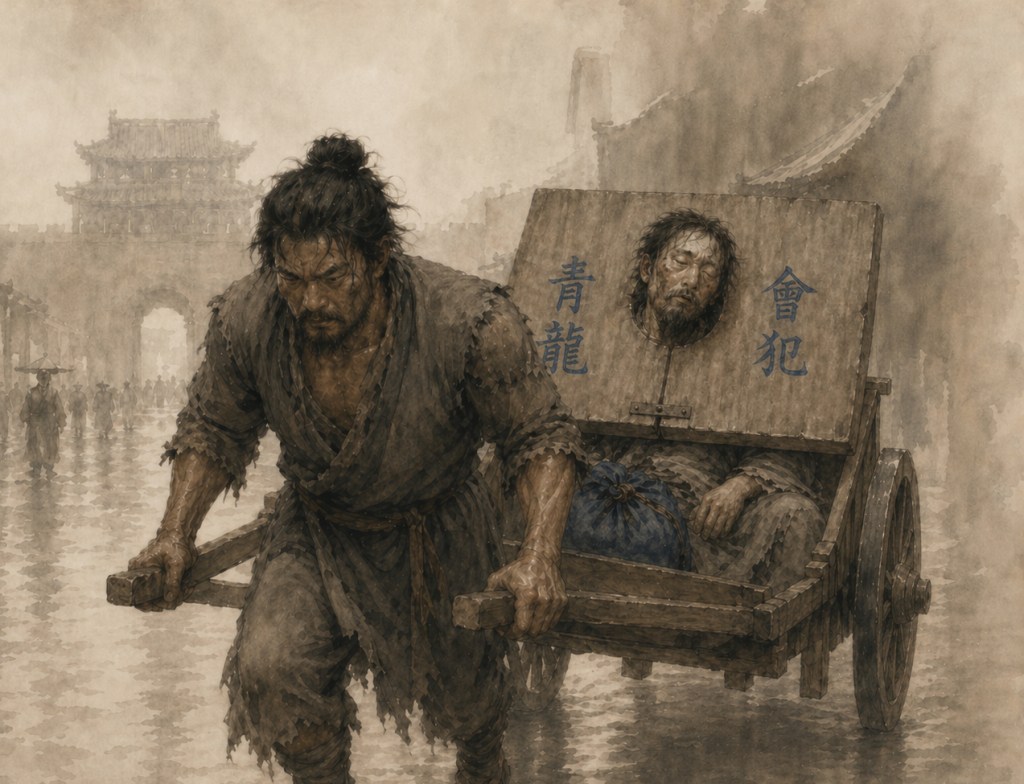
Yet if one strains very hard, a horizon is observed – a wooden horizon, if you please – and there is writing upon that plain directly before his eyes. It speaks of crimes, in painted characters as dulled and forlorn as his mind has become, onto which one can now barely latch. The mind has retreated into a further, deeper corner of the darkness, where no more than a single ray of candlelight might faintly pierce. No self. No “him” to speak of, except poetically, personalizing and gendering the pronoun “it”; perhaps that will be enough. Make a note.
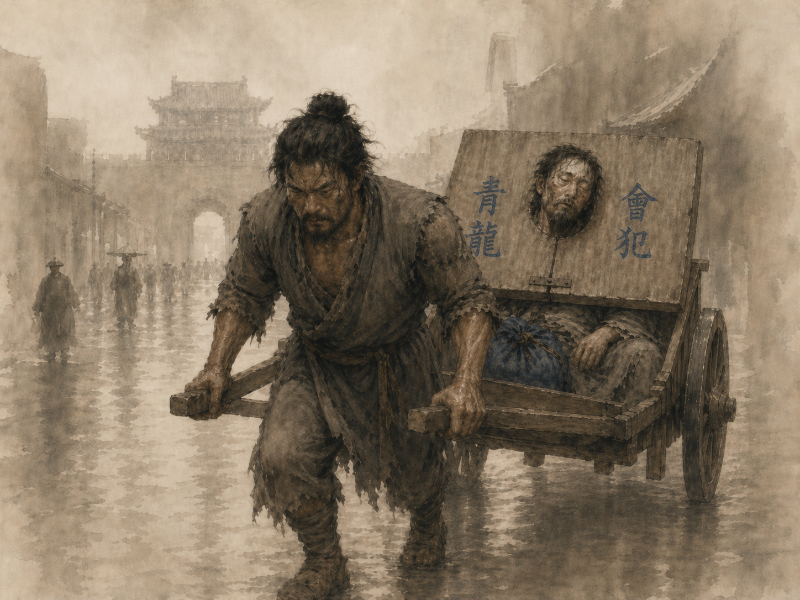
A most memorable road sign, “Ten miles to Fuzhou!”: a picturesque city, better known in earlier times as Ye; later, to the Tangs as Minzhou, the place where the mighty River Min flows, which is why the whole region of Fujian, lying up the coast from Guangdong, was then called just that: Min. But by Qing times it was Fuzhou. Informant’s present is ten years after the First Opium War with countries of the West; our region has been opened up to barbarian traders and missionaries. Back to his woeful state, his horizon – ah, his ruinous yoke. A cangue. Square collar made of boards, three feet by three, having a hole in the centre for the culprit’s neck, thus preventing him from reaching his mouth with his fingers. The crime for which he is punished by wearing this wooden collar, and the duration for which he is to wear it written in bold characters upon the upper or front side of it, and he is placed by the wayside to be fed or spat upon by the citizenry. Blue Dragon criminal. Cangue until death shall release.
Perhaps cross out. Consult the lower ledgers.
Blue Dragon Society: a minor fraternity of regional gangsters, late Qing, subsequently suppressed, of insignificant historical consequence.
Leave it in, it may mean something to someone.
Travelling slumped in the cart, he is propped up by this square hardwood cangue. But his heavy eyelids slide open to slits and he can read the road sign – Eureka! The so-called “Happy Region” of Fuzhou.
A shame he is unable to revel in the delights of the place, as the cart jolts along beside the River Min. It is as though the reality before him barely adheres to the surface of his mind – floating islands, vast bamboo rafts thick with soil, little houses and gardens adrift upon the water. But he sinks down; his tongue lolls. His eyes roll and the heavy eyelids droop to close once more.
The author – a missionary, of course – remarks upon the great sails the aquatic folk hoist when they choose to shift their colony, while men, women, and children labour at the oars below. What else would astonish him? Remove the barbarian Doolittle’s volume. These avaricious Christians have troubled the age quite sufficiently already – and never more so than in the period of our present visitation.
The old barrow clatters through a massive gateway into the walled city of Fuzhou, beneath the lofty sentry tower commanding the approach, among a throng of travellers on foot or in sedans, and coolies bearing produce and merchandise. Driver has bound himself by leather shoulder-harness to the single-wheeled luche or “deer cart”; its central, wobbly wheel groans on its axle as he strains to keep the thing upright through the narrow, filthy alleys. Some portly mandarin of moderate rank edges imperiously through the peasant mass. His sneering glance grazes the abject human cargo lashed to the vehicle and all but sliding off, one hand flapping insensibly against the frame: an amusing caricature of human sediment for the citizens to point at. Some giggle hysterically.
Such events are gainfully recorded, if for nothing more than the insight they impart as to the rudimentary functioning of particular bulkheads of Informant’s mind, which without them would be in peril of submerging entirely. Incidental perceptions such as the fat mandarin somehow join his recognition of the passing moment to those more profound airy labyrinths and subtle wordless channels through which he maintains his confluence with us, that inextricable foundation of his being. Other precincts of the mind, however, remain impenetrable to so feeble an inhabitation of the moment.
Driver has found a patch of dirt to claim as domicile; he releases his leather shoulder-strap, and leans his companion in a disused alcove, balanced relatively upright against the cart. Next day, the driver leaves his burden and goes in quest of scraps and coppers in payment for his services as an itinerant barber to an unnamed, unbearably hairy clientèle. On returning, he turns to the care of his passenger, coaxing him from his fits and trying to lure back some dim memory of humanity. He speaks of the magnificent banyan trees of Fuzhou, beneath whose drooping whiskers, swinging softly in the breeze, he rested during his daily sojourn. As though to a child, he recounts tales of an earlier, happier life, exhorting him to some sign of recognition. At length, he returns with some borrowed tools and proceeds to break the chains that tether the cangue around our informant’s neck. During the days that follow, he uses the sign nailed upon the yoke to restore in him some mysteries of the written word.
After some days Informant’s eyes clear noticeably, and Driver observes in them a fitful lucidity. Behind that clearing, broken moments from the opiate miasma begin to stir –
The Pit. Amid a smattering of flashes and grunts in the dark, unseen blows from heavy fists and sticks break him no more than required, and he is stripped of clothes and shoes. Let down into the Pit for schooling. It is the beginning. It is called manning the pumps. Growled words: pumps, sealed drums, blasted rats. Once inside, the water man flogs and binds him to a place on the chain-pump, in a line of others. Other water toads. Egress is by hauling. The shift is expired. The body will not work beyond this duration. Called freezing in the Pit. Haul out the toads. If it looks tired whip its back. Repeat.
The Sealed Drum. Damp earthen cubicles x feet by x, from where to where. Drag the living water toads through the stockade entrance. Good when moonlight. Bad when sun. Good when the moonlight seeps in to brighten things up. Bad when the sun, which burns a hole through to the brain. The ray of moonlight waxes and wanes. A toad cannot tell whether it is awake or asleep. The moonlight waxes and wanes in its sleep as well. There is space to writhe from somewhere to where. One by one the toads awaken and vermiculate across the bottom in quest of food. They cannot tell food from the other matter, before or after ingesting. It all goes down the same and comes back up the same. At first the toads converse. Called chatting. But after enough passages between the Pit and the Sealed Drum, they aspire only to slip and wriggle like maggots. Called adventuring.
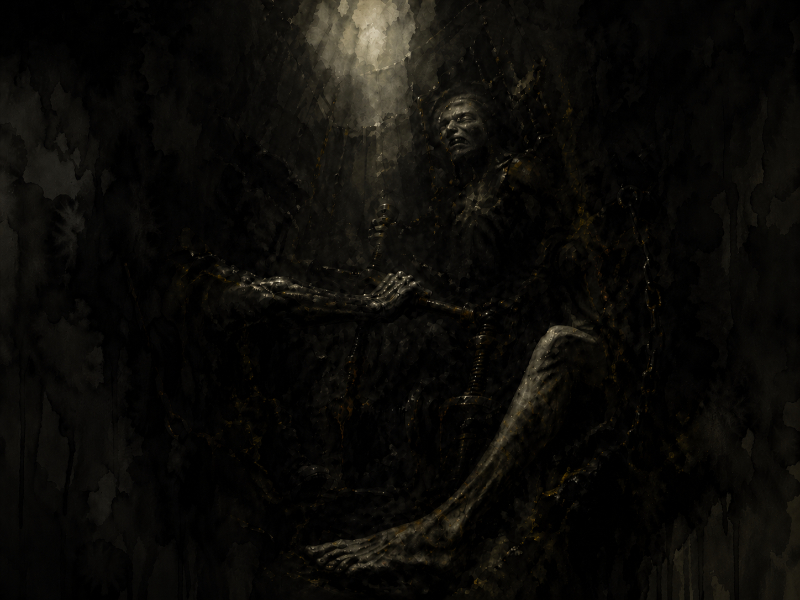
Inside the Pit again. The pump clitter-clacks. Clitter-clack, clitter-clack. Sometimes it sticks and Water Man curses. Rust, or a finger or toe cut off and stuck in the joint. No exploration allowed in the Pit. It is a place for meditation on pain and lessening. Lessen the suffering, lessen the lack. No exact word for escape. If it veers from the way to the Sealed Drum, slash its feet for it.
Called Pension Rice. These ones still living are left in the Sealed Drum for the off-season. Springtime. For a while they luxuriate in the sodden dark. Chat, vermiculate, adventure. But in the Drum life soon becomes indistinguishable from death, and they languish for more pumping; oh to live again.
Whistling, as he used to, of the broken twigs in the grove, our wandering barber rounded a corner and slouched wearily along their narrow market alley, scarcely wide enough to admit two abreast. It was the usual late-afternoon scene, the day’s energy having somewhat dissipated, along with the stream of pedestrians pursuing their sundry ends. A travelling doctor, who had arrived early that morning to harangue the multitude on the powers and virtues of his medicines, was crouched over his case, repacking small bottles. Driver paused among a group of stragglers loosely gathered to watch a soothsayer ply his trade; seated vis-à-vis on little stools and earnestly consulting one of the books laid out between them, the charlatan expounded to the awe-stricken simpleton the lineaments of his destiny.
Pip-pip-pip!
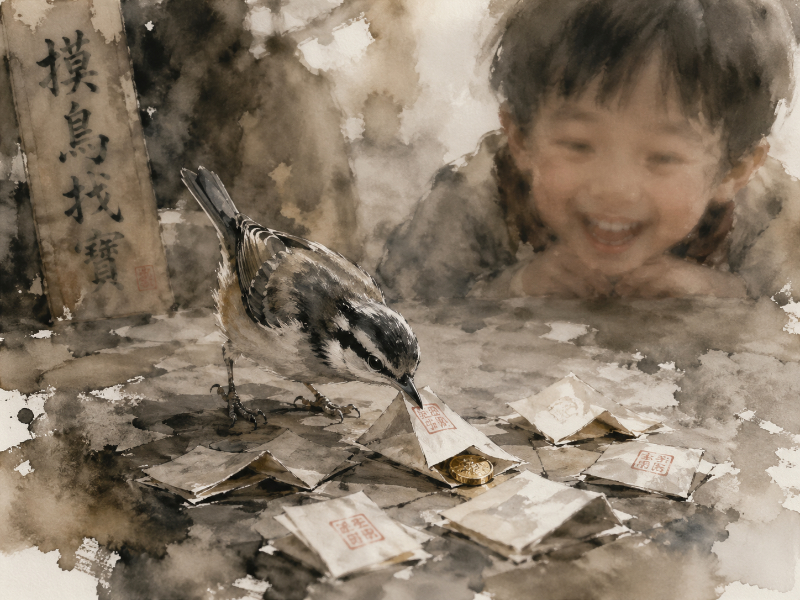
Closing his business early, the haberdasher was sliding his night-boards into their grooves. A cluster of children were down on their haunches before the shop, squealing at the clever feats of a few tiny birds hopping and pip-pipping amongst a pile of paper slips. The trainer had set them to singling out the slip enclosing a coin, rewarding them with grains of millet for their cleverness. A little farther along, at the Good Fortune fruit stall, a couple of women made their purchases, casting lots for the quantity they were to receive.
Approaching the alcove, he could not clearly see his charge, who was screened by rhythmically scuffling legs draped in tatters. A row of blind beggars, eight or ten, crowding into the doorway of the wine shop opposite, each with his hand on the shoulder of the comrade before him.
Aaaiyaa… aaaiyaa… They intoned their dirge, punctuated by a clack-clack from two pieces of wood struck together. Some minutes passed, before the shopman’s unmistakable weary moan of complaint was heard through the door, signifying that a copper cash had changed hands. Then the beggars who had managed to fit inside shuffled out again into the alley, and the group recommenced their performance, filing on towards their next stop, their dirge echoing behind them.
A ghost of a smile lingered on Informant’s face and a faint spark lit his eyes as he sat watching them, propped against his broken cangue.
“They’re a bit late today,” said Driver smiling, as he lowered himself to the ground beside his companion. Informant gave an uncharacteristic start, as he turned his head and their eyes met. “Mow Fung?” said Driver gently.
Informant turned back to watch the receding line of beggars, inclined his head, and made a slight frown.
“That last Aaaiyaa is not quite right,” he said slowly. “The tune should resolve into Yu – the sound of winter and grief” – he searched for words, “… but one of the beggars pulls it up to the tone of Zhi at the fifth degree. That is not a tone of grief, but one of …” turning to his driver “… summer.” He frowned and their eyes locked again.
The two sat silently for several minutes, as the informant explored a suddenly illumined zone of his mind. Then he spoke deliberately, gathering pace.
“There is a warmth inconsistent with mourning.” A puzzled look came over his face, and his eyes turned up as he scrutinized a part of his brain. The sound of the beggars echoed down the alley. “Yes, there it is again, quite … arresting. It evokes the hexagram Shih Ho, Biting Through, because that tone of Zhi doesn’t belong but it can’t be removed – like something stuck between the teeth. I was here asleep when the beggars roused me with their singing. I felt I had to clarify that mistake. But now I can see it’s not that singer’s error, but rather more a cosmic intrusion …”
The driver could not help laughing. “You’re back.”
Mow Fung was getting excited. “That’s it! Zhi, the fifth degree, is the fire-tone – the south, the summer. The heart-viscus. The tone of Shen: spirit and the animating fire of consciousness.”
“So in your sleep, you bit through it,” said Driver gently. Mow Fung turned to him and their eyes locked.
“Wang!” said Mow Fung. “I thought it was you. We must go to the South.”
Their descent by the majestic River Min through the coastal hills to the Pagoda Anchorage was uneventful enough. There Wang found passage on a coastal junk which, laden with hardware and kerosene for Guangzhou, bore them south-westward along the coast towards the Pearl River Delta. He passed the master two Mexican dollars, a sought-after currency those days and enough to keep them in rice for the voyage.
“Pretty good for a travelling barber,” Mow Fung said.
“Don’t worry,” his friend replied. “I’ve got a bit stashed here and there. Nothing too troublesome. I’ve been adventuring for these past couple of years, you know, and even made a bit of a name for myself as hired muscle. Those monks up on the mountain taught me a thing or two, I can tell you. Most of all, I’ve learned to keep it to myself.”
“Wang the Meek,” said Mow Fung with a half-smile, as his eyes slid upward and he dozed. In their corner among the cargo down below, the drumming of waves under the hull, and the creak of timbers and bulkheads shifting, seeped into his sleep, taking him ever deeper. Wang made his way up to the deck for some air. He drew from his sleeve his battered stub of a tobacco pipe and lit it. Above in the dark, a brief gust set the sails slapping. He could still make out the coast, the Wuyi ranges dark against the purplish sky, pricked with stars, and an occasional light from some dwelling. The smell of tar rose from the hull, and he leaned there ruminating on his pirate days.
In the morning the two went on deck, were allowed a place in the bows, with some pieces of heavy sailcloth for comfort, and told roughly to keep out of the way.
“Mind that boom when you rise,” the sailor said as he strode off.
“I dreamed of wearing the cangue,” said Mow Fung. “And before that – what was The Blue Dragon?”
Wang glanced at him. “They were the ones that ran the mine where you found yourself trapped as a water-toad. When they thought you dead, they threw you into a cave where they disposed of their victims; but you must have passed into one of your living-death states or another.”
He stopped as a pair of cormorants with outstretched necks swooped over the bow, wheeling down toward the water.
“So when the yamen runners broke up the gang and found you there, and dragged you to the magistrate as evidence, he wasn’t sure whether you weren’t a Blue Dragon yourself, in hiding. I must say, you didn’t help matters much by raving on deliriously about the Tao, because that magistrate happens to take a dim view of Taoists in any case. So, to be safe, he cangued you till death should settle the question. That is what the bailiff in charge of you told me, anyhow, when I bribed him to hand you over. I hauled you all the way to Fuzhou in a hurry, in case the magistrate, a whimsical type, decided to shorten your days.”
Something on the coast caught his eye. “See that burnt-out stretch, between the headland and that watchtower,” he said. “Red Turban work, maybe. Or one of the brotherhoods. Compared to these parts, Fuzhou is a haven – a bit boring actually. Glad to be gone.” He went off to the galley and came back with two wooden bowls of lukewarm congee.
“Prefer salted fish scraps or a pickled radish?”
“Hi, you pair! Out of the way of that line,” came a shout followed by a curse, and the two crouched and shuffled a few feet across, Wang juggling the bowls. The junk steered a little further out to sea, to where the breeze picked up a little. The sails billowed and the vessel bore along the southward curve of the coastline. Mow Fung rested throughout the day. Once in a while Wang moved to a sheltered spot at the rail and stood alert, his eyes roving between the coast and the horizon.
By night they went back to their corner in the hold, the air now thick with fumes from the kerosene kegs. Nevertheless, Mow Fung was growing steadily stronger, occupying to a greater degree his proper time and space. His corporeal self.
On the fifth morning, a hubbub above deck drew them up. A quarter of a mile astern, another vessel appeared to be bearing down on them, nearing by the minute, causing much consternation among a few of the crew, who had grouped together near the stern, half-hidden behind a stack of cargo.
“Don’t recognize them from the anchorage – must be from further along the coast! Pirates maybe,” said one. Squinting, Wang took a good look, then said quietly, “Nothing to worry about: not pirates, too impatient. They’d more likely cosy up nice and easy-like, not to scare us off. With that big sail and skinny hull, I’d say she’s most likely a dispatch junk. Maybe some Red Turban trouble up north a bit.”
The master called out to the group of green sailors to stop being idiots and get back to work, and a few minutes later the dispatch overtook them.
The only other disturbance was some fighting on shore, barely visible through the haze: smoke rose from beyond the headland and men scattered like insects along the ridge. Alerted by the distant crackle of muskets, Wang watched for a while from the rail.
“Militia and society men,” he said. “Hard to tell which is which from here. There’s a lot of interesting stuff happening these days, that’s for sure.”
Entering the Pearl River Delta, the master shouted orders to his underlings, who trimmed the sails as the junk turned toward the northwest and slipped past Hong Kong. The White Ensign showed on several British naval ships at anchor, sails furled. Macao was hazily visible afar from the port side, its anchored vessels tiny specks. The junk veered deeper into the main channel of the delta, and the master refined his orders as he prepared to thread his way through the vast array of craft now appearing, and sought the channels that would take them up the Pearl towards Guangzhou.
From the draft novel Stawell Bardo © Michael Guest 2026


Leave a Reply