Tag: Chinese diaspora

  • Yoke of Fuzhou

    Yoke of Fuzhou

    These blasted brushes have their bristles falling out into the ink, and where the devil is the new consignment of butterfly scrolls? No, stop, it doesn’t bear transcribing all this, you nitwit, it will only have to be crossed out later. And just as we were broaching a significant point in the temporal flow: the departure of our invaluable Informant from the true path; in fact, he appears to be rather on the point of abject existential dissolution. I may only imagine how he wandered in such a wretched and deluded condition, through the bamboo forests and down the sides of our holy mountains, to lose himself further in the delusory lowlands of the masses, hither and thither, absorbed deep and deeper into the miasma.

    Yet if one strains very hard, a horizon is observed – a wooden horizon, if you please – and there is writing upon that plain directly before his eyes. It speaks of crimes, in painted characters as dulled and forlorn as his mind has become, onto which one can now barely latch. The mind has retreated into a further, deeper corner of the darkness, where no more than a single ray of candlelight might faintly pierce. No self. No “him” to speak of, except poetically, personalizing and gendering the pronoun “it”; perhaps that will be enough. Make a note.

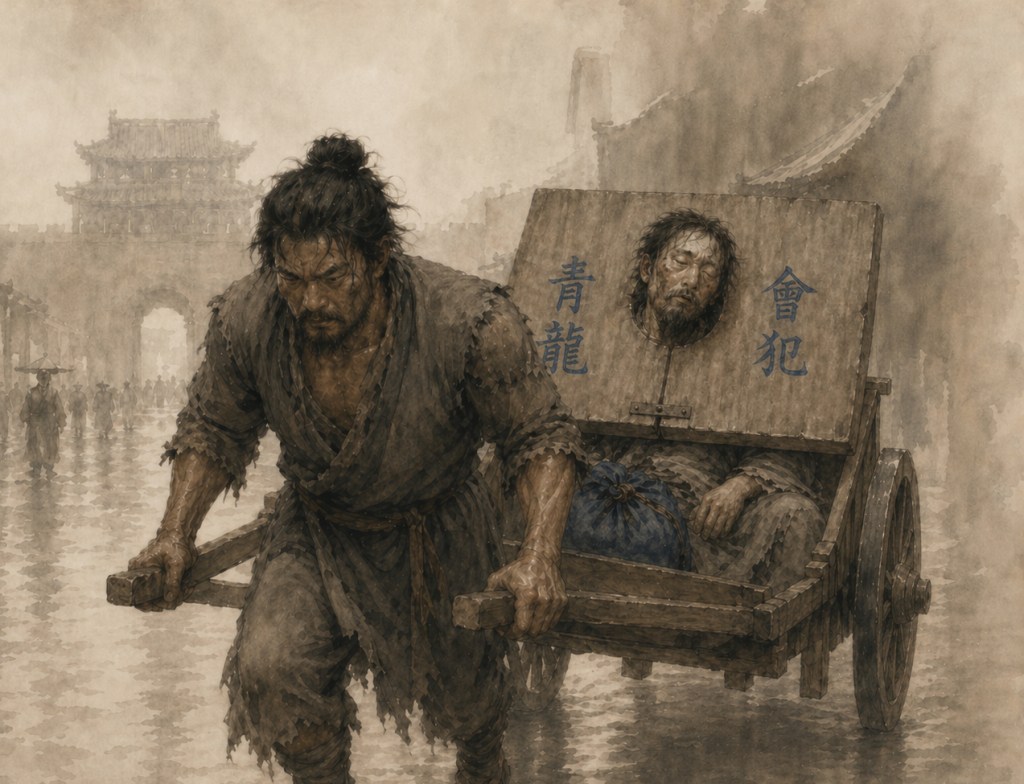
    A most memorable road sign, “Ten miles to Fuzhou!”: a picturesque city, better known in earlier times as Ye; later, to the Tangs as Minzhou, the place where the mighty River Min flows, which is why the whole region of Fujian, lying up the coast from Guangdong, was then called just that: Min. But by Qing times it was Fuzhou. Informant’s present is ten years after the First Opium War with countries of the West; our region has been opened up to barbarian traders and missionaries. Back to his woeful state, his horizon – ah, his ruinous yoke. A cangue. Square collar made of boards, three feet by three, having a hole in the centre for the culprit’s neck, thus preventing him from reaching his mouth with his fingers. The crime for which he is punished by wearing this wooden collar, and the duration for which he is to wear it written in bold characters upon the upper or front side of it, and he is placed by the wayside to be fed or spat upon by the citizenry. Blue Dragon criminal. Cangue until death shall release.

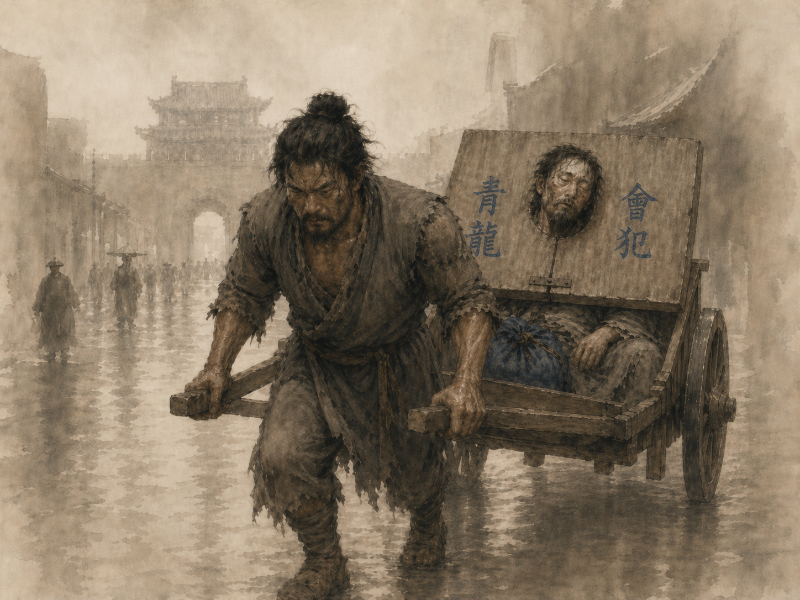
    Manhauling a cart through a narrow street, carrying an exhausted passenger slumped beneath a large wooden cangue.

    Perhaps cross out. Consult the lower ledgers.

    Blue Dragon Society: a minor fraternity of regional gangsters, late Qing, subsequently suppressed, of insignificant historical consequence.

    Leave it in, it may mean something to someone.

    Travelling slumped in the cart, he is propped up by this square hardwood cangue. But his heavy eyelids slide open to slits and he can read the road sign – Eureka! The so-called “Happy Region” of Fuzhou.

    A shame he is unable to revel in the delights of the place, as the cart jolts along beside the River Min. It is as though the reality before him barely adheres to the surface of his mind – floating islands, vast bamboo rafts thick with soil, little houses and gardens adrift upon the water. But he sinks down; his tongue lolls. His eyes roll and the heavy eyelids droop to close once more.

    The author – a missionary, of course – remarks upon the great sails the aquatic folk hoist when they choose to shift their colony, while men, women, and children labour at the oars below. What else would astonish him? Remove the barbarian Doolittle’s volume. These avaricious Christians have troubled the age quite sufficiently already – and never more so than in the period of our present visitation.

    The old barrow clatters through a massive gateway into the walled city of Fuzhou, beneath the lofty sentry tower commanding the approach, among a throng of travellers on foot or in sedans, and coolies bearing produce and merchandise. Driver has bound himself by leather shoulder-harness to the single-wheeled luche or “deer cart”; its central, wobbly wheel groans on its axle as he strains to keep the thing upright through the narrow, filthy alleys. Some portly mandarin of moderate rank edges imperiously through the peasant mass. His sneering glance grazes the abject human cargo lashed to the vehicle and all but sliding off, one hand flapping insensibly against the frame: an amusing caricature of human sediment for the citizens to point at. Some giggle hysterically.

    Such events are gainfully recorded, if for nothing more than the insight they impart as to the rudimentary functioning of particular bulkheads of Informant’s mind, which without them would be in peril of submerging entirely. Incidental perceptions such as the fat mandarin somehow join his recognition of the passing moment to those more profound airy labyrinths and subtle wordless channels through which he maintains his confluence with us, that inextricable foundation of his being. Other precincts of the mind, however, remain impenetrable to so feeble an inhabitation of the moment.

    Driver has found a patch of dirt to claim as domicile; he releases his leather shoulder-strap, and leans his companion in a disused alcove, balanced relatively upright against the cart. Next day, the driver leaves his burden and goes in quest of scraps and coppers in payment for his services as an itinerant barber to an unnamed, unbearably hairy clientèle. On returning, he turns to the care of his passenger, coaxing him from his fits and trying to lure back some dim memory of humanity. He speaks of the magnificent banyan trees of Fuzhou, beneath whose drooping whiskers, swinging softly in the breeze, he rested during his daily sojourn. As though to a child, he recounts tales of an earlier, happier life, exhorting him to some sign of recognition. At length, he returns with some borrowed tools and proceeds to break the chains that tether the cangue around our informant’s neck. During the days that follow, he uses the sign nailed upon the yoke to restore in him some mysteries of the written word.

    After some days Informant’s eyes clear noticeably, and Driver observes in them a fitful lucidity. Behind that clearing, broken moments from the opiate miasma begin to stir –

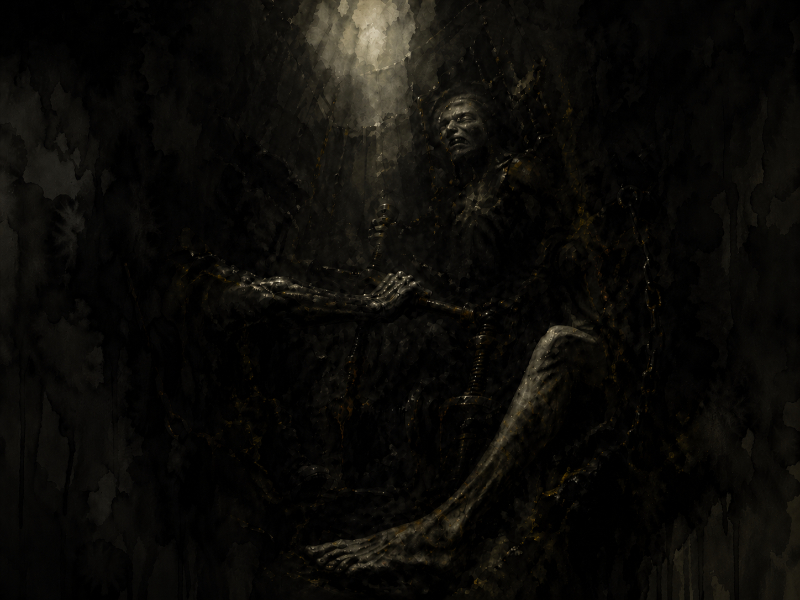
    The Pit. Amid a smattering of flashes and grunts in the dark, unseen blows from heavy fists and sticks break him no more than required, and he is stripped of clothes and shoes. Let down into the Pit for schooling. It is the beginning. It is called manning the pumps. Growled words: pumps, sealed drums, blasted rats. Once inside, the water man flogs and binds him to a place on the chain-pump, in a line of others. Other water toads. Egress is by hauling. The shift is expired. The body will not work beyond this duration. Called freezing in the Pit. Haul out the toads. If it looks tired whip its back. Repeat.

    The Sealed Drum. Damp earthen cubicles x feet by x, from where to where. Drag the living water toads through the stockade entrance. Good when moonlight. Bad when sun. Good when the moonlight seeps in to brighten things up. Bad when the sun, which burns a hole through to the brain. The ray of moonlight waxes and wanes. A toad cannot tell whether it is awake or asleep. The moonlight waxes and wanes in its sleep as well. There is space to writhe from somewhere to where. One by one the toads awaken and vermiculate across the bottom in quest of food. They cannot tell food from the other matter, before or after ingesting. It all goes down the same and comes back up the same. At first the toads converse. Called chatting. But after enough passages between the Pit and the Sealed Drum, they aspire only to slip and wriggle like maggots. Called adventuring.

    Emaciated pit worker bound to a chain-pump in a dark mine shaft, half-submerged and reduced to a “water toad” by brutal labour.

    Inside the Pit again. The pump clitter-clacks. Clitter-clack, clitter-clack. Sometimes it sticks and Water Man curses. Rust, or a finger or toe cut off and stuck in the joint. No exploration allowed in the Pit. It is a place for meditation on pain and lessening. Lessen the suffering, lessen the lack. No exact word for escape. If it veers from the way to the Sealed Drum, slash its feet for it.

    Called Pension Rice. These ones still living are left in the Sealed Drum for the off-season. Springtime. For a while they luxuriate in the sodden dark. Chat, vermiculate, adventure. But in the Drum life soon becomes indistinguishable from death, and they languish for more pumping; oh to live again.

    Whistling, as he used to, of the broken twigs in the grove, our wandering barber rounded a corner and slouched wearily along their narrow market alley, scarcely wide enough to admit two abreast. It was the usual late-afternoon scene, the day’s energy having somewhat dissipated, along with the stream of pedestrians pursuing their sundry ends. A travelling doctor, who had arrived early that morning to harangue the multitude on the powers and virtues of his medicines, was crouched over his case, repacking small bottles. Driver paused among a group of stragglers loosely gathered to watch a soothsayer ply his trade; seated vis-à-vis on little stools and earnestly consulting one of the books laid out between them, the charlatan expounded to the awe-stricken simpleton the lineaments of his destiny.

    Pip-pip-pip!

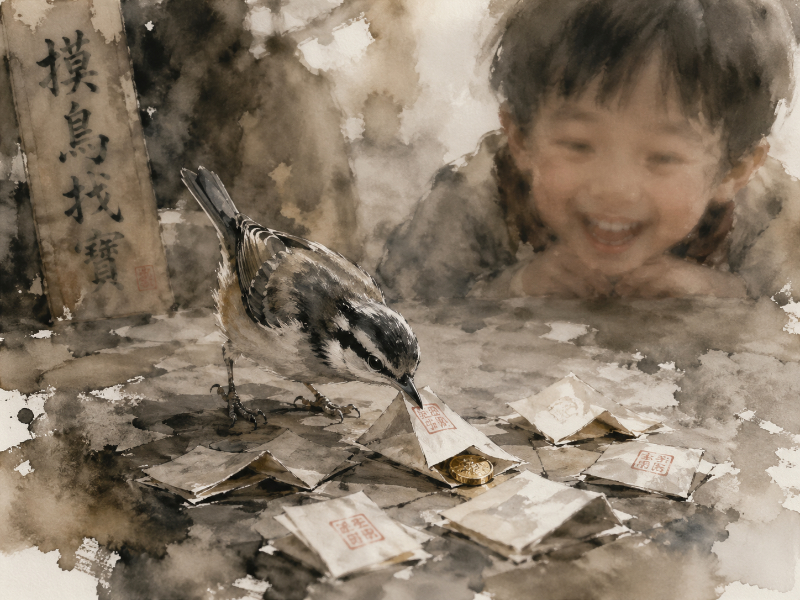
    Closing his business early, the haberdasher was sliding his night-boards into their grooves. A cluster of children were down on their haunches before the shop, squealing at the clever feats of a few tiny birds hopping and pip-pipping amongst a pile of paper slips. The trainer had set them to singling out the slip enclosing a coin, rewarding them with grains of millet for their cleverness. A little farther along, at the Good Fortune fruit stall, a couple of women made their purchases, casting lots for the quantity they were to receive.

    Little boy crouching beside a street trainer’s tiny birds as one picks from a heap the paper slip hiding a coin.

    Approaching the alcove, he could not clearly see his charge, who was screened by rhythmically scuffling legs draped in tatters. A row of blind beggars, eight or ten, crowding into the doorway of the wine shop opposite, each with his hand on the shoulder of the comrade before him.

    Aaaiyaa… aaaiyaa… They intoned their dirge, punctuated by a clack-clack from two pieces of wood struck together. Some minutes passed, before the shopman’s unmistakable weary moan of complaint was heard through the door, signifying that a copper cash had changed hands. Then the beggars who had managed to fit inside shuffled out again into the alley, and the group recommenced their performance, filing on towards their next stop, their dirge echoing behind them.

    A ghost of a smile lingered on Informant’s face and a faint spark lit his eyes as he sat watching them, propped against his broken cangue.

    “They’re a bit late today,” said Driver smiling, as he lowered himself to the ground beside his companion. Informant gave an uncharacteristic start, as he turned his head and their eyes met. “Mow Fung?” said Driver gently.

    Informant turned back to watch the receding line of beggars, inclined his head, and made a slight frown.

    “That last Aaaiyaa is not quite right,” he said slowly. “The tune should resolve into Yu – the sound of winter and grief” – he searched for words, “… but one of the beggars pulls it up to the tone of Zhi at the fifth degree. That is not a tone of grief, but one of …” turning to his driver “… summer.” He frowned and their eyes locked again.

    The two sat silently for several minutes, as the informant explored a suddenly illumined zone of his mind. Then he spoke deliberately, gathering pace.

    “There is a warmth inconsistent with mourning.” A puzzled look came over his face, and his eyes turned up as he scrutinized a part of his brain. The sound of the beggars echoed down the alley. “Yes, there it is again, quite … arresting. It evokes the hexagram Shih Ho, Biting Through, because that tone of Zhi doesn’t belong but it can’t be removed – like something stuck between the teeth. I was here asleep when the beggars roused me with their singing. I felt I had to clarify that mistake. But now I can see it’s not that singer’s error, but rather more a cosmic intrusion …”

    The driver could not help laughing. “You’re back.”

    Mow Fung was getting excited. “That’s it! Zhi, the fifth degree, is the fire-tone – the south, the summer. The heart-viscus. The tone of Shen: spirit and the animating fire of consciousness.”

    “So in your sleep, you bit through it,” said Driver gently. Mow Fung turned to him and their eyes locked.

    “Wang!” said Mow Fung. “I thought it was you. We must go to the South.”

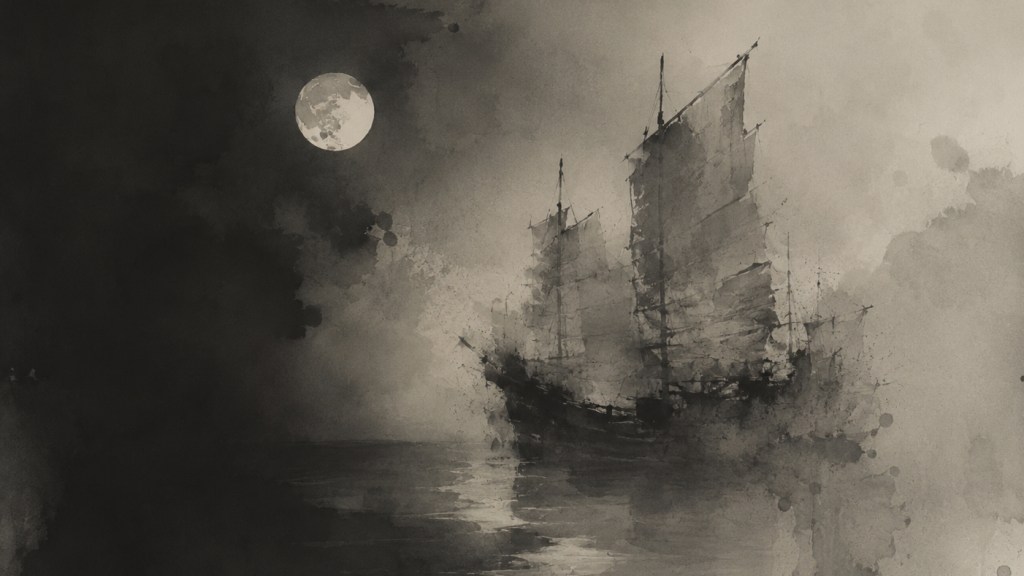
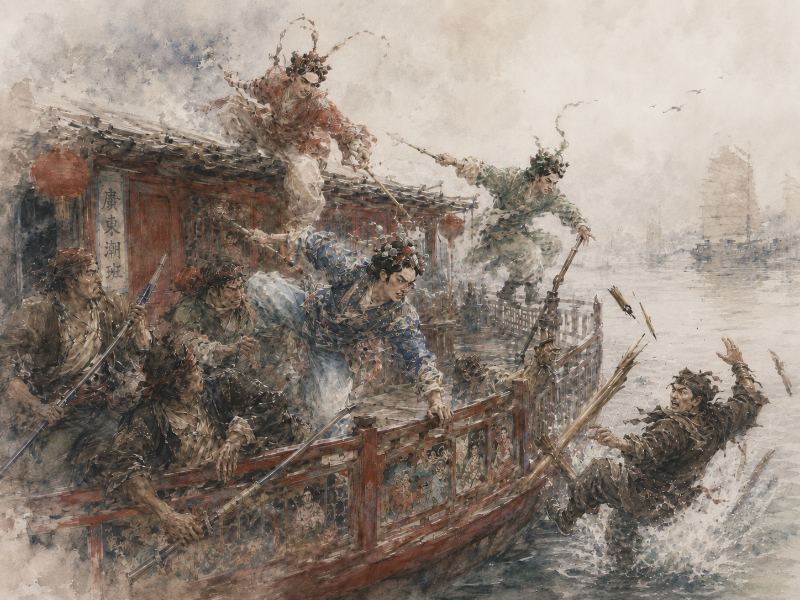
    Their descent by the majestic River Min through the coastal hills to the Pagoda Anchorage was uneventful enough. There Wang found passage on a coastal junk which, laden with hardware and kerosene for Guangzhou, bore them south-westward along the coast towards the Pearl River Delta. He passed the master two Mexican dollars, a sought-after currency those days and enough to keep them in rice for the voyage.

    “Pretty good for a travelling barber,” Mow Fung said.

    “Don’t worry,” his friend replied. “I’ve got a bit stashed here and there. Nothing too troublesome. I’ve been adventuring for these past couple of years, you know, and even made a bit of a name for myself as hired muscle. Those monks up on the mountain taught me a thing or two, I can tell you. Most of all, I’ve learned to keep it to myself.”

    “Wang the Meek,” said Mow Fung with a half-smile, as his eyes slid upward and he dozed. In their corner among the cargo down below, the drumming of waves under the hull, and the creak of timbers and bulkheads shifting, seeped into his sleep, taking him ever deeper. Wang made his way up to the deck for some air. He drew from his sleeve his battered stub of a tobacco pipe and lit it. Above in the dark, a brief gust set the sails slapping. He could still make out the coast, the Wuyi ranges dark against the purplish sky, pricked with stars, and an occasional light from some dwelling. The smell of tar rose from the hull, and he leaned there ruminating on his pirate days.

    In the morning the two went on deck, were allowed a place in the bows, with some pieces of heavy sailcloth for comfort, and told roughly to keep out of the way.

    “Mind that boom when you rise,” the sailor said as he strode off.

    “I dreamed of wearing the cangue,” said Mow Fung. “And before that – what was The Blue Dragon?”

    Wang glanced at him. “They were the ones that ran the mine where you found yourself trapped as a water-toad. When they thought you dead, they threw you into a cave where they disposed of their victims; but you must have passed into one of your living-death states or another.”

    He stopped as a pair of cormorants with outstretched necks swooped over the bow, wheeling down toward the water.

    “So when the yamen runners broke up the gang and found you there, and dragged you to the magistrate as evidence, he wasn’t sure whether you weren’t a Blue Dragon yourself, in hiding. I must say, you didn’t help matters much by raving on deliriously about the Tao, because that magistrate happens to take a dim view of Taoists in any case. So, to be safe, he cangued you till death should settle the question. That is what the bailiff in charge of you told me, anyhow, when I bribed him to hand you over. I hauled you all the way to Fuzhou in a hurry, in case the magistrate, a whimsical type, decided to shorten your days.”

    Something on the coast caught his eye. “See that burnt-out stretch, between the headland and that watchtower,” he said. “Red Turban work, maybe. Or one of the brotherhoods. Compared to these parts, Fuzhou is a haven – a bit boring actually. Glad to be gone.” He went off to the galley and came back with two wooden bowls of lukewarm congee.

    “Prefer salted fish scraps or a pickled radish?”

    “Hi, you pair! Out of the way of that line,” came a shout followed by a curse, and the two crouched and shuffled a few feet across, Wang juggling the bowls. The junk steered a little further out to sea, to where the breeze picked up a little. The sails billowed and the vessel bore along the southward curve of the coastline. Mow Fung rested throughout the day. Once in a while Wang moved to a sheltered spot at the rail and stood alert, his eyes roving between the coast and the horizon.

    By night they went back to their corner in the hold, the air now thick with fumes from the kerosene kegs. Nevertheless, Mow Fung was growing steadily stronger, occupying to a greater degree his proper time and space. His corporeal self.

    On the fifth morning, a hubbub above deck drew them up. A quarter of a mile astern, another vessel appeared to be bearing down on them, nearing by the minute, causing much consternation among a few of the crew, who had grouped together near the stern, half-hidden behind a stack of cargo.

    “Don’t recognize them from the anchorage – must be from further along the coast! Pirates maybe,” said one. Squinting, Wang took a good look, then said quietly, “Nothing to worry about: not pirates, too impatient. They’d more likely cosy up nice and easy-like, not to scare us off. With that big sail and skinny hull, I’d say she’s most likely a dispatch junk. Maybe some Red Turban trouble up north a bit.”

    The master called out to the group of green sailors to stop being idiots and get back to work, and a few minutes later the dispatch overtook them.

    The only other disturbance was some fighting on shore, barely visible through the haze: smoke rose from beyond the headland and men scattered like insects along the ridge. Alerted by the distant crackle of muskets, Wang watched for a while from the rail.

    “Militia and society men,” he said. “Hard to tell which is which from here. There’s a lot of interesting stuff happening these days, that’s for sure.”

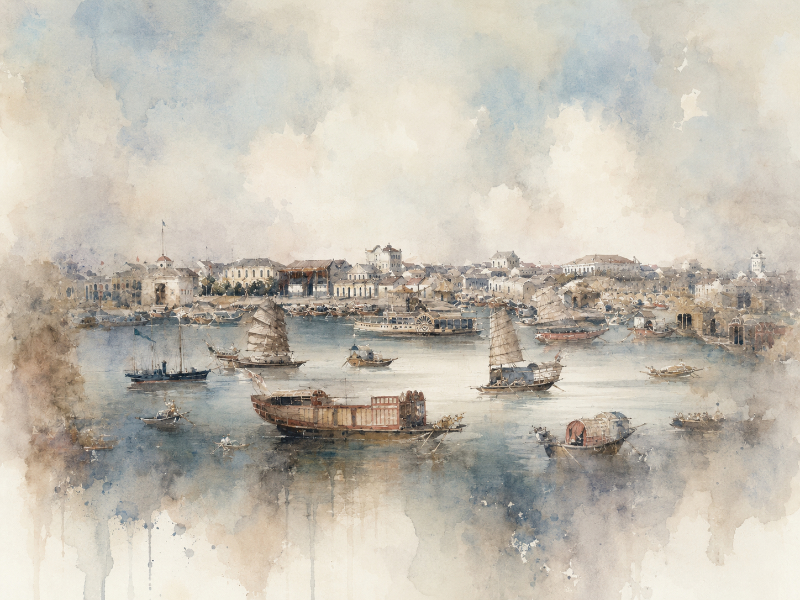
    Entering the Pearl River Delta, the master shouted orders to his underlings, who trimmed the sails as the junk turned toward the northwest and slipped past Hong Kong. The White Ensign showed on several British naval ships at anchor, sails furled. Macao was hazily visible afar from the port side, its anchored vessels tiny specks. The junk veered deeper into the main channel of the delta, and the master refined his orders as he prepared to thread his way through the vast array of craft now appearing, and sought the channels that would take them up the Pearl towards Guangzhou.


    From the draft novel Stawell Bardo © Michael Guest 2026
  • Dust of the Dragon’s Tail

    Dust of the Dragon’s Tail

    The fleeting glimpse he had gained of a young fair-haired woman through the half-opened doorway to the inner sanctum of the Jade Phoenix had nagged at the detective. Of late, Chinese camps were acquiring a reputation among certain of the Wimmera youth for the unwholesome diversions they afforded. Alluring as these places may have appeared to some of tender years, especially to the wayward and unchristian among them, they were commonly reckoned iniquitous dens.

    One sixteen-year-old girl undertook a week-long, hundred-and-forty-mile journey from her home at Ballan, only fifty miles out of Melbourne, in quest, so she said, of a situation at Horsham. Playing upon the compassion of publicans she visited along the way, she obtained overnight board and a shilling here and there to buy meals on the road. Her real destination turned out, after a circuitous detour, to be the house of a suspect European woman at the Deep Lead Chinese camp, where she took up quarters.

    Hearing news of her arrival, Constable Hillard went out to interview her and, disbelieving her story, gave her notice to quit. When she spun him more yarns, attempting to fob him off and contrive to remain, he brought her up on vagrancy before the Stawell bench. The magistrate discharged her after a sound admonition, and the next thing you know, off she went to live with a Chinese gardener at Doctor’s Creek. Not a week later, Hillard ferreted out a second one, not even sixteen, who deserted her family home for the camp, because, she explained, of her father’s cruelty and the lack of comforts at home.

    This same girl was already known to the police, having recently preferred a rather serious charge against a young man from Stawell, which he was to answer at the next General Sessions. There was something wrong in the state of Denmark, the magistrate informed Forster in writing, when girls such as these sought the association of a Chinese camp, proposing that if an example were made of those who harboured them there, it might prove a deterrent.

    Dark-eyed Miss Chan – Forster addressed her as such, for the woman’s unassailable poise checked in him any impulse he may have felt to assume the familiarity of ‘Lili’ – acknowledged, when he called on her the next day, that she had indeed engaged a young white woman as a waitress and housekeeper, and he was welcome to meet her; she was just now in the back garden feeding the chickens. This he did. No ragamuffin, but a strapping, jocular red-haired Irish colleen of nineteen she was, radiating goodwill and health, and obviously unsoiled by the demons of opium and rum.

    Perhaps, Forster reflected, the growing distaste for the Chinese immigrant as ignorant pagan and filthy barbarian had little basis beyond plain bigotry and the biased reporting of the newspapers. There was the old enmity of rival gold-miners, resulting in thuggery and atrocity at Buckland River, Lambing Flats, and as close by as Ararat itself, less than twenty years ago.

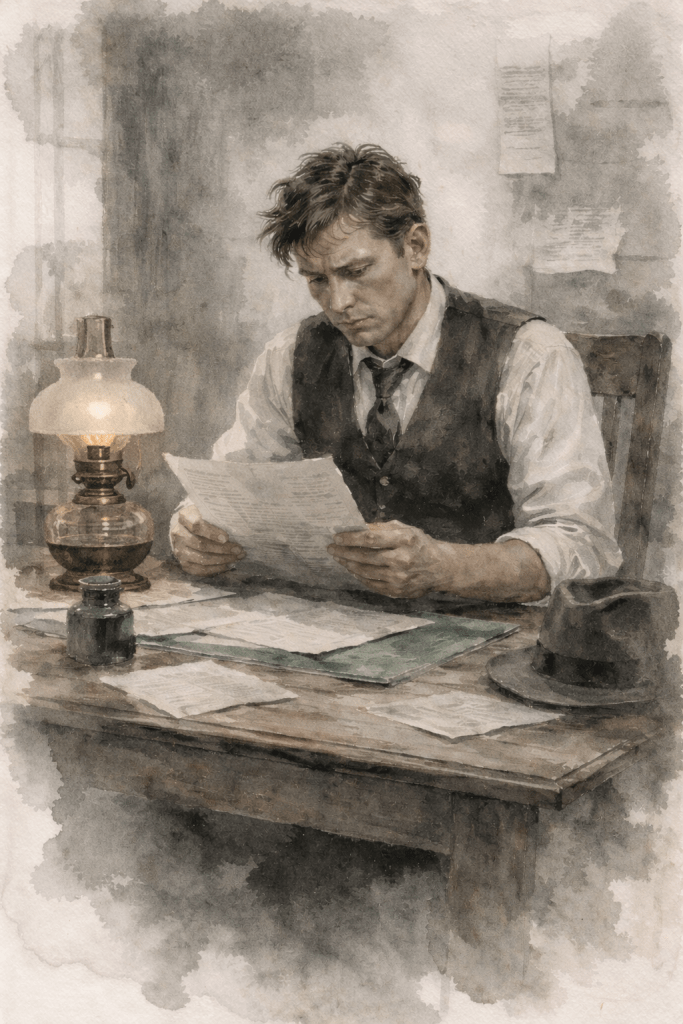
    Detective Forster sits alone at his desk in a modest 1880s bush office, leaning over papers in a dark coat and brimmed hat. An oil lamp and scattered documents rest on the desk, and the scene has a sombre, reflective mood.

    Disgruntled unionists were, he presumed, at the root of the more recent political pressure to exclude Chinese sailors and stokers from working on steamers trading to and about the Australian ports. Invariably cheerful and obliging Chinese fishmongers and hawkers of all sorts of useful wares had now become the targets of insult and violence from many working-class Australians, owing to a general animus against the Australian Steam Navigation Company, which had been hiring Chinese. Most unworthy of a great, free people. And what did this rabble know of China, a country they so despised? Most likely little, if anything, more than he did.

    If Lili Chan and his other new acquaintance, the mysterious Mow Fung – full of surprises he was, publican-cum-priest of some sort, evidently – were a measure, the Chinese had much to contribute to this country, and especially to a far-flung region like this. In idle moments, he found his thoughts wandering in their direction – and in Lili Chan’s, he cautioned himself, rather too often. He could entertain not the slightest likelihood that such a woman might have any possible interest in a crusty, ill-oiled bachelor such as he, even despite her situation, which was a morally tenuous one in the eyes of most. He could only wonder at what had brought her here, to the middle of nowhere, when clearly her talents and charms – that trace of a cultured American accent – would have fitted her for a rewarding position in Melbourne, at least. Enigma indeed. Her skin was of such a subdued olive hue, her features of such subtlety, that she might well pass for white, given the right circumstances and Western attire. Now, there he went, off again on mad imaginings …

    It was in the midst of reflecting on her features that he recalled having paused, some months earlier, on an item in the weekly Victorian Police Gazette – one that had caught his eye by departing from the usual notices concerning people wanted for questioning, prisoners discharged from gaol and the like. He retrieved the number from the bottom of a tea chest packed with old copies of the journal in a corner of the storeroom by the stables.

    “The whereabouts of a missing heiress are sought. The Cantonese woman, of Anglo-Chinese descent, has been traced from the United States, where she spent several years after leaving China, to the Colony. Information has come to light concerning her entitlement to a handsome fortune, of which she is not likely to be aware. Contact should be made with Chief Commissioner Chomley.”

    The memory of the notice clung to him. The next day he rode to the Jade Phoenix, and presently laid the gazette before Miss Chan. The proprietress looked up from the page and bathed the detective in the cool liquid of her unblinking gaze.

    “I was not aware, Sergeant, that you took such an interest in the minutiae of my appearance and background. Your detective’s training, no doubt. The innocent Miss Finnegan discovered in the employ of this humble if disreputable establishment – that speaks well for your skill. Are you ever able to separate yourself from your duties as a … copper?”

    Mincing by their armchairs just as her name was mentioned, the lusty Molly Finnegan, playing at saucy Irish soubrette, flourished her feather duster and made her exit.

    “Have you ever thought of entering the gambling line? Your attention to detail and, I suspect, your talent for handling disturbances would be invaluable,” Lili Chan said.

    “I dare say the references would prove difficult.”

    “On the contrary, Sergeant. In certain establishments, a good blow and a discreet silence recommend a man admirably.”

    “I suspect I should make a very poor ornament to such a profession.”

    “A poor ornament may still have his uses,” Lili said.

    She lowered her eyes to the gazette again. “In some houses, usefulness is the rarer quality.”

    He watched her a moment. “Miss Chan, does this notice mean anything to you?”

    “My origins are too humble, I fear, to promise any inheritance beyond poverty and woe; but if it will put your mind at ease, you may enquire with the Chief Commissioner on my behalf.” What harm, she reflected, could come of agreeing to so much, when to refuse would only raise suspicion.

    • • •

    “Where were we?” said the voice of Huish-Huish, accompanied by the gentle jangle of a consecrated shamanic rattle, amid the light aroma of incense.

    “I recall, the zither.”

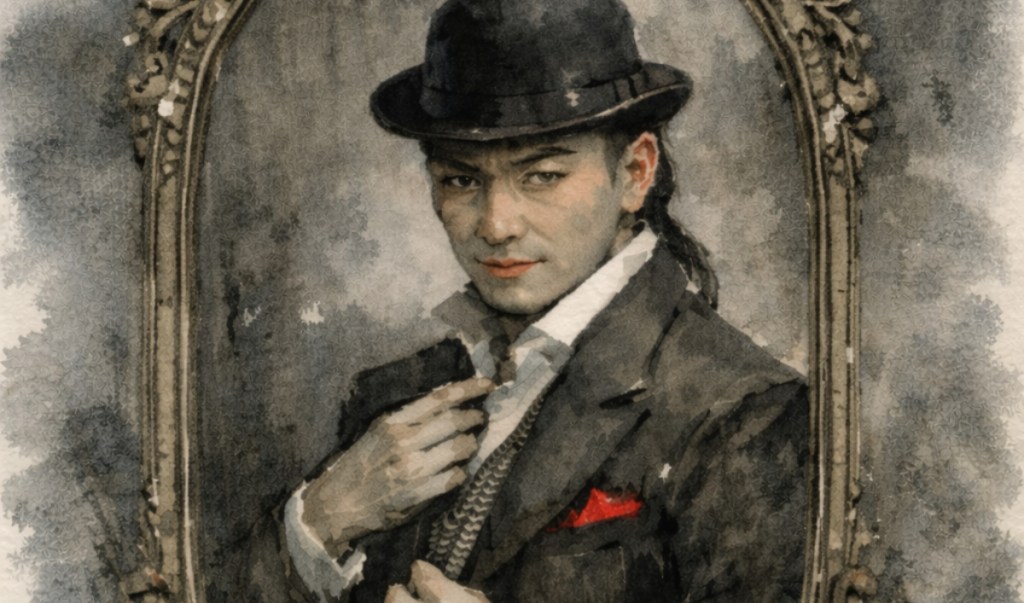
    After Fang Jing Dock’s tong began putting some serious pressure on Ah Toy, unassailable though she had been for the past twenty years, she sold up and moved to an undisclosed destination. With no choice in the matter, Chan Lee Lung became his mistress, and he moved in with her. It had been clear for some time that despite his dandyish affectations he was an enforcer – a so-called highbinder or hatchetman – for the Hing San Fong Tong, passing publicly under the name Society of the Mind Abiding in Tranquility and Freedom. Whenever he went out to conduct business of a certain kind, he would don chain mail beneath his dress shirt, tightly bind his queue up underneath his derby, to keep it from being seized in any rough stuff, and conceal his butterfly swords beneath the back of his jacket, all the while preening himself before his ornate mirror.

    One evening he and a henchman returned to the house with another Chinese man unknown to her. The three repaired to a room that Fang had commandeered as his music studio, where he also kept a small vault containing the most precious valuables of his tong: a handful of flawless diamonds of inestimable value. Before long the sound of Fang’s Viennese zither could be heard filtering out, a fantasia on Il Trovatore. She went to her bed and fell into a deep sleep, to be shaken awake by Fang.

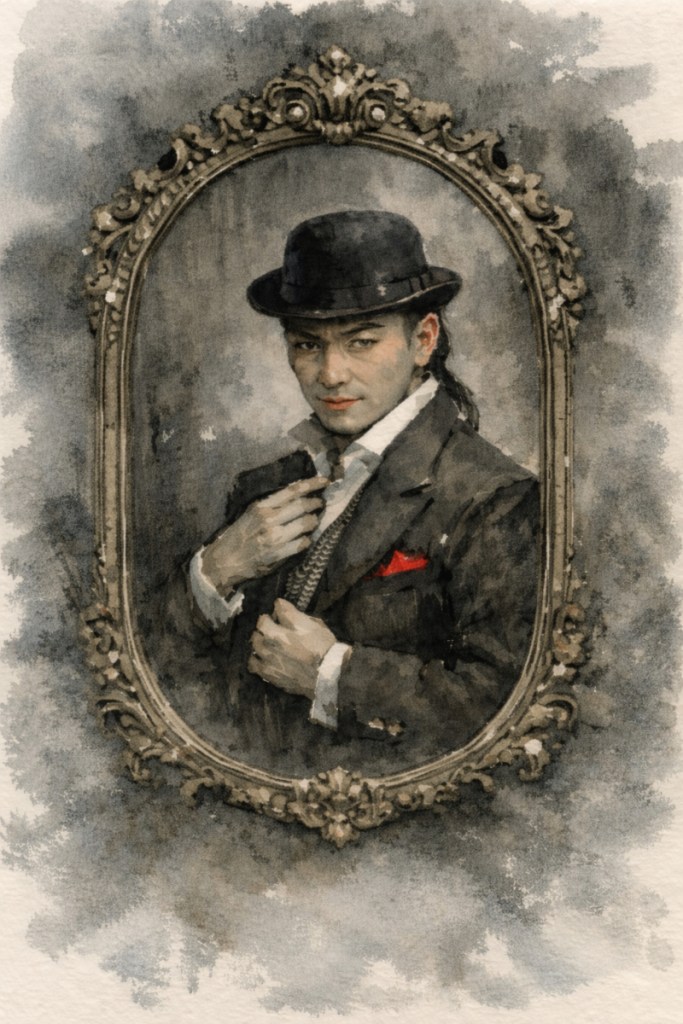
    The highbinder Fang wearing suit, derby, and barely concealed chainmail vest, preens himself in an ornate mirror, adjusting his appearance with deliberate care. The image is rendered in a watery, near-monochrome wash with a subtle red highlight, the reflected figure contained within the frame and the edges fading into abstraction.

    “Go and see what you think of the new centrepiece in the studio and tidy up a bit in there. Fat Louis and I have some business to discuss, then we’ll get things back in order.”

    The third man sat slumped sideways in a wicker chair, his sightless eyes bulging wide, his tongue lolling from the contorted blue face. Around the throat, biting deep into the flesh, was a garrote fashioned from a metal contrabass string, carving what looked like a raspberry-jam-filled rut. She sank silently onto a chair and took stock of her future, which was clearly what Fang had intended.

    When she entered the sitting room, Fang and Fat Louis were sipping pink champagne, and nibbling on Roquefort.

    “Nice tang,” Fat Louis said. “King of cheeses.”

    “Butyric acid caused by the fungus Penicillium roqueforti,” Fang said. “Legend has it that the cheese was discovered when a youth herding his sheep on Combalou Mountain, partook of his lunch of bread and ewes’ milk curds. Seeing a beautiful girl in the distance, he ran off vainly in pursuit of her, leaving behind his flock and his lunch. When he revisited the spot a few months later, the mold had transformed his plain peasant repast into this delectable bonne bouche.”

    Then looking up at Chan Lee, “That was quick. Did he have anything to say?”

    “He thought the end was the best part,” she said in a measured tone.

    “The critics be damned, I say!”

    The two men fell about.

    Chan Lee looked at Fang steadily.

    “There is no medicine for vulgarity,” she said, taking up the champagne flute on the table for Fat Louis to fill. No way out of this but forward; she must watch for an opportunity out of the corner of her eye. 

    “I told you she would have what it takes,” Fang said. “You can tell a woman of breeding. And she knows as well,” lending a malevolent emphasis, “that the song of a dead bird is a sad one.”

    One thing was certain: to run to the police, if the chance arose, would be a waste of time and might well invite a fatal reprisal from Fang’s cohorts, were he to be put away, which in fact was unlikely, since the law tended to stay out of Chinese matters when they did not directly affect anyone else. For the time being she played the dutiful concubine to Fang. As he wished, she took on the mantle of his wife, at least in the view of the public, though the union was not sanctioned by either a Chinese or American ceremony. As an enforced confidante of the highbinder, who often boasted to her of his crimes, she was ever more ensnared in the strands of his fate, becoming, in the parlance of the courts, an accessory after the fact, and thus acquiring the guilt of his felonies.

    • • •

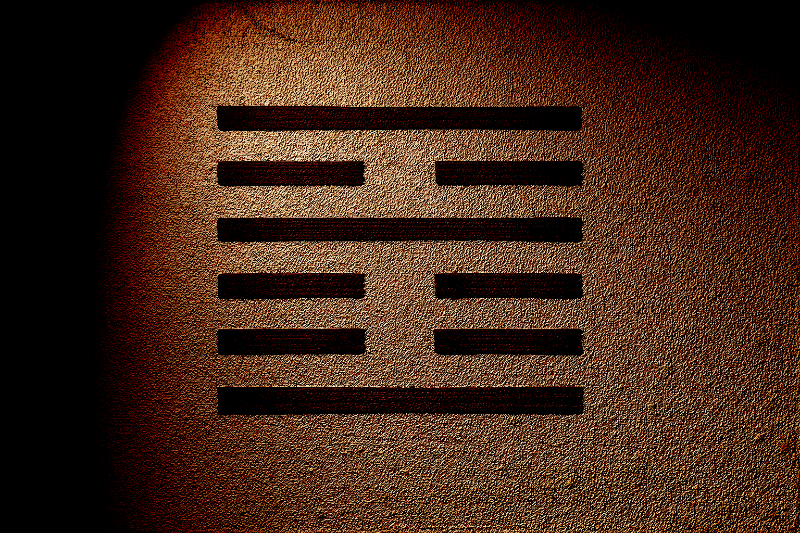
    In the Deep Lead Joss House, Chan Lee sorted through fifty yarrow stalks as Huish-Huish had taught her, occasionally raising them to her nose to savour the herb’s unique aroma. Huish-Huish counted off the number of stalks remaining between Chan Lee’s fingers at each stage, and the procedure was repeated six times to determine the lines of the session’s hexagram: Biting Through – judgement, punishment, discernment. None of the lines signifies guilt, though a little harm may be done. On the whole, an optimistic sign: though there may be trouble at the beginning, one bite’s through. Justice is administered, punishments exacted. If you lose your teeth, you lose your grip.

    Black on gold image of the Yi Jing (I Ching) hexagram 21 Biting Through. Bottom to top, the lines are Yang (solid), Yin (broken), Yin, Yang, Yin, Yang.

    “Cutting … gnawing … chewing …” Huish-Huish said. “A picture of the mouth. You bite through, get your teeth into something.”

    “Cutting.” Chan Lee intoned the word, the eye of flesh closing, the inward gaze of the eye of her contemplation floating back in time. “If you chew dried salt meat, you’ll find yourself poisoned.”

    Knowing not whether for good or ill, she decided that her best move would be to gratify him by seeming to take pleasure in what he did – deeds she found appalling and sickening, lacking as she did the same innate relish for inflicting misery that she now knew to be his. She did not stop to ask whether repeated exposure would inure her to his evils; whether, by touching black paint, her fingers too might be blackened. One thing was sure: there was no iota of love in her heart for the man who had become her ostensible protector. Fang was a man in whose arid heart love for any other creature had never taken root. As time went by, familiarity became contempt, and instead of any initial ardour, the possession of one so desired by others only fed in him a seething sadistic scorn that grew stronger by the day. This scorn he expressed in a ritual of cruelty, a proxy for the conjugal act, with strangulation and cutting for caresses. Sometimes his fervent passions quite got the better of him, and it was on the cards that he would murder her before too much longer.

    Deadened by morphia, a living ghost of herself, she faded from the view of her admirers, most of them so addled that, appeased by a surfeit of available substitutes, they forgot her before long – or rather, recalled only the myth of that bewitching peony of the Barbary Coast, and not the flesh-and-blood woman. Most. An up-and-coming stage magician, Chee Ling Qua, formerly of the ‘Court of Peking’ troupe, was presently engaged at the Bella Union – fire-breathing, sword-swallowing, linking rings, disappearing rabbits and chickens, the works. He could materialize a great big glass bowl full of goldfish out of thin air. A gentle soul, meek and mild, far from a hero come to save the day, but she credited his avowals of undying love and knew that he possessed, if not great means, at least some paste gems of amazing fire and brilliance for use in his performances.

    He was also on close terms with the most highly skilled and secretive Celestial apothecary in the city, whom he commissioned to create incendiaries and other chemical substances necessary for his stage effects. Chan Lee contrived to steal some time alone with the magician in his dressing room one evening when Fang was occupied with business; though he despised her he was as possessive of her as ever. He was much preoccupied these days, his gang embroiled in a war with a rival tong over the exclusive right to operate fan tan games and lotteries in the Barbary Coast. As it happened, Ling Qua was on the verge of pulling up stakes and setting off abroad with his own small troupe. Chan Lee should come with them at any cost, he begged, as she rearranged his robes. She could work as his magician’s assistant, peppering up the act with an arabesque here and a shimmy there … she’d pack them in.

    A month later, the Australasian and American Mail Steamship Company’s City of Melbourne headed towards the Golden Gate, its passenger list including a modest troupe of performers, a mixture of Chinese and Europeans, among them the sylphlike Suzon Chabrier formerly of the Folies Bergère, an inconspicuous brunette who, on closer inspection, as the customs official who processed her had remarked to his colleague, had a charming and subtle nuance of face that could almost pass as oriental. While her fellow passengers lined the decks for their last glimpses of Angel Island, Yerba Buena, and Alcatraz, Miss Chabrier reclined on a deckchair in a discreet black velvet dress, her chapeau decorated with simple field blossoms and pushed forward over her head, perusing the Daily Alta California. She was particularly attentive to an article on page two, which reported on the sudden death of a despised highbinder for the Hing San Fong Tong, one Fang Jing Dock. A photograph of the victim’s corpse had sunk into grainy shadow, which was perhaps for the best, the report ran, since readers would have found the contorted face and twisted limbs most distressing. Suzon applied her reading magnifier to the image, then read on. A note found on the corpse showed that he had expected death by rival hatchetmen.

    Chan Lee, later known as Lily Chan, sits in a deckchair aboard a steamship leaving San Francisco, having assumed the identity of Suzon Chabrier of the Folies Bergère.

    The note read: ‘Soon I must go to my fathers. Whether by the broad bladed axe or by dust of the dragon’s tail, it matters not. This I know. I go. I commend my spirit to Buddha, the all-wise and merciful.’

    “A searching examination of the body,” the reporter continued, “failed to reveal any marks of violence. It is believed that by ‘dust of the dragon’s tail,’ Fang referred to some potent oriental poison. From his expression of agony, it appeared he had been administered sufficient of the substance, whatever it was, to kill an hundred men. Police arrested another highbinder named Fat Louis, who is well-known to have been an associate of the dead man; but it has come out that he was employed surreptitiously by the rival tong in question, the See Yups. The dead man, who will not be missed, was under suspicion for a number of murders of fellow Chinese. A woman with whom he cohabited, once well-known around the gambling dens and houses of ill-repute, has not been seen for several months, and is now added to a long list of the presumed victims of the deceased ne’er-do-well.”


    From the draft novel Stawell Bardo © Michael Guest 2026
  • Hessian Sack

    Hessian Sack

    Some weeks passed. Detective Forster, in his modest office at the Stawell Police Barracks, untied the hessian sack and spread its contents across his desk before Mow Fung. The coat and waistcoat had both been slit cleanly down the back, likely to ease their removal from the body; a white twilled shirt with blue spots, an undershirt, and a fragment of a wideawake hat lay beside them, all stiffened and blackened with blood.

    “These were recovered near where the corpse was found,” he said. “I’m showing them around the district, starting with the publicans, to see whether anyone can put a name to them. Ever clap eyes on them?”

    “Not easy to say. Clothes are clothes,” Mow Fung said.

    “The spotted shirt? Pale hat?”

    Mow Fung drew an exaggerated grimace of doubt.

    “Not so unusual. Could belong to anyone. You are going down to the Chinese camp after this, I suppose?”

    As it happened, that was precisely Forster’s intention.

    “What makes you say that?”

    “Police always look there first. I hear talk – they say the murder was done in the camp, and the body carried east to where the head was taken off. That ground lies midway between the camp and Stawell – four miles. Convenient.”

    He gave a wry smile. “Naturally, it must be the Chinese camp. Many more men live in Stawell – but they are good white men.”

    “No call to get prickly, is there? There have been disturbances in the camp. It draws the rougher element, that much is certain. I can’t say I blame a man for drifting there. There’s precious little diversion in the bush.” Forster, Melburnian by origin, retained something of the city’s broader tolerance.

    “Who is to say the owner is the same?” Mow Fung said. “Blood on shirt and vest – but none on trousers. They were not discovered together, correct?”

    “I believe I am the one paid to ask questions,” Forster said mildly, “but there is no harm in your knowing that they were not found in the exact same place. I recovered the trousers roughly four hundred yards from the body and the other items.”

    “The blood on the coat is faint. There has been little rain of late. It may be animal blood, or human. We shall never know. Anything is possible. But if the murder were done in the Chinese camp, why take the body east toward Stawell to dispose of it, when there are many deep mines much closer to the west?”

    “A reasonable observation. Still, someone in the camp may have seen these garments before, when their unfortunate owner was still walking about in them. If you are heading home, I wonder whether you might accompany me to one or two establishments there – since you were good enough to lodge the deceased on behalf of the Victoria Police. That is, if your good lady would not object to your being away from business a little longer.”

    “Why do you want me to come?”

    “Only that you’ve got more English than many of the men down at the camp, and some of them are apt to clam up – or go to ground – when a policeman turns up. Despite what you say, there may be one or two uneasy consciences there.”

    “Perhaps some understand English better than you suppose, but prefer not to speak to policemen.” He glanced at Forster’s plain clothes. “It is wise not to wear the uniform – it softens the impression. My wife will manage the pub. I had intended to return as I came – on Shank’s mare, as they say.”

    • • •

    Forster drove them out of the township in a trap, along the track, through the dust and glare beneath the blazing sun. The landscape grew strange once the town fell behind them and its ordered shapes yielded to the scrub. Each, sooner or later, noticed the black mat of flies on the other’s back, where they pressed and jostled to feed on sweat and the salt of human skin, in their obscene communion. Best to leave them; disturb them and they rose in a thick, droning swarm.

    The dull thud of the horse’s hooves, the creak of the trap, and the rattle of the harness were swallowed by the silent bush, as though sound itself were absorbed into the vast, listening earth. Holes appeared in patches of bare orange soil already surrendering to growth – the signs of earlier incursions. Here and there, mounds of excavated dirt lay heaped about deepening shafts, like oversized crab-castings along a shore. The human crustaceans who dug here twenty or thirty years ago were gone, many returned to the earth whence they came, having taken what was of value and left their detritus here. Thus history ends where it begins. Or only in these parts?

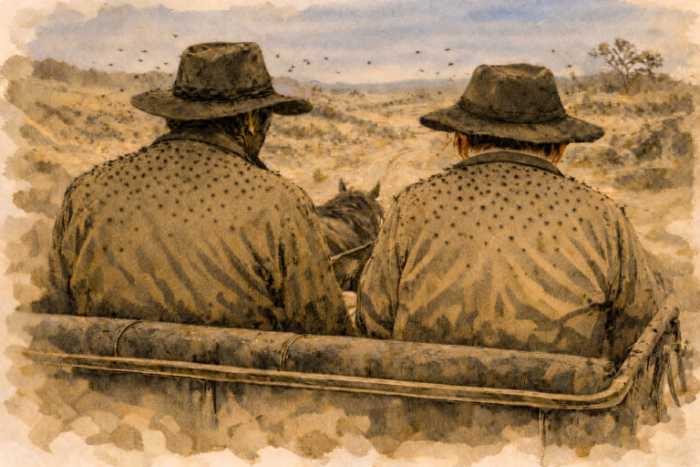
    Rear view of Forster and Mow Fung riding in a trap across an abandoned goldfield, their backs dark with swarming flies as the dusty track threads through pockmarked earth.

    The two continued along in a silence punctuated by the discordant cry of a single bird.

    “Did he say ‘Ballarat’?” Mow Fung said with a delighted start.

    “Not too far from home, enjoying his day-trip like us, maybe.” Forster chuckled. Grey butcherbird, probably. He had read that places were sometimes named for the cries heard there. “They say that Ballarat means ‘resting place.’”

    “Those shafts are Chinese ones,” Mow Fung said. “Round holes with no corners for evil spirits to hide in. Also, round is better than square, because the sides won’t fall in so easy, and you don’t need much timber. A European does not have to worry about ghosts and spirits, does he? Too rational for them, so they cannot harm him,” he added with a small laugh.

    The camp’s heyday lay twenty years past, when gold gravel was struck midway between Stawell and Deep Lead, one of the richest alluvial fields in Victoria. Before long most of the gold was taken, leaving only enough to sustain a dwindling community of oriental fossickers. Of late, the diamond drill had kindled hopes of renewal, and the New Comet Company had even set up in Deep Lead; yet a recent regulation barred Chinese from employment on non-Chinese leases.

    “A rough, strongly built man – there are many such men working on the railway these days,” Mow Fung mused. “If he is not known in Stawell, then he must have come from elsewhere, perhaps to work on the new line.”

    “They are indeed a transient breed.”

    Shops and dwellings huddled together, walls and a variety of roofs clad in boards all askew, yet which somehow in their chaos attained a harmony all their own; frail but sound constructions lining a street not wider than a cart track.

    To Forster, this time too, everything seemed Chinese, from curious fabrics and wares in the windows to the cats and dogs yawning and scratching in patches of shade. Mow Fung exchanged a few words in his own tongue with a plump, amiable woman shaking a mat as Forster pulled up the rig. Her two infants played with a top in the dust at her feet and squealed in high, lilting tones, miniature editions of their mother. The newcomers stirred a hubbub in the nearby buildings, and within a minute a dozen Celestials had poured out and gathered around the trap to inspect the garments Forster had displayed on the seat, while he fended off the more enthusiastic who reached to handle them.

    “Nobody recognizes these things,” Mow Fung said.

    They proceeded down the street, Forster leading the horse and trap.

    “What a pong. For God’s sake, that’s a great patch of human dung beside that place!”

    “Dried out, it makes good fertiliser,” said Mow Fung. “We Chinese have had to learn that practice, because Chinatowns are usually built below the main town, at the bottom of a hill where sewage and rubbish wash down. Very smelly, though. The newspaper editor often worries that diphtheria will not kill us here, but will drift over to Stawell instead.”

    They stopped before the joss house, a low timber building with a sloping roof. A faint scent of incense drifted from within. Mow Fung went over to pay his respects, bowing and disappearing through the open door.

    “No good,” he said when he came back out, holding a paper lantern. “Somebody knocked off some ritual ornaments. Terrible omen.”

    “What’s that you’ve got?”

    Kongming. Sky lantern.”

    Forster made a noncommittal grunt. “Right. Say no more.”

    Mow Fung shrugged. “My mother used to say, ‘If you want to become full, admit the emptiness.’ Lao Tzu said the same. It means don’t think too much – listen once in a while.”

    “Steady on. It’s too hot for philosophy.”

    At the far end of the street, a group of men loitered smoking in front of a building.

    “Miss Lili Chan’s Jade Phoenix,” Forster said. “Its reputation precedes it, and not in a good way. Sly grog and opium. Fantan croupier of prodigious luck – or suspect dexterity.”

    “Good friend. Lady of fine quality,” Mow Fung said.

    Heavy curtains enclosed the parlour, parted here and there to admit thin slivers of light. As Forster looked about to gain his bearings, portions of the room surfaced briefly before retreating again into shadow. He had been expected; nothing illicit met the eye. A girl seated on the end of a couch plucked on an instrument resembling a pear-shaped lute, producing a languid, elusive strain. Beside her a man leaned with his head slumped insensibly against the shoulder of a young female, who smoked a long pipe and fanned herself with a bored look. Some men sat around a table playing pai-gow with black dominoes marked in red and white, wagering from little heaps of matchsticks.

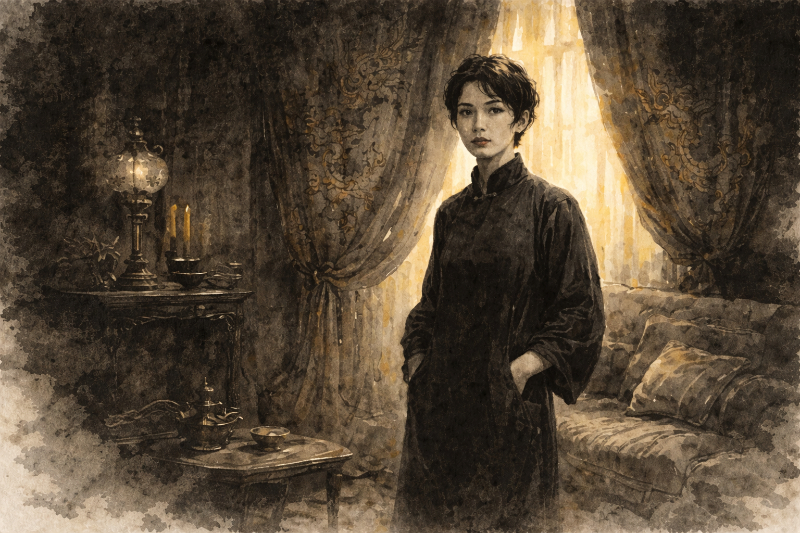
    Lili Chan herself emerged from a curtained doorway in a loose-fitting, mercerised cotton changpao. The matte black fabric gave a restrained rustle as she crossed the room. For an instant Forster thought he saw a light-coloured shock of hair before the curtain slipped back into place. She took a cheroot from a lacquered box on the mantel shelf, inserted it into a cigarette holder and signalled to a brawny attendant to light it for her, before at last addressing the two men.

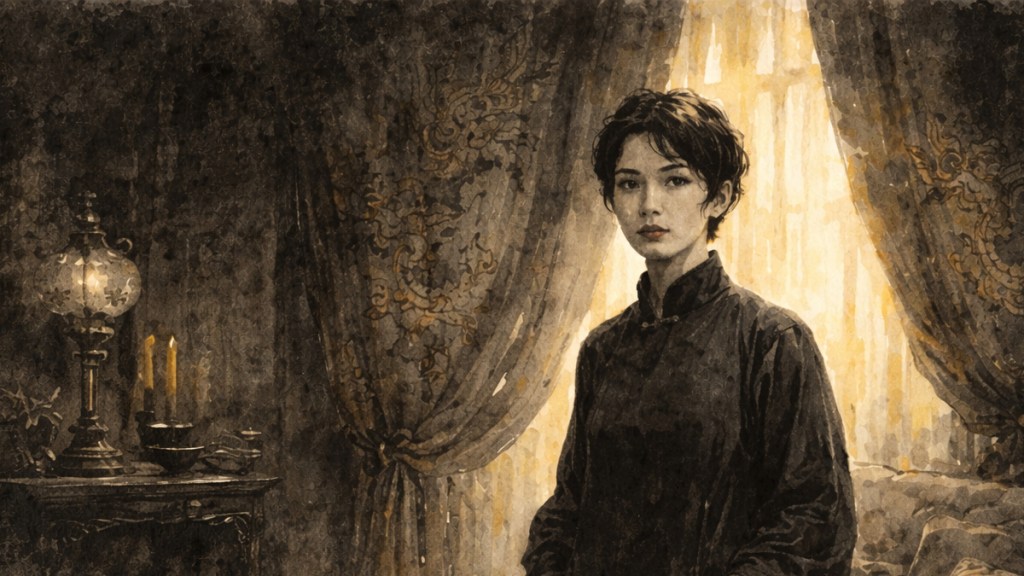
    Lily Chang in a loose black thick-cotton changpao stands in the Jade Phoenix parlour before a curtained window, half-lit in shadow.

    “Detective Forster,” she said. “I assumed our paths would cross again. I take it this is not a social visit.” With a smile, she nodded to Mow Fung.

    “Business has a way of intruding,” Forster said. “Even in agreeable surroundings.” He tapped the hessian at his side.

    “Intriguing. Even so, perhaps you will still allow me to extend some hospitality.”

    She gestured to a young woman, who brought a small tray with porcelain cups and set it on the low table. Lili Chan took a seat without hurry. After a brief hesitation, Forster and Mow Fung did the same.

    Tea was poured from a pot painted with blossoms and winding script. Forster sipped from courtesy; the brew proved lighter than he expected. The murmur of Chinese between Lili and Mow Fung faded into the notes of the lute. Her garment fell in precise folds from her shoulders; the high Mandarin collar framed her face and lent her bearing a formal gravity. A diagonal opening crossed her chest, secured with subtle braided knots. Though the room held the day’s heat, she inhabited a cooler plane altogether. She offered him neither word nor glance, yet he was aware of being measured.

    Then the voices were quiet and he heard only the sparse notes of the lute. She drew on the cheroot, inclined her face and, exhaling the smoke through her mouth and nostrils, looked at him fully for the first time.

    Forster opened the sack and laid the clothing on the table. “You have seen these before?”

    Her eyes moved once across the cloth. “No.”

    “You are quite certain. Perhaps someone else present?”

    “I do not recognize these things,” she repeated. “Nor do my employees, for I do not.”

    At the door, Forster offered her a smile and nod.

    “I understand there was some trouble in the camp last week,” he said. “You see much in this street, Miss Chan. If any part of it bears upon my inquiry, I would be obliged to hear of it.”

    “The temple was robbed by a vagrant from Stawell, a European. I explained to the priest, Mow Fung, that there was no need for the law. The stolen goods were recovered, and mercy shown. Too much to drink. He returned everything when he sobered up and regretted his deed.”

    Outside, Forster turned to his companion. “Priest?”

    Mow Fung looked bashful. “I only consecrate a few things here and there, make rain, tell fortunes, guide the dead, heal boils, such matters…”

    • • •

    Forster found John Campbell, publican of the Royal Hotel at Glenorchy, in his back office. He placed the sack on the table and took out the clothes, one by one. Campbell watched without moving, then gave a short, humourless snort.

    “I know these,” he said. “I’ve seen them worn.”

    Forster waited.

    “Two railway hands, December – navvies off the Dimboola works. Twelfth to the fourteenth, in the one room. Burns was one – smooth-tongued. His mate called himself Charley Forbes. Big red-bearded fellow. ‘Scotty,’ they called him, though he said he was Irish.”

    Campbell touched the coat, as if confirming a weight.

    “He wore this. Coat and hat – same sort. Burns did the talking. Held the money. Kept him close.”

    Forster wrote.

    “They came down by train?”

    “From Horsham, they said.”

    Campbell’s mouth tightened.

    “They ran out of money here. Lost it at cards and drank what was left. When it came time to pay for the room, Burns left a watch with my barman as security – said once the debt was met it was to go on to Stawell, care of Phelan, the storekeeper.”

    Forster noted the name.

    Campbell reflected for a second and added, “I saw Burns at the Stawell races a few days after Christmas. I asked after Forbes. Burns said he’d gone up to New South Wales with an old mate.”

    Forster gathered the clothes together.

    “That’ll do,” he said. “And if you’re pouring, I’ll take that whisky now.”

    • • •

    A few days later, Forster reached the railway camp outside Dimboola, closing in on his phantoms.

    “Painter and his son?” Forster said.

    “Ain’t here …” the foreman began.

    The discharge came with a dull whomp! – sudden and overwhelming, as loud as a cannon, yet muffled by the tons of dirt and rock. The vibration struck the stomach as quickly, if not quicker, than the eardrums. Forster jumped and got through the “Holy–” before tons of dislodged rock thundered down out of sight around the bend.

    “… Jesus!” He blanched and stepped quickly into the cover of the embankment, underneath which a line of navvies was gathered in loose formation, with some standing and others seated in the dust or on rails and stacked sleepers. A drizzle of stones pattered beyond the shelter of the embankment and a cloud of dust surged round the bend. A few seconds of silence followed, the men watching the detective regain his bearings.

    “Who’s opened his bloody tucker bag?” one of them drawled, earning a chortle or two. Forster looked over and was met by steely, sullen faces and a few grins bordering on sneers.

    “Should’ve mentioned that,” said the poker-faced foreman. “Bit of blasting this morning.”

    Evident the copper was put out. Didn’t much enjoy being the butt of a joke.

    “The detective is lookin’ for the Painters?” he called. “Where are they?”

    “Morning off,” came a reply. “Doubler yesterday.”

    A whistle-blast came from around the bend.

    “You men get back to work now,” the foreman said.

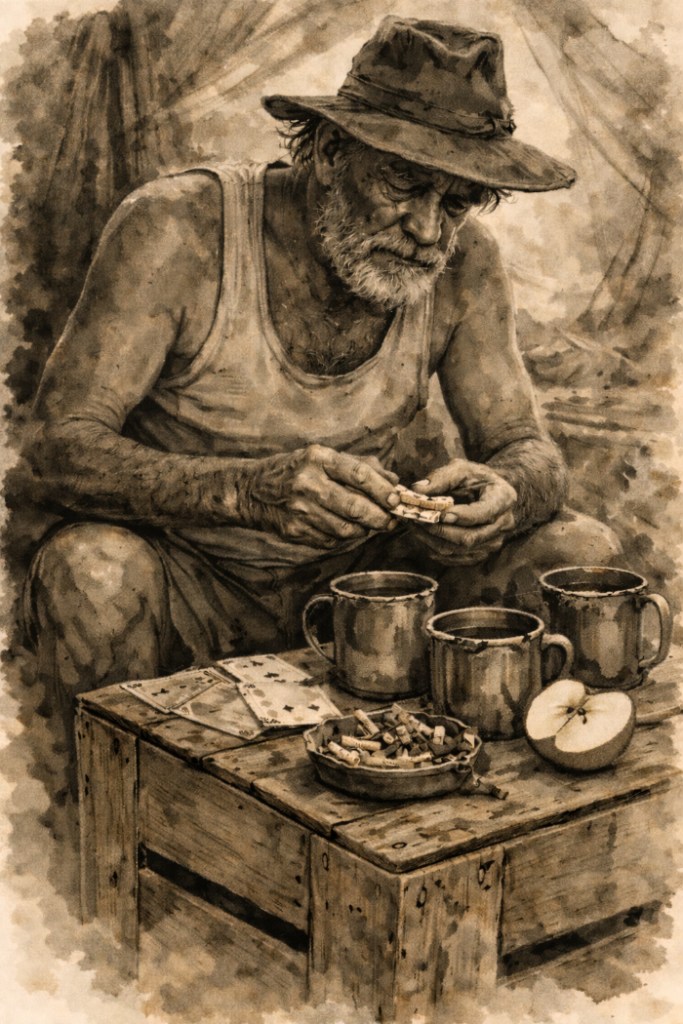
    He showed Forster to one of the tents at the workers’ campsite some hundred yards off. Two men dressed identically in grimy singlets and shorts, Richard and John Painter, father and son, sat on stools drinking tea, either side of an upended wooden fruit box that served as a table.

    At Forster’s direction, they examined the clothing, identical smokes drooping from the corners of nearly identical mouths. Coat in two pieces, almost the same colour as the grass in which it had been found. Waistcoat also in two halves, the buckle and strap suggesting it had been quite new before lying exposed for a month or more. The blue twilled shirt, comparatively new, a button torn out – that button found in the vicinity. Relics of the wideawake hat. All the garments except the wideawake more or less saturated with what looked like blood. He had not brought the trousers, which were found down a mine shaft some distance from the body; he reckoned they were probably the dead man’s too. Less distinctive, though; harder to identify positively.

     The Painters hummed and harred, seeming to communicate to each other in their own language of undecipherable mutters and growls, scratching their beards and shaking their heads deep in thought. The detective waited. Just as his nerves began to wear thin, the two men sucked in a breath as one, glanced at each other over their cups of tea, and shook their heads.

    “Yep,” said the elder.

    He opened his mouth to continue.

    Painter the elder sits in a canvas tent beside an upturned fruit-box table, tea and battered cups among cards and ash.

    “Teeth, Father. Company. Manners.”

    Painter the elder fumbled for his dentures on top of the fruit box between them, alongside some grimy playing cards, three battered tin cups – two half-filled with tea – an overflowing ashtray, and half a browning apple.

    “Reckon we know this bloke,” the father said. “Or knew him, you might say.”

    “The feller who owns these here clothes,” the son said. “Know him pretty bloody well. Knew him.”

    “Worked with him, God rest his soul,” the father said. “Nice chappie, broth of a boy. Bit slow. Addicted to the drink.”

    “Never once saw him drunk, Father.”

    “Never seen him drunk? You must be jokin’.”

    “Who said he’s dead?” Forster said.

    “Been reading the papers, that’s all. The body at Four Posts,” said the son. “Terrible thing, shocking. Must’ve been him.”

    “What was his name, then?” Forster said.

    “Scotty, they called him,” the son said. “But Charley Forbes was the proper name.”

    “Charley Forbes,” the father agreed. “Charley Forbes.” Tutted.

    “You’re certain these belonged to Charles Forbes?”

    “We know this coat by where it’s mended,” the father said. “This bit of stitching on the breast here.” He pointed a finger, the hand had a slight tremor in it now.

    “This here stitching on the breast,” the son said. “Charley burnt a hole in it with his pipe, so he stitched it up like this. Couldn’t be more certain it’s the very coat. I never saw him burn it, but I saw it stitched.”

    “Not a bad piece of stitching, really,” the father said, bending closer. “Quite sure as to the identity of this coat. No question.”

    “No question,” said the son. “Ain’t seen him since him and Burnsey took off together, a bit before Christmas.”

    “What’d he look like?”

    “Broad-shouldered, stout fellow. Large, flowing beard.”

    Sandy coloured.”

    “Well, light sandy coloured, I’d say. Beard was lighter than the hair on his head, which was a dark sandy colour.”

    “Yeah, I s’pose you’re right there, Father. Light sandy coloured beard. Dark sandy coloured hair on his head.”

    “Sandy complexion, wouldn’t you say, Son?”

    “That’s right, Father, very sandy.”

    “And this other character, his mate?”

    “Robert Burns,” said the son. “Like the Scottish poet.”

    “That Man to Man, the world o’er, Shall brothers be for a’ that,” quoth the father, and lapsed into vacant thought, his head nodding involuntarily.

    “Old Jake seen him over at Murtoa the other day, getting off the train,” the son said.

    “Burnsey?” Forster said. “Where’s this Jake?”

    “Shot through.”

    “Where to?”

    “Goodness bloody knows. Just cleared out the other night.”


    From the draft novel Stawell Bardo © Michael Guest 2026
  • The Joss House

    The Joss House

    Hung and festooned as it was with tablets, banners and fans, the joss house at the Chinese camp in Deep Lead was a living bubble of China in the Wimmera. House of deus, so called, from the Portuguese for god. Just inside the doorway, to the left, stood a large iron bell and a tall, barrel-shaped hand drum, with a peacock painted over the pig-skin drumhead. Beside them were glass cases containing sacred candles and five tiers of shelves holding prayers written on paper slips.

    To the unaccustomed eye, the decor was gaudy, with multi-coloured pennants, Chinese characters in purple and gold painted on the walls and roof. Paper and stained-glass lanterns hung from the ceiling; bunches of tinsel in vases were set on stands carved in relief, to depict different epochs. No master craftsman created these, but they proclaim a naïve hand: work executed with painstaking devotion by a jack-of-all-trades, a long-time resident of the Chinese camp.

    Watercolour of Joss House interior. A woman tends the altar, on which is seated a carved deity. There are incense, lanterns, a drum, and various other religios artefacts.

    In her ceremonial robe adorned with all the deities of heaven to clothe her in the protection of the universe, Huish-Huish, Mow Fung’s wife, prepared the altar for the ceremony dedicated to making peace with ghosts. At the very back, raised on a pedestal, in the position of greatest honour, stands the immortal Guanyin, provider of good fortune, who is certain to help, for she hears all the cries of the world and is ever willing to offer protection from any kind of threat or attack. She sits placidly upon a lotus, attired pure white, with gold ornaments and crown. In her right palm she holds a golden flask filled with pure water, in her left raised hand, a twig of willow. Water is to ease suffering and purify the body; willow keeps evil and demons at bay. Huish-Huish communes regularly with the bodhisattva, as though she is a dear friend. She regularly brings the statue flowers, food and drink to sustain and empower her. She is no less beautiful for being made out of plaster. The neck of the statue is pierced with a hole, for other spirits to enter and represent her, after the fashion of an avatar; for Guanyin cannot be everywhere at once herself.

    She lit the sacred lamp for the illumination of wisdom, then the two candles, standing for the sun and moon, and for the two eyes of the human being: the light of the Tao and windows to the psyche. These would help her penetrate the dust of the everyday world. In front of them, three cups, one each of tea, rice and water: tea for yin, the female energy; water for yang, the male; and rice the union of both of these, containing yang from the sun and yin from the earth. In front of them in turn, five plates of fruit to represent the five elements: green for wood, red for fire, yellow for earth, white for metal, black for water. These for the liver, heart, spleen, lungs and kidneys – in harmonious cooperation, a cycle of good health. Sour, bitter, sweet, salty, pungent: plum, apricot, dates, peach, chestnut. She placed dried foods on the altar on this occasion, because she wanted to absorb power from it. When she wishes to empower the altar, she gives it fresh food and flowers, from which it draws life energy.

    In front of the five plates stood the incense burner, a bronze dragon turtle, the smoke curling up through the vents in the top of its carapace – vents in the form of the eight trigrams. The joss sticks were Lena’s work: Mongolian incense, pepped up with dubious substances extracted from her beloved maiden wattle. Necessary cleansing rituals completed, Huish-Huish burned the protective talismans and traced their forms in the air.

    Knowing from previous experiences the ceremonial protocols, Chan Lee Lung – known in Deep Lead as Lili Chan, proprietor of the Jade Phoenix – bowed in deference as she entered, then seated herself. Huish-Huish placed a talisman on her head and performed the mudras, the hand gestures used for drawing out spirits. Based on their previous ceremonies, she has come to suspect that urges to self-harm and suicide afflicting the woman are quite possibly the handiwork of a ghost. There are any number of possible reasons why a ghost might wish the subject injury. She is a beautiful woman, and some ghost may want to marry her, particularly if she has said something inadvertently in earshot that put such a nonsense into its mind. On the other hand, it was common for the ghost of someone who died by suicide to become stranded at the gates of hell, compelled to reenact the fatal act for eternity, unless they were able to find someone to replace them, through that person’s own suicide. Or she may have crossed paths with the spirit of a suicide, or tarried at a haunted spot marked by an unnatural death. Such spirits were always in search of a victim.

    Watercolour image of a Euro-Asian woman in closeup, with her eyes closed, and acupuncture needles in her face, at a few points around the eyes

    The only way to get some idea is to travel with the woman as she journeys through her psyche via the medium of her speech, her story. In this way Huish-Huish may make the woman aware of the ghost, and encounter its weaker manifestations within the trance; there, the ghost itself may be dissolved or at least dissuaded. At the same time, however, in order to heal, she must make herself whole, cultivate herself, and grow in accord with the principles laid out in the Yi Jing and other Taoist teachings. No quick fix here, no game of fantan, this.

    “Every child loves the pretty fable of Kwang Kau’s dream about the butterfly, which Zhuangzi teaches us,” Huish-Huish says. “When Kau awoke from the dream, he found himself unable to tell whether he was Kau dreaming he was a butterfly or the butterfly dreaming it was Kau.

    “Another tale strikes me as somehow similar, in which Shadow and Penumbra converse – Penumbra wanting to know why Shadow moves as she does, perhaps because Penumbra must follow. So Penumbra says, ‘Before, you were walking, but now you have stopped. You were sitting, but now you stand up. How and why do you do that?’

    “Shadow answers, ‘I have to wait for something else to move, and then I will do the same thing as it, almost as though I am its second skin …’”

    The woman listens, as though to a disembodied voice – fluent, lilting Mandarin. Though her own native tongue was that of the city of Taishan – Taishonese, a dialect of Yue, kin to Cantonese – the music of the hypnotic voice draws her into its discourse, and it seems she leaves the world behind her.

    “‘How on earth would I know?’ says Shadow,” Huish-Huish continued. “‘How could I possibly know what it is, that thing which moves, and which I follow – whether the scales of a snake, or a cicada’s wing? How should I have an idea why I perform one particular act instead of another?’”

    The woman’s eyes are closed, and she is already on the brink of a great descent. She hears the pure tone of a chime, and the jingling of rattles, the sounds suffused with the heavy smoke of the incense.

     “Like Shadow and Penumbra,” the voice continued, “I wonder whether we might allow ourselves to pass through phases of our deeper selves – or our earlier selves, when these are not the same thing – and sink into each other, you and I. Penumbras of the scales of a snake follow the shadows of the scales, which follow the snake; they need not feel the belly of the snake sliding across the sand, which is irrelevant to them and impossible to access. And to whom is visible the penumbra of a shadow of the wing of a cicada? And what does the cicada follow, when it does as it does?”

    Huish-Huish aims to melt away her own ego – to become a nothingness, receptive to the projections of memory – because memory is the essence of the psyche itself.

    She guided Chan Lee Lung to lie back upon a low wooden plinth set before the altar, her head resting upon a rice-husk dragon cushion.

    With an austere calm, she placed fine needles along the woman’s brow, at the temples, beneath the eyes, where the face is thinner and the mind can loosen its hold. Chan Lee Lung felt no pain – only a spreading lightness, as though the weight of her features were being unhooked from memory.

    After a while, Chan Lee Lung could no longer separate her inner dialogue from the sound of the guiding voice, which had transposed itself into a chant, whose symbolic words she was unable to comprehend as words, but which fell into a silence as deep as that of the deepest well. As they penetrated the surface of the ether, or whatever liquid-like substance lay at the bottom of the well, something more pure than water, the pitch darkness ignited: each word flared into a splash of sparkling light, cohering into one image, then another, then the next, setting in play a flickering spectacle. A dream that was not quite a dream; a reality that was somehow greater than her reality of the everyday. As instructed, she began to say whatever went through her mind, as though she were a traveller in a railway carriage, sitting by the window, describing to someone else in the carriage the changing scenes she saw outside.

    Standing on a Canton roadside are a woman and her five children, all dressed in their best holiday black, which is nevertheless patched in some places and threadbare in others. Hardly finery, but the woman does her best under extenuating circumstances, as she repeats often to her neighbours and the grocery vendors. The middle daughter examines her mother’s face and observes a liquid bead run down along her nose and fall to the dust.

    “Mama, do you cry?” she asks.

    “Only sweat. Stand quietly.”

    Their sign leans upright against the trunk of the slender tree under whose branches they have sought shade. The mother pacifies the baby, bounces him gently and reassures him with baby-talk, before binding him again to her back, where he falls asleep immediately. At this sight, the eldest daughter stifles the lump in her throat until the mother notices her quivering jaw and corrects her sternly. In the joss house at the Deep Lead Chinese camp, Chan Lee Lung is once again overcome with a profound sadness. Her mother was a hard woman. Again she tastes the blood in her mouth, where she bit herself on the lip to prevent herself from crying – and bites it once again.

    They met up with the broker, who was carrying their sign, at the appointed spot. She disliked the man’s fat, ugly, greasy face. Even his queue seemed to have lumps of fat in it, and he smelled like rotten pork. He laughed when she pointed out these shortcomings to him. He took a piece of lemon from his pocket and presented it to her. She asked him why he thought she would want a piece of lingmung. He corrected her, with another patronising laugh.

    In a Canton street, an old Chinese man, grinning. offers a young woman a piece of lemon. Watercolour image.

    Ningmeng,” he said, pronouncing the syllables of the Mandarin word. And again, after sucking the lemon, he repeated it, pedantically now, with his bloated, sensual, wet lips, “Ning meng.” Emphasised with two beats of his fat forefinger on her forehead. He told the girls to stand in line, with their bags arranged neatly by their feet.

    She wanted to know what was going to happen to her and he replied that if she was a good girl she would go in a magnificent European ship to a wonderful place called Gold Mountain, an earthly paradise where the streets were paved with gold. There she would find boundless happiness as a wife to many men, have all the food she could eat, wear a cheongsam of the finest silk, and return to China a rich lady.

    She saw the improper look he cast her mother, which he pretended was secret while intending her to notice it, a wink and leer that revealed his green teeth. She complained to the mother, saying she did not want to leave her sisters and little brother, and the mother reassured her that her sisters were leaving as well, to somewhere they would be safe from the fighting here. Her brother was too young to miss her, so she need have no concern for him.

    Another man arrived by rickshaw, perused the sign, and Lemon-man took him aside to discuss a transaction. Her mother told her to take up her bag and walk with dignity to the rickshaw. She was a big girl now, and the world would be her oyster. That is all she remembers of the time her mother sold her, except that as the vehicle moved off, she looked around to farewell her mother and siblings. Her mother had her back turned, remonstrating with the broker, as was her usual way in such pecuniary transactions. Her sisters were waving to her gaily, delighted to see her riding in a rickshaw for the first time.

    Two months later, the Pacific Mail Steamship Company’s China passed through the narrow strait into San Francisco Bay. The voyage seemed far shorter to the girl, who had been pacified with narcotics for much of the time, in order to prevent her from creating any fuss. It was a recurring delirious episode; she was rolled to and fro on her narrow bunk with the tossing of the vessel, nausea melding with visions of her sisters who, in her dreams, were transmogrified into salivating crimson ghouls. They were standing beside the repulsive man, between whose luminous green teeth issued copious streams of blood. In her waking moments, she was indifferent to the crush and squalor around her. 

    “This is the Golden Gate to Gold Mountain, the country of your dreams.”

    The woman assigned to play the role of her mother had, during her lucid intervals, been tutoring her in what she must say in case she was questioned by someone called Customs. The girl learned to utter the English word “seamstress” while performing an appropriate pantomime, smiling with an air of great earnestness.

    If her acting talents were unconvincing and the two apprehended, the White Devil would visit unspeakable torment on her.

    Although the two travelled in a better section of steerage, it was only thanks to the ‘value’ her buyers saw in her looks and talents in song and dance, which they judged superior to those of their former favourite, a Hong Kong girl they subsequently cast aside. Chan Lee Lung was cloistered with a group of a dozen other girls, away from the hundreds of male emigrants and prostitutes also travelling in steerage, shielded from the rapes and bashings by two bodyguards known not for their physiques, but for their ruthless cunning and their expertise with concealed weapons.

    Leaning against the railing on the starboard deck, bracing herself against the jostling crowd, the girl inclined her face to the magnificent morning sun, emerging from wisps of fog that had been thick and opaque only minutes earlier. This was the first time for the duration of the voyage that she had been permitted up on deck. The ship was about to dock when a splash was heard from the port side, followed by distinct female screams and a rising volume of anxious chatter, as a wave of agitation spread through the huddle of disembarkees. Descending the gangplank, shouldering a jute sack containing her meagre belongings, she overheard a high-pitched, trembling mention of the name Lee Sing, which seemed vaguely to resemble that of the girl in Hong Kong whose fate she had supplanted with her own.

    A girl among a crowd of disembarkees from the steamship China, docked at a San Francisco wharf.

    Bound-footed Madame Ah Toy, the girl’s new owner, immediately warmed to her. When the ageing madam raised the girl’s chin with two fingers to appraise her face more closely, despite the air of sadness that still hung over her, the girl’s eyes reminded her of her own, formerly renowned for their laughing quality. Goldminers “came to gaze upon the countenance of the charming Ah Toy,” the newspaper said once, in poetic, libidinous understatement. And they would come to gaze on the countenance of this girl, her newest attraction, as well. “But only gaze for the time being,” Ah Toy said to herself, in the cold arithmetic of her trade, now satisfied the girl was physically sound, “until you’re growed up good and proper.” There was more in those eyes, however, that drew the woman’s attention: a depth of soul and intelligence; a quiet defiance that she could see would never be crushed. The madam had good reason to identify with the girl’s sterling qualities, having herself wrought a fortune as the first Chinese courtesan and the first Chinese madam of the red-light district, the so-called Barbary Coast.

     Ah Toy oversaw the education of her new protégé as she would that of a cherished daughter, with a loving and stern hand. She declaimed her belief that “son without learning, you have raised an ass; daughter without learning, you have raised a pig,” and over the next few years, the girl flowered under her regime. She soon assumed mastery over the various academic and dance hall pursuits for which her tutelage had been commissioned, guided by professorial clients of Ah Toy’s famous establishment in an alley off Clay Street, under contracts of barter.

    The girl’s getting of wisdom served, as ever, a financial motive, for the ladies of the Chinese establishment trailed those employed in French, Mexican, British and American cat houses, whose popularity ranked roughly in that order. Competition was fierce in the bagnio trade. The French fandango parlour had its les nymphes du pavé, late of the Parisian gutters, who were packing in the patrons to overflowing, gussied up in their red slippers, black stockings, garters and jackets, nothing down below. Stories abounded of outrageous personalities: The Roaring Gimlet, Snakehips Lulu and the rest. Holy Moses! Madame Featherlegs would gallop a horse down the main street wearing nothing but batwing chaps.

    Unfortunately, although a successful entrepreneur, Ah Toy had also become rather a laughing stock, largely because of her Chinese-ness, but also because of the young age and sickly condition of the girls crammed into her shacks, or “cribs,” in Jackson Street, sometimes abused by white boys scarcely older than children themselves.

    These girls she considered, and treated, no better than chattel.

    The girl grew into her role admirably, expressing as though they were natural traits the aristocratic airs she was schooled in; airs that in fact derived from no single country, but from an amalgam of places, real and imaginary. Yet somehow her intrinsic class seemed to imbue these artificial attributes with substance.

    She was not overawed by anyone she met, but treated with due respect and equality all who crossed her path: from city officials who surreptitiously joined the growing flood of patrons paying good money for no more than the pleasure of gazing upon her, to slave girls locked in the cribs like animals. Most of these girls had been smuggled from China, either peddled, like her, or abducted outright. Sufferers of syphilis numbered among them, their short futures preordained: to die disfigured beggars on the streets of Chinatown.

    She felt a compassion for these creatures in the cribs, pleading their cause to Madame Ah Toy and doing her utmost to convince her, in terms she would understand, that acknowledging even minimal duties of care to the crib girls might serve her business-wise – allowing her to be perceived as less of a pariah and blight on society, though she couched that more gently.

    No cribs for her, nor even a residence in one of the sumptuously appointed parlour houses. Ah Toy set her up in a double storey brick house of her own, where she entertained only the most prestigious clientele – exclusively white, expressly no Chinese – when she was not assisting her proprietress to operate the gambling house and manage the business affairs. As well, Ah Toy provided her with a chaperon, a certain Fung Jing Dock, whom she introduced to Chan Lee Lung as an office bearer in a newly formed organisation known as the Society of the Mind Abiding in Tranquility and Freedom. He was, Ah Toy said, a virtuoso on the zither as well as an avid student of the Yi Jing.

    “Regarding my degree of talent with the zither, I must refuse to answer,” Fung Jing Dock pleaded charmingly, “in order to avoid incriminating myself.”

    Nevertheless, he proved to be a surprisingly good amateur zitherist, and Chan Lee Lung and he spent a few minutes at the instrument together now and then during the daylight hours.

    “But there is more to this story,” Lili Chan said as they came out of the joss house and into the dazzling sunlight. “It does not end well, I’m afraid.” She turned towards her establishment.

    Huish-Huish looked at her face, which seemed pallid.

    “As a process, the ceremony may sometimes require any number of iterations,” she said. “Some subjects joke that it will go on forever, and they will never be free of me. Things cannot be rushed, however. We will have plenty of opportunity next time.” She laughed. “There is no cure for the human existence, you know,” she said. She briefly squeezed her companion’s arm and went back briskly into the joss house. Pausing to look up at the empty expanse of sky for a second, Lili took in a long breath, before making her way languidly down the street.


    From the draft novel Stawell Bardo © Michael Guest 2026
  • 5. Missing Persons (from the draft novel Stawell Bardo)

    5. Missing Persons (from the draft novel Stawell Bardo)

    Missing Persons

    “Here, have a go at this:

    A strange discovery was made yesterday by a miner named Wilson. While cutting props in the bush, about two miles from the Deep Lead, he found that he was at work beside the headless trunk of a human being. The remains were lying about ten feet from an abandoned shaft. The head was severed from the body, and although a careful search was made, it was nowhere to be found. The body had apparently been removed to its present spot within the last week, for there is a mark on the ground close to where the remains were. The body appeared to be that of a male, tall and slender. Not a vestige of clothing of any description was found on or near the remains.

    “Well, that is out of the ordinary, ain’t it, Wilson, what it says in this rag here?” Cleggett, the barroom wag, lowered the newspaper and gave Wilson a sidelong look over his glass.

    “Indeed, well it was exceeding strange,” Wilson said. “Eerie, horrible, and awful as well, I can assure ye. Not every day a cove turns around and cops an eyeful of sompthing like that, I mean to say, a naked corpse right there next to you where you’re workin’. Inches away. Cop that, mate! A nude, naked body of some bloke without no head and all – without a particle of clothing. Ants all over it. Crawling down his throat and everything. No private parts neither and all.”

    “Where was is clothes?” Nash muttered from along the bar.

    “No one knows for godsakes, shit! But you know, there wasn’t no stink of decomposing, having been there a while, and the skin was a kind of mystic golden colour, swear to Christ, like the Pharaoh, I reckon, like some mummy. Cor’blimey, fill this up for us, Ronald, wont’ya? I’m still a’shiverin’ and a’shakin’ from the shock. Shout me one? What about it? Calm me nerves. Who’s won the bloody cricket in Melbourne, anyhoo?”

    Cleggett set his glass down and snorted wearily.

    “No, I mean, strange you was working, like the paper says here. I ain’t never seen you doing no work never. Never heard of it neither. Yet here it is in black and white in the bloody paper. You working! How do they get them facts the sorts of which no-one’s never seen nor heard of before? Cutting props, you? God Almighty, what a farce. Love to witness that. That is an original story!”

    He paused for effect. “Oh, I see! No, the point of the story is, some bloke’s got himself murdered and ’ad his head cut ’orf and you found him.”

    A couple of grunts along the line.

    “Well anyway, who is he? Or if you like, who was he?”

    “They dunno who he was,” Wilson explained. “That’s the problem, like. How can they catch who done him in, if they don’t even know who he was, like? That’s just what I’m trying to tell the bloomin’ coppers. Detective didn’t even want to listen to me. Just kept telling me to shut up every time I opened me mouth. I was invited to the whatsit, of course – as what they call the discoverer of the cadaver. Bloody dead body layin’ there large as life. Shit. And I lost the day’s work of cuttin’ props and all.” He took a gulp of whiskey.

    “Oh yes, you and your props. Hi, get that dog out of ’ere!”

    “Oi, get that bloody dog out!”

    “Ah, he’s not doin’ no harm.”

    “Yeah, leave the poor bastard be.”

    “Ah, e’s bringin’ in the flies!”

    “No he ain’t. Look, he’s drawin’ ours over there into his corner! Look at that one, there you go.”

    “So he is, leave him then.”

    “Yeah, leave him be, he ain’t doin’ no harm nohow.”

    “Leave him be, you bastard!”

    The greying old red and tan kelpie settled in.

    “That is a problem, about the identity. But I overheard the coppers say some bloke was missing.”

    “Yeah, who?”

    “Bellman, I think I heard. Poor bastard. Wife and child, I think I heard. Maybe not, I dunno. She left him, I think maybe I heard.”

    “Good name,” Cleggett reflected.

    “Yeah, I know.”

    Never send to know for whom the bell tolls …” Cleggett drawled.

    “Yeah, I know.”

    It tolls for thee.”

    “Oh, for Chrissakes. Blimey, you don’t half bang on. Gad, what are they putting in this stuff?

    The mystery astonished and horrified the community, locally and across the country. At last the police had something to work upon in ferreting out what had seemed a hopeless mystery. Steadfastly, Detective Forster – dour, methodical, undistracted – set himself to the task of unravelling the details and run the murderer to ground.

    One Frank A. Bellman, a labourer, hadn’t been accounted for during the past month and seemed a likely candidate for the victim. The time frame was right, and his brother was concerned enough to notify the constabulary. Bellman was supposed to visit him at Warrnambool – but failed to show up.

    Forster was at his desk, some new leads having come in. He perused the recent details on Bellman, a page and a half. Hopefully, this was the man. Seemed a decent enough fellow, drank a bit, perhaps too much, but what was that? Didn’t gamble, hardly.

    Why was the head cut off? Obviously, to hide the identity of the deceased; so it was likely the perpetrator either had some connection to him or had been seen with him recently.

    Forster harked back to the inquiry at the pub at Deep Lead, and how the Celestial seemed to look not at the corpse, but somehow through it. That Mow Fung, weird character, Chinese or no. Forster could not get him out of his head. Perhaps call in on him in a couple of days, might know something he’s not saying.

    Frank A. Bellman.

    Frank a bellman?

    Rubbish.

    He was at his wits’ end, mind going around in circles, at the end of a track that petered out and turned into sand, just like his visit to the Junction Hotel and the crime scene. The crime scene a murderer’s paradise, if one had such an inclination. Footprints in the sand were erased in no time. Bottomless mining holes everywhere for miles around, one right near the body. Take the head and clothes, and you are away Scot free.

    Bellman was a good chance, so Forster mounted up and set off to do the rounds of Bellman’s known haunts. He rode out to Bellman’s shanty, where he found a dead dog, and a half-mad horse, and spent a while getting water into it and shifting it into the shade.

    “I’ll send someone in a little bit, you blokes, you keep tight, won’t be long.”

    He rode out through the front barbed-wire gate and dismounted to hook it up again. Clear as day, the Junction publican came to mind again. That inscrutable look still gave you the shivers somehow. He mounted, wheeled about, feeling an impulse to return to the shack.

    A shed fifty yards off stood steaming in the midday sun, so he went over. Behind the shed, a foal lay panting. He coaxed it into the shade, then went to fetch some water from Bellman’s muddy dam. When he poured it gently over the foal’s neck, the animal blinked, snorted, and took a drink. It would live.

    He paused at the gate, took a long breath, and rode to the barracks.

    Mounted-Constable Hadfield was there, chatting with a civilian. They stopped and looked up when Forster came in.

    “This is Mister Bell,” Hadfield said.

    “Bellman?”

    “Just Bell, Detective Sergeant. He’s a woodcarter, lives here in Stawell.”

    A bleached, weathered scrap of clothing lay on the desk: the torn-off half-portion of a waistcoat, violently ripped from the rest, buttons missing and lining torn askew.

    “What’s this?”

    “Mister Bell found these items in the bush, sir, a bit of a way from Deep Lead towards here, and he brought them in for us.”

    Forster checked himself – he’d been too brusque. “That’s very kind of you, sir. Do you mind telling me what took you out that way?”

    “Following my occupation. Gathering and carting wood. Sometimes I carts it, sometimes gathers, most often usually both.”

    “Might you be available to show us the spot, post haste?”

    Bell had found the waistcoat on his way to a place called the Four Posts, about eighty yards from the Old Glenorchy Road. The three fossicked through the immediate area, moving as systematically as they could outward from the spot, which Bell had thoughtfully marked with a cross of four rocks. After about an hour, Forster dispatched Bell to fetch Constable Hillard for another set of legs and eyes.

    Alone now, taking a mental break, he wandered down to a dry creek bed, fringed with scrub and tall kangaroo grass.

    A  lone bird call rang out – Four gallons of water! – and he stopped, turning towards the sound. To his left, where the call had come from, something caught his eye: a small heap half-hidden in the grass. He’d almost missed it, for the cloth had taken on a yellowish-green tinge from long exposure, nearly the same as the tussocks around it. He might have passed and re-passed forever without discovering it, but for that bird. Feathered bloody oracle.

    Three buckets of water! Fainter, receding, gone. Magnifying the heavy, empty expanse. What turns up when you are not looking.

    The coat was blood-stained, especially about the neck. One button remained on the waistcoat, the only one to withstand the violent strain by which the garment had been yanked open. It matched one found under the body. On the shirt, too, were the gaps where two buttons, also recovered under the remains, had been torn free. There could be no doubt that the clothes were those worn by the murdered man. He drew from the tangle of cloth a third of a wideawake felt hat, the rest having been cut away. A few hairs clung to the remaining rim, the same colour as those found at the base of the dead man’s neck. They were stuck to the felt by blood. The trousers were missing, and so was the dead man’s head.

    “Wideawake,” he couldn’t help saying softly aloud, as he made his notes, “no nap.”

    He’d organise another sweep in a week or so, but for now there were other fires to tend.

    Bellman’s mother had been summoned over from Horsham to examine the remains, which she was sure as sure could be were her son’s:

    “It can’t be he, oh it can’t be he! But I fear it is. I’m certain it is! His hair’s turned a little more to the reddish hue, that’s all, workin’ out here like a navvy! What a bonnie bairn he was, the wee rascal! That mole on his shoulder is sure his. Oh, he was a fine laddie, with all of his future in front of him. But will you look at him, look at his skin. It’s … radiant, the peak of health! Bless the daft lad – he couldn’t scrub up like that when he was living. Ach, ma heid’s mince!”

    Hillard fetched her again from the Commercial Hotel in Stawell, where she was being put up, having imperfect relations with her other son. This time, it was not the body she was brought in to identify, but the items of clothing recovered from the bush.

     “He was a dear laddie,” she said quavering, placing her frail hand on the waistcoat. “Och, to think this was the last thing he wore, it sends me heart racin’. Well, whit’s fur ye’ll no go by ye!” Overcome, she paled and drew the back of her hand up to her brow. Forster pulled a chair over and lowered her into it.

    There came a knock at the door, and a constable poked his head in. “There’s a bloke out here to see you, Detective.”

    “Not now.”

    “It seems important.”

    “I said not now.” The door closed.

    Mrs Bellman began to sob. The door opened again; the same constable gestured to Hillard, who looked at Forster.

    “For goodness sake, go and see what he wants.”

    The woman sobbed convulsively. Forster laid a hand lightly on her shoulder. The door opened and Hadfield came in quietly followed by a man.

    “You alright, Ma?”

    “In the name o’ the wee man, this isnae real!” Mrs Bellman turned white as a sheet, rose shaking – “Ye’re meant to be deid!” – and abruptly dropped to the floor.

    Thus the Bellman mystery – if one can call it that – was solved. Instead of going to Warrnambool as planned, he had detoured over into New South Wales and returned the next Saturday. He’d left the animals with feed enough for a few days, thinking he’d be home on Sunday. But his horse threw a shoe past Moama and went lame, and the smith wouldn’t see him till Friday, he had to lay up at some wayside inn, only the publican’s daughter had the measles, and he ended up minding the place while the missus boiled onions. At any rate: no foul play, no mystery. Just an irritatingly loquacious fellow, who couldn’t be bothered sending a wire.

    The case of a carrier named Flannigan, though not dissimilar, was in some respects more of a nuisance. His circumstances made it likely that the remains found near Deep Lead might be his. Detective Forster left Stawell by the first train Monday morning to conduct some interviews. On Tuesday, he struck out for Woodend and went some distance into Bullarook Forest, before doubling back to Seymour. He set the telegraph wires to work, then back to Ballarat, chasing a clue. By wire, he learned that Flannigan was alive and well in Deniliquin.

    The circumstances surrounding the disappearance of all persons reported missing from the district had now been accounted for. The discovery of the clothing further assisted in establishing the identity of the murdered man and was expected to furnish evidence leading to the apprehension of the perpetrator. Another step had been taken in the matter, and it was to be hoped that justice, having misplaced its head, would soon find its footing.


    Michael Guest © 2025

    Images generated by AI