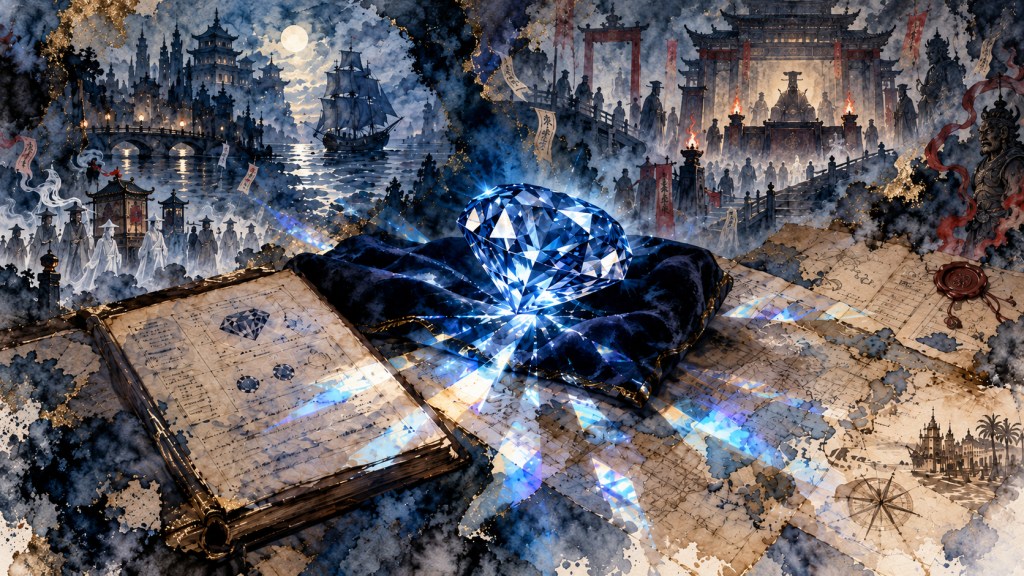
Tag: Stawell Bardo

  • A Woman of Your Description

    A Woman of Your Description

    Trailing a group of fellow passengers – farmers and commercial men, and a family with two children, one of them being carried half-asleep – she emerged from the first-class passenger exit at Spencer Street Station shortly after eleven o’clock at night. A courteous porter followed with her travelling bags on his otherwise empty barrow. She stood quietly beneath the glow of the gas lamps while the others dispersed into the darkness, and the porter called over one of the two hansom cabs waiting on the forecourt.

    Smelling noticeably of horse, a scent she found comparatively inoffensive given what met her on the breeze, the worn-coated cabman stowed her bags, and while doing so was moved to demonstrate his amiable nature by directing a grin at her, to which she responded with no more than a neutral glance, and withdrew a fraction further into the shadow cast by her dark felt capote bonnet.

    “Marvellous Melbourne” was off to bed, she mused as the horse clipped over the Bourke Street cobblestones, and once again she noticed the unfamiliar scent of the place – of late, wags in the newspaper had been calling it “Smellbourne.” She tipped the cabman generously, and the night staff of a family hotel along from the Menzies saw her inside with her baggage and entered her name in the hotel book; it was an ordinary place, where she would go unnoticed. In her plain but comfortable room, she slipped out of her dolman, spread it out on the bed, and sat down beside it. Using a pair of finely pointed scissors, she unpicked some stitching from the hem and removed a small silk purse, from which a stream of gems spilled out onto the bedspread.

    Fang’s diamonds, and just a few from Chee Ling Qua, of the “Court of Peking Troupe,” who had made a gift of them to her on one knee – a token of his vain courtship. Which were which she could not recall, only once or twice having had the need to inspect the hoard. She transferred them into the false compartment of an innocuous-looking velour jewellery case. Then, she took from a side pocket of a travel bag Forster’s letter, penned in his precise hand.

    Dear Miss Chan

    My return to duties in the Melbourne precinct has been made the more trying by the absence of those opportunities, both official and otherwise, in which I had lately grown accustomed to seeing you.

    I am very much looking forward to fulfilling your request to act as your guide in investigating the matter of an inheritance that is due to a woman of your description (if you will forgive the expression). The information supplied initially by the issue of the Police Gazette I showed you in Deep Lead has subsequently been reinforced by some further researches I have made since moving here.

    I have arranged a meeting with the party concerned, to be held at See Yup Temple in Raglan Street, Emerald Hill, on the 20th inst. Unfortunately the cold weather here has not yet quite broken; however, I wonder if in advance of the appointment it might be to your liking if I showed you the Carlton Gardens, which were redeveloped for the International Exhibition two years ago. You expressed some interest in them during one of our informal meetings at Mow Fung’s teahouse before I departed Stawell.

    After a light meal in the Gardens, which I would be honoured to provide, and perhaps a walk, we might discuss the matter further before making our way to the Temple.

    Should you wish to proceed with my proposal, please inform me by wire at your earliest opportunity. We may meet at half past ten in front of the Great Hall, which will be unmistakable for its large dome.

    […]

    Your obedient servant
    William Forster

    Leaning back into an armchair, she lit up a cheroot and poured a small gin, enjoying a few moments of indulgence after her day of travel. Shortly after receiving his communication, she had wired her agreement to Forster. She allowed – what was it, a breath of fond laughter? − to escape her lips as she pictured the somewhat punctilious detective superimposed on his words. A thin, translucent strand of smoke rose up in the still, cool air, as her eyes traced the leaves that scrolled about the dark russet wallpaper. He was evidently smitten, though certainly not from calculation on her part, and actually, his quiet strength was proving to be something of a pillar of support in this ill-considered excursion, the precariousness of her situation having increasingly dawned on her since Forster had shown her the notice.

    At first, the notion of some possible inheritance had struck her as nonsense, however closely the description of this sought-for legatee resembled herself. Yet infected by his show of enthusiasm, and perhaps falsely lulled by the anonymity she enjoyed in her comfortable life in Deep Lead, she had allowed him to look further into the matter. Subsequently, as the momentum increased and, according to Forster, her discovery had fuelled some interest at the other end, she had found it difficult to renege. At the same time, she had begun to feel more vulnerable, drawn not only into the light of officialdom, but perhaps also, through her complacency, back towards the dangers of a past from which she had so successfully, so completely, fled.

    But it had been a shock to come across a reference to See Yup that Forster had made months ago: the name by which she had known in San Francisco as the tong to which her persecutor Fang belonged. When she asked Huish-Huish about the name – Huish-Huish knew many of the details of Lili’s past with her highbinder, and the abuses she had suffered at his hands − she was assured that in Australia the group was not known as a criminal organisation at all.

    On the contrary, it was a community association of long-standing charitable purpose and unimpeachable good name. It had originated among emigrants from four counties of southern Guangdong, near the Pearl River Delta, and its mission was to lend support to others from that region. Indeed, the See Yup Society in Melbourne was run by highly respected leaders of the Chinese community throughout Victoria. Forster had since informed her that one of these gentlemen would be honoured to meet her. The meeting was to take place within the next few days. She read herself to sleep with a Mark Sinclair detective story by W.W. in a copy of the Australian Journal.

    She awoke to a grey morning and breakfasted in the dining room, before taking herself for a stroll along an already lively Bourke Street, casting an appreciative eye through the display windows of some dressmakers’, milliners’, glove and shoe shops, all resplendent with the latest fashions, and of department stores with their mixed luxury goods, books, and bibelots.

    Stawell was, naturally enough, decidedly drab by comparison, and what took her aback was the frisson this little outing aroused in her. Of course, there were ample reasons for having secluded herself in provincial Wimmera for such a long period; but the élan of this gay city street lifted her heart.

    She passed three or four jewellers before returning to one that was more discreet. Standing in a narrow, recessed arcade, the shop presented an immaculate display behind a thick glass window set into a wall of block bluestone.

    When she said she wished to have a few gems appraised, the jeweller left the shop under the charge of his assistant, and led her into a small back room, with a table, safe, and chests of small drawers. He handed her his card, and Lili pushed her silk pouch across the tabletop to him.
    He emptied her stones onto a black velvet tray under the window light and after a mere glimpse selected two, pushing them to one side.
    “Paste,” he announced abruptly.

    Lili could not contain a laugh. “That Chee Ling Qua – such a fraud!” The jeweller looked up at her blankly, and she coughed. “Do excuse me, Mr Kaminski. An old acquaintance, a mere stage magician of no enduring consequence. However, all the jewels have sentimental value, though I rarely look at them.”

    Kaminski returned to his task, bringing a loupe to his eye to examine the rest. As he proceeded, he noted down descriptions and figures, weighed each stone, and placed it in a small white envelope, which he marked neatly in pencil.

    “There are gems of remarkable value in this parcel – most of them without internal fault, beautiful stones,” he said after finishing his task. “But this one…” He drew it aside. “… this one … it has what we refer to as a ‘natural’ on the girdle,” indicating the region with a probe, “You may just be able to see it with the naked eye, a slight patch of the original rough stone. And beside that, a tiny chip where it was once mounted. No great matter, but enough to mark it.”

    “So it’s worthless…” Lili said.

    “On the contrary,” Kaminski continued. “At first one sees only the flaw – before noticing the extraordinary character: that soft warmth, and the faintest blue cast. I seem to recall a reference made some months ago in an issue of the Jewelers’ Circular and Horological Review from the United States… It concerned a distinctive old-cut gem such as this. It will take me a day or two to go through my journals, if you would be willing to leave the diamond here for the time being.”

    Lili nodded. “I had intended to ask if you wouldn’t mind me leaving the parcel with you for safekeeping during my stay in the city, if you thought they were of any value.”

    Closeup image in watercolour of a jeweller examining a sparkling diamond

    “Oh, indeed!” laughed Kaminski. “They are definitely of value, I can assure you, not merely sentimental value, as you have admitted, but of substantial financial value as well.” He gathered the envelopes together and placed them into a compartment of his safe, along with her velour case, before recording details in a ledger and writing out a receipt on his letterhead.

    Closing the door behind her, Lili took a second to adjust to the light of the late morning, even despite the grey day. The footpath was bustling, and she nearly collided with a pair of young women who seemed to come from nowhere.

    “Excuse me, sweetie, that was my fault,” said one of the girls, placing a steadying hand on Lili’s shoulder. “Oh, what a lovely coat! Could I borrow it for the opera tonight?” Then the two were off again, giggling heartily.

    Lili hired a hansom cab to the Carlton Gardens, and, with hands tucked into the sleeves of her dolman, and breathing out steam, strolled leisurely along the long straight path to the front of the Great Hall. Water shimmered and splashed in the fountain. Consulting her chatelaine watch, she found she had arrived a few minutes late, but Forster could not have come and gone already, so she paced patiently for a little while, enjoying the cool air. She heard his hurried footfalls behind her and turned around, to see him puffing as he came up. He wore a dark wool coat unbuttoned, with a waistcoat, white shirt, sober tie, dark trousers and sturdy boots, carrying what was obviously their lunch wrapped in brown paper and a bottle under one arm.

    “Something came up at Russell Street just as I was stepping out,” he said.

    “Not another murder mystery so soon?” she said.

    “Just another dissatisfied customer.”

    They found a bench near the fountain, and he unwrapped the packages: some little pies, buns and slices of seed-cake, and two small enamel cups.

    “A feast! My dear Chef Detective Forster, that is immaculate.”

    “A little lunch place in Lygon Street, just a couple of blocks over. Roast beef or chicken-and-veal?” He indicated the pies.

    “Perhaps the chicken-and-veal, thank you. I’m reluctant to provoke the beef before noon.” She broke off a piece of crust. “I have been reading all about you in the Pleasant Creek Chronicle – your marvellous work pursuing and apprehending that scoundrel Burns.”

    “When we first met, I had thought I sensed some antipathy towards policemen.”

    “It’s true I have had imperfect relations with some of them, and I have to admit to having something of a chequered past. But to have been implicated in your mystery, and to watch how you brought the villain to justice… it’s been most edifying – worthy of a Mark Sinclair, which recently I’ve taken to reading, I hasten to add.”

    “Sinclair always gets his man, of course. In this case, I am afraid there is a fair chance Burns may slip the noose.”

    “How so?”

    “No absolute certainty of who the victim is. Burns insists that his mate Forbes is still rambling about somewhere, alive and happy as Larry. I am certain Burns is the perpetrator, but the case I have made against him is, unfortunately, rather circumstantial, as the lawyers say.” He poured some ginger beer into the cups.

    “Ah, too bad,” said Lili. “Drat.”

    “Nevertheless,” Forster continued, “that may yet change, thanks to some of the uncanny observations made by our mutual friend Mr Mow Fung the publican. He was struck by certain patterns in a different case he had been reading about in the paper, that of a Michael Quinlivan, at Wickliffe, two years ago. We have some detectives reexamining that case to look for a connection. But Burns’s trial opens next month, so we find ourselves in a race against time.”

    “Too bad Mr Sinclair isn’t here to lend a hand,” Lili said. “Though his author is a mystery in himself, isn’t he? W.W. or Waif Wanderer – unlikely name, wouldn’t you say? He seems to me to have something to hide. Still, Sinclair is excellent, with a sharp eye and shrewd grasp of character, of women as well as men. What was he saying in this one titled ‘Hereditary’ I was reading last night on the train: ‘Women … are very pretty and very useful things sometimes, but they are also occasionally very silly and try a practical man’s temper immensely.’ The hide of the man! But a fascinating theme nonetheless: can we escape our pasts, or are we determined even by our heredity, entirely lacking the freedom to make our lives as we would wish them to be?”

    “It seems true from my own experience,” said Forster, “that there’s generally a lot more going on beneath than meets the eye. Quite often, it seems to me, will an action precede the thought that one had supposed motivated it, and the scientific research bears this out.”

    “Well said, Sinclair, old chap,” said Lili. “I mean, Forster.”

    “William.”

    “William,” Lili said, laughing and briefly rubbing his forearm.

    The two glanced at the interior of the Great Hall, before strolling along the grand allée and turning away from the city noise into a secluded curving gravel path by the lower lake, past weeping elms and Moreton Bay figs that overhung the water.

    “We had best soon make our way to the See Yup Temple,” said Forster. “It’s over at the Chinese quarter in Emerald Hill – we’ll easily be able to flag a hansom cab at the corner on Victoria Street.”

    “I made mention of my past a short while ago…” Lili took a deep breath. “I wonder whether we have time to linger a little while in this peaceful part of Melbourne, while I explain to you some of my apprehension about our appointment at the temple,” and they made their way to a bench closer to the lake and beneath the trees. “Arriving in San Francisco a penniless waif from a Chinese village, I came under the influence of a truly despicable man, a Chinese who, under the guise of a doyen of culture and refinement … took me in hand … ignorant and defenceless as I was – and through torments beyond compare, made of me his own abject supplicant. I soon came to learn that this Fang Jing Dock was one of the city’s deadliest assassins and a leader of a Chinese criminal gang. It was known as the See Yup tong…”

    Forster looked at her intently for a moment. “I am aware,” he said, “of the murderous San Franciscan tongs, of course. So you are afraid that this Fang person might be responsible for the notice in the Police Gazette, and is making some kind of attempt to get you back?”

    “Yes and no,” Lili said delicately. “Fang has since left this world and is now, I’m certain, where he belongs. I departed from San Francisco somewhat in haste, however, unknowingly carrying in a satchel belonging to him certain items that I believe his associates would dearly wish to reclaim, if only they suspected who might be in possession of them.”

    “Hmm. Well, I think we may be confident that the Melbourne See Yup Society is absolutely beyond suspicion in this regard. I have met some of the elders in the course of my duty and know them to be eminently respectable Melbourne business and community leaders, who are only too keen to assist in any way they can with our policing, and especially whenever such matters touch upon the Chinese community. As for Mr Lee Kong Wing, the gentleman with whom we have arranged to meet, he is a greatly respected Elder, who organised with our Police Commissioner – who is also a man of impeccable ethics – to have the circular posted. But fear not, I shall be on the alert during the rest of your visit.”

    “I love the way you say ‘impeccable,’” said Lili brightly. “Then you have reassured me immensely. So let’s be off.”

    The hansom cab crossed the Yarra at Princes Bridge and made for Emerald Hill, where it set them down at the temple gate in Raglan Street. In the forecourt, a group of Chinese men smoked and chatted, while another pair faced each other across a movable table, playing dominoes. Lili and Forster passed between the two stone lions that guarded the front door of the brick temple and went through a doorway into the lavish main hall, with its altars, tinted windows, and array of brightly coloured statues. The scent of sandalwood hung in the air, amid echoes of quiet conversation and the footfalls of the half-dozen visitors and attendants. The centrepiece of the hall was an altar set behind a low balustrade, beneath a bearded, ruddy-complexioned statue that dominated all the others. Forster seemed decidedly drawn to it, and they stood there next to a devotee who was lighting a stick of incense at the altar, the statue looking fiercely down upon them.

    “This fellow chimes with me somehow,” said Forster quietly, gazing at the statue.

    “Once in a lineup, possibly?” whispered Lili.

    “More like a dream…” said Forster, still serious. “Mow Fung talked about a friend of his in China, some sort of fighter. Maybe that’s the source of it.”

    Lili and Forster standing before the See Yup Temple patron deity Yuan Ti (aka Guan Yu)

    A genteel voice came from behind them. “Ah, Detective Forster, I am pleased to see you admire the statue of our patron deity.”

    They turned, to see a distinguished white-haired gentleman with a short, trimmed beard, standing there in a modish business suit.

    “Mr Lee,” said Forster. “So nice to see you in your temple rather than your office. It completes my picture of you. Please meet my friend Miss Lili Chan, who has been the subject of both our researches recently.”

    “Enchanté, Miss Chan.” He bowed graciously.

    “Enchantée, Monsieur,” said Lili.

    “This,” said Lee Kong Wing, “is Kuan Ti, a warrior from long ago. In Buddhism he became an enlightened being, and is the patron of loyalty and brotherhoods, and god of all honest merchants. So he is a fitting guardian for our See Yup Temple, which aims to help our countrymen working in the colonies.”

    “Pleased to know you, sir,” Lili said, looking up at the statue.

    Lee showed them into a utilitarian office, and they took seats facing him across a desk. “Here are some particulars of See Yup’s ‘researches’ Detective Forster mentioned, which led us to believe you may be the beneficiary we sought via the Police Gazette,” he said, sliding a folder gently across the tabletop to her. “Detective Forster has kindly consented that the contents should be confidential between you and me, as See Yup Elder, alone. Kindly advise me if they do in fact refer to you.”

    There were several to-and-fro communications in Chinese, including some that recorded the attempts to trace the whereabouts of a half-blooded woman named Chan Lee Lung; initially thought to have been a murder victim in San Francisco, she was subsequently sighted on the Australian and American Mail Company’s ship City of Melbourne, travelling under the alias of one Suzon Chabrier, supposedly a French dancer. That observation had been communicated to the Four Counties of southern Guangdong, her place of birth and upbringing, as well as the home base of the See Yup group, which had been able, largely on account of her distinctive mixed heritage, to establish the context of her emigration to the United States, along with details of her activities there and her association with a Madame Ah Toy, who was now enjoying a peaceful retirement in her later years and who had expressed her dear wish to locate her cherished protege, with the object of thanking and rewarding her for her years of dedicated service in the arts and culture association she had founded. Lili stifled a laugh by converting it to a fake teardrop, which she concealed with two fingers and a sniff. Forster, who had positioned himself discreetly away to preserve her privacy while reading, heard the sound and quickly turned to pass her his pocket handkerchief.

    “I am indeed the one whom you seek,” she said to Lee, upon hearing which he passed a sealed manila envelope to her. The letter inside read:

    My Sweet Child, Chan Lee Lung

    You can imagine how I wept when I was informed that you had been taken from me, cruelly murdered by that reprehensible Fang Jing Dock and his evil cohorts.

    Yes, I can imagine…

    And now, after this interval, to find that you were spirited away and are indeed alive and well in a distant land. Praise the Lord and Hallelujah, that my daily tears of grief have given way to ones of joy and anticipation, now being on the cusp of reuniting with you once again.

    Hallelujah, indeed…

    It is now my dearest desire to reward you, both in celebration of finding you, and as a thanks for your devotion to me during your time in San Francisco, which I had thought myself forever robbed of the opportunity to do. As you know, dedicated to my career in philanthropy and the arts as I have forever been, I was never blessed with child, my dearest Chan Lee Lung, apart from you.

    Hmm…

    Thus I now weep sweetly again, and wish to call you my dear daughter, and to become truly your beloved mother, in lieu of the woman who betrayed her sacred duty to you. I beseech you to reply to my letter. Not having a daughter of blood to whom I might bequeath my fortune and estate, I desire to leave everything to you my dear girl, and only require your temporary return, both to smother you in maternal kisses, and arrange the necessary formalities.

    Uh-uh, there’ll be no smothering, thank you…

    There is one tiny additional detail. After that villain Fang absconded from my association (with his venom and deadly threats), I discovered that he had made off with a bauble of sentimental, though not pecuniary, meaning to me: an imitation gem that had been left to me by my own dear mother – soon to be your grandmother, indeed – which we play-acted had come down to us from French nobility. It was my single inheritance, this otherwise worthless piece of paste, yet I cleaved to it dearly as a remembrance of my own beloved mama.

    I am delighted to have learned that you have at last found a peaceful life in a provincial town of Victoria, away from the long hand of Fang’s vengeful cohorts. I pray, then, that you will advise me that this modest gem is in your possession, and will undertake to bring it with you to America, whereupon we will be able to undertake the procedures as described above…

    &c, &c
    Madame Ah Toy

    Mr Lee had arranged for a hansom cab to call at the temple at noon to return them to the city. Lili was pensive, tapping Ah Toy’s letter, which rested on her lap. There was little in it that caused her any particular elation or consternation, though she presumed that Ah Toy’s “bauble” might well have something to do with Kaminski’s interest in a certain gem. She had dismissed Ah Toy’s effusive and heartfelt offer of an inheritance in exchange for the gem as soon as she read it. The very thought of it now stimulated mirth – leaving aside Ah Toy’s little hint about her whereabouts in the Wimmera. How had she found that out? Certainly not from the tight-lipped William.

    Forster had left her to her own thoughts, but spoke when he noticed her quiet laugh.

    “I trust that nothing in the correspondence has upset you?”

    “No, not in the least, though it has set in play many conflicting memories of long ago. Let me thank you very much, William, for arranging this meeting on my behalf, and for looking after me through it all.”

    “You don’t know what a pleasure it has been for me,” he answered, as they were re-crossing the Yarra. “I have to return to the police station, before going home to change, but I would be honoured to provide you with a sounding board if you feel like unburdening yourself of anything that might be worrying you. Perhaps over dinner?”

    “You know,” she said with a smile, “that might be quite in order. But I wouldn’t mind emptying my mind of the whole lot of it, for the time being. I wonder whether you might be of a mind to escort me to a performance of The Pirates of Penzance, which I noticed is showing tonight at the Melbourne Opera House, along the street from my hotel? Then, perhaps, a bite afterwards. My treat, I insist – a humble gesture for everything you have done,” as she laid her hand on his wrist.


    From the draft novel Stawell Bardo © Michael Guest 2026

  • The Arrest

    The Arrest

    Thirty miles north of Stawell, ten west of Lubeck, a station on the line, Rupanyup was one of the new townships that had sprung up within the past seven or eight years as an outcome of land selection in the north.

    Roused from sleep by hysterical kookaburras just on dawn, Forster went out behind the police station to relieve himself in the outhouse and survey the environs, leaving Mullaney, mounted constable and bullshit artist from Murtoa, snoring on his bunk. Went back inside, having forgotten his binoculars, and took them up onto the water tank. Vista flat as a pancake. Sections of open plains alternated with lightly timbered parts. To the south, the smokestack of Duncan’s steam flour mill poking up all alone reminded him of a lone white king in a drawn endgame; the black king somewhere out of sight over the horizon. Fields of reddish chocolate soil here and there. Kangaroo Island Acacia hedgerows gave it all the appearance of a giant quilt of variegated pale greens and browns. Looked like the crops had nearly all been put in. To the south-east, generally towards Stawell, in the misty distance – or was it the state of his eyes? – he focused the binoculars on a Lilliputian farmer hitching up a four-furrow plough, preparing to supply Gulliver with his bread and, hereabouts, lamb. This year the planting had been pushed forward, the hurried business of harvesting and carting grain to market already behind them. If they got more rain they should do alright, leaving aside the pests that generally developed with good weather: the caterpillars, locusts and rust. Glad it’s them and not me.

    Someone might run but not hide in this open country. A decent rider would be able to clear Dunmunkle Creek, which happened to be flowing due to some refreshing showers over recent weeks, and make off into the timber; but it was light cover and Forster would happily back himself and Mullaney against a boozing navvy who happened to get his hands on a nag. Back inside, the constable had his trousers on and a fire just big enough for the tea kettle burning in the grate.

    “Now, what was I a-sayin’ before you dozed off there last night? Oh right, old Ned. Strike a light, all of a sudden he appears behind us, just like … like a bunyip in the mornin’ fog … or the bleedin’ deevil hisself!”

    Here we go again. Mullaney’s self-defining claim to fame was his participation in the Glenrowan siege two years earlier, as one of the reinforcements picked up from Benalla by the Police Special that travelled up from Melbourne, though his name didn’t seem to have appeared in the paper. Still, that part may have been true – surely that would be too big a fib – but his elaborations assumed greater moment and poetry as time passed, and the narrator an increasingly prominent role. He floated about like a will-o’-the-wisp, somehow adopting perspectives of knowledge about what was going on inside the inn where Joe Byrne, Dan Kelly and Steve Hart were holed up with their hostages, ready to fight it out to the death.

    “Well, not fight it out right to the death, that is to say, strictly speaking,” Mullaney said. “Byrne passed away early on in the piece, during the night. Lifted up his whisky and gave a toast: ‘Many more years in the bush for the Kelly gang!’ he declaimed, before a bullet goes right through a gap in his armour. Eyes wide open, he goes dead still, his whisky held up to his lips and a quizzical look on his face, just like something strange occurred to him, then he falls down dead on the spot. Dan and Steve never fought it right out neither; they done ’emselves in when we set the place alight with a bundle o’ burnin’ straw.”

    And in Mullaney’s telling, he was right there looking over Sergeant Steele’s shoulder when Steele shot the bushranger’s legs out from underneath him. Like the ghost of Hamlet’s father, Ned appeared behind the police. When they saw him, bullets were hitting him left, right and centre, but he only laughed and brushed them away like mosquitoes. The police were stunned and awed by the apparition. Then Steele, noticing that his legs were uncovered by the iron plating, got him with his shotgun, “Get him again, Sarge!” Mullaney called out, and Steele complied. “Such is life!” Ned groaned, lying in a puddle of his own blood.

    “No, wait on,” Mullaney continued. “That was at the hangin’, warn’t it? It was more like ‘You’ve done me, you bastards!’ or the like, foul-mouthed bastard, he was. Deserved hangin’, he really did.”

    “Yeah, well,” Forster said.

    Mullaney was nonetheless reliable backup, overbearing as he struck many. Forster had worked with him before, just a year ago, in this very borough of Rupanyup, an Aboriginal word for “branch hanging over water,” in the Shire of Dunmunkle, District of Horsham, the occasion being the notorious battle for custody of the Dunmunkle Shire Hall. Dunmunkle Shire encompassed the townships of Rupanyup, Murtoa and Minyip. For several years the Shire Hall, a wooden building, was located at Rupanyup; but the establishment of a railway connection at Murtoa made that place a more desirable site. The station was already the cause of considerable friction between the Murtoans and Rupanyuppians when the proposed removal of the hall by Dunmunkle Shire Council provided tinder for a smouldering dispute. A contract was let, but no sooner did the contractors set to work than they and their assistants were forcibly ejected from the building by a dozen Rupanyup residents. The contractors mustered more men, but were again overpowered by the Rupanyupites. They returned to Murtoa with news of the outrage and got sixty more men, including several leading citizens, who went back with them in buggies and lorries, arriving at midnight, carrying saws, axes, hammers and crowbars. The guards left at the building had fallen asleep and were thus expelled with little effort. After a further set-to, however, once again the locals repulsed the invaders.

    Forster received a telegram from Superintendent Nicholson and proceeded to Rupanyup with Mullaney, who was stationed at Glenorchy at the time. Both wearing plain clothes, the two arrived at the outskirts of town at a quarter past one in the morning, where they found about a hundred men and boys camped around a large fire. A contingent of them rushed out to confront the pair of horsemen, but when Mullaney called out “Police!” they fell back and allowed them to continue unaccosted. The detective and the policeman tied up their mounts in front of the Royal Mail Hotel and walked back to the crowd.

    “We are not here as partisans, but as protectors of the peace,” Forster had said. “And as such we will defend both sides from each other if necessary; but we also mean to prevent any stoppages of traffic on the public roads.” With this, he stared down the big, belligerent, hairy-nosed wombat of an individual who confronted them, shouldering a pickaxe.

    At this the crowd cheered the police and shortly dispersed to their homes. Police reinforcements were recalled. At half past eleven the next morning the Murtoan contractors turned up again with their support brigade and set vigorously to work, and within two hours, the building, much the worse for wear, was taken to pieces and packed on drays. Some further fighting took place, with sticks and fists; few injuries were sustained, though several lawsuits ensued.

    Forster and Mullaney finished their cups of tea, then drove the buggy down the empty main street, built incongruously wide to accommodate bullock trains. The two extra horses tied to the rear trailed along docilely. The procession dawdled past the Presbyterian Church, the office of The Rupanyup Chronicle, the saddler, and the Commercial Bank, before pulling up at the back of Gilpin’s Hotel. The town showed signs of preparing itself for the doldrum of a day to come. The sun rose sullenly, as if having nowhere better to be. A window slid open somewhere above them. The grocer along from Gilpin’s appeared framed before a shadowy interior and proceeded to sweep the footpath in front of his shop, looking up briefly but paying them no nevermind. 

    “I’ll do the talking,” Forster said, climbing down from the buggy.

    Mullaney let them in with a set of keys he had commandeered from Gilpin the night before. The stairs squeaked as they climbed them; a running carpet muffled their footsteps as they walked along the austere hallway, stopping at the room whose number Gilpin had provided. Mullaney gripped the doorknob and turned the key, opening the door noiselessly. The morning sun glanced through the curtains, barely illuminating the unkempt and reeking room, with its narrow bed, wooden chair, small square cream-painted bedside table and single wardrobe. Grimy shirt and moles, dirty boots and newspapers were strewn about the floor. A near-empty quart of whisky stood on the table by a tin mug, pocket-knife and pipe, amid drink-sodden ash and tobacco, sludge of a solo binge. The man himself lay on his back, mouth agape, a periodic snore rising to a volume and rasp that intensified Forster’s revulsion at the compound, slightly faecal stench issuing from him.

    Mullaney stood in the doorway, casually holding his rifle. Forster sat down on the bed and roused the sleeper, who emerged from his stertorous coma with a grumble and, on becoming aware of unexpected company, made a frantic effort to scramble away, only to be thwarted by the weight Forster applied to his legs.

    “Gawdstruth, if you’re not on the pongy side,” Forster said with a grimace. “Do you know me?”

    “No. Who the hell are you?”

    “Your friendly local constabulary, just come to bid you top of the day,” Forster said deadpan, producing his badge. Then he waited for some voluble bluster from Burns to subside, regarding his status as an honest railway worker with a wife and children in Stawell, and so on and so forth.

    “Have you finished?”

    “Six kiddies,” Burns said, trembling and breaking into a sweat. “Six. And a missus. Oh God, what have I done?”

    “Don’t you remember? You’d better put your clothes on and come with us to Murtoa,” Forster said. “What have you been giving dud cheques for when you’ve got no money in the bank?”

    “I never did give no cheques!” Mortally offended.

    “There is a matter of a cheque for thirty quid you presented a storekeeper in Stawell by the name of James Phelan.”

    “Never delivered the goods, so the cheque was torn up. Bloody damn cow!” The indignity.

    Befuddled, Burns took two minutes to get dressed; the policemen steered him down to the buggy in handcuffs, and Forster climbed into the back seat next to him. Mullaney took up the reins in front, and the vehicle jerked into motion.

    “I have a warrant to arrest you for the murder of Charles Forbes, on or around the nineteenth of December last,” Forster said.

    Burns was thunderstruck. “Murder? Me murder Charley Forbes?” Impossible to tell whether it was the shock of an innocent man, or a guilty one who, imagining he was in the clear, suddenly comprehended the real situation.

    “The less you say the better, for what you do say will be used against you.”

    “Damned if you’ll lumber me for this. We ain’t orf to the chokey, is we?”

    “No, the Sunday school,” Mullaney said, giving the reins a flick.

    They didn’t get far before the prisoner complained of feeling faint.

    “Pull up in front of the Royal here, for goodness sake, before he keels over,” Forster said. He uncuffed him, got him out of the buggy and led him up two steps into the pub, where they watered him at a small round table in the corner. Though the two police were in plain clothes, the nature of the situation was clear enough to the publican, who looked on saying nothing.

    By the time they left the township, Burns was revived enough to recommence protesting.

    “Charley Forbes is alright, I tell you. He’s at Border Town, in South Australia. By God, I heard from him in the middle of January or February,” he whined.

    “Was it by letter?” Mullaney said.

    Pause. “No.”

    “Then how did you get to know?” Forster.

    “Never mind. He’s alright, I heard it.”

    “From whom?” Forster left an ample pause, but Burns gave no answer.

    “When did you see Charles Forbes last?” Forster pressed.

    “A few days before Christmas,” Burns said. “Came out of Hunter’s Bull and Mouth Hotel at Stawell and Charley picked up with a little fellow.”

    “What sort of a man was he?” Mullaney said, following with a click-click of the tongue to gee up the horse.

    “I can’t tell you what sort of a man he was, for I did not take much notice, but Charley went away with him and I ain’t never seen him since.”

    Mullaney coughed to stifle a laugh, but turned away to afford himself a private grin. A good one occurred to him to tell the blokes back at Murtoa. No Ned Kelly, this one. Far cry. No avenging bushranger in a ha’p’ny novel. Straight-out lowlife and ne’er-do-well, driven by petty appetites. No glory in this; might as well be a Melbourne dog-catcher as chase after penny-a-pound mongrels like this snake. Mullaney could swear he had seen Burns somewhere before. That was it: in the Mechanics’ Institute at Murtoa, reading the newspapers. Must mention it to the sarge later.

    Forster gazed at the scrubby gums rolling by, recalling the odour of death that still hovered there faintly when they moved the mummified corpse from the grass at the Four Posts, re-experiencing it in the abstract zone between nostrils and brain. An odour he had encountered many times in the past, but which seemed to haunt the air these days, somehow vague. Sometimes he thought he might have just caught it but wasn’t sure; maybe in his head, in Mow Fung’s incense, Lili Chan’s perfume – some subtle hint of death. And now this bastard, who stank of it.

    “Well, I reckon I did get some whisky from Phelan,” Burns muttered, as if half to himself. “But the bastard come down to my place and helped drink it.”

    At the Murtoa police station, Mullaney searched their prisoner, finding a pocket-knife and a pipe on him, which Burns confirmed were his own. Then he took him out to the lockup. Forster went into the detectives’ room to fill out paperwork on the arrest and prepare some telegrams. He arrived downstairs about an hour later, in time to observe a performance by Mullaney, holding forth to two other grinning mounted constables.

    “Picks up with a little fellow, he says, and Charley goes off with him, and he ain’t seen him since. Just disappears, poof! Can’t remember nothin’ about this little bloke” – noticing Forster come in – “Reckon he must’a been a leprechaun, eh Sarge, that little cove? I asks him again about that just now, and he remembers this little leprechaun fella had a faint moustache, but that’s all! Then he comes on all high-falutin’, like bloody Ned Kelly hisself. ‘If I did it, I can suffer for it,’ he says. ‘If I did it, it can be proved agin me!’” Mullaney’s giggle, which he appeared to suppress with much difficulty, infected the other constables, who grinned back and forth between the pantomimist and the detective. Forster forced a wry grin, though it almost hurt his face.

    Burns’s bulldust story kept changing the more time he had to dwell on the details, and Forster allowed him every opportunity to elaborate. After he transported him to Stawell lockup, Mullaney reported to Forster:

    “On the train, he says to me out of the blue, ‘I remember all about where I left Charley.’ ‘Where was it?’ I says. ‘We were passing by Christopher’s Hotel in Stawell,’ he says – not Hunter’s Bull and Mouth no more, mind you – ‘only a few days before Christmas,’ he says, ‘and we met a man whom Charley introduced to me as an old mate of his named Jim. All I can say of him is that he had a little light moustache’ – that’d be Jim that moustachioed bloody leprechaun from south of bloody Opossum Gully, I reckon. I says, well, being an old mate did he introduce him to you? and he says, no, he just went away with him. ‘I begged Charley to stay,’ he says, sayin’, ‘O Charley, don’t leave me.’ But he said he would go, and I ain’t never seen ’im since.’”

    A Constable Stannage transferred Burns to Ararat Gaol by rail, building up, as they travelled together, the kind of rapport in which a dog-catcher sometimes engages with an amiable cur in his charge, the nature of whose fate in the world of its masters eludes its brain. The railway sleepers set up a hypnotic rhythm beneath the bogeys and, eyes half closed, the two men sucked the warm breeze into their nostrils as they travelled at Her Majesty’s expense, as the saying goes.

    “Do you reckon I ought to engage a lawyer?” Burns asked him on the way. “Detective Forster told me I didn’t need to – that I would have plenty of time for all that. Troth, I never killed Charley Forbes any more than you did.”

    Stannage told Burns he was unaware of the particulars of his case, and could not advise him, except that he should be careful about what he said. Burns went on to say that he knew Forbes well and was drinking with him in Stawell previous to last Christmas, when Forbes gave him his watch to pawn, which he did in his own name. After that, Burns said, they left Stawell together and worked at Dimboola for about a month after Christmas, when Forbes left to go to “Maoriland,” as Burns called it. Then the prisoner immediately corrected himself, saying:

    “No, it wasn’t New Zealand, he went to New South Wales, that’s right. I know where he is working. I’ll telegraph for him to come, which I know he will do when he has the money. Suppose I cannot find Forbes, I do not see how they can do anything to me. The body has lain so long, and without the head, I don’t see how they can identify it. Neat as ninepence.”

    “Well, of course there might be other traces, you know, such as clothes.”

    “Did they find and identify any clothes?”

    “I believe so.”

    “What sort of clothes?”

    “A suit, I understand.”

    “Even so,” Burns insisted, “I don’t see how they could do anything to me. Any other man could wear the same clothes.” Turned away from Stannage to look out the window. “Fine as fippence.”

    “True,” Stannage said philosophically, “yet I believe the clothes found were those of the murdered man.”

    “Do you think a lawyer might be able to get me out of it?”

    The constable maintained his thoughtful air.

    “You say you know where Forbes is and will telegraph for him,” he said. “If that is so, you can clear yourself and won’t require a lawyer. On the other hand, I would certainly advise you to engage one. What does this mate of yours look like?”

    Burns rubbed his beard while visualising his itinerant companion.

    “He’d be five foot eleven out of his understandings, I reckon.”

    Stannage rolled his head to look him expressionlessly in the eye.

    “Boots, son, his boots,” Burns said. “Long red beard – not quite red, but of a colour” – a nod at Stannage’s – “not unlike your own. I have a wife and family residing nearby the police station at Stawell, did you know that? Wonder how me mates are going down there; nice blokes, them wallopers.”

    Reading Stannage’s report in his office, Forster added ‘New Zealand’ to a list of places where the dead man, who did a fine lot of roving during his healthier days, might possibly turn up – in case the decapitated individual whom he’d scraped up from the kangaroo grass at the Four Posts, and who now lay peacefully in the morgue, turned out to be some other hapless redheaded Goliath with a similar fashion sense. Details, details. Well, he was blowed if he was going to go peregrinating around New Zealand in pursuit of this ghost. He struck out the entry from the itinerary he had compiled for himself and his corporals, about half of it already worked through, as was to be expected, without the faintest trace of their quarry, through Victoria, New South Wales and South Australia: Lubeck, Murtoa, Jung Jung, Horsham, Pimpinio, Dimboola, Nhill, Border Town, Tatiara, Narracoorte, Penola, Mount Gambier, Millicent, Robe, Beachport, Kingston, Hamilton, Coleraine, Casterton, Ararat, Stirling, MacDonnell Bay, Allandale, Menindie, Lake Corong.

    What was the matter with some of these witnesses? Richard Painter, one of the navvies at the Dimboola worksite, insisted he had never seen Burns and Forbes together, didn’t know they were acquainted, even after Forster pressed him. On top of this, Phelan, the Stawell storekeeper, swore blind that the coat found in the bush in the vicinity of the corpse was nothing like the one Forbes wore. As Forster saw it, it was his job to get these ducks in a row, and get them in a row he’d be damned if he didn’t.


    From the draft novel Stawell Bardo © Michael Guest 2026

  • Wang the Meek and the Lodge of the Ghost Junk

    Wang the Meek and the Lodge of the Ghost Junk

    To my dearest friend and comrade Mow Fung
    May blessings of the Celestial Worthy of Primordial Beginnings be upon you.

    As I prepared my old inkstone with a little Madeira, I was wondering what my aim was in writing this to you. I think there might be something more behind it than briefing you on a few things you need to do as we prepare for our passage south to the New Gold Mountain. By the way, I’ll give you the address of that company in Hong Kong that will find a ship and make all the necessary arrangements for us. Even writing that down this minute, I find myself pausing to scratch my beard and search the ceiling for other words – the words I need to express to myself, perhaps, as much as to you. There will be ample time for practical matters, and plenty of space in the modest cache of paper that has travelled with me since I left behind the mountain with its paths that forked through the thick bamboo, our poor doomed temple, and the peasants I thought I had tired of. Do you know, I saved this paper as a remembrance of your spiritual mother Pu-erh, whom I loved, but who rarely gave me a look except as a friend, and maybe dogsbody to a good extent. From time to time, I noted down the things that happened to me as I went along my road.

    Thinking back to when my mates and I met you both that first time on the side of Timeless Mount, it was as though you had fallen down out of heaven. You both had that aura about you that was like a faint, strange light, it occurs to me now, although my memory may have added that part, that glow, because you both became our guides, teaching us invaluable things: like how to write and think, being grateful, and the value that one can derive from helping others. So I came to idolize you both to some extent, and particularly Pu-erh. We did plenty of do-gooding at the temple, and I have no regrets about it, because it turned us into far better men than the incompetent ginseng smugglers and bandits who it was that abducted you. Argh! poor old Ugly Toad and Yongyan the Hungry, who disappeared over the mountainside, inside the temple with everyone else. I picture them meditating in silence, the tumultuous chaos of the outcrop and the temple itself crashing down all about them into the void! – though, frankly, I can’t see how such a relatively ordinary incident could dispose of Pu-erh. Anyway, you can imagine how I was gutted when I heard about it. But what can you do? That’s how it goes. You should not attach yourself to anything.

    How surprised I was to find, on arriving at Guangzhou together, that you had a past here as well, just as I did. Associates and extended family, all smiles, so amazed and glad to see you alive again – and seeming never to have heard of Pu-erh! (Me, well, I don’t have family, but there are a few trusted friends who would store my belongings for me.) Anyway, these considerations hurt my head, so I soon put them out of my mind. I have heard how, in Japan, the family of emperors continues back in time until it overlaps with its legendary ancestors; and that may be how it is with you – here in the flesh, but somewhere mystical at the same time: walking as though floating with your ankles hidden in fog. A realist like myself may only fill in your gaps briefly and subtly, like drawing the parts together with fine silk thread, through tiny imaginary eyelets.

    These days, however, I see what’s in front of my eyes vividly; and that ability owes something to other experiences I have had – some of them shocking – and to certain people I have met along my road, as much as to you and Pu-erh. In those first weeks after we came to Canton – around the time I found myself a new place – I wandered down the riverbank, not far from the Thirteen Factories, the foreign hongs and their wharves where the foreigners do all their trading, completely separate from our little lives; and I was overcome, despite myself, by the beauty of those hongs: like a picture they are, all lined up in white by the water, with the flags of their countries flapping in the wind; and their pretty gardens fenced off from the Pearl, but little stairs going down to where the mighty river slides on by, teeming with all manner of small craft: boats, junks, sampans, and shallow-draft steamers heading every whichway, conducting their own workaday businesses, and the little Tanka egg-boats, shaped like half-eggshells, scooting about among them; with the tall church of the foreigners overlooking it all. Can’t see the pagodas and scenery like you used to, but the river is just as busy all the same.

    Abstract watercolour view of Canton port, with pale hongs, river craft, and misty shoreline forms dissolving into soft washes at the edges.

    After that, I ambled along downstream to Whampoa, where the flower-boats anchor all in a line, drawn up practically hull-to-hull together, and where I soon learned to head for a nice dinner of salt-and-pepper cuttlefish, which is cheap on the lower decks. I’ve got my favourite one, dazzling it is with its lanterns reflecting on the water, though it’s one of the smaller vessels, its hull painted with phoenixes and birds, lotuses and scrolling vines; no foreigners allowed, and I sometimes treat my favourite lady there. It’s wonderful, the way she goes raving on and giggling with a lot of nonsense, and we have a really happy time, with all the laughter, wine games, music, and dancing until sunrise.

    Though I now understand how transient all this is, I have come to enjoy it. I must be becoming earthly; I am sure Pu-erh would disapprove, with one of her stern sideways looks. Ha, ha.

    I don’t know why, but the time has come for me to make a confession, stemming right back to my pirate days, which commenced when I came down from the mountain and took to the sea. Without preamble, one evening, what’s called a “salt-smuggler” boat I was crewing on at the time – though I can tell you, we smuggled a lot more than just salt, primarily opium – turned to bring us to bear upon some mission being built by two Swedes at Kinpai Pass, on the coast near the River Min. I didn’t know much about what I was doing in those days, still green in the pirating trade, and I believe I happened to kill one of them with my flintlock pistol. It was medium range, and I probably got him because he didn’t stay still on the one spot. I was taken aback when he fell, with the shot in the middle of his forehead, but joined in with the cheers of all my mates, as though I was a hero. I’ve never been able to shake that off until now, that terrible feeling, when I am able to bring myself to tell you about it. Since then, I admit I have sent off a few, but he was my first; and apart from him, I’ve only ever dispatched opposing warriors, which is considered non-blameworthy, and rightly so.

    Now I ought to fill you in a little more on my adventures as a warrior and troublemaker. Truth to tell, I’ve never thought much of the Qing. It’s the country of us Hans, not them, and they have no right to invade and rule us; and I took a special set against the Manchus when they used to try to catch and kill the three of us up at Fusong in the old days. So when I turned to fighting for a living, even though my decision was more out of a thirst for fun and adventure than any particular politics, it’s clear that my progress from ginseng thief to bandit, from bandit to smuggler, from smuggler to pirate, and from pirate to sword for hire has tilted to the rebellious side. Of course, my time as a monk deviated superficially from that pattern, but I knew how you and Pu-erh had had to take off from the Forbidden City, so even then I felt myself in like company.

    Anyway, it didn’t take me long to find out that my chosen flower-boat provided more than the delightful times I’d enjoyed so far. Most pleasant things down here in the real world have a more dangerous side, and this lady of mine, knowing that I had a whiff of the sea on me, and was able to take care of myself, introduced me to an old river-rat named Uncle Lo, whom I’d noticed hanging around on deck, twanging away on his snakeskin sanxian and singing the occasional pirate ballad. At first, I took him to be one of the lower hands, whom they must have kept on out of sympathy, what with his worn blue calico jacket and rope belt, but what do you know? he turned out to be the captain; and the next thing he was asking me if I wouldn’t mind some work on the quiet, nothing too demanding, so he said.

    It was just to take some chap out to a junk downriver and bring him back in one piece; so I came on the appointed day, and Uncle Lo showed me to a sampan that was tied up to the stern of his flower-boat, and waiting there was the chap with a few cases to take down with him. He was a quiet, tough-looking character in a blue jacket like the older man’s; he had a grim look, but nothing to worry me. I helped him get his luggage on board, and when we were done, I noticed him and Uncle Lo exchange a martial salute – right fist and left palm pressed together – and I distinctly remember that Uncle Lo called down these words to him, “Under Heaven and Earth, we’ll meet again.” I couldn’t help laughing and calling back up to him not to worry, I wasn’t going to sink his sampan, but this didn’t amuse them in the slightest; I suppose I should learn to keep my peace.

    The fellow didn’t say a word to me during the trip; when we found the junk, lit up discreetly in the darkness with two or three Tanka egg-boats tied up beside it, I helped get his things up, but a couple of men on deck – one of them, I noticed, had a flower tucked into his hat! – warned me off when I was on top of the rope ladder and looked as though I might be making to climb on board, which was all the same to me. I waited in the sampan with an oil lamp for three hours, building walls with an old set of bone gaming-tiles I found in the cabin; and then he climbed back down empty-handed, I sculled us back upstream to the flower-boat, picked up some coin from Uncle Lo, who laughed and clapped me on the back, and had myself a plate of cuttlefish and shark’s fin.

    Things went on like that for some weeks, though the junk was anchored in various places, and occasionally hard to find in the fog, in an inlet or up a rivulet; and then another bloke started to come along as well. I must have proven my worth to Uncle Lo, because one evening he complimented me by saying as much, and asked me how I’d like to become a member of the junk’s “association,” as he called it, in which he was a kind of hall-master. They did some smuggling now and then, of course, but mainly with the idea of helping get rid of the Manchus, setting out the usual litany of grounds. I was on the edge of accepting because of my fondness for Uncle Lo and his old flower-boat, but frankly, I’d had in mind bigger fish to fry than this lot for my adventures, so I politely declined, saying that I had been in trouble with the law in the past, and if the yamen runners caught me involved in such business, it would mean the end of me; to which he gave a regretful nod, and lightly clapped me on the back, the way he does.

    After my next job, something odd occurred. I had stepped onto shore after my meal on the flower-boat, when this tough came straight up to me out of nowhere and slapped me full in the face for no apparent reason. We looked at each other, and I was in the process of deciding which of his limbs to take off, but he just ran away, so I set off after him in full pursuit. He slipped in between the pylons of a fishmarket, which I decided would be a good enough place for him to die; when around the corner came a group of four men holding a sack, evidently this rabbit’s boys, since he now joined them. They told me I’d better do what I was told, or they’d carve me up and murder my family as well (shows how well they knew me!), and to get in the sack. I answered them with a swift kick in the guts of one of them as doubled him up, and the others set on me, one on each of my limbs. I bashed together the heads of the ones on each arm, putting them out of commission, but was having a slightly rough time with the others holding and pummelling me. There we were rolling about in the wet mud, until I gained the ascendancy applying pressure to some little-known vital points; and we ended with one of them face down in the mud, and the other blue in the face, I would guess, preparing to die with my fingers crushing his windpipe.

    I called out, “Where are you, Uncle Lo?” He came out from behind a pylon, letting out a great laugh; and so I was recruited. If he wanted me that badly, I told him, he should have just said so.

    I can’t begin to tell you how hard it was to get ready for my initiation into the lodge during the next months, while I continued to get more and more involved with the business side, sailing to and from Macau, along with some rough stuff for exercise. I couldn’t tell you anyway, because, bound by solemn oath to secrecy as I have become, it would have meant my end. Even that salute of Uncle Lo’s, which I learned to give when meeting another lodge member: right hand fist means the sun, left vertical palm, the moon. So, press them together and you get the sign for Ming, or “brightness.” Get it? “Out with the Qing and in with the Ming!”; that’s to say, “Restore the dynasty of light.”

    But that was nothing. Now that I’ve become a Horse Master, which is our term for a recruiter – the same as that fellow who slapped me in the face (that’s one of our methods) – there are all sorts of secret answers I have to give to a host of impossible questions when I bring new folks in to join up: it rattles the brain. And this is in the middle of the lodge, our own City of Willows, which is all set out like the cosmos, and the Five Gates of the Imperial Palace, with special rooms, doors, and arches. You’re surrounded by all the brothers, and secret instruments and appurtenances – axes, lances, staffs, swords, streamers, porcelain censers, precious mirrors, canopies, scrolls, flags, and silk standards with inscriptions all over them. “The red flag flutters! The heroes are all convoked! The Heaven-destined Emperor shall again restore the dynasty of Ming.” But to me the most disturbing thing is everyone watching with serious faces – you don’t want to make a fool of yourself by laughing out of nervousness.

    When I’m led into the council room, I have to say, “May my lord live myriads of years!”

    “Who is there before me on the ground?”

    And I say, “It is Thian-yu-hung.”

    “How can you prove that you are Thian-yu-hung?”

    So I say, “I can prove it by a verse.”

    “How does this verse run?” (In other words, go ahead and prove it.) So I have to prove it by this quatrain:

    “I am indeed Thian-yu-hung,
    Bringing novices into the city;
    Coming in the Peach Garden to unite in fraternity,
    And fervently wishing to adopt the name of Hung.”

    New members who refuse to take the oath after all this have their heads cut off straight away. Then there’s a ceremony for the others to have their queues cut off, since this “pigtail” is only imposed on us as a mark of our subjugation, as I’m sure you know.

    Of course, that’s only three questions I’ve had to memorise, and so far in our little Lodge of the Ghost Junk, that’s about as far as we take it for the time being. However, the Tiandihui, the official Hung League, upon which we base ourselves – because they go all the way back to the massacre the Qing carried out at the Southern Shaolin monastery when the monks were plotting to overthrow them – has a catechism of three hundred and thirty-three questions, each of which requires a quatrain of proof like the one I just recited, to answer properly. We are building towards that. I’ll be a nervous wreck at the end, unless I’ve worked my way to higher up than Horse Master and don’t have to do it all, Ha!

    Abstract watercolour scene of Cantonese opera performers fighting pirates on a narrow red boat, with figures, pikes, and river mist dissolving at the edges.

    I’m well aware that it’s no joke, and that the situation is heading rapidly towards conflict. Who would ever have thought Hong Xiuquan, that so-called Heavenly King, would take Nanjing and call it his Heavenly Capital? Yet there he is, younger brother of Jesus Christ too, if you please, or so the riverfolk say he claims, with half the empire shaking under him. They say he routed the Emperor’s forces and put the soldiers’ households to death – men, women, children, the lot. Out with the Christians as well, I say, if they are going to be so excessive! Thankfully, we have nothing to do with that crowd; but we are thick with the Red Turbans, who swear there is strength in the cloth they tie round their heads, and who have been drawing several of us smaller lodges into their business. It’s an exciting time, though often bloody, as you yourself saw in that Guangzhou alleyway, when those poor rebels had their heads cut off right in front of your eyes.

    Of course, with my running about all over the delta and up and down the Pearl, I’ve had some dealings with the opera companies. When I was running with a pirate mob some years back, we thought they would be easy pickings; but more than a few of us came back from their narrow red boats carrying our broken mates on our backs, though they had no weapons to speak of, and we had gone at them with muskets, pikes, and sabres. But there’s hardly any space on board to wield a sword, and, being followers of the Shaolin monk who founded their companies, so they say, they have developed their fighting skills specifically to keep types like us at bay. You’ve never seen such wonderful acrobats! The time we attacked them, I watched dumbstruck as they cartwheeled around the walls laughing, broke our bamboo pikes in half, and hurled us off their boat into the Pearl. They’d been on their way to a performance, it turned out, and were resplendent in all their costumes of brightly coloured silk, dripping with fake gold and pearls. I certainly had a new eye for the Cantonese opera after that experience, and am getting a taste for the music, which I found rather clangy at first. Thankfully, they’ve come over to the Red Turban side, same as us, and how I’m looking forward to mixing it up with the Manchus with them on my side!

    I had a break after writing the above, and went down to the flower-boat for a drink and to think things over for a little while. Having all these images in front of my eyes made me feel somewhat sad to be leaving. After all, I came down from the mountain in search of adventure, and here it is, gathering up all around me, charged with mighty purpose, aiming to restore the empire to its rightful heading! Uncle Lo was there, with no idea of what was on my mind. When he asked was there anything wrong, I told him it was stomachache. I realised right then and there, when he placed his old hand upon my shoulder, that I couldn’t look him in the eye and lie.

    Above all, my main reason for staying behind is that I cannot desert him, not after all the strife we’ve seen together, and not after giving my sacred oath before his eyes and my lodge-brothers’ eyes, to lend my strength and my life to restoring the enlightened Ming to rulership. I know you and I have been through a lot as well, my comrade, through gainful times and loss. But you are going to a fine place without the strife we have here, only peace and fortunes to be made. And besides, I await the comeuppance I have coming for dispatching that poor Swedish monk of mine, who was only minding his own business – I would not have that karma follow you to the New Gold Mountain on my account.

    Remember your brother-Hung kindly, who stayed behind to tend the Peach Garden.

    Your devoted friend
    Wang the Meek


    From the draft novel Stawell Bardo © Michael Guest 2026

  • Yoke of Fuzhou

    Yoke of Fuzhou

    These blasted brushes have their bristles falling out into the ink, and where the devil is the new consignment of butterfly scrolls? No, stop, it doesn’t bear transcribing all this, you nitwit, it will only have to be crossed out later. And just as we were broaching a significant point in the temporal flow: the departure of our invaluable Informant from the true path; in fact, he appears to be rather on the point of abject existential dissolution. I may only imagine how he wandered in such a wretched and deluded condition, through the bamboo forests and down the sides of our holy mountains, to lose himself further in the delusory lowlands of the masses, hither and thither, absorbed deep and deeper into the miasma.

    Yet if one strains very hard, a horizon is observed – a wooden horizon, if you please – and there is writing upon that plain directly before his eyes. It speaks of crimes, in painted characters as dulled and forlorn as his mind has become, onto which one can now barely latch. The mind has retreated into a further, deeper corner of the darkness, where no more than a single ray of candlelight might faintly pierce. No self. No “him” to speak of, except poetically, personalizing and gendering the pronoun “it”; perhaps that will be enough. Make a note.

    A most memorable road sign, “Ten miles to Fuzhou!”: a picturesque city, better known in earlier times as Ye; later, to the Tangs as Minzhou, the place where the mighty River Min flows, which is why the whole region of Fujian, lying up the coast from Guangdong, was then called just that: Min. But by Qing times it was Fuzhou. Informant’s present is ten years after the First Opium War with countries of the West; our region has been opened up to barbarian traders and missionaries. Back to his woeful state, his horizon – ah, his ruinous yoke. A cangue. Square collar made of boards, three feet by three, having a hole in the centre for the culprit’s neck, thus preventing him from reaching his mouth with his fingers. The crime for which he is punished by wearing this wooden collar, and the duration for which he is to wear it written in bold characters upon the upper or front side of it, and he is placed by the wayside to be fed or spat upon by the citizenry. Blue Dragon criminal. Cangue until death shall release.

    Manhauling a cart through a narrow street, carrying an exhausted passenger slumped beneath a large wooden cangue.

    Perhaps cross out. Consult the lower ledgers.

    Blue Dragon Society: a minor fraternity of regional gangsters, late Qing, subsequently suppressed, of insignificant historical consequence.

    Leave it in, it may mean something to someone.

    Travelling slumped in the cart, he is propped up by this square hardwood cangue. But his heavy eyelids slide open to slits and he can read the road sign – Eureka! The so-called “Happy Region” of Fuzhou.

    A shame he is unable to revel in the delights of the place, as the cart jolts along beside the River Min. It is as though the reality before him barely adheres to the surface of his mind – floating islands, vast bamboo rafts thick with soil, little houses and gardens adrift upon the water. But he sinks down; his tongue lolls. His eyes roll and the heavy eyelids droop to close once more.

    The author – a missionary, of course – remarks upon the great sails the aquatic folk hoist when they choose to shift their colony, while men, women, and children labour at the oars below. What else would astonish him? Remove the barbarian Doolittle’s volume. These avaricious Christians have troubled the age quite sufficiently already – and never more so than in the period of our present visitation.

    The old barrow clatters through a massive gateway into the walled city of Fuzhou, beneath the lofty sentry tower commanding the approach, among a throng of travellers on foot or in sedans, and coolies bearing produce and merchandise. Driver has bound himself by leather shoulder-harness to the single-wheeled luche or “deer cart”; its central, wobbly wheel groans on its axle as he strains to keep the thing upright through the narrow, filthy alleys. Some portly mandarin of moderate rank edges imperiously through the peasant mass. His sneering glance grazes the abject human cargo lashed to the vehicle and all but sliding off, one hand flapping insensibly against the frame: an amusing caricature of human sediment for the citizens to point at. Some giggle hysterically.

    Such events are gainfully recorded, if for nothing more than the insight they impart as to the rudimentary functioning of particular bulkheads of Informant’s mind, which without them would be in peril of submerging entirely. Incidental perceptions such as the fat mandarin somehow join his recognition of the passing moment to those more profound airy labyrinths and subtle wordless channels through which he maintains his confluence with us, that inextricable foundation of his being. Other precincts of the mind, however, remain impenetrable to so feeble an inhabitation of the moment.

    Driver has found a patch of dirt to claim as domicile; he releases his leather shoulder-strap, and leans his companion in a disused alcove, balanced relatively upright against the cart. Next day, the driver leaves his burden and goes in quest of scraps and coppers in payment for his services as an itinerant barber to an unnamed, unbearably hairy clientèle. On returning, he turns to the care of his passenger, coaxing him from his fits and trying to lure back some dim memory of humanity. He speaks of the magnificent banyan trees of Fuzhou, beneath whose drooping whiskers, swinging softly in the breeze, he rested during his daily sojourn. As though to a child, he recounts tales of an earlier, happier life, exhorting him to some sign of recognition. At length, he returns with some borrowed tools and proceeds to break the chains that tether the cangue around our informant’s neck. During the days that follow, he uses the sign nailed upon the yoke to restore in him some mysteries of the written word.

    After some days Informant’s eyes clear noticeably, and Driver observes in them a fitful lucidity. Behind that clearing, broken moments from the opiate miasma begin to stir –

    The Pit. Amid a smattering of flashes and grunts in the dark, unseen blows from heavy fists and sticks break him no more than required, and he is stripped of clothes and shoes. Let down into the Pit for schooling. It is the beginning. It is called manning the pumps. Growled words: pumps, sealed drums, blasted rats. Once inside, the water man flogs and binds him to a place on the chain-pump, in a line of others. Other water toads. Egress is by hauling. The shift is expired. The body will not work beyond this duration. Called freezing in the Pit. Haul out the toads. If it looks tired whip its back. Repeat.

    The Sealed Drum. Damp earthen cubicles x feet by x, from where to where. Drag the living water toads through the stockade entrance. Good when moonlight. Bad when sun. Good when the moonlight seeps in to brighten things up. Bad when the sun, which burns a hole through to the brain. The ray of moonlight waxes and wanes. A toad cannot tell whether it is awake or asleep. The moonlight waxes and wanes in its sleep as well. There is space to writhe from somewhere to where. One by one the toads awaken and vermiculate across the bottom in quest of food. They cannot tell food from the other matter, before or after ingesting. It all goes down the same and comes back up the same. At first the toads converse. Called chatting. But after enough passages between the Pit and the Sealed Drum, they aspire only to slip and wriggle like maggots. Called adventuring.

    Emaciated pit worker bound to a chain-pump in a dark mine shaft, half-submerged and reduced to a “water toad” by brutal labour.

    Inside the Pit again. The pump clitter-clacks. Clitter-clack, clitter-clack. Sometimes it sticks and Water Man curses. Rust, or a finger or toe cut off and stuck in the joint. No exploration allowed in the Pit. It is a place for meditation on pain and lessening. Lessen the suffering, lessen the lack. No exact word for escape. If it veers from the way to the Sealed Drum, slash its feet for it.

    Called Pension Rice. These ones still living are left in the Sealed Drum for the off-season. Springtime. For a while they luxuriate in the sodden dark. Chat, vermiculate, adventure. But in the Drum life soon becomes indistinguishable from death, and they languish for more pumping; oh to live again.

    Whistling, as he used to, of the broken twigs in the grove, our wandering barber rounded a corner and slouched wearily along their narrow market alley, scarcely wide enough to admit two abreast. It was the usual late-afternoon scene, the day’s energy having somewhat dissipated, along with the stream of pedestrians pursuing their sundry ends. A travelling doctor, who had arrived early that morning to harangue the multitude on the powers and virtues of his medicines, was crouched over his case, repacking small bottles. Driver paused among a group of stragglers loosely gathered to watch a soothsayer ply his trade; seated vis-à-vis on little stools and earnestly consulting one of the books laid out between them, the charlatan expounded to the awe-stricken simpleton the lineaments of his destiny.

    Pip-pip-pip!

    Closing his business early, the haberdasher was sliding his night-boards into their grooves. A cluster of children were down on their haunches before the shop, squealing at the clever feats of a few tiny birds hopping and pip-pipping amongst a pile of paper slips. The trainer had set them to singling out the slip enclosing a coin, rewarding them with grains of millet for their cleverness. A little farther along, at the Good Fortune fruit stall, a couple of women made their purchases, casting lots for the quantity they were to receive.

    Little boy crouching beside a street trainer’s tiny birds as one picks from a heap the paper slip hiding a coin.

    Approaching the alcove, he could not clearly see his charge, who was screened by rhythmically scuffling legs draped in tatters. A row of blind beggars, eight or ten, crowding into the doorway of the wine shop opposite, each with his hand on the shoulder of the comrade before him.

    Aaaiyaa… aaaiyaa… They intoned their dirge, punctuated by a clack-clack from two pieces of wood struck together. Some minutes passed, before the shopman’s unmistakable weary moan of complaint was heard through the door, signifying that a copper cash had changed hands. Then the beggars who had managed to fit inside shuffled out again into the alley, and the group recommenced their performance, filing on towards their next stop, their dirge echoing behind them.

    A ghost of a smile lingered on Informant’s face and a faint spark lit his eyes as he sat watching them, propped against his broken cangue.

    “They’re a bit late today,” said Driver smiling, as he lowered himself to the ground beside his companion. Informant gave an uncharacteristic start, as he turned his head and their eyes met. “Mow Fung?” said Driver gently.

    Informant turned back to watch the receding line of beggars, inclined his head, and made a slight frown.

    “That last Aaaiyaa is not quite right,” he said slowly. “The tune should resolve into Yu – the sound of winter and grief” – he searched for words, “… but one of the beggars pulls it up to the tone of Zhi at the fifth degree. That is not a tone of grief, but one of …” turning to his driver “… summer.” He frowned and their eyes locked again.

    The two sat silently for several minutes, as the informant explored a suddenly illumined zone of his mind. Then he spoke deliberately, gathering pace.

    “There is a warmth inconsistent with mourning.” A puzzled look came over his face, and his eyes turned up as he scrutinized a part of his brain. The sound of the beggars echoed down the alley. “Yes, there it is again, quite … arresting. It evokes the hexagram Shih Ho, Biting Through, because that tone of Zhi doesn’t belong but it can’t be removed – like something stuck between the teeth. I was here asleep when the beggars roused me with their singing. I felt I had to clarify that mistake. But now I can see it’s not that singer’s error, but rather more a cosmic intrusion …”

    The driver could not help laughing. “You’re back.”

    Mow Fung was getting excited. “That’s it! Zhi, the fifth degree, is the fire-tone – the south, the summer. The heart-viscus. The tone of Shen: spirit and the animating fire of consciousness.”

    “So in your sleep, you bit through it,” said Driver gently. Mow Fung turned to him and their eyes locked.

    “Wang!” said Mow Fung. “I thought it was you. We must go to the South.”

    Their descent by the majestic River Min through the coastal hills to the Pagoda Anchorage was uneventful enough. There Wang found passage on a coastal junk which, laden with hardware and kerosene for Guangzhou, bore them south-westward along the coast towards the Pearl River Delta. He passed the master two Mexican dollars, a sought-after currency those days and enough to keep them in rice for the voyage.

    “Pretty good for a travelling barber,” Mow Fung said.

    “Don’t worry,” his friend replied. “I’ve got a bit stashed here and there. Nothing too troublesome. I’ve been adventuring for these past couple of years, you know, and even made a bit of a name for myself as hired muscle. Those monks up on the mountain taught me a thing or two, I can tell you. Most of all, I’ve learned to keep it to myself.”

    “Wang the Meek,” said Mow Fung with a half-smile, as his eyes slid upward and he dozed. In their corner among the cargo down below, the drumming of waves under the hull, and the creak of timbers and bulkheads shifting, seeped into his sleep, taking him ever deeper. Wang made his way up to the deck for some air. He drew from his sleeve his battered stub of a tobacco pipe and lit it. Above in the dark, a brief gust set the sails slapping. He could still make out the coast, the Wuyi ranges dark against the purplish sky, pricked with stars, and an occasional light from some dwelling. The smell of tar rose from the hull, and he leaned there ruminating on his pirate days.

    In the morning the two went on deck, were allowed a place in the bows, with some pieces of heavy sailcloth for comfort, and told roughly to keep out of the way.

    “Mind that boom when you rise,” the sailor said as he strode off.

    “I dreamed of wearing the cangue,” said Mow Fung. “And before that – what was The Blue Dragon?”

    Wang glanced at him. “They were the ones that ran the mine where you found yourself trapped as a water-toad. When they thought you dead, they threw you into a cave where they disposed of their victims; but you must have passed into one of your living-death states or another.”

    He stopped as a pair of cormorants with outstretched necks swooped over the bow, wheeling down toward the water.

    “So when the yamen runners broke up the gang and found you there, and dragged you to the magistrate as evidence, he wasn’t sure whether you weren’t a Blue Dragon yourself, in hiding. I must say, you didn’t help matters much by raving on deliriously about the Tao, because that magistrate happens to take a dim view of Taoists in any case. So, to be safe, he cangued you till death should settle the question. That is what the bailiff in charge of you told me, anyhow, when I bribed him to hand you over. I hauled you all the way to Fuzhou in a hurry, in case the magistrate, a whimsical type, decided to shorten your days.”

    Something on the coast caught his eye. “See that burnt-out stretch, between the headland and that watchtower,” he said. “Red Turban work, maybe. Or one of the brotherhoods. Compared to these parts, Fuzhou is a haven – a bit boring actually. Glad to be gone.” He went off to the galley and came back with two wooden bowls of lukewarm congee.

    “Prefer salted fish scraps or a pickled radish?”

    “Hi, you pair! Out of the way of that line,” came a shout followed by a curse, and the two crouched and shuffled a few feet across, Wang juggling the bowls. The junk steered a little further out to sea, to where the breeze picked up a little. The sails billowed and the vessel bore along the southward curve of the coastline. Mow Fung rested throughout the day. Once in a while Wang moved to a sheltered spot at the rail and stood alert, his eyes roving between the coast and the horizon.

    By night they went back to their corner in the hold, the air now thick with fumes from the kerosene kegs. Nevertheless, Mow Fung was growing steadily stronger, occupying to a greater degree his proper time and space. His corporeal self.

    On the fifth morning, a hubbub above deck drew them up. A quarter of a mile astern, another vessel appeared to be bearing down on them, nearing by the minute, causing much consternation among a few of the crew, who had grouped together near the stern, half-hidden behind a stack of cargo.

    “Don’t recognize them from the anchorage – must be from further along the coast! Pirates maybe,” said one. Squinting, Wang took a good look, then said quietly, “Nothing to worry about: not pirates, too impatient. They’d more likely cosy up nice and easy-like, not to scare us off. With that big sail and skinny hull, I’d say she’s most likely a dispatch junk. Maybe some Red Turban trouble up north a bit.”

    The master called out to the group of green sailors to stop being idiots and get back to work, and a few minutes later the dispatch overtook them.

    The only other disturbance was some fighting on shore, barely visible through the haze: smoke rose from beyond the headland and men scattered like insects along the ridge. Alerted by the distant crackle of muskets, Wang watched for a while from the rail.

    “Militia and society men,” he said. “Hard to tell which is which from here. There’s a lot of interesting stuff happening these days, that’s for sure.”

    Entering the Pearl River Delta, the master shouted orders to his underlings, who trimmed the sails as the junk turned toward the northwest and slipped past Hong Kong. The White Ensign showed on several British naval ships at anchor, sails furled. Macao was hazily visible afar from the port side, its anchored vessels tiny specks. The junk veered deeper into the main channel of the delta, and the master refined his orders as he prepared to thread his way through the vast array of craft now appearing, and sought the channels that would take them up the Pearl towards Guangzhou.


    From the draft novel Stawell Bardo © Michael Guest 2026
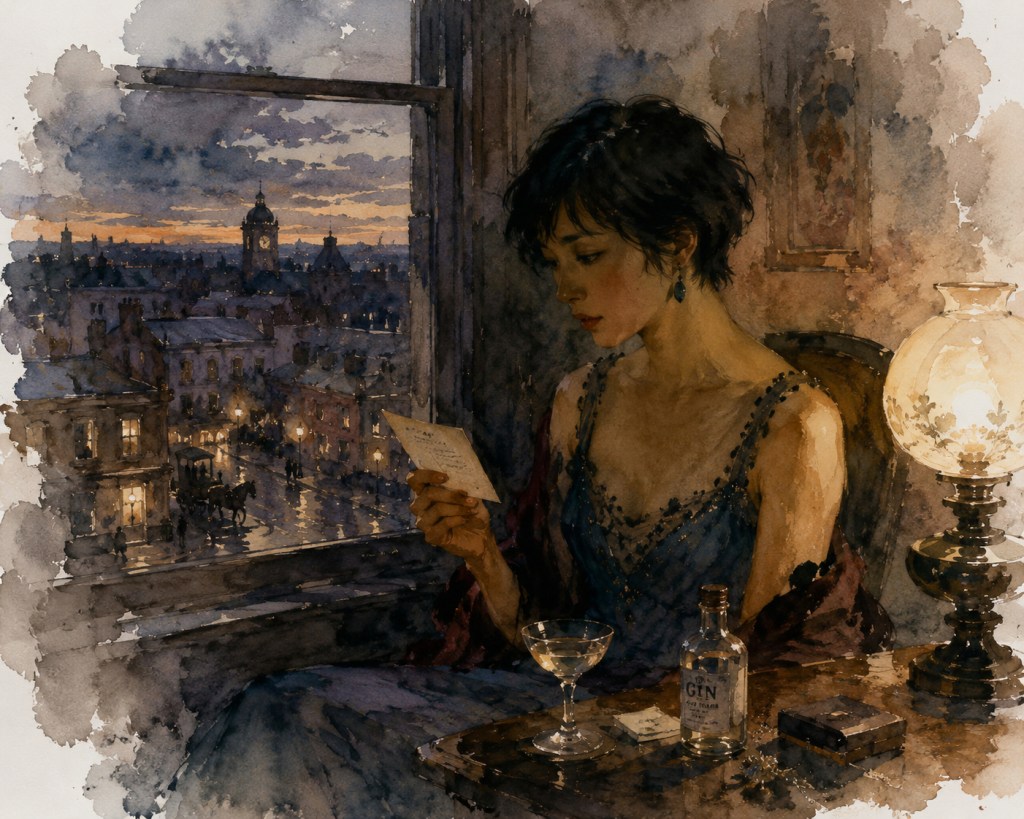
  • Miasma

    Miasma

    The sweet smoke bathed everything in a black light, turned even the sun black, which cast down its inky rays upon an ashen desert dotted with blasted stumps and the remains of unidentifiable beings. And it was as though a miasma arose from the earth to meet the ghastly light, some dark cloud arising. Finally his senses would numb and the faint vestigial flicker of luminous bone dim along with the remnants of wakefulness. What relief it brought, fleeting alas, this bleak corpse-like state.

    Herein unendurable day-lit regrets and cravings subside, assimilated by whichever skeletal self donned them as slabs of weightier stuff, like rag-doll stuffing, marionette trunks chiseled from wood and covered in miniature clothing, so as to impart a compelling illusion of life. First, the fleshing-out of a penny existence, soul without hope; and now the reverse, as in the erasure of a sketch, spiriting away first hatching and shade with light strokes of the rubber, and then the substantive lines with razor blade and spittle.

    Whose awareness was it of the grinning skull within, yet containing him, strangely? A drooling grin spread across his own sticky face; more than an expression, an extension of his embodied grotesqueness, a germ of lasciviousness for its own sake, abjuring any particular object. Some kind of perversion implicit in the skull. Memento mori. Never forget that you must die as well. Well, if that’s all, that’s naught: neither death nor life makes much difference to me. Why should I dread my approaching dissolution? Life is a borrowed thing, and the living frame thus borrowed is like so much dust. Life and death are day and night. He observed such thoughts pass through the skull over and again.

    A shadowed figure peers into a smoky opium den filled with drifting haze and dimly seen occupants.

    Echoing his uneven, scuffing footfalls and stumbles, a passage had led him here, but which? Or which wasn’t it? The one with the ante-room? On the one side a deserted gambling table and on the other the same. Both deserted, for luck had forsaken the place. A hallway led down through the building, from which a number of small rooms opened off, half of each occupied with a staging spread with gaudy carpet. He pushed open a closed door, to peer in through the beckoning smoke, almost sickly sweet as it was. Two … what do they call them … orientals, celestials … pigtailed, reclined on the staging, curled either side of an oil lamp, the wisps of black smoke spiraling up. To look into their eyes was to find no spark beyond faint reflections of the lamplight. Beyond those unseeing orbs, no, orbs revolved inward, no sign was granted the interloper, no sign of life, nor any of the myriad fluorescent blossoms and gems of the transcendent realms, the dreams that held them in thrall.

    Further back, in the shadowier corner, another lay, grotesque grin on his unshaven face, hugely magnified, as though mirrored on the convex surface of the observing eye that had somehow passed by the other two unseen.

    From time to time, one or another stirred in order to reload his cane pipe, about a foot long, on the end of which was affixed a bell-like covered bowl, with a round hole the diameter of a pea, to admit the opium. Using a long steel needle he took up a portion of treacle and heated it above the lamp until it attained the plastic consistency of dental gutta-percha, whereupon it was ready then to be inserted into the hole. He put the end of the cane tube to his lips, applied a light, drew in the smoke and released it out through his nostrils.

    The third awakened, reenacted the ritual, then lay back and drifted again into a fleeting paradise, his head resting on a firm-cushioned stool about six inches high. Once again, and again, further confounding the befuddled mind, which beheld as one continuous action what was in truth a composite of disparate moments. And what if not merely the mind but the spirit as well was so disorientated by this freezing of time’s components that it became dispersed among them? Not knowing where or when it existed in any segment of the action. Not to say that the self was concerned about such contingencies as time and place, so close was it to its dark and eternal home, so close, merely a membrane separate. Bearing in mind that the self itself – note the impersonal pronoun – could not be said to know or think, being merely an effect or illusory thing.

    Immediately he recognized his own face in the contorted smirk, the gesture itself took control, such that he, the mirror image, must only obey. Which was this dark passage through which he had arrived, from a course traced through so many forked paths? Might he rejoin his mother and intimates, Pu-erh, Ugly Toad, Yongyan, and Wang via this corridor, with rooms coming off to the right and left, multifarious false paradises? Places of dreams, ante-chambers of the grave, which remind us of our lost ones, since the walls are hung with their portraits and decorated with their busts, as though designed to relieve our desolation, we who must remain a while longer.

    Whence the guilt, the miasma, the dark cloud arising?

    • • •

    Ugly Toad rose to a position of great respect in the temple, successfully wooed one of the most beautiful women in the village below, and took her for his concubine.

    “I would prefer to be next to him,” she said, “than married to any other man in the province, unattractive as he is.”

    Her given name was Ling, which is like the sound of a bell or a tinkling piece of jade. Jokingly, he called her his Concubine Ling, which was the title the Empress Xiaoyichun had borne a century before, when she rose to fifth-rank consort of the Qianlong Emperor.

    “Concubine Ling,” he said, “your name carries within it the sound of the sweetest chime, but surely you must realize that such a chime will sound muffled and confused when hung between two old earthenware pots like your father and me.”

    How could she answer other than with a smile?

    “You are getting these chestnuts out of some old Taoist rascal in those books, I’m sure. I think you’re spending far too much time pondering in the library these days and not enough planting in the garden.”

    “Yes indeed, Concubine Ling, I noticed just today that the new bamboo shoots are coming up; it may be time for somebody to harvest a few, for they will soon be growing up in front of our eyes.”

    “I disagree,” she replied. “The watermelon radishes are more advanced, and if we don’t pick them, they will turn. And what is more,” she added with a come-hither smile, “they are called ‘beauty in the heart,’ so it is auspicious if you are the one to harvest them, emperor of my heart.”

    “Of course, my dear, you are right. The bamboo shoots can wait a little longer. It is yet quite cool, after all.” And he never failed to do exactly as she wished.

    Similarly, he never expressed any opinion contrary to those of his neighbours. Consequently they grew to love him nearly as much as did his wife and father-in-law, who moved in with the couple and would never be separated from his son-in-law, such was the fondness he developed for him.

    “I wonder why you always seem to agree with everyone’s opinions?” his father-in-law said to him with a faintly critical overtone, one quiet evening when they sat relaxing by the cliff-top, enjoying the moon over a cup of hot toddy mixed from rice wine, sugar, and spices. “I’ve noticed that, even when they are quite contrary to each other, you always manage to concur with all of them and don’t adopt a particular one of your own.”

    “Well, you know,” Ugly Toad said, “it must be because here in this temple I have grown to prefer appealing to the infinite, rather than be disturbed by everyone’s conflicting ideas. Now I think of it, though, listening to what you say, perhaps I should make an effort to have an opinion of my own one day …”

    Lao Tzu’s disciple Zhuangzi says that if an ugly man has a child born to him at midnight, he hurries to it carrying a light to examine it most eagerly, afraid that it may look like him. When their daughter arrived, Ugly Toad did just that, but the baby turned out to be even more beautiful than Ling, and he wept tears of a greater joy than that of most new fathers, as joyful as they are in their own right.

    Endowed as she was with a phenomenal wisdom and depth of knowledge in Confucian law, among her wealth of other attributes, Pu-erh had her pick of administrative roles in the district, for a succession of emperors had come and gone, and the Imperial Court had by now forgotten all about her, sunk from notice in such a far-flung place, leagues upon leagues from the Forbidden City. And anyway, anyone who came across any mention of her in the records would have assumed, naturally enough, that she had passed away many years ago.

    She employed Yongyan and Wang as assistants-in-training, instructing them in the “Ten Wings,” Confucius’ own commentaries on the Yi Jing, and in his principles of law and social harmony, while at the same time guiding their education in Taoist philosophy. A far cry from their activities as less than competent ginseng poachers and bandits, their lives now became devoted to self-improvement and to becoming citizens whom all the villagers would admire for their virtues and upon whom model themselves. Pu-erh’s aim was to form a supremely harmonious society in the mountains – to transform this rough clay into the finest porcelain. Corporeally honed by a fervent idealism, Yongyan the Hungry became thin as a reed and came to be known as “the Sated,” while Wang the Eviscerator became “the Meek.” Wang kept his head and face shaved and packed away his beloved goose-wing sabre, having learned that sharp weapons are instruments of evil omen, not of the cultivated person, who uses them only when compelled by necessity. The regional government instituted Pu-erh as travelling magistrate, and she and her two subordinates successfully undertook many charitable projects. Together, the three engineered drainage and irrigation projects, set up soup kitchens and winter shelters for the poor, and eliminated the widespread practice of infanticide carried out by families who had too many children to feed, known euphemistically as “marrying her off” or “transmigrating him to the body of another.” Mostly girls, but sometimes boys; mostly the poor, but the rich as well.

    Then one day, his eyes reflecting the heaviness of his heart, Wang the Meek came up to Yongyan the Sated where he was working in a vegetable patch, lowered a pack to the ground, and leaned on his walking stick.

    “The life of the do-gooder has been great for what it’s worth,” he said, “and I’ve learned all sorts of new things, but enough is enough and I’ve come to the end of my tether. It’s tired me out, as much good as I know we’ve done. My heart weeps and all this is starting to give me the shits. Before we met up with Pu-erh and Mow Fung, I had a hankering after adventure. Remember after that bear got me at Changbai, I said I’d had enough of mountains – one day I’d go south where it’s nice and warm, and get myself hanged for something more profitable? What’s stopping us?”

    He spat down onto the dirt.

    “And how about Ugly Toad? I can’t talk to him any more, he just agrees with me all the time. How can you communicate with someone like that? I used to like him much more when he was disagreeable. I’ve loved Pu-erh since I first set eyes on her, but there’s no denying she’s too good for me and always will be, no matter how hard I work at it. She doesn’t even see me; it’s as though her eyes look right through me. I love Mow Fung too, like the son I never had, but I never see him any more. Last time we met he raved on about the Jade Volume and all it was teaching him, over and over. He sits up in those caves in the cliffs above the Jagged Rocks. He’s going loco with all that fasting and chanting, and too much reading that old stuff isn’t good for you in this day and age. He’s been acting even weirder than usual, and he’s got even the monks talking, let alone the village folk. How would you like to come with me, back to our good old life of fun and adventure?”

    “Too much still to accomplish,” Yongyan said, resting on his hoe. “When you do a job well, you should do it thoroughly, and when you start something, you ought to finish it.”

    “You don’t say. Really? Did you make that up by yourself?” Wang said, realizing how utterly he had relapsed, but preferring things that way.

    “It is a wise teaching of the ancient sages, a rule that we all should follow.”

    “See what I mean?” Wang said almost to himself, sighed, shook his head and spat again.

    “Even now as we speak,” Yongyan said, “the villages in the valley below the eastern flank of Tranquil Mount are engaged in a controversy about the watercourses over there. Some of the villages noticed unused water flowing down the canal to the Eight-Mile River, you see, and they decided to tap it with unauthorised irrigation ditches. But the village of Great-Water thought this was wrong and appealed to Pu-erh as magistrate; and on going down to investigate the river system and seeing abundant water running down from Dog-Head River – which used to be known as South Ditch, the lower stream of Dog-Head Spring, but hasn’t been called that since the sluice gate was put in and the ditch dredged in spring and summer … But that’s by-the-by. Where was I? Ah yes, noticing that the South Ditch has quite a deep bottom, thus letting more water through than the forty per cent she had allotted to the eight villages along the circulation ditch, she ordered stones be placed on the bottom and sides, thus decreasing the amount they can siphon off. You see, that restores the forty-sixty ratio between the two main groups of villages. As well, she’s placed a five-wen fee on water usage for one day and one night, and limited the amount of water that each person can take during a given cycle of twenty days. Now, listen closely, because here it gets complicated –”

    “Enough,” Wang pleaded. “That’s exactly what I mean. You’ve changed too. I understood you better when you used to let your belly do the talking. I can’t bear any more of these convoluted issues. They have brought both my brain and spirit to the point of collapse. These are exciting times in the world, you know, what with the Taiping Heavenly Kingdom toppling Nanjing and chasing the Emperor out; and you’ve still got the Miao kicking up a stink in Guizhou province, and the Red Turbans look like they may take over Canton. And I’m missing it all for what? The chance to play sluice monitor for a gaggle of rustics.”

    “Wang!”

    “Alright, I apologize, I take that back.” He gave a snort. “Well, there’s little more to say but fare-thee-well. My destiny is out there somewhere waiting for me. Always remember that I love you like a brother, and it is my joy to have gotten us out of some sticky situations in the old days. Pass on my fond regards to Pu-erh and Mow Fung, will you? I hate long goodbyes and don’t think I’d be able to get away without making a fool of myself.”

    With that, disguised in the clothes of a peasant, best to avoid the attention of rebel and Qing soldiers alike, who, when they were not engaged head-to-head in one deadly battle or another, seemed to spend their time searching out and terrorizing Buddhists and Taoists, and defacing their temples, he shouldered his pack and set off for the forking paths in the bamboo grove. His heart was heavy but his tread light, in the understanding that “the skilful traveller leaves no trace of his footsteps.” The last Yongyan heard was a few snatches of a sad old song that Wang used to whistle once in a while in the old days:

    Breaking willow twigs –

    a hundred birds cry in the garden grove.

    • • •

    Mow Fung dreamed of a giant fish that turned itself into a bird and flew across the Southern Ocean, known also as the Heavenly Pond. When he awoke, the heart of the bird remained inside him, and he found himself consumed with its yearning for the south. Impenetrable darkness enclosed him as though he were a fossil caught in a piece of coal, and he recalled that in his dream, before he became the fish, he had found himself in a dark house of multiple paradises where he lost his way as well as his friends. He sat up and reached forward gingerly in the dark until his palm came to rest on a vertical granite plane. He began to crawl, groping his way along the wall. At the next turning, he halted. This was further than he had come on his past excursions in answer to the call of the thousand-mile-long black dragon Zhu Long, believed by the ancients to be the creator of the world, who usually lived deep beneath Zhong Mountain, fasting and holding his breath, but had evidently come here to pay a visit. It was through the light shed from the candle it held in its mouth that, roaming deep inside those caverns, Mow Fung gained his first views of the Nether World.

    The call had become an increasingly powerful roar during recent weeks. He did not hear it through his ears exactly, like a normal earthly noise, but rather through various parts of his body. At first, his heart, stomach and lung cavity vibrated annoyingly, a symptom that would become so pronounced and painful in one or another of them that he feared he might keel over dead any second. As for his ears, first they numbed, then began to burn and feel as though they bled inside. The channels that led from his ears into his brain fed in waves of pressure, synchronized to the pulsing of the blood. Having come so far inside the granite labyrinth, so near the dragon, the fluctuating pressure assaulted his ears, not from the outside but from within himself. Squeezed by the pressure, his eyeballs warped and perceived false, luminescent ghosts.

    He had the subterranean system memorized perfectly up to his present location and found his way back outside without difficulty, though assaulted all along by the voice. The mouth of the tunnel opened from a sheer cliff high above the rocks. As soon as he emerged, four peals of thunder sounded and a bluish-green light flashed six or seven times in the sky like thunderbolts. Clouds of dark vapour arose from the foot of the adjacent mountain and from the depths beneath him. From behind, mice scurried out between his limbs and along the narrow track carved into the cliff face. A silence descended, but for a whistling breeze carrying a scent of rotten eggs. The breath of Zhu Long! He knew immediately what it was the dragon had been trying to tell him all these long weeks.

    As frantic as was his effort to hasten, progress was nauseatingly slow, inching along the track, back pressed against the cliff, heels guided by a carved groove. Then into the forest he went, stumbling over boulders, splashing through streams as he staggered down the eastern shoulder. He came to the crossroads, deep in the forest, the place the monks called the “ineffable centre,” meaning the centre which is everywhere, the circumference nowhere. The temple or the high village? There was only time to warn the one, but not the other. He must decide. Behind him, the east, the Black Dragon; to his left, Rosefinch; straight ahead, White Tiger; to his right, the Tortoise. Out of nowhere, a streak of crimson, a pause, then a ringing, slowly rising trill, Weeja-wu-weeja! Next, the alarm: Chay-eeee! And away.

    A dishevelled monk runs toward villagers, who stop their work and stare at him in a mountain village scene.

    At the outskirts of the high village, peasants tended vegetables, led an ox, wove a basket, braided leather thongs, repaired a gate. They all stopped what they were doing at the sight of the mad young monk in rags come staggering into their midst, unable to speak. Moved his mouth, but no words came – either from the effect of some narcotic or from his months of confinement in the caves. They started to laugh at him and continued until the moment the first tremor struck and threw them all off balance. The earth shuddered and their hovels shook and creaked, but none collapsed. A massive clap of thunder sounded from the direction of White Tiger peak, and an overpowering crash and rumble rent the air, as gargantuan slabs of rock and earth slid and vanished into the abyss before their eyes. The Taoist temple and everything within its grounds and its walls disappeared along with the entire mountain peak, everything mangled and disintegrated as one, like a shovelful of gravel. When the peasants arrived running, there was only an abyss of nothingness where the temple had stood minutes before, much as if it were a chalk drawing wiped from a slate. A vision of it was still there in the memory, as tenuous as a retinal image. Yet, much as they rubbed their eyes and shook their heads, the building itself would not reappear.


    From the draft novel Stawell Bardo © Michael Guest 2026