Tag: serial novel

  • Yoke of Fuzhou

    Yoke of Fuzhou

    These blasted brushes have their bristles falling out into the ink, and where the devil is the new consignment of butterfly scrolls? No, stop, it doesn’t bear transcribing all this, you nitwit, it will only have to be crossed out later. And just as we were broaching a significant point in the temporal flow: the departure of our invaluable Informant from the true path; in fact, he appears to be rather on the point of abject existential dissolution. I may only imagine how he wandered in such a wretched and deluded condition, through the bamboo forests and down the sides of our holy mountains, to lose himself further in the delusory lowlands of the masses, hither and thither, absorbed deep and deeper into the miasma.

    Yet if one strains very hard, a horizon is observed – a wooden horizon, if you please – and there is writing upon that plain directly before his eyes. It speaks of crimes, in painted characters as dulled and forlorn as his mind has become, onto which one can now barely latch. The mind has retreated into a further, deeper corner of the darkness, where no more than a single ray of candlelight might faintly pierce. No self. No “him” to speak of, except poetically, personalizing and gendering the pronoun “it”; perhaps that will be enough. Make a note.

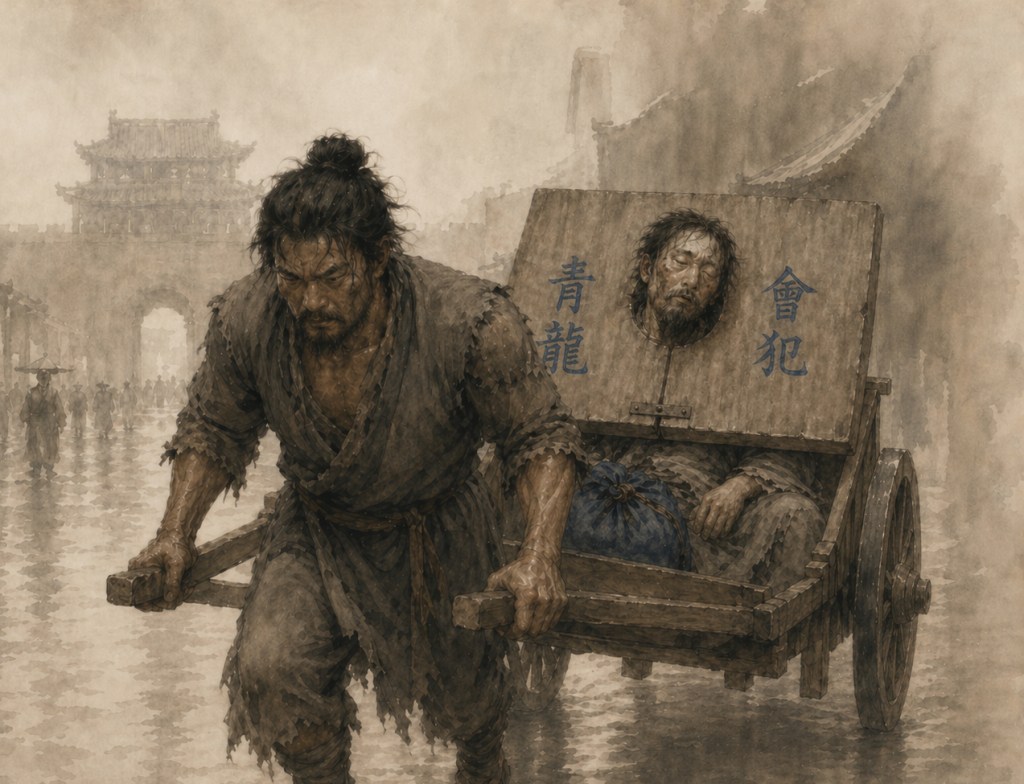
    A most memorable road sign, “Ten miles to Fuzhou!”: a picturesque city, better known in earlier times as Ye; later, to the Tangs as Minzhou, the place where the mighty River Min flows, which is why the whole region of Fujian, lying up the coast from Guangdong, was then called just that: Min. But by Qing times it was Fuzhou. Informant’s present is ten years after the First Opium War with countries of the West; our region has been opened up to barbarian traders and missionaries. Back to his woeful state, his horizon – ah, his ruinous yoke. A cangue. Square collar made of boards, three feet by three, having a hole in the centre for the culprit’s neck, thus preventing him from reaching his mouth with his fingers. The crime for which he is punished by wearing this wooden collar, and the duration for which he is to wear it written in bold characters upon the upper or front side of it, and he is placed by the wayside to be fed or spat upon by the citizenry. Blue Dragon criminal. Cangue until death shall release.
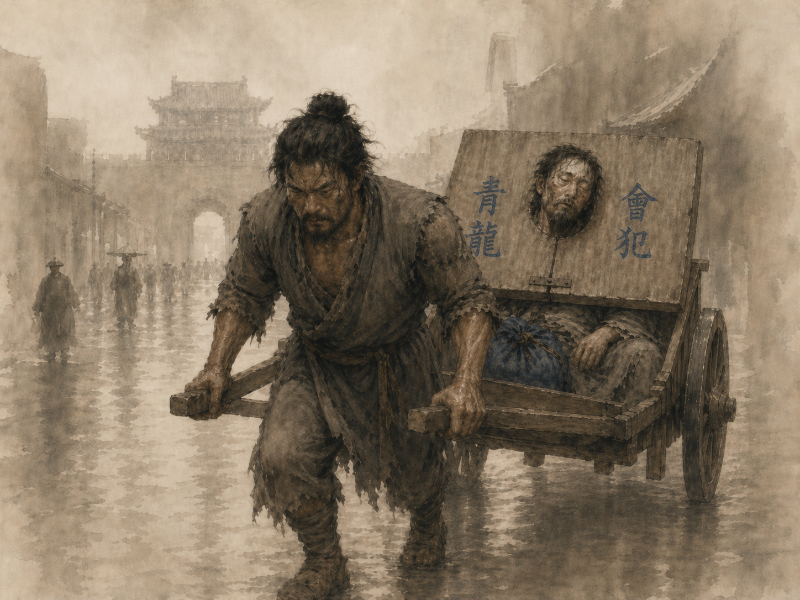
    Manhauling a cart through a narrow street, carrying an exhausted passenger slumped beneath a large wooden cangue.

    Perhaps cross out. Consult the lower ledgers.

    Blue Dragon Society: a minor fraternity of regional gangsters, late Qing, subsequently suppressed, of insignificant historical consequence.

    Leave it in, it may mean something to someone.

    Travelling slumped in the cart, he is propped up by this square hardwood cangue. But his heavy eyelids slide open to slits and he can read the road sign – Eureka! The so-called “Happy Region” of Fuzhou.

    A shame he is unable to revel in the delights of the place, as the cart jolts along beside the River Min. It is as though the reality before him barely adheres to the surface of his mind – floating islands, vast bamboo rafts thick with soil, little houses and gardens adrift upon the water. But he sinks down; his tongue lolls. His eyes roll and the heavy eyelids droop to close once more.

    The author – a missionary, of course – remarks upon the great sails the aquatic folk hoist when they choose to shift their colony, while men, women, and children labour at the oars below. What else would astonish him? Remove the barbarian Doolittle’s volume. These avaricious Christians have troubled the age quite sufficiently already – and never more so than in the period of our present visitation.

    The old barrow clatters through a massive gateway into the walled city of Fuzhou, beneath the lofty sentry tower commanding the approach, among a throng of travellers on foot or in sedans, and coolies bearing produce and merchandise. Driver has bound himself by leather shoulder-harness to the single-wheeled luche or “deer cart”; its central, wobbly wheel groans on its axle as he strains to keep the thing upright through the narrow, filthy alleys. Some portly mandarin of moderate rank edges imperiously through the peasant mass. His sneering glance grazes the abject human cargo lashed to the vehicle and all but sliding off, one hand flapping insensibly against the frame: an amusing caricature of human sediment for the citizens to point at. Some giggle hysterically.

    Such events are gainfully recorded, if for nothing more than the insight they impart as to the rudimentary functioning of particular bulkheads of Informant’s mind, which without them would be in peril of submerging entirely. Incidental perceptions such as the fat mandarin somehow join his recognition of the passing moment to those more profound airy labyrinths and subtle wordless channels through which he maintains his confluence with us, that inextricable foundation of his being. Other precincts of the mind, however, remain impenetrable to so feeble an inhabitation of the moment.

    Driver has found a patch of dirt to claim as domicile; he releases his leather shoulder-strap, and leans his companion in a disused alcove, balanced relatively upright against the cart. Next day, the driver leaves his burden and goes in quest of scraps and coppers in payment for his services as an itinerant barber to an unnamed, unbearably hairy clientèle. On returning, he turns to the care of his passenger, coaxing him from his fits and trying to lure back some dim memory of humanity. He speaks of the magnificent banyan trees of Fuzhou, beneath whose drooping whiskers, swinging softly in the breeze, he rested during his daily sojourn. As though to a child, he recounts tales of an earlier, happier life, exhorting him to some sign of recognition. At length, he returns with some borrowed tools and proceeds to break the chains that tether the cangue around our informant’s neck. During the days that follow, he uses the sign nailed upon the yoke to restore in him some mysteries of the written word.

    After some days Informant’s eyes clear noticeably, and Driver observes in them a fitful lucidity. Behind that clearing, broken moments from the opiate miasma begin to stir –

    The Pit. Amid a smattering of flashes and grunts in the dark, unseen blows from heavy fists and sticks break him no more than required, and he is stripped of clothes and shoes. Let down into the Pit for schooling. It is the beginning. It is called manning the pumps. Growled words: pumps, sealed drums, blasted rats. Once inside, the water man flogs and binds him to a place on the chain-pump, in a line of others. Other water toads. Egress is by hauling. The shift is expired. The body will not work beyond this duration. Called freezing in the Pit. Haul out the toads. If it looks tired whip its back. Repeat.

    The Sealed Drum. Damp earthen cubicles x feet by x, from where to where. Drag the living water toads through the stockade entrance. Good when moonlight. Bad when sun. Good when the moonlight seeps in to brighten things up. Bad when the sun, which burns a hole through to the brain. The ray of moonlight waxes and wanes. A toad cannot tell whether it is awake or asleep. The moonlight waxes and wanes in its sleep as well. There is space to writhe from somewhere to where. One by one the toads awaken and vermiculate across the bottom in quest of food. They cannot tell food from the other matter, before or after ingesting. It all goes down the same and comes back up the same. At first the toads converse. Called chatting. But after enough passages between the Pit and the Sealed Drum, they aspire only to slip and wriggle like maggots. Called adventuring.
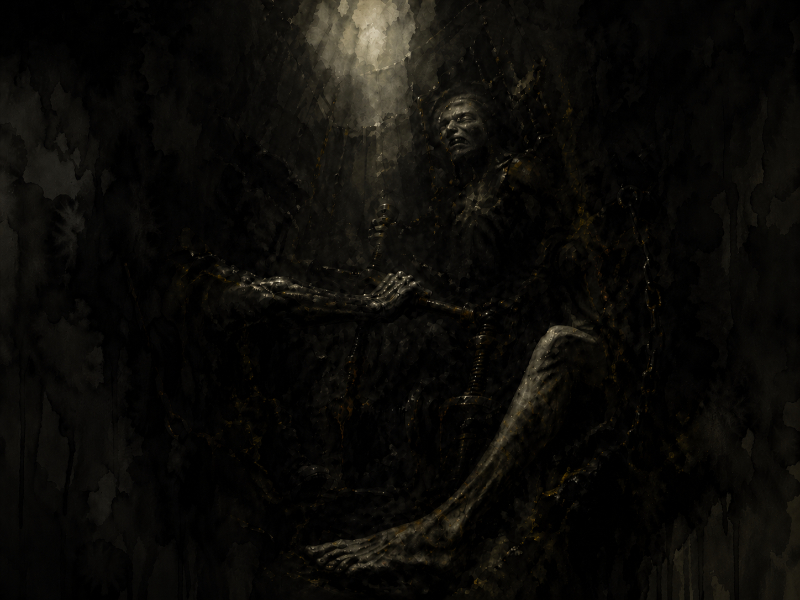
    Emaciated pit worker bound to a chain-pump in a dark mine shaft, half-submerged and reduced to a “water toad” by brutal labour.

    Inside the Pit again. The pump clitter-clacks. Clitter-clack, clitter-clack. Sometimes it sticks and Water Man curses. Rust, or a finger or toe cut off and stuck in the joint. No exploration allowed in the Pit. It is a place for meditation on pain and lessening. Lessen the suffering, lessen the lack. No exact word for escape. If it veers from the way to the Sealed Drum, slash its feet for it.

    Called Pension Rice. These ones still living are left in the Sealed Drum for the off-season. Springtime. For a while they luxuriate in the sodden dark. Chat, vermiculate, adventure. But in the Drum life soon becomes indistinguishable from death, and they languish for more pumping; oh to live again.

    Whistling, as he used to, of the broken twigs in the grove, our wandering barber rounded a corner and slouched wearily along their narrow market alley, scarcely wide enough to admit two abreast. It was the usual late-afternoon scene, the day’s energy having somewhat dissipated, along with the stream of pedestrians pursuing their sundry ends. A travelling doctor, who had arrived early that morning to harangue the multitude on the powers and virtues of his medicines, was crouched over his case, repacking small bottles. Driver paused among a group of stragglers loosely gathered to watch a soothsayer ply his trade; seated vis-à-vis on little stools and earnestly consulting one of the books laid out between them, the charlatan expounded to the awe-stricken simpleton the lineaments of his destiny.

    Pip-pip-pip!

    Closing his business early, the haberdasher was sliding his night-boards into their grooves. A cluster of children were down on their haunches before the shop, squealing at the clever feats of a few tiny birds hopping and pip-pipping amongst a pile of paper slips. The trainer had set them to singling out the slip enclosing a coin, rewarding them with grains of millet for their cleverness. A little farther along, at the Good Fortune fruit stall, a couple of women made their purchases, casting lots for the quantity they were to receive.
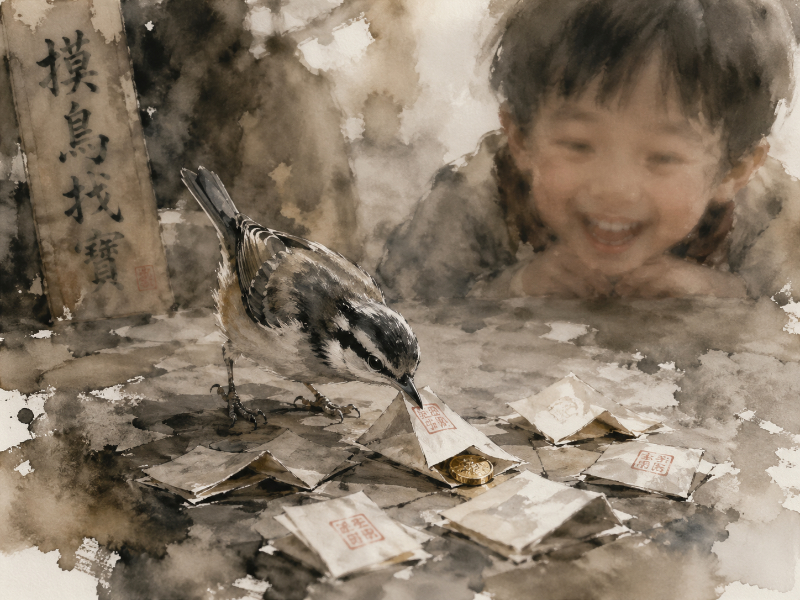
    Little boy crouching beside a street trainer’s tiny birds as one picks from a heap the paper slip hiding a coin.

    Approaching the alcove, he could not clearly see his charge, who was screened by rhythmically scuffling legs draped in tatters. A row of blind beggars, eight or ten, crowding into the doorway of the wine shop opposite, each with his hand on the shoulder of the comrade before him.

    Aaaiyaa… aaaiyaa… They intoned their dirge, punctuated by a clack-clack from two pieces of wood struck together. Some minutes passed, before the shopman’s unmistakable weary moan of complaint was heard through the door, signifying that a copper cash had changed hands. Then the beggars who had managed to fit inside shuffled out again into the alley, and the group recommenced their performance, filing on towards their next stop, their dirge echoing behind them.

    A ghost of a smile lingered on Informant’s face and a faint spark lit his eyes as he sat watching them, propped against his broken cangue.

    “They’re a bit late today,” said Driver smiling, as he lowered himself to the ground beside his companion. Informant gave an uncharacteristic start, as he turned his head and their eyes met. “Mow Fung?” said Driver gently.

    Informant turned back to watch the receding line of beggars, inclined his head, and made a slight frown.

    “That last Aaaiyaa is not quite right,” he said slowly. “The tune should resolve into Yu – the sound of winter and grief” – he searched for words, “… but one of the beggars pulls it up to the tone of Zhi at the fifth degree. That is not a tone of grief, but one of …” turning to his driver “… summer.” He frowned and their eyes locked again.

    The two sat silently for several minutes, as the informant explored a suddenly illumined zone of his mind. Then he spoke deliberately, gathering pace.

    “There is a warmth inconsistent with mourning.” A puzzled look came over his face, and his eyes turned up as he scrutinized a part of his brain. The sound of the beggars echoed down the alley. “Yes, there it is again, quite … arresting. It evokes the hexagram Shih Ho, Biting Through, because that tone of Zhi doesn’t belong but it can’t be removed – like something stuck between the teeth. I was here asleep when the beggars roused me with their singing. I felt I had to clarify that mistake. But now I can see it’s not that singer’s error, but rather more a cosmic intrusion …”

    The driver could not help laughing. “You’re back.”

    Mow Fung was getting excited. “That’s it! Zhi, the fifth degree, is the fire-tone – the south, the summer. The heart-viscus. The tone of Shen: spirit and the animating fire of consciousness.”

    “So in your sleep, you bit through it,” said Driver gently. Mow Fung turned to him and their eyes locked.

    “Wang!” said Mow Fung. “I thought it was you. We must go to the South.”

    Their descent by the majestic River Min through the coastal hills to the Pagoda Anchorage was uneventful enough. There Wang found passage on a coastal junk which, laden with hardware and kerosene for Guangzhou, bore them south-westward along the coast towards the Pearl River Delta. He passed the master two Mexican dollars, a sought-after currency those days and enough to keep them in rice for the voyage.

    “Pretty good for a travelling barber,” Mow Fung said.

    “Don’t worry,” his friend replied. “I’ve got a bit stashed here and there. Nothing too troublesome. I’ve been adventuring for these past couple of years, you know, and even made a bit of a name for myself as hired muscle. Those monks up on the mountain taught me a thing or two, I can tell you. Most of all, I’ve learned to keep it to myself.”

    “Wang the Meek,” said Mow Fung with a half-smile, as his eyes slid upward and he dozed. In their corner among the cargo down below, the drumming of waves under the hull, and the creak of timbers and bulkheads shifting, seeped into his sleep, taking him ever deeper. Wang made his way up to the deck for some air. He drew from his sleeve his battered stub of a tobacco pipe and lit it. Above in the dark, a brief gust set the sails slapping. He could still make out the coast, the Wuyi ranges dark against the purplish sky, pricked with stars, and an occasional light from some dwelling. The smell of tar rose from the hull, and he leaned there ruminating on his pirate days.

    In the morning the two went on deck, were allowed a place in the bows, with some pieces of heavy sailcloth for comfort, and told roughly to keep out of the way.

    “Mind that boom when you rise,” the sailor said as he strode off.

    “I dreamed of wearing the cangue,” said Mow Fung. “And before that – what was The Blue Dragon?”

    Wang glanced at him. “They were the ones that ran the mine where you found yourself trapped as a water-toad. When they thought you dead, they threw you into a cave where they disposed of their victims; but you must have passed into one of your living-death states or another.”

    He stopped as a pair of cormorants with outstretched necks swooped over the bow, wheeling down toward the water.

    “So when the yamen runners broke up the gang and found you there, and dragged you to the magistrate as evidence, he wasn’t sure whether you weren’t a Blue Dragon yourself, in hiding. I must say, you didn’t help matters much by raving on deliriously about the Tao, because that magistrate happens to take a dim view of Taoists in any case. So, to be safe, he cangued you till death should settle the question. That is what the bailiff in charge of you told me, anyhow, when I bribed him to hand you over. I hauled you all the way to Fuzhou in a hurry, in case the magistrate, a whimsical type, decided to shorten your days.”

    Something on the coast caught his eye. “See that burnt-out stretch, between the headland and that watchtower,” he said. “Red Turban work, maybe. Or one of the brotherhoods. Compared to these parts, Fuzhou is a haven – a bit boring actually. Glad to be gone.” He went off to the galley and came back with two wooden bowls of lukewarm congee.

    “Prefer salted fish scraps or a pickled radish?”

    “Hi, you pair! Out of the way of that line,” came a shout followed by a curse, and the two crouched and shuffled a few feet across, Wang juggling the bowls. The junk steered a little further out to sea, to where the breeze picked up a little. The sails billowed and the vessel bore along the southward curve of the coastline. Mow Fung rested throughout the day. Once in a while Wang moved to a sheltered spot at the rail and stood alert, his eyes roving between the coast and the horizon.

    By night they went back to their corner in the hold, the air now thick with fumes from the kerosene kegs. Nevertheless, Mow Fung was growing steadily stronger, occupying to a greater degree his proper time and space. His corporeal self.

    On the fifth morning, a hubbub above deck drew them up. A quarter of a mile astern, another vessel appeared to be bearing down on them, nearing by the minute, causing much consternation among a few of the crew, who had grouped together near the stern, half-hidden behind a stack of cargo.

    “Don’t recognize them from the anchorage – must be from further along the coast! Pirates maybe,” said one. Squinting, Wang took a good look, then said quietly, “Nothing to worry about: not pirates, too impatient. They’d more likely cosy up nice and easy-like, not to scare us off. With that big sail and skinny hull, I’d say she’s most likely a dispatch junk. Maybe some Red Turban trouble up north a bit.”

    The master called out to the group of green sailors to stop being idiots and get back to work, and a few minutes later the dispatch overtook them.

    The only other disturbance was some fighting on shore, barely visible through the haze: smoke rose from beyond the headland and men scattered like insects along the ridge. Alerted by the distant crackle of muskets, Wang watched for a while from the rail.

    “Militia and society men,” he said. “Hard to tell which is which from here. There’s a lot of interesting stuff happening these days, that’s for sure.”

    Entering the Pearl River Delta, the master shouted orders to his underlings, who trimmed the sails as the junk turned toward the northwest and slipped past Hong Kong. The White Ensign showed on several British naval ships at anchor, sails furled. Macao was hazily visible afar from the port side, its anchored vessels tiny specks. The junk veered deeper into the main channel of the delta, and the master refined his orders as he prepared to thread his way through the vast array of craft now appearing, and sought the channels that would take them up the Pearl towards Guangzhou.


    From the draft novel Stawell Bardo © Michael Guest 2026
  • Dust of the Dragon’s Tail

    Dust of the Dragon’s Tail

    The fleeting glimpse he had gained of a young fair-haired woman through the half-opened doorway to the inner sanctum of the Jade Phoenix had nagged at the detective. Of late, Chinese camps were acquiring a reputation among certain of the Wimmera youth for the unwholesome diversions they afforded. Alluring as these places may have appeared to some of tender years, especially to the wayward and unchristian among them, they were commonly reckoned iniquitous dens.

    One sixteen-year-old girl undertook a week-long, hundred-and-forty-mile journey from her home at Ballan, only fifty miles out of Melbourne, in quest, so she said, of a situation at Horsham. Playing upon the compassion of publicans she visited along the way, she obtained overnight board and a shilling here and there to buy meals on the road. Her real destination turned out, after a circuitous detour, to be the house of a suspect European woman at the Deep Lead Chinese camp, where she took up quarters.

    Hearing news of her arrival, Constable Hillard went out to interview her and, disbelieving her story, gave her notice to quit. When she spun him more yarns, attempting to fob him off and contrive to remain, he brought her up on vagrancy before the Stawell bench. The magistrate discharged her after a sound admonition, and the next thing you know, off she went to live with a Chinese gardener at Doctor’s Creek. Not a week later, Hillard ferreted out a second one, not even sixteen, who deserted her family home for the camp, because, she explained, of her father’s cruelty and the lack of comforts at home.

    This same girl was already known to the police, having recently preferred a rather serious charge against a young man from Stawell, which he was to answer at the next General Sessions. There was something wrong in the state of Denmark, the magistrate informed Forster in writing, when girls such as these sought the association of a Chinese camp, proposing that if an example were made of those who harboured them there, it might prove a deterrent.

    Dark-eyed Miss Chan – Forster addressed her as such, for the woman’s unassailable poise checked in him any impulse he may have felt to assume the familiarity of ‘Lili’ – acknowledged, when he called on her the next day, that she had indeed engaged a young white woman as a waitress and housekeeper, and he was welcome to meet her; she was just now in the back garden feeding the chickens. This he did. No ragamuffin, but a strapping, jocular red-haired Irish colleen of nineteen she was, radiating goodwill and health, and obviously unsoiled by the demons of opium and rum.

    Perhaps, Forster reflected, the growing distaste for the Chinese immigrant as ignorant pagan and filthy barbarian had little basis beyond plain bigotry and the biased reporting of the newspapers. There was the old enmity of rival gold-miners, resulting in thuggery and atrocity at Buckland River, Lambing Flats, and as close by as Ararat itself, less than twenty years ago.

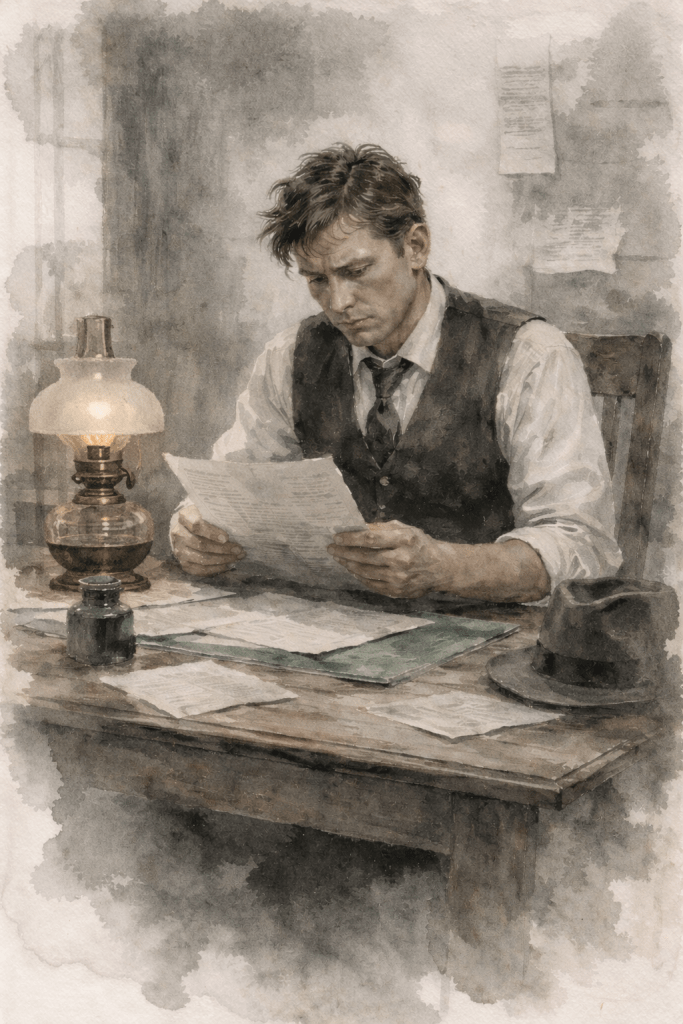
    Detective Forster sits alone at his desk in a modest 1880s bush office, leaning over papers in a dark coat and brimmed hat. An oil lamp and scattered documents rest on the desk, and the scene has a sombre, reflective mood.

    Disgruntled unionists were, he presumed, at the root of the more recent political pressure to exclude Chinese sailors and stokers from working on steamers trading to and about the Australian ports. Invariably cheerful and obliging Chinese fishmongers and hawkers of all sorts of useful wares had now become the targets of insult and violence from many working-class Australians, owing to a general animus against the Australian Steam Navigation Company, which had been hiring Chinese. Most unworthy of a great, free people. And what did this rabble know of China, a country they so despised? Most likely little, if anything, more than he did.

    If Lili Chan and his other new acquaintance, the mysterious Mow Fung – full of surprises he was, publican-cum-priest of some sort, evidently – were a measure, the Chinese had much to contribute to this country, and especially to a far-flung region like this. In idle moments, he found his thoughts wandering in their direction – and in Lili Chan’s, he cautioned himself, rather too often. He could entertain not the slightest likelihood that such a woman might have any possible interest in a crusty, ill-oiled bachelor such as he, even despite her situation, which was a morally tenuous one in the eyes of most. He could only wonder at what had brought her here, to the middle of nowhere, when clearly her talents and charms – that trace of a cultured American accent – would have fitted her for a rewarding position in Melbourne, at least. Enigma indeed. Her skin was of such a subdued olive hue, her features of such subtlety, that she might well pass for white, given the right circumstances and Western attire. Now, there he went, off again on mad imaginings …

    It was in the midst of reflecting on her features that he recalled having paused, some months earlier, on an item in the weekly Victorian Police Gazette – one that had caught his eye by departing from the usual notices concerning people wanted for questioning, prisoners discharged from gaol and the like. He retrieved the number from the bottom of a tea chest packed with old copies of the journal in a corner of the storeroom by the stables.

    “The whereabouts of a missing heiress are sought. The Cantonese woman, of Anglo-Chinese descent, has been traced from the United States, where she spent several years after leaving China, to the Colony. Information has come to light concerning her entitlement to a handsome fortune, of which she is not likely to be aware. Contact should be made with Chief Commissioner Chomley.”

    The memory of the notice clung to him. The next day he rode to the Jade Phoenix, and presently laid the gazette before Miss Chan. The proprietress looked up from the page and bathed the detective in the cool liquid of her unblinking gaze.

    “I was not aware, Sergeant, that you took such an interest in the minutiae of my appearance and background. Your detective’s training, no doubt. The innocent Miss Finnegan discovered in the employ of this humble if disreputable establishment – that speaks well for your skill. Are you ever able to separate yourself from your duties as a … copper?”

    Mincing by their armchairs just as her name was mentioned, the lusty Molly Finnegan, playing at saucy Irish soubrette, flourished her feather duster and made her exit.

    “Have you ever thought of entering the gambling line? Your attention to detail and, I suspect, your talent for handling disturbances would be invaluable,” Lili Chan said.

    “I dare say the references would prove difficult.”

    “On the contrary, Sergeant. In certain establishments, a good blow and a discreet silence recommend a man admirably.”

    “I suspect I should make a very poor ornament to such a profession.”

    “A poor ornament may still have his uses,” Lili said.

    She lowered her eyes to the gazette again. “In some houses, usefulness is the rarer quality.”

    He watched her a moment. “Miss Chan, does this notice mean anything to you?”

    “My origins are too humble, I fear, to promise any inheritance beyond poverty and woe; but if it will put your mind at ease, you may enquire with the Chief Commissioner on my behalf.” What harm, she reflected, could come of agreeing to so much, when to refuse would only raise suspicion.

    • • •

    “Where were we?” said the voice of Huish-Huish, accompanied by the gentle jangle of a consecrated shamanic rattle, amid the light aroma of incense.

    “I recall, the zither.”

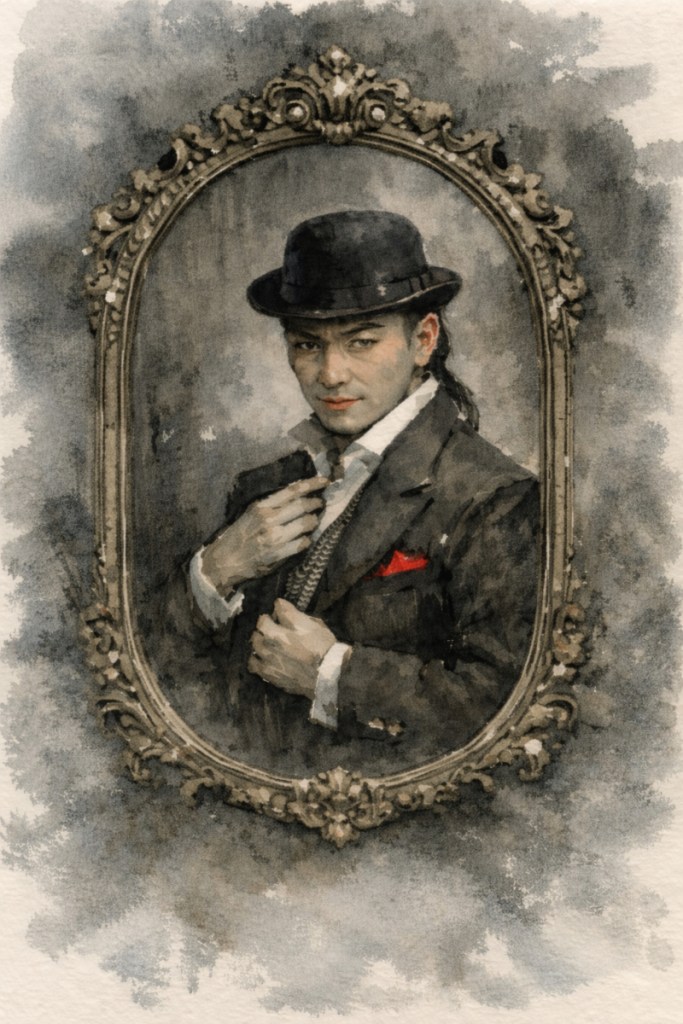
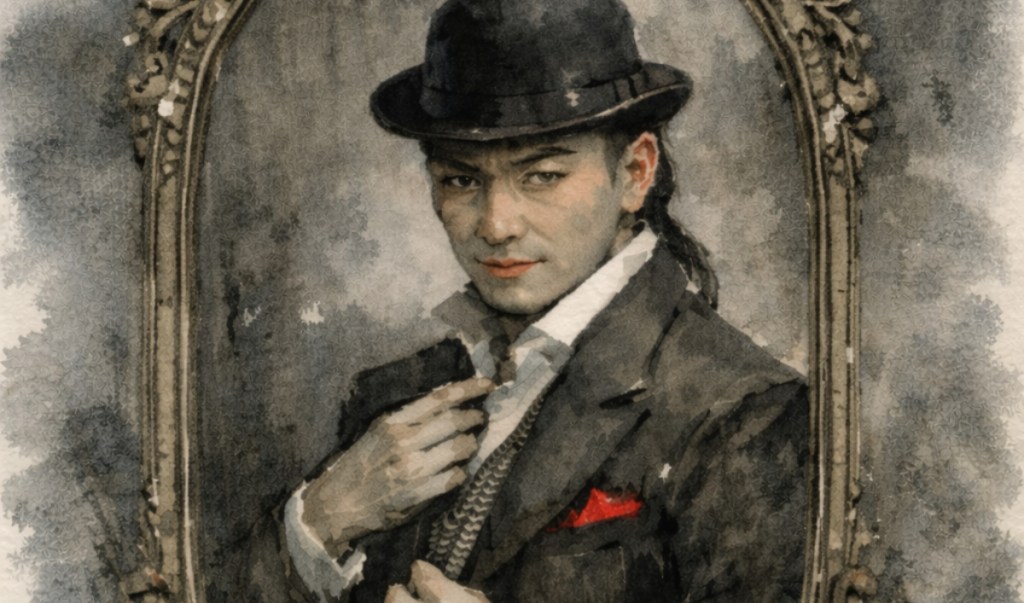
    After Fang Jing Dock’s tong began putting some serious pressure on Ah Toy, unassailable though she had been for the past twenty years, she sold up and moved to an undisclosed destination. With no choice in the matter, Chan Lee Lung became his mistress, and he moved in with her. It had been clear for some time that despite his dandyish affectations he was an enforcer – a so-called highbinder or hatchetman – for the Hing San Fong Tong, passing publicly under the name Society of the Mind Abiding in Tranquility and Freedom. Whenever he went out to conduct business of a certain kind, he would don chain mail beneath his dress shirt, tightly bind his queue up underneath his derby, to keep it from being seized in any rough stuff, and conceal his butterfly swords beneath the back of his jacket, all the while preening himself before his ornate mirror.

    One evening he and a henchman returned to the house with another Chinese man unknown to her. The three repaired to a room that Fang had commandeered as his music studio, where he also kept a small vault containing the most precious valuables of his tong: a handful of flawless diamonds of inestimable value. Before long the sound of Fang’s Viennese zither could be heard filtering out, a fantasia on Il Trovatore. She went to her bed and fell into a deep sleep, to be shaken awake by Fang.

    The highbinder Fang wearing suit, derby, and barely concealed chainmail vest, preens himself in an ornate mirror, adjusting his appearance with deliberate care. The image is rendered in a watery, near-monochrome wash with a subtle red highlight, the reflected figure contained within the frame and the edges fading into abstraction.

    “Go and see what you think of the new centrepiece in the studio and tidy up a bit in there. Fat Louis and I have some business to discuss, then we’ll get things back in order.”

    The third man sat slumped sideways in a wicker chair, his sightless eyes bulging wide, his tongue lolling from the contorted blue face. Around the throat, biting deep into the flesh, was a garrote fashioned from a metal contrabass string, carving what looked like a raspberry-jam-filled rut. She sank silently onto a chair and took stock of her future, which was clearly what Fang had intended.

    When she entered the sitting room, Fang and Fat Louis were sipping pink champagne, and nibbling on Roquefort.

    “Nice tang,” Fat Louis said. “King of cheeses.”

    “Butyric acid caused by the fungus Penicillium roqueforti,” Fang said. “Legend has it that the cheese was discovered when a youth herding his sheep on Combalou Mountain, partook of his lunch of bread and ewes’ milk curds. Seeing a beautiful girl in the distance, he ran off vainly in pursuit of her, leaving behind his flock and his lunch. When he revisited the spot a few months later, the mold had transformed his plain peasant repast into this delectable bonne bouche.”

    Then looking up at Chan Lee, “That was quick. Did he have anything to say?”

    “He thought the end was the best part,” she said in a measured tone.

    “The critics be damned, I say!”

    The two men fell about.

    Chan Lee looked at Fang steadily.

    “There is no medicine for vulgarity,” she said, taking up the champagne flute on the table for Fat Louis to fill. No way out of this but forward; she must watch for an opportunity out of the corner of her eye. 

    “I told you she would have what it takes,” Fang said. “You can tell a woman of breeding. And she knows as well,” lending a malevolent emphasis, “that the song of a dead bird is a sad one.”

    One thing was certain: to run to the police, if the chance arose, would be a waste of time and might well invite a fatal reprisal from Fang’s cohorts, were he to be put away, which in fact was unlikely, since the law tended to stay out of Chinese matters when they did not directly affect anyone else. For the time being she played the dutiful concubine to Fang. As he wished, she took on the mantle of his wife, at least in the view of the public, though the union was not sanctioned by either a Chinese or American ceremony. As an enforced confidante of the highbinder, who often boasted to her of his crimes, she was ever more ensnared in the strands of his fate, becoming, in the parlance of the courts, an accessory after the fact, and thus acquiring the guilt of his felonies.

    • • •

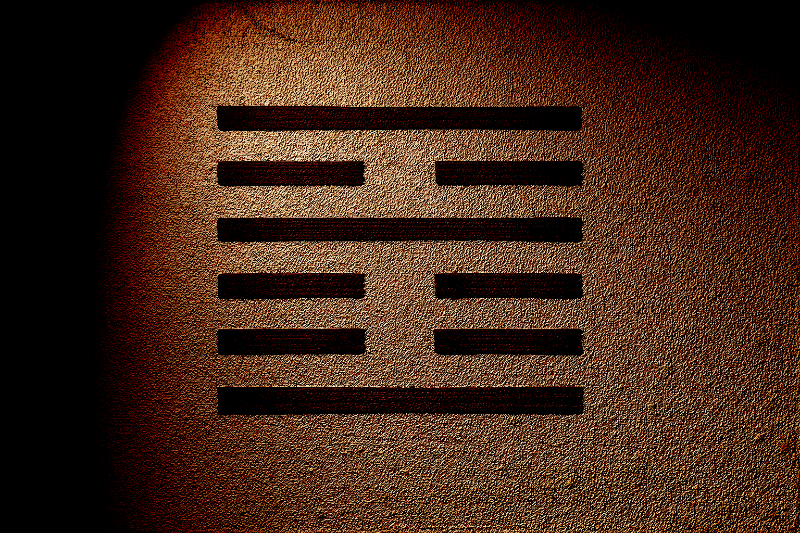
    In the Deep Lead Joss House, Chan Lee sorted through fifty yarrow stalks as Huish-Huish had taught her, occasionally raising them to her nose to savour the herb’s unique aroma. Huish-Huish counted off the number of stalks remaining between Chan Lee’s fingers at each stage, and the procedure was repeated six times to determine the lines of the session’s hexagram: Biting Through – judgement, punishment, discernment. None of the lines signifies guilt, though a little harm may be done. On the whole, an optimistic sign: though there may be trouble at the beginning, one bite’s through. Justice is administered, punishments exacted. If you lose your teeth, you lose your grip.

    Black on gold image of the Yi Jing (I Ching) hexagram 21 Biting Through. Bottom to top, the lines are Yang (solid), Yin (broken), Yin, Yang, Yin, Yang.

    “Cutting … gnawing … chewing …” Huish-Huish said. “A picture of the mouth. You bite through, get your teeth into something.”

    “Cutting.” Chan Lee intoned the word, the eye of flesh closing, the inward gaze of the eye of her contemplation floating back in time. “If you chew dried salt meat, you’ll find yourself poisoned.”

    Knowing not whether for good or ill, she decided that her best move would be to gratify him by seeming to take pleasure in what he did – deeds she found appalling and sickening, lacking as she did the same innate relish for inflicting misery that she now knew to be his. She did not stop to ask whether repeated exposure would inure her to his evils; whether, by touching black paint, her fingers too might be blackened. One thing was sure: there was no iota of love in her heart for the man who had become her ostensible protector. Fang was a man in whose arid heart love for any other creature had never taken root. As time went by, familiarity became contempt, and instead of any initial ardour, the possession of one so desired by others only fed in him a seething sadistic scorn that grew stronger by the day. This scorn he expressed in a ritual of cruelty, a proxy for the conjugal act, with strangulation and cutting for caresses. Sometimes his fervent passions quite got the better of him, and it was on the cards that he would murder her before too much longer.

    Deadened by morphia, a living ghost of herself, she faded from the view of her admirers, most of them so addled that, appeased by a surfeit of available substitutes, they forgot her before long – or rather, recalled only the myth of that bewitching peony of the Barbary Coast, and not the flesh-and-blood woman. Most. An up-and-coming stage magician, Chee Ling Qua, formerly of the ‘Court of Peking’ troupe, was presently engaged at the Bella Union – fire-breathing, sword-swallowing, linking rings, disappearing rabbits and chickens, the works. He could materialize a great big glass bowl full of goldfish out of thin air. A gentle soul, meek and mild, far from a hero come to save the day, but she credited his avowals of undying love and knew that he possessed, if not great means, at least some paste gems of amazing fire and brilliance for use in his performances.

    He was also on close terms with the most highly skilled and secretive Celestial apothecary in the city, whom he commissioned to create incendiaries and other chemical substances necessary for his stage effects. Chan Lee contrived to steal some time alone with the magician in his dressing room one evening when Fang was occupied with business; though he despised her he was as possessive of her as ever. He was much preoccupied these days, his gang embroiled in a war with a rival tong over the exclusive right to operate fan tan games and lotteries in the Barbary Coast. As it happened, Ling Qua was on the verge of pulling up stakes and setting off abroad with his own small troupe. Chan Lee should come with them at any cost, he begged, as she rearranged his robes. She could work as his magician’s assistant, peppering up the act with an arabesque here and a shimmy there … she’d pack them in.

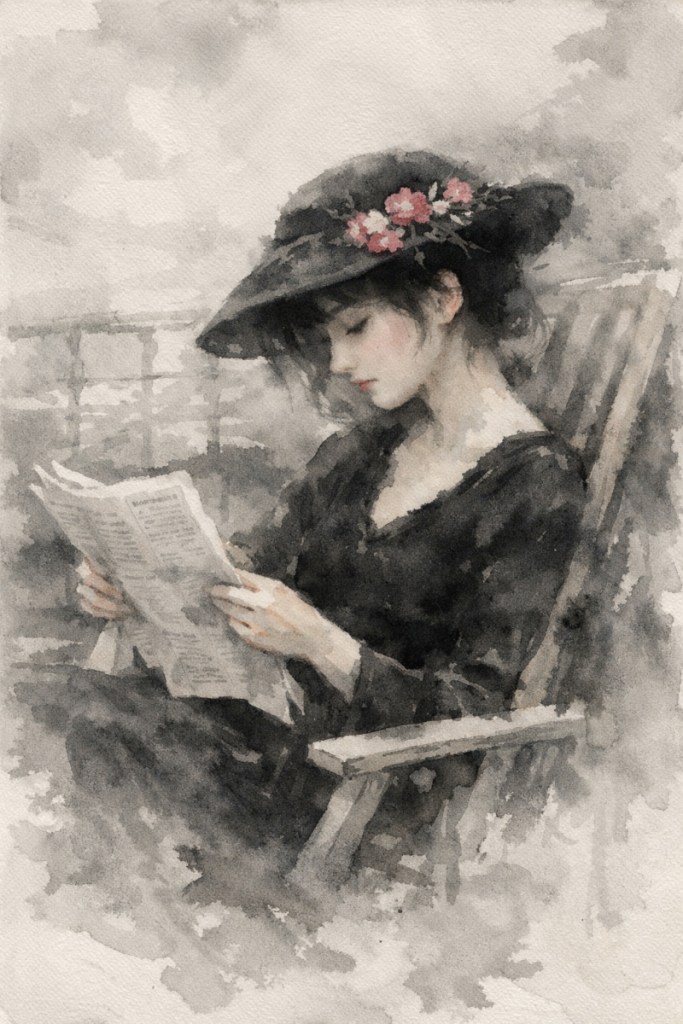
    A month later, the Australasian and American Mail Steamship Company’s City of Melbourne headed towards the Golden Gate, its passenger list including a modest troupe of performers, a mixture of Chinese and Europeans, among them the sylphlike Suzon Chabrier formerly of the Folies Bergère, an inconspicuous brunette who, on closer inspection, as the customs official who processed her had remarked to his colleague, had a charming and subtle nuance of face that could almost pass as oriental. While her fellow passengers lined the decks for their last glimpses of Angel Island, Yerba Buena, and Alcatraz, Miss Chabrier reclined on a deckchair in a discreet black velvet dress, her chapeau decorated with simple field blossoms and pushed forward over her head, perusing the Daily Alta California. She was particularly attentive to an article on page two, which reported on the sudden death of a despised highbinder for the Hing San Fong Tong, one Fang Jing Dock. A photograph of the victim’s corpse had sunk into grainy shadow, which was perhaps for the best, the report ran, since readers would have found the contorted face and twisted limbs most distressing. Suzon applied her reading magnifier to the image, then read on. A note found on the corpse showed that he had expected death by rival hatchetmen.

    Chan Lee, later known as Lily Chan, sits in a deckchair aboard a steamship leaving San Francisco, having assumed the identity of Suzon Chabrier of the Folies Bergère.

    The note read: ‘Soon I must go to my fathers. Whether by the broad bladed axe or by dust of the dragon’s tail, it matters not. This I know. I go. I commend my spirit to Buddha, the all-wise and merciful.’

    “A searching examination of the body,” the reporter continued, “failed to reveal any marks of violence. It is believed that by ‘dust of the dragon’s tail,’ Fang referred to some potent oriental poison. From his expression of agony, it appeared he had been administered sufficient of the substance, whatever it was, to kill an hundred men. Police arrested another highbinder named Fat Louis, who is well-known to have been an associate of the dead man; but it has come out that he was employed surreptitiously by the rival tong in question, the See Yups. The dead man, who will not be missed, was under suspicion for a number of murders of fellow Chinese. A woman with whom he cohabited, once well-known around the gambling dens and houses of ill-repute, has not been seen for several months, and is now added to a long list of the presumed victims of the deceased ne’er-do-well.”


    From the draft novel Stawell Bardo © Michael Guest 2026