Tag: historical fiction

  • The Blue Marquis

    The Blue Marquis

    Lili was accompanied to the senior inspector’s office by the sergeant who had been stationed to guard her door for the night. Forster sat there quietly looking out through the closed window onto the parade ground, where some drills were in progress. The sounds of horses and the raised voices of drill instructors broke into the room when the door opened, and were muted again as the sergeant left. Inspector Secretan introduced himself and directed her to sit in the empty chair alongside Forster.

    “The Commissioner was pleased that his notice in the Gazette succeeded in reaching you, Miss Chan,” Secretan said, “although we were taken aback that the result should prove so dramatic.”

    I do assure you, Inspector,” she said, “that Detective Forster was entirely up to the task. Every hair on my head remains unharmed. I would appreciate it if we might keep it all out of the papers.”

    “That’s well and good,” said Secretan. “Well and good.” He paused to draw on his cigar, glancing over the statements pertaining to the previous night’s events. “Of course, Detective Forster’s use of deadly force has set in motion certain procedures designed to assess whether it was justified, but from these accounts, it does appear in order, at first glance. Indeed, he is to be commended for ensuring your safety in the course of your response to the Commissioner’s invitation.

    “The detective is soon to act as a prosecution witness, as you are probably aware, at the Central Criminal Court, a duty that will not be impeded by the matter at hand. However, questions have now been raised concerning you yourself, which require some answers. Forster has been designated the officer in charge of establishing the facts of your case.”

    He pressed a brass button on the edge of his desk, and somewhere beyond the closed door, a bell gave a muffled note. After a moment, the sergeant appeared.

    “Miss Moira Sculley is to be brought here from detention, and have the clerk attend with his notebook,” Secretan ordered.

    A guard led Moira in, her arm in a sling. Lili gave her an intensely searching look as she passed, and a quizzical little frown crossed Moira’s face for an instant.

    “Lovely to see you so soon,” Lili said softly as Moira sat down, the guard standing next to her. Forster gave Lili a blank look before turning to Moira.
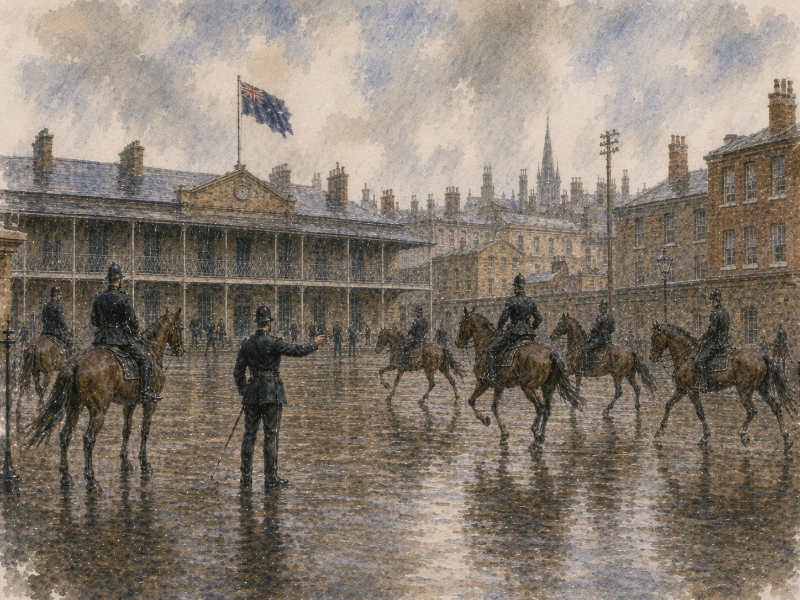
    Russell Street Barracks, Melbourne, exterior view; colonial building flying  Union Jack; troopers doing drills on horseback

    “You are here for the part you played in Miss Chan’s abduction.”

    Moira shrugged. “She come of her own free will.”

    Lili briefly cleared her throat. “I don’t believe I used that exact word, Detective Forster,” she said. Forster looked at her in astonishment. “At least,” she continued, “not in connection with Miss … Sculley. In fact, I formed the distinct impression that she herself was subject to the coercion of that horrid corpulent gentleman now deceased, who introduced himself to me as Algernon. An unconvincing alias, obviously.”

    “I see,” Forster said curtly. “Let us accept that premise, then, since you are the only one, Miss Chan, who had a chance to observe their relationship.”

    “After all,” said Lili, “he did shoot her. I believe it was to prevent her from flinging the door open in an effort to abet my dash for freedom, just as you arrived so heroically, Detective.”

    “Yet, Miss Chan, according to what you told me last night about the incident in the swamp, Miss Sculley was at very least the instrument employed by this … Algernon … to plant a note in your pocket, and to surveil your movements throughout the day.”

    “So I thought at the time, Detective,” Lili said. “But I was extremely disquieted on arriving at Algernon’s shack. Everything was a blur, to an extent that I fear I may have jumped to that conclusion. I must admit to not seeing the young woman’s face clearly when whoever-they-were bumped into me outside the jeweller’s…”

    “Quite right,” Moira piped up. “I ain’t been near Bourke Street for weeks.” Forster gave her a sharp look.

    “Bourke Street?”

    “I must have let that drop during our discussion at the shack,” Lili added quickly.

    “Well, on another detail… let me read from Miss Sculley’s statement,” Forster said, thumbing through a sheaf of papers. “‘Then the fancy Chinese tart admitted to Algy she was the one that done in his big brother’s mate Fang in San Francisco and stole his loot. Oh, she was cool about it, alright.’”

    “The poor child must have misheard,” said Lili. “I said no such thing. You will recall that Fang was the reprehensible highbinder who kept me his slave for months until he was assassinated by a rival tong. It was in all the papers. Naturally, I changed my identity after that fortunate incident, in order to escape any further maltreatment.”

    Forster persisted with Moira. “Who is this Blue Marquis you referred to in your statement, who was apparently the reason Miss Chan was lured to the swamp?”

    “A valuable diamond ring she murdered him for…,” said Moira, uncertainly.

    “This?” Forster took the ring from his pocket and laid it on the table before her. “Our constables retrieved it this morning.”

    “That’s the one.”

    “We had it looked at. It’s a worthless piece of paste,” the detective said.

    “If you don’t mind,” said Lili, “I would like it back regardless, because it holds no small sentimental value for me – it’s a tiny fragment of my past self, one might say, worthless as it may be.”

    “Well … it’s been all too much for me.” Moira gave Lili a glance now more shrewd than spiteful.

    “She is obviously confused,” Lili said. “There is no reason for you to hold her any longer, after what she has been through with that thug. Who knows what lies he probably told her about me?” She dabbed the corner of her eye with her handkerchief.

    Inspector Secretan gave her a second to compose herself.

    “Miss Sculley may be dismissed. Kindly see her to the front gates, Sergeant.”

    When they had gone, he turned to Forster.

    “It seems to me the mystery of this so-called Blue Marquis ring is likely no more than the deluded imaginings of a homicidal monomaniac, who is now resting deservedly in the barracks mortuary. But before we draw a line under the case, it would perhaps be best for you to accompany Miss Chan on a visit to Mr Kaminski’s when she returns to learn the results of his appraisal. In a semi-informal capacity, as it were, if that would be permissible, Miss Chan?”

    “Thank you, Inspector, that would be entirely apropos. And perhaps after that we might be able to proceed with our excursion to the Gilbert and Sullivan? I’ve heard all about it and am absolutely dying to see it. Detective Forster?”

    But Forster only gave her a slight nod and a grim smile.

    • • •

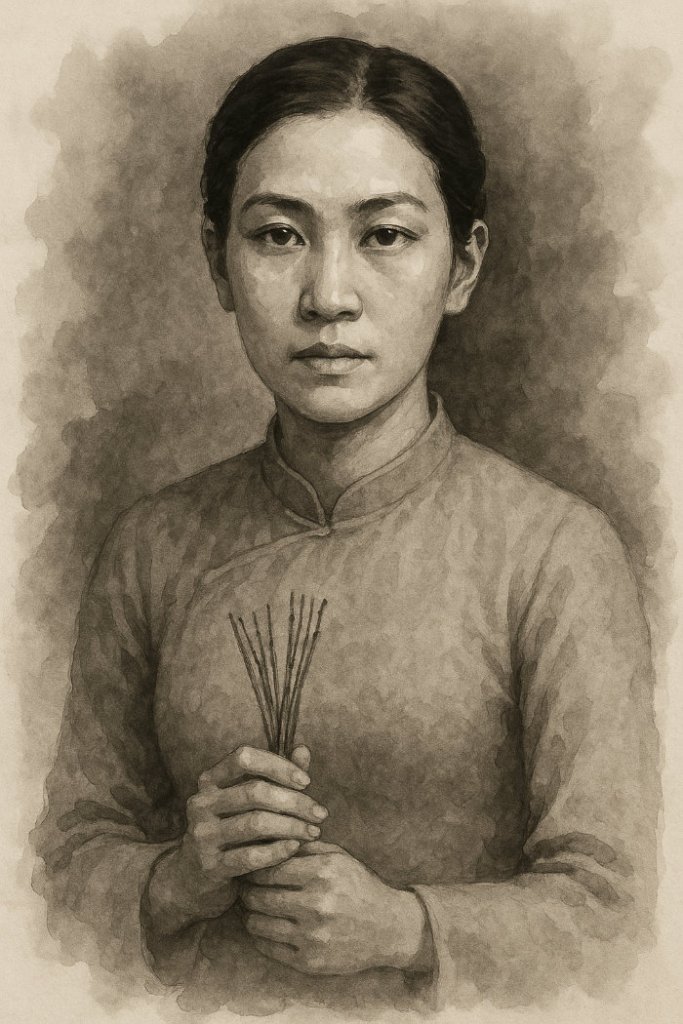
    It was well within the seven-times-seven days of the bardo – sacred interval! – when Lena had seen the detective as she came into Deep Lead from the bush track and he turned just in time to see her slipping in and out of the mirage – lately such an everyday phenomenon in the bush around these parts. Except that she had experienced the illusion as a sense of lightness and return somehow, yes, as though she had been returning from somewhere a great distance off, or rather, from a kind of nowhere, the memory of which transformed into a sudden dizziness and queer visual shimmer that almost made her trip, and gave her a fleeting impression that she could be about to die, so strong she let out an involuntary laugh.

    Afterward, she went into the garden behind the Junction’s teahouse to visit the maiden wattle, for whom she fetched a can of water from the tank. Mow Fung must have noticed her come in, because he joined her for a little while by the plant. Both father and daughter drew insight and calm from the wattle, which had a way of filtering the midday light through its leaves, thereby producing what seemed like a cool and ambient sphere – a calming aura, one might say. Lena retained her uncanny connection with her “Maiden” and even extracted her resin to use as an ingredient for incense.

    “I noticed that the detective came to the teahouse,” Lena said. “He is sure to meet Miss Chan. I wonder whether they will hit it off? Of course, you won’t mention to him your business with the spirit of the headless man. He might find it odd.” She giggled. “Even Mama finds it a little bit silly. I can’t imagine you in Hell. How terrifying it must be.”

    “As you should know, the old fables are a way to help simple souls like myself to understand the nature of our own being. Ancient stories about the Ten Courts can guide us towards understanding and confronting the dark shadows that dwell within ourselves. It makes perfect sense. Let’s say you commit fairly light crimes. In such cases you will go to Tongue-Pull Hell for lying, or suffer the scissor torture for breaking up a marriage. Worse crimes are punished in more severe, lower hells. If you kill animals for sport, you must climb a mountain of knives. Those who disrespect their elders, commit murder, or break monastic vows will find themselves in a vast crimson pool, where they choke forever on boiling, filthy blood. It’s all somewhere inside oneself … almost enough to make you wonder how much of it is there in any real sense.”

    Official horse-face demon rifles through the papers piled before him on his desk, a few of which catch fire from the sparks, while three ox-heads idle over a game of snakes and ladders, tiny screams floating up from the board. Horse-face scowls, spectacles balanced precariously above his nostrils, and snorts an abrupt reply to the human being standing there before him, the smell of life lingering about him.
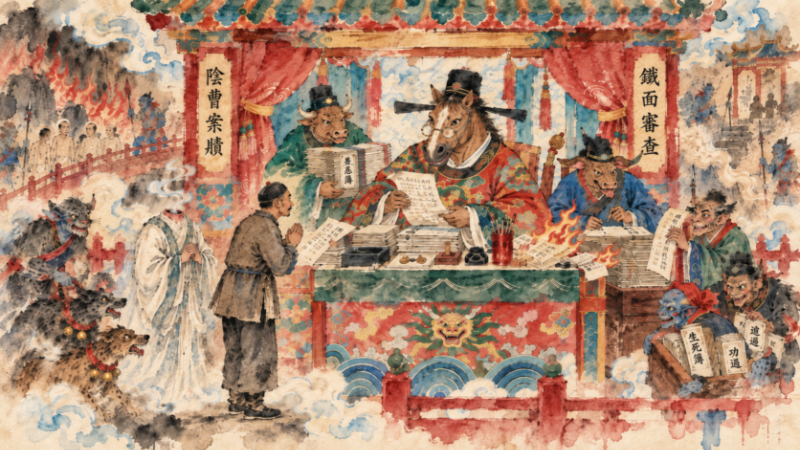
    Horse-face and ox-face officials in the Underworld, Chinse scroll style; Mow Fung and the headless spirit stand before them

    “Foolish Daoist publican,” he spits. “I presume you represent this headless supplicant trailing along behind you with the hound-demons snapping at his heels. What are his name and circumstances?”

    “I do not know his name, nor even his face, because he was decapitated in the bush, and when his body was discovered, he was taken to my pub to be stored and investigated.”

    “Address?” Mow Fung tells him where the body had been found at the Four Posts, and the horse-face summons two demons with blue faces and hooked ivory tusks, sending them to retrieve the spirit’s details. They return almost instantly dragging a barrow behind them, trailing coals and burning reams and scraps of paper.

    “Luckily,” hisses the horse-face, “a few remnants of the record remain, though it was ordered to be assigned to the Pit of Irrelevance.” Blowing on the sheaf presented to him, he extinguishes it, producing a plume of thick acrid black smoke.

    “This happens to be the most recent entry – luckily for him. According to the regulations, that makes it admissible as the record of final authority. I see you have visited the place of death?”

    “There was a strong sense of his presence,” says Mow Fung, “as though he is tied to the spot. His head cannot be found.”

    “I see here that you performed some arcane rites. Not that it is any great concern of mine, but it may be a good idea to fashion a head from paper and ink, then burn it. For the hun, the corpse is mere paperwork. Identity and karmic record are what count.”

    “I tried the head effigy. The head descended temporarily onto the body, then disappeared again.”

    “Then try again. Each seeks the other, as do the hun and po: ethereal and corporeal…” Tosses his head and looks to the upper void. “Is this kindergarten? Now take a look here,” waving a charred document, “and you’ll see the supplicant does not need to confront the judges, but instead, being an innocent victim of murder, is to be sent to Wangsi Cheng, the wrongful-death precinct.”

    He flicks his hand and a team of ox-heads materialise and bear them away bodily, both living and dead. In the void, the entire group dissolves into spots of dark light, yet their individual forms may be perceived, not unlike the projections of a shadow play. Wang Sicheng is not far from the Pool of Blood.

    “Wangsi Cheng? Seventh jurisdiction, is it, Bright Nose?” says one of the ox-heads, giving one of their burdens a sniff. “This living one is surely destined for Fire Mountain, in the Eighth – classified as the most suitable for liquor-drinking Daoist monks…”

    “Horse-face said what he said, White Cork,” comes a reply. “He is not yet dead. This other decapitated wonder is the murder victim, apparently.”

    “I visited the Four Posts a few times over the next weeks to try and summon the soul,” said Mow Fung, “so he wouldn’t wander off into the bush and get lost. The dreams nagged at me to go there to chant sutras, burn hell money to bribe the guards down below, ring my good brass bell to lure the soul out of the ground.”

    “You didn’t make a spectacle of yourself?” said Lena, looking up earnestly, from where she knelt to remove some stubborn weeds.

    “Don’t worry, Pu-Ehr taught me long ago how you can perform these rituals subtly when you know the methods – like a deep meditation. It was to purify the Four Posts, as well: You wouldn’t want some hungry ghost wandering around the place scaring anyone who went there at night, asking them if they knew where his head was.”

    “Pu-Ehr…” Lena mused.

    • • •

    Some days later, Lili received Kaminski’s note asking her to call at his shop when she was able. Wary that the tong may be keeping an eye on the jeweller’s, she penned a note and gave it to hotel reception to deliver to Detective Forster at Russell Street.

    “You mentioned,” she said when he arrived at her door in the early afternoon, “you had a question or two you wanted to ask him about my ‘case,’ as you call it.”

    “Just to tidy up one or two minor details,” William replied. “It shouldn’t interfere with your business.”

    Kaminski was amenable to the detective’s participation in the meeting. “Tea for my guests, if you please,” he said to an attendant after greeting them. He seated them in his back room, and Forster briefed him on the events that occurred after Lili’s previous visit. He appeared visibly stunned, then solicitous when told about the incident at West Melbourne Swamp. “My dear girl,” he said, “that is a most notorious area. You must promise me never to set foot there again.”

    “I was coerced to go into that godforsaken wilderness,” she replied with implacable calm. “But with your kind offices, and the Melbourne Police Force at my side, now it all seems like a fading nightmare.”

    “I wonder, sir,” asked Forster, “whether you might have some idea about the people who were pursuing her, since they managed to plant a note in her pocket just after she left here. I imagine they may have tracked her in the first place by watching the jewellers in the district.”

    “I am loath to admit that some knaves number among my profession,” Kaminski said. “I am deeply grateful that Miss Chan chanced upon me with enquiries about her jewels, else she may have found herself even more gravely ensnared. However, I pride myself on being widely known for my high ethics, even among blackguards of their stamp. They know what to expect should they darken my door.”

    One of Kaminski’s attendants entered with tea. When she had left, Kaminski continued.

    “In other words,” he said, “our established clientele are impeccable – as is my establishment in the scrupulous measures we take to preserve all elements of their privacy.” His finger tapped slightly on a business ledger on top of the mahogany desk, which was set with some neat rows of velvet-lined trays, alongside one or two instruments of his trade.

    “No, I did not mean to imply otherwise,” Forster was quick to reassure him. “Indeed, Russell Street has quite a comprehensive understanding of the establishments in this trade, and your own possesses an immaculate reputation with us. I presume, therefore, that you are unfamiliar with our felon from the other evening, a burly Chinese-American thug who goes – that is to say – went by the alias Algernon, and his associate, a young Victorian female, modest in means yet familiar with this neighbourhood, who calls herself Moira?”

    “I should say not.”

    Forster chuckled lightly at the man’s profound indignation. “Then, that’s all my loose threads tied up, thank you, Mr Kaminski. Miss Chan has asked me to remain while she completes her business, if you don’t mind.”

    “Not in the least,” Kaminski said, and fetched from his safe a tray holding several small envelopes and some documents. “I have finished cataloguing your gems, Miss Chan, and a fine collection it is, including, as I mentioned during our last meeting, one outstanding stone. I will match them against the inventory and, if you don’t mind, have you sign for them.”

    Lili and Kaminski examined the contents of each package, and Lili signed one of the papers. Forster sat back in his chair, casually overseeing the proceedings.

    “After my ordeal at the hands of the criminal underworld, I should be rather anxious keeping these valuables about me here in the city. And my premises at Deep Lead are not altogether as secure as they might be,” she said.

    Kaminski replied that he would be honoured to take charge of the jewels, act as her agent in any trade dealings she might require, and have them deposited in his strong-room box in the Bank of Australasia for safekeeping in the long term, where he kept his finest gems, to all of which she assented. Forster agreed to witness their transaction, signing where Kaminski indicated. Lili kept only a few gems to carry in the false bottom of her jewel case, “for any extraordinary expenses which may arise,” she said.

    “Oh, and of course, I almost forgot,” said Kaminski when they finished. “The matter of that special stone, which I have researched a little about. Fascinating story…”

    “Perhaps tedious for William…” Lili broke in.

    “Go right ahead,” said Forster insouciantly, “I’m not in any hurry.”

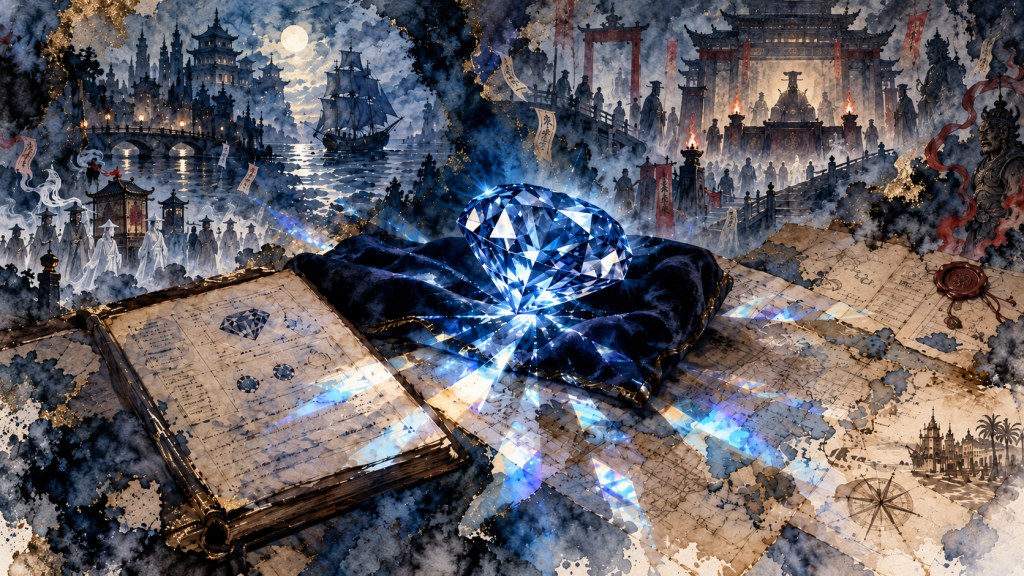
    Kaminski resumed his seat and took a sip of tea. “I recovered the issue of the Jewelers’ Circular and Horological Review where I first saw mention of the rumour that an important historical gem was being offered for sale in the United States,” he said. “The stone was further rumoured to have entered the French royal collection during the reign of Louis XV. It is not reported as established fact, mind you; however, it was supposed to be among a number of pieces that disappeared during the theft of the Crown Jewels from the Garde-Meuble in Paris, in September 1792, amid the violence of the French Revolution and the imprisonment of Louis XVI and Marie-Antoinette.”

    Lili felt a tingle in her spine that was not entirely pleasant. Forster looked mildly interested.

    Lili's face caught fragmented by the blue-tinged diamond facets

    Kaminski continued: “What caught my eye was the reported description of the stone as being cut in ‘an old, elongated navette’ form – that means like a ‘little boat’, pointed at both ends. There is a charming story, probably a myth, mind you, that the style came into fashion when Louis XV had a diamond cut in a shape intended to resemble the smile of his mistress, the Marquise de Pompadour. The cut itself came to be known as the ‘marquise cut.’”

    He took up a small publication that lay in the tray, thumbed through a few pages, and continued, “You see, there is even a sketch of the rumoured stone.” He emptied a gem from one of the envelopes, and it lay there glistening alone on the black velvet, an intriguing pale, smoky violet glimmer about it. Lili took the Circular issue and peered at the sketch, then picked up the gem and compared the two. “Hmm…” She held it up to the window light and turned it slightly, causing its steel-blue heart to flash for the briefest instant.

    Forster uncrossed his legs and sat a little more forward in his seat. “Miss Chan,” he said quietly, “do you happen to have brought your ‘Blue Marquis’ with you, which we returned to you at Russell Street?” She withdrew the ring from her jewellery case and placed both down together on the tray.

    Kaminski let out a guffaw. “No, no!” he laughed. “This vulgar piece of strass bears not the slightest resemblance to a true diamond, let alone the so-called Blue Marquis, rumoured to have been seen some years ago in America.”

    Forster had set his mouth in a grim line, but said nothing more. Lili sensed his detective’s mind at work, connecting her via Moira’s testimony to acts she may have committed in San Francisco that were, strictly speaking, felonies.

    “All hearsay,” she could say.

    He would regard her with that cool eye of his. “Perhaps, but I am struck by the alignment of these details with the gems in your possession. In particular, I note that you allowed me to carry on under the delusion that this rumoured Blue Marquis was strass, while keeping this valuable stone, the real one, here under lock and key and having it valued.”

    “I had never heard of it before this fantastical history lesson.”

    “No? And yet our tong friend at the Swamp seemed deadly familiar with the name.”

    “This is all terribly interesting, Mr Kaminski,” Lili said. “But why Marquis and not Marquise?”

    “To distinguish the particular stone from its generic cut – the Marquise style I described.”

    “Do continue. You were telling us the stone was stolen during the French Revolution.”

    “Indeed. Most of the stolen Crown Jewels eventually reappeared during the years after the theft, but a small number – this one possibly included – did not resurface for decades. Others perhaps never will. The rumoured Blue Marquis is somewhat smaller than the stones recorded in the inventories of the Ancien Régime, but similar enough in cut and colour for some experts to conclude that it may have been recut from one of the original royal stones.”

    Forster leaned forward. “What order of value are we speaking of, Mr Kaminski?”

    “As an ordinary stone, it is worth a small fortune – easily eight hundred pounds sterling.”

    “And if it is this lost…Blue Marquis?”

    “If this provenance as rumoured can be established, I hesitate to give a figure – immeasurably more.”

    “Enough to kill for,” he would say.

    “And you would be able to prove that to a jury, beyond a reasonable doubt? Or would you be stuck with another – what did you call it – ‘circumstantial case,’ I wonder?”

    He would shake his head, as though questioning how he could have been so taken in.

    “I did nothing out of greed, believe me, William.”

    “As the theory has it,” Kaminski continued, “further evidence for the Marquis appears in a London auction catalogue of 1851, which refers to ‘a valuable blue navette-cut diamond, of six and three-quarter carats, of uncertain provenance, but unquestionably French.’”

    “And the weight of the article before us?” said Forster, already anticipating Kaminski’s answer.

    “That’s the marvellous thing,” Kaminski said with a wide smile. “Six and three-quarters precisely.”

    “The documented trail ends in London, though,” Lili suggested blandly.

    “The documented trail, perhaps. There are later reports of a similar blue stone circulating among merchants in the Pearl River trade, though nothing firm enough to establish ownership or continuity.”

    “All extremely iffy,” Lili said.

    “Except for 1853 murmurs in a San Francisco newspaper about a ‘blue talisman’ discovered in a crate of curios from China,” Kaminski insisted, “which quickly became an object of frantic desire among waterfront gamblers and dealers.”

    Lili was quiet.

    “The point is,” Kaminski insisted, “that the San Francisco report refers to it in a marginal note as Le Marquis Bleu, and suggests royal origins deliberately obscured by a name that preserved a French aristocratic flavour while distancing the stone from the Crown. There is no specific carat weight given in the Circular, but there is the sketch, you see.”

    “The circumstances?” asked Forster.

    “It was offered for sale but the deal collapsed. There have been no further reported sightings. It goes underground again.”

    There was little more to say at Kaminski’s, and even less during their walk to her hotel, where they paused awkwardly in the lobby.

    “Well…” said Forster, but did not finish whatever it was he had intended.

    “You don’t have to say anything, I know what you are thinking. I can tell you where the trail went after London. To a smuggler in San Francisco; to my employer, Madame Ah Toy, whose note Mr Lee Kong Wing, the Elder at the See Yup Temple, delivered to me; then to Fang, who stole it from her. Finally, to me.”

    “So Moira was right. You murdered Fang Jing Dock for the Blue Marquis.”

    “I did nothing for that diamond nor any others.”

    “The most heinous of crimes.”

    “If I had not bitten through in that circumstance, I would have been devoured whole – and I very nearly was. Perhaps a man cannot understand.”

    “I sympathise deeply with you for the plight you suffered in San Francisco. But I never dreamed you capable of such a crime.”

    “Men,” she said under her breath. “Merely circumstantial evidence, Detective.”

    “Then let me ask you straight out, Lili. Did you kill Fang Jing Dock?”

    “I have not come so far,” she said steadily, “to confess, so to speak, any of my acts to a soul. Not even to you.”


    From the draft novel Stawell Bardo © Michael Guest 2026

  • The Blue Marquis I – The Morning After

    The Blue Marquis I – The Morning After

    Lili was accompanied to the senior inspector’s office by the sergeant who had been stationed to guard her door for the night. Forster sat there quietly looking out through the closed window onto the parade ground, where some drills were in progress. The sounds of horses and the raised voices of drill instructors broke into the room when the door opened, and were muted again as the sergeant left. Inspector Secretan introduced himself and directed her to sit in the empty chair alongside Forster.

    “The Commissioner was pleased that his notice in the Gazette succeeded in reaching you, Miss Chan,” Secretan said, “although we were taken aback that the result should prove so dramatic.”

    “I do assure you, Inspector,” she said, “that Detective Forster was entirely up to the task. Every hair on my head remains unharmed.”

    “That’s well and good,” said Secretan. “Well and good.” He paused to draw on his cigar, glancing over the statements pertaining to the previous night’s events. “Of course, Detective Forster’s use of deadly force has set in motion certain procedures designed to assess whether it was justified, but from these accounts, it does appear in order, at first glance. Indeed, he is to be commended for ensuring your safety in the course of your response to the Commissioner’s invitation.

    “The detective is soon to act as a prosecution witness, as you are probably aware, at the Central Criminal Court, a duty that will not be impeded by the matter at hand. However, questions have now been raised concerning you yourself, which require some answers. Forster has been designated the officer in charge of establishing the facts of your case.”

    He pressed a brass button on the edge of his desk, and somewhere beyond the closed door, a bell gave a muffled note. After a moment, the sergeant appeared.

    “Miss Moira Sculley is to be brought here from detention, and have the clerk attend with his notebook,” Secretan ordered.

    A guard led Moira in, her arm in a sling. Lili gave her an intensely searching look as she passed, and a quizzical little frown crossed Moira’s face for an instant.

    “Lovely to see you so soon,” Lili said softly as Moira sat down, the guard standing next to her. Forster gave Lili a blank look before turning to Moira.

    “You are here for the part you played in Miss Chan’s abduction.”

    Moira shrugged. “She come of her own free will.”

    Lili briefly cleared her throat. “I don’t believe I used that exact word, Detective Forster,” she said. Forster looked at her in astonishment. “At least,” she continued, “not in connection with Miss … Sculley. In fact, I formed the distinct impression that she herself was subject to the coercion of that horrid corpulent gentleman now deceased, who introduced himself to me as Algernon. An unconvincing alias, obviously.”

    “I see,” Forster said curtly. “Let us accept that premise, then, since you are the only one, Miss Chan, who had a chance to observe their relationship.”

    “After all,” said Lili, “he did shoot her. I believe it was to prevent her from flinging the door open in an effort to abet my dash for freedom, just as you arrived so heroically, Detective.”

    “Yet, Miss Chan, according to what you told me last night about the incident in the swamp, Miss Sculley was at very least the instrument employed by this … Algernon … to plant a note in your pocket, and to surveil your movements throughout the day.”

    “So I thought at the time, Detective,” Lili said. “But I was extremely disquieted on arriving at Algernon’s shack. Everything was a blur, to an extent that I fear I may have jumped to that conclusion. I must admit to not seeing the young woman’s face clearly when whoever-they-were bumped into me outside the jeweller’s…”

    “Quite right,” Moira piped up. “I ain’t been near Bourke Street for weeks.” Forster gave her a sharp look.

    “Bourke Street?”

    “I must have let that drop during our discussion at the shack,” Lili added quickly.

    “Well, on another detail… let me read from Miss Sculley’s statement,” Forster said, thumbing through a sheaf of papers. “‘Then the fancy Chinese tart admitted to Algy she was the one that done in his big brother’s mate Fang in San Francisco and stole his loot. Oh, she was cool about it, alright.’”

    “The poor child must have misheard,” said Lili. “I said no such thing. You will recall that Fang was the reprehensible highbinder who kept me his slave for months until he was assassinated by a rival tong. It was in all the papers. Naturally, I changed my identity after that fortunate incident, in order to escape any further maltreatment.”

    Forster persisted with Moira. “Who is this Blue Marquis you referred to in your statement, who was apparently the reason Miss Chan was lured to the swamp?”

    “A valuable diamond ring she murdered him for…,” said Moira, uncertainly.

    “This?” Forster took the ring from his pocket and laid it on the table before her. “Our constables retrieved it this morning.”

    “That’s the one.”

    “We had it looked at. It’s a worthless piece of paste,” the detective said.

    “If you don’t mind,” said Lili, “I would like it back regardless, because it holds no small sentimental value for me – it’s a tiny fragment of my past self, one might say, worthless as it may be.”

    “Well … it’s been all too much for me.” Moira gave Lili a glance now more shrewd than spiteful.

    “She is obviously confused,” Lili said. “There is no reason for you to hold her any longer, after what she has been through with that thug. Who knows what lies he probably told her about me?” She dabbed the corner of her eye with her handkerchief.

    Inspector Secretan gave her a second to compose herself.

    “Miss Sculley may be dismissed. Kindly see her to the front gates, Sergeant.”

    When they had gone, he turned to Forster.

    “It seems to me the mystery of this so-called Blue Marquis ring is likely no more than the deluded imaginings of a homicidal monomaniac, who is now resting deservedly in the barracks mortuary. But before we draw a line under the case, it would perhaps be best for you to accompany Miss Chan on a visit to Mr Kaminski’s when she returns to learn the results of his appraisal. In a semi-informal capacity, as it were, if that would be permissible, Miss Chan?”

    “Thank you, Inspector, that would be entirely apropos. And perhaps after that we might be able to proceed with our excursion to the Gilbert and Sullivan? I’ve heard all about it and am absolutely dying to see it. Detective Forster?”

    But Forster only gave her a slight nod and a grim smile.

    Chapter to be continued


    From the draft novel Stawell Bardo © Michael Guest 2026
  • Wang the Meek and the Lodge of the Ghost Junk

    Wang the Meek and the Lodge of the Ghost Junk

    To my dearest friend and comrade Mow Fung
    May blessings of the Celestial Worthy of Primordial Beginnings be upon you.

    As I prepared my old inkstone with a little Madeira, I was wondering what my aim was in writing this to you. I think there might be something more behind it than briefing you on a few things you need to do as we prepare for our passage south to the New Gold Mountain. By the way, I’ll give you the address of that company in Hong Kong that will find a ship and make all the necessary arrangements for us. Even writing that down this minute, I find myself pausing to scratch my beard and search the ceiling for other words – the words I need to express to myself, perhaps, as much as to you. There will be ample time for practical matters, and plenty of space in the modest cache of paper that has travelled with me since I left behind the mountain with its paths that forked through the thick bamboo, our poor doomed temple, and the peasants I thought I had tired of. Do you know, I saved this paper as a remembrance of your spiritual mother Pu-erh, whom I loved, but who rarely gave me a look except as a friend, and maybe dogsbody to a good extent. From time to time, I noted down the things that happened to me as I went along my road.

    Thinking back to when my mates and I met you both that first time on the side of Timeless Mount, it was as though you had fallen down out of heaven. You both had that aura about you that was like a faint, strange light, it occurs to me now, although my memory may have added that part, that glow, because you both became our guides, teaching us invaluable things: like how to write and think, being grateful, and the value that one can derive from helping others. So I came to idolize you both to some extent, and particularly Pu-erh. We did plenty of do-gooding at the temple, and I have no regrets about it, because it turned us into far better men than the incompetent ginseng smugglers and bandits who it was that abducted you. Argh! poor old Ugly Toad and Yongyan the Hungry, who disappeared over the mountainside, inside the temple with everyone else. I picture them meditating in silence, the tumultuous chaos of the outcrop and the temple itself crashing down all about them into the void! – though, frankly, I can’t see how such a relatively ordinary incident could dispose of Pu-erh. Anyway, you can imagine how I was gutted when I heard about it. But what can you do? That’s how it goes. You should not attach yourself to anything.

    How surprised I was to find, on arriving at Guangzhou together, that you had a past here as well, just as I did. Associates and extended family, all smiles, so amazed and glad to see you alive again – and seeming never to have heard of Pu-erh! (Me, well, I don’t have family, but there are a few trusted friends who would store my belongings for me.) Anyway, these considerations hurt my head, so I soon put them out of my mind. I have heard how, in Japan, the family of emperors continues back in time until it overlaps with its legendary ancestors; and that may be how it is with you – here in the flesh, but somewhere mystical at the same time: walking as though floating with your ankles hidden in fog. A realist like myself may only fill in your gaps briefly and subtly, like drawing the parts together with fine silk thread, through tiny imaginary eyelets.

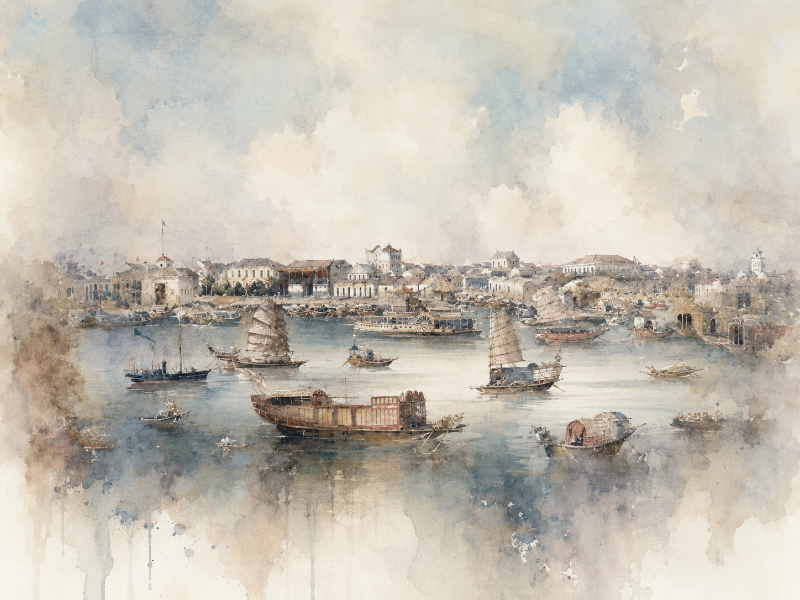
    These days, however, I see what’s in front of my eyes vividly; and that ability owes something to other experiences I have had – some of them shocking – and to certain people I have met along my road, as much as to you and Pu-erh. In those first weeks after we came to Canton – around the time I found myself a new place – I wandered down the riverbank, not far from the Thirteen Factories, the foreign hongs and their wharves where the foreigners do all their trading, completely separate from our little lives; and I was overcome, despite myself, by the beauty of those hongs: like a picture they are, all lined up in white by the water, with the flags of their countries flapping in the wind; and their pretty gardens fenced off from the Pearl, but little stairs going down to where the mighty river slides on by, teeming with all manner of small craft: boats, junks, sampans, and shallow-draft steamers heading every whichway, conducting their own workaday businesses, and the little Tanka egg-boats, shaped like half-eggshells, scooting about among them; with the tall church of the foreigners overlooking it all. Can’t see the pagodas and scenery like you used to, but the river is just as busy all the same.

    Abstract watercolour view of Canton port, with pale hongs, river craft, and misty shoreline forms dissolving into soft washes at the edges.

    After that, I ambled along downstream to Whampoa, where the flower-boats anchor all in a line, drawn up practically hull-to-hull together, and where I soon learned to head for a nice dinner of salt-and-pepper cuttlefish, which is cheap on the lower decks. I’ve got my favourite one, dazzling it is with its lanterns reflecting on the water, though it’s one of the smaller vessels, its hull painted with phoenixes and birds, lotuses and scrolling vines; no foreigners allowed, and I sometimes treat my favourite lady there. It’s wonderful, the way she goes raving on and giggling with a lot of nonsense, and we have a really happy time, with all the laughter, wine games, music, and dancing until sunrise.

    Though I now understand how transient all this is, I have come to enjoy it. I must be becoming earthly; I am sure Pu-erh would disapprove, with one of her stern sideways looks. Ha, ha.

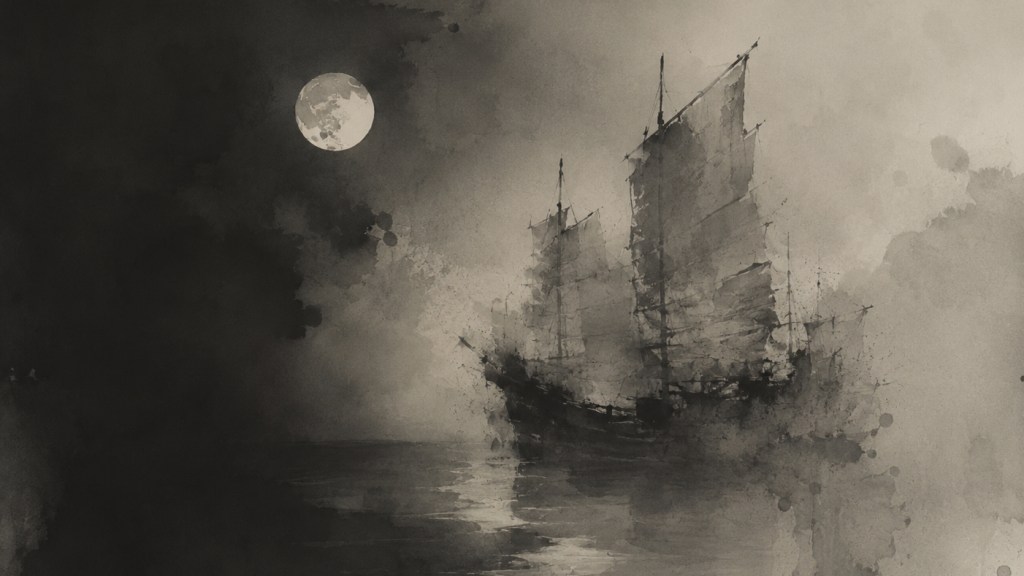
    I don’t know why, but the time has come for me to make a confession, stemming right back to my pirate days, which commenced when I came down from the mountain and took to the sea. Without preamble, one evening, what’s called a “salt-smuggler” boat I was crewing on at the time – though I can tell you, we smuggled a lot more than just salt, primarily opium – turned to bring us to bear upon some mission being built by two Swedes at Kinpai Pass, on the coast near the River Min. I didn’t know much about what I was doing in those days, still green in the pirating trade, and I believe I happened to kill one of them with my flintlock pistol. It was medium range, and I probably got him because he didn’t stay still on the one spot. I was taken aback when he fell, with the shot in the middle of his forehead, but joined in with the cheers of all my mates, as though I was a hero. I’ve never been able to shake that off until now, that terrible feeling, when I am able to bring myself to tell you about it. Since then, I admit I have sent off a few, but he was my first; and apart from him, I’ve only ever dispatched opposing warriors, which is considered non-blameworthy, and rightly so.

    Now I ought to fill you in a little more on my adventures as a warrior and troublemaker. Truth to tell, I’ve never thought much of the Qing. It’s the country of us Hans, not them, and they have no right to invade and rule us; and I took a special set against the Manchus when they used to try to catch and kill the three of us up at Fusong in the old days. So when I turned to fighting for a living, even though my decision was more out of a thirst for fun and adventure than any particular politics, it’s clear that my progress from ginseng thief to bandit, from bandit to smuggler, from smuggler to pirate, and from pirate to sword for hire has tilted to the rebellious side. Of course, my time as a monk deviated superficially from that pattern, but I knew how you and Pu-erh had had to take off from the Forbidden City, so even then I felt myself in like company.

    Anyway, it didn’t take me long to find out that my chosen flower-boat provided more than the delightful times I’d enjoyed so far. Most pleasant things down here in the real world have a more dangerous side, and this lady of mine, knowing that I had a whiff of the sea on me, and was able to take care of myself, introduced me to an old river-rat named Uncle Lo, whom I’d noticed hanging around on deck, twanging away on his snakeskin sanxian and singing the occasional pirate ballad. At first, I took him to be one of the lower hands, whom they must have kept on out of sympathy, what with his worn blue calico jacket and rope belt, but what do you know? he turned out to be the captain; and the next thing he was asking me if I wouldn’t mind some work on the quiet, nothing too demanding, so he said.

    It was just to take some chap out to a junk downriver and bring him back in one piece; so I came on the appointed day, and Uncle Lo showed me to a sampan that was tied up to the stern of his flower-boat, and waiting there was the chap with a few cases to take down with him. He was a quiet, tough-looking character in a blue jacket like the older man’s; he had a grim look, but nothing to worry me. I helped him get his luggage on board, and when we were done, I noticed him and Uncle Lo exchange a martial salute – right fist and left palm pressed together – and I distinctly remember that Uncle Lo called down these words to him, “Under Heaven and Earth, we’ll meet again.” I couldn’t help laughing and calling back up to him not to worry, I wasn’t going to sink his sampan, but this didn’t amuse them in the slightest; I suppose I should learn to keep my peace.

    The fellow didn’t say a word to me during the trip; when we found the junk, lit up discreetly in the darkness with two or three Tanka egg-boats tied up beside it, I helped get his things up, but a couple of men on deck – one of them, I noticed, had a flower tucked into his hat! – warned me off when I was on top of the rope ladder and looked as though I might be making to climb on board, which was all the same to me. I waited in the sampan with an oil lamp for three hours, building walls with an old set of bone gaming-tiles I found in the cabin; and then he climbed back down empty-handed, I sculled us back upstream to the flower-boat, picked up some coin from Uncle Lo, who laughed and clapped me on the back, and had myself a plate of cuttlefish and shark’s fin.

    Things went on like that for some weeks, though the junk was anchored in various places, and occasionally hard to find in the fog, in an inlet or up a rivulet; and then another bloke started to come along as well. I must have proven my worth to Uncle Lo, because one evening he complimented me by saying as much, and asked me how I’d like to become a member of the junk’s “association,” as he called it, in which he was a kind of hall-master. They did some smuggling now and then, of course, but mainly with the idea of helping get rid of the Manchus, setting out the usual litany of grounds. I was on the edge of accepting because of my fondness for Uncle Lo and his old flower-boat, but frankly, I’d had in mind bigger fish to fry than this lot for my adventures, so I politely declined, saying that I had been in trouble with the law in the past, and if the yamen runners caught me involved in such business, it would mean the end of me; to which he gave a regretful nod, and lightly clapped me on the back, the way he does.

    After my next job, something odd occurred. I had stepped onto shore after my meal on the flower-boat, when this tough came straight up to me out of nowhere and slapped me full in the face for no apparent reason. We looked at each other, and I was in the process of deciding which of his limbs to take off, but he just ran away, so I set off after him in full pursuit. He slipped in between the pylons of a fishmarket, which I decided would be a good enough place for him to die; when around the corner came a group of four men holding a sack, evidently this rabbit’s boys, since he now joined them. They told me I’d better do what I was told, or they’d carve me up and murder my family as well (shows how well they knew me!), and to get in the sack. I answered them with a swift kick in the guts of one of them as doubled him up, and the others set on me, one on each of my limbs. I bashed together the heads of the ones on each arm, putting them out of commission, but was having a slightly rough time with the others holding and pummelling me. There we were rolling about in the wet mud, until I gained the ascendancy applying pressure to some little-known vital points; and we ended with one of them face down in the mud, and the other blue in the face, I would guess, preparing to die with my fingers crushing his windpipe.

    I called out, “Where are you, Uncle Lo?” He came out from behind a pylon, letting out a great laugh; and so I was recruited. If he wanted me that badly, I told him, he should have just said so.

    I can’t begin to tell you how hard it was to get ready for my initiation into the lodge during the next months, while I continued to get more and more involved with the business side, sailing to and from Macau, along with some rough stuff for exercise. I couldn’t tell you anyway, because, bound by solemn oath to secrecy as I have become, it would have meant my end. Even that salute of Uncle Lo’s, which I learned to give when meeting another lodge member: right hand fist means the sun, left vertical palm, the moon. So, press them together and you get the sign for Ming, or “brightness.” Get it? “Out with the Qing and in with the Ming!”; that’s to say, “Restore the dynasty of light.”

    But that was nothing. Now that I’ve become a Horse Master, which is our term for a recruiter – the same as that fellow who slapped me in the face (that’s one of our methods) – there are all sorts of secret answers I have to give to a host of impossible questions when I bring new folks in to join up: it rattles the brain. And this is in the middle of the lodge, our own City of Willows, which is all set out like the cosmos, and the Five Gates of the Imperial Palace, with special rooms, doors, and arches. You’re surrounded by all the brothers, and secret instruments and appurtenances – axes, lances, staffs, swords, streamers, porcelain censers, precious mirrors, canopies, scrolls, flags, and silk standards with inscriptions all over them. “The red flag flutters! The heroes are all convoked! The Heaven-destined Emperor shall again restore the dynasty of Ming.” But to me the most disturbing thing is everyone watching with serious faces – you don’t want to make a fool of yourself by laughing out of nervousness.

    When I’m led into the council room, I have to say, “May my lord live myriads of years!”

    “Who is there before me on the ground?”

    And I say, “It is Thian-yu-hung.”

    “How can you prove that you are Thian-yu-hung?”

    So I say, “I can prove it by a verse.”

    “How does this verse run?” (In other words, go ahead and prove it.) So I have to prove it by this quatrain:

    “I am indeed Thian-yu-hung,
    Bringing novices into the city;
    Coming in the Peach Garden to unite in fraternity,
    And fervently wishing to adopt the name of Hung.”

    New members who refuse to take the oath after all this have their heads cut off straight away. Then there’s a ceremony for the others to have their queues cut off, since this “pigtail” is only imposed on us as a mark of our subjugation, as I’m sure you know.

    Of course, that’s only three questions I’ve had to memorise, and so far in our little Lodge of the Ghost Junk, that’s about as far as we take it for the time being. However, the Tiandihui, the official Hung League, upon which we base ourselves – because they go all the way back to the massacre the Qing carried out at the Southern Shaolin monastery when the monks were plotting to overthrow them – has a catechism of three hundred and thirty-three questions, each of which requires a quatrain of proof like the one I just recited, to answer properly. We are building towards that. I’ll be a nervous wreck at the end, unless I’ve worked my way to higher up than Horse Master and don’t have to do it all, Ha!

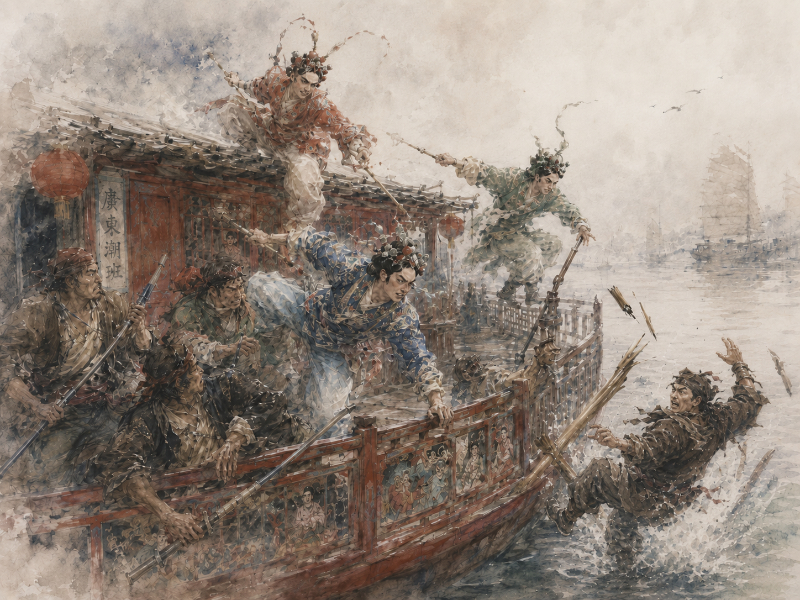
    Abstract watercolour scene of Cantonese opera performers fighting pirates on a narrow red boat, with figures, pikes, and river mist dissolving at the edges.

    I’m well aware that it’s no joke, and that the situation is heading rapidly towards conflict. Who would ever have thought Hong Xiuquan, that so-called Heavenly King, would take Nanjing and call it his Heavenly Capital? Yet there he is, younger brother of Jesus Christ too, if you please, or so the riverfolk say he claims, with half the empire shaking under him. They say he routed the Emperor’s forces and put the soldiers’ households to death – men, women, children, the lot. Out with the Christians as well, I say, if they are going to be so excessive! Thankfully, we have nothing to do with that crowd; but we are thick with the Red Turbans, who swear there is strength in the cloth they tie round their heads, and who have been drawing several of us smaller lodges into their business. It’s an exciting time, though often bloody, as you yourself saw in that Guangzhou alleyway, when those poor rebels had their heads cut off right in front of your eyes.

    Of course, with my running about all over the delta and up and down the Pearl, I’ve had some dealings with the opera companies. When I was running with a pirate mob some years back, we thought they would be easy pickings; but more than a few of us came back from their narrow red boats carrying our broken mates on our backs, though they had no weapons to speak of, and we had gone at them with muskets, pikes, and sabres. But there’s hardly any space on board to wield a sword, and, being followers of the Shaolin monk who founded their companies, so they say, they have developed their fighting skills specifically to keep types like us at bay. You’ve never seen such wonderful acrobats! The time we attacked them, I watched dumbstruck as they cartwheeled around the walls laughing, broke our bamboo pikes in half, and hurled us off their boat into the Pearl. They’d been on their way to a performance, it turned out, and were resplendent in all their costumes of brightly coloured silk, dripping with fake gold and pearls. I certainly had a new eye for the Cantonese opera after that experience, and am getting a taste for the music, which I found rather clangy at first. Thankfully, they’ve come over to the Red Turban side, same as us, and how I’m looking forward to mixing it up with the Manchus with them on my side!

    I had a break after writing the above, and went down to the flower-boat for a drink and to think things over for a little while. Having all these images in front of my eyes made me feel somewhat sad to be leaving. After all, I came down from the mountain in search of adventure, and here it is, gathering up all around me, charged with mighty purpose, aiming to restore the empire to its rightful heading! Uncle Lo was there, with no idea of what was on my mind. When he asked was there anything wrong, I told him it was stomachache. I realised right then and there, when he placed his old hand upon my shoulder, that I couldn’t look him in the eye and lie.

    Above all, my main reason for staying behind is that I cannot desert him, not after all the strife we’ve seen together, and not after giving my sacred oath before his eyes and my lodge-brothers’ eyes, to lend my strength and my life to restoring the enlightened Ming to rulership. I know you and I have been through a lot as well, my comrade, through gainful times and loss. But you are going to a fine place without the strife we have here, only peace and fortunes to be made. And besides, I await the comeuppance I have coming for dispatching that poor Swedish monk of mine, who was only minding his own business – I would not have that karma follow you to the New Gold Mountain on my account.

    Remember your brother-Hung kindly, who stayed behind to tend the Peach Garden.

    Your devoted friend
    Wang the Meek


    From the draft novel Stawell Bardo © Michael Guest 2026
  • Yoke of Fuzhou

    Yoke of Fuzhou

    These blasted brushes have their bristles falling out into the ink, and where the devil is the new consignment of butterfly scrolls? No, stop, it doesn’t bear transcribing all this, you nitwit, it will only have to be crossed out later. And just as we were broaching a significant point in the temporal flow: the departure of our invaluable Informant from the true path; in fact, he appears to be rather on the point of abject existential dissolution. I may only imagine how he wandered in such a wretched and deluded condition, through the bamboo forests and down the sides of our holy mountains, to lose himself further in the delusory lowlands of the masses, hither and thither, absorbed deep and deeper into the miasma.

    Yet if one strains very hard, a horizon is observed – a wooden horizon, if you please – and there is writing upon that plain directly before his eyes. It speaks of crimes, in painted characters as dulled and forlorn as his mind has become, onto which one can now barely latch. The mind has retreated into a further, deeper corner of the darkness, where no more than a single ray of candlelight might faintly pierce. No self. No “him” to speak of, except poetically, personalizing and gendering the pronoun “it”; perhaps that will be enough. Make a note.

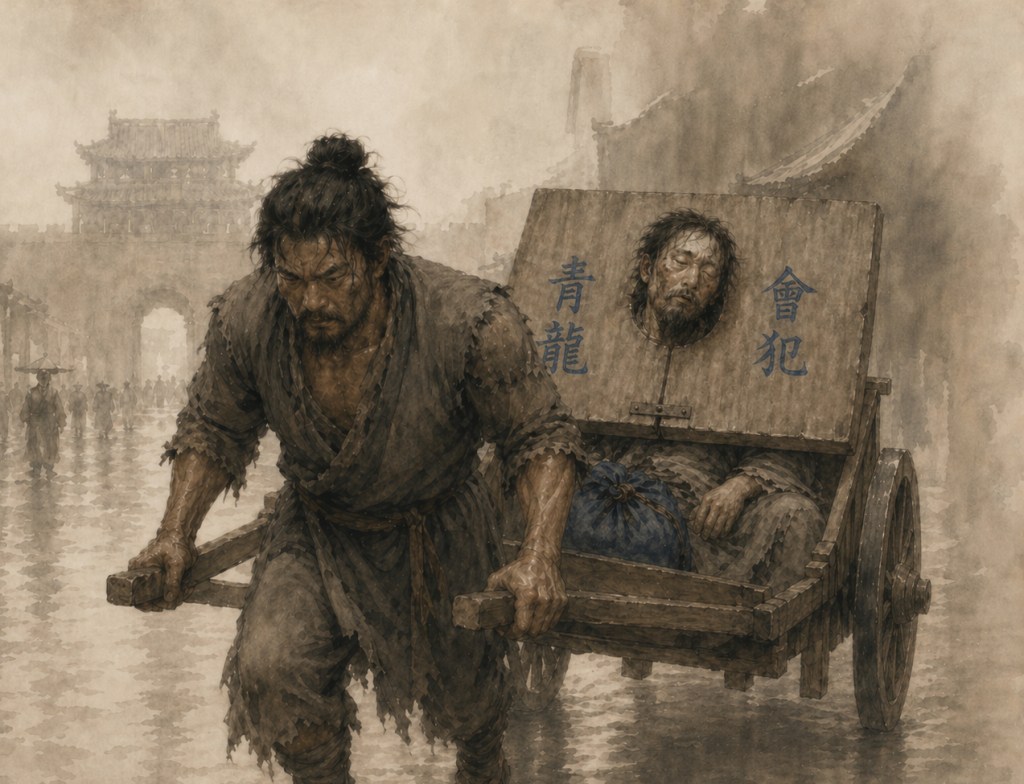
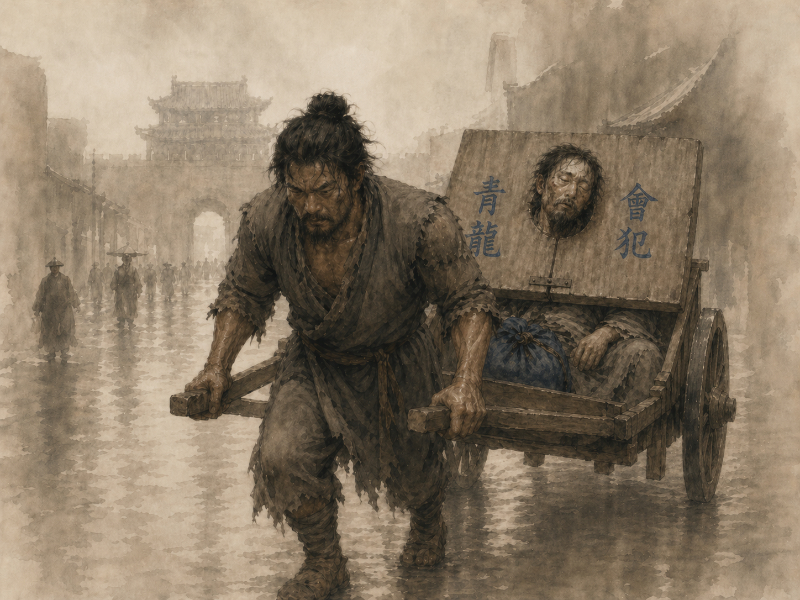
    A most memorable road sign, “Ten miles to Fuzhou!”: a picturesque city, better known in earlier times as Ye; later, to the Tangs as Minzhou, the place where the mighty River Min flows, which is why the whole region of Fujian, lying up the coast from Guangdong, was then called just that: Min. But by Qing times it was Fuzhou. Informant’s present is ten years after the First Opium War with countries of the West; our region has been opened up to barbarian traders and missionaries. Back to his woeful state, his horizon – ah, his ruinous yoke. A cangue. Square collar made of boards, three feet by three, having a hole in the centre for the culprit’s neck, thus preventing him from reaching his mouth with his fingers. The crime for which he is punished by wearing this wooden collar, and the duration for which he is to wear it written in bold characters upon the upper or front side of it, and he is placed by the wayside to be fed or spat upon by the citizenry. Blue Dragon criminal. Cangue until death shall release.

    Manhauling a cart through a narrow street, carrying an exhausted passenger slumped beneath a large wooden cangue.

    Perhaps cross out. Consult the lower ledgers.

    Blue Dragon Society: a minor fraternity of regional gangsters, late Qing, subsequently suppressed, of insignificant historical consequence.

    Leave it in, it may mean something to someone.

    Travelling slumped in the cart, he is propped up by this square hardwood cangue. But his heavy eyelids slide open to slits and he can read the road sign – Eureka! The so-called “Happy Region” of Fuzhou.

    A shame he is unable to revel in the delights of the place, as the cart jolts along beside the River Min. It is as though the reality before him barely adheres to the surface of his mind – floating islands, vast bamboo rafts thick with soil, little houses and gardens adrift upon the water. But he sinks down; his tongue lolls. His eyes roll and the heavy eyelids droop to close once more.

    The author – a missionary, of course – remarks upon the great sails the aquatic folk hoist when they choose to shift their colony, while men, women, and children labour at the oars below. What else would astonish him? Remove the barbarian Doolittle’s volume. These avaricious Christians have troubled the age quite sufficiently already – and never more so than in the period of our present visitation.

    The old barrow clatters through a massive gateway into the walled city of Fuzhou, beneath the lofty sentry tower commanding the approach, among a throng of travellers on foot or in sedans, and coolies bearing produce and merchandise. Driver has bound himself by leather shoulder-harness to the single-wheeled luche or “deer cart”; its central, wobbly wheel groans on its axle as he strains to keep the thing upright through the narrow, filthy alleys. Some portly mandarin of moderate rank edges imperiously through the peasant mass. His sneering glance grazes the abject human cargo lashed to the vehicle and all but sliding off, one hand flapping insensibly against the frame: an amusing caricature of human sediment for the citizens to point at. Some giggle hysterically.

    Such events are gainfully recorded, if for nothing more than the insight they impart as to the rudimentary functioning of particular bulkheads of Informant’s mind, which without them would be in peril of submerging entirely. Incidental perceptions such as the fat mandarin somehow join his recognition of the passing moment to those more profound airy labyrinths and subtle wordless channels through which he maintains his confluence with us, that inextricable foundation of his being. Other precincts of the mind, however, remain impenetrable to so feeble an inhabitation of the moment.

    Driver has found a patch of dirt to claim as domicile; he releases his leather shoulder-strap, and leans his companion in a disused alcove, balanced relatively upright against the cart. Next day, the driver leaves his burden and goes in quest of scraps and coppers in payment for his services as an itinerant barber to an unnamed, unbearably hairy clientèle. On returning, he turns to the care of his passenger, coaxing him from his fits and trying to lure back some dim memory of humanity. He speaks of the magnificent banyan trees of Fuzhou, beneath whose drooping whiskers, swinging softly in the breeze, he rested during his daily sojourn. As though to a child, he recounts tales of an earlier, happier life, exhorting him to some sign of recognition. At length, he returns with some borrowed tools and proceeds to break the chains that tether the cangue around our informant’s neck. During the days that follow, he uses the sign nailed upon the yoke to restore in him some mysteries of the written word.

    After some days Informant’s eyes clear noticeably, and Driver observes in them a fitful lucidity. Behind that clearing, broken moments from the opiate miasma begin to stir –

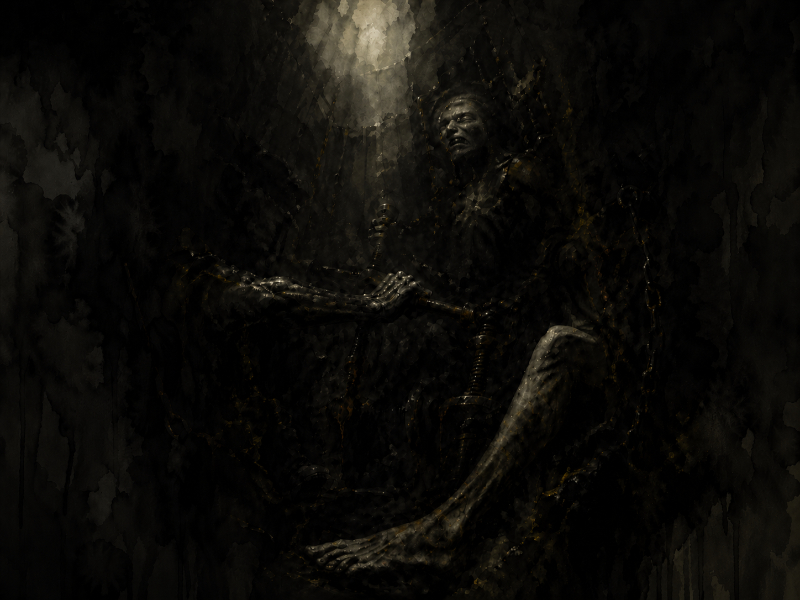
    The Pit. Amid a smattering of flashes and grunts in the dark, unseen blows from heavy fists and sticks break him no more than required, and he is stripped of clothes and shoes. Let down into the Pit for schooling. It is the beginning. It is called manning the pumps. Growled words: pumps, sealed drums, blasted rats. Once inside, the water man flogs and binds him to a place on the chain-pump, in a line of others. Other water toads. Egress is by hauling. The shift is expired. The body will not work beyond this duration. Called freezing in the Pit. Haul out the toads. If it looks tired whip its back. Repeat.

    The Sealed Drum. Damp earthen cubicles x feet by x, from where to where. Drag the living water toads through the stockade entrance. Good when moonlight. Bad when sun. Good when the moonlight seeps in to brighten things up. Bad when the sun, which burns a hole through to the brain. The ray of moonlight waxes and wanes. A toad cannot tell whether it is awake or asleep. The moonlight waxes and wanes in its sleep as well. There is space to writhe from somewhere to where. One by one the toads awaken and vermiculate across the bottom in quest of food. They cannot tell food from the other matter, before or after ingesting. It all goes down the same and comes back up the same. At first the toads converse. Called chatting. But after enough passages between the Pit and the Sealed Drum, they aspire only to slip and wriggle like maggots. Called adventuring.

    Emaciated pit worker bound to a chain-pump in a dark mine shaft, half-submerged and reduced to a “water toad” by brutal labour.

    Inside the Pit again. The pump clitter-clacks. Clitter-clack, clitter-clack. Sometimes it sticks and Water Man curses. Rust, or a finger or toe cut off and stuck in the joint. No exploration allowed in the Pit. It is a place for meditation on pain and lessening. Lessen the suffering, lessen the lack. No exact word for escape. If it veers from the way to the Sealed Drum, slash its feet for it.

    Called Pension Rice. These ones still living are left in the Sealed Drum for the off-season. Springtime. For a while they luxuriate in the sodden dark. Chat, vermiculate, adventure. But in the Drum life soon becomes indistinguishable from death, and they languish for more pumping; oh to live again.

    Whistling, as he used to, of the broken twigs in the grove, our wandering barber rounded a corner and slouched wearily along their narrow market alley, scarcely wide enough to admit two abreast. It was the usual late-afternoon scene, the day’s energy having somewhat dissipated, along with the stream of pedestrians pursuing their sundry ends. A travelling doctor, who had arrived early that morning to harangue the multitude on the powers and virtues of his medicines, was crouched over his case, repacking small bottles. Driver paused among a group of stragglers loosely gathered to watch a soothsayer ply his trade; seated vis-à-vis on little stools and earnestly consulting one of the books laid out between them, the charlatan expounded to the awe-stricken simpleton the lineaments of his destiny.

    Pip-pip-pip!

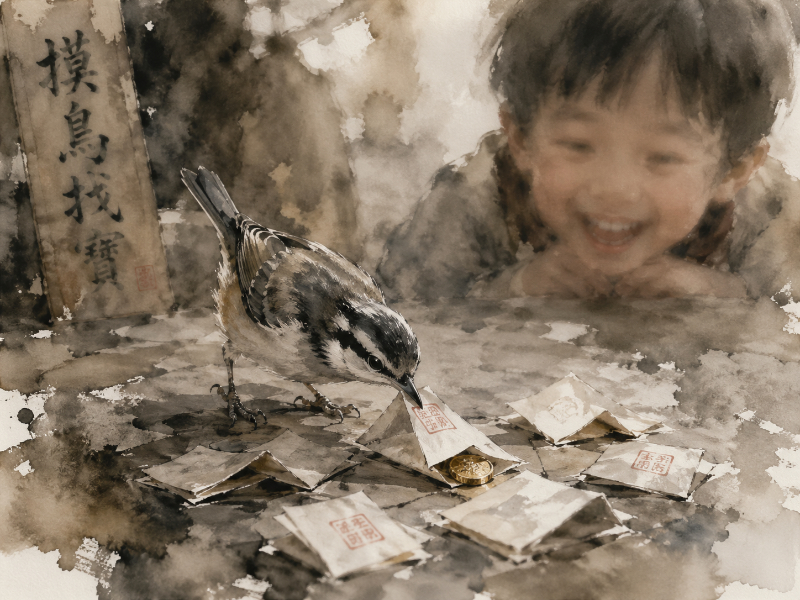
    Closing his business early, the haberdasher was sliding his night-boards into their grooves. A cluster of children were down on their haunches before the shop, squealing at the clever feats of a few tiny birds hopping and pip-pipping amongst a pile of paper slips. The trainer had set them to singling out the slip enclosing a coin, rewarding them with grains of millet for their cleverness. A little farther along, at the Good Fortune fruit stall, a couple of women made their purchases, casting lots for the quantity they were to receive.

    Little boy crouching beside a street trainer’s tiny birds as one picks from a heap the paper slip hiding a coin.

    Approaching the alcove, he could not clearly see his charge, who was screened by rhythmically scuffling legs draped in tatters. A row of blind beggars, eight or ten, crowding into the doorway of the wine shop opposite, each with his hand on the shoulder of the comrade before him.

    Aaaiyaa… aaaiyaa… They intoned their dirge, punctuated by a clack-clack from two pieces of wood struck together. Some minutes passed, before the shopman’s unmistakable weary moan of complaint was heard through the door, signifying that a copper cash had changed hands. Then the beggars who had managed to fit inside shuffled out again into the alley, and the group recommenced their performance, filing on towards their next stop, their dirge echoing behind them.

    A ghost of a smile lingered on Informant’s face and a faint spark lit his eyes as he sat watching them, propped against his broken cangue.

    “They’re a bit late today,” said Driver smiling, as he lowered himself to the ground beside his companion. Informant gave an uncharacteristic start, as he turned his head and their eyes met. “Mow Fung?” said Driver gently.

    Informant turned back to watch the receding line of beggars, inclined his head, and made a slight frown.

    “That last Aaaiyaa is not quite right,” he said slowly. “The tune should resolve into Yu – the sound of winter and grief” – he searched for words, “… but one of the beggars pulls it up to the tone of Zhi at the fifth degree. That is not a tone of grief, but one of …” turning to his driver “… summer.” He frowned and their eyes locked again.

    The two sat silently for several minutes, as the informant explored a suddenly illumined zone of his mind. Then he spoke deliberately, gathering pace.

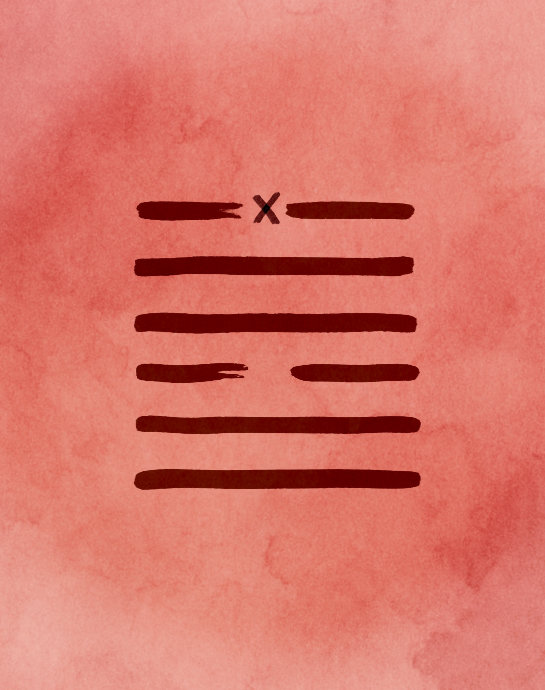
    “There is a warmth inconsistent with mourning.” A puzzled look came over his face, and his eyes turned up as he scrutinized a part of his brain. The sound of the beggars echoed down the alley. “Yes, there it is again, quite … arresting. It evokes the hexagram Shih Ho, Biting Through, because that tone of Zhi doesn’t belong but it can’t be removed – like something stuck between the teeth. I was here asleep when the beggars roused me with their singing. I felt I had to clarify that mistake. But now I can see it’s not that singer’s error, but rather more a cosmic intrusion …”

    The driver could not help laughing. “You’re back.”

    Mow Fung was getting excited. “That’s it! Zhi, the fifth degree, is the fire-tone – the south, the summer. The heart-viscus. The tone of Shen: spirit and the animating fire of consciousness.”

    “So in your sleep, you bit through it,” said Driver gently. Mow Fung turned to him and their eyes locked.

    “Wang!” said Mow Fung. “I thought it was you. We must go to the South.”

    Their descent by the majestic River Min through the coastal hills to the Pagoda Anchorage was uneventful enough. There Wang found passage on a coastal junk which, laden with hardware and kerosene for Guangzhou, bore them south-westward along the coast towards the Pearl River Delta. He passed the master two Mexican dollars, a sought-after currency those days and enough to keep them in rice for the voyage.

    “Pretty good for a travelling barber,” Mow Fung said.

    “Don’t worry,” his friend replied. “I’ve got a bit stashed here and there. Nothing too troublesome. I’ve been adventuring for these past couple of years, you know, and even made a bit of a name for myself as hired muscle. Those monks up on the mountain taught me a thing or two, I can tell you. Most of all, I’ve learned to keep it to myself.”

    “Wang the Meek,” said Mow Fung with a half-smile, as his eyes slid upward and he dozed. In their corner among the cargo down below, the drumming of waves under the hull, and the creak of timbers and bulkheads shifting, seeped into his sleep, taking him ever deeper. Wang made his way up to the deck for some air. He drew from his sleeve his battered stub of a tobacco pipe and lit it. Above in the dark, a brief gust set the sails slapping. He could still make out the coast, the Wuyi ranges dark against the purplish sky, pricked with stars, and an occasional light from some dwelling. The smell of tar rose from the hull, and he leaned there ruminating on his pirate days.

    In the morning the two went on deck, were allowed a place in the bows, with some pieces of heavy sailcloth for comfort, and told roughly to keep out of the way.

    “Mind that boom when you rise,” the sailor said as he strode off.

    “I dreamed of wearing the cangue,” said Mow Fung. “And before that – what was The Blue Dragon?”

    Wang glanced at him. “They were the ones that ran the mine where you found yourself trapped as a water-toad. When they thought you dead, they threw you into a cave where they disposed of their victims; but you must have passed into one of your living-death states or another.”

    He stopped as a pair of cormorants with outstretched necks swooped over the bow, wheeling down toward the water.

    “So when the yamen runners broke up the gang and found you there, and dragged you to the magistrate as evidence, he wasn’t sure whether you weren’t a Blue Dragon yourself, in hiding. I must say, you didn’t help matters much by raving on deliriously about the Tao, because that magistrate happens to take a dim view of Taoists in any case. So, to be safe, he cangued you till death should settle the question. That is what the bailiff in charge of you told me, anyhow, when I bribed him to hand you over. I hauled you all the way to Fuzhou in a hurry, in case the magistrate, a whimsical type, decided to shorten your days.”

    Something on the coast caught his eye. “See that burnt-out stretch, between the headland and that watchtower,” he said. “Red Turban work, maybe. Or one of the brotherhoods. Compared to these parts, Fuzhou is a haven – a bit boring actually. Glad to be gone.” He went off to the galley and came back with two wooden bowls of lukewarm congee.

    “Prefer salted fish scraps or a pickled radish?”

    “Hi, you pair! Out of the way of that line,” came a shout followed by a curse, and the two crouched and shuffled a few feet across, Wang juggling the bowls. The junk steered a little further out to sea, to where the breeze picked up a little. The sails billowed and the vessel bore along the southward curve of the coastline. Mow Fung rested throughout the day. Once in a while Wang moved to a sheltered spot at the rail and stood alert, his eyes roving between the coast and the horizon.

    By night they went back to their corner in the hold, the air now thick with fumes from the kerosene kegs. Nevertheless, Mow Fung was growing steadily stronger, occupying to a greater degree his proper time and space. His corporeal self.

    On the fifth morning, a hubbub above deck drew them up. A quarter of a mile astern, another vessel appeared to be bearing down on them, nearing by the minute, causing much consternation among a few of the crew, who had grouped together near the stern, half-hidden behind a stack of cargo.

    “Don’t recognize them from the anchorage – must be from further along the coast! Pirates maybe,” said one. Squinting, Wang took a good look, then said quietly, “Nothing to worry about: not pirates, too impatient. They’d more likely cosy up nice and easy-like, not to scare us off. With that big sail and skinny hull, I’d say she’s most likely a dispatch junk. Maybe some Red Turban trouble up north a bit.”

    The master called out to the group of green sailors to stop being idiots and get back to work, and a few minutes later the dispatch overtook them.

    The only other disturbance was some fighting on shore, barely visible through the haze: smoke rose from beyond the headland and men scattered like insects along the ridge. Alerted by the distant crackle of muskets, Wang watched for a while from the rail.

    “Militia and society men,” he said. “Hard to tell which is which from here. There’s a lot of interesting stuff happening these days, that’s for sure.”

    Entering the Pearl River Delta, the master shouted orders to his underlings, who trimmed the sails as the junk turned toward the northwest and slipped past Hong Kong. The White Ensign showed on several British naval ships at anchor, sails furled. Macao was hazily visible afar from the port side, its anchored vessels tiny specks. The junk veered deeper into the main channel of the delta, and the master refined his orders as he prepared to thread his way through the vast array of craft now appearing, and sought the channels that would take them up the Pearl towards Guangzhou.


    From the draft novel Stawell Bardo © Michael Guest 2026
  • Junction Teahouse

    Junction Teahouse

    Honourable Buddhist scholars leave the East and go West. Mr Daruma, who doesn’t like Buddha, leaves the West to come East. I thought they might meet at the Teahouse of Awakening. Alas! It was only a dream.

    ⁓ Japanese Zen monk Gibon Sengai (1750–1837), adapted.

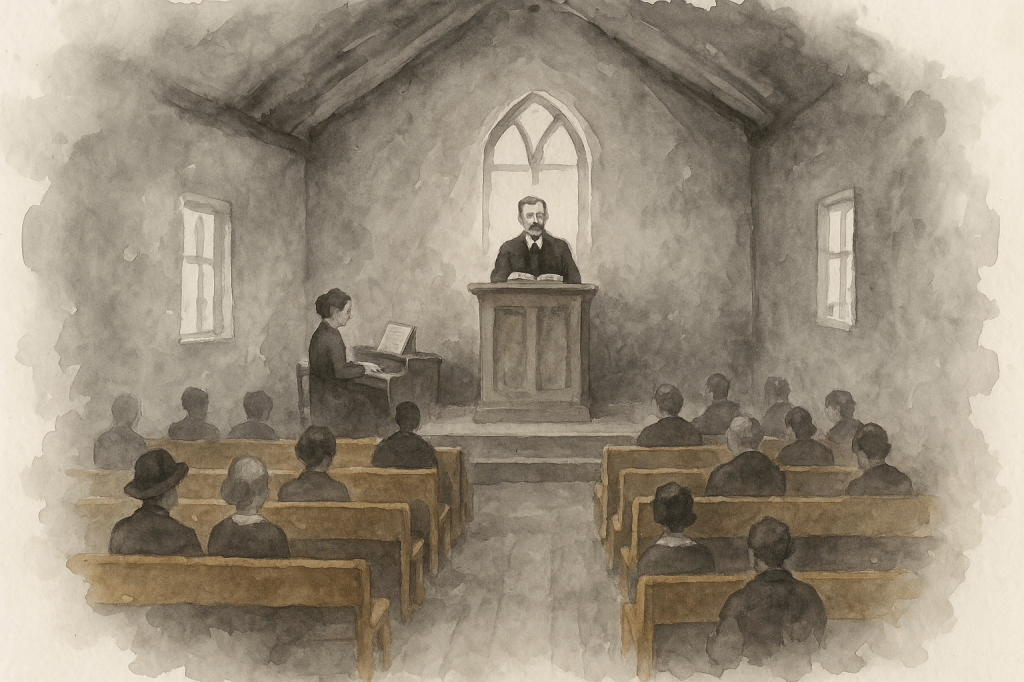
    It was Sunday, and a hush had settled over Stawell and its environs, less the product of Christian observance than the fatigue of a community wilting beneath a heatwave. The constables were at rest, their boots airing by the door, while their horses, in the shaded yard behind the lock-up, stood twitching at the flies. Grave-faced publicans bent over their ledgers with a grim focus. And the Reverend Hollins, in his peculiarly tremulous voice and occasional sighs tantalisingly suggestive of a faltering conviction, sermonised to a reduced congregation: a smattering of families, several women in white gloves already thinking of their lunch preparations; a town councillor occupying the aisle-end of the front pew, his straw boater tucked correctly beneath one arm when rising for a hymn, believing virtue to be transmissible through nods, smiles, and a strategic proximity to the pulpit; and indelibly, two boys whose giggles, once stirred, proved difficult to suppress, captive in the back pew, passing between them a folded scrap of paper on which they scratched and scribbled at a caricature of the preacher, recognisable chiefly by the earnest absurdity of his moustaches, while off-key strains of Jesus, Lover of My Soul wheezed from the beloved but dilapidated harmonium.

    The shopfronts along Main Street were shuttered, each a mute testament to the Sabbath and the wisdom of retreat. At the swimming hole, boys lay strewn in a loose ring beneath the gums, not so much resting as resisting motion altogether, while their sisters played jacks in the spindly grass nearby, casting now and then a glance at their brothers that combined idle curiosity with frank disdain. They had all been spectators the day before, as Stawell’s cricketers ruthlessly dispatched the visiting Ararat team, notorious across the Wimmera competition for their aversion to practice afternoons.

    The players themselves had scattered after the match, victorious and vanquished alike, most of them inclined to the drink. By nightfall, it was difficult to tell who had won: the mood had turned to the camaraderie of once-opposing warriors. On the brink of sunset, a few were seen crossing a drying creek bed, stumbling and laughing while arguing a call of leg-before-wicket as if time might reverse itself were the point laboured long enough, while the bottle, wobbling among them, passed hand to hand with the erratic solemnity of an intoxicated relic.

    Forster was not at rest on this Sabbath, nor was he attempting rest, which for him had never been a natural state – least of all while that torn bundle of clothing remained stubbornly mute. The scattered remnants of hat, flannel undershirt, trousers, and coat refused to yield the truth he was sure they withheld. During the week he had moved among storekeepers, stablemen, drinkers, and those who passed for bush-hands in that part of the country, collecting fragments of recollection that slipped, often visibly, from possibility into fancy. They revolved in his dreams, these lingering ciphers of some anonymous, ill-treated lost soul: a vest too long for most men, with a single bleached button still clinging to a thread; a coat with its lining turned the colour of the grass in which it was found; a twilled shirt, comparatively new, now torn open at the front and stained along the seams with dirt and dried blood. An unremarkable wardrobe from which to conjure a name.

    And it nagged at him that something vital waited to be perceived, if he could only loosen his grip on his habitual, strictly methodical approach to such evidence. That morning, he had reread a marked passage from a volume he carried in his travelling library, an old work by the British physiologist William Benjamin Carpenter, something about knowledge arriving through circuits of which the thinker remains unaware. “Unconscious cerebration,” Carpenter called it. Not instinct, exactly, but a deeper faculty, which underlies reason. It reminded him of something the Chinese publican had said to him offhandedly: that a man may fix his gaze too closely on the fragments of a thing, and so miss the thing itself. Forster, who did not consider himself a mystic, found the idea returning to him incessantly in recent days, like a tiny pebble he could not get out of the sock of his reason. Yet oddly persuasive. The detective was, like Carpenter, a committed empiricist, but it seemed to him of late that a narrow channel might exist between the Western scholar’s rigid concepts and the Buddhist’s drifting brushstroke. Whence come our “hunches,” our “insights,” our “intuition”? he mused as he crunched along, his plain walking stick, little more than a trimmed length of hardwood, tapped lightly at the ground as he pondered. That solution to a problem suddenly flashing into the mind unbidden: whence does it arise? Its quiet elaboration occurring beneath the awareness.

    The heat bore down, and without quite intending to, he had taken the red track to Deep Lead. Past the edge of the diggings, smoke exuded here and there in the Chinese camp, tinted with incense. Truth to tell, when entered from this side, alleys leading from the main street bore signs of the dissolution of which the camp was sometimes accused. There were a few grimy, tumbledown edifices, constructed as though from a pack of pub playing cards – among them opium haunts; the area had of late become known for drawing the idle young from miles around. Denizens of an unprepossessing, not to say suspicious, appearance loitered in the shade; yet even so, Forster reflected, there was a loafing, arrogant class of colonial that roamed around the country and might as easily be found lolling and expectorating about the corners of the principal streets in the best Australian cities.

    Towards the Junction Hotel end, the outlook was much improved, with a man repairing an eccentrically designed but spotless and sturdy cabin, or watering a vegetable garden; women in loose cotton trousers and indigo tunics, sleeves rolled to the elbow as they stooped and rose, pegged laundry to low-strung lines between sheds. Beneath a couple of pepper trees in a scorched yard, half a dozen children clad in faded cotton shrieked with delight as they played a game of bat and ball. A little further along he spotted Mow Fung’s own eldest daughter Lena, appearing wraithlike in the haze, suspended in a shimmer of mirage. She was some distance off, walking in his general direction along a track that led into the dusty street. As she came nearer, she recognised the detective and offered a pleasant smile and nod, gesturing that she was on her way elsewhere. He paused under the eaves of the Junction Hotel and glanced at the door. And just at that moment the proprietor appeared from around the corner of his premises, wearing his habitual loose trousers and black satin Chinese “melon rind” cap.

    Forster settled into one of two comfortable cane chairs arranged on either side of a small table in the corner of the Junction’s exaggeratedly named Tea House, where his acquaintance had guided him with quiet formality. Actually an interior room, it lay beyond public access, tucked behind the family quarters and adjoining a dim little chamber that might have been a storeroom – it was hard to say. Shelves lined the far wall, crowded with potted plants that leaned gently toward the filtered light. The tearoom itself was reached through a plain, easily overlooked door, and Forster had the distinct sense of being ushered into an inner sanctum, not merely for the warren-like route that led him there, but for the subtle change in the publican’s bearing as they entered: an attitude approaching deference, tinged with the protective instinct of a man offering something precious to one who might not recognise it. Perhaps his one or two official visits to the hotel since the post-mortem had earned him Mow Fung’s trust. It was an unintended but welcome result for a city detective newly stationed in the district, slowly learning the elusive protocols of rural trust.

    Mow Fung had then excused himself, to attend to some domestic task or other. More finely dressed than on previous occasions, Mrs Mow Fung was seated at a table in the far corner, opposite a woman whose back was turned to Forster; she gave him a quick smile, then turned back to her companion. The two conversed in hushed tones, drifting between English and Mandarin. A lacquered box sat open on the table, its contents laid out with care: long stalks, slender and pale gold, like dried reeds, along with a square of folded silk, an inkstone, and a strip of scarlet paper. They were playing a counting game with the stalks, or as far as he could tell, tallying up accounts. Forster glanced away, thoughts wandering as he looked out at the garden beyond the window. There was Mow Fung with Lena watering a wattle. Even a scene of such trivial domesticity had the power to soothe the soul, within this hush.

    A soft sound drew him back. The woman had shifted in her seat, and he could see her more clearly now: her lissome form and proud profile even with lowered eyes – beauty understated, yet unmistakable. She wore a pale silk blouse, the fabric catching the light just enough to reveal a faint peony motif in the weave; below that, loose, modest dark trousers.

    Mrs Mow Fung moved the stalks in her hands while the other woman watched intently, Her elbow rested on the table beside the inkstone box, fingers idly tracing its lacquered edge, her posture languid though her eyes tracked the other’s every gesture. She looked up as Mrs Mow Fung posed a question, articulating each word slowly in Chinese, and the answer came in an equally measured tone.

    Mrs Mow Fung’s sleeves made a faint, dry whisper as she moved and a moment later she tapped the yarrow stalks lightly on the square of silk. The woman said something inaudible, and Mrs Mow Fung gave a soft laugh in reply.

    “Yes, they are called ai yao, and that lovely perfume lingers on them for a long time. But we should be quiet now and think only about what troubles you.”

    Forster resisted an urge to clear his throat. He reached for the small teapot on the cane table and poured some tea into one of the two small, handleless Chinese cups Mow Fung had set down. He was sure the splash had cracked the silence, but neither woman looked up.

    Forster closed his eyes. He flinched at the first sip of tea, then smacked his tongue lightly against his palate before taking another. It was a tad bitter, with a taste of mushrooms and … damp soil … that caught him off guard; but after he swallowed, a subtle aftertaste emerged: warm, sweet, and unexpectedly wholesome. He lifted the cup to his nose and inhaled its strange aroma.

    Across the room, Mrs Mow Fung spread the stalks slightly between her hands, then divided them into two uneven bundles, with practiced ease. From the right-hand pile she drew out a single stalk and placed it aside, distinctly articulating the word “Heaven.” The remaining stalks she counted in groups of four, sliding them gently between her fingers until three remained. These she laid to one side, and gathered the bundles again. The motion was repeated. Divide, draw, count, set aside – three times in all.

    Forster listened to the rhythm: a rustling of sleeve, a concentrated breath, a feminine murmur. A pause. “Yang,” said Mrs Mow Fung. The younger woman took up the brush and marked a single line on the red paper – one clean, black stroke. Mrs Mow Fung took up a new bundle, and again the process unfolded: division, removal, counting. At the end of the cycle, she cupped the remainder in her palm and said, once again, “Yang.” Another mark was made – two strokes now, neat and parallel.

    “It is excellent quality Pu-erh tea.”

    Forster opened his eyes. The proprietor had materialised across the table. “It is,” Mow Fung added, “imported from the city of Pu’er in Yunnan province, the only place in the world it is cultivated.”

    Clearly on an intuitive impulse, having judged something favourable in his guest’s manner, he paused and continued:

    “‘Pu-erh’ is an important name in my life,” he said, “but not because of the tea. In my tradition, it’s also the name of a semi-immortal – a Perfected being, a sort of spiritual ancestress.

    “When I was an infant, there was a ritual – a dedication, not unlike a christening – where she was named as my guardian. When I grew a little older, I was told she had been my mother in earlier lives. Her task, I learned, was to help me return to my original true self.”

    Forster blinked, having anticipated nothing quite so personal, nor so metaphysical. Each looked quietly at the other as the words echoed away, infusing the atmosphere of the tearoom.

    “Unfortunately, I could never learn to do that.” Mow Fung chuckled as he reached for the teapot and poured again, the dark stream sliding softly into each cup. The deep, earthy perfume rose. “If you are not used to it,” he said, “it can taste a little like mushrooms and dirt.”

    “It’s not too bad,” Forster said. “Even to a milk-and-two-sugar man like myself. You’re uncannily right about the flavour. Must’ve read my mind.”

    “Much easier to read the face,” said Mow Fung. “Tongue-sounds too – most revealing.”

    Unsettled, Forster reverted to a tone of workaday officialdom, which rang oddly in his own ears amid the intoxicating bouquet of the Pu-erh tea.

    The female voice came from the far corner, and Forster glanced across to see the young woman holding the calligraphy brush upright in her left hand, poised to paint a mark.

    “Shame about that article – you and the doctor, after the post-mortem,” Forster said. “One of the constables tried to chase off that blasted reporter hanging about, but unfortunately not firmly enough.”

    If Mow Fung noticed the tone at all, he betrayed it only in the steady, crystal gaze he cast into Forster’s eyes before reverting to his humble mien. The atmosphere was once more in balance, as the women’s voices drifted and the yarrow stalks whispered on the silk.

    “Ah,” he smiled. “Newspaper. Sometimes the young reporter sees what he wants to see. Wants to make the reader of the newspaper feel superior to a lowly ‘Chinaman’ like myself. Always so. Very natural.

    “In this case, Doctor Bennett needed to wash his hands, but Mow Fung could not allow the dead man’s spirit to adhere to utensils like a bowl or towel – not only for the purity of the space, but for the spirit’s own journey. He should not get stuck to more things here, but instead, progress through the proper stages into the beyond. For this dead man, such matters are especially important, because he is disconnected from his head. It is said by some that a person should be intact, or they will never escape from this world.

    “So, leaning back, not to get splashed, I pour water from the trough over the doctor’s hands to wash them, with the water running into the earth, just as in our ritual cleansing. Doctor Bennett offers me the soap, but for obvious reasons, I refuse to take it back. And what do we find? Articles not only in Hamilton Spectator but as far away as Adelaide Observer. That ‘Heathen Chinee’ headline … Like all Chinese, superstitious, afraid of death, too ignorant to take the soap! Poor Mow Fung! Ha!”

    Across the room, Mow Fung’s wife made two quiet raps on the table, freezing mid-motion as she replaced the stalks into their lacquered box.

    “So sorry, my dear,” said the husband with a chuckle. “Getting a little excited. Since you’re finished, would you keep Detective Forster company while I fetch something I want to show him?”

    The younger woman’s gaze flicked up – not startled, but suddenly still, her face passive for an instant.

    “Detective,” she said, “I see.” She wiped the brush clean and pressed it gently into its groove beside the inkstone.

    Forster, already halfway into a polite nod, faltered slightly.

    “Would you care to join us?” said Mrs Mow Fung, smoothing over the pause.

    “Only if I’m not interrupting,” Forster replied.

    “We were done,” said the younger woman, her tone cool now. “All the lines are drawn.”

    “Please – call me Anna, my English name,” said Mrs Mow Fung graciously. She motioned to the seat beside her. “This is my dear friend Lili.”

    The young woman’s gaze slid from Anna to Forster and back again, and she offered a minimal nod.

    “Excuse me,” she said to her reflection in the window, languidly adjusting her sleeve. A fine silver bracelet caught the light. “Teahouse rituals are deeply exhausting.” The trace of an American accent barely surfaced.

    “You have been playing an intriguing game,” Forster said. He was looking at Anna when he spoke, but he caught a barely perceptible shrinking in Lili, like a bracing, or a folding inward.

    “It is not quite a game,” Anna said gently, “but more of a window into ourselves. It can speak to you, if you listen.”

    Lili regained her composure just as if it had never left. She tapped the red paper with the six parallel lines she had drawn. “It says someone in the room asks too many questions.”

    “This picture is called a gua,” said Anna, ignoring Lili as she might an impertinent child. “You see it is made up of two parts, upper and lower; here they are both the same, a picture of a lake: two Yangs with one Yin – broken line – on top. That is a most desirable gua: one lake perfectly reflecting another lake; two lakes side by side, filled with water, sharing it all with each other. Creative is balanced by receptive. The inside and outside are as one, without any separation. It is a state of joy, or harmony, or even delight. Profoundly satisfying.”

    Lili sipped her tea. “I’ve heard good things about joy,” she said dryly. “It’s on my list.”

    Anna continued. “There is always a risk with joy: it must be correct. False, incorrect joy, will never last long but will disappear; having lost it, you will be worse off than before.”

    “How poetic,” Lili said. “And how typical! A pair of lakes gazing longingly at each other, just before one of them evaporates.”

    “Exactly,” said Anna, implacable. “The top Yin line, broken, is changing to Yang, unbroken – that’s why I asked you to mark it with an x. It’s the culmination of delight, but also its overturning. When we cling too tightly to pleasure, we lose ourselves. Everything changes and then comes the sorrow. That’s the nature of joy when it runs too far.”

    She glanced down again. “Now look – only one Yin is left, and it’s climbing up through the strong Yang lines. This gua becomes a new one: Treading. Heaven above the lake. Like walking on a tiger’s tail – it may not bite, but you must tread carefully. Especially if that remaining, soft Yin is misused. Squint and miss the path; limp and the tiger turns and bites.”

    Then, more softly: “But that one Yin – it’s also the key. It must remain open, yielding. That is not weakness. It’s the only way forward when the forces around you are strong. The gua speaks to your moment. It shows where you stand – and how to tread the path with clarity and grace.”

    Forster ran his finger lightly around the rim of his teacup. “Well, I suppose if you stare at a thing long enough… Some say the mind produces answers of its own, even when we think we’re getting them from elsewhere. From cards, or symbols, or whatever’s at hand.” He lifted the cup to his lips. “Doesn’t necessarily mean they’re any less true.” Climbing up, Forster repeated to himself, smiling – or floating, maybe; the fact gently floating up of its own volition.

    “Here is what I wanted to show you, Detective!” Mow Fung suddenly manifested himself in his irrepressible mode. He drew up an extra seat and slipped in between Forster and Lili, placing a small scrapbook on the table. “You will see how we are growing more famous and may soon catch up with even you, although we have not arrested even a single criminal.”

    The scrapbook was open to a page with the “Heathen Chinee” clipping. Mow Fung laughed delightedly and tapped his finger on the next column, its headline set in bold capitals: “A Chinese Lady at Ararat.”

    “Ah, this one,” he said. “Another of our local triumphs. You see – our old store on the Mullock Bank in Ararat and a banquet said to honour the arrival of a real Celestial lady from the Flowery Land.” He glanced at Anna with a boyish grin. “My wife’s debut on the goldfields. She was the marvel of the district.” He shook his head. “Eighteen years. How time flies. Tempus fugit … He frowned and glanced up, searching a different part of his brain: “Sed fugit interea, fugit …”

    “Fugit irreparabile tempus,” said Lili, a singsong lilt in her voice, faintly amused by her own erudition. Mow Fung paused to look at her.

    Forster quoted the Virgil: “But meanwhile it flees … time flees irretrievably.”

    Mow Fung turned the book slightly so that Forster and the others could see the old clipping, the type still declaiming its truths after all these years. “The reporter wrote that half the township came to peer through the doorway. Then he says, ‘curiosity turned to drink, drink to uproar, and soon every man in the place was fighting – Europeans with their fists, Chinese with bamboo sticks: free fight and no favours.’ He casts me as ringmaster, conducting us Celestials in one-sided combat; and somehow we emerge the fools. while the drunken ruffians are likable country larrikins at heart.”

    He laughed softly, without mirth. “As I recall, there was supper, some singing, too much beer, and one fool who threw a weight from the counter and smashed two jars. The police were fetched; the magistrate dismissed the case. But the paper had its say: a lady from the ‘Flowery Land,’ a ‘Celestial’ riot in her honour, and another good story for breakfast.”

    Anna’s face barely shifted, but her minimal shrug suggested it took more than colonial attitudes to worry her.

    Mow Fung smoothed the edge of the clipping with a fingertip, but it curled back again. “I keep these to remind myself that in print, the story that pleases is the one that endures. I have found joy in this peaceful settlement far away from the violence and strife I left behind in China.”

    Forster shifted in his seat, unsure of what had unsettled him. Lili’s eyes lingered on the yellowing paper, musing, “And here I thought I was the exotic guest.”

    Their host turned another page. “And here – something happier.” The headline, neatly set in small type, read: “Baptism of a Celestial Infant.”

    “That was our first child,” he said. “The paper noted it as the first christening of a Chinese baby in the colony. It says the church was well attended, and that our boy bore himself with ‘admirable composure throughout the ceremony.’” He smiled faintly. “No one meant any harm. It was all quite kindly done – a curiosity for the readers, nothing more.”

    His hand rested lightly on the page. “I remember the minister’s face: the awe with which he regarded a new life; and the townspeople, craning for a better view of the novelty. We thought of it as a gesture of friendship, a courtesy between faiths.”

    He closed the book. “So – a happy clipping to end on.”

    Anna’s eyes softened; Forster gave a small, respectful nod. Lili’s reflection was faint in the window. Now so close, Forster was struck by the quivering delicacy of her beauty – as though each passing second revealed a new facet, trembling and shifting. It reminded him of a tightrope walker: balanced, poised, never quite at rest. There was a fragility to her. Her black hair gleamed and her eyes glistened in the filtered light. A gleam set gently against stillness – that was the essence of her allure. There were traces of Chinese ancestry in her eyes, but something mutable in her features, as though they might shift to match any gaze that sought to define her. Depending on the light, the company, or the hour, she might seem unmistakably Chinese or equally European. A chameleon beauty: composed, ultimately unreadable. She brushed a hand lightly through her hair. A scar traced the line of her jaw.

    “Shall I prepare some more tea?” she said, already rising.


    From the draft novel Stawell Bardo © Michael Guest 2025