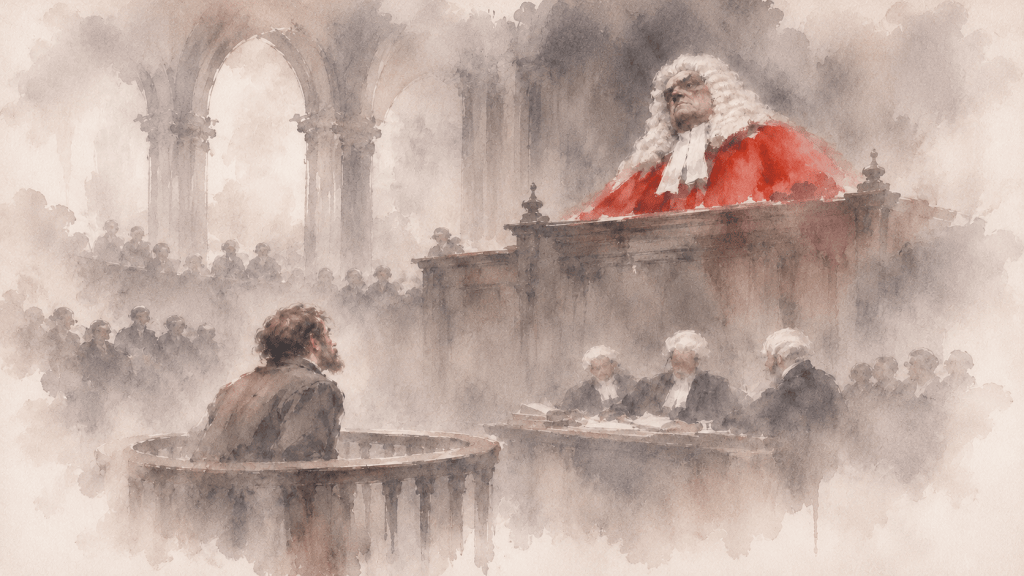
Slumped surly in the dock, the accused wondered when the last time would have been he was sober as this. A whisky or two at least would have steadied the nerves and set the brain straight, but they did not run to that in court. As it was, the fuss and procedures revolving around in a blur hurt your head, and there he was in the middle of it all, the judge looking down from above like a majestic eagle upon a grub. A clerk in a gown and grey wig had summoned him to stand, which he had, and, dizzied at the sea of faces flooding in on him, men and women both, one horsefaced bloke standing out particularly, staring at him with wide eyes and flared nostrils almost, the accused rested his hand on the rail to steady himself.
“Robert Francis Burns, you stand charged that you did, on the nineteenth day of December, one thousand eight hundred and eighty-one, at Deep Lead, wilfully murder Charles Forbes. How say you: are you guilty, or not guilty?”
His mouth opened, but for a moment no words issued, until a gentle wave of murmuring and rustling amongst the crowd brought him back to himself. What was it he said here?
“Not guilty.” Emphatically, as instructed in his cell two days before by a solicitor’s clerk. Mr Hickman Molesworth, the barrister himself, cut a formidable figure in his seat at the bar table, despite having received the brief only a week ago; supremely calm and still he sat regarding His Honour Mr Justice Williams, while one of the solicitor’s clerks finished tidying up his papers.
Twelve men good and true filed into their box across from the dock, staring at him with various expressions it’s true, but all with a touch of the superior air that comes with having a say in a man’s fate. He returned a minuscule sneer to one of them who had cast him a particularly snotty look, before realising that, situated as he was, flanked by warders, with the tipstaff, the mass of press, public spectators and bailiffs all around him, everyone staring right at him, his smallest gesture could scarcely escape notice. He drew himself up and cast his gaze in an arc that travelled above all their gazes in a demonstration of how one might reflect in deep introspection while appreciating the splendid architecture.
Hardly casting an eye at the grub to his lower left, His Honour, a riot of scarlet and white beneath the ranks of looped curls on his full-bottomed wig, delivered his preliminary remarks, explaining to the jurymen in cultured tones what was required of them: to determine the guilt or innocence of the accused, bearing in mind the presumption of innocence they were bound to uphold and the Crown’s obligation to prove his guilt beyond reasonable doubt.
A hush descended at the crier’s call for order in the court, and Mr Travers Adamson the Crown Prosecutor, a stocky man in a wig, a few years older than Molesworth, rose to introduce the Crown’s case, beginning in a matter-of-fact tone, but building in volume and intensity as his performance proceeded. He would prove: first, that a murder was committed at Deep Lead, the body stripped and the head removed to prevent the victim’s identification; second, that the body was that of Forbes; and third, that the victim’s “mate” – he lent the word a heavily ironic emphasis, following it with a pause while gesturing with a flick of one hand to the accused in the dock – was indeed the callous murderer. He halted, contemplating the accused’s pallor and the bead of sweat on his brow.
Adamson turned to the jury. “The case against this man is based on circumstantial evidence, admittedly, but evidence every whit as trustworthy as direct testimony.”
The morning session saw the summoning of witnesses with whom Burns was not personally acquainted, as the discovery of the corpse and the post-mortem were reconstructed. Having kept abreast of the newspaper coverage at the time, he settled back to see those characters in the flesh whom he had heard of only by name, for they had participated in the succession of incidents that occurred after the last time he saw Forbes, in a nice chronological progression, as in a theatre play: Wilson the miner, Hillard the copper, Bennett the quack. (Where was Forster, the bastard? – didn’t fancy seeing him again under any circumstances, particularly these, but anyway, he wasn’t called yet.) It was not the most comfortable chair in the world, and some of Molesie’s (Molesie – yes, me old mate Molesie’s) cross-examination of the twenty-eight-year-old Dr Bennett provided a merciful opportunity to squirm around a bit and get the circulation going.
The barrister stood up. “Doctor,” he said, engaging the witness with a disarmingly warm smile, “you estimated the height of the deceased to be…” – briefly adjusting his spectacles to consult a paper on the table before him – “five feet, eleven inches. Is that correct?”
“Indeed,” Bennett said comfortably.
“Which happens to be the known height, indeed, of Charles Forbes. Tell me Doctor Bennett, did the body have a long neck or a short one?”
“I beg your pardon?”
“The corpse’s neck, was it relatively long or short?”
Bennett chuckled. “My good sir, that was a matter rather difficult to ascertain from a body that had been decapitated.”
When some guffaws erupted from the gallery, Bennett turned in their direction, grinning and nodding appreciatively.
“Order,” said the judge quietly, and Molesworth allowed the moment to pass.
“So without benefit of knowing the length of the neck, nor how much, let us say, had remained attached to the head, you find yourself able to supply the Court with a definitive calculation as to how tall the individual had stood when he was alive. Surely you are aware, Doctor, that a man’s life rests on the evidence heard in this courtroom?”
Some mutters and ripples of laughter from the gallery. “Order,” said the judge, raising his voice. Ruddying, Bennett fumbled for a response before Molesworth let him go. Considerably buoyed, Burns had his lips turned down in an expression of dubiety as he slowly shook his head in sad disbelief. What was the colony coming to when an honest working man could be incriminated by rank unprofessionalism of this sort? He caught a glimpse of his old mate Molesie looking straight at him and almost felt like giving him a wink, but the barrister’s face was like a rock, which, as though reading the mind of his client, he deliberately turned away.
Further to its aim of proving the victim was Forbes, the Crown summoned two medical experts to dispute Bennett’s evidence regarding how long the body had remained in the elements. If, as the doctor had testified in the April committal proceedings, the mummified corpse had lain exposed for at least two months when it was discovered on 17 January 1882, then it could not have been that of Forbes, who had last been seen alive with Burns scarcely four weeks earlier, when the pair left Stawell, walking towards Deep Lead. In today’s testimony, he had reduced the window: “I do not now think it was so long,” Bennett said. “I believe it would require about four weeks to get into that condition.”
“I would perhaps not be so quick,” Molesworth quipped, “to discount estimations drawn from my own first-hand examination, were I in your position, Doctor.”
Molesworth gave the youthful Charles Snodgrass Ryan, twenty-eight like Bennett, a deferential nod. “Allow me, Doctor, to compliment you on your magnificent service for the Ottomans in the Balkans and elsewhere. A decorated military surgeon, I understand you were the only battlefield surgeon present at the Siege of… where was it again?”
“Plevna,” Ryan answered politely. “In Bulgaria.”
“Of course, I recall now. That’s why your nickname – ‘Plevna’ Ryan.” He smiled but seemed somewhat distracted. “Now, I must say, you have acquired during your wartime experiences…” He halted on an abrupt reflection. “I seem to recall that you were captured and imprisoned by the Russians…”
“Not exactly imprisoned. That was the next siege after, the Siege of Erzeroum, in the Caucasus. I was on the tail end of typhus. They allowed me parole because I was a medical surgeon.”
“So you were well-treated?”
“Every courtesy.”
Molesworth shook his head and tutted. “Remarkable. Where was I? Ah, to put it simply, you have dealt with your fair share of battlefield corpses.”
“I think you might say that.”
“Allow me to put it to you, however, that the majority of them were clothed.”
“That is true.”
“However, the body at Deep Lead was naked. Furthermore, I presume the environmental conditions of the Wimmera are somewhat different from Plevna in Bulgaria and Erzeroum in the Caucasus.”
“Without doubt,” Ryan acknowledged.
“Therefore we cannot blithely discount Doctor Bennett’s assessment that the desiccation of the body took much longer, since Doctor Bennett saw the very body in question, Wimmera-raised and Wimmera-based as he is. In other words, if Doctor Bennett’s initial first-hand estimate was correct – which your own testimony cannot absolutely contradict – then the body had already been lying exposed for at least a month before Forbes was last seen alive in Stawell.”
Bridget Hassell, still not a bad sort, took the stand to identify a photograph of Charley. Those cabbage-heads Richard and John Painter and George Johnston, labourers from the Dimboola railway camp, mumbled on when questioned about Charley’s coat and watch, their bush accents and expressions raising the odd snigger. Railway navvies, storekeepers and publicans from Dimboola, Jung Jung, Glenorchy and Stawell were questioned in order to sketch out the movements and certain actions of him and Charley before and after leaving Dimboola to go on the wallaby. At one point, he managed subtly to catch Campbell’s eye, but got the cold shoulder for his trouble. But it was a bit of a lark to have his own story put up like that in all these imaginations, and now and then one of their remarks would conjure a vivid image even for him – “Yeah, that’s right…” he found his lips murmur when John Painter started on about Charley’s coat, and he looked up to see the image of it appear in his own head.
Richard Painter, the father, closely scrutinised the mangled remains of a hat Adamson had submitted for examination. “This is Forbes’s wideawake. No doubt about it,” he drawled. But George Johnston had maintained that the hat Forbes wore was older than this one, while the Glenorchy licensee John Campbell was certain that Forbes’s was “not quite so much worn as this portion before us.”
“Surely that is only to be expected,” Molesworth observed to him, “given the duration that this portion of hat lay in the bush.”
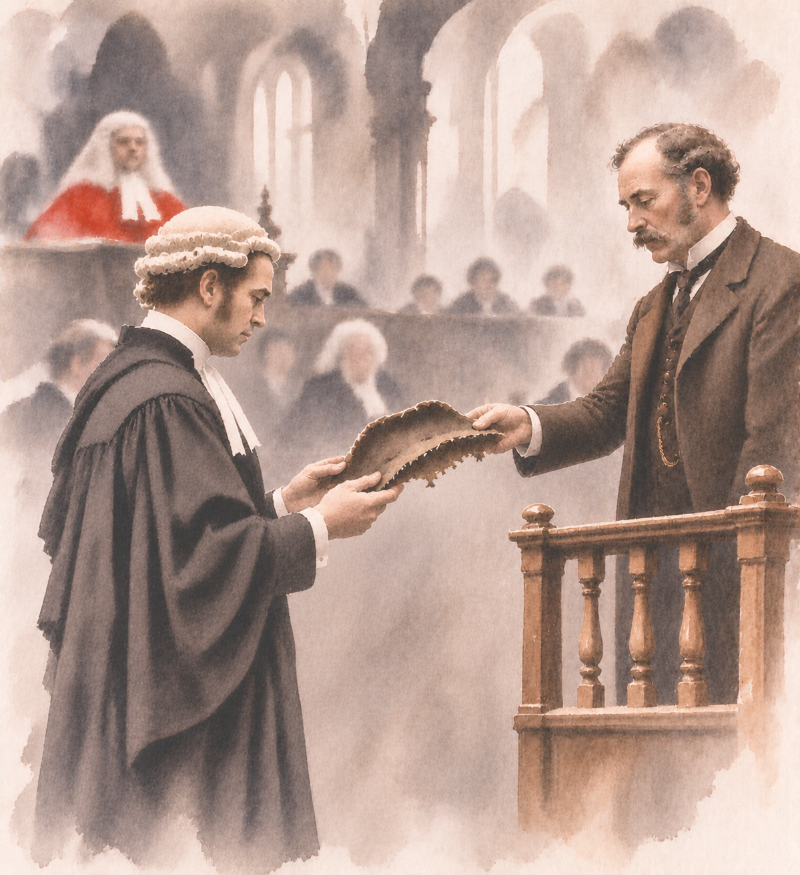
When Mr George Godwin, the storekeeper from Jung Jung, was recalled, Molesworth questioned him about the light-coloured hat Burns had purchased at his store.
“Although Burns bought and paid for the hat,” Godwin explained, “I later recalled it was Forbes who put it on and wore it out onto the street, and the two went off.”
“And you are quite certain that this remnant is from the hat Forbes wore that day, even though the licensee at Jung Jung has testified that it was Burns who left his hotel to buy a hat and came back later wearing a new one.”
“Well, not really,” Godwin said.
“Why is that?”
“Well sir,” came the reply, “all the stores across the bush keep identical moleskin trousers, vests and felt hats in bulk, you see. It’s sort of like a uniform, you might say.”
Some of the labourers were recalled to confirm the point.
“We all used to buy clothes of the same pattern and material at his store, all of us working up that way. It was the only place to go, you see.”
“That is absolutely true,” John Painter acknowledged, handing the hat-remnant back to Molesworth. “Come to think of it, me dad and me wear exactly the same hats ourselves.”
The image proved too much for several in the public gallery, evidently primed on frequent comic hat-business in the Theatre Royal pantomimes now evoked for them by these Wimmera rustics. Unfamiliar though he was with Melbournian harlequinades, Burns joined in enthusiastically, until the disturbance was quelled with a booming “Order in the Court!” from the judge.
From the draft novel Stawell Bardo © Michael Guest 2026


Leave a Reply