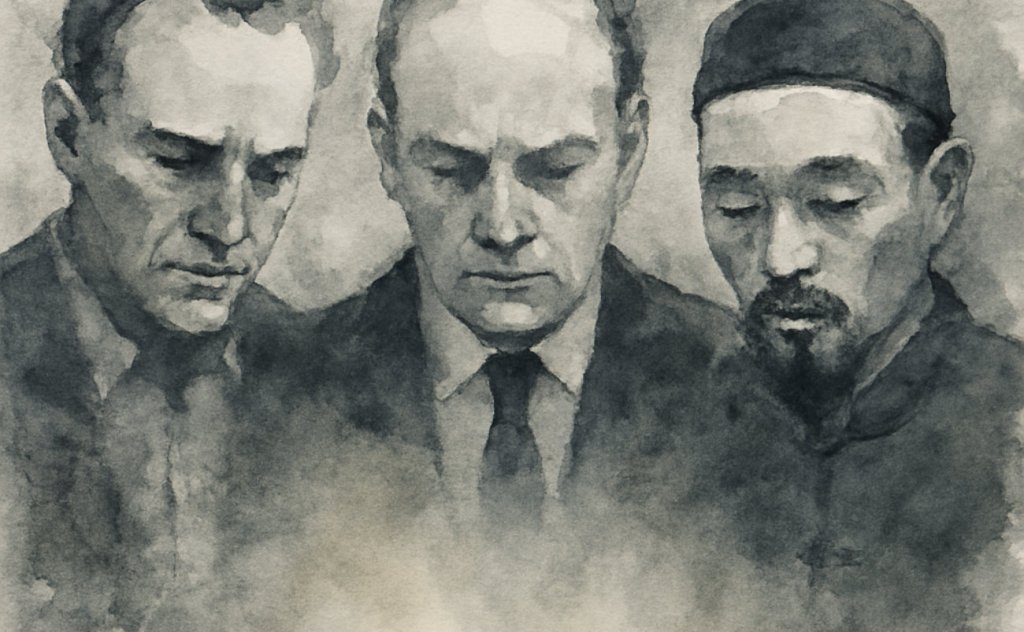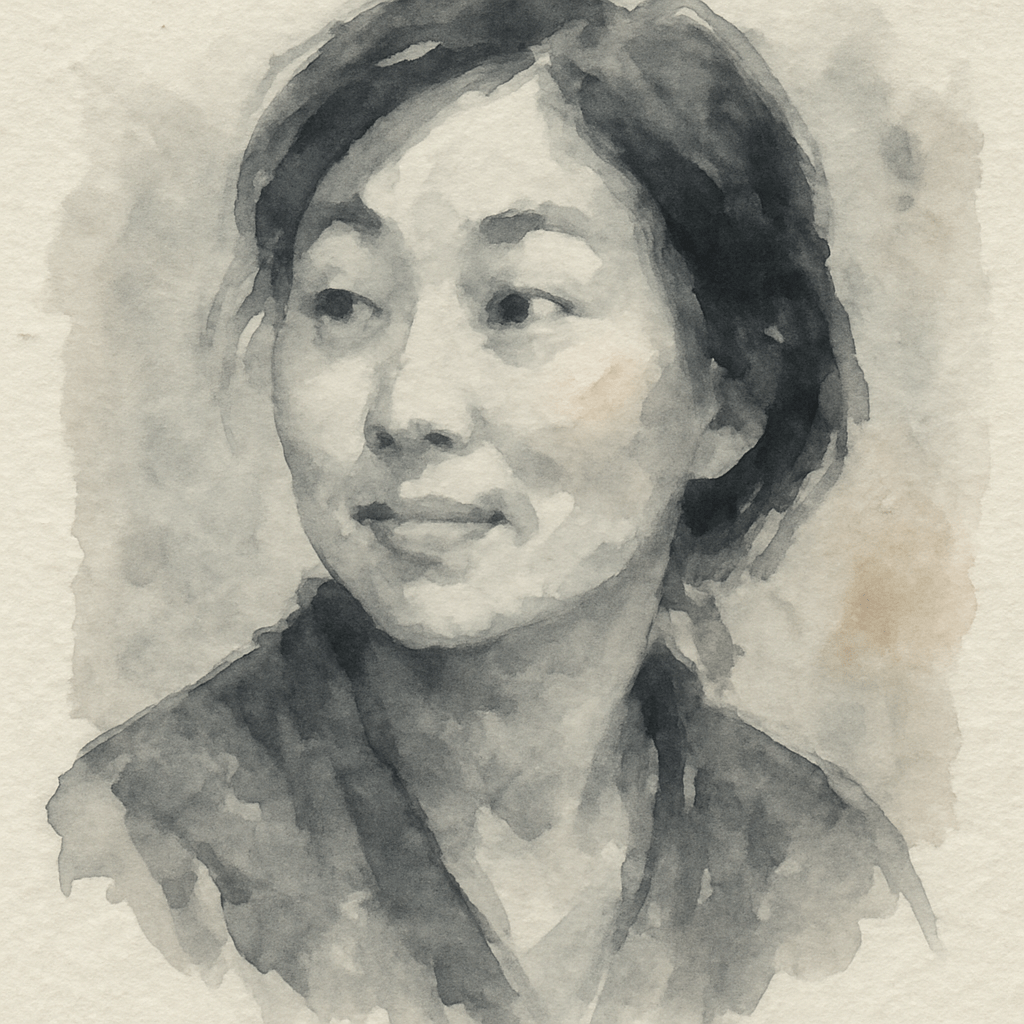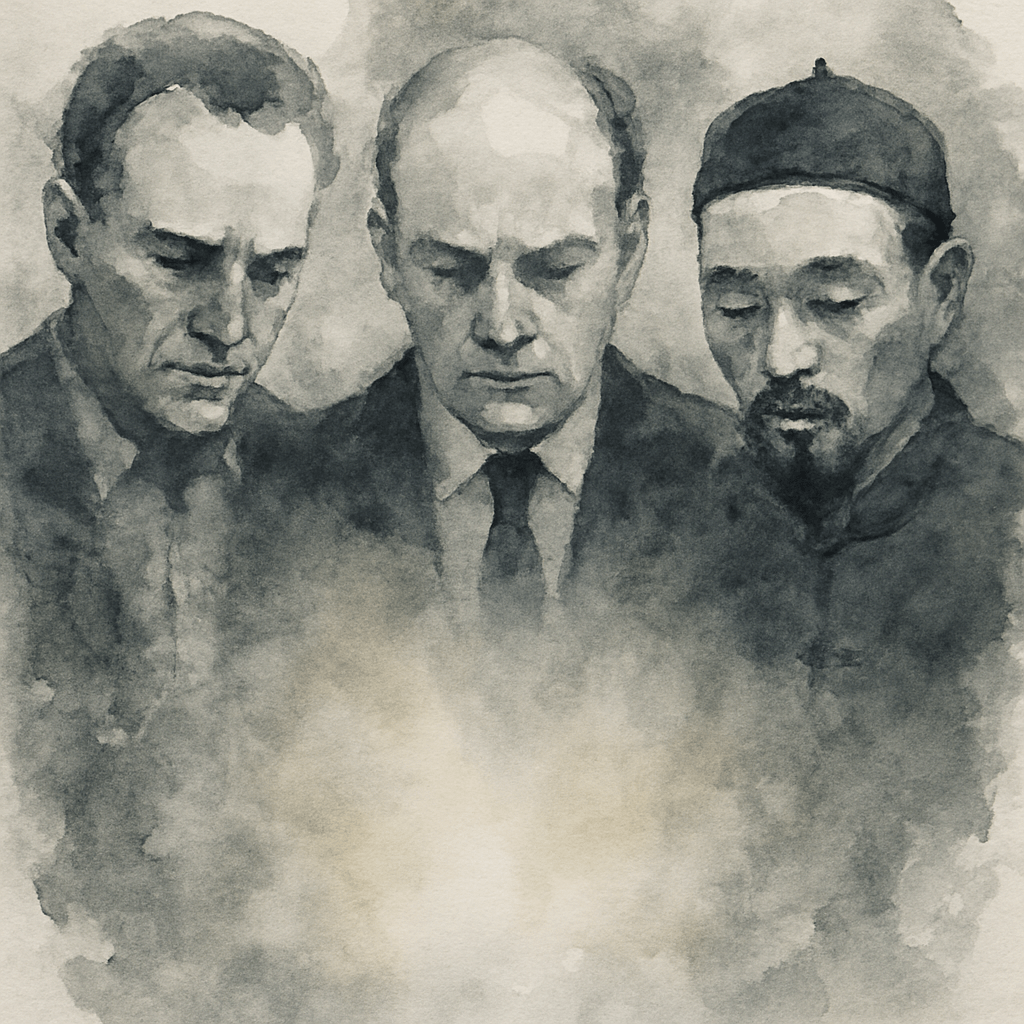
Tag: Australian historical fiction

  • A Woman of Your Description

    A Woman of Your Description

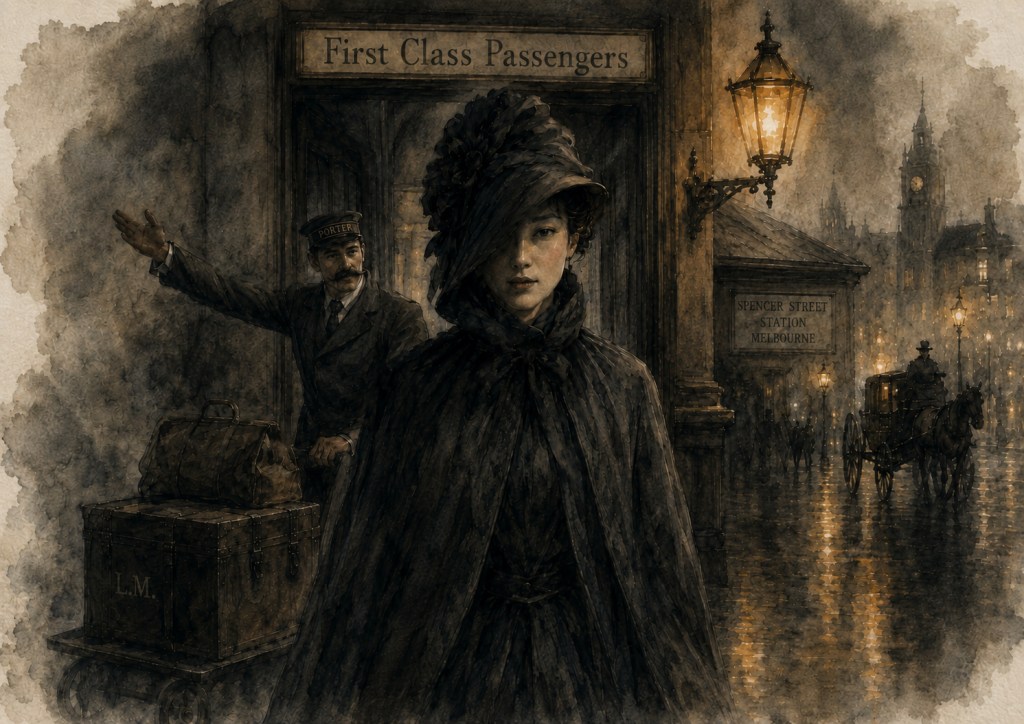
    Trailing a group of fellow passengers – farmers and commercial men, and a family with two children, one of them being carried half-asleep – she emerged from the first-class passenger exit at Spencer Street Station shortly after eleven o’clock at night. A courteous porter followed with her travelling bags on his otherwise empty barrow. She stood quietly beneath the glow of the gas lamps while the others dispersed into the darkness, and the porter called over one of the two hansom cabs waiting on the forecourt.

    Smelling noticeably of horse, a scent she found comparatively inoffensive given what met her on the breeze, the worn-coated cabman stowed her bags, and while doing so was moved to demonstrate his amiable nature by directing a grin at her, to which she responded with no more than a neutral glance, and withdrew a fraction further into the shadow cast by her dark felt capote bonnet.

    “Marvellous Melbourne” was off to bed, she mused as the horse clipped over the Bourke Street cobblestones, and once again she noticed the unfamiliar scent of the place – of late, wags in the newspaper had been calling it “Smellbourne.” She tipped the cabman generously, and the night staff of a family hotel along from the Menzies saw her inside with her baggage and entered her name in the hotel book; it was an ordinary place, where she would go unnoticed. In her plain but comfortable room, she slipped out of her dolman, spread it out on the bed, and sat down beside it. Using a pair of finely pointed scissors, she unpicked some stitching from the hem and removed a small silk purse, from which a stream of gems spilled out onto the bedspread.

    Fang’s diamonds, and just a few from Chee Ling Qua, of the “Court of Peking Troupe,” who had made a gift of them to her on one knee – a token of his vain courtship. Which were which she could not recall, only once or twice having had the need to inspect the hoard. She transferred them into the false compartment of an innocuous-looking velour jewellery case. Then, she took from a side pocket of a travel bag Forster’s letter, penned in his precise hand.

    Dear Miss Chan

    My return to duties in the Melbourne precinct has been made the more trying by the absence of those opportunities, both official and otherwise, in which I had lately grown accustomed to seeing you.

    I am very much looking forward to fulfilling your request to act as your guide in investigating the matter of an inheritance that is due to a woman of your description (if you will forgive the expression). The information supplied initially by the issue of the Police Gazette I showed you in Deep Lead has subsequently been reinforced by some further researches I have made since moving here.

    I have arranged a meeting with the party concerned, to be held at See Yup Temple in Raglan Street, Emerald Hill, on the 20th inst. Unfortunately the cold weather here has not yet quite broken; however, I wonder if in advance of the appointment it might be to your liking if I showed you the Carlton Gardens, which were redeveloped for the International Exhibition two years ago. You expressed some interest in them during one of our informal meetings at Mow Fung’s teahouse before I departed Stawell.

    After a light meal in the Gardens, which I would be honoured to provide, and perhaps a walk, we might discuss the matter further before making our way to the Temple.

    Should you wish to proceed with my proposal, please inform me by wire at your earliest opportunity. We may meet at half past ten in front of the Great Hall, which will be unmistakable for its large dome.

    […]

    Your obedient servant
    William Forster

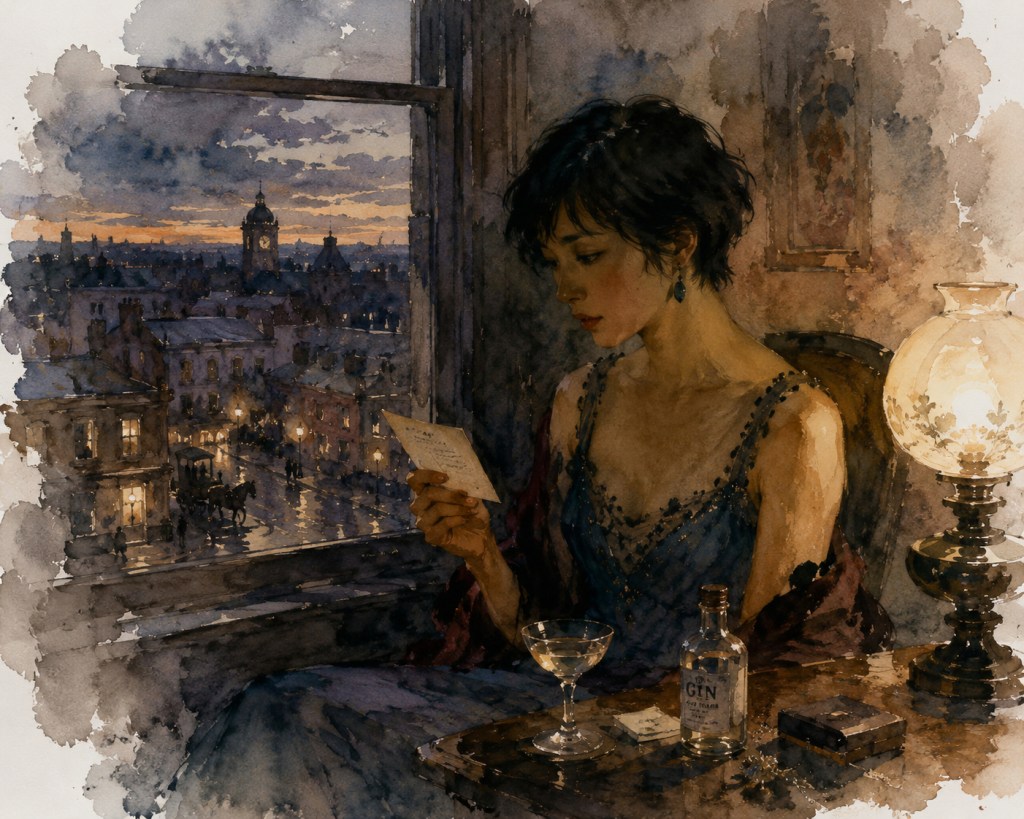
    Leaning back into an armchair, she lit up a cheroot and poured a small gin, enjoying a few moments of indulgence after her day of travel. Shortly after receiving his communication, she had wired her agreement to Forster. She allowed – what was it, a breath of fond laughter? − to escape her lips as she pictured the somewhat punctilious detective superimposed on his words. A thin, translucent strand of smoke rose up in the still, cool air, as her eyes traced the leaves that scrolled about the dark russet wallpaper. He was evidently smitten, though certainly not from calculation on her part, and actually, his quiet strength was proving to be something of a pillar of support in this ill-considered excursion, the precariousness of her situation having increasingly dawned on her since Forster had shown her the notice.

    At first, the notion of some possible inheritance had struck her as nonsense, however closely the description of this sought-for legatee resembled herself. Yet infected by his show of enthusiasm, and perhaps falsely lulled by the anonymity she enjoyed in her comfortable life in Deep Lead, she had allowed him to look further into the matter. Subsequently, as the momentum increased and, according to Forster, her discovery had fuelled some interest at the other end, she had found it difficult to renege. At the same time, she had begun to feel more vulnerable, drawn not only into the light of officialdom, but perhaps also, through her complacency, back towards the dangers of a past from which she had so successfully, so completely, fled.

    But it had been a shock to come across a reference to See Yup that Forster had made months ago: the name by which she had known in San Francisco as the tong to which her persecutor Fang belonged. When she asked Huish-Huish about the name – Huish-Huish knew many of the details of Lili’s past with her highbinder, and the abuses she had suffered at his hands − she was assured that in Australia the group was not known as a criminal organisation at all.

    On the contrary, it was a community association of long-standing charitable purpose and unimpeachable good name. It had originated among emigrants from four counties of southern Guangdong, near the Pearl River Delta, and its mission was to lend support to others from that region. Indeed, the See Yup Society in Melbourne was run by highly respected leaders of the Chinese community throughout Victoria. Forster had since informed her that one of these gentlemen would be honoured to meet her. The meeting was to take place within the next few days. She read herself to sleep with a Mark Sinclair detective story by W.W. in a copy of the Australian Journal.

    She awoke to a grey morning and breakfasted in the dining room, before taking herself for a stroll along an already lively Bourke Street, casting an appreciative eye through the display windows of some dressmakers’, milliners’, glove and shoe shops, all resplendent with the latest fashions, and of department stores with their mixed luxury goods, books, and bibelots.

    Stawell was, naturally enough, decidedly drab by comparison, and what took her aback was the frisson this little outing aroused in her. Of course, there were ample reasons for having secluded herself in provincial Wimmera for such a long period; but the élan of this gay city street lifted her heart.

    She passed three or four jewellers before returning to one that was more discreet. Standing in a narrow, recessed arcade, the shop presented an immaculate display behind a thick glass window set into a wall of block bluestone.

    When she said she wished to have a few gems appraised, the jeweller left the shop under the charge of his assistant, and led her into a small back room, with a table, safe, and chests of small drawers. He handed her his card, and Lili pushed her silk pouch across the tabletop to him.
    He emptied her stones onto a black velvet tray under the window light and after a mere glimpse selected two, pushing them to one side.
    “Paste,” he announced abruptly.

    Lili could not contain a laugh. “That Chee Ling Qua – such a fraud!” The jeweller looked up at her blankly, and she coughed. “Do excuse me, Mr Kaminski. An old acquaintance, a mere stage magician of no enduring consequence. However, all the jewels have sentimental value, though I rarely look at them.”

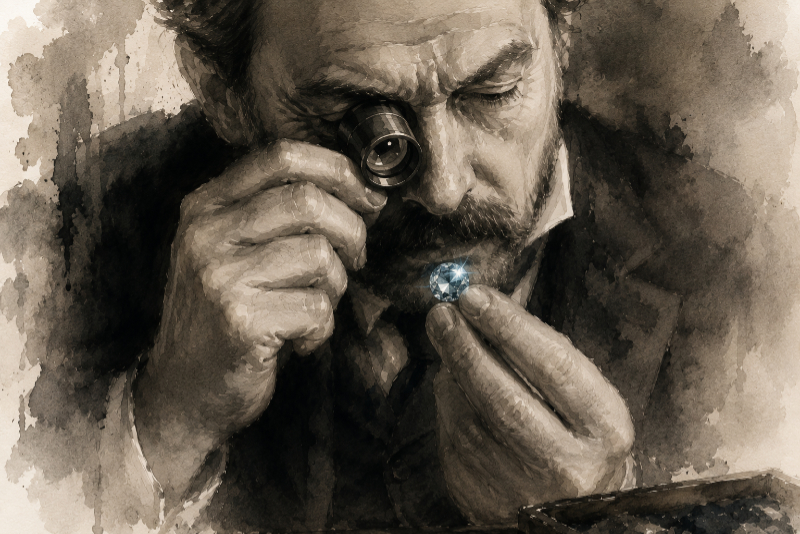
    Kaminski returned to his task, bringing a loupe to his eye to examine the rest. As he proceeded, he noted down descriptions and figures, weighed each stone, and placed it in a small white envelope, which he marked neatly in pencil.

    “There are gems of remarkable value in this parcel – most of them without internal fault, beautiful stones,” he said after finishing his task. “But this one…” He drew it aside. “… this one … it has what we refer to as a ‘natural’ on the girdle,” indicating the region with a probe, “You may just be able to see it with the naked eye, a slight patch of the original rough stone. And beside that, a tiny chip where it was once mounted. No great matter, but enough to mark it.”

    “So it’s worthless…” Lili said.

    “On the contrary,” Kaminski continued. “At first one sees only the flaw – before noticing the extraordinary character: that soft warmth, and the faintest blue cast. I seem to recall a reference made some months ago in an issue of the Jewelers’ Circular and Horological Review from the United States… It concerned a distinctive old-cut gem such as this. It will take me a day or two to go through my journals, if you would be willing to leave the diamond here for the time being.”

    Lili nodded. “I had intended to ask if you wouldn’t mind me leaving the parcel with you for safekeeping during my stay in the city, if you thought they were of any value.”

    Closeup image in watercolour of a jeweller examining a sparkling diamond

    “Oh, indeed!” laughed Kaminski. “They are definitely of value, I can assure you, not merely sentimental value, as you have admitted, but of substantial financial value as well.” He gathered the envelopes together and placed them into a compartment of his safe, along with her velour case, before recording details in a ledger and writing out a receipt on his letterhead.

    Closing the door behind her, Lili took a second to adjust to the light of the late morning, even despite the grey day. The footpath was bustling, and she nearly collided with a pair of young women who seemed to come from nowhere.

    “Excuse me, sweetheart, that was my fault,” said one of the girls, placing a steadying hand on Lili’s shoulder. “Oh, what a lovely coat! Could I borrow it for the opera tonight?” Then the two were off again, giggling heartily.

    Lili hired a hansom cab to the Carlton Gardens, and, with hands tucked into the sleeves of her dolman, and breathing out steam, strolled leisurely along the long straight path to the front of the Great Hall. Water shimmered and splashed in the fountain. Consulting her chatelaine watch, she found she had arrived a few minutes late, but Forster could not have come and gone already, so she paced patiently for a little while, enjoying the cool air. She heard his hurried footfalls behind her and turned around, to see him puffing as he came up. He wore a dark wool coat unbuttoned, with a waistcoat, white shirt, sober tie, dark trousers and sturdy boots, carrying what was obviously their lunch wrapped in brown paper and a bottle under one arm.

    “Something came up at Russell Street just as I was stepping out,” he said.

    “Not another murder mystery so soon?” she said.

    “Just another dissatisfied customer.”

    They found a bench near the fountain, and he unwrapped the packages: some little pies, buns and slices of seed-cake, and two small enamel cups.

    “A feast! My dear Chef Detective Forster, that is immaculate.”

    “A little lunch place in Lygon Street, just a couple of blocks over. Roast beef or chicken-and-veal?” He indicated the pies.

    “Perhaps the chicken-and-veal, thank you. I’m reluctant to provoke the beef before noon.” She broke off a piece of crust. “I have been reading all about you in the Pleasant Creek Chronicle – your marvellous work pursuing and apprehending that scoundrel Burns.”

    “When we first met, I had thought I sensed some antipathy towards policemen.”

    “It’s true I have had imperfect relations with some of them, and I have to admit to having something of a chequered past. But to have been implicated in your mystery, and to watch how you brought the villain to justice… it’s been most edifying – worthy of a Mark Sinclair, which recently I’ve taken to reading, I hasten to add.”

    “Sinclair always gets his man, of course. In this case, I am afraid there is a fair chance Burns may slip the noose.”

    “How so?”

    “No absolute certainty of who the victim is. Burns insists that his mate Forbes is still rambling about somewhere, alive and happy as Larry. I am certain Burns is the perpetrator, but the case I have made against him is, unfortunately, rather circumstantial, as the lawyers say.” He poured some ginger beer into the cups.

    “Ah, too bad,” said Lili. “Drat.”

    “Nevertheless,” Forster continued, “that may yet change, thanks to some of the uncanny observations made by our mutual friend Mr Mow Fung the publican. He was struck by certain patterns in a different case he had been reading about in the paper, that of a Michael Quinlivan, at Wickliffe, two years ago. We have some detectives reexamining that case to look for a connection. But Burns’s trial opens next month, so we find ourselves in a race against time.”

    “Too bad Mr Sinclair isn’t here to lend a hand,” Lili said. “Though his author is a mystery in himself, isn’t he? W.W. or Waif Wanderer – unlikely name, wouldn’t you say? He seems to me to have something to hide. Still, Sinclair is excellent, with a sharp eye and shrewd grasp of character, of women as well as men. What was he saying in this one titled ‘Hereditary’ I was reading last night on the train: ‘Women … are very pretty and very useful things sometimes, but they are also occasionally very silly and try a practical man’s temper immensely.’ The hide of the man! But a fascinating theme nonetheless: can we escape our pasts, or are we determined even by our heredity, entirely lacking the freedom to make our lives as we would wish them to be?”

    “It seems true from my own experience,” said Forster, “that there’s generally a lot more going on beneath than meets the eye. Quite often, it seems to me, will an action precede the thought that one had supposed motivated it, and the scientific research bears this out.”

    “Well said, Sinclair, old chap,” said Lili. “I mean, Forster.”

    “William.”

    “William,” Lili said, laughing and briefly rubbing his forearm.

    The two glanced at the interior of the Great Hall, before strolling along the grand allée and turning away from the city noise into a secluded curving gravel path by the lower lake, past weeping elms and Moreton Bay figs that overhung the water.

    “We had best soon make our way to the See Yup Temple,” said Forster. “It’s over at the Chinese quarter in Emerald Hill – we’ll easily be able to flag a hansom cab at the corner on Victoria Street.”

    “I made mention of my past a short while ago…” Lili took a deep breath. “I wonder whether we have time to linger a little while in this peaceful part of Melbourne, while I explain to you some of my apprehension about our appointment at the temple,” and they made their way to a bench closer to the lake and beneath the trees. “Arriving in San Francisco a penniless waif from a Chinese village, I came under the influence of a truly despicable man, a Chinese who, under the guise of a doyen of culture and refinement … took me in hand … ignorant and defenceless as I was – and through torments beyond compare, made of me his own abject supplicant. I soon came to learn that this Fang Jing Dock was one of the city’s deadliest assassins and a leader of a Chinese criminal gang. It was known as the See Yup tong…”

    Forster looked at her intently for a moment. “I am aware,” he said, “of the murderous San Franciscan tongs, of course. So you are afraid that this Fang person might be responsible for the notice in the Police Gazette, and is making some kind of attempt to get you back?”

    “Yes and no,” Lili said delicately. “Fang has since left this world and is now, I’m certain, where he belongs. I departed from San Francisco somewhat in haste, however, unknowingly carrying in a satchel belonging to him certain items that I believe his associates would dearly wish to reclaim, if only they suspected who might be in possession of them.”

    “Hmm. Well, I think we may be confident that the Melbourne See Yup Society is absolutely beyond suspicion in this regard. I have met some of the elders in the course of my duty and know them to be eminently respectable Melbourne business and community leaders, who are only too keen to assist in any way they can with our policing, and especially whenever such matters touch upon the Chinese community. As for Mr Lee Kong Wing, the gentleman with whom we have arranged to meet, he is a greatly respected Elder, who organised with our Police Commissioner – who is also a man of impeccable ethics – to have the circular posted. But fear not, I shall be on the alert during the rest of your visit.”

    “I love the way you say ‘impeccable,’” said Lili brightly. “Then you have reassured me immensely. So let’s be off.”

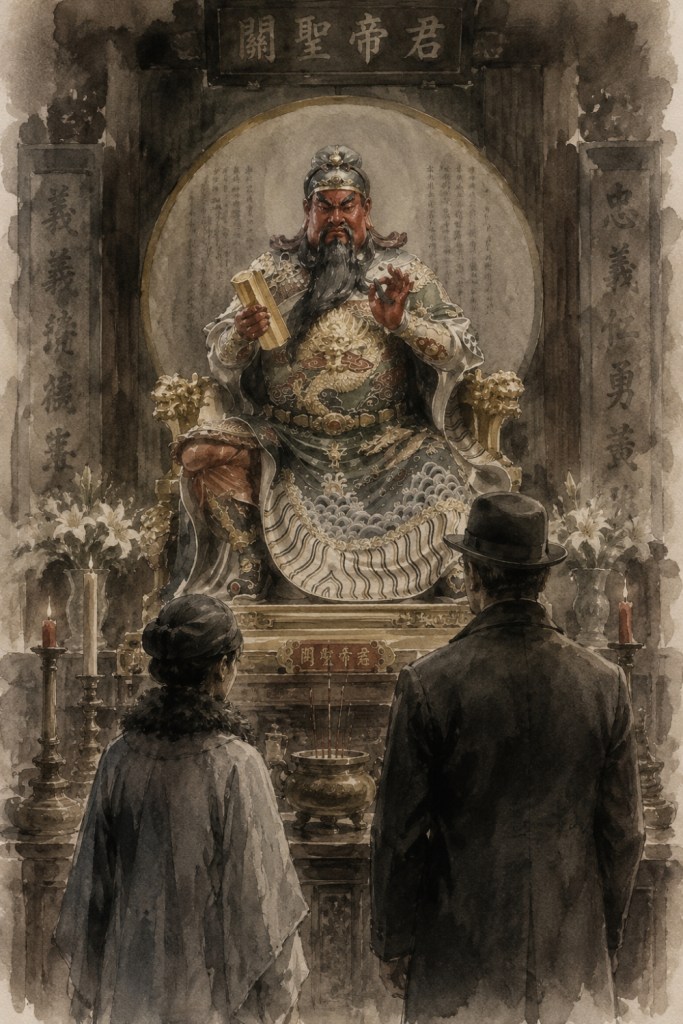
    The hansom cab crossed the Yarra at Princes Bridge and made for Emerald Hill, where it set them down at the temple gate in Raglan Street. In the forecourt, a group of Chinese men smoked and chatted, while another pair faced each other across a movable table, playing dominoes. Lili and Forster passed between the two stone lions that guarded the front door of the brick temple and went through a doorway into the lavish main hall, with its altars, tinted windows, and array of brightly coloured statues. The scent of sandalwood hung in the air, amid echoes of quiet conversation and the footfalls of the half-dozen visitors and attendants. The centrepiece of the hall was an altar set behind a low balustrade, beneath a bearded, ruddy-complexioned statue that dominated all the others. Forster seemed decidedly drawn to it, and they stood there next to a devotee who was lighting a stick of incense at the altar, the statue looking fiercely down upon them.

    “This fellow chimes with me somehow,” said Forster quietly, gazing at the statue.

    “Once in a lineup, possibly?” whispered Lili.

    “More like a dream…” said Forster, still serious. “Mow Fung talked about a friend of his in China, some sort of fighter. Maybe that’s the source of it.”

    Lili and Forster standing before the See Yup Temple patron deity Yuan Ti (aka Guan Yu)

    A genteel voice came from behind them. “Ah, Detective Forster, I am pleased to see you admire the statue of our patron deity.”

    They turned, to see a distinguished white-haired gentleman with a short, trimmed beard, standing there in a modish business suit.

    “Mr Lee,” said Forster. “So nice to see you in your temple rather than your office. It completes my picture of you. Please meet my friend Miss Lili Chan, who has been the subject of both our researches recently.”

    “Enchanté, Miss Chan.” He bowed graciously.

    “Enchantée, Monsieur,” said Lili.

    “This,” said Lee Kong Wing, “is Kuan Ti, a warrior from long ago. In Buddhism he became an enlightened being, and is the patron of loyalty and brotherhoods, and god of all honest merchants. So he is a fitting guardian for our See Yup Temple, which aims to help our countrymen working in the colonies.”

    “Pleased to know you, sir,” Lili said, looking up at the statue.

    Lee showed them into a utilitarian office, and they took seats facing him across a desk. “Here are some particulars of See Yup’s ‘researches’ Detective Forster mentioned, which led us to believe you may be the beneficiary we sought via the Police Gazette,” he said, sliding a folder gently across the tabletop to her. “Detective Forster has kindly consented that the contents should be confidential between you and me, as See Yup Elder, alone. Kindly advise me if they do in fact refer to you.”

    There were several to-and-fro communications in Chinese, including some that recorded the attempts to trace the whereabouts of a half-blooded woman named Chan Lee Lung; initially thought to have been a murder victim in San Francisco, she was subsequently sighted on the Australian and American Mail Company’s ship City of Melbourne, travelling under the alias of one Suzon Chabrier, supposedly a French dancer. That observation had been communicated to the Four Counties of southern Guangdong, her place of birth and upbringing, as well as the home base of the See Yup group, which had been able, largely on account of her distinctive mixed heritage, to establish the context of her emigration to the United States, along with details of her activities there and her association with a Madame Ah Toy, who was now enjoying a peaceful retirement in her later years and who had expressed her dear wish to locate her cherished protege, with the object of thanking and rewarding her for her years of dedicated service in the arts and culture association she had founded. Lili stifled a laugh by converting it to a fake teardrop, which she concealed with two fingers and a sniff. Forster, who had positioned himself discreetly away to preserve her privacy while reading, heard the sound and quickly turned to pass her his pocket handkerchief.

    “I am indeed the one whom you seek,” she said to Lee, upon hearing which he passed a sealed manila envelope to her. The letter inside read:

    My Sweet Child, Chan Lee Lung

    You can imagine how I wept when I was informed that you had been taken from me, cruelly murdered by that reprehensible Fang Jing Dock and his evil cohorts.

    Yes, I can imagine…

    And now, after this interval, to find that you were spirited away and are indeed alive and well in a distant land. Praise the Lord and Hallelujah, that my daily tears of grief have given way to ones of joy and anticipation, now being on the cusp of reuniting with you once again.

    Hallelujah, indeed…

    It is now my dearest desire to reward you, both in celebration of finding you, and as a thanks for your devotion to me during your time in San Francisco, which I had thought myself forever robbed of the opportunity to do. As you know, dedicated to my career in philanthropy and the arts as I have forever been, I was never blessed with child, my dearest Chan Lee Lung, apart from you.

    Hmm…

    Thus I now weep sweetly again, and wish to call you my dear daughter, and to become truly your beloved mother, in lieu of the woman who betrayed her sacred duty to you. I beseech you to reply to my letter. Not having a daughter of blood to whom I might bequeath my fortune and estate, I desire to leave everything to you my dear girl, and only require your temporary return, both to smother you in maternal kisses, and arrange the necessary formalities.

    Uh-uh, there’ll be no smothering, thank you…

    There is one tiny additional detail. After that villain Fang absconded from my association (with his venom and deadly threats), I discovered that he had made off with a bauble of sentimental, though not pecuniary, meaning to me: an imitation gem that had been left to me by my own dear mother – soon to be your grandmother, indeed – which we play-acted had come down to us from French nobility. It was my single inheritance, this otherwise worthless piece of paste, yet I cleaved to it dearly as a remembrance of my own beloved mama.

    I am delighted to have learned that you have at last found a peaceful life in a provincial town of Victoria, away from the long hand of Fang’s vengeful cohorts. I pray, then, that you will advise me that this modest gem is in your possession, and will undertake to bring it with you to America, whereupon we will be able to undertake the procedures as described above…

    &c, &c
    Madame Ah Toy

    Mr Lee had arranged for a hansom cab to call at the temple at noon to return them to the city. Lili was pensive, tapping Ah Toy’s letter, which rested on her lap. There was little in it that caused her any particular elation or consternation, though she presumed that Ah Toy’s “bauble” might well have something to do with Kaminski’s interest in a certain gem. She had dismissed Ah Toy’s effusive and heartfelt offer of an inheritance in exchange for the gem as soon as she read it. The very thought of it now stimulated mirth – leaving aside Ah Toy’s little hint about her whereabouts in the Wimmera. How had she found that out? Certainly not from the tight-lipped William.

    Forster had left her to her own thoughts, but spoke when he noticed her quiet laugh.

    “I trust that nothing in the correspondence has upset you?”

    “No, not in the least, though it has set in play many conflicting memories of long ago. Let me thank you very much, William, for arranging this meeting on my behalf, and for looking after me through it all.”

    “You don’t know what a pleasure it has been for me,” he answered, as they were re-crossing the Yarra. “I have to return to the police station, before going home to change, but I would be honoured to provide you with a sounding board if you feel like unburdening yourself of anything that might be worrying you. Perhaps over dinner?”

    “You know,” she said with a smile, “that might be quite in order. But I wouldn’t mind emptying my mind of the whole lot of it, for the time being. I wonder whether you might be of a mind to escort me to a performance of The Pirates of Penzance, which I noticed is showing tonight at the Melbourne Opera House, along the street from my hotel? Then, perhaps, a bite afterwards. My treat, I insist – a humble gesture for everything you have done,” as she laid her hand on his wrist.


    From the draft novel Stawell Bardo © Michael Guest 2026

  • 2. Autopsy at the Junction Hotel (from the draft novel Stawell Bardo)

    2. Autopsy at the Junction Hotel (from the draft novel Stawell Bardo)

    Autopsy at the Junction Hotel

    Sound of hooves and iron‑shod wheels on gravel reached the Junction Hotel door, a rare interruption in the sleepy settlement. Huish‑Huish brushed back her hair before going to answer the knock. A detective stood at the doorstep, one finger tapping lightly against his thigh. He was waiting for Mow Fung to answer, a name he knew from the licensing roll. He had driven from his headquarters at Stawell, only a few miles away.

    “Mrs Mow Fung, I presume? I am Detective Forster.” He made a slight, polite bow. A nervous man, a lean man, she observed, and the lean, nervous man removed his grey felt hat and fingered the brim. If he meant to unsettle her, he’d have to try harder. She caught the tang of carbolic soap clinging to him in the close air of the doorway. It suited him somehow. She ushered him into the bar. Theirs was a modest establishment, but scrubbed spotless. The faint smell of lamp oil and aged wood lingered in the cool interior, a scent that seemed to settle into its polished tables and floorboards. She had been topping up the lamps, and a tin container of oil remained open on one of the tables, next to a neat pile of linen squares.

    They passed the bottom of a staircase, halting at a child’s footsteps that came thumping down.

    “Mama! Alice won’t eat her porridge. I’ve told her and told her but she just picks at the egg and won’t touch anything else.”

    The mother suppressed a sigh. Such was the morning ritual. “Tell her the police have arrived. Once they deal with your father, I will have them deal with her too, if she is not careful.”

    Detective Forster could not prevent a cough, but immediately resumed his grim composure.

    The girl, aged twelve or so at most, ascended a few stairs, halted, unafraid but inquisitive.

    “What will they do with her, Mama?”

    “Use your imagination!” Huish-Huish was outdone – the child was incorrigible. “Now make them eat their breakfast properly and off to school with you! Foolish girl.”

    The daughter climbed the stairs with purpose, the hem of her uniform brushing the narrow boards.

    The mother stopped at a door halfway along a dim, unadorned hallway. The air smelled faintly of cold ash and last night’s cooking fires. From behind emanated the ghost of a voice. No distinct words, but what the newspapers mocked as “Oriental mishmash.”

    Turning to Forster, she said, “My husband is inside here with the gentleman.”

    “The others have already arrived?”

    “Only the dead one so far,” she said with a smile. “Mow Fung is a very silly man, who nurtures some foolish superstitions from old China. You must forgive him.”

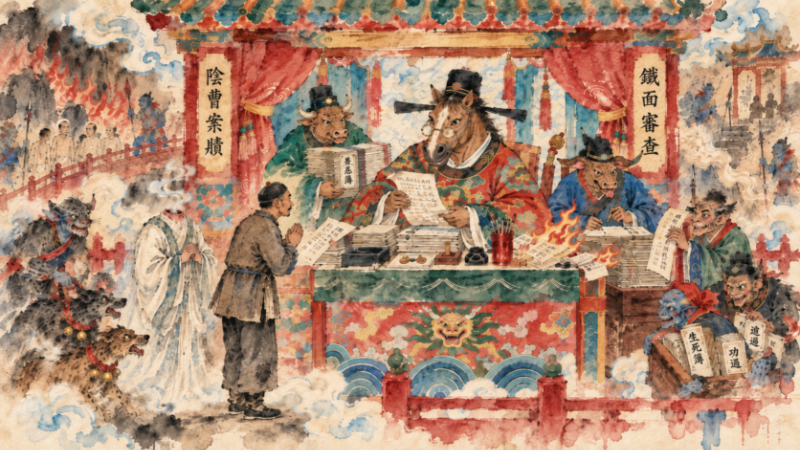
    But she did not go barging in. There may be others. She laughed softly. “He daydreams, fantasises he communes with the dead. You know, he sinks down into the Ten Courts of Hell and has a bit of a chat. Haha!” She said it in a melodramatic tone with a gently mocking lilt.

    The faint chant in the room faltered, as if aware of their intrusion, then died altogether. She pushed the door open. The candle was out. The trace of a strange perfume lingered in the air. His odds and ends were tucked neatly out of sight. Forster felt the change in atmosphere as they stepped in – the pall was unsettling after the murmur that hung in the hallway.

    Mow Fung drew back a curtain, and the morning sun slanted through a haze of fine dust. He smiled at Forster and bobbed his head in a dumb-show of humility. There was something indefinably unusual about the fellow, Forster thought.

    A noise of wheels and hooves announced more visitors, and Huish-Huish left the room to meet them. Forster jotted a few notes in his pad as he examined the corpse.

    “This is exactly the same state it was in when it arrived yesterday?”

    “Of course, detective,” Mow Fung said.

    “You haven’t touched it?”

    “Touched it?” Mow Fung repeated. “Good idea. A very good idea! You are an excellent detective, I see that already. Splendid.” He pressed his palms together in a position akin to prayer and nodded. Forster found himself almost infected with the broad smile.

    “Very nasty business,” said the oriental. “Murderer came up from behind, a trusted companion, a good mate. Never knew what hit him!”

    Was that a laugh? A cackle? What was wrong with these people?

    Forster stepped to the table and took hold of the neck of the cadaver, stretching the flesh about the open wound. A sharp instrument had been used: an axe, probably, or maybe a tomahawk. The weapon evidently slipped in its course at first, creating minor abrasions before cutting right in through the neck.

    He turned to the Chinese man.

    “Mrs Mow Fung tells me you have been … communicating with the deceased,” he said.

    Mow Fung smirked. “The missis,” he said, “is a silly woman who nurtures some foolish superstitions from old China.”

    Forster gave him a piercing look. “Be so kind as to tell me, then, how you could have arrived at your – your deduction otherwise?”

    At that moment, Doctor Bennett, the constable, and Henry Wilson  – the miner who found the body – came into the room. Bennett cut Forster’s introductions short to begin the post‑mortem, and the constable took out his notebook. Forster and Mow Fung took chairs, while Wilson remained standing nearby, arms folded, watching in silence.

    “A European. Body very dried up. Bad state of decomposition,” Bennett dictated. “Much of the skin has been eaten away – particularly from the arms and legs – torn off in patches, very much dried up and leathery. A good portion of the integuments is gone.”

    “A lot of wild cats out there at them old Four Post diggin’s,” Wilson volunteered, but Forster silenced him with a look. “We’ll go through all that later on,” he said.

    “Too far gone to examine the internal organs,” Bennett continued. “The head is off – missing. It wasn’t found at the location, I take it?”

    The constable shook his head. “No, sir.” Of course not: some things the bush will not give back.

    “The upper margin of the skin on the neck has been divided by some sharp heavy instrument. About an inch below the margin of the neck is a transverse cut through the skin, which extends down to the vertebrae, evidently made by the same implement, probably a hatchet or axe. No other marks of violence. The upper margin of the neck is indented as if by a succession of cuts. The head has evidently not been severed from the body by one single blow, but by several. One cut extends transversely across the neck. Numerous abrasions in the vicinity. The vertebrae have been severed with that heavy blade. No, I should not think it was done with one blow.”

    “Not suicide then?” Wilson said deadpan.

    Forster gave him a withering look.

    The doctor continued. “I would estimate the height of the body to be that of a man about five foot ten or eleven inches. As for the length of time the body was exposed, I could not speak with certainty. But I would say any time from four weeks upwards – probably two months or so, to become dried up and mummified like this. Absolutely bloodless. From an examination of the bones and hair, I would conclude that the body was that of a middle-aged man probably between the ages of thirty-five and fifty-five years.

    “Internal organs – those of the chest and abdomen – are very much decomposed, and in the condition of… well, pulp. From the upper margin of the neck to the heel is five foot one and a quarter inches; from the tip of the shoulder to the ankle, four foot nine. The frame is large-boned and that of a big man. Some of the hair of the beard is on the neck – reddish-brown hair mixed with grey.  Skeleton is perfect. No broken bones.”

    He drew a surgical saw from his case and cut off a piece of vertebra and two fingers, then scraped some sandy‑red hair from the neck. He placed the specimens in a jar, which he plugged with its cork stopper.

    “Apparently after having consulted the victim in the afterworld, Mr Mow Fung here informs me that the deceased knew and trusted his murderer – enough to let him come up behind and take him by surprise,” Forster said.

    The constable chuckled.

    “Come on, leave off Sarge!”

    His superior paid him no mind, studying the body as he spoke.

    He turned to Wilson. “You discovered the body lying as it is now, Mr Wilson? On its back?”

    “Yes, sir. On its back when I found it, and your coppers brought it here the same way,” Wilson said.

    “Mm. Yet observe these abrasions on the chest, and the tiny stones impressed into the flesh – or where the flesh was exposed when he hit the ground. Even if the clothing was stripped away afterwards, the marks are clear enough: they suggest the body struck the earth face down.”

    Forster leaned over the table, his hand hovering a few inches above the corpse’s limbs, tracing out their outline. “And note the awkward sprawl of the arms and legs. The hands, palms upward as he fell, show no attempt to break his fall. Whoever removed the clothing may have shifted him somewhat, but that detail remains. He never knew what hit him. A pretty business indeed.”

    He straightened and glanced at Mow Fung. “Does my analysis accord somewhat with yours, Mr Mow Fung?”

    Mow Fung said nothing, gazing clearly into the detective’s eyes, a hint of a smile hovering on his lips.

    “I am a simple hotel-keeper. I am sorry – I do not follow your complicated talk.” Pensively, he stroked his sparse black beard (one day it may grow into a venerable white one). “Perhaps we do not see things as they are,” Mow Fung continued, “but as we are, as it was said in the old time.”

    “Quite so.”

    “Will I put that in, Sarge?”

    “Might be a good idea to insert it as a footnote for you to incorporate into your own meditations, which I’m sure you engage in regularly.”

    Mow Fung watched the buggies of the detective and the doctor, and the uniformed constable on horseback, recede at a leisurely pace down the dusty main street of Deep Lead – towards the old abandoned gold diggings on the Old Glenorchy Road. They rounded the bend, passed Bevan the ironmonger’s, and disappeared into the bush.

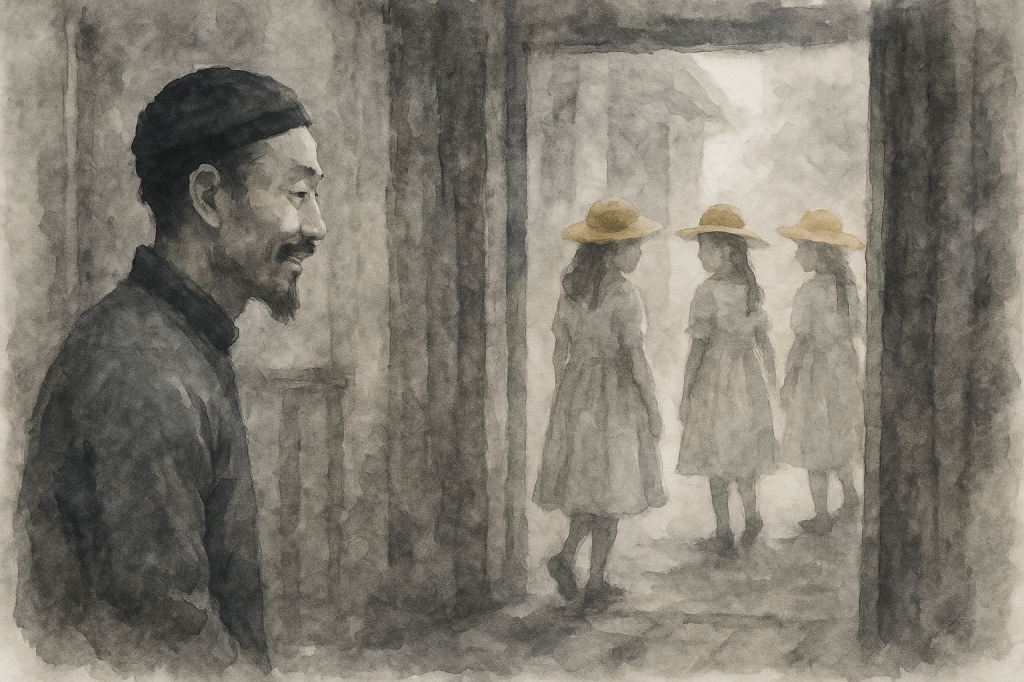
    He met Huish-Huish coming in from the laundry with an armful of towels, their youngest daughter Alice trailing on her skirts. At that moment, the other daughters trooped down the staircase, Lena – the eldest at twelve years – herding her siblings. School uniforms and wide-brimmed straw hats floated in a bubble of chatter, expressing such immediate and minute issues as are memorialized perhaps in the record of human souls, but seldom if ever recalled in human life. “Hurry now,” Huish‑Huish called. Alice was moaning about the porridge. Lena hesitated at the threshold as the others spilled outside, her hand lingering on the doorframe.

    Mow Fung could not refrain from a smile and faint shake of the head as they left with no fare-thee-well, though Lena struck him as older than her years. His eyes followed the children as they disappeared, then shifted to the bush beyond the paddocks. He remembered what Wilson had said: the body had been found at the Four Posts. He gazed at the bush a moment longer, the name settling uneasily in his mind.


    Michael Guest © 2025

    Images generated by AI

  • 1. Down Train from Horsham (from the draft novel Stawell Bardo)

    1. Down Train from Horsham (from the draft novel Stawell Bardo)

    Though railway convention would designate a train travelling from Horsham toward Melbourne as an up train, I have titled this chapter Down Train from Horsham intentionally. The descent invoked here is not geographical but tonal: a movement into rougher country, uncertain fortunes, and subterranean narrative currents. It is, in spirit, a passage downward.


    Down Train from Horsham

    Some dragon stirred from its rest with a snort and shrill hiss. Flame flashed beneath her firebox, steam jetted behind the front wheels, a plume burst from the smokestack. The engineer tugged the pull cord and let go two long, shrill blasts on the screamer.

    Over on the wide, newly asphalted street, their cart driver pulled his horses up to a stop. Forbes was on the ground by the time Burns hauled himself down.

    “Slow today ain’t we?” Forbes said with a wink.

    Burns grunted, dusted off his coat, and spat.

    Both strong, stout men they were, both with full beards, Burns’s brown, Forbes’s flecked auburn when the sun hit it right. The two barely had time to buy tickets, but the guard spotted them and didn’t give the flag.

    “Get a move on, youse blokes,” he growled as they strode up to the door of the last carriage.

    “Go blow your nose, General,” Burns said.

    “Thanks old mate,” Forbes said, smirking at the guard and touching the brim of his grimy, battered wide-awake hat. No nap, no fuzz on the felt – that’s what ‘wide-awake’ meant, Burns told him. He liked that.

    “No call to go tippin’ your lid to the likes of him,” Burns snarled, striding ahead. “All they do is blow on their whistles and wave their bloody flags, riding about all day on railways that we builds for them.”

    AI generated image of train waiting to leave the station at Horsham

    Burns pushed back the reversible seat to make two facing seats, and they swung their swags up onto the overhead rack. Forbes let his bulk fall, crashing down on the forward-facing seat with a thump that startled everyone in the carriage. Heads turned, eyes exchanged glances, eyebrows arched.

    An upright matron leaned to the ear of her companion, a young wife, who commented under her breath, in a tone heard through the carriage, “Navvies by the look.” She pulled a grimace of distaste and flashed a glance toward heaven. Two wide-eyed children across the aisle from the women craned their necks, straining for a better look at the commotion. The elderly clergyman turned his attention back to the Melbourne Argus in his lap, his eye pausing on the masthead: “I am in the place where I am demanded of conscience to speak the truth, and therefore the truth I speak, impugn it who list.” Ah, the brave words of John Knox, a fellow Scotsman.

    Acting oblivious to the disapproving looks but inwardly savouring them, Forbes leaned back to think on the waves of heat rising from the platform. Burns stood with his hands on his hips, staring down at his mate, gripping the seat to adjust his balance as the carriage lurched forward.

    “No, I won’t go backwards,” Burns said.

    “What’s that?” Forbes said, still looking out, the hint of a rascally smile on his lips.

    “It gives me the pip, going backwards does.”

    “Gives everyone the pip, Burnsy. Be a man.”

    “Come on, we’ve been over all this. Get over to this side, at least for a little bit. It’ll have me spewing, mate.”

    “Sit down and shut up, man,” Forbes said. “We can swap after a bit.”

    “For Christ’s sake, I’m not feeling too well after last night.”

    “It was me finished that last quart of rum off with Johnson and the Painter brothers after you flaked out.”

    “Well damn you then.” Burns slumped into the seat across the aisle and looked sullenly out the window, watching the buildings slip by. He took off his hat and ran his hand across his balding scalp. Getting tired of this redheaded prick. “You’re like a naughty kid sometimes. I’m not going to read the newspapers with you anymore now. You were looking forward to that, weren’t you? Over a beer at the pub when we get in.”

    “I’ll read them by myself,” Forbes said petulantly, with a touch of true hurt.

    “Oh yes, oh yes. You are a great reader by yourself, you are.” Burns gave a short derisive laugh. “A regular font of learning. A real Aristotle. Great Peripatetic Philosopher, you are, for sure. A true Bard and all rolled into one. Ha!”

    The train rattled along, passing across the town boundary. A sweet breeze cooled the carriage and Burns’ temper. This was grand country – miles of grazing country, like parkland, and burgeoning seas of wheat turned ghostly in the sun – pale dragons gliding low over the gold. Any man’s heart would glow, and he whistled a few bars of an old ditty that had been playing on his mind the past few days. Trilli-la, trilli-la, as the lassie flung them tripes, flung them far …

    He turned to Forbes and called out over the rhythmic clatter, nodding to the scene. “Magnificent property – the Cawter Brothers, squatters of course, you understand.”

    “Sorry about all that, just pulling your leg.” Forbes said. “Here, take a swig on this, the real article. Found it in back of the cart. Blakey can get another one at the pub, blow ’im.” He offered the flask with a grin and a look that said: ‘we mates again?’ “Look Burnsy,” he said, ”I know I wouldn’t be reading at all if you hadn’t showed me, and I thank you for it, I do, I really do. Mates?”

    Flask to his gob, Forbes froze mid-gulp and grinned. “Can’t hear you. Come on over here, come on.” Forbes swung himself over onto the rear-facing seat. Burns took the place he had vacated.

    Burns shrugged off his aggravation with a mighty swig. “Grumph! God, that’s rough, you ratbag! Gad, that is poison. Villainous vile low stuff indeed it is.”

    “My word! Produces the desired effects, nonetheless, don’t it?”

    “Aye, to be sure – makes the vendor rich and the buyer mad, if that’s what you want.”

    They laughed raucously and then stopped, collapsing abruptly into a sober silence filled with sporadic vague recollections of drunken aftermaths. Pause of indeterminate length and depth. Some stubby vegetation jogged past and the carriage rocked and creaked.

    “Passable whisky.” Forbes had come to love a game with Burns.

    “Passable? My stars, whisky, you reckon! Whisky! There ain’t the slightest suspicion of malt in the composition of this grog. More a concoction of cheap liquor and primitive adulterating agents mixed in by some low, roguish bush publican. Water for toning it done, tobacco and bluestone for bringing it up to the required ‘biting’ standard. That’s what it is. Impossible to calculate the amount of evil wrought by foul stuff like this. What do you reckon? Passable, right enough!”

    Forbes laughed a child’s open, careless laugh. “Righto, well you are free to give it me back then. I’ll down it, no worries.”

    “Steady on, son! I fancy trying another drop or two yet, just to make sure it’s alright for you.”

    “How’s that, then?”

    “Not too bad when you can get it down.”

    Forbes blinked. “What’d you say back there, mate – something Brothers?”

    AI generated image of the two men smoking in the train carriage.

    “Carter Brothers,” said Burns. “Own that place outside of Horsham. North Brighton Estate, la-di-da, fancy stuff. Nothing around like that these days for the likes of honest blokes like us. The rich got the best, and you need money for grazing. Thousands of selector homesteads around these parts, though, I’ve got to admit. At first the squatters tried to get rid of them – pulled up their pegs as fast as they could put ‘em down and burned down every patch of bull-oak in sight – makes decent timber that stuff. Squatters thought they’d won out. Got all the best bits, creek frontages and fertile spots, and didn’t bother to buy up till it was too late and the selectors all got in. Now they own most of the land in the district. Yeah, plenty of selectors in the Wimmera, and soon we may be pleased to number ourselves among ’em, indeed, I’ll wager. Stake my life on it.”

    Forbes yawned and stretched. He took out a two-bladed knife and a plug of tobacco from the pocket of his grimy, gray tweed coat and proceeded to cut some tobacco for a smoke. The knife was a small one with a white handle, but one half of the bone was off, the handle on that side showing the brass. “So how about this place you want to select?” he said. “Is it worth me putting in? What do I want to go on the land for? I’m free as the breeze in the work I do, can go when and whither I wish. That’s the life.” His sly attempt to kick off more sport.

    “Ar, not again,” Burns said, taking up the flask for a swig. “Wake up to yourself, man. You’re a navvy. You want to dig ditches all your life? You’re still young. You want to get yourself a stake. What’s a navvy do, son?” He lit his pipe.

    “I don’t know … digs holes?” …

    “That’s right, digs holes. And what else?”

    “Digs more holes.”

    “Correct. And what then?”

    “Digs some holes and then some trenches for good measure.”

    Burns laughed. “Yes, very good. Anything else?”

    “Cuts some dams.”

    “Yes, for a break, and when he finishes with that? Come on, what have we been doing out at Dimboola?”

    “Ballast. Spreads tons of damn ballast along the line.”

    “Of course he bloody does!” Burns said. “And that’s a lark for you, ain’t it! Anyway, we’ve got nothing to be ashamed about. It’s men like us what builds these railroads, son. Railroads into the future, I reckon. But there’s too much of our sweat and blood in ’em. What you want is to go up in the world. Like I’ve been saying, keep our dough together and build up from there. We’ll be full-blown gentleman in the long run. Whisky, women and song for the asking. In South Australia I was born …” His sonorous tenor cracked with volume, his rhythm matching the pulse of the wheels over the railway sleepers.

    “Heave away, heave away ….” Red-headed Scotty Forbes, so-called, being Irish, was gifted with an equally stirring off-key tenor. He coughed back some reflux and took a big guzzle.

    South Australia is me home …

    Heave away, heave away …

    “Don’t worry, I looked after you over there, didn’t I, son? I’ll fix you up here too, no two ways. Oh heave away you rolling king, we’re bound for South Australia …

    The carriage rocked and clattered along. Forbes packed his pipe and lit it up, twisted his body around and leaned back over the seat. “This is a smoking carriage, is it not?” he asked of the woman diagonally across the aisle. “You don’t object to smoking, madam?”

    It was no smoking, but the woman submitted grimly and said no. Further down, the young wife staged a little drama, rousing her children and shepherding them out.

    The pipe smoke curled lazily in the light. It caught a shaft of sun and hovered there, luminous and insolent. Forbes leaned back, legs stretched long beneath the seat, puffing like he had nowhere particular to be. Beside him, Burns smirked toward the window.

    After a minute or two, the clergyman rose indignantly. He stepped up the aisle, steady as a magistrate, and came to a stop at Forbes’s elbow. “I for one,” he said, glaring down through the smoke, “do object to that filthy habit. And if you persist in indulging in it here, I shall be forced to quit the carriage.”

    Forbes didn’t look up. “Here’s a bonny little reverend, then.”

    Burns sucked on his pipe and exhaled with exaggerated pleasure. “Blind me, people can be disagreeable. Proper cantankerous old ratbags, I’ve had a gutful of their sort.”

    The clergyman’s gaze turned sharp. “Passengers who wish to smoke,” he said, “ought to remove themselves to one of the carriages provided for that very purpose.”

    “Filthy with ash and worse,” Burns said, with wide, innocent eyes. “Even a hardened smoker can’t stand the stink. Anyhow, they’re full. We usually go first class but feel like slumming it today.”

    The Scotish clergyman looking down sternly.

    Forbes puffed on his pipe, grinning back at his companion. He leaned over and hawked something from the back of his throat. The spit hit the outside of the window with a soft, wet smack.

    Burns said to the clergyman, “I know better men than you who partake of the weed.”

    “I shall request the guard remove you at the next station.”

    “No need for that, Bishop,” Burns said. “We plan to alight in that parish in any case, where we have some important business in which to attend. To wit, the acquisition of a prime piece of real estate, for your information.”

    “It’s a good half hour and more to Glenorchy,” the clergyman insisted. “These good people should not be poisoned by smoke and nauseated by your vile expectorations.”

    “Alright, have it your way, if you’re going to be like that,” Forbes said, tapping his pipe against the windowsill, so that the embers fell out onto the floor. He made a show of stomping them out.

    “And if drunken men are permitted to travel, it ought to be in a special carriage.”

    “Look, you’ve got your way,” Burns said, pointing his pipe at him. “Now if you’d kindly go and do your preaching elsewhere, we’d be much obliged.”

    The clergyman blinked, lips pursed. No one else moved. Burns leaned back and took one last puff.

    “Off to buggery with you where you belong, if you don’t mind, good sir. Go to hell with the rest of your sort.”

    The clergyman strode back to his seat, amid some covert approving nods and comments from his fellow travelers for the effort he had made, and took up his newspaper. For the rest of their journey, in loud, vulgar tones, Burns aired his views on Presbyterian priggery and wowsers, white bearded, bald headed old Scottish hypocrites, bastards and coots, and so forth, for the entertainment of Forbes, who hooted and cackled at his mate’s performance, clapping his hands in unpredictable spasms of mirth, as he would do at times, in a way that would cause the casual onlooker to think he might be touched.

    As they drew closer to Glenorchy, the red-headed Forbes drank and nodded, while the balding Burns, his elder, shared his wisdom, audible to their captive and drowsy companion travelers … “Won’t hurt to find out about it, anyway, price is very reasonable … together we’ll be right … Look at this bloody scrub … Good places coming up here at Wal Wal that got had up by selectors … be right with our stake at Glenorchy though, right as rain … Don’t worry about all that, I’ve got it all for you … Six hundred quid in the bank at Dunkeld, anyhow … Breed a few sheep here and all …”

    “I do love a train ride!“ Forbes said.

    “Fine ride, fine ride. It’s the future, you know. We are living in the future, my friend,” said Burns.

    Mother speaking quietly to her little daughter by a carriage window.

    “You can see the scenery, and the occasional sheep. Very fine indeed. trees and pastures and all the rest. Exceeding rapidity. Velocity of modern times, and no mistake,” said Forbes.

    “We are kings, mate, kings of the rail,” said Burns.

    “Considerable dry day though. What day is it, anyway?” said Forbes.

    “Monday, don’t you recall? We resigned our positions on the Sunday?” said Burns.

    “Wind’s changed. Look at the steam!” said Forbes.

    “Nice smell, eh? Sweet-like, but then it hits you in the back of the throat, as well,” said Burns. “Get your head back in, Scotty! God you’re a child. Pull ya bloody noggin in or you’ll get it knocked orf!”

    The train crawled to a stop and sighed an immortal hiss. The two men gathered their swags and pocketed their pipes, leaving the empty flagon adrift on one of the seats, and lumbered towards the front, Burns bumping into the clergyman’s seat as he passed. The wife and daughter of the ironmonger at Stawell silently watched them go out, eyes on their backs.

    “That’s the sort of people you get on the trains,” murmured the mother to her daughter.

    “Here’s to land, mate – ours soon enough,” Burns said, stepping down onto the stationary earth.

    Michael Guest © 2025


    Graphics are AI generated