I’d like to share the draft of a novel I’ve been writing — a work in progress that’s now nearing completion. I’ll be posting chapters every few weeks as I continue to refine and shape the manuscript.
The idea began while I was researching the life of my great-great-grandfather, a Chinese immigrant to Australia during the gold rush. He married a Chinese woman here, and together they had eight children, all born in Australia. He has since become a well-known figure among researchers of the Chinese diaspora and a celebrated forebear.
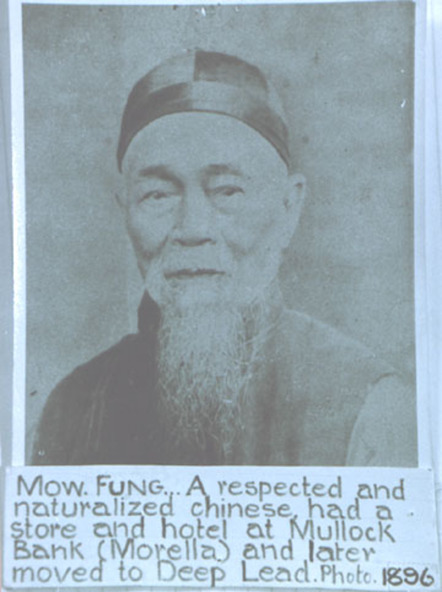
While scouring historical books, documents, and newspapers in search of traces of Mow Fung, my ancestor, I came across a striking discovery: a point of intersection between his life and the story of an infamous serial killer in colonial Australia.
In 1882, a naked, headless corpse was found at a desolate spot in the bush near the Deep Lead goldmine, close to Stawell in the Wimmera Region of Victoria. Stawell is an important historical town in the state’s western development. The body was taken to the Junction Hotel at Deep Lead, a business owned by the Chinese immigrant Mow Fung, where it was kept for the police inquiry.
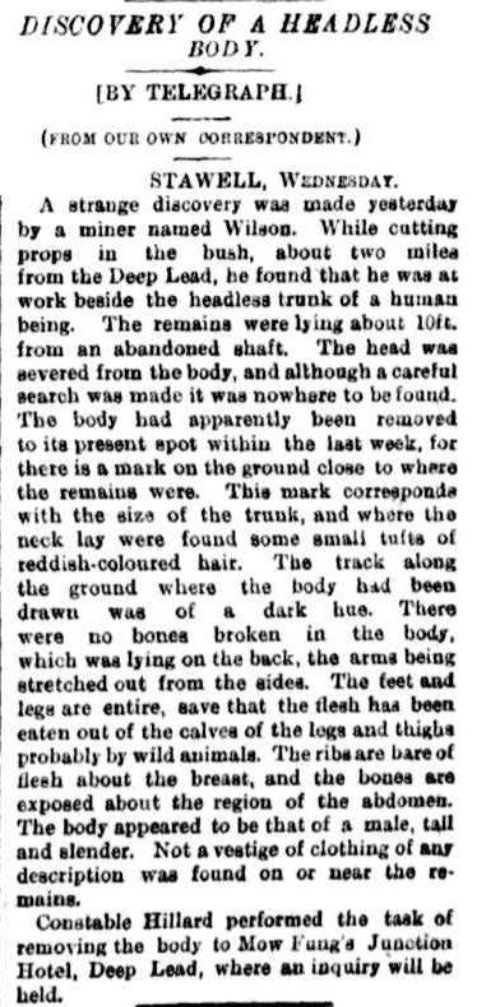
The dead body was a startling discovery for me too. The image gave me a visceral shock, in the context of my passing interest in my ancestry — like the miner Wilson, innocently cutting his props. The incident stayed with me, and in a sense haunted me. I researched the fascinating and dramatic hunt for the murderer, and then the details and background as they revealed themselves in a court of law. It was a curious and unsettling experience that started to suggest an idiosyncratic style of exploring and composing my individual connection with the notion of an “objective” historical reality.
My research has led me into questions that reach beyond ancestry, and into the layered complexities of life in colonial Australia, especially as experienced at the blurry edges of official history. My novel unfolds during times of rapid change: in Australia, the expansion of the railways was reshaping landscapes and economies, even as political upheavals in China were pushing many to seek new lives abroad, in search of gold.
These forces produced glimpses of a future for many and wealth for some, as well as friction among the diverse communities arriving, and those already here. Much of what I’ve found lives in fragments: names, glimpses, half-told stories. Writing through them has become a way of listening and imagining — not necessarily to recreate a historical reality, but rather prospecting in the gaps, for symbolic and unconscious resonances unbounded by history.
The real story of my great-great-grandfather and his descendants is remarkable in its own right. But I’ve used it as a starting point for something more speculative: a fictional narrative shaped by an interest in philosophy and Taoism, and explored through a loosely fabulist approach to storytelling. The gold rush theme took on a global dynamic, leading me beyond the Wimmera, to Melbourne, Chinese wilderness and Canton, nineteenth-century San Francisco, and into liminal psychic underworlds. As these worlds and timelines intertwine, history itself begins to warp and shift, distorting the boundaries of time and memory. Hence my working title: Stawell Bardo, a place between worlds in which time is suspended.

So far, I’ve drafted fifteen chapters. Some loose ends still need tying up, and others feel like they want to be teased out further. While assembling my material in Google Drive, I came across an AI podcast tool that generated a surprisingly coherent and listenable overview of the story so far. It doesn’t capture all the nuance, but does offer a reasonable sense of how the project is evolving 🎧:
- Audio overview of Stawell Bardo: Work In Progress
 Furin Chime Press™
Leave a comment