I’d like to share the draft of a novel I’ve been writing – a work in progress that’s quite well underway. I’ll be posting chapters every few weeks as I continue to refine and shape the manuscript.
The idea began while I was researching the life of my great-great-grandfather, a Chinese immigrant to Australia during the gold rush. He married a Chinese woman here, and together they had eight children, all born in Australia. He has since attracted attention among researchers of the Chinese diaspora and become a celebrated forebear.
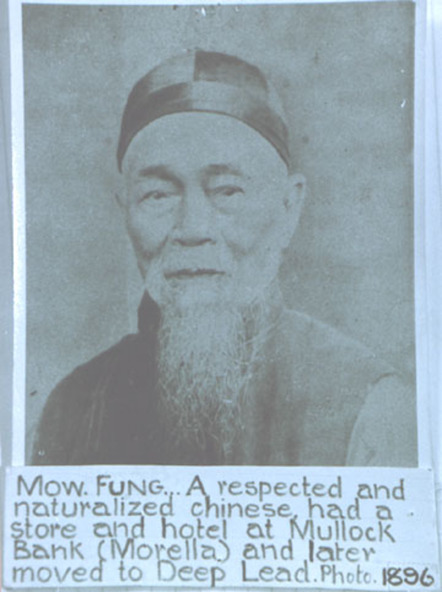
While scouring historical books, documents, and newspapers in search of traces of Mow Fung, my ancestor, I came across a striking discovery: a point of intersection between his life and the story of an infamous serial killer in colonial Australia.
In 1882, a naked, headless corpse was found at a desolate spot in the bush near the Deep Lead goldmine, close to Stawell in the Wimmera Region of Victoria. The body was taken to the Junction Hotel at Deep Lead, a business owned by the Chinese immigrant Mow Fung, where it was kept for the police inquiry.
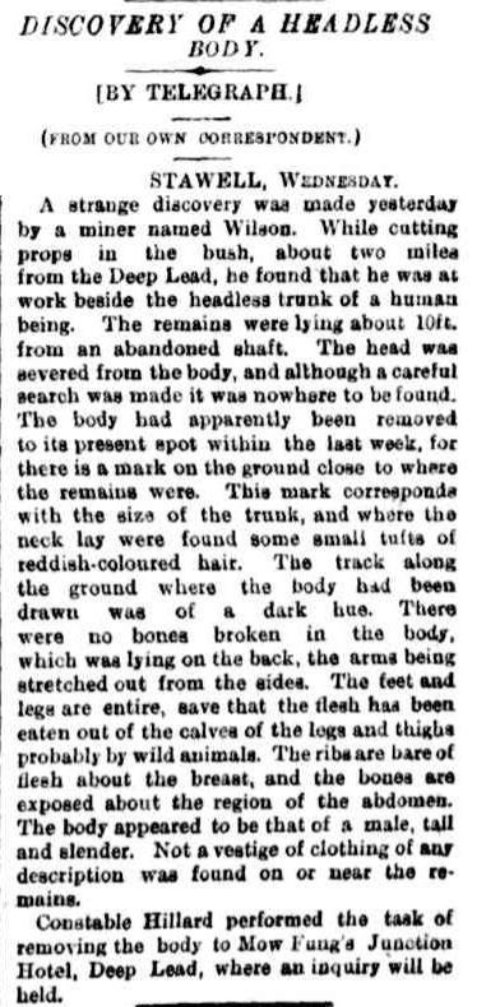
The dead body was a startling discovery for me too. The image gave me a visceral shock, in the context of my passing interest in my ancestry– perhaps like that of the miner Wilson, innocently cutting his props. The incident stayed with me, and in a sense haunted me. I researched the fascinating and dramatic hunt for the murderer, and then the details and background as they revealed themselves in a court of law. It was a curious and unsettling experience that began to suggest a more personal and imaginative engagement with the notion of an “objective” historical reality.
My research has led me into questions that reach beyond ancestry, and into the layered complexities of life in colonial Australia, especially as experienced at the blurry edges of official history. My novel unfolds during times of rapid change: in Australia, the expansion of the railways was reshaping landscapes and economies, even as political upheavals in China were pushing many to seek new lives abroad in search of gold.
The real story of my great-great-grandfather and his descendants is remarkable in its own right. But I’ve used it as a starting point for something more speculative: a fictional narrative shaped by an interest in philosophy and Daoism, and explored through a loosely fabulist approach to storytelling. The gold rush theme took on a global dynamic, leading me beyond the Wimmera to Melbourne, China, nineteenth-century San Francisco, and further back to historical encounters that shaped Western perceptions of China – and into liminal psychic underworlds. Some of the threads and characters are purely fictional, but they embody a method of projecting a web of further dimensions and possible realities in an effort to characterise the times and some of the complexities of the global Chinese diaspora.
As these worlds and timelines intertwine, history warps and shifts, distorting the boundaries of time and memory, reality and imagination. Hence my working title: Stawell Bardo, a place between worlds in which time is suspended. Mow Fung’s descent into the folkloric Chinese underworld as an unlikely Daoist shaman is its most direct representation.


