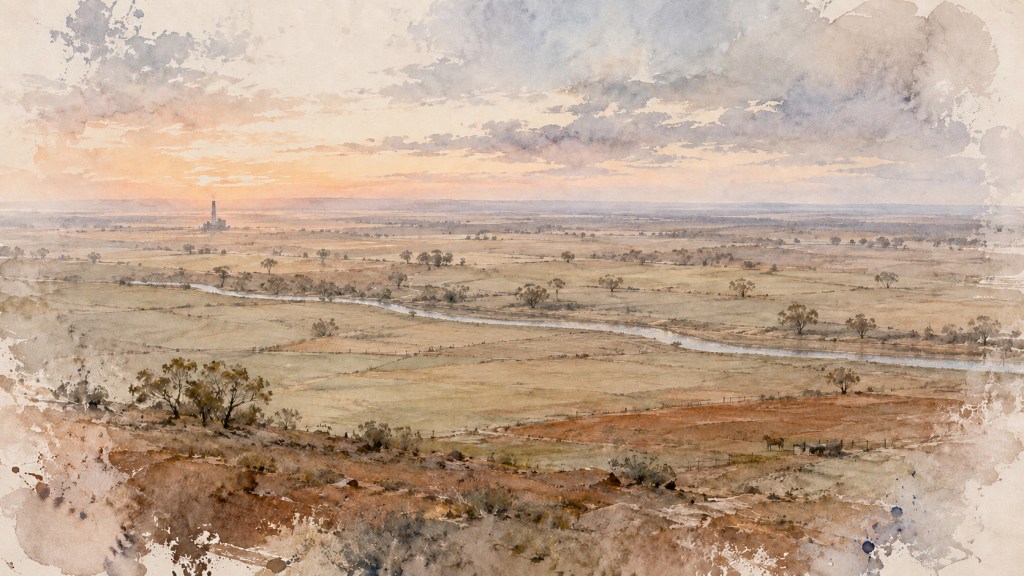
Thirty miles north of Stawell, ten west of Lubeck, a station on the line, Rupanyup was one of the new townships that had sprung up within the past seven or eight years as an outcome of land selection in the north.
Roused from sleep by hysterical kookaburras just on dawn, Forster went out behind the police station to relieve himself in the outhouse and survey the environs, leaving Mullaney, mounted constable and bullshit artist from Murtoa, snoring on his bunk. Went back inside, having forgotten his binoculars, and took them up onto the water tank. Vista flat as a pancake. Sections of open plains alternated with lightly timbered parts. To the south, the smokestack of Duncan’s steam flour mill poking up all alone reminded him of a lone white king in a drawn endgame; the black king somewhere out of sight over the horizon. Fields of reddish chocolate soil here and there. Kangaroo Island Acacia hedgerows gave it all the appearance of a giant quilt of variegated pale greens and browns. Looked like the crops had nearly all been put in. To the south-east, generally towards Stawell, in the misty distance – or was it the state of his eyes? – he focused the binoculars on a Lilliputian farmer hitching up a four-furrow plough, preparing to supply Gulliver with his bread and, hereabouts, lamb. This year the planting had been pushed forward, the hurried business of harvesting and carting grain to market already behind them. If they got more rain they should do alright, leaving aside the pests that generally developed with good weather: the caterpillars, locusts and rust. Glad it’s them and not me.
Someone might run but not hide in this open country. A decent rider would be able to clear Dunmunkle Creek, which happened to be flowing due to some refreshing showers over recent weeks, and make off into the timber; but it was light cover and Forster would happily back himself and Mullaney against a boozing navvy who happened to get his hands on a nag. Back inside, the constable had his trousers on and a fire just big enough for the tea kettle burning in the grate.
“Now, what was I a-sayin’ before you dozed off there last night? Oh right, old Ned. Strike a light, all of a sudden he appears behind us, just like … like a bunyip in the mornin’ fog … or the bleedin’ deevil hisself!”
Here we go again. Mullaney’s self-defining claim to fame was his participation in the Glenrowan siege two years earlier, as one of the reinforcements picked up from Benalla by the Police Special that travelled up from Melbourne, though his name didn’t seem to have appeared in the paper. Still, that part may have been true – surely that would be too big a fib – but his elaborations assumed greater moment and poetry as time passed, and the narrator an increasingly prominent role. He floated about like a will-o’-the-wisp, somehow adopting perspectives of knowledge about what was going on inside the inn where Joe Byrne, Dan Kelly and Steve Hart were holed up with their hostages, ready to fight it out to the death.
“Well, not fight it out right to the death, that is to say, strictly speaking,” Mullaney said. “Byrne passed away early on in the piece, during the night. Lifted up his whisky and gave a toast: ‘Many more years in the bush for the Kelly gang!’ he declaimed, before a bullet goes right through a gap in his armour. Eyes wide open, he goes dead still, his whisky held up to his lips and a quizzical look on his face, just like something strange occurred to him, then he falls down dead on the spot. Dan and Steve never fought it right out neither; they done ’emselves in when we set the place alight with a bundle o’ burnin’ straw.”
And in Mullaney’s telling, he was right there looking over Sergeant Steele’s shoulder when Steele shot the bushranger’s legs out from underneath him. Like the ghost of Hamlet’s father, Ned appeared behind the police. When they saw him, bullets were hitting him left, right and centre, but he only laughed and brushed them away like mosquitoes. The police were stunned and awed by the apparition. Then Steele, noticing that his legs were uncovered by the iron plating, got him with his shotgun, “Get him again, Sarge!” Mullaney called out, and Steele complied. “Such is life!” Ned groaned, lying in a puddle of his own blood.
“No, wait on,” Mullaney continued. “That was at the hangin’, warn’t it? It was more like ‘You’ve done me, you bastards!’ or the like, foul-mouthed bastard, he was. Deserved hangin’, he really did.”
“Yeah, well,” Forster said.
Mullaney was nonetheless reliable backup, overbearing as he struck many. Forster had worked with him before, just a year ago, in this very borough of Rupanyup, an Aboriginal word for “branch hanging over water,” in the Shire of Dunmunkle, District of Horsham, the occasion being the notorious battle for custody of the Dunmunkle Shire Hall. Dunmunkle Shire encompassed the townships of Rupanyup, Murtoa and Minyip. For several years the Shire Hall, a wooden building, was located at Rupanyup; but the establishment of a railway connection at Murtoa made that place a more desirable site. The station was already the cause of considerable friction between the Murtoans and Rupanyuppians when the proposed removal of the hall by Dunmunkle Shire Council provided tinder for a smouldering dispute. A contract was let, but no sooner did the contractors set to work than they and their assistants were forcibly ejected from the building by a dozen Rupanyup residents. The contractors mustered more men, but were again overpowered by the Rupanyupites. They returned to Murtoa with news of the outrage and got sixty more men, including several leading citizens, who went back with them in buggies and lorries, arriving at midnight, carrying saws, axes, hammers and crowbars. The guards left at the building had fallen asleep and were thus expelled with little effort. After a further set-to, however, once again the locals repulsed the invaders.
Forster received a telegram from Superintendent Nicholson and proceeded to Rupanyup with Mullaney, who was stationed at Glenorchy at the time. Both wearing plain clothes, the two arrived at the outskirts of town at a quarter past one in the morning, where they found about a hundred men and boys camped around a large fire. A contingent of them rushed out to confront the pair of horsemen, but when Mullaney called out “Police!” they fell back and allowed them to continue unaccosted. The detective and the policeman tied up their mounts in front of the Royal Mail Hotel and walked back to the crowd.
“We are not here as partisans, but as protectors of the peace,” Forster had said. “And as such we will defend both sides from each other if necessary; but we also mean to prevent any stoppages of traffic on the public roads.” With this, he stared down the big, belligerent, hairy-nosed wombat of an individual who confronted them, shouldering a pickaxe.
At this the crowd cheered the police and shortly dispersed to their homes. Police reinforcements were recalled. At half past eleven the next morning the Murtoan contractors turned up again with their support brigade and set vigorously to work, and within two hours, the building, much the worse for wear, was taken to pieces and packed on drays. Some further fighting took place, with sticks and fists; few injuries were sustained, though several lawsuits ensued.
Forster and Mullaney finished their cups of tea, then drove the buggy down the empty main street, built incongruously wide to accommodate bullock trains. The two extra horses tied to the rear trailed along docilely. The procession dawdled past the Presbyterian Church, the office of The Rupanyup Chronicle, the saddler, and the Commercial Bank, before pulling up at the back of Gilpin’s Hotel. The town showed signs of preparing itself for the doldrum of a day to come. The sun rose sullenly, as if having nowhere better to be. A window slid open somewhere above them. The grocer along from Gilpin’s appeared framed before a shadowy interior and proceeded to sweep the footpath in front of his shop, looking up briefly but paying them no nevermind.
“I’ll do the talking,” Forster said, climbing down from the buggy.
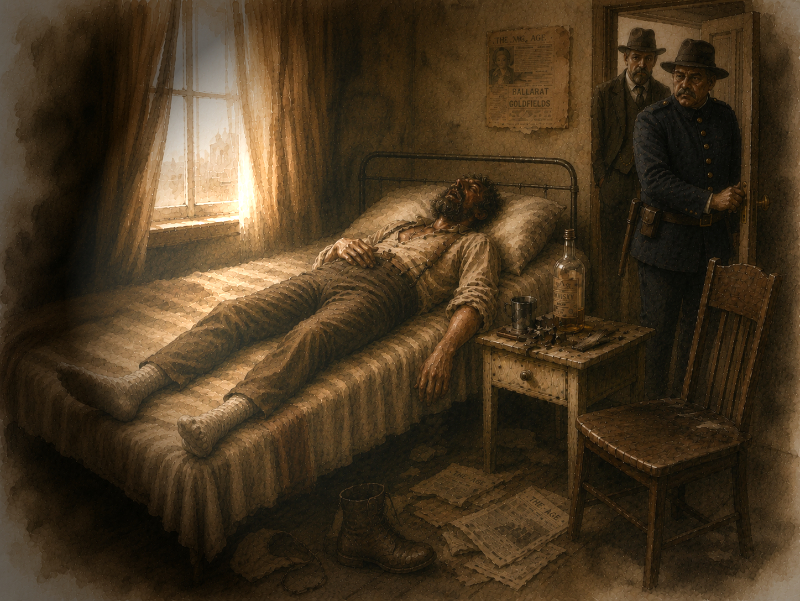
Mullaney let them in with a set of keys he had commandeered from Gilpin the night before. The stairs squeaked as they climbed them; a running carpet muffled their footsteps as they walked along the austere hallway, stopping at the room whose number Gilpin had provided. Mullaney gripped the doorknob and turned the key, opening the door noiselessly. The morning sun glanced through the curtains, barely illuminating the unkempt and reeking room, with its narrow bed, wooden chair, small square cream-painted bedside table and single wardrobe. Grimy shirt and moles, dirty boots and newspapers were strewn about the floor. A near-empty quart of whisky stood on the table by a tin mug, pocket-knife and pipe, amid drink-sodden ash and tobacco, sludge of a solo binge. The man himself lay on his back, mouth agape, a periodic snore rising to a volume and rasp that intensified Forster’s revulsion at the compound, slightly faecal stench issuing from him.
Mullaney stood in the doorway, casually holding his rifle. Forster sat down on the bed and roused the sleeper, who emerged from his stertorous coma with a grumble and, on becoming aware of unexpected company, made a frantic effort to scramble away, only to be thwarted by the weight Forster applied to his legs.
“Gawdstruth, if you’re not on the pongy side,” Forster said with a grimace. “Do you know me?”
“No. Who the hell are you?”
“Your friendly local constabulary, just come to bid you top of the day,” Forster said deadpan, producing his badge. Then he waited for some voluble bluster from Burns to subside, regarding his status as an honest railway worker with a wife and children in Stawell, and so on and so forth.
“Have you finished?”
“Six kiddies,” Burns said, trembling and breaking into a sweat. “Six. And a missus. Oh God, what have I done?”
“Don’t you remember? You’d better put your clothes on and come with us to Murtoa,” Forster said. “What have you been giving dud cheques for when you’ve got no money in the bank?”
“I never did give no cheques!” Mortally offended.
“There is a matter of a cheque for thirty quid you presented a storekeeper in Stawell by the name of James Phelan.”
“Never delivered the goods, so the cheque was torn up. Bloody damn cow!” The indignity.
Befuddled, Burns took two minutes to get dressed; the policemen steered him down to the buggy in handcuffs, and Forster climbed into the back seat next to him. Mullaney took up the reins in front, and the vehicle jerked into motion.
“I have a warrant to arrest you for the murder of Charles Forbes, on or around the nineteenth of December last,” Forster said.
Burns was thunderstruck. “Murder? Me murder Charley Forbes?” Impossible to tell whether it was the shock of an innocent man, or a guilty one who, imagining he was in the clear, suddenly comprehended the real situation.
“The less you say the better, for what you do say will be used against you.”
“Damned if you’ll lumber me for this. We ain’t orf to the chokey, is we?”
“No, the Sunday school,” Mullaney said, giving the reins a flick.
They didn’t get far before the prisoner complained of feeling faint.
“Pull up in front of the Royal here, for goodness sake, before he keels over,” Forster said. He uncuffed him, got him out of the buggy and led him up two steps into the pub, where they watered him at a small round table in the corner. Though the two police were in plain clothes, the nature of the situation was clear enough to the publican, who looked on saying nothing.
By the time they left the township, Burns was revived enough to recommence protesting.
“Charley Forbes is alright, I tell you. He’s at Border Town, in South Australia. By God, I heard from him in the middle of January or February,” he whined.
“Was it by letter?” Mullaney said.
Pause. “No.”
“Then how did you get to know?” Forster.
“Never mind. He’s alright, I heard it.”
“From whom?” Forster left an ample pause, but Burns gave no answer.
“When did you see Charles Forbes last?” Forster pressed.
“A few days before Christmas,” Burns said. “Came out of Hunter’s Bull and Mouth Hotel at Stawell and Charley picked up with a little fellow.”
“What sort of a man was he?” Mullaney said, following with a click-click of the tongue to gee up the horse.
“I can’t tell you what sort of a man he was, for I did not take much notice, but Charley went away with him and I ain’t never seen him since.”
Mullaney coughed to stifle a laugh, but turned away to afford himself a private grin. A good one occurred to him to tell the blokes back at Murtoa. No Ned Kelly, this one. Far cry. No avenging bushranger in a ha’p’ny novel. Straight-out lowlife and ne’er-do-well, driven by petty appetites. No glory in this; might as well be a Melbourne dog-catcher as chase after penny-a-pound mongrels like this snake. Mullaney could swear he had seen Burns somewhere before. That was it: in the Mechanics’ Institute at Murtoa, reading the newspapers. Must mention it to the sarge later.
Forster gazed at the scrubby gums rolling by, recalling the odour of death that still hovered there faintly when they moved the mummified corpse from the grass at the Four Posts, re-experiencing it in the abstract zone between nostrils and brain. An odour he had encountered many times in the past, but which seemed to haunt the air these days, somehow vague. Sometimes he thought he might have just caught it but wasn’t sure; maybe in his head, in Mow Fung’s incense, Lili Chan’s perfume – some subtle hint of death. And now this bastard, who stank of it.
“Well, I reckon I did get some whisky from Phelan,” Burns muttered, as if half to himself. “But the bastard come down to my place and helped drink it.”
At the Murtoa police station, Mullaney searched their prisoner, finding a pocket-knife and a pipe on him, which Burns confirmed were his own. Then he took him out to the lockup. Forster went into the detectives’ room to fill out paperwork on the arrest and prepare some telegrams. He arrived downstairs about an hour later, in time to observe a performance by Mullaney, holding forth to two other grinning mounted constables.
“Picks up with a little fellow, he says, and Charley goes off with him, and he ain’t seen him since. Just disappears, poof! Can’t remember nothin’ about this little bloke” – noticing Forster come in – “Reckon he must’a been a leprechaun, eh Sarge, that little cove? I asks him again about that just now, and he remembers this little leprechaun fella had a faint moustache, but that’s all! Then he comes on all high-falutin’, like bloody Ned Kelly hisself. ‘If I did it, I can suffer for it,’ he says. ‘If I did it, it can be proved agin me!’” Mullaney’s giggle, which he appeared to suppress with much difficulty, infected the other constables, who grinned back and forth between the pantomimist and the detective. Forster forced a wry grin, though it almost hurt his face.
Burns’s bulldust story kept changing the more time he had to dwell on the details, and Forster allowed him every opportunity to elaborate. After he transported him to Stawell lockup, Mullaney reported to Forster:
“On the train, he says to me out of the blue, ‘I remember all about where I left Charley.’ ‘Where was it?’ I says. ‘We were passing by Christopher’s Hotel in Stawell,’ he says – not Hunter’s Bull and Mouth no more, mind you – ‘only a few days before Christmas,’ he says, ‘and we met a man whom Charley introduced to me as an old mate of his named Jim. All I can say of him is that he had a little light moustache’ – that’d be Jim that moustachioed bloody leprechaun from south of bloody Opossum Gully, I reckon. I says, well, being an old mate did he introduce him to you? and he says, no, he just went away with him. ‘I begged Charley to stay,’ he says, sayin’, ‘O Charley, don’t leave me.’ But he said he would go, and I ain’t never seen ’im since.’”
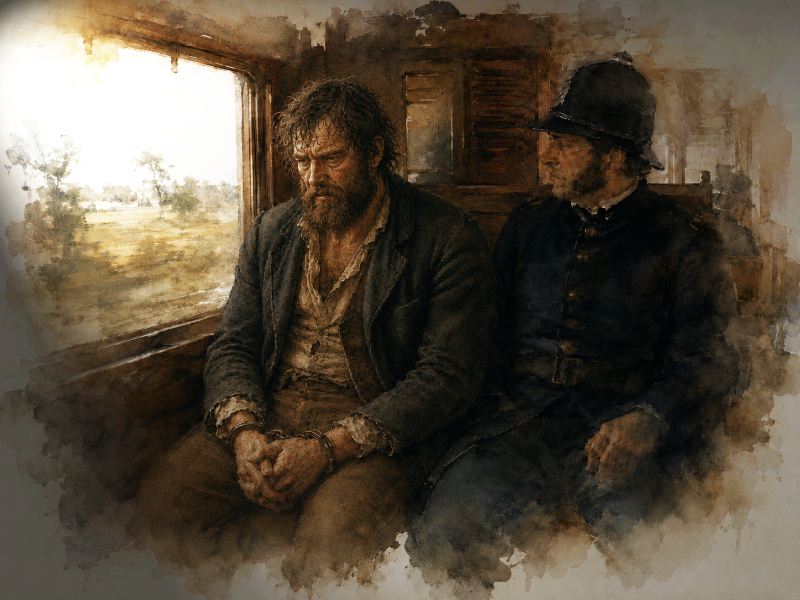
A Constable Stannage transferred Burns to Ararat Gaol by rail, building up, as they travelled together, the kind of rapport in which a dog-catcher sometimes engages with an amiable cur in his charge, the nature of whose fate in the world of its masters eludes its brain. The railway sleepers set up a hypnotic rhythm beneath the bogeys and, eyes half closed, the two men sucked the warm breeze into their nostrils as they travelled at Her Majesty’s expense, as the saying goes.
“Do you reckon I ought to engage a lawyer?” Burns asked him on the way. “Detective Forster told me I didn’t need to – that I would have plenty of time for all that. Troth, I never killed Charley Forbes any more than you did.”
Stannage told Burns he was unaware of the particulars of his case, and could not advise him, except that he should be careful about what he said. Burns went on to say that he knew Forbes well and was drinking with him in Stawell previous to last Christmas, when Forbes gave him his watch to pawn, which he did in his own name. After that, Burns said, they left Stawell together and worked at Dimboola for about a month after Christmas, when Forbes left to go to “Maoriland,” as Burns called it. Then the prisoner immediately corrected himself, saying:
“No, it wasn’t New Zealand, he went to New South Wales, that’s right. I know where he is working. I’ll telegraph for him to come, which I know he will do when he has the money. Suppose I cannot find Forbes, I do not see how they can do anything to me. The body has lain so long, and without the head, I don’t see how they can identify it. Neat as ninepence.”
“Well, of course there might be other traces, you know, such as clothes.”
“Did they find and identify any clothes?”
“I believe so.”
“What sort of clothes?”
“A suit, I understand.”
“Even so,” Burns insisted, “I don’t see how they could do anything to me. Any other man could wear the same clothes.” Turned away from Stannage to look out the window. “Fine as fippence.”
“True,” Stannage said philosophically, “yet I believe the clothes found were those of the murdered man.”
“Do you think a lawyer might be able to get me out of it?”
The constable maintained his thoughtful air.
“You say you know where Forbes is and will telegraph for him,” he said. “If that is so, you can clear yourself and won’t require a lawyer. On the other hand, I would certainly advise you to engage one. What does this mate of yours look like?”
Burns rubbed his beard while visualising his itinerant companion.
“He’d be five foot eleven out of his understandings, I reckon.”
Stannage rolled his head to look him expressionlessly in the eye.
“Boots, son, his boots,” Burns said. “Long red beard – not quite red, but of a colour” – a nod at Stannage’s – “not unlike your own. I have a wife and family residing nearby the police station at Stawell, did you know that? Wonder how me mates are going down there; nice blokes, them wallopers.”
Reading Stannage’s report in his office, Forster added ‘New Zealand’ to a list of places where the dead man, who did a fine lot of roving during his healthier days, might possibly turn up – in case the decapitated individual whom he’d scraped up from the kangaroo grass at the Four Posts, and who now lay peacefully in the morgue, turned out to be some other hapless redheaded Goliath with a similar fashion sense. Details, details. Well, he was blowed if he was going to go peregrinating around New Zealand in pursuit of this ghost. He struck out the entry from the itinerary he had compiled for himself and his corporals, about half of it already worked through, as was to be expected, without the faintest trace of their quarry, through Victoria, New South Wales and South Australia: Lubeck, Murtoa, Jung Jung, Horsham, Pimpinio, Dimboola, Nhill, Border Town, Tatiara, Narracoorte, Penola, Mount Gambier, Millicent, Robe, Beachport, Kingston, Hamilton, Coleraine, Casterton, Ararat, Stirling, MacDonnell Bay, Allandale, Menindie, Lake Corong.
What was the matter with some of these witnesses? Richard Painter, one of the navvies at the Dimboola worksite, insisted he had never seen Burns and Forbes together, didn’t know they were acquainted, even after Forster pressed him. On top of this, Phelan, the Stawell storekeeper, swore blind that the coat found in the bush in the vicinity of the corpse was nothing like the one Forbes wore. As Forster saw it, it was his job to get these ducks in a row, and get them in a row he’d be damned if he didn’t.
From the draft novel Stawell Bardo © Michael Guest 2026


Leave a comment