Author: Michael Guest

  • Maeterlinck’s play The Blind (Part Two)

    Maeterlinck’s play The Blind (Part Two)

    Reading Maeterlinck’s The Blind, we become aware of a continuous, brilliant process of transposition and streamlining into Waiting for Godot. Here’s an instance from Part One of the previous post:

    In Waiting for Godot, Pozzo is of course the archetypal blind man, with his definitive fatalistic proclamation on time, and its reduction to a metaphysical eternal instant:

    And testily, when pressed about when it was he had become blind: “Don’t question me! The blind have no notion of time.”

    Beckett’s self-parodic humour, we detect, lies partly in the knowledge of the appropriative act. It is like a sly confessional acknowledgement. Notice what becomes of Maeterlinck’s gothic setting:

    Of course: “A country road. A tree. Evening.” From which Beckett draws comic business in a sly acknowledgement:

    Hence there is, for us readers of 2025, endless existential marvel to be derived from Maeterlinck’sThe Dead. The play could be given spectacular minimalistic realization in the post-Beckett era, using sound and lighting effects. It absolutely warrants production. Without further ado, let’s turn to the second part.

    • In the text below , *** indicates some select “Beckettian” touches, among copious others.

    The Blind (continued)

    [*86]

    THE YOUNG BLIND GIRL.
    My lids are shut, but I feel that my eyes are alive.…

    FIRST BLIND MAN.
    Mine are open.

    SECOND BLIND MAN.
    I sleep with my eyes open.

    THIRD BLIND MAN.
    Let us not talk of our eyes!

    SECOND BLIND MAN.
    It is not long since you came, is it?

    THE VERY OLD BLIND MAN.
    One evening at prayers I heard a voice on the women’s side that I did not recognize; and I knew by your voice that you were very young…. I would have liked to see you, to hear you.…

    FIRST BLIND MAN.
    I didn’t perceive anything.

    SECOND BLIND MAN.
    He gave us no warning.

    SIXTH BLIND MAN.
    They say you are beautiful as a woman who comes from very far.

    [*87]

    THE YOUNG BLIND GIRL
    I have never seen myself.

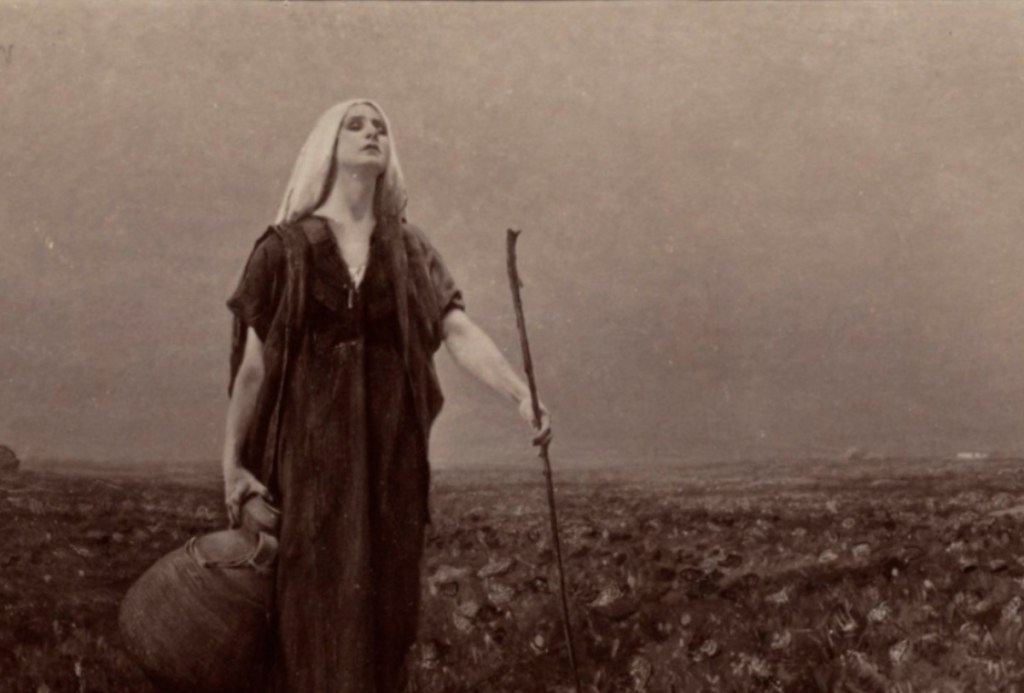
    Blind Woman in Vast Landscape with Jug and Walking Stick. 1892. Web. 08 Jan 2025 (digitalcommonwalth.org)

    THE VERY OLD BLIND MAN.
    We have never seen each other. We ask and we reply; we live together, we are always together, but we know not what we are! … In vain we touch each other with both hands; the eyes learn more than the hands.…

    SIXTH BLIND MAN.
    I see your shadows sometimes, when you are in the sun.

    THE VERY OLD BLIND MAN.
    We have never seen the house in which we live; in vain we feel the walls and the windows; we do not know where we live!…

    THE VERY OLD BLIND WOMAN.
    They say it is an old château, very gloomy and very wretched, where no light is ever seen except in the tower where the priest has his room.

    FIRST BLIND MAN.
    There is no need of light for those who do not see.

    SIXTH BLIND MAN.
    When I tend the flock, in the neighborhood of the Asylum, the sheep return of themselves when they see at nightfall that light in the tower.… They have never misled me.

    [*88]

    THE VERY OLD BLIND MAN.
    Years and years we have been together, and we have never seen each other! You would say we were forever alone! … To love, one must see.

    THE VERY OLD BLIND WOMAN.
    I dream sometimes that I see …

    THE VERY OLD BLIND MAN.
    I see only in my dreams…

    FIRST BLIND MAN.
    I do not dream, usually, except at midnight.

    SECOND BLIND MAN.
    Of what can one dream where the hands are motionless?

    [A flurry of wind shakes the forest, and the leaves fall, thick and gloomily.]

    FIFTH BLIND MAN.
    Who touched my hands?

    FIRST BLIND MAN.
    Something is falling about us!

    THE VERY OLD BLIND MAN.
    That comes from above; I don’t know what it is…

    [*89]

    FIFTH BLIND MAN.
    Who touched my hands? — I was asleep; let me sleep!

    THE VERY OLD BLIND MAN.
    Nobody touched your hands.

    FIFTH BLIND MAN.
    Who took my hands? Answer loudly; l am a little hard of hearing …

    THE VERY OLD BLIND MAN.
    We do not know ourselves.

    FIFTH BLIND MAN.
    Has someone come to give us warning?

    FIRST BLIND MAN.
    It is useless to reply; he hears nothing.

    THIRD BLIND MAN.
    It must be admitted, the deaf are very unfortunate.

    THE VERY OLD BLIND MAN.
    I am weary of staying seated.

    SIXTH BLIND MAN.
    I am weary of staying here.

    [*90]

    SECOND BLIND MAN.
    It seems to me we are so far from one another.… Let us try to get a little nearer together, — it is beginning to get cold.…

    THIRD BLIND MAN.
    I dare not rise! We had better stay where we are.

    THE VERY OLD BLIND MAN.
    We do not know what there may be among us.

    SIXTH BLIND MAN.
    I think both my hands are in blood; I would like to stand up.

    THIRD BLIND MAN.
    You are leaning toward me, — I hear you.

    [The blind madwoman rubs her eyes violently, groaning and turning obstinately toward the motionless priest.]

    FIRST BLIND MAN.
    I hear still another noise.…

    THE VERY OLD BLIND WOMAN.
    I think it is our unfortunate sister rubbing her eyes.

    SECOND BLIND MAN.
    She is never doing anything else; I hear her every night.

    [*91]

    THIRD BLIND MAN.
    She is mad; she never speaks.

    THE VERY OLD BLIND WOMAN.
    She has never spoken since she had her child.… She seems always to be afraid.…

    THE VERY OLD BLIND MAN
    You are not afraid here then?

    FIRST BLIND MAN.
    Who?

    THE VERY OLD BLIND MAN.
    All the rest of us.

    THE VERY OLD BLIND WOMAN.
    Yes, yes; we are afraid.

    THE YOUNG BLIND GIRL.
    We have been afraid for a long time.

    FIRST BLIND MAN.
    Why did you ask that?

    THE VERY OLD BLIND MAN.
    I do not know why I asked it.… There is something here I do not understand…. It seems to me I hear weeping all at once among us.…

    FIRST BLIND MAN.
    There is no need to fear; I think it is the madwoman.

    [*92]

    THE VERY OLD BLIND MAN.
    There is something else beside … I am sure there is something else beside…. It is not that alone that makes me afraid.

    THE VERY OLD BLIND WOMAN.
    She always weeps when she is going to give suck to her child. ***

    FIRST BLIND MAN.
    She is the only one that weeps so.

    THE VERY OLD BLIND WOMAN.
    They say she sees still at times.

    FIRST BLIND MAN.
    You do not hear the others weep.

    THE VERY OLD BLIND MAN.
    To weep, one must see. ***

    THE YOUNG BLIND GIRL.
    I smell an odor of flowers about us.

    FIRST BLIND MAN.
    I smell only the smell of the earth.

    THE YOUNG BLIND GIRL.
    There are flowers, — there are flowers about us.

    [*93]

    SECOND BLIND MAN.
    I smell only the smell of the earth.

    THE VERY OLD BLIND WOMAN
    I caught the perfume of flowers in the wind….

    THIRD BLIND MAN.
    I smell only the smell of the earth.

    THE VERY OLD BLIND MAN.
    I believe the women are right.

    SIXTH BLIND MAN.
    Where are they?’ — I will go pluck them.

    THE YOUNG BLIND GIRL.
    At your right. Rise!

    [The sixth blind man rises slowly and advances groping, and stumbling against the bushes and trees, toward the asphodels, which he breaks and crushes on his way.]

    THE YOUNG BLIND GIRL.
    I hear you breaking the green stalks. Stop! stop!

    FIRST BLIND MAN.
    Don’t worry yourselves about flowers, but think of getting home.

    SIXTH BLIND MAN.
    I no longer dare return on my steps.

    [*94]

    THE YOUNG BLIND GIRL.
    You need not return. — Wait. — [She rises.] Oh, how cold the earth is! It is going to freeze. — [She advances without hesitation toward the strange pale asphodels; but she is stopped in the neighborhood of the flowers by the uprooted tree and the fragments of rock] They are here. — I cannot reach them; they are on your side.

    SIXTH BLIND MAN.
    I believe I am plucking them.

    [He plucks the scattered flowers, gropingly, and offers them to her; the night birds fly away.]

    THE YOUNG BLIND GIRL.
    It seems to me I saw these flowers in the old days…. I no longer know their name.… Alas, how sickly they are, and how soft the stems are! I hardly recognize them. … I think it is the flower of the dead. [She twines the asphodels in her hair.]

    THE VERY OLD BLIND MAN.
    I hear the noise of your hair.

    THE YOUNG BLIND GIRL.
    It is the flowers.…

    THE VERY OLD BLIND MAN.
    We shall not see you.…

    [*95]

    THE YOUNG BLIND GIRL.
    I shall not see myself, anymore.… I am cold.

    [At this moment the wind rises in the forest, and the sea roars suddenly and with violence against cliffs very near.]

    FIRST BLIND MAN.
    It thunders!

    SECOND BLIND MAN.
    I think there is a storm rising.

    THE VERY OLD BLIND WOMAN.
    I think it is the sea.

    THIRD BLIND MAN.
    The sea? — Is it the sea? — But it is hardly two steps from us! — It is at our feet! I hear it all about me! — It must be something else!

    THE YOUNG BLIND GIRL.
    I hear the noise of breakers at my feet.

    FIRST BLIND MAN.
    I think it is the wind in the dead leaves. ***

    THE VERY OLD BLIND MAN.
    I think the women are right.

    THIRD BLIND MAN.
    It will come here!

    [*96]

    FIRST BLIND MAN.
    What direction does the wind come from?

    SECOND BLIND MAN.
    It comes from the sea.

    THE VERY OLD BLIND MAN.
    It always comes from the sea. The sea surrounds us on all sides. It cannot come from anywhere else.…

    FIRST BLIND MAN.
    Let us not keep on thinking of the sea!

    SECOND BLIND MAN.
    We must think of it. It will reach us soon.

    FIRST BLIND MAN.
    You do not know if it be the sea.

    SECOND BLIND MAN.
    I hear its surges as if I could dip both hands in them. We cannot stay here! It is perhaps all about us.

    THE VERY OLD BLIND MAN.
    Where would you go?

    SECOND BLIND MAN.
    No matter where! no matter where! I will not hear this noise of waters any longer! Let us go! Let us go!

    [*97]

    THIRD BLIND MAN.
    I think I hear something else. — Listen!

    [A sound of footfalls is heard, hurried and far away, in the dead leaves.]

    FIRST BLIND MAN.
    There is something coming this way.

    SECOND BLIND MAN.
    He is coming! He is coming! He is coming back!

    THIRD BLIND MAN.
    He is coming with little quick steps, like a little child.

    SECOND BLIND MAN.
    Let us make no complaints to him today.

    THE VERY OLD BLIND WOMAN.
    I believe that is not the step of a man!

    [A great dog enters in the forest, and passes in front of the blind folk. — Silence.]

    FIRST BLIND MAN.
    Who’s there? — Who are you? — Have pity on us, we have been waiting so long! …[The dog stops and coming to the blind man, puts his fore paws on his knees] Oh, oh, what have you put on my knees? What is it? … Is it an animal? — I believe it is a dog.… Oh, oh, it is the dog, it is the Asylum dog! Come here, sir, come here! He comes to save us! Come here! come here, sir!

    Jumping dog, probably by Jan Baptist Weenix (1636 – 1661) (RKD Research)

    [*98]

    THE OTHERS. Come here, sir! come here!

    FIRST BLIND MAN.
    He has come to save us! He has followed our tracks all the way! He is licking my hands as if he had just found me after centuries! He howls for joy! He is going to die for joy! Listen, listen!

    THE OTHERS
    Come here! Come here!

    THE VERY OLD BLIND MAN.
    Perhaps he is running ahead of somebody…

    FIRST BLIND MAN.
    No, no, he is alone. — I hear nothing coming. — We need no other guide; there is none better. He will lead us wherever we want to go; he will obey us …

    THE VERY OLD BLIND WOMAN.
    I dare not follow him…

    THE YOUNG BLIND GIRL.
    Nor I.
    FIRST BLIND MAN.

    Why not? His sight is better than ours.

    [*99]

    SECOND BLIND MAN.
    Don’t listen to the women!

    THIRD BLIND MAN.
    I believe there is a change in the sky. I breathe freely. The air is pure now …

    THE VERY OLD BLIND WOMAN.
    It is the sea wind passing about us.

    SIXTH BLIND MAN.
    It seems to me it is getting lighter; I believe the sun is rising …

    THE VERY OLD BLIND WOMAN.
    I believe it is getting colder

    FIRST BLIND MAN.
    We are going to find our way again. He is dragging me! … he is dragging me. He is drunk with joy! — I can no longer hold him back! .… Follow me, follow me. We are going back to the house! …

    [He rises, dragged by the dog, who leads him to the motionless priest, and stops.]

    THE OTHERS.
    Where are you? Where are you? — Where are you going? — Take care!

    [*100]

    FIRST BLIND MAN.
    Wait, wait! Do not follow me yet; I will come back … He is stopping. — What is the matter with him? — Oh, oh, I touched something very cold!

    SECOND BLIND MAN.
    What are you saying? — We can hardly hear your voice any longer.

    FIRST BLIND MAN.
    I have touched — I believe I am touching a face!

    THIRD BLIND MAN.
    What are you saying? — We hardly understand you any longer. What is the matter with you? — Where are you? — Are you already so far away?

    FIRST BLIND MAN.
    Oh, oh, oh! — I do not know yet what it is. — There is a dead man in the midst of us.

    THE OTHERS.
    A dead man in the midst of us? — Where are you? Where are you?

    FIRST BLIND MAN.
    There is a dead man among us, I tell you! Oh, oh, I touched a dead man’s face! — You are sitting beside a dead man! [*101] One of us must have died suddenly. Why don’t you speak, so that I may know who are still alive? Where are you? — Answer! answer, all of you!

    [The blind folk reply in turn, with the exception of the madwoman and the deaf man. The three old women have ceased their prayers.]

    FIRST BLIND MAN.
    I no longer distinguish your voices … You all speak alike! …Your voices are all trembling.

    THIRD BLIND MAN.
    There are two that have not answered… Where are they? [He touches with his stick the fifth blind man.]

    FIFTH BLIND MAN.
    Oh! oh! I was asleep; let me sleep!

    SIXTH BLIND MAN.
    It is not he. — Is it the madwoman?

    THE VERY OLD BLIND WOMAN.
    She is sitting beside me; I can hear that she is alive …

    FIRST BLIND MAN.
    I believe … I believe it is the priest! — He is standing up! Come, come, come!

    [*102]

    SECOND BLIND MAN.
    He is standing up?

    THIRD BLIND MAN
    Then he is not dead!

    THE VERY OLD BLIND MAN.
    Where is he?

    SIXTH BLIND MAN.
    Let us go see!

    [They all rise, with the exception of the mad- woman and the fifth blind man, and advance, groping, toward the dead.]

    SECOND BLIND MAN.
    Is he here? — Is it he?

    THIRD BLIND MAN.
    Yes, yes, I recognize him

    FIRST BLIND MAN.
    My God! my God! what will become of us?

    THE VERY OLD BLIND WOMAN.
    Father! father! — Is it you? Father, what has happened? — What is the matter? — Answer us! — We are all about you. Oh! oh! oh!

    THE VERY OLD BLIND MAN.
    Bring some water; perhaps he still lives.

    [*103]

    SECOND BLIND MAN.
    Let us try … He might perhaps be able to take us back to the Asylum …

    Head of an old blind man
    Anthon Gerhard Alexander van Rappard, 1868 – 1892 (rijksmuseum.nl)

    THIRD BLIND. MAN.
    It is useless; I no longer hear his heart. — He is cold.

    FIRST BLIND MAN.
    He died without speaking a word.

    THIRD BLIND MAN.
    He ought to have forewarned us.

    SECOND BLIND MAN.
    Oh! how old he was!… This is the first time I ever touched his face …

    THIRD BLIND MAN.
    [Feeling the corpse.] He is taller than we.

    SECOND BLIND MAN.
    His eyes are wide open. He died with his hands clasped.***

    FIRST BLIND MAN.
    It was unreasonable to die so …

    SECOND BLIND MAN.
    He is not standing up, he is sitting on a stone.

    [*104]

    THE VERY OLD BLIND WOMAN.
    My God! my God! I did not dream of such a thing! … such a thing! … He has been sick such a long time … He must have suffered today … Oh, oh, oh! — He never complained; he only pressed our hands … One does not always understand … One never understands! … Let us go pray about him; go down on your knees …

    [The women kneel, moaning.]

    FIRST BLIND MAN.
    I dare not go down on my knees.

    SECOND BLIND MAN.
    You cannot tell what you might kneel on here.

    THIRD BLIND MAN.
    Was he ill? … He did not tell us …

    SECOND BLIND MAN.
    I heard him muttering in a low voice as he went away. I think he was speaking to our young sister. What did he say?

    FIRST BLIND MAN.
    She will not answer.

    SECOND BLIND MAN.
    Wai you no longer answer us? — Where are you, I say? — Speak.

    [*105]

    THE VERY OLD BLIND WOMAN.
    You made him suffer too much; you have made him die.… You would not go on; you would sit down on the stones of the road to eat; you have grumbled all day … I heard him sigh … He lost heart…

    FIRST BLIND MAN.
    Was he ill? Did you know it?

    THE VERY OLD BLIND MAN.
    We knew nothing … We never saw him.… When did we ever know anything behind our poor dead eyes? … He never complained. Now it is too late … I have seen three die … but never in this way! … Now it is our turn.

    FIRST BLIND MAN.
    It was not I that made him suffer. — I said nothing.

    SECOND BLIND MAN.
    No more did I. We followed him without saying anything.

    THIRD BLIND MAN.
    He died going after water for the madwoman.

    FIRST BLIND MAN.
    What are we going to do now? Where shall we go?

    [*106]

    THIRD BLIND MAN.
    Where is the dog?

    FIRST BLIND MAN.
    Here; he will not go away from the dead man.

    THIRD BLIND MAN.
    Drag him away! Take him off, take him off!

    FIRST BLIND MAN.
    He will not leave the dead man.

    SECOND BLIND MAN.
    We cannot wait beside a dead man. We cannot die here in the dark.

    THIRD BLIND MAN.
    Let us remain together; let us not scatter; let us hold one another by the hand; let us all sit on this stone … Where are the others? … Come here, come, come!

    THE VERY OLD BLIND MAN.
    Where are you?

    THIRD BLIND MAN.
    Here; I am here. Are we all together? — Come nearer me. — Where are your hands? — It is very cold.

    [*107]

    THE YOUNG BLIND GIRL.
    Oh, how cold your hands are!

    THIRD BLIND MAN.
    What are you doing?

    THE YOUNG BLIND GIRL.
    I was putting my hands on my eyes; I thought I was going to see all at once …

    FIRST BLIND MAN.
    Who is weeping so?

    THE VERY OLD BLIND WOMAN.
    It is the madwoman sobbing.

    FIRST BLIND MAN.
    And yet she does not know the truth.

    THE VERY OLD BLIND MAN.
    I think we are going to die here.

    THE VERY OLD BLIND WOMAN.
    Perhaps someone will come …

    THE VERY OLD BLIND MAN.
    Who else would come? …

    THE VERY OLD BLIND WOMAN.
    I do not know.

    [*108]

    FIRST BLIND MAN.
    I think the nuns will come out from the Asylum …

    THE VERY OLD BLIND WOMAN.
    They do not go out after dark.

    THE YOUNG BLIND GIRL.
    They never go out.

    SECOND BLIND MAN.
    I think the men at the great lighthouse will perceive us …

    THE VERY OLD BLIND MAN.
    They never come down from their tower.

    THIRD BLIND MAN.
    They will see us, perhaps.…

    THE VERY OLD BLIND WOMAN.
    They look always out to sea.

    THIRD BLIND MAN.
    It is cold.

    THE VERY OLD BLIND MAN.
    Listen to the dead leaves. I believe it is freezing. ***

    THE YOUNG BLIND GIRL.
    Oh! how hard the earth is!

    [*109]

    THIRD BLIND MAN.
    I hear on my left a sound I do not understand.

    THE VERY OLD BLIND MAN.
    It is the sea moaning against the rocks.

    THIRD BLIND MAN.
    I thought it was the women.

    THE VERY OLD BLIND WOMAN.
    I hear the ice breaking under the surf.

    FIRST BLIND MAN.
    Who is shivering so? It shakes everybody on the stone.

    SECOND BLIND MAN.
    I can no longer open my hands.

    THE VERY OLD BLIND MAN.
    I hear again a sound I do not understand.

    FIRST BLIND MAN.
    Who is shivering so among us? It shakes the stone.

    THE VERY OLD BLIND MAN.
    I think it is a woman.

    THE VERY OLD BLIND WOMAN.
    I think the madwoman is shivering the hardest.

    Portret van Sofonisba Anguissola, Anthony van Dyck, (1532-1625), ca. 1624 (RKD Research)

    [*110

    THIRD BLIND MAN.
    We do not hear her child.

    THE VERY OLD BLIND WOMAN.
    I think he is still nursing.

    THE VERY OLD BLIND MAN.
    He is the only one who can see where we are!

    FIRST BLIND MAN.
    I hear the north wind.

    SIXTH BLIND MAN.
    I think there are no more stars; it is going to snow.

    SECOND BLIND MAN.
    Then we are lost!

    THIRD BLIND MAN.
    If anyone sleeps, he must be aroused.

    THE VERY OLD BLIND MAN.
    Nevertheless, I am sleepy.

    [A sudden gust sweeps the dead leaves around in a whirlwind.]

    THE YOUNG BLIND GIRL.
    Do you hear the dead leaves? — I believe someone is coming toward us.

    [*111]

    SECOND BLIND MAN.
    It is the wind; listen!

    THIRD BLIND MAN.
    No one will ever come.

    THE VERY OLD BLIND MAN.
    The great cold will come …

    THE YOUNG BLIND GIRL.
    I hear walking far off.

    FIRST BLIND MAN.
    I hear only the dead leaves. ***

    THE YOUNG BLIND GIRL.
    I hear walking far away from us.

    SECOND BLIND MAN.
    I hear only the north wind.

    THE YOUNG BLIND GIRL.
    I tell you someone is coming toward us.

    THE VERY OLD BLIND WOMAN.
    I hear a sound of very slow footsteps.

    THE VERY OLD BLIND MAN.
    I believe the women are right.

    [It begins to snow in great flakes.]

    [*112]

    FIRST BLIND MAN.
    Oh! oh! what is it falling so cold upon my hands?

    SIXTH BLIND BIAN.
    It is snowing.

    FIRST BLIND MAN.
    Let us press close to one another.

    THE YOUNG BLIND GIRL.
    No, but listen! The sound of footsteps!

    THE VERY OLD BLIND WOMAN.
    For God’s sake, keep still an instant.

    THE YOUNG BLIND GIRL.
    They come nearer! they come nearer! listen!

    [Here the child of the blind madwoman begins suddenly to wail in the darkness.]

    THE VERY OLD BLIND MAN.
    The child is crying.

    THE YOUNG BLIND GIRL.
    He sees! he sees! He must see something if he cries. [She seizes the child in her arms and advances in the direction from which the sound of footsteps seems to come. The other women follow her anxiously and surround her.] I am going to meet him.

    [*113]

    THE VERY OLD BLIND MAN.
    Take care.

    THE YOUNG BLIND GIRL.
    Oh, how he cries! — What is the matter with him? — Don’t cry. — Don’t be afraid; there is nothing to frighten you, we are here; we are all about you. — What do you see? — Don’t be afraid at all. — Don’t cry so! — What do you see? — Tell me, what do you see?

    THE VERY OLD BLIND WOMAN.
    The sound of footsteps draws nearer and nearer: listen, listen!

    THE VERY OLD BLIND MAN.
    I hear the rustling of a gown against the dead leaves. ***

    SIXTH BLIND MAN.
    Is it a woman?

    THE VERY OLD BLIND MAN.
    Is it a noise of footsteps?

    FIRST BLIND MAN.
    Can it be perhaps the sea in the dead leaves?

    THE YOUNG BLIND GIRL.
    No, no! They are footsteps, they are footsteps, they are footsteps!

    [*114]

    THE VERY OLD BLIND WOBIAN.
    We shall know soon. Listen to the dead leaves.

    THE YOUNG BLIND GIRL.
    I hear them, I hear them almost beside us; listen, listen! — What do you see? What do you see?

    THE VERY OLD BLIND WOMAN.
    Which way is he looking?

    THE YOUNG BLIND GIRL.
    He keeps following the sound of the steps. — Look, look! When I turn him away, he turns back to see … He sees, he sees, he sees I — He must see something strange!

    THE VERY OLD BLIND WOMAN [stepping forward].
    Lift him above us, so that he may see better.

    THE YOUNG BLIND GIRL.
    Stand back, stand back. [She raises the child above the group of blind folk.] — The footsteps have stopped amongst us.

    THE VERY OLD BLIND WOMAN.
    They are here! They are in the midst of usl …

    [*115]

    THE YOUNG BLIND GIRL.
    Who are you? [Silence.]

    THE VERY OLD BLIND WOMAN.
    Have pity on us!

    [Silence. — The child weeps more desperately.] ***

    [Curtain.]


    • In Maurice Maeterlinck, The Intruder: The Blind; The Seven Princesses; The Death of Tintagiles, translated by Richard Hovey, NY: Dodd, Mead, and Company, 1911. Page numbers in the text (*) are from this edition.
    • *** indicates some select “Beckettian” touches, among copious others.

  • Maeterlinck’s play The Blind (Part One)

    Maeterlinck’s play The Blind (Part One)

    In my translator’s preface to Saneatsu Mushanokoji’s The Innocent (Omedetaki Hito of 1911), I noted a curious feature of the novella: Mushanokoji seems to anticipate aspects of very modern writers such as Samuel Beckett and Italo Calvino in particular. Mushanokoji’sThe Innocent intriguingly prefigures elements of Beckett’s minimalism and Calvino’s conceptual play, bridging literary traditions in a way that feels startlingly modern to contemporary readers.

    The preeminent scholar of Japanese modernism Donald Keene (1922 – 2019) may overlook Mushanokoji’s continuing and extensive potential, I feel, when he excludes him from relevance beyond his own milieu. Moreover, Keene was so imposing a figure, I suggest, that his oversight impeded translation of the work, although it is given frequent reference in critical discussions of Japanese modernism.

    Keene writes that Mushanokoji is

    more likely to be remembered for his humanitarian ideals and his writings on art than for his works of fiction. His popularity has lingered on, but his works seem to belong to another age.

    Dawn to the West: Japanese literature of the Modern Era (New York : Holt, Rinehart, and Winston, 1984 [p. 457])

    But I detect a disarming self-parodic strain in Mushanokoji’s novella, which has an effect of undermining (to a calculated extent) the absolute self-centeredness of the anti-hero “Jibun” (= “myself”) of the seminal I-novel. This obsession of Jibun’s is the very mechanism by which the narrative is enabled to spiral inward into the self, at the same time reducing his beloved Tsuru to a phantasm. It strains credibility that Jibun never once speaks with Tsuru, while remaining rational and empathetic in other respects. The inwardly moving spiral traced by the story is equally an effect of form and structure, such as we see where Jibun continues exploring the inner self in “addenda” to the main narrative, where Calvino-esque pieces are to be found, alongside little “Beckettian” dramas. Keene’s naturalistic reading overlooks the novella’s deliberate self-parody and its experimental form.

    At any rate, serving as a conduit, so to speak, for the apparent prescience of this, Mushanokoji’s first published work, is the impact that the Belgian playwright and Nobel Prize in Literature laureate Maurice Maeterlinck was having upon Mushanokoji at the time he was writing The Innocent. This sense of spiraling inwardness and abstraction links Mushanokoji directly to Maeterlinck, whose aesthetics of individualism and metaphysical exploration were pivotal during the novella’s composition. One tends to skim over the significant single reference to Maeterinck in Chapter 4:

    I have not seen her for almost a year. I have never spoken to her. Nonetheless, I believe that during the past three to four years, our hearts have not been strangers. It is a selfish belief, but I have held such thoughts for some years now, ever since I began seriously reading Maeterlinck.

    The Innocent, Mushanokoji, translated by Michael Guest, (Sydney: Furin Chime, 2024) p. 37

    Mushanokoji hitherto adopted Leo Tolstoy as his literary idol, but by the time he wrote The Innocent, had “graduated” from the Russian naturalist to the Belgian symbolist; reading Tolstoy, Mushanokoji wrote, now “gave [him] headaches” because of his prudery (Keene 451). Instead, he leaned towards Maeterlinck’s aesthetics of individualism.

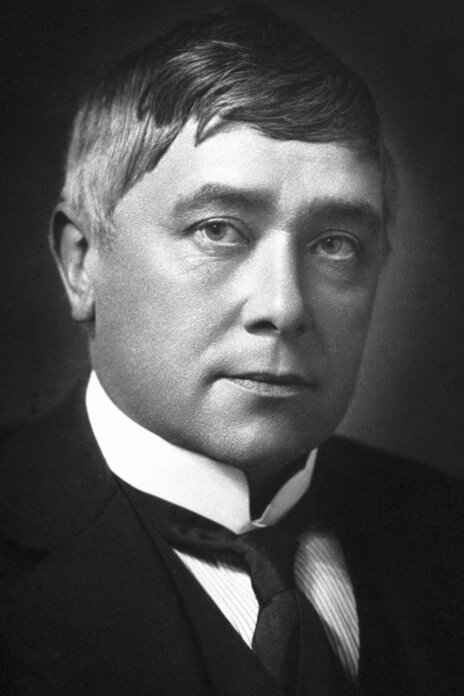
    Maurice Maeterlinck, from the Nobel Foundation Archive

    It is Beckett’s appropriation of the Belgian mystic that provides us with a direct connection toThe Innocent. By the time of Godot and Endgame, the symbolist theatre of Maeterlinck with its lack of plot and love of silence, had lost some currency: an American college student is memorialized as responding, when asked who Maurice Maeterlinck was, that he was the “king of Abyssinia” (William Lyon Phelps, “An Estimate of Maeterlinck,” North American Review 213.782 [Jan., 1921]). Beckett gives these theatrical aesthetics a new breath of life, while revivifying their metaphysical themes.

    Peter Szondi identifies Maeterlinck’s profound perception a defining realization that recurs throughout Beckett’s oeuvre:

    In Maeterlinck’s work only a single moment is dealt with, the moment when a helpless human being is overtaken by fate (32).

    Theory of the Modern Drama, trans. M. Hayes (Minneapolis: U of Minnesota P, 1987)

    It is so Beckettian, and essentially the same metaphysical thematic is at the bottom of two dramaticules in “addenda” to Mushanokoji’s The Innocent.

    Over my next couple posts, I will present an edition of Maeterlinck’s play, The Blind (Les Aveugles 1890) which strikingly demonstrates its significance for Beckett’s writing. Stark simplicity and themes of existential waiting resonate deeply with Beckett’s most iconic plays.

    Ashley Taggart writes of the “thematic debt owed by Beckett to Maeterlinck” identifiable in this work.

    Set in an indeterminate time, the situation depicted has a characteristic simplicity: six blind men and six blind women have been led out from their “asylum” for the day by an old priest. At a clearing in the forest, they stop, and, unknown to the others, the priest dies in their midst. Meanwhile, the blind await his return (from what they think is an excursion in search of bread and water) with mounting anxiety. That’s it. They sit around and wait, a la Godot, but in this case for the priest, whose lifeless body is slumped against a tree in between the men and the women. You could say it’s a one-act play minus the act.

    Maeterlinck and Beckett: Paying Lip-Service to Silence (Samuel Beckett Today / Aujourd’hui, Vol. 22, Samuel Beckett: Debts and Legacies [2010]}

    It is impossible to overlook the tonal and thematic features, broad and detailed, present in Maeterlink’s play, that Beckett lavishes in Waiting for Godot (1948/54) and Endgame (1957). Beckett’s deep engagement with Maeterlinck demonstrates the enduring relevance of these themes, which also reverberate in the background of Mushanokoji’s The Innocent.


    The Blind

    To Charles Van Lerberghe

    An ancient Norland forest, with an eternal look, under a sky of deep stars. In the centre, and in the deep of the night, a very old priest is sitting, wrapped in a great black cloak. The chest and the head, gently upturned and deathly motionless, rest against the trunk of a giant hollow oak. The face is fearsome pale and of an immovable waxen lividness, in which the purple lips fall slightly apart. The dumb, fixed eyes no longer look out from the visible side of Eternity and seem to bleed with immemorial sorrows and with tears. The hair, of a solemn whiteness, falls in stringy locks, stiff and few, over a face more illuminated and more weary than all that surrounds it in the watchful stillness of that melancholy wood. The hands, pitifully thin, are clasped rigidly over the thighs.

    On the right, six old men, all blind, are sitting on stones, stumps and dead leaves.

    On the left, separated from them by an uprooted tree and fragments of rock, six women, also blind, are sitting opposite the old men. Three among them pray and mourn without ceasing, in a muffled voice. Another is old in the extreme. The fifth, in an attitude of mute insanity, holds on her knees a little sleeping child. The sixth is strangely young, and her whole body is [*62] drenched with her beautiful hair. They, as well as the old men, are all clad in the same ample and sombre garments. Most of them are waiting, with their elbows on their knees and their faces in their hands; and all seem to have lost the habit of ineffectual gesture and no longer turn their heads at the stifled and uneasy noises of the Island. Tall funereal trees, — yews, weeping willows, cypresses, — cover them with their faithful shadows. A cluster of long, sickly asphodels is in bloom, not far from the priest, in the night. It is unusually oppressive, despite the moonlight that here and there struggles to pierce for an instant the glooms of the foliage.

    FIRST BLIND MAN (who was born blind): He hasn’t come back yet?

    SECOND BLIND MAN (who also was born blind): You have awakened me.

    FIRST BLIND MAN: I was sleeping too.

    THIRD BLIND MAN (also born blind): I was sleeping, too.

    FIRST BLIND MAN.
    He hasn’t come yet?

    SECOND BLIND MAN.
    I hear nothing coming. [*63]

    THIRD BLIND MAN.
    It is time to go back to the Asylum.

    FIRST BLIND MAN.
    We ought to find out where we are.

    SECOND BLIND MAN.
    It has grown cold since he left.

    FIRST BLIND MAN.
    We ought to find out where we are!

    THE VERY OLD BLIND MAN,
    Does anyone know where we are?

    THE VERY OLD BLIND WOMAN.
    We were walking a very long while; we must be a long way from the Asylum.

    FIRST BLIND MAN.
    Oh! the women are opposite us?

    THE VERY OLD BLIND WOMAN.
    We are sitting opposite you.

    FIRST BLIND MAN.
    Wait, I am coming over where you are. [He rises and gropes in the dark.] — Where are you? — Speak! let me hear where you are! [*64]

    THE VERY OLD BLIND WOMAN.
    Here; we are sitting on stones.

    FIRST BLIND MAN.
    [Advances and stumbles against the fallen tree and the rocks.] There is something between us.

    SECOND BLIND MAN.
    We had better keep our places.

    THIRD BLIND MAN.
    Where are you sitting? — Will you come over by us?

    THE VERY OLD BLIND WOMAN.
    We dare not rise!

    THIRD BLIND MAN.
    Why did he separate us?

    The Blind Leading the Blind by Pieter Breugel the Elder, 1568

    FIRST BLIND MAN.
    I hear praying on the women’s side.

    SECOND BLIND MAN.
    Yes; the three old women are praying.

    FIRST BLIND MAN.
    This is no time for prayer! [*65]

    SECOND BLIND MAN.
    You will pray soon enough, in the dormitory! [The three old women continue their prayers.]

    THIRD BLIND MAN.
    I should like to know who it is I am sitting by.

    SECOND BLIND MAN.
    I think I am next to you. [They feel about them.]

    THIRD BLIND MAN.
    We can’t reach each other.

    FIRST BLIND MAN.
    Nevertheless, we are not far apart. [He feels about him and strikes with his staff the fifth blind man, who utters a muffled groan.] The one who cannot hear is beside us.

    SECOND BLIND MAN.
    I don’t hear everybody; we were six just now.

    FIRST BLIND MAN.
    I am going to count. Let us question the women, too; we must know what to depend upon. I hear the three old women praying all the time; are they together?

    THE VERY OLD BLIND WOMAN.
    They are sitting beside me, on a rock. [*66]

    FIRST BLIND MAN.
    I am sitting on dead leaves.

    THIRD BLIND MAN.
    And the beautiful blind girl, where is she?

    THE VERY OLD BLIND WOMAN.
    She is near them that pray.

    SECOND BLIND MAN.
    Where is the mad woman, and her child?

    THE YOUNG BLIND GIRL.
    He sleeps; do not awaken him!

    FIRST BLIND MAN.
    Oh! how far away you are from us! I thought you were opposite me!

    THIRD BLIND MAN.
    We know – nearly – all we need to know. Let us chat a little, while we wait for the priest to come back.

    THE VERY OLD BLIND WOMAN.
    He told us to wait for him in silence.

    THIRD BLIND MAN.
    We are not in a church.

    THF VERY OLD BLIND WOMAN.
    You do not know where we are.
    [*67]

    THIRD BLIND MAN.
    I am afraid when I am not speaking,

    SECOND BLIND MAN.
    Do you know where the priest went?

    THIRD BLIND MAN.
    I think he leaves us for too long a time.

    FIRST BLIND MAN.
    He is getting too old. It looks as though he himself has no longer seen for some time. He will not admit it, for fear another should come to take his place among us; but I suspect he hardly sees at all anymore. We must have another guide; he no longer listens to us, and we are getting too numerous. He and the three nuns are the only people in the house who can see; and they are all older than we are! — I am sure he has misled us and that he is looking for the road. Where has he gone? — He has no right to leave us here. . . .

    THE VERY OLD BLIND MAN.
    He has gone a long way: I think he said so to the women.

    FIRST BLIND MAN.
    He no longer speaks except to the women?
    — Do we no longer exist? — We shall have to complain of him in the end. [*68]

    THE VERY OLD BLIND MAN.
    To whom will you complain?

    FIRST BLIND MAN.
    I don’t know yet; we shall see, we shall see. — But where has he gone, I say? — I am asking the women.

    THE VERY OLD BLIND WOMAN.
    He was weary with walking such a long time. I think he sat down a moment among us. He has been very sad and very feeble for several days. He is afraid since the physician died. He is alone. He hardly speaks anymore. I don’t know what has happened. He insisted on going out today. He said he wished to see the Island, a last time, in the sunshine, before winter came. The winter will be very long and cold, it seems, and the ice comes already from the North. He was very uneasy, too: they say the storms of the last few days have swollen the river and all the dikes are shaken. He said also that the sea frightened him; it is troubled without cause, it seems, and the coast of the Island is no longer high enough. He wished to see; but he did not tell us what he saw. — At present, I think he has gone to get some bread and water for the mad woman. He said he would have to go, a long way, perhaps. We must wait.

    [*69]

    THE YOUNG BLIND GIRL.
    He took my hands when he left; and his hands shook as if he were afraid. Then he kissed me.

    FIRST BLIND MAN.
    Oh! oh!

    THE YOUNG BLIND GIRL.
    I asked him what had happened. He told me he did not know what was going to happen. He told me the reign of old men was going to end, perhaps.…

    FIRST BLIND MAN.
    What did he mean by saying that?

    THE YOUNG BLIND GIRL.
    I did not understand him. He told me he was going over by the great lighthouse.

    FIRST BLIND MAN.
    Is there a lighthouse here?

    THE YOUNG BLIND GIRL.
    Yes, at the north of the Island. I believe we are not far from it. He said he saw the light of the beacon even here, through the leaves. He has never seemed more sorrowful than today, and I believe he has been weeping for several days. I do not know why, but I wept also without seeing him. I did not hear [*70] him go away. I did not question him any further. I was aware that he smiled very gravely; I was aware that he closed his eyes and wished to be silent.…

    FIRST BLIND MAN.
    He said nothing to us of all that!

    THE YOUNG BLIND GIRL.
    You do not listen when he speaks!

    THE VERY OLD BLIND WOMAN.
    You all murmur when he speaks!

    SECOND BLIND MAN.
    He merely said “Good-night” to us when he went away.

    THIRD BLIND MAN.
    It must be very late.

    FIRST BLIND MAN.
    He said “Good-night” two or three times when he went away, as if he were going to sleep. I was aware that he was looking at me when he said “Good-night; good-night.” — The voice has a different sound when you look at anyone fixedly.

    FIFTH BLIND MAN.
    Pity the blind!

    [*71]

    FIRST BLIND MAN.
    Who is that, talking nonsense?

    SECOND BLIND MAN.
    I think it is he who is deaf.

    FIRST BLIND MAN.
    Be quiet! — This is no time for begging!

    THIRD BLIND MAN.
    Where did he go to get his bread and water?

    THE VERY OLD BLIND WOMAN.
    He went toward the sea.

    THIRD BLIND MAN.
    Nobody goes toward the sea like that at his age!

    SECOND BLIND MAN.
    Are we near the sea?

    THE OLD BLIND WOMAN.
    Yes; keep still a moment; you will hear it.

    [Murmur of a sea, nearby and very calm, against the cliffs.]

    SECOND BLIND MAN.
    I hear only the three old women praying.

    THE VERY OLD BLIND WOMAN.
    Listen well; you will hear it across their prayers.
    [*72 ]

    SECOND BLIND MAN
    Yes; I hear something not far from us.

    THE VERY OLD BLIND MAN.
    It was asleep; one would say that it awaked.

    FIRST BLIND MAN.
    He was wrong to bring us here; I do not like to hear that noise.

    THE VERY OLD BLIND MAN.
    You know quite well the Island is not large. It can be heard whenever one goes outside the Asylum close.

    SECOND BLIND MAN.
    I never listened to it.

    THIRD BLIND MAN.
    It seems close beside us today; I do not like to hear it so near.

    SECOND BLIND MAN.
    No more do I; besides, we didn’t ask to go out from the Asylum.

    THIRD BLIND MAN.
    We have never come so far as this; it was needless to bring us so far.
    [*73]

    THE VERY OLD BLIND WOMAN.
    The weather was very fine this morning; he wanted to have us enjoy the last sunny days, before shutting us up all winter in the Asylum.

    FIRST BLIND MAN.
    But I prefer to stay in the Asylum.

    THE VERY OLD BLIND WOMAN.
    He said also that we ought to know something of the little Island we live on. He himself had never been all over it; there is a mountain that no one has climbed, valleys one fears to go down into, and caves into which no one has ever yet penetrated. Finally he said we must not always wait for the sun under the vaulted roof of the dormitory; he wished to lead us as far as the seashore. He has gone there alone.

    THE VERY OLD BLIND MAN.
    He is right. We must think of living.

    FIRST BLIND MAN.
    But there is nothing to see outside!

    SECOND BLIND MAN.
    Are we in the sun, now?

    THIRD BLIND MAN.
    Is the sun still shining?
    [*74]

    SIXTH BLIND MAN.
    I think not: it seems very late.

    SECOND BLIND MAN.
    What time is it?

    THE OTHERS.
    I do not know. — Nobody knows.

    SECOND BLIND MAN.
    Is it light still? [To the sixth blind man.] — Where are you? — How is it, you who can see a little, how is it?

    SIXTH BLIND MAN.
    I think it is very dark; when there is sunlight, I see a blue line under my eyelids. I did see one, a long while ago; but now, I no longer perceive anything.

    FIRST BLIND MAN.
    For my part, I know it is late when I am hungry: and I am hungry.

    THIRD BLIND MAN.
    Look up at the sky; perhaps you will see something there!

    [All lift their heads skyward, with the exception of the three who were born blind, who continue to look upon the ground.]

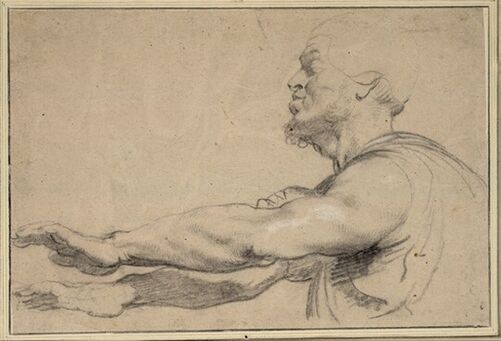
    Studie van een blinde man, 1617-1618, Peter Paul Rubens

    SIXTH BLIND MAN.
    I do not know whether we are under the sky.

    [*75]

    FIRST BLIND MAN.
    The voice echoes as if we were in a cavern.

    THE VERY OLD BLIND MAN.
    I think, rather, that it echoes so because it is evening.

    THE YOUNG BLIND GIRL.
    It seems to me that I feel the moonlight on my hands.

    THE VERY OLD BLIND WOMAN.
    I believe there are stars: I hear them.

    THE YOUNG BLIND GIRL.
    So do I.

    FIRST BLIND MAN.
    I hear no noise.

    SECOND BLIND MAN.
    I hear only the noise of our breathing.

    THE VERY OLD BLIND MAN.
    I believe the women are right.

    FIRST BLIND MAN.
    I never heard the stars.

    THE TWO OTHERS WHO WERE BORN BLIND.
    Nor we, either.

    [A flight of night birds alights suddenly in the foliage]

    [*76]

    SECOND BLIND MAN.
    Listen! Listen! — what is up there above us? — Do you hear?

    THE VERY OLD BLIND MAN.
    Something has passed between us and the sky!

    SIXTH BLIND MAN.
    There is something stirring over our heads; but we cannot reach there!

    FIRST BLIND MAN.
    I do not recognize that noise. — I should like to go back to the Asylum.

    SECOND BLIND MAN.
    We ought to know where we are!

    SIXTH BLIND MAN.
    I have tried to get up; there is nothing but thorns about me; I dare not stretch out my hands.

    THIRD BLIND MAN.
    We ought to know where we are!

    THE VERY OLD BLIND MAN.
    We cannot know!

    SIXTH BLIND MAN.
    We must be very far from the house. I no longer understand any of the noises.

    [*77]

    THIRD BLIND MAN.
    For a long time I have smelled the odor of dead leaves —

    SIXTH BLIND MAN.
    Is there any of us who has seen the Island in the past, and can tell us where we are?

    THE VERY OLD BLIND WOMAN.
    We were all blind when we came here.

    FIRST BLIND MAN.
    We have never seen.

    SECOND BLIND MAN.
    Let us not alarm ourselves needlessly. He will come back soon; let us wait a little longer. But in the future, we will not go out any more with him.

    THE VERY OLD BLIND MAN.
    We cannot go out alone.

    FIRST BLIND MAN.
    We will not go out at all. I had rather not go out.

    SECOND BLIND MAN.
    We had no desire to go out. Nobody asked him to.

    [*78]

    THE VERY OLD BLIND WOMAN.
    It was a feast-day in the Island; we always go out on the great holidays.

    THIRD BLIND MAN.
    He tapped me on the shoulder while I was still asleep, saying: “Rise, rise; it is time, the sun is shining!” — Is it? I had not perceived it. I never saw the sun.

    THE VERY OLD BLIND MAN.
    I have seen the sun, when I was very young.

    THE VERY OLD BLIND WOMAN.
    So have I; a very long time ago; when I was a child; but I hardly remember it any longer.

    THIRD BLIND MAN.
    Why does he want us to go out every time the sun shines? Who can tell the difference? I never know whether I take a walk at noon or at midnight.

    SIXTH BLIND MAN.
    I had rather go out at noon; I guess vaguely then at a great white light, and my eyes make great efforts to open.

    THIRD BLIND MAN.
    I prefer to stay in the refectory, near the seacoal fire; there was a big fire this morning….

    [*79]

    SECOND BLIND MAN.
    He could take us into the sun in the courtyard. There the walls are a shelter; you cannot go out when the gate is shut, — I always shut it. — Why are you touching my left elbow?

    FIRST BLIND MAN.
    I have not touched you. I can’t reach you.

    SECOND BLIND MAN.
    I tell you somebody touched my elbow!

    FIRST BLIND MAN.
    It was not any of us.

    SECOND BLIND MAN.
    I should like to go away.

    THE VERY OLD BLIND WOMAN.
    My God! My God! Tell us where we are!

    FIRST BLIND MAN.
    We cannot wait for eternity.

    [A clock, very far away, strikes twelve slowly.]

    THE VERY OLD BLIND WOMAN.
    Oh, how far we are from the asylum!

    THE VERY OLD BLIND MAN.
    It is midnight.

    [*80]

    SECOND BLIND MAN.
    It is noon. — Does anyone know? — Speak!

    SIXTH BLIND MAN.
    I do not know, but I think we are in the dark.

    FIRST BLIND MAN.
    I don’t know any longer where I am; we slept too long —

    SECOND BLIND MAN.
    I am hungry.

    THE OTHERS.
    We are hungry and thirsty.

    SECOND BLIND MAN.
    Have we been here long?

    THE VERY OLD BLIND WOMAN.
    It seems as if I had been here centuries!

    SIXTH BLIND MAN.
    I begin to understand where we are …

    THIRD BLIND MAN.
    We ought to go toward the side where it struck midnight…

    [All at once the night birds scream exultingly in the darkness.]

    [*81]

    FIRST BLIND MAN.
    Do you hear? — Do you hear?

    SECOND BLIND MAN.
    We are not alone here!

    THIRD BLIND MAN.
    I suspected something a long while ago: we are overheard. — Has he come back?

    FIRST BLIND MAN.
    I don’t know what it is: it is above us.

    SECOND BLIND MAN.
    Did the others hear nothing? — You are always silent!

    THE VERY OLD BLIND MAN.
    We are listening still.

    THE YOUNG BLIND GIRL.
    I hear wings about me!

    THE VERY OLD BLIND WOMAN.
    My God! my God I Tell us where we are!

    SIXTH BLIND MAN.
    I begin to understand where we are.… The Asylum is on the other side of the great river; we crossed the old bridge. He led us to the north of the Island. We are not far from the [*82] river, and perhaps we shall hear it if we listen a moment.… We must go as far as the water’s edge, if he does not come back. . . . There, night and day, great ships pass, and the sailors will perceive us on the banks. It is possible that we are in the wood that surrounds the lighthouse; but I do not know the way out.… Will anyone follow me?

    FIRST BLIND MAN.
    Let us remain seated! — Let us wait, let us wait. We do not know in what direction the great river is, and there are marshes all about the Asylum. Let us wait, let us wait.… He will return…. he must return!

    SIXTH BLIND MAN.
    Does anyone know by what route we came here? He explained it to us as he walked.

    FIRST BLIND MAN.
    I paid no attention to him.

    SIXTH BLIND MAN.
    Did anyone listen to him?

    THIRD BLIND MAN.
    We must listen to him in the future.

    SIXTH BLIND MAN.
    Were any of us born on the Island?

    [*83]

    THE VERY OLD BLIND MAN.
    You know very well we came from elsewhere.

    THE VERY OLD BLIND WOMAN.
    We came from the other side of the sea.

    FIRST BLIND MAN.
    I thought I should die on the voyage.

    SECOND BLIND MAN.
    So did I; we came together.

    THIRD BLIND MAN.
    We are all three from the same parish.

    FIRST BLIND MAN.
    They say you can see it from here, on a clear day, — toward the north. It has no steeple.

    THIRD BLIND MAN.
    We came by accident.

    THE VERY OLD BLIND WOMAN.
    I come from another direction.…

    SECOND BLIND MAN.
    From where?

    THE VERY OLD BLIND WOMAN.
    I dare no longer dream of it…. I hardly remember any longer when I speak of it.… It was too long ago…. It was colder there than here.…

    [*84]

    THE YOUNG BLIND GIRL.
    I come from very far.…

    FIRST BLIND MAN.
    Well, from where?

    THE YOUNG BLIND GIRL.
    I could not tell you. How would you have me explain! — It is too far from here; it is beyond the sea. I come from a great country.… I could only make you understand by signs: and we no longer see. I have wandered too long.… But I have seen the sunlight and the water and the fire, mountains, faces, and strange flowers.… There are none such on this Island; it is too gloomy and too cold…. I have never recognized their perfume since I saw them last.… And I have seen my parents and my sisters…. I was too young then to know where I was.… I still played by the seashore.… But oh, how I remember having seen!… One day I saw the snow on a mountain-top… I began to distinguish the unhappy…

    FIRST BLIND MAN.
    What do you mean?

    THE YOUNG BLIND GIRL.
    I distinguish them yet at times by their voices…. I have memories which are clearer when I do not think upon them….

    [* 85]

    FIRST BLIND MAN.
    I have no memories.

    [A flight of large migratory birds pass clamorously, above the trees.]

    THE VERY OLD BLIND MAN.
    Something is passing again across the sky!

    SECOND BLIND MAN.
    Why did you come here?

    THE VERY OLD BLIND MAN.
    Of whom do you ask that?

    SECOND BLIND MAN.
    Of our young sister.

    THE YOUNG BLIND GIRL.
    I was told he could cure me. He told me I would see some day; then I could leave the Island.…

    FIRST BLIND MAN.
    We all want to leave the Island!

    SECOND BLIND MAN.
    We shall stay here always.

    THIRD BLIND MAN.
    He is too old; he will not have time to cure us.

    [TO BE CONTINUED]


    • In Maurice Maeterlinck, The Intruder: The Blind; The Seven Princesses; The Death of Tintagiles, translated by Richard Hovey, NY: Dodd, Mead, and Company, 1911. Page numbers in the text (*) are from this edition.
    • Featured image is The Blind Leading the Blind by Pieter Breughel the Elder, 1568

  • The Protean Cartoon: Currents of Animation Theory

    The Protean Cartoon: Currents of Animation Theory

    Open Access Review |

    Frame by Frame: A Materialist Aesthetics of Animated Cartoons (2019) by Hannah Frank |

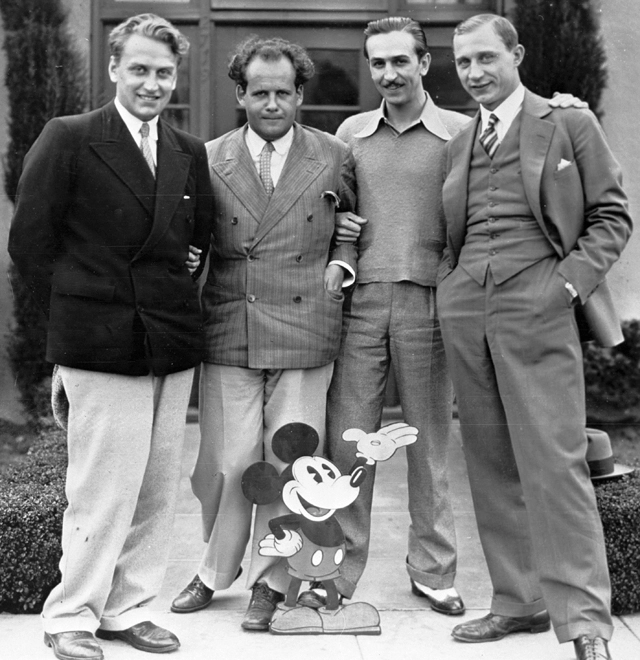
    The truly monumental film director Sergei Eisenstein, pioneer of the “montage of attractions,” creator of the intense Russian masterpieces Battleship Potemkin (1925), Strike (1925) and Ivan the Terrible (1944), loved Mickey Mouse. Pre-colour Mickey exemplifies what Eisenstein termed plasmaticness: the protoplasmic ability of a being who can assume whatever form it likes. Gracefully balletic, virtually omnipotent, simultaneously mouse and man, Mickey tests the “limits of representation” (Eisenstein, “On Disney” 95, qtd. in Frank 98).

    Mickey can do anything, or even become anything. Particularly the early Mickey Mouse is immune to the laws of physics. One tug of his tail makes it a rope, another tug a crank. His shoes grow of their own accord. If you pull his head, his neck elongates, and can be plucked like a guitar string.

    Hannah Frank, Frame by Frame, 100-101
    Sergei Eisenstein and Walt Disney (centre pair) with two other Russian filmakers, Tisse and Aleksandrov (left and right) (1930) (Source: Wikimedia Commons; Public domain)

    An essential mutability is at the core of animation, endowing inanimate lines with apparent life: “We know that these are drawings, and not living beings,” Eisenstein writes of Disney’s characters. “And at the very same time: We sense them as living [….] If it moves, then it’s alive; i.e., moved by an innate, independent, volitional impulse” (Eisenstein, Disney, ed. Bulgakowa, trans. Dustin Condren; see Frank 48).

    The spectacle is perhaps, after all, a certain kind of “magic”: a resonance with the infantile, or even the primal animus, the latter stemming, as Eisenstein asserts, from the prenatal unity of thought and action. Not in the trite sense of “the magic of Disney,” unless this phrase itself conveys a psychoanalytic intuition.

    What a compelling effect produced by a machine.  A series of still images, photographs of drawings, propelled at twenty-four frames per second past a light source, enabling the projection of a single picture that moves.  Perhaps to a degree counterintuitively, Frank undertakes in Frame by Frame to disrupt the “magic” through which inanimate lines are brought to life, and to concentrate on individual frames as though each one is a specific document, a unique artwork. One thinks of the opposition Marx draws between a social system’s “mode of production” and the “ideology” and “false consciousness” that it produces—a mesmerizing form of illusion.

    An aspect of Frank’s analysis is in line with works such as Henry Giroux’s The Mouse that Roared: Disney and the End of Innocence (1999), and Dorfman and Mattelart’s How to Read Donald Duck (1971), both of which reveal an exploitative (colonialist, racist, sexist) predisposition to exist beneath the Disney hegemony of childhood innocence.

    Yet surprisingly, Eisenstein is absolutely smitten. The master’s work, he writes without irony, is “the greatest contribution of the American people to art” (Leyda xiii). Eisenstein swallows the myth of Disney as a single-handed creator, each of his three-hundred workers like “an extension of Walt’s hands and mind” (America Cinematographer, qtd. Frank 84). Surely the Russian couldn’t have realized that, even after being coached by his artists, Disney was unable to draw a single sketch of Mickey Mouse for PR purposes; nor imitate his own famous signature. He was more the entrepreneur.

    Cel Animation, Processes and Glitches

    Now outmoded by computer, the so-called Golden Era for “cel animation” extended from the late 1920s to the late 60s. The major studios like Disney, MGM and Warner Brothers used it to churn out hundreds of seven-minute cartoons each year: alongside Disney’s classics, Otto Messmer’s and Van Beuren’s Felix the Cat, Lantz’s Woody Woodpecker, Warner Brothers’ Loony Tunes and Merrie Melodies (Bugs Bunny, Daffy Duck, Porky Pig, Sylvester the cat and Tweety, etc.), Fleischer’s Popeye the Sailor and Olive Oyl, Hanna-Barbera’s Rocky and Bulwinkle, Tom and Jerry, and many others.

    Cel animation required thousands of images to be transferred from paper onto transparent sheets of celluloid, which were then photographed by a camera, one after the next, frame by frame, to form an individual film. Twenty-four frames per second: that’s a lot of drawing. Which the studios were able to facilitate using an assembly line erected on a Fordist-Taylorist model. (Apparently Disney liked to think of himself as a second Henry Ford.)

    A “head animator” and his “assistant artists”—almost exclusively males—created the main sketches delineating a particular action in a film, and “in-betweeners” filled in the gaps. “Non-creative” workers performed the rest of the tedious, repetitive labour of tracing (inking) and colouring (painting).

    These latter workers were mostly female, low-paid and with no prospects of promotion: the forgotten, invisible hands, the bulk of the labour that made the films. You can almost hear them whistling while they worked. Well, not exactly. Strikes by animators and below-the-line union labour proliferated in the studios. At Disney, much of the talent whom Walt had attracted with talk of art and high ideals abandoned him when his exclusively capitalist motives became apparent.

    From a theoretical point of view, concentrating on the individual, static frame—at the momentary expense of the flow of illusion—produces the grist for understanding the deeper (if less amusing), multifaceted nature of animation, an understanding that at once co-opts and exceeds traditional film studies. The productive forces behind the illusion are foregrounded: the mode of production, the human labour. One becomes aware of the mark of invisible workers, who were absorbed into the illusory identity of a supposed single “artist.”

    To orientate us to the idea of what’s to be found in frame-by-frame analysis, let’s glance at an animator’s pencil test. 

    Snow White and baby bluebird pencil test

    This 46 frame, 4.6 second (i.e., ten frames/sec) design sketch of the heroine of Disney’s film Snow White and the Seven Dwarfs (1937) is a pencil test drawn by a head animator. Notice how it imparts significantly more a sense of the artist’s hand than does the finished film (see, for example, reproductions of finished cels at the Normal Rockwell Museum), in which the material feel of the drawing materials has disappeared, the images have been painstakingly coloured and the lines smoothed. Indeed, the uniformity of the finished art is a target of the mass production assembly line, and informs the idealized “reality” of the film. A social “commodification of desire” is reflected in this ideal of transcendence over human making—the whole world becoming plastic (see for example, Pfifer).

    Paradoxically, the process of tracing the line deadens it, and the pencil test remains more aesthetically pleasing and “alive” than the finished images. Here is a resonance with Walter Benjamin’s 1935 essay, “The Work of Art in the Age of Mechanical Reproduction,” and his discussion of the loss of “aura” suffered by mechanically reproduced works (See Benjamin).

    Technical annotations on the pencil test interrupt the flow of illusion, and at the same time foreground the presence of the maker—any trace of whom needs to be eradicated in the final product, to conform with production values. Directions and corrections are momentarily glimpsed, distracting the eye. These are written and drawn on individual cels, endowing each individual cel with the status of being a form of document. Theoretically, any animation can be treated in this way, as though it is an archive of documents. Doing so is to focus on the animation’s epistemological significance: that is, knowledge of factors bearing upon the means of production (such as issues of race, class, and gender.)

    Information is as likely to have been inputted accidentally as intentionally:

    A cartoon documents and dramatizes India ink, watercolour paints, paper, glass, and stacks of transparent cellulose nitrate or acetate sheets; particles of dust traverse half the screen and fleeting, spectral reflections are cast by the animation stand’s overhead lights; Newton’s rings knit together. And yet animation betrays the graphic of the photographic. A line might be a gesture of ink, a particle of dust on the cel, a hair in the gate of the camera or the contact printer or the projector; the camera lens becomes an element to be photographed, inseparable from the other transparent plates and sheets before it; the image assimilates the various physical and chemical agents that can affect a filmstrip.

    Frank 72-3

    Unintentional factors alter how the cartoon is perceived, as well. Dust particles imprinted on the cels merge with flies swarming around Mickey Mouse; a black, jagged piece of debris appears from nowhere, without reason, to threaten Oswald the Lucky Rabbit. As cartoons recede from the production values of our own era, I might add, they are historicized and humanized in the viewer’s perception, a portion of their lost charm restored.

    Dust and flies swarm about Mickey Mouse (Brave Little Taylor, 1938; Frank 63)

    Located in the dusty archive of cels, precious imperfections are to be discovered, such as erroneous brushstrokes, strands of hair, smudges, and “the literal fingerprints of the workers who handled the image” (Frank 2), preserved for posterity.

    When the film is projected at proper speed, some of the mistakes barely register—blink and you’ll miss them. But even a mistake in a single frame can quake the world of the film.

    Frank 57

    A mistakenly unpainted cel, causing a minute stutter, might stem from the inattention of an in-betweener, inker, painter or camera operator, bored with a repetitious task. For the one-twenty-fourth of a second duration of a single frame, a character’s head is stuck on backwards, an uncoloured foot crossed out, or a single sketch of Woody Woodpecker inserted in a blank cel, in a cartoon where he has no business to be. Most often the precise reasons behind such anomalies won’t be resurrected, any more than we may merely guess at motives behind doodles made by medieval scribes in the margins of their manuscripts— bums, penises and cross-eyed kings. Maybe some of them felt the urge to “fuck it up” (qtd. Frank 80), simply to put their mark on it.

    Cut to Google ScanOps

    An analogue to the idea of the cartoon as an epistemological archive is to be found in a contemporary archive par excellence: Google’s undertaking, begun in 2002, to digitalize every book in the world (known unofficially within the Google organization as “ScanOps”) (Ptak). By 2018 they had succeeded in scanning 40 million volumes, though the status of the project has now become top-secret.

    Now, scanning a book page by page into a long PDF is actually not all that far from the process of shooting and compiling photographs for an animation. Google’s workers, too, leave traces of their presence, commonly in images of errant, “ghostly” fingers captured by the photocopier—the mark of the anonymous drudge. Just like the human glitches and fingerprints uncovered in frame-by-frame analysis of an animation. The artist Andrew Norman Wilson, who used to work for Google, organized and exhibited a series of photographs of these images. The anomalies “index,” so to speak, the elided human element in the scanning process.

    Original found image for The Inland Printer-124 (2012), Andrew Norman Wilson. Source: Buzzfeed News

    As we will see, human fingers do appear occasionally throughout the cartoon corpus, but intentionally, usually within a “how the animation is made” genre.

    Wilson also covertly recorded a 12-minute video entitled Workers Leaving the Googleplex (2011), an insightful pastiche of Louis Lumière’s 46-second film Workers leaving the Factory (1895), the world’s first documentary. Wilson’s Googleplex video is intended to highlight the unequal conditions of the anonymous scanner operators, who were men and women “predominantly of color” (Frank 65).

    Andrew Norman Wilson, Workers Leaving the Googleplex (2011) (11 min)

    Perhaps more than merely being “evocative of” the glitches and disembodied fingers Frank culls in her frame-by-frame viewing of cartoons (Frank 65), Wilson’s project implicates the art of cel animation in the same theoretical schema, one that speaks to the theme of the erasure of human identity in the age of digital reproduction and aesthetic mass production. The animated line already blurs the distinction between image and text, in its mercurial transformation into signifying characters. A digitized book stands at the outer limits of animation; just as a cartoon is a speeded-up archive. If our minds worked fast enough we might directly perceive them as such.

    Or something like—I can’t blame Frank for this notion. Less dramatically, she extends the frame-by-frame context into theory and methodology: the reading of a microform journal; the organization of notes for a novel or thesis into index cards. Avant-garde animators have used index cards to make films; writers such as Dickinson, Melville, Barthes used montage-like methods of composition, assembling fragments often recorded on slips or index cards.

    Dalmations and Xerox

    Disney’s One Hundred and One Dalmatians (1961) marks a decisive moment in the history of animation aesthetics. The first major application of Xerox technology, the film heralded the end of classical animation, which was already suffering the repercussions of unionization, high salaries, the rise of television, and the legal blow to the Big Five studios dealt by the Hollywood Antitrust Case of 1948 (aka the Paramount Case).

    By integrating xerography into the system, the Ink Department (women), could be largely dispensed with because it now became possible for the artist’s original drawing to be directly transferred and fused onto the cells. Spectators of the time were struck by a particular quality of line in the film, which was sketchy, imperfect, artisanal—”loose and scratchy and spontaneous” (Frank 113).

    Cruella de Vil in One Hundred and One Dalmations (Disney, 1961). Reprinted in Frank, 119. Observe the aesthetic “scratchiness” of line.

    The line was brought back to life by the technology, in an enhanced, sophisticated style. Walt Peregoy, the background artist and colour stylist for the film, came up with an innovative style to complement the new technique, in which patches of colour could overlap the outlines, after the fashion of the Fauvist artist Raoul Dufy. (See too the UPA short animation The Invisible Mustache of Raoul Dufy [1995].)

    The central theme of One Hundred and One Dalmatians, which resonates in the title itself, is reproducibility—the very reproducibility inherent in the mode of its production. Dalmatians themselves happen to be black and white—a perfect match for Xerox capabilities. A limitless number of images of Dalmatians could be Xeroxed, easily producing masses of them on screen. All that was needed was to animate:

    Opening titles of Disney’s One Hundred and One Dalmations (1961)

    …eight or nine cycles of action, of dogs running in different ways, then [make] them larger or smaller, using Xerox, knowing that if there are a hundred and one dogs, and if there are eight or nine distinct cycles, and they’re placed at random in this rabble of dogs, no one will know that they all haven’t been animated individually.

    Frank 135, and see Barrier

    It’s reasonable to claim, therefore, that One Hundred and One Dalmatians is in a certain sense “a film about xerography” (113), absorbed as the makers were in the possibilities of the technology. The medium is the message. A self-reflexive trope is found in animation since the early days. Films such as Edison’s The Enchanted Drawing (1900) and Winsor McCay’s Little Nemo (1911), showed still drawings “coming to life,” an ostensive aim being to demonstrate the method of animation itself. (When fingers sometimes appear in these—though intentionally—they seem prescient of ScanOps.)

    Still from Winsor McaCay’s Little Nemo (1911)

    Characters such as Felix the Cat and Oswald the Lucky Rabbit are self-reflexive in their very ability to create objects out of their own bodies. Familiar to the millions of us brought up on Golden Era television cartoons, Bugs Bunny, in Chuck Jones’s Duck Amuck (1953, Merry Melodies), possesses the power of the animator, which he uses to harass Daffy Duck, drawing and erasing him, as well as objects and scenes around him (“Ain’t I a stinker?”)

    Animation and the Avant-garde

    The art of animation informs as well as deconstructs cinema, and has currently taken a central position in film studies. Hollywood needed to trivialize and thus “tame the technology” (qtd. Frank 7) because of its inherent potential to disrupt cinematic narrative codes. While emulating photographic cinema, Warner Brothers’ Sniffles Bells the Cat (1941) and Disney’s Cinderella (1950) already managed to exploit narrative effects of deep-focus, in colour, when film directors were limited to black and white (for example, Orson Welles with Citizen Kane [1941]), because of the slowness of Technicolor film stock. Alfred Hitchcock co-opted the animators’ use of Xerography for scenes in The Birds (1963). Ingmar Bergman may be indebted to Chuck Jones’ Duck Amuck for the moment when, in Persona (1966), the film itself jams in the projector and burns: a materially embodied spectacle—pyschic trauma manifesting itself in visceral shock.

    From the early 1920s, Otto Messmer used stroboscopic effects in his Felix the Cat cartoons, alternating positive and negative images or black and white frames, in sequences simulating phenomena like lightning or shock. Numerous cartoons followed suit: Hanna-Barbara uses a similar idea to electrocute Tom the cat by a string of Christmas lights in The Night Before Christmas (Hanna-Barbera, “Tom and Jerry,” 1941); as does Disney in The Golden Touch (Silly Symphony, 1935) in order to mark the entrances of a leprechaun who grants King Midas’ wishes, and for the climactic collapse of his castle.

    Stroboscopic effect in The Night Before Christmas (Hanna-Barbera, 1941)

    Subsequently, avant-gardists such as Peter Kubelka (Arnulf Rainer [1960]) and Tony Conrad (The Flicker (1965) unleashed techniques of “retinal bombardment” (Frank 24) in concentrated form, producing a genre of “flicker films,” causing headaches and eyestrain for some. In his Epileptic Seizure Comparison (1976) Paul Sharits aimed

    to orchestrate sound and light rhythms in an intimate and proportional space, an ongoing location wherein non-epileptic persons may begin to experience, under ‘controlled conditions’ the majestic potentials of convulsive seizure.

    Sharits, Light Cone

    The New Zealand artist Len Lye was an early experimenter with the potentials of cel animation for abstract art. For A Colour Box (1930) Lye painted directly onto the film (“direct animation”), using a camera only for the titles; he was paid ₤30 to make it as an advertisement for the British General Post Office. Avant-gardists of the 60s and 70s, such as Kubelka, Werner Nekes (e.g., Hynningen [1973]), Robert Breer (Eyewash [1959], Blazes [1961]), Hollis Frampton (Palindrome [1969]) and Ken Jacobs (Tom, Tom the Piper’s Son [1969]) followed with experiments; along with Stan Brakhage (Glaze of Cathexis [1990], Peter Tscherkassky (Outer Space [2019]) and any number of others.

    A Colour Box (1930), Len Lye

    I hope it is not too simplistic to suggest that the avant-garde overlaps traditional animation in terms of elemental techniques and a shared antagonism toward the conventions of cinematic realism—toward André Bazin’s notion of film as “a window to the world.” Frank lays down an aspect of the overlap in broad strokes: one relation moves from animation into the avant-garde; another into microfilm photography (Frank 58). Google ScanOps triangulates the two, in a complex theoretical scenario.

    There is nothing so suigeneris as an avant-garde film, but some key works by Robert Breer are close to conventional narrative animation. Breer made a hundred drawings on index cards for A Man and His Dog Out for Air (1957), shuffling them into various orders to produce the 4,000 pencil line images in the two and a half minute film, dramatizing Paul Klee’s famous saying: “a drawing is simply a line going out for a walk.”  It is as though the film progresses through abstract perceptions (infant-like? canine?), before coalescing in an eponymous scene.

    To make Fuji (1974), Breer shot a Super-8 film while travelling on the Japanese bullet train that goes past Mount Fuji. He traced selected images onto index cards by hand and rephotographed them as cels. The result is a film that shifts between photographic and animated modes, a further memorable pastiche of a logocentric narrative.

    As the footage unfolds, the film tests the iconicity of Mount Fuji: what does it take for it to be identifiable? As it turns out, just a tiny black triangle can be enough, or even an upside-down V.

    Frank 53-4
    Still from Fuji (1974), Reprinted in Frank, 54. (Note the artist’s fingers.)

    But for a sheer reductio ad absurdum of the classical cartoon to its most iconic, aesthetic and perhaps most annoying features, one can’t go past Martin Arnold’s Whistle Stop (2014). A re-envisioning of Duck Amuck, combined with a deconstruction of Draftee Daffy (Loony Tunes, Warner Bros., 1945), in which Daffy ends up in hell, as just deserts for trying to dodge the draft. In contrast, Arnold isolates and incarcerates Daffy Duck throughout, in a repetitious, narrative-less purgatory.

    The cartoon is Beckettian in its angst-ridden minimalism, with an unmistakable debt to the play Not I (Samuel Beckett, 1973), where the only character is a frantic, isolated Mouth. Arnold’s deconstructed protagonist is also somehow reminiscent of Pirandello, its fractured elements in a state of perpetual anticipation of some—any—coherent scenario.


    References

    Barrier, Michael and Bill Spicer (1971). “An Interview with Chuck Jones,” Reprinted from Funnyworld 13.

    Benjamin, Walter (1935). “The Work of Art in the Age of Mechanical Reproduction.” In Arendt, H. ed., Illuminations (New York: Schocken Books, 1969). PDF (MIT).

    Betancourt, Michael (2011). “On Len Lye’s Kinetic Film Theory.” Cinegraphic.

    Burges, Anika (2017). “The Strange and Grotesque Doodles in the Margins of Medieval Books.” Atlas Obscura.

    Eisenstein, Sergei (2010). Disney, ed. Oksana Bulgakowa, trans. Dustin Condren (Berlin: Potemkin Press). PDF excerpts.

    Harmanci, Reyhan (2012). “The Hidden Hands Scanning The World’s Knowledge For Google.” Buzzfeed News: Tech.

    Leyda, J. ed. (1986). Eisenstein on Disney (Calcutta: Seagull Books). PDF excerpts available for download.

    McCay, Winsor (1912). How a Mosquito Operates. Short film.

    Pfifer, Geoff (2017). “The Question of Capitalist Desire: Deleuze and Guattari with Marx Geoff Pfeifer, Continental Thought and Theory: a Journal of Intellectual Freedom 1.4 (Oct). PDF.

    Ptak, Laurel (2013). Interview with Andrew Norman Wilson. Aperture Magazine (Feb 26).

    Somers, James (2017). “Torching the Modern-Day Library of Alexandria,The Atlantic.

    Creative Commons License
    This work is licensed under a Creative Commons Attribution-ShareAlike 4.0 International License.


    Frame by Frame

    A Materialist Aesthetics of Animated Cartoons

    by HANNAH FRANK

    May 2019 | First Edition

    UNIVERSITY OF CALIFORNIA PRESS | OPEN ACCESS | Free from Luminos (EPUB, Mobi, PDF, HTML)

    Paperback: US$34.95, £27.00
    256 pages

  • Coming soon: Anatole France’s The Merrie Tales of Jacques Tournebroche

    Coming soon: Anatole France’s The Merrie Tales of Jacques Tournebroche

    Commencing soon and continuing week-about with Archibald Clavering Gunter’s Baron Montez of Panama and Paris, we present an introduction to the work of the great Nobel Prize winning poet and novelist, Anatole France (1844-1924). For The Merrie Tales of Jacques Tournebroche (1908), France cast back into historical mists at once factual and imagined, for a collection of what might loosely be called ‘moral tales’.

    ‘The Greatest Living Frenchman’ (1909). Jean Baptiste Guth for Vanity Fair

    But that would be in little more than appearance. Gems of wisdom, the tales are steeped in a skepticism that, powered with acute insight, subtle wit, and wicked humour, gnaws at the root of the human self-conception. “Man,” wrote Giambattista Vico, “makes himself the measure  of all things.” We gain a similar sense from The Merrie Tales, that the lights to which we human beings turn for guidance are already richly tinted with our own sins and foibles. Naturally, for we have created them ourselves.

    France’s laughter is tempered with compassion and affection for human beings in their somehow noble frailty. Moreover, his stories seem to be aware of a certain mysterious power inherent in the story itself, in re-enacting this perpetual human comedy.

    Exhilarating writer Oliver Raven will introduce each of Jacques Tournebroche’s tales with his own inimitable take.

  • Gunter Biosnip: Trade in Desires

    Gunter Biosnip: Trade in Desires

    Archibald Clavering Gunter’s life exhibits the marks of a new breed of author – one that in turn exemplifies an emerging species of individual. Homo Economicus, or ‘economic man’: a term coined initially in reaction to John Stuart Mill’s utilitarianist theory and the eminently sensible-sounding principle that “actions are right in the proportion as they tend to promote happiness, wrong as they tend to produce the reverse of happiness” (qtd. Cohen, p. 330).

    Gunter too was a child of his time, and subject to global forces: notably the technologies that powered American growth and integration as a nation. The nineteenth century saw migration from all over Europe to the United States, in a massive wave accelerated by developments in shipping, in terms of steam propulsion and steel manufacture. Gunter’s family set off from England and joined the human tide sailing to the States in quest of the American Dream, which itself assumed imponderable dimensions as the Frontier was overcome.

    ‘SS Amerika’ (1894), Artist Antonio Jacobsen

    The year was 1853, five years after the discovery of gold in California, four years after the completion of the Panama railroad in 1849, seventeen years before the completion of the first transcontinental railroad in 1869. When the Gunters moved to San Francisco after a short while in New York City, they probably travelled via the Panama Railroad – the trip took some forty days. Otherwise, apart from an arduous four to six months on the Oregon Trail (but they were certainly cut from a finer fabric), the only route was by sea right around the Cape of Good Hope, taking up to four times as long as going via the Isthmus.

    They went to California not in quest for gold, but for a new life in a city starting to boom. Archie Gunter was afforded an idyllic childhood in the magnificent house on the hill, overlooking “Taylor Street, all of the bay and Marin and Alameda counties for that matter” (The Insider), and attending public school (Kunitz). As a teenager, he worked “in a variety of technical theater positions” (Fisher, p. 201) and studied at university, graduating with a degree in mining engineering, before “eking out a fair subsistence in California doing odd jobs at assaying minerals” (San Jose Daily Mercury, Dec. 11, 1892).

    Despite being so emphatically kick-started prosperous aims clearly the focus (he even worked as a minerals stockbroker), his career foundered:

    At one time the prime worry of the family of Archibald Clavering Gunter was concerning what would become of the boy. He had attended the University of California, where he had studied in the engineering college, but he didn’t make a go of his profession. He was too restless. What to make of Archie was the Gunter family problem… (The Insider).

    We know already what happened: “…Then he wrote a novel and the question was answered. Before long he was driving four-in-hands at Newport” (The Insider). His books made it, bigtime, and he was carousing in grand style with the wealthy.

    For he was as gifted an entrepreneur as a writer, these two capacities profoundly infusing each other. His first novel having been roundly rejected, he organizes his own company to publish it, and then establishes Gunter’s Magazine, to meet a rapidly rising popular demand. We might say in business terminology, he engages a strategy of “downstream vertical integration,” expanding through the links down the literary supply chain. Those transatlantic liners had established well-stocked passenger libraries. And far more than that: a flourishing readers’ market founded on the hopes of sixty million European emigres, there for the taking (Frost, p. 3).

    Library of the ‘Olympic’, Winter, p. 372

    The public, it turns out, especially the seagoing public, overwhelmingly preferred light reading. A group of passengers, members of the literary fraternity, once addressed this very issue, conducting some impromptu research in order to decide it:

    …they spent a few hours in wandering up and down the ship and taking sly glimpses of the books actually being read by their fellow-travellers. A rather careful canvass of the entire ship resulted in the discovery that the book which easily carried off the prize was one of those familiar yellow covered novels by Archibald Clavering Gunter, at that time at the height of his popularity.

    Winter, p. 373
    Library of the ‘George Washington’, Winter, p. 373

    And onward, to the sources of migration, where Gunter had his books translated to be sold in numerous European countries. Those teeming masses in quest of dreams, dreams commodified in systems of movement and exchange, actual and symbolic, a veritable “trade in desires” (Frost).

    Library of the ‘Kronprinzessin Cecilie’ (Winter, p. 369)

    Thus the pieces of the jigsaw ultimately fell into place for Gunter: the fragments of careers, the transatlantic, transcontinental trajectories of his childhood so imaginatively combined.  We can see even at this early stage in Baron Montez of Panama and Paris, expressions of overarching themes that, in fact, encompassed Gunter’s being. Montez is like a reverse Yankee, tracing his desire in a reverse direction, from the Isthmus to Europe. Hence, a striking image of commodified desire:

    Upon this yellow dross [gold dust], Fernando’s eyes linger lovingly, and from it roam gloatingly to the heavy ironbound trunk of the Californian, and turning from this to the beautiful Americana, who had thrown her pearls in a string of white radiance around her fair white neck, his glance becomes more longing than ever.

    Chapter 3, “The Railroad Station at Panama”

    Notes and References

    • SS Amerika: “This steamship was built in 1872 by Harland & Wolff as the Celtic. It served in the White Star Line 1872-1893, and was then sold to the Danish Thingvalla Steamship Company. That employment lasted until the fall of 1897. Broken up in 1898.” Wikimedia Commons.
    • “organizes his own company to publish it”: Frost has a slightly different account; however, the version cited here is that given in a number of contemporary newspapers.

    Cohen, Marshal. The philosophy of John Stuart Mill: ethical, political, and religious (NY: Modern Library, 1961). Available at Internet Archive.

    Fisher, J. Historical Dictionary of American Theater (Lanham: Rowman and Littlefield, 2015).

    Frost, S. “A trade in desires: Emigration, A. C. Gunter and the Home Publishing Company.” Chapter 3 in The Book World, Selling and Distributing British Literature, 1900-1940, edited by Nicola Louise Wilson (Johns Hopkins UP, 2017). I have used the pre-peer-reviewed version of Frost’s paper.

    The Insider. San Francisco Call, Volume 101, Number 90, 28 February 1907.

    Kunitz, S. American authors, 1600 – 1900 a biographical dictionary of American literature (NY: Wilson, 1938).

    Winter, C. “The Libraries on the Transatlantic Liners”, The Bookman, 33.4, June 1911, 368-76


    Creative Commons License

    This work is licensed under a Creative Commons Attribution-ShareAlike 4.0 International License.