Tag: Stawell Bardo

  • 3. Glenorchy Royal (from the draft novel Stawell Bardo)

    3. Glenorchy Royal (from the draft novel Stawell Bardo)

    Glenorchy Royal

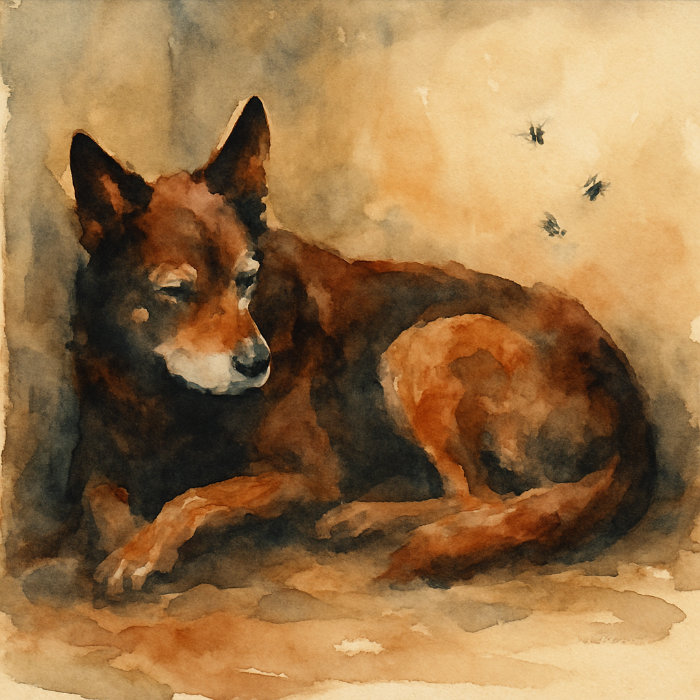
    Let us regress a few weeks, before the scene at the homely Junction Hotel. Before the discovery of the headless body. Before any names were written down, even in a dog-eared notebook. The world barely notices such half-invisible men until a cause arises to record them – for all their swagger. This was before all that, when they strode unhindered and unsought. Dust clung to them, and their deeds had not yet congealed into fates. Glenorchy manifested itself lazily as they approached: a post fence, a dozing kelpie mix, the tin flash of a roof. The Royal Hotel waited in the heat, half-slumped, only half-aware.

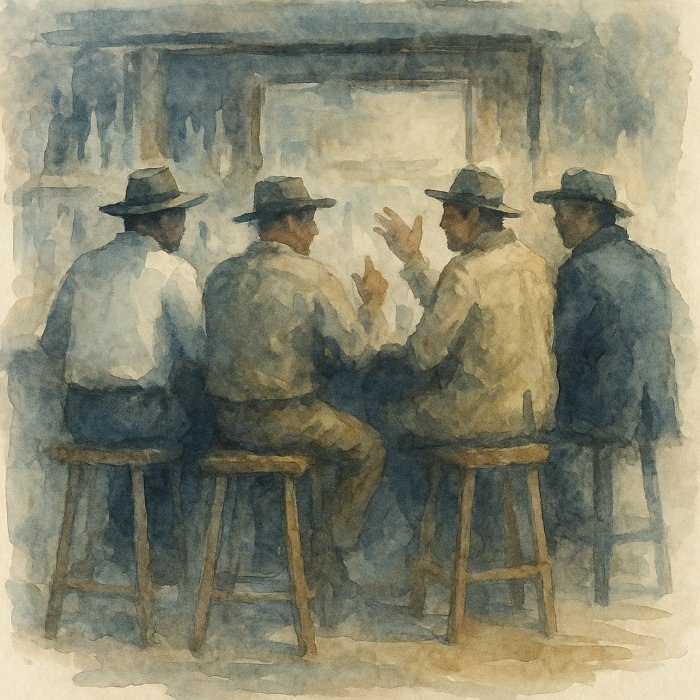
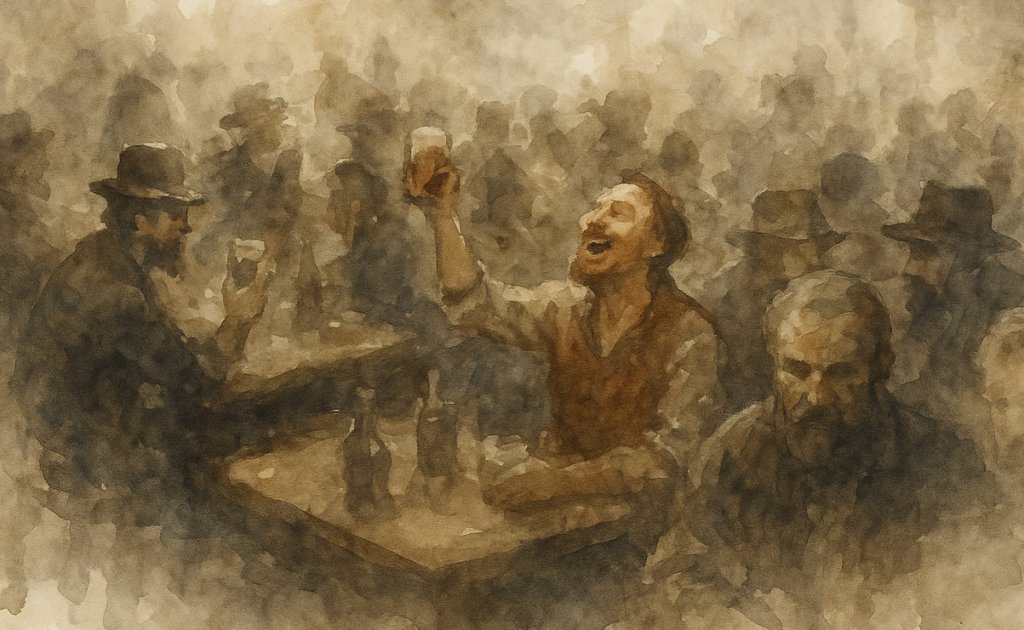
    “This is a hellish, God-awful, melancholy town. The miserable bloody air here alone is enough to make a cove want to get rotten,” Burns said, dispensing with his hat and scratching his head. Truth was, he was feeling tolerably well, buoyed by the promise a day held that commenced with a bout in the Glenorchy Royal Hotel, renowned as it was in the district for its unadulterated grog. No fig tobacco in the brandy casks here, cobber. And the publican’s daughters are good sorts, too – said to cut out a stubborn bullock as good as any plains stockman. The publican knows everything about anything, by all accounts, including, perhaps, the lay of the land. But it turns out he ain’t here. Joseph Jenkins, the self-styled “part proprietor,” has charge of the place today and is big-noting himself on the strength of it.

    A hollow masculine chorus echoed in the bar – voices of shearers, farmhands, bullock-drivers – out of which one solo strain or another might ascend now and then, distinct enough to catch scraps of individual wisdom: the blowflies, the heat, a dog’s virtues, or a horse’s ailment. The most vocal, a couple of ancient farmers at a table by the front window, were bemoaning rabbits.

    “Official work to do, Scotty,” Burns said. “No good to be drunk as fiddler’s bitches.”

    “Why bullock our guts out? Like my old man used to say, never put off till tomorrow what you can do the day after. A spell of easy drinking will give us zest for the task. Don’t take much, anyway, to find out where the lots are, chuck up a couple of pegs and notices.”

    “Back here by late afternoon for cards and hot whisky anyway.”

    “You’ve already got a good start on it, mate.”

    But Burns called the barman over and ordered four tots of rum for a heart-starter.

    “Me and me mate’s got a thirst on after a’rambling place to place for work, which we’ve been doing in the hearty manly fashion, in the spirit of comradeship that is the pride of the Australian bush,” he said – in a forced jocular, theatrical tone that, boorish as it proved generally to most audiences subjected to it, he knew would draw a guileless grin from Forbes.

    “Soon to be landowners,” Forbes said. “Proper cockies, us!”

    Burns inquired of the barman:

    “Would you mind fetching us some of the more recent volumes of your collected publications, my good fellow – any sorts of broadsheets, gazettes, whatever journals have informed and entertained your distinguished clientele.”

    Then turning to his companion:

    “Must keep track of world affairs, when you’ve got your head in a hole in the ground half the time, old man. See how the Australian Eleven are going over in the old Britannia, and so on and so forth.”

    “Oh yes, God almighty!” Forbes let go a cracking belch that silenced the bar for a moment, and the two roared madly, Burns holding his stomach and shaking his head.

    When the barman returned with their nobblers of rum and some newspapers, Burns raised a hand as if to prevent Forbes from paying and produced two shillings from his money purse. “It’s what a bloke does for a good cobber, who’s a half decent sort,” he said.

    Forbes threw his head back from his paper, then tapped it three times with his index finger to mark the rhythm of his utterance, as if to emphasise its gravity.

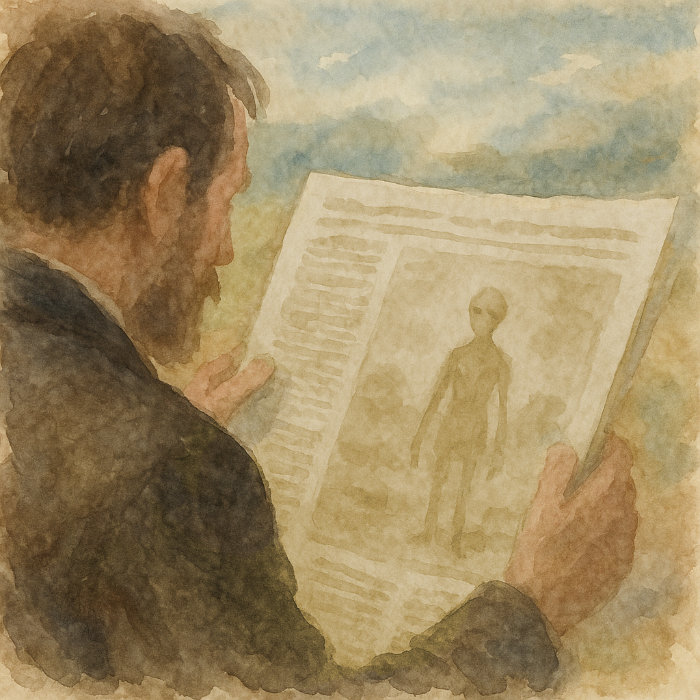
    “I bloody well knew it! People on Mars are no bloody different from us here on Earth.”

    “What is that nonsense?” Burns said, glancing up from a cricket report.

    “Not nonsense, mate, The Australian Town and Country Journal, scientific notes. It’s not as bright as it is down here, but their eyes are more sensitive, so they can see just as good. The polar snows extend further, so it’s colder, you know, naturally, but by no means less in proportion to the lessened power of the solar rays – so, anyway, make of that what you like.”

    “Fuck me dead,” Burns said.

    “This Professor Lockyer – or some what’s-his-name or other – has discovered several remarkable seas in the southern hemisphere, including inland seas, some of them connected and some not connected with the larger seas by straits. One of their seas looks exactly like the Baltic, and there’s an equatorial sea, a long straggling arm, twisting almost in the shape of an S laid on its back, from east to west, at least 1000 miles in length, and 100 miles in breadth.

    Forbes shook his head slowly and mused through the window towards outer space.

    “Let’s have another rum. That reminds me, we need some S-hooks from the blacksmith’s, for sinking them dams in Dunkeld.”

    When the barman served them, Burns was again magnanimous in paying.

    “Why do you say that every time?” Forbes said.

    “What?”

    “All that deal about paying for your mates. I’d take my turn just as quick, except you’re holding all my dough.”

    “What?”

    “Nothing.”

    “And why would that be, do you reckon?”

    “What?”

    “Why am I holding your dough for you, do you reckon?”

    “So as I won’t chuck it away on cards?”

    “Or pour it down your gullet, right? Look here, if you want to hold it yourself, you’ve only got to say so.”

    “Ar, it’s alright, you go on holding it.”

    “No, no, here you go, have it bloody back, because I know what’s going to happen.”

    “No, it’s alright mate, you hold it. You hold onto it for me.”

    “No,” Burns said, raising his voice as he bent down to undo his swag, lying on the floor by his boots. “If that’s how you feel about it, you take it, and we’ll wait and see what happens.”

    He fussed around, unable to lay his hand on the stash immediately, testily disembowelling the swag. The bar now quiet, furtive eyeballs over nobblers of whisky hot. Strange ones.

    “Don’t worry about it, Bobbie” – Forbes pleading – “I’m sorry. You look after it for me, please mate.”

    Burns’ back and shoulders slumped as he sighed, tut-tutted, shook his head, sat up, leaned back.

    Pause.

    “Ah, Scotty, what are we going to do with you, son? I know you’re a good’un right and proper, but god you make it hard to look after you sometimes.”

    Weary head shake.

    “Sorry mate, sorry.” Forbes placed his hand on the back of his mate’s wrist, and the two men looked each other in the face. His eyes watered, a teardrop forming at each inner corner. Conscious of it enough not to sniff, he looked into Burns. A kind man, tough but kind, good to me. His eyes, well, there was a trace of softness to them. Like his beard, bushy but soft. Burns could see right into him, too; he could see that much. They had shared tender times together, which was not the usual lot of those thrust together in railway camps. Forbes sought a salve of kindness in his eyes, the closest thing he had known to affection for a long time – who knows? – for his whole life long.

    Day moves along, and the rambunctious hour draws near. Patrons who’d started at half past ten in the morning are caught up by tardier arrivals, spurring themselves on to comparable states of elation.

    At some point, a mob of navvies crowd round the old farmers and begin to ply them with whisky for sport. Taking a barrel or chair for a seat, the hands share the one table, while one or two stand leaning against the wall engaged in their own conversations.

    “Bloomin’ city so-called ‘sport shooters’ brung ’em over from the Old Country, and the sparrows and deers and all. Said in the paper, if we got rid of the vermin, they’d get even more. Bloody Wild Rabbit Propagation Committee, would you believe?”

    “Don’t tell me!” yells a hand, hawks and hacks in his pocket-rag out of politeness.

    “I’m telling you, my son,” says the old red-haired feller, “It’s bad enough now with the rabbits, but in the sixties, them damn vermin was so many, you’d go to pull out spuds and find they was rabbit nuts instead!”

    “You don’t say!”

    Hoots and hollers. “What’d you do with the rabbit, mate?”

    “Well, you threw it out and chucked the balls in the broth for veggies. No one was in the mood for rabbits no more, in no shape or form, I’ll tell yer that much.”

    “Didn’t the government do nothin’ about it?”

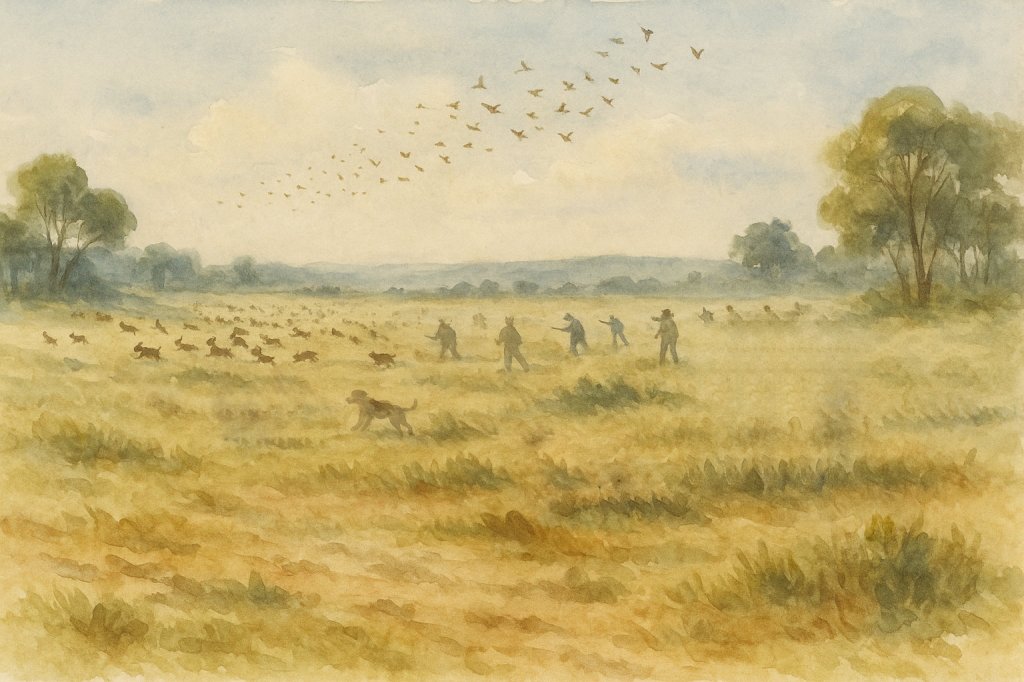
    “I tell you what,” says old red-headed bloke’s mate. “I’ll tell you right now all what the guvment’s good for. Bloody nothing. A year ago they come up here, these blokes, an army of them got sent by the guv’ment. Half a dozen Melbourne loafers and twenty-eight mongrel dogs! They went into a district so thick with pests that hundreds of men, women, and children had worked day and night for months with dogs, guns, and traps – and still made no impression. So we laughed our guts out at these poor bastards running around with their dogs. Not worth a tinker’s dam, them blokes. And sure enough, the dogs tired of huntin’ rabbits and thought they’d prefer worrying the sheep, and the local inspector took out a writ against these bastards for having unregistered dogs!”

    A gust of laughter rips through the heat – “God Almighty!” – “Don’t tell me!” – “You’re havin’ us on, y’old bugger!” – “Bloody hell, so who was the vermin after all, eh?!”

    Misshapen dwarfish gargoyle Poor Joe the Ostler is all unbridled mirth.  Lets loose an ear-splitting hoot, perching upon his stool. Leaning next to him, kindly Tom Piper, who was once a prize-fighter, stands Poor Joe another, but will keep an eye on him.

    “Goin’ to have a wee jig, Joe?” lisps a vile flea called MacDougal, peering across Tom Piper’s face, up to mischief. Poor Joe’s drunken antics are a thing to behold.

    “Do you want to find yourself out there on your face in that muck-heap, MacDougal?” Tom Piper is not one to waste words, and MacDougal slurps quietly, before seeking less perilous entertainment.

    Old red-headed bloke’s mate. “An imbecile from Warrnambool invented some kind of pills to poison them rabbits, and them pills did work to great effect for sure when a rabbit ate one, but hardly any of the rabbits did. Weren’t to their liking. God’s blood! We tried destroying them, filling their burrows with poisonous fumes, but that was damnable hard work, and we didn’t know where half their burrows was. It’s a nightmare, as you can well imagine!”

    Burns sorts the accommodation.

    Pencil poised, the barman assumes: “Two rooms?”

    “Just the one, son. He’s too far gone to warrant a room his own. I know him. I’ll have to look after him later.”

    “Who’s paying?”

    “I am, for sure as lookin’ at me, see this roll I’ve got here!”

    The barman looks him in the eye – a flicker of recognition there, and maybe a hint of suspicion.

    “Come on, cobber, I’ll see you an extra couple of bob.”

    Something in the barman’s smile twitches – almost salacious, or maybe just the beer – but not enough to call it a leer. And Burns missed it anyway.

    “If you say so, mate. Two bob, ya reckon?”

    Forbes mingles, spreading his innocent masculine charm, and generally the locals take to him. Burns has passed him enough dough to stand a few rounds, and he is liberal with it. Here is the single theatre where he can demonstrate the largesse that he aspires to be known for. In return, you have to lend him your ear to chew on for a bit.

    “Who are you, my good man, and what’s your game?” says Forbes to an amiable fellow

    “Archibald Fletcher. I work for Stawell Council as a road overseer.”

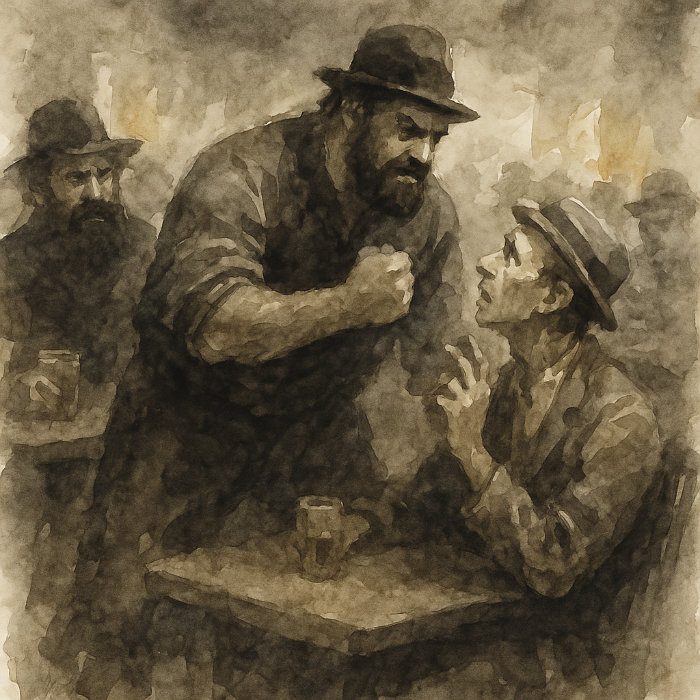
    “Well, Archy, I wish to have a word with you. Who is that gentleman over there with the long white coat? He insulted me about my church, my creed, and my coat, and I will not take that from any man! Not him nor you.”

    “I see no such chap.”

    “Do you think I’m stupid, do you? You might be surprised to hear that some fellow in England has made a remarkable invention called ‘captive daylight.’ Did you know that, smart-arse?”

    “And what might that be, Scotty?” Burns sidles up, winking a cold wink at Fletcher, the council road overseer.

    “What it sounds like, mate, just what it sounds like. I read that this chap, a Mr. Balmain, I think his name is, if memory serves, has succeeded in producing a luminous paint which can absorb light, as it were, and during darkness will suffice to illuminate an entire apartment. Very interesting article.”

    “My lord! That will be good for the outhouse!” Howls from those in earshot. “Yeah, good for readin’ the paper in the dunny without no candle!” Further rustic, scatological expressions of humour.

    Fletcher moves off, as the others incline an ear.

    “Yes, well, indeed, some might suggest there are those dimwits who can’t get their minds out of them parts! Anyways, they’re going to use it in compartments on board ironclads, probably. It’s quite intelligent, really,” Forbes says.

    “How would you turn this paint off when you wanted to go to sleep?”

    “Well, I don’t know, I suppose you don’t need to sleep in the dark, does you?”

    “A lot of blokes don’t like to sleep when the room’s all lit up, like. I’m one of them myself, in fact, so it seems to me there are apparent drawbacks with this invention.”

    “I can assure you as some folks would prefer to read late into the night, save on the price of oil at the same time, and pull the sheet up over their head later.”

    The laughter swells around them, voices breaking off into pockets of side talk. Burns drags a barrel up beside Forbes and leans close, his mouth near the other man’s ear, speaking gutturally against the racket, passing on what Jenkins the barman calls good oil on the allotments of land up for selection. There’s one or two up this way, not far from the river, which at this time of year has dried up into a line of muddy water holes, but there’s some better ones closer to Stawell, too. Blow going all the way down there today; best to catch the train there tomorrow or the day after. Cast an eye over the ones up here first. Bit of a walk this arvo. Then go down to Stawell by rail. You can meet the missus and kids.

    They down two more solid nobblers of rum apiece, before following the route Jenkins’ map takes them on, out of town and north-east towards Swede’s Creek. Forbes has procured two flasks of brandy with what is left of the money Burns has given him, and they alternate swigs, while Burns elaborates on his vision of their shared future as wheat farmers. For the most part, Burns will live with his wife and six children in Stawell, and Forbes will occupy a house on the new property. They stop at the weir for a smoke and gaze down at the muddy trickle way below. Burns lets drop the empty flask, which comes to rest with its mouth barely above the surface, such that suddenly the waters eddy in, until it emits a comic gurgle and disappears.

    Burns knows more than enough about farming, he reckons, to put Forbes on the right track. There are two classes of selectors – one goes on the land without money, and the other without knowledge; and there are some who go on the land without either. But of the first two, he would rather give credit to the man who lacked money but possessed knowledge than he would trust the man who had a limited supply of money and no knowledge at all. Did you know, mate, that sailors make the best selectors? The best of non-farmer selectors, that is. They are quick-eyed, active, strong-handed, and excellent judges of the weather. They can, he opines, almost without exception, successfully compete with old hands in fencing land.

    Four bottles of water? asks some bird invisible in the bush, the phrase clear as speech.

    “Well, I sure ain’t no sailor neither,” Forbes admits, in a tone that one would not quite call wheedling as such, though a kind of seeking for self-reassurance is evident in it, some murky undertone. “I think I might have my work cut out,” he says with a self-deprecating smile.

    “Tosh! you will do alright, son,” Burns says with a wink and a slap on his mate’s shoulder. “Well, I have to say the land’s not much good around here. Only fit for a sheep walk and a poor one at that. You’ll find a sheep every five acres around this place at best.”

    They continue their trek for a while, Burns examining a clod of the friable clay here and there, until the second flask is emptied. “Not too heavily timbered around here,” Burns observes, taking a final swig and tossing the flask. “Just a few patches of bull-oak – though that’s useful stuff for building.” Belch. “The creek’s not always like this, you know, just waterholes. It fills up alright, and I heard some talk back there about some sort of irrigation scheme that might come through in a while.” Snort, hack.

    “Listen to them birds,” Forbes says with a giggle. “They’re saying the same thing over and over and over. What sorts of birds is they?”

    They stop still and listen. A long silence. Then … CRACK! Click-click-click!

    “Out here? Must be lost,” Burns mutters of the Eastern Whipbird.

    Four bottles o’ water – watchya baaaack!

    “There he is!” laughs Forbes – a flash of sheer, foolish delight. “Four bottles of water!”

    “They’re not talkin’, just skwarkin’, son.” Burns’ patience thins. “Will you listen to what I’m saying to you, for Chrissakes?”

    Forbes is still looking up into the branches, laughing.

    Burns exhales, the sound more growl than sigh. A shadow seeps into his gaze and his jaw tightens.

    Cackling, Forbes mimics some more, then falls silent, listening. Burns spits, thinking. Here and now, God help me, I could kill him.

    As they go on, Burns lags behind, wobbling his head, sneering, and mouthing Forbes’ words in a sarcastic pantomime.

    They arrive back at the Royal. Forbes takes some brandy and old newspapers up to their room and pores over some articles of passing interest, though his brain is unable to comprehend much of what his eyes admit into it: The necessity of employing very intense temperatures in cremation, so as to convert the body into ashes, appears likely to be done away with by the experiments of M. Lissagarry. The difficulty in cremation is to decompose and reduce to ashes tissues containing 75 per cent of water; but M. Lissagarry overcomes this by exposing the body, first of all, to the action of superheated steam, which chars the tissues and enables them to burn easily in an ordinary simple furnace at a very much less cost of fuel and without the least unpleasantness . . .

    He blinks slowly, reaches for the brandy, and lets the print swim before his eyes, the words dissolving into the paper’s yellowy grain. His lips shape the words soundlessly. There are some hard ones, but Bobby will know what they mean. He always knows. Rolling onto his back, arms askew, Christlike, he drops into unconsciousness. Snores like ballast pouring into a hopper. Dreams a dream of a sky fretted with magpies, wings beating over acres of land littered with skeletons.

    Tom Piper steers Poor Joe, incoherent, out the back to his mat of hay in the stable. Off he totters, and Tom returns to the fray.

    Burns throws himself into a chaotic game of three-card loo in progress in a smoke-filled room adjoining the bar. Six men compete for tricks around a dilapidated table buried under piles of coins and damp clumps of notes, while onlookers crowd in to outshout each other’s wagers. In the main bar, an accordion strikes up an off-key melody, an Irishman belts out an amorous ditty, forcing the instrument to conform. Then a polka, and a few dance in pairs, man on man, stiffly wobbling around each other like toy peacocks, leaning away, gripping each other by the elbows. Only one woman is present, and she is too far in her cups, anyway, to be of any use, engaged in a slurring interchange with a navvy at the bar, though their topics are unrelated, and they speak past each other’s eyes.

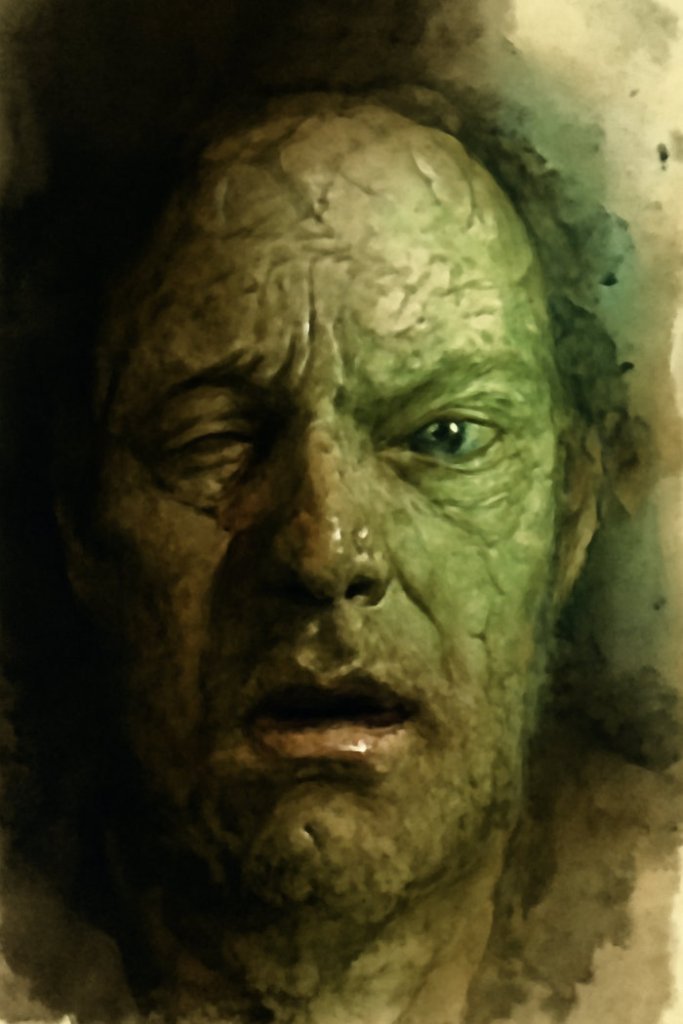
    Burns’ cheer curdles as his luck rots. Repeatedly ‘looed,’ he feeds the pot, three at a time. Others scoop the winnings while his pile shrinks. The pool swells. Greed thickens. The drink works deeper with each loss, peeling him down – the drunken, belligerent aggrandising become brutish, to reptilian – to a being older than men. His hands move more slowly now, eyes narrowed, as though weighing the other men for more than their cards. A primitive thought coils, half-remembered, half-whispered by something older than his bones, shedding centuries like skins – as though a presence that had slithered through ages of darkness might, on a vicious whim, infect a human soul.

    After the fun, Jenkins the barman is left to sweep the refuse into piles on the floor. He leaves the doors open for the last curls of tobacco stench to drift out with the nocturnal breeze. The place is otherwise empty except for Burns – or rather, what’s left of him. The man-shape slumps in the chair, but the thing inside is pared back to its oldest layer, the cold-blooded remnant that survives when all else is stripped away. His gaze is hooded, face sliding off the skull, mouth agape and drooling. A slow flick of the tongue, lizard-like, tastes the air.

    When Jenkins has finished sweeping, he leads the creature up the stairs. By the top step, Burns is down on all fours, almost slithering. “Here you are, mate,” Jenkins says at the door. “Allow me…” He turns the master key and ushers the creature inside. From somewhere far back in his skull, Burns watches this with cold detachment. When he spits, his saliva oozes in strings to the floorboards. He tries littler ptuh! ptuh! spits to be rid of it, but it clings there.


    Michael Guest © 2025

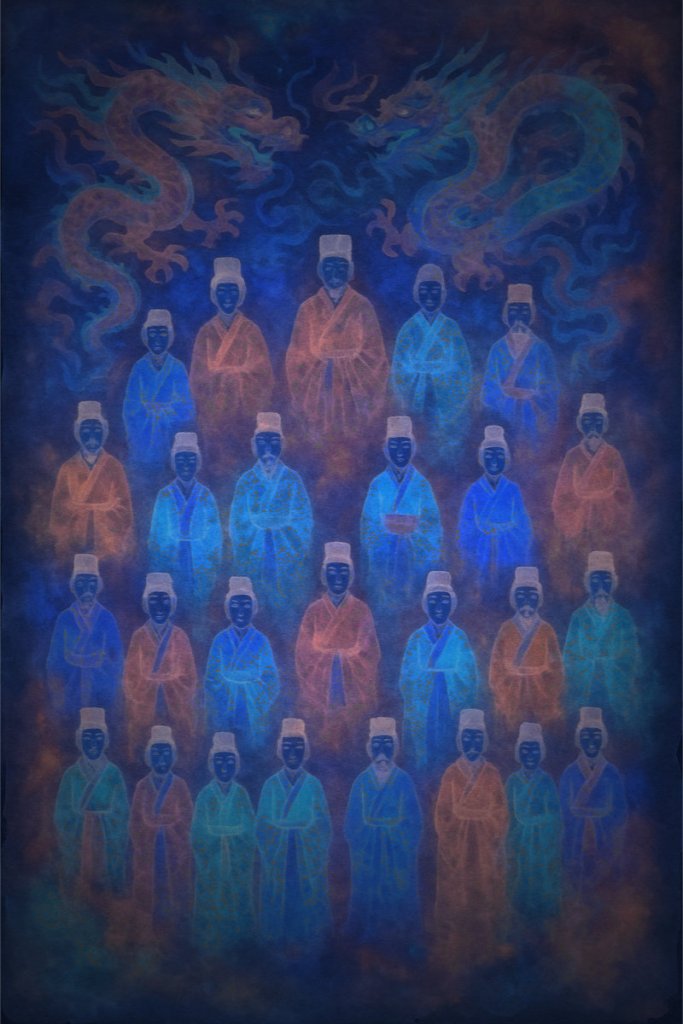
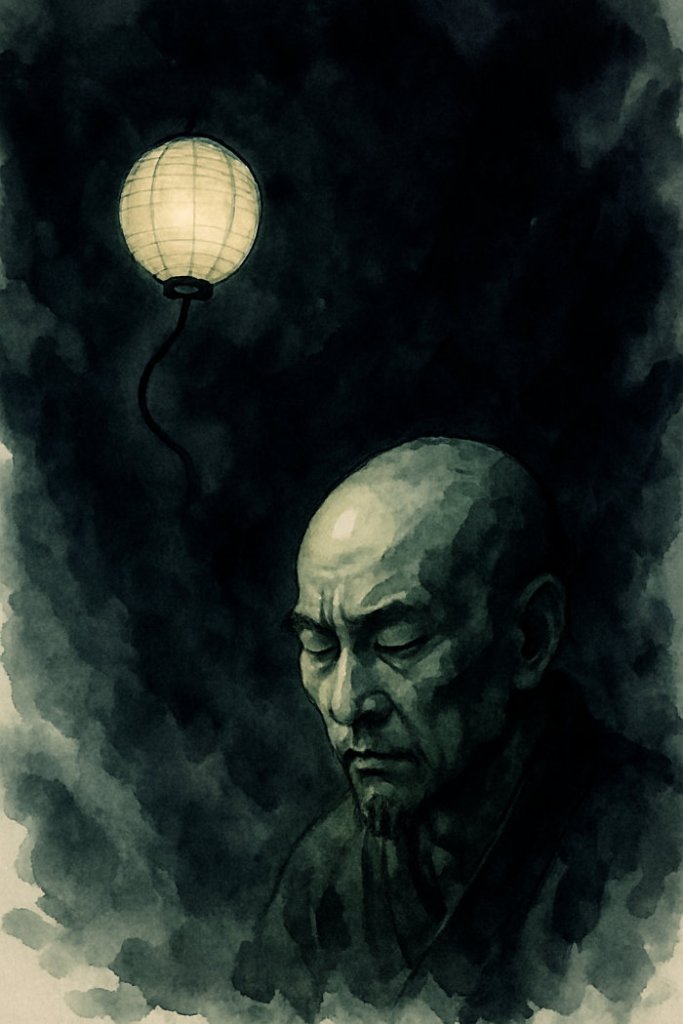
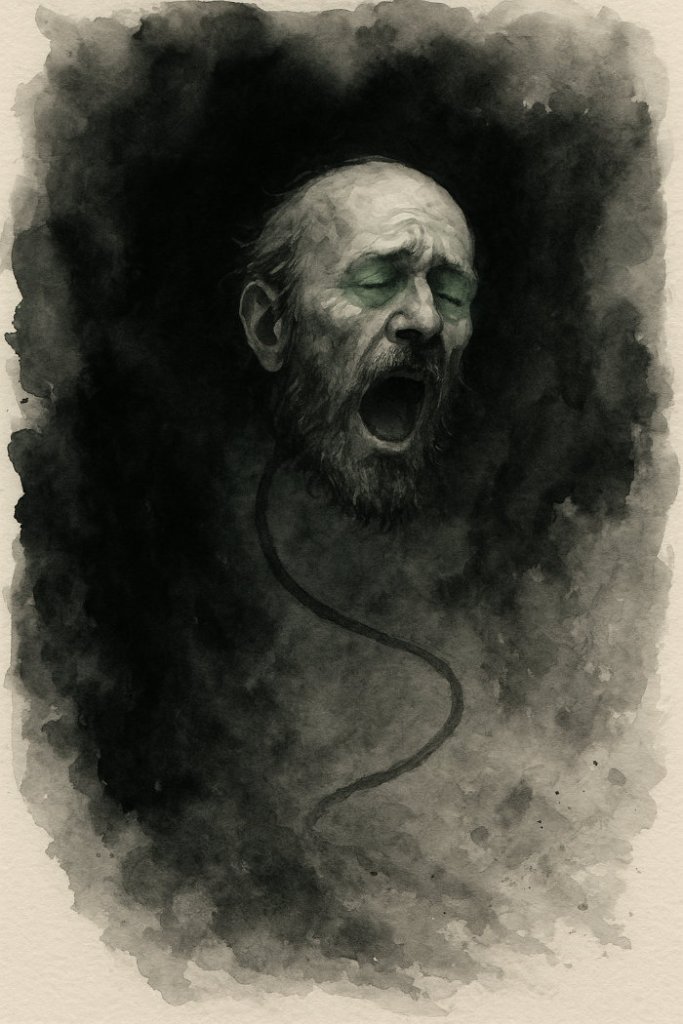
    Images generated by AI

  • 2. Autopsy at the Junction Hotel (from the draft novel Stawell Bardo)

    2. Autopsy at the Junction Hotel (from the draft novel Stawell Bardo)

    Autopsy at the Junction Hotel

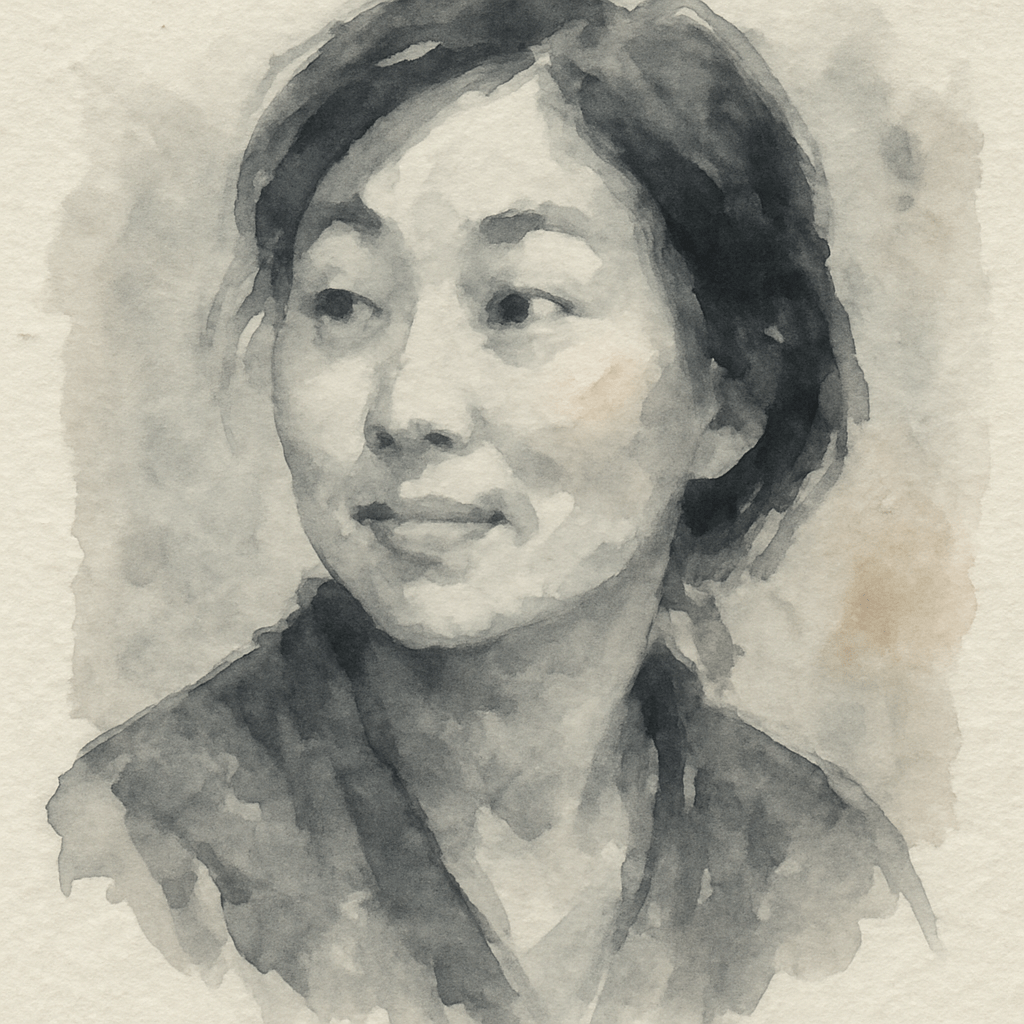
    Sound of hooves and iron‑shod wheels on gravel reached the Junction Hotel door, a rare interruption in the sleepy settlement. Huish‑Huish brushed back her hair before going to answer the knock. A detective stood at the doorstep, one finger tapping lightly against his thigh. He was waiting for Mow Fung to answer, a name he knew from the licensing roll. He had driven from his headquarters at Stawell, only a few miles away.

    “Mrs Mow Fung, I presume? I am Detective Forster.” He made a slight, polite bow. A nervous man, a lean man, she observed, and the lean, nervous man removed his grey felt hat and fingered the brim. If he meant to unsettle her, he’d have to try harder. She caught the tang of carbolic soap clinging to him in the close air of the doorway. It suited him somehow. She ushered him into the bar. Theirs was a modest establishment, but scrubbed spotless. The faint smell of lamp oil and aged wood lingered in the cool interior, a scent that seemed to settle into its polished tables and floorboards. She had been topping up the lamps, and a tin container of oil remained open on one of the tables, next to a neat pile of linen squares.

    They passed the bottom of a staircase, halting at a child’s footsteps that came thumping down.

    “Mama! Alice won’t eat her porridge. I’ve told her and told her but she just picks at the egg and won’t touch anything else.”

    The mother suppressed a sigh. Such was the morning ritual. “Tell her the police have arrived. Once they deal with your father, I will have them deal with her too, if she is not careful.”

    Detective Forster could not prevent a cough, but immediately resumed his grim composure.

    The girl, aged twelve or so at most, ascended a few stairs, halted, unafraid but inquisitive.

    “What will they do with her, Mama?”

    “Use your imagination!” Huish-Huish was outdone – the child was incorrigible. “Now make them eat their breakfast properly and off to school with you! Foolish girl.”

    The daughter climbed the stairs with purpose, the hem of her uniform brushing the narrow boards.

    The mother stopped at a door halfway along a dim, unadorned hallway. The air smelled faintly of cold ash and last night’s cooking fires. From behind emanated the ghost of a voice. No distinct words, but what the newspapers mocked as “Oriental mishmash.”

    Turning to Forster, she said, “My husband is inside here with the gentleman.”

    “The others have already arrived?”

    “Only the dead one so far,” she said with a smile. “Mow Fung is a very silly man, who nurtures some foolish superstitions from old China. You must forgive him.”

    But she did not go barging in. There may be others. She laughed softly. “He daydreams, fantasises he communes with the dead. You know, he sinks down into the Ten Courts of Hell and has a bit of a chat. Haha!” She said it in a melodramatic tone with a gently mocking lilt.

    The faint chant in the room faltered, as if aware of their intrusion, then died altogether. She pushed the door open. The candle was out. The trace of a strange perfume lingered in the air. His odds and ends were tucked neatly out of sight. Forster felt the change in atmosphere as they stepped in – the pall was unsettling after the murmur that hung in the hallway.

    Mow Fung drew back a curtain, and the morning sun slanted through a haze of fine dust. He smiled at Forster and bobbed his head in a dumb-show of humility. There was something indefinably unusual about the fellow, Forster thought.

    A noise of wheels and hooves announced more visitors, and Huish-Huish left the room to meet them. Forster jotted a few notes in his pad as he examined the corpse.

    “This is exactly the same state it was in when it arrived yesterday?”

    “Of course, detective,” Mow Fung said.

    “You haven’t touched it?”

    “Touched it?” Mow Fung repeated. “Good idea. A very good idea! You are an excellent detective, I see that already. Splendid.” He pressed his palms together in a position akin to prayer and nodded. Forster found himself almost infected with the broad smile.

    “Very nasty business,” said the oriental. “Murderer came up from behind, a trusted companion, a good mate. Never knew what hit him!”

    Was that a laugh? A cackle? What was wrong with these people?

    Forster stepped to the table and took hold of the neck of the cadaver, stretching the flesh about the open wound. A sharp instrument had been used: an axe, probably, or maybe a tomahawk. The weapon evidently slipped in its course at first, creating minor abrasions before cutting right in through the neck.

    He turned to the Chinese man.

    “Mrs Mow Fung tells me you have been … communicating with the deceased,” he said.

    Mow Fung smirked. “The missis,” he said, “is a silly woman who nurtures some foolish superstitions from old China.”

    Forster gave him a piercing look. “Be so kind as to tell me, then, how you could have arrived at your – your deduction otherwise?”

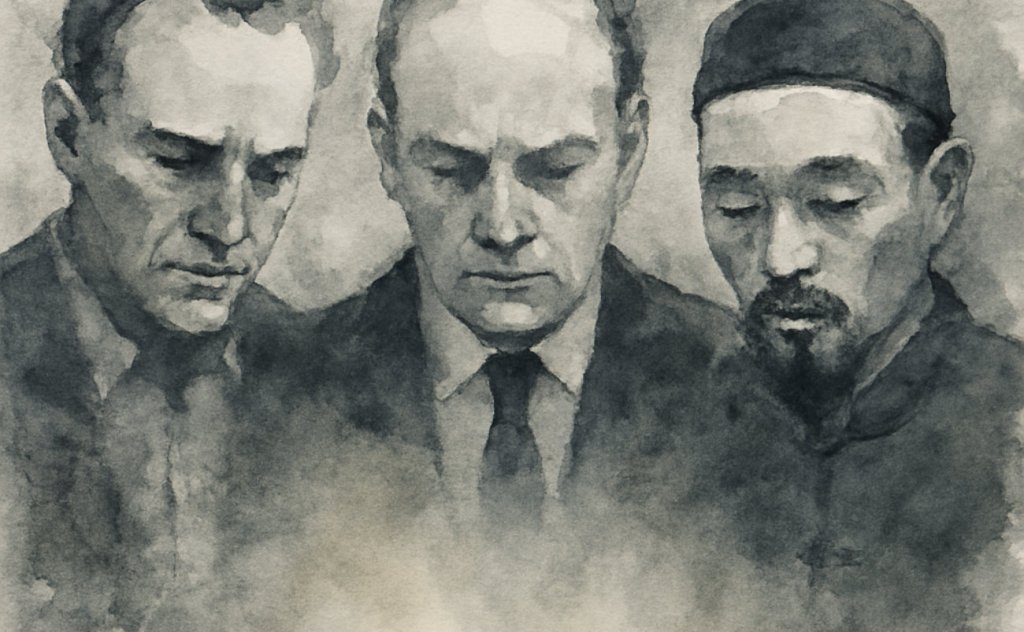
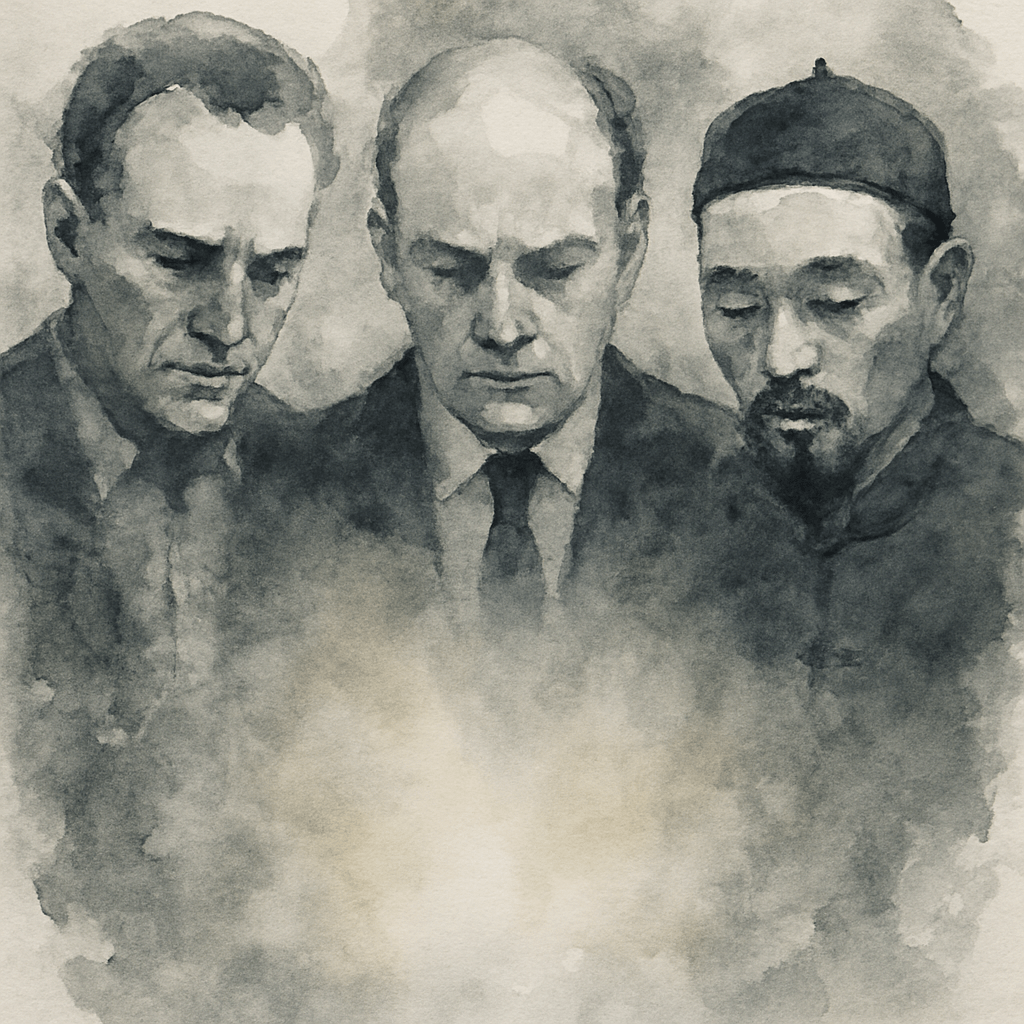
    At that moment, Doctor Bennett, the constable, and Henry Wilson  – the miner who found the body – came into the room. Bennett cut Forster’s introductions short to begin the post‑mortem, and the constable took out his notebook. Forster and Mow Fung took chairs, while Wilson remained standing nearby, arms folded, watching in silence.

    “A European. Body very dried up. Bad state of decomposition,” Bennett dictated. “Much of the skin has been eaten away – particularly from the arms and legs – torn off in patches, very much dried up and leathery. A good portion of the integuments is gone.”

    “A lot of wild cats out there at them old Four Post diggin’s,” Wilson volunteered, but Forster silenced him with a look. “We’ll go through all that later on,” he said.

    “Too far gone to examine the internal organs,” Bennett continued. “The head is off – missing. It wasn’t found at the location, I take it?”

    The constable shook his head. “No, sir.” Of course not: some things the bush will not give back.

    “The upper margin of the skin on the neck has been divided by some sharp heavy instrument. About an inch below the margin of the neck is a transverse cut through the skin, which extends down to the vertebrae, evidently made by the same implement, probably a hatchet or axe. No other marks of violence. The upper margin of the neck is indented as if by a succession of cuts. The head has evidently not been severed from the body by one single blow, but by several. One cut extends transversely across the neck. Numerous abrasions in the vicinity. The vertebrae have been severed with that heavy blade. No, I should not think it was done with one blow.”

    “Not suicide then?” Wilson said deadpan.

    Forster gave him a withering look.

    The doctor continued. “I would estimate the height of the body to be that of a man about five foot ten or eleven inches. As for the length of time the body was exposed, I could not speak with certainty. But I would say any time from four weeks upwards – probably two months or so, to become dried up and mummified like this. Absolutely bloodless. From an examination of the bones and hair, I would conclude that the body was that of a middle-aged man probably between the ages of thirty-five and fifty-five years.

    “Internal organs – those of the chest and abdomen – are very much decomposed, and in the condition of… well, pulp. From the upper margin of the neck to the heel is five foot one and a quarter inches; from the tip of the shoulder to the ankle, four foot nine. The frame is large-boned and that of a big man. Some of the hair of the beard is on the neck – reddish-brown hair mixed with grey.  Skeleton is perfect. No broken bones.”

    He drew a surgical saw from his case and cut off a piece of vertebra and two fingers, then scraped some sandy‑red hair from the neck. He placed the specimens in a jar, which he plugged with its cork stopper.

    “Apparently after having consulted the victim in the afterworld, Mr Mow Fung here informs me that the deceased knew and trusted his murderer – enough to let him come up behind and take him by surprise,” Forster said.

    The constable chuckled.

    “Come on, leave off Sarge!”

    His superior paid him no mind, studying the body as he spoke.

    He turned to Wilson. “You discovered the body lying as it is now, Mr Wilson? On its back?”

    “Yes, sir. On its back when I found it, and your coppers brought it here the same way,” Wilson said.

    “Mm. Yet observe these abrasions on the chest, and the tiny stones impressed into the flesh – or where the flesh was exposed when he hit the ground. Even if the clothing was stripped away afterwards, the marks are clear enough: they suggest the body struck the earth face down.”

    Forster leaned over the table, his hand hovering a few inches above the corpse’s limbs, tracing out their outline. “And note the awkward sprawl of the arms and legs. The hands, palms upward as he fell, show no attempt to break his fall. Whoever removed the clothing may have shifted him somewhat, but that detail remains. He never knew what hit him. A pretty business indeed.”

    He straightened and glanced at Mow Fung. “Does my analysis accord somewhat with yours, Mr Mow Fung?”

    Mow Fung said nothing, gazing clearly into the detective’s eyes, a hint of a smile hovering on his lips.

    “I am a simple hotel-keeper. I am sorry – I do not follow your complicated talk.” Pensively, he stroked his sparse black beard (one day it may grow into a venerable white one). “Perhaps we do not see things as they are,” Mow Fung continued, “but as we are, as it was said in the old time.”

    “Quite so.”

    “Will I put that in, Sarge?”

    “Might be a good idea to insert it as a footnote for you to incorporate into your own meditations, which I’m sure you engage in regularly.”

    Mow Fung watched the buggies of the detective and the doctor, and the uniformed constable on horseback, recede at a leisurely pace down the dusty main street of Deep Lead – towards the old abandoned gold diggings on the Old Glenorchy Road. They rounded the bend, passed Bevan the ironmonger’s, and disappeared into the bush.

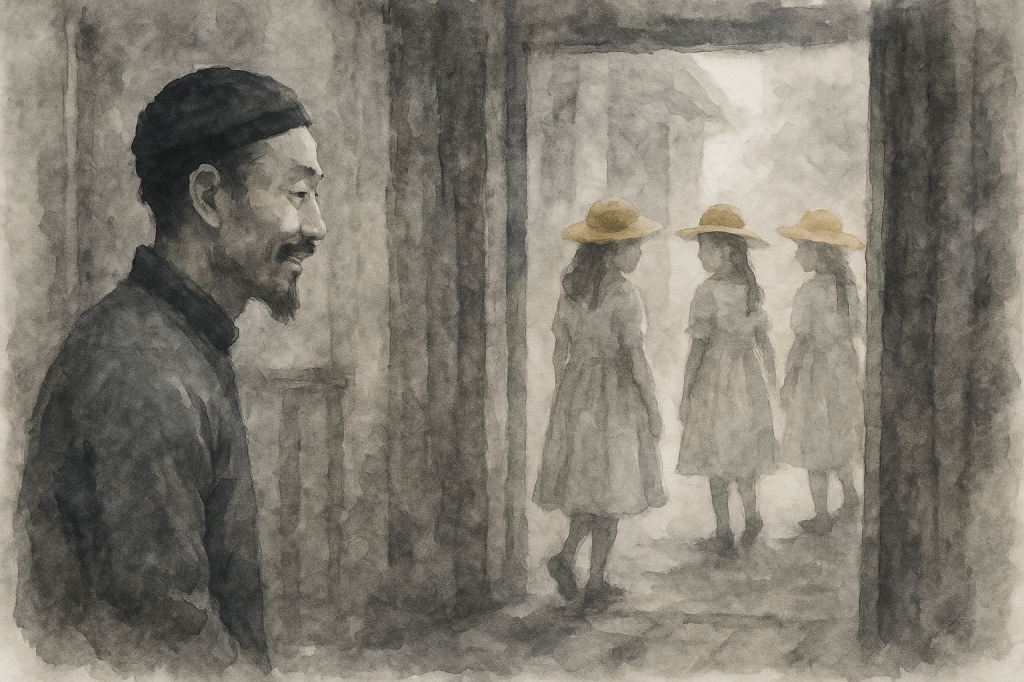
    He met Huish-Huish coming in from the laundry with an armful of towels, their youngest daughter Alice trailing on her skirts. At that moment, the other daughters trooped down the staircase, Lena – the eldest at twelve years – herding her siblings. School uniforms and wide-brimmed straw hats floated in a bubble of chatter, expressing such immediate and minute issues as are memorialized perhaps in the record of human souls, but seldom if ever recalled in human life. “Hurry now,” Huish‑Huish called. Alice was moaning about the porridge. Lena hesitated at the threshold as the others spilled outside, her hand lingering on the doorframe.

    Mow Fung could not refrain from a smile and faint shake of the head as they left with no fare-thee-well, though Lena struck him as older than her years. His eyes followed the children as they disappeared, then shifted to the bush beyond the paddocks. He remembered what Wilson had said: the body had been found at the Four Posts. He gazed at the bush a moment longer, the name settling uneasily in his mind.


    Michael Guest © 2025

    Images generated by AI
  • 1. Down Train from Horsham (from the draft novel Stawell Bardo)

    1. Down Train from Horsham (from the draft novel Stawell Bardo)

    Though railway convention would designate a train travelling from Horsham toward Melbourne as an up train, I have titled this chapter Down Train from Horsham intentionally. The descent invoked here is not geographical but tonal: a movement into rougher country, uncertain fortunes, and subterranean narrative currents. It is, in spirit, a passage downward.


    Down Train from Horsham

    Some dragon stirred from its rest with a snort and shrill hiss. Flame flashed beneath her firebox, steam jetted behind the front wheels, a plume burst from the smokestack. The engineer tugged the pull cord and let go two long, shrill blasts on the screamer.

    Over on the wide, newly asphalted street, their cart driver pulled his horses up to a stop. Forbes was on the ground by the time Burns hauled himself down.

    “Slow today ain’t we?” Forbes said with a wink.

    Burns grunted, dusted off his coat, and spat.

    Both strong, stout men they were, both with full beards, Burns’s brown, Forbes’s flecked auburn when the sun hit it right. The two barely had time to buy tickets, but the guard spotted them and didn’t give the flag.

    “Get a move on, youse blokes,” he growled as they strode up to the door of the last carriage.

    “Go blow your nose, General,” Burns said.

    “Thanks old mate,” Forbes said, smirking at the guard and touching the brim of his grimy, battered wide-awake hat. No nap, no fuzz on the felt – that’s what ‘wide-awake’ meant, Burns told him. He liked that.

    “No call to go tippin’ your lid to the likes of him,” Burns snarled, striding ahead. “All they do is blow on their whistles and wave their bloody flags, riding about all day on railways that we builds for them.”

    AI generated image of train waiting to leave the station at Horsham

    Burns pushed back the reversible seat to make two facing seats, and they swung their swags up onto the overhead rack. Forbes let his bulk fall, crashing down on the forward-facing seat with a thump that startled everyone in the carriage. Heads turned, eyes exchanged glances, eyebrows arched.

    An upright matron leaned to the ear of her companion, a young wife, who commented under her breath, in a tone heard through the carriage, “Navvies by the look.” She pulled a grimace of distaste and flashed a glance toward heaven. Two wide-eyed children across the aisle from the women craned their necks, straining for a better look at the commotion. The elderly clergyman turned his attention back to the Melbourne Argus in his lap, his eye pausing on the masthead: “I am in the place where I am demanded of conscience to speak the truth, and therefore the truth I speak, impugn it who list.” Ah, the brave words of John Knox, a fellow Scotsman.

    Acting oblivious to the disapproving looks but inwardly savouring them, Forbes leaned back to think on the waves of heat rising from the platform. Burns stood with his hands on his hips, staring down at his mate, gripping the seat to adjust his balance as the carriage lurched forward.

    “No, I won’t go backwards,” Burns said.

    “What’s that?” Forbes said, still looking out, the hint of a rascally smile on his lips.

    “It gives me the pip, going backwards does.”

    “Gives everyone the pip, Burnsy. Be a man.”

    “Come on, we’ve been over all this. Get over to this side, at least for a little bit. It’ll have me spewing, mate.”

    “Sit down and shut up, man,” Forbes said. “We can swap after a bit.”

    “For Christ’s sake, I’m not feeling too well after last night.”

    “It was me finished that last quart of rum off with Johnson and the Painter brothers after you flaked out.”

    “Well damn you then.” Burns slumped into the seat across the aisle and looked sullenly out the window, watching the buildings slip by. He took off his hat and ran his hand across his balding scalp. Getting tired of this redheaded prick. “You’re like a naughty kid sometimes. I’m not going to read the newspapers with you anymore now. You were looking forward to that, weren’t you? Over a beer at the pub when we get in.”

    “I’ll read them by myself,” Forbes said petulantly, with a touch of true hurt.

    “Oh yes, oh yes. You are a great reader by yourself, you are.” Burns gave a short derisive laugh. “A regular font of learning. A real Aristotle. Great Peripatetic Philosopher, you are, for sure. A true Bard and all rolled into one. Ha!”

    The train rattled along, passing across the town boundary. A sweet breeze cooled the carriage and Burns’ temper. This was grand country – miles of grazing country, like parkland, and burgeoning seas of wheat turned ghostly in the sun – pale dragons gliding low over the gold. Any man’s heart would glow, and he whistled a few bars of an old ditty that had been playing on his mind the past few days. Trilli-la, trilli-la, as the lassie flung them tripes, flung them far …

    He turned to Forbes and called out over the rhythmic clatter, nodding to the scene. “Magnificent property – the Cawter Brothers, squatters of course, you understand.”

    “Sorry about all that, just pulling your leg.” Forbes said. “Here, take a swig on this, the real article. Found it in back of the cart. Blakey can get another one at the pub, blow ’im.” He offered the flask with a grin and a look that said: ‘we mates again?’ “Look Burnsy,” he said, ”I know I wouldn’t be reading at all if you hadn’t showed me, and I thank you for it, I do, I really do. Mates?”

    Flask to his gob, Forbes froze mid-gulp and grinned. “Can’t hear you. Come on over here, come on.” Forbes swung himself over onto the rear-facing seat. Burns took the place he had vacated.

    Burns shrugged off his aggravation with a mighty swig. “Grumph! God, that’s rough, you ratbag! Gad, that is poison. Villainous vile low stuff indeed it is.”

    “My word! Produces the desired effects, nonetheless, don’t it?”

    “Aye, to be sure – makes the vendor rich and the buyer mad, if that’s what you want.”

    They laughed raucously and then stopped, collapsing abruptly into a sober silence filled with sporadic vague recollections of drunken aftermaths. Pause of indeterminate length and depth. Some stubby vegetation jogged past and the carriage rocked and creaked.

    “Passable whisky.” Forbes had come to love a game with Burns.

    “Passable? My stars, whisky, you reckon! Whisky! There ain’t the slightest suspicion of malt in the composition of this grog. More a concoction of cheap liquor and primitive adulterating agents mixed in by some low, roguish bush publican. Water for toning it done, tobacco and bluestone for bringing it up to the required ‘biting’ standard. That’s what it is. Impossible to calculate the amount of evil wrought by foul stuff like this. What do you reckon? Passable, right enough!”

    Forbes laughed a child’s open, careless laugh. “Righto, well you are free to give it me back then. I’ll down it, no worries.”

    “Steady on, son! I fancy trying another drop or two yet, just to make sure it’s alright for you.”

    “How’s that, then?”

    “Not too bad when you can get it down.”

    Forbes blinked. “What’d you say back there, mate – something Brothers?”

    AI generated image of the two men smoking in the train carriage.

    “Carter Brothers,” said Burns. “Own that place outside of Horsham. North Brighton Estate, la-di-da, fancy stuff. Nothing around like that these days for the likes of honest blokes like us. The rich got the best, and you need money for grazing. Thousands of selector homesteads around these parts, though, I’ve got to admit. At first the squatters tried to get rid of them – pulled up their pegs as fast as they could put ‘em down and burned down every patch of bull-oak in sight – makes decent timber that stuff. Squatters thought they’d won out. Got all the best bits, creek frontages and fertile spots, and didn’t bother to buy up till it was too late and the selectors all got in. Now they own most of the land in the district. Yeah, plenty of selectors in the Wimmera, and soon we may be pleased to number ourselves among ’em, indeed, I’ll wager. Stake my life on it.”

    Forbes yawned and stretched. He took out a two-bladed knife and a plug of tobacco from the pocket of his grimy, gray tweed coat and proceeded to cut some tobacco for a smoke. The knife was a small one with a white handle, but one half of the bone was off, the handle on that side showing the brass. “So how about this place you want to select?” he said. “Is it worth me putting in? What do I want to go on the land for? I’m free as the breeze in the work I do, can go when and whither I wish. That’s the life.” His sly attempt to kick off more sport.

    “Ar, not again,” Burns said, taking up the flask for a swig. “Wake up to yourself, man. You’re a navvy. You want to dig ditches all your life? You’re still young. You want to get yourself a stake. What’s a navvy do, son?” He lit his pipe.

    “I don’t know … digs holes?” …

    “That’s right, digs holes. And what else?”

    “Digs more holes.”

    “Correct. And what then?”

    “Digs some holes and then some trenches for good measure.”

    Burns laughed. “Yes, very good. Anything else?”

    “Cuts some dams.”

    “Yes, for a break, and when he finishes with that? Come on, what have we been doing out at Dimboola?”

    “Ballast. Spreads tons of damn ballast along the line.”

    “Of course he bloody does!” Burns said. “And that’s a lark for you, ain’t it! Anyway, we’ve got nothing to be ashamed about. It’s men like us what builds these railroads, son. Railroads into the future, I reckon. But there’s too much of our sweat and blood in ’em. What you want is to go up in the world. Like I’ve been saying, keep our dough together and build up from there. We’ll be full-blown gentleman in the long run. Whisky, women and song for the asking. In South Australia I was born …” His sonorous tenor cracked with volume, his rhythm matching the pulse of the wheels over the railway sleepers.

    “Heave away, heave away ….” Red-headed Scotty Forbes, so-called, being Irish, was gifted with an equally stirring off-key tenor. He coughed back some reflux and took a big guzzle.

    South Australia is me home …

    Heave away, heave away …

    “Don’t worry, I looked after you over there, didn’t I, son? I’ll fix you up here too, no two ways. Oh heave away you rolling king, we’re bound for South Australia …

    The carriage rocked and clattered along. Forbes packed his pipe and lit it up, twisted his body around and leaned back over the seat. “This is a smoking carriage, is it not?” he asked of the woman diagonally across the aisle. “You don’t object to smoking, madam?”

    It was no smoking, but the woman submitted grimly and said no. Further down, the young wife staged a little drama, rousing her children and shepherding them out.

    The pipe smoke curled lazily in the light. It caught a shaft of sun and hovered there, luminous and insolent. Forbes leaned back, legs stretched long beneath the seat, puffing like he had nowhere particular to be. Beside him, Burns smirked toward the window.

    After a minute or two, the clergyman rose indignantly. He stepped up the aisle, steady as a magistrate, and came to a stop at Forbes’s elbow. “I for one,” he said, glaring down through the smoke, “do object to that filthy habit. And if you persist in indulging in it here, I shall be forced to quit the carriage.”

    Forbes didn’t look up. “Here’s a bonny little reverend, then.”

    Burns sucked on his pipe and exhaled with exaggerated pleasure. “Blind me, people can be disagreeable. Proper cantankerous old ratbags, I’ve had a gutful of their sort.”

    The clergyman’s gaze turned sharp. “Passengers who wish to smoke,” he said, “ought to remove themselves to one of the carriages provided for that very purpose.”

    “Filthy with ash and worse,” Burns said, with wide, innocent eyes. “Even a hardened smoker can’t stand the stink. Anyhow, they’re full. We usually go first class but feel like slumming it today.”

    The Scotish clergyman looking down sternly.

    Forbes puffed on his pipe, grinning back at his companion. He leaned over and hawked something from the back of his throat. The spit hit the outside of the window with a soft, wet smack.

    Burns said to the clergyman, “I know better men than you who partake of the weed.”

    “I shall request the guard remove you at the next station.”

    “No need for that, Bishop,” Burns said. “We plan to alight in that parish in any case, where we have some important business in which to attend. To wit, the acquisition of a prime piece of real estate, for your information.”

    “It’s a good half hour and more to Glenorchy,” the clergyman insisted. “These good people should not be poisoned by smoke and nauseated by your vile expectorations.”

    “Alright, have it your way, if you’re going to be like that,” Forbes said, tapping his pipe against the windowsill, so that the embers fell out onto the floor. He made a show of stomping them out.

    “And if drunken men are permitted to travel, it ought to be in a special carriage.”

    “Look, you’ve got your way,” Burns said, pointing his pipe at him. “Now if you’d kindly go and do your preaching elsewhere, we’d be much obliged.”

    The clergyman blinked, lips pursed. No one else moved. Burns leaned back and took one last puff.

    “Off to buggery with you where you belong, if you don’t mind, good sir. Go to hell with the rest of your sort.”

    The clergyman strode back to his seat, amid some covert approving nods and comments from his fellow travelers for the effort he had made, and took up his newspaper. For the rest of their journey, in loud, vulgar tones, Burns aired his views on Presbyterian priggery and wowsers, white bearded, bald headed old Scottish hypocrites, bastards and coots, and so forth, for the entertainment of Forbes, who hooted and cackled at his mate’s performance, clapping his hands in unpredictable spasms of mirth, as he would do at times, in a way that would cause the casual onlooker to think he might be touched.

    As they drew closer to Glenorchy, the red-headed Forbes drank and nodded, while the balding Burns, his elder, shared his wisdom, audible to their captive and drowsy companion travelers … “Won’t hurt to find out about it, anyway, price is very reasonable … together we’ll be right … Look at this bloody scrub … Good places coming up here at Wal Wal that got had up by selectors … be right with our stake at Glenorchy though, right as rain … Don’t worry about all that, I’ve got it all for you … Six hundred quid in the bank at Dunkeld, anyhow … Breed a few sheep here and all …”

    “I do love a train ride!“ Forbes said.

    “Fine ride, fine ride. It’s the future, you know. We are living in the future, my friend,” said Burns.

    Mother speaking quietly to her little daughter by a carriage window.

    “You can see the scenery, and the occasional sheep. Very fine indeed. trees and pastures and all the rest. Exceeding rapidity. Velocity of modern times, and no mistake,” said Forbes.

    “We are kings, mate, kings of the rail,” said Burns.

    “Considerable dry day though. What day is it, anyway?” said Forbes.

    “Monday, don’t you recall? We resigned our positions on the Sunday?” said Burns.

    “Wind’s changed. Look at the steam!” said Forbes.

    “Nice smell, eh? Sweet-like, but then it hits you in the back of the throat, as well,” said Burns. “Get your head back in, Scotty! God you’re a child. Pull ya bloody noggin in or you’ll get it knocked orf!”

    The train crawled to a stop and sighed an immortal hiss. The two men gathered their swags and pocketed their pipes, leaving the empty flagon adrift on one of the seats, and lumbered towards the front, Burns bumping into the clergyman’s seat as he passed. The wife and daughter of the ironmonger at Stawell silently watched them go out, eyes on their backs.

    “That’s the sort of people you get on the trains,” murmured the mother to her daughter.

    “Here’s to land, mate – ours soon enough,” Burns said, stepping down onto the stationary earth.

    Michael Guest © 2025


    Graphics are AI generated

  • Stawell Bardo: a work in progress

    Stawell Bardo: a work in progress

    I’d like to share the draft of a novel I’ve been writing — a work in progress that’s now nearing completion. I’ll be posting chapters every few weeks as I continue to refine and shape the manuscript.

    The idea began while I was researching the life of my great-great-grandfather, a Chinese immigrant to Australia during the gold rush. He married a Chinese woman here, and together they had eight children, all born in Australia. He has since become a well-known figure among researchers of the Chinese diaspora and a celebrated forebear.

    Held by Stawell Historical Society

    While scouring historical books, documents, and newspapers in search of traces of Mow Fung, my ancestor, I came across a striking discovery: a point of intersection between his life and the story of an infamous serial killer in colonial Australia.

    In 1882, a naked, headless corpse was found at a desolate spot in the bush near the Deep Lead goldmine, close to Stawell in the Wimmera Region of Victoria. Stawell is an important historical town in the state’s western development. The body was taken to the Junction Hotel at Deep Lead, a business owned by the Chinese immigrant Mow Fung, where it was kept for the police inquiry.

    The Argus (Melbourne, Vic.: 1848 – 1957), (1882, January 19) p. 5

    The dead body was a startling discovery for me too. The image gave me a visceral shock, in the context of my passing interest in my ancestry — like the miner Wilson, innocently cutting his props. The incident stayed with me, and in a sense haunted me. I researched the fascinating and dramatic hunt for the murderer, and then the details and background as they revealed themselves in a court of law. It was a curious and unsettling experience that started to suggest an idiosyncratic style of exploring and composing my individual connection with the notion of an “objective” historical reality.

    My research has led me into questions that reach beyond ancestry, and into the layered complexities of life in colonial Australia, especially as experienced at the blurry edges of official history. My novel unfolds during times of rapid change: in Australia, the expansion of the railways was reshaping landscapes and economies, even as political upheavals in China were pushing many to seek new lives abroad, in search of gold.

    These forces produced glimpses of a future for many and wealth for some, as well as friction among the diverse communities arriving, and those already here. Much of what I’ve found lives in fragments: names, glimpses, half-told stories. Writing through them has become a way of listening and imagining — not necessarily to recreate a historical reality, but rather prospecting in the gaps, for symbolic and unconscious resonances unbounded by history.

    The real story of my great-great-grandfather and his descendants is remarkable in its own right. But I’ve used it as a starting point for something more speculative: a fictional narrative shaped by an interest in philosophy and Taoism, and explored through a loosely fabulist approach to storytelling. The gold rush theme took on a global dynamic, leading me beyond the Wimmera, to Melbourne, Chinese wilderness and Canton, nineteenth-century San Francisco, and into liminal psychic underworlds. As these worlds and timelines intertwine, history itself begins to warp and shift, distorting the boundaries of time and memory. Hence my working title: Stawell Bardo, a place between worlds in which time is suspended.

    Map of part of the parish of Stawell (187?), detail (State Library of Victoria)

    So far, I’ve drafted fifteen chapters. Some loose ends still need tying up, and others feel like they want to be teased out further. While assembling my material in Google Drive, I came across an AI podcast tool that generated a surprisingly coherent and listenable overview of the story so far. It doesn’t capture all the nuance, but does offer a reasonable sense of how the project is evolving 🎧: