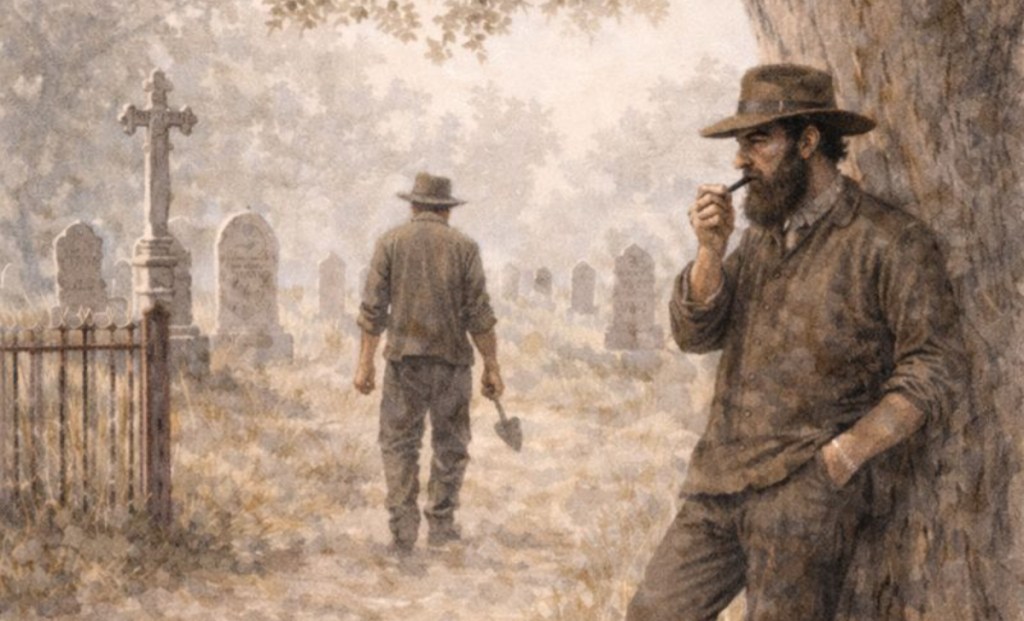
Tag: Stawell Bardo

  • Junction Teahouse

    Junction Teahouse

    Junction Teahouse

    Honourable Buddhist scholars leave the East and go West. Mr Daruma, who doesn’t like Buddha, leaves the West to come East. I thought they might meet at the Teahouse of Awakening. Alas! It was only a dream.

    ⁓ Japanese Zen monk Gibon Sengai (1750–1837), adapted.

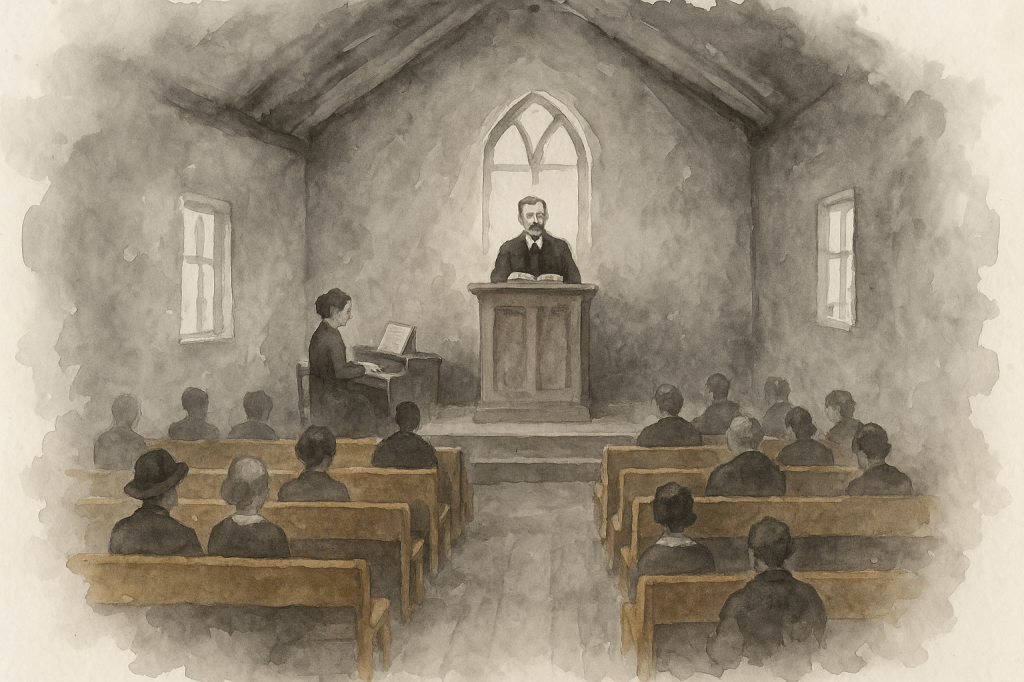
    It was Sunday, and a hush had settled over Stawell and its environs, less the product of Christian observance than the fatigue of a community wilting beneath a heatwave. The constables were at rest, their boots airing by the door, while their horses, in the shaded yard behind the lock-up, stood twitching at the flies. Grave-faced publicans bent over their ledgers with a grim focus. And the Reverend Hollins, in his peculiarly tremulous voice and occasional sighs tantalisingly suggestive of a faltering conviction, sermonised to a reduced congregation: a smattering of families, several women in white gloves already thinking of their lunch preparations; a town councillor occupying the aisle-end of the front pew, his straw boater tucked correctly beneath one arm when rising for a hymn, believing virtue to be transmissible through nods, smiles, and a strategic proximity to the pulpit; and indelibly, two boys whose giggles, once stirred, proved difficult to suppress, captive in the back pew, passing between them a folded scrap of paper on which they scratched and scribbled at a caricature of the preacher, recognisable chiefly by the earnest absurdity of his moustaches, while off-key strains of Jesus, Lover of My Soul wheezed from the beloved but dilapidated harmonium.

    The shopfronts along Main Street were shuttered, each a mute testament to the Sabbath and the wisdom of retreat. At the swimming hole, boys lay strewn in a loose ring beneath the gums, not so much resting as resisting motion altogether, while their sisters played jacks in the spindly grass nearby, casting now and then a glance at their brothers that combined idle curiosity with frank disdain. They had all been spectators the day before, as Stawell’s cricketers ruthlessly dispatched the visiting Ararat team, notorious across the Wimmera competition for their aversion to practice afternoons.

    The players themselves had scattered after the match, victorious and vanquished alike, most of them inclined to the drink. By nightfall, it was difficult to tell who had won: the mood had turned to the camaraderie of once-opposing warriors. On the brink of sunset, a few were seen crossing a drying creek bed, stumbling and laughing while arguing a call of leg-before-wicket as if time might reverse itself were the point laboured long enough, while the bottle, wobbling among them, passed hand to hand with the erratic solemnity of an intoxicated relic.

    Forster was not at rest on this Sabbath, nor was he attempting rest, which for him had never been a natural state – least of all while that torn bundle of clothing remained stubbornly mute. The scattered remnants of hat, flannel undershirt, trousers, and coat refused to yield the truth he was sure they withheld. During the week he had moved among storekeepers, stablemen, drinkers, and those who passed for bush-hands in that part of the country, collecting fragments of recollection that slipped, often visibly, from possibility into fancy. They revolved in his dreams, these lingering ciphers of some anonymous, ill-treated lost soul: a vest too long for most men, with a single bleached button still clinging to a thread; a coat with its lining turned the colour of the grass in which it was found; a twilled shirt, comparatively new, now torn open at the front and stained along the seams with dirt and dried blood. An unremarkable wardrobe from which to conjure a name.

    And it nagged at him that something vital waited to be perceived, if he could only loosen his grip on his habitual, strictly methodical approach to such evidence. That morning, he had reread a marked passage from a volume he carried in his travelling library, an old work by the British physiologist William Benjamin Carpenter, something about knowledge arriving through circuits of which the thinker remains unaware. “Unconscious cerebration,” Carpenter called it. Not instinct, exactly, but a deeper faculty, which underlies reason. It reminded him of something the Chinese publican had said to him offhandedly: that a man may fix his gaze too closely on the fragments of a thing, and so miss the thing itself. Forster, who did not consider himself a mystic, found the idea returning to him incessantly in recent days, like a tiny pebble he could not get out of the sock of his reason. Yet oddly persuasive. The detective was, like Carpenter, a committed empiricist, but it seemed to him of late that a narrow channel might exist between the Western scholar’s rigid concepts and the Buddhist’s drifting brushstroke. Whence come our “hunches,” our “insights,” our “intuition”? he mused as he crunched along, his plain walking stick, little more than a trimmed length of hardwood, tapped lightly at the ground as he pondered. That solution to a problem suddenly flashing into the mind unbidden: whence does it arise? Its quiet elaboration occurring beneath the awareness.

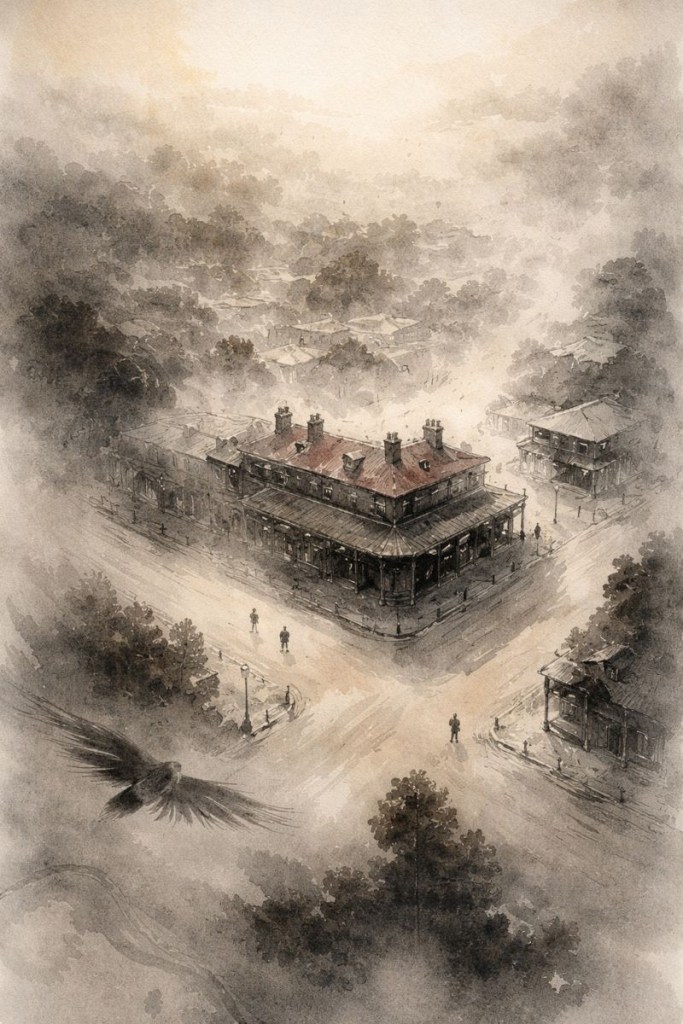
    The heat bore down, and without quite intending to, he had taken the red track to Deep Lead. Past the edge of the diggings, smoke exuded here and there in the Chinese camp, tinted with incense. Truth to tell, when entered from this side, alleys leading from the main street bore signs of the dissolution of which the camp was sometimes accused. There were a few grimy, tumbledown edifices, constructed as though from a pack of pub playing cards – among them opium haunts; the area had of late become known for drawing the idle young from miles around. Here and there loitered denizens of an unprepossessing, not to say suspicious, appearance; but even so, Forster reflected, there was a loafing, arrogant class of colonial that roamed around the country and might as easily be found lolling and expectorating about the corners of the principal streets in the best Australian cities.

    Towards the Junction Hotel end, the outlook was much improved, a man here and there repairing an eccentrically designed but spotless and sturdy cabin, or watering a vegetable garden; women in loose cotton trousers and indigo tunics, sleeves rolled to the elbow as they stooped and rose, pegged laundry to low-strung lines between sheds. Beneath a couple of pepper trees in a scorched yard, half a dozen children clad in faded cotton shrieked with delight as they played a game of bat and ball. A little further along he spotted Mow Fung’s own eldest daughter Lena, appearing wraithlike in the haze, suspended in a shimmer of mirage. She was some distance off, walking in his general direction along a track that led into the dusty street. As she came nearer, she recognised the detective and offered a pleasant smile and nod, gesturing that she was on her way elsewhere. He paused under the eaves of the Junction Hotel and glanced at the door. And just at that moment the proprietor appeared from around the corner of his premises, wearing his habitual loose trousers and black satin Chinese “melon rind” cap.

    Forster settled into one of two comfortable cane chairs arranged on either side of a small table in the corner of the Junction’s exaggeratedly named Tea House, where his acquaintance had guided him with quiet formality. Actually an interior room, it lay beyond public access, tucked behind the family quarters and adjoining a dim little chamber that might have been a storeroom – it was hard to say. Shelves lined the far wall, crowded with potted plants that leaned gently toward the filtered light. The tearoom itself was reached through a plain, easily overlooked door, and Forster had the distinct sense of being ushered into an inner sanctum, not merely for the warren-like route that led him there, but for the subtle change in the publican’s bearing as they entered: an attitude approaching deference, tinged with the protective instinct of a man offering something precious to one who might not recognise it. Perhaps his one or two official visits to the hotel since the post-mortem had earned him Mow Fung’s trust. It was an unintended but welcome result for a city detective newly stationed in the district, slowly learning the elusive protocols of rural trust.

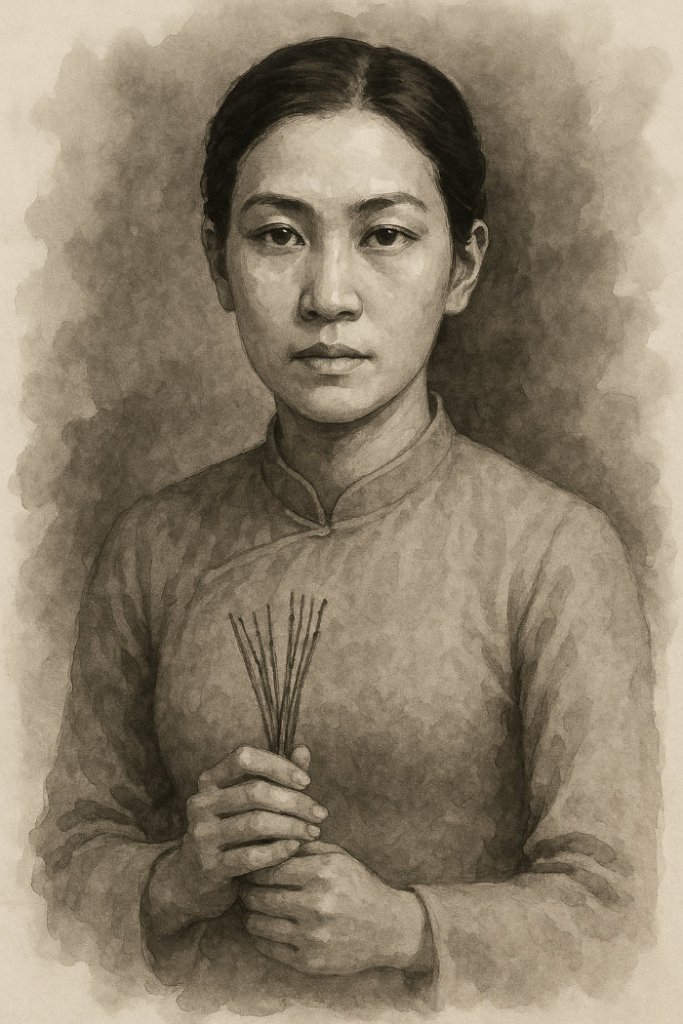
    Mow Fung had then excused himself, to attend to some domestic task or other. More finely dressed than on previous occasions, Mrs Mow Fung was seated at a table in the far corner, opposite a woman whose back was turned to Forster; she gave him a quick smile, then turned back to her companion. The two conversed in hushed tones, drifting between English and Mandarin. A lacquered box sat open on the table, its contents laid out with care: long stalks, slender and pale gold, like dried reeds, along with a square of folded silk, an inkstone, and a strip of scarlet paper. They were playing a counting game with the stalks, or as far as he could tell, tallying up accounts. Forster glanced away, thoughts wandering as he looked out at the garden beyond the window. There was Mow Fung with Lena watering a wattle. Even a scene of such trivial domesticity had the power to soothe the soul, within this hush.

    A soft sound drew him back. The woman had shifted in her seat, and he could see her more clearly now: her lissome form and proud profile even with lowered eyes – beauty understated, yet unmistakable. She wore a pale silk blouse, the fabric catching the light just enough to reveal a faint peony motif in the weave; below that, loose, modest dark trousers.

    Mrs Mow Fung moved the stalks in her hands while the other woman watched intently, Her elbow rested on the table beside the inkstone box, fingers idly tracing its lacquered edge, her posture languid though her eyes tracked the other’s every gesture. She looked up as Mrs Mow Fung posed a question, articulating each word slowly in Chinese, and the answer came in an equally measured tone.

    Mrs Mow Fung’s sleeves made a faint, dry whisper as she moved and a moment later she tapped the yarrow stalks lightly on the square of silk. The woman said something inaudible, and Mrs Mow Fung gave a soft laugh in reply.

    “Yes, they are called ai yao, and that lovely perfume lingers on them for a long time. But we should be quiet now and think only about what troubles you.”

    Forster resisted an urge to clear his throat. He reached for the small teapot on the cane table and poured some tea into one of the two small, handleless Chinese cups Mow Fung had set down. He was sure the splash had cracked the silence, but neither woman looked up.

    Forster closed his eyes. He flinched at the first sip of tea, then smacked his tongue lightly against his palate before taking another. It was a tad bitter, with a taste of mushrooms and … damp soil … that caught him off guard; but after he swallowed, a subtle aftertaste emerged: warm, sweet, and unexpectedly wholesome. He lifted the cup to his nose and inhaled its strange aroma.

    Across the room, Mrs Mow Fung spread the stalks slightly between her hands, then divided them into two uneven bundles, with practiced ease. From the right-hand pile she drew out a single stalk and placed it aside, distinctly articulating the word “Heaven.” The remaining stalks she counted in groups of four, sliding them gently between her fingers until three remained. These she laid to one side, and gathered the bundles again. The motion was repeated. Divide, draw, count, set aside – three times in all.

    Forster listened to the rhythm: a rustling of sleeve, a concentrated breath, a feminine murmur. A pause. “Yang,” said Mrs Mow Fung. The younger woman took up the brush and marked a single line on the red paper – one clean, black stroke. Mrs Mow Fung took up a new bundle, and again the process unfolded: division, removal, counting. At the end of the cycle, she cupped the remainder in her palm and said, once again, “Yang.” Another mark was made – two strokes now, neat and parallel.

    “It is excellent quality Pu-erh tea.”

    Forster opened his eyes. The proprietor had materialised across the table. “It is,” Mow Fung added, “imported from the city of Pu’er in Yunnan province, the only place in the world it is cultivated.”

    Clearly on an intuitive impulse, having judged something favourable in his guest’s manner, he paused and continued:

    “‘Pu-erh’ is an important name in my life,” he said, “but not because of the tea. In my tradition, it’s also the name of a semi-immortal – a Perfected being, a sort of spiritual ancestress.

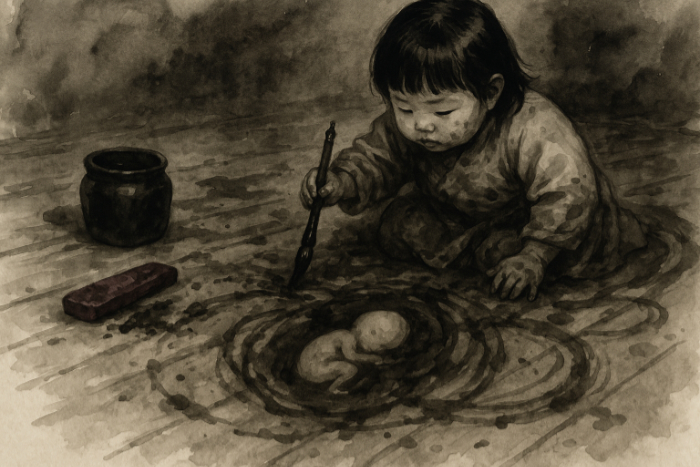
    “When I was an infant, there was a ritual – a dedication, not unlike a christening – where she was named as my guardian. When I grew a little older, I was told she had been my mother in earlier lives. Her task, I learned, was to help me return to my original true self.”

    Forster blinked, having anticipated nothing quite so personal, nor so metaphysical. Each looked quietly at the other as the words echoed away, infusing the atmosphere of the tearoom.

    “Unfortunately, I could never learn to do that.” Mow Fung chuckled as he reached for the teapot and poured again, the dark stream sliding softly into each cup. The deep, earthy perfume rose. “If you are not used to it,” he said, “it can taste a little like mushrooms and dirt.”

    “It’s not too bad,” Forster said. “Even to a milk-and-two-sugar man like myself. You’re uncannily right about the flavour. Must’ve read my mind.”

    “Much easier to read the face,” said Mow Fung. “Tongue-sounds too – most revealing.”

    Unsettled, Forster reverted to a tone of workaday officialdom, which rang oddly in his own ears amid the intoxicating bouquet of the Pu-erh tea.

    The female voice came from the far corner, and Forster glanced across to see the young woman holding the calligraphy brush upright in her left hand, poised to paint a mark.

    “Shame about that article – you and the doctor, after the post-mortem,” Forster said. “One of the constables tried to chase off that blasted reporter hanging about, but unfortunately not firmly enough.”

    If Mow Fung noticed the tone at all, he betrayed it only in the steady, crystal gaze he cast into Forster’s eyes before reverting to his humble mien. The atmosphere was once more in balance, as the women’s voices drifted and the yarrow stalks whispered on the silk.

    “Ah,” he smiled. “Newspaper. Sometimes the young reporter sees what he wants to see. Wants to make the reader of the newspaper feel superior to a lowly ‘Chinaman’ like myself. Always so. Very natural.

    “In this case, Doctor Bennett needed to wash his hands, but Mow Fung could not allow the dead man’s spirit to adhere to utensils like a bowl or towel – not only for the purity of the space, but for the spirit’s own journey. He should not get stuck to more things here, but instead, progress through the proper stages into the beyond. For this dead man, such matters are especially important, because he is disconnected from his head. It is said by some that a person should be intact, or they will never escape from this world.

    “So, leaning back, not to get splashed, I pour water from the trough over the doctor’s hands to wash them, with the water running into the earth, just as in our ritual cleansing. Doctor Bennett offers me the soap, but for obvious reasons, I refuse to take it back. And what do we find? Articles not only in Hamilton Spectator but as far away as Adelaide Observer. That ‘Heathen Chinee’ headline … Like all Chinese, superstitious, afraid of death, too ignorant to take the soap! Poor Mow Fung! Ha!”

    Across the room, Mow Fung’s wife made two quiet raps on the table, freezing mid-motion as she replaced the stalks into their lacquered box.

    “So sorry, my dear,” said the husband with a chuckle. “Getting a little excited. Since you’re finished, would you keep Detective Forster company while I fetch something I want to show him?”

    The younger woman’s gaze flicked up – not startled, but suddenly still, her face passive for an instant.

    “Detective,” she said, “I see.” She wiped the brush clean and pressed it gently into its groove beside the inkstone.

    Forster, already halfway into a polite nod, faltered slightly.

    “Would you care to join us?” said Mrs Mow Fung, smoothing over the pause.

    “Only if I’m not interrupting,” Forster replied.

    “We were done,” said the younger woman, her tone cool now. “All the lines are drawn.”

    “Please – call me Anna, my English name,” said Mrs Mow Fung graciously. She motioned to the seat beside her. “This is my dear friend Lili.”

    The young woman’s gaze slid from Anna to Forster and back again, and she offered a minimal nod.

    “Excuse me,” she said to her reflection in the window, languidly adjusting her sleeve. A fine silver bracelet caught the light. “Teahouse rituals are deeply exhausting.” The trace of an American accent barely surfaced.

    “You have been playing an intriguing game,” Forster said. He was looking at Anna when he spoke, but he caught a barely perceptible shrinking in Lili, like a bracing, or a folding inward.

    “It is not quite a game,” Anna said gently, “but more of a window into ourselves. It can speak to you, if you listen.”

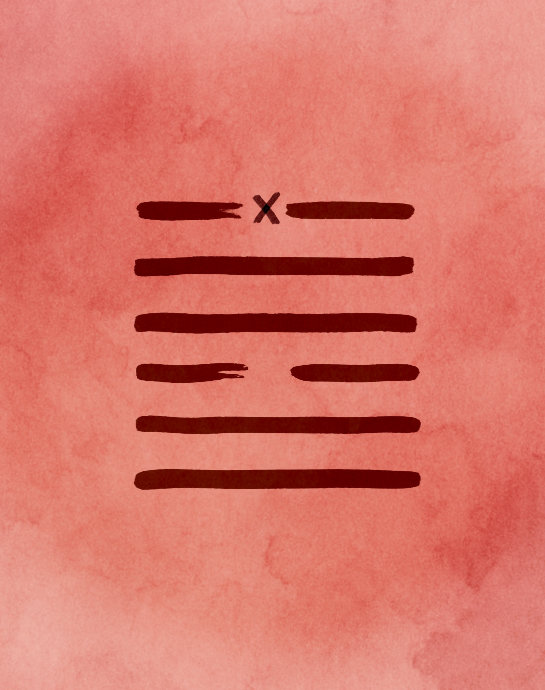
    Lili regained her composure just as if it had never left. She tapped the red paper with the six parallel lines she had drawn. “It says someone in the room asks too many questions.”

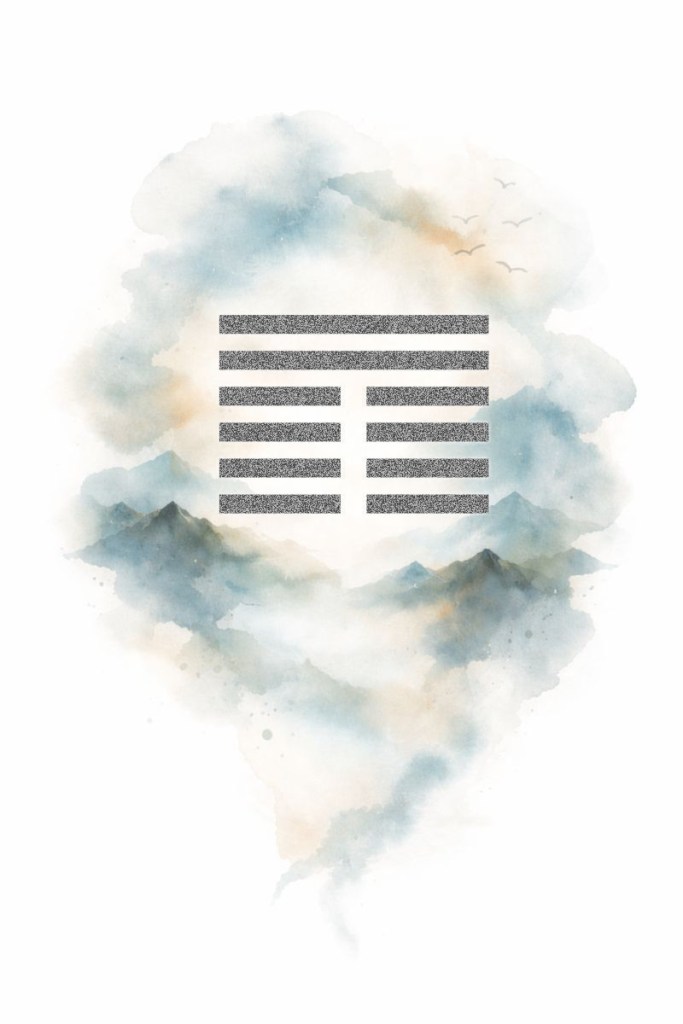
    “This picture is called a gua,” said Anna, ignoring Lili as she might an impertinent child. “You see it is made up of two parts, upper and lower; here they are both the same, a picture of a lake: two Yangs with one Yin – broken line – on top. That is a most desirable gua: one lake perfectly reflecting another lake; two lakes side by side, filled with water, sharing it all with each other. Creative is balanced by receptive. The inside and outside are as one, without any separation. It is a state of joy, or harmony, or even delight. Profoundly satisfying.”

    Lili sipped her tea. “I’ve heard good things about joy,” she said dryly. “It’s on my list.”

    Anna continued. “There is always a risk with joy: it must be correct. False, incorrect joy, will never last long but will disappear; having lost it, you will be worse off than before.”

    “How poetic,” Lili said. “And how typical! A pair of lakes gazing longingly at each other, just before one of them evaporates.”

    “Exactly,” said Anna, implacable. “The top Yin line, broken, is changing to Yang, unbroken – that’s why I asked you to mark it with an x. It’s the culmination of delight, but also its overturning. When we cling too tightly to pleasure, we lose ourselves. Everything changes and then comes the sorrow. That’s the nature of joy when it runs too far.”

    She glanced down again. “Now look – only one Yin is left, and it’s climbing up through the strong Yang lines. This gua becomes a new one: Treading. Heaven above the lake. Like walking on a tiger’s tail – it may not bite, but you must tread carefully. Especially if that remaining, soft Yin is misused. Squint and miss the path; limp and the tiger turns and bites.”

    Then, more softly: “But that one Yin – it’s also the key. It must remain open, yielding. That is not weakness. It’s the only way forward when the forces around you are strong. The gua speaks to your moment. It shows where you stand – and how to tread the path with clarity and grace.”

    Forster ran his finger lightly around the rim of his teacup. “Well, I suppose if you stare at a thing long enough… Some say the mind produces answers of its own, even when we think we’re getting them from elsewhere. From cards, or symbols, or whatever’s at hand.” He lifted the cup to his lips. “Doesn’t necessarily mean they’re any less true.” Climbing up, Forster repeated to himself, smiling – or floating, maybe; the fact gently floating up of its own volition.

    “Here is what I wanted to show you, Detective!” Mow Fung suddenly manifested himself in his irrepressible mode. He drew up an extra seat and slipped in between Forster and Lili, placing a small scrapbook on the table. “You will see how we are growing more famous and may soon catch up with even you, although we have not arrested even a single criminal.”

    The scrapbook was open to a page with the “Heathen Chinee” clipping. Mow Fung laughed delightedly and tapped his finger on the next column, its headline set in bold capitals: “A Chinese Lady at Ararat.”

    “Ah, this one,” he said. “Another of our local triumphs. You see – our old store on the Mullock Bank in Ararat and a banquet said to honour the arrival of a real Celestial lady from the Flowery Land.” He glanced at Anna with a boyish grin. “My wife’s debut on the goldfields. She was the marvel of the district.” He shook his head. “Eighteen years. How time flies. Tempus fugit … He frowned and glanced up, searching a different part of his brain: “Sed fugit interea, fugit …”

    Fugit irreparabile tempus,” said Lili, a singsong lilt in her voice, faintly amused by her own erudition. Mow Fung paused to look at her.

    Forster quoted the Virgil: “But meanwhile it flees … time flees irretrievably.”

    Mow Fung turned the book slightly so that Forster and the others could see the old clipping, the type still declaiming its truths after all these years. “The reporter wrote that half the township came to peer through the doorway. Then he says, ‘curiosity turned to drink, drink to uproar, and soon every man in the place was fighting – Europeans with their fists, Chinese with bamboo sticks: free fight and no favours.’ He casts me as ringmaster, conducting us Celestials in one-sided combat; and somehow we emerge the fools. while the drunken ruffians are likable country larrikins at heart.”

    He laughed softly, without mirth. “As I recall, there was supper, some singing, too much beer, and one fool who threw a weight from the counter and smashed two jars. The police were fetched; the magistrate dismissed the case. But the paper had its say: a lady from the ‘Flowery Land,’ a ‘Celestial’ riot in her honour, and another good story for breakfast.”

    Anna’s face barely shifted, but her minimal shrug suggested it took more than colonial attitudes to worry her.

    Mow Fung smoothed the edge of the clipping with a fingertip, but it curled back again. “I keep these to remind myself that in print, the story that pleases is the one that endures. I have found joy in this peaceful settlement far away from the violence and strife I left behind in China.”

    Forster shifted in his seat, unsure of what had unsettled him. Lili’s eyes lingered on the yellowing paper, musing, “And here I thought I was the exotic guest.”

    Their host turned another page. “And here – something happier.” The headline, neatly set in small type, read: “Baptism of a Celestial Infant.”

    “That was our first child,” he said. “The paper noted it as the first christening of a Chinese baby in the colony. It says the church was well attended, and that our boy bore himself with ‘admirable composure throughout the ceremony.’” He smiled faintly. “No one meant any harm. It was all quite kindly done – a curiosity for the readers, nothing more.”

    His hand rested lightly on the page. “I remember the minister’s face: the awe with which he regarded a new life; and the townspeople, craning for a better view of the novelty. We thought of it as a gesture of friendship, a courtesy between faiths.”

    He closed the book. “So – a happy clipping to end on.”

    Anna’s eyes softened; Forster gave a small, respectful nod. Lili’s reflection was faint in the window. Now so close, Forster was struck by the quivering delicacy of her beauty – as though each passing second revealed a new facet, trembling and shifting. It reminded him of a tightrope walker: balanced, poised, never quite at rest. There was a fragility to her. Her black hair gleamed and her eyes glistened in the filtered light. A gleam set gently against stillness – that was the essence of her allure. There were traces of Chinese ancestry in her eyes, but something mutable in her features, as though they might shift to match any gaze that sought to define her. Depending on the light, the company, or the hour, she might seem unmistakably Chinese or equally European. A chameleon beauty: composed, ultimately unreadable. She brushed a hand lightly through her hair. A scar traced the line of her jaw.

    “Shall I prepare some more tea?” she said, already rising.


    From the draft novel Stawell Bardo © Michael Guest 2025

  • 7. Document 17 (from the draft novel Stawell Bardo)

    7. Document 17 (from the draft novel Stawell Bardo)

    Document 17: Manifestation Series

    The unicorn is injured, why did it come? My way is finished.

    ⁓ Attributed to the Zuozhuan, on the death of Confucius, 479 BCE (adapted)

    This account, drawn from the lower ledgers in the Registry of Misperceived Wonders (Third Vault), concerns the imperfect ascent of a crown, a sign mistaken for itself, the brief elevation of a foreign scholar, and a haunting sigh. The report commences with an account of the journey of the foreign envoy from the White River, just south of Tongzhou, to the Forbidden City. The route is as well-trodden as the tropes that embellish it, so for present intents, the passage has been elided.

    Lord Macartney received with restrained annoyance the news of the extension of his itinerary a further 160 miles, extending the journey into Tartary. He was already preoccupied with the Chinese administration’s requirement that he perform full-body kowtows to the Emperor, since he was not required to humble himself in this way even before his own monarch, good King George III. He nevertheless resigned himself to attempting an approximation. Bright Yang set him at ease with a broad smile and copious applause, assuring him that his impromptu flourishes, bows and scrapes such as he demonstrated, which were worthy of the most extravagant dandy, would more than satisfy the Qianlong Emperor, who was, in any case, a most amiable fellow once you got to know him.

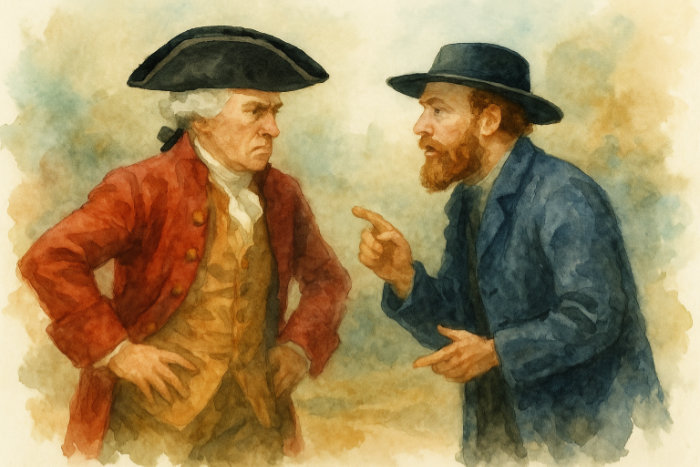
    Lord Macartney, an Ulster Scot consummately qualified for ambassadorial duty, departed from the capital with the majority of his entourage, leaving behind much of the valuable equipment that he had dragged to the ends of the earth as presents for the Emperor, in the care of his tiring – in both senses – travel companion, another Scot: astronomer, physicist, inventor and philosopher, one dour James Dinwiddie.

    Two European men in 18th-century dress. Lord Macartney One stands tall and reserved, hands on hips. Dinwiddie leans forward, gesturing animatedly.

    One of the marvels intended to evoke the amazement of the Chinese Emperor was a clockwork planetarium of Dinwiddie’s own devising, which had taken him thirty years to build and was acclaimed “the most wonderful mechanism ever emanating from human hands.” Dinwiddie’s second love among the collection of marvels was a hot air balloon, an “aerostatic globe” of his own design, with room for two aeronauts. Although he had never gone aloft in one before, which had proven to be a perilous feat throughout Europe, he had become obsessed with the idea of becoming the first to do so in China, and to float high above the Emperor, his court, and the citizenry of Peking, who would all be rendered agog in disbelief. Such would be his historical legacy, he foresaw: even above his planetarium and extensive philosophical tracts, it would be foremost amongst his life’s works.

    Other items in the display included reflecting telescopes, burning lenses, electrical machines, air pumps, and clocks; brass artillery, howitzer mortars, muskets, and swords; a diving bell, musical instruments, magnificent chandeliers, and vases; Wedgwood china, paintings of everyday English life, scenes of English military victories by sea and land, and royal family portraits. The cost amounted to fourteen thousand pounds – in those days a formidable sum.

    On the journey to Peking with the envoy, Sun Pu-erh took stock of the information she gathered and started a series of detailed sketches of the devices most relevant to her Emperor’s wishes, in particular the military and scientific machines and artefacts. She employed spies and draftsmen to aid in the task. Bright Yang, on the other hand, was absorbed in tales that had flourished among the populace as the envoy made its way up along the White River – tales in which, perhaps, the twelve-year-old son of Lord Macartney’s secretary had a hand, aided by his smattering of Chinese. From the point of view of the child, similar to that of the rural populace in this regard, the official inventory of planetarium, lenses, lustres and so on, was not overwhelming, hence stories grew up that hidden inside the cargo were the actual marvels to be revealed to the Emperor: an elephant no bigger than a cat; a battalion of miniature, living British grenadiers, each only twelve inches tall but perfect in the most minute detail, down to fingernails, eyelashes, and intelligence; and a magical pillow that transported one to faraway countries while one slept.

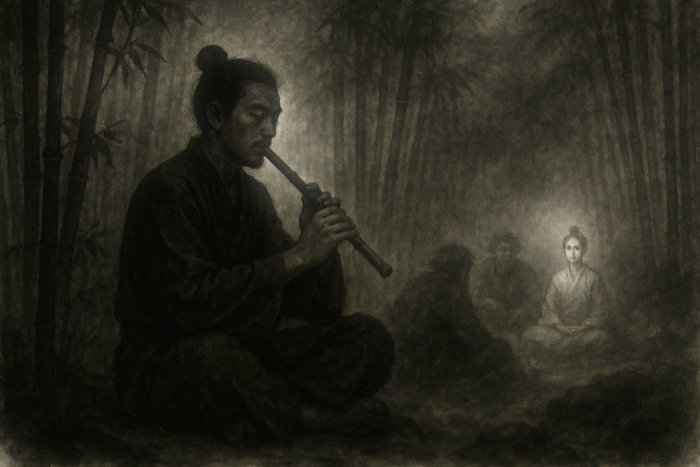
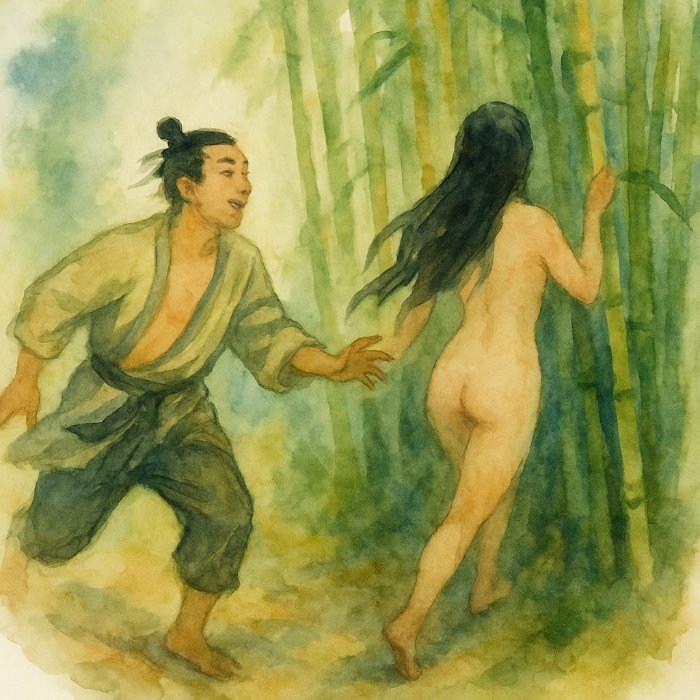
    A sentry reported to Pu-erh that Bright Yang was last observed with one of the lower-ranking concubines, following a narrow path into a bamboo grove, half-clothed and crying out in abandon, in full pursuit of the elephant and grenadiers. She raised an eyebrow expressing initial surprise at the news, then appeared to be none too bothered. Mow Fung, however, observant of such minutiae as only an infant is capable, noticed that, still relatively expressionless, she was now infected with an occasional little sigh, which she would immediately stifle before anyone else but him could notice. He was quite entertaining, she thought.

    A Chinese man in casual robes pursues a nude woman into a bamboo grove, vanishing into shadow and greenery.

    The exaggerated local publicity surrounding the English marvels spread widely among the populace along the way, causing no end of anxiety for both Macartney and Dinwiddie, in fear that their exhibition might fail to meet the Emperor’s expectations. Macartney could do nothing but fret as the journey continued north. Dinwiddie, at least, could busy himself in preparation for the exhibition and his historic balloon flight.

    During his weeks of preparation and waiting in the Forbidden City, he developed an infatuation with the refined, demure, though persistently aloof Sun Pu-erh. She seemed to observe everything through her inscrutable dark eyes, while her long, strategic locks, neither concealing nor clearly inviting access to his imagined fortress of her womanhood, were enough to elicit certain untoward thoughts in his own inflamed mind. He found himself drawn helplessly to the mysterious, dark, exotic femininity he’d read about in travellers’ tales and believed expressed itself in her every word and gesture.

    He took her aside into the corner of a storage room to confess his feelings.

    “D’ye mind I stroke your bonnie raven hair, lassie?”

    She glanced over his large hairy nose, irregular ears, bushy eyebrows, and red whiskers – none of which appealed to her in the slightest – and gave a wry smile. To his mind, it was an encouraging one, so he gave her a wink and proceeded with his whimsy.

    “Looks like silk, but feels a wee bit like the mane o’ a horse,” he confided.

    In an effort to further his suit, such as it was, he professed a warm affection for her young son Chung, our very own Mow Fung of that era, a child blessed with a nature to be seen and not heard, one who would sit and watch him assemble his complex and precious marvels, without ever touching a thing.

    “E’s a fine wee bairn,” he said. “I daresay I got three o’ ma own, and not one o’ em surpasses him in manners, nort be a long short.

    A young Chinese boy gazes intently at a model planetarium; blurred adults adjust the mechanism in the background.

    “Now, the absence of the Emperor, along with almost the entire British delegation, gives us a rare chance to put my aerostatic globe through its paces and to mount a rehearsal that will allow everyone concerned to practise their roles. I’ll hold off, for the moment, from testing the discharge of fireworks from the craft, but will reserve that for the great day itself. We’ll hae nae beasts flung frae the heavens, nor French contraptions named “parachute.” Yon Blanchard – the great pretender tae philosophy, carnival-showman – may cast his ducks at Providence as he pleases! Rather, we shall save such spectacles for the day itself, to maximise the impression upon the Celestial Court that the potentialities – at once military and philosophical – of floating skyward in a silk-lined basket constitute nothing less than the definitive mark of a truly enlightened society.”

    Pu-erh was invested with the imperial power to authorise such a project, and so it was done. The day approached for Dinwiddie to test-fly his globe.

    “I will require a few of my assistants to set up the apparatus,” he said. “Is there a secure location? Best to maintain the highest level of discretion in order to preserve the element of surprise for His Nibs – ahem, His Celestial Majesty the something-or-other Emperor – ahem – when I reveal the aerostatic globe before him in all its magnificent sublimity.”

    “Sire,” said Pu-erh. “I know a perfect place for your preliminary ascent. It is located in the north-west corner of the Imperial Garden of the Forbidden City, close to a Taoist shrine that is under my own humble administration. High walls, a few trees and structures, some open space.”

    “Sounds ideal, my cherub. There we shall discover what shall transpire, according to the scientific method. P’raps a hydrogen one would’ha been better, but a difficulty – not insurmountable, mind ye – to manufacture the hydrogen right here. For all purposes, this beauty should amply suffice.”

    The day before the planned launch, Dinwiddie’s team transported the apparatus from a storage room to the secluded north-west corner of the Imperial Garden. Our young Mow Fung stood apart from the proceedings, contemplating them beside Pu-erh, who observed silently, committing each step to memory in minute detail.

    The envelope was suspended between two masts and tethered by six ropes, each gripped by a man. Dinwiddie ignited a pyre that had been placed beneath it, contained within a structure designed to focus the rising hot air into the mouth of the envelope, which expanded, revealing bright patches of red, blue, white, black, and gold. When fully inflated, the glory of the sphere, suspended in the air by its own force, was manifest: the English coat of arms, with a shield of the Empire and crown of the Monarch supported by a fierce lion and a noble, tethered unicorn. Beneath the arms, the motto Dieu et mon droit shone out in gold, proclaiming the divine majesty of King George III.

    The envelope was detached from the masts and jockeyed into position beside the northernmost gate – the Gate of Divine Might – where the wicker basket stood in readiness. The two were lashed together with ropes, the silk slackening and filling by turns in the uncertain air.

    The basket carried a burner to maintain the heat in the canopy above, with a supply of charred wool for fuel.

    Dinwiddie cleared his throat and hushed his assistants for a spot of oratory. Adjusting his wig with the gravity of a sermon, he murmured, half to the heavens, “If Providence has pit China in the traupic, it’s no but that Britain micht instruct her frae the firmament.”

    The balloon wheezed politely in assent.

    At a shrill blast of Dinwiddie’s whistle, Pu-erh stepped forward as planned and was helped into the wicker-basket.

    “Come along, laddie, dinna dawdle,” said Dinwiddie, lifting the boy in beside his mother, before climbing in himself. “Just a gentle ascent – straight up a wee ways, stay for a few minutes, and straight back doon. Cast off, lads!” he cried.

    The craft began to descend immediately the ropes were loosed, so Dinwiddie struck a spark and stoked the wool-burner. In response, the globe bobbed to a halt.

    “Too muckle ballast!” he cried. “Out wi’ ye, laddie!”

    He took Mow Fung bodily and cast him over the edge into a pair of arms that happened to be there. The craft crawled upwards, reaching a height of about six feet – and there it stayed, hovering, obstinately refusing to rise any further.

    “Ye be-luddy deevil o’ a thang!” he roared. “Off wi’ more ballast! Quick, gi’ out, gi’ out, gi’ off!”

    Fixing him with a cool, level look, Pu-erh climbed out of the basket and took hold of a stay rope, guiding herself roughly to the ground. The craft began to ascend, slowly, and all on the ground dropped their ropes.

    “Na! Dinna do that! Dinna do that!” Dinwiddie called down, but it was too late.

    The balloon rose quickly to a point above the thirty-foot wall and was caught in a stiffening breeze. It took on momentum and, without any stays, sailed over the top of the wall, just beside the Gate of Divine Might.

    As the wind took hold, Dinwiddie realised there was nothing to do but go over the edge himself. He slid down to near the end of a rope, but found himself still too far from the ground to let go.

    Fortunately, as the craft drifted across the broad moat of the Forbidden City, the wind died down just enough for the balloon to descend, dragging his body through the water and giving him a chance to escape into the mud of the opposite bank.

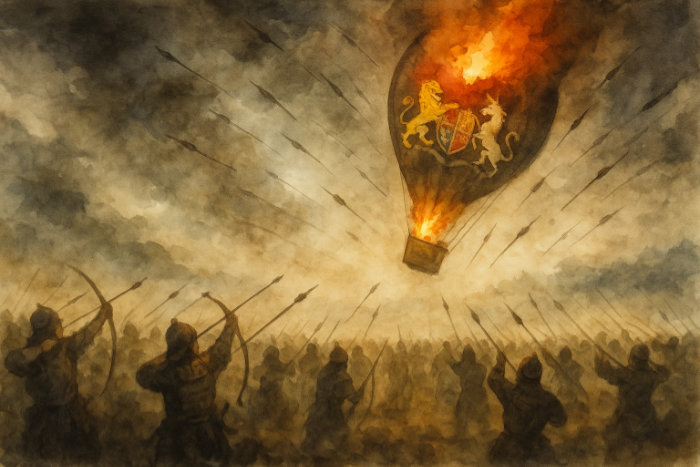
    The balloon gained height again and took off on an unmanned flight for several miles above Peking. The envelope caught fire from the furnace, and many perceived it as a dragon descending from heaven, to wreak havoc on the Manchu Qings.

    Among the populace, alarm spread at the sight of the unicorn, glistening in the evening light – so closely resembling a legendary beast of their own, whose arrival had been anticipated for centuries. Archers fired upon the apparition as it bobbed and limped across the sky, striking sacred spots upon its body.

    Snatches of an ancient song arose amid the cries of terrified onlookers, first muttered, then taken up by others:

    The unicorn’s hooves!
    The duke’s sons assemble,
    Woe for the unicorn!

    The unicorn’s forehead!
    The duke’s cousins gather,
    Woe for the unicorn!

    The unicorn’s horn!
    The duke’s kinsfolk arrive,
    Woe for the unicorn!

    A fire-engulfed hot air balloon, embossed with the British coat of arms featuring a lion and unicorn, plunges from the sky under a gale of arrows, fired upon by amassed warriors.

    When the craft crashed flaming into a field on the outskirts of Peking, it was set upon by peasants wielding spades, shovels, picks, and knives. No one was harmed in the incident, except that during the incineration of the balloon’s remains, all the hair on the head of one of its attackers was entirely burned off.

    Dinwiddie was conveyed back to his quarters, where Pu-erh and her son were waiting. He waved them aside and, devastated and speechless, took to his couch for days, avoiding them both for the remainder of his stay in Peking.

    Mow Fung noticed that from this time on, his mother tacked a tiny new gesture to the end of her occasional, apparently unprovoked sigh: a barely perceptible shake of the head. She would now say just one word to herself:

    “Men.”

    Addendum. Filed: Gate of Divine Might, 1793:
    The foregoing episode is absent from the official papers of the Embassy, and from all Celestial memorials of the same year. No explanation is recorded, nor could one be; the event appears to have been extinguished at the instant of its occurrence. A trace persists only in a marginal entry among provincial gazetteers, describing the sudden descent of a flaming lion beyond the northern wall of Peking: a visitation later interpreted as the passing shadow of an immortal qilin (the “unicorn” of the translated song).

    The entry adds that similar portents were recorded in antiquity, when a qilin was said to have announced the birth of Confucius, the Sage of Lu, and another to have appeared before Emperor Wen of Han. In Han and later commentaries, the song “The Hooves of the Unicorn,” long preserved in classical commentaries, was linked to the death of Confucius himself, for it was said that the capture and wounding of a qilin in Lu marked the end of his era. By analogy, the chronicler proposed that this fiery apparition might signify the renewal of imperial virtue, or else its exhaustion. Whether this was mass illusion, actual omen, or mere transcription error cannot now be determined.


    © Michael Guest 2025

  • 6. Jade Volume (from the draft novel Stawell Bardo)

    6. Jade Volume (from the draft novel Stawell Bardo)

    Jade Volume

    There is a mountain in the northern reaches of central China, known by devotees as Time’s Heavenly Sanctuary an Infinity above the Jagged Rocks. To the uninitiated, the summit lies at a distance no greater than a rice husk from the utterly impossible. And yet the region dazzles with natural vistas and unimaginable beauty. Many have tried to get to the higher elevations, but most failed. This is the realm not of mankind, but of the eagle, the heavenly tiger, and also the mischievous monkey who toys with the mind.

    Below, a wide, pure, meandering river traverses a pristine landscape that extends into unknown territory, amid countless acres of giant bamboo, their upper branches seeming to beckon the breeze. The skies above are the sapphire blue of heaven. Hearts lift at the sight, and there are climbers so intoxicated by the vision that they hurl themselves in ecstasy to their doom – clearing the sheer cliffs and smashing against the rough boulders below. It is no wonder that, to a remaining few, Time’s Heavenly Sanctuary an Infinity above the Jagged Rocks is believed the holiest of holy places and, indeed, not to be slighted without profound risk.

    Abstract watercolor landscape featuring red mist and glowing light in the foreground, with blue-grey watercolor waves suggesting water and fog. Evokes a mythic Chinese mountain scene from the Jade Volume chapter.

    The path winds upward through groves of giant bamboo, past shadowed outcrops and long-forgotten steps. Midway up the mountain’s flank, obscured by foliage and time, stand the ruins of a small, ancient temple – crumbling, barely visible through a thick curtain of green. Though seemingly deserted, the sacred fonts are kept full, and the stone steps swept clean.

    Inside, a modest offering of a simple rice-ball and bamboo shoot invariably awaits the intrepid visitor. To come so far demonstrates a purity of heart that is well rewarded. To accept the offering in proper humility opens the senses to the contrast between the essences of darkness and light – a rare clarity amid the world’s illusions. But should the offering be taken improperly, or worse, scorned in any infinitesimal degree … then the shattered remains of the fallen, far below the cliffs, bear silent witness to the error.

    Slightly below the temple’s ledge, until a century or two ago, burial tunnels were dug into the side of the sheer cliffs, extraordinarily deep, hand-carved tunnels in which it was the tradition to inter beings deemed noble of mind and spirit. It is said that, for the adept, the tunnels lead into a subterranean network that joins together all the holiest mountains in China, though not in the form of a physical labyrinth. Rather, access can be had only by an astral body, guided by the lines of an ancient map inscribed by the Tao on the shell of a certain large tortoise. Gravediggers would once upon a time swing down on ropes and steer one’s coffin into place in the cliff. Unsurprisingly, some of these erstwhile aerial ferrymen perished alongside their cargo, a worthy sacrifice for which they accrued what some call good Karma.

    And still the mountain ascends.

    Above this middle sanctuary of shrine and tomb, the mountain veils its final secrets. The temple, perched on a precarious ledge far above the valley, is not the summit. Beyond it, higher still and hidden from even the boldest climbers, lie the archives. Cascades of shining white water shield the opening to the cave, mighty enough to wash intruders away like ants. To human eyes, from all but an angular perspective of higher insight, the entrance appears no greater than a long, narrow crack in impenetrable stone.

    Seldom indeed will visitors appear at these elevations – whether temple, tomb, or the archive beyond – in a living, physical form – but when they do, they find awaiting them the welcoming rice-ball and fresh bamboo shoot. Quite the mystery. Either there are ways to attain such heights known only to the peasants who reside in hovels dotting the mountain here and there, shrouded in mist, or else a supernatural force is at work. We adhere to the former explanation because, no matter how sheer the cliffs or tangled the paths on the way to enlightenment, there are always those who will dare to ascend and untangle them, even among us simple monks and peasants.

    Yet there are also tales of hazardous spiritual journeys undertaken in order to consult the archive, in which an adventurer-adept awakens from trance to find the rice-ball and bamboo shoot in his mouth – rotten and crawling with maggots. And this although no flies exist above the treeline! The scenario is horrific, and it invariably concludes on the boulders at the foot of the cliffs.

    The archive is a forest of books dating back to the earliest ‘butterfly’ volumes, constructed from vertical strips of bamboo, each inscribed with a line of text, and linked together into concertina-folded pages. The works kept in the archive are expertly arranged, meticulously ordered and colour-coded, their calligraphy flawless, their ink illustrations brilliant in economy. Naturally, they are dusty and draped in thick wreaths of spider web, for they are seldom taken up in the hand of a reader.

    In the present day, the name of Chung Mow Fung yields only a single footnote, in a ‘recent’ volume from two or three centuries ago, referencing parentage under a different name. This name, however, is barred from formal publication, for it was altered by edict of the Tao, as made clear and manifest in the Forty-Ninth Hexagram: Revolution (革 – ). As Fire meets Metal (the lake), producing illumination, so too are personal desires refined into unselfishness. What is obsolete is shed like a snake’s skin; acquired pollution is burned away, revealing the essence of primal, unified awareness. The spirit aligns with its path. The great person changes like a tiger.

    Abstract watercolor of a fiery metallic I Ching hexagram, glowing against a watery background. Symbolizes transformation or revolution..

    It was not uncommon for those of the Mow Fung line to alter their names – a necessary measure during those periods when the study of the Tao fell into disfavour with ascendant militant ideologies. When he settled on the southern continent, Chung had been his family name; however, local officials, in their ignorance, reversed the order. That moment marks the point at which we locate our pivotal index for extracting the lineage, and so the name becomes, in the final analysis, arbitrary. Yet the Mandarin denotation, Admirer of the Phoenix, perhaps remains apt. After all, how may we pin down a karmic ripple or trace an Akashic echo by means of a single name? Naturally, such terms are merely Buddhist and Hindu approximations, and useful metaphors at best, for, as Lao Tzu correctly observes, the true Way is named only tentatively: Tao.

    So much for names. The Tao does not trouble itself with the consistency of library catalogues.

    Although the familial lines extend back centuries into various narratives concerning the most enlightened individuals, this and further changes in name make certain crucial connections obscure, such that the specific ancestry becomes a matter of interpretation and even, in the worst cases, divination. It is like pursuing the strands of a fog. Any identifiable and named individual will not necessarily correlate with the line of the Mow Fung who occupies our current interest.

    Some traditions suggest that Mow Fung is not so much a reincarnation as a resonance – a particular pattern in the Tao reasserting itself under a familiar-seeming name: a node through which the Tao’s intent briefly shimmers. That such a resonance might walk, speak, or even misbehave is not so much a mystery as a habit of the Way.

    Perhaps he never attained enlightenment, nor will his descendants, his temperament being of a too weak, too dark, too yin-flavoured humour and given to excesses of the flesh: notably, unmindful congress and the ingestion of hallucinogens. Unfortunately, even such faults are not as uncommon as the reader might like to think, even among the membership of our venerable community of ancestors, among whom number not only sages and adepts, but also a handful of artists and poets whose conviction in their own genius outpaced any objective manifestation.

    It is gathered from the relevant volume that this ‘earlier’ Mow Fung was the son of an accomplished civil servant who, after becoming a father, subsequently became a eunuch in the imperial court of the Qianlong Emperor, where he enjoyed a cheerfully untroubled life. Nicknamed, with some irony, Ma Tan-yang, or “Bright Yang” he achieved a degree of enlightenment, thanks to the tutelage of his wife. She, Sun Pu-erh (“One Hearted”), was a child prodigy and a brilliant scholar and seer, trained in a clandestine temple of the Taoist School of Complete Reality (now officially suppressed, but only on paper) and endowed with unsurpassed expertise in the study of Confucius.

    Traditional Chinese watercolor painting of two court officials in ceremonial robes, standing before a decorative phoenix tapestry. Represents Pu-erh and Bright Yang from the Jade Volume, styled as Taoist immortals.

    Moreover, she was a brilliant exponent of foreign languages, which she studied under the tutelage of a Jesuit missionary and painter named Giuseppe Castiglione. She was an adept of high degree, directly descended from the female Wu, the most powerful sorcerers of all time, and engaged as a high adviser in the imperial court. Her husband was charged with supervision of the Emperor’s concubines, who instructed him in the most up-to-date nuances in fashion and cosmetics, in exchange for tutoring them in all sorts of corporeal practices in which he was expert (see Indigo Volume XXXXIV of Late Tang Dynasty Collection, and Emerald Volume XXVII of Song Dynasty Collection).

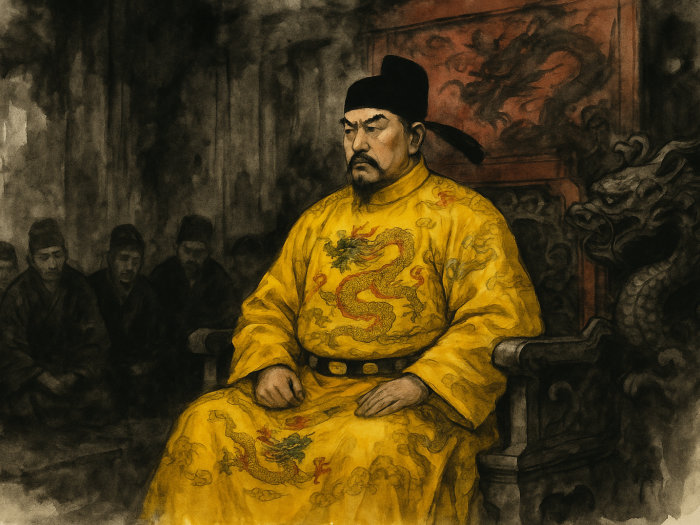
    One day the Emperor summoned Sun Pu-erh and her foolish young husband Bright Yang to the Hall of Supreme Harmony, in the Forbidden City. Sitting on his Dragon Throne, which marked the centre of the universe, he assigned them a mission. Backed by a magnificent screen of gold, he appeared a multi-coloured, superhuman gem. His voice echoed around and among the six huge gilded columns immediately before him, each encoiled by his own five-clawed dragon. Touch one if you wish to die. The ruler of a round-eyed, red-haired, ghostly-skinned barbarian rabble from a far-flung isle had requested that he receive a delegation. The chieftain, who called himself King George III of England, a territory he described in terms so overblown as to border on hilarious arrogance, wished to discover the wonders of the Great Qing, for the betterment of his own ‘civilization’, which the Emperor understood to be the lowliest among all those in Europe.

    “His baser wish is that we grant certain concessions to his barbarian merchants. Hitherto, all European nations, including those of his own realm, have carried on their trade with our Celestial Empire, as permitted solely at the port of Canton, a restriction he now seeks to overturn.

    “What is the meaning of this word ‘king,’ anyway?” the Emperor said, looking at Pu-erh, who had memorized all 11,099 volumes of the encyclopedia housed in the Hall of Literary Glory.

    She bowed her head and replied.

    “Perhaps related to another word they use, ‘kin,’ implying he is the father of their extended family,” she said. “They say also that ‘the lion is king of beasts,’ referring to their imperial symbolism. Evidently there are no lions there, are there? Perhaps they seek to differentiate themselves from Caesar, derived elsewhere as Czar or Kaiser. I imagine it all originates in Roman times ”

    “Cease!” the Emperor said curtly, and continued:

    “His letter is illiterate. You see, here he addresses us as ‘the Supreme Emperor of China … worthy to live tens of thousands and tens of thousands thousand years.” He coughed lightly, tittered, and cast a glance at the ceiling – augustly decorated with framed images in jade, ruby, and gold leaf: dragons, qilin, phoenixes, and other fabulous beings from the four corners of the earth and beyond – while an imitative titter rippled among the courtiers.

    Close-up watercolor portrait of the Qianlong Emperor in Qing Dynasty regalia, with a stern expression. Painted in stylized ink-brush style evoking Chinese portraiture traditions.

    “However, despite his clumsy expression, we take note his respectful spirit of submission,” he said, raising his hand to cut short the disturbance. “We determine that he is sincere in his intentions.

    “It behooves us here at the centre and apogee of the world to cast our light before such peoples, backward peoples, but those who have nevertheless drawn themselves up to attain a state in which they manage to discern the magnanimity with which we bend towards them and allow them to participate in our beneficence, and therefore shall we acquiesce to these requests. Never mind how meagre their offering, we shall treat them with generosity and luminosity. After all, it is our Throne’s principle to treat strangers from afar with indulgence and exercise a pacifying control over barbarian tribes, the world over. Make a special note,” he ordered his scribes, who were taking down his words.

    “His delegation of a hundred men will arrive in China at any moment now, concluding a year’s voyage from the far-flung regions of barbarians, by way of several countries even more primitive than their own, in the Americas and in Asia. Naturally, we are already well informed about all parts of Asia, thanks to our numerous voyages of discovery and trade, so we require no enlightenment from this English impertinence. Ha! In the year 1405,” he said, his voice rising, “during the Ming dynasty, Admiral Zheng He discovered America – seventy-five years before the Spaniards. And during his seven expeditions, he mapped the entire globe: the Mediterranean, Africa, the Americas, and even Australia.” He looked again at Sun Pu-erh, who bowed her head.

    “I have seen it in an archive in the Pavilion of Literary Profundity,” she said.

    “We have had little need since those times for forays abroad. Our Celestial Empire possesses all things in prolific abundance and lacks no product within its own borders. Make a special note, underlined,” he commanded the scribes.

    “Since the barbarians have developed some abilities in seamanship, they now scramble to us,” he continued. “We remain loath to admit them – all the more, given the skirmish playing out somewhere over there in those parts, some minor uprising …” He looked at Pu-erh, who bowed her head.

    “The French Revolution,” she said. “King Louis XVI, Marie Antoinette beheaded, and so on.”

    “Correct, what they call the French Revolution. Well, we don’t want that sort of nuisance over here, do we?” He looked at Pu-erh, who lowered her gaze and said nothing.

    “At any rate, the weather has become unseasonably warm in the capital, and we have decided to repair to our summer palace and mountain resort in Jehol. You two will meet the ambassador, one Lord George Macartney, en route to Peking, and advise him of our change in plans. His entourage will rest for three days before proceeding north for an audience with us. Pay close attention to any equipment or paraphernalia he must leave behind during his sojourn. He intends to amaze us with certain marvels of English invention. Though we anticipate little worthy of attention, we wish to see recorded, in fine detail, the technical principles of any scientific apparatus – particularly weapons or devices of use in the art of war – that they intend to demonstrate.

    The couple travelled by palanquin with a modest retinue. They found the envoy, news of whose approach had long preceded it, at the town of Tongzhou, a canal terminus.

    Traditional-style watercolor painting of Chinese river junks with sails lowered, depicted on a calm, shallow river. Illustrates the halted imperial convoy near Tongzhou in the Jade Volume.

    The thirty-seven imperial junks that had carried it thus far along the shallow White River could go no further, although the military escort would continue. Armed with bows, swords, and rusty-looking matchlocks, the troops marched in single file, beneath standards made of green silk with red borders and enriched with golden characters. Long braids, tied at the end with a ribbon, hung down their backs from beneath their shallow straw hats.

    A wonderful rigmarole attended the transfer of Lord Macartney’s cargo to a convoy of carts, wooden wheelbarrows, and coolies – those labourers pressed into toil for wages scarcely worthy of the name – for the next leg of the trip to Peking. The spectacle inspired in many of them the words from ancient songs, to which they lent their voices while they toiled:

    Do not work on the great chariot –You will only get dust in your mouth.
    I sing of those who are far away,
    And sorrow clings like a cloak.

    The great chariot groans with its load –
    And saps the strength from my bones.
    I think of those who are gone,
    and my heart is cut open again.

    The great chariot creaks at the axle –
    It cannot bear the weight.
    I remember those who fell blinded by the dust,
    On the side of this distant road
    .

    Some of the labourers were given a taste of the whip by their military guards, who perceived seditious intent in the stanzas.

    Thus concludes the scroll of the Jade Volume. The continuation has – most vexingly – been mislaid in a dark corner by one of those accursed archival monkeys, necessitating a brief but unavoidable interruption in our unfolding.


    Michael Guest © 2025

    Images generated by AI

  • 5. Missing Persons (from the draft novel Stawell Bardo)

    5. Missing Persons (from the draft novel Stawell Bardo)

    Missing Persons

    “Here, have a go at this:

    A strange discovery was made yesterday by a miner named Wilson. While cutting props in the bush, about two miles from the Deep Lead, he found that he was at work beside the headless trunk of a human being. The remains were lying about ten feet from an abandoned shaft. The head was severed from the body, and although a careful search was made, it was nowhere to be found. The body had apparently been removed to its present spot within the last week, for there is a mark on the ground close to where the remains were. The body appeared to be that of a male, tall and slender. Not a vestige of clothing of any description was found on or near the remains.

    “Well, that is out of the ordinary, ain’t it, Wilson, what it says in this rag here?” Cleggett, the barroom wag, lowered the newspaper and gave Wilson a sidelong look over his glass.

    “Indeed, well it was exceeding strange,” Wilson said. “Eerie, horrible, and awful as well, I can assure ye. Not every day a cove turns around and cops an eyeful of sompthing like that, I mean to say, a naked corpse right there next to you where you’re workin’. Inches away. Cop that, mate! A nude, naked body of some bloke without no head and all – without a particle of clothing. Ants all over it. Crawling down his throat and everything. No private parts neither and all.”

    “Where was is clothes?” Nash muttered from along the bar.

    “No one knows for godsakes, shit! But you know, there wasn’t no stink of decomposing, having been there a while, and the skin was a kind of mystic golden colour, swear to Christ, like the Pharaoh, I reckon, like some mummy. Cor’blimey, fill this up for us, Ronald, wont’ya? I’m still a’shiverin’ and a’shakin’ from the shock. Shout me one? What about it? Calm me nerves. Who’s won the bloody cricket in Melbourne, anyhoo?”

    Cleggett set his glass down and snorted wearily.

    “No, I mean, strange you was working, like the paper says here. I ain’t never seen you doing no work never. Never heard of it neither. Yet here it is in black and white in the bloody paper. You working! How do they get them facts the sorts of which no-one’s never seen nor heard of before? Cutting props, you? God Almighty, what a farce. Love to witness that. That is an original story!”

    He paused for effect. “Oh, I see! No, the point of the story is, some bloke’s got himself murdered and ’ad his head cut ’orf and you found him.”

    A couple of grunts along the line.

    “Well anyway, who is he? Or if you like, who was he?”

    “They dunno who he was,” Wilson explained. “That’s the problem, like. How can they catch who done him in, if they don’t even know who he was, like? That’s just what I’m trying to tell the bloomin’ coppers. Detective didn’t even want to listen to me. Just kept telling me to shut up every time I opened me mouth. I was invited to the whatsit, of course – as what they call the discoverer of the cadaver. Bloody dead body layin’ there large as life. Shit. And I lost the day’s work of cuttin’ props and all.” He took a gulp of whiskey.

    “Oh yes, you and your props. Hi, get that dog out of ’ere!”

    “Oi, get that bloody dog out!”

    “Ah, he’s not doin’ no harm.”

    “Yeah, leave the poor bastard be.”

    “Ah, e’s bringin’ in the flies!”

    “No he ain’t. Look, he’s drawin’ ours over there into his corner! Look at that one, there you go.”

    “So he is, leave him then.”

    “Yeah, leave him be, he ain’t doin’ no harm nohow.”

    “Leave him be, you bastard!”

    The greying old red and tan kelpie settled in.

    “That is a problem, about the identity. But I overheard the coppers say some bloke was missing.”

    “Yeah, who?”

    “Bellman, I think I heard. Poor bastard. Wife and child, I think I heard. Maybe not, I dunno. She left him, I think maybe I heard.”

    “Good name,” Cleggett reflected.

    “Yeah, I know.”

    Never send to know for whom the bell tolls …” Cleggett drawled.

    “Yeah, I know.”

    It tolls for thee.”

    “Oh, for Chrissakes. Blimey, you don’t half bang on. Gad, what are they putting in this stuff?

    The mystery astonished and horrified the community, locally and across the country. At last the police had something to work upon in ferreting out what had seemed a hopeless mystery. Steadfastly, Detective Forster – dour, methodical, undistracted – set himself to the task of unravelling the details and run the murderer to ground.

    One Frank A. Bellman, a labourer, hadn’t been accounted for during the past month and seemed a likely candidate for the victim. The time frame was right, and his brother was concerned enough to notify the constabulary. Bellman was supposed to visit him at Warrnambool – but failed to show up.

    Forster was at his desk, some new leads having come in. He perused the recent details on Bellman, a page and a half. Hopefully, this was the man. Seemed a decent enough fellow, drank a bit, perhaps too much, but what was that? Didn’t gamble, hardly.

    Why was the head cut off? Obviously, to hide the identity of the deceased; so it was likely the perpetrator either had some connection to him or had been seen with him recently.

    Forster harked back to the inquiry at the pub at Deep Lead, and how the Celestial seemed to look not at the corpse, but somehow through it. That Mow Fung, weird character, Chinese or no. Forster could not get him out of his head. Perhaps call in on him in a couple of days, might know something he’s not saying.

    Frank A. Bellman.

    Frank a bellman?

    Rubbish.

    He was at his wits’ end, mind going around in circles, at the end of a track that petered out and turned into sand, just like his visit to the Junction Hotel and the crime scene. The crime scene a murderer’s paradise, if one had such an inclination. Footprints in the sand were erased in no time. Bottomless mining holes everywhere for miles around, one right near the body. Take the head and clothes, and you are away Scot free.

    Bellman was a good chance, so Forster mounted up and set off to do the rounds of Bellman’s known haunts. He rode out to Bellman’s shanty, where he found a dead dog, and a half-mad horse, and spent a while getting water into it and shifting it into the shade.

    “I’ll send someone in a little bit, you blokes, you keep tight, won’t be long.”

    He rode out through the front barbed-wire gate and dismounted to hook it up again. Clear as day, the Junction publican came to mind again. That inscrutable look still gave you the shivers somehow. He mounted, wheeled about, feeling an impulse to return to the shack.

    A shed fifty yards off stood steaming in the midday sun, so he went over. Behind the shed, a foal lay panting. He coaxed it into the shade, then went to fetch some water from Bellman’s muddy dam. When he poured it gently over the foal’s neck, the animal blinked, snorted, and took a drink. It would live.

    He paused at the gate, took a long breath, and rode to the barracks.

    Mounted-Constable Hadfield was there, chatting with a civilian. They stopped and looked up when Forster came in.

    “This is Mister Bell,” Hadfield said.

    “Bellman?”

    “Just Bell, Detective Sergeant. He’s a woodcarter, lives here in Stawell.”

    A bleached, weathered scrap of clothing lay on the desk: the torn-off half-portion of a waistcoat, violently ripped from the rest, buttons missing and lining torn askew.

    “What’s this?”

    “Mister Bell found these items in the bush, sir, a bit of a way from Deep Lead towards here, and he brought them in for us.”

    Forster checked himself – he’d been too brusque. “That’s very kind of you, sir. Do you mind telling me what took you out that way?”

    “Following my occupation. Gathering and carting wood. Sometimes I carts it, sometimes gathers, most often usually both.”

    “Might you be available to show us the spot, post haste?”

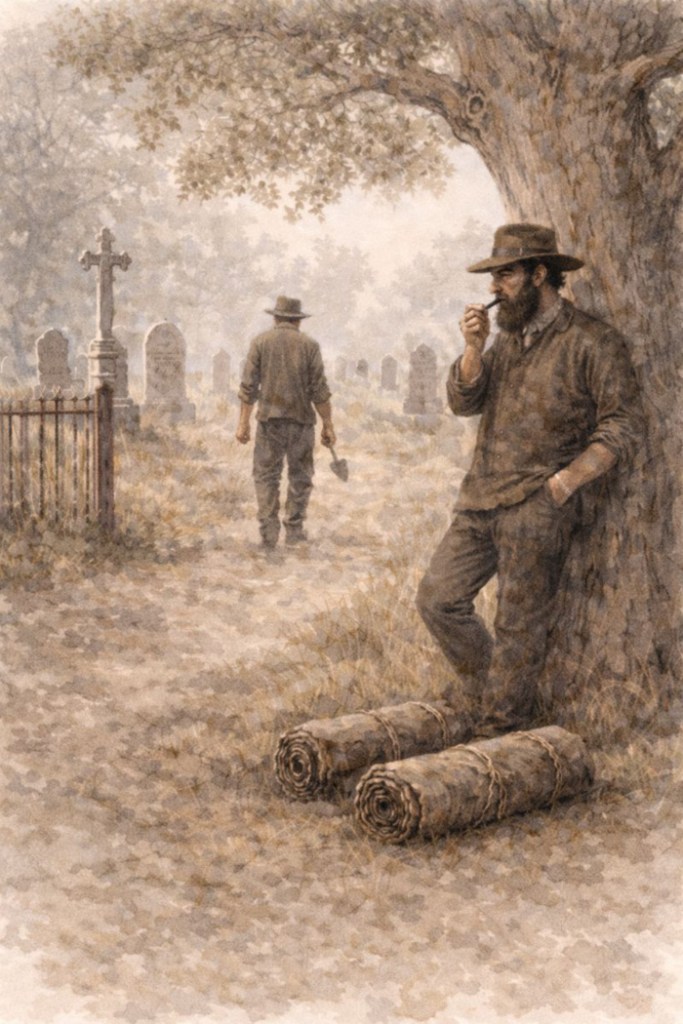
    Bell had found the waistcoat on his way to a place called the Four Posts, about eighty yards from the Old Glenorchy Road. The three fossicked through the immediate area, moving as systematically as they could outward from the spot, which Bell had thoughtfully marked with a cross of four rocks. After about an hour, Forster dispatched Bell to fetch Constable Hillard for another set of legs and eyes.

    Alone now, taking a mental break, he wandered down to a dry creek bed, fringed with scrub and tall kangaroo grass.

    A  lone bird call rang out – Four gallons of water! – and he stopped, turning towards the sound. To his left, where the call had come from, something caught his eye: a small heap half-hidden in the grass. He’d almost missed it, for the cloth had taken on a yellowish-green tinge from long exposure, nearly the same as the tussocks around it. He might have passed and re-passed forever without discovering it, but for that bird. Feathered bloody oracle.

    Three buckets of water! Fainter, receding, gone. Magnifying the heavy, empty expanse. What turns up when you are not looking.

    The coat was blood-stained, especially about the neck. One button remained on the waistcoat, the only one to withstand the violent strain by which the garment had been yanked open. It matched one found under the body. On the shirt, too, were the gaps where two buttons, also recovered under the remains, had been torn free. There could be no doubt that the clothes were those worn by the murdered man. He drew from the tangle of cloth a third of a wideawake felt hat, the rest having been cut away. A few hairs clung to the remaining rim, the same colour as those found at the base of the dead man’s neck. They were stuck to the felt by blood. The trousers were missing, and so was the dead man’s head.

    “Wideawake,” he couldn’t help saying softly aloud, as he made his notes, “no nap.”

    He’d organise another sweep in a week or so, but for now there were other fires to tend.

    Bellman’s mother had been summoned over from Horsham to examine the remains, which she was sure as sure could be were her son’s:

    “It can’t be he, oh it can’t be he! But I fear it is. I’m certain it is! His hair’s turned a little more to the reddish hue, that’s all, workin’ out here like a navvy! What a bonnie bairn he was, the wee rascal! That mole on his shoulder is sure his. Oh, he was a fine laddie, with all of his future in front of him. But will you look at him, look at his skin. It’s … radiant, the peak of health! Bless the daft lad – he couldn’t scrub up like that when he was living. Ach, ma heid’s mince!”

    Hillard fetched her again from the Commercial Hotel in Stawell, where she was being put up, having imperfect relations with her other son. This time, it was not the body she was brought in to identify, but the items of clothing recovered from the bush.

     “He was a dear laddie,” she said quavering, placing her frail hand on the waistcoat. “Och, to think this was the last thing he wore, it sends me heart racin’. Well, whit’s fur ye’ll no go by ye!” Overcome, she paled and drew the back of her hand up to her brow. Forster pulled a chair over and lowered her into it.

    There came a knock at the door, and a constable poked his head in. “There’s a bloke out here to see you, Detective.”

    “Not now.”

    “It seems important.”

    “I said not now.” The door closed.

    Mrs Bellman began to sob. The door opened again; the same constable gestured to Hillard, who looked at Forster.

    “For goodness sake, go and see what he wants.”

    The woman sobbed convulsively. Forster laid a hand lightly on her shoulder. The door opened and Hadfield came in quietly followed by a man.

    “You alright, Ma?”

    “In the name o’ the wee man, this isnae real!” Mrs Bellman turned white as a sheet, rose shaking – “Ye’re meant to be deid!” – and abruptly dropped to the floor.

    Thus the Bellman mystery – if one can call it that – was solved. Instead of going to Warrnambool as planned, he had detoured over into New South Wales and returned the next Saturday. He’d left the animals with feed enough for a few days, thinking he’d be home on Sunday. But his horse threw a shoe past Moama and went lame, and the smith wouldn’t see him till Friday, he had to lay up at some wayside inn, only the publican’s daughter had the measles, and he ended up minding the place while the missus boiled onions. At any rate: no foul play, no mystery. Just an irritatingly loquacious fellow, who couldn’t be bothered sending a wire.

    The case of a carrier named Flannigan, though not dissimilar, was in some respects more of a nuisance. His circumstances made it likely that the remains found near Deep Lead might be his. Detective Forster left Stawell by the first train Monday morning to conduct some interviews. On Tuesday, he struck out for Woodend and went some distance into Bullarook Forest, before doubling back to Seymour. He set the telegraph wires to work, then back to Ballarat, chasing a clue. By wire, he learned that Flannigan was alive and well in Deniliquin.

    The circumstances surrounding the disappearance of all persons reported missing from the district had now been accounted for. The discovery of the clothing further assisted in establishing the identity of the murdered man and was expected to furnish evidence leading to the apprehension of the perpetrator. Another step had been taken in the matter, and it was to be hoped that justice, having misplaced its head, would soon find its footing.


    Michael Guest © 2025

    Images generated by AI

  • 4. Death Rites (from the draft novel Stawell Bardo)

    4. Death Rites (from the draft novel Stawell Bardo)

    Death Rites

    I am not the least bit afraid of you hungry ghosts, Mow Fung says silently. Not because he doubts your existence, but because he has lived too long to deny it. Still, he will not let you see his fear. A part of him is always apprehensive, and it would be foolish not to be.

    In the centre of the back room, the headless body is suspended in light as though in thin air. In the middle of all things, since everything else floats around it, cast into the eternal dimensions. He contemplates the multidimensionality of this container, of the person who once inhabited it, now perhaps having almost arrived at the infinite end of the loop, the point of closure – and escape – of a human entity.

    Mow Fung sits on a wooden stool, and images of the ancestors appear to his mind’s eye. Not a grandiose company by worldly standards, not a lineage of Mandarins thirty generations deep. No, some were threadbare hermits, others alchemists in the courts of emperors. Many kept faith with the Tao; others faltered along the way, as he has. Yet all are recorded, nonetheless, in the long cosmic family archive, robed in deep blue, crimson, and jade, and encircled by golden dragons, as befits their rank in the Immortal Registers.

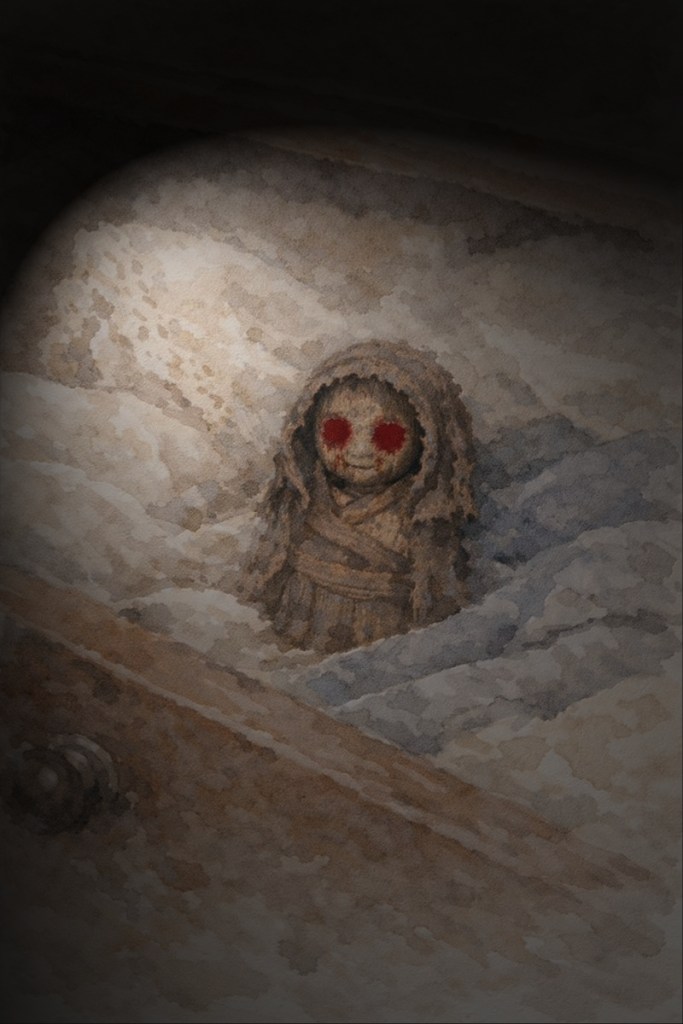
    The body is laid out on its back before him, upon a makeshift slab of two small tables joined and draped with a blanket. Only the remains are visible, in a sphere of candlelight. A single flame burns steadily, flickering now and again from some subtle cause, some nearby disturbance. Similarly, the ribbon of smoke from the cheap incense burner placed by the dead man’s shoulder curls and falters, though not a breath of air stirs. Spirits? A lost soul? This man died a brutal death, of a kind that lingers, and draws misery in its wake. The kind of death that attracts attention from dangerous quarters. Yet rites must still be done – from human kindness, and something higher than that. There are dangers, and it has been a long time. But the dead deserve their due.

    He sprinkles more incense onto the embers in the burner: dragon’s blood resin, frankincense, myrrh, and sea salt – the mixture taught to him long ago. The smoke rises in slow spirals, vanishing into the rafters. A garden lizard clings to the wall above the window, still as an ancient glyph.

    Mow Fung settles into meditation, imprinting the vision of the corpse onto his psyche. Ghosts may bother him tonight. But he will sit, focus his mind, and dream a little.

    For the time being, sit here and meditate on this strange and radiant being.

    Hungry ghosts may try to devour or deceive the spirit who recently inhabited this shell, may try to beguile him into straying from the true path. So Mow Fung will remain. Perhaps he may be of help to the passing spirit, which surely lingers still.

    But I am not afraid of you ghosts and phantoms and all the rest of you, though you may manifest yourselves in the hollows of my psyche and the ancient gateways at the base of my spine.

    He will lend the strength of his will and the benevolence of his heart.

    Why radiant? What may it be that it radiates? Luminous only in his own mind’s eye? He lets the thought drift past. Inwardly he perceives it again, a pale gleam, the colour of the Golden Pill and Golden Elixir of immortality, the vapour of the Tao inside the body, giving rise to the three flowers that gather at the top of the head. In the eye of ritual he was still recently dead, the spirit hovering close. But the husk declared otherwise, bearing the marks of the sun and the slow desiccation of time.

    The skin is dried and darkened to a leathery orange-brown hue, like the crust of old lacquer or parchment scorched by the sun, as though an ancient inscription had blistered and peeled from the body. He lay outdoors under the summer sun for a month to become mummified like this. Mow Fung sniffs the air. Little smell, because the flesh has dried; only a faint foulness lingers. Something has taken the generative parts. By tooth, by hand, by force of hunger or madness, there is no saying. A void where the gate of life once stood, robbed of return. The generative parts: root of essence, seed of Jing. The gate of life torn away.Without the root, the essence scatters. Jing lost, Shen adrift. A cosmological wound, rending the dead man’s passage and the karma of the living he leaves behind. Even ghosts may not find their way back to where they belong.

    Around the throat, where once rough red bristles clung, now sun-softened, the remnants of a full beard spread in a matted trail down the chest. Hair grows no further after death; this is his last signature, fading. He leans closer. At the neck: clean, decisive cuts, consistent with a heavy axe. Not just to kill (the killing blow struck the now missing head, no doubt) but to erase. To unname.

    Mow Fung stands and moves slowly around the body, passing his hands above it, sensing more than examining as such. The limbs are intact, no bones broken. The calves and thighs hollowed. Scavenged, gnawed out. In the chest, dried flecks of blood cling like pigment; where faint scratches or fragments remain embedded in the skin, their pattern uncertain, whether accidental or intentional. The ribs are bared in patches, the abdomen leached of flesh.

    There were dried-out bodies fallen by the wayside on the hot trek from the South Australian coast to the Victorian goldfields. His countrymen, whom he and his comrades would bury with some rites to speed them along their way to the afterlife.

    He had seen worse.

    One day, long ago in Canton, his feet took him along a meandering route through the city and into an alleyway, where Manchu soldiers were in the process of butchering a throng of hapless supporters of the Taiping Heavenly Kingdom of Great Peace. Already the place stank of the blood of hundreds, so many that their heads would not all fit into the chests that were to be sent to the governor general. So many heads that, after a while, many were emptied out of the chests and only the ears packed.

    One instant strikes him from the past, clear and lucid as starlight. Two Manchu soldiers bound one of the captives hand and foot and clubbed him so that he fell to his knees. One soldier grabbed hold of the pigtail and the other prepared to chop off his head. Unlike his terrified comrades, the doomed man maintained a calm demeanor. Seconds before the sword fell, he selected Mow Fung from the group of peasants, among whom he had concealed himself, and fixed him in an unearthly, unwavering gaze. It was clear to Mow Fung even then: he had been led to that place to witness this specific moment of death, for his own benefit. Such a pure death signified an enlightened life.

    Huish-Huish enters carrying a tray with tea and fruit, as though for a guest. Mow Fung sits, eyes closed, head bowed, his back showing the weight of his years. He remains absorbed in contemplation. Motionless, like a mountain, the mind rests in its place.

    “This man is calling out for help,” he says calmly, his eyes still closed. “He is stuck here in the world of the living, still clinging to his physical vessel. But there is something else, something malevolent, reaching from the far past, and out into the future, through this room, at this hour, sucking in all of us. Traces linger here, signs I was meant to see. But to read them, I must first root them in existence. And to do that, I must turn inward, though I have strayed from the path before.”

    He makes the arcane hand seal of the Patriarch of Ten Thousand Arts, upon whose benevolence his fate will depend. He doesn’t mind that Huish-Huish sees the forbidden sign.

    “Do you mean, similar omens to the ones that came to you in Canton in those lost days, those woeful days far behind you now? Do you happen to recall the ravages of the poppy?”

    “Perhaps. There were pleasant times too, you know. Neither matters anymore. But someone has arrived in our hotel needing shelter and a guide. How can we refuse him?”

    “Neither matters, according to your beliefs, so do what you feel you must,” she says. “I suppose you will anyway.”

    She smiles faintly, turns, and starts to leave the room. Then she looks back.

    “Of course,” she says, “you told me you’d fled those times forever. But you know you cannot fly from the path, since the further you fly, the closer you remain.”

    “Poppycock.”

    Suddenly the incense splutters and the fragrant smoke erupts.

    “There are some bad ghosts here now,” he says. “You had better go.” Not entirely sure they are here yet, but she is annoying him with her womanly contrariness, her profound oppositeness.

    “Well, don’t worry them,” Huish-Huish says, turning again to go. She is less afraid of ghosts than he, having had less experience. “Don’t surprise them. Don’t scare them too much.”

    But there is no surprising some of them, those whom he senses looking on from far in the future, where they have access from their lairs in eternity. Will he have descendants way down the track to help him out if needs be? To combat those vultures who lie in wait to tear out his soul?

    He recreates a temporary altar from mystical objects encountered and secreted here and there. With the Sword-Fingers Hand Seal of the right hand, he traces the character Chi or Imperial Order in the air, thereby infusing himself with celestial fire. Appealing to the Patriarch, the deity Wan Fa Zu Shi, he prepares for the journey: painting talismans on his clothes and body for protection, setting upon the altar a peach-wood sword inscribed with celestial characters, and spirit-money, paper painted with black and silver symbols, for burning. How else shall the poor fellow pay his way in the underworld?

    To locate the lost soul, he inflates a consecrated paper lantern with heated air from the candle and releases it through the window, so that it drifts away into the dark. He makes the Five Thunders gesture to resist the threat he smells, from a foul presence, faint but rising. For the rest of the night, he casts spells using the symbols and talismans he has kept hidden away since … he almost forgets when. He sprinkles incense prepared from golden wattle: its essence extracted, purified, concentrated.

    He had made the incense himself, as always. The ingredients were chosen for their essences – dragon’s blood, frankincense, powdered bark of the Raspberry Jam Wattle, fragrant and subtly luminous, said to open the inner senses – dried, ground, and purified over slow charcoal in a clay cauldron, with breath and invocation. He had traced the talismanic characters in the air above the bowl: Qi, An, Ling. Then exhaled gently three times to bind them with his own spirit. The resulting powder, dark and fine, was wrapped in yellow silk and set aside to cure in the hush of moonlight. A humble alchemy, but his own.

    The ancients taught that to arrive at one’s essence, both substance and self must pass through furnace and cauldron — sacred tools of Taoist transformation, forged in both body and mind. Vessels to burn away acquired dross and reveal the hidden nature beneath.

     The incantations first trickle into memory, then the flood begins and he sinks inward, drawn down toward the realm of death. Deeper and deeper.

    For some reason this beheaded man made his way here to the Junction Hotel and set Mow Fung’s psyche in turmoil. The story of Peng Yue has haunted him from childhood.

    Once a fisherman, Peng Yue became a great general and conquered twenty cities. But the treacherous Empress Lu Zhi betrayed him, and he was beheaded. She had his body minced and salted and fed to the aristocrats who supported him. “I grant you a rare treat …”

    Now Mow Fung gazes down from the ceiling upon the headless man on the table. Palms turned down, arms spread at a forty-five degree angle – appearing relaxed, paradoxically, in their state of rigor mortis – legs extended.

    He focuses on the trunk and the space where the head once was but is no longer – a void that seems to open outward into infinite time. Even the dead man’s arms express that thought somehow, in their pathetic, unconscious gesture of resignation. He passes through the clogged throat and into the cavern of the lungs; silent chambers sealed by death, yet faintly trembling with memory.

    In his meditations, in the stillness of his body, he casts his spells, intones his incantations. No one to hear now but the spirits and ghosts.

    Even if I try to move my hand, I cannot, because I feel the pressure of time forcing me back into the reality of this place into which I was born. It is as though an inch of space through which he might move his hand is the same as the whole extent of the universe. So he cannot even lift a finger.

    But he enters a trance and moves outward in his spirit body, so that he can follow the lantern, which will lead him to the boundary realm. A dry creek with scrub that Mow Fung does not recognise. The dead man’s ghost appears in the periphery of his vision.

    There is the head, but floating, attached by a long cord, moaning inconsolably.

    Mow Fung wills him to come along, and so they progress, side by side towards the boundary zone, inhabited by the shadow beings and spirit-shells who prey on the newly dead. The deceased has forty-nine days to get through here, lest he himself become one of the wandering dead, to prey on others.

    Along a shimmering trail in a space of blackness beneath two purple moons, they approach the local guardian spirit. Serpents writhe about the three of them in the red dust of the outer limits, while the dark-skinned entity regards the other two askance.

    “So you’re that poor fellow with a good mate,” the guardian says to the precarious soul. “I seen what happened, don’t worry. And you, who do you think you are, yella-fella?” looking at Mow Fung. Ink-black skin, white pigment daubed roughly on the face and in lines and patches across his naked body. His eyes strike the alert look of a kangaroo, nostrils flaring.

    “You dunno him, wadda you care what appens to im?”

    “I have come down here with this bloke,” Mow Fung says, “this white fella, because he came to my place, the Junction Hotel, Deep Lead, dead and beheaded.”

    “Irish or Scottish or something. Well, I don’t care who he is,” the local guardian says. “He is where he belongs, under the dirt here. But you, you don’t belong here. You a yella man, a Chinee. You alive still, you can’t fool me, you know!”

    He cackles as if finding the situation hilarious. The laughter of spirits is never glib; it is the echo of doors closing – or opening where they should not.

    The laugh ceases abruptly, and the guardian’s visage turns to stone.

    “You smoked that stuff, them poppies. We don’t want any of them poisons here, so you begone with you!”

    “He visited my hotel before we came down here. He may be a sign of worse to come.”

    “Good point, maybe. Ha ha! You been here before too, you Chinese man of the dead. We remember you, don’t worry. Only you and that other Chinee.” He raises his arm horizontally to the right and points, without looking. ”You go that way, east, and maybe you’ll find yourself in the west after all. Maybe in the Teahouse of Awakening, where you mobs sometimes meet – if ya lucky, if ya lucky!”

    “We don’t want to loiter around here too long, anyway,” Mow Fung says sideways to his companion.

    The red-bearded head was making its way back to its place by degrees onto the broad shoulders, condensing midway into the visual field. Disconcerting. Fortunately, Mow Fung had developed his ghost-seeing eyes years before and, invoking the Ghost Eye Hand Seal, was able to discern some dim contours through ripples in the ether. The spirit’s head had descended and he stood there mute, the head bowed, the red hair falling forward to cover the face.

    The two of them set off in the direction the guardian had pointed. Mow Fung looked back once and saw a rainbow fading against the black sky.

    There are colours that infuse the beginning of things.

    There echoed a beating of wings, vast and powerful, as if from a primeval bird.

    The entity was gone.

    “I don’t know much about these local ancestor beings,” Mow Fung said, “except they are powerful spirits from what they call their Dreamtime. He has allowed us right of way, so if things work out, we might be able to get you through the border zone, out to the other side.”

    They reached a fork in the track, marked by a ruined tree. “We’ll go this way.” Taking the path to the left.

    The left-hand way follows the yielding earth; the right-hand way, the open sky.

    They descended a ridge onto a plain of white ash, streaked with tar pits. Bodies writhed in the viscous black, their groans rising on the hot wind to greet the two arrivals.


    Michael Guest © 2025

    Images generated by AI