Tag: Newspaper serial

  • J.F. Smith’s Mystery of the Marsh — Thirty-second Instalment

    J.F. Smith’s Mystery of the Marsh — Thirty-second Instalment

    We arrive at last at the denouement. The term is borrowed from the French dénouement, Aristotle’s Poetics first having made its way into English via André Dacier’s 1692 French translation, Poëtique d’Aristote Traduite en François avec des Remarques. In Aristotle’s Art of Poetry (1705) Theodore Goulston translates dénouement as “unravelling“:
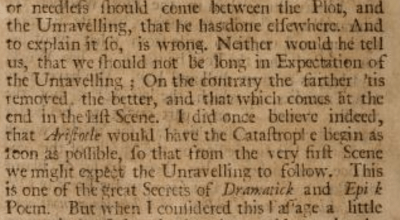
    From Goulston (1705), remarks on Aristotle’s Eighth Chapter

    Over the next few decades, the English word “unravelling” — plainly descriptive as it is — was supplanted by the alluring, intellectual-sounding French term. “Denouement” does assume a sense of specificity as a technical term, which would have been clouded in the humble “unravelling.”

    Moreover, the root of the French word, nouer, “to tie” or “to knot”, from the Latin nodus, “a knot” (Merriam-Webster) implies the untying of a knot that was in the first place deliberately tied. Thus it is apropos to narrative form, in which plots become increasingly complicated in their movement, until something disturbs the “upward” momentum, and there is a turning point and descent.

    As a technical term in drama, denouement is considered a synonym for the Aristotelian “catastrophe,” which is derived from katá, “down, against” + stréphō, “I turn” (Wiktionary) — that is, a down-turning or unwinding of the story (once it has been wound up, so to speak). This aesthetic usage is distinguished from the everyday sense of a “terrible happening”; though it’s easy to deduce its derivation from classical tragedy.

    Turning now to Smith’s denouement, we can only marvel at the masterly hand with which he effects the final unravelling of Mystery of the Marsh. His engaging light touch, his wit and refinement are in evidence throughout.

    As ever, social currents bubble beneath, with all the qualities of splendour, subtlety, and crassness that characterize not only Regency society, perhaps, but all the human race. Legal strategies and points of moral principle are teased out and resolved. Character nuances are polished to a tasteful finish (note Bury’s absolute redemption from his conditioned class prejudice). The i’s are dotted and t’s elegantly crossed.

    On the entrance of the villains, we feel we have to stop ourselves from hissing out loud. Just deserts are meted out in fine measure. Loose threads are tied, the abject truth and consequence of corrupt relationships revealed.

    Vaguely remembered sub-plots are recalled. “Bet you’d forgotten about that one …” Smith seems to say with a chuckle at your expense — “Well, I hadn’t!” And his fine touch with the technique of reader-address, with which the reader has become quite familiar, seems now at once quaint and profound, evidencing an awareness of an intimate fellowship. He won’t tell a secret straight out, but “we suspect our readers have a shrewd guess at it.”


    CHAPTER THIRTY-TWO

    An Unexpected Surprise, Followed by a Monster Law Suit — Conclusion — The Running Down of the Clock — Its Last Tick

    The next morning the fashionable portion of London was greatly agitated by the various reports which appeared in the morning papers. Scarcely one gave a correct version of the affair. The names of the fair cousins were no longer masked by initials — transparent to all who recollected the previous reports — but were printed at full length.

    Lady Montague had a fit of the horrors. Lord Bury looked serious, and Sir George Meredith felt so indignant at the outrage offered to his child that he threatened to go over at once to the Liberals unless the Home Office did prompt justice to his demands. Having fully made up his mind, and satisfied as to the conclusion, he did as many hasty, well-meaning persons do on similar occasions: he sent for his lawyer to draw up his memorial.

    Mr. Whiston expected the summons, and was speedily in attendance. He listened to his statements with exemplary patience, as he did to all his clients when they were angry, and then pronounced emphatically against the step.

    ‘You must apply to the chancellor,’ he said.

    ‘For once you are wrong,’ exclaimed the baronet. ‘Clara is not a ward in chancery.’

    ‘But Lady Kate is,’ observed the man of law. ‘The cases are the same; both lie in a nutshell; you cannot separate them.’

    ‘Still I do not see how his lordship’s power hears upon the point.’

    The lawyer gave him a pitying smile.

    ‘His power bears upon every point that comes before his court,’ he said; ‘practically it is illimitable — has never been defined. What he cannot do I have not the slightest idea; but I will tell you what he will do — issue an order to the Home Office to dispatch a body of well-armed officers to the Bittern’s Marsh, with powers to arrest every living actor in the outrage they may discover, and bring back the bodies of the dead ones.’

    ‘Why, then there will be an inquest!’

    ‘I trust so.’

    ‘Trust so?’ repeated Sir George. ‘Would you kill my child?’

    Mr. Whiston appeared slightly moved.

    ‘I am not a father,’ he observed; ‘but I can feel for your embarrassment. Would you have the reputation of two pure, innocent girls exposed to the sneers of slander — the covert doubts, the half-veiled suspicion, whose stings are worse than death? No; their purity must be established by the light of judicial inquiry; by legal evidence, without a flaw for malice to hang a rumor on. It will be a hard trial for them; but it must be endured. I see no other way.’

    Sir George Meredith paced the room for some time in silence. Much as he disliked publicity, his better judgment at last prevailed.

    ‘You are right,’ he said; ‘a hundred times right. I must prepare my daughter for the ordeal; but who shall prepare my niece?’

    The lawyer smiled.

    ‘Girls,’ he observed, ‘are stronger than we deem. Their own virtue and the dawning prospect of future happiness will sustain them. Leave the rest to me. I will instantly prepare a memorial to his lordship, and feel no doubt as to the result.’

    On his return home, whilst still relating the conversation to his nephew, Lord Bury was announced. Without noticing the lawyer, the young nobleman walked directly up to our hero and extended his hand. It was the first time he had ever done so.

    ‘Mr. William Whiston,’ he said, ‘I have heard of the noble sacrifice you have made to affection and true manhood. I, for one, am prepared to welcome most cordially your alliance with my cousin. At the request of my aunt, I add that she will be most happy to receive you at Montague House as the acknowledged suitor of her niece.’

    Our hero grasped the hand extended to him most cordially.

    ‘My dear lord —’ he said.

    ‘Had we not better call each other by our Christian names now, since we are likely to become so nearly related? Let it be henceforth William and Egbert between us.’

    ‘If you really wish it.’

    ‘I do wish it,’ replied the visitor, energetically. ‘The last few weeks have taught me more than one lesson — that man’s true nobility is in himself, not in the accident of birth. My greatest desire is to prove worthy of your esteem.’

    On that day the speaker made two fast friends — the nephew and his uncle. The latter proved a most important one. He divined, if he did not exactly know, the exact position his father’s conduct had placed him in, and mentally resolved to exert all his skill and experience to extricate him.

    The legal step turned out exactly as Lawyer Whiston predicted. The chancellor issued his rescript to the Home Office, and in three days the officers returned, not with any living prisoners, but the bodies of Clarence Marsham and Burcham.

    On the morning of the inquest the coroner’s court appeared unusually crowded. Fabulous sums were offered for seats long after there ceased to be standing room. Public curiosity was on the alert, and peeresses and ladies of fashion hastened to the scene as to the opera or some other exciting spectacle.

    Expectation was at its height, when Lady Montague, looking wonderfully calm and collected, entered the courtroom, with Clara and Kate, and all three took their seats upon the bench reserved for them. The jury, having already been empaneled, had viewed the bodies in a room apart.

    An array of men eminent at the bar appeared on both sides. The arch-plotter had taken care of her own interests; not even the death of her son could blind her to them.

    We have neither time nor space to give the examinations of the witnesses. Lawyer Whiston had prepared the evidence on his side — the letters of Lady Allworth were read, which covered her with infamy, and every point in the part of the dark transaction she had planned was most clearly proved. The narrative of the two cousins, which was clearly although faintly given, began to excite a deep sympathy; but when Susan, in her artless, simple way, related the death of the old domestic, the frantic entreaties of Kate to her cousin to kill her rather than suffer her to be forced into a marriage she abhorred, the feeling became positive enthusiasm. The jury declared they were ready to give their verdict. This, however, the counsel Lawyer Whiston had employed, acting under his instructions, by no means would permit; they insisted that every witness should be heard. Bunce, Willie, and Goliah gave their testimony, described the siege, the ruse by which the conspirators had been defeated, down to the arrival of Sir George Meredith and Lord Bury. Lastly the correspondence of Viscountess Allworth with the schoolmaster was read. The opposing barristers threw up their briefs in disgust, and the last fangs of the serpent, slander, on which her ladyship relied, were effectually drawn. Then, and then only, was the verdict of justifiable homicide received. Hosts of friends thronged around the cruelly persecuted girls to congratulate them on their escape.

    Then, and then only, was the wisdom of the old lawyer’s advice fully understood.

    When fashionable society in England does take a fit of virtuous indignation it generally proves an exceedingly strong one. The following day the elite of London called to inscribe their names in the visiting book at Montague House, whilst not one single note of condolence was left at that of the woman who had lost her son, whose name was already stamped with the indelible brand of infamy. Still, the arch plotter bore a bold front. When her husband, disgusted at the exposure — not on account of its immorality, but failure — hinted at the propriety of retiring to the country, she haughtily refused.

    Title and fortune still remained to her. She could still defy the world.

    In the midst of the dispute, a letter from her lawyer, Brit, was brought to her. As she read it her cheek became pale for an instant, not longer, and then her courage returned.

    ‘You must accompany me,’ she said. Our agent, Blackmore, has been arrested in London, and will be examined before noon at the police office.’

    ‘Our agent?’ repeated his lordship.

    ‘Well, my agent, and your tenant, if you prefer the distinction. The old idiot has been caught, wandering amongst the old book-stalls near Drury Lane. I thought he had escaped.’

    The viscount began to feel exceedingly uncomfortable. He remembered the lease of the Bittern’s Marsh.

    ‘You must bail him,’ added his wife.

    This proved a little too much even for his lordship’s philosophy to bear.

    ‘Absurd!’ he ejaculated.

    ‘I tell you that you must,’ continued the lady. ‘My reputation is at stake.’

    ‘Bah! It is lost already.’

    ‘And your life!’ This rather startled her hearer.

    ‘Think you I am such a weak fool as to have trusted you without precaution?’ continued the speaker. ‘Your forgeries upon your son are in my hands. I deposited them in the Bank of England. Bury was quite willing enough to pay them, but I refused to accept the money. He will never lay perjury upon his soul to save a father he must despise.’

    ‘The monster!’ ejaculated the now thoroughly terrified man.

    Whether he meant his wife or his son we cannot undertake to decide.

    ‘You know me at last,’ said her ladyship, coolly. ‘Take your choice.’

    ‘Certainly, my love,’ was the submissive reply. ‘I am quite willing to go with you.’

    ‘The degradation proved unavailing. On their arrival at the police office the formal gentleman in black was there before them. When bail was offered he objected to bail, produced the chancellor’s warrant committing the prisoner for contempt of court, and bore him triumphantly off to the King’s Bench Prison, There we must leave him for a while.

    During the day Bury received a most piteous appeal from his parent, and rushed with it to the office of Mr. Whiston, who read it carefully, smiling as he did so.

    ‘Is it possible that you can find a source of mirth in my distress?’

    ‘Not so, my dear lord,’ answered the lawyer, kindly. ‘If I smiled, it was because I begin to see my way out of this sad difficulty.’

    ‘Is it possible? How?’

    ‘That is my secret. Lady Allworth is playing a very close game, but I think I hold the winning card in my hand. In five days the forgeries shall be in your hands.’

    ‘May I believe this happiness?’

    ‘If I live, yes. Nothing but death can cancel my promise. Now leave me. I have the work of twenty younger men to do.’

    The old man did not miscalculate his task.

    As a matter of observation, one enormous scandal is generally succeeded by another equally notorious. Society was again startled by the report that a suit had been commenced by a certain person styling himself Charles Marsham, against Lady Allworth, for the recovery of the estates bequeathed to her by her first husband, and that the chancellor had placed a distringas upon all the property. The rumour proved to be correct; but what struck those watching the affair was the singular fact that, although the most eminent council had been employed by the plaintiff, his solicitor was an obscure but rising young man, who had never been previously engaged on any important case. Curiosity, especially among the legal profession, was greatly excited. More than once Mr. Whiston was questioned by his friends and acquaintances in the law, but he professed the most profound ignorance of the affair — professional ignorance of course. Outsiders, as well as lawyers, understand what that means.

    Trembling at the possibility of losing her ill-acquired wealth, of which she had made so vile a use, her ladyship rushed to consult her advisers, Brit and Son, who received her rather coolly. They could do nothing, they declared, without money, the account against their client being already so much larger than they could afford to lose.

    ‘Why, you do not believe in this absurd claim?’

    The elder Brit replied that the absurdity had very little to do with it, and the law was painfully uncertain. The firm had met with losses lately.

    His son re-echoed the opinion.

    ‘After all the money you have made of me?’

    The gentlemen smiled. Hitherto they had looked upon their client as a shrewd woman. The simplicity of the remark surprised them.

    Still they adhered to their resolution. The junior partner suggested an appeal to her husband.

    Her ladyship shook her head. He was almost as much pushed for money as herself.

    ‘Your ladyship still holds the securities lodged in the bank,’ observed the senior partner, ‘and the money is there to redeem them. With twenty thousand pounds it would be easy to defeat this conspiracy.’

    ‘You believe it one, then ?’

    ‘No doubt of it,’ replied the firm.

    ‘And you could see the treacherous old hypocrite, Blackmore?’

    ‘Money will do anything.’

    The love of greed prevailed over the thirst for revenge, and the guilty woman finally consented to follow their advice. The money was recovered, the notes stamped as paid, and, an hour afterwards delivered to Lawyer Whiston, who claimed them as Lord Bury’s agent, to whose irrepressible satisfaction that same day they were destroyed.

    Sundown, Laura Knight

    As soon as the cousins were sufficiently recovered to bear the journey the united family left London for Sir George Meredith’s seat in the eastern counties, near Chellston, soon to become the property, we suspect, of Lord Bury, who, with our hero, accompanied them. The party would have still been larger, but Lawyer Whiston declared it impossible for himself, Bunce, and Old Nance to quit town. They did not ask his reasons. Already they had divined a part of his secret, and we suspect our readers have a shrewd guess at it.

    As for the Sawter boys and their mother, they were already provided for.

    ‘Fear not,’ added the old, man; ‘we shall be in time.’

    ‘In time for what?’ innocently demanded Kate.

    An arch look from the uncle of Willie brought a blush into her cheek. She asked no further questions.

    We are not going to inflict upon our readers a technical account of the great trial, which soon afterwards took place, but merely relate a few of the incidents.

    Lady Allworth, a former pupil of Theophilus Blackmore, had created interest with her instructor by her intelligence and aptitude. By his influence she obtained a situation in the family of Mr. Marsham, whose wife dying shortly afterwards, first awakened her ambition. Her plans were artfully laid.

    By the connivance of the Bath woman it was given out that his infant son was drowned, and universally believed. Such, however, was not the case. It was secretly conveyed to the martello tower, where the schoolmaster, reduced to poverty, had taken up his abode. His servant, Nance, nursed the boy. The mysterious way in which he had been brought there first excited her suspicions, and induced her to gather up the fragments of half-burnt letters which first excited the curiosity of the astute lawyer. The cynical confession of Theophilus Blackmore, that of the Bath woman and French maid, who were all in the plot, not only proved the identity of the boy, but established the facts which the correspondence of the viscountess, discovered in the old tower, still further confirmed.

    After days of wrangling arguing by council on either side a decree was at last pronounced by which Charles Marsham — so long known as Bunce the tramp — was declared heir to his late lather’s landed estate.

    Poor fellow! the change in fortune appeared to afford him but slight pleasure As he feelingly observed, when his benefactor congratulated him, he was alone in the world.

    ‘Not so,’ replied his friend. You have an uncle and an aunt — Walter Marsham and his sister Pen — who are anxious to claim you. It was their money that enabled me to search out the evidence and carry on the suit successfully.’

    The speaker did not say how much of his own he had expended.

    On learning the result of the trial Lady Allworth retired to her own room. Everything had failed — scheming, lying, and even perjury proved useless. They had left her a pauper as far as wealth was concerned. An empty title alone remained, and even that now appeared valueless.

    ‘The way of transgressors is hard.’

    The next morning she was found dead in her bed.

    Thanks to obliging doctors and a complaisant jury, a verdict of apoplexy was given, and the body buried by her husband in an obscure churchyard in the city — no one to mourn her, no herald’s pomp, no stone to mark the spot, which was soon forgotten.

    The brief space that remains to us must be devoted to happier themes — to self-sacrifice rewarded by faithful love, to prejudice rooted from a nature naturally good.

    But ere the final act which was to crown the day-dreams of the lovers was fixed by the fair cousins the reconciliation of Tom Randal with his father was brought about. The rough old farmer, who had known but little peace since the quarrel, sought the cottage of the pretty Phœbe, made the amende honorable, and ask her to become the wife of his soldier boy. The happy girl consented, and proved no dowerless bride; the gift of the Home Farm from Clara accompanied her to the altar.

    Goliah and Susan were married at the same time, and started for Deerhurst.

    Here we are but slightly anticipating. A respectable peace, or rather an armed neutrality, was patched up between the widows. Mrs. Hurst, according to her husband’s will, retired to her own cottage, whilst Goliah’s mother remained in her own homestead.

    Poor Goliah felt so boisterously happy that there exists a tradition even to the present day that on one occasion he was known to have kissed his mother-in-law.

    When Lawyer Whiston, accompanied by Bunce — we must call him so, if only for the last time — visited Chellston, both were warmly welcomed. If Lady Kate and Clara looked a little shy, it was, as Lady Montague observed, exceedingly proper. They knew what the visit portended.

    The great day dawned at last. Our hero and Lord Bury became the happy husbands of the girls they had so honestly won — the best reward mankind can claim or love bestow.

    In less than a year’s time the same party were assembled at the same place. Health, sweet peace of mind, and calm content beamed on the features of all. And as they sat beneath the trees in the park many an innocent jest went round and tale of the past was related.

    Bunce caught the infection of the hour, and was soon seen walking at evening shade by the side of Martha.

    It proved afterwards a match.

    Our task is over. The weights of the clock are run down and the final tick is heard.

    THE END.


    Notes and References

    • draw up his memorial: memorial = “A petition or representation made by one or more individuals to a legislative or other body. When such instrument is addressed to a court, it is called a petition.” thefreedictionary.com (legal section).
    • rescript: official edict, decree or announcement.
    • distringas: a writ commanding the sheriff to distrain a person by that person’s goods or chattels (Merriam-Webster).
    • Laura Knight, Sundown (1947): Entirely out of period, but looking towards the future.

    Goulston, Theodore. (1705). Aristotle’s Art of Poetry (London: Browne and Turner). Available at Internet Archive. Jump to document.

  • J.F. Smith’s Mystery of the Marsh — Thirtieth instalment

    J.F. Smith’s Mystery of the Marsh — Thirtieth instalment

    Did anyone notice, ages ago, the noble Bunce occasionally nip over to Hearst’s farm at Deerhurst to court the farmer’s pretty daughter Susan — even trying to steal a kiss one time — before coming onside and making himself useful as an occasional lookout for her and Goliah while they canoodled in Mrs Hearst’s garden? This was the kiss Susan rewarded him with when he revealed his true identity in the martello tower last instalment (Ch. 29.1).

    Bunce disappears from the reader’s view after rescuing the two girls in the red barn (Chs 2 and 3), and Susan doesn’t mention him until the scene in which Willie and Goliah have to appear in court, accused of stealing the mare (Chs 6 and 7). Bunce’s must certainly have been that “sure hand” to which Susan entrusted a letter to Lawyer Whiston, who consequently arrived in time to save the day for the two young men.

    This is the letter to which Lawyer Whiston refers in Chapter 7, complimenting the presence of mind and courage Susan displayed sending it to him via a certain “ragged messenger” — Bunce. Thanks to his meeting with Bunce, the lawyer recognizes his quality, takes him under his wing, and sends him on his surveillance mission to Dinant and Bitterns’ Marsh. (Muddying the waters, Susan writes a further letter to William in London, warning him that Benoni has gone there as well, intending, she believes, some treachery or other. This one she hands to Goliah to deliver, during the wedding at Deerhurst in Chapter 12.)

    My point is that none of Bunce’s acts in the interest of Susan’s affairs — and indeed out of an interest in Susan herself — are unfolded ‘onstage’, but rather, in a narrative shadow or blind-spot, only to be explained at the crucial instant in Chapter 29. I wonder whether the reader may have a right to feel to some extent gypped by such tricks of authorial deception? Others may, to the contrary, find themselves quite enjoying Smith’s chicanery and unconventional plotting. The counterfeit Smith/Bunce’s declared attraction to Susan, via faintly lascivious double entendres, makes complete sense as a form of “reverse foreshadowing” that points us back to those shady events — to an entire rivalry between Bunce and Goliah for Susan’s affections that never actually happened in the text!

    A further theme, bubbling beneath the surface, becomes explicit in this chapter and warrants some context in our digital age. Who would have picked Smith as a condoner of biblioclasm? — yet we witness a flagrant, cathartic demonstration to this effect here in Chapter 30. Twice Smith’s narrator has referred to the schoolmaster, Theophilus Blackmore, this “one loved by God” (see commentary at the beginning of Chapter 21), as “the old bookworm” (Ch. 12) and “the aged bookworm” (Ch. 21). He is characterized as a bibliomaniac, an obsessive lover of precious books, but of nothing or nobody else. Life for him is “a mathematical problem, which, once solved, could have no further interest for him” (Ch. 12). Of course, he becomes an instrument in Lady Allworth’s dastardly plot to ensnare Lady Kate.

    Smith’s scheme of compound binary oppositions would seem to counterpose “old Theo” (Ch. 12) against young William in the question of the moral worth of books. William’s pursuits at university are depicted as healthy and upright; indeed, as a means to reform a decadent society, the way to a better national future. On the other hand, Theo’s love for books is a love for the things-in-themselves, his opusculum on his “beloved Horace” (Ch. 19) a mere manic derivative.

    Bookworms are generally considered unhealthy types: immersing themselves in books at the expense of the reality, the fresh air and roses under their very noses (in this they have been replaced by mobile phone users, perhaps). Libraries, unhealthy dark, dank and musty places, give rise to parasitic lifeforms. Not lightly did Gustave Flaubert (1821-80) define literature as the “occupation of idlers” (well, actually, it was lightly). However, the biblioclasts par excellence are surely the bookworms themselves; that is, the vehicle of the metaphorical bookworm: the bugs-in-themselves.

    What of the actual creature, the bookworm; have any among us ever seen one? For centuries the organism has lurked in the dark, snugly insulated in the pages of a closed book, invisible to prying eyes. Many people have given little credit to the possibility of their real existence.

    If we turn to our Aristotle, however, we will find reference to what he considered must be one of the tiniest creatures in existence, called the acarus, which is small and white. “In books,” the philosopher writes, “there are others … and they are like scorpions without a tail.” Subsequently, many books of Aristotle have been found perforated.

    Acarus cheyletus, order acaridae

    A hundred years earlier, in the 5th-century BC, Evenus  composed an epigram:

    Pest of the Muses, devourer of pages, in crannies that lurkest,
    Fruits of the muses to taint, labor of learnings to spoil;
    Wherefore, oh, black-fleshed worm!
    Wert thou born for the evil thou workest?
    Wherefore thine own foul form shapest thou, with envious toil?

    (Qtd. in O’Conor)

    Notice that, unlike Aristotle’s, Evenus’ mite is black. Research reveals several forms and varieties, classified and unclassified.

    One day hard at work, the German doctor, botanist and sinologist Christianus Mentzelius (1622-1701) heard a loud screeching, crowing noise. Looking around, bewildered, thinking that it was a neighbour’s rooster, he noticed on his writing paper:

    a little insect that ceased not to carol like very chanticleer  until, taking a magnifying glass, I assiduously observed him. He is about the bigness of a mite and carries a gray crest, and the head low-bowed over the bosom; as to his crowing noise it comes of his clashing his wings against each other with an incessant din.

    (Qtd. in O’Conor)

    The insect is much less tedious than its human counterpart is popularly considered, and no wonder it is thought by some to be a myth. Among seven terrifying varieties researched in his Facts about Bookworms: Their History in Literature and Work in Libraries, O’Conor describes the Attagenus Pellio larva as “Long, slender, salmon-colored” and the shape of a graceful miniature whale. The Lepisma saccharina is small, brown, and cone-shaped, with “three thick tails,” and as rapid as “a flash of light.” The Dermestes lardarius is similar to a “microscopic hedgehog, bristling all over with rough black hairs.”

    Lepisma saccharina

    In 1665 Robert Hook, inventor of the microscope, described the first bookworm observed scientifically as “a small, white, silver shining worm or moth […] found much conversant among books and papers […] which corrodes and eats holes thro’ the leaves and covers. Its head appears big and blunt and its body tapers from it toward the tail smaller and smaller, being shaped almost like a carrot,” with three tails and two horns growing from its head; and it makes small round holes in books and covers.

    In his Enemies of Books (1888), Blades discusses the Bestia audax, which was like a chamelion, in seeming to offer a different size and shape to however many observers beheld it. It was microscopic and “wriggling on the learned page,” but when discovered it instantaneously “stiffened out into the resemblance of a streak of dirt.”

    As O’Conor writes:

    A strange truth it is, that the same material that supplies food for the spiritual intellect of man should also supply food for one of the tiniest creatures in God’s creation.

    They may be found, he asserts, in any quality or era of book, generally without respect to genre, from black-letter legal texts, through the classics, leather-bound folios of Plutarch and Dante, to Hauy’s ponderous Treatise on Mineralogy. Novels, however, are safest, being opened more frequently than scholarly tomes.

    Their damage is manifold as the form of the creatures themselves:

    I have five volumes of Hauy’s Mineralogy, Paris, 1801, before me now, and scarcely a page of the five volumes is intact. Very often there are deep channels cut into the book, irregular in outline, and these channels will be longer or shorter, and across the width or length of the book. Some pages will be slightly perforated; on others there will be several furrows separated by spaces untouched.

    Bookworm found crushed in the Mineralogy of Hauy

    Blades relates Peignot’s well-known account of a bookworm that pierced a continuous straight line through twenty-seven standing volumes. Such a prodigy, we might imagine, would be entirely at home alongside Blades’s worm of infinite chameleonic form, and the one that moves at the speed of light, in a library replete with Borges, Calvino, or even Castaneda.


    CHAPTER THIRTY

    Suspense — Things Not Quite so Dark as They Were, but Still Very Gloomy — Friends — A Brave Girl’s Resolution

    There are few things more trying to the human nerve than the pause which precedes action — the torturing suspense which sometimes appals more than actual danger. The first feeling of the prisoners, on discovering that a friend was near them, undoubtedly was that of hope. On his departure the cold fear, the sickening despondency, returned with redoubled force, gradually creeping over them, till the interview with Bunce seemed almost a dream. Yet there were the pistols in the hands of Clara Meredith, the food he assured them they might partake of, and old Nance ready to wait upon them.

    Clara was the first to recover something like self-command. She carefully examined the weapons, placed, as it were, by Providence in her grasp, and once satisfied they were charged, pressed them gratefully to her lips.

    She knew that her fate was in her own hands.

    ‘Aye,’ said Nance, who was still in the chamber and stood watching her movements closely, ‘you may well kiss them, lady; they were the gift of as true a friend as ever a woman in her hour of peril might wish; for in parting with them my poor boy left himself defenceless.’

    ‘I recollect. He told us you were his nurse — his second mother — that we might trust you,’ answered Miss Meredith. ‘We can only pray for him. I will not despair,’ she added, with a flash of returning spirit. ‘God is too just, too merciful, to permit a noble heart to perish in protecting two helpless girls from misery and shame.’

    ‘I have no time to pray,’ observed Nance, ‘and if I had, I have almost forgotten how. My prayer must be in action. Hark! they are calling for me. You may partake of the food in perfect confidence,’ she said, lowering her voice to a whisper. ‘I prepared it with my own hands. Again; they are getting impatient. I must descend. Heaven watch over and assist us.’

    With these words she quitted the room.

    Clara walked with an air of self-deliberation to the rude bench on which sat her cousin, whom terror rendered little more than a passive spectator of what had taken place, and seated herself beside her. Throwing her arms around her, she kissed her fondly, and uttered many endearing, soothing expressions.

    ‘Kate, darling,’ she whispered, ‘we must be firm — the crisis is at hand. I have a hope, almost a conviction, that we shall be saved. Hush, dearest—no cry of joy; the hope may fail us — the conviction prove a delusion; but, at the worst, we are armed against dishonour.’

    The speaker showed the weapons so unexpectedly obtained.

    ‘And yet,’ she added, ‘it is hard to die so young and so beloved.’

    ‘No,’ exclaimed Kate, who caught the meaning of her words, ‘a thousand times No! Better death than —’

    The shudder that shook her delicate frame — the look of agony in her soft blue eyes — explained what words were wanting to express.

    Again her cousin kissed her.

    ‘You would forgive me, then?’ she whispered.

    ‘Forgive, and bless you,’ answered the excited girl. ‘Dear, good noble Clara! you promise me, by the sisterly love between us, our sweet companionship — the ties of blood which bind us — you will kill me? Promise me? Let not that wretch triumph over my girlish weakness. Promise me — promise me ‘ she added, imploringly, ‘or give me the weapon!’

    ‘I dare not trust you with it,’ answered her cousin. ‘You are too impressionable, too easily excited. At the last moment only, should I feel justified in using it. Should it arrive — which I trust and pray it never may — rest assured of this, that villain, Clarence, shall clasp no living  victim.’

    Kate repaid her for the promise by a fond embrace.

    ‘O, that Goliah were here!’ sobbed Susan. It was about the twentieth time she had, since their imprisonment, uttered the wish. ‘But it is like the men,’ she added, ‘out of the way when they are really wanted, and never in the way when they might be useful.’

    Under ordinary circumstances the observation might, perhaps, have had some truth in it, but our readers are already aware, in the present instance, how little it was merited. Her faithful lover was nearer to her than she suspected.

    For a considerable time the speakers remained listening, with strained attention, for any sound that indicated the approach of their oppressors. They presented a sad picture— three pale, frightened girls, upon whose haggard features the light of the lamp suspended from the ceiling streamed with a weird glare. Suddenly Susan quitted the side of her companions, and walking to the table, on which the still untasted food remained, secured a sharp-pointed knife, which she concealed beneath the folds of her dress.

    ‘I, too, am armed,’ she whispered to Clara Meredith, as she rejoined them.

    A voice was heard below, followed by a laugh, words of congratulation, and the closing of a door. The hearts of the listeners beat violently. Bunce had returned with the clergyman and his clerk. The former proved to be a tall, thin man, swarthy almost as a Moor, dressed in a suit of professional black, wearing a wig known as a Brown George at the time, and a huge, white cravat, tied in an ostentatious bow; the latter, a powerful, broad-shouldered man in horn-rimmed spectacles. He, too, wore a wig, like his superior.

    ‘The Reverend Joseph Sly, and Mr. Fustian, his clerk,’ said their guide, who introduced them formally to his employers.’

    Clarence and the squire shook them warmly by the hand.

    ‘And who are these?’ demanded the former, pointing to two young men who had followed the anxiously looked-for visitors to the tower.

    ‘The sons of the woman at whose house I discovered the reverend gentleman, who fancies he has been tracked through the Marsh,’ answered Bunce. ‘He insisted on their coming. I scarcely knew what to do; at last I concluded to bring them with me — not that I believe in any danger.’

    ‘I can answer for them,’ said Theophilus Blackmore. ‘Their father is the most staunch man engaged m the enterprise. I can always rely upon Tim Sawter.’

    This, of course, proved so highly satisfactory that not only were the boys welcomed, but Bunce was commended for his prudence and forethought.

    ‘And where is Benoni?’ inquired the schoolmaster.

    ‘I left him at Sawter’s hut,’ answered the messenger, ‘ready to bring us warning if at any time strangers should be seen endeavouring to penetrate the mazes of the Bitterns’ Marsh.’

    ‘Got over your jealousy?’ observed the squire.

    ‘It was never very strong.’ said the pretended lover of the pretty Susan, laughingly. ‘I flatter myself, however, she will be glad to see me. As you observed, he is but a boy.’

    The rest of the band were now called in. They numbered eleven in all, including their employers. The table had been previously spread with food and spirits in abundance; the last was rarely wanting at the repast of the smugglers.

    Clarence Marsham looked at his watch.

    ‘Now, boys,’ he said, ‘enjoy yourselves; but mind, no excess. We have just one hour before proceeding to business. As soon as our reverend friend here has tied the knot — made myself and friend here happy husbands — all you will have to do is to escort us to the vessel in the creek. Once on board, you shall all of you receive additional proofs of my liberality.’

    At this there was a general cheer.

    ‘Aye, aye,’ averred Bilk, ‘we can always tell a true gentleman cove.’

    ‘When he behaves as sich,’ added Pike. ‘I thinks we ought to drink the health of the ʼappy bridegrooms.’

    ‘Not bridegrooms yet,’ suggested Burcham.

    ‘But very soon will be,’ replied the proposer of the toast, with a knowing wink.

    The health was drunk amid the clattering of glasses and cheers of the men, who called for more liquor to do honour to it a second time.

    Clarence Marsham began to feel a little uneasy.

    ‘These fellows will soon be drunk,’ he whispered in the ear of Bunce, ‘at the rate they are going on. What is to be done?’

    The former reflected for a few instants, then answered, in the same undertone:

    ‘Give them coffee.’

    ‘Will they drink it?’

    ‘With brandy in it,’ replied the trusted counsellor. ‘Yes, I can answer for that. The Frenchmen, who bring their goods to the north, have taught them how to brew a gloria, as they call it. They like it.’

    ‘Go and order it, then.’

    Bunce quitted the room. Returning in a few minutes, he nodded to Clarence, to intimate that all was right, and resumed his seat beside him.

    Once more the brutal revelry ran high, jests were passed, which we will not sully our pages by repeating. In this saturnalia another half hour passed. The gentlemen rascals began to feel impatient of the degrading associations. Not that their morals were offended. It was their taste.

    They both rose at the same instant.

    ‘Keep your seats, boys,’ said Burcham; ‘the ceremony above will not detain us long. We shall soon be back.’

    ‘Cut it short!’ shouted one half-muddled wretch.

    ‘Bring the gals with you!’ suggested a second. ‘We want to get a peep at ʼem!’

    As the conspirators quitted the room they encountered Nance with the coffee.

    When Marsham and the squire entered the chamber of the prisoners, followed by Bunce, the clergyman and his clerk, they found Clara and Lady Kate far more composed than they expected. They saw that their protector was with them. The last few hours had given them hope, and hope is the nurse of courage as well as of life.

    ‘I have kept my word,’ observed Clarence, addressing his victim. ‘All that the most scrupulous delicacy can ask has been complied with. I bring an ordained clergyman of the Church of England with me to celebrate our union. Consent, I implore you. A life of devotion and tenderness shall prove the depth of my love. Your slightest wish shall be a law to me. Offer no useless resistance,’ he added; ‘our fates are irrevocably doomed to be one.

    ‘In the grave, perhaps,’ replied Kate, with more firmness than might have been anticipated after the agitation she had undergone; ‘but even there my corpse would shrink in  horror from your side. Villain! assassin! man without manhood! never shall my lips pronounce the words that would unite us!’

    The ruffian was about to advance, when the Reverend Mr. Joseph Sly placed his hand upon his arm.

    ‘Allow me,’ he whispered, hoarsely, ‘to reason with the lady.’

    ‘Be brief. I know it will be useless.’

    ‘As to your threats.’ exclaimed the pretended clergyman, tearing off the hideous brown wig and huge cravat that disfigured him, ‘advance one step, touch her but with a look, and I will rend your false heart from its foul hiding-place! Wretch!’ he continued, ‘your plans have been deeply laid — wealth freely spent to compass the destruction of this pure and innocent victim, not of your passion — unless interest may be termed one — but of your avarice. Fool as well as wretch! God never sleeps. The humble instruments of His justice have found you!’

    Kate looked bewildered. The swarthy features of the speaker brought no recollection; but the voice did. ‘With, a cry resembling that of the scared bird torn by the fierce vulture from its nest, she threw herself upon his manly breast, and clung there as to her home — to safety.

    The dastardly conspirators saw that, for the moment, their scheme was defeated. With an expression of rage they rushed to the door of the chamber, dashed madly down the stairs, calling on their accomplices below to assist them.

    No sooner had they disappeared than Bunce commenced barricading the door, dragging the heavy furniture against it, the clerk — who proved to be no other than our readers old acquaintance, Goliah — the three girls, and the two Sawter lads, lending their assistance.

    It was but a frail barrier. Still it afforded time.

    The brave fellow who had so skilfully conducted the enterprise had still another hope. When all that human forethought could accomplish had been done, he pressed his ear to the door to listen.

    ‘Alas! I am unarmed,’ observed our hero, sadly.

    Clara Meredith placed the pistols silently in his hands. He offered one to his companion.

    ‘Keep one, Willie,’ said the honest fellow. ‘I beant much used to such things, but I can hit unmarcifully hard.’

    Susan, who, since the recognition of her lover, had been laughing and crying hysterically, showed him her knife.

    ‘Keep it,’ he repeated; ‘keep it. A kiss would do I more good nor a dozen knives.’

    The favour thus modestly hinted at was complied with.

    The expression of doubt, hope, fear, in the face of Bunce became intense. One moment oaths, execrations, bitter threats, fell upon his ear. Gradually a faint smile stole over his features. Addressing his companions, he said:

    ‘I think we are saved — for the present.’

    Again he applied his ear to the door.

    ‘Yes, I feel certain of it. She never failed me yet. It has been a terrible risk, though.’

    The voice of Nance was heard demanding admittance.

    ‘Has it succeeded?’ asked her foster son.

    ‘Perfectly,’ was the reply. And instantly he commenced to unbar the door.

    ‘All but the master and his employers are helpless as the infant at its mother’s breast,’ said the woman. ‘I drugged the coffee as I promised. Heaven grant I did not place too much in it. Bad as they are, I would not have their deaths upon my soul.’

    ‘I would,’ observed Goliah; ‘and think no more on it than killing so many rats or any other varmint.’

    Cautiously the speakers made their way to the room below, ready to retreat in case of an attack, but no attack was made. The wretched hirelings lay perfectly senseless, motionless, as if the final sleep had fallen upon them. Clarence, the squire and schoolmaster had quitted the tower.

    ‘Their hearts still beat,’ observed Bunce, after placing his hand upon the breast of each.

    ‘Thank Heaven!’ murmured Nance.

    Goliah did not seem to feel quite so well satisfied.

    ‘They must be removed,’ observed the speaker; ‘in a few hours, like torpid vipers, they will recover both their venom and their strength, and we are too few to master them. The danger, alas, is not over yet. The master will cause the desperate inhabitants of the Marsh to attack the place. They will obey him. You do not know how much energy he is capable of.’

    This suggestion was too prudent not to be complied with. With the exception of Pike and Bilk, the sleepers were carried out of the tower and placed close to the Druid’s Stone. The former were reserved for a different fate.

    In searching the vaults for a secure place to confine them in, Bunce and Goliah discovered an old iron culverin which the government of the day had not thought it worthwhile to remove. With no inconsiderable: amount of labor they dragged it from its hiding-place, and, finally got it in position so as to command the approach from the Marsh.

    The first difficulty vanquished, a second, presented itself. They had plenty of ammunition to charge it with, but not a single ball.

    ‘Everything seems against us,’ murmured the former.

    The Bookworm (c.1850), Carl Spitzweg  (1808–1885). Source: Wiki Commons

    ‘I don’t know that,’ said Goliah, who, since he had found the pretty Susan, appeared to be endowed with an increase of intelligence. ‘Wait you just here. I’ll find summat.’

    He proved as good as his word. In a very short time the honest fellow returned laden with the heavy brass clasps which he had ruthlessly torn from the antique bindings of Theophilus Blackmore’s fondly cherished volumes — Elzevirs, Aldines, and tomes that might have been the pride of any biblomaniac. Worse than all, he had discovered the old man’s manuscript notes on Horace, the labor of a life, cherished as the apple of his eye — the opusculum which was to hand down his name to admiring posterity.

    ‘If these aint enough,’ he observed, as he poured out the contents of his pockets before his companion, ‘ I can get plenty more. The old fellow left a mort o’ books behind him.’

    Bunce smiled. He saw that the vandalism of Goliah had been made a work of retribution.

    ‘There,’ said the latter, ramming the precious commentaries on Horace into the culverin, by way of wadding, ‘ I don’t think they will swallow that easy, and if they does it won’t agree with ʼem. My eyes ached to look on it.’

    ‘I believe,’ replied his friend, ‘they may find it difficult of digestion.’

    As the last arrangement was completed our hero joined the speakers. The Sawter boys were with him.

    ‘Can I not assist you?’ he asked. ‘I have some strength left — would that it were equal to my will!’

    ‘I wish it were,’ observed Bunce; ‘But as it is not, you must be content to remain with the ladies. Leave the rougher work to us. I should feel much more confident,’ he added, ‘if I were certain the piece was in correct position.’

    ‘And I have not the strength to raise it,’ observed Willie, ‘or I might aid you.’

    ‘It be all that cussed varsity,’ muttered Gohiah. ‘What is the use of sich places?’

    The culverin was drawn back to enable the pale strident to run his eye along the sight. He at once discovered that the charge must pass over the heads of their enemies if they ventured to approach. The position was soon rectified.

    ‘I am satisfied,’ he said, ‘it will sweep their lines like a hailstorm.’

    ‘And wi’ mighty hard drops, too,’ observed Goliah. ‘There be all the fixin’s of old master’s books in the gun.’

    The Sawter boys, Burk and Beni, now joined them, and the five men formed the only garrison of the lone tower. Not an eye was closed. All watched. Not only their own lives, but, what was far more precious, the honour of the beings they loved was at stake.

    Everything passed quietly till the first faint rays of light began to gild the horizon. Slowly and with difficulty they appeared to disperse the mist which, like a dense fog, hung over the Bittern’s Marsh.

    William Whiston was the first to perceive a dark figure creeping in front of the Druid’s Stone. For an instant he thought his vision had deceived him, but soon a second one appeared, and together they stood reconnoitering the martello tower.

    Noiselessly he imparted the warning to his companions.

    ‘They think we are sleeping,’ whispered Bunce.

    ‘Clarence knows better than that,’ replied our hero, in the same undertone. ‘Hate never sleeps. I read it in his eyes, and he in mine. Mark my words,’ he added, ‘the meeting will be fatal to one or both of us.’

    ‘Will it?’ thought Goliah. ‘Not if I can help it.’

    This edition © 2020 Furin Chime, Michael Guest


    Notes and References

    • Flaubert: In his Dictionary of Received Ideas (1911-13); compiled from notes he made in the 1870s.
    • chanticleer: domestic rooster.
    • culverin: ‘[…] a medieval cannon, adapted for use by the French as the “couleuvrine” (from couleuvre “grass snake”) in the 15th century, and later adapted for naval use by the English in the late 16th century.’ Wikipedia.
    • biblomaniac [sic]: bibliomaniac.
    • opusculum: opuscule; a minor literary or musical work.
    • mort: A great quantity or number. Webster.

    Blades, W. (1888). The Enemies of Books, 2nd ed (London: Eliot Stock). Available free at Gutenberg.org. Jump to file.

    *O’Conor, J.F.X (John Francis Xavier, 1852-1920) (1898). Facts about Bookworms: Their History in Literature and Work in Libraries (NY: Harper). Available free at Internet Archive. Jump to file.

  • J.F. Smith’s Mystery of the Marsh — Twenty-fourth Instalment

    J.F. Smith’s Mystery of the Marsh — Twenty-fourth Instalment

    Viscount Allworth is in a lather over the prospect of being uncovered for forging his son Lord Bury’s signature. Fuelling his gambling and extravagant lifestyle, cash moneys obtained from the ‘Chellston affair’ (see Chapters 4, 10, 11 and 17) only served to blow his debts out into further spirals. Incorrigible; though we can’t fail to detect the author’s underlying affection for the old roué, despite his narrator’s high moral tone.

    ‘Mean, despicable forgery,’ repeated the son; ‘and the penalty —’

    The speaker could not bring himself to complete the sentence, but sank back into a chair, covering his face with his hands.

    Lord Allworth changed his tactics at once. He saw that the time for cajolery had passed.

    ‘Death!’ he said. ‘Rather an unpleasant ending to a tolerably pleasant existence — not that the hangman’s hand shall ever touch me. I can guard against that. Positively, it would be too ridiculous!’

    The death penalty was abolished in 1832 for forgery, except for the forging of wills and particular powers of attorney, for which it was abolished in 1837. The viscount’s perceived need to guard against the prospect of hanging, and his subsequent reactions, suggest that it is still operative at the time our narrative unfolds.

    On Bury’s exit, the viscount turns immediately to musing on the possibility of having him committed for insanity — echoing Peggy Hurst’s thoughts on how she might be able to address her husband’s unfavourable will.

    The theme of criminal forgery foregrounded in the present chapter, involving issues of documentary verification and falsification, links to the more general motifs of identity, self-representation and misrepresentation, with their moral connotations. At the outset, the disguised girls in the red barn anticipate the theme. William’s quest to ‘forge’ (in the positive sense of ‘establish’ or ‘found’) an upstanding identity in the context of the class system, is a further important variation.

    Plots involving crimes of forgery appeared commonly in Victorian fiction and newspaper reportage. These two genres of writing inform each other greatly in respect to forgery — bearing in mind that fiction itself is intrinsically falsification. Works of fiction often appropriated  famous and spectacular cases of forgery, and narrators sometimes referred to real cases in  passing, as Smith’s does here. Reciprocally, journalists used techniques borrowed from fictional writing in sensationalizing cases of forgery, towards the end of gratifying the reading public’s increasingly avid interest in the topic.

    The fact that many fictional authors worked, or had worked, as journalists, facilitated the generic interaction. Preeminently, Charles Dickens was an accomplished news reporter and editor before embarking on his literary career. Abel Magwitch of Great Expectations uses the name of famous real-life forger Thomas Provis as an alias (‘Provis’), who was similarly sentenced to transportation, and bears other resemblances.

    In David Copperfield, Uriah Heep is modelled on a friend of Dickens’, the writer Thomas Powell (1809-87), a convicted forger and fraud, who moved to America to escape prosecution. Mr. Merdle in Little Dorrit was inspired by John Sadleir (1835-56), financier, politician, forger and suicide.

    Likewise, several other forgers gained massive public notoriety. Henry Fauntleroy (1784-1824), a London banker, who misappropriated and squandered a quarter of a million, was hanged for forging powers of attorney. He appears in works by Hawthorne, Thackeray, Collins, and Bulwer-Lytton. Bulwer-Lytton based his novel Lucretia; or Children of the Night (1846; rev. 1853) on another notorious forger, a good friend of Blake and Lamb, the painter and poisoner, Thomas Griffiths Wainewright (1794-1847), whom Oscar Wilde features in ‘Pen, Pencil, and Poison,’ in his collection of essays, Intentions (1885).

    Thackeray gained mileage from other real-life forgers, including Sadleir; Powell; William Dodd (1729-77), man of letters, priest and forger; and Liberal Member of Parliament for Lambeth, socialite William Roupell (1831-1909), who forged wills and was alleged to have bribed his way to election. Trollope patterned his character Melmotte on Sadleir, in The Way We Live Now (1874-5).

    Smith’s extensive interrelated themes of identity, with their existential implications, hint at the fascination and anxiety that the Victorian readership must have experienced regarding the crime of forgery and its representation in sensational news and fiction. The forger applies fiction in a strike at the heart of a reality that is emerging in step with a developing global market.

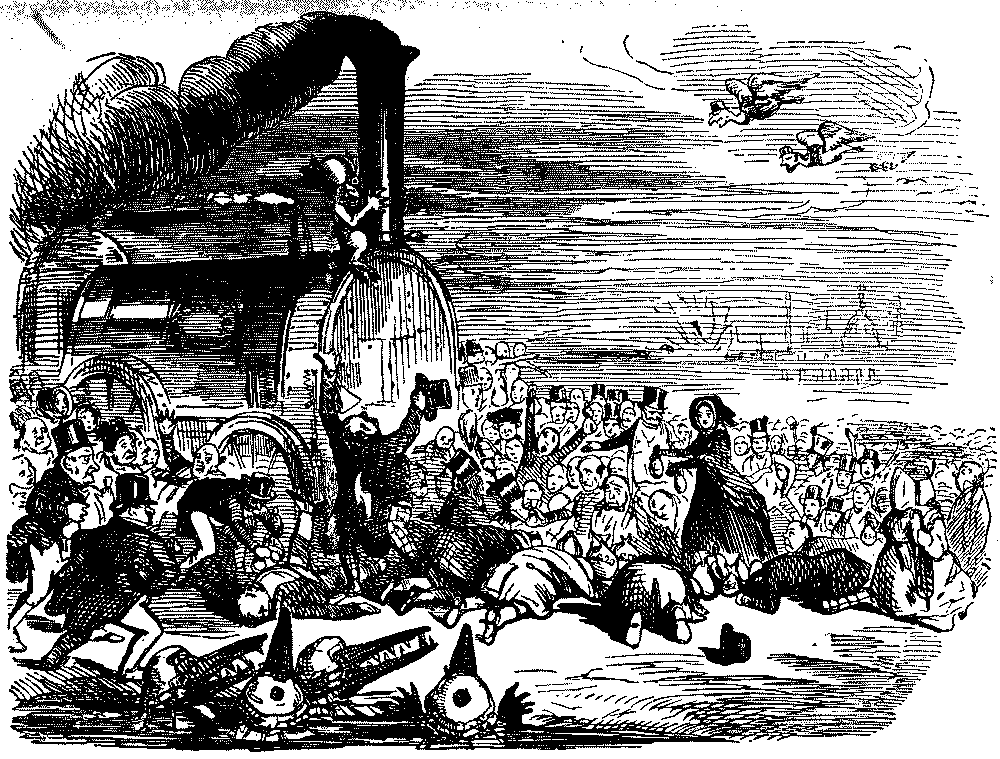
    The Railway Juggernaut of 1845, Charles L. Graves, Mr. Punch’s History of Modern England, Vol. 1, 1841-57, (Project Gutenberg EBook)

    Driven by developments in technology, the new economy is based on speculation and stocks and bonds instead of tangible property. Wealth is up for grabs. Constructing oneself in the socio-financial-legal context requires radical psychological adjustments, leaps of faith, and the ability to prove who one is. From here it’s a mere paradigm shift to us in our postmodern world, replete with ‘Wag the Dog’-like media manipulation, and the impact of things like identity-theft, digital currency and fake news.


    CHAPTER TWENTY-FOUR

    The Reading of the Will — The Widow Unpleasantly Surprised — Scene in a Lawyer’s Office — An Honourable Peer, who has a Predilection for Swimming in Dirty Water, Gets a Little out of his Depth

    The widow and her daughter had been inmates of the house in Soho Square three days, when the former hinted to her host the propriety of proving her late husband’s will.

    ‘Yes! certainly, Mrs. Hurst highly necessary; we will drive to my office in Lincoln’s Inn Fields at noon.’

    ‘I thought it had to be proved at Doctors’ Commons,’ observed Peggy.

    ‘Indisputably correct, my dear madam; but it must first be read, and a copy made,’ replied the gentleman. ‘You would wish to have a copy, would you not?’

    ‘Certainly!’ replied Mrs. Hurst, emphatically.

    Lawyers, as a rule, rarely provoke a scene, unless in the interests of their clients. Even then it is rather doubtful policy. Judges dislike it. Juries dislike it;  and in the solemn propriety of the probate office, where everything wears a funereal hue — the very clerks looking like mutes — it would be regarded with peculiar horror. Added to all this, Mr. Winston was actuated by a benevolent view. He saw that Susan was really ill. The poor girl grieved greatly for her father’s death. In support, he wished to spare her the pain of witnessing the first outbreaks of her mother’s wrath by placing her beyond their reach.

    He rang the bell and ordered the carriage.

    ‘Come, child,’ said the widow; ‘we have but time to dress.’

    Her daughter rose to obey her.

    ‘Pardon me,’ interrupted their host; ‘but Susan is looking really ill and her presence will be quite unnecessary. Minors, even when interested in legal proceedings, can only act through  their guardians. Will it not be better for her to take a walk in the square, or a short ride with my housekeeper? Either would do her good; but perhaps, he added in a tone of indifference, ‘she is one of the witnesses?’

    ‘Nothing of the kind!’ said Peggy, sharply. ‘Squire Tyrrell drew the will; his clerk and butler witnessed it.  As you say, she is looking puny. I wonder how I keep myself up; but Providence sustains me. Don’t you  believe in Providence, Mr. Whiston?

    ‘In the present instance, decidedly,’ replied the latter.

    ‘Well then, perhaps she had better not accompany us. But mind, Susan, you do not stir a step  from the house without Mrs. Page.’

    This was the name of the housekeeper.

    ‘I won’t, mother,’ answered the poor girl, languidly.

    We wonder if lawyers ever do feel a pang at the part they are sometimes compelled to act. Certainly Mr. Whiston did not in the present instance. During the ride to his office he made himself very agreeable, ventured on a decorous joke or two, gave the widow, on their arrival, his arm up the stairs, showed her into his private room, and saw her comfortably seated in his own easy-chair.

    ‘She may bluster there as much as she pleases,’ he thought. His nerves were strung for the encounter; neither screaming nor fainting could have shaken them.

    ‘So,’ said Peggy, looking round her, ‘this is a lawyer’s office? Not a bit like what I expected to see.’

    ‘So I presume, madam. Many respectable and intelligent persons entertain an unreasoning prejudice against us; but we will proceed to business. You have the will with you?’

    The widow drew it from her capacious pocket, spread her handkerchief, a sign that she intended to shed a few tears if she could, and remarked, as she placed the paper in his hands, that ‘poor, dear Peter had been an excellent husband.’

    ‘No doubt, my dear madam, no doubt.’

    ‘So affectionate!’

    ‘Ah, we all have our good qualities –‘

    ‘Placed such trust in me!’

    ‘And weaknesses,’ added the lawyer.

    The last observation did not sound as complimentary as the preceding ones had done, and she regarded him earnestly whilst the speaker rapidly read over the commencement of the will.

    ‘Dear me!’ ejaculated Mr. Whiston, in a tone of surprise, more or less genuine, ‘this is singular! very singular!’

    ‘What is singular?’ demanded the widow.

    ‘The dates of the testaments do not agree.’

    ‘Testaments!’ gasped Peggy. ‘Testaments!’

    ‘Yes; the one you have just given me —  and one your late husband placed in my hands an hour or two before he died.’

    ‘The old wretch!’ muttered the affectionate woman.

    The lawyer commenced reading the one alluded to. We shall pass over the preliminaries. They are the same in all wills, we believe. Out of his half of the farm, Peter bequeathed an annuity of eighty pounds a year, a  pretty little cottage and garden which he had purchased in the village, and two hundred pounds out of a sum standing in his own name in the bank at Colchester. The rest of his property he left to his daughter, whom he consigned to the sole guardianship of his executor, Richard Whiston, Attorney at Law, Lincoln Inn Fields, London.

    In a concluding paragraph he asked pardon of his nephew for the wicked, groundless charge he had been induced to bring against him.

    The blow, all the more terrible from being unexpected, fell upon the ears of Peggy Hurst like a thunderstroke. She had schemed, cajoled, nose-led and driven her husband for so many years that a possibility of a revolt never struck her. At first she felt inclined to scream; but recollecting that it could do no possible good, by a violent effort restrained herself.

    ‘Give me back my will!’ she exclaimed at last.

    Mr. Whiston quietly handed it to her without a word.

    ‘And do you really mean to tell me you will prove that abominable, false, unjust testament?’

    ‘Undoubtedly.’

    ‘Very well; I shall oppose it. This is the real will, the only one my fool of a husband ever made with my consent. He was an idiot,’ added the speaker.’

    ‘A little weak in judgment, I confess,’ observed the lawyer, with a smile.

    ‘And yet you made that abominably wicked will at the request of a man out of his senses. I can prove that he never had any sense, and I will prove it.’

    ‘Not unlikely,’ answered Mr. Whiston. ‘Not that I can see how it would better your position if you did prove it. All your late husband’s property, in that case, would go absolutely to his daughter.’

    Peggy Hurst looked unutterable things, words being too weak to express her indignation.

    ‘Susan,’ no doubt, ‘would show you every consideration. She is an excellent young person,’ continued the speaker. ‘Allow me, also, to inform you that I did not prepare the will, neither did I suggest it. I did not even suspect its existence. It was made by that excellent lawyer and upright magistrate, Frank Smithers, town clerk of Colchester.’

    It must be confessed that the patience of the widow was being sorely tried.

    ‘Very well, sir,’ she said, thrusting the first testament into her pocket. ‘This is my will,’ and I intend to stand by it. There are other lawyers, I hope.’

    ‘Plenty of them.’

    ‘And some honest ones.’

    ‘I trust so,’ said the gentleman, calmly. He had made up his mind not to lose his temper by any amount of provocation, and he adhered to his resolution.

    With heart and temper at boiling heat over her supposed wrongs, Peggy Hurst made her way to the office of Brit and Son. She had heard Benoni frequently speak of them as shrewd, practical men, Heaven knows they were practical enough. As to their sharpness we do not feel quite so certain. True sharpness, to our old fashioned way of thinking, consists in honesty. It is the only thing that eventually pays. Brit and Son were cunning; nothing more.

    The interview did not prove a satisfactory one. Before these very astute gentlemen would give an opinion, or even listen to her statement, they demanded a fee of five guineas. Custom of the profession; invariable rule of the firm; so many clients to attend to; time was money to them.

    ‘So I should think,’ said the widow, as she reluctantly handed them the money, and proceeded to give a tolerably clear  statement of her case.

    ‘Hem! Yes, quite plain,’ said the respectable-looking, well-dressed head of the firm. ‘Remedy? Of course you have a remedy in Chancery. His lordship will doubtless order a trial to test the validity of the will at common law. A verdict in your favour there must be followed by proceedings in the probate court. Should defendants appeal, as the doubtless will –‘

    Here Brit, junior, nodded assent.

    ‘It could be argued before the Privy Council.’

    No wonder that Peggy’s head began to swim. A much stronger one might have felt confused at the prospect set before her. Still her mind remained clear on one important point.

    ‘And what would it all cost?’ she demanded.

    ‘Impossible to say, my dear madam,’ replied the head of the firm. ‘Brit and Son never give estimates. Most unusual with the respectable part of the profession. A thousand pounds might be sufficient to commence the suit with. I think we might venture to undertake it with that.’

    This was addressed to his son, who, with a broad grin upon his face, answered that he thought they could.

    Patience, like every other virtue, has its limits; and the widow, who had never been abundantly supplied with that: estimable quality, completely lost the little that remained to her. Starting to her feet, she commenced a string of expletives not usually indulged in in a lawyer’s office, however frequently they may be felt. ‘Rogues’ and ‘thieves ‘were the mildest of her expressions.

    ‘Give me back my five guineas!’ she exclaimed, half mad with passion. Half mad, did we say? Any intelligent jury would have considered it prima facie evidence of positive insanity. For who ever heard of a lawyer returning a fee he had once pocketed?

    Without the slightest appearance either of anger or surprise upon his placid features, Brit, senior, rang the bell.

    ‘See this female,’ he said to the clerk who answered it, ‘out of the office. And, mind, she is never to be admitted again. Most violent person; no delicacy; uses improper language.’

    Decidedly it was destined to prove an unlucky day for Peggy Hurst. The most galling offence of all was that her husband had outwitted her. The cipher, as he had been usually considered, had made himself a unit, and a strong one.

    No blow rankles so deeply as one inflicted by a dead man’s hand. Women rarely inflict one. They are too gentle and forgiving. The worst of them do little more than scratch.

    The treatment she had received from the firm of Brit and Son, to say nothing of the loss of five guineas, was certainly very provoking. Still she might have got over that, but a still more mortifying disappointment was in store for her.

    Having made up her mind to return to Deerhurst, and consider there what was best to be done, she drove to Soho Square, but her daughter was no longer there, and neither threats, entreaties, nor even the offer of a guinea, could induce the housekeeper to name the place of her retreat.

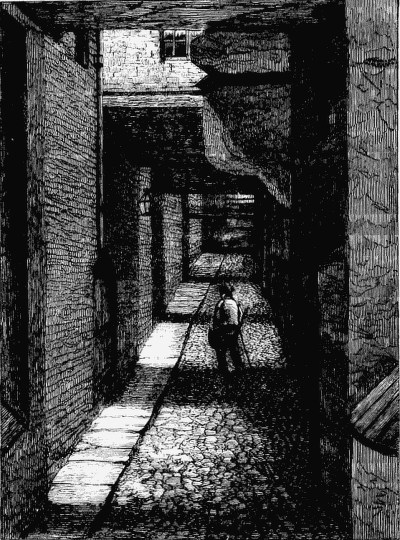
    South Corner of Soho Square and Sutton Street, Thomas Hosmer Shepherd (1792-1864)

    Maddened by this last defeat, the widow rushed to Bow-street. Mr. Whiston who expected some such movement, kept himself in readiness, and very soon presented himself before the magistrate, who very properly had refused to issue a warrant,

    ‘All alike!’ she muttered; ‘all alike!’ when she saw the two gentlemen shake hands.

    Mr. Whiston produced the will, which his worship glanced over.

    ‘No jurisdiction,’ he said. ‘Must be decided in Chancery. Call the next case.’

    That same evening Peggy Hurst returned to the country, a sadder, wiser, but we fear,
    not a much better woman, She required a very different lesson to break her stubborn will.

    Convince a woman ʼgainst her will
    She’s of the same opinion still.

    We have slightly altered the quotation.

    Many men credited with wit and sense, like young geese, develop at an early age a singular propensity for swimming in very dirty puddles. This abnormal taste becomes all the more remarkable when it is recollected that most of them have nice clean water running close at hand, or if not at hand, easily procurable with a little self-control and patient industry.

    Unfortunately for his family, Viscount Allworth turned out one of these human goslings. Whilst a mere boy, he inherited a large patrimony, noble estates, and a vast amount of ready cash. How nice and spotless he might have kept his plumage — we mean his reputation. The pure running stream close at hand, flowing, as it were, under his nose, and yet he would plunge into the puddles. A little dust upon the spotless ermine of his young manhood would have been looked over — he was human, and it was to be expected — but not the filthy mud of foul, dishonourable practices.

    Dirt, we suspect, must be something like the magnet. It attracts certain bodies, and repulses others.

    It is not always wise, when those who are dear to us, or in whom we feel an interest, commit equivocal and dishonourable actions, to condone them; and yet perhaps it is only natural. The opinions of our fellow-men, which all of us are more or less swayed by, the honour of the name we bear, the ties of affection, incline us to judge leniently and show mercy. We can understand the last plea, but not the preceding ones, for beyond the opinion of the world, the honour of a name, we place personal honour. The former may be mere pinchbeck, the latter is pure gold.

    The sacrifice which Lord Bury had made to save his father from disgrace in the affair of the Chellston property tempted that noble gosling to wade still further into the mud. The ready money so dishonestly obtained had been wasted; as a matter of course, in the usual round of extravagance, folly, and dissipation. His lordship’s bonds and post-obits had long been a drug in the money-market; one signature alone could give them value — his son’s. In an evil hour he was weak enough to forge it.

    ‘Oh! oh!’ some of our critics will exclaim, ‘this is a little too strong! A peer of England commit forgery!’

    There is, we believe, still living, a member of the House of Lords who dares not take his seat in that assembly. He drove his father — one of our great Law luminaries — from his high position by trafficking with his patronage. Compelled to retire to France to avoid his creditors, this worthless scamp next proceeded to forge three bills of exchange upon his brother. The first two were paid; the third resisted, and exposure followed; end the man is now one of the hereditary judges and legislators of the land. True, he dares not take his seat. Bad as the institution undoubtedly is, the House of Lords could not stand that. He is still a miserable exile, we believe.

    As the time of payment of the second year’s interest drew near, the aged roue began to feel exceedingly uncomfortable. He had contrived to pay the first. He was without money. An appeal to his wife he knew would be useless — her ladyship had quite sufficient to do in meeting the expenditure necessary for the carrying on of her own nefarious schemes. As a, last resource he resolved to appeal to his son. The interview proved a most painful one — falsehood and degradation on one side, disgust and indignation on the other. For some time the young nobleman proved inexorable.

    ‘My dear boy,’ urged the viscount, ‘how can you speak so unnaturally? Only a paltry twenty thousand pounds! Your name or mine, what could it signify? I am sure I should not have said such harsh things had you takes a similar liberty with me.’

    ‘It was a forgery, father,’ was the stern reply.

    ‘No ugly, indelicate words, Egbert,’ observed the old. sinner. ‘You know how nervous l am. They shock my sensibilities.’

    ‘Mean, despicable forgery,’ repeated the son; ‘and the penalty —’

    The speaker could not bring himself to complete the sentence, but sank back into a chair, covering his face with his hands.

    Lord Allworth changed his tactics at once. He saw that the time for cajolery had passed.

    ‘Death!’ he said. ‘Rather an unpleasant ending to a tolerably pleasant existence — not that the hangman’s hand shall ever touch me. I can guard against that. Positively, it would be too ridiculous!’

    Lord Bury started to his feet.

    ‘Three of our ancestors — I think it was three — you can correct me if I am wrong,’ continued the speaker, ‘were beheaded for high treason; but the axe brought no dishonour on their descendant; whilst the rope — the vulgar, filthy rope —’

    ‘You shall be saved, my lord,’ interrupted his son, coldly.

    ‘Ah, Bury,’ ejaculated the old hypocrite, ‘I knew you would never see your affectionate old father hang.’

    Here a sigh of relief escaped him.

    ‘I once thought,’ observed the son, ‘that no greater disgrace could befall me than having such a parent. I was deceived. You have convinced me there is a depth of infamy beyond — his death upon the scaffold.’

    ‘Never! Egbert, never!’ said Lord Allworth, trying to call up a look of dignity. ‘I am quite prepared to —’

    ‘Spare your acting,’ said the young man. ‘You have not the courage to be a suicide. You forget how well you have taught me to know you. Who holds these notes?’

    The forger gave the name of a well-known banker in the Strand, and the young nobleman took his leave without even a parting salute or word.

    Lord Allworth reflected for several instants in silence.

    ‘Egbert is very absurd — becoming unbearable,’ he muttered, half aloud. ‘What ideas? He never had them from me. They amount almost to mania.’

    The word mania threw him into another train of thought.

    ‘I wonder if a jury would pronounce him insane?’ be added. ‘Hem! worth thinking of; but not till these infernal notes are taken up and destroyed. Bad world; getting more selfish, every day.’

    Three hours afterwards his lordship might have been seen taking his usual drive in the park, kissing his little white hand to his female friends, or talking in an exceedingly juvenile strain with his male ones.

    Lord Bury passed a miserable night. It was not the loss of the money that affected him; he had mad up his mind to pay it. It was the disgrace, the infamous system of extortion to which he saw himself exposed. ‘Where will it end?’ he asked himself .

    The following morning be called upon the firm who had discounted the notes. Ostensibly it carried on the business of banks, and enjoyed a fair reputation in the city, where it was quietly understood that other matters did not come amiss to it. With an air of nonchalance anything but genuine, for his heart felt very heavy, his lordship asked to see the notes, observing that he had quite forgotten the dates.

    The senior partner produced them The interest would be due in ten days.

    His lordship made a memorandum in his notebook.

    ‘I shall take them up,’ he observed. ‘It is not wise to leave this sort of thing unsettled; affairs get confused. I suppose I may pay them at any time?’

    ‘Certainly,’ said the senior partner. ‘And if at any future time your lordship should require accommodation –‘

    ‘Thank you! Thank you!’ interrupted the visitor, hurriedly. Poor fellow! he almost forced a laugh. ‘We shall see; it is very possible.’

    Three days afterwards their visitor returned, strong in the hope of averting a foul disgrace from the name he was so proud of. He had raised the money to redeem the forgeries.

    The partners looked blank, Very sorry to disappoint his lordship. They had taken a share in the new French loan, been pressed — in short, compelled to part with them.

    ‘And who holds them now?’ demanded Lord Bury, with difficulty suppressing his emotion.

    ‘Impossible to say — probably still: on the market, the securities being so unexceptionable,’ replied a member of the firm.’

    ‘Or in the Bank of England,’ added the junior. ‘Such bills are frequently accepted as collaterals.’

    With a throb of agony at his heart the wretched son arose from his seat, staggered rather than walked to his carriage, rode home and shut himself in chambers for the rest of the day.

    The blow was a heavy one, and placed him in a terrible position. The Bank of England never rediscounted any securities’ placed in their hands, neither had it ever been known to condone a forgery. No matter how large the amount, they submitted to the loss rather than forego the pleasure of hanging the criminal.

    ‘Oh!’ he muttered, ‘in what a dilemma am I likely to be placed! Should the discovery be made, I must either give evidence to condemn my own father or perjure myself.’

    ‘Yes, that — even that,’ he added passionately, ‘rather than sully the honor of our name!’

    Did it ever strike his lordship that, behind the tinsel brightness of the phantom he worshipped, there was a nobler, purer object of adoration?

    We fear not. At least not at the time.

    Here we must conclude our present chapter, leaving the viscount to his senile race of folly, his wife to her schemes against the happiness of Lady Kate, and our hero to his hard studies at the university, consuming the midnight oil till his features grew thin, his face pale with the sickly hue of thought.

    But the prize was worthy of the struggle — the crowning hope of manhood — a true-hearted woman’s love. Fame has no nobler gift.

    This edition © 2020 Furin Chime, Michael Guest


    Notes, References, Further Reading

    • Convince a woman …: from Samuel Butler, Hudibras (1664). Smith refers to the usually misquoted: “A man convinced against his will is of the same opinion still”: he “slightly alter[s]” it to refer to women rather than men. Actually, the original goes: “He that complies against his will is of the same opinion still.” As George and Boller point out, it is illogical for someone convinced out of an opinion to keep it still (and indeed, convinced against their will); but not to be forced to comply, while maintaining one’s opinion. (See John George and Paul Boller, They Never Said It: A Book of Fake Quotes, Misquotes and Misleading Attributions [OUP, 1990]).
    • post-obit: ‘a bond given by a borrower, payable after the death of a specified person, esp one given to a moneylender by an expectant heir promising to repay when his interest falls into possession’ (thefreedictionary.com).

    Briefel, Aviva. “Forgery and Imitation.” Victorian Network Volume 8 (2008 Winter).

    *Ellis, Paul. Forgers and Fiction: How Forgery Developed the Novel, 1846-79. Thesis, University College London. 2004. UMI U602586.  Available free online here.

    Finn, M. and Lobban, M, et al. (eds.). Legitimacy and Illegitimacy in Nineteenth-Century Law, Literature and History. Palgrave Macmillan, 2010.

    Graves, Charles L. The Project Gutenberg EBook of Mr. Punch’s History of Modern England, Vol. I (of 4) — 1841 -1857.

    Malta, Sara. Forgery in Nineteenth-Century Literature and Culture: Fictions of Finance from Dickens to Wilde. Palgrave Macmillan, 2009.

    O’Gorman, Francis (ed.). Victorian Literature and Finance. OUP, 2007. Palgrave Macmillan, 2010.

  • J.F. Smith’s Mystery of the Marsh — Twenty-first Instalment

    J.F. Smith’s Mystery of the Marsh — Twenty-first Instalment

    There is an idiosyncratic slide, moving from the omniscient narrator’s opening reflection on the parable of the “wise and foolish builders,” to Theophilus (Theo) Blackmore’s own seemingly spontaneous reflection on “Sand! sand!” in his meeting with Viscountess Allworth. It is almost as though the narrator informs as much as observes the character’s consciousness.

    To date, Smith’s allusions have been mostly historical or classic-literary, as in this episode’s playful gesture where he invokes the Hippogriff — a beast from Greek myth familiar to Harry Potter fans — in dramatizing a simple scene break, and thereby transporting the reader from London to Dinant, in France, at a speed faster than thought.

    It might be interesting, then, to consider the builders’ parable for a moment — especially given its “originary” significance to the Christian institution. The parable appears in Mathew 7:24-27 and Luke 6:46-49, attributing to Christ’s words the power to raise mankind above the chaos of the world. According to Saint John Chrysostom (c.340 – 407), in Christ’s telling of the parable:

    By “rain” here, and “floods,” and “winds,” He is expressing metaphorically the calamities and afflictions that befall men; such as false accusations, plots, bereavements, deaths, loss of friends, vexations from strangers, all the ills in our life that any one could mention. “But to none of these,” says He, “does such a soul give way; and the cause is, it is founded on the rock.”

    He [Christ] calls the steadfastness of His doctrine a rock; because in truth His commands are stronger than any rock, setting one above all the waves of human affairs. For he who keeps these things strictly, will not have the advantage of men only when they are vexing him, but even of the very devils plotting against him.”

    Homily 24 on Mathew

    The author of the Gospel of Luke and the Acts of the Apostles addresses his work to a listener who goes by the name of Theophilus, held traditionally to be a companion of Saul/Paul. Christian scholars have variously supposed this Theophilus to have been a Jewish high priest, a Roman official, or simply, as his name suggests, one “loved by God.”

    Luke’s explicit aim is to assure Theophilus of the truth “of the things he had been taught” (Luke 1:3-4); for example, of the resurrection and the spread of Christianity in the Roman Empire. Smith’s character Theophilus is notable for his morbid bookishness and is, it emerges, increasingly morally compromised. Is he nonetheless redeemable?

    According to Christian standards, of course he is; by the logic of Smith’s own narrative, this remains to be seen. I wonder whether an extreme sacrifice may be necessary.

    Remarkably, the magic whisper our Theo receives from the narrator is like an inspirational summoning to ethics. Yet he plans to collaborate with the viscountess in some dastardly plot, evidently one intended to ensnare the lovely Lady Kate in a loveless marriage with her morally bankrupt loser of a son, the disgraced Royal Horse Guard, Clarence Marsham, currently residing in Dinant.

    The narrator himself refers the metaphor of building on the rock not to faith in Christ as such, but instead to a concept of “the rock of integrity,” suggestive of a more agnostic view, which may be more indicative, we feel, of Smith’s own. Viscountess Allworth’s riposte at Theo’s implicit censure goes a step further, and is worthy of a Schopenhauer or a Nietzsche:

    ‘My house is erected on indomitable will, cemented by past success — guarantees against the future,’ observed his visitor, sneeringly.

    Clearly not the approved perspective, as reasonable as it may seem to us postmoderns.

    The theme is developed as well at a tangent, the opposition of “superstructure” to “base”; which is equivalent to that of “superficial appeal” as opposed to “being solidly grounded” — such as in Christ or in some form of integrity (a Christian view being that the latter needs to be grounded in the former).

    This secondary version of the parable is in the form “all that glitters is not gold” — or after Shakespeare, all that “glisters”. Living our life in pursuit of superficial attractions would be analogous to building upon the sand. The viscountess is such a person, and we now become privy to the tenuous underpinnings of her privileged status, and their further manifestation in the character of her son.

    Her attraction to the glitter of social position, at the expense of integrity, generates the villainous momentum that placed Kate and her maid-servant at such dire peril in the novel’s opening scenes in the red barn at Deerhurst and is still at work hatching further dark schemes.

    Love’s Shadow (1867), Frederick Sandys. Source: Wikimedia Commons; Sotheby’s NY.

    CHAPTER TWENTY-ONE

    A House Built on Sand — Very Showy but not Secure — News of Clarence Marsham and Squire Burcham — They Meet at Dinant, in France

    We are warned by an authority older than modern civilisation not to build our house upon sand. How many stately edifices have been swept away from being erected on no better foundation. The world witnesses it daily, and yet the supposed wiseacres of the earth are continually falling into the same fatal error, looking to the superstructure rather than the base. The rock of integrity, on which alone a solid mansion can be reared, appears to them so hard to dig — the process is too slow.

    From the glimpses already given of the character of Viscountess Allworth, our readers already, doubtless, have divined, that she has been one of the unwise builders alluded to. In the eyes of the world her position appeared a most enviable one. Born in obscurity and poverty, she had become rich and titled by the exercise of talents bestowed for far different purposes. Not that we despise wealth; on the contrary, we consider it a blessing, when honestly acquired and nobly used; but for mere rank — the thing that men are born to — we feel a profound indifference. Like the cap and bells, it merely serves to make folly appear more ridiculous, and adds not one iota to the consideration justly due to the really great and virtuous.

    Her ladyship felt greatly annoyed. She had just received a note from a person whom she had not met for years, and trusted never to meet again; and yet they had never lost sight of each other.

    The note was a very laconic one: ‘I must see you.’ It had no signature, but the address of the writer was given, an obscure street in the Strand.

    ‘What can he want?’ she murmured to herself. ‘Money?’ No, to do l him justice, he has never been unreasonable on that score. There can be no real cause for alarm, for, although my plans are laid, no overt action has been taken to put them in execution.’

    After a few minutes’ reflection she continued: ‘I dare not refuse. A false alarm, or, more likely still, some scholarly crotchet he wants my influence to gratify. Would he were dead,’ she added, deliberately. ‘I could breathe freely then. The grave is the only safe confidant.’

    Of course, it would never do for the fashionable Lady Allworth to be seen in her own equipage driving down one of the narrow, obscure lanes of the Strand, even if it did bear the aristocratic name of Cecil-street. A century previous and royalty might have been seen there without exciting surprise; but times have changed. Mansions formerly the abode of nobles have either been pulled down or converted into lodging-houses, and those not of the highest class.

    After attiring herself in a very plain dress and wearing a thick veil her ladyship quitted Allworth House unattended, and walked as far as the quadrant in Regent-street. There she took a cab, and directed the man to drive to No. 13 Cecil-street.

    It was so short a distance that the driver at once set her down for a stranger in the metropolis, and mentally resolved to charge her half a crown.

    Ivy Bridge Lane, in the Strand, from Old and New London, Vol. 3, (Cassell, Petter & Galpin, London, 1878). Source: British History Online.

    On reaching the house Lady Allworth felt greatly annoyed that the smallest coin in her purse was a half sovereign. The man eyed it greedily.

    ‘Can’t do it, Miss,’ he said. He always said ‘Miss’ to his female fares; fancied they liked it. ‘Yours was the first off the stand this mornin’. Large family; wife sick; very poor, but honest, that a well-known fact. If you like to trust me with the half skiv’ (slang word for half a sovereign) ‘I can melt it at the Fox and Geese and bring you back your change ker-rectly, Miss, in five minutes.’

    Of course her ladyship was not deceived, but she pretended to be so. Anything appeared preferable to waiting on the street and risking the chance of a discovery.

    ‘Yes, I dare say,’ she replied. ‘Very dreadful, no doubt. ‘I am not rich, but can feel for honest poverty. You may keep the half-sovereign, and may it do you all the good I wish.’

    ‘God bless you, Miss!’ exclaimed the driver, jumping on the box of his vehicle with an alacrity surprising for his years and starting his worn horse at a rapid pace.

    Lady Allworth stood watching him till he and his cab disappeared by turning into the Strand. Then, with a sigh of relief, she rang the bell of a respectable-looking house near her. It was answered by a slatternly-looking maid-of-all-work.

    Lady Allworth asked if the person whose address she had was in.

    ‘Yes, mam,’ said the maid. ‘Jest step into the parlor. ‘Missis is gone up to the gentleman’s room to see what he wants for dinner; down in a minute — do take a cheer.’

    The visitor, who felt tired as well as agitated, silently accepted one.

    ‘Come to git your fortin told?’ added the speaker.

    ‘Fortune told!’ repeated the lady, greatly surprised. ‘No. Why do you ask such a ridiculous question?’

    ‘Beg pardin, mam, didn’t know; thought you might. I and the missus made up our minds the gentleman wor sothing o’ that sort when we seed the books he brought with him; such odd-lookin’ letters. No Christian ever printed them.’

    ‘Perhaps you cannot read,’ observed the visitor, with a half-suppressed smile.’

    The maid-of-all-work tossed her head, curl papers and all — for she only took them down in the afternoon — indignantly, as if she had received some personal affront.

    ‘Indeed, mam, but I can read. ‘I wor edicated at St. Pancrass, and wor called the best scholard in the school.’

    Considering the lamentable state of the school system for the poor in England of the time, there appeared nothing very improbable in the assertion.

    The landlady now made her appearance, and inquired if she were the person whom her new lodger expected.

    ‘Yes.’

    ‘He is quite ready to receive you. This way, if you please. Will show you upstairs myself. His daughter, I presume?’

    The question was put forth as a feeler, but failed to elicit a reply.

    Second class furnished apartments, as their as their owners ambitiously term them, in the days of the regency, were sad uncomfortable affairs. The same crimson, moreen curtains, probably twice dipped, bordered with black cotton velvet; the half dozen regulation chairs, one facetiously called an easy one, and a ricketty table, generally comprised the entire furniture. In the more pretentious ones a couple of engravings — the death of Wolfe or the Battle of Trafalgar — might occasionally be found. Where such was the case, they added considerably to the price. Lodging-house keepers make money out of everything. The style has somewhat improved at the present day. Not in comfort — O! dear, no — but in show. As Shakespeare says, the world is still deceived by ornament.

    On the first floor, into such a room as we have described, the visitor was shown. Its occupant was a well-dressed man, with a white beard — an unusual appendage in those days. He was seated in the easy-chair. A pile of books, most probably Greek classics, which had so excited the curiosity of the maid-of-all-work, were on the table beside him.

    It was our readers’ old acquaintance, Theophilus Blackmore, the tenant of the martello tower and school-master of Deerhurst.

    ‘Take a chair, Zelinda,’ he said, without rising from his seat. ‘I will not trouble you to wait.’ This was addressed to the landlady, who disappeared with a dissatisfied air.

    Lady Allworth was about to close the door after her, when the speaker added:

    ‘Leave it open. It faces the staircase: She cannot return to listen without our being aware of it. Now turn your chair and face me. I will watch the door.’

    It was not till these instructions had been carried out that the viscountess raised her veil. The old man gazed upon her countenance long and earnestly.

    ‘Time has little changed “you,’ he observed. ‘You are still the same resolute being whose courage and strong will excited my admiration in the past. Well, Zelinda,’ he continued, ‘you have, succeeded in the objects of your ambition — wealth and rank. How the dead would laugh in their graves could they see to what heights you have climbed! You are rich and a peeress.’

    ‘Not so wealthy as you suppose. Clarence has been a sad drain upon me.’

    ‘You love your son, then?’

    ‘Devotedly.’

    ‘The question was an unnecessary one,’ said the questioner. ‘You would not be human if you did not. It is the weakness of maternity. The she wolf will fight for her young.’

    ‘Thank you, Theo!’ ejaculated the lady.

    ‘You know I rarely compliment,’ was the reply. ‘You still adhere to your project of this marriage?’

    ‘More tenaciously than ever,’ answered Lady Allworth, harshly. ‘My poor boy dares not return to England, or show his face in society if he did, till it is accomplished. Not so much for the girl’s fortune — that, although an important motive, might be got over — as on account of an unsuccessful attempt to — ‘

    ‘Yes! yes!’ interrupted her hearer. ‘I have heard all about the affair. It was foolishly contrived and badly managed. Clarence has not his mother’s brains.’

    ‘I thought you never complimented.’

    ‘Truth is no compliment,’ observed the schoolmaster. ‘The fact is, your son is a reckless idiot.’

    ‘Was it to tell me this,’ exclaimed her ladyship, her countenance flushed with mortification j and anger, ‘that you quitted your retreat, left your beloved books, and sought this interview? Your son — you see I am aware you have one,’ she added sarcastically — ‘is, doubtless, perfection?’

    ‘Benoni might be wiser,’ answered the old man, evasively, ‘but he is no fool, and has few scruples, as yourself. But we will not speak of him.’

    ‘As you please,’ said his strangely assorted confederate — for such they evidently were — in a tone of the utmost indifference. ‘But you have not yet informed me of the motive of your visit to London.’

    ‘I am uneasy in my mind.’

    ‘Some Greek root puzzled you?’ asked the lady, alluding to his favourite studies.

    The scholar smiled.

    ‘Ah, Zelinda,’ he said, ‘if you had only been content to share my labours; but it is useless to regret that now.’

    ‘Perfectly!’ ejaculated her ladyship. ‘Well, then, we will confine our conversation to the present and the future,’ observed Theophilus Blackmore, with a sigh. ‘You are fixed in your purpose of effecting this marriage?’

    ‘Immovably so.’

    ‘I have carried out your instructions,’ continued the former, ‘but you were wrong to have transmitted them through Brit. I doubt that man. It was still more unwise to assist him in his scheme for plundering Burcham, who has escaped from the Bitterns’ Marsh.’

    ‘Where can he have fled to?’

    ‘To France — to Dinant, Brittany.’

    ‘There must have been treachery!’ ejaculated his hearer.

    ‘Not on my part,’ answered the tenant of the tower. ‘Everything is prepared as you desired. The loopholes have been newly barred. The place is provisioned for a month, water unfailing. It would stand a siege. As for the wild inhabitants of the swamp, my influence over them since I obtained the lease is unbounded.’

    ‘In half the time you name,’ exclaimed the viscountess, in a tone of confidence, ‘Lady Kate will be the wife of Clarence. Pride — the dread of the world’s scandal — will overcome her childish repugnance, and my son’s position be secured.’

    ‘Sand! sand!’ murmured the ex-schoolmaster, half aloud.

    ‘What were you saying?’

    ‘Nothing; a mere allusion to the volume whose contents we have both of us, I fear, too long ignored. It warns us against building on such foundations as you have trusted to,’ he added, thoughtfully.

    ‘My house is erected on indomitable will, cemented by past success — guarantees against the future,’ observed his visitor, sneeringly. ‘But enough of this. We fully understand and can rely upon each other.’

    ‘Yes; I have no other choice,’ was the reply. ‘You always did as you pleased with me. I have been as plastic as potter’s clay in your hands; send or bring your victim when you will, all things shall be in readiness.’

    ‘It may be weeks and even months, first,’ said her ladyship. ‘The stake is a vast one, and must be cautiously played for.’

    And placing a roll of bank notes upon the table, the speaker lowered her veil and rose to depart, and had reached the head of the stairs, when something important seemed to strike her. She retraced her steps, and fixing her eyes searchingly upon those of her confederate, pronounced in an undertone, the name of ‘Nance?’

    ‘Dead, years since,’ answered the old man, calmly. ‘Ague and the marsh fever played into your hands. I thought you were aware of it.’

    A smile of intense satisfaction broke over the countenance of the scheming woman as she slowly descended the staircase.

    It was not till Theophilus Blackmore heard the street door open and shut that he raised the notes from the table, and began to count them. They amounted to £200.

    ‘Books?’ he muttered, in a tone of satisfaction — ‘mere books! They are the only friends left me, and I cannot have too many of them. But even they are not always to be relied upon. How I should like to examine the precious manuscript of Josephus in the Ambrosian Library at Milan, and collate it with my own copy. The best critics pronounce the disputed passage an interpolation. Who knows? Possibly I might be able to bring new light upon the subject.

    ‘This affair of Zelinda’s once concluded, I shall be enabled to indulge in the dream of tranquil study my soul so longs to realise. But, will she keep her promise?’ he added, to himself.

    For several instants the aged bookworm appeared lost in profound reflection.

    ‘She dares not play me false!’ he exclaimed at last. ‘She is in my power, and I can crush her like some worm beneath my feet !’

    With this reflection we take our leave of the schemers for a time.

    Roger délivrant Angélique (1824), by Louis-Édouard Rioult. Louvre.

    Many of our readers have, doubtless, heard of the hippogriff — that fabulous monster, half horse and half griffin, which owed its existence to the fertile imagination of the Greeks, who named it the Centaur. The middle ages changed the form of its first conception. Poets and romance writers are the only persons who have ever seen it but, then, poets and romancists, like the Scottish highlanders, sometimes see strange things. The gift of double sight is not always to be relied upon. Amongst the extraordinary powers attributed to the hippogriff, a speed far outstripping steam — in short, every known means of locomotion — was, perhaps, the most remarkable. The flight of the eagle was as the creeping of the snail in comparison. Thought alone could outstrip it.

    We are about to invite the readers of the “Evening News” to take a ride with us on the back of one of these monsters. They need not be alarmed; the seat is easy, the motions pleasant enough. Even as we write its wings are spread, the journey accomplished, and we are safely landed at the little town of Dinant, in the ancient province of Brittany, in France.

    It was to this obscure place that Clarence Marsham had retreated after recovering from his wound, to exist, as he termed it, on the reduced allowance his mother prudently made him. But few of his countrymen had hitherto found their way there. Its inhabitants are a reserved, unsocial race, particularly shy of strangers. The little community of Englishmen were compelled, in self-defence, to associate together. The cafe, billiards, botany and fishing occupied most of their time; the rest of it, we fear, was spent in idleness and debauchery. This condition of things has greatly changed since we first visited Dinant; the English form quite an important colony, taking, as the Scotch say, the crown o’ the causeway, from their wealth and numbers. We say wealth, by comparison, the native inhabitants, including the nobility, being as poor as they were proud; the Reign of Terror and the iron hand of Napoleon had completely crushed them for their adherence to the Bourbons and the ancient faith.

    The return of Louis XVIII somewhat alleviated their misery.

    Such was the state of society in this obscure corner of France when Clarence Marsham took up his abode there. The change from the Guards, the excitement of the mess-table, the turf and his club, had a most depressing effect upon him, but not a salutary one, and he soon began to experience what our Gallic neigbours describe as the English malady — the spleen. They, too, suffer from the same disease. True, they call it ennui — a much prettier name.

    In the state of what he was pleased to call his mind, the young roue naturally felt relieved by the appearance of Burcham, whom he had met occasionally in London, and rather patronised. The meeting proved agreeable to both, and they soon contracted a species of friendship— intimacy probably would be the better word, for it is almost a profanation to employ the first.

    Honour is much more chary of confidence than vice; it bestows it slowly, but, then, it is generally lasting. Vice, on the contrary, is capricious in its intimacies, contracting and breaking them heedlessly. The similarity of their position drew them yet more closely together, till at last, over a bowl of punch, each made a clean breast of it to the other.

    ‘Ah,’ hiccoughed Clarence, ‘my position is bad enough, but yours is worse — forger!’

    ‘Pshaw!’ interrupted Burcham; ‘a ridiculous letter. It had no commercial value, at any rate. I am safe here, and can fight Moses and Co. at a distance. My steward, Banks, holds the estate; they can’t get it from me. He served my father, and will stick to me like the old house-dog. Brit, the family lawyer, warned me against that rascally Jew; but I was a fool, wanted money, and refused to listen to him.’

    ‘The way with most of us, I suppose,’ remarked his companion, philosophically. ‘What do you intend to do?’

    ‘Compromise,’ was the reply. ‘Get the letter out of the claws of that vulture of Israel. Willing to act squarely — do anything but give up the lands, I should never get an acre back again.’

    ‘Not unlikely,’ remarked Clarence, with drunken gravity. After a pause he added: ‘Settle your affair as soon as you can, and I have something to propose to you.’

    ‘What is it?’

    ‘Settle your affair first, I tell you.’

    ‘Some turf speculation, I suppose; mine have been most unlucky. I have lost all faith in them,’ said the squire, despondingly. ‘Lost three thousand on the Eclipse race. The ring is too strong for outsiders,’ he added.’

    ‘I won on it!’ exclaimed Marsham, with a grin of satisfaction; ‘only a brace of fifties, though; funds were low; dared not venture more; was in the Guards at the time. In the Guards we are always expected to pay up. But the affair I hinted at has nothing to do with racing; there is a woman in it.’

    ‘A rich one?’

    ‘That of course.’

    ‘Ah!’ ejaculated the squire, ‘like my own case; for good or evil, they are generally mixed up in our affairs. Fatality, I suppose.’

    As time dragged its weary length along, the speakers became more and more confidential with each other. They took long walks together, discussed their plans, which were so far matured that they waited only till the signal from England should be given to put them in execution. Having few mental resources, the conspirators generally spent their evenings at the principal cafe in Dinant, where the inhabitants and the little colony met, as it were, on neutral ground. It was awfully slow work, as Clarence declared, but better than the painful reflection of their own thoughts.

    As their countrymen were generally poor, they gathered round Clarence and the squire, in the hope of gathering a few francs at pool, and laughed at their jokes as parasites laugh at the stale jests of their patrons. The gains of these unfortunates could not have been very large; the rich rogues played an excellent game.

    Amongst other frequenters of the cafe were two Englishmen who attracted the attention of the exiles. One was a fellow about forty years of age, who called himself Captain Brandle. There was no such name in the army list, and yet few men ventured to question him or his decisions on billiards; his bullying airs, and a certain fierce rolling of his eyes, cowed them, and he obtained credit cheaply for courage; it was considered dangerous to tackle him.

    The second, a young man, who wore the dress of a fisherman, appeared remarkably quiet and unassuming in his manners. He drank little, and only occasionally took a hand at pool. His quiet, unobtrusive manners excited the curiosity of the two conspirators — not that they apprehended any danger from his presence in Dinant; there appeared nothing suspicious about him, except his name — Smith — the most ill-used and unjustly abused one in the world — that is to say, the English world.

    A pool of billiards was being played at the cafe, in which Captain Brandle and the bearer of the long vilified name of Smith, we suspect it was only borrowed, took a part. Clarence Marsham and his friend were standing near the table, merely looking on.

    ‘That was a foul stroke!’ exclaimed the young man, ‘and ought not to count!’

    The spectators looked aghast at the speaker; the captain, who had made it, having impressed them with an awful opinion of his courage by his constant braggadocio. The impostor (for true courage rarely or ever boasts) glared at him ferociously, twisted his moustache, stamped angrily upon the ground, and called him a liar.

    ‘We will soon see,’ observed his accuser calmly, ‘which of us merits that appellation. I repeat, the stroke was a foul one, and appeal to these gentlemen,’ he added, turning to Clarence and the squire; ‘they must have seen it.’

    The two gentlemen declared they had not seen the stroke made; something had distracted their attention at the moment it was made.

    The accuser bowed somewhat sarcastically.

    ‘Of course I cannot dispute your word.’ he said. ‘I thought you had; but find I must settle the point with the bully without the assistance of your evidence.’

    ‘Bully!’ repeated the captain, who appeared thunderstruck at his presumption.

    ‘And coward,’ coolly added his accuser.

    The quarrel was becoming interesting. All present expected to see the speaker, who had so rashly provoked the hostility of the fire-eater, annihilated on the spot. Instead of springing on his victim like a roused tiger, as they anticipated, he mastered his rage and advancing towards the speaker, asked him if he were tired of his life.

    ‘Not quite yet, for I have never disgraced it,’ was the reply.

    One or two of the spectators began to smile.

    Possibly the redoubtable captain did not like the cool, steady gaze which encountered his. As a last effort to redeem his reputation he exclaimed:

    ‘This must be settled elsewhere. For a less insult I have spitted two such cockerels before breakfast.’

    ‘Did you. eat them afterwards?’ inquired his opponent, with the utmost seriousness.

    ‘Turn him out of the café!’ shouted the disconcerted bully. ‘ I cannot answer for my rage ; something dreadful will occur — murder done — or — ‘

    ‘Petty larceny committed,’ added the speaker, turning to the crowd. The first time I saw this cheat and rascal,’ he continued, ‘was in the felon’s dock at Bow-street. I thought I knew him when I arrived at Dinant. Although he has got himself up exceedingly well for the part he has been playing, I am now convinced that he is the same miserable scamp.’

    ‘You shall hear from me in the morning,’ repeated the pretended captain. ‘If I remain, rage and indignation at his insolent assertions will choke me. ‘

    ‘This,’ said the young Englishman, giving him a kick, ‘to remind you of your promise.’

    The kick was repeated. The exposed scamp fairly took to his heels, and escaped across the square.

    ‘A resolute fellow,’ whispered Clarence to the squire; ‘might be useful in our own affair.’

    His confederate nodded assent, and it was agreed to invite him to supper.

    Thus it was that the quiet, unpretending young man made the acquaintance of his fellow countrymen.

    This edition © 2019 Furin Chime, Michael Guest


    Notes

    rascally Jew: Please see my brief consideration of historical anti-Semitism in Chapter 14. In no instance does Smith himself express anti-semitic attitudes, apart from attributing them to characters whom he valorizes negatively.

    ricketty: Alt. spelling “rickety”

    the world is still deceived by ornament: Shakespeare, Merchant of Venice, 3.2: “The world is still deceived with ornament” (Bassanio).

    crown o’ the causeway: The middle of the street. Fine Dictionary.

    Eclipse race: Horse race established at Sandown Park, 1886, named after a famous 18th century racehorse. Now known as the “Coral-Eclipse.” Contemporary newspaper results of the inaugural race here.

  • J.F. Smith’s Mystery of the Marsh — Twentieth Instalment

    J.F. Smith’s Mystery of the Marsh — Twentieth Instalment

    Sometimes the anomalies in a text can provide a starting point to explore possibilities of meaning that aren’t immediately evident. The first such a one in this chapter is striking: Smith’s misquotation from Romeo and Juliet, which ought to read:

    These violent delights have violent ends,
    And in their triumph die. (2.6)

    An erroneous word, “transports,” conceals both the true terms “delights” and “triumph,” as though they fall into a conceptual blind spot. “Transports” is a distinct concept from the others, denoting the sense of an ecstatic loss of control, which is absent from the actual terms. At the same time, it is illogical that “transports” (of caprice) die in their own “transports,” as the misquotation circularly proposes. The quote seems to summon the virtues of self-restraint, but in a mere rhetorical gesture, one that lacks sufficient conviction even to check the logic.

    We assume that an alternative species of love will endure — “true, manly passion” he calls it. An issue of true love flows beneath the ensuing narration of the perennial courtship ritual, reenacted by two youthful couples. The narrator’s perspective, which he assumes the reader will share, is self-assured and authoritative — one of disengagement, having access to the superior wisdom of age. Just as pointedly, the narrator’s point of view is one of retrospection, that of an elderly man looking back upon his own youth, and applying to the young those realizations beyond their grasp, which can only be acquired with time and life-experience.

    Such an ever-so-slight but unmistakably condescending tone colours the narrative, this erroneous word “transports” loaded with a pejorative sense of “ecstasis” — a being beside oneself, being taken or stepping outside the self, as in a rapture or trance: a danger to which youth is singularly vulnerable in matters of sexual love. The courtship and fate of Romeo and Juliet exemplify the transcendence and peril. (Let’s overlook the later underwhelming allusion to Juliet assigned to Lady Kate: “Parting is always sad.”)

    A further anomaly is the conspicuous mention made of the Greek lyric poet Anacreon (c. 582 – c. 485 BC), whose brows were “crowned with snow,” says the narrator (in Anacreonic mode), when he wrote his love poetry, though the topic is the young William Whiston’s attempt to express his passion to Kate in verse — but not only in verse. Anacreon’s relevance would appear to be not so much to Willie, however, as to the narrator, as a proxy for Smith himself, who finds himself here “cheering his age” with the remembered sweetness of past love.

    We can assume a degree of familiarity with Anacreon on the part of Smith’s ideal reader. Thomas Moore’s (1779 – 1852) Odes of Anacreon, Translated into English Verse with Notes (1800) spawned a vogue of ‘Anacreonics’ — the art of imitating Anacreon — among further Irish and English poets, expanding a more minor European tradition that went back several centuries, an ancient tradition of erotic verse. Poets of such significance as Byron, Shelley, Keats, Coleridge and Wordsworth took one interest or another in the Greek, who was “one of the original lyricists of wine, women and song” (Jane Moore passim.)

    For a sample, let’s see Thomas Moore’s translation of Ode XVII, as illustrated by the French Anacreonic translator and artist Girodet de Roussy (1767 – 1824), said to have captured the essence:

    Now the star of day is high,
    Fly, my girls, in pity fly,
    Bring me wine in brimming urns,
    Cool my lip, it burns, it burns!
    Sunn’d by the meridian fire,
    Panting, languid I expire!
    Give me all those humid flowers,
    Drop them o’er my brow in showers.
    Scarce a breathing chaplet now
    Lives upon my feverish brow;

    Every dewy rose I wear
    Sheds its tears and withers there.
    But for you, my burning mind!
    Oh! what shelter shall I find?
    Can the bowl, or floweret’s dew,
    Cool the flame that scorches you?

    Here Anacreon, like Smith’s narrator, facilitates the encounters of two imagined couples, except in an explicitly voyeuristic rite, all the signifiers in free play. Symbolism of humid flowers, burning of lips, scorching of flames, wearing of dewy roses. Nothing like a good orgy in the middle of the day.

    Turning now to the more prosaic scene, structured by Victorian proprieties, we are a little sensitive to the fluttering hearts, a smouldering subtext beneath the cut and thrust of Lord Bury and Clara’s repartee and ripostes, undercurrents of love yet undeclared. Similarly in the circular drawing-room, William’s love sings his Anacreonic lyrics, his urge to break out of the restrictions placed upon his burgeoning passion.

    It’s more in keeping with the Smith we have come to know, the wine-imbibing Bohemian wanderer. Not the fuddy-duddy uncle who sits “playing propriety,” putting a damper on this youthful excitation, but that wag who blew up the Mississippi river boat and elevated a printer’s devil.

    Wine, women and song? Hell, you can drink and sing any time.


    CHAPTER TWENTY

    A Lesson on Prudence — Clara Meredith’s Defence of her Friends — Love Vs the Absurd Teachings of the World

    When a man begins to feel puzzled as to the nature of his feelings towards a woman, we may feel assured that something akin to love is mingling-with them. He may not be conscious of it; in fact, we very much doubt if any male creature was ever yet perfectly aware of the heart’s entanglement till the net had become too strong for its meshes to be broken.

    In speaking thus of love, of course it is to be understood that we are describing it in the true, manly, common sense of the word, not of those sudden caprices to which Shakespeare alludes when he says

    These violent transports have violent ends,
    And in their transports die.

    Lord Bury began to feel a strong but, as he conceived, purely platonic friendship for his cousin Clara. There had been no attempt to catch him, no efforts to attract; great points in the lady’s favor. Although, like most young men, a great admirer of beauty, it ceased to charm as soon as it becomes demonstrative; like the magnet, it had two poles — one to attract, the other to repel.

    His lordship was fastidious in his tastes, as might naturally be expected from his education and the surroundings of his youth. Fortunately he possessed a safeguard in those high principles which most certainly he had not imbibed from his father, whose profligate example failed to corrupt him, as an overdose of poison sometimes fails to destroy life from its excess.

    Clara Meredith and Lord Bury were conversing in the conservatory at Montague House, whilst their cousin, Lady Kate, was giving a lesson in music to William Whiston, now a constant visitor in the circular drawing-room, where Martha, who shared the peril and flight of her young mistress, was seated at a distance to play propriety.

    ‘Hush!’ said Clara, interrupting the conversation with her cousin. ‘How perfectly their voices blend together!’

    ‘Too perfectly!’ observed gentleman, dryly.

    ‘Bury,’ replied the lady, ‘that is really the first ungenerous word I ever heard you utter. I thought you liked her preserver.’

    ‘And so I do,’ continued her cousin, ‘like him for his perfectly unaffected manners, his plucky perseverance at the university — the studies would have killed me — the reputation he has already acquired, and his fixed determination to win a name.’

    ‘Win a name!’ repeated Clara. ‘Why he has one already.’

    ‘Ah, indeed!’

    ‘And you know it as well as I do — William Whiston.’

    ‘I cannot find it in the Herald’s books,’ observed his lordship.

    ‘Possibly,’ said Miss Meredith; ‘he wishes to avoid bad company — a great many bad names there. Seriously,’ she added, ‘you are ungenerous — unlike yourself.’

    ‘You think that I am naturally generous then?’

    ‘Yes,’ replied Clara, ‘when you speak and act for yourself, I mean your real self, and not from the prejudices of the world. Why should he not be received here? The service he rendered Kate was immense; his family is respectable, his character without reproach, his talents undeniable.’

    In the warmth of her defence of the absent the speaker had risen from her seat and was about to leave the conservatory.

    ‘Come and sit by me again,’ said his lordship. ‘We must not quarrel; that would be too absurd. Let us talk reasonably.’

    Clara Meredith silently complied with his request, yet felt angry with herself for doing so.

    ‘Thanks,’ said her cousin. ‘I knew you would not judge me unheard.

    ‘But I have heard you —’

    ‘Only partially,’ continued the gentleman. ‘Recollect there are two sides to every medal.’

    ‘And to most faces,’ added her cousin.

    ‘An epigram!’ exclaimed her cousin, archly.

    ‘I did not intend it for one,’ continued Clara. ‘Merely an observation. You know I never can disguise my thoughts, and would not if I could, unless to avoid giving pain to these I love,’ she added.

    The young guardsman began to feel a wish to be one of those she alluded to.

    ‘Clara,’ he said, ‘I cannot endure to be misjudged by those whom I respect. Listen to me calmly.’

    He took her hand in his, and the heart of the young girl began to flutter wildly.

    ‘It is not our fault,’ resumed the speaker, ‘that we are born in the rank and privileged station that we hold in the world.’

    ‘Nor our merit,’ was the reply.

    ‘Granted,’ said his lordship. ‘But having been born to them, it is our duty to fulfil the obligations they impose upon us.’

    ‘Some of them. A broad charity in estimating the worth of others, and a helping hand not only to the poor and humble, but to all who by cultivation, intellect and honourable industry are seeking to escape the trammels of prejudice, the worldly jealousies which would cuff down rising merit, clip the wings of the young eaglet, to prevent its soaring to these nobler heights where fortune’s owls are perched in idle security.’

    ‘These are strange doctrines,’ observed her hearer, ‘for one of your age and sex.’

    ‘I cannot help it, coz. They come naturally to me.’

    Lord Bury rose from his seat, paced the length of the conservatory, then turned and reseated himself by the side of the speaker.

    ‘You approve, then,’ he said, in calm, dispassionate tones, ‘in your cousin, Lady Kate Kepple, the last descendant of an ancient and noble race, falling in love with William Whiston, the son of an obscure farmer? I grant that he is honourable; not a speck upon his reputation. I have ascertained that.’

    ‘I am not aware that there is yet any question of love between them,’ answered his hearer.

    ‘Aye, but there is, or at the very least a danger. I have watched them closely, Clara. His tongue may have been mute — I trust it has — but his eyes, those windows of the soul, are eloquent. He will declare himself,’ he added, ‘and that is the danger I wish to guard against. You, too, have seen it. It is useless to deny it. I have watched you both.’

    Clara Meredith began to feel extremely embarrassed. The words of the speaker were not without influence on her prejudices. Education was to blame for that. But they failed to shake her principles. There she felt firm as the rock of reason on which they were based. Conversion at the swiftest is but a slow process, the world has so many ties to draw us back, to stifle our best instincts. Clara was too truthful to deny the uneasiness she had long felt on her cousin’s account. As yet she knew nothing, if she feared much. She felt that the speaker was treading upon treacherous ground, so, with true feminine instinct, she hastened to change the position.

    ‘I am perfectly satisfied,’ she said, ‘that Kate will never disgrace herself by contracting an improper marriage.’

    Lord Bury smiled. He was not much of a logician, but he detected the ruse.

    ‘An alliance with meanness, with vulgarity, sordid interest. She has a sensitive nature; pride almost equal to your own, Egbert. None but a true heart could win her.’

    ‘I am as firmly convinced of that as you are,’ observed her cousin. ‘Whiston possesses the quality you name. I do him that justice. Were he a mere scheming adventurer, I should feel perfectly easy on our cousin’s account. More, he is gifted with rare talents, and that still rarer quality, perseverance. Therefore I fear him,’ he added.

    ‘As a rival, perhaps.’

    ‘Pshaw!’ ejaculated his lordship, impatiently. ‘You know me better than that. I never thought of Kate on my own account.’

    ‘What is it you fear, then?’

    ‘A misalliance in our family.’

    ‘Oh, you men! you men!’ exclaimed Clara, impatiently, ‘with your pride of rank, your worship of a mere accident, your absurd veneration for musty parchments and the Herald’s blazon! You laugh at our sex — the weaker one, as you insolently term us — for our love of bric-a-brac, majolica, Sevres, antique lace and niello, whilst with admirable inconsistency, you bow down before idols which have not even artistic beauty to recommend them.’

    ‘If you advocate Kate’s cause so warmly, I shall begin to think you share her weakness.’

    ‘That was a most ungenerous thrust,’ observed the lady coldly, ‘and unlike yourself, because it was discourteous. If there is one quality more than another which I like in you,’ she added, ‘it is your perfect tone and manner with women.  I should regret being compelled to change the opinion I have formed of you; very sorry.’

    His lordship felt the reproof all the more from the consciousness that he had merited it. He was gratified also by the compliment with which she had withdrawn the sting.

    ‘Let us change the subject,’ he said. ‘I perceive I shall not have you for an ally. Let what will happen, we must remain fast friends, coz. I cannot afford to lose you and Kate; it would leave a void in my existence greater than you dream of.’

    Clara blushed at the words — which might have meant much or nothing. Reflection — for she had a very humble opinion of her attractions — convinced her of the latter. Still, she treasured them in her memory.

    Whilst the above conversation was taking place in the conservatory, one far more eloquent, because far less worldly, occurred in the circular drawing-room, where Lady Kate Kepple and our hero had been practising a duet together. William was about to return to the university, and each knew that nearly a year would elapse before they met again.

    Poetry and music are the keys of the heart — fortunately, there is sometimes a third one, which fetters its voice in silence — prudence; not that it is always sufficiently strong to guard the tongue from uttering the words that quiver on the lips of a true, manly passion. Feeling often becomes too powerful to be governed by self -imposed restraints. A look, a sigh, and, still more frequently, a tear, will break the strongest resolution. In age we can reason on these things calmly, else it would be impossible to describe them truly.

    The brows of Anacreon were crowned with snow when he wrote his passionate love-verses. The realities had passed; but the dream, like the exquisite perfume of some precious flower, remained to cheer his age with its remembered sweetness.

    From Ode XX: “Sing, sing of love, let music’s breath / Softly beguile our rapturous death.”

    William, who had won the chancellor’s medal for the prize poem the preceding year, wrote a few lines on the subject of his approaching departure, which, in a rough, unscientific way, no doubt, he contrived to set to music, then sent them to Lady Kate, modestly requesting her to correct the music for him.

    ‘Artful,’ we hear some of our fair readers exclaim. Perhaps it was; but, if so, it was artfulness without craft— the artfulness of nature. It is scarcely necessary to add that the grateful girl complied with his request — the words touched her more than she would like to have confessed, and the simple, unskilled melody to which the youthful author had set them haunted her. Were it averred that she murmured it even in her sleep, we should scarcely doubt it.

    This was the composition, which had so strongly excited the suspicions of Lord Bury and created considerable uneasiness in the mind of Clara Meredith, who knew the world and shrank from its sneers, although in a just cause she felt that she could brave them.

    ‘I think I have succeeded,’ observed Lady Kate, when the poet hesitatingly presented himself in the drawing-room. ‘I have arranged it as a duetto.’

    ‘The very thing I most desired.’

    ‘You can look it over,’ added the fair girl, pointing to the sheet of music upon the pianoforte; ‘afterwards we will try it.’

    Little did she suspect the snare she had prepared for her own heart.

    Sufficient to add that the arrangement was gratefully approved of, and they commenced singing together:

    Farewell! Farewell! I would not fling
    Around thy brow the veil of sorrow;
    Brightly for thee the morn shall spring,
    And mirth and music wait thy morrow.

    I dare not leave one parting token,
    Or breathe a sigh of vain regret;
    Dream not the word I leave unspoken,
    Or if thou dost, thy dream forget.

    The poet seeks his cloistered hall,
    Thy home will still be beauty’s bower;
    Should memory his strains recall,
    Forgive the madness of the hour.

    Twice had the youthful singers repeated the strain which betrayed the feelings they dared not express. On the last occasion the rich voice of our hero trembled with emotion, but with a strong effort he mastered himself, and a silence more dangerous than words ensued. Kate was the first to break it. Strange to say, she had been more successful in suppressing all outward signs of agitation than the youth who so truly and, as he believed, hopelessly loved her; that exquisite reserve and sensitive modesty which are a girl’s best safeguards restrained her, for William had never hinted at his passion before — he considered it hopeless, and no true woman ever yet could bring herself to acknowledge she had, unsought, been won.

    Kate was the first to speak.

    ‘Parting is always sad,’ she observed, ‘especially from those we esteem; but you must not feel its pangs too keenly. Consider it but a cloud obscuring the bright morning of your young life. Your good, kind uncle, who loves you like a son I am certain, views the separation as I do. The cloud will pass,’ she added, attempting to force a smile, ‘and all be fair again.’

    ‘I was not thinking of my uncle,’ observed our hero; ‘and yet I feel most grateful to him. I shall find him unchanged on my return, even should I disappoint his expectations.’

    ‘Doubting yourself, Willie,’ resumed the object of his thoughts. ‘Is not that unwise? Why even I, who am a poor, weak girl, possess more courage and hopefulness than that. I am not a judge of such things, but every one tells me the highest honours of the university are within your reach; and in this land, where there are no barriers of caste that may not be surmounted, we know what they lead to. I speak not of wealth, but of the world’s consideration, respect from the respected. The senate and the bar have long been ruled by men who won their way as you will do.’

    ‘They have ceased to attract me,’ observed her hearer, sadly. ‘I have fixed my heart upon a prize so immeasurably above my reach that even hope is denied me, like the golden apples of the fabled garden, it hangs so high above my reach I can only gaze wistfully at a distance. Life,’ he added, ‘has lost its best incentive to exertion.’

    ‘Patience,’ said Kate, scarcely conscious of the import of the words she uttered, ‘patience and perseverance, and the branches will descend to you, borne down by the weight of their fruit.’ Then, as the sudden flush, the flashing eyes of her lover betrayed the construction he placed upon her speech, broke upon her mind, she hid her face in her hands.

    In an instant he was at her feet, pouring forth a torrent of impassioned words all the more eloquent for having been so long restrained. We cannot trust our pen to repeat the words in which he clothed his feelings; they would appear cold and vapid to those who never felt the pangs of a true love, whilst to those who have felt them they are unnecessary.

    A true passion, like Proteus, takes many forms, but the same soul animates each. Love is a mighty lord indeed; gentle as a child, despotic as an autocrat by turns. Poor Kate had resolved to be very reasonable — in fact, she had been so; for what can be a higher exercise of reason than to place our affections worthily!

    ‘William,’ she murmured, as he buried her blushing face upon his bosom, ‘I did not mean to betray myself. You will think me very weak.’

    ‘Angel!’

    ‘But I could not endure to see you so unhappy.’

    ‘Angel!’ repeated her lover, as his arm stole around her waist, and he imprinted a kiss, the first of love he had ever given upon her yielding lips, sealing her as it were to himself, and to himself alone.

    ‘Kate,’ he whispered fondly, ‘you will not mar the immeasurable happiness of an hour like this by one regretful thought?’

    ‘I feel none,’ came a gently murmuring voice.

    ‘From the hour we first met I loved you,’ continued Willie, ‘although I knew not what love meant. Saw you nightly in my dreams, and felt impatient of the garish day till slumber should return, bringing the blissful vision back to my sight again. I believed you to be poor — poorer even than myself. It was for your sake I wasted the midnight oil, striving to win a name to offer you, and a fortune to protect you. Oh! how, these thoughts sustained me; hope and courage both were high within me; but when the truth was made apparent, and I saw how immeasurably you were placed above me, despair took possession of my heart, its energies died out— all but its love had faded.’

    ‘Dwell not on such sad fancies,’ replied the now happy girl — happy despite her tears. ‘There can be no inequality where love is mutual.’

    ‘Bless you, dearest, for these words,’ said her lover. ‘You know not the strength they have given me; the steady will of manhood has returned, and I will yet win a name that shall justify your choice in the eyes of your friends, your family and the world.’

    ‘I care not for the last,’ observed Lady Kate Kepple. ‘My choice is made; my heart is given; the faith that accompanies them can never change. We are both young, and must wait till you have finished your career at college. Should it prove successful, none will hail your triumph more truly than myself. Should it fail you,’ she added, ‘my heart and hand shall still be yours.’

    With such a prospect, and an angel’s promises to cheer him, no wonder that our hero returned to Cambridge a happy man.

    This edition © 2019 Furin Chime, Michael Guest


    Notes, Reference and Further Reading

    play propriety: An older term: ‘play the chaperone’, in a sense

    Herald’s books: Records of heraldry, family pedigrees.

    golden apples of the fabled garden: The myth of Tantalus, whom the gods punished by immobilizing him in the royal garden next to an enchanted apple tree, whose branches would move away each time he reached for one. Note that apples traditionally symbolize the female’s breasts,  which motivates Kate’s double entendre about the apples descending.

    Proteus: Note that Proteus, the Greek god of change, is also an elderly figure.

    Moore, Jane. ‘Thomas Moore, Anacreon and the Romantic Tradition’. Romantic Textualities: Literature and Print Culture, 1780–1840 21 (2013): 30–52. Jump to pdf.

    Moore, Thomas, Trans. The Odes of Anacreon, with Fifty-Four Illustrative Designs by Girodet de Roussy (1869). Jump to html version at gutenburg.org

    The Works of Anacreon, Sappho, and Musaeus. Translated from the Greek by Francis Fawkes (1810)
    (Includes a section on the life of Anacreon as well as several odes). Jump to free ebook (Google).

    Roche, John B. The First Twenty-eight Odes of Anacreon, In Greek and in English, and in Both Languages, in Prose as Well as in Verse : with Variorum Notes  a Grammatical Analysis, and a Lexicon (1827). Jump to free ebook (Google).

    Hunt, Leigh. ‘Anacreon’, in Arthur Symons, ed., Essays by Leigh Hunt 1887: 169-173. Facsimile available at Internet Archive. Jump to page.