Tag: Fictions and Features

  • Narcissism and the Flicker of Self in Thomas Mann’s Felix Krull, Confidence Man

    Narcissism and the Flicker of Self in Thomas Mann’s Felix Krull, Confidence Man

    Picaresque novel cum Bildungsroman, Thomas Mann’s Confessions of Felix Krull, Confidence Man (1954; trans. Denver Lindley) resonates with the late modernist psyche. Mann’s novel prefigures a psychiatric epidemic of our day, psychopathic narcissism. In this widespread postmodern condition, the fragile identity implodes in its own process of self-aggrandizement, sucking in those closest around.
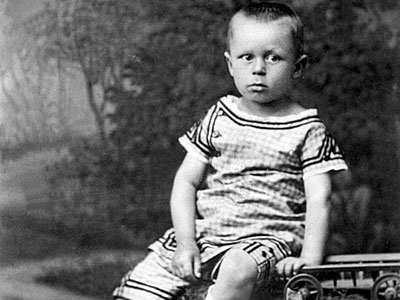
    Thomas Mann at the age of six, 1881. Source: Wikimedia Commons
    Thomas Mann at the age of six, 1881. Source: Wikimedia Commons

    The Talented Mr. Ripley (dir. Anthony Minghella, 1999) is a recent cinematic iteration of the theme, via the 1955 novel of the same title, written by the American writer Patricia Highsmith. Mann’s novel is more subtle, turning away from any formulaic moralistic closure.

    What underpins identity? Might one abnegate the self, and if so, what would be the implications? If a self were infinitely transmutable, who would be the self that exercised the will to make it so?

    The power of narcissism. The fragility of the self. What underlies the self? Mann explores issues like these. Particularly fascinating is his approach to the implications for the act of reading his novel itself, which manipulates an array of masks that the author and reader assume implicitly.

    Mann’s novel is a stylistic parody of Johann Wolfgang von Goethe’s autobiography — grand, pompous, aesthetic, philosophic.  The technique lends the narrator-protagonist Felix a high-flung, unconsciously self-parodying viewpoint throughout his “confessions.”

    Don’t mind that the novel was unfinished due to the author’s death (at 83 years of age, by heart failure). The story coheres by its own volition, climaxing spectacularly (actually, at a moment of sexual climax!) at a point whose aesthetic and moral effects are empowered throughout the narrative, toward that peak.

    The final climax is the third of three memorable encounters throughout Felix’s sexual history to date. At age sixteen he enjoys secret trysts with his household maid Genovefa, in her early thirties. At twenty, when working as a lift-boy at the Hotel Saint James and Albany in Paris, he has an affair with a married woman, whose jewel case he had accidentally acquired en route by train to Paris, but keeps.

    Our Plot

    Narrator-Felix exhibits a divided attitude to the strictures of artifice, aware that a story-teller

    … ought not to encumber the reader with incidents of which “nothing comes,” to put the matter bluntly, since they in no way advance what is called “the action.”

    But perhaps it is in some measure permissible, in the description of one’s own life, to follow not the laws of art but the dictates of one’s heart.

    Regardless, let’s briefly outline some of the salient points of the plot, while considering thematic implications here and there along the way.

    1. The Rhine Valley

    Felix Krull grew up not far west of the German city of Mainz. He was born “a few years after the glorious founding of the German Empire,” which dates the story as post-1871.

    He believes himself to have been a “Sunday Child” (that is, full of grace), with splendid looks, charm, intelligence, talents and sensibilities, as he regularly reminds the reader, maintaining

    the unshakeable belief that I am a favourite of the powers that be and actually composed of finer flesh and blood.

    His bourgeois family enjoys an idyllic and decadent lifestyle, in which Felix provides some of the prime entertainment, with his dressing up and games of make-believe. His father is the brewer of an inferior brand of champagne, “Loreley extra cuvée,” which flows copiously during social gatherings full of “merriment and uproar.”

    Felix’s parents organise these events often, because they “bore each other to distraction.”

    Felix’s godfather Schimmelpreester is a formative figure in his early life, encouraging and applauding his antics. After the death of Krull senior by suicide — a consequence of the unsurprising collapse of the family wine business — Schimmelpreester arranges employment for Felix in Paris, which he will take up after a short stay in Frankfurt, where his mother is to operate a rooming house, christened the “Pension Loreley.”

    2. The Hotel Saint James and Albany, Paris

    “You seem,” he added, “either a fool or possibly a little too intelligent.”

    “I hope,” I replied, “to prove quickly enough to my superiors that my intelligence functions within precisely the right limits.”

    Mann’s high-flung, parodic style invests Felix, as narrator and character, with an enchanting quality of self-parody, even as he extols his own virtues, while inwardly mocking the imperfections of most if not everyone around him. As narrator, he seduces the “narratee”  — the projected reader’s persona to whom he addresses his “confessions” — into complicity. If he omits certain details, it’s because

    a reader of sensibility (and it is for such readers alone that I am setting down my confessions) will have realized it by himself.

    Note how the term ”confessions” implies the truth of what Felix says. He dons a certain air of pristine naivety like a halo of innocence. But the “truth” is an inherently vacillating quality, as its affirmation by this compulsive confidence man attests. After all, to what extent will the reader be duped into Felix’s own confidence?

    Does this motive underpin his periodic overtures to his reader (“if I ever have one”) — to his “discriminating,” “earnest,” “solicitous” and so on, readers?

    Anyway, Felix is christened “Armand” by the hotel, the name of the previous elevator boy. He works for a while in the job, before attaining a position as waiter, having casually undermined an elderly employee who occupied it. He charms the hotel guests, to an extent that requires he evade advances from members of both sexes.

    The owner of the misappropriated jewel case is one magnificently demented Madame Diane Houpflé from Strassburg, a dilettante novelist who writes “in the shelter of [her husband’s] riches.” She and Felix join in a torrid one-night stand:

    She came. We came. I had given my best, had in my enjoyment made proper recompense (174)

    which his admission about the jewel case serves to heighten:

    “I have a wonderful idea.”
    “What’s that?”
    “Armand, you shall steal from me. Here under my very eyes. That is, I’ll shut my eyes and pretend to both of us that I am asleep. But secretly I’ll watch you steal. Get up, as you are, thievish god, and steal! […] You will find all sorts of things under the lingerie. There’s cash there, too. Prowl around my room on cat feet and catch the mice! You will do this favour for your Diane, won’t you?” (179)

    Substantial profits from this encounter enable Felix to rent a small apartment in the city and dress himself to the nines. He dines and attends the theatre incognito, while continuing to work quite happily as an elevator boy, admiring himself in the livery.

    On an outing to the rooftop garden of a luxury hotel, he bumps into Louis, the Marquis de Venosta, a dilettante artist about the same age as Felix, whom he has served (and charmed) at the hotel where he works. Venosta marvels at Felix’s double life and is astounded at the staggering qualities of talent and aplomb that enable him to bring it off.
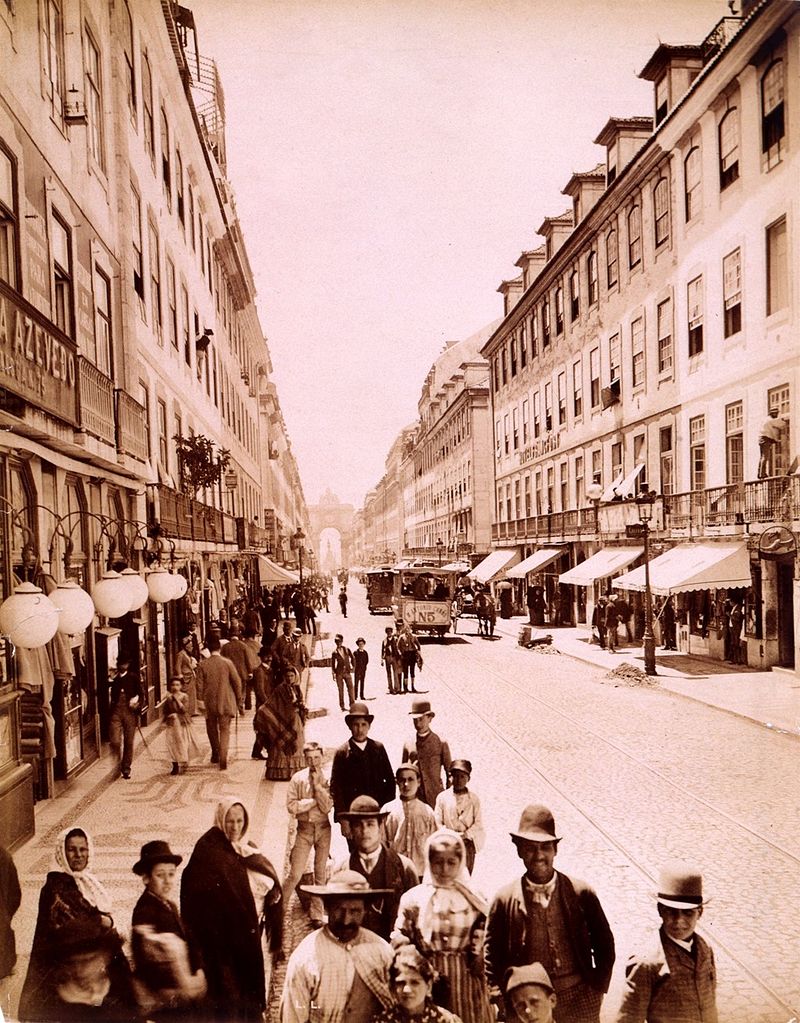
    Rua Augusta, Lisbon, at about the time, 1905 or so, that Felix was heading towards the bullring
    Rua Augusta, Lisbon, 1890 at around the time Felix was heading towards the bullring. Source: Wikimedia Commons

    3. The city of Lisbon, Portugal

    The marquis is in a quandary. He is madly in love with the beautiful, vivacious Mademoiselle Zaza, a singer who performs scantily clad as a soubrette at a little theatre, Folies Musicales, (and with whom Felix is also quite infatuated). Venosta’s parents are opposed to the romance and threaten to cut him off from his inheritance. Their plan is to “pry him loose” from Zaza by financing a world trip for him.

    To cut a long story short, over Benedictine and Egyptian cigarettes, Venosta and Felix work out the ideal solution. Felix will assume the marquis’ identity and go on the trip on his behalf. Venosta is not personally known abroad, and it only takes Felix a few seconds to master his signature: updates he sends the aristocrat’s parents on the progress of his travels will easily hoodwink them.

    Once again Felix has a chance meeting on a train, this time bound for Lisbon, on which will hinge the plot, the character Felix’s destiny. He meets Professor Kuckuck, brilliant, eccentric founder of the Museum of Natural History in that city. Kuckuck is returning from Paris, where he has been on museum business. He thrills Felix with elaborations on the philosophy and history of life on earth, and as well, with mentions of his daughter Zouzou, “a completely enchanting child,” upon whom Felix immediately starts to transfer his fondness for Marquis Venosta’s Zaza.

    Felix settles comfortably into his new aristocratic persona:

    We had hitherto spoken in French; now he inquired: “I assume you speak German, Marquis Venosta? Your good mother, I believe, derives from Gotha — near my own native place — née Baroness Plettenberg, if I am not mistaken? You see I really do know my facts. So we can just as well —”
    How could Louis possibly have failed to inform me that my mother was a Plettenberg! I seized upon this new fact as something with which to enrich my memory.
    “But with pleasure,” I replied, changing languages at his suggestion. “Good Lord, as though I hadn’t babbled German all through my childhood, not only with Mama but also with our coachman, Klosmann!”

    Professor Kuckuck’s truly fascinating discourses create a profound context for implicit questions surrounding the sources of truth and self-hood. The evolution of species traces a mutability in the identity of one species to the next, a process that manifests itself even at the metaphysical level:

    There have been not one but three spontaneous generations: the emergence of Being out of Nothingness, the awakening of Life out of Being, and the birth of Man. (271)

    And indeed, Being itself, Kuckuck teaches Felix is merely an “interlude between Nothingness and Nothingness.” By this stage, Mann’s novel has created the depth to stimulate a perception of flickering between alternate identities and doubles. Louis and Felix are doubles as independent characters, and Felix is a doubled character himself when he “becomes” Louis the Marquis de Venosta.

    These particular doublings are reinforced by the characters’ shared attraction to Zaza, who will shortly mutate into Zouzou, whom Felix-as-Louis will pursue almost as a surrogate Zaza. As reader, we flick through the series of lovers — Genovefa, Diane, Zouzou, Zaza — and with them, the series of mutated, alternated Felix’s. The novel presents the potential for a fascinating action of reading, which is much like the action of the memory in tracing the series of one’s own distinct selves in time.

    Then, in Lisbon, we are presented with a heightened doubling: Felix and Kuckuck, opposed to the professor’s haughty wife and precocious daughter. In Felix’s coach on the Rua Augusta, on their way to the bullring:

    The professor and his wife sat on the back seat, Zouzou and I facing them, and Dom Miguel took the seat beside the coachman. The ride passed in silence or with very brief exchanges, due principally to Senhora Maria’s extremely dignified, indeed stern, demeanour, which admitted of no chitchat.

    Once, to be sure, her husband calmly addressed a remark to me, but before answering I involuntarily glanced toward the sombre lady in the Iberian headdress and replied with reserve. Her black amber earrings oscillated, set in motion by the light jolting of the carriage.

    Alas, we have run out of time and space in this blog post, so the forbearing reader must research for themself the nature of Felix’s third amorous encounter, fired as the blood is by the adrenalin of the bullfight.

    Let me just add that Mann imposes no overt moral judgement on Felix throughout this unfinished novel. Not a plot-like this is what he did and by God he got his come-uppance sort of story. Mann’s assumption of Felix’s narrator-persona is one mechanism that prevents such an abomination from impeding the intoxicating flow of his storytelling.

    Neither is there any obvious  dark, sinister self lurking beneath, as one suspects of the modern day narcissist — as is borne out by the derivative Tom Ripley character  as enacted in the plot. Rather, Mann’s impeccably subtle technique enables vague hints to reveal the starkness of Felix’s lie when he is at his most articulate, in his erudite, heartfelt, absolutely convincing seduction of his mentor Kuckuck’s daughter, spoken from behind the mask of the Marquis de Venosta.


  • Myths of the Wild West as Period and Genre

    Myths of the Wild West as Period and Genre

    The processes of myth-creation rely on a crossover between reality and imagination. A collective psychological space  exists in which history and myth merge and become indistinguishable from one another.  In the heyday of the television western, for instance, how many young children were aware there was any difference in status between historical characters such as Daniel Boone and fictional ones like Hopalong Cassidy? This feature reflects on the evolution and mass manufacture of myth, using the classical example of the Old West.

    Photo courtesy of Randy Nyhof, RandyNyhofPhotos

    Death and superstition

    August 2, 1876, Nuttall and Mann’s No. 10 Saloon in Deadwood, South Dakota, 4:15 pm. A game of poker is in progress. Young, cross-eyed gunslinger, Jack McCall, skulks up to the table, behind one of the players. He draws his pistol, places the barrel inches from the back of the man’s skull and pulls the trigger. The dead man’s fingers stay clutched at the cards, frozen. McCall waves his weapon at the assembly, swears and makes to flee. Click, click, nothing. All the rest of his slugs are duds.

    When it all quiets down, as they say out west, it occurs to somebody to check the cards. Or maybe it’s the first thing they do. Two pair. Black eights and aces. Not a bad hand, must have been feeling purrty confident this time, after losing all day. Lucky as hell. Never ever sat with his back to the door, a sound strategy. Only this once, when they invited him to replace a player who had to leave for some reason. Aces and eights. You got it. Wild Bill Hickok’s murder.

    WIld Bill HIckok. Source Wikimedia commons
    Wild Bill Hickok. Source Wikimedia commons

    The details fade. But that image of black aces and eights, the “dead man’s hand,” endures. The final image imprinted on Wild Bill’s brain, linking his life with his immortality. The catchy assonance, the concise visual image of the playing cards, the momentous context and compelling role of chance: powerful elements that motivate the phrase and the supernatural, mythical idea it expresses.

    Myth collides with reality

    Kit Carson was called on to take a detachment and retrieve a white woman — Ann White, in fact — whom Apache Indians had kidnapped. Carson himself discovered the corpse, with an arrow through the heart. One of his soldiers found a dime novel that the woman had kept in her possession, Charles E. Averill’s Kit Carson, the Prince of the Gold Hunters (1849), in which the fictionalized hero himself, Kit Carson, rescues a girl kidnapped by Indians.

    For the rest of his life, Carson is haunted by the idea that the woman clung onto the fiction throughout her ordeal as a source of hope, which he failed to fulfill in real life. Wyatt Earp symbolizes the classic Western lawman, “goody” versus “baddy” and the notion of “the law of the gun,” though his historical career was far more checkered. The gunfight at the OK Corral spawns an archetypal perception of a perceived global American “peace keeping” role that reaches its satirical fruition in Trey Parker’s Team America: World Police (2004).

    Earp’s part in the manufacture of the Western myth is momentous. His transformation into a dime novel hero, alongside Carson, Buffalo Bill Cody, Hickok, and others, set off a process of idealization that continued into the cinema. But Earp’s contribution to the screen Western is outstanding, since he consulted for Hollywood during his later years and influenced the first Western star, Tom Mix, with whom he became close friends. John Wayne himself met Earp while working as a prop boy, eventually drawing on the famous lawman’s traits, in developing his own definitive western characters.

    Global schema for the Western genre

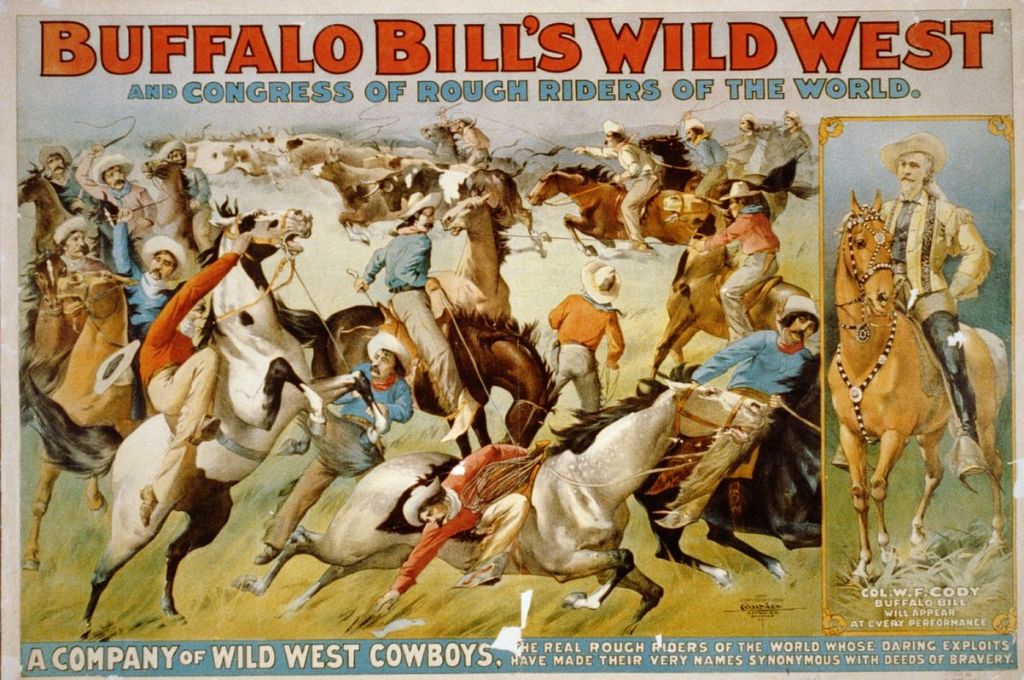
    “Buffalo Bill” Cody began producing Wild West theatres in the early 1870s and toured Europe with them eight times from 1887 to 1906. Buffalo Bill’s Wild West shows accelerated the transmutation of history into myth and eventually the global appeal of the western mythology. Over three hundred performances in London, including a private one for Queen Victoria on her Golden Jubilee.

    Wild West show poster, 1899. Source Wikipedia Commons
    Wild West show poster, 1899. Source Wikipedia Commons

    Famous historical figures from the West such as Chief Sitting Bull, Apache warrior Geronimo, and Calamity Jane, frontiers-woman, army scout and purported spouse of Wild Bill Hickok, participated. Anything up to twelve hundred performers, plus horses, buffalo and cattle. Romantic dramatizations of historical events such as the Battle of the Little Bighorn, cattle roundups, pony express, wagon train and stagecoach attacks provided national and international schema, in which the West could take root both as myth and genre.

    To Television: the medium is the message

    Turn on the TV, shut out the light, Roy Rogers is riding tonight.

    Elton John & Bernie Taupin

    Annie Oakley
    Annie Oakley

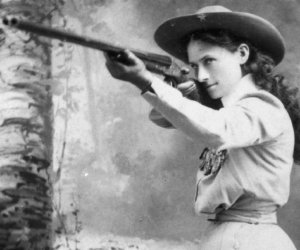
    Annie Oakley took her peerless shooting skills into the Wild West show in 1885. She wasn’t actually a Western personage at all, historically speaking, admirable woman as she was, just showbiz. Annie shows up as heroine in the TV series Annie Oakley in 1954-7, starring Gail Davis. Ring a bell, baby-boomers? Pigtail braids, white hat, fringed cowgirl outfit? Lived in Diablo, Arizona? Horse Target? Brother Tag? Tag’s horse, Pixie?

    Annie (Gail Davis) and Trigger
    Annie (Gail Davis) and Target

    Acquiring heroine status in Buffalo Bill’s show, Oakley spawns a television avatar. And thus the process works in reverse: the TV heroine is granted a proxy historical grounding. Why did the Annie Oakley TV series use her name, but to try to ground the fiction — albeit in dust?

    Without Annie Oakley’s name, the character would be an utterly empty signifier, meaning nothing to anyone. It’s not far from the Adventures of Kit Carson TV series, with Kit and his Mexican sidekick El Toro, played by Don Diamond, who would graduate to Crazy Cat in F Troop. Nothing historical about these stories except for the main character himself. A lot of comic business between Kit and El Toro, along with the usual plot points, building to a correct moral outcome.

    Fadeout on the Western as period, genre and ethos

    Westerns are dying out, along with the Western hero. It’s hard to see Antoine Fuqua’s Magnificent Seven (2016) as a patch on John Sturges’ 1960 version, a transformation of Kurosawa’s Seven Samurai that enriched our perceptions of the Western itself. Let’s propose that two timelines are in play. First the historical, the second the screen one, which catches up and interferes with the first. At the very beginning, the only thing for show business to draw on is the myth fundamentally rooted in history.

    Thus the initial films are ones that draw on Buffalo Bill’s show: Annie Oakley, Buffalo Bill, Sioux Ghost Dance. The films tend to blur relationships between history and showbiz that are already quite well blurred. When the West hits television, a long time later, in the fifties, we have programs such as Kit Carson, Daniel Boone and Davie Crockett. Established, card-carrying frontiersmen. They are historically integral with the creation of the United States as we know it, a single great country that stretches “from sea to shining sea.”

    Without the West, the United States might have been more like Belgium, an interesting place bordering a single ocean, home to several cultures, and sharing a continent with a number of other states struggling to develop a democracy. But the acquisition of the West made America into a transcontinental power. It became a country straddling two oceans, and filling with immigrants from Asia and Latin America as well as Europe.

    Scott Simon, NPR

    The grand narrative is embedded in Carson’s life. But how does one reconcile the war of extermination waged on the Navajo with the amiable TV hero? We move through the Wyatt Earps, Bat Mastersons and Johnny Ringos. Through the Rawhides and Bonanzas, whose classic Western television protagonists never existed except in the imagination. Latter-day Western films try to put a bit of the historical feel back, as in Walter Hill’s Wild Bill (1995) — put the long hair and dirt back in  while subtracting from historical “truth” at the same time, in the interest of a contemporary cinematic Western romanticism.

    Ultimately, the historical timeline is exhausted, to be followed by viable fictional potentials. The Wild Bunch (Sam Peckinpah, 1969) spews havoc: no black hats and white hats any more. The audience identifies with either or both in a hectic, ungrounded consciousness, a “phantasmagoria of senseless brutality” with all the ethical values of the Vietnam War.

  • Simone de Beauvoir and Sexual Symbolism in Wonder Woman (2017)

    Simone de Beauvoir and Sexual Symbolism in Wonder Woman (2017)

    Wonder Woman (dir. Patty Jenkins) was screened on TV the day after I happened to be reading the first part of Simone de Beauvoir’s The Second Sex, her finely honed analysis of the cultural perception of womanhood. I knew there existed ample literature on the cultural and feminist significance of the Wonder Woman character[1] but hadn’t had a chance to read much of it, and was satisfied enough with the idea that the advent of the WW character was a reaction against the male dominated canon of comic-book super heroes, Superman, Batman (though not “super”), Aquaman, Flash, etc.

    Wonder Woman’s feminist pedigree in question

    I was intrigued to learn that WW was invented by famous psychologist, Harvard professor and feminist Dr William Moulton Marston (pen name Charles Moulton)[2] The original character of WW definitely has feminism in her DNA.

    Simone de Beauvoir, 1950. Source: Wikimedia Commons.

    Subsequent waves of feminism have superseded Beauvoir’s ideology, if not exceeded her brilliance, but it seems reasonable to suggest that the inclusion of later than first wave feminist messages would be laden with anachronism. A more Beauvoiresque brand would help maintain a period feel — which is indeed what happens.

    So, though the feminism may be dated, I can’t agree with Theresa Harold’s criticisms in the article “Why Wonder Woman isn’t the feminist fantasy we’ve been told it is” (metro.co.uk), citing a twitterer: “Wonder Woman is a thin, white, cisgender able bodied Zionist. No way in hell I’m watching that ish [sic].”[3] I can’t see this as reasonable, enlightening criticism. But I do appreciate the argument against the idea that the cinematic WW should be seen as a model of feminism.

    Hollywood-glamorous though Gal Gadot undeniably is in certain aspects, I perceive her as on the tall, strong side and approaching the androgynous in some shots, wouldn’t you agree? At any rate, her physical characteristics are a leap apart from many, perhaps most previous Hollywood “starlets.” When characters in the film comment on her fabulous beauty, the intent seems to be to validate a new cinematic model of female beauty, one based on strength and self-affirmation. This is surely a reasonable, ideologically sound aim, isn’t it? Not that we’re measuring the film in terms of its political correctness.

    The accusation about Gadot being a Zionist is irrelevant to me and even worrying — politically weighted, to say the least. There are some other naive points made in the article: “[I]f being semi-naked is the most practical mode in which to save the world, where is Batman’s mankini?” Hmm.

    One comment is interesting, however: she lights on the spy Sameer’s line, after WW’s display of power in the barroom fight scene, “I’m both frightened and aroused,” which Harold can’t imagine Lois Lane saying about Superman in a similar situation. Yet it is obviously a comic reference to a sexual mechanism of attraction-revulsion

    Possible observations of de Beauvoir as period signifiers

    Functionally, I would argue, the line throws precisely to Beauvoir’s style of reasoning in the first chapter of The Second Sex, where she examines the gamut of biological reproduction across living species, in the context of ascertaining and rejecting received notions about the essential nature of the female:

    Alfred Fouillé claimed he could define woman entirely from the ovum and man from the sperm; many so-called deep theories are based on this game of dubious analogies … it was imagined that the ovum is a female homunculus and the woman a giant ovum.

    Existence precedes essence. The female is not conceived or born as such, as traditionally defined — rather, she becomes herself.

    The sperm, as well, has been conceived (and still is, perhaps, by some “foggy minds” — Beauvoir’s term) as a microscopic male homunculus. It has even been “scientifically” observed and recorded as such, as Beauvoir points out. Hence, one symbol of human male anxiety about the female lies in the mechanism of fertilization, in which, “[by] giving up its transcendence and mobility, the sperm penetrates the female element: it is grabbed and castrated by the inert mass that absorbs it after cutting off its tail …”

    Mantis assumes Wonder Woman’s pose | Photo by siamesepuppy from USA [CC BY 2.0 ], via Wikimedia Commons
    Now, it is well known that films such as Ridley Scott’s Alien, Roland Emmerich’s Independence Day and Mitchell Lichtenstein’s Teeth pointedly apply the ancient vagina dentata (aka “toothed vagina”) in aggravating such masculine anxieties to great box office effect. I contend that Patty Jenkins’s Wonder Woman also contains a subtle thread of similar symbolism.

    Mantis form as vagina dentata?

    The origin may well be in Beauvoir, who refers several times to a most fascinating insect of the order Mantodea, as one of several threatening images evoked by the word “female”: “the praying mantis […], gorged on love, crushing their partners and gobbling them up …”

    Some of WW’s characteristics link transparently to the praying mantis:

    1. If you compare her tiara to previous comic-book versions, you can’t fail to note its pronounced triangular form, which accentuates her frown, turning her physiognomy into a shape evocative of the insect’s head.
    2. Her crossed-arms fighting pose, by which she activates her bracelets to repulse bullets and project energy bolts resonates with the insect’s “praying” pose. Interestingly, the preying mantis supplies the martial art of Kung Fu with one of its fighting forms.
    3. Her mantis-like leaping and climbing. WW doesn’t fly smoothly like Superman. Rather, she springs and hops long distances, performing aerobatic feats only replicable in the insect world by the mantis. (The male mantis can use his wings to fly but the female can’t, incidentally, she leaps.) Notice how in one early scene WW discovers her insect-power when she scales a castle wall in order to obtain the so-called “God Killer” sword?
    4. All the above combined. The flamboyant, beautiful, deadly, male-devouring beauty of the female praying mantis inform WW’s cinematic impression.
    Wonder Woman assumes mantis pose

    When WW strides into “no man’s land” she asserts herself as the ovum-presence. Bullets fly as she strikes her Amazonian war-poses, and fends them away like so many spermatozoa.

    Then there is the romantic scene with her and Trevor — her lover, who will sacrifice himself for the sake of her self-realization — dancing in the snow. The spermatozoa have turned into snowflakes, framing her delicately and romantically in all her gorgeousness. Idealized ovum.

    A semiosis is at play, a pleasurable, open-ended action of play. The film’s feminist achievement is that it does not attempt to impose a totalizing moral — what some of its critics howl for — but which, if articulated, would destroy itself in its own ludicrousness. Far better to inform the mise en scène with a historical impression of feminism, a semiotic reflection on feminist ideas. Undoubtedly, the Hollywood ideology will tend to subsume any contrary, totalizing moral, one way or another.


    Notes

    [1] See for example, Jacob M. Held & William Irwin eds, Wonder Woman and Philosophy: The Amazonian Mystique (Wiley-Blackwell 2017); Trina Robbins, Wonder Woman: Ambassador of Truth (Harper Design 2017); and Jill Lepore The Secret History of Wonder Woman (Vintage 2015).

    [2] See Matthew J. Brown, “Love Slaves and Wonder Women: Radical Feminism and Social Reform in the Psychology of William Moulton Marston,” Feminist Philosophy Quarterly, 2.1 (2016)

    [3] Also Lara Wit, “Wonder Woman is Your Zionist, White Feminist Hero,” wearyourvoicemag.com

  • Revisiting Samuel Beckett (Ill Seen Ill Said)

    Revisiting Samuel Beckett (Ill Seen Ill Said)

    Stooped as loving memory some old gravestones stoop. In that old graveyard. Names gone and when to when.

    Once hooked, always will be, on these writings of Samuel Beckett. On.

    Sometimes referred to as “novels,” Beckett’s three later works, Company (1980), Ill Seen Ill Said (1981) and Worstward Ho (1983) might be better thought of as pieces of short prose — Ill Seen Ill Said, for example, being around eight thousand words long. That’s right, not eighty, but eight. Not what we might expect of a “novel.” They are unimaginably spacious nonetheless.

    They possess a beauty their own, and a quality of getting inside your head and staying there. A uniquely “haunting” quality. Their charm consists in adorning — or incorporating, in a sense — the dynamics of the reader’s experience of reading. They draw the reader into an intriguing game. A game of life’s drawing to a close (what fun!) A game of recognition of death, where death isn’t far away, in any sense. Merely beyond a membrane.

    Well, we are already embroiled, enmired in that. “Our little life is rounded with a sleep,” the Bard put it so concisely. And what an inspired line that is, incorporating the finite and infinite dimensions of life with such a tender sense of affection for the human race. We feel that Samuel Beckett isn’t far removed from this humanistic sense.

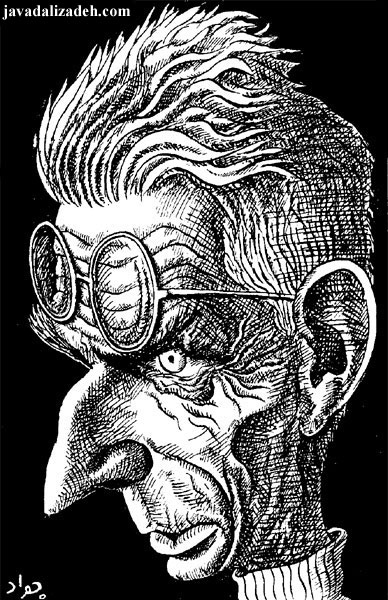
    'Samuel_Beckett'_by_Javad_Alizadeh
    Samuel Beckett by Javad Alizadeh (javadalizadeh.com: Gallery Direct)

    In his late pieces Beckett constructs a kind of prism through which one perceives the light of human existence. In reading the text, one inhabits it. There’s really no way around this if you are to read the texts properly, which is, my contention is, freely.

    Although, then again, I guess it’s a free world: read or misread them as you will. Many critics, indeed, interpret them in particular and peculiar ways, write about that, and try to convince us, the reader, that their way is the only one.

    That is one kind of criticism: closing the free play. The woman is Beckett’s mother May. Which she may be in a sense — the sense that reveals one’s approach to the reading as biographically orientated. What was that Beckett once said? “No symbols where none intended,” I believe.

    I will try to avoid that pitfall. But I think it was Sartre who wrote that we (“man”) are condemned to be free: “because once thrown into the world, he is responsible for everything he does.” Slightly sexist, but pretty true nonetheless, if you let the women etcetera in.

    Let’s look for a second at our opening quotation from Ill Seen Ill Said. Notice one clear ambiguity out of several. First, note how in the line “Stooped in loving memory some old gravestones stoop” we may read initially that someone, some person, is in the act of stooping, and therefore is stooped, so to speak (interpolating an imaginary comma between “memory” and “some.”

    That would be to say something like: someone has halted, stooping in loving memory (presumably of a lost one). Like Yeats’ epitaph: “Cast a cold eye. On life, on death. Horseman pass by.” Beckett’s gravestone phrases reduce the stretches of lives to the pronouns, “when to when”. Years compressed by the of years of weathering to a kind of equivalence. Finite time-spans don’t register in the infinity of time. And it’s not as such a “person,” as I mis-said, but more of a literary character to whom I as reader imbue certain qualities of animation — more of a figment of the imagination.

    Does Beckett anticipate the figure of the reader? Definitely. Or better to say, he creates a space for the reader, in which the reader manifests and reflects upon themself. All of us have lost someone dear, or else will. Well may we be condemned to freedom, as Sartre wrote, but also to suffering. But then again, grammatically speaking, we might as well have it that the gravestones themselves stoop, or at least, some of them.

    That is, some of them lean over, presumably, as gravestones are wont to do over time, in old graveyards. And to note as well, these ones may stoop also “in loving memory,” in the sense that some were initially placed there in loving memory of him or her whom they commemorate. Sooner or later, most of us have to visit a graveyard. Unless, unfortunately, we are in one already, or perhaps been incinerated, or else in some unknown, unmarked place. Fine.

    On the other hand, in this piece, it may well be the gravestones themselves that stoop, interpolating the same comma, but transferring our sense of the subject to the gravestones themselves. This would be to interpret something like: these old gravestones stoop (are stooping, if we bring our reading into the present tense — which is where it probably really belongs) in loving memory of the deceased buried beneath them. Decades after the burial, they have take on a stoop. Alright, screwed the poetry. But you see the alternative sense.

    We could go on. And on. That is one critical point in my reading of the “novel” (which could also be described as a play script, an extended stage direction for what the reader should attempt to imagine). There is a beautiful and mysterious sense of wonder that comes with reading Ill Seen Ill Said. You can never blithely scan this work, no matter how many times you’ve read it. Some commentators believe that the old woman, the central figure in the narrative, approaching death; others that she is already dead, like a ghost.

    I would prefer to think of her with the kind of textual potency that a reader informs in encountering the text. Or one may think of her as being both alive and dead, in a sense, as in Shakespeare’s “little life” reduced to the infinitesimal.

    But we need to be “careful,” as the narrative voice seems to caution itself or the reader from time to time, not to misconstrue the sense, or fixate a particular possibility at the expense of others.

    Every sentence is a challenge. We can’t let critics tell us what the meaning is. They are often deluded. Do you know how, when in the midst of “reading” a novel, you sometimes look up and say “Where was I, what does all this mean?” You’ve been scanning it, taking in the words but not cogitating them. One will inevitably experience such a feeling reading Ill Seen Ill Said (or Company or Worstward Ho).

    That’s at least partially because every sentence is fraught with ambiguity, or else the whole context of the piece has invested it with one. Let’s briefly examine a couple of relatively straightforward instances:

    In the dark day and night.

    It is clear immediately that the absence of the comma creates at least two somewhat different senses. Either the speaker or an object of the statement (an “other” or a location) is “in the dark” both day and night; or else “dark” is used to qualify either “day” or “day and night.”

    Or this:

    A gap time will fill.

    Note the temporal or spacial alternatives in the word “gap.” And in which sense may “time” be considered to “fill” anything. How may a gap be opened up, as it were, and then filled by time?

    Or again:

    It too dead still.

    An old woman’s white hair: either too dead, or too dead still, or “still dead” perhaps in the sense that one may answer an early acquaintance’s enquiry, “How is your mother?” “Still dead.”

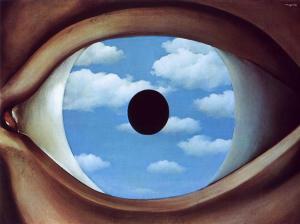
    René Magritte, The False Mirror (1929). Source: Wikiart.org

    Let’s  consider the scenario in more general terms. The elderly, white haired woman occupies a cabin adjacent to a zone containing white stones. There are twelve of them, suggesting a cosmic mise-en-scène, or it may be a cemetery, or an ultimately indefinable amalgam. She is being watched — by the narrator, by the reader, by the generally encompassing “eye” (in the sense, for example, “the eye lose[s] itself in the gloom.” She is “caught,” observed by this spooky “eye,” a character that is not restricted to Ill Seen Ill Said but occurs elsewhere in the short prose (and see, especially, Film).

    It is as though the (objective) female figure is engaged perpetually in her motions and activities, and the (subjective) “eye” just “tunes in” or “cuts in” once in a way, happening to catch her at this or that instant. In the way that we, the reader, activate a text — a kind of perpetually moving, autonomous entity — at any instant we choose to inhabit it.