Tag: Fictions and Features

  • Raising a Penny Dreadful: The Case of J.F. Smith

    Raising a Penny Dreadful: The Case of J.F. Smith

    While researching old newspaper archives for a novel set in the Victorian period, I uncovered an intriguing British serialized penny dreadful, The Mystery of the Marsh; or The Red Barn at Deerhurst, which I plan to resurrect in its entirety here on Furin Chime, chapter by chapter. The work is unattributed in the instalments, but I traced the author to one ‘J.F. Smith.’

    I presume this is the once famous, now all-but-forgotten John Frederick Smith (1806–1890), whom the Oxford Dictionary of National Biography describes as ‘England’s most popular novelist of the mid-nineteenth century.’ I am presently at work on confirming the authorship; not a simple task, for there is little extant information about the man. More about him and the genre of the Victorian penny novel in forthcoming posts.

    Further problematizing the process of editing the novel is the need to piece the work together using two quite obscure sources, because i) the copy in both is indecipherable in parts, and ii) the less legible of the two serialized copies sometimes presents chapter information that the cleaner copy lacks. The novel is a bit like a jigsaw puzzle to piece together, since the chapters are segmented according to the editorial requirements of the newspaper in which each appears.

    At any rate, I do hope you develop as much affection for the story as I have. I will do my best to provide a chapter every two weeks. 

    Don’t hesitate to make any comment or reply at the bottom of the blog post. I very much hope some discussions might ensue. If you like the instalment, please ‘Like’ it at the bottom of the post. Facebook Likes and Comments are also most appreciated.

    There is a link to the next instalment at the bottom of the post.


    CHAPTER ONE

    The Red Barn at Deerhurst — Tramps in Search of a Lodging

    Essex, one of the midland counties of England, presents almost as great diversity of inhabitants as of soil. Roman, Saxon, Dane, have all left traces of their blood. Colchester and Chelmsford, the county towns, are peopled by a well-educated, thriving class; the country round by a sturdy race of farmers, good agriculturists and skilled breeders of cattle, which bring a high price in the London markets. There is also a considerable trade carried on between Wivenhoe and the metropolis in the sale of oysters. Nowhere are these delicious bivalves found in greater perfection than in the carefully-cultivated pits of the first-named place.

    Essex is intersected by long, dreary tracts of marsh lands, noted for their rank vegetation, and dotted here and there with pools of water, much frequented by flocks of wild ducks and other water-fowl, which during the shooting season attract the attention of hardy sportsmen willing to risk both health and safety in pursuit of game. To accommodate these visitors many taverns have been erected within the last fifty years. Most of the inhabitants consist of gypsies, tinkers, peddlers, and not a few fugitives from justice, who live, rent free, in huts or tents of their own erecting, setting law, order, and morality at defiance.

    Essex Naturalist (1887). Source: Wikimedia Commons

    In no other country of Europe would such a state of things be permitted, but the marshes would long since have been drained and brought under cultivation the only means of civilizing and getting rid of their dangerous population; but an absurd law in England prevents this. No sooner is a patch of land reclaimed and made productive than the Established Church puts in a claim for titles.

    No wonder if, under such a state of things, nothing serious has been attempted. Enterprise is paralysed, and capital made cautious.

    The noble Thames — one of the greatest arteries of the world’s commerce — flows for many miles along the banks of the largest of these swamps or marshes, and probably the most dangerous one, known as Bittern’s Nest. Its proximity to London — not more than thirty miles distant — has made it a refuge for the worst of characters; in a few instances, perhaps, also of the unfortunate.

    Of course, there is a line of demarcation to be drawn somewhere between what may be termed savagedom and civilisation; the difficulty would be to locate it, the frontiers being so blended together as to form a debatable land round the village of Deerhurst, whose inhabitants thought it no sin to get their brandy and tea from the smugglers of the swamp. It was whispered that the curate — for the village had both a church and a schoolhouse — shut his eyes to the dealings of his parishioners with the contrabandists.

    Probably the most prosperous farmer in the place was Peter Hurst, a tall, strong-limbed, hard-working man, shrewd at a bargain, and an excellent judge of cattle. His family consisted of Peggy, his wife, Susan, their only child, and William Whiston, a nephew, residing with him. These, with an old female servant, and one or two farm hands, formed the entire household.

    It was generally believed or surmised amongst the neighbours that on his coming of age he would be entitled to half the farm. Nothing positive, however, was known upon the subject, the Hursts keeping their family affairs pretty much to themselves. The only person who could have enlightened them, Richard Whiston, a paternal uncle of the boy, a lawyer, resided in London. The report of a projected marriage between the cousins, Susan and William, found general credence, although founded on mere conjecture. Both parties being young, several years would necessarily have to elapse before the doubts of the curious could be solved.

    Women have keen eyes and jump at conclusions, especially where matchmaking is concerned. They had noticed that when the Hursts gave their Christmas party but few girls were invited, and these the oldest or plainest in the village. This might have been accident, but, as a matter of course, the mothers of the excluded ones attributed it to design. If the latter, it is only justice to the farmer to state that he had no band in it. He attended to his work, was exceedingly fond of money, and entertained — very properly, our female readers will say — an immense opinion of his wife.

    Mrs. Hurst was a different person. Nature had endowed her with a strong will, some sense, and a considerable stock of patience. Although youth is said to be a great beautifier, she could never have been good-looking, and yet she made the best match in the place. True, her husband was a mere nullity, intellectually speaking, but she saw that she could lead him by the nose.

    When everything went according to her wishes Peggy Hurst was rather a pleasant person. Like the cat before the fire, she could purr very gently. It was only when thwarted that she unsheathed her claws. Even then she did not always scratch. It is not a very amiable character that we have drawn; but even in the worst some touch of goodness may be found. She loved her daughter. Nothing was too good for Susan or herself, or too expensive, considering her means. And if on rare occasions her husband ventured to hint that the account of the butter money did not seem quite clear, she would gently remind him that he had no head for figures, and that he ought to consider himself fortunate in having a wife who could calculate and manage for him

    As for Susan, if she had inherited something of her mother’s strong will, it was without any of its hardness. She had a good heart, was a little selfish perhaps, but that was to be expected, and possessed a considerable amount of animal spirits.

    Susan Hurst liked her cousin as she would have liked a brother if she had one, but at present nothing more. Being a girl, of course she was fond of teasing him.

    William Whiston, the last member of the family whom we think it necessary at present to describe, had just entered on his sixteenth year. Nature had been liberal to him in person as well as in mind. He was tall of his age, had a well-knit frame, possessing both strength and activity, fair without being effeminate, and rather good looking; and, what was better still, both courageous and honest — in short, excellent material, which only required to be well worked up to make a man, and we shall feel disappointed it he does not live to prove himself one.

    Neither the farmer nor his wife felt quite satisfied with the conduct of their nephew’s second guardian, who was also an uncle. A methodical, dry lawyer, residing in London, he was an old bachelor, too much in love with his profession to indulge in any other kind of love; no time for courtship, although he found sufficient to look keenly after the interests of his ward. The Hursts stood considerably in awe of him, possibly because they could not understand him. At their yearly settlements everything connected with the personal expenditures of the youth was scrupulously examined; clothes, pocket money — the last no very great item — carefully audited and allowed for; the balance prudently invested; from all of which our readers will come to the conclusion that the surmise of the neighbors was correct. William Whiston really owned one half of the farm.

    Hence the desire of his aunt and uncle for the marriage of the cousins.

    On one point alone had the man of law ever shown anything like liberality — in the education of his ward. Fortunately he was enabled to indulge it at a very moderate expense. Theophilis Blackmore, the village schoolmaster, was a ripe scholar. It was even asserted that he had received a university education, but of this the old man never spoke. After school hours he shut himself up with his books. or, if their lessons had not been quite satisfactory, with his favourite pupil, William Whiston, and his son, Benoni, for he had been married. The old pedagogue was resolved to make scholars of them, and up to the commencement of our tale the prospect of success was highly satisfactory.

    In haying and harvest time it was quite useless for farmer Hurst to insist on a holiday for his nephew, whose services would have been useful in the fields. Theophilis Blackmore would not listen to him, and when pressed too hardly, threatened to appeal to the lawyer in London. This generally settled the question.

    From pursuing the same studies, it is not surprising that William and Benoni became close friends. They fished and shot together. At the time the intimacy commenced both were so young that Mrs. Hurst had not seen the slightest danger to her projects in permitting the son of the schoolmaster to be almost a daily visitor at the farm. In fact, he half lived there. The boy was not only shy and reserved, but somewhat uncouth in his ways. In person there appeared little to object to.

    Behind his back Susan used to laugh and turn him into ridicule. Of course her mother was right. There could be nothing to fear. There was one person, however, in the village whom Mrs. Hurst really did feel a little uneasy about — a young giant named Goliah Gob, the son of a respectable widow in the village. He had already acquired as much education, perhaps, as he was capable of receiving — that is to say, he could read, write, and do a little ciphering as far as the rule of three, but spelling had presented insurmountable difficulties. He never could be brought to see the connection between signs and sounds, so gave it up at last in despair.

    Although a year older and almost a head taller than the two friends, even whilst at school he had pertinaciously attached himself to them; and proved rather an invaluable acquaintance, for he knew not only every stream within ten miles round in which trout were to be found, but the best points for rabbit shooting. From merely tolerating his society at first, William and Benoni gradually began to like him, and if they still laughed occasionally at his odd ways and quaint sayings, it was laughter without ridicule; they had discovered the particles of sterling ore buried in the rough quartz, and did their best to extract it.

    If, like his namesake of Gath, Goliah was a giant in strength, in disposition he was peaceable as a child, and rarely or ever exerted it unless in defence of those he loved, and then woe to those who assailed them.

    It will appear strange, no doubt, to such of our readers as are unacquainted with the peculiar Saxon type so common in the eastern counties of England, when we assure them that the complexion of this youthful Hercules was fair, delicate and creamy as that of a girl of seven or eight. It would have required excellent eyes to discover the light down just beginning to show itself upon his chin and upper lip; in regarding the face only, one would have pronounced its owner all gentleness; in feeling the grip of his hand, a conviction that he might become dangerous presented itself.

    We trust our readers will not accuse us of indulging too much in description. When once the action of a tale commences there is but little time to photograph portraits.

    The Hurst homestead was a plain, substantial building, situated on a gentle slope about a mile distant from the debatable land of the Bittern’s Marsh. The greatest peculiarity about it was its strength; strong oaken shutters guarded every window, and the doors were of the same solid material. To the security of the latter the farmer saw every night himself, the last thing before going to rest.

    Forty rods from the house, just where four cross-roads met, stood the red barn, evidently of much older construction than the farm building. In fact, there was something semi-ecclesiastical in its appearance, explained, if tradition is to be relied upon, by its having been the Bury, or place for the collection of tithes paid before the Reformation to the abbots of Wivenhoe.

    Another peculiarity which it may be as well to mention. Not only was the building fireproof, but it had a small chamber constructed for the watchers who at certain seasons of the year had to see to the safety both of grain and cattle liable to be carried off by the inhabitants of the neighbouring marsh.

    At the south end of the barn four crossroads met, one, leading to Chelmsford and the seats of several of the county gentry, being exceedingly well kept. Traces of handsomely-appointed carriages might be seen traversed by deep ruts caused by farmers’ waggons, or lighter ones made by pedlers’ carts and the humbler barrows of the tinker and scissors-grinder, whose homes were in the swamps. An epitome of the world-poverty and wealth intersecting each other, yet rarely coming in actual contact. When they did, the collision generally proved a rough one.

    The night threatened to be stormy; in fact, several drops of heavy rain had already fallen, giving the three friends a hint to accelerate their pace towards the house, when Goliah suddenly stopped.

    ‘Hurry up!’ exclaimed William.

    ‘I beant a goin’ no further,’ replied the young giant.

    This caused the first speaker and the schoolmaster’s son to stop.

    ‘And why not?’ demanded the former.

    ‘Cos thee aunt doesn’t like I.’

    ‘Nonsense, Goliah. I am sure she is always civil to you.’

    He would like to have said cordial, but love of truth forbade it.

    Goliah shook his head.

    ‘Civil enough,’ he replied. ‘I don’t complain o’ that, but it be all upon the tongue. A plaguey long way from dame Hurst’s tongue to her heart.’

    ‘This is all fancy.’

    ‘No, it beant. I aint got no fancy. Have I, Benoni?’

    The schoolmaster’s son smiled.

    ‘That be right,’ added the speaker. ‘Thee do never lie.’

    ‘Thank you,’ said the farmer’s nephew.

    ‘Nor thee either,’ replied the rustic, ‘unless to prevent the feelin’s of a friend from being hurt, and I don’t call them lies. Now my feelin’s aint a bit hurt, but somehow I don’t like to sit down at thee aunt’s table and eat her bread and butter I feel as if it would choke me like; she do look as thof she grudged it.’

    ‘I tell you no,’ exclaimed William, impatiently. ‘She has no such thoughts.’

    ‘What be it, then?’

    ‘Well,’ answered his friend, with a half-amused smile, ‘you are almost a young man.’

    ‘Pretty near it.’

    ‘And are very good-looking.’

    ‘Ah! Now I see thee be making fun of I.’

    ‘Not in the least. All the girls in the village say so.’

    ‘And my cousin Susan will soon be a young woman,’ continued the speaker. ‘Now her mother is a very prudent woman.’

    The color flushed the countenance of Goliah, even to the roots of his light curly hair; it seemed as if some new revelation had suddenly struck him. It faded almost as soon it came, and he shook his head.

    ‘I tell ’ee, Willie,’ he said, ‘that it beant that. She do know as well as I do that I should have but a poor chance agin thee.’

    William Whiston laughed.

    ‘And if I had a good un,’ added the rustic, ‘I wouldn’t try it.’

    ‘Why, you don’t imagine that I am in love with my cousin?’

    ‘Folks in Deerhurst say thee are to be married.’

    ‘Foolish gossip,’ replied the youth. ‘True, I do love Susan dearly, but only as a sister. I shall never think of her as a wife, nor she of me as a husband.’

    Again the face of the young giant flushed.

    ‘Be thee serious?’

    ‘O, perfectly ‘

    ‘By gory, then,’ exclaimed Goliah, ‘ I will go with thee to the farm. Mrs. Hurt’s black looks shan’t scare I a bit; I allays felt more at Susan’s laughing at me.’

    The conversation was interrupted by the appearance of two youths. The eldest who carried a bundle at the end of a stick over his shoulder, appeared about eighteen; his companion, several years younger. Although travel-stained, and evidently sinking with fatigue, there was an air of respectability in their appearance, and their clothes were something more than decent.

    Both the boys sank upon a rustic bench which some charitable hands had erected on the road-side.

    The three previous speakers regarded them attentively.

    ‘You seem tired,’ observed William Whiston. ‘Have you walked far?’

    ‘A very long distance,’ replied the eldest of the two tramps, for such the inquirer concluded in his own mind they were. ‘Can you inform us of any respectable house where we could lodge for the night?’

    ‘And where we should be quite safe,’ added his companion.

    ‘Safe!’ repeated Goliah. ‘Why, thee don’t look as if thee had much to lose.’

    ‘Just sufficient,’ observed the eldest, a little nervously, ‘to take us to London on foot. We have friends there. How far distant is it?’

    ‘Thirty miles, at the least.’

    At this information the youngest boy burst into tears.

    ‘I shall never live to get there,’ he sobbed.

    ‘For shame, Charley,’ said his comrade, soothingly. ‘Is this your courage? Be more of a man. Remember how many miles we have walked already.’

    ‘Not get there?’ repeated Goliah Gob. ‘Why I have footed it many a time afore breakfast by the side of mother’s waggon, and thought naught on it.’

    ‘Ah, yes,’ replied the tired lad, contemplating the stout frame and limbs of the speaker. ‘I can understand your doing it. I wish,’ he added, despondingly, ‘we could find some safe shelter for the night. I should not care how humble.’

    William Whiston felt touched. He noticed the delicate features and small white hands of the boy, which he clasped hopelessly, and resolved to assist him.

    ‘If you don’t mind roughing it a little,’ he observed, ‘ I can at least provide you with a shelter. The night threatens to be a stormy one; but you will be quite safe there,’ he added, pointing to the red barn, a few rods distant.

    The young wanderers regarded the dreary-looking building, and shuddered.

    ‘It does not look very inviting, I confess,’ continued the speaker, ‘but it is better than it looks. There is a small chamber at the north end used by the caretakers — when there is anything to watch. The place is quite empty now, and you can lock yourselves in.’

    The last assurance seemed to decide the boys, and the offer was gratefully accepted. William led the way, accompanied by his two friends. Everything appeared as he stated — the barn quite empty, and the key of the chamber in the door. He took it out, and placed it in the hand of the eldest youth.

    ‘Why, a king might sleep here,’ observed Goliah, looking round the room. ‘Not as I ever seed one. There be a good flock bed, wi’ sheep-skins to keep ’ee both warm.’

    ‘And here,’ added the schoolmaster’s son, giving them a canvas satchel, ‘are the remains of our dinner. It was well filled when we started this morning fishing. You will find half a bottle of currant wine in it.’

    The boys were profuse in their thanks. ‘Make yourselves as comfortable as you can,’ observed William Whiston, as he bade them good-night. ‘Not at all likely that you will be disturbed; but if any tramps should seek shelter in the barn, keep silent, and your presence will not be suspected.

    The three friends quitted the red barn, carefully closing the great doors after them, and resumed their walk towards the house. Somehow they did not seem inclined to talk. Each one appeared to have something to think of. Goliah was the first to break silence.

    ‘Lord! Lord!’ he muttered, half aloud, what a lot of poor frimicating critters there are in the world! What be the use of em? They do look more like gals than boys. Did you see their hands? They ha’ never done a day’s hard work, and never will!’ he added.

    A similar thought had struck his companions.

    ‘Play-actors,’ suggested William.

    ‘Their language was too simple for that,’ observed Benoni. ‘Mountebanks, perhaps.’

    ‘Naught o’ the kind; they be only tramps,’ said Goliah.

    This edition © 2019 Furin Chime, Michael Guest


    Scroll down if you would like to access a link to the next instalment, or see the blog menu at the top.

    Thanks for visiting.

    MG

  • Cyberspace: Virtual Life in the 90’s

    Cyberspace: Virtual Life in the 90’s

    Reflecting on a post-Tipp-Ex era I ponder questions surrounding the concept of Cyberspace.

    Remembrance of Tipp-Ex past

    Be it fortunate or unfortunate, the years locate me at a pivotal time in the evolution of cyberspace. I don’t claim to be among its first denizens. Arpanet, the forerunner of the Internet was “operational” in the United States from 1975 (with a connection to Norway), and went international in 1983, soon becoming known as “the Internet” (aka “information superhighway). However, among those presently alive on this planet, I consider myself to have been a relatively early user.

    In 1985 or so I’d commenced my doctoral research on James Joyce’s Finnegans Wake at the University of Sydney, on an Australian Postgraduate Research Award, which is a kind of national prize for undergraduate achievement.

    I saved my meagre resources to purchase an electronic Brother golf-ball typewriter, if you can conceptualize what that may have been, but despite the copious application of Tipp-Ex correction fluid, for months I couldn’t get past a few printed pages. Joyce was partly to blame, partly my limited intellect and inclination for good times and tequila. But it became clear to me I was never going to be able to produce a PhD dissertation on Joyce’s work or anything else by this method (but particularly not on the Wake).

    How longingly I leafed through the computer magazines displayed at the local newsagency in those days, realizing that this computer-thingy was capable of saving all those wasted trees and enabling me to progress into chapters and, possibly, an entire thesis. No, never, surely not likely.

    I bought a modest computer, a British manufactured Amstrad PCW8256 beast, basically a hard-wired word processor known affectionately, coincidentally, as “Joyce” to its fans, with whom I identified enthusiastically. I imagine the inexpensive machine salvaged many a poor, lost, wannabe scholar like myself, perhaps their faithful hound lying asleep under the desk like my briard, Pepe.

    I decamped from the  “Joyce Industry” to the nearby “Beckett Industry,” in which I felt more at home  and in whose work for theatre I had some background, and with the help of my Amstrad “Joyce,” finished my thesis in time. Leading international Beckett scholars examined my dissertation, and I was granted my doctorate but found I couldn’t seem to get a job apart from writing arts features and reviews and lecturing as a casual at various universities, which was enjoyable for a year or two, but uninspiring if that was all the future had to offer. So I left Australia for Japan, to have a shot at full-time tertiary teaching, first at business college, then university.

    Internet advent

    Towards the mid-nineties, I’m feeling somewhat isolated from Western academia, rummaging in Japanese university library stacks, a subterranean salmagundi of intellectual distraction.

    I started to hear dribs and drabs about that amazing technical entity called the Internet, a kind of computer network that operated via international telephone lines. It was basically unvisualizable to anyone who hadn’t experienced it; but from what I’d heard, I thought there was a chance it might help me get in touch with libraries and researchers located in other countries.

    In 1995, the Internet could boast 16 million users, or 0.4% of the world’s population, as opposed to 4,208 million, or 55.1% today (Internet World Stats: Usage and Population Statistics).  It was like magic when my computer was hooked up, the first one in my faculty. I won’t forget my initial sight of the mysterious gray “web page” — a particular striking steel-gray I’d never before known — with its black text and blue “hyperlinks.” Wow … hyperlinks. Thank you, Tim Berners-Lee, who invented the World Wide Web and gave it to the world for free (See Katrina Brooker, “The Man who Created the World Wide Web Has Some Regrets,” Vanity Fair, Jul. 2018). A few years later, I’m working in a faculty of informatics — the first in a national Japanese university, where I set up a course in media semiotics.

    As a nineties newbie, the notion of cyberspace struck me as a mind-blowing phenomenon, as it still does to some extent, when I’m not dodging scams and paywalls. It brought me back in touch with global academia, enabling all manner of research prospects and travel to several countries, where I could exchange ideas face-to-face with international correspondents. I wondered about how one might adapt and define the self within this space, which was evidently so liberating from the physical strictures of time and place. Like so many I was attracted to the apparently emancipating, somewhat anarchic potential, such as John P. Barlow was to articulate some years later:

    Governments of the Industrial World, you weary giants of flesh and steel, I come from Cyberspace, the new home of Mind. On behalf of the future, I ask you of the past to leave us alone. You are not welcome among us. You have no sovereignty where we gather. […]

    Cyberspace consists of transactions, relationships, and thought itself, arrayed like a standing wave in the web of our communications. Ours is a world that is both everywhere and nowhere, but it is not where bodies live.

    We are creating a world that all may enter without privilege or prejudice accorded by race, economic power, military force, or station of birth.

    We are creating a world where anyone, anywhere may express his or her beliefs, no matter how singular, without fear of being coerced into silence or conformity.

    Our legal concepts of property, expression, identity, movement, and context do not apply to us. They are based on matter, There is no matter here.

    Extracted from “Declaration of the Independence of Cyberspace” (1996)

    That’s what many thought possible of this evolved “home of the mind”; and kudos to John P. Barlow for his monumental historical “proclamation.” However, nowadays it reads not unlike an adolescent utopian manifesto, which it may have been to some degree. Today, it is entirely clear that cyberspace is up for grabs by countless economically, criminally, and even politically motivated parties. Seems like, if someone doesn’t want our money, they’re after our data or our identity.

    I think we see these tendencies way back in the 90s, the Eden of cyberspace, when click farms, troll farms and the dark web were unheard of.  The seeds are there, way, way back in time.

    Some late 90s semiotics of cyberspace

    It’s an opportunity to explore some more of my semiotics files of the 90s/00s, collected from Japanese publications.

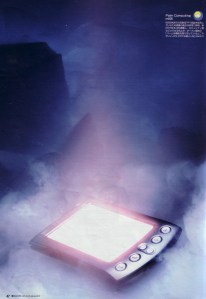
    Here is a magazine ad for a Palm Pilot (Palm Inc., subsidiary of US Robotics), circa 2000 — a brand of pocket computer.

    Print commercial for Palm Pilot (circa 2000)
    Japanese print commercial for Palm Pilot PDA (circa 2000)

    Note the attempt to depict the concept of cyberspace by constructing a mise en scene that is an admixture of light, water, rocks, ice and gas. The background design obscures and refigures the elements of earth, water, air, fire and aether (void) — a persistent ancient influence on our conception of everyday reality. We presume the device had not been dropped in a rock-pool. Rather, it resembles an occupied miniature spacecraft exploring a newly discovered alien world. The light in the device suggests it is occupied, not by a human body but by a consciousness, thus attributing qualities of adventure, strangeness and disembodiment to the idea of cyberspace. The tiny computer is able to enter cyberspace and take our consciousness with it, leaving our body behind.

    Here are some more images from the same catalogue, to emphasize the visual effect of the “cyberspacial” background, which was quite cool at the time, but perhaps because of the relatively naive mass-sense of what cyberspace entailed. Below are the original Harmon/Kardon Soundsticks. Original as they appear, if they remind you vaguely of a certain style, you’re quite right. Apple designed and engineered them so they could dovetail into their range of sexy, translucent, multicolored iMacs, which retailed between 1998 and 2003.

    Print commercial for Harmon/Kardon Soundsticks (circa 2000)
    Japanese print commercial for Harmon/Kardon Soundsticks (circa 2000)

    There is a rather organic form to the design of the Soundsticks that echoes the humanoid user-friendliness of the iMac. It is pronounced in the Elmar Flototto “Flower Power” standing floor fan as well, spruiked for its innovative design, ultra-quietness and high-density foam blade. Here it is standing in a reflected glow of things cyber, there being nothing essentially related to computers, or digital, about it. It’s all about image. Let us have one standing in the room behind us or on the desk beside us, keeping our bodies ventilated and cool in the real world during our cyber-voyages.

    Japanese print commercial for Elmar Flototto "Flower Power" fan (circa 2000)
    Japanese print commercial for Elmar Flototto “Flower Power” fan (circa 2000)

    An irony shared among the iMac, Soundsticks and Flower Power fan is that even while the organic nature of the human body is extracted from the virtual reality of cyberspace, it surreptitiously re-informs it.  Consider, for example, the Toshiba Videoball LZ-P2, which manifests, of course … the eyeball…; evoking connotations of the “cyborg,” portmanteau of “cybernetic organism,” a word first defined in 1960 by the academics Manfred Clynes and Nathan Kline as exogenously extended organizational complex functioning as an integrated homeostatic system unconsciously” (see “The Man Who First Said ‘Cyborg,’ 50 Years Later”). Also note the creepy, paranoid overtone of a malevolent AI, echoing something like Kubrik’s 2001: A Space Odyssey (1968) or Dean Koontz’s novel Demon Seed (1973/1997):

    Japanese print commercial for Toshiba Videoball LZ-P2 (circa 2000)
    Japanese print commercial for Toshiba Videoball LZ-P2 (circa 2000)

    Consider the Psion Revo Plus, a PDA (“personal digital assistant”) whose pronounced organic, ergonomic design, particularly when photographed as it is here (the green and white one, though we might consider the white NTT DoCoMo P601ev mobile as well, described charmingly in the Japanese ad copy as something like “a smidgin retro”), implies the form of the hands and eyes in coordination. See the ghost of the human being, the spirit in the machine:

    Japanese print commercial for Psion Revo Plus PDA and NTT DoCoMo P601ev mobile (circa 2000)
    Japanese print commercial for Psion Revo Plus PDA and NTT DoCoMo P601ev mobile (circa 2000)

    On the other side of the coin, we find a reaction against this disembodying tendency, which places the technology in a perceived “healthy” society. In the alternative conception, humanity is not fragmented or swallowed up, but instead, the internet may be applied as an educational, communicative tool, in the context of a properly regulated, well-governed social reality. Here is an example from NTT Communications. “Let’s boot up! We want to ‘provide’ for you: Thrills! Opportunities! Excitement! Discovery! Truth! …”

    Japanese print commercial for NTT Communications OCN IP Service (circa 2000)
    Japanese print commercial for NTT Communications OCN IP Service (circa 2000)

    Some of the constructive, developmental things you can do using the internet — the link-like buttons — are embraced by the overarching image of the tree, which is lent connotations of

    1. organic social growth, with society seen as a kind of extended family;
    2. a healthy, outdoorsy life; and
    3. the humanistic social, ethical and ideological system of Confucianism. 

    Governance and patriarchy

    Note the patriarchal connotations, which are endemic, if not exclusively so, to Japanese society and Confucianism. Three woman are in charge of the children, for looking after children is their rightful domain. The gestures of two of the woman indicate the tree, at the same time as they appear to seek physical support from it. Thus we read the tree as a masculine symbol lending strength and structure to society — standing behind, sheltering and protecting the weaker members of society (women and children).

    The absence of adult men in the image has an effect of transforming men into a pervasive entity, identified with the natural order. On the one hand, these absentees are those men behind the scenes, faceless and invisible behind the walls of NTT Communications, who make it all happen. At the mythic level, they aspire to a god-like status via a power of invisibility that identifies them as the most august tree-spirit in Japanese pantheism, one stretching back through the ancestors, to the mythic, prehistoric realm. In  the same way, the imperial line of descent links the present-day emperor to his mythological ancestors in prehistory, and to the sun goddess Amaterasu.

    Intriguingly, the ordering and “governance” of society, is an idea that informs initial definitions of things “cyber” from as long ago as Aristotle. Thus it remains a compelling factor in our conception of cyberspace, as I aim to explore in a forthcoming article.


  • The King: Donald Barthelme’s Postmodernist Anachronism

    The King: Donald Barthelme’s Postmodernist Anachronism

    Anachronism is an obvious comic device in The King (1990), Donald Barthelme’s last, posthumously published novel, and as such invariably commands comment. Barthelme places or “transposes” the Arthurian court into the period of Second World War Britain, something in the manner of what’s known today as the allohistorical genre, in which it is imagined how history may have been, given that a particular event had been different (i.e., an “alternate history”). Anachronism is generally thought of, however, as the sublimation of a minor element into a dominant flow of discourse. The minor element stands out as “anachronistic” but doesn’t drastically disrupt the flow of the primary narrative.

    Connecticut Yankee

    A close relative of The King would seem to be Mark Twain’s Connecticut Yankee in King Arthur’s Court (1889), though Barthelme’s work reverses the historical shift: Arthur’s court is moved into the future. Barthelme doesn’t need any fictional mechanism to do this, as Twain did — his hero being hit on the head with a crowbar. Barthelme simply assumes an unjustifiable realty as his premise.

    Both convey a critical humanistic message that class oppression remains the same across time, and both in a sense privilege a particular way of thinking, to be identified with the period in which the author’s mind situates and identifies itself. Naturally enough. Twain’s privileges American progressiveness, ingenuity and democracy in contrast with stuffy Britain. Barthelme’s is an avant-garde, iconoclastic point of view. The difference, of course, depends on their historical situations.

    Foucault’s Episteme and “Man”

    Regarding The King, I wonder whether it is not at least equally useful to invoke the Foucauldian concept of the episteme, which refers to all the conditions of a culture or period within which anything in particular may be known. In The King, the clash of the two disparate worldviews is at the crux of the narrative, rather than being one thing transposed, so to speak, into or onto the other. It may be that the difference between the objects of satire, one to another, is not so great.

    In contrast with Twain, Barthelme creates a radical discontinuity between two fundamental elements, two disjunctive epistemes. A particular episteme is a quantum leap or paradigm shift apart from what preceded it. More like a cubist idea, in a sense, than an organic one, and with a concomitant aesthetic — disconnected, fragmentary, dichotomous.

    It is as though history meanders blithely through a particular episteme, confident in its knowledge of the world, and then over a period of time, one element and another, like fragments of glass in the kaleidoscope of reality fall, bit by bit, into a radically new pattern. And bang, we suddenly look around and find ourselves occupying a brand new worldview, one fundamentally different from the one that preceded it — that of “the present.” There may exist equivalent elements in both “ways of seeing,” but the overall coherence is altered irreparably.

    One of Foucault’s startling seminal insights in The Order of Things (1966) is that

    “… man is only a recent invention, a figure not yet two centuries old, a new wrinkle in our knowledge, and that he will disappear again as soon as that knowledge has discovered a new form” (Order of Things xxiii; my emphasis).

    In The King, reflections of this sort, forced by a collision of mutually exclusive epistemes, stimulate a comedic reevaluation of humanistic attitudes and myths. The reader is rather privileged to occupy this “space” that transcends the counterpoised epistemes.

    Arising in the “now” of reading

    Guinevere considering the state of this world of total war:

    “But Jesu, the intrigue! Once upon a time the men went out and bashed each other on the head for a day and a half, and that was it. Now we have ambassadors hithering and thithering, secret agreements with still more secret codicils, betrayals, reversals, stabs in the back —”
    “Terrible it is, mum.”
    “One has to think about so many different sorts of people one never thought about before,” Guinevere said. “Croats, for example. I never knew there was such a thing as a Croat before this war.”
    “Are they on our side?”
    “As I understand it, they are being held in reserve for a possible uprising in the event that the Serbs fail to live up to some agreement or other.”
    “What’s a Serb, mum?”
    “I stand before you in the most perfect ignorance,” said the Queen.

    Such comic business is close-as-dammit worthy of a Beckett or Pirandello, in its self-reflexive gesture attributed to the character, who essentially arises as a character in a scenario about which they have no prior knowledge. There needs be no particular consistency to this effect. The instant of self-reflexiveness is like a sly peek through the fourth wall of the diegesis, into that benevolent and transcendental space occupied by the reader. In semiotics, the paradigmatic rather than syntagmatic mode. In one sense, the gesture is that of a character emerging into the act of reading.

    The space, moreover, or as Wolfgang Iser, the great reader-response theorist might say, the “gap” configured into the narrative premise, is the stage not only for the comedy, by way of the inherent incongruousness and surprise it engenders, bursting out at ninety degrees from the line of the story. It is a font for the narrative in general, an opportunity to reconcile endless irreconcilable conundrums in the act of holding the anachronistic elements in place.

    Reading the running gag

    All this may seem … trivial, along the line of a running gag that serves the functional aim of keeping the two episteme in situ:

    “I do know,” said Launcelot, “that I’m damned tired of hearing about the Polish cavalry.”
    “I get a sense that we’re wasting our time,” said Sir Roger. “That we should be out slaying dragons or something.”

    Note with this quotation, even granted its mechanistic function as described, Barthelme’s deft and tasteful exercising of Beckett/Pirandello-esque brand of self-reflexion, in which the characters are getting bored with the story.

    Barthelme now grants Launcelot the benefit of a latter-day insight, an Enlightened notion of what dragons “really” are —

    “Typically the Eyed or Jeweled Lizard, found in Spain, Italy, the South of France, and our own country, and which may attain a length of two feet. A largish lizard, but not a dragon”

    — an observation that motivates a Monty-Pythonesque account of the uncomfortable domestic scene that may ensue after an encounter with one:

    “One understands that a man does not wish to come home to his castle and say to his lady, ‘God wot I had the fight of me life today — no sooner had I fewtered my spear than the monster was upon me,’ and have the lady say, ‘But, good Sir Giles’ or ‘But, good Sir Hebes,’ and then have the awful question come, ‘What manner of monster was it?’ and be forced to reply, ‘Lizard.’”

    Here is a nice absurdist comic effect of vacillation between the two epistemes. As everyone knows, real dragons speak Danish, so

    “If a mixture of flame and Danish comes from the creature and your armor is singed black, you know that you have not been fighting a lizard.”

    Knights of color

    Similarly, encounters with variously colored knights, a borrowed Arthurian convention, take on satirical anachronistic tones here. The Black Knight is an African whom we meet in combat with Launcelot. What an occasion, as they come to grips, then “rest for a moment” to discuss various nonsense, before realizing their affinities and “falling to the ground in a swoon.”

    The Red Knight is a socialist who has fought in the Russian Revolution. Predictably idealistic:

    “The party embodies the collective wisdom of the people,” said the Red Knight. “Also, the Party has access to information the individual doesn’t have. I much prefer leaving important decisions to the Party than to a crowd of loonies in parliament.”

    The Brown Knight is Scottish, fittingly, because just about everything in Scotland is brown, the most sexual of colors: whisky, Scottish cloth, “our heaths when the sun is done with them.” Despite a probably cultural faux pas of which he is guilty — unspeakably, wearing brown armor while riding a black horse; yet Guinevere falls for him, as is her wont.

    “Guinevere in bed with the Brown Knight.
    ‘Wonderful,’ said the queen. ‘Quite the best I’ve ever had.’
    ‘We Scots know a thing or two,’ said Sir Robert. ‘By the Clyde, Forth, Dee, Tay and Tweed, our principal rivers — I swear by our principal rivers because I do not believe in God — By the Clyde, Forth, Dee, Tay and Tweed, I declare that you are the best bounce I ever had in all my days.’”

    The Blue Knight is melancholy, bearing in mind that a few of them are, as well as being great “swooners.” He has written a book On the Implausibility of Paradise, and has been drawn to research the element of cobalt as a possible basis for an atomic bomb, which he believes — probably correctly — is the Holy Grail.

    Barthelme doesn’t cover the fact he’s making it up as he goes along, probably minute by minute. That’s the point. There is a triviality about it all, but that’s okay: mankind is trivial, and the wonderful creative freshness of a fresh reading space is a definite pleasure of the text. The triviality is tasteful, counterpoised against the somewhat heavy Grail as bomb analogy.

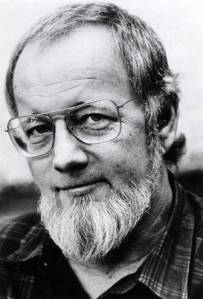
    Donald Barthelme (Source: Wikimedia Commons)

    Episteme and great style

    A word in passing about the stylistic conventions that facilitate this amusing and original literary achievement. Not scrupulously thorough like Beckett, but who needs to be? Barthelme’s The King resembles as much a radio playscript as a novel. The action is given through the dialogue of observers, a convention that Barthelme establishes beautifully on the first page:

    “See there! It’s Launcelot!”
    “Riding, riding —”
    “How swiftly he goes!”
    “As if enchafed by a fiend!”
    “The splendid muscles of his horse move rhythmically under the drenchèd skin of same!”
    “By Jesu, he is in a vast hurry!”
    “But now he pulls up the horse and sits for a moment, lost in thought!”
    “Now he wags his great head in daffish fashion!”
    “He reins the horse about and puts the golden spurs to her!”

    And so on. Riveting from the start, the narrative gallops on to … no where. Basically no plot, nothing happens. Nobody comes, nobody goes … just like total war. Sorry, didn’t really get to that.

    Once upon upon a timely time, such may have vouchsafed criticism. But not since the 50s.

  • Semiotics of Two Honda Motorscooters

    Semiotics of Two Honda Motorscooters

    Here are some more circa 2000 commercial images from Japan. There’s not much difference between Eastern and Western cultures in the way they fabricate mythological/ideological messages via semiotic techniques. But there are cultural idiosyncrasies as well, which feed easily into a global mythological context.

    50 cc “naked” Zoomer

    Let’s kick start this post with the “Zoomer” 50cc “naked” scooter, which Honda released in 2001. I present this design as a kind of “zero degree,” against which to contrast another Honda scooter of quite a different design.

    Honda Zoomer (2001)

    The Zoomer is “naked” in the sense of being stripped down to the bare essentials, with no back cowling. It is Honda’s stated attempt to “appeal to the sensibilities of younger riders favoring a stronger, more distinctive personality and character.”

    Thus the modest financial condition of, for instance, the student, is presented as an aesthetic quality. The design reflects a youthful state of being unencumbered, which translates into velocity and airy transparency — a zen-like quality, one might say.

    The Zoomer actually uses the same frame as the classic CHF50 Crea Scoopy, but takes on a chopped-down look. There is nothing faintly elitist, pretentious nor rebellious about it. But it differentiates itself stylistically as a generation beyond the Scoopy (which it essentially is).

    The rider in this image presents quite a common “attitude” of university-aged Japanese youth. He is flawlessly attired in brand new gear: joggers, below-knee shorts and white t-shirt. An understated sense of style — but a sense nonetheless.

    The “brand” of the individual is aloof and intellectual, in compliance with a quite recognizable and sanctioned group or even class of person. The Zoomer is absolutely in keeping with this branding (or identity), and is presented almost as a type of “wearable transport.” It answers a desire to be insulated from, inured to one’s social as well as environmental surroundings, while being connected to them at the same time.

    I’m tempted to link this aesthetic to the classic nihonjinron, so-called “thesis of Japanese uniqueness,” even though that “thesis” is somewhat discredited in favor of a more recent privileging of perceived Japanese heterogeneity. In other words, the Zoomer aesthetic seems to me a paradoxical mechanism of “groupism,” a membrane through which one passes to and fro between the collective and individualistic.

    600 cc Silver Wing GT

    Now to move on to a commercial image featuring the 600 cc Honda Silver Wing GT Scooter, with double overhead cam. The vehicle is massively over-styled compared to the Zoomer. It is, of course, a far more expensive and higher-end item, and it needs such styling to bring its conception into a semiological frame.

    Honda Silver Wing GT Scooter (2001)
    Honda Silver Wing GT Scooter (2001)

    Note first the overt design signifiers connoting aerodynamics, rockets, luxury. The Silver Wing is designed primarily for a couple to use, evidently more advanced in age and finances than the Zoomer rider. Hence the twin seats, both with backrests; more staid, stable, safety conscious. For “adults,” as the text indicates explicitly.

    Consider the narrative of the image, which is caught at a critical instant. The male has disembarked from the helicopter and makes his way toward the vehicle, awaited by a female, who is linked thematically to the scooter by the helmets she holds. The two will make their greeting, hop on the Silver Wing GT and power off into the city.

    The Japanese text headline is a typical play on words. The set phrase “koi no yokan,” which is close to the English idiom “love at first sight,” becomes “big pleasure no yokan”: the word yokan meaning a kind of premonition of what is to come. This is in keeping with the narrative of the image, of course, which promises pleasure in the experience of the Silver Wing, and in the experience with the female. Not exactly “love” per se, more pleasure.

    The hero of the narrative resembles a cross between James Bond and a successful salaryman. He has alighted from the helo, and is on his way to his next adventure. The woman, however, strikes one not so much as a “Bond girl” as a Japanese tour bus or elevator hostess, welcoming the hero into the empty mid-frame space, atop the Silver Wing. She is passive and ancillary compared to the hero.

    On the one hand, then, the commercial seems to undertake to represent its perceived target consumer: the quite wealthy “adult” business worker who is looking for a romantic escape with his female partner. Yet, one would not think that it was the wife or girlfriend who went to the trouble of getting the scooter all set up like that in advance of the instant and then stood to one side like an elevator attendant, welcoming him in to the focus.

    Therefore, we should assess the possibility that the characters represented are not intended to mirror the ideal viewer of the image, as the text would indicate. Rather, they represent a desired image of the ideal consumer: the desire to be a James Bond. In this respect, the image appeals to a relatively deep adolescent desire — not just a matter of acquiring a Silver Wing GT to complement the helicopter, of course!

    The commercial, therefore, appeals to a lack of social power, mobility and sex. Its implicit promise is to provide these things on consumption of the image, on purchase of the commodity. The myth is fabricated from adolescent desires — on the absence of a ride, the absence of a female. That is the semiotic nature of the riders’ space on this image of the Silver Wing.

    The myth is not going to compete directly with the Harleys of Easy Rider etc. But who knows, there’s a long road ahead, in which the Japanese urban mythology can only gain on that of the American wilderness, of a passé “looking for America.” It will all be the same in the global-urban.


  • Glimpses at Signs

    Glimpses at Signs

    In the era of the Internet and social media, an awareness of semiotics, also known as the “study of signs,” is useful to have. This article considers some elementary but illuminating ideas in the field. What are signs and how do they convey meaning? What is the message and how should we read it? We focus on some images from Japanese magazine advertising.

    Concept of Semiotics

    Semiotics, the study of signs and signification, is a systematic method for interpreting meaning in texts and images. Widely used in analyzing advertisements, the method may be applied to film and literature, fashion and the social world. Semiotics has its origins with linguistic theorists such as Ferdinand de Saussure (1857-1913) and Charles Sanders Peirce (1839-1914).

    The cultural anthropologist Claude Lévi-Strauss (1908-2009) is also of great importance to the field. Lévi-Strauss undertook to explain social systems in terms of the structural relationships between their elements and supra-cultural, or “universal,” patterns of human thought. The fields of semiotics and structuralism are often considered in tandem.

    The late Umberto Eco (1932-2016) is an intellectual who must be mentioned in the development and popularization of semiotics. Originally a prominent semiologist, his later literary writings, in particular his debut novel The Name of the Rose (1980; English translation 1983), instance a genre of “semiotic fiction,” in which the action of tracing the meanings of signs and symbols determines the narrative action.

    Writers such as Calvino, Joyce, and let’s even go back so far as Dante, employ a profound awareness of the action of signs and signification in their texts. The questions themselves hark back to the Middle Ages.

    More recently, Roland Barthes (1915-80) is a great interpreter of the semiotic sport, with his much thumbed work Mythologies (1957; English trans. 1972). In this readable and convincing little tome, Barthes outlines some fundamentals of semiotics, while elaborating brilliantly on cultural and media themes from professional wrestling to margarine.

    Further books like The Semiotic Challenge, The Fashion System, The Pleasure of the Text, and S/Z establish him as a master beyond any doubt. I shouldn’t overlook Daniel Chandler (1952- ), a significant interpreter of these and other giants of semiotics.

    I would like to glance at a couple of essential basics, drawing mostly from the Barthesian view.

    This diagram illustrates the essential structure of the “sign,” and the relationship between language and myth.

    Relations among Signifier, Signified and Sign, at levels of language and myth

    I based this on a figure from Barthes’ book Mythologies, but turned it upside-down, with the idea of emphasizing that “myth” is a “higher order” type of discourse than straight-out language. The diagram illustrates the fundamental nature of a “sign.”

    A sign is an entity that results from the combination of a “signifier” and a “signified.” The signifier is formed from a sensual input: something one senses: sees, touches, tastes, smells or feels, etc. (I don’t want to omit the proprioceptive sense.)

    The signified is a kind of payload, a concept to which the signifier is linked. Notice in the diagram that a signifier and signified are associated at the level of language. The relation is a straightforward denotative sign, such as the word DOG, which links to one’s concept of a dog.

    As the diagram shows, however, the lower level sign in blue font itself becomes a signifier at the level of myth. There is a space of connotation created for a new signified. In the DOG example, the signified might be, for example, the connotation of fidelity — loyalty, faithfulness, truth — for which the dog is renowned. Hence the archetypal dog’s name of Fido, from the Latin fidelitas, fidelity.

    Red Dog Statue, Dampier, WA, by Anthony Loveridge (Red Dog website ) via Wiki Commons

    Woman and Myth

    The interpretive method of semiotics is implicit in this movement from lower to higher levels of signs, and from denotation, through connotation, to mythical (or ideological) phases of signification.

    Here is a memorable example from Susan Hayward’s (1996): Key Concepts in Cinema Studies via Chandler.

    Marilyn Monroe -- Ballerina Series
    Milton H. Greene, The Ballerina Series, 1954

    At the denotative level, we read an iconic signification of the actress Monroe. The iconic classification means that the signifier resembles the signified. The two other general classifications are: indexical, where the signified in one way or another points to the signified (e.g., as smoke may function as a signifier of fire); and symbolic, in which the connection is purely arbitrary (as in the case of the word DOG, whether spoken or written).

    The Monroe image carries connotations of fame, glamour and sexuality. At the mythical level, we detect a certain pathos. Through its set of connotations, the image evokes the Hollywood mythology: the uncaring, capitalistic dream factory that ultimately destroyed Monroe’s happiness and her life. The photographer Milton Greene, a friend of Monroe’s, took this in New York in 1954.

    Since the tutu bodice was too tight for her, she had to hold it on with her hand, a gesture that lends a sense of vulnerability, reinforcing the delicate, rather innocent facial expression.

    Three Women in Japanese Advertising

    Let us apply these basic tools to some subjects that are not so familiar: Japanese advertising images from the early 2000’s. I used these magazine ads in a Japanese university course on semiotics at around the same time. The subject is the representation of woman. First, the Casio woman:

    Casio advertisment
    Japanese magazine add for Casio watches (c. 2001)

    We can jump immediately to the mythological level of representation. The figure of the woman is fragmented in time: past, present, future. She is indeed chained by time; there is no escape. Her collar and chain looks like a fashion accessory. Indeed, the image connotes all the mythology and style of “high fashion.”

    Probably, not many women would want to wear the collar and chain in everyday life, but that is often the case with high fashion, which can appear outlandish in its semiotic register when taken outside its definitive context. However, apart from that consideration, the style of the woman seems quite attractive and desirable. She is an “affirmative woman.” Naturally, a modern woman will want to “consume” this image, take on its style, in order to project these characteristics about herself.

    However, we must note that she is in chains.  As affirmative as she may look, she is captive not only to time, but to the male gaze, which is an essential ideological premise for advertising in the capitalistic world. The image appears to be directed toward women, since it is advertising women’s watches. Cool, modern, affirmative, utilitarian and practical. No sexist bullshit.

    But it is a kind of pretence. we need to differentiate between this “mythological/ideological” message purported by the advertiser, and a critical ideological context. Otherwise, if we simply describe the advertiser’s “mythological” message, we are simply perpetuating it uncritically.

    Second, let’s consider the Lotte woman.

    Japanese magazine ad for Lotte Air-Le chocolate, c. 2001

    That’s not her own rump she is patting, but that of the merry-go-round (carousel) horse on which she is sitting side-saddle. The commodity being sold is a particular type of chocolate, Air-Le, which combines sweet, whipped white chocolate with brown, “bitter” chocolate chip.

    We can see this contrast denoted in her costume: the fluffy mohair jacket versus the brown skirt and boots. The blurred, out of focus background, leads the eye to an identification with the mohair jacket, and the “feminine softness” of the woman herself. One might say she looks “scrumptious,” or seems so at a subliminal level. Mature-ish embodiment of kawaiisa (cuteness).

    Her silken hair, her soft facial expression. Her hand on the horse’s rump is adorned with a ring. But it is a dress ring with a single gem. Not a wedding ring: married Japanese women wear theirs on the left hand.

    Thus she is depicted as “available.” Visually, she is denoted is similar terms as the chocolate. She connotes, is attached to, the sensual qualities of the chocolate itself. Desirable, yes. And one consumes her. She dissolves in the mouth, like chocolate. Of course, boys, we shall purchase for our desired one this luscious treat. Or else, just eat it ourselves.

    You can see more of the Lotte woman’s dynamism in this youtube video: notice the sexual connotations and the voyeuristic male. The boyfriend to whom she makes the heart sign with her fingers?

    Third, the global Chanel woman:

    She is not Japanese. That’s okay, the image depicts a sense of “exoticism” from a Japanese perspective, a traditional hankering after western commodities and styles. Note how the whole image resembles a dollar sign, aiming perhaps for a subliminal effect? The richness of the gold and lucre. At the mythological/level the image of the woman is directed on the one hand towards the female consumer, who wishes to consume/adopt the image of the western woman.

    She is posed in a way that attract connotations of a mermaid. Ostensibly, the ad undertakes to represent visually the concept of “perfume.” Not an easy task, but it does that by mixing the images of gold, money and the perfume itself. The bottle doesn’t drop and crash, but seems to hang suspended in the air, or in liquid. It’s a different, higher universe, a mythical one.