Category: Features

  • Razor Viking: With a Twist

    Razor Viking: With a Twist

    • Tony Reck recalls one of many arduous treks. The Razor-Viking wilderness is an isolated and rugged mountainous region in the Alpine National Park, about 380 kilometres northeast of Melbourne. It lacks vehicle access, signposts, and track markers.

    It was November 2024, the Melbourne Cup weekend, and we had four days to complete the Razor Viking circuit. After spending Friday night at Muttonwood camp, twenty kilometres north of Licola, we drove over Mt Tamboritha, along the Snowy Range, and arrived at Howitt car park.

    Having just met the party of nine, I kept my head down and watched for indications of a group dynamic. Our leader, a tall, bearded man of Dutch descent named Jopie, produced a set of scales from his white Subaru Forester, and each member of the group rushed to obtain an accurate reading of the weight of their packs.

    Jopie’s pack weighed 16 kg, John’s 15.5 kg, while Rod’s four-day masterpiece barely recorded a reading at 11 kg.

    There was much conviviality among those with light packs as they struck out at speed through the snowgums on Clover Plain toward Macalister Springs. While the unenlightened, myself included, brought up the rear under a humid sky and wondered what secrets in weight strategy had been denied us during our formative bushwalking years.
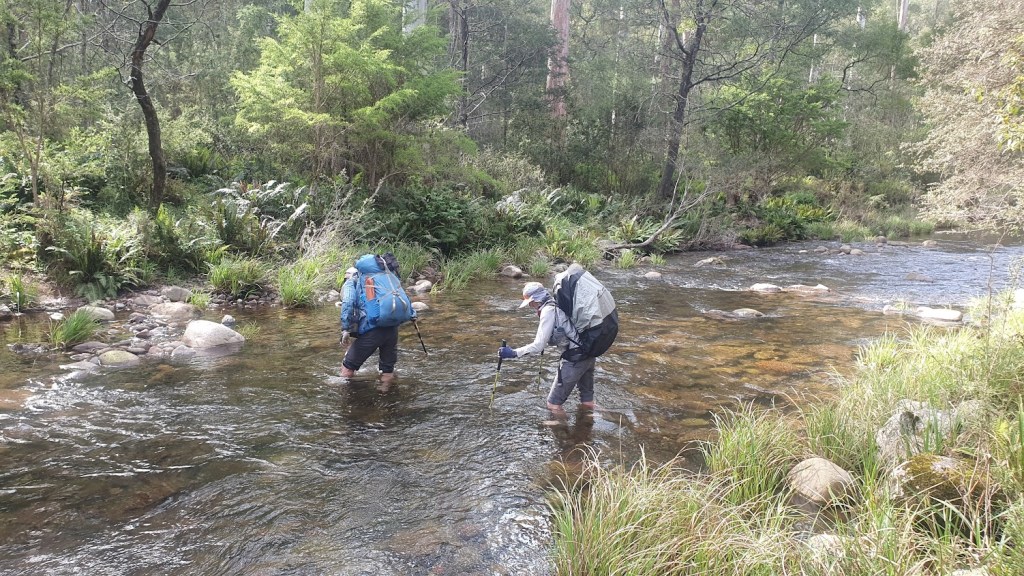
    Two trekkers cross a stream

    Lance, a nuggetty man with a wild afterburn of grey hair, had decided not to chance his hand on the Razor Viking circuit. Instead, he would spend the following four days exploring the Howitt Plains area. We said goodbye at the top of Devil’s Staircase and Lance hot-tailed it along a well-defined track toward a comfortable night in a hut situated at Macalister Springs. For the rest of us the opposite was true. There would be no well-defined track and no hut to retreat to if the weather soured during the following days.

    From the top of Devil’s Staircase, an untracked spur led north-east, then east, during a one thousand metre descent into the valley of the infant Wonnangatta River and our first campsite. We would then cross the river, climb steeply out of the valley, circumnavigate an unnamed 900-metre hill, descend once again, and cross a tributary of the river; then locate a narrow ridge running north-north-east, ending at a 1,300-metre-high point, south-west of the South Viking.

    But first, we had to do battle with three hundred metres of skin-scratching scrub and a stubborn two-metre tiger snake.

    It was past midday, and a significant change in the weather was apparent. Rain was forecast: developing that afternoon, persisting the next day, then clearing the day after. As we scratched our way through corrosive scrub, the cool alpine breeze that had been present above fifteen hundred metres was replaced by a greasy humidity. The scintillating morning sunshine was consumed by a diffuse curtain of grey cloud. Perhaps the sun’s disappearance was a reason why the two-metre tiger snake refused to move. Rod, the man with the unbelievably light 11-kg pack, warned me of the snake’s presence as I stumbled through the scrub.

    A tiger snake disappears into scrubby grass

    “That’s alright,” I said. “It’s probably more frightened of me than I am of it.”

    Rod was not convinced.

    “That might be so, but the snake isn’t moving. So tiptoe around it.”

    And there it was, splayed across a rock, as thick as a sapling. Calm, but possibly dangerous.

    A big snake moves quickly, and I was not about to be bitten. I took Rod’s advice and tiptoed from stone to stone, giving the snake much space. If a wall had been present I would have had my back against it. But the big tiger seemed unconcerned, confirming the maxim that left alone, most snakes are harmless. It was the most impressive tiger snake I had seen in quite a few years.

    That night, camped in light forest with the southern bank of the Wonnangatta River close by, I recorded the day’s events in a notebook. The walk across Clover Plain had been a pleasant jaunt and our thousand-metre descent had come off as planned. We were camped in an isolated spot, and the next morning, we would embark upon an 800-metre ascent that would take us into the heart of a spectacular mountain wilderness. Yet already, something seemed to be missing from this trip. What it was I could not say: the wilderness without is often as intangible as the wilderness within. I was in little doubt that this absence would be filled over the next three days. Not, as often appears to be the case, by a single event. More likely, by an accumulation of experience, one in which the entire trip would coalesce. That moment when the old path on which a walker treads ends, and a new path unfolds.

    It rained all night, and when I woke the next morning it was still coming down. Reluctantly, I emerged from my sleeping bag and pushed my head beyond the vestibule of my tent. A grey sky with an ominous green hue and not a single break between the clouds. It now looked like this rain would continue throughout the day.

    Then the rain stopped. Tents began to quiver and the sound of several pressure stoves blossomed in the gloom. Hans emerged: a Swiss carpenter, his handlebar moustache and superhero emblazoned cap indicated he was ready for action, and it wasn’t long before the group gathered at a site one hundred metres upstream, where we intended to cross the rising Wonnangatta River.

    There Jopie outlined the day’s route. We were aiming for a campsite at Viking Saddle, a small clearing situated between The Viking and The Razor. The distance wasn’t great: approximately seven kilometres. However, it would take a full day to arrive as we climbed eight hundred metres and attained two distinctive summits, before negotiating The Viking’s north-western cliff and descending two hundred metres through uprooted mountain ash in an area decimated by a recent winter storm.

    There are various methods for crossing a fast-flowing, swollen river. Hans, that Man of Action, and being a carpenter, could not contain a biblical impulse. Fully clothed, he entered the river on the south bank and exited via the north like Moses parting the Red Sea.
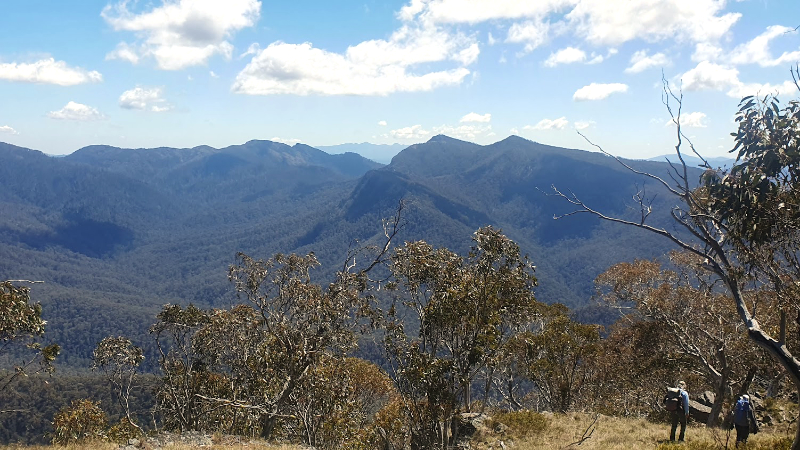
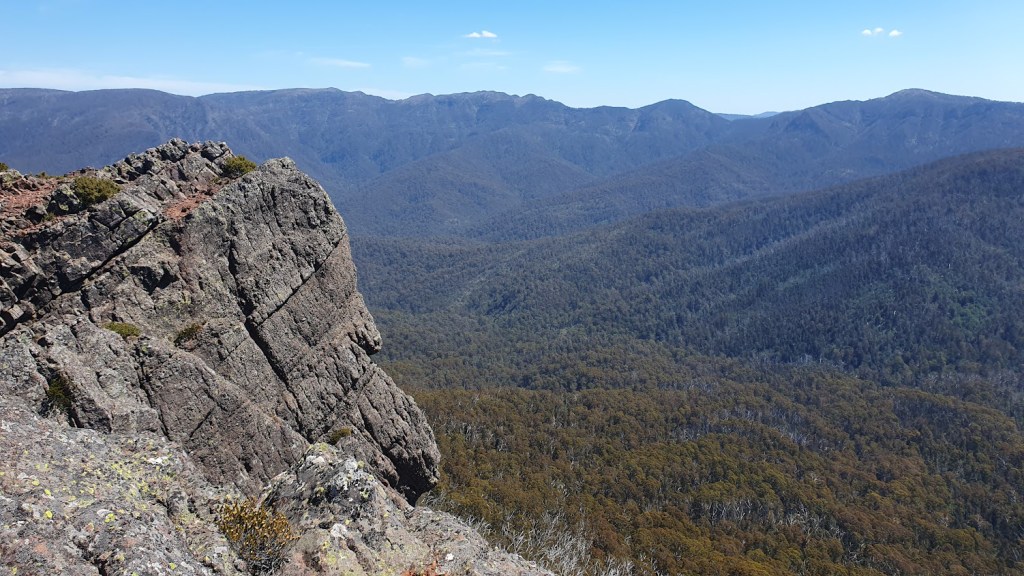
    Majestic scenery of the Australian Alps, with two trekkers showing tiny in the foreground

    Soon, we had all managed to successfully cross the river and regrouped on the north bank, while considering the next — and perhaps most difficult — obstacle of the entire walk: a ‘1 in 2’ climb (one metre ascent for every two metres walked), out of the river valley to a small ridge running east to west and separating the Wonnangatta from one of its myriad tributaries. Steep, but short — yet combined with a 22-kg pack and overbearing humidity… well, I need not say any more.

    Once the tributary was crossed we fought our way through a patch of dense, wet fern and other harsh vegetation, before emerging on a pleasant slope — the beginning of the climb to our first 1,300-metre highpoint, south-west of the South Viking.

    As we followed the spur upward there occurred several changes in the landscape. The spur narrowed and turned to rock. Sub-alpine grasses and mountain ash were replaced by tufts of spinifex and the ubiquitous snowgum. The thick humidity present at seven hundred metres was swept away by the snap of an alpine wind. Cloud coagulated around us, the mist rolled in, and one of our party, Michael, a visitor like myself, disappeared from view.

    The ‘1 in 2′ climb straight after breakfast had curbed the group’s enthusiasm but Michael appeared to have suffered a little more than the rest of us. Having some inclination toward the mysteries of first aid and that almost transparent 11-kg pack, Rod left the leader’s group and joined him at the rear.

    Nobody in the party had traversed, or knew of anyone who had traversed, this route to the South Viking. (I had dropped off the summit once before, opting for the relatively gentle descent of a broad spur further east.) We did not know what to expect as we approached the South Viking in heavy mist until the sight of a perpendicular bluff made its presence felt, appearing to block any further ascent. Momentarily, it looked as if we would be forced to spend excruciating hours battling scrub in hostile country by pushing horizontally east — until Jopie’s navigational skill eased into gear.

    Viewed from a great height, we must have resembled a procession of colourful ants teeming over stonework as we negotiated an interconnected system of channels in the escarpment, soon reaching the summit of the South Viking. The difficult aspect of the ascent was over. The South Viking and The Viking were connected by three low-lying saddles. We hurried through each one and arrived at the summit of The Viking. There we hauled packs through a rock chimney, picked up the track to Viking Saddle, and descended through an apocalypse of trees ripped from the ground by a mini-tornado.
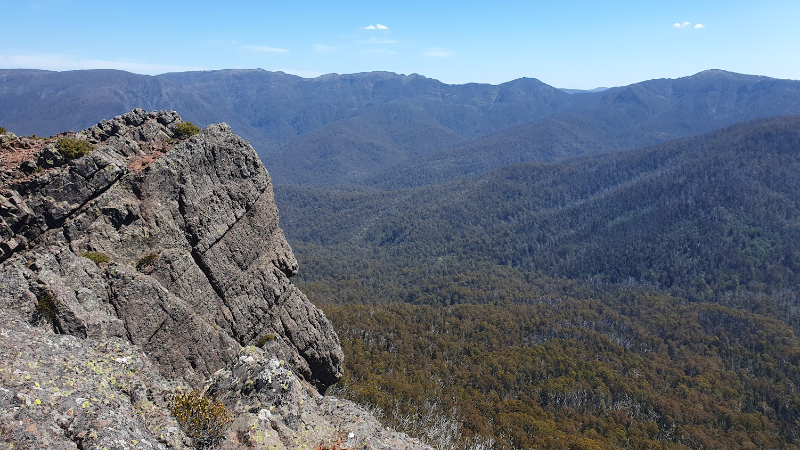
    Rock outcrop in foreground of panoramic view of Australian Alps

    I was thankful not to have been camped in the saddle on the night that monster tore through the bush. Hearing a fully grown tree hit the ground is unnerving enough. To have fifty or so crashing around a tent at night would have been a bushwalker’s nightmare.

    A large group had already arrived at the saddle. With the inclusion of our eight tents, a small colony appeared. The sky cracked open once again — and this time the rain was permanent. Confined to our tents, we were wet, hungry and tired. But we were well and truly alive. Not that there was any question about the safety of the party. It’s just that city life dulls the senses and a sophisticated urbanite soon forgets his primal origins.

    After an hour of heavy rain, the weather shifted. A noticeable breeze blew into the saddle via the headwater of the West Buffalo River. At dusk, a break appeared in the eastern sky. Someone from the other group had persisted in the rain and lit a campfire. A strange shamanic conduit, it drew others to its primal dance. Shadows flickered across faces alive in the darkness, smoke rose into the night air, and I fell asleep and dreamed of prehistoric times.

    As predicted, the rain cleared overnight. We were off early, picking our way through fallen timber as we climbed toward The Razor. To my surprise, there was such a thing as a promising grey sky. But an hour later, as we emerged from the forest and scrambled up the conglomerate slabs of The Razor, low cloud still enveloped the northern face of The Viking.

    Even so, it was the first unrestricted view we’d had of the surrounding area for two days.

    Standing on the crest of one of many conglomerate slabs, we could see the many sloping spurs and interconnecting ridges descending north toward the remote Catherine River. To the west, the Australian Alps Walking Track fractured as it struggled along intractable rock towards Mt Despair. This was to be our intended route for the day, the objective being Mt Speculation. Jopie had other ideas.

    Having walked the circuit several times, I had never reached the summit of The Razor. Once on the summit, after a slow kilometre of rock hopping through trackless terrain, the side-trip proved eminently worthwhile.

    An increase in temperature flushed low-lying cloud from The Viking’s north-eastern flank. The cliffs marking the Australian Alps Walking Track’s easterly descent to Barry Saddle appeared. Vertical, and like the weather-beaten brow of a forlorn, lost explorer, the mid-mountain cloud closed in once again and The Viking disappeared.

    An hour later, after reclaiming our packs, we were back on the walking track leading west toward Mt Despair. Despite slow going along the southern crest of The Razor, the mood of the group had lightened. The most difficult aspect of the walk was behind us. Hans was telling tall stories once again. We would soon be setting the pace along an obstacle-free track over Despair and down to Catherine Saddle, a headwater of the Wonnangatta River. As a gash in the cloud widened and blue sky appeared for the first time in two days, we discovered there was no irony intended in the name ‘Mt Despair’.

    It was a relief to finally see the sun. But why had it chosen to appear, and why had the temperature increased just as the ascent of Mt Despair had begun?
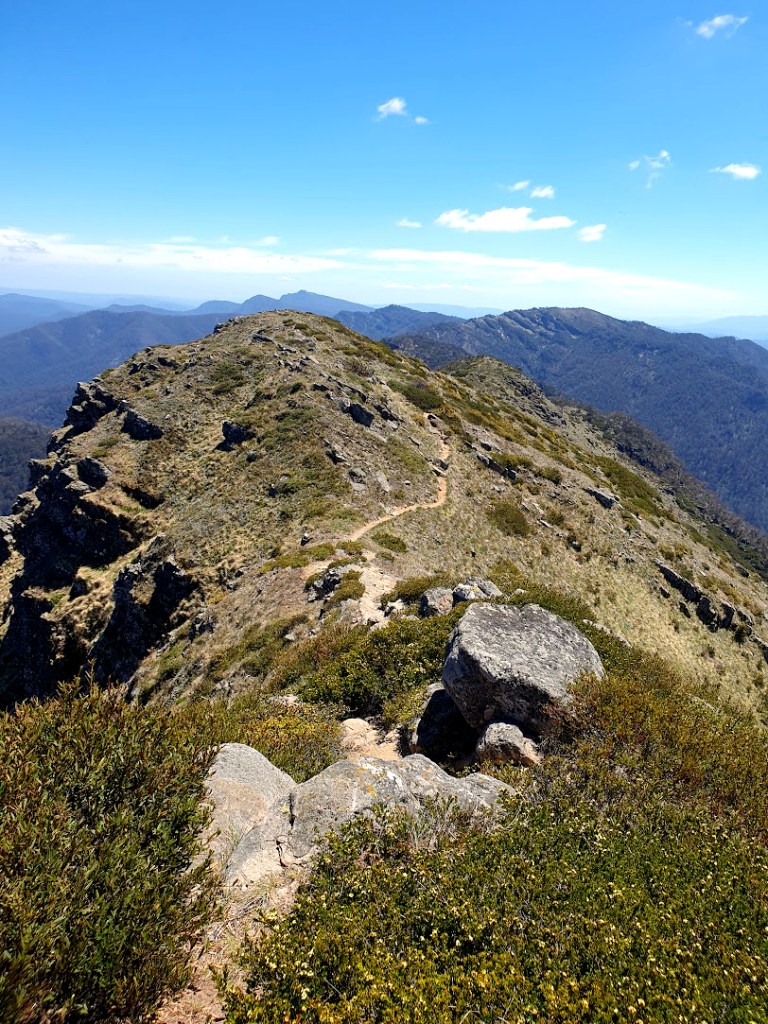
    Rugged rocky ridge with Australian Alps blue in the background

    In the past, a solid rest after considerable physical exertion had always left me ready and willing. However, the cumulative stress produced by carrying a heavy pack through rough country for three days was beginning to tell. And we still had the severe climb from Catherine Saddle to Camp Creek prior to the summit of Mt Speculation to complete.

    It was well past 5.00 pm as we descended the grassy, sun drenched western slope of Mt Despair. After a hard day, this was not a great time for preparing to climb one of the higher mountains (1,630 metres) of the Wonnangatta Moroka sector of The Alpine National Park.

    At Catherine Saddle, two routes presented themselves.

    A foot track headed straight up the northeastern flank of the mountain while the old Wonnangatta Track (ambitiously referred to as Speculation Road) followed the twelve-hundred-metre contour around the same flank, then ascended Camp Creek via a shallow valley.

    Bob and Michael chose to follow the contour. I was tempted, but on a blind impulse followed Jopie, Rod, Tim and Hans over an embankment and up the hill.

    Halfway up, I wished I’d chosen the contour. Without exaggeration, I thought my lungs would pop. But after twenty years of bushwalking, during which I had walked the entire Australian Alps Walking Track and been whacked by second-stage hypothermia on Mt Anne in South West Tasmania, I had integrated into my bushwalking a highly sophisticated technique for dealing with mind-altering pack-carries up the steep flanks of mountains.

    Growling.

    Believe me, growling will get a beaten walker to any summit, any time — although the worried look I received from Hans suggested I had completely lost my marbles. But growl I did, and once again it got me up the mountain. Yet I was grateful that Tim, a trainee nurse, was also present in case my growl became a heart murmur and I collapsed in cardiac arrest.

    Finally, we reached Camp Creek. After some slow tent-erecting, during which I found it difficult to recognise the front end of the tent from its rear, water was obtained from Camp Creek.
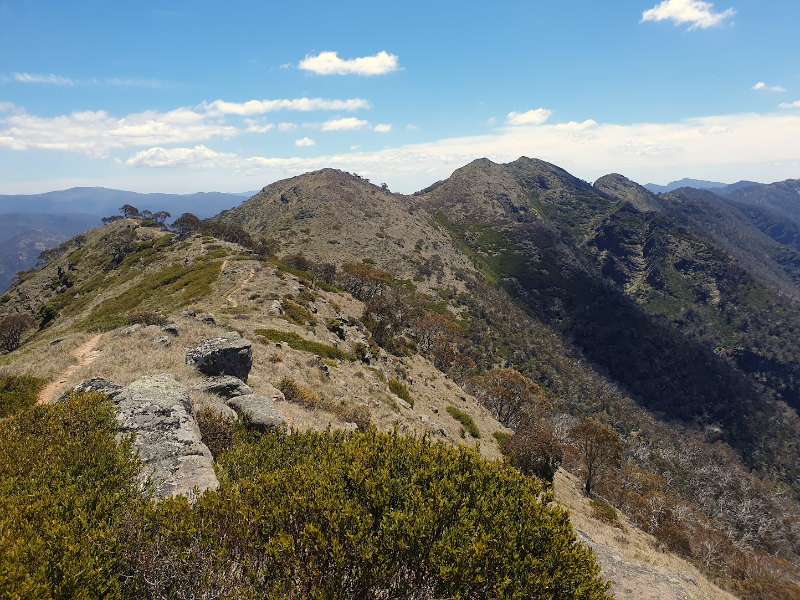
    Rugged ridge showing trekking route in the Razor-VIking circuit

    Bob and Michael arrived, a small fire was lit, and once again, cloud descended upon us, dampening everything except our spirits. We settled in for a restful night as the temperature hovered at five degrees.

    We were high in alpine country, directly beneath the summit of a 1,600-metre mountain. We may not have been able to see past our noses, but our bellies were soon full. For the first time during the entire trip, the opportunity presented itself to sit around the fire and share what was already a memorable experience. From intimations of shamanic ritual and prehistoric dreams, to a bushwalker who chose to growl, instead of howl, when confronted by cardiac arrest. But soon, we were all so tired, each one of us silently slipped away, disappeared within a lick of mist, and quietly went to sleep.

    Birdsong broke the silence; what species of bird it might have been, I had no idea. Instead of going back to sleep, I lay on my back in the dark as the bird’s repeated rhythms crystallised thoughts in my sleepy brain. Somewhere in the valley below, a second bird of the same species responded to the first bird’s solo. A fugue ensued; something was afoot in the natural world. I could feel its aura surrounding my tent.

    A high mountain sunrise was one thing, but this show was otherworldly. Tim and I were up and out of our tents, captivated by a violet streak illuminating the tip of a distant mountain. No one else was awake. We were two children watching the birth of a new world. I had seen many a sunrise during my forty years in the mountains, but this was THE sunrise.

    After an hour frolicking in the mellow light of a glorious mountain morning, it was time to get serious. Before us lay the Crosscut Saw: a ten-kilometre rocky spine separating the Wonnangatta and Howqua rivers, leading back to Macalister Springs. Our trip along the Razor Viking circuit was concluding.

    From the summit of Mt Speculation there would be that descent through the bluff at Horrible Gap during which Bob would lose his footing and hang suspended in mid-air from a rickety tree branch. There would also be that climb to Mt Buggery, the name of which would elicit a grim laugh from Tim as he encountered its sharpness. Without doubt, there would be the pain derived from four days of stress upon a body that failed to recover after the climb to Buggery’s summit. Every step, every adjustment of the load upon my back, every swivel of the hips and resulting unobstructed view into valleys east and west would evoke within me an ecstatic sense of the Victorian Alps — their inspiration, my infatuation, and the wonder that makes bushwalking in those alps an exhilarating experience. There would be all this and more as we cracked jokes after meeting up with Lance on the heath at Macalister Springs, before arriving to fresh fruit at Howitt car park.

    But that moment of truth all bushwalkers strive for had passed.

    As we left Camp Creek and climbed toward the summit of Mt Speculation, the old path had ended and a new trip had begun.


    RAZOR VIKING: WITH A TWIST by Tony Reck © 2025
    Photos: John Terrell © 2025

  • Nightshift

    Nightshift

    Driving through the streets of Fitzroy at night you become obsessed with streetlight and the sound of an imagined disturbance occurring in flat thirteen on the twenty-fifth floor of the Brunswick St. commission flats. In daylight, there is little to see but a urine stain on a tram shelter seat. An old stiff with a grey beard named Jimmy calls to you unintelligibly from the other side of the street. You wish you were somewhere else; perhaps wandering along a path beneath a mountain in the bush…

    But no.


    You are up against a brick wall. Forever waiting to be released from the pain that is synonymous with the stiff named Jimmy who sits the day out on Death Row while trams travel along gentrified Gertrude St.

    Jimmy isn’t a bad man, but he’d snip you for twenty dollars if he could. He sits in his tram shelter, one foot across a thigh, digging splinters of glass out of the soles of his bare feet. The memories emanating from the grey hair covering his scalp are all he has for company. Nobody bothers about old Jimmy, so he creates imaginary friends in order to deflect the pain circulating in his head.

    Jimmy once drove a cab at night. One morning, when the encroaching daylight had washed another junkie’s brains into the gutter, he drove home and had breakfast. While sitting at the kitchen table he saw what he believed was a worm wriggling in his buttered toast. He placed a finger in the marmalade jar and dabbed a touch of ginger in the direction of the worm’s mouth. It promptly slurped the marmalade off his finger, smiled, and in Jimmy’s mind, thanked him for the secretion. The worm then crawled beneath his fingernail and entered his bloodstream through a crack in his skin. Jimmy quietly explained this to his mother; she blessed herself, kissed her son between the eyes, then made him a dish of pear and pineapple pieces hoping that something fruity would prepare her son for the nightshift.

    After breakfast Jimmy read the Neos Kosmos. As the heat of the afternoon drew near he retired to his bedroom and studied an old high school history report. He dropped off to sleep riding the gratification obtained from reading a comment his teacher had made:

    ‘Jimmy is a very bright boy who does no work.’

    As he dozed the worm that he believed had earlier entered his bloodstream fused with the memory of Mrs. Logan’s words until a further sentence was tacked onto the end of the history report:

    ‘Jimmy is a very bright boy who does no work. For punishment, he must clean up the streets.’

    His mother woke him at 4.00 pm. She knocked on his bedroom door then marched into his room and checked him for dysentery. (Her husband had been killed fighting the fascists in the mountains of Northern Greece. He had been a Greek resistance fighter, who, when captured by the Italians, had been forced to sit unchecked in a cell for nine months until an Italian soldier had walked in one morning unannounced and asphyxiated the prisoner using Jimmy’s father’s own excrement. Since the knowledge of that foul act had reached Jimmy’s mother she had remained petrified by the presence of faecal matter. She sensed it everywhere: under the stairs, in the refrigerator, hiding out surreptitiously under the model bridge Jimmy had constructed in the backyard of their home and which acted as a monument over the fish pond he had built in memory of his dead father). Jimmy was free of dysentery, but the worm that he believed had burrowed beneath his fingernail earlier that day had increased in size during the five hours he had been asleep. He now heard and felt Mrs Logan’s command circulating in his arteries and forcing its message through veins, onto blood vessels; which then pumped her command into each muscle of Jimmy’s body until his arms, legs, head, toes and feet were ready to put this command to work and quote:

    ‘…clean up the streets.’ Unquote.

    Later, Jimmy sat at the kitchen table, breadcrumbs clinging to the sleeve of his shirt, gazing at his features in a handheld mirror his menopausal mother had once used when plucking her eyebrows and waxing her bikini line.

    His mother entered the kitchen through a rear door with orange worry beads clasped in her left hand and muttering ‘Hail Mary’ in unorthodox Greek; this was Jimmy’s cue to hit the street. He placed the mirror on the kitchen table and dismissed the furrowed brow that now followed him through the flywire door — Jimmy unaware of its presence between his black Kalamata eyes — and into Vere St.

    Outside, a local street urchin dangled the entrails of a ginger tom cat on a bamboo stick, saw Jimmy, twirled the mess several times, and released it. The entrails slapped on the driver’s side windscreen of Jimmy’s Silver Top Holden Kingswood.

    Jimmy could have murdered the child; indeed, should have murdered the child. This kid, along with all the other kids that played in Jimmy’s region, who refused to play anywhere else, was a constant reminder of his semiconscious desire to kill off ‘The Child’. If Jimmy wanted to achieve this ambition he would have to transcend himself and become a red-eyed battalion of tungsten, human protein, and simple stainless steel, put together and integrated with various weaponry, some obvious, some not so, into a two tone, white hot, come as you are to the party killing machine.

    The sun slithered across the roofs of houses and all its grace and splendour was lost in sawtooth alcoves and sheets of rusty corrugated iron. Jimmy held the ginger tom’s entrails in one hand while its pancreas remained lodged between the taxi’s wiper blade and windscreen. He hurled the entrails after the retreating child then lunged for the pancreas with the intention of removing it. Unluckily for Jim his intellectual faculty kicked in and he was quietly impressed by the proud pancreas’ emanating theoretical value. As the saying goes, and this is not one I would use in any other context I assure you, Jimmy was about to ‘Bust his Pooper’.

    The worm, which that morning had slipped beneath Jimmy’s chipped fingernail and manoeuvred its way into his bloodstream, penetrated his mind. He now believed it had receded, recidivist worm that it was, into the compartment in his brain that contained traces of zinc, iron oxide, lead, sulphur and bauxite, and which had been secreted there by the monumental amount of illicitly made amphetamine Jimmy had injected in a previous attempt at killing off ‘The Child’. With worm and heavy metals in tow — and an undissolved preservative attached to a jelly crystal he had eaten as a child — Jimmy was ready to inflict harm upon the nearest pederast he could find.

    The sun was completely hidden in alcoves and side streets as the nightshift began with ginger tom’s pancreas flapping insistently on the windscreen; a constant reminder to Jimmy of the fun filled days he had been forced to spend with his mother. All of which culminated in a desire to whip the blade of his paint scraper across the carotid artery of ‘The Child’.

    A voice cackled into life on the two-way radio. It was Mary Kyrikilli, the depot manager’s wife. The job involved picking up an elderly couple in Surrey Hills wanting a lift to the over seventy five’s dance in Canterbury. What Jimmy heard was this:

    ‘You have a function to fulfil at 666 Fitzroy St. St. Kilda. Be quick, for the scum is sliding off the street and receding into drains then catching the first train to outer Elsternwick. We applaud your meticulous preparations for performing the task of killing ‘The Child’. We respect your commitment to cleaning up the streets and replacing unredeemed low life with flesh powered by pink spark plugs. We recognise your brain’s ability to assimilate organic material, heavy metal, and static electricity. We admire the organism you have become Jimmy: your quilled fingers, tungsten breastplate, metal teeth, and plumber’s worm for a tongue. We implore you to unleash this flexible spike from your mouth and reach into the decadent minds of the scum who surf Fitzroy St. You are the future Jimmy… Do you read me?’

    Mary’s voice fractured into an orangutan’s outraged scream that pierced Jimmy’s skull, ramming the shears into the soft skin beside his forehead. His eyes crackled with green intensity. He pressed the cab’s accelerator to the floor, picked up the receiver, and responded to Mary’s call:

    ‘Clear as the night sky seen from the planet Venus.’

    
His cab rocketed past a sex shop in Smith St. just as its pot-bellied, red moustached proprietor stepped out for a breather.

    ‘That’s odd.’ The proprietor lit a cigarette and inhaled deeply. ‘There’s a cab without its lights on.’


    Excessive exposure to the Kama Sutra, jet-propelled semen, and pink pelvic interiors pierced by nuts and bolts, wooden pegs, and surgical steel curtain rings eventually overwhelm the most sophisticated thinkers. The proprietor stepped back inside, but not before carelessly flicking his half-finished cigarette into the sky — and there it remained, frozen. The city skyline wheezed while in St. Kilda, Fitzroy St. seethed with discontinuity and shallow breathing as Jimmy’s murderous thoughts sharpened the shears.

    Number six hundred and sixty-six Fitzroy St. was a Malaysian Hawker’s joint. The restaurateur and a Labrador-Deerhound cross he kept in a kennel in the kitchen studied Jimmy with similar expressions when he walked into the restaurant and proclaimed he was on a mission from Mary. The restaurateur shrugged:

    ‘Sorry. Not on the menu here.’

    Then resumed tossing squealing noodles, broccoli, and tofu in a wok. In his left ear Jimmy heard the depot manager’s wife and temporary radio operator Mary Kyrikilli. She sang a song he remembered singing in primary school. The words were unfamiliar: a jumble of disconnected nouns, verbs and present tenses, but Jimmy recognised the tune. His mother had hummed the same tune while sitting in a chair as she tried to conceal from her infant son the homesickness and accompanying despair she felt for the mountains of Northern Greece.

    Jimmy’s vision of the Labrador-Deerhound’s curling upper lip, revealing pink gristle and canines capable of inflicting a serious incision, was blurred by melancholic feelings rising through his gullet and intersecting with Mary Kyrikilli’s pursed lips whispering in his ear. The restauranteur slipped his hand beneath the dog’s frothing muzzle, grabbed its leather collar, and demanded Jimmy exit the premises post haste. Instead of ramming the shears as he had planned, Jimmy turned and stepped onto Fitzroy St.

    Next door, a fight erupted in the bar of the Prince of Wales Hotel, and spilled out over cascading chairs and tables onto the footpath.

    Jimmy became involved in the fracas.

    The bouncer, a bald-headed gorilla, stomped up and down on Jimmy’s head until a member of the Scottish clan celebrating St. Andrew’s Day in the bar intervened, and hit the bouncer with a Bolo combination that cracked the bouncer’s rib and broke his nose.

    The other Jocks drinking portergaffs at the bar broke into a chant for Glasgow singing:

    ‘Here we go… Here we go… Here we go…’

    But their striker’s score on the bouncer was soon equalised by a door bitch well versed in Zen Do Kai, sadism, and the cultivation of azaleas.

    In retaliation, she KO’d Jimmy with a Liverpool Kiss.

    Jimmy sat cross-legged amid the chaos, losing blood from his right ear, and pleading for help to find his glasses. He was unable to do so, and feeling rather discontent, until one of the Scottish revellers finally bought him a beer.

    ‘There you are my good man…’, said Jock to the unremitting Jimmy. ‘Drink up, for you are about to meet your maker.’

    He walked down Fitzroy St. dressed in his stove pipe suit. When he reached The Esplanade the sound of waves breaking on St. Kilda beach accumulated in his mind. He sat down on the dirty sand, stared across Port Phillip Bay, and saw a silhouette of the You Yang Range in the night sky. He pulled his beanie over his eyes and saw an image in his mind of a man not unlike himself. That man wore a tungsten breastplate emblazoned with a moving image of the Serengeti Plain. Jimmy now believed that he was wearing a tungsten breastplate that contained a moving image of the Serengeti Plain. Then, in spite of the worm beneath his fingernail, and the cat entrails on the windscreen, Jimmy murdered ‘The Child’.

    He had wanted to go to the milk bar and buy another ice cream, but his mother had disallowed it, so he had placed a chair beside the window in his bedroom, stood on the chair, and beat his little fists upon the pane of glass until it smashed. He had seen the ice cream stick in his mind, sailing through the sewer beneath the suburb he had grown up in, while hiding under the bed and staring at his mother’s bare legs as she tried to coax him into the open. But Jimmy had refused to come out from under the bed under any circumstance for he knew this meant a beating, so his mother had sent the straw broom under the bed in an attempt to dislodge him. He felt the scratch and tickle, the rip and sickle like feature of sharp straw upon his bare thigh. He squeezed further into a hole between the bed and the wall and slashed his elbow open on a protruding bed spring. He cried and his mother screamed, while the real culprit leant against the wall. The straw broom, diffident, composed, quietly calculating the amount of blood the boy’s wound had sprayed upon its handle.

    On the night of his breakdown, Jimmy struck fourteen people on the head with an engineer’s hammer. When his cab sideswiped a telephone pole in Richmond he ripped a piece of metal from the cab’s rear door and tried to dig that worm out of his ear. A gardener found him in the Botanic Gardens at 8.30 am with the metal shard protruding from the wound in his head. The worm was nowhere to be seen, but Jimmy had mumbled something about a bloated maggot wriggling down Batman Ave. toward Flinders St. According to Jimmy, his extraterrestrial partner had boarded a train, gained six kilograms on the trip by eating leftover packets of potato chips, then got out in Ringwood.

    Jimmy was sentenced to three and a half years in jail, during which he was raped by one inmate, beaten by two, and poleaxed by a screw. Upon his release into the community he lived with a fervour only countered by the ecstasy derived from watching an Old English Sheepdog urinate against a pole. Yet Jimmy did not complain, or if he did, then it was a complaint directed inward — to that black hole he has remained in for the past twenty years.

    Jimmy sucks hard on a cigarette butt. A tram stops alongside his shelter in Gertrude St. He is preoccupied with swatting flies in and around his beard, but the combined stare of the tram cuts him to the quick and he is invigorated.

    ‘Come ’ere…’, Jimmy says.

    He waves an alighting passenger in his direction, hoping to score a fag or some coins for a bottle of turps, but the elderly woman blows disgust at him then disappears into a Voluntary Helpers shop to do her bit for charity. Jimmy’s moment of clarity dissipates in his air of lost connections.

    I watch Jimmy from across the street, sitting in his tram shelter, one foot across a thigh. I am aware of a certain similarity that exists between us.

    Turpentine is not my poison, but living is.

    His mother is asleep in the bedroom of her commission flat. She dreams of water sliding over rocks that cascades into a silent pool. Alongside one another Jimmy and his mother sit waiting for the Achilles Laura to sail back home to Greece. Outside, she can hear Jimmy’s voice, or another voice belonging to one of the hundreds of stiffs on Death Row, sitting in tram shelters on cold nights, sleeping beneath the All Ordinaries Index printed on daily newspapers, or simply fighting off the demon that is Mary Kyrikilli emanating from a microchip Jimmy believes has been implanted in his cerebellum.

    From the twenty-fifth floor of the Brunswick St. commission flats there is only the night sky. The stars try to force the clouds apart, but it is the clouds that contain the pain scintillating in Jimmy’s mother’s mind. She lies on her back in the dark, listening to the tick of an alarm clock, along with her son, sitting in a tram shelter in Gertrude St. He shouts obscenities directed at nobody in particular, yet which she feels are reserved for her. She cannot go out and embrace him or bring him in for moussaka; he is lost to her. He screams:

    ‘Come ’ere gamisou…. La, la, la…’

    His mother takes earplugs from the drawer beside her bed and inserts these into her ears to deaden the obscenities.

    All is quiet at 3.53 am.

    This is the son she was unable to love who has returned to torment her.

    When the early birds rise the squeak they make is an expression of ornithological glee at the penetration of a starling’s beak into the green heart of a cicada. Jimmy’s mother wakes, hurries to the kitchen, and prepares a Turkish coffee.


    NIGHTSHIFT by Tony Reck © 2025

    Selected photographic art is by Jr Korpa, a prominent photographer based in Spain, at Unsplash | @jrkorpa. His surrealistic vision echoes the fractured streets and restless minds within Tony Reck’s narrative. See more of Jr Korpa’s work at jrkorpa.com

  • Cyberspace: Virtual Life in the 90’s

    Cyberspace: Virtual Life in the 90’s

    Reflecting on a post-Tipp-Ex era I ponder questions surrounding the concept of Cyberspace.

    Remembrance of Tipp-Ex past

    Be it fortunate or unfortunate, the years locate me at a pivotal time in the evolution of cyberspace. I don’t claim to be among its first denizens. Arpanet, the forerunner of the Internet was “operational” in the United States from 1975 (with a connection to Norway), and went international in 1983, soon becoming known as “the Internet” (aka “information superhighway). However, among those presently alive on this planet, I consider myself to have been a relatively early user.

    In 1985 or so I’d commenced my doctoral research on James Joyce’s Finnegans Wake at the University of Sydney, on an Australian Postgraduate Research Award, which is a kind of national prize for undergraduate achievement.

    I saved my meagre resources to purchase an electronic Brother golf-ball typewriter, if you can conceptualize what that may have been, but despite the copious application of Tipp-Ex correction fluid, for months I couldn’t get past a few printed pages. Joyce was partly to blame, partly my limited intellect and inclination for good times and tequila. But it became clear to me I was never going to be able to produce a PhD dissertation on Joyce’s work or anything else by this method (but particularly not on the Wake).

    How longingly I leafed through the computer magazines displayed at the local newsagency in those days, realizing that this computer-thingy was capable of saving all those wasted trees and enabling me to progress into chapters and, possibly, an entire thesis. No, never, surely not likely.

    I bought a modest computer, a British manufactured Amstrad PCW8256 beast, basically a hard-wired word processor known affectionately, coincidentally, as “Joyce” to its fans, with whom I identified enthusiastically. I imagine the inexpensive machine salvaged many a poor, lost, wannabe scholar like myself, perhaps their faithful hound lying asleep under the desk like my briard, Pepe.

    I decamped from the  “Joyce Industry” to the nearby “Beckett Industry,” in which I felt more at home  and in whose work for theatre I had some background, and with the help of my Amstrad “Joyce,” finished my thesis in time. Leading international Beckett scholars examined my dissertation, and I was granted my doctorate but found I couldn’t seem to get a job apart from writing arts features and reviews and lecturing as a casual at various universities, which was enjoyable for a year or two, but uninspiring if that was all the future had to offer. So I left Australia for Japan, to have a shot at full-time tertiary teaching, first at business college, then university.

    Internet advent

    Towards the mid-nineties, I’m feeling somewhat isolated from Western academia, rummaging in Japanese university library stacks, a subterranean salmagundi of intellectual distraction.

    I started to hear dribs and drabs about that amazing technical entity called the Internet, a kind of computer network that operated via international telephone lines. It was basically unvisualizable to anyone who hadn’t experienced it; but from what I’d heard, I thought there was a chance it might help me get in touch with libraries and researchers located in other countries.

    In 1995, the Internet could boast 16 million users, or 0.4% of the world’s population, as opposed to 4,208 million, or 55.1% today (Internet World Stats: Usage and Population Statistics).  It was like magic when my computer was hooked up, the first one in my faculty. I won’t forget my initial sight of the mysterious gray “web page” — a particular striking steel-gray I’d never before known — with its black text and blue “hyperlinks.” Wow … hyperlinks. Thank you, Tim Berners-Lee, who invented the World Wide Web and gave it to the world for free (See Katrina Brooker, “The Man who Created the World Wide Web Has Some Regrets,” Vanity Fair, Jul. 2018). A few years later, I’m working in a faculty of informatics — the first in a national Japanese university, where I set up a course in media semiotics.

    As a nineties newbie, the notion of cyberspace struck me as a mind-blowing phenomenon, as it still does to some extent, when I’m not dodging scams and paywalls. It brought me back in touch with global academia, enabling all manner of research prospects and travel to several countries, where I could exchange ideas face-to-face with international correspondents. I wondered about how one might adapt and define the self within this space, which was evidently so liberating from the physical strictures of time and place. Like so many I was attracted to the apparently emancipating, somewhat anarchic potential, such as John P. Barlow was to articulate some years later:

    Governments of the Industrial World, you weary giants of flesh and steel, I come from Cyberspace, the new home of Mind. On behalf of the future, I ask you of the past to leave us alone. You are not welcome among us. You have no sovereignty where we gather. […]

    Cyberspace consists of transactions, relationships, and thought itself, arrayed like a standing wave in the web of our communications. Ours is a world that is both everywhere and nowhere, but it is not where bodies live.

    We are creating a world that all may enter without privilege or prejudice accorded by race, economic power, military force, or station of birth.

    We are creating a world where anyone, anywhere may express his or her beliefs, no matter how singular, without fear of being coerced into silence or conformity.

    Our legal concepts of property, expression, identity, movement, and context do not apply to us. They are based on matter, There is no matter here.

    Extracted from “Declaration of the Independence of Cyberspace” (1996)

    That’s what many thought possible of this evolved “home of the mind”; and kudos to John P. Barlow for his monumental historical “proclamation.” However, nowadays it reads not unlike an adolescent utopian manifesto, which it may have been to some degree. Today, it is entirely clear that cyberspace is up for grabs by countless economically, criminally, and even politically motivated parties. Seems like, if someone doesn’t want our money, they’re after our data or our identity.

    I think we see these tendencies way back in the 90s, the Eden of cyberspace, when click farms, troll farms and the dark web were unheard of.  The seeds are there, way, way back in time.

    Some late 90s semiotics of cyberspace

    It’s an opportunity to explore some more of my semiotics files of the 90s/00s, collected from Japanese publications.

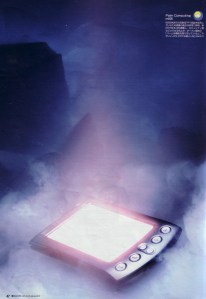
    Here is a magazine ad for a Palm Pilot (Palm Inc., subsidiary of US Robotics), circa 2000 — a brand of pocket computer.

    Print commercial for Palm Pilot (circa 2000)
    Japanese print commercial for Palm Pilot PDA (circa 2000)

    Note the attempt to depict the concept of cyberspace by constructing a mise en scene that is an admixture of light, water, rocks, ice and gas. The background design obscures and refigures the elements of earth, water, air, fire and aether (void) — a persistent ancient influence on our conception of everyday reality. We presume the device had not been dropped in a rock-pool. Rather, it resembles an occupied miniature spacecraft exploring a newly discovered alien world. The light in the device suggests it is occupied, not by a human body but by a consciousness, thus attributing qualities of adventure, strangeness and disembodiment to the idea of cyberspace. The tiny computer is able to enter cyberspace and take our consciousness with it, leaving our body behind.

    Here are some more images from the same catalogue, to emphasize the visual effect of the “cyberspacial” background, which was quite cool at the time, but perhaps because of the relatively naive mass-sense of what cyberspace entailed. Below are the original Harmon/Kardon Soundsticks. Original as they appear, if they remind you vaguely of a certain style, you’re quite right. Apple designed and engineered them so they could dovetail into their range of sexy, translucent, multicolored iMacs, which retailed between 1998 and 2003.

    Print commercial for Harmon/Kardon Soundsticks (circa 2000)
    Japanese print commercial for Harmon/Kardon Soundsticks (circa 2000)

    There is a rather organic form to the design of the Soundsticks that echoes the humanoid user-friendliness of the iMac. It is pronounced in the Elmar Flototto “Flower Power” standing floor fan as well, spruiked for its innovative design, ultra-quietness and high-density foam blade. Here it is standing in a reflected glow of things cyber, there being nothing essentially related to computers, or digital, about it. It’s all about image. Let us have one standing in the room behind us or on the desk beside us, keeping our bodies ventilated and cool in the real world during our cyber-voyages.

    Japanese print commercial for Elmar Flototto "Flower Power" fan (circa 2000)
    Japanese print commercial for Elmar Flototto “Flower Power” fan (circa 2000)

    An irony shared among the iMac, Soundsticks and Flower Power fan is that even while the organic nature of the human body is extracted from the virtual reality of cyberspace, it surreptitiously re-informs it.  Consider, for example, the Toshiba Videoball LZ-P2, which manifests, of course … the eyeball…; evoking connotations of the “cyborg,” portmanteau of “cybernetic organism,” a word first defined in 1960 by the academics Manfred Clynes and Nathan Kline as exogenously extended organizational complex functioning as an integrated homeostatic system unconsciously” (see “The Man Who First Said ‘Cyborg,’ 50 Years Later”). Also note the creepy, paranoid overtone of a malevolent AI, echoing something like Kubrik’s 2001: A Space Odyssey (1968) or Dean Koontz’s novel Demon Seed (1973/1997):

    Japanese print commercial for Toshiba Videoball LZ-P2 (circa 2000)
    Japanese print commercial for Toshiba Videoball LZ-P2 (circa 2000)

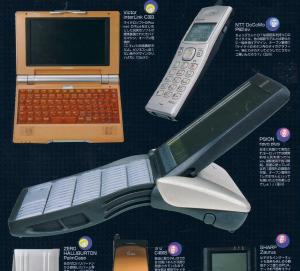
    Consider the Psion Revo Plus, a PDA (“personal digital assistant”) whose pronounced organic, ergonomic design, particularly when photographed as it is here (the green and white one, though we might consider the white NTT DoCoMo P601ev mobile as well, described charmingly in the Japanese ad copy as something like “a smidgin retro”), implies the form of the hands and eyes in coordination. See the ghost of the human being, the spirit in the machine:

    Japanese print commercial for Psion Revo Plus PDA and NTT DoCoMo P601ev mobile (circa 2000)
    Japanese print commercial for Psion Revo Plus PDA and NTT DoCoMo P601ev mobile (circa 2000)

    On the other side of the coin, we find a reaction against this disembodying tendency, which places the technology in a perceived “healthy” society. In the alternative conception, humanity is not fragmented or swallowed up, but instead, the internet may be applied as an educational, communicative tool, in the context of a properly regulated, well-governed social reality. Here is an example from NTT Communications. “Let’s boot up! We want to ‘provide’ for you: Thrills! Opportunities! Excitement! Discovery! Truth! …”

    Japanese print commercial for NTT Communications OCN IP Service (circa 2000)
    Japanese print commercial for NTT Communications OCN IP Service (circa 2000)

    Some of the constructive, developmental things you can do using the internet — the link-like buttons — are embraced by the overarching image of the tree, which is lent connotations of

    1. organic social growth, with society seen as a kind of extended family;
    2. a healthy, outdoorsy life; and
    3. the humanistic social, ethical and ideological system of Confucianism. 

    Governance and patriarchy

    Note the patriarchal connotations, which are endemic, if not exclusively so, to Japanese society and Confucianism. Three woman are in charge of the children, for looking after children is their rightful domain. The gestures of two of the woman indicate the tree, at the same time as they appear to seek physical support from it. Thus we read the tree as a masculine symbol lending strength and structure to society — standing behind, sheltering and protecting the weaker members of society (women and children).

    The absence of adult men in the image has an effect of transforming men into a pervasive entity, identified with the natural order. On the one hand, these absentees are those men behind the scenes, faceless and invisible behind the walls of NTT Communications, who make it all happen. At the mythic level, they aspire to a god-like status via a power of invisibility that identifies them as the most august tree-spirit in Japanese pantheism, one stretching back through the ancestors, to the mythic, prehistoric realm. In  the same way, the imperial line of descent links the present-day emperor to his mythological ancestors in prehistory, and to the sun goddess Amaterasu.

    Intriguingly, the ordering and “governance” of society, is an idea that informs initial definitions of things “cyber” from as long ago as Aristotle. Thus it remains a compelling factor in our conception of cyberspace, as I aim to explore in a forthcoming article.


  • The King: Donald Barthelme’s Postmodernist Anachronism

    The King: Donald Barthelme’s Postmodernist Anachronism

    Anachronism is an obvious comic device in The King (1990), Donald Barthelme’s last, posthumously published novel, and as such invariably commands comment. Barthelme places or “transposes” the Arthurian court into the period of Second World War Britain, something in the manner of what’s known today as the allohistorical genre, in which it is imagined how history may have been, given that a particular event had been different (i.e., an “alternate history”). Anachronism is generally thought of, however, as the sublimation of a minor element into a dominant flow of discourse. The minor element stands out as “anachronistic” but doesn’t drastically disrupt the flow of the primary narrative.

    Connecticut Yankee

    A close relative of The King would seem to be Mark Twain’s Connecticut Yankee in King Arthur’s Court (1889), though Barthelme’s work reverses the historical shift: Arthur’s court is moved into the future. Barthelme doesn’t need any fictional mechanism to do this, as Twain did — his hero being hit on the head with a crowbar. Barthelme simply assumes an unjustifiable realty as his premise.

    Both convey a critical humanistic message that class oppression remains the same across time, and both in a sense privilege a particular way of thinking, to be identified with the period in which the author’s mind situates and identifies itself. Naturally enough. Twain’s privileges American progressiveness, ingenuity and democracy in contrast with stuffy Britain. Barthelme’s is an avant-garde, iconoclastic point of view. The difference, of course, depends on their historical situations.

    Foucault’s Episteme and “Man”

    Regarding The King, I wonder whether it is not at least equally useful to invoke the Foucauldian concept of the episteme, which refers to all the conditions of a culture or period within which anything in particular may be known. In The King, the clash of the two disparate worldviews is at the crux of the narrative, rather than being one thing transposed, so to speak, into or onto the other. It may be that the difference between the objects of satire, one to another, is not so great.

    In contrast with Twain, Barthelme creates a radical discontinuity between two fundamental elements, two disjunctive epistemes. A particular episteme is a quantum leap or paradigm shift apart from what preceded it. More like a cubist idea, in a sense, than an organic one, and with a concomitant aesthetic — disconnected, fragmentary, dichotomous.

    It is as though history meanders blithely through a particular episteme, confident in its knowledge of the world, and then over a period of time, one element and another, like fragments of glass in the kaleidoscope of reality fall, bit by bit, into a radically new pattern. And bang, we suddenly look around and find ourselves occupying a brand new worldview, one fundamentally different from the one that preceded it — that of “the present.” There may exist equivalent elements in both “ways of seeing,” but the overall coherence is altered irreparably.

    One of Foucault’s startling seminal insights in The Order of Things (1966) is that

    “… man is only a recent invention, a figure not yet two centuries old, a new wrinkle in our knowledge, and that he will disappear again as soon as that knowledge has discovered a new form” (Order of Things xxiii; my emphasis).

    In The King, reflections of this sort, forced by a collision of mutually exclusive epistemes, stimulate a comedic reevaluation of humanistic attitudes and myths. The reader is rather privileged to occupy this “space” that transcends the counterpoised epistemes.

    Arising in the “now” of reading

    Guinevere considering the state of this world of total war:

    “But Jesu, the intrigue! Once upon a time the men went out and bashed each other on the head for a day and a half, and that was it. Now we have ambassadors hithering and thithering, secret agreements with still more secret codicils, betrayals, reversals, stabs in the back —”
    “Terrible it is, mum.”
    “One has to think about so many different sorts of people one never thought about before,” Guinevere said. “Croats, for example. I never knew there was such a thing as a Croat before this war.”
    “Are they on our side?”
    “As I understand it, they are being held in reserve for a possible uprising in the event that the Serbs fail to live up to some agreement or other.”
    “What’s a Serb, mum?”
    “I stand before you in the most perfect ignorance,” said the Queen.

    Such comic business is close-as-dammit worthy of a Beckett or Pirandello, in its self-reflexive gesture attributed to the character, who essentially arises as a character in a scenario about which they have no prior knowledge. There needs be no particular consistency to this effect. The instant of self-reflexiveness is like a sly peek through the fourth wall of the diegesis, into that benevolent and transcendental space occupied by the reader. In semiotics, the paradigmatic rather than syntagmatic mode. In one sense, the gesture is that of a character emerging into the act of reading.

    The space, moreover, or as Wolfgang Iser, the great reader-response theorist might say, the “gap” configured into the narrative premise, is the stage not only for the comedy, by way of the inherent incongruousness and surprise it engenders, bursting out at ninety degrees from the line of the story. It is a font for the narrative in general, an opportunity to reconcile endless irreconcilable conundrums in the act of holding the anachronistic elements in place.

    Reading the running gag

    All this may seem … trivial, along the line of a running gag that serves the functional aim of keeping the two episteme in situ:

    “I do know,” said Launcelot, “that I’m damned tired of hearing about the Polish cavalry.”
    “I get a sense that we’re wasting our time,” said Sir Roger. “That we should be out slaying dragons or something.”

    Note with this quotation, even granted its mechanistic function as described, Barthelme’s deft and tasteful exercising of Beckett/Pirandello-esque brand of self-reflexion, in which the characters are getting bored with the story.

    Barthelme now grants Launcelot the benefit of a latter-day insight, an Enlightened notion of what dragons “really” are —

    “Typically the Eyed or Jeweled Lizard, found in Spain, Italy, the South of France, and our own country, and which may attain a length of two feet. A largish lizard, but not a dragon”

    — an observation that motivates a Monty-Pythonesque account of the uncomfortable domestic scene that may ensue after an encounter with one:

    “One understands that a man does not wish to come home to his castle and say to his lady, ‘God wot I had the fight of me life today — no sooner had I fewtered my spear than the monster was upon me,’ and have the lady say, ‘But, good Sir Giles’ or ‘But, good Sir Hebes,’ and then have the awful question come, ‘What manner of monster was it?’ and be forced to reply, ‘Lizard.’”

    Here is a nice absurdist comic effect of vacillation between the two epistemes. As everyone knows, real dragons speak Danish, so

    “If a mixture of flame and Danish comes from the creature and your armor is singed black, you know that you have not been fighting a lizard.”

    Knights of color

    Similarly, encounters with variously colored knights, a borrowed Arthurian convention, take on satirical anachronistic tones here. The Black Knight is an African whom we meet in combat with Launcelot. What an occasion, as they come to grips, then “rest for a moment” to discuss various nonsense, before realizing their affinities and “falling to the ground in a swoon.”

    The Red Knight is a socialist who has fought in the Russian Revolution. Predictably idealistic:

    “The party embodies the collective wisdom of the people,” said the Red Knight. “Also, the Party has access to information the individual doesn’t have. I much prefer leaving important decisions to the Party than to a crowd of loonies in parliament.”

    The Brown Knight is Scottish, fittingly, because just about everything in Scotland is brown, the most sexual of colors: whisky, Scottish cloth, “our heaths when the sun is done with them.” Despite a probably cultural faux pas of which he is guilty — unspeakably, wearing brown armor while riding a black horse; yet Guinevere falls for him, as is her wont.

    “Guinevere in bed with the Brown Knight.
    ‘Wonderful,’ said the queen. ‘Quite the best I’ve ever had.’
    ‘We Scots know a thing or two,’ said Sir Robert. ‘By the Clyde, Forth, Dee, Tay and Tweed, our principal rivers — I swear by our principal rivers because I do not believe in God — By the Clyde, Forth, Dee, Tay and Tweed, I declare that you are the best bounce I ever had in all my days.’”

    The Blue Knight is melancholy, bearing in mind that a few of them are, as well as being great “swooners.” He has written a book On the Implausibility of Paradise, and has been drawn to research the element of cobalt as a possible basis for an atomic bomb, which he believes — probably correctly — is the Holy Grail.

    Barthelme doesn’t cover the fact he’s making it up as he goes along, probably minute by minute. That’s the point. There is a triviality about it all, but that’s okay: mankind is trivial, and the wonderful creative freshness of a fresh reading space is a definite pleasure of the text. The triviality is tasteful, counterpoised against the somewhat heavy Grail as bomb analogy.

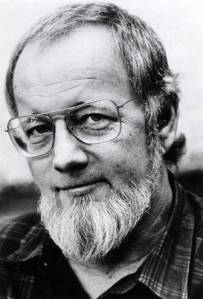
    Donald Barthelme (Source: Wikimedia Commons)

    Episteme and great style

    A word in passing about the stylistic conventions that facilitate this amusing and original literary achievement. Not scrupulously thorough like Beckett, but who needs to be? Barthelme’s The King resembles as much a radio playscript as a novel. The action is given through the dialogue of observers, a convention that Barthelme establishes beautifully on the first page:

    “See there! It’s Launcelot!”
    “Riding, riding —”
    “How swiftly he goes!”
    “As if enchafed by a fiend!”
    “The splendid muscles of his horse move rhythmically under the drenchèd skin of same!”
    “By Jesu, he is in a vast hurry!”
    “But now he pulls up the horse and sits for a moment, lost in thought!”
    “Now he wags his great head in daffish fashion!”
    “He reins the horse about and puts the golden spurs to her!”

    And so on. Riveting from the start, the narrative gallops on to … no where. Basically no plot, nothing happens. Nobody comes, nobody goes … just like total war. Sorry, didn’t really get to that.

    Once upon upon a timely time, such may have vouchsafed criticism. But not since the 50s.

  • Semiotics of Two Honda Motorscooters

    Semiotics of Two Honda Motorscooters

    Here are some more circa 2000 commercial images from Japan. There’s not much difference between Eastern and Western cultures in the way they fabricate mythological/ideological messages via semiotic techniques. But there are cultural idiosyncrasies as well, which feed easily into a global mythological context.

    50 cc “naked” Zoomer

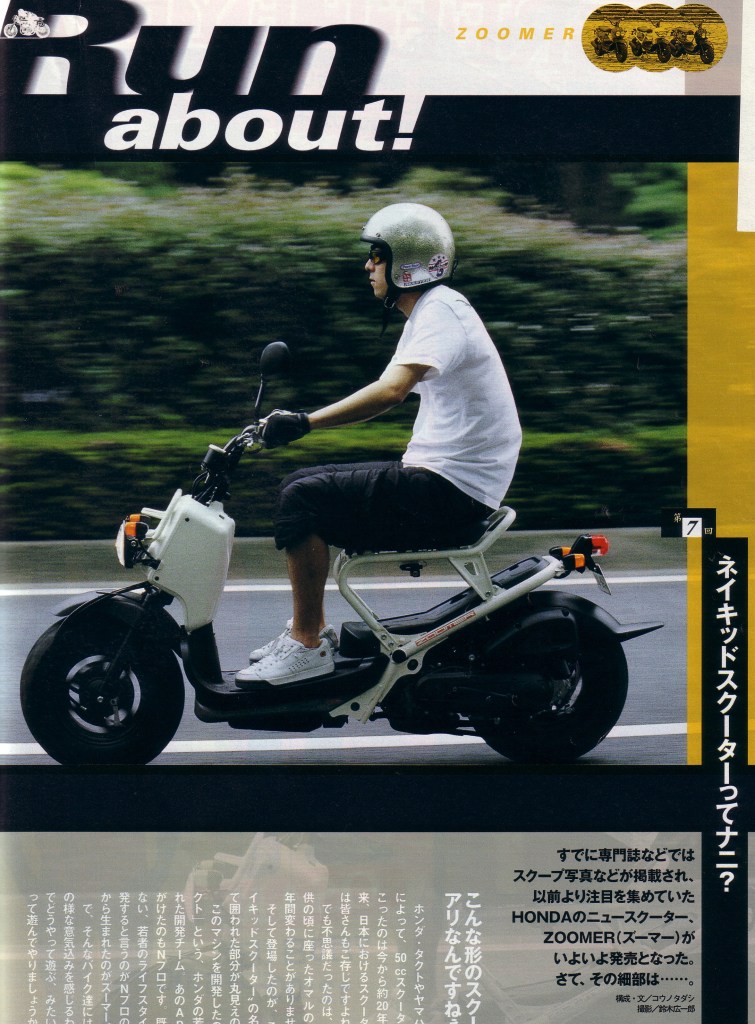
    Let’s kick start this post with the “Zoomer” 50cc “naked” scooter, which Honda released in 2001. I present this design as a kind of “zero degree,” against which to contrast another Honda scooter of quite a different design.

    Honda Zoomer (2001)

    The Zoomer is “naked” in the sense of being stripped down to the bare essentials, with no back cowling. It is Honda’s stated attempt to “appeal to the sensibilities of younger riders favoring a stronger, more distinctive personality and character.”

    Thus the modest financial condition of, for instance, the student, is presented as an aesthetic quality. The design reflects a youthful state of being unencumbered, which translates into velocity and airy transparency — a zen-like quality, one might say.

    The Zoomer actually uses the same frame as the classic CHF50 Crea Scoopy, but takes on a chopped-down look. There is nothing faintly elitist, pretentious nor rebellious about it. But it differentiates itself stylistically as a generation beyond the Scoopy (which it essentially is).

    The rider in this image presents quite a common “attitude” of university-aged Japanese youth. He is flawlessly attired in brand new gear: joggers, below-knee shorts and white t-shirt. An understated sense of style — but a sense nonetheless.

    The “brand” of the individual is aloof and intellectual, in compliance with a quite recognizable and sanctioned group or even class of person. The Zoomer is absolutely in keeping with this branding (or identity), and is presented almost as a type of “wearable transport.” It answers a desire to be insulated from, inured to one’s social as well as environmental surroundings, while being connected to them at the same time.

    I’m tempted to link this aesthetic to the classic nihonjinron, so-called “thesis of Japanese uniqueness,” even though that “thesis” is somewhat discredited in favor of a more recent privileging of perceived Japanese heterogeneity. In other words, the Zoomer aesthetic seems to me a paradoxical mechanism of “groupism,” a membrane through which one passes to and fro between the collective and individualistic.

    600 cc Silver Wing GT

    Now to move on to a commercial image featuring the 600 cc Honda Silver Wing GT Scooter, with double overhead cam. The vehicle is massively over-styled compared to the Zoomer. It is, of course, a far more expensive and higher-end item, and it needs such styling to bring its conception into a semiological frame.

    Honda Silver Wing GT Scooter (2001)
    Honda Silver Wing GT Scooter (2001)

    Note first the overt design signifiers connoting aerodynamics, rockets, luxury. The Silver Wing is designed primarily for a couple to use, evidently more advanced in age and finances than the Zoomer rider. Hence the twin seats, both with backrests; more staid, stable, safety conscious. For “adults,” as the text indicates explicitly.

    Consider the narrative of the image, which is caught at a critical instant. The male has disembarked from the helicopter and makes his way toward the vehicle, awaited by a female, who is linked thematically to the scooter by the helmets she holds. The two will make their greeting, hop on the Silver Wing GT and power off into the city.

    The Japanese text headline is a typical play on words. The set phrase “koi no yokan,” which is close to the English idiom “love at first sight,” becomes “big pleasure no yokan”: the word yokan meaning a kind of premonition of what is to come. This is in keeping with the narrative of the image, of course, which promises pleasure in the experience of the Silver Wing, and in the experience with the female. Not exactly “love” per se, more pleasure.

    The hero of the narrative resembles a cross between James Bond and a successful salaryman. He has alighted from the helo, and is on his way to his next adventure. The woman, however, strikes one not so much as a “Bond girl” as a Japanese tour bus or elevator hostess, welcoming the hero into the empty mid-frame space, atop the Silver Wing. She is passive and ancillary compared to the hero.

    On the one hand, then, the commercial seems to undertake to represent its perceived target consumer: the quite wealthy “adult” business worker who is looking for a romantic escape with his female partner. Yet, one would not think that it was the wife or girlfriend who went to the trouble of getting the scooter all set up like that in advance of the instant and then stood to one side like an elevator attendant, welcoming him in to the focus.

    Therefore, we should assess the possibility that the characters represented are not intended to mirror the ideal viewer of the image, as the text would indicate. Rather, they represent a desired image of the ideal consumer: the desire to be a James Bond. In this respect, the image appeals to a relatively deep adolescent desire — not just a matter of acquiring a Silver Wing GT to complement the helicopter, of course!

    The commercial, therefore, appeals to a lack of social power, mobility and sex. Its implicit promise is to provide these things on consumption of the image, on purchase of the commodity. The myth is fabricated from adolescent desires — on the absence of a ride, the absence of a female. That is the semiotic nature of the riders’ space on this image of the Silver Wing.

    The myth is not going to compete directly with the Harleys of Easy Rider etc. But who knows, there’s a long road ahead, in which the Japanese urban mythology can only gain on that of the American wilderness, of a passé “looking for America.” It will all be the same in the global-urban.