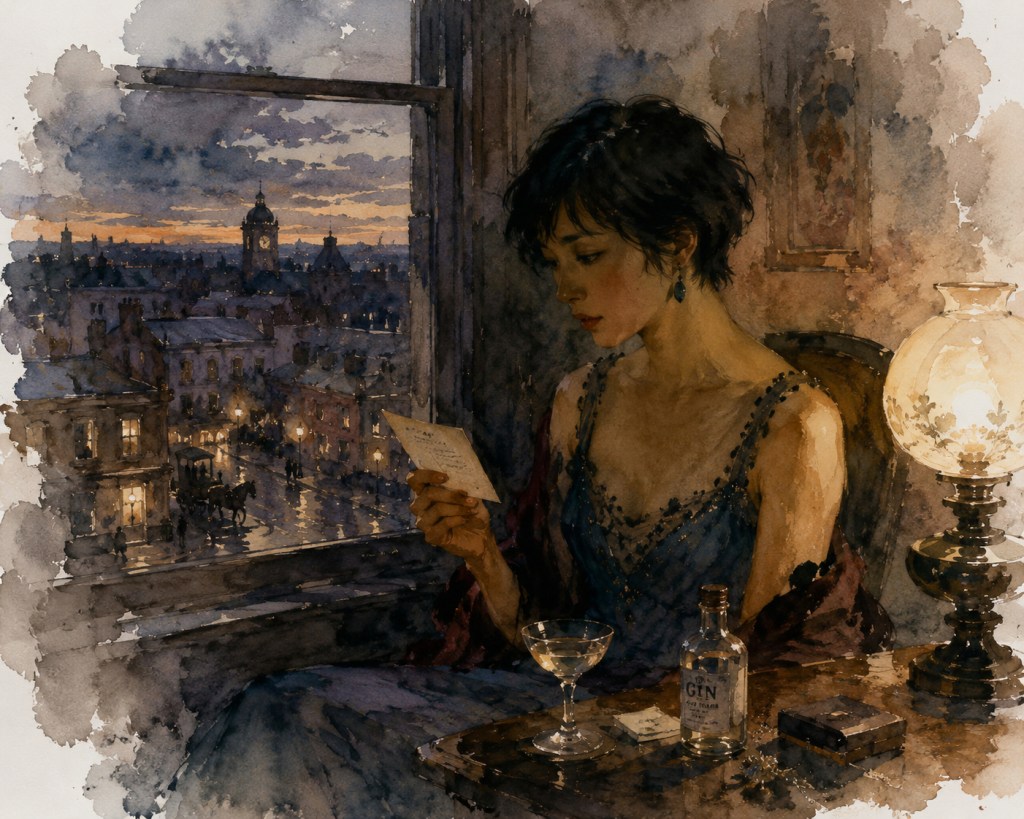
The cab trundled off along Bourke Street. Lili nodded to the receptionist in the hotel lobby and climbed the stairs to her room. Inside, she took off her capote bonnet and hung up her dolman coat, idly feeling through the wardrobe for the one or two dresses that might do for The Pirates of Penzance. There was plenty of time before Forster would return for their engagement, so she settled into the easy chair by the window with her cheroot and gin, anticipating the lazy spectacle of evening patrons arriving for their various entertainments.
The events of the day passed fragmentarily before her mind’s eye: the jeweller Kaminski’s appraisal; luncheon with William; the outing to See Yup Temple, with its distinguished elder Mr Lee Kong Wing; and alongside them the startling voice of her one-time mentor, the shady Madame Ah Toy, manifesting vicariously from the dim past. Remarkable how Ah Toy’s odd communication with its dubious promises and invitation had managed to reach her through so many hands. A chain of intermediaries extending to and fro between Guangdong, San Francisco, and Melbourne … bridging the abyss with her past that Lili had managed so assiduously to establish, and stripping away her cloak of anonymity.
She stood and went over to retrieve Ah Toy’s letter from her coat pocket … but along with the letter and Kaminski’s receipt, she withdrew a third folded card, too prominent to have missed had she not been quite so absorbed in the events of the day. She unfolded it, and its words made her heart stop:
“To the harlot Chan Lee Lung …”
She sank slowly into the chair. Outside, the sounds of the evening coming to life faded to silence before the now rapid beat of her heart.
I know who you are, better than you might think. I know why you have come to Melbourne. I know why you went to see Kaminski the jeweller today, and the purpose of your other movements. I know of your past crimes of murder and theft and will reveal them to the police if you do not comply with my wishes.
Her head swam as though she had been drugged. No one in the country could possibly know of her “past crimes.” How could anyone know of her reasons for coming to Melbourne – above all, of her meeting with Kaminski, whose shop she had only selected this very morning, on the spur of the moment, telling no one about it since. She had refolded the letter on a reflex, as the message sent its shockwave through her nerves. She took a sip of her gin, looked again, found the terrible words unchanged, and read on:
You are to meet with me this evening at eight o’clock, in a certain shed at the edge of the blue lagoon in West Melbourne Swamp. Come along Dudley Street to the railway coal canal. Cross it and keep to the northern bank until the water runs down to the river; there you will find a shed marked by a red lantern. If you bring anyone with you or tell anyone about our appointment, you will not leave the swamp, and your remains will never be found. If you fail to show up, believe me, you will not live the night out.
Make sure to bring the Marquis with you, whom I’m sure, if you weren’t familiar with before, you must be by now from your meeting with Kaminski.
The Marquis, never heard of him… but of course, Kaminski had been fascinated and really rather effusive about that single blue-tinged diamond. Well, she imagined Mark Sinclair saying, time was of the essence. Kaminski would be closed for the night, of course, but… She retrieved her velour jewellery case from the inside pocket of her dolman, before changing into some things she’d brought along with the vague notion she might take some walks by the Yarra while she was in the city.: a dark wool bodice and walking skirt, ulster, and walking boots. She donned her plain felt walking hat, narrow brim turned up at the side, which she fixed with a single long pin.
Should she leave something for Forster? Certainly not this note, with its too-truthful allegation. Anyway, it was probably kinder not to implicate him in this hazardous errand. Hurrying past the receptionist, she paused for a moment and said breathlessly, “A gentleman will be calling later this evening. Tell him that something urgent has come up and I must unfortunately delay our outing until tomorrow. Where am I likely to find a hansom cab?”
The young woman looked up in surprise. “There’s one stops regular, just up the street, across from the Menzies.”
Lili turned on her heel and hurried out the front door.
There was the cab; the driver nodded her aboard. She called up through the speaking hatch, “I’m in a hurry to go to Dudley Street in West Melbourne.”
“It’ll only take a quarter of an hour at this time of the evening, miss.”
They pulled out into the street and set off at a brisk trot through the city grid. Before long, the street lights thinned and the cab turned left at a junction, stopping in a working-class residential neighbourhood of terrace houses, boarding houses, workshops, and the like.
“I’d say where you want is one of these places,” the cabman said. “What’s the address?”
“I need to go further along the street, to somewhere called the railway coal canal. And beyond,” she said.
“Well, I don’t know about that,” he said. “That place is bad enough in the daytime, but at night it is most disagreeable.”
“I am willing to pay you for your trouble,” she said, reaching up to him with a banknote. “Now let us be off, it’s getting towards eight.”
The cabman grunted as he took the money, and they moved off to the west along Dudley. As they drove, the gas lamps became fewer and dimmer. There was a full moon with broken cloud cover as the wind freshened. Lili’s heart had stopped racing, but now seemed to bear a leaden, nauseous weight. In the unlit stretches, the moon was sufficient to bathe the industrial structures and dwindling trees, sometimes shadowy and black, in an unreal ghostly glow. The road became bumpier, and the wheels skidded sporadically in muddy ruts. They came to a scantily lit shanty settlement, through which their track now took them towards a canal crossed by a rough bridge.
“End of the road, ma’am,” the driver said.
“Keep going. Cross the bridge.” There was only blackness on the other side of the canal, but she could barely discern a red light a good distance off to what she imagined must be the northwest, along the river. The air stank of dank mud and rot.
The cab stopped again. The cabman’s voice was gruff and resolute. “I am not going to risk my horse over there in that lagoon. I would advise you as well to change whatever may be your foolish plans. There is nothing in that area of the lagoon but the haunts of criminals and paupers. Dead bodies are sometimes to be found in the numerous canals – suicides as well as others not so fortunate.”
“My good man, you will allow me to be the author of my own foolish plans.”
“So be it on your own head – but I won’t have you get my horse injured or my cab bogged in the process.”
She handed him a gratuity and alighted.
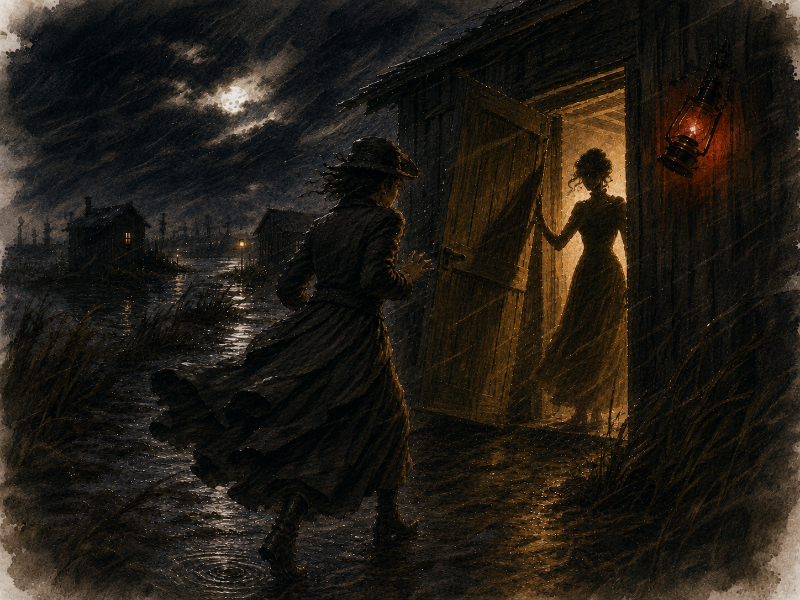
The faint red lamp seemed to flicker as she stumbled over the bridge. As she walked and slipped along the track, the cold wind flapped the hems of her coat and strained to pull her hat away, forcing her to hold it down with one hand while she balanced herself with the other. Whenever the clouds suddenly parted to let through the moonlight, she could see that the misshapen shadows surrounding her were tumbledown sheds and improvised shacks alongside rubbish heaps. Suddenly, the timber building with the red lamp seemed to lurch towards her from out of the dark, and she pounded on its door.
She stepped back as the door was roughly shaken open, and yellow oil-light spilled out, silhouetting the slim female figure standing in front of her.
“Get in.”
• • •
Forster arrived back at the hotel at a quarter past seven, buttoned up in his good coat, dress hat, and even a bowtie for the opera, only to be told by the desk that Miss Chan had gone out again and would have to postpone till the next day. His immediate disappointment gave way to unease. After a few questions, the receptionist revealed that the lady had appeared somewhat flustered, and no, she hadn’t been out of her room since having arrived earlier on. So obviously, thought Forster, nothing could have “come up” except from something she had discovered in the room, and she had appeared perfectly happy and composed when he left her. He went looking for the hansom in question and found it where, according to the girl, it usually waited.
At this time of the evening, more people were arriving in Bourke Street than departing; and after one or two false leads, he found the cabman who had driven Lili, sitting up on his box eating his dinner. The fellow was at first less than loquacious, having taken a dislike to his passenger, but Forster and his badge rendered him talkative. Forster was gravely concerned to hear of Lili’s destination and, less than a minute later, they were rattling along at speed towards the police barracks in Russell Street.
• • •
Lili brushed past the young woman and heard the door slam tight behind her. The interior of the room was surprisingly solid, shutting out the wind that had strengthened to a howl outside. An old potbelly stove gave off a good amount of heat, though the fire was visible through some cracks in the flue. Two windows were shuttered up, and a door to an inner room was closed. There was a rough-hewn Baltic pine table in the centre of the room, and two heavy benches against the walls. Despite the wine flagon and tumblers on the table, it resembled a serious workshed, with all manner of tools and augers on the benches and hanging from hooks on the walls.
“You’ll catch your death out there.” The ugliness of her tone belied the words.
Lili turned to look at the woman, who wore a cold, humourless sneer. She was white, youngish, not unattractive, and faintly familiar.
“Sit down.”
Lili stayed where she was.
“Go on, sit. Take the load off. He’ll be back soon – just ducked out the back to find a few bits of wood. You’re a bit late, ducky – you don’t want to make him cross, you know.”
“So the message is not from you?”
The woman sneered. “Just sit yourself down, ducky.”
Lili was taken aback as the woman’s half-glimpsed face flashed into her memory. She drew out a chair and slowly lowered herself down. The woman carried a stool across to the exit door and sat blocking it.
Some thumps issued from behind the inner door. Presently it opened, and a thickset Chinese man came in bearing some timber offcuts in his arms. He dumped them on the floor by the potbelly, then opened the firebox door, put in some of the wood, and clanked it shut. He stood brushing his hands together and looked at Lili with a broad grin.
“Miss Chan Lee Lung, I presume,” he said. “So kind of you to call.” He took the chair opposite Lili, poured two glasses from the flagon, and pushed one across to her. She did not touch it.
“Impossible. You cannot be him,” she said steadily, trying to conceal her astonishment, “though you’re the image.”
“Ah,” he said. “Yes, he would be noticeably older if you met him now. My dearly beloved brother, the epicurean…”
“Fat Louis,” she said.
“An unkind sobriquet. He detested it quietly, you know.”
“He was widely misjudged,” said Lili, producing a convincing faint smile. “Merely because he was good at what he did. How is the dear boy?”
“Oh,” said the brother, tutting. “He is not doing very well at all.”
“Oh no…” said Lili. “Don’t tell me he’s… departed.”
“As a doornail. Thirty-two.”
“So young.”
“I meant the calibre. Slug to the forehead. Nasty sight. I was standing right there. He took on an expression of amazement. I suppose he imagined he would live on forever.”
“I’m ever so saddened to hear of it,” said Lili. “He was such a likeable fellow. We were just like family – Fang, Louis and me. How we laughed at his little jokes – and so handsome. I can remember the last time I saw him; he’d brought champagne and Roquefort cheese, and we listened to Fang play delightfully on his zither. Your fraternal resemblance is uncanny. It’s so lovely to make your acquaintance. How on earth did you manage to find me here? I’d tried like mad to contact Louis and the boys after Fang passed away, but to no avail.”
“Louis and his associates in the San Francisco See Yup tong tracked down your apothecary friend after a while. He became sadly uncaring about your wellbeing after they spoke with him. But the tong came to realise who was responsible for what happened to Fang. As you know, he was a master in the society, and well liked and respected; so they were eager to take their vengeance on your head, sure that the cops had got it wrong about you being taken care of by those Hing San Fong Tong boys, who are weak sons of bitches when it comes to women. But then, as luck would have it, they discovered going through their books that Fang’s fingers had been much too light on the zither when it came to doing the accounting. So the fact that you did him in actually served you well after all.” He laughed, provoking Lili to join in.
“It’s an ill wind,” she laughed. “I had no idea that removing that despicable man would prove to my advantage. Of course, I had to go on the run, because he was their fair-haired boy at the time.”
“They forgave you that, but they still wanted their loot back. Anyway, what do you know, but one day the celebrated name of Madame Ah Toy passed through our hands, when she decided she wanted to reunite with you, and a couple of our brothers assisted in her communications back and forth between San Francisco, Guangdong, and here. Until one day…”
“Voila,” smiled Lili.
“Voila. Suspecting nothing, the See Yup here helped us get the notice into the Police Gazette. They’re hand in glove with the cops, with all manner of worthy causes, bless their hearts; but of course, we manage to slip in between the cracks, you know, and we have our various secret societies in this country too. They are not so well-known, but are quite as effective as ours back in San Francisco.”
“Obviously,” said Lili. “Well done.”
Seeing the two were getting on so well, the young woman seated at the door drew up a chair to the side of the table.
“You were the one who sent off the legendary Fang Jing Dock in San Francisco?” She gazed at Lili wonderingly. “You look like butter wouldn’t melt in your mouth.” Lili could sense the woman wanted to hear those words that she had vowed never, ever to utter. She looked her in the eye, said nothing, and turned back to Fat Louis’s brother.
“This is Moira, one of our little helpers here.”
“And you?” Lili asked.
He gave a slight bow. “Call me Algernon.”
“Of course. Algie.”
“I said Algernon.”
“Your little helper and I bumped into each other this morning, Algernon,” Lili said. “She’s how you kept track of my movements today.”
“We had eyes and ears waiting at the temple, too,” Algernon said. “So we know pretty well what you learned there, as well. However, that’s enough preliminaries; let us proceed to the substance of our meeting. Show me the Marquis.”
“Who on earth is he?”
“Don’t be cute. Moira, fetch that small pair of bolt cutters from the bench.”
She did so, placing them in front of him on the table. He withdrew a pistol from the inside of his coat and laid it next to them.
“The Marquis,” said Algernon, “is a gem of an individual. A very pretty but hard little fellow who is eager to return to his proper companions and doesn’t like to be kept waiting.”
Lili retrieved her velour case from an inside pocket of her coat and placed it on the table before her. The man snatched it up and snapped it open. His upper lip quivered as he turned it upside down and shook it, but nothing came tumbling out. He dropped the case and froze, and Lili emitted a peal of gay laughter.
“Oh, you should see your face,” she said gleefully. “You’ll do yourself a mischief!”
She drew back the case, carefully undid its false bottom, and withdrew a ring from the hidden compartment. She held it so that the jewel, in its Louis XV Marquise setting, caught the yellow oil-light from the lamp hanging above her. The man narrowed his eyes as he peered at the ring.
• • •
Forster persuaded the cabman to guide him and a uniformed policeman to the bridge over the coal canal. They left the cabman there with the police wagon they had come in, to keep the horses calm. The wind had risen, but fortunately the lamp towards which the cabman had last seen Lili heading was still there, and Forster and his constable set off, stumbling and slipping through the muddy terrain, their bull’s-eye lanterns shuttered down to prevent light spilling out and revealing their approach. As they neared the building, the wind faltered momentarily, and raised voices could be heard coming from inside the shed.
• • •
“Very nice,” said Algernon, resting one forearm on the table as he leant forward over the table and held the ring up towards the yellow oil-lamp.
“A man of taste like Fat Louis himself,” said Lili pleasantly.
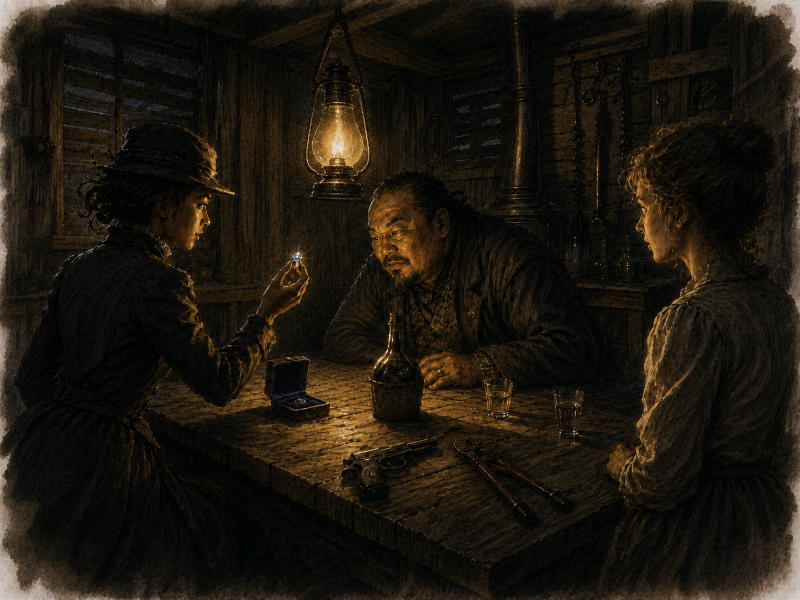
But after breathing softly onto the gem and squinting closely, his face turned to a mask of marble, and he hurled the ring back at her, letting loose a filthy American expletive. Just as he grabbed for the pistol, Lili raised her hand to the side of her hat, then plunged the hatpin down into the tabletop and straight through the meaty hand resting there. The pin was a serious affair, ten inches long, manufactured of fine sharpened steel, and capped with a plain polished bulb. She had brought it with her from San Francisco years ago, where such objects were popular as serviceable lady’s accessories, for obvious reasons.
He emitted a roar as his skewered hand jerked away from the tabletop, and the pistol in his other hand discharged. At that moment, the door was kicked in. There stood Forster, his revolver levelled. Algernon swung his own pistol around in Forster’s direction, but Forster’s shot caught him in the centre of the forehead before he was able to fire the gun again, and the man stumbled sideways onto the floor, knocking over his chair as he fell. Moira screamed when she saw the blood seeping from her arm where the stray shot had grazed it. The constable hurried over to steady her.
Lili stared down at the man sprawled on the floor. He was obviously dead.
“The irony,” she said quietly.
• • •
The cabman was growing restless by the police van when the small group arrived. Moira did not say a word. Though she had recovered from the shock of her flesh wound, she was aware that the incident would have implications for her future. Forster had decided that it would be more sensible for the constable to drive the group back to Russell Street than have him stay with the dead man overnight. The cabman gave Lili a sour look as she climbed into the van and sat opposite him.
“Told you,” he muttered, but she ignored him.
Forster helped Moira inside and sat down next to Lili.
“Beats the opera,” she said quietly to him. “Reminds one a little bit of those yellowback novels they keep in the reading room at the Stawell Mechanics’ Institute – set the heart racing, if negligible in literary merit.”
Forster sighed as the van trundled off.
From the draft novel Stawell Bardo © Michael Guest 2026

