Tag: Work in Progress

  • Acacia and Ash

    Acacia and Ash

    He had been instructing Lena in the secret arts since she was scarcely past the crib. Even then her talent was unmistakable, revealing itself in the look in her eyes, the elasticity of her tiny muscles, the spring in her limbs. How piercingly and wisely she looked at him – and into him! She was an infant when he found her one morning lying in a puddle of tap-water on the floor, his scented pine-soot inkstick ground to smithereens on the purple-red volcanic inkstone, his brushes in disarray but for the one grasped in her fist, with which she was bespattering and daubing all over the floorboards and her own self with energetic expressions of pretemporal flux, the originary Nameless, the mother of all things. Amid her chaos, an image of an embryo? Or was it merely a shape expressed from the dark recesses of his own psyche, imposed upon meaningless blotches and smears?
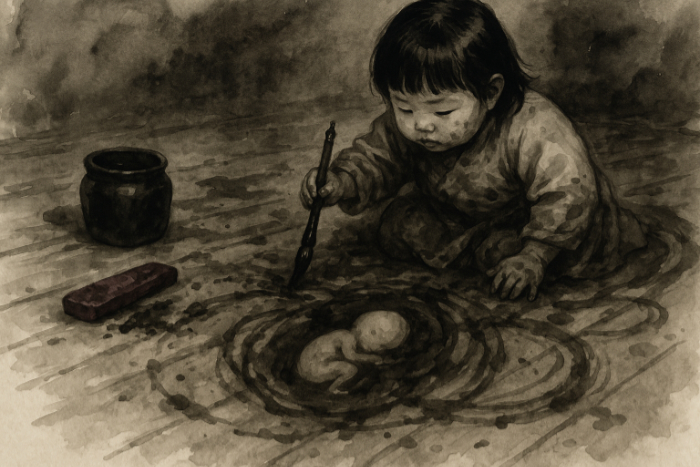
    A delicate watercolor of a small East Asian girl seated cross-legged on the floor, her head bowed in quiet concentration as she paints or embroiders with ink on stretched fabric. The style is loose and flowing, evoking traditional brush painting, with soft washes of colour fading into the paper.

    The prodigious air of equanimity he observed in her at that instant persuaded him the former was true: the form was no accident, but an intentional representation; and this was borne out over time, for as he introduced her to the time-proven techniques and subtleties of the calligraphic art, she would occasionally reproduce similar but evolved versions of the same motif, one after the next.

    Over the years, the outline became stylised and filled with scenes, blurry at first, then increasingly detailed, as though brought into focus by a kinesigraph, an invention he’d read about in the newspaper, said to have recorded the growth of a universal embryo. As Lao-Tzu’s disciple Zhuangzi wrote: “So all creatures come out of the mysterious workings and go back into them again.” Close by the pair of boulders that marked the feet, two human figures walked side by side upon a waterwheel, driving a stream to flow upward, delineating the spine, which culminated at its point of entry into the skull. Beneath the jagged boulders representing the cranium sat an adult figure, cross-legged.

    “Who are these children?” Mow Fung asked one day.

    “This one is called Yin,” she said, tracing the outline of the girl, “and the other one Yang. Surely you should know that, since you already told me all about Yin and Yang so many times. Aren’t they really, really strong? And they work so hard to create the energy for all of nature, and for human life too. This stream flows east, all the way up to the top of the Southern Mountains, these huge rocks.”

    “And this man sitting on the mountain – is it me?”

    She emitted a sweet, bubbling peal of laughter.

    “Oh no, goodness gracious, that could never be you, although you are very old, like that man; and he sits there doing nothing but contemplating nothing and pondering on things that can’t be named, just like you. Tee-hee!

    “Do you know? this man’s mother conceived him when she saw a falling star, and then she carried him in her belly for sixty-two years and he was born when she leaned against a plum tree to catch her breath. Poor woman! But lucky for him, because the plum is an auspicious tree.

    “A great crack of thunder erupted, and fairies danced on rainbows high up in the sky. He already had grey hair and a beard and long earlobes like a little old man, and he could already walk and talk straight away.

    “That’s why he was called Lao-Tzu, which is a way of saying ‘venerable teacher,’ because ‘Lao’ means ‘old’ and ‘Tzu’ ‘master.’ I think I would have had a heart attack if I’d been poor old Mrs Lao, his mama.

    “Truth to tell, with all these wild tales about him, I sometimes wonder whether he existed at all, at least as one real man in history. Maybe he was many.

    “Some people think he came down from heaven many times to help humans along the path, and even taught Confucius and Buddha. But perhaps what we think of as the scribblings of one person are the work of several, collected together over centuries. Anyway, my picture is all about making the gold elixir, and becoming an immortal like Lao-Tzu, poor old Mr Rabbit Ears.”

    Despite, or perhaps because of, her precocious cleverness, she was becoming rather hard to bear. Not so much so for her parents, who had an inkling of the forces that drove her. Not only had her father cultivated these gifts in her, which were now developing in strange and unforeseen ways, but she was, in some sense, an extension of his own past.

    No, he had no-one but himself to blame: his own youthful conceit having left him exquisitely vulnerable to a joke of cosmic proportions, the cosmos apparently having a nose for hubris in those whose gifts were squandered early, especially the inwardly illumined lured by aberrant indulgences, the pleasures of opium smoke among them. Our man had broken a habit to which he succumbed years ago when he fled to Canton, after the tragic deaths of his mother and friends, the three Bandit-Monks as they became known after their years of devotion and training, and their innumerable acts of generosity and self-sacrifice on behalf of the mountain folk. At one time he numbered among the fifty per-cent of Chinese immigrants in Ballarat who were slaves of the poppy, a statistic assiduously reported by government investigators.

    • • •

    Forward then, into the Underworld, though barely a word forward in a place like this. At any rate, for the sake of argument, best accept the proposition that they proceed, the living and dead, or, depending on an unforeseeable outcome, the earlier and later dead; the guide and follower, though who is which has fallen into doubt.

    There had been a lantern, a delicious trembling thing, whose light had coiled around him lovingly, as if loath to depart; but he discarded it after it extinguished in a gust. No, wrong. Impossible: gusts in the abysmal vacuum of this intermediary hell! And yet a stench manages to surface. When, from time to time, the two regain an animal characteristic or other, they are able, after a fashion, to gasp or puke.

    The idea of light remains, however, to which they cling, though no sun to adorn the infinitely high and starless ceiling of opaque black. A light of sorts emanates from the earth itself, all about, dull and nausea-green. It is said that this place is nowhere and everywhere, a place where, when the maximum is attained, the opposite is inevitable.

    The Sightseeing phase. Here we have the famous Gate of Sighs, unmarked and nondescript, but unmistakable, worn smooth as glass where heads beyond eternal count have bowed low to the stone. Inevitable psychopomp Horse-Face stands to the left, Ox-Head the right. (Or was it Kangaroo and Emu?) One looked on, while the other counted on his fingers, saying nothing, while their minions dragged the two through the dirt, red when it would appear in spasmodic flashes of gaslight.

    Clerks of merit and sin pore over their ledgers, spectral bureaucrats assisted by their ink ghosts. They afford few words and barely a glance at the souls. Their avatars would abound in the Colony, haunting the public, despised but obeyed: turnkeys, forever-echoes from the prison cell.

    An abysmal semi-skeletal thing in a frayed robe peers more closely at the once-guide. “Still warm,” it mutters, “but the paperwork is complete. All in order. We don’t make mistakes in here” – prompting its indescribably ghastly and abominable colleague to cast it a long blank look, before turning again to its own ledger.

    The plain widens, if such a thing were possible in this deathly nowhere, giving way to produce the sensation of a soft tearing into black salient. Surely we are not inside a body… The guide sinks to his knees (ha!), and the larger, redder one, once a cadaver, clasps his living companion’s shoulder and emits an utterance for comfort.

    “Take heart. This is meant to be,” he says, surprisingly without any trace of surprise that he has acquired a mouth, and that words come out of it, the inanity of which strikes him the moment he expresses them.

    But the once-shaman replies with a desolate moan, for all this not a whit what was intended by him. Pity the hunching, the spasms, as if some mute refusal were lodged at the back of his skull. Voices of the dead are carried in the Whispering Wind: dear companions from the past beseech him to leave the path and rejoin them. And what is this abomination? The innocent voice of his daughter among them, who should not be here by any means! He goes to rise, but sinks again when the voice folds back into the many others, that murmuring desolate weft.

    Then this way, onto a plain of hungry ghosts, detritis of failed judgements, souls that neither reincarnate nor dissolve. Disgusting creatures with distended bellies, leech-like necks, and mouths tiny as the eyes of needles, testament to their forever insatiable desires.

    At last, he regains the “power” of speech:

    “Not this. This is not the shape, nor the measure, nor the place. I am not the one. Stop when it is time to stop. Well, stop!” It is barely a whisper suffused in a sob. “I am not dead!”

    “No need to be upset,” the bigger, red one comforts him.

    • • •

    Spurred by the censorious tongue of her school mistress, Miss Pritchard-Jones, in her mid-forties, formerly a Willoughton, Lincolnshire girl known simply as Ruby Jones, some of the locals were starting to turn stony-faced at Lena’s approach, save for the subtle arch of an eyebrow, passed from one to another in discreet recognition. The covert signal was spreading steadily through the European populace of Deep Lead. Miss Pritchard-Jones had paid a Sunday visit to the Junction Hotel with one of Lena’s alchemical paintings under her arm, which happened to depict Yin and Yang in their respective guises of tiger and dragon, in the celestial act of conjoining that occurs at midnight in the alchemical process, when the elixir circulates nine times and returns to the immortal origin. Yes, there above the two fiery figures, the Sword of Wisdom and a once ferocious Monster of Illusion now immobilised with its limbs bound could be distinguished hanging in the stars. Where else could she have obtained such knowledge and imagery? – apart from Time’s Heavenly Sanctuary an Infinity above the Jagged Rocks, to whose archives he himself had long since given up hope of gaining admittance.

    “There is something not quite right with the child. She performs dismally on her school tests, though she appears to possess intelligence. Doubtless, she has the ability to ‘go places.’ Many girls of her ability become perfectly capable wives, maids, hairdressers, shop-girls,” the teacher explained after they sat down to a cup of tea. She then hurriedly concealed the painting in her soft leather satchel, before beginning to outline her solution to the problem she believed was vividly immanent in the incendiary artifact.

    “Mental and moral discipline are indispensable in the education of a child, else she be led to stray from a productive and righteous path into pitfalls of crime and vagrancy,” she elaborated. “I concede that you in your position, who come from a primitive land and are constrained to a humble, not to say precarious, station in life, in a country that is not always hospitable to orientals and natives, are unable to grasp fully the importance of a wholesome family background to the upbringing and development of a child of Lena’s age, and indeed her siblings …”

    The child’s parents looked at her in silence, their eyes stripping back the powdered mask and genteel veils to glimpse the workings beneath – subtle mechanisms, hardened circuits, a cogged and coded puppet, sealed within a larger apparatus of manners and decorum. Her cavernous mouth moved with a life of its own, and her massive, powdered and rouged face inflated to fill the room. Their existences shrank to an invisible plane, and they levitated up to a spot in a shaded corner to observe, alighting like the butterfly in Zhuangzi’s dream. From here, the onslaught softened to the echo of a gale howling in the distance, though her words remained clearly discernible.

    “I will put it plainly. Her brain is wrong, her mind astray,” and she proceeded to enumerate several further instances of warped expression that, in her view, had led to the present pass. She paused to take in their reaction but they gave her none. “My concern is that unless steps are taken she will continue to deteriorate – and not only in her schoolwork. By education, we practitioners mean not merely lessons, but all that may be educed – brought out – from the child: intellectually, yes, but morally as well. To begin at the true foundation, one must attend first to the parents. For are we not told, on the highest authority, that the sins of the fathers shall be visited upon the children unto the third and fourth generation? The baser thoughts, emotions, and impulses of the parents find harmful expression in their descendants. It behooves parents to reflect upon their sacred responsibilities.”

    They were more primitive than she had feared. “To quote from Archdeacon Julius’s recent sermon in Ballarat, which I had the honour to attend in person,” she said deliberately, taking out a newspaper cutting from her satchel and laying it down with ceremonial care, “the Lord says expressly that young children are like as arrows in the hands of a giant. From this we may draw the inference, as the Archdeacon explains, that each human life is fired out into the world like an arrow, and just like an arrow, not to miss its mark – by ‘missing its mark’ of course, he refers to sinning – it needs to be keenly pointed, which is to say, trained and sharpened by education. Furthermore, just as an arrow has three feathers, the three stabilising forces for a young life need to be: knowledge, love, and work. And so on and so forth. I would like Lena to take this and read it closely and explain it to you both thoroughly, so that all of you can understand. And I have a proposal …”

    A faint breath, a stirring as if by the wing of a moth, made Mow Fung aware that his eldest had joined them up at the cornice.

    “Yes, bring it in,” he transmitted and lowered his full awareness back into his corporeal body.

    “It is a well-known fact that poorer parents tend to coddle their children more than the richer, and the children tyrannize them in return.”

    “Something in what you say there,” Anna said with a smile.

    The door squeaked open and Lena entered with schoolroom poise, carrying her current work of art: black crayon on a sheet of wrapping paper. A figure seated cross-legged, spine straight, balancing the sun on one palm, the moon on the other. Within his belly, a stove glowed, its tiny flame drawn with a child’s fierce precision. The girl set the picture on the table without a word and assumed a still posture.

    Watercolor portrait of a middle-aged woman with hair pulled back and a stern expression softened by a slight smile. Her eyes remain cool, suggesting restraint. She wears a dark high-collared dress, and the painting’s style is muted, realistic, and softly textured.

    Miss Pritchard-Jones’s smile did not quite reach her eyes.

    “And what do we have here, dear?” she asked sweetly, leaning forward to squint at the drawing, as though it almost certainly contained something improper.

    “Is this meant to be… a magician of some sort?” the schoolmistress tried again, tracing the black line that circled the figure’s stomach. “Or perhaps… a new kind of stove?”

    “It’s just a man,” Lena said.

    “He seems to have swallowed a brazier,” said Miss Pritchard-Jones, letting out a snort of mirth – which, after a glance at the girl’s father, anticipating that he would share her amusement, she immediately stifled.

    Mow Fung looked at the drawing for a long moment, then at Lena. The silence stretched.

    “Why do you think his eyes are crossed, Miss Pritchard-Jones?” Mow Fung asked.

    “Goodness gracious, there is no why or wherefore about it. All nonsense.”

    “Lena?”

    “His eyes revolve like the planets in the solar system, Miss Pritchard-Jones. He squints and then rolls his eyes from left to right and back again to raise and lower his inner fire. From left to the top of his head, then down to the right to look inside his navel. He rolls his eyes around the sun thirty-six times to raise the positive fire. Twenty-four times around the moon to lower the negative fire.”

    “Incorrigible,” the teacher said.

    “Yet, you must admit it means something to her, and you see how she has learned your schoolbook science.” Then turning to his daughter, “Miss Pritchard-Jones has a proposal for you, so pay attention.”

    “I shall listen and obey, Father.”

    The woman struck a declamatory attitude.

    “It is true, parental responsibility involves the proper training of each child by its parents, but this is the ideal not always reached. Unfortunately, we do not have sufficient resources at the Deep Lead school to provide the religious instruction so sorely needed in a case such as this. However, as a Teaching Elder of St. Matthew’s in Stawell, I have taken it among my broader civil responsibilities to provide extra-curricular religious training and discipline to a small group of lucky young people deemed most in need of healing, in what I make bold to refer to as sessions of spiritual therapy. Spiritual wellbeing is as important to a child as their physical wellbeing and should never be neglected, lest the child herself be considered neglected.”

    Lena made her opinion clear immediately upon Miss Pritchard-Jones’s departure.

    “If she thinks I’m going to traipse all the way over to Stawell every Sunday to listen to more of her tripe, she’s got another damn thing coming.”

    “You should think about making an effort to fit in,” her mother ventured. “When turtles hide in the mud they remain safe and cannot be harmed. When they come out, people catch them. Same with fish. When they stay down deep, nothing can hurt them; but when they surface, the birds catch and eat them.”

    “Yes, best be like the turtle in the mud, the fish in the deep,” her father agreed, “Who knows? – there may be things worth learning in this spiritual therapy business.”

    “Don’t worry,” Lena said, “I’ll take care of it.”

    The next evening, there was no one around to notice the slender shadow flit through the laneway that ran alongside the teacher’s residence nearby the Deep Lead school, nor the flash of a match igniting a rectangular slip of paper, which burned for a few seconds to ash. The ‘Five Ghosts’ talisman works to traumatic effect when exercised against susceptible victims of a sensitive disposition, but Miss Pritchard-Jones was not such a person. Moreover, the artificer of the talisman, though youthful, was a compassionate girl, and inscribed it with characters that summoned less insidious spectres. No terrifying flying-head ghosts, faceless ghosts without feet, or baleful hungry ghosts from hell. Instead of these, naughty, playful sprites, who on the completion of each childish prank would depart back into the spirit realm to the tone of a chime, leaving no more than that playful and well-intentioned vibration. Just the type of spiritual therapy that might do her teacher good. Little harm likely ensues when a goldfish goes missing from out of its bowl but reappears a day later unassisted, looking as though nothing has happened; and the same is true of a budgerigar from its cage. Then a pet rabbit absconds leaving its cage door wired shut behind it, lagomorphous version of the Davenport Brothers, the famous mystical escapologists. It fails to return; but perhaps this is far less than a miracle, given the hatred for its species throughout the Wimmera at that time.

    Resting on her beloved rattan chaise longue on the veranda, Miss Pritchard-Jones looked up when the Fung child appeared, cradling the pet rabbit she had found hopping aimlessly on the roadside. The girl gently placed it in her hands. There was enough empathy in Lena’s eyes to still the suspicion, barely forming, that she might somehow have been responsible for the escapade – which indeed, she was not, at least in a certain direct sense of the word. The teacher smiled and patted the girl’s hand; her need of spiritual therapy was never again mentioned, and the tinkle of the teacher’s little Aeolian chime was from that time only ever heard when a gentle breeze, at least, would stir. A past offering from an anonymous pupil, the Japanese curio could be obtained at Kwong Hing’s shop in the Chinese camp.

    • • •

    A flat place. No texture or edge. Suggestion of enclosure without form. Inner perimeter, no wall. The air is not air as such. Breathing is not a prerequisite. And yet there is a pressure from above, faint but definite, of eternal waiting.

    A pale thing leans. A figure, perhaps, or a coagulation of posture. It inclines forward from among a stand of not-columns. Not arranged, not formed, neither standing nor collapsed. The pale thing has no face, or a great many, vaguely superimposed. It carries the smell of ancient, unwashed robes, and the fungal tang of mouldering rice-paper: suggestive of a monolithic bureaucrat obsessed with the accounting of infinitesimal infractions.

    It speaks: “Proceed.”

    Silence. Then again: “No. Abide.”

    The Celestial lowers his head even lower. The other stiffens. Progress may no longer be an option for him.

    “There is a discrepancy,” the thing says. “Designation uncertain. Misprocessed? Unprocessed?”

    It shuffles what appears to be a sheaf, but the papers are not quite flat, and not quite still. One separates, drifts, curls at the edge before floating down to a non-floor, sizzling to ash.

    “State your designation.”

    No answer.

    “He is not dead,” explains once-Forbes.

    The thing tilts. Abides. Tilts again, as if abiding might yield reply.

    “He is here. There is no procedure for reversal.”

    Mow Fung emits a sob.

    Nothing changes.

    Then: “Though I suppose even that may be subject to review these days, the way things are going. We will open the Register of Residual Appearances (Beings Undead or Vanished.)”

    It does nothing.

    “Ah. Yes. An echo. The shadow of an intention. The residue of action restrained. A karmic hesitancy.”

    It does not look up.

    “He may proceed.”

    Then, as if mumbling to itself. “Unless the next phase has been canceled… We received a memorandum but the seals were indistinct. The authority unclear. Proceed. If that is the word.”

    Not a soul stirs.

    • • •

    One day, she looked up from a swing he had hung for her years before, from the low branch of the blue gum behind the backyard, studied his face seriously and said: “Father, I am ready.”

    “For what?”

    “I don’t know yet exactly for what.”

    “Well, I shall have to save to buy you a violin or something.”

    She looked at him with a long-suffering expression, but did not answer.

    “The Maiden spoke to me when I was watering her. She gave me quite a shock, but I heard her voice distinctly.” The Maiden was the title they gave the stateliest maiden wattle in the acacia grove. Acacia maidenii was the plant’s Latin name, she informed him.

    A close-up watercolor of a young East Asian girl seen through a foreground of soft golden wattle (acacia) blossoms. Her face is partially obscured by the foliage as she looks directly toward the viewer, her expression thoughtful and serene. The style is fluid, with abstracted edges and gentle hues.

    “Oh?” The plants had never spoken to him, though he paid respects, and certainly watered them more dutifully than his number one daughter.

    “What did she say?”

    “She said there was something I must do.

    “Oh?”

    “She said there were some things you have to do before she’ll be able to speak to you directly – some procedures – and then you will be able to tell me what she said. I understand much from her, but there are other things I need you to explain.”

    “What are these procedures?”

    “First, you should get a pencil and paper. Have you been squinting properly?”

    He found the stub of a pencil and an old envelope in a shut-off area of the bar he called his office. She related to him the means of extracting potions from the maiden wattle, which would show him a new, deeper path than the one from which he strayed, even before leaving China. “This is the best way to use the bark and roots here,” she said, and summarised the procedures for him, drafting some diagrams in her precise hand and noting down Chinese names for some substances that she could not possibly have learned except from an adept in alchemy or sorcery.

    He explained about the tree spirits and malevolent wandering ghosts. Some plants and trees develop a natural spirit of their own – a spirit-being inhabiting the stem or trunk, like a tree fairy. These are far more powerful than common ghosts and spirits, though usually benevolent. Sometimes, however, a wandering ghost may take possession of a tree and impersonate a natural spirit. These are dangerous. Homeless ghosts that settle in innocent trees can harm human beings, and people must be wary of them.

    “I understand all this,” she said. “The Maiden explained to me I was a wise and ancient being.”

    “I thought I told you that.”

    “Not in so many words.”

    “Oh.”

    “Now, try to listen and not be dense.”

    He gave her a paternal look, an eyebrow raised.

    “The Maiden told me to say that,” she said with a look of surprise.

    “That’s all right,” he said. “I suppose I’ll have to learn when it’s you being cheeky yourself.”

    “Now come with me to the acacias.” And he went with her to his special garden.

    “Your arts are a little outdated,” Lena said. “She says that her cousin acacia pycnantha is so popular and beautiful that she will likely become the flower symbol of this whole country. She has such magnificent golden blooms, and we love her wattle-seed cakes and biscuits. The Aborigines, she says, use her wood to make spears and boomerangs, and put her leaves and bark in the billabong to make the fish go sleepy, so they can catch them easy. They use her smoke as a medicine, too, for things like diarrhoea and inflamed skin.”

    “Oh yes, of course, of course.”

    “Please stop looking at me superciliously. She isn’t fond of sarcasm, in fact she loathes it.”

    “She told you that?”

    “Nor fond of the faintly ironical tone you affect at times, she said just now.”

    “Oh.”

    “She knows a lot about you. She knows about the Jade Volume in the sanctuary above the jagged rocks, and about your friend in China the mighty general Senggelinqin, and the story about your mother and the bandits, and the opium, and how you came to Australia, and tramped all the way from Robe to Ararat, before coming to Stawell and Deep Lead. She knows a great deal.”

    “I think I told you those stories myself.”

    “She showed me inside my mind, I think, or in a dream, in moving pictures. It was like I was there, sort of thing.”


    © Michael Guest 2025

  • Ginseng Poachers

    Ginseng Poachers

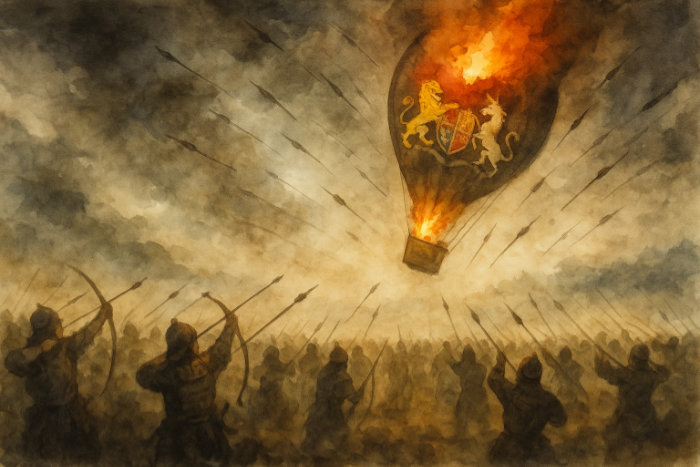
    Once the blackened remains of his aerostatic globe were retrieved, Dinwiddie took to his bunk, afflicted with a profound dread usually reserved for the condemned. He shook, perspired, quivered, and palpitated; so much so that Pu-erh, apprehensive of her own fate, having been placed in charge of the Scot by the Qianlong Emperor himself, summoned a team of imperial physicians and acupuncturists. Their examination of his tongue revealed flaws in the state of his kidneys, bladder, intestines, stomach, spleen, lungs, heart, gall bladder, and liver. Moreover, its shape and colour pointed to a severe deficiency in Qi; red dots suggested heat or inflammation in his blood; and the thick coating was indicative of an allergic disorder compounded by digestive imbalance. He was dosed, moxibusted with mugwort, and cupped, scraped, tickled and pricked to the point of tears and bellows.

    He may as well have reclined sunning himself in the Imperial Garden, for Lord Macartney’s overtures to the Emperor had crashed and burned as completely as the globe, with tangible repercussions for the delegation. Macartney, preoccupied with weightier matters, had never much cared for Dinwiddie’s pet project in any case, and failed to notice its absence from the exhibition.

    Dinwiddie resurrected himself and managed to prepare for the official event. The Emperor was contemptuous, tarrying for less than five minutes before repairing to the quarters of his latest concubine. After his disdainful exit, Pu-erh conveyed his comments to the scowling Lord Macartney and deflated Dinwiddie:

    “Your air pump is of little interest, though the telescope might amuse children. He finds your planetarium infantile too – not unlike the sing-song clocks hawked in the Canton marketplaces,” she said. “The Emperor already owns a superior model, anyway, presented as a personal gift by a German delegation. It is true your giant lens can melt a copper coin, but will it melt his enemy’s city? He believes not.”

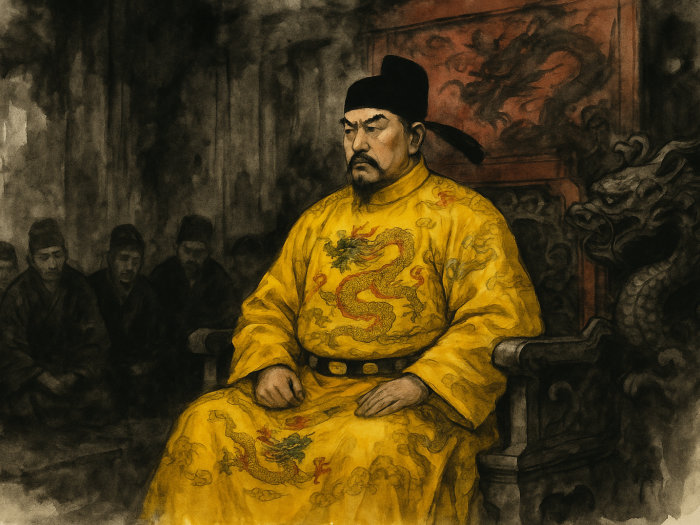
    The next day, she was summoned to the Dragon Throne. She kowtowed three times as she approached. The imperial ministers, secretaries, and scribes were in attendance, assisting the Emperor draft a reply to King George’s letter. Her attendants delivered the sketches and notes she and her agents had compiled regarding the scientific instruments.

    The Qing Emperor, in his Bright Yellow court robes.

    “You have performed your duties exemplarily, our flower,” the Emperor said. “Our indulgence of the foreign delegation, exasperating though it was, has nonetheless proved edifying in certain significant respects. Their ships are capable and well-armoured, their weapons powerful beyond our anticipation. It is useful to glean these odds and ends regarding the abilities of their scientists and craftsmen. Oh, that fellow, that worm …”

    Lord Macartney,” prompted an advisor at his side.

    “That’s it – Macartney. I will never forget that spotted mulberry suit of his – the enormous diamond star, medals festooning his chest, and that hat – that ridiculous plume of feathers! The very image of presumption and self-importance. What a … peacock! But bumbling as a poacher setting snares in the Imperial Garden!” He let out a hearty laugh, provoking a ripple of hilarity among the ministers.

    “Insufferable dunce and fop. Humming and hawing about the significance of rituals and this and that, how he should bow and the rest of it. Disdains kowtowing to our Throne indeed, but performed some silly sort of jig instead. And they wouldn’t leave! They would like to have remained in Jehol the whole summer long! Those English have incurred my great displeasure – no more favours for them. Mark that, a ministerial edict for you: No more favours. Allow them two days to gather their paraphernalia, then escort them from the capital forthwith. The nonsense of this king, his wild ideas and hopes. Ah, that is apt! make a note. Come, take this down,” he said, flicking his fingers at the nearest scribe. “We shall draft the edict:

    “Your England is not the only nation trading at Canton. If other nations, following your bad example, wrongfully importune my ear with further impossible requests, how will it be possible for me to treat them with easy indulgence? Yes, good, and while I think of it, that point about letting in their proselytizers … Regarding your nation’s worship of the Lord of Heaven … Ever since the beginning of history, sage Emperors and wise rulers have bestowed on China a moral system and inculcated the code of Confucius, which from time immemorial has been religiously observed by the myriads of my subjects. There has been no hankering after heterodox doctrines.

    “Well and good,” he said, looking down at Pu-erh and granting her a broad, warm smile. It was the first smile of any sort, indeed, that she had ever received from him. “Foreign ideas and fancies can breed serious disharmony, can they not, our petal? The last thing we need is exposure to them. What was it that my father used to say? ‘Destroy the seed of evil, or it will grow into your ruin,’ or something to that effect. By the way, how is your beloved Bright Yang? Has he returned with the tiny elephant and soldiers?”

    She averted her eyes and slowly shook her head.

    “You see, I know more than I let on,” he said. “I even heard scraps of a crazy rumour that the barbarians can fly! The nonsense that gets around. Never mind, he was unworthy of you, that Bright Yang. Yet fear not, a woman as intelligent as yourself must be much sought after. Is such a brilliant flower, however plain, worth more than the prettiest concubine? No, she is worth ten of them, and not just for lacking their vacant minds. Stupidity makes a concubine restful. But you, dear petal, you keep us guessing. Oh, that is not quite well put, is it? Naturally a pretty concubine is all the better when graced with an astute mind, is she not? How old are you, our petal? When were you born?”

    She told him, and he slowly shook his head.

    “That is what I have heard tell, but would you truly have me believe in the gold elixir of immortality? Have no qualms, our enlightened one, you need not seduce me with the fairy tales of your sect. Despite my patronage of Tibetan Buddhism and my abiding friendship with the Dalai Lama, I do not entertain the slightest aversion to your affections for the Tao, though its religion and philosophy I neither believe nor understand. Alas, there are far too few of you left in the upper echelons, though I’m told that some of your rural cults are regaining popularity amongst the poorer, lower-class folk. No matter, you have earned our fond indulgence, and may rely upon it to the end of your span under Heaven.”

    Again he shed the glow of his smile upon her, or so it seemed, enhaloed as it was in the golden rays reflected from the Dragon Throne.

    If Pu-erh had never doubted the Emperor’s enduring patronage, she did now. Another warm smile deepened her unease. He dismissed her and returned to work on his epistle to the British.

    “The beginning and middle are good,” he said, “but the end needs attention. Where were we? Ah yes … I do not forget the lonely remoteness of your island, cut off from the world by intervening wastes of sea, nor do I overlook your excusable ignorance of the usages of our Celestial Empire. I have consequently commanded my Ministers to enlighten your Ambassador on the subject, and have ordered the departure of the mission. Etcetera, etcetera, etcetera … Now for a firm conclusion: Should your vessels touch the shore, your merchants will assuredly never be permitted to land or to reside there, but will be subject to instant expulsion. In that event your barbarian merchants will have had a long journey for nothing. Do not say that you were not warned in due time! Tremblingly obey and show no negligence! Yes, that should do it! Inscribe this missive on yellow silk of the finest quality, deliver it to the mulberry peacock and impose my edict upon him to begone in two days’ time, at the risk of your heads!” He uttered the final phrase in an ominous tone that echoed in the hall, then smiled broadly.

    Lord Macartney received the yellow silk epistle, mercifully unreadable to him, and departed China ignominiously, his retinue and exhibition articles hastily boxed. Aboard the Lion as she set sail from Macao, he stood on deck with her captain.

    “Are they ignorant that a couple of our English frigates would outmatch his entire antiquated fleet?” Macartney said bitterly.

    “From what I have seen,” the captain said, “it would take no more than half a summer. Half a dozen broadsides would block the so-called Tiger’s Mouth, which guards the waterway into Canton.”

    “The population would be condemned to starvation. The Empire of China is much overrated. He is a crazy old man of war, kept barely afloat these past hundred and fifty years, which through its impression of bulk has managed to overawe its neighbours. Ah, he’s rotten at the timbers …”

    “Through and through, m’lud. It won’t be long. He’ll drift as a wreck and surely be dashed asunder on the rocky shore.”

    “The tyranny of a handful of Manchu tartars over three hundred millions of Chinese, who will not endure their condition for much longer. Still, we must forbear while a ray of hope remains for the success of gentle measures. At any rate, left to its own devices, I believe the dissolution of this imperial yoke will precede my own.”

    Two British ships, the Lion and another, leaving China under full sail.

    The captain watched the lord’s back as he paced away, then turned discreetly from the breeze, to shake his head, light his pipe, and allow himself a wry face at the tales of his superior’s disastrous mission, which were attaining satirical proportions amongst members of the envoy and crew.

    • • •

    Approaching twilight, two unexceptional sojourners tramped down the dusty track that skirted the flank of Timeless Mount – a poised woman and a mustachioed youth – both clad in plain, weather-worn robes, the modest dress of those who have forsaken rank. Though travel-marked, they bore the composed, abstracted air of those returned from beyond time’s keeping.

    As they neared a fork in the path, one arm climbing higher, the other tracing a ridge eastward before dipping into dense forest, three grizzled bandits in big boots and hats came up behind them.

    “Oi! What’s your hurry, peasants?” one of the bandits growled and the two turned to face them, bowing low and repeatedly, out of old acquaintance with peril.

    The one who had spoken snorted his satisfaction at what he perceived as their humility, blind as he was to the absence of fear in it. “You can chuck down all that stuff,” he said, jerking a thumb, the other hand gripping the hilt of his goose-wing sabre, as he limped toward them. The pilgrims eased their carry-poles from their shoulders to the ground. “Toady, have a look-see what we got ’ere.”

    One of his henchmen, distinguished by the angry boils covering one side of his face, did immediately as ordered, dropping to his knees before the packages and opening them up. Periodically, he scratched at his face, his boils themselves seeming to have boils.

    “Clothes and stuff, pretty nice, silk even!” he said, holding up a deep blue scarf patterned with peonies. “Now, what have we got ’ere in this box? All this writing-stuff and little statues and books and bells and little pots, and all sorts of other useless rubbish.”

    “What about food?” said the third bandit, urgently, his eyes wide.

    “Hold on, Yongyan, give me a minute. We got some carrots, rice, and beans. Not much chop.”

    “Better than nothing,” said the third bandit, a man more corpulent than hardened. “We got more back at camp, anyway.”

    “Pack it all up, you two, and let’s be off.”

    Down from the track they stumbled with their prisoners, pushing through the bamboo until they came to a small cleared area with a fire-pit and the rough wherewithal of a bandit’s trade: a meagre stack of weapons – spear, pike, sword, and a musket – and a dismal pile of loot, which they may as well have obtained by begging: a modest heap of bronze coins, a studded leather belt, an old bamboo flute, an abacus, a compass, a wooden figurine of the Buddha, a drawstring burlap pouch, and other odds and ends.

    Pu-erh and her son sat in silence, loosely restrained by a rope, observing the men as they cooked up the food, ate, and passed around a flagon of rice-whisky. She was adorned with not one extra wrinkle since we last saw her, all that indeterminate period before, though her little boy Mow Fung was matured into an adolescent fellow of lean frame and quiet grace.

    “Better give them a bit,” the leader said through a mouthful. “Might be the last meal they ever have before getting all sliced up into bits and pieces and their heads chopped off.” His guffaws dwindled when she fixed him in her level gaze.

    “Your name, sir?” Pu-erh said politely to the one with boils, who leaned over to them with two wooden plates of beans. She and her son had already freed themselves from their restraints without any fuss. The bandit had removed his headwear, and even in the dim light one could see that the boils continued up from the side of his face and across half his cranium.

    “He’s called Ugly Toad,” the leader said. “The other one goes by Yongyan the Hungry. And me? Wang the Eviscerator.” He lifted his sabre from the ground beside him and waved it in the air. “And this ’ere’s what does the evisceratin’. So you better watch your p’s and q’s, got it? Are you from around hereabouts? We’re new ourselves, lookin’ for a good place to set up a proper hideout and all that. Heard there’s treasure up on that next mountain, Time’s Heavenly Sanctuary Blah-Blah-Something-or-Other, so we figured we might head up there a ways.”

    “That would seem an unfavourable location for those of your profession,” she said.

    “Oh it would, would it?”

    “Certainly, unless you would enter the lair to look for the tiger.”

    “Allow me to be the best judge of that,” he said. “But go on, proceed, tell us a bit about it, since you seem to know so much about everything. What is it you do around this neck of the woods, scratch the dirt, I suppose?”

    “Simple hermits. We study and improve ourselves; distill the gold elixir; wander from village to village; tend the hidden temple; heal boils; make rain; exorcise ghosts; give blessings; heal boils (it’s a recurring problem); prophesy destinies; interpret the countryside; create and burn talismans for good or ill fortune …”

    “Ar, got it,” said the leader and guzzled from the flask. “Quacks. What a coincidence. You know, before this we worked as ginseng poachers in Fusong County up at Changbai Mountain. Not much fun, I can tell you. You get those Manchus after you, because it’s their sacred place, you see; and then you get the black bears too. If it’s the Manchu, you run like the wind, for your head’s at stake. If it’s the bear, you don’t run or fight, whatever you do, but play dead and freeze, and be good at it, too, because they’ll push and prod you around to see if you’re faking, and if you are, they’ll more than likely take your head off before they gobble you up. Here, I’ll show you one of my gut-wounds, still septic it is after all that time. Pretty nice, eh? Well, I never made a peep, you better believe it, though he licked all over my face and blew his rank breath up my nostrils. The ginseng takes a lot of poaching indeed – but if you know what you’re doin’ it’s worth more’n silver. Sometimes, if you’re lucky you’ll hear a special little birdie singing, what’s telling you the ginseng is there; and if it is, it’s so fiddly to get it out you might as well not even try. The root can disappear or run away, too, because it’s magic. It’s just the exact shape of a human and it’s got the mountain spirit in it, so you have to lasso it by the sprouts with red cotton thread with the ends weighed down with two bronze coins. Then you tie it up to a sort of special trap until you dig it out without breaking any of it, which is next to impossible anyways. We’ve saved two in that little sack, which is about all we got out of the exercise. To tell the truth, we haven’t been much chop at working as bandits, either, but that’s another story.”

    “Gold elixir …” said Yongyan the Hungry. “Any alcohol in it?”

    “In the modern day, it’s generally understood as a potion of immortality formed within,” Pu-erh said. “Hence the term inner alchemy. The gold elixir is the innate knowledge and power of the mind – a fusion of vitality, energy, and spirit: the forces of creativity, motion, and consciousness – refined through rigorous observance of the Tao. By contrast, external alchemy follows the example of one of the Eight Immortals, Iron-Crutch Li. Its goal is to concoct a pill of immortality by combining ingredients like lead, mercury, cinnabar, and sulphates, then firing them in a furnace. Unfortunately, the ingestion of such pills often results in death. Some lesser practitioners attempt to raise their consciousness through crude experiments with plant extracts.”

    “Deviant practices,” Mow Fung said, with the shadow of a smile, closing his eyes. The bandits stared, then glanced at one another, slack-jawed.

    “He don’t say too much, do he?” said Wang the Eviscerator at last.

    “Those days are gone,” Pu-erh sighed, “when condemned prisoners were made available as subjects for such experiments. As for these mountains, they are favourable to our alchemical purpose: the pursuit of the elixir. For here, tucked in a valley that time forgot, lies a village where months pass as years and the people scarcely age.”

    “Heal boils, do you say?” said Ugly Toad.

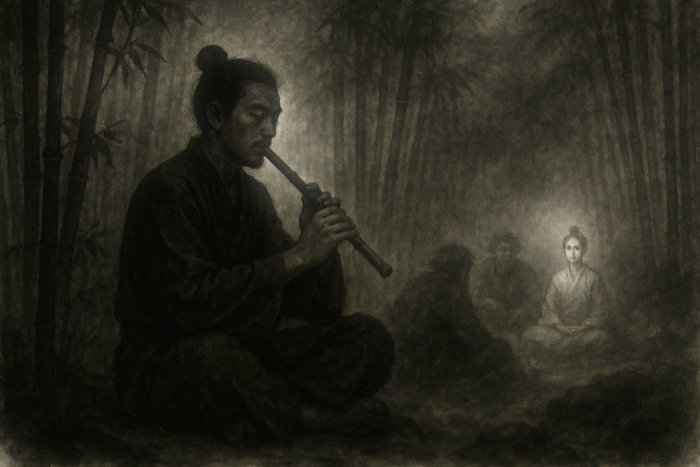
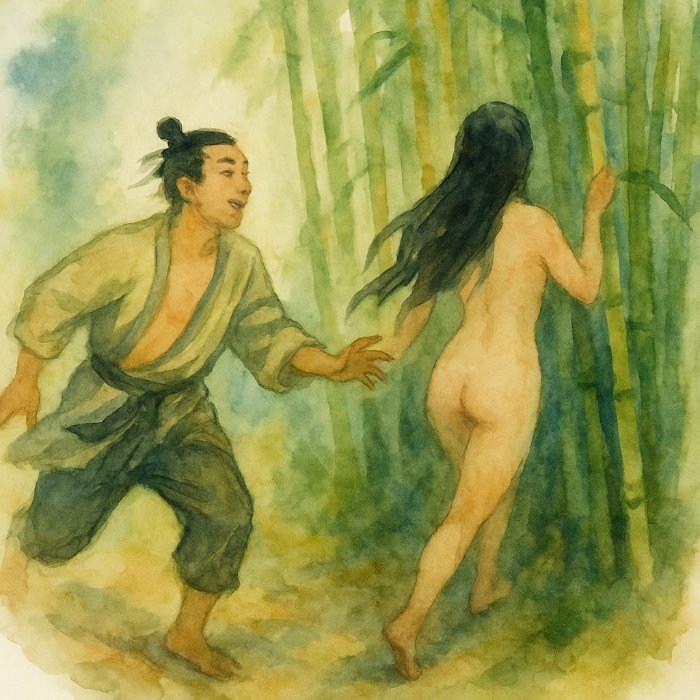
    None of the bandits paid any attention as Mow Fung retrieved the bamboo flute and moved to the edge of the clearing without a word, where he sat down cross-legged again and began to play.

    The campfire crackled. He ad-libbed lento through melodic variations once taught to him by the Imperial Music Master, as a favour to Pu-erh. In theory, they formed a transcendent framework based on the King Wen sequence of I Ching hexagrams from the late Shang Dynasty, embodying a microcosm of the universe.

    Mow Fung playing his flute in the dark bamboo grove, with Pu-Erh and the poachers in the background

    Without effort, the young man lent the intrinsically dry exercise a style idiomatic to the flute, evoking in everyone present an impression of a lonely moon suspended in a frosty autumn night sky, though not one of them made mention of it.

    As he played, he reflected on dim memories of his infancy in the Forbidden City, and on the blurry period that followed, living their lives in hiding and reclusion among caves and forests, and in the infinite seclusion of the mountain. How the years had flown since they fled, when one looked back, while seeming, minute to minute, to progress in ordinary time – so that he, an apparent “youth” – had lived the span of perhaps two lifetimes for one of his corporeal age.

    “You might as well keep that thing,” Yongyan said. “None of us could get a note out of it.”

    “What was that you were saying about boils a while earlier?” Ugly Toad asked quietly. “I’ve been having trouble with these for years. Getting worse rather than better, I’m afraid.”

    “Those little blemishes?” Pu-erh said. “Why, you can hardly notice them. They’re really not worth bothering about too much, do you think?”

    He gave her a meek and appreciative grin. “I’ve tried all sorts of remedies from quacks all over the countryside, but they’ve only made things worse.”

    She took a dab of unguent from one of several minuscule clay pots stacked into her carry-sack and told him to apply it. Though scarcely more than a smear, it seemed to warm in his fingers and swell slightly as he rubbed it in – not diminishing, but softly renewing itself. After a long while, she told him to save what remained for daily use. There would always be enough, she said, so long as he didn’t try to measure it.

    “Feels better already,” Ugly Toad said to Wang the Eviscerator. “You should try it, you know, for your belly.”

    “Well, you do realize I was only kidding about cutting you up into bits…” Wang said to her through his toothless grin.

    “I knew your capabilities the moment we met,” she said, “and I was doubtful they include the eviscerating of unarmed victims. Unfortunately, the unguent is only a salve, a stop-gap measure. Cures for both your complaints will require substantial time and involved procedures. Take heed that if you leave your bear-wound as it is to heal, you will assuredly die. Moreover, if you lead your party to seek treasure on the upper mount as you implied was your plan, the three of you will surely perish all the sooner.”

    The following morning the five took the lower path, hiking along the ridge and descending into thick forest. They entered a narrow trail that soon forked into a dozen offshoots, each of which branched again and again into near-identical tracks, until they found themselves in a bewilderment of forks and false turnings. Only Pu-erh and Mow Fung seemed to know the way. At last, near midday, they emerged before a dilapidated temple, half-lost in the undergrowth.

    “Rest now,” said Pu-erh. “We will return before nightfall.”

    The temple and its crumbling attendant building sat on a ledge where the land dropped away into a mist-filled void. Behind it, cliffs fell sheer to silence, visited only by haughty eagles who wheeled and nested in the inaccessible crags.

    The three bandits felt a rush of exhilaration at the sight – a sensation unlike any they had ever known. They settled in to await the return of their two guides or perhaps some wandering monk. An overwhelming solemnity fell over them, as though from this high place one might commune with the Eight Immortals – whoever they were.

    “We were looking for a hideout, and we have found one,” said Wang.

    “Without knowing the way, no one could ever get in,” said Toad.

    The void was an immense auditorium of silence, from whose depths came the thin cry of a hawk.

    “… or out, for that matter, you might say,” said Yongyan.

    “You don’t think …”

    The three cast glances at each other, before settling down for a smoke.

    “How could you suggest such a thing?”


    From the draft novel Stawell Bardo © Michael Guest 2025

  • Junction Teahouse

    Junction Teahouse

    Junction Teahouse

    Honourable Buddhist scholars leave the East and go West. Mr Daruma, who doesn’t like Buddha, leaves the West to come East. I thought they might meet at the Teahouse of Awakening. Alas! It was only a dream.

    ⁓ Japanese Zen monk Gibon Sengai (1750–1837), adapted.

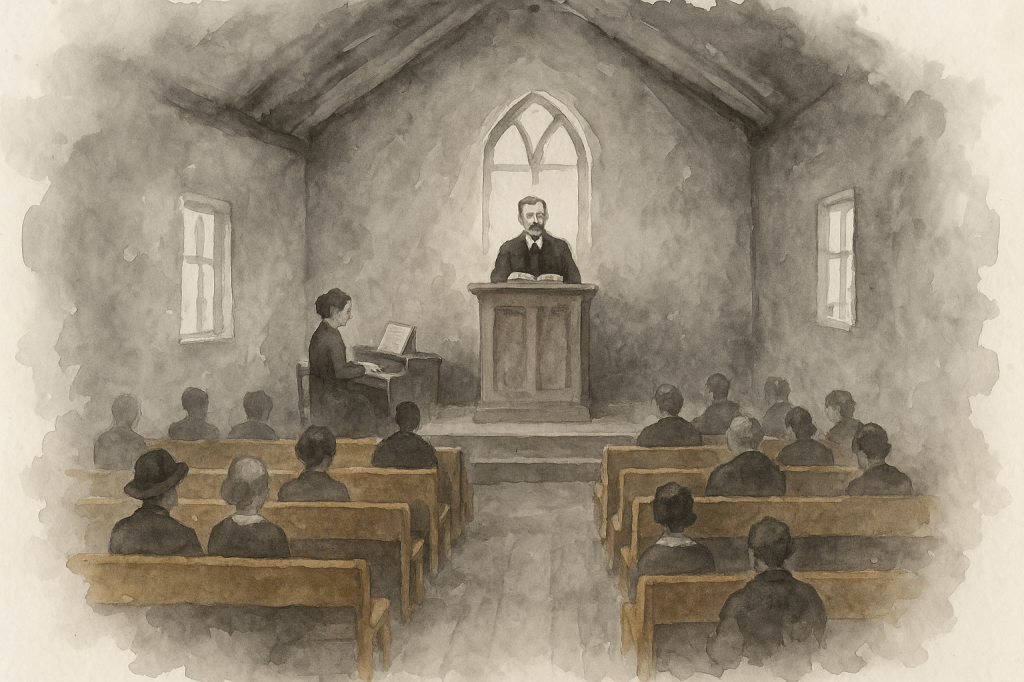
    It was Sunday, and a hush had settled over Stawell and its environs, less the product of Christian observance than the fatigue of a community wilting beneath a heatwave. The constables were at rest, their boots airing by the door, while their horses, in the shaded yard behind the lock-up, stood twitching at the flies. Grave-faced publicans bent over their ledgers with a grim focus. And the Reverend Hollins, in his peculiarly tremulous voice and occasional sighs tantalisingly suggestive of a faltering conviction, sermonised to a reduced congregation: a smattering of families, several women in white gloves already thinking of their lunch preparations; a town councillor occupying the aisle-end of the front pew, his straw boater tucked correctly beneath one arm when rising for a hymn, believing virtue to be transmissible through nods, smiles, and a strategic proximity to the pulpit; and indelibly, two boys whose giggles, once stirred, proved difficult to suppress, captive in the back pew, passing between them a folded scrap of paper on which they scratched and scribbled at a caricature of the preacher, recognisable chiefly by the earnest absurdity of his moustaches, while off-key strains of Jesus, Lover of My Soul wheezed from the beloved but dilapidated harmonium.

    The shopfronts along Main Street were shuttered, each a mute testament to the Sabbath and the wisdom of retreat. At the swimming hole, boys lay strewn in a loose ring beneath the gums, not so much resting as resisting motion altogether, while their sisters played jacks in the spindly grass nearby, casting now and then a glance at their brothers that combined idle curiosity with frank disdain. They had all been spectators the day before, as Stawell’s cricketers ruthlessly dispatched the visiting Ararat team, notorious across the Wimmera competition for their aversion to practice afternoons.

    The players themselves had scattered after the match, victorious and vanquished alike, most of them inclined to the drink. By nightfall, it was difficult to tell who had won: the mood had turned to the camaraderie of once-opposing warriors. On the brink of sunset, a few were seen crossing a drying creek bed, stumbling and laughing while arguing a call of leg-before-wicket as if time might reverse itself were the point laboured long enough, while the bottle, wobbling among them, passed hand to hand with the erratic solemnity of an intoxicated relic.

    Forster was not at rest on this Sabbath, nor was he attempting rest, which for him had never been a natural state – least of all while that torn bundle of clothing remained stubbornly mute. The scattered remnants of hat, flannel undershirt, trousers, and coat refused to yield the truth he was sure they withheld. During the week he had moved among storekeepers, stablemen, drinkers, and those who passed for bush-hands in that part of the country, collecting fragments of recollection that slipped, often visibly, from possibility into fancy. They revolved in his dreams, these lingering ciphers of some anonymous, ill-treated lost soul: a vest too long for most men, with a single bleached button still clinging to a thread; a coat with its lining turned the colour of the grass in which it was found; a twilled shirt, comparatively new, now torn open at the front and stained along the seams with dirt and dried blood. An unremarkable wardrobe from which to conjure a name.

    And it nagged at him that something vital waited to be perceived, if he could only loosen his grip on his habitual, strictly methodical approach to such evidence. That morning, he had reread a marked passage from a volume he carried in his travelling library, an old work by the British physiologist William Benjamin Carpenter, something about knowledge arriving through circuits of which the thinker remains unaware. “Unconscious cerebration,” Carpenter called it. Not instinct, exactly, but a deeper faculty, which underlies reason. It reminded him of something the Chinese publican had said to him offhandedly: that a man may fix his gaze too closely on the fragments of a thing, and so miss the thing itself. Forster, who did not consider himself a mystic, found the idea returning to him incessantly in recent days, like a tiny pebble he could not get out of the sock of his reason. Yet oddly persuasive. The detective was, like Carpenter, a committed empiricist, but it seemed to him of late that a narrow channel might exist between the Western scholar’s rigid concepts and the Buddhist’s drifting brushstroke. Whence come our “hunches,” our “insights,” our “intuition”? he mused as he crunched along, his plain walking stick, little more than a trimmed length of hardwood, tapped lightly at the ground as he pondered. That solution to a problem suddenly flashing into the mind unbidden: whence does it arise? Its quiet elaboration occurring beneath the awareness.

    The heat bore down, and without quite intending to, he had taken the red track to Deep Lead. Past the edge of the diggings, smoke exuded here and there in the Chinese camp, tinted with incense. Truth to tell, when entered from this side, alleys leading from the main street bore signs of the dissolution of which the camp was sometimes accused. There were a few grimy, tumbledown edifices, constructed as though from a pack of pub playing cards – among them opium haunts; the area had of late become known for drawing the idle young from miles around. Here and there loitered denizens of an unprepossessing, not to say suspicious, appearance; but even so, Forster reflected, there was a loafing, arrogant class of colonial that roamed around the country and might as easily be found lolling and expectorating about the corners of the principal streets in the best Australian cities.

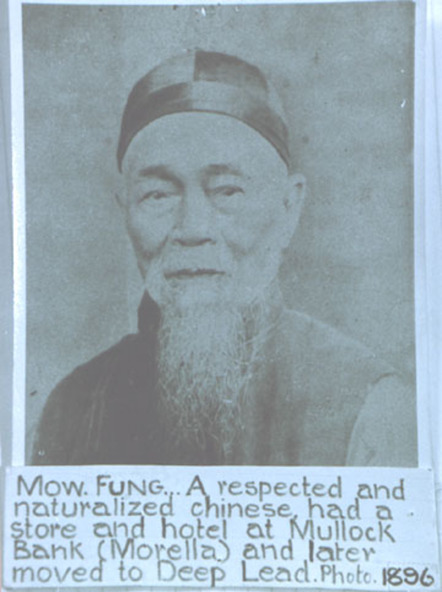
    Towards the Junction Hotel end, the outlook was much improved, a man here and there repairing an eccentrically designed but spotless and sturdy cabin, or watering a vegetable garden; women in loose cotton trousers and indigo tunics, sleeves rolled to the elbow as they stooped and rose, pegged laundry to low-strung lines between sheds. Beneath a couple of pepper trees in a scorched yard, half a dozen children clad in faded cotton shrieked with delight as they played a game of bat and ball. A little further along he spotted Mow Fung’s own eldest daughter Lena, appearing wraithlike in the haze, suspended in a shimmer of mirage. She was some distance off, walking in his general direction along a track that led into the dusty street. As she came nearer, she recognised the detective and offered a pleasant smile and nod, gesturing that she was on her way elsewhere. He paused under the eaves of the Junction Hotel and glanced at the door. And just at that moment the proprietor appeared from around the corner of his premises, wearing his habitual loose trousers and black satin Chinese “melon rind” cap.

    Forster settled into one of two comfortable cane chairs arranged on either side of a small table in the corner of the Junction’s exaggeratedly named Tea House, where his acquaintance had guided him with quiet formality. Actually an interior room, it lay beyond public access, tucked behind the family quarters and adjoining a dim little chamber that might have been a storeroom – it was hard to say. Shelves lined the far wall, crowded with potted plants that leaned gently toward the filtered light. The tearoom itself was reached through a plain, easily overlooked door, and Forster had the distinct sense of being ushered into an inner sanctum, not merely for the warren-like route that led him there, but for the subtle change in the publican’s bearing as they entered: an attitude approaching deference, tinged with the protective instinct of a man offering something precious to one who might not recognise it. Perhaps his one or two official visits to the hotel since the post-mortem had earned him Mow Fung’s trust. It was an unintended but welcome result for a city detective newly stationed in the district, slowly learning the elusive protocols of rural trust.

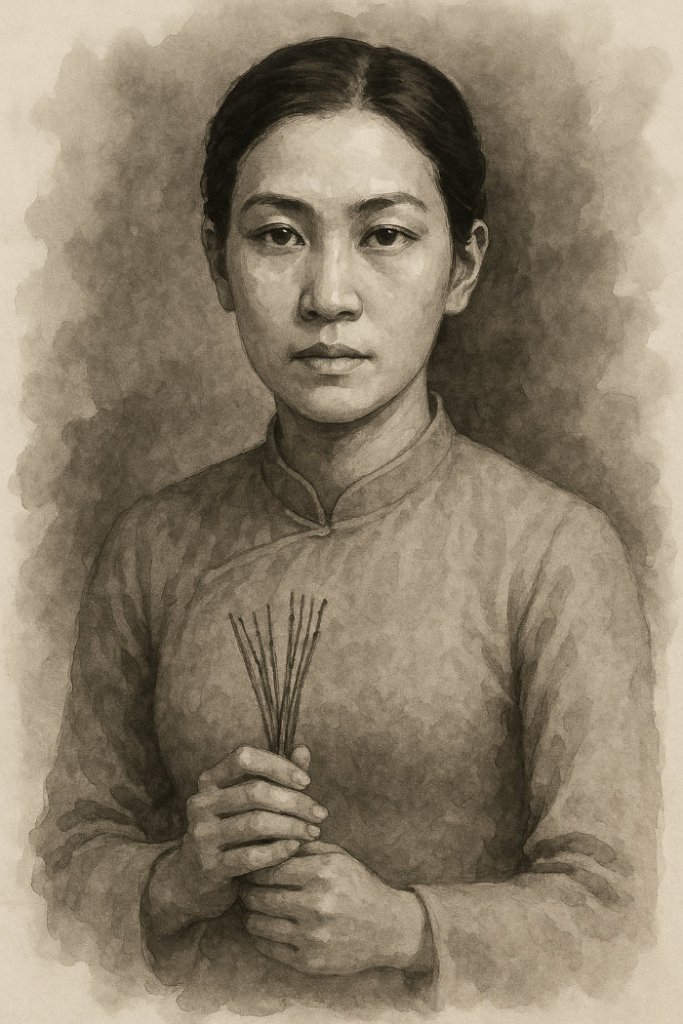
    Mow Fung had then excused himself, to attend to some domestic task or other. More finely dressed than on previous occasions, Mrs Mow Fung was seated at a table in the far corner, opposite a woman whose back was turned to Forster; she gave him a quick smile, then turned back to her companion. The two conversed in hushed tones, drifting between English and Mandarin. A lacquered box sat open on the table, its contents laid out with care: long stalks, slender and pale gold, like dried reeds, along with a square of folded silk, an inkstone, and a strip of scarlet paper. They were playing a counting game with the stalks, or as far as he could tell, tallying up accounts. Forster glanced away, thoughts wandering as he looked out at the garden beyond the window. There was Mow Fung with Lena watering a wattle. Even a scene of such trivial domesticity had the power to soothe the soul, within this hush.

    A soft sound drew him back. The woman had shifted in her seat, and he could see her more clearly now: her lissome form and proud profile even with lowered eyes – beauty understated, yet unmistakable. She wore a pale silk blouse, the fabric catching the light just enough to reveal a faint peony motif in the weave; below that, loose, modest dark trousers.

    Mrs Mow Fung moved the stalks in her hands while the other woman watched intently, Her elbow rested on the table beside the inkstone box, fingers idly tracing its lacquered edge, her posture languid though her eyes tracked the other’s every gesture. She looked up as Mrs Mow Fung posed a question, articulating each word slowly in Chinese, and the answer came in an equally measured tone.

    Mrs Mow Fung’s sleeves made a faint, dry whisper as she moved and a moment later she tapped the yarrow stalks lightly on the square of silk. The woman said something inaudible, and Mrs Mow Fung gave a soft laugh in reply.

    “Yes, they are called ai yao, and that lovely perfume lingers on them for a long time. But we should be quiet now and think only about what troubles you.”

    Forster resisted an urge to clear his throat. He reached for the small teapot on the cane table and poured some tea into one of the two small, handleless Chinese cups Mow Fung had set down. He was sure the splash had cracked the silence, but neither woman looked up.

    Forster closed his eyes. He flinched at the first sip of tea, then smacked his tongue lightly against his palate before taking another. It was a tad bitter, with a taste of mushrooms and … damp soil … that caught him off guard; but after he swallowed, a subtle aftertaste emerged: warm, sweet, and unexpectedly wholesome. He lifted the cup to his nose and inhaled its strange aroma.

    Across the room, Mrs Mow Fung spread the stalks slightly between her hands, then divided them into two uneven bundles, with practiced ease. From the right-hand pile she drew out a single stalk and placed it aside, distinctly articulating the word “Heaven.” The remaining stalks she counted in groups of four, sliding them gently between her fingers until three remained. These she laid to one side, and gathered the bundles again. The motion was repeated. Divide, draw, count, set aside – three times in all.

    Forster listened to the rhythm: a rustling of sleeve, a concentrated breath, a feminine murmur. A pause. “Yang,” said Mrs Mow Fung. The younger woman took up the brush and marked a single line on the red paper – one clean, black stroke. Mrs Mow Fung took up a new bundle, and again the process unfolded: division, removal, counting. At the end of the cycle, she cupped the remainder in her palm and said, once again, “Yang.” Another mark was made – two strokes now, neat and parallel.

    “It is excellent quality Pu-erh tea.”

    Forster opened his eyes. The proprietor had materialised across the table. “It is,” Mow Fung added, “imported from the city of Pu’er in Yunnan province, the only place in the world it is cultivated.”

    Clearly on an intuitive impulse, having judged something favourable in his guest’s manner, he paused and continued:

    “‘Pu-erh’ is an important name in my life,” he said, “but not because of the tea. In my tradition, it’s also the name of a semi-immortal – a Perfected being, a sort of spiritual ancestress.

    “When I was an infant, there was a ritual – a dedication, not unlike a christening – where she was named as my guardian. When I grew a little older, I was told she had been my mother in earlier lives. Her task, I learned, was to help me return to my original true self.”

    Forster blinked, having anticipated nothing quite so personal, nor so metaphysical. Each looked quietly at the other as the words echoed away, infusing the atmosphere of the tearoom.

    “Unfortunately, I could never learn to do that.” Mow Fung chuckled as he reached for the teapot and poured again, the dark stream sliding softly into each cup. The deep, earthy perfume rose. “If you are not used to it,” he said, “it can taste a little like mushrooms and dirt.”

    “It’s not too bad,” Forster said. “Even to a milk-and-two-sugar man like myself. You’re uncannily right about the flavour. Must’ve read my mind.”

    “Much easier to read the face,” said Mow Fung. “Tongue-sounds too – most revealing.”

    Unsettled, Forster reverted to a tone of workaday officialdom, which rang oddly in his own ears amid the intoxicating bouquet of the Pu-erh tea.

    The female voice came from the far corner, and Forster glanced across to see the young woman holding the calligraphy brush upright in her left hand, poised to paint a mark.

    “Shame about that article – you and the doctor, after the post-mortem,” Forster said. “One of the constables tried to chase off that blasted reporter hanging about, but unfortunately not firmly enough.”

    If Mow Fung noticed the tone at all, he betrayed it only in the steady, crystal gaze he cast into Forster’s eyes before reverting to his humble mien. The atmosphere was once more in balance, as the women’s voices drifted and the yarrow stalks whispered on the silk.

    “Ah,” he smiled. “Newspaper. Sometimes the young reporter sees what he wants to see. Wants to make the reader of the newspaper feel superior to a lowly ‘Chinaman’ like myself. Always so. Very natural.

    “In this case, Doctor Bennett needed to wash his hands, but Mow Fung could not allow the dead man’s spirit to adhere to utensils like a bowl or towel – not only for the purity of the space, but for the spirit’s own journey. He should not get stuck to more things here, but instead, progress through the proper stages into the beyond. For this dead man, such matters are especially important, because he is disconnected from his head. It is said by some that a person should be intact, or they will never escape from this world.

    “So, leaning back, not to get splashed, I pour water from the trough over the doctor’s hands to wash them, with the water running into the earth, just as in our ritual cleansing. Doctor Bennett offers me the soap, but for obvious reasons, I refuse to take it back. And what do we find? Articles not only in Hamilton Spectator but as far away as Adelaide Observer. That ‘Heathen Chinee’ headline … Like all Chinese, superstitious, afraid of death, too ignorant to take the soap! Poor Mow Fung! Ha!”

    Across the room, Mow Fung’s wife made two quiet raps on the table, freezing mid-motion as she replaced the stalks into their lacquered box.

    “So sorry, my dear,” said the husband with a chuckle. “Getting a little excited. Since you’re finished, would you keep Detective Forster company while I fetch something I want to show him?”

    The younger woman’s gaze flicked up – not startled, but suddenly still, her face passive for an instant.

    “Detective,” she said, “I see.” She wiped the brush clean and pressed it gently into its groove beside the inkstone.

    Forster, already halfway into a polite nod, faltered slightly.

    “Would you care to join us?” said Mrs Mow Fung, smoothing over the pause.

    “Only if I’m not interrupting,” Forster replied.

    “We were done,” said the younger woman, her tone cool now. “All the lines are drawn.”

    “Please – call me Anna, my English name,” said Mrs Mow Fung graciously. She motioned to the seat beside her. “This is my dear friend Lili.”

    The young woman’s gaze slid from Anna to Forster and back again, and she offered a minimal nod.

    “Excuse me,” she said to her reflection in the window, languidly adjusting her sleeve. A fine silver bracelet caught the light. “Teahouse rituals are deeply exhausting.” The trace of an American accent barely surfaced.

    “You have been playing an intriguing game,” Forster said. He was looking at Anna when he spoke, but he caught a barely perceptible shrinking in Lili, like a bracing, or a folding inward.

    “It is not quite a game,” Anna said gently, “but more of a window into ourselves. It can speak to you, if you listen.”

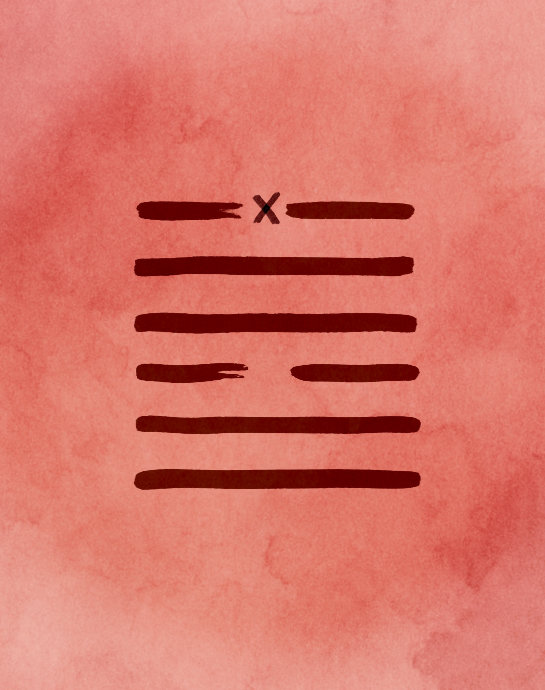
    Lili regained her composure just as if it had never left. She tapped the red paper with the six parallel lines she had drawn. “It says someone in the room asks too many questions.”

    “This picture is called a gua,” said Anna, ignoring Lili as she might an impertinent child. “You see it is made up of two parts, upper and lower; here they are both the same, a picture of a lake: two Yangs with one Yin – broken line – on top. That is a most desirable gua: one lake perfectly reflecting another lake; two lakes side by side, filled with water, sharing it all with each other. Creative is balanced by receptive. The inside and outside are as one, without any separation. It is a state of joy, or harmony, or even delight. Profoundly satisfying.”

    Lili sipped her tea. “I’ve heard good things about joy,” she said dryly. “It’s on my list.”

    Anna continued. “There is always a risk with joy: it must be correct. False, incorrect joy, will never last long but will disappear; having lost it, you will be worse off than before.”

    “How poetic,” Lili said. “And how typical! A pair of lakes gazing longingly at each other, just before one of them evaporates.”

    “Exactly,” said Anna, implacable. “The top Yin line, broken, is changing to Yang, unbroken – that’s why I asked you to mark it with an x. It’s the culmination of delight, but also its overturning. When we cling too tightly to pleasure, we lose ourselves. Everything changes and then comes the sorrow. That’s the nature of joy when it runs too far.”

    She glanced down again. “Now look – only one Yin is left, and it’s climbing up through the strong Yang lines. This gua becomes a new one: Treading. Heaven above the lake. Like walking on a tiger’s tail – it may not bite, but you must tread carefully. Especially if that remaining, soft Yin is misused. Squint and miss the path; limp and the tiger turns and bites.”

    Then, more softly: “But that one Yin – it’s also the key. It must remain open, yielding. That is not weakness. It’s the only way forward when the forces around you are strong. The gua speaks to your moment. It shows where you stand – and how to tread the path with clarity and grace.”

    Forster ran his finger lightly around the rim of his teacup. “Well, I suppose if you stare at a thing long enough… Some say the mind produces answers of its own, even when we think we’re getting them from elsewhere. From cards, or symbols, or whatever’s at hand.” He lifted the cup to his lips. “Doesn’t necessarily mean they’re any less true.” Climbing up, Forster repeated to himself, smiling – or floating, maybe; the fact gently floating up of its own volition.

    “Here is what I wanted to show you, Detective!” Mow Fung suddenly manifested himself in his irrepressible mode. He drew up an extra seat and slipped in between Forster and Lili, placing a small scrapbook on the table. “You will see how we are growing more famous and may soon catch up with even you, although we have not arrested even a single criminal.”

    The scrapbook was open to a page with the “Heathen Chinee” clipping. Mow Fung laughed delightedly and tapped his finger on the next column, its headline set in bold capitals: “A Chinese Lady at Ararat.”

    “Ah, this one,” he said. “Another of our local triumphs. You see – our old store on the Mullock Bank in Ararat and a banquet said to honour the arrival of a real Celestial lady from the Flowery Land.” He glanced at Anna with a boyish grin. “My wife’s debut on the goldfields. She was the marvel of the district.” He shook his head. “Eighteen years. How time flies. Tempus fugit … He frowned and glanced up, searching a different part of his brain: “Sed fugit interea, fugit …”

    Fugit irreparabile tempus,” said Lili, a singsong lilt in her voice, faintly amused by her own erudition. Mow Fung paused to look at her.

    Forster quoted the Virgil: “But meanwhile it flees … time flees irretrievably.”

    Mow Fung turned the book slightly so that Forster and the others could see the old clipping, the type still declaiming its truths after all these years. “The reporter wrote that half the township came to peer through the doorway. Then he says, ‘curiosity turned to drink, drink to uproar, and soon every man in the place was fighting – Europeans with their fists, Chinese with bamboo sticks: free fight and no favours.’ He casts me as ringmaster, conducting us Celestials in one-sided combat; and somehow we emerge the fools. while the drunken ruffians are likable country larrikins at heart.”

    He laughed softly, without mirth. “As I recall, there was supper, some singing, too much beer, and one fool who threw a weight from the counter and smashed two jars. The police were fetched; the magistrate dismissed the case. But the paper had its say: a lady from the ‘Flowery Land,’ a ‘Celestial’ riot in her honour, and another good story for breakfast.”

    Anna’s face barely shifted, but her minimal shrug suggested it took more than colonial attitudes to worry her.

    Mow Fung smoothed the edge of the clipping with a fingertip, but it curled back again. “I keep these to remind myself that in print, the story that pleases is the one that endures. I have found joy in this peaceful settlement far away from the violence and strife I left behind in China.”

    Forster shifted in his seat, unsure of what had unsettled him. Lili’s eyes lingered on the yellowing paper, musing, “And here I thought I was the exotic guest.”

    Their host turned another page. “And here – something happier.” The headline, neatly set in small type, read: “Baptism of a Celestial Infant.”

    “That was our first child,” he said. “The paper noted it as the first christening of a Chinese baby in the colony. It says the church was well attended, and that our boy bore himself with ‘admirable composure throughout the ceremony.’” He smiled faintly. “No one meant any harm. It was all quite kindly done – a curiosity for the readers, nothing more.”

    His hand rested lightly on the page. “I remember the minister’s face: the awe with which he regarded a new life; and the townspeople, craning for a better view of the novelty. We thought of it as a gesture of friendship, a courtesy between faiths.”

    He closed the book. “So – a happy clipping to end on.”

    Anna’s eyes softened; Forster gave a small, respectful nod. Lili’s reflection was faint in the window. Now so close, Forster was struck by the quivering delicacy of her beauty – as though each passing second revealed a new facet, trembling and shifting. It reminded him of a tightrope walker: balanced, poised, never quite at rest. There was a fragility to her. Her black hair gleamed and her eyes glistened in the filtered light. A gleam set gently against stillness – that was the essence of her allure. There were traces of Chinese ancestry in her eyes, but something mutable in her features, as though they might shift to match any gaze that sought to define her. Depending on the light, the company, or the hour, she might seem unmistakably Chinese or equally European. A chameleon beauty: composed, ultimately unreadable. She brushed a hand lightly through her hair. A scar traced the line of her jaw.

    “Shall I prepare some more tea?” she said, already rising.


    From the draft novel Stawell Bardo © Michael Guest 2025
  • 7. Document 17 (from the draft novel Stawell Bardo)

    7. Document 17 (from the draft novel Stawell Bardo)

    Document 17: Manifestation Series

    The unicorn is injured, why did it come? My way is finished.

    ⁓ Attributed to the Zuozhuan, on the death of Confucius, 479 BCE (adapted)

    This account, drawn from the lower ledgers in the Registry of Misperceived Wonders (Third Vault), concerns the imperfect ascent of a crown, a sign mistaken for itself, the brief elevation of a foreign scholar, and a haunting sigh. The report commences with an account of the journey of the foreign envoy from the White River, just south of Tongzhou, to the Forbidden City. The route is as well-trodden as the tropes that embellish it, so for present intents, the passage has been elided.

    Lord Macartney received with restrained annoyance the news of the extension of his itinerary a further 160 miles, extending the journey into Tartary. He was already preoccupied with the Chinese administration’s requirement that he perform full-body kowtows to the Emperor, since he was not required to humble himself in this way even before his own monarch, good King George III. He nevertheless resigned himself to attempting an approximation. Bright Yang set him at ease with a broad smile and copious applause, assuring him that his impromptu flourishes, bows and scrapes such as he demonstrated, which were worthy of the most extravagant dandy, would more than satisfy the Qianlong Emperor, who was, in any case, a most amiable fellow once you got to know him.

    Lord Macartney, an Ulster Scot consummately qualified for ambassadorial duty, departed from the capital with the majority of his entourage, leaving behind much of the valuable equipment that he had dragged to the ends of the earth as presents for the Emperor, in the care of his tiring – in both senses – travel companion, another Scot: astronomer, physicist, inventor and philosopher, one dour James Dinwiddie.

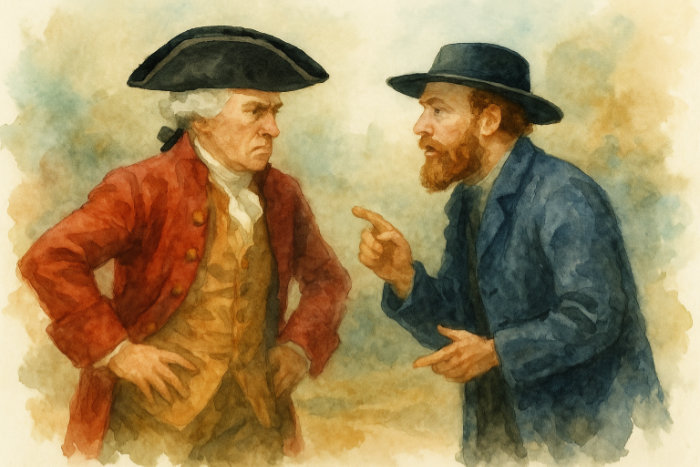
    Two European men in 18th-century dress. Lord Macartney One stands tall and reserved, hands on hips. Dinwiddie leans forward, gesturing animatedly.

    One of the marvels intended to evoke the amazement of the Chinese Emperor was a clockwork planetarium of Dinwiddie’s own devising, which had taken him thirty years to build and was acclaimed “the most wonderful mechanism ever emanating from human hands.” Dinwiddie’s second love among the collection of marvels was a hot air balloon, an “aerostatic globe” of his own design, with room for two aeronauts. Although he had never gone aloft in one before, which had proven to be a perilous feat throughout Europe, he had become obsessed with the idea of becoming the first to do so in China, and to float high above the Emperor, his court, and the citizenry of Peking, who would all be rendered agog in disbelief. Such would be his historical legacy, he foresaw: even above his planetarium and extensive philosophical tracts, it would be foremost amongst his life’s works.

    Other items in the display included reflecting telescopes, burning lenses, electrical machines, air pumps, and clocks; brass artillery, howitzer mortars, muskets, and swords; a diving bell, musical instruments, magnificent chandeliers, and vases; Wedgwood china, paintings of everyday English life, scenes of English military victories by sea and land, and royal family portraits. The cost amounted to fourteen thousand pounds – in those days a formidable sum.

    On the journey to Peking with the envoy, Sun Pu-erh took stock of the information she gathered and started a series of detailed sketches of the devices most relevant to her Emperor’s wishes, in particular the military and scientific machines and artefacts. She employed spies and draftsmen to aid in the task. Bright Yang, on the other hand, was absorbed in tales that had flourished among the populace as the envoy made its way up along the White River – tales in which, perhaps, the twelve-year-old son of Lord Macartney’s secretary had a hand, aided by his smattering of Chinese. From the point of view of the child, similar to that of the rural populace in this regard, the official inventory of planetarium, lenses, lustres and so on, was not overwhelming, hence stories grew up that hidden inside the cargo were the actual marvels to be revealed to the Emperor: an elephant no bigger than a cat; a battalion of miniature, living British grenadiers, each only twelve inches tall but perfect in the most minute detail, down to fingernails, eyelashes, and intelligence; and a magical pillow that transported one to faraway countries while one slept.

    A sentry reported to Pu-erh that Bright Yang was last observed with one of the lower-ranking concubines, following a narrow path into a bamboo grove, half-clothed and crying out in abandon, in full pursuit of the elephant and grenadiers. She raised an eyebrow expressing initial surprise at the news, then appeared to be none too bothered. Mow Fung, however, observant of such minutiae as only an infant is capable, noticed that, still relatively expressionless, she was now infected with an occasional little sigh, which she would immediately stifle before anyone else but him could notice. He was quite entertaining, she thought.

    A Chinese man in casual robes pursues a nude woman into a bamboo grove, vanishing into shadow and greenery.

    The exaggerated local publicity surrounding the English marvels spread widely among the populace along the way, causing no end of anxiety for both Macartney and Dinwiddie, in fear that their exhibition might fail to meet the Emperor’s expectations. Macartney could do nothing but fret as the journey continued north. Dinwiddie, at least, could busy himself in preparation for the exhibition and his historic balloon flight.

    During his weeks of preparation and waiting in the Forbidden City, he developed an infatuation with the refined, demure, though persistently aloof Sun Pu-erh. She seemed to observe everything through her inscrutable dark eyes, while her long, strategic locks, neither concealing nor clearly inviting access to his imagined fortress of her womanhood, were enough to elicit certain untoward thoughts in his own inflamed mind. He found himself drawn helplessly to the mysterious, dark, exotic femininity he’d read about in travellers’ tales and believed expressed itself in her every word and gesture.

    He took her aside into the corner of a storage room to confess his feelings.

    “D’ye mind I stroke your bonnie raven hair, lassie?”

    She glanced over his large hairy nose, irregular ears, bushy eyebrows, and red whiskers – none of which appealed to her in the slightest – and gave a wry smile. To his mind, it was an encouraging one, so he gave her a wink and proceeded with his whimsy.

    “Looks like silk, but feels a wee bit like the mane o’ a horse,” he confided.

    In an effort to further his suit, such as it was, he professed a warm affection for her young son Chung, our very own Mow Fung of that era, a child blessed with a nature to be seen and not heard, one who would sit and watch him assemble his complex and precious marvels, without ever touching a thing.

    “E’s a fine wee bairn,” he said. “I daresay I got three o’ ma own, and not one o’ em surpasses him in manners, nort be a long short.

    A young Chinese boy gazes intently at a model planetarium; blurred adults adjust the mechanism in the background.

    “Now, the absence of the Emperor, along with almost the entire British delegation, gives us a rare chance to put my aerostatic globe through its paces and to mount a rehearsal that will allow everyone concerned to practise their roles. I’ll hold off, for the moment, from testing the discharge of fireworks from the craft, but will reserve that for the great day itself. We’ll hae nae beasts flung frae the heavens, nor French contraptions named “parachute.” Yon Blanchard – the great pretender tae philosophy, carnival-showman – may cast his ducks at Providence as he pleases! Rather, we shall save such spectacles for the day itself, to maximise the impression upon the Celestial Court that the potentialities – at once military and philosophical – of floating skyward in a silk-lined basket constitute nothing less than the definitive mark of a truly enlightened society.”

    Pu-erh was invested with the imperial power to authorise such a project, and so it was done. The day approached for Dinwiddie to test-fly his globe.

    “I will require a few of my assistants to set up the apparatus,” he said. “Is there a secure location? Best to maintain the highest level of discretion in order to preserve the element of surprise for His Nibs – ahem, His Celestial Majesty the something-or-other Emperor – ahem – when I reveal the aerostatic globe before him in all its magnificent sublimity.”

    “Sire,” said Pu-erh. “I know a perfect place for your preliminary ascent. It is located in the north-west corner of the Imperial Garden of the Forbidden City, close to a Taoist shrine that is under my own humble administration. High walls, a few trees and structures, some open space.”

    “Sounds ideal, my cherub. There we shall discover what shall transpire, according to the scientific method. P’raps a hydrogen one would’ha been better, but a difficulty – not insurmountable, mind ye – to manufacture the hydrogen right here. For all purposes, this beauty should amply suffice.”

    The day before the planned launch, Dinwiddie’s team transported the apparatus from a storage room to the secluded north-west corner of the Imperial Garden. Our young Mow Fung stood apart from the proceedings, contemplating them beside Pu-erh, who observed silently, committing each step to memory in minute detail.

    The envelope was suspended between two masts and tethered by six ropes, each gripped by a man. Dinwiddie ignited a pyre that had been placed beneath it, contained within a structure designed to focus the rising hot air into the mouth of the envelope, which expanded, revealing bright patches of red, blue, white, black, and gold. When fully inflated, the glory of the sphere, suspended in the air by its own force, was manifest: the English coat of arms, with a shield of the Empire and crown of the Monarch supported by a fierce lion and a noble, tethered unicorn. Beneath the arms, the motto Dieu et mon droit shone out in gold, proclaiming the divine majesty of King George III.

    The envelope was detached from the masts and jockeyed into position beside the northernmost gate – the Gate of Divine Might – where the wicker basket stood in readiness. The two were lashed together with ropes, the silk slackening and filling by turns in the uncertain air.

    The basket carried a burner to maintain the heat in the canopy above, with a supply of charred wool for fuel.

    Dinwiddie cleared his throat and hushed his assistants for a spot of oratory. Adjusting his wig with the gravity of a sermon, he murmured, half to the heavens, “If Providence has pit China in the traupic, it’s no but that Britain micht instruct her frae the firmament.”

    The balloon wheezed politely in assent.

    At a shrill blast of Dinwiddie’s whistle, Pu-erh stepped forward as planned and was helped into the wicker-basket.

    “Come along, laddie, dinna dawdle,” said Dinwiddie, lifting the boy in beside his mother, before climbing in himself. “Just a gentle ascent – straight up a wee ways, stay for a few minutes, and straight back doon. Cast off, lads!” he cried.

    The craft began to descend immediately the ropes were loosed, so Dinwiddie struck a spark and stoked the wool-burner. In response, the globe bobbed to a halt.

    “Too muckle ballast!” he cried. “Out wi’ ye, laddie!”

    He took Mow Fung bodily and cast him over the edge into a pair of arms that happened to be there. The craft crawled upwards, reaching a height of about six feet – and there it stayed, hovering, obstinately refusing to rise any further.

    “Ye be-luddy deevil o’ a thang!” he roared. “Off wi’ more ballast! Quick, gi’ out, gi’ out, gi’ off!”

    Fixing him with a cool, level look, Pu-erh climbed out of the basket and took hold of a stay rope, guiding herself roughly to the ground. The craft began to ascend, slowly, and all on the ground dropped their ropes.

    “Na! Dinna do that! Dinna do that!” Dinwiddie called down, but it was too late.

    The balloon rose quickly to a point above the thirty-foot wall and was caught in a stiffening breeze. It took on momentum and, without any stays, sailed over the top of the wall, just beside the Gate of Divine Might.

    As the wind took hold, Dinwiddie realised there was nothing to do but go over the edge himself. He slid down to near the end of a rope, but found himself still too far from the ground to let go.

    Fortunately, as the craft drifted across the broad moat of the Forbidden City, the wind died down just enough for the balloon to descend, dragging his body through the water and giving him a chance to escape into the mud of the opposite bank.

    The balloon gained height again and took off on an unmanned flight for several miles above Peking. The envelope caught fire from the furnace, and many perceived it as a dragon descending from heaven, to wreak havoc on the Manchu Qings.

    Among the populace, alarm spread at the sight of the unicorn, glistening in the evening light – so closely resembling a legendary beast of their own, whose arrival had been anticipated for centuries. Archers fired upon the apparition as it bobbed and limped across the sky, striking sacred spots upon its body.

    Snatches of an ancient song arose amid the cries of terrified onlookers, first muttered, then taken up by others:

    The unicorn’s hooves!
    The duke’s sons assemble,
    Woe for the unicorn!

    The unicorn’s forehead!
    The duke’s cousins gather,
    Woe for the unicorn!

    The unicorn’s horn!
    The duke’s kinsfolk arrive,
    Woe for the unicorn!

    A fire-engulfed hot air balloon, embossed with the British coat of arms featuring a lion and unicorn, plunges from the sky under a gale of arrows, fired upon by amassed warriors.

    When the craft crashed flaming into a field on the outskirts of Peking, it was set upon by peasants wielding spades, shovels, picks, and knives. No one was harmed in the incident, except that during the incineration of the balloon’s remains, all the hair on the head of one of its attackers was entirely burned off.

    Dinwiddie was conveyed back to his quarters, where Pu-erh and her son were waiting. He waved them aside and, devastated and speechless, took to his couch for days, avoiding them both for the remainder of his stay in Peking.

    Mow Fung noticed that from this time on, his mother tacked a tiny new gesture to the end of her occasional, apparently unprovoked sigh: a barely perceptible shake of the head. She would now say just one word to herself:

    “Men.”

    Addendum. Filed: Gate of Divine Might, 1793:
    The foregoing episode is absent from the official papers of the Embassy, and from all Celestial memorials of the same year. No explanation is recorded, nor could one be; the event appears to have been extinguished at the instant of its occurrence. A trace persists only in a marginal entry among provincial gazetteers, describing the sudden descent of a flaming lion beyond the northern wall of Peking: a visitation later interpreted as the passing shadow of an immortal qilin (the “unicorn” of the translated song).

    The entry adds that similar portents were recorded in antiquity, when a qilin was said to have announced the birth of Confucius, the Sage of Lu, and another to have appeared before Emperor Wen of Han. In Han and later commentaries, the song “The Hooves of the Unicorn,” long preserved in classical commentaries, was linked to the death of Confucius himself, for it was said that the capture and wounding of a qilin in Lu marked the end of his era. By analogy, the chronicler proposed that this fiery apparition might signify the renewal of imperial virtue, or else its exhaustion. Whether this was mass illusion, actual omen, or mere transcription error cannot now be determined.


    © Michael Guest 2025
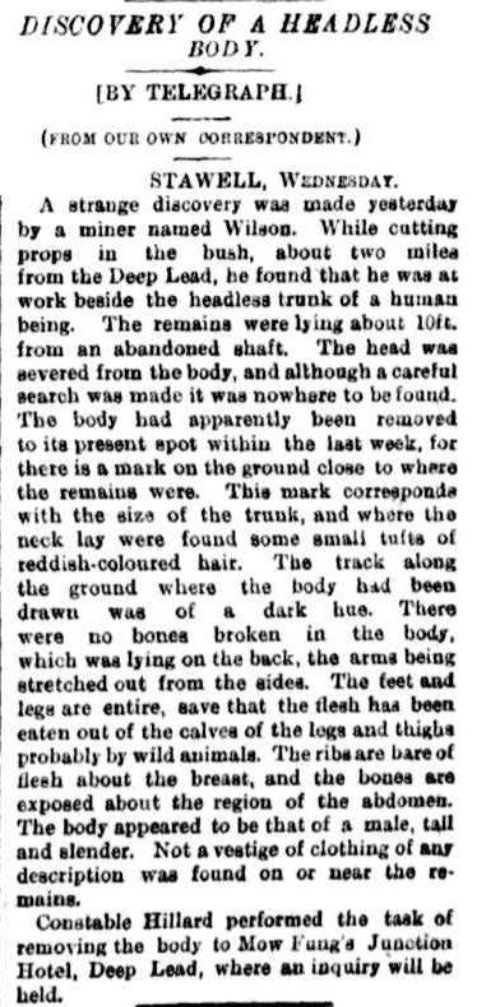
  • Stawell Bardo: a work in progress

    Stawell Bardo: a work in progress

    I’d like to share the draft of a novel I’ve been writing — a work in progress that’s now nearing completion. I’ll be posting chapters every few weeks as I continue to refine and shape the manuscript.

    The idea began while I was researching the life of my great-great-grandfather, a Chinese immigrant to Australia during the gold rush. He married a Chinese woman here, and together they had eight children, all born in Australia. He has since become a well-known figure among researchers of the Chinese diaspora and a celebrated forebear.

    Held by Stawell Historical Society

    While scouring historical books, documents, and newspapers in search of traces of Mow Fung, my ancestor, I came across a striking discovery: a point of intersection between his life and the story of an infamous serial killer in colonial Australia.

    In 1882, a naked, headless corpse was found at a desolate spot in the bush near the Deep Lead goldmine, close to Stawell in the Wimmera Region of Victoria. Stawell is an important historical town in the state’s western development. The body was taken to the Junction Hotel at Deep Lead, a business owned by the Chinese immigrant Mow Fung, where it was kept for the police inquiry.

    The Argus (Melbourne, Vic.: 1848 – 1957), (1882, January 19) p. 5

    The dead body was a startling discovery for me too. The image gave me a visceral shock, in the context of my passing interest in my ancestry — like the miner Wilson, innocently cutting his props. The incident stayed with me, and in a sense haunted me. I researched the fascinating and dramatic hunt for the murderer, and then the details and background as they revealed themselves in a court of law. It was a curious and unsettling experience that started to suggest an idiosyncratic style of exploring and composing my individual connection with the notion of an “objective” historical reality.

    My research has led me into questions that reach beyond ancestry, and into the layered complexities of life in colonial Australia, especially as experienced at the blurry edges of official history. My novel unfolds during times of rapid change: in Australia, the expansion of the railways was reshaping landscapes and economies, even as political upheavals in China were pushing many to seek new lives abroad, in search of gold.

    These forces produced glimpses of a future for many and wealth for some, as well as friction among the diverse communities arriving, and those already here. Much of what I’ve found lives in fragments: names, glimpses, half-told stories. Writing through them has become a way of listening and imagining — not necessarily to recreate a historical reality, but rather prospecting in the gaps, for symbolic and unconscious resonances unbounded by history.

    The real story of my great-great-grandfather and his descendants is remarkable in its own right. But I’ve used it as a starting point for something more speculative: a fictional narrative shaped by an interest in philosophy and Taoism, and explored through a loosely fabulist approach to storytelling. The gold rush theme took on a global dynamic, leading me beyond the Wimmera, to Melbourne, Chinese wilderness and Canton, nineteenth-century San Francisco, and into liminal psychic underworlds. As these worlds and timelines intertwine, history itself begins to warp and shift, distorting the boundaries of time and memory. Hence my working title: Stawell Bardo, a place between worlds in which time is suspended.

    Map of part of the parish of Stawell (187?), detail (State Library of Victoria)

    So far, I’ve drafted fifteen chapters. Some loose ends still need tying up, and others feel like they want to be teased out further. While assembling my material in Google Drive, I came across an AI podcast tool that generated a surprisingly coherent and listenable overview of the story so far. It doesn’t capture all the nuance, but does offer a reasonable sense of how the project is evolving 🎧: