Tag: Victorian popular culture

  • J.F. Smith’s Mystery of the Marsh — Nineteenth Instalment

    J.F. Smith’s Mystery of the Marsh — Nineteenth Instalment

    Philosophical Victorian John Stuart Mill considered his era an “age of transition.” Certain critical transitions, such as those we touched upon in the previous instalment, were visited by the industrial revolution.

    British cultural anthropologist Victor Turner’s (1920-33) idea of liminality is worthy of a mention in the context. It refers to a “betwixt and between” mode of being, “a limbo of statuslessness” that is integral to a ritualistic process of accession — a rite of passage leading to a structured, approved mode of social status.

    Enter Smith’s “Bitterns’ Marsh”, a disorientating space, cast as historically and socially indeterminate, if tending towards pre-historical and pre-civilized poles. The marsh borders both London and its rural neighbours, a component part of neither country nor city. Here we cross over an invisible line, into a mysterious, mystical zone inhabited by outsiders, a place of immorality, criminality, and suspect economies; smugglers and fugitives from the law; a place of dark superstition. It is a liminal zone, with no roads apart from foot-tracks through treacherous peat bogs — a regular Slough of Despond.

    The flora and fauna are ancient and bordering on extinction: giant oaks that perhaps — how may one know? — shielded the Druids from the advance of the Romans based at Colchester (in anticipation, perhaps, of the ‘Druid of Colchester,’ whose remains from 40–60 AD rested undiscovered till 1996?). In Smith’s day, you may have been lucky enough to observe the endangered great auks and grey woodpeckers “worth ten pounds each to the collector.” The great auk (Pinguinus impennis) was hunted out in the mid-19th century.

    Great Auk. Extracted from C.B. Beach, ed., New Student’s Reference Work (Chicago: Compton, 1914). Source: Wikimedia Commons

    Bechstein’s guide Chamber Birds (1848) refers to the “grey woodpecker” only by way of a single-page running header, above content pertaining to its 57th entry, the “Green Woodpecker”, Picus viridus, with no further entries until the 58th specimen, the “Great Spotted Woodpecker”, Picus major; so I suspect that running header to be a misprint.

    The location of the Essex Marshes presents a portal to the Continent. A transient bark lies anchored off the banks of the marsh, enabling the fictional entrance and exit from the scene, of characters possessing such opposing sets of traits they almost seem to pursue trajectories of charged particles. On the one hand, a greedy landed bully and cheat makes off to France; on the other, a youth of exemplary courage and bravery — despite  his wretched origins in the Marsh — returns in disguise as a Breton sailor, to undertake a perilous but virtuous mission.

    According to Turner, “liminal personae” or “threshold people” like these

    … elude or slip through the network of classifications that normally locate states and positions in cultural space. Liminal entities are neither here nor there; they are betwixt and between the positions assigned and arrayed by law, custom, convention and ceremonial. As such, their ambiguous and indeterminate attributes are expressed by a rich variety of symbols in the many societies that ritualize social and cultural transitions.

    The Ritual Process, 95

    On the historical scale, martello towers erected in the vicinity of the Nore sandbank at the mouth of the Thames, to prevent Napoleon Bonaparte from blockading and choking London, memorialize national anxieties. The towers became inhabited by “lawless outcasts” who “flocked” to the region like the bitterns themselves.

    Terms defining the Marsh, this “wild tract of land”, suggest the ritual transition encoded in the story, as progress towards an enlightened and civilized future, from a past with ancient murky roots. These are broad, accessible dimensions that resonate with a mass audience and exemplify J.F. Smith’s appeal as a grand popular storyteller and polymath.

    Mouth of the Thames, showing the Nore sandbank and Essex banks. Source: A Vision of Britain Through Time.

    CHAPTER NINETEEN

    A Slight Description of the Bitterns’ Marsh — Burcham’s Escape to Dinant, where he Meets with an Associate Worthy of Him — The Mutual Understanding and a Compact

    Many of our readers no doubt consider it high time they should be made acquainted with the topography of the Bittern’s Marsh, to which lone spot Squire Burcham had been so cleverly inveigled. Moses, the money lender, and his sleeping partner, Lawyer Brit, were cunning in their generation, troubled with few scruples, and these limited to personal considerations for their own safety. Their client, or, as they facetiously termed him, their pigeon, was only half-plucked, his estate involved to little more than a third of its value. The interest — highly usurious — formed no inconsiderable portion of the money advanced. It is the curse of avarice that the thirst of gain destroys the sense of prudence. Vice and dissipation share in the weakness, and thus folly and craft play into each other’s hands. The human spiders rejoiced at first at their success. Soon it appeared insignificant; they thirsted for the whole estate.

    Their dupe, without entertaining any very clear perception of their design, had hitherto resisted every attempt of Brit to obtain the receivership of his property, which still remained in the hands of the old family steward. This was embarrassing, and the conspiracy came to a standstill till an act of positive fraud, committed by their victim, revived their hopes.

    On the death of his aunt, Squire Burcham found himself dreadfully pressed for money. Creditors were impatient; miscalled debts of honor had to be paid, and what was stronger still with him, vicious habits to be indulged in. In his philosophy of life it never entered into his calculations that Clara Meredith would reject him, or her father forego the opportunity of consolidating his political interests in the country by uniting the estates. Under these convictions he wrote a letter to the money-lender — who made difficulties respecting further advances — in which he stated that the lady had accepted him, and the marriage delayed only till a fitting time from the death of his aunt had elapsed.

    This was something, but not sufficient to answer the purposes of the crafty firm, and the supplies asked for were again refused.

    In an evil hour for himself he forged a letter from Clara, in which she was made to accept his offer, and placed the document in the hands of Moses.

    The cash was advanced.

    Experience teaches us that in the affairs of life one entanglement generally leads to another. Moses very soon intimated his knowledge of the crime that had been committed, and as the price of his forbearance demanded that the estate should be placed in his hands. The eyes of his dupe at last were opened, and the condition refused with that dogged obstinacy which neither threats nor danger could shake. Lawyer Brit, who, as our readers are aware, was the real head of the firm of usurers, found himself placed in a difficult position. He could not appear in the affair himself, and the reputation of his partner was so bad that he hesitated to place him in the witness-box. True, he could destroy the reputation of the squire, but it would be at the risk of certain ugly truths creeping out.

    In this dilemma he thought of The Bitterns’ Marsh. Blackmore and he were old acquaintances, and he was not unfamiliar with the affairs of Viscountess Allworth. In fact, he regarded her as one of his most profitable clients.

    We have already shown the ruse by which the half-plucked pigeon had been drawn into the toils and taken, with Benoni to act the spy upon his proceedings, to the Bitterns’ Marsh.

    Bittern advancing through water amongst reeds. Coloured woodcut, 1921. Source: British Museum
    A bittern advancing through water amongst reeds. Colour woodcut print. Allen William Seaby (1882-1914). Source: British Museum

    Now, then, to fulfil our promise, and give our readers something like a description of the Bitterns’ Marsh.

    This wild tract of land — for even to the hour of writing no attempt worthy of the name has been made to reclaim it — runs for several miles along the Essex coast parallel with the river Thames till it reaches the Nore, where the river is not only sufficiently wide but deep enough for vessels of large size to lie at anchor and blockade the port of London. To prevent such a catastrophe England, during her wars with the first Napoleon, caused to be constructed a number of martello towers along the banks. They were circular buildings of considerable strength, and in the then state of artillery capable of offering a stout resistance to any invading force. Deep wells within the walls supplied the inhabitants with water, and the ground floors consisting entirely of vaults for storing ammunition and provisions. Windows there were none, properly speaking, but merely loop-holes for the guns, and to admit light and air. The only mode of entrance or egress to or from these towers was a strong iron postern, some ten or twelve feet from the ground. In fact, the entire buildings were fire-proof. On the termination of the war they were suffered to fall into decay, government having no further use for them — a fate from which only a few of the larger ones escaped, and these were seized upon by the lawless outcasts who gradually came flocking into the Marsh.

    During the shooting season they received sportsmen, who, attracted by the enormous quantity of wild fowl and fish, ventured into the district to procure supplies for the London markets. Smuggling, however, as we stated in an earlier number, constituted the chief resource of the inhabitants.

    Fringe of the Marshes. Extracted from Rivers of Great Britain: The Thames, from Source to Sea (Cassell & Co., 1891).
    Fringe of the Marshes. Extracted from Rivers of Great Britain: The Thames, from Source to Sea (Cassell & Co., 1891).

    Extending some eight or ten miles inland lay the dreary, solitary marsh, intersected by pools of stagnant water, as well as by several living streams abounding in trout. There were no regular roads — foot-tracks, nothing more; even these were dangerous from the treacherous patches of bog and peat, which doubtless concealed the bodies of many a plundered victim enticed by curiosity or the love of adventure into the dreary maze.

    The author of The Pilgrim’s Progress, we suspect, must have taken his description of the Slough of Despond from such a place. In his early years he had been a travelling tinker, and possibly might have visited it.

    To all but the sportsman or the naturalist, the Bitterns’ Marsh presents a scene of savage desolation. The latter will find it rich in specimens of birds and insects, which, if not extinct are now extremely rare. The grey woodpecker and great auk, who are worth ten pounds each to the collector, may still be found there, but only in the wildest recesses, where are giant oaks, beneath whose gloomy branches the Druids possibly found shelter, when driven by the advance of the Romans from the neighbouring station of Colchester, one of their principal seats.

    Of course there are sparse patches of land rudely cultivated, and here and there something like a garden may be seen. The only manufactures of the inhabitants are guns, fishing-rods, and coarse attempts at cloth, woven by the women, of unbleached wool and the hair of goats; the men, however, disdain this latter occupation. Some vague traditions of religion may still be found amongst these wretched people, but schools and chapels they have not. And yet they live within less than a day’s journey from the richest city in the world, in a country boastful of its civilisation, proud of its universities and wealthy establishments.
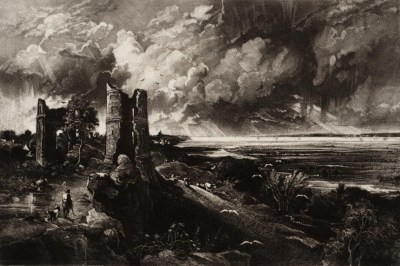
    Hadleigh Castle near the Nore (1832), cropped. John Constable and David Lucas. Source: Tate.

    Such an abode and such surroundings soon began to tell upon the hitherto stubborn resolution of Squire Burcham. Entire loneliness, facilities for drink, no moral principles to sustain him, began to do their work. He felt himself gradually breaking down, and he resolved to fly. Having still some money left, he watched his opportunity, which soon presented itself. A bark from Dinant — a town on the north coast of France, about twelve miles from the port of St. Malo — lay anchored off the banks of the Bitterns’ Marsh. It was manned by Bretons, a hardy, half-savage race, yet not without some redeeming qualities. The prisoner — for such he actually was — had too much prudence to betray the slightest curiosity respecting this foreign vessel or the picturesque-looking crew which commanded it. Benoni, who suffered quite as much from ennui as the poor dupe he was employed to watch, had to propose a walk to the banks twice before the latter carelessly assented.

    ‘He cannot hold out much longer,’ said the master, as he watched them from his dreary abode. ‘The fool has no mental resources; hates books, as if there were anything else in the world, worth caring for. He must soon give way, and then for my share of the spoil.’

    ‘Not so soon as you expect, master!’ exclaimed a shrill, querulous voice behind him.

    Blackmore turned hastily round, and recognised in the speaker the aged woman who had so long kept house for him. During his temporary residence at Deerhurst he had not taken her with him. He required some one to take charge of his home in the Marsh. Her presence there he knew would be sufficient protection, seeing that the inhabitants stood in considerable awe of her, not for her strength, for she was weak as a child, and could only support her tottering steps by means of a staff, which, whenever she stopped to speak to anyone, she clasped with both her long bony hands. Many winters must have passed over her head, but although her hair was white as snow, her cold blue eyes appeared bright and clear. At times, too, they were lit with a strange intelligence.

    ‘Ah, Nance, is that you?’ said her master. ‘Why, you came upon me like a noiseless shadow.’

    ‘The shadows of your evil deeds,’ observed the woman, ‘like the heavy mists which rise sullenly and unceasingly from the stagnant waters of the Marsh. I see them gathering round you. The end is drawing near.’

    Her hearer laughed quietly, as he regarded her with an air of mingled surprise and amusement.

    ‘You forget, Nance,’ he said, ‘that it was I who taught you how to act the character you have so successfully assumed — half sibyl and half sorceress. That it was I who showed you the properties of the plants which calm the raging fever, lull the distracting pains of the burning rheumatism, still the chattering ague fit, and so establish an influence over the superstitious dwellers of the Marsh.

    ‘Would you turn the lessons I imparted against your instructor?’ he added.

    ‘I owe you no gratitude,’ replied the woman, sadly. ‘It was to serve your own purposes you trained me, You owed me some compensation for driving from my side the only being who cared for me.’

    ‘I did not force him to leave,’ said the schoolmaster, gloomily. ‘Perhaps it was unwise. I should have kept him here under my own eyes.’

    ‘To train him like yourself!’ ejaculated the woman, scornfully. ‘Such were your first intentions. To make him a cold, heartless, selfish being, without love or human sympathy. But you failed. Benoni proved the more apt pupil of the two. Besides,’ continued the speaker, in a less excited tone — ‘besides, when you quitted the swamp to become schoolmaster of Deerhurst, it was necessary to arm the feeble hands that guarded your home with a weapon the lawless wretches round it would respect. You have returned to that home as the serpent returns to its den, doubtless to restore its half-exhausted venom.’

    ‘Let us not quarrel,’ observed Theophilus Blackmore. ‘Words are a sign of weakness.’

    ‘I know that you prefer actions,’ answered Nancy, sarcastically.

    ‘Did I not conceal and protect you?’

    ‘Because it served your purpose. I owe you no gratitude for that,’ said the former speaker, sullenly. ‘The debt is cancelled.’

    ‘Not yet,’ thought the schoolmaster, as he walked from the tower, taking the direction Benoni and Squire Burcham had pursued, for his mind began to misgive him concerning the intentions of the latter, and he felt anxious to keep an eye upon him. ‘These last affairs concluded, and I will take a receipt in full. I will. no longer be fooled by empty promises. The lease of the Bittern’s Marsh is worth but little to me. Lady Allworth must come to a settlement with me, or —’

    What the alternative might be he did not even mutter to himself.

    ‘It was unwise in me to speak as I did to him,’ said Nancy, half aloud; but when the heart is full the tongue at times forgets discretion. I had been thinking all the night of my poor boy. Last night I dreamt of him. I wonder if he still lives?’

    She seated herself at the foot of a gigantic boulder which some extraordinary convulsion of nature had torn from earth’s rocky entrails, and cast within a few yards of the spot where the martello tower stood. Moss-grown and partially covered with lichen, the huge stone might have served as a Druid altar when that mystic race fled before the advance of the conquering Romans.

    ‘Why — why is this?’ murmured the aged woman, unconscious of the tears that were trickling down her wrinkled cheeks. ‘It is not often that I permit myself to think of him. The feeling softens me. And yet today memory is continually conjuring up his image. I see him an infant as when Blackmore brought him senseless to this den, and placed him in my arms. I thought it a trouble, and felt angry till his little hands, as he recovered, clasped themselves around my neck. Then what a change came over me. A new sensation seemed born within my heart, and soon — very soon — I learned to love him.’

    Lost in these and similar reflections, Nancy became gradually so absorbed that she noticed not the approach of a young man in the garb of a Breton sailor — boots of untanned leather, short breeches — which might have been taken for a kilt, they were so widely cut — a red sash around the waist, and a jacket with double rows of buttons; a broad-brimmed hat drawn over his swarthy brows, with the usual accompaniment of a flower stuck in the brim, completed the costume of the stranger, whose appearance could scarcely be considered prepossessing, so dark were his features, and darker still the straight, long masses of hair which partially shaded them. As he neared the spot his steps became somewhat quicker, and his eye glanced rapidly round the scene till they rested on the form seated, or, rather, crouching at the foot of the boulder; then he paused as if to consider. If so, his mind was rapidly made up. and he resumed his walk till be stood within six or seven feet of the object of his curiosity.

    The woman, however, did not seem to notice him.

    ‘Good mother,’ he said at last, speaking in the Breton tongue.

    There was no reply.

    At last he repeated the words in English; but not till he had looked carefully around him.

    At the second sound of his voice Nancy started to her feet, and stood for more than a minute gazing upon him in silence.

    ‘I am the fool of my own fancies,’ she muttered at last. ‘The echo buried in my old heart is no longer a truthful one.’

    ‘What would you?’ she said at last, in a tone of disappointment.

    ‘I hurt my arm,’ replied the sailor, ‘on board the cutter, which you can see at anchor yonder in the bay. Not a wound; merely a sprain. But it is a painful one. One of your neighbours, who came to assist in removing the cargo, told me to apply to you; boasted of your skill in herbs and roots, and so I made my way here. Do your best for me,’ he added, ‘and you shall have no reason to complain of the reward.’

    ‘I will do my best for you without fee or recompense. You have paid me already.’

    ‘I do not understand you, good mother,’ said the young man. ‘I have given you nothing yet.’

    ‘Paid me by a memory,’ added Nance, ‘and that is sufficient. Let me see your arm.’

    ‘Are we alone, Mother?’

    ‘God is with us,’ answered the woman, surprised, but not alarmed at the question. ‘I am poor; you would gain little by plundering me. Were you to murder me,’ she added, ‘the lawless inhabitants of the Bitterns’ Marsh would terribly avenge me.’

    ‘They love you, then?’

    ‘Not so,’ said the woman, coldly; ‘but I am of use to them; besides which they fear me.’

    ‘Surely you have done them no evil,’ observed the sailor.

    ‘I have done them naught but good,’ was the reply.

    ‘Then why should they fear you?’

    ‘Because they do not understand what good means. My skill in fevers, setting broken bones, in dressing wounds, my knowledge of herbs and plants appears to them something unholy — they cannot understand it; hence their dread of me. Some call me a witch — a few feel grateful; but not many. Come, show me your arm.’

    The man removed his jacket, which he placed upon the ground, and then commenced slowly to roll up the sleeve of his shirt. His hands — like his visage — appeared to be almost black, sunburnt and stained; but the arms showed white, almost as white as a woman’s.

    A cry of surprise burst from the lips of Nance.

    ‘It is you who are the sorcerer,’ she observed.

    ‘Look me full in the face, good mother,’ said the pretended patient, in a low, earnest tone, ‘and suppress all outward signs of joy or fear, whilst I explain this seeming riddle. Can you be firm?’ he added.

    ‘Try me.’

    ‘My face, hair, and hands are dyed.’

    ‘That I have already discovered.’

    ‘My skin, as you perceive, is fair — fair as the infant’s you received many years since, and bestowed upon him a mother’s love.’

    A half-suppressed cry of joy broke from the lips of his hearer.

    ‘Once more I ask you to be firm,’ continued the speaker. ‘There — grasp my arm, that, if curious eyes are watching our proceedings, it may seem you are examining my injury. And now,’ he said, satisfied that his instructions were understood, and would be followed, ‘look in my face and see if you cannot recognise some features of the boy you so befriended.’

    ‘Bunce!’ exclaimed Nance, eagerly.

    ‘Yes, that was the name old Blackmore gave me.’

    For several minutes the agitation of the woman, who had acted like a second mother to him, was so intense that she could only gasp out a word or two at intervals.

    ‘I — I knew that, if you lived, you would one day return to seek your old nurse. My heart is so full — but joy will not kill me. I should grow calm could I but once embrace you — feel that my joy was real.’

    ‘My second mother!’ exclaimed Bunce; ‘for you have acted like one to me.’

    ‘You must not,’ interrupted Nance, hastily. ‘Do not attempt it. An eye we cannot perceive may be at this moment watching us. You know not half the cunning of our enemy. There, I am stronger now.’

    ‘At least I may take your hand,’ observed the pretended sailor. ‘You can pretend to be examining my arm; the hurt is not a severe one.’

    Nance grasped the hand extended to her, and began to examine the injury. As she did so, the tears rolled down her withered cheeks. The arm appeared slightly inflamed from the elbow to the wrist.

    ‘I did it myself, good mother,’ said the speaker, ‘as an excuse for seeking you.’

    ‘The world has taught you a sad lesson,’ sighed the aged woman.

    ‘Suffering has,’ replied, the young man. ‘Dry your tears, and listen to me. Yonder I perceive Blackmore and his son; they are coming towards the tower. Collect yourself. We must contrive some way to meet again, for I have much to ask.’

    ‘Do you mind a little pain?’ asked Nance.

    ‘Try, my mother.’

    ‘I will retire to my den to procure you a lotion and a box of salve. The first will cool the heated blood; the second, produce the appearance of violent inflammation and increased pain. Use it only when you want an excuse to return here. The old man and Benoni will be sure to question you, for guilt is always suspicious. Mind that you answer only in the Breton tongue; and mind you banter with me on the price of my nostrum, for you must pay me,’ she added with a faint smile. ‘Am I understood?’

    ‘Clearly — clearly,’ answered Bunce.

    The woman caught up the staff which, in her agitation, she had let fall, and walked steadily towards the martello tower.

    When the schoolmaster and Benoni reached the spot where the sailor remained standing, calmly awaiting them, they eyed him, not exactly with suspicion, but curiosity; they appeared excited. Something had evidently occurred to annoy them both.

    ‘What seek you here?’ demanded the old man, sharply.

    Bunce shook his head, as if he did not comprehend the question.

    The question was repeated in the Breton tongue.

    ‘I have injured my arm,’ was the reply, ‘and the wise woman, to whom the captain sent me, has gone to prepare me a salve.’

    ‘Humph,’ ejaculated Blackmore. ‘But you will have to pay her. The wise woman, as you call her, knows the value of her drugs and simples.’

    ‘So I suppose,’ observed the patient, in a sullen tone, as if the prospect of payment was not an agreeable one.

    ‘Father!’ exclaimed Benoni, impatiently, ‘why waste time in prating with this fool? You forget that 1 must start with the news of Burcham’s escape at once, and you have your letter to write. Won’t Brit and Moses be furious!’

    ‘Let them,’ replied his patent. ‘I do not fear them; they are more in my power than I in theirs. Not another word. Here comes Nance with her drugs.’

    The woman soon joined them, with a bottle wrapped in paper and a box of salve in her hand.

    ‘Wash your arm with the liquid,’ she said, ‘and apply the salve only occasionally; but before I part with them, you must pay me.’

    A haggling ensued over the price, during which Nance and her patient acted their parts capitally; finally, they referred it to Blackmore, who fixed it at a crown, which the pretended seaman paid sullenly.

    ‘Too little,’ muttered Nance, ‘too little.’

    ‘As much as your nostrums are worth,’ said Benoni, laughingly.

    ‘How do you know what they are worth?’ demanded the woman, sharply; ‘wait till you have tried them.’

    ‘It will be a long time first,’ observed the former. ‘Your cooking is bad enough; still I can put up with that, but it will be a long time before I venture on your simples. Come father,’ he added, we have other matters more pressing than idle gossip to think of.’

    ‘The young serpent is wise,’ thought Nance, as father and son walked towards their abode. ‘He feels that I hate him. I have been often tempted — but, no, no,’ she added, ‘unless in self-defence, or to save my poor boy — their lives are safe.’

    ‘Should danger threaten him,’ she added, ‘let them beware.’

    With slow steps and a thoughtful brow she retraced her way to the tower.

    Although burning with impatience to obtain a second interview with the weird woman who, from his earliest recollection, had taken so singular an interest in his fate, Bunce restrained himself till the second day from visiting her at her dwelling. This time his arm was swarthy as the rest of his body, much swollen and inflamed. He had used the unguent Nance had given him.

    Blackmore had not the slightest suspicion of any secret understanding between them. Still he thought it best to witness their meeting, and tore himself away from his beloved Horace to see and hear what passed.

    Benoni had not yet returned from London.

    ‘Your skill has failed,’ observed the old man, with a smile. ‘The arm appears much worse.’

    ‘I expected it,’ replied Nance. ‘He has more crowns in his purse. I saw them when he paid me; and I intend to have them,’ she added.

    ‘Eager for gain as ever,’ said her master. ‘Attend to your patient; he begins to regard.us with suspicion. His faith in your nostrum is failing.’

    ‘This will revive it stronger than ever,’ answered the former, as she poured a portion of the cooling lotion on his arm.

    ‘How does it feel now?’ she added addressing her patient.

    ‘Better — much easier,’ replied Bunce; ‘but you see how it is swollen, and at night the pains are dreadful. I can scarcely bear them.’

    ‘The injury is more deeply seated than I thought,’ observed Nance. ‘I must prepare another salve.’

    ‘Will it take long, good mother?’

    ‘Nearly an hour. Why do you ask?’

    ‘Because the day is warm and I am tired with my walk. May I not rest awhile within your dwelling?’

    ‘Not for an instant,’ replied the woman, sharply. ‘The master and I receive no stranger beneath our roof. You can repose beneath the shadow of the boulder,’ she added, pointing to the huge rock where they had met previously when he made himself known to her.

    So well was the scene acted that Blackmore did not think it worth his while to listen to their further conversation, but returned to his favorite author; and with a warning glance to her patient to act prudently, Nance slowly hobbled after him.

    When she returned with her medicaments, she whispered as she gave them — for age is naturally cautious:

    ‘There is a packet beneath my ragged mantle; contrive to take it from me and conceal it under your jacket, but do not read the contents till you are safe on board your vessel, which sails tomorrow.’

    ‘How know you that?’

    ‘My means of information are certain. Now pay me,’ she added, ‘and speak the last sad word, farewell.’

    Poor Bunce felt deeply affected. He had not met with much kindness in his checkered path through life. The devotion and long-enduring love of the woman touched him.

    ‘Alas!’ he said, ‘should we never meet again you will never know how grateful I feel for all your kindness to your poor boy; and I may not even thank you —’

    ‘Not another word,’ interrupted Nance; ‘your enemy and mine — not that Blackmore is your greatest one — must not see a tear upon my withered cheek. It might set him thinking, and his thoughts are dangerous. We shall meet again,’ she added, ‘for God is just, and he owes us both that recompense. Now, then, the money, and depart.’

    The wanderer, in whom, from infancy, the weird woman had taken so strong an interest, had already possessed himself of the packet, Placing several crowns in her hand, he started for the bark.

    ‘God bless him,’ murmured Nance. ‘We will right him yet.’

    This edition © 2019 Furin Chime, Michael Guest


    Notes, References, Further Reading

    • cunning in their generation / drawn into the toils: Interesting old expressions, slightly elusive. The first may possibly resonate Luke 16:8 (“And the lord commended the unjust steward, because he had done wisely: for the children of this world are in their generation wiser than the children of light”) with a substitution of “cunning” for “wisdom”. The consensus on the Biblical expression seems to be along the lines that the “children of this world” are wise(r) or (more) shrewd regarding the world around them, that is, wiser about “their own kind” (see various versions and interpretations at Biblehub). At the same time, “cunning in their generation” suggests that those in question are relatively more cunning than their peers. The expression “drawn into the toils” seems relatively self-explanatory as well, in the sense of “co-opted” or “conscripted”, with a recurrent usage being “drawn into the toils of error”.
    • simples: No, not that one. Rather: “simple: 2a: a medicinal plant; b: a vegetable drug having only one ingredient” (Merriam-Webster).

    Victor Turner, The Ritual Process: Structure and Anti-Structure (NY: Cornell UP, 1969).

    • On industrial revolution etc., see William Ralph Inge, “The Victorian Age,” Rede Lecture, Cambridge UP, 1922.
    • On liminality, see Sarah Gilead, “Liminality, Anti-Liminality and the Victorian Novel”, ELH, 53.1 (Spring 1986), 183-97.
    • On the Essex Marshes, see Herbert Winckworth Tompkins, Marsh-Country Rambles (London: Chatto & Windus, 1904). Available free at Internet Archive. Jump to title page.
    • Fringe of the Marshes (illustr.): N.A., Rivers of Great Britain: The Thames, from Source to Sea (Cassell & Co., 1891). Available free at Project Gutenberg. Jump to beginning.


  • J.F. Smith’s Mystery of the Marsh — Eighteenth Instalment

    J.F. Smith’s Mystery of the Marsh — Eighteenth Instalment

    In the previous chapter, Clara expresses her relief when William turns out to be a gentleman, as is borne out by the credentials printed on his card and his reputation as a scholar, which has become a matter of public knowledge. Lady Kate hadn’t doubted it, perhaps thanks to her greater sensitivity to him and his actions, or because her noble breeding better equips her to judge.

    The theme of interpreting gentleman-like virtues and qualities continues in the present chapter, incorporating a theme of etiquette. To be a Victorian gentleman, it would appear, requires an innate, transcendent trait of nobility, but as well, the ability to negotiate a finely-tuned symbolic system of ritual and convention, in order to be able to present oneself as a gentleman.

    On the other hand, Goliah seems to possess at least two innate virtues of the gentleman: honesty and bravery. Place him in a situation requiring a modicum of gentlemanly savoir faire, however, and he can’t measure up. He expresses himself with childlike spontaneity and needs a poke in the ribs to keep quiet. When Bunce insists that Goliah is a gentleman, that “It is the heart that gives the title. The rest is the mere gilding of the surface,” it is in a tone of kindly rhetoric. Goliah is clearly as yet a primitive if well-intended ‘unsuspecting rustic’ and comic relief, competent at only the most basic ropes.

    ‘Love Will Triumph’ (1900). Charles Haigh-Wood. Source: artnet.com

    But how should a gentleman behave in Lady Montague’s mansion on a social call? She is a stickler for the protocols. Why was the meeting in the park necessary in the first place? Did Lady Kate not repay his services with a gift? — which ought to be sufficient in the language of etiquette. Kate’s reply demonstrates her own finesse at interpreting and balancing symbolic actions and their meanings.

    There are actions which the most costly gifts cannot repay, but which a few kind words may amply recompense. Besides, she added, ‘Mr. Winston is a gentleman.’

    When a servant takes William’s card and ushers him to the morning-room, he is pitiably afflicted with confusion and doubt. Smith-narrator worries about what William will do with his hat, “that terrible test to young men”. Perhaps he should read something like that most useful guide,The Spirit of Etiquette; Or Politeness Exemplified, by Lady de S****** (London, 1837):

    On paying a morning call, keep your hat in your hand unless at the house of an intimate friend. If you leave it in the hall, it appears as though you intended staying; and unless you are very intimate with the party, it is a liberty.

    Or perhaps he has. A slew of such books appeared in the Victorian era, a more accessible variation on the previous “courtesy” genre, which had enjoyed currency since the Renaissance. Addressed to an aristocratic audience, courtesy books discoursed on manners as an expression of moral ideals (Curtin 411). The publication of Lord Chesterfield’s Letters to His Son on the Art of Becoming a Man of the World and a Gentleman (1774) marked a turning point, attending to more pragmatic, outward, imitable issues, toward the ends of self-interest:

    Observe the shining part of every man of fashion, who is liked and esteemed; attend to and imitate that particular accomplishment for which you hear him chiefly celebrated and distinguished; then collect those various parts and make yourself a Mosaic of the whole.

    Henceforth the discussion of manners was disassociated from high culture and disdained by distinguished authors. In the pattern set by Chesterfield for his son, etiquette books addressed themselves to the upwardly mobile members of the burgeoning middle class. Those who had become financially successful now looked to rub shoulders with those of “le suprême bon ton,” to advance socially and hide their humble origins by assuming the manners of the aristocracy.

    Chesterfield writes on the implications of what a gentleman wears:

    Your dress (as insignificant a thing as dress is in itself) is now become an object worthy of some attention; for, I confess, I cannot help forming some opinion of a man’s sense and character from his dress; and I believe most people do as well as myself. Any affectation whatsoever in dress implies, in my mind, a flaw in the understanding.

    We may note in this light the understated taste with which William dresses — which is entirely appropriate, as Lord Bury tacitly discries, “to a mere morning call”.

    In the era of the industrial revolution and the advent of what Karl Marx termed commodity fetishism, extravagant garments no longer proclaim rank and status. Rather, co-opting a new cosmopolitan aesthetic, clothes become a protective shield against invasion, a mechanism of codes and signs and a process of discernment.

    Details of workmanship now show how “gentle” a man or woman is. The fastening of buttons on a coat, the quality of fabric counts, when the fabric itself is subdued in color or hue. Boot leather becomes another sign. The tying of cravats becomes an intricate business; how they are tied reveals whether a man has “stuffing” or not, what is tied is nondescript material.

    As watches become simpler in appearance, the materials used in their making are the mark of the owner’s social standing. It was, in all these details, a matter of subtly marking yourself; anyone who proclaims himself a gent obviously isn’t.

    (Sennett, 165)

    It is more than just lavender gloves as things-in-themselves. An emerging bourgeois self is dislocated from its tranquil sources in the family and in the country and exposed to a mechanism of intrusive forces and gazes that seek to determine it — just as we see Kate’s family array itself as her protective shield in determining to its satisfaction what William is.

    Deep anxieties underpin these new social processes, such as Lady Montague embodies, seemingly risibly characterised with her phobia of social exposure. Why so humiliating for the scandalous details surrounding Lady Kate and Clarence Marsham to come out? Perhaps because codes that define the male, in terms of how he matches up against a positive model of the gentleman (and not a “coxcomb” or a “scoundrel”), are the same that determine the lady against a relatively negatively valorised model of the “loose woman”. Hence, the spontaneity that Kate exhibits — even in abruptly stopping the carriage, blocking the orderly flow of traffic — may be perceived as a disturbing, hysterical trait:

    [W]hen a society proposes to its members that regularity and purity of feeling are the price for having a self, hysteria becomes the logical, perhaps the only means of rebellion.

    (Sennett, 182)


    CHAPTER EIGHTEEN

    Lawyer Whiston Makes a New Acquaintance — A Glance at the Past — Plans for the Future

    However excellent in theory the law of England may be, like most human institutions, it presents many singular anomalies. In practice its professors are divided into two distinct branches, or bodies. First in rank are the barristers who alone possess the right of pleading in the superior courts. They are generally men of university education, and not unfrequently have won its proudest honours.

    From them the lord chancellors, vice chancellors and judges are invariably taken.

    The second, or inferior class, as they are considered, are the attorneys, or solicitors, whose forensic abilities are confined to the police courts and quarter sessions. They act as wet-nurses to the barristers, collect evidence, and prepare their briefs, which none but a solicitor can present. A client, no matter how intelligent and capable, may not draw up his own brief, or statement of his case. No barrister would receive it; it would be considered against the usages of the courts.

    Solicitors divide their practice into several branches, some of them exceedingly lucrative; the conveyance of real estate, which in England is beset with difficulties, being one of them. Divorce cases and criminal defence are two others, to say nothing of offences against the excise laws, poaching, and civil suits generally. They have to prepare all the evidence, and although they may not open their lips in the superior courts, may frequently be seen seated by the side of the privileged barrister, prompting or coaching him.

    The wealthiest and probably most respected members of this branch of the legal profession are the family solicitors to the nobility, landed aristocracy, and great mercantile firms. In the first two instances they have the management of the estates and of honourable men; are consulted on all occasions, looked upon in the light of a friend.

    In this class of solicitors the uncle of our hero held a distinguished position. His clients were not numerous, but they were wealthy, and of high social standing. To such a man the means of obtaining information were sore and varied. Lately he had spent considerable time in piecing together the fragments of half-burnt letters, which Bunce had given him, and the result was that he began to feel considerable interest in the antecedents of Viscountess Allworth. Amongst other bits of information he discovered that her first husband, Gervais Marsham, had a brother, a wealthy merchant in the city, who bore a high character for integrity and honourable dealing.

    As a general rule, if there is any little speck of dirt, flaw of reputation, or circumstance that we particularly wish to conceal, relatives are the first to disclose it, especially if the unfortunate tainted wether of the flock happens to be placed in a more enviable position regarding rank and fortune than the rest. Richard Whiston was far too close an observer of human nature, both as a lawyer and a man, for this peculiarity to have escaped him, and he set about turning it to advantage in his own quiet ways. It was an easy matter to obtain an introduction to the merchant, to whom he made himself so agreeable that invitations were soon exchanged.

    On the occasion of his first visit he contrived to be just ten minutes too late for dinner — not long enough to disturb the equanimity of his host, or, what was of more consequence, that of his maiden sister, Miss Penelope Marsham, who presided over her brother’s bachelor establishment.

    ‘Not a word, my dear sir, said the city man, cutting short his apologies. ‘A dozen turns, more or less, of the spit will not hurt the haunch, and turtle can’t spoil. Will you take my sister in?’

    Their new acquaintance gave his arm to the lady, and the small but select party proceeded to the dining-room.

    The dinner proved an excellent one — a little heavy, perhaps; but that was to be expected in the city, yet not uncomfortably so. It was not till the dessert made its appearance that the wily lawyer alluded to the cause of his delay.

    ‘Consultation,’ he said, ‘with a noble client in rather an intricate affair between two ladies of the fashionable world — Lady Montague and Viscountess Allworth. Ladies — pardon the remark. Miss Marsham — are at times disposed to be a little prolix.’ Turning to her brother, he added, as he eyed the bronze beading on the rim of his glass. ‘This is exquisite Burgundy.’

    ‘Imported it myself,’ observed his host.

    At the name of the viscountess Miss Penelope gave one of those scarcely perceptible little shrugs, which sometimes convey a vast amount of meaning.

    ‘Are you concerned in any legal affairs for Lady Allworth?’ she asked.

    ‘Oh, dear, no! not in the slightest degree. My client is opposed to her. A question of guardianship —’

    ‘Your client,’ remarked the spinster, ‘had better be upon her guard.’

    ‘Pen,’ interrupted her, brother, ‘our friend, I suspect, has had quite enough professional business for one day. Had we not better change the subject?’ A frown accompanied the observation.

    The lady looked displeased, but took the hint, although it lost her an occasion for airing her resentment.

    Richard Whiston appeared perfectly unconscious of this little piece of by-play, but came at once to the conclusion that the sister was the one likely to afford the information he sought.

    With some men — and they are not the worst of their kind — there is nothing like good dinners to cement intimacy. They even assist friendship. The wealthy merchant was a bon vivant, and the lawyer’s cook an artist of peculiar merit. Visits were frequently exchanged; gradually they became intimate. Like an experienced general, Mr. Whiston attacked the weakest side of the fortress; directed all his inquiries to Miss Penelope, and soon succeeded in drawing from her much curious information respecting the antecedents of the crafty viscountess, whom she hated — bitterly — intensely — only as a woman can hate.

    Her brother, Walter Marsham, it appeared, had been left a widower, with only one son, a boy six years of age. It was an awkward position for a young man immersed in affairs. Too fond of his child to commit him to the care of strangers, he engaged a lady, who came, highly recommended, to take charge of his household and superintend the education of his infant heir.

    The next fact extracted from the garrulous old maid was that, six months after the arrival of the governess, the boy was drowned; the body never found.

    ‘A sad misfortune,’ observed the lawyer, in a sympathetic tone.

    ‘A terrible one,’ added the narrator. ‘But for his loss, poor Walter would never have become the dupe of that artful woman. He married her within a year.’

    ‘I can comprehend your feelings,’ said Mr. Whiston, ‘especially if the antecedents of the Lady —’

    ‘She had no antecedents,’ interrupted Miss Penelope Marsham. ‘No one knows anything about her. As my brother, Gervais, said, when he heard of it, she came into the family like a doubtful bill, without any endorsement. We city people have our pride. Neither my brother nor myself ever noticed her.’

    ‘And your sister-in-law is now Viscountess Allworth?’

    ‘No mistake about that,’ observed Penelope, just a little spitefully. ‘His lordship married her for her money. Walter left her everything — but he did not get it, after all. The schemer was too cunning for him.’

    It took at least half a dozen dinners and quite as many calls to draw out the information which we have thus briefly condensed for the satisfaction of our readers.

    After carefully weighing all these circumstances, the astute lawyer at last made up his mind that the time had arrived for him to act, and the morning after the arrival of Goliah in town he sent for Bunce to come to his private room at the office, having given strict orders to the managing clerk that they were not to be disturbed under any pretence.

    ‘Are you satisfied,’ he asked, as soon as they were seated, ‘with the manner in which I have treated you?’

    ‘Satisfied!’ repeated the ex-tramp. ‘Ah, sir, I am most grateful. Your confidence has been most generous. With nothing but my simple word to support my assertions, you have placed a confidence in me almost against reason to expect. I would give my life to serve you.’

    ‘I believe you,’ observed the gentleman with a smile. ‘In the service I am about to ask of you fortunately there is no such risk to be encountered. And yet,’ he added, ‘it is not without some danger.’

    ‘Try me,’ said the young man, eagerly.

    ‘You are well acquainted, I believe, with the Bittern’s Marsh?’

    ‘Every track is familiar to me. Regular roads — that is to say, roads worthy of the name — there are none. Reckless and unprincipled as the inhabitants are, at war with justice and the world, it would not answer their purpose to have any.’

    ‘Reflect well before you answer my question,’ said Mr. Whiston, ‘and let not gratitude sway your judgment. Do you think it would be possible for you to visit that den of outcasts without much risk of detection? I would not you should endanger your life to serve me — added to which, the sacrifice would defeat my project.’

    A pause of several instants ensued in the conversation, during which the grateful fellow coolly but rapidly turned over in his mind all the difficulties of the task.

    ‘I was a mere boy,’ he replied at last, ‘when I quitted the Marsh, and am so changed in person that the fear of recognition is not great. Possible, but not probable; nothing more. The real danger lies in the suspicion with which the steps of every stranger are watched — unless, indeed, in the shooting season, when the hope of gain renders them less cautious. The majority of the inhabitants are smugglers; vessels laden with brandy and silks frequently land their cargoes from the left bank of the Thames. They come from Dinant in Brittany. Could I land from one of these, pass for one of the crew, I should have little doubts of the result.’

    ‘Can you speak the language of those smugglers?’ inquired his benefactor.

    ‘It was familiar to me as my mother tongue when a boy, sir. The captains and mates of the barks generally lodged with the old man who said he had kept me from charity.’

    ‘Your idea is an excellent one,’ observed the lawyer, ‘and a vast improvement on my original plan, for in Dinant you can render me an equally important service. In what character do you think of going?’

    ‘As a sailor.’

    ‘You shall be well provided with money,’ said his employer.

    ‘Not too much, sir,’ answered Bunce, with a smile.

    ‘And when will you be ready to start?’

    ‘In two days.’

    ‘In two days be it then,’ said Mr. Whiston; but recollect, you are to run no unnecessary risks. Greatly as I value the success of the enterprise, it may be too dearly purchased.’

    The above conversation took place on the morning of the day when our hero and Goliah encountered Lady Kate and Miss Meredith in the park. With his usual frankness, Willie informed his uncle of the meeting and exchange of cards, and concluded by asking him if it would not be the correct thing to call.

    ‘Evidently,’ was the reply.

    ‘I have so often puzzled my brain, sir, wondering if we should ever meet again. Was it not a lucky accident? How fortunate that you advised us to drive in the park.’

    We cannot assert it, but are rather inclined to suspect that the lawyer foresaw the great probability of Lady Kate’s meeting with her protector.

    The next day the visit was duly made. Goliah, however, did not accompany his friend. Richard Whiston so particularly required his opinion on the capabilities of a farm he was about to purchase in the neighbourhood of London, that the unsuspecting rustic could not refuse to go with him.

    Decidedly the uncle of our hero ought to have been a diplomat. He was born with a vast amount of natural tact.

    The heart of the youth beat violently as he alighted at the stately mansion of Lady Montague, and when the groom of the chamber ushered him into the morning-room, saying that he would take his card to the young lady, his confusion increased to so pitiable a degree that he almost regretted the step he had taken.

    ‘Why render my regrets indelible?’ murmured he to himself. ‘What can Lady Kate Kepple ever be to me? The disparity is too great.’

    By this time, we suspect Willie already began to have a faint suspicion of the feelings which were gradually entwining themselves with his existence — haunting his dreams, absorbing his waking thoughts. The romance of the first meeting with the fair girl he had so gallantly protected, made a powerful impression, on his imagination — that beneficent or dangerous quality which, for good or ill. as we employ it, controls the greater part of man’s existence; so subtle are its operations that brain and heart are enthralled before we feel conscious of the process which youth, especially in its firsts love, rarely perceives. The man — and the observation we are about to add applies equally to woman — who can analyse its effects, count and estimate the strength of every link as it is added to the chain, may entertain a caprice, but he is not in love.

    ‘The Patient Competitors’ (1892). Charles Haigh-Wood. Source: The Athenaeum

    When her niece and Clara informed Lady Montague of the meeting in the park, that exceedingly correct personage appeared slightly annoyed. We say slightly, for the dread of scandal had died out, nearly two years having elapsed since the adventure which so troubled her at the time.

    ‘I thought,’ she observed gravely, ‘that you had already acknowledged his services by the gift you forwarded to him?’

    ‘Gift!’ repeated Lady Kate, warmly. ‘There are actions which the most costly gifts cannot repay, but which a few kind words may amply recompense. Besides, she added, ‘Mr. Winston is a gentleman.’

    ‘Mr. Whiston!’ repeated the aunt, in surprise.

    Her niece silently handed her our hero’s card.

    ‘Mr. William Whiston, Trin. Col., Cam.,’ said her ladyship, reading it aloud. ‘Well, it certainly does look as if he might be a gentleman.’

    She passed the card to Lord Bury, who was present, and whose frequent and prolonged visits to the country, intimate association with two sensible, right-minded girls, who placed principle before fashion, and what they felt to be right before the conventionalities of the world, had shaken a vast amount of nonsense out of his lordship’s disposition, and the operation had greatly improved him; he had always been strictly honourable. If a certain residuum of pride still remained, it was pride without meanness, based on true manhood and honour.

    ‘I do not see, Lady Montague,’ he observed, ‘how my cousin could have acted otherwise — it would have been ungrateful. A call does not necessarily lead to intimacy. I think you ought to receive him.’

    ‘You, too!’ exclaimed the spinster, half-reproachfully. ‘Well, I suppose I must.’

    ‘I and Clara,’ he added, ‘will, if you wish it, both be present; it may relieve Kate from some embarrassment.’

    ‘Thanks!’ exclaimed the latter, ‘for I should feel dreadfully embarrassed at receiving him alone.’

    ‘Not to be thought of, my love!’ exclaimed the aunt.

    In consequence of this arrangement, all of the speakers were present when our hero was shown into the morning reception room at Montague House.

    The young guardsman eyed him as critically as he would have done a colt which he had serious thoughts of introducing into his own stables. On the important points of dress, person and appearance nothing could be more satisfactory. Plain morning suit; not a trinket visible; pale lavender gloves; his hat — that terrible test to young men, who so rarely know what to do with it — in his hand, it being a mere morning call.

    ‘Well,’ thought his lordship, ‘he certainly does look like a gentleman.’

    Lady Kate, having first introduced him by name to her relatives, began to falter forth her thanks for the protection to had afforded her.

    ‘Pray do not allude to it.’ said Willie, perceiving her embarrassment. ‘A hundred such services would be amply repaid by the simplest expression of thanks. ‘It is I,’ he added, raising his eyes timidly to her blushing countenance, ‘who ought to feel grateful for the pleasure it has afforded me by this introduction.’

    ‘Not bad,’ whispered Lady Montague to Clara; ‘he certainly is a gentleman.’

    ‘I told you so, aunt,’ was the reply.

    ‘Allow me to express my own and Lady Montague’s feelings,’ said Lord Bury, extending his hand to their visitor, ‘for your conduct on an occasion which I will not further allude to, although it can never be forgotten. May I ask,’ he added, by way of changing the subject, ‘if you are related to the Whistons of Northumberland? I have occasionally met several  members of that family.’

    ‘Not in the slightest degree, that I am aware of,’ answered our hero, unhesitatingly. ‘The only relative of standing I possess is my uncle and guardian, Richard Whiston, the eminent solicitor of Lincoln’s Inn Field, to whose bounty I am indebted for my university education — to whose affection for me more than I can ever repay.’

    ‘He is a noble fellow,’ thought his lordship, ‘No pinchbeck about him.

    ‘I am perfectly aware of your uncle’s respectability and high standing in his profession,’ observed the stately old maid. ‘For many years,’ she added, ‘he has had the management of my affairs.’

    ‘Whiston’s nephew,’ she mentally added. ‘Of course I can rely on his discretion.’ Speaking aloud, she added:

    ‘I receive every Wednesday. Mine is not a very brilliant circle but you will meet some celebrities worth knowing, should you favour me with your presence.’

    As the speaker did not add the word ‘occasionally,’ Clara and Kate considered it a sure sign that the invitation had been cordially given .

    More visitors being announced, Willie took his leave.

    ‘What tact,’ observed Lord Bury. ‘Not being acquainted with the fresh arrivals, it might have looked as if he sought an introduction. I think I shall like the fellow,’ he added.

    Considering the source from whence it came, this was high praise.

    ‘I already like him very much,’ observed Clara Meredith.

    ‘Of course. He has such remarkably fine eyes,’ said his lordship.

    Kate remained silent.

    This edition © 2019 Furin Chime, Michael Guest


    Notes and References

    pinchbeck: Alloy of copper and zinc used to imitate gold in jewelry; hence ‘something counterfeit or spurious’ (Merriam-Webster)

    Lady de S******. The Spirit of Etiquette; Or Politeness Exemplified, (London, 1837). Available free at Google Books (jump to cover).

    Lord Chesterfield’s Letters to His Son on the Art of Becoming a Man of the World and a Gentleman (1774). Good edition available free at Adelaide Univ. ebooks (jump to file).

    See also, James Pitt, Instructions in Etiquette, intended for the use of schools and young persons (1840). Available free at Google Books (jump to cover).

    Michael Curtin, “A Question of Manners: Status and Gender in Etiquette and Courtesy,” Journal of Modern History, 57.3 (1985).

    Richard Sennett, The Fall of Public Man (NY: Penguin, 1986)

  • J.F. Smith’s Mystery of the Marsh — Sixteenth Instalment

    J.F. Smith’s Mystery of the Marsh — Sixteenth Instalment

    Prior to the two Australian newspaper series we’re using to reconstruct The Mystery of the Marsh, the novel appeared serialized in the New York Ledger during the period December 1882 — March 1883. You may recall that Smith moved from Europe to the United States in 1870, residing there until his death in 1890. According to Montague Summers, the author of A Gothic Bibliography (1941; 1964), by that time Smith’s fortune was ‘wasted’, owing to his ‘too ample charities and generosity’, and he died ‘in obscurity, if not indeed in actual want.’

    During that period, Smith wrote original stories for the New York Ledger, a so-called ‘six-cent weekly’ offering diverse family entertainment, but catering mostly for a female readership, with an emphasis on romantic fiction (‘Dime Novels and Penny Dreadfuls’; Stanford U).

    In considering provenance, as tempting as it is to suggest that Mystery of the Marsh was first published in the New York Ledger, Summers cautions that in America Smith ‘republished many of his old tales and wrote some new romances the titles of which it is baffling to trace.’ The problem is exacerbated by the fact that many stories published in London were given no explicit byline, but rather advertised as ‘By the author of such-and-such.’ It would seem a fool’s errand to go wading through a morass of digitized newspapers in search of a serialized text whose author was unstated and title unsure.

    The copy referenced in the New York Ledger is itself  hard to access. Earhart and Jewell explain how

    While the works of major writers and periodicals are being digitized, there is limited funding for others. For example, scholars have no electronic or even microfilm access to the New York Ledger, the newspaper where Fanny Fern, among the most famous women writers in the nineteenth century, published her weekly columns from 1856 to 1872.

    The American Literature Scholar in the Digital Age, (U of Michigan P, 2011)

    There is little if any doubt, however, that the work is Smith’s own, given its style, catalogue attributions, and details of reference, some of which I’ve mentioned in previous notes. It seems to me that, in one sense, while we cannot know exactly when the work first appeared, such a limitation adds a certain interest to the work, being a function of the channels and technologies of the text’s transmission.

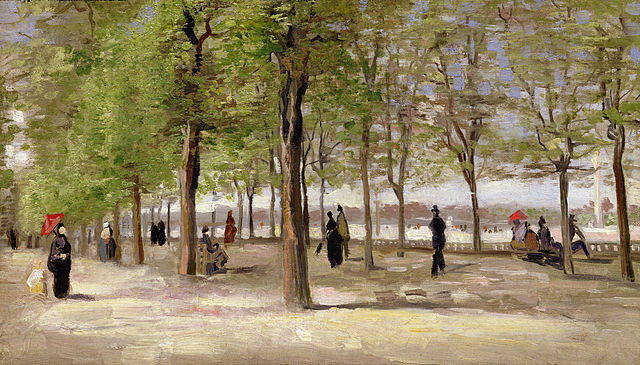
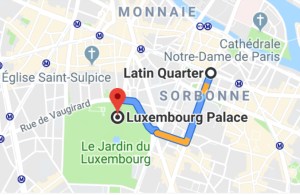
    More on technicalities in a later post. For the time being, let us leave them behind and turn to the pleasure of the text. In this week’s chapter, the Paris duel and its aftermath; and some dubious characters find themselves ensnared. This instalment’s featured image shows a daytime view of one of the ‘alleys’ of the Luxembourg where the duel is fought.


    CHAPTER SIXTEEN

    Result of the Duel — The Victor and his Friends Make Good their Retreat to London — Lord Bury Once More in the Country — Plot and Counterplot

    On reaching the alley of the Luxembourg — the one skirted by the dead wall in which Marshal Ney was shot for his fidelity to the first Napoleon, and truth compels us to add, undoubted treason to Louis the Eighteenth — the late revellers, their eyes still sparkling under the influence of the wine cup, advanced with a confident if not cheerful air, followed by the three Englishman, whose demeanor appeared far more serious.

    Allée au jardin du Luxembourg, Vincent van Gogh, 1886

    At a distance, but out of sight, Monsieur Vezin, with several agents of police, were on their track. The clever detective had received not only his reward, but instructions. If Lord Bury fell, he was to take no steps against the liberty of his antagonist. If Clarence succumbed, he was not to use the information he had obtained or arrest him. The only circumstances under which the last step would be taken — his refusal to fight — did not seem likely to occur; he was already on the ground.

    Although little more than boys in years, the students were men of the world as far as the punctilios of the duel are concerned. They had secured the services of a surgeon on their way to the Luxembourg, measured the ground with mathematical exactness, and placed the pistol in the hands of their principal.

    It had been agreed that the combatants should fire together.

    The fall of the handkerchief was followed by the instantaneous discharge of the weapons. Lord Bury still stood erect, although the ball of Clarence had slightly grazed his temple. Marsham lay senseless on the ground, bleeding from a severe wound in his throat.

    The surgeon approached, looked in his face, and shook his head gravely. Despite the semi-Bohemian life he led, he was a man of honor. Turning to the English group, he said:

    ‘You had better retire, gentlemen, and provide for your safety. The result threatens to be serious, and the government of the day sets its face against duelling.’

    Captain Seymour had taken the precaution of keeping the carriage waiting at the gate of the Luxembourg. In less than an hour Bury and his friends had quitted Paris and were on their way to the nearest frontier town in Belgium.

    Monsieur Vezin took care they were not too closely followed.

    Meanwhile Marsham had been taken back to his hotel, and further surgical assistance sent for.

    * * *

    Tact is one of those qualities which some men are born with; few things are more difficult to acquire. Experience can only partially supply its absence. It lacks the smoothness, the ready spontaneity of the former; then it sometimes blunders, which tact carefully avoids.

    ‘Here, you girls,’ exclaimed Sir George Meredith, handing the “Morning Post” — the fashionable journal of the day — to his daughter as they sat at luncheon, ‘see if you can solve this riddle. I can make nothing of it.’

    Clara addressed herself to the paragraph in the “Morning Post,” and had not proceeded far before a deadly paleness overspread her countenance, and she fell, half-fainting, from her chair.

    With the assistance of Lady Kate and Rose Neville, who were staying at the Hall, the housekeeper and female servants conveyed the deeply agitated girl to her own room. A groom was dispatched to the nearest physician by her half distracted parent, who at intervals stood puzzling his brains as to the cause of the sudden attack. Slowly the perception dawned upon his mind that something in the “Post” had occasioned it

    Snatching up the paper, he perused the paragraph a second time. For the benefit of our readers we shall transcribe it :

    ‘Paris. — Duel in High Life. — On the l8th instant a hostile meeting took place in the garden of the Luxembourg, between Captain Lord B—, of the Guards, and Lieutenant M—-, whose late retirement from the service caused considerable comment in fashionable circles. Both the combatants wore wounded; his lordship in the temple; his antagonist far more seriously in the throat. His life, we hear, is despaired of.’

    What renders the affair still more distressing is the fact of the father of Lord B— being married to the mother of the gentleman whose life is despaired of.

    ‘B stands for Bury,’ muttered the baronet, after reading the paragraph a second and third time. ‘He would never be such a fool as to call Marsham to account, and yet M— designates the rascal clearly enough.’

    ‘But why should Clara faint on reading the news?’ he added.

    Glancing his eyes once more over the journal, he detected a paragraph which had escaped his attention:

    ‘Lord Bury, we are happy to hear, has arrived safely from Paris, and is now staying with his regiment at Knightsbridge.’

    And a little lower down he read:

    ‘Viscount and Viscountess Allworth left town last night for the continent. The state of Mr. M— is considered hopeless.’

    ‘Served the rascal right, if it is really the man I suspect,’ said Sir George, by way of comment. ‘But I have no time to think of him. My mind is occupied with Clara. What could her fainting mean?’

    The speaker paced the apartment for several minutes. A smile at last appeared upon his honest countenance.’ An idea had struck him — one that, we shrewdly suspect, has already occurred to our readers.

    ‘If it should be so,’ he muttered, ‘I have a great mind to write and remind him of his promised visit. But first for the “Morning Post.”‘

    Carefully marking the two last bits of gossip, he directed the housekeeper to convey the paper to Lady Kate Kepple.

    ‘A clever girl that,’ he thought. ‘She will know what I mean. Girls understand each other.’

    Two hours elapsed before his niece made her appearance. She entered the room with a smiling face that boded favourable intelligence of the patient.

    ‘Clara is much better!’ she exclaimed. ‘Quite recovered from her fainting fit. The heat of the weather. Nothing serious.’

    ‘No doubt’ of it,’ replied the baronet. ‘I felt it myself. Dreadfully warm.’

    The morning had been a frosty one. The speakers looked in each other’s face, and laughed. A sense of the ridiculous had struck them both.

    ‘Sir George,’ observed the young lady, regarding him archly, ‘are you aware that you are a very deceitful, treacherous old gentleman?’

    ‘Treacherous and deceitful!’ exclaimed her relative. ‘What can you mean?’

    ‘Exactly what I said,’ answered Kate; ‘and you know it. But we will not discuss the question. It can do no good. If I had a secret,’ she added, ‘I should be very careful how I gave you a clue to it.’

    ‘All girls have their secret,’ observed the father of Clara, playfully, ‘and I feel certain that you are no exception to the rule, for you have a heart.’

    Lady Kate coloured to the temples.

    ‘So you may just as well confess it,’ added the speaker.

    ‘When I have,’ she answered laughingly, as she quitted the room, ‘I will come to you for advice; but not till then.’

    The worthy baronet felt particularly well satisfied with himself. He had acted most diplomatically; conveyed the information he wished to his daughter without permitting his suspicions as to the cause of her illness to appear.

    That same day he wrote to his nephew, alluded frankly to the reports he had read, and asked him candidly how much truth he was to attribute to them. He concluded the letter by reminding him of his promised visit to the country.

    That will do,’ he said, after reading  it  twice; ‘must not appear too pressing. Clara would never forgive me. I wish she were well married.’

    ‘Just the thing,’ thought his lordship, on perusing the invitation. ‘A few weeks rest will be welcome to me. I wonder if Clara knew of her father’s writing. Don’t be conceited, Bury,’ he added, smiling to himself;  ‘even if she does know of it, it means nothing. What more natural? It must be awfully dull in the country.’

    Ten days later he was on his way to Norfolk, but not alone. Tom Randal accompanied him in the character of his valet.

    It is the privilege of every officer in the army to take one man from his regiment to act as a servant, not that the young guardsman had the slightest intention of entrusting his person to the care of the rustic lover of the pretty Phoebe, who, excited by the hope of meeting his sweetheart again, and, if possible, shaking her resolution, forgot all about his determination of wearing no other livery than that of his country.

    ‘Tom,’ said his captain, when everything was settled; ‘we travel in mufti.’

    Mufti, in military parlance, means plain clothes.

    ‘Sorry to disappoint you,’ continued the speaker, ‘but you can wear your uniform only on Sundays; weekdays you will have to dress in –‘

    ‘Your Lordship’s livery,’ interrupted the farmer’s son, in a tone of wounded pride.

    The officer fixed his eyes keenly upon him.

    ‘You deserve that I should say yes, for doubting me,’ he replied. ‘Do you think I could humiliate you? I had no other means of obtaining your temporary leave of absence, or I would have tried it. Take that card, Tom, to my tailor. He will supply you with plain clothes that will not disgrace your father’s son — and on Sundays you may break the hearts of half the village girls by wearing your uniform — and a deuced fine fellow you look in it.’

    ‘Phœbe,’ he added, ‘will scarcely be able to resist it.’

    Needless to say, poor Tom Randal was profuse in his gratitude. At the appointed time they started on their journey.

     * * *

    Like a solitary spider in its web, Mr. Brit, senior, sat alone in his chambers. The clerks had quitted at the usual hour, but their employer remained under pretence of having important papers to look through; but in reality to hold a meeting with his agent and confederate, the money lender.

    Benoni, who, whilst seeming attentive only to his duties, had eyes and ears for everything that transpired, was not deceived by their ruse. He had already acquired one piece of practical knowledge in his new profession — that the last thing a lawyer gives is his reason for any act. He prefers putting forth the pretence. Instead of returning as his fellow clerks did, to his lodgings, he resolved to remain in the neighbourhood of the Old Jury and watch the proceedings of his employer.

    To this degrading action he was impelled by a double motive  — curiosity and fear. The allurements of London had already proved too much for him; he had yielded to their blandishments and plunged, without making any real resistance, into a career of vice. As is usual in such cases, the first false step forced on a second. To supply the means of extravagance, the unfortunate youth had appropriated a check, left by a country client in settlement of an account; and even that was not the worst — he had endorsed it with his employer’s name.

    No wonder the possible consequence of this rash act haunted him. He saw but one way of escaping from it — discovering something so damaging to the reputation of the pious Mr. Brit that might in turn place that gentleman in his power.

    It was a terrible game of see-saw Benoni was playing. At one end of the balance stood the hangman with his rope; at the other, even if he succeeded, shame and exposure.

    The odds were desperately in favor of the elder rogue.

    Benoni had concealed himself in a dark, narrow passage, bordered by dirty, gloomy-looking houses. At night the passage was a solitude; few except the hungry and destitute invaded it — or the criminal.

    After standing two hours upon the watch, a prey to his remorseful fears, the concealed spy saw the old money lender, Moses, glide like a shadow from his own den to that of the respectable Mr. Brit.

    ‘Something,’ he thought, ‘but not sufficient. If I could but overhear their conversation.’

    Whilst he stood puzzling his fevered brain to contrive the means, two men, who, from the bottom of the passage, had been watching his proceedings, crept stealthily towards him. They were meanly dressed, their faces partially hid by high shirt collars, then just coming into vogue, and long woollen wrappers twisted loosely round their necks.

    No echoing footfall gave warning of their approach. A cloak was thrown suddenly over the head of the spy, who felt himself dragged still farther into the passage, then down a short flight of steps, leading, as he rightly conjectured, to the basement of one of the houses.

    The prisoner, who had never been remarkable for courage, believing himself to have fallen into the hands of justice, fainted.

    On recovering his senses he found himself seated in an arm chair, his arms bound, and the cloak still over his face. Certain animals, we are told, when closely pressed by the hunter, will pretend to be dead. Benoni was not much of a naturalist, but he had read the Greek fable, and, although restored to consciousness, made up his mind to act the insensible.

    He was rewarded by hearing the following conversation between his captors:

    ‘I tell you,’ said the tallest of the two, ‘it is useless to trust him. He has not the courage of a hare. Can’t you see what a miserable cur he is?’

    ‘But he is cunning,’ replied a thin, squeaking voice, which the listener thought he recognised.

    ‘What security will his cunning give for his fidelity?’

    ‘None; but I have a better than that — his neck.’

    The tall man repeated the words.

    ‘Yes,’ continued the former speaker. ‘He has committed a breach of trust; forged old Brit’s name to a check; no great amount, but sufficient to hang him. The warrant is out.’

    Benoni with difficulty suppressed a groan.

    ‘On his return to his lodgings he will be arrested.’

    At this revelation the prisoner experienced a fresh access of terror. His limbs trembled in every joint, and, yet faithful to the part he was acting, he gave no signs of consciousness till the cloak had been removed and a glass of cold water dashed in his face, when he opened first one eye, then the other, and stared languidly round the room.

    ‘Ah, Wickwar,’ he said, In a faint tone, ‘is that you?’

    ‘In person,’ chuckled the man.

    ‘Always playing some practical joke.’

    ‘You will find it no joke,’ observed the squeaking voice, dryly.

    Benoni recognised in its answer the confidential clerk of Mr. Moses, the money-lender, and experienced an unpleasant choking sensation at his throat.

    ‘Look you,’ continued the speaker. ‘I don’t know that I am much better than you are — only a little more prudent. My employer has no hold on me. Yours has upon you. I have engaged myself to serve this gentleman, who has fallen into the hands of our masters, who are great rogues, but exceedingly clever ones. I am bound to carry out my promise. Now, if you could undertake to guide him to a place of safety, perhaps — mind, I only say perhaps — I might connive at your escaping with him. Do you know of such a place?’

    ‘I do!’ exclaimed Benoni, eagerly. ‘A retreat where the staunchest bloodhounds of the law would not attempt to penetrate.’

    ‘Is it far from London?’

    ‘Thirty miles.’

    ‘By land or water?’

    ‘Much the same either way,’ was the reply. ‘But by water would be safest. What day is it?’

    ‘Thursday.’

    ‘Then I am certain I could perform my promise,’ observed Benoni. ‘There will be boats in the river laden with wild fowl, game and spirits. Four hours’ sharp rowing will land us safely in the Bittern’s Marsh.’

    After a few whispered words between the two men the proposal was agreed to.

    ‘Listen to me,’ said the eldest. ‘Guide me safely to the place you name, and you will not only secure your own safety, but a handsome reward. Attempt to betray me, and I will  blow your brains out. I will not be taken alive.’

    To prove this threat was not an idle one, he drew from his pocket a pair of pistols.

    The three speakers quitted the basement together.

    At the entrance of the passage Wickwar gave a low whistle, and presently a dingy looking cab was seen driving along the Old Jury. Benoni and the tall man entered it, when it immediately drove off. The money-order clerk stood watching it as it disappeared.

    ‘The fools!’ he muttered to himself. ‘Bully and coward — they are well matched.’

    Waiting till the rattle of the wheels ceased to be heard, the schemer crossed rapidly to the other side of the streets and began groping his way in the dark up the stairs leading to the chamber of the respectable Mr. Brit.

    It was no part of that gentleman’s policy — all lawyer’s are gentlemen by act of Parliament — to drive the fugitive, who was no other than their dupe Burcham, out of the country, but to frighten him into some place of concealment where he could communicate neither with friends nor receive advice. The transactions with his dupe through his agent, Moses, had been most profitable, and promised to be more so, but he well knew they could not bear the light. It was with this view the scene we have described had been enacted.

    Needless to add that Wickwar was in the plot.

    ‘Capital, my dear fellow, capital!’ said the lawyer, in a tone of satisfaction, when the last-named personage entered the chambers. ‘Could not have done it better myself.’

    ‘Peautiful!’ exclaimed the Jew. You think he will be quite safe?’

    ‘As in the grave,’ answered the clerk, confidently. ‘Few,’ he added, have ever escaped from the Bittern’s Marsh.’

    This edition © 2019 Furin Chime, Michael Guest


    Notes and References

    he had read the Greek fable: Seems to be Aesop’s fable of the cat and the mice.

    Mufti, in military parlance, means plain clothes: See Hobson-Jobson: a glossary of colloquial Anglo-Indian words and phrases, and of kindred terms, etymological, historical, geographical and discursive by Sir Henry Yule et al (London: Murray, 1903). Jump to page on Internet Archive.

    Luxembourg Gardens and Latin Quarter locations:

    Montague Summers. A Gothic Bibliography. NY: Russell & Russell, 1964 (1941). Jump to page on Internet Archive.

  • J.F. Smith’s Mystery of the Marsh — Fifteenth Instalment

    J.F. Smith’s Mystery of the Marsh — Fifteenth Instalment

    The scene shifts to Paris, where Smith can draw upon his youthful experience of bohemian life in the Latin Quarter.  A character in our upper echelon has gone there to take care of some … unfinished business — of the serious kind. Here we meet a new brand of character, a detective by the name of Monsieur Vezin. Although, while in the process of introducing him Smith alludes to Poe (1809–49), this Vezin is hardly the stature of the brilliant Le Chevalier Auguste Dupin — the world’s first fictional detective — of The Murders in the Rue Morgue and The Purloined Letter. One has only to look at his coarse, mercenary nature and how he snaps up such a mundane mission. Dupin would never lower himself.

    In saying so, I don’t mean to detract from Smith. On the contrary, his subtle realistic approach compares favourably with Poe’s spectacle and artifice, as entertaining as these are in their own right. (An escaped orangutan did it?!)

    Smith’s seemingly gratuitous reference to Poe is complicated, but worth a few minutes trying to untangle. The historical Duchess de Berry (Maria Carolina Ferdinanda Luise; 1798–1870) is famous for her intrigue against Louis Philippe I, King of France, in whose place she aimed to ‘restore’ her son Henri as the legitimate descendant of the overthrown Bourbon dynasty.  In an incident well-known in the history of cryptography, she sent an encrypted letter to a group of anti-monarchists in Paris, advising them she had arrived in order to mount the insurrection. Unfortunately, she forgot to supply them with the cipher-key (the key explaining which ciphers in the message correspond to which letters of the alphabet).

    It was the great politician and orator, the lawyer Pierre-Antoine Berryer, who reputedly worked out the key — definitely not a detective named Vezin. Poe used the idea in his story The Gold-bug, where the plot turns on deciphering an encoded message just as Berryer did. On the other hand, this particular letter of the Duchess’ doesn’t seem to have been ‘compromising’ as such. Perhaps Smith mixes in a vague allusion to Poe’s ‘purloined letter’, since its disclosure ‘would bring in question the honor of a personage of most exalted station’ (Poe, PL).

    Later in the chapter, out of the blue, Smith makes further reference to the absence of a figurative ‘key’, this time in the form of a Latin quotation: ‘nil nisi clavis [deest]’ (‘nothing is wanting but the key’), an arcane Masonic catechism. Does he mean to imply, more broadly, that there exists a missing master-key to some overarching mystery? Shades of Umberto Eco. Is it for the reader, or yet for the author himself to uncover?

    And we notice the echoing of names and identities. ‘Marsham’ has become ‘Marsh’, recalling the eponymous Bittern’s Marsh. We have ‘Lord Bury’, the alluded ‘Duchess of Berry’ and ‘Berryer’. Don’t tell me something is going to be found buried in the marsh?

    Yet the substance of the story unfolds in a straightforward, naturalistic fashion, without a defined, singular, impelling mystery. It is as though the entry of the Poe-esque character, Vezin, acts as a stimulus for ideas that are more characteristic of the Dupin-style of detective fiction, the precursor to the twentieth-century mystery genre. Many incidents in Smith’s novel have a ‘mystery’ or unknown quantity attached to them, waiting to be revealed: boys who turn out to be girls; dark plots; characters with obscure histories in the marsh; and those who have disappeared back into the Bittern’s Marsh …

    Naturally enough, the contemporary reader cannot expect it to conform to a modern mystery. But nevertheless, the conventions of the genre may skew one’s expectations.


    CHAPTER FIFTEEN

    A Glance at Paris — The Avenger on the Track — Students’ Orgie — Preliminaries of a Duel

    When Lord Bury started for France it was with the full intention of calling Clarence Marsham to account for his unmanly conduct to Lady Kate.

    Our traveller’s first halting-place was Paris. It was not his lordship’s first visit to the gay metropolis of our Gallic neighbors. He had been there twice before; seen something of its dissipations, without plunging over head and ears into them. Escaped from the fire, in fact, with only a few feathers singed.

    Faithful to the object of his journey, knowing the character and habits of the man he sought, he frequented once more the scenes he had formerly visited. They failed, however, to attract him. His mind had acquired a more manly tone.

    Paris, Grands Boulevards 1860. Etching

    It is astonishing how soon a naturally healthy appetite sickens of the sugared dainties of our youth.

    Not having discovered Clarence Marsham where he thought he would be found, Lord Bury addressed himself first to the English embassy; next to the prefecture of the police. Neither of them could afford the information be required. No passport in the name of Marsham had been viséd at either place.

    Travelling with a Secretary of State’s passport, which the English Government grants only to the favourite few, his lordship had been received with great civility by the authorities, who really felt anxious to oblige him.

    As he was leaving the prefecture — it was his third visit — a little old man, who had very much the air of a retired grocer or small shopkeeper, addressed him, and after a profusion of bows, such as Frenchmen alone know how to make, blandly inquired if he could be of any service.

    ‘I fear not,’ was the reply. ‘I have already had two interviews with the minister of police, who assures me that everything has been done that could be done.’

    ‘Officially?’ inquired the old man.

    ‘Of course.’ The querist smiled sarcastically. There was an expression of something very like contempt in his small, twinkling grey eyes at the obtuseness of the Englishman that roused the anger of the latter, who asked himself if the Frenchman had played with or been mocking him. Monsieur Vezin noticed this, and hastened to dissipate it.

    ‘No, no, my lord,’ he said, eagerly. ‘The prefect of the police can have no interest in deceiving you. What I meant was simply this: Official investigations are not always the most satisfactory. They have so much to attend to.’

    The traveller naturally felt surprised at finding his thoughts so accurately interpreted, and eyed the speaker more closely.

    ‘You know me?’ he observed.

    The detective smiled.

    ‘I know everyone who comes to Paris in his own name and with a legitimate passport,’ he replied. ‘And those who do not, I know where to find them.’

    ‘Who are you, sir?’

    ‘I am Vezin.’

    I know not whether it tells in their favour or not as a people, but the French have long been celebrated for the marvellous astuteness of their police. It is a speciality, and they are proud of it. And yet, singular contradiction, the humblest tradesman or mechanic would consider himself insulted by being taken for a member of it. Hint to a Frenchman of the middle classes that his morals are loose, he will only laugh at you. Accuse him of untruthfulness, he merely shrugs his shoulders. Call him a spy, and he is ready to fight you.

    Lord Bury was no stranger to the name of the detective. It was of European reputation, although he had not yet made the famous stroke by which he discovered the compromising letter of the Duchess de Berry, which the American poet, Poe, has made such a clever use of.

    ‘It is not the means I should prefer,’ he thought, but Clarence Marsham has left me no other.’

    Turning to the old man, he added, aloud:

    ‘I think, Monsieur, that you can be of use to me.’

    Vezin bowed.

    ‘This is no place for confidence,’ continued the speaker. ‘Follow me to my hotel, where we can converse more freely.’

    ‘With pleasure, my lord.’

    Once seated at the Bristol — the then fashionable hotel — his lordship described his anxiety to discover the whereabouts of Clarence Marsham, but not his motives; in this he was wrong. A detective is something like a confessor — he should be trusted with everything or nothing. The young Englishman ought to have understood this — perhaps he did — but his pride revolted at the thought of painting one so nearly connected with him in his true colours.

    Monsieur Vezin looked puzzled — just sufficiently to justify his asking a few questions.

    ‘Very clear,’ he said;  ‘in fact, perfectly lucid; still in certain cases we require an excess of light. Has the Englishman — I wish to put it as delicately as possible, done anything to render him amenable to the laws?’

    ‘His offence is a social one,’ was the evasive answer.

    ‘And you are in Paris to call him to an account?’ continued the former. ‘You need not reply. I can read the intention in your flashing eyes. I have nothing to do with that. If Mr. Clarence Marsham is in Paris I pledge my reputation to discover his retreat — but it will cost both time and money.’

    ‘You shall have no cause to complain,’ observed Lord Bury, haughtily. ‘Find his address, that is all I ask. You may leave the rest to me.’

    Monsieur Vezin thought so too.

    Three days after the above conversation the detective made his appearance at the Hotel Bristol again;  his employer saw by his eyes that he had been successful.

    ‘Well?’ he exclaimed eagerly.

    ‘I am on the track my lord.’

    ‘Pshaw! Only on the track?’

    ‘That is something,’ observed Monsieur Vezin, quietly; ‘a pledge that I shall run him to earth, as your fox-hunting countrymen say. There is but one difficulty. He has a Secretary of State’s passport,’ he added, significantly, ‘in the name of Marsh.’

    ‘My father must have procured it for him,’ thought Lord Bury, bitterly.

    ‘That there may be no errors,’ continued his visitor, ‘I have called to consult with you before I proceed any further.’

    ‘Not for the world!’ exclaimed his lordship, eagerly. ‘Leave him to me.’

    ‘He has signed a false name.’

    ‘With no political or fraudulent intentions. I can answer for that.’

    ‘Still it is a serious offence by the laws of France. I ought to arrest him.’

    ‘Come, come, Monsieur Vezin,’ said the Englishman, forcing a smile. ‘You are, I am convinced, too gallant a gentleman’ — the word gentleman stuck in his throat — ‘not to appreciate the difficulty in which such a step would place me; my honour and courage might be suspected — the world would suppose that I feared to meet him.’

    ‘It is possible,’ observed the Frenchman, musingly.

    ‘Of course it is,’ said his employer. ‘Let us see if duty or sentiment cannot hit upon a compromise.’

    A compromise was hit upon. Needless to say, it took a tangible shape, and the following agreement made: At an early hour the following morning, Monsieur Vezin was to accompany Lord Bury and two of his English friends, to point out the house in the students’ quarters where Clarence Marsham had taken up his abode. If he accepted the duel, well, the police would wink at its taking place. If he refused, they were at once to arrest him.

    ‘I shall be sure to hit him,’ thought his lordship, as he quitted his hotel in search of a second.

    The detective muttered something very similar as he walked towards the prefecture of police; to be sure, the words were somewhat different.

    ‘He means mischief. I can see it in his eyes,’ he said. ‘Bah! What is it to me if one English dog shoots another? — a troublesome affair off my mind, even if I am well paid for it.’

    ‘The Latin Quarter of Paris has a type apart from the rest of  the pleasure-loving city. It is the centre of Bohemian life in all its varieties. Students, grisettes, dealers in books, old coins, bric-a-brac, antique furniture, costumes and armor, indispensable accessories of the painter’s studio, locate themselves chiefly in the street of the Ancient Comedy, where the once celebrated Cafe Procope still. opens wide its doors. The brilliant galaxy, Balzac, Lamartine, dear old Béranger, Victor Hugo, have long since disappeared from the busy stage of Parisian life.

    Student life in the Latin Quarter has changed but little. Its amusements, occupations, habits, vices, and, let us add, virtues, are still pretty much the same as when the author shared it some fifty years ago. A little study, great extravagance, loyal generosity to a comrade in distress, a rude sense of honor where their own sex are concerned, a general disregard of it towards the weaker and more helpless one.

    Street in Latin Quarter, 1862, photograph, Charles Marville. Source: nga.gov

    The houses occupied by the students are exceedingly numerous. The steady ones board; the pleasure-seeking merely lodge in them. Each set of rooms is a separate fortress; their occupants band in strict alliance for self-defence.

    In the middle ages, the members of the university braved the crown — frequently gave laws to it. At the present day they brave only the police, unless a revolution happens to be upon the tapis; then something like their old spirit returns to them.

    In the street of the Ancient Comedy stands a large hotel which, for nearly a century, has been a favorite abode with the semi-Bohemian race we have just described. On the first floor of the building, Clarence Marsham — or rather Clarence Marsh, as his passport designated him — had engaged one of the most roomy and best apartments. Compared with his neighboring lodgers, his surroundings might be termed luxurious; still they were a sad falling off from the regimental club and the splendors of Allworth House. The youthful profligate did not, however, regret the change very much. In Paris he had found what he deemed compensation in the alluring pleasures of the French metropolis.

    Although his mother had reduced his allowance by one half, Clarence Marsham appeared a veritable Crœsus to his new acquaintances, who ate his suppers, drank his wines, and occasionally borrowed a few francs from him. Not that he was by any means a generous lender; it was a tax he had to pay, and he paid it grudgingly.

    Our roué, who was fast gliding into the habits and manners of his new associates, had invited some half dozen of them to a late breakfast in his rooms. Amongst others were Duhammel, the son of a rich notary; Alfred Oufroy, of an old Norman family; Alphonse Dubarry; St. Ange, brother to the great advocate, — all of them giddy, pleasure loving youths, but extremely sensitive on the one great point of French honor — courage.

    As for morals, in the strict sense of the word, we fear they scoffed at them.

    From Scenes de la vie de boheme (1850), Henri Murger, illustr. Maurice Berty.
    From La Vie de Boheme (1850), Henri Murger, illustr. Maurice Berty.

    The revel was at its height — continued from the orgies of the preceding night — orgies which we cannot take upon ourselves to describe, even if we had the inclination. Glasses were drained, plans for fresh dissipations laid out, and vows of eternal friendship — false as dicers’ oaths — exchanged.

    One instant, bursts of equivocal jest; the next, the half-drunken madcaps broke into one of their student songs — honoured traditions in the Latin Quarter. Their fathers and grandfathers most probably, had sung them under similar circumstances, with the same noisy accompaniments of jingling glasses and rattling of forks and knives.

    Brother students, we are met for mirth and delight,
    And joy the bright goblet of Bacchus shall fill;
    For though woman, dear women, be absent to-night,
    The spell of her beauty is over us still.
    ‘Twas wisely decreed by our masters of old,
    To refuse them degrees, ‘spite entreaties and sighs;
    For once in our halls they would rule uncontrolled,
    And govern each class by the light of their eyes.
    Then think not in Bacchus alone we delight,
    And seek but the cup of the wine-god to fill:
    For though woman, dear woman, be absent to-night,
    The spell of her beauty is over us still.

    The cheers which followed the song and chorus had barely subsided when Monsieur Bellot, the proprietor of the hotel, entered the room. His appearance was hailed by the revellers with bursts of laughter and applause. Clarence insisted on his drinking a glass of champagne in honor of his guests. The Frenchman bowed, swallowed the wine, then gravely informed the host that three gentlemen were in the ante-room who insisted on seeing him.

    The young Englishman looked disconcerted. The recollection of the false passport, and his assumed name, suggested suspicions of the police.

    ‘Who are they?’ he demanded after a pause. ‘Frenchmen?’

    ‘No,’ replied Mons. Bellot, ‘Englishmen. I can swear to that. But their cards,’ he added, at the same time, ‘will doubtless inform you of the purport of their visit.’

    The roué read the names of three officers of Lord Bury’s regiment. His enemy had found him.

    ‘Yes, certainly!’ exclaimed the latter, enforcing a laugh to conceal his embarrassment. ‘They are old friends, show them in.’

    The students noticed with surprise that the three Englishmen, when they entered the room, instead of rushing to their host, embracing him, and indulging in a succession of gyrations which it would puzzle a mathematician to describe, bowed stiffly, and the eldest one, advancing towards Clarence, requested the favour of a private conversation with him.

    ‘A duel,’ whispered Oufroy.

    Duhammel thought it looked very like one.

    ‘How odd these islanders are,’ added a third student. ‘Three seconds to carry one message. But, nil nisi clavis, we have not the key of the enigma yet.’

    ‘You may speak before these gentlemen,’ exclaimed Marsham, in a tone of bravado, trusting that his guests would stand by him.

    ‘Tiens!’ said one of them. ‘The insular appears civilised.’

    Considering that barely four years had elapsed since the battle of Waterloo had been fought, this was rather a handsome admission for a Frenchman to make.

    ‘My Lord Bury,’ said the second, ‘feeling deeply insulted in his honour and personal dignity by the conduct of Mr. Marsh’– he gave him his assumed name — ‘towards a lady whose name it would be indelicate to mention, demands immediate satisfaction for the outrage.’

    Although Clarence was not particularly brave, he was far from being, in the ordinary acceptation of the word, a coward. He knew that his lordship was a dead shot, and began to reflect whether some means might not be found to avoid the meeting. What made the affair more difficult was the Englishman had delivered his message in excellent French.

    ‘Mon Dieu!’ whispered Oufroy in his ear. ‘What are you hesitating about?’

    ‘Looking for his lost courage,’ suggested another of the students.

    Clarence turned towards them, his mind being made up at last.

    ‘Gentlemen,’ he said, ‘you are, I believe, all of you, my excellent good friends.’

    To this there succeeded a dead silence His guests were waiting.

    ‘I am placed in a position of extreme delicacy,’ added the speaker, ‘and solicit your advice, pledging myself, of course, to act on it.’

    At this there was a faint murmur of approval.

    ‘The gentleman who has challenged me is so nearly related to me that I hesitate about accepting the provocation.’

    ‘Is he a brother?’ asked Duhammel, the oldest of the Frenchmen present.

    ‘No. His father is the husband of my mother.’

    An ironical smile — in fact, it amounted almost to a sneer — curled the lips of the students, who unanimously assured the speaker that so slight a degree of relationship presented no obstacle to his accepting the duel.

    ‘Curse them!’ muttered Clarence to himself. ‘I am in for it.’ Speaking aloud he added: ‘Thanks, gentlemen; you have relieved my mind of a painful doubt. Perhaps you will arrange the time and place of meeting with my adversary?’

    ‘It must be instantly,’ observed Captain Seymour, the name of the messenger. ‘His lordship is waiting in the Alley of the Luxembourg, hard by.’

    ‘Is the offence so deadly?’ asked Duhammel.

    ‘Most deadly,’ was the reply. Walking close to Clarence, he whispered in his ear: ‘Choose at once ‘between the satisfaction demanded or being arrested, dragged through the streets of Paris, for travelling under a false name and passport.’

    ‘And can you reconcile to yourselves turning informers?’

    ‘Under ordinary circumstances, certainly not; but by violating the laws of honor you have placed yourself beyond the pale of society. The police are already in the hotel, ready to arrest you. The exposure once made, his friends cannot permit Lord Bury to meet you.’

    ‘And shall I fall?’

    ‘You need not trouble yourself for any after results,’ observed Captain Seymour, dryly.

    ‘Should I be the victor?’ added Clarence.

    ‘In that case,’ remarked the former, ‘neither my brother officers nor myself will feel called upon .to denounce you.’

    Cornered at every point, the cowardly insulter of Lady Kate resolved to take the desperate chance. Walking to the table he tossed off in succession two or three glasses of wine; then, turning to his student friends, exclaimed, in an almost joyous tone:

    ‘I am ready.’

    The former had already supplied themselves with both swords and pistols, that the principal might have the choice of weapons on the ground.

    ‘And now, gentlemen, where to?’ inquired Duhammel.

    ‘To the garden of the Luxembourg,’ answered Captain Seymour, gravely.

    A few minutes later the speakers passed by the Odeon, where a bal masque had been held the preceding night. Several of the students who had attended it recognised Clarence and his friends as they passed them.

    Death and dissipation jostled each other on the street. They are old acquaintances, and a familiar nod was all that seemed necessary.

    This edition © 2019 Furin Chime, Michael Guest


    Notes, References, Further Reading

    orangutan: To counterbalance my glib comment, see Sydney Lévy, ‘Why an Ourang-Outang? Thinking and Computing with Poe‘, at Épistémocritique: Littérature et savoirs.

    orgie: Fr. orgy

    grisette: ‘1. A young French working-class woman; 2. A young woman combining part-time prostitution with some other occupation.’ Merriam-Webster.

    upon the tapis: from Fr. ‘sur le tapis’ = ‘on the carpet’; in the context, ‘on the table-cloth’, or ‘under consideration’, as in the English idiom ‘on the table’.

    Crœsus: King of Lydia, 560–547 BCE, whose riches came from gold in the sands of the River Pactolus, where King Midas washed his hands.

    false as dicers’ oaths: ‘Such an act / That blurs the grace and blush of modesty, / Calls virtue hypocrite, takes off the rose / From the fair forehead of an innocent love / And sets a blister there, makes marriage-vows / As false as dicers’ oaths: O, such a deed […]’ (Hamlet iii.4). That is, as untrustworthy as a dicer’s vow to quit gambling.

    [Louis de Loménie], R.M. Walsh, trans. ‘Berryer’ in Sketches of Conspicuous Living Characters of France (1841). Available free at Internet Archive.

    Henri Murger, La Vie de Boheme (1850). Available free at Internet Archive.

    Edgar Allan Poe, ‘The Murders in the Rue Morgue’ (1841), ‘The Purloined Letter’ (PL) (1844), ‘The Gold-bug’ (1843).

    William F. Friedman, ‘Edgar Allan Poe, Cryptographer’ in L.J. Budd and E.H. Cady eds.,  On Poe (1993).

  • J.F. Smith’s Mystery of the Marsh — Fourteenth Instalment

    J.F. Smith’s Mystery of the Marsh — Fourteenth Instalment

    What a presumption of Burcham’s that Lady Kate’s cousin Clara Meredith will drop everything and marry him because an inheritance of five thousand a year hinges on it! He doesn’t need Mr. Brit to tell him there will be possibly much more for him when her father dies, issues of marriage and inheritance dictating the distribution of property. The situation reflects something of the dominion that the “unfair sex” held over women to a large extent in the Victorian era, much depending on class. Generally speaking, a wife had no separate legal existence from her husband, who had power over her property, estates, any earnings she might have, custody of children, and her body. It was not until 1891 that a court of law overturned a man’s right to keep his wife at home under lock and key (Perkin).

    A private system of law, however, enabling upper-class Englishwomen to hold separate estates and income, made them perhaps the most liberated wives in the world.

    In this respect, Clara is not atypical of a woman from the untitled gentry. Raised in protective families,

    They were not reared as shrinking violets; almost without exception they were brought up in the country, outdoor life being considered more important than other forms of education. But these half-educated, horse-loving girls often married young and became great hostesses in London. They were considered among the most politically minded women in Europe. They learned from their elders, but had their own views and expected to air them. (Perkin 101)

    It was a pivotal time, with moves to guarantee the financial protection of women in the upper and middle classes a thin end of the wedge for emancipation of women throughout society.

    “The Young Bride” 1875, Mary Cassatt. Source: wikiart.org

    Tied up in the conniving around the issue of Clara’s inheritance, we are introduced to a stereotyped caricature of a Jewish man, a money-lender brought in furtively by Burcham’s lawyer, Roland Brit.

    The figure strikes us as unfunny and at least in poor taste, reflecting echoes of systemic anti-semitism. It is a serious issue even in the present day, with  the theatrical representation of characters such as Shylock and Fagin encountering criticism.

    ‘The Merchant of Venice’ perpetuates vile stereotypes of Jews. So why do we still produce it? […] It is time to say “never again” to this historical aberration. Every time it is produced, the play introduces new audiences to vile medieval tropes of Jew-hatred that we should have long ago left behind.

    Steve Frank, Washington Post

    It’s not just this latest hook-nosed rendition of Oliver! that offends — it’s wrong to revive it at all … Fagin was written in the 19th century but his character is rooted in the middle ages and it is regressive to revive this musical. I have no problems with presenting “bad Jews”, but let them be fleshed-out characters, not stereotypes.

    Julia Pascal, The Guardian, Australian edition


    CHAPTER FOURTEEN

    Still in the Country — The Unexpected Inheritance — A Proposal of Marriage Rejected, and the Vow of Vengeance

    Still in the country! Yes, dear reader, and we can’t get out of it just at present without leaving a blot in our history, which, in your interest as well as our own, we have not the slightest intention of doing. So, for a brief spell, you must be content to hear more of rural walks, flowers, rustic friends and acquaintances. For several months Lady Kate and her Cousin Clara pursued the even tenor of their lives. The latter had all but forgotten the terrible trial she had been subjected to at Allworth Park — her perilous journey and the incidents connected with it — all but one: the gallant youth who had protected her. Sometimes she saw him in her dreams. She could not be blamed for that. No girl can help her dreams, we all know.

    The family party at the Hall were seated at the breakfast table on a delicious morning in autumn, when the owner rather startled his daughter and visitors by suddenly exclaiming:

    ‘Zounds! How unexpected!’ as he dropped the newspaper he had been reading.

    ‘What is unexpected, papa?’ inquired Clara.

    ‘Lady Burcham is dead,’ replied the baronet. ‘Apoplexy! Always thought it would end that way. Great feeder. Would not take exercise. Never could coax her into the hunting-field.’

    ‘I have never frequented the hunting field,’ observed Lady Montague, gravely.

    ‘Hem,’ coughed Sir George. ‘Very different person. She was exceedingly stout, you are gracefully thin, and are several years younger,’ he added.

    ‘Five or six, at the least,’ said her ladyship, somewhat reassured by his last observation. ‘She was rich, I believe.’

    ‘Not one of our great county fortunes,’ remarked the host, ‘ but handsomely well off. The estate is worth eight thousand a year at the very least. I suppose her scamp of a nephew will come in for it. As her heir-at-law, I shall be expected to attend the funeral. Great bore:’

    ‘Perhaps she has left you a legacy,’ observed Lady Kate.

    ‘Don’t want it,’ answered the old gentleman, sharply. ‘Enough money of my own already; more would be a plague to me.’

    ‘Oh! Oh!’ exclaimed the cousins, laughingly; ‘money a plague! Only consider the good one can do with it.’

    ‘Not,’ added Clara, looking suddenly serious, ‘that it can ever compensate for the loss of those we love. If it could I should hate it.’

    Her father marked the tears ready to start at the thought so unexpectedly conjured up, and silently kissed them away.

    That same evening’s post brought a letter to the baronet from the solicitors of the deceased lady, informing him of her death and inviting him to attend the funeral at Burcham House that day week. The letter was signed ‘Brit and Son.’

    Funerals sometimes have their comic as well as serious aspect, especially when the dead have left no grateful hearts to mourn for them — no recollection of charities unostentatiously performed, no memories of sympathies with the living, no offspring’s tears to fall upon the coffin. These are tokens which no number of distant expectant heirs, no pomp of heraldry or luxuries of woe, can replace. Without them the velvet pall and emblazoned escutcheon are merely empty, idle mockeries.

    Such was the aspect which the great hall of Burcham House displayed on the day of the late owner’s funeral. Cousins, nephews, and yet more distant relatives had gathered from the neighbouring counties to listen to her will. No one except the solicitors had the slightest idea of its contents, and as the lady had been exceedingly capricious whilst living, even those relatives who had most offended her were not without hopes.

    Such was the scene when Sir George Meredith arrived at the Hall, where he was received by the steward and lawyers. Brit, whose visage was of the exact professional length befitting the occasion, was the most serious one in the room.

    As for Burcham, who had borrowed money of his aunt, vexed, annoyed, and disgusted her in various ways, he scarcely hoped to be remembered in the disposition of her property, and witnessed the arrival of the heir-at-law with a smile of indifference. As he frequently boasted to his. friends, he would die game anyhow.

    When the testament was opened, its contents surprised every one. The testatrix bequeathed her estates to her nephew, Master Burcham, and Clara Meredith, jointly, share and share alike, provided they contracted matrimony within the space of two years from the old lady’s death; and in the event of the above-mentioned marriage not taking place, the estates to be sold and the funds distributed to such charities as her valued friend and sole executor, Joshua Brit, senior of the firm of Brit and Son, Old Jury, London, should name for that purpose.

    There was a general murmur of disappointment when the lawyer concluded the reading of the will.

    Sir George Meredith felt greatly surprised, but in no way disappointed at the disposition of the deceased lady’s property. Burcham regarded him with a triumphant air. It never entered into his coarse imagination that any girl would reject five thousand a year, even if it had the trifling incumbrance of a husband attached to it.

    ‘Once my wife,’ he muttered to himself, ‘I will pay Clara and her father off old scores. There is a long debt standing between us.’

    He had not forgotten the threat of the stocks; it rankled deeply in his memory.

    As the baronet was about entering his carriage to return home, the executor advanced obsequiously and inquired if he had any instructions to leave with him.

    ‘No,’ replied the old gentleman in a tone of surprise. ‘What can I have to say in the affair? It does not rest with me.’

    The next instant he drove away.

    ‘It will never be a match,’ muttered the lawyer. ‘They despise him. What are five thousand a year to Sir George Meredith and his daughter? The charities will come in for the property. What a vast amount of good it will do, especially as I have the management of the revenues.’

    From that hour the length of the old schemer’s visage gradually decreased.

    ‘I say, old fellow,’ said Burcham, after the mourners — all more or less disappointed — had taken their leave, ‘don’t you think the old girl made a foolish will’? I ought to have been left sole heir. Not that I suppose it much signifies,’ he added.

    ‘Probably not,’ answered the executor. ‘My late respected client was a most conscientious woman, and the estate being hers before her marriage concluded she had a right to dispose of it as she pleased,. You forget she was a Meredith.’

    ‘No I don’t, curse her.’

    ‘Oh, Mr. Burcham!’ exclaimed the lawyer, greatly shocked, or pretending to be so. He was a great stickler for the proprieties.

    ‘Well, you need not repeat it,’ replied the co-heir. ‘But it is very provoking to be compelled to marry a girl I don’t care a straw for.’

    ‘With five thousand a year,’ added Mr. Brit; ‘and heaven knows how much more when her father dies.’

    ‘It may turn out for the best, after all,’ observed the former speaker, musingly. ‘Anyway, I am in for the matrimonial noose. How soon ought I to propose?’

    ‘Not before a month, at the very earliest,’ was the reply; ‘it would not look well.’ ‘

    I have a month’s fling before me, at any rate,’ exclaimed the roue. ‘ I say, old fellow, you could not let me have a couple of hundred pounds, could you?’

    ‘It is against the articles of the firm to lend money,’ was the cautious answer, ‘or I should be happy to oblige you. Others are less scrupulous; and with your prospects there ought not to be any difficulty, especially as the sum is a trifling one.’

    ‘Try Moses again,’ said Burcham. ‘But he is such an unreasonable rascal. I suppose I may refer him to you?’

    ‘Yes, certainly; but if you take my advice you will have nothing to do with him.’

    ‘Ah, I forgot he’s a neighbour of yours. You know him?’

    ‘Slightly,’ replied the lawyer, repressing a smile.

    A blush of indignation rose on the countenance of Clara Meredith when the baronet informed her of the conditions of Lady Burcham’s will.

    ‘How intensely absurd!’ she exclaimed. ‘I would rather die than marry him. Of course, papa, you told him so?’ she added.

    ‘No.’

    ‘No!’ repeated the indignant girl.

    ‘The rejection must come from you,’ continued Sir George. ‘I have no right to decide for you.’

    ‘And I must really go through the form of listening to him?’

    ‘I fear so.’

    ‘And give him a civil answer?’

    ‘It is the custom of such occasions.’

    ‘Why, papa, you speak as coolly as if you thought it possible I should accept him, and I think it very unkind of you.’

    Her father drew towards her and kissed her.

    ‘You must not be so impetuous, pet,’ he said,’ and jump at such rash conclusions. You ought to know that I would rather see you in your coffin than the wife of Burcham, or of any man,’ he added, ‘whom you could not respect as well as love. I fear, Clara, you are a little capricious.’

    ‘How can you be so unjust, papa.’

    ‘You have refused Wiltshire?’

    ‘Yes, papa.’

    ‘And Sir John Radcliff?’

    ‘Oh, he is so insipid.’

    And the speaker was about to enumerate several others of her rejected admirers, when his daughter sprang upon his lap and threw her arms about his neck, exclaiming as she did so:

    ‘How sly you have been, papa! I did not think you had noticed their attentions. Why, are you in such a hurry to get rid of your saucy girl?’

    ‘No,’ replied the baronet fondly. ‘It is that before I die I wish to see you the wife of some good and honorable man, who will insure your happiness. I care not how poor he is, provided his character is unblemished and you love him, You have carte blanche in your choice. I know,’ he added, ‘that you will never abuse it by giving your hand to any one who is not in the true sense of the word a gentleman.’

    Involuntarily the thoughts of the speaker reverted to his nephew, Lord Bury, who appeared to him to be just the husband he would have selected for his daughter, but as unfortunately there did not appear the slightest chance of such an attachment, he tried to dismiss the subject from his mind.

    Clara felt but too glad to escape from the room, and so the conversation terminated. Possibly she feared to be further questioned, or, what is still more probable, began to understand her own heart.

    When Lawyer Brit declared that he never lent money, those who knew him well — and there were a few such’ persons in the world — would have construed his declaration in an exactly opposite sense. The fact was that he did lend money, and to a very large extent, but not in his own name. He was far too cautious for that. Like other successful rogues, he had learnt during his long practice the value of the word reputation –that is to say, its commercial value. Besides this, he had other reasons: His connection with certain important charities, whose well-meaning, but easily duped directors were exceedingly sensitive on such subjects. The concerns were prosperous. It not only provided them with fat salaries, but enabled them to provide for younger sons and dependants by secretaryships,  inspectorships, auditors, and other profitable employments.

    Many of the public charities in England are, no doubt, admirably administered. Some — suppose we say, tolerably. Others are as much a business as the dealings in dry goods, tobaccos, teas or sugars.

    Lawyer Brit employed therefore an agent in his pecuniary transactions — the same Mr. Moses to whom Burcham alluded on the executor’s refusal to advance him the two hundred pounds. The said Moses was one of the most abused persons in London, and yet it was extraordinary how many respectable persons had transactions with him. The smooth-faced principal in his schemes of usury —  the man who found the money, and profited so largely by them — was the first to condemn him. Whenever Moses made his appearance at the lawyer’s offices the latter would make difficulties about seeing him, wring his hands, look virtuously indignant, and wonder how his respectable clients could entangle themselves by dealings with such a disreputable person. This little by-play he enacted for the benefit of his clerks, who would be sure to repeat it. It deceived most of them; not all, perhaps. Benoni already began to have an inkling as to the true character of his employer. The lessons of the old schoolmaster had not been thrown away upon his son. Benoni was a close, though a silent, observer.

    On his return to London the head of this prosperous firm had a long interview with his son, Roland, in his private room. Even to him it was limited. True his new clerk had inspired him with a favourable opinion, but Mr. Brit acted only on certainties. The youth had not compromised himself yet.

    ‘Well, Roland,’ said his parent, ‘ have you calculated the amount of Burcham’s securities — the exact value of  his remaining interest in the property?’

    ‘About four thousand pounds, sir.’

    ‘Under the hammer?’

    ‘Of course,’ replied the son. ‘We make no allowance for fancy values,’

    ‘Right; very right, my boy,’ observed his senior. ‘Sentiment is only another name for weakness in all business transactions. Is Moses informed that I wish to see him?’

    ‘He will call at one, sir.’

    ‘Very good. Contrive to be in the clerks’ office when he arrives. Make the usual difficulties. Moses will understand it. It might be as well to have some slight altercation with him, Nothing serious, of course,’

    Roland Brit smiled at what he considered unnecessary precautions. The young spider knew all the capabilities of the paternal web — its elastic strength, powers of retaining the foolish insect once entangled in its meshes; but he had not the experience of the old one.

    Mr. Brit had rather a foolish habit for a person in his position of talking to himself when alone. He was aware of this, and standing orders had been given than none of the clerks should enter his private room without first knocking at outward doors, of which there were two — one of oak, the other of green baize.

    ‘Everything appears safe,’ muttered the lawyer, as he closed them both after his son, and had thrown himself into an easy-chair. ‘Burcham’s property — Burcham’s estate — will stand another thousand, although I did not calculate on paying so much for it. Nor will I,’ he added, ’till I get him completely in my power. I must risk something for the charities. Last year’s subscription fell short. Not much — not much,’ he repeated, reflectively. ‘Still a wise man should not neglect the first signs of danger. Lady Burcham’s bequest will place them beyond danger, I can only secure it for them. The world thinks I am overpaid for my services. It little knows the anxieties I endure, and all in the cause of charity.’

    If, as an old proverb asserts, that charity begins at home, the subtle schemer had some reason perhaps for his conclusions.

    The author has taken his readers thus far into his confidence in order to prepare them for the plan the lawyer had concocted for the ruin of Mr. Burcham, who, in his dealings with the respectable Moses, had not, as yet, committed an act to place his liberty at his mercy. He was a coarse brutal bully, as well as a fool; but nothing more.

    It never entered Mr. Brit’s calculations that Clara Meredith would reject the fortune and the husband. Could he have been assured of that he would not have taken so much trouble. Rich as he was, he felt that he could not have refused it, no matter what the conditions.

    Hearing his son’s voice in dispute the lawyer broke off the train of reflection as he hastened into the clerks’ office, where he found his son, as he expected, having warm words with the Jew moneylender.

    ‘My father will not see you,’ said Roland, as his father, as he entered from his private room.

    ‘Pisiness is pisiness,’ answered the Israelite, who perfectly understood the part he was to act. ‘One of his clients has –‘

    ‘Mr. Moses,’ said the head of the firm, interrupting him, ‘this is really intolerable. I have already informed you more than once that when you have any affairs in which my clients are interested, it would be more agreeable to communicate by letter.’

    ‘It is pressing.’

    ‘I cannot help that.’

    ‘Ferry vell; den I will ruin your client  — send him to prison for debt — sell him up, and all because he has a bad lawyer.’

    Mr. Brit looked exceedingly distressed. ‘If the case is really so urgent –‘

    ‘I tells you it is urgent,’ interrupted the money-lender. ‘The writs are out, I have got judgment against him.’

    ‘Against whom?’

    ‘Your client — Mr. Burcham.’

    ‘Improvident young man,’ sighed the lawyer. ‘After all my friendly warnings, too. I suppose I must see you.’

    ‘It vill be better.’

    ‘Step this way,’ said the head of the firm. ‘What a scandal for an office like mine.’

    Like two actors satisfied with their exertions, the speakers entered the private room together and closed the doors care. fully after them. Once alone, they regarded each other in the face, shook hands, and indulged in a quiet chuckle.

    ‘Peautiful!’ exclaimed the visitor.

    ‘Not so loud, Mr. Moses,’ replied the lawyer. ‘It really was exceedingly well acted.’

    ‘It is too bad,’ observed Roland Brit, as the speakers disappeared, ‘that my father, who abhors all such practices, should be exposed to this annoyance.’

    All the clerks, as in duty and prudence bound, expressed great sympathy with this natural indignation. All but Benoni; he was reflecting upon it.

    The sum of one thousand pounds was duly advanced by the accommodating Mr. Moses to dupe Burcham, but not till after a number of letters from the latter, filled with false statements sufficient at any time to establish a charge of fraud, had passed between them.

    ‘I don’t quite understand the affair,’ observed the ostensible money-lender, at the conclusion of the transaction. ‘You bid me not to set a detective to watch him.’

    ‘Not for your life,’ ejaculated the lawyer. ‘Make no movement without my orders.’

    ‘I vill not; but I forsee it vill pring troubles.’

    Mr. Brit regarded him earnestly. It was the first time he had ever heard a word of remonstrance from his lips.

    ‘If you are dissatisfied,’ he remarked, sternly.

    Moses resumed his former subservient manner.

    ‘Not at all, not at all, mine good Mr. Brit, If I feels just a little uneasy, it was on your accounts, not mine own.’

    ‘Very well, sir, I will understand it so.’

    Notwithstanding his assertion to the contrary, Mr. Moses did not feel satisfied with the transaction — not on account of its immorality — he was above such vulgar scruples; all he doubted was its safety.

    After enjoying a month’s dissipation in London, Burcham returned to the country to propose to Clara Meredith. Never for an instant from the first reading of the will had he entertained a doubt of her accepting him. Five thousand a year, he concluded rarely went begging. Great, therefore, was his astonishment, to say

    nothing of his mortification, when the young lady, after listening with exemplary patience to his rough style of wooing, civilly, but decidedly, rejected him.

    ‘You can’t mean it!’ he said. ‘It will ruin me.’

    ‘I am not responsible for that.’

    ‘And the five thousand a year?’

    ‘I do not require it; and the condition renders it impossible I should accept it,’ added the firm-hearted girl.

    ‘O, nonsense! You only say this to tease me.’

    ‘Believe me, I have no such wish,’ replied Clara, who began to feel tired as well as disgusted at the interview. ‘You do not know me, Mr. Burcham.’

    ‘Nor you me,’ explained the disappointed suitor, scowling fearfully. ‘It is a plot to ruin me, rob me of my inheritance, and drive me from the county. I will be revenged; I will thwart your hopes and prospects at every turn! I could not rest in my grave unless I had obtained satisfaction for this cruel, heartless insult!’

    Although not in the least terrified by his menaces, Clara Meredith rang the bell, and her father entered the room, accompanied by Lady Kate. The coward and bully — for none else would insult a woman — sullenly withdrew.

    This edition © 2019 Furin Chime, Michael Guest


    Reference and Further Reading

    • Joan Perkin, Women and Marriage in Nineteenth Century England (Routledge, 1989)
    • Todd M. Endelman, The Jews of Britain, 1656 – 2000 (U of California P, 2002)