Tag: Vanishing literature

  • Anatole France’s Merrie Tales: Mademoiselle Roxane

    Anatole France’s Merrie Tales: Mademoiselle Roxane

    The final tale in this series is about what Frenchmen are often believed to be most obsessed with: L’Amour. It might be all too easy to be cynical about any such tale written in the words of another time, but France still engages us, despite the subject. Oh, please don’t get me wrong. Flowery expressions of passion or woe might not be to my taste, but I do have some empathy for those unhappy in love, having been there myself and survived. The emptiness and obsession of it, all wonderfully described by France.

    Forgive my indulgence in this final of the tales, but I’m reminded of a German poem by Erich Fried, which I’ll translate for you:

    It's silly, says reason 
    It is what it is, says love 
    
    It's misfortune, says calculation 
    It's nothing but pain, says fear 
    It's hopeless, says insight 
    It is what is, says love
    
    It's ridiculous, says pride 
    It"s foolish, says caution 
    It's impossible, says experience 
    It is what it is, says love 

    At first, the title of our story, ‘Mademoiselle Roxane’, reminded me of perhaps not quite what the author would have intended. A movie poster with the same female name and some Hollywood comedy actor named Steve with a ridiculously exaggerated Cyrano De Bergerac nose. Yet I guess that this too was a film about unrequited love, albeit a supposedly funny one about some modern day guy like Cyrano.

    So what would have happened, if during some Paris night long ago, our heroes had encountered such a young man, and not a beautiful young woman in the same situation? Most probably, there would not have been a whisker or even a nose of a tale. But a brilliant author has the artistic schnozzle to get all the elements right to please his readers, and so, enter stage left, beautiful Mademoiselle Sophie. My strange mind correlates too much of the lovelorn gooey sort of stuff with that awful signature tune which comedian Jack Benny used to play on his violin, “Love in Bloom”. I used to think of adapted lyrics that I had imagined went, “When our cardboard box got wet, so did all the cigarettes, and the weed…”—to at least internally mock overdone hard luck stories when I was subjected to them.

    Roxane in Jean-Baptiste Racine’s Bajazet, ca. 1838, attr. Eugène Devéria

    So yes, prepare yourself for a bit of a hard luck story. But also for an ending worthy of Anatole France. A happy one? I’ll have to leave you in suspense. I’ll miss reading his Merrie Tales ofJacques Tournebroch. I’m sure you will too.


    Mademoiselle Roxane

    image852SPECKLE[FINAL]

    Y good master, M. l’Abbé Coignard, had taken me with him to sup with one of his old fellow-students, who lodged in a garret in the Rue Gît-le-Cour. Our host, a Premonstratensian Father of much learning and a fine Theologian, had fallen out with the Prior of his House for having writ a little book relating the calamities of Mam’zelle Fanchon. The end of it was he turned tavern-keeper at The Hague. He was now returned to France and living precariously by the sermons he composed, which were full of high argument and eloquence. After supper he had read us these same calamities of Mam’zelle Fanchon, source of his own, and the reading had kept us there till a late hour. At last I found myself without-doors with my good master, under a wondrous fine summer’s night, which made me straightway comprehend the verity of the ancient fables regarding the loves of Diana and feel how natural it is to employ in soft dalliance the silent, silvery hours of night. I said as much to M. l’Abbé Coignard, who retorted that love is to blame for many and great ills.

    “Tournebroche, my son,” he asked me, “have you not just heard from the mouth of yonder good Monk how, for having loved a recruiting sergeant, a clerk of M. Gaulot’s mercer at the sign of the Truie-qui-file, and the younger son of M. le Lieutenant-Criminel Leblanc, Mam’zelle Fanchon was clapped in hospital? Would you wish to be any of these,—sergeant or clerk or limb of the law?”

    I answered I would indeed. My good master thanked me for my candid avowal, and quoted some verses of Lucretius to persuade me that love is contrary to the tranquillity of a truly philosophical soul.

    Thus discoursing, we were come to the round-point of the Pont-Neuf. Leaning our elbows on the parapet, we looked over at the great tower of the Châtelet, which stood out black in the moonlight.

    “There might be much to say,” sighed my good master, “on this justice of the civilized nations, the punishments whereof in retaliation are often more cruel than the crime itself I cannot believe that these tortures and penalties that men inflict on their fellows are necessary for the safeguarding of States, seeing how from time to time one and another legal cruelty is done away with without hurt to the commonweal. And I hold it likely that the severities they still maintain are no whit more useful than those they have abolished. But men are cruel. Come away, Tournebroche, my dear lad; it grieves me to think how unhappy prisoners are even now lying awake behind those walls in anguish and despair. I know they have done faultily, but this doth not hinder me from pitying them. Which of us is without offence?”

    We went on our way. The bridge was deserted save for a beggarman and woman, who met on the causeway. The pair drew stealthily into one of the recesses over the piers, where they lurked together on the door-step of a hucksters booth. They seemed well enough content, both of them, to mingle their joint wretchedness, and when we went by were thinking of quite other things than craving our charity. Nevertheless my good master, who was the most compassionate of men, threw them a half farthing, the last piece of money left in his breeches pocket.

    “They will pick up our obol,” he said, “when they have come back to the consciousness of their misery. I pray they may not quarrel then over fiercely for possession of the coin.”

    We passed on without further rencounter till on the Quai des Oiseleurs we espied a young damsel striding along with a notable air of resolution. Hastening our pace to get a nearer view, we saw she had a slim waist and fair hair in which the moonbeams played prettily. She was dressed like a citizen’s wife or daughter.

    “There goes a pretty girl,” said the Abbé; “how comes it she is out of doors alone at this hour of night?”

    “Truly,” I agreed, “’tis not the sort one generally encounters on the bridges after curfew.”

    Our surprise was changed to alarm when we saw her go down to the river bank by a little stairway the sailors use. We ran towards her; but she did not seem to hear us. She halted at the edge; the stream was running high, and the dull roar of the swollen waters could be heard some way off. She stood a moment motionless, her head thrown back and arms hanging, in an attitude of despair. Then, bending her graceful neck, she put her two hands over her face and kept it hid behind her fingers for some seconds. Next moment she suddenly grasped her skirts and dragged them forward with the gesture a woman always uses when she is going to jump. My good master and I came up with her just as she was taking the fatal leap, and we hauled her forcibly backward. She struggled to get free of our arms; and as the bank was all slimy and slippery with ooze deposited by the receding waters (for the river was already beginning to fall), M. l’Abbé Coignard came very near being dragged in too. I was losing my foothold myself. But as luck would have it, my feet lighted on a root which held me up as I crouched there with my arms round the best of masters and this despairing young thing. Presently, coming to the end of her strength and courage, she fell back on M. l’Abbé Coignard’s breast, and we managed all three to scramble to the top of the bank again. He helped her up daintily, with a certain easy grace that was always his. Then he led the way to a great beech-tree at the foot of which was a wooden bench, on which he seated her.

    Taking his place beside her:

    “Mademoiselle,” he said gently, “you need have no fear. Say nothing just yet, but be assured it is a friend sits by you.”

    Next, turning to me, my master went on:

    “Tournebroche, my son, we may congratulate ourselves on having brought this strange adventure to a good end. But I have left my hat down yonder on the river bank; albeit it has lost pretty near all its lace and is thread-bare with long service, it was still good to guard my old head, sorely tried by years and labours, against sun and rain. Go see, my son, if it may still be found where I dropped it. And if you discover it, bring it me, I beg,—likewise one of my shoe buckles, which I see I have lost. For my part I will stay by this damsel we have rescued and watch over her slumber.”

    I ran back to the spot we had just quitted and was lucky enough to find my good master’s hat. The buckle I could not espy anywhere. True, I did not take any very excessive pains to hunt for it, having never all my life seen my good master with more than one shoe buckle. When I returned to the tree, I found the damsel still in the same state, sitting quite motionless with her head leant against the trunk of the beech. I noticed now that she was of a very perfect beauty. She wore a silk mantle trimmed with lace, very neat and proper, and on her feet light shoes, the buckles of which caught the moonbeams.

    I could not have enough of examining her. Suddenly she opened her drooping lids, and casting a look that was still misty at M. Coignard and me, she began in a feeble voice, but with the tone and accent, I thought, of a person of gentility:

    “I am not ungrateful, sirs, for the service you have done me from feelings of humanity; but I cannot truthfully tell you I am glad, for the life to which you have restored me is a curse, a hateful, cruel torment.”

    At these sad words my good master, whose face wore a look of compassion, smiled softly, for he could not really think life was to be for ever hateful to so young and pretty a creature.

    “My child,” he told her, “things strike us in a totally different light according as they are near at hand or far off. It is no time for you to despair. Such as I am, and brought to this sorry plight by the buffets of time and fortune, I yet make shift to endure a life wherein my pleasures are to translate Greek and dine sometimes with sundry very worthy friends. Look at me, mademoiselle, and say,—would you consent to live in the same conditions as I?”

    She looked him over; her eyes almost laughed, and she shook her head. Then, resuming her melancholy and mournfulness, she faltered:

    “There is not in all the world so unhappy a being as I am.”

    “Mademoiselle,” returned my good master, “I am discreet both by calling and temperament; I will not seek to force your confidence. But your looks betray you; any one can see you are sick of disappointed love. Well, ’t is not an incurable complaint. I have had it myself, and I have lived many a long year since then.”

    He took her hand, gave her a thousand tokens of his sympathy, and went on in these terms:

    “There is only one thing I regret for the moment,—that I cannot offer you a refuge for the night, or what is left of it. My present lodging is in an old château a long way from here, where I am busy translating a Greek book along with young Master Tournebroche whom you see here.”

    My master spoke the truth. We were living at the time with M. d’Astarac, at the Château des Sablons, in the village of Neuilly, and were in the pay of a great alchemist, who died later under tragic circumstances.

    “At the same time, mademoiselle,” my master added, “if you should know of any place where you think you could go, I shall be happy to escort you thither.”

    To which the girl answered she appreciated all his kindness, that she lived with a kinswoman, to whose house she could count on being admitted at any hour; but that she had rather not return before daylight. She was fain, she said, not to disturb quiet folks’ sleep, and dreaded moreover to have her grief too painfully renewed by the sight of her old, familiar surroundings.

    As she spoke thus, the tears rained down from her eyes. My good master bade her:

    “Mademoiselle, give me your handkerchief, if you please, and I will wipe your eyes. Then I will take you to wait for daybreak under the archways of the Halles, where we can sit in comfort under shelter from the night dews.”

    The girl smiled through her tears.

    “I do not like,” she said, “to give you so much trouble. Go your way, sir, and rest assured you take my best thanks with you.”

    For all that she laid her hand on the arm my good master offered her, and we set out, all the three of us, for the Halles. The night had turned much cooler. In the sky, which was beginning to assume a milky hue, the stars were growing paler and fainter. We could hear the first of the market-gardeners’ carts rumbling along to the Halles, drawn by a slow-stepping horse, half asleep in the shafts. Arrived at the archways, we chose a place in the recess of a porch distinguished by an image of St. Nicholas, and established ourselves all three on a stone step, on which M. l’Abbé Coignard took the precaution of spreading his cloak before he let his young charge sit down.

    Thereupon my good master fell to discoursing on divers subjects, choosing merry and enlivening themes of set purpose to drive away the gloomy thoughts that might assail our companion’s mind. He told her he accounted this rencounter the most fortunate he had ever chanced on all his life, and that he should ever cherish a fond recollection of one who had so deeply touched him,—all this, however, without ever asking to know her name and story.

    My good master thought no doubt that the unknown would presently tell him what he refrained from asking. She broke into a fresh flood of weeping, heaved a deep sigh and said:

    “I should be churlish, sir, to reward your kindness with silence. I am not afraid to trust myself in your hands. My name is Sophie T———. You have guessed the truth; ’tis the betrayal of a lover I was too fondly attached to has brought me to despair. If you deem my grief excessive, that is because you do not know how great was my assurance, how blind my infatuation, and you cannot realize how enchanting was the paradise I have lost.”

    Then, raising her lovely eyes to our faces, she went on:

    “Sirs, I am not such a woman as your meeting me thus at night time might lead you to suppose. My father was a merchant. He went, in the way of trade, to America, and was lost on his way home in a shipwreck, he and his merchandise with him. My mother was so overwhelmed by these calamities that she fell into a decline and died, leaving me, while still a child, to the charge of an aunt, who brought me up. I was a good girl till the hour I met the man whose love was to afford me indescribable delights, ending in the despair wherein you now see me plunged.”

    So saying, Sophie hid her face in her handkerchief. Presently she resumed with a sigh:

    “His worldly rank was so far above my own I could never expect to be his except in secret. I flattered myself he would be faithful to me. He swore he loved me, and easily overcame my scruples. My aunt was aware of our feelings for one another, and raised no obstacles, for two reasons,—because her affection for me made her indulgent, and because my dear lover’s high position impressed her imagination. I lived a year of perfect happiness only equalled by the wretchedness I now endure. This morning he came to see me at my aunt’s, with whom I live. I was haunted by dark forebodings. As I dressed my hair but an hour or so before, I had broken a mirror he had given me. The sight of him only increased my misgivings, for I noticed instantly that his face wore an unaccustomed look of constraint… Oh! sir, was ever woman so unhappy as I?…”

    Her eyes filled again with tears; but she kept them back under her lids, and was able to finish her tale, which my good master deemed as touching, but by no means so unique, as she did herself.

    “He informed me coldly, though not without signs of embarrassment, that his father having bought him a Company, he was leaving to join the colours. First, however, he said, his family required him to plight his troth to the daughter of an Intendant of Finances; the connection was advantageous to his fortune and would bring him means adequate to support his rank and make a figure in the world. And the traitor, never deigning to notice my pale looks, added in his soft, caressing voice which had made me so many vows of affection, that his new obligations would prevent his seeing me again, at least for some while. He assured me further that he was still my friend and begged me to accept a sum of money in memory of the days we had passed together.

    “And with the words he held out a purse to me.

    “I am telling you the truth, sirs, when I assure you I had always refused to listen to the offers he repeated again and again, to give me fine clothes, furniture, plate, an establishment, and to take me away from my aunt’s, where I lived in very narrow circumstances, and settle me in a most elegant little mansion he had in the Rue di Roule. My wish was that we should be united only by the ties of affection, and I was proud to have of his gift nothing but a few jewels whose sole value came from the fact of his being the donor. My gorge rose at the sight of the purse he offered me, and the insult gave me strength to banish from my presence the impostor whom in one moment I had learnt to know and to despise. He faced my angry looks unabashed, and assured me with the utmost unconcern that I could know nothing of the paramount obligations that fill the existence of a man of quality, adding that he hoped eventually, when I looked at things quietly, I should come to see his behaviour in a better light. Then, returning the purse to his pocket, he declared he would readily find a way of putting the contents at my disposal in such a manner as to make it impossible for me to refuse his liberality. Thus leaving me with the odious, the intolerable implication that he was going to make full amends by these sordid means, he made for the door to which I pointed without a word. When he was gone, I felt a calmness of mind that surprised myself. It arose from the resolution I had formed to die. I dressed with some care, wrote a letter to my aunt asking her forgiveness for the pain I was about to cause her by my death, and went out into the streets. There I roamed about all the afternoon and evening and a part of the night, moving from busy thoroughfare to deserted lane without a trace of fatigue, postponing the execution of my purpose to make it more sure and certain under the favouring conditions of darkness and solitude. Possibly too I found a certain weak pleasure in dallying with the thought of dying and tasting the mournful satisfaction of my coming release from my troubles. At two o’clock in the morning, I went down to the river’s brink. Sirs, you know the rest,—you snatched me from a watery grave. I thank you for your goodness,—though I am sorry you saved my life. The world is full of forsaken women. I did not wish to add another to the number.”

    Sophie then fell silent and began weeping afresh. My good master took her hand with the greatest delicacy.

    “My child,” he said, “I have listened with a tender interest to the story of your life, and I own ‘tis a sad tale. But I am happy to discern that your case is curable. Not only was your lover unworthy of the favours you showed him and has proved himself on trial a selfish, cruel-hearted libertine, but I see plainly your love for him was only an impulse of the senses and the effect of your own sensibility, the particular object of which mattered far less than you imagine. What there was rare and excellent in the liaison came from you. Well then, nothing is lost, since the source still remains. Your eyes, which have thrown a glamour of the fairest hues over, I doubt not, a very ordinary individual, will not cease to go on shedding abroad elsewhere the same bright rays of charming self-delusion.”

    My good master said more in the same strain, dropping from his lips the finest words ever heard anent the tribulations of the senses and the errors lovers are prone to. But, as he talked on, Sophie, who for some while had let her pretty head droop on the shoulder of this best of men, fell softly asleep. When M. l’Abbé Coignard saw his young friend was wrapped in a sound slumber, he congratulated himself on having discoursed in a vein so meet to afford repose and peace to a suffering soul.

    “It must be allowed,” he chuckled, “my sermons have a beneficent effect.”

    Not to disturb Mademoiselle’s slumbers, he took a thousand pretty precautions, amongst others constraining himself to talk on uninterruptedly, not unreasonably apprehensive that a sudden silence might awake her.

    “Tournebroche, my son,” he said, turning to me, “look, all her sorrows are vanished away with the consciousness she had of them. You must see they were all of the imagination and resided in her own thought. You must understand likewise they sprang from a certain pride and overweening conceit that goes along with love and makes it very exacting. For, in truth, if only we loved in humbleness of spirit and forgetfulness of self, or merely with a simple heart, we should be content with what is vouchsafed us and should not straightway cry treason when some slight is put on us. And if some power of loving were left us still, after our lover had deserted us, we should await the issue in calmness of mind to make what use of it God should please to grant.”

    But the day was just breaking by this time, and the song of the birds grew so loud it drowned my good master’s voice. He made no complaint on this score.

    “Hearken,” he said, “to the sparrows. They make love more wisely than men do.”

    Sophie awoke in the white light of dawn, and I admired her lovely eyes, which fatigue and grief had ringed with a delicate pearly-grey. She seemed somewhat reconciled to life, and did not refuse a cup of chocolate which my good master made her drink at Mathurine’s door, the pretty chocolate-seller of the Halles.

    But as the poor child came into more complete possession of her wits, she began to trouble about sundry practical difficulties she had not thought of till then.

    “What will my aunt say? And whatever can I tell her?” she asked distractedly.

    The aunt lived just opposite Saint-Eustache, less than a hundred yards from Mathurine’s archway. Thither we escorted her niece; and M. l’Abbé Coignard, who had quite a venerable look, though one shoe was unbuckled, accompanied the fair Sophie to the door of her aunt’s lodging and pitched that lady a fine tale:

    “I had the happy fortune,” he informed her, “to encounter your good niece at the very moment when she was assailed by four footpads armed with pistols, and I shouted for the watch so lustily that the thieves took to their heels in a panic. But they were not quick enough to escape the sergeants who, by the rarest chance, ran up in answer to my outcries. They arrested the villains after a desperate tussle. I took my share of the rough and tumble, and I thought at first I had lost my hat in the fray. When all was over, we were all taken, your niece, the four footpads and myself, before his Honour the Lieutenant-Criminel, who treated us with much consideration and detained us till daylight in his cabinet, taking down our evidence.” The aunt answered drily:

    “I thank you, sir, for having saved my niece from a peril which, to say the truth, is not the risk a girl of her age need fear the most, when she is out alone at night in the streets of Paris.”

    My good master made no answer to this; but Mademoiselle Sophie spoke up and said in a voice of deep feeling:

    “I do assure you, Aunt, Monsieur l’Abbé saved my life.”

    * * *

    Some years after this singular adventure, my master made the fatal journey to Lyons from which he never returned. He was foully murdered, and I had the ineffable grief of seeing him expire in my arms. The incidents of his death have no connexion with the matter I speak of here. I have taken pains to record them elsewhere; they are indeed memorable, and will never, I think, be forgotten. I may add that this journey was in all ways unfortunate, for after losing the best of masters on the road, I was likewise forsaken by a mistress who loved me, but did not love me alone, and whose loss nearly broke my heart, coming after that of my good master. It is a mistake to suppose that a man who has received one cruel blow grows callous to succeeding strokes of calamity. Far otherwise; he suffers agonies from the smallest contrarieties. I returned to Paris in a state of dejection almost beyond belief.

    Well, one evening, by way of enlivening my spirits, I went to the Comédie, where they were playing Bajazet, one of Racine’s excellent pieces. I was particularly struck by the charm and beauty, no less than the originality and talent, of the actress who took the part of Roxane. She expressed with a delightful naturalness the passion animating that character, and I shuddered as I heard her declaim in accents that were harmonious and yet terrible the line:

    Écoutez Bajazet, je sens que je vous aime (“Hearken, Bajazet, I feel I love you”)

    I never wearied of gazing at her all the time she occupied the stage, and admiring the beauty of her eyes that gleamed below a brow as pure as marble and crowned by powdered locks all spangled with pearls. Her slender waist too, which her hoop showed off to perfection, did not fail to make a vivid impression on my heart. I had the better leisure to scrutinize these adorable charms as she happened to face in my direction to deliver several important portions of her rôle. And the more I looked, the more I felt convinced I had seen her before, though I found it impossible to recall anything connected with our previous meeting. My neighbour in the theatre, who was a constant frequenter of the Comédie, told me the beautiful actress was Mademoiselle B———, the idol of the pit. He added that she was as great a favourite in society as on the boards, that M. le Duc de La ——— had made her the fashion and that she was on the highroad to eclipse Mademoiselle Lecouvreur.

    I was just leaving my seat after the performance when a “femme de chambre” handed me a note in which I found written in pencil the words:

    Mademoiselle Roxane is waiting for you in her coach at the theatre door.”

    I could not believe the missive was intended for me; and I asked the abigail who had delivered it if she was not mistaken in the recipient.

    “If I am mistaken,” she replied confidently, “then you cannot be Monsieur de Tournebroche, that is all.”

    I ran to the coach which stood waiting in front of the House, and inside I recognized Mademoiselle B———, her head muffled in a black satin hood.

    She beckoned to me to get in, and when I was seated beside her:

    “Do you not,” she asked me, “recognize Sophie, whom you rescued from drowning on the banks of the Seine?”

    “What! you! Sophie—Roxane—Mademoiselle B———, is it possible?—”

    My confusion was extreme, but she appeared to view it without annoyance.

    “I saw you,” she went on, “in one corner of the pit. I knew you instantly and played for you. Say, did I play well? I am so glad to see you again!—”

    She asked me news of M. l’Abbé Coignard, and when I told her my good master had just perished miserably, she burst into tears.

    She was good enough to inform me of the chief events of her life:

    “My aunt,” she said, “used to mend her laces for Madame de Saint-Remi, who, as you must know, is an admirable actress. A short while after the night when you did me such yeoman service, I went to her house to take home some pieces of lace. The lady told me I had a face that interested her. She then asked me to read some verses, and concluded I was not without wits. She had me trained. I made my first appearance at the Comédie last year. I interpret passions I have felt myself, and the public credits me with some talent. M. le Duc de La ——— exhibits a very dear friendship for me, and I think he will never cause me pain and disappointment, because I have learnt to ask of men only what they can give. At this moment he is expecting me at supper. I must not break my word.”

    But, reading my vexation in my eyes, she added:

    “However, I have told my people to go the longest way round and to drive slowly.”


    Notes

    Erich Fried, ‘Es ist was es ist’ (1983).

    Roxane in Jean-Baptiste Racine’s Bajazet: The character in Racine’s tragedy that Tournebroche discovers Sophie performing during the finale. Racine’s play of 1672 eerily echoes Coignard’s words about pride and conceit in love, and his reflection on the need to ‘love in humbleness of spirit’. It is based on a true story from the Turkish court of the time (or about thirty years earlier); a love triangle spawning a plot of power, conspiracy, deceit and murder, with the the sultana, Roxane, who is largely responsible for a chain of tragic events, ultimately committing suicide.

    M. l’Abbé Coignard / Tournebroche: Central characters in Anatole France’s novel, At the Sign of the Reine Pédauque (La Rôtisserie de la reine Pédauque) (1892); and again as protagonist and narrator in The Opinions of Jerome Coignard (Les opinions de M. Jérôme Coignard Recueillies par Jacques Tournebroche) (1893).

    The tower of the Chatelet: The Grand Chatelet, on the right bank of the Seine, contained the police HQ, courts and several prisons.

    Les Halles: The Paris fresh food markets, demolished in 1971. They were the “stomach of Paris”, much loved, and written about by Emile Zola in his book of the same name.

    Note on France’s text and the illustrations: Translation of The Merrie Tales of Jacques Tournebroche is by Alfred Allinson (London: John Lane, Bodley Head, 1909). Woodcuts by British artist Marcia Lane Foster (1897–1983) have been confirmed as Public Domain Mark 1.0 (free of known restrictions under copyright law). Acknowledgement to David Widger for his digital edition.

    Creative Commons License
    This work is licensed under a Creative Commons Attribution-ShareAlike 4.0 International License.

    NIGHTSHIFT byTony Reck © 2025

  • Anatole France’s Merrie Tales: Mademoiselle de Doucine’s New Year’s Present

    Anatole France’s Merrie Tales: Mademoiselle de Doucine’s New Year’s Present

    This delightful short tale gave me a few questions to ponder, never having given anyone a New Year present in all my life. Have I been an unknowingly awful and stingy miser? Heaven forbid, will I have to get enlightenment from, well if not a Capuchin monk, because these are extremely difficult to come by around here, but perhaps from an afternoon cappuccino? Shivers. New Year presents? What will they think of next? Yet another retail ploy to suck the cash out of our pockets? Anatole France’s tale has an interesting little twist, as they often do. Advice from two who should have known an answer.

    The practice dates back as far as Celts and Druids, who gave gifts of mistletoe to celebrate the New Year. And here I was, believing that this was an old Christmas custom. Oddly enough, the pagan Romans also gave New Year gifts and called them strenae, named after their goddess of luck, Strenia. As to which sorts of gifts, well they often gave things like gilded nuts and coins bearing the imprint of Janus, guardian of the gates of heaven, the two faced God of beginnings and time. Hence the two sources of advice on this matter in our story, or just too much interpretation?

    Rue Saint-Honoré, dans l’après-midi. Effet de pluie (1897), Camille Pissaro. See note.

    So is it really wrong and even perhaps “unchristian” to give New Year gifts, or is it just a nice thing to do? Strangely enough, the German word gift means ‘poison’ in English. Hmmmm… Better be careful then? I guess that most people in Australia only rush to the stores around New Year either for the New Year sales or to exchange unwanted Christmas presents. Apparently however it is still relatively common to give New Year gifts in France and the UK and even in the US. Queen Elizabeth the First insisted on the practice, enjoying being showered with jewels and so on, and even made it compulsory for her subjects to do this. It had been a common practice since the days of Henry III in the thirteenth century, but fell out of favour in the UK when Oliver Cromwell and puritans came to power.

    Well I never. All these years I have missed a perfectly good excuse to browse toy stores and look at all the cool stuff that wasn’t invented when I was a kid, while shopping for nieces or nephews or the kids of a dear friend. If I were to confess any sin in buying presents, it would have to be the fun I had going to Toys R Us to buy such things, before they went broke. It just isn’t the same any more buying cool stuff online for kids like my great nieces.

    I hope you enjoy reading about the good Monsieur Chanterelle wanting to bring a smile to the face of his little niece back in 1696


    Mademoiselle de Doucine’s New Year’s Present

    DropcapO_speckle

    N January 1st, in the forenoon, the good M. Chanterelle sallied out on foot from his hôtel in the Faubourg Saint-Marcel. He felt the cold and was a poor walker; so it was a real penance to him to face the chilly air and the bleak streets which were full of half-melted snow. He had refused to take his coach by way of mortifying the flesh, having grown very solicitous since his illness about the salvation of his soul. He lived in retirement, aloof from all society and company, and paid no visits save to his niece, Mademoiselle de Doucine, a little girl of seven.

    Leaning on his walking-cane, he made his way painfully to the Rue Saint-Honoré and entered the shop of Madame Pinson at the sign of the Panier Fleuri. Here was displayed an abundant stock of children’s toys to tempt customers seeking presents for this New Year’s Day of 1696. You could scarce move for the host of mechanical figures of dancers and tipplers, birds in the bush that clapped their wings and sang, cabinets full of wax puppets, soldiers in white and blue ranged in battle array, and dolls dressed some as fine ladies, others as servant wenches, for the inequality of stations, established by God himself among mankind, appeared even in these innocent mannikins.

    M. Chanterelle chose a doll. The one he selected was dressed like the Princess of Savoy on her arrival in France, on November 4th. The head was a mass of bows and ribbons; she wore a very stiff corsage, covered with gold filigrees, and a brocade petticoat with an overskirt caught up by pearl clasps.

    M. Chanterelle smiled to think of the delight such a lovely doll would give Mademoiselle de Doucine, and when Madame Pinson handed him the Princess of Savoy wrapped up in silk paper, a gleam of sensuous satisfaction flitted over his kind face, pinched as it was with illness, pale with fasting and haggard with the fear of hell.

    He thanked Madame Pinson courteously, clapped the Princess under his arm and walked away, dragging his leg painfully, towards the house where he knew Mademoiselle de Doucine was waiting for him to attend her morning levée.

    At the corner of the Rue de l’ Arbre-Sec, he met M. Spon, whose great nose dived almost into his lace cravat.

    “Good morning, Monsieur Spon,” he greeted him. “I wish you a happy New Year, and I pray God everything may turn out according to your wishes.”

    “Oh! my good sir, don’t say that,” cried M. Spon. “’T is often for our chastisement that God grants our wishes. Et tribuit eis petittonem eorum.”

    “‘Tis very true,” returned M. Chanterelle, “we do not know our own best interests. I am an example myself, as I stand before you. I thought at first that the complaint I have suffered from for the last two years was a curse; but I see now it is a blessing, since it has removed me from the abominable life I was leading at the play-houses and in society. This complaint, which tortures my limbs and is like to turn my brain, is a signal token of God’s goodness toward me. But, sir, will you not do me the favour to accompany me as far as the Rue du Roule, whither I am bound, to carry a New Year’s gift to my niece Mademoiselle de Doucine?”

    At the words M. Spon threw up his arms and gave a great cry of horror.

    “What!” he exclaimed. “Can it be M. Chanterelle I hear say such things,—and not some profligate libertine? Is it possible, sir, that living as you do a religious and retired life, I see you all in a moment plunge into the vices of the day?”

    “Alack! I did not think I was plunging into vice,” faltered M. Chanterelle, trembling all over. “But I sorely lack a lamp of guidance. Is it so great a sin then to offer a doll to Mademoiselle de Doucine?”

    “Yes, a great and terrible sin,” replied M. Spon. “And what you are offering this innocent child to-day is meeter to be called an idol, a devilish simulacrum, than a doll. Are you not aware, sir, that the custom of New Year’s gifts is a foul superstition and a hideous survival of Paganism?”

    “No, I did not know that,” said M. Chanterelle.

    “Let me tell you, then,” resumed M. Spon, “that this custom descends from the Romans, who seeing something divine in all beginnings, held the beginning of the year holy also. Hence, to act as they did is to do idolatry. You make New Year’s offerings, sir, in imitation of the worshippers of the God Janus. Be consistent, and like them consecrate to Juno the first day of every month.”

    M. Chanterelle, hardly able to keep his feet, begged M. Spon to give him his arm, and while they moved on, M. Spon proceeded in the same vein:

    “Is it because the Astrologers have fixed on the first of January for the beginning of the year that you deem yourself obliged to make presents on that day? Pray, what call have you to revive at that precise date the affection of your friends. Was their love dying then with the dying year? And will it be so much worth the having when you have reanimated it by dint of cajolements and baneful gifts?”

    “Sir,” returned the good M. Chanterelle, leaning on M. Spon’s arm and trying hard to make his tottering steps keep pace with his impetuous companion’s, “sir, before my sickness, I was only a miserable sinner, taking no heed but to treat my friends with civility and govern my behaviour by the principles of honesty and honour. Providence hath deigned to rescue me from this abyss, and I direct my conduct since my conversion by the admonitions the Director of my conscience gives me. But I have been so light-minded and thoughtless as not to seek his advice on this question of New Year’s gifts. What you tell me of them, sir, with the authority of a man alike admirable for sober living and sound doctrine, amazes and confounds me.”

    “Nay! that is indeed what I mean to do,” resumed M. Spon,—“to confound you, and to illumine you, not indeed by my own lights, which burn feebly, but by those of a great Doctor. Sit you down on that wayside post.”

    And pushing M. Chanterelle into the archway of a carriage gate, where he made himself as easy as circumstances allowed, M. Spon drew from his pocket a little parchment-bound book, which he opened, and after hunting through the pages, lighted on a passage which he proceeded to read out loud amid a gaping circle of chimney-sweeps, chamber-maids, and scullions who had collected at the resounding tones of his voice:

    “‘We who hold in abhorrence the festivals of the Jews, and who would deem strange and outlandish their Sabbaths and New Moons and other Holy Days erst loved of the Almighty, we deal familiarly with the Saturnalia and the Calends of January, with the Matronalia and the Feast of the Winter Solstice; New Year’s gifts and foolish presents fill all our thoughts; merrymakings and junketings are in every house. The Heathens guard their religion better; they are heedful to observe none of our Feasts, for fear of being taken for Christians, while we never hesitate to make ourselves look like Heathens by celebrating their Ceremonial Days.’

    “You hear what I say,” went on M. Spon. “’T is Tertullian speaks in this wise and from the depths of Africa displays before your eyes, sir, the odiousness of your behaviour. He it is upbraids you, declaring how ‘New Year’s gifts and foolish presents fill all your thoughts. You keep holy the feasts of the Heathen.’ I have not the honour to know your Confessor. But I shudder, sir, to think of the way he neglects his duty toward you. Tell me this, can you rest assured that at the day of your death, when you come to stand before God, he will be at your side, to take upon him the sins he hath suffered you to fall into?”

    After haranguing in this sort, he put back his book in his pocket and marched off with angry strides, followed at a distance by the astonished chimney-sweeps and scullions.

    The good M. Chanterelle was left sitting alone on his post with the Princess of Savoy, and thinking how he was risking the eternal pains of hell fire for giving a doll to Mademoiselle de Doucine, his niece, he fell to pondering the unfathomable mysteries of Religion.

    His legs, which had been tottery for several months, refused to carry him, and he felt as unhappy as ever a well-meaning man possibly can in this world.

    He had been sitting stranded in this distressful mood on his post for some minutes when a Capuchin friar stepped up and addressed him:

    “Sir, will you not give New Year’s presents to the Little Brethren who are poor, for the love of God?”

    “Why! what! good Father,” M. Chan-terelle burst out, “you are a man of religion, and you ask me for New Year’s gifts?”

    “Sir,” replied the Capuchin, “the good St. Francis bade his sons make merry with all simplicity. Give the Capuchins wherewith to make a good meal this day, that they may endure with cheerfulness the abstinence and fasting they must observe all the rest of the year,—barring, of course, Sundays and Feast Days.”

    M. Chanterelle gazed at the holy man with wonder:

    “Are you not afraid, Father, that this custom of New Year’s gifts is baneful to the soul?”

    “No, I am not afraid.”

    “The custom comes to us from the Pagans.”

    “The Pagans sometimes followed good customs. God was pleased to suffer some faint rays of his light to pierce the darkness of the Gentiles. Sir, if you refuse to give us presents, never refuse a boon to our poor little ones. We have a home for foundlings. With this poor crown I shall buy each child a little paper windmill and a cake. They will owe you the only pleasure perhaps of all their life; for they are not fated to have much joy in the world. Their laughter will go up to heaven; when children laugh, they praise the Lord.”

    M. Chanterelle laid his well-filled purse in the poor friar’s palm and got him down from his post, saying over softly to himself the word he had just heard:

    “When children laugh, they praise the Lord.”

    Then his soul was comforted and he marched off with a firmer step to carry the Princess of Savoy to Mademoiselle de Doucine, his niece.


    Notes

    Rue Saint-Honoré, Pissaro: The street in Anatole France’s time. Today, Anatole France metro station is 6 km away via the Boulevard Malesherbes.

    corsage (Fr): Not bouquet, but bodice.

    morning levée: reception.

    Note on France’s text and the illustrations: Translation of The Merrie Tales of Jacques Tournebroche is by Alfred Allinson (London: John Lane, Bodley Head, 1909). Woodcuts by British artist Marcia Lane Foster (1897–1983) have been confirmed as Public Domain Mark 1.0 (free of known restrictions under copyright law). Acknowledgement to David Widger for his digital edition.

    Creative Commons License
    This work is licensed under a Creative Commons Attribution-ShareAlike 4.0 International License.

  • A.C. Gunter’s Baron Montez: 1. The Returning Californians

    A.C. Gunter’s Baron Montez: 1. The Returning Californians

    Welcome to the first instalment of Achibald Clavering Gunter’s 1893 novel Baron Montez of Panama and Paris. The story is integrated with historical events which provide a background for the introduction of the main character, Fernando Gomez Montez. The first chapters take place on a particular day, the fifteenth day of April, 1856, a date that has a significant part to play both in history and future plot.

    Panama

    Panama was always of vital interest to the United States. President Andrew Jackson as early as 1836 had commissioned a study of proposed routes for a railroad across the Isthmus to protect the interests of Americans travelling to and from the Eastern and Western states by ocean, and the developing Oregon County in the Pacific Northwest. Two years before gold was discovered in California in 1848, which made safe transit across the Isthmus even more crucial, William H. Aspinall, who ran the Pacific mail steamships conceived of a railroad. He and his partners formed a New York company and raised a million dollars to conduct engineering and route studies. The Panama Railroad was completed on January 27, 1855, at a cost of eight million and an estimated five to ten thousand lives to malaria, yellow fever and cholera.

    The ‘science’ of blood and race

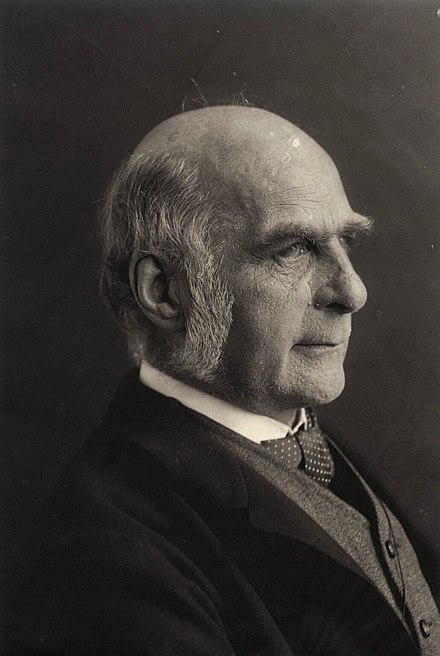
    There is a great dollop of blood ahead and smatterings throughout these first chapters, with racial connotations. Not to alarm our readers, it is best to put this in context with the time of A.C. Gunter’s writing, 1893. Ten years before, Sir Francis Galton, a cousin of Charles Darwin, defined Eugenics as ‘the study of agencies under social control that may improve or impair the racial quality of future generations’ (Memories… p. 321). As Darwin’s evolutionary ‘survival of the fittest’ made universal sense and was applied widely beyond its scientific origins, so Galton’s determination took on a life of its own in the US. Pseudo-eugenics prospered. Galton proposed that, where possible, breeding should be encouraged from good stock, and discouraged in bad. He saw the English upper classes as good stock with good qualities.

    Sir Francis Galton (1822–1911). Platinum print by Eveleen Myers (née Tennant). Source: Wikimedia Commons

    It’s all very well to establish a scientific principle, but left in the hands of the unscientific to ascribe subjective values on who or what is desirable, is another thing, particularly if based simply on race. It becomes a basis and validation for prejudice. None-the-less a movement began to grow to embrace the principles for the betterment of society through inherited blood. As Nancy Ordover puts it:

    U.S. eugenicists tended to believe in the genetic superiority of Nordic, Germanic and Anglo-Saxon peoples, supported strict immigration and anti-miscegenation laws, and supported the forcible sterilization of the poor, disabled and “immoral.”

    Ordover, American Eugenics (2003) xii

    Today, the narrator’s stereotypical presumptions would be considered racist, but these were, not to judge or justify, the emerging values of the society within which he lived. With financial support from the likes of John D. Rockefeller, and the Carnegie Institution, and aided by influential scientists like Charles B. Davenport and Alexander Graham Bell, the formation of organizations such as The Eugenics Record Office and the American Breeders Association, ensured the movement continued to grow and expand its demands until the commencement of the First World War (Ordover).

    Style and technique of the storyteller

    Contemporary writing has been greatly influenced by the visual mediums of television and film. ‘Show don’t tell’ is the admonition given new writers. This is a distinct departure from previous writing styles where the narrator plays a more visible, involved role of story-teller. However, even in Gunter’s period narrators were generally unobtrusive entities largely prepared to let their characters’ actions and words speak for qualities and nature.

    The narrator of Baron Montez, has a prominent all-seeing, all-knowing presence, to the extent of almost becoming a character of the story himself—as a US basketball coach is considered part of the team or an off-stage voice one of the cast. But this is purposeful. A.C. Gunter is a successful New York playwright, and this dramatic influence is evident in this work, in staging, character design and the transparency of his dialogue which truly provides an insight into character.

    In this first chapter, A.C. Gunter has several revelations to impart which have a bearing on the larger plot: the new Panama Railroad and its effect on the native population, and transiting Americans such as Alice and George Ripley; and while alternatively mollifying the reader with exquisite descriptions of the paradise that is Toboga Island, the sand, jewel waters and flowers, the vehement narrator carries out a relentless character assassination of Fernando Gomez Montez, who no doubt is up to no good. He is the quintessential bad boy, a charming rogue without soul, capable of anything, and his irresistible potential for evil-doing draws the reader on.


    BARON MONTEZ

    OF

    PANAMA AND PARIS

    A NOVEL

    BY

    ARCHIBALD CLAVERING GUNTER


    BOOK 1

    A TRAGEDY OF THE EARLY ISTHMUS

    CHAPTER 1

    THE RETURNING CALIFORNIANS

    “ANITA!”

    “Fernando, light of my heart! Returned from the Pearl Islands!” cries the beautiful Indian girl rushing to his arms and covering Mr. Fernando’s olive face with the kisses of youth and love. Anita is but fifteen, and the heart grows fast under the sun of the Equator.

    Fernando himself is scarce twenty, but he does not seem so ardent. He replies carelessly, “Yes, last night, by the Columbus,” pointing to that little unseaworthy steamer as she lies languidly upon the blue waters of the Bay of Panama, about three miles from the town, and seven from the lovely Island of Toboga, from which these two are gazing at it.

    “Last night, and you did not come to me? you—away five days!” answers the girl, tears coming into her eyes that flash through mists of passion like topaz stones.

    “Last night I had business in Panama—great business.”

    Then the young man says anxiously, “Is the Americano well?”

    Photo of indigenous Panamanian woman by Ayaita (detail, adjusted) CC BY-SA 3.0 Source: Wikimedia Commons

    “Yes.”

    “And here?”

    “Still here.”

    “He has not gone yet! Blessings on God! And his wife—the beautiful Senora Alicia, the lady with the white skin? She has recovered from her touch of the fever Panama?”

    “She is better. They go to the mainland this after noon.”

    “Ho-oh!”

    “To-morrow morning they take passage on the railway, to Aspinwall, and then go on the big vessel with the smoke to the great America beyond the sea.”

    “A-ah. she is well enough to travel?”

    “Yes, she is yellow no more; her cheeks are red as the blossoms of the manzanilla.”

    Por Dios! She must be lovely as a mermaid of Las Islas de las Perles!” murmurs Fernando half to himself, but still not sufficiently low to miss the sharp ear of an Indian; for at his words the dark eyes of Anita flash ominously, her full, round bosom pants under its white semitransparent cotton drapery, and she mutters savagely to herself.

    “What are you saying under your breath, Anita?” cries the young man.

    “Nothing! I—I was only whispering a prayer to the Virgin for the young American lady’s recovery, in the language of my tribe,” answers the girl hesitatingly.

    Diablo! No more of the language of your tribe! I don’t understand the language of your tribe!” sneers Señor Fernando, giving the girl a little slap on her shapely brown shoulder and a nasty glance out of his bright eyes. To this she does not reply, as she passes round the corner of the bamboo cottage, apparently overcome by some emotion she would sooner the gentleman who has been speaking to her would not discern in her face.

    “By all the saints of the cathedral, I believe the fool is jealous of my passion for the beautiful Americana! Anita jealous! Did she but know there is an Anita at Cruces, another at the Island del Rey, and half a dozen more scattered between Aspinwall and Panama, little Anita of Toboga would have fine cause for jealousy,” chuckles the young gentleman, smoothing his elaborate and spotlessly white shirt front, and settling the bright red sash around his hips, in the conceited way peculiar to South American dandies.

    A moment after, he thinks: “What matters one Indian girl, more or less? Besides, today I have other things—they are going away today. How lucky I returned from the Pearl Islands in time! But now, Por Dios!—everything is arranged for the departure tonight of the American, his treasure, and his—beautiful—wife.” He lisps this through his white teeth, as he looks lazily out over the Bay of Panama, and dreams a daydream which seems to be a pleasant one.

    It is shortly interrupted by a hearty American voice saying: “Back at last, Señor Montez. I hope you have brought the pearls. I was afraid we would not be able to wait for you. A gleaming necklace would be a very pretty present for my little girl in the United States.”

    With these words, a brown-faced, hardy and stalwart American, George Merritt Ripley, steps upon the bamboo portico and gives the man he addresses a hearty grasp of the hand. Ripley’s manners are those of one who has been educated as a gentleman, but has to a limited extent thrown off the veneer of society among the rough and ready companions of Alta California.

    This is apparent as he continues. “Light a cigar, my Spanish friend, and enjoy the view with me, this beautiful morning;” and, taking a camp chair, places his feet lazily upon the bamboo railing of the veranda, making a fine picture of a returning Californian of the fifties in his light woollen turn-away shirt, Panama hat, black trousers, high boots and belted revolver.

    “Gracias!” The Spaniard accepts the offered weed and then suggests: “Your wife, I understand, is now sufficiently recovered, to continue her journey to the United States.”

    “Yes, thank God!” answers the American. Then his lip trembles a little, as he says: “Though our first day in Panama, I was afraid my Alice would leave me forever;” and sighs: “That would have been the saddest parting on earth. My wife going to the embraces of our daughter she has not seen for four years—since we left her to journey to California.”

    “Why did you not take her with you to the land of gold?”

    “What! take a child of twelve across the Isthmus in 1852? With its boat travel on the Chagres—its night at Gargona, amid the clicking of dice and the curses of the gamblers—its morning of miasma, going up the river to Cruces, and its mule ride through tropical forests infested by thieves and banditti? That would have been too great a risk; but now, with the railroad, our return is different and safe.”

    At the American’s mention of gamblers at Gargona, and bandits on the Cruces road in 1852, a slight smile has rippled the olive features of the young man to whom he is talking.

    As the returning Californian speaks of the railroad, the smile on the Spaniard’s features changes to a scowl, but a moment after he assents laughingly: “Yes, it is different.” Then a gleam of diabolical hope comes into his face, as he says: “I am glad the Señora is well enough to travel.”

    “Yes, we leave here this afternoon. That reminds me I must thank you for your kindness of the week. Had it not been for you, Alice would have remained in Panama, and perhaps have succumbed to the fever; but here on this beautiful island, the sea breezes and the perfume of the tamarind groves have been better for her than all the quinine in the universe, and all the doctors on earth. So I shall take her back to the East to meet our child, and a reunited family will settle down to a life of civilization, blessing God for the gold placers of the Sierras, for I have been very fortunate in California. My wife will be dressed very shortly, Señor Montez. Would you mind suggesting to the kind Anita that sea breezes bring appetite for breakfast?”

    With this the gentleman returns into the little cottage of bamboo walls and palm-thatched roof, and Fernando Gomez Montez, looking after him, murmurs: “He has been very fortunate!” and thinks covetously of a strong ironbound chest the returning Californian carries with him, whose weight indicates that it contains the gold of the Sierras.

    Then his agile though sensuous mind wanders to the beauty that he knows the slight bamboo walls keep from his prying, inquisitive, hungering eyes—the beauty of the American lady—the white lady whose loveliness he has longed for since he has seen it—more than for the biggest pearl ever fished up from the blue waters of the Gulf of Panama.

    So he chuckles, looking over his own personal charms which he thinks are great, for he has very nice regular white teeth and sparkling dark eyes; his skin is a very mild chocolate color, and his slight, wiry, petite figure is clothed in immaculate white linen save where his bright red sash circles his dapper waist and falls down his right leg almost to his highly polished patent leather Wellington boots.

    Then hearing a woman’s soft voice within the bamboo walls, he mutters: “The Californian is bigger than I; but she will forget him for me—the prettiest boy in Panama!” and, gazing over the bay, sees in the distance, on the shore, the ramparts of the town, the white walls of its houses, and the glittering domes of its cathedrals.

    Back of it are the savannas, green as emeralds, that glisten in the rising sun; beyond, the Cordilleras droop to the lowest gap of that great ridge that divides the Atlantic and Pacific—so low here that twenty-five years after, they will draw all the gold from the stockings of the saving peasants of Brittany and Normandy, in the vain attempt to make the waters of the Pacific and Atlantic meet.

    Behind the South American town rise two green hills—the nearest, called Ancon; the other, farther back, an advance peak of the Sierras, is the Cerro de Filibusteres—thus ominously named because Morgan, the buccaneer, first gazed upon the old Panama that he and his two thousand miscreants (gathered from all quarters of the earth) three days afterwards destroyed with lust and pillage and rapine and fire and blood.

    Looking on this, Montez murmurs: “How peaceful! how beautiful!” Even his soul is struck by the lovely view before him, though he has seen it a hundred times, for to devils’ eyes, heaven is sometimes lovely: and this looks like heaven—though it is not.

    The sea breezes bring to him the scent of the tamarind, lime and orange groves. Around him is a mass of green—feathery green—of palms and bamboos, brightened here and there by red and yellow blossoms, that are strung, as if on florist’s wreaths, from tree to tree, and often dangle and droop into the limpid waters that lave the shore of fair Toboga Island.

    In front of him, and round to right and left, are waves clear as blue diamonds, in which the fish are seen as in some gigantic aquarium: the white shark, mixing with shoals of baracuta, and now and then a shiver of pearly water thrown into the air by flights of flying fish, that glisten in the sun.

    A little to his right, concealing a portion of the modern town of Panama, are three or four islands—green to the water’s edge. Were he nearer to them, they would also be brightened by the colors of innumerable tropical flowers, and made joyous by the songs of tropic birds. Beyond these, on the mainland to the south, lie the ruins of the old town of Panama—the one that Morgan made no more. Farther towards the Equator, the mountain range, growing higher, disappears in the blue sky.

    To the southeast, but beyond his eye, lie the beautiful Islas de las Perles. Around him it is all green and golden yellow and brilliant red—the foliage, fruits, and flowers of the tropics; about him blue; at his feet the waters of the Gulf; above him the ether of a fairy atmosphere. Its dreamy effect appeals to his sensuous soul. He gazes entranced.

    Panama, showing Archipiélago de las Perlas and Isla del Rey. (By Zakuragi; released by copyright holder)

    But as he looks his restless eyes catch, just on the right of the new town of Panama, a little smoke that goes peacefully into the air above it, and mingles with it. It comes from one of the locomotives of the Panama Railway, completed but eighteen months before, and a gleaming smile, as bright and sunny as the day he looks on, comes into the eyes of Fernando Gomez Montez, as he thinks: “Our mulateros and the Chagres boatmen hate this railroad that has taken from them the just dues they filched from the stupid Gringos who travel across our land. This iron track robs our honest banditti of their chances of spoil and plunder on the Cruces mule trail. To-night this helps me! To-night I have both the American’s treasure and his wife!”

    Then he giggles and chuckles to himself, emotions running over his mobile countenance, as fantastic, bizarre, and changing as the many drops of the blood of the various human races who in two centuries have passed across this highway of the world; and Montez of Panama has a drop of nearly all the races of the earth within his despicable carcass, and each drop—the basest.

    He has the drop that gives the cunning of the Spaniard; the drop that holds the bourgeois greed of the Frenchman; the drop that makes the watchful stealth of the Indian; the drop that contains the savage cruelty of the Zulu warrior; the drop that gives the finesse of the Italian; the drop that comes from the Corsican and makes undying hate; and, above all, one drop left by one of Morgan’s buccaneers, that makes him more dangerous than all the other drops of wickedness in his blood, for it gives to him the determination and the bulldog pluck of the Anglo-Saxon.

    Brute and bully as this buccaneer had been, he left his drop of blood to flow in the veins of this fantastic creature of all nations, to make him dangerous; because it gave him that unflinching determination that has carried the Anglo-Saxon race to all quarters of the world, and made it dominant in every one of them.

    But Montez awakes with a start. A merry voice is in his ear, a white, aristocratic hand is held toward him in friendly greeting. These belong to Alice Ripley, who with joy, hope, and happiness on her fair American face, is saying: “Señor Montez, our kind friend, you have been to the Pearl Islands for us—another favor for which to thank you!”

    “You are now quite well?” he stammers, a little confused, though his eyes are bold enough to linger over the beautiful woman, as she stands before him, a white muslin dress floating about her graceful form, and some ribbons in her golden hair, giving color to a fair Saxon face, that is lighted up by radiant, happy violet eyes.

    “Yes—quite well!” she laughs. “So well, appetite has returned to me. I am impatient for breakfast, which kind Anita says is ready in the tamarind grove.”

    “You are—quite changed—you are more beautiful—”

    “No,” she laughs, “more happy. I am well once more—my husband is by my side. In ten days I shall kiss my daughter. Am I not a fortunate woman? But breakfast. En avant, George, and forward Montez!” and Alice Ripley flits over the veranda towards the breakfast bower, made girlish by joy, and stands beside the green palms and red flowers, a picture that makes Señor Montez’s eyes grow tender, and he would pity this lovely American lady he hopes this night to cut off from husband and friends, and home and child—but in all the polyhæma drops that run in his vile veins, there is no drop of pity.

    But there are in his body, drops of blood that carry unbounded passion and intense desire, and gazing on this fair woman’s blue eyes, and white skin, and graceful mobile figure, his eyes grow misty, as he mutters: “A rare flower for Fernando Gomez Montez of Panama to pluck—Ah! This is a lucky day for the naughty boy of the Isthmus!”


    Notes and References

    • Francis Galton (quotation): The version above is taken from Galton’s book Memories of My Life (1908), where he refers to the quoted definition appearing in the ‘minutes of the University of London’, presumably based on his work. (See Field, p.23 for clarification.)
    • Por Dios: Spanish, ‘For God’s sake'.
    • quinine: anti-malaria treatment. Made from bark of a tree from Peru. It gives Tonic Water its bitter taste.
    • rapine: origin 1375–1425; late Middle English – robbery, pillage.
    • mulateros: Spanish, mule driver, mule boy.
    • Gringos: Spanish foreigners, pejorative: Yanks, Yankees, North Americans, light hair/complexion.
    • banditti: Spanish, el bandido; bandit (plural, el bandolero).
    • Cerro de Filibusteres: Cerro, hill. The literal meaning of ‘filibustero‘/’filibuster’ is ‘obstruction’; hence in the text, ‘thus ominously named…’.
    • lave: before 900; Middle English, laven < Old French, laver < Latin, lavāre, to wash. Partly representing Old English, lafian, to pour water on, wash, itself perhaps < Latin, lavāre (same Latin root as ‘lavatory’).
    • polyhæma: ‘many’ + ‘blood’; in the context, perhaps referring derogatively to his ‘mixed blood’?

    Field, James A. ‘The Progress of Eugenics’, Quarterly Journal of Economics, 1911, 26.1, 1-67. Jump to file (OUP) at JSTOR.

    Galton, Francis.Memories of My Life (London: Methuen, 1908). Jump to quotation at Internet Archive.

    ——. Hereditary Genius: An Enquiry into its Laws and Consequences (London:Macmillan, 1802). Jump to file at Internet Archive.

    ——. Inquiries into Human Faculty and its Development. (London: Macmillan, 1883). Jump to file at Internet Archive.

    Otis, Fessendon Not. Isthmus of Panama: History of the Panama Railroad; and of the Pacific Mail Steamship Company (NY: Harpers Brothers, 1867). Available free: Google Books. Internet Archive.

    Ordover, Nancy. American Eugenics: Race, Queer Anatomy, and the Science of Nationalism (Minneapolis: University of Minnesota Press, 2003).

    This edition © 2021 Furin Chime, Brian Armour

  • Cobb’s False Knight: 13. A Terrible Blow

    Cobb’s False Knight: 13. A Terrible Blow

    For some people living in western democracies, reading Cobb’s story with spies lurking in the woods may almost seem a bit too fictional to be taken seriously. Yes, some of us remember all the “reds under the beds” hysteria from not so long ago, but wasn’t that a bit different?

    Perhaps we are entering times of spies galore once again, but only a few years ago, all you had to do was get a day pass to visit East Berlin from West Berlin, and suddenly you entered something like a huge walk-through movie set from what could have been a James Bond spy film. Except, it was real.

    Maybe it was because the drab border checkpoints and East Berlin streets seemed familiar from such movies? Or maybe it was because you knew a bit more about Stasi, the East German security service, that was reputed to have up to ten percent of the population working for it as informants? They even had one in West German Chancellor Willy Brandt’s office, happily passing on NATO secrets (Guenther Guillaume).

    Still, imagining “spies lurking in the woods” is something quite different, isn’t it? I guess it might not seem so unusual for those of us who might be a bit more prone to paranoia than others when it comes to feeling observed to accept such a notion. But for the others? Is Frau Schmidt from the apartment building next door hoping to see what kind of furniture is being delivered from the van parked below? Perhaps, in the Middle Ages, “spies” may have been little more than inbred villagers paid to hang around an area and hope to get a reward for reporting something suspicious. Calling them “spies” may be all that had irked me at first. I really wondered exactly why Cobb’s mentioning of them at first seemed a bit too contrived for me.

    Mata Hari in 1906, photographer unknown. Source: Wiki Commons

    We have all heard of Mata Hari and those famous British traitors from Cambridge, like Philby. Less well known is Rudolf Roessler, an extremely successful anti-Nazi Soviet spy. But do we know the name of even a single spy from several hundred years ago? Hmmmm… There you go. Not one, I bet. Perhaps they were just too good at keeping a low profile back then? I’m just kidding. Or could it be that in an age of chivalry, when concepts such as “honour” and “fairness” still meant something, anyone lacking enough in either to become a spy in such times was soon best forgotten?

    An example of this could be Christian Andreas Kaesebier (the surname translates as “Cheesebeer”). Known as a thief and a scoundrel, Prussian King Frederick II had him released from prison in Stettin during the siege of Prague in 1757, on the condition that he should of enter the city and spy for Frederick. He did so on two consecutive nights, not returning from a third however. He disappeared and was never heard of again. It’s amazing we even still know of him.

    So of course Kings, Emperors and all sorts of nobles had spies, maybe even knights from smaller castles, surely also in the Middle Ages. Perhaps my reason for at first wanting to think of them as being too fictional was simply because I had never heard of any from that era. Tinker, tailor, soldier, spy? Forgotten bit part players in the intrigues of long ago, mere village inbreds, standing around suspiciously in the woods? Fitting then, that Cobb didn’t even name them.

    Just kidding. It seems that our perception of spies may have changed since a century or so, except those we revile for having worked for the other side. Too many Bond films?


    CHAPTER 13

    A TERRIBLE BLOW

    An hour and more Oberwald and his young friend spent with Thorbrand, finding him more easy and comfortable than he had been at any time since his sanguinary ordeal. For one thing, they found him up and partly dressed, sitting in a softly-cushioned chair, with a sword in his hand— a sword which his host had kindly lent him to hang up on the wall of his abode. He said he had been simply trying the strength and endurance of his arm. His nurse did not scold him, as he believed the exercise would be of benefit.

    As we have said, his visitors remained with him an hour and more, and when they left him he seemed better and stronger than when they had found him. They had told him all they thought it best to tell him, giving him to understand that the baroness and her daughter were for the present safe, but withholding the fact that they were so near him.

    When evening had come, Lady Bertha and Electra, with Captain von Linden, joined the hunter and his child in their comfortable living room. The heavy inside shutters had been put up against the windows, and there firmly bolted, and the doors carefully closed and secured.

    “Dear sister,” said the heiress of Deckendorf, looking suspiciously into Irene’s face, “what has happened to you? What is that wondrous light in your eyes? And why does your heart beat so strangely? I can hear its throbbing when I lay my head against your bosom. Ah! you have seen—”

    “Hush! No more now, if you love me!” And as Irene thus exclaimed in a tremulous whisper, she caught her companion’s hands and looked into her face imploringly. “At some other time I will tell you all about it. Don’t ask me any more now.”

    Electra gave her a curious glance, then a meaning smile broke over her beautiful features, and she turned the conversation upon another topic.

    Wolfgang had gone as he had come, promising that with the expiration of another week, if not before, he would come again, by which time he felt assured his chief would be entirely recovered; or, should an alarm of impending danger reach him, they might see him at any moment thereafter.

    The fourth day from the visit of Wolfgang was dull and drizzly—really stormy. The wind moaned through the sombre firs and around the broken faces of the mountain, and the driving moisture was penetrating. Early in the morning the hunter had been obliged to go to the village, taking the secret way. It was a business he dared not neglect. Before he went he looked in upon the baroness, to see if she had any orders or errands for him, at the same time being very particular to enjoin upon her the utmost caution during his absence. She promised him that both she and her daughter would be very, very careful and circumspect; and he went away content.

    Alas! Why did the woman break her promise? Was it that perversity of her kind that makes forbidden fruit so attractive? At any rate, good Martin Oberwald had not been gone an hour when the fancy seized the baroness that it was very gloomy and lonesome in that dismal cavern, and she tried to make herself believe that the rain was coming down through the roof. A full hour she dwelt upon the subject, telling herself repeatedly that she would certainly stay where she was, and then—then she persuaded Electra that they might, on such a wretched day, with entire safety spend a little time with Irene before her great fire. The girl, unfortunately, needed no urging. So many days of quiet rest without any alarm had made them bold.

    At the same time that Lady Bertha and her daughter were making their way out into the living-room of the cottage, something happened outside that is worthy of note.

    Two of Dunwolf’s spies, posted near the main path from the hunter’s cot, were surprised by the appearance of another of their squad, who had just come up the mountain. He had been climbing rapidly, and was breathing hard.

    “Martin Oberwald is in the village!” was the report. “I saw him at the foot: of the mountain, just striking into the path from a dense jungle of rock and tangled wildwood. Now let us strike at the game. We know where it is, and we may capture it if we are prompt and wary. What say you ?”

    They were both of his way of thinking, and they at once went to work to gather together sufficient of their comrades to strike a decisive blow.

    * * *

    “O! Irene, how comfortable you are here!”

    The words were spoken by the Baroness Deckendorf, as she and Electra came forth from their hiding place.

    The hunter’s daughter started so suddenly that she dropped a part of the work from her hands.

    “Now, don’t scold us. I cannot tell you how lonesome and cheerless it had become in that dark and dismal place,” said the baroness.

    “I could not scold you if I would, dear lady; yet I must tell you that you are running a risk. I know the cavern is chill and cheerless on such a day; but it is safe, nevertheless.”

    “And why shall we not be safe here?” asked the baroness, as she spread her hands over the blazing fire. “The shutters are all up at the lower windows, and if strangers should approach the dogs would give us warning.”

    “What makes your father so particularly anxious?” asked Electra, not offering to sit. ” I thought this morning, when he came to speak to us, that some new cause of alarm had arisen.”

    Young Couple (1850), Carl Wilhelm Hübner. Source: invaluable.com

    “You know, dear sister, that your staghound got out on the day before yesterday, and was away for a considerable time. Some of the spies must have seen him, and if they recognised him as yours, of course they would be certain that you are not far away.”

    “Really, mamma,” the daughter said, “I think we had better return to our safe retreat. We can have a good fire there, and be as comfortable as we please. Let us call Ernest to sit with us, and I am sure we shall pass the time away very pleasantly.”

    “Well, well,” the baroness returned, as she arose from her chair with a seeming effort, ” I will go back. But, certainly, I do not see how anybody can come upon us in here. How could they, with the lower shutters up, and everything so snug and close?”

    As she spoke, and before lrene could reply, the staghound, who had followed his mistress from the cave, gave a sudden start; then a low, sharp cry; and then away to the door, where he pressed his muzzle against the cracks, sniffing and growling with wonderful persistence.

    “Mamma! mamma! come! let us make haste. There is something at the door I am sure.”

    Electra had taken her mother’s hand, and had turned towards the place of exit, when a sound, as of a thunderclap, smote their ears, and on the next instant the outer door was burst from its fastenings, and flew wide open, a huge battering-ram—a log of wood as heavy as ten men could lift—being at the same time projected into the room; and in a moment more the place was filled with armed men!

    While the women screamed the staghound flew at the foremost of the intruders ferociously; but one of the men, with his wits about him, and evidently prepared for the work, adroitly slipped a noose over his head, and very quickly had him secured and placed beyond the power to do more harm.

    The baroness and her daughter were then seized, their arms bound behind them, their heads and shoulders protected from the weather by heavy coats which two of the soldiers threw off; and then, without further ceremony—without waiting for further raiment, they started off upon the run, the half paralyzed women being borne roughly along, a strong man at each arm, almost lifting them from their feet as they sped on their way. In their paroxysm of terror, the stricken captives could neither struggle nor cry out; one word, and one alone, fell from the lips of Electra—the name of her dear lover—”ERNEST!”

    So quickly had the whole thing been done, so prompt and sure had been every moment without mistake or mishap, that not more than one poor minute had elapsed after the invaders had burst open the door of the cot before they were out again, with their prisoners in charge,

    Upon Irene they had scarcely looked. Her great St. Bernard, accidently left shut up in another room, had been struggling for admittance, but she felt that in opening the way to him she would but admit him to his death. And further, he could have done no good. As for herself, she had not lost her presence of mind at any time during the startling scene. She had seen on the instant that anything like resistance would be worse than useless. As for help, there was none to call. If, for a single moment, she had allowed Electra’s pathetic call to lead her to think of arousing Ernest, the thought was quickly put away. She would have simply called him to share the fate of the others. There had been at least a full score of the ruffians, and they had been determined and desperate. Against them, the arm of the young captain, strong as it was, would have been but as an arm of straw. He would have been instantly captured, if not killed, and thus the loved ones would have been robbed of a valuable helper in the future. Aye, Ernest von Linden left behind in his safe retreat, could be of vastly more service to them than he could have been had he kept them company in captivity.

    The girl stood where she had stood from the first, and watched the departing troopers—saw them half carrying their captives in their arms—forcing them onward in brutal haste—watched them until they had gone from sight, and then went to close the door; but this she was unable to do. The heavy log, which had been used as a battering-ram, had been left across the threshold, and she had not the strength to lift it. With a strong lever, however, she at length succeeded in working it out of her way, after which she shut to the door, and secured it as best she could.

    Her next movement was to loosen poor Fritz, who was jumping against his leash, and howling most dismally. When the dog was free, he sprang to the door and tried to open it. Then he came back to Irene, and begged most piteously, fawning upon her and whining, his great brown eyes fairly brimming with tears. The agony of that poor, dumb friend made her heart ache more than had all that had gone before; and by and by the intelligent animal seemed to understand that he had her sympathy, and that that was all she could give him. He finally returned to the door, and there lay down, moaning in bitter grief and distress.

    The getting of the log from the threshold and disposing of the dog had consumed considerable time; so much, that Irene judged that the marauders had, reached the foot of the mountain, at least, and she would be safe in letting Ernest know what had happened. She had hesitated until now, because she had felt sure that he would, if he thought the ruffians within reach, dash madly after them; and she did not care to be a party to his self-destruction. But she was speedily saved further anxiety in the matter by the appearance of the man himself.

    She was standing looking at the dog, but thinking of Ernest, when she heard her name called, and on turning, she saw the face of the captain just peering through a narrow opening he had made by partially pulling back the door.

    “Irene, What was the noise I heard? Where are the baroness and Electra?” he asked, hurriedly and eagerly, as the girl came towards him. “How? Has anything happened?” he exclaimed, catching the scared look upon her face; and, at the same time forgetting the precautions of the hunter, he threw open the door and came out.

    But Irene pushed him back, herself following; and as she started to close the door behind her, the stag-hound came bounding through, and at once began to fawn upon the youth, and to implore him as he had to the maiden.

    By this time our hero knew that all was not right. He caught the girl by the wrist and besought her to speak.

    “Alas, dear sir, the worst— No, no not the worst,” she cried, correcting herself, “but something very painful has happened.”

    And then, as best she could, with his frequent and frantic interruptions, she went on and told the story.

    It was terrible—and for a little time the frenzied youth strode to and fro, wringing his hands in speechless agony. His first thought, when he could think at all, was of instant pursuit. He would arm himself with sword and pistols, and overtake the villains if he could.

    Fortunately for Irene, and, perhaps, fortunately for the young man himself, at that moment the hunter made his appearance. In the two faces before him he saw the indications of terrible news, for never was more terror depicted in a human countenance. Before a word had been spoken he opened the door and looked into the front room. He saw the ponderous log of wood upon the floor, its smaller end just clear of the outer door, and his quick eye detected that the fastening had been broken away, in a moment he knew what had happened.

    “Irene! how came it to pass?”

    “Dear papa! It was all done in a moment, without warning of any kind.” And she went on, and told the story as it was; and this time she was permitted to tell it without interruption.

    When it was done, the strong man bowed his head upon his hand, and so remained for several seconds.

    “Alas! Alas!” he moaned, on looking up. “l ought not to blame her. Poor lady! she was very sad and lonesome, I have no doubt; and she did not think. Yet, if she had obeyed me— if she had kept the spirit of her promise to me—this would not have happened.”

    “But how did they happen to strike at the very time when you were away, dear papa?”

    “There was no happening in that. As I emerged from the cover of the far end of the mountain pass, I saw one of Dunwolf’s men not ten yards away; and I know that he saw and recognised me. But I feared nothing. Even should the rascals pluck up courage enough to break into my dwelling in my absence, they could find nothing, for my caverns are beyond human skill to discover. Had I thought that Bertha could have been so careless, after the caution I had given her, I should have come back at once. You remember the circumstance of the dog’s getting loose and wandering into the forest? The spies knew that the [check typo in copy] mistress must be hidden not far away.”

    To a question from Ernest, Oberwald explained that he had several times detected spies in the tall grass near the cot, from which position they could look into the sitting-room through the upper windows. In all probability enough had been seen to warrant them in making a bold dash. They made it, and the result we have now before us.

    Ernest groaned in bitterness of spirit. By-and-by, when he could speak coherently, he laid a hand upon the hunter’s shoulder and asked him what could be done.

    “If I thought I could find the grand duke,” he said, “I would take horse for Baden-Baden at once. He, l am sure, would set this matter right.”

    “There is the trouble,” returned Oberwald. “You are not sure of finding Leopold, if you go. I have not heard of his return to his palace since he went away. We must look to Thorbrand. Upon him our hopes must now rest.”

    “Let me see him,” pleaded the eager youth. “I can so set before him the character of Pascal Dunwolf—”

    The hunter put out his hand and commanded silence.

    “Thorbrand will not be seen until he is ready to act. Be sure, my dear Ernest, you can tell him nothing which he does not know. As for the character of Dunwolf he knows it thoroughly; and I may assure you that he can, when he will, strike him to the earth. There is one other, however, for whose coming we must wait. I think he will be here before this day’s light is gone.

    Irene looked up quickly, with a flush upon her face, and a wondrous sparkle in her eye.

    Her father nodded pleasantly. “Yes, dear child, it is he. With his arrival we shall be prepared to lay out the work. Meantime, you Ernest, must run a little risk. You must visit the castle—”

    “O!” the latter exclaimed, impetuously, “did you think I needed to be told that? Did you imagine that I would allow a night to pass with us in uncertainty regarding the fate of our beloved friends?”

    “Ah, my dear boy,” the hunter said, with a significant shake of the head, ” I think you need a little caution before you venture. You may be sure that Dunwolf will have an eye upon his fair captives, that they do not escape him again by any secret pass; for, of course, he must know that in that way alone could you have given him the slip, and taken the ladies with you. Now, mark me, Ernest, your only object in going to the castle must be to learn what is going on, and, if possible, what the rascal’s plans are. Evidently, he intends to force a marriage ceremony upon the heiress, and that we must prevent.”

    “Prevent it! By the heavens above me I would—”

    “Tut! tut! What would you do, singlehanded, against the host that man has at command? Be rational, boy, and listen. You will learn all you can learn, and bring back word as speedily as possible. And do you not, for a single moment, lose sight of this important fact: The power to overcome Pascal Dunwolf is here—at present within these walls.”

    “O! dear Oberwald, if I could know—”

    “Pshaw! Can you not believe me? Do you fear to trust me?”

    “Papa,” interposed Irene, with pleading look and tone, “remember how he has been tried. Think how his heart is aching.”

    “And I would heal it for him.—Dear boy,” the hunter added, with a kindly smile, laying a hand upon his shoulder, “there is no need of haste in this matter. You will not think of going to the castle until evening; so we have plenty of time for consideration. I might ask you, however, whom you will seek? To which part of the keep will you direct your steps?”

    The young man reflected for a brief space, and finally said that he should go to the old picture-gallery.

    “Leading out from that,” he explained, “is a small closet, for the stowing away of pictures not hung, in one of the walls of which is a sliding panel that opens the way into a branch of the secret pass. None of Dunwolf’s people will be in that neighbourhood. From that point I can direct my steps as I will. I must run some risk. I will see the baroness if I can. But, good Martin, I will be careful. I shall be cool and collected. Know that clanger, however great or sudden, never weakens or confuses me. I am never so strong, never so cool and calm as when in the face of mortal peril. I shall go well armed, and woe betide the man who shall place himself in my way.”

    Oberwald gazed upon the youth with a beaming look—a look of admiration and respect.

    “Ernest,” he said, extending his hand as he spoke, ” I did you wrong a little while ago. I failed to think how sorely you had been stricken, how your heart must have been wrung. I will trust you, dear boy. Aye, more, if Thorbrand thinks well of it, I will go with you. The pair of us might present a strong front in case of discovery and attack.”

    Von Linden uttered an exclamation of gladness.

    “O! that would be a joy for me,” he cried. “As we should go we could meet nothing that we could not overcome on the instant. Say you will go.”

    “I will speak with him I told you of, and by his judgment must I abide. You shall know in good time.”

    Just then poor old Gretchen came crying upon the scene. She had just missed her dear mistress, and feared some accident had befallen her.

    To Irene was left the work of comforting the faithful old servitor. She did it after a time, though she found it difficult to do.

    After this Martin put on his cloak and went out to take an observation. For half an hour he scoured the forest in every direction, over the ground, lately occupied by the spies from the castle, without finding one of them left behind. The capture of the two ladies had been all that had been particularly desired by their chief; for, though he had set a price upon Von
    Linden’s head, he was not at all anxious that he should be brought back to him.

    Having satisfied himself upon this point the hunter returned to his cot, where, for the next hour, with Ernest’s help, he worked on his front door. Luckily the door itself had been stronger than had been its fastening, in consequence of which only the latter had suffered.

    House in the Middle Black Forest (1910-11 autochrome, cropped). (Emmendingen district of Baden-Württemberg). Public Domain. Source: Wiki Commons

    Irene was just preparing the evening meal when a step was heard in the rear porch of the cot, and shortly afterwards the door of the living-room was unceremoniously opened, and the golden-haired, blue-eyed hero of our mountain maid’s love-dream appeared. He shook the dripping moisture from his plumed cap, and threw off his cloak before he spoke.

    Oberwald started to his feet, and took his hand.

    “Just in season, my dear Wolfgang—in season for supper, and for news,” said the hunter.

    Our hero gazed in speechless wonder upon this man, with the name of the most notorious of the famed robbers of the Schwarzwald, and whom yet the honest hunter took by the hand and addressed as a dear friend. But a greater surprise was in store. He saw the man turn from the father to the daughter, and never before had he seen that beautiful maiden look so charmingly beautiful as she did at that moment.

    Her azure eyes beamed and glowed with the light of a gladness that was of the heart; and when the man lifted her hand to his lips she did not quail, and if she trembled at all, it was not with either fear or offence.

    And for the man himself—Ernest was obliged to confess that he had never seen a handsomer— never a man whose face at sight he would sooner trust. This had he seen and thought when he stood with him face to face.

    “Captain von Linden, this is the Herr Wolfgang of whom you have heard. I present him to you as my very dear friend. And to you, my dear sir, I will say, Von Linden is worthy of your confidence and esteem.”

    It was all very strange to our hero, but he had no time then for speculation. He gave the man his hand, and in the grasp which he received there was a warmth and spirit that went to his heart. He met the earnest, honest gaze of those deep blue eyes—eyes that appeared a heavenly blue to Irene—and he was captive from that moment.

    After a time the men resumed their seats, and Irene, assisted by her maid, with good old Gretchen making herself as useful as she could, resumed her work of preparing supper.

    Then Oberwald told the new-comer the story of the abduction of the baroness and her daughter; and if Ernest had honored and respected Wolfgang before, he fairly loved him now; for the words which he spoke, the spirit which he manifested, and the power which he seemed to possess, gave him more of hope and courage than had come to him from any other source.

    When supper was ready, they all sat round the table, for the time putting off every anxious care, and turning their conversation upon subjects of interest and instruction.

    Later in the evening the hunter drew Ernest aside, and said :

    “Now, my dear boy, you must make yourself comfortable and sociable, if you can, for a time with Irene. Wolfgang and I are going to confer with him whom we both acknowledge our chief at present. I would ask you to go with us if I dared, but our master has forbidden it. Be not uneasy. The time is not far distant when we shall have no secrets from you.”

    In speechless amaze Ernest stood gazing in to the vacant space which the hunter had left, until the sweet voice of Irene recalled him to himself.


    Notes & FYI

  • Cobb’s False Knight: 12. In the Hunter’s Cot

    Cobb’s False Knight: 12. In the Hunter’s Cot

    The Swabian Alb is indeed the area of Germany with more caves than anywhere else. Around 2000 of them, apparently. That’s because it’s a karst area: a landscape in which limestone is constantly being hollowed out by erosion. Cobb knew his geography well. Hiding in caves is a theme that has left traces in the German language that still endure.

     “Siebenschlaefer”, the “Seven Sleepers”, is what every German knows as a particular date. The 27th of June in every year. That’s because legend has it that the weather on this date predicts the weather for the following seven weeks. If it rains on the 27th of June, that means it will be rainy until mid to late August. Farmers still recite the old rhyme, “ist der Siebenschlaefer nass, regnet’s ohne Unterlass” (If the Seven Sleepers is wet, lots of rain is what you’ll get). Yikes! A “Siebenschlaefer” is also a species of fat, edible dormouse found in Western Europe. One whose burrows might be flooded if it rains on that particular day? Why on Earth would Germans, and who knows, fat dormice, believe in something like that?

    It’s perhaps the most enduring example of weather lore in Europe. Quite surprising how often it can be relatively accurate. You seem to forget the years where it may have been wrong. What many Germans don’t realise is that the date is actually that of an old religious feast, meant to commemorate the “Seven Sleepers“, seven youths in antiquity who hid in a cave outside the Greek city of Ephesus to escape religious persecution. They apparently emerged again three hundred years later. The seven youths are also known in the Islamic faith, as the “Cave people”.

    Seven sleepers, Anon. from Menologion of Basil II* (c.985).

    Well, if anyone decided to hide in a cave these days, the Atta Cave in Westphalia might be a good choice. Because, if they ended up staying a bit longer, at least they wouldn’t starve. This one is more than seven kilometers long and is used to store thousands and thousands of tons of cheese. Bored cave hiders who might lack a bit of entertainment however would have to burrow through to another cave, the “Ruebelaender Tropfsteinhoehlen” (the “Turnip Country Dripping Stone Caves” if translated word for word) (I simply couldn’t deprive you of this gem by putting in a normal translation) in Saxony Anhalt. Even Goethe is said to have visited this particular hole in the ground, which has been used for theatre performances for a long time (Is there anywhere that Goethe didn’t visit?) There’s even a “Goethe Chamber” in one of them.

    Anyone for Mervyn Peake’s “Cave”, performed in a real cave? Then head for Turnip Country. But don’t forget to take lots of hard cheese with you. To stick in your ears perhaps: performances there can be a bit grating because they are often in the somewhat heavy Saxon dialect.


    CHAPTER 12

    IN THE HUNTER’S COT 

    Forty years, or thereabout, previous to the time of which we write, Sir Arthur von Morin, then a gallant hunter when not in the field, had accidentally discovered a wonderful cavern on the side of the Schwarzwolf Mountain; or it was rather a series of caverns, with a common entrance. Beneath an overhanging shelf of rock, completely hidden by tangled wildwood, was a broad alcove, within which were three different openings into as many large and convenient caves. They were very high, with arched roofs, and with fissures in the walls and tops, through which air could pass, and light enter, but proof against the incoming of rain. This secret the knight had kept to himself, only imparting it, after a time, to Baron Deckendorf, until Martin Oberwald chanced to come that way in search of a refuge from the world. He had known and loved Martin’s father, and Martin himself had served under him in more than one campaign.

    Portrait of a Hunter, Max Kuglmayer (1863-1930). Source: invaluable.com

    To Martin Oberwald, Sir Arthur imparted the secret of the cavern, and the baron gave him a deed of that side of the Mountain. His infant daughter had a home at the castle until he could prepare for her a fitting dwelling of his own. The fancy seized him to erect a substantial stone cottage so situated that its rear wall should cover the entrance to the caves; and in this covering wall, with his own hands, assisted only by a competent builder whom he could trust, he fixed a secret door, so arranged that a child might work it, but which no stranger could discover.

    And here the recluse had lived, and reared his beautiful child. To more than one poor, hunted fugitive, flying from oppression and injustice, had he given safe asylum, and none to whom he had thus given his secret had betrayed it.

    In one of these caves the wounded man whom Electra and Irene had succoured had been placed, and there the hunter cared for him. In all the land not a better physician than was Oberwald could have been found, and under his skilful treatment and tender nursing the patient was gaining strength fast. But very little fever had resulted from his hurts, and that was entirely gone. All he had now to do was, to make good blood and plenty of it. That would heal his wounds, and give him back the strength he had lost.

    On the other two caves, one of them—that on the extreme left—was double. Opening from it, was a narrow, beautifully arched passage, leading to another chamber of good size, but so far into the mountain that no light of day could reach it. Yet the air circulated freely through it, and it was very comfortable. This double cave was given to the baroness and her daughter and good Gretchen, while Ernest von Linden took the other.

    Since there was no likelihood of the baroness coming in contact with the occupant of the first-mentioned cave, the hunter did not think it best to inform her of the presence of the dreaded robber chieftain so near to her; but she was not long in discovering it. That some one was there whom Oberwald was tenderly nursing, she knew on her first visit to the sitting-room of the cottage; and finally her daughter told her who it was. At first she was inclined to be alarmed, believing, as she did, that Thorbrand was a friend and co-worker with her worst enemy.

    “O! mamma,” said her daughter, “if you could see the man as I saw him, you would not fear him.” And then, for the first time, came out the story, new and wonderful to Lady Bertha and Ernest, of the heroic work of Electra in saving the robber’s life; for that she had done so was a fact not to be disputed.

    “And now,” said the hunter, when Electra’s story had been sufficiently discussed, “I will make a disclosure which has been given to me as a trust; but I think that I have a right to impart it to you. This man—Thorbrand—is so far from being a friend of Dunwolf, that he will expose and punish him as soon as he is strong enough. I tell you my lady, and von Ernest, in that man rests the sole power to give you ample justice. He loved the late baron as he never loved another living being. It would be a long story to tell, and I feel that I have not the right to tell it. I have nursed him, and helped him on the road to health and strength, as much for your sakes as for his own. So, dear lady, put away your fears, and pray, if your conscience will let you, for the speedy recovery of the robber chief.”

    Both the baroness and von Linden were greatly surprised by this information. They had many questions to ask, some of which their host promptly answered, while to others he only shook his head and closed his lips. But the lady put away her fears from that moment, and soon came to think o£ the terrible Thorbrand kindly, and with good wishes.

    Oberwald was not long in discovering that his cot was under surveillance, and before night of the second day of the appearance of the spies he had counted a full score of them, and he knew there were more,

    He had one secret more which, up to the present time, had been given to only two men beside himself. That was a covered way—a deep, narrow gorge in the mountain, caused by some great convulsion that had upheaved and rent asunder—completely hidden at both ends. At the upper extremity a porch of the cot covered it; and half a mile away, toward the village, at the extreme foot of the mountain, it was hidden by a combination of broken rocks and tangled vine and brushwood.

    The second man to whom he had given the secret had been none other than Wolfgang. When that man had called to see his wounded comrade, and had expressed a desire to feel free to come when he would, Oberwald had been so wonderfully impressed in his favor that he had not only suffered him to depart by the secret pass but had bidden him come when he would by the same way.

    So the good hunter borrowed no present trouble on account of this espionage. Had it been necessary for Wolfgang to come up the mountain openly, he would have felt it his duty to hasten down to the village and instruct the inn-keeper there to warn him when he came; but, as it was, if he should chance to visit the wounded chief again, he could do so safely,

    Four days had passed since the spies had made their appearance in the forest; the baroness had been a full week a guest of the hunter; and, thus far, all had gone well with the indwellers of the cot and its mountain chambers.

    Towards the middle of the forenoon, Irene Oberwald sat in the kitchen, having just finished a grand baking of pies and meats, and while her only servant had gone out to look to the poultry and hunt for eggs, she had laved her face and hands in fresh water, and sat down to rest. Her father had taken his gun and gone forth to hunt for game— partly that, and partly to observe the disposition of the spies, who still occupied their old places in the surrounding forest. He had not been far away from his dwelling since they made their appearance, and he would not probably go far now.

    Very seldom did the people from the castle leave their cavern during the day. The hunter had striven to impress it upon them that they could be safe only while out of sight. There was no telling at what moment the eyes of one of the numerous spies might peer into the cot. As for himself, they dared not molest him without cause. Sir Pascal knew that he enjoyed a pledge of personal security from both the grand duke and the emperor. Why those magnates had thus honored him he did not know; he only knew it was so.

    So Irene sat, in her high-backed chair, her eyes half closed, thinking of something that had often occupied her thoughts of late, one hand resting upon her lap, while the other stole unconsciously up until it pressed her bosom, when she was aroused from her reverie by the sound of a footfall behind her, coming from the direction of the rear of the cot. She quickly turned, and started to her feet. Her breath came and went, her face grew suddenly pale, and then the rich colour mounted to cheek and temple, while she caught the back of her chair for support.

    He of whom she had been thinking, looking handsomer, she thought, than ever, his clear, honest eyes smiling upon her, with a gaze earnest and sincere, stood before her.

     “Wolfgang!” she whispered, before she thought.

     “Dear lady—lrene!—let me believe that I am welcome.”

     “But, sir, how did you come? I saw you not.”

     “No. I am a favored one. Your father, when I was here once before,—it has seemed an age to me—initiated me into the mystery of the secret pass.”

    Why did her heart bound so happily at that? Why did it give her such quick, thrilling joy to know that her father had so trusted this man? Ah, poor heart! poor heart! It had become captive, and she knew it. She realized now, if never before, that she loved this man. And yet she scarcely knew him. How strange it was. How had it come to pass?

    But she had no time now for further speculation or philosophising. The newcomer took her hand as a brother might have done, and asked for her father—or rather, where he was. He did not appear to be in a hurry to see him.

    She told him that he had gone out to shoot some game and— She had got so far when she stopped.

    “Ah, I see,” he said. ” Let us converse for a few moments. I want information which you can give me.”

    He pointed her to a chair, and then sat near her.

    “Now, dear lady, I want to know what is going on here. As I told you once before, I will help your friends if I can; and that the ability will be mine I have not the least particle of doubt. Trust me. You will trust a true heart, be sure.”

    Her tongue was loosened as though by the touch of a magician’s wand. She could not have felt more confidence in her beloved father than she felt at that moment in the man before her. She asked him of what she should tell him.

     “Of everything,” he answered. “I want to know what Dunwolf is doing at the castle.”

    Then she went on and told him the story. She told first of Dunwolf ‘s arrival at the castle immediately after the funeral of old Sir Arthur; then of the adventure of Ernest von Linden on the road; then of his being entrapped and cast into the dungeon; then of the escape and flight to the cot; and, finally, of the precautions they had been obliged to take on account of the spies that Sir Pascal had posted in the forest. She said her father had counted more than twenty of them.

    It would be impossible to describe the various emotions which had been manifest in her listener during her recital.

    “Ah!” he ejaculated, “and this villain thinks we will give him our help! I will help him! But it shall be to—what he little dreams of. And the ladies of the castle are still here?”

    “Yes, yes.”

    “Well, well,—let them remain for a time longer, but it shall not be for long. We must wait until our very dear friend in yonder chamber of the mountain is able to be up and doing. He is the man upon whom the final solution depends. We will not call his name, but, my dear girl, do not you think badly of him. Be sure he is not so black as he is painted.”

    With this the young man rose quickly from his chair, and took two or three turns to and fro across the room. Once he stopped near Irene, and gazed into her face. Then he walked to and fro once more, and finally, with slow and thoughtful step, he returned to his seat, which he moved nearer to the maiden before he sat down.

    “Irene,” he said, speaking with solemn earnestness, “I wish you to answer me a question—to answer it from your heart. I would have you look to your own good; but, if you can, give a little thought to me and my weal. If you thought—if you believed—that you could make of me a good and happy man—a man who should be of some use to his fellows and of value to his country—would you give yourself to the work? Would you be willing to place your hand in mine, and go with me to the end?”

    His eyes of celestial blue were brimming and beaming with a light that was infinitely tender and true. The quivering maiden felt her own eyes fill; her bosom heaved tumultuously; and she could no more have spoken at the moment than she could have flown.

    Wolfgang took her unresisting hand, and repeated the question. He spoke very softly, and with an earnestness that was of the heart. A little time he waited, and then said:

     “Irene,—you do not refuse me? You do not say me nay? Then, dear girl, will you by and by, when you have consulted your own heart, and reflected more deeply, give me an answer?”

    “Yes, yes,” she cried, and she would have buried her face in her hands, but he gently held them fast, while he presently whispered:

    “I wish you would tell me that I may hope. Irene, I have not told you how beautiful you are, nor have I told you how deeply and ardently I have learned in this brief time to love you. I would not have asked you that question if my love—the deepest, purest love my heart can know had not been all your own. And now—give me a sign, that I may live in hope of a happier, better life than I have ever yet known.”

    She looked up, and met his ardent gaze, and its wondrous wistfulness conquered. A sweet, loving smile broke through the gathering moisture of her eloquent eyes as she softly whispered:

     “If it can make you happier—if it can make you—O! I dare not say, better—but if it can give you help for the coming time, I would not refuse you the hope you ask.”

    “Ten thousand blessings for that word!” and he lifted her hand to his lips, and imprinted upon it a kiss.

    He had just risen from his seat and was upon the point of speaking further, when the hunter entered. He started on beholding the visitor, and a cry of surprise broke from his lips.

    Biondina (1879), Frederick Leighton. Source: Wikicommons

    Irene arose, trembling with an apprehension she could not define. How would her father receive the man who had gained from her more than an implied pledge of love— had gained love itself? If she had fears, they were quickly set at rest. She was watching eagerly, anxiously, and this was what she saw:

    With an exclamation of gladness, following close upon that of surprise, her father grasped the visitor by the hand, holding it with a fervent grip; and she saw in his face the warmth and fervor of genuine affection.

    “Good old Martin,” said Wolfgang, after having quieted the hunter’s fears by informing him that he had come by way of the secret pass, “your daughter, God bless her for an angel of love and mercy, has told me of all that has transpired at the castle, and of the exodus of its mistress and her fair daughter.”

    As the young man thus bestowed his heart’s blessing upon his fair informant, the hunter gazed first upon the speaker and then upon his daughter; and one who watched narrowly would have seen an expression of infinite joy and satisfaction upon his honest face. Irene saw it, and from that moment the die was cast.

    The two men conversed a little further, after which the hunter cautioned his daughter to keep the visit of Wolfgang to herself, then took his visitor by the arm and led him towards the asylum of the wounded chieftain.


    Notes

    • * Menologion of Basil II: The most lavishly illuminated of extant Byzantine liturgical manuscripts. Housed in Vatican Library. Jump to beautiful digitalized facsimile at Digivatlib.