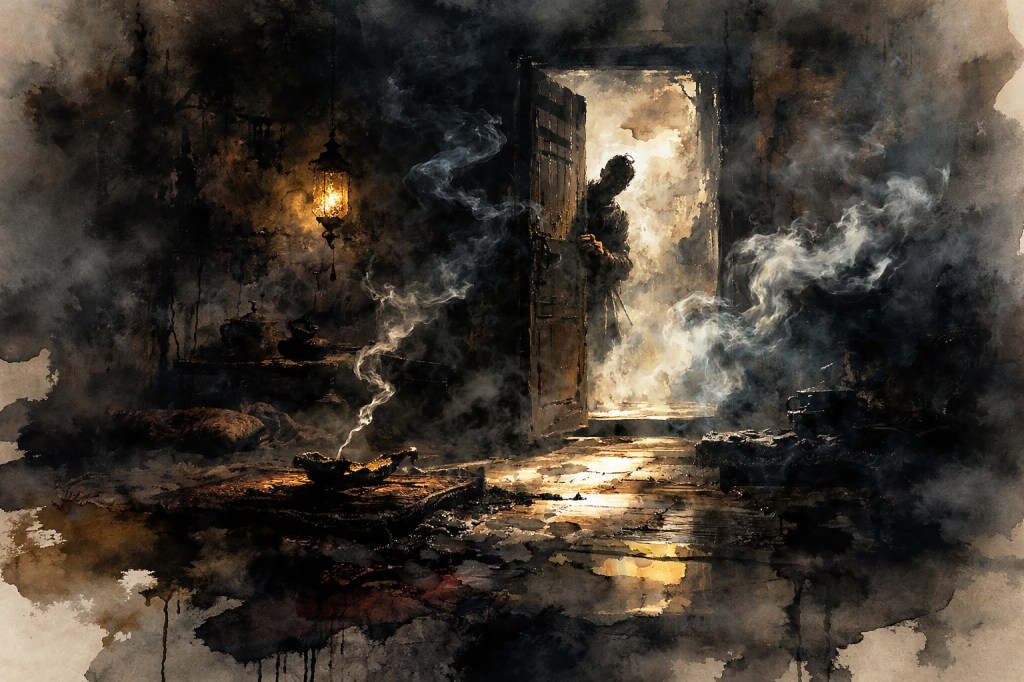
The sweet smoke bathed everything in a black light, turned even the sun black, which cast down its inky rays upon an ashen desert dotted with blasted stumps and the remains of unidentifiable beings. And it was as though a miasma arose from the earth to meet the ghastly light, some dark cloud arising. Finally his senses would numb and the faint vestigial flicker of luminous bone dim along with the remnants of wakefulness. What relief it brought, fleeting alas, this bleak corpse-like state.
Herein unendurable day-lit regrets and cravings subside, assimilated by whichever skeletal self donned them as slabs of weightier stuff, like rag-doll stuffing, marionette trunks chiseled from wood and covered in miniature clothing, so as to impart a compelling illusion of life. First, the fleshing-out of a penny existence, soul without hope; and now the reverse, as in the erasure of a sketch, spiriting away first hatching and shade with light strokes of the rubber, and then the substantive lines with razor blade and spittle.
Whose awareness was it of the grinning skull within, yet containing him, strangely? A drooling grin spread across his own sticky face; more than an expression, an extension of his embodied grotesqueness, a germ of lasciviousness for its own sake, abjuring any particular object. Some kind of perversion implicit in the skull. Memento mori. Never forget that you must die as well. Well, if that’s all, that’s naught: neither death nor life makes much difference to me. Why should I dread my approaching dissolution? Life is a borrowed thing, and the living frame thus borrowed is like so much dust. Life and death are day and night. He observed such thoughts pass through the skull over and again.
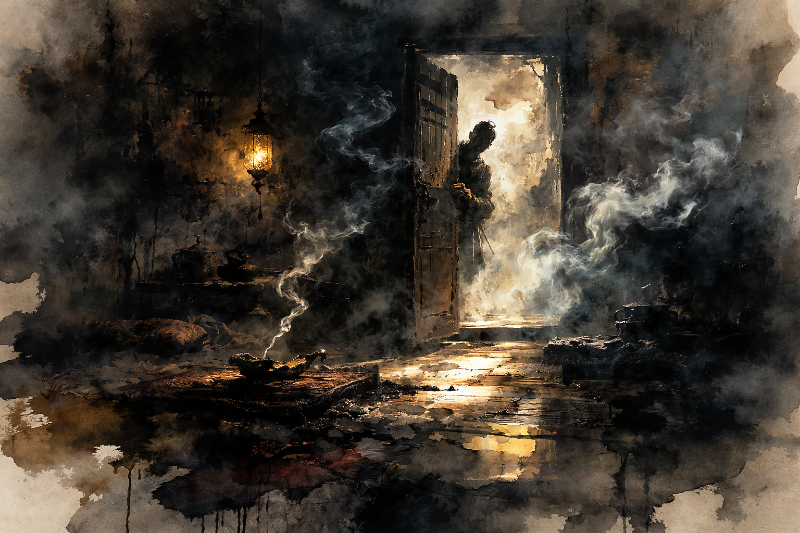
Echoing his uneven, scuffing footfalls and stumbles, a passage had led him here, but which? Or which wasn’t it? The one with the ante-room? On the one side a deserted gambling table and on the other the same. Both deserted, for luck had forsaken the place. A hallway led down through the building, from which a number of small rooms opened off, half of each occupied with a staging spread with gaudy carpet. He pushed open a closed door, to peer in through the beckoning smoke, almost sickly sweet as it was. Two … what do they call them … orientals, celestials … pigtailed, reclined on the staging, curled either side of an oil lamp, the wisps of black smoke spiraling up. To look into their eyes was to find no spark beyond faint reflections of the lamplight. Beyond those unseeing orbs, no, orbs revolved inward, no sign was granted the interloper, no sign of life, nor any of the myriad fluorescent blossoms and gems of the transcendent realms, the dreams that held them in thrall.
Further back, in the shadowier corner, another lay, grotesque grin on his unshaven face, hugely magnified, as though mirrored on the convex surface of the observing eye that had somehow passed by the other two unseen.
From time to time, one or another stirred in order to reload his cane pipe, about a foot long, on the end of which was affixed a bell-like covered bowl, with a round hole the diameter of a pea, to admit the opium. Using a long steel needle he took up a portion of treacle and heated it above the lamp until it attained the plastic consistency of dental gutta-percha, whereupon it was ready then to be inserted into the hole. He put the end of the cane tube to his lips, applied a light, drew in the smoke and released it out through his nostrils.
The third awakened, reenacted the ritual, then lay back and drifted again into a fleeting paradise, his head resting on a firm-cushioned stool about six inches high. Once again, and again, further confounding the befuddled mind, which beheld as one continuous action what was in truth a composite of disparate moments. And what if not merely the mind but the spirit as well was so disorientated by this freezing of time’s components that it became dispersed among them? Not knowing where or when it existed in any segment of the action. Not to say that the self was concerned about such contingencies as time and place, so close was it to its dark and eternal home, so close, merely a membrane separate. Bearing in mind that the self itself – note the impersonal pronoun – could not be said to know or think, being merely an effect or illusory thing.
Immediately he recognized his own face in the contorted smirk, the gesture itself took control, such that he, the mirror image, must only obey. Which was this dark passage through which he had arrived, from a course traced through so many forked paths? Might he rejoin his mother and intimates, Pu-erh, Ugly Toad, Yongyan, and Wang via this corridor, with rooms coming off to the right and left, multifarious false paradises? Places of dreams, ante-chambers of the grave, which remind us of our lost ones, since the walls are hung with their portraits and decorated with their busts, as though designed to relieve our desolation, we who must remain a while longer.
Whence the guilt, the miasma, the dark cloud arising?
• • •
Ugly Toad rose to a position of great respect in the temple, successfully wooed one of the most beautiful women in the village below, and took her for his concubine.
“I would prefer to be next to him,” she said, “than married to any other man in the province, unattractive as he is.”
Her given name was Ling, which is like the sound of a bell or a tinkling piece of jade. Jokingly, he called her his Concubine Ling, which was the title the Empress Xiaoyichun had borne a century before, when she rose to fifth-rank consort of the Qianlong Emperor.
“Concubine Ling,” he said, “your name carries within it the sound of the sweetest chime, but surely you must realize that such a chime will sound muffled and confused when hung between two old earthenware pots like your father and me.”
How could she answer other than with a smile?
“You are getting these chestnuts out of some old Taoist rascal in those books, I’m sure. I think you’re spending far too much time pondering in the library these days and not enough planting in the garden.”
“Yes indeed, Concubine Ling, I noticed just today that the new bamboo shoots are coming up; it may be time for somebody to harvest a few, for they will soon be growing up in front of our eyes.”
“I disagree,” she replied. “The watermelon radishes are more advanced, and if we don’t pick them, they will turn. And what is more,” she added with a come-hither smile, “they are called ‘beauty in the heart,’ so it is auspicious if you are the one to harvest them, emperor of my heart.”
“Of course, my dear, you are right. The bamboo shoots can wait a little longer. It is yet quite cool, after all.” And he never failed to do exactly as she wished.
Similarly, he never expressed any opinion contrary to those of his neighbours. Consequently they grew to love him nearly as much as did his wife and father-in-law, who moved in with the couple and would never be separated from his son-in-law, such was the fondness he developed for him.
“I wonder why you always seem to agree with everyone’s opinions?” his father-in-law said to him with a faintly critical overtone, one quiet evening when they sat relaxing by the cliff-top, enjoying the moon over a cup of hot toddy mixed from rice wine, sugar, and spices. “I’ve noticed that, even when they are quite contrary to each other, you always manage to concur with all of them and don’t adopt a particular one of your own.”
“Well, you know,” Ugly Toad said, “it must be because here in this temple I have grown to prefer appealing to the infinite, rather than be disturbed by everyone’s conflicting ideas. Now I think of it, though, listening to what you say, perhaps I should make an effort to have an opinion of my own one day …”
Lao Tzu’s disciple Zhuangzi says that if an ugly man has a child born to him at midnight, he hurries to it carrying a light to examine it most eagerly, afraid that it may look like him. When their daughter arrived, Ugly Toad did just that, but the baby turned out to be even more beautiful than Ling, and he wept tears of a greater joy than that of most new fathers, as joyful as they are in their own right.
Endowed as she was with a phenomenal wisdom and depth of knowledge in Confucian law, among her wealth of other attributes, Pu-erh had her pick of administrative roles in the district, for a succession of emperors had come and gone, and the Imperial Court had by now forgotten all about her, sunk from notice in such a far-flung place, leagues upon leagues from the Forbidden City. And anyway, anyone who came across any mention of her in the records would have assumed, naturally enough, that she had passed away many years ago.
She employed Yongyan and Wang as assistants-in-training, instructing them in the “Ten Wings,” Confucius’ own commentaries on the Yi Jing, and in his principles of law and social harmony, while at the same time guiding their education in Taoist philosophy. A far cry from their activities as less than competent ginseng poachers and bandits, their lives now became devoted to self-improvement and to becoming citizens whom all the villagers would admire for their virtues and upon whom model themselves. Pu-erh’s aim was to form a supremely harmonious society in the mountains – to transform this rough clay into the finest porcelain. Corporeally honed by a fervent idealism, Yongyan the Hungry became thin as a reed and came to be known as “the Sated,” while Wang the Eviscerator became “the Meek.” Wang kept his head and face shaved and packed away his beloved goose-wing sabre, having learned that sharp weapons are instruments of evil omen, not of the cultivated person, who uses them only when compelled by necessity. The regional government instituted Pu-erh as travelling magistrate, and she and her two subordinates successfully undertook many charitable projects. Together, the three engineered drainage and irrigation projects, set up soup kitchens and winter shelters for the poor, and eliminated the widespread practice of infanticide carried out by families who had too many children to feed, known euphemistically as “marrying her off” or “transmigrating him to the body of another.” Mostly girls, but sometimes boys; mostly the poor, but the rich as well.
Then one day, his eyes reflecting the heaviness of his heart, Wang the Meek came up to Yongyan the Sated where he was working in a vegetable patch, lowered a pack to the ground, and leaned on his walking stick.
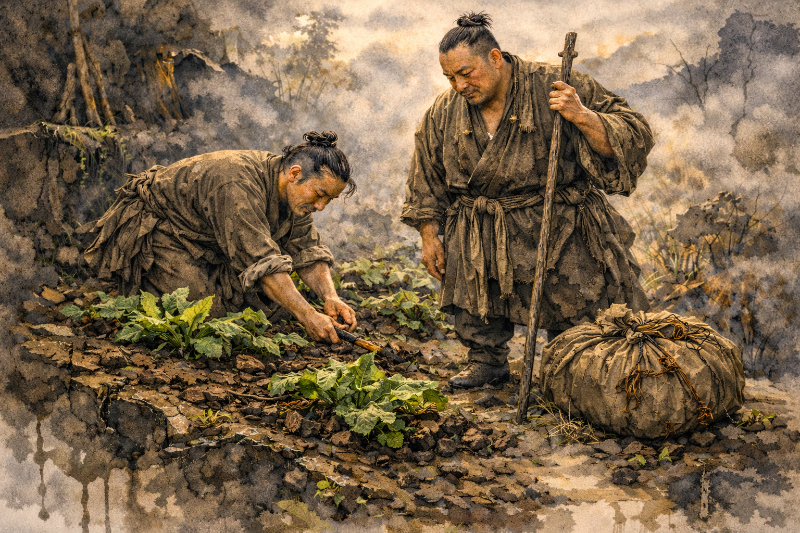
“The life of the do-gooder has been great for what it’s worth,” he said, “and I’ve learned all sorts of new things, but enough is enough and I’ve come to the end of my tether. It’s tired me out, as much good as I know we’ve done. My heart weeps and all this is starting to give me the shits. Before we met up with Pu-erh and Mow Fung, I had a hankering after adventure. Remember after the bear got me up there at Changbai, I said to you, Enough of the mountain life, let’s go down to the Pearl River Delta and work as pirates shipping opium for the Heaven and Earth Society? There are all sorts of openings down there with secret societies starting up all over the place, all wanting to get rid of the Emperor and all the other Manchus.”
He spat down onto the dirt.
“And how about Ugly Toad? I can’t talk to him any more, he just agrees with me all the time. How can you communicate with someone like that? I used to like him much more when he was disagreeable. I’ve loved Pu-erh since I first set eyes on her, but there’s no denying she’s too good for me and always will be, no matter how hard I work at it. She doesn’t even see me; it’s as though her eyes look right through me. I love Mow Fung too, like the son I never had, but I never see him any more. Last time we met he raved on about the Jade Volume and all it was teaching him, over and over. He sits up in those caves in the cliffs above the Jagged Rocks. He’s going loco with all that fasting and chanting, and too much reading that old stuff isn’t good for you in this day and age. He’s been acting even weirder than usual, and he’s got even the monks talking, let alone the village folk. How would you like to come with me, back to our good old life of fun and adventure?”
“Too much still to accomplish,” Yongyan said, resting on his hoe. “When you do a job well, you should do it thoroughly, and when you start something, you ought to finish it.”
“You don’t say. Really? Did you make that up by yourself?” Wang said, realizing how utterly he had relapsed, but preferring things that way.
“It is a wise teaching of the ancient sages, a rule that we all should follow.”
“See what I mean?” Wang said almost to himself, sighed, shook his head and spat again.
“Even now as we speak,” Yongyan said, “the villages in the valley below the eastern flank of Tranquil Mount are engaged in a controversy about the watercourses over there. Some of the villages noticed unused water flowing down the canal to the Eight-Mile River, you see, and they decided to tap it with unauthorised irrigation ditches. But the village of Great-Water thought this was wrong and appealed to Pu-erh as magistrate; and on going down to investigate the river system and seeing abundant water running down from Dog-Head River – which used to be known as South Ditch, the lower stream of Dog-Head Spring, but hasn’t been called that since the sluice gate was put in and the ditch dredged in spring and summer … But that’s by-the-by. Where was I? Ah yes, noticing that the South Ditch has quite a deep bottom, thus letting more water through than the forty per cent she had allotted to the eight villages along the circulation ditch, she ordered stones be placed on the bottom and sides, thus decreasing the amount they can siphon off. You see, that restores the forty-sixty ratio between the two main groups of villages. As well, she’s placed a five-wen fee on water usage for one day and one night, and limited the amount of water that each person can take during a given cycle of twenty days. Now, listen closely, because here it gets complicated –”
“Enough,” Wang pleaded. “That’s exactly what I mean. You’ve changed too. I understood you better when you used to let your belly do the talking. I can’t bear any more of these convoluted issues. They have brought both my brain and spirit to the point of collapse. These are exciting times in the world, you know, what with the Taiping Heavenly Kingdom toppling Nanjing and chasing the Emperor out; and you’ve still got the Miao kicking up a stink in Guizhou province, and the Red Turbans look like they may take over Canton. And I’m missing it all for what? The chance to play sluice monitor for a gaggle of rustics.”
“Wang!”
“Alright, I apologize, I take that back.” He gave a snort. “Well, there’s little more to say but fare-thee-well. My destiny is out there somewhere waiting for me. Always remember that I love you like a brother, and it is my joy to have gotten us out of some sticky situations in the old days. Pass on my fond regards to Pu-erh and Mow Fung, will you? I hate long goodbyes and don’t think I’d be able to get away without making a fool of myself.”
With that, disguised in the clothes of a peasant, best to avoid the attention of rebel and Qing soldiers alike, who, when they were not engaged head-to-head in one deadly battle or another, seemed to spend their time searching out and terrorizing Buddhists and Taoists, and defacing their temples, he shouldered his pack and set off for the forking paths in the bamboo grove. His heart was heavy but his tread light, in the understanding that “the skilful traveller leaves no trace of his footsteps.” The last Yongyan heard was a few snatches of a sad old song that Wang used to whistle once in a while in the old days:
Breaking willow twigs –
a hundred birds cry in the garden grove.
• • •
Mow Fung dreamed of a giant fish that turned itself into a bird and flew across the Southern Ocean, known also as the Heavenly Pond. When he awoke, the heart of the bird remained inside him, and he found himself consumed with its yearning for the south. Impenetrable darkness enclosed him as though he were a fossil caught in a piece of coal, and he recalled that in his dream, before he became the fish, he had found himself in a dark house of multiple paradises where he lost his way as well as his friends. He sat up and reached forward gingerly in the dark until his palm came to rest on a vertical granite plane. He began to crawl, groping his way along the wall. At the next turning, he halted. This was further than he had come on his past excursions in answer to the call of the thousand-mile-long black dragon Zhu Long, believed by the ancients to be the creator of the world, who usually lived deep beneath Zhong Mountain, fasting and holding his breath, but had evidently come here to pay a visit. It was through the light shed from the candle it held in its mouth that, roaming deep inside those caverns, Mow Fung gained his first views of the Nether World.
The call had become an increasingly powerful roar during recent weeks. He did not hear it through his ears exactly, like a normal earthly noise, but rather through various parts of his body. At first, his heart, stomach and lung cavity vibrated annoyingly, a symptom that would become so pronounced and painful in one or another of them that he feared he might keel over dead any second. As for his ears, first they numbed, then began to burn and feel as though they bled inside. The channels that led from his ears into his brain fed in waves of pressure, synchronized to the pulsing of the blood. Having come so far inside the granite labyrinth, so near the dragon, the fluctuating pressure assaulted his ears, not from the outside but from within himself. Squeezed by the pressure, his eyeballs warped and perceived false, luminescent ghosts.
He had the subterranean system memorized perfectly up to his present location and found his way back outside without difficulty, though assaulted all along by the voice. The mouth of the tunnel opened from a sheer cliff high above the rocks. As soon as he emerged, four peals of thunder sounded and a bluish-green light flashed six or seven times in the sky like thunderbolts. Clouds of dark vapour arose from the foot of the adjacent mountain and from the depths beneath him. From behind, mice scurried out between his limbs and along the narrow track carved into the cliff face. A silence descended, but for a whistling breeze carrying a scent of rotten eggs. The breath of Zhu Long! He knew immediately what it was the dragon had been trying to tell him all these long weeks.
As frantic as was his effort to hasten, progress was nauseatingly slow, inching along the track, back pressed against the cliff, heels guided by a carved groove. Then into the forest he went, stumbling over boulders, splashing through streams as he staggered down the eastern shoulder. He came to the crossroads, deep in the forest, the place the monks called the “ineffable centre,” meaning the centre which is everywhere, the circumference nowhere. The temple or the high village? There was only time to warn the one, but not the other. He must decide. Behind him, the east, the Black Dragon; to his left, Rosefinch; straight ahead, White Tiger; to his right, the Tortoise. Out of nowhere, a streak of crimson, a pause, then a ringing, slowly rising trill, Weeja-wu-weeja! Next, the alarm: Chay-eeee! And away.
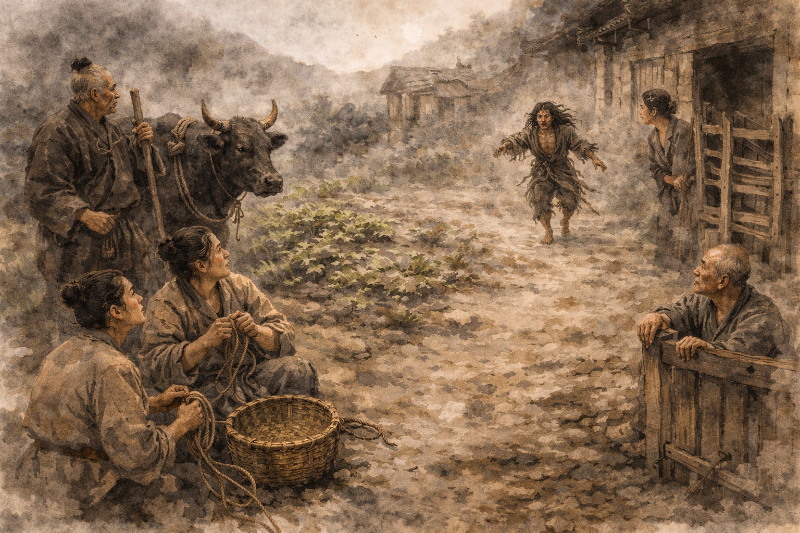
At the outskirts of the high village, peasants tended vegetables, led an ox, wove a basket, braided leather thongs, repaired a gate. They all stopped what they were doing at the sight of the mad young monk in rags come staggering into their midst, unable to speak. Moved his mouth, but no words came – either from the effect of some narcotic or from his months of confinement in the caves. They started to laugh at him and continued until the moment the first tremor struck and threw them all off balance. The earth shuddered and their hovels shook and creaked, but none collapsed. A massive clap of thunder sounded from the direction of White Tiger peak, and an overpowering crash and rumble rent the air, as gargantuan slabs of rock and earth slid and vanished into the abyss before their eyes. The Taoist temple and everything within its grounds and its walls disappeared along with the entire mountain peak, everything mangled and disintegrated as one, like a shovelful of gravel. When the peasants arrived running, there was only an abyss of nothingness where the temple had stood minutes before, much as if it were a chalk drawing wiped from a slate. A vision of it was still there in the memory, as tenuous as a retinal image. Yet, much as they rubbed their eyes and shook their heads, the building itself would not reappear.
From the draft novel Stawell Bardo © Michael Guest 2026
 Furin Chime Press™