Tag: time slip fiction

  • Miasma

    Miasma

    The sweet smoke bathed everything in a black light, turned even the sun black, which cast down its inky rays upon an ashen desert dotted with blasted stumps and the remains of unidentifiable beings. And it was as though a miasma arose from the earth to meet the ghastly light, some dark cloud arising. Finally his senses would numb and the faint vestigial flicker of luminous bone dim along with the remnants of wakefulness. What relief it brought, fleeting alas, this bleak corpse-like state.

    Herein unendurable day-lit regrets and cravings subside, assimilated by whichever skeletal self donned them as slabs of weightier stuff, like rag-doll stuffing, marionette trunks chiseled from wood and covered in miniature clothing, so as to impart a compelling illusion of life. First, the fleshing-out of a penny existence, soul without hope; and now the reverse, as in the erasure of a sketch, spiriting away first hatching and shade with light strokes of the rubber, and then the substantive lines with razor blade and spittle.

    Whose awareness was it of the grinning skull within, yet containing him, strangely? A drooling grin spread across his own sticky face; more than an expression, an extension of his embodied grotesqueness, a germ of lasciviousness for its own sake, abjuring any particular object. Some kind of perversion implicit in the skull. Memento mori. Never forget that you must die as well. Well, if that’s all, that’s naught: neither death nor life makes much difference to me. Why should I dread my approaching dissolution? Life is a borrowed thing, and the living frame thus borrowed is like so much dust. Life and death are day and night. He observed such thoughts pass through the skull over and again.
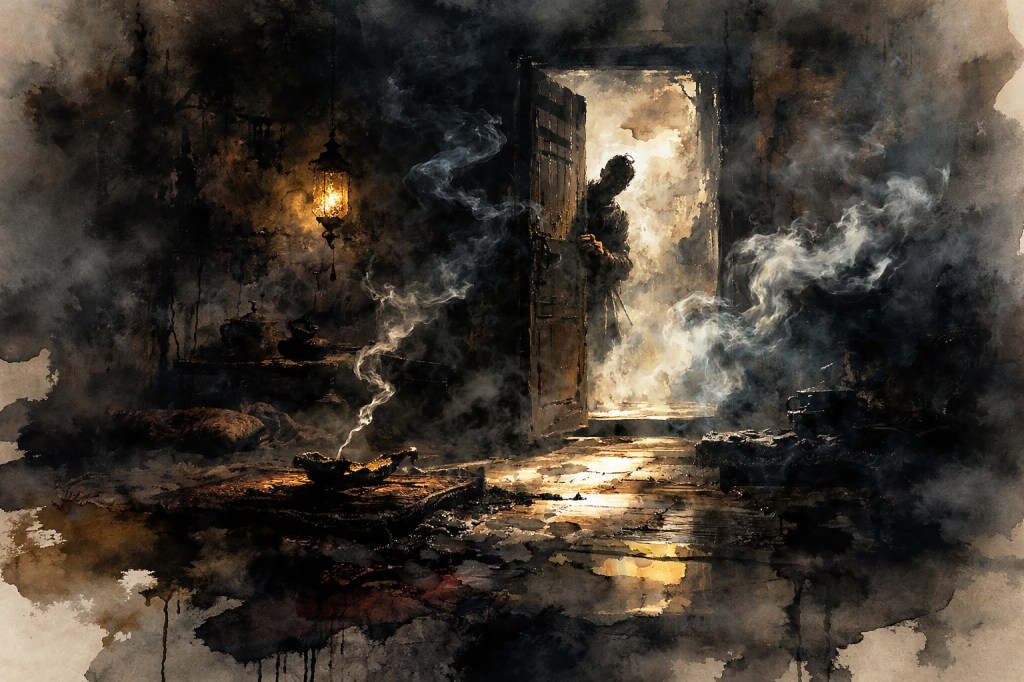
    A shadowed figure peers into a smoky opium den filled with drifting haze and dimly seen occupants.

    Echoing his uneven, scuffing footfalls and stumbles, a passage had led him here, but which? Or which wasn’t it? The one with the ante-room? On the one side a deserted gambling table and on the other the same. Both deserted, for luck had forsaken the place. A hallway led down through the building, from which a number of small rooms opened off, half of each occupied with a staging spread with gaudy carpet. He pushed open a closed door, to peer in through the beckoning smoke, almost sickly sweet as it was. Two … what do they call them … orientals, celestials … pigtailed, reclined on the staging, curled either side of an oil lamp, the wisps of black smoke spiraling up. To look into their eyes was to find no spark beyond faint reflections of the lamplight. Beyond those unseeing orbs, no, orbs revolved inward, no sign was granted the interloper, no sign of life, nor any of the myriad fluorescent blossoms and gems of the transcendent realms, the dreams that held them in thrall.

    Further back, in the shadowier corner, another lay, grotesque grin on his unshaven face, hugely magnified, as though mirrored on the convex surface of the observing eye that had somehow passed by the other two unseen.

    From time to time, one or another stirred in order to reload his cane pipe, about a foot long, on the end of which was affixed a bell-like covered bowl, with a round hole the diameter of a pea, to admit the opium. Using a long steel needle he took up a portion of treacle and heated it above the lamp until it attained the plastic consistency of dental gutta-percha, whereupon it was ready then to be inserted into the hole. He put the end of the cane tube to his lips, applied a light, drew in the smoke and released it out through his nostrils.

    The third awakened, reenacted the ritual, then lay back and drifted again into a fleeting paradise, his head resting on a firm-cushioned stool about six inches high. Once again, and again, further confounding the befuddled mind, which beheld as one continuous action what was in truth a composite of disparate moments. And what if not merely the mind but the spirit as well was so disorientated by this freezing of time’s components that it became dispersed among them? Not knowing where or when it existed in any segment of the action. Not to say that the self was concerned about such contingencies as time and place, so close was it to its dark and eternal home, so close, merely a membrane separate. Bearing in mind that the self itself – note the impersonal pronoun – could not be said to know or think, being merely an effect or illusory thing.

    Immediately he recognized his own face in the contorted smirk, the gesture itself took control, such that he, the mirror image, must only obey. Which was this dark passage through which he had arrived, from a course traced through so many forked paths? Might he rejoin his mother and intimates, Pu-erh, Ugly Toad, Yongyan, and Wang via this corridor, with rooms coming off to the right and left, multifarious false paradises? Places of dreams, ante-chambers of the grave, which remind us of our lost ones, since the walls are hung with their portraits and decorated with their busts, as though designed to relieve our desolation, we who must remain a while longer.

    Whence the guilt, the miasma, the dark cloud arising?

    • • •

    Ugly Toad rose to a position of great respect in the temple, successfully wooed one of the most beautiful women in the village below, and took her for his concubine.

    “I would prefer to be next to him,” she said, “than married to any other man in the province, unattractive as he is.”

    Her given name was Ling, which is like the sound of a bell or a tinkling piece of jade. Jokingly, he called her his Concubine Ling, which was the title the Empress Xiaoyichun had borne a century before, when she rose to fifth-rank consort of the Qianlong Emperor.

    “Concubine Ling,” he said, “your name carries within it the sound of the sweetest chime, but surely you must realize that such a chime will sound muffled and confused when hung between two old earthenware pots like your father and me.”

    How could she answer other than with a smile?

    “You are getting these chestnuts out of some old Taoist rascal in those books, I’m sure. I think you’re spending far too much time pondering in the library these days and not enough planting in the garden.”

    “Yes indeed, Concubine Ling, I noticed just today that the new bamboo shoots are coming up; it may be time for somebody to harvest a few, for they will soon be growing up in front of our eyes.”

    “I disagree,” she replied. “The watermelon radishes are more advanced, and if we don’t pick them, they will turn. And what is more,” she added with a come-hither smile, “they are called ‘beauty in the heart,’ so it is auspicious if you are the one to harvest them, emperor of my heart.”

    “Of course, my dear, you are right. The bamboo shoots can wait a little longer. It is yet quite cool, after all.” And he never failed to do exactly as she wished.

    Similarly, he never expressed any opinion contrary to those of his neighbours. Consequently they grew to love him nearly as much as did his wife and father-in-law, who moved in with the couple and would never be separated from his son-in-law, such was the fondness he developed for him.

    “I wonder why you always seem to agree with everyone’s opinions?” his father-in-law said to him with a faintly critical overtone, one quiet evening when they sat relaxing by the cliff-top, enjoying the moon over a cup of hot toddy mixed from rice wine, sugar, and spices. “I’ve noticed that, even when they are quite contrary to each other, you always manage to concur with all of them and don’t adopt a particular one of your own.”

    “Well, you know,” Ugly Toad said, “it must be because here in this temple I have grown to prefer appealing to the infinite, rather than be disturbed by everyone’s conflicting ideas. Now I think of it, though, listening to what you say, perhaps I should make an effort to have an opinion of my own one day …”

    Lao Tzu’s disciple Zhuangzi says that if an ugly man has a child born to him at midnight, he hurries to it carrying a light to examine it most eagerly, afraid that it may look like him. When their daughter arrived, Ugly Toad did just that, but the baby turned out to be even more beautiful than Ling, and he wept tears of a greater joy than that of most new fathers, as joyful as they are in their own right.

    Endowed as she was with a phenomenal wisdom and depth of knowledge in Confucian law, among her wealth of other attributes, Pu-erh had her pick of administrative roles in the district, for a succession of emperors had come and gone, and the Imperial Court had by now forgotten all about her, sunk from notice in such a far-flung place, leagues upon leagues from the Forbidden City. And anyway, anyone who came across any mention of her in the records would have assumed, naturally enough, that she had passed away many years ago.

    She employed Yongyan and Wang as assistants-in-training, instructing them in the “Ten Wings,” Confucius’ own commentaries on the Yi Jing, and in his principles of law and social harmony, while at the same time guiding their education in Taoist philosophy. A far cry from their activities as less than competent ginseng poachers and bandits, their lives now became devoted to self-improvement and to becoming citizens whom all the villagers would admire for their virtues and upon whom model themselves. Pu-erh’s aim was to form a supremely harmonious society in the mountains – to transform this rough clay into the finest porcelain. Corporeally honed by a fervent idealism, Yongyan the Hungry became thin as a reed and came to be known as “the Sated,” while Wang the Eviscerator became “the Meek.” Wang kept his head and face shaved and packed away his beloved goose-wing sabre, having learned that sharp weapons are instruments of evil omen, not of the cultivated person, who uses them only when compelled by necessity. The regional government instituted Pu-erh as travelling magistrate, and she and her two subordinates successfully undertook many charitable projects. Together, the three engineered drainage and irrigation projects, set up soup kitchens and winter shelters for the poor, and eliminated the widespread practice of infanticide carried out by families who had too many children to feed, known euphemistically as “marrying her off” or “transmigrating him to the body of another.” Mostly girls, but sometimes boys; mostly the poor, but the rich as well.

    Then one day, his eyes reflecting the heaviness of his heart, Wang the Meek came up to Yongyan the Sated where he was working in a vegetable patch, lowered a pack to the ground, and leaned on his walking stick.
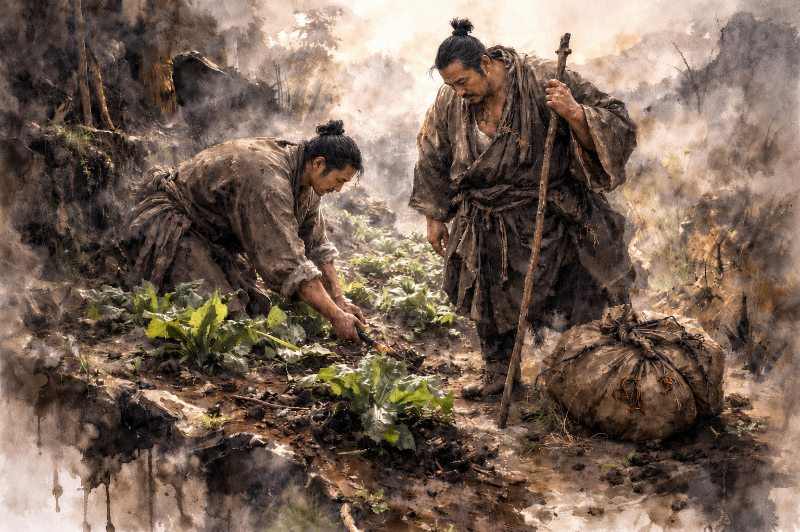
    Two weathered monks tend a small garden in a misty, rugged landscape.

    “The life of the do-gooder has been great for what it’s worth,” he said, “and I’ve learned all sorts of new things, but enough is enough and I’ve come to the end of my tether. It’s tired me out, as much good as I know we’ve done. My heart weeps and all this is starting to give me the shits. Before we met up with Pu-erh and Mow Fung, I had a hankering after adventure. Remember after the bear got me up there at Changbai, I said to you, Enough of the mountain life, let’s go down to the Pearl River Delta and work as pirates shipping opium for the Heaven and Earth Society? There are all sorts of openings down there with secret societies starting up all over the place, all wanting to get rid of the Emperor and all the other Manchus.”

    He spat down onto the dirt.

    “And how about Ugly Toad? I can’t talk to him any more, he just agrees with me all the time. How can you communicate with someone like that? I used to like him much more when he was disagreeable. I’ve loved Pu-erh since I first set eyes on her, but there’s no denying she’s too good for me and always will be, no matter how hard I work at it. She doesn’t even see me; it’s as though her eyes look right through me. I love Mow Fung too, like the son I never had, but I never see him any more. Last time we met he raved on about the Jade Volume and all it was teaching him, over and over. He sits up in those caves in the cliffs above the Jagged Rocks. He’s going loco with all that fasting and chanting, and too much reading that old stuff isn’t good for you in this day and age. He’s been acting even weirder than usual, and he’s got even the monks talking, let alone the village folk. How would you like to come with me, back to our good old life of fun and adventure?”

    “Too much still to accomplish,” Yongyan said, resting on his hoe. “When you do a job well, you should do it thoroughly, and when you start something, you ought to finish it.”

    “You don’t say. Really? Did you make that up by yourself?” Wang said, realizing how utterly he had relapsed, but preferring things that way.

    “It is a wise teaching of the ancient sages, a rule that we all should follow.”

    “See what I mean?” Wang said almost to himself, sighed, shook his head and spat again.

    “Even now as we speak,” Yongyan said, “the villages in the valley below the eastern flank of Tranquil Mount are engaged in a controversy about the watercourses over there. Some of the villages noticed unused water flowing down the canal to the Eight-Mile River, you see, and they decided to tap it with unauthorised irrigation ditches. But the village of Great-Water thought this was wrong and appealed to Pu-erh as magistrate; and on going down to investigate the river system and seeing abundant water running down from Dog-Head River – which used to be known as South Ditch, the lower stream of Dog-Head Spring, but hasn’t been called that since the sluice gate was put in and the ditch dredged in spring and summer … But that’s by-the-by. Where was I? Ah yes, noticing that the South Ditch has quite a deep bottom, thus letting more water through than the forty per cent she had allotted to the eight villages along the circulation ditch, she ordered stones be placed on the bottom and sides, thus decreasing the amount they can siphon off. You see, that restores the forty-sixty ratio between the two main groups of villages. As well, she’s placed a five-wen fee on water usage for one day and one night, and limited the amount of water that each person can take during a given cycle of twenty days. Now, listen closely, because here it gets complicated –”

    “Enough,” Wang pleaded. “That’s exactly what I mean. You’ve changed too. I understood you better when you used to let your belly do the talking. I can’t bear any more of these convoluted issues. They have brought both my brain and spirit to the point of collapse. These are exciting times in the world, you know, what with the Taiping Heavenly Kingdom toppling Nanjing and chasing the Emperor out; and you’ve still got the Miao kicking up a stink in Guizhou province, and the Red Turbans look like they may take over Canton. And I’m missing it all for what? The chance to play sluice monitor for a gaggle of rustics.”

    “Wang!”

    “Alright, I apologize, I take that back.” He gave a snort. “Well, there’s little more to say but fare-thee-well. My destiny is out there somewhere waiting for me. Always remember that I love you like a brother, and it is my joy to have gotten us out of some sticky situations in the old days. Pass on my fond regards to Pu-erh and Mow Fung, will you? I hate long goodbyes and don’t think I’d be able to get away without making a fool of myself.”

    With that, disguised in the clothes of a peasant, best to avoid the attention of rebel and Qing soldiers alike, who, when they were not engaged head-to-head in one deadly battle or another, seemed to spend their time searching out and terrorizing Buddhists and Taoists, and defacing their temples, he shouldered his pack and set off for the forking paths in the bamboo grove. His heart was heavy but his tread light, in the understanding that “the skilful traveller leaves no trace of his footsteps.” The last Yongyan heard was a few snatches of a sad old song that Wang used to whistle once in a while in the old days:

    Breaking willow twigs –

    a hundred birds cry in the garden grove.

    • • •

    Mow Fung dreamed of a giant fish that turned itself into a bird and flew across the Southern Ocean, known also as the Heavenly Pond. When he awoke, the heart of the bird remained inside him, and he found himself consumed with its yearning for the south. Impenetrable darkness enclosed him as though he were a fossil caught in a piece of coal, and he recalled that in his dream, before he became the fish, he had found himself in a dark house of multiple paradises where he lost his way as well as his friends. He sat up and reached forward gingerly in the dark until his palm came to rest on a vertical granite plane. He began to crawl, groping his way along the wall. At the next turning, he halted. This was further than he had come on his past excursions in answer to the call of the thousand-mile-long black dragon Zhu Long, believed by the ancients to be the creator of the world, who usually lived deep beneath Zhong Mountain, fasting and holding his breath, but had evidently come here to pay a visit. It was through the light shed from the candle it held in its mouth that, roaming deep inside those caverns, Mow Fung gained his first views of the Nether World.

    The call had become an increasingly powerful roar during recent weeks. He did not hear it through his ears exactly, like a normal earthly noise, but rather through various parts of his body. At first, his heart, stomach and lung cavity vibrated annoyingly, a symptom that would become so pronounced and painful in one or another of them that he feared he might keel over dead any second. As for his ears, first they numbed, then began to burn and feel as though they bled inside. The channels that led from his ears into his brain fed in waves of pressure, synchronized to the pulsing of the blood. Having come so far inside the granite labyrinth, so near the dragon, the fluctuating pressure assaulted his ears, not from the outside but from within himself. Squeezed by the pressure, his eyeballs warped and perceived false, luminescent ghosts.

    He had the subterranean system memorized perfectly up to his present location and found his way back outside without difficulty, though assaulted all along by the voice. The mouth of the tunnel opened from a sheer cliff high above the rocks. As soon as he emerged, four peals of thunder sounded and a bluish-green light flashed six or seven times in the sky like thunderbolts. Clouds of dark vapour arose from the foot of the adjacent mountain and from the depths beneath him. From behind, mice scurried out between his limbs and along the narrow track carved into the cliff face. A silence descended, but for a whistling breeze carrying a scent of rotten eggs. The breath of Zhu Long! He knew immediately what it was the dragon had been trying to tell him all these long weeks.

    As frantic as was his effort to hasten, progress was nauseatingly slow, inching along the track, back pressed against the cliff, heels guided by a carved groove. Then into the forest he went, stumbling over boulders, splashing through streams as he staggered down the eastern shoulder. He came to the crossroads, deep in the forest, the place the monks called the “ineffable centre,” meaning the centre which is everywhere, the circumference nowhere. The temple or the high village? There was only time to warn the one, but not the other. He must decide. Behind him, the east, the Black Dragon; to his left, Rosefinch; straight ahead, White Tiger; to his right, the Tortoise. Out of nowhere, a streak of crimson, a pause, then a ringing, slowly rising trill, Weeja-wu-weeja! Next, the alarm: Chay-eeee! And away.
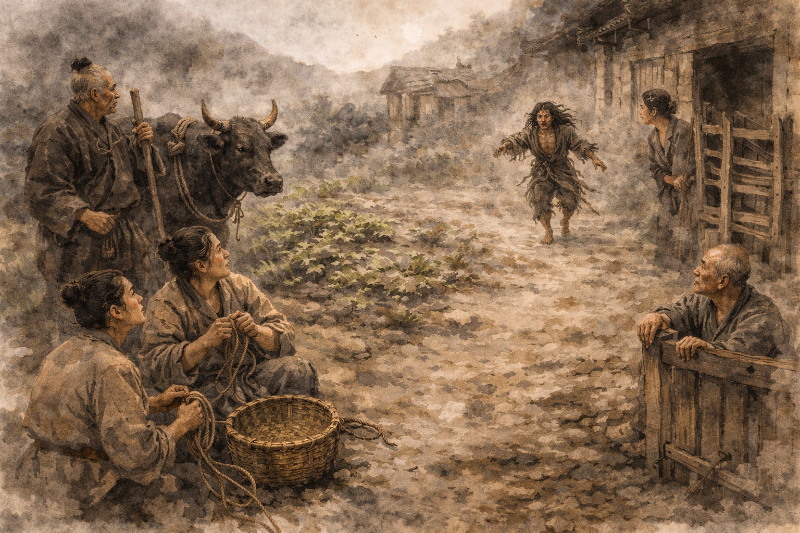
    A dishevelled monk runs toward villagers, who stop their work and stare at him in a mountain village scene.

    At the outskirts of the high village, peasants tended vegetables, led an ox, wove a basket, braided leather thongs, repaired a gate. They all stopped what they were doing at the sight of the mad young monk in rags come staggering into their midst, unable to speak. Moved his mouth, but no words came – either from the effect of some narcotic or from his months of confinement in the caves. They started to laugh at him and continued until the moment the first tremor struck and threw them all off balance. The earth shuddered and their hovels shook and creaked, but none collapsed. A massive clap of thunder sounded from the direction of White Tiger peak, and an overpowering crash and rumble rent the air, as gargantuan slabs of rock and earth slid and vanished into the abyss before their eyes. The Taoist temple and everything within its grounds and its walls disappeared along with the entire mountain peak, everything mangled and disintegrated as one, like a shovelful of gravel. When the peasants arrived running, there was only an abyss of nothingness where the temple had stood minutes before, much as if it were a chalk drawing wiped from a slate. A vision of it was still there in the memory, as tenuous as a retinal image. Yet, much as they rubbed their eyes and shook their heads, the building itself would not reappear.


    From the draft novel Stawell Bardo © Michael Guest 2026
  • Dust of the Dragon’s Tail

    Dust of the Dragon’s Tail

    The fleeting glimpse he had gained of a young fair-haired woman through the half-opened doorway to the inner sanctum of the Jade Phoenix had nagged at the detective. Of late, Chinese camps were acquiring a reputation among certain of the Wimmera youth for the unwholesome diversions they afforded. Alluring as these places may have appeared to some of tender years, especially to the wayward and unchristian among them, they were commonly reckoned iniquitous dens.

    One sixteen-year-old girl undertook a week-long, hundred-and-forty-mile journey from her home at Ballan, only fifty miles out of Melbourne, in quest, so she said, of a situation at Horsham. Playing upon the compassion of publicans she visited along the way, she obtained overnight board and a shilling here and there to buy meals on the road. Her real destination turned out, after a circuitous detour, to be the house of a suspect European woman at the Deep Lead Chinese camp, where she took up quarters.

    Hearing news of her arrival, Constable Hillard went out to interview her and, disbelieving her story, gave her notice to quit. When she spun him more yarns, attempting to fob him off and contrive to remain, he brought her up on vagrancy before the Stawell bench. The magistrate discharged her after a sound admonition, and the next thing you know, off she went to live with a Chinese gardener at Doctor’s Creek. Not a week later, Hillard ferreted out a second one, not even sixteen, who deserted her family home for the camp, because, she explained, of her father’s cruelty and the lack of comforts at home.

    This same girl was already known to the police, having recently preferred a rather serious charge against a young man from Stawell, which he was to answer at the next General Sessions. There was something wrong in the state of Denmark, the magistrate informed Forster in writing, when girls such as these sought the association of a Chinese camp, proposing that if an example were made of those who harboured them there, it might prove a deterrent.

    Dark-eyed Miss Chan – Forster addressed her as such, for the woman’s unassailable poise checked in him any impulse he may have felt to assume the familiarity of ‘Lili’ – acknowledged, when he called on her the next day, that she had indeed engaged a young white woman as a waitress and housekeeper, and he was welcome to meet her; she was just now in the back garden feeding the chickens. This he did. No ragamuffin, but a strapping, jocular red-haired Irish colleen of nineteen she was, radiating goodwill and health, and obviously unsoiled by the demons of opium and rum.

    Perhaps, Forster reflected, the growing distaste for the Chinese immigrant as ignorant pagan and filthy barbarian had little basis beyond plain bigotry and the biased reporting of the newspapers. There was the old enmity of rival gold-miners, resulting in thuggery and atrocity at Buckland River, Lambing Flats, and as close by as Ararat itself, less than twenty years ago.

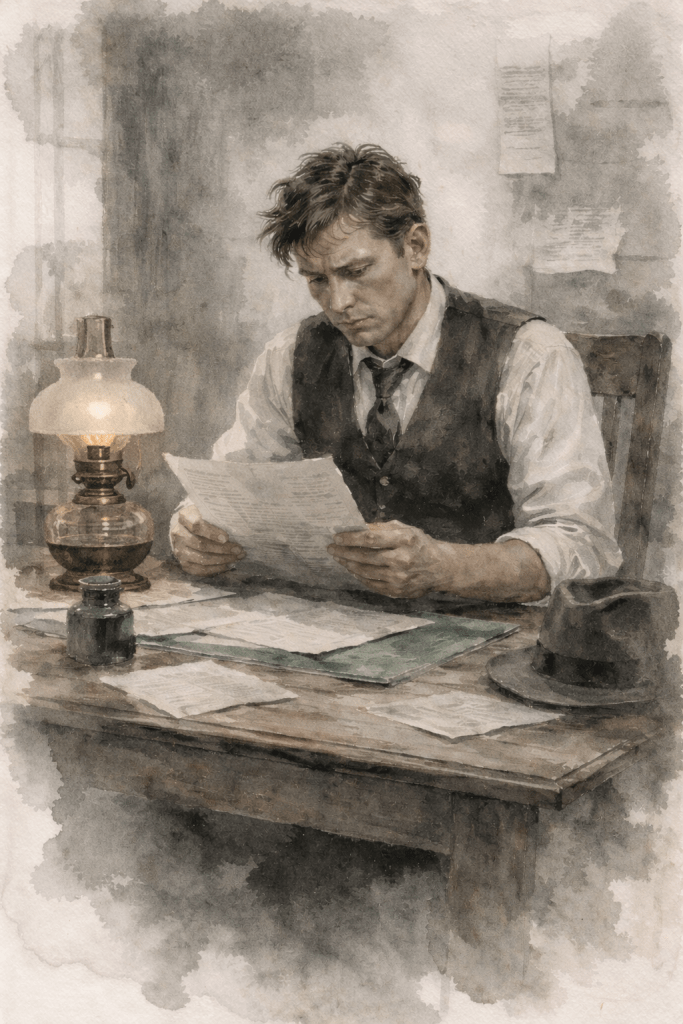
    Detective Forster sits alone at his desk in a modest 1880s bush office, leaning over papers in a dark coat and brimmed hat. An oil lamp and scattered documents rest on the desk, and the scene has a sombre, reflective mood.

    Disgruntled unionists were, he presumed, at the root of the more recent political pressure to exclude Chinese sailors and stokers from working on steamers trading to and about the Australian ports. Invariably cheerful and obliging Chinese fishmongers and hawkers of all sorts of useful wares had now become the targets of insult and violence from many working-class Australians, owing to a general animus against the Australian Steam Navigation Company, which had been hiring Chinese. Most unworthy of a great, free people. And what did this rabble know of China, a country they so despised? Most likely little, if anything, more than he did.

    If Lili Chan and his other new acquaintance, the mysterious Mow Fung – full of surprises he was, publican-cum-priest of some sort, evidently – were a measure, the Chinese had much to contribute to this country, and especially to a far-flung region like this. In idle moments, he found his thoughts wandering in their direction – and in Lili Chan’s, he cautioned himself, rather too often. He could entertain not the slightest likelihood that such a woman might have any possible interest in a crusty, ill-oiled bachelor such as he, even despite her situation, which was a morally tenuous one in the eyes of most. He could only wonder at what had brought her here, to the middle of nowhere, when clearly her talents and charms – that trace of a cultured American accent – would have fitted her for a rewarding position in Melbourne, at least. Enigma indeed. Her skin was of such a subdued olive hue, her features of such subtlety, that she might well pass for white, given the right circumstances and Western attire. Now, there he went, off again on mad imaginings …

    It was in the midst of reflecting on her features that he recalled having paused, some months earlier, on an item in the weekly Victorian Police Gazette – one that had caught his eye by departing from the usual notices concerning people wanted for questioning, prisoners discharged from gaol and the like. He retrieved the number from the bottom of a tea chest packed with old copies of the journal in a corner of the storeroom by the stables.

    “The whereabouts of a missing heiress are sought. The Cantonese woman, of Anglo-Chinese descent, has been traced from the United States, where she spent several years after leaving China, to the Colony. Information has come to light concerning her entitlement to a handsome fortune, of which she is not likely to be aware. Contact should be made with Chief Commissioner Chomley.”

    The memory of the notice clung to him. The next day he rode to the Jade Phoenix, and presently laid the gazette before Miss Chan. The proprietress looked up from the page and bathed the detective in the cool liquid of her unblinking gaze.

    “I was not aware, Sergeant, that you took such an interest in the minutiae of my appearance and background. Your detective’s training, no doubt. The innocent Miss Finnegan discovered in the employ of this humble if disreputable establishment – that speaks well for your skill. Are you ever able to separate yourself from your duties as a … copper?”

    Mincing by their armchairs just as her name was mentioned, the lusty Molly Finnegan, playing at saucy Irish soubrette, flourished her feather duster and made her exit.

    “Have you ever thought of entering the gambling line? Your attention to detail and, I suspect, your talent for handling disturbances would be invaluable,” Lili Chan said.

    “I dare say the references would prove difficult.”

    “On the contrary, Sergeant. In certain establishments, a good blow and a discreet silence recommend a man admirably.”

    “I suspect I should make a very poor ornament to such a profession.”

    “A poor ornament may still have his uses,” Lili said.

    She lowered her eyes to the gazette again. “In some houses, usefulness is the rarer quality.”

    He watched her a moment. “Miss Chan, does this notice mean anything to you?”

    “My origins are too humble, I fear, to promise any inheritance beyond poverty and woe; but if it will put your mind at ease, you may enquire with the Chief Commissioner on my behalf.” What harm, she reflected, could come of agreeing to so much, when to refuse would only raise suspicion.

    • • •

    “Where were we?” said the voice of Huish-Huish, accompanied by the gentle jangle of a consecrated shamanic rattle, amid the light aroma of incense.

    “I recall, the zither.”

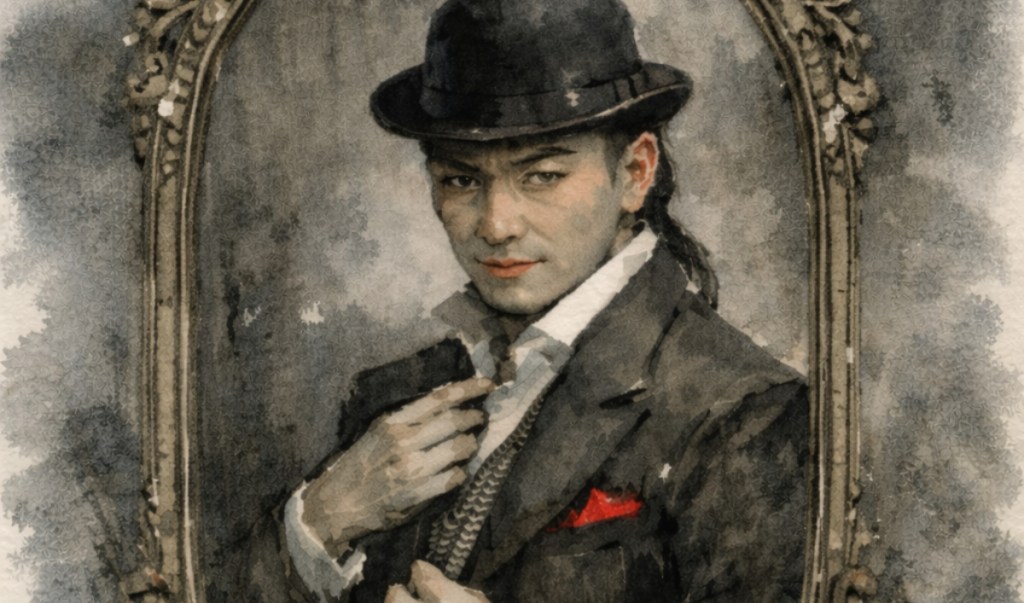
    After Fang Jing Dock’s tong began putting some serious pressure on Ah Toy, unassailable though she had been for the past twenty years, she sold up and moved to an undisclosed destination. With no choice in the matter, Chan Lee Lung became his mistress, and he moved in with her. It had been clear for some time that despite his dandyish affectations he was an enforcer – a so-called highbinder or hatchetman – for the Hing San Fong Tong, passing publicly under the name Society of the Mind Abiding in Tranquility and Freedom. Whenever he went out to conduct business of a certain kind, he would don chain mail beneath his dress shirt, tightly bind his queue up underneath his derby, to keep it from being seized in any rough stuff, and conceal his butterfly swords beneath the back of his jacket, all the while preening himself before his ornate mirror.

    One evening he and a henchman returned to the house with another Chinese man unknown to her. The three repaired to a room that Fang had commandeered as his music studio, where he also kept a small vault containing the most precious valuables of his tong: a handful of flawless diamonds of inestimable value. Before long the sound of Fang’s Viennese zither could be heard filtering out, a fantasia on Il Trovatore. She went to her bed and fell into a deep sleep, to be shaken awake by Fang.

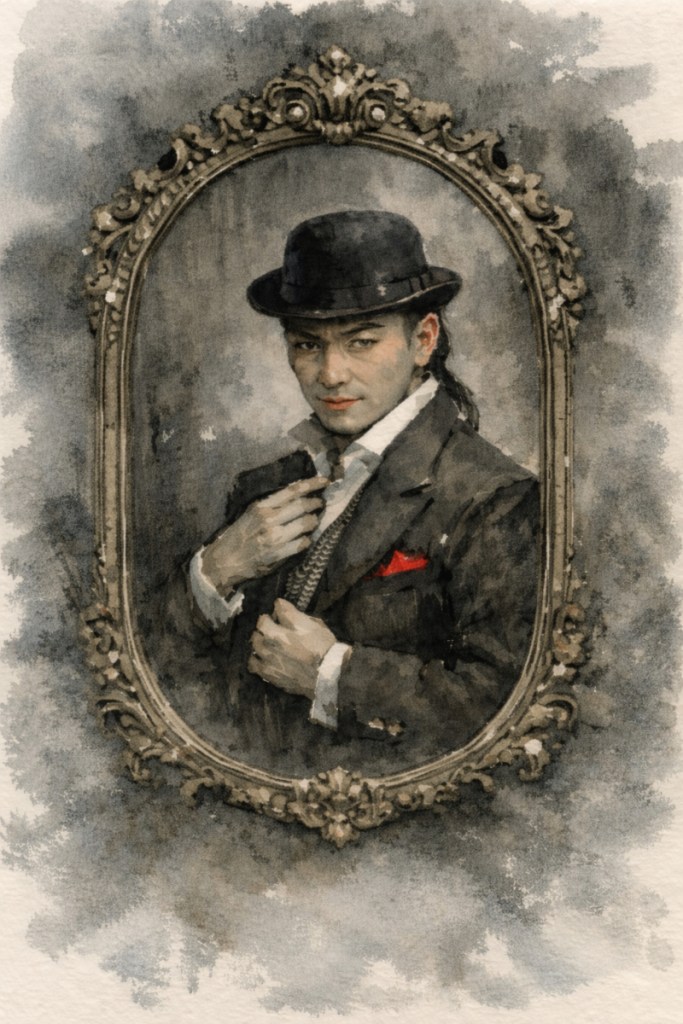
    The highbinder Fang wearing suit, derby, and barely concealed chainmail vest, preens himself in an ornate mirror, adjusting his appearance with deliberate care. The image is rendered in a watery, near-monochrome wash with a subtle red highlight, the reflected figure contained within the frame and the edges fading into abstraction.

    “Go and see what you think of the new centrepiece in the studio and tidy up a bit in there. Fat Louis and I have some business to discuss, then we’ll get things back in order.”

    The third man sat slumped sideways in a wicker chair, his sightless eyes bulging wide, his tongue lolling from the contorted blue face. Around the throat, biting deep into the flesh, was a garrote fashioned from a metal contrabass string, carving what looked like a raspberry-jam-filled rut. She sank silently onto a chair and took stock of her future, which was clearly what Fang had intended.

    When she entered the sitting room, Fang and Fat Louis were sipping pink champagne, and nibbling on Roquefort.

    “Nice tang,” Fat Louis said. “King of cheeses.”

    “Butyric acid caused by the fungus Penicillium roqueforti,” Fang said. “Legend has it that the cheese was discovered when a youth herding his sheep on Combalou Mountain, partook of his lunch of bread and ewes’ milk curds. Seeing a beautiful girl in the distance, he ran off vainly in pursuit of her, leaving behind his flock and his lunch. When he revisited the spot a few months later, the mold had transformed his plain peasant repast into this delectable bonne bouche.”

    Then looking up at Chan Lee, “That was quick. Did he have anything to say?”

    “He thought the end was the best part,” she said in a measured tone.

    “The critics be damned, I say!”

    The two men fell about.

    Chan Lee looked at Fang steadily.

    “There is no medicine for vulgarity,” she said, taking up the champagne flute on the table for Fat Louis to fill. No way out of this but forward; she must watch for an opportunity out of the corner of her eye. 

    “I told you she would have what it takes,” Fang said. “You can tell a woman of breeding. And she knows as well,” lending a malevolent emphasis, “that the song of a dead bird is a sad one.”

    One thing was certain: to run to the police, if the chance arose, would be a waste of time and might well invite a fatal reprisal from Fang’s cohorts, were he to be put away, which in fact was unlikely, since the law tended to stay out of Chinese matters when they did not directly affect anyone else. For the time being she played the dutiful concubine to Fang. As he wished, she took on the mantle of his wife, at least in the view of the public, though the union was not sanctioned by either a Chinese or American ceremony. As an enforced confidante of the highbinder, who often boasted to her of his crimes, she was ever more ensnared in the strands of his fate, becoming, in the parlance of the courts, an accessory after the fact, and thus acquiring the guilt of his felonies.

    • • •

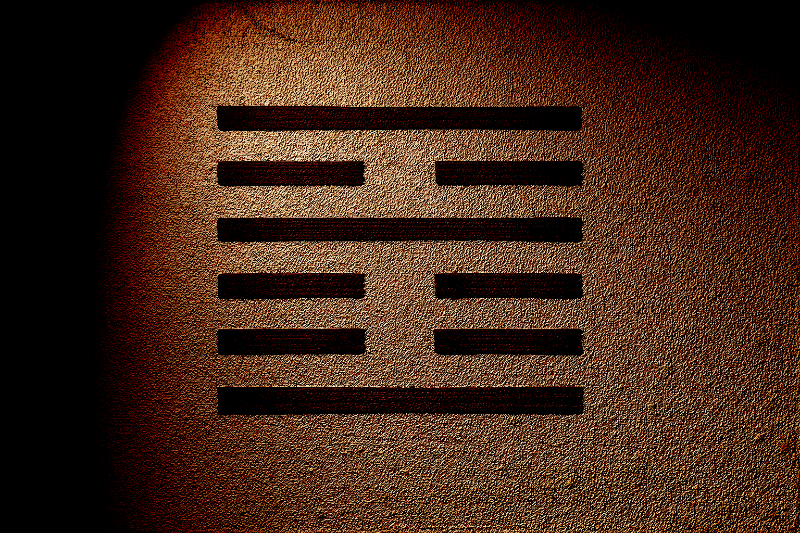
    In the Deep Lead Joss House, Chan Lee sorted through fifty yarrow stalks as Huish-Huish had taught her, occasionally raising them to her nose to savour the herb’s unique aroma. Huish-Huish counted off the number of stalks remaining between Chan Lee’s fingers at each stage, and the procedure was repeated six times to determine the lines of the session’s hexagram: Biting Through – judgement, punishment, discernment. None of the lines signifies guilt, though a little harm may be done. On the whole, an optimistic sign: though there may be trouble at the beginning, one bite’s through. Justice is administered, punishments exacted. If you lose your teeth, you lose your grip.

    Black on gold image of the Yi Jing (I Ching) hexagram 21 Biting Through. Bottom to top, the lines are Yang (solid), Yin (broken), Yin, Yang, Yin, Yang.

    “Cutting … gnawing … chewing …” Huish-Huish said. “A picture of the mouth. You bite through, get your teeth into something.”

    “Cutting.” Chan Lee intoned the word, the eye of flesh closing, the inward gaze of the eye of her contemplation floating back in time. “If you chew dried salt meat, you’ll find yourself poisoned.”

    Knowing not whether for good or ill, she decided that her best move would be to gratify him by seeming to take pleasure in what he did – deeds she found appalling and sickening, lacking as she did the same innate relish for inflicting misery that she now knew to be his. She did not stop to ask whether repeated exposure would inure her to his evils; whether, by touching black paint, her fingers too might be blackened. One thing was sure: there was no iota of love in her heart for the man who had become her ostensible protector. Fang was a man in whose arid heart love for any other creature had never taken root. As time went by, familiarity became contempt, and instead of any initial ardour, the possession of one so desired by others only fed in him a seething sadistic scorn that grew stronger by the day. This scorn he expressed in a ritual of cruelty, a proxy for the conjugal act, with strangulation and cutting for caresses. Sometimes his fervent passions quite got the better of him, and it was on the cards that he would murder her before too much longer.

    Deadened by morphia, a living ghost of herself, she faded from the view of her admirers, most of them so addled that, appeased by a surfeit of available substitutes, they forgot her before long – or rather, recalled only the myth of that bewitching peony of the Barbary Coast, and not the flesh-and-blood woman. Most. An up-and-coming stage magician, Chee Ling Qua, formerly of the ‘Court of Peking’ troupe, was presently engaged at the Bella Union – fire-breathing, sword-swallowing, linking rings, disappearing rabbits and chickens, the works. He could materialize a great big glass bowl full of goldfish out of thin air. A gentle soul, meek and mild, far from a hero come to save the day, but she credited his avowals of undying love and knew that he possessed, if not great means, at least some paste gems of amazing fire and brilliance for use in his performances.

    He was also on close terms with the most highly skilled and secretive Celestial apothecary in the city, whom he commissioned to create incendiaries and other chemical substances necessary for his stage effects. Chan Lee contrived to steal some time alone with the magician in his dressing room one evening when Fang was occupied with business; though he despised her he was as possessive of her as ever. He was much preoccupied these days, his gang embroiled in a war with a rival tong over the exclusive right to operate fan tan games and lotteries in the Barbary Coast. As it happened, Ling Qua was on the verge of pulling up stakes and setting off abroad with his own small troupe. Chan Lee should come with them at any cost, he begged, as she rearranged his robes. She could work as his magician’s assistant, peppering up the act with an arabesque here and a shimmy there … she’d pack them in.

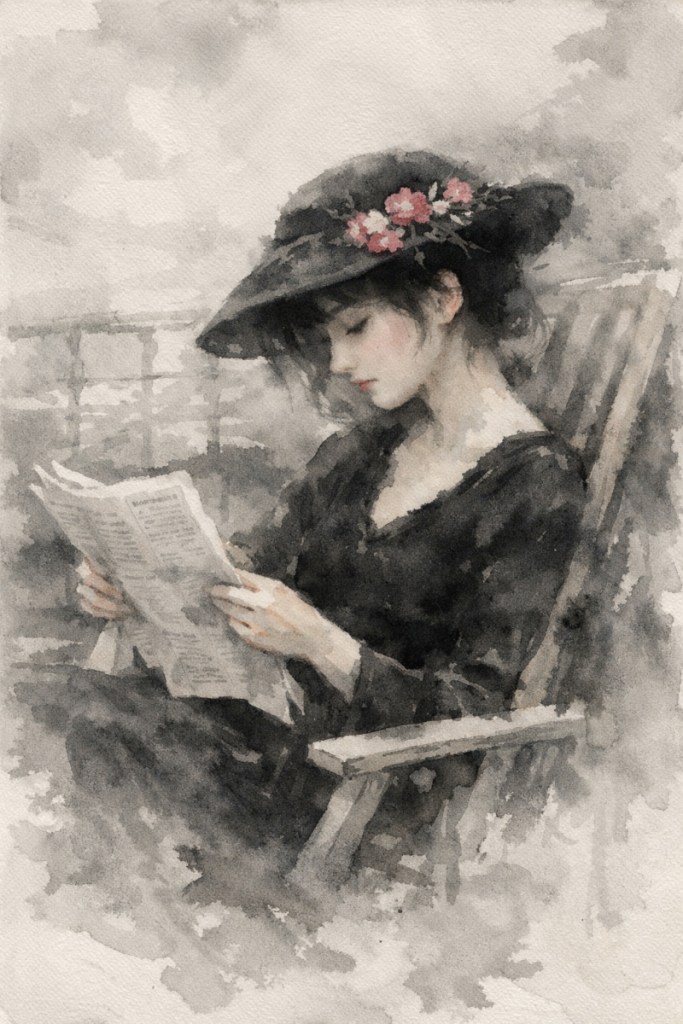
    A month later, the Australasian and American Mail Steamship Company’s City of Melbourne headed towards the Golden Gate, its passenger list including a modest troupe of performers, a mixture of Chinese and Europeans, among them the sylphlike Suzon Chabrier formerly of the Folies Bergère, an inconspicuous brunette who, on closer inspection, as the customs official who processed her had remarked to his colleague, had a charming and subtle nuance of face that could almost pass as oriental. While her fellow passengers lined the decks for their last glimpses of Angel Island, Yerba Buena, and Alcatraz, Miss Chabrier reclined on a deckchair in a discreet black velvet dress, her chapeau decorated with simple field blossoms and pushed forward over her head, perusing the Daily Alta California. She was particularly attentive to an article on page two, which reported on the sudden death of a despised highbinder for the Hing San Fong Tong, one Fang Jing Dock. A photograph of the victim’s corpse had sunk into grainy shadow, which was perhaps for the best, the report ran, since readers would have found the contorted face and twisted limbs most distressing. Suzon applied her reading magnifier to the image, then read on. A note found on the corpse showed that he had expected death by rival hatchetmen.

    Chan Lee, later known as Lily Chan, sits in a deckchair aboard a steamship leaving San Francisco, having assumed the identity of Suzon Chabrier of the Folies Bergère.

    The note read: ‘Soon I must go to my fathers. Whether by the broad bladed axe or by dust of the dragon’s tail, it matters not. This I know. I go. I commend my spirit to Buddha, the all-wise and merciful.’

    “A searching examination of the body,” the reporter continued, “failed to reveal any marks of violence. It is believed that by ‘dust of the dragon’s tail,’ Fang referred to some potent oriental poison. From his expression of agony, it appeared he had been administered sufficient of the substance, whatever it was, to kill an hundred men. Police arrested another highbinder named Fat Louis, who is well-known to have been an associate of the dead man; but it has come out that he was employed surreptitiously by the rival tong in question, the See Yups. The dead man, who will not be missed, was under suspicion for a number of murders of fellow Chinese. A woman with whom he cohabited, once well-known around the gambling dens and houses of ill-repute, has not been seen for several months, and is now added to a long list of the presumed victims of the deceased ne’er-do-well.”


    From the draft novel Stawell Bardo © Michael Guest 2026
  • Ginseng Poachers

    Ginseng Poachers

    Once the blackened remains of his aerostatic globe were retrieved, Dinwiddie took to his bunk, afflicted with a profound dread usually reserved for the condemned. He shook, perspired, quivered, and palpitated; so much so that Pu-erh, apprehensive of her own fate, having been placed in charge of the Scot by the Qianlong Emperor himself, summoned a team of imperial physicians and acupuncturists. Their examination of his tongue revealed flaws in the state of his kidneys, bladder, intestines, stomach, spleen, lungs, heart, gall bladder, and liver. Moreover, its shape and colour pointed to a severe deficiency in Qi; red dots suggested heat or inflammation in his blood; and the thick coating was indicative of an allergic disorder compounded by digestive imbalance. He was dosed, moxibusted with mugwort, and cupped, scraped, tickled and pricked to the point of tears and bellows.

    He may as well have reclined sunning himself in the Imperial Garden, for Lord Macartney’s overtures to the Emperor had crashed and burned as completely as the globe, with tangible repercussions for the delegation. Macartney, preoccupied with weightier matters, had never much cared for Dinwiddie’s pet project in any case, and failed to notice its absence from the exhibition.

    Dinwiddie resurrected himself and managed to prepare for the official event. The Emperor was contemptuous, tarrying for less than five minutes before repairing to the quarters of his latest concubine. After his disdainful exit, Pu-erh conveyed his comments to the scowling Lord Macartney and deflated Dinwiddie:

    “Your air pump is of little interest, though the telescope might amuse children. He finds your planetarium infantile too – not unlike the sing-song clocks hawked in the Canton marketplaces,” she said. “The Emperor already owns a superior model, anyway, presented as a personal gift by a German delegation. It is true your giant lens can melt a copper coin, but will it melt his enemy’s city? He believes not.”

    The next day, she was summoned to the Dragon Throne. She kowtowed three times as she approached. The imperial ministers, secretaries, and scribes were in attendance, assisting the Emperor draft a reply to King George’s letter. Her attendants delivered the sketches and notes she and her agents had compiled regarding the scientific instruments.

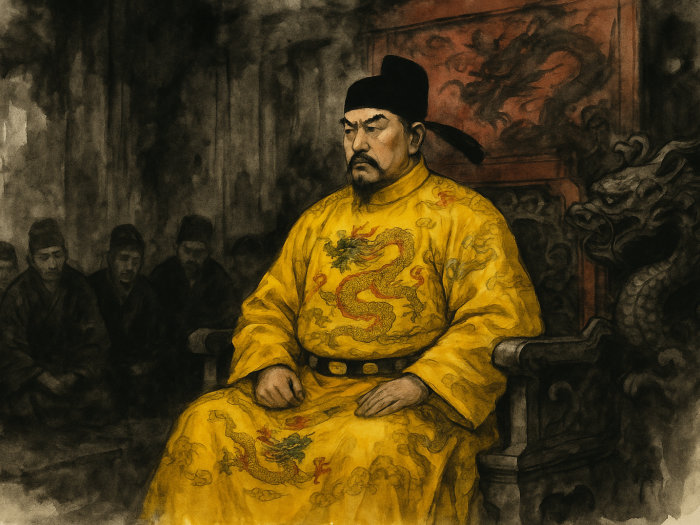
    The Qing Emperor, in his Bright Yellow court robes.

    “You have performed your duties exemplarily, our flower,” the Emperor said. “Our indulgence of the foreign delegation, exasperating though it was, has nonetheless proved edifying in certain significant respects. Their ships are capable and well-armoured, their weapons powerful beyond our anticipation. It is useful to glean these odds and ends regarding the abilities of their scientists and craftsmen. Oh, that fellow, that worm …”

    Lord Macartney,” prompted an advisor at his side.

    “That’s it – Macartney. I will never forget that spotted mulberry suit of his – the enormous diamond star, medals festooning his chest, and that hat – that ridiculous plume of feathers! The very image of presumption and self-importance. What a … peacock! But bumbling as a poacher setting snares in the Imperial Garden!” He let out a hearty laugh, provoking a ripple of hilarity among the ministers.

    “Insufferable dunce and fop. Humming and hawing about the significance of rituals and this and that, how he should bow and the rest of it. Disdains kowtowing to our Throne indeed, but performed some silly sort of jig instead. And they wouldn’t leave! They would like to have remained in Jehol the whole summer long! Those English have incurred my great displeasure – no more favours for them. Mark that, a ministerial edict for you: No more favours. Allow them two days to gather their paraphernalia, then escort them from the capital forthwith. The nonsense of this king, his wild ideas and hopes. Ah, that is apt! make a note. Come, take this down,” he said, flicking his fingers at the nearest scribe. “We shall draft the edict:

    “Your England is not the only nation trading at Canton. If other nations, following your bad example, wrongfully importune my ear with further impossible requests, how will it be possible for me to treat them with easy indulgence? Yes, good, and while I think of it, that point about letting in their proselytizers … Regarding your nation’s worship of the Lord of Heaven … Ever since the beginning of history, sage Emperors and wise rulers have bestowed on China a moral system and inculcated the code of Confucius, which from time immemorial has been religiously observed by the myriads of my subjects. There has been no hankering after heterodox doctrines.

    “Well and good,” he said, looking down at Pu-erh and granting her a broad, warm smile. It was the first smile of any sort, indeed, that she had ever received from him. “Foreign ideas and fancies can breed serious disharmony, can they not, our petal? The last thing we need is exposure to them. What was it that my father used to say? ‘Destroy the seed of evil, or it will grow into your ruin,’ or something to that effect. By the way, how is your beloved Bright Yang? Has he returned with the tiny elephant and soldiers?”

    She averted her eyes and slowly shook her head.

    “You see, I know more than I let on,” he said. “I even heard scraps of a crazy rumour that the barbarians can fly! The nonsense that gets around. Never mind, he was unworthy of you, that Bright Yang. Yet fear not, a woman as intelligent as yourself must be much sought after. Is such a brilliant flower, however plain, worth more than the prettiest concubine? No, she is worth ten of them, and not just for lacking their vacant minds. Stupidity makes a concubine restful. But you, dear petal, you keep us guessing. Oh, that is not quite well put, is it? Naturally a pretty concubine is all the better when graced with an astute mind, is she not? How old are you, our petal? When were you born?”

    She told him, and he slowly shook his head.

    “That is what I have heard tell, but would you truly have me believe in the gold elixir of immortality? Have no qualms, our enlightened one, you need not seduce me with the fairy tales of your sect. Despite my patronage of Tibetan Buddhism and my abiding friendship with the Dalai Lama, I do not entertain the slightest aversion to your affections for the Tao, though its religion and philosophy I neither believe nor understand. Alas, there are far too few of you left in the upper echelons, though I’m told that some of your rural cults are regaining popularity amongst the poorer, lower-class folk. No matter, you have earned our fond indulgence, and may rely upon it to the end of your span under Heaven.”

    Again he shed the glow of his smile upon her, or so it seemed, enhaloed as it was in the golden rays reflected from the Dragon Throne.

    If Pu-erh had never doubted the Emperor’s enduring patronage, she did now. Another warm smile deepened her unease. He dismissed her and returned to work on his epistle to the British.

    “The beginning and middle are good,” he said, “but the end needs attention. Where were we? Ah yes … I do not forget the lonely remoteness of your island, cut off from the world by intervening wastes of sea, nor do I overlook your excusable ignorance of the usages of our Celestial Empire. I have consequently commanded my Ministers to enlighten your Ambassador on the subject, and have ordered the departure of the mission. Etcetera, etcetera, etcetera … Now for a firm conclusion: Should your vessels touch the shore, your merchants will assuredly never be permitted to land or to reside there, but will be subject to instant expulsion. In that event your barbarian merchants will have had a long journey for nothing. Do not say that you were not warned in due time! Tremblingly obey and show no negligence! Yes, that should do it! Inscribe this missive on yellow silk of the finest quality, deliver it to the mulberry peacock and impose my edict upon him to begone in two days’ time, at the risk of your heads!” He uttered the final phrase in an ominous tone that echoed in the hall, then smiled broadly.

    Lord Macartney received the yellow silk epistle, mercifully unreadable to him, and departed China ignominiously, his retinue and exhibition articles hastily boxed. Aboard the Lion as she set sail from Macao, he stood on deck with her captain.

    “Are they ignorant that a couple of our English frigates would outmatch his entire antiquated fleet?” Macartney said bitterly.

    “From what I have seen,” the captain said, “it would take no more than half a summer. Half a dozen broadsides would block the so-called Tiger’s Mouth, which guards the waterway into Canton.”

    “The population would be condemned to starvation. The Empire of China is much overrated. He is a crazy old man of war, kept barely afloat these past hundred and fifty years, which through its impression of bulk has managed to overawe its neighbours. Ah, he’s rotten at the timbers …”

    “Through and through, m’lud. It won’t be long. He’ll drift as a wreck and surely be dashed asunder on the rocky shore.”

    “The tyranny of a handful of Manchu tartars over three hundred millions of Chinese, who will not endure their condition for much longer. Still, we must forbear while a ray of hope remains for the success of gentle measures. At any rate, left to its own devices, I believe the dissolution of this imperial yoke will precede my own.”

    Two British ships, the Lion and another, leaving China under full sail.

    The captain watched the lord’s back as he paced away, then turned discreetly from the breeze, to shake his head, light his pipe, and allow himself a wry face at the tales of his superior’s disastrous mission, which were attaining satirical proportions amongst members of the envoy and crew.

    • • •

    Approaching twilight, two unexceptional sojourners tramped down the dusty track that skirted the flank of Timeless Mount – a poised woman and a mustachioed youth – both clad in plain, weather-worn robes, the modest dress of those who have forsaken rank. Though travel-marked, they bore the composed, abstracted air of those returned from beyond time’s keeping.

    As they neared a fork in the path, one arm climbing higher, the other tracing a ridge eastward before dipping into dense forest, three grizzled bandits in big boots and hats came up behind them.

    “Oi! What’s your hurry, peasants?” one of the bandits growled and the two turned to face them, bowing low and repeatedly, out of old acquaintance with peril.

    The one who had spoken snorted his satisfaction at what he perceived as their humility, blind as he was to the absence of fear in it. “You can chuck down all that stuff,” he said, jerking a thumb, the other hand gripping the hilt of his goose-wing sabre, as he limped toward them. The pilgrims eased their carry-poles from their shoulders to the ground. “Toady, have a look-see what we got ’ere.”

    One of his henchmen, distinguished by the angry boils covering one side of his face, did immediately as ordered, dropping to his knees before the packages and opening them up. Periodically, he scratched at his face, his boils themselves seeming to have boils.

    “Clothes and stuff, pretty nice, silk even!” he said, holding up a deep blue scarf patterned with peonies. “Now, what have we got ’ere in this box? All this writing-stuff and little statues and books and bells and little pots, and all sorts of other useless rubbish.”

    “What about food?” said the third bandit, urgently, his eyes wide.

    “Hold on, Yongyan, give me a minute. We got some carrots, rice, and beans. Not much chop.”

    “Better than nothing,” said the third bandit, a man more corpulent than hardened. “We got more back at camp, anyway.”

    “Pack it all up, you two, and let’s be off.”

    Down from the track they stumbled with their prisoners, pushing through the bamboo until they came to a small cleared area with a fire-pit and the rough wherewithal of a bandit’s trade: a meagre stack of weapons – spear, pike, sword, and a musket – and a dismal pile of loot, which they may as well have obtained by begging: a modest heap of bronze coins, a studded leather belt, an old bamboo flute, an abacus, a compass, a wooden figurine of the Buddha, a drawstring burlap pouch, and other odds and ends.

    Pu-erh and her son sat in silence, loosely restrained by a rope, observing the men as they cooked up the food, ate, and passed around a flagon of rice-whisky. She was adorned with not one extra wrinkle since we last saw her, all that indeterminate period before, though her little boy Mow Fung was matured into an adolescent fellow of lean frame and quiet grace.

    “Better give them a bit,” the leader said through a mouthful. “Might be the last meal they ever have before getting all sliced up into bits and pieces and their heads chopped off.” His guffaws dwindled when she fixed him in her level gaze.

    “Your name, sir?” Pu-erh said politely to the one with boils, who leaned over to them with two wooden plates of beans. She and her son had already freed themselves from their restraints without any fuss. The bandit had removed his headwear, and even in the dim light one could see that the boils continued up from the side of his face and across half his cranium.

    “He’s called Ugly Toad,” the leader said. “The other one goes by Yongyan the Hungry. And me? Wang the Eviscerator.” He lifted his sabre from the ground beside him and waved it in the air. “And this ’ere’s what does the evisceratin’. So you better watch your p’s and q’s, got it? Are you from around hereabouts? We’re new ourselves, lookin’ for a good place to set up a proper hideout and all that. Heard there’s treasure up on that next mountain, Time’s Heavenly Sanctuary Blah-Blah-Something-or-Other, so we figured we might head up there a ways.”

    “That would seem an unfavourable location for those of your profession,” she said.

    “Oh it would, would it?”

    “Certainly, unless you would enter the lair to look for the tiger.”

    “Allow me to be the best judge of that,” he said. “But go on, proceed, tell us a bit about it, since you seem to know so much about everything. What is it you do around this neck of the woods, scratch the dirt, I suppose?”

    “Simple hermits. We study and improve ourselves; distill the gold elixir; wander from village to village; tend the hidden temple; heal boils; make rain; exorcise ghosts; give blessings; heal boils (it’s a recurring problem); prophesy destinies; interpret the countryside; create and burn talismans for good or ill fortune …”

    “Ar, got it,” said the leader and guzzled from the flask. “Quacks. What a coincidence. You know, before this we worked as ginseng poachers in Fusong County up at Changbai Mountain. Not much fun, I can tell you. You get those Manchus after you, because it’s their sacred place, you see; and then you get the black bears too. If it’s the Manchu, you run like the wind, for your head’s at stake. If it’s the bear, you don’t run or fight, whatever you do, but play dead and freeze, and be good at it, too, because they’ll push and prod you around to see if you’re faking, and if you are, they’ll more than likely take your head off before they gobble you up. Here, I’ll show you one of my gut-wounds, still septic it is after all that time. Pretty nice, eh? Well, I never made a peep, you better believe it, though he licked all over my face and blew his rank breath up my nostrils. The ginseng takes a lot of poaching indeed – but if you know what you’re doin’ it’s worth more’n silver. Sometimes, if you’re lucky you’ll hear a special little birdie singing, what’s telling you the ginseng is there; and if it is, it’s so fiddly to get it out you might as well not even try. The root can disappear or run away, too, because it’s magic. It’s just the exact shape of a human and it’s got the mountain spirit in it, so you have to lasso it by the sprouts with red cotton thread with the ends weighed down with two bronze coins. Then you tie it up to a sort of special trap until you dig it out without breaking any of it, which is next to impossible anyways. We’ve saved two in that little sack, which is about all we got out of the exercise. To tell the truth, we haven’t been much chop at working as bandits, either, but that’s another story.”

    “Gold elixir …” said Yongyan the Hungry. “Any alcohol in it?”

    “In the modern day, it’s generally understood as a potion of immortality formed within,” Pu-erh said. “Hence the term inner alchemy. The gold elixir is the innate knowledge and power of the mind – a fusion of vitality, energy, and spirit: the forces of creativity, motion, and consciousness – refined through rigorous observance of the Tao. By contrast, external alchemy follows the example of one of the Eight Immortals, Iron-Crutch Li. Its goal is to concoct a pill of immortality by combining ingredients like lead, mercury, cinnabar, and sulphates, then firing them in a furnace. Unfortunately, the ingestion of such pills often results in death. Some lesser practitioners attempt to raise their consciousness through crude experiments with plant extracts.”

    “Deviant practices,” Mow Fung said, with the shadow of a smile, closing his eyes. The bandits stared, then glanced at one another, slack-jawed.

    “He don’t say too much, do he?” said Wang the Eviscerator at last.

    “Those days are gone,” Pu-erh sighed, “when condemned prisoners were made available as subjects for such experiments. As for these mountains, they are favourable to our alchemical purpose: the pursuit of the elixir. For here, tucked in a valley that time forgot, lies a village where months pass as years and the people scarcely age.”

    “Heal boils, do you say?” said Ugly Toad.

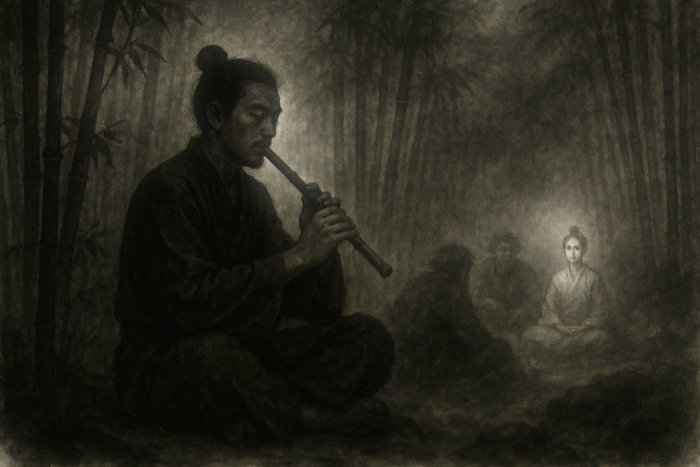
    None of the bandits paid any attention as Mow Fung retrieved the bamboo flute and moved to the edge of the clearing without a word, where he sat down cross-legged again and began to play.

    The campfire crackled. He ad-libbed lento through melodic variations once taught to him by the Imperial Music Master, as a favour to Pu-erh. In theory, they formed a transcendent framework based on the King Wen sequence of I Ching hexagrams from the late Shang Dynasty, embodying a microcosm of the universe.

    Mow Fung playing his flute in the dark bamboo grove, with Pu-Erh and the poachers in the background

    Without effort, the young man lent the intrinsically dry exercise a style idiomatic to the flute, evoking in everyone present an impression of a lonely moon suspended in a frosty autumn night sky, though not one of them made mention of it.

    As he played, he reflected on dim memories of his infancy in the Forbidden City, and on the blurry period that followed, living their lives in hiding and reclusion among caves and forests, and in the infinite seclusion of the mountain. How the years had flown since they fled, when one looked back, while seeming, minute to minute, to progress in ordinary time – so that he, an apparent “youth” – had lived the span of perhaps two lifetimes for one of his corporeal age.

    “You might as well keep that thing,” Yongyan said. “None of us could get a note out of it.”

    “What was that you were saying about boils a while earlier?” Ugly Toad asked quietly. “I’ve been having trouble with these for years. Getting worse rather than better, I’m afraid.”

    “Those little blemishes?” Pu-erh said. “Why, you can hardly notice them. They’re really not worth bothering about too much, do you think?”

    He gave her a meek and appreciative grin. “I’ve tried all sorts of remedies from quacks all over the countryside, but they’ve only made things worse.”

    She took a dab of unguent from one of several minuscule clay pots stacked into her carry-sack and told him to apply it. Though scarcely more than a smear, it seemed to warm in his fingers and swell slightly as he rubbed it in – not diminishing, but softly renewing itself. After a long while, she told him to save what remained for daily use. There would always be enough, she said, so long as he didn’t try to measure it.

    “Feels better already,” Ugly Toad said to Wang the Eviscerator. “You should try it, you know, for your belly.”

    “Well, you do realize I was only kidding about cutting you up into bits…” Wang said to her through his toothless grin.

    “I knew your capabilities the moment we met,” she said, “and I was doubtful they include the eviscerating of unarmed victims. Unfortunately, the unguent is only a salve, a stop-gap measure. Cures for both your complaints will require substantial time and involved procedures. Take heed that if you leave your bear-wound as it is to heal, you will assuredly die. Moreover, if you lead your party to seek treasure on the upper mount as you implied was your plan, the three of you will surely perish all the sooner.”

    The following morning the five took the lower path, hiking along the ridge and descending into thick forest. They entered a narrow trail that soon forked into a dozen offshoots, each of which branched again and again into near-identical tracks, until they found themselves in a bewilderment of forks and false turnings. Only Pu-erh and Mow Fung seemed to know the way. At last, near midday, they emerged before a dilapidated temple, half-lost in the undergrowth.

    “Rest now,” said Pu-erh. “We will return before nightfall.”

    The temple and its crumbling attendant building sat on a ledge where the land dropped away into a mist-filled void. Behind it, cliffs fell sheer to silence, visited only by haughty eagles who wheeled and nested in the inaccessible crags.

    The three bandits felt a rush of exhilaration at the sight – a sensation unlike any they had ever known. They settled in to await the return of their two guides or perhaps some wandering monk. An overwhelming solemnity fell over them, as though from this high place one might commune with the Eight Immortals – whoever they were.

    “We were looking for a hideout, and we have found one,” said Wang.

    “Without knowing the way, no one could ever get in,” said Toad.

    The void was an immense auditorium of silence, from whose depths came the thin cry of a hawk.

    “… or out, for that matter, you might say,” said Yongyan.

    “You don’t think …”

    The three cast glances at each other, before settling down for a smoke.

    “How could you suggest such a thing?”


    From the draft novel Stawell Bardo © Michael Guest 2025

  • 6. Jade Volume (from the draft novel Stawell Bardo)

    6. Jade Volume (from the draft novel Stawell Bardo)

    Jade Volume

    There is a mountain in the northern reaches of central China, known by devotees as Time’s Heavenly Sanctuary an Infinity above the Jagged Rocks. To the uninitiated, the summit lies at a distance no greater than a rice husk from the utterly impossible. And yet the region dazzles with natural vistas and unimaginable beauty. Many have tried to get to the higher elevations, but most failed. This is the realm not of mankind, but of the eagle, the heavenly tiger, and also the mischievous monkey who toys with the mind.

    Below, a wide, pure, meandering river traverses a pristine landscape that extends into unknown territory, amid countless acres of giant bamboo, their upper branches seeming to beckon the breeze. The skies above are the sapphire blue of heaven. Hearts lift at the sight, and there are climbers so intoxicated by the vision that they hurl themselves in ecstasy to their doom – clearing the sheer cliffs and smashing against the rough boulders below. It is no wonder that, to a remaining few, Time’s Heavenly Sanctuary an Infinity above the Jagged Rocks is believed the holiest of holy places and, indeed, not to be slighted without profound risk.

    Abstract watercolor landscape featuring red mist and glowing light in the foreground, with blue-grey watercolor waves suggesting water and fog. Evokes a mythic Chinese mountain scene from the Jade Volume chapter.

    The path winds upward through groves of giant bamboo, past shadowed outcrops and long-forgotten steps. Midway up the mountain’s flank, obscured by foliage and time, stand the ruins of a small, ancient temple – crumbling, barely visible through a thick curtain of green. Though seemingly deserted, the sacred fonts are kept full, and the stone steps swept clean.

    Inside, a modest offering of a simple rice-ball and bamboo shoot invariably awaits the intrepid visitor. To come so far demonstrates a purity of heart that is well rewarded. To accept the offering in proper humility opens the senses to the contrast between the essences of darkness and light – a rare clarity amid the world’s illusions. But should the offering be taken improperly, or worse, scorned in any infinitesimal degree … then the shattered remains of the fallen, far below the cliffs, bear silent witness to the error.

    Slightly below the temple’s ledge, until a century or two ago, burial tunnels were dug into the side of the sheer cliffs, extraordinarily deep, hand-carved tunnels in which it was the tradition to inter beings deemed noble of mind and spirit. It is said that, for the adept, the tunnels lead into a subterranean network that joins together all the holiest mountains in China, though not in the form of a physical labyrinth. Rather, access can be had only by an astral body, guided by the lines of an ancient map inscribed by the Tao on the shell of a certain large tortoise. Gravediggers would once upon a time swing down on ropes and steer one’s coffin into place in the cliff. Unsurprisingly, some of these erstwhile aerial ferrymen perished alongside their cargo, a worthy sacrifice for which they accrued what some call good Karma.

    And still the mountain ascends.

    Above this middle sanctuary of shrine and tomb, the mountain veils its final secrets. The temple, perched on a precarious ledge far above the valley, is not the summit. Beyond it, higher still and hidden from even the boldest climbers, lie the archives. Cascades of shining white water shield the opening to the cave, mighty enough to wash intruders away like ants. To human eyes, from all but an angular perspective of higher insight, the entrance appears no greater than a long, narrow crack in impenetrable stone.

    Seldom indeed will visitors appear at these elevations – whether temple, tomb, or the archive beyond – in a living, physical form – but when they do, they find awaiting them the welcoming rice-ball and fresh bamboo shoot. Quite the mystery. Either there are ways to attain such heights known only to the peasants who reside in hovels dotting the mountain here and there, shrouded in mist, or else a supernatural force is at work. We adhere to the former explanation because, no matter how sheer the cliffs or tangled the paths on the way to enlightenment, there are always those who will dare to ascend and untangle them, even among us simple monks and peasants.

    Yet there are also tales of hazardous spiritual journeys undertaken in order to consult the archive, in which an adventurer-adept awakens from trance to find the rice-ball and bamboo shoot in his mouth – rotten and crawling with maggots. And this although no flies exist above the treeline! The scenario is horrific, and it invariably concludes on the boulders at the foot of the cliffs.

    The archive is a forest of books dating back to the earliest ‘butterfly’ volumes, constructed from vertical strips of bamboo, each inscribed with a line of text, and linked together into concertina-folded pages. The works kept in the archive are expertly arranged, meticulously ordered and colour-coded, their calligraphy flawless, their ink illustrations brilliant in economy. Naturally, they are dusty and draped in thick wreaths of spider web, for they are seldom taken up in the hand of a reader.

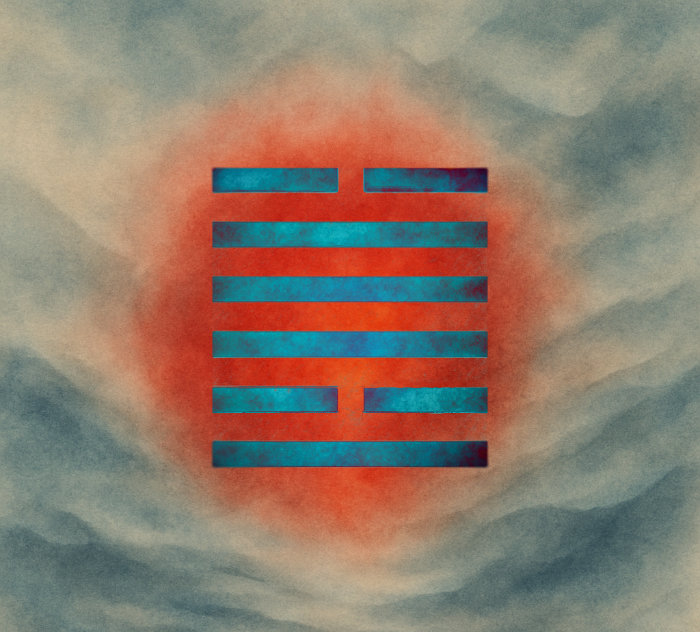
    In the present day, the name of Chung Mow Fung yields only a single footnote, in a ‘recent’ volume from two or three centuries ago, referencing parentage under a different name. This name, however, is barred from formal publication, for it was altered by edict of the Tao, as made clear and manifest in the Forty-Ninth Hexagram: Revolution (革 – ). As Fire meets Metal (the lake), producing illumination, so too are personal desires refined into unselfishness. What is obsolete is shed like a snake’s skin; acquired pollution is burned away, revealing the essence of primal, unified awareness. The spirit aligns with its path. The great person changes like a tiger.

    Abstract watercolor of a fiery metallic I Ching hexagram, glowing against a watery background. Symbolizes transformation or revolution..

    It was not uncommon for those of the Mow Fung line to alter their names – a necessary measure during those periods when the study of the Tao fell into disfavour with ascendant militant ideologies. When he settled on the southern continent, Chung had been his family name; however, local officials, in their ignorance, reversed the order. That moment marks the point at which we locate our pivotal index for extracting the lineage, and so the name becomes, in the final analysis, arbitrary. Yet the Mandarin denotation, Admirer of the Phoenix, perhaps remains apt. After all, how may we pin down a karmic ripple or trace an Akashic echo by means of a single name? Naturally, such terms are merely Buddhist and Hindu approximations, and useful metaphors at best, for, as Lao Tzu correctly observes, the true Way is named only tentatively: Tao.

    So much for names. The Tao does not trouble itself with the consistency of library catalogues.

    Although the familial lines extend back centuries into various narratives concerning the most enlightened individuals, this and further changes in name make certain crucial connections obscure, such that the specific ancestry becomes a matter of interpretation and even, in the worst cases, divination. It is like pursuing the strands of a fog. Any identifiable and named individual will not necessarily correlate with the line of the Mow Fung who occupies our current interest.

    Some traditions suggest that Mow Fung is not so much a reincarnation as a resonance – a particular pattern in the Tao reasserting itself under a familiar-seeming name: a node through which the Tao’s intent briefly shimmers. That such a resonance might walk, speak, or even misbehave is not so much a mystery as a habit of the Way.

    Perhaps he never attained enlightenment, nor will his descendants, his temperament being of a too weak, too dark, too yin-flavoured humour and given to excesses of the flesh: notably, unmindful congress and the ingestion of hallucinogens. Unfortunately, even such faults are not as uncommon as the reader might like to think, even among the membership of our venerable community of ancestors, among whom number not only sages and adepts, but also a handful of artists and poets whose conviction in their own genius outpaced any objective manifestation.

    It is gathered from the relevant volume that this ‘earlier’ Mow Fung was the son of an accomplished civil servant who, after becoming a father, subsequently became a eunuch in the imperial court of the Qianlong Emperor, where he enjoyed a cheerfully untroubled life. Nicknamed, with some irony, Ma Tan-yang, or “Bright Yang” he achieved a degree of enlightenment, thanks to the tutelage of his wife. She, Sun Pu-erh (“One Hearted”), was a child prodigy and a brilliant scholar and seer, trained in a clandestine temple of the Taoist School of Complete Reality (now officially suppressed, but only on paper) and endowed with unsurpassed expertise in the study of Confucius.

    Traditional Chinese watercolor painting of two court officials in ceremonial robes, standing before a decorative phoenix tapestry. Represents Pu-erh and Bright Yang from the Jade Volume, styled as Taoist immortals.

    Moreover, she was a brilliant exponent of foreign languages, which she studied under the tutelage of a Jesuit missionary and painter named Giuseppe Castiglione. She was an adept of high degree, directly descended from the female Wu, the most powerful sorcerers of all time, and engaged as a high adviser in the imperial court. Her husband was charged with supervision of the Emperor’s concubines, who instructed him in the most up-to-date nuances in fashion and cosmetics, in exchange for tutoring them in all sorts of corporeal practices in which he was expert (see Indigo Volume XXXXIV of Late Tang Dynasty Collection, and Emerald Volume XXVII of Song Dynasty Collection).

    One day the Emperor summoned Sun Pu-erh and her foolish young husband Bright Yang to the Hall of Supreme Harmony, in the Forbidden City. Sitting on his Dragon Throne, which marked the centre of the universe, he assigned them a mission. Backed by a magnificent screen of gold, he appeared a multi-coloured, superhuman gem. His voice echoed around and among the six huge gilded columns immediately before him, each encoiled by his own five-clawed dragon. Touch one if you wish to die. The ruler of a round-eyed, red-haired, ghostly-skinned barbarian rabble from a far-flung isle had requested that he receive a delegation. The chieftain, who called himself King George III of England, a territory he described in terms so overblown as to border on hilarious arrogance, wished to discover the wonders of the Great Qing, for the betterment of his own ‘civilization’, which the Emperor understood to be the lowliest among all those in Europe.

    “His baser wish is that we grant certain concessions to his barbarian merchants. Hitherto, all European nations, including those of his own realm, have carried on their trade with our Celestial Empire, as permitted solely at the port of Canton, a restriction he now seeks to overturn.

    “What is the meaning of this word ‘king,’ anyway?” the Emperor said, looking at Pu-erh, who had memorized all 11,099 volumes of the encyclopedia housed in the Hall of Literary Glory.

    She bowed her head and replied.

    “Perhaps related to another word they use, ‘kin,’ implying he is the father of their extended family,” she said. “They say also that ‘the lion is king of beasts,’ referring to their imperial symbolism. Evidently there are no lions there, are there? Perhaps they seek to differentiate themselves from Caesar, derived elsewhere as Czar or Kaiser. I imagine it all originates in Roman times ”

    “Cease!” the Emperor said curtly, and continued:

    “His letter is illiterate. You see, here he addresses us as ‘the Supreme Emperor of China … worthy to live tens of thousands and tens of thousands thousand years.” He coughed lightly, tittered, and cast a glance at the ceiling – augustly decorated with framed images in jade, ruby, and gold leaf: dragons, qilin, phoenixes, and other fabulous beings from the four corners of the earth and beyond – while an imitative titter rippled among the courtiers.

    Close-up watercolor portrait of the Qianlong Emperor in Qing Dynasty regalia, with a stern expression. Painted in stylized ink-brush style evoking Chinese portraiture traditions.

    “However, despite his clumsy expression, we take note his respectful spirit of submission,” he said, raising his hand to cut short the disturbance. “We determine that he is sincere in his intentions.

    “It behooves us here at the centre and apogee of the world to cast our light before such peoples, backward peoples, but those who have nevertheless drawn themselves up to attain a state in which they manage to discern the magnanimity with which we bend towards them and allow them to participate in our beneficence, and therefore shall we acquiesce to these requests. Never mind how meagre their offering, we shall treat them with generosity and luminosity. After all, it is our Throne’s principle to treat strangers from afar with indulgence and exercise a pacifying control over barbarian tribes, the world over. Make a special note,” he ordered his scribes, who were taking down his words.

    “His delegation of a hundred men will arrive in China at any moment now, concluding a year’s voyage from the far-flung regions of barbarians, by way of several countries even more primitive than their own, in the Americas and in Asia. Naturally, we are already well informed about all parts of Asia, thanks to our numerous voyages of discovery and trade, so we require no enlightenment from this English impertinence. Ha! In the year 1405,” he said, his voice rising, “during the Ming dynasty, Admiral Zheng He discovered America – seventy-five years before the Spaniards. And during his seven expeditions, he mapped the entire globe: the Mediterranean, Africa, the Americas, and even Australia.” He looked again at Sun Pu-erh, who bowed her head.

    “I have seen it in an archive in the Pavilion of Literary Profundity,” she said.

    “We have had little need since those times for forays abroad. Our Celestial Empire possesses all things in prolific abundance and lacks no product within its own borders. Make a special note, underlined,” he commanded the scribes.

    “Since the barbarians have developed some abilities in seamanship, they now scramble to us,” he continued. “We remain loath to admit them – all the more, given the skirmish playing out somewhere over there in those parts, some minor uprising …” He looked at Pu-erh, who bowed her head.

    “The French Revolution,” she said. “King Louis XVI, Marie Antoinette beheaded, and so on.”

    “Correct, what they call the French Revolution. Well, we don’t want that sort of nuisance over here, do we?” He looked at Pu-erh, who lowered her gaze and said nothing.

    “At any rate, the weather has become unseasonably warm in the capital, and we have decided to repair to our summer palace and mountain resort in Jehol. You two will meet the ambassador, one Lord George Macartney, en route to Peking, and advise him of our change in plans. His entourage will rest for three days before proceeding north for an audience with us. Pay close attention to any equipment or paraphernalia he must leave behind during his sojourn. He intends to amaze us with certain marvels of English invention. Though we anticipate little worthy of attention, we wish to see recorded, in fine detail, the technical principles of any scientific apparatus – particularly weapons or devices of use in the art of war – that they intend to demonstrate.

    The couple travelled by palanquin with a modest retinue. They found the envoy, news of whose approach had long preceded it, at the town of Tongzhou, a canal terminus.

    Traditional-style watercolor painting of Chinese river junks with sails lowered, depicted on a calm, shallow river. Illustrates the halted imperial convoy near Tongzhou in the Jade Volume.

    The thirty-seven imperial junks that had carried it thus far along the shallow White River could go no further, although the military escort would continue. Armed with bows, swords, and rusty-looking matchlocks, the troops marched in single file, beneath standards made of green silk with red borders and enriched with golden characters. Long braids, tied at the end with a ribbon, hung down their backs from beneath their shallow straw hats.

    A wonderful rigmarole attended the transfer of Lord Macartney’s cargo to a convoy of carts, wooden wheelbarrows, and coolies – those labourers pressed into toil for wages scarcely worthy of the name – for the next leg of the trip to Peking. The spectacle inspired in many of them the words from ancient songs, to which they lent their voices while they toiled:

    Do not work on the great chariot –You will only get dust in your mouth.
    I sing of those who are far away,
    And sorrow clings like a cloak.

    The great chariot groans with its load –
    And saps the strength from my bones.
    I think of those who are gone,
    and my heart is cut open again.

    The great chariot creaks at the axle –
    It cannot bear the weight.
    I remember those who fell blinded by the dust,
    On the side of this distant road
    .

    Some of the labourers were given a taste of the whip by their military guards, who perceived seditious intent in the stanzas.

    Thus concludes the scroll of the Jade Volume. The continuation has – most vexingly – been mislaid in a dark corner by one of those accursed archival monkeys, necessitating a brief but unavoidable interruption in our unfolding.


    Michael Guest © 2025

    Images generated by AI