To my dearest friend and comrade Mow Fung
May blessings of the Celestial Worthy of Primordial Beginnings be upon you.
As I prepared my old inkstone with a little Madeira, I was wondering what my aim was in writing this to you. I think there might be something more behind it than briefing you on a few things you need to do as we prepare for our passage south to the New Gold Mountain. By the way, I’ll give you the address of that company in Hong Kong that will find a ship and make all the necessary arrangements for us. Even writing that down this minute, I find myself pausing to scratch my beard and search the ceiling for other words – the words I need to express to myself, perhaps, as much as to you. There will be ample time for practical matters, and plenty of space in the modest cache of paper that has travelled with me since I left behind the mountain with its paths that forked through the thick bamboo, our poor doomed temple, and the peasants I thought I had tired of. Do you know, I saved this paper as a remembrance of your spiritual mother Pu-erh, whom I loved, but who rarely gave me a look except as a friend, and maybe dogsbody to a good extent. From time to time, I noted down the things that happened to me as I went along my road.
Thinking back to when my mates and I met you both that first time on the side of Timeless Mount, it was as though you had fallen down out of heaven. You both had that aura about you that was like a faint, strange light, it occurs to me now, although my memory may have added that part, that glow, because you both became our guides, teaching us invaluable things: like how to write and think, being grateful, and the value that one can derive from helping others. So I came to idolize you both to some extent, and particularly Pu-erh. We did plenty of do-gooding at the temple, and I have no regrets about it, because it turned us into far better men than the incompetent ginseng smugglers and bandits who it was that abducted you. Argh! poor old Ugly Toad and Yongyan the Hungry, who disappeared over the mountainside, inside the temple with everyone else. I picture them meditating in silence, the tumultuous chaos of the outcrop and the temple itself crashing down all about them into the void! – though, frankly, I can’t see how such a relatively ordinary incident could dispose of Pu-erh. Anyway, you can imagine how I was gutted when I heard about it. But what can you do? That’s how it goes. You should not attach yourself to anything.
How surprised I was to find, on arriving at Guangzhou together, that you had a past here as well, just as I did. Associates and extended family, all smiles, so amazed and glad to see you alive again – and seeming never to have heard of Pu-erh! (Me, well, I don’t have family, but there are a few trusted friends who would store my belongings for me.) Anyway, these considerations hurt my head, so I soon put them out of my mind. I have heard how, in Japan, the family of emperors continues back in time until it overlaps with its legendary ancestors; and that may be how it is with you – here in the flesh, but somewhere mystical at the same time: walking as though floating with your ankles hidden in fog. A realist like myself may only fill in your gaps briefly and subtly, like drawing the parts together with fine silk thread, through tiny imaginary eyelets.
These days, however, I see what’s in front of my eyes vividly; and that ability owes something to other experiences I have had – some of them shocking – and to certain people I have met along my road, as much as to you and Pu-erh. In those first weeks after we came to Canton – around the time I found myself a new place – I wandered down the riverbank, not far from the Thirteen Factories, the foreign hongs and their wharves where the foreigners do all their trading, completely separate from our little lives; and I was overcome, despite myself, by the beauty of those hongs: like a picture they are, all lined up in white by the water, with the flags of their countries flapping in the wind; and their pretty gardens fenced off from the Pearl, but little stairs going down to where the mighty river slides on by, teeming with all manner of small craft: boats, junks, sampans, and shallow-draft steamers heading every whichway, conducting their own workaday businesses, and the little Tanka egg-boats, shaped like half-eggshells, scooting about among them; with the tall church of the foreigners overlooking it all. Can’t see the pagodas and scenery like you used to, but the river is just as busy all the same.
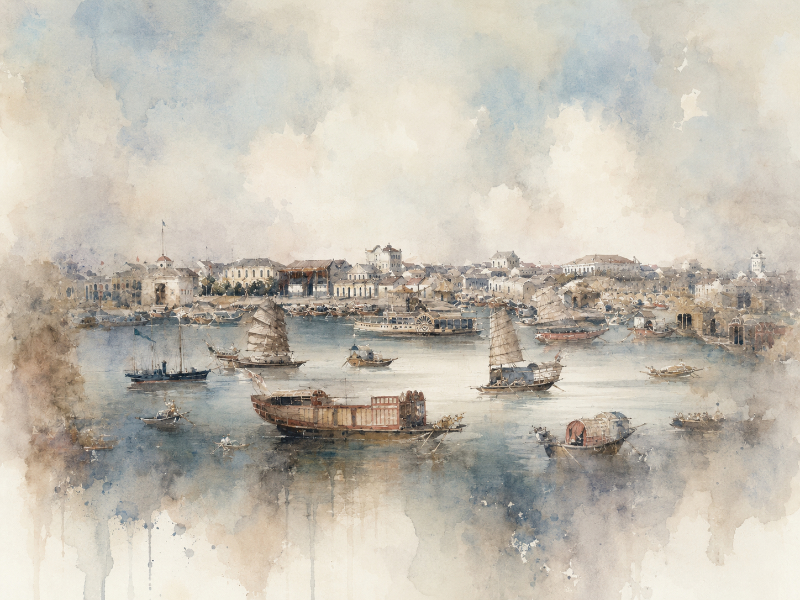
After that, I ambled along downstream to Whampoa, where the flower-boats anchor all in a line, drawn up practically hull-to-hull together, and where I soon learned to head for a nice dinner of salt-and-pepper cuttlefish, which is cheap on the lower decks. I’ve got my favourite one, dazzling it is with its lanterns reflecting on the water, though it’s one of the smaller vessels, its hull painted with phoenixes and birds, lotuses and scrolling vines; no foreigners allowed, and I sometimes treat my favourite lady there. It’s wonderful, the way she goes raving on and giggling with a lot of nonsense, and we have a really happy time, with all the laughter, wine games, music, and dancing until sunrise.
Though I now understand how transient all this is, I have come to enjoy it. I must be becoming earthly; I am sure Pu-erh would disapprove, with one of her stern sideways looks. Ha, ha.
I don’t know why, but the time has come for me to make a confession, stemming right back to my pirate days, which commenced when I came down from the mountain and took to the sea. Without preamble, one evening, what’s called a “salt-smuggler” boat I was crewing on at the time – though I can tell you, we smuggled a lot more than just salt, primarily opium – turned to bring us to bear upon some mission being built by two Swedes at Kinpai Pass, on the coast near the River Min. I didn’t know much about what I was doing in those days, still green in the pirating trade, and I believe I happened to kill one of them with my flintlock pistol. It was medium range, and I probably got him because he didn’t stay still on the one spot. I was taken aback when he fell, with the shot in the middle of his forehead, but joined in with the cheers of all my mates, as though I was a hero. I’ve never been able to shake that off until now, that terrible feeling, when I am able to bring myself to tell you about it. Since then, I admit I have sent off a few, but he was my first; and apart from him, I’ve only ever dispatched opposing warriors, which is considered non-blameworthy, and rightly so.
Now I ought to fill you in a little more on my adventures as a warrior and troublemaker. Truth to tell, I’ve never thought much of the Qing. It’s the country of us Hans, not them, and they have no right to invade and rule us; and I took a special set against the Manchus when they used to try to catch and kill the three of us up at Fusong in the old days. So when I turned to fighting for a living, even though my decision was more out of a thirst for fun and adventure than any particular politics, it’s clear that my progress from ginseng thief to bandit, from bandit to smuggler, from smuggler to pirate, and from pirate to sword for hire has tilted to the rebellious side. Of course, my time as a monk deviated superficially from that pattern, but I knew how you and Pu-erh had had to take off from the Forbidden City, so even then I felt myself in like company.
Anyway, it didn’t take me long to find out that my chosen flower-boat provided more than the delightful times I’d enjoyed so far. Most pleasant things down here in the real world have a more dangerous side, and this lady of mine, knowing that I had a whiff of the sea on me, and was able to take care of myself, introduced me to an old river-rat named Uncle Lo, whom I’d noticed hanging around on deck, twanging away on his snakeskin sanxian and singing the occasional pirate ballad. At first, I took him to be one of the lower hands, whom they must have kept on out of sympathy, what with his worn blue calico jacket and rope belt, but what do you know? he turned out to be the captain; and the next thing he was asking me if I wouldn’t mind some work on the quiet, nothing too demanding, so he said.
It was just to take some chap out to a junk downriver and bring him back in one piece; so I came on the appointed day, and Uncle Lo showed me to a sampan that was tied up to the stern of his flower-boat, and waiting there was the chap with a few cases to take down with him. He was a quiet, tough-looking character in a blue jacket like the older man’s; he had a grim look, but nothing to worry me. I helped him get his luggage on board, and when we were done, I noticed him and Uncle Lo exchange a martial salute – right fist and left palm pressed together – and I distinctly remember that Uncle Lo called down these words to him, “Under Heaven and Earth, we’ll meet again.” I couldn’t help laughing and calling back up to him not to worry, I wasn’t going to sink his sampan, but this didn’t amuse them in the slightest; I suppose I should learn to keep my peace.
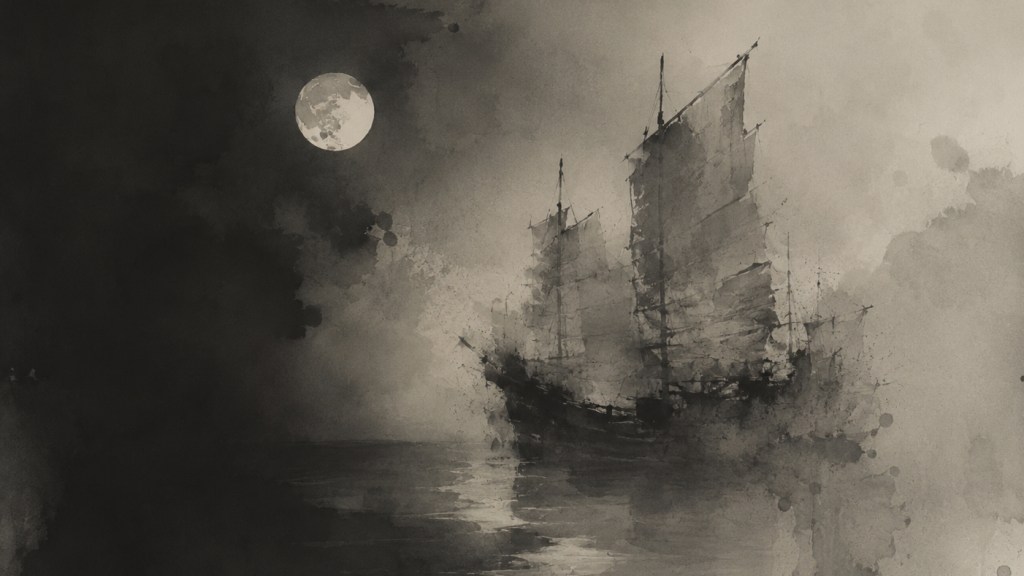
The fellow didn’t say a word to me during the trip; when we found the junk, lit up discreetly in the darkness with two or three Tanka egg-boats tied up beside it, I helped get his things up, but a couple of men on deck – one of them, I noticed, had a flower tucked into his hat! – warned me off when I was on top of the rope ladder and looked as though I might be making to climb on board, which was all the same to me. I waited in the sampan with an oil lamp for three hours, building walls with an old set of bone gaming-tiles I found in the cabin; and then he climbed back down empty-handed, I sculled us back upstream to the flower-boat, picked up some coin from Uncle Lo, who laughed and clapped me on the back, and had myself a plate of cuttlefish and shark’s fin.
Things went on like that for some weeks, though the junk was anchored in various places, and occasionally hard to find in the fog, in an inlet or up a rivulet; and then another bloke started to come along as well. I must have proven my worth to Uncle Lo, because one evening he complimented me by saying as much, and asked me how I’d like to become a member of the junk’s “association,” as he called it, in which he was a kind of hall-master. They did some smuggling now and then, of course, but mainly with the idea of helping get rid of the Manchus, setting out the usual litany of grounds. I was on the edge of accepting because of my fondness for Uncle Lo and his old flower-boat, but frankly, I’d had in mind bigger fish to fry than this lot for my adventures, so I politely declined, saying that I had been in trouble with the law in the past, and if the yamen runners caught me involved in such business, it would mean the end of me; to which he gave a regretful nod, and lightly clapped me on the back, the way he does.
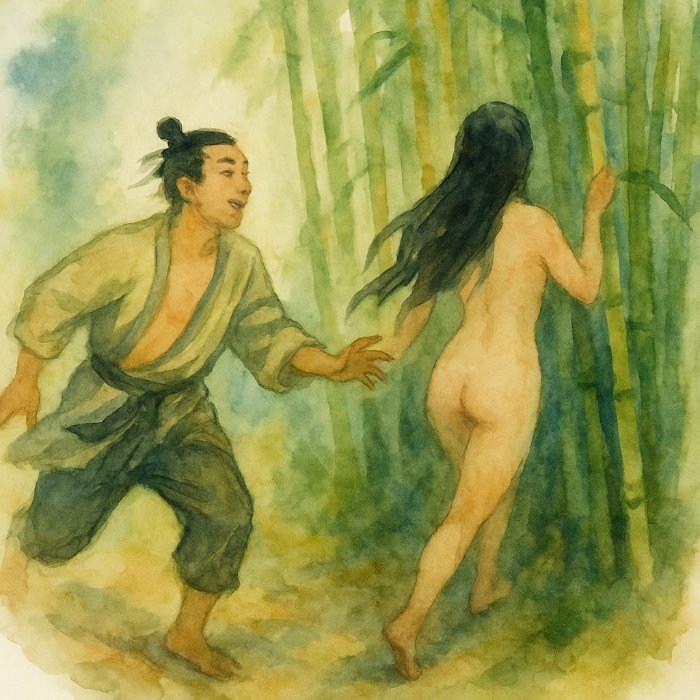
After my next job, something odd occurred. I had stepped onto shore after my meal on the flower-boat, when this tough came straight up to me out of nowhere and slapped me full in the face for no apparent reason. We looked at each other, and I was in the process of deciding which of his limbs to take off, but he just ran away, so I set off after him in full pursuit. He slipped in between the pylons of a fishmarket, which I decided would be a good enough place for him to die; when around the corner came a group of four men holding a sack, evidently this rabbit’s boys, since he now joined them. They told me I’d better do what I was told, or they’d carve me up and murder my family as well (shows how well they knew me!), and to get in the sack. I answered them with a swift kick in the guts of one of them as doubled him up, and the others set on me, one on each of my limbs. I bashed together the heads of the ones on each arm, putting them out of commission, but was having a slightly rough time with the others holding and pummelling me. There we were rolling about in the wet mud, until I gained the ascendancy applying pressure to some little-known vital points; and we ended with one of them face down in the mud, and the other blue in the face, I would guess, preparing to die with my fingers crushing his windpipe.
I called out, “Where are you, Uncle Lo?” He came out from behind a pylon, letting out a great laugh; and so I was recruited. If he wanted me that badly, I told him, he should have just said so.
I can’t begin to tell you how hard it was to get ready for my initiation into the lodge during the next months, while I continued to get more and more involved with the business side, sailing to and from Macau, along with some rough stuff for exercise. I couldn’t tell you anyway, because, bound by solemn oath to secrecy as I have become, it would have meant my end. Even that salute of Uncle Lo’s, which I learned to give when meeting another lodge member: right hand fist means the sun, left vertical palm, the moon. So, press them together and you get the sign for Ming, or “brightness.” Get it? “Out with the Qing and in with the Ming!”; that’s to say, “Restore the dynasty of light.”
But that was nothing. Now that I’ve become a Horse Master, which is our term for a recruiter – the same as that fellow who slapped me in the face (that’s one of our methods) – there are all sorts of secret answers I have to give to a host of impossible questions when I bring new folks in to join up: it rattles the brain. And this is in the middle of the lodge, our own City of Willows, which is all set out like the cosmos, and the Five Gates of the Imperial Palace, with special rooms, doors, and arches. You’re surrounded by all the brothers, and secret instruments and appurtenances – axes, lances, staffs, swords, streamers, porcelain censers, precious mirrors, canopies, scrolls, flags, and silk standards with inscriptions all over them. “The red flag flutters! The heroes are all convoked! The Heaven-destined Emperor shall again restore the dynasty of Ming.” But to me the most disturbing thing is everyone watching with serious faces – you don’t want to make a fool of yourself by laughing out of nervousness.
When I’m led into the council room, I have to say, “May my lord live myriads of years!”
“Who is there before me on the ground?”
And I say, “It is Thian-yu-hung.”
“How can you prove that you are Thian-yu-hung?”
So I say, “I can prove it by a verse.”
“How does this verse run?” (In other words, go ahead and prove it.) So I have to prove it by this quatrain:
“I am indeed Thian-yu-hung,
Bringing novices into the city;
Coming in the Peach Garden to unite in fraternity,
And fervently wishing to adopt the name of Hung.”
New members who refuse to take the oath after all this have their heads cut off straight away. Then there’s a ceremony for the others to have their queues cut off, since this “pigtail” is only imposed on us as a mark of our subjugation, as I’m sure you know.
Of course, that’s only three questions I’ve had to memorise, and so far in our little Lodge of the Ghost Junk, that’s about as far as we take it for the time being. However, the Tiandihui, the official Hung League, upon which we base ourselves – because they go all the way back to the massacre the Qing carried out at the Southern Shaolin monastery when the monks were plotting to overthrow them – has a catechism of three hundred and thirty-three questions, each of which requires a quatrain of proof like the one I just recited, to answer properly. We are building towards that. I’ll be a nervous wreck at the end, unless I’ve worked my way to higher up than Horse Master and don’t have to do it all, Ha!
I’m well aware that it’s no joke, and that the situation is heading rapidly towards conflict. Who would ever have thought Hong Xiuquan, that so-called Heavenly King, would take Nanjing and call it his Heavenly Capital? Yet there he is, younger brother of Jesus Christ too, if you please, or so the riverfolk say he claims, with half the empire shaking under him. They say he routed the Emperor’s forces and put the soldiers’ households to death – men, women, children, the lot. Out with the Christians as well, I say, if they are going to be so excessive! Thankfully, we have nothing to do with that crowd; but we are thick with the Red Turbans, who swear there is strength in the cloth they tie round their heads, and who have been drawing several of us smaller lodges into their business. It’s an exciting time, though often bloody, as you yourself saw in that Guangzhou alleyway, when those poor rebels had their heads cut off right in front of your eyes.
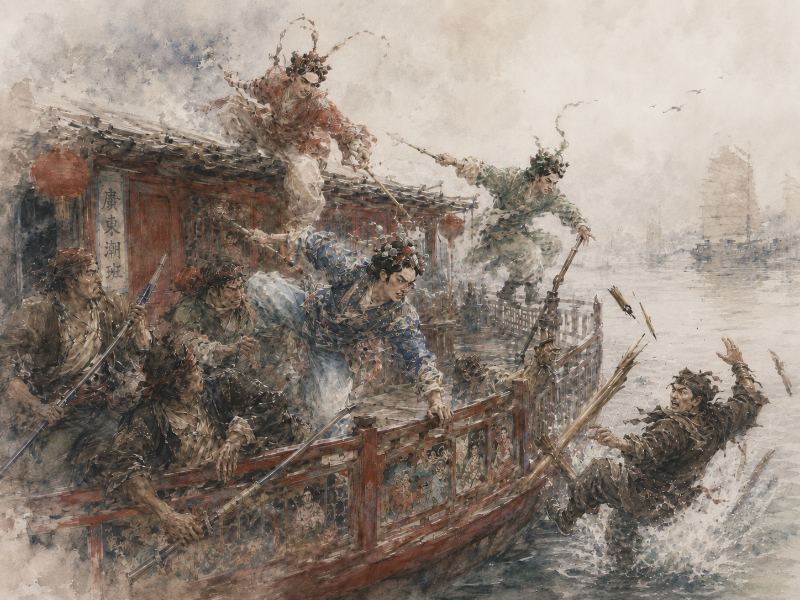
Of course, with my running about all over the delta and up and down the Pearl, I’ve had some dealings with the opera companies. When I was running with a pirate mob some years back, we thought they would be easy pickings; but more than a few of us came back from their narrow red boats carrying our broken mates on our backs, though they had no weapons to speak of, and we had gone at them with muskets, pikes, and sabres. But there’s hardly any space on board to wield a sword, and, being followers of the Shaolin monk who founded their companies, so they say, they have developed their fighting skills specifically to keep types like us at bay. You’ve never seen such wonderful acrobats! The time we attacked them, I watched dumbstruck as they cartwheeled around the walls laughing, broke our bamboo pikes in half, and hurled us off their boat into the Pearl. They’d been on their way to a performance, it turned out, and were resplendent in all their costumes of brightly coloured silk, dripping with fake gold and pearls. I certainly had a new eye for the Cantonese opera after that experience, and am getting a taste for the music, which I found rather clangy at first. Thankfully, they’ve come over to the Red Turban side, same as us, and how I’m looking forward to mixing it up with the Manchus with them on my side!
I had a break after writing the above, and went down to the flower-boat for a drink and to think things over for a little while. Having all these images in front of my eyes made me feel somewhat sad to be leaving. After all, I came down from the mountain in search of adventure, and here it is, gathering up all around me, charged with mighty purpose, aiming to restore the empire to its rightful heading! Uncle Lo was there, with no idea of what was on my mind. When he asked was there anything wrong, I told him it was stomachache. I realised right then and there, when he placed his old hand upon my shoulder, that I couldn’t look him in the eye and lie.
Above all, my main reason for staying behind is that I cannot desert him, not after all the strife we’ve seen together, and not after giving my sacred oath before his eyes and my lodge-brothers’ eyes, to lend my strength and my life to restoring the enlightened Ming to rulership. I know you and I have been through a lot as well, my comrade, through gainful times and loss. But you are going to a fine place without the strife we have here, only peace and fortunes to be made. And besides, I await the comeuppance I have coming for dispatching that poor Swedish monk of mine, who was only minding his own business – I would not have that karma follow you to the New Gold Mountain on my account.
Remember your brother-Hung kindly, who stayed behind to tend the Peach Garden.
Your devoted friend
Wang the Meek
From the draft novel Stawell Bardo © Michael Guest 2026