Tag: Tales of wisdom

  • Anatole France’s Merrie Tales: Mademoiselle Roxane

    Anatole France’s Merrie Tales: Mademoiselle Roxane

    The final tale in this series is about what Frenchmen are often believed to be most obsessed with: L’Amour. It might be all too easy to be cynical about any such tale written in the words of another time, but France still engages us, despite the subject. Oh, please don’t get me wrong. Flowery expressions of passion or woe might not be to my taste, but I do have some empathy for those unhappy in love, having been there myself and survived. The emptiness and obsession of it, all wonderfully described by France.

    Forgive my indulgence in this final of the tales, but I’m reminded of a German poem by Erich Fried, which I’ll translate for you:

    It's silly, says reason 
    It is what it is, says love 
    
    It's misfortune, says calculation 
    It's nothing but pain, says fear 
    It's hopeless, says insight 
    It is what is, says love
    
    It's ridiculous, says pride 
    It"s foolish, says caution 
    It's impossible, says experience 
    It is what it is, says love 

    At first, the title of our story, ‘Mademoiselle Roxane’, reminded me of perhaps not quite what the author would have intended. A movie poster with the same female name and some Hollywood comedy actor named Steve with a ridiculously exaggerated Cyrano De Bergerac nose. Yet I guess that this too was a film about unrequited love, albeit a supposedly funny one about some modern day guy like Cyrano.

    So what would have happened, if during some Paris night long ago, our heroes had encountered such a young man, and not a beautiful young woman in the same situation? Most probably, there would not have been a whisker or even a nose of a tale. But a brilliant author has the artistic schnozzle to get all the elements right to please his readers, and so, enter stage left, beautiful Mademoiselle Sophie. My strange mind correlates too much of the lovelorn gooey sort of stuff with that awful signature tune which comedian Jack Benny used to play on his violin, “Love in Bloom”. I used to think of adapted lyrics that I had imagined went, “When our cardboard box got wet, so did all the cigarettes, and the weed…”—to at least internally mock overdone hard luck stories when I was subjected to them.

    Roxane in Jean-Baptiste Racine’s Bajazet, ca. 1838, attr. Eugène Devéria

    So yes, prepare yourself for a bit of a hard luck story. But also for an ending worthy of Anatole France. A happy one? I’ll have to leave you in suspense. I’ll miss reading his Merrie Tales ofJacques Tournebroch. I’m sure you will too.


    Mademoiselle Roxane

    image852SPECKLE[FINAL]

    Y good master, M. l’Abbé Coignard, had taken me with him to sup with one of his old fellow-students, who lodged in a garret in the Rue Gît-le-Cour. Our host, a Premonstratensian Father of much learning and a fine Theologian, had fallen out with the Prior of his House for having writ a little book relating the calamities of Mam’zelle Fanchon. The end of it was he turned tavern-keeper at The Hague. He was now returned to France and living precariously by the sermons he composed, which were full of high argument and eloquence. After supper he had read us these same calamities of Mam’zelle Fanchon, source of his own, and the reading had kept us there till a late hour. At last I found myself without-doors with my good master, under a wondrous fine summer’s night, which made me straightway comprehend the verity of the ancient fables regarding the loves of Diana and feel how natural it is to employ in soft dalliance the silent, silvery hours of night. I said as much to M. l’Abbé Coignard, who retorted that love is to blame for many and great ills.

    “Tournebroche, my son,” he asked me, “have you not just heard from the mouth of yonder good Monk how, for having loved a recruiting sergeant, a clerk of M. Gaulot’s mercer at the sign of the Truie-qui-file, and the younger son of M. le Lieutenant-Criminel Leblanc, Mam’zelle Fanchon was clapped in hospital? Would you wish to be any of these,—sergeant or clerk or limb of the law?”

    I answered I would indeed. My good master thanked me for my candid avowal, and quoted some verses of Lucretius to persuade me that love is contrary to the tranquillity of a truly philosophical soul.

    Thus discoursing, we were come to the round-point of the Pont-Neuf. Leaning our elbows on the parapet, we looked over at the great tower of the Châtelet, which stood out black in the moonlight.

    “There might be much to say,” sighed my good master, “on this justice of the civilized nations, the punishments whereof in retaliation are often more cruel than the crime itself I cannot believe that these tortures and penalties that men inflict on their fellows are necessary for the safeguarding of States, seeing how from time to time one and another legal cruelty is done away with without hurt to the commonweal. And I hold it likely that the severities they still maintain are no whit more useful than those they have abolished. But men are cruel. Come away, Tournebroche, my dear lad; it grieves me to think how unhappy prisoners are even now lying awake behind those walls in anguish and despair. I know they have done faultily, but this doth not hinder me from pitying them. Which of us is without offence?”

    We went on our way. The bridge was deserted save for a beggarman and woman, who met on the causeway. The pair drew stealthily into one of the recesses over the piers, where they lurked together on the door-step of a hucksters booth. They seemed well enough content, both of them, to mingle their joint wretchedness, and when we went by were thinking of quite other things than craving our charity. Nevertheless my good master, who was the most compassionate of men, threw them a half farthing, the last piece of money left in his breeches pocket.

    “They will pick up our obol,” he said, “when they have come back to the consciousness of their misery. I pray they may not quarrel then over fiercely for possession of the coin.”

    We passed on without further rencounter till on the Quai des Oiseleurs we espied a young damsel striding along with a notable air of resolution. Hastening our pace to get a nearer view, we saw she had a slim waist and fair hair in which the moonbeams played prettily. She was dressed like a citizen’s wife or daughter.

    “There goes a pretty girl,” said the Abbé; “how comes it she is out of doors alone at this hour of night?”

    “Truly,” I agreed, “’tis not the sort one generally encounters on the bridges after curfew.”

    Our surprise was changed to alarm when we saw her go down to the river bank by a little stairway the sailors use. We ran towards her; but she did not seem to hear us. She halted at the edge; the stream was running high, and the dull roar of the swollen waters could be heard some way off. She stood a moment motionless, her head thrown back and arms hanging, in an attitude of despair. Then, bending her graceful neck, she put her two hands over her face and kept it hid behind her fingers for some seconds. Next moment she suddenly grasped her skirts and dragged them forward with the gesture a woman always uses when she is going to jump. My good master and I came up with her just as she was taking the fatal leap, and we hauled her forcibly backward. She struggled to get free of our arms; and as the bank was all slimy and slippery with ooze deposited by the receding waters (for the river was already beginning to fall), M. l’Abbé Coignard came very near being dragged in too. I was losing my foothold myself. But as luck would have it, my feet lighted on a root which held me up as I crouched there with my arms round the best of masters and this despairing young thing. Presently, coming to the end of her strength and courage, she fell back on M. l’Abbé Coignard’s breast, and we managed all three to scramble to the top of the bank again. He helped her up daintily, with a certain easy grace that was always his. Then he led the way to a great beech-tree at the foot of which was a wooden bench, on which he seated her.

    Taking his place beside her:

    “Mademoiselle,” he said gently, “you need have no fear. Say nothing just yet, but be assured it is a friend sits by you.”

    Next, turning to me, my master went on:

    “Tournebroche, my son, we may congratulate ourselves on having brought this strange adventure to a good end. But I have left my hat down yonder on the river bank; albeit it has lost pretty near all its lace and is thread-bare with long service, it was still good to guard my old head, sorely tried by years and labours, against sun and rain. Go see, my son, if it may still be found where I dropped it. And if you discover it, bring it me, I beg,—likewise one of my shoe buckles, which I see I have lost. For my part I will stay by this damsel we have rescued and watch over her slumber.”

    I ran back to the spot we had just quitted and was lucky enough to find my good master’s hat. The buckle I could not espy anywhere. True, I did not take any very excessive pains to hunt for it, having never all my life seen my good master with more than one shoe buckle. When I returned to the tree, I found the damsel still in the same state, sitting quite motionless with her head leant against the trunk of the beech. I noticed now that she was of a very perfect beauty. She wore a silk mantle trimmed with lace, very neat and proper, and on her feet light shoes, the buckles of which caught the moonbeams.

    I could not have enough of examining her. Suddenly she opened her drooping lids, and casting a look that was still misty at M. Coignard and me, she began in a feeble voice, but with the tone and accent, I thought, of a person of gentility:

    “I am not ungrateful, sirs, for the service you have done me from feelings of humanity; but I cannot truthfully tell you I am glad, for the life to which you have restored me is a curse, a hateful, cruel torment.”

    At these sad words my good master, whose face wore a look of compassion, smiled softly, for he could not really think life was to be for ever hateful to so young and pretty a creature.

    “My child,” he told her, “things strike us in a totally different light according as they are near at hand or far off. It is no time for you to despair. Such as I am, and brought to this sorry plight by the buffets of time and fortune, I yet make shift to endure a life wherein my pleasures are to translate Greek and dine sometimes with sundry very worthy friends. Look at me, mademoiselle, and say,—would you consent to live in the same conditions as I?”

    She looked him over; her eyes almost laughed, and she shook her head. Then, resuming her melancholy and mournfulness, she faltered:

    “There is not in all the world so unhappy a being as I am.”

    “Mademoiselle,” returned my good master, “I am discreet both by calling and temperament; I will not seek to force your confidence. But your looks betray you; any one can see you are sick of disappointed love. Well, ’t is not an incurable complaint. I have had it myself, and I have lived many a long year since then.”

    He took her hand, gave her a thousand tokens of his sympathy, and went on in these terms:

    “There is only one thing I regret for the moment,—that I cannot offer you a refuge for the night, or what is left of it. My present lodging is in an old château a long way from here, where I am busy translating a Greek book along with young Master Tournebroche whom you see here.”

    My master spoke the truth. We were living at the time with M. d’Astarac, at the Château des Sablons, in the village of Neuilly, and were in the pay of a great alchemist, who died later under tragic circumstances.

    “At the same time, mademoiselle,” my master added, “if you should know of any place where you think you could go, I shall be happy to escort you thither.”

    To which the girl answered she appreciated all his kindness, that she lived with a kinswoman, to whose house she could count on being admitted at any hour; but that she had rather not return before daylight. She was fain, she said, not to disturb quiet folks’ sleep, and dreaded moreover to have her grief too painfully renewed by the sight of her old, familiar surroundings.

    As she spoke thus, the tears rained down from her eyes. My good master bade her:

    “Mademoiselle, give me your handkerchief, if you please, and I will wipe your eyes. Then I will take you to wait for daybreak under the archways of the Halles, where we can sit in comfort under shelter from the night dews.”

    The girl smiled through her tears.

    “I do not like,” she said, “to give you so much trouble. Go your way, sir, and rest assured you take my best thanks with you.”

    For all that she laid her hand on the arm my good master offered her, and we set out, all the three of us, for the Halles. The night had turned much cooler. In the sky, which was beginning to assume a milky hue, the stars were growing paler and fainter. We could hear the first of the market-gardeners’ carts rumbling along to the Halles, drawn by a slow-stepping horse, half asleep in the shafts. Arrived at the archways, we chose a place in the recess of a porch distinguished by an image of St. Nicholas, and established ourselves all three on a stone step, on which M. l’Abbé Coignard took the precaution of spreading his cloak before he let his young charge sit down.

    Thereupon my good master fell to discoursing on divers subjects, choosing merry and enlivening themes of set purpose to drive away the gloomy thoughts that might assail our companion’s mind. He told her he accounted this rencounter the most fortunate he had ever chanced on all his life, and that he should ever cherish a fond recollection of one who had so deeply touched him,—all this, however, without ever asking to know her name and story.

    My good master thought no doubt that the unknown would presently tell him what he refrained from asking. She broke into a fresh flood of weeping, heaved a deep sigh and said:

    “I should be churlish, sir, to reward your kindness with silence. I am not afraid to trust myself in your hands. My name is Sophie T———. You have guessed the truth; ’tis the betrayal of a lover I was too fondly attached to has brought me to despair. If you deem my grief excessive, that is because you do not know how great was my assurance, how blind my infatuation, and you cannot realize how enchanting was the paradise I have lost.”

    Then, raising her lovely eyes to our faces, she went on:

    “Sirs, I am not such a woman as your meeting me thus at night time might lead you to suppose. My father was a merchant. He went, in the way of trade, to America, and was lost on his way home in a shipwreck, he and his merchandise with him. My mother was so overwhelmed by these calamities that she fell into a decline and died, leaving me, while still a child, to the charge of an aunt, who brought me up. I was a good girl till the hour I met the man whose love was to afford me indescribable delights, ending in the despair wherein you now see me plunged.”

    So saying, Sophie hid her face in her handkerchief. Presently she resumed with a sigh:

    “His worldly rank was so far above my own I could never expect to be his except in secret. I flattered myself he would be faithful to me. He swore he loved me, and easily overcame my scruples. My aunt was aware of our feelings for one another, and raised no obstacles, for two reasons,—because her affection for me made her indulgent, and because my dear lover’s high position impressed her imagination. I lived a year of perfect happiness only equalled by the wretchedness I now endure. This morning he came to see me at my aunt’s, with whom I live. I was haunted by dark forebodings. As I dressed my hair but an hour or so before, I had broken a mirror he had given me. The sight of him only increased my misgivings, for I noticed instantly that his face wore an unaccustomed look of constraint… Oh! sir, was ever woman so unhappy as I?…”

    Her eyes filled again with tears; but she kept them back under her lids, and was able to finish her tale, which my good master deemed as touching, but by no means so unique, as she did herself.

    “He informed me coldly, though not without signs of embarrassment, that his father having bought him a Company, he was leaving to join the colours. First, however, he said, his family required him to plight his troth to the daughter of an Intendant of Finances; the connection was advantageous to his fortune and would bring him means adequate to support his rank and make a figure in the world. And the traitor, never deigning to notice my pale looks, added in his soft, caressing voice which had made me so many vows of affection, that his new obligations would prevent his seeing me again, at least for some while. He assured me further that he was still my friend and begged me to accept a sum of money in memory of the days we had passed together.

    “And with the words he held out a purse to me.

    “I am telling you the truth, sirs, when I assure you I had always refused to listen to the offers he repeated again and again, to give me fine clothes, furniture, plate, an establishment, and to take me away from my aunt’s, where I lived in very narrow circumstances, and settle me in a most elegant little mansion he had in the Rue di Roule. My wish was that we should be united only by the ties of affection, and I was proud to have of his gift nothing but a few jewels whose sole value came from the fact of his being the donor. My gorge rose at the sight of the purse he offered me, and the insult gave me strength to banish from my presence the impostor whom in one moment I had learnt to know and to despise. He faced my angry looks unabashed, and assured me with the utmost unconcern that I could know nothing of the paramount obligations that fill the existence of a man of quality, adding that he hoped eventually, when I looked at things quietly, I should come to see his behaviour in a better light. Then, returning the purse to his pocket, he declared he would readily find a way of putting the contents at my disposal in such a manner as to make it impossible for me to refuse his liberality. Thus leaving me with the odious, the intolerable implication that he was going to make full amends by these sordid means, he made for the door to which I pointed without a word. When he was gone, I felt a calmness of mind that surprised myself. It arose from the resolution I had formed to die. I dressed with some care, wrote a letter to my aunt asking her forgiveness for the pain I was about to cause her by my death, and went out into the streets. There I roamed about all the afternoon and evening and a part of the night, moving from busy thoroughfare to deserted lane without a trace of fatigue, postponing the execution of my purpose to make it more sure and certain under the favouring conditions of darkness and solitude. Possibly too I found a certain weak pleasure in dallying with the thought of dying and tasting the mournful satisfaction of my coming release from my troubles. At two o’clock in the morning, I went down to the river’s brink. Sirs, you know the rest,—you snatched me from a watery grave. I thank you for your goodness,—though I am sorry you saved my life. The world is full of forsaken women. I did not wish to add another to the number.”

    Sophie then fell silent and began weeping afresh. My good master took her hand with the greatest delicacy.

    “My child,” he said, “I have listened with a tender interest to the story of your life, and I own ‘tis a sad tale. But I am happy to discern that your case is curable. Not only was your lover unworthy of the favours you showed him and has proved himself on trial a selfish, cruel-hearted libertine, but I see plainly your love for him was only an impulse of the senses and the effect of your own sensibility, the particular object of which mattered far less than you imagine. What there was rare and excellent in the liaison came from you. Well then, nothing is lost, since the source still remains. Your eyes, which have thrown a glamour of the fairest hues over, I doubt not, a very ordinary individual, will not cease to go on shedding abroad elsewhere the same bright rays of charming self-delusion.”

    My good master said more in the same strain, dropping from his lips the finest words ever heard anent the tribulations of the senses and the errors lovers are prone to. But, as he talked on, Sophie, who for some while had let her pretty head droop on the shoulder of this best of men, fell softly asleep. When M. l’Abbé Coignard saw his young friend was wrapped in a sound slumber, he congratulated himself on having discoursed in a vein so meet to afford repose and peace to a suffering soul.

    “It must be allowed,” he chuckled, “my sermons have a beneficent effect.”

    Not to disturb Mademoiselle’s slumbers, he took a thousand pretty precautions, amongst others constraining himself to talk on uninterruptedly, not unreasonably apprehensive that a sudden silence might awake her.

    “Tournebroche, my son,” he said, turning to me, “look, all her sorrows are vanished away with the consciousness she had of them. You must see they were all of the imagination and resided in her own thought. You must understand likewise they sprang from a certain pride and overweening conceit that goes along with love and makes it very exacting. For, in truth, if only we loved in humbleness of spirit and forgetfulness of self, or merely with a simple heart, we should be content with what is vouchsafed us and should not straightway cry treason when some slight is put on us. And if some power of loving were left us still, after our lover had deserted us, we should await the issue in calmness of mind to make what use of it God should please to grant.”

    But the day was just breaking by this time, and the song of the birds grew so loud it drowned my good master’s voice. He made no complaint on this score.

    “Hearken,” he said, “to the sparrows. They make love more wisely than men do.”

    Sophie awoke in the white light of dawn, and I admired her lovely eyes, which fatigue and grief had ringed with a delicate pearly-grey. She seemed somewhat reconciled to life, and did not refuse a cup of chocolate which my good master made her drink at Mathurine’s door, the pretty chocolate-seller of the Halles.

    But as the poor child came into more complete possession of her wits, she began to trouble about sundry practical difficulties she had not thought of till then.

    “What will my aunt say? And whatever can I tell her?” she asked distractedly.

    The aunt lived just opposite Saint-Eustache, less than a hundred yards from Mathurine’s archway. Thither we escorted her niece; and M. l’Abbé Coignard, who had quite a venerable look, though one shoe was unbuckled, accompanied the fair Sophie to the door of her aunt’s lodging and pitched that lady a fine tale:

    “I had the happy fortune,” he informed her, “to encounter your good niece at the very moment when she was assailed by four footpads armed with pistols, and I shouted for the watch so lustily that the thieves took to their heels in a panic. But they were not quick enough to escape the sergeants who, by the rarest chance, ran up in answer to my outcries. They arrested the villains after a desperate tussle. I took my share of the rough and tumble, and I thought at first I had lost my hat in the fray. When all was over, we were all taken, your niece, the four footpads and myself, before his Honour the Lieutenant-Criminel, who treated us with much consideration and detained us till daylight in his cabinet, taking down our evidence.” The aunt answered drily:

    “I thank you, sir, for having saved my niece from a peril which, to say the truth, is not the risk a girl of her age need fear the most, when she is out alone at night in the streets of Paris.”

    My good master made no answer to this; but Mademoiselle Sophie spoke up and said in a voice of deep feeling:

    “I do assure you, Aunt, Monsieur l’Abbé saved my life.”

    * * *

    Some years after this singular adventure, my master made the fatal journey to Lyons from which he never returned. He was foully murdered, and I had the ineffable grief of seeing him expire in my arms. The incidents of his death have no connexion with the matter I speak of here. I have taken pains to record them elsewhere; they are indeed memorable, and will never, I think, be forgotten. I may add that this journey was in all ways unfortunate, for after losing the best of masters on the road, I was likewise forsaken by a mistress who loved me, but did not love me alone, and whose loss nearly broke my heart, coming after that of my good master. It is a mistake to suppose that a man who has received one cruel blow grows callous to succeeding strokes of calamity. Far otherwise; he suffers agonies from the smallest contrarieties. I returned to Paris in a state of dejection almost beyond belief.

    Well, one evening, by way of enlivening my spirits, I went to the Comédie, where they were playing Bajazet, one of Racine’s excellent pieces. I was particularly struck by the charm and beauty, no less than the originality and talent, of the actress who took the part of Roxane. She expressed with a delightful naturalness the passion animating that character, and I shuddered as I heard her declaim in accents that were harmonious and yet terrible the line:

    Écoutez Bajazet, je sens que je vous aime (“Hearken, Bajazet, I feel I love you”)

    I never wearied of gazing at her all the time she occupied the stage, and admiring the beauty of her eyes that gleamed below a brow as pure as marble and crowned by powdered locks all spangled with pearls. Her slender waist too, which her hoop showed off to perfection, did not fail to make a vivid impression on my heart. I had the better leisure to scrutinize these adorable charms as she happened to face in my direction to deliver several important portions of her rôle. And the more I looked, the more I felt convinced I had seen her before, though I found it impossible to recall anything connected with our previous meeting. My neighbour in the theatre, who was a constant frequenter of the Comédie, told me the beautiful actress was Mademoiselle B———, the idol of the pit. He added that she was as great a favourite in society as on the boards, that M. le Duc de La ——— had made her the fashion and that she was on the highroad to eclipse Mademoiselle Lecouvreur.

    I was just leaving my seat after the performance when a “femme de chambre” handed me a note in which I found written in pencil the words:

    Mademoiselle Roxane is waiting for you in her coach at the theatre door.”

    I could not believe the missive was intended for me; and I asked the abigail who had delivered it if she was not mistaken in the recipient.

    “If I am mistaken,” she replied confidently, “then you cannot be Monsieur de Tournebroche, that is all.”

    I ran to the coach which stood waiting in front of the House, and inside I recognized Mademoiselle B———, her head muffled in a black satin hood.

    She beckoned to me to get in, and when I was seated beside her:

    “Do you not,” she asked me, “recognize Sophie, whom you rescued from drowning on the banks of the Seine?”

    “What! you! Sophie—Roxane—Mademoiselle B———, is it possible?—”

    My confusion was extreme, but she appeared to view it without annoyance.

    “I saw you,” she went on, “in one corner of the pit. I knew you instantly and played for you. Say, did I play well? I am so glad to see you again!—”

    She asked me news of M. l’Abbé Coignard, and when I told her my good master had just perished miserably, she burst into tears.

    She was good enough to inform me of the chief events of her life:

    “My aunt,” she said, “used to mend her laces for Madame de Saint-Remi, who, as you must know, is an admirable actress. A short while after the night when you did me such yeoman service, I went to her house to take home some pieces of lace. The lady told me I had a face that interested her. She then asked me to read some verses, and concluded I was not without wits. She had me trained. I made my first appearance at the Comédie last year. I interpret passions I have felt myself, and the public credits me with some talent. M. le Duc de La ——— exhibits a very dear friendship for me, and I think he will never cause me pain and disappointment, because I have learnt to ask of men only what they can give. At this moment he is expecting me at supper. I must not break my word.”

    But, reading my vexation in my eyes, she added:

    “However, I have told my people to go the longest way round and to drive slowly.”


    Notes

    Erich Fried, ‘Es ist was es ist’ (1983).

    Roxane in Jean-Baptiste Racine’s Bajazet: The character in Racine’s tragedy that Tournebroche discovers Sophie performing during the finale. Racine’s play of 1672 eerily echoes Coignard’s words about pride and conceit in love, and his reflection on the need to ‘love in humbleness of spirit’. It is based on a true story from the Turkish court of the time (or about thirty years earlier); a love triangle spawning a plot of power, conspiracy, deceit and murder, with the the sultana, Roxane, who is largely responsible for a chain of tragic events, ultimately committing suicide.

    M. l’Abbé Coignard / Tournebroche: Central characters in Anatole France’s novel, At the Sign of the Reine Pédauque (La Rôtisserie de la reine Pédauque) (1892); and again as protagonist and narrator in The Opinions of Jerome Coignard (Les opinions de M. Jérôme Coignard Recueillies par Jacques Tournebroche) (1893).

    The tower of the Chatelet: The Grand Chatelet, on the right bank of the Seine, contained the police HQ, courts and several prisons.

    Les Halles: The Paris fresh food markets, demolished in 1971. They were the “stomach of Paris”, much loved, and written about by Emile Zola in his book of the same name.

    Note on France’s text and the illustrations: Translation of The Merrie Tales of Jacques Tournebroche is by Alfred Allinson (London: John Lane, Bodley Head, 1909). Woodcuts by British artist Marcia Lane Foster (1897–1983) have been confirmed as Public Domain Mark 1.0 (free of known restrictions under copyright law). Acknowledgement to David Widger for his digital edition.

    Creative Commons License
    This work is licensed under a Creative Commons Attribution-ShareAlike 4.0 International License.

    NIGHTSHIFT byTony Reck © 2025

  • Anatole France’s Merrie Tales: Mademoiselle de Doucine’s New Year’s Present

    Anatole France’s Merrie Tales: Mademoiselle de Doucine’s New Year’s Present

    This delightful short tale gave me a few questions to ponder, never having given anyone a New Year present in all my life. Have I been an unknowingly awful and stingy miser? Heaven forbid, will I have to get enlightenment from, well if not a Capuchin monk, because these are extremely difficult to come by around here, but perhaps from an afternoon cappuccino? Shivers. New Year presents? What will they think of next? Yet another retail ploy to suck the cash out of our pockets? Anatole France’s tale has an interesting little twist, as they often do. Advice from two who should have known an answer.

    The practice dates back as far as Celts and Druids, who gave gifts of mistletoe to celebrate the New Year. And here I was, believing that this was an old Christmas custom. Oddly enough, the pagan Romans also gave New Year gifts and called them strenae, named after their goddess of luck, Strenia. As to which sorts of gifts, well they often gave things like gilded nuts and coins bearing the imprint of Janus, guardian of the gates of heaven, the two faced God of beginnings and time. Hence the two sources of advice on this matter in our story, or just too much interpretation?

    Rue Saint-Honoré, dans l’après-midi. Effet de pluie (1897), Camille Pissaro. See note.

    So is it really wrong and even perhaps “unchristian” to give New Year gifts, or is it just a nice thing to do? Strangely enough, the German word gift means ‘poison’ in English. Hmmmm… Better be careful then? I guess that most people in Australia only rush to the stores around New Year either for the New Year sales or to exchange unwanted Christmas presents. Apparently however it is still relatively common to give New Year gifts in France and the UK and even in the US. Queen Elizabeth the First insisted on the practice, enjoying being showered with jewels and so on, and even made it compulsory for her subjects to do this. It had been a common practice since the days of Henry III in the thirteenth century, but fell out of favour in the UK when Oliver Cromwell and puritans came to power.

    Well I never. All these years I have missed a perfectly good excuse to browse toy stores and look at all the cool stuff that wasn’t invented when I was a kid, while shopping for nieces or nephews or the kids of a dear friend. If I were to confess any sin in buying presents, it would have to be the fun I had going to Toys R Us to buy such things, before they went broke. It just isn’t the same any more buying cool stuff online for kids like my great nieces.

    I hope you enjoy reading about the good Monsieur Chanterelle wanting to bring a smile to the face of his little niece back in 1696


    Mademoiselle de Doucine’s New Year’s Present

    DropcapO_speckle

    N January 1st, in the forenoon, the good M. Chanterelle sallied out on foot from his hôtel in the Faubourg Saint-Marcel. He felt the cold and was a poor walker; so it was a real penance to him to face the chilly air and the bleak streets which were full of half-melted snow. He had refused to take his coach by way of mortifying the flesh, having grown very solicitous since his illness about the salvation of his soul. He lived in retirement, aloof from all society and company, and paid no visits save to his niece, Mademoiselle de Doucine, a little girl of seven.

    Leaning on his walking-cane, he made his way painfully to the Rue Saint-Honoré and entered the shop of Madame Pinson at the sign of the Panier Fleuri. Here was displayed an abundant stock of children’s toys to tempt customers seeking presents for this New Year’s Day of 1696. You could scarce move for the host of mechanical figures of dancers and tipplers, birds in the bush that clapped their wings and sang, cabinets full of wax puppets, soldiers in white and blue ranged in battle array, and dolls dressed some as fine ladies, others as servant wenches, for the inequality of stations, established by God himself among mankind, appeared even in these innocent mannikins.

    M. Chanterelle chose a doll. The one he selected was dressed like the Princess of Savoy on her arrival in France, on November 4th. The head was a mass of bows and ribbons; she wore a very stiff corsage, covered with gold filigrees, and a brocade petticoat with an overskirt caught up by pearl clasps.

    M. Chanterelle smiled to think of the delight such a lovely doll would give Mademoiselle de Doucine, and when Madame Pinson handed him the Princess of Savoy wrapped up in silk paper, a gleam of sensuous satisfaction flitted over his kind face, pinched as it was with illness, pale with fasting and haggard with the fear of hell.

    He thanked Madame Pinson courteously, clapped the Princess under his arm and walked away, dragging his leg painfully, towards the house where he knew Mademoiselle de Doucine was waiting for him to attend her morning levée.

    At the corner of the Rue de l’ Arbre-Sec, he met M. Spon, whose great nose dived almost into his lace cravat.

    “Good morning, Monsieur Spon,” he greeted him. “I wish you a happy New Year, and I pray God everything may turn out according to your wishes.”

    “Oh! my good sir, don’t say that,” cried M. Spon. “’T is often for our chastisement that God grants our wishes. Et tribuit eis petittonem eorum.”

    “‘Tis very true,” returned M. Chanterelle, “we do not know our own best interests. I am an example myself, as I stand before you. I thought at first that the complaint I have suffered from for the last two years was a curse; but I see now it is a blessing, since it has removed me from the abominable life I was leading at the play-houses and in society. This complaint, which tortures my limbs and is like to turn my brain, is a signal token of God’s goodness toward me. But, sir, will you not do me the favour to accompany me as far as the Rue du Roule, whither I am bound, to carry a New Year’s gift to my niece Mademoiselle de Doucine?”

    At the words M. Spon threw up his arms and gave a great cry of horror.

    “What!” he exclaimed. “Can it be M. Chanterelle I hear say such things,—and not some profligate libertine? Is it possible, sir, that living as you do a religious and retired life, I see you all in a moment plunge into the vices of the day?”

    “Alack! I did not think I was plunging into vice,” faltered M. Chanterelle, trembling all over. “But I sorely lack a lamp of guidance. Is it so great a sin then to offer a doll to Mademoiselle de Doucine?”

    “Yes, a great and terrible sin,” replied M. Spon. “And what you are offering this innocent child to-day is meeter to be called an idol, a devilish simulacrum, than a doll. Are you not aware, sir, that the custom of New Year’s gifts is a foul superstition and a hideous survival of Paganism?”

    “No, I did not know that,” said M. Chanterelle.

    “Let me tell you, then,” resumed M. Spon, “that this custom descends from the Romans, who seeing something divine in all beginnings, held the beginning of the year holy also. Hence, to act as they did is to do idolatry. You make New Year’s offerings, sir, in imitation of the worshippers of the God Janus. Be consistent, and like them consecrate to Juno the first day of every month.”

    M. Chanterelle, hardly able to keep his feet, begged M. Spon to give him his arm, and while they moved on, M. Spon proceeded in the same vein:

    “Is it because the Astrologers have fixed on the first of January for the beginning of the year that you deem yourself obliged to make presents on that day? Pray, what call have you to revive at that precise date the affection of your friends. Was their love dying then with the dying year? And will it be so much worth the having when you have reanimated it by dint of cajolements and baneful gifts?”

    “Sir,” returned the good M. Chanterelle, leaning on M. Spon’s arm and trying hard to make his tottering steps keep pace with his impetuous companion’s, “sir, before my sickness, I was only a miserable sinner, taking no heed but to treat my friends with civility and govern my behaviour by the principles of honesty and honour. Providence hath deigned to rescue me from this abyss, and I direct my conduct since my conversion by the admonitions the Director of my conscience gives me. But I have been so light-minded and thoughtless as not to seek his advice on this question of New Year’s gifts. What you tell me of them, sir, with the authority of a man alike admirable for sober living and sound doctrine, amazes and confounds me.”

    “Nay! that is indeed what I mean to do,” resumed M. Spon,—“to confound you, and to illumine you, not indeed by my own lights, which burn feebly, but by those of a great Doctor. Sit you down on that wayside post.”

    And pushing M. Chanterelle into the archway of a carriage gate, where he made himself as easy as circumstances allowed, M. Spon drew from his pocket a little parchment-bound book, which he opened, and after hunting through the pages, lighted on a passage which he proceeded to read out loud amid a gaping circle of chimney-sweeps, chamber-maids, and scullions who had collected at the resounding tones of his voice:

    “‘We who hold in abhorrence the festivals of the Jews, and who would deem strange and outlandish their Sabbaths and New Moons and other Holy Days erst loved of the Almighty, we deal familiarly with the Saturnalia and the Calends of January, with the Matronalia and the Feast of the Winter Solstice; New Year’s gifts and foolish presents fill all our thoughts; merrymakings and junketings are in every house. The Heathens guard their religion better; they are heedful to observe none of our Feasts, for fear of being taken for Christians, while we never hesitate to make ourselves look like Heathens by celebrating their Ceremonial Days.’

    “You hear what I say,” went on M. Spon. “’T is Tertullian speaks in this wise and from the depths of Africa displays before your eyes, sir, the odiousness of your behaviour. He it is upbraids you, declaring how ‘New Year’s gifts and foolish presents fill all your thoughts. You keep holy the feasts of the Heathen.’ I have not the honour to know your Confessor. But I shudder, sir, to think of the way he neglects his duty toward you. Tell me this, can you rest assured that at the day of your death, when you come to stand before God, he will be at your side, to take upon him the sins he hath suffered you to fall into?”

    After haranguing in this sort, he put back his book in his pocket and marched off with angry strides, followed at a distance by the astonished chimney-sweeps and scullions.

    The good M. Chanterelle was left sitting alone on his post with the Princess of Savoy, and thinking how he was risking the eternal pains of hell fire for giving a doll to Mademoiselle de Doucine, his niece, he fell to pondering the unfathomable mysteries of Religion.

    His legs, which had been tottery for several months, refused to carry him, and he felt as unhappy as ever a well-meaning man possibly can in this world.

    He had been sitting stranded in this distressful mood on his post for some minutes when a Capuchin friar stepped up and addressed him:

    “Sir, will you not give New Year’s presents to the Little Brethren who are poor, for the love of God?”

    “Why! what! good Father,” M. Chan-terelle burst out, “you are a man of religion, and you ask me for New Year’s gifts?”

    “Sir,” replied the Capuchin, “the good St. Francis bade his sons make merry with all simplicity. Give the Capuchins wherewith to make a good meal this day, that they may endure with cheerfulness the abstinence and fasting they must observe all the rest of the year,—barring, of course, Sundays and Feast Days.”

    M. Chanterelle gazed at the holy man with wonder:

    “Are you not afraid, Father, that this custom of New Year’s gifts is baneful to the soul?”

    “No, I am not afraid.”

    “The custom comes to us from the Pagans.”

    “The Pagans sometimes followed good customs. God was pleased to suffer some faint rays of his light to pierce the darkness of the Gentiles. Sir, if you refuse to give us presents, never refuse a boon to our poor little ones. We have a home for foundlings. With this poor crown I shall buy each child a little paper windmill and a cake. They will owe you the only pleasure perhaps of all their life; for they are not fated to have much joy in the world. Their laughter will go up to heaven; when children laugh, they praise the Lord.”

    M. Chanterelle laid his well-filled purse in the poor friar’s palm and got him down from his post, saying over softly to himself the word he had just heard:

    “When children laugh, they praise the Lord.”

    Then his soul was comforted and he marched off with a firmer step to carry the Princess of Savoy to Mademoiselle de Doucine, his niece.


    Notes

    Rue Saint-Honoré, Pissaro: The street in Anatole France’s time. Today, Anatole France metro station is 6 km away via the Boulevard Malesherbes.

    corsage (Fr): Not bouquet, but bodice.

    morning levée: reception.

    Note on France’s text and the illustrations: Translation of The Merrie Tales of Jacques Tournebroche is by Alfred Allinson (London: John Lane, Bodley Head, 1909). Woodcuts by British artist Marcia Lane Foster (1897–1983) have been confirmed as Public Domain Mark 1.0 (free of known restrictions under copyright law). Acknowledgement to David Widger for his digital edition.

    Creative Commons License
    This work is licensed under a Creative Commons Attribution-ShareAlike 4.0 International License.

  • Anatole France’s Merrie Tales: Concerning an Horrible Picture

    Anatole France’s Merrie Tales: Concerning an Horrible Picture

    THE WHICH WAS SHOWED IN A TEMPLE AND OF SUNDRY LIMNINGS OF A RIGHT PACIFIC AND AMOROUS SORT THE WHICH THE SAGE PHILEMON HAD HANGED IN HIS LIBRARIE AND OF A NOBLE PORTRAITURE OF THE POET HOMER THE WHICH THE AFORESAID PHILEMON DID PRIZE ABOVE ALL OTHER LIMNINGS

    The word “limnings” appears odd (as does the entire, long-winded title). It’s Middle English, meaning “to illuminate”, as in the only illustrations most people would have seen in an earlier age, in illuminated manuscripts. It refers to paintings, or drawings. The use of this word signals that the story is set in such times.

    Jacques Tournebroche describes the paintings in the gallery of a man called Philemon. Knowing that our author, Anatole France, was French, we could wonder if there is any connection with a French comic book series of the same name. This particular Philemon, a teenage farm boy, had a donkey named Anatole. But these comics had only appeared in the 1960, long after our Nobel Prize winning author was dead.

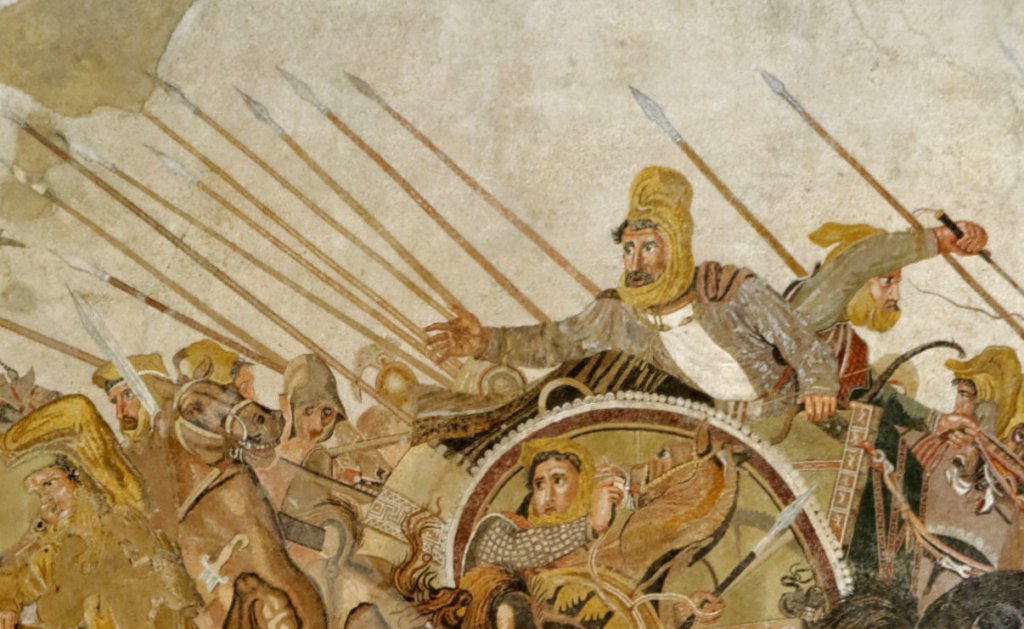
    Battle of Issus mosaic, Museo Archeologico Nazionale, Naples c. 100 BCE.

    So clearly it’s an earlier Philemon who owned the paintings. There’s one in the Bible, in the New Testament, with a book named after him, which religious scholars love to analyse and interpret. It’s because the book is actually a letter written in 61 AD from Rome by none other than St Paul, while in prison, to a fellow called Philemon. In his letter, or epistle, St Paul, in summary, asked him to be merciful to a slave named Onesimus, whom Philemon had owned but who fled to Rome. This earlier Philemon however can’t be the right one, strictly speaking, because in 61 AD there were no art collectors with libraries full of paintings, oil or otherwise. We only know of paintings, frescoes, on the walls of houses in Pompeii and Herculaneum and certainly not depicting the detailed types of scenes described in the story. There is an ancient portrait of Homer in a New York museum, from 200 BC, but it’s a marble sculpture and not a painting.

    Goethe wrote about a Philemon too, referring to a character in Ovid’s Metamorphosis. That fellow however was an old man. He and Baucis, his wife, were hospitable to two Greek gods in disguise when they knocked at his door. In return for their kindness, they warned him to flee before they destroyed the entire village, the other villagers having turned them away or not even opened their doors to them. This is not our Philemon, however, because he was poor and certainly did not own an art gallery.

    Carl Gustav Jung, whom some consider the father of modern psychiatry, also wrote about Ovid’s Philemon. He wrote that he dreamt of Philemon, who appeared as a sort of guiding spirit. After all, this is the CG Jung who expatiates on the interpretation of dreams. Jung built himself a home, known as the Bollingen Tower, on the shore of the upper lake of Lake Zurich. Philemon was so important to him that he had his name inscribed on the gate: Philemonis Sacrum (Philemon’s Sanctuary).

    There was even a gallery inside this small four towered castle, with a huge painting of Philemon by Jung, one of three attributed to him. Other inscriptions include, in stone, in classic Greek, a quote from Homer’s Odyssey, Homer being the subject of the painting most prized to the Philemon in question. Could this be the right Philemon?

    Unfortunately, Jung only bought the land in 1922 and built the tower in 1923. And, alas, Anatole France, who died in 1924, had written The Merrie Tales of Jacques Tournebroche in 1908. Darn… So the limnings and the Philemon written about by our author may perhaps just have been imagined to be the Biblical Philemon, the Bishop of Gaza, the wealthy Christian with a big house in which early Christians had met. A fictional character who in France’s imagination had loved a painting of Homer above all others. There are of course many portraits of Homer, from an age in which ancient Greek literature was highly appreciated.


    image17SPECKLE

    HILEMON was used to confess how, in the fire of his callow youth and fine flower of his lustie springal days, he had been stung with murderous frenzie at view of a certaine picture of Apelles, the which in those times was showed in a temple. And the said picture did present Alexander the Great laying on right shrewdly at Darius, king of the Indians, whiles round about these twain, soldiers and captains were a-slaying one another with a savage furie and in divers strange fashions. And the said work was right cunningly wrought and in very close mimicrie of nature. And none, an they were in the hot and lustie season of their life, could cast a look thereon without being stirred incontinent to be striking and killing poor harmlesse folk for the sole sake of donning so rich an harnesse and bestriding such high-stepping chargers as did these good codpieces in their battle,—for that young blood doth aye take pleasure in horseflesh and the practise of arms. This had the aforesaid Philemon proven in his day. And he was used to say how ever after ’twas his wont to turn aside his eyen of set purpose from suchlike pictures of wars and bloodshed, and that he did so heartily loathe these cruelties as that he could not abear to behold them even set forth in counterfeit presentment.

    And he was used to say that any honest and prudent wight must needs be sore offended and scandalized by all this appalling array of armour and bucklers and the horde of warriors Homer calls Corythaioloi (glancing-helmed) by reason of the terrifying hideousness of their head-gear, and that the portrayal of these same fighting fellows was in very truth unseemly, as contrarie to good and peaceable manners, immodest, no thing in the world being more shameful then homicide, and eke lascivious, as alluring folk to cruelty, the which is the worst of all allurements. For to entice to pleasant dalliaunce is a far lesse heinous fault.

    And the aforesaid Philemon was used to say that it was honest, decent, of good ensample and entirely modest to show by painting, chiselling, or any other fine artifice the scenes of the Golden Age, to wit maidens and young men interlacing limbs in accord with the craving of kindly Nature, or other the like delectable fancy, as of a Nymph lying laughing in the grass. And on her ripe smiling mouth a Faun is crushing a purple grape.

    And he was used to say that belike the Golden Age had never flourished save only in the fond imagining of the poets, and that our first forebears of human kind, being yet barbarous and silly folk, had known naught at all thereof; but that, an the said age could not credibly be deemed to have been at the beginning of the world, we might well wish it should be at the end, and that meanwhiles it was a gracious boon to offer us a likeness of the same in pictured image.

    And like as it is (so he would say) obscene,— ’t is the word Virgil writes of dogs wallowing in the mud and mire,—to depict murderers, whoreson men-at arms, fighting-men, conquering heroes and plundering thieves, wreaking their foul and wicked will, yea! and poor devils licking the dust and swallowing the same in great mouthfuls, and one unhappie wretch that hath been felled to the earth and is striving to get to his feet againe, but is pinned down by an horse’s hoof pressing on his chops, and another that looketh piteously about him for that his pennon hath been shorn from him and his hand with it,—so is it of right subtile and so to say heavenly art to exhibit prettie blandishments, caresses, frolickings, beauties and delights, and the loves of the Nymphs and Fauns in the woods. And he would have it there was none offence in these naked bodies, clothed upon enow with their owne grace and comeliness.

    And he had in his closet, this same Philemon aforesaid, a very marvellous painting, wherein was limned a young Faun in act to filch away with a craftie hand a light cloth did cover the belly of a sleeping Nymph. ’T was plain to see he was full fain of his freak and seemed to be saying: The body of this young goddess is so sweet and refreshing as that the fountaine springing in the shade of the woods is not more delightsome. How I do love to look upon you, soft sweet lap, and prettie white thighs, and shady cavern at once terrifying and entrancing! And over the heads of the twain did hover winged Cupids and watched them laughingly, whiles fair dames and their gallants, their brows wreathen with flowers, footed it on the lush grass.

    And he had, the aforesaid Philemon, yet other limnings of cunning craftsmanship in his closet. And he did prize very high the portraiture of a good doctor a-sitting in his cabinet writing at a table by candle-light. The said cabinet was fully furnished with globes, gnomons, and astrolabes, proper for meting the movements of the orbs of heaven, the which is a right praiseworthy task and one that doth lift the spirit to sublime thoughts and the exceeding pure love of Venus Urania.

    And there was hanging from the joists of the said cabinet a great serpent and crocodile, forasmuch as they be rarities and very needful for the due understanding of anatomy. And he had likewise, the said doctor, amid his belongings, the books of the most excellent philosophers of Antiquity and eke the treatises of Hippocrates. And he was an ensample to young men which should be fain, by hard swinking, to stuff their pates with as much high learning and occult lore as he had under his own bonnet.

    And he had, the aforesaid Philemon, painted on a panel that shined like a polished mirror a portraiture of Homer in the guise of an old blind man, his beard white as the flowers of the hawthorn and his temples bound about with the fillets sacred to the god Apollo, which had loved him above all other men. And, to look at that good old man, you deemed verily his lips were presently to ope and break into words of mélodie.


    Notes

    Note on France’s text and the illustrations: Translation of The Merrie Tales of Jacques Tournebroche is by Alfred Allinson (London: John Lane, Bodley Head, 1909). Woodcuts by British artist Marcia Lane Foster (1897–1983) have been confirmed as Public Domain Mark 1.0 (free of known restrictions under copyright law). Acknowledgement to David Widger for his digital edition.

    Battle of Issus mosaic: ‘Reconstruction of a mosaic depiction of the Battle of Issus after a painting supposed to be by Apelles or Philoxenus of Eretria found in the House of the Faun at Pompeii’ (Wikimedia Commons).

    Creative Commons License
    This work is licensed under a Creative Commons Attribution-ShareAlike 4.0 International License.

  • Anatole France’s Merrie Tales: Satan’s Tongue-Pie

    Anatole France’s Merrie Tales: Satan’s Tongue-Pie

    The image of a “Devil’s Pie” might appear to be a bit odd nowadays, but according to Barry Popik in”The Big Apple“, it apparently hails from the famous English priest Thomas Adams: “The Devil makes his Christmas-pyes from lawyers’ tongues and clerkes’ fingers”, attributing his original source to an Italian proverb. Probably the one written about by Giovanni Florio in Second Fruits in 1591. Not just the Adams quote favoured male gossips. Florio, a linguist, poet, writer and language teacher for Lady Jane Grey in the court of James I in England also singled out lawyers, back then all males. Adams would have found Second Fruits in the Cambridge University Library.

    In terms of malicious gossip, my personal best bet as to where the devil could find enough of the tastiest morsels for his minions to bake a huge pie of them would be the lunchrooms of any public service organisation dominated by certain types of people. It’s simply because this is where I have witnessed it.

    Gossip Sisters and the Devil, woodcut by Hans Weiditz (1488-1534)

    Perhaps my experience of nasty scandal chitchat could be somewhat limited however, not having had the experience of hearing what goes on in nunneries. Thank God… But here is a nice pic for it, rosaries and all, the devil writing down every word.

    Our writer, Nobel Prize winner Anatole France, appeared to believe that a nunnery was where world champion gossiping went on, obviously not in orders with vows of silence, not in monasteries, and apparently not among lawyers for some reason. Hmmmm…

    I wonder if there could be any truth in it? Surely males in a monastery, peeved at not being allowed to engage in sins of the flesh might sometimes also be inclined to release some pent up bitterness and frustration by a bit of evil tongue wagging? France’s mouthpiece Jacques Tournebroche attributes the chapter’s content to a sermon by a Capuchin monk. Well, at least they gave us the Cappuccino. Or perhaps not. Apparently the brown colour of these is the same as that of a Capuchin monk’s robe.

    So the Capuchin monk, and France, singled out nuns, while Thomas Adams and Giovanni Florio had attributed the most evil gossip to lawyers. I still prefer to award the malicious gossip gold medal to certain public servants.


    image852SPECKLE

    ATAN lay in his bed with the flaming curtains. The physicians and apothecaries of Hell, finding their patient had a white tongue, inferred he was suffering from a weakness of the stomach and prescribed a diet at once light and nourishing.

    Satan swore he had no appetite for aught but a certain earthly dish, which women excel in making when they meet in company, to wit, tongue-pie.

    The doctors agreed there was nothing could better suit His Majesty’s stomach.

    In an hour’s time the dish was set before the King; but he found it insipid and tasteless.

    He sent for his Head Cook and asked him where the pie came from.

    “From Paris, sire. It is quite fresh; ’twas baked this very morning, in the Marais Quarter, by a dozen gossips gathered round the bed at a woman’s lying-in.”

    “Ah! now I know the reason it is so flavourless,” returned the Prince of Darkness. “You have not been to the best cooks for dishes of the sort. Citizens’ wives, they do their best; but they lack delicacy, they lack the fine touch of genius. Women of the people are clumsier still. For a real good tongue-pie a Nunnery is the place to go to. There’s nobody to match these old maids of Religion for a pretty skill in compounding all the needful ingredients,—fine spices of rancour, thyme of backbiting, fennel of insinuation, bay-leaf of calumny.”

    This parable is taken from a sermon of the good Father Gillotin Landoulle, a poor, unworthy Capuchin.


    Note on Anatole France’s text and the illustrations: Translation of The Merrie Tales of Jacques Tournebroche is by Alfred Allinson (London: John Lane, Bodley Head, 1909). Woodcuts by British artist Marcia Lane Foster (1897–1983) confirmed as Public Domain Mark 1.0 (free of known restrictions under copyright law). Acknowledgement to David Widger for his digital edition.

    Creative Commons License
    This work is licensed under a Creative Commons Attribution-ShareAlike 4.0 International License.

  • Anatole France’s Merrie Tales: A Good Lesson Well Learnt

    Anatole France’s Merrie Tales: A Good Lesson Well Learnt

    Never having had a confessor, I found this tale a little difficult to appreciate at first. I’d heard of King Edward the Confessor of course. As a kid, I used to believe that he must have confessed a lot… My only direct experience with such a, to me, quite bizarre custom was on a visit to St Mary’s Cathedral in Sydney, which our high school class had visited. We saw awfully drab and dingy looking old wooden confession boxes there, which made me joke about people being locked up in them until they confessed.

    Having been brought up as a Protestant, our confessions, unbeknownst to me, were rather more “automated” in comparison, a glib absolution for the whole congregation, if anything. If I were a Catholic, I guess I’d prefer to confess my sins somewhat anonymously, and not to the same priest over and over, a person who would, embarrassingly, know me personally. The practice of having a specific confessor however was actually common for the more well to do in earlier times. Some churches even demanded public confessions. Imagine that! The whole village listening in…

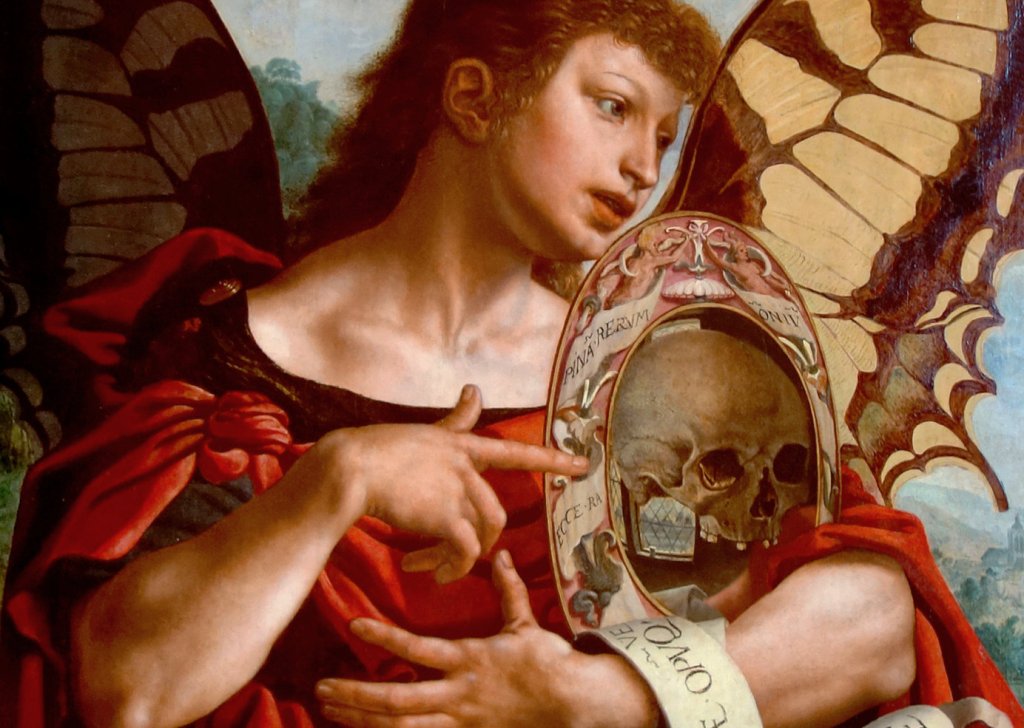
    Vanitas (c.1535) Jan Sanders van Hemessen

    Anatole France describes the relationship between Madame Violante and Brother Jean Turelure, her confessor, who gets his jollies steering poor sinners away from paths of sin and “saving their souls”. People like this still exist today, believe me, I’ve met a few. The overly zealous types, I mean. Yet to Catholics, confessors were people who were, like priests, supposed to offer consolation and mercy. A word of warning perhaps to those not expecting to read about male attitudes from over a century ago. Her alluring bosom is mentioned several times, another aspect of this story which some readers might find a bit odd.

    The word “fetish” comes to mind, and repressed desires; but for some chaste confessor back then who would have held up his hands in horror at the sight of today’s suntanned…. Well, I guess they probably might really have obsessed about “bosoms white as snow” in the time of King Louis, while hearing salacious confessions, as strange as it might sound today.

    The white bosomed lady Violante asks Brother Turelure for a souvenir, and he returns with a strange version. Not just a cheap postcard, no, but would telling you more give too much away? These things were damned expensive, even back then. A handsome but stingy knight, bearing mere sugar-plums, seems to reap an unintended benefit.


    A Good Lesson Well Learnt

    DROPCAP-I

    N the days of King Louis XI there lived at Paris, in a matted chamber, a citizen dame called Violante, who was comely and well-liking in all her person. She had so bright a face that Master Jacques Tribouillard, doctor in law and a renowned cosmographer, who was often a visitor at her house, was used to tell her:

    “Seeing you, madame, I deem credible and even hold it proven, what Cucurbitus Piger lays down in one of his scholia on Strabo, to wit, that the famous city and university of Paris was of old known by the name of Lutetia or Leucecia, or some such like word coming from Leuké, that is to say, ‘the white,’ forasmuch as the ladies of the same had bosoms white as snow,—yet not so clear and bright and white as is your own, madame.”

    To which Violante would say in answer:

    “’T is enough for me if my bosom is not fit to fright folks, like some I wot of. And, if I show it, why, ’tis to follow the fashion. I have not the hardihood to do otherwise than the rest of the world.”

    Now Madame Violante had been wedded, in the flower of her youth, to an Advocate of the Parlement, a man of a harsh temper and sorely set on the arraignment and punishing of unfortunate prisoners. For the rest, he was of sickly habit and a weakling, of such a sort he seemed more fit to give pain to folks outside his doors than pleasure to his wife within. The old fellow thought more of his blue bags than of his better half, though these were far otherwise shapen, being bulgy and fat and formless. But the lawyer spent his nights over them.

    Madame Violante was too reasonable a woman to love a husband that was so unlovable. Master Jacques Tribouillard upheld she was a good wife, as steadfastly and surely confirmed and stablished in conjugal virtue as Lucretia the Roman. And for proof he alleged that he had altogether failed to turn her aside from the path of honour. The judicious observed a prudent silence on the point, holding that what is hid will only be made manifest at the last Judgment Day. They noted how the lady was over fond of gewgaws and laces and wore in company and at church gowns of velvet and silk and cloth of gold, purfled with miniver; but they were too fair-minded folk to decide whether, damning as she did Christian men who saw her so comely and so finely dressed to the torments of vain longing, she was not damning her own soul too with one of them. In a word, they were well ready to stake Madame Violante’s virtue on the toss of a coin, cross or pile,—which is greatly to the honour of that fair lady.

    The truth is her Confessor, Brother Jean Turelure, was for ever upbraiding her.

    “Think you, madame,” he would ask her, “that the blessed St. Catherine won heaven by leading such a life as yours, baring her bosom and sending to Genoa for lace ruffles?”

    But he was a great preacher, very severe on human weaknesses, who could condone naught and thought he had done everything when he had inspired terror. He threatened her with hell fire for having washed her face with ass’s milk.

    As a fact, no one could say if she had given her old husband a meet and proper head-dress, and Messire Philippe de Coetquis used to warn the honest dame in a merry vein:

    “See to it, I say! He is bald, he will catch his death of cold!”

    Messire Philippe de Coetquis was a knight of gallant bearing, as handsome as the knave of hearts in the noble game of cards. He had first encountered Madame Violante one evening at a ball, and after dancing with her far into the night, had carried her home on his crupper, while the Advocate splashed his way through the mud and mire of the kennels by the dancing light of the torches his four tipsy lackeys bore. In the course of these merry doings, a-foot and on horseback, Messire Philippe de Coetquis had formed a shrewd notion that Madame Violante had a limber waist and a full, firm bosom of her own, and there and then had been smit by her charms.

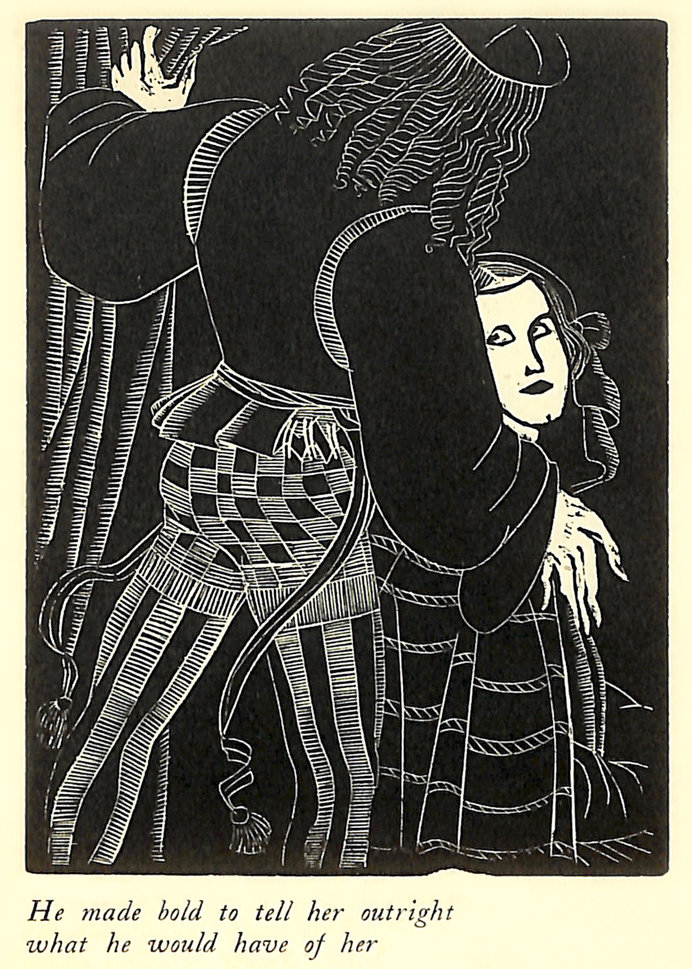
    He was a frank and guileless wight and made bold to tell her outright what he would have of her,—to wit, to hold her naked in his two arms.

    To which she would make answer:

    “Messire Philippe, you know not what you say. I am a virtuous wife,”—

    Or another time:

    “Messire Philippe, come back again tomorrow,—”

    And when he came next day she would ask innocently:

    “Nay, where is the hurry?”

    These never-ending postponements caused the Chevalier no little distress and chagrin. He was ready to believe, with Master Tribouillard, that Madame Violante was indeed a Lucretia, so true is it that all men are alike in fatuous self-conceit! And we are bound to say she had not so much as suffered him to kiss her mouth,—only a pretty diversion after all and a bit of wanton playfulness.

    Things were in this case when Brother Jean Turelure was called to Venice by the General of his Order, to preach to sundry Turks lately converted to the true Faith.

    Before setting forth, the good Brother went to take leave of his fair Penitent, and upbraided her with more than usual sternness for living a dissolute life. He exhorted her urgently to repent and pressed her to wear a hair-shirt next her skin,—an incomparable remedy against naughty cravings and a sovran medicine for natures over prone to the sins of the flesh.

    She besought him: “Good Brother, never ask too much of me.”

    But he would not hearken, and threatened her with the pains of hell if she did not amend her ways. Then he told her he would gladly execute any commissions she might be pleased to entrust him with. He was in hopes she would beg him to bring her back some consecrated medal, a rosary, or, better still, a little of the soil of the Holy Sepulchre which the Turks carry from Jerusalem together with dried roses, and which the Italian monks sell.

    But Madame Violante preferred a quite other request:

    “Good Brother, dear Brother, as you are going to Venice, where such cunning workmen in this sort are to be found, I pray you bring me back a Venetian mirror, the clearest and truest can be gotten.”

    Brother Jean Turelure promised to content her wish.

    While her Confessor was abroad, Madame Violante led the same life as before. And when Messire Philippe pressed her: “Were it not well to take our pleasure together?” she would answer: “Nay! ‘t is too hot. Look at the weathercock if the wind will not change anon.” And the good folk who watched her ways were in despair of her ever giving a proper pair of horns to her crabbed old husband. “’T is a sin and a shame!” they declared.

    On his return from Italy Brother Jean Turelure presented himself before Madame Violante and told her he had brought what she desired.

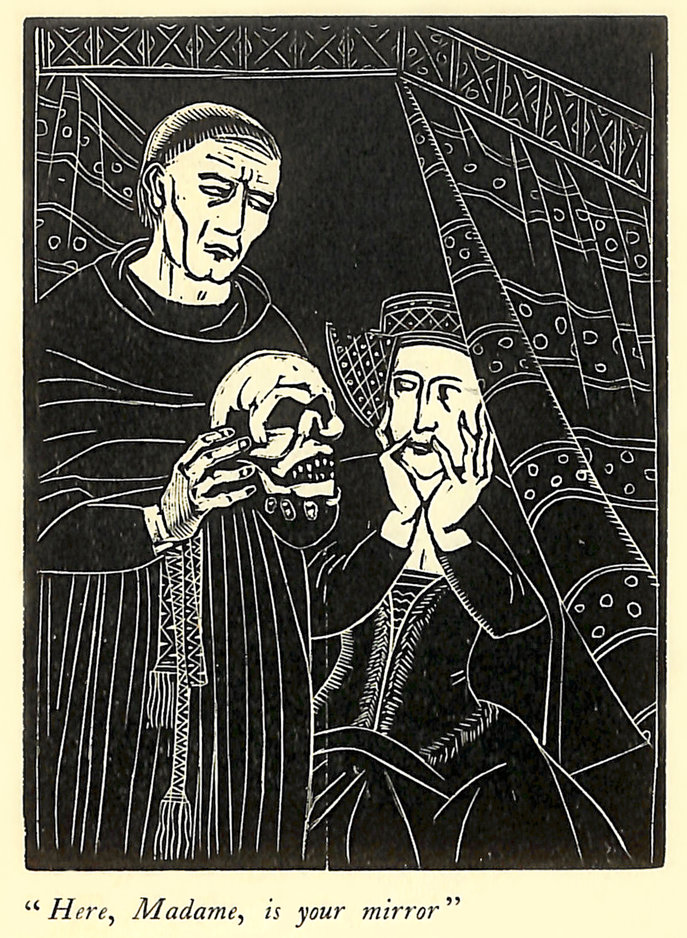
    “Look, madame,” he said, and drew from under his gown a death’s-head.

    “Here, madame, is your mirror. This death’s-head was given me for that of the prettiest woman in all Venice. She was what you are, and you will be much like her anon.”

    Madame Violante, mastering her surprise and horror, answered the good Father in a well-assured voice that she understood the lesson he would teach her and she would not fail to profit thereby.

    “I shall aye have present in my mind, good Brother, the mirror you have brought me from Venice, wherein I see my likeness not as I am at present, but as doubtless I soon shall be. I promise you to govern my behaviour by this salutary thought.”

    Brother Jean Turelure was far from expecting such pious words. He expressed some satisfaction.

    “So, madame,” he murmured, “you see yourself the need of altering your ways. You promise me henceforth to govern your behaviour by the thought this fleshless skull hath brought home to you. Will you not make the same promise to God as you have to me?”

    She asked if indeed she must, and he assured her it behoved her so to do.

    “Well, I will give this promise then,” she declared.

    “Madame, this is very well. There is no going back on your word now.”

    “I shall not go back on it, never fear.”

    Having won this binding promise, Brother Jean Turelure left the place, radiant with satisfaction. And as he went from the house, he cried out loud in the street:

    “Here is a good work done! By Our Lord God’s good help, I have turned and set in the way toward the gate of Paradise a lady, who, albeit not sinning precisely in the way of fornication spoken of by the Prophet, yet was wont to employ for men’s temptation the clay whereof the Creator had kneaded her that she might serve and adore him withal. She will forsake these naughty habits to adopt a better life. I have throughly changed her. Praise be to God!”

    Hardly had the good Brother gone down the stairs when Messire Philippe de Coetquis ran up them and scratched at Madame Violante’s door. She welcomed him with a beaming smile, and led him into a closet, furnished with carpets and cushions galore, wherein he had never been admitted before. From this he augured well. He offered her sweetmeats he had in a box.

    “Here be sugar-plums to suck, madame; they are sweet and sugared, but not so sweet as your lips.”

    To which the lady retorted he was a vain, silly fop to make boast of a fruit he had never tasted.

    He answered her meetly, kissing her forthwith on the mouth.

    She manifested scarce any annoyance and said only she was an honest woman and a true wife. He congratulated her and advised her not to lock up this jewel of hers in such close keeping that no man could enjoy it. “For, of a surety,” he swore, “you will be robbed of it, and that right soon.”

    “Try then,” said she, cuffing him daintily over the ears with her pretty pink palms.

    But he was master by this time to take whatsoever he wished of her. She kept protesting with little cries:

    “I won’t have it. Fie! fie on you, messire! You must not do it. Oh! sweetheart… oh! my love… my life! You are killing me!”

    Anon, when she had done sighing and dying, she said sweetly:

    “Messire Philippe, never flatter yourself you have mastered me by force or guile. You have had of me what you craved, but ‘t was of mine own free will, and I only resisted so much as was needful that I might yield me as I liked best. Sweetheart, I am yours. If, for all your handsome face, which I loved from the first, and despite the tenderness of your wooing, I did not before grant you what you have just won with my consent, ’t was because I had no true understanding of things. I had no thought of the flight of time and the shortness of life and love; plunged in a soft languor of indolence, I reaped no harvest of my youth and beauty. However, the good Brother Jean Turelure hath given me a profitable lesson. He hath taught me the preciousness of the hours. But now he showed me a death’s-head, saying: ‘Suchlike you will be soon.’ This taught me we must be quick to enjoy the pleasures of love and make the most of the little space of time reserved to us for that end.”

    These words and the caresses wherewith Madame Violante seconded them persuaded Messire Philippe to turn the time to good account, to set to work afresh to his own honour and profit and the pleasure and glory of his mistress, and to multiply the sure proofs of prowess which it behoves every good and loyal servant to give on suchlike an occasion.

    After which, she was ready to cry quits. Taking him by the hand, she guided him back to the door, kissed him daintily on the eyes, and asked:

    “Sweetheart Philippe, is it not well done to follow the precepts of the good Brother Jean Turelure?”


    Note

    • wot of: know of
    • gewgaws: baubles, trinkets
    • purfled: decoratively bordered
    • miniver: fine white fur used to decorate the robes of nobles, etc.

    Note on France’s text and the illustrations: Translation is by Alfred Allinson (London: John Lane, Bodley Head, 1909). Woodcuts by British artist Marcia Lane Foster (1897–1983) confirmed as Public Domain Mark 1.0 (free of known restrictions under copyright law). Acknowledgement to David Widger for his digital edition.

    Creative Commons License
    This work is licensed under a Creative Commons Attribution-ShareAlike 4.0 International License.