Knowing nothing of Sylvanus Cobb Jr’s work, let alone the writer himself, Emerson did not realize the offense his remarks would have caused Cobb’s brother (see “Cobb Biosnip: No Yellowbacks“). In her memoir, Sylvanus’ daughter Ella Waite Cobb omits to mention which brother it was. Sylvanus Jr., the eldest, had six (one of whom had died at ten years of age) as well as two sisters.
Cobb’s immediate family was definitely among the most righteous and upstanding in the United States, and would have taken great umbrage at the idea that Cobb’s writing was mere vulgar sensationalism.
The novelist’s father, Reverend Sylvanus Cobb, D.D. (1799-1866), a Massachusetts clergyman, is described as “the most important Universalist reformer before the Civil War” (Harris 117). In 1839 he founded the Christian Freeman, an influential anti-slavery, pro-temperance religious publication, and was active in seeking reform.
His wife, Eunice Hale Waite Cobb (1803-80) was a public speaker in support of temperance and social welfare. She contributed articles and poetry to Universalist publications, and was the first woman ever to do so. In Boston, she founded the first woman’s club in America, one dedicated to health and fitness, the Ladies’ Physiological Institute (1848-1996).
Eunice Hale Waite Cobb. Source: Wikimedia Commons
The prodigious Cobb twins were as industrious. Cyrus Cobb was an accomplished mathematician, lawyer, writer, poet, sculptor and musician. Darius Cobb achieved fame as a painter, and was, as well, a noted “musician, singer, poet, lecturer, lithographer, and art critic” (“Darius Cobb“, Wikipedia).
Virtual doppelgangers, the two were not only identical in appearance, but also in intellect, personality, tastes and abilities. Darius said, after Cyrus’ death that:
No person could tell the difference between our photographs, and very few between our persons. If he were to deliver a lecture, I could step in and fill his place exactly. If I were conducting music, he could take up my baton at any point and carry it out to the end, and no one could see the difference. If either were to play the violin, the other could substitute for him absolutely.
Reverend Cobb’s adherence to Freemasonry was concomitant with his family’s extraordinary allegiance to hard work, if not fundamental to it. He was the founding chaplain of the first lodge instituted in Boston, after a period of anti-Masonic agitation, against which he worked vehemently, and of course, tirelessly. In his capacity as a member of State Legislature, he saved the Freemasons fromabolition in Massachusetts.
Of the sons who followed him into the organization, including the twins, Sylvanus Jr. is the best remembered by the fraternity:
He served as Worshipful Master of the Lodge for five years. He was also a member of Norfolk Chapter, Royal Arch Mason and served as High Priest, a member of Hyde Park Council Royal & Select Masters serving as Thrice Illustrious Master and Cyprus Commandery Knights Templar where he was the Eminent Commander.
Knights Templar seal. Latin motto translates to “Seal of the Soldiers of Christ” (Source: Png Guru; reproduction permitted)
It is a tenet of Freemasonry that, in emulating the example of God as the grand architect of the universe, men are the makers of themselves, and that
to labor well and truly, to labor honestly and persistently, is the object and chief end of all humanity.
Mackey
Laborareest orare. After the wisdom of the monks of the Middle Ages, Freemasons hold that labour is itself a mode of worship (Mackey).
Cast in this mould, Cobb and his family would have considered his writing as humanitarian service, far from the low realm of the yellowback; rather, a manifestation of uplifting and formative moral values. And prime among these values, the noble aim of living by the sweat of one’s brow.
Cobb uses Masonic symbolism overtly in some works. The Caliph of Baghdad is listed in the Encyclopedia of Freemasonry as “the most widely read of Masonic novels” and is reputedly a vault of Masonic symbolism, “all of which is instantly recognisable to Masons who have been exalted to the Royal Arch Degree.” The novels Alaric, The Mystic Tie of the Temple (evidently an earlier title of the Caliph of Baghdad) and The Keystone were published in the New York Ledger, from 1858 to 1874 (Mackey).
Following the examples of his mother and father, Cobb actively supported social reform in the areas of slavery, suffrage and temperance. He first addressed anti-slavery meetings in 1852, and in 1864 was elected president of a Union League he had helped establish. After the commencement of the civil war, he was made Captain of a light infantry company of the Maine Volunteer Militia, but saw no active service (Ella Waite Cobb, A Memoir…).
In the temperance publication The Rechabite, of which he was editor, he draws on his recent experience on an American man-of-war:
The very foundation upon which rests its present mode of operation, is RUM! This may be deemed, by some, an unwarrantable assertion; but we say it calmly and understandingly — we have been there, and we know.
Rechabite 1846-7; qtd. A Memoir…
Cobb’s quiet subtext, by which he seems to acknowledge a demon of his own, is borne out subtly in his daughter’s memoir. She records how in 1869, he became a member of the Sons of Temperance, an organization for temperance and mutual support, for whom he lectured:
He cherished a warm admiration for the man who could stand firm in the face of temptation and say No; and he had reason to do so; but also, from the depths of his heart, he had reason to sympathize with the man who could not always resist temptation. His own struggle extended from boyhood to death. One enemy ever hovered near him, and was ever ready for the fray. At times the battle turned against him, and a cloud, black and ominous, enshrouded him: but he never failed to rise to the light.
A Memoir…
Notes and References
Cobb’s immediate family: “The Cobb family was a large and important New England clan (see Philip Cobb’s A History of the Cobb Family, Cleveland:1907). The main branch of the Cobb family descended from Ebenezer and Elizabeth Cobb, both of whom were descended from Elder Henry Cobb who arrived in America on the second voyage of the Mayflower.” “Cobb Family Papers“. Syracuse University Libraries, Special Collections Research Center.
saved the Freemasons from abolition: See, for example, Cobb, Autobiography
Union League: “…also called Loyal League, in U.S. history, any of the associations originally organized in the North to inspire loyalty to the Union cause during the American Civil War. During Reconstruction, they spread to the South to ensure Republicans of support among newly enfranchised blacks.” Encyclopedia Britannica.
Rechabite: “(in the Bible) a member of an Israelite family, descended from Rechab, who refused to drink wine or live in houses (Jer. 35). / a member of the Independent Order of Rechabites, a benefit society of teetotallers, founded in 1835″ (Lexico.com)
Cobb, Ella Waite. A Memoir of Sylvanus Cobb, Jr. (Boston: C.L. Peters and Son, 1891).
Cobb, Sylvanus. Autobiography of the first forty-one years of the life of Sylvanus Cobb, D. D., to which is added a memoir, by his eldest son, Sylvanus Cobb, jr. (Boston: Universalist Publishing House, 1867). Jump to file at Internet Archive.
Harris, Mark W. The A to Z of Unitarian Universalism (Lanham: Scarecrow Press, 2009).
Heimbichner, C. and Adam Parfrey. Ritual America:Secret Brotherhoods and their Influence on American Society: a Visual Guide. (n.p.: Feral House, 2012). Entry on Caliph of Baghdad.
Mackey, Albert G. The Symbolism of Freemasonry Illustrating and Explaining its Science and Philosophy, its Legends, Myths and Symbols (South Carolina: Albert G. Mackey, 1882). Available at guttenberg.org. Jump to file.
“Encyclopedia of Freemasonry and its Kindred Sciences.” phoenixmasonry.org. Jump to page.
Strange, that Electra’s beloved should say of Thorbrand that he may be “evil” but not “dreadful“, and that he would “never take a penny from a man he knew to be poor”. A German Robin Hood? Some say that the before-mentioned Eppelein von Gailingen was one; however, there is little remaining evidence of this.
Robber knights often had no choice other than to take money and riches any way they could. As opposed to today, when many impoverished castle owners open bed and breakfasts or rent out their great halls for wedding parties, these opportunities for income did not exist in the Middle Ages. So there you were, the heir to a crumbling castle, people depending on your income, a few serfs tilling soil for which they offer some of their produce to the owner. Should you take something like an unofficial tax from those rich merchants who wear grooves into the paths through your land with their heavy carts, so you can make ends meet? Many did just that.
The kings, dukes and so on did much the same, only on a grander scale. Even in the 1700s, they often demanded and went to war over ownership of assets like mines, silver or salt, etc, whether their families had ever had anything to with establishing them or not. Wasn’t that also theft? What then was legal, and what wasn’t? The only written laws appeared from 1220 to about 1235, such as theSachsenspiegel, which remained a valid legal source in Germany until about 1900. Only seven copies of this German law book remain, all illuminated manuscripts and written in Low German.
A page from the Heidelberg Sachsenspiegel, concerning murder and manslaughter. Source: U of Heidelberg
It’s called Saxenspiegel (“Saxon Mirror”) because it was supposed to reflectthe customary laws of the time. Of course people back then were obsessed with accusing others of witchcraft, or whatever constituted lewd behaviour in their opinions. Women could inherit, but if they married, all their possessions would become property of the male.
Best be careful whom you might be forced to marry then. What will become of Electra if she marries her betrothed? According to the Sachsenspiegel, translated from Low German to High German, “Wenn ein Mann Eine Frau heiratet, so nimmt er all ihr Gut in sein Gewaehre zu rechter Vormundschaft” (“When a man marries a woman, he is granted all her possessions into proper trusteeship as her legal guardian”. (Because women were seen as “incapable of acting legally”, unless they happened to be queens or duchesses.) Can she really trust her suitor?
CHAPTER 3
A FUNERAL — A NEW ARRIVAL
As our heroine approached the castle, she saw through the gathering gloom, the figure of a man — a man who appeared to be looking towards her — standing upon the drawbridge. The gleesome cry of her dog told her that he was a friend, and very shortly thereafter she was leaning upon the arm of her dear lover, Ernest von Linden, who had come out to meet her. He was a young man of four-and-twenty; tall and comely; with a frame of wonderful powers of endurance, lithe and sinewy; his face the mirror of truth and sincerity; his hair of a glossy brown, flowing over his well-shaped head in beautiful wavelets; his eyes of a rich gray, beaming with wit and intelligence; a man, take him all in all, as handsome as you will find in a day’s journeying through a populous district. He wore a doublet of dark green velvet, a white ostrich feather drooped over his velvet cap. and upon his hip he wore a good sword. He was a soldier, every inch of him, holding a captain’s commission from the baroness, and in command, under Sir Arthur, of the forces of the castle, and the town.
“Darling, we had begun to worry about you, and I should have started out to meet you a long time ago, had not Sir Arthur — dear old man! — been taken with an ill turn. So ill was he that I dared not leave him.”
“He is not dangerously ill? Do not tell me that!” cried Electra, in alarm.
“We shall know very soon. Roland has gone on swift horse for the doctor, and it is time now that he had returned. However, there may be nothing to alarm us. He has had just such turns before.”
“Yes,” said the loving niece, with infinite tenderness and pathos in her tone, “but they are worse and worse with every repetition. Dear old Sir Arthur! I hope God will spare him to us a little longer.”
With this they turned to enter the main court of the castle and as they crossed the draw-bridge, Electra saw that the heavy chains were cast loose, and that the windlass of the portcullis was in readiness for use.
“Ah!” said Ernest, in answer to her silent question. “We are making ready to close our gates. It was your mother’s desire and your uncle thought it had better be done. I suppose there can be no doubt that the noted robber chief, Thorbrand, is somewhere in the vicinity. He is no respecter of private property, and if he is accompanied by a sufficient force, he is as liable to strike at a strong castle as at a solitary wayfarer. However, he will find Deckendorf Castle a dangerous place to trifle with.”
“Ernest, what sort of a man is this Thorbrand? Is he as dreadful as people say?”
“If you mean to ask if he is powerful or evil, I should answer you, yes, most emphatically; but if you mean by ‘dreadful,’ is he a bloodthirsty, cruel monster, I should say, no. He never robbed a peasant’s cot, nor took a penny from a man whom he knew to be poor. Further he has been known — so I have been told — to shoot down one of his own men for offering gross insult to a peasant’s daughter; but, alas! that does not hold good, I fear, with regard to wives and daughters of castles. The man is governed by policy. While he can keep the friendship of the peasantry he finds many avenues of safety which he could not find otherwise. He has sacked whole villages, and I have no doubt but that he would attack and rob our peaceful hamlet should it come in his way. He is dangerous man, and he will be a public benefactor who shall slay him or deliver him up to justice.”
They had now entered the broad court, and for a little time they walked on in silence. At length the young captain looked down into his companion’s face, which he could just distinguish in the deepening gloom and asked:
“What are you thinking of, my sweet one? Has my picture of Thorbrand frightened you?”
“No, Ernest, it was not that. A curious thought came to me, and I was trying to see through it. I was thinking: Suppose you and I were walking as we are walking now, only away in the deep forest, and should come upon a man suffering most cruelly — let us suppose him to have been wounded nigh unto death — and we should find him just when a helping, friendly hand could save his life. What should we do?”
“Electra!”
“Pshaw! You don’t think I am going to lead you to such an adventure, do you? Certainly not. It was only a fancy that struck me; and you will see what I mean pretty soon. What should we do to that man?”
“Do? Why, we should put forth every effort to save him, of course.”
“Certainly. And now suppose one thing further: Suppose after we had got the poor man up, and he had blessed us for our kindness, we should accidentally discover that we had saved the life of the Robber Chief, Thorbrand — should we seek to undo what we had done?”
“What a question!”
“Well — but — suppose we had known he was Thorbrand before we gave him help — when we first found his life running away through cruel wounds — would we have saved him all the same?”
“Certainly. I would do so much for the bitterest enemy had in the world.”
“Noble heart! I knew you would. And now answer me this: You have given the robber chief back his life, and he has asked God to bless you for your goodness; and then, after that, when he is at your mercy, are you going swiftly to the nearest barracks to call forth a host to go to the robber’s capture? That is the thought that has been puzzling me.”
“Well, I wouldn’t let it puzzle you any more.”
“I don’t want it to, my dear Ernest, and for that very reason I want you to tell me what you would do under such circumstances.”
“Why, I should do as near right as I could, of course.”
“Would you betray the man whose life you had so kindly saved to a death a thousand times more dreadful than that from which you had secured him?”
“That is a hard question, Electra.”
“I know it; and that is the very reason why I wish you to answer it.”
“Well,” said the youth, after a little thought, stopping at the foot of the steps ending up to the vestibule, “if I must answer your question, I shall have to confess that, under the circumstances which you have supposed, I should not forsake the man in his great need. Betray him, I could not. The man whom I had befriended I could not, in that same hour, surrender to his enemies, let him be saint or sinner.”
“O! I knew your heart would not let you do such a thing.”
“But, tell me, what put that thought into your head? Electra! Have you —”
“Hark! 0! there is dear mamma! Pooh! don’t you go to fancying that I have been doing any such wonderful things. I was thinking, that was all. You know what curious fancies sometimes possess me. — Here I am, mamma! — safe and well, with Ernest and my good Fritz for my guards.”
With that she ran up the steps and threw her arms around the neck of her dear mother, who stood in the heavily arched doorway waiting for her.
“Mamma! Mamma! How is Uncle Arthur?”
“We shall know very soon, my child; for here comes the doctor.”
Electra turned, and saw Doctor Ritter just coming through the inner gateway, with Roland in company. He was a small man, physically; but professionally he was a host. He was, in truth, a physician and surgeon of surpassing knowledge and skill; and had he not owed fealty to Deckendorf — had he not been under a promise to the last baron that he would never, willingly, forsake his old post while the Baroness Bertha lived, he might have found a more profitable location long ago.
The Baroness Bertha von Deckendorf was of the same complexion as her daughter, but not quite so tall. She was really a short woman, and inclined to a healthful embonpoint; and though only forty years of age, the sorrow of. her great bereavement had drawn many lines of silver in her dark brown hair.
“Electra, why did you stay so late? We had become really alarmed.”
“Did you think I might have fallen in with the robber chieftain?”
“Do not make light of that subject, my child. We have positive assurance that the dreadful man is somewhere in this neighborhood; and you know very well what his reputation is.”‘
“My darling mamma, I did not think of making light of it, I assure you. Still I have no fear. But I am safe and well, as you see.”
“For which blessing I thank Heaven devoutly,” murmured the baroness, seemingly to herself, after which she walked on with bowed head, busy with her own thoughts.
In one of the older apartments of the castle, on the second floor, the narrow loopholes of which had been enlarged and glazed, the walls covered with arms and armour of every known description, together with trophies of the chase, lay the old knight Sir Arthur von Morin, now in his seventy-sixth year. His plentiful hair was as white, almost, as the covering of the pillow over which it floated in sinuous masses; his brow was high and full; his face of a leonine cast his frame massive, though now shrunken and shattered. For ten years, since the last going forth of the Baron Gregory, Sir Arthur had been sole master of the castle, and in that time he had endeared himself to, all with whom he had been brought in contact.
But his days, alas! were numbered. Paralysis had followed a severe cold, taken after long and severe exposure in the mountains — a paralysis which had not marred the face, but which had been creeping nearer and nearer to the heart.
Electra, when she entered the chamber, in company with her mother and Ernest, moved quickly to his bedside, and bent over and imprinted a kiss upon his brow.
“Dear, dear uncle! You did not think I had forsaken you.”
“No, sweet one. Kiss me again. Darling, you have been, very precious to me. No, no — I did not think you had run away; yet I wanted to see you — Bertha!” looking toward the baroness, “have you told her of the arrival from Baden Baden?”
“No, dear uncle — I have had no opportunity.”
“What is it? Who has arrived?” the girl asked eagerly.
“It is not a person, my child — only a letter; but a letter of vast moment. It was for me,” said the old knight, “so I will explain it. A letter from the grand duke, informing me that Sir Pascal Dunwolf will soon arrive at the castle to confer with me. He had been informed of my sickness, and is pleased to add that, if it should come to pass that I be utterly incapacitated for military command, Sir Pascal will come clothed with authority to take my place, and — and —”
“What more uncle? Do not fear to speak.”
“Ah! Leopold does not know — he cannot know — what the situation is here. In fact, the letter itself shows that he has been misinformed. Tell me Electra — did Dunwolf ever hint to you of his love? Did he ever intimate to you that he would be happy in the possession of your hand?”
“He! — Dunwolf! — hint to me of love! Merciful Heaven! — he dared not. Has he intimated such a thing? Does the grand Duke write to that effect?”
“The duke writes as though he really hoped you would be happy with Sir Pascal. He says he owes the knight a heavy debt and he can think of no better way in which to pay it.”
“The price he will pay,” said Electra with scornful bitterness, “is my castle and my hand! I wonder if he means to include my soul in the transfer”
“The grand duke must be seen,” suggested the baroness, with calm decision. “Ernest, you are known to him.”
“No, mother. I was well known to his father. During my stay at the ducal court Leopold was absent at the court of the emperor; and since his accession to the throne I have not been at the capital. Still, I will see him? He is reported to be a just and honourable man; and if he be that I have no fear of the result. If, after I have told him my story, as I feel I shall be able to tell it, he can turn a deaf ear to my entreaty I — shall think him neither just nor honourable.”
The entrance of the doctor put a stop to further conversation on the subject of the grand duke’s letter, and attention was now given to Sir Arthur.
At the end of a long and critical examination Dr. Ritter took a seat at the bedside, with one of the patient’s hands in his grasp.
“Sir Arthur,” said he, in a frank, friendly manner, “I know you wish for the truth — the whole of it. — Certainly. Well, I have only this to say: — Put your house in order at once, after which you may quietly await the end. When it will be no man can tell. You may live for days — perhaps weeks; but, I think, not many days, if many hours. I will do what I can for you and, further, I will remain for a time with you.”
After this the doctor prepared the simple medicines he intended to give, and took up his watch with his patient. He had explained to the baroness that the old man was liable to be taken away at any moment, and that the end might come with but little warning. He would let them know if he should detect any change for the worse.
The evening meal was prepared, and after it had been disposed of Ernest and Electra repaired to the apartment of the baroness, where the subject of the grand duke’s project was further discussed; the conference ending with the promise that the young captain would see Leopold, and tell him the story as it was — how the Baron Gregory had planned to dispose of his daughter’s hand, and how such had been the heart’s desire of all concerned ever since, — and then he would respectfully demand that the wishes of the mother and child should be duly considered; and there was no doubt in their minds that justice would be done.
After this Ernest went out to look to the defences of the castle, while the Baroness and Electra repaired once more to the chamber of Sir Arthur, where they found both the patient and the doctor buried in peaceful slumber; and they did not disturb them.
Early on the morning of the following day the baroness and her daughter, who occupied apartments of the same suite, met in the passage leading to the chamber of Sir Arthur. They had but just arisen, and neither of them had yet heard from the sick one. At the old knight’s door the baroness gently knocked, and it was quickly opened by Ernest von Linden, whose cheeks were wet with tears.
Tod (Death). 1911/13. Christian Rohlfs. Public Domain. Source: Wikimedia Commons
No need was there to ask what had happened. Mother and daughter entered the chamber, and stood by the bedside, looking down upon the face of the dead. The good old man had passed away during the night, the doctor could not say when. He could only tell that the passage must have been peaceful and painless. He had slept lightly; at midnight he had given the patient a draught of cordial, and received in return his blessing. At four o’clock he awakened from a brief slumber, and found him sleeping the sleep that knows no earthly waking.
They knelt in the chamber of death while Lady Bertha offered up a fervent prayer to the Throne of Grace, after which the household servants were notified of the solemn event, and those who desired were permitted to come and gaze upon the still, calm face of him whom, in life, they had so truly and devotedly loved.
Then the death-flag was raised upon the main tower of the castle, and a gun was fired upon the western bastion, towards the settlement.
Sir Arthur von Morin had died on Tuesday morning, and it was arranged that the funeral should take place on Thursday, at noon.
Thursday morning dawned, and at an early hour all was in readiness for the solemn ceremonies. A rich casket had been brought from Zell, and the people had come in from far and near to pay their tribute of respect to the memory of the deceased.
Irene Oberwald came over from her cot in the opposite mountain side; but she was forced to come alone, saving the company of one of her father’s dogs. When asked by the warder, at the gate, where old Martin was, she replied that sickness kept him confined within doors. She did not hesitate to go that far in the way of deceiving, since a good and sufficient excuse of some kind was absolutely necessary, seeing that her father had been one of Sir Arthur’s oldest and dearest friends. In answer to the baroness she was more frank. She said that her father was kept at home in attendance upon a sick guest, — an unfortunate traveller who had received a severe hurt in the forest, and whom he felt called upon to kindly nurse.
“Dear Irene, tell me, how is it with my hero?” eagerly asked Electra, as soon as she could get the hunter’s daughter to herself.
“I have not seen him since you left,” the girl replied; “but papa says he is doing well. He has a powerful frame, and most excellent health, and his recovery is likely to be rapid.”
The last note of the solemn service had sounded; the mortal remains of the brave old knight had been consigned to their resting-place in the vaults beneath the chapel, and most of the people had departed for their homes, when, towards the middle of the afternoon, the warder of the castle, Herbert, came in from his post at the great gate, with the intelligence that a large troop of cavalry was approaching.
Electra, upon the spur of the moment, thought of raising the drawbridge and letting fall the portcullis; but even she, upon more sober thought, was forced to the conclusion that such a course would not be advisable.
Fifteen minutes later the head of the column crossed the drawbridge and entered the court. There were five-and-forty well-armed troopers of the Ducal Guard, with a richly-clad knight in command. When the whole force had entered, it was brought to a proper alignment, after which the knight turned over the command to a subaltern, and turned himself towards the vestibule, an orderly and a herald bearing him company.
As the chieftain slipped from his saddle, and gave his horse to the servant, he displayed a thick-set, powerful frame, rather below the medium stature, but making up in breadth what it lacked in height. He was of dark complexion; his hair and beard as black as the raven’s plumage, with a pair of heavily-arched eyes to match. His features were regular, and by many might certainly have been thought handsome. He was a bold man, and reckless of physical danger, but hardly brave; for true bravery presupposes truth and honor, and these were not the characteristics of the man whose face and figure we are now contemplating.
When he had given his horse to his orderly, he started up the broad steps towards the deep arch of the vestibule, sending his herald on in advance; and shortly thereafter the notes of a brazen trumpet smote the ears of the inmates, and the herald proclaimed:
“SIR PASCAL DUNWOLF!”
Notes and References
portcullis: Heavy gate, such as a metal grill, that can be lowered vertically to close off a gateway.
vestibule: “An antechamber, hall, or lobby next to the outer door of a building” (lexico.com).
embonpoint: The plump or fleshy part of a person’s body, in particular a woman’s bosom. E.g., ‘I have lost my embonpoint, and become quite thin.’ Late 17th century from French en bon point ‘in good condition’ (lexico.com).
subaltern: Officer below the rank of a captain (lexico.com).
“The Heidelberg Saxon Mirror (Heidelberger Sachsenspiegel)“. Heidelberg University. Jump to page.
Some years after Cobb began writing for the New York Ledger, Ralph Waldo Emerson delivered a public lecture in East Boston. The honour of introducing him happened to fall to one of Cobb’s brothers. On the subject of modern literature, Emerson made a contemptuous mention of “yellow-covered literature of the Sylvanus Cobb, Jr. stamp.”
He was referring to so-called “sensational literature,” as opposed to substantial matter. “To what base uses we put this ineffable intellect! To reading all day murders & railroad accidents, & choosing patterns for waistcoats & scarves,” he wrote in his journal of May 1852. The social critic Charles Eliot Norton voiced his similar dismay a few years later in reference to popular publications, which he considered to be consumed by
a horde of readers who seek in them […] the gratification of a vicious taste for strong sensations; who enjoy the coarse stimulants of personalities and scandal, and have no appetite for any sort of proper intellectual nourishment.
“The Intellectual Life of America” (1888)
The term “yellowback” was imported from Britain, where it was used to denote cheap, sensational railway novels; these appeared as a result of reciprocal developments in mass printing technology and the evolution of a reading public. In 1840s America, speculative “yellowback publishers” arose who, unrestricted by international copyright law, were able to pirate the British works. Cutthroat operators, these companies managed to put each other out of business before long, in a melee of price-cutting. Subsequent publishers, however, continued to produce cheap, paperbound editions, such as paperbacks and dime novels (West, 788-9).
But back to East Boston, where at the end of the meeting, Cobb’s brother approached the lecturer. Cobb’s daughter resumes the narrative in her memoir:
‘Mister Emerson, did you ever read one of Mr. Cobb’s stories?’
‘No, sir!’ with a tone and look that implied that such a question was almost an insult.
‘And do you think it just and honest to hold up one of the most popular writers of the day as a representative of a certain class of objectionable literature, when, as you confess, you have never read a line of his work?’
After some further conversation, Mr. Emerson said:–
‘Well, I confess that I may have erred in this matter in relying too much upon impressions, and I promise that the remark to which you object shall not be repeated until I am able to judge for myself whether or not it is just. I will read one of Mr. Cobb’s stories at my earliest opportunity. What one shall I read?’
‘It makes no difference,’ said Mr. Cobb; ‘select any of them and read.’
About three months after this the two gentlemen met in the little den of Mr. James T. Fields, in the famous Old Corner Bookstore. After a mutually cordial greeting, and a few general words, Mr. Emerson looked Mr. Cobb in the face with a frank smile, and said:–
‘By the way, Mr. Cobb, according to promise I have read one of your brother’s novels, and I have ascertained that it is a fair representative of all his stories. While it is not in my line of reading, I confess that when once I had begun it I could not leave it unfinished. And it will be sufficient for me to say to you that I have never, since that East Boston lecture, nor can I ever again, hold up the stories of Mr. Cobb as an illustration of yellow-covered or merely sensational literature. In sentiment and language that story was not only unobjectionable, but elevating.’
Ella Waite Cobb, A Memoir…
High praise from a luminary of American letters, the man whom Nietzsche called “the most fertile author of this century” (qtd. Ratner-Rosenhagen, 5).
One could quibble with Emerson over his use of “yellow-covered,” given that even at this quite established stage in Cobb’s career, with scores of serialized novels behind him, he had actually published barely any books as such. From the pen of the most prolific novelist in history, his daughter tells us, issued just one single book, which was “a memoir of his father, a duodecimo of four hundred and fifty pages, written in 1866” (A Memoir).
The reason underlying this ironical circumstance is that Robert Bonner, his New York Ledger publisher, strictly maintained the rights to all Cobb’s work, for subsequent republication in the serial format. Cobb saw none of his novels in book form until late in life. His best known work, The Gunmaker of Moscow, his first contribution to the Ledger, serialized in 1856 — a novel that became almost as popular as Harriet Beecher Stowe’sUncle Tom’s Cabin — did not appear in book form till 1888 (Hart, 99, 809).
Apart from the obstacle to his “pet scheme” of publishing an actual book (see A Memoir 261), Cobb had no reason to complain, perfectly satisfied as he was with his agreement with Bonner. The contract required him to produce a “novelette every eight weeks and a minimum of two short pieces in a week”, and provided him with $50 per week for the next thirty years. A most satisfactory and indeed lucrative arrangement for “the first American one-man fiction factory” (Ljungquist 83).
References
Cobb, Ella Waite. A Memoir of Sylvanus Cobb, Jr. Boston, 1891.
Hart, J.D. The Popular Book: A History of America’s Literary Taste (NY: 1950, OUP).
Ljungquist, K.P. ed. Bibliography of American Fiction Through 1865 (NY: Facts on File, 1994).
Norton, C. E. “The Intellectual Life of America”, The New Princeton Review 6 (1888) 312–324 (318). Available here on the Internet Archive.
Ratner-Rosenhagen. J. American Nietzsche: A History of an Icon and His Ideas (Chicago: U of Chicago P, 2012).
West, J. “Twentieth-century publishing and the rise of the paperback,” in Cambridge History of the American Novel, Vol. 3, 1860-1920, ed. Leonard Cassuto et al. (Cambridge: CUP, 2011).
Arme Ritter (“Poor Knights”) is a fourteenth century recipe for pan fried French toast served with sweets which is still very popular in Germany today. Watch this video to see how you can fry your own Sir Lancelot. We don’t know for sure how the name Arme Ritter came about. Maybe because so many impoverished knights ended up being burned at the stake for all their robberies? Many were “broken by wheel” instead.
That mysterious wounded man treated by our beautiful heroine… Would such “early nursing” by a beautiful young woman have been likely at all? Medicine was studied in cloisters and monasteries throughout the Middle Ages, by both men and women. Electra may well have studied Chirurgie (the German word for surgery) in one.
Cobb’s choice of the name Electra for the beautiful young daughter of a knight at first seemed rather odd to me, so I tried to find out more about name choices in the Middle Ages. Robber knight Eppelein von Gailingen, who ended up “broken by wheel” for his crimes, lived from about 1320 to 1381. Some almost think of him as a German Robin Hood. Was he really one? He was most famous for how he escaped execution for multiple robberies in Nuremberg Castle. He had allegedly asked to be allowed to die on horseback.
Once in the saddle, he galloped to the castle wall and jumped with his horse into the moat. The hoof-prints can supposedly still be seen on the wall, although it was rebuilt and the moat widened some fifty years after the famous leap. Many generations of school children who have since toured the castle however scoured out those hoof-prints on the wall with whatever implements they had. They seemed to like the tales of him being a hero.
Eppelein von Gailingen. Source: Die Gartenlaube – Illustriertes Familienblatt (The Garden Arbor – Illustrated Family Journal)
Eppelein had three sons and five daughters. To give you an idea of typical girl’s names of the time, we know that he named them Kathrin, Anna, Margret Elsbeth and Soffey (Soffey being a Middle Ages version of Sophie). All quite modern sounding names. What about Electra? The name is from ancient Greece, she was the daughter of King Agamemnon. Strauss composed an opera of the same name, a brutal and disturbing tale of murder and insanity. Yet even today, five out of 100,000 girls are still named Electra, although I’d bet most of them prefer “Ellie”.
Could Cobb’s choice of that name be alluding to darker aspects of the story which are yet to come? In comparison to many names given to daughters by modern day Germans, naming your daughter after a deranged, ancient Greek murderess might not be as strange a thing to do as I first thought. Every German Standesamt, (Registry Office) has a current list of names which German parents, as decided by courts, may not give their sons and daughters, which is a good thing if you look at some of the ones that have been refused.
They include an awfully revengeful “Pillula“, which several German parents thought was appropriate for the result of forgotten contraceptives, all the way to neo-Nazi favourites “Hitlerike” and “Goebbelin“, the latter being a contrived female first name version of that awful and infamous Reich’s Propaganda Minister, Dr Josef Goebbels, believe it or not. People actually wanted to give a daughter that name?
“Thanatos“, ancient Greek for death, was also knocked back. An obviously more religiously inclined parent had tried to register the name “Frieden mit Gott allein durch Jesus Christus“, (Peace with God only though Jesus Christ), which, thankfully for the unfortunate child doomed to be brought up by those awful parents, was also ruled against by a court.
While such verbotene blossoms of German parent name ideas were prevented, some of the names NOT taken to court and actually allowed by registry offices are just as bad or even worse: “Schneewittchen” (Snow White), Cinderella-Melody (cringe…), Bluecherine (an attempt to make a female name out of “Bluecher”, the Prussian general who led the decisive blow against Napoleon at the Battle of Waterloo), Verleihnix (Don’t lend anything), Popo (German slang for bottom or backside), Pepsi-Carola (wouldn’t you almost like to thump those parents responsible for such names for child cruelty?), Champagna, Galaxina, Gucci and Bierstuebl (a small beer room).
I think I’d prefer mad, ancient Greek murderess Elektra any day … While the name Deckendorf is fictitious, it is at least similar to Deggendorf, a town on the Danube in Bavaria, adjacent to the Bavarian Forest. There was a knight and a castle there too, once belonging to Heinrich III of Natternberg, who, coincidentally, died there in 1333 at the age of only 21 of an improperly treated wound to his leg. If only he had met Electra, who knows what might have been… Natternberg is a suburb of Deggendorf, with a hill on which the castle was built, the hill’s name in German meaning “Snake Mountain”.
CHAPTER TWO
A SECRET IN THE HUNTER’S COT
Once on the way, after they had reached a point in the dense wood where the tangled undergrowth began to trouble them, the girls stopped as by mutual consent. The dog, seeing his mistress thus hesitate, became urgent in the extreme. He took hold of her skirt with his teeth; as though to lead her on; then he lifted his eyes to her face with a pitiful whine, and then, once more, set forward.
“Let us go,” said Electra, resolutely. ” It must be a case of need, or Fritz would not —”
She was interrupted by a voice, not far away, imploring help. It was a deep, solemn voice, mellow and heartful.
“Help! help! For the love of Heaven! Whoever you are, come quickly, I pray!”
Without further thought of tangle or bramble, the girls hastened forward, Electra in advance. At the distance of not more than a dozen yards from where they had stopped they found a clear space of considerable extent, near the centre of which was a rock — it might be called a boulder — and against it a man was reclining, retaining a sitting posture with evident difficulty. He was a man of powerful frame, full six feet tall, from five-and-forty to fifty years of age, with strongly marked features — decidedly a handsome man; his large, shapely head covered by a flowing mass of nutbrown curls, with here and there a trace of silver; his eyes large and full, of a dark, solemn grey, the lower part of the face being entirely covered by a full beard of the same colour as the hair, saving only that there were no threads of silver in it. He was clad in a mountaineer’s garb of finely dressed deerskin, with a leathern baldric over his shoulder, to which was attached a large empty scabbard. His head-covering was gone, and upon the ground by his side lay the hilt, with a portion of the broken blade, of a heavy sword.
The man was sorely wounded, and his life seemed ebbing fast away. There were cuts upon his shoulders, and the blood trickled from a wound on the side of the head; but that from which his life was flowing out was a wound in the breast, over which, with what little strength was left him, he pressed a closely folded kerchief.
“Ladies, kind Heaven hath surely sent you. Stand not upon ceremony, I pray, I may yet live, if you can stanch the flow of blood from this ugly hole in my breast. I — I —beg and pray —”
“He had spoken with difficulty, and at this point his strength seemed to fail him. It was plainly to be seen that he was losing strength rapidly. Electra saw, and as soon as she had recovered from the first shock occasioned by the ghastly scene her every sense came to her aid; her wits were clear and quick; her understanding sure; and her only thought was of help to the sufferer, and how she best could render it. One swift review of the case, and she said to her companion:
“Irene, do you hasten to the cot and bring back with you an old sheet for bandaging, and a flask of brandy; also two or three napkins. I will manage alone till you come back. I know you will borrow the wings of the wind if you can.”
As soon as her companion had gone — and she had obeyed the order without a question or a murmur — Electra hastened to the sufferer’s side and knelt down.
“Have no fear, good sir,” she said, at the same time gently lifting his weakening hand away from the wounded bosom. “I am a soldier’s daughter, and have been taught very much of the art of surgery. You may trust me.”
“Heaven bless you, whoever you may be! Your face is like the face of an angel; your voice like celestial music. It was a sword-thrust — deep,” he added, as the gentle hands began to remove the clothing from over the region of the wound.
“Please, sir, do not speak at present,” Electra said, seeing that the effort caused the blood to flow in greater volume.
“Let your head rest there — so! — That will do.”
With a small pocket-knife, which she always carried with her, she cut away such clothing as she could not otherwise remove, and having arrived at the wound she found it to be a clean cut, little more than an inch in length, very near the sternum, on the right side, and between the second and third ribs. Feeling that she must know quickly the direction and depth of the wound, she hesitated not an instant in probing it with her finger.
The Wounded Knight (1853). William Gale. Source: Tate
“If I hurt you, you must not wince. I will be as careful as I can.”
If there was pain the patient did not show it so much as by the twitching of a nerve; and presently a glad look came to his weather-beaten face as the fair surgeon exclaimed, out of the fullness of her heart:
“Good! Thank Heaven for that! O! had this wound been direct, or had it turned one poor finger’s breath the other way, life would have gone out at once!”
She had found it to be deeper than her finger would reach; but that mattered not, as the point of the sword had been turned so far to the right — towards the side — as to escape the heart and the deeper arteries. Several large vessels had been cut, but the colour of the blood was almost entirely venous.
At this point, as Electra had determined the course of the wound, Irene made her appearance, with the articles she had been asked to bring; and she had been thoughtful, further, of a jug of water. Meantime the dog had not been idle. He had with his tongue thoroughly cleansed the wound on the head, and when his mistress laid bare the shoulder, he applied himself to that.
A draught of the brandy gave the sufferer new life at once; but a deeper draught of the water was required to restore something of the circulating medium he had lost. Then the two girls went to work, Electra giving directions, and very soon the flow of blood was stopped, and the wounds all successfully cared for.
“There, sir; I have done the best in my power,” the heiress said, when she had secured the last bandage; “and if there is nothing worse than I think, you need not die from these hurts, bad as they are. If you could walk a short distance, or, if you could rest comfortably here until a strong man can come to help you —”
The patient interrupted her with a motion of the hand. He asked for another draught of brandy, and when he had slowly swallowed it, he said he thought he could walk.
“If,” he added, “you two blessed angels will allow me to lean somewhat upon you. I will not bear heavily. I think the cot of Martin Oberwald should not be far from this spot.”
As the man thus spoke Irene glanced quickly at his face with a startled look, and seemed, for a moment, half inclined to shrink away from him; but her native goodness of heart came to her aid, and she joined cheerfully with Electra in giving him the aid he required.
“The cot is only a short distance away, good sir,” his fair physician answered him, without observing the strange emotion of her companion, “and if you will be very careful, and lean upon us with thought only of your own good, I think you will be able to reach it safely.”
As Electra thus spoke the man looked upon her with a great yearning in his eyes, as though he would have taken her to his bosom had he dared. It was a holy look, soulful and solemn, and full of blessing. A moment so, and then, with a deep sigh, as if in acknowledgment of his own unworthiness, he bowed his head, and signified his readiness to make the proposed attempt.
Very tenderly the girls lifted him to his feet, and after one or two false movements and a little stumbling, he went on quite comfortably.
“Dear sir,” said Electra, when she was assured that the sufferer was putting forth more strength than he ought, “we are stronger than you think. Indeed you will please me if you will let me bear more of your weight.”
She was forced to speak again before he would obey; but he did it at length, and all went well after that. They reached the cot with but little difficulty, and there, in a comfortably furnished apartment, upon an easy bed, the wounded man found rest. Whether it was the brandy, or only weakness and fatigue, could not be told; but, whatever the cause, scarcely had the girls seen that the bandages were all right, and with care arranged the clothing of the bed, before their patient was sleeping soundly. And so they left him, leaving the door of the apartment ajar, so that they might have warning should he awake and require assistance.
“Irene!” cried the maiden of the castle, when the twain had reached the front room of the cot —removed a considerable distance from the dormitory in the rear, where the unfortunate guest had been placed, — “what ails you? What makes you act so strangely? Surely you are not afraid of that wounded man?”
The hunter’s daughter returned a wondering look, with a shade of unmistakable fear but did not speak.
“Why,” continued Electra, with ardent feeling, “he is one of the grandest looking men I ever saw. Did you look at his eyes? They are truth itself. He has been waylaid by some of the dreadful mountain robbers and very likely robbed of everything he possessed.”
“Electra! Electra!” burst forth Irene as though unable to contain herself longer, “have you not eyes? Can you not guess who that man is?”
“Why! what do you mean?” cried the heiress, frightened by her companion’s wild and excited manner. “One would think, to look at you, that we had taken in the very king of the Schwarzwald robbers.”
“And have we not?” was Irene’s response in a heavy whisper.
Electra caught her by the arm, and looked eagerly into her face. The truth was dawning upon her. A moment so; then she moved back and sank into a scat.
“Irene, — speak! Tell me what you mean. You think that man is —”
“THORBRAND!”
A sharp cry broke from Electra’s lips. In all that region of country no name was more terrible. Nurses spoke it to frighten refractory children, and stout men trembled when they heard it in wild and forsaken places. At first she could not believe it; but when she had reflected — when she had called to mind several strange movements on the part of the mountaineer while in the firwood — it became more reasonable. She could now understand why, when he had gazed upon her so yearningly, as though he would take her in his arms, and bless her, his countenance had fallen, and a sigh had escaped him. He had felt himself unworthy to lay his hand upon her in friendship. But even that should tell them that he was to be trusted. If his sense of honor was so fine, surely they had nothing to fear.
“Do you not see?” said Irene, after a prolonged silence, during which both had been deeply thoughtful. “Think how we found him, — sorely wounded, and his sword broken, alone in a part of the forest which he seldom, if ever, visits.”
“He must have visited it at some time,” suggested Electra. “Don’t you remember, — he knew that your cot was somewhere near him.”
“Yes, he has probably passed this way before.”
“But why should he be alone when he has so many men at his beck and call?”
“Very likely,” said Irene, after a little thought, “he became separated from his companions while being pursued by the soldiers of the grand duke. I heard papa say, only two or three days ago, that a strong force of well-armed cavalry was to be sent after Thorbrand and his host. Very likely they have met, and there has been severe lighting. The robber chief was forced to flee for his life, and was able to make his way to the place where we found him. O! I wish he had not come this way.”
“Dear Irene, how can you wish that? Be he robber, or not, he is a human being, whom we found in sore distress — a man, in the image of his Maker. For my part, I am glad we have been able to do him good. Who shall say what the result may be? Suppose the event should prove the turning point of his life? He is yet in the prime of his manhood, and may have many years to live.”
“Electra!” cried the hunter’s daughter, with a wondering look, “I do really believe you have fallen in love with the man.”
“No, no, Irene, — not that,” returned the heiress soberly; “but I am free to confess that he has inspired me with a good deal of interest. In my heart I feel glad that we have saved him; for he would certainly have died if we had not found him as we did.”
“So am I glad that we have saved him,” repeated the other; “but I wish we had not been obliged to bring him hither to my father’s cot.”
“Why so?”
“Can you not see? How long can such a man as Thorbrand — hunted by monarchs, with the price of a king’s ransom set upon his head; the terror of the State and the enemy of every honest traveller, — how long can he remain beneath my father’s roof without its becoming known? — and what will be said of him who has given shelter and hiding to the Robber Chieftain of the Schwarzwald?”
Before Electra could make a reply a glad cry from the stag-hound gave notice that a friend was approaching, and in n few moments more the hunter himself appeared.
Martin Oberwald was near fifty years of age; a powerfully built man, of medium height; with broad shoulders; a deep, full chest; limbs muscular and finely proportioned; features strongly marked and full of character — honest and reliable — a man that one would never fear to trust under any and every circumstance; his head covered by a mass of yellow, curling hair; eyes blue and frank, with a light that, seldom, if ever, wavered; and when he smiled, which was very often, he displayed a set of teeth like pearls. He was clad in a mountain garb — a doublet and breeches of tanned leather; a vest of dark blue velvet; and a bonnet of the same material upon his head; or, rather, in his hand, for he had removed it on entering the cot.
He greeted the baron’s daughter as though she had been a loved one of his own family; and having taken Irene in his arms and kissed her, he started to take a chair, when his eye chanced to fall upon a strip of white cloth bespattered with blood.
“Dear papa,” cried Irene, seeing his glance, and his sudden start of surprise, “sit right down, and I will tell you all about it.”
He did as she bade him, and then standing a part of the time before him, and a part of the time sitting upon his knee, she told him the story — told it minutely, from the moment when they heard the first call of distress to the placing of the wounded man upon the bed in the guest’s room.
“Papa you must not blame us. We could not do otherwise. The man was —”
“Why bless thee, child!” broke in her father, “what art thou craving about? Blame thee for helping Electra to save a human life.”
“Ah! — but, papa, you don’t dream who it is that we have taken beneath your roof.”
The stout hunter started.
“Aye!” he exclaimed, putting his daughter from his knee, and rising to his feet. “I can guess who it is. I have heard that he has been seen in the neighbourhood; but I did not think the soldiers had come out yet. Did he tell you who he was?”
“No, but it is not difficult to guess.”
Oberwald took several turns to and fro across the apartment, evidently ill at ease, At length he stopped, and pressed his hand over his brow. So he stood for a little time, and then said:
“Stay you here girls and keep watch, while I go in and see our guest. That wound in his breast I had better look at.”
So saying the hunter turned and left the room. The dog would have followed him if his mistress had not called him back.
Martin was gone a long time — so long that the girls became anxious, wondering if anything could have happened. Irene would have feared for her father’s safety had she not known how strong and brave he was, and how weak and helpless the robber must be.
Electra, on the contrary, could conceive nothing of the kind. To her the man whom she had saved was still a hero. She had given him back his life, and with his heart in his look he had blessed her. If the soldiers had appeared at that moment, demanding their legal prey, she would have saved him had the power been hers. Still she was anxious. She wished the hunter would come and tell them if the patient would live. And further, she would be assured of his identity. She was not yet quite satisfied that he was truly the terrible robber chief.
Full half an hour passed before Oberwald returned. He came and sat down without speaking, evidently in a state of deep and painful agitation. Irene was the first to speak.
“Papa — how did you find him? Was he awake? Did he know you? ”
“I found him far more comfortable than I had expected.” Then to Electra he added:
“To you, dear lady, he owes his life. I do not think a physician will be needed, for which I am very thankful. Your treatment of the ugly wound was more than skilful, — it was eminently successful. He told me how you probed into his bosom with your finger and how prompt and firm you were, and how quickly you decided upon the necessary treatment. If no accident happens I think he will do very well. I can find a safe man to nurse him.”
“Papa,” broke in the eager daughter, “did he really confess who he was? Did he —”
The hunter put out his hand to stop her.
“Let not his name be spoken here, my child. Remember — he is a suffering fellow creature cast for a time on our hands; and we are bound to care for him as best we can. Electra, — may I ask you, when you go from us, to forget the man to whose need you have so kindly administered? That is — you will not speak of him to any person whatever. Will you give me your promise?”
“Most cheerfully,” she promptly answered.
“I have given that man my personal pledge that he shall remain here in safety. Whether I have done right or not in this, leave with the Searcher of hearts. For myself I feel that I am in right. At all events, I am perfectly willing to assume the responsibility.”
Once more Electra gave her promise to remain silent, and then she turned her thoughts homeward. The sun was very near to its setting, and she would have just about time enough to reach the castle before dark. The hunter would have gone with her at least part of the way, but her noble dog was amply sufficient for her protection, and she would not take the good man away from his cot under existing circumstances.
“If I do not come tomorrow,” she said as she stood in the doorway, “I shall certainly come on the day after, to see my patient. Since his life is mine, you can give him no name that will frighten me. With the new life, who shall say that there may not come forth a new and a better man?”
“Amen! So may it be!” fervently pronounced the hunter.
And with that the lady of the castle went her way, her faithful dog holding his place close by her side.
Something seemed to whisper to her, as the entered upon the deep forest path — an unseen, solemn voice from out the vast solitude — that a new page in her life was opening. The feeling thrilled her to the uttermost depths of her being, and silently she prayed that the All-father would be merciful unto her.
Notes and References
Die Gartenlaube – Illustriertes Familienblatt: “The Garden Arbor – Illustrated Family Journal”. Founded in 1854, “the most successful and most popular German family magazine of the second half of the nineteenth century; it is referred to as the first periodic mass press publication.” Paletschek 41.
baldric: “an often ornamented belt worn over one shoulder to support a sword or bugle” (Merriam-Webster).
stanch: staunch
Searcher of hearts: “O righteous God, who searches minds and hearts, bring to an end the violence of the wicked and make the righteous secure.” Psalm 7:9 (New International Version).
Paletschek, Sylvia. “Popular Presentations of History in the Nineteenth Century: The Example of Die Gartenlaube,” in Paletschek, ed., Popular Historiographies in the 19th and 20th Centuries: Cultural Meanings, Social Practices (Oxford: Berghahn, 2011), 34-53.
Wallis, Faith, ed. “Chapter Ten: Who Can Help? Physicians, ‘Empirics,’ and the Spectrum of Practitioners Medieval Medicine,” in Medieval Medicine: A Reader (Toronto: U Toronto P, 2010).
The images the word “knight” conjures up might all be similar for most of us: Shining armour, bravery, jousting, glorious, bloody battles, castles, saving distressed damsels even perhaps. But isn’t it a strange word? In French, it’s “Chevalier”. A man on a horse. In Spanish, “Caballero”, a man on a horse. In German, it’s “Ritter“, derived from “Reiter”, which means “Rider”.
So where does that rather odd and unhorsely word “Knight” come from? Not from “neigh”, although many a knight’s steed may at the thought. These days, it’s pronounced with a softer beginning, simply the letter “n” with a totally silent “k”.
Centuries ago however, English people spoke the same word with a hard “kn”. Worse still, they made a retching sort of noise at the end. “Knicht” perhaps. That’s because the word knight wasn’t English. They had, for whatever strange reason, magpied the term from Dutch and German, from “Knecht”, despite the English having had a lot of trouble reproducing that strange retching German and Dutch “ch”.
Knicht? It sounds more like an insult than title. A word that doesn’t conjure up images of bravery, jousting or shining armour at all. That’s because a Knecht was a mere “boy”, a youth, in the sense of “servant”. A lowly squire in the knightly sense rather than a brave warrior? A lackey? For whatever reason, the English seemed to love the strange and incorrect expression so much that they kept it as their own.
Albrecht Duerer, Ritter und Landsknecht — the difference to a simple “Knecht” being that a “Landsknecht” was an armed footsoldier. Both far lower in rank however than a knight.
From around 900 years ago, this anglicised word, in the older pronunciation, described a military follower of a king or duke. Who, similarly to a Caballero, Chevalier or Ritter, used to ride around on a horse, doing his “serving” in that sense. Of course Dutch, French or German knights also usually served kings or dukes, etc., yet the words for “knight” in those languages emphasise the connection to horses, and not to any servile duty to a “superior”.
Is this why we saw the phenomenon of “Raubritter”, “Robber knights“, more in Germany and at least not linguistically, in England? In England, they call them “robber barons” and not “robber knights”. Perhaps the knights in England were less evil? Not so the Barons apparently.
Were there any robber knights in the Black Forest? The very name of this area might suggest a darker side, with one famous castle ruin located right in the “Hoellental”, “Hell’s Valley”. Although many robber knights had castles along the Rhine, where they extorted payments from travellers, there are Swabian folk tales about “Hans von Wieladingen”, from the southern end of the Black Forest, who used to lure merchants to his castle by playing his violin, only to throw them in his dungeon, pending the payment of ransoms.
Knights in the middle ages naturally had something feudal about them, but often more in the sense of “feud”. When they had disagreements with neighbouring “strong men”, this resulted in them attacking and burning down the villages and even destroying the castle of the enemy. Perhaps it’s little wonder, especially after the Thirty Years War, that only ruins of castles in the Black Forest remain…
A “False Knight”. Is that a double negative then, even after nine hundred years of anglicising the humble “k-nicht” with the retching ending? Hans von Wieladingen may have been a robber, but he really was a knight, title, castle and all. Is there any evidence of there ever having been a real false knight?
Back in the year 1284, a humble German peasant decided that it would be a good idea to pretend to be Kaiser Frederick II. The problem was that the real Kaiser had already died in 1250. But he was sorely missed in the decades that became known as the “Kaierlose, die schreckliche Zeit”, the “Kaiserless, the terrible times” because of the political chaos of the interregnum. So Tile Kolup, Dietrich Woodenshoe’s other name, turned up thirty four years later in the city of Cologne claiming to be the dear old Kaiser.
Whereupon the locals tossed him into a cesspit and dunked him in the Rhine. Undaunted, a perhaps rather smelly Kolup proceeded to the town of Neuss, several miles downstream, where, after he had cleaned himself up, his reception was so much more positive that he used a fake royal seal on documents. He made money by selling fake royal privileges, sealed with wax with his trusty fake seal.
But what has this got to do with any “false knight”? The following image, from the year 1474, depicts a scene from Tile Kolup’s story in the “Chronicle of the Ninety Five Rulers“, a manuscript kept in the Austrian National Library.
Clemens Specker, 1479, illustration of the story of Tile Kolup, depicting the “Three Chancellors Paying an Innkeeper”, from the “Chronicle of the Ninety-Five Rulers”, Austrian National Library.
The text tells us that it shows the fake Kaiser’s three fake “Chancellors” paying an innkeeper in the town of Wetzlar. A chancellor used to be a person who ran a royal household. Usually a knight. The third fake “Chancellor” is even depicted on horseback. He and his co-conspirator “Chancellors” were apparently “moors”.
Sadly, King Rudolf of Habsburg had Tile Kolup captured and burned at the stake in Wetzlar in 1285. It is only fake news that the exquisite German dish “Kaiserbraten” (“Emperor’s Fry) was so named in honour of this incident. There are no references to the fate of the fake knights, so maybe they managed to get away…
This story may not quite sound as unlikely as, for example, a resurrected President Kennedy coming back to save America in the year 1997. After all, there were no photos or films back then and because of average mortality, hardly anyone alive in 1284 would ever have laid eyes on good old Kaiser Frederick II.
The only drawings of him are in old manuscripts only seen by a privileged few. The very most that people would have known was that the dearly departed Kaiser had a big red beard, hence his Italian name Barbarossa. Surprisingly, the only know image of Tile Kolup, his impostor, depicts the wannabe Kaiser without as much as a moustache….
CHAPTER ONE
THE CASTLE AND THE COT — AN ALARM
By far the larger portion of the Grand Duchy of Baden, together with a large part of the territory of Wurtemberg, is covered by that wild and darksome, yet romantic picturesque mountainous region known as the Black Forest (German. Schwarzwald). Near the centre of this forest, on the eastern confine of that district of Baden called the Middle Rhine, nestled away in one of the wildest and most romantic of the Schwarzwald vales, was the small town or hamlet of Deckendorf, taking its name from a strong castle that reared its massive walls and embattled towers upon a rocky eminence close at hand.
At the time of which we write — during the first half of the seventeenth century — Deckendorf Castle was under the immediate command of a veteran, war-worn knight, Sir Arthur von Morin; but he was not its feudal lord. Ten years previous to the opening of our story, the Baron Gregory von Deckendorf, lord of the domain — then in the early prime of his manhood — in the fullness of his Christian zeal, accompanied John Sigismund in his crusade against the infidel Turks, and in battle with the Moslem he fell, leaving a wife and daughter to mourn his loss.
On the eve of his departure upon the fatal crusade, the baron had placed his castle and his family under the care of his wife’s uncle, the veteran knight aforesaid, giving him full power, and receiving in return the oath of fealty to himself, and good faith to the baroness and her daughter. And most loyally had .Sir Arthur kept his oath and his faith. The bereaved ones had come to lean upon him as upon a lord and master, and to love and revere him as a father.
One of the most beautifully romantic spots in this beautiful and romantic region of which we write, was a small plateau — an elevated bit of table land — on a mountain side, directly opposite to the castle. Imagine twin mountains — one to the east, the other to the west, and between them a crystal stream, leaping from rock to rock in silvery cascades, soon thereafter settling into a sober, placid river, on the fertile intervales of which clustered the dwellings, the shops, the quaint old mill, and the still quainter old church of Deckendorf. On the side of the easterly mountain, not far from its foot, stood Deckendorf Castle; opposite, on the side of the mountain to the westward, and at about the same elevation, was the plateau of which we have spoken, whereon stood the cot of Martin Oberwarld, one of the most accomplished and intrepid of the trained hunters of the Schwarzwald.
View on the Middle Rhine (1770). Herman Saftleven. Museum Boijmans Van Beuningen.
The cot covered a broad area; its walls were of gray stone: its small gothic windows, looking not unlike the eyes of some shaggy-headed monster, set so deep in the thick masonry, were artistically glazed; while the widely-spreading roof, steeply sloping — its eaves overhanging so as to afford protection to doors and windows against ordinary storms — was a thatch of fine mountain reeds, made impervious by a liberal application of the balsam of the black fir. A scene it was, take it all in all, that would have happily fixed the gaze of the painter, and made his heart glad.
Towards the close of a pleasant day of early summer, two girls sat just outside the open doorway of the hunter’s cot. They were very nearly of the same age, one of them having seen eighteen years, the other nineteen, and they were both beautiful, gifted with that beauty of heart and soul of truth and faith — that beauty of loveliness which appeals to the better and nobler instincts, elevating and purifying the love it awakens. They were healthful and vigorous, with forms of sylph-like grace and comeliness; fond of outdoor life and exercise, their forest roaming and mountain climbing having given them unusual strength of limb and powers of endurance.
The elder of the twain was Electra von Deckendorf, heiress of the grim old castle over the way, and of the greater part of the town and territory in the neighboring valley. She was slightly taller than her companion; her hair was of a dark glossy brown, gathered away from her brow and temples into a heavy braid, which, secured by a bit of silvery ribbon, was suffered to float over her back as it would. Her eyes were of a dark pearly gray, full of mellow, liquid light, with truth and affection in every friendly glance. The younger maiden was Irene Oberwald, daughter of the owner of the cot. She was a laughter-loving, sparkling girl, looking for brightness and goodness wherever they might be found, and never happier than when she could give of her happiness to others. She had a wealth of golden curls, floating over her shoulder in wild but lovely profusion; her eyes, of heaven’s own blue, were large, full and brilliant, rippling with smiles when she was happy, or overflowing with tears when sympathy touched the fount of her tender emotions. Of her it might be truly said: “She was a thing of beauty, and a joy forever.” Electra came to her for comfort always when clouds overhung her path; and to the poor and the suffering of the village of the valley she was an angel of light and goodness. But in this latter respect — in benefactions upon the villagers — be sure Electra bore her part. Little could Irene have done in the way of bestowing creature comforts without the aid of her dear sister of the castle.
Nothing of raiment, on the present occasion, wore the heiress of Deckendorf to distinguish her from the humble daughter of the poor hunter. Tunics, or short jackets, of velvet — blue for Electra, and crimson for Irene — tastefully embroidered with thread and lace of gold; shirts of fine linen stuff, worn short, so as not to interfere with their mountain climbing; stockings of finely knit silk, with strong leather boots, gave protection to their feet, while for head-covering twin hats of finest Italian straw, fashioned for comfort, but with a true eye to comeliness, lay upon a rough stone bench at their side.
Such were the principal items of the garb of these two girls, and to be sure nothing more was required nor could anything more have been brought into play to set forth in the rich fullness of perfection their matchless grace and beauty, both of form and feature.
At Electra’s feet lay a magnificent stag-hound, her constant friend and companion in her forest rambles. He was large and powerful, with a face full of affection and intelligence, and his gentle mistress felt as safe in his companionship as though guarded by a squadron of troopers in full panoply of war.
On the present occasion, as we thus introduce the two girls and the canine friend and companion, the heiress had just arrived from the castle; and Irene’s first question, after the first impulsive greetings had been exchanged, was of one whom she had hoped to see, but who had not made his appearance.
“Why didn’t he come?” she asked, with a hand laid affectionately upon her companion’s arm. “I could not have believed you would have come without him.”
“Ah,” murmured the heiress, with a mournful shake of the head, “my own thoughts and my noble Fritz were all the companionship I wanted. Dear old Fritz!” she cried, throwing her arms round the neck of the dog, who had lifted his muzzle to her knee with a loving light in his brown eyes on hearing his name thus called; “if all could love me with your true heart! Ah!”
“Electra! What is it! Why do you speak in that manner? Surely, Ernest is not —”
“Ernest!” broke in the baron’s daughter, quickly and eagerly. “Oh! he is brave and loyal — as true as truth itself. No, no: do you never, never think an evil thing of Ernest. Poor Ernest! He is wandering away somewhere by himself, I have no doubt, dwelling upon his unhappiness, as I have been doing.”
“Dear sister,” cried Irene, with sympathetic alarm, “you frighten me. — O!” — her memory coming to her aid — “is it something about that dark Sir Pascal?”
“Yes, Irene — alas! yes.”
“Electra,” reaching her hand coaxingly to her friend’s shoulders, “I wish you would tell me the story. You have often spoken of Sir Pascal Dunwolf as one of whom you feared. You are not afraid to trust me?”
“No no, dear sister mine. 0! when I shall have known the fear of trusting you this life will have become bare and barren indeed! — Irene” — after a brief pause — “I will tell you the whole story from beginning to end; and who shall say how much you may be able to help me.”
“One thing you know, Electra, I will help you if I can.”
“Yes, my sister, I know it well; and you may be sure I shall not hesitate to ask you for help if I think you are able to give it. Listen, now, and you shall know all about it.”
After a little thought the baron’s daughter spoke, tremulously at first, as follows:
“Between Ernest von Linden and myself, though I have always called him, as he has me, cousin, there is no relationship of blood at all. His mother was Uncle Arthur’s youngest sister; and Sir Arthur, you know, is my mother’s uncle by having married with her mother’s sister. Still, both my father and mother loved Ernest from the first as though he had been of their own flesh and blood, and it was always papa’s wish that he should be my husband. He was an only child, left fatherless and motherless when only six years of age, when Sir Arthur took him, and very shortly afterwards, on the death of his wife, placed him where he has since had a home — with us. The estate of Lindenberg is very valuable, and is not only entirely unencumbered, but Uncle Arthur has so managed the property during the twenty years almost of his stewardship that it has fully doubled in value. Knowing that Ernest’s worldly prosperity was assured, my father only asked that he should grow up to be a true and loyal man to claim my hand, always understanding that I should be willing, and that Ernest should truly love and desire me.
“You know, Irene, how we have loved. It has been a calm, quiet love, but deep, strong, and abiding. Really, we never knew how all-absorbing and powerful our love had become until the bolt came that threatens to smite it.”
“Electra!”
“Hush! Do not interrupt me. I will explain. Just before my father went away on that dreadful crusade — O, I cannot bear to think of it! I shall never become reconciled — never! It was ten years ago this very month that he left us — O, so proud and brave, his heart given to the cause of his Lord and Master, Jesus Christ, as he religiously believed. Just before he went away, he spoke with Ernest and myself together. He told us that the Baroness and Sir Arthur both knew his wishes, and it was right that we should know. Never mind the injunctions which he laid upon us; the principal thing was this: Should anything happen to prevent his return to us — should he fall upon the field of battle — it was his desire that we should be married when I should have reached the age of nineteen. He set it first at twenty, but both Ernest and my mother entreated him to cut off a single year: and he did so.
“Of his death you know. He fell at Novi, in Croatia, struck down by a turbaned Turk at the very end of the battle. He would not flee when the others did. I have been told that Sigismund had ordered a retreat a long time before my father would listen to such a thing; and it was while endeavouring to cut his way out from the midst of the Moslem host that he received his death-blow.”
At this point the stag-hound lifted his head upon the knee of his mistress, his eloquent eyes looking the sympathy he could not speak. Upon his neck she wept a time in silence, and then resumed her story.
“In that darksome, mournful time, what should we have done without Ernest? He was our comfort and our joy. Uncle Arthur, with his heart in the war, himself battle-worn and scarred, felt only pride in what he called the baron’s noble sacrifice. Yet, he was sympathetic and kind; but not with the sympathy and the kindness of Ernest. Well, the years passed: Ernest was away much of the time at school, in Heidelberg; and, of late, since Sir Arthur has been so feeble, he has been obliged to be much of the time on his estate, it having come into his full possession three years ago. He has been with us, however, when he could; my mother has regarded him as her son, while I, with my heart given wholly to him, have simply looked upon him as my husband — so in spirit, awaiting only the few; short months that must pass before it can be so indeed.
“And now comes the storm that threatens to shatter our fabric of bliss and blast our every hope. Ah, how gladly would I exchange places with the lowest peasant girl of Baden! See what it is to be heiress of Deckendorf Castle. By the law of the land I have been, ever since the death of my father, a ward of the reigning grand duke. It has only remained for him to claim his right for me to submit to his authority. It is known at Baden-Baden that Sir Arthur has been stricken with paralysis, and that his days are numbered. Deckendorf Castle, commanding as it does one of the chief passes of the Schwarzwald, between Baden and Wurtemberg, is of so great importance to the State that the grand duke feels that he must have it under his own control, to which end he would place one of his own paladins in full possession, which possession can be gained only by marrying me. Now, do you not understand?”
“Mercy!” cried the hunter’s daughter, with a frightened look. “Is Sir Pascal Dunwolf the man whom the grand duke would make master of Deckendorf Castle?”
“Verily, he is the man.”
“And he would have you become that man’s wife.”
“So he has said.”‘
“But, surely, Leopold has a heart. He is himself young, is he not?”
“I think he is. It is only two years since he succeeded his father on the ducal throne.”
“What reason does he give? He would not do such a thing without some good and sufficient reason.”
“His reason, as Sir Arthur has explained it to me, is that there is treason in this section of the Schwarzwald. Some of the powerful barons of Wurtemberg have entered into a league, the object of which is the conquest of a large portion of the district of the Middle Rhine; and it is strongly suspected that a number of the barons of this very district, are ready to join with the enemy as soon as the opportunity is offered. In order to make such a movement a success, the possession of Deckendorf Castle would be indispensable. Thus you can understand why the grand duke should wish to place one of his chief officers in our old fortress.”
”Let him place as many officers in your castle as he likes. Do you give to them the room, and betake yourself to this dear old cot. You will never listen to such an outrageous thing. Tell me that you will not.”
“Ah! my dear sister,”‘ said the heiress, with a lugubrious shake of the head, “it is one of the penalties of rank from which I cannot escape. Although the grand duke has power to give my hand in marriage to whom he will, he cannot make another lord of Deckendorf except my hand goes with the title. He cannot rob me of my heritage.”
“But he can do what is ten thousand, times worse!” cried the hunter’s daughter, with wrathful emphasis. “He can rob you of your life’s life — of hope and joy — for all time to come!”
“Alas! yes.”
“But you will not suffer it. You must not. Why does not Ernest go himself to the ducal court and plead his cause — his cause and yours? As I live, I believe Leopold would listen to him.”
Still Electra shook her head. “I fear it would be of no use,” she said. “Ernest saw the prince when he was last at Baden-Baden, having been commissioned by my mother to strongly oppose the marriage by him contemplated. Ernest spoke eloquently, as we know he must have done, telling the story of our early betrothal, and of our deep and unwavering love. Leopold listened patiently, and even kindly, but he would not give up his cherished plan. He said the safety of the State must take precedence of everything else. He was sorry to be obliged to make unhappiness for even the very lowest of his subjects; but when the weal of the nation was in the balance the romantic love of a single pair could not be considered. He then told Ernest, to wait. He said he should very soon send Sir Pascal to Deckendorf and he was sure we should like him.”
“And do you mean to tamely submit? Will you give up your love of a lifetime without an effort?”
“No! no!’ cried Electra, starting to her feet, with her hands upraised — “not without an effort! O, no! I shall struggle be sure. If Sir Pascal comes, thinking to find in the heiress of Deckendorf a willing victim, he will find instead, I fear, a vixen. I will show him what an injured, indignant maiden can do towards defending herself. If he will take me for his wife as I shall appear to him, he must be something different from the majority of men. No! no, Irene! I shall not surrender without an effort!”
“Good! Good!” exclaimed the maiden of the cot, with enthusiasm. “You will have time for thought. Of course Sir Arthur will help you all he can.”
“Yes bless his dear old heart! He will do all that he is able to do: but that, I fear, will not be much. He is very weak, and his mental powers are not what they were. Alas! poor uncle is terribly shattered. Ha! What was that?”
The girls were at that moment startled by what sounded like a painful moan, or cry of some one in distress. The dog at the same time came to his feet, gave a single sniff in the direction of the point whence the sound had come, and then bounded away.
“Ah there it. is again!” said Irene, as a low wail of distress was plainly borne to their ears.
Before Electra could answer the stag-hound came bounding back in quest of help. He stopped before his mistress, gave her a look which she plainly understood, and then turned to lead the way as he desired her to follow.
“Fritz has found something for us to do,” Electra said, as the dog looked back with an entreating whine. “Let us follow him and see what it is.”
“Do you feel it safe to do so?”
“Yes. Fritz would not ask me to go where there was danger — be sure of that. Hark! It is a man in dire distress. Come! Who can tell what the need may be?”
Irene hesitated no more. “Go on!” Electra said to the dog; and with a glad cry he set forth. They followed him across the open space beside the cot, and into the dark wood of mountain firs beyond followed, both of them, to their fate. What was to come to them of that forest search not the wildest fancy could have pictured to their imagination.
Notes
cot: cottage/hut
“a thing of beauty, and a joy forever”: “A thing of beauty is a joy forever,” John Keats, “Endymion”.





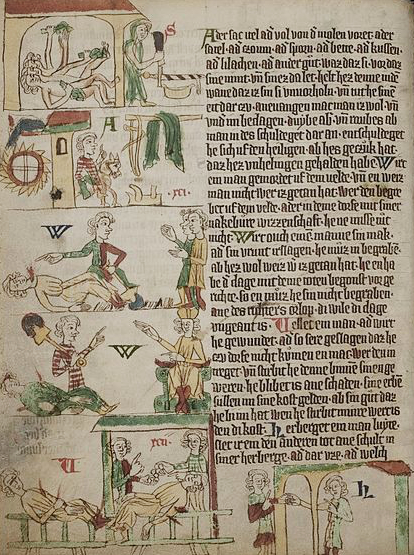


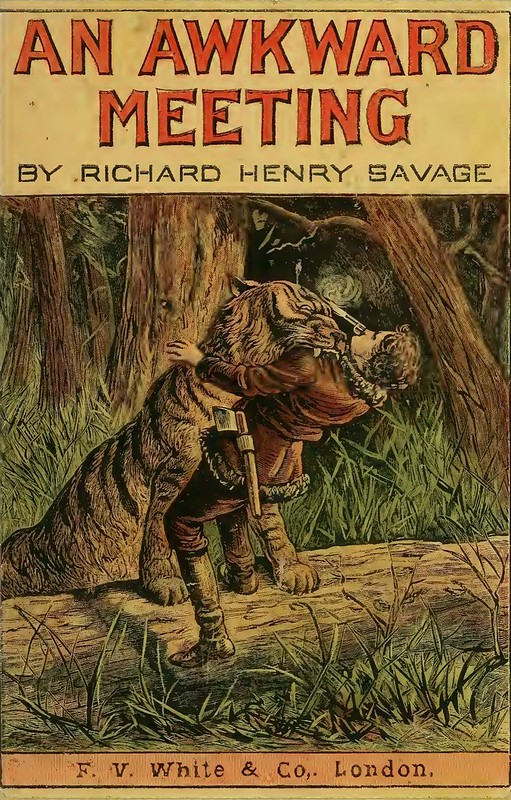
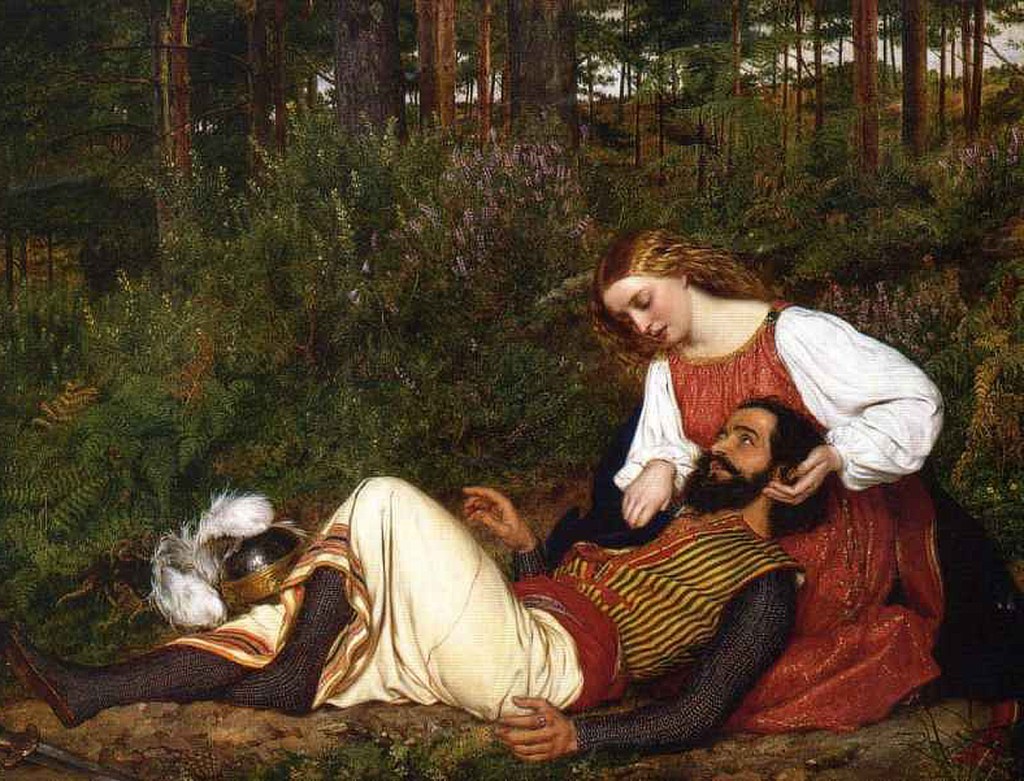

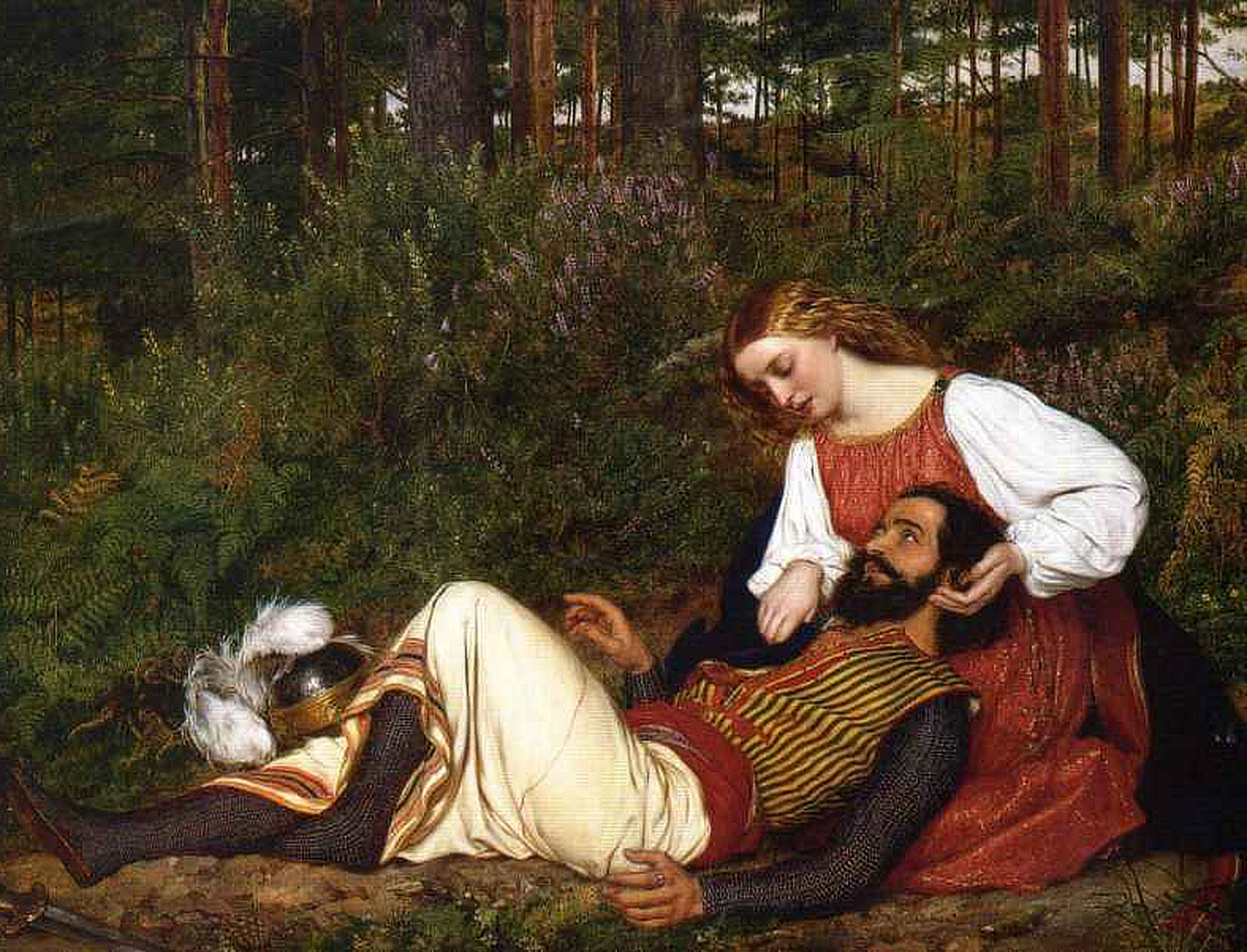
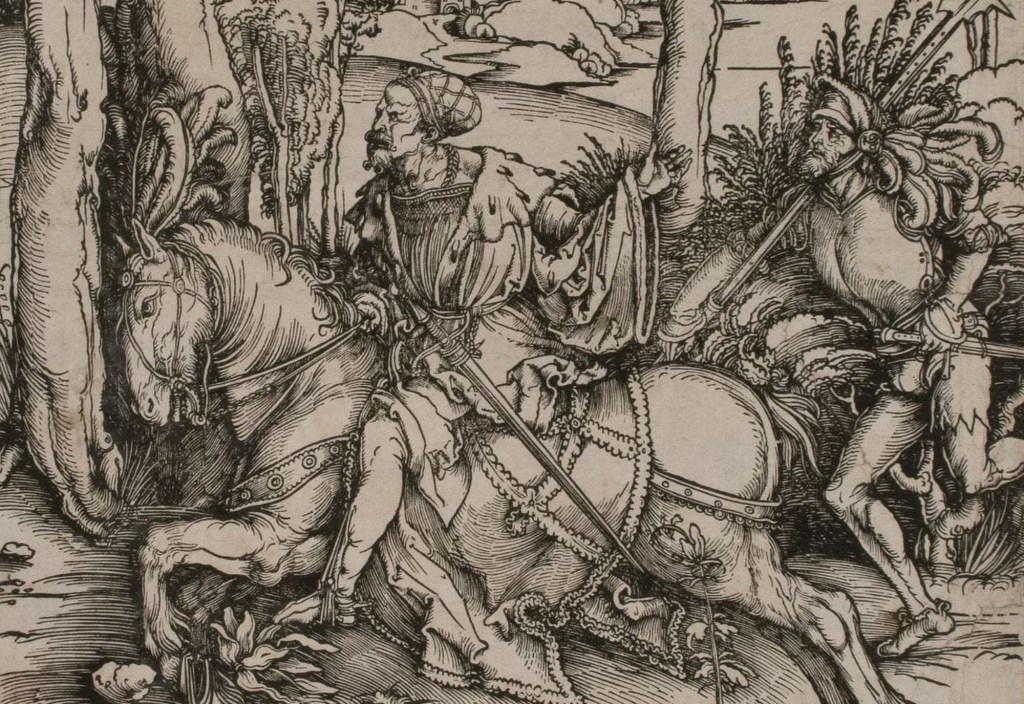
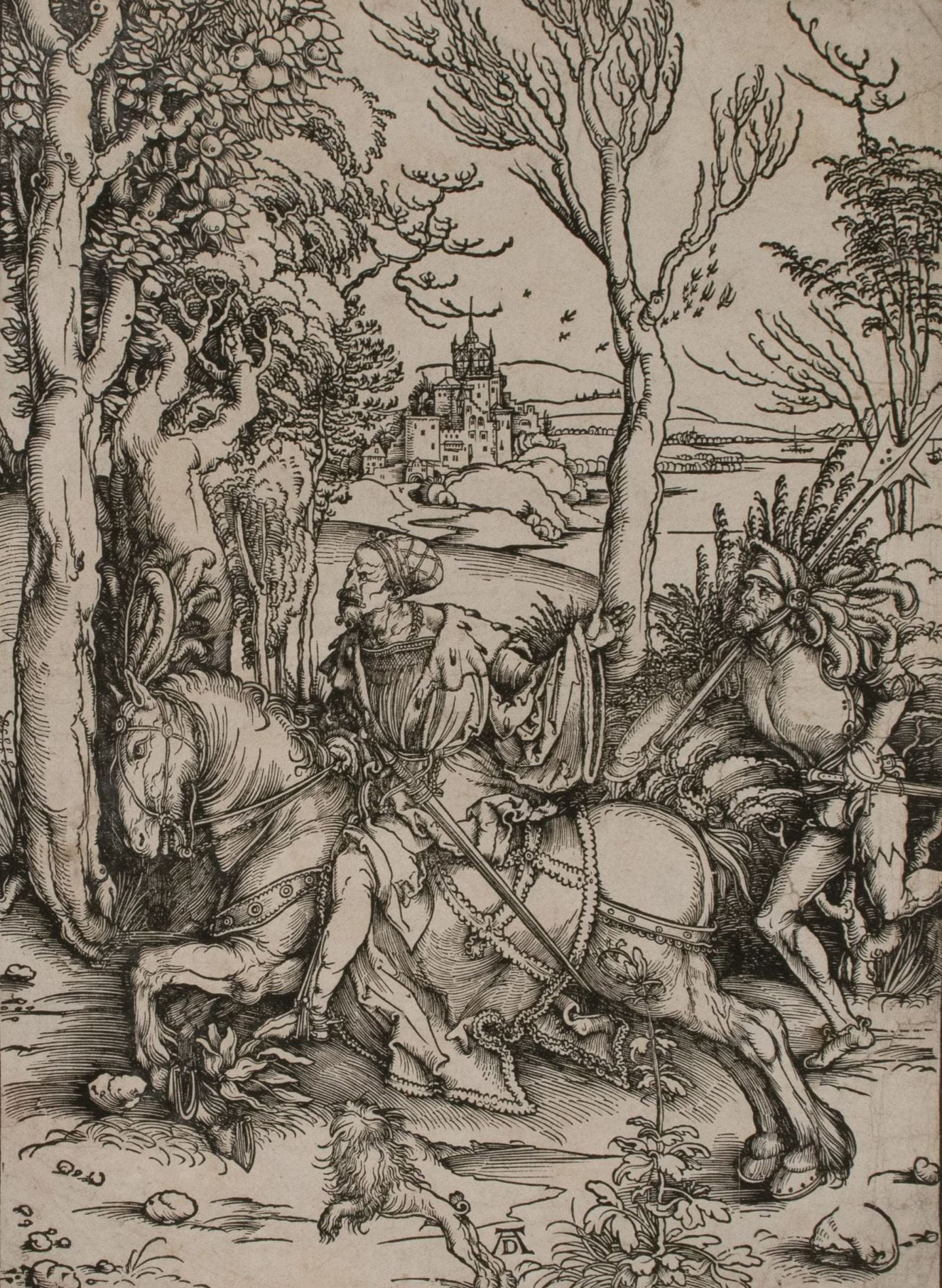


 Furin Chime Press™