Tag: Sylvanus Cobb Jr

  • Cobb’s False Knight: 8. Another Trap

    Cobb’s False Knight: 8. Another Trap

    Confusion in the Castle. The plot thickens, while dastardly villains conspire. Two assassins already dead in the forest, replacements dispatched. Guns that shouldn’t have been working, but which our hero had repaired… History is of course full of foul assassinations. Have you heard of any that occurred in that part of Germany? There were perhaps a few. Not with guns that shouldn’t have been working, but perhaps with guns which should not even have been there

    I don’t mean Stauffenberg’s failed attempt to eliminate Hitler of course, he had tried to do that with a bomb. No, far more recent. In the 1970s, the “Baader Meinhof Gang“, a nasty and extreme bunch of nutcase terrorists that had called themselves the “Red Army Faction” had been causing mayhem. They murdered a Federal Attorney General by the name of Buback and tried to kill an American general by firing a rocket propelled grenade at his car.

    Bomb threats and sightings here and there resulted in trigger happy police with machine guns all over Germany. When many of them had finally been captured, the hard core having been placed in the high security wing of Stuttgart prison, the concern was that those inside had still been orchestrating terror plots via secret messages transported by their legal counsels.

    Red Army Faction leader Ulrike Meinhof (1934-76) when a young journalist, in 1964. Source: Wikimedia Commons

    In the opinion of some in power, they had to go. How do you kill known terrorists in maximum security wings of several prisons? Some say, a “suicide plot” was hatched. On the 18th of October, 1977, gang leaders Andreas Baader, Gudrun Ensslin and Jan-Karl Raspe allegedly shot themselves inside their cells, in different cells, at exactly the same time, with pistols that had allegedly been concealed behind skirting boards.

    A fourth, Irmgard Modeller, survived the attempt. Some say that they had been murdered. How could anyone have got multiple guns past metal detectors and body searches? To hide them in holes dug into concrete walls and behind skirting boards? You can see why some suspected a plot by the authorities to rid themselves of a perceived (and probably quite real) ongoing threat to state security…

    Now what will Cobb’s replacement assassins do? Make it look like Ernest von Linden killed himself? While poisoning is perhaps the preferred method of assassinating any possible threat to today’s Russian Mafia state, it was always seen as the preferred method of killing for females. Kaiser Otto III was possibly poisoned in the year 1002 by a woman whose husband he had put to death. She had allegedly sent him a pair of gloves, the insides of which she had laced with poison, but this was never proven. He died of a sudden fever at the age of just 22.

    Should our hero be careful about what he eats and drinks or wears while inside Electra’s castle?


    CHAPTER 8

    ANOTHER TRAP

    Let us now look back and see what Sir Pascal Dunwolf had been doing the while that we have been with Ernest on his adventurous journey.

    To the very summit of the highest pinnacle of the castle the knight made his way as soon as the youth had departed, and here watched in order to make sure that here had been no deception—that he was really and truly going towards the capital, and not into the opposite mountain. Having satisfied himself that all was right in that direction, he came down and ate his breakfast, after which he took a stroll on the battlements, with his lieutenant for a companion.

    “My dear Franz, you are looking unusually glum this morning. What has happened to give you such a turn?”

    “Pshaw! It’s nothing, Meinherr. I am not feeling just right; that’s all.”

    ”You have not had a bout with Balthazar so early as this, have you?”

    “Eh! Who told you that? Has the little traitor betrayed me?”

    “Easy, easy, Lieutenant. The little rascal has told me nothing. In fact, I have not set eyes on him since I arose.”

    “Then how—”

    “Hold! I’ll make a clean breast of it. I last evening gave Balthazar a piece of work to do for me, promising him, if he was successful, that I would bestow upon him the wherewith to enable him to take revenge on you at dice. He did the work—did it completely—and I gave him the money before I was out of bed this morning. And now, hark ye: If in my present undertaking I succeed as I think I shall, I will give you far more than I gave to him.”

    “Ha! you have the young tiger on the hip [at a disadvantage], eh?”

    “Aye. What did you suppose I sent Roger and Otto in the forest for?”

    “I knew what you sent them for, but I did not know what their chances of success were.”

    “Ha—they have a sure thing. The boy’s wings are clipped entirely—the charges of his pistols withdrawn, and they so left that no human eye can detect the work without trial.”

    “Good! With him out of the way our work is wonderfully simplified. And now for our renowned chieftan—Thorbrand. You have not yet heard from him?”

    “No, and I am a little anxious. He was to have reported to me immediately on my arrival.”

    “Very likely he has been detained away. A man upon whose head is fixed the price of a prince’s ransom cannot go and come at will.”

    “But,” said the knight, with a dubious shake of the head, “the old inn-keeper at Hasslach told me that Thorbrand in company with his chief lieutenant—Wolfgang—stopped with him only two nights before our arrival, and that they were on their way towards this castle. He said, further, that they spoke of me—that is, spoke of an expected arrival from Baden-Baden, about which they were somewhat anxious. So, you see, the chieftain must be somewhere near here.”

    “It cannot be,” ventured Franz, “that— he— would—”

    “What do you mean?” cried Dunwolf, as his subaltern came to a dead stop. “Do you mean to ask if Thorbrand could prove treacherous? By all the bones of all the saints! If I thought he could do that— But, pshaw! Why do I doubt? By our compact he has everything to gain and not a thing to lose; while I— all! it would be a very sore thing for me were I to fail in this.”

    “If Thorbrand is true, and the barons of Wurtemberg keep faith with us, failure is impossible,” said the lieutenant with entire assurance.”

    “You are right. Thorbrand will soon show himself, I have no doubt; and meantime I must think of other matters. The sooner I secure the hand of the heiress the better for me.”

    “And the better for me, I trust, added the other, significantly.

    “Yes, my true heart—I will make it a golden occasion for you, never fear. And with that the twain descended into the court, the knight remarking, on the way down:

    “By the way,— this, I believe, is Sabbath day. Suppose we give Father Alexis an opportunity to manifest himself.”

    The lieutenant thought the plan a good one. They ought, he said, to assume the garb of sanctity once in a while.

    Sir Pascal had brought with him a priest—a man of middle age, reared in camps, who had spent several years of his life in the saddle as a trooper, and who could now lead in a religious service, or in the wassail of high carnival. He was a short, thick necked, rotund specimen of humanity, not absolutely evil at heart, and incapable of a great crime, but ready and willing to serve the master who fed and clothed him, and never curtailed his allowance of wine, even though such service might rend the heart strings of another.

    Towards the middle of the forenoon the herald sounded the call for the assembling of all who heard within the chapel, and the priest in full canonicals, accompanied by a choir he had selected from among the musical ones of the troopers, made his way to the altar, and in due time commenced the service.

    “The devil is selling indulgences” (1490-1510), Jenský kodex. Source: Wikimedia Commons

    The baroness and Electra, when they had been told what was going forward, considered what they had better do. It had been their custom, in pleasant weather, to attend mass in the old church in the village; and when they could not go out, good Father Paul would come up to the castle and perform mass in the chapel. Of course, they could not, with Ernest absent, go to the village; nor would they ask Father Paul to come to them; so, after talking the matter over for a time they concluded that they would call together the female servants, and attend the service of the strange priest. And this they did.

    Sir Pascal received them very politely at the chapel entrance; and, moreover, they became interested, despite their prejudices, in the strange priest’s homily. Yet his fervid speech, his brilliant flights of fancy, and his pleasing pictures of life, did not blind them to his entire lack of true godliness. His discourse was rather flippant than sincere, and strained for effect, and they were glad when it had been brought to an end, and they were permitted to return to their own apartments.

    “Mamma,” said the daughter, “did you mark how Sir Pascal looked at us?”

    “I did, my child; and I thought when marked I the evil glance he gave us, that nothing would induce me to remain here if Ernest were not very soon to return.”

    “But, would the bad man suffer us to leave, do you think?”

    “I should not ask him. There are methods of leaving the castle without disturbing sentinel or warder.”

    “Certainly, l know. Were you ever in the underground passes, mamma?”

    “Once. Shortly before your father went away to his death he took me through them.”

    “Does Ernest know the secret?”

    “Yes. He is thoroughly instructed. There are passages which I do not understand; but I have a key to them all, which your father had prepared on purpose for me. Ernest knows every secret, I believe; and for that reason I have felt no anxiety about instructing you.”

    While the ladies had been making their way back to their apartments Sir Pascal had ascended to the summit of the tower overlooking the path which the young captain had taken, out upon which he now looked for the return of the two bravos. If they had done their work as they ought they should be on their way back by this time. But he saw nothing of them. After remaining until he had become weary, he descended, and sent up a servant, whom he directed to keep strict watch for the return of two messengers he had sent out, and to give him intelligence instantly when they were seen.

    The hours passed; the knight ate his dinner; after which he went up to take a look from the tower. He found the lookout awake and watchful, but with nothing at all to report. Ten minutes or more he stood peering away down the mountain path; and then, nervous and uneasy, he again descended, and considered over the matter.

    It was now past two o’clock in the afternoon. Certainly, his men should have done their work, and returned, long ere this. If they had stopped, and intercepted Von Linden at the point he had laid down for them, they would have met him within two hours after he had set forth. Certainly, they should have had him in their hands by nine o’clock. Then they should have dispatched him at once, and returned before noon.

    While he was thus discussing the matter within himself, his hunchback page came in.

    “Balthazar! Look me in the eye. Now tell me, did you draw the charges from Captain von Linden’s pistols?”

    “Why do you ask me a question like that? I have a mind not to answer you. But, as I see you are in trouble, I will relieve you.”

    And he then went on and told the story of his morning’s adventure. When he had done, his master exclaimed:

    “I believe you, sirrah. But why don’t my men return?”

    “Look ye, brave sir,” the page replied, with a look of keen intelligence, “you should remember that we are dealing with a man who has his wits about him. I can swear that he left this castle this morning without a grain of powder, saving only the priming, and without a bullet in either one of his pistols; for I kept my eye upon him from the time I drew the charges to the moment of his leaping into the saddle; but who shall say how far he rode in ignorance of his defenceless condition? I am told that the old wolves in this forest are bold and fearless, and that often a veteran will sit on his haunches while horse and rider come very near to him. Suppose the captain should have had an experience of that kind—what more likely than that he should have drawn a pistol and thought to fire upon the brute?”

    Dunwolf wanted to hear no more. Bidding the dwarf to hold his peace, he hastened away to the barracks, where he called out two of the most reliable of his sworn men—men sworn to stand by him to the bitter end, let him lead where he would, so that he led them to plunder. These men—Zillern and Walbeck by name—were directed to saddle and bridle their horse immediately, and report to him at the great gate.

    And at the gate he awaited them. When they came he told them what they were to do. Roger Vadas and Otto Orson had been sent out upon the road early that morning, on a particular mission. They should have returned long ago.

    “You know the paths toward Zell?” said the knight.

    Yes, they knew them well.

    “Then ride on till you find those men, or some trace of them. In the deep vale, beyond the first mountain, they were to stop. A small stream of water runs through it. Search well and carefully in that neighborhood.”

    The sun was setting, and Sir Pascal was fairly beside himself with anxiety, when his two messengers last sent out returned. They found him in the apartment which he had appropriated as an office, and his hunchback page was with him.

    “Well,” as he saw one of the men making a search in his pocket, “what have you to tell me?”

    “Meiherr,”answered the man called Zillern—the same who had been searching in his pocket—”we found nothing until we had reached the top of the high ridge that snakes down from the Schwarzwolf Mountains, and there, on the grass, by the wayside, I picked up these bits of paper, which, as you can see, have never been wet by either dew or rain, but which have certainly—”

    Before he could finish the sentence the dwarf had sprung nimbly forward, and taken the crumpled bits of paper from his hand.

    “Oho! D’ye see, my lord and master? The very paper I tore from one of the gallant captain’s—”

    The knight gave him a rap on the side of the head to stop his tongue, and then bade the trooper go on with his story. The truth was already breaking upon him. If the captain had reloaded his pistols the summit of that spur, the end was easy to guess; for not only would he be efficiently armed, but he would have had a warning that would lead him to be on his guard, and give him to know the mission of Vadas and Orson the moment he should see them.

    “Go on,” he said to Zillern, clutching his hands tightly in his effort to hide his deep agitation.

    “Well, Meinherr, after I had picked up the paper we kept on down into the valley, and when we came to the brook, there, by the side of the path, we found the men we were looking for, both of ’em shot through the heart!”

    “Shot?”

    “Aye, Meinherr, by a hand that must have been wonderfully steady, and with a keen pair of eyes behind it. Orson’s pistols had both been fired, but neither of Vadas’s, though he had drawn one from his holster. We put the bodies out of sight, and covered them with leaves and brushwood, leaving them to be got tonight.”

    Dunwolf took a turn across the room, after the story had been told, and when he stopped he had so far regained his composure that he spoke very calmly.

    “Look ye, my men,” he said, with a strong glance in their coarse, brutal faces, “can you hold your tongues?”

    They asserted their undoubted ability in that direction.

    “Because,” the knight continued, “I want you to maintain an utter silence about what you have this day heard and seen in relation to those two men. If you are asked where you have been, simply say that you have been on business for the governor, and suffer them to ask no more questions. We will have the bodies buried where they are. Do you think you can smuggle out a couple of spades without exposing them?”

    “Aye, sir, we can do that; and if you would give us a bottle of good old wine, it would help us. It’s a kind of dubersome work, and a bit of something to shorten the time would make it easier.”

    Without question Sir Pascal turned to the sideboard behind him, and brought forth a bottle that had never been opened. This the men took, and went their way, promising that the bodies should be buried, and that none others should be the wiser.

    “Now, my master, what will you do?” demanded the dwarf, when he and the knight had been left alone.” He exercised a jester’s privilege of freedom when he felt in the mood, and as his wits were keen and his advice often of value, no offence was taken.

    “What can I do?” was the response, spoken half to himself.

    “Of course,” pursued Balthazar, “the youngster will make his way straight to Baden-Baden.”

    “Aye, and there’s the mischief.”

    “The mischief I don’t see, my lord. If you fear he will fill the ears of the grand duke with his complaints, I can inform you that he will not do any such thing.”

    “How? Not do it?” cried the knight, with a violent start.

    “He cannot do it; for his majesty isn’t there. Oho! see what I learned for you by remaining a night behind you when you left the capital! The grand duke has gone to Heidelberg. That I can swear.”

    “Von Linden may keep on after him.”

    “I don’t believe it, sir. He will learn at Baden-Baden that the chances are in favor of his losing the prince, even at Heidelberg, for I don’t think he intended to stop there.”

    “In the name of wonder how did you learn all this?”

    “Why, don’t you know that Leopold’s page is my very dear friend? He told me all about it.”

    “But how could you have seen him if he had gone to—”

    “Pshaw! There it is. He didn’t go, and he was full of wrath. His master wouldn’t take him.”

    “Balthazar, you are a jewel! You have given me great relief.”

    “And now, Meinherr, let me advise you to clip that young gentleman’s wings with your own hands. Don’t trust any more of your troopers.”

    “What!— I—”

    “O! don’t you understand? I do not mean that you are to shed his blood. Are there not strong dungeons somewhere beneath this ancient pile where he can be put behind bolts and bars that will hold him safely?”

    “Balthazar, if ever Franz empties your purse again come to me and I will fill it. I don’t offer it now, because I know you broke him at your last essay.”

    “Oho! he has been complaining to you, then.”

    “No, no; I laughed at his sober face, and he confessed the truth. Ah! who is this?”

    It was Franz himself, come to inform his chief that he had just passed two men out at the smaller postern with spades. He hoped he had done right.

    Sir Pascal relieved his mind at once, after which they sat at the table, and Balthazar waited upon them, filling their glasses as they drank, and at the same time taking his own glass as he liked’.

    Later the knight called his officers, with Father Alexis, to join him at supper, and there he made a night of it.

    * * *

    On the following morning—the morning of Monday—Sir Pascal made arrangement with his lieutenant for the keeping of the men-at-arms who belonged to the castle away from the gates. He wished them during the day and the night, and for another day and another night, to be under the charge of his own men. He was anxious that Von Linden, when he returned, should be brought directly to him, and, if it were possible, he wanted his coming to be kept a secret from the young man’s friends. Franz promised that he would do all that lay in his power.

    Dunwolf gave the youth one day of tarrying in Baden-Baden, and if he should conclude to return speedily to Deckendorf, he would come on Tuesday.

    Twice during the two days—Monday and Tuesday—Sir Pascal saw the baroness, and once he met the daughter. On these occasions he was very polite, and, what was of greater moment to them, he allowed them to pass without forcing upon them his conversation.

    As Tuesday’s sun drew near to its setting the dark-browed knight paced up and down his office in a depth of anxiety that would not let him remain seated. At the very slightest sound he stopped and listened, and as nothing came of it, he uttered an oath and resumed his walk. At length, however, his terrible anxiety was relieved by Balthazar, who came down from the turret with the light of gladness in his wicked eyes.

    “Your man is coming my lord,” said the dwarf.

    “Alone?”

    “Yes.”

    “Where is he now?”

    “He broke cover not five minutes ago, and his horse is walking up the hill. He will be at the gate in ten minutes from the present moment.”

    “Make haste. Send Franz to me; and then call Zillern and Walbeck—the men who went in search—”

    “All right, my lord; I know them. Is that all?”

    “That is all at present. Fly for once, my lad.”

    The dwarf glided out with wonderful agility, and five minutes later the lieutenant was in the room.

    “To the gate, Franz; and when Captain von Linden arrives bring him hither. I leave it to your own wits to invent the best method of bringing him.”

    “I will find a way, sir.”

    “Let half a dozen safe men be on the watch, at a respectful distance, so that if a forcible arrest should become absolutely necessary, it can be done without failure. Mark you: He must not be permitted to see the women.”

    The lieutenant promised that he would look well to it, and then took his leave. As he went out, the men Zillern and Walbeck, came in—the same who had been sent in search of Vadas and Orson, They were armed with short, heavy clubs of ironwood—just the weapon for the work they had to do.

    Dunwolf had not quite the heart to order the youth’s assassination within those walls. He would seize him and lock him up where no human being could find him, after which he could consider at his leisure. Perhaps, when he had made the heiress of Deckendorf his wife, he might set him free.

    The two ruffians had scarcely received their instructions, and effectually concealed themselves, when the jingle of the lieutenant’s spurs was heard in the adjacent hall.


    Notes and Reference

    • on the hip: at a disadvantage (originally a wrestling reference) (Collins Dictionary).
    • bravos: assassins, murderers (New Century Dictionary).
    • Zell: located in the Central Black Forest.
    • dubersome: doubtful, tough, cumbersome.
    • essay: attempt.

    “Who were Germany’s Red Army Faction Militants?” BBC News, 19 Jan, 2016

    This edition © 2020 Furin Chime, Oliver Raven
  • Cobb’s False Knight: 7. Cause for Alarm

    Cobb’s False Knight: 7. Cause for Alarm

    Baden Baden. The German Wagga Wagga? For the non-Australians among you, the latter is a town in western New South Wales which does not derive its name from “the Aboriginal word for Italians” (an old joke based on the no longer so insulting term “wog”). But what of Baden Baden? A city in the state of Baden, which is famous for being a health spa, where, in Cobb’s time, upper class Germans used to “take the waters”.

    Poster (1924): Water-fountains, the Black Forest, and a red sunset, representing the health resort Wildbad im Schwarzwald (Baden-Württemberg). Colour lithograph after A. Fischinger. CC by 4.0. Wellcome Images

    In the Middle Ages, it was also a spa town, and had been since the times of Roman emperor Caracalla, as excavated ruins below the New Castle have proven. The German word for taking a bath is “baden”; so does the funny sounding double name simply refer to the town in Baden where people take baths? With such a history, one could be forgiving for thinking it did, but it’s just an older plural form for “the city of Baden in the state of Baden”. Whether you go for one in mud, water, or in the casino, the name of the town has nothing to do with taking a bath.

    Casino? Yes, there’s also been a casino there since the 1830s, so Cobb would have heard of it. Surely you can’t go for a bath in the casino. Well, perhaps not, except for diving into roulette, baccarat or blackjack, but the word “baden” also has another meaning in German, “baden gehen“: not only to go for a bath or to go swimming, but “to go under“, in the sense of losing everything, which one often does in a casino.

    Hopefully, our hero’s hopes won’t “go swimming” in this German sense in Baden Baden because of the recipient of his letter, the Grand Duke, being away in Heidelberg. Oh, by the way, there’s an old German schlock of a song called “Du hast Dein Herz in Heidelberg verloren” (“You lost your heart in Heidelberg”, meaning not that you went there for a transplant of this vital organ, but that you fell in love there). Will our hero get shot through the heart in this supposedly most romantic German town? Surely, not, but this terribly sentimental old tune reminded me of another when there was mention of the Grand Duke being saved from drowning off the Island of Capri.

    Rudi Schuricke – Capri Fischer 1943

    I’ve added a link to this cheesier song about the island: “Wenn bei Capri die rote Sonne im Meer versinkt” (“When the red sun sinks into the sea near Capri”), which a German comedian turned into “Wenn bei Capri die rote Nonne im Meer versinkt“, which, sung to the same tune, translates to, “When the Red Nun sinks into the sea near Capri”. Perhaps you could change it to a Grand Duke almost sinking beneath the waves near Capri, instead of a suicidal or perhaps tipsy, drowning communist nun? — the former, however, being allegedly saved by none other than Sir Pascal Dunwolf?

    Is it just me, but after remembering two terrible tunes, do things not bode well for the desperate mission of Ernest von Linden?


    CHAPTER 7

    CAUSE FOR ALARM

    As Captain von Linden came near to the crystal stream the two ruffians pulled up the heads of their horses, and faced them about to the northward towards their objective point; but the youth clearly detected some signal and a response pass between them, and he was sure they loosened their pistols in the holsters at the same time.

    Ernest’s only trouble was this: He could not, in good conscience, fire a deadly shot upon one who had not made a demonstration of the same character against himself; and yet, if he waited for that, he was liable to he shot down like a dog before he could make preparations for his defence. He thus felt it to be a critical moment, knowing, as he did, that his life hung by a thread.

    Once more, as the two men turned their horses as though to ride forward, he recalled all the circumstances to mind. He passed them critically in review, from the beginning to the end from Sir Pascal’s prompt refusal, when his journey to the court of the grand duke had been first proposed, to the present time. He could now understand why the knight had so readily and with such apparent cheerfulness withdrawn his opposition to the visit. He had allowed him to set out upon his journey for the very purpose of leading him into this trap. In every way he stood dangerously in Dunwolf’s path of greed and ambition; and, if he could be stricken down in the wild depths of the dark forest, none save himself and his sworn tools would be the wiser.

    There could be no mistaking the signs as he had thus passed them in review, and his resolution was quickly taken.

    Even at a little risk he must make the rascals avow themselves, to which end he rode on a few paces beyond the brook, and there ordered them to halt. They obeyed instantly, and, without further orders, turned about and faced him.

    “Roger Vadas, answer me. Wherefore have you hung upon my steps? why thus waylaid me? Seek not to deceive me, for I know more than you think. Will you speak?”

    The man thus addressed glanced towards his companion, but gained no help from the stolid look he there met. Then he looked towards the young officer, and, with a grin almost idiotic in its utter brutishness, he said:

    “Look ye, Meinherr, I s’pose w’eve a right to travel this path, haven’t we? If you don’t like to see us ahead, just go on yourself, and we will follow.”

    “That does not happen to suit me,” said Ernest, “and,” he added, drawing a pistol from his right-hand hoister, and cocking it, “you will answer my question, or I will put you beyond the power of answering forever-more.”

    “Oho! That’s the business, is it? I rather think I can take a hand of the same kind.”

    Then, to his companion, as he drew a pistol from its case, he said:

    “Now’s our time Otto! Let’s finish it quickly!”

    To hesitate longer would have been simply suicidal.

    “Hold!” thundered the youth, rising in his stirrups, and taking a sure aim. “Mark me. If you raise that pistol I shall fire, and I am not apt to miss my mark.”

    “Fire away, Captain. Such things as those you’ve got won’t hurt.” And he raised
    his weapon to take aim.

    That was enough for our hero. It told him that he had not been mistaken in his judgment, and that his life was aimed at. With a quick, sure aim, his finger pressed the trigger, and this time the faithful weapon did not fail him. A sharp report broke upon the air, and the ruffian reeled, and fell backward, lying for a moment supine upon his horse’s back, and then rolling off upon the ground.

    With a fierce oath Otto Orson raised his pistol and fired; but he was not a marksman. In his mingled wrath and astonishment he had discharged his piece without due caution, and the bullet flew wide of its mark.

    “Beware!” shouted the youth, as the ruffian drew his second pistol. “You are a dead man if you

    A fierce oath was the response; the pistol was raised, but not fired. “Quick as thought Ernest had covered the mans heart, and when he saw that quarter was not to be thought of he pulled the trigger, and ruffian Number Two fell from his saddle, his weapon being discharged as he went down.

    Our hero now dismounted and went to where lay the man last shot. He struggled to his elbow as the youth came up, and pressed a hand over the sore spot on his breast.

    “Ah! Captain,” he groaned gaspingly, “you’ve done for me! Your pistols were loaded.”

    “Of course they were loaded,” Ernest said, at the same time lifting the man’s head and offering him a drink from his flask. You did not suppose I travelled with empty pistols, did you?”

    “But,” gargled the expiring wretch, brightening somewhat under the stimulating influence of the cordial, “you said Balthazar came to your chamber with the letter.”

    “Ah! and he was to have drawn the charges, was he?”

    “O! O! O! What care I now? Yes, he was to have done that thing- Sir Pascal 0! him! swore that it should be done.”

    “And Sir Pascal sent you out to waylay and kill me?”

    “Yes, yes. O! If I’d known that your pistols were

    Ernest offered him another pull at the flask, but he could not swallow. His eyes glared wildly for a moment; his lips paled arid parted; a deep moan escaped him, another imprecation, half uttered, upon the man who had sent him to his death, and he breathed his last.

    The youth arose, and went to the side of the other; but he was beyond human aid. He had been shot through the heart, and had died instantly.

    For a little time Ernest gazed upon his work in solemn silence. It was not a pleasant thought that he had taken two human lives; but he could not blame himself for the deed. He was only sorry that the deeper, darker villain who had planned the wickedness had not himself come out to execute it. However, upon looking down upon the two faces, and marking the characters unmistakably stamped thereon, he felt in his heart that the world would be the grainer in their deaths.

    He pulled the bodies on the side of the path, leaving them in such position that any who might be sent out in search of them would readily find them; then he reloaded his pistols and resumed his journey, destined to no more adventure on the road.

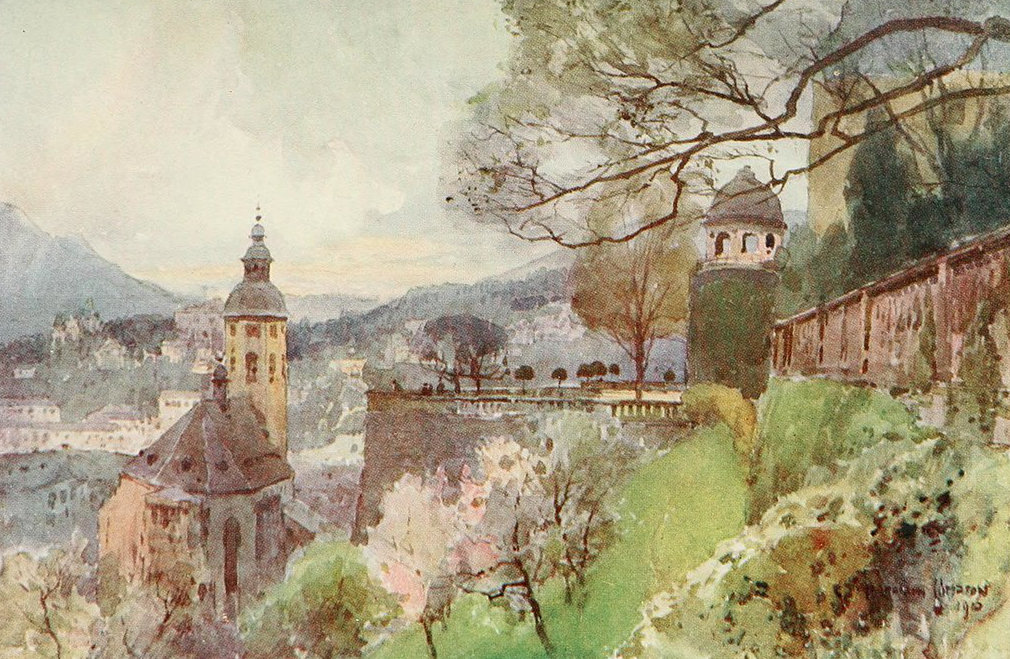
    Baden-Baden, by Edward Harrison Compton, 1912. Public domain. Source: Wikimedia Commons.

    It was after nightfall when he reached Baden-Baden too late to think of waiting upon the grand duke on that day so he sought a comfortable inn, where he was acquainted, and secured lodgings. On the following morning his first movement, after having eaten his breakfast, was to call upon the banker of the baroness, from whom he obtained all the money he required, and then he bent his steps to the ducal residence. But only disappointment awaited him. The grand duke had gone to Heidelberg, and none could tell when he would return; and he was further informed that it was seriously in contemplation to remove the seat of government to that old city. The ancient palace of the Electors Palatine was being repaired and refurnished, and in all probability Leopold would ere long make it his permanent abode.

    Residing at Baden-Baden and connected with the court, was a justice, named Arnbeck, who had in other years been Ernest’s tutor, and upon him our hero determined to call, thinking he might gain information that would be of value.

    Herr Arnbeck was an elderly man; a professor in the college in his younger days, and now a judge in the higher court of law. He had been tutor of Leopold, the present grand duke, having in that capacity accompanied him during a two or three years’ residence abroad. He received Ernest with marked kindness, glad always to meet those pupils whom he had loved and respected; and he cheerfully offered any assistance in his power to render.

    After a brief conversation upon current topics, chiefly of the grand duke and his contemplated change of residence, the young man stated the particular business that had brought him to Baden-Baden. He knew that his hearer was to be trusted, and that his sympathy would-be with him: so he told the story plainly from beginning to end; told of his love Electra von Deckendorf, of their betrothment at the baron’s own desire; told how they had grown up in love, looking upon marriage as a settled fact; and then he told of the coming of Sir Pascal Dunwolf, together with the strange plan of the grand duke for his marriage with the beautiful heiress.

    Arnbeck listened with deep interest, asking several questions for further information, and in the end he was sensibly affected.

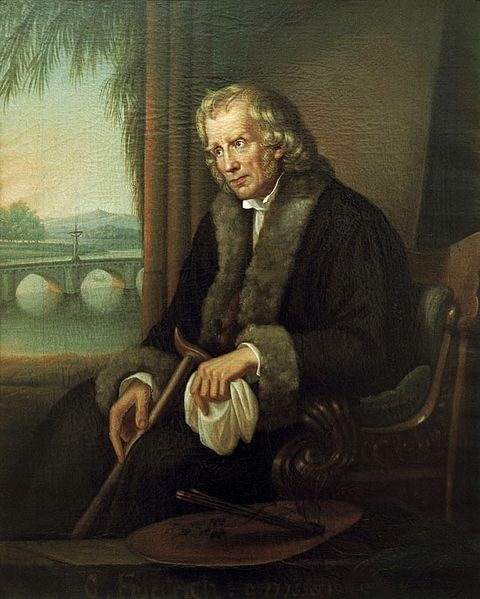
    Porträt Caspar David Friedrichs (1840) by Caroline Bardua. Public domain. Source: Wikimedia Commons

    “My dear boy,” he said, speaking with something of the old school-day familiarity, “had one whom I had not known told me your story I should have doubted its correctness, but I cannot doubt you; and moreover the whole thing bears the stamp of fact. Let me tell you one thing in the outset: Leopold was unfortunate enough to have his life saved by this Sir Pascal Dunwolf. It happened in the Bay of Naples. Sir Pascal had been appointed on Leopold’s suite by his father, the Grand Duke Rudolf. Off the island of Capri my dear pupil was knocked overboard by the jibing of a boom, and Pascal, who had been sitting by his side, leaped into the sea, and upheld him until the sailors could bring the boat around and come up with them.”

    “But surely,” said Ernest,”he would not on that account suffer

    The old justice put out his hand.

    “Listen to me, my son. Think no evil of Leopold. He is young and impulsive; his affections are strong, and his gratitude deep and abiding. He never forgets a favor. So I can see how he has hoped to bestow a benefit upon the man to whom he owes so much. You may be sure, however, that Dunwolf has misrepresented matters to the grand duke. Was he ever at the castle before? Did the baroness know him of old?”

    He was there several times, I believe, in the baron’s time. I think he was attachcd to the staff of Rudolf.”

    “Yes as due of his aides. There is no doubt in my mind that he has represented to Leopold that he would be warmly welcomed by both the baroness and her daughter. He had probably seen the young lady.”

    “Yes. He had seen her at court. She was there with her mother about two years ago.”

    After a little further discussion of the subject it was arranged that Ernest should remain and dine with his old tutor, and meantime he the tutor would go out and make enquiries. Business called him to court, and he would there investigate.

    Herr Arnbeck was gone longer than he had anticipated; and when he returned there was a cloud upon his face which he could not hide; but he would say nothing until after they had eaten their dinner; nor would there have been opportunity, for, on entering the eating-room, they met there the justice’s wife and two daughters, all of whom remembered the visitor well and kindly, and even affectionately.

    At length Herr Arnbeck and Ernest were again alone together, the latter being very anxious to know what his aged friend and counsellor had to say to him. The host did not offer his visitor a seat; but, standing before him, he laid a hand kindly and paternally upon his shoulder, saying as he did so:

    “My dear boy I have made all possible inquiry, and such information as I have is at your service. Sir Pascal did certainly represent to the grand, duke in short, he told him, in direct terms, that the Baroness von Deckendorf would gladly welcome him as a son-in-law; and that she was the more anxious since her daughter had conceived an unfortunate attachment for a vagabond hunter, who, in all probability, belonged to the band of the notorious Thorbrand. This he told her so soberly, and with so much of apparent feeling, picturing in vivid colors the grief and chagrin of the outraged mother, that Leopold believed him, and at once turned his attention to mending the matter, which he would do by exercising his regal prerogative of guardian of the orphan heiress, and bestowing her hand upon the valiant knight.

    Several times during this brief recital the youth had seemed ready to go wild in his wrathful indignation; but thought brought deeper and calmer feeling; and his first coherent speech was of what course he should pursue. Would it be well for him to push on to Heidelberg, and see the grand duke?

    “No,” said Arnbeck, with a solemn shake of the head. Though I am confident Leopold would givn you quick relief, were you to see him, yet you had better not waste time in running after him. It is his plan to visit Wurtemberg before he returns, to make investigation into the matter of an uprising a revolt led by the very Thorbrand of whom we have spoken.”

    “I have heard a whispering of something of that kind,” said Ernest, “but I gave it no credit.”

    “Nor did I, at first, returned the justice; “but I am now forced to the belief that there is much to fear, if prompt measures are not taken to nip the mischief in the bud. In the depths of the Schwarzwald, on the confines of the two principalities, there is a large number of disaffected people, with no grievance save poverty, who are ready to join the robbers, thus making a host capable of terrible work of plunder and devastation. It was to look after this rebellion, and to assist in crushing it; and, afterwards, to hold the uneasy ones in subjection, that Dunwolf was sent to Deckendorf.”

    “My dear old friend,” said our hero, with a proud flush in his face, and a kindling of his truthful eyes, “I may say to you what I would not say to another. Leopold of Baden had better trust me with that command, than trust the man he has sent thither.”

    “I believe you, my dear boy; and I will bring it to pass, if I can. Meantime, my advice to you is, Return at once to Deckendorf. Since that bad man has been so boldly wicked as to attempt your life, there is no telling what he may do next. Now that he fancies he has put you out of the way he may carry a high hand with the marriage. With the commission as given him by the grand duke, and the consent to the union therein implied, there is nothing in the world to prevent him from forcing the marriage at his will. He has only to find a priest ready and willing to do his wicked work, and they, I am sorry to say, are plenty. So, my son, back to the castle, and look to those who may need your protection.”

    For a little time the startled youth was utterly unable to speak. So confounded was he that he could scarcely think. The danger that threatened his beloved had come upon him like a thunderbolt from a clear sky. He had not dreamed of such a possibility. The idea that any living man, less than the emperor, or the grand duke himself, could do such a deed as force an unhallowed, unwelcome marriage upon the heiress of Deckendorf, would have been too wild and ridiculous for belief.

    “Herr Arnbeck!” he gasped, as soon as he could command speech, “would such a marriage as that forced upon the lady against the earnest protest of herself and her mother be valid?”

    “I am pained to say, Yes. Electra von Deckendorf is, in the eye of the law, a ward of the grand duke, and he has given his consent to her union with Pascal Dunwolf, which consent the prospective husband has in his possession in writing, in the prince’s own hand. You can see for yourself the power possessed by that dark-browed knight. But, mark you, he must act quickly if he hopes to succeed in his nefarious purpose; for, as I have promised you, the moment Leopold knows the truth, that moment Dunwolf’s power falls.”

    “O! why is not the grand duke here? Why can I not find him? Heaven have mercy!” And the quivering youth wrung his hands in the uttermost depths of anguish.

    “Hush!” said the aged justice, laying a hand upon his arm. “Be up and doing. Do you look to Deckendorf, and I will look for the grand duke. I know you will not find him if you go to Heidelberg. I shall hear from him on the arrival of his first budget, and I will not fail to notify him.”

    With a mighty effort Ernest recovered himself, and as soon as he could think consecutively, and speak coherently, he thanked the good old man for his kindness, and promised that he would return to Deckendorf as speedily as possible. It was now too late to set out that day. The weather was thick and threatening, and the night was likely to be stormy; but he would be on the road early in the morning.

    He took tea with the justice, and with him spent a portion of the evening. The conversation turned upon the trouble in the Schwarzwald, neither of them having any heart to talk further of Dunwolf and his villainy. Ernest asked if there were any men of standing and influence engaged in the insurrection.

    His host answered that there probably were, but they were not positively known. The plan, as nearly as it could be arrived at, was to form a vast and powerful organisation of freebooters. They would organize a government, and live by general plunder. Having gained possession of a few of the strongest castles in the heart of the Schwarzwald, they might bid defiance in their mountain fastnesses to the world. It was known that Thorbrand was engaged in the enterprise, and he appeared to be the ostensible head of the movement, but it was doubtful if he was the responsible head.

    “Have you any idea who is the responsible head?” asked the youth, earnestly.

    The old man returned him a sharp piercing glance, and then arose from his seat and took two or three turns around the room. By-and-by he stopped by the side of his guest, and laid a hand upon his shoulder.

    “Ernest, what I now say to you, you will sacredly keep as a trust reposed under seal of your honour. You have asked me a direct question. I will give you a direct answer: SIR PASCAL DUNWOLF!”

    The young captain started as though he had been stricken a heavy blow.

    “Hush! Not a word!” added Arnbeck. “I have never thought this until within the present hour; but now I sincerely believe it. Bury it in your bosom bury it deeply and keep your eyes open. And now I must bid you good-night. I have work to do; and you must gain sleep, if you would perform your journey on the morrow.”

    A little later our hero returned to his inn and sought his rest; and on the following morning, bright and early, he was on the road. There had been rain during the night, but the rising sun soon banished the clouds, and the day promised to be clear and pleasant.


    Notes

    • his sworn tools: his lackeys, flunkeys.
    • be the grainer: this obsolete idiom carries the sense, “be the beneficiary,” presumably after the agricultural metaphor.
    • Electors Palatine: “[A palatinate was] Either of two historical districts and former states of southern Germany. The Lower Palatinate is in southwest Germany between Luxembourg and the Rhine River; the Upper Palatinate is to the east in eastern Bavaria. They were once under the jurisdiction of the counts palatine, who became electors of the Holy Roman Empire in 1356 and were then known as electors palatine” (yourdictionary.com). Elector: “a German prince entitled to take part in the election of the Holy Roman Emperor; [E.g.], the Elector of Brandenburg’” (Oxford Languages).
    • Wurtemberg: “The Kingdom of Württembe.rg was a German state that existed from 1805 to 1918, located within the area that is now Baden-Württemberg” (Wikipedia).
    • arrival of his first budget: “budget” from OF bouge, “a bag”; so carries the sense, “immediately on his arrival.”
    • freebooter: robber, plunderer.
    • fastness: stronghold (see also Chapter 6 and n.)
    Creative Commons License
    This work is licensed under a Creative Commons Attribution-ShareAlike 4.0 International License.


  • Cobb’s False Knight: 6. Waylaid

    Cobb’s False Knight: 6. Waylaid

    Trying to get a desperate message through to possibly avoid a looming disaster, a dangerous journey through a dark expanse. Where had I heard that before? It was also in Germany, but not in the Black Forest.

    This particular journey started from an airfield just outside Munich. The dark expanse was the North Sea, the destination Dungavel Castle in Scotland, strangely reminiscent of Dunwolf, but purely coincidentally. It was the Duke of Hamilton the desperate messenger had tried to reach, a fellow aviator, and one he had hoped could pass his message on to Churchill. Avoiding being shot down, he had to parachute into a field, unable to find his intended destination.

    The messenger was a man I had never met or had any interest whatsoever in meeting, but whose presence I had been aware of while living in West Berlin. He was the sole occupant of an entire prison built to incarcerate six hundred, kept there incommunicado, lest he told of what his errand had really been about. In later years, when his son was finally allowed to visit, guards were always present and he was not permitted to discuss anything in relation to his mission. Don’t you wonder why?

    Spandau Prison was less than twenty kilometres from where I lived, but normally, nobody was allowed to enter. An absurdly expensive, huge place to house the desperate messenger, already pushing ninety in the early 1980s, kept there under the jurisdiction of the Allied Command. These days they say it was the Soviets who held him, but when I was in West Berlin, we knew it was the British who blocked any attempts for release, even by someone as influential and definitely acting out of compassion and not because of any pro-Nazi sentiments, as former Mayor of West Berlin and Chancellor of Germany, Willy Brandt. But why?

    It was because of what Rudolf Hess knew about his mission, which was still highly embarrassing to the British. Had there been an intelligence sting to convince Hitler that Great Britain had been seeking a way out of the war? Or was Hess simply a madman? Berliners need knew of the old man, held alone in that huge and foreboding prison. Did he deserve to be there? At one time, probably. He had been Hitler’s deputy, had signed into law terrible policies that harmed and killed so many. Not an innocent, by any means.

    Why on Earth had he tried to get a message to Churchill? Because he knew that madman Hitler was about to invade the Soviet Union and thereby open a second front making the war unwinnable for Nazi Germany? Or had he been acting on the direct orders of Hitler, in response to secret British overtures? The murky world of intelligence services conceals many such plots. We will never know the details of this one, but we can be thankful that his desperate mission to find peace with the UK and avoid the defeat Nazi Germany did not succeed, whatever the circumstances.

    Hess allegedly hanged himself in 1987, at the age of 93. A messenger, whose to some still immensely embarrassing message finally “had to be stopped” from being told, because more moves were afoot to finally release the old man? Will Ernest von Linden succeed in getting his message through to King Leopold, or will he too be incarcerated or even killed?


    CHAPTER 6

    WAYLAID

    The baroness and Electra were ready to sit with Ernest at the breakfast table, so that no time might be lost in consultation. The distance to Baden-Baden was fifty miles — the road exceedingly mountainous and rough. If he could make the journey in a day he would do well. At all events, the chances were that he would be obliged to be gone three days, as he could not expect to find time for business on the day of his journeying.

    His business, however, was easily understood, most of it being left to his own judgment. Since Sir Pascal Dunwolf had made his appearance at the castle the baroness could not believe that the grand duke would insist upon his marriage with her daughter when the facts of the case had been presented to him. She knew how eager the dukes were that the great estates of the grand duchy should be possessed by their chief henchmen. She knew that during the reign of Leopold’s father three orphan daughters of wealthy baronies, representing their respective families, had been forced to wed with husbands of his choosing; and one of them, at least, she well knew had at the time a lover in the lower order of society to whom she was devotedly attached.

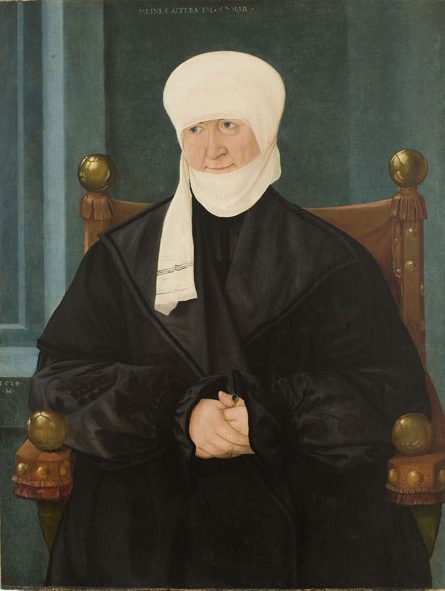
    Portrait of a Woman of 57 (1539), Hans Mielich. (MNAC, Barcelona). More information.

    Still, her case, she felt, was different. Her daughter had been long affianced — allianced, too, by a father who had given his life to the state — to a youth of noble lineage and owner of a large estate. As she arrived at this point in her statement Ernest interrupted her, saying:

    “And for that very reason, I am informed the grand duke said, he objected to our union; perhaps not in so many words, but such was doubtless his meaning. He regards the Barony of Deckendorf as already powerful enough. Let the earldom of Linden be combined therewith, as would be the case in my marriage with my darling, and Leopold thinks the lordship might, in time, over-shadow his own proud station.”

    “O! what a fool!” exclaimed Electa, impatiently. ”When Ernest and I would be to him two of the very best and truest of friends.”

    “That is what I shall try to make him understand, my own precious love,” said Ernest, as he moved back his chair from the table. There was further conversation on the all-important subject, but, as the result will be seen in the end, there is no need that we should follow it further.

    The question of companionship on the journey had been discussed, and the brave youth had decided that he would go unattended. He was not afraid of robbers, for he took with him nothing for them to steal. As for money, all he could want was in the hands of the baroness’s banker in Baden-Baden, and a simple cheque would command it. A companion of his own turn of mind and thought, one intelligent and educated, would have been pleasant; but none such was within call; so, after due consideration, he had resolved to go alone. Thus he could speed on his way as he pleased, and enjoy his own thoughts and fancies.

    The baroness had given her last words of direction and caution; both she and Electra had given him their blessing, and their parting kiss; after which he sent a servant to order his horse, while he went to his chamber to get his portmanteau and his pistols.

    The pistols, of the very latest pattern, procured of the manufacturer, at Heidelberg, less than a year ago, were the best weapons of their class to be found anywhere. The spring jaws for the flint, with the steel for the stroke directly over, and closing the pan, had been introduced; and the stock had been brought to a graceful, compact, and convenient form. In short, the pistols which our hero then handled were as nearly perfect as was possible with the flint lock.

    Those for the holsters were large and strong, carrying an ounce ball, the handles, or buts, being heavily bound with cast brass, to fit them for clubbing purposes in case of need. The smaller pistol, for the pocket, was highly ornamented. There were two barrels and two locks; the bores little more than half the diameter of the former; its sandalwood stock being richly bound and inlaid with silver and gold.

    As he took them up he instinctively opened the pans to see that the priming had not been accidently disturbed, and having found them intact, he put the smaller one into his pocket; took the others under his arm; then picked up his portmanteau and went out. In the passage he found a servant to whom he gave his key, bidding her to keep it until his return.

    As he passed through the lower hall he looked round for any friendly face that might appear; but no one did he see. He had not expected that Electra would come down; he had bidden her not to do so; but she might have sent word. None came, however, and he went his way out through the vestibule, down the broad steps, to the inner court, where he found his horse, and near by it standing Sir Pascal Dunwolf.

    For the moment his heart quickened its beatings, and his hands closed more tightly upon his luggage; but the knight gave him a smile, and offered his hand, which the youth took as soon as he had landed his portmanteau.

    “You have my letters?”

    “Yes Meinherr; and I will promptly deliver them.”

    “Thanks! I was not sure that my page had given them to you. The graceless rascal is such a liar that I know not when to believe him. But he is faithful, nevertheless, and serves me well, when it comes convenient for him to do so. I wish you a pleasant journey, Captain; and I beg you to forget our little passage of yesterday.”

    “It is already forgotten, Sir Pascal.”

    “Thanks again; and once more — success to you.” And with this the knight bowed, at the same time, raising his plumed cap, and then turned away.

    Ernest secured his portmanteau in its place, and put the pistols into the holsters; then vaulted to his saddle, and rode away. Not until he had crossed the draw-bridge, and began the descent of the deep ditch beyond, did he think of the last look he had seen upon the face of Sir Pascal Dunwolf. At that moment his thoughts chancing to turn back to his interview with the dark-browed knight, the look glared upon him. He saw it as though the face was there before him, and he could read its full diabolism. What did it mean? There had been malevolence in it, and such intense spite; but why should he have worn an expression of triumph? — for such it had surely been. Had he more promise from the grand duke than they had thought? Had he ground for the assurance that the youth’s mission would be fruitless? If not, whence his feeling of triumph? — for, the more he thought of it, the more deeply was he convinced that he had not been mistaken in his estimate of the knight’s look.

    “Bah! — I am a fool!” he told himself, after a deal of perplexing study. “The man is a natural braggart, and his look of triumph was a reflection of the wish of his heart. The grand duke will never enforce the marriage of Electra von Deckendorf with that monster! I will make him understand that he will find a safer friend in me than any man can find in Sir Pascal Dunwolf.” And he resolved that he would think no more about it.

    The sun was two hours high as Ernest crossed the stream in the valley, and shortly afterwards he began the ascent of the Schwarzwolf Mountain — or rather, of a spur thereof. It was a wild, rugged pass, but the path was clear, and he went on without difficulty, but rather slowly. At the summit of the spur the road lay through a dense growth of mountain fir — the black fir, whence the forest (wald) takes its name — and here, under the shadow of a precipitous cliff which arose on his left hand, he saw a large wolf sitting. His horse stopped suddenly and tried to turn, but the rider held him to his place; he could not hope to force him by the place, however, while the beast remained at his post; and he certainly exhibited no signs of moving out of the way.

    The captain knew that sometimes an old wolf, in his mountain fastness, would be very bold and fearless, though he did not believe the animal would attack him. He considered a few moments, and then drew one of the large pistols, meaning to give the beast a shot between the eyes, the mark being direct to his aim. At the cocking and aiming of the piece the wolf raised himself to an erect posture, but nothing more. With a sure aim our rider pulled the trigger. A flash of the powder in the pan followed, and that was all. He waited a few seconds, to make sure that the fire had hot held only temporarily, and then knew that his pistol had missed fire entirely — something he had never before known with those weapons. Never before a burning of the priming without communicating fire to the charge.

    The bright flash and the tiny wave of smoke that curled up from the pan caused the wolf to take himself off, but that mattered little to the owner of the pistol at that particular moment. He cared more to know what was the matter with his powder.

    As soon as he had made sure that the wolf had disappeared, he slipped from his saddle, and having thrown the rein over the broken stub of a stout branch, he gave his attention to his pistol. First, however, before going further, he thought he would try the other. He took it from its holster, cocked it, took aim at a small sapling fifteen to twenty yards away, and pulled the trigger. Whew! The result was as before. His next movement was to draw the double-barrelled weapon from his pocket, and try first one hammer, and then the other; and, as the reader doubtless imagines, with the same result.

    And now for the bottom facts. There must be mischief somewhere. Ernest sat down upon a stone by the wayside, and exposed the screw upon the tail of the rammer of one of the holster pistols, with which he easily drew forth the wadding of the first one he took in hand; but he quickly determined that it was not the wadding he had himself put there. It was a wad of paper, which he recognised to be a part of a leaf from one of the books that lay in his room. He went on, and drew forth another wad, but no bullet. Then another — and yet another — piece from the same book, until the barrel was empty and the vent-hole clear.

    The second holster pistol, and likewise both the barrels of the smaller pistol, were found to have been deprived of their proper charges of powder and ball, and filled with nothing but paper from his devoted book! He sat for a time and looked at the three pistols.

    And the light burst upon him. He now could translate the look he had seen upon Dunwolf’s dark visage. And he understood, also, the secret of the early visit of the hunchback page. And, of course, there was more to come, which would doubtless present itself in due time.

    Fortunately he had plenty of ammunition in his saddle-bags. He opened them, and proceeded to load his weapons with extra care. He measured the powder critically; saw that the communication with the priming was free; he fitted a tallowed patch about the bullet so that it should drive home snugly; and when the work was done, and the flints had been made sure of striking plenty of fire, he put the pistols back into their places of rest, and resumed his journey.

    At a short distance from where he had stopped he reached the brow of the spur, and looked down into the valley below. It was a vast concavity of the forest, black as night, with here and there a giant oak or pine towering above the levels of the firs, and anon a cliff of gray rock lifted its bare peak into sight. The path was lost to view not far away, but the traveller knew where it lay, and was well acquainted with its many windings and its numerous branches. It was the branching of diverging tracks that made the desolate portion of the Schwarzwald dangerous to strangers. Many a man has been lost in those endless, intricate wilds; the sun and stars shut out by the mountain mists: his instinct leading him onward — ever onward — in a fatal circle, which he pursues until fatigue and famine conquer, and he finally sinks, perhaps not an hour’s journey from the point of his departure!

    But Ernest von Linden knew every turn and every branch, and he pushed surely on. A few hours’ more would bring him to the town of Wolfach, beyond which the road was broad and mostly good.

    He had reached the foot of the mountain spur, and was striking into a broader and better path, when he distinctly heard the footfall of a horse other than his own, not far away on his left hand, and on looking in that direction, he detected an opening in the thick wood, which he soon discovered to be another path, joining that which he was following at a short distance ahead. He looked to it that the pistols were loose in their holsters, and a few moments later two horsemen appeared to view directly before him, and not more than a dozen yards away.

    As he drew rein and brought his horse to a halt, the two men turned and faced him, and he recognised at sight two of the stout men-at-arms of Sir Pascal Dunwolf’s troop. They had not taken the trouble to disguise themselves.

    “Ha, Captain! Is it really you? I’faith, you must have given Sir Pascal the slip. He declared in our hearing that you would not leave the castle. Do you journey to Baden-Baden?”

    “Such is my intention.”

    “Good! We shall have company. In these times, with Thorbrand’s infants running at will through the forest, it is just as well to travel in goodly company. But I am surprised that you should have come alone.”

    “I have traversed this section many times,” the young man returned, and have yet to encounter an enemy. Still, as you suggest, we know not when one may appear.”

    “That is even so; but against the three of us it would require a strong force to prevail.”

    While this coloquy had been going on our hero had been making a study of the two men before him, and he had been content to quietly answer them that he might gain the opportunity.

    They were men of powerful frames, with VILLAIN indelibly stamped upon both their faces. Those faces were coarse-featured and battered; heavy-lipped and low-browed; with as wicked a complement of eyes as ever looked from a human head. They wore the uniform of their troop, heavy swords hung at their sides, daggers in their girdles, and evidently pistols in their holsters.

    Ernest knew that they must have left the castle during the night, for he remembered distinctly having seen them at parade on the preceding evening. And if they had left the castle during the night, of course their chief had sent them; for they could not have passed the sentinels otherwise. And for what had they been sent? Ah! it remained for them — clumsy loons! to blunder out the truth.

    “Captain,” said the second man of the twain, with an exceedingly cunning look, “did the chief send any letters by you?”

    What did this mean? Why was the question asked? The youth determined to pursue the matter to a solution.

    “He did,” he answered, after only an instant’s hesitation.

    “Oho! Then you saw him. I s’pose he gave the letters to you with his own hands.”

    Ernest began to gain a glimmering of light.

    “No,” he said. “They were given to me by another.”

    “I wouldn’t have believed it. Generally he doesn’t trust his letters in the hands of his underlings. I s’pose he sent ’em by Lieutenant Franz?”

    “No.”

    “Eh? Who could it have been?”

    “They were brought by a humpbacked dwarf, who brought them to me in my chamber before I had completed my toilet.”

    “Well, is it possible? What d’you think of that, Roger?”

    The man thus appealed to declared, most soberly, that he wouldn’t have believed it.

    The rascals had now learned all they could hope to discover by questioning. They believed that the captain’s pistols were innocent of powder and ball; and he knew that they so believed. Further, he knew that Sir Pascal had sent them out to intercept — to waylay — him, and that he had promised them that their victim’s weapons should be rendered harmless.

    At this point Ernest gathered in his slack rein and sat erect.

    “Look, you, sirrah!” to the man who had first addressed him. “If I heard
    correctly, your name is Roger. Now, sir” — to the other — “by what name may I call you?”

    “My name is Otto, sir,” the fellow replied without hesitation

    “Will you now tell me whither you are bound?”

    “Why,” answered Roger, “we are going right along with you.”

    “To Baden-Baden?”

    “Certainly.”

    “For what purpose?”

    “Why — bless you — the governor sent us, of course.”

    “Aye, but upon what business? He did not send you without a purpose.”

    “No, certainly not. He sent us — Eh, Otto?”

    “Why — he sent us,” said Otto, “to hunt up the trail of the robbers; and that was why we started off on that side path.”

    “And now,” suggested Ernest, “you will look for them in Baden-Baden?”

    “Yes; if we take a notion so to do. We are acting on our own judgment, and we’ll have you to know that we are not responsible to you.”

    “Certainly not. I should be exceedingly sorry if you were. And now, Roger and Otto, you will turn your horses’ heads to the front, and ride on. I propose to ride in the rear.”

    At that moment the assassins were evidently not prepared to act in concert; so without hesitation, save for the simple exchanging of a glance, they turned, as they had been ordered, and rode on. For a little time they sped on at a gallop, gaining a considerable distance in advance. At length they came to an open glade through which ran a brooklet of clear, sparkling water, where they reined up and allowed their horses to drink. Their heads were close together in earnest consultation, and our hero saw one of them point over his shoulder towards himself, at the same time laying the other hand upon the hilt of his sword.

    Evidently the time of trial was at hand; but the brave youth did not shrink, nor did he fear. He felt that he had the advantage, and with a watchful, wary eye upon their every movement, he rode slowly on.


    Notes and Reference

    • barony: a baron’s domain.
    • Schwarzwolf Mountain: fictional.
    • fastness: stronghold; fortified place.
    • rammer: in a muzzle-loaded firearm, an attachment to help load the bullet.
    • tallowed: v.t. constructed from n. “tallow”: solid oil or fat of ruminant animals (Encyc. Brit. qtd. Century Dictionary).
    • anon: soon.

    Handwerk, Brian. “Will We Ever Know Why Nazi Leader Rudolf Hess Flew to Scotland in the Middle of World War II?Smithsonian Magazine (May 2016).

    Creative Commons License
    This work is licensed under a Creative Commons Attribution-ShareAlike 4.0 International License.

  • Cobb’s False Knight: 5. Plotting — Deep and Deadly

    Cobb’s False Knight: 5. Plotting — Deep and Deadly

    Inheritances. There’s an old German saying, “Wenn’s ums Erben geht, besser frueh handeln, als zu spaet…” (“When it’s a matter of inheritance, it’s better to act early, than too late …”) There’s a fairytale castle Iocked in a bitter dispute about the matter of who inherited it. A story from the middle ages? No, the dispute erupted in Lower Saxony only last year (Burghardt, “Adel vernichtet,” SZ-Magazin).

    Marienburg Palace is the home castle of the Welf family, the current head of which, Ernest August von Hannover, born on 1954, willed the castle to his son, Ernest August, born in 1983. These days, it’s not threats with soldiers, it’s legal battles.

    Schloss Marienburg bei Pattensen by Raycer (2018). CC BY-SA 4.0, Jump to panorama. Jump to snow covered.

    The head of the Welf family is suing the Prince of Liechtenstein for allegedly conspiring with his son to defraud Ernest August senior of his property, believe it or not. Ernest August Junior has, as opposed to his father, not often appeared in the Boulevarde press, while Ernest August Senior was given the nickname “Priegel Prinz” (The bashing prince) or even “Pinkel Prinz” (The peeing prince, in reference to the result of drinking binges) because of many drunken escapades resulting in court appearances.

    Unfortunately, however, he married a very beautiful Russian “commoner”, Ekaterina Malysheva, in 2017, which, in the eyes of Ernest August Senior, brought about all sorts of complications relating to the future inheritance of the family fortune. In 2005, around 20,000 art objects from the castle’s vast collection were auctioned, for 44 Million Euros.

    I remember seeing the interior decades ago: tapestries, battle standards from the Thirty Years War, Battle drums, knight armour, muskets, pikes… A fairytale hilltop castle balcony overlooking the River Leine below and the distant city of Hannover.

    Ernest August Senior is now trying to sell the castle to the State for a single Euro. A plot to disinherited his son, who married the commoner?? Ah, the problems related to owning castles. The upkeep, well, keeping up the keep. Oiling the drawbridge, that peeling wallpaper in the royal lounge, the rising damp. In the case of this particular castle, all that peeing after too many drinking binges, I wonder? Things might have been more straightforward in the Middle Ages. You marry me, I get your Castle and all the soldiers? Or else? What will the lovely Electra DO?


    CHAPTER 5

    PLOTTING — DEEP AND DEADLY

    While the scene which we have just recorded had been transpiring at the hunter’s cot, Sir Pascal Dunwolf had been making himself known and felt at the castle. During the previous evening he had done nothing more than attend to the quartering of his troop, and to making the acquaintance of the baroness and her fair daughter, with a passing salutation to Ernest von Linden. He had delivered to Lady Bertha his commission from the grand duke, by which he was empowered to possess Deckendorf Castle, and assume entire control of the fortress, together with whatever of military force there might be within its walls. She had received it and read it, and handed it over to Ernest, remarking that he was now her chief reliance, and she must refer to him the surrender of the castle. The young captain had looked the document over; had marked the salient points, and made sure that Leopold’s sign-manual was attached and then, with a low bow, passed it back to its owner, saying that he recognised the authority, and would promptly turn over the command whenever the knight was ready to assume it.

    The knight’s presence was extremely chilling and disagreeable to the ladies, and they could not hide it. Nor could Dunwolf fail to see, and he did not press his company upon them, nor did he at the time manifest to them any ill-feeling on account thereof. They retired to their own apartments, while he gathered together his chief officers in the great banqueting hall, where they held high wassail far into the night. Ernest had been invited to join them, but without hesitation, had respectfully declined.

    It was quite late in the day — past nine o’clock — when Sir Pascal made his appearance from his drunken sleep; so he was not ready for business until near noon. It was very near high twelve when Ernest von Linden, walking with Electra in the little private flower garden beneath the windows of the baroness, was saluted by an orderly, and informed that “the lord of the castle” wished to see him in the armory.

    And who is “the lord of the castle?” asked our Hero, unable to hide his deep indignation.

    “Be careful! O for my sake be careful!” whispered Electra. “That man is terribly vengeful, as his dark and forbidding face plainly shows. Do not anger him.”

    He promised her that he would exercise due caution — that he would not let his passions betray him; and then, having handed her to the foot of the stairs leading to her mother’s apartments, he turned and thanked the orderly for his information — said information being that the noble knight, Sir Pascal Dunwolf, was present lord of the castle — and having thanked him, he signified to him that he was ready to follow his lead.

    Ernest found Sir Pascal in the large armory, with a score or more of the officers and men-at-arms of the castle about him.

    We may state here that the force of the castle, under our youthful captain’s command, consisted of five-and-forty men-at arms, about equally divided into cannoneers, arquebusiers, and pikeman, the latter being trained to the use of the crossbow and the javelin, for, though firearms had come into general use, the modern cross-bow of steel, with short, steel arrows, or bolts, was still held as an effective weapon in the hands of men capable of properly using it. Then there were six corporals, three sergeants, and a lieutenant — forty-five men all told.

    Sir Pascal Dunwolf was evidently feeling far from well. His eyes were bloodshot and inflamed, and he carried his hand over and anon to his forehead, as though he had an ache there.

    “Captain von Linden,” he said, hoarsely and brusquely, “you are ordered to report to me with your command, I think you will remember.”

    “Excuse me, sir. I am ordered to turn over to you my command, which I am ready
    to do.”

    “It is one and the same thing, Captain. When your command is turned over, you will, of course, come with it to me, as you are of the military force of the castle.”

    “Not at all, Meinherr,” said Ernest, respectfully, but with emphasis. I am an officer of the Baroness von Deckendorf, by her appointed and by her commissioned.”

    “By a woman! How can a woman grant a military commission, I would like to know? Whoever heard of such a thing? Franz!” to his lieutenant, “did ever you hear of such a thing as a woman’s giving a military commission?”

    “Never, Meinherr,” was the prompt response, as in duty bound.

    “What do you think now, my youthful Captain? Where do you stand?”

    “I would refer you to Elizabeth of England, Sir Pascal.”

    “Ah!– but — ugh! — she was a queen — a queen, on the throne of a great nation.”

    “Exactly; and the Lady Bertha, was Baroness of this powerful fortress — so recognised by the Archduke Rudolph, father of our present ruler, and by the Emperor Ferdinand. If you wish for further proof, I will refer you to the grand duke himself.”

    “I will be my own judge, young sir,” retorted the knight, angrily; and, mark you; I hold you to service under me. You will disobey me at your peril!”

    Our hero bowed, but held his peace. He was too indignant to trust his tongue with speech. As briefly and quick as possible he gave the knight an inventory of the force and the arms and the ammunition of the castle, together with the horses and the forage; also he gave him the steward’s account of the provisions on hand. His heart ached as he did it — not for himself, but for the baroness. Surely the grand duke could not have known the situation. If he had, he would never have given this man such power, in such a place. And further, his heart was sore when he thought of his journey to the court of the grand duke. How could he got away if Sir Pascal should forbid him? And that thing he was certainly likely to do. He must report to the baroness, and with her confer. She could be strong and resolute upon occasion.

    He had turned to leave, when the knight again addressed him:

    “Captain, you understand that you will report to me for duty.”

    “I will confer with my lady, Meinherr, and by her orders I shall be governed. You are certainly soldier enough to see and acknowledge the propriety of that.”

    Dunwolf was upon the point of making an angry response, when his lieutenant, Franz, plucked him by the sleeve, and whispered into his ear. A little later he swallowed his wrath as best he could, and said to the stubborn youth:

    “Be it as you will for the present, but remember — the means for enforcing obedience are in my hands, and I think you will give me the credit of knowing how to use them.”

    With this Ernest left the armory, and made his way at once to the apartment of the baroness, whom he found anxious to see him.

    In as few words as possible to told the story of his late interview with Sir Pascal, at the same time assuring her that he had been respectful through the whole trial. After a few questions had been asked and answered, the lady gave herself for a little time to thought, neither Ernest not Electra disturbing her. At length she said, in a calm, resolute tone:

    “Ernest, I must send you to Baden-Baden tomorrow. I shall give you no written instructions nor messages. I shall trust you to tell the story to the grand duke, and I have faith to believe that he will do justice. Some time during the day I will see Sir Pascal, and make known my plan. Should he oppose me, I think that I can make him see that it will be for his interest to submit. Further, I shall demand that you be left entirely to me. You can be making your preparations, for I am confident that no opposition will be made to your departure.”

    Later in the day, by the baroness’s request. Sir Pascal met her in one of the salons. He was exceedingly polite, and was inclined to be effusive; but she did not unbend from her true dignity.

    “Sir Pascal,” she said, after she had waved him to a seat, and had seated herself, “it is my purpose to send Captain von Linden, on the morrow, to Baden-Baden. I give you notice of my intent, first, because you are in charge of the fortress, and second, that you may, if you desire, send by his hand any message you may have to transmit.”

    “Dear lady,” said the knight, with a perceptible quiver of the nether lip, “there is no need that you should trouble yourself. I shall be sending messengers of my own almost every day, and any message you have for the capital I will gladly forward for you.”

    “You are very kind, sir but I prefer to select my own courier. I shall despatch Ernest on the morrow. Of course, you will not prevent me from so doing.”

    “I fear I must, madam,” said the knight, with a strong effort to appear calm. “Captain von Linden is an important officer, and I cannot spare him so soon after taking command here.”

    “Whose officer do you consider Captain von Linden?” the baroness asked, with calm, unruffled dignity.

    “Of course, dear lady, we must regard him as subject to my orders. Where would be our military discipline if there could be two commanders in the fortress? He shall be at your service at all proper times, but I must consider him as owing fealty to me.”

    “Very well, sir,” said the lady, rising from her seat as she spoke and standing proudly erect. “We will not argue the matter. I will go myself to Baden-Baden; for most surely you will not claim that I am under your command.”

    “Perhaps not, madam,” the knight returned, plainly showing his temper, “but I fancy I could find means of preventing you from doing so foolish a thing as that. You will remember that the castle is under my command, and those only will pass the gate who have my permission.”

    The eyes of the baroness fairly blazed, yet she did not lose an atom of her dignity. Drawing herself up to her proudest stature she said, with her hand extended, without a finger quivering:

    “Sir Pascal Dunwolf, I shall send a message to Baden-Baden. If Ernest von Linden cannot go, I will go. If you attempt to prevent me, I will call on my tried and trusty retainers to stand by me. Of men-at-arms and officers capable of bearing arms, I have within these walls fifty-six. You will say they are now your men; but let me civil them to my aid and you will see whose men they are. You have, counting yourself, ten men less than that. Then from my battlements I will summon my true henchmen from the town. Beware, sir! If you push me to it, you will find yourself in a sorry plight! I beg you not to forget that I am, in my own right, a baroness of the empire, with all the powers and privileges of a feudal lord. Now, sir, think this matter over. Reflect upon it, and when you are ready to make known your final determination, let me know.”

    She bowed as though to dismiss him; but he did not offer to go. As she started to turn away he put out his hand and begged her to remain.

    “Dear lady,” he said, with a great gulp. “I was wrong. I see it now, and I beg you will overlook my error, an error not of the heart, but of judgment. If you will give your message to Captain von Linden, he will carry it for you. Let me hear that I am forgiven.”

    The baroness ought to have known the man better than she did. She should have known that such a man — a man with that face, and those treacherous eyes — was not to be trusted under any circumstances. But she had strained herself up to so high a pitch, and had endured so much, that the reaction was weakening; and she was so greatly relieved when he had apparently surrendered, that she felt only gratitude.

    “You are forgiven, Sir Pascal, gladly forgiven.” And with that she turned away. She wished to find a purer atmosphere, and regain her breath.

    The dark-visaged knight stood where the baroness had left him until she had disappeared from sight, and when the door had been closed behind her his countenance underwent a wondrous change. It was like the settling of a thunder-cloud over a broken landscape.

    “Aye!” he muttered, between his clenched teeth, and compressed bloodless lips, “you may send your gallant young captain, and he shall freely set forth upon his journey. But — let him look to himself on the road! By my life! I could not ask for a better opportunity to make an end of that impediment!”

    An hour later Sir Pascal was closeted with two of his stoutest and most trusty troopers — most trusty, because they were his tools — both of them culprits whom a word from his lips would consign to the rack and the wheel! — two murderers they were, whom he had saved from exposure on condition that they would give themselves to him, body and soul. And they had done it. And during the night that followed, these two men — Roger Vadas and Otto Orson were their names — fully armed, and well mounted, left the castle by a postern, the knight standing by to watch their departure and give them their final instructions.

    Haying seen his two cut-throats depart — being well-assured that no other eyes had been watching — Sir Pascal re-entered the keep, and having reached his private chamber, he summoned his page.

    The Dwarf, Sebastián de Morra, at the Court of Felipe IV (1644). Diego Velázquez (Museo del Prado)

    And this page is worth an introduction. Balthazar was his name. He was a dwarf, slightly hump-backed, not far from five-and-thirty years of age. He was from the mountains of Tyrol, as swarthy as a Moor; with features sharp and angular; a pair of eyes intensely black, that gleamed like sparks of fire; and his height not quite four feet. He was clad in a quaint garb of velvet and silk, with embroidery of gold and silver; in his bonnet, of bright crimson velvet, was a triple plume of red and white ostrich feathers; and in a crimson girdle, of knitted silk, he wore a silver-hilted dagger. Bodily he was lithe and agile, turning a summersault with entire ease, and performing tricks of legerdemain that might have astonished an Indian juggler.

    “Balthazar,” said the knight, when he had assured himself that no other ears were near, “how do you and Lieutenant Franz stand in the sum and substance of your playing? Didn’t he rather get the best of you at the dice last night?”

    “Look ’e my dear master, much revered,” piped the dwarf, with serio-comic expression, “if you mean to mend my fortunes, I can honestly assure you, there was never a more fitting occasion. My purse is as empty as is your lieutenant’s head.”

    “Well, well, we will try to mend the matter for you. But, really, my noble Festus, you should be more careful in your play with Franz. Did you use your own dice, or his?”

    “We used his, my lord; but, hark ye,” said the page, with a finger laid significantly against the side of his nose, “we will use mine on the next occasion; for he has promised me my revenge. Ho! let the doughty warrior look to himself.”

    “That is right, Balthazar. And now listen; you know the former commander here — Captain von Linden?”

    “Yes.”

    The knight cast a quick glance around the apartment, and then in a low, guarded tone, he said:

    “Captain von Linden proposes that tomorrow morning he will set out for the court of the grand duke. The proud lady of this old pile of granite has a big chapter of complaints made up lo send; and I am not ready, just yet, that our good Leopold — Heaven save him! — should receive them, to which end I have sent Vadus and Orson out upon the road to overhaul the youth and borrow his dispatches.”

    “And you want me to clip his wings,” suggested the dwarf.

    “Exactly. He has three pistols — two large ones, which he carries in his holsters, and a smaller affair, with two barrels, richly mounted with silver, which he carries in his bosom, or in a pocket of the vest. I want the charges of those playthings drawn out. Be sure and leave the priming.”

    “Aye,” cried the little rascal — “I’ll do better than that, Not only will I leave the priming intact, but I will down a charge of paper in each of the three barrels corresponding with the charges withdrawn.”

    “Good! And now for good and sufficient cause for your visit. Here are two letters, for two officers of Leopold’s court. I told the young fellow that I should have one or two messages to send by him, and these will make my promise good. The rest I must leave with you. Let me give you one caution: Von Linden is a man of keen penetration, and quick of wit. You will have to be wary. I would not have him set forth with those pistols fully charged on any account. I am told he is an unerring shot, and wonderfully quick to act.”

    “Let me alone for that, my master. But, look ye: I might work with more spirit if I knew how much you were to give me.”

    “I’ll tell you,” said the knight, after a moment’s thought, — “when you shall come to me, and assure me upon your honour, that the barrels of Captain Von Linden’s pistols are empty of powder and ball, I will give you, in shining gold, a sum just double that which you owe to Franz, let it be more or less.”

    “All right! It is a bargain. Give me the letters, and consider the work done. I shall not fail.” With that Balthazar took the two letters, carefully superscribed, bound, and sealed, and having accepted a draught of wine, he departed.

    On the following morning, while he was dressing, Ernest von Linden was interrupted in his toilet by a rap upon his door, which he had locked upon retiring. He went and opened it and gave entrance to Sir Pascal’s hunchback page.

    The fellow came in without ceremony, with the two letters in his hand.

    “A plague on all early risers, say I!” he exclaimed, rubbing his eyes, as though to get them fairly open. “Here must I, just in the very sweetest chapter of my morning’s nap, be bundled out of bed to bring your honour these two lotters, which old Evil-Eye says you have promised to deliver as directed.” A quick, furtive glance, under shadow of his overhanging brows while he spoke, revealed to him the three pistols lying upon the light stand at the head of the bed.

    Ernest could not repress a smile at the dwarf’s intensely comical and humorous manner. He took the letters, and promised that he would deliver them as addressed, and then asked if the knight had any verbal orders.

    “Nothing of importance. He isn’t out of bed yet. He bade me bring these immediately, as he thought you might be early on the road. Shall I tell him that you will see him before you go?”

    “That depends upon how much longer he remains in his bed. I am very nearly dressed as you see; and I plan to set forth as soon as I have eaten my breakfast.”

    “Then I doubt if you see his bibulous majesty today. However, I guess there’s nothing of importance. He won’t send for orders, — be, sure of that. A pleasant journey to you, fair sir; and give my love to all the pretty frauleins who inquire for me.”

    “I will not fail,” said the captain with a light laugh; and with that the dwarf made a low bow, and departed.

    Ten minutes later Earnest took up his pistols, and examined them critically. Into the pans of the larger pair he put fresh priming, the other having been primed on the previous evening. Then he went out, carefully locking the door behind him, and putting the key into his pocket; and then away to his breakfast.

    Five minutes had elapsed after the young captain’s departure, when the hunchback page glided out from a deep alcove near at hand, and crept to the door. From his pocket he took Several skeleton keys; but only one was needed. At the very first trial the bolt was thrown back, the door was noiselessly opened, and the dwarf glided into the chamber.

    He was there not many minutes; for his fingers were exceedingly nimble, and his manipulations sure. By-and-by he came forth with an evil smile lurking about his lips; he closed and relocked the door behind him; and then away to claim at the hands of his master the golden means whereby he was to be enabled to take his revenge at dice upon Lieutenant Franz.


    Notes and Reference

    • sign-manual: “a personal signature, especially that of a sovereign or official on a public document” (Dictionary.com).
    • high wassail: revelrous drinking.
    • arquebusier: Infantryman armed with an arquebus. “The arquebus (/ˈɑːrk(w)ɪbəs/ AR-k(w)ib-əs) derived from the German word Hakenbüchse (‘hook gun’), was a form of long gun that appeared in Europe and the Ottoman Empire during the 15th century.” (Wikipedia; see illustration,)
    • postern: back or side entrance (lexico.com). Example image of castle postern.
    • keep: fortified tower within a castle.
    • Balthazar: In the Bible, one of the three wise men (gave the gift of myrrh, which evidently prefigures the death of Christ).
    • dwarf: Court dwarfs were employed from early times, as early as the Egyptian empire (See for e.g, Thompson, “Dwarfs in the Old Kingdom in Egypt,” in Bulletin of the Australian Centre for Egyptology, v. 1, 1991). Sebastián de Morra, painted by Velázquez, was one of the most famous in Europe.
    • bibulous: partial to alcohol.
    • legerdemain: (/ˌlɛdʒədɪˈmeɪn/) skilful use of the hands in conjuring.
    • Felix … Festus: names of the successive Roman procurators of Judea from ca 52-58 CE, the latter of whom stands in judgement of Paul (Acts 26).
    • doughty: Brave and persistent (lexico.com).
    • chargespriming: When a flintlock pistol of the time (“first half of the seventeenth century”) is fired, a piece of flint attached to a spring-loaded hammer (or “cock”) strikes a piece of steel causing a spark that ignites an amount of priming or detonating powder, which in turn ignites the main charge of gunpowder. Thus if the charge is removed and the priming left intact, there will be a fizz but no bang.

    Burghardt, Peter. “Adel vernichtet” (“Nobility Destroyed”), SZ-Magazin, 17 Feb 2019.

    Creative Commons License
    This work is licensed under a Creative Commons Attribution-ShareAlike 4.0 International License.

  • Cobb’s False Knight: 4. A Brief, Sweet Dream

    Cobb’s False Knight: 4. A Brief, Sweet Dream

    A bit of a coincidence, more names. And Cobb even explains their origins in detail. How do we respond to and interpret them? Now we hear of Irene and Wolfgang. In English, we pronounce Irene as in “serene”, with an emphasis on the second syllable. In German, it sounds quite different, despite emphasis on the same syllable. The letter “e” is pronounced as “eh”, in addition to a bounce on the second “eh”, making the same lovely name sound much more harsh. Not instantly a beguiling Irish maiden, but perhaps a bit of a standoffish Valkyrie?

    It’s perhaps little wonder that the only German song about an Irene is “Leb Wohl, Irene” (Goodbye, Irene), the Nazi German song of the German flak unit drivers.

    Or should I have not mentioned the war, after the BBC tried to ban the Fawlty Towers episode “The Germans” this year? (See “Fawlty Towers ‘Don’t Mention the War’ Episode Removed from UKTV” Guardian, 12 Jun, 2020.)

    The German language is preferred by almost all lion and big cat tamers. Because these predators will more likely listen to you if you yell at them in German. The language even changes the way names are interpreted by us. Wolfgang sounds more foreboding in English, by contrast. The wolf and a sinister sounding gang? Which in German means only something like “gait” or “passage”. Goethe’s middle name, but still a popular one, even today. Mozart’s first, shortened to a cute little “Wolfie” in Amadeus, as his wife Constance is being chased by him around a table.

    Portrait of Mr. Van Amburgh, As He Appeared with His Animals at the London Theatres (1846-7). Sir Edwin Henry Landseer.

    On the subject of playing with names, will the evil Dunwolf finally be done in by a wolf? Cobb gives him the name “Sir Pascal Dunwolf”. Because that might sound sinister the first time you hear it? Could it be the first name Pascal that causes this? Not that I had anything against Blaise Pascal, although I abhorred having to calculate hectopascals. An instant villain?

    Or is it just me? Knights, in the many kingdoms, duchies and principalities of what later became Germany, were, in German, not given a title denoting knighthood, like “Sir”. They were of course noblemen, usually a von or a van something-or-other, but the fact that they might have been knights was bestowed by being a member of the “Deutscher Ritter Orden“, the German (or Teutonic) Order of Knights, with no extra title added to the name.


    CHAPTER 4

    A BRIEF, SWEET DREAM

    Towards the middle of the forenoon of the day following that on which the funeral at the castle had taken place, Irene Oberwald sat at the door of her father’s cot with a magnificent St. Bernard dog lying at her feet. Her distaff was before her and she was warbling a pretty little love-song as she spun her flaxen thread. Her father had gone down to the village in quest of medicine for his strange patient, and she had been left in charge.

    Thus she sat, busily spinning, and thus she sang, when a warning growl from her guardian gave token that something was approaching — something that might be dangerous, or Lion would not have uttered that particular note of alarm. She quickly set her distaff aside and arose to her feet, and as she did so the dog growled more deeply than before, and assumed an attitude of defiance. In another moment she heard the sound of a footfall behind her, and on turning she beheld the cause of her guardian’s disquiet. She had been looking in the direction of the village, supposing that any visitor would come that way, but the intruder had come from the opposite point. This is what she saw as she stood with her hand upon the head of the dog to hold him at her side; but her precaution was needless. The intelligent brute, having given one fair look into the new face, gave token of entire satisfaction.

    A man in a garb almost a duplicate of the garb worn by the man who now lay so sorely wounded near at hand; but a man very, very, very different. The girl’s first thought on seeing him was: “How like these robbers are; and what handsome men!” — for it was very evident at sight that he now before her was comrade with the other. Another thing passed through her mind, and was silently spoken: “How can men leading such a life wear such honest, truthful faces?”

    For the man before her she thought the handsomest, and the noblest, and the most truly loveable, she had ever seen. He was not more than five-and-twenty years of age, with a face the very picture of manly beauty and elegance. A mass of bright golden curls swept away from a full, open brow; his eyes, large and lustrous, were of a blue like the sapphire; his only beard being a prettily waving moustache upon the upper lip. The collar of his frock was open low in front, exposing a neck and the upper part of a bosom as fair as alabaster; and when he smiled his teeth gleamed like pearls. His cap, or bonnet, of purple velvet, bearing a rich, white ostrich feather, he held in his hand. He wore a sword of goodly size, with a hilt of gold, and a brace of pistols, also mounted with gold, were in his girdle. He was of medium height; of perfect form; compact and powerful.

    “I think I have found the dwelling of Martin Oberwald,” he said, in tones that sounded wonderfully melodious in the ears of the hunter’s daughter. Irene trembled, for her first thought was of the wounded man to whom they had given shelter; but her fear was only for the moment. “Surely,” she said to herself, “this man cannot be a traitor nor an enemy.” He marked her hesitation, and presently added, with a smile that banished the maiden’s last scruple:

    “Do not fear, fair lady. I would be the last to bring trouble upon your father’s abode. I will be frank with you, and I ask you to trust me. I am in search of a friend, and I think he has found blessed shelter beneath your roof. Am I wrong?”

    “If you would tell me the name of your friend, good sir—or,” she added, after a momentary pause, “perhaps l ought not to ask it.” Another pause, and she went on, with an answering smile—the smile came of its own accord:

    “I will be as frank as you have promised to be, fair sir. A stranger, sorely wounded, is at this moment beneath our roof. His name I do not know.”

    “Your father doubtless knows it.”

    “I think so; I am not sure.”

    “Let us call him — What shall it be?” the stranger said, with a smile that had a tinge of merriment in it. “What name should you give him?”

    “I would not dare to name him, sir.”

    “But, of course, you have given him a name in your thoughts. Will you speak it? No harm can come from that, I give you my solemn promise.”

    That was enough. The last remnant of doubt was swept away, and she resolved that she would trust the man fully.

    “I would call him,” she said, almost in a whisper, — “THORBRAND.”

    “Bless you for an angel of mercy and goodness!” the stranger exclaimed, from the fulness of his heart. “In that answer I read more than you think; I can see that a kind Providence must have led my poor friend in this direction. But tell me — how fares he? Was he very severely wounded?”

    “He was most terribly wounded. Had we not found him as we did he could not have lived many minutes. His life was running swiftly away from a deep wound in his bosom.”

    “You and your father found him?”

    “Nay, sir, my companion was Electra von Deckendorf.”

    “Who?” quickly demanded the stranger, with a palpable start as the name struck his ear.

    “Electra, daughter of the noble Baroness von Deckendorf.”

    “She it was?”

    “Yes, sir; and she it was who saved his life. I should not have known what to do; but she had studied chirurgery. She knew exactly what to do. O!” with a little cry of terror in memory of the scene — “how she had the courage to plunge her finger into the deep wound! I could not have done it if the wound had been on my dog.”

    “Bless the dear lady! We must find some fitting recompense for her most noble deed.”

    “Ah, sir!” cried Irene, without stopping to think, “if you could save her from a fate that threatens to make wreck and ruin of her joy forever, you would do a blessed thing indeed.”

    “Ha! What now! Who has dared? — But perhaps you will allow me to take a seat.”

    “Pardon me, good sir; I did not think,” and she pointed to the seat in which we first saw the young lady of the castle. As he sat down he said, with a smile that was captivating:

    “Now, fair lady, if you will add to your kindness by telling me your name I shall be grateful.”

    “That is hardly fair, sir. You know already who I am, while of yourself I know absolutely nothing.”

    The stranger laughed a light, merry laugh, and presently said:

    “Since you have my dearest friend a prisoner beneath your roof, I certainly should not fear to speak my name in your hearing but I would prefer that you should keep it to yourself, only, of course, telling your father, in case I do not see him.”

    “You may trust me, sir.”

    “I know it, sweet lady. Those lips of yours could no more conceal a lying tongue than Heaven itself could prove false. You may call me WOLFGANG. “

    “I am called Irene,” was the maiden’s response, scarcely above a whisper.

    Something in her bosom — it seemed near her heart — oppressed her. She knew not what it was — she did not try to think; she only knew that never before had such a feeling been hers. She had just bent her head, with her eyes cast upon the ground, when the tones of her companion, more musical, if possible, than before, caused her to look up.

    “Do you know the signification of that name — IRENE?”

    “No, sir,” she replied, wondering.

    “Shall I tell you?”

    “Certainly.”

    Portrait of Henry Casimir I, Count of Nassau-Dietz (c. 1632). Wybrand de Geest.

    “Then, listen.” He looked directly into her eyes with an expression upon his eloquent features that thrilled her through and through. ”The ancient heathens had a deity whom they worshipped as the personification of the Spirit of Peace. The Greeks called her Eirene. After the Romans had adopted Christianity, they gave that name to certain women whom they wished particularly to honor, calling it, as it has. been called ever since, IRENE. Several of the Greek empresses bore the name, and it was never given to one of humble station except for the purpose of rendering especial honor to her. So, do you see, you should be proud that your parents conferred it upon you.”

    “And now, Meinherr,” said the hunter’s daughter, after a little silence, ”can you tell me if your name has a signification?”

    “Ah! that is cruel; but I forgive you. Yes, the name has a signification, and you can read it in the name itself: WOLF-GANG — the Wolf’s course, the Wolf’s track; but perhaps it might be more properly given as the Wolf’s progress. Let me hope that the name will not frighten you.”

    “Indeed, no, sir; for I cannot believe that you could in any way resemble the wolf.”

    “And now,” said the visitor, seeing that the maiden was beginning to be troubled, “we were speaking of the young lady of the castle — Electra. What is the character of the danger that threatens her?”

    As she seemed to hesitate, he presently added:

    “I wish you would trust me, not only for the lady’s own sake, but for the sake of the man whom she so gallantly served. You may not know — I doubt if you have any idea — of that man’s power. And perhaps I can render her aid. Strange things sometimes happen in this world of ours.”

    Irene caught at the promise of help eagerly. Her heart had been aching ever since she had seen the dark, sinister face of Sir Pascal Dunwolf at the castle; and now had come a beam of hope. If she could in any way secure help to her beloved sister she had no right to neglect the opportunity. She bent her head for a brief; space in thought, and finally looked up and spoke. Her eyes were clear and steady in their beaming eloquence, and she looked straight into her listener’s face as she told him the story.

    She told of Electra’s childhood; of Ernest von Linden, and his adoption by the baron; of the love and the betrothment of the children; how they had gone on loving more and more, to the present time. She told of Sir Arthur; of his sickness and death; and then of the unfortunate whim of the grand duke; the suffering which it had occasioned; and finally, of the coming of Sir Pascal Dunwolf, just as the mortal remains of Sir Arthur von Morin had been laid at rest in the family vault.

    Irene had spoken more eloquently than she knew. Had her own heart been the scene of the suffering of which she told she could not have given to the story more feeling. Wolfgang had listened in rapt silence, his eyes fixed upon the face of the speaker as though by a spell. When she had concluded, he spoke, without premeditation, the words seeming to issue from his lips of their own volition, as though he had been dreaming, and spoke before being wholly awake.

    “Ah!” he said, a shadow resting upon his fresh, handsome face, “it is plainly to be seen that you know what true love is.”

    “Yes,” she responded, with simple honesty, her thoughts given so entirely to the story she had been telling that she did not catch the deeper significance of his words; “yes; I love my good father; and I could not love Electra more if she were my own sister.”

    “And another! Is there not another, at the sound of whose voice your pulses quicken, and your heart leaps with a wondrous emotion?”

    There was something in the man’s look — in his tone and bearing—that would not let her take offence. There was a slight tremor, quickly overcome; then a beaming smile, as she answered:

    “You mistake, sir. The emotion of which you speak was never mine.”

    It was strange how quickly the cloud passed away from Wolfgang’s face, and what a glorious light came into his blue eyes. Really, it seemed a transfiguration.

    “I beg your pardon,” he said. “And I ought perhaps to beg your pardon for having kept you so long in conversation, though I am free to confess that I have enjoyed it. I thank you for having trusted me in the matter of the young lady of Deckendorf. I think I must have an eye upon the dark-visaged knight.”

    “O, Sir! Do you think you can help the dear lady?”

    “I can certainly try.”

    “But if he has the authority of the grand duke to uphold him?”

    “The grand duke must be seen. Let the true lover go to Baden-Baden, where I believe Leopold at present has his headquarters.”

    “He is going, sir. He would have gone ere this had it not been for the death and funeral of the aged knight — Sir Arthur.”

    “Very well. Let Ernest von Linden look to the grand duke, and I will look to Sir Pascal. If I am not much mistaken, there is an unsettled account between us. Rest you easy, sweet lady, for I think I may promise you that your friend shall be saved from the fate she so much dreads. And now, if you do not forbid, and if you will kindly show me the way, I will go and see my friend and frater, Thorbrand.”

    “One word, good sir!” said Irene, with marked eagerness, as her visitor rose to his feet.” Because I gave you that name so readily, you will not think I would have carelessly exposed it.”

    “Bless you!” he cried with a kindling glance. “I thought you were wondrously careful in your keeping of the secret. No, no; I understand the matter much better than you can explain. You trusted me because you believed me trustworthy — following your own good judgment; as I will do always.”

    “The girl thanked him with a smiling look, and then led the way to the rear of the cot; and when they had come in sight of the door of the room in which the wounded man lay, she pointed it out and bade him enter. He went to the door and gently opened it and passed in. He closed it without noise, and in a moment more she heard a glad exclamation in the deep tones of the Schwarzwald chieftain followed by the musical notes of the voice of the visitor.

    Once more in her seat at the outer door, Irene drew up her distaff, and took a mass of the flossy flax in her hand, but she did not resume her spinning. An emotion new and strange was in her heart — a feeling never before experienced — a something that reached to every fibre of her being, thrilling her through and through. For a little time she sat as in a trance, without thought of any kind, her eyes half closed, her hands pressed on her bosom. And by and by she murmured, like one dreaming aloud:

    “Surely he must be a good man. He cannot be a robber. If he is — if such a thing were possible — there must, be some wonderful story in his life; some upheaval, wreck, ruin; some terrible treachery of professing friends, that drove him to the free life of the mountains. I wish I dared to ask him. Whatever he told me I should certainly believe.”

    She laid aside her distaff and arose, and began to pace slowly to and fro before the door. She was asking herself a solemn question: Had anything akin to love been awakened in her bosom towards the youthful mountaineer? Surely there was in her heart a feeling never known before. But — pshaw! how wild and foolish it was to speculate upon the subject! She would probably never see the man again, and yet, as she told herself so, a sense of desolation came upon her; a bright star seemed suddenly blotched out from the heaven of her life.

    She was thus slowly walking and deeply meditating, when a glad cry from her dog recalled her to herself, and on turning, she beheld her father close upon her.

    “Papa! O! I am glad you have come. We have had a visitor. — There! There! Be not alarmed. The wounded man, I am very sure, was anxiously expecting him.”

    “Ha! — is it — Did he give you his name?”

    “Yes.”

    “Was it — Wolfgang?”

    “Yes, papa!” she cried, seizing him by the wrist us she spoke. “He told me his name without fear. Do you know him?”

    “No. I never saw him.”

    The bright countenance fell in a moment, but presently it lighted up.

    “You know who he is, dear papa. You know something about him.”

    “Child, why are you so anxious! What can the man be to you? Look ye: Has he been talking tender nonsense to you?”

    “O, papa!”

    “Pooh! I was but jesting, my darling. And, moreover, I do not think Wolfgang — if it is really he —is at all such a man.

    ”Indeed, he is not. I never heard a man talk so wisely and so well.”

    “Oho! Then you have had a good bit of a chat, eh? And what sort of a man is he? Describe him to me, for be assured I have a deep interest in knowing all about him.”

    Without hesitation — from the fulness of an overflowing heart — the girl honestly and sincerely spoke:

    “He is the handsomest man I ever saw; and one of the grandest looking. I know he is brave; and I know he is true. A face like his could not belong to a man in whom there was a single grain of falsehood or deceit. And then, he is educated. He talked to me of things that I never knew before — talked like one whose understanding was deep and profound. If he is a robber — but I do not like to think of him as such. At heart I know he is not evil.”

    “An elderly man, I take it.”

    “Elderly! What are you thinking of? Why, he is not much older than — I won’t say that. But he is very young, not more than three or four-and-twenty.”

    The stout hunter gazed upon his daughter curiously. The smile which had at first broken over his kindly face faded away, and a look of deep concern took its place. After a little time he laid his hand tenderly upon the sunny head, and gently said:

    “My blessed child, beware of that heart of yours! I plainly see that this man has made a deep impression upon you. I simply ask you to keep a strong hand upon your affections, and especially upon your fancy. I think Wolfgang is an honest man, and true; but be sure, he will never seek a mate in these mountains.”

    “Oh! papa!”

    “Tush! That is all. Now go about your work, and I will go in and see our visitor. I suppose he is still with — his chief.”

    “Yes. He is in the —”

    The hunter did not wait for her to finish the sentence, but turned away at once towards the rear of the cot.

    Irene watched him until he had disappeared from her sight, and then she sank upon a seat, buried her face in her hands, and burst into tears. For a time her heart seemed well nigh to breaking; but at length she started up, and dashed away her tears, and told herself that she was a fool. And the more she thought of it the more foolish the whole thing appeared. It had been a brief, wild dream, with her whole heart involved; but she had happily awakened, and she told herself that that was the end.

    Then she went to the little well-room and laved her face in the crystal water of the spring, after which she returned to her distaff, and set resolutely about her spinning; and as she watched the tiny thread lengthening and gleaming in the slanting sunbeams, she thought of the handsome stranger, and repeated the sweet words he had spoken.

    So she spun, and so she thought, resolving all the while that she would think no more.


    Notes

    • Leb Wohl, Irene: See Addendum below for English translation of lyrics.
    • Portrait of Mr. Van Amburgh: Isaac van Amburgh (1808-1865). Dutch-American lion tamer. See also, “Isaac van Amburgh and his Animals,” Royal Collection Trust, UK.
    • distaff: A stick or spindle on to which wool or flax is wound for spinning. (Lexico.com)
    • frater: Comrade
    • kindling glance: Not so much the sense of kind as kindling something. See, for example, “Terpsichore” in Poems by Oliver Wendell Holmes: “And there is mischief in thy kindling glance” (in Making of America, U of Michigan Library).
    • laved: Washed
    Addendum

    English translation of lyrics of “Leb Wohl, Irene” (Goodbye, Irene) (Das Flak Lied) (Source: “Axis History” and Google Translate.)

    1. We go back and forth
    we drive all over the place.
    Throughout the country
    we are known
    by every girl with taste
    as a driver of the flak.
    
    Chorus:
    Farewell, Irene!
    Love me, Sophie!
    Be good, Marlene!
    Are you staying true to me, Marie?
    You are so lovely, so beautiful, so cheerful,
    but unfortunately I have to go on again.
    
    Farewell, Irene!
    Love me, Sophie!
    Be good, Marlene!
    Are you staying true to me, Marie?
    I will always love you.
    I love you new in every new place!
    
    2. We go back and forth
    we drive all over the place.
    Somehow sits
    A battery
    in one spot in the thick dirt,
    there we take them away.
    
    Chorus
    
    3. We go back and forth
    we drive all over the place.
    And it turns out
    the war is over,
    let's go home on the last day
    the flak with sack and pack.
    
    Chorus

    This work CC BY-SA 4.0