Mushanokoji Saneatsu’s novella The Innocent (1911) incorporates an anecdote that, at first glance, might seem eccentric. Chapter 7 offers a poignant portrait of Jibun’s uncle, prompted by the uncle’s cancer diagnosis and Jibun’s complex emotional response, including reflections on their relationship. Among a few stories expressing the uncle’s colorful character and past, Jibun tells how on one occasion his uncle, who held the title of Viscount, signed an inn’s guest register with the term “Shinheimin” – a label then used to designate members of Japan’s former outcaste communities.
One day, my uncle went to Kōfu. It was before the steam train was in service, and he stayed at an inn along the way. He was unhappy with the way he was treated there, so he signed “Shinheimin” – “New Commoner” – in the register.
He was welcomed in Kōfu warmly as a viscount. When for some reason the police saw the derogatory name “New Commoner” written in the inn’s register, they were astonished and reprimanded the innkeeper for his poor service. My uncle said he was sorry to hear that, and went back and stayed at the inn again.
The Innocent, Chapter 7
The incident is loaded with symbolic meaning, warranting some closer attention. In this post I will briefly explain it in light of the historical and philosophical context that surrounds it. Jibun’s anecdote, in fact, opens a window onto certain aspects and contradictions at the heart of Japan’s modernization project, especially the tension between state-driven reforms and the emergence of an autonomous individual self.
As one of the earliest and most representative works of the I-novel (shishosetsu) tradition, The Innocent reflects a moment when Japan’s writers were grappling with the formation of an autonomous, individual self – a project intimately tied to the nation’s broader transformation into a modern state. It dramatizes these psychological dynamics in a highly original and creative way. This literary focus aligned with a political aim: to cultivate disciplined, self-aware citizens who could help Japan compete with Western powers. Under the preceding feudal regimes (late 12th to late 19th century), the concept of an autonomous self had been largely sublimated. The modern self needed to be forged in tension with long-standing structures of hierarchy and familial authority. The Innocent embodies this contradiction, situating personal feeling and selfhood within the currents of modernization and social reform.
A Nation Under Pressure
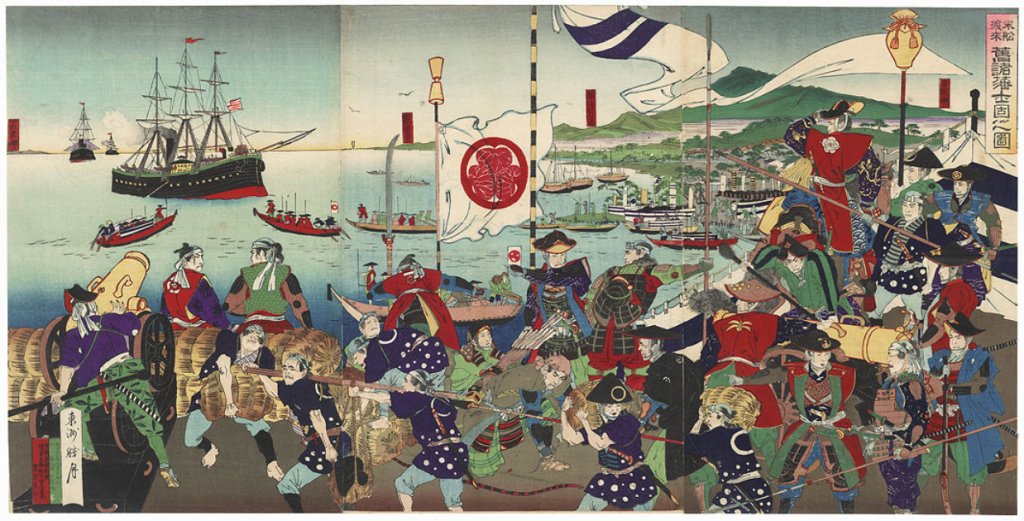
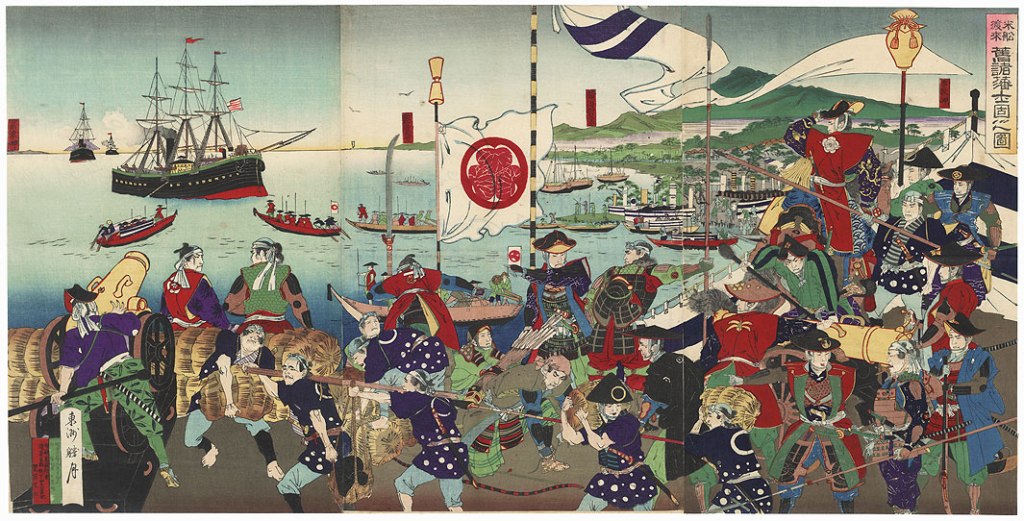
The push toward modernization was not born of internal reform alone. In 1853, Commodore Matthew Perry arrived in Tokyo Bay (at the time, Edo Bay) with a fleet of American warships: the infamous “Black Ships.” The military imbalance and resulting treaties exposed the Tokugawa Shogunate’s vulnerability and shocked the country into action. Reformers feared Japan would share the fate of colonized nations like China, which had been exploited by Western powers.
Historical woodblock print depicting the entry into Edo Bay of Perry’s “Black Ships”
In response, the Meiji Restoration from 1868 marked a deliberate and sweeping effort to transform Japan into a modern nation-state. Leaders pursued a course of “defensive modernization” (e.g., Trevor Getz, “Meiji Restoration: Japan’s Industrial Revolution“): building a conscript army, overhauling the tax system, and reforming education. But modernization also required a new kind of citizen, an individual who was literate, obedient, and nationally conscious. The redefinition of the self was thus as much a political imperative as a philosophical project.
The Viscount and the Inn Register
The anecdote in question involves the narrator’s uncle, an aristocrat bearing the title of Viscount (shishaku). Upon feeling slighted at an inn, he signs the guest register using the term shinheimin, which translates as “new commoner.”
While humorous on the surface, the act amounts to a trenchant piece of social commentary. The term shinheimin referred to the reclassified descendants of outcast groups (“eta” and “hinin”) who had occupied the lowest rungs of Tokugawa Japan’s rigid social order. Although these designations were officially abolished in 1871 during the Meiji government’s efforts to modernize and unify Japan, the new classification of shinheimin continued to stigmatize and segregate. (See James Miura, “Birth of the Outcaste in Tokugawa Japan“, PDF.)
Despite its aim to enhance the status of previous outcastes, the Meiji government’s revision of the koseki household registration system preserved certain pejorative distinctions. In practice, the term shinheimin (“new commoner”) marked someone as a former outcaste, preserving their underclass status despite formal reform. By signing himself as he does, the uncle accuses the inn of having treated him with extreme disrespect.
For a Viscount to claim this status was to invert the hierarchy, not as satire, but as a statement of protest. He was using the most pejorative term available to underscore his indignation and to show that, in his view, the inn’s treatment had violated not just his personal dignity but the social order itself.
The Koseki and the Codification of Status
This brings us to one of the key bureaucratic tools of Meiji modernity: the koseki (family register). Following the 1871 Kaihorei (Emancipation Edict), former outcast groups were reclassified as shinheimin (“new commoners”). Yet in practice, the new label was frequently used in ways that preserved discrimination, and the 1872 koseki system often recorded social origins in forms that enabled continued exclusion. (See Chapman, “Geographies of Self and Other”).
Definition: The koseki is a national family registration system instituted in 1872. It was designed to record the names, birthplaces, and familial relationships of every Japanese citizen.
Purpose:
To centralize population data for taxation, conscription, and education
To unify a fragmented society under a common administrative structure
To serve as legal proof of identity, family relations, and nationality
Problems:
Despite its claim to abolish class distinctions, the koseki often preserved old hierarchies
Shinheimin and former outcastes were labelled in ways that perpetuated discrimination
Individual identity was defined by the ie (patrilineal household), subordinating autonomy to familial and patriarchal control
The koseki thus represents a paradox: it was a modernizing force that enabled the Meiji state to govern effectively, but it also codified social exclusions that persisted well into the twentieth century and, in some cases, have left lasting effects on social mobility and discrimination that contradicted the very ideals of equality and unity it claimed to promote. Mushanokoji’s anecdote in The Innocent underscores this inherent contradiction.
The Kazoku: A New Aristocracy
Jibun’s Viscount uncle belongs to the kazoku, a hereditary peerage class established after the Meiji Restoration. Mushanokoji’s uncle and his father were, indeed, members of this nobility in real life, their father having been a senior court noble (Kugyo) under the Tokugawa regime. Formed by merging the former court nobility (kuge) and feudal lords (daimyo), the kazoku had five ranks: Prince, Marquess, Count, Viscount, and Baron. Its creation was meant to:
Reward loyalty to the imperial cause
Provide a political elite for the new constitutional order
Recast old power holders as allies of the modern state
Yet, like the koseki, the kazoku system reveals the contradictions of Meiji modernization. In place of dismantling hierarchy, it replaced old feudal titles with Western-style aristocratic ones, perpetuating privilege under a new guise.
The Reorganization of Self
One of the less immediately visible aims of Meiji reform was to cultivate a new kind of subject: the autonomous, responsible individual citizen (kokumin).
This was not merely a philosophical goal. It was instrumental:
A modern nation-state needed disciplined soldiers, literate taxpayers, and educated workers
Citizens had to think of themselves as individuals tied to the state, rather than vassals tied to a lord
Yet this ideal of individuality clashed with the reality of the ie system, in which the household head had legal authority over all family members, and personal identity was defined relationally rather than independently.
This contradiction is central to The Innocent, which uses its confessional, first-person narrative form to dramatize, in a sense, the emergence of a modern, autonomous self. As an I-novel (shishosetsu), it is uniquely suited to explore the tensions between inherited social obligations and the evolving demand for individual subjectivity in a rapidly modernizing society. The novel probes conscience, personal love, and emotional conflict in ways that challenge traditional roles. In doing so, it participates in the birth of the I-novel: a literary form devoted to introspection and self-expression. By 1910, this broader project had become an aesthetic and ideological aim of the “White Birch” literary society (Shirakaba-ha), a humanist-leaning group co-founded by Saneatsu Mushanokoji that championed individualism, ethical idealism, and Western liberal thought.
Conclusion: Literature as Reflection and Critique
The uncle’s sardonic use of shinheimin may seem like a personal joke, but it encapsulates much more than social wit. It crystallizes the paradoxes of Meiji-era social engineering, serving as a literary flashpoint for the contradictions at the heart of Japan’s modernization. As a pivotal moment in an early I-novel, it not only signals protest against entrenched hierarchies but also foregrounds the emergent self-consciousness central to the genre’s role in articulating an autonomous individual subjectivity.
The Innocent is not a political tract, yet it is deeply political. Its quiet tone belies the depth of its insight into the nature of modern Japanese identity. As an early I-novel, it stands at the threshold of a new literary and philosophical era, one where the personal was never merely personal, but bound up with the transformation of Japanese society itself. By examining a single symbolic moment, we gain access to the larger forces that shaped modern Japan – and its “modern self.”
Followed by his colleagues from the Peers’ School, Mushanokoji began publishing Shirakaba in 1910, which was to become the most important literary magazine of early twentieth century Japan. He had graduated from the Peers’ School, then withdrawn from Tokyo Imperial University in 1907. Shirakaba means “White Birch,” in reference to the white birches that appear plentifully in Japan, but are even more overtly symbolic in Russian literature.
This post in the Exploratory Companion will sketch out elements of the literary and lived forms of Mushanokoji’s evolving humanism, from his Tolstoyan beginnings, through Maeterlinck, and culminating in his literary philosophy and social experiment at Atarashikimura village. I aim to explore the broader global context for his development. It’s not only via his attachment to the metaphysics of Maeterlinck that THE INNOCENT speaks so accessibly to modern readers, nor only through its avant-garde characteristics, but also because of his position in this ongoing historical movement of “East-meets-West” humanism and peace.
Rousseau – Tolstoy – Gandhi: evolving world vision
The title Shirakaba resonates with the influence exercised upon the young Meiji intelligentsia by the great Russian author Count Leo Tolstoy (1828 – 1910), through ideas communicated to them by Mushanokoji himself. This influence extended not only to the field of literature but also into social and community idealism, and Mushanokoji’s founding of the village of Atarashikimura, to embody his ideals and teachings. (Rekolektiv, “Atarashikimura in Interwar Japan”).
To outline the origins of a broader humanistic movement of which Mushanokoji’s work is one manifestation, we would look to Jean-Jacques Rousseau (1712 –78), whose critique of social inequality and ideas about education and the nature of humanity captivated Tolstoy from the age of fifteen. The opening up of a secluded Japan and its potent interaction with Western culture during the Meiji period provided fertile ground in which these ideals could evolve in a fascinating direction.
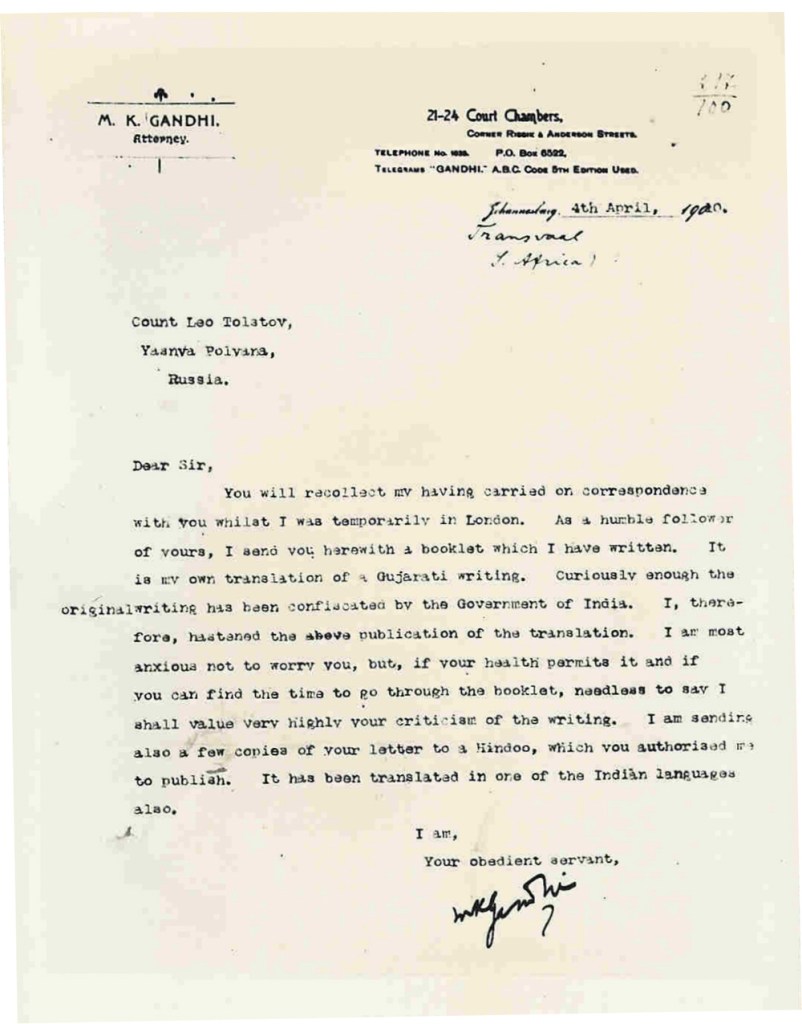
Facsimile of 1910 letter from Gandhi to Tolstoy (UHM Library)
Tolstoy’s contribution to the broad politics of peace and non-violence was, of course, immense, and magnified through his relationship with Mahatma Gandhi (1869 –1948). In his autobiography The Story of My Experiments with Truth (1925-29; 161), Gandhi wrote that he was “overwhelmed” by the Russian’s reinterpretation of Christianity, due to its “independent thinking, profound morality and […] truthfulness.”
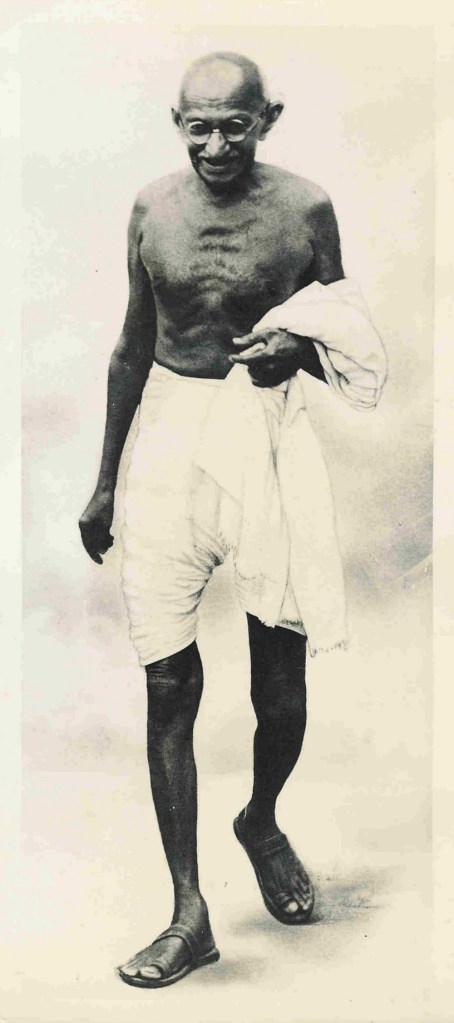
“The Mahatma” 1945 (UHM Library)
Tolstoy’s 1908 “A Letter to a Hindu” instigated an ongoing correspondence between the two great luminaries. In 1910, the Mahatma established a cooperative settlement in South Africa, naming it Tolstoy Farm, which was to be a model for self-sufficient, communal living, and training in satyagraha — a commitment to truth, non-violence, self-suffering, courage, conviction, and self-discipline.
Aristocratic obligation and presumption
The youngest of eight sons of a Japanese Viscount, Mushanokoji turned to Leo Tolstoy for literary and humanitarian inspiration, fueled by a sense of social obligation that inhered in his aristocratic birthright. During what is sometimes called his “Tolstoy craze” late in his adolescence, Mushanokoji had emulated the ascetic lifestyle that Tolstoy espoused, by living in a small, unheated hut on his family’s estate, “wearing simple clothes and leaving the stove unlit.” Indeed, because of their privileged origins, Mushanokoji and his Peers’ School colleagues received criticism in Japan as being immature and dandyish dilettantes, despite or perhaps even because of the charitable acts that several of them exhibited in response to social inequality, such as Arishima Takeo, who gave his family farm in Hokkaido to its tenants as cooperative owners (Yiu 218).
Mushanokoji’s uncle provided his nephew with recently translated Japanese editions of Tolstoy’sThe Kingdom of God is Within You (1894) and other works by Tolstoy, and also introduced him to the Bible:
Mushanokoji’s host – his reclusive uncle Kadenokoji Sukekoto – was far from fashionable. After suffering a series of financial setbacks, Kadenokoji had retired to live alone on his sole remaining estate. He worked in his fields in the daytime and spent the evenings studying sacred texts and discussing them with Christian pastors and Buddhist monks. His eclectic spirituality set an example for his nephew, who would also spend his life gathering ideas from diverse sources.
Anna Neima, The Utopians: Six Attempts to Build the Perfect Society (118).
Viscount Sukekoto Kadenokoji (1860 –1925), 1913
Mushanokoji was indeed greatly inspired by Kadenokoji. It is unlikely, however, that the compassionate and amusing portrait of Jibun’s uncle in Chapter 7 of THE INNOCENT is specifically him, since he died from kidney failure at the age of 65, whereas the uncle in the novella dies from cancer at 45 or 46. Recall, however, that Jibun’s father appears in the novella, even though the fact is he died when the author was an infant; so the possibility remains that Jibun’s uncle may be based on Kadenokoji.
It is perhaps fairly natural to suspect the compassion that privileged individuals extend to those below. For some, the image of Marie Antoinette dressing up as a peasant in her rustic hamlet in the grounds of the Château de Versailles prefigures an inauthentic spectacle of the aristocrat Tolstoy assuming the guise and lifestyle of his peasants, from which he always had the freedom to withdraw.
Not to be too glib, however: Buddha himself, Siddhartha Gautama, was an aristocrat who, in his “Great Renunciation,” gave up his wealth, family, and social status to become a wandering ascetic.
Shadow of Buddha: eclectic spiritual roots of a humanistic ideology
Tolstoy deeply respected Asian culture, and his ideology is redolent with Eastern thought. His interest stemmed from an early experience at age nineteen, when he met a Buddhist monk in a hospital in Kazan, who had been robbed and assaulted violently, but had not fought back, adhering to the principle of non-violence (Kamalakaran).
The encounter had a profound effect on Tolstoy, fostering his lifelong interest in Buddhism and other Eastern teachings. He experienced an existential crisis in his mid-50s, which he described in his autobiographical A Confession (1880), when, after having achieved wealth and fame, he found life lacking in meaning. Tolstoy became disillusioned with traditional Christian churches, believing they had corrupted Christ’s message. While his resulting “new faith” was not explicitly Buddhist, it marked a significant sympathy with Eastern philosophies. (See Kamalakaran, “The influence of Buddhism and Hinduism on Leo Tolstoy’s life” – Russia Beyond.)
Tolstoy engaged further with Buddhism in an 1889 essay, “Siddartha, Called the Buddha, That is the Holy One,” and expressed Buddhist ideas in his correspondence, discussing concepts such as karma and reincarnation. Towards the end of his life, he contributed an article on the Buddha to his anthology “The Circle of Reading” (1906) and translated the American Paul Carus’s (1852 – 1919) story “Karma” into Russian.
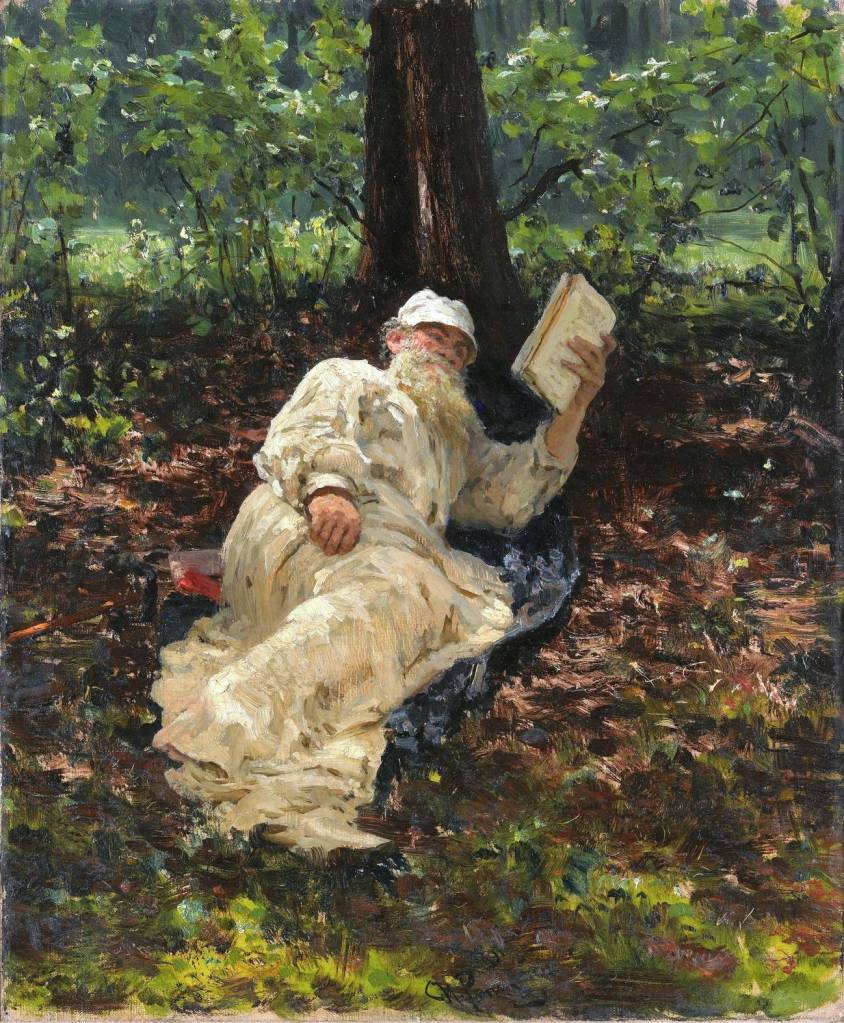
Tolstoy Resting in the Forest, Ilya Repin, 1891
His adoption of vegetarianism, championing of non-violence, and attempts to live a simpler life demonstrate an affinity with Buddhist practice. Ultimately, the philosophy he developed, known as tolstovstvo, containing a core concept of mankind living in peace, harmony, and unity, and which also encompassed his rejection of luxury and opposition to the exploitation of peasants, is in keeping with Buddhist ideals.
Subsequently Tolstoy engaged in further Japanese projects, particularly in the context of agrarian and utopian movements. He collaborated with Konishi Masutaro, a Japanese Orthodox priest, on a translation of the Daoist text, the Daodejing, which they both saw as “an escape from state authoritarianism” and a step towards a “‘new universal religion’ based on Tolstoyanism” (Johnson, “Displacements: Current Work on Japanese Modernism”). Tolstoy’s concern with the peasantry and agricultural reform became a significant legacy in Japan, influencing movements described as “agrarian-Buddhist utopianism” (see Shields).
Mushanokoji explored Buddhism explicitly to some extent in later life, presenting the Buddha as a “human” ideal in his popular work Life of Shakyamuni Buddha (1934; ctd. in Shields). Mushanokoji’s explicit intention here was to emphasize the “human” Shakyamuni, portraying him as an ideal figure lauded for his insight and compassion, someone who possessed a natural innocence, described as “the heart of a child” (akago no kokoro). He portrays Buddha as a valuable model for human behavior, one stripped of mystical elements. Mushanokoji included Shakyamuni Buddha in a pantheon of “masters” alongside Jesus Christ (whom he saw as a “man with a pure, pure heart”), philosophers, writers, and even literary characters, all of whom served as models of human “liberation” (Shields).
…“the Buddha” functions [for Mushanokoji] as a representative of a complex of humanist ideals, including a religious understanding rooted in common sense and compatible with modern science, one that rejects social discrimination and institutional hypocrisy, and looks to nature itself as a source for liberation.
Shields, “Future Perfect: Tolstoy and the Structures of Agrarian-Buddhist Utopianism in Taisho Japan”
Mushanokoji’s utopian vision thus blended liberal-humanist ideals evolved from Buddhist, Christian, and Western philosophical traditions. Shirakaba writers compiled a list of idealist “masters” whom they admired, including Christ, Buddha, Confucius, St. Francis, Rousseau, Carlyle, Whitman, and William James. Interestingly, in her book, Meeting the Sensei: The Role of the Masters in Shirakaba Writers, Maya Mortimer asserts that in rejecting all (positivistic) “-isms,” the Shirakaba “masters” embody a “way of unlearning” or a Zen-like methodology (ctd. in Shields).
Subversive philosophy of self-love
In an explicit doctrine of egoism (jiko shugi), Mushanokoji advocated one’s complete subordination to the Self:
Our present generation can no longer be satisfied with what is called “objectivism” in naturalist ideology. We are too individualistic for that . . . I have, therefore, taught myself to place entire trust in the Self. To me, nothing has more authority than the Self. If a thing appears white to me, white it is. If one day I see it as black, black is what it will be. If someone tries to convince me that what I see as white is black, I will just think that person is wrong. Accordingly, if the “self” is white to me, nobody will make me say it is black.
Mushanokoji, “Art for the Self” (1911), qtd. in Shields
THE INNOCENT brilliantly embodies such a subjective gesture. In what I have called Jibun’s “spiralling inwards,” he is drawn towards the phantasm of his beloved, the girl Tsuru. That is, she is rendered as a symbol of an ideal love, which is ultimately perceived as his love for himself, which he realizes he is unable to sacrifice for her sake (See previous posts and Translator’s Preface to THE INNOCENT).
Portrait of Mushanokoji Saneatsu by Tsubaki Sadao (1896 –1957), 1922
As discussed in previous posts, Mushanokoji’s humanistic perspectives were greatly influenced as well by the Belgian writer and philosopher Maurice Maeterlinck, with a primary emphasis on self-love and the cultivation of the individual self. Mushanokoji declared in an early issue of the Shirakaba journal, on the struggle of attaining a free individuality:
I only understand myself. I only do my work; I only love myself. Hated though I am, despised though I am, I go my own way.
Mushanokoji in Shirakaba (1912), quoted in Gennifer Weisenfeld, MAVO: Japanese Arts and the Avant-Garde, 1905–1931 (Berkeley, CA; Los Angeles, CA; London, 2002), 22
Thus Mushanokoji’s thought evolved in a direction away from the ideal of self-sacrifice associated with his earlier Tolstoyan influence. Maeterlinck’s metaphysical vision validated an insular, contemplative life. It equipped Mushanokoji to make a literary inward turn to autobiographical fiction and to embody the inner trajectory in literary form.
A brilliantly original achievement in THE INNOCENT lies in how the author explores multiple implications of such an introjection of objective reality, preserved ironically in an accessible naturalism. In so doing, Mushanokoji adapted Maeterlinck’s philosophy of self-love, encouraging individuals to conduct themselves as individualistic moderns, living for their own pleasure, and writing about the process of exploring their own natures. Mushanokoji came to adopt a pivotal point of opposition between Tolstoy and Maeterlinck: that we must love ourself in order to love others:
In an essay titled Jiko no tame oyobi hoka ni tsuite (For My Own Sake and Other Things, 1912), [Mushanokoji] paraphrased Maurice Maeterlinck (1862–1949) and wrote, “Even if you were told to love your neighbor, you must first learn to love yourself. Moreover, it is not sufficient to love your neighbor as you love yourself. You must love yourself in others”
Mushanokoji “For my own sake and other things” (1912), qtd in Angela Yiu, “Atarashikimura: The Intellectual and Literary Contexts of a Taishō Utopian Village,” Japan Today
Mushanokoji’s exploration of identity and self-cultivation in THE INNOCENT and later writings became a key early expression of a cultural phenomenon of the time — a so-called “cult of self-love.” It became a popular mindset among Japanese youth, even prompting government concerns. School texts were rewritten, with the idea of preventing hedonistic individualism from undermining loyalty to the state. Conservatives fumed that Western ideas were destroying Japan’s social cohesion, and that traditional values of piety and loyalty had to be revived (Yiu).
“Twin Desires”: I-novel and village utopia
Atarashikimura can be read as the continuous augmentation of an ego that seeks to make its impact felt not only on the pages of a book but literally on earth. The village, like his art, is created “for the sake of the self ” (jiko no tame), and is thus the ultimate act of self-expression.
Angela Yiu, “Atarashikimura: The Intellectual and Literary Contexts of a Taisho Utopian Village.”
In 1918, in an effort to embody his ideals and teachings, Mushanokoi established a utopian village community in Japan: Atarashikimura (“New Village”). Mushanokoji’s social project was in the spirit of Tolstoy’s school for peasants at his estate of Yasnaya Polyana (“Bright Meadows”) (Rekolektiv). Atarashikimura can be described not merely as a social experiment but as an instance of an “I-novel” sensibility given physical form: “Atarashikimura is an I-novel written not in the pages of a book but in an actual geographical dimension” (Yiu). Still operating today, though relocated from its original site in Miyazaki prefecture to Saitama prefecture in 1939, the village embodies Mushanokoji’s egoistic and creative vision. It’s about an hour and a half from Tokyo.
Today, the village continues to operate based on original principles of communal living and the pursuit of art and culture, fulfillment of each individual’s destiny, and the importance of each person’s individuality. Residents, currently numbering around twenty, contribute six hours of compulsory labor per day. (Members living outside the village can contribute funds.) The remaining time is for the free pursuit of truth, virtue, beauty, and personal interests aimed at actualizing one’s authentic self. Villagers receive an allowance from a collective fund for their daily needs (see Yiu).
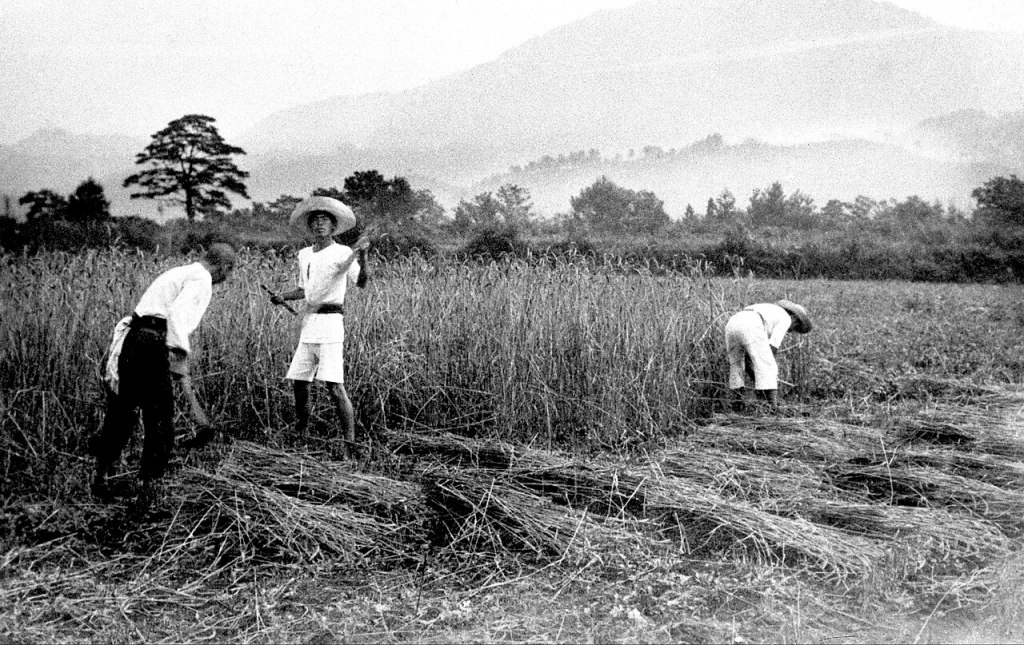
The harvest wheat in Atarashikimura, 1919. Mushanokoji is facing the camera.
When Mushanokoji founded Atarashikimura, during the late Meiji and Taisho eras, or from around the end of the nineteenth century to the mid-1920s, a period in Japan saw the rise of kyoyo shugi, an emphasis on holistic personal development, intellectual cultivation, assimilating ideas from Western humanism, which influenced groups such as the Shirakaba-ha. The concept can be translated as “liberal arts” and is linked as well to the German concept of Bildung, which emphasizes intellectual and personal self-cultivation. Alongside this development at the time was a growing exploration of the inner self, as propounded by Mushanokoji.
The I-Novel and Inner Exploration
Crucially, this period also witnessed the emergence of the I-novel (shishosetsu), a genre of which Mushanokoji’s THE INNOCENT is a seminal exemplar. The I-novel is characterized by its intensely self-oriented nature and the cultivation and assertion of the ego as the ultimate authority. The I-novel marks a strong focus on interiority in fictional writing, as we see clearly in the case of THE INNOCENT, with the novella’s single-minded exploration of identity and self-cultivation.
Angela Yiu describes how Mushanokoji’s aspirations in literary art and his wish to create a new world, a utopian community, were his “twin desires,” such as he expressed in his 1921 autobiographical novel Aru otoko (A Certain Man). In an article entitled “Art for Oneself” (1911), at around the same time as THE INNOCENT, he wrote: “I go all the way to create art for the sake of oneself.” The thought process of Jibun in THE INNOCENT demonstrates his arrival at this same conviction of Mushanokoji’s: a sentiment that extended to his village project. Atarashikimura can be viewed as “[Mushanokoji’s] most invested work of art, a sakuhin {work] that is created for the sake of maximum self-expression” (Yiu).
“Imperialistic Egoism” and the Village
Saneasu Mushanokoji’s philosophy involves a complex blend of influences, including a tension between his declared admiration for Leo Tolstoy and a contrasting development of what Yiu calls an “imperialistic egoism.” In THE INNOCENT, the ego is clearly presented as undergoing an all-encompassing expansion, to the extent that even the beloved character Tsuru is beyond actual reach, but merely an internal phantasm. In attempting to mitigate such an extreme degree of aggrandizement, we may bear in mind Maeterlinck’s own formulation from his book Wisdom and Destiny (1898):
Tolstoy’s ideas on humanism, equality, communal living, and labour profoundly influenced Mushanokoji throughout his life, though Mushanokoji selectively adopted or reinterpreted these ideas to accommodate a philosophy centered on the assertion and cultivation of the self, as advanced by Maeterlinck. Mushanokoji’s is a more progressive ideal than Tolstoy’s, validating aspects like
[…] lust, sex and pleasure-seeking as essential, even moral, components of human existence … This new philosophy of hedonistic egotism was the second of the two strands that Mushanokoji would eventually weave together to form his utopian ideology, combining it with the socially minded influence of Tolstoy and Christ.
Neima, 125
In Chapter 5 of THE INNOCENT, a still “prudish” Tolstoyan Jibun debates the opposition with his libertine, Maeterlinckian visitor:
“You speak from the female perspective, as one would expect from a prude,” he said. “But a healthy man has rights as well. Someone who takes pleasure in life is entitled to do so, without having to go around like some kind of sexual invalid. You, as a scholar, should not derive satisfaction from the plight of the weak. I will not accept the idea that healthy people should be condemned for complying with the demands of nature and enjoying themselves.”
Mushanokoji adapted the philosophy of self-love into a literary philosophy focused on exploring the transcendent extent of one’s own self. His celebration of the self is a crucial element reflecting his philosophical evolution during the period leading up to THE INNOCENT. A model of the Japanese I-novel genre, the novella is marked by an overwhelming emphasis on the subjective perspective and assertion of the ego.
The concept of what Yiu calls Mushanokoji’s “imperialistic egoism” may be further debated in the context of his utopian commune, Atarashikimura. She argues that the village can be read as a physical manifestation of a creative ego seeking to “make its impact felt not only on the pages of a book but literally on earth.” For Yiu, this strong sense of self implies eliminating the difference between self and others by “subsuming others under an overpowering self”. The observation aligns with Mushanokoji’s assertion that “there is no authority above the self.“
The idea of a central “self” encompassing or projecting onto others within the communal setting resonates with the theme of solipsism found in his literary works. This is particularly so inTHE INNOCENT, in which the narrator reduces the figure of the “other” (his beloved Tsuru in this case) to a mere projection of “projection of fantasies and desires, entirely lacking in agency (Lippit, 14).
In his Topographies of Japanese Modernism, Lippit considers that Mushanokoji’s “discursive rendering of the relationship between self and other,” where the Other is reduced to a “phantasmal image,” not only provides a framework for Mushanokoji’s fiction, but also his “consciousness of modern culture” (Lippit 14). The village, as Mushanokoji’s “most invested work of art […] created for maximum self-expression” and an I-novel written in a “physical reality,” reflects this same tendency for the individual self to be the ultimate frame of reference, potentially overshadowing the independent reality and experiences of others.
The concept of “imperialistic egoism” encapsulates a fascinating paradox within Mushanokoji Saneatsu’s work: the transformation of personal idealism into a broader social project. In the I-novel form, this egoism seems not only ideologically tenable but formally generative — THE INNOCENT thrives on the inward-turning journey of the self, with its solipsistic implications often turning into a source of ironic humor. The exaggerated isolation of the protagonist, driven by self-absorption, becomes a way of exploring human vulnerability, and this humor lends the text a certain playfulness while deepening the existential weight of its themes.
However, when these same “imperialistic egoism” impulses are extended into the practical framework of Atarashikimura, their implications seem less straightforward. The utopian vision powered by a single, dominant self could, at least hypothetically, run the risk of reproducing some of the hierarchical dynamics it was meant to challenge. The tension between the ideal and the real seems to suggest that what enables the author’s literary world — the expansive self — might not seamlessly translate into a sustainable communal project. It remains uncertain whether this “imperialistic egoism,” when enacted outside the literary realm, would promote true cooperation or potentially veer into paternalism, revealing the complex balancing act between idealism and pragmatism that such a project sets in play.
Yiu, Angela. (2008). “Atarashikimura: The Intellectual and Literary Contexts of a Taishō Utopian Village.” Japan Today 2008, 20: 203–230. PDF freely available.
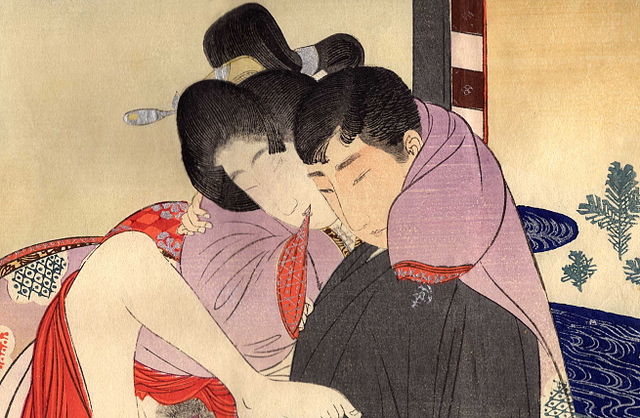
In Chapter Three, Jibunattends an alumni reunion, where he is offended by some of the mildly off-colour gossip shared by his former classmates. His beloved Tsuru is not far from his thoughts at any time, an object of absolute purity. I have borrowed an anonymous erotic artwork from late in the Meiji era (1868-1912), in emphasizing the perceived contrast with his more lewd acquaintances, though despite Jibun’s disgust, they actually seem quite tame. It is interesting to note the short haircut of the man, which marks the image clearly as Meiji, a period when Japan was rapidly absorbing Western influences, fashions, and technologies.
This particular genre of art is calledshunga, and dates from the fourteenth century. Shunga means ‘spring picture’ — ‘spring’ being a euphemism for ‘sex’. The brilliant artist Hokusai was famous for his shunga prints, as well as for his ukiyoe (‘pictures of the floating world’).
A man with a Western-style haircut makes love to a woman in traditional Japanese dress. Shunga print, 1880 (anon)
In this chapter of the Exploratory Companion, let’s begin to consider a little of Jibun’s and Mushanokoji’s philosophy. As well, I’d like to look at the introduction and evolution of transport technology in Japan, and in particular Tokyo. What a superb system it has become. We can still see the Meiji slogan in action: “Japanese spirit, Western techology”!
Jibun as a ‘moral philosopher’
The term dogakusha, which Jibun uses to describe his “occupation” as a “moral scholar,” literally translates as “scholar of the way” — the (Chinese) way of the Tao, as in Lao Tzu’s Tao Te Ching (“the way of integrity”). Strictly speaking, it means “Taoist scholar,” which is inapt here. By late Meiji, the term could refer to a Confucian philosopher or simply a moralist. It also took on a mocking connotation, describing an eccentric scholar so preoccupied with morality and reason as to be oblivious to worldly affairs. To some extent, Mushanokoji seems to be poking fun at himself in adopting this role (See my noteto Translator’s Preface, The Innocent). His philosophy is a free-sprited amalgam of ideas from East and West.
Here one may find the spirit of masculine fortitude comparable to Nietzsche’s amor fati [Lat. ‘Love of one’s fate’] but Saneatsu’s affirmative attitude has more affinity to the meditative state of mind, typical of the Zen sect, attained by the Oriental sages.
Okazaki (Toyo Bunko) 312
Musha-ism: Happiness Through Self-Transcendence
The alumni meeting scene explicitly raises Jibun’s philosophical aspirations. Yoshihiro Mochizuki’s MA thesis on Musha-ism — Mushanokoji’s theory of happiness — proves a useful reference, in its framing of happiness as a function of self-transcendence: transcendence effected via the self.
Our marriage would make a good topic for gossip, and those fools [the alumni] might still try ridiculing me.
If they did, I would answer them like this:
“Yes, it was love at first sight and we married. I am sorry to say that I cannot be interested in as many women as you are because I know something of true love. I cannot do everything.”
While I spoke, I would make an expression as though I were biting through a bitter-tasting bug. It would be most awkward. Yet I am unable to rise above reacting like this.
If I am able to transcend that, I am already no longer a moral scholar. No longer an educator.
The Innocent, Ch. 3: 33
Mochizuki examines Musha-ism as a philosophy of happiness, defined as self-cultivation and self-transcendence. He identifies two levels in The Innocent: a deeper philosophical aspect and a more superficial narrative of Jibun’s pursuit of Tsuru, in which he relegates her to a purely subjective sphere.
Whenever I see a female student of her age, or a woman coming from a distance, or a woman from behind, whatever the time or place, I wonder whether it might be Tsuru. I can notice this tendency increasing, little by little. Ten times out of ten it would not be her.
And yet still I wonder.
Ch. 3: 30
Rather than attempt to prescribe any specific (and inevitably somewhat arbitrary) reading, it may be more productive in general to consider how a reader is free to receive elements from these levels, assembling one’s own interpretation. Such an approach would well align with Mushanokoji’s own progressive aims. His author’s dedication for The Innocent, for instance, privileges the reader’s free response:
I believe in a selfish kind of literature, a literature for its own sake. It is only in accord with this idea that I desire to be an author. The value of my writing is determined by the degree to which it can harmonize with the reader’s own individuality. I am not entitled to demand that people unable to empathize with me should buy or read what I write.
Glancing at a few elements of Musha-ism in The Innocent will suffice to give us a notion of the author’s intentions. For a comprehensive view, we can turn to Mochizuki’s thesis.
The Shirakaba Group and the Cultivation of the Self
Mushanokoji was a founder and leading figure of the Shirakaba-ha (White Birch Society), a literary coterie at the Gakushuin (Peers’ School) in Tokyo, whose members included several prominent writers. Under his leadership, the Shirakaba group “led the humanitarian movement of the Taisho era” (Toyo Bunko, Okazaki comp., Japanese Literature in the Meiji Era, 1955). As an elite group of aristocratic youths in their early twenties, they faced minimal restrictions on their artistic ambitions. Their philosophy centered on art for art’s sake and self-cultivation — transcendence through the self — with a pronounced avant-garde inclination.
What is of utmost importance is my Self, the development of my Self, the growth of my Self, the fulfillment of my self in the true sense of the word… I love Power, I love Life, I love Thought. But that is all because I love my Self, because I want to develop my Self, and want to give life to my Self…. I will not sacrifice myself for anything. (52-3)
Qtd. in Tomo Suzuki, Narrating the Self: Fictions of Japanese Modernity (Stanford, Calif.: Stanford UP, 1951)
Subtle avant-garde elements of The Innocent have tended to marginalize it, accounting for a lack of interest from potential translators. Missing the point, certain types of reader have dismissed the novella as confused and immature, misconstruing its disarming self-parody. Fortunately, at the same time, these progressive characteristics appeal to a late modern, who has become historically conditioned to them. To such a reader, the novella offers a vital doorway into a dynamic experience of the Meiji imagination.
Besides mere primitive simplicity, [The Innocent] displays also a considerable degree of self-consciousness, self-analysis, and self satirizing. In a sense, Saneatsu seems to have been presenting such a pointless sort of comedy knowingly. He seems also to have resigned himself to the destiny of human beings who are impressed with their own goodness while satirizing themselves, and obliged to live after all by approving of their behavior just as it is, even though they sometimes try to deny themselves.
Okazaki, Toyo Bunko 312
Such a total immersion in the Self is evident in the way Jibun’s love for Tsuru is circumscribed in his own subjectivity. He places her on a pedestal of the ideal, while remaining anonymous and never even speaking to her.
Unfortunately, I crave a beautiful young woman. I have not even spoken to one since Tsukiko, my crush when I was nineteen, returned to her hometown seven years ago, and now I hunger for a woman.
It is an almost absurdist feature of the story, this apparent descent into solipsism — being completely bound up in the self. Moreover, as we will see, the untenable existential situation will inevitably place Jibun into conflict with his idealistic love for Tsuru: just what sacrifices would he be prepared to make for her, if any? He is caught in something of a vicious cycle or reductio ad absurdum, without realizing it.
How terrible it would be for her to come to me feeling she would be happier somewhere else!
If she were to accept my proposal joylessly, then I would have to withdraw it. By nature, I am a moralist.
And as such, an extreme individualist.
I am against sacrificing myself in the slightest for the sake of another person and would be ashamed to sacrifice another in my own interest.
Ch. 4: 37
Jibun cannot help become an object of self-parody. This flows from his continual self-questioning and moralising, as much as from his obsessiveness about his beloved Tsuru, with whom he has never even spoken.
Yet Jibun remains a close proxy for the author, the utopian philosopher Mushanokoji himself. Towards the end of the chapter, in Jibun’s thoughts, I believe, can be observed a subtle ambivalence that lies at the heart of a serious aspiration to self-transcendence.
Musha-ism tends to produce an anti-naturalistic, what might be called “decadent” stylistic turn, particularly an opposition to a mechanistic idea of nature then holding sway (Okazaki, Toyo Bunko, 312). During his Tolstoyan phase, Mushanokoji had sought like his then luminary to “love his neighbor as himself”; his adoption of Maeterlinck’s ideas saw a shift in this attitude. Mushanokoji’s transition from following a Tolstoyan mode of humanism to Maurice Maeterlinck’s (see earlier Furin Chime posts on Maeterlinck) further involves a turn from self-denial and asceticism, to the affirmation of pleasure.
You are told you should love your neighbour as yourself; but if you love yourself meanly, childishy, timidly, even so shall you love your neigbour. Learn therefore to love yourself with a love that is wise and healthy, that is large and complete.
Maeterlinck, qtd. in Mochizuki, 46
As I argued in my posts on Maeterlinck, the various anti-naturalistic, humanistic, absurdist, and metaphysical thematics of The Innocent serve to make it quite accessible and sympatico with a modern reader, more than the theory of Musha-ism per se. Rather, it is thanks to Maeterlinck’s influence on Samuel Beckett and Beckett’s appropriation of Maeterlinck; and to the profound influence Beckett has had upon the human imagination since the 50s and 60s.
Locating The Innocent in time and space: Meiji-Taisho Tokyo rail
I should say a few words regarding a technical detail of translation.
Tokyo’s transportation landscape underwent a significant transformation during the Meiji and Taisho eras. It began in 1871 with the introduction of horse-drawn carriages, initially a luxury for the elite. Public horse-drawn carriages soon followed, providing transport within Tokyo and to surrounding areas. By 1882, horse-drawn trams, running on rails, gained popularity, but sanitation issues prompted a shift towards electric trams. This transition was marked by the Tokyo Basha Tetsudo (‘horse carriage’) railway’s conversion to electric power in 1903, becoming Tokyo Densha Tetsudo, with full electrification achieved by 1904. The city’s acquisition of the private tram (or streetcar) company in 1911, forming Tokyo Shiden (“city electric”), further solidified the electric tram network.
Trams queued at the south side of Ueno Park, Tokyo, late Meji Period (Sumitomo Mitsui Trust, Ueno Town Archives)
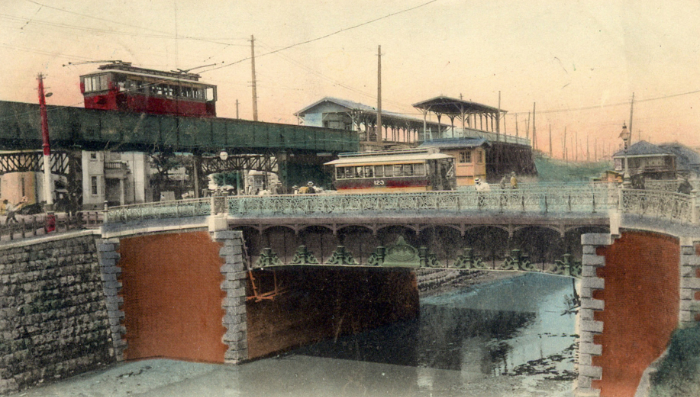
Note, however, that the Japanese word densha (“electric” + “car/carriage”) remained consistent throughout these changes, encompassing both trams and trains. In 1907, while electric trams served the inner city along street routes, incorporating significant stops like those near the imperial moat and Hibiya Park, the area Jibun walks through after buying the book, at the beginning of The Innocent.
This map shows the electric tram and train system of Tokyo in 1911. The circular red web in the middle comprises tram lines that follow street routes in central Tokyo: they radiate out from the Imperial Palace, whose moats are drawn in blue. In Chapter 1, Jibun walks around the south east corner of this complex (Hibiya Moat) to Hibiya Park. In 1911 the Kobu line is denoted as the Chuo line and runs from Kandabashi through Shinjuku and west to Nakano, where Jibun travels.
Several rail lines connecting more distant areas were under development. These included the Kōbu Railway, which later became part of today’s important Chuo Line. This line, serving western suburbs, had stations at Okubo, Yotsuya and Nakano, where Jibun travels to see his friend. This distinction between trams and trains is crucial for understanding the novella’s setting. In Chapter 7, Jibun provides a street address for a rail stop, a clear indicator that technically he’s using a tram, and not a train.
It’s important to remember that early densha, whether trams or trains, were often single carriages, much like trams. Thus, the physical form didn’t drastically change in the public consciousness.
“Introduction of Railway Technology,” Bureau of Urban Development, Tokyo
The photo shows precisely the model of densha that Jibun rides on the Kobu line — a 10-meter-long, four-wheel-car imported from England and used subsequently as trains by Japanese National Railways
The modern understanding of ‘train,’ with its etymological connotation of ‘a series of things drawn along behind,’ can be misleading. This is particularly relevant when considering the Kobu Line, which used electric ‘densha’ to connect suburbs to central Tokyo, and therefore could be considered a train, but was not the modern multi-car train. At the same, the station described in Chapter 3, with Jibun catching the Kobu line and alighting with Tsuru at Okubo, the platform, gates, and exit route are clearly more substantial than a neighbourhood tram stop.
Given the nuance of translating the word densha and the potential for misinterpretation, I’ve chosen to use “tram” in some places when referring to the Kobu Line. This decision is based on several factors: First, the physical form of the early electric densha closely resembled trams, particularly in their single-carriage configuration. Second, the term “tram” helps to differentiate these early suburban rail services from the modern concept of a multi-carriage “train.” Third, the use of “tram” allows for a more consistent and accessible reading experience, particularly for readers unfamiliar with the nuances of early 20th-century Japanese rail transport.
Suidobashi Station, c. 1910, showing a carriage (densha) on the elevated, electrified Chuo Line and a streetcar (densha) on Suiodobashi bridge (Old Tokyo)
While acknowledging the technical distinction between the Kobu Line as a railway and the city’s tram network, my aim is to convey the historical context and the lived experience of the characters as accurately as possible. The use of ‘tram’ in specific instances is a deliberate choice to bridge the gap between the historical reality and the modern reader’s understanding, aiming for a setting that accommodates the action authentically and accessibly. Admittedly, it should be possible to adjust future iterations of The Innocent to clarify the point I have indicated here.
First Steam Train Leaving Yokohama, 1872. Kunisada III (1848 – 1920)
geta: Japanese footwear, consisting of a wooden base held on by fabric straps, similar to ‘thongs’ or ‘flipflops’. They may be elevated by one or two so-called ‘teeth’. or wooden blocks.
koma-geta: a style of geta with low teeth.
seventeenth day of [the moon’s] cycle: Known as Tachimachizuki (‘standing and waiting’). As the moon rises progressively later during this phase, one has to ‘stand and wait’ for it to appear. See Rikumo Journal.
Mochizuki, Yoshijiro (2005). Rediscovering Musha-ism: The Theory of Happiness in the Early Works of Saneatsu Mushakoji, MA Thesis, University of Hawaii. PDF from U of Hawaii.
Okazaki, Y (compiler) (1955).Japanese Culture in the Meiji Era: Japanese Literature in the Meiji Era (Published by Toyo Bunko: one of the world’s five largest Eastern Studies libraries).
Shields, James Mark (2018). “Future Perfect: Tolstoy and the Structures of Agrarian-Buddhist Utopianism in Taishō Japan,” Religions9 (5), 161. HTML or PDF
Suzuki, T (1955). Narrating the Self: Fictions of Japanese Modernity (Stanford, Calif.: Stanford UP)
In my previous post, I referred to Jibun’s description of two women outside Maruzen bookstore as having “a round face, in a flowery kimono, heavily powdered,” assuming them “naturally” to be geisha. His casual observation raises an intriguing issue about the perception of physical beauty across cultures, which will afford us a diversion touching on some cultural ideas about female beauty.
The Round Faces of Jibun’s Nihonbashi geisha: changing ideals of female beauty
Laura Miller’s book Beauty Up: Exploring Contemporary Japanese Body Aesthetics (Berkeley: U of California P, 2006) is a useful place to start. She observes the female aesthetic ideal through history, beginning with Heian era literature (794–1185), primarily Lady Murasaki’s Tale of Genji and Makura no Soshi’s Pillow Book.
A court lady ideally had a pale, round, plump face with elongated eyes. The eyebrows were plucked and repainted somewhat above their original positions. Gleaming white teeth were thought to be horribly ghoul-like, so they were darkened. Positive assessment of chubbiness was also common, as in descriptors like “well-rounded and plump” (tsubutsubu to fuetaru) and “plump person” (fukuraku naru hito). Perhaps most importantly, a woman’s hair should be long, straight, and lustrous, reaching at least to the ground.
There are some who argue that at that time teeth were blackened with paint, in order to simulate tooth-decay: this showed that the woman was wealthy enough to afford sweets, in the same way that her plumpness would show that she could afford plenty of food. (See Hiroshi Wagatsuma [1967], “The Social Perception of Skin Color in Japan“. Daedalus. 96 [2]: 407–443.) In later times, a liquid made from iron filings dissolved in vinegar was used. This procedure of ohaguro was considered a dental sealant for preventing tooth decay.
Female beauty norms of the Edo period (1603–1867) are documented in an ukiyo-e genre called bijin-ga, or “portraits of beautiful women.” These are usually “courtesans with long, thin faces, fair skin, small lips, blackened teeth, thickset necks, and rounded shoulders” (Morris 21; and see Shinji and Newland; and Hickey).
See also:
Hamanaka Shinji and Amie Reigle Newland, The Female Image: Twentieth Century Prints of Japanese Beauties (Leiden: Hotei Publishing: 2000)
Gary Hickey, Beauty and Desire in Edo Period Japan (London: Thames & Hudson, 1998)
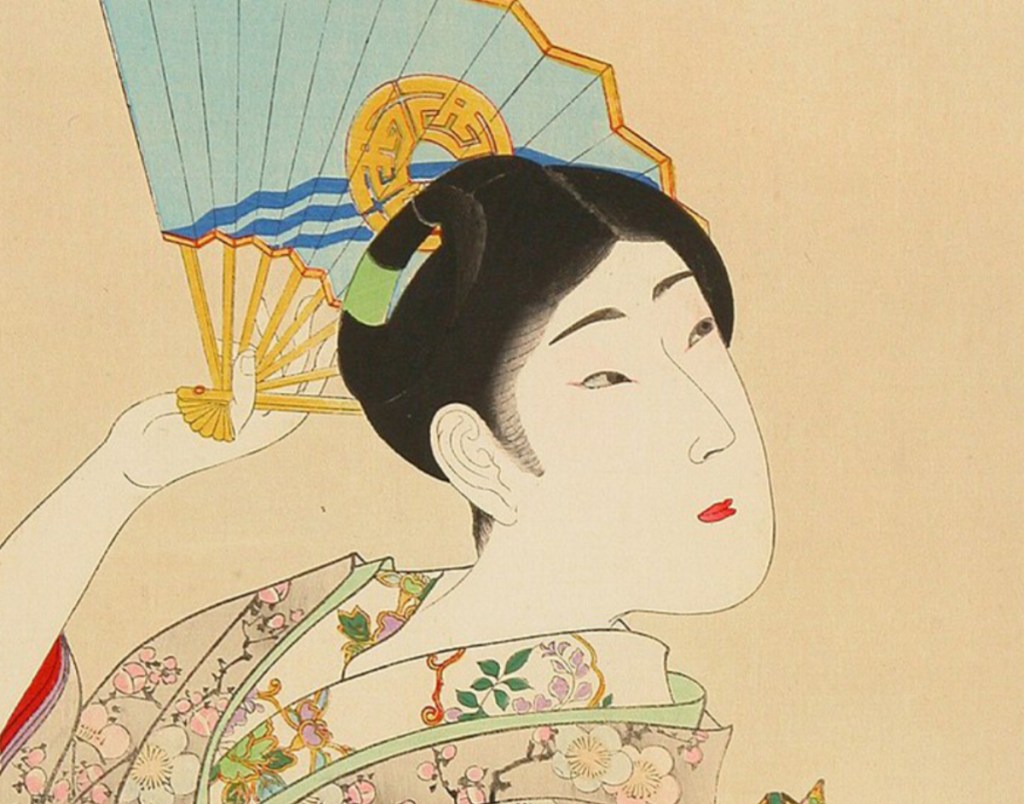
Actually, it is not so easy to find a “round face” among the bijin-ga. The following, by Yoshu Chikanobu is from 1897, well into the Meiji period (1868-1912), and shows its model holding her fan in a flamenco position, which is an emphatic marker of Westernization:
Perhaps part of the problem lies in how to reconcile the naturalistic look of a “round face” with the convention of the bijin-ga to depict its subjects as having long slender faces. There is a gesture made to “round” the face to some extent, about the chin and hairline; but one would have to describe the face more as “oval.” The bijin-ga subjects are sometimes referred to as conventionally having “rectangular” faces. At the same time, the curves in Chikanobu’s Shin Bijin may attempt to convey a degree of plumpness of the face perceived at three-quarter profile.
Still, Morris maintains that “Later artistic representations of beauties often showed petite women with round faces, straight eyes with flat eyelids, and small receding chins” (21). Furthermore, it seems to me that, in the case of a maiko, or apprentice geisha, the application of thick white makeup over the entire face, does tend to de-accentuate the protrusion of facial features, thus maximizing its perceived roundedness. Fully qualified geisha do not wear the opaque white makeup (once made from toxic lead, which was banned in 1934 and replaced with rice powder.)
Wagatsuma writes how, during the Edo period, aesthetic norms underwent a transformation: “Gradually, slim and fragile women with slender faces and up-turned eyes began to be preferred to the plump, pear shaped ideal that remained dominant until the middle of the eighteenth century” (15). However, there is a mention in a 1949 novel by Ibara Saikaku, of “A beautiful woman with a round face, skin with a faint pink color, eyes not too narrow, eyebrows thick, the bridge of her nose not too thin, her mouth small, teeth in excellent shape and shining white” (Koshoku Ichidai Onna [The Woman Who Spent Her Life at Love Making], Tokyo, 1949), p. 215.
In the following passage, the novelist Ishibashi Ningetsu describes a beautiful woman:
[I]f we see her from behind, she is slim and slender, with a long nape— her neck is thin and whiter than snow, standing tall and straight — that in itself makes us guess her beauty; if we see her from the front, she has an oval face, a complexion like a plum blossom blooming in the cold, mixing eight parts pure white with two parts pale red, and the way she keeps her tiny adorable lips sealed epitomizes the gracefulness of her whole body; but even when she laughs, those lips express the attractiveness of her whole body. You ask why? I’ll tell you why: it’s because within those blushing petals of her red lips, her teeth play hide and seek like gourd seeds; it’s because each of her appropriately plumpcheeks comes endowed with its own whirlpool of Naruto.
Princess Tsuyuko (“Tsuyukohime,” 1889)
Indeed, she seems nearly good enough to eat — her skin tones recalling the distinctive spiralling red on white colors of the traditional rolled naruto fish cake!
Narutomaki — a type of kakoboku, or cured fish surimi (public domain)
First Miss Japan, 1908
Traditional influences apparently held sway through Jibun’s time in late Meiji, c. 1908, despite the influence the West had exerted over Japanese values and aesthetics. In 1908, the winner of the first official nationwide beauty contest, Miss Hiroko Suehiro is described as having a “round, pale face, a small mouth, and narrow eyes,” features that “some Japanese scholars cite as […] expressions of the values of submissiveness, gentleness, and modesty” (Miller, 2006, p. 21). We might notice the plumpness of Hiroko’s cheeks, and the relative roundness of her face, particularly as emphasized by the hairstyle. But her nose is quite long. The closer you look, the more relative such measures seem to become; after all, beauty truly is in the eye of the beholder.
Incidentally, sixteen-year-old Hiroko, the daughter of a city mayor in Fukuoka prefecture, had been a student at the female equivalent of Mushanokoji’s own aristocratic school, attending the elite Gakushuin Girl’s College, or Peeresses’ School in Tokyo. The Chicago Tribune and Jiji Shimpo, an influential Japanese newspaper, co-convened the contest, judging the 7,000 contestants on their submitted photographs. The prize was to be an 18-carat diamond ring worth 300 yen (about 1 million yen today).
Hiroko’s uncle submitted her photograph unbenownst to her. Thirteen judges included Kabuki actors, “Western-style” painters, and doctors. Unfortunately, the Gakushuin Women’s College took a dim view of her participation in the competition, previous beauty contests having been held only for geisha. The school considered expelling her, harkening to the words of the School President, Baron Nogi Maresuke, a war hero in the Russo-Japanese war (1904-5) and a general in the Japanese Imperial Army, as well as former Governor General of Taiwan. He said of Hiroko’s case:
In the educational policy of nurturinggood wives and wise mothers, flaunting one’s appearance is an act that is unbecoming of a student, and has a bad influence on other students.
The school offered Hiroko the option of withdrawing voluntarily, which she did. At any rate, a year and a half later, Hiroko married a twenty-four year old marquis and artillery lieutenant, Shizunosuke Nozu, whose father had fought with General Nogi in the Russo-Japanese war. It was rumoured that the general had mediated the marriage out of regret, but the fact is that the couple’s fathers were old friends, and the marriage had been arranged between the two families over some time.
As you progress with Mushanokoji’s The Innocent, you will be surprised at some of the parallels between the Hiroko Suehiro matter, and Jibun’s quest to marry his beloved Tsuru, and various other incidents. They are more likely a function of class hierarchies and social customs than any use by Mushanokoji of the case itself. However, there would seem to be little doubt that he would have been extremely aware of the controversy.
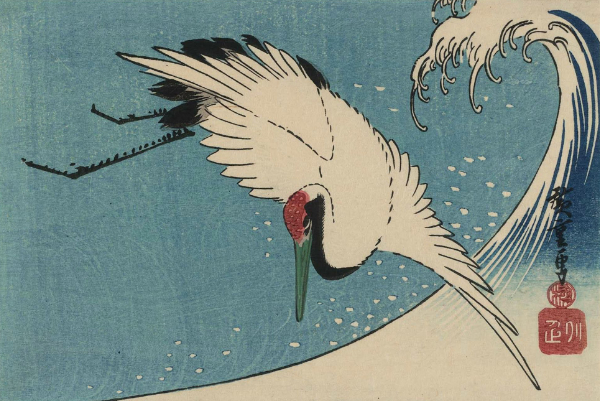
The wave pictured below recalls Hokusai’sGreat Wave off Kanagawa, but this print is by another famous ukiyo-e artist. Here Hiroshige depicts a Japanese crane, the “bird of happiness,” symbol also of good luck, long life, and fidelity. Mushanokoji uses the Japanese word for crane—tsuru—as the name of his “ideal woman,” Tsuru, whom the “I” in the novella obsesses over.
It is a powerful and economical gesture by Mushanokoji. He invests the young woman’s name with symbolic overtones that encapsulate Jibun’s quest for happiness. Tsuru embodies Jibun’s ideal—or rather, he projects his ideal upon her. In the same action, he internalizes an image of Tsuru, such that she is contained in his psyche.
Although I refer to the narrator-protagonist as Jibun, this is simply the word for “myself” (reflexive pronoun) that occurs throughout the Japanese text. It is a convenient way to refer to him in the third person—a commonplace in English criticism on the I-novel (shishosetsu) (see, e.g., Fowler).
Mushanokoji’s use of symbolism contributes to the economy of the work as it unfolds before us. This brief Chapter Two is minimalist in the way it develops the outlines of Jibun’s psyche, through his reflecting upon his own peculiar thought processes. Less is more. Bear in mind the autobiographical, confessional nature of the I-novel. We can think of these reflections as sincere observations, not necessarily fictions.
We like to consider ourselves as rational beings, and to present ourself as such when we express our ideas and opinions to others. But underneath, how much of our inner dialogue is actually obsessive, repetitive, circular, and self-contradictory? We tend not to speak of such thoughts, but prefer to keep them private.
Jibun Reflects
Chapter Two continues to develop on the technique of self-examination and self-parody. His continous inner monologue is at once poignant, comic, tasteful, and insightful. A tender yet detached affection—the narrator sees his niece as an embodiment of innocence and familial love, yet she also serves as a quiet reminder of his own solitude, unfulfilled longing, and the uneasy distance between himself and the life he wishes to grasp.
Anonymous infant girl, ca. 1910
I love Haru-chan too. She calls me “uncle-chan” and is very fond of me, but I cannot say that I am totally enamored. I live at home without anyone to love but myself.
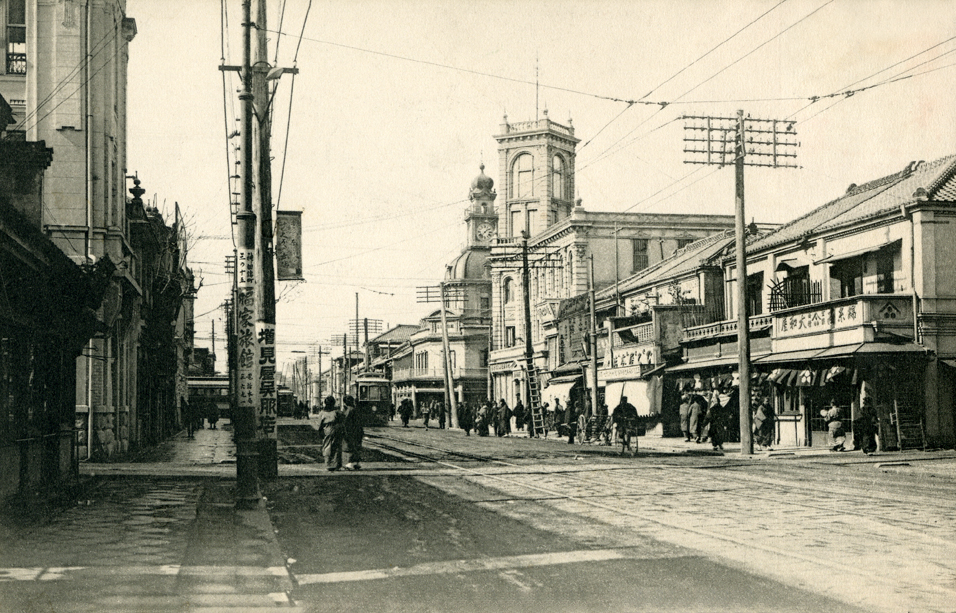
Ginza, Tokyo, ca, 1910 (Meiji/Taisho)
I have not been able to taste love, nor do any work I enjoy. I do not know the joy of being a father and cannot help feeling as if I am going to die…
In the same mood, I walked aimlessly through the colorless town, a solitary feeling in my heart…
***Fowler, Edward. The Rhetoric of Confession: Shishosetsu in Early Twentieth-Century Japanese Fiction. Berkeley: University of California Press, 1988. Full text, html (UC Press E-Books Collection.)
Fraser, Karen M. in “Beauty Battle: Politics and Portraiture in Late Meiji Japan,” Visualising Beauty and Gender , ed. Ada Yuen Wong, 2012.
Kamei, Hideo. Transformations of Sensibility: The Phenomenology of Meiji Literature, Trans. Michael Bourdaghs, Michigan Monograph Series in Japanese Studies 40, (Ann Arbor: U Michigan P, 2002).
Patessio, Mara. Women and Public Life in Early Meiji Japan: The Development of the Feminist Movement. Michigan Monograph Series in Japanese Studies 71 / (Ann Arbor: University of Michigan P, 2011).
I-novel (shishosetsu): Bear in mind that the shishosetsu was not formally theorized until at least ten years after the present novella appeared, when some attributions of “first I-novel” were attempted retrospectively.
Haru-chan: The meaning of haru is spring (the season). The ‘diminutive suffix’ -chan attached to a person’s name expresses that the speaker finds them endearing.
The first Tokyo Hyakubijin beauty contest, comprising 100 geisha contestants, was conducted in 1891.
Saneatsu Mushanokoji (1885-1976) was one of the first great Japanese modernist writers. He may lay claim to have founded the I-novel (shishosetsu), a specifically Japanese confessional genre in which the author speaks directly and colloquially to the reader (e.g., Lippit 28). Mushanokoji was also a painter of still lifes, a poet and playwright, and a unique but influential philosopher. Inspired by the writings of Tolstoy, he established a utopian village,Atarashiki-mura (“New Village”), which continues to operate, and which a young Mao Zedong himself attempted to replicate.
Mushanokoji (aka Mushakoji) first published Omedetaki Hito (1910) in a journal of the Shirakaba (White Birch) society, a group of aristocratic writers from Tokyo Imperial University, of whom he was the leader. Shirakaba led a humanitarian movement in Japan during the Taisho era of 1912-1926.
Novella
Elements of Mushanokoji’s later style, and of the I-novel, are distinctly present in this his first novel, and the narrator may be to an extent identified with the author. Written in the form of a diary, the novel draws on personal experiences from his youth, and from his own philosophy of happiness and transcendence (Okazaki 310; Mochizuki).
The novel’s psychological and philosophical depths are already evident in this initial chapter. On the one hand, the story of the narrator’s infatuation with a schoolgirl named Tsuru consists of straightforward incidents, candidly expressed. Notice in the beginning, the spontaneity of the character (“I”) when he turns towards the two geishas. It sems as though his feet veer in their direction on their own, propelled by his internal “hunger” (starving/longing) for a woman, which he mentions several times.
As the story proceeds, however, it becomes evident that he has never actually spoken to Tsuru. As he reflects about her, he starts to appear unhealthily obsessive to an extent—to us, who have become familiar with the socio-psychological phenomenon of “stalking.” He appears to admire her fairly creepily from afar. Indeed, some modern young Japanese reporting on the Web, tend to see the book either as a “stalker novel” or as the story of a person so hopelessy naive as to be unbelievable. (I have come across one or two who confess to identifying with him in his standoffishness.)
The character’s utter detachment from the object of his love is, at the same time, equivalent to his complete absorbtion in the self. Hence, he positively affirms his unwillingness to sacrifice his “own self” for the sake of his idealized love-object, Tsuru. Somewhat reminiscent of Nietzsche, Mushanokoji expresses his ideal of a transcendent self that refuses to defer to societal norms, but will conduct life on its own terms.
Mushanokoji uses a device of ambiguity to help depict the “I” character’s absolute detachment from exterior reality, and his centering upon the self. That is why he refuses to speak of “watching” or “observing” Tsuru. Instead he expresses the action euphemistically as “seeing” her, which carries a an incorrect connotation of their having “met.”
Frontispiece
Max Klinger’s image suggests the psychic and animal aspects of human being. With the “higher” elements needing to control the “baser.” Darwin is implicit, but a salient cruelty is apparent on the psychical or human side. Still, the bear is after the elf, presumably wanting to gobble her up!
Max Klinger, Bär und Elfe (Bear and Fairy), plate I from Intermezzi, Opus IV (Intermezzos, Opus IV) (1880)
The results of reading Darwin and viewing exhibited nature can be judged by Klinger’s thematic preoccupation with scenes of elemental nature (centaurs in Intermezzi and satyrs in Rettungen Ovidischer Opfer), primitive man, prehistoric creatures (dinosaurs in sketches and a pterosaur in Ein Handschuh), and women with animals. These appear not only in the central images, but in numerous details, botanical and biological, sprinkled like coded clues throughout the pictures. In all cases, science is merged with imagination, and primal states are considered with an eye to their impact on modern man.
Marsha Morton, “Art on the Edge: Klinger at the Threshold of Modernism”, in Max Klinger Le Théâter de L’Étrange: Les Suites Gravées 1879-1915 (Strasbourg: Musées de la Ville de Strasbourg, 2012)
Stroll through the heart of Meiji Tokyo
“On the morning of January 29, I went to Maruzen bookshop to look for some books and left after buying one titled Civilization and Education, written by someone named Münch.”
This fitting opening reference carries an almost metafictional significance to readers of today, for Maruzen became the primary conduit for Western thought into Japan, subsequent to the Meiji Restoration. It is particularly appropriate, given Mushanokoji’s further significance as a leading figure in the evolution of Japanese modernism.
Consider the following, written by Katai Tayama, whose 1907 novel Futon, may also lay fair claim to being, along with Saneatsu Mushanokoji’s The Innocent, an early instance of the I-novel:
It was thanks to the upstairs section of Maruzen that the surging currents of thought of nineteenth [and early twentieth] century continental Europe broke relentlessly through onto the shores of this remote Far Eastern island.
It was a small and gloomy section. The attendant, who had a limp and was very pale, had a ready smile. The shelves were thick with dust, and the literature books were put away behind the glass with a mixture of science books and guide-books. Nonetheless it was here that one came across the masterpieces that shook Europe.
… You’d encounter some young man walking along the streets of Marunouchi in the vicinity of the Palace, clutching a copy of [Turgenyev’s] Fathers and Sonsthat he’d ordered some time before and looking as it he’d just met his sweetheart. You’d see some other young man spotting a copy of [Tolstoy’s] Anna Karenina on the second-floor shelves at Maruzen and emptying his month’s allowance from his purse to buy it with a look of delight on his face.
In those days I often went searching for such books with Yanagita Kunio. With great excitement we searched out advertisements appended to magazines, and catalogues appended to books. And then, with money we could scarce afford, we ordered these rare books from Maruzen.
Nihonbashi, Tokyo, c. 1920, taken from Shirokiya department store (oldtokyo.com). Maruzen is the orange-brown building at the top center of the photo
This young man of Tayama’s, strolling through Maranouchi could well be Mushanokoji himself, particularly the one carrying the novel by Tolstoy, who was a major influence on Saneatsu, giving way to his later interest in the Belgian writer Maurice Maeterlinck. (See my opening comments on Maeterlinck’s play The Blind in a recent post.)
But Jibun has other things on his mind as well as literature.
A geisha in the Taisho period (1912-1926)
“I assumed the women were geisha. When I see a woman in a flowery kimono, with a round face, heavily powdered, I naturally think of her as a geisha.”
Various images jostle for the foreground of his mind, for association with his thoughts on morals and aesthetics. Inevitably, they lead to images and thoughts of the girl Tsuru, his desire for whom dominates his existence.
The dark blue dotted route shows Jibun’s twenty-minute or so walk from Maruzen bookstore in Nihonbashi via the corner of the moat at the boundary of Kokyo Gaien National Garden, and down through Hibiya Park, the green rectangle at the bottom:
Route from Maruzen to Hibiya Park
“Walking quickly I reached the moat and, instead of catching an electric tram, turned left to follow the tracks to Hibiya and go through Hibiya Park to my house”
Since 1868, the Imperial Palace has occupied the site of Edo Castle, originally built in 1457 by the Edo Clan, the samurai family who first fortified the town of Edo. Between 1603 and 1868, the Tokugawa shogunate, who were the feudal rulers up until the Meiji Revolution, developed the castle into the largest ever constructed in Japan.
The Kokyo Gaien National Gardens encircle the palace, in Chiyoda City, a special ward of Tokyo. As well as being the economic and political hub of Japan, Chiyoda contains the most affluent residential neighborhoods in Tokyo, towards the west, in the Yamanote area.
The Mushanokojis were among the most aristocratic families in Japan. Their home was located at what is now Saneatsu Park, adjacent to the Saneatsu Mushanokoji Memorial Museum, in Chofu, Tokyo, to the west. It seems odd, then, that Jibun would forgo the electric tram ride for Shank’s Pony, since the journey on foot would take around four and a half hours, and we learn at the opening of Chapter 2 that he arrives home in time for lunch.
Jibun doesn’t strike us as the athletic type. Perhaps it is an instance of the divergence from biographical fact that the I-novel can exhibit generically. For instance, his father makes some appearances in the novella, whereas Mushanokoji’s own father, Viscount Saneyo Mushanokoji, a court noble, actually died when his son Saneatsu was two.
Anyway Hibiya Park is a pretty spot for Jibun to enjoy his homeward stroll. Note that the first-person narrator is unnamed in the story. Jibun is actually a Japanese pronoun equivalent to “myself/oneself/me,” and how he is conventionally referred to in literary criticism.
This time he is distracted by two lovers, and he can’t decide whether to rejoice for them in their happiness, or curse them for reminding him of his unfulfilled longing for Tsuru.
Lippit, Seiji, M. Topographies of Japanese Modernism. (NY: Columbia U, 2002).
Mochizuki, Yoshihiro. Rediscovering Musha-ism: The Theory of Happiness in the Early Works), of Mushakoji Saneatsu (Master of Arts thesis, Univ. Hawai’i, 2005).
Okazaki, Yoshie, Japanese Literature in the Meiji Era. Vol. 1 of Japanese Culture in the Meiji Era. Trans. V.H. Vigliemo (Tokyo: Toyo Bunko, 1955).
Suzuki, Tomi. Narrating the Self: Fictions of Japanese Modernity (Stanford: Stanford UP, 2000) ,
Treat, John Whittier. The Rise and Fall of Japanese Literature (Chicago: U of Chicago P, 2018).
Tyler, William J. Review of Suzuki, Narrating the Self, in Harvard Journal of Asiatic Studies Vol. 60, No. 2 (Dec., 2000), pp. 661-670.













 Furin Chime Press™