
An astute reader of the first chapter wondered whether the red barn of our tale might be the scene of the infamous 1827 murder of Maria Marten, perhaps in order to unfold Maria’s tragic plot. That does not seem to be so, however, given the events that occur in this and the prior instalment, which proceed in an independent direction.
Poor Maria’s red barn was located in Polstead, Suffolk, which is indeed not too far from our location, the Essex marshes of the greater Thames Estuary. There is little question but that our author J.F. Smith (1803 — 1890) who was born in Norwich, and thus definitely in the general vicinity, would have been aware of those terrible events, which culminated in Maria’s ghost pointing out the location of her own grave. The red barn of the present story, therefore, may well have reverberated with dramatic overtones for readers of the period.
In editing this work, I have preserved elements of the writing that are characteristic of the period and medium, even where these might create some minor difficulties of readability for a modern reader used to modern popular conventions. Semi-colons, for example, tend to be used more liberally than is the fashion today, even as occasional closing punctuation for direct dialogue. Taken all together such features add charm and even contribute to a Victorian atmosphere.
All the paragraphing is intact, as it was in the original newspapers. This is actually quite in keeping with online convention, where short paragraphs are considered best practice.
An occasional point of dialect or cultural schema is not immediately transparent, but most reveal themselves quickly with the aid of context (‘porlite’, ‘loike’), deduction (‘the famous Essex two fives on the skull’) or Google. I don’t want to invade the text with footnotes and sic’s, but will make a few notes at the end of each instalment to clarify one or two of the slightly more elusive points of interest.
Don’t hesitate to make any comment or reply at the bottom of the blog post. I very much hope some discussions might ensue. If you like the instalment, please ‘Like’ it at the bottom of the post.
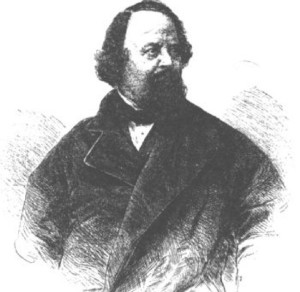
I’ll take this opportunity to introduce the author. He is an imposing gent, a brilliant Victorian star writer. Ladies and gentlemen, I give you the unsung giant and herald of popular literature, John Frederick Smith, Esquire …
CHAPTER TWO
A Cool Reception — More Tramps — The Friends Compare Notes — Adventures in the Red Barn
Mrs. Hurst did not appear particularly well-pleased when Goliah Gob entered the keeping-room — as the second parlor is generally named in Essex — in company with her nephew and the schoolmaster’s son; and yet it would have puzzled her very much to explain why she disliked him. Her daughter Susan had never yet shown the slightest preference for him; on the contrary, she rarely missed an occasion of mocking at his uncouth ways and quaint dialect, which she imitated to perfection, sometimes to his face, much to the annoyance of her cousin, who knew the worth, the true-heartedness, and honesty of the lad she thoughtlessly ridiculed; not that she shared in her mother’s dislike of him. William felt perfectly assured of that. Sometimes he thought he could detect a tone of pique blending with her playful malice. Why it should be so he could not understand. Goliah was perfectly civil to her, and even polite in his simple way. He had reasoned and remonstrated with her in vain.
At last he came to the conclusion that, if his friend had shown himself a little more susceptible of her charms, she would not have been displeased.
Hence his hint to Goliah, when he refused to accompany him to the farm.
Possibly the aunt inclined to this opinion. There might also be another reason; Mrs. Gob’s butter was the crack of the market, so that there existed a species of rivalry between the two ladies.
By this time the rain was falling heavily.
‘Come in,’ said Mrs. Hurst, addressing Goliah, who stood rather hesitatingly at the door of the keeping-room. You need not leave till the storm is over.’
‘I should think not,’ observed her nephew, dryly. ‘You would not allow a neighbour’s dog, much less a neighbour’s son, to quit the house in such weather; and if you could do so I would not permit it.’
This was the first time the speaker had hinted his rights as joint owner of the farm. Mrs. Hurst bit her lips; she did not like it. It was treading upon unpleasant ground; so like a clever woman, she hastened to change the conversation.
‘Don’t stand chopping words, Willie, which signify nothing,’ she exclaimed, ‘and the rain dropping off of you, but take your friends into your own room and give them some dry clothes. Tea will be ready by the time you come down; the cakes are nearly done. Go with him, Goliah,’ she added, good-humoredly, ‘and don’t mind a thing he says; of course, I am glad to see you, though I don’t make fine speeches. Soft words are not always sincere ones.’
‘No more they be,’ observed the young man; ‘and grandmother do say they butter no parsnips.’
At tea Goliah helped himself unsparingly to Mrs. Hurst’s cake and made sad havoc with the preserved gooseberries, a dish of which he cleared twice, to the great amusement of Susan and anger of her mother.
‘You seem very fond of gooseberries, Mr. Gob,’ said the girl laughingly.
‘Yes, Miss.’
‘And so are we,’ added the young lady, pointedly.
‘But not so fond as I be,’ replied the rustic visitor, assisting himself to the last spoonful in the dish. This was too much. The gravity of the table gave way to an explosion of mirth; even Mrs. Hurst’s anger yielded to the contagion of example, and she laughed heartily. Poor Goliah coloured to the temples.
‘What have I done?’ he whispered to William.
‘Nothing, nothing,’ replied his friend, trying to compose his features. ‘Take no notice,’ he added, in the same undertone.
‘Why, thee told I to be free and easy loike.’
‘Certainly; say no more, it is quite right.’
Goliah felt that somehow or other it was all wrong; saw that William was annoyed although he did his best to conceal it, and he made up his mind at the first pause in the storm to take his leave. All confidence had left him as suddenly as it came, and he sat listening silently to the whistling of the tempest which whirled and shrieked round the gables of the house like some human thing in pain. The heavy pattering rain, the solemn peals of thunder ceased at last, and he rose to depart.
‘Why in such haste, Goliah?’ observed William. ‘It is only a lull in the tempest; it will soon burst again with redoubled fury. Better remain till morning.’
As neither Mr. nor Mrs. Hurst seconded the invitation, Goliah Gob felt confirmed in his resolution. Susan looked as if she wished him to stay.
‘Thankee, Willie,’ he said: ‘thee hast a kind heart, but I knowed that long ago. I beant a bit afraid o’ the rain; it can’t melt I; ’sides, it be only five miles.’
‘Five miles in such a night!’ observed Susan.
The sturdy rustic, however, paid no attention to the remonstrances of his friends, but after bidding a brief good night to the rest of the family, walked resolutely towards the door, followed by William,
‘I am sorry you are so resolute on leaving us,’ observed the latter, as they stayed for an instant on the threshold. ‘See how black the clouds are.’
‘No blacker than the looks within,’ replied his friend.
‘And the rain will be pouring down in torrents again.’
‘I mun go,’ said Goliah, resolutely.
‘I am sorry you are so determined,’ said the youth; ‘but when once you have made up your mind I know it is no use arguing with you; so good night, and, bye-the-by, Goliah,’ he added, ‘as you pass the red barn, just look in and see that those two poor boys are all right. Not unlikely that more tramps may have stopped there.’
‘I wol.’
With these words the speakers shook hands and parted.
***
As soon as the youthful wayfarers felt assured they were alone in the barn, they proceeded to make themselves as comfortable as circumstances would permit. First, they partook of the refreshment their friends had left them. Hunger appeased, and they had been very hungry, they next examined the room, which they did by the light of a lantern the eldest boy had discovered hanging from one of the beams; fortunately he had matches in his pocket. Everything appeared as William Whiston had represented. No window or other door to the room than the one of which he had given them the key. As for the bed, it might have looked a little more inviting certainly, still it was comparatively clean, and the sheepskins were in abundance.
‘Dear Charley,’ whispered the eldest, at the same time throwing his arms round the neck of his young companion, ‘we are quite safe here. We shall escape them yet.’
‘Would I could think so,’ replied the latter; ‘but I cannot. I feel they are on our track; I have only to close my eyes to see them as they sprang upon us whilst we were combing our long hair behind the holly bush, the brutal leering passion in their eyes as they tried to force us to follow them into the marsh. They read our secret. Martha! Martha!’ added the speaker, bursting into tears, ‘but for that honest waggoner and his two sons what should we have been now?’
‘Hush, dearest! Not that name! You must call me Hal. Listen to me: Something tells me that our greatest trials are past. You must try to obtain some rest. You need not undress. Let me unlace those coarse, horrid boots and rub your poor, tired feet,’
Charley — we suppose we must call him so for the present — sank down upon the bed, and the speaker proceeded to remove the heavy high-lows, disclosing a pair of exquisitely turned feet, incased in white silk stockings — rather an unusual article for a tramp to wear.
Nearly an hour elapsed before tired nature yielded to the approach of sleep. After extinguishing the lantern the wayfarers sank to rest at last, clasped in each other’s arms. No wonder that the sleep of both was broken by dreams and fitful starts. Once or twice the youngest awoke with a faint scream, appeared dreadfully agitated, and muttered incoherent words, till the soothing voice of the elder calmed her again.
‘Only a dream, Charley, only a dream,’ whispered his companion; ‘nothing more.’
‘Thank Heaven,’ murmured the frightened sufferer, pressed still closer to his side, ‘it was but a dream!’
In a few minutes they were asleep again. Meanwhile the storm, which bad lulled once or twice during the evening, broke out afresh, howled like a weird dirge through the leafless trees, and the rain fell, splash! splash! upon the slate roof of the barn, whilst the angry lightning flashed and darted in arrowy, fantastic lines from the sable clouds which obscured the greater part of the heavens,
God help the poor wanderers exposed to the cold charities of the world on such a night! The hard and thoughtless will doubtless console themselves by reflecting that, without doubt, they have deserved their fate. Perhaps so; but the necessity of shelter is none the less urgent, the obligation to pity and assist none the less binding; for what is man that he should harshly judge his fellow-man, whether for good or ill, blessing or punishment? The results are in higher hands than his.
Any shelter in that terrible storm must have seemed like an oasis in the desert, a Patmos in the wilderness to the houseless and friendless. So, doubtless, must have thought a young fellow of about three-and-twenty, as he made his way into the red barn. He was evidently a tramp; no mistaking the signs. His shoes leaked water; his clothes — a half-faded summer suit — clung tightly to his shapely figure; the rim of the felt hat that he wore had uncurled itself in the rain, permitting the water to trickle down his back till it wetted him to the bone. He did not seem, however, to mind it very much, for after giving himself a good shake, like some Newfoundland dog after taking a swim, he seated himself upon the floor, and opening a wallet, began to eat. His appetite appeased, he paced up and down the floor of the barn to get himself warm.
‘This will never do,’ he muttered to himself, as a sudden chill crept over him. ‘The rain and sleet have struck to my bones. I must have a fire, or be laid up with the marsh ague. There can be no danger; neither hay nor straw in the place.’
Gathering a small pile of wood which he found scattered in various parts of the building, the young fellow struck a light, and in a few minutes a cheerful blaze not only diffused a cheering warmth around, but it lit up the dreary space around.
‘This is what I call comfortable,’ he said, as he stood holding his coat and vest before the front of the fire to dry. ‘I wonder what those who once knew me would think of it, could they see me. What a fool I am to suffer such thoughts to run in my mind,’ he added, ‘They have long since forgotten me. Not all, perhaps. One or two may remember me yet.’
These and similar thoughts kept chasing each other through his brain as he stood enjoying the warmth. At last his garments were sufficiently dry, and he commenced putting them on again. As he fastened the last button two more of the disinherited ones of the world crept into the barn — coarse, ruffianly looking fellows, several years older than the wanderer who preceded them. Their countenances bore the hard, cynical lines traced by a long career of passion, selfish, brutal indulgence, and crime.
‘Well, pal!’ exclaimed the foremost of the new-comers, as he advanced to the fire, ‘you are in luck. Quite pleasant here. Any scran?’
The young man pointed to the wallet, which still contained some food.
‘Here, Bill!’ shouted the speaker to his companion, who had remained behind to close the barn doors. ‘Never mind s’porting the timber. The wind ‘ll keep ’em closed. Here is a good fire, and the right sort o’ pal, thof he don’t seem ’xactly like one of us. A Romany chal, p’r’aps.’
‘Not a bit,’ replied the first comer. ‘I am no gypsy.’
He threw off his wide-awake as he spoke, disclosing a fair, bright, intelligent face, blue eyes, high forehead, shaded by light brown curly though somewhat matted hair.
‘I see yer aint,’ observed the questioner, after eyeing him over as critically as he would have done a lurcher or terrier dog. ‘None the wuss, maybe, for that. One of the marsh breed, I see.’
‘Neither do I belong to the Bittern’s Nest.’
‘Well I thought you might; no harm done, I s’pose. Many a good, honest bird has its nest in the swamp. What’s your name?’
‘Bunce.’
‘And mine is Pike, and my pal is called Bilk; and now we knows one another.’
‘O, yes! certainly!’ replied the former, with a smile.
The three men seated themselves near the fire; the food remaining in the wallet quickly disappeared. Fuselli, or better still, Dore, might have made a startling picture from the group; Bunce with his pale, sad face, Pike and Bilk, their hideous countenances obscurely seen through the cloud of vapor rising from their saturated clothes; one instant it hid their traits, the next disclosing them with added deformity.
For some time they remained silent, quitely enjoying themselves in the warmth. Pike, who evidently liked to hear the sound of his own voice, was the first to speak.
‘I s’pose you are up to a thing or two?’ he observed, addressing himself to the youngest of the party.
‘To a great many things,’ was the reply.
‘That’s right, nothing like plain talking; it mayn’t be allays wise to cackle in the ken afore strangers; but here, three honest pals together, it’s all right. I’ve something to tell you. But fust take a dram.’
He drew a bottle, about half full, and handed it to Bunce, who, before tasting its contents, drew the cork and smelt them.
‘Brandy,’ he said.
‘You may swear to it,’ observed Bilk, ‘and what’s more, the gauger’s stick has never been in it.’
Notwithstanding this recommendation the young fellow drank but a very moderate quantity. His suspicions were confirmed; he knew they were from the marsh — the desperate character of whose inhabitants he had heard of — and he determined to be upon his guard.
‘Now then,’ said Pike, in a confidential tone, as he replaced the bottle in his pocket, ‘let us talk bizziness; but mind it is all on the square.’
‘Of course it is.’
‘Have you seen anyone since you came here?’
‘You and your friend are the only persons who have entered the barn,’ replied the young man. ‘Why do you stare at me so hard? Do you think I am lying to you?’
‘Can’t say,’ replied the ruffian, coolly; ‘hard to tell; don’t signify much if you are; we are two to one. Now jest look at me in the face; I want to see your eyes when I tell you somethink. We are not alone in the barn.’
‘Police?’ whispered Bunce. ‘No. Two gals dressed in boys’ clothes.’
The look of intense surprise, the sudden flush which mantled the countenance of his bearer, were too natural to have been assumed, and the speaker felt satisfied that it was news to him.
‘Poor things,’ murmured Bunce, in an undertone. ‘Where?’ he added aloud.
Pike pointed to the door at the end of the barn.
‘There,’ he whispered. ‘Such a lark! My pal and I came upon them behind the bushes, just by the old stone cross, as they were combing out their long hair. Weren’t they scared! Bilk and I were quite porlite and coaxing; tried to get them to go with us into the swamp; but somehow they didn’t see it, so we just tried to make them.’
‘And would ha’ done it, too,’ chimed in his companion, ‘if their cries — of course we didn’t mind them — had not brought a waggoner and his two sons, who heard the cackle and leaving their team in the road came running to see what was up. They were three to two, to say nothing of the girls — so we had to sneak off. Awful provoking! Enough to make a parson swear! They rode off with the waggoner; but Pike and I knew a shorter cut, and dogged them till we saw the farmer’s boys hide them in the barn; so we waited and watched. At last we made our way in.’
‘The boys may return,’ observed Bunce, anxious to gain time.
‘Not such a night as this,’ replied the elder tramp. ‘No great matter if they do. We are now three to three.’
‘Why, what do you intend to do?’
‘Have ’em out, in course,’ exclaimed Bilk, ‘and have a jolly night. You can whistle whilst we dance,’
‘I will have nothing to do with it. Not that I object to a bit of fun; but this might prove dangerous — too near the village.’
‘It is nearer to the marsh.’
‘But I am a stranger in the marsh,’ replied the young man.
‘Oh, my pal and I will make you welcome.’
‘I told you I would have nothing to do with it, and intend to keep my word; it is unmanly, dastardly. Better give it up. As far as a hen-roost is concerned, I don’t mind going in with you. Hens were intended to be eaten.’
‘And pretty girls to be kissed.’
‘If they are willing.’
‘Willing or not, we intend to have them out. Bilk, you break open the door of the chamber, whilst I attend to this white-livered cur — to go back on two such pals as we are, and after treating him so ’ansomely, too.’
Although the speakers were all three active men, the two eldest were by far the most powerful; the Bunce saw that he would have a hard struggle, if it came to blows. With the exception of a stout ash cudgel, such as the natives of the eastern counties play at single-sticks with, he was totally unarmed. The swamp ruffians — for such by their own confession he knew them to be — most probably were better provided. Still he determined not to abandon two helpless girls to the brutal treatment of such wretches. They might not even be respectable; their disguise was unfavorable to the supposition that they were so. He cared not for that; they were women. Possibly he recollected that he had sisters; at any rate, his mind was made up to defend them.
There was some inherent good in that lone wanderer, after all.
During the above conversation the pale, trembling girls stood listening at the door, the only barrier between them and possible insult. The mild tone in which the younger tramp had expostulated with the elder one gave them but faint hope.’
‘I have a knife,’ whispered Martha to her half-fainting companion.
‘Oh, kill me! kill me!’ whispered the youngest of the two.
Whilst Bilk was thundering with his heavy boots trying to break open the door, Pike was attacking the young fellow who had refused to listen to their shameful proposal. Confident in his great strength, he committed the not unusual fault of undervaluing that of his opponent. Twice had the ash stick of Bunce cut the famous Essex two fives on the skull of the now thoroughly infuriated ruffian, whose loud curses, mingling with the screams of the two females, might have been heard beyond the barn.
In cudgel playing, anger is about the worst second a man can have. The old tramp was not without considerable skill, but rage rendered him incautious.
‘Curse you!’ he exclaimed. ‘Take that!’
The blow was well aimed, but as skillfully parried. In making the half circular movement to recover guard, Bunce brought his weapon across the head of his assailant. The blow was a terrible one, and the ruffian staggered for an instant as if half blinded. The hero of the skirmish — for such he proved himself — saw his advantage, and turning from his opponent, commenced attacking the second tramp. The door had been nearly broken open.
‘Keep up your courage!’ shouted Bunce to the inmates or the little chamber. ‘One of your enemies is powerless to harm you, and the other has almost had enough.’
‘No, he aint,’ said Pike, drawing a pistol from his vest.
He advanced more cautiously than ever to the attack, the weapon in his hand.
The heart of the generous wanderer sank within him.
This edition © 2019 Furin Chime, Michael Guest
Some Annotations
The chapter highlight ‘The Friends Compare Notes’ seems out of place. I wonder whether these have been added by the newspaper editor in the main one of my two sources.
Goliah Gob’s British dialect characterizes him beautifully as a diamond in the rough. ‘I mun go’ is dialect for ‘I must go’. The ruffian, Pike, uses the word ‘thof’, which Goliah used already in Chapter 1. It is dialect for the conjunction ‘though’; and I presume has a link to Middle English pronunciation, of which our irregular ‘-gh’ spelling is a relic.
It is rare for Goliah to be used as a first name. Here, the name clearly illustrates the size and might of the character. We have in Chapter 1 ‘like his namesake of Gath, Goliah was a giant in strength’, Gath being the home of the Biblical Goliath.
Some further brief notes:
- scran: Dialectal, ‘food‘; the word originates in the British Navy
- chal: male gypsy
- lurcher: A crossbred dog, used especially by poachers
- Marsh breed / Bittern’s Nest:The bittern is a rare, shy heron whose habitat is the marsh. (See the bird’s entry in the Essex Wildlife Trust website.) We can understand the upstanding Bunce’s reluctance to be labelled as ‘one of the marsh breed‘, given the mention in Chapter 1 of the Bittern’s Nest’s ‘proximity to London — not more than thirty miles distant — [which] has made it a refuge for the worst of characters; in a few instances, perhaps, also of the unfortunate.’ Therefore, at the same time, we might sympathise with Pike’s reasonable, egalitarian view that ‘Many a good, honest bird has its nest in the swamp.’
- ‘Fuselli, or better still, Dore’: Not ‘Fusilli Jerry’. Fuseli is the more proper spelling for the Swiss painter and art writer Henry Fuseli (1741 — 1825), though the double-l does occur; Dore is the French painter Gustave Doré (1832 — 1883). They share a penchant for creating dark, macabre images.
- ‘threw off his wide-awake’: Low crowned, wide brimmed soft felt hat; so-named, jocularly, for having ‘no nap’.
- ‘quitely’: Not ‘quiety’ but ‘quitely’ = ‘completely, entirely’, as in ‘Your ancestres conquered all France quitely’ (Robert Mannyng of Brunne, qtd. in the Century Dictionary (originally published in 1889).
- Single-sticks: A martial arts style of sport using sticks or cudgels; variants appear in several different cultures. Pays Googling. For your information, it was an Olympic sport in 1904 only.
- ‘the gauger’s stick has never been in it’: Unexcised liquor, which we may infer to be either smuggled or illicitly produced.
- *** : I inserted the asterisks to indicate the scene change, since that was a little unclear in the source.
More details about John Frederick Smith in future posts
MG


 Furin Chime Press™