Tag: serialized Victorian mystery novel

  • J.F. Smith’s Mystery of the Marsh — Twenty-eighth Instalment

    J.F. Smith’s Mystery of the Marsh — Twenty-eighth Instalment

    The unflappable Clara rebukes her “gentleman” kidnapper, Marsham:

    ‘You forget,’ she added, ironically, ‘the law against bigamy.’

    Her quip anticipates Morticia Addams’, who, bitten by the green-eyed monster, tests a barb on her unwitting husband:

    ‘Gomez, do you know the penalty for bigamy?’
    ‘… Two wives?’

    It must be the narrator’s tone that provokes our flippant response. He adopts a certain ironical distance himself, with his “We must not forget the ladies …”, his “As our readers may suppose …”, and the variants — sometimes quite teasing ones. In clear and simple prose, Smith exercises a virtuosic ability to combine seriousness and playfulness in artistic equipoise.

    We tend to become glib in the face of high drama and, especially, melodrama. Smith anticipates such a reaction with his playful self-reflexive ironies. In the current chapter, making a second appearance is the character Smith, whom the villains hired and brought back with them from Dinant to the Bitterns’ Marsh. (Can it be Bunce in disguise?)

    Being such a common name, ‘Smith’ is almost a byword for ‘pseudonym’. How tempting might it be for this author Smith, the mischief-maker, to use his actual name, the archetypal pseudonym, as a pseudonym for himself? It would be an audacious gesture indeed, to ‘stride the boards’, as it were, of his own novel; to make a cheeky cameo performance after the fashion (or rather, before the fashion) of a Hitchcock or a Tarantino.

    Before you scoff, notice the several throwaway quips on the name, Smith, which commence with the very chapter outline, and turn up a few times in the narrative and dialogue. Marsham is given the subtlest to say:

    ‘The fellow appears infernally indifferent to everything; walks about the old tower as if he owned the place ….

    which is to say, in the manner of an author-god (as one mask).

    Effects such as these gesture to a metafictional dimension, which characterizes writers such as Borges, Eco, Calvino, Pirandello, etc., who are held by many to herald or exemplify postmodernist fiction. This is, broadly speaking, a genre that draws attention to its own artifice; that parodies, pastiches and deconstructs traditional conventions, often implicitly incorporating the figures of the author and reader in the aesthetic action.

    At the same time, we should bear in mind that many writers as “dated” as Sterne (18th c.) and Cervantes (15th c.) demonstrate similar if not identical characteristics.

    So it is not particularly radical to observe metafictional effects here, though we hardly consider them as defining. The form of serialization lends itself well to such features. Consider the current instalment of the meercat ad, which ends with the two Russian protagonists clutching to the edge of a cliff:

    Aleksandr: Is this the end, Sergei?
    Sergei: No, it’s only a cliffhanger …

    Unlike a finished work, in one aspect the serialized novel unfolds itself in the same temporal frame as the reader’s own. Devices such as the cliffhanger, and the author’s address to the “gentle reader” convey a tacit wink, an acknowledgement of secretly inhabiting an identical world.

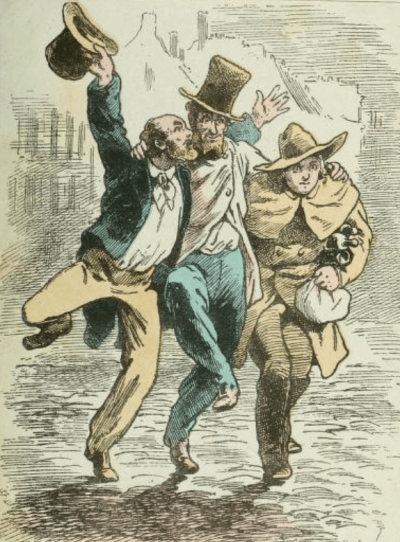
    From Sydney Punch Title Page
    Sydney Punch, title page (Jan 20 1866), cropped

    Apart from our own, the only extant instance of reader-reception of Mystery of the Marsh is an article in  Sydney Punch (Saturday June 9, 1883), which appeared at precisely our stage of the narrative, as published in the Evening News (Sydney, Wednesday June 13, 1883), in a column called “Family Jars.” The piece is a good measure of the popularity of Smith’s work among the Sydney readership. The author succumbs to one of the lower forms of wit, though we presume he is paid to do so.

    Night after night do we frantically devour the thrilling tale which adorns the last sheet of the Even Ooze, and which bears the Fisher’s Ghost-like title of the “Mystery of the Marsh.” It is now in its thirtieth chapter, and seems to have wind enough left to run thirty more, so that each gentle reader pays 5 shillings by instalments for a tale that can probably be bought at Paddy’s market for 5 pence. Of late we have been deeply grieved to find the fair heroine occasionally “sot down very hard,” but things are evidently on the mend, and the conspirators sing —

    “Farewell! farewell! I would not fling
    Around thy brow the veil of sorrow.”

    Quite right, too; for the man who would raise his hand to a woman (except in self-defence) is worthy of the name of a Pitt-street hero. It’s always safest to stand well away, and pelt the furniture after her.


    CHAPTER TWENTY-EIGHT

    The Martello Tower and the Prisoners — A Smith who is neither a White or a Black Smith — A Hut in the Bitterns’ Marsh

    We must not forget the ladies, whom, at the close of our last number, we left prisoners in the martello tower. The plot had succeeded. Money and brain-work, badly applied, carried out the daring scheme of the unprincipled Lady Allworth, whose insane desire to enrich her son without materially lessening her own means, knew no let nor hindrance. Scruples she had none. As for conscience — that was a myth with her, or, at least, a thing of the past.

    It was some time before the terrified girls recovered sufficient self-possession to look around them. A calm consideration of their position was equally out of the question; their senses were in a whirl of confusion; one moment it seemed to them as if they were in a hideous dream; it needed the sound of each other’s voice to convince them that they were not sleeping.

    Susan was the first to recover her presence of mind. There was a considerable amount of commonsense, as well as courage, in the girl. Whilst Clara and Kate sat helplessly, hopelessly locked in each other’s arms, she commenced taking a practical view of the situation — not a very encouraging one, certainly; neither did it appear to her utterly hopeless.

    After a glance at the strongly-barred windows, her eyes fell upon a pile of books; some in parchment covers, others in quaint old binding, mixed with a few Elzivers and several manuscripts piled confusedly in one of the corners of the room. In the first one she opened she read the name of Theophilus Blackmore, the ex-schoolmaster of Deerhurst, and a sigh of relief escaped her. Having learnt both writing and arithmetic under his care, of course she was well acquainted with the man — had never heard anything very bad of him. As for his son, Benoni, whom she had several times rejected, she smiled with contempt at the idea of any danger from that quarter.

    ‘Why, Goliah would brain him!’ she muttered to herself.

    And so, no doubt, he would, if ever he discovered that his rival had a hand in carrying her off.

    ‘Dear, kind ladies,’ she said, addressing her companions in captivity, ‘things look quite bad and ugly enough, still we must not despair. I do not believe that the owner of this place would lend himself to any very wicked act. He is old, and lives more amongst books than his fellow creatures. I could almost answer for him.’

    ‘But not for the wretches who have employed him,’ observed Miss Meredith. This was a view of the situation Susan had not taken.

    The noise made by someone unlocking the door of their prison chamber startled them. Poor Lady Kate clung to the side of her cousin, imploring her not to leave her. She recollected but too well the horrors of the night at the Red Barn.

    ‘Kill me first!’ she exclaimed. ‘Kill me!’

    The door opened. Clarence Marsham, accompanied by his confederate, Burcham, entered the room, leaving the taciturn fellow named Smith, whose services they had engaged at Dinant, to guard the entrance. With the cunning peculiar to great criminals they had concealed from the man, not the purpose, but names of their victims — also the locality in which they expected to find them. To all appearance this new agent in their schemes was not over-troubled with scruples, expressed little curiosity, and seemed to trouble himself only for the reward — half of which had been paid down before he consented to start with them.

    On recognising the suitor she had so contemptuously rejected, Miss Meredith saw that the same danger threatened both her cousin and herself. Her heart beat probably as violently as her cousin’s; but she possessed more self-command. Drawing herself up to her full height she fixed her eyes upon Clarence, affecting to ignore all knowledge of his companion.

    ‘Perhaps you will explain, Mr. Marsham, the meaning of this double outrage. Your designs on the hand and fortune of Lady Kate Kepple I have long been acquainted with, and the disgraceful means by which, on a former occasion, you attempted to accomplish them. But why am I here? Is it a part of your scheme — perhaps I ought to say your mother’s — to marry both the cousins, and so secure a double inheritance? You forget,’ she added, ironically, ‘the law against bigamy.’

    ‘No, Clara. Nothing of that kind. I —’

    ‘You are familiar, sir,’ interrupted the insulted girl, calmly. ‘Since I am compelled to exchange words with so contemptible a person, he will address me only as Miss Meredith.’

    ‘Hang it, Clara — well, then, Miss Meredith, since you will have it so — you know well enough what we intend — to make you our wives. The clergyman will not arrive till to-morrow night, so you and Kate have plenty of time to think it over. We can play the lovers afterwards. It will be your own fault if we use any but the gentlest persuasion.’

    ‘And are you weak enough to suppose, Mr. Marsham, that such a marriage would be binding?’

    ‘As for that, we will take the risk,’ replied the young ruffian, beginning to feel nettled at the determined tone of the speaker. ‘Once married, I don’t suppose you and Kate will be very anxious to create a scandal. Hang it, Burcham, why the devil don’t you speak? She is your affair — not mine. All I have to do is with her cousin Kate.’

    ‘Back, sir!’ exclaimed Clara, as the squire approached the spot where she was standing. ‘I cannot descend to exchange words with two felons in one day!’

    ‘Felons?’

    ‘Murderers!’ shrieked Kate. ‘They will kill us as they have killed poor old Willis!’

    ‘Killed?’ repeated Clarence. ‘We have killed no one. Not such fools as that.’

    Susan was about to speak, when a warning glance from Clara restrained her. Had the faithful girl declared herself a witness of the crime it might have cost her her life. Miss Meredith had no such fears upon her own account. Her danger was of a different nature.

    ‘Brutally murdered,’ she repeated, ‘by the ruffians you employed to decoy us here. Although prisoners in the cabin of the barge, we recognised his voice, heard his cries for assistance, the oaths of the assassins as they plunged the body of the old man into the river.’

    At this intelligence Clarence Marsham and his companion looked exceedingly blank. Much as money, rank, and political influence could do in England, they knew them to be powerless to condone crime where life had been taken. It was the first hint they had received of the death of the aged servant. The perpetrators had kept their own secret.

    Another source of embarrassment: They did not feel perfectly assured of the fidelity of the man they had engaged in Dinant, and who, from his position in the passage, must have heard every word of the accusation. The fellow had made a hard bargain with them, played off and on, haggled over the price of his services — in short, acted his part so well that doubt balanced confidence. One moment the conspirators felt disposed to trust him implicitly; the next to rid themselves of him — no very difficult thing to accomplish whilst they were in the Bittern’s Marsh.

    Clarence and Burcham withdrew from the room as abruptly as they had entered it. If conscience had not taken the alarm, fear had. They felt it necessary to consult together.

    As soon as she saw them depart Lady Kate Kepple commenced laughing hysterically. The dread of the present and recollections of the past were pressing upon her sensitive nature. She was already in the first stage of a brain fever.

    ‘Oh! my dear, kind lady!’ sobbed Susan, kneeling by the side of the old lounge on which the victim was seated. ‘Where will this all end?’

    ‘In death, perhaps,’ answered Miss Meredith, firmly; ‘but never in dishonour!’

    ‘Oh! that Goliah were here!’ said the humble friend.

    More than one heart re-echoed the wish.

    ‘Things are beginning to look infernally ugly,’ observed Squire Burcham, when he and Clarence were seated in what the latter styled their own den — namely, a room on the lower floor of the martello tower.

    ‘Who could have thought that they would have been such fools. Murder is a very different affair from running off with two girls and persuading them into marriage! Once our wives, they could give no evidence against us.’

    ‘That,’ said his confederate, ‘is our chance of safety — the last plank circumstances throw out to us. We must cling to it or sink. I know Clara,’ he continued. ‘She is a true Meredith, and would feel as little remorse in hanging us as I should in bagging a snipe.’

    ‘Unless she bore one of our names,’ observed his friend.

    ‘Exactly so,’ said Clarence. ‘We must carry out our plans by any means — fair ones, if possible; if not, the girls will only have themselves to blame.’

    His hearer nodded approval.

    ‘What troubles me now,’ continued the speaker, ‘is the fellow we picked up in Dinant. He must have heard every word of Clara’s accusation. Will he prove faithful to the end?’

    ‘Had we not better see him?’ asked Burcham.

    ‘Perhaps we had,’ answered Marsham, thoughtfully. ‘Were I convinced that he had the slightest idea of playing us falsely, some of the Marsh boys should soon settle the difficulty. It is the doubt that haunts me. The fellow appears infernally indifferent to everything; walks about the old tower as if he owned the place, and —’

    The rest of the conversation was cut short by the subject of their conversation walking into the room and coolly taking a seat at the table. He was a man of middle height, strongly but not coarsely built, about forty years of age, with nothing very remarkable in his appearance, except the keen grey eyes, which expressed great resolution.

    The two rich rascals drew themselves slightly up as if offended at the familiarity of the poor one.

    ‘Gentlemen,’ he said, ‘you have not acted fairly by me.’

    ‘Why, we paid you!’ exclaimed Clarence.

    ‘Of course you did,’ replied the seaman; ‘such services are rarely given.’

    ‘What, then, do you complain of?’

    ‘Paid me for assisting you to carry off two young ladies who asked, as you assured me, nothing better than to fall into your hands; but not for murder — a very different affair. Do you suppose I am going to risk my neck within the compass of a halter, at such a price? Ridiculous! ‘

    His hearers breathed freely. After all, it was merely a question of money, and they were well provided.

    ‘Name your terms,’ said Burcham.

    ‘I must have five hundred pounds more.’

    ‘Is that reasonable?’ demanded Clarence. ‘You have received two hundred pounds already.’

    ‘For coming with you from Dinant to the Bittern’s Marsh. You see I have learnt the name of the place, despite your cunning attempts to conceal it. Handsome pay, I acknowledge, for assisting you to bring two young ladies on shore. I have committed no other act for which the law can touch me. Take my offer, or reject it as you think fit.’

    ‘Why, what would you do?’

    The question was put with a view of testing his intentions yet further.

    ‘Wash my hands of the whole affair,’ was the reply.

    ‘Rascal! would you betray us?’

    The man laughed heartily.

    ‘And to whom should I betray you?’ he demanded: ‘Will you direct me where to find a magistrate in the Bittern’s Marsh, or officers to arrest you when I have obtained a warrant? You are neither of you very wise,’ he continued. ‘Still I give you credit for more judgment than that, I might try London, you will say. Tell me the names of the girls, give me the address of their family, and possibly I may think of it. Not that it would be of any great use, for if you are the fellows I take you for, it would be too late. The game will be played out.’

    The reasoning of the speaker was boldly put, nor did it detract from its value that it was insolent as well as convincing.

    ‘You are completely in our power. The boys of the Marsh are devoted to me.’

    ‘Not so completely as you suppose,’ answered the fellow, carelessly. ‘There are three or four gallows birds below anxious to fly to America. Probably they were on board the barge when — you understand. Now I wish to cross the ocean, too. We have had some talk over the affair. I don’t think, even at your bidding, they would commit a second murder.’

    The two gentleman rascals consulted together in a whisper.

    ‘Not so dangerous as I expected,’ said Clarence. ‘A mere petty larceny rogue. His object, to obtain more money.’

    ‘Yes, pay him; pay him,’ replied Burcham. It is hard, though I shall feel more at ease when I know they are on the other side of the Atlantic.’

    The last suggestion prevailed.

    ‘Hark you, my man,’ said the former, ‘when we engaged your services neither my friend nor myself anticipated the contingency you have alluded to, and perhaps it is only fair that your recompense should be increased. Pity you urged it so offensively. You might have trusted to our liberality.’

    ‘And been cast aside like a soiled glove when you had no further use for me,’ replied the mutineer, scornfully.

    ‘Well, well,’ chimed in the squire, who began to feel a little nervous, ‘we will overlook your insolence. All we require is to be assured of your fidelity. That is the important point.’

    ‘And yet you huckster over it like petty traders,’ observed Smith, lowering his tone, for he saw that the money would be forthcoming. ‘I will deal more frankly by you than you have dealt by me. In three weeks time I must be in America, far beyond reach of English law and English lawyers. The whole country will soon be ringing with my name.’

    ‘Rather a common one, I believe,’ observed Marsham with a sneer.

    ‘Perhaps it is,’ replied the former in a tone of indifference, ‘but some rather uncommon men have borne it. I am not ashamed of it. Enough of name,’ he continued. ‘Accept my offer; or reject it; the choice lies with you. I can be staunch as a bloodhound to my promise, but then I must have my price.’

    Walking back to the table, the speaker assisted himself to a second glass of liquor, and stood quietly awaiting the decision.

    The money was paid, and confidence, to all appearance, restored.

    ‘The Crofter’s Cottage’, Edwin Ellis (1842-95)

    As our readers may suppose, the motley inhabitants of the Bittern’s Marsh were not very particular in the choice of materials for their habitations, most of which, apart from the martello tower, were constructed of the trunks of trees dragged from the pools of stagnant waters, or, where these were scanty, of rough, unhewn stones, fragments of boulders, patched out with broken planks, and the interstices filled with mud or clay. Around these wretched abodes a plot of cultivated ground might occasionally be seen, with a few sickly-looking vegetables striving to pierce through the mass of weeds stifling their growth.

    The owner of one of these wretched huts was Sarah Sawter, the former servant of the widow Gob. We call her the owner from the fact that her worthless husband owned nothing but his worthless self. She was a tall, masculine-looking woman, strongly built, sharp of tongue, and capable ot thrashing both Tim and his sons, although, to do her justice, it was only in extreme cases that she exercised her strength.

    Soon after the arrival of Sarah in the Marsh a hard contest commenced between herself and the man with whom she had united her fortune for life, for the mastery. Pluck and resolution finally prevailed. In little more than a year Tom Sawter gave in, and the supremacy of his wife was sullenly acknowledged. Occasionally some outbreak might occur, but it was sternly suppressed, and she brought up her children as she pleased.

    As her sons grew up towards manhood they became deeply attached to her; to
    them her words were like oracles, which, if not always believed in, were rarely disputed. If Burk and Ben — the names of the boys — drank with their father, they always sided with their mother in all home disputes.

    One trait will give the key to Sarah Sawter’s character better, perhaps, than a page of description. On one occasion, as hostilities were about to commence between her husband and herself, the lads gave unmistakable indications of siding with the latter.

    ‘Stand aside!’ she exclaimed. ‘Have you forgotten he is your father?’

    It was the last serious contest with her drunken husband that Sarah Sawter had occasion to engage in. Tim was not only whipped but subdued in spirit when his sons turned against, him — he, to use a sporting phrase, ‘threw up the sponge.’ Grumblings might, perhaps, have occurred occasionally at intervals afterwards, and threats of what he would do; but the grumblings died away harmless as the echoes of distant thunder, and the threats were disregarded.

    The whole family were seated around the clean but rough deal table, on which stood a lamp filled with fish oil and a mesh made of dried bullrush. The supper, by no means a plenteous one, had long been concluded. The hour was getting late, yet still the inmates of the hut lingered at the table. Some project of interest was evidently under discussion.

    ‘I don’t like the looks on it,’ observed the mistress of the place. ‘What can they want wi’ a parson at the tower? Never heard of sich a thing afore. The master ain’t agoin to get married agin. I spose he haint sich an old fool as that.’

    In the Marsh they always spoke of Theophilis Blackmore as the master.

    Her sons grinned at the idea.

    ‘What is it to us what he wants un for,’ demanded the husband, in as loud a tone as he thought it prudent to assume, ‘since he pays well?’

    ‘And we are out of bread, mother,’ observed the oldest son.

    ‘The last bone of the old goat has been picked,’ added the youngest.

    ‘There are wuss things than hard fare,’ replied the woman, sadly, ‘though it be bad enough — the gaol and the law.’

    ‘It shall be as you say, mother,’ said the young men.

    ‘If it were only to guide the parson and his clerk from Deerhurst through the swamp to the tower, I should not so much mind; it’s what they may tempt ʼee to afterward. Still if —’

    The rest of her speech was cut short by a loud knocking at the door. In an instant all was silent in the lonely abode.

    The signal was repeated, but no one offered to stir.

    ‘Marcy on us!’ whispered Sarah, who can it be? So near on mornin’ too.’

    ‘Tramps — marsh birds like oursels,’ replied her husband; ‘but we ha’ naught for ’em. We be half clammed oursels. I’ll start ʼem.’

    Walking to the door he drew aside the bar, when two men, evidently greatly fatigued, clad in rags almost as wretched as the speaker’s, made their way into the room. The youngest one sank exhausted upon the settle.

    ‘Don’t you know me, Sarah?’ asked the elder of the two wayfarers.

    Mrs. Sawter caught up the lamp and held it close to his face, whilst Burk and Ben, her sons, stood quietly prepared for anything that might occur.

    ‘Marcy on us!’ exclaimed their mother. ‘Master Goliah, be it really you?’

    The name explained something to the boys; but not everything. They could not understand why the well.-dressed, good-looking young farmer, whom they had frequently seen, and been taught to respect, should come to their miserable dwelling in such a plight, and at so late an hour.

    No wonder they gazed upon him with surprise; but it was without any feeling of hostility. The grateful woman threw an additional armful of wood upon the hearth, and produced another bottle of spirits upon the table.

    Her husband began to eye it eagerly.

    ‘O! Master Goliah,’ she said, ‘if your dear good mother could see you in these rags it would break her poor heart. Where did yer get ʼem?’

    ‘Out of her garret,’ replied her visitor with a grin. ‘Mother gied ʼem to I.’

    As Sarah did not quite believe this statement she made no reply.

    ‘I tell ʼee she did,’ added the speaker; ‘and look, I hev fayther’s pistols as well, an’ you know the store she set on ʼem. She told I to come here.’

    ‘Here! to the Marsh? Here, amongst thieves, and worse?’ exclaimed the mistress of the house, who had recognised the weapons. ‘O! what have yer done?’

    ‘Nothink, as I knows on.’

    Sarah shook her head.

    Goliah knew that he might trust her, but doubted the prudence of doing so before her husband and her sons. Looking her earnestly in the face, he remarked that he would tell her all by-and-by. The woman understood him.

    ‘You. might trust in my boys,’ she whispered, ‘but not in their father. I have kept them honest. Tim will soon be drunk; it was partly for that I placed the bottle of liquor on the table.’

    In less than an hour the prediction was verified, and a series of explanations ensued, and some schemes suggested, in which Burk and Ben pledged their assistance.

    So satisfied were the two wanderers with the result that they consented to accept the only bed the wretched place afforded. Goliah did so on William’s account more than his own; for, as he said, he could sleep anywhere.

    When Tim Sawter awoke from his debauch in the morning he called loudly for his boots and his coat, which had disappeared.

    ‘Useless to search for them,’ observed his wife. ‘The boys have taken ʼem.’

    ‘Taken ʼem?’

    ‘Yes; they started at daybreak for Deerhurst to find the parson and guide him through the Marsh to the old tower.’

    Tim cursed loudly; swore that he would break every bone in their skin when they returned. Did they mean to rob him of his perkesites?

    Sarah smiled contemptuously. She had no fears for her sons. As for their father, he was effectually a prisoner in the Bittern’s Marsh; to go out barefoot was an impossibility, and he had not even a pair of slippers to attempt it in. Such luxuries were unknown in the miserable den he called home.

    This edition © 2020 Furin Chime, Michael Guest


    Notes and Further Reading

    • Metafiction: See for example, David Henry Lowenkron, “The Metanovel,” College English 38.4, Dec. 1976 (343-355).
    • Sydney Punch image reprinted in Shattock, J (ed.) Journalism and the Periodical Press in Nineteenth-Century Britain (CUP, 2017).
    • Elzivers [sic]: Must refer to the House of Elzevir, Dutch publisher of the 18th and 19th centuries: “The duodecimo series of ‘Elzevirs’ became very famous and very desirable among bibliophiles, who sought to obtain the tallest and freshest copies of these tiny books” (Wikipedia).


  • J.F. Smith’s Mystery of the Marsh — Twenty-first Instalment

    J.F. Smith’s Mystery of the Marsh — Twenty-first Instalment

    There is an idiosyncratic slide, moving from the omniscient narrator’s opening reflection on the parable of the “wise and foolish builders,” to Theophilus (Theo) Blackmore’s own seemingly spontaneous reflection on “Sand! sand!” in his meeting with Viscountess Allworth. It is almost as though the narrator informs as much as observes the character’s consciousness.

    To date, Smith’s allusions have been mostly historical or classic-literary, as in this episode’s playful gesture where he invokes the Hippogriff — a beast from Greek myth familiar to Harry Potter fans — in dramatizing a simple scene break, and thereby transporting the reader from London to Dinant, in France, at a speed faster than thought.

    It might be interesting, then, to consider the builders’ parable for a moment — especially given its “originary” significance to the Christian institution. The parable appears in Mathew 7:24-27 and Luke 6:46-49, attributing to Christ’s words the power to raise mankind above the chaos of the world. According to Saint John Chrysostom (c.340 – 407), in Christ’s telling of the parable:

    By “rain” here, and “floods,” and “winds,” He is expressing metaphorically the calamities and afflictions that befall men; such as false accusations, plots, bereavements, deaths, loss of friends, vexations from strangers, all the ills in our life that any one could mention. “But to none of these,” says He, “does such a soul give way; and the cause is, it is founded on the rock.”

    He [Christ] calls the steadfastness of His doctrine a rock; because in truth His commands are stronger than any rock, setting one above all the waves of human affairs. For he who keeps these things strictly, will not have the advantage of men only when they are vexing him, but even of the very devils plotting against him.”

    Homily 24 on Mathew

    The author of the Gospel of Luke and the Acts of the Apostles addresses his work to a listener who goes by the name of Theophilus, held traditionally to be a companion of Saul/Paul. Christian scholars have variously supposed this Theophilus to have been a Jewish high priest, a Roman official, or simply, as his name suggests, one “loved by God.”

    Luke’s explicit aim is to assure Theophilus of the truth “of the things he had been taught” (Luke 1:3-4); for example, of the resurrection and the spread of Christianity in the Roman Empire. Smith’s character Theophilus is notable for his morbid bookishness and is, it emerges, increasingly morally compromised. Is he nonetheless redeemable?

    According to Christian standards, of course he is; by the logic of Smith’s own narrative, this remains to be seen. I wonder whether an extreme sacrifice may be necessary.

    Remarkably, the magic whisper our Theo receives from the narrator is like an inspirational summoning to ethics. Yet he plans to collaborate with the viscountess in some dastardly plot, evidently one intended to ensnare the lovely Lady Kate in a loveless marriage with her morally bankrupt loser of a son, the disgraced Royal Horse Guard, Clarence Marsham, currently residing in Dinant.

    The narrator himself refers the metaphor of building on the rock not to faith in Christ as such, but instead to a concept of “the rock of integrity,” suggestive of a more agnostic view, which may be more indicative, we feel, of Smith’s own. Viscountess Allworth’s riposte at Theo’s implicit censure goes a step further, and is worthy of a Schopenhauer or a Nietzsche:

    ‘My house is erected on indomitable will, cemented by past success — guarantees against the future,’ observed his visitor, sneeringly.

    Clearly not the approved perspective, as reasonable as it may seem to us postmoderns.

    The theme is developed as well at a tangent, the opposition of “superstructure” to “base”; which is equivalent to that of “superficial appeal” as opposed to “being solidly grounded” — such as in Christ or in some form of integrity (a Christian view being that the latter needs to be grounded in the former).

    This secondary version of the parable is in the form “all that glitters is not gold” — or after Shakespeare, all that “glisters”. Living our life in pursuit of superficial attractions would be analogous to building upon the sand. The viscountess is such a person, and we now become privy to the tenuous underpinnings of her privileged status, and their further manifestation in the character of her son.

    Her attraction to the glitter of social position, at the expense of integrity, generates the villainous momentum that placed Kate and her maid-servant at such dire peril in the novel’s opening scenes in the red barn at Deerhurst and is still at work hatching further dark schemes.

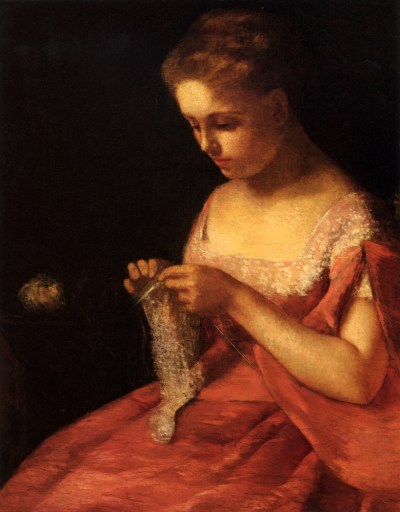
    Love’s Shadow (1867), Frederick Sandys. Source: Wikimedia Commons; Sotheby’s NY.

    CHAPTER TWENTY-ONE

    A House Built on Sand — Very Showy but not Secure — News of Clarence Marsham and Squire Burcham — They Meet at Dinant, in France

    We are warned by an authority older than modern civilisation not to build our house upon sand. How many stately edifices have been swept away from being erected on no better foundation. The world witnesses it daily, and yet the supposed wiseacres of the earth are continually falling into the same fatal error, looking to the superstructure rather than the base. The rock of integrity, on which alone a solid mansion can be reared, appears to them so hard to dig — the process is too slow.

    From the glimpses already given of the character of Viscountess Allworth, our readers already, doubtless, have divined, that she has been one of the unwise builders alluded to. In the eyes of the world her position appeared a most enviable one. Born in obscurity and poverty, she had become rich and titled by the exercise of talents bestowed for far different purposes. Not that we despise wealth; on the contrary, we consider it a blessing, when honestly acquired and nobly used; but for mere rank — the thing that men are born to — we feel a profound indifference. Like the cap and bells, it merely serves to make folly appear more ridiculous, and adds not one iota to the consideration justly due to the really great and virtuous.

    Her ladyship felt greatly annoyed. She had just received a note from a person whom she had not met for years, and trusted never to meet again; and yet they had never lost sight of each other.

    The note was a very laconic one: ‘I must see you.’ It had no signature, but the address of the writer was given, an obscure street in the Strand.

    ‘What can he want?’ she murmured to herself. ‘Money?’ No, to do l him justice, he has never been unreasonable on that score. There can be no real cause for alarm, for, although my plans are laid, no overt action has been taken to put them in execution.’

    After a few minutes’ reflection she continued: ‘I dare not refuse. A false alarm, or, more likely still, some scholarly crotchet he wants my influence to gratify. Would he were dead,’ she added, deliberately. ‘I could breathe freely then. The grave is the only safe confidant.’

    Of course, it would never do for the fashionable Lady Allworth to be seen in her own equipage driving down one of the narrow, obscure lanes of the Strand, even if it did bear the aristocratic name of Cecil-street. A century previous and royalty might have been seen there without exciting surprise; but times have changed. Mansions formerly the abode of nobles have either been pulled down or converted into lodging-houses, and those not of the highest class.

    After attiring herself in a very plain dress and wearing a thick veil her ladyship quitted Allworth House unattended, and walked as far as the quadrant in Regent-street. There she took a cab, and directed the man to drive to No. 13 Cecil-street.

    It was so short a distance that the driver at once set her down for a stranger in the metropolis, and mentally resolved to charge her half a crown.

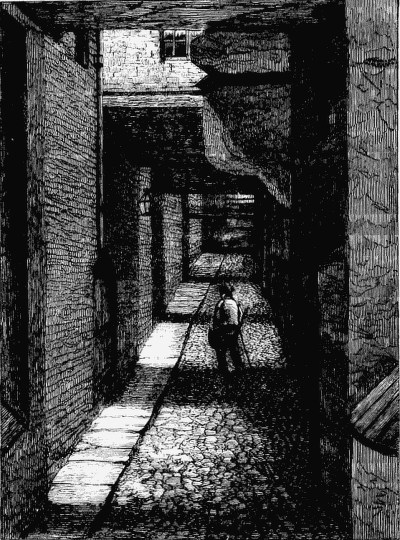
    Ivy Bridge Lane, in the Strand, from Old and New London, Vol. 3, (Cassell, Petter & Galpin, London, 1878). Source: British History Online.

    On reaching the house Lady Allworth felt greatly annoyed that the smallest coin in her purse was a half sovereign. The man eyed it greedily.

    ‘Can’t do it, Miss,’ he said. He always said ‘Miss’ to his female fares; fancied they liked it. ‘Yours was the first off the stand this mornin’. Large family; wife sick; very poor, but honest, that a well-known fact. If you like to trust me with the half skiv’ (slang word for half a sovereign) ‘I can melt it at the Fox and Geese and bring you back your change ker-rectly, Miss, in five minutes.’

    Of course her ladyship was not deceived, but she pretended to be so. Anything appeared preferable to waiting on the street and risking the chance of a discovery.

    ‘Yes, I dare say,’ she replied. ‘Very dreadful, no doubt. ‘I am not rich, but can feel for honest poverty. You may keep the half-sovereign, and may it do you all the good I wish.’

    ‘God bless you, Miss!’ exclaimed the driver, jumping on the box of his vehicle with an alacrity surprising for his years and starting his worn horse at a rapid pace.

    Lady Allworth stood watching him till he and his cab disappeared by turning into the Strand. Then, with a sigh of relief, she rang the bell of a respectable-looking house near her. It was answered by a slatternly-looking maid-of-all-work.

    Lady Allworth asked if the person whose address she had was in.

    ‘Yes, mam,’ said the maid. ‘Jest step into the parlor. ‘Missis is gone up to the gentleman’s room to see what he wants for dinner; down in a minute — do take a cheer.’

    The visitor, who felt tired as well as agitated, silently accepted one.

    ‘Come to git your fortin told?’ added the speaker.

    ‘Fortune told!’ repeated the lady, greatly surprised. ‘No. Why do you ask such a ridiculous question?’

    ‘Beg pardin, mam, didn’t know; thought you might. I and the missus made up our minds the gentleman wor sothing o’ that sort when we seed the books he brought with him; such odd-lookin’ letters. No Christian ever printed them.’

    ‘Perhaps you cannot read,’ observed the visitor, with a half-suppressed smile.’

    The maid-of-all-work tossed her head, curl papers and all — for she only took them down in the afternoon — indignantly, as if she had received some personal affront.

    ‘Indeed, mam, but I can read. ‘I wor edicated at St. Pancrass, and wor called the best scholard in the school.’

    Considering the lamentable state of the school system for the poor in England of the time, there appeared nothing very improbable in the assertion.

    The landlady now made her appearance, and inquired if she were the person whom her new lodger expected.

    ‘Yes.’

    ‘He is quite ready to receive you. This way, if you please. Will show you upstairs myself. His daughter, I presume?’

    The question was put forth as a feeler, but failed to elicit a reply.

    Second class furnished apartments, as their as their owners ambitiously term them, in the days of the regency, were sad uncomfortable affairs. The same crimson, moreen curtains, probably twice dipped, bordered with black cotton velvet; the half dozen regulation chairs, one facetiously called an easy one, and a ricketty table, generally comprised the entire furniture. In the more pretentious ones a couple of engravings — the death of Wolfe or the Battle of Trafalgar — might occasionally be found. Where such was the case, they added considerably to the price. Lodging-house keepers make money out of everything. The style has somewhat improved at the present day. Not in comfort — O! dear, no — but in show. As Shakespeare says, the world is still deceived by ornament.

    On the first floor, into such a room as we have described, the visitor was shown. Its occupant was a well-dressed man, with a white beard — an unusual appendage in those days. He was seated in the easy-chair. A pile of books, most probably Greek classics, which had so excited the curiosity of the maid-of-all-work, were on the table beside him.

    It was our readers’ old acquaintance, Theophilus Blackmore, the tenant of the martello tower and school-master of Deerhurst.

    ‘Take a chair, Zelinda,’ he said, without rising from his seat. ‘I will not trouble you to wait.’ This was addressed to the landlady, who disappeared with a dissatisfied air.

    Lady Allworth was about to close the door after her, when the speaker added:

    ‘Leave it open. It faces the staircase: She cannot return to listen without our being aware of it. Now turn your chair and face me. I will watch the door.’

    It was not till these instructions had been carried out that the viscountess raised her veil. The old man gazed upon her countenance long and earnestly.

    ‘Time has little changed “you,’ he observed. ‘You are still the same resolute being whose courage and strong will excited my admiration in the past. Well, Zelinda,’ he continued, ‘you have, succeeded in the objects of your ambition — wealth and rank. How the dead would laugh in their graves could they see to what heights you have climbed! You are rich and a peeress.’

    ‘Not so wealthy as you suppose. Clarence has been a sad drain upon me.’

    ‘You love your son, then?’

    ‘Devotedly.’

    ‘The question was an unnecessary one,’ said the questioner. ‘You would not be human if you did not. It is the weakness of maternity. The she wolf will fight for her young.’

    ‘Thank you, Theo!’ ejaculated the lady.

    ‘You know I rarely compliment,’ was the reply. ‘You still adhere to your project of this marriage?’

    ‘More tenaciously than ever,’ answered Lady Allworth, harshly. ‘My poor boy dares not return to England, or show his face in society if he did, till it is accomplished. Not so much for the girl’s fortune — that, although an important motive, might be got over — as on account of an unsuccessful attempt to — ‘

    ‘Yes! yes!’ interrupted her hearer. ‘I have heard all about the affair. It was foolishly contrived and badly managed. Clarence has not his mother’s brains.’

    ‘I thought you never complimented.’

    ‘Truth is no compliment,’ observed the schoolmaster. ‘The fact is, your son is a reckless idiot.’

    ‘Was it to tell me this,’ exclaimed her ladyship, her countenance flushed with mortification j and anger, ‘that you quitted your retreat, left your beloved books, and sought this interview? Your son — you see I am aware you have one,’ she added sarcastically — ‘is, doubtless, perfection?’

    ‘Benoni might be wiser,’ answered the old man, evasively, ‘but he is no fool, and has few scruples, as yourself. But we will not speak of him.’

    ‘As you please,’ said his strangely assorted confederate — for such they evidently were — in a tone of the utmost indifference. ‘But you have not yet informed me of the motive of your visit to London.’

    ‘I am uneasy in my mind.’

    ‘Some Greek root puzzled you?’ asked the lady, alluding to his favourite studies.

    The scholar smiled.

    ‘Ah, Zelinda,’ he said, ‘if you had only been content to share my labours; but it is useless to regret that now.’

    ‘Perfectly!’ ejaculated her ladyship. ‘Well, then, we will confine our conversation to the present and the future,’ observed Theophilus Blackmore, with a sigh. ‘You are fixed in your purpose of effecting this marriage?’

    ‘Immovably so.’

    ‘I have carried out your instructions,’ continued the former, ‘but you were wrong to have transmitted them through Brit. I doubt that man. It was still more unwise to assist him in his scheme for plundering Burcham, who has escaped from the Bitterns’ Marsh.’

    ‘Where can he have fled to?’

    ‘To France — to Dinant, Brittany.’

    ‘There must have been treachery!’ ejaculated his hearer.

    ‘Not on my part,’ answered the tenant of the tower. ‘Everything is prepared as you desired. The loopholes have been newly barred. The place is provisioned for a month, water unfailing. It would stand a siege. As for the wild inhabitants of the swamp, my influence over them since I obtained the lease is unbounded.’

    ‘In half the time you name,’ exclaimed the viscountess, in a tone of confidence, ‘Lady Kate will be the wife of Clarence. Pride — the dread of the world’s scandal — will overcome her childish repugnance, and my son’s position be secured.’

    ‘Sand! sand!’ murmured the ex-schoolmaster, half aloud.

    ‘What were you saying?’

    ‘Nothing; a mere allusion to the volume whose contents we have both of us, I fear, too long ignored. It warns us against building on such foundations as you have trusted to,’ he added, thoughtfully.

    ‘My house is erected on indomitable will, cemented by past success — guarantees against the future,’ observed his visitor, sneeringly. ‘But enough of this. We fully understand and can rely upon each other.’

    ‘Yes; I have no other choice,’ was the reply. ‘You always did as you pleased with me. I have been as plastic as potter’s clay in your hands; send or bring your victim when you will, all things shall be in readiness.’

    ‘It may be weeks and even months, first,’ said her ladyship. ‘The stake is a vast one, and must be cautiously played for.’

    And placing a roll of bank notes upon the table, the speaker lowered her veil and rose to depart, and had reached the head of the stairs, when something important seemed to strike her. She retraced her steps, and fixing her eyes searchingly upon those of her confederate, pronounced in an undertone, the name of ‘Nance?’

    ‘Dead, years since,’ answered the old man, calmly. ‘Ague and the marsh fever played into your hands. I thought you were aware of it.’

    A smile of intense satisfaction broke over the countenance of the scheming woman as she slowly descended the staircase.

    It was not till Theophilus Blackmore heard the street door open and shut that he raised the notes from the table, and began to count them. They amounted to £200.

    ‘Books?’ he muttered, in a tone of satisfaction — ‘mere books! They are the only friends left me, and I cannot have too many of them. But even they are not always to be relied upon. How I should like to examine the precious manuscript of Josephus in the Ambrosian Library at Milan, and collate it with my own copy. The best critics pronounce the disputed passage an interpolation. Who knows? Possibly I might be able to bring new light upon the subject.

    ‘This affair of Zelinda’s once concluded, I shall be enabled to indulge in the dream of tranquil study my soul so longs to realise. But, will she keep her promise?’ he added, to himself.

    For several instants the aged bookworm appeared lost in profound reflection.

    ‘She dares not play me false!’ he exclaimed at last. ‘She is in my power, and I can crush her like some worm beneath my feet !’

    With this reflection we take our leave of the schemers for a time.

    Roger délivrant Angélique (1824), by Louis-Édouard Rioult. Louvre.

    Many of our readers have, doubtless, heard of the hippogriff — that fabulous monster, half horse and half griffin, which owed its existence to the fertile imagination of the Greeks, who named it the Centaur. The middle ages changed the form of its first conception. Poets and romance writers are the only persons who have ever seen it but, then, poets and romancists, like the Scottish highlanders, sometimes see strange things. The gift of double sight is not always to be relied upon. Amongst the extraordinary powers attributed to the hippogriff, a speed far outstripping steam — in short, every known means of locomotion — was, perhaps, the most remarkable. The flight of the eagle was as the creeping of the snail in comparison. Thought alone could outstrip it.

    We are about to invite the readers of the “Evening News” to take a ride with us on the back of one of these monsters. They need not be alarmed; the seat is easy, the motions pleasant enough. Even as we write its wings are spread, the journey accomplished, and we are safely landed at the little town of Dinant, in the ancient province of Brittany, in France.

    It was to this obscure place that Clarence Marsham had retreated after recovering from his wound, to exist, as he termed it, on the reduced allowance his mother prudently made him. But few of his countrymen had hitherto found their way there. Its inhabitants are a reserved, unsocial race, particularly shy of strangers. The little community of Englishmen were compelled, in self-defence, to associate together. The cafe, billiards, botany and fishing occupied most of their time; the rest of it, we fear, was spent in idleness and debauchery. This condition of things has greatly changed since we first visited Dinant; the English form quite an important colony, taking, as the Scotch say, the crown o’ the causeway, from their wealth and numbers. We say wealth, by comparison, the native inhabitants, including the nobility, being as poor as they were proud; the Reign of Terror and the iron hand of Napoleon had completely crushed them for their adherence to the Bourbons and the ancient faith.

    The return of Louis XVIII somewhat alleviated their misery.

    Such was the state of society in this obscure corner of France when Clarence Marsham took up his abode there. The change from the Guards, the excitement of the mess-table, the turf and his club, had a most depressing effect upon him, but not a salutary one, and he soon began to experience what our Gallic neigbours describe as the English malady — the spleen. They, too, suffer from the same disease. True, they call it ennui — a much prettier name.

    In the state of what he was pleased to call his mind, the young roue naturally felt relieved by the appearance of Burcham, whom he had met occasionally in London, and rather patronised. The meeting proved agreeable to both, and they soon contracted a species of friendship— intimacy probably would be the better word, for it is almost a profanation to employ the first.

    Honour is much more chary of confidence than vice; it bestows it slowly, but, then, it is generally lasting. Vice, on the contrary, is capricious in its intimacies, contracting and breaking them heedlessly. The similarity of their position drew them yet more closely together, till at last, over a bowl of punch, each made a clean breast of it to the other.

    ‘Ah,’ hiccoughed Clarence, ‘my position is bad enough, but yours is worse — forger!’

    ‘Pshaw!’ interrupted Burcham; ‘a ridiculous letter. It had no commercial value, at any rate. I am safe here, and can fight Moses and Co. at a distance. My steward, Banks, holds the estate; they can’t get it from me. He served my father, and will stick to me like the old house-dog. Brit, the family lawyer, warned me against that rascally Jew; but I was a fool, wanted money, and refused to listen to him.’

    ‘The way with most of us, I suppose,’ remarked his companion, philosophically. ‘What do you intend to do?’

    ‘Compromise,’ was the reply. ‘Get the letter out of the claws of that vulture of Israel. Willing to act squarely — do anything but give up the lands, I should never get an acre back again.’

    ‘Not unlikely,’ remarked Clarence, with drunken gravity. After a pause he added: ‘Settle your affair as soon as you can, and I have something to propose to you.’

    ‘What is it?’

    ‘Settle your affair first, I tell you.’

    ‘Some turf speculation, I suppose; mine have been most unlucky. I have lost all faith in them,’ said the squire, despondingly. ‘Lost three thousand on the Eclipse race. The ring is too strong for outsiders,’ he added.’

    ‘I won on it!’ exclaimed Marsham, with a grin of satisfaction; ‘only a brace of fifties, though; funds were low; dared not venture more; was in the Guards at the time. In the Guards we are always expected to pay up. But the affair I hinted at has nothing to do with racing; there is a woman in it.’

    ‘A rich one?’

    ‘That of course.’

    ‘Ah!’ ejaculated the squire, ‘like my own case; for good or evil, they are generally mixed up in our affairs. Fatality, I suppose.’

    As time dragged its weary length along, the speakers became more and more confidential with each other. They took long walks together, discussed their plans, which were so far matured that they waited only till the signal from England should be given to put them in execution. Having few mental resources, the conspirators generally spent their evenings at the principal cafe in Dinant, where the inhabitants and the little colony met, as it were, on neutral ground. It was awfully slow work, as Clarence declared, but better than the painful reflection of their own thoughts.

    As their countrymen were generally poor, they gathered round Clarence and the squire, in the hope of gathering a few francs at pool, and laughed at their jokes as parasites laugh at the stale jests of their patrons. The gains of these unfortunates could not have been very large; the rich rogues played an excellent game.

    Amongst other frequenters of the cafe were two Englishmen who attracted the attention of the exiles. One was a fellow about forty years of age, who called himself Captain Brandle. There was no such name in the army list, and yet few men ventured to question him or his decisions on billiards; his bullying airs, and a certain fierce rolling of his eyes, cowed them, and he obtained credit cheaply for courage; it was considered dangerous to tackle him.

    The second, a young man, who wore the dress of a fisherman, appeared remarkably quiet and unassuming in his manners. He drank little, and only occasionally took a hand at pool. His quiet, unobtrusive manners excited the curiosity of the two conspirators — not that they apprehended any danger from his presence in Dinant; there appeared nothing suspicious about him, except his name — Smith — the most ill-used and unjustly abused one in the world — that is to say, the English world.

    A pool of billiards was being played at the cafe, in which Captain Brandle and the bearer of the long vilified name of Smith, we suspect it was only borrowed, took a part. Clarence Marsham and his friend were standing near the table, merely looking on.

    ‘That was a foul stroke!’ exclaimed the young man, ‘and ought not to count!’

    The spectators looked aghast at the speaker; the captain, who had made it, having impressed them with an awful opinion of his courage by his constant braggadocio. The impostor (for true courage rarely or ever boasts) glared at him ferociously, twisted his moustache, stamped angrily upon the ground, and called him a liar.

    ‘We will soon see,’ observed his accuser calmly, ‘which of us merits that appellation. I repeat, the stroke was a foul one, and appeal to these gentlemen,’ he added, turning to Clarence and the squire; ‘they must have seen it.’

    The two gentlemen declared they had not seen the stroke made; something had distracted their attention at the moment it was made.

    The accuser bowed somewhat sarcastically.

    ‘Of course I cannot dispute your word.’ he said. ‘I thought you had; but find I must settle the point with the bully without the assistance of your evidence.’

    ‘Bully!’ repeated the captain, who appeared thunderstruck at his presumption.

    ‘And coward,’ coolly added his accuser.

    The quarrel was becoming interesting. All present expected to see the speaker, who had so rashly provoked the hostility of the fire-eater, annihilated on the spot. Instead of springing on his victim like a roused tiger, as they anticipated, he mastered his rage and advancing towards the speaker, asked him if he were tired of his life.

    ‘Not quite yet, for I have never disgraced it,’ was the reply.

    One or two of the spectators began to smile.

    Possibly the redoubtable captain did not like the cool, steady gaze which encountered his. As a last effort to redeem his reputation he exclaimed:

    ‘This must be settled elsewhere. For a less insult I have spitted two such cockerels before breakfast.’

    ‘Did you. eat them afterwards?’ inquired his opponent, with the utmost seriousness.

    ‘Turn him out of the café!’ shouted the disconcerted bully. ‘ I cannot answer for my rage ; something dreadful will occur — murder done — or — ‘

    ‘Petty larceny committed,’ added the speaker, turning to the crowd. The first time I saw this cheat and rascal,’ he continued, ‘was in the felon’s dock at Bow-street. I thought I knew him when I arrived at Dinant. Although he has got himself up exceedingly well for the part he has been playing, I am now convinced that he is the same miserable scamp.’

    ‘You shall hear from me in the morning,’ repeated the pretended captain. ‘If I remain, rage and indignation at his insolent assertions will choke me. ‘

    ‘This,’ said the young Englishman, giving him a kick, ‘to remind you of your promise.’

    The kick was repeated. The exposed scamp fairly took to his heels, and escaped across the square.

    ‘A resolute fellow,’ whispered Clarence to the squire; ‘might be useful in our own affair.’

    His confederate nodded assent, and it was agreed to invite him to supper.

    Thus it was that the quiet, unpretending young man made the acquaintance of his fellow countrymen.

    This edition © 2019 Furin Chime, Michael Guest


    Notes

    rascally Jew: Please see my brief consideration of historical anti-Semitism in Chapter 14. In no instance does Smith himself express anti-semitic attitudes, apart from attributing them to characters whom he valorizes negatively.

    ricketty: Alt. spelling “rickety”

    the world is still deceived by ornament: Shakespeare, Merchant of Venice, 3.2: “The world is still deceived with ornament” (Bassanio).

    crown o’ the causeway: The middle of the street. Fine Dictionary.

    Eclipse race: Horse race established at Sandown Park, 1886, named after a famous 18th century racehorse. Now known as the “Coral-Eclipse.” Contemporary newspaper results of the inaugural race here.

  • J.F. Smith’s Mystery of the Marsh — Eighteenth Instalment

    J.F. Smith’s Mystery of the Marsh — Eighteenth Instalment

    In the previous chapter, Clara expresses her relief when William turns out to be a gentleman, as is borne out by the credentials printed on his card and his reputation as a scholar, which has become a matter of public knowledge. Lady Kate hadn’t doubted it, perhaps thanks to her greater sensitivity to him and his actions, or because her noble breeding better equips her to judge.

    The theme of interpreting gentleman-like virtues and qualities continues in the present chapter, incorporating a theme of etiquette. To be a Victorian gentleman, it would appear, requires an innate, transcendent trait of nobility, but as well, the ability to negotiate a finely-tuned symbolic system of ritual and convention, in order to be able to present oneself as a gentleman.

    On the other hand, Goliah seems to possess at least two innate virtues of the gentleman: honesty and bravery. Place him in a situation requiring a modicum of gentlemanly savoir faire, however, and he can’t measure up. He expresses himself with childlike spontaneity and needs a poke in the ribs to keep quiet. When Bunce insists that Goliah is a gentleman, that “It is the heart that gives the title. The rest is the mere gilding of the surface,” it is in a tone of kindly rhetoric. Goliah is clearly as yet a primitive if well-intended ‘unsuspecting rustic’ and comic relief, competent at only the most basic ropes.

    ‘Love Will Triumph’ (1900). Charles Haigh-Wood. Source: artnet.com

    But how should a gentleman behave in Lady Montague’s mansion on a social call? She is a stickler for the protocols. Why was the meeting in the park necessary in the first place? Did Lady Kate not repay his services with a gift? — which ought to be sufficient in the language of etiquette. Kate’s reply demonstrates her own finesse at interpreting and balancing symbolic actions and their meanings.

    There are actions which the most costly gifts cannot repay, but which a few kind words may amply recompense. Besides, she added, ‘Mr. Winston is a gentleman.’

    When a servant takes William’s card and ushers him to the morning-room, he is pitiably afflicted with confusion and doubt. Smith-narrator worries about what William will do with his hat, “that terrible test to young men”. Perhaps he should read something like that most useful guide,The Spirit of Etiquette; Or Politeness Exemplified, by Lady de S****** (London, 1837):

    On paying a morning call, keep your hat in your hand unless at the house of an intimate friend. If you leave it in the hall, it appears as though you intended staying; and unless you are very intimate with the party, it is a liberty.

    Or perhaps he has. A slew of such books appeared in the Victorian era, a more accessible variation on the previous “courtesy” genre, which had enjoyed currency since the Renaissance. Addressed to an aristocratic audience, courtesy books discoursed on manners as an expression of moral ideals (Curtin 411). The publication of Lord Chesterfield’s Letters to His Son on the Art of Becoming a Man of the World and a Gentleman (1774) marked a turning point, attending to more pragmatic, outward, imitable issues, toward the ends of self-interest:

    Observe the shining part of every man of fashion, who is liked and esteemed; attend to and imitate that particular accomplishment for which you hear him chiefly celebrated and distinguished; then collect those various parts and make yourself a Mosaic of the whole.

    Henceforth the discussion of manners was disassociated from high culture and disdained by distinguished authors. In the pattern set by Chesterfield for his son, etiquette books addressed themselves to the upwardly mobile members of the burgeoning middle class. Those who had become financially successful now looked to rub shoulders with those of “le suprême bon ton,” to advance socially and hide their humble origins by assuming the manners of the aristocracy.

    Chesterfield writes on the implications of what a gentleman wears:

    Your dress (as insignificant a thing as dress is in itself) is now become an object worthy of some attention; for, I confess, I cannot help forming some opinion of a man’s sense and character from his dress; and I believe most people do as well as myself. Any affectation whatsoever in dress implies, in my mind, a flaw in the understanding.

    We may note in this light the understated taste with which William dresses — which is entirely appropriate, as Lord Bury tacitly discries, “to a mere morning call”.

    In the era of the industrial revolution and the advent of what Karl Marx termed commodity fetishism, extravagant garments no longer proclaim rank and status. Rather, co-opting a new cosmopolitan aesthetic, clothes become a protective shield against invasion, a mechanism of codes and signs and a process of discernment.

    Details of workmanship now show how “gentle” a man or woman is. The fastening of buttons on a coat, the quality of fabric counts, when the fabric itself is subdued in color or hue. Boot leather becomes another sign. The tying of cravats becomes an intricate business; how they are tied reveals whether a man has “stuffing” or not, what is tied is nondescript material.

    As watches become simpler in appearance, the materials used in their making are the mark of the owner’s social standing. It was, in all these details, a matter of subtly marking yourself; anyone who proclaims himself a gent obviously isn’t.

    (Sennett, 165)

    It is more than just lavender gloves as things-in-themselves. An emerging bourgeois self is dislocated from its tranquil sources in the family and in the country and exposed to a mechanism of intrusive forces and gazes that seek to determine it — just as we see Kate’s family array itself as her protective shield in determining to its satisfaction what William is.

    Deep anxieties underpin these new social processes, such as Lady Montague embodies, seemingly risibly characterised with her phobia of social exposure. Why so humiliating for the scandalous details surrounding Lady Kate and Clarence Marsham to come out? Perhaps because codes that define the male, in terms of how he matches up against a positive model of the gentleman (and not a “coxcomb” or a “scoundrel”), are the same that determine the lady against a relatively negatively valorised model of the “loose woman”. Hence, the spontaneity that Kate exhibits — even in abruptly stopping the carriage, blocking the orderly flow of traffic — may be perceived as a disturbing, hysterical trait:

    [W]hen a society proposes to its members that regularity and purity of feeling are the price for having a self, hysteria becomes the logical, perhaps the only means of rebellion.

    (Sennett, 182)


    CHAPTER EIGHTEEN

    Lawyer Whiston Makes a New Acquaintance — A Glance at the Past — Plans for the Future

    However excellent in theory the law of England may be, like most human institutions, it presents many singular anomalies. In practice its professors are divided into two distinct branches, or bodies. First in rank are the barristers who alone possess the right of pleading in the superior courts. They are generally men of university education, and not unfrequently have won its proudest honours.

    From them the lord chancellors, vice chancellors and judges are invariably taken.

    The second, or inferior class, as they are considered, are the attorneys, or solicitors, whose forensic abilities are confined to the police courts and quarter sessions. They act as wet-nurses to the barristers, collect evidence, and prepare their briefs, which none but a solicitor can present. A client, no matter how intelligent and capable, may not draw up his own brief, or statement of his case. No barrister would receive it; it would be considered against the usages of the courts.

    Solicitors divide their practice into several branches, some of them exceedingly lucrative; the conveyance of real estate, which in England is beset with difficulties, being one of them. Divorce cases and criminal defence are two others, to say nothing of offences against the excise laws, poaching, and civil suits generally. They have to prepare all the evidence, and although they may not open their lips in the superior courts, may frequently be seen seated by the side of the privileged barrister, prompting or coaching him.

    The wealthiest and probably most respected members of this branch of the legal profession are the family solicitors to the nobility, landed aristocracy, and great mercantile firms. In the first two instances they have the management of the estates and of honourable men; are consulted on all occasions, looked upon in the light of a friend.

    In this class of solicitors the uncle of our hero held a distinguished position. His clients were not numerous, but they were wealthy, and of high social standing. To such a man the means of obtaining information were sore and varied. Lately he had spent considerable time in piecing together the fragments of half-burnt letters, which Bunce had given him, and the result was that he began to feel considerable interest in the antecedents of Viscountess Allworth. Amongst other bits of information he discovered that her first husband, Gervais Marsham, had a brother, a wealthy merchant in the city, who bore a high character for integrity and honourable dealing.

    As a general rule, if there is any little speck of dirt, flaw of reputation, or circumstance that we particularly wish to conceal, relatives are the first to disclose it, especially if the unfortunate tainted wether of the flock happens to be placed in a more enviable position regarding rank and fortune than the rest. Richard Whiston was far too close an observer of human nature, both as a lawyer and a man, for this peculiarity to have escaped him, and he set about turning it to advantage in his own quiet ways. It was an easy matter to obtain an introduction to the merchant, to whom he made himself so agreeable that invitations were soon exchanged.

    On the occasion of his first visit he contrived to be just ten minutes too late for dinner — not long enough to disturb the equanimity of his host, or, what was of more consequence, that of his maiden sister, Miss Penelope Marsham, who presided over her brother’s bachelor establishment.

    ‘Not a word, my dear sir, said the city man, cutting short his apologies. ‘A dozen turns, more or less, of the spit will not hurt the haunch, and turtle can’t spoil. Will you take my sister in?’

    Their new acquaintance gave his arm to the lady, and the small but select party proceeded to the dining-room.

    The dinner proved an excellent one — a little heavy, perhaps; but that was to be expected in the city, yet not uncomfortably so. It was not till the dessert made its appearance that the wily lawyer alluded to the cause of his delay.

    ‘Consultation,’ he said, ‘with a noble client in rather an intricate affair between two ladies of the fashionable world — Lady Montague and Viscountess Allworth. Ladies — pardon the remark. Miss Marsham — are at times disposed to be a little prolix.’ Turning to her brother, he added, as he eyed the bronze beading on the rim of his glass. ‘This is exquisite Burgundy.’

    ‘Imported it myself,’ observed his host.

    At the name of the viscountess Miss Penelope gave one of those scarcely perceptible little shrugs, which sometimes convey a vast amount of meaning.

    ‘Are you concerned in any legal affairs for Lady Allworth?’ she asked.

    ‘Oh, dear, no! not in the slightest degree. My client is opposed to her. A question of guardianship —’

    ‘Your client,’ remarked the spinster, ‘had better be upon her guard.’

    ‘Pen,’ interrupted her, brother, ‘our friend, I suspect, has had quite enough professional business for one day. Had we not better change the subject?’ A frown accompanied the observation.

    The lady looked displeased, but took the hint, although it lost her an occasion for airing her resentment.

    Richard Whiston appeared perfectly unconscious of this little piece of by-play, but came at once to the conclusion that the sister was the one likely to afford the information he sought.

    With some men — and they are not the worst of their kind — there is nothing like good dinners to cement intimacy. They even assist friendship. The wealthy merchant was a bon vivant, and the lawyer’s cook an artist of peculiar merit. Visits were frequently exchanged; gradually they became intimate. Like an experienced general, Mr. Whiston attacked the weakest side of the fortress; directed all his inquiries to Miss Penelope, and soon succeeded in drawing from her much curious information respecting the antecedents of the crafty viscountess, whom she hated — bitterly — intensely — only as a woman can hate.

    Her brother, Walter Marsham, it appeared, had been left a widower, with only one son, a boy six years of age. It was an awkward position for a young man immersed in affairs. Too fond of his child to commit him to the care of strangers, he engaged a lady, who came, highly recommended, to take charge of his household and superintend the education of his infant heir.

    The next fact extracted from the garrulous old maid was that, six months after the arrival of the governess, the boy was drowned; the body never found.

    ‘A sad misfortune,’ observed the lawyer, in a sympathetic tone.

    ‘A terrible one,’ added the narrator. ‘But for his loss, poor Walter would never have become the dupe of that artful woman. He married her within a year.’

    ‘I can comprehend your feelings,’ said Mr. Whiston, ‘especially if the antecedents of the Lady —’

    ‘She had no antecedents,’ interrupted Miss Penelope Marsham. ‘No one knows anything about her. As my brother, Gervais, said, when he heard of it, she came into the family like a doubtful bill, without any endorsement. We city people have our pride. Neither my brother nor myself ever noticed her.’

    ‘And your sister-in-law is now Viscountess Allworth?’

    ‘No mistake about that,’ observed Penelope, just a little spitefully. ‘His lordship married her for her money. Walter left her everything — but he did not get it, after all. The schemer was too cunning for him.’

    It took at least half a dozen dinners and quite as many calls to draw out the information which we have thus briefly condensed for the satisfaction of our readers.

    After carefully weighing all these circumstances, the astute lawyer at last made up his mind that the time had arrived for him to act, and the morning after the arrival of Goliah in town he sent for Bunce to come to his private room at the office, having given strict orders to the managing clerk that they were not to be disturbed under any pretence.

    ‘Are you satisfied,’ he asked, as soon as they were seated, ‘with the manner in which I have treated you?’

    ‘Satisfied!’ repeated the ex-tramp. ‘Ah, sir, I am most grateful. Your confidence has been most generous. With nothing but my simple word to support my assertions, you have placed a confidence in me almost against reason to expect. I would give my life to serve you.’

    ‘I believe you,’ observed the gentleman with a smile. ‘In the service I am about to ask of you fortunately there is no such risk to be encountered. And yet,’ he added, ‘it is not without some danger.’

    ‘Try me,’ said the young man, eagerly.

    ‘You are well acquainted, I believe, with the Bittern’s Marsh?’

    ‘Every track is familiar to me. Regular roads — that is to say, roads worthy of the name — there are none. Reckless and unprincipled as the inhabitants are, at war with justice and the world, it would not answer their purpose to have any.’

    ‘Reflect well before you answer my question,’ said Mr. Whiston, ‘and let not gratitude sway your judgment. Do you think it would be possible for you to visit that den of outcasts without much risk of detection? I would not you should endanger your life to serve me — added to which, the sacrifice would defeat my project.’

    A pause of several instants ensued in the conversation, during which the grateful fellow coolly but rapidly turned over in his mind all the difficulties of the task.

    ‘I was a mere boy,’ he replied at last, ‘when I quitted the Marsh, and am so changed in person that the fear of recognition is not great. Possible, but not probable; nothing more. The real danger lies in the suspicion with which the steps of every stranger are watched — unless, indeed, in the shooting season, when the hope of gain renders them less cautious. The majority of the inhabitants are smugglers; vessels laden with brandy and silks frequently land their cargoes from the left bank of the Thames. They come from Dinant in Brittany. Could I land from one of these, pass for one of the crew, I should have little doubts of the result.’

    ‘Can you speak the language of those smugglers?’ inquired his benefactor.

    ‘It was familiar to me as my mother tongue when a boy, sir. The captains and mates of the barks generally lodged with the old man who said he had kept me from charity.’

    ‘Your idea is an excellent one,’ observed the lawyer, ‘and a vast improvement on my original plan, for in Dinant you can render me an equally important service. In what character do you think of going?’

    ‘As a sailor.’

    ‘You shall be well provided with money,’ said his employer.

    ‘Not too much, sir,’ answered Bunce, with a smile.

    ‘And when will you be ready to start?’

    ‘In two days.’

    ‘In two days be it then,’ said Mr. Whiston; but recollect, you are to run no unnecessary risks. Greatly as I value the success of the enterprise, it may be too dearly purchased.’

    The above conversation took place on the morning of the day when our hero and Goliah encountered Lady Kate and Miss Meredith in the park. With his usual frankness, Willie informed his uncle of the meeting and exchange of cards, and concluded by asking him if it would not be the correct thing to call.

    ‘Evidently,’ was the reply.

    ‘I have so often puzzled my brain, sir, wondering if we should ever meet again. Was it not a lucky accident? How fortunate that you advised us to drive in the park.’

    We cannot assert it, but are rather inclined to suspect that the lawyer foresaw the great probability of Lady Kate’s meeting with her protector.

    The next day the visit was duly made. Goliah, however, did not accompany his friend. Richard Whiston so particularly required his opinion on the capabilities of a farm he was about to purchase in the neighbourhood of London, that the unsuspecting rustic could not refuse to go with him.

    Decidedly the uncle of our hero ought to have been a diplomat. He was born with a vast amount of natural tact.

    The heart of the youth beat violently as he alighted at the stately mansion of Lady Montague, and when the groom of the chamber ushered him into the morning-room, saying that he would take his card to the young lady, his confusion increased to so pitiable a degree that he almost regretted the step he had taken.

    ‘Why render my regrets indelible?’ murmured he to himself. ‘What can Lady Kate Kepple ever be to me? The disparity is too great.’

    By this time, we suspect Willie already began to have a faint suspicion of the feelings which were gradually entwining themselves with his existence — haunting his dreams, absorbing his waking thoughts. The romance of the first meeting with the fair girl he had so gallantly protected, made a powerful impression, on his imagination — that beneficent or dangerous quality which, for good or ill. as we employ it, controls the greater part of man’s existence; so subtle are its operations that brain and heart are enthralled before we feel conscious of the process which youth, especially in its firsts love, rarely perceives. The man — and the observation we are about to add applies equally to woman — who can analyse its effects, count and estimate the strength of every link as it is added to the chain, may entertain a caprice, but he is not in love.

    ‘The Patient Competitors’ (1892). Charles Haigh-Wood. Source: The Athenaeum

    When her niece and Clara informed Lady Montague of the meeting in the park, that exceedingly correct personage appeared slightly annoyed. We say slightly, for the dread of scandal had died out, nearly two years having elapsed since the adventure which so troubled her at the time.

    ‘I thought,’ she observed gravely, ‘that you had already acknowledged his services by the gift you forwarded to him?’

    ‘Gift!’ repeated Lady Kate, warmly. ‘There are actions which the most costly gifts cannot repay, but which a few kind words may amply recompense. Besides, she added, ‘Mr. Winston is a gentleman.’

    ‘Mr. Whiston!’ repeated the aunt, in surprise.

    Her niece silently handed her our hero’s card.

    ‘Mr. William Whiston, Trin. Col., Cam.,’ said her ladyship, reading it aloud. ‘Well, it certainly does look as if he might be a gentleman.’

    She passed the card to Lord Bury, who was present, and whose frequent and prolonged visits to the country, intimate association with two sensible, right-minded girls, who placed principle before fashion, and what they felt to be right before the conventionalities of the world, had shaken a vast amount of nonsense out of his lordship’s disposition, and the operation had greatly improved him; he had always been strictly honourable. If a certain residuum of pride still remained, it was pride without meanness, based on true manhood and honour.

    ‘I do not see, Lady Montague,’ he observed, ‘how my cousin could have acted otherwise — it would have been ungrateful. A call does not necessarily lead to intimacy. I think you ought to receive him.’

    ‘You, too!’ exclaimed the spinster, half-reproachfully. ‘Well, I suppose I must.’

    ‘I and Clara,’ he added, ‘will, if you wish it, both be present; it may relieve Kate from some embarrassment.’

    ‘Thanks!’ exclaimed the latter, ‘for I should feel dreadfully embarrassed at receiving him alone.’

    ‘Not to be thought of, my love!’ exclaimed the aunt.

    In consequence of this arrangement, all of the speakers were present when our hero was shown into the morning reception room at Montague House.

    The young guardsman eyed him as critically as he would have done a colt which he had serious thoughts of introducing into his own stables. On the important points of dress, person and appearance nothing could be more satisfactory. Plain morning suit; not a trinket visible; pale lavender gloves; his hat — that terrible test to young men, who so rarely know what to do with it — in his hand, it being a mere morning call.

    ‘Well,’ thought his lordship, ‘he certainly does look like a gentleman.’

    Lady Kate, having first introduced him by name to her relatives, began to falter forth her thanks for the protection to had afforded her.

    ‘Pray do not allude to it.’ said Willie, perceiving her embarrassment. ‘A hundred such services would be amply repaid by the simplest expression of thanks. ‘It is I,’ he added, raising his eyes timidly to her blushing countenance, ‘who ought to feel grateful for the pleasure it has afforded me by this introduction.’

    ‘Not bad,’ whispered Lady Montague to Clara; ‘he certainly is a gentleman.’

    ‘I told you so, aunt,’ was the reply.

    ‘Allow me to express my own and Lady Montague’s feelings,’ said Lord Bury, extending his hand to their visitor, ‘for your conduct on an occasion which I will not further allude to, although it can never be forgotten. May I ask,’ he added, by way of changing the subject, ‘if you are related to the Whistons of Northumberland? I have occasionally met several  members of that family.’

    ‘Not in the slightest degree, that I am aware of,’ answered our hero, unhesitatingly. ‘The only relative of standing I possess is my uncle and guardian, Richard Whiston, the eminent solicitor of Lincoln’s Inn Field, to whose bounty I am indebted for my university education — to whose affection for me more than I can ever repay.’

    ‘He is a noble fellow,’ thought his lordship, ‘No pinchbeck about him.

    ‘I am perfectly aware of your uncle’s respectability and high standing in his profession,’ observed the stately old maid. ‘For many years,’ she added, ‘he has had the management of my affairs.’

    ‘Whiston’s nephew,’ she mentally added. ‘Of course I can rely on his discretion.’ Speaking aloud, she added:

    ‘I receive every Wednesday. Mine is not a very brilliant circle but you will meet some celebrities worth knowing, should you favour me with your presence.’

    As the speaker did not add the word ‘occasionally,’ Clara and Kate considered it a sure sign that the invitation had been cordially given .

    More visitors being announced, Willie took his leave.

    ‘What tact,’ observed Lord Bury. ‘Not being acquainted with the fresh arrivals, it might have looked as if he sought an introduction. I think I shall like the fellow,’ he added.

    Considering the source from whence it came, this was high praise.

    ‘I already like him very much,’ observed Clara Meredith.

    ‘Of course. He has such remarkably fine eyes,’ said his lordship.

    Kate remained silent.

    This edition © 2019 Furin Chime, Michael Guest


    Notes and References

    pinchbeck: Alloy of copper and zinc used to imitate gold in jewelry; hence ‘something counterfeit or spurious’ (Merriam-Webster)

    Lady de S******. The Spirit of Etiquette; Or Politeness Exemplified, (London, 1837). Available free at Google Books (jump to cover).

    Lord Chesterfield’s Letters to His Son on the Art of Becoming a Man of the World and a Gentleman (1774). Good edition available free at Adelaide Univ. ebooks (jump to file).

    See also, James Pitt, Instructions in Etiquette, intended for the use of schools and young persons (1840). Available free at Google Books (jump to cover).

    Michael Curtin, “A Question of Manners: Status and Gender in Etiquette and Courtesy,” Journal of Modern History, 57.3 (1985).

    Richard Sennett, The Fall of Public Man (NY: Penguin, 1986)

  • J.F. Smith’s Mystery of the Marsh — Fifteenth Instalment

    J.F. Smith’s Mystery of the Marsh — Fifteenth Instalment

    The scene shifts to Paris, where Smith can draw upon his youthful experience of bohemian life in the Latin Quarter.  A character in our upper echelon has gone there to take care of some … unfinished business — of the serious kind. Here we meet a new brand of character, a detective by the name of Monsieur Vezin. Although, while in the process of introducing him Smith alludes to Poe (1809–49), this Vezin is hardly the stature of the brilliant Le Chevalier Auguste Dupin — the world’s first fictional detective — of The Murders in the Rue Morgue and The Purloined Letter. One has only to look at his coarse, mercenary nature and how he snaps up such a mundane mission. Dupin would never lower himself.

    In saying so, I don’t mean to detract from Smith. On the contrary, his subtle realistic approach compares favourably with Poe’s spectacle and artifice, as entertaining as these are in their own right. (An escaped orangutan did it?!)

    Smith’s seemingly gratuitous reference to Poe is complicated, but worth a few minutes trying to untangle. The historical Duchess de Berry (Maria Carolina Ferdinanda Luise; 1798–1870) is famous for her intrigue against Louis Philippe I, King of France, in whose place she aimed to ‘restore’ her son Henri as the legitimate descendant of the overthrown Bourbon dynasty.  In an incident well-known in the history of cryptography, she sent an encrypted letter to a group of anti-monarchists in Paris, advising them she had arrived in order to mount the insurrection. Unfortunately, she forgot to supply them with the cipher-key (the key explaining which ciphers in the message correspond to which letters of the alphabet).

    It was the great politician and orator, the lawyer Pierre-Antoine Berryer, who reputedly worked out the key — definitely not a detective named Vezin. Poe used the idea in his story The Gold-bug, where the plot turns on deciphering an encoded message just as Berryer did. On the other hand, this particular letter of the Duchess’ doesn’t seem to have been ‘compromising’ as such. Perhaps Smith mixes in a vague allusion to Poe’s ‘purloined letter’, since its disclosure ‘would bring in question the honor of a personage of most exalted station’ (Poe, PL).

    Later in the chapter, out of the blue, Smith makes further reference to the absence of a figurative ‘key’, this time in the form of a Latin quotation: ‘nil nisi clavis [deest]’ (‘nothing is wanting but the key’), an arcane Masonic catechism. Does he mean to imply, more broadly, that there exists a missing master-key to some overarching mystery? Shades of Umberto Eco. Is it for the reader, or yet for the author himself to uncover?

    And we notice the echoing of names and identities. ‘Marsham’ has become ‘Marsh’, recalling the eponymous Bittern’s Marsh. We have ‘Lord Bury’, the alluded ‘Duchess of Berry’ and ‘Berryer’. Don’t tell me something is going to be found buried in the marsh?

    Yet the substance of the story unfolds in a straightforward, naturalistic fashion, without a defined, singular, impelling mystery. It is as though the entry of the Poe-esque character, Vezin, acts as a stimulus for ideas that are more characteristic of the Dupin-style of detective fiction, the precursor to the twentieth-century mystery genre. Many incidents in Smith’s novel have a ‘mystery’ or unknown quantity attached to them, waiting to be revealed: boys who turn out to be girls; dark plots; characters with obscure histories in the marsh; and those who have disappeared back into the Bittern’s Marsh …

    Naturally enough, the contemporary reader cannot expect it to conform to a modern mystery. But nevertheless, the conventions of the genre may skew one’s expectations.


    CHAPTER FIFTEEN

    A Glance at Paris — The Avenger on the Track — Students’ Orgie — Preliminaries of a Duel

    When Lord Bury started for France it was with the full intention of calling Clarence Marsham to account for his unmanly conduct to Lady Kate.

    Our traveller’s first halting-place was Paris. It was not his lordship’s first visit to the gay metropolis of our Gallic neighbors. He had been there twice before; seen something of its dissipations, without plunging over head and ears into them. Escaped from the fire, in fact, with only a few feathers singed.

    Faithful to the object of his journey, knowing the character and habits of the man he sought, he frequented once more the scenes he had formerly visited. They failed, however, to attract him. His mind had acquired a more manly tone.

    Paris, Grands Boulevards 1860. Etching

    It is astonishing how soon a naturally healthy appetite sickens of the sugared dainties of our youth.

    Not having discovered Clarence Marsham where he thought he would be found, Lord Bury addressed himself first to the English embassy; next to the prefecture of the police. Neither of them could afford the information be required. No passport in the name of Marsham had been viséd at either place.

    Travelling with a Secretary of State’s passport, which the English Government grants only to the favourite few, his lordship had been received with great civility by the authorities, who really felt anxious to oblige him.

    As he was leaving the prefecture — it was his third visit — a little old man, who had very much the air of a retired grocer or small shopkeeper, addressed him, and after a profusion of bows, such as Frenchmen alone know how to make, blandly inquired if he could be of any service.

    ‘I fear not,’ was the reply. ‘I have already had two interviews with the minister of police, who assures me that everything has been done that could be done.’

    ‘Officially?’ inquired the old man.

    ‘Of course.’ The querist smiled sarcastically. There was an expression of something very like contempt in his small, twinkling grey eyes at the obtuseness of the Englishman that roused the anger of the latter, who asked himself if the Frenchman had played with or been mocking him. Monsieur Vezin noticed this, and hastened to dissipate it.

    ‘No, no, my lord,’ he said, eagerly. ‘The prefect of the police can have no interest in deceiving you. What I meant was simply this: Official investigations are not always the most satisfactory. They have so much to attend to.’

    The traveller naturally felt surprised at finding his thoughts so accurately interpreted, and eyed the speaker more closely.

    ‘You know me?’ he observed.

    The detective smiled.

    ‘I know everyone who comes to Paris in his own name and with a legitimate passport,’ he replied. ‘And those who do not, I know where to find them.’

    ‘Who are you, sir?’

    ‘I am Vezin.’

    I know not whether it tells in their favour or not as a people, but the French have long been celebrated for the marvellous astuteness of their police. It is a speciality, and they are proud of it. And yet, singular contradiction, the humblest tradesman or mechanic would consider himself insulted by being taken for a member of it. Hint to a Frenchman of the middle classes that his morals are loose, he will only laugh at you. Accuse him of untruthfulness, he merely shrugs his shoulders. Call him a spy, and he is ready to fight you.

    Lord Bury was no stranger to the name of the detective. It was of European reputation, although he had not yet made the famous stroke by which he discovered the compromising letter of the Duchess de Berry, which the American poet, Poe, has made such a clever use of.

    ‘It is not the means I should prefer,’ he thought, but Clarence Marsham has left me no other.’

    Turning to the old man, he added, aloud:

    ‘I think, Monsieur, that you can be of use to me.’

    Vezin bowed.

    ‘This is no place for confidence,’ continued the speaker. ‘Follow me to my hotel, where we can converse more freely.’

    ‘With pleasure, my lord.’

    Once seated at the Bristol — the then fashionable hotel — his lordship described his anxiety to discover the whereabouts of Clarence Marsham, but not his motives; in this he was wrong. A detective is something like a confessor — he should be trusted with everything or nothing. The young Englishman ought to have understood this — perhaps he did — but his pride revolted at the thought of painting one so nearly connected with him in his true colours.

    Monsieur Vezin looked puzzled — just sufficiently to justify his asking a few questions.

    ‘Very clear,’ he said;  ‘in fact, perfectly lucid; still in certain cases we require an excess of light. Has the Englishman — I wish to put it as delicately as possible, done anything to render him amenable to the laws?’

    ‘His offence is a social one,’ was the evasive answer.

    ‘And you are in Paris to call him to an account?’ continued the former. ‘You need not reply. I can read the intention in your flashing eyes. I have nothing to do with that. If Mr. Clarence Marsham is in Paris I pledge my reputation to discover his retreat — but it will cost both time and money.’

    ‘You shall have no cause to complain,’ observed Lord Bury, haughtily. ‘Find his address, that is all I ask. You may leave the rest to me.’

    Monsieur Vezin thought so too.

    Three days after the above conversation the detective made his appearance at the Hotel Bristol again;  his employer saw by his eyes that he had been successful.

    ‘Well?’ he exclaimed eagerly.

    ‘I am on the track my lord.’

    ‘Pshaw! Only on the track?’

    ‘That is something,’ observed Monsieur Vezin, quietly; ‘a pledge that I shall run him to earth, as your fox-hunting countrymen say. There is but one difficulty. He has a Secretary of State’s passport,’ he added, significantly, ‘in the name of Marsh.’

    ‘My father must have procured it for him,’ thought Lord Bury, bitterly.

    ‘That there may be no errors,’ continued his visitor, ‘I have called to consult with you before I proceed any further.’

    ‘Not for the world!’ exclaimed his lordship, eagerly. ‘Leave him to me.’

    ‘He has signed a false name.’

    ‘With no political or fraudulent intentions. I can answer for that.’

    ‘Still it is a serious offence by the laws of France. I ought to arrest him.’

    ‘Come, come, Monsieur Vezin,’ said the Englishman, forcing a smile. ‘You are, I am convinced, too gallant a gentleman’ — the word gentleman stuck in his throat — ‘not to appreciate the difficulty in which such a step would place me; my honour and courage might be suspected — the world would suppose that I feared to meet him.’

    ‘It is possible,’ observed the Frenchman, musingly.

    ‘Of course it is,’ said his employer. ‘Let us see if duty or sentiment cannot hit upon a compromise.’

    A compromise was hit upon. Needless to say, it took a tangible shape, and the following agreement made: At an early hour the following morning, Monsieur Vezin was to accompany Lord Bury and two of his English friends, to point out the house in the students’ quarters where Clarence Marsham had taken up his abode. If he accepted the duel, well, the police would wink at its taking place. If he refused, they were at once to arrest him.

    ‘I shall be sure to hit him,’ thought his lordship, as he quitted his hotel in search of a second.

    The detective muttered something very similar as he walked towards the prefecture of police; to be sure, the words were somewhat different.

    ‘He means mischief. I can see it in his eyes,’ he said. ‘Bah! What is it to me if one English dog shoots another? — a troublesome affair off my mind, even if I am well paid for it.’

    ‘The Latin Quarter of Paris has a type apart from the rest of  the pleasure-loving city. It is the centre of Bohemian life in all its varieties. Students, grisettes, dealers in books, old coins, bric-a-brac, antique furniture, costumes and armor, indispensable accessories of the painter’s studio, locate themselves chiefly in the street of the Ancient Comedy, where the once celebrated Cafe Procope still. opens wide its doors. The brilliant galaxy, Balzac, Lamartine, dear old Béranger, Victor Hugo, have long since disappeared from the busy stage of Parisian life.

    Student life in the Latin Quarter has changed but little. Its amusements, occupations, habits, vices, and, let us add, virtues, are still pretty much the same as when the author shared it some fifty years ago. A little study, great extravagance, loyal generosity to a comrade in distress, a rude sense of honor where their own sex are concerned, a general disregard of it towards the weaker and more helpless one.

    Street in Latin Quarter, 1862, photograph, Charles Marville. Source: nga.gov

    The houses occupied by the students are exceedingly numerous. The steady ones board; the pleasure-seeking merely lodge in them. Each set of rooms is a separate fortress; their occupants band in strict alliance for self-defence.

    In the middle ages, the members of the university braved the crown — frequently gave laws to it. At the present day they brave only the police, unless a revolution happens to be upon the tapis; then something like their old spirit returns to them.

    In the street of the Ancient Comedy stands a large hotel which, for nearly a century, has been a favorite abode with the semi-Bohemian race we have just described. On the first floor of the building, Clarence Marsham — or rather Clarence Marsh, as his passport designated him — had engaged one of the most roomy and best apartments. Compared with his neighboring lodgers, his surroundings might be termed luxurious; still they were a sad falling off from the regimental club and the splendors of Allworth House. The youthful profligate did not, however, regret the change very much. In Paris he had found what he deemed compensation in the alluring pleasures of the French metropolis.

    Although his mother had reduced his allowance by one half, Clarence Marsham appeared a veritable Crœsus to his new acquaintances, who ate his suppers, drank his wines, and occasionally borrowed a few francs from him. Not that he was by any means a generous lender; it was a tax he had to pay, and he paid it grudgingly.

    Our roué, who was fast gliding into the habits and manners of his new associates, had invited some half dozen of them to a late breakfast in his rooms. Amongst others were Duhammel, the son of a rich notary; Alfred Oufroy, of an old Norman family; Alphonse Dubarry; St. Ange, brother to the great advocate, — all of them giddy, pleasure loving youths, but extremely sensitive on the one great point of French honor — courage.

    As for morals, in the strict sense of the word, we fear they scoffed at them.

    From Scenes de la vie de boheme (1850), Henri Murger, illustr. Maurice Berty.
    From La Vie de Boheme (1850), Henri Murger, illustr. Maurice Berty.

    The revel was at its height — continued from the orgies of the preceding night — orgies which we cannot take upon ourselves to describe, even if we had the inclination. Glasses were drained, plans for fresh dissipations laid out, and vows of eternal friendship — false as dicers’ oaths — exchanged.

    One instant, bursts of equivocal jest; the next, the half-drunken madcaps broke into one of their student songs — honoured traditions in the Latin Quarter. Their fathers and grandfathers most probably, had sung them under similar circumstances, with the same noisy accompaniments of jingling glasses and rattling of forks and knives.

    Brother students, we are met for mirth and delight,
    And joy the bright goblet of Bacchus shall fill;
    For though woman, dear women, be absent to-night,
    The spell of her beauty is over us still.
    ‘Twas wisely decreed by our masters of old,
    To refuse them degrees, ‘spite entreaties and sighs;
    For once in our halls they would rule uncontrolled,
    And govern each class by the light of their eyes.
    Then think not in Bacchus alone we delight,
    And seek but the cup of the wine-god to fill:
    For though woman, dear woman, be absent to-night,
    The spell of her beauty is over us still.

    The cheers which followed the song and chorus had barely subsided when Monsieur Bellot, the proprietor of the hotel, entered the room. His appearance was hailed by the revellers with bursts of laughter and applause. Clarence insisted on his drinking a glass of champagne in honor of his guests. The Frenchman bowed, swallowed the wine, then gravely informed the host that three gentlemen were in the ante-room who insisted on seeing him.

    The young Englishman looked disconcerted. The recollection of the false passport, and his assumed name, suggested suspicions of the police.

    ‘Who are they?’ he demanded after a pause. ‘Frenchmen?’

    ‘No,’ replied Mons. Bellot, ‘Englishmen. I can swear to that. But their cards,’ he added, at the same time, ‘will doubtless inform you of the purport of their visit.’

    The roué read the names of three officers of Lord Bury’s regiment. His enemy had found him.

    ‘Yes, certainly!’ exclaimed the latter, enforcing a laugh to conceal his embarrassment. ‘They are old friends, show them in.’

    The students noticed with surprise that the three Englishmen, when they entered the room, instead of rushing to their host, embracing him, and indulging in a succession of gyrations which it would puzzle a mathematician to describe, bowed stiffly, and the eldest one, advancing towards Clarence, requested the favour of a private conversation with him.

    ‘A duel,’ whispered Oufroy.

    Duhammel thought it looked very like one.

    ‘How odd these islanders are,’ added a third student. ‘Three seconds to carry one message. But, nil nisi clavis, we have not the key of the enigma yet.’

    ‘You may speak before these gentlemen,’ exclaimed Marsham, in a tone of bravado, trusting that his guests would stand by him.

    ‘Tiens!’ said one of them. ‘The insular appears civilised.’

    Considering that barely four years had elapsed since the battle of Waterloo had been fought, this was rather a handsome admission for a Frenchman to make.

    ‘My Lord Bury,’ said the second, ‘feeling deeply insulted in his honour and personal dignity by the conduct of Mr. Marsh’– he gave him his assumed name — ‘towards a lady whose name it would be indelicate to mention, demands immediate satisfaction for the outrage.’

    Although Clarence was not particularly brave, he was far from being, in the ordinary acceptation of the word, a coward. He knew that his lordship was a dead shot, and began to reflect whether some means might not be found to avoid the meeting. What made the affair more difficult was the Englishman had delivered his message in excellent French.

    ‘Mon Dieu!’ whispered Oufroy in his ear. ‘What are you hesitating about?’

    ‘Looking for his lost courage,’ suggested another of the students.

    Clarence turned towards them, his mind being made up at last.

    ‘Gentlemen,’ he said, ‘you are, I believe, all of you, my excellent good friends.’

    To this there succeeded a dead silence His guests were waiting.

    ‘I am placed in a position of extreme delicacy,’ added the speaker, ‘and solicit your advice, pledging myself, of course, to act on it.’

    At this there was a faint murmur of approval.

    ‘The gentleman who has challenged me is so nearly related to me that I hesitate about accepting the provocation.’

    ‘Is he a brother?’ asked Duhammel, the oldest of the Frenchmen present.

    ‘No. His father is the husband of my mother.’

    An ironical smile — in fact, it amounted almost to a sneer — curled the lips of the students, who unanimously assured the speaker that so slight a degree of relationship presented no obstacle to his accepting the duel.

    ‘Curse them!’ muttered Clarence to himself. ‘I am in for it.’ Speaking aloud he added: ‘Thanks, gentlemen; you have relieved my mind of a painful doubt. Perhaps you will arrange the time and place of meeting with my adversary?’

    ‘It must be instantly,’ observed Captain Seymour, the name of the messenger. ‘His lordship is waiting in the Alley of the Luxembourg, hard by.’

    ‘Is the offence so deadly?’ asked Duhammel.

    ‘Most deadly,’ was the reply. Walking close to Clarence, he whispered in his ear: ‘Choose at once ‘between the satisfaction demanded or being arrested, dragged through the streets of Paris, for travelling under a false name and passport.’

    ‘And can you reconcile to yourselves turning informers?’

    ‘Under ordinary circumstances, certainly not; but by violating the laws of honor you have placed yourself beyond the pale of society. The police are already in the hotel, ready to arrest you. The exposure once made, his friends cannot permit Lord Bury to meet you.’

    ‘And shall I fall?’

    ‘You need not trouble yourself for any after results,’ observed Captain Seymour, dryly.

    ‘Should I be the victor?’ added Clarence.

    ‘In that case,’ remarked the former, ‘neither my brother officers nor myself will feel called upon .to denounce you.’

    Cornered at every point, the cowardly insulter of Lady Kate resolved to take the desperate chance. Walking to the table he tossed off in succession two or three glasses of wine; then, turning to his student friends, exclaimed, in an almost joyous tone:

    ‘I am ready.’

    The former had already supplied themselves with both swords and pistols, that the principal might have the choice of weapons on the ground.

    ‘And now, gentlemen, where to?’ inquired Duhammel.

    ‘To the garden of the Luxembourg,’ answered Captain Seymour, gravely.

    A few minutes later the speakers passed by the Odeon, where a bal masque had been held the preceding night. Several of the students who had attended it recognised Clarence and his friends as they passed them.

    Death and dissipation jostled each other on the street. They are old acquaintances, and a familiar nod was all that seemed necessary.

    This edition © 2019 Furin Chime, Michael Guest


    Notes, References, Further Reading

    orangutan: To counterbalance my glib comment, see Sydney Lévy, ‘Why an Ourang-Outang? Thinking and Computing with Poe‘, at Épistémocritique: Littérature et savoirs.

    orgie: Fr. orgy

    grisette: ‘1. A young French working-class woman; 2. A young woman combining part-time prostitution with some other occupation.’ Merriam-Webster.

    upon the tapis: from Fr. ‘sur le tapis’ = ‘on the carpet’; in the context, ‘on the table-cloth’, or ‘under consideration’, as in the English idiom ‘on the table’.

    Crœsus: King of Lydia, 560–547 BCE, whose riches came from gold in the sands of the River Pactolus, where King Midas washed his hands.

    false as dicers’ oaths: ‘Such an act / That blurs the grace and blush of modesty, / Calls virtue hypocrite, takes off the rose / From the fair forehead of an innocent love / And sets a blister there, makes marriage-vows / As false as dicers’ oaths: O, such a deed […]’ (Hamlet iii.4). That is, as untrustworthy as a dicer’s vow to quit gambling.

    [Louis de Loménie], R.M. Walsh, trans. ‘Berryer’ in Sketches of Conspicuous Living Characters of France (1841). Available free at Internet Archive.

    Henri Murger, La Vie de Boheme (1850). Available free at Internet Archive.

    Edgar Allan Poe, ‘The Murders in the Rue Morgue’ (1841), ‘The Purloined Letter’ (PL) (1844), ‘The Gold-bug’ (1843).

    William F. Friedman, ‘Edgar Allan Poe, Cryptographer’ in L.J. Budd and E.H. Cady eds.,  On Poe (1993).

  • J.F. Smith’s Mystery of the Marsh — Fourteenth Instalment

    J.F. Smith’s Mystery of the Marsh — Fourteenth Instalment

    What a presumption of Burcham’s that Lady Kate’s cousin Clara Meredith will drop everything and marry him because an inheritance of five thousand a year hinges on it! He doesn’t need Mr. Brit to tell him there will be possibly much more for him when her father dies, issues of marriage and inheritance dictating the distribution of property. The situation reflects something of the dominion that the “unfair sex” held over women to a large extent in the Victorian era, much depending on class. Generally speaking, a wife had no separate legal existence from her husband, who had power over her property, estates, any earnings she might have, custody of children, and her body. It was not until 1891 that a court of law overturned a man’s right to keep his wife at home under lock and key (Perkin).

    A private system of law, however, enabling upper-class Englishwomen to hold separate estates and income, made them perhaps the most liberated wives in the world.

    In this respect, Clara is not atypical of a woman from the untitled gentry. Raised in protective families,

    They were not reared as shrinking violets; almost without exception they were brought up in the country, outdoor life being considered more important than other forms of education. But these half-educated, horse-loving girls often married young and became great hostesses in London. They were considered among the most politically minded women in Europe. They learned from their elders, but had their own views and expected to air them. (Perkin 101)

    It was a pivotal time, with moves to guarantee the financial protection of women in the upper and middle classes a thin end of the wedge for emancipation of women throughout society.

    “The Young Bride” 1875, Mary Cassatt. Source: wikiart.org

    Tied up in the conniving around the issue of Clara’s inheritance, we are introduced to a stereotyped caricature of a Jewish man, a money-lender brought in furtively by Burcham’s lawyer, Roland Brit.

    The figure strikes us as unfunny and at least in poor taste, reflecting echoes of systemic anti-semitism. It is a serious issue even in the present day, with  the theatrical representation of characters such as Shylock and Fagin encountering criticism.

    ‘The Merchant of Venice’ perpetuates vile stereotypes of Jews. So why do we still produce it? […] It is time to say “never again” to this historical aberration. Every time it is produced, the play introduces new audiences to vile medieval tropes of Jew-hatred that we should have long ago left behind.

    Steve Frank, Washington Post

    It’s not just this latest hook-nosed rendition of Oliver! that offends — it’s wrong to revive it at all … Fagin was written in the 19th century but his character is rooted in the middle ages and it is regressive to revive this musical. I have no problems with presenting “bad Jews”, but let them be fleshed-out characters, not stereotypes.

    Julia Pascal, The Guardian, Australian edition


    CHAPTER FOURTEEN

    Still in the Country — The Unexpected Inheritance — A Proposal of Marriage Rejected, and the Vow of Vengeance

    Still in the country! Yes, dear reader, and we can’t get out of it just at present without leaving a blot in our history, which, in your interest as well as our own, we have not the slightest intention of doing. So, for a brief spell, you must be content to hear more of rural walks, flowers, rustic friends and acquaintances. For several months Lady Kate and her Cousin Clara pursued the even tenor of their lives. The latter had all but forgotten the terrible trial she had been subjected to at Allworth Park — her perilous journey and the incidents connected with it — all but one: the gallant youth who had protected her. Sometimes she saw him in her dreams. She could not be blamed for that. No girl can help her dreams, we all know.

    The family party at the Hall were seated at the breakfast table on a delicious morning in autumn, when the owner rather startled his daughter and visitors by suddenly exclaiming:

    ‘Zounds! How unexpected!’ as he dropped the newspaper he had been reading.

    ‘What is unexpected, papa?’ inquired Clara.

    ‘Lady Burcham is dead,’ replied the baronet. ‘Apoplexy! Always thought it would end that way. Great feeder. Would not take exercise. Never could coax her into the hunting-field.’

    ‘I have never frequented the hunting field,’ observed Lady Montague, gravely.

    ‘Hem,’ coughed Sir George. ‘Very different person. She was exceedingly stout, you are gracefully thin, and are several years younger,’ he added.

    ‘Five or six, at the least,’ said her ladyship, somewhat reassured by his last observation. ‘She was rich, I believe.’

    ‘Not one of our great county fortunes,’ remarked the host, ‘ but handsomely well off. The estate is worth eight thousand a year at the very least. I suppose her scamp of a nephew will come in for it. As her heir-at-law, I shall be expected to attend the funeral. Great bore:’

    ‘Perhaps she has left you a legacy,’ observed Lady Kate.

    ‘Don’t want it,’ answered the old gentleman, sharply. ‘Enough money of my own already; more would be a plague to me.’

    ‘Oh! Oh!’ exclaimed the cousins, laughingly; ‘money a plague! Only consider the good one can do with it.’

    ‘Not,’ added Clara, looking suddenly serious, ‘that it can ever compensate for the loss of those we love. If it could I should hate it.’

    Her father marked the tears ready to start at the thought so unexpectedly conjured up, and silently kissed them away.

    That same evening’s post brought a letter to the baronet from the solicitors of the deceased lady, informing him of her death and inviting him to attend the funeral at Burcham House that day week. The letter was signed ‘Brit and Son.’

    Funerals sometimes have their comic as well as serious aspect, especially when the dead have left no grateful hearts to mourn for them — no recollection of charities unostentatiously performed, no memories of sympathies with the living, no offspring’s tears to fall upon the coffin. These are tokens which no number of distant expectant heirs, no pomp of heraldry or luxuries of woe, can replace. Without them the velvet pall and emblazoned escutcheon are merely empty, idle mockeries.

    Such was the aspect which the great hall of Burcham House displayed on the day of the late owner’s funeral. Cousins, nephews, and yet more distant relatives had gathered from the neighbouring counties to listen to her will. No one except the solicitors had the slightest idea of its contents, and as the lady had been exceedingly capricious whilst living, even those relatives who had most offended her were not without hopes.

    Such was the scene when Sir George Meredith arrived at the Hall, where he was received by the steward and lawyers. Brit, whose visage was of the exact professional length befitting the occasion, was the most serious one in the room.

    As for Burcham, who had borrowed money of his aunt, vexed, annoyed, and disgusted her in various ways, he scarcely hoped to be remembered in the disposition of her property, and witnessed the arrival of the heir-at-law with a smile of indifference. As he frequently boasted to his. friends, he would die game anyhow.

    When the testament was opened, its contents surprised every one. The testatrix bequeathed her estates to her nephew, Master Burcham, and Clara Meredith, jointly, share and share alike, provided they contracted matrimony within the space of two years from the old lady’s death; and in the event of the above-mentioned marriage not taking place, the estates to be sold and the funds distributed to such charities as her valued friend and sole executor, Joshua Brit, senior of the firm of Brit and Son, Old Jury, London, should name for that purpose.

    There was a general murmur of disappointment when the lawyer concluded the reading of the will.

    Sir George Meredith felt greatly surprised, but in no way disappointed at the disposition of the deceased lady’s property. Burcham regarded him with a triumphant air. It never entered into his coarse imagination that any girl would reject five thousand a year, even if it had the trifling incumbrance of a husband attached to it.

    ‘Once my wife,’ he muttered to himself, ‘I will pay Clara and her father off old scores. There is a long debt standing between us.’

    He had not forgotten the threat of the stocks; it rankled deeply in his memory.

    As the baronet was about entering his carriage to return home, the executor advanced obsequiously and inquired if he had any instructions to leave with him.

    ‘No,’ replied the old gentleman in a tone of surprise. ‘What can I have to say in the affair? It does not rest with me.’

    The next instant he drove away.

    ‘It will never be a match,’ muttered the lawyer. ‘They despise him. What are five thousand a year to Sir George Meredith and his daughter? The charities will come in for the property. What a vast amount of good it will do, especially as I have the management of the revenues.’

    From that hour the length of the old schemer’s visage gradually decreased.

    ‘I say, old fellow,’ said Burcham, after the mourners — all more or less disappointed — had taken their leave, ‘don’t you think the old girl made a foolish will’? I ought to have been left sole heir. Not that I suppose it much signifies,’ he added.

    ‘Probably not,’ answered the executor. ‘My late respected client was a most conscientious woman, and the estate being hers before her marriage concluded she had a right to dispose of it as she pleased,. You forget she was a Meredith.’

    ‘No I don’t, curse her.’

    ‘Oh, Mr. Burcham!’ exclaimed the lawyer, greatly shocked, or pretending to be so. He was a great stickler for the proprieties.

    ‘Well, you need not repeat it,’ replied the co-heir. ‘But it is very provoking to be compelled to marry a girl I don’t care a straw for.’

    ‘With five thousand a year,’ added Mr. Brit; ‘and heaven knows how much more when her father dies.’

    ‘It may turn out for the best, after all,’ observed the former speaker, musingly. ‘Anyway, I am in for the matrimonial noose. How soon ought I to propose?’

    ‘Not before a month, at the very earliest,’ was the reply; ‘it would not look well.’ ‘

    I have a month’s fling before me, at any rate,’ exclaimed the roue. ‘ I say, old fellow, you could not let me have a couple of hundred pounds, could you?’

    ‘It is against the articles of the firm to lend money,’ was the cautious answer, ‘or I should be happy to oblige you. Others are less scrupulous; and with your prospects there ought not to be any difficulty, especially as the sum is a trifling one.’

    ‘Try Moses again,’ said Burcham. ‘But he is such an unreasonable rascal. I suppose I may refer him to you?’

    ‘Yes, certainly; but if you take my advice you will have nothing to do with him.’

    ‘Ah, I forgot he’s a neighbour of yours. You know him?’

    ‘Slightly,’ replied the lawyer, repressing a smile.

    A blush of indignation rose on the countenance of Clara Meredith when the baronet informed her of the conditions of Lady Burcham’s will.

    ‘How intensely absurd!’ she exclaimed. ‘I would rather die than marry him. Of course, papa, you told him so?’ she added.

    ‘No.’

    ‘No!’ repeated the indignant girl.

    ‘The rejection must come from you,’ continued Sir George. ‘I have no right to decide for you.’

    ‘And I must really go through the form of listening to him?’

    ‘I fear so.’

    ‘And give him a civil answer?’

    ‘It is the custom of such occasions.’

    ‘Why, papa, you speak as coolly as if you thought it possible I should accept him, and I think it very unkind of you.’

    Her father drew towards her and kissed her.

    ‘You must not be so impetuous, pet,’ he said,’ and jump at such rash conclusions. You ought to know that I would rather see you in your coffin than the wife of Burcham, or of any man,’ he added, ‘whom you could not respect as well as love. I fear, Clara, you are a little capricious.’

    ‘How can you be so unjust, papa.’

    ‘You have refused Wiltshire?’

    ‘Yes, papa.’

    ‘And Sir John Radcliff?’

    ‘Oh, he is so insipid.’

    And the speaker was about to enumerate several others of her rejected admirers, when his daughter sprang upon his lap and threw her arms about his neck, exclaiming as she did so:

    ‘How sly you have been, papa! I did not think you had noticed their attentions. Why, are you in such a hurry to get rid of your saucy girl?’

    ‘No,’ replied the baronet fondly. ‘It is that before I die I wish to see you the wife of some good and honorable man, who will insure your happiness. I care not how poor he is, provided his character is unblemished and you love him, You have carte blanche in your choice. I know,’ he added, ‘that you will never abuse it by giving your hand to any one who is not in the true sense of the word a gentleman.’

    Involuntarily the thoughts of the speaker reverted to his nephew, Lord Bury, who appeared to him to be just the husband he would have selected for his daughter, but as unfortunately there did not appear the slightest chance of such an attachment, he tried to dismiss the subject from his mind.

    Clara felt but too glad to escape from the room, and so the conversation terminated. Possibly she feared to be further questioned, or, what is still more probable, began to understand her own heart.

    When Lawyer Brit declared that he never lent money, those who knew him well — and there were a few such’ persons in the world — would have construed his declaration in an exactly opposite sense. The fact was that he did lend money, and to a very large extent, but not in his own name. He was far too cautious for that. Like other successful rogues, he had learnt during his long practice the value of the word reputation –that is to say, its commercial value. Besides this, he had other reasons: His connection with certain important charities, whose well-meaning, but easily duped directors were exceedingly sensitive on such subjects. The concerns were prosperous. It not only provided them with fat salaries, but enabled them to provide for younger sons and dependants by secretaryships,  inspectorships, auditors, and other profitable employments.

    Many of the public charities in England are, no doubt, admirably administered. Some — suppose we say, tolerably. Others are as much a business as the dealings in dry goods, tobaccos, teas or sugars.

    Lawyer Brit employed therefore an agent in his pecuniary transactions — the same Mr. Moses to whom Burcham alluded on the executor’s refusal to advance him the two hundred pounds. The said Moses was one of the most abused persons in London, and yet it was extraordinary how many respectable persons had transactions with him. The smooth-faced principal in his schemes of usury —  the man who found the money, and profited so largely by them — was the first to condemn him. Whenever Moses made his appearance at the lawyer’s offices the latter would make difficulties about seeing him, wring his hands, look virtuously indignant, and wonder how his respectable clients could entangle themselves by dealings with such a disreputable person. This little by-play he enacted for the benefit of his clerks, who would be sure to repeat it. It deceived most of them; not all, perhaps. Benoni already began to have an inkling as to the true character of his employer. The lessons of the old schoolmaster had not been thrown away upon his son. Benoni was a close, though a silent, observer.

    On his return to London the head of this prosperous firm had a long interview with his son, Roland, in his private room. Even to him it was limited. True his new clerk had inspired him with a favourable opinion, but Mr. Brit acted only on certainties. The youth had not compromised himself yet.

    ‘Well, Roland,’ said his parent, ‘ have you calculated the amount of Burcham’s securities — the exact value of  his remaining interest in the property?’

    ‘About four thousand pounds, sir.’

    ‘Under the hammer?’

    ‘Of course,’ replied the son. ‘We make no allowance for fancy values,’

    ‘Right; very right, my boy,’ observed his senior. ‘Sentiment is only another name for weakness in all business transactions. Is Moses informed that I wish to see him?’

    ‘He will call at one, sir.’

    ‘Very good. Contrive to be in the clerks’ office when he arrives. Make the usual difficulties. Moses will understand it. It might be as well to have some slight altercation with him, Nothing serious, of course,’

    Roland Brit smiled at what he considered unnecessary precautions. The young spider knew all the capabilities of the paternal web — its elastic strength, powers of retaining the foolish insect once entangled in its meshes; but he had not the experience of the old one.

    Mr. Brit had rather a foolish habit for a person in his position of talking to himself when alone. He was aware of this, and standing orders had been given than none of the clerks should enter his private room without first knocking at outward doors, of which there were two — one of oak, the other of green baize.

    ‘Everything appears safe,’ muttered the lawyer, as he closed them both after his son, and had thrown himself into an easy-chair. ‘Burcham’s property — Burcham’s estate — will stand another thousand, although I did not calculate on paying so much for it. Nor will I,’ he added, ’till I get him completely in my power. I must risk something for the charities. Last year’s subscription fell short. Not much — not much,’ he repeated, reflectively. ‘Still a wise man should not neglect the first signs of danger. Lady Burcham’s bequest will place them beyond danger, I can only secure it for them. The world thinks I am overpaid for my services. It little knows the anxieties I endure, and all in the cause of charity.’

    If, as an old proverb asserts, that charity begins at home, the subtle schemer had some reason perhaps for his conclusions.

    The author has taken his readers thus far into his confidence in order to prepare them for the plan the lawyer had concocted for the ruin of Mr. Burcham, who, in his dealings with the respectable Moses, had not, as yet, committed an act to place his liberty at his mercy. He was a coarse brutal bully, as well as a fool; but nothing more.

    It never entered Mr. Brit’s calculations that Clara Meredith would reject the fortune and the husband. Could he have been assured of that he would not have taken so much trouble. Rich as he was, he felt that he could not have refused it, no matter what the conditions.

    Hearing his son’s voice in dispute the lawyer broke off the train of reflection as he hastened into the clerks’ office, where he found his son, as he expected, having warm words with the Jew moneylender.

    ‘My father will not see you,’ said Roland, as his father, as he entered from his private room.

    ‘Pisiness is pisiness,’ answered the Israelite, who perfectly understood the part he was to act. ‘One of his clients has –‘

    ‘Mr. Moses,’ said the head of the firm, interrupting him, ‘this is really intolerable. I have already informed you more than once that when you have any affairs in which my clients are interested, it would be more agreeable to communicate by letter.’

    ‘It is pressing.’

    ‘I cannot help that.’

    ‘Ferry vell; den I will ruin your client  — send him to prison for debt — sell him up, and all because he has a bad lawyer.’

    Mr. Brit looked exceedingly distressed. ‘If the case is really so urgent –‘

    ‘I tells you it is urgent,’ interrupted the money-lender. ‘The writs are out, I have got judgment against him.’

    ‘Against whom?’

    ‘Your client — Mr. Burcham.’

    ‘Improvident young man,’ sighed the lawyer. ‘After all my friendly warnings, too. I suppose I must see you.’

    ‘It vill be better.’

    ‘Step this way,’ said the head of the firm. ‘What a scandal for an office like mine.’

    Like two actors satisfied with their exertions, the speakers entered the private room together and closed the doors care. fully after them. Once alone, they regarded each other in the face, shook hands, and indulged in a quiet chuckle.

    ‘Peautiful!’ exclaimed the visitor.

    ‘Not so loud, Mr. Moses,’ replied the lawyer. ‘It really was exceedingly well acted.’

    ‘It is too bad,’ observed Roland Brit, as the speakers disappeared, ‘that my father, who abhors all such practices, should be exposed to this annoyance.’

    All the clerks, as in duty and prudence bound, expressed great sympathy with this natural indignation. All but Benoni; he was reflecting upon it.

    The sum of one thousand pounds was duly advanced by the accommodating Mr. Moses to dupe Burcham, but not till after a number of letters from the latter, filled with false statements sufficient at any time to establish a charge of fraud, had passed between them.

    ‘I don’t quite understand the affair,’ observed the ostensible money-lender, at the conclusion of the transaction. ‘You bid me not to set a detective to watch him.’

    ‘Not for your life,’ ejaculated the lawyer. ‘Make no movement without my orders.’

    ‘I vill not; but I forsee it vill pring troubles.’

    Mr. Brit regarded him earnestly. It was the first time he had ever heard a word of remonstrance from his lips.

    ‘If you are dissatisfied,’ he remarked, sternly.

    Moses resumed his former subservient manner.

    ‘Not at all, not at all, mine good Mr. Brit, If I feels just a little uneasy, it was on your accounts, not mine own.’

    ‘Very well, sir, I will understand it so.’

    Notwithstanding his assertion to the contrary, Mr. Moses did not feel satisfied with the transaction — not on account of its immorality — he was above such vulgar scruples; all he doubted was its safety.

    After enjoying a month’s dissipation in London, Burcham returned to the country to propose to Clara Meredith. Never for an instant from the first reading of the will had he entertained a doubt of her accepting him. Five thousand a year, he concluded rarely went begging. Great, therefore, was his astonishment, to say

    nothing of his mortification, when the young lady, after listening with exemplary patience to his rough style of wooing, civilly, but decidedly, rejected him.

    ‘You can’t mean it!’ he said. ‘It will ruin me.’

    ‘I am not responsible for that.’

    ‘And the five thousand a year?’

    ‘I do not require it; and the condition renders it impossible I should accept it,’ added the firm-hearted girl.

    ‘O, nonsense! You only say this to tease me.’

    ‘Believe me, I have no such wish,’ replied Clara, who began to feel tired as well as disgusted at the interview. ‘You do not know me, Mr. Burcham.’

    ‘Nor you me,’ explained the disappointed suitor, scowling fearfully. ‘It is a plot to ruin me, rob me of my inheritance, and drive me from the county. I will be revenged; I will thwart your hopes and prospects at every turn! I could not rest in my grave unless I had obtained satisfaction for this cruel, heartless insult!’

    Although not in the least terrified by his menaces, Clara Meredith rang the bell, and her father entered the room, accompanied by Lady Kate. The coward and bully — for none else would insult a woman — sullenly withdrew.

    This edition © 2019 Furin Chime, Michael Guest


    Reference and Further Reading

    • Joan Perkin, Women and Marriage in Nineteenth Century England (Routledge, 1989)
    • Todd M. Endelman, The Jews of Britain, 1656 – 2000 (U of California P, 2002)