Tag: Serialized novel

  • J.F. Smith’s Mystery of the Marsh — Twelfth Instalment

    J.F. Smith’s Mystery of the Marsh — Twelfth Instalment

    Margaret Oliphant’s essay ‘The Byways of Literature: Reading for the Million’ (1858) is something of a seminal study in literature and popular culture. Her elegant piece is by turns endearing — particularly in her approval of our man Smith — and a worry for its tone of condescension towards ‘the Million,’ meaning the multitude, the ‘lower classes’.

    Let us give the masses all credit for their gift of reading; but before we glorify ourselves over the march of intelligence, let us pause first to look into their books.

    There is an irony, which is to some extent to be borne out:

    These unfortunate masses! When first the schoolmaster began to be abroad, how tenderly we took care of the improvement of their minds, and how zealously exerted ourselves to make literature a universal dominie, graciously enlightening the neophyte on every subject under heaven!

    Edinburgh-born ‘Mrs Oliphant’ (née Wilson, 1828–97) did not herself hail from an aristocratic background but a more bourgeois family. Her father was employed as a clerk in the customs and excise service, and she was afforded an education solid enough for her subsequently to produce more than ninety novels, among more than one hundred books. She was well received by critics and was Queen Victoria’s favourite novelist.
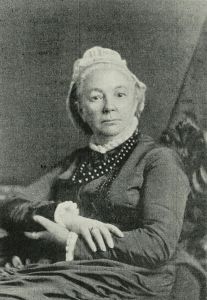
    Margaret Oliphant (1828–97)

    She fell out of currency until the late twentieth century, when some of her works returned into print, in an atmosphere of renewed interest in women’s writing. Merryn Williams compares her to Jane Austen and George Eliot and considers her ‘indispensible reading for anyone interested in women in the nineteenth century‘ (Women in the English Novel, 1800–1900).

    Bear in mind that the occasional tone of condescension I mentioned is characteristic of the era, in which a revolution in industry — including the attachment of a steam engine to a rotary printing press capable of printing on both sides of a sheet of paper — made possible the production of millions of copies of a single page in a day, and thus the birth of a mass media. Political, moral and financial imperatives came into play: on the one hand, considerations of the education, edification, ‘betterment’ and socializing of the masses; on the other, anxieties about the breakdown of social order.

    Questions arose such as, What kind of reading is appropriate for the working class (obviously, something useful)? And even fears about the ‘contamination’ of one class by another — more than a metaphor when it came down to instituting public libraries.

    In her essay, Oliphant writes of a summer afternoon in a cathedral town. She has charge of a restless child, whom she takes to a grassy patch by the cathedral, beyond the ‘verdant turf of the cathedral close’, having spent sixpence on some miscellaneous literature to amuse her with. The child is more fascinated with the ‘living daisies outside better than the dead effigies within’, and Oliphant spreads the papers out on the grass.

    Grave literature and learning, decorum and dignity, the authorities of society, stood represented in those grave old houses, from which no careless human eye looked out; and scattered over the daisies, with the wind among their leaves, lay the unauthoritative, undignified, unlearned broadsheets, which represent literature to a great portion of our country people, despite of all the better provision made for their pleasure.

    There could not possibly be a more marked or total contrast than between the object of our immediate attention and the scene.

    Thus is revealed an epiphany, which is not too far from the reader-response and reception theories of nowadays, to the effect that, ‘the multitude’, the reading public — those girls in the mills — will freely take what it pleases and do as it likes with the literature that is put in front of it. And so it ought.

    But here’s the good part. Whom should she uncover from her little trove of cheap writings among the daisies? Of course:

    Here is one personage, for instance, whom rival publications vie for the possession of, and whom the happy successful competitor advertises with all the glow and effusion of conscious triumph,—J. F.; nay, let us be particular,— John Frederick Smith, Esq. This gentleman is a great author, though nobody (who is anybody) ever was aware of it […]

    [Y]et we protest we never read a word of his writings, nor heard a whisper of his existence, until we spread out our sixpenny budget of light literature upon the June daisies. What matter? His portrait, from a photograph by Mayall, may be had in those regions where his sway is acknowledged; and the everybody, who is nobody, bestows upon him that deep-rolling subterraneous universal applause which is fame.


    CHAPTER TWELVE

    Goliah Gob’s Watch — Great Excitement in the Village of Deerhurst — Two Fathers and Two Sons — Viscount Allworth and Lord Bury — The Schoolmaster and Benoni

    Our readers, we flatter ourself, will step back with pleasure to see what some of their old acquaintances have been doing all this time.

    There was great excitement in the village of Deerhurst when it was known that Goliah Gob had received a splendid gold watch from one of the girls he assisted to rescue, and the interest was still further increased by the mysterious manner in which it had been conveyed to him — left at his mother’s farm by an itinerant preacher who had slept at the house overnight, and found on the table in his room, addressed to the honest rustic.

    It was a great puzzle to him, no doubt. But the London lawyer knew how to choose his agents.

    Peggy Hurst spitefully declared, without ever seeing it, that the watch would prove brass. Even Susan doubted, but it might be otherwise.

    We wonder if she had an eye to future contingencies. At any rate, she gave her mother, who watched her with the stealthiness of a lynx, no reasonable cause of complaint. She quitted her home, which had become intolerably dull since the departure of William, only on Sundays, to accompany her father to church. Not even his wife’s influence could prevent the old man from attending it. He had done naught to disgrace himself, he said, and would not give his neighbours cause to blame him.

    Mrs. Hurst prudently abstained. She had not forgotten the scene in the justice room at Squire Tyrell’s, the insults of the crowd, and above all, the triumphant, jeering glances of the Widow Gob.

    Absenting herself from church was the one weak spot in the programme she had traced for keeping Goliah and her daughter apart. There might be nothing between them at present; she admitted that, and determined within herself there never should be if she could prevent it.

    The last few days had greatly intensified her hatred of the Gob dynasty.

    ‘Mind and return as soon as the service is over,’ she said, after carefully tying her husband’s cravat.

    ‘I don’t expect anyone will invite us to stay,’ observed her husband, dryly.

    ‘And look closely after Susan,’ added his wife.

    ‘Aye, aye. I’ll take care on her.’

    ‘And watch if she exchanges looks or words with any of the singers in the organ galleries.’

    ‘I can’t,’ said the farmer.

    ‘Nonsense, Peter.’

    ‘I won’t,’ he added, firmly. ‘Susan be a good girl. Why should I play the spy upon her and feel ashamed to look my own child in the face? And it is my opinion there be naught to spy out. Now you know my meaning.’

    Mrs. Hurst looked thunderstruck. It was the first symptom of rebellion against domestic government that had occurred since they had been married. No wonder it startled, if it did not greatly alarm her.

    As for her daughter, she appeared rather amused than otherwise at her mother’s astonishment. Possibly she also did not place much confidence in her father’s resolution.

    ‘Peter,’ gasped his wife, in a tragic tone, ‘answer me one question.’

    ‘I will if I can.’

    ‘Are you in your right senses?’

    ‘No.’ The admission seemed to afford Peggy considerable relief.

    ‘I thought not,’ she muttered.

    ‘But I am coming to them,’ added her husband.

    Catching up his hat with an air of determination, the speaker quitted the kitchen, and, accompanied by Susan, started on his way to church; and Peggy, disconcerted by forebodings of the approaching end of her reign, sank into her easy chair to meditate.

    The truth was, she had stretched her authority too far. She muttered to herself: ‘He misses Willie, and the loss has made him mad.’

    This conclusion appeared to afford her considerable relief.

    ‘It can’t last, and it sha’n’t last,’ she resumed. ‘Why, Peter never ventured to cry snip unless I first said snap! and now — We shall see, we shall see. I’d rather die than give in to him. What would Mrs. Gob say?’

    Many wives have made similar resolutions before, and yet been obliged eventually to yield. Patience, gentle reader; the domestic battle is only just commenced. A shot from the outposts; nothing more.

    Up to our present writing we have barely alluded to the village schoolmaster, and yet he is destined to play an important part in our tale, as well as his treacherous son, Benoni.

    Theophilus Blackmore — or old Theo, as his pupils called him — seemed to have been born without any strong moral perceptions; and yet he was neither dissipated in his habits, vindictive in temper, nor naturally inclined to cruelty. He had no sympathies, no hates, but looked upon life as a mathematical problem, which, once solved, could have no further interest for him.

    His one solitary passion was for books; provided that were gratified, the world with its petty rivalries, jealousies, ambitions and crimes, might jog on as it pleased. They were the one necessity of his existence; he hungered for them.

    Reading had made him a ripe scholar. Science rendered him familiar with the latest discoveries; and yet he had never applied his knowledge to any practical or useful purposes.

    The Village Schoolmaster (1881), Charles West Cope. Source: Leicester Arts and Museums. Public Domain.

    When we say the old man had no sympathies, we ought to have admitted one exception. He felt a sort of dreamy kind of regard for his son Benoni. He had educated, but failed to make a man of him. All the higher qualities of manhood were lacking — honor, truthfulness, courage, fidelity in friendship.

    The fatal influences of his childhood clung to the young hypocrite still.

    How the old schoolmaster ever thought of marrying was a wonder to most persons who knew him. Possibly he wanted a cook or housekeeper. Certain it is that love had small, if any, share in his resolution. Since the death of his wife he had never been known to allude to her. In short, there appeared to be a mystery about the man which no one had ever been able to fathom.

    For several days the continued presence of Benoni in the house failed to excite his attention. When he did notice it he attributed it to the absence of his companion, Willie. As weeks passed, and the youth still avoided going to the village, or event attending church service on Sundays, the curiosity of Theophilus Blackmore became excited; not that he thought of questioning him. He knew his soon too well for that. Truthfulness was not one of Benoni’s characteristics. He took a surer way, and speedily learnt from his pupils the story of the boy’s treachery.

    Some parents would have felt grieved — would have remonstrated, corrected; not so the old bookworm. He regarded it as a thing that was to be — a mere incident in the drama of existence.

    The state of quietude was broken by a very unusual circumstance — the arrival of a visitor, who drove directly to their solitary abode, and remained nearly two hours in close conversation with the owner. Vainly did Benoni try to catch the subject — he was not above listening — but the door of the room was kept locked till the departure of the stranger.

    The following day his father delighted his pupils by informing them that for three days they might take a holiday — business of importance obliging him to pass that period in London. In short, he at once dismissed them, and as they quitted the school-room, settled himself down to one of his favourite authors. The curiosity of his son was excited to the highest pitch.

    ‘Did you say you were going to London?’ he demanded, alter a pause, trusting that his father might impart something more.

    ‘Did you not hear me?’

    ‘Am I to accompany you?’

    ‘No.’

    The querist looked terribly disappointed.

    ‘I have never been in London,’ he observed.

    ‘And what would you do there?’ inquired Mr. Blackmore, sharply. ‘You have not a single friend or acquaintance there that I am aware of. You might have had one, but foolishly lost him by your treachery.’

    The youth colored deeply.

    ‘To preserve a friend,’ added the speaker, ‘we must observe the laws which govern friendship — truth, honor, sincerity.’

    ‘Do you reproach me?’ exclaimed Benoni, getting excited.

    ‘I never indulge in reproaches,’ observed his father, for the first time raising his eyes from the volume before him. ‘They do no good. Besides, you would not feel them.’

    ‘And whose the fault?’ retorted the young man. ‘Yours! You trained me to distrust the natural feelings of the heart, calling them weakness; taught me to be as cold and artificial as yourself; and now find fault with your own work.

    ‘I tried to make you a philosopher,’ said the schoolmaster.

    ‘And trained a hypocrite,’ replied his son.

    ‘We will not dispute on terms,’ remarked the book-worm. ‘They are convertible, as mathematics teaches. What folly induced you to release the two ruffians in the Red Barn?’

    ‘They were from the Bittern’s Marsh,’ answered the youth, sullenly.

    ‘Ah!’ ejaculated his hearer.

    ‘And recognised me.’

    ‘That gave the act some show of reason,’ observed Mr. Blackmore after a pause. ‘An excuse, but not a necessity,’ he added. ‘You should have consulted me.’

    ‘There was no time for consultation. I had to decide,’ replied his son. ‘Consult, indeed! Father,’ he continued, ‘has there ever existed the least confidence between us? I know as little of your past life as of the future. That you are a cold selfish hypocrite, I have long since discovered; but there my knowledge ends. It would be better for us to part.’

    ‘What!’ said the old man sarcastically. ‘The tiger cub would break its chain?’

    ‘You should have forged it stronger,’ was the muttered reply.

    His parent closed the book he had been reading, and commenced pacing up and down the room for several minutes, muttering to himself, ‘Kismet! Kismet!’ the Arabic word for fate. Suddenly he paused in his peregrination, and fixed his glaring blue eyes upon the inflamed countenance of the speaker.

    ‘You are right,’ he said. ‘It is time that we should part. Cold as you think me, I will not suffer you to cast yourself upon the world without some chance of escaping shipwreck. But you must leave the means to me. This visit to London is most opportune. Yes, yes,’ he muttered to himself, ‘I will insist upon it. You must await my return. My absence will not exceed three days. Promise me.’

    Benoni pledged his word to remain. Nor that the speaker placed much reliance upon it; he trusted more to the fact that, with the exception of a few shillings, he knew him to be penniless. That same evening he started upon his journey, and at the time appointed returned to Deerhurst.

    Vainly did his son try to read in his face the success or disappointment of his hopes. The countenance of the Sphinx could not have been more impassive. Unable to endure the suspense of doubt, he boldly questioned him.

    ‘Have you succeeded?’ he demanded.

    ‘Yes,’ was the reply, ‘In a week or two you will enter the office of Brit and Son, London.’

    ‘What are they?’

    ‘Lawyers.’

    ‘Only lawyers!’ remarked Benoni, in a tone of disappointment.

    ‘Did you expect to be articled to a cabinet minister?’ asked his father, sarcastically. ‘Such personages do not generally take apprentices.’

    ‘No. But I –‘

    ‘Shall I tell you what a lawyer really is?’ continued, the former, interrupting him. ‘He is the depository of secrets affecting the honor, and sometimes the fortune, and sometimes the lives, of his clients; an agent to baffle the ends of justice more frequently than to assist them. The fortunes of the fools who trust them pass through their hands, which are birdlimed, and some of the feathers of the golden geese are sure to stick to them. Only lawyers!’ he repeated. ‘You are unworthy to be my pupil if you fail to find your advantage in this.’

    ‘But all lawyers are not alike,’ suggested the young man.

    ‘Perhaps not,’ was the reply. ‘I only state the rule, and waste no time or thought upon the exceptions, I know what is best for you.’

    His son thought so, too, and began to feel pleased with the idea, although it was not the profession he would have chosen. But, then, it promised change — change from the dreary, dull, unloving home to the busy realities of life; activity, success, and possibly revenge upon his former friend, Willie, whose honest scorn of his treachery had deeply stung him.

    Two weeks before the departure of Benoni for London there was to be a wedding at Deerhurst church, which Susan naturally felt desirous of attending. All girls like to be present at weddings; at least we never knew one that did not.

    Peggy Hurst made but a faint attempt to prevent her daughter from going. The wish was so natural. Then her father spoke out, and somehow his wife felt less inclined to oppose him than formerly. It did not appear quite so safe. She was a tactician in her way, and husbanded her forces for serious occasions.

    The church was crowded, as is usual on such occasions. The farmer met several old friends and acquaintances, who appeared something less inclined than lately to censure him very strongly. The fact was, they knew where the shoe pinched. They were mostly married men, and had worn it themselves, Opinions, like the weathercock, were veering round in the old man’s favour.

    Whilst he was chatting with some and shaking hands with others Susan contrived to slip from his side, and made her way to the organ-gallery. Behind the instrument she found Goliah. Of course she appeared very much surprised.

    ‘Dear me, Mr. Gob,’ she exclaimed. ‘You here!’

    ‘Ees,’ answered the rustic; ‘beant this the place?’

    She had forgotten, for the instant, a message she had sent him. There was no time for coquetting. She felt that, and came at once to her purpose.

    ‘I am uneasy in my mind’ she began. ‘Benoni is about leaving for London, and I have written a letter to put my cousin on his guard, for I feel certain some treachery is intended. He has twice held long talks with mother at the bottom of the orchard. I dare not post it in the village. Mother and post-mistress are too intimate. Can’t you take it?’

    ‘You may swear to that,’ replied her admirer — ‘not that I ever heard of thee swearing. I be goin’ wi’ a load of hay in the mornin’. Dear! Dear!’ he added. ‘I do feel mortal bad.’

    ‘What can be the matter with you?’ inquired Susan, archly .

    ‘I think it be love. And now the murder’s out!’

    ‘Nonsense!’ said the village beauty, as she disappeared down the gallery staircase. ‘Mrs. Gob’s dumplings were too heavy! It can only be indigestion!’

    The honest fellow looked after her wistfully.

    ‘It beant dumplings,’ he muttered. ‘Mother’s dumplings are allays light. What will I do?’ he added. ‘Sartin it be love!’

    We think so, too.

    Viscount Allworth would have made an excellent stage manager of a vaudeville theatre. Neither was he without some talent for tragedy. His mise en scene, too, was admirable. He could set his face to any expression he pleased, for, like the Roman actor who of old had worn the mask so long, his features took the impress of bronze.

    For several days his lordship had been expecting a visit from his son, and remained at home, watching with calm confidence his arrival. No sooner did he perceive the brougham enter the square than he walked deliberately to the mirror in the dressing-room, to arrange his countenance for the occasion. Satisfied of his artistic success, he seated himself at a table. The bell had rung for the performance. He was ready.

    ‘Welcome, my dear boy!’ he exclaimed, as the young man entered the apartment. ‘I am glad you are come. I have been anxiously expecting you.’

    ‘Doubtless, my lord,’ was the reply, ‘for the honour of our name is dear to me.’

    ‘The honour of our name is untouched.’

    ‘Hear me, father –‘

    ‘You must first hear me,’ interrupted the aged hypocrite, with well-affected dignity. ‘Unjust accusations are always regretted; forbearance rarely is so. You have heard the rumours?’

    Lord Bury bowed in the affirmative. I have done everything in my power to stifle them — not without success, I flatter myself. Something also I have exacted by way of atonement. Clarence Marsham has quitted the army.’

    ‘His debts compelled him.’

    ‘Not so,’ observed his parent. ‘Lady Allworth was quite prepared to pay them but I refused to listen to any compromise.’

    ‘And where is the scoundrel now?’ demanded the visitor, the, frown upon his brow slightly relaxing.

    ‘In France.’

    ‘Paris?’

    ‘I presume so.’

    At the very moment he uttered the equivocating lie the speaker had a letter dated from Dinent, in Brittany, written by his step-son, in his pocket.

    ‘What more can I do?’ continued his father. ‘I cannot divorce my wife because her son has acted like a fool. Is it not better to let the rumors quietly die out than to create any further scandal? My own conduct has been perfectly clear in the affair, but I leave the decision with you.’

    ‘Possibly you are right,’ observed Lord Bury, after reflecting on the circumstances. ‘At least, I shall not oppose it; but this acquiescence, forced upon me by consideration for my cousin, Kate, will not prevent me from proceeding immediately to Paris and calling Clarence to account.’

    ‘I have no opinion to offer on that point,’ observed the viscount, gravely. ‘And now, Egbert,’ he continued, ‘weigh all that has taken place calmly; question me on any point of my conduct you please, I am ready to answer you.’

    ‘Father,’ replied the young guardsman, ‘I would fain believe, and dare not question you, lest some painful doubts should be re-awakened. God forgive you if you have deceived me!’

    It is a hard thing to force upon a son the terrible conviction that his father is a villain. Lord Bury took his leave, hoping and trusting probably against his better reason. A few minutes after his departure Lady Allworth entered the dressing-room. She had overheard every word that passed.

    ‘Admirable!’ she said. ‘Yes; I think I have pretty well mystified him. We have now a clear field before us. ‘But the bonds?’ he added, eagerly.

    ‘Shall be paid the instant you have signed the lease of the Bittern’s Marsh.’

    This edition © 2019 Furin Chime, Michael Guest


    Notes, References, Further Reading

    dominie: Scottish English term for a schoolmaster.

    [Margaret Oliphant], The Byways of Literature: Reading for the Million’, Blackwood’s Edinburgh Magazine 84 (August 1858) 200-16. Available at Internet Archive. [Author’s name not given on the text.]

    John Sutherland, ed., Longman Companion to Victorian Fiction, 2d ed. (Routledge, 1988).

    Victorian Fiction Research Guides, ‘Margaret Oliphant‘.

    Lewis C. Roberts, ‘Disciplining and Disinfecting Working-Class Readers in the Victorian Public Library’, Victorian Literature and Culture, Vol. 26, No. 1 (1998),105-132.

  • J.F. Smith’s Mystery of the Marsh — Recap

    J.F. Smith’s Mystery of the Marsh — Recap

    I’ll keep good the promise made by the 1883 newspaper sources for this reconstructed penny blood mystery, by providing their mid-way summary. The author of the novel is the Englishman John Frederick Smith, the most popular writer of the mid-nineteenth century — but in later years all but forgotten. The annotated instalments include contextual notes along with glimpses of the life of this intriguing writer.


    In order that new readers may begin with the following installment of this story, and understand it just the same as though they had read it all from the beginning, we here give a synopsis of that portion of it which has already been published:

    Two girls, clad in male attire, one evening appealed for help to William Whiston, nephew of Farmer Hurst, of Deerhurst. William — who was accompanied by two friends, Goliah Gob and Benoni Blackmore — gave the fugitives refuge in his uncle’s red barn. Soon afterwards a tramp, named Bunce, took refuge in the barn, and two ruffians came there also, in pursuit of the girls. Bunce defended the girls against the ruffians, till Goliah Gob, a young fellow of gigantic size and strength, came to his assistance. The ruffians were overpowered and bound.

    Isaac Israëls (1865-1934), Bois de Boulogne (1904). Public Domain. Source: 1stdibs.com

    Goliah then summoned William and Benoni, and after consultation William and Goliah set out in a waggon for London with the girls, who proved to be Lady Kate Kepple, an heiress, and her maid Martha. Lady Kate was fleeing from Clarence Marsham, an officer in the Guards, who attempted to force her to marry him. They arrived safely in London, where Kate went to the protection of her aunt, Lady Montague.

    William called on his uncle, Lawyer Whiston, and told him the story. The old lawyer was Lady Montague’s legal adviser, and was delighted to find what part his nephew had played in Lady Kate’s escape.

    Benoni had been left in charge of the bound ruffians in the red barn, with directions to hand them over to the authorities in the morning, but he set them free, and told such a story to Farmer Hurst that Mrs. Hurst insisted on having William and Goliah arrested for stealing the farmer’s horse and waggon. This was done, but Lawyer Whiston came down from London, rescued them, and overwhelmed the Hursts and Benoni with exposure and shame.

    William, who was half-owner of the Hurst farm, then went to London with his uncle.

    Goliah loved Susan Hurst (William’s cousin), and Mrs. Hurst hated him for it. Lawyer Whiston, to whom Bunce showed some old family papers, provided handsomely for the wanderer, and Lady Kate Kepple sent William and Goliah each a handsome watch as a token of her gratitude.

    Clarence Marsham, the persecutor of Lady Kate, was a step-son of an unprincipled nobleman, Lord Allworth, who, after the death of his wife, married Clarence’s mother for her money. Lord Allworth had a son of his own — Egbert, Lord Bury — whom he had swindled out of an estate called Chellston, that Egbert had inherited from his mother. Sir George Meredith, Egbert’s uncle, had bought Chellston.

    Clara Meredith, sole child of Sir George Meredith was a beauty and an heiress. Egbert — Lord Bury — was on a visit to Chellston. Clara felt piqued at Lord Bury, who was an officer of the Guards and noted for his exclusiveness, because when she was on her first visit to London the season before, he did not call upon her. For this reason she snubbed him, reminded him how he had fallen into the duck pond when he was a boy, and requested him to make her a drawing of the scene.

    At the May Day festival Lord Bury defended the May Queen, Phœbe Burr, from a ruffian named Burcham, until her lover, Tom Randal, came upon the scene, and claimed the right to act as her champion. Farmer Randal, Tom’s father, was so incensed at his son for avowing his love for Phoebe that a quarrel ensued and Tom ran away. Clara was a friend of Phœbe’s and resolved to help her to marry Tom despite his father’s opposition.

    This is the state of affairs at Chellston when the following chapter opens …

    This edition © 2019 Furin Chime, Michael Guest


    Next instalment will be Chapter Eleven. All the previous chapters are available at Furin Chime website. 

  • J.F. Smith’s Mystery of the Marsh — Tenth Instalment

    J.F. Smith’s Mystery of the Marsh — Tenth Instalment

    Smith lingers over May Day while introducing a new source of conflict. The early twenty-first century reader may wince at the themes of gender and morality so firmly foregrounded. In our era we have the advent of LGBT rights, and concurrent with them, the destabilization, at least, of traditional gender identifications; such that perhaps the only truly defining characteristic remains the (optional) ability of a woman to bear offspring.

    Women’s rights and equality, moreover, have been hard fought for and to an extent achieved, and we have come to expect the equivalent participation of women across the gamut of human endeavour, from politics and world leadership to sport. At the same time, the advance of a particular set of human rights collides with others and frictions arise with traditional religious ideas.

    From the modern perspective, the Victorian ethos is beheld as the epitome of repression against which the progressive West measures its freedom of thought and existential identity. Though John Ruskin himself has been the butt of many jokes, there are few better spokespeople for the ideology of a culture that fundamentally prefigures our own.

    His lecture ‘Of Queens’ Gardens’, published as one half of Sesame and Lilies (1865), outlines his ideals of femininity, defining the woman’s sphere as passive in relation to the man’s, and in the private domain of the home. At the same time, he ‘urges women to abandon trivial feminine pursuits in order to act as a moral force in countering the ills of society’ (Norton Anthology of English Literature).

    Here are some quotations from Ruskin’s lecture, referring to the ‘place’ (the home) and ‘power’ of women, which echo in the instalment to follow:

    We are foolish … in speaking of the ‘superiority’ of one sex to the other, as if they could be compared in similar things. Each has what the other has not: each completes the other and is completed by the other: they are nothing alike, and the happiness and perfection of both depends on each asking and receiving from the other what the other only can give …

    The man’s power is active, progressive, defensive. He is eminently the doer, the creator, the discoverer, the defender …

    But the woman’s power is for rule, not for battle, — and her intellect is not for invention or creation, but for sweet ordering, arrangement, and decision. She sees the qualities of things, their claims and their places …

    This is the true nature of home — it is the place of Peace; the shelter, not only from all injury, but from all terror, doubt, and division … And wherever a true wife comes, this home is always round her.

    Of Queens’ Gardens (p. 20 ff.)


    CHAPTER TEN

    The May Day Sports Interrupted — The Bully and the Gentleman — A Manly Lover — A Poor Girl’s Resolution

    ‘What is the meaning of this disgraceful scene?’ demanded the baronet, walking in the midst of the crowd, composed mostly of his old and new tenants. ‘Nephew, will you explain?’

    ‘Better, ask some one else, uncle,’ replied the guardsman, laughingly. ‘You forget that I am a particeps criminis in the affair.’

    This was the first intimation of the relation between their landlord and the unknown gentleman.

    The bully began to feel cowed.

    ‘I need not ask,’ added Sir George, ‘since I see Mr. Burcham present. It is time these public outrages were put a stop to.’

    ‘High time,’ said the rector.

    ‘Leave him to me,’ exclaimed the lover of the pretty May Queen, ‘and I will answer for it he will not be in a hurry to recommence.’

    ‘And what have you to do with it?’ inquired the baronet mildly, for the speaker was rather a favorite with the old gentleman from his sporting accomplishments.

    ‘That is what I should like to know,’ muttered Farmer Randal.

    ‘Sir George,’ replied the young man, respectfully, ‘Phœbe is my betrothed wife. I love her very dearly, and she loves me. It is my right to defend her. Don’t cry, Phœbe,’ he added, ‘there is nothing to be ashamed of in an honest affection, although it is rather tough to be forced to speak of such things. When that thing, who calls himself a gentleman, tried to force her to dance with him — no modest girl could do so — your nephew stood forward like a man to protect her. God bless him! If ever he wants a true heart and a tolerably strong arm to defend him, he knows where to find them.’

    The glowing countenance of the speaker, his untaught natural eloquence, and manly avowal of his love produced a favorable effect upon his hearers.

    ‘I was at a distant part of the green,’ continued Tom Randal, ‘when the row commenced. Burcham — Squire, as he calls himself — had already received some punishment. I claimed the right to finish him, which my lord here — I recollect him now — reluctantly consented to. It was my right to defend her, and I would have pounded the rascal to a jelly, if your honour and your friends had not interfered; but I only put off paying my debts: the first time we meet I intend to take a receipt in full.’

    ‘Very proper,’ said the baronet. ‘How very natural, I meant to say,’ he added, correcting himself; ‘but unfortunately, it would be illegal. Mr. Burcham you had better retire.’

    ‘I shall do nothing of the kind,’ replied the cowardly ruffian, sullenly. Conscious that in the presence of so many magistrates, no further contest would be permitted, he resolved to brave it out. ‘This is May Day, and though you are lord of the manor, the green is free to all.’

    ‘Who conduct themselves respectably,’ observed Sir George; ‘but vagrants, disorderly characters, and disturbers of the peace, I am fully authorised to remove. I shall commit you.’

    ‘I can give bail,’ observed Burcham with a sneer.

    ‘Or place you in the stocks,’ added Sir George, thoroughly roused.

    At this there was a general shout of laughter.

    ‘And any magistrate present, I feel certain, will sign the warrant. Call the constables.’

    As the bully said, he could easily have found bail, and lawyers to defend him, for he had plenty of money; but the stocks! Nothing could ever efface the ridicule of such an exposition. With an oath of future vengeance he broke through the crowd, and ran with the fleetness of a hound till he had cleared the village green. There was a general hiss on his flight.

    During the rest of the day the sports were languidly carried out. Tom Randal never for an instant quitted the side of Phœbe. Vainly did his father call to him, his mother and sisters beckoned to him; summons and signs were alike unheeded. He knew his place, and stuck to it.

    For several years the young farmer, who with Lord Bury had fairly divided the honours of the day, had been an object of speculation amongst those of his own class, who had daughters to dispose of in marriage. Mothers, of course, condoled with Mrs. Randal on her son’s having been so easily entrapped; the girls pouted and tossed their heads indignantly.

    ‘Phœbe Burr indeed!’ observed one.

    ‘Hasn’t an acre of land in the parish!’

    ‘Nor in any other parish,’ added a third. ‘The old organist can’t have saved much.’

    The last observation, unfortunately, was strictly true, the old man’s salary being only forty pounds a year, and for that he had to train the choir, as well as attend two weekly services.

    ‘Tom was always a soft-hearted fool,’ said one of his sisters, spitefully. She was not only jealous of her brother, but detested the object of his choice.

    ‘Hold thee tongue, Bess!’ exclaimed her father, angrily. Not that he did not feel quite as much displeased at his son’s choice as the rest of the family, or had not come to a conclusion to break it off; but the old man was quite shrewd enough to perceive that abusing Phœbe was not the way to do it. ‘Thee was always envious of the gal because she has a prettier face than thine. It be only calf-love,’ he added, ‘and will die off of itself, if let alone.’

    We question if the speaker felt much confidence in his own prediction. Still he was resolved to give the boy a chance. If Tom listened to reason, well and good; if not, then he would see.

    If it were possible to tempt us to bet, we rather think we should feel inclined to back the son. How frequently have we seen prudent resolutions made, and fail from lack of temper in carrying them out. We suspect it will prove so with the farmer.

    How frequently can one coarse mind destroy the enjoyment of many. To the May Day Queen her ephemeral dignity had proved anything but a source of pleasure; her name had been made the theme of village gossip, the sport of every tongue — and we know how charitable they are, especially in rustic communities. As soon as Sir George and his guests returned to the Hall, poor Phœbe retired to her father’s cottage. Her lover accompanied her. It had been by her own repeated requests that Tom had abstained from paying her any marked attentions, and kept at a distance from her mimic court. Not that he felt ashamed of his choice; on the contrary, he felt proud of it, and proved the depth as well as manlinesss of his attachment by proclaiming it openly to the world.

    Queen of the May, 1875. Julia Margaret Cameron (British, 1815-1879). Albumen print from wet collodion negative. Public Domain. Source: Internet Archive (Cleveland Museum of Art)

    With tender, truthful words, such as dwell on memory’s page long after they are uttered, he sought to soothe her delicacy and wounded pride, till he had the satisfaction of seeing something like a smile on her pale face. The shades of evening had fallen when he rose to depart. At the request of her lover, Phœbe consented to accompany him as far as the garden gate. Perhaps he thought to steal a kiss; if so, who shall blame him?

    On reaching the limit of the enclosure the lovers paused; neither of them liked to say the word ‘good-night,’ and yet each felt that it was time to speak it.

    ‘I fear, Tom,’ said the fair girl, breaking their mutual silence, ‘that I can never be your wife.’

    ‘You will! You must!’ exclaimed the young farmer, impetuously.’What would life be without you?’

    ‘You forget that you have a father,’ the maiden hesitatingly replied; ‘and that without his consent I never will be yours.’

    ‘Phœbe! Phœbe!’ ejaculated her lover, imploringly.

    ‘I will bring discord into no family,’ continued the former; ‘happiness would fail to follow it. Remember how angry your father looked; how repeatedly he called you when you proclaimed the right to protect me.’

    ‘You do not know how well he loves me,’ replied her suitor, trustfully. ‘ He will fret and fume and rage at first — for I cannot conceal from myself that he has other views respecting me — but when he finds my happiness is really at stake, he will yield at last.’

    ‘Never!’ exclaimed a harsh voice near them.

    The next instant Farmer Randal broke through the hedge, where he had been a concealed listener to their conversation.

    ‘I did not think, father,’ observed Tom, greatly hurt, ‘that you would play the spy upon me.’

    ‘Aye, thee father; and thee will find that his heart baint half so soft as thee do think. Leave that artful minx, and come home with me.’

    The countenance of his son flushed, and then became pale. He had never disobeyed a command of his parent yet.

    ‘I will follow you in a few minutes,’ he replied. ‘I cannot accompany you now.’

    ‘Come home, I say,’ repeated the angry man.

    ‘For Heaven’s sake! go with him,’ whispered the terrified girl.

    ‘I will not!’ said her lover, firmly. ‘I am glad the discovery has been made, although it has not occurred in the manner I could have wished. I love her, father. You must have some memories in your heart to tell you what a first love means. You know that I am industrious. I will work harder than ever to please you. We are both young — willing to wait, if you exact the sacrifice; but one thing is certain: if Phœbe consents, she shall be my wife.’

    ‘Wife?’ repeated the old man, scornfully. ‘Why she hasn’t a penny! Knowing what a soft-hearted fool thee art, her mother has trained the artful hussy to catch thee.’

    In his wrath the speaker would have struck his son a blow; but Tom caught his wrist in an iron grasp, and held it firmly till his father’s eyes quailed beneath his reproachful gaze.

    ‘Do not disgrace my manhood by an outrage it would be sacrilege to resent by a blow that must separate us for ever,’ replied his son, disengaging his wrist.

    ‘Thee has driven me half mad!’ was the reply.

    Phœbe felt that it was time to interfere. The slanderous accusation against the mother she so dearly loved had aroused her indignation, and she confronted the speaker with eyes lit up by scorn at the outrage.

    ‘Mr. Randal,’ she said, ‘it is quite true that Tom and I love each other dearly — very dearly; equally true that I am poor. I do not deny it, Poorer, perhaps, than you suspect. But it is a wicked falsehood to accuse my mother of plotting to entrap your son.’

    ‘Maybe I was wrong there,’ growled the farmer.

    ‘You have a right to object to our marriage. I also have the right, to respect myself. Never will I consent to become the wife of your son till his father asks me.’

    The old man gave a low, chuckling laugh.

    ‘Phœbe!’ exclaimed her lover, greatly agitated.

    ‘I have said it, and you know that I can keep my word, And now, Tom,’ she added, blushingly, ‘take the kiss you asked for — in this world probably the last; for rest assured of this, the lips you have once pressed shall never be pressed by another.’

    The kiss was given and received. The lovers lingered over that parting embrace as if their heartstrings were twined together. Phœbe was the first to recover from the conflicting emotions which agitated both, and tearing herself from the arms of the young farmer, tottered rather than walked into her father’s humble cottage.

    The poor fellow stood gazing after her, the image of mute despair.

    ‘Come home, Tom,’ said the old man, mildly, for he, too, felt touched by the sorrow of his son. ‘She be a good gal, after all,’ he added.

    ‘God forgive you, father; you have broken my heart,’ murmured the poor fellow.

    The next instant he bounded over the hedge and disappeared. The farmer tried to follow him, thinking to soothe him with soft promises of future indulgence, but soon gave up the chase for want of breath.

    ‘Ah, well,’ he muttered, as he sank panting on one of the benches prepared for the May Day visitors — ‘I beant as spry as I once wor. Ugh! Tom can outrun me. Then what a grip he has! I am glad I didn’t strike him — not that he would have hit back again; too manly for that.

    ‘It be all calf love,’ he continued, ‘felt it once myself. Father wouldn’t hear of it, so I sulked for three days; refused my food; but, then, I milked the cows in the barn, and that kept me up like. I wonder if the boy will think of that. He will be back in three days, or four at the furthermost, and then I’ll buy him the colt that he took a fancy to. That will make it all right.’

    Here we must anticipate the progress of events and inform our readers that not only did the four days but as many weeks, nay, months, elapse before Farmer Randal received the least intelligence of his son.

    Although Sir George Meredith, on hospitable cares intent, did his best to entertain his guests, the dinner somehow passed heavily. He told his best stories, and scarcely elicited a smile. His daughter too, appeared dull and dispirited; her cousin calm as usual, as might have been expected, for his lordship rarely indulged in sentiment. Being in the Guards, of course he had a horror of gushing.

    The rector and his lady were the first to move; the worthy man had his sermon to write.

    ‘Hang the sermon!’ exclaimed his host. Struck by the impropriety of the expression, he instantly added: ‘I don’t mean that; excellent things in their way. I thought to make a night of it. Preach one of your old ones; that about the Pelagians. Like to hear it again; never understood it.’

    ‘Nor any one else,’ the speaker might have added.

    The suggestion was artfully made, but failed in its intended effect, although the subject was a favorite one with the learned churchman, who looked upon the denial of original sin with orthodox horror. Possibly the last observation of the baronet — that he never understood, the sermon — had something to do with the reverend gentleman’s refusal to remain.

    The Nevilles went next — that is to say, all but Rose. She and Clara Meredith had long been intimate friends. They compared observations, criticised men creatures together, and had no secrets from each other. Girls are something like boys in one respect — they must have a confidant till they win a lover, and then their confessions become more guarded; not that friendship has grown cold — it has only become discreet.

    Older readers can easily understand why Rose Neville remained at the Hall for a few days.

    Captain Waterpark and Lord Wiltshire and the rest of the guests soon followed. And the owner of the Hall began to feel in an irritable humor.

    ‘Well, Bury,’ he observed, ‘I suppose you find yourself considerably bored by your visit. Had you written to inform me of’ your intention, I would have asked some of your set down to meet you.’

    ‘Not at all necessary, my dear uncle,’ replied his lordship. ‘So far from feeling bored, I have been highly amused. Fond of studying character.’

    ‘Pretty specimen, that fellow Burcham,’ said the baronet. ‘Glad you thrashed him. Would have done it myself had I been ten years younger. Believe I can do it now. Great mind to try it.’

    ‘Oh, papa! papa!’ exclaimed Clara.

    ‘Don’t look frightened, pet,’ said her father. ‘I am not going to make myself so ridiculous as that.

    His nephew felt delighted to hear there is a limit; if rather a wide one, to the eccentricities of his relative.

    ‘Mr. Burcham in society?’ he asked.

    ‘No,’ answered Sir George pettishly; ‘admitted to the hunt; a mere outsider. Can’t avoid that; he owns the best cover in the country.’

    ‘But not to the county balls,’ observed Rose Neville.

    ‘Or at any house where there are ladies in the family,’ added Clara.

    ‘I see; a native of the debatable land,’ said her cousin.

    The ladies retired; they had their own little confidences to make and compare notes on the events of the day.

    Albert Anker (1831 — 1910). Still Life with two glasses of red wine, a bottle of wine, a corkscrew and a plate of biscuits on a tray. Public Domain. Source: Wikimedia Commons

    ‘You have made out anything but a pleasant time,’ observed the uncle to his nephew; ‘do better, I trust, tomorrow. Touch the bell — thank you.’

    The summons was answered by the butler, whom his master ordered to bring up a bottle of choice Burgundy.

    ‘No such wine to be had in the market now,’ observed the old gentleman, complacently eyeing the sparkling nectar. ‘Don’t often produce it. Stock getting low. We will finish it together.’

    ‘One glass, with pleasure,’ replied Lord Bury, ‘and then good night. I have a drawing to make for my cousin in the morning.’

    ‘O, nonsense! Put it off.’

    ‘Impossible; I have given a promise.’

    The glass was taken, and his lordship withdrew to his own room.

    ‘Milksop!’ growled his relative, distastefully. ‘Not a headache in a hogshead of the wine. No, he is not,’ he added, as kindlier thoughts and recollections stole over him; ‘and hang me if I don’t call out the first man who utters a word against him; could not have done it better myself in my best days; perhaps not quite so well.’

    This was rather a remarkable admission for the speaker to make, who, like most old men, prided himself on what he had been.

    ‘How well he has behaved,’ he continued, pursuing his reflections, ‘to that old scamp, his father. It was a cruel trick he played him. The loss of Chellston must have galled him. Wish I had not bought it now. Not that I suspected foul play till the lawyer told me all about it in confidence. If the boy is not a fool, the estate may be his again. But mum — must not breathe that thought, even to myself. Clara would never forgive me. I wonder if she likes the fellow.’

    The baronet pursued his reflections till the Burgundy was exhausted, and then, with the assistance of his valet and the butler, retired to bed, to awake in the morning with all the premonitory symptoms of a violent attack of gout.

    The fit proved an unusually severe one. Whilst it lasted Clara and Rose were his constant attendants. At the end of ten days the violence of the attack had considerably abated, and the patient, who had been anything but patient, insisted, on the twelfth, that his daughter and her friend should take a canter to recover the roses they had lost.

    Their first visit was to the cottage of the old organist. They found poor Phœbe greatly changed. Her eyes had lost their lustre; the innocent mirth which once sparkled in them was gone; and the two dark circles which grief had drawn around them showed too plainly the effects of sorrow. As they noticed the change the indignation of her visitors at the cruelty of Farmer Randal became roused, and the heiress then and there made a vow not to rest till she had brought the old man to his senses.

    ‘You are very kind,’ said the ex-May Queen, ‘and I feel so grateful. I am sure Tom would. I am quite hopeless. When his father told me that I had ensnared his son by arts and wiles, I bore it patiently; but when he accused my dear, good mother of plotting with me to entrap him, I felt so angry and unforgiving that I declared I would never be his son’s wife unless his father came to our cottage to ask me.’

    ‘Very proper,’ exclaimed Rose Neville.

    ‘The farmer is a slandering, wicked, unreasonable monster. I see I must take him into my own hands. Entrap, indeed! As if any modest girl would lay herself out to entrap any man. How little does he know our sex,’ she added.

    Hem! We are not quite certain that we can honestly endorse the last observation, but we believe the speaker was sincere in making it.

    ‘Have you heard from Tom?’ asked the young lady.

    ‘No,’ replied the poor girl, yielding to her tears. ‘I know that everything is at an end between us; still he might have written or sent a message that he was safe, just in a friendly way. Dear, dear, I shall never see him again.’

    ‘You shall!’ exclaimed Clara Meredith, pained by the sorrow of her former playmate. ‘More, you shall be his wife, and I will give you your wedding dress. I have not the slightest idea how I shall bring it about. You know I never yet set my mind on anything that I did not, accomplish. Don’t fret; make haste to recover your good looks; that is a duty every girl owes herself. Tom must not find you changed when he comes back.’

    The two visitors quitted the cottage to resume their ride, leaving hope and consolation behind them.

    ‘O, if he should soon return. I only want to know that he is safe.’

    Probably she thought so. The heart dissembles even to itself.

    It was not without design, or rather the hope of meeting the old man, that the fair equestrians returned to the Hall by way of the Randal farm. They were not disappointed, but came upon the occupant walking moodily along the shady land connecting it with the high road.

    The ladies checked their horses.

    Some are born with tact, others never can acquire it. The first lead gently and almost imperceptibly to the point they seek; the latter jump at it, and frequently miss it.

    ‘Well, farmer,’ said the heiress, as her father’s richest tenant stood bareheaded before her, ‘how is the good dame?’

    ‘Not very well, my lady; trouble has come upon us. Tom has run away.’

    ‘Sorry to hear it. I thought he was such a good son.’

    ‘He beant a bad one,’ replied the father, quickly; ‘he be only a fool; gone off because I would not listen to his marrying Burr the organist’s daughter. I ha’ been to Ipswich, Yarmouth, and even as far as Norwich, to find him, but can’t hear naught of him. I fear he’s gone and listed.’

    ‘I regret to hear it,’ repeated Clara, with difficulty repressing her satisfaction, for she began to read the speaker rightly; ‘but you have some consolation.’

    ‘Have I, my lady?’

    ‘Two excellent daughters.’

    ‘Yes, to be sure; the gals are well enough!’

    ‘Bess, I hear, is to marry young Watson.’

    ‘Some talk on it, my lady.’

    ‘So that if Tom should get shot, drowned at sea, or never come back, there will be no danger of the farm going out of the family. To be sure,’ she added, carelessly, ‘it will not be a Randal. Good-day.’

    ‘I fear, Clara,’ observed her friend, after they had resumed their ride, ‘that our sex are naturally inclined to be a little cruel. Did you notice how the old man winced when you alluded to the possibility of his son’s being shot or drowned?’

    ‘I did notice it replied the heiress; ‘but I thought of Phœbe, and conscience told me I was right. The farmer has a hard nature. It is only by constantly hammering one can produce the least impression.’

    I must be cruel only to be kind.

    ‘I have resolved,’ added the speaker, ‘to see my old playmate happy with her lover, who really deserves her, and begin to think I perceive the way.’

    ‘It will not be a Randal,’ repeated the farmer, several times to himself. The words had stung him deeply. ‘It shan’t be a Watson, anyway. I’ll shut my gals up fust — make nuns of ’em. I ha’ heard that nuns don’t marry. Tom be a bad boy, though I wouldn’t own to it, to cross his old father. Why, I always let him have his own way.’

    The speaker should have added, when it happened to be his own as well. Clara Meredith was right. Some men have hard natures and require a deal of hammering.

    This edition © 2019 Furin Chime, Michael Guest


    Notes and Further Reading

    I’ll keep good the promise made by one of my 1883 newspaper sources:

    In tomorrow’s issue a synopsis will be given of that portion of The Mystery of the Marsh which has already been published, in order that new readers may be enabled to take up the following chapters with a knowledge of what has preceded.

    Perhaps not tomorrow as such, but before the next instalment, anyway.

    ‘on hospitable cares intent’: Generic misquotation from Milton’s Paradise Lost, ‘on hospitable thoughts intent’ (5.332). Sir Walter Scott (Redgauntlet, Ch. 11, 1824) and Anthony Trollope’s brother Tom Trollope (A Summer in Brittany, 1840) also use the misquoted phrase.

    ‘the Pelagians’: Followers of Pelagius (c. 354 — post-418), a monk and theologian, probably born in Britain, who espoused a belief in the freedom of human will, especially concerning the question of spiritual salvation, as opposed to inherent dependency upon Adam’s original sin.

    ‘native of the debatable land’: Originally a specific politico-geographical reference, as in Walter Scott’s Introduction to Minstrelsy of the Scottish Border (1802 — 03): “At this time [mid-16th C], also, the Debateable Land, a tract of country, situated betwixt the Esk and Sarke, claimed by both kingdoms, was divided by royal commissioners, appointed by the two crowns.” By the nineteenth century, the term had been extended to apply to other, comparable regions. (See Claire Lamont and Michael Rossington, Romanticism’s Debatable Lands [Macmillan, 2007]).

    Hence Burcham, while considered persona non grata and not invited to respectable affairs, has no problem posting bail, and though ‘a mere outsider’, owns ‘the best cover in the country’ and must therefore be admitted to the hunt.

    I must be cruel only to be kind: Italics added to the quotation from Hamlet, Act 3, scene 4, 173-9, which is differentiated typographically in the newspaper copies.

    Holly Furneaux, ‘Victorian Sexualities’, online at the British Library website.

    John Ruskin, ‘Of Queens’ Gardens‘, Ballantyne Press (1902). Beautiful digital facsimile available free online at Internet Archive (see above link).

  • J.F. Smith’s Mystery of the Marsh — Eighth Instalment

    J.F. Smith’s Mystery of the Marsh — Eighth Instalment

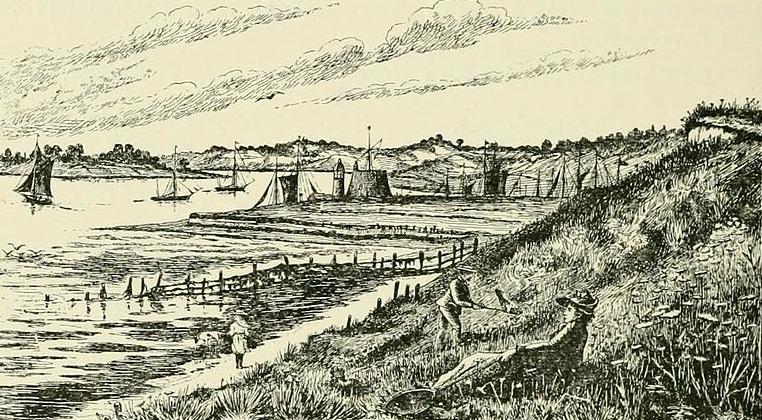
    Part of this instalment outlines the troubled history of Bunce, the courageous tramp who risked his life to defend the two girls in the Red Barn. His childhood memories begin in one of about a dozen martello towers in Essex, which prompts the illustration this week, a scene with Martello Tower No. 1 at Brightlingsea Harbour and the mouth of the River Colne, borrowed from the Journal of the Essex Field Club (1887).

    Over half the 140 Martello towers in Britain were built in the southeast as fortifications during the Napoleonic War between 1805 and 1808; though it turned out they weren’t required for that purpose.

    A typical South East Martello would be about 45 ft (13.7m) in diameter at base and up to 40ft (12m) tall. The masonry walls were built of brick and rendered with lime mortar externally, and were up to 13ft thick.

    geograph.org.uk

    Their name originates from the Torra di Mortella, on which they were modelled, the remains of which stand at Punta Mortella (Myrtle Point), Corsica.

    A Martello Tower at Sandycove in County Dublin, Ireland is the world’s most famous, the site of the James Joyce Tower and Museum. Joyce’s friend Oliver St. John Gogarty rented the tower, where Joyce stayed for six days in 1904, between September 9 and 14.

    In Ulysses, Joyce’s fictional alter ego, Stephen Dedalus, lives there with a medical student, a character modelled on Gogarty and immortalised in the novel’s opening words, in a scene set in the tower: ‘Stately, plump Buck Mulligan […]’ 


    CHAPTER EIGHT

    Mr. Bunce concludes the sketch of his past life — Return home of Lawyer Whiston — The poor tramp finds a fulcrum at last, but without knowing it

    ‘My home,’ resumed the narrator, ‘was an old martello tower, abandoned by the government after the French war. I had few companions, and those few were distasteful to me. Even at this distant period I cannot recall without a shudder the recollection of the miserable long winter nights. No one to love me, no human sympathy, nothing to occupy my brooding brain but the dull, dry lessons of the old schoolmaster. He never smiled upon me; in fact, I never saw him smile upon any one, not even on his own son.’

    ‘Poor Bunce!’ ejaculated his hearer.

    ‘As hope died within me I felt a something which I have often thought must have been akin to death, gradually stealing over me; it was worse than indifference — torpor, apathy. To rouse myself I plunged into the only amusements of the place, fishing and shooting, and at the age of twelve became an expert sportsman; penetrated in pursuit of game the wildest recesses of the marsh. Often did I return home tired and half famished, my feet bleeding from the sharp brambles, wet through with the stagnant waters of the pools I waded or swam through, but never with an empty game-bag. If solitude disintegrates the brain, it leaves certain portions of it harder and brighter than ever. I became sharp-witted — curious I had always been — and my intercourse with the smugglers, whom about this time I began to assist, made me daring. Gradually I was led towards the abyss of crime, and should have plunged doubtless into it had not circumstances rather than innate strength of character preserved me.’

    ‘Crime,’ repeated William, slowly.

    ‘Nothing very serious, observed the former, with a smile; ‘beyond a few plundered hen-roosts and the slaughter of a few gobblers, I have nothing serious upon my conscience.’

    His hearer looked as if he felt considerably relieved.

    ‘I quickly discovered,’ said Bunce, ‘that Blackmore’s occupation of schoolmaster was merely a blind to hide his real occupation — that of agent to the nobleman who owned the Bittern’s Marsh. I never learnt his name. You cannot form the slightest idea of the extensive operations the contrabandists carry on; nearly all the eastern counties are supplied by them with French wines and brandy. London is no stranger to the trade. Blackmore kept the accounts, received the rents, and a share of the profits set apart for the proprietor of the Marsh.’

    ‘Can such a state of things exist,’ exclaimed our hero — ‘here in sober, well-governed England?’

    ‘When you reach my age,’ replied the tramp, ‘you will have discovered that the surface and undercurrents of life flow in opposite directions.

    Brightlingsea Harbour and Mouth of the Colne with Martello Tower No. 1, Essex Field Club, 1887 (cropped). Public Domain. Source: Wikimedia Commons.

    ‘One day the schoolmaster told me he was about to quit his abode in the martello tower. Made an independence, I suppose. He could or would not give me any information respecting my parents. A small sum he stated had been placed in his hands when he first took charge of me, but it had long since been exhausted. He advised me to join the band of smugglers. I refused; I had already seen too much of them.’

    ‘Thank Heaven you did not.’

    ‘He next proposed that I should enter as a boy on board one of the king’s ships. I caught at the chance eagerly; it was relief from the monotony of existence — release from the swamp, its vile companionships, the stifling atmosphere which stunted the little that remained of moral nature in me. I accepted, and a few days saw me on board the Peerless, where I served for twelve years, as the certificate I gave your uncle proves, with credit.’

    His hearer began to breathe more freely; he had trembled at the trials and temptations of his new friend.

    ‘I forgot to state,’ added the speaker, ‘that the old woman who kept ship for my guardian — I presume I must call him so –before I quitted my home gave me a packet of papers, charging me never to part with them. It consisted of half burnt letters, several old accounts — evidently having reference to myself — and an old pocket-book. The rest is soon told.

    ‘Three months since the Peerless was paid off, I had grown tired of a sailor’s life, so I sold my kit, bought the rags in which you first beheld me, and started to re-visit the Bittern’s Marsh in the desperate hope of obtaining some clue to my friends and family, if I had any. You know the rest.’

    ‘It is a strange as well as a sad story,’ observed William Whiston. ‘Few could have resisted such trials and temptations as you have done.’

    ‘One circumstance alone I have kept from you, at the request and advice of your uncle. It is a secret.’

    ‘Then I will neither ask nor seek to pry into it,’ said the hearer, emphatically.

    Our readers have not forgotten the papers which Martha had concealed behind one of the beams of the little chamber, when Pike and Bilk attempted to break open the door. Possibly the lawyer had discovered a use for them.

    ‘What I have just told you,’ observed the wanderer, ‘I had previously imparted to Mr. Whiston. Whether the interest he appears to take in me is to prove a momentary or a lasting one, I cannot say. If the former, the loss of your friendship will not be the least of my regrets.’

    ‘No fear of that,’ replied the youth. ‘My uncle is one of those men, who rarely let their hearts run away with their heads. He must have excellent reasons for acting as he has by you. His liberality I expected; his confidence surprises as much as it pleases me.’

    Notwithstanding the want of worldly knowledge which the speaker had displayed in driving to London with the fair fugitives, he could exercise a considerable amount of caution for one of his years — never giving the slightest hint to Bunce that the schoolmaster Blackmore was the father of his false friend Benoni.

    It was getting late towards evening when Lawyer Whiston returned home. His countenance appeared somewhat anxious and careworn, but a smile chased aside the expression when he saw his nephew and the wanderer seated in friendly conversation.

    Both rose upon his entrance.

    ‘Keep your seats, boys — keep your seats,’ he said, pleasantly. ‘I am no friend of ceremony — unless in court,’ he added. ‘How have you passed your time?’

    ‘I have been deeply interested,’ replied William; ‘my friend has been relating the history of his eventful life.’

    ‘All?’ said his relative,.

    ‘All, sir, except the circumstance you wished him to conceal.’

    The uncle nodded approvingly.

    ‘Quite right, William; quite right. Not that I mistrust your truthfulness. I have proved it. It is your inexperience and knowledge of the world I doubt. Youth is unguarded. A look, an unguarded word, will sometimes reveal a secret. Now I prefer to keep mine to myself. As long as I do so I am its master. Once revealed, it would become mine.

    ‘You forget,’ observed his nephew, with a smile, ‘that Bunce already knows it.’

    ‘No, he does not,’ replied the lawyer, laughingly; ‘he has not the slightest suspicion of it. You are both of you keen-witted. Two young heads, putting this and that together, might divine more than I wish you to know till the time comes. Then there shall be no concealment. By the by,’ he added, ‘you have not quitted the house?’

    ‘I thought you told me not to do so, sir.’

    ‘I am answered,’ said his relative, complacently.

    The speaker appeared in excellent humour; informed his hearers that he had not only carried his point in an important case before the Lord Chancellor, but carried it exactly in the form he wished the decision to be made. The young men congratulated him, without, attaching any importance to the fact, which did not concern them. If they felt pleased, it was because the speaker appeared so.

    It is not to be supposed that two such very astute personages as Viscount and Lady Allworth would remain passive under the equivocal circumstances in which they found themselves placed. They had connived at a most unworthy action, the mere suspicion of which would materially affect their position in the fashionable world, which is not so utterly heartless as many suppose. Heaven knows that it allows itself latitude enough, still there are lines of demarkation distinctly drawn. One step beyond them, and social disgrace follows. The attempt to force a girl of Lady Kate’s tender years into an unequal marriage was just one of these steps.

    In the old world, as in the new, money will do a great deal. English judges we believe to be incorruptible. Political influences may have their weight; social ones predispose; but money is powerless. The ‘accursed thirst for gold’ has not yet obtained the power of dictating decisions to the judicial bench. God forbid that it ever should.

    If the judges are unapproachable, it is not always the case with the officers and secretaries attached to their several courts. From one of these channels Lord Allworth acquired the certainty that the guardianship of Lady Kate Kepple’s person had been placed in the hands of Lady Montague. All attempts to recover his legal authority he knew to be hopeless; but his reputation, he thought, might still be guarded.

    ‘We must see Lady Montague at once,’ he said to his wife, ‘and disown all share in the attempt of Clarence. Of course, she will not believe us; but, then, she has a nervous dread of scandal or notoriety of all kinds, and may affect to do so.’

    ‘I cannot endure the thought of her triumph over me,’ replied her ladyship. ‘The insolence of her tone and manner. She never liked me.’

    ‘You could scarcely expect that she should do so,’ observed her husband with provoking calmness. ‘She is the last representative of one of the oldest names in the peerage — her reputation unblemished.

    ‘Oh, that I could detect a spot in it!’ exclaimed the viscountess.

    ‘But you can’t,’ replied the peer. ‘Why then indulge in useless wishes? Juliana,’ he added, ‘when we consented to this mad project of yours to assist your son to acquire a certain distinction by marriage with my ward, I expected we should meet with difficulties; unpleasant considerations; but I did not anticipate on your part this vulgar weakness. All weakness is vulgar,’ he added.

    ‘What am I to do?’

    ‘Ah! now you are getting reasonable. Should Lady Montague appear very indignant at the conduct of Clarence, who acted, it appears, like a commonplace ruffian, your indignation must exceed hers. Declare, as I shall do, your determination to banish him from your home and heart. The last,’ added the speaker, reflectively, ‘may be unnecessary. She scarcely gives you credit for having such a thing. He must quit the Guards.’

    ‘Never!’ exclaimed her ladyship, passionately. ‘You forget the trouble, intrigues, and expense I had to obtain his commission.’

    ‘No, I do not; but I tell you there is no other resource. Bury, when he hears of the affair, will certainly post him.’

    ‘No doubt,’ said his wife, bitterly. ‘He is your son.’

    ‘And, you might add, a young man of exquisite taste,’ observed his lordship. ‘You have a natural talent for intrigue, Juliana; in fact a very pretty talent; but you cannot repair a check. I must do so for you.’

    ‘And will you, for my sake?’

    ‘O, dear, no,’ interrupted the husband. ‘If I take a hand in the game it will be for my own. There is no false sentiment about me.’

    ‘Nor sentiment of any kind,’ observed her ladyship, bitterly.

    ‘Fortunately for you,’ replied her husband, cynically; ‘for sentiment is weakness. You know how I detest a scene. My nerves won’t stand it. You will either follow my direction — place the direction of the affair in my hands — or in the morning I start for Paris.’

    ‘Alone?’

    Of course,’ replied his lordship, sarcastically. ‘Paris is a most expensive city. I know that you dislike it. ‘Besides,’ he added, ‘I would not deprive Clarence of so able an adviser as his mother.’

    A considerable pause ensued. There was a great mental struggle. Lady Allworth saw that the only means of saving her son from public disgrace and preserving her own position in society was to adhere to the counsel of her husband; without him she could do nothing. Experience had proved to her that he was as clever as unprincipled.

    ‘It shall be as you wish,’ she said.

    The viscount rang the bell and ordered his carriage.

    ‘My dear Mr. Whiston,’ said Lady Montague, when that gentleman placed in her hands the decree by which the chancellor consigned the person of Lady Kate Kepple to her exclusive guardianship, ‘you have managed this terrible affair admirably.’

    The lawyer bowed profoundly.

    ‘I have read all the morning papers,’ added the speaker. ‘What I most dreaded — the scandal — has been avoided, Not a hint, not a word.

    ‘For once the press has been muzzled,’ observed the man of law, with considerable satisfaction. ‘A hint, despite my precautions, had crept out, sufficient to find a paragraph upon, nothing more, or the expense would have been –‘

    ‘Never mind the expense,’ interrupted her ladyship. ‘We can stand that.’

    ‘True. Your niece’s fortune is large.’

    ‘Not a shilling of it must be withdrawn for such a purpose,’ said the aunt. ‘I ought to have been more upon my guard, knowing as I did the doubtful character of the Allworths. We will regulate that.’

    Kate kissed her hand.

    ‘What is the matter, my love? You look dissatisfied.’

    ‘Not dissatisfied,’ replied the fair girl, ‘but I am fearful that those who protected Martha and myself will think us very ungrateful; we quitted them without a word. I should so like to see –‘

    ‘Not to be thought of, my love,’ exclaimed Lady Montague, in a tone of decision. ‘It might render all our precautions useless; but, of course, they shall be handsomely recompensed.’

    Lawyer Whiston saw with surprise the tears which started in the eyes of the niece. More than once, when he had time to think over the conversation, the recollection of them set him musing.

    ‘Your ladyship’s wishes,’ he said, ‘can be easily carried out. I have ascertained the names of the two youths who drove your ward to London, and probably shall discover the third one, who really risked his life in a contest with the ruffians in the Red Barn. He is wretchedly poor,’ he added, ‘judging from your niece’s and Martha’s description of him. Something, I think, ought to be done for him.’

    ‘Very right and proper, Mr. Whiston,’ observed Lady Montague. ‘Act as you think best. I am certain you will be careful. I give you carte blanche.’

    ‘I should so like to see the gifts you purchase for them,’ said Kate. ‘I should be certain then of my wishes being carried out.’

    ‘Child!’ exclaimed her aunt, fondly, ‘can you not trust to the taste of our excellent friend here? But be it as you please. Mr. Whiston,’ she added, ‘you will be kind enough to send the presents you will purchase to Montague House. Lady Kate Kepple desires to see them.’

    It would be curious to say what odd and improbable fancies met in the brains of the lawyer as he drove to Lincoln’s Inn Fields.

    In the course of the day the groom of the chambers brought the cards of Viscount and Lady Allworth to his mistress, whose countenance changed as she read the names aloud.

    ‘You will not see them — for pity’s sake do not see them!’ exclaimed her niece, greatly agitated.

    Her aunt reflected for several instants.

    ‘Since a meeting is inevitable,’ she said, at last, ‘as well now as at a future period. At home, Kate,’ she added, ‘you have nothing to fear; there are at least a dozen servants in the house, sufficient to protect us, should protection be needed; but I do not think it will. You are in London — not in a lone country house like Allworth Park. Remember the dignity of your sex — call up your pride. Let not those wretches see how they have made you suffer.’

    When the two hypocrites entered the reception-room at Montague House, his lordship, with his usual courtly grace, advanced to pay his respects to his aged kinswoman. They were but coldly received.

    Not so his wife. She had a different part to play. Rushing towards the poor girl who had so nearly fallen a victim to her deep-laid schemes, she threw her arms around her, kissed her with well-acted affection, exclaiming at the same time:

    ‘My sweet child, what have you not endured from that mad boy’s impetuous love? Who could have suspected such a headstrong passion in one so young, so manly as I thought him? But he is punished — punished in his hopeless love — the just anger of my lord, the grief of his mother. We have cast him off,’ she added, with a flood of tears, ‘forbidden him the house, refused even to see him.’

    Considering that the young ruffian was at the very time comfortably lounging on a sofa and smoking under her own roof, the conscience of the speaker must have been exceedingly elastic.

    ‘You have acted with discretion,’ observed Lady Montague, with freezing dignity.

    O, how the word ‘discretion,’ which was strongly emphasized, rankled in the heart of the manœuvering woman.

    ‘Could we do less,’ said the viscount, as calm and unruffled as if the discussion turned upon some trivial, everyday occurrence, ‘to mark our abhorrence of my step-son’s conduct? I have even insisted on his leaving the Guards and quitting England for a time till the affair blows over. Should he and Bury meet, I tremble for the consequences,’ he added.

    ‘My poor boy,’ sighed the viscountess, wringing her hands. ‘His only crime — not that I excuse it — is love.’

    Kate shuddered, and her aunt smiled disdainfully.

    ‘What more can we do?’

    ‘Nothing,’ replied Lady Montague, coldly. ‘In fact, I scarcely anticipated that you would do so much.’

    ‘You never did me justice,’ observed his lordship, in the tone of a man who felt deeply hurt.

    ‘We can discuss that point some other time,’ answered the aunt.

    ‘Right!’ exclaimed both the visitors. ‘Our present task must be to stifle everything like scandal. It would be too dreadful!’

    They were astonished when they saw how little effect the word scandal produced. It had been their great reliance.

    ‘There will be no scandal,’ remarked the aunt, ‘unless you circulate it.’

    ‘Oh, Lady Montague!’

    ‘I do not think you will, for your own sakes,’ continued the former speaker. ‘The chancellor kindly heard the application in his private chambers.’

    ‘Chancellor! Application!’ ejaculated Lord Allworth, as if it was the first time he had heard of any such proceedings.

    ‘Yes. I am now sole guardian of my niece’s person as well as fortune.’

    ‘Is this fair — is it even just, towards me?’ said Lord Allworth, in a tone of offended dignity. ‘On the slightest hint that such was your wish, I would have joined in the application to his lordship. What will the world think?’

    ‘I am not answerable for that,’ replied Lady Montague. ‘My first duty was to protect this dear child. If in doing so I have wronged you, I regret it deeply. Prove it to me, and I will do all in my power to atone.’

    ‘Time will do that.’

    ‘To time we had better leave it, then. I need not remind you, kinsman, that I am no longer young, Such discussions agitate me.’

    ‘I understand you, and will take my leave,’ said his lordship. ‘I may have been a gay man — a dissipated one, I do not deny it. But the world has never yet accused me of dishonour. Think calmly over my conduct in this lamentable affair. Anger and prejudice are bad counsellors. Promise me that you will do so, and I have no fear of the result.’

    ‘I do promise you,’ replied his kinswoman, with a little less coldness in her look and voice, ‘and I shall rejoice to find you blameless.’

    With an air of injured innocence the visitors took their leave.

    ‘Hypocrites!’ whispered Lady Montague, as she embraced her niece.

    ‘Dupe!’ thought the viscountess, as she stepped into her carriage.

    Her husband made no remark. He was reflecting on the interview.

    The presents destined for their protectors proved to be two costly gold watches. Lady Kate Kepple examined them very closely, and insisted on making them up into two small packets herself; but her aunt directed them. But her niece had forgotten all but their Christians names.

    Mr. Whiston, into whose care they were given, promised they should reach their destination quickly. They were left by a confidential agent at his own door.

    When William opened his, a small slip of paper fell from the outer case. On it two words were written — ‘From Kate.’

    O, how it set his young heart dreaming!

    This edition © 2019 Furin Chime, Michael Guest

  • J.F. Smith’s Mystery of the Marsh — Second Instalment

    J.F. Smith’s Mystery of the Marsh — Second Instalment

    An astute reader of the first chapter wondered whether the red barn of our tale might be the scene of the infamous 1827 murder of  Maria Marten, perhaps in order to unfold Maria’s tragic plot. That does not seem to be so, however, given the events that occur in this and the prior instalment, which proceed in an independent direction.

    Poor Maria’s red barn was located in Polstead, Suffolk, which is indeed not too far from our location, the Essex marshes of the greater Thames Estuary. There is little question but that our author J.F. Smith (1803 — 1890) who was born in Norwich, and thus definitely in the general vicinity, would have been aware of those terrible events, which culminated in Maria’s ghost pointing out the location of her own grave. The red barn of the present story,  therefore, may well have reverberated with dramatic overtones for readers of the period.

    In editing this work, I have preserved elements of the writing that are characteristic of the period and medium, even where these might create some minor difficulties of readability for a modern reader used to modern popular conventions. Semi-colons, for example, tend to be used more liberally than is the fashion today, even as occasional closing punctuation for direct dialogue. Taken all together such features add charm and even contribute to a Victorian atmosphere.

    All the paragraphing is intact, as it was in the original newspapers. This is actually quite in keeping with online convention, where short paragraphs are considered best practice.

    An occasional point of dialect or cultural schema is not immediately transparent, but most reveal themselves quickly with the aid of context (‘porlite’, ‘loike’), deduction (‘the famous Essex two fives on the skull’)  or Google. I don’t want to invade the text with footnotes and sic’s, but will make a few notes at the end of each instalment to clarify one or two of the slightly more elusive points of interest.

    Don’t hesitate to make any comment or reply at the bottom of the blog post. I very much hope some discussions might ensue. If you like the instalment, please ‘Like’ it at the bottom of the post.

    I’ll take this opportunity to introduce the author.  He is an imposing gent, a brilliant Victorian star writer. Ladies and gentlemen, I give you the unsung giant and herald of popular literature, John Frederick Smith, Esquire


    Portrait of J.F. Smith, Cassell's Illustrated Family Paper, I: 385, 22 May 1858. Reprinted in Andrew King, The London Journal, 1845-83 (Routledge, 2004)
    The only existing portrait of J.F. Smith, Cassell’s Illustrated Family Paper, I: 385, 22 May 1858. Reprinted in Andrew King, The London Journal, 1845-83 (Routledge, 2004)

    CHAPTER TWO

    A Cool Reception — More Tramps — The Friends Compare Notes — Adventures in the Red Barn

    Mrs. Hurst did not appear particularly well-pleased when Goliah Gob entered the keeping-room — as the second parlor is generally named in Essex — in company with her nephew and the schoolmaster’s son; and yet it would have puzzled her very much to explain why she disliked him. Her daughter Susan had never yet shown the slightest preference for him; on the contrary, she rarely missed an occasion of mocking at his uncouth ways and quaint dialect, which she imitated to perfection, sometimes to his face, much to the annoyance of her cousin, who knew the worth, the true-heartedness, and honesty of the lad she thoughtlessly ridiculed; not that she shared in her mother’s dislike of him. William felt perfectly assured of that. Sometimes he thought he could detect a tone of pique blending with her playful malice. Why it should be so he could not understand. Goliah was perfectly civil to her, and even polite in his simple way. He had reasoned and remonstrated with her in vain.

    At last he came to the conclusion that, if his friend had shown himself a little more susceptible of her charms, she would not have been displeased.

    Hence his hint to Goliah, when he refused to accompany him to the farm.

    Possibly the aunt inclined to this opinion. There might also be another reason; Mrs. Gob’s butter was the crack of the market, so that there existed a species of rivalry between the two ladies.

    By this time the rain was falling heavily.

    ‘Come in,’ said Mrs. Hurst, addressing Goliah, who stood rather hesitatingly at the door of the keeping-room. You need not leave till the storm is over.’

    ‘I should think not,’ observed her nephew, dryly. ‘You would not allow a neighbour’s dog, much less a neighbour’s son, to quit the house in such weather; and if you could do so I would not permit it.’

    This was the first time the speaker had hinted his rights as joint owner of the farm. Mrs. Hurst bit her lips; she did not like it. It was treading upon unpleasant ground; so like a clever woman, she hastened to change the conversation.

    ‘Don’t stand chopping words, Willie, which signify nothing,’ she exclaimed, ‘and the rain dropping off of you, but take your friends into your own room and give them some dry clothes. Tea will be ready by the time you come down; the cakes are nearly done. Go with him, Goliah,’ she added, good-humoredly, ‘and don’t mind a thing he says; of course, I am glad to see you, though I don’t make fine speeches. Soft words are not always sincere ones.’

    ‘No more they be,’ observed the young man; ‘and grandmother do say they butter no parsnips.’

    At tea Goliah helped himself unsparingly to Mrs. Hurst’s cake and made sad havoc with the preserved gooseberries, a dish of which he cleared twice, to the great amusement of Susan and anger of her mother.

    ‘You seem very fond of gooseberries, Mr. Gob,’ said the girl laughingly.

    ‘Yes, Miss.’

    ‘And so are we,’ added the young lady, pointedly.

    ‘But not so fond as I be,’ replied the rustic visitor, assisting himself to the last spoonful in the dish. This was too much. The gravity of the table gave way to an explosion of mirth; even Mrs. Hurst’s anger yielded to the contagion of example, and she laughed heartily. Poor Goliah coloured to the temples.

    ‘What have I done?’ he whispered to William.

    ‘Nothing, nothing,’ replied his friend, trying to compose his features. ‘Take no notice,’ he added, in the same undertone.

    ‘Why, thee told I to be free and easy loike.’

    ‘Certainly; say no more, it is quite right.’

    Goliah felt that somehow or other it was all wrong; saw that William was annoyed although he did his best to conceal it, and he made up his mind at the first pause in the storm to take his leave. All confidence had left him as suddenly as it came, and he sat listening silently to the whistling of the tempest which whirled and shrieked round the gables of the house like some human thing in pain. The heavy pattering rain, the solemn peals of thunder ceased at last, and he rose to depart.

    ‘Why in such haste, Goliah?’ observed William. ‘It is only a lull in the tempest; it will soon burst again with redoubled fury. Better remain till morning.’

    As neither Mr. nor Mrs. Hurst seconded the invitation, Goliah Gob felt confirmed in his resolution. Susan looked as if she wished him to stay.

    ‘Thankee, Willie,’ he said: ‘thee hast a kind heart, but I knowed that long ago. I beant a bit afraid o’ the rain; it can’t melt I; ’sides, it be only five miles.’

    ‘Five miles in such a night!’ observed Susan.

    The sturdy rustic, however, paid no attention to the remonstrances of his friends, but after bidding a brief good night to the rest of the family, walked resolutely towards the door, followed by William,

    ‘I am sorry you are so resolute on leaving us,’ observed the latter, as they stayed for an instant on the threshold. ‘See how black the clouds are.’

    ‘No blacker than the looks within,’ replied his friend.

    ‘And the rain will be pouring down in torrents again.’

    ‘I mun go,’ said Goliah, resolutely.

    ‘I am sorry you are so determined,’ said the youth; ‘but when once you have made up your mind I know it is no use arguing with you; so good night, and, bye-the-by, Goliah,’ he added, ‘as you pass the red barn, just look in and see that those two poor boys are all right. Not unlikely that more tramps may have stopped there.’

    ‘I wol.’

    With these words the speakers shook hands and parted.

    ***

    As soon as the youthful wayfarers felt assured they were alone in the barn, they proceeded to make themselves as comfortable as circumstances would permit. First, they partook of the refreshment their friends had left them. Hunger appeased, and they had been very hungry, they next examined the room, which they did by the light of a lantern the eldest boy had discovered hanging from one of the beams; fortunately he had matches in his pocket. Everything appeared as William Whiston had represented. No window or other door to the room than the one of which he had given them the key. As for the bed, it might have looked a little more inviting certainly, still it was comparatively clean, and the sheepskins were in abundance.

    ‘Dear Charley,’ whispered the eldest, at the same time throwing his arms round the neck of his young companion, ‘we are quite safe here. We shall escape them yet.’

    ‘Would I could think so,’ replied the latter; ‘but I cannot. I feel they are on our track; I have only to close my eyes to see them as they sprang upon us whilst we were combing our long hair behind the holly bush, the brutal leering passion in their eyes as they tried to force us to follow them into the marsh. They read our secret. Martha! Martha!’ added the speaker, bursting into tears, ‘but for that honest waggoner and his two sons what should we have been now?’

    ‘Hush, dearest! Not that name! You must call me Hal. Listen to me: Something tells me that our greatest trials are past. You must try to obtain some rest. You need not undress. Let me unlace those coarse, horrid boots and rub your poor, tired feet,’

    Charley — we suppose we must call him so for the present — sank down upon the bed, and the speaker proceeded to remove the heavy high-lows, disclosing a pair of exquisitely turned feet, incased in white silk stockings — rather an unusual article for a tramp to wear.

    Nearly an hour elapsed before tired nature yielded to the approach of sleep. After extinguishing the lantern the wayfarers sank to rest at last, clasped in each other’s arms. No wonder that the sleep of both was broken by dreams and fitful starts. Once or twice the youngest awoke with a faint scream, appeared dreadfully agitated, and muttered incoherent words, till the soothing voice of the elder calmed her again.

    ‘Only a dream, Charley, only a dream,’ whispered his companion; ‘nothing more.’

    ‘Thank Heaven,’ murmured the frightened sufferer, pressed still closer to his side, ‘it was but a dream!’

    In a few minutes they were asleep again. Meanwhile the storm, which bad lulled once or twice during the evening, broke out afresh, howled like a weird dirge through the leafless trees, and the rain fell, splash! splash! upon the slate roof of the barn, whilst the angry lightning flashed and darted in arrowy, fantastic lines from the sable clouds which obscured the greater part of the heavens,

    God help the poor wanderers exposed to the cold charities of the world on such a night! The hard and thoughtless will doubtless console themselves by reflecting that, without doubt, they have deserved their fate. Perhaps so; but the necessity of shelter is none the less urgent, the obligation to pity and assist none the less binding; for what is man that he should harshly judge his fellow-man, whether for good or ill, blessing or punishment? The results are in higher hands than his.

    Any shelter in that terrible storm must have seemed like an oasis in the desert, a Patmos in the wilderness to the houseless and friendless. So, doubtless, must have thought a young fellow of about three-and-twenty, as he made his way into the red barn. He was evidently a tramp; no mistaking the signs. His shoes leaked water; his clothes — a half-faded summer suit — clung tightly to his shapely figure; the rim of the felt hat that he wore had uncurled itself in the rain, permitting the water to trickle down his back till it wetted him to the bone. He did not seem, however, to mind it very much, for after giving himself a good shake, like some Newfoundland dog after taking a swim, he seated himself upon the floor, and opening a wallet, began to eat. His appetite appeased, he paced up and down the floor of the barn to get himself warm.

    ‘This will never do,’ he muttered to himself, as a sudden chill crept over him. ‘The rain and sleet have struck to my bones. I must have a fire, or be laid up with the marsh ague. There can be no danger; neither hay nor straw in the place.’

    Gathering a small pile of wood which he found scattered in various parts of the building, the young fellow struck a light, and in a few minutes a cheerful blaze not only diffused a cheering warmth around, but it lit up the dreary space around.

    ‘This is what I call comfortable,’ he said, as he stood holding his coat and vest before the front of the fire to dry. ‘I wonder what those who once knew me would think of it, could they see me. What a fool I am to suffer such thoughts to run in my mind,’ he added, ‘They have long since forgotten me. Not all, perhaps. One or two may remember me yet.’

    These and similar thoughts kept chasing each other through his brain as he stood enjoying the warmth. At last his garments were sufficiently dry, and he commenced putting them on again. As he fastened the last button two more of the disinherited ones of the world crept into the barn — coarse, ruffianly looking fellows, several years older than the wanderer who preceded them. Their countenances bore the hard, cynical lines traced by a long career of passion, selfish, brutal indulgence, and crime.

    ‘Well, pal!’ exclaimed the foremost of the new-comers, as he advanced to the fire, ‘you are in luck. Quite pleasant here. Any scran?’

    The young man pointed to the wallet, which still contained some food.

    ‘Here, Bill!’ shouted the speaker to his companion, who had remained behind to close the barn doors. ‘Never mind s’porting the timber. The wind ‘ll keep ’em closed. Here is a good fire, and the right sort o’ pal, thof he don’t seem ’xactly like one of us. A Romany chal, p’r’aps.’

    ‘Not a bit,’ replied the first comer. ‘I am no gypsy.’

    He threw off his wide-awake as he spoke, disclosing a fair, bright, intelligent face, blue eyes, high forehead, shaded by light brown curly though somewhat matted hair.

    ‘I see yer aint,’ observed the questioner, after eyeing him over as critically as he would have done a lurcher or terrier dog. ‘None the wuss, maybe, for that. One of the marsh breed, I see.’

    ‘Neither do I belong to the Bittern’s Nest.’

    ‘Well I thought you might; no harm done, I s’pose. Many a good, honest bird has its nest in the swamp. What’s your name?’

    ‘Bunce.’

    ‘And mine is Pike, and my pal is called Bilk; and now we knows one another.’

    ‘O, yes! certainly!’ replied the former, with a smile.

    The three men seated themselves near the fire; the food remaining in the wallet quickly disappeared. Fuselli, or better still, Dore, might have made a startling picture from the group; Bunce with his pale, sad face, Pike and Bilk, their hideous countenances obscurely seen through the cloud of vapor rising from their saturated clothes; one instant it hid their traits, the next disclosing them with added deformity.

    For some time they remained silent, quitely enjoying themselves in the warmth. Pike, who evidently liked to hear the sound of his own voice, was the first to speak.

    ‘I s’pose you are up to a thing or two?’ he observed, addressing himself to the youngest of the party.

    ‘To a great many things,’ was the reply.

    ‘That’s right, nothing like plain talking; it mayn’t be allays wise to cackle in the ken afore strangers; but here, three honest pals together, it’s all right. I’ve something to tell you. But fust take a dram.’

    He drew a bottle, about half full, and handed it to Bunce, who, before tasting its contents, drew the cork and smelt them.

    ‘Brandy,’ he said.

    ‘You may swear to it,’ observed Bilk, ‘and what’s more, the gauger’s stick has never been in it.’

    Notwithstanding this recommendation the young fellow drank but a very moderate quantity. His suspicions were confirmed; he knew they were from the marsh — the desperate character of whose inhabitants he had heard of — and he determined to be upon his guard.

    ‘Now then,’ said Pike, in a confidential tone, as he replaced the bottle in his pocket, ‘let us talk bizziness; but mind it is all on the square.’

    ‘Of course it is.’

    ‘Have you seen anyone since you came here?’

    ‘You and your friend are the only persons who have entered the barn,’ replied the young man. ‘Why do you stare at me so hard? Do you think I am lying to you?’

    ‘Can’t say,’ replied the ruffian, coolly; ‘hard to tell; don’t signify much if you are; we are two to one. Now jest look at me in the face; I want to see your eyes when I tell you somethink. We are not alone in the barn.’

    ‘Police?’ whispered Bunce. ‘No. Two gals dressed in boys’ clothes.’

    The look of intense surprise, the sudden flush which mantled the countenance of his bearer, were too natural to have been assumed, and the speaker felt satisfied that it was news to him.

    ‘Poor things,’ murmured Bunce, in an undertone. ‘Where?’ he added aloud.

    Pike pointed to the door at the end of the barn.

    ‘There,’ he whispered. ‘Such a lark! My pal and I came upon them behind the bushes, just by the old stone cross, as they were combing out their long hair. Weren’t they scared! Bilk and I were quite porlite and coaxing; tried to get them to go with us into the swamp; but somehow they didn’t see it, so we just tried to make them.’

    ‘And would ha’ done it, too,’ chimed in his companion, ‘if their cries — of course we didn’t mind them — had not brought a waggoner and his two sons, who heard the cackle and leaving their team in the road came running to see what was up. They were three to two, to say nothing of the girls — so we had to sneak off. Awful provoking! Enough to make a parson swear! They rode off with the waggoner; but Pike and I knew a shorter cut, and dogged them till we saw the farmer’s boys hide them in the barn; so we waited and watched. At last we made our way in.’

    ‘The boys may return,’ observed Bunce, anxious to gain time.

    ‘Not such a night as this,’ replied the elder tramp. ‘No great matter if they do. We are now three to three.’

    ‘Why, what do you intend to do?’

    ‘Have ’em out, in course,’ exclaimed Bilk, ‘and have a jolly night. You can whistle whilst we dance,’

    ‘I will have nothing to do with it. Not that I object to a bit of fun; but this might prove dangerous — too near the village.’

    ‘It is nearer to the marsh.’

    ‘But I am a stranger in the marsh,’ replied the young man.

    ‘Oh, my pal and I will make you welcome.’

    ‘I told you I would have nothing to do with it, and intend to keep my word; it is unmanly, dastardly. Better give it up. As far as a hen-roost is concerned, I don’t mind going in with you. Hens were intended to be eaten.’

    ‘And pretty girls to be kissed.’

    ‘If they are willing.’

    ‘Willing or not, we intend to have them out. Bilk, you break open the door of the chamber, whilst I attend to this white-livered cur — to go back on two such pals as we are, and after treating him so ’ansomely, too.’

    Although the speakers were all three active men, the two eldest were by far the most powerful; the Bunce saw that he would have a hard struggle, if it came to blows. With the exception of a stout ash cudgel, such as the natives of the eastern counties play at single-sticks with, he was totally unarmed. The swamp ruffians — for such by their own confession he knew them to be — most probably were better provided. Still he determined not to abandon two helpless girls to the brutal treatment of such wretches. They might not even be respectable; their disguise was unfavorable to the supposition that they were so. He cared not for that; they were women. Possibly he recollected that he had sisters; at any rate, his mind was made up to defend them.

    There was some inherent good in that lone wanderer, after all.

    During the above conversation the pale, trembling girls stood listening at the door, the only barrier between them and possible insult. The mild tone in which the younger tramp had expostulated with the elder one gave them but faint hope.’

    ‘I have a knife,’ whispered Martha to her half-fainting companion.

    ‘Oh, kill me! kill me!’ whispered the youngest of the two.

    Whilst Bilk was thundering with his heavy boots trying to break open the door, Pike was attacking the young fellow who had refused to listen to their shameful proposal. Confident in his great strength, he committed the not unusual fault of undervaluing that of his opponent. Twice had the ash stick of Bunce cut the famous Essex two fives on the skull of the now thoroughly infuriated ruffian, whose loud curses, mingling with the screams of the two females, might have been heard beyond the barn.

    In cudgel playing, anger is about the worst second a man can have. The old tramp was not without considerable skill, but rage rendered him incautious.

    ‘Curse you!’ he exclaimed. ‘Take that!’

    The blow was well aimed, but as skillfully parried. In making the half circular movement to recover guard, Bunce brought his weapon across the head of his assailant. The blow was a terrible one, and the ruffian staggered for an instant as if half blinded. The hero of the skirmish — for such he proved himself — saw his advantage, and turning from his opponent, commenced attacking the second tramp. The door had been nearly broken open.

    ‘Keep up your courage!’ shouted Bunce to the inmates or the little chamber. ‘One of your enemies is powerless to harm you, and the other has almost had enough.’

    ‘No, he aint,’ said Pike, drawing a pistol from his vest.

    He advanced more cautiously than ever to the attack, the weapon in his hand.

    The heart of the generous wanderer sank within him.

    This edition © 2019 Furin Chime, Michael Guest


    Some Annotations

    The chapter highlight ‘The Friends Compare Notes’ seems out of place. I wonder whether these have been added by the newspaper editor in the main one of my two sources.

    Goliah Gob’s British dialect characterizes him beautifully as a diamond in the rough. ‘I mun go’ is dialect for  ‘I must go’. The ruffian, Pike, uses the word ‘thof’, which Goliah used already in Chapter 1. It is dialect for the conjunction ‘though’; and I presume has a link to Middle English pronunciation, of which our irregular ‘-gh’ spelling is a  relic.

    It is rare for Goliah to be used as a first name. Here, the name clearly illustrates the size and might of the character. We have in Chapter 1 ‘like his namesake of Gath, Goliah was a giant in strength’, Gath being the home of the Biblical Goliath.

    Some further brief notes:

    • scran: Dialectal, ‘food‘; the word originates in the British Navy
    • chal: male gypsy
    • lurcher: A crossbred dog, used especially by poachers
    • Marsh breed / Bittern’s Nest:The bittern is a rare, shy heron whose habitat is the marsh. (See the bird’s entry in the Essex Wildlife Trust website.) We can understand the upstanding Bunce’s reluctance to be labelled as ‘one of the marsh breed‘, given the mention in Chapter 1 of the Bittern’s Nest’s ‘proximity to London — not more than thirty miles distant — [which] has made it a refuge for the worst of characters; in a few instances, perhaps, also of the unfortunate.’ Therefore, at the same time, we might sympathise with Pike’s reasonable, egalitarian view that ‘Many a good, honest bird has its nest in the swamp.’
    • ‘Fuselli, or better still, Dore’:  Not ‘Fusilli Jerry’. Fuseli is the more proper spelling for the Swiss painter and art writer Henry Fuseli (1741 — 1825), though the double-l does occur; Dore is the French painter Gustave Doré (1832 — 1883). They share a penchant for creating dark, macabre images.
    • ‘threw off his wide-awake’: Low crowned, wide brimmed soft felt hat; so-named, jocularly, for having ‘no nap’.
    • ‘quitely’: Not ‘quiety’ but ‘quitely’ = ‘completely, entirely’, as in ‘Your ancestres conquered all France quitely’ (Robert Mannyng of Brunne, qtd. in the Century Dictionary (originally published in 1889).
    • Single-sticks:  A martial arts style of sport using sticks or cudgels; variants appear in several different cultures. Pays Googling. For your information, it was an Olympic sport in 1904 only.
    • ‘the gauger’s stick has never been in it’: Unexcised liquor, which we may infer to be either smuggled or illicitly produced.
    • *** : I inserted the asterisks to indicate the scene change, since that was a little unclear in the source.

    More details about John Frederick Smith in future posts

    MG