Tag: Serialized novel

  • Cobb’s False Knight: 3.  A Funeral — A New Arrival

    Cobb’s False Knight: 3. A Funeral — A New Arrival

    Strange, that Electra’s beloved should say of Thorbrand that he may be “evil” but not “dreadful“, and that he would “never take a penny from a man he knew to be poor”. A German Robin Hood? Some say that the before-mentioned Eppelein von Gailingen was one; however, there is little remaining evidence of this.

    Robber knights often had no choice other than to take money and riches any way they could. As opposed to today, when many impoverished castle owners open bed and breakfasts or rent out their great halls for wedding parties, these opportunities for income did not exist in the Middle Ages. So there you were, the heir to a crumbling castle, people depending on your income, a few serfs tilling soil for which they offer some of their produce to the owner. Should you take something like an unofficial tax from those rich merchants who wear grooves into the paths through your land with their heavy carts, so you can make ends meet? Many did just that.

    The kings, dukes and so on did much the same, only on a grander scale. Even in the 1700s, they often demanded and went to war over ownership of assets like mines, silver or salt, etc, whether their families had ever had anything to with establishing them or not. Wasn’t that also theft? What then was legal, and what wasn’t? The only written laws appeared from 1220 to about 1235, such as the Sachsenspiegel, which remained a valid legal source in Germany until about 1900. Only seven copies of this German law book remain, all illuminated manuscripts and written in Low German.
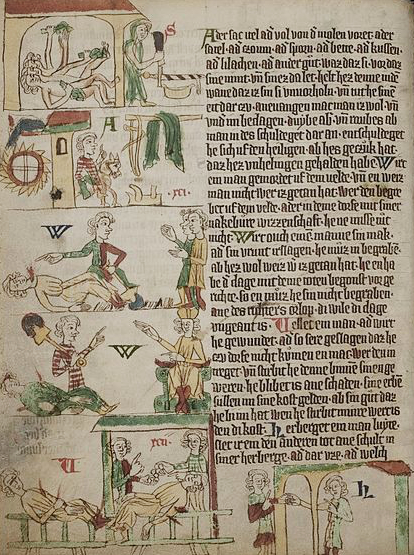
    A page from the Heidelberg Sachsenspiegel, concerning murder and manslaughter. Source: U of Heidelberg

    It’s called Saxenspiegel (“Saxon Mirror”) because it was supposed to reflect the customary laws of the time. Of course people back then were obsessed with accusing others of witchcraft, or whatever constituted lewd behaviour in their opinions. Women could inherit, but if they married, all their possessions would become property of the male.

    Best be careful whom you might be forced to marry then. What will become of Electra if she marries her betrothed? According to the Sachsenspiegel, translated from Low German to High German, “Wenn ein Mann Eine Frau heiratet, so nimmt er all ihr Gut in sein Gewaehre zu rechter Vormundschaft” (“When a man marries a woman, he is granted all her possessions into proper trusteeship as her legal guardian”. (Because women were seen as “incapable of acting legally”, unless they happened to be queens or duchesses.) Can she really trust her suitor?


    CHAPTER 3

    A FUNERAL — A NEW ARRIVAL

    As our heroine approached the castle, she saw through the gathering gloom, the figure of a man — a man who appeared to be looking towards her — standing upon the drawbridge. The gleesome cry of her dog told her that he was a friend, and very shortly thereafter she was leaning upon the arm of her dear lover, Ernest von Linden, who had come out to meet her. He was a young man of four-and-twenty; tall and comely; with a frame of wonderful powers of endurance, lithe and sinewy; his face the mirror of truth and sincerity; his hair of a glossy brown, flowing over his well-shaped head in beautiful wavelets; his eyes of a rich gray, beaming with wit and intelligence; a man, take him all in all, as handsome as you will find in a day’s journeying through a populous district. He wore a doublet of dark green velvet, a white ostrich feather drooped over his velvet cap. and upon his hip he wore a good sword. He was a soldier, every inch of him, holding a captain’s commission from the baroness, and in command, under Sir Arthur, of the forces of the castle, and the town.

    “Darling, we had begun to worry about you, and I should have started out to meet you a long time ago, had not Sir Arthur — dear old man! — been taken with an ill turn. So ill was he that I dared not leave him.”

    “He is not dangerously ill? Do not tell me that!” cried Electra, in alarm.

    “We shall know very soon. Roland has gone on swift horse for the doctor, and it is time now that he had returned. However, there may be nothing to alarm us. He has had just such turns before.”

    “Yes,” said the loving niece, with infinite tenderness and pathos in her tone, “but they are worse and worse with every repetition. Dear old Sir Arthur! I hope God will spare him to us a little longer.”

    With this they turned to enter the main court of the castle and as they crossed the draw-bridge, Electra saw that the heavy chains were cast loose, and that the windlass of the portcullis was in readiness for use.

    “Ah!” said Ernest, in answer to her silent question. “We are making ready to close our gates. It was your mother’s desire and your uncle thought it had better be done. I suppose there can be no doubt that the noted robber chief, Thorbrand, is somewhere in the vicinity. He is no respecter of private property, and if he is accompanied by a sufficient force, he is as liable to strike at a strong castle as at a solitary wayfarer. However, he will find Deckendorf Castle a dangerous place to trifle with.”

    “Ernest, what sort of a man is this Thorbrand? Is he as dreadful as people say?”

    “If you mean to ask if he is powerful or evil, I should answer you, yes, most emphatically; but if you mean by ‘dreadful,’ is he a bloodthirsty, cruel monster, I should say, no. He never robbed a peasant’s cot, nor took a penny from a man whom he knew to be poor. Further he has been known — so I have been told — to shoot down one of his own men for offering gross insult to a peasant’s daughter; but, alas! that does not hold good, I fear, with regard to wives and daughters of castles. The man is governed by policy. While he can keep the friendship of the peasantry he finds many avenues of safety which he could not find otherwise. He has sacked whole villages, and I have no doubt but that he would attack and rob our peaceful hamlet should it come in his way. He is dangerous man, and he will be a public benefactor who shall slay him or deliver him up to justice.”

    They had now entered the broad court, and for a little time they walked on in silence. At length the young captain looked down into his companion’s face, which he could just distinguish in the deepening gloom and asked:

    “What are you thinking of, my sweet one? Has my picture of Thorbrand frightened you?”

    “No, Ernest, it was not that. A curious thought came to me, and I was trying to see through it. I was thinking: Suppose you and I were walking as we are walking now, only away in the deep forest, and should come upon a man suffering most cruelly — let us suppose him to have been wounded nigh unto death — and we should find him just when a helping, friendly hand could save his life. What should we do?”

    “Electra!”

    “Pshaw! You don’t think I am going to lead you to such an adventure, do you? Certainly not. It was only a fancy that struck me; and you will see what I mean pretty soon. What should we do to that man?”

    “Do? Why, we should put forth every effort to save him, of course.”

    “Certainly. And now suppose one thing further: Suppose after we had got the poor man up, and he had blessed us for our kindness, we should accidentally discover that we had saved the life of the Robber Chief, Thorbrand — should we seek to undo what we had done?”

    “What a question!”

    “Well — but — suppose we had known he was Thorbrand before we gave him help — when we first found his life running away through cruel wounds — would we have saved him all the same?”

    “Certainly. I would do so much for the bitterest enemy had in the world.”

    “Noble heart! I knew you would. And now answer me this: You have given the robber chief back his life, and he has asked God to bless you for your goodness; and then, after that, when he is at your mercy, are you going swiftly to the nearest barracks to call forth a host to go to the robber’s capture? That is the thought that has been puzzling me.”

    “Well, I wouldn’t let it puzzle you any more.”

    “I don’t want it to, my dear Ernest, and for that very reason I want you to tell me what you would do under such circumstances.”

    “Why, I should do as near right as I could, of course.”

    “Would you betray the man whose life you had so kindly saved to a death a thousand times more dreadful than that from which you had secured him?”

    “That is a hard question, Electra.”

    “I know it; and that is the very reason why I wish you to answer it.”

    “Well,” said the youth, after a little thought, stopping at the foot of the steps ending up to the vestibule, “if I must answer your question, I shall have to confess that, under the circumstances which you have supposed, I should not forsake the man in his great need. Betray him, I could not. The man whom I had befriended I could not, in that same hour, surrender to his enemies, let him be saint or sinner.”

    “O! I knew your heart would not let you do such a thing.”

    “But, tell me, what put that thought into your head? Electra! Have you —”

    “Hark! 0! there is dear mamma! Pooh! don’t you go to fancying that I have been doing any such wonderful things. I was thinking, that was all. You know what curious fancies sometimes possess me. — Here I am, mamma! — safe and well, with Ernest and my good Fritz for my guards.”

    With that she ran up the steps and threw her arms around the neck of her dear mother, who stood in the heavily arched doorway waiting for her.

    “Mamma! Mamma! How is Uncle Arthur?”

    “We shall know very soon, my child; for here comes the doctor.”

    Electra turned, and saw Doctor Ritter just coming through the inner gateway, with Roland in company. He was a small man, physically; but professionally he was a host. He was, in truth, a physician and surgeon of surpassing knowledge and skill; and had he not owed fealty to Deckendorf — had he not been under a promise to the last baron that he would never, willingly, forsake his old post while the Baroness Bertha lived, he might have found a more profitable location long ago.

    The Baroness Bertha von Deckendorf was of the same complexion as her daughter, but not quite so tall. She was really a short woman, and inclined to a healthful embonpoint; and though only forty years of age, the sorrow of. her great bereavement had drawn many lines of silver in her dark brown hair.

    “Electra, why did you stay so late? We had become really alarmed.”

    “Did you think I might have fallen in with the robber chieftain?”

    “Do not make light of that subject, my child. We have positive assurance that the dreadful man is somewhere in this neighborhood; and you know very well what his reputation is.”‘

    “My darling mamma, I did not think of making light of it, I assure you. Still I have no fear. But I am safe and well, as you see.”

    “For which blessing I thank Heaven devoutly,” murmured the baroness, seemingly to herself, after which she walked on with bowed head, busy with her own thoughts.

    In one of the older apartments of the castle, on the second floor, the narrow loopholes of which had been enlarged and glazed, the walls covered with arms and armour of every known description, together with trophies of the chase, lay the old knight Sir Arthur von Morin, now in his seventy-sixth year. His plentiful hair was as white, almost, as the covering of the pillow over which it floated in sinuous masses; his brow was high and full; his face of a leonine cast his frame massive, though now shrunken and shattered. For ten years, since the last going forth of the Baron Gregory, Sir Arthur had been sole master of the castle, and in that time he had endeared himself to, all with whom he had been brought in contact.

    But his days, alas! were numbered. Paralysis had followed a severe cold, taken after long and severe exposure in the mountains — a paralysis which had not marred the face, but which had been creeping nearer and nearer to the heart.

    Electra, when she entered the chamber, in company with her mother and Ernest, moved quickly to his bedside, and bent over and imprinted a kiss upon his brow.

    “Dear, dear uncle! You did not think I had forsaken you.”

    “No, sweet one. Kiss me again. Darling, you have been, very precious to me. No, no — I did not think you had run away; yet I wanted to see you — Bertha!” looking toward the baroness, “have you told her of the arrival from Baden Baden?”

    “No, dear uncle — I have had no opportunity.”

    “What is it? Who has arrived?” the girl asked eagerly.

    “It is not a person, my child — only a letter; but a letter of vast moment. It was for me,” said the old knight, “so I will explain it. A letter from the grand duke, informing me that Sir Pascal Dunwolf will soon arrive at the castle to confer with me. He had been informed of my sickness, and is pleased to add that, if it should come to pass that I be utterly incapacitated for military command, Sir Pascal will come clothed with authority to take my place, and — and —”

    “What more uncle? Do not fear to speak.”

    “Ah! Leopold does not know — he cannot know — what the situation is here. In fact, the letter itself shows that he has been misinformed. Tell me Electra — did Dunwolf ever hint to you of his love? Did he ever intimate to you that he would be happy in the possession of your hand?”

    “He! — Dunwolf! — hint to me of love! Merciful Heaven! — he dared not. Has he intimated such a thing? Does the grand Duke write to that effect?”

    “The duke writes as though he really hoped you would be happy with Sir Pascal. He says he owes the knight a heavy debt and he can think of no better way in which to pay it.”

    “The price he will pay,” said Electra with scornful bitterness, “is my castle and my hand! I wonder if he means to include my soul in the transfer”

    “The grand duke must be seen,” suggested the baroness, with calm decision. “Ernest, you are known to him.”

    “No, mother. I was well known to his father. During my stay at the ducal court Leopold was absent at the court of the emperor; and since his accession to the throne I have not been at the capital. Still, I will see him? He is reported to be a just and honourable man; and if he be that I have no fear of the result. If, after I have told him my story, as I feel I shall be able to tell it, he can turn a deaf ear to my entreaty I — shall think him neither just nor honourable.”

    The entrance of the doctor put a stop to further conversation on the subject of the grand duke’s letter, and attention was now given to Sir Arthur.

    At the end of a long and critical examination Dr. Ritter took a seat at the bedside, with one of the patient’s hands in his grasp.

    “Sir Arthur,” said he, in a frank, friendly manner, “I know you wish for the truth — the whole of it. — Certainly. Well, I have only this to say: — Put your house in order at once, after which you may quietly await the end. When it will be no man can tell. You may live for days — perhaps weeks; but, I think, not many days, if many hours. I will do what I can for you and, further, I will remain for a time with you.”

    After this the doctor prepared the simple medicines he intended to give, and took up his watch with his patient. He had explained to the baroness that the old man was liable to be taken away at any moment, and that the end might come with but little warning. He would let them know if he should detect any change for the worse.

    The evening meal was prepared, and after it had been disposed of Ernest and Electra repaired to the apartment of the baroness, where the subject of the grand duke’s project was further discussed; the conference ending with the promise that the young captain would see Leopold, and tell him the story as it was — how the Baron Gregory had planned to dispose of his daughter’s hand, and how such had been the heart’s desire of all concerned ever since, — and then he would respectfully demand that the wishes of the mother and child should be duly considered; and there was no doubt in their minds that justice would be done.

    After this Ernest went out to look to the defences of the castle, while the Baroness and Electra repaired once more to the chamber of Sir Arthur, where they found both the patient and the doctor buried in peaceful slumber; and they did not disturb them.

    Early on the morning of the following day the baroness and her daughter, who occupied apartments of the same suite, met in the passage leading to the chamber of Sir Arthur. They had but just arisen, and neither of them had yet heard from the sick one. At the old knight’s door the baroness gently knocked, and it was quickly opened by Ernest von Linden, whose cheeks were wet with tears.

    Tod (Death). 1911/13. Christian Rohlfs. Public Domain. Source: Wikimedia Commons

    No need was there to ask what had happened. Mother and daughter entered the chamber, and stood by the bedside, looking down upon the face of the dead. The good old man had passed away during the night, the doctor could not say when. He could only tell that the passage must have been peaceful and painless. He had slept lightly; at midnight he had given the patient a draught of cordial, and received in return his blessing. At four o’clock he awakened from a brief slumber, and found him sleeping the sleep that knows no earthly waking.

    They knelt in the chamber of death while Lady Bertha offered up a fervent prayer to the Throne of Grace, after which the household servants were notified of the solemn event, and those who desired were permitted to come and gaze upon the still, calm face of him whom, in life, they had so truly and devotedly loved.

    Then the death-flag was raised upon the main tower of the castle, and a gun was fired upon the western bastion, towards the settlement.

    Sir Arthur von Morin had died on Tuesday morning, and it was arranged that the funeral should take place on Thursday, at noon.

    Thursday morning dawned, and at an early hour all was in readiness for the solemn ceremonies. A rich casket had been brought from Zell, and the people had come in from far and near to pay their tribute of respect to the memory of the deceased.

    Irene Oberwald came over from her cot in the opposite mountain side; but she was forced to come alone, saving the company of one of her father’s dogs. When asked by the warder, at the gate, where old Martin was, she replied that sickness kept him confined within doors. She did not hesitate to go that far in the way of deceiving, since a good and sufficient excuse of some kind was absolutely necessary, seeing that her father had been one of Sir Arthur’s oldest and dearest friends. In answer to the baroness she was more frank. She said that her father was kept at home in attendance upon a sick guest, — an unfortunate traveller who had received a severe hurt in the forest, and whom he felt called upon to kindly nurse.

    “Dear Irene, tell me, how is it with my hero?” eagerly asked Electra, as soon as she could get the hunter’s daughter to herself.

    “I have not seen him since you left,” the girl replied; “but papa says he is doing well. He has a powerful frame, and most excellent health, and his recovery is likely to be rapid.”

    The last note of the solemn service had sounded; the mortal remains of the brave old knight had been consigned to their resting-place in the vaults beneath the chapel, and most of the people had departed for their homes, when, towards the middle of the afternoon, the warder of the castle, Herbert, came in from his post at the great gate, with the intelligence that a large troop of cavalry was approaching.

    Electra, upon the spur of the moment, thought of raising the drawbridge and letting fall the portcullis; but even she, upon more sober thought, was forced to the conclusion that such a course would not be advisable.

    Fifteen minutes later the head of the column crossed the drawbridge and entered the court. There were five-and-forty well-armed troopers of the Ducal Guard, with a richly-clad knight in command. When the whole force had entered, it was brought to a proper alignment, after which the knight turned over the command to a subaltern, and turned himself towards the vestibule, an orderly and a herald bearing him company.

    As the chieftain slipped from his saddle, and gave his horse to the servant, he displayed a thick-set, powerful frame, rather below the medium stature, but making up in breadth what it lacked in height. He was of dark complexion; his hair and beard as black as the raven’s plumage, with a pair of heavily-arched eyes to match. His features were regular, and by many might certainly have been thought handsome. He was a bold man, and reckless of physical danger, but hardly brave; for true bravery presupposes truth and honor, and these were not the characteristics of the man whose face and figure we are now contemplating.

    When he had given his horse to his orderly, he started up the broad steps towards the deep arch of the vestibule, sending his herald on in advance; and shortly thereafter the notes of a brazen trumpet smote the ears of the inmates, and the herald proclaimed:

    “SIR PASCAL DUNWOLF!”


    Notes and References

    • portcullis: Heavy gate, such as a metal grill, that can be lowered vertically to close off a gateway.
    • vestibule: “An antechamber, hall, or lobby next to the outer door of a building” (lexico.com).
    • embonpoint: The plump or fleshy part of a person’s body, in particular a woman’s bosom. E.g., ‘I have lost my embonpoint, and become quite thin.’ Late 17th century from French en bon point ‘in good condition’ (lexico.com).
    • subaltern: Officer below the rank of a captain (lexico.com).

    “The Heidelberg Saxon Mirror (Heidelberger Sachsenspiegel)“.  Heidelberg University. Jump to page.

    This work CC BY-SA 4.0

  • Cobb Biosnip: No Yellowbacks

    Cobb Biosnip: No Yellowbacks

    Some years after Cobb began writing for the New York Ledger, Ralph Waldo Emerson delivered a public lecture in East Boston. The honour of introducing him happened to fall to one of Cobb’s brothers. On the subject of modern literature, Emerson made a contemptuous mention of “yellow-covered literature of the Sylvanus Cobb, Jr. stamp.”

    He was referring to so-called “sensational literature,” as opposed to substantial matter. “To what base uses we put this ineffable intellect! To reading all day murders & railroad accidents, & choosing patterns for waistcoats & scarves,” he wrote in his journal of May 1852. The social critic Charles Eliot Norton voiced his similar dismay a few years later in reference to popular publications, which he considered to be consumed by

    a horde of readers who seek in them […] the gratification of a vicious taste for strong sensations; who enjoy the coarse stimulants of personalities and scandal, and have no appetite for any sort of proper intellectual nourishment.

    “The Intellectual Life of America” (1888)

    The term “yellowback” was imported from Britain, where it was used to denote cheap, sensational railway novels; these appeared as a result of reciprocal developments in mass printing technology and the evolution of a reading public. In 1840s America, speculative “yellowback publishers” arose who, unrestricted by international copyright law, were able to pirate the British works. Cutthroat operators, these companies managed to put each other out of business before long, in a melee of price-cutting. Subsequent publishers, however, continued to produce cheap, paperbound editions, such as paperbacks and dime novels (West, 788-9).

    Typical yellowback cover image (1899). Source: Yellowback Cover Art, Flickr

    But back to East Boston, where at the end of the meeting, Cobb’s brother approached the lecturer. Cobb’s daughter resumes the narrative in her memoir:

    ‘Mister Emerson, did you ever read one of Mr. Cobb’s stories?’

    ‘No, sir!’ with a tone and look that implied that such a question was almost an insult.

    ‘And do you think it just and honest to hold up one of the most popular writers of the day as a representative of a certain class of objectionable literature, when, as you confess, you have never read a line of his work?’

    After some further conversation, Mr. Emerson said:–

    ‘Well, I confess that I may have erred in this matter in relying too much upon impressions, and I promise that the remark to which you object shall not be repeated until I am able to judge for myself whether or not it is just. I will read one of Mr. Cobb’s stories at my earliest opportunity. What one shall I read?’

    ‘It makes no difference,’ said Mr. Cobb; ‘select any of them and read.’

    About three months after this the two gentlemen met in the little den of Mr. James T. Fields, in the famous Old Corner Bookstore. After a mutually cordial greeting, and a few general words, Mr. Emerson looked Mr. Cobb in the face with a frank smile, and said:–

    ‘By the way, Mr. Cobb, according to promise I have read one of your brother’s novels, and I have ascertained that it is a fair representative of all his stories. While it is not in my line of reading, I confess that when once I had begun it I could not leave it unfinished. And it will be sufficient for me to say to you that I have never, since that East Boston lecture, nor can I ever again, hold up the stories of Mr. Cobb as an illustration of yellow-covered or merely sensational literature. In sentiment and language that story was not only unobjectionable, but elevating.’

    Ella Waite Cobb, A Memoir…

    High praise from a luminary of American letters, the man whom Nietzsche called “the most fertile author of this century” (qtd. Ratner-Rosenhagen, 5).

    One could quibble with Emerson over his use of “yellow-covered,” given that even at this quite established stage in Cobb’s career, with scores of serialized novels behind him, he had actually published barely any books as such. From the pen of the most prolific novelist in history, his daughter tells us, issued just one single book, which was “a memoir of his father, a duodecimo of four hundred and fifty pages, written in 1866” (A Memoir).

    The reason underlying this ironical circumstance is that Robert Bonner, his New York Ledger publisher, strictly maintained the rights to all Cobb’s work, for subsequent republication in the serial format. Cobb saw none of his novels in book form until late in life. His best known work, The Gunmaker of Moscow, his first contribution to the Ledger, serialized in 1856 — a novel that became almost as popular as Harriet Beecher Stowe’s Uncle Tom’s Cabin — did not appear in book form till 1888 (Hart, 99, 809).

    Apart from the obstacle to his “pet scheme” of publishing an actual book (see A Memoir 261), Cobb had no reason to complain, perfectly satisfied as he was with his agreement with Bonner. The contract required him to produce a “novelette every eight weeks and a minimum of two short pieces in a week”, and provided him with $50 per week for the next thirty years. A most satisfactory and indeed lucrative arrangement for “the first American one-man fiction factory” (Ljungquist 83).


    References

    Cobb, Ella Waite. A Memoir of Sylvanus Cobb, Jr. Boston, 1891.

    Hart, J.D. The Popular Book: A History of America’s Literary Taste (NY: 1950, OUP).

    Ljungquist, K.P. ed. Bibliography of American Fiction Through 1865 (NY: Facts on File, 1994).

    Norton, C. E. “The Intellectual Life of America”, The New Princeton Review 6 (1888) 312–324 (318). Available here on the Internet Archive.

    Ratner-Rosenhagen. J. American Nietzsche: A History of an Icon and His Ideas (Chicago: U of Chicago P, 2012).

    West, J. “Twentieth-century publishing and the rise of the paperback,” in Cambridge History of the American Novel, Vol. 3, 1860-1920, ed. Leonard Cassuto et al. (Cambridge: CUP, 2011).

    This work CC BY-SA 4.0

  • Cobb’s The False Knight

    Cobb’s The False Knight

    Give me them good ol’ days of guns, of snakes, an’ gapin’ jaws
    Of wolves an’ ragin’ catamounts, with blood upon their paws;
    W’en six-foot heroes courted girls that they had snatched away
    From out a bloody bandit’s clasp, an’ tramped him into clay.

    I wish we had some writers now who understand the job,
    Some writers who can sling themselves like ol’ Sylvanus Cobb!

    Sam Walter Foss, “Uncle Seth on the Modern Novel”

    Outstanding popular novelist of nineteenth century America, Sylvanus Cobb Jr (1823-87) was famous for contributions to the New York Ledger. From 1856 until his death in 1887 the Ledger published his short stories and serialised novels, adding up to 89,544 pages of manuscript. During his whole career he produced 120 novels, over 800 short stories, and over 90,000 manuscript pages of short pieces for weeklies.

    Sylvanus Cobb Jr.
    Sylvanus Cobb Jr.

    Cobb was a scrupulous researcher, and three years’ experience as a seafarer in the United States Navy provided him with plenty of material. But in addition to his own name, he found it advantageous to employ several pseudonyms. Under “Colonel Walter B. Dunlap,” he cultivated notoriety as an adventurer and expert on the East.

    “Colonel Dunlap,” wrote his publisher:

    has travelled through Asia and Africa, and has had considerable experience in fighting elephants, lions, tigers, boa constrictors, cannibals and other tough customers …

    At the same time that Cobb’s own novels were appearing in the Ledger, so did seventy-two of the Colonel’s “Forest Adventures” and several “Sketches of Adventure.” His publisher spruiked one of the Colonel’s serialised novels, Lorinda the Princess; or, The Sultana’s Diadem as

    a new story of Eastern life, with which Colonel Dunlap is so familiar. He has travelled a great deal, and, judging from his thrilling sketches in the Ledger, he has had more adventures than almost any other living man.

    The Colonel grew into such a vivid figure that the Ledger received countless inquiries about him, and one man claimed to have met him out West.

    Cobb’s brilliant writing reached Australian shores in the 1880s. The False Knight appeared serialized far and wide, creating a sensation from the Nepean, through Horsham, to out beyond the black stump. It is to this medieval story of love, mystery, and adventure set in the Black Forest of Germany that we now turn in our quest for gems of penny and dime novels that would otherwise remain buried. The serial begins next week.

    Context and commentary by Oliver Raven will accompany each instalment. An acute observer and entertaining writer, Oliver is expert in German history, culture and language, and has trodden among some of the very scenes and castles where the adventure takes place.

    Perhaps he will be able to keep Cobb honest. I doubt it.

  • J.F. Smith’s Mystery of the Marsh — Thirtieth instalment

    J.F. Smith’s Mystery of the Marsh — Thirtieth instalment

    Did anyone notice, ages ago, the noble Bunce occasionally nip over to Hearst’s farm at Deerhurst to court the farmer’s pretty daughter Susan — even trying to steal a kiss one time — before coming onside and making himself useful as an occasional lookout for her and Goliah while they canoodled in Mrs Hearst’s garden? This was the kiss Susan rewarded him with when he revealed his true identity in the martello tower last instalment (Ch. 29.1).

    Bunce disappears from the reader’s view after rescuing the two girls in the red barn (Chs 2 and 3), and Susan doesn’t mention him until the scene in which Willie and Goliah have to appear in court, accused of stealing the mare (Chs 6 and 7). Bunce’s must certainly have been that “sure hand” to which Susan entrusted a letter to Lawyer Whiston, who consequently arrived in time to save the day for the two young men.

    This is the letter to which Lawyer Whiston refers in Chapter 7, complimenting the presence of mind and courage Susan displayed sending it to him via a certain “ragged messenger” — Bunce. Thanks to his meeting with Bunce, the lawyer recognizes his quality, takes him under his wing, and sends him on his surveillance mission to Dinant and Bitterns’ Marsh. (Muddying the waters, Susan writes a further letter to William in London, warning him that Benoni has gone there as well, intending, she believes, some treachery or other. This one she hands to Goliah to deliver, during the wedding at Deerhurst in Chapter 12.)

    My point is that none of Bunce’s acts in the interest of Susan’s affairs — and indeed out of an interest in Susan herself — are unfolded ‘onstage’, but rather, in a narrative shadow or blind-spot, only to be explained at the crucial instant in Chapter 29. I wonder whether the reader may have a right to feel to some extent gypped by such tricks of authorial deception? Others may, to the contrary, find themselves quite enjoying Smith’s chicanery and unconventional plotting. The counterfeit Smith/Bunce’s declared attraction to Susan, via faintly lascivious double entendres, makes complete sense as a form of “reverse foreshadowing” that points us back to those shady events — to an entire rivalry between Bunce and Goliah for Susan’s affections that never actually happened in the text!

    A further theme, bubbling beneath the surface, becomes explicit in this chapter and warrants some context in our digital age. Who would have picked Smith as a condoner of biblioclasm? — yet we witness a flagrant, cathartic demonstration to this effect here in Chapter 30. Twice Smith’s narrator has referred to the schoolmaster, Theophilus Blackmore, this “one loved by God” (see commentary at the beginning of Chapter 21), as “the old bookworm” (Ch. 12) and “the aged bookworm” (Ch. 21). He is characterized as a bibliomaniac, an obsessive lover of precious books, but of nothing or nobody else. Life for him is “a mathematical problem, which, once solved, could have no further interest for him” (Ch. 12). Of course, he becomes an instrument in Lady Allworth’s dastardly plot to ensnare Lady Kate.

    Smith’s scheme of compound binary oppositions would seem to counterpose “old Theo” (Ch. 12) against young William in the question of the moral worth of books. William’s pursuits at university are depicted as healthy and upright; indeed, as a means to reform a decadent society, the way to a better national future. On the other hand, Theo’s love for books is a love for the things-in-themselves, his opusculum on his “beloved Horace” (Ch. 19) a mere manic derivative.

    Bookworms are generally considered unhealthy types: immersing themselves in books at the expense of the reality, the fresh air and roses under their very noses (in this they have been replaced by mobile phone users, perhaps). Libraries, unhealthy dark, dank and musty places, give rise to parasitic lifeforms. Not lightly did Gustave Flaubert (1821-80) define literature as the “occupation of idlers” (well, actually, it was lightly). However, the biblioclasts par excellence are surely the bookworms themselves; that is, the vehicle of the metaphorical bookworm: the bugs-in-themselves.

    What of the actual creature, the bookworm; have any among us ever seen one? For centuries the organism has lurked in the dark, snugly insulated in the pages of a closed book, invisible to prying eyes. Many people have given little credit to the possibility of their real existence.

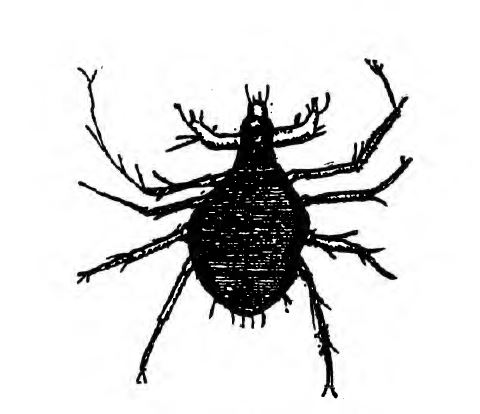
    If we turn to our Aristotle, however, we will find reference to what he considered must be one of the tiniest creatures in existence, called the acarus, which is small and white. “In books,” the philosopher writes, “there are others … and they are like scorpions without a tail.” Subsequently, many books of Aristotle have been found perforated.

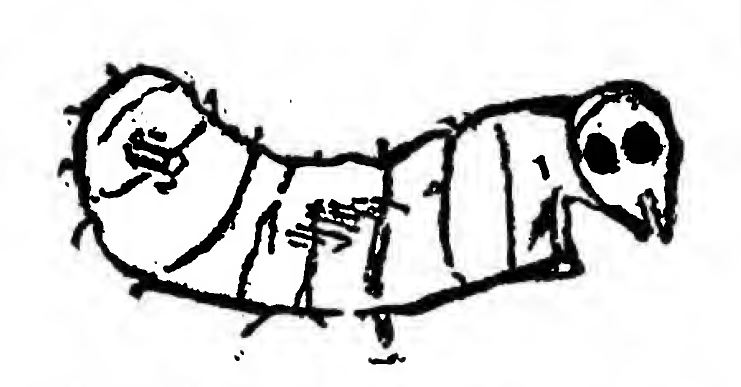
    Acarus cheyletus, order acaridae

    A hundred years earlier, in the 5th-century BC, Evenus  composed an epigram:

    Pest of the Muses, devourer of pages, in crannies that lurkest,
    Fruits of the muses to taint, labor of learnings to spoil;
    Wherefore, oh, black-fleshed worm!
    Wert thou born for the evil thou workest?
    Wherefore thine own foul form shapest thou, with envious toil?

    (Qtd. in O’Conor)

    Notice that, unlike Aristotle’s, Evenus’ mite is black. Research reveals several forms and varieties, classified and unclassified.

    One day hard at work, the German doctor, botanist and sinologist Christianus Mentzelius (1622-1701) heard a loud screeching, crowing noise. Looking around, bewildered, thinking that it was a neighbour’s rooster, he noticed on his writing paper:

    a little insect that ceased not to carol like very chanticleer  until, taking a magnifying glass, I assiduously observed him. He is about the bigness of a mite and carries a gray crest, and the head low-bowed over the bosom; as to his crowing noise it comes of his clashing his wings against each other with an incessant din.

    (Qtd. in O’Conor)

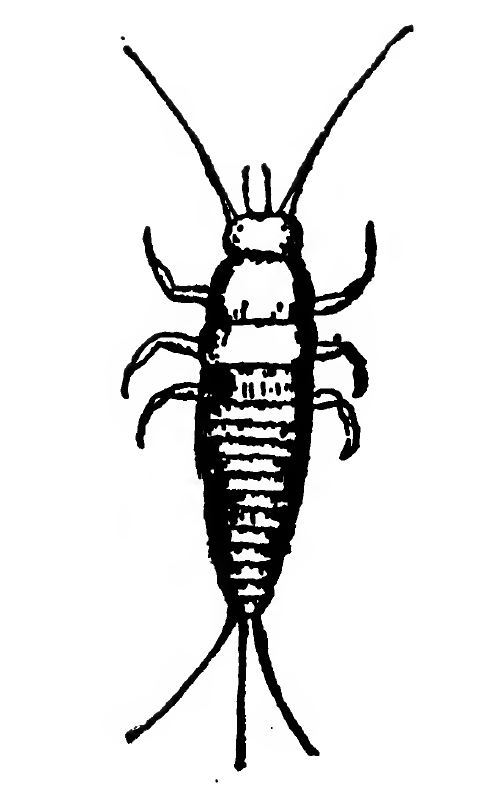
    The insect is much less tedious than its human counterpart is popularly considered, and no wonder it is thought by some to be a myth. Among seven terrifying varieties researched in his Facts about Bookworms: Their History in Literature and Work in Libraries, O’Conor describes the Attagenus Pellio larva as “Long, slender, salmon-colored” and the shape of a graceful miniature whale. The Lepisma saccharina is small, brown, and cone-shaped, with “three thick tails,” and as rapid as “a flash of light.” The Dermestes lardarius is similar to a “microscopic hedgehog, bristling all over with rough black hairs.”

    Lepisma saccharina

    In 1665 Robert Hook, inventor of the microscope, described the first bookworm observed scientifically as “a small, white, silver shining worm or moth […] found much conversant among books and papers […] which corrodes and eats holes thro’ the leaves and covers. Its head appears big and blunt and its body tapers from it toward the tail smaller and smaller, being shaped almost like a carrot,” with three tails and two horns growing from its head; and it makes small round holes in books and covers.

    In his Enemies of Books (1888), Blades discusses the Bestia audax, which was like a chamelion, in seeming to offer a different size and shape to however many observers beheld it. It was microscopic and “wriggling on the learned page,” but when discovered it instantaneously “stiffened out into the resemblance of a streak of dirt.”

    As O’Conor writes:

    A strange truth it is, that the same material that supplies food for the spiritual intellect of man should also supply food for one of the tiniest creatures in God’s creation.

    They may be found, he asserts, in any quality or era of book, generally without respect to genre, from black-letter legal texts, through the classics, leather-bound folios of Plutarch and Dante, to Hauy’s ponderous Treatise on Mineralogy. Novels, however, are safest, being opened more frequently than scholarly tomes.

    Their damage is manifold as the form of the creatures themselves:

    I have five volumes of Hauy’s Mineralogy, Paris, 1801, before me now, and scarcely a page of the five volumes is intact. Very often there are deep channels cut into the book, irregular in outline, and these channels will be longer or shorter, and across the width or length of the book. Some pages will be slightly perforated; on others there will be several furrows separated by spaces untouched.

    Bookworm found crushed in the Mineralogy of Hauy

    Blades relates Peignot’s well-known account of a bookworm that pierced a continuous straight line through twenty-seven standing volumes. Such a prodigy, we might imagine, would be entirely at home alongside Blades’s worm of infinite chameleonic form, and the one that moves at the speed of light, in a library replete with Borges, Calvino, or even Castaneda.


    CHAPTER THIRTY

    Suspense — Things Not Quite so Dark as They Were, but Still Very Gloomy — Friends — A Brave Girl’s Resolution

    There are few things more trying to the human nerve than the pause which precedes action — the torturing suspense which sometimes appals more than actual danger. The first feeling of the prisoners, on discovering that a friend was near them, undoubtedly was that of hope. On his departure the cold fear, the sickening despondency, returned with redoubled force, gradually creeping over them, till the interview with Bunce seemed almost a dream. Yet there were the pistols in the hands of Clara Meredith, the food he assured them they might partake of, and old Nance ready to wait upon them.

    Clara was the first to recover something like self-command. She carefully examined the weapons, placed, as it were, by Providence in her grasp, and once satisfied they were charged, pressed them gratefully to her lips.

    She knew that her fate was in her own hands.

    ‘Aye,’ said Nance, who was still in the chamber and stood watching her movements closely, ‘you may well kiss them, lady; they were the gift of as true a friend as ever a woman in her hour of peril might wish; for in parting with them my poor boy left himself defenceless.’

    ‘I recollect. He told us you were his nurse — his second mother — that we might trust you,’ answered Miss Meredith. ‘We can only pray for him. I will not despair,’ she added, with a flash of returning spirit. ‘God is too just, too merciful, to permit a noble heart to perish in protecting two helpless girls from misery and shame.’

    ‘I have no time to pray,’ observed Nance, ‘and if I had, I have almost forgotten how. My prayer must be in action. Hark! they are calling for me. You may partake of the food in perfect confidence,’ she said, lowering her voice to a whisper. ‘I prepared it with my own hands. Again; they are getting impatient. I must descend. Heaven watch over and assist us.’

    With these words she quitted the room.

    Clara walked with an air of self-deliberation to the rude bench on which sat her cousin, whom terror rendered little more than a passive spectator of what had taken place, and seated herself beside her. Throwing her arms around her, she kissed her fondly, and uttered many endearing, soothing expressions.

    ‘Kate, darling,’ she whispered, ‘we must be firm — the crisis is at hand. I have a hope, almost a conviction, that we shall be saved. Hush, dearest—no cry of joy; the hope may fail us — the conviction prove a delusion; but, at the worst, we are armed against dishonour.’

    The speaker showed the weapons so unexpectedly obtained.

    ‘And yet,’ she added, ‘it is hard to die so young and so beloved.’

    ‘No,’ exclaimed Kate, who caught the meaning of her words, ‘a thousand times No! Better death than —’

    The shudder that shook her delicate frame — the look of agony in her soft blue eyes — explained what words were wanting to express.

    Again her cousin kissed her.

    ‘You would forgive me, then?’ she whispered.

    ‘Forgive, and bless you,’ answered the excited girl. ‘Dear, good noble Clara! you promise me, by the sisterly love between us, our sweet companionship — the ties of blood which bind us — you will kill me? Promise me? Let not that wretch triumph over my girlish weakness. Promise me — promise me ‘ she added, imploringly, ‘or give me the weapon!’

    ‘I dare not trust you with it,’ answered her cousin. ‘You are too impressionable, too easily excited. At the last moment only, should I feel justified in using it. Should it arrive — which I trust and pray it never may — rest assured of this, that villain, Clarence, shall clasp no living  victim.’

    Kate repaid her for the promise by a fond embrace.

    ‘O, that Goliah were here!’ sobbed Susan. It was about the twentieth time she had, since their imprisonment, uttered the wish. ‘But it is like the men,’ she added, ‘out of the way when they are really wanted, and never in the way when they might be useful.’

    Under ordinary circumstances the observation might, perhaps, have had some truth in it, but our readers are already aware, in the present instance, how little it was merited. Her faithful lover was nearer to her than she suspected.

    For a considerable time the speakers remained listening, with strained attention, for any sound that indicated the approach of their oppressors. They presented a sad picture— three pale, frightened girls, upon whose haggard features the light of the lamp suspended from the ceiling streamed with a weird glare. Suddenly Susan quitted the side of her companions, and walking to the table, on which the still untasted food remained, secured a sharp-pointed knife, which she concealed beneath the folds of her dress.

    ‘I, too, am armed,’ she whispered to Clara Meredith, as she rejoined them.

    A voice was heard below, followed by a laugh, words of congratulation, and the closing of a door. The hearts of the listeners beat violently. Bunce had returned with the clergyman and his clerk. The former proved to be a tall, thin man, swarthy almost as a Moor, dressed in a suit of professional black, wearing a wig known as a Brown George at the time, and a huge, white cravat, tied in an ostentatious bow; the latter, a powerful, broad-shouldered man in horn-rimmed spectacles. He, too, wore a wig, like his superior.

    ‘The Reverend Joseph Sly, and Mr. Fustian, his clerk,’ said their guide, who introduced them formally to his employers.’

    Clarence and the squire shook them warmly by the hand.

    ‘And who are these?’ demanded the former, pointing to two young men who had followed the anxiously looked-for visitors to the tower.

    ‘The sons of the woman at whose house I discovered the reverend gentleman, who fancies he has been tracked through the Marsh,’ answered Bunce. ‘He insisted on their coming. I scarcely knew what to do; at last I concluded to bring them with me — not that I believe in any danger.’

    ‘I can answer for them,’ said Theophilus Blackmore. ‘Their father is the most staunch man engaged m the enterprise. I can always rely upon Tim Sawter.’

    This, of course, proved so highly satisfactory that not only were the boys welcomed, but Bunce was commended for his prudence and forethought.

    ‘And where is Benoni?’ inquired the schoolmaster.

    ‘I left him at Sawter’s hut,’ answered the messenger, ‘ready to bring us warning if at any time strangers should be seen endeavouring to penetrate the mazes of the Bitterns’ Marsh.’

    ‘Got over your jealousy?’ observed the squire.

    ‘It was never very strong.’ said the pretended lover of the pretty Susan, laughingly. ‘I flatter myself, however, she will be glad to see me. As you observed, he is but a boy.’

    The rest of the band were now called in. They numbered eleven in all, including their employers. The table had been previously spread with food and spirits in abundance; the last was rarely wanting at the repast of the smugglers.

    Clarence Marsham looked at his watch.

    ‘Now, boys,’ he said, ‘enjoy yourselves; but mind, no excess. We have just one hour before proceeding to business. As soon as our reverend friend here has tied the knot — made myself and friend here happy husbands — all you will have to do is to escort us to the vessel in the creek. Once on board, you shall all of you receive additional proofs of my liberality.’

    At this there was a general cheer.

    ‘Aye, aye,’ averred Bilk, ‘we can always tell a true gentleman cove.’

    ‘When he behaves as sich,’ added Pike. ‘I thinks we ought to drink the health of the ʼappy bridegrooms.’

    ‘Not bridegrooms yet,’ suggested Burcham.

    ‘But very soon will be,’ replied the proposer of the toast, with a knowing wink.

    The health was drunk amid the clattering of glasses and cheers of the men, who called for more liquor to do honour to it a second time.

    Clarence Marsham began to feel a little uneasy.

    ‘These fellows will soon be drunk,’ he whispered in the ear of Bunce, ‘at the rate they are going on. What is to be done?’

    The former reflected for a few instants, then answered, in the same undertone:

    ‘Give them coffee.’

    ‘Will they drink it?’

    ‘With brandy in it,’ replied the trusted counsellor. ‘Yes, I can answer for that. The Frenchmen, who bring their goods to the north, have taught them how to brew a gloria, as they call it. They like it.’

    ‘Go and order it, then.’

    Bunce quitted the room. Returning in a few minutes, he nodded to Clarence, to intimate that all was right, and resumed his seat beside him.

    Once more the brutal revelry ran high, jests were passed, which we will not sully our pages by repeating. In this saturnalia another half hour passed. The gentlemen rascals began to feel impatient of the degrading associations. Not that their morals were offended. It was their taste.

    They both rose at the same instant.

    ‘Keep your seats, boys,’ said Burcham; ‘the ceremony above will not detain us long. We shall soon be back.’

    ‘Cut it short!’ shouted one half-muddled wretch.

    ‘Bring the gals with you!’ suggested a second. ‘We want to get a peep at ʼem!’

    As the conspirators quitted the room they encountered Nance with the coffee.

    When Marsham and the squire entered the chamber of the prisoners, followed by Bunce, the clergyman and his clerk, they found Clara and Lady Kate far more composed than they expected. They saw that their protector was with them. The last few hours had given them hope, and hope is the nurse of courage as well as of life.

    ‘I have kept my word,’ observed Clarence, addressing his victim. ‘All that the most scrupulous delicacy can ask has been complied with. I bring an ordained clergyman of the Church of England with me to celebrate our union. Consent, I implore you. A life of devotion and tenderness shall prove the depth of my love. Your slightest wish shall be a law to me. Offer no useless resistance,’ he added; ‘our fates are irrevocably doomed to be one.

    ‘In the grave, perhaps,’ replied Kate, with more firmness than might have been anticipated after the agitation she had undergone; ‘but even there my corpse would shrink in  horror from your side. Villain! assassin! man without manhood! never shall my lips pronounce the words that would unite us!’

    The ruffian was about to advance, when the Reverend Mr. Joseph Sly placed his hand upon his arm.

    ‘Allow me,’ he whispered, hoarsely, ‘to reason with the lady.’

    ‘Be brief. I know it will be useless.’

    ‘As to your threats.’ exclaimed the pretended clergyman, tearing off the hideous brown wig and huge cravat that disfigured him, ‘advance one step, touch her but with a look, and I will rend your false heart from its foul hiding-place! Wretch!’ he continued, ‘your plans have been deeply laid — wealth freely spent to compass the destruction of this pure and innocent victim, not of your passion — unless interest may be termed one — but of your avarice. Fool as well as wretch! God never sleeps. The humble instruments of His justice have found you!’

    Kate looked bewildered. The swarthy features of the speaker brought no recollection; but the voice did. ‘With, a cry resembling that of the scared bird torn by the fierce vulture from its nest, she threw herself upon his manly breast, and clung there as to her home — to safety.

    The dastardly conspirators saw that, for the moment, their scheme was defeated. With an expression of rage they rushed to the door of the chamber, dashed madly down the stairs, calling on their accomplices below to assist them.

    No sooner had they disappeared than Bunce commenced barricading the door, dragging the heavy furniture against it, the clerk — who proved to be no other than our readers old acquaintance, Goliah — the three girls, and the two Sawter lads, lending their assistance.

    It was but a frail barrier. Still it afforded time.

    The brave fellow who had so skilfully conducted the enterprise had still another hope. When all that human forethought could accomplish had been done, he pressed his ear to the door to listen.

    ‘Alas! I am unarmed,’ observed our hero, sadly.

    Clara Meredith placed the pistols silently in his hands. He offered one to his companion.

    ‘Keep one, Willie,’ said the honest fellow. ‘I beant much used to such things, but I can hit unmarcifully hard.’

    Susan, who, since the recognition of her lover, had been laughing and crying hysterically, showed him her knife.

    ‘Keep it,’ he repeated; ‘keep it. A kiss would do I more good nor a dozen knives.’

    The favour thus modestly hinted at was complied with.

    The expression of doubt, hope, fear, in the face of Bunce became intense. One moment oaths, execrations, bitter threats, fell upon his ear. Gradually a faint smile stole over his features. Addressing his companions, he said:

    ‘I think we are saved — for the present.’

    Again he applied his ear to the door.

    ‘Yes, I feel certain of it. She never failed me yet. It has been a terrible risk, though.’

    The voice of Nance was heard demanding admittance.

    ‘Has it succeeded?’ asked her foster son.

    ‘Perfectly,’ was the reply. And instantly he commenced to unbar the door.

    ‘All but the master and his employers are helpless as the infant at its mother’s breast,’ said the woman. ‘I drugged the coffee as I promised. Heaven grant I did not place too much in it. Bad as they are, I would not have their deaths upon my soul.’

    ‘I would,’ observed Goliah; ‘and think no more on it than killing so many rats or any other varmint.’

    Cautiously the speakers made their way to the room below, ready to retreat in case of an attack, but no attack was made. The wretched hirelings lay perfectly senseless, motionless, as if the final sleep had fallen upon them. Clarence, the squire and schoolmaster had quitted the tower.

    ‘Their hearts still beat,’ observed Bunce, after placing his hand upon the breast of each.

    ‘Thank Heaven!’ murmured Nance.

    Goliah did not seem to feel quite so well satisfied.

    ‘They must be removed,’ observed the speaker; ‘in a few hours, like torpid vipers, they will recover both their venom and their strength, and we are too few to master them. The danger, alas, is not over yet. The master will cause the desperate inhabitants of the Marsh to attack the place. They will obey him. You do not know how much energy he is capable of.’

    This suggestion was too prudent not to be complied with. With the exception of Pike and Bilk, the sleepers were carried out of the tower and placed close to the Druid’s Stone. The former were reserved for a different fate.

    In searching the vaults for a secure place to confine them in, Bunce and Goliah discovered an old iron culverin which the government of the day had not thought it worthwhile to remove. With no inconsiderable: amount of labor they dragged it from its hiding-place, and, finally got it in position so as to command the approach from the Marsh.

    The first difficulty vanquished, a second, presented itself. They had plenty of ammunition to charge it with, but not a single ball.

    ‘Everything seems against us,’ murmured the former.

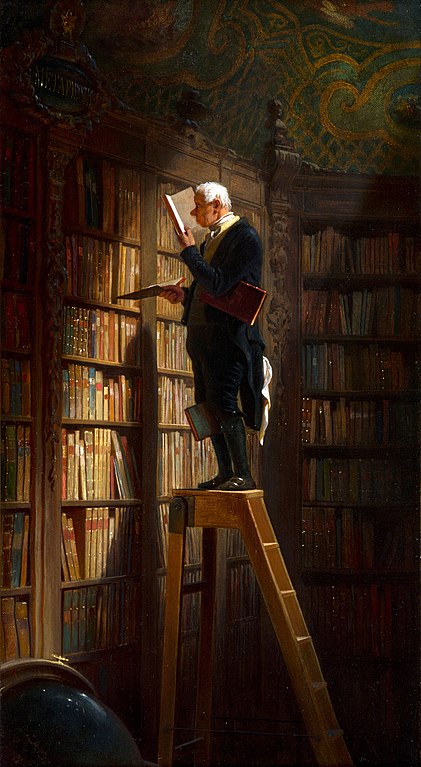
    The Bookworm (c.1850), Carl Spitzweg  (1808–1885). Source: Wiki Commons

    ‘I don’t know that,’ said Goliah, who, since he had found the pretty Susan, appeared to be endowed with an increase of intelligence. ‘Wait you just here. I’ll find summat.’

    He proved as good as his word. In a very short time the honest fellow returned laden with the heavy brass clasps which he had ruthlessly torn from the antique bindings of Theophilus Blackmore’s fondly cherished volumes — Elzevirs, Aldines, and tomes that might have been the pride of any biblomaniac. Worse than all, he had discovered the old man’s manuscript notes on Horace, the labor of a life, cherished as the apple of his eye — the opusculum which was to hand down his name to admiring posterity.

    ‘If these aint enough,’ he observed, as he poured out the contents of his pockets before his companion, ‘ I can get plenty more. The old fellow left a mort o’ books behind him.’

    Bunce smiled. He saw that the vandalism of Goliah had been made a work of retribution.

    ‘There,’ said the latter, ramming the precious commentaries on Horace into the culverin, by way of wadding, ‘ I don’t think they will swallow that easy, and if they does it won’t agree with ʼem. My eyes ached to look on it.’

    ‘I believe,’ replied his friend, ‘they may find it difficult of digestion.’

    As the last arrangement was completed our hero joined the speakers. The Sawter boys were with him.

    ‘Can I not assist you?’ he asked. ‘I have some strength left — would that it were equal to my will!’

    ‘I wish it were,’ observed Bunce; ‘But as it is not, you must be content to remain with the ladies. Leave the rougher work to us. I should feel much more confident,’ he added, ‘if I were certain the piece was in correct position.’

    ‘And I have not the strength to raise it,’ observed Willie, ‘or I might aid you.’

    ‘It be all that cussed varsity,’ muttered Gohiah. ‘What is the use of sich places?’

    The culverin was drawn back to enable the pale strident to run his eye along the sight. He at once discovered that the charge must pass over the heads of their enemies if they ventured to approach. The position was soon rectified.

    ‘I am satisfied,’ he said, ‘it will sweep their lines like a hailstorm.’

    ‘And wi’ mighty hard drops, too,’ observed Goliah. ‘There be all the fixin’s of old master’s books in the gun.’

    The Sawter boys, Burk and Beni, now joined them, and the five men formed the only garrison of the lone tower. Not an eye was closed. All watched. Not only their own lives, but, what was far more precious, the honour of the beings they loved was at stake.

    Everything passed quietly till the first faint rays of light began to gild the horizon. Slowly and with difficulty they appeared to disperse the mist which, like a dense fog, hung over the Bittern’s Marsh.

    William Whiston was the first to perceive a dark figure creeping in front of the Druid’s Stone. For an instant he thought his vision had deceived him, but soon a second one appeared, and together they stood reconnoitering the martello tower.

    Noiselessly he imparted the warning to his companions.

    ‘They think we are sleeping,’ whispered Bunce.

    ‘Clarence knows better than that,’ replied our hero, in the same undertone. ‘Hate never sleeps. I read it in his eyes, and he in mine. Mark my words,’ he added, ‘the meeting will be fatal to one or both of us.’

    ‘Will it?’ thought Goliah. ‘Not if I can help it.’

    This edition © 2020 Furin Chime, Michael Guest


    Notes and References

    • Flaubert: In his Dictionary of Received Ideas (1911-13); compiled from notes he made in the 1870s.
    • chanticleer: domestic rooster.
    • culverin: ‘[…] a medieval cannon, adapted for use by the French as the “couleuvrine” (from couleuvre “grass snake”) in the 15th century, and later adapted for naval use by the English in the late 16th century.’ Wikipedia.
    • biblomaniac [sic]: bibliomaniac.
    • opusculum: opuscule; a minor literary or musical work.
    • mort: A great quantity or number. Webster.

    Blades, W. (1888). The Enemies of Books, 2nd ed (London: Eliot Stock). Available free at Gutenberg.org. Jump to file.

    *O’Conor, J.F.X (John Francis Xavier, 1852-1920) (1898). Facts about Bookworms: Their History in Literature and Work in Libraries (NY: Harper). Available free at Internet Archive. Jump to file.

  • J.F. Smith’s Mystery of the Marsh — Twenty-eighth Instalment

    J.F. Smith’s Mystery of the Marsh — Twenty-eighth Instalment

    The unflappable Clara rebukes her “gentleman” kidnapper, Marsham:

    ‘You forget,’ she added, ironically, ‘the law against bigamy.’

    Her quip anticipates Morticia Addams’, who, bitten by the green-eyed monster, tests a barb on her unwitting husband:

    ‘Gomez, do you know the penalty for bigamy?’
    ‘… Two wives?’

    It must be the narrator’s tone that provokes our flippant response. He adopts a certain ironical distance himself, with his “We must not forget the ladies …”, his “As our readers may suppose …”, and the variants — sometimes quite teasing ones. In clear and simple prose, Smith exercises a virtuosic ability to combine seriousness and playfulness in artistic equipoise.

    We tend to become glib in the face of high drama and, especially, melodrama. Smith anticipates such a reaction with his playful self-reflexive ironies. In the current chapter, making a second appearance is the character Smith, whom the villains hired and brought back with them from Dinant to the Bitterns’ Marsh. (Can it be Bunce in disguise?)

    Being such a common name, ‘Smith’ is almost a byword for ‘pseudonym’. How tempting might it be for this author Smith, the mischief-maker, to use his actual name, the archetypal pseudonym, as a pseudonym for himself? It would be an audacious gesture indeed, to ‘stride the boards’, as it were, of his own novel; to make a cheeky cameo performance after the fashion (or rather, before the fashion) of a Hitchcock or a Tarantino.

    Before you scoff, notice the several throwaway quips on the name, Smith, which commence with the very chapter outline, and turn up a few times in the narrative and dialogue. Marsham is given the subtlest to say:

    ‘The fellow appears infernally indifferent to everything; walks about the old tower as if he owned the place ….

    which is to say, in the manner of an author-god (as one mask).

    Effects such as these gesture to a metafictional dimension, which characterizes writers such as Borges, Eco, Calvino, Pirandello, etc., who are held by many to herald or exemplify postmodernist fiction. This is, broadly speaking, a genre that draws attention to its own artifice; that parodies, pastiches and deconstructs traditional conventions, often implicitly incorporating the figures of the author and reader in the aesthetic action.

    At the same time, we should bear in mind that many writers as “dated” as Sterne (18th c.) and Cervantes (15th c.) demonstrate similar if not identical characteristics.

    So it is not particularly radical to observe metafictional effects here, though we hardly consider them as defining. The form of serialization lends itself well to such features. Consider the current instalment of the meercat ad, which ends with the two Russian protagonists clutching to the edge of a cliff:

    Aleksandr: Is this the end, Sergei?
    Sergei: No, it’s only a cliffhanger …

    Unlike a finished work, in one aspect the serialized novel unfolds itself in the same temporal frame as the reader’s own. Devices such as the cliffhanger, and the author’s address to the “gentle reader” convey a tacit wink, an acknowledgement of secretly inhabiting an identical world.

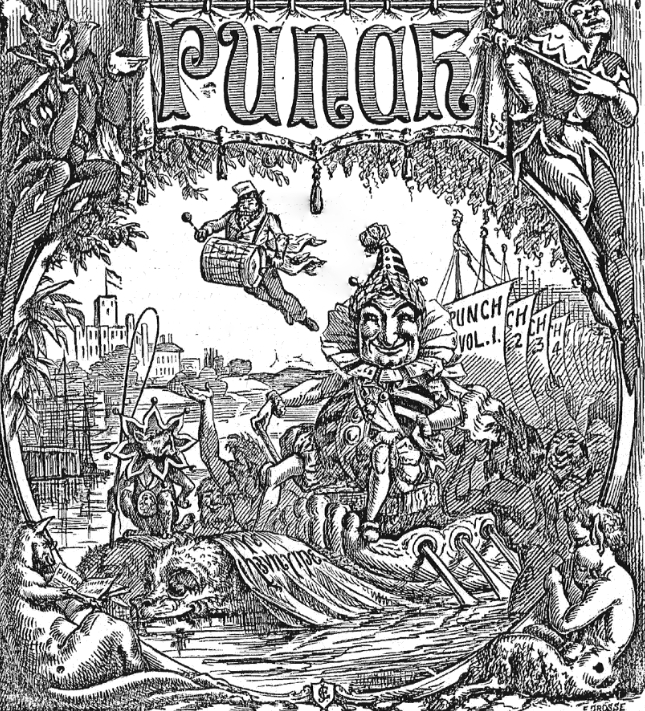
    From Sydney Punch Title Page
    Sydney Punch, title page (Jan 20 1866), cropped

    Apart from our own, the only extant instance of reader-reception of Mystery of the Marsh is an article in  Sydney Punch (Saturday June 9, 1883), which appeared at precisely our stage of the narrative, as published in the Evening News (Sydney, Wednesday June 13, 1883), in a column called “Family Jars.” The piece is a good measure of the popularity of Smith’s work among the Sydney readership. The author succumbs to one of the lower forms of wit, though we presume he is paid to do so.

    Night after night do we frantically devour the thrilling tale which adorns the last sheet of the Even Ooze, and which bears the Fisher’s Ghost-like title of the “Mystery of the Marsh.” It is now in its thirtieth chapter, and seems to have wind enough left to run thirty more, so that each gentle reader pays 5 shillings by instalments for a tale that can probably be bought at Paddy’s market for 5 pence. Of late we have been deeply grieved to find the fair heroine occasionally “sot down very hard,” but things are evidently on the mend, and the conspirators sing —

    “Farewell! farewell! I would not fling
    Around thy brow the veil of sorrow.”

    Quite right, too; for the man who would raise his hand to a woman (except in self-defence) is worthy of the name of a Pitt-street hero. It’s always safest to stand well away, and pelt the furniture after her.


    CHAPTER TWENTY-EIGHT

    The Martello Tower and the Prisoners — A Smith who is neither a White or a Black Smith — A Hut in the Bitterns’ Marsh

    We must not forget the ladies, whom, at the close of our last number, we left prisoners in the martello tower. The plot had succeeded. Money and brain-work, badly applied, carried out the daring scheme of the unprincipled Lady Allworth, whose insane desire to enrich her son without materially lessening her own means, knew no let nor hindrance. Scruples she had none. As for conscience — that was a myth with her, or, at least, a thing of the past.

    It was some time before the terrified girls recovered sufficient self-possession to look around them. A calm consideration of their position was equally out of the question; their senses were in a whirl of confusion; one moment it seemed to them as if they were in a hideous dream; it needed the sound of each other’s voice to convince them that they were not sleeping.

    Susan was the first to recover her presence of mind. There was a considerable amount of commonsense, as well as courage, in the girl. Whilst Clara and Kate sat helplessly, hopelessly locked in each other’s arms, she commenced taking a practical view of the situation — not a very encouraging one, certainly; neither did it appear to her utterly hopeless.

    After a glance at the strongly-barred windows, her eyes fell upon a pile of books; some in parchment covers, others in quaint old binding, mixed with a few Elzivers and several manuscripts piled confusedly in one of the corners of the room. In the first one she opened she read the name of Theophilus Blackmore, the ex-schoolmaster of Deerhurst, and a sigh of relief escaped her. Having learnt both writing and arithmetic under his care, of course she was well acquainted with the man — had never heard anything very bad of him. As for his son, Benoni, whom she had several times rejected, she smiled with contempt at the idea of any danger from that quarter.

    ‘Why, Goliah would brain him!’ she muttered to herself.

    And so, no doubt, he would, if ever he discovered that his rival had a hand in carrying her off.

    ‘Dear, kind ladies,’ she said, addressing her companions in captivity, ‘things look quite bad and ugly enough, still we must not despair. I do not believe that the owner of this place would lend himself to any very wicked act. He is old, and lives more amongst books than his fellow creatures. I could almost answer for him.’

    ‘But not for the wretches who have employed him,’ observed Miss Meredith. This was a view of the situation Susan had not taken.

    The noise made by someone unlocking the door of their prison chamber startled them. Poor Lady Kate clung to the side of her cousin, imploring her not to leave her. She recollected but too well the horrors of the night at the Red Barn.

    ‘Kill me first!’ she exclaimed. ‘Kill me!’

    The door opened. Clarence Marsham, accompanied by his confederate, Burcham, entered the room, leaving the taciturn fellow named Smith, whose services they had engaged at Dinant, to guard the entrance. With the cunning peculiar to great criminals they had concealed from the man, not the purpose, but names of their victims — also the locality in which they expected to find them. To all appearance this new agent in their schemes was not over-troubled with scruples, expressed little curiosity, and seemed to trouble himself only for the reward — half of which had been paid down before he consented to start with them.

    On recognising the suitor she had so contemptuously rejected, Miss Meredith saw that the same danger threatened both her cousin and herself. Her heart beat probably as violently as her cousin’s; but she possessed more self-command. Drawing herself up to her full height she fixed her eyes upon Clarence, affecting to ignore all knowledge of his companion.

    ‘Perhaps you will explain, Mr. Marsham, the meaning of this double outrage. Your designs on the hand and fortune of Lady Kate Kepple I have long been acquainted with, and the disgraceful means by which, on a former occasion, you attempted to accomplish them. But why am I here? Is it a part of your scheme — perhaps I ought to say your mother’s — to marry both the cousins, and so secure a double inheritance? You forget,’ she added, ironically, ‘the law against bigamy.’

    ‘No, Clara. Nothing of that kind. I —’

    ‘You are familiar, sir,’ interrupted the insulted girl, calmly. ‘Since I am compelled to exchange words with so contemptible a person, he will address me only as Miss Meredith.’

    ‘Hang it, Clara — well, then, Miss Meredith, since you will have it so — you know well enough what we intend — to make you our wives. The clergyman will not arrive till to-morrow night, so you and Kate have plenty of time to think it over. We can play the lovers afterwards. It will be your own fault if we use any but the gentlest persuasion.’

    ‘And are you weak enough to suppose, Mr. Marsham, that such a marriage would be binding?’

    ‘As for that, we will take the risk,’ replied the young ruffian, beginning to feel nettled at the determined tone of the speaker. ‘Once married, I don’t suppose you and Kate will be very anxious to create a scandal. Hang it, Burcham, why the devil don’t you speak? She is your affair — not mine. All I have to do is with her cousin Kate.’

    ‘Back, sir!’ exclaimed Clara, as the squire approached the spot where she was standing. ‘I cannot descend to exchange words with two felons in one day!’

    ‘Felons?’

    ‘Murderers!’ shrieked Kate. ‘They will kill us as they have killed poor old Willis!’

    ‘Killed?’ repeated Clarence. ‘We have killed no one. Not such fools as that.’

    Susan was about to speak, when a warning glance from Clara restrained her. Had the faithful girl declared herself a witness of the crime it might have cost her her life. Miss Meredith had no such fears upon her own account. Her danger was of a different nature.

    ‘Brutally murdered,’ she repeated, ‘by the ruffians you employed to decoy us here. Although prisoners in the cabin of the barge, we recognised his voice, heard his cries for assistance, the oaths of the assassins as they plunged the body of the old man into the river.’

    At this intelligence Clarence Marsham and his companion looked exceedingly blank. Much as money, rank, and political influence could do in England, they knew them to be powerless to condone crime where life had been taken. It was the first hint they had received of the death of the aged servant. The perpetrators had kept their own secret.

    Another source of embarrassment: They did not feel perfectly assured of the fidelity of the man they had engaged in Dinant, and who, from his position in the passage, must have heard every word of the accusation. The fellow had made a hard bargain with them, played off and on, haggled over the price of his services — in short, acted his part so well that doubt balanced confidence. One moment the conspirators felt disposed to trust him implicitly; the next to rid themselves of him — no very difficult thing to accomplish whilst they were in the Bittern’s Marsh.

    Clarence and Burcham withdrew from the room as abruptly as they had entered it. If conscience had not taken the alarm, fear had. They felt it necessary to consult together.

    As soon as she saw them depart Lady Kate Kepple commenced laughing hysterically. The dread of the present and recollections of the past were pressing upon her sensitive nature. She was already in the first stage of a brain fever.

    ‘Oh! my dear, kind lady!’ sobbed Susan, kneeling by the side of the old lounge on which the victim was seated. ‘Where will this all end?’

    ‘In death, perhaps,’ answered Miss Meredith, firmly; ‘but never in dishonour!’

    ‘Oh! that Goliah were here!’ said the humble friend.

    More than one heart re-echoed the wish.

    ‘Things are beginning to look infernally ugly,’ observed Squire Burcham, when he and Clarence were seated in what the latter styled their own den — namely, a room on the lower floor of the martello tower.

    ‘Who could have thought that they would have been such fools. Murder is a very different affair from running off with two girls and persuading them into marriage! Once our wives, they could give no evidence against us.’

    ‘That,’ said his confederate, ‘is our chance of safety — the last plank circumstances throw out to us. We must cling to it or sink. I know Clara,’ he continued. ‘She is a true Meredith, and would feel as little remorse in hanging us as I should in bagging a snipe.’

    ‘Unless she bore one of our names,’ observed his friend.

    ‘Exactly so,’ said Clarence. ‘We must carry out our plans by any means — fair ones, if possible; if not, the girls will only have themselves to blame.’

    His hearer nodded approval.

    ‘What troubles me now,’ continued the speaker, ‘is the fellow we picked up in Dinant. He must have heard every word of Clara’s accusation. Will he prove faithful to the end?’

    ‘Had we not better see him?’ asked Burcham.

    ‘Perhaps we had,’ answered Marsham, thoughtfully. ‘Were I convinced that he had the slightest idea of playing us falsely, some of the Marsh boys should soon settle the difficulty. It is the doubt that haunts me. The fellow appears infernally indifferent to everything; walks about the old tower as if he owned the place, and —’

    The rest of the conversation was cut short by the subject of their conversation walking into the room and coolly taking a seat at the table. He was a man of middle height, strongly but not coarsely built, about forty years of age, with nothing very remarkable in his appearance, except the keen grey eyes, which expressed great resolution.

    The two rich rascals drew themselves slightly up as if offended at the familiarity of the poor one.

    ‘Gentlemen,’ he said, ‘you have not acted fairly by me.’

    ‘Why, we paid you!’ exclaimed Clarence.

    ‘Of course you did,’ replied the seaman; ‘such services are rarely given.’

    ‘What, then, do you complain of?’

    ‘Paid me for assisting you to carry off two young ladies who asked, as you assured me, nothing better than to fall into your hands; but not for murder — a very different affair. Do you suppose I am going to risk my neck within the compass of a halter, at such a price? Ridiculous! ‘

    His hearers breathed freely. After all, it was merely a question of money, and they were well provided.

    ‘Name your terms,’ said Burcham.

    ‘I must have five hundred pounds more.’

    ‘Is that reasonable?’ demanded Clarence. ‘You have received two hundred pounds already.’

    ‘For coming with you from Dinant to the Bittern’s Marsh. You see I have learnt the name of the place, despite your cunning attempts to conceal it. Handsome pay, I acknowledge, for assisting you to bring two young ladies on shore. I have committed no other act for which the law can touch me. Take my offer, or reject it as you think fit.’

    ‘Why, what would you do?’

    The question was put with a view of testing his intentions yet further.

    ‘Wash my hands of the whole affair,’ was the reply.

    ‘Rascal! would you betray us?’

    The man laughed heartily.

    ‘And to whom should I betray you?’ he demanded: ‘Will you direct me where to find a magistrate in the Bittern’s Marsh, or officers to arrest you when I have obtained a warrant? You are neither of you very wise,’ he continued. ‘Still I give you credit for more judgment than that, I might try London, you will say. Tell me the names of the girls, give me the address of their family, and possibly I may think of it. Not that it would be of any great use, for if you are the fellows I take you for, it would be too late. The game will be played out.’

    The reasoning of the speaker was boldly put, nor did it detract from its value that it was insolent as well as convincing.

    ‘You are completely in our power. The boys of the Marsh are devoted to me.’

    ‘Not so completely as you suppose,’ answered the fellow, carelessly. ‘There are three or four gallows birds below anxious to fly to America. Probably they were on board the barge when — you understand. Now I wish to cross the ocean, too. We have had some talk over the affair. I don’t think, even at your bidding, they would commit a second murder.’

    The two gentleman rascals consulted together in a whisper.

    ‘Not so dangerous as I expected,’ said Clarence. ‘A mere petty larceny rogue. His object, to obtain more money.’

    ‘Yes, pay him; pay him,’ replied Burcham. It is hard, though I shall feel more at ease when I know they are on the other side of the Atlantic.’

    The last suggestion prevailed.

    ‘Hark you, my man,’ said the former, ‘when we engaged your services neither my friend nor myself anticipated the contingency you have alluded to, and perhaps it is only fair that your recompense should be increased. Pity you urged it so offensively. You might have trusted to our liberality.’

    ‘And been cast aside like a soiled glove when you had no further use for me,’ replied the mutineer, scornfully.

    ‘Well, well,’ chimed in the squire, who began to feel a little nervous, ‘we will overlook your insolence. All we require is to be assured of your fidelity. That is the important point.’

    ‘And yet you huckster over it like petty traders,’ observed Smith, lowering his tone, for he saw that the money would be forthcoming. ‘I will deal more frankly by you than you have dealt by me. In three weeks time I must be in America, far beyond reach of English law and English lawyers. The whole country will soon be ringing with my name.’

    ‘Rather a common one, I believe,’ observed Marsham with a sneer.

    ‘Perhaps it is,’ replied the former in a tone of indifference, ‘but some rather uncommon men have borne it. I am not ashamed of it. Enough of name,’ he continued. ‘Accept my offer; or reject it; the choice lies with you. I can be staunch as a bloodhound to my promise, but then I must have my price.’

    Walking back to the table, the speaker assisted himself to a second glass of liquor, and stood quietly awaiting the decision.

    The money was paid, and confidence, to all appearance, restored.

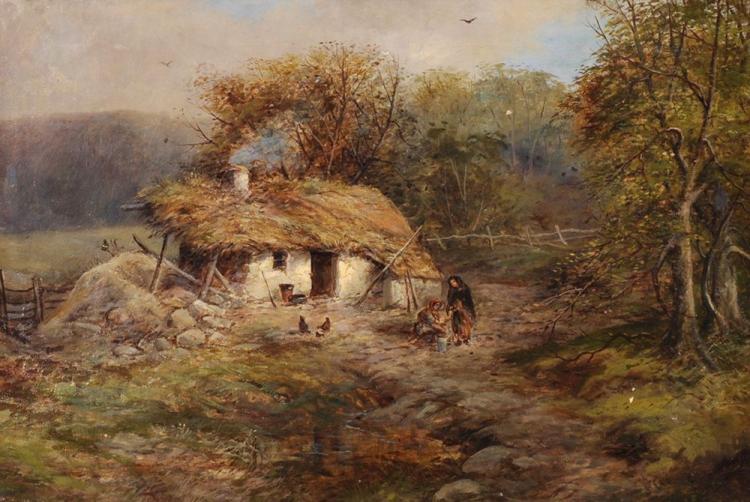
    ‘The Crofter’s Cottage’, Edwin Ellis (1842-95)

    As our readers may suppose, the motley inhabitants of the Bittern’s Marsh were not very particular in the choice of materials for their habitations, most of which, apart from the martello tower, were constructed of the trunks of trees dragged from the pools of stagnant waters, or, where these were scanty, of rough, unhewn stones, fragments of boulders, patched out with broken planks, and the interstices filled with mud or clay. Around these wretched abodes a plot of cultivated ground might occasionally be seen, with a few sickly-looking vegetables striving to pierce through the mass of weeds stifling their growth.

    The owner of one of these wretched huts was Sarah Sawter, the former servant of the widow Gob. We call her the owner from the fact that her worthless husband owned nothing but his worthless self. She was a tall, masculine-looking woman, strongly built, sharp of tongue, and capable ot thrashing both Tim and his sons, although, to do her justice, it was only in extreme cases that she exercised her strength.

    Soon after the arrival of Sarah in the Marsh a hard contest commenced between herself and the man with whom she had united her fortune for life, for the mastery. Pluck and resolution finally prevailed. In little more than a year Tom Sawter gave in, and the supremacy of his wife was sullenly acknowledged. Occasionally some outbreak might occur, but it was sternly suppressed, and she brought up her children as she pleased.

    As her sons grew up towards manhood they became deeply attached to her; to
    them her words were like oracles, which, if not always believed in, were rarely disputed. If Burk and Ben — the names of the boys — drank with their father, they always sided with their mother in all home disputes.

    One trait will give the key to Sarah Sawter’s character better, perhaps, than a page of description. On one occasion, as hostilities were about to commence between her husband and herself, the lads gave unmistakable indications of siding with the latter.

    ‘Stand aside!’ she exclaimed. ‘Have you forgotten he is your father?’

    It was the last serious contest with her drunken husband that Sarah Sawter had occasion to engage in. Tim was not only whipped but subdued in spirit when his sons turned against, him — he, to use a sporting phrase, ‘threw up the sponge.’ Grumblings might, perhaps, have occurred occasionally at intervals afterwards, and threats of what he would do; but the grumblings died away harmless as the echoes of distant thunder, and the threats were disregarded.

    The whole family were seated around the clean but rough deal table, on which stood a lamp filled with fish oil and a mesh made of dried bullrush. The supper, by no means a plenteous one, had long been concluded. The hour was getting late, yet still the inmates of the hut lingered at the table. Some project of interest was evidently under discussion.

    ‘I don’t like the looks on it,’ observed the mistress of the place. ‘What can they want wi’ a parson at the tower? Never heard of sich a thing afore. The master ain’t agoin to get married agin. I spose he haint sich an old fool as that.’

    In the Marsh they always spoke of Theophilis Blackmore as the master.

    Her sons grinned at the idea.

    ‘What is it to us what he wants un for,’ demanded the husband, in as loud a tone as he thought it prudent to assume, ‘since he pays well?’

    ‘And we are out of bread, mother,’ observed the oldest son.

    ‘The last bone of the old goat has been picked,’ added the youngest.

    ‘There are wuss things than hard fare,’ replied the woman, sadly, ‘though it be bad enough — the gaol and the law.’

    ‘It shall be as you say, mother,’ said the young men.

    ‘If it were only to guide the parson and his clerk from Deerhurst through the swamp to the tower, I should not so much mind; it’s what they may tempt ʼee to afterward. Still if —’

    The rest of her speech was cut short by a loud knocking at the door. In an instant all was silent in the lonely abode.

    The signal was repeated, but no one offered to stir.

    ‘Marcy on us!’ whispered Sarah, who can it be? So near on mornin’ too.’

    ‘Tramps — marsh birds like oursels,’ replied her husband; ‘but we ha’ naught for ’em. We be half clammed oursels. I’ll start ʼem.’

    Walking to the door he drew aside the bar, when two men, evidently greatly fatigued, clad in rags almost as wretched as the speaker’s, made their way into the room. The youngest one sank exhausted upon the settle.

    ‘Don’t you know me, Sarah?’ asked the elder of the two wayfarers.

    Mrs. Sawter caught up the lamp and held it close to his face, whilst Burk and Ben, her sons, stood quietly prepared for anything that might occur.

    ‘Marcy on us!’ exclaimed their mother. ‘Master Goliah, be it really you?’

    The name explained something to the boys; but not everything. They could not understand why the well.-dressed, good-looking young farmer, whom they had frequently seen, and been taught to respect, should come to their miserable dwelling in such a plight, and at so late an hour.

    No wonder they gazed upon him with surprise; but it was without any feeling of hostility. The grateful woman threw an additional armful of wood upon the hearth, and produced another bottle of spirits upon the table.

    Her husband began to eye it eagerly.

    ‘O! Master Goliah,’ she said, ‘if your dear good mother could see you in these rags it would break her poor heart. Where did yer get ʼem?’

    ‘Out of her garret,’ replied her visitor with a grin. ‘Mother gied ʼem to I.’

    As Sarah did not quite believe this statement she made no reply.

    ‘I tell ʼee she did,’ added the speaker; ‘and look, I hev fayther’s pistols as well, an’ you know the store she set on ʼem. She told I to come here.’

    ‘Here! to the Marsh? Here, amongst thieves, and worse?’ exclaimed the mistress of the house, who had recognised the weapons. ‘O! what have yer done?’

    ‘Nothink, as I knows on.’

    Sarah shook her head.

    Goliah knew that he might trust her, but doubted the prudence of doing so before her husband and her sons. Looking her earnestly in the face, he remarked that he would tell her all by-and-by. The woman understood him.

    ‘You. might trust in my boys,’ she whispered, ‘but not in their father. I have kept them honest. Tim will soon be drunk; it was partly for that I placed the bottle of liquor on the table.’

    In less than an hour the prediction was verified, and a series of explanations ensued, and some schemes suggested, in which Burk and Ben pledged their assistance.

    So satisfied were the two wanderers with the result that they consented to accept the only bed the wretched place afforded. Goliah did so on William’s account more than his own; for, as he said, he could sleep anywhere.

    When Tim Sawter awoke from his debauch in the morning he called loudly for his boots and his coat, which had disappeared.

    ‘Useless to search for them,’ observed his wife. ‘The boys have taken ʼem.’

    ‘Taken ʼem?’

    ‘Yes; they started at daybreak for Deerhurst to find the parson and guide him through the Marsh to the old tower.’

    Tim cursed loudly; swore that he would break every bone in their skin when they returned. Did they mean to rob him of his perkesites?

    Sarah smiled contemptuously. She had no fears for her sons. As for their father, he was effectually a prisoner in the Bittern’s Marsh; to go out barefoot was an impossibility, and he had not even a pair of slippers to attempt it in. Such luxuries were unknown in the miserable den he called home.

    This edition © 2020 Furin Chime, Michael Guest


    Notes and Further Reading

    • Metafiction: See for example, David Henry Lowenkron, “The Metanovel,” College English 38.4, Dec. 1976 (343-355).
    • Sydney Punch image reprinted in Shattock, J (ed.) Journalism and the Periodical Press in Nineteenth-Century Britain (CUP, 2017).
    • Elzivers [sic]: Must refer to the House of Elzevir, Dutch publisher of the 18th and 19th centuries: “The duodecimo series of ‘Elzevirs’ became very famous and very desirable among bibliophiles, who sought to obtain the tallest and freshest copies of these tiny books” (Wikipedia).