Tag: secret societies

  • Curtains at the Swamp

    Curtains at the Swamp

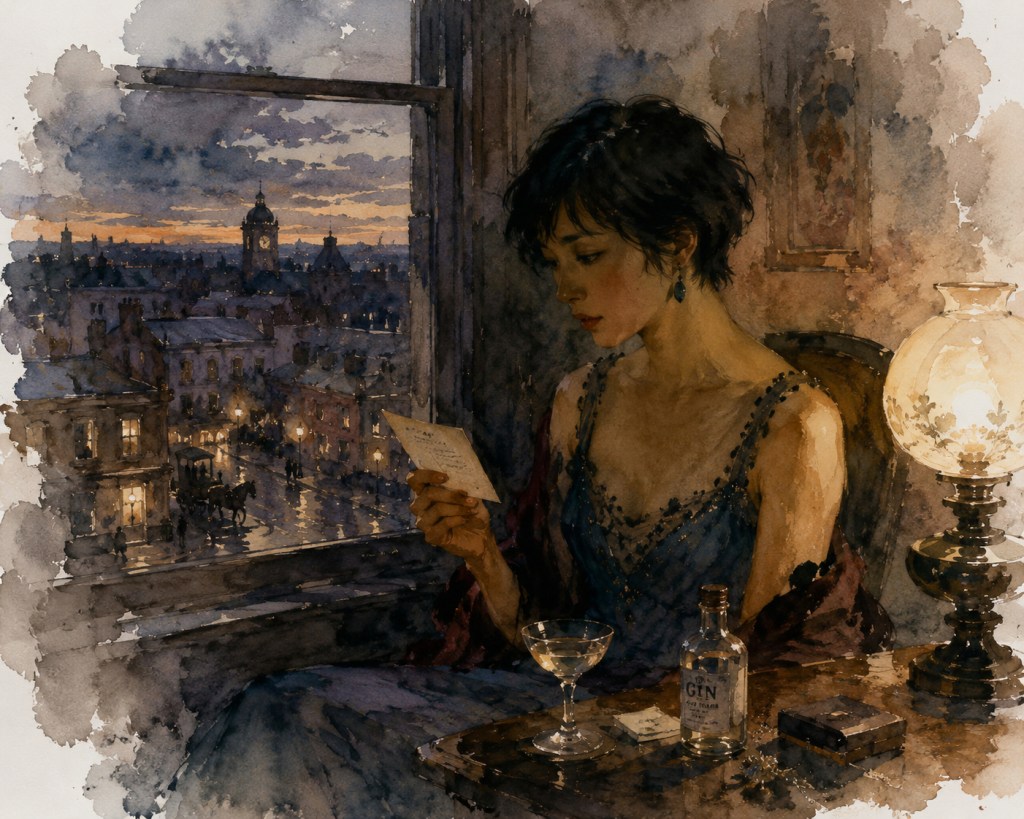
    The cab trundled off along Bourke Street. Lili nodded to the receptionist in the hotel lobby and climbed the stairs to her room. Inside, she took off her capote bonnet and hung up her dolman coat, idly feeling through the wardrobe for the one or two dresses that might do for The Pirates of Penzance. There was plenty of time before Forster would return for their engagement, so she settled into the easy chair by the window with her cheroot and gin, anticipating the lazy spectacle of evening patrons arriving for their various entertainments.

    The events of the day passed fragmentarily before her mind’s eye: the jeweller Kaminski’s appraisal; luncheon with William; the outing to See Yup Temple, with its distinguished elder Mr Lee Kong Wing; and alongside them the startling voice of her one-time mentor, the shady Madame Ah Toy, manifesting vicariously from the dim past. Remarkable how Ah Toy’s odd communication with its dubious promises and invitation had managed to reach her through so many hands. A chain of intermediaries extending to and fro between Guangdong, San Francisco, and Melbourne … bridging the abyss with her past that Lili had managed so assiduously to establish, and stripping away her cloak of anonymity.

    She stood and went over to retrieve Ah Toy’s letter from her coat pocket … but along with the letter and Kaminski’s receipt, she withdrew a third folded card, too prominent to have missed had she not been quite so absorbed in the events of the day. She unfolded it, and its words made her heart stop:

    “To the harlot Chan Lee Lung …”

    She sank slowly into the chair. Outside, the sounds of the evening coming to life faded to silence before the now rapid beat of her heart.

    I know who you are, better than you might think. I know why you have come to Melbourne. I know why you went to see Kaminski the jeweller today, and the purpose of your other movements. I know of your past crimes of murder and theft and will reveal them to the police if you do not comply with my wishes.

    Her head swam as though she had been drugged. No one in the country could possibly know of her “past crimes.” How could anyone know of her reasons for coming to Melbourne – above all, of her meeting with Kaminski, whose shop she had only selected this very morning, on the spur of the moment, telling no one about it since. She had refolded the letter on a reflex, as the message sent its shockwave through her nerves. She took a sip of her gin, looked again, found the terrible words unchanged, and read on:

    You are to meet with me this evening at eight o’clock, in a certain shed at the edge of the blue lagoon in West Melbourne Swamp. Come along Dudley Street to the railway coal canal. Cross it and keep to the northern bank until the water runs down to the river; there you will find a shed marked by a red lantern. If you bring anyone with you or tell anyone about our appointment, you will not leave the swamp, and your remains will never be found. If you fail to show up, believe me, you will not live the night out.

    Make sure to bring the Marquis with you, whom I’m sure, if you weren’t familiar with before, you must be by now from your meeting with Kaminski.

    The Marquis, never heard of him… but of course, Kaminski had been fascinated and really rather effusive about that single blue-tinged diamond. Well, she imagined Mark Sinclair saying, time was of the essence. Kaminski would be closed for the night, of course, but… She retrieved her velour jewellery case from the inside pocket of her dolman, before changing into some things she’d brought along with the vague notion she might take some walks by the Yarra while she was in the city.: a dark wool bodice and walking skirt, ulster, and walking boots. She donned her plain felt walking hat, narrow brim turned up at the side, which she fixed with a single long pin.

    Should she leave something for Forster? Certainly not this note, with its too-truthful allegation. Anyway, it was probably kinder not to implicate him in this hazardous errand. Hurrying past the receptionist, she paused for a moment and said breathlessly, “A gentleman will be calling later this evening. Tell him that something urgent has come up and I must unfortunately delay our outing until tomorrow. Where am I likely to find a hansom cab?”

    The young woman looked up in surprise. “There’s one stops regular, just up the street, across from the Menzies.”

    Lili turned on her heel and hurried out the front door.

    There was the cab; the driver nodded her aboard. She called up through the speaking hatch, “I’m in a hurry to go to Dudley Street in West Melbourne.”

    “It’ll only take a quarter of an hour at this time of the evening, miss.”
    They pulled out into the street and set off at a brisk trot through the city grid. Before long, the street lights thinned and the cab turned left at a junction, stopping in a working-class residential neighbourhood of terrace houses, boarding houses, workshops, and the like.

    “I’d say where you want is one of these places,” the cabman said. “What’s the address?”

    “I need to go further along the street, to somewhere called the railway coal canal. And beyond,” she said.

    “Well, I don’t know about that,” he said. “That place is bad enough in the daytime, but at night it is most disagreeable.”

    “I am willing to pay you for your trouble,” she said, reaching up to him with a banknote. “Now let us be off, it’s getting towards eight.”

    The cabman grunted as he took the money, and they moved off to the west along Dudley. As they drove, the gas lamps became fewer and dimmer. There was a full moon with broken cloud cover as the wind freshened. Lili’s heart had stopped racing, but now seemed to bear a leaden, nauseous weight. In the unlit stretches, the moon was sufficient to bathe the industrial structures and dwindling trees, sometimes shadowy and black, in an unreal ghostly glow. The road became bumpier, and the wheels skidded sporadically in muddy ruts. They came to a scantily lit shanty settlement, through which their track now took them towards a canal crossed by a rough bridge.

    “End of the road, ma’am,” the driver said.

    “Keep going. Cross the bridge.” There was only blackness on the other side of the canal, but she could barely discern a red light a good distance off to what she imagined must be the northwest, along the river. The air stank of dank mud and rot.

    The cab stopped again. The cabman’s voice was gruff and resolute. “I am not going to risk my horse over there in that lagoon. I would advise you as well to change whatever may be your foolish plans. There is nothing in that area of the lagoon but the haunts of criminals and paupers. Dead bodies are sometimes to be found in the numerous canals – suicides as well as others not so fortunate.”

    “My good man, you will allow me to be the author of my own foolish plans.”

    “So be it on your own head – but I won’t have you get my horse injured or my cab bogged in the process.”

    She handed him a gratuity and alighted.

    The faint red lamp seemed to flicker as she stumbled over the bridge. As she walked and slipped along the track, the cold wind flapped the hems of her coat and strained to pull her hat away, forcing her to hold it down with one hand while she balanced herself with the other. Whenever the clouds suddenly parted to let through the moonlight, she could see that the misshapen shadows surrounding her were tumbledown sheds and improvised shacks alongside rubbish heaps. Suddenly, the timber building with the red lamp seemed to lurch towards her from out of the dark, and she pounded on its door.

    She stepped back as the door was roughly shaken open, and yellow oil-light spilled out, silhouetting the slim female figure standing in front of her.

    “Get in.”
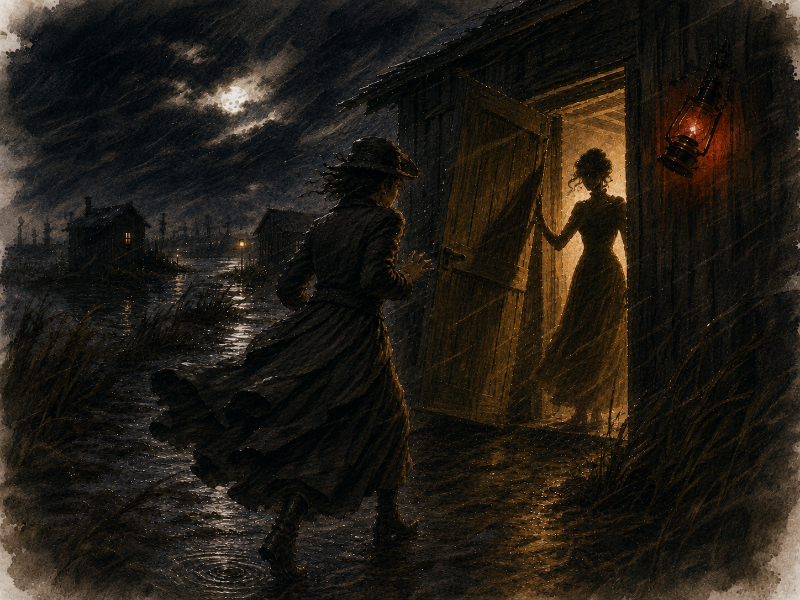
    Lili Chan, in dark walking clothes and hat, stands in the wind outside a swamp shack as the door opens and yellow lamplight silhouettes a woman within.

    • • •

    Forster arrived back at the hotel at a quarter past seven, buttoned up in his good coat, dress hat, and even a bowtie for the opera, only to be told by the desk that Miss Chan had gone out again and would have to postpone till the next day. His immediate disappointment gave way to unease. After a few questions, the receptionist revealed that the lady had appeared somewhat flustered, and no, she hadn’t been out of her room since having arrived earlier on. So obviously, thought Forster, nothing could have “come up” except from something she had discovered in the room, and she had appeared perfectly happy and composed when he left her. He went looking for the hansom in question and found it where, according to the girl, it usually waited.

    At this time of the evening, more people were arriving in Bourke Street than departing; and after one or two false leads, he found the cabman who had driven Lili, sitting up on his box eating his dinner. The fellow was at first less than loquacious, having taken a dislike to his passenger, but Forster and his badge rendered him talkative. Forster was gravely concerned to hear of Lili’s destination and, less than a minute later, they were rattling along at speed towards the police barracks in Russell Street.

    • • •

    Lili brushed past the young woman and heard the door slam tight behind her. The interior of the room was surprisingly solid, shutting out the wind that had strengthened to a howl outside. An old potbelly stove gave off a good amount of heat, though the fire was visible through some cracks in the flue. Two windows were shuttered up, and a door to an inner room was closed. There was a rough-hewn Baltic pine table in the centre of the room, and two heavy benches against the walls. Despite the wine flagon and tumblers on the table, it resembled a serious workshed, with all manner of tools and augers on the benches and hanging from hooks on the walls.

    “You’ll catch your death out there.” The ugliness of her tone belied the words.

    Lili turned to look at the woman, who wore a cold, humourless sneer. She was white, youngish, not unattractive, and faintly familiar.

    “Sit down.”

    Lili stayed where she was.

    “Go on, sit. Take the load off. He’ll be back soon – just ducked out the back to find a few bits of wood. You’re a bit late, ducky – you don’t want to make him cross, you know.”

    “So the message is not from you?”

    The woman sneered. “Just sit yourself down, ducky.”

    Lili was taken aback as the woman’s half-glimpsed face flashed into her memory. She drew out a chair and slowly lowered herself down. The woman carried a stool across to the exit door and sat blocking it.
    Some thumps issued from behind the inner door. Presently it opened, and a portly Chinese man came in bearing some timber offcuts in his arms. He dumped them on the floor by the potbelly, then opened the firebox door, put in some of the wood, and clanked it shut. He stood brushing his hands together and looked at Lili with a broad grin.

    “Miss Chan Lee Lung, I presume,” he said. “So kind of you to call.” He took the chair opposite Lili, poured two glasses from the flagon, and pushed one across to her. She did not touch it.

    “Impossible. You cannot be him,” she said steadily, trying to conceal her astonishment, “though you’re the image.”

    “Ah,” he said. “Yes, he would be noticeably older if you met him now. My dearly beloved brother, the epicurean…”

    “Fat Louis,” she said.

    “An unkind sobriquet. He detested it quietly, you know.”

    “He was widely misjudged,” said Lili, producing a convincing faint smile. “Merely because he was good at what he did. How is the dear boy?”

    “Oh,” said the brother, tutting. “He is not doing very well at all.”

    “Oh no…” said Lili. “Don’t tell me he’s… departed.”

    “As a doornail. Thirty-two.”

    “So young.”

    “I meant the calibre. Slug to the forehead. Nasty sight. I was standing right there. He took on an expression of amazement. I suppose he imagined he would live on forever.”

    “I’m ever so saddened to hear of it,” said Lili. “He was such a likeable fellow. We were just like family – Fang, Louis and me. How we laughed at his little jokes – and so handsome. I can remember the last time I saw him; he’d brought champagne and Roquefort cheese, and we listened to Fang play delightfully on his zither. Your fraternal resemblance is uncanny. It’s so lovely to make your acquaintance. How on earth did you manage to find me here? I’d tried like mad to contact Louis and the boys after Fang passed away, but to no avail.”

    “Louis and his associates in the San Francisco See Yup tong tracked down your apothecary friend after a while. He became sadly uncaring about your wellbeing after they spoke with him. But the tong came to realise who was responsible for what happened to Fang. As you know, he was a master in the society, and well liked and respected; so they were eager to take their vengeance on your head, sure that the cops had got it wrong about you being taken care of by those Hing San Fong Tong boys, who are weak sons of bitches when it comes to women. But then, as luck would have it, they discovered going through their books that Fang’s fingers had been much too light on the zither when it came to doing the accounting. So the fact that you did him in actually served you well after all.” He laughed, provoking Lili to join in.

    “It’s an ill wind,” she laughed. “I had no idea that removing that despicable man would prove to my advantage. Of course, I had to go on the run, because he was their fair-haired boy at the time.”

    “They forgave you that, but they still wanted their loot back. Anyway, what do you know, but one day the celebrated name of Madame Ah Toy passed through our hands, when she decided she wanted to reunite with you, and a couple of our brothers assisted in her communications back and forth between San Francisco, Guangdong, and here. Until one day…”

    “Voila,” smiled Lili.

    “Voila. Suspecting nothing, the See Yup here helped us get the notice into the Police Gazette. They’re hand in glove with the cops, with all manner of worthy causes, bless their hearts; but of course, we manage to slip in between the cracks, you know, and we have our various secret societies in this country too. They are not so well-known, but are quite as effective as ours back in San Francisco.”

    “Obviously,” said Lili. “Well done.”

    Seeing the two were getting on so well, the young woman seated at the door drew up a chair to the side of the table.

    “You were the one who sent off the legendary Fang Jing Dock in San Francisco?” She gazed at Lili wonderingly. “You look like butter wouldn’t melt in your mouth.” Lili could sense the woman wanted to hear those words that she had vowed never, ever to utter. She looked her in the eye, said nothing, and turned back to Fat Louis’s brother.

    “This is Moira, one of our little helpers here.”

    “And you?” Lili asked.

    He gave a slight bow. “Call me Algernon.”

    “Of course. Algie.”

    “I said Algernon.”

    “Your little helper and I bumped into each other this morning, Algernon,” Lili said. “She’s how you kept track of my movements today.”

    “We had eyes and ears waiting at the temple, too,” Algernon said. “So we know pretty well what you learned there, as well. However, that’s enough preliminaries; let us proceed to the substance of our meeting. Show me the Marquis.”

    “Who on earth is he?”

    “Don’t be cute. Moira, fetch that small pair of bolt cutters from the bench.”

    She did so, placing them in front of him on the table. He withdrew a pistol from the inside of his coat and laid it next to them.

    “The Marquis,” said Algernon, “is a gem of an individual. A very pretty but hard little fellow who is eager to return to his proper companions and doesn’t like to be kept waiting.”

    Lili retrieved her velour case from an inside pocket of her coat and placed it on the table before her. The man snatched it up and snapped it open. His upper lip quivered as he turned it upside down and shook it, but nothing came tumbling out. He dropped the case and froze, and Lili emitted a peal of gay laughter.

    “Oh, you should see your face,” she said gleefully. “You’ll do yourself a mischief!”

    She drew back the case, carefully undid its false bottom, and withdrew a ring from the hidden compartment. She held it so that the jewel, in its Louis XV Marquise setting, caught the yellow oil-light from the lamp hanging above her. The man narrowed his eyes as he peered at the ring.

    • • •

    Forster persuaded the cabman to guide him and a uniformed policeman to the bridge over the coal canal. They left the cabman there with the police wagon they had come in, to keep the horses calm. The wind had risen, but fortunately the lamp towards which the cabman had last seen Lili heading was still there, and Forster and his constable set off, stumbling and slipping through the muddy terrain, their bull’s-eye lanterns shuttered down to prevent light spilling out and revealing their approach. As they neared the building, the wind faltered momentarily, and raised voices could be heard coming from inside the shed.

    • • •

    “Very nice,” said Algernon, resting one forearm on the table as he leant forward over the table and held the ring up towards the yellow oil-lamp.

    “A man of taste like Fat Louis himself,” said Lili pleasantly.
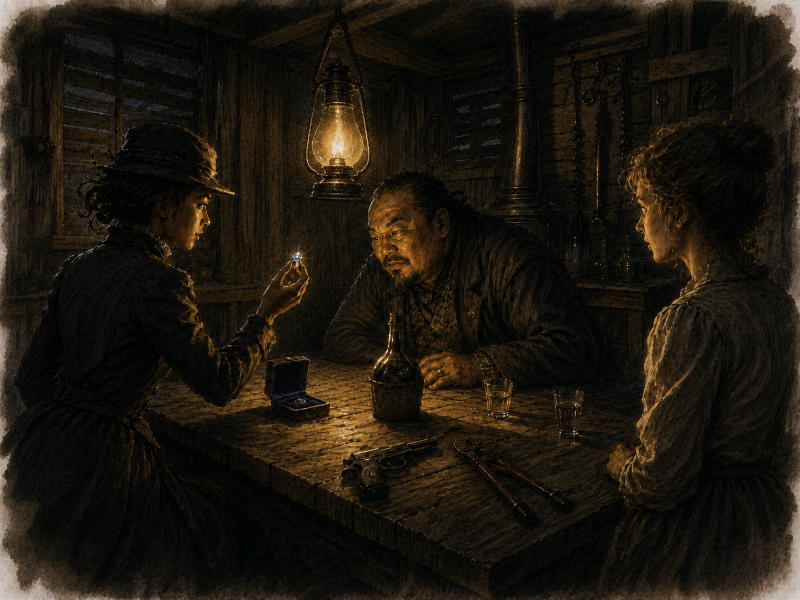
    Lili presents a ring across a rough table to Algernon while Moira watches inside the lamplit shack.

    But after breathing softly onto the gem and squinting closely, his face turned to a mask of marble, and he hurled the ring back at her, letting loose a filthy American expletive. Just as he grabbed for the pistol, Lili raised her hand to the side of her hat, then plunged the hatpin down into the tabletop and straight through the meaty hand resting there. The pin was a serious affair, ten inches long, manufactured of fine sharpened steel, and capped with a plain polished bulb. She had brought it with her from San Francisco years ago, where such objects were popular as serviceable lady’s accessories, for obvious reasons.

    He emitted a roar as his skewered hand jerked away from the tabletop, and the pistol in his other hand discharged. At that moment, the door was kicked in. There stood Forster, his revolver levelled. Algernon swung his own pistol around in Forster’s direction, but Forster’s shot caught him in the centre of the forehead before he was able to fire the gun again, and the man stumbled sideways onto the floor, knocking over his chair as he fell. Moira screamed when she saw the blood seeping from her arm where the stray shot had grazed it. The constable hurried over to steady her.

    Lili stared down at the man sprawled on the floor. He was obviously dead.

    “The irony,” she said quietly.

    • • •

    The cabman was growing restless by the police van when the small group arrived. Moira did not say a word. Though she had recovered from the shock of her flesh wound, she was aware that the incident would have implications for her future. Forster had decided that it would be more sensible for the constable to drive the group back to Russell Street than have him stay with the dead man overnight. The cabman gave Lili a sour look as she climbed into the van and sat opposite him.

    “Told you,” he muttered, but she ignored him.

    Forster helped Moira inside and sat down next to Lili.

    “Beats the opera,” she said quietly to him. “Reminds one a little bit of those yellowback novels they keep in the reading room at the Stawell Mechanics’ Institute – set the heart racing, if negligible in literary merit.”

    Forster sighed as the van trundled off.


    From the draft novel Stawell Bardo © Michael Guest 2026
  • Wang the Meek and the Lodge of the Ghost Junk

    Wang the Meek and the Lodge of the Ghost Junk

    To my dearest friend and comrade Mow Fung
    May blessings of the Celestial Worthy of Primordial Beginnings be upon you.

    As I prepared my old inkstone with a little Madeira, I was wondering what my aim was in writing this to you. I think there might be something more behind it than briefing you on a few things you need to do as we prepare for our passage south to the New Gold Mountain. By the way, I’ll give you the address of that company in Hong Kong that will find a ship and make all the necessary arrangements for us. Even writing that down this minute, I find myself pausing to scratch my beard and search the ceiling for other words – the words I need to express to myself, perhaps, as much as to you. There will be ample time for practical matters, and plenty of space in the modest cache of paper that has travelled with me since I left behind the mountain with its paths that forked through the thick bamboo, our poor doomed temple, and the peasants I thought I had tired of. Do you know, I saved this paper as a remembrance of your spiritual mother Pu-erh, whom I loved, but who rarely gave me a look except as a friend, and maybe dogsbody to a good extent. From time to time, I noted down the things that happened to me as I went along my road.

    Thinking back to when my mates and I met you both that first time on the side of Timeless Mount, it was as though you had fallen down out of heaven. You both had that aura about you that was like a faint, strange light, it occurs to me now, although my memory may have added that part, that glow, because you both became our guides, teaching us invaluable things: like how to write and think, being grateful, and the value that one can derive from helping others. So I came to idolize you both to some extent, and particularly Pu-erh. We did plenty of do-gooding at the temple, and I have no regrets about it, because it turned us into far better men than the incompetent ginseng smugglers and bandits who it was that abducted you. Argh! poor old Ugly Toad and Yongyan the Hungry, who disappeared over the mountainside, inside the temple with everyone else. I picture them meditating in silence, the tumultuous chaos of the outcrop and the temple itself crashing down all about them into the void! – though, frankly, I can’t see how such a relatively ordinary incident could dispose of Pu-erh. Anyway, you can imagine how I was gutted when I heard about it. But what can you do? That’s how it goes. You should not attach yourself to anything.

    How surprised I was to find, on arriving at Guangzhou together, that you had a past here as well, just as I did. Associates and extended family, all smiles, so amazed and glad to see you alive again – and seeming never to have heard of Pu-erh! (Me, well, I don’t have family, but there are a few trusted friends who would store my belongings for me.) Anyway, these considerations hurt my head, so I soon put them out of my mind. I have heard how, in Japan, the family of emperors continues back in time until it overlaps with its legendary ancestors; and that may be how it is with you – here in the flesh, but somewhere mystical at the same time: walking as though floating with your ankles hidden in fog. A realist like myself may only fill in your gaps briefly and subtly, like drawing the parts together with fine silk thread, through tiny imaginary eyelets.

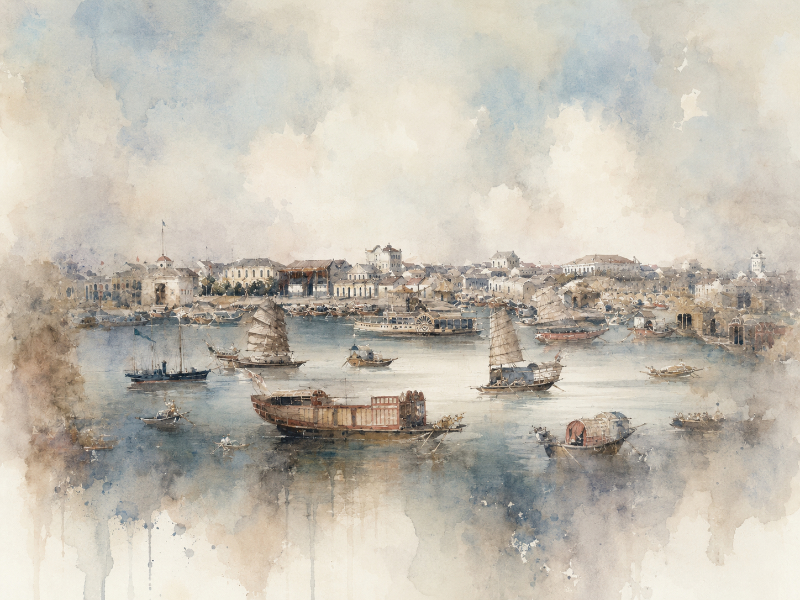
    These days, however, I see what’s in front of my eyes vividly; and that ability owes something to other experiences I have had – some of them shocking – and to certain people I have met along my road, as much as to you and Pu-erh. In those first weeks after we came to Canton – around the time I found myself a new place – I wandered down the riverbank, not far from the Thirteen Factories, the foreign hongs and their wharves where the foreigners do all their trading, completely separate from our little lives; and I was overcome, despite myself, by the beauty of those hongs: like a picture they are, all lined up in white by the water, with the flags of their countries flapping in the wind; and their pretty gardens fenced off from the Pearl, but little stairs going down to where the mighty river slides on by, teeming with all manner of small craft: boats, junks, sampans, and shallow-draft steamers heading every whichway, conducting their own workaday businesses, and the little Tanka egg-boats, shaped like half-eggshells, scooting about among them; with the tall church of the foreigners overlooking it all. Can’t see the pagodas and scenery like you used to, but the river is just as busy all the same.

    Abstract watercolour view of Canton port, with pale hongs, river craft, and misty shoreline forms dissolving into soft washes at the edges.

    After that, I ambled along downstream to Whampoa, where the flower-boats anchor all in a line, drawn up practically hull-to-hull together, and where I soon learned to head for a nice dinner of salt-and-pepper cuttlefish, which is cheap on the lower decks. I’ve got my favourite one, dazzling it is with its lanterns reflecting on the water, though it’s one of the smaller vessels, its hull painted with phoenixes and birds, lotuses and scrolling vines; no foreigners allowed, and I sometimes treat my favourite lady there. It’s wonderful, the way she goes raving on and giggling with a lot of nonsense, and we have a really happy time, with all the laughter, wine games, music, and dancing until sunrise.

    Though I now understand how transient all this is, I have come to enjoy it. I must be becoming earthly; I am sure Pu-erh would disapprove, with one of her stern sideways looks. Ha, ha.

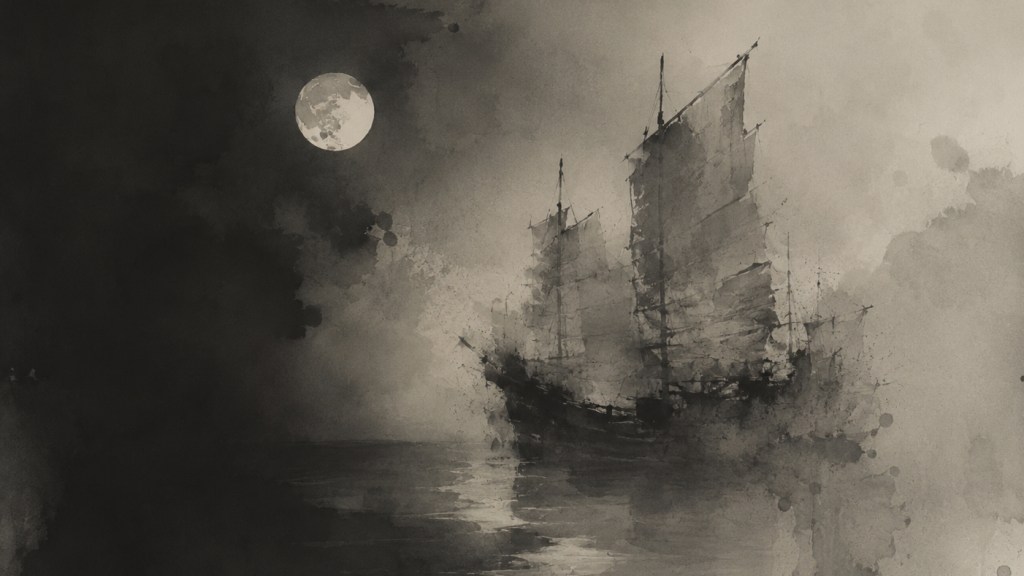
    I don’t know why, but the time has come for me to make a confession, stemming right back to my pirate days, which commenced when I came down from the mountain and took to the sea. Without preamble, one evening, what’s called a “salt-smuggler” boat I was crewing on at the time – though I can tell you, we smuggled a lot more than just salt, primarily opium – turned to bring us to bear upon some mission being built by two Swedes at Kinpai Pass, on the coast near the River Min. I didn’t know much about what I was doing in those days, still green in the pirating trade, and I believe I happened to kill one of them with my flintlock pistol. It was medium range, and I probably got him because he didn’t stay still on the one spot. I was taken aback when he fell, with the shot in the middle of his forehead, but joined in with the cheers of all my mates, as though I was a hero. I’ve never been able to shake that off until now, that terrible feeling, when I am able to bring myself to tell you about it. Since then, I admit I have sent off a few, but he was my first; and apart from him, I’ve only ever dispatched opposing warriors, which is considered non-blameworthy, and rightly so.

    Now I ought to fill you in a little more on my adventures as a warrior and troublemaker. Truth to tell, I’ve never thought much of the Qing. It’s the country of us Hans, not them, and they have no right to invade and rule us; and I took a special set against the Manchus when they used to try to catch and kill the three of us up at Fusong in the old days. So when I turned to fighting for a living, even though my decision was more out of a thirst for fun and adventure than any particular politics, it’s clear that my progress from ginseng thief to bandit, from bandit to smuggler, from smuggler to pirate, and from pirate to sword for hire has tilted to the rebellious side. Of course, my time as a monk deviated superficially from that pattern, but I knew how you and Pu-erh had had to take off from the Forbidden City, so even then I felt myself in like company.

    Anyway, it didn’t take me long to find out that my chosen flower-boat provided more than the delightful times I’d enjoyed so far. Most pleasant things down here in the real world have a more dangerous side, and this lady of mine, knowing that I had a whiff of the sea on me, and was able to take care of myself, introduced me to an old river-rat named Uncle Lo, whom I’d noticed hanging around on deck, twanging away on his snakeskin sanxian and singing the occasional pirate ballad. At first, I took him to be one of the lower hands, whom they must have kept on out of sympathy, what with his worn blue calico jacket and rope belt, but what do you know? he turned out to be the captain; and the next thing he was asking me if I wouldn’t mind some work on the quiet, nothing too demanding, so he said.

    It was just to take some chap out to a junk downriver and bring him back in one piece; so I came on the appointed day, and Uncle Lo showed me to a sampan that was tied up to the stern of his flower-boat, and waiting there was the chap with a few cases to take down with him. He was a quiet, tough-looking character in a blue jacket like the older man’s; he had a grim look, but nothing to worry me. I helped him get his luggage on board, and when we were done, I noticed him and Uncle Lo exchange a martial salute – right fist and left palm pressed together – and I distinctly remember that Uncle Lo called down these words to him, “Under Heaven and Earth, we’ll meet again.” I couldn’t help laughing and calling back up to him not to worry, I wasn’t going to sink his sampan, but this didn’t amuse them in the slightest; I suppose I should learn to keep my peace.

    The fellow didn’t say a word to me during the trip; when we found the junk, lit up discreetly in the darkness with two or three Tanka egg-boats tied up beside it, I helped get his things up, but a couple of men on deck – one of them, I noticed, had a flower tucked into his hat! – warned me off when I was on top of the rope ladder and looked as though I might be making to climb on board, which was all the same to me. I waited in the sampan with an oil lamp for three hours, building walls with an old set of bone gaming-tiles I found in the cabin; and then he climbed back down empty-handed, I sculled us back upstream to the flower-boat, picked up some coin from Uncle Lo, who laughed and clapped me on the back, and had myself a plate of cuttlefish and shark’s fin.

    Things went on like that for some weeks, though the junk was anchored in various places, and occasionally hard to find in the fog, in an inlet or up a rivulet; and then another bloke started to come along as well. I must have proven my worth to Uncle Lo, because one evening he complimented me by saying as much, and asked me how I’d like to become a member of the junk’s “association,” as he called it, in which he was a kind of hall-master. They did some smuggling now and then, of course, but mainly with the idea of helping get rid of the Manchus, setting out the usual litany of grounds. I was on the edge of accepting because of my fondness for Uncle Lo and his old flower-boat, but frankly, I’d had in mind bigger fish to fry than this lot for my adventures, so I politely declined, saying that I had been in trouble with the law in the past, and if the yamen runners caught me involved in such business, it would mean the end of me; to which he gave a regretful nod, and lightly clapped me on the back, the way he does.

    After my next job, something odd occurred. I had stepped onto shore after my meal on the flower-boat, when this tough came straight up to me out of nowhere and slapped me full in the face for no apparent reason. We looked at each other, and I was in the process of deciding which of his limbs to take off, but he just ran away, so I set off after him in full pursuit. He slipped in between the pylons of a fishmarket, which I decided would be a good enough place for him to die; when around the corner came a group of four men holding a sack, evidently this rabbit’s boys, since he now joined them. They told me I’d better do what I was told, or they’d carve me up and murder my family as well (shows how well they knew me!), and to get in the sack. I answered them with a swift kick in the guts of one of them as doubled him up, and the others set on me, one on each of my limbs. I bashed together the heads of the ones on each arm, putting them out of commission, but was having a slightly rough time with the others holding and pummelling me. There we were rolling about in the wet mud, until I gained the ascendancy applying pressure to some little-known vital points; and we ended with one of them face down in the mud, and the other blue in the face, I would guess, preparing to die with my fingers crushing his windpipe.

    I called out, “Where are you, Uncle Lo?” He came out from behind a pylon, letting out a great laugh; and so I was recruited. If he wanted me that badly, I told him, he should have just said so.

    I can’t begin to tell you how hard it was to get ready for my initiation into the lodge during the next months, while I continued to get more and more involved with the business side, sailing to and from Macau, along with some rough stuff for exercise. I couldn’t tell you anyway, because, bound by solemn oath to secrecy as I have become, it would have meant my end. Even that salute of Uncle Lo’s, which I learned to give when meeting another lodge member: right hand fist means the sun, left vertical palm, the moon. So, press them together and you get the sign for Ming, or “brightness.” Get it? “Out with the Qing and in with the Ming!”; that’s to say, “Restore the dynasty of light.”

    But that was nothing. Now that I’ve become a Horse Master, which is our term for a recruiter – the same as that fellow who slapped me in the face (that’s one of our methods) – there are all sorts of secret answers I have to give to a host of impossible questions when I bring new folks in to join up: it rattles the brain. And this is in the middle of the lodge, our own City of Willows, which is all set out like the cosmos, and the Five Gates of the Imperial Palace, with special rooms, doors, and arches. You’re surrounded by all the brothers, and secret instruments and appurtenances – axes, lances, staffs, swords, streamers, porcelain censers, precious mirrors, canopies, scrolls, flags, and silk standards with inscriptions all over them. “The red flag flutters! The heroes are all convoked! The Heaven-destined Emperor shall again restore the dynasty of Ming.” But to me the most disturbing thing is everyone watching with serious faces – you don’t want to make a fool of yourself by laughing out of nervousness.

    When I’m led into the council room, I have to say, “May my lord live myriads of years!”

    “Who is there before me on the ground?”

    And I say, “It is Thian-yu-hung.”

    “How can you prove that you are Thian-yu-hung?”

    So I say, “I can prove it by a verse.”

    “How does this verse run?” (In other words, go ahead and prove it.) So I have to prove it by this quatrain:

    “I am indeed Thian-yu-hung,
    Bringing novices into the city;
    Coming in the Peach Garden to unite in fraternity,
    And fervently wishing to adopt the name of Hung.”

    New members who refuse to take the oath after all this have their heads cut off straight away. Then there’s a ceremony for the others to have their queues cut off, since this “pigtail” is only imposed on us as a mark of our subjugation, as I’m sure you know.

    Of course, that’s only three questions I’ve had to memorise, and so far in our little Lodge of the Ghost Junk, that’s about as far as we take it for the time being. However, the Tiandihui, the official Hung League, upon which we base ourselves – because they go all the way back to the massacre the Qing carried out at the Southern Shaolin monastery when the monks were plotting to overthrow them – has a catechism of three hundred and thirty-three questions, each of which requires a quatrain of proof like the one I just recited, to answer properly. We are building towards that. I’ll be a nervous wreck at the end, unless I’ve worked my way to higher up than Horse Master and don’t have to do it all, Ha!

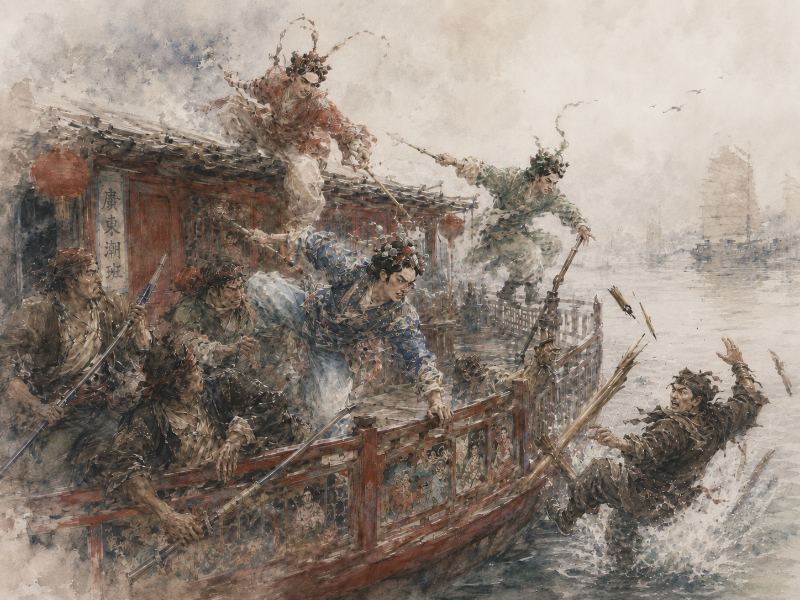
    Abstract watercolour scene of Cantonese opera performers fighting pirates on a narrow red boat, with figures, pikes, and river mist dissolving at the edges.

    I’m well aware that it’s no joke, and that the situation is heading rapidly towards conflict. Who would ever have thought Hong Xiuquan, that so-called Heavenly King, would take Nanjing and call it his Heavenly Capital? Yet there he is, younger brother of Jesus Christ too, if you please, or so the riverfolk say he claims, with half the empire shaking under him. They say he routed the Emperor’s forces and put the soldiers’ households to death – men, women, children, the lot. Out with the Christians as well, I say, if they are going to be so excessive! Thankfully, we have nothing to do with that crowd; but we are thick with the Red Turbans, who swear there is strength in the cloth they tie round their heads, and who have been drawing several of us smaller lodges into their business. It’s an exciting time, though often bloody, as you yourself saw in that Guangzhou alleyway, when those poor rebels had their heads cut off right in front of your eyes.

    Of course, with my running about all over the delta and up and down the Pearl, I’ve had some dealings with the opera companies. When I was running with a pirate mob some years back, we thought they would be easy pickings; but more than a few of us came back from their narrow red boats carrying our broken mates on our backs, though they had no weapons to speak of, and we had gone at them with muskets, pikes, and sabres. But there’s hardly any space on board to wield a sword, and, being followers of the Shaolin monk who founded their companies, so they say, they have developed their fighting skills specifically to keep types like us at bay. You’ve never seen such wonderful acrobats! The time we attacked them, I watched dumbstruck as they cartwheeled around the walls laughing, broke our bamboo pikes in half, and hurled us off their boat into the Pearl. They’d been on their way to a performance, it turned out, and were resplendent in all their costumes of brightly coloured silk, dripping with fake gold and pearls. I certainly had a new eye for the Cantonese opera after that experience, and am getting a taste for the music, which I found rather clangy at first. Thankfully, they’ve come over to the Red Turban side, same as us, and how I’m looking forward to mixing it up with the Manchus with them on my side!

    I had a break after writing the above, and went down to the flower-boat for a drink and to think things over for a little while. Having all these images in front of my eyes made me feel somewhat sad to be leaving. After all, I came down from the mountain in search of adventure, and here it is, gathering up all around me, charged with mighty purpose, aiming to restore the empire to its rightful heading! Uncle Lo was there, with no idea of what was on my mind. When he asked was there anything wrong, I told him it was stomachache. I realised right then and there, when he placed his old hand upon my shoulder, that I couldn’t look him in the eye and lie.

    Above all, my main reason for staying behind is that I cannot desert him, not after all the strife we’ve seen together, and not after giving my sacred oath before his eyes and my lodge-brothers’ eyes, to lend my strength and my life to restoring the enlightened Ming to rulership. I know you and I have been through a lot as well, my comrade, through gainful times and loss. But you are going to a fine place without the strife we have here, only peace and fortunes to be made. And besides, I await the comeuppance I have coming for dispatching that poor Swedish monk of mine, who was only minding his own business – I would not have that karma follow you to the New Gold Mountain on my account.

    Remember your brother-Hung kindly, who stayed behind to tend the Peach Garden.

    Your devoted friend
    Wang the Meek


    From the draft novel Stawell Bardo © Michael Guest 2026