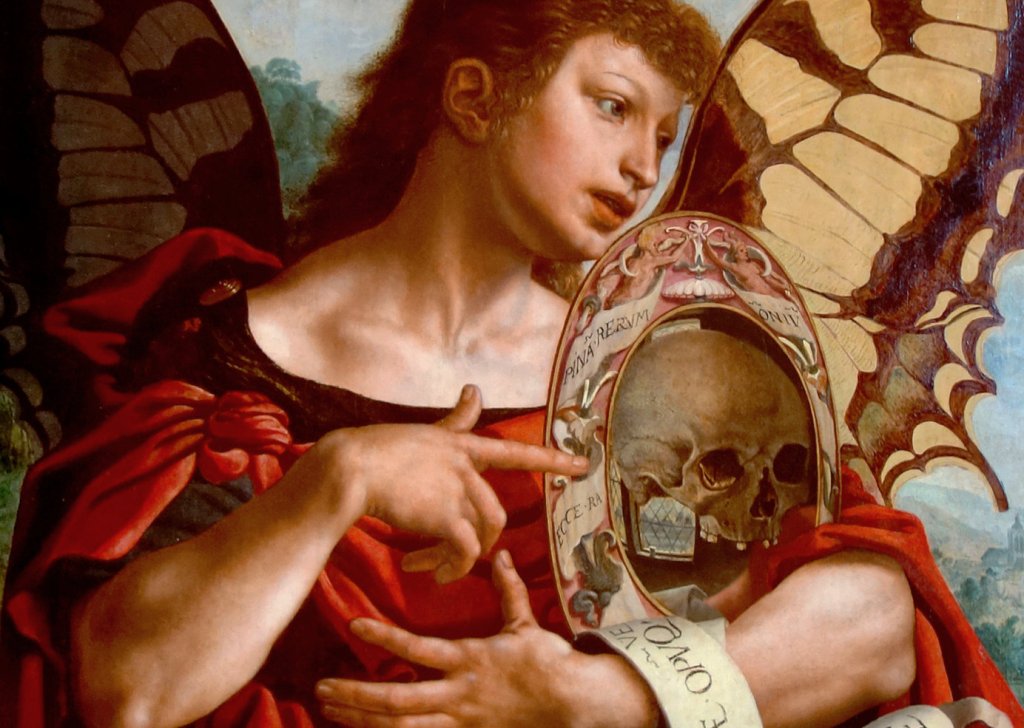
Never having had a confessor, I found this tale a little difficult to appreciate at first. I’d heard of King Edward the Confessor of course. As a kid, I used to believe that he must have confessed a lot… My only direct experience with such a, to me, quite bizarre custom was on a visit to St Mary’s Cathedral in Sydney, which our high school class had visited. We saw awfully drab and dingy looking old wooden confession boxes there, which made me joke about people being locked up in them until they confessed.
Having been brought up as a Protestant, our confessions, unbeknownst to me, were rather more “automated” in comparison, a glib absolution for the whole congregation, if anything. If I were a Catholic, I guess I’d prefer to confess my sins somewhat anonymously, and not to the same priest over and over, a person who would, embarrassingly, know me personally. The practice of having a specific confessor however was actually common for the more well to do in earlier times. Some churches even demanded public confessions. Imagine that! The whole village listening in…

Anatole France describes the relationship between Madame Violante and Brother Jean Turelure, her confessor, who gets his jollies steering poor sinners away from paths of sin and “saving their souls”. People like this still exist today, believe me, I’ve met a few. The overly zealous types, I mean. Yet to Catholics, confessors were people who were, like priests, supposed to offer consolation and mercy. A word of warning perhaps to those not expecting to read about male attitudes from over a century ago. Her alluring bosom is mentioned several times, another aspect of this story which some readers might find a bit odd.
The word “fetish” comes to mind, and repressed desires; but for some chaste confessor back then who would have held up his hands in horror at the sight of today’s suntanned…. Well, I guess they probably might really have obsessed about “bosoms white as snow” in the time of King Louis, while hearing salacious confessions, as strange as it might sound today.
The white bosomed lady Violante asks Brother Turelure for a souvenir, and he returns with a strange version. Not just a cheap postcard, no, but would telling you more give too much away? These things were damned expensive, even back then. A handsome but stingy knight, bearing mere sugar-plums, seems to reap an unintended benefit.
A Good Lesson Well Learnt

N the days of King Louis XI there lived at Paris, in a matted chamber, a citizen dame called Violante, who was comely and well-liking in all her person. She had so bright a face that Master Jacques Tribouillard, doctor in law and a renowned cosmographer, who was often a visitor at her house, was used to tell her:
“Seeing you, madame, I deem credible and even hold it proven, what Cucurbitus Piger lays down in one of his scholia on Strabo, to wit, that the famous city and university of Paris was of old known by the name of Lutetia or Leucecia, or some such like word coming from Leuké, that is to say, ‘the white,’ forasmuch as the ladies of the same had bosoms white as snow,—yet not so clear and bright and white as is your own, madame.”
To which Violante would say in answer:
“’T is enough for me if my bosom is not fit to fright folks, like some I wot of. And, if I show it, why, ’tis to follow the fashion. I have not the hardihood to do otherwise than the rest of the world.”
Now Madame Violante had been wedded, in the flower of her youth, to an Advocate of the Parlement, a man of a harsh temper and sorely set on the arraignment and punishing of unfortunate prisoners. For the rest, he was of sickly habit and a weakling, of such a sort he seemed more fit to give pain to folks outside his doors than pleasure to his wife within. The old fellow thought more of his blue bags than of his better half, though these were far otherwise shapen, being bulgy and fat and formless. But the lawyer spent his nights over them.
Madame Violante was too reasonable a woman to love a husband that was so unlovable. Master Jacques Tribouillard upheld she was a good wife, as steadfastly and surely confirmed and stablished in conjugal virtue as Lucretia the Roman. And for proof he alleged that he had altogether failed to turn her aside from the path of honour. The judicious observed a prudent silence on the point, holding that what is hid will only be made manifest at the last Judgment Day. They noted how the lady was over fond of gewgaws and laces and wore in company and at church gowns of velvet and silk and cloth of gold, purfled with miniver; but they were too fair-minded folk to decide whether, damning as she did Christian men who saw her so comely and so finely dressed to the torments of vain longing, she was not damning her own soul too with one of them. In a word, they were well ready to stake Madame Violante’s virtue on the toss of a coin, cross or pile,—which is greatly to the honour of that fair lady.
The truth is her Confessor, Brother Jean Turelure, was for ever upbraiding her.
“Think you, madame,” he would ask her, “that the blessed St. Catherine won heaven by leading such a life as yours, baring her bosom and sending to Genoa for lace ruffles?”
But he was a great preacher, very severe on human weaknesses, who could condone naught and thought he had done everything when he had inspired terror. He threatened her with hell fire for having washed her face with ass’s milk.
As a fact, no one could say if she had given her old husband a meet and proper head-dress, and Messire Philippe de Coetquis used to warn the honest dame in a merry vein:
“See to it, I say! He is bald, he will catch his death of cold!”
Messire Philippe de Coetquis was a knight of gallant bearing, as handsome as the knave of hearts in the noble game of cards. He had first encountered Madame Violante one evening at a ball, and after dancing with her far into the night, had carried her home on his crupper, while the Advocate splashed his way through the mud and mire of the kennels by the dancing light of the torches his four tipsy lackeys bore. In the course of these merry doings, a-foot and on horseback, Messire Philippe de Coetquis had formed a shrewd notion that Madame Violante had a limber waist and a full, firm bosom of her own, and there and then had been smit by her charms.
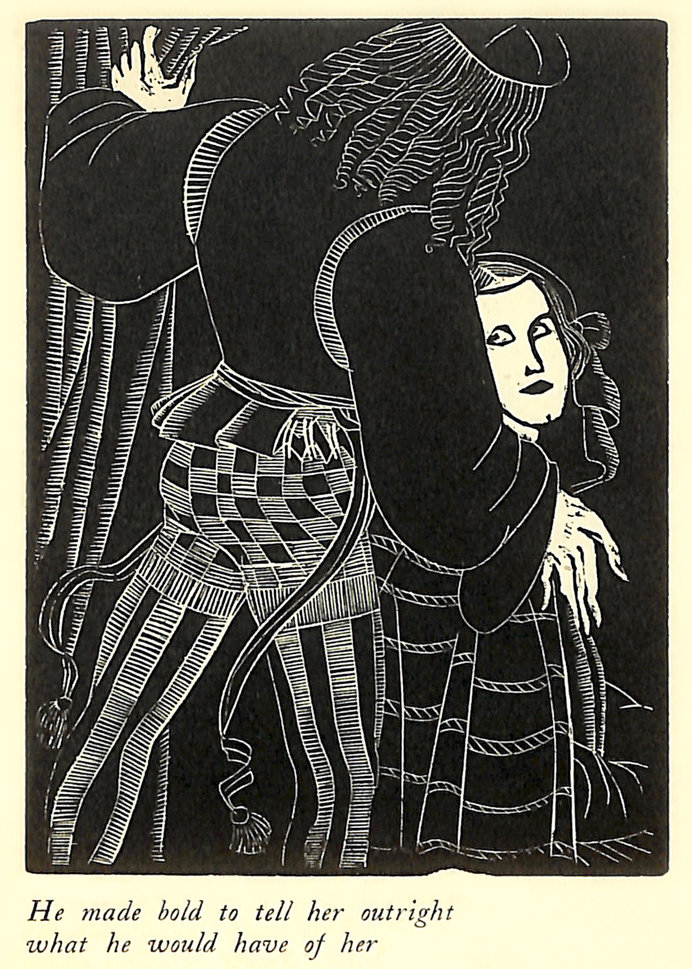
He was a frank and guileless wight and made bold to tell her outright what he would have of her,—to wit, to hold her naked in his two arms.
To which she would make answer:
“Messire Philippe, you know not what you say. I am a virtuous wife,”—
Or another time:
“Messire Philippe, come back again tomorrow,—”
And when he came next day she would ask innocently:
“Nay, where is the hurry?”
These never-ending postponements caused the Chevalier no little distress and chagrin. He was ready to believe, with Master Tribouillard, that Madame Violante was indeed a Lucretia, so true is it that all men are alike in fatuous self-conceit! And we are bound to say she had not so much as suffered him to kiss her mouth,—only a pretty diversion after all and a bit of wanton playfulness.
Things were in this case when Brother Jean Turelure was called to Venice by the General of his Order, to preach to sundry Turks lately converted to the true Faith.
Before setting forth, the good Brother went to take leave of his fair Penitent, and upbraided her with more than usual sternness for living a dissolute life. He exhorted her urgently to repent and pressed her to wear a hair-shirt next her skin,—an incomparable remedy against naughty cravings and a sovran medicine for natures over prone to the sins of the flesh.
She besought him: “Good Brother, never ask too much of me.”
But he would not hearken, and threatened her with the pains of hell if she did not amend her ways. Then he told her he would gladly execute any commissions she might be pleased to entrust him with. He was in hopes she would beg him to bring her back some consecrated medal, a rosary, or, better still, a little of the soil of the Holy Sepulchre which the Turks carry from Jerusalem together with dried roses, and which the Italian monks sell.
But Madame Violante preferred a quite other request:
“Good Brother, dear Brother, as you are going to Venice, where such cunning workmen in this sort are to be found, I pray you bring me back a Venetian mirror, the clearest and truest can be gotten.”
Brother Jean Turelure promised to content her wish.
While her Confessor was abroad, Madame Violante led the same life as before. And when Messire Philippe pressed her: “Were it not well to take our pleasure together?” she would answer: “Nay! ‘t is too hot. Look at the weathercock if the wind will not change anon.” And the good folk who watched her ways were in despair of her ever giving a proper pair of horns to her crabbed old husband. “’T is a sin and a shame!” they declared.
On his return from Italy Brother Jean Turelure presented himself before Madame Violante and told her he had brought what she desired.
“Look, madame,” he said, and drew from under his gown a death’s-head.
“Here, madame, is your mirror. This death’s-head was given me for that of the prettiest woman in all Venice. She was what you are, and you will be much like her anon.”
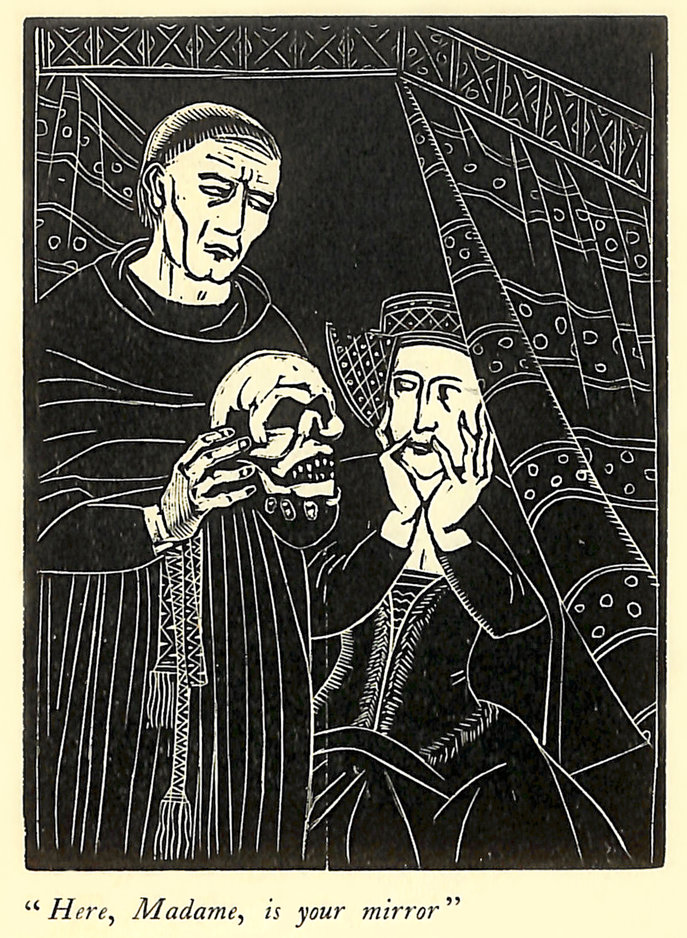
Madame Violante, mastering her surprise and horror, answered the good Father in a well-assured voice that she understood the lesson he would teach her and she would not fail to profit thereby.
“I shall aye have present in my mind, good Brother, the mirror you have brought me from Venice, wherein I see my likeness not as I am at present, but as doubtless I soon shall be. I promise you to govern my behaviour by this salutary thought.”
Brother Jean Turelure was far from expecting such pious words. He expressed some satisfaction.
“So, madame,” he murmured, “you see yourself the need of altering your ways. You promise me henceforth to govern your behaviour by the thought this fleshless skull hath brought home to you. Will you not make the same promise to God as you have to me?”
She asked if indeed she must, and he assured her it behoved her so to do.
“Well, I will give this promise then,” she declared.
“Madame, this is very well. There is no going back on your word now.”
“I shall not go back on it, never fear.”
Having won this binding promise, Brother Jean Turelure left the place, radiant with satisfaction. And as he went from the house, he cried out loud in the street:
“Here is a good work done! By Our Lord God’s good help, I have turned and set in the way toward the gate of Paradise a lady, who, albeit not sinning precisely in the way of fornication spoken of by the Prophet, yet was wont to employ for men’s temptation the clay whereof the Creator had kneaded her that she might serve and adore him withal. She will forsake these naughty habits to adopt a better life. I have throughly changed her. Praise be to God!”
Hardly had the good Brother gone down the stairs when Messire Philippe de Coetquis ran up them and scratched at Madame Violante’s door. She welcomed him with a beaming smile, and led him into a closet, furnished with carpets and cushions galore, wherein he had never been admitted before. From this he augured well. He offered her sweetmeats he had in a box.
“Here be sugar-plums to suck, madame; they are sweet and sugared, but not so sweet as your lips.”
To which the lady retorted he was a vain, silly fop to make boast of a fruit he had never tasted.
He answered her meetly, kissing her forthwith on the mouth.
She manifested scarce any annoyance and said only she was an honest woman and a true wife. He congratulated her and advised her not to lock up this jewel of hers in such close keeping that no man could enjoy it. “For, of a surety,” he swore, “you will be robbed of it, and that right soon.”
“Try then,” said she, cuffing him daintily over the ears with her pretty pink palms.
But he was master by this time to take whatsoever he wished of her. She kept protesting with little cries:
“I won’t have it. Fie! fie on you, messire! You must not do it. Oh! sweetheart… oh! my love… my life! You are killing me!”
Anon, when she had done sighing and dying, she said sweetly:
“Messire Philippe, never flatter yourself you have mastered me by force or guile. You have had of me what you craved, but ‘t was of mine own free will, and I only resisted so much as was needful that I might yield me as I liked best. Sweetheart, I am yours. If, for all your handsome face, which I loved from the first, and despite the tenderness of your wooing, I did not before grant you what you have just won with my consent, ’t was because I had no true understanding of things. I had no thought of the flight of time and the shortness of life and love; plunged in a soft languor of indolence, I reaped no harvest of my youth and beauty. However, the good Brother Jean Turelure hath given me a profitable lesson. He hath taught me the preciousness of the hours. But now he showed me a death’s-head, saying: ‘Suchlike you will be soon.’ This taught me we must be quick to enjoy the pleasures of love and make the most of the little space of time reserved to us for that end.”
These words and the caresses wherewith Madame Violante seconded them persuaded Messire Philippe to turn the time to good account, to set to work afresh to his own honour and profit and the pleasure and glory of his mistress, and to multiply the sure proofs of prowess which it behoves every good and loyal servant to give on suchlike an occasion.
After which, she was ready to cry quits. Taking him by the hand, she guided him back to the door, kissed him daintily on the eyes, and asked:
“Sweetheart Philippe, is it not well done to follow the precepts of the good Brother Jean Turelure?”
Note
- wot of: know of
- gewgaws: baubles, trinkets
- purfled: decoratively bordered
- miniver: fine white fur used to decorate the robes of nobles, etc.
Note on France’s text and the illustrations: Translation is by Alfred Allinson (London: John Lane, Bodley Head, 1909). Woodcuts by British artist Marcia Lane Foster (1897–1983) confirmed as Public Domain Mark 1.0 (free of known restrictions under copyright law). Acknowledgement to David Widger for his digital edition.

This work is licensed under a Creative Commons Attribution-ShareAlike 4.0 International License.


 Furin Chime Press™