Tag: Raising a dime novel

  • Cobb’s False Knight: 4. A Brief, Sweet Dream

    Cobb’s False Knight: 4. A Brief, Sweet Dream

    A bit of a coincidence, more names. And Cobb even explains their origins in detail. How do we respond to and interpret them? Now we hear of Irene and Wolfgang. In English, we pronounce Irene as in “serene”, with an emphasis on the second syllable. In German, it sounds quite different, despite emphasis on the same syllable. The letter “e” is pronounced as “eh”, in addition to a bounce on the second “eh”, making the same lovely name sound much more harsh. Not instantly a beguiling Irish maiden, but perhaps a bit of a standoffish Valkyrie?

    It’s perhaps little wonder that the only German song about an Irene is “Leb Wohl, Irene” (Goodbye, Irene), the Nazi German song of the German flak unit drivers.

    Or should I have not mentioned the war, after the BBC tried to ban the Fawlty Towers episode “The Germans” this year? (See “Fawlty Towers ‘Don’t Mention the War’ Episode Removed from UKTV” Guardian, 12 Jun, 2020.)

    The German language is preferred by almost all lion and big cat tamers. Because these predators will more likely listen to you if you yell at them in German. The language even changes the way names are interpreted by us. Wolfgang sounds more foreboding in English, by contrast. The wolf and a sinister sounding gang? Which in German means only something like “gait” or “passage”. Goethe’s middle name, but still a popular one, even today. Mozart’s first, shortened to a cute little “Wolfie” in Amadeus, as his wife Constance is being chased by him around a table.

    Portrait of Mr. Van Amburgh, As He Appeared with His Animals at the London Theatres (1846-7). Sir Edwin Henry Landseer.

    On the subject of playing with names, will the evil Dunwolf finally be done in by a wolf? Cobb gives him the name “Sir Pascal Dunwolf”. Because that might sound sinister the first time you hear it? Could it be the first name Pascal that causes this? Not that I had anything against Blaise Pascal, although I abhorred having to calculate hectopascals. An instant villain?

    Or is it just me? Knights, in the many kingdoms, duchies and principalities of what later became Germany, were, in German, not given a title denoting knighthood, like “Sir”. They were of course noblemen, usually a von or a van something-or-other, but the fact that they might have been knights was bestowed by being a member of the “Deutscher Ritter Orden“, the German (or Teutonic) Order of Knights, with no extra title added to the name.


    CHAPTER 4

    A BRIEF, SWEET DREAM

    Towards the middle of the forenoon of the day following that on which the funeral at the castle had taken place, Irene Oberwald sat at the door of her father’s cot with a magnificent St. Bernard dog lying at her feet. Her distaff was before her and she was warbling a pretty little love-song as she spun her flaxen thread. Her father had gone down to the village in quest of medicine for his strange patient, and she had been left in charge.

    Thus she sat, busily spinning, and thus she sang, when a warning growl from her guardian gave token that something was approaching — something that might be dangerous, or Lion would not have uttered that particular note of alarm. She quickly set her distaff aside and arose to her feet, and as she did so the dog growled more deeply than before, and assumed an attitude of defiance. In another moment she heard the sound of a footfall behind her, and on turning she beheld the cause of her guardian’s disquiet. She had been looking in the direction of the village, supposing that any visitor would come that way, but the intruder had come from the opposite point. This is what she saw as she stood with her hand upon the head of the dog to hold him at her side; but her precaution was needless. The intelligent brute, having given one fair look into the new face, gave token of entire satisfaction.

    A man in a garb almost a duplicate of the garb worn by the man who now lay so sorely wounded near at hand; but a man very, very, very different. The girl’s first thought on seeing him was: “How like these robbers are; and what handsome men!” — for it was very evident at sight that he now before her was comrade with the other. Another thing passed through her mind, and was silently spoken: “How can men leading such a life wear such honest, truthful faces?”

    For the man before her she thought the handsomest, and the noblest, and the most truly loveable, she had ever seen. He was not more than five-and-twenty years of age, with a face the very picture of manly beauty and elegance. A mass of bright golden curls swept away from a full, open brow; his eyes, large and lustrous, were of a blue like the sapphire; his only beard being a prettily waving moustache upon the upper lip. The collar of his frock was open low in front, exposing a neck and the upper part of a bosom as fair as alabaster; and when he smiled his teeth gleamed like pearls. His cap, or bonnet, of purple velvet, bearing a rich, white ostrich feather, he held in his hand. He wore a sword of goodly size, with a hilt of gold, and a brace of pistols, also mounted with gold, were in his girdle. He was of medium height; of perfect form; compact and powerful.

    “I think I have found the dwelling of Martin Oberwald,” he said, in tones that sounded wonderfully melodious in the ears of the hunter’s daughter. Irene trembled, for her first thought was of the wounded man to whom they had given shelter; but her fear was only for the moment. “Surely,” she said to herself, “this man cannot be a traitor nor an enemy.” He marked her hesitation, and presently added, with a smile that banished the maiden’s last scruple:

    “Do not fear, fair lady. I would be the last to bring trouble upon your father’s abode. I will be frank with you, and I ask you to trust me. I am in search of a friend, and I think he has found blessed shelter beneath your roof. Am I wrong?”

    “If you would tell me the name of your friend, good sir—or,” she added, after a momentary pause, “perhaps l ought not to ask it.” Another pause, and she went on, with an answering smile—the smile came of its own accord:

    “I will be as frank as you have promised to be, fair sir. A stranger, sorely wounded, is at this moment beneath our roof. His name I do not know.”

    “Your father doubtless knows it.”

    “I think so; I am not sure.”

    “Let us call him — What shall it be?” the stranger said, with a smile that had a tinge of merriment in it. “What name should you give him?”

    “I would not dare to name him, sir.”

    “But, of course, you have given him a name in your thoughts. Will you speak it? No harm can come from that, I give you my solemn promise.”

    That was enough. The last remnant of doubt was swept away, and she resolved that she would trust the man fully.

    “I would call him,” she said, almost in a whisper, — “THORBRAND.”

    “Bless you for an angel of mercy and goodness!” the stranger exclaimed, from the fulness of his heart. “In that answer I read more than you think; I can see that a kind Providence must have led my poor friend in this direction. But tell me — how fares he? Was he very severely wounded?”

    “He was most terribly wounded. Had we not found him as we did he could not have lived many minutes. His life was running swiftly away from a deep wound in his bosom.”

    “You and your father found him?”

    “Nay, sir, my companion was Electra von Deckendorf.”

    “Who?” quickly demanded the stranger, with a palpable start as the name struck his ear.

    “Electra, daughter of the noble Baroness von Deckendorf.”

    “She it was?”

    “Yes, sir; and she it was who saved his life. I should not have known what to do; but she had studied chirurgery. She knew exactly what to do. O!” with a little cry of terror in memory of the scene — “how she had the courage to plunge her finger into the deep wound! I could not have done it if the wound had been on my dog.”

    “Bless the dear lady! We must find some fitting recompense for her most noble deed.”

    “Ah, sir!” cried Irene, without stopping to think, “if you could save her from a fate that threatens to make wreck and ruin of her joy forever, you would do a blessed thing indeed.”

    “Ha! What now! Who has dared? — But perhaps you will allow me to take a seat.”

    “Pardon me, good sir; I did not think,” and she pointed to the seat in which we first saw the young lady of the castle. As he sat down he said, with a smile that was captivating:

    “Now, fair lady, if you will add to your kindness by telling me your name I shall be grateful.”

    “That is hardly fair, sir. You know already who I am, while of yourself I know absolutely nothing.”

    The stranger laughed a light, merry laugh, and presently said:

    “Since you have my dearest friend a prisoner beneath your roof, I certainly should not fear to speak my name in your hearing but I would prefer that you should keep it to yourself, only, of course, telling your father, in case I do not see him.”

    “You may trust me, sir.”

    “I know it, sweet lady. Those lips of yours could no more conceal a lying tongue than Heaven itself could prove false. You may call me WOLFGANG. “

    “I am called Irene,” was the maiden’s response, scarcely above a whisper.

    Something in her bosom — it seemed near her heart — oppressed her. She knew not what it was — she did not try to think; she only knew that never before had such a feeling been hers. She had just bent her head, with her eyes cast upon the ground, when the tones of her companion, more musical, if possible, than before, caused her to look up.

    “Do you know the signification of that name — IRENE?”

    “No, sir,” she replied, wondering.

    “Shall I tell you?”

    “Certainly.”

    Portrait of Henry Casimir I, Count of Nassau-Dietz (c. 1632). Wybrand de Geest.

    “Then, listen.” He looked directly into her eyes with an expression upon his eloquent features that thrilled her through and through. ”The ancient heathens had a deity whom they worshipped as the personification of the Spirit of Peace. The Greeks called her Eirene. After the Romans had adopted Christianity, they gave that name to certain women whom they wished particularly to honor, calling it, as it has. been called ever since, IRENE. Several of the Greek empresses bore the name, and it was never given to one of humble station except for the purpose of rendering especial honor to her. So, do you see, you should be proud that your parents conferred it upon you.”

    “And now, Meinherr,” said the hunter’s daughter, after a little silence, ”can you tell me if your name has a signification?”

    “Ah! that is cruel; but I forgive you. Yes, the name has a signification, and you can read it in the name itself: WOLF-GANG — the Wolf’s course, the Wolf’s track; but perhaps it might be more properly given as the Wolf’s progress. Let me hope that the name will not frighten you.”

    “Indeed, no, sir; for I cannot believe that you could in any way resemble the wolf.”

    “And now,” said the visitor, seeing that the maiden was beginning to be troubled, “we were speaking of the young lady of the castle — Electra. What is the character of the danger that threatens her?”

    As she seemed to hesitate, he presently added:

    “I wish you would trust me, not only for the lady’s own sake, but for the sake of the man whom she so gallantly served. You may not know — I doubt if you have any idea — of that man’s power. And perhaps I can render her aid. Strange things sometimes happen in this world of ours.”

    Irene caught at the promise of help eagerly. Her heart had been aching ever since she had seen the dark, sinister face of Sir Pascal Dunwolf at the castle; and now had come a beam of hope. If she could in any way secure help to her beloved sister she had no right to neglect the opportunity. She bent her head for a brief; space in thought, and finally looked up and spoke. Her eyes were clear and steady in their beaming eloquence, and she looked straight into her listener’s face as she told him the story.

    She told of Electra’s childhood; of Ernest von Linden, and his adoption by the baron; of the love and the betrothment of the children; how they had gone on loving more and more, to the present time. She told of Sir Arthur; of his sickness and death; and then of the unfortunate whim of the grand duke; the suffering which it had occasioned; and finally, of the coming of Sir Pascal Dunwolf, just as the mortal remains of Sir Arthur von Morin had been laid at rest in the family vault.

    Irene had spoken more eloquently than she knew. Had her own heart been the scene of the suffering of which she told she could not have given to the story more feeling. Wolfgang had listened in rapt silence, his eyes fixed upon the face of the speaker as though by a spell. When she had concluded, he spoke, without premeditation, the words seeming to issue from his lips of their own volition, as though he had been dreaming, and spoke before being wholly awake.

    “Ah!” he said, a shadow resting upon his fresh, handsome face, “it is plainly to be seen that you know what true love is.”

    “Yes,” she responded, with simple honesty, her thoughts given so entirely to the story she had been telling that she did not catch the deeper significance of his words; “yes; I love my good father; and I could not love Electra more if she were my own sister.”

    “And another! Is there not another, at the sound of whose voice your pulses quicken, and your heart leaps with a wondrous emotion?”

    There was something in the man’s look — in his tone and bearing—that would not let her take offence. There was a slight tremor, quickly overcome; then a beaming smile, as she answered:

    “You mistake, sir. The emotion of which you speak was never mine.”

    It was strange how quickly the cloud passed away from Wolfgang’s face, and what a glorious light came into his blue eyes. Really, it seemed a transfiguration.

    “I beg your pardon,” he said. “And I ought perhaps to beg your pardon for having kept you so long in conversation, though I am free to confess that I have enjoyed it. I thank you for having trusted me in the matter of the young lady of Deckendorf. I think I must have an eye upon the dark-visaged knight.”

    “O, Sir! Do you think you can help the dear lady?”

    “I can certainly try.”

    “But if he has the authority of the grand duke to uphold him?”

    “The grand duke must be seen. Let the true lover go to Baden-Baden, where I believe Leopold at present has his headquarters.”

    “He is going, sir. He would have gone ere this had it not been for the death and funeral of the aged knight — Sir Arthur.”

    “Very well. Let Ernest von Linden look to the grand duke, and I will look to Sir Pascal. If I am not much mistaken, there is an unsettled account between us. Rest you easy, sweet lady, for I think I may promise you that your friend shall be saved from the fate she so much dreads. And now, if you do not forbid, and if you will kindly show me the way, I will go and see my friend and frater, Thorbrand.”

    “One word, good sir!” said Irene, with marked eagerness, as her visitor rose to his feet.” Because I gave you that name so readily, you will not think I would have carelessly exposed it.”

    “Bless you!” he cried with a kindling glance. “I thought you were wondrously careful in your keeping of the secret. No, no; I understand the matter much better than you can explain. You trusted me because you believed me trustworthy — following your own good judgment; as I will do always.”

    “The girl thanked him with a smiling look, and then led the way to the rear of the cot; and when they had come in sight of the door of the room in which the wounded man lay, she pointed it out and bade him enter. He went to the door and gently opened it and passed in. He closed it without noise, and in a moment more she heard a glad exclamation in the deep tones of the Schwarzwald chieftain followed by the musical notes of the voice of the visitor.

    Once more in her seat at the outer door, Irene drew up her distaff, and took a mass of the flossy flax in her hand, but she did not resume her spinning. An emotion new and strange was in her heart — a feeling never before experienced — a something that reached to every fibre of her being, thrilling her through and through. For a little time she sat as in a trance, without thought of any kind, her eyes half closed, her hands pressed on her bosom. And by and by she murmured, like one dreaming aloud:

    “Surely he must be a good man. He cannot be a robber. If he is — if such a thing were possible — there must, be some wonderful story in his life; some upheaval, wreck, ruin; some terrible treachery of professing friends, that drove him to the free life of the mountains. I wish I dared to ask him. Whatever he told me I should certainly believe.”

    She laid aside her distaff and arose, and began to pace slowly to and fro before the door. She was asking herself a solemn question: Had anything akin to love been awakened in her bosom towards the youthful mountaineer? Surely there was in her heart a feeling never known before. But — pshaw! how wild and foolish it was to speculate upon the subject! She would probably never see the man again, and yet, as she told herself so, a sense of desolation came upon her; a bright star seemed suddenly blotched out from the heaven of her life.

    She was thus slowly walking and deeply meditating, when a glad cry from her dog recalled her to herself, and on turning, she beheld her father close upon her.

    “Papa! O! I am glad you have come. We have had a visitor. — There! There! Be not alarmed. The wounded man, I am very sure, was anxiously expecting him.”

    “Ha! — is it — Did he give you his name?”

    “Yes.”

    “Was it — Wolfgang?”

    “Yes, papa!” she cried, seizing him by the wrist us she spoke. “He told me his name without fear. Do you know him?”

    “No. I never saw him.”

    The bright countenance fell in a moment, but presently it lighted up.

    “You know who he is, dear papa. You know something about him.”

    “Child, why are you so anxious! What can the man be to you? Look ye: Has he been talking tender nonsense to you?”

    “O, papa!”

    “Pooh! I was but jesting, my darling. And, moreover, I do not think Wolfgang — if it is really he —is at all such a man.

    ”Indeed, he is not. I never heard a man talk so wisely and so well.”

    “Oho! Then you have had a good bit of a chat, eh? And what sort of a man is he? Describe him to me, for be assured I have a deep interest in knowing all about him.”

    Without hesitation — from the fulness of an overflowing heart — the girl honestly and sincerely spoke:

    “He is the handsomest man I ever saw; and one of the grandest looking. I know he is brave; and I know he is true. A face like his could not belong to a man in whom there was a single grain of falsehood or deceit. And then, he is educated. He talked to me of things that I never knew before — talked like one whose understanding was deep and profound. If he is a robber — but I do not like to think of him as such. At heart I know he is not evil.”

    “An elderly man, I take it.”

    “Elderly! What are you thinking of? Why, he is not much older than — I won’t say that. But he is very young, not more than three or four-and-twenty.”

    The stout hunter gazed upon his daughter curiously. The smile which had at first broken over his kindly face faded away, and a look of deep concern took its place. After a little time he laid his hand tenderly upon the sunny head, and gently said:

    “My blessed child, beware of that heart of yours! I plainly see that this man has made a deep impression upon you. I simply ask you to keep a strong hand upon your affections, and especially upon your fancy. I think Wolfgang is an honest man, and true; but be sure, he will never seek a mate in these mountains.”

    “Oh! papa!”

    “Tush! That is all. Now go about your work, and I will go in and see our visitor. I suppose he is still with — his chief.”

    “Yes. He is in the —”

    The hunter did not wait for her to finish the sentence, but turned away at once towards the rear of the cot.

    Irene watched him until he had disappeared from her sight, and then she sank upon a seat, buried her face in her hands, and burst into tears. For a time her heart seemed well nigh to breaking; but at length she started up, and dashed away her tears, and told herself that she was a fool. And the more she thought of it the more foolish the whole thing appeared. It had been a brief, wild dream, with her whole heart involved; but she had happily awakened, and she told herself that that was the end.

    Then she went to the little well-room and laved her face in the crystal water of the spring, after which she returned to her distaff, and set resolutely about her spinning; and as she watched the tiny thread lengthening and gleaming in the slanting sunbeams, she thought of the handsome stranger, and repeated the sweet words he had spoken.

    So she spun, and so she thought, resolving all the while that she would think no more.


    Notes

    • Leb Wohl, Irene: See Addendum below for English translation of lyrics.
    • Portrait of Mr. Van Amburgh: Isaac van Amburgh (1808-1865). Dutch-American lion tamer. See also, “Isaac van Amburgh and his Animals,” Royal Collection Trust, UK.
    • distaff: A stick or spindle on to which wool or flax is wound for spinning. (Lexico.com)
    • frater: Comrade
    • kindling glance: Not so much the sense of kind as kindling something. See, for example, “Terpsichore” in Poems by Oliver Wendell Holmes: “And there is mischief in thy kindling glance” (in Making of America, U of Michigan Library).
    • laved: Washed
    Addendum

    English translation of lyrics of “Leb Wohl, Irene” (Goodbye, Irene) (Das Flak Lied) (Source: “Axis History” and Google Translate.)

    1. We go back and forth
    we drive all over the place.
    Throughout the country
    we are known
    by every girl with taste
    as a driver of the flak.
    
    Chorus:
    Farewell, Irene!
    Love me, Sophie!
    Be good, Marlene!
    Are you staying true to me, Marie?
    You are so lovely, so beautiful, so cheerful,
    but unfortunately I have to go on again.
    
    Farewell, Irene!
    Love me, Sophie!
    Be good, Marlene!
    Are you staying true to me, Marie?
    I will always love you.
    I love you new in every new place!
    
    2. We go back and forth
    we drive all over the place.
    Somehow sits
    A battery
    in one spot in the thick dirt,
    there we take them away.
    
    Chorus
    
    3. We go back and forth
    we drive all over the place.
    And it turns out
    the war is over,
    let's go home on the last day
    the flak with sack and pack.
    
    Chorus

    This work CC BY-SA 4.0

  • Cobb’s False Knight: 3.  A Funeral — A New Arrival

    Cobb’s False Knight: 3. A Funeral — A New Arrival

    Strange, that Electra’s beloved should say of Thorbrand that he may be “evil” but not “dreadful“, and that he would “never take a penny from a man he knew to be poor”. A German Robin Hood? Some say that the before-mentioned Eppelein von Gailingen was one; however, there is little remaining evidence of this.

    Robber knights often had no choice other than to take money and riches any way they could. As opposed to today, when many impoverished castle owners open bed and breakfasts or rent out their great halls for wedding parties, these opportunities for income did not exist in the Middle Ages. So there you were, the heir to a crumbling castle, people depending on your income, a few serfs tilling soil for which they offer some of their produce to the owner. Should you take something like an unofficial tax from those rich merchants who wear grooves into the paths through your land with their heavy carts, so you can make ends meet? Many did just that.

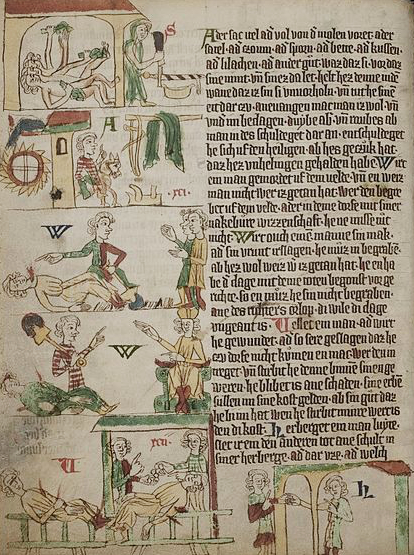
    The kings, dukes and so on did much the same, only on a grander scale. Even in the 1700s, they often demanded and went to war over ownership of assets like mines, silver or salt, etc, whether their families had ever had anything to with establishing them or not. Wasn’t that also theft? What then was legal, and what wasn’t? The only written laws appeared from 1220 to about 1235, such as the Sachsenspiegel, which remained a valid legal source in Germany until about 1900. Only seven copies of this German law book remain, all illuminated manuscripts and written in Low German.

    A page from the Heidelberg Sachsenspiegel, concerning murder and manslaughter. Source: U of Heidelberg

    It’s called Saxenspiegel (“Saxon Mirror”) because it was supposed to reflect the customary laws of the time. Of course people back then were obsessed with accusing others of witchcraft, or whatever constituted lewd behaviour in their opinions. Women could inherit, but if they married, all their possessions would become property of the male.

    Best be careful whom you might be forced to marry then. What will become of Electra if she marries her betrothed? According to the Sachsenspiegel, translated from Low German to High German, “Wenn ein Mann Eine Frau heiratet, so nimmt er all ihr Gut in sein Gewaehre zu rechter Vormundschaft” (“When a man marries a woman, he is granted all her possessions into proper trusteeship as her legal guardian”. (Because women were seen as “incapable of acting legally”, unless they happened to be queens or duchesses.) Can she really trust her suitor?


    CHAPTER 3

    A FUNERAL — A NEW ARRIVAL

    As our heroine approached the castle, she saw through the gathering gloom, the figure of a man — a man who appeared to be looking towards her — standing upon the drawbridge. The gleesome cry of her dog told her that he was a friend, and very shortly thereafter she was leaning upon the arm of her dear lover, Ernest von Linden, who had come out to meet her. He was a young man of four-and-twenty; tall and comely; with a frame of wonderful powers of endurance, lithe and sinewy; his face the mirror of truth and sincerity; his hair of a glossy brown, flowing over his well-shaped head in beautiful wavelets; his eyes of a rich gray, beaming with wit and intelligence; a man, take him all in all, as handsome as you will find in a day’s journeying through a populous district. He wore a doublet of dark green velvet, a white ostrich feather drooped over his velvet cap. and upon his hip he wore a good sword. He was a soldier, every inch of him, holding a captain’s commission from the baroness, and in command, under Sir Arthur, of the forces of the castle, and the town.

    “Darling, we had begun to worry about you, and I should have started out to meet you a long time ago, had not Sir Arthur — dear old man! — been taken with an ill turn. So ill was he that I dared not leave him.”

    “He is not dangerously ill? Do not tell me that!” cried Electra, in alarm.

    “We shall know very soon. Roland has gone on swift horse for the doctor, and it is time now that he had returned. However, there may be nothing to alarm us. He has had just such turns before.”

    “Yes,” said the loving niece, with infinite tenderness and pathos in her tone, “but they are worse and worse with every repetition. Dear old Sir Arthur! I hope God will spare him to us a little longer.”

    With this they turned to enter the main court of the castle and as they crossed the draw-bridge, Electra saw that the heavy chains were cast loose, and that the windlass of the portcullis was in readiness for use.

    “Ah!” said Ernest, in answer to her silent question. “We are making ready to close our gates. It was your mother’s desire and your uncle thought it had better be done. I suppose there can be no doubt that the noted robber chief, Thorbrand, is somewhere in the vicinity. He is no respecter of private property, and if he is accompanied by a sufficient force, he is as liable to strike at a strong castle as at a solitary wayfarer. However, he will find Deckendorf Castle a dangerous place to trifle with.”

    “Ernest, what sort of a man is this Thorbrand? Is he as dreadful as people say?”

    “If you mean to ask if he is powerful or evil, I should answer you, yes, most emphatically; but if you mean by ‘dreadful,’ is he a bloodthirsty, cruel monster, I should say, no. He never robbed a peasant’s cot, nor took a penny from a man whom he knew to be poor. Further he has been known — so I have been told — to shoot down one of his own men for offering gross insult to a peasant’s daughter; but, alas! that does not hold good, I fear, with regard to wives and daughters of castles. The man is governed by policy. While he can keep the friendship of the peasantry he finds many avenues of safety which he could not find otherwise. He has sacked whole villages, and I have no doubt but that he would attack and rob our peaceful hamlet should it come in his way. He is dangerous man, and he will be a public benefactor who shall slay him or deliver him up to justice.”

    They had now entered the broad court, and for a little time they walked on in silence. At length the young captain looked down into his companion’s face, which he could just distinguish in the deepening gloom and asked:

    “What are you thinking of, my sweet one? Has my picture of Thorbrand frightened you?”

    “No, Ernest, it was not that. A curious thought came to me, and I was trying to see through it. I was thinking: Suppose you and I were walking as we are walking now, only away in the deep forest, and should come upon a man suffering most cruelly — let us suppose him to have been wounded nigh unto death — and we should find him just when a helping, friendly hand could save his life. What should we do?”

    “Electra!”

    “Pshaw! You don’t think I am going to lead you to such an adventure, do you? Certainly not. It was only a fancy that struck me; and you will see what I mean pretty soon. What should we do to that man?”

    “Do? Why, we should put forth every effort to save him, of course.”

    “Certainly. And now suppose one thing further: Suppose after we had got the poor man up, and he had blessed us for our kindness, we should accidentally discover that we had saved the life of the Robber Chief, Thorbrand — should we seek to undo what we had done?”

    “What a question!”

    “Well — but — suppose we had known he was Thorbrand before we gave him help — when we first found his life running away through cruel wounds — would we have saved him all the same?”

    “Certainly. I would do so much for the bitterest enemy had in the world.”

    “Noble heart! I knew you would. And now answer me this: You have given the robber chief back his life, and he has asked God to bless you for your goodness; and then, after that, when he is at your mercy, are you going swiftly to the nearest barracks to call forth a host to go to the robber’s capture? That is the thought that has been puzzling me.”

    “Well, I wouldn’t let it puzzle you any more.”

    “I don’t want it to, my dear Ernest, and for that very reason I want you to tell me what you would do under such circumstances.”

    “Why, I should do as near right as I could, of course.”

    “Would you betray the man whose life you had so kindly saved to a death a thousand times more dreadful than that from which you had secured him?”

    “That is a hard question, Electra.”

    “I know it; and that is the very reason why I wish you to answer it.”

    “Well,” said the youth, after a little thought, stopping at the foot of the steps ending up to the vestibule, “if I must answer your question, I shall have to confess that, under the circumstances which you have supposed, I should not forsake the man in his great need. Betray him, I could not. The man whom I had befriended I could not, in that same hour, surrender to his enemies, let him be saint or sinner.”

    “O! I knew your heart would not let you do such a thing.”

    “But, tell me, what put that thought into your head? Electra! Have you —”

    “Hark! 0! there is dear mamma! Pooh! don’t you go to fancying that I have been doing any such wonderful things. I was thinking, that was all. You know what curious fancies sometimes possess me. — Here I am, mamma! — safe and well, with Ernest and my good Fritz for my guards.”

    With that she ran up the steps and threw her arms around the neck of her dear mother, who stood in the heavily arched doorway waiting for her.

    “Mamma! Mamma! How is Uncle Arthur?”

    “We shall know very soon, my child; for here comes the doctor.”

    Electra turned, and saw Doctor Ritter just coming through the inner gateway, with Roland in company. He was a small man, physically; but professionally he was a host. He was, in truth, a physician and surgeon of surpassing knowledge and skill; and had he not owed fealty to Deckendorf — had he not been under a promise to the last baron that he would never, willingly, forsake his old post while the Baroness Bertha lived, he might have found a more profitable location long ago.

    The Baroness Bertha von Deckendorf was of the same complexion as her daughter, but not quite so tall. She was really a short woman, and inclined to a healthful embonpoint; and though only forty years of age, the sorrow of. her great bereavement had drawn many lines of silver in her dark brown hair.

    “Electra, why did you stay so late? We had become really alarmed.”

    “Did you think I might have fallen in with the robber chieftain?”

    “Do not make light of that subject, my child. We have positive assurance that the dreadful man is somewhere in this neighborhood; and you know very well what his reputation is.”‘

    “My darling mamma, I did not think of making light of it, I assure you. Still I have no fear. But I am safe and well, as you see.”

    “For which blessing I thank Heaven devoutly,” murmured the baroness, seemingly to herself, after which she walked on with bowed head, busy with her own thoughts.

    In one of the older apartments of the castle, on the second floor, the narrow loopholes of which had been enlarged and glazed, the walls covered with arms and armour of every known description, together with trophies of the chase, lay the old knight Sir Arthur von Morin, now in his seventy-sixth year. His plentiful hair was as white, almost, as the covering of the pillow over which it floated in sinuous masses; his brow was high and full; his face of a leonine cast his frame massive, though now shrunken and shattered. For ten years, since the last going forth of the Baron Gregory, Sir Arthur had been sole master of the castle, and in that time he had endeared himself to, all with whom he had been brought in contact.

    But his days, alas! were numbered. Paralysis had followed a severe cold, taken after long and severe exposure in the mountains — a paralysis which had not marred the face, but which had been creeping nearer and nearer to the heart.

    Electra, when she entered the chamber, in company with her mother and Ernest, moved quickly to his bedside, and bent over and imprinted a kiss upon his brow.

    “Dear, dear uncle! You did not think I had forsaken you.”

    “No, sweet one. Kiss me again. Darling, you have been, very precious to me. No, no — I did not think you had run away; yet I wanted to see you — Bertha!” looking toward the baroness, “have you told her of the arrival from Baden Baden?”

    “No, dear uncle — I have had no opportunity.”

    “What is it? Who has arrived?” the girl asked eagerly.

    “It is not a person, my child — only a letter; but a letter of vast moment. It was for me,” said the old knight, “so I will explain it. A letter from the grand duke, informing me that Sir Pascal Dunwolf will soon arrive at the castle to confer with me. He had been informed of my sickness, and is pleased to add that, if it should come to pass that I be utterly incapacitated for military command, Sir Pascal will come clothed with authority to take my place, and — and —”

    “What more uncle? Do not fear to speak.”

    “Ah! Leopold does not know — he cannot know — what the situation is here. In fact, the letter itself shows that he has been misinformed. Tell me Electra — did Dunwolf ever hint to you of his love? Did he ever intimate to you that he would be happy in the possession of your hand?”

    “He! — Dunwolf! — hint to me of love! Merciful Heaven! — he dared not. Has he intimated such a thing? Does the grand Duke write to that effect?”

    “The duke writes as though he really hoped you would be happy with Sir Pascal. He says he owes the knight a heavy debt and he can think of no better way in which to pay it.”

    “The price he will pay,” said Electra with scornful bitterness, “is my castle and my hand! I wonder if he means to include my soul in the transfer”

    “The grand duke must be seen,” suggested the baroness, with calm decision. “Ernest, you are known to him.”

    “No, mother. I was well known to his father. During my stay at the ducal court Leopold was absent at the court of the emperor; and since his accession to the throne I have not been at the capital. Still, I will see him? He is reported to be a just and honourable man; and if he be that I have no fear of the result. If, after I have told him my story, as I feel I shall be able to tell it, he can turn a deaf ear to my entreaty I — shall think him neither just nor honourable.”

    The entrance of the doctor put a stop to further conversation on the subject of the grand duke’s letter, and attention was now given to Sir Arthur.

    At the end of a long and critical examination Dr. Ritter took a seat at the bedside, with one of the patient’s hands in his grasp.

    “Sir Arthur,” said he, in a frank, friendly manner, “I know you wish for the truth — the whole of it. — Certainly. Well, I have only this to say: — Put your house in order at once, after which you may quietly await the end. When it will be no man can tell. You may live for days — perhaps weeks; but, I think, not many days, if many hours. I will do what I can for you and, further, I will remain for a time with you.”

    After this the doctor prepared the simple medicines he intended to give, and took up his watch with his patient. He had explained to the baroness that the old man was liable to be taken away at any moment, and that the end might come with but little warning. He would let them know if he should detect any change for the worse.

    The evening meal was prepared, and after it had been disposed of Ernest and Electra repaired to the apartment of the baroness, where the subject of the grand duke’s project was further discussed; the conference ending with the promise that the young captain would see Leopold, and tell him the story as it was — how the Baron Gregory had planned to dispose of his daughter’s hand, and how such had been the heart’s desire of all concerned ever since, — and then he would respectfully demand that the wishes of the mother and child should be duly considered; and there was no doubt in their minds that justice would be done.

    After this Ernest went out to look to the defences of the castle, while the Baroness and Electra repaired once more to the chamber of Sir Arthur, where they found both the patient and the doctor buried in peaceful slumber; and they did not disturb them.

    Early on the morning of the following day the baroness and her daughter, who occupied apartments of the same suite, met in the passage leading to the chamber of Sir Arthur. They had but just arisen, and neither of them had yet heard from the sick one. At the old knight’s door the baroness gently knocked, and it was quickly opened by Ernest von Linden, whose cheeks were wet with tears.

    Tod (Death). 1911/13. Christian Rohlfs. Public Domain. Source: Wikimedia Commons

    No need was there to ask what had happened. Mother and daughter entered the chamber, and stood by the bedside, looking down upon the face of the dead. The good old man had passed away during the night, the doctor could not say when. He could only tell that the passage must have been peaceful and painless. He had slept lightly; at midnight he had given the patient a draught of cordial, and received in return his blessing. At four o’clock he awakened from a brief slumber, and found him sleeping the sleep that knows no earthly waking.

    They knelt in the chamber of death while Lady Bertha offered up a fervent prayer to the Throne of Grace, after which the household servants were notified of the solemn event, and those who desired were permitted to come and gaze upon the still, calm face of him whom, in life, they had so truly and devotedly loved.

    Then the death-flag was raised upon the main tower of the castle, and a gun was fired upon the western bastion, towards the settlement.

    Sir Arthur von Morin had died on Tuesday morning, and it was arranged that the funeral should take place on Thursday, at noon.

    Thursday morning dawned, and at an early hour all was in readiness for the solemn ceremonies. A rich casket had been brought from Zell, and the people had come in from far and near to pay their tribute of respect to the memory of the deceased.

    Irene Oberwald came over from her cot in the opposite mountain side; but she was forced to come alone, saving the company of one of her father’s dogs. When asked by the warder, at the gate, where old Martin was, she replied that sickness kept him confined within doors. She did not hesitate to go that far in the way of deceiving, since a good and sufficient excuse of some kind was absolutely necessary, seeing that her father had been one of Sir Arthur’s oldest and dearest friends. In answer to the baroness she was more frank. She said that her father was kept at home in attendance upon a sick guest, — an unfortunate traveller who had received a severe hurt in the forest, and whom he felt called upon to kindly nurse.

    “Dear Irene, tell me, how is it with my hero?” eagerly asked Electra, as soon as she could get the hunter’s daughter to herself.

    “I have not seen him since you left,” the girl replied; “but papa says he is doing well. He has a powerful frame, and most excellent health, and his recovery is likely to be rapid.”

    The last note of the solemn service had sounded; the mortal remains of the brave old knight had been consigned to their resting-place in the vaults beneath the chapel, and most of the people had departed for their homes, when, towards the middle of the afternoon, the warder of the castle, Herbert, came in from his post at the great gate, with the intelligence that a large troop of cavalry was approaching.

    Electra, upon the spur of the moment, thought of raising the drawbridge and letting fall the portcullis; but even she, upon more sober thought, was forced to the conclusion that such a course would not be advisable.

    Fifteen minutes later the head of the column crossed the drawbridge and entered the court. There were five-and-forty well-armed troopers of the Ducal Guard, with a richly-clad knight in command. When the whole force had entered, it was brought to a proper alignment, after which the knight turned over the command to a subaltern, and turned himself towards the vestibule, an orderly and a herald bearing him company.

    As the chieftain slipped from his saddle, and gave his horse to the servant, he displayed a thick-set, powerful frame, rather below the medium stature, but making up in breadth what it lacked in height. He was of dark complexion; his hair and beard as black as the raven’s plumage, with a pair of heavily-arched eyes to match. His features were regular, and by many might certainly have been thought handsome. He was a bold man, and reckless of physical danger, but hardly brave; for true bravery presupposes truth and honor, and these were not the characteristics of the man whose face and figure we are now contemplating.

    When he had given his horse to his orderly, he started up the broad steps towards the deep arch of the vestibule, sending his herald on in advance; and shortly thereafter the notes of a brazen trumpet smote the ears of the inmates, and the herald proclaimed:

    “SIR PASCAL DUNWOLF!”


    Notes and References

    • portcullis: Heavy gate, such as a metal grill, that can be lowered vertically to close off a gateway.
    • vestibule: “An antechamber, hall, or lobby next to the outer door of a building” (lexico.com).
    • embonpoint: The plump or fleshy part of a person’s body, in particular a woman’s bosom. E.g., ‘I have lost my embonpoint, and become quite thin.’ Late 17th century from French en bon point ‘in good condition’ (lexico.com).
    • subaltern: Officer below the rank of a captain (lexico.com).

    “The Heidelberg Saxon Mirror (Heidelberger Sachsenspiegel)“.  Heidelberg University. Jump to page.

    This work CC BY-SA 4.0

  • Cobb’s False Knight: 2. Secret in the Hunter’s Cot

    Cobb’s False Knight: 2. Secret in the Hunter’s Cot

    Arme Ritter (“Poor Knights”) is a fourteenth century recipe for pan fried French toast served with sweets which is still very popular in Germany today. Watch this video to see how you can fry your own Sir Lancelot. We don’t know for sure how the name Arme Ritter came about. Maybe because so many impoverished knights ended up being burned at the stake for all their robberies? Many were “broken by wheel” instead.

    That mysterious wounded man treated by our beautiful heroine… Would such “early nursing” by a beautiful young woman have been likely at all? Medicine was studied in cloisters and monasteries throughout the Middle Ages, by both men and women. Electra may well have studied Chirurgie (the German word for surgery) in one.

    Cobb’s choice of the name Electra for the beautiful young daughter of a knight at first seemed rather odd to me, so I tried to find out more about name choices in the Middle Ages. Robber knight Eppelein von Gailingen, who ended up “broken by wheel” for his crimes, lived from about 1320 to 1381. Some almost think of him as a German Robin Hood. Was he really one? He was most famous for how he escaped execution for multiple robberies in Nuremberg Castle. He had allegedly asked to be allowed to die on horseback.

    Once in the saddle, he galloped to the castle wall and jumped with his horse into the moat. The hoof-prints can supposedly still be seen on the wall, although it was rebuilt and the moat widened some fifty years after the famous leap. Many generations of school children who have since toured the castle however scoured out those hoof-prints on the wall with whatever implements they had. They seemed to like the tales of him being a hero.

    Eppelein von Gailingen. Source: Die Gartenlaube – Illustriertes Familienblatt (The Garden Arbor – Illustrated Family Journal)

    Eppelein had three sons and five daughters. To give you an idea of typical girl’s names of the time, we know that he named them Kathrin, Anna, Margret Elsbeth and Soffey (Soffey being a Middle Ages version of Sophie). All quite modern sounding names. What about Electra? The name is from ancient Greece, she was the daughter of King Agamemnon. Strauss composed an opera of the same name, a brutal and disturbing tale of murder and insanity. Yet even today, five out of 100,000 girls are still named Electra, although I’d bet most of them prefer “Ellie”.

    Could Cobb’s choice of that name be alluding to darker aspects of the story which are yet to come? In comparison to many names given to daughters by modern day Germans, naming your daughter after a deranged, ancient Greek murderess might not be as strange a thing to do as I first thought. Every German Standesamt, (Registry Office) has a current list of names which German parents, as decided by courts, may not give their sons and daughters, which is a good thing if you look at some of the ones that have been refused.

    They include an awfully revengeful “Pillula“, which several German parents thought was appropriate for the result of forgotten contraceptives, all the way to neo-Nazi favourites “Hitlerike” and “Goebbelin“, the latter being a contrived female first name version of that awful and infamous Reich’s Propaganda Minister, Dr Josef Goebbels, believe it or not. People actually wanted to give a daughter that name?

    Thanatos“, ancient Greek for death, was also knocked back. An obviously more religiously inclined parent had tried to register the name “Frieden mit Gott allein durch Jesus Christus“, (Peace with God only though Jesus Christ), which, thankfully for the unfortunate child doomed to be brought up by those awful parents, was also ruled against by a court.

    While such verbotene blossoms of German parent name ideas were prevented, some of the names NOT taken to court and actually allowed by registry offices are just as bad or even worse: “Schneewittchen” (Snow White), Cinderella-Melody (cringe…), Bluecherine (an attempt to make a female name out of “Bluecher”, the Prussian general who led the decisive blow against Napoleon at the Battle of Waterloo), Verleihnix (Don’t lend anything), Popo (German slang for bottom or backside), Pepsi-Carola (wouldn’t you almost like to thump those parents responsible for such names for child cruelty?), Champagna, Galaxina, Gucci and Bierstuebl (a small beer room).

    I think I’d prefer mad, ancient Greek murderess Elektra any day … While the name Deckendorf is fictitious, it is at least similar to Deggendorf, a town on the Danube in Bavaria, adjacent to the Bavarian Forest. There was a knight and a castle there too, once belonging to Heinrich III of Natternberg, who, coincidentally, died there in 1333 at the age of only 21 of an improperly treated wound to his leg. If only he had met Electra, who knows what might have been… Natternberg is a suburb of Deggendorf, with a hill on which the castle was built, the hill’s name in German meaning “Snake Mountain”.


    CHAPTER TWO

    A SECRET IN THE HUNTER’S COT

    Once on the way, after they had reached a point in the dense wood where the tangled undergrowth began to trouble them, the girls stopped as by mutual consent. The dog, seeing his mistress thus hesitate, became urgent in the extreme. He took hold of her skirt with his teeth; as though to lead her on; then he lifted his eyes to her face with a pitiful whine, and then, once more, set forward.

    “Let us go,” said Electra, resolutely. ” It must be a case of need, or Fritz would not —”

    She was interrupted by a voice, not far away, imploring help. It was a deep, solemn voice, mellow and heartful.

    “Help! help! For the love of Heaven! Whoever you are, come quickly, I pray!”

    Without further thought of tangle or bramble, the girls hastened forward, Electra in advance. At the distance of not more than a dozen yards from where they had stopped they found a clear space of considerable extent, near the centre of which was a rock — it might be called a boulder — and against it a man was reclining, retaining a sitting posture with evident difficulty. He was a man of powerful frame, full six feet tall, from five-and-forty to fifty years of age, with strongly marked features — decidedly a handsome man; his large, shapely head covered by a flowing mass of nutbrown curls, with here and there a trace of silver; his eyes large and full, of a dark, solemn grey, the lower part of the face being entirely covered by a full beard of the same colour as the hair, saving only that there were no threads of silver in it. He was clad in a mountaineer’s garb of finely dressed deerskin, with a leathern baldric over his shoulder, to which was attached a large empty scabbard. His head-covering was gone, and upon the ground by his side lay the hilt, with a portion of the broken blade, of a heavy sword.

    The man was sorely wounded, and his life seemed ebbing fast away. There were cuts upon his shoulders, and the blood trickled from a wound on the side of the head; but that from which his life was flowing out was a wound in the breast, over which, with what little strength was left him, he pressed a closely folded kerchief.

    “Ladies, kind Heaven hath surely sent you. Stand not upon ceremony, I pray, I may yet live, if you can stanch the flow of blood from this ugly hole in my breast. I — I —beg and pray —”

    “He had spoken with difficulty, and at this point his strength seemed to fail him. It was plainly to be seen that he was losing strength rapidly. Electra saw, and as soon as she had recovered from the first shock occasioned by the ghastly scene her every sense came to her aid; her wits were clear and quick; her understanding sure; and her only thought was of help to the sufferer, and how she best could render it. One swift review of the case, and she said to her companion:

    “Irene, do you hasten to the cot and bring back with you an old sheet for bandaging, and a flask of brandy; also two or three napkins. I will manage alone till you come back. I know you will borrow the wings of the wind if you can.”

    As soon as her companion had gone — and she had obeyed the order without a question or a murmur — Electra hastened to the sufferer’s side and knelt down.

    “Have no fear, good sir,” she said, at the same time gently lifting his weakening hand away from the wounded bosom. “I am a soldier’s daughter, and have been taught very much of the art of surgery. You may trust me.”

    “Heaven bless you, whoever you may be! Your face is like the face of an angel; your voice like celestial music. It was a sword-thrust — deep,” he added, as the gentle hands began to remove the clothing from over the region of the wound.

    “Please, sir, do not speak at present,” Electra said, seeing that the effort caused the blood to flow in greater volume.

    “Let your head rest there — so! — That will do.”

    With a small pocket-knife, which she always carried with her, she cut away such clothing as she could not otherwise remove, and having arrived at the wound she found it to be a clean cut, little more than an inch in length, very near the sternum, on the right side, and between the second and third ribs. Feeling that she must know quickly the direction and depth of the wound, she hesitated not an instant in probing it with her finger.

    The Wounded Knight (1853). William Gale. Source: Tate

    “If I hurt you, you must not wince. I will be as careful as I can.”

    If there was pain the patient did not show it so much as by the twitching of a nerve; and presently a glad look came to his weather-beaten face as the fair surgeon exclaimed, out of the fullness of her heart:

    “Good! Thank Heaven for that! O! had this wound been direct, or had it turned one poor finger’s breath the other way, life would have gone out at once!”

    She had found it to be deeper than her finger would reach; but that mattered not, as the point of the sword had been turned so far to the right — towards the side — as to escape the heart and the deeper arteries. Several large vessels had been cut, but the colour of the blood was almost entirely venous.

    At this point, as Electra had determined the course of the wound, Irene made her appearance, with the articles she had been asked to bring; and she had been thoughtful, further, of a jug of water. Meantime the dog had not been idle. He had with his tongue thoroughly cleansed the wound on the head, and when his mistress laid bare the shoulder, he applied himself to that.

    A draught of the brandy gave the sufferer new life at once; but a deeper draught of the water was required to restore something of the circulating medium he had lost. Then the two girls went to work, Electra giving directions, and very soon the flow of blood was stopped, and the wounds all successfully cared for.

    “There, sir; I have done the best in my power,” the heiress said, when she had secured the last bandage; “and if there is nothing worse than I think, you need not die from these hurts, bad as they are. If you could walk a short distance, or, if you could rest comfortably here until a strong man can come to help you —”

    The patient interrupted her with a motion of the hand. He asked for another draught of brandy, and when he had slowly swallowed it, he said he thought he could walk.

    “If,” he added, “you two blessed angels will allow me to lean somewhat upon you. I will not bear heavily. I think the cot of Martin Oberwald should not be far from this spot.”

    As the man thus spoke Irene glanced quickly at his face with a startled look, and seemed, for a moment, half inclined to shrink away from him; but her native goodness of heart came to her aid, and she joined cheerfully with Electra in giving him the aid he required.

    “The cot is only a short distance away, good sir,” his fair physician answered him, without observing the strange emotion of her companion, “and if you will be very careful, and lean upon us with thought only of your own good, I think you will be able to reach it safely.”

    As Electra thus spoke the man looked upon her with a great yearning in his eyes, as though he would have taken her to his bosom had he dared. It was a holy look, soulful and solemn, and full of blessing. A moment so, and then, with a deep sigh, as if in acknowledgment of his own unworthiness, he bowed his head, and signified his readiness to make the proposed attempt.

    Very tenderly the girls lifted him to his feet, and after one or two false movements and a little stumbling, he went on quite comfortably.

    “Dear sir,” said Electra, when she was assured that the sufferer was putting forth more strength than he ought, “we are stronger than you think. Indeed you will please me if you will let me bear more of your weight.”

    She was forced to speak again before he would obey; but he did it at length, and all went well after that. They reached the cot with but little difficulty, and there, in a comfortably furnished apartment, upon an easy bed, the wounded man found rest. Whether it was the brandy, or only weakness and fatigue, could not be told; but, whatever the cause, scarcely had the girls seen that the bandages were all right, and with care arranged the clothing of the bed, before their patient was sleeping soundly. And so they left him, leaving the door of the apartment ajar, so that they might have warning should he awake and require assistance.

    “Irene!” cried the maiden of the castle, when the twain had reached the front room of the cot —removed a considerable distance from the dormitory in the rear, where the unfortunate guest had been placed, — “what ails you? What makes you act so strangely? Surely you are not afraid of that wounded man?”

    The hunter’s daughter returned a wondering look, with a shade of unmistakable fear but did not speak.

    “Why,” continued Electra, with ardent feeling, “he is one of the grandest looking men I ever saw. Did you look at his eyes? They are truth itself. He has been waylaid by some of the dreadful mountain robbers and very likely robbed of everything he possessed.”

    “Electra! Electra!” burst forth Irene as though unable to contain herself longer, “have you not eyes? Can you not guess who that man is?”

    “Why! what do you mean?” cried the heiress, frightened by her companion’s wild and excited manner. “One would think, to look at you, that we had taken in the very king of the Schwarzwald robbers.”

    “And have we not?” was Irene’s response in a heavy whisper.

    Electra caught her by the arm, and looked eagerly into her face. The truth was dawning upon her. A moment so; then she moved back and sank into a scat.

    “Irene, — speak! Tell me what you mean. You think that man is —”

    “THORBRAND!”

    A sharp cry broke from Electra’s lips. In all that region of country no name was more terrible. Nurses spoke it to frighten refractory children, and stout men trembled when they heard it in wild and forsaken places. At first she could not believe it; but when she had reflected — when she had called to mind several strange movements on the part of the mountaineer while in the firwood — it became more reasonable. She could now understand why, when he had gazed upon her so yearningly, as though he would take her in his arms, and bless her, his countenance had fallen, and a sigh had escaped him. He had felt himself unworthy to lay his hand upon her in friendship. But even that should tell them that he was to be trusted. If his sense of honor was so fine, surely they had nothing to fear.

    “Do you not see?” said Irene, after a prolonged silence, during which both had been deeply thoughtful. “Think how we found him, — sorely wounded, and his sword broken, alone in a part of the forest which he seldom, if ever, visits.”

    “He must have visited it at some time,” suggested Electra. “Don’t you remember, — he knew that your cot was somewhere near him.”

    “Yes, he has probably passed this way before.”

    “But why should he be alone when he has so many men at his beck and call?”

    “Very likely,” said Irene, after a little thought, “he became separated from his companions while being pursued by the soldiers of the grand duke. I heard papa say, only two or three days ago, that a strong force of well-armed cavalry was to be sent after Thorbrand and his host. Very likely they have met, and there has been severe lighting. The robber chief was forced to flee for his life, and was able to make his way to the place where we found him. O! I wish he had not come this way.”

    “Dear Irene, how can you wish that? Be he robber, or not, he is a human being, whom we found in sore distress — a man, in the image of his Maker. For my part, I am glad we have been able to do him good. Who shall say what the result may be? Suppose the event should prove the turning point of his life? He is yet in the prime of his manhood, and may have many years to live.”

    “Electra!” cried the hunter’s daughter, with a wondering look, “I do really believe you have fallen in love with the man.”

    “No, no, Irene, — not that,” returned the heiress soberly; “but I am free to confess that he has inspired me with a good deal of interest. In my heart I feel glad that we have saved him; for he would certainly have died if we had not found him as we did.”

    “So am I glad that we have saved him,” repeated the other; “but I wish we had not been obliged to bring him hither to my father’s cot.”

    “Why so?”

    “Can you not see? How long can such a man as Thorbrand — hunted by monarchs, with the price of a king’s ransom set upon his head; the terror of the State and the enemy of every honest traveller, — how long can he remain beneath my father’s roof without its becoming known? — and what will be said of him who has given shelter and hiding to the Robber Chieftain of the Schwarzwald?”

    Before Electra could make a reply a glad cry from the stag-hound gave notice that a friend was approaching, and in n few moments more the hunter himself appeared.

    Martin Oberwald was near fifty years of age; a powerfully built man, of medium height; with broad shoulders; a deep, full chest; limbs muscular and finely proportioned; features strongly marked and full of character — honest and reliable — a man that one would never fear to trust under any and every circumstance; his head covered by a mass of yellow, curling hair; eyes blue and frank, with a light that, seldom, if ever, wavered; and when he smiled, which was very often, he displayed a set of teeth like pearls. He was clad in a mountain garb — a doublet and breeches of tanned leather; a vest of dark blue velvet; and a bonnet of the same material upon his head; or, rather, in his hand, for he had removed it on entering the cot.

    He greeted the baron’s daughter as though she had been a loved one of his own family; and having taken Irene in his arms and kissed her, he started to take a chair, when his eye chanced to fall upon a strip of white cloth bespattered with blood.

    “Dear papa,” cried Irene, seeing his glance, and his sudden start of surprise, “sit right down, and I will tell you all about it.”

    He did as she bade him, and then standing a part of the time before him, and a part of the time sitting upon his knee, she told him the story — told it minutely, from the moment when they heard the first call of distress to the placing of the wounded man upon the bed in the guest’s room.

    “Papa you must not blame us. We could not do otherwise. The man was —”

    “Why bless thee, child!” broke in her father, “what art thou craving about? Blame thee for helping Electra to save a human life.”

    “Ah! — but, papa, you don’t dream who it is that we have taken beneath your roof.”

    The stout hunter started.

    “Aye!” he exclaimed, putting his daughter from his knee, and rising to his feet. “I can guess who it is. I have heard that he has been seen in the neighbourhood; but I did not think the soldiers had come out yet. Did he tell you who he was?”

    “No, but it is not difficult to guess.”

    Oberwald took several turns to and fro across the apartment, evidently ill at ease, At length he stopped, and pressed his hand over his brow. So he stood for a little time, and then said:

    “Stay you here girls and keep watch, while I go in and see our guest. That wound in his breast I had better look at.”

    So saying the hunter turned and left the room. The dog would have followed him if his mistress had not called him back.

    Martin was gone a long time — so long that the girls became anxious, wondering if anything could have happened. Irene would have feared for her father’s safety had she not known how strong and brave he was, and how weak and helpless the robber must be.

    Electra, on the contrary, could conceive nothing of the kind. To her the man whom she had saved was still a hero. She had given him back his life, and with his heart in his look he had blessed her. If the soldiers had appeared at that moment, demanding their legal prey, she would have saved him had the power been hers. Still she was anxious. She wished the hunter would come and tell them if the patient would live. And further, she would be assured of his identity. She was not yet quite satisfied that he was truly the terrible robber chief.

    Full half an hour passed before Oberwald returned. He came and sat down without speaking, evidently in a state of deep and painful agitation. Irene was the first to speak.

    “Papa — how did you find him? Was he awake? Did he know you? ”

    “I found him far more comfortable than I had expected.” Then to Electra he added:

    “To you, dear lady, he owes his life. I do not think a physician will be needed, for which I am very thankful. Your treatment of the ugly wound was more than skilful, — it was eminently successful. He told me how you probed into his bosom with your finger and how prompt and firm you were, and how quickly you decided upon the necessary treatment. If no accident happens I think he will do very well. I can find a safe man to nurse him.”

    “Papa,” broke in the eager daughter, “did he really confess who he was? Did he —”

    The hunter put out his hand to stop her.

    “Let not his name be spoken here, my child. Remember — he is a suffering fellow creature cast for a time on our hands; and we are bound to care for him as best we can. Electra, — may I ask you, when you go from us, to forget the man to whose need you have so kindly administered? That is — you will not speak of him to any person whatever. Will you give me your promise?”

    “Most cheerfully,” she promptly answered.

    “I have given that man my personal pledge that he shall remain here in safety. Whether I have done right or not in this, leave with the Searcher of hearts. For myself I feel that I am in right. At all events, I am perfectly willing to assume the responsibility.”

    Once more Electra gave her promise to remain silent, and then she turned her thoughts homeward. The sun was very near to its setting, and she would have just about time enough to reach the castle before dark. The hunter would have gone with her at least part of the way, but her noble dog was amply sufficient for her protection, and she would not take the good man away from his cot under existing circumstances.

    “If I do not come tomorrow,” she said as she stood in the doorway, “I shall certainly come on the day after, to see my patient. Since his life is mine, you can give him no name that will frighten me. With the new life, who shall say that there may not come forth a new and a better man?”

    “Amen! So may it be!” fervently pronounced the hunter.

    And with that the lady of the castle went her way, her faithful dog holding his place close by her side.

    Something seemed to whisper to her, as the entered upon the deep forest path — an unseen, solemn voice from out the vast solitude — that a new page in her life was opening. The feeling thrilled her to the uttermost depths of her being, and silently she prayed that the All-father would be merciful unto her.


    Notes and References

    • Die Gartenlaube – Illustriertes Familienblatt: “The Garden Arbor – Illustrated Family Journal”. Founded in 1854, “the most successful and most popular German family magazine of the second half of the nineteenth century; it is referred to as the first periodic mass press publication.” Paletschek 41.
    • baldric: “an often ornamented belt worn over one shoulder to support a sword or bugle” (Merriam-Webster).
    • stanch: staunch
    • Searcher of hearts: “O righteous God, who searches minds and hearts, bring to an end the violence of the wicked and make the righteous secure.” Psalm 7:9 (New International Version).

    Paletschek, Sylvia. “Popular Presentations of History in the Nineteenth Century: The Example of Die Gartenlaube,” in Paletschek, ed., Popular Historiographies in the 19th and 20th Centuries: Cultural Meanings, Social Practices (Oxford: Berghahn, 2011), 34-53.

    Severin, Carolina. “Verbotene Namen: So dürfen Babys in Deutschland nicht heißen” (Forbidden Baby Names in Germany).

    Wallis, Faith, ed. “Chapter Ten: Who Can Help? Physicians, ‘Empirics,’ and the Spectrum of Practitioners Medieval Medicine,” in Medieval Medicine: A Reader (Toronto: U Toronto P, 2010).

    This work CC BY-SA 4.0