Tag: Penny Dreadful

  • J.F. Smith’s Mystery of the Marsh — Fourth Instalment

    J.F. Smith’s Mystery of the Marsh — Fourth Instalment

    The adage ‘The pen is mightier than the sword’ is universally attributed to Edward Bulwer-Lytton, for a line in his five-act play Richelieu; or the Conspiracy (1839):

    beneath the rule of men entirely great, the pen is mightier than the sword

    — for which the play became best known.

    However, the saying was actually coined by our very own author, John Frederick Smith, Esq., for his burletta, or brief comic opera, The Court of Old Fritz — the most successful play he wrote — which opened at London’s Olympic Theatre in November, 1838. According to Frank Keys, Bulwer-Lytton (scoundrel!) appropriated it (Peeps into the Past, 1919).

    William Farren (1786–1861), perhaps the greatest London actor of the day, featured:

    Farren’s personating the two distinct characters of Frederick the Great, and Voltaire, was intended to be the great hit in the piece.

    The Court Magazine and Monthly Critic (1838, vol 13, 632)

    Incidentally, the play was later performed in New York in 1840 (Preston, Opera: Traveling Opera Troupes in the United States, 1825–60) and Adelaide SA in 1841.

    We have already seen Smith’s facility with the grand statement, and there are many more fine instances yet to enjoy — one or two in this fortnight’s instalment.


    CHAPTER FOUR

    English nobleman in the days of the Regency — There are two sides to every medal — The best, but not a very good one, shown first

    We must now invite our readers to follow us to other scenes, and be introduced to quite a different class of characters than those they have already made acquaintance with.

    Allworth House, the town residence of the ancient family whose name it bore, was situated in one of the old-fashioned squares at the west end of London. It would be thought extremely antiquated at the present day; but the aristocracy had not then abandoned the stately but cumbrous houses of their forefathers for the somewhat fantastic abodes of Belgravia and Pimlico — localities just springing into notice. To the author’s taste, the old mansions were much superior to the new ones, both in extent, architecture and convenience. But let that pass. It is a serious thing to abandon the family homestead for a new one; the echoes of an old house are rich with the melodies of the past; those of the modern one jar on the ear like discords in music. This may be fancy; possibly it is, for the memories of age are filled with fancies.

    The London season was over, society out of town, and yet the huge, overgrown metropolis did not, except in a few fashionable streets and squares, seem to be aware of its misfortune. One met quite as many intelligent faces in the streets as ever; fewer carriages, perhaps, although the absent ones were scarcely missed.

    Lords, ladies, aristocrats and fashionable idlers, who consume much and produce nothing, form neither the backbone nor sinews of a great city. There is more strength in looms and anvils than in a hundred coronets. They have had their day, and the world is beginning to see it.

    ‘The first quadrille at Almack’s’ — The Reminiscences and Recollections of Captain Gronow (1892) (cropped). Source: Wikimedia Commons.

    As one of the élite or creme de la creme, as they term themselves, Lord Viscount Allworth was too distinguished a personage to be supposed to be in town after society had withdrawn the light of its somewhat insipid countenance. Grave and important motives — of course, not public ones; he would have scoffed at these — kept him in London; but the convenance of caste was strictly observed. The shutters and blinds of the family mansion were closed; the principal entrance, under the grand portico, kept locked; the few servants that remained used the area steps, to the intense disgust of his lordship’s valet, an exceedingly fine gentleman, who was, however, too well paid to air his offended dignity beyond the precincts of the butler’s room.

    As for his master, he had the key of a private door at the back of the house, and came and went as he pleased.

    Although he had passed his grand climacteric by one or two years, Viscount Allworth looked upon himself as a young man; and as far as retaining the follies and vices of youth could make him so, he certainly was exceedingly young. Nature had gifted him with a fine person, which art — ingenious even in the days of the regency — had done its best to preserve; for if his morals were a little loose, his dress was unexceptionable. Stultz built his coats; his wigs were modelled by Truefit on those of that sweet young prince who, at the age of sixty, set the fashions.

    Thrice had the nation paid the debts of the royal spendthrift. The first time almost without a murmur; the second, it grumbled a great deal, and the third time, spoke its mind so plainly that the experiment has never been tried since.

    Royal highnesses at the present day have to pay their own debts, which many simple-minded persons consider only just and reasonable. The world certainly is progressing; very slowly, of course, like a great lazy thing as it is.

    Lord Allworth had an only son, who, as is the custom in England, took his father’s second title, and was generally known as Lord Bury; a young fellow who had been two years in the Guards, during which brief space of time he had contrived not only to spend his allowance, but contracted debts to the amount of ten thousand pounds. As most of these debts were what the world considers debts of honour, money had to be raised to meet them. Had they been owing to mere tradesmen, we question if either father or son would have given himself very great concern respecting them. Tradesmen can always wait, but debts contracted on the turf, or at the gaming-table, must be paid, under pain of social ostracism — that moral death where society is concerned.

    Lord Bury had been wrongly educated, but neither Eton nor Christ Church had quite spoiled him. His follies had been more of the head than of the heart. He was intensely proud; but it is only justice to add that his name had never hitherto been coupled with any dishonourable transaction. With foolish ones — many. To be sure, he was just one-and-twenty; at thirty, the probabilities are, he would know better.

    His step-mother — for the viscount had been twice married — hated him. She, too, had an only son by her first husband, a wealthy city merchant. As children, the two boys could not agree. The little lord never would consent to call Clarence Marsham brother; but always spoke of him as Lady Allworth’s son or as the boy from the city, which was very annoying to her ladyship, who complained frequently to the viscount on the subject, but without producing any more serious effect than a laughing remonstrance to his heir. The fact was, his lordship did not choose to interfere. He had been cruelly disappointed on his marriage. The simple, single-minded widow, who never once hinted at a settlement, had, he discovered, conveyed the whole of her fortune to trustees. He could not touch a shilling of it.

    It was not till the peer hinted at a separation that the lady consented to pay her contingent of expenses towards housekeeping. She knew that her position in fashionable society depended upon her continuing to rest under her husband’s roof; and thus they contrived to live on for years, till their sons were old enough to be sent to a public school.

    Lord Bury selected Eton; Clarence Marsham, Rugby.

    At Oxford they were entered at different colleges — in the army, chose different regiments. The feeling of hostility still continued, though kept within such bounds as the usages of society demand.

    As we stated before, money had to be raised. Like an inexperienced youth, Lord Bury left the arrangement to his father, who, as a matter of course, deceived him.

    The viscount had just completed an elaborate toilet, for although supposed to be out of town, he dressed for himself. He was expecting a visit from his son; an explanation had become inevitable. He anticipated a scene, but felt perfectly prepared to meet it.

    ‘Bury appears in a great rage,’ he murmured, as he read for at least the sixth time a note demanding an interview. ‘He does not understand these little family arrangements, so I suppose I must excuse his rage. Rage,’ he repeated, and a smile flitted for an instant over his well made up features, ‘rage is not the weapon with which to contend with me.’

    ‘Well, my dear boy,’ he said, in a half-caressing, careless tone when the young nobleman entered the dressing-room. ‘What is it? Love or debt?’

    ‘Neither, my lord,’ replied the visitor, at the same time pointing to the door for the valet, who had announced him, to retire. ‘It is,’ he added, gravely, ‘a question which seriously affects the honor of our name.’

    ‘A duel?’ inquired his father, languidly.

    ‘When I consented to cut off the entail of Chellston,’ continued the former, without heeding the interruption, ‘it was clearly understood between us that the estate was not to be sold, but a sum of thirty thousand pounds raised to meet our mutual requirements. Am I not correct in my statement?’

    ‘I dare say you are, Bury,’ answered his lordship, languidly; ‘but really I cannot charge my memory with these details. Be kind enough to teach me the essence. Thank you, You were about to observe –‘

    ‘That, contrary to our agreement, the estate has been sold.’

    ‘Unavoidably, my dear boy! Unavoidably! Those dreadful lawyers were so pressing, tradesmen would not wait — threatened to seize my horses and carriages. Quite dreadful! What could I do? The honor of the family –‘

    ‘Had we not better leave honor out of the question?’ interrupted his son, bitterly.

    ‘As you please,’ said the viscount, calmly. ‘I really do not see what it has to do with it.’

    ‘The estate brought eighty thousand pounds — little more than half its value.’

    ‘Yes, I think so. You know I have no head for figures. Never had.’

    ‘What has become of the money, my lord?’

    ‘Gone,’ replied the father, coolly.

    ‘Gone! Infamous!’

    ‘No scene, Bury, if you please. You know I can’t stand that, or carry on a conversation in the issimo style, as Horace Walpole said. By the by, you do not know him; too young. I did. The best talker I ever met. Do take example from me. You know when I paid your debts at Oxford I made no reproaches.’

    ‘Twelve hundred pounds, my lord.’

    ‘Do take example by me,’ continued the speaker, without heeding him, ‘and keep your temper. I never lose mine; it is so useless. I repeat: the money is gone, through no fault of mine. I cannot be held accountable for the impatience of vulgar tradesmen. When the estate was sold I directed the solicitors to pay off the debts. They have done so. Really, there is nothing more to be said about it.’

    ‘Gone! all?’

    ‘All,’ repeated the father.

    ‘Upon your honour?’ said Lord Bury, looking the viscount full in the face.

    ‘All, once more,’ repeated the latter, ‘except a trifling sum reserved for my private necessities. You would never be so indelicate as to object to that,’ he added, in a tone of affectionate reproach.

    The trifling sum alluded to amounted to no less than twenty thousand pounds.

    Lord Bury paced up and down the dressing-room for several minutes in moody silence. Evidently he felt deeply wounded in his pride as well as interests. His parent saw it, and with that tact peculiar to high bred, unprincipled men of the world, commenced trying to soothe him.

    ‘You know, my dear boy,’ he began, in that low, half voice which insensibly makes its way with all but very resolute-minded persons, ‘you must feel that I have been one of the best of fathers, never thwarted you when you were a child; laughed at all your follies; indulged you in every caprice; and some of them,’ he added, ‘were rather expensive ones. Am I not speaking truth?’

    ‘Unfortunately, yes.’

    ‘Don’t be ungrateful, Bury,’ continued his lordship. ‘Ingratitude is a great crime. A generous mind disdains it. Goodness only knows what your boyish escapades cost me. I loved you too well, and had too much delicacy to keep a vulgar tradesman-like account against my own son.’

    The brows of the young man so shamelessly plundered began slowly to unbend. The speaker saw his advantage, and continued.

    ‘Besides,’ he added, ‘I have not been so unmindful of your interests as you imagine. I have a magnificent marriage in view for you.

    ‘I feel no inclination to marry,’ observed the young man, sullenly.

    ‘Of course not,’ replied the peer. ‘No sensible fellow ever has. But it is one of the unpleasant necessities of our rank. On your death the title and estates, provided you left no heir, would devolve on Sir George Meredith.’

    ‘He has no son.’

    ‘Fortunately not,’ said the viscount, ‘but he has a daughter, who is already rich — who will inherit his estates.’

    ‘My cousin Clara,’ exclaimed Lord Bury. I never thought of her.’

    ‘Of course you did not!’ exclaimed the old roué. ‘The merit of the combination is wholly mine. Who do you suppose purchased Chellston?’

    ‘I have not yet heard.’

    ‘Sir George Meredith,’ added his father, emphatically. ‘Now do you see the beauty of my combination?’

    ‘Clara is good-looking, certainly,’ observed the son, musingly. ‘I remember that, although I saw her only once last season in the park; but not my style of beauty. I shall never love her.’

    ‘No necessity, my dear boy. I am not so unreasonable as to expect you to force your inclinations. The objection, my dear boy, is irrelevant; quite. She is rich, which, like charity, covers a multitude of defects.’

    ‘I will think of it,’ said the son. ‘I suppose the sacrifice must be made some day.’

    ‘Of course it must,’ replied his parent. Marriage is something like a cold bath — rather disagreeable to contemplate at first, but in reality it is nothing. One plunge, and it is over.’

    A pretty lesson from a parent to a son.

    Lord Bury turned aside his head to conceal the expression of disgust which, despite his command of countenance, he felt to be stealing over it, and yet his lordship was not what in these days would be considered a good young man. The wonder was that under such tutelage he had not become worse.

    ‘I will think of it,’ he repeated. ‘But respecting Chellston –‘

    ‘Not another word my dear boy,’ interrupted the viscount. ‘I cannot listen to it. Positively it is bad taste. We are both victims of our simplicity.’

    ‘Your simplicity, father,’ repeated the young man, ironically.

    Well it is rather remarkable I confess,’ observed the roué, with a faint smile. ‘I had too much confidence in human nature. The lawyers deceived me. Can’t be helped now. The thing is done, and there is nothing more to be said about it.’

    His son quitted the dressing-room without another word.

    ‘So that affair is off my mind,’ muttered the speaker, with a quiet chuckle. Had no idea he would have proved so restive. I always knew him to be proud. But these quixotic notions of honour — where could he have got them?’

    Where indeed? Certainly not from his father.

    ‘If Clarence manages his affair with Kate as well,’ continued his lordship, musingly, ‘my troubles will be pretty well over. He must succeed, unless he is a bungler. She is alone at Allworth Park, without a friend to advise or assist her. The fellow is vulgar — deucedly vulgar; but, then, he is not bad looking. She will accept him.

    ‘Of course I shall be very angry when I first hear of the marriage; pretend to be very unforgiving, till his mother pays me the percentage agreed upon on her fortune. Had that been in my hands, instead of her aunt’s, I should have thought twice before I winked at the affair.’

    The last part of the viscount’s monologue — ‘the percentage agreed upon’ — will give our readers the measure of Lady Allworth’s morality. Of her husband’s it is unnecessary to speak. He has already spoken for himself.

    Joseph Nash, Stafford House central hall and principal staircase (1850). Source: Wikimedia Commons.

    In a luxuriously furnished boudoir situated in one of the wings of the extensive mansion, the viscountess was seated. Despite forty years which she confessed to and four or five she concealed, the world still considered her an exceedingly fine woman. At the period of her marriage she must have been very handsome — not beautiful — her features were too imperious, her figure too statuesque for that. As our readers already are aware, his lordship had wedded her for her fortune. Disappointed in obtaining possession of it, he still found her a most useful ally, provided the advantages offered were mutual; otherwise it was an armed neutrality between them.

    Her ladyship had one or two passions — love of rank, a general characteristic of the parvenu; love of money, because it is power, and better still — for it was the one redeeming trait in her selfish nature — an intense love for her son Clarence; whom she had done her best to spoil. The one great purpose of her life was to insure his making a brilliant alliance. To accomplish this she had given her worthless husband bonds to a considerable amount, payable only in the event of her son’s marriage with Lady Kate Kepple, the orphan ward and niece of the viscount. The helpless girl — she was scarcely fifteen, and ignorant of the world as the half-fledged bird before quitting the parent nest, had been left at Allworth Park with no other protection than a mercenary governess devoted to her employers. The few servants who remained were also in their pay. Fortunately for the youthful heiress, she had one true friend, a sharp-witted girl, the daughter of her mother’s nurse, a most respectable woman, now married and settled in London.

    With this object in view, Clarence had obtained leave of absence from his regiment and hastened down to Allworth Park under pretence of shooting, but in reality with the hope of obtaining a noble and wealthy bride. Having no delicacy and few scruples he was prepared to carry out his purpose by any means, persuasion or violence, it scarcely mattered which.

    ‘By this time,’ thought the scheming mother, ‘he must have succeeded. Clarence is handsome, and no novice, I suspect, where women are concerned. Kate is very young, but of legal age to contract a marriage. I ascertained that point before I gave the bonds. She cannot do better. I must affect, of course, to be exceedingly angry to preserve my own reputation free from suspicion. The only person I fear is Lady Montague, her aunt, and joint guardian with my husband. She is proud as Lucifer and dislikes me. Never asks me to her assemblies — a family dinner occasionally, nothing more. There will be some trouble at first — but her very pride will help us through it. She will never endure the scandal of legal proceedings. Yes, yes! tact and time; all will turn out well, provided he has secured the girl.’

    That her son had already secured the prize her ladyship did not permit herself to doubt. Hitherto all her plans in life had proved successful. She had made what the world considered a great match, outwitted her husband in the settlement of her fortune, fought her way bravely into society; her self-confidence, therefore, did not seem unreasonable.

    There was, however, one weak spot in her coat of mail, but for which she would have been invulnerable. This, however, she rarely permitted herself to think upon; so many years had elapsed that she felt assured that the past would never rise to confront her.

    She was wrong there; the past may be forgotten, but it can never be annihilated; it is attached to us like our shadow, not always seen, but ever with us; bury it in the grave, and it will sometimes rise again.

    The reveries of Lady Allworth were broken by a familiar rap at the door of the boudoir, and the next instant her son, his face muffled in a silk handkerchief, entered the room. With an exclamation of joy, his mother rose to meet him.

    ‘Welcome, my dear boy,’ she said. ‘Of course, you have succeeded, or I should not see you again so soon. Where is your bride. Poor child,  afraid, I suppose, to meet me. I shall not prove very unforgiving,’ she added, with a smile.

    Clarence shook his head.

    ‘I do not understand you,’ continued the speaker. ‘You cannot have failed? Everything had been arranged so favourably. Why do you keep your face muffled? The precaution was all very well in the streets, but perfectly unnecessary in the house.’

    Her son slowly dropped the handkerchief. His mother gave a faint scream. A deeply red seam appeared upon his face, extending from the forehead, athwart the nose, down the left cheek even to the chin.

    ‘Who has done this?’ she exclaimed.

    ‘I do not know,’ he replied.

    ‘Where is Kate?’

    ‘Escaped.’

    ‘Fool!’ said the mother, greatly excited.

    ‘Listen to me,’ added the disappointed wooer, ‘before you condemn me. When I first spoke to her of marriage she started like a frightened fawn — pretended not to believe me sincere. I soon undeceived her on that point. Madame Joulair, the governess, tried to calm her, pointed out the wisdom of the match, soothed her, till as I thought, she consented. You know how I detest a scene, so I agreed to give her a day for reflection. In the morning she was gone.’

    ‘Fool!’ repeated the countess — ‘Fool, as well as coward!’

    ‘Not such a fool or coward as you suppose,’ replied the young man. ‘In the morning, I discovered that Kate, accompanied by that cunning creature, Martha, had quitted the Hall, both dressed in boy’s clothes, and started at once in pursuit. The second day I came up with them within a few miles of London. They were in a sort of covered cart.’

    ‘Well?’

    ‘I and my groom insisted on their returning.’

    ‘And the result?’

    ‘You see it,’ said her son, pointing to the scar upon his face. For several minutes neither of the speakers exchanged another word. The viscountess was the first to break silence. She had reflected, and her resolution was taken.

    ‘Your step-father,’ she observed, ‘must see the commander-in-chief and procure an extension of your leave of absence.’

    ‘That will easily be granted.’

    ‘And for the ruffian who –‘

    You may leave him to me,’ interrupted Clarence Marsham, with a look of hate.’

    ‘As for Kate,’ added his mother, I shall take that affair into my own hands.’

    This edition © 2019 Furin Chime, Michael Guest


    Some Annotations

    The viscount’s line ‘You know I can’t stand that, or carry on a conversation in the issimo style, as Horace Walpole said’ is a detail of passing significance for the provenance of the copy. By the ‘issimo style’ Walpole meant, after the ‘absolute superlative’ suffix in Italian, a style full of superlatives — purple prose, let’s say. Smith uses exactly the same reference elsewhere. In Woman’s Love; or Like and Unlike (London Journal, 1869) his narrator has:

    Although not yet four o’clock, the city was already deserted, not only by its “merchant princes,” as the newspaper writers, when indulging in what Horace Walpole so pleasantly terms the issimo style,” love to designate it […]

    • convenance: conventional propriety
    • ‘grand climacteric’: Originally an astrological belief, the idea that a person undergoes significant changes in body, fortune etc., in multiples of seven years, and is therefore more susceptible to fatality that particular year or ‘climacteric’. The belief can be traced back to Plato. The ‘grand climacteric’ occurs in the sixty-third year of life. So the viscount is at least sixty-three years old (presumably sixty-four or five).
    • ‘sweet young prince’ / ‘royal spendthrift’: King George IV, who reigned from 1820–30. Antiquarian and historian Thomas Wright (1810–77) uses the expression ‘royal spendthrift’ in his book History of the Reigns of George IV and William IV (1836; full-text available on Google Books). Smith draws the other expression ironically, of course, from Shakespeare’s Henry IV, Part 1.
    • ‘entail’: In its noun form, ‘a restriction especially of lands by limiting the inheritance to the owner’s lineal descendants or to a particular class thereof’ (Merriam-Webster).

    Links to other instalments below, or see menu for blog on top header.

    MG
  • J.F. Smith’s Mystery of the Marsh — Third Instalment

    J.F. Smith’s Mystery of the Marsh — Third Instalment

    Here is a brief and necessarily hazy biographical note on the author John Frederick Smith (1803?–1890). He is himself something of a mystery, despite the immense popularity he enjoyed in his day, being described as ‘England’s most popular novelist of the mid-nineteenth century’ (Oxford Dict. Nat. Biography).

    [J.F. Smith] had a thousand readers where Dickens had ten or Thackeray one. He was the people’s chosen author … if his work was too slapdash to have literary merit, he never abused his influence and it is impossible to deny him the faculty of invention. Had he had more ambition he might have produced more lasting work; but he would have had far fewer readers … (Athenaeum, 15 March 1890; ctd. in King, London Journal)

    The man to whom Robert Louis Stevenson referred as ‘the great J.F. Smith’ was born some date between 1903 and 1906. No-one knows for sure when. He was the son of a Norwich theatre manager by the name of George Smith, for whom he wrote and acted.

    One version of the family genealogy has George being disowned by a rich uncle when he became involved with the theatre — an initial infusion of bohemianism that comes to characterize the authorial persona of the son. Disinherited gentry, wanderer, poet and intellectual living on his wit and savoir-faire.

    No one knows how he spent his earlier adult years, but at some point Smith travelled to Russia with a relative, and then, at the age of twenty-nine, to Rome, where he lived for two years, during which period Pope Gregory XVI conferred upon him the Order of St. Gregory. Nor is there anyone who knows exactly why, except that it was for some valuable service rendered to the Church (he was subsequently suspected of being a Jesuit).

    Next he wandered aimlessly in Germany in the company of Bohemians and artists. Early historian of Victorian fiction, Frank Jay, reports that:

    Many stories are told of his life during this period, but as none of them have been authenticated by Mr. Smith himself, who had only a smile when questioned on the subject, we need not repeat them here. (Peeps into the Past, 1918-21)

    Smith skyrocketed to fame after joining the London Journal, a penny fiction weekly, as a writer. His third novel, Minnigrey (1851-52), a Picaresque romance set in the Peninsular War was a hit. This and subsequent serial novels boosted the magazine’s circulation to 500,000 copies per week. Some say that during his five years’ tenure he wrote half the Journal’s copy by himself and worked as its de facto editor.

    A contemporary author, Henry Vizetelly (1820–1894), says of Smith’s brilliance:

    So cleverly did [he] pile up the excitement towards the end of the stories which he wrote for Stiff [the editor of the London Journal], that the latter told me his weekly circulation used to rise as many as 50,000 when the dénouement approached.

    He surmised that the factory girls in the north, the great patrons of the journal, were in the habit of lending it to one another, and that when their curiosity as to how the story would end was at its greatest tension, the borrowers, being unable to wait for the journal to be lent to them, expended their pennies in buying it outright. (Glances Back Through Seventy Years, 1893)

    J.F. Smith’s calculated authorial mystique may contribute to the world’s having so quickly forgotten him, alongside the nameless politics and machinations of publishing and literary culture. His work was not found sufficiently literary by an envious elite, a ‘conspiracy of spiteful critics’ (Anon., ‘Byways of Literature. Reading for the Million’. Blackwood’s Edinburgh Magazine, Aug. 1858).

    After a subsequent decade as star writer for Cassell’s Illustrated Family Paper, Smith disappeared into the employ of ‘some seminary in Paris’ (Anon., Macmillan’s Magazine, 1866), resurfacing in the United States in about 1870, to ‘eke out an existence in the New York Ledger’, eventually dying in poverty (New York Times, 8 May 1890).

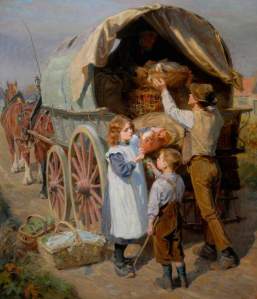
    “The Market Wagon’, Ralph Hedley (1848–1913). Public Domain. Source: Hartlepool Museums and Heritage Service. Please see annotation.

    CHAPTER THREE

    The Struggle in the Red Barn Continued — An Unlooked-for Friend Makes His Appearance on the Scene — Young Heads in Counsel — The Result

    Ha! ha!’ chuckled the ruffian, at the same time casting a look of triumphant hate upon his brave young opponent. ‘Yer did not calkerlate on that! Catch a marsh boy without his fixins! Where will yer have it?’ he added. ‘I’d like to spile yer beauty; yer spilt mine! Not that I ever had much to be proud on!’

    ‘One moment before you fire; just listen to me!’ exclaimed Bunce.

    ‘Well,’ replied Pike, who enjoyed his terror exceedingly, and wished to prolong its agonies, ‘what have yer got to say?’

    ‘I am not without money.’

    ‘All the better! When the game is lean, the skin aint worth much. What money have yer got?’

    ‘Five pounds.’

    ‘Is that all?’

    ‘All but a few pence,’ answered the young man, ‘and they too shall be yours if you consent to fight it out like a man!’

    ‘Well, that is a good one!’ ejaculated Pike. ‘Buy me off with my own money!’

    ‘Your money?’

    ‘Leastways as good as mine. Do yer think I am such a green hand as not to pluck the birds I shoot? Come,’ be continued, with that ferocious playfulness which is more terrible than hate, ‘where will yer have it?’

    There was no reply.

    ‘Can’t make up yer mind?’ observed the ruffian in the same jeering tone. ‘I don’t wonder at it. Maybe I should be as much puzzled as yourself. It is hard to die at your age — ‘praps at any age; but no help for it, so face the music boldly. The tune is a short un!’

    He raised his hand deliberately to fire. Poor Bunce stood gazing at him steadily with something of the Bohemian philosophy of the life he had lately led, and yet he did feel it hard to die — the dreams he had so often pictured in his waking hours unrealised.

    ‘Curse the fellow!’ muttered the cowardly assassin. ‘I wish he would take his eyes off me. I shall see them in my sleep.’

    He raised his hand a second time. His finger was upon the trigger, but before he could press it a blow was heard, and the ruffian’s arm fell nerveless at his side. It was broken, and the weapon lying on the floor of the barn.

    It was Goliah Gob who struck him. Our readers will remember that on quitting the farm-house he had promised his friend William to give a look into the barn. On approaching the building the frantic screams of the girls, mingling with the curses of the elder tramps, had startled him, and he crept in cautiously, remaining near the doors long enough to overhear a considerable part of the conversation.

    On seeing the pistol fall from the hand of his enemy, Bunce sprang forward intending to secure it, but his preserver already had his foot upon it, and resisted his attempts to take it.

    ‘What does ‘ee want wi’ it?’ he demanded.

    ‘To shoot the villain!’ replied the young man, greatly excited.

    ‘No ‘ee don’t,’ said Goliah. ‘I did feel mortal like it myself a bit since; but I can’t let murder be done in Farmer Hurst’s barn.’

    ‘He would have murdered me,’ urged Bunce.

    ‘It did look like it,’ observed the rustic. ‘We will take him afore a justice in the morning.’

    ‘You do not know half his rascality.’

    ‘May be nor a quarter on it,’ replied Goliah, with a grin; ‘but I heard enough to prove what he war and what thee war. Gie us thee hand. Thee beest an honest lad. Essex-bred, I’m thinking. That war a sharp crack on the crown of the head I seed thee gie the chap lying by the chamber door. Best look to him.’

    They found Bilk partially recovered from the effect of the blow which had rendered him senseless, and Pike moaning like a stricken wolf over the pain of his broken arm. As both the ruffians had the use of their legs the victors thought it best to secure them, which they did with sundry pieces of rope lying around the place. That done, they began to consult on their next proceedings. Goliah came to the conclusion — and it was a sensible one — that the best thing to do would be to call his friend William. He knew the room at the farm in which he slept, recollected the great elm tree in front of the window, that it would be easy to climb, attract his attention, and bring him down to the red barn without disturbing the rest of the family.

    ‘Wait a bit,’ he said; ‘I’ll soon be back wi’ a wiser head than ourn to tell us what mun be done.’

    Without waiting a reply he quitted the barn, carefully barring the great door on the outside. The sturdy rustic was not half so simple as he appeared.

    Left to himself, Bunce took a survey of the scene. In one corner of the building lay the two tramps, so securely bound that it was impossible for them either to escape or renew the contest. Satisfied on that point, he cautiously approached the partially shattered door of the chamber. The inmates had relit the lantern; by its light he saw the eldest girl take a small packet from her bosom and conceal it behind one of the massive beams which supported the roof. The act did not give him a very favourable impression as to their honesty, or respectability — a circumstance scarcely to be wondered at, considering the life he had lately led, their disguise, and the characters he had been compelled to associate with; and yet he did not quite give them up. Their terrors and cries of agony had been unmistakably genuine; their pale faces, rivalling the marble in its snowy whiteness, pleaded against his judgment.

    ‘If I am better than I seem, why should not these poor girls prove the same?’ he murmured. ‘They may have erred, fallen perhaps; so have I, more than once. It is not for me to judge them. Like my own, their lives may have been an epic or a doggerel; who shall say which?’

    These reflections — they were rather odd ones for a person of his condition — were interrupted by the return of Goliah, accompanied by William Whiston and Benoni. On their way from the farm the former had related to his companions all that had taken place in the barn, which, notwithstanding their knowledge of his truthfulness, they could scarcely credit.

    ‘And you are certain they are girls?’ observed the schoolmaster’s son.

    ‘They screeched like ’em,’ answered their informant. ‘And, Willie,’ he added, turning to the farmer’s nephew, ‘thof things do look a little queer agin ’em, I do believe they are honest ones.’

    ‘We shall see,’ observed the youth as they came to the half-shattered door; ‘but whether honest or not, their sex ought to be a protection.’

    ‘Exactly what I thought,’ chimed in Bunce.

    ‘And acted upon,’ said William Whiston, extending a hand to him. ‘My friend has informed me how nobly you defended them against the brutal violence of yonder ruffians, whom my uncle will see properly punished in the morning.’

    ‘I did my best,’ replied the young tramp, carelessly.’

    ‘And good it war,’ exclaimed Goliah, with a grin, recollecting the famous backhanded stroke he had seen the speaker deal Bilk.

    ‘I wouldn’t advise ’ee, Willie, to try a bout o’ single stick we un; he do hit awful hard.’

    ‘I will take your word for it,’ observed his friend, with a smile.

    ‘I am sorry,’ continued the speaker, addressing Bunce, ‘to see a fellow who has proved his heart is in the right place in your situation, and if there is anything I can do to serve you –‘

    The young tramp shook his head.

    ‘You cannot feel satisfied with the life you are leading,’ urged William — ‘rags, shame and misery!’

    ‘Bad enough, no doubt,’ said the object of his sympathy, sadly. ‘Winter is coming on, and these tattered clothes promise poor protection against the frost and wind. I must make the best of them — work out my fate as I may.’

    ‘Still, with a little help,’ urged the former — ‘I will speak to the farmer, and –‘The tramp shook his head a second time.

    ‘Useless! useless!’ he replied; ‘not that I expect to remain always in this degrading position. Do not think me ungrateful; but you can do nothing for me; your uncle would not listen to you; and I can scarcely blame him. Few men would employ a fellow in my position. I have tried it, asked for work when I was starving, and been refused with scorn and laughter. I must endure it till I find my fulcrum.’

    ‘He talks like old schoolmaster hisself,’ observed Goliah. ‘Not that I understand un. What be a fulcrum? Never heard o’ one in these parts. Did thee, William?’

    The youth smiled. He, of course, had understood the poor tramp’s meaning. It was not without considerable difficulty that the three friends succeeded in persuading the trembling girls to emerge from the chamber. They had relit the lantern, and recognised through the half-shattered door the young men who had so kindly given them shelter. Aware that their sex had been discovered, they came forth, blushing and trembling with modesty and fear.

    Such were not the looks of guilt.

    ‘You will not harm or insult us?’ said the youngest, imploringly, at the same time fixing her eyes upon those of Farmer Hurst’s nephew, ‘Indeed! indeed! we are not the wretched creatures we appear.’

    ‘Hurt ‘ee!’ repeated Goliah. ‘I’d like to see anyone try it on. Don’t ‘ee be fearsome. We be all friends here.’

    ‘He speaks truly,’ added William. ‘However strong appearances may seem against you, I for one do not believe in them. You told us, when we first met that you were on your way to London, that you had friends there. At noon the day coach will pass through Deerhurst. If you are unprovided with money to pay your fares, my friends and I will pay them for you.’

    ‘Too late!’ sobbed the eldest girl, wringing her hands. We shall be overtaken. Oh, Kate, what shall we do?’

    The word ‘overtaken’ produced rather an unfavourable impression upon her hearers.

    In cases of emergency or terrible danger we have frequently seen childhood display an intuitive presence of mind scarcely to be expected from its tender years. Not that the pale, half-fainting maiden whom the speaker had designated by the name of Kate could be exactly called a child. Her age was about fourteen. The terrors which hitherto seemed to crush her suddenly vanished as she advanced to William Whiston and clasped his hand.

    ‘Look at me,’ she said, throwing back the pale golden hair which partially concealed her features. ‘Look into my eyes, and see if you can read vice or falsehood there. We are two poor, helpless, unprotected girls, flying from a great danger, persecuted by those we never injured, menaced with a fate to which death were preferable. As you have sisters whom you love — whom you would rather die than see reduced to shame — pity and assist us to reach London. Once there we will reward you nobly.’

    Willie did look into her eyes. In fact, we do not see very well how he could avoid it, whilst they were fixed so beseechingly upon his. And very beautiful eyes they were — dark sapphire blue, gemmed in the tears which, like pearls, encircled them. For the first time in his young life his heart thrilled with strange emotion. He would have laughed had any one told him it was love, and declared it to be pity only. Like most boys, he had yet to learn that love and pity are dangerously akin.

    Doubts — he certainly had entertained some — hesitation, fear of his uncle’s anger, disappeared before the magic influence of that imploring glance, and from that instant he both spoke and acted with a decision which somewhat astonished his two friends.

    ‘Goliah,’ he said, ‘hurry to the farm and harness Bess’ — the name of his uncle’s favourite mare — ‘to the covered cart. Make as little noise as possible; and drive back to the barn as quickly as you can.’

    ‘Why, where be ’ee a-goin’ to?’ exclaimed his friend.

    ‘You will soon know, since you are to accompany me.’

    ‘I?’

    ‘Yes, if you are the friend I take you for.’

    ‘That be enough. Thee knowest, Willie, I drive to — no matter where — rather than go back on thee. Be Benoni a goin’ wi’ us?’

    ‘No. There is room only for four in the cart. Besides, he must remain to explain matters to my uncle. If you love me, be off at once. It will soon be daylight.’

    Goliah disappeared without a word.

    The schoolmaster’s son looked disappointed,

    ‘I take him with me,’ continued the speaker, whom circumstances and newly awakened feeling were developing into a hero, ‘because he has some knowledge of London. We have never been there. Another reason: Should we be overtaken — which, if I rightly understand these fair fugitives, is by no means improbable — Goliah would prove a better defender than half a dozen as we are.’

    ‘You know best,’ replied Benoni.

    Still he did not look as if he felt quite satisfied with the arrangements. He was not accustomed to see the young giant, whose heart he undervalued, whose intellect he despised, preferred to himself.

    There was a latent feeling of jealousy in his composition. We do not mean to insinuate that there was anything radically bad in his disposition. It might have been the effect of education, of his home surroundings, both of which exercise an imperceptible but subtle influence in the formation of character. Benoni was unusually reserved for one of his years; appeared always self-possessed; never displayed any of those sudden ebullitions either of temper or feeling so characteristic of youth, when youth is what nature intended it to be — the joyous springtime of a thorough manly nature. In short, as Goliah used to observe, there was a loose hitch in his harness somewhere; but of course, no one paid any attention to what he said.

    In a few minutes the honest fellow reentered the barn.

    ‘It be all right, Willie!’ he exclaimed. ‘Cover’d cart and Bess be at the door. Won’t farmer or the Missus storm when they miss the mare?’

    ‘Too late to think of that now,’ replied his friend, in a tone of decision. ‘Besides, Benoni will explain everything.’

    ‘Yes. I s’pose so; but somehow he don’t seem quite clever at ’splanations. I sometimes thinks he do make matters wuss.’

    ‘We can never repay the debt we owe you,’ said Martha, addressing Bunce. ‘This is but a slight earnest of our gratitude.’

    She pressed into his hand several pieces of gold. The young tramp regarded her wistfully and replied that he had rather not take them.

    ‘You must not reproach our poverty,’ observed Kate. ‘Thank you and bless you a thousand times!’

    Bunce slipped them reluctantly into his pocket.

    Just as they were about to start, Benoni pointed to the two tramps lying securely bound in one corner of the barn, and asked what was to be done with them.

    ‘Leave them as they are till you have seen my uncle,’ replied Willie. ‘Tell him not to unbind them till the constables arrive.’

    On hearing these instructions Pike and Bilk uttered cries of rage. Their past lives afforded too many reasons for the prospect of an interview with justice to prove a pleasant one.

    Although the covered cart was rather heavily laden, Brown Bess fully sustained her reputation of being one of the fastest trotters in the country. William and Goliah made but one stoppage between Deerhurst and London, and that was merely to procure bread and milk for their companions, who, as the distance between them and their pursuers (if there were any) lessened, began gradually to recover their self-possession. Of course, there was the awkward feeling of being in male attire that was not so easily to be got over, but the tact and delicate forbearance of their young preservers, who never once alluded to it, put them comparatively at their ease.

    When within five or six miles of the metropolis the fugitives were overtaken by a couple of horsemen, both exceedingly well-mounted. From his military undress and cap the foremost rider was evidently an officer, the second a groom.

    In an imperious tone the gentleman — we suppose we must call him such — commanded Goliah, who was driving, to stop.

    ‘And what be I to stop for?’ replied the latter.

    ‘Just to answer one or two questions.’

    ‘Thee mun speak more civil loike, then. We Essex lads have heavy fists and short tempers. Well, what be it?’

    ‘Have you passed two boys upon the road?’

    ‘Twenty,’ replied Goliah.

    ‘The ones I mean must have been dreadfully tired and worn for they have walked all night, and looked more like two girls disguised for a frolic than real boys.’

    Our rustic friend — who at first was far from suspecting the boyish-looking speaker to be in pursuit of the trembling girls in the waggon — became suddenly enlightened as to the intentions of the speaker, and his eyes began to flash viciously.

    ‘Thee do look loike a gal theeself, or a play-actor chap, with those frimicating things stitched on to thee coat, and that bit of gold lace, it do look loike brass on the pants. I beant in no temper for foolin’. Stand out of the road, or dom thee, I’ll make ’ee.’

    ‘The fellow evidently knows more than he seems disposed to tell,’ observed the young officer — for he really was an officer. ‘You will stand by me, Tom ?’ This was addressed to his groom.

    ‘I? Yes, of course, sir,’ replied the boy.

    His master dismounted and attempted to grasp the rein of Brown Bess — the most imprudent thing he could have done, for it brought him within reach of the driver’s whip, in the use of which the cattle drivers of Essex are curiously expert. Goliah caused the long lash to circle for an instant round his own head, and then drew it, with terrible precision, athwart the face of his assailant, who fell to the ground with a yell something between a shriek and a groan.

    The groom withdrew to a prudent distance.

    All this passed so rapidly that William Whiston had barely found time to descend from the back of the waggon and stand ready to assist his friend.

    ‘Get ’ee back,’ exclaimed the rustic. ‘I don’t want no ’sistance. Bless ’ee, I could crack the limbs of half-a-dozen loike him. He be more like a monkey than a man,’ he added, ‘thof he does wear gowd upon his cap and pants.’

    The hint was taken, and the fugitives once more resumed their journey.

    It was yet early in the morning when they reached London. Goliah’s knowledge of the metropolis was limited to Covent Garden market — where he had occasionally been sent with butter and eggs, the produce of his mother’s farm — and two or three of the neighbouring streets. Here Martha came to his assistance.

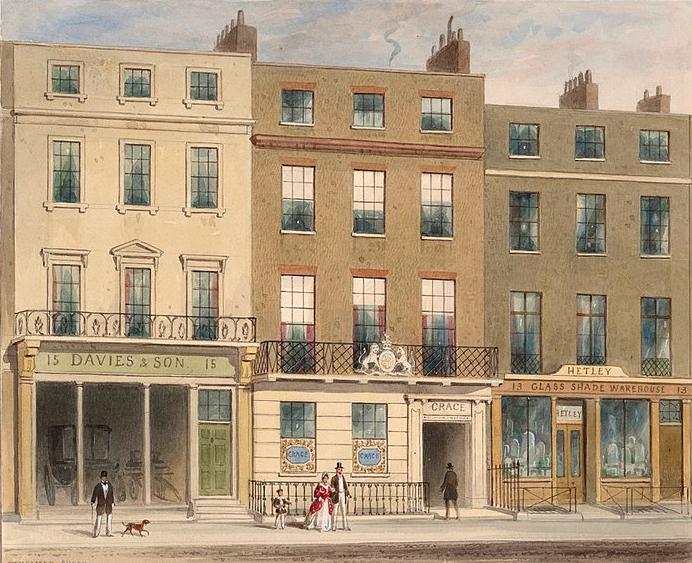
    Wigmore Street, London (1827-40), unknown artist. Public domain. Source: Wikimedia commons

    ‘To the right,’ she cried.

    He obeyed her as readily as Bess would have answered to the check rein.

    ‘Now to the left,’ she added.

    Goliah turned the mare’s head into Chandos Street.

    ‘Stop at the small white house with green shutters.’

    These instructions were followed to the letter, and the covered waggon drew up close to a moderate-sized, but respectable looking domicile, such as a city clerk or the family of a retired tradesman might be supposed to inhabit. At least there were no signs of trade being carried on in it. As we said, the hour was still young, and a middle-aged, respectable-looking female was engaged in washing the doorsteps, Martha sprang from the waggon and touched her upon the shoulder.

    ‘Go away, boy!’ said the woman, sharply,

    ‘Ann, don’t you know me?’ At the sound of her voice the servant looked up and stood, with the mop in her hand, gazing on the speaker in speechless astonishment;

    ‘Is my mother stirring?’

    ‘Yes, Miss,’ gasped the maid, with a bewildered look, ‘in the little parlour, getting breakfast for the lodger. Good gracious, Miss! what does it all mean?’

    Without making any reply, Martha darted into the house, and in a few minutes returned, accompanied by her parent. The countenance of the latter appeared flushed with excitement.

    Without a word of thanks or explanation to William Whiston or his friend, they assisted Kate into the house, and called on the servant to follow them. The woman did so, coolly shutting the door in the faces of the young men, who stood for several seconds gazing on each other in speechless surprise.

    ‘Well!’ ejaculated Goliah, bursting into a hearty laugh, ‘that be what I call London pride! They might ha said Thank ’ee!’

    ‘I cannot think so, I will not think so,’ replied his friend. ‘There is a mystery in the affair I cannot comprehend; but whatever the cause of this strange treatment, I feel convinced they are not ungrateful.’

    ‘Thee do know best. Has thee gotten any money with thee?’

    ‘About half-a-crown,’ replied our hero, after feeling in his pockets, — ‘and you?’

    ‘Just sixpence ha’penny,’ answered Goliah, with a broad grin. ‘Willie,’ he added, ‘did ’ee ever read the story-book ’bout babes in the wood?’

    ‘Of course I have.’

    ‘We mun look ’common loike ’em; not that I mean to starve,’ added the speaker, ‘and Bess mun be taken care on. I can find my way back to the market, and know the house where father and I, when he was alive, allays used to put up. We mun have some breakfast first.’

    ‘And then?’

    ‘Breakfast first. I tell ’ee my head beant loike my stomick; it can only take in one thing at a time.’

    Something less than half an hour saw the mare well stabled and the speakers seated at a comfortable meal, to which one at least did ample justice. William could not eat much, poor boy; his heart troubled him more than his brain. Both were filled with those thick-coming fancies that haunt the waking dreams of youth, and which those of manhood are rarely free from.

    Although his position in London, without money, and the probable anger of Farmer Hurst for taking his favourite horse, placed him in an embarrassing position, he did not seem to feel it. What he really felt was the cold, ungrateful treatment he had received at the little house with green blinds in Chandos Street; that rankled in his breast.

    ‘I will not return,’ he muttered to himself, ‘like a hireling seeking payment for his services. I must find out Uncle Whiston, and tell him everything. How the grim old lawyer will rave at my folly, and yet I have sometimes fancied that he rather liked me. This will put it to the test.’

    ‘What be thee a thinkin’ on?’ demanded his friend, who had been watching his countenance for several minutes. ‘It do take the pluck out o’ me to see thee downhearted. We aint a done nothink wrong.’

    ‘It’s not that,’ said William. ‘I must see my uncle and guardian, Richard Whiston, and tell him our troubles.’

    ‘What, t’old lawyer chap as comes to Deerhurst once a year?’

    ‘Even so.’

    ‘Does thee know where to find un?’

    ‘I have his address.’

    ‘I will go wi’ thee Willie,’ said the warm-hearted lad. He can’t scare I. If the worst comes to the worst I ha’ gotten my poor old father’s watch, and three seals — real gold. Not that I should like to part wi’ it. We mun stick together.’

    ‘Not for me,’ replied his friend, pressing his hand. ‘I have led you into this scrape, and I must get you out of it the best way I can.’

    A few minutes later the speakers were in the street, inquiring their way to Lincoln’s Inn Fields — then, as now, the favoured residence of the legal profession.

    This edition © 2019 Furin Chime, Michael Guest


    Some Annotations

    I am not attempting to add illustrations to the story as such, except on points like atmosphere, aesthetics, general history, geography or culture. Hedley’s painting ‘The Market Wagon’ has the purpose of clarifying Smith’s references to the ‘covered cart’ and ‘covered wagon’.

    On their approach to London, when the group is stopped by the two horseman, the narrator refers to the ‘trembling girls in the wagon’ but doesn’t mention that they are actually concealed in it. On my first reading, I was confused about why the horsemen didn’t see them. If I had a more ingrained image of what a ‘covered cart’ was, I may not have been.

    So forgive my fudging here, for trying surreptitiously to present a functional image before the narrative begins. (As well, the attractive image serves to evoke the rural theme and gestures to Smith’s origins.) Wigmore Street is in the vicinity of Chandos Street, near Cavendish Square.

    • ‘a slight earnest of our gratitude’: in this noun form, ‘earnest’ means a ‘pledge’ or ‘guarantee‘.
    • ‘dom thee’: dialect, ‘damn’; cf. ‘”Dom thee for a fool!” said Thomas.’ Captain Rafter, ‘Les Anglais Pour Rire; or, Parisian Adventures’ in The Metropolitan Magazine (1846).
    • ‘gowd‘: ‘gold’ (chiefly Scot.).
    • ‘check rein’: ‘a piece of horse tack that runs from a point on the horse’s back, over the head, to a bit. It is used to prevent the horse from lowering its head beyond a fixed point’ (Wikipedia).

    References and Further Reading

    • Andrew King, The London Journal, 1845-83: Periodicals, Production and Gender (Routledge 2004)
    • John Sutherland, Longman Companion to Victorian Fiction (1988).
    • Neil Macara Brown, ‘Had Their Day’: Robert Louis Stevenson’s “Popular Authors”‘ in Journal of Stevenson Studies 9, 2012 (171-206).
    • Frank Jay, ‘Peeps into the Past: A Detailed 1919 History of Bloods and Journals’. Edition available at peepsintothepast.wordpress.com
    • John Adcock, ‘Yesterday’s Papers’ blog. 

    Links to other chapters are at the bottom of the post or the menu at the top.

    MG

  • J.F. Smith’s Mystery of the Marsh — Second Instalment

    J.F. Smith’s Mystery of the Marsh — Second Instalment

    An astute reader of the first chapter wondered whether the red barn of our tale might be the scene of the infamous 1827 murder of  Maria Marten, perhaps in order to unfold Maria’s tragic plot. That does not seem to be so, however, given the events that occur in this and the prior instalment, which proceed in an independent direction.

    Poor Maria’s red barn was located in Polstead, Suffolk, which is indeed not too far from our location, the Essex marshes of the greater Thames Estuary. There is little question but that our author J.F. Smith (1803 — 1890) who was born in Norwich, and thus definitely in the general vicinity, would have been aware of those terrible events, which culminated in Maria’s ghost pointing out the location of her own grave. The red barn of the present story,  therefore, may well have reverberated with dramatic overtones for readers of the period.

    In editing this work, I have preserved elements of the writing that are characteristic of the period and medium, even where these might create some minor difficulties of readability for a modern reader used to modern popular conventions. Semi-colons, for example, tend to be used more liberally than is the fashion today, even as occasional closing punctuation for direct dialogue. Taken all together such features add charm and even contribute to a Victorian atmosphere.

    All the paragraphing is intact, as it was in the original newspapers. This is actually quite in keeping with online convention, where short paragraphs are considered best practice.

    An occasional point of dialect or cultural schema is not immediately transparent, but most reveal themselves quickly with the aid of context (‘porlite’, ‘loike’), deduction (‘the famous Essex two fives on the skull’)  or Google. I don’t want to invade the text with footnotes and sic’s, but will make a few notes at the end of each instalment to clarify one or two of the slightly more elusive points of interest.

    Don’t hesitate to make any comment or reply at the bottom of the blog post. I very much hope some discussions might ensue. If you like the instalment, please ‘Like’ it at the bottom of the post.

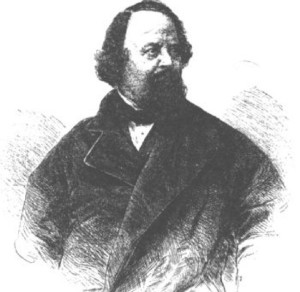
    I’ll take this opportunity to introduce the author.  He is an imposing gent, a brilliant Victorian star writer. Ladies and gentlemen, I give you the unsung giant and herald of popular literature, John Frederick Smith, Esquire


    Portrait of J.F. Smith, Cassell's Illustrated Family Paper, I: 385, 22 May 1858. Reprinted in Andrew King, The London Journal, 1845-83 (Routledge, 2004)
    The only existing portrait of J.F. Smith, Cassell’s Illustrated Family Paper, I: 385, 22 May 1858. Reprinted in Andrew King, The London Journal, 1845-83 (Routledge, 2004)

    CHAPTER TWO

    A Cool Reception — More Tramps — The Friends Compare Notes — Adventures in the Red Barn

    Mrs. Hurst did not appear particularly well-pleased when Goliah Gob entered the keeping-room — as the second parlor is generally named in Essex — in company with her nephew and the schoolmaster’s son; and yet it would have puzzled her very much to explain why she disliked him. Her daughter Susan had never yet shown the slightest preference for him; on the contrary, she rarely missed an occasion of mocking at his uncouth ways and quaint dialect, which she imitated to perfection, sometimes to his face, much to the annoyance of her cousin, who knew the worth, the true-heartedness, and honesty of the lad she thoughtlessly ridiculed; not that she shared in her mother’s dislike of him. William felt perfectly assured of that. Sometimes he thought he could detect a tone of pique blending with her playful malice. Why it should be so he could not understand. Goliah was perfectly civil to her, and even polite in his simple way. He had reasoned and remonstrated with her in vain.

    At last he came to the conclusion that, if his friend had shown himself a little more susceptible of her charms, she would not have been displeased.

    Hence his hint to Goliah, when he refused to accompany him to the farm.

    Possibly the aunt inclined to this opinion. There might also be another reason; Mrs. Gob’s butter was the crack of the market, so that there existed a species of rivalry between the two ladies.

    By this time the rain was falling heavily.

    ‘Come in,’ said Mrs. Hurst, addressing Goliah, who stood rather hesitatingly at the door of the keeping-room. You need not leave till the storm is over.’

    ‘I should think not,’ observed her nephew, dryly. ‘You would not allow a neighbour’s dog, much less a neighbour’s son, to quit the house in such weather; and if you could do so I would not permit it.’

    This was the first time the speaker had hinted his rights as joint owner of the farm. Mrs. Hurst bit her lips; she did not like it. It was treading upon unpleasant ground; so like a clever woman, she hastened to change the conversation.

    ‘Don’t stand chopping words, Willie, which signify nothing,’ she exclaimed, ‘and the rain dropping off of you, but take your friends into your own room and give them some dry clothes. Tea will be ready by the time you come down; the cakes are nearly done. Go with him, Goliah,’ she added, good-humoredly, ‘and don’t mind a thing he says; of course, I am glad to see you, though I don’t make fine speeches. Soft words are not always sincere ones.’

    ‘No more they be,’ observed the young man; ‘and grandmother do say they butter no parsnips.’

    At tea Goliah helped himself unsparingly to Mrs. Hurst’s cake and made sad havoc with the preserved gooseberries, a dish of which he cleared twice, to the great amusement of Susan and anger of her mother.

    ‘You seem very fond of gooseberries, Mr. Gob,’ said the girl laughingly.

    ‘Yes, Miss.’

    ‘And so are we,’ added the young lady, pointedly.

    ‘But not so fond as I be,’ replied the rustic visitor, assisting himself to the last spoonful in the dish. This was too much. The gravity of the table gave way to an explosion of mirth; even Mrs. Hurst’s anger yielded to the contagion of example, and she laughed heartily. Poor Goliah coloured to the temples.

    ‘What have I done?’ he whispered to William.

    ‘Nothing, nothing,’ replied his friend, trying to compose his features. ‘Take no notice,’ he added, in the same undertone.

    ‘Why, thee told I to be free and easy loike.’

    ‘Certainly; say no more, it is quite right.’

    Goliah felt that somehow or other it was all wrong; saw that William was annoyed although he did his best to conceal it, and he made up his mind at the first pause in the storm to take his leave. All confidence had left him as suddenly as it came, and he sat listening silently to the whistling of the tempest which whirled and shrieked round the gables of the house like some human thing in pain. The heavy pattering rain, the solemn peals of thunder ceased at last, and he rose to depart.

    ‘Why in such haste, Goliah?’ observed William. ‘It is only a lull in the tempest; it will soon burst again with redoubled fury. Better remain till morning.’

    As neither Mr. nor Mrs. Hurst seconded the invitation, Goliah Gob felt confirmed in his resolution. Susan looked as if she wished him to stay.

    ‘Thankee, Willie,’ he said: ‘thee hast a kind heart, but I knowed that long ago. I beant a bit afraid o’ the rain; it can’t melt I; ’sides, it be only five miles.’

    ‘Five miles in such a night!’ observed Susan.

    The sturdy rustic, however, paid no attention to the remonstrances of his friends, but after bidding a brief good night to the rest of the family, walked resolutely towards the door, followed by William,

    ‘I am sorry you are so resolute on leaving us,’ observed the latter, as they stayed for an instant on the threshold. ‘See how black the clouds are.’

    ‘No blacker than the looks within,’ replied his friend.

    ‘And the rain will be pouring down in torrents again.’

    ‘I mun go,’ said Goliah, resolutely.

    ‘I am sorry you are so determined,’ said the youth; ‘but when once you have made up your mind I know it is no use arguing with you; so good night, and, bye-the-by, Goliah,’ he added, ‘as you pass the red barn, just look in and see that those two poor boys are all right. Not unlikely that more tramps may have stopped there.’

    ‘I wol.’

    With these words the speakers shook hands and parted.

    ***

    As soon as the youthful wayfarers felt assured they were alone in the barn, they proceeded to make themselves as comfortable as circumstances would permit. First, they partook of the refreshment their friends had left them. Hunger appeased, and they had been very hungry, they next examined the room, which they did by the light of a lantern the eldest boy had discovered hanging from one of the beams; fortunately he had matches in his pocket. Everything appeared as William Whiston had represented. No window or other door to the room than the one of which he had given them the key. As for the bed, it might have looked a little more inviting certainly, still it was comparatively clean, and the sheepskins were in abundance.

    ‘Dear Charley,’ whispered the eldest, at the same time throwing his arms round the neck of his young companion, ‘we are quite safe here. We shall escape them yet.’

    ‘Would I could think so,’ replied the latter; ‘but I cannot. I feel they are on our track; I have only to close my eyes to see them as they sprang upon us whilst we were combing our long hair behind the holly bush, the brutal leering passion in their eyes as they tried to force us to follow them into the marsh. They read our secret. Martha! Martha!’ added the speaker, bursting into tears, ‘but for that honest waggoner and his two sons what should we have been now?’

    ‘Hush, dearest! Not that name! You must call me Hal. Listen to me: Something tells me that our greatest trials are past. You must try to obtain some rest. You need not undress. Let me unlace those coarse, horrid boots and rub your poor, tired feet,’

    Charley — we suppose we must call him so for the present — sank down upon the bed, and the speaker proceeded to remove the heavy high-lows, disclosing a pair of exquisitely turned feet, incased in white silk stockings — rather an unusual article for a tramp to wear.

    Nearly an hour elapsed before tired nature yielded to the approach of sleep. After extinguishing the lantern the wayfarers sank to rest at last, clasped in each other’s arms. No wonder that the sleep of both was broken by dreams and fitful starts. Once or twice the youngest awoke with a faint scream, appeared dreadfully agitated, and muttered incoherent words, till the soothing voice of the elder calmed her again.

    ‘Only a dream, Charley, only a dream,’ whispered his companion; ‘nothing more.’

    ‘Thank Heaven,’ murmured the frightened sufferer, pressed still closer to his side, ‘it was but a dream!’

    In a few minutes they were asleep again. Meanwhile the storm, which bad lulled once or twice during the evening, broke out afresh, howled like a weird dirge through the leafless trees, and the rain fell, splash! splash! upon the slate roof of the barn, whilst the angry lightning flashed and darted in arrowy, fantastic lines from the sable clouds which obscured the greater part of the heavens,

    God help the poor wanderers exposed to the cold charities of the world on such a night! The hard and thoughtless will doubtless console themselves by reflecting that, without doubt, they have deserved their fate. Perhaps so; but the necessity of shelter is none the less urgent, the obligation to pity and assist none the less binding; for what is man that he should harshly judge his fellow-man, whether for good or ill, blessing or punishment? The results are in higher hands than his.

    Any shelter in that terrible storm must have seemed like an oasis in the desert, a Patmos in the wilderness to the houseless and friendless. So, doubtless, must have thought a young fellow of about three-and-twenty, as he made his way into the red barn. He was evidently a tramp; no mistaking the signs. His shoes leaked water; his clothes — a half-faded summer suit — clung tightly to his shapely figure; the rim of the felt hat that he wore had uncurled itself in the rain, permitting the water to trickle down his back till it wetted him to the bone. He did not seem, however, to mind it very much, for after giving himself a good shake, like some Newfoundland dog after taking a swim, he seated himself upon the floor, and opening a wallet, began to eat. His appetite appeased, he paced up and down the floor of the barn to get himself warm.

    ‘This will never do,’ he muttered to himself, as a sudden chill crept over him. ‘The rain and sleet have struck to my bones. I must have a fire, or be laid up with the marsh ague. There can be no danger; neither hay nor straw in the place.’

    Gathering a small pile of wood which he found scattered in various parts of the building, the young fellow struck a light, and in a few minutes a cheerful blaze not only diffused a cheering warmth around, but it lit up the dreary space around.

    ‘This is what I call comfortable,’ he said, as he stood holding his coat and vest before the front of the fire to dry. ‘I wonder what those who once knew me would think of it, could they see me. What a fool I am to suffer such thoughts to run in my mind,’ he added, ‘They have long since forgotten me. Not all, perhaps. One or two may remember me yet.’

    These and similar thoughts kept chasing each other through his brain as he stood enjoying the warmth. At last his garments were sufficiently dry, and he commenced putting them on again. As he fastened the last button two more of the disinherited ones of the world crept into the barn — coarse, ruffianly looking fellows, several years older than the wanderer who preceded them. Their countenances bore the hard, cynical lines traced by a long career of passion, selfish, brutal indulgence, and crime.

    ‘Well, pal!’ exclaimed the foremost of the new-comers, as he advanced to the fire, ‘you are in luck. Quite pleasant here. Any scran?’

    The young man pointed to the wallet, which still contained some food.

    ‘Here, Bill!’ shouted the speaker to his companion, who had remained behind to close the barn doors. ‘Never mind s’porting the timber. The wind ‘ll keep ’em closed. Here is a good fire, and the right sort o’ pal, thof he don’t seem ’xactly like one of us. A Romany chal, p’r’aps.’

    ‘Not a bit,’ replied the first comer. ‘I am no gypsy.’

    He threw off his wide-awake as he spoke, disclosing a fair, bright, intelligent face, blue eyes, high forehead, shaded by light brown curly though somewhat matted hair.

    ‘I see yer aint,’ observed the questioner, after eyeing him over as critically as he would have done a lurcher or terrier dog. ‘None the wuss, maybe, for that. One of the marsh breed, I see.’

    ‘Neither do I belong to the Bittern’s Nest.’

    ‘Well I thought you might; no harm done, I s’pose. Many a good, honest bird has its nest in the swamp. What’s your name?’

    ‘Bunce.’

    ‘And mine is Pike, and my pal is called Bilk; and now we knows one another.’

    ‘O, yes! certainly!’ replied the former, with a smile.

    The three men seated themselves near the fire; the food remaining in the wallet quickly disappeared. Fuselli, or better still, Dore, might have made a startling picture from the group; Bunce with his pale, sad face, Pike and Bilk, their hideous countenances obscurely seen through the cloud of vapor rising from their saturated clothes; one instant it hid their traits, the next disclosing them with added deformity.

    For some time they remained silent, quitely enjoying themselves in the warmth. Pike, who evidently liked to hear the sound of his own voice, was the first to speak.

    ‘I s’pose you are up to a thing or two?’ he observed, addressing himself to the youngest of the party.

    ‘To a great many things,’ was the reply.

    ‘That’s right, nothing like plain talking; it mayn’t be allays wise to cackle in the ken afore strangers; but here, three honest pals together, it’s all right. I’ve something to tell you. But fust take a dram.’

    He drew a bottle, about half full, and handed it to Bunce, who, before tasting its contents, drew the cork and smelt them.

    ‘Brandy,’ he said.

    ‘You may swear to it,’ observed Bilk, ‘and what’s more, the gauger’s stick has never been in it.’

    Notwithstanding this recommendation the young fellow drank but a very moderate quantity. His suspicions were confirmed; he knew they were from the marsh — the desperate character of whose inhabitants he had heard of — and he determined to be upon his guard.

    ‘Now then,’ said Pike, in a confidential tone, as he replaced the bottle in his pocket, ‘let us talk bizziness; but mind it is all on the square.’

    ‘Of course it is.’

    ‘Have you seen anyone since you came here?’

    ‘You and your friend are the only persons who have entered the barn,’ replied the young man. ‘Why do you stare at me so hard? Do you think I am lying to you?’

    ‘Can’t say,’ replied the ruffian, coolly; ‘hard to tell; don’t signify much if you are; we are two to one. Now jest look at me in the face; I want to see your eyes when I tell you somethink. We are not alone in the barn.’

    ‘Police?’ whispered Bunce. ‘No. Two gals dressed in boys’ clothes.’

    The look of intense surprise, the sudden flush which mantled the countenance of his bearer, were too natural to have been assumed, and the speaker felt satisfied that it was news to him.

    ‘Poor things,’ murmured Bunce, in an undertone. ‘Where?’ he added aloud.

    Pike pointed to the door at the end of the barn.

    ‘There,’ he whispered. ‘Such a lark! My pal and I came upon them behind the bushes, just by the old stone cross, as they were combing out their long hair. Weren’t they scared! Bilk and I were quite porlite and coaxing; tried to get them to go with us into the swamp; but somehow they didn’t see it, so we just tried to make them.’

    ‘And would ha’ done it, too,’ chimed in his companion, ‘if their cries — of course we didn’t mind them — had not brought a waggoner and his two sons, who heard the cackle and leaving their team in the road came running to see what was up. They were three to two, to say nothing of the girls — so we had to sneak off. Awful provoking! Enough to make a parson swear! They rode off with the waggoner; but Pike and I knew a shorter cut, and dogged them till we saw the farmer’s boys hide them in the barn; so we waited and watched. At last we made our way in.’

    ‘The boys may return,’ observed Bunce, anxious to gain time.

    ‘Not such a night as this,’ replied the elder tramp. ‘No great matter if they do. We are now three to three.’

    ‘Why, what do you intend to do?’

    ‘Have ’em out, in course,’ exclaimed Bilk, ‘and have a jolly night. You can whistle whilst we dance,’

    ‘I will have nothing to do with it. Not that I object to a bit of fun; but this might prove dangerous — too near the village.’

    ‘It is nearer to the marsh.’

    ‘But I am a stranger in the marsh,’ replied the young man.

    ‘Oh, my pal and I will make you welcome.’

    ‘I told you I would have nothing to do with it, and intend to keep my word; it is unmanly, dastardly. Better give it up. As far as a hen-roost is concerned, I don’t mind going in with you. Hens were intended to be eaten.’

    ‘And pretty girls to be kissed.’

    ‘If they are willing.’

    ‘Willing or not, we intend to have them out. Bilk, you break open the door of the chamber, whilst I attend to this white-livered cur — to go back on two such pals as we are, and after treating him so ’ansomely, too.’

    Although the speakers were all three active men, the two eldest were by far the most powerful; the Bunce saw that he would have a hard struggle, if it came to blows. With the exception of a stout ash cudgel, such as the natives of the eastern counties play at single-sticks with, he was totally unarmed. The swamp ruffians — for such by their own confession he knew them to be — most probably were better provided. Still he determined not to abandon two helpless girls to the brutal treatment of such wretches. They might not even be respectable; their disguise was unfavorable to the supposition that they were so. He cared not for that; they were women. Possibly he recollected that he had sisters; at any rate, his mind was made up to defend them.

    There was some inherent good in that lone wanderer, after all.

    During the above conversation the pale, trembling girls stood listening at the door, the only barrier between them and possible insult. The mild tone in which the younger tramp had expostulated with the elder one gave them but faint hope.’

    ‘I have a knife,’ whispered Martha to her half-fainting companion.

    ‘Oh, kill me! kill me!’ whispered the youngest of the two.

    Whilst Bilk was thundering with his heavy boots trying to break open the door, Pike was attacking the young fellow who had refused to listen to their shameful proposal. Confident in his great strength, he committed the not unusual fault of undervaluing that of his opponent. Twice had the ash stick of Bunce cut the famous Essex two fives on the skull of the now thoroughly infuriated ruffian, whose loud curses, mingling with the screams of the two females, might have been heard beyond the barn.

    In cudgel playing, anger is about the worst second a man can have. The old tramp was not without considerable skill, but rage rendered him incautious.

    ‘Curse you!’ he exclaimed. ‘Take that!’

    The blow was well aimed, but as skillfully parried. In making the half circular movement to recover guard, Bunce brought his weapon across the head of his assailant. The blow was a terrible one, and the ruffian staggered for an instant as if half blinded. The hero of the skirmish — for such he proved himself — saw his advantage, and turning from his opponent, commenced attacking the second tramp. The door had been nearly broken open.

    ‘Keep up your courage!’ shouted Bunce to the inmates or the little chamber. ‘One of your enemies is powerless to harm you, and the other has almost had enough.’

    ‘No, he aint,’ said Pike, drawing a pistol from his vest.

    He advanced more cautiously than ever to the attack, the weapon in his hand.

    The heart of the generous wanderer sank within him.

    This edition © 2019 Furin Chime, Michael Guest


    Some Annotations

    The chapter highlight ‘The Friends Compare Notes’ seems out of place. I wonder whether these have been added by the newspaper editor in the main one of my two sources.

    Goliah Gob’s British dialect characterizes him beautifully as a diamond in the rough. ‘I mun go’ is dialect for  ‘I must go’. The ruffian, Pike, uses the word ‘thof’, which Goliah used already in Chapter 1. It is dialect for the conjunction ‘though’; and I presume has a link to Middle English pronunciation, of which our irregular ‘-gh’ spelling is a  relic.

    It is rare for Goliah to be used as a first name. Here, the name clearly illustrates the size and might of the character. We have in Chapter 1 ‘like his namesake of Gath, Goliah was a giant in strength’, Gath being the home of the Biblical Goliath.

    Some further brief notes:

    • scran: Dialectal, ‘food‘; the word originates in the British Navy
    • chal: male gypsy
    • lurcher: A crossbred dog, used especially by poachers
    • Marsh breed / Bittern’s Nest:The bittern is a rare, shy heron whose habitat is the marsh. (See the bird’s entry in the Essex Wildlife Trust website.) We can understand the upstanding Bunce’s reluctance to be labelled as ‘one of the marsh breed‘, given the mention in Chapter 1 of the Bittern’s Nest’s ‘proximity to London — not more than thirty miles distant — [which] has made it a refuge for the worst of characters; in a few instances, perhaps, also of the unfortunate.’ Therefore, at the same time, we might sympathise with Pike’s reasonable, egalitarian view that ‘Many a good, honest bird has its nest in the swamp.’
    • ‘Fuselli, or better still, Dore’:  Not ‘Fusilli Jerry’. Fuseli is the more proper spelling for the Swiss painter and art writer Henry Fuseli (1741 — 1825), though the double-l does occur; Dore is the French painter Gustave Doré (1832 — 1883). They share a penchant for creating dark, macabre images.
    • ‘threw off his wide-awake’: Low crowned, wide brimmed soft felt hat; so-named, jocularly, for having ‘no nap’.
    • ‘quitely’: Not ‘quiety’ but ‘quitely’ = ‘completely, entirely’, as in ‘Your ancestres conquered all France quitely’ (Robert Mannyng of Brunne, qtd. in the Century Dictionary (originally published in 1889).
    • Single-sticks:  A martial arts style of sport using sticks or cudgels; variants appear in several different cultures. Pays Googling. For your information, it was an Olympic sport in 1904 only.
    • ‘the gauger’s stick has never been in it’: Unexcised liquor, which we may infer to be either smuggled or illicitly produced.
    • *** : I inserted the asterisks to indicate the scene change, since that was a little unclear in the source.

    More details about John Frederick Smith in future posts

    MG

  • Raising a Penny Dreadful: The Case of J.F. Smith

    Raising a Penny Dreadful: The Case of J.F. Smith

    While researching old newspaper archives for a novel set in the Victorian period, I uncovered an intriguing British serialized penny dreadful, The Mystery of the Marsh; or The Red Barn at Deerhurst, which I plan to resurrect in its entirety here on Furin Chime, chapter by chapter. The work is unattributed in the instalments, but I traced the author to one ‘J.F. Smith.’

    I presume this is the once famous, now all-but-forgotten John Frederick Smith (1806–1890), whom the Oxford Dictionary of National Biography describes as ‘England’s most popular novelist of the mid-nineteenth century.’ I am presently at work on confirming the authorship; not a simple task, for there is little extant information about the man. More about him and the genre of the Victorian penny novel in forthcoming posts.

    Further problematizing the process of editing the novel is the need to piece the work together using two quite obscure sources, because i) the copy in both is indecipherable in parts, and ii) the less legible of the two serialized copies sometimes presents chapter information that the cleaner copy lacks. The novel is a bit like a jigsaw puzzle to piece together, since the chapters are segmented according to the editorial requirements of the newspaper in which each appears.

    At any rate, I do hope you develop as much affection for the story as I have. I will do my best to provide a chapter every two weeks. 

    Don’t hesitate to make any comment or reply at the bottom of the blog post. I very much hope some discussions might ensue. If you like the instalment, please ‘Like’ it at the bottom of the post. Facebook Likes and Comments are also most appreciated.

    There is a link to the next instalment at the bottom of the post.


    CHAPTER ONE

    The Red Barn at Deerhurst — Tramps in Search of a Lodging

    Essex, one of the midland counties of England, presents almost as great diversity of inhabitants as of soil. Roman, Saxon, Dane, have all left traces of their blood. Colchester and Chelmsford, the county towns, are peopled by a well-educated, thriving class; the country round by a sturdy race of farmers, good agriculturists and skilled breeders of cattle, which bring a high price in the London markets. There is also a considerable trade carried on between Wivenhoe and the metropolis in the sale of oysters. Nowhere are these delicious bivalves found in greater perfection than in the carefully-cultivated pits of the first-named place.

    Essex is intersected by long, dreary tracts of marsh lands, noted for their rank vegetation, and dotted here and there with pools of water, much frequented by flocks of wild ducks and other water-fowl, which during the shooting season attract the attention of hardy sportsmen willing to risk both health and safety in pursuit of game. To accommodate these visitors many taverns have been erected within the last fifty years. Most of the inhabitants consist of gypsies, tinkers, peddlers, and not a few fugitives from justice, who live, rent free, in huts or tents of their own erecting, setting law, order, and morality at defiance.

    Essex Naturalist (1887). Source: Wikimedia Commons

    In no other country of Europe would such a state of things be permitted, but the marshes would long since have been drained and brought under cultivation the only means of civilizing and getting rid of their dangerous population; but an absurd law in England prevents this. No sooner is a patch of land reclaimed and made productive than the Established Church puts in a claim for titles.

    No wonder if, under such a state of things, nothing serious has been attempted. Enterprise is paralysed, and capital made cautious.

    The noble Thames — one of the greatest arteries of the world’s commerce — flows for many miles along the banks of the largest of these swamps or marshes, and probably the most dangerous one, known as Bittern’s Nest. Its proximity to London — not more than thirty miles distant — has made it a refuge for the worst of characters; in a few instances, perhaps, also of the unfortunate.

    Of course, there is a line of demarcation to be drawn somewhere between what may be termed savagedom and civilisation; the difficulty would be to locate it, the frontiers being so blended together as to form a debatable land round the village of Deerhurst, whose inhabitants thought it no sin to get their brandy and tea from the smugglers of the swamp. It was whispered that the curate — for the village had both a church and a schoolhouse — shut his eyes to the dealings of his parishioners with the contrabandists.

    Probably the most prosperous farmer in the place was Peter Hurst, a tall, strong-limbed, hard-working man, shrewd at a bargain, and an excellent judge of cattle. His family consisted of Peggy, his wife, Susan, their only child, and William Whiston, a nephew, residing with him. These, with an old female servant, and one or two farm hands, formed the entire household.

    It was generally believed or surmised amongst the neighbours that on his coming of age he would be entitled to half the farm. Nothing positive, however, was known upon the subject, the Hursts keeping their family affairs pretty much to themselves. The only person who could have enlightened them, Richard Whiston, a paternal uncle of the boy, a lawyer, resided in London. The report of a projected marriage between the cousins, Susan and William, found general credence, although founded on mere conjecture. Both parties being young, several years would necessarily have to elapse before the doubts of the curious could be solved.

    Women have keen eyes and jump at conclusions, especially where matchmaking is concerned. They had noticed that when the Hursts gave their Christmas party but few girls were invited, and these the oldest or plainest in the village. This might have been accident, but, as a matter of course, the mothers of the excluded ones attributed it to design. If the latter, it is only justice to the farmer to state that he had no band in it. He attended to his work, was exceedingly fond of money, and entertained — very properly, our female readers will say — an immense opinion of his wife.

    Mrs. Hurst was a different person. Nature had endowed her with a strong will, some sense, and a considerable stock of patience. Although youth is said to be a great beautifier, she could never have been good-looking, and yet she made the best match in the place. True, her husband was a mere nullity, intellectually speaking, but she saw that she could lead him by the nose.

    When everything went according to her wishes Peggy Hurst was rather a pleasant person. Like the cat before the fire, she could purr very gently. It was only when thwarted that she unsheathed her claws. Even then she did not always scratch. It is not a very amiable character that we have drawn; but even in the worst some touch of goodness may be found. She loved her daughter. Nothing was too good for Susan or herself, or too expensive, considering her means. And if on rare occasions her husband ventured to hint that the account of the butter money did not seem quite clear, she would gently remind him that he had no head for figures, and that he ought to consider himself fortunate in having a wife who could calculate and manage for him

    As for Susan, if she had inherited something of her mother’s strong will, it was without any of its hardness. She had a good heart, was a little selfish perhaps, but that was to be expected, and possessed a considerable amount of animal spirits.

    Susan Hurst liked her cousin as she would have liked a brother if she had one, but at present nothing more. Being a girl, of course she was fond of teasing him.

    William Whiston, the last member of the family whom we think it necessary at present to describe, had just entered on his sixteenth year. Nature had been liberal to him in person as well as in mind. He was tall of his age, had a well-knit frame, possessing both strength and activity, fair without being effeminate, and rather good looking; and, what was better still, both courageous and honest — in short, excellent material, which only required to be well worked up to make a man, and we shall feel disappointed it he does not live to prove himself one.

    Neither the farmer nor his wife felt quite satisfied with the conduct of their nephew’s second guardian, who was also an uncle. A methodical, dry lawyer, residing in London, he was an old bachelor, too much in love with his profession to indulge in any other kind of love; no time for courtship, although he found sufficient to look keenly after the interests of his ward. The Hursts stood considerably in awe of him, possibly because they could not understand him. At their yearly settlements everything connected with the personal expenditures of the youth was scrupulously examined; clothes, pocket money — the last no very great item — carefully audited and allowed for; the balance prudently invested; from all of which our readers will come to the conclusion that the surmise of the neighbors was correct. William Whiston really owned one half of the farm.

    Hence the desire of his aunt and uncle for the marriage of the cousins.

    On one point alone had the man of law ever shown anything like liberality — in the education of his ward. Fortunately he was enabled to indulge it at a very moderate expense. Theophilis Blackmore, the village schoolmaster, was a ripe scholar. It was even asserted that he had received a university education, but of this the old man never spoke. After school hours he shut himself up with his books. or, if their lessons had not been quite satisfactory, with his favourite pupil, William Whiston, and his son, Benoni, for he had been married. The old pedagogue was resolved to make scholars of them, and up to the commencement of our tale the prospect of success was highly satisfactory.

    In haying and harvest time it was quite useless for farmer Hurst to insist on a holiday for his nephew, whose services would have been useful in the fields. Theophilis Blackmore would not listen to him, and when pressed too hardly, threatened to appeal to the lawyer in London. This generally settled the question.

    From pursuing the same studies, it is not surprising that William and Benoni became close friends. They fished and shot together. At the time the intimacy commenced both were so young that Mrs. Hurst had not seen the slightest danger to her projects in permitting the son of the schoolmaster to be almost a daily visitor at the farm. In fact, he half lived there. The boy was not only shy and reserved, but somewhat uncouth in his ways. In person there appeared little to object to.

    Behind his back Susan used to laugh and turn him into ridicule. Of course her mother was right. There could be nothing to fear. There was one person, however, in the village whom Mrs. Hurst really did feel a little uneasy about — a young giant named Goliah Gob, the son of a respectable widow in the village. He had already acquired as much education, perhaps, as he was capable of receiving — that is to say, he could read, write, and do a little ciphering as far as the rule of three, but spelling had presented insurmountable difficulties. He never could be brought to see the connection between signs and sounds, so gave it up at last in despair.

    Although a year older and almost a head taller than the two friends, even whilst at school he had pertinaciously attached himself to them; and proved rather an invaluable acquaintance, for he knew not only every stream within ten miles round in which trout were to be found, but the best points for rabbit shooting. From merely tolerating his society at first, William and Benoni gradually began to like him, and if they still laughed occasionally at his odd ways and quaint sayings, it was laughter without ridicule; they had discovered the particles of sterling ore buried in the rough quartz, and did their best to extract it.

    If, like his namesake of Gath, Goliah was a giant in strength, in disposition he was peaceable as a child, and rarely or ever exerted it unless in defence of those he loved, and then woe to those who assailed them.

    It will appear strange, no doubt, to such of our readers as are unacquainted with the peculiar Saxon type so common in the eastern counties of England, when we assure them that the complexion of this youthful Hercules was fair, delicate and creamy as that of a girl of seven or eight. It would have required excellent eyes to discover the light down just beginning to show itself upon his chin and upper lip; in regarding the face only, one would have pronounced its owner all gentleness; in feeling the grip of his hand, a conviction that he might become dangerous presented itself.

    We trust our readers will not accuse us of indulging too much in description. When once the action of a tale commences there is but little time to photograph portraits.

    The Hurst homestead was a plain, substantial building, situated on a gentle slope about a mile distant from the debatable land of the Bittern’s Marsh. The greatest peculiarity about it was its strength; strong oaken shutters guarded every window, and the doors were of the same solid material. To the security of the latter the farmer saw every night himself, the last thing before going to rest.

    Forty rods from the house, just where four cross-roads met, stood the red barn, evidently of much older construction than the farm building. In fact, there was something semi-ecclesiastical in its appearance, explained, if tradition is to be relied upon, by its having been the Bury, or place for the collection of tithes paid before the Reformation to the abbots of Wivenhoe.

    Another peculiarity which it may be as well to mention. Not only was the building fireproof, but it had a small chamber constructed for the watchers who at certain seasons of the year had to see to the safety both of grain and cattle liable to be carried off by the inhabitants of the neighbouring marsh.

    At the south end of the barn four crossroads met, one, leading to Chelmsford and the seats of several of the county gentry, being exceedingly well kept. Traces of handsomely-appointed carriages might be seen traversed by deep ruts caused by farmers’ waggons, or lighter ones made by pedlers’ carts and the humbler barrows of the tinker and scissors-grinder, whose homes were in the swamps. An epitome of the world-poverty and wealth intersecting each other, yet rarely coming in actual contact. When they did, the collision generally proved a rough one.

    The night threatened to be stormy; in fact, several drops of heavy rain had already fallen, giving the three friends a hint to accelerate their pace towards the house, when Goliah suddenly stopped.

    ‘Hurry up!’ exclaimed William.

    ‘I beant a goin’ no further,’ replied the young giant.

    This caused the first speaker and the schoolmaster’s son to stop.

    ‘And why not?’ demanded the former.

    ‘Cos thee aunt doesn’t like I.’

    ‘Nonsense, Goliah. I am sure she is always civil to you.’

    He would like to have said cordial, but love of truth forbade it.

    Goliah shook his head.

    ‘Civil enough,’ he replied. ‘I don’t complain o’ that, but it be all upon the tongue. A plaguey long way from dame Hurst’s tongue to her heart.’

    ‘This is all fancy.’

    ‘No, it beant. I aint got no fancy. Have I, Benoni?’

    The schoolmaster’s son smiled.

    ‘That be right,’ added the speaker. ‘Thee do never lie.’

    ‘Thank you,’ said the farmer’s nephew.

    ‘Nor thee either,’ replied the rustic, ‘unless to prevent the feelin’s of a friend from being hurt, and I don’t call them lies. Now my feelin’s aint a bit hurt, but somehow I don’t like to sit down at thee aunt’s table and eat her bread and butter I feel as if it would choke me like; she do look as thof she grudged it.’

    ‘I tell you no,’ exclaimed William, impatiently. ‘She has no such thoughts.’

    ‘What be it, then?’

    ‘Well,’ answered his friend, with a half-amused smile, ‘you are almost a young man.’

    ‘Pretty near it.’

    ‘And are very good-looking.’

    ‘Ah! Now I see thee be making fun of I.’

    ‘Not in the least. All the girls in the village say so.’

    ‘And my cousin Susan will soon be a young woman,’ continued the speaker. ‘Now her mother is a very prudent woman.’

    The color flushed the countenance of Goliah, even to the roots of his light curly hair; it seemed as if some new revelation had suddenly struck him. It faded almost as soon it came, and he shook his head.

    ‘I tell ’ee, Willie,’ he said, ‘that it beant that. She do know as well as I do that I should have but a poor chance agin thee.’

    William Whiston laughed.

    ‘And if I had a good un,’ added the rustic, ‘I wouldn’t try it.’

    ‘Why, you don’t imagine that I am in love with my cousin?’

    ‘Folks in Deerhurst say thee are to be married.’

    ‘Foolish gossip,’ replied the youth. ‘True, I do love Susan dearly, but only as a sister. I shall never think of her as a wife, nor she of me as a husband.’

    Again the face of the young giant flushed.

    ‘Be thee serious?’

    ‘O, perfectly ‘

    ‘By gory, then,’ exclaimed Goliah, ‘ I will go with thee to the farm. Mrs. Hurt’s black looks shan’t scare I a bit; I allays felt more at Susan’s laughing at me.’

    The conversation was interrupted by the appearance of two youths. The eldest who carried a bundle at the end of a stick over his shoulder, appeared about eighteen; his companion, several years younger. Although travel-stained, and evidently sinking with fatigue, there was an air of respectability in their appearance, and their clothes were something more than decent.

    Both the boys sank upon a rustic bench which some charitable hands had erected on the road-side.

    The three previous speakers regarded them attentively.

    ‘You seem tired,’ observed William Whiston. ‘Have you walked far?’

    ‘A very long distance,’ replied the eldest of the two tramps, for such the inquirer concluded in his own mind they were. ‘Can you inform us of any respectable house where we could lodge for the night?’

    ‘And where we should be quite safe,’ added his companion.

    ‘Safe!’ repeated Goliah. ‘Why, thee don’t look as if thee had much to lose.’

    ‘Just sufficient,’ observed the eldest, a little nervously, ‘to take us to London on foot. We have friends there. How far distant is it?’

    ‘Thirty miles, at the least.’

    At this information the youngest boy burst into tears.

    ‘I shall never live to get there,’ he sobbed.

    ‘For shame, Charley,’ said his comrade, soothingly. ‘Is this your courage? Be more of a man. Remember how many miles we have walked already.’

    ‘Not get there?’ repeated Goliah Gob. ‘Why I have footed it many a time afore breakfast by the side of mother’s waggon, and thought naught on it.’

    ‘Ah, yes,’ replied the tired lad, contemplating the stout frame and limbs of the speaker. ‘I can understand your doing it. I wish,’ he added, despondingly, ‘we could find some safe shelter for the night. I should not care how humble.’

    William Whiston felt touched. He noticed the delicate features and small white hands of the boy, which he clasped hopelessly, and resolved to assist him.

    ‘If you don’t mind roughing it a little,’ he observed, ‘ I can at least provide you with a shelter. The night threatens to be a stormy one; but you will be quite safe there,’ he added, pointing to the red barn, a few rods distant.

    The young wanderers regarded the dreary-looking building, and shuddered.

    ‘It does not look very inviting, I confess,’ continued the speaker, ‘but it is better than it looks. There is a small chamber at the north end used by the caretakers — when there is anything to watch. The place is quite empty now, and you can lock yourselves in.’

    The last assurance seemed to decide the boys, and the offer was gratefully accepted. William led the way, accompanied by his two friends. Everything appeared as he stated — the barn quite empty, and the key of the chamber in the door. He took it out, and placed it in the hand of the eldest youth.

    ‘Why, a king might sleep here,’ observed Goliah, looking round the room. ‘Not as I ever seed one. There be a good flock bed, wi’ sheep-skins to keep ’ee both warm.’

    ‘And here,’ added the schoolmaster’s son, giving them a canvas satchel, ‘are the remains of our dinner. It was well filled when we started this morning fishing. You will find half a bottle of currant wine in it.’

    The boys were profuse in their thanks. ‘Make yourselves as comfortable as you can,’ observed William Whiston, as he bade them good-night. ‘Not at all likely that you will be disturbed; but if any tramps should seek shelter in the barn, keep silent, and your presence will not be suspected.

    The three friends quitted the red barn, carefully closing the great doors after them, and resumed their walk towards the house. Somehow they did not seem inclined to talk. Each one appeared to have something to think of. Goliah was the first to break silence.

    ‘Lord! Lord!’ he muttered, half aloud, what a lot of poor frimicating critters there are in the world! What be the use of em? They do look more like gals than boys. Did you see their hands? They ha’ never done a day’s hard work, and never will!’ he added.

    A similar thought had struck his companions.

    ‘Play-actors,’ suggested William.

    ‘Their language was too simple for that,’ observed Benoni. ‘Mountebanks, perhaps.’

    ‘Naught o’ the kind; they be only tramps,’ said Goliah.

    This edition © 2019 Furin Chime, Michael Guest


    Scroll down if you would like to access a link to the next instalment, or see the blog menu at the top.

    Thanks for visiting.

    MG