Tag: Penny Dreadful

  • J.F. Smith’s Mystery of the Marsh — Twenty-eighth Instalment

    J.F. Smith’s Mystery of the Marsh — Twenty-eighth Instalment

    The unflappable Clara rebukes her “gentleman” kidnapper, Marsham:

    ‘You forget,’ she added, ironically, ‘the law against bigamy.’

    Her quip anticipates Morticia Addams’, who, bitten by the green-eyed monster, tests a barb on her unwitting husband:

    ‘Gomez, do you know the penalty for bigamy?’
    ‘… Two wives?’

    It must be the narrator’s tone that provokes our flippant response. He adopts a certain ironical distance himself, with his “We must not forget the ladies …”, his “As our readers may suppose …”, and the variants — sometimes quite teasing ones. In clear and simple prose, Smith exercises a virtuosic ability to combine seriousness and playfulness in artistic equipoise.

    We tend to become glib in the face of high drama and, especially, melodrama. Smith anticipates such a reaction with his playful self-reflexive ironies. In the current chapter, making a second appearance is the character Smith, whom the villains hired and brought back with them from Dinant to the Bitterns’ Marsh. (Can it be Bunce in disguise?)

    Being such a common name, ‘Smith’ is almost a byword for ‘pseudonym’. How tempting might it be for this author Smith, the mischief-maker, to use his actual name, the archetypal pseudonym, as a pseudonym for himself? It would be an audacious gesture indeed, to ‘stride the boards’, as it were, of his own novel; to make a cheeky cameo performance after the fashion (or rather, before the fashion) of a Hitchcock or a Tarantino.

    Before you scoff, notice the several throwaway quips on the name, Smith, which commence with the very chapter outline, and turn up a few times in the narrative and dialogue. Marsham is given the subtlest to say:

    ‘The fellow appears infernally indifferent to everything; walks about the old tower as if he owned the place ….

    which is to say, in the manner of an author-god (as one mask).

    Effects such as these gesture to a metafictional dimension, which characterizes writers such as Borges, Eco, Calvino, Pirandello, etc., who are held by many to herald or exemplify postmodernist fiction. This is, broadly speaking, a genre that draws attention to its own artifice; that parodies, pastiches and deconstructs traditional conventions, often implicitly incorporating the figures of the author and reader in the aesthetic action.

    At the same time, we should bear in mind that many writers as “dated” as Sterne (18th c.) and Cervantes (15th c.) demonstrate similar if not identical characteristics.

    So it is not particularly radical to observe metafictional effects here, though we hardly consider them as defining. The form of serialization lends itself well to such features. Consider the current instalment of the meercat ad, which ends with the two Russian protagonists clutching to the edge of a cliff:

    Aleksandr: Is this the end, Sergei?
    Sergei: No, it’s only a cliffhanger …

    Unlike a finished work, in one aspect the serialized novel unfolds itself in the same temporal frame as the reader’s own. Devices such as the cliffhanger, and the author’s address to the “gentle reader” convey a tacit wink, an acknowledgement of secretly inhabiting an identical world.

    From Sydney Punch Title Page
    Sydney Punch, title page (Jan 20 1866), cropped

    Apart from our own, the only extant instance of reader-reception of Mystery of the Marsh is an article in  Sydney Punch (Saturday June 9, 1883), which appeared at precisely our stage of the narrative, as published in the Evening News (Sydney, Wednesday June 13, 1883), in a column called “Family Jars.” The piece is a good measure of the popularity of Smith’s work among the Sydney readership. The author succumbs to one of the lower forms of wit, though we presume he is paid to do so.

    Night after night do we frantically devour the thrilling tale which adorns the last sheet of the Even Ooze, and which bears the Fisher’s Ghost-like title of the “Mystery of the Marsh.” It is now in its thirtieth chapter, and seems to have wind enough left to run thirty more, so that each gentle reader pays 5 shillings by instalments for a tale that can probably be bought at Paddy’s market for 5 pence. Of late we have been deeply grieved to find the fair heroine occasionally “sot down very hard,” but things are evidently on the mend, and the conspirators sing —

    “Farewell! farewell! I would not fling
    Around thy brow the veil of sorrow.”

    Quite right, too; for the man who would raise his hand to a woman (except in self-defence) is worthy of the name of a Pitt-street hero. It’s always safest to stand well away, and pelt the furniture after her.


    CHAPTER TWENTY-EIGHT

    The Martello Tower and the Prisoners — A Smith who is neither a White or a Black Smith — A Hut in the Bitterns’ Marsh

    We must not forget the ladies, whom, at the close of our last number, we left prisoners in the martello tower. The plot had succeeded. Money and brain-work, badly applied, carried out the daring scheme of the unprincipled Lady Allworth, whose insane desire to enrich her son without materially lessening her own means, knew no let nor hindrance. Scruples she had none. As for conscience — that was a myth with her, or, at least, a thing of the past.

    It was some time before the terrified girls recovered sufficient self-possession to look around them. A calm consideration of their position was equally out of the question; their senses were in a whirl of confusion; one moment it seemed to them as if they were in a hideous dream; it needed the sound of each other’s voice to convince them that they were not sleeping.

    Susan was the first to recover her presence of mind. There was a considerable amount of commonsense, as well as courage, in the girl. Whilst Clara and Kate sat helplessly, hopelessly locked in each other’s arms, she commenced taking a practical view of the situation — not a very encouraging one, certainly; neither did it appear to her utterly hopeless.

    After a glance at the strongly-barred windows, her eyes fell upon a pile of books; some in parchment covers, others in quaint old binding, mixed with a few Elzivers and several manuscripts piled confusedly in one of the corners of the room. In the first one she opened she read the name of Theophilus Blackmore, the ex-schoolmaster of Deerhurst, and a sigh of relief escaped her. Having learnt both writing and arithmetic under his care, of course she was well acquainted with the man — had never heard anything very bad of him. As for his son, Benoni, whom she had several times rejected, she smiled with contempt at the idea of any danger from that quarter.

    ‘Why, Goliah would brain him!’ she muttered to herself.

    And so, no doubt, he would, if ever he discovered that his rival had a hand in carrying her off.

    ‘Dear, kind ladies,’ she said, addressing her companions in captivity, ‘things look quite bad and ugly enough, still we must not despair. I do not believe that the owner of this place would lend himself to any very wicked act. He is old, and lives more amongst books than his fellow creatures. I could almost answer for him.’

    ‘But not for the wretches who have employed him,’ observed Miss Meredith. This was a view of the situation Susan had not taken.

    The noise made by someone unlocking the door of their prison chamber startled them. Poor Lady Kate clung to the side of her cousin, imploring her not to leave her. She recollected but too well the horrors of the night at the Red Barn.

    ‘Kill me first!’ she exclaimed. ‘Kill me!’

    The door opened. Clarence Marsham, accompanied by his confederate, Burcham, entered the room, leaving the taciturn fellow named Smith, whose services they had engaged at Dinant, to guard the entrance. With the cunning peculiar to great criminals they had concealed from the man, not the purpose, but names of their victims — also the locality in which they expected to find them. To all appearance this new agent in their schemes was not over-troubled with scruples, expressed little curiosity, and seemed to trouble himself only for the reward — half of which had been paid down before he consented to start with them.

    On recognising the suitor she had so contemptuously rejected, Miss Meredith saw that the same danger threatened both her cousin and herself. Her heart beat probably as violently as her cousin’s; but she possessed more self-command. Drawing herself up to her full height she fixed her eyes upon Clarence, affecting to ignore all knowledge of his companion.

    ‘Perhaps you will explain, Mr. Marsham, the meaning of this double outrage. Your designs on the hand and fortune of Lady Kate Kepple I have long been acquainted with, and the disgraceful means by which, on a former occasion, you attempted to accomplish them. But why am I here? Is it a part of your scheme — perhaps I ought to say your mother’s — to marry both the cousins, and so secure a double inheritance? You forget,’ she added, ironically, ‘the law against bigamy.’

    ‘No, Clara. Nothing of that kind. I —’

    ‘You are familiar, sir,’ interrupted the insulted girl, calmly. ‘Since I am compelled to exchange words with so contemptible a person, he will address me only as Miss Meredith.’

    ‘Hang it, Clara — well, then, Miss Meredith, since you will have it so — you know well enough what we intend — to make you our wives. The clergyman will not arrive till to-morrow night, so you and Kate have plenty of time to think it over. We can play the lovers afterwards. It will be your own fault if we use any but the gentlest persuasion.’

    ‘And are you weak enough to suppose, Mr. Marsham, that such a marriage would be binding?’

    ‘As for that, we will take the risk,’ replied the young ruffian, beginning to feel nettled at the determined tone of the speaker. ‘Once married, I don’t suppose you and Kate will be very anxious to create a scandal. Hang it, Burcham, why the devil don’t you speak? She is your affair — not mine. All I have to do is with her cousin Kate.’

    ‘Back, sir!’ exclaimed Clara, as the squire approached the spot where she was standing. ‘I cannot descend to exchange words with two felons in one day!’

    ‘Felons?’

    ‘Murderers!’ shrieked Kate. ‘They will kill us as they have killed poor old Willis!’

    ‘Killed?’ repeated Clarence. ‘We have killed no one. Not such fools as that.’

    Susan was about to speak, when a warning glance from Clara restrained her. Had the faithful girl declared herself a witness of the crime it might have cost her her life. Miss Meredith had no such fears upon her own account. Her danger was of a different nature.

    ‘Brutally murdered,’ she repeated, ‘by the ruffians you employed to decoy us here. Although prisoners in the cabin of the barge, we recognised his voice, heard his cries for assistance, the oaths of the assassins as they plunged the body of the old man into the river.’

    At this intelligence Clarence Marsham and his companion looked exceedingly blank. Much as money, rank, and political influence could do in England, they knew them to be powerless to condone crime where life had been taken. It was the first hint they had received of the death of the aged servant. The perpetrators had kept their own secret.

    Another source of embarrassment: They did not feel perfectly assured of the fidelity of the man they had engaged in Dinant, and who, from his position in the passage, must have heard every word of the accusation. The fellow had made a hard bargain with them, played off and on, haggled over the price of his services — in short, acted his part so well that doubt balanced confidence. One moment the conspirators felt disposed to trust him implicitly; the next to rid themselves of him — no very difficult thing to accomplish whilst they were in the Bittern’s Marsh.

    Clarence and Burcham withdrew from the room as abruptly as they had entered it. If conscience had not taken the alarm, fear had. They felt it necessary to consult together.

    As soon as she saw them depart Lady Kate Kepple commenced laughing hysterically. The dread of the present and recollections of the past were pressing upon her sensitive nature. She was already in the first stage of a brain fever.

    ‘Oh! my dear, kind lady!’ sobbed Susan, kneeling by the side of the old lounge on which the victim was seated. ‘Where will this all end?’

    ‘In death, perhaps,’ answered Miss Meredith, firmly; ‘but never in dishonour!’

    ‘Oh! that Goliah were here!’ said the humble friend.

    More than one heart re-echoed the wish.

    ‘Things are beginning to look infernally ugly,’ observed Squire Burcham, when he and Clarence were seated in what the latter styled their own den — namely, a room on the lower floor of the martello tower.

    ‘Who could have thought that they would have been such fools. Murder is a very different affair from running off with two girls and persuading them into marriage! Once our wives, they could give no evidence against us.’

    ‘That,’ said his confederate, ‘is our chance of safety — the last plank circumstances throw out to us. We must cling to it or sink. I know Clara,’ he continued. ‘She is a true Meredith, and would feel as little remorse in hanging us as I should in bagging a snipe.’

    ‘Unless she bore one of our names,’ observed his friend.

    ‘Exactly so,’ said Clarence. ‘We must carry out our plans by any means — fair ones, if possible; if not, the girls will only have themselves to blame.’

    His hearer nodded approval.

    ‘What troubles me now,’ continued the speaker, ‘is the fellow we picked up in Dinant. He must have heard every word of Clara’s accusation. Will he prove faithful to the end?’

    ‘Had we not better see him?’ asked Burcham.

    ‘Perhaps we had,’ answered Marsham, thoughtfully. ‘Were I convinced that he had the slightest idea of playing us falsely, some of the Marsh boys should soon settle the difficulty. It is the doubt that haunts me. The fellow appears infernally indifferent to everything; walks about the old tower as if he owned the place, and —’

    The rest of the conversation was cut short by the subject of their conversation walking into the room and coolly taking a seat at the table. He was a man of middle height, strongly but not coarsely built, about forty years of age, with nothing very remarkable in his appearance, except the keen grey eyes, which expressed great resolution.

    The two rich rascals drew themselves slightly up as if offended at the familiarity of the poor one.

    ‘Gentlemen,’ he said, ‘you have not acted fairly by me.’

    ‘Why, we paid you!’ exclaimed Clarence.

    ‘Of course you did,’ replied the seaman; ‘such services are rarely given.’

    ‘What, then, do you complain of?’

    ‘Paid me for assisting you to carry off two young ladies who asked, as you assured me, nothing better than to fall into your hands; but not for murder — a very different affair. Do you suppose I am going to risk my neck within the compass of a halter, at such a price? Ridiculous! ‘

    His hearers breathed freely. After all, it was merely a question of money, and they were well provided.

    ‘Name your terms,’ said Burcham.

    ‘I must have five hundred pounds more.’

    ‘Is that reasonable?’ demanded Clarence. ‘You have received two hundred pounds already.’

    ‘For coming with you from Dinant to the Bittern’s Marsh. You see I have learnt the name of the place, despite your cunning attempts to conceal it. Handsome pay, I acknowledge, for assisting you to bring two young ladies on shore. I have committed no other act for which the law can touch me. Take my offer, or reject it as you think fit.’

    ‘Why, what would you do?’

    The question was put with a view of testing his intentions yet further.

    ‘Wash my hands of the whole affair,’ was the reply.

    ‘Rascal! would you betray us?’

    The man laughed heartily.

    ‘And to whom should I betray you?’ he demanded: ‘Will you direct me where to find a magistrate in the Bittern’s Marsh, or officers to arrest you when I have obtained a warrant? You are neither of you very wise,’ he continued. ‘Still I give you credit for more judgment than that, I might try London, you will say. Tell me the names of the girls, give me the address of their family, and possibly I may think of it. Not that it would be of any great use, for if you are the fellows I take you for, it would be too late. The game will be played out.’

    The reasoning of the speaker was boldly put, nor did it detract from its value that it was insolent as well as convincing.

    ‘You are completely in our power. The boys of the Marsh are devoted to me.’

    ‘Not so completely as you suppose,’ answered the fellow, carelessly. ‘There are three or four gallows birds below anxious to fly to America. Probably they were on board the barge when — you understand. Now I wish to cross the ocean, too. We have had some talk over the affair. I don’t think, even at your bidding, they would commit a second murder.’

    The two gentleman rascals consulted together in a whisper.

    ‘Not so dangerous as I expected,’ said Clarence. ‘A mere petty larceny rogue. His object, to obtain more money.’

    ‘Yes, pay him; pay him,’ replied Burcham. It is hard, though I shall feel more at ease when I know they are on the other side of the Atlantic.’

    The last suggestion prevailed.

    ‘Hark you, my man,’ said the former, ‘when we engaged your services neither my friend nor myself anticipated the contingency you have alluded to, and perhaps it is only fair that your recompense should be increased. Pity you urged it so offensively. You might have trusted to our liberality.’

    ‘And been cast aside like a soiled glove when you had no further use for me,’ replied the mutineer, scornfully.

    ‘Well, well,’ chimed in the squire, who began to feel a little nervous, ‘we will overlook your insolence. All we require is to be assured of your fidelity. That is the important point.’

    ‘And yet you huckster over it like petty traders,’ observed Smith, lowering his tone, for he saw that the money would be forthcoming. ‘I will deal more frankly by you than you have dealt by me. In three weeks time I must be in America, far beyond reach of English law and English lawyers. The whole country will soon be ringing with my name.’

    ‘Rather a common one, I believe,’ observed Marsham with a sneer.

    ‘Perhaps it is,’ replied the former in a tone of indifference, ‘but some rather uncommon men have borne it. I am not ashamed of it. Enough of name,’ he continued. ‘Accept my offer; or reject it; the choice lies with you. I can be staunch as a bloodhound to my promise, but then I must have my price.’

    Walking back to the table, the speaker assisted himself to a second glass of liquor, and stood quietly awaiting the decision.

    The money was paid, and confidence, to all appearance, restored.

    ‘The Crofter’s Cottage’, Edwin Ellis (1842-95)

    As our readers may suppose, the motley inhabitants of the Bittern’s Marsh were not very particular in the choice of materials for their habitations, most of which, apart from the martello tower, were constructed of the trunks of trees dragged from the pools of stagnant waters, or, where these were scanty, of rough, unhewn stones, fragments of boulders, patched out with broken planks, and the interstices filled with mud or clay. Around these wretched abodes a plot of cultivated ground might occasionally be seen, with a few sickly-looking vegetables striving to pierce through the mass of weeds stifling their growth.

    The owner of one of these wretched huts was Sarah Sawter, the former servant of the widow Gob. We call her the owner from the fact that her worthless husband owned nothing but his worthless self. She was a tall, masculine-looking woman, strongly built, sharp of tongue, and capable ot thrashing both Tim and his sons, although, to do her justice, it was only in extreme cases that she exercised her strength.

    Soon after the arrival of Sarah in the Marsh a hard contest commenced between herself and the man with whom she had united her fortune for life, for the mastery. Pluck and resolution finally prevailed. In little more than a year Tom Sawter gave in, and the supremacy of his wife was sullenly acknowledged. Occasionally some outbreak might occur, but it was sternly suppressed, and she brought up her children as she pleased.

    As her sons grew up towards manhood they became deeply attached to her; to
    them her words were like oracles, which, if not always believed in, were rarely disputed. If Burk and Ben — the names of the boys — drank with their father, they always sided with their mother in all home disputes.

    One trait will give the key to Sarah Sawter’s character better, perhaps, than a page of description. On one occasion, as hostilities were about to commence between her husband and herself, the lads gave unmistakable indications of siding with the latter.

    ‘Stand aside!’ she exclaimed. ‘Have you forgotten he is your father?’

    It was the last serious contest with her drunken husband that Sarah Sawter had occasion to engage in. Tim was not only whipped but subdued in spirit when his sons turned against, him — he, to use a sporting phrase, ‘threw up the sponge.’ Grumblings might, perhaps, have occurred occasionally at intervals afterwards, and threats of what he would do; but the grumblings died away harmless as the echoes of distant thunder, and the threats were disregarded.

    The whole family were seated around the clean but rough deal table, on which stood a lamp filled with fish oil and a mesh made of dried bullrush. The supper, by no means a plenteous one, had long been concluded. The hour was getting late, yet still the inmates of the hut lingered at the table. Some project of interest was evidently under discussion.

    ‘I don’t like the looks on it,’ observed the mistress of the place. ‘What can they want wi’ a parson at the tower? Never heard of sich a thing afore. The master ain’t agoin to get married agin. I spose he haint sich an old fool as that.’

    In the Marsh they always spoke of Theophilis Blackmore as the master.

    Her sons grinned at the idea.

    ‘What is it to us what he wants un for,’ demanded the husband, in as loud a tone as he thought it prudent to assume, ‘since he pays well?’

    ‘And we are out of bread, mother,’ observed the oldest son.

    ‘The last bone of the old goat has been picked,’ added the youngest.

    ‘There are wuss things than hard fare,’ replied the woman, sadly, ‘though it be bad enough — the gaol and the law.’

    ‘It shall be as you say, mother,’ said the young men.

    ‘If it were only to guide the parson and his clerk from Deerhurst through the swamp to the tower, I should not so much mind; it’s what they may tempt ʼee to afterward. Still if —’

    The rest of her speech was cut short by a loud knocking at the door. In an instant all was silent in the lonely abode.

    The signal was repeated, but no one offered to stir.

    ‘Marcy on us!’ whispered Sarah, who can it be? So near on mornin’ too.’

    ‘Tramps — marsh birds like oursels,’ replied her husband; ‘but we ha’ naught for ’em. We be half clammed oursels. I’ll start ʼem.’

    Walking to the door he drew aside the bar, when two men, evidently greatly fatigued, clad in rags almost as wretched as the speaker’s, made their way into the room. The youngest one sank exhausted upon the settle.

    ‘Don’t you know me, Sarah?’ asked the elder of the two wayfarers.

    Mrs. Sawter caught up the lamp and held it close to his face, whilst Burk and Ben, her sons, stood quietly prepared for anything that might occur.

    ‘Marcy on us!’ exclaimed their mother. ‘Master Goliah, be it really you?’

    The name explained something to the boys; but not everything. They could not understand why the well.-dressed, good-looking young farmer, whom they had frequently seen, and been taught to respect, should come to their miserable dwelling in such a plight, and at so late an hour.

    No wonder they gazed upon him with surprise; but it was without any feeling of hostility. The grateful woman threw an additional armful of wood upon the hearth, and produced another bottle of spirits upon the table.

    Her husband began to eye it eagerly.

    ‘O! Master Goliah,’ she said, ‘if your dear good mother could see you in these rags it would break her poor heart. Where did yer get ʼem?’

    ‘Out of her garret,’ replied her visitor with a grin. ‘Mother gied ʼem to I.’

    As Sarah did not quite believe this statement she made no reply.

    ‘I tell ʼee she did,’ added the speaker; ‘and look, I hev fayther’s pistols as well, an’ you know the store she set on ʼem. She told I to come here.’

    ‘Here! to the Marsh? Here, amongst thieves, and worse?’ exclaimed the mistress of the house, who had recognised the weapons. ‘O! what have yer done?’

    ‘Nothink, as I knows on.’

    Sarah shook her head.

    Goliah knew that he might trust her, but doubted the prudence of doing so before her husband and her sons. Looking her earnestly in the face, he remarked that he would tell her all by-and-by. The woman understood him.

    ‘You. might trust in my boys,’ she whispered, ‘but not in their father. I have kept them honest. Tim will soon be drunk; it was partly for that I placed the bottle of liquor on the table.’

    In less than an hour the prediction was verified, and a series of explanations ensued, and some schemes suggested, in which Burk and Ben pledged their assistance.

    So satisfied were the two wanderers with the result that they consented to accept the only bed the wretched place afforded. Goliah did so on William’s account more than his own; for, as he said, he could sleep anywhere.

    When Tim Sawter awoke from his debauch in the morning he called loudly for his boots and his coat, which had disappeared.

    ‘Useless to search for them,’ observed his wife. ‘The boys have taken ʼem.’

    ‘Taken ʼem?’

    ‘Yes; they started at daybreak for Deerhurst to find the parson and guide him through the Marsh to the old tower.’

    Tim cursed loudly; swore that he would break every bone in their skin when they returned. Did they mean to rob him of his perkesites?

    Sarah smiled contemptuously. She had no fears for her sons. As for their father, he was effectually a prisoner in the Bittern’s Marsh; to go out barefoot was an impossibility, and he had not even a pair of slippers to attempt it in. Such luxuries were unknown in the miserable den he called home.

    This edition © 2020 Furin Chime, Michael Guest


    Notes and Further Reading

    • Metafiction: See for example, David Henry Lowenkron, “The Metanovel,” College English 38.4, Dec. 1976 (343-355).
    • Sydney Punch image reprinted in Shattock, J (ed.) Journalism and the Periodical Press in Nineteenth-Century Britain (CUP, 2017).
    • Elzivers [sic]: Must refer to the House of Elzevir, Dutch publisher of the 18th and 19th centuries: “The duodecimo series of ‘Elzevirs’ became very famous and very desirable among bibliophiles, who sought to obtain the tallest and freshest copies of these tiny books” (Wikipedia).


  • J.F. Smith’s Mystery of the Marsh — Twenty-seventh Instalment

    J.F. Smith’s Mystery of the Marsh — Twenty-seventh Instalment

    Willie will need to prove his mettle. He is well in the running to become Cambridge University’s Senior Wrangler for the year: referring to the highest scoring third year first-class honours student in the Mathematical Tripos. An amazing feat for a farm lad, but Willie is worn out with study, his brain over-taxed, and the Tripos commences today!

    The Mathematical Tripos was a formidable examination taken by students after three years and one term at the University […] For example, in 1854, the Tripos consisted of 16 papers, 2 papers each day for 8 days — a total of 44.5 hours in the examination room. The total number of questions set was 211. (Forfar)

    That’s the least of it. What will he do if he discovers that his betrothed, his beloved Lady Kate Kepple, has been abducted by murderous thugs on her way home from the opera? His uncle, Lawyer Whiston, seems reluctant to pass on the news. It would be sure to distract the boy! Undoubtedly receptive to Smith’s reveries on the transcendent power of Love, the reader has a reasonable idea that Willie is more likely to send the Tripos to the devil, for the sake of his Kate.

    Since 1910, the rankings have not been made public (within the general scheme: Wranglers, first-class honours; Senior Optimes, second-class; Junior Optimes, third-class). For the hundred and fifty-odd years prior, results were proclaimed far and wide, and supreme prestige afforded to the Senior Wrangler. Indeed, to become Senior Wrangler in the Mathematical Tripos was considered the highest intellectual achievement in the country.

    He’d be assured of a place among the highest ranks, such as in the church, legal, actuarian, medical or political professions. Lawyer Whiston already regards Willie as the stuff “of  which lord chancellors, statesmen, and prime ministers are made” (Chapter 23).

    Admission of the Senior Wrangler in 1842. Richard Bankes Harraden (1778–1862). Source: Wikimedia Commons.

    The situations of plot, along with the romantic themes, dovetail with seemingly more bookish political issues. What do you have to do to get the wheels of the Home Office turning, even in such a dire emergency as ours?

    Sir George has it right in one. The country is going to the dogs. The system is weighed down, clogged up with indolent “Tory place-men” — let alone the stultifying effects that descend from an idiotic, indulgent regent. It’s like a fish rotting from the head down.

    An old, mad, blind, despised, and dying King;
    Princes, the dregs of their dull race, who flow
    Through public scorn,—mud from a muddy spring;

    (from “England in 1819” by Percy Bysshe Shelley)

    Thus the narrator’s description of Beacham’s yacht comments on the condition of the metaphorical “ship of state”:

    Everything appeared in confusion; rigging incomplete; cabin windows out of place; paint half dry; the decks encumbered with canvas, tools and litter.

    The British system (of decades earlier than the writing of the novel) cries out to be rectified: in need of upright, honest, rational, selfless action. Youth holds the ultimate key: youth such as Willie’s, who points the way to a society governed by ethics, intelligence and merit.

    Hence Smith’s heavy irony in alluding to the “irreligious, revolutionary, insane” new call for reform. Writing from several decades in the future, Smith has the benefit of 20/20 historical hindsight. Here we are yet six or so years prior to the Peterloo Massacre of 1819, a deadly cavalry charge upon a crowd of up to 80,000 peaceful protesters demanding reform of parliamentary representation.

    The event fuelled a radical movement leading to the Reform Acts of 1832, 1867 and 1884, by which the right to vote gradually expanded, descending the class ladder.

    Smith’s story is not so politically charged in itself. Rather, his strategy is to reaffirm democratic values to a readership in whom they are already entrenched. His historico-political allusions may be understood as an ingenious method of reeling in the reader, by subtly invoking a sympathetic ideology of the status quo.


    CHAPTER TWENTY-SEVEN

    Great Surprise both in London and Cambridge — Honours Rejected — Flight of a Senior Wrangler — Preparations to Explore the Bitterns’ Marsh

    As may well be supposed, there was a great commotion in London when the abduction of the fair cousins became known. Many persons refused to believe it. ‘Absurd! Impossible!’ they said. ‘Two young ladies carried off in the heart of the most civilised, best governed city in the world! Ridiculous!’ Others shook their heads, looked exceedingly knowing, and whispered something about a double elopement. What seemed to give a shadow of probability to the last surmise was that no trace of the lost ones had been discovered, although Sir George Meredith and Lord Bury had set the Home Office magistrates and detectives on the alert. Hand-bills, offering a very large reward, had been placarded, not only throughout Westminster, but the business parts of the city. Many a hungry wretch, on keen scent for a breakfast or a dinner, possibly for both meals in one, scratched his ears and wondered if he could not make something out of them. Detectives looked grave, perfectly speechless mysteries; not even that enterprising race, the reporters, could extract a word from them.

    The truth was, they had nothing to tell.

    Lady Montague, not knowing what better to do, had sent for her solicitor — a proceeding quite as sensible, if not a little more so, than the others.

    The old lawyer listened to her tale with such evident dismay that it increased the terror of his client. His countenance, usually so impassible, became deadly pale, and as he clasped his hands together he murmured:

    ‘My boy! my poor boy! it will kill him! And this is examination day! Such hopes as his tutors wrote me.’

    In all the difficulties of life, from which neither rank, wealth, nor virtue are exempt, her ladyship had eventually found consolation in the ready suggestions and sound common sense with which her legal adviser encountered them; but now he sat speechless; not a word of consolation or counsel to offer. All he did was to repeat the words, ‘My poor boy!’

    ‘What are we to do?’ exclaimed the aunt, looking in his face with almost childish confidence. ‘My nieces must be found, and the wretches punished.’

    ‘They will be found — no fear of that,’ replied Mr. Whiston, who began slowly to recover his self-possession, ‘and the authors of the outrage punished. The question is,’ he added, and the tone in which he uttered the words imparted a fearful meaning to them, ‘What shall we have to punish?’

    Lady Montague hid her face with her hands and sobbed hysterically.

    The lawyer returned to his office, where he remained for several hours buried in deep reflection. His plans at last were laid; and when he issued forth, he appeared cool and collected as ever — astonished his old coachman, and no doubt the horses, by the rapidity with which he drove from public office to office. His last visit was to Westminster Hall, where he had a long interview with the lord chancellor.

    When he quitted the presence of that important functionary, an officer of his court accompanied him.

    On reaching his offices he found Sir George Meredith and Lord Bury impatiently awaiting his return.

    ‘No time for words!’ he exclaimed; ‘every instant must be employed in action.’

    ‘Ought we not,’ demanded the distracted lover of Clara, ‘to dispatch officers to all the nearest seaports?’

    ‘Done three hours since, my lord,’ was the reply.

    ‘Increase the reward,’ suggested the father.

    ‘Loss of time, Sir George.’

    ‘Apply again at the Home Office?’

    ‘The Home Office be ——’ As the speaker was unquestionably a moral man, we trust he only said ‘hanged.’ At any rate the word sounded very like it. ‘Been there myself. Saw the minister. An empty-pated idiot told me to prepare a statement on oath! Statements and oaths in such a case! High time we had reform. Shall vote for it next election. Heaven knows we want it!’

    Under less exciting circumstances his hearers would have been inexpressibly shocked by this favourable allusion to the irreligious, revolutionary, insane cry for reform just beginning to make itself heard and shaking the ranks of Tory place-men. A few plain, sensible men were just beginning to suspect the hollow tinsel they had so long taken for pure gold, and, what was worse, to analyse it. They had discovered a vast amount of base metal already.

    The door of the private office was opened very gently, and the managing clerk made his appearance with a half-hesitating air as if he did not feel quite certain what kind of a reception he would meet with. In his hand he held a scrap of dirty paper, folded in the shape of a letter. With the rapidity of a hawk darting on a sparrow his employer pounced upon it, and tore open the wafer, which contained but three words: ‘Bittern’s Marsh. Bunce.’

    ‘Thank God!’ ejaculated Mr. Whiston, as he sank back in his chair, letting the paper drop from his hand.

    It was no time for ceremony. Lord Bury picked it up, and read them aloud.

    ‘Still, I do not understand,’ he said. ‘Where is the Bittern’s Marsh?’

    ‘A tract of land upon the Essex coast, inhabited by the worst of characters,’ replied the lawyer. ‘It belongs to your father, Viscount Allworth. Lady Kate and her cousin have been conveyed there.’

    The marked emphasis which the speaker placed upon the word father brought a blush of indignation to the face of the son.

    ‘Can you rely upon the information?’ demanded the baronet.

    ‘Implicitly.’

    ‘The integrity of the writer?’

    ‘As on my own; more so,’ replied Mr. Whiston, ‘for he has resisted temptations to which, thank Heaven, I have never been exposed.’

    Lord Bury said something about seeing his father.

    ‘Do nothing of the kind,’ continued the former. ‘This scrap of paper has given the only clue that was wanted; changed surmise to certainty. It would put the plotters upon their guard. The girls, I can answer for it, have one devoted friend hovering near them. O! If I had but a yacht at my disposal!’

    The baronet suggested an application to the admiralty; but the lawyer at once pooh-poohed it. He had quite experience enough of public officers and red tape officials. Egbert proposed something more practical. His friend Beacham’s yacht, he said, was lying at St. Catherine’s Dock for repairs; it must be ready by this time, and was at his disposal.

    ‘Still more delay!’ groaned the baronet.

    ‘It is the best we can do,’ observed the nephew, mournfully.

    ‘We must see to it at once,’ exclaimed the lawyer; ‘better trust to that than to official interference. Talk of the law’s delay! Nothing, compared with it. It should be well manned.’

    ‘Leave that to me,’ replied his lordship. ‘Eight or ten men of my own troop are stationed at Whitehall, recruiting; not one of them but will follow me. Tom Randal, just named cadet at the Veterinary College, came to town with me this morning.’

    ‘God bless you, my dear boy!’ said the father of Clara, wringing his hand. ‘You know what we are struggling for.’

    He could say no more.

    His nephew not only knew, but felt it. An extraordinary change had taken place in him; he began to see the world — all that is worthless, all that is estimable in it — as it really is; not as false education, pride of birth, as the prejudices of society had painted it. The indifference, languid apathy which, in fashionable parlance, nothing less than an earthquake ought to have shaken, suddenly disappeared. The man had replaced the club-lounger; he was all life and energy. The soil must originally have been good; but the weeds had hitherto choked it.

    Never again rail against true, honest love, no matter what the conditions or inequalities; it is the surest test of the true metal. Gold is as frequently mistake for pinchbeck by the unthinking as pinchbeck is for gold.

    On their arrival at St. Catherine’s Dock the rescuers hastened on board the Leander — the name of Beacham’s yacht — where a cruel disappointment awaited them. Everything appeared in confusion; rigging incomplete; cabin windows out of place; paint half dry; the decks encumbered with canvas, tools and litter.

    Sir George Meredith and his lordship began to remonstrate, explain, argue, and propose all kinds of practicable and impracticable schemes. Here it was that the practical common sense of Richard Whiston came to their assistance. Calling the master-shipwright to the front, he said:

    ‘The Leander must leave the dock in twenty-four hours.’

    ‘Impossible,’ was the reply.

    ‘Don’t understand the word; it is only a crutch for lame fools to hobble upon. Whose men are these?’ added the speaker, pointing to the shipwrights.

    ‘Searle’s, sir.’

    ‘The word, then, was doubly absurd,’ continued the lawyer. ‘Searles’s men can do anything.’

    This last touch flattered their pride, and the carpenters began to grin.

    The speaker drew forth his watch. It was just four o’clock.

    ‘Hear me,’ added the speaker.’ If by this hour to-morrow the Leander is in the river in navigable order —never mind the painting, gilding, and fine work — Lord Bury, Sir George Meredith, and myself will distribute the sum of one thousand pounds amongst the honest fellows who execute our wishes.’

    The men gave a hearty cheer.

    ‘Never mind that,’ said Mr. Whiston. ‘It is a hard task I have set you; but the recompense is a noble one, remember. One thousand pounds. To work at once. Strong hands and willing hearts can accomplish everything. You have lost five minutes already.’

    ‘Is this offer really a serious one?’ inquired the master-carpenter.

    ‘Serious as the Bank of England, and payable as its notes for value received,’ remarked the lawyer.

    ‘Then,’ exclaimed several of the men, ‘it shall be done if muscle and good will can do it. To work, lads, to work.’

    As Lawyer Whiston remarked, somewhat bitterly, when he heard of the abduction of the cousins, it was examination day at Cambridge — the first of the three which annually decide who are to be the winners of the great prizes which the university holds out to the ambition of aspiring youth — the senior wranglership and the head of the classical tripos. Should intelligence of the outrage reach William he trembled for the result, the reaction upon his over-taxed brain’ for his studies had been severe.

    The senior wranglership opens the door to fame, fortune, and distinctions of every kind, but only a little way. The holder has still years of toil before him ere the mitre of the bishop, the ermined mantle of the judge, and the influence of the statesman fall within his reach. Still it clears the way. He is already a marked man. His future career is curiously watched. The public mind has taken hold of him; he is a possibility of the future and rarely forgotten.

    The head of the tripos enjoys similar advantages, but in a less eminent degree.

    The first day’s examination had closed, and our hero retired to his rooms in glorious old Trinity. Poor fellow, he looked pale, worn by hard brainwork and excitement. It was the future that stared him in the face. No wonder the vision startled him.

    His papers, written under the eyes of the examiners, had proved most brilliant. College Dons had smiled upon him, the vice-chancellor given him a friendly nod as he quitted the senate-house, and advised him to take care of himself. No wonder his rooms were crowded. Friends anticipated his triumph — rivals feared it. It was seven in the evening before he found himself alone, alone with proud and happy thoughts, the prospect of success honestly won.

    ‘Should it be so,’ he murmured to himself, ‘dear Kate may be pardoned for her choice, although it still leaves me unworthy of such a blessing.’

    His gyp — college servant — now made his appearance and informed his master that his dinner would be ready in a few minutes. The poor fellow had an air of unusual respect and importance. He, too, had heard of the general impression, and the shadow of Willie’s future greatness had fallen upon him. He was not very ambitious; his dreams extended no further than bearing the train of some future chief justice, or possibly lord chancellor, in the house of peers.

    ‘Eat it yourself, Gibby,’ said. the tired student. ‘All I require is a cup of strong tea and a biscuit.’

    ‘Certainly, my lord!’

    Our hero smiled; he read the speaker’s thoughts.

    ‘What is that you have in your hand?’ he asked.

    ‘The London paper, my — h’m, sir, I meant to say. Third edition. Great sensation. I have only just glanced at it. But nothing ‘like one,’ he added slyly, ‘that will appear in a day or two.’

    The gyp alluded to the result of the examinations.

    ‘Leave it with me,’ said William. Anything to cool my heated brain and change the current of my thoughts.’

    The speaker had been engaged in the columns but a few minutes when, with a cry that must have come from his heart, he sprang from the chair. In the pages of the Post he had read an account of the abduction of Lady Kate and her cousin. The names were not given in full, but his love divined them. In an instant his mind was made up, his course decided upon. What were the honours which awaited him, the triumph over his competitors, several of whom had affected to look down upon the farmer’s boy, as they insolently termed him, or the gratification of his own legitimate ambition! All vanished at the call of manhood, the claims of true affection. He would have been unworthy the love of a true woman had he hesitated. Within an hour he left the university, its honours, pledges of future fame behind him; left them without one sigh of regret. A nobler and far more imperious call decided him — love, the beacon light, the polar star of man’s existence, guiding him to happiness or misery as virtue or vice inspire him. Love! How often, in our more youthful days, have we tried to analyse the passion. Reason cannot grasp it, nor retort or alembic hold it for one instant. It is more subtle than the subtlest essence. In short, so incomprehensible that he who bestowed the God-like faculties upon the beings he created alone can comprehend it.

    The grey-eyed moon was faintly gilding the roofs and quaint gables of the old-fashioned farmhouses scattered round Deerhurst, and the Widow Gob, despite her sixty years, was busily engaged in preparing breakfast for her son, herself, and the labourers. She was, as might be expected in the mother of a young giant like Goliah, a strong and rather muscular-looking woman. Honest labour had made her so. She made excellent butter and cheese, saw to the work with her own eyes, helped it with her own hands. A rude but cleanly abundance reigned throughout her house. Mrs. Gob did not understand makeshifts. If she kept rather a tight hand upon worldly gear, it was not through avarice. She loved her big boy very dearly, and it was for him that she saved.

    Photo by L.Tyrer, Farmer & Stockbreeder (1889 – 1984). Courtesy of The Museum of English Rural Life, University of Reading

    ‘God bless us!’ exclaimed the widow, as a post-chaise, the horses flecked with foam, drove up to the door. ‘Who can this be? Company? Only brown bread, bacon and eggs for breakfast, too.’

    Our hero — we still persist in calling him so — alighted, so haggard, broken down, and careworn in appearance that at first she scarcely recognised him.

    ‘Why, Willie,’ she said, at last, after taking a good stare at him, ‘be that really you?’

    ‘Where is Goliah?’ asked the exhausted traveller.

    ‘In the home croft.’

    The worn-out student attempted to rise from the oaken settle on which he had sank.

    ‘Sit thee still,’ added the speaker. ‘I can tell him.’

    Going to the door, she placed her hand to her mouth and sent up a shout that might have been heard at — but as we pride ourselves on our veracity, we will not name the distance. It proved one thing better even than the stethoscope could have done, that the widow’s lungs were in a remarkably healthy condition.

    In a few minutes her son came rushing into the kitchen.

    ‘God save us, mother!’ he exclaimed. ‘Be the chimbly afire?’

    Mrs. Gob pointed to their visitor.

    The eyes of friendship, like those of love, are exceedingly keen. Goliah knew him in an instant, and taking the thin, white hands of our hero in his own, gazed on the piteous features with the piteous look of patient fidelity so noticeable in the hound when the master is ill.

    ‘Willie! dear Willie!’ he said, and his voice became wondrously gentle, ‘what be the matter on thee? What ha’ they done to thee? That cussed varsity and them books be akillin’ on thee.’

    ‘It is not that — not that,’ replied his friend, with a faint smile.

    ‘What be it then?’

    ‘The world will think I have acted very foolishly,’ added the former, ‘but I shall never regret it, for my heart tells me I am right.’

    ‘And I’ll swear to it!’ exclaimed the honest rustic, slapping his thigh — a way he had when excited. ‘Swear to it,’ her repeated, ‘on any book, and afore all the lawyers and justices in England. So let us hear all about it.’

    Perceiving, or fancying that he did so, a slight degree of hesitation on the part of William Whiston to explain matters in the presence of his mother, the speaker turned to that excellent personage and asked if she could not broil them a chicken.

    ‘Two, my boys,’ said the widow, as she walked from the kitchen, ‘if you and Willie can eat them.’

    Did Mrs. Gob listen to the conversation that ensued? We almost fear she did — mind, we do not assert it. Mothers have strange privileges, and singular modes of exercising them. When she returned in something less than an hour’s time, bearing the savoury dish in her hands, her countenance appeared hard set — not with anger, but resolution — like that of a person prepared to meet a stern necessity.

    ‘I cannot eat,’ said our hero, turning from the table, after swallowing one or two mouthfuls. ‘My heart revolts at the thought of food.’

    ‘An’ I beant hungry,’ observed his friend, who had already devoured at least half of one of the fowls. ‘My heart, too, do feel uncommon heavy.’

    Poor fellow! He was thinking of Susan.

    ‘You must eat, both of you,’ observed the widow, firmly. ‘How else will you find strength to encounter the dangers and fatigues of the Bittern’s Marsh?’

    The young men exchanged a glance of surprise.

    Decidedly the speaker must have listened. Goliah did not seem so much astonished as his friend; but, then, he was her son.

    ‘Why, what put that in your head?’ he began.

    ‘No frimicating’ — which in the dialect of the eastern counties means affectation, or pretence — interrupted the widow. ‘Yer can’t deceive me; no reason why yer should. Ain’t I yer mother? Did yer think l’d sit still and patiently see my own boy, to say nothing of poor Willie, robbed of the girls they love? Not if I know it! Yer must eat, I tell yer, and take some rest, too, for it would be foolhardy to venture into the Marsh before nightfall, where you will need all your strength and courage.’

    Our hero groaned with impatience.

    ‘She is right,’ whispered his friend. Turning to the widow, he added: ‘Do yer really mean what yer say?’

    ‘Bring back Susan safe to Deerhurst,’ said his mother, with a faint smile, ‘and I will answer that question.’

    Goliah started from his seat, threw his arms round the speaker’s neck, and imprinted a kiss upon her still comely cheek — a kiss such as no doubt would have greatly shocked the Misses Prue and Prim of the present day.

    ‘She be a good girl,’ added the widow, after settling her cap; old women wore caps in those days. ‘I’ve had my eyes on her and on you, too. Yer thought I was blind, I suppose. Lord! Lord! how simple these boys and gals all be!’

    The kind-hearted woman had her own way. Convinced at last of the folly — we might say madness — of attempting to penetrate the Bittern’s Marsh in broad daylight, William Whiston reluctantly consented to take a few hours’ repose.

    ‘Be it so,’ he said. ‘Rest for the body, not for the mind.’

    He was mistaken. Mrs. Gob was not only a good housekeeper, but, like most farmers’ wives, possessed some skill in the use of simples. Preparing a draught with her own hands of herbs gathered on the farm, she prevailed on the youth to take it. He slept so long and soundly that the shades of evening were gathering around Deerhurst when he awoke.

    Meanwhile, everything, had been prepared for the departure of the friends — garrets ransacked for old clothes to disguise them in, money in separate purses, lest they should be separated. The widow had thought of everything, even to the name of an old servant of hers who had been wheedled into marrying a handsome, good looking scamp, and finally settled in the marsh with him.

    Her mistress had frequently assisted her in her distresses.

    The last thing Mrs. Gob placed in the hands of her son were his father’s pistols. She had cleaned and loaded them herself, and looked exceedingly pale as she gave them.

    ‘Only in self-defence,’ she whispered. ‘And, O! Goliah, remember you have a mother! But do your duty,’ she added. ‘Don’t forget that you are a man!’

    The Spartan matron’s words to her soldier boy, when she gave him his shield on the eve of battle, ‘With it, or on it,’ were much more poetical perhaps, but not so true to nature.

    It was not till ‘the boys,’ as she called them, had quitted the farm, and the last echo of their footsteps died away, that the widow found her courage fail her.

    And then she cried bitterly. Her tears were for the safety of her son.

    The Spartan mother would have smiled upon his corpse. But, then, Mrs. Gob was not a Spartan.

    This edition © 2020 Furin Chime, Michael Guest


    Notes, References and Further Reading

    • Image: Admission of the Senior Wrangler in 1842: Scanned from H P Stokes, Ceremonies of the University of Cambridge, CUP 1927.
    • Here is a question of the sort for which Willie is preparing himself:

    • placeman: “chiefly British, often disparaging: a political appointee to a public office especially in 18th century Britain.” Merriam-Webster.
    • alembic: “An alembic (‏الإنبيق‎, al-inbīq); Ancient Greek: ἄμβιξ (ambix, ‘cup, beaker’): an alchemical still consisting of two vessels connected by a tube, used for distilling.” Wikipedia
    • frimicating: Goliah’s favourite F-word. E.g., Chapters 1, 3, etc. See external definition in Chapter 13 (n).
    • simples: Interesting connection with Nance, the wise woman of the Bitterns’ Marsh. See Chapter 19 (n) for definition.
    • Photo of rural woman at pump: “The costume of country women lagged behind that of town dwellers until the middle of the nineteenth century when simplified versions of more fashionable clothes were increasingly adopted. For the poor, new clothes were often hand-made at home with cloth bought from both local shops and travelling salesmen. A large trade in second hand, and even third and fourth hand, clothes existed during this period. The wives and daughters of prosperous farmers however, sought as fashionable clothes as they could find. From the turn of the twentieth century the distinction between rural and town costume had virtually disappeared and country women dressed to suit their personal taste and what their pockets could afford. The country woman pictured is wearing a waist apron and a sun bonnet. Such bonnets were particularly popular between 1840 and 1914” (Museum of English Rural Life, University of Reading).

    *Forfar, D.O. “What became of the Senior Wranglers?” Amended version of article first published in Mathematical Spectrum Vol. 29 No. 1, 1996. Jump to PDF.

    *Galton, F. “Hereditary Genius: an inquiry into its laws and consequences” (1869).  Fascinating research based on Cambridge Wranglers. Jump to PDF.

    *Mandler, P. (ed.) Liberty and Authority in Victorian Britain. Oxford: OUP, 2006.

    Evert, G. “The Reform Acts” Victorian Web.

    Briggs, A. “Reforming Acts.” BBC, archived.

    “Introduction to Georgian England (1714-1837).” English Heritage.

    *”Dare to be free: Revolt and Reform in Regency England.” Warwick U Library. Contemporary facsimile pamphlets, etc. Jump to webpage.

    *”Reform!!! or The House that Jack Built”. Warwick Digital Collections. Jump to Webpage.

  • J.F. Smith’s Mystery of the Marsh — Twenty-sixth Instalment

    J.F. Smith’s Mystery of the Marsh — Twenty-sixth Instalment

    This evening the girls are off to the opera, as Lady Montague announced the other day (Chapter 25). Sir George Meredith won’t be dragged — says he feels sleepy. Men. The sparkle and glitter of a brilliant Friday evening play upon the rippling Thames, as the London bon ton arrive in a magnificent array of carriages and barges to congregate at the opera house. Due to the oppressive warmth, the storm clouds gather.

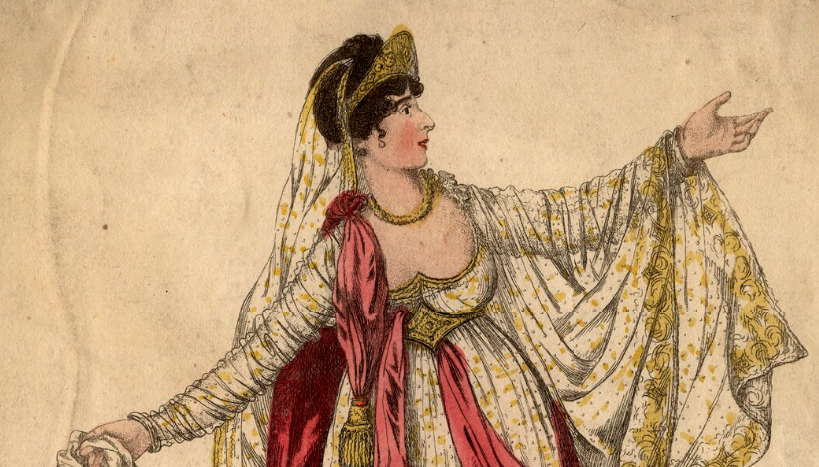
    It is Catalini’s farewell … make that Madame Angelica Catalani (1779 – 1849), the world’s — the century’s — most famous, most fabulous soprano. We won’t be meeting her in person, hardly seeing her on stage, except to learn that during the performance the prince regent bowed to her from the royal box. Smith is at it again: the diva transcends beyond measure the regent George’s paltry, self-aggrandizing gesture — his laughable setting of his seal upon her triumph.

    ‘Madame Catalani in Seriramide’ (1806). Hand-coloured etching, Robert Dighton. Source: British Museum

    Catalani’s inclusion reinforces a backdrop of high culture as only a stellar diva is able. She was the Cécilia Bartoli, the Montserrat Caballé, the Maria Callas of the day; like such towering figures, seemingly endowed with a richer essence of human soul, by their excellence in that highest of high art.

    I wonder if we might take a few minutes to establish a mood. Let us view a short video clip of the incomparable Bartoli, the greatest coloratura mezzo of all time (such a talent demands superlatives). It is “Ombra mai fu,” the opening aria, originally intended for soprano castrato, from Handel’s opera Serse (1738).

    Catalani’s sublime voice belied her humble origins. Born in Senigallia, Italy, she is said to have been a match girl. She was rescued from an obscure life by her possession of a phenomenal voice. Despite having little knowledge of music, she made her operatic debut in Rome at fifteen, and her fame soon spread throughout Europe.

    In Lisbon, her vocal gifts were cultivated to sublimity. To the deep regret of the Portugese, from there she went to Madrid, where she was feted by the Spanish court; thence to Paris, to be showered in the applause and adulation not only of the French public, but of the Emperor himself.

    Napoleon was so enraptured that he offered her 100,000 francs to stay in France. When she declined, he refused her a visa to leave, so she disguised herself as a nun in order to escape to London, performing at the King’s Theatre in Haymarket. She reigned for seven years in England as unrivalled prima donna — for she would brook no rival — winning the affections of the public and those at the highest levels of society.

    “Her voice,” wrote Lord Mount-Edgcumbe,

    … is of a most uncommon quality, and capable of exertions almost supernatural. Her throat seems endued (as has been remarked by medical men) with a power of expansion and muscular motion by no means usual, and when she throws out all her voice to the utmost, it has a volume and strength that are quite surprising; while its agility in divisions, running up and down the scale in semi-tones, and its compass in jumping over two octaves at once, are equally astonishing.

    “Place her at the top of St. Paul’s,” it was popularly held, “and she will be heard at the Opera House.”

    She is the subject of some nice anecdotes.

    Once, at a dinner party in Weimar, she was sat next to Goethe, about whom she knew absolutely nothing. Taken by his fine appearance, she enquired who he was, and was told, “The celebrated Goethe, madam.”

    “On what instrument does he play?”

    “He is not a performer, madame; he is the renowned author of Werther — The Sorrows of Young Werther (1774), Goethe’s first novel, a tragic, angst-ridden, semi-biographical story of love and suicide.

    Whereupon, turning to the poet, she gushed: “I am such an admirer of Werther!” — to which he bowed deeply.

    “I never read anything half so laughable in my life,” she continued, laughing. “What a capital farce! Never was there anything so exquisitely ridiculous.”

    She knew the great work only by way of a parodic farce she had seen performed at a minor Parisian theatre.


    CHAPTER TWENTY-SIX

    Opera Night in London, Followed by a Voyage down the River Thames — Trapped at Last — Three Birds Instead of Two

    Most of our readers, in all probability, have witnessed a review, with its clouds of dust, confusion, the hurrying to and fro of aides-de-camp; occasional clubbing of a whole company, to the intense mortification of its officers, although as a matter of etiquette the blame never falls upon them. The poor, over-taxed sergeants and men have to bear it all. To the Pekins — non-military spectators — it is a perfect mystery, and sometimes to those who wear the epaulette.

    The inspection of a single regiment is a different and far more business-like affair.

    The men of the —- (we purposely omit the number of the regiment) were drawn up on the parade ground of the barracks at Knightsbridge, when Lord Sturton, accompanied by the lieutenant-colonel, his aide-de-camp and several field officers, made his appearance on the ground. The day was a warm one; neither officers nor men looked particularly cheerful — for, as Egbert told his cousins, his lordship was something of a martinet; added to which, it was his own regiment he was about to inspect.

    Here a few words of explanation are absolutely necessary. In the British service cavalry regiments are almost invariably commanded by their lieutenant colonel, on whom rests all the responsibility. The head colonelship is held by a general, to whom it has been given as a reward for meritorious service, sometimes we fear for other reasons. Of course they draw the pay

    A single troop escaped the irascible comments of the old general — the one commanded by Lord Bury. The horses were in splendid condition, and as for the accoutrements, not a strap or buckle out of place.

    ‘On my word, Bury,’ said the old soldier, when the wearisome task at last was ended, ‘your company does you great credit. Horses splendid; no better mounted men in the service.’

    Although much gratified by the compliment, the young guardsman was too generous to appropriate it entirely to himself.

    ‘I am fortunate, General, in my sergeant,’ he replied.

    ‘Ah! Some old campaigner, no doubt.’

    ‘On the contrary, about my own age, certainly not a year older,’ added Lord Bury. ‘The son of a rich farmer, one of my uncle Sir George Meredith’s tenants. His father has repeatedly offered to buy his discharge — but Tom Randal refuses to leave the service.’

    ‘Fine fellow!’ ejaculated the general. ‘Wish we had more such men. What is his general character?’

    ‘Excellent; not a single black mark against him.’

    ‘And understands horses?’

    ‘Your lordship has seen the condition of those of my troop. All owing to Randal’s care. He never suffers a man to shirk his duty, particularly the hand-rubbing.’

    This was touching the inspector-general of cavalry on one of his weak points, perhaps the very weakest. The system of hand-rubbing had only lately been introduced into the service. Lord Sturton highly approved of it. The privates detested it, and we do not wonder at it. The duty was performed in the stable; each man had to kneel down and for half an hour rub the fetlocks of his horse. The regulation has since been abolished, or fallen into disuse. Too many painful and even fatal accidents occurred.

    ‘Bury,’ said Lord Sturton, ‘I have a great mind to send him to the Veterinary College.’

    ‘He would do credit, General, to your recommendation.’

    ‘We will see about it. Rare chance for him; sure of a commission.’

    Here one or two words of explanation are necessary. The officers of the household troops — the most privileged regiments in the service — are invariably selected from the members of the aristocracy. No commoner, unless nobly connected; or backed by great political interest, can hope to obtain a commission in them, and when he does he is looked down upon as a parvenu. To this rule, as to many others, there are some exceptions. The paymaster, veterinary surgeons and adjutant either rise from the ranks or are taken from other regiments. They must have commissions; but rarely rise above the rank of cornet.

    Young fellows, with more money than brains, proud of their Norman blood and ancestral acres, cannot be expected to take such mechanical, tiresome duties upon their delicate shoulders. They consider that they have quite sufficient to do in attending parades, drawing-rooms, court balls, or once a year guarding the person of the sovereign on his or her way to Parliament. To do them justice, these feather-bed soldiers have rarely shown any want of pluck in-the field. Waterloo, the Peninsula, and Crimea have proved it.

    Lord Sturton kept the promise he had hinted at; that very same day Tom Randal received his nomination to the newly-established college for veterinary surgeons, which gave him the somewhat hybrid rank of cadet.

    We trust our readers have not forgotten Tom Randal, the lover of Phœbe, the May Queen, who had so handsomely thrashed Squire Burcham for insulting her. Press of matter, as the newspapers say, compelled us to drop them for awhile; but they were sure to appear upon the scene again.

    Lord Bury rejoiced in the advancement of his humble friend, which he knew would please both Clara and her father. The only drawback to his satisfaction was the prospect of thee mess-dinner to which the inspecting general had been, as a matter of course, invited. No avoiding that, Lady Montague and her niece would have to visit the opera unattended. There was no coaxing Sir George Meredith to accompany them. He vowed that the music made him sleepy.

    We have known it produce that effect sometimes; but not with Catalini, Pasta, Grisi, or the divine Malibran upon the scene.

    London has been pronounced the most magnificent city in the world. It is undoubtedly the largest. It has magnificent buildings, noble institutions, richly endowed hospitals, and offers educational advantages of which Englishmen naturally feel proud; and yet we cannot call it magnificent. The contrasts between wealth and poverty, which strike the eye at every turn, are too great. Velvet and calico, ermine and rags, jostle together in the same streets.

    Like most great cities, London may be studied best in its undercurrents of good and evil; it is there the true keys to the enigma will be found. Large benevolence, in which ostentation does sometimes contrive to show its face; great domestic virtues, especially in the middle classes; a tolerably fair amount of honesty, though still far from, what might be desired, contrast with crime and vice in almost every direction.

    In London almost everything may be bought for money — from the smile of beauty, trained by speculating mothers to accept the richest offers, up to that priceless gem, the human soul, provided you are able to bid high enough for it. Vice never need lack either a pander, an instrument, nor a victim, provided the yellow dross is ready to be counted down in payment for them.

    London should be seen at night to understand half its glory and its shame; throngs of carriages, filled with, lovely women hastening to the opera, ball-room, or routs, their dazzling toilets and sparkling gems exciting glances of admiration or envy from their poorer sisters in the streets, who little dream how sad a heart too frequently beats beneath the load of wealth and finery — links in the chains which bind all but the affections.

    Few women better understood the terrible facilities which the possession of wealth can lend to crime, or felt less scruple in using it, than Lady All worth. Born of poor and very humble parentage, she had acquired, first gold — then rank; but the crowning object of her ambitious scheming — the marriage of her worthless son with Lady Kate Kepple — had yet to be achieved. She had been checkmated once, and the defeat galled her. The great fortune of the fair girl whose happiness she laboured to destroy, although it excited fierce cupidity, was not the end in view. She wanted to see the reputation of Clarence sufficiently whitewashed to enable him to show his face in society again.

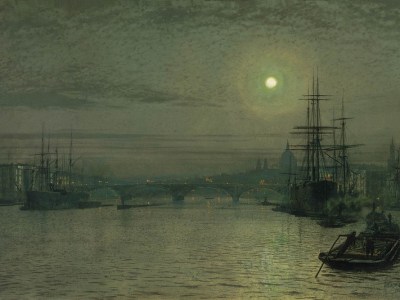
    London Bridge Night, John Atkinson Grimshaw (1836-93)

    The plans of Lady Allworth had been cautiously and cunningly laid, the details carefully studied, and contingencies guarded against — in short, all that brain-work and money could accomplish had been done patiently, earnestly; and the day at last arrived which was to test the strength of the nets so persistently woven. Day! We should have written night; for, honest, open-faced day, with its broad sunlight streaming around, penetrating every nook and cranny, curious eyes peering around, hands ready to resist evil, renders the execution of such projects as the one we are about to describe all but impossible; or, if not impossible, ten times more hazardous.

    The day had been exceedingly sultry; one of those scorching, metallic ones on which summer presses its bronze kiss upon the brow of rustic labour, and lazy poverty languidly stretches itself in the shade, trusting to accident for the bread which patient industry is toilsomely earning. Lady Montague had decided to proceed to London in her barge. There is always a chance of catching a breeze upon tbe Thames, and the opera could not be missed. Her ladyship and her nieces arrived in safety. Poor Clara missed the arm of Egbert sadly, and once or twice murmured to herself: ‘That odious inspection!’ Her cousin, Kate, who read what was passing in her mind, smiled gaily as she whispered in her ear: ‘Don’t fret, darling. He will be here in time to see us back to Belmont.’

    The last strains of the opera of the night had been heard, encores graciously complied with — Catalini was ever liberal in that respect — wreaths flung and gracefully acknowledged. The regent had set the seal upon the great singer’s success by bowing to her from the royal box. This last act of condescension raised the enthusiasm of the aristocratic audience to its height.

    The English Sardanapalus was certainly the glass of fashion; but how about the ‘mould of form,’ as his flatterers styled him? He weighed at least twenty stones at the period we are writing of him. Still, young men dressed by him, wasted hours before the glass trying to copy his bow, which really was inimitable, and arranging the almost historic love-lock of his curly wig carefully over the left temple, gumming it there; Beau Brummel christened it, ‘his royal highness’s persuader.’

    Poor, obstinate George III was a man in comparison with his son. His bigotry was at least sincere, his obstinacy constitutional, his prejudices the result of a bad education. Of the two, we prefer the blind old king to the elderly Adonis of sixty who succeeded him.

    Leaning on the arm of a nobleman who, if tradition is to be believed, had been one of her early admirers. Lady Montague made her way to the crush room, where the tired audience huddled together till their carriages were called, fully believing that her nieces were following. Alas! it was not so. Looking around, she perceived their absence, and, although not greatly alarmed, commenced a series of inquiries amongst her acquaintances.

    At this instant a gentleman, quietly but irreproachably dressed, approached her.

    ‘Be under no alarm, Lady Montague,’ he said. ‘Lady Kate and her cousin are perfectly safe. Sir George Meredith is escorting them.’

    The speaker was no other than Roland Brit, the son of Lady Allworth’s agent and solicitor. He had, in a theatrical phrase, got himself up exceedingly well for the occasion. It was a deep-laid plot. Who could have suspected such duplicity?

    His dupe, greatly relieved, bowed graciously.

    ‘Who is that gentleman?’ she inquired of her companion.

    ‘Which?’

    ‘The one who spoke to me just now.’

    By this time Brit, junior, having played his part, had prudently withdrawn amongst the crowd.

    ‘Can’t say,’ replied her ladyship’s escort, ‘Seen his face somewhere — not in my set. How terribly warm! Must end in a storm.’

    His lordship was right. The rain already had commenced falling— splash ! splash! — the large round drops hissing as they reached the hot pavement.

    An instant later the voice of one of the Bow-street officers announced Lady Montague’s carriage.

    ‘I am really too fatigued to return to Belmont to-night,’ observed its owner, as she sank upon its cushioned seat. Run and tell the bargemen to put op at Searle’s. And you, Willis,’ this was to the second footman, ‘remain to assist Sir George and my nieces.’

    These orders were punctually obeyed, and a few minutes later the speaker found herself comfortably seated in her own luxuriously furnished boudoir at Montague House, where we most leave her for a while and hasten back to the opera.

    Say what foreigners will, Englishmen are naturally gallant. They may not excel in compliments — in fact, they are rather awkward at them; but in right-down manly gallantry, readiness to assist the weaker sex in any little embarrassment, they are not to he surpassed. Frenchmen are just as willing, no doubt, but, then, they would expect a pretty speech or glance of admiration is return. The bow or simple smile of acknowledgment which is all an Englishman expects, would scarcely satisfy them.

    In the really arduous attempt to make their way to the crush room, the half-terrified cousins received the benefit of this characteristic of their fellow-countrymen. The young ones hastily made way for the two high-bred, beautiful girls, who had evidently lost their chaperon, Even the ladies under their charge— usually so tenacious of their privilege — smiled approval. The ‘If you please,’ ‘Pray let us pass,’ so plaintively uttered, acted like a charm.

    By great good fortune — they never clearly comprehended how it was done — Clara and Lady Kate not only succeeded in reaching the crush room, but penetrated as far as the grand vestibule of the opera house, where, to their great delight, they discovered Susan and the old footman, Willis. The grateful, affectionate girl, foreseeing the terrible storm about to break over the metropolis, had returned with the barge when she quitted Belmont a second time, to bring back Lady Montague and her nieces. She brought veils, cloaks, and all kinds of feminine wraps to guard her young ladies against the driving rain, and with nimble fingers proceeded to wrap them in them.

    Again the cry of ‘Lady Montague’s carriage stops the way,’ was shouted out. Willis hurried his young ladies into it, Susan followed, and in a few minutes they were driving rapidly down Parliament-street, then newly lighted with gas.

    Our readers will please recollect that the aunt of the two unsuspicious victims of this diabolical plot, when she decided on remaining in London for the night, had directed one of the footmen to hasten to Westminster Stairs, with orders to the rowers to put up at Searle’s. The prospect of a row of ten or twelve miles in such a storm was not particularly enticing, and the men obeyed with alacrity. Unstrapping their oars, which they left upon the benches facing the door of the cabin, they hastened to more comfortable quarters, leaving the barge moored to the bank of the river.

    As the rowers disappeared over the bridge an equal number of men, wearing the same livery, emerged from under one of the dry arches, where they had been patiently watching, and silently taking the vacant seats, awaited the arrival of the expected victims.

    They came at last. The old footman carefully conducted the cousins and Susan to the cabin, and closed the door, taking his seat on the outside near to it.

    Every detail of the diabolical scheme had been studied by its clever contriver, even to the plank they had to walk across to reach the boat.

    The first thing that struck Clara and Lady Kate was the form of their venerable relative sleeping, as they thought, upon one of the sofas, the rich velvet mantle she always wore on quitting the heated opera or the ball-room thrown carelessly over her.

    By this time the barge was fairly afloat in the centre of the stream, and rapidly approaching London Bridge, beneath whose arches the current, swollen by the rain, flowed with unusual swiftness.

    ‘Poor dear!’ observed Clara Meredith, regarding the recumbent figure. ‘She must be terribly fatigued. I almost wonder she can sleep, so fearful as she is of lightning. There was a flash! It almost blinded me. Fortunately the shutters are nearly all of them closed.’

    ‘Fortunately, indeed,’ answered Kate. ‘Thank Heaven, we shall soon be at Belmont. The tide is in our favour. I am not so much frightened as I appear to be, although I never but once witnessed a storm like this.’

    The still unsuspecting girl alluded to the memorable night at the Red Barn at Deerhurst, and an involuntary shudder thrilled through her frame as she recollected it.

    ‘There again!’ half-shrieked the speaker, as a still louder peal startled the inmates of the cabin. ‘I wonder aunt did not decide on remaining for the night in town — and such a night as it is, too.’

    Once, and once only, did a possibility of rescue present itself. Just below Rotherhite the barge passed a large boat manned by the Thames police. A cry might have brought assistance, but it was not uttered, for no one suspected any danger. The disguised rowers perceived it; they recognised the police boat by the lantern at the bow, and instantly commenced singing a boisterous rude chorus, peculiar to the inhabitants of the Bittern’s Marsh, in order to drown any alarm that might be given.

    Susan listened to it in astonishment. She had heard it more than once as the half-drunken smugglers staggered along the straggling streets at Deerhurst. She could not comprehend it. An instant’s reflection, however, convinced her that something must be wrong, and opening the door of the cabin, she called loudly for Willis.

    ‘Ladies,’ said the old man, who looked as if he had been startled from sleep, ‘I can’t make it out. We must have passed Belmont. The servants are either drunk or crazy.’

    ‘See what it is,’ said Clara Meredith. ‘Tell them they will disturb my aunt. Insist on their keeping silence. This conduct is intolerable.’

    As the faithful domestic disappeared, the supposed sleeper began to stir, and something very like a chuckle was heard from beneath the velvet mantle.

    The two cousins stood riveted with surprise.

    Suddenly loud cries for assistance, mingled with oaths, curses, and a shuffling of feet upon the deck overhead. Susan, who had followed Willis to the door of the cabin, staggered back.

    ‘They are murdering him! They are murdering the old man!’ she exclaimed.

    A pause of fearful suspense ensued, broken at last by the splash, as of a body falling into the water; then a second pause, and again the barge resumed its way.

    Kate rushed towards the sofa, calling upon her aunt to assume her authority to quell the disturbance. Snatching aside the mantle, she recognised, not the features of her venerable relative, but those of the ruffian who years before had tried to drag her into the swamp. No wonder the girl stood spell-bound with disgust and horror. Not for an instant did she indulge the hope of a mistake, but knew him instantly as he drew himself up, and sat leering insolently upon her.

    There are countenances both of love and hate, which, once seen, remain photographed upon the heart and brain forever.

    The tramp Pike’s was one of them.

    Clara Meredith, fully awake at last to the peril of herself and her cousin, began to utter loud shrieks, in which the equally terrified Susan joined her.

    ‘Stash it,’ said the tramp. ‘Yer aint got no young feller — Bunce I think he calls hisself — to stand up for yer now; nor any farmer boys. It’s no use a skreeching. I ha’ caught yer again, and don’t mean to let yer go.’

    The terrified girl clung to the side of her cousin, who scarcely yet realized the full horror of their position. Clara Meredith considered, as far as she felt capable of considering, the circumstance that the outrage was aimed at Kate alone. A thought of Burcham never struck her. Being naturally of a firm spirit, she somewhat recovered her self-possession.

    ‘What is the meaning of this outrage?’ she demanded. ‘To extort money? or have you been set on by wretches viler than yourself? Are you such a fool as to imagine that two ladies of our rank and fortune can be carried off with impunity? If we are helpless,’ she added, ‘our relatives are rich and powerful.’

    ‘Ours aint poor,’ observed Pike, with a grin.

    ‘Probably not,’ continued the fair girl; ‘but there is something beyond money to be considered — that is, if you are wise. My father, Sir George Meredith, has great influence with the government. Every engine will be set to work to trace our whereabouts. Reflect, then. Is it not wiser to restore us to our friends, and receive in return twice the sum your base employers have promised you?’

    Pike shook his head.

    ‘It won’t do,’ he said. ‘I’m staunch — can’t trust you.’

    ‘We have jewels.’

    ‘What be they?’ said the tramp. ‘Them shiny things in your ears and on your fingers? Don’t understand the vally on ’em; and, if I did, I dare not listen to you.’

    ‘Dare not?’ repeated Clara. ‘Why?’

    ‘You know of suthin’ that happened on deck.’

    He alluded to the brutal murder of the faithful Willis.

    The three unhappy girls crowded together as if to find protection. Susan kept murmuring to herself:

    ‘Oh! if Goliah were only here!’

    Shortly after dawn the barge neared the Essex coast, and despite their faint attempts at resistance, the well-paid ruffians landed their prisoners, and a rough conveyance took them to the martello tower prepared for their reception months beforehand.

    We need not tell our readers they were in the Bitterns’ Marsh.

    This edition © 2020 Furin Chime, Michael Guest


    Notes, References, Further Reading

    • occasional clubbing …: Wasn’t able to track down this expression. Might it mean unacceptable insouciance or talkativeness of soldiers on review?
    • Sardanapalus: Ctesias’ portrayal of the decadent last king of Assyria (actually Ashur-uballit II [612–605 BC]), who “spends his life in self-indulgence and dies in an orgy of destruction” (Wikipedia). Another cruel jibe at the regent.
    • Catalini / Catalani: Almost always the latter, with occasional exceptions.
    • * Catalani’s farewell: According to Grove, Catalani departed the London theatre at the end of the 1811 season (though the Wikisource extract from Grove has 1813) . She returned to London for a while in 1824 to perform for a few nights without a regular engagement; however, this was post-Regency (1811 – 1820), so the regent could not have bowed to her qua regent. Therefore, for working purposes we can assume that the action occurs in 1811/1813.
    • Pasta, Grisi, Malibran: Giuditta Angiola Maria Costanza Pasta (1797 – 1865), Italian soprano, has been compared to Callas; Carlotta Grisi (1819 – 99), Italian ballet dancer; Maria Felicia Malibran (1808 – 36), famous Spanish opera star, legendary after her death at 28 years.

    Dictionary of Music and Musicians, Catalani. Wikisource.

    Grove, George, ed. Dictionary of Music and Musicians (1900), Vol 1. Available at Internet Archive. Jump to page.

    ‘Review of The Music of Nature; or an Attempt to prove that what is passionate and pleasing in the art of Singing, Speaking, and Performing upon Musical Instruments, is derived from the Sounds of the Animated World; with Curious and Interesting Illustrations’, by William Gardner (Boston 1837)’. N.A., The New Monthly Magazine and Journal, Vol. 12, no. 60, Dec. 1823 (London). Available on Google Play. Jump to journal.

    Ganzi, Kurt. Victorian Vocalists (London: Routledge, 2018). Available Google Books. Jump to file.

    ‘All things Georgian.’ Jump to webpage.

    ‘Regency World’ (Catalani): Jump to blog.

    ‘Madame Catalani.’ The Australian, 2 March 1839. Jump to article. The diva’s fame spread to the Antipodes.

  • J.F. Smith’s Mystery of the Marsh — Twenty-fifth Instalment

    J.F. Smith’s Mystery of the Marsh — Twenty-fifth Instalment

    Smith places the novel in the Regency era, forty to fifty years earlier than when he wrote it. In this chapter the narrator mentions that the prince regent (1762-1830) was sixty years old when he had the imitation Chinese pagoda built in St. James Park. It was built in 1814 to commemorate victories over Napoleon.

    Thomas Smith, a contemporary, records the event:

    Monday, August I, 1814, being remarkable as the anniversary of the glorious victory of the Nile, and by a singular coincidence, the centenary of the accession of the House of Brunswick to the throne of these realms, was selected as the day for a grand national Jubilee, to celebrate, by public rejoicing, the return of the blessings of peace …

    Despite our own author’s jaded recollection, the event was a spectacle of mammoth proportions: “on a scale of magnificence surpassing all that had heretofore been seen in this country.” We might emphasize that, in order to counteract, if momentarily, the almost universal ridicule and condemnation with which the prince regent Prince of Wales / George IV met, both during his own time and in subsequent history, and which he doubtless earned. It is clear from this record that, in its day, the jubilee elicited mass public approval.

    The Jubilee celebrations, showing Chinese pagoda, 1816. Source: British Library.

    In 1714, George Louis of the House of Brunswick-Lüneburg, from which the House of Hanover sprang in 1635, inherited his mother’s claim to the British throne — to which Thomas Smith alludes. We defer to Ida Macalpine and Richard Hunter’s convincing hypothesis, which they formed as late as 1968, based on contemporary accounts of George III’s urine being of the colour purple, in accepting that his insanity was probably due to a disorder of the blood, Variegate Porphyria. His disease was likely due to an inherited gene carried by the Hanoverians.

    As a result of his father’s insanity, the Prince of Wales was appointed ruler of Britain in the capacity of Prince Regent. This period of Regency lasted for ten years from 1810 until 1820, when George III finally succumbed and the regent ascended to the throne as King George IV. In 1830 he died and was succeeded by his brother, King William IV.

    George IV’s reign as regent and king was extravagant and wasteful. His increasing drunkenness,  gluttony, laziness, selfishness and ill-nature overshadowed and overwhelmed his better qualities. At the same time, monumental hijinks were in progress amongst the beau monde in particular, due partially to it being a post-war period,  and due as well to George’s own over-indulgence and flamboyance.

    J.F. Smith enjoys once more taking a swipe at that “sweet young prince who, at the age of sixty, set the fashions” (Chapter 4). The regent is a such an oft-assailed straw target, however, as to render such barbs positively tame.

    Times obituaries criticised him vociferously, denouncing his carnal and gastronomical appetites as “little higher than that of animal indulgence.” They berated him for his “indifference to the feelings of others” and “unbounded prodigality”; and declared that

    There never was an individual less regretted by his fellow creatures than this deceased King.

    George IV was endless fodder for caricaturists, most notably George Cruikshank (1792-1878), known as the “modern Hogarth.” His “Merry Making on the Regent’s Birthday” depicts George IV at his revels, drunken and dancing, while stamping underfoot a rejected petition to aid poor children.

    Merry Making on the Regent’s Birthday, 1812. George Cruikshank.

    Outside, his subjects are lamenting and being hanged on Tyburn hill. One is saying: “If Rich rogues like poor ones were for to Hang, it would thin the land such numbers would Swing upon Tyburn Tree.” On the left, a servant holds a scroll with the King’s agenda for the day, including his menus with entries like “Breakfast: 2 to be hung at Newgate; Dinner: Love and lumps of fat.”

    At the time of the jubilee, J.F. Smith (1803?-90) was between eight and eleven years old. The Regency years were thus a memorable and formative period for him — as well as for the country. It was during this time that he worked in his father’s Norwich theatre troupe, and perhaps travelled to Russia (see Third Instalment).

    For Smith, George IV is an index of a general feeling of antipathy towards the beau monde. Viscount Allworth is the most distinct fossil of the Regency:

    Lords, ladies, aristocrats and fashionable idlers, who consume much and produce nothing, form neither the backbone nor sinews of a great city. There is more strength in looms and anvils than in a hundred coronets. They have had their day, and the world is beginning to see it.

    Mystery of the Marsh, Chapter 4

    The Chinese pagoda is a pithy emblem as well. George IV reinvigorated an earlier craze for Chinoiserie, drawn to its florid, rococo style. Hence Lady Montague’s fashionable Chinese tent: a perfect backdrop for the partaking of afternoon tea — a nineteenth century vogue. Like George IV himself, the pagoda was a casualty of excess:

    … at a later period of the evening, an unfortunate accident happened which threw a damp over the whole proceedings at this point, the fire-works having set fire to the pagoda; two of the men employed were so seriously injured that they expired on the following day; and before the fire could be got under, five stories of the pagoda were consumed.

    Thomas Smith

    At the same time, the period mise en scène is attractively exotic in its indulgence and extravagance. The historical gap functions well to allow for some play of living memory. A certain ambiguity combines a combination of embarrassed identification with the censure of a conservative public that considers itself more sophisticated, more “adult.”

    Recall Mike Myers’ Austin Powers films, which have a similar historical gap between the time of the film and the period depicted — between the 1960s and late 90s, early 2000s. They satirize the 60s for their childish self-indulgence and egotism. At the same time, they provoke nostalgia and defensiveness about bygone, now castigated ideologies, such as “free love,” while implicitly caricaturing the contemporary, overrun not so much with fembots and lasers, as with a ubiquitous and sterile corporate mentality.


    CHAPTER TWENTY-FIVE

    Far-seeing Schemes, in which the Character does not See Quite Far Enough Lord Bury Finds a True Friend ‘Rus In Urbe’ Glimpse of Fashionable Country Life Two Girls

    Amongst other belongings with which fortune had favored her, Lady Montague possessed a charming country house, not far from Wanstead, on the high road to Essex. To this retreat, when the last days of the season were becoming too warm for residence in London, she generally withdrew, with her guests, to enjoy the pleasures of the countryside nowhere more beautiful or varied, perhaps, than in England.

    Belmont had only one drawback attached to it. The rooms were lofty and airy; the lawn verdant; level, fit to be trod by the dainty feet of beauty; but the road to it was abominable down the Strand, along, Cheapside, through Hounsditch in short the most unpleasant quarters of the overgrown city. To obviate this inconvenience, her ladyship on opera nights or, when invited to balls and assemblies frequently came to town in her own barge, rowed by her own servants, wearing her livery. This barge usually remained stationed at Westminster Bridge till her return to the Lodge. Sometimes Lady Montague decided on passing the night in town, where, no matter how long her absence, she constantly kept up her establishment.

    All these arrangements had been carefully noted by the unscrupulous woman who was plotting the aggrandisement of a worthless son, and the misery of Kate. Lady Allworth was playing not only a hazardous game, but for high stakes; the affair, whether a failure or a success, would be certain to create a great sensation in the fashionable world. This consideration, however, had no weight with her, for nature had not made her ladyship at all sensitive. In her early career she had confronted far more serious risks, and stood prepared to brave them again.

    No wonder that she felt confident, for, up to the present period, every scheme had succeeded with her.

    The Greeks had an excellent proverb: ‘Tempt not the gods too far.’ The Latins also had a wise saying: Non bis in idem — ‘Not twice on the same thing’ — an advice no prudent person would care to neglect.

    The mistress of Belmont had a large Chinese tent erected upon the lawn. It was the fashion in those days; that sweet young prince, the regent — he was only sixty — first introduced the style of thing by building a pagoda in St. James’s Park, to commemorate his victories of war over the French. We thought that Wellington, Anglesea, Crawford and Hill had something to do with them, but must have been mistaken.

    A Voluptuary Under the Horrors of Digestion (1792), James Gillray. Source: Wikimedia Commons.

    Princes never lie!

    This monstrosity — we are still alluding to the pagoda — was removed many years since to Kew Gardens, where it still remains half hidden by trees. There let it rot and be forgotten.

    Miss Meredith and Lady Kate had risen early to take a morning walk through the shady lanes close to the villa, to fill their baskets with wild flowers, which — fit work for such dainty fingers — they were now scattering over the breakfast-table under the tent, laughing and babbling together in the merry confidence of girlhood, when the former, chancing to look up, recognised her father and Lord Bury walking together in the grove, and engaged apparently, in earnest conversation, the former evidently very much excited.

    ‘What could it all mean?’ she asked herself, as she silently pointed them out to her companion.

    ‘Yes,’ said her cousin, ‘I see them. Sir George seems very animated, and Egbert unusually depressed. What can they be talking about? I wish we were two little birds,’ she continued, ‘and could fly from tree to tree after them, and listen to all they are saying.’

    ‘That would be scarcely fair,’ observed Clara, smiling at the conceit.

    ‘Not for us,’ said Kate, ‘but for the birds perfectly fair. They would be sure to keep the secret, if there is one, and I think there must be.’

    Her cousin made no reply.

    ‘I wonder what Egbert has been so sad about. For the last few days scarcely a word. Have you any idea?’ added the speaker, archly.

    ‘I think I have,’ was the reply, given with a certain degree of hesitation.

    ‘A secret?’

    ‘Not from you, Kate. From something I heard last night at the reception of the duchess, I am inclined to think — almost to fear — that our cousin —’

    Here the hesitation of the speaker visibly increased.

    ‘I will spare your blushes, Clara,’ exclaimed her friend, joyously. ‘I read it all — Bury, has proposed. I knew he would do so — read it all along. Give me a kiss, dear,’ she added; ‘ that will tell the rest.’

    ‘Nothing of the kind, sweet, foolish girl,’ said Miss Meredith, hastily; ‘but you shall have the kiss, just the same. Egbert has no thought of me.’

    Men do not engross all the heroism in the world. Women more than share it. Not a sigh escaped the speaker, although we fear that riches treasure a young girl possesses, her heart, was no longer in her own keeping. We say fear, because it would scarcely be the correct thing for the author to know it till a declaration had been duly made.

    The two girls were not the only members of the family who had noticed the change which had taken place in the manner of Lord Bury. Something seemed to haunt him. He would start at times as if from some absorbing reverie, and ask what those around him had been saying; and unless answered on the instant he became irritable — but only to those of his own sex. To women he was invariably as courteous, deferential and considerate as ever; never permitting any of his brusque sallies to startle them.

    There were many noble qualities and much true manhood in the fellow, after all. Pity there was so much nonsense; but clay will stick. A few more buffets, we are inclined to think, will bring him to his senses, and make our readers like him at last.

    ‘What is this, Egbert?’ demanded the baronet, kindly, when he encountered his nephew in his morning’s walk. ‘There is a rumour that you are about to sell out of the Guards.’

    To this there was no reply.

    ‘I know, of course, that it is only a rumour, and a most absurd one,’ added the speaker. ‘Society hatches a hundred daily. I know that you like the service — [best school to break in young fellows and softies. Why should you sell out? It can’t be that you require money.’

    The last observation sounded just a little like a note of interrogation.

    ‘It is not that,’ answered his lordship.

    ‘I could have sworn it,’ observed the uncle. ‘Most preposterous supposition. Why should you require money when half a dozen purses — not badly filled ones — would be open to you upon the
    slightest hint?’

    ‘Where did you hear the report?” inquired the former.

    ‘At the duchess’s last night, Clara, I am afraid, heard it, too. What a squeeze! Scarcely got over it yet. Old Lady Beauchamp told me. She is one of the greatest gossips in London; and yet, to do her justice, she would scarcely lie. Must have some authority for asserting it. By the by,’ added the baronet, ‘her grandson, I believe, is in your regiment?’

    ‘In my own company. First lieutenant, and a good fellow.’

    ‘It must have been from him she heard it,’ observed his uncle.’

    ‘Most likely. I told him so.’

    Sir George Meredith opened his eyes very wide. He began to feel angry.

    ‘Egbert,’ he said, ‘you would provoke a saint, What do you mean? You say that it is not money that you require. What is it, then ?’

    ‘A friend,’ answered the young man, sadly. ‘A true friend. A man of heart as well as honour.’

    His relative was so struck by the sad tone of his reply that his anger sank as suddenly as it had risen. Something like a squall at sea when some slight turn of the vessel takes the wind out of the sails.

    ‘Well, my dear boy,’ he said, ‘for fault of a better, perhaps you will accept me. I say nothing about my heart — you must judge of that; but this I can and will say, that old George Meredith never did a dishonourable action yet; if he did, it must have been in his sleep.’

    ‘Thank you,’ said the nephew grasping the hand extended to him, cordially. ‘The difficulty is that neither to you nor to any man living can I give more than a partial confidence. Beyond that my lips are sealed.’

    ‘I will take your word for what you do tell me, and rely upon your honour for what you do not,’ observed Sir George. ‘We each of us know what we trust to.’

    ‘Some fresh trick of that old rogue, his father,’ thought the speaker.

    Thus encouraged, Lord Bury proceeded to unbosom himself.

    ‘There are bills out against me for twenty thousand pounds,’ he said.

    His uncle uttered something like a low whistle.

    ‘Boys will be boys,’ he observed, after pause. ‘At your age I was not remarkably prudent myself. Nothing like that amount, though. Why don’t you, pay them?’

    His nephew made no reply.

    ‘If it is the money you require, Egbert,’ continued the baronet, ‘speak out at once. Both my friendship and purse can stand that tug — may be a tougher one. Pay it, my boy, pay it; and, don’t let us see any more long faces.’

    ‘My dear, generous uncle,’ exclaimed the young man, deeply moved, ‘when I told you it was not money that I required I spoke the truth. I have it lying at my banker’s these five days. Here lies the difficulty: the firm who discounted the bills no longer hold them.’

    ‘What difference does that make? You can pay them just the same.’

    ‘The firm which discounted them refuse to inform me of the name of the purchaser.’

    ‘That is singular,’ remarked the baronet.

    ‘Who bought them, they told me, as a permanent investment,’ added his nephew.

    ‘Permanent nonsense!’ exclaimed the uncle, a little impatiently. ‘How can they convert bills which you have a perfect right to take up at any time into a permanent investment? The idea is most absurd, ridiculous, impracticable. You must compel them to give them up. Commence an action.’

    A long pause ensued. The speaker as yet had not the slightest suspicion of
    the terrible facts of the case.

    ‘I dare not,’ replied Lord Bury, with desperate calmness. ‘I have every reason to believe the bills are deposited in the Bank of England, which has probably advanced money upon them. If so, they are joint holders, and you know how inexorable the directors are.’

    A sudden light broke upon his kind-hearted relative.

    ‘And the signatures?’ he whispered, in an involuntarily hushed tone.

    ‘You must ask me no question on that subject, exclaimed the unhappy son. ‘It is there that I invoke your reliance upon my honor. I am tongue-tied, bound in a chain of iron — worse, of fire. It is eating into both heart and brain.’

    ‘Forgeries!’ mentally concluded Sir George Meredith. ‘And if legal proceedings are adopted, the poor boy must either acknowledge them on oath, or condemn his worthless father. What a gulf to have fallen into.’

    ‘The advice. I gave,’ he observed, speaking very deliberately, ‘was perhaps a little inconsiderate. Legal proceedings, on reflection, would not be advisable. What can I do? You have the dates of the bills?’

    ‘Yes.’

    ‘Pay the amount into the Bank of England,’ confided his uncle. ‘I will accompany you. Having a large account there, I stand pretty well with the directors. State that it is to pay certain acceptances of yours; give the dates; and leave the rest to chance. If the worst comes to the worst, he continued, you have only to retire to the continent till the affair is settled without your appearing in it.’

    ‘I had thought of that,’ said the nephew, dreamily.

    ‘Mind, Egbert — no selling out!’ exclaimed the old man suddenly. ‘Won’t hear of it. It might give rise to unpleasant surmises, the world is so infernally good natured. Besides, what would the girls do? They like to have a cousin in the Guards — dashing escort to drawing-rooms and the opera. I, too, confess to a slight weakness that way. Aunt Montague would faint at the thought of such a thing.’

    ‘I would not willingly quit the service,’ observed the nephew, somewhat relieved, ‘but if any sudden emergency should arise, and no time to apply for leave of absence —’

    ‘Go without it then,’ said the baronet. ‘The authorities at the Horse Guards are tolerably reasonable, especially with their own men. A duel, a runaway marriage, a hundred things will be guessed at sooner than the truth.’

    ‘l shall never marry,’ observed Lord Bury, with a sigh.

    For some reason we cannot explain, this declaration provoked an inconsiderable amount of irritation in his usually even-tempered relative.

    ‘And pray, sir, may I ask you why you should not marry?’ he demanded. ‘Do you suppose yourself such a phoenix that a son and heir can be born to you from your ashes? Not marry, indeed! Why, a man is but half a man without a wife.’

    ‘You forget the dishonour which threatens my name,’ said Egbert. ‘Can I — dare I ask any girl to risk the sharing of it?’

    ‘That, I suppose, is what you call sentiment,’ replied Sir George Meredith, with a grim smile. ‘Nonsense! Trash bred by vanity out of a disordered imagination! Been reading Mademoiselle de Scudery’s writings lately? They sickened me when I was a boy and almost as romantic as yourself; but a wife cured me of that. Lord Bury,’ he added, speaking more seriously, ‘no man can be really really dishonoured except by his own act.’

    Most of the readers, we believe, will cry Amen to that doctrine, or the lessons of common sense it has for years been teaching are thrown away.

    It is a great blessing to possess a friend — one who will neither pander to our folly or turn a cold shoulder in the hour of misfortune; who, without exaggerating our merits, if we possess any, will judge our failings kindly?

    There are such men in the world, we presume, but they are rare — exceedingly rare. Gems of the purest water invariably are so.

    When the party met at breakfast Clara and Kate observed, with pleasure, that their cousin had cast off an inconsiderable amount of the gloom and care which for days had oppressed him. The practical view taken by Sir George of his difficulties had greatly relieved his mind, and once or twice he positively laughed cheerfully.

    ‘That is right, Egbert,’ said his aunt. ‘You are beginning to look like yourself again. For the week past you have been as dull as a mute at a funeral. Not that I much, wonder at it.’

    Her nephew regarded her earnestly.

    ‘It must be a most unpleasant affair. Fortunately girls,’ she added, ‘have nothing to do with such things.’

    The baronet and the young guardsman exchanged glances.

    ‘What affair do you allude to?’ inquired the former, at the same time draining his cup of chocolate to conceal his surprise.

    ‘O, you know. I just read it in the papers. It is no secret.’

    The mystification seemed to increase.

    ‘Since the peace,’ continued their hostess, ‘I thought we had done with reviews, parades, and all such disagreeable things, taking the most eligible of our young men away from their natural duties. But you look surprised. Have you not seen the Post? Francoise —’

    Her ladyship’s maitre d’hotel passed the journal to Lord Bury, who, having read the paragraph, handed it to Sir George Meredith.

    After reading it, both gentlemen appeared much more at their ease.

    ‘It is really too bad,’ added the aunt. ‘On Friday, too, the last night of the opera season, and Catalini’s farewell! We shall have to go without you.’

    ‘I don’t think Sturton ever thought about the opera, ‘observed Egbert; ‘never saw him there.’

    ‘The monster!’ ejaculated Lady Montague. Clara Meredith and Kate looked very much as if they were of the same opinion. ‘He really ought to be remonstrated with.’

    ‘It would be perfectly useless,’ observed the young guardsman. ‘He is a magnificent soldier. Wellington thinks everything of him — a severe disciplinarian — and just a little of the martinet.’

    ‘What is that? Something very disagreeable?’ inquired Kate.

    Her cousin smiled.

    ‘Of course it is,’ said Clara, ‘or it would not be Lord Sturton.’

    Two pairs of pretty pouting lips swelled like young rosebuds, as the inquiry and remark were made.

    The rest of the day passed very pleasantly — strolling in the woods, or short trips on the miniature lake in the centre of the grounds. Lord Bury had been at Eton and pulled a good oar to one of the girls.

    We need not say which; it was the happiest day she had ever known. His manner was growing tender; poor fellow, he could not avoid it. He had experienced a great sorrow, and met with sympathy. No wonder his heart was touched. We all have our weak points.

    Portrait (1890), George Elgar Hicks

    In one of our earlier chapters we stated that Clara Meredith was not beautiful, and were very truthful; but her features, if not strictly regular, were undoubtedly pleasing. She had fine eyes, a profusion of dark hair, glossy as the raven’s wing, and a form the most fastidious sculptor could scarcely have found fault with.

    Kate, like an affectionate cousin and discreet friend, dropped occasionally behind them, under pretence of gathering wild flowers, or seeing to the lunch basket, which Susan carried after them. The good, simple girl had become something more than an attendant — the friend of the fair cousins. The services of Martha were transferred to their aunt, not from caprice, but by her own choice, Lady Montague having frequently expressed a desire to avail herself of them.

    During the last row on the lake their escort rather astonished the girls by breaking into a strain of song — once very popular in England and not unsuited to the occasion, although for ocean he had only a small piece of still water not more than five acres in extent, which it was almost absurd to call ‘the lake,’ and for foaming crests, the gentle ripples upon its surface:

    Over the sea our barque we guide,
    And gaily stem its foaming crest,
    The sailor woos his ocean bride,
    And sinks ’mid storms and dreams to rest;
    Whilst the soft winds sing his lullaby.

    Clara Meredith made no remark on the fine, manly voice and natural taste of the singer; Kate was delighted.

    ‘Why, Egbert, she exclaimed, ‘I never knew that you were a musician before!’

    ‘Scarcely,’ he replied, with a smile.

    ‘It is very unkind to conceal your accomplishments from us — hiding your accomplishments under a bushel.’

    ‘They are so few, and such modest ones,’ said the guardsman, in a similar tone of raillery, ‘that I dare let them peep out only occasionally. My wife,’ he added ‘may discover the rest of them, if ever I am fortunate enough to find any girl to take pity on me.’

    Clara blushed deeply.

    ‘He must have proposed,’ thought Kate, joyfully, ‘or he would never have made that speech;’ and the conviction afforded her intense satisfaction.

    She was right.

    Lord Bury had proposed — succumbed to the charm of mind, the high principles, and fine, innate modesty of her cousin — the fairest garment Eve from Eden brought.

    That same night the lover returned to his regiment.

    We must pass over the kisses and congratulations of Kate when her cousin confessed to her what had passed. The account did not seem very clear. She could scarcely understand how it occurred — girls never can; all she knew about it was that she felt very, very happy.

    Sir George showed more surprise than he really felt when Clara, like a dutiful girl, informed him of the engagement. He had long since perceived the attachment of his nephew to his daughter, wondered and felt a little irritable that he had not declared himself; but that was all over now. The conversation of the morning had removed what he considered the fastidious scruples of Egbert — not that he altogether blamed them; they showed a high, if exaggerated, sense of what the world calls honour.

    The affair was at once imparted to Lady Montague, who highly approved of the match, but sighed when she thought of Kate.

    ‘If the young man,’ she thought, alluding mentally to our hero, ‘would only make himself lord chancellor, or something of that kind, the girls could be married at the same time, which would be a very great weight off my mind. Poor, dear Kate! She sometimes looks very miserable; it wrings my heart to see her; but it is not my fault. The consent of Lord Allworth must be obtained if she marries before five-and-twenty.’

    ‘Make himself lord chancellor!’ Poor, simple Lady Montague! Her ideas were not very practical. She little knew the cost of such a prize, dear at the cheapest — years of toil, broken health, success both in the senate and at the bar, political intrigues and the desertions of friends as well as principles. Even after these sacrifices have been made the prize is not always gained.

    This edition © 2020 Furin Chime, Michael Guest


    Notes and References

    • Lord Sturton: This doesn’t seem to be William Stourton, 18th Baron Stourton (or Sturton).

    Ashton, John. Social England Under the Regency, 2 vols. London: Ward and Downey, 1890. Available free at gutenberg.com. Jump to location.

    Smith, Thomas. Historical Recollections of Hyde Park (1836). Freely available at Internet Archive. Jump to page.

  • J.F. Smith’s Mystery of the Marsh — Twenty-fourth Instalment

    J.F. Smith’s Mystery of the Marsh — Twenty-fourth Instalment

    Viscount Allworth is in a lather over the prospect of being uncovered for forging his son Lord Bury’s signature. Fuelling his gambling and extravagant lifestyle, cash moneys obtained from the ‘Chellston affair’ (see Chapters 4, 10, 11 and 17) only served to blow his debts out into further spirals. Incorrigible; though we can’t fail to detect the author’s underlying affection for the old roué, despite his narrator’s high moral tone.

    ‘Mean, despicable forgery,’ repeated the son; ‘and the penalty —’

    The speaker could not bring himself to complete the sentence, but sank back into a chair, covering his face with his hands.

    Lord Allworth changed his tactics at once. He saw that the time for cajolery had passed.

    ‘Death!’ he said. ‘Rather an unpleasant ending to a tolerably pleasant existence — not that the hangman’s hand shall ever touch me. I can guard against that. Positively, it would be too ridiculous!’

    The death penalty was abolished in 1832 for forgery, except for the forging of wills and particular powers of attorney, for which it was abolished in 1837. The viscount’s perceived need to guard against the prospect of hanging, and his subsequent reactions, suggest that it is still operative at the time our narrative unfolds.

    On Bury’s exit, the viscount turns immediately to musing on the possibility of having him committed for insanity — echoing Peggy Hurst’s thoughts on how she might be able to address her husband’s unfavourable will.

    The theme of criminal forgery foregrounded in the present chapter, involving issues of documentary verification and falsification, links to the more general motifs of identity, self-representation and misrepresentation, with their moral connotations. At the outset, the disguised girls in the red barn anticipate the theme. William’s quest to ‘forge’ (in the positive sense of ‘establish’ or ‘found’) an upstanding identity in the context of the class system, is a further important variation.

    Plots involving crimes of forgery appeared commonly in Victorian fiction and newspaper reportage. These two genres of writing inform each other greatly in respect to forgery — bearing in mind that fiction itself is intrinsically falsification. Works of fiction often appropriated  famous and spectacular cases of forgery, and narrators sometimes referred to real cases in  passing, as Smith’s does here. Reciprocally, journalists used techniques borrowed from fictional writing in sensationalizing cases of forgery, towards the end of gratifying the reading public’s increasingly avid interest in the topic.

    The fact that many fictional authors worked, or had worked, as journalists, facilitated the generic interaction. Preeminently, Charles Dickens was an accomplished news reporter and editor before embarking on his literary career. Abel Magwitch of Great Expectations uses the name of famous real-life forger Thomas Provis as an alias (‘Provis’), who was similarly sentenced to transportation, and bears other resemblances.

    In David Copperfield, Uriah Heep is modelled on a friend of Dickens’, the writer Thomas Powell (1809-87), a convicted forger and fraud, who moved to America to escape prosecution. Mr. Merdle in Little Dorrit was inspired by John Sadleir (1835-56), financier, politician, forger and suicide.

    Likewise, several other forgers gained massive public notoriety. Henry Fauntleroy (1784-1824), a London banker, who misappropriated and squandered a quarter of a million, was hanged for forging powers of attorney. He appears in works by Hawthorne, Thackeray, Collins, and Bulwer-Lytton. Bulwer-Lytton based his novel Lucretia; or Children of the Night (1846; rev. 1853) on another notorious forger, a good friend of Blake and Lamb, the painter and poisoner, Thomas Griffiths Wainewright (1794-1847), whom Oscar Wilde features in ‘Pen, Pencil, and Poison,’ in his collection of essays, Intentions (1885).

    Thackeray gained mileage from other real-life forgers, including Sadleir; Powell; William Dodd (1729-77), man of letters, priest and forger; and Liberal Member of Parliament for Lambeth, socialite William Roupell (1831-1909), who forged wills and was alleged to have bribed his way to election. Trollope patterned his character Melmotte on Sadleir, in The Way We Live Now (1874-5).

    Smith’s extensive interrelated themes of identity, with their existential implications, hint at the fascination and anxiety that the Victorian readership must have experienced regarding the crime of forgery and its representation in sensational news and fiction. The forger applies fiction in a strike at the heart of a reality that is emerging in step with a developing global market.

    The Railway Juggernaut of 1845, Charles L. Graves, Mr. Punch’s History of Modern England, Vol. 1, 1841-57, (Project Gutenberg EBook)

    Driven by developments in technology, the new economy is based on speculation and stocks and bonds instead of tangible property. Wealth is up for grabs. Constructing oneself in the socio-financial-legal context requires radical psychological adjustments, leaps of faith, and the ability to prove who one is. From here it’s a mere paradigm shift to us in our postmodern world, replete with ‘Wag the Dog’-like media manipulation, and the impact of things like identity-theft, digital currency and fake news.


    CHAPTER TWENTY-FOUR

    The Reading of the Will — The Widow Unpleasantly Surprised — Scene in a Lawyer’s Office — An Honourable Peer, who has a Predilection for Swimming in Dirty Water, Gets a Little out of his Depth

    The widow and her daughter had been inmates of the house in Soho Square three days, when the former hinted to her host the propriety of proving her late husband’s will.

    ‘Yes! certainly, Mrs. Hurst highly necessary; we will drive to my office in Lincoln’s Inn Fields at noon.’

    ‘I thought it had to be proved at Doctors’ Commons,’ observed Peggy.

    ‘Indisputably correct, my dear madam; but it must first be read, and a copy made,’ replied the gentleman. ‘You would wish to have a copy, would you not?’

    ‘Certainly!’ replied Mrs. Hurst, emphatically.

    Lawyers, as a rule, rarely provoke a scene, unless in the interests of their clients. Even then it is rather doubtful policy. Judges dislike it. Juries dislike it;  and in the solemn propriety of the probate office, where everything wears a funereal hue — the very clerks looking like mutes — it would be regarded with peculiar horror. Added to all this, Mr. Winston was actuated by a benevolent view. He saw that Susan was really ill. The poor girl grieved greatly for her father’s death. In support, he wished to spare her the pain of witnessing the first outbreaks of her mother’s wrath by placing her beyond their reach.

    He rang the bell and ordered the carriage.

    ‘Come, child,’ said the widow; ‘we have but time to dress.’

    Her daughter rose to obey her.

    ‘Pardon me,’ interrupted their host; ‘but Susan is looking really ill and her presence will be quite unnecessary. Minors, even when interested in legal proceedings, can only act through  their guardians. Will it not be better for her to take a walk in the square, or a short ride with my housekeeper? Either would do her good; but perhaps, he added in a tone of indifference, ‘she is one of the witnesses?’

    ‘Nothing of the kind!’ said Peggy, sharply. ‘Squire Tyrrell drew the will; his clerk and butler witnessed it.  As you say, she is looking puny. I wonder how I keep myself up; but Providence sustains me. Don’t you  believe in Providence, Mr. Whiston?

    ‘In the present instance, decidedly,’ replied the latter.

    ‘Well then, perhaps she had better not accompany us. But mind, Susan, you do not stir a step  from the house without Mrs. Page.’

    This was the name of the housekeeper.

    ‘I won’t, mother,’ answered the poor girl, languidly.

    We wonder if lawyers ever do feel a pang at the part they are sometimes compelled to act. Certainly Mr. Whiston did not in the present instance. During the ride to his office he made himself very agreeable, ventured on a decorous joke or two, gave the widow, on their arrival, his arm up the stairs, showed her into his private room, and saw her comfortably seated in his own easy-chair.

    ‘She may bluster there as much as she pleases,’ he thought. His nerves were strung for the encounter; neither screaming nor fainting could have shaken them.

    ‘So,’ said Peggy, looking round her, ‘this is a lawyer’s office? Not a bit like what I expected to see.’

    ‘So I presume, madam. Many respectable and intelligent persons entertain an unreasoning prejudice against us; but we will proceed to business. You have the will with you?’

    The widow drew it from her capacious pocket, spread her handkerchief, a sign that she intended to shed a few tears if she could, and remarked, as she placed the paper in his hands, that ‘poor, dear Peter had been an excellent husband.’

    ‘No doubt, my dear madam, no doubt.’

    ‘So affectionate!’

    ‘Ah, we all have our good qualities –‘

    ‘Placed such trust in me!’

    ‘And weaknesses,’ added the lawyer.

    The last observation did not sound as complimentary as the preceding ones had done, and she regarded him earnestly whilst the speaker rapidly read over the commencement of the will.

    ‘Dear me!’ ejaculated Mr. Whiston, in a tone of surprise, more or less genuine, ‘this is singular! very singular!’

    ‘What is singular?’ demanded the widow.

    ‘The dates of the testaments do not agree.’

    ‘Testaments!’ gasped Peggy. ‘Testaments!’

    ‘Yes; the one you have just given me —  and one your late husband placed in my hands an hour or two before he died.’

    ‘The old wretch!’ muttered the affectionate woman.

    The lawyer commenced reading the one alluded to. We shall pass over the preliminaries. They are the same in all wills, we believe. Out of his half of the farm, Peter bequeathed an annuity of eighty pounds a year, a  pretty little cottage and garden which he had purchased in the village, and two hundred pounds out of a sum standing in his own name in the bank at Colchester. The rest of his property he left to his daughter, whom he consigned to the sole guardianship of his executor, Richard Whiston, Attorney at Law, Lincoln Inn Fields, London.

    In a concluding paragraph he asked pardon of his nephew for the wicked, groundless charge he had been induced to bring against him.

    The blow, all the more terrible from being unexpected, fell upon the ears of Peggy Hurst like a thunderstroke. She had schemed, cajoled, nose-led and driven her husband for so many years that a possibility of a revolt never struck her. At first she felt inclined to scream; but recollecting that it could do no possible good, by a violent effort restrained herself.

    ‘Give me back my will!’ she exclaimed at last.

    Mr. Whiston quietly handed it to her without a word.

    ‘And do you really mean to tell me you will prove that abominable, false, unjust testament?’

    ‘Undoubtedly.’

    ‘Very well; I shall oppose it. This is the real will, the only one my fool of a husband ever made with my consent. He was an idiot,’ added the speaker.’

    ‘A little weak in judgment, I confess,’ observed the lawyer, with a smile.

    ‘And yet you made that abominably wicked will at the request of a man out of his senses. I can prove that he never had any sense, and I will prove it.’

    ‘Not unlikely,’ answered Mr. Whiston. ‘Not that I can see how it would better your position if you did prove it. All your late husband’s property, in that case, would go absolutely to his daughter.’

    Peggy Hurst looked unutterable things, words being too weak to express her indignation.

    ‘Susan,’ no doubt, ‘would show you every consideration. She is an excellent young person,’ continued the speaker. ‘Allow me, also, to inform you that I did not prepare the will, neither did I suggest it. I did not even suspect its existence. It was made by that excellent lawyer and upright magistrate, Frank Smithers, town clerk of Colchester.’

    It must be confessed that the patience of the widow was being sorely tried.

    ‘Very well, sir,’ she said, thrusting the first testament into her pocket. ‘This is my will,’ and I intend to stand by it. There are other lawyers, I hope.’

    ‘Plenty of them.’

    ‘And some honest ones.’

    ‘I trust so,’ said the gentleman, calmly. He had made up his mind not to lose his temper by any amount of provocation, and he adhered to his resolution.

    With heart and temper at boiling heat over her supposed wrongs, Peggy Hurst made her way to the office of Brit and Son. She had heard Benoni frequently speak of them as shrewd, practical men, Heaven knows they were practical enough. As to their sharpness we do not feel quite so certain. True sharpness, to our old fashioned way of thinking, consists in honesty. It is the only thing that eventually pays. Brit and Son were cunning; nothing more.

    The interview did not prove a satisfactory one. Before these very astute gentlemen would give an opinion, or even listen to her statement, they demanded a fee of five guineas. Custom of the profession; invariable rule of the firm; so many clients to attend to; time was money to them.

    ‘So I should think,’ said the widow, as she reluctantly handed them the money, and proceeded to give a tolerably clear  statement of her case.

    ‘Hem! Yes, quite plain,’ said the respectable-looking, well-dressed head of the firm. ‘Remedy? Of course you have a remedy in Chancery. His lordship will doubtless order a trial to test the validity of the will at common law. A verdict in your favour there must be followed by proceedings in the probate court. Should defendants appeal, as the doubtless will –‘

    Here Brit, junior, nodded assent.

    ‘It could be argued before the Privy Council.’

    No wonder that Peggy’s head began to swim. A much stronger one might have felt confused at the prospect set before her. Still her mind remained clear on one important point.

    ‘And what would it all cost?’ she demanded.

    ‘Impossible to say, my dear madam,’ replied the head of the firm. ‘Brit and Son never give estimates. Most unusual with the respectable part of the profession. A thousand pounds might be sufficient to commence the suit with. I think we might venture to undertake it with that.’

    This was addressed to his son, who, with a broad grin upon his face, answered that he thought they could.

    Patience, like every other virtue, has its limits; and the widow, who had never been abundantly supplied with that: estimable quality, completely lost the little that remained to her. Starting to her feet, she commenced a string of expletives not usually indulged in in a lawyer’s office, however frequently they may be felt. ‘Rogues’ and ‘thieves ‘were the mildest of her expressions.

    ‘Give me back my five guineas!’ she exclaimed, half mad with passion. Half mad, did we say? Any intelligent jury would have considered it prima facie evidence of positive insanity. For who ever heard of a lawyer returning a fee he had once pocketed?

    Without the slightest appearance either of anger or surprise upon his placid features, Brit, senior, rang the bell.

    ‘See this female,’ he said to the clerk who answered it, ‘out of the office. And, mind, she is never to be admitted again. Most violent person; no delicacy; uses improper language.’

    Decidedly it was destined to prove an unlucky day for Peggy Hurst. The most galling offence of all was that her husband had outwitted her. The cipher, as he had been usually considered, had made himself a unit, and a strong one.

    No blow rankles so deeply as one inflicted by a dead man’s hand. Women rarely inflict one. They are too gentle and forgiving. The worst of them do little more than scratch.

    The treatment she had received from the firm of Brit and Son, to say nothing of the loss of five guineas, was certainly very provoking. Still she might have got over that, but a still more mortifying disappointment was in store for her.

    Having made up her mind to return to Deerhurst, and consider there what was best to be done, she drove to Soho Square, but her daughter was no longer there, and neither threats, entreaties, nor even the offer of a guinea, could induce the housekeeper to name the place of her retreat.

    South Corner of Soho Square and Sutton Street, Thomas Hosmer Shepherd (1792-1864)

    Maddened by this last defeat, the widow rushed to Bow-street. Mr. Whiston who expected some such movement, kept himself in readiness, and very soon presented himself before the magistrate, who very properly had refused to issue a warrant,

    ‘All alike!’ she muttered; ‘all alike!’ when she saw the two gentlemen shake hands.

    Mr. Whiston produced the will, which his worship glanced over.

    ‘No jurisdiction,’ he said. ‘Must be decided in Chancery. Call the next case.’

    That same evening Peggy Hurst returned to the country, a sadder, wiser, but we fear,
    not a much better woman, She required a very different lesson to break her stubborn will.

    Convince a woman ʼgainst her will
    She’s of the same opinion still.

    We have slightly altered the quotation.

    Many men credited with wit and sense, like young geese, develop at an early age a singular propensity for swimming in very dirty puddles. This abnormal taste becomes all the more remarkable when it is recollected that most of them have nice clean water running close at hand, or if not at hand, easily procurable with a little self-control and patient industry.

    Unfortunately for his family, Viscount Allworth turned out one of these human goslings. Whilst a mere boy, he inherited a large patrimony, noble estates, and a vast amount of ready cash. How nice and spotless he might have kept his plumage — we mean his reputation. The pure running stream close at hand, flowing, as it were, under his nose, and yet he would plunge into the puddles. A little dust upon the spotless ermine of his young manhood would have been looked over — he was human, and it was to be expected — but not the filthy mud of foul, dishonourable practices.

    Dirt, we suspect, must be something like the magnet. It attracts certain bodies, and repulses others.

    It is not always wise, when those who are dear to us, or in whom we feel an interest, commit equivocal and dishonourable actions, to condone them; and yet perhaps it is only natural. The opinions of our fellow-men, which all of us are more or less swayed by, the honour of the name we bear, the ties of affection, incline us to judge leniently and show mercy. We can understand the last plea, but not the preceding ones, for beyond the opinion of the world, the honour of a name, we place personal honour. The former may be mere pinchbeck, the latter is pure gold.

    The sacrifice which Lord Bury had made to save his father from disgrace in the affair of the Chellston property tempted that noble gosling to wade still further into the mud. The ready money so dishonestly obtained had been wasted; as a matter of course, in the usual round of extravagance, folly, and dissipation. His lordship’s bonds and post-obits had long been a drug in the money-market; one signature alone could give them value — his son’s. In an evil hour he was weak enough to forge it.

    ‘Oh! oh!’ some of our critics will exclaim, ‘this is a little too strong! A peer of England commit forgery!’

    There is, we believe, still living, a member of the House of Lords who dares not take his seat in that assembly. He drove his father — one of our great Law luminaries — from his high position by trafficking with his patronage. Compelled to retire to France to avoid his creditors, this worthless scamp next proceeded to forge three bills of exchange upon his brother. The first two were paid; the third resisted, and exposure followed; end the man is now one of the hereditary judges and legislators of the land. True, he dares not take his seat. Bad as the institution undoubtedly is, the House of Lords could not stand that. He is still a miserable exile, we believe.

    As the time of payment of the second year’s interest drew near, the aged roue began to feel exceedingly uncomfortable. He had contrived to pay the first. He was without money. An appeal to his wife he knew would be useless — her ladyship had quite sufficient to do in meeting the expenditure necessary for the carrying on of her own nefarious schemes. As a, last resource he resolved to appeal to his son. The interview proved a most painful one — falsehood and degradation on one side, disgust and indignation on the other. For some time the young nobleman proved inexorable.

    ‘My dear boy,’ urged the viscount, ‘how can you speak so unnaturally? Only a paltry twenty thousand pounds! Your name or mine, what could it signify? I am sure I should not have said such harsh things had you takes a similar liberty with me.’

    ‘It was a forgery, father,’ was the stern reply.

    ‘No ugly, indelicate words, Egbert,’ observed the old. sinner. ‘You know how nervous l am. They shock my sensibilities.’

    ‘Mean, despicable forgery,’ repeated the son; ‘and the penalty —’

    The speaker could not bring himself to complete the sentence, but sank back into a chair, covering his face with his hands.

    Lord Allworth changed his tactics at once. He saw that the time for cajolery had passed.

    ‘Death!’ he said. ‘Rather an unpleasant ending to a tolerably pleasant existence — not that the hangman’s hand shall ever touch me. I can guard against that. Positively, it would be too ridiculous!’

    Lord Bury started to his feet.

    ‘Three of our ancestors — I think it was three — you can correct me if I am wrong,’ continued the speaker, ‘were beheaded for high treason; but the axe brought no dishonour on their descendant; whilst the rope — the vulgar, filthy rope —’

    ‘You shall be saved, my lord,’ interrupted his son, coldly.

    ‘Ah, Bury,’ ejaculated the old hypocrite, ‘I knew you would never see your affectionate old father hang.’

    Here a sigh of relief escaped him.

    ‘I once thought,’ observed the son, ‘that no greater disgrace could befall me than having such a parent. I was deceived. You have convinced me there is a depth of infamy beyond — his death upon the scaffold.’

    ‘Never! Egbert, never!’ said Lord Allworth, trying to call up a look of dignity. ‘I am quite prepared to —’

    ‘Spare your acting,’ said the young man. ‘You have not the courage to be a suicide. You forget how well you have taught me to know you. Who holds these notes?’

    The forger gave the name of a well-known banker in the Strand, and the young nobleman took his leave without even a parting salute or word.

    Lord Allworth reflected for several instants in silence.

    ‘Egbert is very absurd — becoming unbearable,’ he muttered, half aloud. ‘What ideas? He never had them from me. They amount almost to mania.’

    The word mania threw him into another train of thought.

    ‘I wonder if a jury would pronounce him insane?’ be added. ‘Hem! worth thinking of; but not till these infernal notes are taken up and destroyed. Bad world; getting more selfish, every day.’

    Three hours afterwards his lordship might have been seen taking his usual drive in the park, kissing his little white hand to his female friends, or talking in an exceedingly juvenile strain with his male ones.

    Lord Bury passed a miserable night. It was not the loss of the money that affected him; he had mad up his mind to pay it. It was the disgrace, the infamous system of extortion to which he saw himself exposed. ‘Where will it end?’ he asked himself .

    The following morning be called upon the firm who had discounted the notes. Ostensibly it carried on the business of banks, and enjoyed a fair reputation in the city, where it was quietly understood that other matters did not come amiss to it. With an air of nonchalance anything but genuine, for his heart felt very heavy, his lordship asked to see the notes, observing that he had quite forgotten the dates.

    The senior partner produced them The interest would be due in ten days.

    His lordship made a memorandum in his notebook.

    ‘I shall take them up,’ he observed. ‘It is not wise to leave this sort of thing unsettled; affairs get confused. I suppose I may pay them at any time?’

    ‘Certainly,’ said the senior partner. ‘And if at any future time your lordship should require accommodation –‘

    ‘Thank you! Thank you!’ interrupted the visitor, hurriedly. Poor fellow! he almost forced a laugh. ‘We shall see; it is very possible.’

    Three days afterwards their visitor returned, strong in the hope of averting a foul disgrace from the name he was so proud of. He had raised the money to redeem the forgeries.

    The partners looked blank, Very sorry to disappoint his lordship. They had taken a share in the new French loan, been pressed — in short, compelled to part with them.

    ‘And who holds them now?’ demanded Lord Bury, with difficulty suppressing his emotion.

    ‘Impossible to say — probably still: on the market, the securities being so unexceptionable,’ replied a member of the firm.’

    ‘Or in the Bank of England,’ added the junior. ‘Such bills are frequently accepted as collaterals.’

    With a throb of agony at his heart the wretched son arose from his seat, staggered rather than walked to his carriage, rode home and shut himself in chambers for the rest of the day.

    The blow was a heavy one, and placed him in a terrible position. The Bank of England never rediscounted any securities’ placed in their hands, neither had it ever been known to condone a forgery. No matter how large the amount, they submitted to the loss rather than forego the pleasure of hanging the criminal.

    ‘Oh!’ he muttered, ‘in what a dilemma am I likely to be placed! Should the discovery be made, I must either give evidence to condemn my own father or perjure myself.’

    ‘Yes, that — even that,’ he added passionately, ‘rather than sully the honor of our name!’

    Did it ever strike his lordship that, behind the tinsel brightness of the phantom he worshipped, there was a nobler, purer object of adoration?

    We fear not. At least not at the time.

    Here we must conclude our present chapter, leaving the viscount to his senile race of folly, his wife to her schemes against the happiness of Lady Kate, and our hero to his hard studies at the university, consuming the midnight oil till his features grew thin, his face pale with the sickly hue of thought.

    But the prize was worthy of the struggle — the crowning hope of manhood — a true-hearted woman’s love. Fame has no nobler gift.

    This edition © 2020 Furin Chime, Michael Guest


    Notes, References, Further Reading

    • Convince a woman …: from Samuel Butler, Hudibras (1664). Smith refers to the usually misquoted: “A man convinced against his will is of the same opinion still”: he “slightly alter[s]” it to refer to women rather than men. Actually, the original goes: “He that complies against his will is of the same opinion still.” As George and Boller point out, it is illogical for someone convinced out of an opinion to keep it still (and indeed, convinced against their will); but not to be forced to comply, while maintaining one’s opinion. (See John George and Paul Boller, They Never Said It: A Book of Fake Quotes, Misquotes and Misleading Attributions [OUP, 1990]).
    • post-obit: ‘a bond given by a borrower, payable after the death of a specified person, esp one given to a moneylender by an expectant heir promising to repay when his interest falls into possession’ (thefreedictionary.com).

    Briefel, Aviva. “Forgery and Imitation.” Victorian Network Volume 8 (2008 Winter).

    *Ellis, Paul. Forgers and Fiction: How Forgery Developed the Novel, 1846-79. Thesis, University College London. 2004. UMI U602586.  Available free online here.

    Finn, M. and Lobban, M, et al. (eds.). Legitimacy and Illegitimacy in Nineteenth-Century Law, Literature and History. Palgrave Macmillan, 2010.

    Graves, Charles L. The Project Gutenberg EBook of Mr. Punch’s History of Modern England, Vol. I (of 4) — 1841 -1857.

    Malta, Sara. Forgery in Nineteenth-Century Literature and Culture: Fictions of Finance from Dickens to Wilde. Palgrave Macmillan, 2009.

    O’Gorman, Francis (ed.). Victorian Literature and Finance. OUP, 2007. Palgrave Macmillan, 2010.