Tag: Penny Blood

  • J.F. Smith’s Mystery of the Marsh — Twenty-third Instalment

    J.F. Smith’s Mystery of the Marsh — Twenty-third Instalment

    Some pointed remarks in this and recent chapters invite a cursory digression into the world of heraldry. Whether an art or a science as are variously asserted, it is an intriguing and complicated field with roots in the ancient past as well as tendrils — if in some ways tenuous ones — in the present.

    First, a few words on the historical origin of the herald:

    He was in the first place the messenger of war or peace between sovereigns; and of courtesy or defiance between knights. His functions further included the superintendence of trials by battles, jousts, tournaments […] When the bearing of hereditary armorial insignia became an established usage its supervision was in most European countries added to the other duties of the herald.

    (Woodward, Treatise on Heraldry 1-2)

    English and French heralds watched together while their armies engaged on Saint Crispin’s Day in 1415, and at the end determined that the English were the victors. On reporting to Henry V, the heralds told him the name of the nearest fortified town, Azincourt, after which the battle was named. The principal French herald Montjoie appears as the character, Montjoy, in Shakespeare’s play, where we see him transmit communications between Henry and the French King Charles VI. In this respect, the herald is an historical forerunner of the modern international diplomat.

    A momentous incident occurred for heraldry during the battle of Hastings in 1066. After William, Duke of Normandy (the Conqueror), sustained a fall from his horse, a rumour spread that he had been killed. To raise his troops’ moral, he lifted his helmet to show his face, as is famously recorded in a scene from the Bayeux Tapestry. That’s William, second from the right:
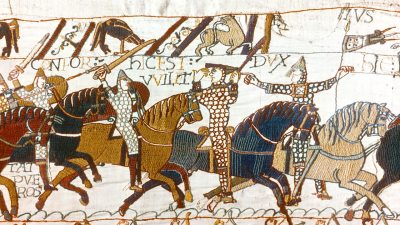
    Extract from Bayeux Tapestry: William raises his helmet

    At this time combatants did not widely identify themselves by designs on their shields and armour, although various adornments do appear. One scene, for example, shows William’s standard, and the shields of many of the French warriors are decorated with a wyvern, or winged dragon, an emblem of the French army. (See Davenport’s discussion of the beginnings of armory in the tapesty in British Heraldry [1921].)

    After the famous incident pictured, fighters across Europe took to painting individual emblems and insignias on their shields. This practice of ‘armory‘ developed sets of rules and conventions for elaborating the identity of fighters from the higher echelon, knights in particular.

    The herald’s role expanded to regulate an evolving symbolic language and record the heraldic insignia of other personages of note, incorporating a multitude of details of family, accomplishment and entitlement. As coats of arms proliferated over time, disputes arose about who had the right to use a particular emblem (or charge) on their shield (escutcheon).

    In 1389 Richard III himself decided the first heraldic legal case, which was fought over who had the right to bear the arms Azure, a bend or, subsequently known as the Scrope arms.

    Scrope arms: Azure, a bend or
    Scrope arms: Azure, a bend or. Source: Wikimedia Commons — (CC BY-SA 4.0)

    Perhaps in consideration of the simplicity of this form, and in anticipation of complexities to come, 1483 Richard instituted a Herald’s College or College of Arms to grant and control the use of arms in England (Grant, Manual of Heraldry p.6).

    Various categories of arms came to include:

    • Arms of Sovereignty or Dominion, those of the sovereigns of the territories they govern, such as the Russian Eagle and English Lions
    • Arms of Pretension, those co-opted by a prince or lord with a claim to a certain kingdom or territory, such as through marriage
    • Arms of Concession, granted in reward for virtue, valour, or extraordinary service
    • Arms of Community, for bishops, cities, universities, academies, societies, and corporate bodies
    • Arms of Patronage, for governors of provinces, lords of manors and the like
    • Arms of Alliance, gained by marriage
    • Arms of Succession, inherited or assumed by bequest, donation, etcetera
    • Arms of Affection, assumed from gratitude to a benefactor

    (Grant, Manual p.15-16)

    So far in J.F. Smith’s Mystery of the Marsh, Lord Bury has actually looked for the Whiston name in the “Herald’s Books,” and would render William, not merely an outcast from their society, but a virtual nonentity. He damns the young scholar with faint praise for “plucky perseverance” at study, at the service of “his fixed determination to win a name” (Chapter 20). Smith clearly sides with Clara Meredith’s critique of Bury’s patriarchal attitudes:

    ‘Oh you men […] with your pride of rank, your worship of a mere accident, your absurd veneration for musty parchments and the Herald’s blazon […] you bow down before idols which have not even artistic beauty to recommend them.’

    Lady Montague’s satirical observation, herself an object of partially affectionate satire for her snobbery, reflects an absurdly primitive susceptibility to totemic influence. (Durkheim notes the “analogies” of totems with the heraldic coat-of-arms.)

    ‘Are you not aware, Miss Meredith,’ she demanded solemnly, ‘that the crest of the Kepples is an eagle?’
    ‘Perfectly, aunt, I have seen it on her carriage a hundred times.’
    ‘And that the crest of this young man, if he has such a thing, is probably a goose, a sparrow, or some such ignoble bird, possibly a sucking pig,’ she added, in a tone of lofty indignation, which was completely thrown away upon her hearer, who could not repress a smile.

    (Chapter 22)

    She alludes not only to an implicit hierarchy of creatures that portray totemically the characteristics of the families they represent, but also to what she considers the unnatural aberration that results from breeding across limits of class and status: “It cannot be. It shall not be,” she insists. “Nature and heraldry are alike opposed to it.” It is simply not done to cross eagles with geese or sucking-pigs; the devil’s work, we might say.

    We can, in fact, find heraldic precedents, such as the anomalous creatures found in the coat of arms of the city of Great Yarmouth. After the Battle of Sluys against the French navy in 1340, as a gesture of thanks to the city for its contribution of men and merchant ships, King Edward III granted arms-of-affection, in the form of the three golden British lions passant (or “striding towards the [viewer’s] left”).

    These were dimidiated with Yarmouth’s own three silver herrings, resulting in the curiosities. “Dimidiation” is the practice of combining two separate coats by dividing both of them vertically, then joining the sinister and dexter halves (meaning respectively those on the bearer’s left and right).

    Coat of arms of Great Yarmouth Borough Council. Source:
    Coat of arms of Great Yarmouth Borough Council. Source: Wikimedia Commons (CC BY-SA 3.0)

    Great Yarmouth is only 18 miles from Norwich, the city of the author’s youth, so there is every chance that Lady Montague’s sarcastic comment quietly references the Yarmouth lion-herrings.

    Quartering” is a more evolved and versatile method of dividing coats of arms, such as occurs when families intermarry and inherit and otherwise acquire further arms. In principle, the term refers to dividing the shield into four parts by dividing it horizontally and vertically. In practice, it can extend by division into any number of rows and columns, in encompassing the complete arms to which an entity has a right. In order to show one’s maternal arms, for example, they may be quartered with paternal ones.

    Here are the quartered arms of Pamela Vivien Kirkham, 16th Baroness Berners (b.1929). They are in a “quarterly of ten,” incorporating her entitled arms of Williams, Tyrwhitt and Jones, Tyrwhitt, Booth, Wilson, Knyvett, Bourchier, Lovayne, Thomas of Woodstock, and Berners:

    Armoiries des barons Berners
    Armoiries des barons Berners. Source: WikiVisually (CC BY-SA 4.0)

    In this sense, Smith’s narrator speaks this week of Lady Montague “[falling] back upon her quarterings,” which he considers to be “rather a feeble stay.” Lawyer Whiston’s reference to the Allworths’ “ancient,” “moth-eaten” title with its “unexceptional” blazon bolsters this skeptical view of heraldry and the peerage in general. Sir George Meredith’s comment in Chapter 22 expresses a similar attitude:

    ‘We are not in the peerage, Clara,’ he added, ‘but we might have been. Refused it twice. The Merediths can count quarterings with the Montagues and the Allworths.’


    Chapter Twenty-three

    Death of Farmer Hearst — His Will — Goliah’s Prospects Brighten

    If Peggy Hurst did not bring her husband a fortune, she was not altogether dowerless. A sharp tongue and a strong will accompanied the gift of her hand, which, to do her justice, was a hard-working one. To such a woman it was no very difficult task to discover Peter’s weak points. Like setters, wives have a natural instinct that way. She speedily found them all out, and determined to govern him through them; an easy thing to accomplish — for the farmer had few brains, and was not much troubled with feeling — especially gratitude — else he had never lent himself to Peggy’s project of disgracing William, whose father had acted most kindly to him.

    That it failed was no merit of his.

    Parents must have had singular ideas of the discipline proper for children in those days, and it was no wise remarkable that Peggy shared the mistake, but commenced switching and spanking both her daughter and our hero at a very tender age.

    The boy was the first to rebel. On the last occasion his aunt ever made to punish him he snatched the switch from her hand, kicked the shin of the hired man, who had been ordered to hold him, and declared, passionately, that he would run away to his uncle in London. This settled the question as far as William was concerned; for Peggy stood in some awe of the lawyer, who, on his annual visits to look over the accounts, spoke so little, paid her no compliments, and exacted the last shilling due to his ward.

    The whippings of poor little Susan, however, were still continued, to the great distress of Willie and secret annoyance of her father, to whom she sometimes ran for protection, which the weak headed cipher had not courage to afford.

    At last the farmer did venture to interpose, not openly — that was not to be expected — but in his usual timid, hesitating, sly way, by asking his wife if she did not think it time Susan should attend school.

    Peggy regarded him fixedly, and asked what put that crotchet into his head.

    ‘Nothing— that is, nothing particular, my love. Only William’s uncle will be down in a month.’

    ‘I do hate that man!’

    ‘The boy says he shall ask him to remove him from the farm; that he won’t stay here to see his cousin whipped daily. You, of course, know best, my love,’ he added.

    This last observation somewhat mollified his wife, who merely muttered, in allusion to her nephew:

    ‘The little wretch!’

    ‘I sometimes think,’ continued her husband, ‘that the lawyer is rather fond of Willie. He does not show it much, but that is his way, I suppose. We shall miss the money for his board,’ he added.

    The last shot told, for it was levelled where Peggy was most sensitive, her interest, her tenderest feelings being in her pocket. She made no observation at the time, but from that day the whippings erased, and the nephew so far forgot his resentment in pleasure at the change that, when his uncle arrived, they were not even alluded to.

    Goliah and Lawyer Whiston were driving along the beaten highway to Deerhurst.

    ‘Is Peter really so ill?’ inquired the latter.

    ‘Mortal bad; three doctors ha’ been at him.’

    ‘Did Mrs. Hurst send for me?’

    ‘Not she. It war Susan told I to come. Thee be about the last person Peggy wants to see at the farm.’

    His companion regarded the speaker with a smile, rather surprised, perhaps, at his intelligence.

    ‘And so we thought it best —’

    ‘We!’ interrupted the gentleman. ‘How long have you been a plural?’

    ‘What be that? I an’t been a plural as I knows on.’

    ‘Nothing. Thinking of something else,’ said his companion. ‘How long have you and Susan been such excellent friends?

    Goliah regarded him with a half doubtful, half comical expression, as if he wished to trust him, but did not feel quite convinced of the prudence of doing so. Probably he regarded the step he meditated as a sort of forlorn hope, but after a moment’s deliberation, bravely took it.

    ‘Susan and I be in love,’ he said.

    ‘Ah! ah!’ ejaculated Mr. Whiston. ‘A suitable match.’

    ‘Does thee really think so!’ exclaimed the rustic.

    ‘Of course I do, really and truly.’

    ‘Then thee beest an honest man,’ added the lover.

    ‘Thank you; but you must not flatter me,’ observed the gentleman.

    ‘I won’t. I allays told Willie,’ added Goliah, ‘that thee wor an honest man for a lawyer.’

    The recipient of this rather equivocal compliment gave one of his quiet smiles.

    ‘The farmer be willin’,’ continued the speaker, ‘but his wife won’t hear on it — dead agin it. She wants her daughter to marry Benoni Blackmore, the schoolmaster’s son. They often meet i’ the Red Barn to talk matters over. They both do hate I,’ he added.

    His hearer recollected what the honest rustic had told him of the medicine his rival brought from the Bitterns’ Marsh for the farmer.

    ‘Surely,’ he observed, gravely, ‘you do not suspect any foul play?’

    ‘Lord bless thee!’ he said, ‘no. Nothin’ o’ that kind. Peggy be bad enough, but not bad enough for that. She wouldn’t hurt a hair of her husband’s head. She might pull out a few,’ he added, with a grin. ‘But p’ison! She wouldn’t p’ison even me. It was only herb drink, which some old woman at the marsh makes up. Folks say she be mortal clever.’

    Still the lawyer regarded him doubtfully.

    ‘I tell ’ee no,’ continued the speaker, earnestly. ‘Susan wouldn’t let her father take it. Maybe she had some such thought. Not agin her mother, but Benoni. But I know it wor all right. He hadn’t the pluck. So I swallowed a bottle of the stuff to satisfy her, and mortal nasty it wor.’

    This assurance, and the details confirming it, afforded his hearer great relief. It would have been a most distressing circumstance for William’s aunt to have been arraigned for. murder.

    ‘We are getting near to Deerhurst,’ he observed. ‘Now, Goliah, attend to my directions.’

    ‘Yes, I will.’

    ‘Pay no attention to anything I may say to Mrs. Hurst. I am going there in your interest and Susan’s; not hers. Possibly I may seemingly take sides with her, merely to–‘

    The lawyer hesitated. Possibly he did not like to complete the sentence.

    ‘I sees,’ exclaimed his companion, finishing it for him. ‘Pull the wool over her eyes. It will be a cunning trick that, and rare fun to see it; but thee canst do it — I know thee canst. Thee beest a lawyer.’ Evidently the speaker had not overcome all his prejudices against the profession, but he discriminated — made exceptions — that was something towards it. ‘

    By this time they had entered the village.

    When Peggy Hurst saw the only man, perhaps, she had ever stood in dread of, accompanied by the one she most hated, drive up to the door of farm, she coloured with vexation and anger.

    ‘Walk in, Mr. Whiston,’ she said. ‘Of course I am glad to see you. Not that I think poor, dear Peter is as sick as the doctors say. But as for that impudent, prying, meddlesome, mischief-making fellow,’ she added, pointing to Goliah, ‘he sha’nt set a foot in my house. He is not one of the family. He is not William’s guardian, and I can’t allow it .’

    ‘I have not the slightest intention of asking him,’ observed the visitor, coolly. ‘ In fact. I see no necessity for doing so; had there been, I should not have asked your permission. Half the house is my nephew’s. Let me advise you to keep a civil tongue in your head — a very civil one — for should your husband die the arrangement which gives you a home here will expire with him.’

    This was gall and wormwood with a drop of honey mixed with them, the honey being the tone of indifference in which the speaker alluded to her daughter’s suitor, who grinned with delight at hearing her thus lectured.

    ‘I don’t want to come into yer house, Mrs. Hurst,’ Goliah cried. ‘My own house is quite good enough for I, and it is our own — all on it, not half. The squire has paid I for bringing him down,’ he added, ‘and I ha’ naught more to say.’

    With this parting shot, which Peggy felt too indignant to answer, he drove off, whistling a tune as he went.

    When Mr. Whiston entered the sick man’s chamber he perceived at a glance the wisdom of the precaution Susan and her lover had taken in sending for him. The farmer was greatly changed, and evidently had not many days to live. Such at least was his impression, which the two medical gentlemen whom he found in the room, soon confirmed by a few whispered words. Susan, who was seated by the bedside — she had been his constant nurse — appeared to be crying bitterly. Despite his weakness, and even worse failings, she loved the old man dearly. He was her father, had been kind to her, as far as he dared; added to which she felt that it was not for the child, at such a moment, to judge its parent.

    ‘You need not whisper,’ said Peter Hurst, in the querulous tone peculiar to sickness. ‘I know what you are saying as well as if I had heard the words. How long, Mr. Whiston,’ he added, after a pause, ‘did the doctors tell you that I had to live?’

    ‘That is a question they cannot always answer,’ observed the lawyer, kindly.

    ‘Well,’ continued the patient, half muttering to himself and half aloud, ‘it can’t much signify. I am glad you are come, for my poor girl’s sake; she was always kind and good to William, so you will protect her on his account.’

    ‘On her own,’ said the man of law, firmly; ‘but to do so effectually I must possess full authority.’

    ‘You have it,’ answered the farmer, in an undertone, ‘The last time I went to Colchester to sell the hay I made my will — that is, Squire Smithers made it. You are sole executor. Be kind to Susan; she has been a good, affectionate child to her poor old father.’

    ‘Susan,’ he continued, after pausing to recover breath, ‘open the case of the cuckoo clock.’ He pointed to a large, old-fashioned piece of furniture standing in one corner of the room — it had been his grandfather’s, but long since valueless as a time-keeper. His wife never went to it, and had frequently requested him to exchange it for a modern one, but had failed to persuade him to do so.

    ‘There are two packets, father,’ observed his daughter, who had complied with the directions.

    ‘Bring them both,’ said Peter — ‘I had almost forgotten the other — and give them both to Uncle Whiston; but, first, let me see them. This is my will.’

    The lawyer placed it in the inside pocket of his vest.

    ‘And this,’ continued the dying man, who was evidently exhausted by the exertion he had made — ‘I can scarcely tell you what it is. I found it behind one of the beams in the chamber of the Red Barn, three years ago; but you will be able to make something of it.’

    Our readers will not have forgotten the parcel which Bunce saw the eldest of the fugitives conceal in the little room on the night they so nearly fell into the hands of the two tramps. Believing it contained letters or papers important to the interests of the Lady Kate, Martha had abstracted them from the desk of the French governess, Mademoiselle Joulair, and taken them with her on their flight.

    A smile of satisfaction rested on the countenance of Mr. Whiston, to whom a cursory glance had revealed their value, and he placed them, even more carefully than he had done the will, in the same secure pocket.

    One of the medical men now recommended his patient to take a little home-made wine with bark in it. His daughter administered it. It seemed less bitter from her hand.

    ‘He cannot last long,’ whispered the second doctor to the lawyer.

    ‘Not a word of what has taken place,’ observed the latter; ‘it might only disturb the last moments of your patient, and provoke unseemly discussion.’

    The gentlemen understood him — they were well acquainted with Mrs. Hurst — and bowed assent.

    The caution was not given one whit too soon, for the next instant Peggy came bouncing into the room. In her impatience to see Goliah safely off the farm she had forgotten her interests till the idea struck her that something prejudicial to them might be taking place. Looking suspiciously round, and seeing neither paper, pens nor ink were upon the table, her excitement cooled down. She noticed that the lawyer was watching her, and recollected the part she would be expected to play, that of an afflicted wife.

    ‘Poor, dear lamb!’ she said, shedding a few natural tears. Perhaps her conscience did reproach her. ‘Oh! doctors, can you do nothing for him?’

    The medical men shook their heads, and the speaker sank down upon her knees by the side of the bed as if in prayer. We trust it was sincere.

    ‘You have the will?’ murmured the dying man. ‘Keep it safe.’

    Whether the question had been intended for Mr. Whiston or his wife, we cannot decide. Peggy took it to herself.

    ‘Yes, Peter dear,’ answered the almost widow. Our separation will not be very long. We shall soon meet again, never to part.’

    The prospect thus held out did not seem to afford much satisfaction; in fact, it rather appeared to scare him. With a last effort he turned from her to the side of the bed where Susan, sobbing with grief, was sitting, gazed upon her fondly, then closed his eyes for ever.

    He had at least one consolation in dying — the last gaze that met his was that of true affection.

    That same evening Mr. Whiston returned to London, promising to come down again in time for the funeral.

    When he arrived the widow received him much more cordially than on the previous occasion. Then she had her doubts; there were possibilities to be guarded against; now everything seemed clear and satisfactory. Had she not the will, made years since under her own direction and approval? Peter’s worldly possessions would soon be in her hands, her daughter dependent upon her, her rule unshakable! Mr. Whiston came in his own carriage, too; that gratified her pride. Neighbors would see that she was well connected.

    We need not describe the funeral ceremony; the tears, artificial and genuine, shed on the occasion. There was at least one sincere mourner — the dead man’s child.

    On the return to the farm Peggy carried her confidence so far as to consult the gentleman on the steps necessary to prove her late husband’s will.

    ‘Probate must be taken at once,’ he replied. ‘We can do nothing till that is done. Let me see. Deerhurst, county of Essex, diocese of London. Doctors’ Commons will be the place. You must come up to town.’

    The widow hinted something about the expense. She could not think of going there alone, leaving Susan behind, and giving that wretch Goliah a chance of seeing her.

    ‘Pooh! Pooh!’ said Mr. Whiston. ‘Take no trouble about him, or the expense either. I shall be happy to receive yourself and daughter at my house in Soho Square.’

    The invitation was accepted as much from pride as economy, and the widow came to the conclusion that, after all, the lawyer was really an excellent person — a little odd, perhaps — but, then, he was an old bachelor — sufficient explanation, in most female minds, to account for any amount of eccentricity, short of insanity. As Goliah suggested, he had pulled the wool over her eyes completely.

    Like most of his profession, Mr. Whiston was a far-seeing man — made his arrangements beforehand; he detested nothing so much as being taken by surprise. With this end in view, he waited upon Lady Montague; the first time he had seen her since what his aristocratic client termed her niece’s preposterous engagement.

    Time had cooled down her anger, without removing her ladyship’s objections; but the sight of William’s uncle revived the former in all its original force. ‘So, sir,’ she exclaimed, ‘you have called at last. This is a pretty affair — my ward, Lady Kate Kepple, engaged to your nephew! Preposterous. It is no use your arguing. If Lord Bury has been silenced, I have not. Can’t understand him. But one thing is certain; I will never give my consent.’

    Many women, when aware of their weakness, have a habit of reiterating their determination to others, in order to keep up their courage.

    ‘I can only say,’ observed the gentleman, calmly, ‘that I felt as much surprised as your ladyship appears to be, when my young relative informed me of it.’

    ‘No doubt you did!’ said the aunt, sarcastically, ‘and delighted.’

    ‘Oh dear no, Lady Montague,’ answered the lawyer. ‘It was all very well; but I saw nothing in it to delight me. On the contrary, a considerable amount of vexation and trouble.’ The lady almost gasped with astonishment.

    ‘William’s fortune,’ continued the speaker, ‘will, in all probability, be a large one. His talents are acknowledged to be of an exceptionally high order. He is of the material of which lord chancellors, statesmen, and prime ministers are made; but youth is naturally impatient. Had he been content to wait, possibly he might have done better.’

    This time Lady Montague actually did gasp. This coolness and self-possession, where she expected to meet only confusion and respectful entreaties, actually dumbfounded her.

    ‘Better!’ she gasped; ‘better!’

    ‘Pray do not misconceive me. In person, fortune, and family, your niece is unexceptionable.’

    ‘I should think so, Mr. Whiston.’

    ‘There are other advantages, important only in a worldly sense, I grant you — such as political connections,’ observed the lawyer — ‘things to be considered.’

    His hearer drew herself up with a stately air.

    ‘You forget yourself, sir,’ she observed severely; ‘Lady Kate Kepple is the granddaughter of a duke!’

    ‘An estimable person in his time, no doubt,’ remarked the gentleman, ‘but weak, unfortunately very weak. The conduct of his duchess drove him to suicide instead of the divorce court, where a more sensible man would have gone. She is also the niece of Viscount Allworth,’ he continued, in a slightly sarcastic tone, ‘a very ancient title, blazon unexceptionable — so ancient that it has become somewhat moth-eaten.’

    ‘And mine?’ said her ladyship, drawing herself up with a stately air. She felt that she was getting the worst of the argument, and fell back upon her quarterings. As the world goes, rather a feeble stay.

    ‘And that is her noblest boast,’ replied Mr. Whiston, bowing with formal courtesy. ‘The reputation of Lady Montague is as unspotted as her heart. The slander-loving gossips of society, the human flies that live on carrion, have never yet discovered a taint in it.’

    The compliment, no less merited than graceful, was skilfully paid; few women could have resisted it.

    ‘Ah, well! You have such an odd way of putting things,’ observed the recipient of it, her excitement calming down considerably. ‘If you could only persuade your nephew to be reasonable.’

    ‘He is reasonable, very reasonable, for his age,’ said the lawyer; ‘it is hardly just to judge the impulsive feelings of youth from the standpoint of age. Pardon the allusion. Are you not alarming yourself unnecessarily? A hundred things may occur to change the feelings of Lady Kate and my nephew, while harshness and unwise opposition might tend to confirm them. My own experience in life,’ added the speaker, ‘tells me that comparatively few persons marry the object of their first attachment.’

    ‘O, I am not angry with Kate,’ exclaimed the aunt.

    ‘I presume not,’ was the reply. Lord Bury was not present, and if he had been, his nice sense of honor  would have held him tongue-bound. Possibly, also, the recollection of certain innocent flirtations in her own juveniles days, which had ended in nothing, occurred to her ladyship.

    ‘Perhaps we had better change the subject; but let it be understood that my consent will never be given to their insane project.’

    Her hearer smiled. Probably he knew the value of such resolutions. Lady Montague’s heart was, after all, much better than her head.

    ‘And now, Whiston,’ she resumed, ‘that this question be settled — quite settled, mind that — allow me to ask the motive of your visit? It cannot have been to say all these pleasant things to me ?’ she added good-humouredly.

    ‘Certainly not,’ was the reply. ‘It was intended, in the first place, for Lady Kate Kepple, whose sympathies I wish to enlist in behalf of a good, fatherless girl I am left guardian to; her mother, a most unwise person, is not fitted to be trusted with the office. She wishes to force her into a highly improper marriage.’

    ‘Have you accepted office as Cupid’s attorney-general?’ demanded his hearer, laughingly. ‘If so, I fear the more lucrative part of your practice will suffer. But what can my niece do?’

    ‘Everything,’ answered the lawyer; ‘by receiving her as a humble companion; in time, I trust, as a friend. She is of respectable birth; been reared in the country, unblemished in character — that I pledge my own reputation to — and requires no salary. Before speaking with Lady Kate upon the subject, I felt that it was only respectful and fitting to obtain your sanction.’

    ‘Very proper,’ replied Lady Montague; ‘most unexceptionable proceeding. Of course, I have no objection. Ah, Mr. Whiston, if you were only as reasonable and considerate in other things! But we will not touch on that subject again.’

    What followed were mere matters of detail unnecessary to enter into, it being understood that the protegee of the lawyer would be received at any time he thought fit to bring her. Somehow the gentleman forgot to inform his client of the name of his ward. We will be a little more frank, and hint to our readers that it was Susan Hurst. We suspect they have already guessed it.

    This edition © 2020 Furin Chime, Michael Guest


    References and Further Reading

    See also
  • J.F. Smith’s Mystery of the Marsh — Twenty-second Instalment

    J.F. Smith’s Mystery of the Marsh — Twenty-second Instalment

    We find a slight mix-up in the text this week, but one that involves a significant issue of plot and theme. It is where the young Lord Bury appears about to take Lady Montague’s side against William, in her confrontation with the two girls. Lady Kate draws up her slight, ‘scarcely fifteen’-year-old figure in a heroic stance and denies that Bury possesses any authority over her, or any right to judge her.

    Pre-prepared, Cousin Clara follows up with a disclosure that completely neutralizes him:

    ‘Especially … as in the event of her cousin’s death, unmarried, Lord Bury becomes heir to her estates.’

    Lord Bury promptly takes the point: that he may be perceived as having an interest in whether or not Kate marries at all, let alone to William, whom he considers her — and their — social inferior.

    Even at first glance, Clara’s comment seems illogical: Lord Bury is himself her cousin (as is Clara both his and her cousin, by the way). Obviously, if he dies, he cannot become heir to her estates. Clearly the statement should read:

    ‘Especially … as in the event of his cousin’s death, unmarried, Lord Bury becomes heir to her estates.’

    Put simply, if Kate dies unmarried, Bury will become her heir. Keep in mind that Kate is an orphan. She is already wealthy, having inherited her fortune from the Kepple family line.

    How might it stand that Clara and Kate are cousins? Sir George Meredith’s wife is not mentioned; we we assume her to be deceased (Ch. 4). Might it be that she is Kate’s late mother and the viscount’s late sister? Probably not, since in that case, Sir George would have been heir — and her surname is Kepple. 

    The reader is able to sketch out the family tree from various given bits of information, such as:

    • Kate is Viscount Allworth’s ‘orphan ward and niece’ (Ch. 4), and ‘the last descendant of one of the best families in the kingdom’ (Ch. 6)
    • Lady Montague is Kate’s aunt and joint guardian (Ch. 4), presumably Kepple’s sister
    • Sir George is Lord Bury’s uncle (Ch. 10)
    • Clara (daughter of Sir George Meredith the baronet) and Kate are cousins; as are Lord Bury and Kate; and Lord Bury and Clara

    We may infer that, probably:

    • Viscount Allworth (Lord Bury’s father) had two sisters, who are both deceased.
    • One of them married Kepple (Kate’s father).
    • The other married Sir George Meredith (Clara’s father)

    This makes Kate Kepple, Clara Meredith and Lord Bury (Egbert) all first-cousins.

    All these cousins …

    In the Victorian era, marriages between first-cousins were by no means uncommon, particularly among the nobility, as a mechanism for shoring up wealth, alongside various intangible assets — hallmarks of class. Keeping it all in the family, so to speak. At the top of the pyramid, Queen Victoria and her husband, Albert, were first-cousins.

    Wedding of Queen Victoria and Albert, Prince Consort, 1840

    In 1875, Charles Darwin had his son George devise some ingenious studies to estimate the incidence of first-cousin marriage across class. He arrived at the results:

      • 4.5% of marriages in the aristocracy were with first cousins (or about one out of twenty)
      • 3.5% in the landed gentry and upper-middle classes
      • 2.25% among the rural population
      • 1.15% among all classes in London

    (Kuper 722)

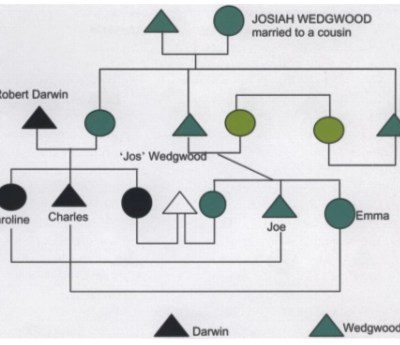
    Why were the Darwins so interested in the topic? Because Charles Darwin was himself married to his first-cousin, and his research into the processes of natural selection had caused him to become concerned about the possibly deleterious health effects of such close unions. Further compounding the issue for the Darwins was their complex intermarital connection with the famous Wedgewood family, whose dynastic pottery business was reinforced by a tradition of endogamy.

    First-cousin inter-marriages between Darwin and Wedgeworth families (Kuper 729)

    The Rothschild banking dynasty further attests to the competitive advantage secured by the tradition. Between 1824 and 1877, as part of a planned strategy to consolidate the partnership of the five fraternal branches of the bank, thirty of the thirty-six patrilineal descendants of the founder of the House of Rothschild married first-cousins. Seventy-eight percent of marriages were “with a father’s brother’s daughter or a father’s brother’s son’s daughter”. The practice terminated when “the institution of joint-stock companies changed the banking environment” (Kuper 728):

    Cousin marriage and sister exchange reinforced new social, political, and economic networks that came to the fore in Victorian England, and which provided the country with a new elite.

    (Kuper 731)

    Incidentally, Darwin revised what were his initial concerns about the severity of health effects. Genetists in the present day believe that the risk of birth defects or infant mortality is approximately doubled, which is not considered to be significantly high. Relevant attitudes changed, however, particularly those pertaining to the conception of incest, and the incidence of first-cousin marriage diminished, falling, by the 1930s, to a rate of 1 in 6,000.

    The complexity of relations in Smith’s Mystery of the Marsh appears beyond doubt to be informed by the late nineteenth-century controversy surrounding first-cousin marriage. Indeed, part of the ‘mystery’ lies in piecing together the family relationships between key characters, within contextual themes of class structure, dynastic continuity, and the importance of inheritance to the independence of women.

    Hence, we may note variations on the theme, such as:

    1. Lord Bury’s nascent romantic interest in his cousin Clara, who is the present heir to the country estate of Chellston, to which he himself had been heir, until his father Viscount Allworth sold it to Sir George Marsham, her father. Both the viscount and Sir George mention the possibility that a marriage between Bury and Clara would enable him to regain the estate.
    2. Goliah’s previous concern that William may have been interested in his cousin Susan, which is varied so as to distinguish the issue in terms of social class
    3. The Allworths’ plot to foist their son Clarence Marsham onto Kate. He is her first cousin by marriage only, but not by blood, being the issue of Viscountess Allworth’s earlier marriage. (Her shadowy past, however, is sure to contain some uncomfortable surprises.)
    4. Kate’s being fourteen years of age makes Clarence’s attempted physical assault on his step-cousin particularly nasty, and perhaps relevant to changing historical conceptions of the child.

    CHAPTER TWENTY-TWO

    A Love Confidence — Lady Kate Relates her Experience to her Cousin Clara — The Vow of Mutual Assistance — Lady Montague and Lord Bury Attempt to put a Spoke in Cupid’s Wheels

    Lady Kate was far too ingenuous a person to keep the fact of her engagement to our hero a secret from those who, by kindness and affection, possessed a right to her confidence. Her Cousin Clara, as was only natural, was the first to whom she imparted it. The warm-hearted girl did not betray an extraordinary amount of surprise when she heard it. The last six or eight months had considerably modified her views of life, society, and what the world calls happiness; still she could not help looking a little grave at the intelligence, and for several instants remained silent.

    ‘You disapprove of my conduct?’ whispered the blushing girl.

    ‘I have no right to do so.’

    ‘Yes, but you have,’ replied her cousin. ‘The right which sisterly affection gives. I never intended to come to an explanation, and I feel certain he did not with me; and yet, somehow, I shall never understand exactly how it happened. The secret of his love broke forth despite of him.’

    ‘And you?’

    ‘I would have died rather than have confessed it unasked, although I have loved him almost from the hour we first met; but he looked.so wretched, so hopeless, spoke so pitifully, that I found myself in his arms without knowing how I came there.’

    ‘That unfortunate duet,’ thought Clara. ‘I foresaw it all. What will Bury say?’

    ‘Do speak to me,’ sobbed her cousin, ‘if only to tell me how weak I have been.’

    Miss Meredith felt touched; possibly she had her own little secret in some sly corner of her heart.

    ‘No, Kate, darling,’ she replied, throwing her arms around her neck and kissing her. ‘With the same feelings — had I been placed in a similar position — I should have acted just as you have done. Have you informed Lady Montague?’

    ‘Not yet,’ was the reply. ‘I suppose I ought to have confessed it to her first; but it seemed so much easier to come to you. I thought you would help me.’

    ‘Thought I would help you!’ repeated Clara, in a slight accent of reproof.

    ‘Knew you would. I am still so confused that I scarcely know how to express myself,’ added the pretty culprit. ‘I did not mean to be ungrateful.’

    And the eyes of the speaker filled with tears.

    ‘I am sure you did not,’ observed her cousin. ‘I did not even suspect it; but friendship is sometimes jealous of its rights. You must tell her at once. She will be angry at first, no doubt — very angry — and scold.  It is the privilege of aunts to scold; but it will not last long, especially when she sees how wretched it makes you.’

    ‘It is not my dear, kind guardian’s displeasure that I most dread,’ answered Kate. ‘I knew her warmth of heart too well to fear it greatly. It is Bury that I fear. You know how Lady Montague is guided by his opinions. His pride of birth — dread of the world’s censure — will incline them against me.’

    ‘Not against you, dearest.’

    ‘Against William, then; it is the same thing.’

    ‘How she must love him!’ thought Clara, struck by the simplicity of the avowal.

    ‘It is there,’ added the speaker, ‘that I require your assistance.’

    ‘Why, what influence can I exercise over him?’ exclaimed her cousin.

    ‘You best can answer that question,’ observed Kate. ‘Forgive me,’ she continued, struck by the sudden paleness which overspread the countenance of her confidant. I fancied — that is, I believed — that he loved you.’

    Miss Meredith tried to force a smile.

    ‘Because you love me, darling,’ she replied. ‘You must not imagine that every one sees me with your partial eyes. Egbert never uttered a word of love to me; his conduct has been most kind; a brother’s regard for a sister — nothing more.’

    ‘Then he is more blind than I –‘

    ‘Hush!’ whispered Clara, as she bent over the head reclining upon her shoulder, and kissed it softly.

    Was it to conceal a tear?

    Lady Kate respected the delicacy of her cousin too much to allude to it again.

    Before seeking the dressing-room of their venerable but somewhat weak relative, Clara contrived to have a brief conversation with her father, in which she explained the difficulties of her cousin’s position, and begged him to use his influence with Lord Bury to soften his opposition to the engagement.

    ‘Why, what can I do?’ demanded the baronet, half testily, half playfully.

    ‘Reason with him, papa.’

    ‘And a great deal of use that would be,’ continued the former. ‘He is as obstinate in his opinions as a year-old pointer, and harder to break. When once he has taken one up, he thinks it a point of honour to adhere to it.’

    His daughter sighed. She felt that it was but too true.

    ‘Honour!’ repeated the speaker, musingly. Then he paused, and a smile stole over his good-natured countenance.

    ‘After all, perhaps,’ he said, ‘it is just possible that I may be of some service to Kate — a sensible girl. I cannot see anything so very preposterous in her choice. I like Whiston. He has acted honourably, and I should not think — not that I would choose it — the alliance a disgrace. We are not in the peerage, Clara,’ he added, ‘but we might have been. Refused it twice. The Merediths can count quarterings with the Montagues and the Allworths.’

    ‘Never mind our quarterings. I have them all by heart. The point is to help Kate.’

    ‘If Bury becomes very obstinate and makes a strong fight,’ said Sir George, ‘put the following question to him. It may not convert, but I think it will silence him.’

    He whispered the rest in her ear.

    ‘Does be know that?’

    ‘No!’ exclaimed.her father. ‘If he did, I should entertain a very different opinion of him.’

    It would be superfluous to describe the manner or repeat the words in which Lady Kate informed her aunt of her engagement. As Clara Meredith predicted, the storm proved a violent one, yet strange to say, her wrath fell chiefly on our hero.

    ‘The villain!’ she exclaimed, as soon as she had recovered sufficiently from her surprise to speak. ‘So artless and unassuming as he seemed! I have been terribly deceived. But there is no trusting to men. The best of them are crocodiles, or something worse, You must break it off. Mind, I say must. Then perhaps I may forgive you. The young man will threaten scandal, no doubt, or require money,’ added her ladyship. ‘I will provide that. I must pay for my folly in receiving him here.’

    ‘Money!’ repeated Kate, her niece, indignantly. ‘Do not insult him, aunt.’

    ‘Indeed, you wrong him,’ observed Clara.

    ‘You, too, in the plot?’ said Lady Montague, despairingly. ‘But I might have expected as much. No use, Clara. I am rock — adamant — this time. It cannot be. It shall not be. Nature and heraldry are alike opposed to it.’

    The last argument appeared to the speaker unanswerable, but the true friend of the lovers was not so easily silenced. Throwing her arms around the neck of her angry relative, who did not very much resist her caress, she continued:

    ‘I cannot see the force of your objections. Nature is to blame more than poor, dear Kate. Why has it given us hearts to love? Sense — not that girls always use it — to admire true worth and manhood. Recollect how nobly William protected her, when yet a mere boy, from the machinations of that villain, Clarence, She can’t help loving him.’

    The old lady wrung her hands despairingly.

    ‘That dreadful scandal will be revived again,’ she murmured to herself.

    ‘As for her heraldry,’ added the fair advocate, ‘I really cannot see what that has to do with the affair.’

    Here the aunt felt herself on firm ground.

    ‘Are you not aware, Miss Meredith,’ she demanded solemnly, ‘that the crest of the Kepples is an eagle?’

    ‘Perfectly, aunt, I have seen it on her carriage a hundred times.’

    ‘And that the crest of this young man, if he has such a thing, is probably a goose, a sparrow, or some such ignoble bird, possible a sucking pig,’ she added, in a tone of lofty indignation, which was completely thrown away upon her hearer, who could not repress a smile.’

    Strong resentments are seldom very lasting with the aged. They dislike, too, seeing those they love made wretched. The tears of Kate, the wistful, imploring, though mute expression in her eyes, produced a greater effect on her aristocratic relative than even the eloquence of Clara. She was distressed, but not subdued; prejudice was still too strong.

    It was at this critical point in the interview with her nieces that Lady Montague gained an ally by the appearance of Lord Bury, who entered the dressing-room unannounced, as their near relationship permitted him.

    From the agitation of Kate and the pale countenance of her aunt, he guessed what had transpired. Most heartily did he wish the absence of both his cousins. He knew that his opinion would be asked, but although perfectly ready to express it, he disliked giving pain to any one.

    ‘Egbert! Egbert!’ cried the old lady, in a tone of almost helpless perplexity, ‘there has been such a scene, and I want your advice.’

    The young nobleman bowed gravely.

    To the astonishment of both aunt and nephew, and the delight of Clara, Kate drew up her slender form with queen-like dignity. Her eyes were still red with weeping, but her voice never for an instant faltered, as she observed:

    ‘When I am aware of his lordship’s right to interfere between us, aunt, I may perhaps be induced to listen to his opinions, but till then must decline to be swayed by them. He does not understand me, and should not presume to judge me.’

    ‘Especially,’ added Clara, ‘as in the event of her cousin’s death, unmarried, Lord Bury becomes heir to her estates.’

    With a respectful curtsey to Lady Montague, and a cold, distant bow to her nephew, the speakers quitted the apartment.

    ‘Well!’ ejaculated the old lady, in a tone of bewilderment.

    His lordship appeared greatly surprised at the intelligence, which was perfectly new to him, and struck him painfully.

    ‘Were you aware of this?’ he demanded of Lady Montague.

    ‘Of course I was,’ said his aunt. ‘The settlement was made at the time of my sister’s marriage. I am a trustee to it, or some such troublesome thing. Sir George Meredith and your father are the others. I wonder Allworth never told you.’

    ‘It would have been more strange if he had. The viscount kept the knowledge to himself as something that might one day be useful.’

    With a look of bitter reproach, which on the present occasion his relative certainty did not merit, her nephew rushed from the dressing-room.

    ‘What does it all mean?’ exclaimed her ladyship, as she sank back in her luxuriously cushioned easy-chair. ‘What can the settlement of Kate’s fortune have to do with her absurd engagement? I shall never understand it.’

    Of course the speaker, in the simple uprightness of her nature, could not comprehend it; never suspected that the motives of her nephew in opposing what the world would consider a most unequal match would be misjudged. Worldly interests, to do her justice, had not the slightest share in her own objections.

    ‘You acted admirably, Kate,’ whispered Miss Meredith, when they had regained the privacy of their own boudoir. ‘It was noble — grand.’

    ‘Do not praise,’ faltered the now trembling girl. ‘I wonder at my own courage. I could have endured the blame Bury cast upon my conduct meekly, but not the scorn he heaped upon William. It was that which roused me. ‘

    ‘How did you hear of the settlement of my fortune?’ she added.

    ‘My father told me in confidence,’ answered Clara, ‘to help you in your trials. But you must not betray the secret. Do you think Egbert knew of it?’

    Kate reflected several instants before making a reply.

    ‘No, a hundred times no!’ she exclaimed. ‘He is too honourable, too high-minded for that. Had he known or even suspected the fact it would have fettered his tongue in silence, whilst his opinions remained the same,’ she added, with a sigh.

    A look of intense satisfaction beamed on the countenance of Clara on hearing this generous vindication of Lord Bury’s delicacy and high principles from lips so truthful.

    ‘Ah! Kate,’ she sighed, ‘men rarely do us justice. We are better than they give us credit for.’

    The groom of the chambers entered the boudoir with a card on which Lord Bury had hastily written a request for an interview.

    ‘Better have it out at once,’ observed her cousin, to whom she had handed it as if for advice. ‘We are in the right, darling, and right gives strength. Tell his lordship,’ she added, ‘Lady Kate will join him in the drawing-room directly.’

    The domestic retired with the message.

    ‘One effort more, darling,’ continued the speaker, ‘and I think we shall have discomfited the enemy’s first attack. Others will doubtless follow, but we shall be prepared for them. Why, that is well; try this essence. You look calmer now. I think we may venture to descend.’

    ‘You will go with me?’ said Kate, clinging to her arm.

    ‘Allies to the death!’ answered Clara Meredith, with apparent gaiety. We say apparent, because her own heart felt anything but at ease.

    ‘I requested this interview,’ said Lord Bury, coldly but kindly, ‘to assure Lady Kate Kepple that I can no longer take an active part in opposition to her wishes.’

    His cousin held out her hand. The speaker touched it slightly.

    ‘The opinion I have formed,’ he continued, ‘unfortunately remains unchanged; but honour and self-respect must henceforth prevent my giving utterance to it. Had I been made acquainted with certain family arrangements sooner, a great pain would have been spared me. I should not have been misjudged.’

    ‘Not a word for me,’ thought Miss Meredith, with something very like a sigh, which she instantly suppressed.

    ‘Spoken like yourself, Egbert,’ answered his cousin. ‘I know how loyally you will keep your promise. But why not call me Kate? It sounds far more kind.’

    To this his lordship only bowed.

    ‘As for the settlement you alluded to,’ he added, ‘had I only known –‘

    ‘Not a word!’ exclaimed the agitated girl, interrupting him. ‘The honour and delicacy of Lord Bury need no vindication here. Clara and I are both convinced of that. I felt as much surprise as you did when I heard it.’

    ‘I stand higher in your opinion than I hoped,’ observed his lordship.

    ‘But not higher than you deserve, does he, Clara? Promise me one thing; it will make me happy, or nearly so. Do not call me Lady Kate again. Let it be Kate and Egbert as it used to be.’

    ‘It shall be as you request.’

    ‘And you will come to see us just the same as if this dark shadow had never passed between us? Say yes, dear cousin Egbert.’

    ‘Of course he will say it,’ observed Clara Meredith, almost gayly — ‘or I shall suspect the chivalry of the Allworths has died out. We are neither of us blessed with brothers to take care of and protect us. Bury is the nearest of our kith and kin; we have almost a sister’s claim on him; besides who so fit and qualified?’

    Few young fellows, we suspect, could have resisted so flattering an appeal from such lips. Certainly his lordship did not. Seating himself between the two cousins he kissed a hand of each.

    ‘It shall be as you desire,’ he replied, ‘since you do me the honor to desire it. And from this hour all unpleasant subjects shall be tabooed between us.’

    The agreement was faithfully kept, and whether his lordship’s opinions and prejudices remained unchanged, or time gradually modified them, he never again alluded to them.

    On the morning on which the interview we have just described took place, Lawyer Whiston felt somewhat surprised by a visit from Goliah Gob. The honest fellow did not much like running the gauntlet of the clerks’ office, and generally called, when he came to London, at the house in Soho Square. The quick eye of the man of law detected at a glance that the visitor was somewhat excited.

    ‘Sit down,’ he said; ‘just ten minutes before I go to court. Anything the matter? But first let me tell you, Willie is quite well. Letter last night. Can only spare ten minutes.’

    ‘Thank goodness for that, it be more than I durst expect; for misfortunes allays come double, as folks says.’

    ‘Why, what is the matter, Goliah?’

    ‘Peter Hurst is dying, and he do want to see thee very bad. Something about his daughter, something about Willie, and something about myself.’

    ‘Yourself!’

    ‘Yes, Peter has been quite kind and sensible loike of late. Now, his wife can’t bear I, and watches Susan and I as a cat does young sparrows. So thee must spare more nor ten minutes, and come wi’ me to Deerhurst.’

    ‘Is he so bad, then?’

    ‘Three doctors wi’ him,’ answered the visitor. ‘And that sly fellow, Benoni, brings him physics from the Bittern’s Marsh.’

    These last words decided him. Lawyer Whiston put off his engagements in court, gave certain instructions to his confidential clerk, and in little over an hour was on his way to Deerhurst, driven by Goliah Gob, whose easy-going team were astonished at the hints of their young master that he was in a hurry to get home.

    This edition © 2019 Furin Chime, Michael Guest


    References and Further Reading

    Anderson, Nancy Fix. ‘Cousin Marriage in Victorian England’. Journal of Family History, 1986.

    Bittles, A.H. ‘Background and outcomes of the first-cousin marriage controversy in Great Britain’. International Journal of Epidemiology, 2009, 38: 1453-1458.

    *Kuper, Adam. ‘Changing the subject — about cousin marriage, among other things’ (Huxley Lecture, 14 Dec. 2007; Journal of the Royal Anthropological Institute, 2008, 14: 717-735.

  • J.F. Smith’s Mystery of the Marsh — Twenty-first Instalment

    J.F. Smith’s Mystery of the Marsh — Twenty-first Instalment

    There is an idiosyncratic slide, moving from the omniscient narrator’s opening reflection on the parable of the “wise and foolish builders,” to Theophilus (Theo) Blackmore’s own seemingly spontaneous reflection on “Sand! sand!” in his meeting with Viscountess Allworth. It is almost as though the narrator informs as much as observes the character’s consciousness.

    To date, Smith’s allusions have been mostly historical or classic-literary, as in this episode’s playful gesture where he invokes the Hippogriff — a beast from Greek myth familiar to Harry Potter fans — in dramatizing a simple scene break, and thereby transporting the reader from London to Dinant, in France, at a speed faster than thought.

    It might be interesting, then, to consider the builders’ parable for a moment — especially given its “originary” significance to the Christian institution. The parable appears in Mathew 7:24-27 and Luke 6:46-49, attributing to Christ’s words the power to raise mankind above the chaos of the world. According to Saint John Chrysostom (c.340 – 407), in Christ’s telling of the parable:

    By “rain” here, and “floods,” and “winds,” He is expressing metaphorically the calamities and afflictions that befall men; such as false accusations, plots, bereavements, deaths, loss of friends, vexations from strangers, all the ills in our life that any one could mention. “But to none of these,” says He, “does such a soul give way; and the cause is, it is founded on the rock.”

    He [Christ] calls the steadfastness of His doctrine a rock; because in truth His commands are stronger than any rock, setting one above all the waves of human affairs. For he who keeps these things strictly, will not have the advantage of men only when they are vexing him, but even of the very devils plotting against him.”

    Homily 24 on Mathew

    The author of the Gospel of Luke and the Acts of the Apostles addresses his work to a listener who goes by the name of Theophilus, held traditionally to be a companion of Saul/Paul. Christian scholars have variously supposed this Theophilus to have been a Jewish high priest, a Roman official, or simply, as his name suggests, one “loved by God.”

    Luke’s explicit aim is to assure Theophilus of the truth “of the things he had been taught” (Luke 1:3-4); for example, of the resurrection and the spread of Christianity in the Roman Empire. Smith’s character Theophilus is notable for his morbid bookishness and is, it emerges, increasingly morally compromised. Is he nonetheless redeemable?

    According to Christian standards, of course he is; by the logic of Smith’s own narrative, this remains to be seen. I wonder whether an extreme sacrifice may be necessary.

    Remarkably, the magic whisper our Theo receives from the narrator is like an inspirational summoning to ethics. Yet he plans to collaborate with the viscountess in some dastardly plot, evidently one intended to ensnare the lovely Lady Kate in a loveless marriage with her morally bankrupt loser of a son, the disgraced Royal Horse Guard, Clarence Marsham, currently residing in Dinant.

    The narrator himself refers the metaphor of building on the rock not to faith in Christ as such, but instead to a concept of “the rock of integrity,” suggestive of a more agnostic view, which may be more indicative, we feel, of Smith’s own. Viscountess Allworth’s riposte at Theo’s implicit censure goes a step further, and is worthy of a Schopenhauer or a Nietzsche:

    ‘My house is erected on indomitable will, cemented by past success — guarantees against the future,’ observed his visitor, sneeringly.

    Clearly not the approved perspective, as reasonable as it may seem to us postmoderns.

    The theme is developed as well at a tangent, the opposition of “superstructure” to “base”; which is equivalent to that of “superficial appeal” as opposed to “being solidly grounded” — such as in Christ or in some form of integrity (a Christian view being that the latter needs to be grounded in the former).

    This secondary version of the parable is in the form “all that glitters is not gold” — or after Shakespeare, all that “glisters”. Living our life in pursuit of superficial attractions would be analogous to building upon the sand. The viscountess is such a person, and we now become privy to the tenuous underpinnings of her privileged status, and their further manifestation in the character of her son.

    Her attraction to the glitter of social position, at the expense of integrity, generates the villainous momentum that placed Kate and her maid-servant at such dire peril in the novel’s opening scenes in the red barn at Deerhurst and is still at work hatching further dark schemes.

    Love’s Shadow (1867), Frederick Sandys. Source: Wikimedia Commons; Sotheby’s NY.

    CHAPTER TWENTY-ONE

    A House Built on Sand — Very Showy but not Secure — News of Clarence Marsham and Squire Burcham — They Meet at Dinant, in France

    We are warned by an authority older than modern civilisation not to build our house upon sand. How many stately edifices have been swept away from being erected on no better foundation. The world witnesses it daily, and yet the supposed wiseacres of the earth are continually falling into the same fatal error, looking to the superstructure rather than the base. The rock of integrity, on which alone a solid mansion can be reared, appears to them so hard to dig — the process is too slow.

    From the glimpses already given of the character of Viscountess Allworth, our readers already, doubtless, have divined, that she has been one of the unwise builders alluded to. In the eyes of the world her position appeared a most enviable one. Born in obscurity and poverty, she had become rich and titled by the exercise of talents bestowed for far different purposes. Not that we despise wealth; on the contrary, we consider it a blessing, when honestly acquired and nobly used; but for mere rank — the thing that men are born to — we feel a profound indifference. Like the cap and bells, it merely serves to make folly appear more ridiculous, and adds not one iota to the consideration justly due to the really great and virtuous.

    Her ladyship felt greatly annoyed. She had just received a note from a person whom she had not met for years, and trusted never to meet again; and yet they had never lost sight of each other.

    The note was a very laconic one: ‘I must see you.’ It had no signature, but the address of the writer was given, an obscure street in the Strand.

    ‘What can he want?’ she murmured to herself. ‘Money?’ No, to do l him justice, he has never been unreasonable on that score. There can be no real cause for alarm, for, although my plans are laid, no overt action has been taken to put them in execution.’

    After a few minutes’ reflection she continued: ‘I dare not refuse. A false alarm, or, more likely still, some scholarly crotchet he wants my influence to gratify. Would he were dead,’ she added, deliberately. ‘I could breathe freely then. The grave is the only safe confidant.’

    Of course, it would never do for the fashionable Lady Allworth to be seen in her own equipage driving down one of the narrow, obscure lanes of the Strand, even if it did bear the aristocratic name of Cecil-street. A century previous and royalty might have been seen there without exciting surprise; but times have changed. Mansions formerly the abode of nobles have either been pulled down or converted into lodging-houses, and those not of the highest class.

    After attiring herself in a very plain dress and wearing a thick veil her ladyship quitted Allworth House unattended, and walked as far as the quadrant in Regent-street. There she took a cab, and directed the man to drive to No. 13 Cecil-street.

    It was so short a distance that the driver at once set her down for a stranger in the metropolis, and mentally resolved to charge her half a crown.

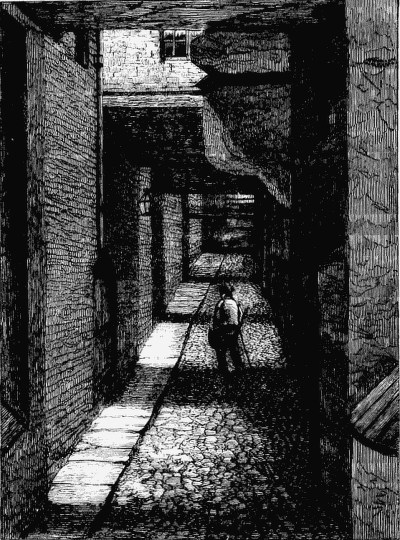
    Ivy Bridge Lane, in the Strand, from Old and New London, Vol. 3, (Cassell, Petter & Galpin, London, 1878). Source: British History Online.

    On reaching the house Lady Allworth felt greatly annoyed that the smallest coin in her purse was a half sovereign. The man eyed it greedily.

    ‘Can’t do it, Miss,’ he said. He always said ‘Miss’ to his female fares; fancied they liked it. ‘Yours was the first off the stand this mornin’. Large family; wife sick; very poor, but honest, that a well-known fact. If you like to trust me with the half skiv’ (slang word for half a sovereign) ‘I can melt it at the Fox and Geese and bring you back your change ker-rectly, Miss, in five minutes.’

    Of course her ladyship was not deceived, but she pretended to be so. Anything appeared preferable to waiting on the street and risking the chance of a discovery.

    ‘Yes, I dare say,’ she replied. ‘Very dreadful, no doubt. ‘I am not rich, but can feel for honest poverty. You may keep the half-sovereign, and may it do you all the good I wish.’

    ‘God bless you, Miss!’ exclaimed the driver, jumping on the box of his vehicle with an alacrity surprising for his years and starting his worn horse at a rapid pace.

    Lady Allworth stood watching him till he and his cab disappeared by turning into the Strand. Then, with a sigh of relief, she rang the bell of a respectable-looking house near her. It was answered by a slatternly-looking maid-of-all-work.

    Lady Allworth asked if the person whose address she had was in.

    ‘Yes, mam,’ said the maid. ‘Jest step into the parlor. ‘Missis is gone up to the gentleman’s room to see what he wants for dinner; down in a minute — do take a cheer.’

    The visitor, who felt tired as well as agitated, silently accepted one.

    ‘Come to git your fortin told?’ added the speaker.

    ‘Fortune told!’ repeated the lady, greatly surprised. ‘No. Why do you ask such a ridiculous question?’

    ‘Beg pardin, mam, didn’t know; thought you might. I and the missus made up our minds the gentleman wor sothing o’ that sort when we seed the books he brought with him; such odd-lookin’ letters. No Christian ever printed them.’

    ‘Perhaps you cannot read,’ observed the visitor, with a half-suppressed smile.’

    The maid-of-all-work tossed her head, curl papers and all — for she only took them down in the afternoon — indignantly, as if she had received some personal affront.

    ‘Indeed, mam, but I can read. ‘I wor edicated at St. Pancrass, and wor called the best scholard in the school.’

    Considering the lamentable state of the school system for the poor in England of the time, there appeared nothing very improbable in the assertion.

    The landlady now made her appearance, and inquired if she were the person whom her new lodger expected.

    ‘Yes.’

    ‘He is quite ready to receive you. This way, if you please. Will show you upstairs myself. His daughter, I presume?’

    The question was put forth as a feeler, but failed to elicit a reply.

    Second class furnished apartments, as their as their owners ambitiously term them, in the days of the regency, were sad uncomfortable affairs. The same crimson, moreen curtains, probably twice dipped, bordered with black cotton velvet; the half dozen regulation chairs, one facetiously called an easy one, and a ricketty table, generally comprised the entire furniture. In the more pretentious ones a couple of engravings — the death of Wolfe or the Battle of Trafalgar — might occasionally be found. Where such was the case, they added considerably to the price. Lodging-house keepers make money out of everything. The style has somewhat improved at the present day. Not in comfort — O! dear, no — but in show. As Shakespeare says, the world is still deceived by ornament.

    On the first floor, into such a room as we have described, the visitor was shown. Its occupant was a well-dressed man, with a white beard — an unusual appendage in those days. He was seated in the easy-chair. A pile of books, most probably Greek classics, which had so excited the curiosity of the maid-of-all-work, were on the table beside him.

    It was our readers’ old acquaintance, Theophilus Blackmore, the tenant of the martello tower and school-master of Deerhurst.

    ‘Take a chair, Zelinda,’ he said, without rising from his seat. ‘I will not trouble you to wait.’ This was addressed to the landlady, who disappeared with a dissatisfied air.

    Lady Allworth was about to close the door after her, when the speaker added:

    ‘Leave it open. It faces the staircase: She cannot return to listen without our being aware of it. Now turn your chair and face me. I will watch the door.’

    It was not till these instructions had been carried out that the viscountess raised her veil. The old man gazed upon her countenance long and earnestly.

    ‘Time has little changed “you,’ he observed. ‘You are still the same resolute being whose courage and strong will excited my admiration in the past. Well, Zelinda,’ he continued, ‘you have, succeeded in the objects of your ambition — wealth and rank. How the dead would laugh in their graves could they see to what heights you have climbed! You are rich and a peeress.’

    ‘Not so wealthy as you suppose. Clarence has been a sad drain upon me.’

    ‘You love your son, then?’

    ‘Devotedly.’

    ‘The question was an unnecessary one,’ said the questioner. ‘You would not be human if you did not. It is the weakness of maternity. The she wolf will fight for her young.’

    ‘Thank you, Theo!’ ejaculated the lady.

    ‘You know I rarely compliment,’ was the reply. ‘You still adhere to your project of this marriage?’

    ‘More tenaciously than ever,’ answered Lady Allworth, harshly. ‘My poor boy dares not return to England, or show his face in society if he did, till it is accomplished. Not so much for the girl’s fortune — that, although an important motive, might be got over — as on account of an unsuccessful attempt to — ‘

    ‘Yes! yes!’ interrupted her hearer. ‘I have heard all about the affair. It was foolishly contrived and badly managed. Clarence has not his mother’s brains.’

    ‘I thought you never complimented.’

    ‘Truth is no compliment,’ observed the schoolmaster. ‘The fact is, your son is a reckless idiot.’

    ‘Was it to tell me this,’ exclaimed her ladyship, her countenance flushed with mortification j and anger, ‘that you quitted your retreat, left your beloved books, and sought this interview? Your son — you see I am aware you have one,’ she added sarcastically — ‘is, doubtless, perfection?’

    ‘Benoni might be wiser,’ answered the old man, evasively, ‘but he is no fool, and has few scruples, as yourself. But we will not speak of him.’

    ‘As you please,’ said his strangely assorted confederate — for such they evidently were — in a tone of the utmost indifference. ‘But you have not yet informed me of the motive of your visit to London.’

    ‘I am uneasy in my mind.’

    ‘Some Greek root puzzled you?’ asked the lady, alluding to his favourite studies.

    The scholar smiled.

    ‘Ah, Zelinda,’ he said, ‘if you had only been content to share my labours; but it is useless to regret that now.’

    ‘Perfectly!’ ejaculated her ladyship. ‘Well, then, we will confine our conversation to the present and the future,’ observed Theophilus Blackmore, with a sigh. ‘You are fixed in your purpose of effecting this marriage?’

    ‘Immovably so.’

    ‘I have carried out your instructions,’ continued the former, ‘but you were wrong to have transmitted them through Brit. I doubt that man. It was still more unwise to assist him in his scheme for plundering Burcham, who has escaped from the Bitterns’ Marsh.’

    ‘Where can he have fled to?’

    ‘To France — to Dinant, Brittany.’

    ‘There must have been treachery!’ ejaculated his hearer.

    ‘Not on my part,’ answered the tenant of the tower. ‘Everything is prepared as you desired. The loopholes have been newly barred. The place is provisioned for a month, water unfailing. It would stand a siege. As for the wild inhabitants of the swamp, my influence over them since I obtained the lease is unbounded.’

    ‘In half the time you name,’ exclaimed the viscountess, in a tone of confidence, ‘Lady Kate will be the wife of Clarence. Pride — the dread of the world’s scandal — will overcome her childish repugnance, and my son’s position be secured.’

    ‘Sand! sand!’ murmured the ex-schoolmaster, half aloud.

    ‘What were you saying?’

    ‘Nothing; a mere allusion to the volume whose contents we have both of us, I fear, too long ignored. It warns us against building on such foundations as you have trusted to,’ he added, thoughtfully.

    ‘My house is erected on indomitable will, cemented by past success — guarantees against the future,’ observed his visitor, sneeringly. ‘But enough of this. We fully understand and can rely upon each other.’

    ‘Yes; I have no other choice,’ was the reply. ‘You always did as you pleased with me. I have been as plastic as potter’s clay in your hands; send or bring your victim when you will, all things shall be in readiness.’

    ‘It may be weeks and even months, first,’ said her ladyship. ‘The stake is a vast one, and must be cautiously played for.’

    And placing a roll of bank notes upon the table, the speaker lowered her veil and rose to depart, and had reached the head of the stairs, when something important seemed to strike her. She retraced her steps, and fixing her eyes searchingly upon those of her confederate, pronounced in an undertone, the name of ‘Nance?’

    ‘Dead, years since,’ answered the old man, calmly. ‘Ague and the marsh fever played into your hands. I thought you were aware of it.’

    A smile of intense satisfaction broke over the countenance of the scheming woman as she slowly descended the staircase.

    It was not till Theophilus Blackmore heard the street door open and shut that he raised the notes from the table, and began to count them. They amounted to £200.

    ‘Books?’ he muttered, in a tone of satisfaction — ‘mere books! They are the only friends left me, and I cannot have too many of them. But even they are not always to be relied upon. How I should like to examine the precious manuscript of Josephus in the Ambrosian Library at Milan, and collate it with my own copy. The best critics pronounce the disputed passage an interpolation. Who knows? Possibly I might be able to bring new light upon the subject.

    ‘This affair of Zelinda’s once concluded, I shall be enabled to indulge in the dream of tranquil study my soul so longs to realise. But, will she keep her promise?’ he added, to himself.

    For several instants the aged bookworm appeared lost in profound reflection.

    ‘She dares not play me false!’ he exclaimed at last. ‘She is in my power, and I can crush her like some worm beneath my feet !’

    With this reflection we take our leave of the schemers for a time.

    Roger délivrant Angélique (1824), by Louis-Édouard Rioult. Louvre.

    Many of our readers have, doubtless, heard of the hippogriff — that fabulous monster, half horse and half griffin, which owed its existence to the fertile imagination of the Greeks, who named it the Centaur. The middle ages changed the form of its first conception. Poets and romance writers are the only persons who have ever seen it but, then, poets and romancists, like the Scottish highlanders, sometimes see strange things. The gift of double sight is not always to be relied upon. Amongst the extraordinary powers attributed to the hippogriff, a speed far outstripping steam — in short, every known means of locomotion — was, perhaps, the most remarkable. The flight of the eagle was as the creeping of the snail in comparison. Thought alone could outstrip it.

    We are about to invite the readers of the “Evening News” to take a ride with us on the back of one of these monsters. They need not be alarmed; the seat is easy, the motions pleasant enough. Even as we write its wings are spread, the journey accomplished, and we are safely landed at the little town of Dinant, in the ancient province of Brittany, in France.

    It was to this obscure place that Clarence Marsham had retreated after recovering from his wound, to exist, as he termed it, on the reduced allowance his mother prudently made him. But few of his countrymen had hitherto found their way there. Its inhabitants are a reserved, unsocial race, particularly shy of strangers. The little community of Englishmen were compelled, in self-defence, to associate together. The cafe, billiards, botany and fishing occupied most of their time; the rest of it, we fear, was spent in idleness and debauchery. This condition of things has greatly changed since we first visited Dinant; the English form quite an important colony, taking, as the Scotch say, the crown o’ the causeway, from their wealth and numbers. We say wealth, by comparison, the native inhabitants, including the nobility, being as poor as they were proud; the Reign of Terror and the iron hand of Napoleon had completely crushed them for their adherence to the Bourbons and the ancient faith.

    The return of Louis XVIII somewhat alleviated their misery.

    Such was the state of society in this obscure corner of France when Clarence Marsham took up his abode there. The change from the Guards, the excitement of the mess-table, the turf and his club, had a most depressing effect upon him, but not a salutary one, and he soon began to experience what our Gallic neigbours describe as the English malady — the spleen. They, too, suffer from the same disease. True, they call it ennui — a much prettier name.

    In the state of what he was pleased to call his mind, the young roue naturally felt relieved by the appearance of Burcham, whom he had met occasionally in London, and rather patronised. The meeting proved agreeable to both, and they soon contracted a species of friendship— intimacy probably would be the better word, for it is almost a profanation to employ the first.

    Honour is much more chary of confidence than vice; it bestows it slowly, but, then, it is generally lasting. Vice, on the contrary, is capricious in its intimacies, contracting and breaking them heedlessly. The similarity of their position drew them yet more closely together, till at last, over a bowl of punch, each made a clean breast of it to the other.

    ‘Ah,’ hiccoughed Clarence, ‘my position is bad enough, but yours is worse — forger!’

    ‘Pshaw!’ interrupted Burcham; ‘a ridiculous letter. It had no commercial value, at any rate. I am safe here, and can fight Moses and Co. at a distance. My steward, Banks, holds the estate; they can’t get it from me. He served my father, and will stick to me like the old house-dog. Brit, the family lawyer, warned me against that rascally Jew; but I was a fool, wanted money, and refused to listen to him.’

    ‘The way with most of us, I suppose,’ remarked his companion, philosophically. ‘What do you intend to do?’

    ‘Compromise,’ was the reply. ‘Get the letter out of the claws of that vulture of Israel. Willing to act squarely — do anything but give up the lands, I should never get an acre back again.’

    ‘Not unlikely,’ remarked Clarence, with drunken gravity. After a pause he added: ‘Settle your affair as soon as you can, and I have something to propose to you.’

    ‘What is it?’

    ‘Settle your affair first, I tell you.’

    ‘Some turf speculation, I suppose; mine have been most unlucky. I have lost all faith in them,’ said the squire, despondingly. ‘Lost three thousand on the Eclipse race. The ring is too strong for outsiders,’ he added.’

    ‘I won on it!’ exclaimed Marsham, with a grin of satisfaction; ‘only a brace of fifties, though; funds were low; dared not venture more; was in the Guards at the time. In the Guards we are always expected to pay up. But the affair I hinted at has nothing to do with racing; there is a woman in it.’

    ‘A rich one?’

    ‘That of course.’

    ‘Ah!’ ejaculated the squire, ‘like my own case; for good or evil, they are generally mixed up in our affairs. Fatality, I suppose.’

    As time dragged its weary length along, the speakers became more and more confidential with each other. They took long walks together, discussed their plans, which were so far matured that they waited only till the signal from England should be given to put them in execution. Having few mental resources, the conspirators generally spent their evenings at the principal cafe in Dinant, where the inhabitants and the little colony met, as it were, on neutral ground. It was awfully slow work, as Clarence declared, but better than the painful reflection of their own thoughts.

    As their countrymen were generally poor, they gathered round Clarence and the squire, in the hope of gathering a few francs at pool, and laughed at their jokes as parasites laugh at the stale jests of their patrons. The gains of these unfortunates could not have been very large; the rich rogues played an excellent game.

    Amongst other frequenters of the cafe were two Englishmen who attracted the attention of the exiles. One was a fellow about forty years of age, who called himself Captain Brandle. There was no such name in the army list, and yet few men ventured to question him or his decisions on billiards; his bullying airs, and a certain fierce rolling of his eyes, cowed them, and he obtained credit cheaply for courage; it was considered dangerous to tackle him.

    The second, a young man, who wore the dress of a fisherman, appeared remarkably quiet and unassuming in his manners. He drank little, and only occasionally took a hand at pool. His quiet, unobtrusive manners excited the curiosity of the two conspirators — not that they apprehended any danger from his presence in Dinant; there appeared nothing suspicious about him, except his name — Smith — the most ill-used and unjustly abused one in the world — that is to say, the English world.

    A pool of billiards was being played at the cafe, in which Captain Brandle and the bearer of the long vilified name of Smith, we suspect it was only borrowed, took a part. Clarence Marsham and his friend were standing near the table, merely looking on.

    ‘That was a foul stroke!’ exclaimed the young man, ‘and ought not to count!’

    The spectators looked aghast at the speaker; the captain, who had made it, having impressed them with an awful opinion of his courage by his constant braggadocio. The impostor (for true courage rarely or ever boasts) glared at him ferociously, twisted his moustache, stamped angrily upon the ground, and called him a liar.

    ‘We will soon see,’ observed his accuser calmly, ‘which of us merits that appellation. I repeat, the stroke was a foul one, and appeal to these gentlemen,’ he added, turning to Clarence and the squire; ‘they must have seen it.’

    The two gentlemen declared they had not seen the stroke made; something had distracted their attention at the moment it was made.

    The accuser bowed somewhat sarcastically.

    ‘Of course I cannot dispute your word.’ he said. ‘I thought you had; but find I must settle the point with the bully without the assistance of your evidence.’

    ‘Bully!’ repeated the captain, who appeared thunderstruck at his presumption.

    ‘And coward,’ coolly added his accuser.

    The quarrel was becoming interesting. All present expected to see the speaker, who had so rashly provoked the hostility of the fire-eater, annihilated on the spot. Instead of springing on his victim like a roused tiger, as they anticipated, he mastered his rage and advancing towards the speaker, asked him if he were tired of his life.

    ‘Not quite yet, for I have never disgraced it,’ was the reply.

    One or two of the spectators began to smile.

    Possibly the redoubtable captain did not like the cool, steady gaze which encountered his. As a last effort to redeem his reputation he exclaimed:

    ‘This must be settled elsewhere. For a less insult I have spitted two such cockerels before breakfast.’

    ‘Did you. eat them afterwards?’ inquired his opponent, with the utmost seriousness.

    ‘Turn him out of the café!’ shouted the disconcerted bully. ‘ I cannot answer for my rage ; something dreadful will occur — murder done — or — ‘

    ‘Petty larceny committed,’ added the speaker, turning to the crowd. The first time I saw this cheat and rascal,’ he continued, ‘was in the felon’s dock at Bow-street. I thought I knew him when I arrived at Dinant. Although he has got himself up exceedingly well for the part he has been playing, I am now convinced that he is the same miserable scamp.’

    ‘You shall hear from me in the morning,’ repeated the pretended captain. ‘If I remain, rage and indignation at his insolent assertions will choke me. ‘

    ‘This,’ said the young Englishman, giving him a kick, ‘to remind you of your promise.’

    The kick was repeated. The exposed scamp fairly took to his heels, and escaped across the square.

    ‘A resolute fellow,’ whispered Clarence to the squire; ‘might be useful in our own affair.’

    His confederate nodded assent, and it was agreed to invite him to supper.

    Thus it was that the quiet, unpretending young man made the acquaintance of his fellow countrymen.

    This edition © 2019 Furin Chime, Michael Guest


    Notes

    rascally Jew: Please see my brief consideration of historical anti-Semitism in Chapter 14. In no instance does Smith himself express anti-semitic attitudes, apart from attributing them to characters whom he valorizes negatively.

    ricketty: Alt. spelling “rickety”

    the world is still deceived by ornament: Shakespeare, Merchant of Venice, 3.2: “The world is still deceived with ornament” (Bassanio).

    crown o’ the causeway: The middle of the street. Fine Dictionary.

    Eclipse race: Horse race established at Sandown Park, 1886, named after a famous 18th century racehorse. Now known as the “Coral-Eclipse.” Contemporary newspaper results of the inaugural race here.

  • J.F. Smith’s Mystery of the Marsh — Twentieth Instalment

    J.F. Smith’s Mystery of the Marsh — Twentieth Instalment

    Sometimes the anomalies in a text can provide a starting point to explore possibilities of meaning that aren’t immediately evident. The first such a one in this chapter is striking: Smith’s misquotation from Romeo and Juliet, which ought to read:

    These violent delights have violent ends,
    And in their triumph die. (2.6)

    An erroneous word, “transports,” conceals both the true terms “delights” and “triumph,” as though they fall into a conceptual blind spot. “Transports” is a distinct concept from the others, denoting the sense of an ecstatic loss of control, which is absent from the actual terms. At the same time, it is illogical that “transports” (of caprice) die in their own “transports,” as the misquotation circularly proposes. The quote seems to summon the virtues of self-restraint, but in a mere rhetorical gesture, one that lacks sufficient conviction even to check the logic.

    We assume that an alternative species of love will endure — “true, manly passion” he calls it. An issue of true love flows beneath the ensuing narration of the perennial courtship ritual, reenacted by two youthful couples. The narrator’s perspective, which he assumes the reader will share, is self-assured and authoritative — one of disengagement, having access to the superior wisdom of age. Just as pointedly, the narrator’s point of view is one of retrospection, that of an elderly man looking back upon his own youth, and applying to the young those realizations beyond their grasp, which can only be acquired with time and life-experience.

    Such an ever-so-slight but unmistakably condescending tone colours the narrative, this erroneous word “transports” loaded with a pejorative sense of “ecstasis” — a being beside oneself, being taken or stepping outside the self, as in a rapture or trance: a danger to which youth is singularly vulnerable in matters of sexual love. The courtship and fate of Romeo and Juliet exemplify the transcendence and peril. (Let’s overlook the later underwhelming allusion to Juliet assigned to Lady Kate: “Parting is always sad.”)

    A further anomaly is the conspicuous mention made of the Greek lyric poet Anacreon (c. 582 – c. 485 BC), whose brows were “crowned with snow,” says the narrator (in Anacreonic mode), when he wrote his love poetry, though the topic is the young William Whiston’s attempt to express his passion to Kate in verse — but not only in verse. Anacreon’s relevance would appear to be not so much to Willie, however, as to the narrator, as a proxy for Smith himself, who finds himself here “cheering his age” with the remembered sweetness of past love.

    We can assume a degree of familiarity with Anacreon on the part of Smith’s ideal reader. Thomas Moore’s (1779 – 1852) Odes of Anacreon, Translated into English Verse with Notes (1800) spawned a vogue of ‘Anacreonics’ — the art of imitating Anacreon — among further Irish and English poets, expanding a more minor European tradition that went back several centuries, an ancient tradition of erotic verse. Poets of such significance as Byron, Shelley, Keats, Coleridge and Wordsworth took one interest or another in the Greek, who was “one of the original lyricists of wine, women and song” (Jane Moore passim.)

    For a sample, let’s see Thomas Moore’s translation of Ode XVII, as illustrated by the French Anacreonic translator and artist Girodet de Roussy (1767 – 1824), said to have captured the essence:

    Now the star of day is high,
    Fly, my girls, in pity fly,
    Bring me wine in brimming urns,
    Cool my lip, it burns, it burns!
    Sunn’d by the meridian fire,
    Panting, languid I expire!
    Give me all those humid flowers,
    Drop them o’er my brow in showers.
    Scarce a breathing chaplet now
    Lives upon my feverish brow;

    Every dewy rose I wear
    Sheds its tears and withers there.
    But for you, my burning mind!
    Oh! what shelter shall I find?
    Can the bowl, or floweret’s dew,
    Cool the flame that scorches you?

    Here Anacreon, like Smith’s narrator, facilitates the encounters of two imagined couples, except in an explicitly voyeuristic rite, all the signifiers in free play. Symbolism of humid flowers, burning of lips, scorching of flames, wearing of dewy roses. Nothing like a good orgy in the middle of the day.

    Turning now to the more prosaic scene, structured by Victorian proprieties, we are a little sensitive to the fluttering hearts, a smouldering subtext beneath the cut and thrust of Lord Bury and Clara’s repartee and ripostes, undercurrents of love yet undeclared. Similarly in the circular drawing-room, William’s love sings his Anacreonic lyrics, his urge to break out of the restrictions placed upon his burgeoning passion.

    It’s more in keeping with the Smith we have come to know, the wine-imbibing Bohemian wanderer. Not the fuddy-duddy uncle who sits “playing propriety,” putting a damper on this youthful excitation, but that wag who blew up the Mississippi river boat and elevated a printer’s devil.

    Wine, women and song? Hell, you can drink and sing any time.


    CHAPTER TWENTY

    A Lesson on Prudence — Clara Meredith’s Defence of her Friends — Love Vs the Absurd Teachings of the World

    When a man begins to feel puzzled as to the nature of his feelings towards a woman, we may feel assured that something akin to love is mingling-with them. He may not be conscious of it; in fact, we very much doubt if any male creature was ever yet perfectly aware of the heart’s entanglement till the net had become too strong for its meshes to be broken.

    In speaking thus of love, of course it is to be understood that we are describing it in the true, manly, common sense of the word, not of those sudden caprices to which Shakespeare alludes when he says

    These violent transports have violent ends,
    And in their transports die.

    Lord Bury began to feel a strong but, as he conceived, purely platonic friendship for his cousin Clara. There had been no attempt to catch him, no efforts to attract; great points in the lady’s favor. Although, like most young men, a great admirer of beauty, it ceased to charm as soon as it becomes demonstrative; like the magnet, it had two poles — one to attract, the other to repel.

    His lordship was fastidious in his tastes, as might naturally be expected from his education and the surroundings of his youth. Fortunately he possessed a safeguard in those high principles which most certainly he had not imbibed from his father, whose profligate example failed to corrupt him, as an overdose of poison sometimes fails to destroy life from its excess.

    Clara Meredith and Lord Bury were conversing in the conservatory at Montague House, whilst their cousin, Lady Kate, was giving a lesson in music to William Whiston, now a constant visitor in the circular drawing-room, where Martha, who shared the peril and flight of her young mistress, was seated at a distance to play propriety.

    ‘Hush!’ said Clara, interrupting the conversation with her cousin. ‘How perfectly their voices blend together!’

    ‘Too perfectly!’ observed gentleman, dryly.

    ‘Bury,’ replied the lady, ‘that is really the first ungenerous word I ever heard you utter. I thought you liked her preserver.’

    ‘And so I do,’ continued her cousin, ‘like him for his perfectly unaffected manners, his plucky perseverance at the university — the studies would have killed me — the reputation he has already acquired, and his fixed determination to win a name.’

    ‘Win a name!’ repeated Clara. ‘Why he has one already.’

    ‘Ah, indeed!’

    ‘And you know it as well as I do — William Whiston.’

    ‘I cannot find it in the Herald’s books,’ observed his lordship.

    ‘Possibly,’ said Miss Meredith; ‘he wishes to avoid bad company — a great many bad names there. Seriously,’ she added, ‘you are ungenerous — unlike yourself.’

    ‘You think that I am naturally generous then?’

    ‘Yes,’ replied Clara, ‘when you speak and act for yourself, I mean your real self, and not from the prejudices of the world. Why should he not be received here? The service he rendered Kate was immense; his family is respectable, his character without reproach, his talents undeniable.’

    In the warmth of her defence of the absent the speaker had risen from her seat and was about to leave the conservatory.

    ‘Come and sit by me again,’ said his lordship. ‘We must not quarrel; that would be too absurd. Let us talk reasonably.’

    Clara Meredith silently complied with his request, yet felt angry with herself for doing so.

    ‘Thanks,’ said her cousin. ‘I knew you would not judge me unheard.

    ‘But I have heard you —’

    ‘Only partially,’ continued the gentleman. ‘Recollect there are two sides to every medal.’

    ‘And to most faces,’ added her cousin.

    ‘An epigram!’ exclaimed her cousin, archly.

    ‘I did not intend it for one,’ continued Clara. ‘Merely an observation. You know I never can disguise my thoughts, and would not if I could, unless to avoid giving pain to these I love,’ she added.

    The young guardsman began to feel a wish to be one of those she alluded to.

    ‘Clara,’ he said, ‘I cannot endure to be misjudged by those whom I respect. Listen to me calmly.’

    He took her hand in his, and the heart of the young girl began to flutter wildly.

    ‘It is not our fault,’ resumed the speaker, ‘that we are born in the rank and privileged station that we hold in the world.’

    ‘Nor our merit,’ was the reply.

    ‘Granted,’ said his lordship. ‘But having been born to them, it is our duty to fulfil the obligations they impose upon us.’

    ‘Some of them. A broad charity in estimating the worth of others, and a helping hand not only to the poor and humble, but to all who by cultivation, intellect and honourable industry are seeking to escape the trammels of prejudice, the worldly jealousies which would cuff down rising merit, clip the wings of the young eaglet, to prevent its soaring to these nobler heights where fortune’s owls are perched in idle security.’

    ‘These are strange doctrines,’ observed her hearer, ‘for one of your age and sex.’

    ‘I cannot help it, coz. They come naturally to me.’

    Lord Bury rose from his seat, paced the length of the conservatory, then turned and reseated himself by the side of the speaker.

    ‘You approve, then,’ he said, in calm, dispassionate tones, ‘in your cousin, Lady Kate Kepple, the last descendant of an ancient and noble race, falling in love with William Whiston, the son of an obscure farmer? I grant that he is honourable; not a speck upon his reputation. I have ascertained that.’

    ‘I am not aware that there is yet any question of love between them,’ answered his hearer.

    ‘Aye, but there is, or at the very least a danger. I have watched them closely, Clara. His tongue may have been mute — I trust it has — but his eyes, those windows of the soul, are eloquent. He will declare himself,’ he added, ‘and that is the danger I wish to guard against. You, too, have seen it. It is useless to deny it. I have watched you both.’

    Clara Meredith began to feel extremely embarrassed. The words of the speaker were not without influence on her prejudices. Education was to blame for that. But they failed to shake her principles. There she felt firm as the rock of reason on which they were based. Conversion at the swiftest is but a slow process, the world has so many ties to draw us back, to stifle our best instincts. Clara was too truthful to deny the uneasiness she had long felt on her cousin’s account. As yet she knew nothing, if she feared much. She felt that the speaker was treading upon treacherous ground, so, with true feminine instinct, she hastened to change the position.

    ‘I am perfectly satisfied,’ she said, ‘that Kate will never disgrace herself by contracting an improper marriage.’

    Lord Bury smiled. He was not much of a logician, but he detected the ruse.

    ‘An alliance with meanness, with vulgarity, sordid interest. She has a sensitive nature; pride almost equal to your own, Egbert. None but a true heart could win her.’

    ‘I am as firmly convinced of that as you are,’ observed her cousin. ‘Whiston possesses the quality you name. I do him that justice. Were he a mere scheming adventurer, I should feel perfectly easy on our cousin’s account. More, he is gifted with rare talents, and that still rarer quality, perseverance. Therefore I fear him,’ he added.

    ‘As a rival, perhaps.’

    ‘Pshaw!’ ejaculated his lordship, impatiently. ‘You know me better than that. I never thought of Kate on my own account.’

    ‘What is it you fear, then?’

    ‘A misalliance in our family.’

    ‘Oh, you men! you men!’ exclaimed Clara, impatiently, ‘with your pride of rank, your worship of a mere accident, your absurd veneration for musty parchments and the Herald’s blazon! You laugh at our sex — the weaker one, as you insolently term us — for our love of bric-a-brac, majolica, Sevres, antique lace and niello, whilst with admirable inconsistency, you bow down before idols which have not even artistic beauty to recommend them.’

    ‘If you advocate Kate’s cause so warmly, I shall begin to think you share her weakness.’

    ‘That was a most ungenerous thrust,’ observed the lady coldly, ‘and unlike yourself, because it was discourteous. If there is one quality more than another which I like in you,’ she added, ‘it is your perfect tone and manner with women.  I should regret being compelled to change the opinion I have formed of you; very sorry.’

    His lordship felt the reproof all the more from the consciousness that he had merited it. He was gratified also by the compliment with which she had withdrawn the sting.

    ‘Let us change the subject,’ he said. ‘I perceive I shall not have you for an ally. Let what will happen, we must remain fast friends, coz. I cannot afford to lose you and Kate; it would leave a void in my existence greater than you dream of.’

    Clara blushed at the words — which might have meant much or nothing. Reflection — for she had a very humble opinion of her attractions — convinced her of the latter. Still, she treasured them in her memory.

    Whilst the above conversation was taking place in the conservatory, one far more eloquent, because far less worldly, occurred in the circular drawing-room, where Lady Kate Kepple and our hero had been practising a duet together. William was about to return to the university, and each knew that nearly a year would elapse before they met again.

    Poetry and music are the keys of the heart — fortunately, there is sometimes a third one, which fetters its voice in silence — prudence; not that it is always sufficiently strong to guard the tongue from uttering the words that quiver on the lips of a true, manly passion. Feeling often becomes too powerful to be governed by self -imposed restraints. A look, a sigh, and, still more frequently, a tear, will break the strongest resolution. In age we can reason on these things calmly, else it would be impossible to describe them truly.

    The brows of Anacreon were crowned with snow when he wrote his passionate love-verses. The realities had passed; but the dream, like the exquisite perfume of some precious flower, remained to cheer his age with its remembered sweetness.

    From Ode XX: “Sing, sing of love, let music’s breath / Softly beguile our rapturous death.”

    William, who had won the chancellor’s medal for the prize poem the preceding year, wrote a few lines on the subject of his approaching departure, which, in a rough, unscientific way, no doubt, he contrived to set to music, then sent them to Lady Kate, modestly requesting her to correct the music for him.

    ‘Artful,’ we hear some of our fair readers exclaim. Perhaps it was; but, if so, it was artfulness without craft— the artfulness of nature. It is scarcely necessary to add that the grateful girl complied with his request — the words touched her more than she would like to have confessed, and the simple, unskilled melody to which the youthful author had set them haunted her. Were it averred that she murmured it even in her sleep, we should scarcely doubt it.

    This was the composition, which had so strongly excited the suspicions of Lord Bury and created considerable uneasiness in the mind of Clara Meredith, who knew the world and shrank from its sneers, although in a just cause she felt that she could brave them.

    ‘I think I have succeeded,’ observed Lady Kate, when the poet hesitatingly presented himself in the drawing-room. ‘I have arranged it as a duetto.’

    ‘The very thing I most desired.’

    ‘You can look it over,’ added the fair girl, pointing to the sheet of music upon the pianoforte; ‘afterwards we will try it.’

    Little did she suspect the snare she had prepared for her own heart.

    Sufficient to add that the arrangement was gratefully approved of, and they commenced singing together:

    Farewell! Farewell! I would not fling
    Around thy brow the veil of sorrow;
    Brightly for thee the morn shall spring,
    And mirth and music wait thy morrow.

    I dare not leave one parting token,
    Or breathe a sigh of vain regret;
    Dream not the word I leave unspoken,
    Or if thou dost, thy dream forget.

    The poet seeks his cloistered hall,
    Thy home will still be beauty’s bower;
    Should memory his strains recall,
    Forgive the madness of the hour.

    Twice had the youthful singers repeated the strain which betrayed the feelings they dared not express. On the last occasion the rich voice of our hero trembled with emotion, but with a strong effort he mastered himself, and a silence more dangerous than words ensued. Kate was the first to break it. Strange to say, she had been more successful in suppressing all outward signs of agitation than the youth who so truly and, as he believed, hopelessly loved her; that exquisite reserve and sensitive modesty which are a girl’s best safeguards restrained her, for William had never hinted at his passion before — he considered it hopeless, and no true woman ever yet could bring herself to acknowledge she had, unsought, been won.

    Kate was the first to speak.

    ‘Parting is always sad,’ she observed, ‘especially from those we esteem; but you must not feel its pangs too keenly. Consider it but a cloud obscuring the bright morning of your young life. Your good, kind uncle, who loves you like a son I am certain, views the separation as I do. The cloud will pass,’ she added, attempting to force a smile, ‘and all be fair again.’

    ‘I was not thinking of my uncle,’ observed our hero; ‘and yet I feel most grateful to him. I shall find him unchanged on my return, even should I disappoint his expectations.’

    ‘Doubting yourself, Willie,’ resumed the object of his thoughts. ‘Is not that unwise? Why even I, who am a poor, weak girl, possess more courage and hopefulness than that. I am not a judge of such things, but every one tells me the highest honours of the university are within your reach; and in this land, where there are no barriers of caste that may not be surmounted, we know what they lead to. I speak not of wealth, but of the world’s consideration, respect from the respected. The senate and the bar have long been ruled by men who won their way as you will do.’

    ‘They have ceased to attract me,’ observed her hearer, sadly. ‘I have fixed my heart upon a prize so immeasurably above my reach that even hope is denied me, like the golden apples of the fabled garden, it hangs so high above my reach I can only gaze wistfully at a distance. Life,’ he added, ‘has lost its best incentive to exertion.’

    ‘Patience,’ said Kate, scarcely conscious of the import of the words she uttered, ‘patience and perseverance, and the branches will descend to you, borne down by the weight of their fruit.’ Then, as the sudden flush, the flashing eyes of her lover betrayed the construction he placed upon her speech, broke upon her mind, she hid her face in her hands.

    In an instant he was at her feet, pouring forth a torrent of impassioned words all the more eloquent for having been so long restrained. We cannot trust our pen to repeat the words in which he clothed his feelings; they would appear cold and vapid to those who never felt the pangs of a true love, whilst to those who have felt them they are unnecessary.

    A true passion, like Proteus, takes many forms, but the same soul animates each. Love is a mighty lord indeed; gentle as a child, despotic as an autocrat by turns. Poor Kate had resolved to be very reasonable — in fact, she had been so; for what can be a higher exercise of reason than to place our affections worthily!

    ‘William,’ she murmured, as he buried her blushing face upon his bosom, ‘I did not mean to betray myself. You will think me very weak.’

    ‘Angel!’

    ‘But I could not endure to see you so unhappy.’

    ‘Angel!’ repeated her lover, as his arm stole around her waist, and he imprinted a kiss, the first of love he had ever given upon her yielding lips, sealing her as it were to himself, and to himself alone.

    ‘Kate,’ he whispered fondly, ‘you will not mar the immeasurable happiness of an hour like this by one regretful thought?’

    ‘I feel none,’ came a gently murmuring voice.

    ‘From the hour we first met I loved you,’ continued Willie, ‘although I knew not what love meant. Saw you nightly in my dreams, and felt impatient of the garish day till slumber should return, bringing the blissful vision back to my sight again. I believed you to be poor — poorer even than myself. It was for your sake I wasted the midnight oil, striving to win a name to offer you, and a fortune to protect you. Oh! how, these thoughts sustained me; hope and courage both were high within me; but when the truth was made apparent, and I saw how immeasurably you were placed above me, despair took possession of my heart, its energies died out— all but its love had faded.’

    ‘Dwell not on such sad fancies,’ replied the now happy girl — happy despite her tears. ‘There can be no inequality where love is mutual.’

    ‘Bless you, dearest, for these words,’ said her lover. ‘You know not the strength they have given me; the steady will of manhood has returned, and I will yet win a name that shall justify your choice in the eyes of your friends, your family and the world.’

    ‘I care not for the last,’ observed Lady Kate Kepple. ‘My choice is made; my heart is given; the faith that accompanies them can never change. We are both young, and must wait till you have finished your career at college. Should it prove successful, none will hail your triumph more truly than myself. Should it fail you,’ she added, ‘my heart and hand shall still be yours.’

    With such a prospect, and an angel’s promises to cheer him, no wonder that our hero returned to Cambridge a happy man.

    This edition © 2019 Furin Chime, Michael Guest


    Notes, Reference and Further Reading

    play propriety: An older term: ‘play the chaperone’, in a sense

    Herald’s books: Records of heraldry, family pedigrees.

    golden apples of the fabled garden: The myth of Tantalus, whom the gods punished by immobilizing him in the royal garden next to an enchanted apple tree, whose branches would move away each time he reached for one. Note that apples traditionally symbolize the female’s breasts,  which motivates Kate’s double entendre about the apples descending.

    Proteus: Note that Proteus, the Greek god of change, is also an elderly figure.

    Moore, Jane. ‘Thomas Moore, Anacreon and the Romantic Tradition’. Romantic Textualities: Literature and Print Culture, 1780–1840 21 (2013): 30–52. Jump to pdf.

    Moore, Thomas, Trans. The Odes of Anacreon, with Fifty-Four Illustrative Designs by Girodet de Roussy (1869). Jump to html version at gutenburg.org

    The Works of Anacreon, Sappho, and Musaeus. Translated from the Greek by Francis Fawkes (1810)
    (Includes a section on the life of Anacreon as well as several odes). Jump to free ebook (Google).

    Roche, John B. The First Twenty-eight Odes of Anacreon, In Greek and in English, and in Both Languages, in Prose as Well as in Verse : with Variorum Notes  a Grammatical Analysis, and a Lexicon (1827). Jump to free ebook (Google).

    Hunt, Leigh. ‘Anacreon’, in Arthur Symons, ed., Essays by Leigh Hunt 1887: 169-173. Facsimile available at Internet Archive. Jump to page.

  • J.F. Smith’s Mystery of the Marsh — Nineteenth Instalment

    J.F. Smith’s Mystery of the Marsh — Nineteenth Instalment

    Philosophical Victorian John Stuart Mill considered his era an “age of transition.” Certain critical transitions, such as those we touched upon in the previous instalment, were visited by the industrial revolution.

    British cultural anthropologist Victor Turner’s (1920-33) idea of liminality is worthy of a mention in the context. It refers to a “betwixt and between” mode of being, “a limbo of statuslessness” that is integral to a ritualistic process of accession — a rite of passage leading to a structured, approved mode of social status.

    Enter Smith’s “Bitterns’ Marsh”, a disorientating space, cast as historically and socially indeterminate, if tending towards pre-historical and pre-civilized poles. The marsh borders both London and its rural neighbours, a component part of neither country nor city. Here we cross over an invisible line, into a mysterious, mystical zone inhabited by outsiders, a place of immorality, criminality, and suspect economies; smugglers and fugitives from the law; a place of dark superstition. It is a liminal zone, with no roads apart from foot-tracks through treacherous peat bogs — a regular Slough of Despond.

    The flora and fauna are ancient and bordering on extinction: giant oaks that perhaps — how may one know? — shielded the Druids from the advance of the Romans based at Colchester (in anticipation, perhaps, of the ‘Druid of Colchester,’ whose remains from 40–60 AD rested undiscovered till 1996?). In Smith’s day, you may have been lucky enough to observe the endangered great auks and grey woodpeckers “worth ten pounds each to the collector.” The great auk (Pinguinus impennis) was hunted out in the mid-19th century.

    Great Auk. Extracted from C.B. Beach, ed., New Student’s Reference Work (Chicago: Compton, 1914). Source: Wikimedia Commons

    Bechstein’s guide Chamber Birds (1848) refers to the “grey woodpecker” only by way of a single-page running header, above content pertaining to its 57th entry, the “Green Woodpecker”, Picus viridus, with no further entries until the 58th specimen, the “Great Spotted Woodpecker”, Picus major; so I suspect that running header to be a misprint.

    The location of the Essex Marshes presents a portal to the Continent. A transient bark lies anchored off the banks of the marsh, enabling the fictional entrance and exit from the scene, of characters possessing such opposing sets of traits they almost seem to pursue trajectories of charged particles. On the one hand, a greedy landed bully and cheat makes off to France; on the other, a youth of exemplary courage and bravery — despite  his wretched origins in the Marsh — returns in disguise as a Breton sailor, to undertake a perilous but virtuous mission.

    According to Turner, “liminal personae” or “threshold people” like these

    … elude or slip through the network of classifications that normally locate states and positions in cultural space. Liminal entities are neither here nor there; they are betwixt and between the positions assigned and arrayed by law, custom, convention and ceremonial. As such, their ambiguous and indeterminate attributes are expressed by a rich variety of symbols in the many societies that ritualize social and cultural transitions.

    The Ritual Process, 95

    On the historical scale, martello towers erected in the vicinity of the Nore sandbank at the mouth of the Thames, to prevent Napoleon Bonaparte from blockading and choking London, memorialize national anxieties. The towers became inhabited by “lawless outcasts” who “flocked” to the region like the bitterns themselves.

    Terms defining the Marsh, this “wild tract of land”, suggest the ritual transition encoded in the story, as progress towards an enlightened and civilized future, from a past with ancient murky roots. These are broad, accessible dimensions that resonate with a mass audience and exemplify J.F. Smith’s appeal as a grand popular storyteller and polymath.

    Mouth of the Thames, showing the Nore sandbank and Essex banks. Source: A Vision of Britain Through Time.

    CHAPTER NINETEEN

    A Slight Description of the Bitterns’ Marsh — Burcham’s Escape to Dinant, where he Meets with an Associate Worthy of Him — The Mutual Understanding and a Compact

    Many of our readers no doubt consider it high time they should be made acquainted with the topography of the Bittern’s Marsh, to which lone spot Squire Burcham had been so cleverly inveigled. Moses, the money lender, and his sleeping partner, Lawyer Brit, were cunning in their generation, troubled with few scruples, and these limited to personal considerations for their own safety. Their client, or, as they facetiously termed him, their pigeon, was only half-plucked, his estate involved to little more than a third of its value. The interest — highly usurious — formed no inconsiderable portion of the money advanced. It is the curse of avarice that the thirst of gain destroys the sense of prudence. Vice and dissipation share in the weakness, and thus folly and craft play into each other’s hands. The human spiders rejoiced at first at their success. Soon it appeared insignificant; they thirsted for the whole estate.

    Their dupe, without entertaining any very clear perception of their design, had hitherto resisted every attempt of Brit to obtain the receivership of his property, which still remained in the hands of the old family steward. This was embarrassing, and the conspiracy came to a standstill till an act of positive fraud, committed by their victim, revived their hopes.

    On the death of his aunt, Squire Burcham found himself dreadfully pressed for money. Creditors were impatient; miscalled debts of honor had to be paid, and what was stronger still with him, vicious habits to be indulged in. In his philosophy of life it never entered into his calculations that Clara Meredith would reject him, or her father forego the opportunity of consolidating his political interests in the country by uniting the estates. Under these convictions he wrote a letter to the money-lender — who made difficulties respecting further advances — in which he stated that the lady had accepted him, and the marriage delayed only till a fitting time from the death of his aunt had elapsed.

    This was something, but not sufficient to answer the purposes of the crafty firm, and the supplies asked for were again refused.

    In an evil hour for himself he forged a letter from Clara, in which she was made to accept his offer, and placed the document in the hands of Moses.

    The cash was advanced.

    Experience teaches us that in the affairs of life one entanglement generally leads to another. Moses very soon intimated his knowledge of the crime that had been committed, and as the price of his forbearance demanded that the estate should be placed in his hands. The eyes of his dupe at last were opened, and the condition refused with that dogged obstinacy which neither threats nor danger could shake. Lawyer Brit, who, as our readers are aware, was the real head of the firm of usurers, found himself placed in a difficult position. He could not appear in the affair himself, and the reputation of his partner was so bad that he hesitated to place him in the witness-box. True, he could destroy the reputation of the squire, but it would be at the risk of certain ugly truths creeping out.

    In this dilemma he thought of The Bitterns’ Marsh. Blackmore and he were old acquaintances, and he was not unfamiliar with the affairs of Viscountess Allworth. In fact, he regarded her as one of his most profitable clients.

    We have already shown the ruse by which the half-plucked pigeon had been drawn into the toils and taken, with Benoni to act the spy upon his proceedings, to the Bitterns’ Marsh.

    Bittern advancing through water amongst reeds. Coloured woodcut, 1921. Source: British Museum
    A bittern advancing through water amongst reeds. Colour woodcut print. Allen William Seaby (1882-1914). Source: British Museum

    Now, then, to fulfil our promise, and give our readers something like a description of the Bitterns’ Marsh.

    This wild tract of land — for even to the hour of writing no attempt worthy of the name has been made to reclaim it — runs for several miles along the Essex coast parallel with the river Thames till it reaches the Nore, where the river is not only sufficiently wide but deep enough for vessels of large size to lie at anchor and blockade the port of London. To prevent such a catastrophe England, during her wars with the first Napoleon, caused to be constructed a number of martello towers along the banks. They were circular buildings of considerable strength, and in the then state of artillery capable of offering a stout resistance to any invading force. Deep wells within the walls supplied the inhabitants with water, and the ground floors consisting entirely of vaults for storing ammunition and provisions. Windows there were none, properly speaking, but merely loop-holes for the guns, and to admit light and air. The only mode of entrance or egress to or from these towers was a strong iron postern, some ten or twelve feet from the ground. In fact, the entire buildings were fire-proof. On the termination of the war they were suffered to fall into decay, government having no further use for them — a fate from which only a few of the larger ones escaped, and these were seized upon by the lawless outcasts who gradually came flocking into the Marsh.

    During the shooting season they received sportsmen, who, attracted by the enormous quantity of wild fowl and fish, ventured into the district to procure supplies for the London markets. Smuggling, however, as we stated in an earlier number, constituted the chief resource of the inhabitants.

    Fringe of the Marshes. Extracted from Rivers of Great Britain: The Thames, from Source to Sea (Cassell & Co., 1891).
    Fringe of the Marshes. Extracted from Rivers of Great Britain: The Thames, from Source to Sea (Cassell & Co., 1891).

    Extending some eight or ten miles inland lay the dreary, solitary marsh, intersected by pools of stagnant water, as well as by several living streams abounding in trout. There were no regular roads — foot-tracks, nothing more; even these were dangerous from the treacherous patches of bog and peat, which doubtless concealed the bodies of many a plundered victim enticed by curiosity or the love of adventure into the dreary maze.

    The author of The Pilgrim’s Progress, we suspect, must have taken his description of the Slough of Despond from such a place. In his early years he had been a travelling tinker, and possibly might have visited it.

    To all but the sportsman or the naturalist, the Bitterns’ Marsh presents a scene of savage desolation. The latter will find it rich in specimens of birds and insects, which, if not extinct are now extremely rare. The grey woodpecker and great auk, who are worth ten pounds each to the collector, may still be found there, but only in the wildest recesses, where are giant oaks, beneath whose gloomy branches the Druids possibly found shelter, when driven by the advance of the Romans from the neighbouring station of Colchester, one of their principal seats.

    Of course there are sparse patches of land rudely cultivated, and here and there something like a garden may be seen. The only manufactures of the inhabitants are guns, fishing-rods, and coarse attempts at cloth, woven by the women, of unbleached wool and the hair of goats; the men, however, disdain this latter occupation. Some vague traditions of religion may still be found amongst these wretched people, but schools and chapels they have not. And yet they live within less than a day’s journey from the richest city in the world, in a country boastful of its civilisation, proud of its universities and wealthy establishments.

    Hadleigh Castle near the Nore (1832), cropped. John Constable and David Lucas. Source: Tate.

    Such an abode and such surroundings soon began to tell upon the hitherto stubborn resolution of Squire Burcham. Entire loneliness, facilities for drink, no moral principles to sustain him, began to do their work. He felt himself gradually breaking down, and he resolved to fly. Having still some money left, he watched his opportunity, which soon presented itself. A bark from Dinant — a town on the north coast of France, about twelve miles from the port of St. Malo — lay anchored off the banks of the Bitterns’ Marsh. It was manned by Bretons, a hardy, half-savage race, yet not without some redeeming qualities. The prisoner — for such he actually was — had too much prudence to betray the slightest curiosity respecting this foreign vessel or the picturesque-looking crew which commanded it. Benoni, who suffered quite as much from ennui as the poor dupe he was employed to watch, had to propose a walk to the banks twice before the latter carelessly assented.

    ‘He cannot hold out much longer,’ said the master, as he watched them from his dreary abode. ‘The fool has no mental resources; hates books, as if there were anything else in the world, worth caring for. He must soon give way, and then for my share of the spoil.’

    ‘Not so soon as you expect, master!’ exclaimed a shrill, querulous voice behind him.

    Blackmore turned hastily round, and recognised in the speaker the aged woman who had so long kept house for him. During his temporary residence at Deerhurst he had not taken her with him. He required some one to take charge of his home in the Marsh. Her presence there he knew would be sufficient protection, seeing that the inhabitants stood in considerable awe of her, not for her strength, for she was weak as a child, and could only support her tottering steps by means of a staff, which, whenever she stopped to speak to anyone, she clasped with both her long bony hands. Many winters must have passed over her head, but although her hair was white as snow, her cold blue eyes appeared bright and clear. At times, too, they were lit with a strange intelligence.

    ‘Ah, Nance, is that you?’ said her master. ‘Why, you came upon me like a noiseless shadow.’

    ‘The shadows of your evil deeds,’ observed the woman, ‘like the heavy mists which rise sullenly and unceasingly from the stagnant waters of the Marsh. I see them gathering round you. The end is drawing near.’

    Her hearer laughed quietly, as he regarded her with an air of mingled surprise and amusement.

    ‘You forget, Nance,’ he said, ‘that it was I who taught you how to act the character you have so successfully assumed — half sibyl and half sorceress. That it was I who showed you the properties of the plants which calm the raging fever, lull the distracting pains of the burning rheumatism, still the chattering ague fit, and so establish an influence over the superstitious dwellers of the Marsh.

    ‘Would you turn the lessons I imparted against your instructor?’ he added.

    ‘I owe you no gratitude,’ replied the woman, sadly. ‘It was to serve your own purposes you trained me, You owed me some compensation for driving from my side the only being who cared for me.’

    ‘I did not force him to leave,’ said the schoolmaster, gloomily. ‘Perhaps it was unwise. I should have kept him here under my own eyes.’

    ‘To train him like yourself!’ ejaculated the woman, scornfully. ‘Such were your first intentions. To make him a cold, heartless, selfish being, without love or human sympathy. But you failed. Benoni proved the more apt pupil of the two. Besides,’ continued the speaker, in a less excited tone — ‘besides, when you quitted the swamp to become schoolmaster of Deerhurst, it was necessary to arm the feeble hands that guarded your home with a weapon the lawless wretches round it would respect. You have returned to that home as the serpent returns to its den, doubtless to restore its half-exhausted venom.’

    ‘Let us not quarrel,’ observed Theophilus Blackmore. ‘Words are a sign of weakness.’

    ‘I know that you prefer actions,’ answered Nancy, sarcastically.

    ‘Did I not conceal and protect you?’

    ‘Because it served your purpose. I owe you no gratitude for that,’ said the former speaker, sullenly. ‘The debt is cancelled.’

    ‘Not yet,’ thought the schoolmaster, as he walked from the tower, taking the direction Benoni and Squire Burcham had pursued, for his mind began to misgive him concerning the intentions of the latter, and he felt anxious to keep an eye upon him. ‘These last affairs concluded, and I will take a receipt in full. I will. no longer be fooled by empty promises. The lease of the Bittern’s Marsh is worth but little to me. Lady Allworth must come to a settlement with me, or —’

    What the alternative might be he did not even mutter to himself.

    ‘It was unwise in me to speak as I did to him,’ said Nancy, half aloud; but when the heart is full the tongue at times forgets discretion. I had been thinking all the night of my poor boy. Last night I dreamt of him. I wonder if he still lives?’

    She seated herself at the foot of a gigantic boulder which some extraordinary convulsion of nature had torn from earth’s rocky entrails, and cast within a few yards of the spot where the martello tower stood. Moss-grown and partially covered with lichen, the huge stone might have served as a Druid altar when that mystic race fled before the advance of the conquering Romans.

    ‘Why — why is this?’ murmured the aged woman, unconscious of the tears that were trickling down her wrinkled cheeks. ‘It is not often that I permit myself to think of him. The feeling softens me. And yet today memory is continually conjuring up his image. I see him an infant as when Blackmore brought him senseless to this den, and placed him in my arms. I thought it a trouble, and felt angry till his little hands, as he recovered, clasped themselves around my neck. Then what a change came over me. A new sensation seemed born within my heart, and soon — very soon — I learned to love him.’

    Lost in these and similar reflections, Nancy became gradually so absorbed that she noticed not the approach of a young man in the garb of a Breton sailor — boots of untanned leather, short breeches — which might have been taken for a kilt, they were so widely cut — a red sash around the waist, and a jacket with double rows of buttons; a broad-brimmed hat drawn over his swarthy brows, with the usual accompaniment of a flower stuck in the brim, completed the costume of the stranger, whose appearance could scarcely be considered prepossessing, so dark were his features, and darker still the straight, long masses of hair which partially shaded them. As he neared the spot his steps became somewhat quicker, and his eye glanced rapidly round the scene till they rested on the form seated, or, rather, crouching at the foot of the boulder; then he paused as if to consider. If so, his mind was rapidly made up. and he resumed his walk till be stood within six or seven feet of the object of his curiosity.

    The woman, however, did not seem to notice him.

    ‘Good mother,’ he said at last, speaking in the Breton tongue.

    There was no reply.

    At last he repeated the words in English; but not till he had looked carefully around him.

    At the second sound of his voice Nancy started to her feet, and stood for more than a minute gazing upon him in silence.

    ‘I am the fool of my own fancies,’ she muttered at last. ‘The echo buried in my old heart is no longer a truthful one.’

    ‘What would you?’ she said at last, in a tone of disappointment.

    ‘I hurt my arm,’ replied the sailor, ‘on board the cutter, which you can see at anchor yonder in the bay. Not a wound; merely a sprain. But it is a painful one. One of your neighbours, who came to assist in removing the cargo, told me to apply to you; boasted of your skill in herbs and roots, and so I made my way here. Do your best for me,’ he added, ‘and you shall have no reason to complain of the reward.’

    ‘I will do my best for you without fee or recompense. You have paid me already.’

    ‘I do not understand you, good mother,’ said the young man. ‘I have given you nothing yet.’

    ‘Paid me by a memory,’ added Nance, ‘and that is sufficient. Let me see your arm.’

    ‘Are we alone, Mother?’

    ‘God is with us,’ answered the woman, surprised, but not alarmed at the question. ‘I am poor; you would gain little by plundering me. Were you to murder me,’ she added, ‘the lawless inhabitants of the Bitterns’ Marsh would terribly avenge me.’

    ‘They love you, then?’

    ‘Not so,’ said the woman, coldly; ‘but I am of use to them; besides which they fear me.’

    ‘Surely you have done them no evil,’ observed the sailor.

    ‘I have done them naught but good,’ was the reply.

    ‘Then why should they fear you?’

    ‘Because they do not understand what good means. My skill in fevers, setting broken bones, in dressing wounds, my knowledge of herbs and plants appears to them something unholy — they cannot understand it; hence their dread of me. Some call me a witch — a few feel grateful; but not many. Come, show me your arm.’

    The man removed his jacket, which he placed upon the ground, and then commenced slowly to roll up the sleeve of his shirt. His hands — like his visage — appeared to be almost black, sunburnt and stained; but the arms showed white, almost as white as a woman’s.

    A cry of surprise burst from the lips of Nance.

    ‘It is you who are the sorcerer,’ she observed.

    ‘Look me full in the face, good mother,’ said the pretended patient, in a low, earnest tone, ‘and suppress all outward signs of joy or fear, whilst I explain this seeming riddle. Can you be firm?’ he added.

    ‘Try me.’

    ‘My face, hair, and hands are dyed.’

    ‘That I have already discovered.’

    ‘My skin, as you perceive, is fair — fair as the infant’s you received many years since, and bestowed upon him a mother’s love.’

    A half-suppressed cry of joy broke from the lips of his hearer.

    ‘Once more I ask you to be firm,’ continued the speaker. ‘There — grasp my arm, that, if curious eyes are watching our proceedings, it may seem you are examining my injury. And now,’ he said, satisfied that his instructions were understood, and would be followed, ‘look in my face and see if you cannot recognise some features of the boy you so befriended.’

    ‘Bunce!’ exclaimed Nance, eagerly.

    ‘Yes, that was the name old Blackmore gave me.’

    For several minutes the agitation of the woman, who had acted like a second mother to him, was so intense that she could only gasp out a word or two at intervals.

    ‘I — I knew that, if you lived, you would one day return to seek your old nurse. My heart is so full — but joy will not kill me. I should grow calm could I but once embrace you — feel that my joy was real.’

    ‘My second mother!’ exclaimed Bunce; ‘for you have acted like one to me.’

    ‘You must not,’ interrupted Nance, hastily. ‘Do not attempt it. An eye we cannot perceive may be at this moment watching us. You know not half the cunning of our enemy. There, I am stronger now.’

    ‘At least I may take your hand,’ observed the pretended sailor. ‘You can pretend to be examining my arm; the hurt is not a severe one.’

    Nance grasped the hand extended to her, and began to examine the injury. As she did so, the tears rolled down her withered cheeks. The arm appeared slightly inflamed from the elbow to the wrist.

    ‘I did it myself, good mother,’ said the speaker, ‘as an excuse for seeking you.’

    ‘The world has taught you a sad lesson,’ sighed the aged woman.

    ‘Suffering has,’ replied, the young man. ‘Dry your tears, and listen to me. Yonder I perceive Blackmore and his son; they are coming towards the tower. Collect yourself. We must contrive some way to meet again, for I have much to ask.’

    ‘Do you mind a little pain?’ asked Nance.

    ‘Try, my mother.’

    ‘I will retire to my den to procure you a lotion and a box of salve. The first will cool the heated blood; the second, produce the appearance of violent inflammation and increased pain. Use it only when you want an excuse to return here. The old man and Benoni will be sure to question you, for guilt is always suspicious. Mind that you answer only in the Breton tongue; and mind you banter with me on the price of my nostrum, for you must pay me,’ she added with a faint smile. ‘Am I understood?’

    ‘Clearly — clearly,’ answered Bunce.

    The woman caught up the staff which, in her agitation, she had let fall, and walked steadily towards the martello tower.

    When the schoolmaster and Benoni reached the spot where the sailor remained standing, calmly awaiting them, they eyed him, not exactly with suspicion, but curiosity; they appeared excited. Something had evidently occurred to annoy them both.

    ‘What seek you here?’ demanded the old man, sharply.

    Bunce shook his head, as if he did not comprehend the question.

    The question was repeated in the Breton tongue.

    ‘I have injured my arm,’ was the reply, ‘and the wise woman, to whom the captain sent me, has gone to prepare me a salve.’

    ‘Humph,’ ejaculated Blackmore. ‘But you will have to pay her. The wise woman, as you call her, knows the value of her drugs and simples.’

    ‘So I suppose,’ observed the patient, in a sullen tone, as if the prospect of payment was not an agreeable one.

    ‘Father!’ exclaimed Benoni, impatiently, ‘why waste time in prating with this fool? You forget that 1 must start with the news of Burcham’s escape at once, and you have your letter to write. Won’t Brit and Moses be furious!’

    ‘Let them,’ replied his patent. ‘I do not fear them; they are more in my power than I in theirs. Not another word. Here comes Nance with her drugs.’

    The woman soon joined them, with a bottle wrapped in paper and a box of salve in her hand.

    ‘Wash your arm with the liquid,’ she said, ‘and apply the salve only occasionally; but before I part with them, you must pay me.’

    A haggling ensued over the price, during which Nance and her patient acted their parts capitally; finally, they referred it to Blackmore, who fixed it at a crown, which the pretended seaman paid sullenly.

    ‘Too little,’ muttered Nance, ‘too little.’

    ‘As much as your nostrums are worth,’ said Benoni, laughingly.

    ‘How do you know what they are worth?’ demanded the woman, sharply; ‘wait till you have tried them.’

    ‘It will be a long time first,’ observed the former. ‘Your cooking is bad enough; still I can put up with that, but it will be a long time before I venture on your simples. Come father,’ he added, we have other matters more pressing than idle gossip to think of.’

    ‘The young serpent is wise,’ thought Nance, as father and son walked towards their abode. ‘He feels that I hate him. I have been often tempted — but, no, no,’ she added, ‘unless in self-defence, or to save my poor boy — their lives are safe.’

    ‘Should danger threaten him,’ she added, ‘let them beware.’

    With slow steps and a thoughtful brow she retraced her way to the tower.

    Although burning with impatience to obtain a second interview with the weird woman who, from his earliest recollection, had taken so singular an interest in his fate, Bunce restrained himself till the second day from visiting her at her dwelling. This time his arm was swarthy as the rest of his body, much swollen and inflamed. He had used the unguent Nance had given him.

    Blackmore had not the slightest suspicion of any secret understanding between them. Still he thought it best to witness their meeting, and tore himself away from his beloved Horace to see and hear what passed.

    Benoni had not yet returned from London.

    ‘Your skill has failed,’ observed the old man, with a smile. ‘The arm appears much worse.’

    ‘I expected it,’ replied Nance. ‘He has more crowns in his purse. I saw them when he paid me; and I intend to have them,’ she added.

    ‘Eager for gain as ever,’ said her master. ‘Attend to your patient; he begins to regard.us with suspicion. His faith in your nostrum is failing.’

    ‘This will revive it stronger than ever,’ answered the former, as she poured a portion of the cooling lotion on his arm.

    ‘How does it feel now?’ she added addressing her patient.

    ‘Better — much easier,’ replied Bunce; ‘but you see how it is swollen, and at night the pains are dreadful. I can scarcely bear them.’

    ‘The injury is more deeply seated than I thought,’ observed Nance. ‘I must prepare another salve.’

    ‘Will it take long, good mother?’

    ‘Nearly an hour. Why do you ask?’

    ‘Because the day is warm and I am tired with my walk. May I not rest awhile within your dwelling?’

    ‘Not for an instant,’ replied the woman, sharply. ‘The master and I receive no stranger beneath our roof. You can repose beneath the shadow of the boulder,’ she added, pointing to the huge rock where they had met previously when he made himself known to her.

    So well was the scene acted that Blackmore did not think it worth his while to listen to their further conversation, but returned to his favorite author; and with a warning glance to her patient to act prudently, Nance slowly hobbled after him.

    When she returned with her medicaments, she whispered as she gave them — for age is naturally cautious:

    ‘There is a packet beneath my ragged mantle; contrive to take it from me and conceal it under your jacket, but do not read the contents till you are safe on board your vessel, which sails tomorrow.’

    ‘How know you that?’

    ‘My means of information are certain. Now pay me,’ she added, ‘and speak the last sad word, farewell.’

    Poor Bunce felt deeply affected. He had not met with much kindness in his checkered path through life. The devotion and long-enduring love of the woman touched him.

    ‘Alas!’ he said, ‘should we never meet again you will never know how grateful I feel for all your kindness to your poor boy; and I may not even thank you —’

    ‘Not another word,’ interrupted Nance; ‘your enemy and mine — not that Blackmore is your greatest one — must not see a tear upon my withered cheek. It might set him thinking, and his thoughts are dangerous. We shall meet again,’ she added, ‘for God is just, and he owes us both that recompense. Now, then, the money, and depart.’

    The wanderer, in whom, from infancy, the weird woman had taken so strong an interest, had already possessed himself of the packet, Placing several crowns in her hand, he started for the bark.

    ‘God bless him,’ murmured Nance. ‘We will right him yet.’

    This edition © 2019 Furin Chime, Michael Guest


    Notes, References, Further Reading

    • cunning in their generation / drawn into the toils: Interesting old expressions, slightly elusive. The first may possibly resonate Luke 16:8 (“And the lord commended the unjust steward, because he had done wisely: for the children of this world are in their generation wiser than the children of light”) with a substitution of “cunning” for “wisdom”. The consensus on the Biblical expression seems to be along the lines that the “children of this world” are wise(r) or (more) shrewd regarding the world around them, that is, wiser about “their own kind” (see various versions and interpretations at Biblehub). At the same time, “cunning in their generation” suggests that those in question are relatively more cunning than their peers. The expression “drawn into the toils” seems relatively self-explanatory as well, in the sense of “co-opted” or “conscripted”, with a recurrent usage being “drawn into the toils of error”.
    • simples: No, not that one. Rather: “simple: 2a: a medicinal plant; b: a vegetable drug having only one ingredient” (Merriam-Webster).

    Victor Turner, The Ritual Process: Structure and Anti-Structure (NY: Cornell UP, 1969).

    • On industrial revolution etc., see William Ralph Inge, “The Victorian Age,” Rede Lecture, Cambridge UP, 1922.
    • On liminality, see Sarah Gilead, “Liminality, Anti-Liminality and the Victorian Novel”, ELH, 53.1 (Spring 1986), 183-97.
    • On the Essex Marshes, see Herbert Winckworth Tompkins, Marsh-Country Rambles (London: Chatto & Windus, 1904). Available free at Internet Archive. Jump to title page.
    • Fringe of the Marshes (illustr.): N.A., Rivers of Great Britain: The Thames, from Source to Sea (Cassell & Co., 1891). Available free at Project Gutenberg. Jump to beginning.