Tag: Panama Canal

  • A.C. Gunter’s Baron Monez: 14. Little Paris

    A.C. Gunter’s Baron Monez: 14. Little Paris

    Following Louise’s outburst at Harry’s suggestion she spy for him, emotions are still up in the air. She remains stalwart, and Harry is flummoxed by her behavior. Following a request from the captain, Harry gets to strut his stuff once more with another young lady, much to the chagrin of Louise. However, Harry’s parting gesture is to secure her safe accommodation in Panama.

    The steamship completes its voyage at Colon on what was a ‘marshy islet‘ called Manzinillo. Relieved of the confines of shipboard relations, our romantic characters assume further depth through their interactions with other new characters: Mr. Stuart of the Pacific Mail company, who shows her around the town; and a flamboyant Silas Winterburn and his wife. Historically, the town of Colon had been a focus of ongoing political struggle and civil war in Colombia (bearing in mind that Panama was still a province of Colombia). Three years earlier than Gunter’s setting in 1888, Panamanian rebels had destroyed most of the town by fire, during the Panama crisis of 1885.

    Gunter provides descriptions and scenic notes on the train trip to Panama city, dramatizing the historical route. Works information given by Louise’s new friend’s husband, Silas Winterburn, is graphic and picturesque as the character himself. Starting from Colon (earlier called Aspinwall) on Manzinillo Island, they traverse the Mindee river, pass Monkey Hill (Mount Hope), and move on through the settlements of Gatun and Bohio Soldado (“Soldiers’ Home”). Crossing the Chagres River, they transit further villages along the line–Barbacoas, Gargona (Gorgona), and Culebra–before reaching Rio Grande station, Panama.

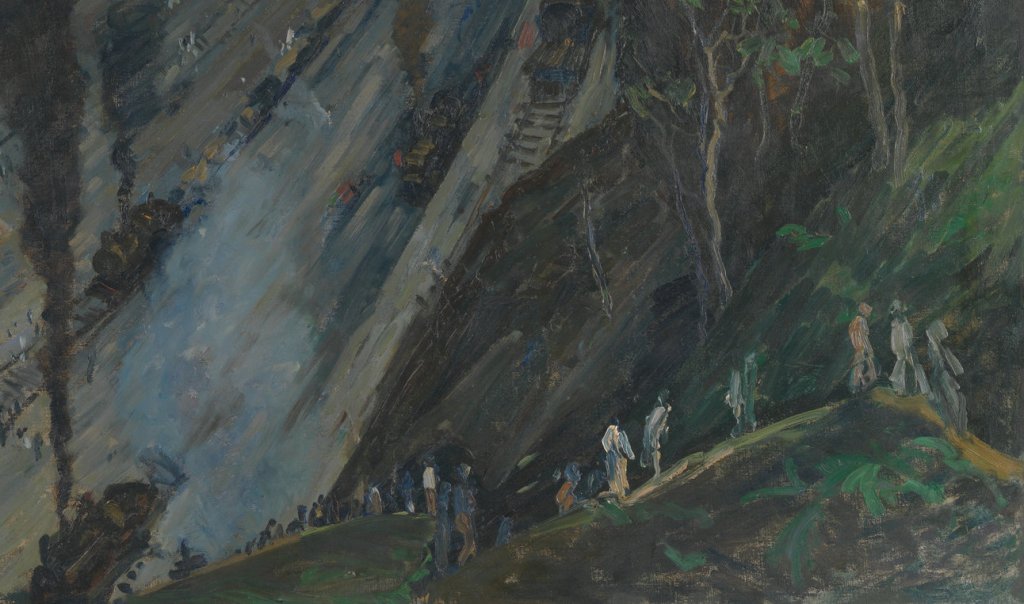
    Excavation of Culebra Cut (1896)

    Historically, apart from Yellow Fever, a gigantic excavation known as the Culebra Cut was the primary obstacle in engineering the Panama Canal. The Culebra, or ‘Snake river’ in English, is part of the Continental Divide, separating Lake Gatun on the Atlantic Ocean side from the Pacific Ocean access. In total, the French excavated 18,646,000 cubic yards of material from the Cut (Avery, p. 72). They reduced the height above sea level from 64 m (210 ft) to 59 m (193 ft) (Goethals).

    This chapter is the end of Book Three. Having settled his romantic characters in Panama, Gunter has his narrator comment on the possible future of the canal attempt. It is one thing for him to speculate on future fictional events; but hardly those of actual outcomes in the real world. In the novel, it is 1888, a crucial year in the history of the French undertaking to build the Panama Canal. In January, Gustav Eiffel’s men had arrived to make preparations for the installation of a series of locks. This was a major concession by De Lesseps, who had always insisted that the canal would be à niveau’—at sea-level.

    The required funding did not eventuate, and by December1888 the company was declared bankrupt and placed in the hands of liquidators (Parker, pp. 180-182). Gunter is of course aware of these events; indeed, January, 1893, the year of the novel’s publication, saw De Lesseps and his son Charles before the courts. The narrator’s comments obliquely preface the coming collapse of the French enterprise and offer a forlorn prophecy regarding a return to Nature. Gunter did not live to see the United States’successfully complete the Panama Canal in 1914.


    CHAPTER 14

    LITTLE PARIS

    Neither Harry Larchmont nor Miss Louise Minturn make their appearance at lunch this afternoon upon the Colon.

    At dinner, only monosyllables pass between them, which the captain noticing whispers into Miss Louise’s pink ear to make it red: “Didn’t I tell you kisses stop at the gangplank?”

    Just here the seadog’s attention is fortunately attracted by what is happening to another young lady under his charge.

    Miss Madeline Stockwell, the pretty girl who is going to California to be married to the Los Angeles orange grower, oblivious of the vows she is journeying to take, has been indulging in a flirtation with the young Costa Rican, which has gradually grown from mild to tempestuous; from tepid to boiling hot!

    This young gentleman, not understanding English very well, has failed to catch what has been generally known about the ship, of this young lady’s engagement. But now, the voyage drawing to a close, some one has been kind enough to inform him, in good Spanish, that Miss Madeline, who has entangled him in the silken meshes of love, and whose bright eyes have grown to be very beautiful to him, and whom he has had wild dreams of transporting, after Church ceremony of course, to his coffee plantation near San Jose, is already promised to another!

    So all the afternoon Don Diego Alvarez has been going about with a Tibault glare in his eyes, and is now eating his dinner in a gloomy, vindictive manner, cutting into his salad as he would into the orange farmer’s throat, were he within knife reach.

    Soon after, all go on deck.

    Here is his opportunity. He steps towards the pretty Madeline, who has been hiding from him in her stateroom most of the day, and whispers something in her ear, at which she turns deathly pale, for she is now mortally frightened at this demon of Spanish love that she has conjured up, and that will not down.

    Noting this, the skipper, laying his hand on Larchmont’s shoulder, whispers to him: “Harry, will you do me a favor?”

    “Certainly, if possible.”

    “Well, here is a matter in which I cannot interfere unless I go to extreme methods. Young Alvarez is frightening that foolish girl. She has been silly enough to encourage him, and Spanish blood, when encouraged and then jilted, is sometimes obstreperous. Now you kindly take care of the young lady this evening. Tomorrow morning we will be at Colon, and after I have landed her, pretty Miss Madeline Stockwell can handle a Spanish flirtation as she pleases. Don’t leave her alone with him—that’s a good fellow!”
    Anon. vintage photograph

    Now Mr. Harry is exactly in the mood for something desperate himself. He has just had another short but exciting tête-à-tête with Miss Minturn, in a little dark spot of the deck that the rising moon has not yet intruded on.

    “You have not changed your mind about me, I see?” he has whispered, noting that Louise’s eyes are still uncompromising in expression.

    “Certainly not; about your proposition!”

    “And you accuse me of attempting to gain your friendship with the idea of making it?” the young man has asked hotly.

    “It would seem so. Why else?”

    “Why else? You are too modest. Don’t you think,” he has gone on warmly, “that you have other attractions than being the stenographer of Baron Montez? Didn’t I treat you with consideration before that? Did I ask your aid until those accursed letters showed me that you were probably his victim as well as my brother and Jessie?”

    “Oh, it is for Miss Severn’s sake that you ask me to do a thing I consider dishonorable? Learn that I consider a stenographer’s conscience as valuable as an heiress’s money!” the girl has muttered very haughtily, for her position makes her oversensitive. “Please do not speak to me again until you remember it also!”

    So turning away, she has left Larchmont in a very bad humor, for he feels he is badly treated. He has muttered to himself sarcastically: “I wonder if she thinks I saved her from the snow that night, because I divined she was going to be the stenographer of Montez, Aguilla et Cie.? She’s as unjust as she is beautiful.”

    Consequently at present Harry is about the worst person the captain could have chosen to pour oil upon the troubled waters of Miss Madeline Stockwell’s flirtation, although he accepts the office with alacrity. He whispers to the skipper: “See me cut the Costa Rican out!” then proceeds to join a tête-à-tête that is becoming exciting; for young Alvarez has just placed his hand upon his heart, and said with a rolling of the eyes: “Señorita, remember it is his life or my own! Tell that to your orange rancher!”

    “Good evening. Miss Madeline!” interjects Harry; and is very effusively received by the girl, who would be pleased at any time to receive attentions from this élève of New York society, but at this moment would be happy to have Old Nick himself intrude upon her interview with Don Diego.

    It is a little trembling hand that the American takes in his as Miss Stockwell whispers nervously: “I—I am delighted to see you, Mr. Larchmont. Permit me to present Señor Alvarez. I—I cannot always understand his Spanish. He speaks so fast and ex—excitedly.”

    “Can’t understand him, eh?” says Harry; “then permit me to be your interpreter;” and coolly places a steamer-chair between the young Costa Rican and his inamorata.

    Next turning upon the astonished Don, he mutters rather surlily: “Supposing you say to me what you were going to say to her.”

    “Say to you, Americano,” gasps the astounded Alvarez, “what I was going to say to the light of my soul, the Señorita Madeline?” Then looking at the American contemptuously, he says: “Bah! you do not interest me!”

    “Don’t I?” replies Harry courteously “Then perhaps Miss Maddy will be kinder to me. Don’t you think a promenade this pleasant night would suit you?” and he offers his arm to flirtatious Miss Stockwell, and takes her away, leaving the Costa Rican grinding his teeth at him, for Mr. Larchmont has a very tender manner with pretty girls, and Alvarez, noting his devotion to the young lady in the moonlight, includes him in his vendetta with the orange farmer, as rival number two.

    Harry’s attentions to Miss Stockwell are not unobserved by Miss Minturn, who thinks to herself: “He has not succeeded in gaining me over to his plans. Therefore I am of no more interest to him. See how he proves the truth of what I accuse him!” This feminine logic makes Louise’s heart grow very hard to Harry Larchmont, as he paces the deck of the Colon, whispering idle nothings to Miss Madeline Stockwell; for this young lady has a habit of thinking all men in love with her, and rolls her eyes most affectionately at the big fashionable creature, who she thinks has fallen before her charms.

    So Louise, growing desperate, mutters to herself: “If he shows indifference, why not I?” And Herr Alsatius Wernig chancing to come along, she receives his effusive attentions with a great deal more kindness than she has hitherto shown to him, and puts him in the seventh heaven of expectant delight, though ever and anon Mr. Larchmont turns an evil eye upon her, as he passes her on the deck.

    Consequently Miss Louise Minturn and Mr. Harry Larchmont, who had greeted each other this morning so warmly, go to bed this evening with bitter feelings in their hearts towards each other. Not the bitterness of hate, but the bitterness of love, which is sometimes equally potent, and ofttimes produces as unpleasant results.

    As for Miss Stockwell, she is radiantly happy. She imagines she has got rid of one flirtation that bothered her, and taken up another that she thinks will not bother her.

    Later in the evening, Mr. Larchmont, after packing his baggage, and getting in general order for going ashore next day at Colon, sits down and writes a letter, giving to it one or two sighs, and one or two imprecations; and just before going to bed, remarks: “So far, I don’t think my trip to Panama has been a success!” for this very evening he has added another enemy to his list—Don Diego Alvarez, the Costa Rican.

    The next morning, bright and early, everyone is up, for land has been sighted!

    From the deck, they see the distant Andes of South America.

    Then, after a time, from out its mists, they can distinguish the Tierras Calientes, that rise, a mass of tropical verdure, before them: from which, wafted by breezes over sparkling waves, are the odors of myriad plants and flowers. For what has been blustering, chilly spring in New York, is now early summer under the Equator.

    Then churning the blue waters, the great ship enters Navy Bay, and before them lies Manzinillo Island, on which stands the town of Colon—a mass of low red brick structures, brightened here and there by palm trees; embellished on its sea side by a number of parallel wharves that go straight into the bay, lined with the shipping of all nations.

    To their left are the pretty residences of the officers of the canal, on the Island of Christophe Colon, to which a causeway has been filled in, at great expense, by the ever-lavish Canal Interoceanic.

    Then the steamer running into her dock, ranges alongside the wharf, and ties up to it.

    All of this would have been noted with a good deal of interest by Miss Minturn, did not a more personal matter take up her attention.

    In the last moments of a voyage, just before landing, some of the niceties of ship etiquette are forgotten; and taking advantage of this, a pleasant looking round-faced woman, very neatly dressed, and leading by the hand a pretty child, leaves the second cabin, and coming to Miss Louise, presents a letter saying: “Mr. Larchmont asked me to give you this.”

    Looking over it, the girl is astonished by the following:

    Steamer Colon, March 30th, 1888.

    “Dear Miss Minturn:

    “Though you may consider it an impertinence, I take the liberty of making this suggestion to you. I have been thinking over the position in which you will be placed—a young lady, unknown, and alone in a foreign city—Panama.

    “Of course the firm by whom you are engaged, and Mr. Stuart, will do everything they can for your comfort; but still perhaps the matter of domicile may be a difficult one to you. You should have a home with some company and some protection.

    “Under the circumstances I venture to suggest to your favorable consideration, Mrs. Silas Winterburn. She has rooms and board in the Spanish family of an old notary named Martinez, in Panama—that is, when she is not with her husband, who is stationed with his dredger at this end of the Canal.

    “The Martinez family, she informs me, will be able to accommodate you, at a reasonable figure. Consequently I presume to mention this to you.

    “Yours most respectfully,

    “Harry Sturgis Larchmont.”

    Looking at these words, the girl sees the handwriting that came on the card with the violets, and her heart grows softer to the gentleman whose hand has penned this note.

    She says to the woman: “I am happy to meet you, Mrs. Winterburn. Mr. Larchmont has been kind enough to mention that you could assist me in obtaining a domicile in Panama;” and holds out a welcoming hand.

    This is cordially gripped by the woman, who replies:

    “Thank you very kindly! I hope you will come with me. It will be so nice to have someone to talk to in English. The other time I was there, I did not understand Spanish, or French, and it was so lonely!”

    As she says this, the steamer is at the wharf, and Louise finds herself face to face with a kindly-looking florid gentleman, whom the captain introduces as Mr. Stuart of the Pacific Mail, and to whom Miss Minturn presents her letter of introduction.

    As he is reading it, Mrs. Silas Winterburn and her pretty child have been hugged, kissed, and hugged again, by a peculiar-looking man, who was once tall, but has apparently been shrivelled by the sun from six feet one to five feet ten.

    “Miss Minturn, this is my husband!” says the woman very proudly.

    And the man adds: “By Plymouth Rock and Sanctus Dominus! I’m almighty glad to grip such a pretty girl by the hand.”

    “Oh, how do you do, Winterburn?” remarks Stuart cordially, looking at the mechanic.

    “Quite spryish, governor,” is the answer.

    Here Miss Minturn takes opportunity of explaining what Mr. Larchmont had suggested in the letter.

    After a moment’s consideration, Mr. Stuart says: “I really think that would be the best plan for you in Panama. Of course I shall see you safely onboard the cars, and that all preparations are made for your pleasant transport across the Isthmus. But though I can engage rooms for you in Panama, by telegraph, I do not think for a young lady situated as you are, they will be as pleasant as those in the family of old Martinez, the notary, where you will have at least American society and the protection of honest Silas Winterburn and his wife.”

    “Oh, everybody knows me,” remarks Silas, “from Colon to Panama, and from the Atrato to Chiriqui! I am the American pioneer of the Isthmus!”

    “The pioneer of the Isthmus?” echoes Louise, astonished.

    “Yes! Caramba! I beg your pardon!—I beg your pardon! I sometimes swear in Spanish from force of habit. I was a fireman on the first through train on the railway in ’55.”

    “And have you been here ever since?”

    “I’ve buried three families here, of yellow fever,” says the man, wiping a tear from his eye. Then he goes on in a happier voice: “But I’ve got started with number four!” And looking with loving eyes upon his wife, he whispers: “I think she’ll last me through. The other three were timid things from factories in Mass’chusetts, and most died of fright at the thought of Yellow Jack!”

    This is said in a manner that astonishes Miss Minturn, for Silas seems to suffer agony at the remembrance of his three lost families, but to be equally happy in the contemplation of the present one.

    By this time they have all got ashore, Louise noting that Mr. Larchmont is well ahead of her, and already in conversation with one or two officers of the Panama Railroad, who chance to be Americans he has seen in New York. This young man’s chief object now seems to be to make acquaintance with everybody on the Isthmus, and apparently he is succeeding.

    Then genial Mr. Stuart shows his pretty charge over the town, which consists chiefly of two rows of houses and stores running the length of the island, with the Panama Railroad shops on the south end of it, and the attachment called Christophe Colon at the north, and the canal, which is the Chagres River turned from its course, running past it: all this with a few palm and cocoanut trees thrown in, a mangrove swamp behind it, and a series of wharves in front of it that run out into the blue waves and soft surf which ripples upon a beach of coral sand.

    Half an hour of this is sufficient; then Mr. Stuart puts Louise on the train beside Mrs. Winterburn, the happy Silas and his little daughter occupying the opposite seat. The cars are crowded by a heterogeneous mass of foreigners. The bulk of the conversation however is French, for this canal with its thousand officers and myriad laborers in 1888, had made the Isthmus from Colon to Panama practically a French colony.

    Mr. Larchmont is not on the car in which Miss Minturn is seated. Therefore she does not speak to him, though she would have liked to; for she is beginning to repent of her hasty expressions towards him, which had been caused not only by his proposition, but by Miss Severn’s connection with it.

    She is even now thinking, “His letter this morning brought me protection, when I had treated him harshly. He has done me many kindnesses; and I have refused to do him one! I don’t think I could ever bring myself to his proposition, still I forgive him for making it. Yesterday, jealousy made me cruel!”

    Then she mutters to herself: “Jealousy! Pshaw! I am not jealous! Whom am I jealous of?” And glares around as if to find out the person on the train, but only catches the eye of Mr. Winterburn.

    This eccentric says: “What’s the matter, sissy? Are you looking for a beau? There’s plenty here. Por Dios! I beg your pardon for the swear. Most every one’s unmarried about here. By all the saints in the Cathedral! bachelors and widowers predominate.”

    “You—you seem to be very well acquainted with the Isthmus, Mr. Winterburn,” stammers the girl, throwing off meditation. “You say you are a pioneer?”

    “Yes, had the fever in 1856 and got acclimated. Since then I have found it as healthy as the Penobscot—for me! Other people sicken and die, but I thrive. I reckon, when we were building this railroad, we planted a man for every tie. Now I think the Canal is even beatin’ our average.”

    This eulogium upon the climate of the Isthmus gives Louise a shiver; she turns the conversation by suggesting: “You must have seen many curious things here?”

    “Yes, everything from revolution and riot, to balls and fandangos.”

    “Revolution and riot!” says the girl, and is about to ask him something eagerly, when glancing out of the car window she suddenly ejaculates: “How beautiful! How fairylike!”

    For the train has run out of Colon, and leaving the island, is dashing through the swamps of the Mindee that are fairylike in beauty, but awful in miasma and death.

    So they come to the mainland with its rank vegetation, in which are trees of a myriad species, flowers of a thousand hues, vines and creeping plants, each different from the other, making a thicket that is a garden.

    So passing Monkey Hill, they reach Gatun, getting here a first glimpse of the main Chagres; and turning up its valley, the cars run under great lignum vita; trees covered with parasites, and palms of every species, from the giant grande̕ to those of smaller stem and more feathery leaves.

    Every now and then, they pass a little native rancho with its thatched roof, and inevitable banana plantation. These are varied by occasional orange groves, and now and then a glimpse of the Chagres River, quiet and limpid in this the dry season, and rippling peaceably between banks of living green to the Caribbean. It is now disturbed, here and there, by the huge dredgers of the American Company—great masses of machinery that scrape the mud of the river from its bottom, to build up side walls to protect its banks.

    “It is one of them fellows that I work on as engineer, Miss Minturn,” says Winterburn, looking up from his little daughter, who has grown tired, and is sleeping contentedly in his lap.

    Now and again they get glimpses of trading stations for canal laborers, some of them kept by Chinamen, till finally they arrive at Bohio Soldado.

    “That’s my place of residence!” ejaculates Silas, who has now become communicative. “But I’ve three days leave, and so I’ll see you and the old lady through to Panama. Do you note that p’int?” he says, after twenty minutes more travel, “that’s the head of the dredging, and from there on, the Canal Company tackles not mud, but rocks. And rocks,” here he whispers to the girl, a curious twinkle in his eye, “is what’ll down ’em!”

    And then passing the great bridge over the river at Barbacoas they run up the other bank to Gargona, and from that on, by gradually increasing grades, come to Culebra, where the Canal people have their deepest cut to make.
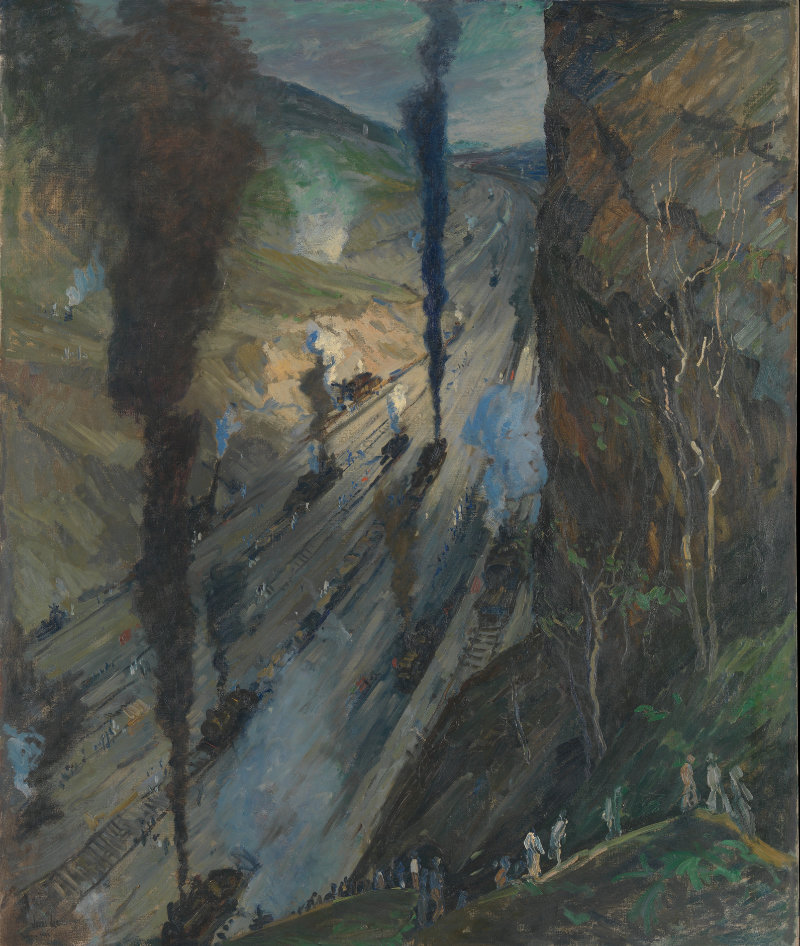
    The Conquerors (Culebra Cut, Panama Canal), 1913, Jonas Lie (Source Wikimedia Commons; public domain)

    “Oh, goodness!” cries the girl, “what an enormous excavation!”

    “It’s the biggest in the world,” answers Silas. Then he whispers confidentially, “But there is five times as much more to dig.”

    “Why,” cries Louise, “they’ll never do it!”

    “Not this trip! Por la Madre!” assents Winterburn solemnly.

    But other views drive Culebra from the girl’s mind. They are descending the mountain; before them the great savanna that leads to Panama, and the white waters of the Pacific. Running down through hills that gradually become smaller, they come to the Rio Grande station, and first see the river that is to be the western waters of the canal.

    From there on, dashing over savannas ever green, they note at their right hand, some gray buildings on a hill.

    “That’s the Canal yellow-fever hospitals, where the poor critters will get a little breeze,” says Silas, eager to do the honors of the Isthmus.

    But leaving these, three miles away they run into a little station where carriages with native drivers are waiting for them, to drag them through dirty lanes into the town of Panama itself.

    This is now a little Paris. French people jabber about them at the station, and the language of Normandy and Brittany dominates the Spanish tongue; for la belle France has come over the Isthmus to capture Panama.

    Twice before this has been attempted. Twice with success! Once Morgan and his daring band of every nation freebooters came up the Chagres, and conquering, bore away with them the treasures of the western ocean. Then American enterprise fought its way with iron rail through the swamps of the Mindee, and up the valley of the Chagres, and through the gate of the mountains, and reached this town, to take its tribute from the commerce of the world, and pay to stockholders the dividends of Dives.

    And now comes France—not to cross the Isthmus, but to drive through it, and thus levy toll upon the navies of the sea!

    The Isthmus, subdued twice, will it be conquered again? Nature—the awful giant nature of the tropics—will it triumph? Will this land go back to nature, and become silent as when the Spanish Conquestadores first landed on its shores to make the Indians curse the white sails which bore to them a Christianity that came with blood and bigotry, to make them slaves?


    Notes and References

    • ‘this élève of New York Society’: élève meaning ‘student’, in the sense of l’élève de la nature, ‘the student of nature’ (e.g., De Beaurieu, 1789).
    • inamorata: A woman loved in a romantic way is one’s inamorata. From the Italian innamorare, “to fall in love”. Vocabulary.com
    • Tierras Calientes: Tierra caliente (hot land) includes all areas under about 900 m (3000 ft). These areas generally have a mean annual temperature above 25°C (77°F). Their natural vegetation is usually either tropical evergreen or tropical deciduous forest. Farms produce tropical crops such as sugar-cane, cacao and bananas. – Geo-Mexico.com
    • Penobscot: North American Idian tribe. ‘The word “Penobscot” originates from a mispronunciation of their name for themselves: Penawapskewi. The word means “the people of where the white rocks extend out” and originally referred to their territory on the portion of the Penobscot River between present-day Old Town and Verona Island, Maine’ (Wikipedia).
    • Dives: the rich man of the parable in Luke 16:19–31. Any rich man. Pron. dahy-veez (Dictionary.com). ‘Dives’: Latin for ‘rich’. See Mainly Norfolk.

    Avery, Ralph E. America’s Triumph in Panama. Chicago, 1913: L.W. Walter Co.. Freely available at Internet Archive

    Goethals, Colonel George W. (Chief Engineer). The Panama Canal (Address to National Geographic Society Feb., 1911)

    Parker, M. Hell’s Gorge:The Battle to Build the Panama Canal. Arrow Books, 2007

    This edition © 2021 Furin Chime, Brian Armour

  • A.C. Gunter’s Baron Montez: 5. Black Blood Changes to Blue

    A.C. Gunter’s Baron Montez: 5. Black Blood Changes to Blue

    Twenty-five years after the closing events of the last chapter, Panama is still our setting, though the focus has shifted from the Panama Railroad to a new major engineering challenge: The Panama Canal. The year is 1880 and Ferdinand de Lesseps, French diplomat and developer of the Suez Canal and his entourage, are in Panama to celebrate commencement of the French undertaking to link the Pacific and Atlantic Oceans.

    Ferdinand de Lesseps (1805-1894)

    A New York reporter tries to obtain engineering information from the official party, and amid an ensuing scuffle, mention is made of the Monroe Doctrine. Instigated by John Quincy Adams, then US Secretary of State, and first delivered in a speech by President James Monroe in 1823, this policy became a formative statement in the international presence of the United States. It fundamentally and unilaterally opposed European colonialism in the Americas, or meddling “into any portion of this hemisphere” (Monroe). Most of the Latin American colonies had either gained independence from Portugal or Spain, or were on the point of doing so. Monroe stated that any European efforts to reestablish control would be seen as unfriendly toward the United States. The United States would, however, recognize existing European colonies.

    The attitude of the United States towards France was quite positive at this time. France had helped America substantially in the Revolutionary War (1775–1783). A swathe of public opinion decried the “virulence” of the Paris Commune of 1871 (Bernstein); but a good relationship ensued with the Third Republic. The Louisiana Purchase of 1803 massively increased the size of the United States, and enabled its continental completion. The Statue of Liberty, a gift from France, will be inaugurated in New York in 1886.

    The narrator, we know, finds it difficult to keep a secret. If his insider knowledge of Montez, and his ‘book cover’ assessments of other characters are correct, we as readers have an idea what is going to happen, if all goes according to fomenting plan. Our narrator also, you will find, is not backward in coming forward over the plight of shareholder’s interests being neglected in the expensive promotions taking place—to the extent of shouting at the reader. The French attempt to create a canal was abandoned in 1887, a mere five years before this novel was published, and given the strident voice, it may not be far-fetched to suggest the author personally knew shareholders, or was one himself.

    Not only did shareholders lose greatly in the $287M venture. As noted on the first page of the chapter, yellow fever is still prevalent, and over twenty thousand will die before it is over. One such sad case is the Director General of Works and Chief Engineer, Jules A. Dingler. He arrived in Panama in 1883, and spent $100,000 building a mansion, only to lose his wife, son and daughter to the disease.

    The fate of his prize stallions is one of the heart-wrenching episodes of his tragedy:

    His wife had frequently gone riding on one of two magnificent horses worth 25,000 francs, which had been a gift from Gadpaille [a labour recruiter] in Jamaica. After her death, the director did not wish to encounter anyone else on the streets of Panama riding these horses, so he ordered the beasts to be killed. The staff refused to carry out the command. Finally they found a poor fellow who was given the role of executioner, but at the last moment his hand trembled and he could not finish the job. For hours the horses were heard, partially disembowelled, screaming in agony. In the end they were shot dead.

    Parker, p. 123

    Dingler returned to France in 1885 a broken man and died within six months.

    Under our narrator’s guidance, readers continue to follow the nefarious career of Fernando Gomez Montez, which is interlinked with the Panama Canal project. We hear no more, for the time being, of the fate of sweet Alice Ripley, or her daughter left alone in the United States. However, not content with the elevated position he has achieved, our conniving Montez has two new victims in his sights.


    BOOK 2

    The Franco American

    CHAPTER 5

    Black Blood Changes to Blue

    It had been a day of triumph for Panama and le grand Français Ferdinand de Lesseps, this first day of January, 1880—this day that inaugurated the opening work of the Canal Transatlantique; that was to make the commerce of all oceans one; that was to wipe out from the sailor’s log the tempestuous icy hurricanes of Cape Horn, and the more languid but equally retarding calms of the Cape of Good Hope. By it France was to become richer, the world happier, and Ferdinand de Lesseps doubly immortal—this man of Suez and of Panama.

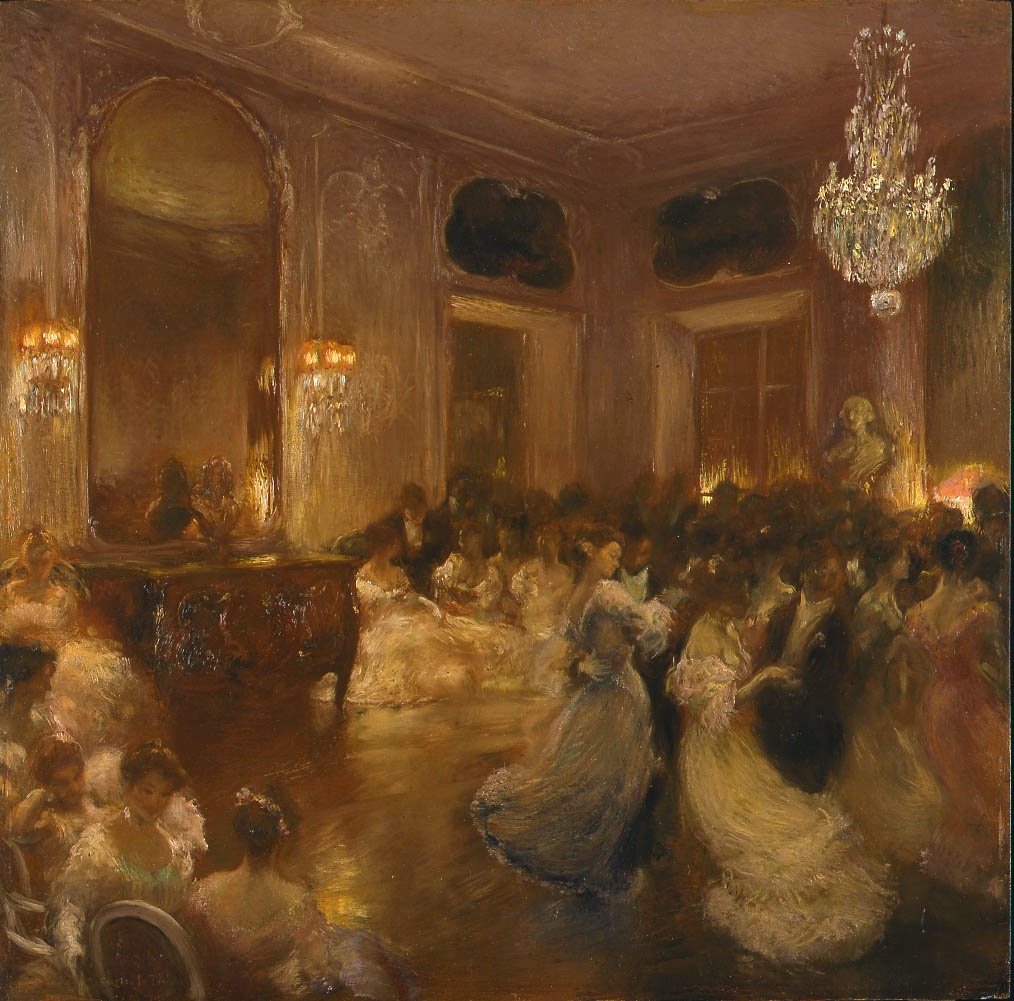
    The Ball (n.d.), Gaston La Touche (1854-1913)

    Five o’clock on the previous afternoon, welcomed by the braying of the one military band, and addresses from the Committee, and President of the State of Panama at the railway station, he had descended from the train bringing him from Aspinwall, soon to be rechristened Colon.

    The bridge over the track of the Panama Railroad, from which the speeches were made, had been adorned with the flags of France and Colombia.

    In carriages, the finest in the city, though not of the latest style, and the worse for twenty years’ wear, Comte de Lesseps and his attendant party of engineers, politicians and fortune seekers, had been driven through streets, that for once in the history of Panama, and only once in its past, present, or to come, were clean. They had been swept by municipal order, that their foul odors might not affront the delicate nostrils of the great Frenchman. Along the road from the railway station, leading up to the old Gargona road, and thence into the Plaza and the Grand Hotel, the huts and houses were especially white washed for the occasion, to destroy germs of yellow fever, or cholera Asiaticus that had convenient resting place upon their palm-thatched roofs and mouldy beams.

    This had been the suggestion of Don Fernando Gomez Montez, by this time one of the leading dignitaries of the city, banker, rich man, and general swell, who had impressed his views upon his confrères, by this pertinent remark: “Caramba! If all those delicate Europeans encounter Yellow Jack and el vomito negro before they commence operations, good-by to our canal which is to make us rich.”

    So the French party came with prancing of horses and shoutings from the crowd of creoles, negroes, and the general populace, between two battalions of native troops drawn up along the road, as ragged, as barefooted and as badly armed as in the days of ’49; for this man and his nation were to bring wealth, commerce, and enterprise to this city deserted since the days of the early Californian travel; and Panama was to become even greater, richer, and more populous and important than the old town whose deserted tower stands in tropical jungle five miles to the south—the one that Morgan’s buccaneers destroyed two hundred years before—the richest city of its size on earth.

    Among the élite gathered to meet the great French man had stood Fernando Gomez Montez, apparently not much older than when he had made his first great coup in life from the returning Californian, since which time he has devoted the plundered gold dust of that night to commercial pursuits, and has built up for himself a fortune, large for a Colombian city, but not great for Paris or New York.

    His poverty he has learned by travel, for he has been both to France and America; and his intellect, bright, wicked, and unscrupulous as ever, has been made subtile, cautious, and wary by experience. At twenty he was a great villain, at forty-four he is a great man, and therefore greater villain. To the audacity of the bandit he has added the finesse of the diplomat.

    During the preceding day he has made his address at the railway station and at the banquet of the evening, and has been embraced by le grand Franc̗ais, and petted with diplomatic tact, and called the hero local of the canal—for he had greatly assisted in obtaining from the Colombian Government the concession about to be sold to French stockholders for ten million francs.

    On this day he has, with the inaugural party, sailed in the Tobaguilla around the bay, into La Boca of the Rio Grande, where young Mademoiselle Fernanda de Lesseps was to have inaugurated the work of the canal, by digging with childish shovel the first little sod of all the earth that separated the Atlantic and Pacific. But, as it had grown late, in this land where darkness comes on with sudden rush, they agreed to consider the entrance of the steamer into the river as the opening of the work of the canal—and omitted the shovelful of Isthmus swamp; thus beginning the gigantic enterprise by a makeshift—one of the many that they made—till makeshifts were of use no more.

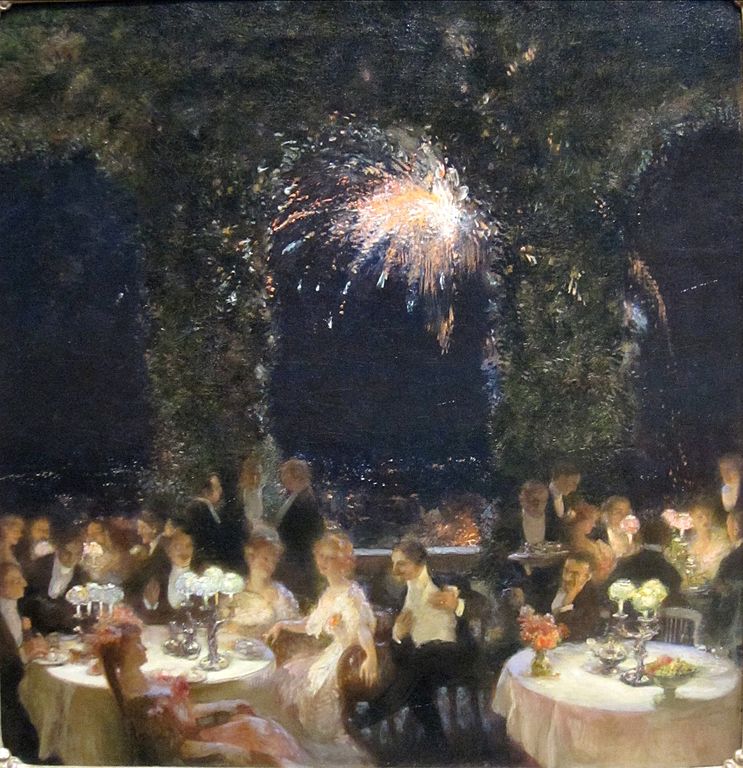
    Gaston La Touche

    Returned from this excursion, tonight Fernando Montez is at one of the minor banquets that take place before the ball.

    It is in one of the smaller rooms of the Grand Hotel. Several of the attachés of De Lesseps are at the table—a Paralta, a Diaz, and one or two others of the leading families of the Isthmus. It is a gentlemen’s dinner party; and though the great Frenchman is not there in person, all are enthusiastic about the canal which is to give every one a chance to grab a fortune.

    Among them sits one Anglo-Saxon—a man of about twenty-eight years, who has a pleasant though weak face, surmounted by light hair, and adorned by a moustache and goatee, the cut of which are French. His costume is rather that of Paris than America, as far as a dress suit permits.

    “The stock must be subscribed for at once!” cries Montez. “The fever must not be let grow cold in France.”

    “Oh, trust De Lesseps for that!” answers one of his satellites, Monsieur Dirks, Dutch engineer, who has dug canals in level Holland.

    “Let me be the first to subscribe!” says the Franco American. Here he whispers to one of the French attachés: “Please hand my name for the first one thousand shares to your chief, the Comte de Lesseps!”

    “The first one thousand shares subscribed for by an American!” There is a buzz of excitement around the table. The champagne glasses clink.

    “A health,” cries Montez, “to the great Republic and the American, Mr. Frank Leroy Larchmont!”

    “I beg your pardon!” says the gentleman he toasts.

    “Don’t put me down as an American. Register me as a Franco American—Franc̗ois Leroy Larchmont.”

    “But you live in the United States?” says Jose Peralta who sits next to him.

    “I did once. Now I consider myself a Parisian!” Which in truth he does.

    “This gentleman who takes one thousand shares so eagerly—I know his name—but what is he?” whispers Montez to the Frenchman sitting next to him.

    “Oh, he is very rich, I believe! That is all I know about him. He lives in Paris, has the good taste to like France, and very seldom visits his native land.”

    Then the banquet goes on, but during its conversation, buzz and excitement, Montez’ eye, sleepless and relentless, never leaves the face of the Franco-American who has taken the one thousand shares.

    Fernando Gomez Montez has determined to make himself one of the rich men of the world by this canal; as many more did about that time, some of whom succeeded. He is shrewd enough to foresee, this cannot be by the dividends it will pay to its investors, but in the immense amount of money that must be handled, and rolled about, and circulated from hand to hand and check book to check book during its construction.

    His subtle mind can easily grasp the idea that in this great “grab game” some of it must come into his clutches. This gentleman, who rushes so eagerly into a scheme just set on foot, whose face has a peculiar weakness not often seen in men of the United States, may possibly be a very good chicken to pick in the great pluckings and pickings that will take place during all the financial evolutions of this great enterprise.

    As soon as cigars pass about, and the formality of the dinner becomes somewhat relaxed, he contrives to get his chair beside that of Mr. Larchmont, and their conversation, from being that of first introduction, becomes freighted with some of the confidences of friends.

    Mr. Larchmont, to Fernando’s deft questioning, informs him that though educated partly in America, and his family entirely American, he has lived from his seventeenth year mainly in Europe and Paris. “Paris,” he says, “I regard as my home. I have a young brother in the United States, who is only twenty now. I am afraid he is too American to ever become a Parisian like myself.” But here their conversation is disturbed.

    A dapper young man, with the quick address of one to whom time is money, and the manner of “no time like the present,” enters the room, and says: “Pardon my stopping the champagne, Monsieur Dirks. I believe you are one of the engineers in control of the preliminary surveys of the canal?”

    “I have that honor,” says the Hollander.

    “Then, between drinks, permit me to ask you four questions. First, when do you expect to open the Panama Canal that has been inaugurated today?”

    “Certainly,” replies the Dutch engineer, astonished at the abruptness of the address. “In five years at the latest. In 1885.”

    “You are sure?”

    “So confident that I would write it in letters twenty-four feet high!”

    “Then can you tell me how you are going to provide for the tremendous floods in the Chagres River that wash down, each rainy season, dirt enough to fill up the whole canal?”

    “That will be by means of a large dam and reservoir sufficient to hold the average rainfall of a week.”

    “But when the rainfall is more than the average, what will you do with it?”

    To this, the Hollander replies evasively: “Are you an engineer?”

    “No!”

    “Then why do you ask engineering questions?” he replies sternly.

    “It is because I am not an engineer that I ask engineering questions. If I were an engineer, I could determine things for myself.”

    “Ah, then I will tell you. The floods in the Chagres will be provided for—later.”

    “Then, the floods being provided for, what will you do with the higher rise of tide in the Pacific than the Atlantic?”

    “That will be provided for later also!” returns the Dutch engineer savagely. And others of the Latin races at the banquet look with angry eyes upon this young man who stays their festival. Who is this creature that dares interrupt their night of triumph by impertinent queries that tend to throw doubt upon their grand scheme?

    “Then, all this being settled, will you tell me how you are going to build the canal if you don’t get the permission of the Panama Railroad, which by its concession from the Colombian government must give its consent before you can dig a barrelful of dirt out of your gigantic ditch?”

    At this question, the guests rise with foreign indignation and South American swagger.

    “That,” shouts Dirks, wildly, “will be provided for by Monsieur le Comte de Lesseps. When he visits the United States, he will obtain from the Panama Railroad the requisite consent.”

    “Not unless he pays Trainor W. Park pretty well, if I know him,” replies the young man. “I have just got time to telegraph your answer.”

    “Ah, you are an emissary!” cries a French attaché. “An emissary of the United States, that is now making such a shriek about the accursed Monroe doctrine!”

    “I am no emissary!” the intruder gasps, dismayed, for two or three Latins have gathered about him threateningly, and one, a young Chiliano, is handling a carving knife as if it were a cuchillo. “I am merely a reporter for the New York―” He can say no more, for at this instant he is rushed from the room and hurled down stairs, which perchance saves his life, as the Chiliano does not reach him in time.

    Looking on this, the Franco-American says disgustedly: “You see the crude manners of my country men. No wonder I fly from them! You will appreciate my embarrassment, Señor Montez, at this uncouth scene. I have been lately to New York, to try to induce my brother Henri to live with me in Paris, but he declines. Over his actions I have no control; but my ward, Mademoiselle Jessie Severn, as her guardian and trustee, I am taking with me to Paris. I made a short tour in America, and while in San Francisco, thought I would come to Panama, to see the opening of this great French enterprise, and from here take passage in the Transatlantique line from Colon to France.”

    “The young lady, your ward, is with you;” remarks Montez indifferently.

    “Oh, yes; she and her governess and nurse.”

    “Ah, she is not a young lady?”

    “Not yet. She is but ten. I am taking her to Europe, to educate her in the manner of my adopted country. I do not approve of the way in which girls are brought up in the United States. Heiresses in America become so bold and self-reliant. They even assert their independence to the extent of selecting their own husbands.”

    “Ah, an heiress!” thinks Fernando, his eyes opening a little wider at the news, for here may be two fortunes to play with; not only that of this rich gentleman, but also that of his ward.

    So he proceeds to weave the first meshes in the web of the spider around this Franco-American fly. His conversation grows jovial, and full of anecdote, repartee, and wit. Incidentally, by adroit questions that seem more suggestions than queries, he learns what he wishes to know of the other’s character and life; and, though it is conveyed to him with reluctance, discovers that Mr. Larchmont’s father had been at one time a tailor in New York, and turning the money he had received for dress suits, overcoats, and trousers into city real estate, had become one of the magnates of Manhattan, though his elder son was almost ashamed to own him, notwithstanding the very handsome estates he had left behind him to his two sons and co-heirs.

    “Ah!” remarks Montez, to this revelation, “no one can avoid bourgeois ancestors in the United States; it is land of trade and money.” And he sneers at the tradesmen in his mind, as the robber always does at the merchant.

    Then noting that the gentleman sitting opposite him seems somewhat ashamed of his commercial American ancestors, and drags into his conversation every one he knows of title or rank in the Old World, Montez’ occult mind divines that to thoroughly and easily trap this man who is ashamed of his commercial country and tailor birth, he his captor must be of the nobility.

    Then he mentions parenthetically: “Though you of North America have no aristocracy, South America still clings to hers. The Hidalgos of Spain never forget that they are grandees. As such I remember my ancestors!” and a drop of the blood of one of the Spanish Conquistadores coming into his eyes, this gentleman looks very haughty and exclusive to his Franco-American acquaintance.

    Shortly after, they stroll from the apartment in which the little banquet has taken place, towards the ballroom. As they pass through the corridor of the hotel, which is brilliantly lighted, a charming figure trips toward them. It is that of a beautiful little girl, who is dressed like a sylph in gauze and fancy flowers and whitest muslin.

    She is attended by a French bonne, trying in vain to restrain her charge, who comes eagerly towards the gentlemen, exclaiming, “Mr. Larchmont—Frank—Guardy! Look what the count has given me.”

    She exhibits one of the beautiful decorations the charming gentleman had had made for distribution among the ladies of Panama—a mass of colored enamel and solid gold, and bearing the Colombian coat of arms, and an inscription in Spanish announcing the inauguration of Del Canal Interoceanic by Count Ferdinand de Lesseps.

    These exquisite badges had been scattered broadcast among the youth and beauty of Panama, little drops in the ocean of expense that was to come, but bearing promise of the lavish manner in which gold would be thrown broadcast over promoters, jobbers, contractors and employees—in short, on everyone engaged in this gigantic enterprise—SAVE THE SHAREHOLDERS.

    Delighted with her present, the child stands poised on tiptoe, one hand held upwards towards her guardian, one little foot advanced. With bare white arms and graceful pose, the short skirts of childhood displaying fairy limbs, she looks to Montez like a ballerina idealized. For she has the blonde hair and blue eyes that dark nations love so well; and her figure, draped in the light dress of that warm climate, gives promise of faultless development in an early future.

    “This is my little ward,” says Larchmont, examining the pretty bauble she holds up to him. “Miss Jessie Severn, permit me to present Señor Montez.”

    Baron Montez.”

    “Ah!” is the little surprised exclamation from the American.

    “Yes, we are old Castilians, we Montez, and like all Spanish Hidalgos, punctilio itself about our name and our titles. You will excuse my mentioning it to you,” says Fernando, with a pleased smile at his own inspiration. “Baron Fernando Montez.”

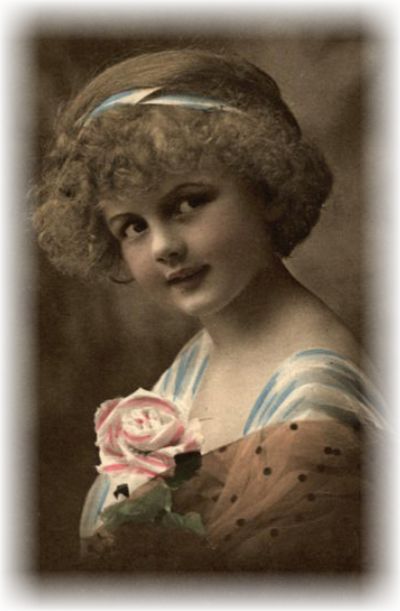
    English postcard, c.1919

    But here the little girl breaks in upon them, and says: “How curious, Mademoiselle Fernanda de Lesseps was to open the canal today, and you are called Fernando! Fernando Montez—that’s a pretty name! I call little Fernanda, Tototé; must I call you Tototo?” Then she looks at the little figure of the ennobled gentleman, and gazes curiously at his jetty hair that is just beginning to show a little silver on the temples, and notes his mobile mouth play under his waxed moustachios, and his very white shirt, which has a decoration upon it—some old Spanish order he had picked up in some Peruvian cathedral. Next the blue eyes of happy childhood glance up fearlessly at the bright orbs of the newmade noble that have opal flashes in the gaslight; and, somehow, though this child had never felt fear before, her eyes droop before those of the all-nation gentleman, and she is happy when her guardian says: “Jessie, it is time for little girls to be in bed.” So mademoiselle trips hurriedly off to her governess, followed by the sleepless eyes of Montez.

    “You have made quite an impression on my little ward,” whispers the guardian.

    “Ah, you ravish me with delight!” cries Fernando.

    And so he has; for the little girl is murmuring to her elf: “Bluebeard, Bluebeard—naughty Bluebeard!” and trembles as she runs along.

    The Hidalgo is pleased to see that his title has made an impression upon the Franco-American. He remarks, for the beauty of the child still lingers in his senses, “Miss Jessie will soon be ready to bless some happy man with her hand—this little beauty!”

    “Pooh! She is only ten. That will be years from now!” says Larchmont easily. Then he goes on: “But I see in this tropic land the ladies develop early,” and casts his eyes over the bronze shouldered Inezes and Doloreses, as they are trooping into the ballroom.

    “Yes, we would marry her at fourteen here!” laughs Montez. “But even in France, in a few years she will be ready for her trousseau—about the time the canal will be open. You might celebrate both fêtes together, when you have selected the husband.”

    Then the buzz of excitement coming in through windows that are always open, save during thunder storms, in this torrid city, attracts the gentlemen. They step out to catch the night breeze that comes refreshingly to their cheeks, and look down upon the great Plaza of Panama, with its green plants and paved walks, in which the crowd are promenading, the great cathedral standing at their left. For this is the old Grand Hotel—the one that afterwards became the offices of the Panama Canal—which is decked to-night for gayety.

    Looking at the cathedral, a grim smile comes over the face of Montez, and he sees in his vivid imagination a bridal procession going up its great aisles to music of the organ and chant of dusky altar-boys, and picturing the bride with blue eyes and blonde tresses, thinks to himself: “Why not I for the bridegroom? I am not old! She is rich. The man beside me is weak. Perhaps with another fortune may come to me another beauty.”

    The noise of the moving crowds below breaks in upon his reverie, and Larchmont suggests:  “Suppose we see the ball.”

    They go in to the dance where Spanish beauties, in the ball-dresses of Europe, jostle French and Colombian uniforms and black dress coats; and the grand old man dances quadrilles with lovely Inezes, Marias, and Manuelas, to have his agility telegraphed all over the world, so that doubting French peasants may invest their stocking hoards in his newest and grandest enterprise, still thinking him the man of Suez, when Ferdinand de Lesseps is in reality beginning a dotage, awful in its consequences, to his friends, his government and his country—because it is unsuspected.

    So the ball goes on to its climax, amid the strains of the latest waltzes, and the clinking of champagne glasses in the supper room, and the laughing eyes of Spanish beauties, and the babbling tongues of sycophants and hangers-on.

    And on this night of triumph, when De Lesseps inaugurates the work on the Panama Canal, this night Fernando Montez gives to himself nobility and a title that will give him weight in Europe and influence over weaklings like the one he has set his eyes upon this evening. So the black drops in his veins become blue, azure, and noble; even the little Congo negro he has in him changes to old Castilian, as he exclaims: “Fernando Gomez Montez, I ennoble thee! Mule-boy of Cruces, I introduce you to Baron Montez!”

    Full of his project, this very night he obtains a printer, who, under great promise of secrecy, for which he is heavily paid, furnishes early the next morning the following striking carte de visite.

    Visiting card is decorated with a coronet. Embossed flowing script reads, "Baron Montez, Panama and Paris".

    This looks so beautiful to him that he cannot refrain from trying its effect early next morning.

    Old Domingo, who is older by twenty-four years since the night he assisted to make Montez rich, lives with him, not as servant, but as kind of halfway guest, for the old man is well-to-do. The old pirate knows the buccaneer maxim: “Every man his share!” And he had had pirate enough in him to compel the moiety of the American’s gold due him from Montez.

    On this he has lived and prospered, and though well over seventy, is still as hale and hearty and old a sinner as can be found in South America—which furnishes as fine a sample of ruffians as Hades itself.

    “How now, Señor? You seem happy!” is Domingo’s greeting, as his mentor saunters on to his portico, having finished his alligator pear, sucked his orange, and drank his cup of coffee. “How now, Señor Montez?”

    Baron Montez!” corrects the gentleman addressed, severely.

    “Caramba!”

    “After this, Baron Montez! I have been ennobled,” remarks Fernando, shoving his ornamental pasteboard beneath Domingo’s rolling orbs.

    “Ho oh! By the great fat Frenchman who is here?”

    “Yes, the great Frenchman, who will make us all rich.”

    “Sant Jago! Another massacre! There are lots of them here now! Beauties, too! Would I were younger!” mutters the ex-pirate, his eyes glowing with pirate gleam.

    “No, not this time. They have more to give us if we let them live!” returns Montez in grim significance.

    But the remembrance brought to his mind of that night in 1856, does not seem to please him. He looks curiously at Domingo, then gives a little sigh of relief; the appearance of his co-laborer indicates he will be forever close-mouthed. Time has made the rest safe. They are dead; even the beautiful Indian girl, Anita of Toboga, had become a hag at twenty-five, and died at thirty. Beauty that the sun nourishes most fondly, it soon scorches to death in these tropic climes.

    So, with a contented smile, Fernando strolls off, to put his new nobility to use.

    He sends up his card, with its coronet, to the Franco-American, and very shortly following it to that gentleman’s parlor in the Grand Hotel, is greeted by a “Good morning, Baron!” and an effusive grasp of the hand.

    For one second he starts, thinking some one else is addressed—it is not easy to get accustomed to nobility overnight—then, with a smile, the “new creation” replies with affable hauteur.

    Soon after, all others address him as Baron; none seeming to doubt his title, for these curious reasons: The French, knowing but little about him, think he is a true Spanish Hidalgo. His Colombian confrères, some of whom have known him even when he was an altar boy in the Cruces chapel, think Fernando has received his patent of nobility in some peculiar manner from le grand Francais De Lesseps. Besides this, they are very much occupied about a revolution that they have been intending to put in progress, but have postponed, fearing their political shooting and slaying might delay the opening of this canal. They will, however, go at this quite merrily, as soon as Monsieur de Lesseps leaves Panama. So it comes to pass that the ex-muleboy of the Gargona trail, el muchacho diablo, becomes accepted by men as Ferando Gomez, Baron Montez, and prepares to air his title in the salons of Europe and the Parisian Bourse.


    Notes and References:

    • Le Grand Franc̗ais: a title bestowed on Ferdinand de Lesseps by Léon Gambetta, a French statesman, a revolutionary Republican known for his brilliant oratory. De Lesseps withdrew from the election in the District of Marseille in order that Gambetta might win it, and Paris District.
    • Comte de: count, earl.
    • cholera Asiaticus: Asiatic cholera pandemic (1826-1837), was “a cholera pandemic that reached from India across western Asia to Europe, Great Britain, and the Americas, as well as east to China and Japan.”
    • el vomito negro: alternative name for acute viral yellow fever.
    • la boca: French—the mouth.
    • confrères: a fellow member of a profession, fraternity, colleague.
    • Chiliano: Chilian.
    • cuchillo: knife.
    • carte de visite: visiting card, i.e. a calling card. Notably a type of small photograph which was patented in Paris by photographer André Adolphe Eugène Disdéri in 1854.
    • bourgeois: member of middle class.
    • sylph: “a slender, graceful woman or girl. (In folklore) one of a race of supernatural beings supposed to inhabit the air” (dictionary.com).
    • bonne: French—a child’s nurse.
    • punctilio: a fine point, particular, or detail, as of conduct, ceremony, or procedure.
    • moiety: a half, or an indefinite portion, part, or share.
    • hauteur: haughty manner or spirit; arrogance.
    • Bourse: stockmarket—the Paris Stock Exchange


    Bernstein, S. “The Impact of the Paris Commune in the United States,” The Massachusetts Review
    Vol. 12, No. 3 (Summer, 1971), pp. 435-446.

    Monroe Doctrine; December 2, 1823“. Yale Avalon Project: Documents in law, history and diplomacy.

    Parker, M. Hell’s Gorge: The Battle to Build the Panama Canal (London: Arrow Books, 2007).

    This edition © 2021 Furin Chime, Brian Armour

  • A.C. Gunter’s Baron Montez of Panama and Paris

    A.C. Gunter’s Baron Montez of Panama and Paris

    Prepare to embark on an idiosyncratic taste thrill, another foray into the paradoxically expanding universe of vanishing literature. This bestselling author-playwright, said to have been better known in his day than his contemporary, Mark Twain (1835-1910), is now reduced to fragments, trivial contributions to popular culture: Played middle-man in the rise of the great American baseball poem “Casey at the Bat” – sometimes referred to as the best known poem in the United States. Authored a novel on which A Florida Enchantment (1914) was based, ancestor of lesbian-transgender films.

    Archibald Clavering Gunter (1847-1907) was born in Liverpool, England, taken by his parents to San Francisco when he was six, and grew up there, before moving to New York to become a playwright, after building careers in rail and mining engineering, chemistry and stockbroking. Something of the thrill and spectacle of that six-year-old Liverpudlian’s trans-Atlantic voyage surely took permanent root in his imagination, given the extensive output he managed to generate even after such patently anti-literary occupations. Actually, he wrote his first play, Found a True Vein (1872), about life in a mining camp, while still working as an engineer.

    Baron Montez of Panama and Paris (1893) is a rags-to-riches story, like other of Gunter’s novels propelled by a dynamic of character and place. We can compare with titles of his such as  Mr. Barnes of New York (1888), Mr. Potter of Texas (1891), Don Balasco of Key West (1897), and the intriguing Miss Nobody of Nowhere (1890). Intriguing indeed, as Harlequin Romance author Elizabeth Ashton must have thought in 1933 when writing her novel Miss Nobody from Nowhere.

    But where are places as plentiful in such possibilities of drama and exotica as Panama and Paris – especially in that exciting era of massive change and aspiration, of explorers, prospectors, swindlers and tycoons? We wonder already about Gunter’s representation of the burgeoning Americas and Americana upon a global stage.

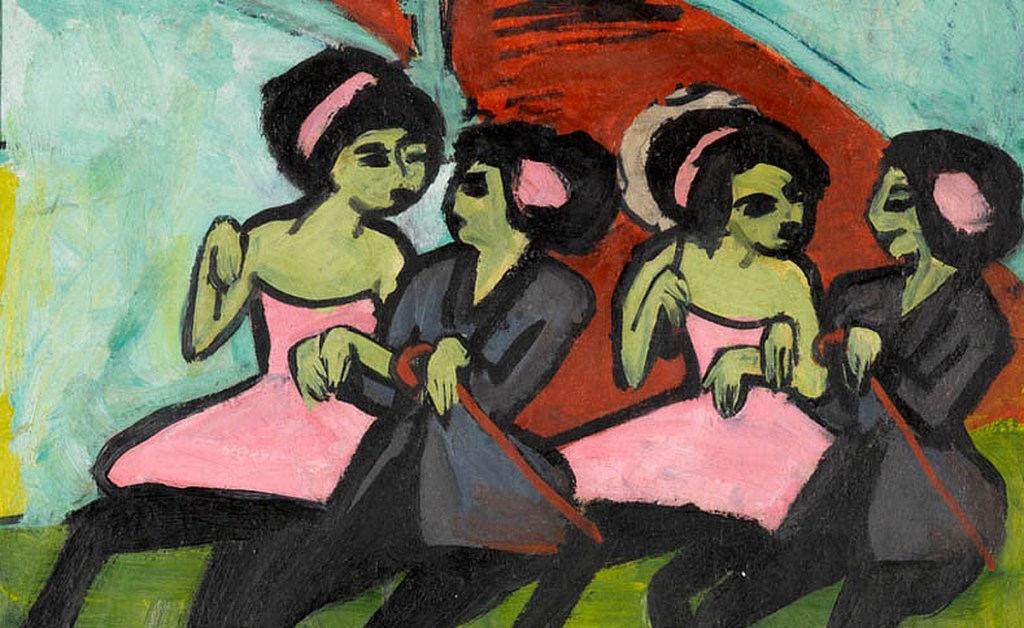
    Panama Dancers (1910-11), Ernst Ludwig Kirchner. (North Carolina Musuem of Art)

    Shady Señor Fernando Montez starts out as a seedy muchacho in a bamboo shack on Toboga Island. These are portentous times, however, preceding the building of a great canal to link the Atlantic and Pacific Oceans, and hence the two hemispheres of the globe, a dream only intensified by the discovery of Californian gold. Montez’ ascent can be limited only by his own hubris, and Gunter’s imagination.

    The French diplomat Ferdinand de Lesseps, who had developed the Suez Canal in 1869, attempted a repeat performance in Panama during the years 1881-89 but went bankrupt. The Compagnie Nouvelle du Canal de Panama again tried unsuccessfully in 1894. Gunter’s novel is, therefore, quite contemporaneous with the world depicted in it. One anticipates a taste of the authentic flavour of the times—the authentic zeitgeist, good and ill.

    In Gunter’s own estimation, his were “the most successful novels ever published” (Hart 189). Well, we’ve heard that sort of thing before, and it depends which way you’re looking at it. Nevertheless, if not for literary brilliance or a polished style, he is acknowledged for bringing American and European attitudes into a comparative focus and for the immense popularity of his

    …long line of yellow-backed novels, soon to be seen in innumerable hammocks, summer resorts, excursion boats, Pullman Palace cars, or wherever else Americans moved for dreams and escape.

    Hart 188

    Brian Armour will edit the chapters and provide reflective, contextual prefaces. Brian is the author of a stunningly good science fiction novel, Future Crime (2015), with a further brilliant novel and book of short stories coming out soon.


    Reference

    Hart, J.D.,The Popular Book: a History of America’s Literary Taste (NY: OUP, 1950).