Tag: Panama

  • A.C. Gunter’s Baron Montez: 21. After Her!

    A.C. Gunter’s Baron Montez: 21. After Her!

    As the title suggests, this chapter, the last in Book Three has a sense of haste and urgency about it. Louise has to navigate a series of diverse interactions and does so skillfully and with a will, including another encounter with Domingo in which she deftly uses his own vernacular to deflect him from the truth. The previous night’s episode with a drunk Domingo has wrought a profound change in Louise. She appears now as self-realized, confident and independent in her thought and actions, acting some contemporary female readers might say, like a driven man.

    Harry is recovering and is well enough to read the cable he has received. The situation is becoming desperate for young Jessie as Harry’s brother has started wedding arrangements. We come to appreciate that Harry is thicker than we thought when it comes to Louise’s feelings toward him, and is only enlightened by his friend Bovee’s observations. Despite Louise’s explanations as to what has occurred and that she has to act immediately, Harry is still too ill to do anything and seeks her promise to wait until he is well. This is expressed in dialogue that is attributed, not to Harry, but to ‘the man’, the intimation being that this is ‘what a typical male might say’. Louise has other ideas. Louise has been put in an invidious situation but she responds well, with new adventurous vigor invested with her desire for vengeance. Louise has a mission.

    In an ‘impressive’ meeting with Aguilla, Louise is informed that Montez and himself sold their shares in the Canal Interoceanic in the first four months of 1881. This is when the shares would have been at their most inflated value. December 7th, the previous year having seen the first share offering of the company. The stock issue of 600,000 shares at 500 francs each had been heavily promoted—there were picnics and conferences hosted by De Lesseps, hot-air balloons streaming advertisements, handbills issued with grocery purchases, offers of a silver medal to those who were assigned five shares or more.

    The Panama Canal: having fled France to escape the results of his mismanagement of the canal’s financing, Dr Cornelius Herz escapes extradition on the ground that he has a terminal illness, and lives happily in Bournemouth for fifteen years. Satirical watercolour drawing by H.S. Robert, ca. 1897. See n. Chapter 18.

    In addition, the press had been bribed with a million and a half francs, so that all the leading journals lauded the project. The enterprise took hold in the hearts of the French people and 100,000 citizens subscribed for the 1,206,609 shares on offer, 80,000 of these being small investors. As the share issue was seriously oversubscribed, many people were left still hungry to be a part of the great French enterprise (Parker, p. 97-98). Such a person was Gunter’s character Sebastien LeFort, the Parisian glovemaker, who was desperate not to miss out on the once in a lifetime opportunity. This saw enormous speculation on the Bourse for shares, of which obviously, Montez has taken full advantage. Though it is difficult to determine what exactly the functions of Montez, Aguilla et Cie have been since that time, requiring an office in Panama and the employment of three clerks, Aguilla is seriously rattled at the prospect of Montez getting his hands on the company books.

    The chapter is designed to initialize action that will stimulate the reader to anticipate Book 4. With Louise’s departure, Gunter has spawned a parallel narrative stream, which he will utilize in a future chapter. This method permits the author to condense time, skip unnecessary description, and instill curiosity in the reader afresh as the story progresses. Gunter concentrates on only one long sea voyage, and return to Paris, aptly filled with Harry’s convalescence. Once more our narrator cannot contain his excitement and uses upper-case letters to entice readers onward with great expectations.


    CHAPTER 21

    AFTER HER!

    Some little time after this, the girl lying half swooning over her typewriter, by an effort, forces her mind to its work once more, and taking the awful dictation with her, goes tremblingly out of the building, and is happy to find herself in the streets, with people moving about.

    This terrible tale has affected her nerves, and she shudders, turning corners, even on the open streets of Panama, for she sees the Macagua snake in her imagination, and a woman crazy with despair holding it on high, pursuing the shrieking Montez in the hut, careless as to which one it gives death. But the very horror of the tragedy ultimately gives her strength. She thinks of the cruel fate of Alice Ripley, and determines to avenge it, and this nerves her to do things Louise Minturn could hardly have brought herself to do, until Domingo the ex-pirate had told his awful story to her shuddering ears.

    Young Fer-de-lance (Bothrops Asper), Photo by Hugo Brightling on Unsplash

    She is so excited, that she fears her agitation may communicate itself to the invalid. She knows this night she is no fit nurse for anyone.

    So she sends a message to the young American, Bovee, in whose room Harry Larchmont still lies; and, receiving word that the invalid is doing very well, remains at home and goes to bed herself.

    The next morning she awakes her usual self; for youth and hope give brightness to the eyes and elasticity to the step of this fair young maiden—even in this sickly town of Panama—now that Harry Larchmont is getting well.

    She comes into the sickroom quite cheerily this morning, and is very happy, for the patient is much better. A moment after, the doctor, who is present also, says to her inquiring glance: “Yes, you can give him the cablegram now.”

    This she does, and is sorry for it.

    Glancing at it, the sick man utters a faint cry, and tries to struggle up in his bed.

    “What’s the matter?” whispers the doctor, seizing him.

    “My brother!” shouts Larchmont, agitation giving him for a moment strength. “My heaven! He is wax in Montez’ hands! I must go to Paris at once, or he will marry her to that villain before I get there! It’s—it’s a cable from Jessie.”

    These words put a knife in Louise Minturn’s heart.

    After a little, when the doctor has quieted the patient, telling him he will soon be able to travel, she mutters: “I must go!” And despite Harry’s pleadings for more of her society, falters from the room to her office labors at Montez, Aguilla et Cie., murmuring to herself in broken voice: “How anxious he is to get back to theside of his love—the girl in Paris! All he fears is that he will lose her!”

    At the office she contrives to get through her work, which is very little just now, though Aguilla says : “In a few minutes I will have something to say to you!”

    She is at her typewriter. Suddenly she shudders; Domingo stands before her.

    The wine has left him now, and he says insinuatingly, a cunning gleam in his eyes: “What did I do last night? Did you see me? Did the old drunkard swear to any wild tale, eh, muchacha bonita?”

    The girl, steadying herself, replies: “No, though you might have—you had a letter to write, old Domingo—only you were a little overcome with wine—too much to speak it to the air. If you will tell it to me now, I will put it down for you.”

    “Oh, I told you nothing—that was well! Never believe the stories of the drunkard!” he chuckles. “But I have a letter to write to mi amigo, Baron Montez—one he will not bless you for sending.”

    And he dictates one to her, of a threatening kind, in case he shall lose his gold that he has saved during his many years, and be left in his old age without money to buy for him the pleasures of life. This finished, he snarls: “Send that to Montez with the compliments of Domingo of Porto Bello!” and goes off to the wine shop, for there is still some money in his pockets.

    Thinking over the matter, Louise is glad she has given him no hint of his revelation. Domingo drunk, and Domingo sober, are two different creatures. Domingo drunk will babble his awful tale into her pretty ears: Domingo sober will cut her white throat for telling it.

    A moment after, she hears something from Aguilla that expels for the moment all thought of the ex-pirate from her mind.

    He leads her cautiously into his private office, and says: “This that I tell you is a secret. I have been kind to you, while you have been here, have I not?” and pats her hand as if to beg a favor.

    “Yes,” answers Louise, “very kind and considerate, and I thank you for it.”

    “Then in my extremity, remember it! You are the only one I can trust to do this thing. My clerks here are either those who might betray me, or have not that certainty of character that is necessary in this delicate mission.”

    “What do you wish?” asks the girl, nervously; for his manner is impressive.

    “This! and remember—I am placing my fortune in your hands—the fortune of my family that I have worked all these years to gain! I want you to prevent my partner, Baron Montez”—here his voice grows very low—“from ruining me!

    “Ruining you?”

    “Sh—sh! Not so loud! Yes. What he has done here, to those about him, makes me know I am not safe in his hands. I fear he will destroy the ledgers of our firm in Paris, because those ledgers show that I am rich—not as he is—but still enough. There is but one chance for me. You must go to Paris!”

    “To Paris!” gasps Louise, then thinking of the invalid still pale and weak and needing her nursing, she mutters, “Impossible!”

    “Imperative!” answers Aguilla. “You must leave tonight!”

    “But my patient?”

    “Leave him here. He is out of danger, I am not. My salvation depends on your acting for me—in time! I shall give you tickets for the fast steamer leaving Colon tomorrow morning, to connect at St. Thomas with the English line for Southampton. The British ship calls at Cherbourg. From there go to Paris, immediately! At the office of Montez, Aguilla et Cie., deliver to the gentleman in charge, Monsieur Gascoigne, my written order for you to examine the ledgers of the firm, and take off certain reports therefrom.”

    “But,” stammers Louise, “Montez is there. If he means to do what you fear, he will refuse!”

    “Montez is not in Paris! He did not go there direct. He will stop two weeks in New York—that is our chance! You will get there, probably, a week before him! In that time you must take a record of the ledgers for the first four months of 1881. That was the time when we sold out most of our stock and got clear of Canal Interoceanic. Have your excerpts attested by Monsieur Gascoigne before a notary. Then if Montez destroys the books or loses the books—or they fly away into the air, I am safe—I have the records!—he cannot rob me!”

    “But why not go yourself?”

    “At this moment it is impossible! My wife and child are sick—perhaps dying—I cannot leave them! There is no time but now! I must trust to you! Will you do it?”

    “Yes, if possible!” cries Louise, a sudden wild thought in her brain. “I will tell you in an hour!”

    “Very well! If you will not go, I must try and get someone else, though I know of none who would do as well!” murmurs Aguilla.

    Then the girl flies off to the bedside of Harry Larchmont.

    “What does the doctor say about your going to Paris?” she asks hurriedly.

    “Not for a week yet—at best!”

    “Then I will go to Paris for you!”

    “You? How will you prevent Baron Montez marrying Jessie Severn?” and the invalid stabs his nurse again.

    “Do you suppose you could control my brother?” he goes on reflectively, “who is now either fool or imbecile, in Paris?”

    “No, but I can do something else for you!” murmurs the girl, whose lips tremble at the mention of Miss Severn’s name. “You told me once, you wanted the secrets of Baron Montez. What secret do you want most?”

    “The most important to me,” murmurs Larchmont, “would be the real or true record of his transactions with my brother. The statements he has furnished Frank, I have looked over; they are incomprehensible, involved, vague. I do not believe them true!”

    “I will betray them to you!”

    “Impossible!”

    “I will betray Baron Montez to you! I will use my confidential position to destroy him!” cries Louise, her face excited.

    “Oh, no!” answers the man. “You told me your business honor would prevent your doing that!” Then he falters: “Not even to save me a fortune or my brother his honor, will I permit you to do what you may one day blush for!”

    “My business honor is to business men—not monsters, murderers, and bandits!” answers the girl, the light of passion coming into her eyes. “I will destroy this man as he has destroyed those of my blood—remorselessly as he did them!” and she tells him the story of Domingo, the ex-pirate, and the mission that Aguilla would give her in Paris.

    But he whispers: “No! no! Montez would kill you, if you brought danger upon him! For my sake, do not go!” and kisses his nurse’s hand, murmuring “Promise!”

    “I must go!”

    “Not till I go with you. Promise!”

    But she does not understand, and breaks away from him; but lingers at the door and kisses her hand to him, though her face says farewell.

    From Harry’s side she flies back to Aguilla and says: “I accept. I will do what you wish, faithfully and truly!”

    “Then I have hope!” answers the Frenchman, and chuckles in his bourgeois way “I knew you would! You are a true girl! I have had everything prepared! Here are your tickets to Paris, complete in every particular. Here is money for your expenses!” And he gives her more gold than she has ever had in one lump in her life before. “Spare no expense. This letter to the firm will give you the opportunities you want, if you get to Paris before Montez—that is the vital point!”

    Then she suddenly says: “Where shall I stay in Paris? A young lady alone, I am told, is very unpleasantly situated.”

    “I will give you a letter to a friend of mine, a man of family,” answers Aguilla. Writing this last and handing it to her, he gives her another thrill—for he says: “You must leave this afternoon!”

    “This afternoon?” ejaculates Louise.

    “In two hours! The steamer leaves Colon tomorrow morning, and time is vital!”

    “Then get a carriage for me,” answers Miss Minturn, who having once made decision carries it to the end. This being done she flies to the house of Martinez the notary, and astonishes them all. She says she is going away.

     “Next month?”

    “No, now!”

    “Now? Sanctus Dominus!” And the Spanish family, not accustomed to haste, jabber excitedly about her as she packs her trunk. Feeling she has not strength to say good-by to the man for whose sake she is really going, Louise scribbles a hasty note of farewell to Harry Larchmont; and even while writing it, Aguilla has come for her with a carriage—he is in such a hurry.

    The two drive down to the railroad, the Frenchman repeating his instructions as he puts her on the train.

    Then Louise Minturn, as the cars run out of Panama, the excitement of departure leaving her, falters: “Who would have thought it this morning? I am going to Paris to fight Harry’s battle—to win his love for him—to win her fortune back!”

    Her lovely eyes cannot see for the tears, and she murmurs: “God help me! The happier I make him, the more unhappy I make myself! I wonder if he will ever know?” Then determination coming to her, she cries: “I pray God not!”

    Vampire (orig. Love and Pain), 1893, Edvard Munch

    That evening a little note is brought to Harry Larchmont, as he lies in his cot, in the town of Panama, and he mutters: “Louise has broken her promise! She has left me! She has gone where danger and death may come upon her!”

    “Calm yourself, Harry!” says his friend Bovee; “she has only gone to Paris, and Paris is not fatal to all pretty women.”

    “But you don’t know—he may kill her!”

    “He—who?”

    “Baron Montez!”

    At this his friend looks curiously at him, and thinks he is raving again; so curiously that Harry says: “You need not fear. My head is as sane as yours, only—God help me! She has left me!”

    “Oh, you’re convalescent now—you can get along without your nurse!” laughs Bovee.

    Not when I love her!” answers Larchmont. “Love her with my heart and my soul!”

    “Then,” says Bovee, after a pause of astonishment: “I can give you better medicine than the doctor—the best medicine in the world!”

    “What’s that?”

    “She loves you!”

    “My God! What makes you think?”

    “She’s awfully jealous of that little girl in Paris—and between ourselves you’ve given her very good reason in your delirium ravings.”

    “Jealous of Jessie? Ha! ha! Ho! ho! The darling!—jealous of my brother’s little ward! This is lovely; this is funny! This is delightful,” laughs the invalid.

    “You wouldn’t laugh if you’d seen her look at you when you were raving about the other girl,” mutters Bovee who is an observer.

    “I brought tears to her?” murmurs Harry.

    “Yes!”

    “Then as God’s above me, those tears shall be her last!”

    “All right! To keep your oath pull yourself together, get well, and we’ll ship you off to Paris after her!” answers his friend.

    Which Mr. Larchmont does, and a week after Miss Minturn has sailed from Colon, Harry reaches that place, to follow her to Paris. He is much stronger now, and the sea-breeze adds to his strength, day by day, as he sails to cooler climes.

    He carries with him something that keeps his mind occupied during the voyage.

    As he is leaving Panama, right at the depot, Mrs. Winterburn catches him. She cries eagerly, for the locomotive has already whistled: “Here’s something my husband says belongs to Louise;” and gives him the beautiful string of pearls found in the powder canister. “And here’s something Miss Minturn left in the hurry of bolting. It’s a book of writing: she had only an hour to pack, and forgot it.” With this Susie presses into Larchmont’s hand a large manuscript volume.

    “Great goodness! It’s her diary!” he gasps, gazing at the outside of it, and would give it back to Mrs. Winterburn, but the train is already moving, for a curiosity has come upon him of which he is afraid.

    But he locks the book up in his trunk, and fights with himself, saying: “No, no. I’ll not—read this—if I die of wanting.” But one day as he moves it, gazing at it with longing eyes, some things fall out of it.

    With a cry of love and joy he picks them up and look ing on them mutters: “These are mine—they were mine before they were hers.” And goes about happy but expectant. They are his bunch of violets and card of the blizzard.

    And so, coming into Paris, about six o’clock in the evening, of an early June day, Harry Larchmont is pretty much his old self again, though his face is still pale, and there is a very anxious expression in his eyes.

    Driving up to the hotel of his brother in the Boulevard Malesherbes, near the Park Monceau, he is let in by Robert the old-time servitor, with exclamations of delight and welcome, and finds something that astounds him—that something that often comes to us—the great—the UNEXPECTED!


    Notes and Reference

    • muchacha bonita: pretty girl

    Parker, M. Hell’s Gorge: The Battle to Build the Panama Canal (London: Arrow Books, 2007).

    This edition © 2021 Furin Chime, Brian Armour

  • A.C. Gunter’s Baron Montez: 3. The Railroad Station At Panama

    A.C. Gunter’s Baron Montez: 3. The Railroad Station At Panama

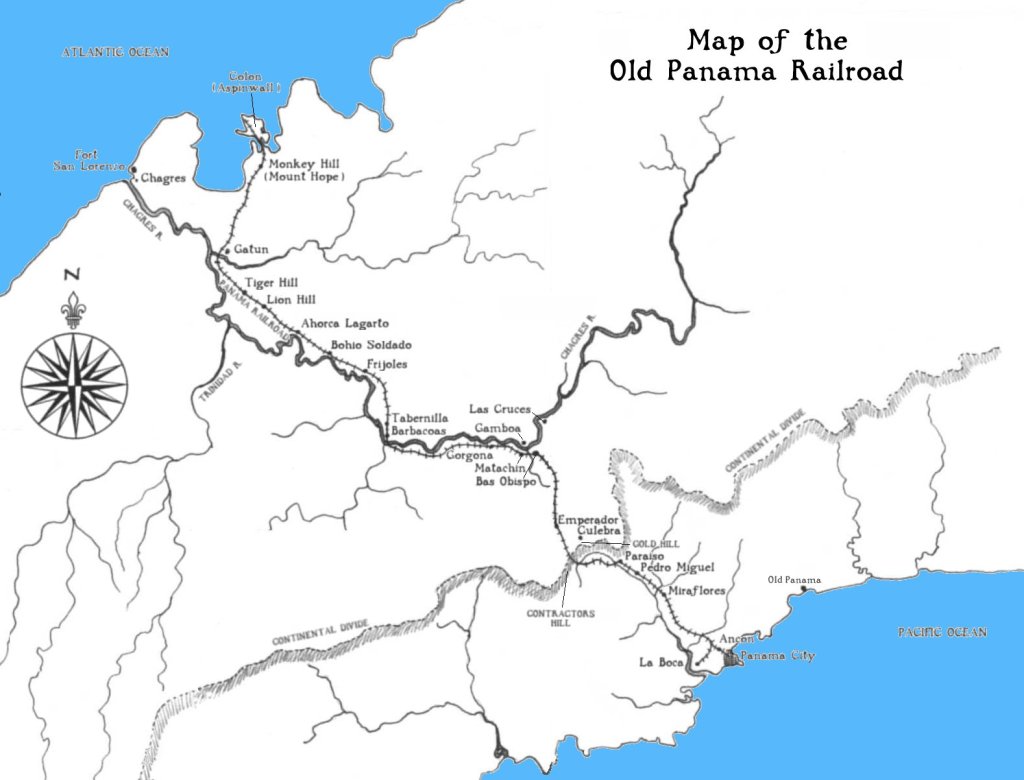
    As we begin this chapter, Fernando Gomez Montez, having tampered with George Ripley’s revolver, has new confidence, and commences putting in place other components in his plan to relieve the American of his gold-filled chest, and fair-skinned wife. Montez arranges boat transport for himself and the Ripleys to Panama where they find it crowded with travellers recently offloaded from steamers awaiting the train across the Isthmus and also those joining vessels to travel up the West Coast of the United States. Panama has become a busy hub for trans-continental travellers.

    Even before the railroad was completed, Americans eager to join the gold rush in California were paying to have themselves and their luggage transported across the extent of the completed track. The Californian Goldfields would generate nearly twelve million ounces of gold, most of which would pass through Panama on the way to the Eastern United States. George and Alice can expect to pay a hefty twenty-five dollars each to travel on the recently completed railway to Aspinwall.

    Old rail route across the Isthmus of Panama (panamarailroad.org)

    Seven years earlier, in 1848, the United States signed the Guadalupe Hidalgo Treaty, ending the long running Mexican War. The treaty gave the U.S. undisputed control of Texas, established the U.S.-Mexican border of the Rio Grande, and ceded to the United States the present-day states of California, Nevada, and Utah, most of New Mexico, Arizona and Colorado, and parts of Texas, Oklahoma, Kansas, and Wyoming. This expansion completed control of continental United States complementing central lands transferred through the Louisiana Purchase of 1803. The removal of the threat of warring Mexican forces, and mitigation of dangerous Native Indian tribes encouraged settlers like those awaiting the steamships to venture to the Western States.

    During the construction of the railroad, the Americans used workers who had come from the United States, Europe, Columbia, China, the Caribbean islands, and also African Slaves, a great many of them who died of Cholera, Malaria and Yellow Fever. Once the Railway was completed the majority of these remaining poorly paid workers were dumped and left to their own devices for survival. The US used troops to suppress separatist uprisings and social disturbances on many occasions. The first time will occur on the fifteenth of April, 1856.

    Unlike the narrator, who reminds the reader of the date, Fernando is unaware of any significance attached to it and goes about his connivances, which remarkably are designed to precipitate an historical event.


    CHAPTER 3

    THE RAILROAD STATION AT PANAMA

    On the veranda once more, George Ripley suggests: “Would you mind showing us your pearls? My wife is anxious to see your jewels, and we must be soon getting under way for the mainland.”

    “Yes, the Illinois arrived this morning at Aspinwall,” returns Montez. “Her passengers will soon reach Panama. Soon there will be a Pacific Mail steamship in the bay. The Golden Age from San Francisco is one day overdue. When she comes in, her passengers will be moved eastward rapidly. If you are not at the railway station you may be left to spend ten days more with us. That would please me, mi amigo; but you—you are an American, and in a hurry. You do not enjoy life. You fly through it.”

    “And you dream through it, I imagine, Señor Montez,” laughs Alice, coming on the veranda to meet the returning bathers. Then she says archly, “Dream no more; show us your pearls, and become a man of business.”

    “That I will!” cries Montez, as he displays his jewels, and descants on the beauties of the large pink pearl he has, and the perfection of the white ones he holds caressingly in his hands, with the vehemence and volubility of an Armenian in the bazaar at Constantinople, and the shrewdness of a Hebrew pawnbroker in Seven Dials.

    Fernando’s trading powers, however, are thrown away; for the American takes all the pearls at the seller’s own prices, which though exorbitant for Panama, are cheap for New York.

    “Come in and get our business over,” says George; and Montez following him and Alice into the bamboo cottage, the affair is completed. Opening a large buckskin bag, that is part of his belt, after the manner of early Californians, Ripley makes payment in gold dust; for at that time gold was plenty, though coin was scarce, in the Western world.

    Upon this yellow dross, Fernando’s eyes linger lovingly, and from it roam gloatingly to the heavy ironbound trunk of the Californian, and turning from this to the beautiful Americana, who had thrown her pearls in a string of white radiance around her fair white neck, his glance becomes more longing than ever.

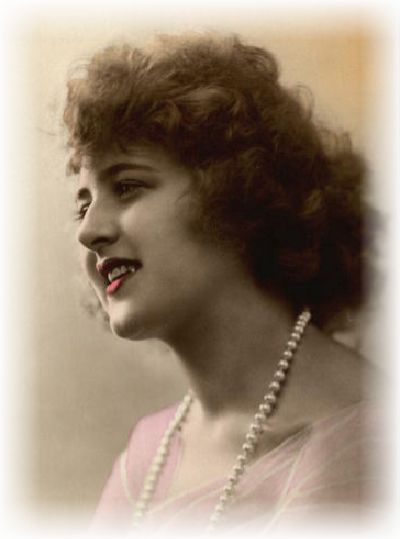
    Antique French postcard (n.d.)

    Here George laughingly suggests: “Montez, you think jewels become her? Alice should have had these pearls when she stood in Edouart’s gallery in Washington Street, San Francisco, and had this taken,” producing from his pocket a tintype of his wife, a style of picture just come into fashion.

    “Yes, I had two of them taken; one for my husband, the other for my daughter; Mary’s was sent to her two months ago. It will remind her of my coming,” replies the lady; then blushes a little, for Montez, in his native way, has cried out: “Ah, Dios! It is celestial—but the sun has not done you justice, Señora Ripley!”

    The sun, however, has done very well, and the tintype has the blue eyes and fair hair of this charming American.

    So charming, Montez fears to stay; his passion may betray itself. He mutters, “I will go and engage your boat, Señor Ripley.”

    “Yes! Get a safe one, I don’t care for speed. Something there is no chance of capsizing,” calls the Californian after him.

    “I will be sure of that for my own sake, as well as yours,” cries back the little gentleman, as he glides down the pathway, brushing with a bamboo switch the dust from his patent leather boots.

    At the white glistening beach he selects carefully a boat, and is delighted to find among its crew a swarthy boatman, who is called Domingo.

    Addressing him familiarly, and slapping him on the back, Montez says in his ear: “Old bravo, are you still up to banditti work as in ’52, on the Cruces roads?”

    To this, Domingo, a gentleman with a pirate countenance adorned by two fearful scars, with a stalwart black frame, and a stout black heart beating in his black body, replies: “Si, Señor, mouches dinero, mouches sangui, mouches Domingo.”

    So Fernando knows he has at his hand, for this night’s work, a man who will not be turned back for pity, nor blood, nor danger, from doing any wickedness that may come to his hand.

    While this has been taking place on the beach, Ripley and his wife, during hurried preparations for their departure, are holding a conversation that makes the Californian open his honest eyes in astonishment.

    His wife says to him, under her breath: “Now that Montez is away, I wish to tell you something: I am glad we are going!”

    “Of course! Tomorrow we will be one day nearer our daughter.”

    “It is not entirely that,” whispers the lady, nervously, “but I fear to stay here.”

    “Why?”

    “Anita hates me.”

    “Impossible! No one could have nursed you more faithfully during the fever, than the bright-eyed Indian girl.”

    “It is her bright eyes that make me fear her. Something new has come into them. Besides that, while you were taking your bath she told me that we had better go away as soon as possible. She told me.”

    “Well, what?” says the American impatiently.

    “Only—that—if the fever returned to me here—I would not throw it off again. Toboga breezes are good for the first attack,—but after that,—like other medicines,—they lose their value.”

    While she says this in a hesitating, disjointed manner, a bright red flush has come over the features of the beautiful American lady, for Alice Ripley is telling her husband her first falsehood.

    Anita’s words had been to her: “Beware of Montez! Montez loves you!” and suspicion coming to her quick feminine mind at these words, Alice had noted some of the uncanny glances the polyhæma gentleman at times could not restrain himself from indulging in. But at the last moment, even when warning was on her lips, she has hesitated to tell her husband what she has heard and suspects—because the very thought of the thing brings blushing shame upon her.

    So the modesty of this beautiful woman takes from her husband one of his ropes of safety this day—his one chance of suspecting the man he thinks his friend, but who is even now bent upon his robbery and ruin.

    “Well, let us give Anita her pearl—perhaps that will reconcile her to our going away,” laughs the Californian.

    This being done, they leave the palm-thatched bamboo villa, and come down the little rocky pathway to the beach at Toboga, to take departure for Panama.

    Three stalwart natives carry the ironbound trunk, and find it all they can handle; another swings easily the lighter one that contains the wardrobe of George Ripley and his wife.

    Looking around, Montez is happy; for there is only a steamer of the English Steam Navigation Company in the harbor, one or two trading brigs and schooners, and the Columbus just returned from her voyage to the Islas de las Perles, and no vessels of war of any nation. No blue jackets can be landed to interfere with a plan that he has already set on foot among the desperate native classes of the town of Panama this fifteenth day of April, 1856.

    Toboga is slumbering in the midday sun, as they stand upon the sandy beach. A lazy steward from the English steamer is buying fish and fruit from a big Indian bongo that has come from a neighboring island. There is a drowsy hum from a few bamboo huts, and pine board edifices that do duty as shops, and ship chandlers’ stores, for this Island of Toboga is really the port of Panama, as the depth of water permits vessels to lie there at all times; while off the mainland, the tremendous rise and fall of the ocean compels ships of burden to keep three or four miles out in the bay.

    “I am glad you got a good, big, safe boat,” remarks the Californian, “and I hope competent boatmen.”

    “Yes, that is all arranged. On board, mi amigo,” cries Montez, offering a gallant hand to assist the pretty Americana.

    But what the Indian girl has said to her makes this lady blind to his attentions, and she carelessly and lightly steps over the gunwale of the boat, and tripping to its stern, takes seat under its awning of many colors, ignoring the gentleman whose eyes follow her, an unknown suspicion in them.

    A moment after, they are under way, black Domingo pulling a strong stroke oar, and three lithe natives keeping time with him, and dashing foam that looks like pearls and diamonds from the water, as they glide over this aquarium, in which Alice looking down sees countless fish.

    As they move, she carelessly drops a dainty hand into the cool water, playing with its ripples. The next instant Montez quietly takes it in his and replaces it in the boat.

    Perchance, unable to control himself, he has given its delicate fingers a tender pressure, for the lady’s face grows angry.

    “Would you like to leave your arm in that fellow’s maw?” is Fernando’s reply to her indignant glance, and he points to a huge white shark that is lazily patrolling the water a cable’s length or so from the English steamer’s stern.

    Following his gesture with their eyes, the crew start and Domingo mutters: “Diablo! Toboga Bill!”

    “Yes, that is the gentleman!” laughs Montez. “This desperado has just come up after the Peruvian steamer from a trip down the coast to Callao.”

    “So that is the terror of Panama Bay?” queries George, turning his eyes upon the great fish, who is as long as a ship’s cutter, and whose dorsal fin makes a big swash of foam with every movement.

    Bay of Panama, lantern slide c. 1900–20 (cropped), Art Gallery of South Australia

    “Yes! There will be one or two less native boatmen, perhaps, before he leaves harbor!” returns Montez. Then he suddenly cries: “For your life, No!” and places a deterring hand upon the Californian’s pistol, for Ripley is about to draw it.

    “There is no danger in this big boat. Let me have a pop at the desperado,” says George, still fingering his ready revolver.

    “No, no! Your wife is here. He might charge the boat. He has upset canoes! Don’t use your pistol!” murmurs the little every-nation rascal, his lips trembling and growing white.

    “If he is so awful—don’t shoot at him!” gasps Alice to her husband.

    “If you tremble, of course not!” says the American, returning his revolver to his belt. “Though I had imagined Montez had better nerves.”

    This idea is that of the boatmen; for one of them says in Spanish to his fellow: “Caramba! I never saw the muchacho diablo tremble before—at a shark, too!”

    But Domingo knows his old master better, and chuckles to himself: “What was there about that pistol of the Americano that Fernando did not wish him to use it? Ah! It has been tampered with. This man and this woman are to be our prey.” And from now on, the whites of his eyes grow bloodshot when they look on the Californian and his fair-haired wife.

    As they leave “Toboga Bill” behind them, fear seems to depart from Montez; he regains his spirits, but whenever a stray gull offers a tempting shot he looks nervous; perchance Ripley will test his pistol.

    Three hours after, they make the landing at Panama, having been assisted by the incoming tide, which has just turned, and is here tremendous.

    They come to the end of the long wharf of the railroad, finding there a little light-draft iron steamboat—the Toboga—used in transferring passengers and mail to the great Pacific steamers that cannot come nearer than three miles of the town. Not six inches of water is under the Toboga’s keel. It must wait for the incoming tide to free it, and make it float again, which will be somewhere about ten or eleven o’clock this evening.

    Clambering upon this wharf, which rises at this stage of the tide quite high above the boat, Montez and Ripley assist the American lady, who soon stands beside them.

    “There will probably be no train for Aspinwall before tomorrow morning. I think we had better go to one of the hotels in the main town. It will be more comfortable,” remarks Ripley.

    “Very well,” answers Montez, a shade of disappointment crossing his face, “the Hotel Francais. But what will you do with your trunk—the heavy fellow? It seems all that the three boatmen can manage.”

    “Of course, George, they can never carry it into the town in this hot sun,” remarks Alice, who, having hoisted a dainty parasol over her head, stands watching the men.

    “Let me suggest the Pacific House,” returns Fernando, pointing to a white board hotel just across the road from the station. “It is but a step for your wife—and your trunk.”

    To this proposition George assents, and they walk up the wharf, followed by three of the boatmen, who struggle under the heavy ironbound chest, upon which the Californian, turning ever and anon, casts a wary glance. Behind them tramps old Domingo, slinging easily upon his stalwart shoulder the light trunk containing the wardrobe of the Californian, which does not seem to interest Ripley at all.

    Walking along the tracks of the Panama road, which run upon this wharf, they soon come to dusty terra firma, and find themselves in quite a crowd of passengers from the Illinois, which has landed them at Aspinwall, on the Atlantic side of the Isthmus, some few hours before. These are making their preparations for departure, some of them checking their baggage, and others having their tickets examined; a few, even now (fortunately for themselves), are taking their families on board the Toboga, as the Golden Age, the incoming Pacific Mail steamer, has been sighted.

    Hearing this, Montez whispers to the Californian: “The train for Aspinwall will be sure to leave early in the morning. The Pacific House is the one for you, it is so near the railroad depot.”

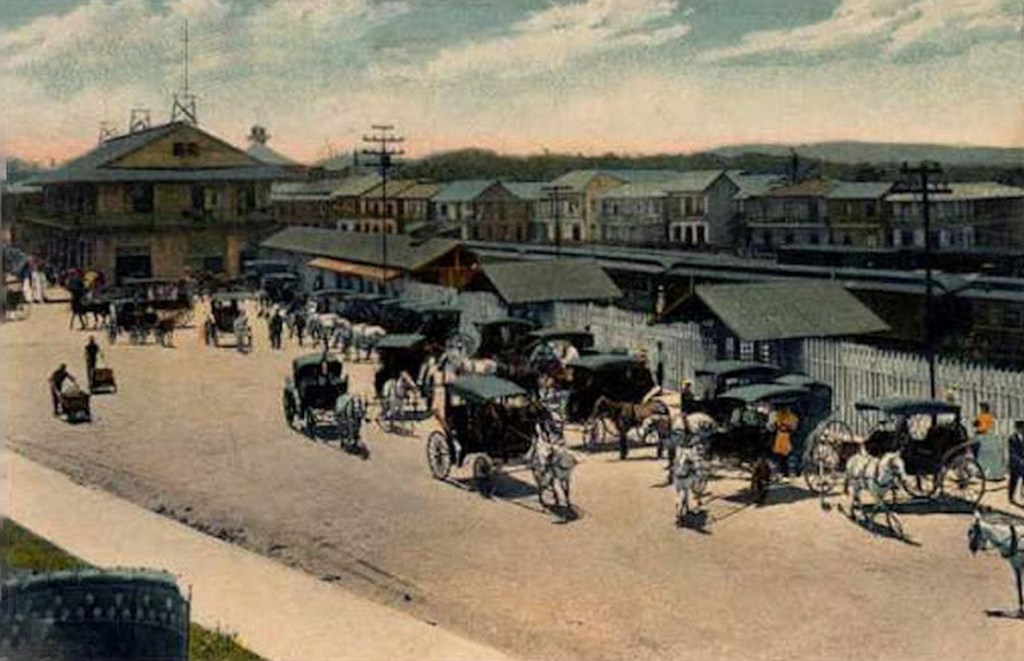
    Railroad Station at Panama, antique postcard (n.d.) (panamarailroad.org)

    So they pass in, and registering their names with McFarlane, the proprietor, soon find themselves in a little room on the eastern, and now shady, side of the house, for the sun is already declining in the heavens. This chamber is one flight up, retired and quiet as any room can be in a house made of thin boards with partitions of canvas and paper. To this the three natives stagger with the heavy trunk, Domingo accompanying them with the lighter one.

    Here Montez says to the American, “Au revoir!” but while doing this, suggests: “Won’t you take a stroll with me into the town? You will find lots of the passengers who are bound for California, seeing the sights. Why not make an evening of it with me? Dinner at the Cafe Victor, and then, I believe, we have a circus in town tonight.”

    “That would be delightful!” cries Alice. A moment after, she says thoughtfully, “but I am afraid I am too fatigued for it.”

    “No thank you, Montez, old boy,” answers George. “I think I’ll stay here with my baggage and my tired wife.”

    “Then au revoir again!” murmurs Fernando, and turns to go, but the Californian comes after him, and seizing his little fingers in his stalwart grip, says gratefully; “This must not be the last we shall see of you! Promise to come back here this evening. My wife and I must thank you again for your hospitality, and what you have done for us. I’ll not forget to express the revolver to you from New York.”

    “Oh, do not fear—I’ll return to you!” answers Montez, the Armenian drop in his blood coming to the fore, and giving his eyes a farseeing, peculiar, subtle look. “Until this evening!” and whispering these words, he skips down the steps, giving one last longing parting glance at the fair American lady, who makes a pretty picture, her bright beauty being in strong contrast to the bareness of the room, as she carelessly sits upon the ironbound trunk. Thus grouped these two treasures of the American look very beautiful to Señor Montez—they are now, he thinks, so nearly his.

    As he reaches the doorway of the hotel he suddenly starts and says: “But I have much to do!” and so passes rapidly out of the Pacific House, where there is a good deal of drinking going on, and many glasses are being emptied to the first sight of the Pacific, by passengers eager to reach the land of gold.

    Left together Ripley turns to Alice, saying: “It looks as if you would have a dull time, little woman, till tomorrow morning when we get upon the railroad for Aspinwall.”

    “Oh, I’ll pass a little of it writing to Mary.”

    “Why, the child’ll see us as soon as the letter!”

    “Not quite. We’ll have to remain a day in New York probably. The letter will go right on. I’ll tell her of our week in Toboga,” returns the lady, taking from her trunk the articles for a hasty epistle. “Had you not better see about our tickets?”

    “They’ll do in the morning,” replies the gentleman who is looking out of the hotel window. “Besides, the crowd bound for California are giving the railroad officials all they want to attend to just now.” And George amuses himself inspecting the movements of the throng outside as the sun goes down upon Panama.

    After a little, his wife closes an epistle full of a mother’s love to her absent dear one, telling her the day after she receives it she will be in her arms, and says, “George, just step down and put this in the mail at the railroad depot, before you forget as usual.”

    “Then the usual bribe,” laughs her husband.

    “Two, if you like,” and the lady’s lips receive his kisses, for these two are as much lovers as when they first became man and wife.

    “Now hurry. For Mr. McFarlane’s gong is going to sound for dinner soon,” cries Alice.

    So George Ripley goes down and posts the letter to Mary, his daughter, putting it in the strong grip of Wells, Fargo & Co., but does not come back to dinner with his wife—for this is the night of the fifteenth day of April, 1856—a night that at Panama severed husbands from wives and parted children from parents’ love.


    Notes, References, Further Reading

    • Aspinwall: City founded in 1850 on the northern shoulder of the Isthmus. Named after co-founder of the Panama Railroad, American businessman William Henry Aspinwall (1807–1875), it was the Atlantic terminal of the railroad. The name was changed to Colón, after Christopher Columbus, whose Spanish name was Cristóbal Colón. See “How Did Colón Become Columbus?: Explorer’s name varies from country to country” (thoughtco.com).
    • dross: “waste product taken off molten metal during smelting, essentially metallic in character” (wordreference.com).
    • descants: to comment or discourse at great length.
    • tintype: Photographic image produced on a thin metal plate. See “Tintype Photographs” at phototree.com.
    • mouches dinero, mouches sangui: much money, much blood.
    • set on foot: to initiate, start something.
    • polyhæma: many bloods.
    • bongo: “[T]he small schooner-rigged market craft of Panama are […] called bongos.” Man, Vol. 28 (1928), p. 122, at Internet Archive.
    • Caramba!: good heavens.

    Bishop, F., Panama Past and Present (NY: Century, 1916). wikisource.org .

    Daley, M.C., “The Watermelon Riot: Cultural Encounters in Panama City, April 15, 1856,” Hispanic American Historical Review 70:1, Feb 1990. Available Duke U Press.

    Haskin, F.J., The Panama Canal (NY: Doubleday, Page and Co., 1913) Project Gutenberg eBook.

    Musicant, I., The Banana Wars (New York: Macmillan, 1990).

    Schott, Joseph L., Rails across Panama; the story of the building of the Panama Railroad, 1849-1855 (Indianapolis, Bobbs-Merrill, 1967. Borrow from Internet Archive.

    This edition © 2021 Furin Chime, Brian Armour
  • Gunter Biosnip: Seeds of Brilliance

    Gunter Biosnip: Seeds of Brilliance

    A brief reflection on the theme of eugenics that Brian Armour identifies in Baron Montez, in his preface to Chapter One. Gunter was himself probably of “mixed race” to a modest degree. Legacies of British Slave-ownership, a web site of University College London, reports that his father, Henry Gunter (1813–1856), was born in Jamaica to a one-quarter African woman.

    Archibald Clavering Gunter would have been, if their research is correct, at least one-sixteenth African. I venture to suggest that such a “quantum” of blood might tend towards a sense of identification with – indeed, a celebration of – the minority cultural, and racial, heritage.

    With this in mind, Gunter’s reference to the polyracial “polyhaema drops” in the blood of Montez becomes a tantalizing issue; as does the nature of his identification with his anti-hero. Gunter is fond of Montez even while the narrator reviles him. Of course, as we know, Lucifer is far more appealing as a character than God in Milton’s Paradise Lost. How fitting Gunter’s phrase, “This little disciple of Satan” in the opening to Chapter Two, “A Toboga Breakfast in56!

    The UCL web-page agrees with the short supply of biographical data in the literary overviews. Using New York and New Orleans passenger lists, it traces Henry Gunter three times across the Atlantic between 1838 and 1844, which evidences his alacrity as a merchant at the time.

    Henry Gunter married Elizabeth Agnes Sharples in Liverpool in 1839, and they had two sons, William Henry and Archibald Clavering. The family moved from Liverpool, first to New York in c. 1853, and soon after to San Francisco, where Henry became proprietor-manager of the “first conventional theater” to be built there, called the National. Archibald Clavering Gunter moved back to New York in 1879, after his variegated career (See Gunter Biosnip: Curse of Popularity).

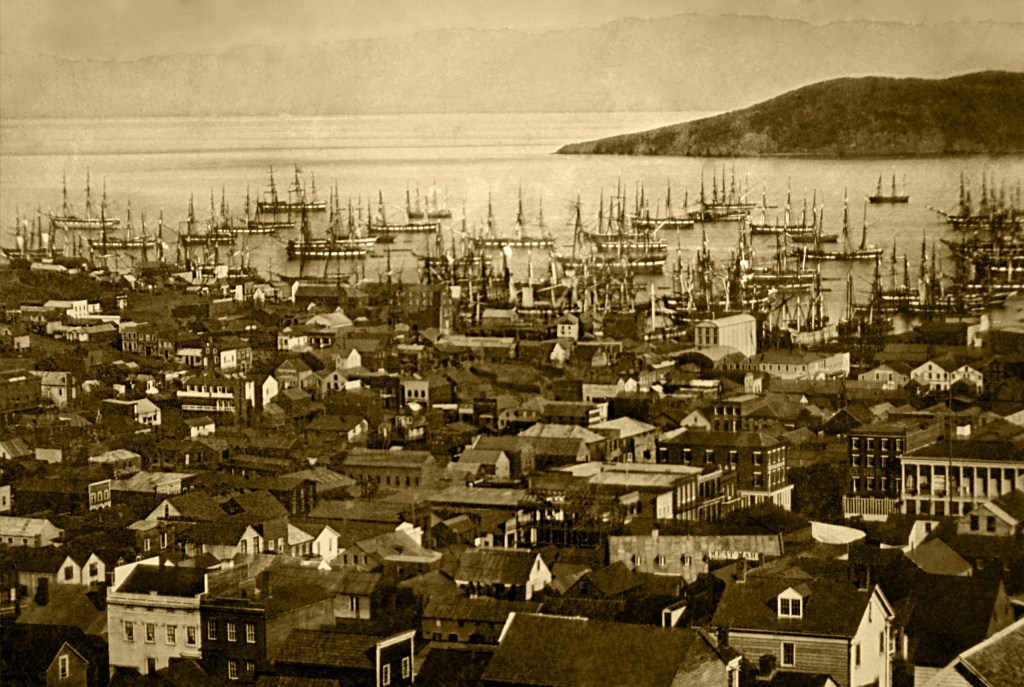
    As with J.F. Smith in England, whose father also owned a theatre company, Gunter first wrote plays. When he was a child, his home in San Francisco boasted “an unusually large living room built expressly for the purpose of giving young Archie a theatre in which to produce his youthful dramas.” It was a stately residence, attesting to the entrepreneurial success his father enjoyed with the National Theater. The house had an entrance on Washington Street and at the back overlooked the lower, adjacent Taylor Street. From the porch of this house, the oldest on the hill, was “one of the finest vistas in San Francisco” (The Insider).

    San Francisco harbor c.1851

    Ella Sterling Mighels considers the first two of Gunter’s dramatic successes as too high up on the “literary plane” for popular success, though she and her milieu were impressed that a San Franciscan was able to produce writing of such a high tone. He soon realized that the “high plane goes a-begging” and retuned it to appeal for public tastes (p. 338).

    The sensation caused by his first novel, Mr Barnes of New York, gave him an inkling he might be able to make a go of it on the printed page. Following the trail of other Californian writers before him, he moved East in 1879 and achieved just that, making enough to set up his own Gunter’s Magazine and The Home Publishing Company. He produced a string of thirty-nine novels and “one of the most remunerative careers ever lived by a man who lived by his typewriter” (The Insider). Gunter’s contemporary, the Californian author Gertrude Atherton (1857–1948) writes in Cosmopolitan that:

    His books have been on every stand in three continents where our language is read, and by a large proportion of the reading public abroad he is regarded as the representative American author.

    Cited in Mighels, p. 339

    … his international popularity being facilitated by a busy industry of book pirating.

    Baron Montez (1893) comes at the height of Gunter’s momentum. It is not one of his most cited works, but was decently reviewed when it appeared, with particular reference to Gunter’s skill, and to his  polyhaemic anti-hero.

    Here are some excerpts:

    The work exhibits the wonderful resources of the author’s mind and the richness of his imaginative powers. The characters are forcibly drawn, the details worked up with surprising exactness, and the plot unraveled with scrupulous care

    Although entirely a piece of fiction – good fiction, still under the surface may be found many direct hits at some of the social and political fads of the present day…

    His portrayal of the hero, Harry Larchmont, is excellent and will not only win the admiration of the fair sex, but also that of the men who admire a good athletic figure and a will power over which the Anglomaniac craze has no control.

    In the heroine, Miss Louise Ripley Minturn, we have one of those strong, sensitive characters, of the typical American girl – the girl to whom we raise our hat in honor, to her pluck, refinement and modesty; the girl who in the face of poverty and temptation will educate herself to meet the battle of life with a smile, and even though [sic] a typewriter, will assert her independence and uphold the greatest of all characters – the American woman.

    The central figure of the novel, however, is the all-nation prince of villains, Fernando Gomez Montez, mule boy of Cruces, self-ennobled to “Baron” Montez. As a villain he will challenge the admiration of all the readers. The conventional smooth, oily villain has been succeeded by an educated one, full of fascination, a good conversationalist, cunning and almost brave, a clear, quick-witted brain, working like fast revolving machinery, accurate in calculation, precise in detail, with a strong will and commanding power which fascinates all weaker natures first, and then causes them to obey…

    The scenes are panoramic in their changes, and carry the reader rapidly from the rushing restless, bustling city of New York to the drudgery and turmoil of the miasmic, fever-laden tropic isthmus, and thence to pleasure-loving, scheming Paris, the center of intrigue, gay life, inflated stocks, bonds, and feverish existence. The situations are very sensational and dramatic showing the author’s dramatic vein in the background of the novelistic landscape…

    Behymer, “Among the Authors” (1893)

    Chapter Three coming next week, edited and introduced by Brian Armour.


    Notes and References

    Behymer, H. “Among the Authors,” Los Angeles Herald, Volume 40, Number 40, 21 May 1893.

    Mighels, Ella Sterling, The Story of the Files: California Writers and Literature (Boston: Harvard U, 1893).

    The Insider. San Francisco Call, Volume 101, Number 90, 28 February 1907.

    Creative Commons License
    This work is licensed under a Creative Commons Attribution-ShareAlike 4.0 International License.

  • A.C. Gunter’s Baron Montez: 2. A Toboga Breakfast in ’56

    A.C. Gunter’s Baron Montez: 2. A Toboga Breakfast in ’56

    Our narrator is at it again, delighting us with wonderful descriptions of island scenery and life, while never missing an opportunity to take a swipe at Montez. Fernando is now increasingly referred to as ‘little’. When a Narrator becomes a character in a story, as I explored in the previous introduction, expressing opinions, deriding or debasing characters, a question arises: can he be trusted? Were it not for the intimations of the Narrator, the previous chapter would seem idyllic. Hasn’t our kind host, Fernando rescued the ill Alice and her husband George from the pestilence of Panama, for the sweet aromatic breezes of his island retreat, treated them to excellent care and wonderful cuisine, travelled to the Isle of Pearls for them, at all times been a perfect gentleman? Yet our American Narrator’s insights into Montez’s character are ringing true, and his credibility appears intact for the time being.

    Village on Taboga Island, Republic of Panama, from postcard c. 1927

    While providing an unsympathetic history of young Fernando, at the same time the Narrator covers some of the history of the Isthmus and the crossing before the railway. Prior to this, for three hundred years the Isthmus was a possession of the Spanish. They first sought to improve the way across it for the passage of South American gold and treasure back to Spain.

    Through Fernando’s memory, his first engagement with the Americans, George Ripley and his wife, is related. It is clear he holds some disdain for Americanos, apart from their potential as marks in a confidence trick, which is likely shared amongst the local population. American presence and involvement in the Isthmus had been going on for some time. In 1846, the United States and The Republic of New Granada negotiated a treaty of “peace, amity, navigation and commerce” that included a guarantee of the US right of way across the Isthmus of Panama. The country of New Granada consisted mostly of present-day Colombia, and also Panama, Ecuador and Venezuela (Encycl. Britannica).

    Background is provided on George Riley, and his wife, Alice’s, contraction of yellow fever. Yellow fever, malaria and other mosquito borne diseases were rife in Panama due to the port being surrounded by swamp. Direct off-loading of passengers by steam ships was not possible which is why they disembarked at Taboga Island and later transferred to Panama by smaller boat or canoe.

    Most infections of yellow fever lead to serious illness. At first the sufferer experiences a high temperature, a slow pulse, muscle pain, nausea, shivers and vomiting. About 15 percent of people progress to a toxic stage, with life threatening symptoms such as bleeding, jaundice and liver and kidney failure. Half of these sufferers die within two weeks of onset. In 1887, the artist Paul Gauguin contracted yellow fever and malaria after working on the Panama Canal and spent time on Taboga Island recovering, as does Alice Ripley.

    Fernando‘s aspirations for Alice Ripley have grown, though his vision varies not, and she remains a beautiful object to him, second only to the old chest of George Ripley. In this chapter, Fernando’s disarming ways take on a new definition, and he moves one step closer to achieving his goal.


    CHAPTER 2

    A TOBOGA BREAKFAST IN ‘56

    Then this little disciple of Satan runs over what has brought him this great chance of good luck. He thinks of his earlier days.

    He is scarce twenty now, but people develop rapidly under the hot sun of the Equator. He remembers the quiet little town of Cruces, in the mountains—at the head of navigation of the Chagres, where the good priest taught him his Paternosters, and where he chanted them each day in his class, mingling his Latin with howls produced by blows of a cutting rawhide in the hands of the padre’s athletic and vigilant assistant.

    This mixture of penance and prayer pleased the young Montez but little. His mother, who lived in a palm hut by the rapids of the Chagres, did the padre’s washing; his father was—Heaven knows where or who. There seemed no way of escape. They were about to make him an altar boy, and rebellious little Fernando cursed as he chanted and saw no prospect save of a life of prayer and penance, and candle carrying behind a decorated image of the Virgin, in its daily religious procession through the lanes of the little town. But just at this moment Cruces—buried from the world in the hills of the Cordilleras in the deadly slumber that had fallen upon the Isthmus when the route to Chili and Peru round Cape Horn succeeded the route via Panama, and the jingling bells of its mule trains were no longer heard crossing the mountain paths between Panama and Porta Bella—awoke and lived again.

    The first rush of the gold seekers for California in ’49 crossed the Isthmus.

    Flying from church and prayer and penance, young Montez dodged fasting and discipline in the hurly-burly of that early Isthmus excitement.

    At thirteen he peddled water, for ten cents a glass, to thirsty Gringos. A year after he did a thriving business in unripe bananas, oranges, and pineapples in the streets of Chagres. Next taking up with a monte shop, became “muchacho diablo” in a gambling establishment at Gargona, where he learned card sharping and thimble rigging. In the years 1851, 1852, and 1853 he was a handler of bad mules, which he leased out at exorbitant prices to the embryo pioneers and argonauts of California to cross worse roads from Gargona in the dry season, and from Cruces in the wet time, to Panama.

    Spanish muchacho. Anonymous photo c. 1920

    Perchance, he took a flyer or two, with one or two successful bandits, and some looted treasure came to him.

    He had a knack of recovering lost children who disappeared together with their native carriers in this rush across the Isthmus, and restoring them to fond parents for large sums of money.

    And during this time he learned one great principle that has been of much use to Napoleons of finance both in America and Europe—that is, not to steal often, but to steal much. The first invariably leads to disgrace and a prison—the second often to honor and a palace.

    While doing all this, his facile mind became educated. He picked up French, from some Parisians crossing the Isthmus. Spanish was his native tongue. A smattering of Latin he had from the priest. English came to him from his vocation with the Californian adventurers; and by devoting himself to one or two Portuguese, who travelled tremblingly across the Isthmus in those days, he stole from them a smattering of their language and any doubloons and Spanish dollars they might leave within reach of his grasping paws.

    At length, the railroad completed in 1855 destroyed young Montez’s means of livelihood; but by this time he had sufficient to engage in other occupations, and turned his attention to dealing in pearls, precious stones, and other valuables he could pick up about the Isthmus, sometimes making trips to the Pearl Islands, and once or twice going as far as Ecuador and Peru, upon the English steamers that were now running down the coast of South America, and to Acapulco to the north, on the Pacific Mail boats, trading always with a rare facility and shrewdness that had come to him in a drop of Yankee blood left by a New Bedford whaler at Darien some hundred years before, and by a globule of the vital fluid of Israel, that had entered his poly-nation veins from an unfortunate Jewish pedler the Inquisition had burned, before the time of Morgan.

    He was even now considered well to do, and his orders were good in the Hotel Francais in Panama, or in the restaurant of Monsieur Victor, the Isthmus Delmonico those days, but still as yet no grand coup had come to him.

    Some ten days before the time he sits upon the veranda of the villa on the Island of Toboga, the steamer John L. Stevens, from San Francisco, brought its lot of passengers from California, to take route across the Isthmus by railway to Aspinwall, and so on to New York; among them this American gentleman and his wife, who are occupying the pretty palm cottage this morning—Ripley ruddy in health, Alice beautiful as a pale lily, stricken with the fever picked up during a six hours’ stay in Acapulco, and too ill to proceed on her journey. But for this, the American would have been the happiest of men, for he was a successful pioneer to California.

    George Merritt Ripley had left a clerkship in Baltimore, and taken his wife with him, leaving his little daughter of twelve at school in the East, and had gone to California in 1852. He had made his first start in gold mining in Calaveras County, at Mokelumne Hill, and being sensible enough to see that placer digging was uncertain, and that trade in California at that time was a sure road to wealth, had taken his few thousand dollars, and entered into business in the thriving town of Stockton on the San Joaquin. In three years he had accumulated some sixty thousand dollars, which, in those days of cheap prices, large interest, and small capital, was the equivalent to half a million at the present.

    Having enough to live upon in the East, his money properly invested in the growing towns of New York or Boston would in time make him even wealthy.

    His wife, anxious to see her child (for four years is a long time to a mother’s heart), had implored him to return to the Eastern States, which in those days all Californians called “home.”

    So, though his life on the plains of the San Joaquin had been a pleasant one, Ripley was delighted to turn his face from the crudities of the early California, to the more civilized existence of the Eastern world.

    He had come on his way rejoicing, until the fever struck the woman he loved, so he had brought her to Panama to rest there—perchance to die there.

    His trunks, checked through to the East, had gone on, all save one that contained their immediate necessities of apparel, and the other one; the one that never left his eye—the heavy one—the one that took three natives to handle. These, together with his wife, were in Panama, when he chanced to meet Montez, who, having many arts and graces of a gentleman, had soon made George Ripley think him his friend.

    Montez had recommended the change from the pestilent miasma of the mainland to the breezes that came fresh up the Gulf to the Island of Toboga, and in these zephyrs, health had come to George’s wife, and despair had left the heart of the strong man who loved her.

    During these days of his wife’s convalescence, in one of his conversations with Montez, Ripley had mentioned a desire to invest a little of the gold he was bringing with him in the pearls of the Isthmus—which were cheap at Panama compared to New York. This treasure was all in his own care, for Wells Fargo’s charges in these days, for the transmission of specie, were very high, and George Ripley thought himself strong enough to take care of his own money, having stood off bandits from his Mokelumne Hill mine and possessing that peculiar self-confidence that seemed to come with the air of the Sierras to all Californians in those early days. Therefore this foolish Ripley had evaded Wells, Fargo & Co.’s charges, and had everything he held valuable in this world with him in Toboga this sunny day—save his daughter in her Eastern school.

    Musing over this, Fernando chuckles to himself: “Brave Americano—fool Americano!

    Just here he is awakened from his reverie by the brave Americano’s voice in his ear, and the hearty grasp of the fool Americano’s hand upon his shoulder. The voice says: “Come along, Don Fernando Montez! We are hungry. The odor of the breakfast is delicious—but my wife insists upon our waiting for our kind host.” The hand drags in friendly play the petite carcass of Fernando Gomez Montez to see the prettiest sight his sparkling, all nation eyes have ever gazed upon—the blonde beauty of the temperate zone contrasted with the dark loveliness of the Equator, surrounded by a tropic breakfast al fresco.

    It is under the shade of the tamarind trees, the perfume from which is mingled with the odors of a feast for the gods!

    The aroma of Costa Rica coffee just burnt and ground comes from a steaming urn that stands on the ground near the fire of perfumed orange wood, upon which turtle steaks are broiling, and luscious plantains and mealy yams are cooking in its ashes. A stew of rice and freshly killed Iguano lizard, made hot with Chili Colorado, and a slight suspicion of garlic—for Anita is an artist in the cooking line—stands ready to their hands; and fruits, gorgeous as the sun that gave them their ripe beauty, lie about them everywhere.

    The American lady, lazily seated in a hammock, looks coolly beautiful under the leaves that shade her—the abandon of careless ease shows her still girlish figure in graceful motion. Her blue eyes would be very bright this morning, were they not wistful at times when gazing towards the East. Anita posed like a bronze statue stands near the fire, her orbs sparkling also, save when looking at la Americana they glow with soma unknown passion like those of a Voodoo priestess!

    So breakfast passes, Anita the presiding goddess of the feast; for to this Indian girl all the beauty of the tropics has come in the fifteen years of her life. She is robed in white—some soft clinging Isthmus stuff, which drapes her lithe figure, and displays the beauties of her graceful limbs at every motion—and her little feet, bare as when she was born, step so lightly they hardly rustle the leaves under them.

    The girl flits about, ministering to the appetites of Señor Montez and his guests, which seem to be very good, Montez apparently being happy, and a great joy beaming in the eyes of the American. His beautiful wife has roses on her fair cheeks, and in ten days they will be in their Eastern home; with them the one child of their love. Health and appetite are theirs, and their breakfast is almost like that of Arcady.

    The coffee is of the sweetest aroma, the Iguano is done to a nicety, and the turtle steaks are juicy as those from a two-year old buffalo cow. These being finished, they revel in the fruits of the tropics—oranges green as an olive, thin-skinned as a lady’s glove, with one blood red shot upon each, to prove that it has ripened; melons, sweet limes, Avigado pears, and the mangoes for which Toboga is famous.

    As appetite is appeased, conversation becomes easy.

    “Why did you not ask Anita to tell me that I was keeping you from breakfast? It is such a good one,” laughs the every-nation gentleman.

    “Anita did not seem to care for your coming.” returns the American lady. “Perhaps she did not think her breakfast was as perfect as it is.”

    “Ah, Anita was sulky, eh?” says Fernando, a little mocking snarl curling over his white teeth. “Anita has an Indian temper and Indian moods.” He regards the girl with a sneer, and she returns him several flashes from her eyes, that would be reproachful, were they not almost vindictive.

    “A little sullen, Anita—eh?” jeers the host.

    His tone would drive the girl to frenzy, did not the American lady suddenly say, “Please don’t be cross with her. You do not know how kind she has been to me during your absence and my sickness!” Then she turns to her husband and suggests: “We must not forget Anita’s services when we leave her.”

    “No,” cries the jovial Californian. “Anita shall have the biggest pearl that Montez has brought from the Islands.”

    At this mention of personal adornment, a smile runs over the volatile features of the Indian girl.

    Fernando smiles also. What is Anita’s is his. And everything is fish that comes to his net.

    A second after, he gives a start. The American lady is remarking in grateful tones: “And what shall our offering be to you, Señor Montez, whose hospitality has given me health?”

    “A present for me? Mia madre! you are too kind.”

    “Yes, mention what you like and you have it,” interjects the Californian.

    “Oh, if you wish me to say what I should regard with the greatest favor, it would be your—your beautiful revolver. There is none like it on the Isthmus,—none that shoots so truly, for I have seen your skill with it,” answers Fernando, looking with longing eyes upon the fatal weapon of the American.

    “My revolver,” echoes the Californian with a start. Then he says, after a pause of consideration: “I will send it to you by express from New York. Until this journey is over, I cannot part with it. It has guarded my life and my property before. I feel safer with it by my side.”

    “Yes,” returns Alice, “at his side by day, near his hand at night. George is superstitious, I think, with regard to it.”

    This conversation apparently does not please Señor Montez very greatly. The revolver has seemed to fascinate him. All through the meal his glances have sought the long Colt’s pistol that carries six lives in its six loaded chambers as it hangs in the Californian’s belt. A little spheroid of timid Cingales blood, poured into his veins from some East Indian ancestor, now brings a coward faltering into his bright eyes. He does not seem to enjoy the Avigado pear that he was eating with a good appetite a second before. Throwing it away with a “pish” of disgust, he cries: “Anita, quick, a cigar!” for nicotine soothes this gentleman’s excitable nerves.

    The Indian girl, at his command, draws out from a bundle of fragrant Toboga tobacco a fresh leaf, and rolling it in her deft and agile fingers, in half a minute it becomes a cigar. Thirty seconds more, a second leaf becomes another cigar. This she offers to the American, who follows his host’s example. So lighting up, the two men puff away contentedly.

    A moment after, Alice gives a start of amazement, for a third cigar has been tendered to her. and to her astonished refusal, Anita laughs: “You are not well enough yet to smoke. I had supposed now you are ill no longer you would enjoy it as I do.” Then throwing herself into a hammock, this lazy bird of the tropic surrounds herself with wreaths of smoke, puffing them out between her white teeth, and playing with them as a juggler does with his baubles.

    The sensuous scene appeals to even the energetic Californian’s senses. He mutters: “This week at Toboga has seemed like a week ofof—”

    “Of paradise! “interjects his wife. “Since I have become well again, we have made a fairy land of it. Daytime in the hammock, sipping coccanut milk and chicha under the tamarind leaves; dinners at Jacques’ petite restaurant in the cocoanut trees, and moonlight in a canoe on the water. George said,” here the lady blushes slightly, gazing at her husband with bride’s eyes, “that it was more romantic than our wedding tour.”

    “A-ah, a—new honeymoon!” sighs Montez. Looking at the beauty of this Northern violet, as she sits before him in the ease of this tropic Arcady—for Alice Ripley has imitated Señorita Anita in the hammock business, and sits lazily under the green leaves, one perfect foot and one delicate ankle carelessly swinging from under her white laces and muslin and ribbons—this gentleman’s face suddenly flushes with a great delight, as he thinks: “A new honeymoon!—Yes—for me!” Then visions come to him, entrancing as the dreams of opium sleep, as he gazes at Alice Ripley through the clouds of his cigar smoke.

    Woman in white. Anon., antique French postcard (n.d.)

    Mingled with the rustling breezes in the tamarind groves, as they sit there, the “silence—of—the—smoker” coming on them, is heard the voice of a rushing stream, which issues gurgling and foaming from the hillside, and splashes into a little basin, a short hundred yards away, suggesting coolness.

    The day is already burning, and the noise of this foaming stream apparently puts an idea into the fertile mind of little Montez, as he sits looking with sleepless eyes at the big Californian, through his wreaths of smoke.

    He says: “How is a cool plunge this hot morning? Why not a bath, Señor Georgio Ripley?”

    “A bath—delicious!” ejaculates the American. Then looking over the green water of the bay, he suggests, “But the sharks!”

    “No sharks here,” and Fernando points with a little finger, adorned with some diamonds and a very delicately trimmed almond-shaped nail, to the cool, limpid basin worn in the rock by the unceasing flow of the living stream for centuries. “That is nature’s bathing place.”

    So the two go off together, through the thickets to the shady pool, bearing with them handfuls of javoncilla leaves, that will act as vegetable soap and make their skins soft as those of children.

    Looking on its limpid waters, dark under the palms and only golden where the sun steals in upon it through little breaks in the leaves, the American mutters: “This is perfection.”

    Then Montez cries, “Quick, I’ll beat you into the water. You need not fear to undress here. Toboga has no deadly lance-vipers or coral snakes like the mainland.”

    So undressing himself in the little thicket of broad leaved palms and feathery bamboos, George Merritt Ripley, as he takes his plunge into nature’s bathtub, for the first time in his journey really parts himself from his revolver.

    It is but for a short fifteen minutes, and Montez bathes with him ten of them, but leaves the water first.

    But in that five minutes, that one last plunge for Ripley, something has happened to his weapon of trust that had saved his life and his treasure from the bandits of the Sierras and the highwaymen of the Californian trails.

    Not knowing this, George comes laughingly up the bank, crying, “That last plunge was the most refreshing of my life! I hope you enjoyed your bath as well as I did, Señor Montez.”

    “Perhaps better,” returns his companion, who has as yet hardly begun to dress. Fernando is apparently a lazy man, and he has had something to occupy him, and a little file that he has brought with him, during the five minutes of Ripley’s last plunge.

    From now on, a confident air seems to come over this every nation gentleman; and when his eyes look at the revolver which the American is strapping around him again, they no longer shrink from it, but gaze at it in confident triumph. So, walking up the path to the tamarind grove and bamboo cottage, Fernando chuckles to himself: “I am sure now—treasure and beauty.”


    Notes, References, Further Reading

    • Cover feauture image is a painting by Edward Gennys Fanshawe, ‘From a back window in Panama, March 10th 1850’.
    • Toboga: Taboga, volcanic island in the Gulf of Panama, known also as ‘the Island of Flowers’. See “Some History of Isla Taboga” at taboga.panamanow.com.
    • treaty: known as New Granada Treaty, Bidlack Treaty, or Bidlack Mallarino Treaty (see Dennis).
    • yellow fever: See “What’s to know about Yellow Fever”, medicalnewstoday.com
    • Chili: early variant spelling ‘Chile’.
    • monte shop:  monte is a gambling game played with a 40 card deck.
    • muchacho diablo:  Spanish ‘man-devil’
    • specie: coin, or money in kind.
    • Paternosters: in the Roman Catholic Church, The Lord’s Prayer usually in Latin.
    • Padre: Spanish ‘father’, ‘a priest’.
    • Delmonico: Opened 1837. “New York’s first a la carte restaurant on 2 South William Street, favored French cuisine, cloth-covered tables and a printed menu designed by the first “star chef,” Charles Ranhofer” (A Brief History of Delmonico’s)
    • Placer digging: “placer derives from the Spanish placer, meaning shoal or alluvial/sand deposit, from Catalan placer (shoal), from plassa (place) from Medieval Latin placea (place) the origin word for “place” and “plaza” in English. The word in Spanish is thus derived from placea and refers directly to an alluvial or glacial deposit of sand or gravel” (“Placer Mining” — Wikipedia).
    • Darien: Darién, province in eastern Panama. The Scots failed in an attempt to colonize it in the 17th century. (See Ben Johnson, “The Darien Scheme.”)
    • Arcady: Arcadia, a region of Greece, known through the ages as a beautiful, unspoiled wilderness.
    • Mia madre: Spanish `my mother’
    • Isle of Pearls: a group of islands in the Gulf of Panama, Isle del Rey being the largest.
    • Avigado pear: Avocados are widely cultivated in Panama.
    • Javoncilla: Luffa operculata.
    • John L. Stephens: “The [SS John L. Stephens] is 2500 tons register, 280 feet keel, 66-1/2 feet breadth of beam amidships, and 285 feet over all. Her engine was built in the Novelty Works, and is on the oscillating principle. It is suspended from a framing of wood similar to the frames usually employed in the construction of beam-engines, and is the first application of the kind ever introduced. She is built on the clipper model, and is believed to be the sharpest American steamer ever constructed. Her accommodations are for twelve hundred passengers and the ventilation throughout every part is believed to be superior to any steamship ever built. Her buoyancy is also very great, and with 650 tons of coal and 20,000 gallons of water, she draws less than 12 feet of water” (excerpt from March 25, 1853, Sacramento Daily Union, Sacramento, California). See maritimeheritage.org .
    • lance-viper: Fer-de-lance, venomous pit viper.

    Anderson, Charles L.D., Old Panama and Castilla del Oro (np: Sudwarth, 1911 at Smithsonian Institute. “Narrative history of the discovery, conquest and settlement by the Spaniards.”

    Dennis, William Cullen. “The Panama Situation in the Light of International Law. The Treaty of 1846 between
    the United States and New Granada” The American Law Register (1898-1907) , May, 1904, Vol. 52, No. 5, Volume 43
    New Series (May, 1904), pp. 265-306. Available at Jstor.

    “América Central. Tierra Firme. Mapas generales. 1785” Historical Spanish maritime map of Central America. España en el Mundo.

    Samuels, A.J., “Gauguin in Panama: A Forgotten Journey”. Culturetrip.com

    This edition © 2021 Furin Chime, Brian Armour
  • A.C. Gunter’s Baron Montez: 1. The Returning Californians

    A.C. Gunter’s Baron Montez: 1. The Returning Californians

    Welcome to the first instalment of Achibald Clavering Gunter’s 1893 novel Baron Montez of Panama and Paris. The story is integrated with historical events which provide a background for the introduction of the main character, Fernando Gomez Montez. The first chapters take place on a particular day, the fifteenth day of April, 1856, a date that has a significant part to play both in history and future plot.

    Panama

    Panama was always of vital interest to the United States. President Andrew Jackson as early as 1836 had commissioned a study of proposed routes for a railroad across the Isthmus to protect the interests of Americans travelling to and from the Eastern and Western states by ocean, and the developing Oregon County in the Pacific Northwest. Two years before gold was discovered in California in 1848, which made safe transit across the Isthmus even more crucial, William H. Aspinall, who ran the Pacific mail steamships conceived of a railroad. He and his partners formed a New York company and raised a million dollars to conduct engineering and route studies. The Panama Railroad was completed on January 27, 1855, at a cost of eight million and an estimated five to ten thousand lives to malaria, yellow fever and cholera.

    The ‘science’ of blood and race

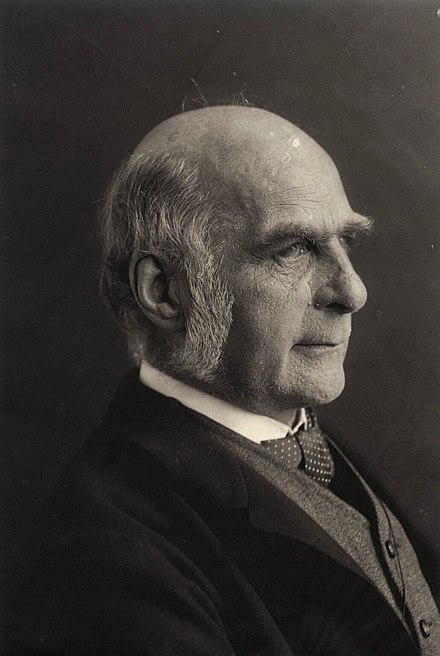
    There is a great dollop of blood ahead and smatterings throughout these first chapters, with racial connotations. Not to alarm our readers, it is best to put this in context with the time of A.C. Gunter’s writing, 1893. Ten years before, Sir Francis Galton, a cousin of Charles Darwin, defined Eugenics as ‘the study of agencies under social control that may improve or impair the racial quality of future generations’ (Memories… p. 321). As Darwin’s evolutionary ‘survival of the fittest’ made universal sense and was applied widely beyond its scientific origins, so Galton’s determination took on a life of its own in the US. Pseudo-eugenics prospered. Galton proposed that, where possible, breeding should be encouraged from good stock, and discouraged in bad. He saw the English upper classes as good stock with good qualities.

    Sir Francis Galton (1822–1911). Platinum print by Eveleen Myers (née Tennant). Source: Wikimedia Commons

    It’s all very well to establish a scientific principle, but left in the hands of the unscientific to ascribe subjective values on who or what is desirable, is another thing, particularly if based simply on race. It becomes a basis and validation for prejudice. None-the-less a movement began to grow to embrace the principles for the betterment of society through inherited blood. As Nancy Ordover puts it:

    U.S. eugenicists tended to believe in the genetic superiority of Nordic, Germanic and Anglo-Saxon peoples, supported strict immigration and anti-miscegenation laws, and supported the forcible sterilization of the poor, disabled and “immoral.”

    Ordover, American Eugenics (2003) xii

    Today, the narrator’s stereotypical presumptions would be considered racist, but these were, not to judge or justify, the emerging values of the society within which he lived. With financial support from the likes of John D. Rockefeller, and the Carnegie Institution, and aided by influential scientists like Charles B. Davenport and Alexander Graham Bell, the formation of organizations such as The Eugenics Record Office and the American Breeders Association, ensured the movement continued to grow and expand its demands until the commencement of the First World War (Ordover).

    Style and technique of the storyteller

    Contemporary writing has been greatly influenced by the visual mediums of television and film. ‘Show don’t tell’ is the admonition given new writers. This is a distinct departure from previous writing styles where the narrator plays a more visible, involved role of story-teller. However, even in Gunter’s period narrators were generally unobtrusive entities largely prepared to let their characters’ actions and words speak for qualities and nature.

    The narrator of Baron Montez, has a prominent all-seeing, all-knowing presence, to the extent of almost becoming a character of the story himself—as a US basketball coach is considered part of the team or an off-stage voice one of the cast. But this is purposeful. A.C. Gunter is a successful New York playwright, and this dramatic influence is evident in this work, in staging, character design and the transparency of his dialogue which truly provides an insight into character.

    In this first chapter, A.C. Gunter has several revelations to impart which have a bearing on the larger plot: the new Panama Railroad and its effect on the native population, and transiting Americans such as Alice and George Ripley; and while alternatively mollifying the reader with exquisite descriptions of the paradise that is Toboga Island, the sand, jewel waters and flowers, the vehement narrator carries out a relentless character assassination of Fernando Gomez Montez, who no doubt is up to no good. He is the quintessential bad boy, a charming rogue without soul, capable of anything, and his irresistible potential for evil-doing draws the reader on.


    BARON MONTEZ

    OF

    PANAMA AND PARIS

    A NOVEL

    BY

    ARCHIBALD CLAVERING GUNTER


    BOOK 1

    A TRAGEDY OF THE EARLY ISTHMUS

    CHAPTER 1

    THE RETURNING CALIFORNIANS

    “ANITA!”

    “Fernando, light of my heart! Returned from the Pearl Islands!” cries the beautiful Indian girl rushing to his arms and covering Mr. Fernando’s olive face with the kisses of youth and love. Anita is but fifteen, and the heart grows fast under the sun of the Equator.

    Fernando himself is scarce twenty, but he does not seem so ardent. He replies carelessly, “Yes, last night, by the Columbus,” pointing to that little unseaworthy steamer as she lies languidly upon the blue waters of the Bay of Panama, about three miles from the town, and seven from the lovely Island of Toboga, from which these two are gazing at it.

    “Last night, and you did not come to me? you—away five days!” answers the girl, tears coming into her eyes that flash through mists of passion like topaz stones.

    “Last night I had business in Panama—great business.”

    Then the young man says anxiously, “Is the Americano well?”

    Photo of indigenous Panamanian woman by Ayaita (detail, adjusted) CC BY-SA 3.0 Source: Wikimedia Commons

    “Yes.”

    “And here?”

    “Still here.”

    “He has not gone yet! Blessings on God! And his wife—the beautiful Senora Alicia, the lady with the white skin? She has recovered from her touch of the fever Panama?”

    “She is better. They go to the mainland this after noon.”

    “Ho-oh!”

    “To-morrow morning they take passage on the railway, to Aspinwall, and then go on the big vessel with the smoke to the great America beyond the sea.”

    “A-ah. she is well enough to travel?”

    “Yes, she is yellow no more; her cheeks are red as the blossoms of the manzanilla.”

    Por Dios! She must be lovely as a mermaid of Las Islas de las Perles!” murmurs Fernando half to himself, but still not sufficiently low to miss the sharp ear of an Indian; for at his words the dark eyes of Anita flash ominously, her full, round bosom pants under its white semitransparent cotton drapery, and she mutters savagely to herself.

    “What are you saying under your breath, Anita?” cries the young man.

    “Nothing! I—I was only whispering a prayer to the Virgin for the young American lady’s recovery, in the language of my tribe,” answers the girl hesitatingly.

    Diablo! No more of the language of your tribe! I don’t understand the language of your tribe!” sneers Señor Fernando, giving the girl a little slap on her shapely brown shoulder and a nasty glance out of his bright eyes. To this she does not reply, as she passes round the corner of the bamboo cottage, apparently overcome by some emotion she would sooner the gentleman who has been speaking to her would not discern in her face.

    “By all the saints of the cathedral, I believe the fool is jealous of my passion for the beautiful Americana! Anita jealous! Did she but know there is an Anita at Cruces, another at the Island del Rey, and half a dozen more scattered between Aspinwall and Panama, little Anita of Toboga would have fine cause for jealousy,” chuckles the young gentleman, smoothing his elaborate and spotlessly white shirt front, and settling the bright red sash around his hips, in the conceited way peculiar to South American dandies.

    A moment after, he thinks: “What matters one Indian girl, more or less? Besides, today I have other things—they are going away today. How lucky I returned from the Pearl Islands in time! But now, Por Dios!—everything is arranged for the departure tonight of the American, his treasure, and his—beautiful—wife.” He lisps this through his white teeth, as he looks lazily out over the Bay of Panama, and dreams a daydream which seems to be a pleasant one.

    It is shortly interrupted by a hearty American voice saying: “Back at last, Señor Montez. I hope you have brought the pearls. I was afraid we would not be able to wait for you. A gleaming necklace would be a very pretty present for my little girl in the United States.”

    With these words, a brown-faced, hardy and stalwart American, George Merritt Ripley, steps upon the bamboo portico and gives the man he addresses a hearty grasp of the hand. Ripley’s manners are those of one who has been educated as a gentleman, but has to a limited extent thrown off the veneer of society among the rough and ready companions of Alta California.

    This is apparent as he continues. “Light a cigar, my Spanish friend, and enjoy the view with me, this beautiful morning;” and, taking a camp chair, places his feet lazily upon the bamboo railing of the veranda, making a fine picture of a returning Californian of the fifties in his light woollen turn-away shirt, Panama hat, black trousers, high boots and belted revolver.

    “Gracias!” The Spaniard accepts the offered weed and then suggests: “Your wife, I understand, is now sufficiently recovered, to continue her journey to the United States.”

    “Yes, thank God!” answers the American. Then his lip trembles a little, as he says: “Though our first day in Panama, I was afraid my Alice would leave me forever;” and sighs: “That would have been the saddest parting on earth. My wife going to the embraces of our daughter she has not seen for four years—since we left her to journey to California.”

    “Why did you not take her with you to the land of gold?”

    “What! take a child of twelve across the Isthmus in 1852? With its boat travel on the Chagres—its night at Gargona, amid the clicking of dice and the curses of the gamblers—its morning of miasma, going up the river to Cruces, and its mule ride through tropical forests infested by thieves and banditti? That would have been too great a risk; but now, with the railroad, our return is different and safe.”

    At the American’s mention of gamblers at Gargona, and bandits on the Cruces road in 1852, a slight smile has rippled the olive features of the young man to whom he is talking.

    As the returning Californian speaks of the railroad, the smile on the Spaniard’s features changes to a scowl, but a moment after he assents laughingly: “Yes, it is different.” Then a gleam of diabolical hope comes into his face, as he says: “I am glad the Señora is well enough to travel.”

    “Yes, we leave here this afternoon. That reminds me I must thank you for your kindness of the week. Had it not been for you, Alice would have remained in Panama, and perhaps have succumbed to the fever; but here on this beautiful island, the sea breezes and the perfume of the tamarind groves have been better for her than all the quinine in the universe, and all the doctors on earth. So I shall take her back to the East to meet our child, and a reunited family will settle down to a life of civilization, blessing God for the gold placers of the Sierras, for I have been very fortunate in California. My wife will be dressed very shortly, Señor Montez. Would you mind suggesting to the kind Anita that sea breezes bring appetite for breakfast?”

    With this the gentleman returns into the little cottage of bamboo walls and palm-thatched roof, and Fernando Gomez Montez, looking after him, murmurs: “He has been very fortunate!” and thinks covetously of a strong ironbound chest the returning Californian carries with him, whose weight indicates that it contains the gold of the Sierras.

    Then his agile though sensuous mind wanders to the beauty that he knows the slight bamboo walls keep from his prying, inquisitive, hungering eyes—the beauty of the American lady—the white lady whose loveliness he has longed for since he has seen it—more than for the biggest pearl ever fished up from the blue waters of the Gulf of Panama.

    So he chuckles, looking over his own personal charms which he thinks are great, for he has very nice regular white teeth and sparkling dark eyes; his skin is a very mild chocolate color, and his slight, wiry, petite figure is clothed in immaculate white linen save where his bright red sash circles his dapper waist and falls down his right leg almost to his highly polished patent leather Wellington boots.

    Then hearing a woman’s soft voice within the bamboo walls, he mutters: “The Californian is bigger than I; but she will forget him for me—the prettiest boy in Panama!” and, gazing over the bay, sees in the distance, on the shore, the ramparts of the town, the white walls of its houses, and the glittering domes of its cathedrals.

    Back of it are the savannas, green as emeralds, that glisten in the rising sun; beyond, the Cordilleras droop to the lowest gap of that great ridge that divides the Atlantic and Pacific—so low here that twenty-five years after, they will draw all the gold from the stockings of the saving peasants of Brittany and Normandy, in the vain attempt to make the waters of the Pacific and Atlantic meet.

    Behind the South American town rise two green hills—the nearest, called Ancon; the other, farther back, an advance peak of the Sierras, is the Cerro de Filibusteres—thus ominously named because Morgan, the buccaneer, first gazed upon the old Panama that he and his two thousand miscreants (gathered from all quarters of the earth) three days afterwards destroyed with lust and pillage and rapine and fire and blood.

    Looking on this, Montez murmurs: “How peaceful! how beautiful!” Even his soul is struck by the lovely view before him, though he has seen it a hundred times, for to devils’ eyes, heaven is sometimes lovely: and this looks like heaven—though it is not.

    The sea breezes bring to him the scent of the tamarind, lime and orange groves. Around him is a mass of green—feathery green—of palms and bamboos, brightened here and there by red and yellow blossoms, that are strung, as if on florist’s wreaths, from tree to tree, and often dangle and droop into the limpid waters that lave the shore of fair Toboga Island.

    In front of him, and round to right and left, are waves clear as blue diamonds, in which the fish are seen as in some gigantic aquarium: the white shark, mixing with shoals of baracuta, and now and then a shiver of pearly water thrown into the air by flights of flying fish, that glisten in the sun.

    A little to his right, concealing a portion of the modern town of Panama, are three or four islands—green to the water’s edge. Were he nearer to them, they would also be brightened by the colors of innumerable tropical flowers, and made joyous by the songs of tropic birds. Beyond these, on the mainland to the south, lie the ruins of the old town of Panama—the one that Morgan made no more. Farther towards the Equator, the mountain range, growing higher, disappears in the blue sky.

    To the southeast, but beyond his eye, lie the beautiful Islas de las Perles. Around him it is all green and golden yellow and brilliant red—the foliage, fruits, and flowers of the tropics; about him blue; at his feet the waters of the Gulf; above him the ether of a fairy atmosphere. Its dreamy effect appeals to his sensuous soul. He gazes entranced.

    Panama, showing Archipiélago de las Perlas and Isla del Rey. (By Zakuragi; released by copyright holder)

    But as he looks his restless eyes catch, just on the right of the new town of Panama, a little smoke that goes peacefully into the air above it, and mingles with it. It comes from one of the locomotives of the Panama Railway, completed but eighteen months before, and a gleaming smile, as bright and sunny as the day he looks on, comes into the eyes of Fernando Gomez Montez, as he thinks: “Our mulateros and the Chagres boatmen hate this railroad that has taken from them the just dues they filched from the stupid Gringos who travel across our land. This iron track robs our honest banditti of their chances of spoil and plunder on the Cruces mule trail. To-night this helps me! To-night I have both the American’s treasure and his wife!”

    Then he giggles and chuckles to himself, emotions running over his mobile countenance, as fantastic, bizarre, and changing as the many drops of the blood of the various human races who in two centuries have passed across this highway of the world; and Montez of Panama has a drop of nearly all the races of the earth within his despicable carcass, and each drop—the basest.

    He has the drop that gives the cunning of the Spaniard; the drop that holds the bourgeois greed of the Frenchman; the drop that makes the watchful stealth of the Indian; the drop that contains the savage cruelty of the Zulu warrior; the drop that gives the finesse of the Italian; the drop that comes from the Corsican and makes undying hate; and, above all, one drop left by one of Morgan’s buccaneers, that makes him more dangerous than all the other drops of wickedness in his blood, for it gives to him the determination and the bulldog pluck of the Anglo-Saxon.

    Brute and bully as this buccaneer had been, he left his drop of blood to flow in the veins of this fantastic creature of all nations, to make him dangerous; because it gave him that unflinching determination that has carried the Anglo-Saxon race to all quarters of the world, and made it dominant in every one of them.

    But Montez awakes with a start. A merry voice is in his ear, a white, aristocratic hand is held toward him in friendly greeting. These belong to Alice Ripley, who with joy, hope, and happiness on her fair American face, is saying: “Señor Montez, our kind friend, you have been to the Pearl Islands for us—another favor for which to thank you!”

    “You are now quite well?” he stammers, a little confused, though his eyes are bold enough to linger over the beautiful woman, as she stands before him, a white muslin dress floating about her graceful form, and some ribbons in her golden hair, giving color to a fair Saxon face, that is lighted up by radiant, happy violet eyes.

    “Yes—quite well!” she laughs. “So well, appetite has returned to me. I am impatient for breakfast, which kind Anita says is ready in the tamarind grove.”

    “You are—quite changed—you are more beautiful—”

    “No,” she laughs, “more happy. I am well once more—my husband is by my side. In ten days I shall kiss my daughter. Am I not a fortunate woman? But breakfast. En avant, George, and forward Montez!” and Alice Ripley flits over the veranda towards the breakfast bower, made girlish by joy, and stands beside the green palms and red flowers, a picture that makes Señor Montez’s eyes grow tender, and he would pity this lovely American lady he hopes this night to cut off from husband and friends, and home and child—but in all the polyhæma drops that run in his vile veins, there is no drop of pity.

    But there are in his body, drops of blood that carry unbounded passion and intense desire, and gazing on this fair woman’s blue eyes, and white skin, and graceful mobile figure, his eyes grow misty, as he mutters: “A rare flower for Fernando Gomez Montez of Panama to pluck—Ah! This is a lucky day for the naughty boy of the Isthmus!”


    Notes and References

    • Francis Galton (quotation): The version above is taken from Galton’s book Memories of My Life (1908), where he refers to the quoted definition appearing in the ‘minutes of the University of London’, presumably based on his work. (See Field, p.23 for clarification.)
    • Por Dios: Spanish, ‘For God’s sake'.
    • quinine: anti-malaria treatment. Made from bark of a tree from Peru. It gives Tonic Water its bitter taste.
    • rapine: origin 1375–1425; late Middle English – robbery, pillage.
    • mulateros: Spanish, mule driver, mule boy.
    • Gringos: Spanish foreigners, pejorative: Yanks, Yankees, North Americans, light hair/complexion.
    • banditti: Spanish, el bandido; bandit (plural, el bandolero).
    • Cerro de Filibusteres: Cerro, hill. The literal meaning of ‘filibustero‘/’filibuster’ is ‘obstruction’; hence in the text, ‘thus ominously named…’.
    • lave: before 900; Middle English, laven < Old French, laver < Latin, lavāre, to wash. Partly representing Old English, lafian, to pour water on, wash, itself perhaps < Latin, lavāre (same Latin root as ‘lavatory’).
    • polyhæma: ‘many’ + ‘blood’; in the context, perhaps referring derogatively to his ‘mixed blood’?

    Field, James A. ‘The Progress of Eugenics’, Quarterly Journal of Economics, 1911, 26.1, 1-67. Jump to file (OUP) at JSTOR.

    Galton, Francis.Memories of My Life (London: Methuen, 1908). Jump to quotation at Internet Archive.

    ——. Hereditary Genius: An Enquiry into its Laws and Consequences (London:Macmillan, 1802). Jump to file at Internet Archive.

    ——. Inquiries into Human Faculty and its Development. (London: Macmillan, 1883). Jump to file at Internet Archive.

    Otis, Fessendon Not. Isthmus of Panama: History of the Panama Railroad; and of the Pacific Mail Steamship Company (NY: Harpers Brothers, 1867). Available free: Google Books. Internet Archive.

    Ordover, Nancy. American Eugenics: Race, Queer Anatomy, and the Science of Nationalism (Minneapolis: University of Minnesota Press, 2003).

    This edition © 2021 Furin Chime, Brian Armour