Tag: Omedetaki Hito

  • Trams, Spring Pictures, and the Beauty Contestant: Translating the Meiji Self in The Innocent

    Trams, Spring Pictures, and the Beauty Contestant: Translating the Meiji Self in The Innocent

    In Chapter Three, Jibun attends an alumni reunion, where he is offended by some of the mildly off-colour gossip shared by his former classmates. His beloved Tsuru is not far from his thoughts at any time, an object of absolute purity.  I have borrowed an anonymous erotic artwork from late in the Meiji era (1868-1912), in emphasizing the perceived contrast with his more lewd acquaintances, though despite Jibun’s disgust, they actually seem quite tame. It is interesting to note the short haircut of the man, which marks the image clearly as Meiji, a period when Japan was rapidly absorbing Western influences, fashions, and technologies.

    This particular genre of art is called shunga, and dates from the fourteenth century. Shunga means ‘spring picture’ — ‘spring’ being a euphemism for ‘sex’. The brilliant artist Hokusai was famous for his shunga prints, as well as for his ukiyoe (‘pictures of the floating world’).
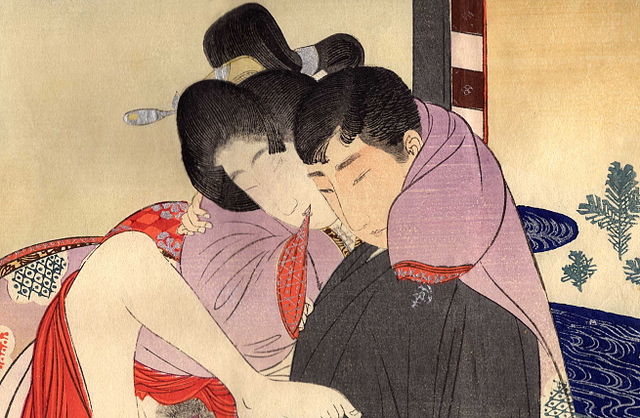
    A man with a Western-style haircut makes love to a woman in traditional Japanese dress. Shunga print, 1880 (anon)

    In this chapter of the Exploratory Companion, let’s begin to consider a little of Jibun’s and Mushanokoji’s philosophy. As well, I’d like to look at the introduction and evolution of transport technology in Japan, and in particular Tokyo. What a superb system it has become. We can still see the Meiji slogan in action: “Japanese spirit, Western techology”!

    Jibun as a ‘moral philosopher’

    The term dogakusha, which Jibun uses to describe his “occupation” as a “moral scholar,” literally translates as “scholar of the way” — the (Chinese) way of the Tao, as in Lao Tzu’s Tao Te Ching (“the way of integrity”). Strictly speaking, it means “Taoist scholar,” which is inapt here. By late Meiji, the term could refer to a Confucian philosopher or simply a moralist. It also took on a mocking connotation, describing an eccentric scholar so preoccupied with morality and reason as to be oblivious to worldly affairs. To some extent, Mushanokoji seems to be poking fun at himself in adopting this role (See my note to Translator’s Preface, The Innocent). His philosophy is a free-sprited amalgam of ideas from East and West.

    Okazaki (Toyo Bunko) 312

    Musha-ism: Happiness Through Self-Transcendence

    The alumni meeting scene explicitly raises Jibun’s philosophical aspirations. Yoshihiro Mochizuki’s MA thesis on Musha-ism — Mushanokoji’s theory of happiness — proves a useful reference, in its framing of happiness as a function of self-transcendence: transcendence effected via the self.

    Our marriage would make a good topic for gossip, and those fools [the alumni] might still try ridiculing me.

    If they did, I would answer them like this:

    “Yes, it was love at first sight and we married. I am sorry to say that I cannot be interested in as many women as you are because I know something of true love. I cannot do everything.”

    While I spoke, I would make an expression as though I were biting through a bitter-tasting bug. It would be most awkward. Yet I am unable to rise above reacting like this.

    If I am able to transcend that, I am already no longer a moral scholar. No longer an educator.

    The Innocent, Ch. 3: 33

    Mochizuki examines Musha-ism as a philosophy of happiness, defined as self-cultivation and self-transcendence. He identifies two levels in The Innocent: a deeper philosophical aspect and a more superficial narrative of Jibun’s pursuit of Tsuru, in which he relegates her to a purely subjective sphere.

    Whenever I see a female student of her age, or a woman coming from a distance, or a woman from behind, whatever the time or place, I wonder whether it might be Tsuru. I can notice this tendency increasing, little by little. Ten times out of ten it would not be her.

    And yet still I wonder.

    Ch. 3: 30

    Rather than attempt to prescribe any specific (and inevitably somewhat arbitrary) reading, it may be more productive in general to consider how a reader is free to receive elements from these levels, assembling one’s own interpretation. Such an approach would well align with Mushanokoji’s own progressive aims. His author’s dedication for The Innocent, for instance, privileges the reader’s free response:

    I believe in a selfish kind of literature, a literature for its own sake. It is only in accord with this idea that I desire to be an author. The value of my writing is determined by the degree to which it can harmonize with the reader’s own individuality. I am not entitled to demand that people unable to empathize with me should buy or read what I write.

    Glancing at a few elements of Musha-ism in The Innocent will suffice to give us a notion of the author’s intentions. For a comprehensive view, we can turn to Mochizuki’s thesis.

    The Shirakaba Group and the Cultivation of the Self

    Mushanokoji was a founder and leading figure of the Shirakaba-ha (White Birch Society), a literary coterie at the Gakushuin (Peers’ School) in Tokyo, whose members included several prominent writers. Under his leadership, the Shirakaba group “led the humanitarian movement of the Taisho era” (Toyo Bunko, Okazaki comp., Japanese Literature in the Meiji Era, 1955). As an elite group of aristocratic youths in their early twenties, they faced minimal restrictions on their artistic ambitions. Their philosophy centered on art for art’s sake and self-cultivation — transcendence through the self — with a pronounced avant-garde inclination.

    Qtd. in Tomo Suzuki, Narrating the Self: Fictions of Japanese Modernity (Stanford, Calif.: Stanford UP, 1951)

    Subtle avant-garde elements of The Innocent have tended to marginalize it, accounting for a lack of interest from potential translators. Missing the point, certain types of reader have dismissed the novella as confused and immature, misconstruing its disarming self-parody. Fortunately, at the same time, these progressive characteristics appeal to a late modern, who has become historically conditioned to them. To such a reader, the novella offers a vital doorway into a dynamic experience of the Meiji imagination.

    Okazaki, Toyo Bunko 312

    Such a total immersion in the Self is evident in the way Jibun’s love for Tsuru is circumscribed in his own subjectivity. He places her on a pedestal of the ideal, while remaining anonymous and never even speaking to her.

    Unfortunately, I crave a beautiful young woman. I have not even spoken to one since Tsukiko, my crush when I was nineteen, returned to her hometown seven years ago, and now I hunger for a woman.

    Ch. 1: 17
    Anonymous student c. 1912 (source Taisho Era Tumblr)

    It is an almost absurdist feature of the story, this apparent descent into solipsism — being completely bound up in the self. Moreover, as we will see, the untenable existential situation will inevitably place Jibun into conflict with his idealistic love for Tsuru: just what sacrifices would he be prepared to make for her, if any? He is caught in something of a vicious cycle or reductio ad absurdum, without realizing it.

    Jibun cannot help become an object of self-parody. This flows from his continual self-questioning and moralising, as much as from his obsessiveness about his beloved Tsuru, with whom he has never even spoken.

    Yet Jibun remains a close proxy for the author, the utopian philosopher Mushanokoji himself. Towards the end of the chapter, in Jibun’s thoughts, I believe, can be observed a subtle ambivalence that lies at the heart of a serious aspiration to self-transcendence.

    Musha-ism tends to produce an anti-naturalistic, what might be called “decadent” stylistic turn, particularly an opposition to a mechanistic idea of nature then holding sway (Okazaki, Toyo Bunko, 312). During his Tolstoyan phase, Mushanokoji had sought like his then luminary to “love his neighbor as himself”; his adoption of Maeterlinck’s ideas saw a shift in this attitude. Mushanokoji’s transition from following a Tolstoyan mode of humanism to Maurice Maeterlinck’s (see earlier Furin Chime posts on Maeterlinck) further involves a turn from self-denial and asceticism, to the affirmation of pleasure.

    Maeterlinck, qtd. in Mochizuki, 46

    As I argued in my posts on Maeterlinck, the various anti-naturalistic, humanistic, absurdist, and metaphysical thematics of The Innocent serve to make it quite accessible and sympatico with a modern reader, more than the theory of Musha-ism per se. Rather, it is thanks to Maeterlinck’s influence on Samuel Beckett and Beckett’s appropriation of Maeterlinck; and to the profound influence Beckett has had upon the human imagination since the 50s and 60s.

    Locating The Innocent in time and space: Meiji-Taisho Tokyo rail

    I should say a few words regarding a technical detail of translation.

    Tokyo’s transportation landscape underwent a significant transformation during the Meiji and Taisho eras. It began in 1871 with the introduction of horse-drawn carriages, initially a luxury for the elite. Public horse-drawn carriages soon followed, providing transport within Tokyo and to surrounding areas. By 1882, horse-drawn trams, running on rails, gained popularity, but sanitation issues prompted a shift towards electric trams. This transition was marked by the Tokyo Basha Tetsudo (‘horse carriage’) railway’s conversion to electric power in 1903, becoming Tokyo Densha Tetsudo, with full electrification achieved by 1904. The city’s acquisition of the private tram (or streetcar) company in 1911, forming Tokyo Shiden (“city electric”), further solidified the electric tram network.

    Trams queued at the south side of Ueno Park, Tokyo, late Meji Period (Sumitomo Mitsui Trust, Ueno Town Archives)

    Note, however, that the Japanese word densha (“electric” + “car/carriage”) remained consistent throughout these changes, encompassing both trams and trains. In 1907, while electric trams served the inner city along street routes, incorporating significant stops like those near the imperial moat and Hibiya Park, the area Jibun walks through after buying the book, at the beginning of The Innocent.

    Electric tram and train services in Tokyo in 1911. Source: Introduction of Railway Technology, at Changing Face of Tokyo (Metro, Tokyo Local Government)

    This map shows the electric tram and train system of Tokyo in 1911. The circular red web in the middle comprises tram lines that follow street routes in central Tokyo: they radiate out from the Imperial Palace, whose moats are drawn in blue. In Chapter 1, Jibun walks around the south east corner of this complex (Hibiya Moat) to Hibiya Park. In 1911 the Kobu line is denoted as the Chuo line and runs from Kandabashi through Shinjuku and west to Nakano, where Jibun travels.

    Several rail lines connecting more distant areas were under development. These included the Kōbu Railway, which later became part of today’s important Chuo Line. This line, serving western suburbs, had stations at Okubo, Yotsuya and Nakano, where Jibun travels to see his friend. This distinction between trams and trains is crucial for understanding the novella’s setting. In Chapter 7, Jibun provides a street address for a rail stop, a clear indicator that technically he’s using a tram, and not a train.

    It’s important to remember that early densha, whether trams or trains, were often single carriages, much like trams. Thus, the physical form didn’t drastically change in the public consciousness.

    “Introduction of Railway Technology,” Bureau of Urban Development, Tokyo

    The photo shows precisely the model of densha that Jibun rides on the Kobu line — a 10-meter-long, four-wheel-car imported from England and used subsequently as trains by Japanese National Railways

    The modern understanding of ‘train,’ with its etymological connotation of ‘a series of things drawn along behind,’ can be misleading. This is particularly relevant when considering the Kobu Line, which used electric ‘densha’ to connect suburbs to central Tokyo, and therefore could be considered a train, but was not the modern multi-car train. At the same, the station described in Chapter 3, with Jibun catching the Kobu line and alighting with Tsuru at Okubo, the platform, gates, and exit route are clearly more substantial than a neighbourhood tram stop.

    Given the nuance of translating the word densha and the potential for misinterpretation, I’ve chosen to use “tram” in some places when referring to the Kobu Line. This decision is based on several factors: First, the physical form of the early electric densha closely resembled trams, particularly in their single-carriage configuration. Second, the term “tram” helps to differentiate these early suburban rail services from the modern concept of a multi-carriage “train.” Third, the use of “tram” allows for a more consistent and accessible reading experience, particularly for readers unfamiliar with the nuances of early 20th-century Japanese rail transport.
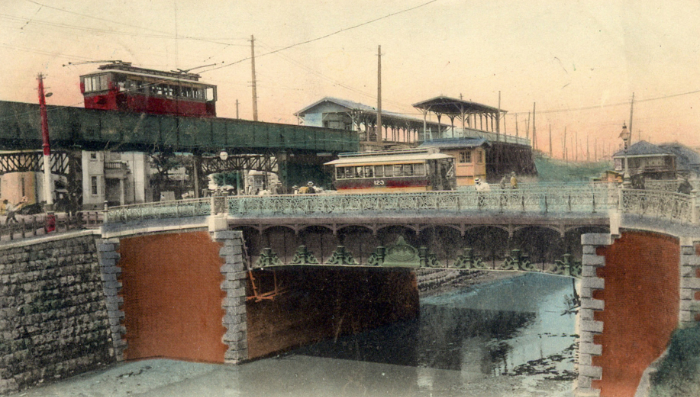
    Suidobashi Station, c. 1910, showing a carriage (densha) on the elevated, electrified Chuo Line and a streetcar (densha) on Suiodobashi bridge (Old Tokyo)

    While acknowledging the technical distinction between the Kobu Line as a railway and the city’s tram network, my aim is to convey the historical context and the lived experience of the characters as accurately as possible. The use of ‘tram’ in specific instances is a deliberate choice to bridge the gap between the historical reality and the modern reader’s understanding, aiming for a setting that accommodates the action authentically and accessibly. Admittedly, it should be possible to adjust future iterations of The Innocent to clarify the point I have indicated here.

    First Steam Train Leaving Yokohama, 1872. Kunisada III (1848 – 1920)

    Michael Guest © 2025


    Notes and further reading

    Saneatsu Mushanokoji, The Innocent (1911), trans. Michael Guest, Sydney: Furin Chime Press, 2024.

    • geta: Japanese footwear, consisting of a wooden base held on by fabric straps, similar to ‘thongs’ or ‘flipflops’. They may be elevated by one or two so-called ‘teeth’. or wooden blocks.
    • koma-geta: a style of geta with low teeth.
    • seventeenth day of [the moon’s] cycle: Known as Tachimachizuki (‘standing and waiting’). As the moon rises progressively later during this phase, one has to ‘stand and wait’ for it to appear. See Rikumo Journal.

    Aitken, Annika (2023). ‘Interpreting Shunga Scroll: sex and desire between women in Edo’s ‘floating world’

    Bureau of Urban Development, Tokyo. The Changing Face of Tokyo: From Edo to Today, and into the Future

    Mochizuki, Yoshijiro (2005). Rediscovering Musha-ism: The Theory of Happiness in the Early Works of Saneatsu Mushakoji, MA Thesis, University of Hawaii. PDF from U of Hawaii.

    Okazaki, Y (compiler) (1955).Japanese Culture in the Meiji Era: Japanese Literature in the Meiji Era (Published by Toyo Bunko: one of the world’s five largest Eastern Studies libraries).

    Shields, James Mark (2018). “Future Perfect: Tolstoy and the Structures of Agrarian-Buddhist Utopianism in Taishō Japan,” Religions 9 (5), 161. HTML or PDF

    Suzuki, T (1955). Narrating the Self: Fictions of Japanese Modernity (Stanford, Calif.: Stanford UP)

    English translation of Saneatsu Mushanokoji’s The Innocent (1911) by Michael Guest © 2024
  • A Walk Through Meiji Tokyo: Mushanokōji and the Making of The Innocent

    A Walk Through Meiji Tokyo: Mushanokōji and the Making of The Innocent

    Author

    Saneatsu Mushanokoji (1885-1976) was one of the first great Japanese modernist writers. He may lay claim to have founded the I-novel (shishosetsu), a specifically Japanese confessional genre in which the author speaks directly and colloquially to the reader (e.g., Lippit 28). Mushanokoji was also a painter of still lifes, a poet and playwright, and a unique but influential philosopher. Inspired by the writings of Tolstoy, he established a utopian village, Atarashiki-mura (“New Village”), which continues to operate, and which a young Mao Zedong himself attempted to replicate.

    Mushanokoji (aka Mushakoji) first published Omedetaki Hito (1910) in a journal of the Shirakaba (White Birch) society, a group of aristocratic writers from Tokyo Imperial University, of whom he was the leader. Shirakaba led a humanitarian movement in Japan during the Taisho era of 1912-1926.

    Novella

    Elements of Mushanokoji’s later style, and of the I-novel, are distinctly present in this his first novel, and the narrator may be to an extent identified with the author. Written in the form of a diary, the novel draws on personal experiences from his youth, and from his own philosophy of happiness and transcendence (Okazaki 310; Mochizuki).

    The novel’s psychological and philosophical depths are already evident in this initial chapter. On the one hand, the story of the narrator’s infatuation with a schoolgirl named Tsuru consists of straightforward incidents, candidly expressed. Notice in the beginning, the spontaneity of the character (“I”) when he turns towards the two geishas. It sems as though his feet veer in their direction on their own, propelled by his internal “hunger” (starving/longing) for a woman, which he mentions several times.

    As the story proceeds, however, it becomes evident that he has never actually spoken to Tsuru. As he reflects about her, he starts to appear unhealthily obsessive to an extent—to us, who have become familiar with the socio-psychological phenomenon of “stalking.” He appears to admire her fairly creepily from afar. Indeed, some modern young Japanese reporting on the Web, tend to see the book either as a “stalker novel” or as the story of a person so hopelessy naive as to be unbelievable. (I have come across one or two who confess to identifying with him in his standoffishness.)

    The character’s utter detachment from the object of his love is, at the same time, equivalent to his complete absorbtion in the self. Hence, he positively affirms his unwillingness to sacrifice his “own self” for the sake of his idealized love-object, Tsuru. Somewhat reminiscent of Nietzsche, Mushanokoji expresses his ideal of a transcendent self that refuses to defer to societal norms, but will conduct life on its own terms.

    Mushanokoji uses  a device of ambiguity to help depict the “I” character’s absolute detachment from exterior reality, and his centering upon the self. That is why he refuses to speak of “watching” or “observing” Tsuru. Instead he expresses the action euphemistically as “seeing” her, which carries a an incorrect connotation of their having “met.”

    Frontispiece

    Max Klinger’s image suggests the psychic and animal aspects of human being. With the “higher” elements needing to control the “baser.” Darwin is implicit, but a salient cruelty is apparent on the psychical or human side. Still, the bear is after the elf, presumably wanting to gobble her up!

    Max Klinger, Bär und Elfe (Bear and Fairy), plate I from Intermezzi, Opus IV (Intermezzos, Opus IV) (1880)
    Marsha Morton, “Art on the Edge: Klinger at the Threshold of Modernism”, in Max Klinger Le Théâter de L’Étrange: Les Suites Gravées 1879-1915 (Strasbourg: Musées de la Ville de Strasbourg, 2012)

    Stroll through the heart of Meiji Tokyo

    “On the morning of January 29, I went to Maruzen bookshop to look for some books and left after buying one titled Civilization and Education, written by someone named Münch.”

    This fitting opening reference carries an almost metafictional significance to readers of today, for Maruzen became the primary conduit for Western thought into Japan, subsequent to the Meiji Restoration. It is particularly appropriate, given Mushanokoji’s further significance as a leading figure in the evolution of Japanese modernism.

    Consider the following, written by Katai Tayama, whose 1907 novel Futon, may also lay fair claim to being, along with Saneatsu Mushanokoji’s The Innocent, an early instance of the I-novel:

    “The Second Floor of Maruzen”, by Tayama Katai, Thirty Years in Tokyo (1917) (translated by Kenneth G. Henshall, 1987). oldtokyo.com
    Nihonbashi, Tokyo, c. 1920, taken from Shirokiya department store (oldtokyo.com). Maruzen is the orange-brown building at the top center of the photo

    This young man of Tayama’s, strolling through Maranouchi could well be Mushanokoji himself, particularly the one carrying the novel by Tolstoy, who was a major influence on Saneatsu, giving way to his later interest in the Belgian writer Maurice Maeterlinck. (See my opening comments on Maeterlinck’s play The Blind in a recent post.)

    But Jibun has other things on his mind as well as literature.

    A geisha in the Taisho period (1912-1926)

    Various images jostle for the foreground of his mind, for association with his thoughts on morals and aesthetics. Inevitably, they lead to images and thoughts of the girl Tsuru, his desire for whom dominates his existence.

    The dark blue dotted route shows Jibun’s twenty-minute or so walk from Maruzen bookstore in Nihonbashi via the corner of the moat at the boundary of Kokyo Gaien National Garden, and down through Hibiya Park, the green rectangle at the bottom:

    Route from Maruzen to Hibiya Park

    “Walking quickly I reached the moat and, instead of catching an electric tram, turned left to follow the tracks to Hibiya and go through Hibiya Park to my house”

    Hibiya Moat today (Wikipedia)

    Since 1868, the Imperial Palace has occupied the site of Edo Castle, originally built in 1457 by the Edo Clan, the samurai family who first fortified the town of Edo. Between 1603 and 1868, the Tokugawa shogunate, who were the feudal rulers up until the Meiji Revolution, developed the castle into the largest ever constructed in Japan.

    The Kokyo Gaien National Gardens encircle the palace, in Chiyoda City, a special ward of Tokyo. As well as being the economic and political hub of Japan, Chiyoda contains the most affluent residential neighborhoods in Tokyo, towards the west, in the Yamanote area.

    The Mushanokojis were among the most aristocratic families in Japan. Their home was located at what is now Saneatsu Park, adjacent to the Saneatsu Mushanokoji Memorial Museum, in Chofu, Tokyo, to the west. It seems odd, then, that Jibun would forgo the electric tram ride for Shank’s Pony, since the journey on foot would take around four and a half hours, and we learn at the opening of Chapter 2 that he arrives home in time for lunch.

    Jibun doesn’t strike us as the athletic type. Perhaps it is an instance of the divergence from biographical fact that the I-novel can exhibit generically. For instance, his father makes some appearances in the novella, whereas Mushanokoji’s own father, Viscount Saneyo Mushanokoji, a court noble, actually died when his son Saneatsu was two.

    Anyway Hibiya Park is a pretty spot for Jibun to enjoy his homeward stroll. Note that the first-person narrator is unnamed in the story. Jibun is actually a Japanese pronoun equivalent to “myself/oneself/me,” and how he is conventionally referred to in literary criticism.

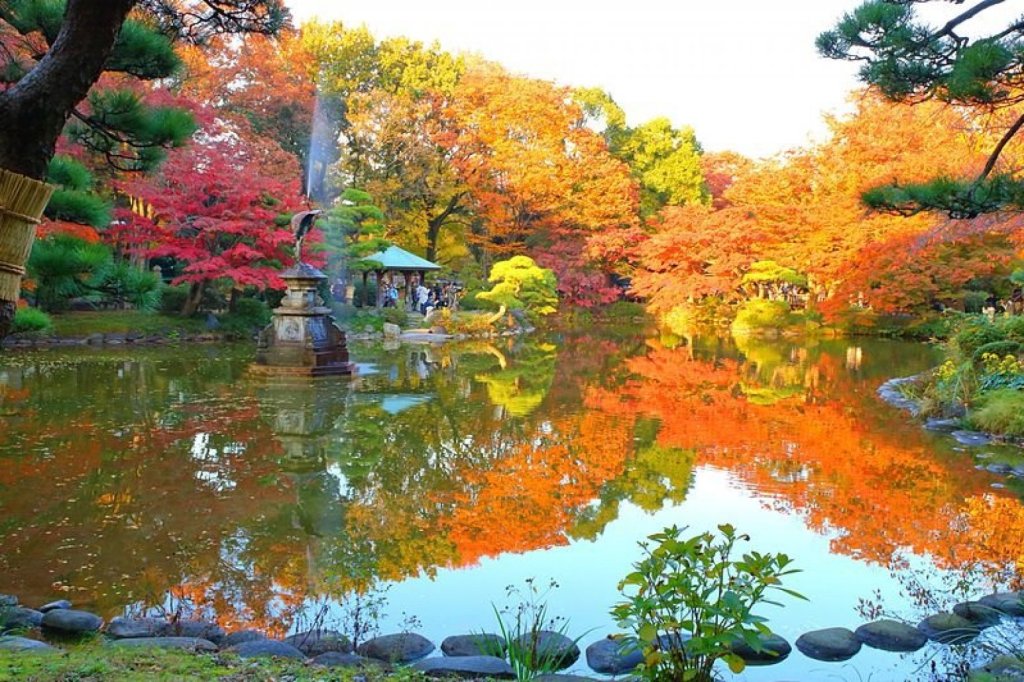
    Hibiya Park (Photo: Kakidai / CC BY-SA 4.0) Source: Japan Travel

     This time he is distracted by two lovers, and he can’t decide whether to rejoice for them in their happiness, or curse them for reminding him of his unfulfilled longing for Tsuru.


    Notes and References

    Saneatsu Mushanokoji, The Innocent (1911), trans. Michael Guest, Sydney: Furin Chime Press, 2024.

    Lippit, Seiji, M. Topographies of Japanese Modernism. (NY: Columbia U, 2002).

    Mochizuki, Yoshihiro. Rediscovering Musha-ism: The Theory of Happiness in the Early Works), of Mushakoji Saneatsu (Master of Arts thesis, Univ. Hawai’i, 2005).

    Okazaki, Yoshie, Japanese Literature in the Meiji Era. Vol. 1 of Japanese Culture in the Meiji Era. Trans. V.H. Vigliemo (Tokyo: Toyo Bunko, 1955).

    Suzuki, Tomi. Narrating the Self: Fictions of Japanese Modernity (Stanford: Stanford UP, 2000) ,

    Treat, John Whittier. The Rise and Fall of Japanese Literature (Chicago: U of Chicago P, 2018).

    Tyler, William J. Review of Suzuki, Narrating the Self, in Harvard Journal of Asiatic Studies Vol. 60, No. 2 (Dec., 2000), pp. 661-670.

  • Maeterlinck’s play The Blind (Part Two)

    Maeterlinck’s play The Blind (Part Two)

    Reading Maeterlinck’s The Blind, we become aware of a continuous, brilliant process of transposition and streamlining into Waiting for Godot. Here’s an instance from Part One of the previous post:

    In Waiting for Godot, Pozzo is of course the archetypal blind man, with his definitive fatalistic proclamation on time, and its reduction to a metaphysical eternal instant:

    And testily, when pressed about when it was he had become blind: “Don’t question me! The blind have no notion of time.”

    Beckett’s self-parodic humour, we detect, lies partly in the knowledge of the appropriative act. It is like a sly confessional acknowledgement. Notice what becomes of Maeterlinck’s gothic setting:

    Of course: “A country road. A tree. Evening.” From which Beckett draws comic business in a sly acknowledgement:

    Hence there is, for us readers of 2025, endless existential marvel to be derived from Maeterlinck’sThe Dead. The play could be given spectacular minimalistic realization in the post-Beckett era, using sound and lighting effects. It absolutely warrants production. Without further ado, let’s turn to the second part.

    • In the text below , *** indicates some select “Beckettian” touches, among copious others.

    The Blind (continued)

    [*86]

    THE YOUNG BLIND GIRL.
    My lids are shut, but I feel that my eyes are alive.…

    FIRST BLIND MAN.
    Mine are open.

    SECOND BLIND MAN.
    I sleep with my eyes open.

    THIRD BLIND MAN.
    Let us not talk of our eyes!

    SECOND BLIND MAN.
    It is not long since you came, is it?

    THE VERY OLD BLIND MAN.
    One evening at prayers I heard a voice on the women’s side that I did not recognize; and I knew by your voice that you were very young…. I would have liked to see you, to hear you.…

    FIRST BLIND MAN.
    I didn’t perceive anything.

    SECOND BLIND MAN.
    He gave us no warning.

    SIXTH BLIND MAN.
    They say you are beautiful as a woman who comes from very far.

    [*87]

    THE YOUNG BLIND GIRL
    I have never seen myself.

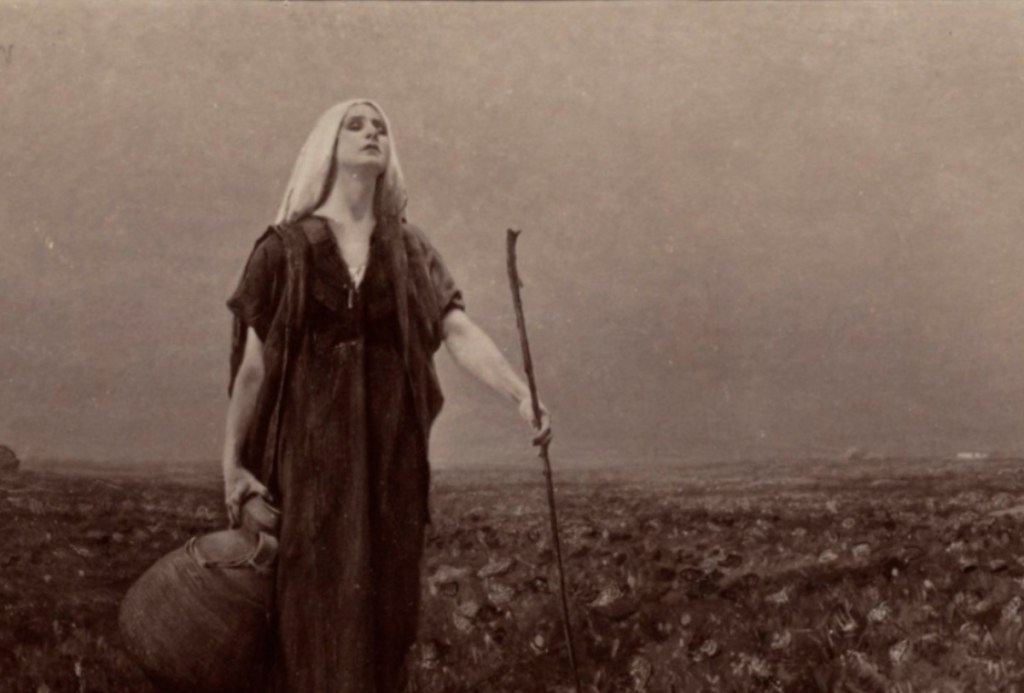
    Blind Woman in Vast Landscape with Jug and Walking Stick. 1892. Web. 08 Jan 2025 (digitalcommonwalth.org)

    THE VERY OLD BLIND MAN.
    We have never seen each other. We ask and we reply; we live together, we are always together, but we know not what we are! … In vain we touch each other with both hands; the eyes learn more than the hands.…

    SIXTH BLIND MAN.
    I see your shadows sometimes, when you are in the sun.

    THE VERY OLD BLIND MAN.
    We have never seen the house in which we live; in vain we feel the walls and the windows; we do not know where we live!…

    THE VERY OLD BLIND WOMAN.
    They say it is an old château, very gloomy and very wretched, where no light is ever seen except in the tower where the priest has his room.

    FIRST BLIND MAN.
    There is no need of light for those who do not see.

    SIXTH BLIND MAN.
    When I tend the flock, in the neighborhood of the Asylum, the sheep return of themselves when they see at nightfall that light in the tower.… They have never misled me.

    [*88]

    THE VERY OLD BLIND MAN.
    Years and years we have been together, and we have never seen each other! You would say we were forever alone! … To love, one must see.

    THE VERY OLD BLIND WOMAN.
    I dream sometimes that I see …

    THE VERY OLD BLIND MAN.
    I see only in my dreams…

    FIRST BLIND MAN.
    I do not dream, usually, except at midnight.

    SECOND BLIND MAN.
    Of what can one dream where the hands are motionless?

    [A flurry of wind shakes the forest, and the leaves fall, thick and gloomily.]

    FIFTH BLIND MAN.
    Who touched my hands?

    FIRST BLIND MAN.
    Something is falling about us!

    THE VERY OLD BLIND MAN.
    That comes from above; I don’t know what it is…

    [*89]

    FIFTH BLIND MAN.
    Who touched my hands? — I was asleep; let me sleep!

    THE VERY OLD BLIND MAN.
    Nobody touched your hands.

    FIFTH BLIND MAN.
    Who took my hands? Answer loudly; l am a little hard of hearing …

    THE VERY OLD BLIND MAN.
    We do not know ourselves.

    FIFTH BLIND MAN.
    Has someone come to give us warning?

    FIRST BLIND MAN.
    It is useless to reply; he hears nothing.

    THIRD BLIND MAN.
    It must be admitted, the deaf are very unfortunate.

    THE VERY OLD BLIND MAN.
    I am weary of staying seated.

    SIXTH BLIND MAN.
    I am weary of staying here.

    [*90]

    SECOND BLIND MAN.
    It seems to me we are so far from one another.… Let us try to get a little nearer together, — it is beginning to get cold.…

    THIRD BLIND MAN.
    I dare not rise! We had better stay where we are.

    THE VERY OLD BLIND MAN.
    We do not know what there may be among us.

    SIXTH BLIND MAN.
    I think both my hands are in blood; I would like to stand up.

    THIRD BLIND MAN.
    You are leaning toward me, — I hear you.

    [The blind madwoman rubs her eyes violently, groaning and turning obstinately toward the motionless priest.]

    FIRST BLIND MAN.
    I hear still another noise.…

    THE VERY OLD BLIND WOMAN.
    I think it is our unfortunate sister rubbing her eyes.

    SECOND BLIND MAN.
    She is never doing anything else; I hear her every night.

    [*91]

    THIRD BLIND MAN.
    She is mad; she never speaks.

    THE VERY OLD BLIND WOMAN.
    She has never spoken since she had her child.… She seems always to be afraid.…

    THE VERY OLD BLIND MAN
    You are not afraid here then?

    FIRST BLIND MAN.
    Who?

    THE VERY OLD BLIND MAN.
    All the rest of us.

    THE VERY OLD BLIND WOMAN.
    Yes, yes; we are afraid.

    THE YOUNG BLIND GIRL.
    We have been afraid for a long time.

    FIRST BLIND MAN.
    Why did you ask that?

    THE VERY OLD BLIND MAN.
    I do not know why I asked it.… There is something here I do not understand…. It seems to me I hear weeping all at once among us.…

    FIRST BLIND MAN.
    There is no need to fear; I think it is the madwoman.

    [*92]

    THE VERY OLD BLIND MAN.
    There is something else beside … I am sure there is something else beside…. It is not that alone that makes me afraid.

    THE VERY OLD BLIND WOMAN.
    She always weeps when she is going to give suck to her child. ***

    FIRST BLIND MAN.
    She is the only one that weeps so.

    THE VERY OLD BLIND WOMAN.
    They say she sees still at times.

    FIRST BLIND MAN.
    You do not hear the others weep.

    THE VERY OLD BLIND MAN.
    To weep, one must see. ***

    THE YOUNG BLIND GIRL.
    I smell an odor of flowers about us.

    FIRST BLIND MAN.
    I smell only the smell of the earth.

    THE YOUNG BLIND GIRL.
    There are flowers, — there are flowers about us.

    [*93]

    SECOND BLIND MAN.
    I smell only the smell of the earth.

    THE VERY OLD BLIND WOMAN
    I caught the perfume of flowers in the wind….

    THIRD BLIND MAN.
    I smell only the smell of the earth.

    THE VERY OLD BLIND MAN.
    I believe the women are right.

    SIXTH BLIND MAN.
    Where are they?’ — I will go pluck them.

    THE YOUNG BLIND GIRL.
    At your right. Rise!

    [The sixth blind man rises slowly and advances groping, and stumbling against the bushes and trees, toward the asphodels, which he breaks and crushes on his way.]

    THE YOUNG BLIND GIRL.
    I hear you breaking the green stalks. Stop! stop!

    FIRST BLIND MAN.
    Don’t worry yourselves about flowers, but think of getting home.

    SIXTH BLIND MAN.
    I no longer dare return on my steps.

    [*94]

    THE YOUNG BLIND GIRL.
    You need not return. — Wait. — [She rises.] Oh, how cold the earth is! It is going to freeze. — [She advances without hesitation toward the strange pale asphodels; but she is stopped in the neighborhood of the flowers by the uprooted tree and the fragments of rock] They are here. — I cannot reach them; they are on your side.

    SIXTH BLIND MAN.
    I believe I am plucking them.

    [He plucks the scattered flowers, gropingly, and offers them to her; the night birds fly away.]

    THE YOUNG BLIND GIRL.
    It seems to me I saw these flowers in the old days…. I no longer know their name.… Alas, how sickly they are, and how soft the stems are! I hardly recognize them. … I think it is the flower of the dead. [She twines the asphodels in her hair.]

    THE VERY OLD BLIND MAN.
    I hear the noise of your hair.

    THE YOUNG BLIND GIRL.
    It is the flowers.…

    THE VERY OLD BLIND MAN.
    We shall not see you.…

    [*95]

    THE YOUNG BLIND GIRL.
    I shall not see myself, anymore.… I am cold.

    [At this moment the wind rises in the forest, and the sea roars suddenly and with violence against cliffs very near.]

    FIRST BLIND MAN.
    It thunders!

    SECOND BLIND MAN.
    I think there is a storm rising.

    THE VERY OLD BLIND WOMAN.
    I think it is the sea.

    THIRD BLIND MAN.
    The sea? — Is it the sea? — But it is hardly two steps from us! — It is at our feet! I hear it all about me! — It must be something else!

    THE YOUNG BLIND GIRL.
    I hear the noise of breakers at my feet.

    FIRST BLIND MAN.
    I think it is the wind in the dead leaves. ***

    THE VERY OLD BLIND MAN.
    I think the women are right.

    THIRD BLIND MAN.
    It will come here!

    [*96]

    FIRST BLIND MAN.
    What direction does the wind come from?

    SECOND BLIND MAN.
    It comes from the sea.

    THE VERY OLD BLIND MAN.
    It always comes from the sea. The sea surrounds us on all sides. It cannot come from anywhere else.…

    FIRST BLIND MAN.
    Let us not keep on thinking of the sea!

    SECOND BLIND MAN.
    We must think of it. It will reach us soon.

    FIRST BLIND MAN.
    You do not know if it be the sea.

    SECOND BLIND MAN.
    I hear its surges as if I could dip both hands in them. We cannot stay here! It is perhaps all about us.

    THE VERY OLD BLIND MAN.
    Where would you go?

    SECOND BLIND MAN.
    No matter where! no matter where! I will not hear this noise of waters any longer! Let us go! Let us go!

    [*97]

    THIRD BLIND MAN.
    I think I hear something else. — Listen!

    [A sound of footfalls is heard, hurried and far away, in the dead leaves.]

    FIRST BLIND MAN.
    There is something coming this way.

    SECOND BLIND MAN.
    He is coming! He is coming! He is coming back!

    THIRD BLIND MAN.
    He is coming with little quick steps, like a little child.

    SECOND BLIND MAN.
    Let us make no complaints to him today.

    THE VERY OLD BLIND WOMAN.
    I believe that is not the step of a man!

    [A great dog enters in the forest, and passes in front of the blind folk. — Silence.]

    FIRST BLIND MAN.
    Who’s there? — Who are you? — Have pity on us, we have been waiting so long! …[The dog stops and coming to the blind man, puts his fore paws on his knees] Oh, oh, what have you put on my knees? What is it? … Is it an animal? — I believe it is a dog.… Oh, oh, it is the dog, it is the Asylum dog! Come here, sir, come here! He comes to save us! Come here! come here, sir!

    Jumping dog, probably by Jan Baptist Weenix (1636 – 1661) (RKD Research)

    [*98]

    THE OTHERS. Come here, sir! come here!

    FIRST BLIND MAN.
    He has come to save us! He has followed our tracks all the way! He is licking my hands as if he had just found me after centuries! He howls for joy! He is going to die for joy! Listen, listen!

    THE OTHERS
    Come here! Come here!

    THE VERY OLD BLIND MAN.
    Perhaps he is running ahead of somebody…

    FIRST BLIND MAN.
    No, no, he is alone. — I hear nothing coming. — We need no other guide; there is none better. He will lead us wherever we want to go; he will obey us …

    THE VERY OLD BLIND WOMAN.
    I dare not follow him…

    THE YOUNG BLIND GIRL.
    Nor I.
    FIRST BLIND MAN.

    Why not? His sight is better than ours.

    [*99]

    SECOND BLIND MAN.
    Don’t listen to the women!

    THIRD BLIND MAN.
    I believe there is a change in the sky. I breathe freely. The air is pure now …

    THE VERY OLD BLIND WOMAN.
    It is the sea wind passing about us.

    SIXTH BLIND MAN.
    It seems to me it is getting lighter; I believe the sun is rising …

    THE VERY OLD BLIND WOMAN.
    I believe it is getting colder

    FIRST BLIND MAN.
    We are going to find our way again. He is dragging me! … he is dragging me. He is drunk with joy! — I can no longer hold him back! .… Follow me, follow me. We are going back to the house! …

    [He rises, dragged by the dog, who leads him to the motionless priest, and stops.]

    THE OTHERS.
    Where are you? Where are you? — Where are you going? — Take care!

    [*100]

    FIRST BLIND MAN.
    Wait, wait! Do not follow me yet; I will come back … He is stopping. — What is the matter with him? — Oh, oh, I touched something very cold!

    SECOND BLIND MAN.
    What are you saying? — We can hardly hear your voice any longer.

    FIRST BLIND MAN.
    I have touched — I believe I am touching a face!

    THIRD BLIND MAN.
    What are you saying? — We hardly understand you any longer. What is the matter with you? — Where are you? — Are you already so far away?

    FIRST BLIND MAN.
    Oh, oh, oh! — I do not know yet what it is. — There is a dead man in the midst of us.

    THE OTHERS.
    A dead man in the midst of us? — Where are you? Where are you?

    FIRST BLIND MAN.
    There is a dead man among us, I tell you! Oh, oh, I touched a dead man’s face! — You are sitting beside a dead man! [*101] One of us must have died suddenly. Why don’t you speak, so that I may know who are still alive? Where are you? — Answer! answer, all of you!

    [The blind folk reply in turn, with the exception of the madwoman and the deaf man. The three old women have ceased their prayers.]

    FIRST BLIND MAN.
    I no longer distinguish your voices … You all speak alike! …Your voices are all trembling.

    THIRD BLIND MAN.
    There are two that have not answered… Where are they? [He touches with his stick the fifth blind man.]

    FIFTH BLIND MAN.
    Oh! oh! I was asleep; let me sleep!

    SIXTH BLIND MAN.
    It is not he. — Is it the madwoman?

    THE VERY OLD BLIND WOMAN.
    She is sitting beside me; I can hear that she is alive …

    FIRST BLIND MAN.
    I believe … I believe it is the priest! — He is standing up! Come, come, come!

    [*102]

    SECOND BLIND MAN.
    He is standing up?

    THIRD BLIND MAN
    Then he is not dead!

    THE VERY OLD BLIND MAN.
    Where is he?

    SIXTH BLIND MAN.
    Let us go see!

    [They all rise, with the exception of the mad- woman and the fifth blind man, and advance, groping, toward the dead.]

    SECOND BLIND MAN.
    Is he here? — Is it he?

    THIRD BLIND MAN.
    Yes, yes, I recognize him

    FIRST BLIND MAN.
    My God! my God! what will become of us?

    THE VERY OLD BLIND WOMAN.
    Father! father! — Is it you? Father, what has happened? — What is the matter? — Answer us! — We are all about you. Oh! oh! oh!

    THE VERY OLD BLIND MAN.
    Bring some water; perhaps he still lives.

    [*103]

    SECOND BLIND MAN.
    Let us try … He might perhaps be able to take us back to the Asylum …

    Head of an old blind man
    Anthon Gerhard Alexander van Rappard, 1868 – 1892 (rijksmuseum.nl)

    THIRD BLIND. MAN.
    It is useless; I no longer hear his heart. — He is cold.

    FIRST BLIND MAN.
    He died without speaking a word.

    THIRD BLIND MAN.
    He ought to have forewarned us.

    SECOND BLIND MAN.
    Oh! how old he was!… This is the first time I ever touched his face …

    THIRD BLIND MAN.
    [Feeling the corpse.] He is taller than we.

    SECOND BLIND MAN.
    His eyes are wide open. He died with his hands clasped.***

    FIRST BLIND MAN.
    It was unreasonable to die so …

    SECOND BLIND MAN.
    He is not standing up, he is sitting on a stone.

    [*104]

    THE VERY OLD BLIND WOMAN.
    My God! my God! I did not dream of such a thing! … such a thing! … He has been sick such a long time … He must have suffered today … Oh, oh, oh! — He never complained; he only pressed our hands … One does not always understand … One never understands! … Let us go pray about him; go down on your knees …

    [The women kneel, moaning.]

    FIRST BLIND MAN.
    I dare not go down on my knees.

    SECOND BLIND MAN.
    You cannot tell what you might kneel on here.

    THIRD BLIND MAN.
    Was he ill? … He did not tell us …

    SECOND BLIND MAN.
    I heard him muttering in a low voice as he went away. I think he was speaking to our young sister. What did he say?

    FIRST BLIND MAN.
    She will not answer.

    SECOND BLIND MAN.
    Wai you no longer answer us? — Where are you, I say? — Speak.

    [*105]

    THE VERY OLD BLIND WOMAN.
    You made him suffer too much; you have made him die.… You would not go on; you would sit down on the stones of the road to eat; you have grumbled all day … I heard him sigh … He lost heart…

    FIRST BLIND MAN.
    Was he ill? Did you know it?

    THE VERY OLD BLIND MAN.
    We knew nothing … We never saw him.… When did we ever know anything behind our poor dead eyes? … He never complained. Now it is too late … I have seen three die … but never in this way! … Now it is our turn.

    FIRST BLIND MAN.
    It was not I that made him suffer. — I said nothing.

    SECOND BLIND MAN.
    No more did I. We followed him without saying anything.

    THIRD BLIND MAN.
    He died going after water for the madwoman.

    FIRST BLIND MAN.
    What are we going to do now? Where shall we go?

    [*106]

    THIRD BLIND MAN.
    Where is the dog?

    FIRST BLIND MAN.
    Here; he will not go away from the dead man.

    THIRD BLIND MAN.
    Drag him away! Take him off, take him off!

    FIRST BLIND MAN.
    He will not leave the dead man.

    SECOND BLIND MAN.
    We cannot wait beside a dead man. We cannot die here in the dark.

    THIRD BLIND MAN.
    Let us remain together; let us not scatter; let us hold one another by the hand; let us all sit on this stone … Where are the others? … Come here, come, come!

    THE VERY OLD BLIND MAN.
    Where are you?

    THIRD BLIND MAN.
    Here; I am here. Are we all together? — Come nearer me. — Where are your hands? — It is very cold.

    [*107]

    THE YOUNG BLIND GIRL.
    Oh, how cold your hands are!

    THIRD BLIND MAN.
    What are you doing?

    THE YOUNG BLIND GIRL.
    I was putting my hands on my eyes; I thought I was going to see all at once …

    FIRST BLIND MAN.
    Who is weeping so?

    THE VERY OLD BLIND WOMAN.
    It is the madwoman sobbing.

    FIRST BLIND MAN.
    And yet she does not know the truth.

    THE VERY OLD BLIND MAN.
    I think we are going to die here.

    THE VERY OLD BLIND WOMAN.
    Perhaps someone will come …

    THE VERY OLD BLIND MAN.
    Who else would come? …

    THE VERY OLD BLIND WOMAN.
    I do not know.

    [*108]

    FIRST BLIND MAN.
    I think the nuns will come out from the Asylum …

    THE VERY OLD BLIND WOMAN.
    They do not go out after dark.

    THE YOUNG BLIND GIRL.
    They never go out.

    SECOND BLIND MAN.
    I think the men at the great lighthouse will perceive us …

    THE VERY OLD BLIND MAN.
    They never come down from their tower.

    THIRD BLIND MAN.
    They will see us, perhaps.…

    THE VERY OLD BLIND WOMAN.
    They look always out to sea.

    THIRD BLIND MAN.
    It is cold.

    THE VERY OLD BLIND MAN.
    Listen to the dead leaves. I believe it is freezing. ***

    THE YOUNG BLIND GIRL.
    Oh! how hard the earth is!

    [*109]

    THIRD BLIND MAN.
    I hear on my left a sound I do not understand.

    THE VERY OLD BLIND MAN.
    It is the sea moaning against the rocks.

    THIRD BLIND MAN.
    I thought it was the women.

    THE VERY OLD BLIND WOMAN.
    I hear the ice breaking under the surf.

    FIRST BLIND MAN.
    Who is shivering so? It shakes everybody on the stone.

    SECOND BLIND MAN.
    I can no longer open my hands.

    THE VERY OLD BLIND MAN.
    I hear again a sound I do not understand.

    FIRST BLIND MAN.
    Who is shivering so among us? It shakes the stone.

    THE VERY OLD BLIND MAN.
    I think it is a woman.

    THE VERY OLD BLIND WOMAN.
    I think the madwoman is shivering the hardest.

    Portret van Sofonisba Anguissola, Anthony van Dyck, (1532-1625), ca. 1624 (RKD Research)

    [*110

    THIRD BLIND MAN.
    We do not hear her child.

    THE VERY OLD BLIND WOMAN.
    I think he is still nursing.

    THE VERY OLD BLIND MAN.
    He is the only one who can see where we are!

    FIRST BLIND MAN.
    I hear the north wind.

    SIXTH BLIND MAN.
    I think there are no more stars; it is going to snow.

    SECOND BLIND MAN.
    Then we are lost!

    THIRD BLIND MAN.
    If anyone sleeps, he must be aroused.

    THE VERY OLD BLIND MAN.
    Nevertheless, I am sleepy.

    [A sudden gust sweeps the dead leaves around in a whirlwind.]

    THE YOUNG BLIND GIRL.
    Do you hear the dead leaves? — I believe someone is coming toward us.

    [*111]

    SECOND BLIND MAN.
    It is the wind; listen!

    THIRD BLIND MAN.
    No one will ever come.

    THE VERY OLD BLIND MAN.
    The great cold will come …

    THE YOUNG BLIND GIRL.
    I hear walking far off.

    FIRST BLIND MAN.
    I hear only the dead leaves. ***

    THE YOUNG BLIND GIRL.
    I hear walking far away from us.

    SECOND BLIND MAN.
    I hear only the north wind.

    THE YOUNG BLIND GIRL.
    I tell you someone is coming toward us.

    THE VERY OLD BLIND WOMAN.
    I hear a sound of very slow footsteps.

    THE VERY OLD BLIND MAN.
    I believe the women are right.

    [It begins to snow in great flakes.]

    [*112]

    FIRST BLIND MAN.
    Oh! oh! what is it falling so cold upon my hands?

    SIXTH BLIND BIAN.
    It is snowing.

    FIRST BLIND MAN.
    Let us press close to one another.

    THE YOUNG BLIND GIRL.
    No, but listen! The sound of footsteps!

    THE VERY OLD BLIND WOMAN.
    For God’s sake, keep still an instant.

    THE YOUNG BLIND GIRL.
    They come nearer! they come nearer! listen!

    [Here the child of the blind madwoman begins suddenly to wail in the darkness.]

    THE VERY OLD BLIND MAN.
    The child is crying.

    THE YOUNG BLIND GIRL.
    He sees! he sees! He must see something if he cries. [She seizes the child in her arms and advances in the direction from which the sound of footsteps seems to come. The other women follow her anxiously and surround her.] I am going to meet him.

    [*113]

    THE VERY OLD BLIND MAN.
    Take care.

    THE YOUNG BLIND GIRL.
    Oh, how he cries! — What is the matter with him? — Don’t cry. — Don’t be afraid; there is nothing to frighten you, we are here; we are all about you. — What do you see? — Don’t be afraid at all. — Don’t cry so! — What do you see? — Tell me, what do you see?

    THE VERY OLD BLIND WOMAN.
    The sound of footsteps draws nearer and nearer: listen, listen!

    THE VERY OLD BLIND MAN.
    I hear the rustling of a gown against the dead leaves. ***

    SIXTH BLIND MAN.
    Is it a woman?

    THE VERY OLD BLIND MAN.
    Is it a noise of footsteps?

    FIRST BLIND MAN.
    Can it be perhaps the sea in the dead leaves?

    THE YOUNG BLIND GIRL.
    No, no! They are footsteps, they are footsteps, they are footsteps!

    [*114]

    THE VERY OLD BLIND WOBIAN.
    We shall know soon. Listen to the dead leaves.

    THE YOUNG BLIND GIRL.
    I hear them, I hear them almost beside us; listen, listen! — What do you see? What do you see?

    THE VERY OLD BLIND WOMAN.
    Which way is he looking?

    THE YOUNG BLIND GIRL.
    He keeps following the sound of the steps. — Look, look! When I turn him away, he turns back to see … He sees, he sees, he sees I — He must see something strange!

    THE VERY OLD BLIND WOMAN [stepping forward].
    Lift him above us, so that he may see better.

    THE YOUNG BLIND GIRL.
    Stand back, stand back. [She raises the child above the group of blind folk.] — The footsteps have stopped amongst us.

    THE VERY OLD BLIND WOMAN.
    They are here! They are in the midst of usl …

    [*115]

    THE YOUNG BLIND GIRL.
    Who are you? [Silence.]

    THE VERY OLD BLIND WOMAN.
    Have pity on us!

    [Silence. — The child weeps more desperately.] ***

    [Curtain.]


    • In Maurice Maeterlinck, The Intruder: The Blind; The Seven Princesses; The Death of Tintagiles, translated by Richard Hovey, NY: Dodd, Mead, and Company, 1911. Page numbers in the text (*) are from this edition.
    • *** indicates some select “Beckettian” touches, among copious others.