Tag: novel in progress

  • Wang the Meek and the Lodge of the Ghost Junk

    Wang the Meek and the Lodge of the Ghost Junk

    To my dearest friend and comrade Mow Fung
    May blessings of the Celestial Worthy of Primordial Beginnings be upon you.

    As I prepared my old inkstone with a little Madeira, I was wondering what my aim was in writing this to you. I think there might be something more behind it than briefing you on a few things you need to do as we prepare for our passage south to the New Gold Mountain. By the way, I’ll give you the address of that company in Hong Kong that will find a ship and make all the necessary arrangements for us. Even writing that down this minute, I find myself pausing to scratch my beard and search the ceiling for other words – the words I need to express to myself, perhaps, as much as to you. There will be ample time for practical matters, and plenty of space in the modest cache of paper that has travelled with me since I left behind the mountain with its paths that forked through the thick bamboo, our poor doomed temple, and the peasants I thought I had tired of. Do you know, I saved this paper as a remembrance of your spiritual mother Pu-erh, whom I loved, but who rarely gave me a look except as a friend, and maybe dogsbody to a good extent. From time to time, I noted down the things that happened to me as I went along my road.

    Thinking back to when my mates and I met you both that first time on the side of Timeless Mount, it was as though you had fallen down out of heaven. You both had that aura about you that was like a faint, strange light, it occurs to me now, although my memory may have added that part, that glow, because you both became our guides, teaching us invaluable things: like how to write and think, being grateful, and the value that one can derive from helping others. So I came to idolize you both to some extent, and particularly Pu-erh. We did plenty of do-gooding at the temple, and I have no regrets about it, because it turned us into far better men than the incompetent ginseng smugglers and bandits who it was that abducted you. Argh! poor old Ugly Toad and Yongyan the Hungry, who disappeared over the mountainside, inside the temple with everyone else. I picture them meditating in silence, the tumultuous chaos of the outcrop and the temple itself crashing down all about them into the void! – though, frankly, I can’t see how such a relatively ordinary incident could dispose of Pu-erh. Anyway, you can imagine how I was gutted when I heard about it. But what can you do? That’s how it goes. You should not attach yourself to anything.

    How surprised I was to find, on arriving at Guangzhou together, that you had a past here as well, just as I did. Associates and extended family, all smiles, so amazed and glad to see you alive again – and seeming never to have heard of Pu-erh! (Me, well, I don’t have family, but there are a few trusted friends who would store my belongings for me.) Anyway, these considerations hurt my head, so I soon put them out of my mind. I have heard how, in Japan, the family of emperors continues back in time until it overlaps with its legendary ancestors; and that may be how it is with you – here in the flesh, but somewhere mystical at the same time: walking as though floating with your ankles hidden in fog. A realist like myself may only fill in your gaps briefly and subtly, like drawing the parts together with fine silk thread, through tiny imaginary eyelets.

    These days, however, I see what’s in front of my eyes vividly; and that ability owes something to other experiences I have had – some of them shocking – and to certain people I have met along my road, as much as to you and Pu-erh. In those first weeks after we came to Canton – around the time I found myself a new place – I wandered down the riverbank, not far from the Thirteen Factories, the foreign hongs and their wharves where the foreigners do all their trading, completely separate from our little lives; and I was overcome, despite myself, by the beauty of those hongs: like a picture they are, all lined up in white by the water, with the flags of their countries flapping in the wind; and their pretty gardens fenced off from the Pearl, but little stairs going down to where the mighty river slides on by, teeming with all manner of small craft: boats, junks, sampans, and shallow-draft steamers heading every whichway, conducting their own workaday businesses, and the little Tanka egg-boats, shaped like half-eggshells, scooting about among them; with the tall church of the foreigners overlooking it all. Can’t see the pagodas and scenery like you used to, but the river is just as busy all the same.
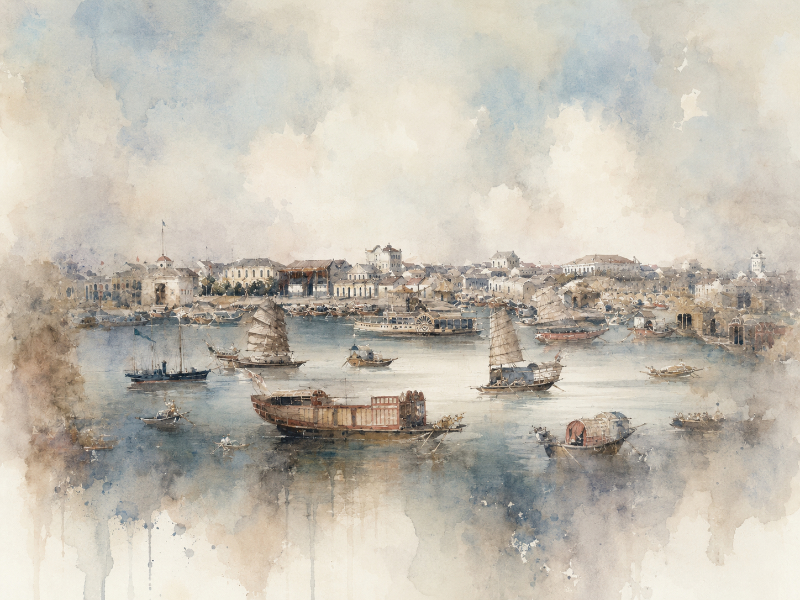
    Abstract watercolour view of Canton port, with pale hongs, river craft, and misty shoreline forms dissolving into soft washes at the edges.

    After that, I ambled along downstream to Whampoa, where the flower-boats anchor all in a line, drawn up practically hull-to-hull together, and where I soon learned to head for a nice dinner of salt-and-pepper cuttlefish, which is cheap on the lower decks. I’ve got my favourite one, dazzling it is with its lanterns reflecting on the water, though it’s one of the smaller vessels, its hull painted with phoenixes and birds, lotuses and scrolling vines; no foreigners allowed, and I sometimes treat my favourite lady there. It’s wonderful, the way she goes raving on and giggling with a lot of nonsense, and we have a really happy time, with all the laughter, wine games, music, and dancing until sunrise.

    Though I now understand how transient all this is, I have come to enjoy it. I must be becoming earthly; I am sure Pu-erh would disapprove, with one of her stern sideways looks. Ha, ha.

    I don’t know why, but the time has come for me to make a confession, stemming right back to my pirate days, which commenced when I came down from the mountain and took to the sea. Without preamble, one evening, what’s called a “salt-smuggler” boat I was crewing on at the time – though I can tell you, we smuggled a lot more than just salt, primarily opium – turned to bring us to bear upon some mission being built by two Swedes at Kinpai Pass, on the coast near the River Min. I didn’t know much about what I was doing in those days, still green in the pirating trade, and I believe I happened to kill one of them with my flintlock pistol. It was medium range, and I probably got him because he didn’t stay still on the one spot. I was taken aback when he fell, with the shot in the middle of his forehead, but joined in with the cheers of all my mates, as though I was a hero. I’ve never been able to shake that off until now, that terrible feeling, when I am able to bring myself to tell you about it. Since then, I admit I have sent off a few, but he was my first; and apart from him, I’ve only ever dispatched opposing warriors, which is considered non-blameworthy, and rightly so.

    Now I ought to fill you in a little more on my adventures as a warrior and troublemaker. Truth to tell, I’ve never thought much of the Qing. It’s the country of us Hans, not them, and they have no right to invade and rule us; and I took a special set against the Manchus when they used to try to catch and kill the three of us up at Fusong in the old days. So when I turned to fighting for a living, even though my decision was more out of a thirst for fun and adventure than any particular politics, it’s clear that my progress from ginseng thief to bandit, from bandit to smuggler, from smuggler to pirate, and from pirate to sword for hire has tilted to the rebellious side. Of course, my time as a monk deviated superficially from that pattern, but I knew how you and Pu-erh had had to take off from the Forbidden City, so even then I felt myself in like company.

    Anyway, it didn’t take me long to find out that my chosen flower-boat provided more than the delightful times I’d enjoyed so far. Most pleasant things down here in the real world have a more dangerous side, and this lady of mine, knowing that I had a whiff of the sea on me, and was able to take care of myself, introduced me to an old river-rat named Uncle Lo, whom I’d noticed hanging around on deck, twanging away on his snakeskin sanxian and singing the occasional pirate ballad. At first, I took him to be one of the lower hands, whom they must have kept on out of sympathy, what with his worn blue calico jacket and rope belt, but what do you know? he turned out to be the captain; and the next thing he was asking me if I wouldn’t mind some work on the quiet, nothing too demanding, so he said.

    It was just to take some chap out to a junk downriver and bring him back in one piece; so I came on the appointed day, and Uncle Lo showed me to a sampan that was tied up to the stern of his flower-boat, and waiting there was the chap with a few cases to take down with him. He was a quiet, tough-looking character in a blue jacket like the older man’s; he had a grim look, but nothing to worry me. I helped him get his luggage on board, and when we were done, I noticed him and Uncle Lo exchange a martial salute – right fist and left palm pressed together – and I distinctly remember that Uncle Lo called down these words to him, “Under Heaven and Earth, we’ll meet again.” I couldn’t help laughing and calling back up to him not to worry, I wasn’t going to sink his sampan, but this didn’t amuse them in the slightest; I suppose I should learn to keep my peace.

    The fellow didn’t say a word to me during the trip; when we found the junk, lit up discreetly in the darkness with two or three Tanka egg-boats tied up beside it, I helped get his things up, but a couple of men on deck – one of them, I noticed, had a flower tucked into his hat! – warned me off when I was on top of the rope ladder and looked as though I might be making to climb on board, which was all the same to me. I waited in the sampan with an oil lamp for three hours, building walls with an old set of bone gaming-tiles I found in the cabin; and then he climbed back down empty-handed, I sculled us back upstream to the flower-boat, picked up some coin from Uncle Lo, who laughed and clapped me on the back, and had myself a plate of cuttlefish and shark’s fin.

    Things went on like that for some weeks, though the junk was anchored in various places, and occasionally hard to find in the fog, in an inlet or up a rivulet; and then another bloke started to come along as well. I must have proven my worth to Uncle Lo, because one evening he complimented me by saying as much, and asked me how I’d like to become a member of the junk’s “association,” as he called it, in which he was a kind of hall-master. They did some smuggling now and then, of course, but mainly with the idea of helping get rid of the Manchus, setting out the usual litany of grounds. I was on the edge of accepting because of my fondness for Uncle Lo and his old flower-boat, but frankly, I’d had in mind bigger fish to fry than this lot for my adventures, so I politely declined, saying that I had been in trouble with the law in the past, and if the yamen runners caught me involved in such business, it would mean the end of me; to which he gave a regretful nod, and lightly clapped me on the back, the way he does.

    After my next job, something odd occurred. I had stepped onto shore after my meal on the flower-boat, when this tough came straight up to me out of nowhere and slapped me full in the face for no apparent reason. We looked at each other, and I was in the process of deciding which of his limbs to take off, but he just ran away, so I set off after him in full pursuit. He slipped in between the pylons of a fishmarket, which I decided would be a good enough place for him to die; when around the corner came a group of four men holding a sack, evidently this rabbit’s boys, since he now joined them. They told me I’d better do what I was told, or they’d carve me up and murder my family as well (shows how well they knew me!), and to get in the sack. I answered them with a swift kick in the guts of one of them as doubled him up, and the others set on me, one on each of my limbs. I bashed together the heads of the ones on each arm, putting them out of commission, but was having a slightly rough time with the others holding and pummelling me. There we were rolling about in the wet mud, until I gained the ascendancy applying pressure to some little-known vital points; and we ended with one of them face down in the mud, and the other blue in the face, I would guess, preparing to die with my fingers crushing his windpipe.

    I called out, “Where are you, Uncle Lo?” He came out from behind a pylon, letting out a great laugh; and so I was recruited. If he wanted me that badly, I told him, he should have just said so.

    I can’t begin to tell you how hard it was to get ready for my initiation into the lodge during the next months, while I continued to get more and more involved with the business side, sailing to and from Macau, along with some rough stuff for exercise. I couldn’t tell you anyway, because, bound by solemn oath to secrecy as I have become, it would have meant my end. Even that salute of Uncle Lo’s, which I learned to give when meeting another lodge member: right hand fist means the sun, left vertical palm, the moon. So, press them together and you get the sign for Ming, or “brightness.” Get it? “Out with the Qing and in with the Ming!”; that’s to say, “Restore the dynasty of light.”

    But that was nothing. Now that I’ve become a Horse Master, which is our term for a recruiter – the same as that fellow who slapped me in the face (that’s one of our methods) – there are all sorts of secret answers I have to give to a host of impossible questions when I bring new folks in to join up: it rattles the brain. And this is in the middle of the lodge, our own City of Willows, which is all set out like the cosmos, and the Five Gates of the Imperial Palace, with special rooms, doors, and arches. You’re surrounded by all the brothers, and secret instruments and appurtenances – axes, lances, staffs, swords, streamers, porcelain censers, precious mirrors, canopies, scrolls, flags, and silk standards with inscriptions all over them. “The red flag flutters! The heroes are all convoked! The Heaven-destined Emperor shall again restore the dynasty of Ming.” But to me the most disturbing thing is everyone watching with serious faces – you don’t want to make a fool of yourself by laughing out of nervousness.

    When I’m led into the council room, I have to say, “May my lord live myriads of years!”

    “Who is there before me on the ground?”

    And I say, “It is Thian-yu-hung.”

    “How can you prove that you are Thian-yu-hung?”

    So I say, “I can prove it by a verse.”

    “How does this verse run?” (In other words, go ahead and prove it.) So I have to prove it by this quatrain:

    “I am indeed Thian-yu-hung,
    Bringing novices into the city;
    Coming in the Peach Garden to unite in fraternity,
    And fervently wishing to adopt the name of Hung.”

    New members who refuse to take the oath after all this have their heads cut off straight away. Then there’s a ceremony for the others to have their queues cut off, since this “pigtail” is only imposed on us as a mark of our subjugation, as I’m sure you know.

    Of course, that’s only three questions I’ve had to memorise, and so far in our little Lodge of the Ghost Junk, that’s about as far as we take it for the time being. However, the Tiandihui, the official Hung League, upon which we base ourselves – because they go all the way back to the massacre the Qing carried out at the Southern Shaolin monastery when the monks were plotting to overthrow them – has a catechism of three hundred and thirty-three questions, each of which requires a quatrain of proof like the one I just recited, to answer properly. We are building towards that. I’ll be a nervous wreck at the end, unless I’ve worked my way to higher up than Horse Master and don’t have to do it all, Ha!
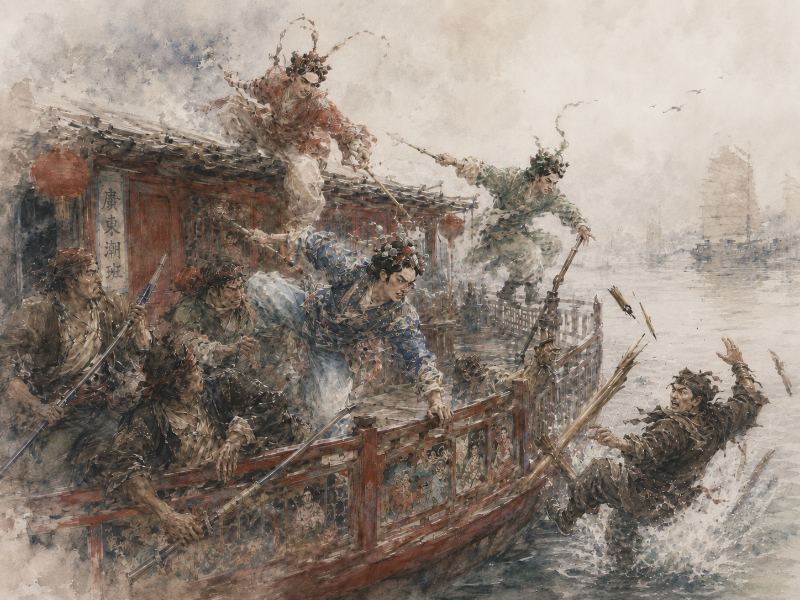
    Abstract watercolour scene of Cantonese opera performers fighting pirates on a narrow red boat, with figures, pikes, and river mist dissolving at the edges.

    I’m well aware that it’s no joke, and that the situation is heading rapidly towards conflict. Who would ever have thought Hong Xiuquan, that so-called Heavenly King, would take Nanjing and call it his Heavenly Capital? Yet there he is, younger brother of Jesus Christ too, if you please, or so the riverfolk say he claims, with half the empire shaking under him. They say he routed the Emperor’s forces and put the soldiers’ households to death – men, women, children, the lot. Out with the Christians as well, I say, if they are going to be so excessive! Thankfully, we have nothing to do with that crowd; but we are thick with the Red Turbans, who swear there is strength in the cloth they tie round their heads, and who have been drawing several of us smaller lodges into their business. It’s an exciting time, though often bloody, as you yourself saw in that Guangzhou alleyway, when those poor rebels had their heads cut off right in front of your eyes.

    Of course, with my running about all over the delta and up and down the Pearl, I’ve had some dealings with the opera companies. When I was running with a pirate mob some years back, we thought they would be easy pickings; but more than a few of us came back from their narrow red boats carrying our broken mates on our backs, though they had no weapons to speak of, and we had gone at them with muskets, pikes, and sabres. But there’s hardly any space on board to wield a sword, and, being followers of the Shaolin monk who founded their companies, so they say, they have developed their fighting skills specifically to keep types like us at bay. You’ve never seen such wonderful acrobats! The time we attacked them, I watched dumbstruck as they cartwheeled around the walls laughing, broke our bamboo pikes in half, and hurled us off their boat into the Pearl. They’d been on their way to a performance, it turned out, and were resplendent in all their costumes of brightly coloured silk, dripping with fake gold and pearls. I certainly had a new eye for the Cantonese opera after that experience, and am getting a taste for the music, which I found rather clangy at first. Thankfully, they’ve come over to the Red Turban side, same as us, and how I’m looking forward to mixing it up with the Manchus with them on my side!

    I had a break after writing the above, and went down to the flower-boat for a drink and to think things over for a little while. Having all these images in front of my eyes made me feel somewhat sad to be leaving. After all, I came down from the mountain in search of adventure, and here it is, gathering up all around me, charged with mighty purpose, aiming to restore the empire to its rightful heading! Uncle Lo was there, with no idea of what was on my mind. When he asked was there anything wrong, I told him it was stomachache. I realised right then and there, when he placed his old hand upon my shoulder, that I couldn’t look him in the eye and lie.

    Above all, my main reason for staying behind is that I cannot desert him, not after all the strife we’ve seen together, and not after giving my sacred oath before his eyes and my lodge-brothers’ eyes, to lend my strength and my life to restoring the enlightened Ming to rulership. I know you and I have been through a lot as well, my comrade, through gainful times and loss. But you are going to a fine place without the strife we have here, only peace and fortunes to be made. And besides, I await the comeuppance I have coming for dispatching that poor Swedish monk of mine, who was only minding his own business – I would not have that karma follow you to the New Gold Mountain on my account.

    Remember your brother-Hung kindly, who stayed behind to tend the Peach Garden.

    Your devoted friend
    Wang the Meek


    From the draft novel Stawell Bardo © Michael Guest 2026
  • Hessian Sack

    Hessian Sack

    Some weeks passed. Detective Forster, in his modest office at the Stawell Police Barracks, untied the hessian sack and spread its contents across his desk before Mow Fung. The coat and waistcoat had both been slit cleanly down the back, likely to ease their removal from the body; a white twilled shirt with blue spots, an undershirt, and a fragment of a wideawake hat lay beside them, all stiffened and blackened with blood.

    “These were recovered near where the corpse was found,” he said. “I’m showing them around the district, starting with the publicans, to see whether anyone can put a name to them. Ever clap eyes on them?”

    “Not easy to say. Clothes are clothes,” Mow Fung said.

    “The spotted shirt? Pale hat?”

    Mow Fung drew an exaggerated grimace of doubt.

    “Not so unusual. Could belong to anyone. You are going down to the Chinese camp after this, I suppose?”

    As it happened, that was precisely Forster’s intention.

    “What makes you say that?”

    “Police always look there first. I hear talk – they say the murder was done in the camp, and the body carried east to where the head was taken off. That ground lies midway between the camp and Stawell – four miles. Convenient.”

    He gave a wry smile. “Naturally, it must be the Chinese camp. Many more men live in Stawell – but they are good white men.”

    “No call to get prickly, is there? There have been disturbances in the camp. It draws the rougher element, that much is certain. I can’t say I blame a man for drifting there. There’s precious little diversion in the bush.” Forster, Melburnian by origin, retained something of the city’s broader tolerance.

    “Who is to say the owner is the same?” Mow Fung said. “Blood on shirt and vest – but none on trousers. They were not discovered together, correct?”

    “I believe I am the one paid to ask questions,” Forster said mildly, “but there is no harm in your knowing that they were not found in the exact same place. I recovered the trousers roughly four hundred yards from the body and the other items.”

    “The blood on the coat is faint. There has been little rain of late. It may be animal blood, or human. We shall never know. Anything is possible. But if the murder were done in the Chinese camp, why take the body east toward Stawell to dispose of it, when there are many deep mines much closer to the west?”

    “A reasonable observation. Still, someone in the camp may have seen these garments before, when their unfortunate owner was still walking about in them. If you are heading home, I wonder whether you might accompany me to one or two establishments there – since you were good enough to lodge the deceased on behalf of the Victoria Police. That is, if your good lady would not object to your being away from business a little longer.”

    “Why do you want me to come?”

    “Only that you’ve got more English than many of the men down at the camp, and some of them are apt to clam up – or go to ground – when a policeman turns up. Despite what you say, there may be one or two uneasy consciences there.”

    “Perhaps some understand English better than you suppose, but prefer not to speak to policemen.” He glanced at Forster’s plain clothes. “It is wise not to wear the uniform – it softens the impression. My wife will manage the pub. I had intended to return as I came – on Shank’s mare, as they say.”

    • • •

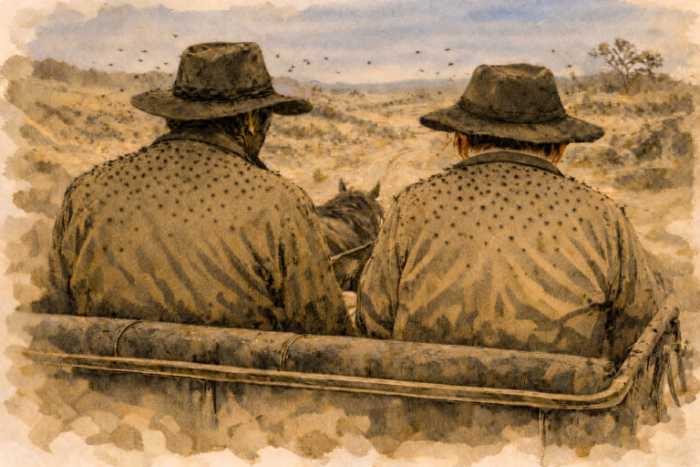
    Forster drove them out of the township in a trap, along the track, through the dust and glare beneath the blazing sun. The landscape grew strange once the town fell behind them and its ordered shapes yielded to the scrub. Each, sooner or later, noticed the black mat of flies on the other’s back, where they pressed and jostled to feed on sweat and the salt of human skin, in their obscene communion. Best to leave them; disturb them and they rose in a thick, droning swarm.

    The dull thud of the horse’s hooves, the creak of the trap, and the rattle of the harness were swallowed by the silent bush, as though sound itself were absorbed into the vast, listening earth. Holes appeared in patches of bare orange soil already surrendering to growth – the signs of earlier incursions. Here and there, mounds of excavated dirt lay heaped about deepening shafts, like oversized crab-castings along a shore. The human crustaceans who dug here twenty or thirty years ago were gone, many returned to the earth whence they came, having taken what was of value and left their detritus here. Thus history ends where it begins. Or only in these parts?

    Rear view of Forster and Mow Fung riding in a trap across an abandoned goldfield, their backs dark with swarming flies as the dusty track threads through pockmarked earth.

    The two continued along in a silence punctuated by the discordant cry of a single bird.

    “Did he say ‘Ballarat’?” Mow Fung said with a delighted start.

    “Not too far from home, enjoying his day-trip like us, maybe.” Forster chuckled. Grey butcherbird, probably. He had read that places were sometimes named for the cries heard there. “They say that Ballarat means ‘resting place.’”

    “Those shafts are Chinese ones,” Mow Fung said. “Round holes with no corners for evil spirits to hide in. Also, round is better than square, because the sides won’t fall in so easy, and you don’t need much timber. A European does not have to worry about ghosts and spirits, does he? Too rational for them, so they cannot harm him,” he added with a small laugh.

    The camp’s heyday lay twenty years past, when gold gravel was struck midway between Stawell and Deep Lead, one of the richest alluvial fields in Victoria. Before long most of the gold was taken, leaving only enough to sustain a dwindling community of oriental fossickers. Of late, the diamond drill had kindled hopes of renewal, and the New Comet Company had even set up in Deep Lead; yet a recent regulation barred Chinese from employment on non-Chinese leases.

    “A rough, strongly built man – there are many such men working on the railway these days,” Mow Fung mused. “If he is not known in Stawell, then he must have come from elsewhere, perhaps to work on the new line.”

    “They are indeed a transient breed.”

    Shops and dwellings huddled together, walls and a variety of roofs clad in boards all askew, yet which somehow in their chaos attained a harmony all their own; frail but sound constructions lining a street not wider than a cart track.

    To Forster, this time too, everything seemed Chinese, from curious fabrics and wares in the windows to the cats and dogs yawning and scratching in patches of shade. Mow Fung exchanged a few words in his own tongue with a plump, amiable woman shaking a mat as Forster pulled up the rig. Her two infants played with a top in the dust at her feet and squealed in high, lilting tones, miniature editions of their mother. The newcomers stirred a hubbub in the nearby buildings, and within a minute a dozen Celestials had poured out and gathered around the trap to inspect the garments Forster had displayed on the seat, while he fended off the more enthusiastic who reached to handle them.

    “Nobody recognizes these things,” Mow Fung said.

    They proceeded down the street, Forster leading the horse and trap.

    “What a pong. For God’s sake, that’s a great patch of human dung beside that place!”

    “Dried out, it makes good fertiliser,” said Mow Fung. “We Chinese have had to learn that practice, because Chinatowns are usually built below the main town, at the bottom of a hill where sewage and rubbish wash down. Very smelly, though. The newspaper editor often worries that diphtheria will not kill us here, but will drift over to Stawell instead.”

    They stopped before the joss house, a low timber building with a sloping roof. A faint scent of incense drifted from within. Mow Fung went over to pay his respects, bowing and disappearing through the open door.

    “No good,” he said when he came back out, holding a paper lantern. “Somebody knocked off some ritual ornaments. Terrible omen.”

    “What’s that you’ve got?”

    Kongming. Sky lantern.”

    Forster made a noncommittal grunt. “Right. Say no more.”

    Mow Fung shrugged. “My mother used to say, ‘If you want to become full, admit the emptiness.’ Lao Tzu said the same. It means don’t think too much – listen once in a while.”

    “Steady on. It’s too hot for philosophy.”

    At the far end of the street, a group of men loitered smoking in front of a building.

    “Miss Lili Chan’s Jade Phoenix,” Forster said. “Its reputation precedes it, and not in a good way. Sly grog and opium. Fantan croupier of prodigious luck – or suspect dexterity.”

    “Good friend. Lady of fine quality,” Mow Fung said.

    Heavy curtains enclosed the parlour, parted here and there to admit thin slivers of light. As Forster looked about to gain his bearings, portions of the room surfaced briefly before retreating again into shadow. He had been expected; nothing illicit met the eye. A girl seated on the end of a couch plucked on an instrument resembling a pear-shaped lute, producing a languid, elusive strain. Beside her a man leaned with his head slumped insensibly against the shoulder of a young female, who smoked a long pipe and fanned herself with a bored look. Some men sat around a table playing pai-gow with black dominoes marked in red and white, wagering from little heaps of matchsticks.

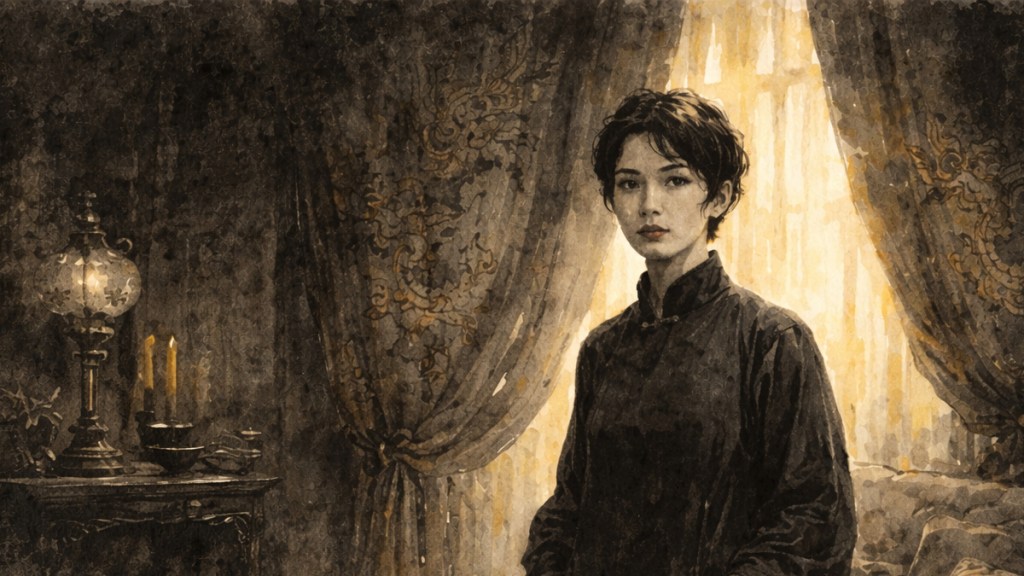
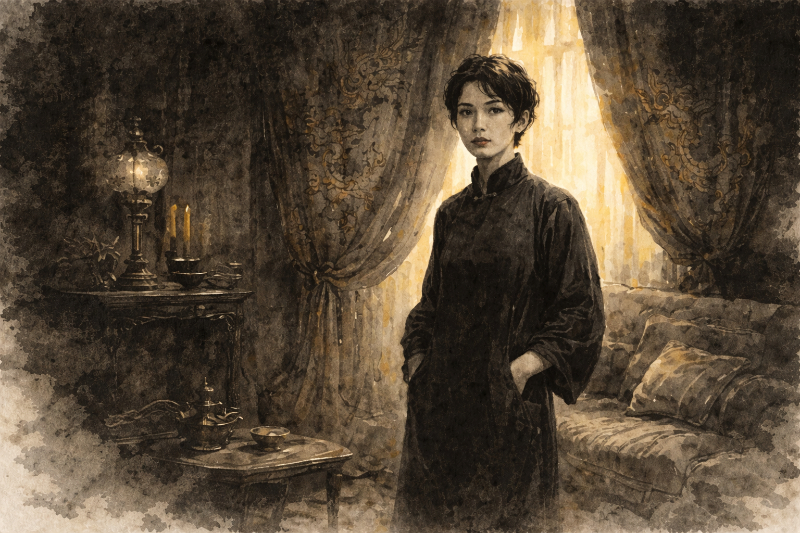
    Lili Chan herself emerged from a curtained doorway in a loose-fitting, mercerised cotton changpao. The matte black fabric gave a restrained rustle as she crossed the room. For an instant Forster thought he saw a light-coloured shock of hair before the curtain slipped back into place. She took a cheroot from a lacquered box on the mantel shelf, inserted it into a cigarette holder and signalled to a brawny attendant to light it for her, before at last addressing the two men.

    Lily Chang in a loose black thick-cotton changpao stands in the Jade Phoenix parlour before a curtained window, half-lit in shadow.

    “Detective Forster,” she said. “I assumed our paths would cross again. I take it this is not a social visit.” With a smile, she nodded to Mow Fung.

    “Business has a way of intruding,” Forster said. “Even in agreeable surroundings.” He tapped the hessian at his side.

    “Intriguing. Even so, perhaps you will still allow me to extend some hospitality.”

    She gestured to a young woman, who brought a small tray with porcelain cups and set it on the low table. Lili Chan took a seat without hurry. After a brief hesitation, Forster and Mow Fung did the same.

    Tea was poured from a pot painted with blossoms and winding script. Forster sipped from courtesy; the brew proved lighter than he expected. The murmur of Chinese between Lili and Mow Fung faded into the notes of the lute. Her garment fell in precise folds from her shoulders; the high Mandarin collar framed her face and lent her bearing a formal gravity. A diagonal opening crossed her chest, secured with subtle braided knots. Though the room held the day’s heat, she inhabited a cooler plane altogether. She offered him neither word nor glance, yet he was aware of being measured.

    Then the voices were quiet and he heard only the sparse notes of the lute. She drew on the cheroot, inclined her face and, exhaling the smoke through her mouth and nostrils, looked at him fully for the first time.

    Forster opened the sack and laid the clothing on the table. “You have seen these before?”

    Her eyes moved once across the cloth. “No.”

    “You are quite certain. Perhaps someone else present?”

    “I do not recognize these things,” she repeated. “Nor do my employees, for I do not.”

    At the door, Forster offered her a smile and nod.

    “I understand there was some trouble in the camp last week,” he said. “You see much in this street, Miss Chan. If any part of it bears upon my inquiry, I would be obliged to hear of it.”

    “The temple was robbed by a vagrant from Stawell, a European. I explained to the priest, Mow Fung, that there was no need for the law. The stolen goods were recovered, and mercy shown. Too much to drink. He returned everything when he sobered up and regretted his deed.”

    Outside, Forster turned to his companion. “Priest?”

    Mow Fung looked bashful. “I only consecrate a few things here and there, make rain, tell fortunes, guide the dead, heal boils, such matters…”

    • • •

    Forster found John Campbell, publican of the Royal Hotel at Glenorchy, in his back office. He placed the sack on the table and took out the clothes, one by one. Campbell watched without moving, then gave a short, humourless snort.

    “I know these,” he said. “I’ve seen them worn.”

    Forster waited.

    “Two railway hands, December – navvies off the Dimboola works. Twelfth to the fourteenth, in the one room. Burns was one – smooth-tongued. His mate called himself Charley Forbes. Big red-bearded fellow. ‘Scotty,’ they called him, though he said he was Irish.”

    Campbell touched the coat, as if confirming a weight.

    “He wore this. Coat and hat – same sort. Burns did the talking. Held the money. Kept him close.”

    Forster wrote.

    “They came down by train?”

    “From Horsham, they said.”

    Campbell’s mouth tightened.

    “They ran out of money here. Lost it at cards and drank what was left. When it came time to pay for the room, Burns left a watch with my barman as security – said once the debt was met it was to go on to Stawell, care of Phelan, the storekeeper.”

    Forster noted the name.

    Campbell reflected for a second and added, “I saw Burns at the Stawell races a few days after Christmas. I asked after Forbes. Burns said he’d gone up to New South Wales with an old mate.”

    Forster gathered the clothes together.

    “That’ll do,” he said. “And if you’re pouring, I’ll take that whisky now.”

    • • •

    A few days later, Forster reached the railway camp outside Dimboola, closing in on his phantoms.

    “Painter and his son?” Forster said.

    “Ain’t here …” the foreman began.

    The discharge came with a dull whomp! – sudden and overwhelming, as loud as a cannon, yet muffled by the tons of dirt and rock. The vibration struck the stomach as quickly, if not quicker, than the eardrums. Forster jumped and got through the “Holy–” before tons of dislodged rock thundered down out of sight around the bend.

    “… Jesus!” He blanched and stepped quickly into the cover of the embankment, underneath which a line of navvies was gathered in loose formation, with some standing and others seated in the dust or on rails and stacked sleepers. A drizzle of stones pattered beyond the shelter of the embankment and a cloud of dust surged round the bend. A few seconds of silence followed, the men watching the detective regain his bearings.

    “Who’s opened his bloody tucker bag?” one of them drawled, earning a chortle or two. Forster looked over and was met by steely, sullen faces and a few grins bordering on sneers.

    “Should’ve mentioned that,” said the poker-faced foreman. “Bit of blasting this morning.”

    Evident the copper was put out. Didn’t much enjoy being the butt of a joke.

    “The detective is lookin’ for the Painters?” he called. “Where are they?”

    “Morning off,” came a reply. “Doubler yesterday.”

    A whistle-blast came from around the bend.

    “You men get back to work now,” the foreman said.

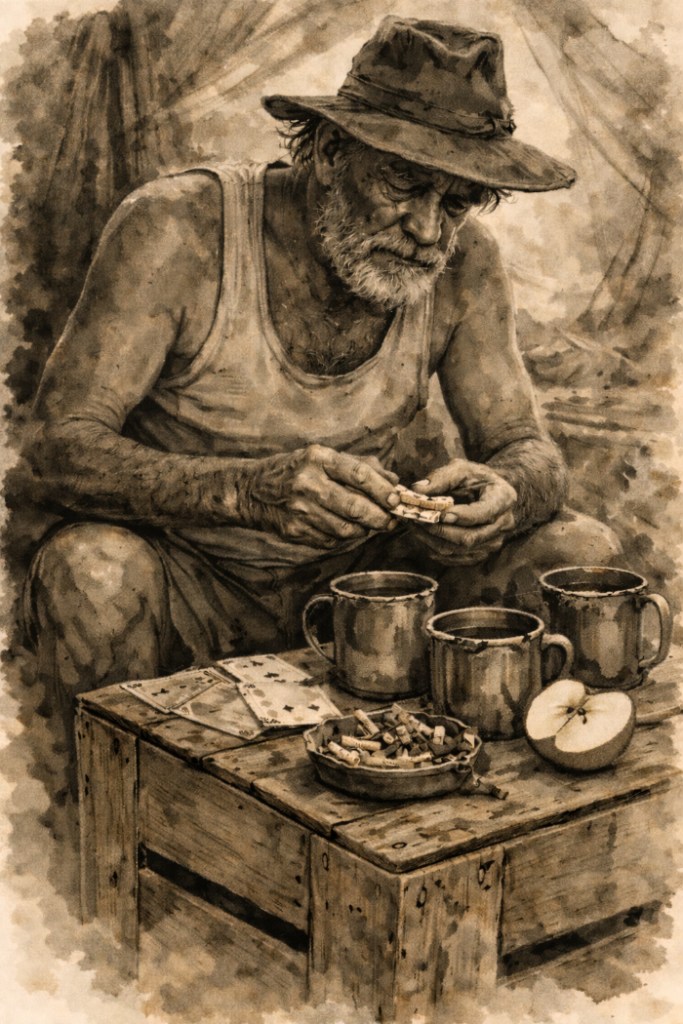
    He showed Forster to one of the tents at the workers’ campsite some hundred yards off. Two men dressed identically in grimy singlets and shorts, Richard and John Painter, father and son, sat on stools drinking tea, either side of an upended wooden fruit box that served as a table.

    At Forster’s direction, they examined the clothing, identical smokes drooping from the corners of nearly identical mouths. Coat in two pieces, almost the same colour as the grass in which it had been found. Waistcoat also in two halves, the buckle and strap suggesting it had been quite new before lying exposed for a month or more. The blue twilled shirt, comparatively new, a button torn out – that button found in the vicinity. Relics of the wideawake hat. All the garments except the wideawake more or less saturated with what looked like blood. He had not brought the trousers, which were found down a mine shaft some distance from the body; he reckoned they were probably the dead man’s too. Less distinctive, though; harder to identify positively.

     The Painters hummed and harred, seeming to communicate to each other in their own language of undecipherable mutters and growls, scratching their beards and shaking their heads deep in thought. The detective waited. Just as his nerves began to wear thin, the two men sucked in a breath as one, glanced at each other over their cups of tea, and shook their heads.

    “Yep,” said the elder.

    He opened his mouth to continue.

    Painter the elder sits in a canvas tent beside an upturned fruit-box table, tea and battered cups among cards and ash.

    “Teeth, Father. Company. Manners.”

    Painter the elder fumbled for his dentures on top of the fruit box between them, alongside some grimy playing cards, three battered tin cups – two half-filled with tea – an overflowing ashtray, and half a browning apple.

    “Reckon we know this bloke,” the father said. “Or knew him, you might say.”

    “The feller who owns these here clothes,” the son said. “Know him pretty bloody well. Knew him.”

    “Worked with him, God rest his soul,” the father said. “Nice chappie, broth of a boy. Bit slow. Addicted to the drink.”

    “Never once saw him drunk, Father.”

    “Never seen him drunk? You must be jokin’.”

    “Who said he’s dead?” Forster said.

    “Been reading the papers, that’s all. The body at Four Posts,” said the son. “Terrible thing, shocking. Must’ve been him.”

    “What was his name, then?” Forster said.

    “Scotty, they called him,” the son said. “But Charley Forbes was the proper name.”

    “Charley Forbes,” the father agreed. “Charley Forbes.” Tutted.

    “You’re certain these belonged to Charles Forbes?”

    “We know this coat by where it’s mended,” the father said. “This bit of stitching on the breast here.” He pointed a finger, the hand had a slight tremor in it now.

    “This here stitching on the breast,” the son said. “Charley burnt a hole in it with his pipe, so he stitched it up like this. Couldn’t be more certain it’s the very coat. I never saw him burn it, but I saw it stitched.”

    “Not a bad piece of stitching, really,” the father said, bending closer. “Quite sure as to the identity of this coat. No question.”

    “No question,” said the son. “Ain’t seen him since him and Burnsey took off together, a bit before Christmas.”

    “What’d he look like?”

    “Broad-shouldered, stout fellow. Large, flowing beard.”

    Sandy coloured.”

    “Well, light sandy coloured, I’d say. Beard was lighter than the hair on his head, which was a dark sandy colour.”

    “Yeah, I s’pose you’re right there, Father. Light sandy coloured beard. Dark sandy coloured hair on his head.”

    “Sandy complexion, wouldn’t you say, Son?”

    “That’s right, Father, very sandy.”

    “And this other character, his mate?”

    “Robert Burns,” said the son. “Like the Scottish poet.”

    “That Man to Man, the world o’er, Shall brothers be for a’ that,” quoth the father, and lapsed into vacant thought, his head nodding involuntarily.

    “Old Jake seen him over at Murtoa the other day, getting off the train,” the son said.

    “Burnsey?” Forster said. “Where’s this Jake?”

    “Shot through.”

    “Where to?”

    “Goodness bloody knows. Just cleared out the other night.”


    From the draft novel Stawell Bardo © Michael Guest 2026
  • The Joss House

    The Joss House

    Hung and festooned as it was with tablets, banners and fans, the joss house at the Chinese camp in Deep Lead was a living bubble of China in the Wimmera. House of deus, so called, from the Portuguese for god. Just inside the doorway, to the left, stood a large iron bell and a tall, barrel-shaped hand drum, with a peacock painted over the pig-skin drumhead. Beside them were glass cases containing sacred candles and five tiers of shelves holding prayers written on paper slips.

    To the unaccustomed eye, the decor was gaudy, with multi-coloured pennants, Chinese characters in purple and gold painted on the walls and roof. Paper and stained-glass lanterns hung from the ceiling; bunches of tinsel in vases were set on stands carved in relief, to depict different epochs. No master craftsman created these, but they proclaim a naïve hand: work executed with painstaking devotion by a jack-of-all-trades, a long-time resident of the Chinese camp.

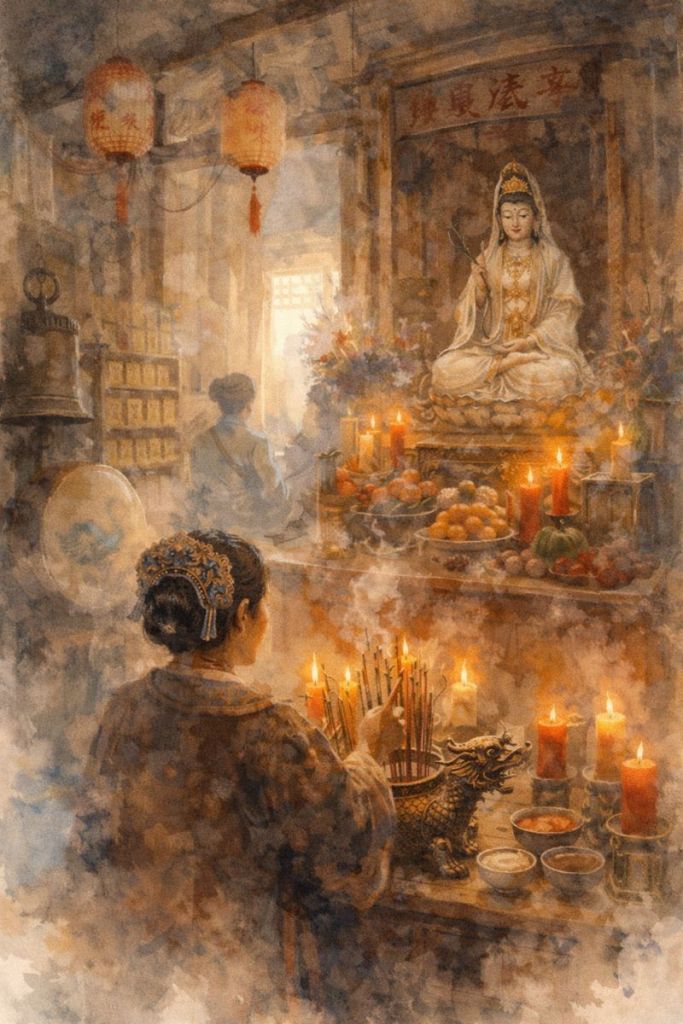
    Watercolour of Joss House interior. A woman tends the altar, on which is seated a carved deity. There are incense, lanterns, a drum, and various other religios artefacts.

    In her ceremonial robe adorned with all the deities of heaven to clothe her in the protection of the universe, Huish-Huish, Mow Fung’s wife, prepared the altar for the ceremony dedicated to making peace with ghosts. At the very back, raised on a pedestal, in the position of greatest honour, stands the immortal Guanyin, provider of good fortune, who is certain to help, for she hears all the cries of the world and is ever willing to offer protection from any kind of threat or attack. She sits placidly upon a lotus, attired pure white, with gold ornaments and crown. In her right palm she holds a golden flask filled with pure water, in her left raised hand, a twig of willow. Water is to ease suffering and purify the body; willow keeps evil and demons at bay. Huish-Huish communes regularly with the bodhisattva, as though she is a dear friend. She regularly brings the statue flowers, food and drink to sustain and empower her. She is no less beautiful for being made out of plaster. The neck of the statue is pierced with a hole, for other spirits to enter and represent her, after the fashion of an avatar; for Guanyin cannot be everywhere at once herself.

    She lit the sacred lamp for the illumination of wisdom, then the two candles, standing for the sun and moon, and for the two eyes of the human being: the light of the Tao and windows to the psyche. These would help her penetrate the dust of the everyday world. In front of them, three cups, one each of tea, rice and water: tea for yin, the female energy; water for yang, the male; and rice the union of both of these, containing yang from the sun and yin from the earth. In front of them in turn, five plates of fruit to represent the five elements: green for wood, red for fire, yellow for earth, white for metal, black for water. These for the liver, heart, spleen, lungs and kidneys – in harmonious cooperation, a cycle of good health. Sour, bitter, sweet, salty, pungent: plum, apricot, dates, peach, chestnut. She placed dried foods on the altar on this occasion, because she wanted to absorb power from it. When she wishes to empower the altar, she gives it fresh food and flowers, from which it draws life energy.

    In front of the five plates stood the incense burner, a bronze dragon turtle, the smoke curling up through the vents in the top of its carapace – vents in the form of the eight trigrams. The joss sticks were Lena’s work: Mongolian incense, pepped up with dubious substances extracted from her beloved maiden wattle. Necessary cleansing rituals completed, Huish-Huish burned the protective talismans and traced their forms in the air.

    Knowing from previous experiences the ceremonial protocols, Chan Lee Lung – known in Deep Lead as Lili Chan, proprietor of the Jade Phoenix – bowed in deference as she entered, then seated herself. Huish-Huish placed a talisman on her head and performed the mudras, the hand gestures used for drawing out spirits. Based on their previous ceremonies, she has come to suspect that urges to self-harm and suicide afflicting the woman are quite possibly the handiwork of a ghost. There are any number of possible reasons why a ghost might wish the subject injury. She is a beautiful woman, and some ghost may want to marry her, particularly if she has said something inadvertently in earshot that put such a nonsense into its mind. On the other hand, it was common for the ghost of someone who died by suicide to become stranded at the gates of hell, compelled to reenact the fatal act for eternity, unless they were able to find someone to replace them, through that person’s own suicide. Or she may have crossed paths with the spirit of a suicide, or tarried at a haunted spot marked by an unnatural death. Such spirits were always in search of a victim.

    Watercolour image of a Euro-Asian woman in closeup, with her eyes closed, and acupuncture needles in her face, at a few points around the eyes

    The only way to get some idea is to travel with the woman as she journeys through her psyche via the medium of her speech, her story. In this way Huish-Huish may make the woman aware of the ghost, and encounter its weaker manifestations within the trance; there, the ghost itself may be dissolved or at least dissuaded. At the same time, however, in order to heal, she must make herself whole, cultivate herself, and grow in accord with the principles laid out in the Yi Jing and other Taoist teachings. No quick fix here, no game of fantan, this.

    “Every child loves the pretty fable of Kwang Kau’s dream about the butterfly, which Zhuangzi teaches us,” Huish-Huish says. “When Kau awoke from the dream, he found himself unable to tell whether he was Kau dreaming he was a butterfly or the butterfly dreaming it was Kau.

    “Another tale strikes me as somehow similar, in which Shadow and Penumbra converse – Penumbra wanting to know why Shadow moves as she does, perhaps because Penumbra must follow. So Penumbra says, ‘Before, you were walking, but now you have stopped. You were sitting, but now you stand up. How and why do you do that?’

    “Shadow answers, ‘I have to wait for something else to move, and then I will do the same thing as it, almost as though I am its second skin …’”

    The woman listens, as though to a disembodied voice – fluent, lilting Mandarin. Though her own native tongue was that of the city of Taishan – Taishonese, a dialect of Yue, kin to Cantonese – the music of the hypnotic voice draws her into its discourse, and it seems she leaves the world behind her.

    “‘How on earth would I know?’ says Shadow,” Huish-Huish continued. “‘How could I possibly know what it is, that thing which moves, and which I follow – whether the scales of a snake, or a cicada’s wing? How should I have an idea why I perform one particular act instead of another?’”

    The woman’s eyes are closed, and she is already on the brink of a great descent. She hears the pure tone of a chime, and the jingling of rattles, the sounds suffused with the heavy smoke of the incense.

     “Like Shadow and Penumbra,” the voice continued, “I wonder whether we might allow ourselves to pass through phases of our deeper selves – or our earlier selves, when these are not the same thing – and sink into each other, you and I. Penumbras of the scales of a snake follow the shadows of the scales, which follow the snake; they need not feel the belly of the snake sliding across the sand, which is irrelevant to them and impossible to access. And to whom is visible the penumbra of a shadow of the wing of a cicada? And what does the cicada follow, when it does as it does?”

    Huish-Huish aims to melt away her own ego – to become a nothingness, receptive to the projections of memory – because memory is the essence of the psyche itself.

    She guided Chan Lee Lung to lie back upon a low wooden plinth set before the altar, her head resting upon a rice-husk dragon cushion.

    With an austere calm, she placed fine needles along the woman’s brow, at the temples, beneath the eyes, where the face is thinner and the mind can loosen its hold. Chan Lee Lung felt no pain – only a spreading lightness, as though the weight of her features were being unhooked from memory.

    After a while, Chan Lee Lung could no longer separate her inner dialogue from the sound of the guiding voice, which had transposed itself into a chant, whose symbolic words she was unable to comprehend as words, but which fell into a silence as deep as that of the deepest well. As they penetrated the surface of the ether, or whatever liquid-like substance lay at the bottom of the well, something more pure than water, the pitch darkness ignited: each word flared into a splash of sparkling light, cohering into one image, then another, then the next, setting in play a flickering spectacle. A dream that was not quite a dream; a reality that was somehow greater than her reality of the everyday. As instructed, she began to say whatever went through her mind, as though she were a traveller in a railway carriage, sitting by the window, describing to someone else in the carriage the changing scenes she saw outside.

    Standing on a Canton roadside are a woman and her five children, all dressed in their best holiday black, which is nevertheless patched in some places and threadbare in others. Hardly finery, but the woman does her best under extenuating circumstances, as she repeats often to her neighbours and the grocery vendors. The middle daughter examines her mother’s face and observes a liquid bead run down along her nose and fall to the dust.

    “Mama, do you cry?” she asks.

    “Only sweat. Stand quietly.”

    Their sign leans upright against the trunk of the slender tree under whose branches they have sought shade. The mother pacifies the baby, bounces him gently and reassures him with baby-talk, before binding him again to her back, where he falls asleep immediately. At this sight, the eldest daughter stifles the lump in her throat until the mother notices her quivering jaw and corrects her sternly. In the joss house at the Deep Lead Chinese camp, Chan Lee Lung is once again overcome with a profound sadness. Her mother was a hard woman. Again she tastes the blood in her mouth, where she bit herself on the lip to prevent herself from crying – and bites it once again.

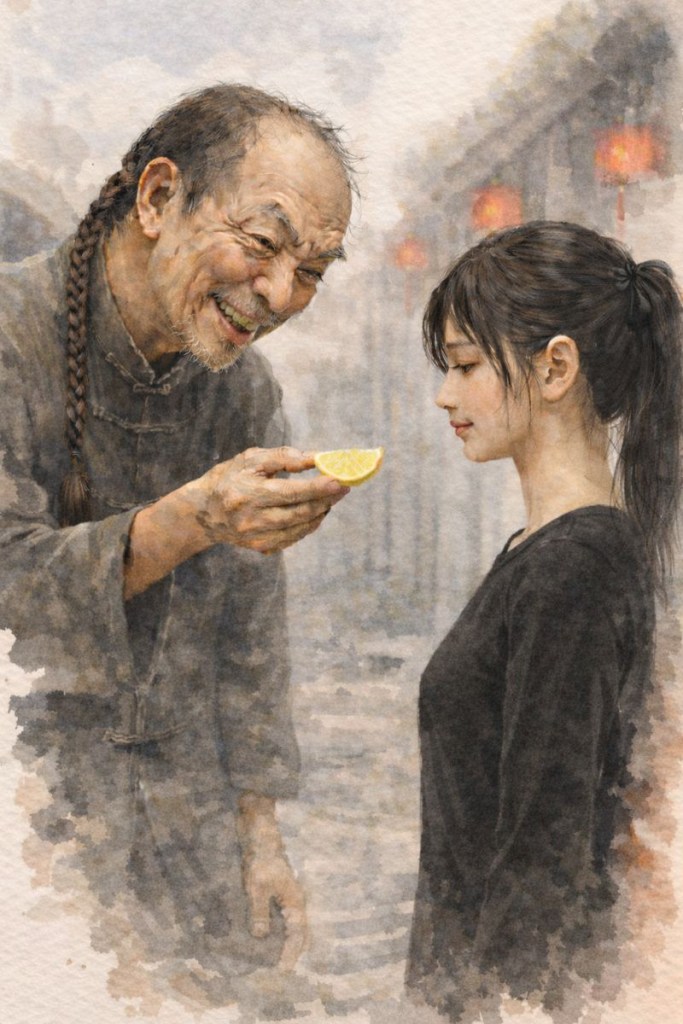
    They met up with the broker, who was carrying their sign, at the appointed spot. She disliked the man’s fat, ugly, greasy face. Even his queue seemed to have lumps of fat in it, and he smelled like rotten pork. He laughed when she pointed out these shortcomings to him. He took a piece of lemon from his pocket and presented it to her. She asked him why he thought she would want a piece of lingmung. He corrected her, with another patronising laugh.

    In a Canton street, an old Chinese man, grinning. offers a young woman a piece of lemon. Watercolour image.

    Ningmeng,” he said, pronouncing the syllables of the Mandarin word. And again, after sucking the lemon, he repeated it, pedantically now, with his bloated, sensual, wet lips, “Ning meng.” Emphasised with two beats of his fat forefinger on her forehead. He told the girls to stand in line, with their bags arranged neatly by their feet.

    She wanted to know what was going to happen to her and he replied that if she was a good girl she would go in a magnificent European ship to a wonderful place called Gold Mountain, an earthly paradise where the streets were paved with gold. There she would find boundless happiness as a wife to many men, have all the food she could eat, wear a cheongsam of the finest silk, and return to China a rich lady.

    She saw the improper look he cast her mother, which he pretended was secret while intending her to notice it, a wink and leer that revealed his green teeth. She complained to the mother, saying she did not want to leave her sisters and little brother, and the mother reassured her that her sisters were leaving as well, to somewhere they would be safe from the fighting here. Her brother was too young to miss her, so she need have no concern for him.

    Another man arrived by rickshaw, perused the sign, and Lemon-man took him aside to discuss a transaction. Her mother told her to take up her bag and walk with dignity to the rickshaw. She was a big girl now, and the world would be her oyster. That is all she remembers of the time her mother sold her, except that as the vehicle moved off, she looked around to farewell her mother and siblings. Her mother had her back turned, remonstrating with the broker, as was her usual way in such pecuniary transactions. Her sisters were waving to her gaily, delighted to see her riding in a rickshaw for the first time.

    Two months later, the Pacific Mail Steamship Company’s China passed through the narrow strait into San Francisco Bay. The voyage seemed far shorter to the girl, who had been pacified with narcotics for much of the time, in order to prevent her from creating any fuss. It was a recurring delirious episode; she was rolled to and fro on her narrow bunk with the tossing of the vessel, nausea melding with visions of her sisters who, in her dreams, were transmogrified into salivating crimson ghouls. They were standing beside the repulsive man, between whose luminous green teeth issued copious streams of blood. In her waking moments, she was indifferent to the crush and squalor around her. 

    “This is the Golden Gate to Gold Mountain, the country of your dreams.”

    The woman assigned to play the role of her mother had, during her lucid intervals, been tutoring her in what she must say in case she was questioned by someone called Customs. The girl learned to utter the English word “seamstress” while performing an appropriate pantomime, smiling with an air of great earnestness.

    If her acting talents were unconvincing and the two apprehended, the White Devil would visit unspeakable torment on her.

    Although the two travelled in a better section of steerage, it was only thanks to the ‘value’ her buyers saw in her looks and talents in song and dance, which they judged superior to those of their former favourite, a Hong Kong girl they subsequently cast aside. Chan Lee Lung was cloistered with a group of a dozen other girls, away from the hundreds of male emigrants and prostitutes also travelling in steerage, shielded from the rapes and bashings by two bodyguards known not for their physiques, but for their ruthless cunning and their expertise with concealed weapons.

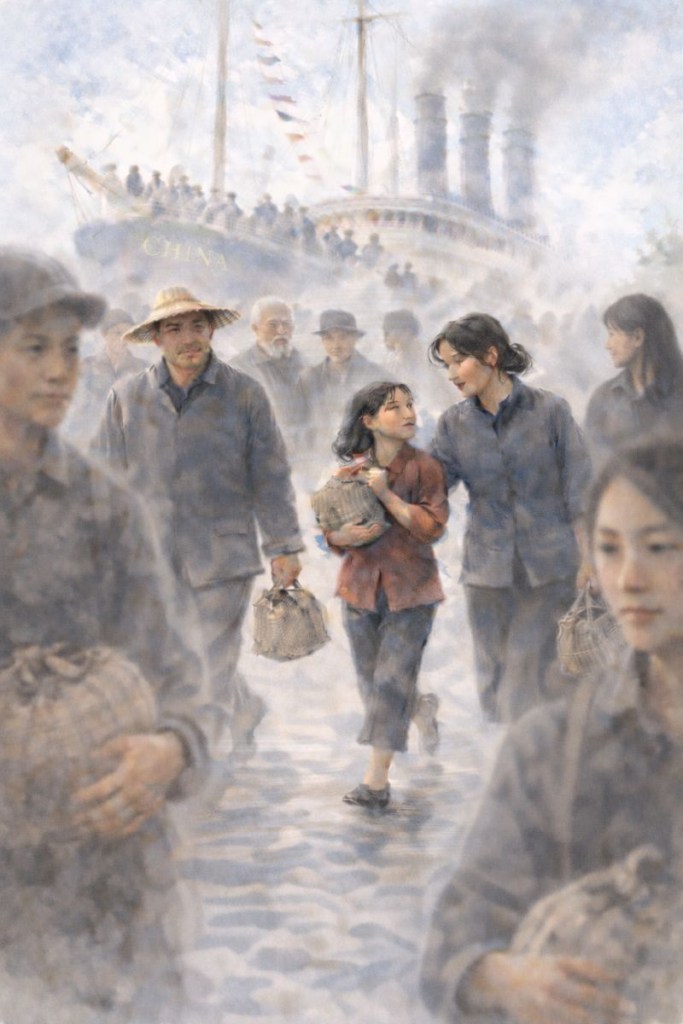
    Leaning against the railing on the starboard deck, bracing herself against the jostling crowd, the girl inclined her face to the magnificent morning sun, emerging from wisps of fog that had been thick and opaque only minutes earlier. This was the first time for the duration of the voyage that she had been permitted up on deck. The ship was about to dock when a splash was heard from the port side, followed by distinct female screams and a rising volume of anxious chatter, as a wave of agitation spread through the huddle of disembarkees. Descending the gangplank, shouldering a jute sack containing her meagre belongings, she overheard a high-pitched, trembling mention of the name Lee Sing, which seemed vaguely to resemble that of the girl in Hong Kong whose fate she had supplanted with her own.

    A girl among a crowd of disembarkees from the steamship China, docked at a San Francisco wharf.

    Bound-footed Madame Ah Toy, the girl’s new owner, immediately warmed to her. When the ageing madam raised the girl’s chin with two fingers to appraise her face more closely, despite the air of sadness that still hung over her, the girl’s eyes reminded her of her own, formerly renowned for their laughing quality. Goldminers “came to gaze upon the countenance of the charming Ah Toy,” the newspaper said once, in poetic, libidinous understatement. And they would come to gaze on the countenance of this girl, her newest attraction, as well. “But only gaze for the time being,” Ah Toy said to herself, in the cold arithmetic of her trade, now satisfied the girl was physically sound, “until you’re growed up good and proper.” There was more in those eyes, however, that drew the woman’s attention: a depth of soul and intelligence; a quiet defiance that she could see would never be crushed. The madam had good reason to identify with the girl’s sterling qualities, having herself wrought a fortune as the first Chinese courtesan and the first Chinese madam of the red-light district, the so-called Barbary Coast.

     Ah Toy oversaw the education of her new protégé as she would that of a cherished daughter, with a loving and stern hand. She declaimed her belief that “son without learning, you have raised an ass; daughter without learning, you have raised a pig,” and over the next few years, the girl flowered under her regime. She soon assumed mastery over the various academic and dance hall pursuits for which her tutelage had been commissioned, guided by professorial clients of Ah Toy’s famous establishment in an alley off Clay Street, under contracts of barter.

    The girl’s getting of wisdom served, as ever, a financial motive, for the ladies of the Chinese establishment trailed those employed in French, Mexican, British and American cat houses, whose popularity ranked roughly in that order. Competition was fierce in the bagnio trade. The French fandango parlour had its les nymphes du pavé, late of the Parisian gutters, who were packing in the patrons to overflowing, gussied up in their red slippers, black stockings, garters and jackets, nothing down below. Stories abounded of outrageous personalities: The Roaring Gimlet, Snakehips Lulu and the rest. Holy Moses! Madame Featherlegs would gallop a horse down the main street wearing nothing but batwing chaps.

    Unfortunately, although a successful entrepreneur, Ah Toy had also become rather a laughing stock, largely because of her Chinese-ness, but also because of the young age and sickly condition of the girls crammed into her shacks, or “cribs,” in Jackson Street, sometimes abused by white boys scarcely older than children themselves.

    These girls she considered, and treated, no better than chattel.

    The girl grew into her role admirably, expressing as though they were natural traits the aristocratic airs she was schooled in; airs that in fact derived from no single country, but from an amalgam of places, real and imaginary. Yet somehow her intrinsic class seemed to imbue these artificial attributes with substance.

    She was not overawed by anyone she met, but treated with due respect and equality all who crossed her path: from city officials who surreptitiously joined the growing flood of patrons paying good money for no more than the pleasure of gazing upon her, to slave girls locked in the cribs like animals. Most of these girls had been smuggled from China, either peddled, like her, or abducted outright. Sufferers of syphilis numbered among them, their short futures preordained: to die disfigured beggars on the streets of Chinatown.

    She felt a compassion for these creatures in the cribs, pleading their cause to Madame Ah Toy and doing her utmost to convince her, in terms she would understand, that acknowledging even minimal duties of care to the crib girls might serve her business-wise – allowing her to be perceived as less of a pariah and blight on society, though she couched that more gently.

    No cribs for her, nor even a residence in one of the sumptuously appointed parlour houses. Ah Toy set her up in a double storey brick house of her own, where she entertained only the most prestigious clientele – exclusively white, expressly no Chinese – when she was not assisting her proprietress to operate the gambling house and manage the business affairs. As well, Ah Toy provided her with a chaperon, a certain Fung Jing Dock, whom she introduced to Chan Lee Lung as an office bearer in a newly formed organisation known as the Society of the Mind Abiding in Tranquility and Freedom. He was, Ah Toy said, a virtuoso on the zither as well as an avid student of the Yi Jing.

    “Regarding my degree of talent with the zither, I must refuse to answer,” Fung Jing Dock pleaded charmingly, “in order to avoid incriminating myself.”

    Nevertheless, he proved to be a surprisingly good amateur zitherist, and Chan Lee Lung and he spent a few minutes at the instrument together now and then during the daylight hours.

    “But there is more to this story,” Lili Chan said as they came out of the joss house and into the dazzling sunlight. “It does not end well, I’m afraid.” She turned towards her establishment.

    Huish-Huish looked at her face, which seemed pallid.

    “As a process, the ceremony may sometimes require any number of iterations,” she said. “Some subjects joke that it will go on forever, and they will never be free of me. Things cannot be rushed, however. We will have plenty of opportunity next time.” She laughed. “There is no cure for the human existence, you know,” she said. She briefly squeezed her companion’s arm and went back briskly into the joss house. Pausing to look up at the empty expanse of sky for a second, Lili took in a long breath, before making her way languidly down the street.


    From the draft novel Stawell Bardo © Michael Guest 2026
  • The Minyip Letter

    The Minyip Letter

    “Must be about seven or half-past,” Burns thought as he walked up to Fergus’s European Hotel, the morning after he and Forbes had tramped off along the old Glenorchy track. Finding the front doors locked, he went around the side, in through the gate and past a pile of empty kegs, where a back door on the bar-side of the pub stood wide open. He was halted by the sudden appearance of his own ashen reflection in a large gilded oval mirror on the wall of the hallway.

    He forced a laugh. “Thought you were a bloody ghost, but only my own self. What next?” he said aloud to the reflection. He wiped his brow, which glistened with a heavy sweat. The morning was already warm.

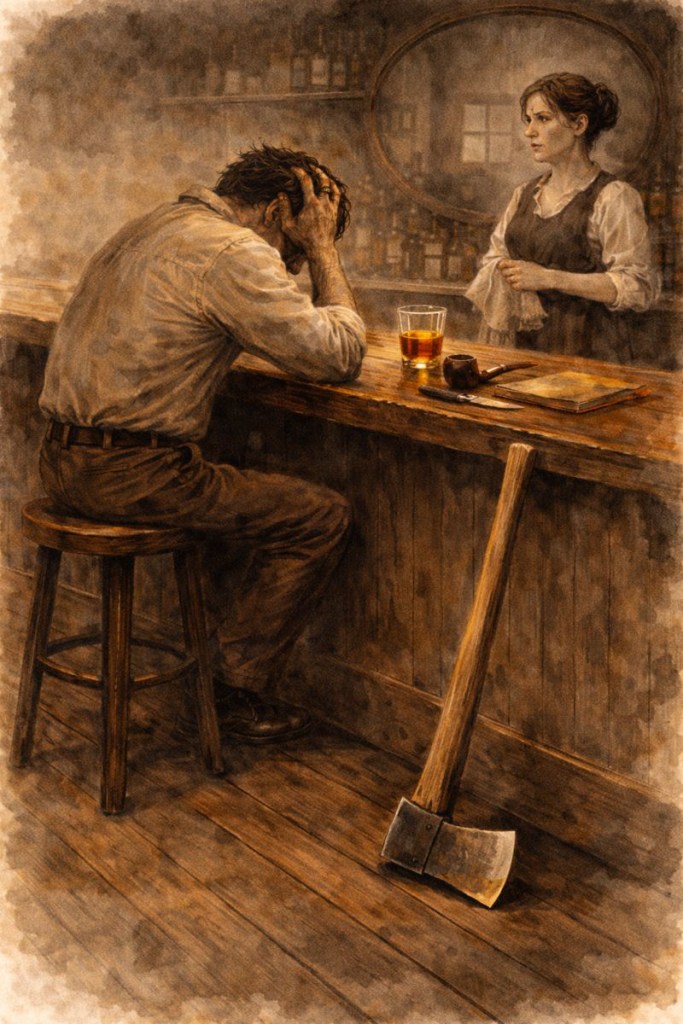
    Eliza was giving the bar a wipe-down and laying out bar towels. She stopped at the sight of Burns with his axe, which he leaned against the bar as he drew up a stool. He swivelled away from her to the left, craning his neck as if to get a view out the window.

    “Give us a brandy, love, would you? I’m parched.”

    He took out his pipe and a plug of tobacco, which he cut with a pocket-knife.

    She watched his hands tremble as he inserted the weed and lit the pipe.

    “No brandy,” she said. Expression gormless.

    He looked up, and the pocket-knife, slipping from his fingers, clattered on the top of the bar.

    “For God’s sake.” Tone miserable in frustration. His head throbbed and his throat was dry. His heart thumped and fluttered alternately beneath his ribs, and the nausea set in. He took in some short, quick breaths to quell it, and bent forward, lowering his forehead into his hands. “Greed,” he moaned, “all greed. They’ve got it all but that’s nothing to them if they don’t ruin life for their neighbour as well. Rotten mongrels, and the coppers are even worse.”

    Eliza, who had seen much of what there is to see in life, was not discomfited by his demonstration, any more than she had been by his leering the day before. Truth to tell, she didn’t mind the flattery. Perhaps, she thought, he misunderstood her meaning.

    “Bit early, ain’t it? Delivery ain’t come in. Only got whisky.”

    She poured him a nobbler as he fumbled in his pocket for some coin.

    “Down the hatch.” He threw it back. “And another.” He sat and pondered for a while, smoking his pipe, staring out the window.

    She went back to racking glasses and straightening the towels. He held up his hands to examine them. The whisky had quieted the tremors.

    Burns cradles his head, at the hotel bar, an axe leaned up beside him.

    “Got a grindstone here?” he said.

    “What?” Warily, anticipating a lewd jest.

    “A grindstone for my axe. Got a grindstone on the place?”

    “Nothing of the sort,” she said.

    “Any grub or suchlike?”

    “What would you think, at this time?”

    “Well, give us a half bottle of whisky. You got that, don’t you? When I don’t have anything to eat, I have something to drink.”

    He slapped the money down on the bar and drew his hands up in a solemn, conjurer’s flourish, or one like a monarch’s, bestowing jewels and baubles of gold on the greedy.

    She watched him rise, pocket his bottle, shoulder his axe, and swagger out the back way.

    “Well, I’m off to cut wood, at any rate.”

    Next day, hair slicked down, on the way to the town hall he was afflicted with the shakes again. They told him downstairs to see Mr Franklin, who would know what he was talking about, so he groped his way up the staircase to the shire offices on the second floor, pausing halfway up to catch his breath, white-knuckled, supporting himself by the banister. Locating the door of John Henry Franklin, Esquire, Secretary, Stawell Shire Council, he knocked and was summoned in. He gathered himself, and again the call came.

    Burns stood swaying in the doorway for a full half-minute as light from the window behind Franklin washed him out to a silhouette. The room smelled of stale ink and hot dust; a blowfly buzzed against the windowpane.

    “My goodness, Burns, what is the matter with you?”

    Franklin sat there, amazed at the gaze that met his: maniacal, animalistic, uncomprehending. He recognised the man from a meeting six months back, over some piece of council business so trivial he could scarcely recall it.

    “Look at you, fellow, you’re tremulous. Have a seat before you fall down. What’s the matter with you? What are you doing here in a state like this? Confound me, you smell like a brewery. What brings you here, then?”

    Burns shook all over in a spasm before regaining the power of speech.

    “I have been on a drinking spree, sir, in my own time. Being once more sober, I have come here to …” momentarily forgetting why “… to look for work on the railway.”

    Franklin stared at the long, fresh graze that ran along Burns’s left cheek, which his beard did not conceal. The man was swaying in his chair.

    “You are serious.”

    “I am a simple railway man, sir.” Your bloody highness. “Except for honest fellows like I the locomotives would not run … I seek nothing more than honest toil. I vacated my position at Dimboola because … it’s too far to go … I tire of the scenery … Heard there is some maintenance available in the more local vicinity.”

    “I don’t think,” Franklin said, “there will be any chance of anything, at least until after the Christmas holidays.”

    Burns nodded slowly for an inordinate amount of time.

    “There is also the matter of the land I made inquiries about some months ago.”

    Franklin was prompted to recall the substance of their previous meeting.

    “There is no land available for selection,” he said firmly, and at that, Burns stood up, pulled himself together, and went away without another word.

    Three days after the Scarlet Robin and her flock had castigated him for creating such a commotion in the peaceful bush, Burns walked into a scrappy little farm at Pimpinio, eight miles the other side of Horsham, owned by a German named Baum. Passing the barn on his way to the house, he was assailed from behind:

    “The blokes you run into when you don’t have a gun.”

    He started and froze, his heart doing its new jig.

    “Mate, don’t get a shock.”

    Burns knew him as well as anything, just couldn’t place the face at first, here in this dump.

    “John, mate, from Avanel!”

    “Yeah, I know, Putney. Couldn’t place you out of the blue like that. Well I’ll be bushed. How are you, you scallywag?” Navvy who’d worked beside them on the rail.

    “Pretty good, mate. Just been doing a bit of graft for Baum, old tightwad he is. Say, what are you up to? Haven’t seen you and Charley since … must be more than a month ago on the line between Dimboola and Horsham, before I chucked it in.”

    “Ah, I’ve been up in the country selecting land. Thought I’d drop in on the way home and see if old Baum had anything for me to do.”

    “Well, I reckon you might be out of luck. Said he’s flat-out paying me. How’s the other bearded wonder, then, old Charley? Thought youse two were joined at the hip.”

    Think, think. Could kill two birds here.

    “Ah, haven’t seen him for a while, the bastard.” Think quick. “Wouldn’t believe the strife he’s put me through with the grog, so I left him out at Natimuk. Got on the spree, he did, as usual. Pawned his watch and I had to release it for him. Thanks to that I’m a broker. Look here, you wouldn’t happen to have a bit of tin on you, would you? I’ll be good for it next time I run into you, or I’ll bring it to you here or Avenel, whichever you wish.”

    “Barely got enough left to go for a drink tonight. Baum can’t pay me till next week. Well, I can spare you a couple of bob, I suppose.”

    “Thanks mate. Well, damn Baum anyway, I’m off home.”

    Late in the summer, he re-adapted to an itinerant lifestyle without his mate, travelling by rail here and there about the Wimmera, catching a few days’ work when he felt like it. Life’s not too bad with a few quid in the bank. “No sign of Charley,” he thought from time to time. “That’s all well and good. Passable life, that of the solitary rambler, well and good.”

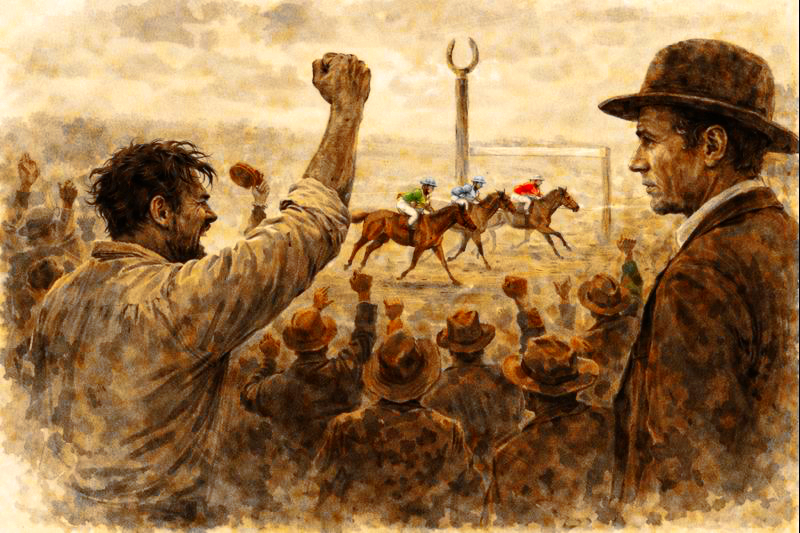
    Burns enjoying a win at the country racetrack. He is observed by Archibald Fletcher.

    Three weeks after the Scarlet Robin, on a brilliant sunny day at Murtoa racetrack, he won a few bob on a skinny bush nag. Turned to leave the bookmaker and found himself face-to-face with Archibald Fletcher, the cow that Scotty, the idiot, had a run-in with at Glenorchy. Asked him what he won on, but Burns declined to reply, raising his lip as he brushed by him.

    “Where is your mate?” said Fletcher behind him.

    The same thing Fergus asked him the other day, when he’d run into him getting off the train at Stawell, peeved about all that money nonsense: “Here, I’d like a word with you. Where’s your mate?” “Oh, up there,” he’d said back to him, waving his arm, indicating vaguely – somewhere between Horsham, up the line, or that place upstairs, if such a one existed – as he escaped through the wicket.

    “None of your business.” This time to Fletcher, and kept going, just the same as the other day.

    He sat down in the refreshment tent with a beer and picked up a copy of the Ballarat Star, a few days old, lying on the wicker table.

    He let the beer sit while he read:

    Awful Discovery in the Wimmera Scrub.

    A labourer working near Deep Lead, close to five miles from Stawell, yesterday discovered a man’s body in the bush – naked and without a head. Police have given no word on identity.…

    The heart started its antics again. How fleeting, fortune’s favours.

    “What’s up, mate? See you done all right in the third there.” Michael Carrick, city bloke, now working with him on a place outside Murtoa, joined him with a beer. Thoughts and hideous images swamped Burns’s skull in such a torrent they confounded the brain and the tongue.

    “Nasty business that one, eh?” Carrick nodded at the paper.

    “They’ll never find the head,” Burns said.

    “What?”

    “They’ll never find the head. Or the man who did it.”

    “Daresay. When you think of it, I suppose that’s why the head’s not there. Means the culprit knew him. Yeah, of course. If they could identify the dead bloke, they’d go around looking at everyone who knew him. Still, with dogs and all …”

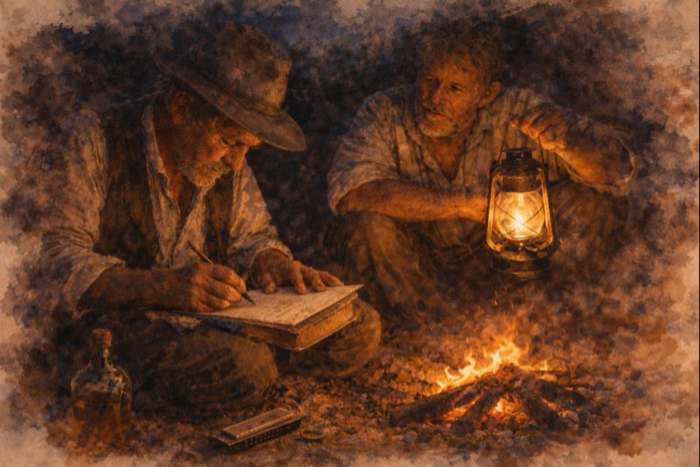
    That night, back at their campfire, Burns, carrying a gas lamp and a fountain pen and paper, interrupted Carrick playing “The Flooers o the Forest” on his battered harmonica to ask him a favour. Carrick being possessed of the finer, more legible hand, would he mind penning a letter for him? He wanted it written for a man named Charles Forbes, who was working at Minyip and did not want the man to whom the letter was going to know his handwriting. It was for a man named Fergus, who owned a hotel in Stawell.

    Good-natured Carrick saw no reason why not, and thought it was something he could do for his new mate. He shrugged and got a book out of his tent, on which to lay one of the sheets of paper.

    Burns dictated the following letter, and the next day had another man drop it at the post office when he was in town:

    Burns dictates the Minyip letter to Carrick at a campfire on the farm where they are employed as transients. Burns holds an oil lamp illuminating the letter. There is a harmonica on the ground by Carrick's knee.

    Minyip, Jan 20, 1882 

    Dear Fergus – I wish to let you know that I am here with a farmer at Minyip at six shillings a day harvesting. I will send you down £5 to redeem my watch which I pledged before I left Stawell. I owe Burns £4 8s 6d cash. I gave him the ticket of my watch as a guarantee for his money, so if you pay the balance of the money to Burns and let Burns redeem the watch, as I got three pounds on it. By you doing so you will much oblige.

    Do not answer this until I send you the £5. It is better for me to send for the watch than to drink it. I hope I will keep sober this time until I go to Stawell to you.

    Charles Forbes, Minyip

    Burns went down to the races again on the twenty-third of February, and asked a few of the bookmakers and drunks whether they’d run into Scotty, because he wanted the twenty quid he owed him. That night, he got drunk, created a disturbance at the Murtoa pub, and was arrested and taken to the lockup. When the watchkeeper arrived in the morning and heard the prisoner pacing and muttering inside the lockup cell, he paused at the door. With a jingle of keys, he unlocked it and pushed it open.

    “What am I here for? What have I done?” Burns moaned, gasping and in a lather, his shirt soaked with sweat.

    “Calm yourself, sonny boy, or else you won’t be goin’ nowhere for a while,” the watchkeeper growled threateningly, unimpressed at being assailed with such agitated queries.

    “Why am I here?” Burns in peril of hyperventilating. “What is the charge against me?”

    “You’ve been a naughty boy, that’s why. A very naughty boy.”

    Burns stopped breathing and chilled to the bone, a frozen lump of nausea lodged in the pit of his stomach.

     “Hauled in for being drunk and disorderly and causing a ruckus in this peaceable borough of Murtoa.”

    Hearing these words, Burns’s countenance changed immediately, and apparently in token of relief and joy, he whooped and danced a lurching, deranged hornpipe in front of his captor.


    From the draft novel Stawell Bardo © Michael Guest 2026
  • 1. Down Train from Horsham (from the draft novel Stawell Bardo)

    1. Down Train from Horsham (from the draft novel Stawell Bardo)

    Though railway convention would designate a train travelling from Horsham toward Melbourne as an up train, I have titled this chapter Down Train from Horsham intentionally. The descent invoked here is not geographical but tonal: a movement into rougher country, uncertain fortunes, and subterranean narrative currents. It is, in spirit, a passage downward.


    Down Train from Horsham

    Some dragon stirred from its rest with a snort and shrill hiss. Flame flashed beneath her firebox, steam jetted behind the front wheels, a plume burst from the smokestack. The engineer tugged the pull cord and let go two long, shrill blasts on the screamer.

    Over on the wide, newly asphalted street, their cart driver pulled his horses up to a stop. Forbes was on the ground by the time Burns hauled himself down.

    “Slow today ain’t we?” Forbes said with a wink.

    Burns grunted, dusted off his coat, and spat.

    Both strong, stout men they were, both with full beards, Burns’s brown, Forbes’s flecked auburn when the sun hit it right. The two barely had time to buy tickets, but the guard spotted them and didn’t give the flag.

    “Get a move on, youse blokes,” he growled as they strode up to the door of the last carriage.

    “Go blow your nose, General,” Burns said.

    “Thanks old mate,” Forbes said, smirking at the guard and touching the brim of his grimy, battered wide-awake hat. No nap, no fuzz on the felt – that’s what ‘wide-awake’ meant, Burns told him. He liked that.

    “No call to go tippin’ your lid to the likes of him,” Burns snarled, striding ahead. “All they do is blow on their whistles and wave their bloody flags, riding about all day on railways that we builds for them.”

    AI generated image of train waiting to leave the station at Horsham

    Burns pushed back the reversible seat to make two facing seats, and they swung their swags up onto the overhead rack. Forbes let his bulk fall, crashing down on the forward-facing seat with a thump that startled everyone in the carriage. Heads turned, eyes exchanged glances, eyebrows arched.

    An upright matron leaned to the ear of her companion, a young wife, who commented under her breath, in a tone heard through the carriage, “Navvies by the look.” She pulled a grimace of distaste and flashed a glance toward heaven. Two wide-eyed children across the aisle from the women craned their necks, straining for a better look at the commotion. The elderly clergyman turned his attention back to the Melbourne Argus in his lap, his eye pausing on the masthead: “I am in the place where I am demanded of conscience to speak the truth, and therefore the truth I speak, impugn it who list.” Ah, the brave words of John Knox, a fellow Scotsman.

    Acting oblivious to the disapproving looks but inwardly savouring them, Forbes leaned back to think on the waves of heat rising from the platform. Burns stood with his hands on his hips, staring down at his mate, gripping the seat to adjust his balance as the carriage lurched forward.

    “No, I won’t go backwards,” Burns said.

    “What’s that?” Forbes said, still looking out, the hint of a rascally smile on his lips.

    “It gives me the pip, going backwards does.”

    “Gives everyone the pip, Burnsy. Be a man.”

    “Come on, we’ve been over all this. Get over to this side, at least for a little bit. It’ll have me spewing, mate.”

    “Sit down and shut up, man,” Forbes said. “We can swap after a bit.”

    “For Christ’s sake, I’m not feeling too well after last night.”

    “It was me finished that last quart of rum off with Johnson and the Painter brothers after you flaked out.”

    “Well damn you then.” Burns slumped into the seat across the aisle and looked sullenly out the window, watching the buildings slip by. He took off his hat and ran his hand across his balding scalp. Getting tired of this redheaded prick. “You’re like a naughty kid sometimes. I’m not going to read the newspapers with you anymore now. You were looking forward to that, weren’t you? Over a beer at the pub when we get in.”

    “I’ll read them by myself,” Forbes said petulantly, with a touch of true hurt.

    “Oh yes, oh yes. You are a great reader by yourself, you are.” Burns gave a short derisive laugh. “A regular font of learning. A real Aristotle. Great Peripatetic Philosopher, you are, for sure. A true Bard and all rolled into one. Ha!”

    The train rattled along, passing across the town boundary. A sweet breeze cooled the carriage and Burns’ temper. This was grand country – miles of grazing country, like parkland, and burgeoning seas of wheat turned ghostly in the sun – pale dragons gliding low over the gold. Any man’s heart would glow, and he whistled a few bars of an old ditty that had been playing on his mind the past few days. Trilli-la, trilli-la, as the lassie flung them tripes, flung them far …

    He turned to Forbes and called out over the rhythmic clatter, nodding to the scene. “Magnificent property – the Cawter Brothers, squatters of course, you understand.”

    “Sorry about all that, just pulling your leg.” Forbes said. “Here, take a swig on this, the real article. Found it in back of the cart. Blakey can get another one at the pub, blow ’im.” He offered the flask with a grin and a look that said: ‘we mates again?’ “Look Burnsy,” he said, ”I know I wouldn’t be reading at all if you hadn’t showed me, and I thank you for it, I do, I really do. Mates?”

    Flask to his gob, Forbes froze mid-gulp and grinned. “Can’t hear you. Come on over here, come on.” Forbes swung himself over onto the rear-facing seat. Burns took the place he had vacated.

    Burns shrugged off his aggravation with a mighty swig. “Grumph! God, that’s rough, you ratbag! Gad, that is poison. Villainous vile low stuff indeed it is.”

    “My word! Produces the desired effects, nonetheless, don’t it?”

    “Aye, to be sure – makes the vendor rich and the buyer mad, if that’s what you want.”

    They laughed raucously and then stopped, collapsing abruptly into a sober silence filled with sporadic vague recollections of drunken aftermaths. Pause of indeterminate length and depth. Some stubby vegetation jogged past and the carriage rocked and creaked.

    “Passable whisky.” Forbes had come to love a game with Burns.

    “Passable? My stars, whisky, you reckon! Whisky! There ain’t the slightest suspicion of malt in the composition of this grog. More a concoction of cheap liquor and primitive adulterating agents mixed in by some low, roguish bush publican. Water for toning it done, tobacco and bluestone for bringing it up to the required ‘biting’ standard. That’s what it is. Impossible to calculate the amount of evil wrought by foul stuff like this. What do you reckon? Passable, right enough!”

    Forbes laughed a child’s open, careless laugh. “Righto, well you are free to give it me back then. I’ll down it, no worries.”

    “Steady on, son! I fancy trying another drop or two yet, just to make sure it’s alright for you.”

    “How’s that, then?”

    “Not too bad when you can get it down.”

    Forbes blinked. “What’d you say back there, mate – something Brothers?”

    AI generated image of the two men smoking in the train carriage.

    “Carter Brothers,” said Burns. “Own that place outside of Horsham. North Brighton Estate, la-di-da, fancy stuff. Nothing around like that these days for the likes of honest blokes like us. The rich got the best, and you need money for grazing. Thousands of selector homesteads around these parts, though, I’ve got to admit. At first the squatters tried to get rid of them – pulled up their pegs as fast as they could put ‘em down and burned down every patch of bull-oak in sight – makes decent timber that stuff. Squatters thought they’d won out. Got all the best bits, creek frontages and fertile spots, and didn’t bother to buy up till it was too late and the selectors all got in. Now they own most of the land in the district. Yeah, plenty of selectors in the Wimmera, and soon we may be pleased to number ourselves among ’em, indeed, I’ll wager. Stake my life on it.”

    Forbes yawned and stretched. He took out a two-bladed knife and a plug of tobacco from the pocket of his grimy, gray tweed coat and proceeded to cut some tobacco for a smoke. The knife was a small one with a white handle, but one half of the bone was off, the handle on that side showing the brass. “So how about this place you want to select?” he said. “Is it worth me putting in? What do I want to go on the land for? I’m free as the breeze in the work I do, can go when and whither I wish. That’s the life.” His sly attempt to kick off more sport.

    “Ar, not again,” Burns said, taking up the flask for a swig. “Wake up to yourself, man. You’re a navvy. You want to dig ditches all your life? You’re still young. You want to get yourself a stake. What’s a navvy do, son?” He lit his pipe.

    “I don’t know … digs holes?” …

    “That’s right, digs holes. And what else?”

    “Digs more holes.”

    “Correct. And what then?”

    “Digs some holes and then some trenches for good measure.”

    Burns laughed. “Yes, very good. Anything else?”

    “Cuts some dams.”

    “Yes, for a break, and when he finishes with that? Come on, what have we been doing out at Dimboola?”

    “Ballast. Spreads tons of damn ballast along the line.”

    “Of course he bloody does!” Burns said. “And that’s a lark for you, ain’t it! Anyway, we’ve got nothing to be ashamed about. It’s men like us what builds these railroads, son. Railroads into the future, I reckon. But there’s too much of our sweat and blood in ’em. What you want is to go up in the world. Like I’ve been saying, keep our dough together and build up from there. We’ll be full-blown gentleman in the long run. Whisky, women and song for the asking. In South Australia I was born …” His sonorous tenor cracked with volume, his rhythm matching the pulse of the wheels over the railway sleepers.

    “Heave away, heave away ….” Red-headed Scotty Forbes, so-called, being Irish, was gifted with an equally stirring off-key tenor. He coughed back some reflux and took a big guzzle.

    South Australia is me home …

    Heave away, heave away …

    “Don’t worry, I looked after you over there, didn’t I, son? I’ll fix you up here too, no two ways. Oh heave away you rolling king, we’re bound for South Australia …

    The carriage rocked and clattered along. Forbes packed his pipe and lit it up, twisted his body around and leaned back over the seat. “This is a smoking carriage, is it not?” he asked of the woman diagonally across the aisle. “You don’t object to smoking, madam?”

    It was no smoking, but the woman submitted grimly and said no. Further down, the young wife staged a little drama, rousing her children and shepherding them out.

    The pipe smoke curled lazily in the light. It caught a shaft of sun and hovered there, luminous and insolent. Forbes leaned back, legs stretched long beneath the seat, puffing like he had nowhere particular to be. Beside him, Burns smirked toward the window.

    After a minute or two, the clergyman rose indignantly. He stepped up the aisle, steady as a magistrate, and came to a stop at Forbes’s elbow. “I for one,” he said, glaring down through the smoke, “do object to that filthy habit. And if you persist in indulging in it here, I shall be forced to quit the carriage.”

    Forbes didn’t look up. “Here’s a bonny little reverend, then.”

    Burns sucked on his pipe and exhaled with exaggerated pleasure. “Blind me, people can be disagreeable. Proper cantankerous old ratbags, I’ve had a gutful of their sort.”

    The clergyman’s gaze turned sharp. “Passengers who wish to smoke,” he said, “ought to remove themselves to one of the carriages provided for that very purpose.”

    “Filthy with ash and worse,” Burns said, with wide, innocent eyes. “Even a hardened smoker can’t stand the stink. Anyhow, they’re full. We usually go first class but feel like slumming it today.”

    The Scotish clergyman looking down sternly.

    Forbes puffed on his pipe, grinning back at his companion. He leaned over and hawked something from the back of his throat. The spit hit the outside of the window with a soft, wet smack.

    Burns said to the clergyman, “I know better men than you who partake of the weed.”

    “I shall request the guard remove you at the next station.”

    “No need for that, Bishop,” Burns said. “We plan to alight in that parish in any case, where we have some important business in which to attend. To wit, the acquisition of a prime piece of real estate, for your information.”

    “It’s a good half hour and more to Glenorchy,” the clergyman insisted. “These good people should not be poisoned by smoke and nauseated by your vile expectorations.”

    “Alright, have it your way, if you’re going to be like that,” Forbes said, tapping his pipe against the windowsill, so that the embers fell out onto the floor. He made a show of stomping them out.

    “And if drunken men are permitted to travel, it ought to be in a special carriage.”

    “Look, you’ve got your way,” Burns said, pointing his pipe at him. “Now if you’d kindly go and do your preaching elsewhere, we’d be much obliged.”

    The clergyman blinked, lips pursed. No one else moved. Burns leaned back and took one last puff.

    “Off to buggery with you where you belong, if you don’t mind, good sir. Go to hell with the rest of your sort.”

    The clergyman strode back to his seat, amid some covert approving nods and comments from his fellow travelers for the effort he had made, and took up his newspaper. For the rest of their journey, in loud, vulgar tones, Burns aired his views on Presbyterian priggery and wowsers, white bearded, bald headed old Scottish hypocrites, bastards and coots, and so forth, for the entertainment of Forbes, who hooted and cackled at his mate’s performance, clapping his hands in unpredictable spasms of mirth, as he would do at times, in a way that would cause the casual onlooker to think he might be touched.

    As they drew closer to Glenorchy, the red-headed Forbes drank and nodded, while the balding Burns, his elder, shared his wisdom, audible to their captive and drowsy companion travelers … “Won’t hurt to find out about it, anyway, price is very reasonable … together we’ll be right … Look at this bloody scrub … Good places coming up here at Wal Wal that got had up by selectors … be right with our stake at Glenorchy though, right as rain … Don’t worry about all that, I’ve got it all for you … Six hundred quid in the bank at Dunkeld, anyhow … Breed a few sheep here and all …”

    “I do love a train ride!“ Forbes said.

    “Fine ride, fine ride. It’s the future, you know. We are living in the future, my friend,” said Burns.

    Mother speaking quietly to her little daughter by a carriage window.

    “You can see the scenery, and the occasional sheep. Very fine indeed. trees and pastures and all the rest. Exceeding rapidity. Velocity of modern times, and no mistake,” said Forbes.

    “We are kings, mate, kings of the rail,” said Burns.

    “Considerable dry day though. What day is it, anyway?” said Forbes.

    “Monday, don’t you recall? We resigned our positions on the Sunday?” said Burns.

    “Wind’s changed. Look at the steam!” said Forbes.

    “Nice smell, eh? Sweet-like, but then it hits you in the back of the throat, as well,” said Burns. “Get your head back in, Scotty! God you’re a child. Pull ya bloody noggin in or you’ll get it knocked orf!”

    The train crawled to a stop and sighed an immortal hiss. The two men gathered their swags and pocketed their pipes, leaving the empty flagon adrift on one of the seats, and lumbered towards the front, Burns bumping into the clergyman’s seat as he passed. The wife and daughter of the ironmonger at Stawell silently watched them go out, eyes on their backs.

    “That’s the sort of people you get on the trains,” murmured the mother to her daughter.

    “Here’s to land, mate – ours soon enough,” Burns said, stepping down onto the stationary earth.

    Michael Guest © 2025


    Graphics are AI generated