Tag: Nineteenth Century popular culture

  • J.F. Smith’s Mystery of the Marsh — Eleventh Instalment

    J.F. Smith’s Mystery of the Marsh — Eleventh Instalment

    This chapter presents insights into the motivations and machinations in play at the ‘higher end’ of society. A far cry from Mrs. Hurst’s scheme to have William and Goliah banged up for the ‘theft’ of the horse and wagon, motivated partially by her rivalry with Mrs. Gob over her excellent butter.

    Nevertheless, the differences appear to be more in terms of their degrees of subtlety and complexity rather than in essence. Smith presents the moral attributes of the characters in a system of defined binary oppositions, which work at times to undercut each other in the same character. Someone who wears a ‘black hat’ in the first instance may be shown subsequently to have redeeming qualities to some extent. (Cinema quite commonly applies similar techniques.)

    It seems on cue to turn, as we do in the present chapter, to a deeper context of meaning for his play of morality and human nobility. The scene in the regimental headquarters of the Royal Life Guards and Horse Guards (also known as The Blues) serves to diminish the importance of the social hierarchy per se, with this proximity to royalty and empire.

    These are the two most senior regiments of the Royal Household Cavalry, dating to the restoration of Charles II in 1660. They boasted an illustrious record of service at home and abroad in any number of theatres of war over the subsequent centuries, including Waterloo.

    In the Victorian era, the British Empire had become one upon which ‘the sun never set’. A certain mode of history — ‘Whig historiography’ — assumed popularity, one that viewed this position of world leadership as a logical and inevitable development, a march towards global enlightenment based on the principles enshrined in British governance.

    Lord Macaulay’s (1800–1859) five-volume History of England (1848) is considered the archetype of Whig history. But guess in whose history we can discern shades? Correct: in John Frederick Smith’s own volume of the nine-volume Cassell’s lIlustrated History of England (1874):

    The slow building of a constitution which finds no parallel in the world is the most distinctive, as it is the largest feature in English history … If we do not profit in heart and head by the experience which the ages have gathered for us — if we do not grow, as they would have us, not only in wisdom but in humility, in moderation, in humanity — we have to blame, not these unerring teachers, but ourselves.

    Preface to Volume 1

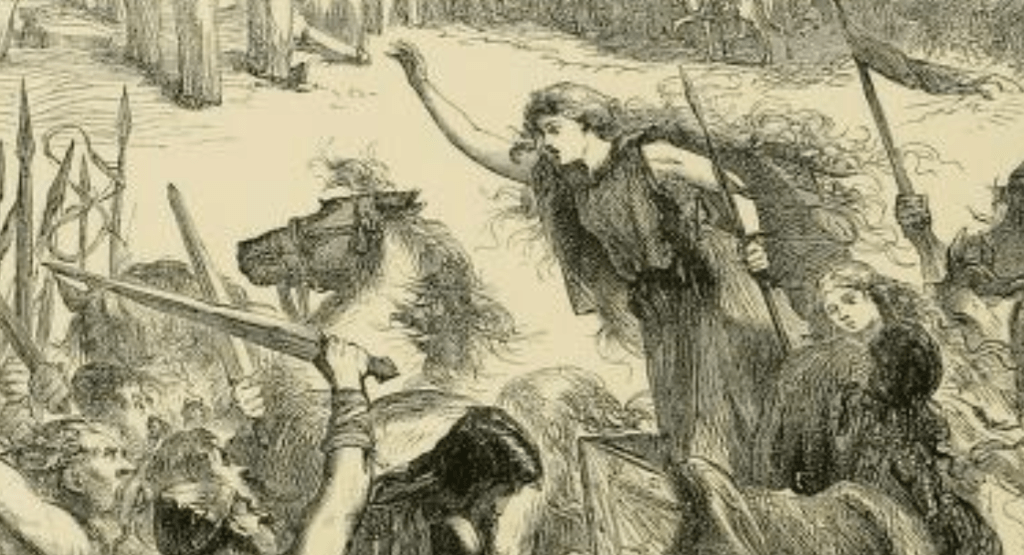
    The Celtic queen Boadicea leading the British revolt against the Romans, 60/61 CE. Frontispiece to Cassell’s Illustrated History of England Vol. 1 (cropped).

    CHAPTER ELEVEN

    Clara Meredith Does not Feel Quite Satisfied with Herself — The Sketch — Return of her Cousin to London

    Clara was seated in the library, thinking over the events of the last few days, and taking herself to task for her conduct to her cousin. To be sure, his neglecting to make her acquaintance in London — her first season, too — was unkind, to say the least of it; but had she the right to resent it, and turn him into ridicule on his arrival in the country? After turning the circumstances over in her mind she came to the conclusion that she had not. It was undignified, to say the least of it; and she felt dissatisfied with herself, and all the more so that he had endured her sarcasm with such polished good humour.

    That her cousin was ultra-fashionable, and not a little fastidious, she did not doubt; but that he merited the title some of her dear friends in London had given him of a “cynical, heartless man,” she could not believe. Had he not danced with the May Queen at her request; defended her from the insulting familiarity of Burcham? Shaken hands with Tom Randal as he reluctantly yielded to his right to protect his rustic sweetheart?

    What better proofs of manhood could he have given?

    ‘Clara,’ said his lordship, as he entered the library, ‘I am come to fulfil my promise. I told you when I made it that I was not much of an artist; but I have done my best.’

    He placed the sketch in her hand.

    The young lady coloured slightly as she received it. She had secretly hoped he had forgotten it; but Bury was a man of his word. Despite the seriousness of her late thoughts she could not help laughing gaily as she contemplated the drawing. It was really exceedingly well done for an amateur, and he had carried out her description to the letter. There stood the old mansion in the distance; Clara, in a short frock and blue sash, screaming on the bank of the pond; his lordship floundering in the water. One of the famous red morocco shoes floating on the surface, and a goose swimming after it.

    The last, by-the-by, was an introduction of the artist’s own, intended, probably, as a slight epigram on the playful malice which had recalled the incidents.

    ‘I am glad,’ observed Clara, recovering her seriousness, ‘that you have recollected your promise, and yet it scarcely amounted to one. But why represent me twice?’

    ‘I scarcely understand you, cousin.’

    His cousin pointed to the goose sailing after the shoe. His lordship smiled.

    ‘I am ever so much obliged to you,’ resumed the fair girl, after a pause. Is it really mine?’

    ‘Undoubtedly, since you have honored me by accepting it. Shall the drawing find a place in your album, or be sent as a contribution to the next fancy fair?’

    ‘Neither one nor the other,’ answered his cousin, with a show of feeling at which she felt provoked with herself. ‘I can dispose of it in a far more fitting way. And yet it is a almost a pity,’ she added, as she crushed the sketch in her little hand, dropped it into the fire, stood watching it until it was consumed, and then, with a quiet courtesy, quitted the room.

    Lord Bury stood for some little time gazing after her in silence. Possibly the problem was becoming interesting to him.

    ‘Pshaw!’ he muttered, as he took up a newspaper to while away the time till luncheon. ‘Why should I feel surprised? Good blood will tell.’

    Had he said good principles, the observation, we suspect, would have been more germane to the matter, as our friend, Shakespeare, says.

    Three days after the interview in the library, which neither of the cousins thought fit to allude to again, Lord Bury, who had just received his letters, informed Sir George that he was obliged to start the following morning, on particular business, for London.

    ‘Nothing unpleasant, I trust. Can I be of any use?’

    ‘Exceedingly unpleasant, uncle, for it concerns the honor of one who ought to be very dear to me. Unfortunately,’ he added, ‘you cannot be of the slightest assistance to me.’

    ‘That scamp of a father, I suppose,’ thought his host, who had noticed the word “ought.” ‘He is always getting himself into some infernal scrape or another. Older, too, than I am.’

    Of course he kept these reflections to himself.

    ‘Possibly I may be able to renew my visit,’ said his lordship, ‘in the shooting season. That is, if I have not worn out my welcome.’

    ‘We are homespun, Egbert,’ observed his relative, ‘and can stand a vast amount of wear and tear. Come when you will, always glad to see you, Make it a promise, and I will keep the home cover for you. Make it your home if you like.

    ‘That is,’ he added, noticing the blush upon his daughter’s cheek, ‘as long as I live, Of course I cannot answer for my successor.’

    ‘That would be unreasonable, Sir George,’ observed the nephew, who had noticed the blush and the correction of the speaker’s offer. ‘Thanks, I will not abuse your hospitality.’

    The next day Lord Bury started for London.

    ‘Well, Sparks,’ said his lordship, when the sergeant-major entered the room the morning after his arrival at headquarters, to report on the condition of his company, ‘anything important?’

    ‘Not very,’ answered the old soldier. ‘There has been a fine young fellow here from the country, who wants to enlist, but won’t engage in any company but yours. Such a chest! Stands six feet two; straight as a pike-staff. Knows the points of a horse as well as the regimental vet, himself. Hope we shan’t lose him.’

    ‘But why in my company?’ demanded Lord Bury.

    ‘Heard that you were a kind officer, most likely.’

    ‘No flattery, Sparks. Did the young fellow you were speaking of give his name?’

    ‘Tom Randal, my lord.’

    ‘Find him; bring him to me instantly,’ exclaimed the officer, greatly interested. ‘You said truly, he is a fine fellow — a man every inch of him.’

    In a few minutes the lover of the pretty Phœbe entered the luxuriously-furnished room of the officer, who frankly held out his hand to him.

    Although the countenance of the new recruit flushed with a momentary satisfaction, he did not accept it.

    ‘You forget,’ he observed, ‘that I am about to become a private soldier.’

    ‘No, I do not,’ replied his lordship; ’till you are enlisted, you are a free man, and a prince might shake hands with you. Once in the ranks,’ he added, ‘it would be different; but that will be neither your fault nor mine.’

    The hand was again extended, and this time cordially shaken. The sergeant discreetly withdrew. He thought it best to leave the officer and his rustic friend together.

    Tom Randal, after the quarrel with his father, had made the best of his way to London on foot; for he had very little money, and proceeded at once to the barracks of the Guards. Our readers know the rest. Vainly did his aristocratic friend try to argue him out of his intention to enlist, pointing out the difficulty of obtaining his discharge when once he had taken the fatal shilling.

    ‘The colonel,’ he added, is a good man — a kind man — but will never consent to let a fine young fellow like you leave the regiment when once engaged in it,’ and advised him to take a few days to consider of it.

    ‘Not an hour, my lord,’ replied the lover of Phœbe. ‘I have lost the only girl I can ever love, and all through my father’s prejudice, pride, and obstinacy. It has cost him his son,’ he added. ‘He shall find I can be as resolute as he is. My mind is made up.’
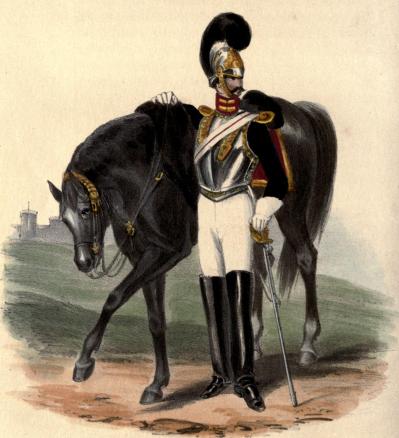
    Trooper of the Royal Horse Guards, 1828. (Created 1847) Public Domain. Source: Wikipedia

    Lord Bury sent for Sergeant Sparks, and Tom Randal quitted the room, duly enlisted into his majesty’s first regiment of Life Guards.

    The poor fellow, we suspect, had inherited some of the old farmer’s temper; if so, the army was, perhaps, the best school to work it out of him.

    The expiration of his leave of absence was not the only motive which brought his lordship to London. He could easily have obtained a prolongation of it. He had received a letter from one of his most intimate friends, informing him of certain ugly rumours that were whispered in society of an attempt to force his cousin, Lady Kate Kepple, into an unequal marriage with Clarence Marsham, and that Lord Allworth’s name was unpleasantly mixed up with the transaction. ‘Of course,’ added the writer, ‘I do not vouch for the correctness of these reports; but as they are levelled at the honor of your family, I felt it my duty to inform you of them. All I really know is that the chancellor has deprived your father of the guardianship of Lady Kate’s person, and that his step-son has sold out of the army. The last two facts I affirm on my knowledge. There the duty of friendship ends. It is for you to act as you think best.’

    On his way to town, the young guardsman had perused the letter at least a dozen times, and each reading added to his mortification. As we before observed, he was both proud and honorable, weak in some things and extremely sensitive; but, then, we are not drawing a perfect character; absolute perfection, we fear, would be just a little insipid.

    His first visit was to Montague House. There, at least, he expected to learn the truth. Its owner, with whom he was a favorite, received him nervously. Our readers have not forgotten her intense dread of scandal, and the feeling increased tenfold when he had explained the object of his visit.

    ‘It it possible!’ she exclaimed, ‘that, despite my precautions, the unfortunate story has leaked out?’

    ‘It is true, then?’

    ‘I cannot deny it.’

    Lord Bury rose to take his leave.’

    ‘Egbert! Egbert! cannot the affair be hushed up?’

    ‘Impossible!’ was the reply. ‘At present it is only whispered; in a week’s time it will be a common topic of conversation in half the drawing-rooms in London. It is my duty,’ he added, firmly, ‘to see that your conduct and Kate’s should be unquestioned.’

    Again he moved towards the door.

    ‘Stay,’ said her ladyship, lowering her voice to a whisper. ‘You do not know all.’

    ‘For Heaven’s sake, let me hear it, aunt!’

    ‘Kate escaped from Allworth Park in boy’s clothes; walked all one night in them, and slept the next in a barn.’

    ‘Is that the worst?’

    ‘What could be worse?’ replied the aristocratic old maid, blushing deeply as the veiled meaning of his question dawned upon her mind. ‘Is not Kate living — slowly recovering her health and spirits?’

    A terrible suspicion passed from the heart of Lord Bury. He knew the speaker too well to doubt her word for an instant. A third time he was about to depart.

    ‘Stay,’ said Lady Montague, ‘Do tell me where you are going.’

    ‘To see my father,’ answered her visitor, gloomily. ‘I have a hard task before me, but will not shrink from it.’

    This time he succeeded in quitting the room.

    ‘Poor Egbert!’ sighed Lady Montague, as he disappeared. ‘He is very much to be pitied. Why did my sister marry Allworth? I told her he was a roue, repeated all the evil reports I ever heard of him, warned her every way; but it was of no use — seemed to increase her infatuation. If she had accepted some plain country gentleman, or even a bishop’s son I should not so much have minded, although, of course, it would have been a misalliance. But no, she would have a peer. Poor girl; she paid dearly enough for her folly. And yet,’ she added, thoughtfully, ‘I do not think it was all ambition. At the worst,’ continued her ladyship, ‘Kate and I can return to Montague Castle, live like nuns, and when we die, leave our fortunes to found a hospital for old maids.’

    However improbable, the project certainly was not an impossible one, although somehow we have an idea that Lady Kate will feel but little disposed to join in it.

    Viscount Allworth never believed it would be possible to keep the disgraceful escapade of his stepson from the knowledge of society — he knew the world too well for that — so he prudently resolved to make his own share in the transaction appear as harmless as possible. What he most feared was the indignation of his own son, who had lately shown a spirit which startled him.

    ‘Bury behaved exceedingly well in the Chellston affair,’ he muttered to himself, as he turned the incidents over in his scheming brain. ‘Must keep friends with him if possible.’

    Having traced a line of conduct for himself, Lord Allworth was not the man to be easily moved to depart from it; and the less so, that for the first time for years he found himself — thanks to the Chellston trickery — tolerably at ease in his pecuniary affairs; hence the firmness with which he insisted on Clarence Marcham’s retirement from the army.

    ‘Absurd!’ exclaimed his wife, when he informed her of his determination. ‘A mere boyish folly; the world soon forgets such things.’

    ‘In some persons, perhaps, but not in others,’ remarked the husband, gravely. ‘You made no objection when I stated my intention to Lady Montague.’

    ‘Because I did not believe you to be serious. In fact I never know when you. are serious. I considered it merely a sop thrown to the old Cerberus.’

    His lordship appeared greatly shocked.

    ‘I wish, Lady Allworth,’ he observed, but without losing his temper, ‘that you would be a little more refined in your expressions. I am aware that the defects of early education and associations are hard to overcome. Still it may be done. You will oblige greatly by striving to recollect this the next time you speak of my first wife’s sister, a woman of high birth, large fortune, and spotless reputation.’

    There was a momentary lull in the stormy conversation. The viscountess bit her lips to avoid giving expression to her rage at his provoking coolness.

    The husband — and we feel there are but too many like him in the world — enjoyed his wife’s mortification exceedingly.

    ‘I perceive what you are driving at,’ observed the angry woman. ‘You require money?’

    ‘No.’

    The lady gazed at him with astonishment. It was the first time in her married life she had received such an answer to a similar question.

    ‘Money,’ continued the speaker, ‘is an excellent thing in its way. I can’t imagine how some people contrive to exist without it; but it is not everything. Listen to me — my conduct is not so unkind as you suspect. You are far from being a fool, Lady Allworth. I know that you can control your temper on some occasions, and act with prudence.’

    The wife could scarcely repress a smile; she recollected how cleverly she had contrived to outwit him in the settlement of her fortune.

    ‘I have seen the commander-in-chief,’ added the speaker; ‘the affair has got wind through the rascally lawyers. I suspect Clarence is in bad odor at the Horse Guards — very bad. His royal highness is decidedly of opinion that he ought to sell out; and you know what such an opinion from such a quarter means. The price of his commission I am told, will barely pay his debts.’

    ‘Debts!’ gasped the astonished mother; ‘why, his allowance has been most liberal!’

    ‘Not feeling the slightest interest in the subject,’ said his lordship, ‘I made no inquiry as to their amount. You perceive the step is inevitable. Clarence had better return to France; living is cheap there; great resort for half-pay people. But he must decide quickly; in three days he will be arrested.’

    It is quite true that Viscountess Allworth loved her son, but, then, she loved herself a great deal more, and did not care to impoverish herself to pay off his liabilities. He must do that, she thought, by a wealthy marriage. So far from having abandoned the project, she clung to it more tenaciously than ever. Two days afterwards the unmanly scapegrace landed in France.

    We scarcely need to remind our readers that these last arrangements were made during Lord Bury’s visit to the country.

    This edition © 2019 Furin Chime, Michael Guest


    Notes and References

    ‘as our friend, Shakespeare, says’: ‘The phrase would be more germane to the matter if we could carry cannon by our sides’ (Hamlet, V, 2).

    ‘[to take] the fatal shilling’: sign up as a soldier, ‘from the former practice of giving a shilling to a recruit when he enlisted’, wordhistories.net

    Macaulay, Thomas Babington, Baron, 1800-1859, History of England from the Accession of James the Second (1901). Digital facsimile available at the Internet Archive. Link opens Vol. 1.

    Smith, John Frederick, Cassell’s Illustrated History of England (1874). Beautifully illustrated digital facsimile available at the Internet Archive. Link opens Vol. 1.

    While all nine volumes of Cassell’s Illustrated History are sometimes attributed to Smith, Andrew King and John Plunkett reveal that he actually only wrote the first. Subsequently Cassell ‘realized that Smith was less concerned with facts than narrative drive’ and handed the rest of the work over to William Howitt (1792–1879) (King and Plunkett, Victorian Print Media, OUP, 2005, p. 415).

  • J.F. Smith’s Mystery of the Marsh — Recap

    J.F. Smith’s Mystery of the Marsh — Recap

    I’ll keep good the promise made by the 1883 newspaper sources for this reconstructed penny blood mystery, by providing their mid-way summary. The author of the novel is the Englishman John Frederick Smith, the most popular writer of the mid-nineteenth century — but in later years all but forgotten. The annotated instalments include contextual notes along with glimpses of the life of this intriguing writer.


    In order that new readers may begin with the following installment of this story, and understand it just the same as though they had read it all from the beginning, we here give a synopsis of that portion of it which has already been published:

    Two girls, clad in male attire, one evening appealed for help to William Whiston, nephew of Farmer Hurst, of Deerhurst. William — who was accompanied by two friends, Goliah Gob and Benoni Blackmore — gave the fugitives refuge in his uncle’s red barn. Soon afterwards a tramp, named Bunce, took refuge in the barn, and two ruffians came there also, in pursuit of the girls. Bunce defended the girls against the ruffians, till Goliah Gob, a young fellow of gigantic size and strength, came to his assistance. The ruffians were overpowered and bound.

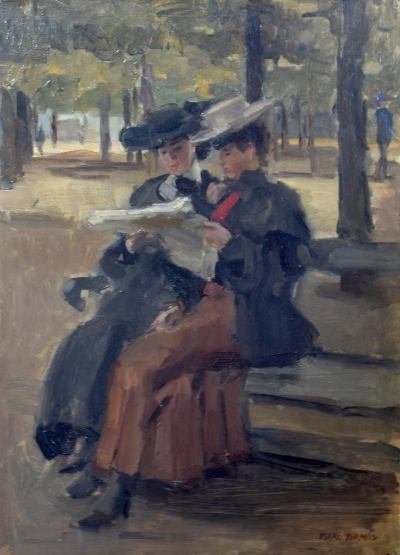
    Isaac Israëls (1865-1934), Bois de Boulogne (1904). Public Domain. Source: 1stdibs.com

    Goliah then summoned William and Benoni, and after consultation William and Goliah set out in a waggon for London with the girls, who proved to be Lady Kate Kepple, an heiress, and her maid Martha. Lady Kate was fleeing from Clarence Marsham, an officer in the Guards, who attempted to force her to marry him. They arrived safely in London, where Kate went to the protection of her aunt, Lady Montague.

    William called on his uncle, Lawyer Whiston, and told him the story. The old lawyer was Lady Montague’s legal adviser, and was delighted to find what part his nephew had played in Lady Kate’s escape.

    Benoni had been left in charge of the bound ruffians in the red barn, with directions to hand them over to the authorities in the morning, but he set them free, and told such a story to Farmer Hurst that Mrs. Hurst insisted on having William and Goliah arrested for stealing the farmer’s horse and waggon. This was done, but Lawyer Whiston came down from London, rescued them, and overwhelmed the Hursts and Benoni with exposure and shame.

    William, who was half-owner of the Hurst farm, then went to London with his uncle.

    Goliah loved Susan Hurst (William’s cousin), and Mrs. Hurst hated him for it. Lawyer Whiston, to whom Bunce showed some old family papers, provided handsomely for the wanderer, and Lady Kate Kepple sent William and Goliah each a handsome watch as a token of her gratitude.

    Clarence Marsham, the persecutor of Lady Kate, was a step-son of an unprincipled nobleman, Lord Allworth, who, after the death of his wife, married Clarence’s mother for her money. Lord Allworth had a son of his own — Egbert, Lord Bury — whom he had swindled out of an estate called Chellston, that Egbert had inherited from his mother. Sir George Meredith, Egbert’s uncle, had bought Chellston.

    Clara Meredith, sole child of Sir George Meredith was a beauty and an heiress. Egbert — Lord Bury — was on a visit to Chellston. Clara felt piqued at Lord Bury, who was an officer of the Guards and noted for his exclusiveness, because when she was on her first visit to London the season before, he did not call upon her. For this reason she snubbed him, reminded him how he had fallen into the duck pond when he was a boy, and requested him to make her a drawing of the scene.

    At the May Day festival Lord Bury defended the May Queen, Phœbe Burr, from a ruffian named Burcham, until her lover, Tom Randal, came upon the scene, and claimed the right to act as her champion. Farmer Randal, Tom’s father, was so incensed at his son for avowing his love for Phoebe that a quarrel ensued and Tom ran away. Clara was a friend of Phœbe’s and resolved to help her to marry Tom despite his father’s opposition.

    This is the state of affairs at Chellston when the following chapter opens …

    This edition © 2019 Furin Chime, Michael Guest


    Next instalment will be Chapter Eleven. All the previous chapters are available at Furin Chime website. 

  • J.F. Smith’s Mystery of the Marsh — Ninth Instalment

    J.F. Smith’s Mystery of the Marsh — Ninth Instalment

    Picture a May Day festival on an English village green, complete with Morris dancers and maypole, the main setting for this instalment. May Day is a tradition widespread in the Northern Hemisphere, celebrating fertility and the return of Spring. There are indeterminate roots in the pagan Roman Floralia, dedicated to the goddess Flora, in which participants danced and wore floral wreaths.

    The popularity of the festival was intermittent across the centuries. Some argue that the British May Day tradition in its present form was a reinvention of the Victorians, who formalized and cleansed it of risqué pagan elements.

    Despite the fact that they were, in reality, the usual celebrants, adolescents were excluded from direct participation in such sentimentalized representations. It would seem that even the image of teenagers of both sexes gathering flowers in the woods on a spring morning might have been considered immoral (as the practice itself certainly was considered; maying’s potential as an opportunity for youthful sexual adventures was one reason why the festivals had nearly been suppressed early in the century.)

    Louise Lippincott, Lawrence Alma Tadema: Spring (1990)

    In 1881 John Ruskin (1819–1900), the uber-influential writer, art critic, and social reformer, inaugurated a new style of May Festival at Whitelands College in London, which was emulated throughout England. He borrowed from European festivals, with their Queen of May and weaving together of ribbons that hung down from the top of the maypole. Students elected, in Ruskin’s words, the ‘nicest and likablest’ among them to be May Queen — someone ‘full of pure and uncontending natural worth’ (The Companion).

    Ruskin, by Herbert Rose Barraud, 1885. Public Domain. Source: LIFE Photo Archive; Wikimedia Commons

    It is tempting to see in Smith’s use of the festival, below, an emphatic nod to Ruskin, given the wholesome nature of his own heroes and heroines, and his constant promotion of values inherent in a rural way of life. In particular, his passage on the adverse effects of aspects of contemporary change — ‘an unnatural system of forcing’ — upon youth and courtship, is redolent of Ruskin’s polemic against nineteenth-century industrial capitalism.


    CHAPTER NINE

    The May-Day Festival — An Old-Fashioned Country Squire and his Guests — Arrival of an Unexpected Visitor

    Sir George Meredith felt extremely gratified by his purchase of Chellston; not that he cared much about the revenue derived from it, being already sufficiently rich, but it rounded his estate and increased his interests in the county. He could now turn the elections. The world said that he wanted a peerage; they were mistaken; he had twice refused it. Probably his having no son had something to do with it.

    On his rare visits to London the fashionable world in which his ancient name and large fortune entitled him to move, pronounced him a little coarse; not in mind, for he was manly, upright, and honest. But, then, he shocked their conventionalities, not by any positive vulgarisms — he was too much of a gentleman for that — but by doing things in his own way. For instance, when he gave a dinner-party, he would invite any of his neighbors from the country who happened to be in town. Frock-coats might occasionally be seen at them, and even top-boots.

    Our readers, probably, will wonder why a man so perfectly indifferent to the usage of the world — he never neglected its proprieties — should have been so generally welcomed. The reason will appear sufficiently plain when we inform them that he had an only daughter — the greatest heiress in the eastern counties.

    Clara Meredith was not strictly beautiful; some did not consider her even pretty. She possessed a fine figure, black, curly hair, eyes of the same color that sparkled with wit and humour. Sometimes there appeared a slight touch of sarcasm in her conversation. It was not very pronounced, but it made her enemies. The only thing society really admired in her was her horsemanship. Trained by her father to the hunting-field, she had become a matchless rider. Her first appearance in the Park created quite a sensation. Clara had been presented at court; passed one season in London, which she pronounced a bore, and then returned joyously to her home, vowing never again to quit it. Her father and friends laughed at her, predicting that she would one day change her resolution. The saucy girl shook her head and merely answered:

    ‘We shall see.’

    Possibly she felt piqued. Not by her want of success at balls, routs, and flower shows; but she did think it strange that her cousin, Lord Bury, had not been introduced to her. It was negligent on his part, to say the least of it. They had never met since they were both children; but his lordship had seen her in the Park, and pronounced her not his style of girl — an opinion he kept strictly to himself, and only imparted it to his father when that scheming nobleman ‘hinted’ at a marriage between them. As our readers may recollect, his lordship scouted the idea.

    Chellston lay heavy on his heart. Not so much for the value of the place as its associations. His boyhood had been passed there. At Chellston he had experienced a mother’s love, rode his first pony, fired his first shot upon its lands. Having an idle week upon his hands, Lord Bury made up his mind to revisit the still fondly-remembered spot. It was his last chance of doing so, for the London season was about to commence. The first of May was near at hand.

    ‘It will be the more galling,’ he thought. ‘I must visit with those I do not care to meet — wear a smiling face. The world must not suspect how shamelessly I have been duped. The honor of our name must be preserved.’

    Chellston, really, is a very pretty village, situated a few miles from Scole, on the borders of Norfolk. In the centre an extensive green, dotted on the skirts with comfortable-looking farmhouses; it had also a church, school, and, what is rarely now to be met with in once merry England, a lofty May-pole, the pride of the inhabitants, who were entitled, by long-established custom, to cut down the tallest tree once in ten years growing on the adjacent common. Some said a charter existed to that effect. Be that as it may, in our time the lord of the manor had never disputed the right.

    Poets love to dwell on the resemblance between human life and the seasons of the year. Youth and May are both the springtime of the future. First they put forth delicate, sensitive leaves, which shrink alike from the cold embrace of winter and too sudden contact with the summer’s sultry breath.

    The world has lost much of its freshness. Since the race of life became so keenly contested from an unnatural system of forcing, the human plant loses in perfume more than it gains in strength; and even that is fictitious. The mere boy springs like a young gladiator from the school-room into the arena; advances by antagonism; the warning cry, ‘Woe to the conquered,’ excites instead of restraining him. His courage may be high, but it is pitted against the craft of age; his impulses pure, till the cynical lessons of experience force him to change his weapons, and the battle is renewed upon more equal ground.

    The result is generally unfortunate. Youth has no latent forces to rely upon.

    Even in that sex whose domain is beauty, whose influence has civilised the world, whose smile adds lustre to the poet’s wreath and the soldier’s laurel, without whose presence home becomes an empty word, the change has been equally great. What we complain of is, there are more women and fewer girls — girls in the artless, loving, lovable sense of the word. Courtship has lost much of its charm since Cupid’s shafts have been aimed at the pocket rather than the heart.

    Toilet, too, has become an important enemy to matrimony.

    Oh! for the days when simple muslin was an institution as sacred to girlhood as satins and velvets to matron dignity and honoured age; when a bright-coloured ribbon, more or less, a rose in the hair, made all the difference between morning and evening dress; when dainty feet, instead of being confined in instruments of torture, which cripple them, were cased in tiny slippers; when girls could dance and —

    Patience, reader! Patience! These murmurings are but the echoes of an old man’s dreams, drawn from his recollections of a world that has passed away.

    On the first of May not only the population of Chellston but most of the neighbouring villages were on foot at an early hour. Great preparations had been made; the May-pole duly garlanded; a rustic throne of turf and spring flowers erected for the mimic queen — an uncommonly pretty, modest girl, the daughter of John Burr, organist of the village church.

    Seats also had been prepared for Sir George Meredith, his family and friends. As lord of the manor, he held it almost a religious duty to attend the May-Day games, distribute prizes to the morris dancers, and keep order by his presence.

    Just as the baronet was about to proceed to the green, accompanied by his daughter and guests, a carriage drove up to the door of the mansion, and a servant announced Lord Bury. The eyes of Clara and her father met; those of the former had a rather saucy expression in them.

    ‘At last,’ said the old gentleman, ‘it is time that he renewed his acquaintance with us. I thought the loss of Chellston,’ he added, in a whisper, ‘would bring him down.’

    ‘Come to look over the estate and its incumbrances,’ answered the young lady, warily. ‘I wonder what he is like?’ The question was asked mentally.

    ‘If I thought that, I’d –‘

    What her father would have done, most probably will never be known, for his words were cut short by the appearance of his nephew, whom he received with just that fitting amount of cordiality due to a relative and a visitor — nothing more. Sir George was not without tact.

    ‘Allow me to introduce you to my friends. The Nevilles, mother and two daughters;  Lord Wiltshire and his sisters, our worthy rector and his wife — ought to have named them first; Captain Waterpark — but, of course, you are acquainted with him, seeing that you are both in the army; Count Villa Benson, and others, are on the lawn; and last,’ he added, ‘your saucy cousin Clara.’

    His daughter courtesied demurely.

    ‘You mean mischief, Clara,’ whispered her friend, Rose Neville, to the heiress. I can read it in your eyes.’

    ‘Perhaps,’ was the reply.

    Lord Bury received the introductions with well-bred ease, but rather coldly — but, then, it must be remembered that he was in the Guards; shook hands with the Nevilles and Wiltshire — they were of the best families in the county; elevated his eyebrows slightly at the supposition that he and Captain Waterpark were already acquainted, being both in the army. The speaker ought to have known that the Guards had a club-house of their own and rarely fraternised with the line. Having done all he considered necessary, he turned his attention to Clara. His first attempts at conversation were anything but successful.

    ‘I should scarcely have known you, cousin,’ he said, in that soft, low tone with which a true gentleman invariably addresses those of the opposite sex. ‘You are so grown.’

    ‘I have had nothing else to do,’ answered the young lady, very quietly. ‘You, too, are changed — almost a man — so different from the little boy in red morocco shoes and black velvet jacket that used to go birds’ nesting with me! Do you recollect falling from the willow-tree? How you floundered in the pond till the farmer’s son pulled you out with a hay-rake, and how you cried over the loss of one of your pretty red shoes?’

    The gravity with which the speaker had commenced her reply appeared to give way to the remembrance of the scene, and she laughed heartily.

    ‘Is the girl an idiot, or merely trying to make me appear ridiculous?’ thought her cousin, as he bowed to conceal his annoyance at the scarcely suppressed smile on the countenances of the guests which the description had called up.

    ‘I have frequently thought,’ added the heiress, ‘how much I should like to have a sketch of the scene; it would make such an interesting picture. The old towers in the distance, your lordship floundering like a Newfoundland dog — a very young one, of course, for old ones swim beautifully; the farmer’s boy with the hay-rake, and poor I, screaming like a frightened goose at the edge of the pond. O, it would be delicious.’

    ‘What does Clara mean by red shoes, Newfoundland dogs, and pond?’ muttered Sir George Meredith to himself, ‘I must put a stop to this folly.’

    Perhaps he had better let it alone.

    Whether the new owner of Chellston entertained similar ideas to Viscount Allworth on the subject of a marriage of their children, we cannot venture to decide; certainly he had never hinted at such a project. He loved his daughter too well, and felt too proud of her to offer her hand to anyone.

    Lord Bury no longer asked himself if his cousin were an idiot. He had seen too much of the world not to detect her real character at once. She was piqued, and had taken her own way of showing it; Clara had passed a season in London. His lordship must have known it, yet he had never once called or proffered the slightest attention, although they were such near relatives.

    The young guardsman was as generous as he was proud, and he reflected on his conduct, scarcely blamed her; still he felt mortified, and determined to meet her with her own weapons. As they were neither of them in love, the combat promised to be an amusing one.

    ‘My friends tell me,’ he observed, ‘that I possess some talent with the pencil. I will do my best to carry out your idea, on one condition.’

    That I stand and scream on the edge of the pond?’ asked Clara archly.

    ‘That you accept it when it is finished,’ added her cousin, gracefully; ‘not that it will be worthy of you, but recollections go for something.’

    ‘Can’t wait any longer,’ exclaimed the baronet, looking at his watch. ‘The tenants and villagers will  think I am dead or laid up with a fit of the gout. Egbert, give your cousin your arm. May Day is a sort of family festival. Never mind your travelling dress; your valet will arrange your things long before you return.’

    This was the first intimation that he expected his nephew to take up his residence at the Hall.

    ‘Mrs. Neville, accept my escort, The rector will take charge of his wife, and the rest of our young friends pair off as they please. Hey for the green.’

    The arrangements were made just as the speaker suggested. Everyone felt satisfied, with the exception perhaps of Clara. She had fenced well — made the first hit — but felt that the second one counted against her.

    Sarcasm is a dangerous game for girls to play at; they get the worst of it, especially if the weapons of their antagonists are polished ones.

    ‘An Old English Custom Dancing Round the Maypole on the Village Green’, engraving, c. 1896, from The Graphic newspaper (cropped). Robert Walker Macbeth (1848-1910).

    When Sir George Meredith and his friends appeared upon the green the rustic crowd set up a loud shout of welcome, and a chorus of young girls sang the following madrigal, set to music by the old organist in honor of the day:

    Come, gentle May,
    Spring for thy sweet breath is sighing;
    Fading away,
    The cold storms of winter are dying;
    And maidens fair
    Are seeking their woodland bowers,
    To deck their hair
    With wreaths of thy beautiful flowers.

    During the execution of the music, Phœbe Burr, the daughter of the composer, and elected queen of the day, quitted her father’s cottage and walked with modest gracefulness towards the rustic seat prepared for her reception. She was dressed simply in white; not an ornament of any kind except a wreath of maythorn, which contrasted admirably with her dark flowing hair and sparkling black eyes. We question if coquetry itself could have devised a more striking costume. The crowd stared at first, for hitherto the maidens chosen to preside over the rural festival had been accustomed to attire themselves in all the finery they could beg or borrow from the ladies’ maids of the neighbouring gentry.

    The change was a great innovation, but it took.

    ‘She is very beautiful, is she not?’ observed Clara to her cousin.

    ‘Dangerously so,’ replied his lordship, abstractedly.

    The young lady repeated the word, archly.

    ‘Not to me,’ continued  the young guardsman; ‘for I have long since schooled my heart to offer no homage to beauty which honor could not accept.’

    ‘Ah! yes, I understand; birth, wealth, and all those troublesome kind of things,’ said his cousin. ‘To some minds they are indispensable.’

    ‘Birth, certainly,’ said her cousin, ‘as far as it guarantees careful training and high principles; but no farther. As for wealth,’ he added, ‘I can afford to, dispense with that, although I have lost Chellston –‘

    ‘It was a cruel trick Lord Allworth played you.’

    ‘Not a word more upon that subject, I entreat you,’ interrupted her companion, hastily. ‘I have made no complaint; shall make none. The honour of my father is sacred to me as my own, and has never been questioned by me.’

    Clara Meredith regarded him earnestly, and read in his open countenance the perfect sincerity of his words. They had the true ring in them.

    ‘Have I misjudged him?’ she asked herself. ‘They described him to me in London as a mere moth of pleasure, an empty-headed coxcomb, a thing without heart or brains. Now I begin to find that he has both.’

    This little mental soliloquy has let our readers into one secret — that the heiress had been exceedingly curious respecting the character of her cousin, and received her impressions from those the least likely to judge him fairly. Of course the allusion to Chellston and Lord Allworth was dropped.

    ‘At any rate,’ she added, ‘he is not effeminate.’ This had been one of the charges brought against his lordship.

    As soon as Phœbe Burr had taken her seat the maidens chosen to attend upon her during the day advanced with a prettily decorated basket filled with small bouquets of the May flower. It was the privilege of the queen to present them to the lord of the manor and his guests.

    As the girls presented their gifts, they sang a species of invocation, in which only female voices joined:

    Bright Queen of the May Day, young Queen of an hour,
    Whose throne is the greensward; whose sceptre a flower;
    Come forth in thy beauty and reign in thy bower.
    We have rifled the green woods as rifles the bee,
    We have stripped of its blossoms the white hawthorne tree;
    And are come with the sweet spoils in homage to thee.

    When the mimic queen presented Clara with her floral tribute the heiress kissed her upon the cheek. They were about the same age; had been playmates in childhood; and the young lady still retained an affectionate attachment for her simple friend.

    ‘Cousin,’ she whispered in the ear of her companion, ‘you could afford me a very great pleasure.’

    ‘To hear is to obey,’ replied his lordship. ‘Tell me how.’

    ‘Commence the sports by dancing with the May Day Queen.’

    ‘Will that be fitting?’

    ‘Fitting!’ repeated the wilful girl. ‘My father always did so till age and the gout compelled him to give up the privilege. True, he was not in the Guards.’

    This last observation, we fear, had a touch of her old sarcasm.

    ‘It cannot be out of place,’ replied her cousin, ‘to follow the example of Sir George Meredith, although I am in the Guards.’

    Clara felt the reproof, and coloured to the temples.

    ‘Present me to her sylvan majesty,’ he added.

    The invitation was given, and frankly accepted. Phœbe was no coquette, and felt pleased with her partner, who treated her with as much deference as he would have shown to a duchess. His lordship not having visited the neighbourhood since he was a child in red morocco shoes, scarcely a person out of his own set recognised him. There were many surmises that followed, naturally. By the peasantry and young farmers he was set down to be one of their own class, to which error the simplicity of his plain travelling dress not a little contributed.

    The dance being ended, Lord Bury led the mimic queen back to her rustic throne, thanked her for the honor she had conferred, and returned to the side of his cousin.

    Scarcely had he withdrawn from the group, when a tall young fellow, familiarly known by the name of Ned Burcham, or the Squire, broke through the circle. Although possessed of some property, and of a respectable family, he held an anomalous position in the neighbourhood, being as the Neville girls said, neither fish nor fowl — in other words, he was not recognised in society. The exclusion was a just one, his manners and mind being equally coarse.

    Still he was not without his admirers amongst the lower orders, who made way for him.

    ‘Why, Phœbe, girl,’ he exclaimed, ‘you look deucedly pretty, but you ought to have waited. You might have known that I intended to stand up in the first round with you, and not have given your hand to that puppy. But come! It is not too late.’

    He held out his hand. The May Queen saw that he had been drinking, and shrank back timidly.

    ‘Thank you, squire,’ she answered, hesitatingly, ‘but I do not intend to dance again. I have so much to do; the prizes to distribute, and –‘

    ‘Nonsense!’ interrupted the uncouth suitor, seizing her not very gently by the band. ‘I know better than that. We shall be waited for.’

    Phœbe uttered a faint scream, and there were a few cries of ‘Shame!’

    ‘Bury,’ said the heiress, her face flushing with indignation at the insult to her former playmate, ‘see if that drunken fellow, Burcham, is not trying to drag the May Queen from her seat.’

    To relinquish the arm of his cousin, dart back to the spot he had so lately quitted, and hurl the ruffian sprawling upon the grass, was with his lordship the work of an instant.

    Squire Ned rose to his feet, and stood glaring on his antagonist with a look of mingled rage and astonishment that anyone should presume to interfere with his amusements.

    ‘Who are you?’ he growled, at last.

    ‘A man. Perhaps you will inform me how things like you designate themselves,’ was the reply.

    ‘I? O, I am gentleman.’

    ‘A what? A gentleman!’ repeated his lordship, in a tone of contempt more cutting than anger, more galling than passion. ‘Pooh! you are not even the outline of one. You do not know the meaning of the word. Not one of these honest rustics who witnessed your ruffianly conduct but possesses a better claim to the title than you can show.’

    ‘At any rate, I can fight,’ observed the infuriated bully, stung to the quick by the retort. At the same instant he rushed upon his antagonist with the intention, as he proclaimed aloud, of giving the young puppy a lesson. Ned Burcham could not have selected a more intractable scholar. Eton had trained his lordship, Oxford given him his degree in more sciences than one, and the Guards — whatever their folly and shortcomings — failed to make him effeminate. Thrice did the village tyrant measure his length upon the sward beneath his well-planted blows. It was the general opinion of the crowd that Squire Ned had found his match at last.

    In justice to my fellow-countrymen I cannot avoid making one observation. Englishmen have been accused of showing undue subserviency to rank and wealth — in fact, to celebrity of every kind — and with some reason, perhaps; but this much I can fearlessly assert for them — true manliness and courage will always excite their admiration.

    The third time Squire Ned went down a hearty cheer was given for the young stranger.

    The contest was about to be renewed, when a young farmer, his eyes flashing with passion, arrived upon the scene. He was powerfully built, and if not remarkably handsome, had an open, manly countenance.

    ‘Thanks,’ he said, grasping the hand of Lord Bury warmly. ‘If ever you require a friend, call upon Tom Randal. You must leave this bully to me.’

    ‘O, dear, no!’ replied the guardsman, ‘I have not half done with him yet. He will stand considerably more pounding yet.’

    ‘I tell you, it’s my right.’

    ‘Can’t see it,’ was the cool rejoinder.

    ‘I repeat that it is. I am the accepted lover of Phœbe Burr. And now the murder is out.’

    The mother, father, and two maiden aunts of the speaker, wealthy farmers, lifted up their hands in speechless astonishment. His sister only smiled; probably she was in his confidence.

    ‘Well,’ said his lordship, after reflecting for an instant, ‘that certainly does make a difference, and I at once withdraw my claim. On my honour, I do it reluctantly.’

    The contest, however, was not destined to be renewed.

    The baronet and the gentlemen of his party had now reached the scene of contention. Several of the latter, as well as their host, were magistrates, and Lord Wiltshire a deputy lieutenant of the county.

    This edition © 2019 Furin Chime, Michael Guest


    Notes and Further Reading

    ‘measure his length upon the sward’: ‘Sward’ is a literary term for an expanse of short grass. Thus the phrase means to knock him down.

    ‘the murder is out’: said when something is suddenly revealed or explained. A similar expression is ‘murder will out’, as in Chaucer’s Nun’s Priest’s Tale (c. 1386): ‘Mordre wol out that se we day by day’ (OED). 

    Louise Lippincott, Lawrence Alma Tadema: Spring (1990). Available online (pdf) at Getty Publications Virtual Library.

    The Companion, available online from The Guild of St. George, a charitable education trust founded by John Ruskin in 1871. For the quotations see, for example, numbers 8 (2008) and 11 (2011).

    Spence, Margaret E., ”The Guild of St George: Ruskin’s attempt to translate his ideas into practice” (1957), Bulletin of the John Ryland’s Library.  Available online at escholar, University of Manchester Library.

  • J.F. Smith’s Mystery of the Marsh — Eighth Instalment

    J.F. Smith’s Mystery of the Marsh — Eighth Instalment

    Part of this instalment outlines the troubled history of Bunce, the courageous tramp who risked his life to defend the two girls in the Red Barn. His childhood memories begin in one of about a dozen martello towers in Essex, which prompts the illustration this week, a scene with Martello Tower No. 1 at Brightlingsea Harbour and the mouth of the River Colne, borrowed from the Journal of the Essex Field Club (1887).

    Over half the 140 Martello towers in Britain were built in the southeast as fortifications during the Napoleonic War between 1805 and 1808; though it turned out they weren’t required for that purpose.

    A typical South East Martello would be about 45 ft (13.7m) in diameter at base and up to 40ft (12m) tall. The masonry walls were built of brick and rendered with lime mortar externally, and were up to 13ft thick.

    geograph.org.uk

    Their name originates from the Torra di Mortella, on which they were modelled, the remains of which stand at Punta Mortella (Myrtle Point), Corsica.

    A Martello Tower at Sandycove in County Dublin, Ireland is the world’s most famous, the site of the James Joyce Tower and Museum. Joyce’s friend Oliver St. John Gogarty rented the tower, where Joyce stayed for six days in 1904, between September 9 and 14.

    In Ulysses, Joyce’s fictional alter ego, Stephen Dedalus, lives there with a medical student, a character modelled on Gogarty and immortalised in the novel’s opening words, in a scene set in the tower: ‘Stately, plump Buck Mulligan […]’ 


    CHAPTER EIGHT

    Mr. Bunce concludes the sketch of his past life — Return home of Lawyer Whiston — The poor tramp finds a fulcrum at last, but without knowing it

    ‘My home,’ resumed the narrator, ‘was an old martello tower, abandoned by the government after the French war. I had few companions, and those few were distasteful to me. Even at this distant period I cannot recall without a shudder the recollection of the miserable long winter nights. No one to love me, no human sympathy, nothing to occupy my brooding brain but the dull, dry lessons of the old schoolmaster. He never smiled upon me; in fact, I never saw him smile upon any one, not even on his own son.’

    ‘Poor Bunce!’ ejaculated his hearer.

    ‘As hope died within me I felt a something which I have often thought must have been akin to death, gradually stealing over me; it was worse than indifference — torpor, apathy. To rouse myself I plunged into the only amusements of the place, fishing and shooting, and at the age of twelve became an expert sportsman; penetrated in pursuit of game the wildest recesses of the marsh. Often did I return home tired and half famished, my feet bleeding from the sharp brambles, wet through with the stagnant waters of the pools I waded or swam through, but never with an empty game-bag. If solitude disintegrates the brain, it leaves certain portions of it harder and brighter than ever. I became sharp-witted — curious I had always been — and my intercourse with the smugglers, whom about this time I began to assist, made me daring. Gradually I was led towards the abyss of crime, and should have plunged doubtless into it had not circumstances rather than innate strength of character preserved me.’

    ‘Crime,’ repeated William, slowly.

    ‘Nothing very serious, observed the former, with a smile; ‘beyond a few plundered hen-roosts and the slaughter of a few gobblers, I have nothing serious upon my conscience.’

    His hearer looked as if he felt considerably relieved.

    ‘I quickly discovered,’ said Bunce, ‘that Blackmore’s occupation of schoolmaster was merely a blind to hide his real occupation — that of agent to the nobleman who owned the Bittern’s Marsh. I never learnt his name. You cannot form the slightest idea of the extensive operations the contrabandists carry on; nearly all the eastern counties are supplied by them with French wines and brandy. London is no stranger to the trade. Blackmore kept the accounts, received the rents, and a share of the profits set apart for the proprietor of the Marsh.’

    ‘Can such a state of things exist,’ exclaimed our hero — ‘here in sober, well-governed England?’

    ‘When you reach my age,’ replied the tramp, ‘you will have discovered that the surface and undercurrents of life flow in opposite directions.

    Brightlingsea Harbour and Mouth of the Colne with Martello Tower No. 1, Essex Field Club, 1887 (cropped). Public Domain. Source: Wikimedia Commons.

    ‘One day the schoolmaster told me he was about to quit his abode in the martello tower. Made an independence, I suppose. He could or would not give me any information respecting my parents. A small sum he stated had been placed in his hands when he first took charge of me, but it had long since been exhausted. He advised me to join the band of smugglers. I refused; I had already seen too much of them.’

    ‘Thank Heaven you did not.’

    ‘He next proposed that I should enter as a boy on board one of the king’s ships. I caught at the chance eagerly; it was relief from the monotony of existence — release from the swamp, its vile companionships, the stifling atmosphere which stunted the little that remained of moral nature in me. I accepted, and a few days saw me on board the Peerless, where I served for twelve years, as the certificate I gave your uncle proves, with credit.’

    His hearer began to breathe more freely; he had trembled at the trials and temptations of his new friend.

    ‘I forgot to state,’ added the speaker, ‘that the old woman who kept ship for my guardian — I presume I must call him so –before I quitted my home gave me a packet of papers, charging me never to part with them. It consisted of half burnt letters, several old accounts — evidently having reference to myself — and an old pocket-book. The rest is soon told.

    ‘Three months since the Peerless was paid off, I had grown tired of a sailor’s life, so I sold my kit, bought the rags in which you first beheld me, and started to re-visit the Bittern’s Marsh in the desperate hope of obtaining some clue to my friends and family, if I had any. You know the rest.’

    ‘It is a strange as well as a sad story,’ observed William Whiston. ‘Few could have resisted such trials and temptations as you have done.’

    ‘One circumstance alone I have kept from you, at the request and advice of your uncle. It is a secret.’

    ‘Then I will neither ask nor seek to pry into it,’ said the hearer, emphatically.

    Our readers have not forgotten the papers which Martha had concealed behind one of the beams of the little chamber, when Pike and Bilk attempted to break open the door. Possibly the lawyer had discovered a use for them.

    ‘What I have just told you,’ observed the wanderer, ‘I had previously imparted to Mr. Whiston. Whether the interest he appears to take in me is to prove a momentary or a lasting one, I cannot say. If the former, the loss of your friendship will not be the least of my regrets.’

    ‘No fear of that,’ replied the youth. ‘My uncle is one of those men, who rarely let their hearts run away with their heads. He must have excellent reasons for acting as he has by you. His liberality I expected; his confidence surprises as much as it pleases me.’

    Notwithstanding the want of worldly knowledge which the speaker had displayed in driving to London with the fair fugitives, he could exercise a considerable amount of caution for one of his years — never giving the slightest hint to Bunce that the schoolmaster Blackmore was the father of his false friend Benoni.

    It was getting late towards evening when Lawyer Whiston returned home. His countenance appeared somewhat anxious and careworn, but a smile chased aside the expression when he saw his nephew and the wanderer seated in friendly conversation.

    Both rose upon his entrance.

    ‘Keep your seats, boys — keep your seats,’ he said, pleasantly. ‘I am no friend of ceremony — unless in court,’ he added. ‘How have you passed your time?’

    ‘I have been deeply interested,’ replied William; ‘my friend has been relating the history of his eventful life.’

    ‘All?’ said his relative,.

    ‘All, sir, except the circumstance you wished him to conceal.’

    The uncle nodded approvingly.

    ‘Quite right, William; quite right. Not that I mistrust your truthfulness. I have proved it. It is your inexperience and knowledge of the world I doubt. Youth is unguarded. A look, an unguarded word, will sometimes reveal a secret. Now I prefer to keep mine to myself. As long as I do so I am its master. Once revealed, it would become mine.

    ‘You forget,’ observed his nephew, with a smile, ‘that Bunce already knows it.’

    ‘No, he does not,’ replied the lawyer, laughingly; ‘he has not the slightest suspicion of it. You are both of you keen-witted. Two young heads, putting this and that together, might divine more than I wish you to know till the time comes. Then there shall be no concealment. By the by,’ he added, ‘you have not quitted the house?’

    ‘I thought you told me not to do so, sir.’

    ‘I am answered,’ said his relative, complacently.

    The speaker appeared in excellent humour; informed his hearers that he had not only carried his point in an important case before the Lord Chancellor, but carried it exactly in the form he wished the decision to be made. The young men congratulated him, without, attaching any importance to the fact, which did not concern them. If they felt pleased, it was because the speaker appeared so.

    It is not to be supposed that two such very astute personages as Viscount and Lady Allworth would remain passive under the equivocal circumstances in which they found themselves placed. They had connived at a most unworthy action, the mere suspicion of which would materially affect their position in the fashionable world, which is not so utterly heartless as many suppose. Heaven knows that it allows itself latitude enough, still there are lines of demarkation distinctly drawn. One step beyond them, and social disgrace follows. The attempt to force a girl of Lady Kate’s tender years into an unequal marriage was just one of these steps.

    In the old world, as in the new, money will do a great deal. English judges we believe to be incorruptible. Political influences may have their weight; social ones predispose; but money is powerless. The ‘accursed thirst for gold’ has not yet obtained the power of dictating decisions to the judicial bench. God forbid that it ever should.

    If the judges are unapproachable, it is not always the case with the officers and secretaries attached to their several courts. From one of these channels Lord Allworth acquired the certainty that the guardianship of Lady Kate Kepple’s person had been placed in the hands of Lady Montague. All attempts to recover his legal authority he knew to be hopeless; but his reputation, he thought, might still be guarded.

    ‘We must see Lady Montague at once,’ he said to his wife, ‘and disown all share in the attempt of Clarence. Of course, she will not believe us; but, then, she has a nervous dread of scandal or notoriety of all kinds, and may affect to do so.’

    ‘I cannot endure the thought of her triumph over me,’ replied her ladyship. ‘The insolence of her tone and manner. She never liked me.’

    ‘You could scarcely expect that she should do so,’ observed her husband with provoking calmness. ‘She is the last representative of one of the oldest names in the peerage — her reputation unblemished.

    ‘Oh, that I could detect a spot in it!’ exclaimed the viscountess.

    ‘But you can’t,’ replied the peer. ‘Why then indulge in useless wishes? Juliana,’ he added, ‘when we consented to this mad project of yours to assist your son to acquire a certain distinction by marriage with my ward, I expected we should meet with difficulties; unpleasant considerations; but I did not anticipate on your part this vulgar weakness. All weakness is vulgar,’ he added.

    ‘What am I to do?’

    ‘Ah! now you are getting reasonable. Should Lady Montague appear very indignant at the conduct of Clarence, who acted, it appears, like a commonplace ruffian, your indignation must exceed hers. Declare, as I shall do, your determination to banish him from your home and heart. The last,’ added the speaker, reflectively, ‘may be unnecessary. She scarcely gives you credit for having such a thing. He must quit the Guards.’

    ‘Never!’ exclaimed her ladyship, passionately. ‘You forget the trouble, intrigues, and expense I had to obtain his commission.’

    ‘No, I do not; but I tell you there is no other resource. Bury, when he hears of the affair, will certainly post him.’

    ‘No doubt,’ said his wife, bitterly. ‘He is your son.’

    ‘And, you might add, a young man of exquisite taste,’ observed his lordship. ‘You have a natural talent for intrigue, Juliana; in fact a very pretty talent; but you cannot repair a check. I must do so for you.’

    ‘And will you, for my sake?’

    ‘O, dear, no,’ interrupted the husband. ‘If I take a hand in the game it will be for my own. There is no false sentiment about me.’

    ‘Nor sentiment of any kind,’ observed her ladyship, bitterly.

    ‘Fortunately for you,’ replied her husband, cynically; ‘for sentiment is weakness. You know how I detest a scene. My nerves won’t stand it. You will either follow my direction — place the direction of the affair in my hands — or in the morning I start for Paris.’

    ‘Alone?’

    Of course,’ replied his lordship, sarcastically. ‘Paris is a most expensive city. I know that you dislike it. ‘Besides,’ he added, ‘I would not deprive Clarence of so able an adviser as his mother.’

    A considerable pause ensued. There was a great mental struggle. Lady Allworth saw that the only means of saving her son from public disgrace and preserving her own position in society was to adhere to the counsel of her husband; without him she could do nothing. Experience had proved to her that he was as clever as unprincipled.

    ‘It shall be as you wish,’ she said.

    The viscount rang the bell and ordered his carriage.

    ‘My dear Mr. Whiston,’ said Lady Montague, when that gentleman placed in her hands the decree by which the chancellor consigned the person of Lady Kate Kepple to her exclusive guardianship, ‘you have managed this terrible affair admirably.’

    The lawyer bowed profoundly.

    ‘I have read all the morning papers,’ added the speaker. ‘What I most dreaded — the scandal — has been avoided, Not a hint, not a word.

    ‘For once the press has been muzzled,’ observed the man of law, with considerable satisfaction. ‘A hint, despite my precautions, had crept out, sufficient to find a paragraph upon, nothing more, or the expense would have been –‘

    ‘Never mind the expense,’ interrupted her ladyship. ‘We can stand that.’

    ‘True. Your niece’s fortune is large.’

    ‘Not a shilling of it must be withdrawn for such a purpose,’ said the aunt. ‘I ought to have been more upon my guard, knowing as I did the doubtful character of the Allworths. We will regulate that.’

    Kate kissed her hand.

    ‘What is the matter, my love? You look dissatisfied.’

    ‘Not dissatisfied,’ replied the fair girl, ‘but I am fearful that those who protected Martha and myself will think us very ungrateful; we quitted them without a word. I should so like to see –‘

    ‘Not to be thought of, my love,’ exclaimed Lady Montague, in a tone of decision. ‘It might render all our precautions useless; but, of course, they shall be handsomely recompensed.’

    Lawyer Whiston saw with surprise the tears which started in the eyes of the niece. More than once, when he had time to think over the conversation, the recollection of them set him musing.

    ‘Your ladyship’s wishes,’ he said, ‘can be easily carried out. I have ascertained the names of the two youths who drove your ward to London, and probably shall discover the third one, who really risked his life in a contest with the ruffians in the Red Barn. He is wretchedly poor,’ he added, ‘judging from your niece’s and Martha’s description of him. Something, I think, ought to be done for him.’

    ‘Very right and proper, Mr. Whiston,’ observed Lady Montague. ‘Act as you think best. I am certain you will be careful. I give you carte blanche.’

    ‘I should so like to see the gifts you purchase for them,’ said Kate. ‘I should be certain then of my wishes being carried out.’

    ‘Child!’ exclaimed her aunt, fondly, ‘can you not trust to the taste of our excellent friend here? But be it as you please. Mr. Whiston,’ she added, ‘you will be kind enough to send the presents you will purchase to Montague House. Lady Kate Kepple desires to see them.’

    It would be curious to say what odd and improbable fancies met in the brains of the lawyer as he drove to Lincoln’s Inn Fields.

    In the course of the day the groom of the chambers brought the cards of Viscount and Lady Allworth to his mistress, whose countenance changed as she read the names aloud.

    ‘You will not see them — for pity’s sake do not see them!’ exclaimed her niece, greatly agitated.

    Her aunt reflected for several instants.

    ‘Since a meeting is inevitable,’ she said, at last, ‘as well now as at a future period. At home, Kate,’ she added, ‘you have nothing to fear; there are at least a dozen servants in the house, sufficient to protect us, should protection be needed; but I do not think it will. You are in London — not in a lone country house like Allworth Park. Remember the dignity of your sex — call up your pride. Let not those wretches see how they have made you suffer.’

    When the two hypocrites entered the reception-room at Montague House, his lordship, with his usual courtly grace, advanced to pay his respects to his aged kinswoman. They were but coldly received.

    Not so his wife. She had a different part to play. Rushing towards the poor girl who had so nearly fallen a victim to her deep-laid schemes, she threw her arms around her, kissed her with well-acted affection, exclaiming at the same time:

    ‘My sweet child, what have you not endured from that mad boy’s impetuous love? Who could have suspected such a headstrong passion in one so young, so manly as I thought him? But he is punished — punished in his hopeless love — the just anger of my lord, the grief of his mother. We have cast him off,’ she added, with a flood of tears, ‘forbidden him the house, refused even to see him.’

    Considering that the young ruffian was at the very time comfortably lounging on a sofa and smoking under her own roof, the conscience of the speaker must have been exceedingly elastic.

    ‘You have acted with discretion,’ observed Lady Montague, with freezing dignity.

    O, how the word ‘discretion,’ which was strongly emphasized, rankled in the heart of the manœuvering woman.

    ‘Could we do less,’ said the viscount, as calm and unruffled as if the discussion turned upon some trivial, everyday occurrence, ‘to mark our abhorrence of my step-son’s conduct? I have even insisted on his leaving the Guards and quitting England for a time till the affair blows over. Should he and Bury meet, I tremble for the consequences,’ he added.

    ‘My poor boy,’ sighed the viscountess, wringing her hands. ‘His only crime — not that I excuse it — is love.’

    Kate shuddered, and her aunt smiled disdainfully.

    ‘What more can we do?’

    ‘Nothing,’ replied Lady Montague, coldly. ‘In fact, I scarcely anticipated that you would do so much.’

    ‘You never did me justice,’ observed his lordship, in the tone of a man who felt deeply hurt.

    ‘We can discuss that point some other time,’ answered the aunt.

    ‘Right!’ exclaimed both the visitors. ‘Our present task must be to stifle everything like scandal. It would be too dreadful!’

    They were astonished when they saw how little effect the word scandal produced. It had been their great reliance.

    ‘There will be no scandal,’ remarked the aunt, ‘unless you circulate it.’

    ‘Oh, Lady Montague!’

    ‘I do not think you will, for your own sakes,’ continued the former speaker. ‘The chancellor kindly heard the application in his private chambers.’

    ‘Chancellor! Application!’ ejaculated Lord Allworth, as if it was the first time he had heard of any such proceedings.

    ‘Yes. I am now sole guardian of my niece’s person as well as fortune.’

    ‘Is this fair — is it even just, towards me?’ said Lord Allworth, in a tone of offended dignity. ‘On the slightest hint that such was your wish, I would have joined in the application to his lordship. What will the world think?’

    ‘I am not answerable for that,’ replied Lady Montague. ‘My first duty was to protect this dear child. If in doing so I have wronged you, I regret it deeply. Prove it to me, and I will do all in my power to atone.’

    ‘Time will do that.’

    ‘To time we had better leave it, then. I need not remind you, kinsman, that I am no longer young, Such discussions agitate me.’

    ‘I understand you, and will take my leave,’ said his lordship. ‘I may have been a gay man — a dissipated one, I do not deny it. But the world has never yet accused me of dishonour. Think calmly over my conduct in this lamentable affair. Anger and prejudice are bad counsellors. Promise me that you will do so, and I have no fear of the result.’

    ‘I do promise you,’ replied his kinswoman, with a little less coldness in her look and voice, ‘and I shall rejoice to find you blameless.’

    With an air of injured innocence the visitors took their leave.

    ‘Hypocrites!’ whispered Lady Montague, as she embraced her niece.

    ‘Dupe!’ thought the viscountess, as she stepped into her carriage.

    Her husband made no remark. He was reflecting on the interview.

    The presents destined for their protectors proved to be two costly gold watches. Lady Kate Kepple examined them very closely, and insisted on making them up into two small packets herself; but her aunt directed them. But her niece had forgotten all but their Christians names.

    Mr. Whiston, into whose care they were given, promised they should reach their destination quickly. They were left by a confidential agent at his own door.

    When William opened his, a small slip of paper fell from the outer case. On it two words were written — ‘From Kate.’

    O, how it set his young heart dreaming!

    This edition © 2019 Furin Chime, Michael Guest

  • J.F. Smith’s Mystery of the Marsh — Seventh Instalment

    J.F. Smith’s Mystery of the Marsh — Seventh Instalment

    Several of Smith’s writings for the London Journal, beginning in 1849, were illustrated by the artist Sir John Gilbert (1817–1897), knighted by Queen Victoria in 1872. These include his historical romance, Stanfield Hall; a domestic novel, Amy Lawrence, the Freemason’s Daughter; and Minnigrey, generally held to be his best work.

    Frank Jay describes the ‘great draughtsman’s work’ as being ‘artistically conceived, vigorous in execution, and in treatment highly dramatic.’

    An article entitled ‘Cheap Art’, in Macmillan’s Magazine (1859), refers to ‘the spirit and vigour of Mr Gilbert’s designs … [which are] an instance of the power of life-like art to attract an immense audience’. Along with J.F. Smith, he was perhaps an equal star of the London Journal.

    The following wood engraving is a great instance of the power of Gilbert’s work, in distilling in terms of visual feeling and motion the essence of Shakespeare’s lines:

    John Gilbert, wood engraving, in Shakspere’s Songs and Sonnets (c. 1870).

    Blow, blow, thou winter wind,
    Thou art not so unkind
    As man’s ingratitude;
    Thy tooth is not so keen,
    Because thou art not seen,
    Although thy breath be rude.

    The image featured in the present instalment, below, is not by Gilbert but the English painter George Elgar Hicks (1824–1914).


    CHAPTER SEVEN

    Close of the Examination — A False Friend Confounded — Our Hero and Lawyer Whiston Return to London

    Richard Whiston was well-known in Essex, not only as a most respectable lawyer, but as agent for the estates of several of the largest land-owners in the county, Squire Tyrrel included in the number. He was a man of great tact, a little formal, perhaps, in his ideas, but of undoubted honesty. Under ordinary circumstances, his first act would have been to pay his respects to the wealthy magistrate; on the present occasion, however, he forbore to do so till he had shaken hands with his nephew and Goliah, who did not appear in the least surprised by the honour. Not so the Hursts, whose courage began to give way rapidly.

    ‘Ha, Whiston,’ said the squire, ‘glad to see you. What brings you from town? Place a chair,’ he added, to one of the servants.

    The order was at once complied with, and a brief conversation, in a low tone of voice, ensued between the speaker and the lawyer.

    ‘Constables,’ said his worship, perceiving that the farmer and his wife were attempting to sneak quietly out of the court, ‘you will not suffer a single witness to quit the room without my permission. This affair has assumed a very different aspect. Send for Benoni Blackmore, the schoolmaster’s son. Stay,’ he added correcting himself. ‘My clerk will give you a summons. Meanwhile, we will hear the evidence of the prosecutor again.’

    Peter Hurst, in a pitiable state of confusion, advanced towards the dais. Vainly he attempted to catch the eyes of Richard Whiston. They were turned persistently in another direction. A smile, or even a slight nod of recognition, would have been a consolation to him.

    ‘You accuse the prisoners of stealing a bay mare and covered market-waggon?’ said the magistrate.

    ‘Well, not exactly of stealing them,’ faltered the prosecutor. ‘They took them without leave.’

    ‘What! do you mean to go back on your sworn testimony?’ exclaimed the squire, indignanty. ‘There it is, in black and white, attested by your own signature. I fear I shall have to commit you for perjury.’

    Drops of cold perspiration stood on the forehead of the farmer at hearing himself thus menaced. Most heartily did he wish that he had never learnt to write his name.

    ‘Perhaps you want your wife to prompt you?’ added the speaker, sarcastically. ‘Can’t be permitted. No tampering with justice in a court where I preside. Instead of standing there like a poor, hen-pecked idiot, wasting my time and the time of the court, answer my question instantly! Do you mean to go back on your sworn testimony?’

    ‘No, Squire, no,’ answered the old man, very meekly, ‘but somehow there has been a mistake. We only wanted to scare the lad, who has given himself a great many airs lately, and make him give up certain low companions whom we disapproved of. It was half in jest. Willie can come home, and be just as welcome as ever. That is all I have to say.’

    ‘Jest!’ repeated the magistrate, indignantly. ‘And do you mean to tell me that you have dared against the peace and dignity of our sovereign lord the king, the public safety, the respect due to this court and the laws of the realm — see the statutes in such cases provided — to take an oath in jest? You will find it a very dear one before I have done with you. Did any one incite — put you up to, or suggest this abominable conduct?’

    ‘His wife!’ shouted one or two voices at the lower end of the room — an interruption which was instantly repressed.

    ‘I have nothing more to say,’ faltered the farmer, loyally determined not to bring Peggy into the same predicament as himself.

    ‘Peter Hurst reflect!’

    ‘Nothing on that head,’ added the prosecutor, doggedly.

    Benoni, accompanied by the officer who had been sent in search of him, now made his appearance in the court-room. Twice he attempted to meet the looks of the two friends, but his confidence failed him, and his eyes sank beneath their steadfast, honest gaze. William gave one sigh as his doubts were confirmed. The memory of his pretended friendship passed away, but the scar remained. Goliah did not indulge in a chuckle, nor even in a smile. He felt for his fellow prisoner’s disappointment.

    On perceiving Lawyer Whiston seated by the side of the magistrate, the confusion of the hypocrite became pitiable. He wondered how he came there. There had not been time sufficient for intelligence of his nephew’s scrape to reach him by the ordinary post. He admitted that neither our hero nor Goliah knew anything respecting the boys, and that the former had commissioned him to explain the cause of his taking the mare and wagon.

    ‘Thee explained nothing of the kind!’ exclaimed Farmer Hurst. ‘All thee said wor that Willie and Goliah had gone off to London wi’ two gals.’

    ‘I was so confused,’ stammered Benoni.

    William hastily wrote a few lines to Vickers, Chelmsford man of law.

    ‘With your worship’s permission, I wish to ask the witness a few questions.’

    Strong in the presence of the great London practitioner, he had discarded much of his former cringing, servile tone.

    The permission was granted.

    ‘Your name, I believe, is Blackmore?’

    ‘It is, sir.’

    ‘It will be difficult to wash such a blackmoor white.’ Here the little man looked round for applause, but receiving none, resumed the examination.

    ‘I presume, sir, you know the nature of an oath?’

    ‘I hope I do.’

    ‘Hope you do!’ repeated Vickers, delighted at finding someone he couId bully and the opportunity of airing his eloquence in presence of his London confrere.

    ‘Are you trifling with the honourable magistrate and the patience of the court? Are you not certain that you do?’

    ‘I am, sir.’

    ‘Quite certain?’

    ‘Quite certain,’ repeated Benoni.

    ‘Then, sir, on your oath, answer me. Were there not two prisoners, ruffians from the Bittern’s Marsh, who had attempted to rob, beat, or otherwise misuse the two boys in questions — that is, supposing they were boys — lying bound in the Red Barn?’

    ‘I believe so, sir.’

    ‘Now, who released them?’

    The crowd in the justice-room stretched forth their heads, eager to catch the answer, which came hesitatingly and after a considerable pause.

    ‘I don’t know, sir.’

    ‘And that you swear to?’

    ‘Yes,’ said the witness, faintly.

    ‘Then you have sworn to a wicked lie!’ exclaimed a voice from the lower end of the room. ‘I saw you cut the cords that bound them, shake hands with them, and heard you bid them good-bye.’

    ‘Let that person come forward and give evidence,’ said Squire Tyrrel.

    Blushing and trembling with indignation as well as modesty, Susan Hurst advanced to the dais. She swore that her curiosity being excited by the account she had heard, she crept down to the Red Barn, and peeping through the neatly closed doors, saw Benoni Blackmore, after a brief conversation with the two tramps, not only release them, but shake hands with them.

    The witness looked around him; read scorn, loathing, and contempt on almost every face. With a cry of defiance, he sprang through one of the large windows of the justice-room, which had been opened to afford air, and fled with the fleetness of a deer across the park.

    ‘Let him go,’ said Squire Tyrrel. ‘The constables will know where to find him. As for the charge –‘

    ‘A word first,’ interposed Richard Whiston. ‘I cannot permit a doubt to remain as to the honesty of the prisoners’ intentions, or a suspicion to attach itself to the character of my nephew. The prosecutor has not yet proved that the mare and wagon are really his.’

    Here Farmer Hurst felt himself strong.

    ‘That be a good un!’ he exclaimed. ‘There is not a man in Deerhurst but knows I bred Brown Bess myself.’

    ‘What was the name of her dam?’

    ‘Blackfoot. She wor born upon the farm.’

    ‘That is all I wish to elicit,’ said Lawyer Whiston, with a quiet smile. ‘And I move that William Whiston be honorably discharged. Half the farm is his; half the stock and agricultural implements. He could not rob himself.’

    ‘His friend, Goliah Gob,’ he added, ‘must be equally exonerated, as he acted under the authority of the part owner of the mare and wagon.’

    Squire Tyrrel did not attempt to check the shouts which broke from the spectators at this positive, unanswerable proof of the prisoners’ innocence. When the noise had subsided he rose and said, with a certain amount of dignity:

    ‘William Whiston and Goliah Gob, you are both honorably discharged, and will leave the court-room without the slightest stain upon your characters. Whether you will bring an action against the prosecutor for false imprisonment and a still more serious charge, will, I presume, as you are still a minor, depend upon your legal guardian. It is no part of my duty,’ he added,’ to advise you on the subject.’

    As the Hursts, humbled and disgraced in public opinion, were quitting the courtroom amid the jeers and hisses of the crowd, especially the female portion of it, William broke through them, and, taking Susan by the hand, kissed her most affectionately. All who witnessed the action appeared to understand the motive and a dead silence ensued. Even Peggy felt touched by it, and bitterly regretted her temper and headstrong folly.

    ‘The boy does love her after all,’ she thought,

    A faint suspicion of the kind glanced across the mind of Goliah, but he instantly repelled it.

    ‘I beant agoin’ to doubt Willie,’ he muttered to himself.

    The farmer, unable to endure the bitterness of his mortification, had no sooner passed through the lodge gates of Tyrrel Park than he darted down a by-lane, and never relaxed his speed till he reached his home, where he shut himself up in his own room, a prey to bitter reflection. As for Susan and her mother, he felt little or no uneasiness on their account. He knew that his nephew and Goliah would protect them. The lesson was a most severe one. Possibly he may profit by it. His wife, we fear, may have to learn a harder one yet.

    When our hero repaired to the Tyrrel Arms, the only decent hotel in Deerhurst, he found Lawyer Whiston waiting for him rather impatiently.  He thanked him most warmly for having so effectively cleared his character from suspicion.

    ‘Pooh!’ said the old bachelor. ‘I only did my duty.’

    ‘It was efficiently as well as shrewdly done, sir.’

    ‘Yes,’ observed his relative, complacently. ‘Poor Peter did not see the trap I laid for him. Where have you been?’

    ‘Seeing my aunt and cousin safely to the farm.’

    The lawyer smiled.

    ‘Then you don’t feel very angry?’ he said.

    ‘I did at first; but that has passed away. You know how completely Uncle Hurst has been ruled by his wife. A great weakness, no doubt; but the habit of submission has become second nature to him — too late to change it.’

    ‘Then Susan will never rule you,’ observed his guardian.

    William regarded him with surprise.

    ‘I saw the kiss you gave her,’ added the speaker.

    ‘That was gratitude, sir.’

    ‘Not love?’

    ‘Not in the sense you mean it,’ replied the youth with a smile. ‘Love, as the word is generally understood, has never troubled my imagination.’

    Willie coloured slightly, doubtful, perhaps whether he were speaking quite disingenuously; but the suspicion passed away as an idle fancy.

    ‘I do love my cousin,’ he added, ‘for her truthfulness, her sense of right, her unwavering goodness to me — nothing more, I assure you.’

    His hearer not only believed the assertion, but it appeared to afford him considerable satisfaction.

    ‘She is a noble-minded girl, and has acted well,’ he remarked. ‘Time enough to think of such folly ten years hence — that is, if ever you should think of it. She showed much presence of mind as well as courage in sending her letter to me by that ragged messenger. But probably you suggested it.’

    ‘I never heard of it till this morning in the justice-room, sir.’

    ‘All the more remarkable,’ observed Mr. Whiston. ‘The poor fellow appears to have received some sort of an education. Bad antecedents, I fear; great pity, for he rather interested me when he described the adventure in the Red Barn.’

    ‘Bunce?’ ejaculated William.

    ‘Yes, I think he told me that was his name.’

    ‘I trust, sir,’ said the nephew, earnestly, ‘that you did not dismiss him with a simple gratuity. You have no idea what a noble heart he has. Singly and at the risk of his life, he defended the two poor girls from their assailants. One of the ruffians was about to shoot him, when the young savage — you know who I mean,’ he added with a smile — ‘came to his assistance. I had nothing — positively nothing — to do with their deliverance. The merit is wholly theirs.’

    ‘At least I know where to find him again,’ answered the lawyer, somewhat evasively. ‘You must return to London with me.’

    ‘The very thing I wished, sir.’

    ‘To complete your education,’ added his relative gravely, ‘which I ought to have attended to more particularly than I have hitherto done. But boys grow so rapidly in these days that I sometimes ask myself if there are any left. I must be in London in the morning.’

    ‘That will give me time,’ replied our hero, ‘to say good-bye to the only friends in Deerhurst whom I shall regret, or who will regret me.’

    ‘Your cousin Susan?’ said the lawyer.

    ‘Yes sir.’

    ‘And Goliah Gob?’

    ‘The truest-hearted friend that ever man possessed.’

    ‘Ah!’ said Richard Whiston, musingly; ‘I begin to think so, too.’

    We must pass over the adieux.

    On the arrival of uncle and nephew in London they drove to the private residence of the former, a large, roomy house in Soho Square. It was handsomely, if not fashionably furnished. Our hero was conducted to a comfortable bedroom, directly facing the one occupied by his relative.

    This is your home for the present,’ remarked the latter. ‘I have ordered dinner for you, although in all probability I shall not return in time to share it with you; but I will send you a friend.’

    William regarded him inquiringly.

    ‘One whom I think you will be glad to meet. By the by, William, you would me oblige me greatly by promising me one thing.’

    ‘Anything,’ exclaimed the grateful youth.

    ‘Not to quit the house till I return. Most important case before the chancellor — scarcely in time — never kept his lordship waiting before.’

    With a smile which expressed great kindness as well as satisfaction, the speaker took his leave to keep his appointment in the highest court of judicature in the kingdom, always excepting the house of peers.

    After passing two or three hours in the library, William Whiston found that he could not fix his attention upon books. Not only did the last forty-eight hours appear like a dream to him — some moments he charged the girls he had rescued with ingratitude, the next he would have sworn they had excellent reasons for their conduct — sighed, wondered if he should ever see them again, then asked himself if he should wish to do so.

    ‘Maud’ (1882), painting by George Elgar Hicks. Public Domain. Wikimedia Commons; Sotheby’s.

    ‘Doubtless they have forgotten me by this time, or are laughing at my credulity,’ he murmured. ‘No,’ he added, ‘there was a truthfulness in the voice and eyes of Kate — I scarcely noticed her companion — that assures me of her sincerity.’

    It is an unmistakable sign of feelings stronger than curiosity when boys of sixteen indulge in such speculations. When the tones of a voice, heard but once, dwell upon the ear, making soft music — when weeping or laughing eyes haunt their sleep, we may be certain that the young, winged god is stealing an entrance to their hearts. Such, we fear, was the case with our hero. He was in love.

    Girls, when they read this, will smile; papas and mammas look serious, as if they did not quite approve, till they regard each other in the face, when some recollection of their own youthful days will rest like a sunbeam on their countenances, and they will smile, too.

    For our own part, we confess being an advocate of early love and early marriages, provided the object of our choice is a fitting one, and circumstances do not render them positively unwise. Like a mansion which at any moment may receive its tenant, the heart should be kept clean.

    Day dreams sometimes make a more lasting impression than those which visit us in our sleep. William Whiston was still indulging in the former when his reveries were broken by the entrance of his uncle’s managing clerk, followed by a young man of about three or four and twenty, his countenance lit up by a bright, sunny smile, hope and excitement glowing in every feature.

    ‘I have brought the friend, sir, Mr Whiston promised to send to you,’ said a Mr. Prim; who, having delivered his message, instantly quitted the library.

    His visitor advanced joyously towards our hero; but seeing that he was not recognised, said, sadly:

    ‘I perceive, sir, that you have forgotten me.’

    The voice of the speaker dissipated the uncertainty of the dreamer; he recognised it instantly. Starting from his seat he cordially grasped his hand, and pronounced the name of Bunce.

    ‘This is indeed an unexpected pleasure,’ he exclaimed. ‘Pardon my seeming coldness; the metamorphosis is so great that I did not know you.’

    ‘It is so great,’ replied the poor tramp, ‘that I scarcely recognise myself. Suppose I shall in time, should the change last. For years I doubted the existence of such things as hearts; no such heresy now; owe it to your uncle. Gave him your cousin’s letter. What a man! What penetration! I could not even have lied to him — not that I felt the slightest inclination,’ he added, sadly, ‘although old habits are hard to overcome. I shall conquer them.’

    ‘You must forget the past,’ observed his hearer

    ‘It will never be forgotten,’ continued Bunce, ’till it is buried with me. With your cousin’s letter I gave him some papers and memoranda of my own which I had preserved since I was a child. The old woman who had charge of me told me they might one day be of service to me and advised me never to part with them. I never did so till I gave them to your uncle.’

    ‘Did he read them?’

    ‘Yes.’

    ‘And then?’

    ‘Placed them as carefully in his pocketbook as if they had been bank notes; after which he looked at me so earnestly that I, if I had told him a lie, felt certain he would have read it in my face.’

    ‘And the result?’

    ‘You may read it in my changed appearance,’ answered the tramp, spinning round gayly on one foot to display his new attire. ‘Boots that no longer leak; good warm clothes to keep out the cold winter; clean linen — ah I you don’t know what a luxury it is — hat, real beaver — no rabbit skin!’

    ‘Once more, my dear fellow,’ said William, ‘let me congratulate you. I spoke of your conduct to those poor girls to him before we quitted Deerhurst. He questioned me most minutely. His conduct to you has been better than I dared hope for. You have found a fulcrum at last.’

    ‘Ah, you recollect my using the word? I dare say you wondered how I came to know the meaning of it. As a boy I received some education. Would you like to hear my history?’

    ‘Yes, if you have no objections to the telling. The story must be interesting.’

    ‘It shall be the truth,’ observed the tramp, gravely. ‘This unexpected stroke of fortune may terminate as suddenly as it came. But I will not add to disappointment the reproach of having deceived you. Gratitude has placed a guard both on my imagination and my tongue.

    ‘Well, then,’ continued the speaker, after a pause, ‘my earliest recollections — perhaps I ought to say dreams — are of a house furnished far more sumptuously than this, and of a fair, delicate woman I believe to have been my mother. Yes,’ he added, musingly, ‘I feel certain she was my mother, for she loved me — and no one else ever did.’

    ‘Poor fellow!’ mentally ejaculated our hero.

    ‘An interval followed, of which I remember nothing certain. I think there was a funeral. I know that I was dressed in black. I know that for a long time I felt exceedingly unhappy, but, boy-like, gradually recovered both health and spirits. From that period my recollections are distinct, vivid as the forked lightning’s flash when it darts through a sombre cloud. I found myself in a sort of school kept by, I have no doubt, a very learned man; at least he was always reading.’

    ‘Did he ill-use you?’

    ‘No, not as the world would understand the question. But there was nothing genial in his disposition. He did his best to instruct us; there all thought and care appeared to end. I never recollect old Blackmore, as we used to call him, to procure us one pleasure or amusement.’

    ‘Whom did you say?’ demanded our hero, greatly surprised.

    ‘Old Blackmore.’

    ‘Was that his real name?’

    ‘I cannot tell,’ answered Bunce. ‘At least I never knew him by any other. He was a reserved and silent man. I question whether he really loved his own child, a boy about three years of age; at least he never caressed him.’

    ‘And his wife?’

    ‘Dead, I presume. An aged woman, who prepared our food, told me so. She had charge of everything — no very onerous task, seeing there were only four of us — in the old martello tower.’

    ‘I thought you told me that he kept a school,’ observed his hearer, fancying he had detected a discrepancy in the narrative.

    ‘I told you truly, but the rest of his pupils were day scholars — an unruly set, sons of smugglers, gypsies, tinkers, and ruffians inhabiting the Bittern’s Marsh. You cannot conceive a more savage, desolate place; tracts of land broken by swamps, with here and there open pools of water, no regular roads, mere bridle paths which could not be followed with out a guide, intersected by fallen trees, half-choked with rank grass which concealed many a dangerous pitfall.’

    ‘The Bittern’s Marsh!’ repeated William Whiston, as soon as he recovered from his surprise. ‘I thought you denied all knowledge of the place to the two ruffians you met in the barn.’

    ‘I told them that I was not a swamp-bird, and I told them truly. Not that I should have hesitated to have deceived them. My safety depended upon their not recognizing me. I knew them at the first glance, although twelve years at least had passed since we had met. The frankness of my confession, I see, has somewhat shaken your confidence in me,’ added the speaker, sadly. ‘I cannot help it. You did not expect a life like mine to be a tale of pleasure.’

    ‘Heed not my interruption,’ said our hero. ‘Pray proceed.’

    This edition © 2019 Furin Chime, Michael Guest


    Notes and Reading

    On Gilbert, for instance, see Frank Jay, Peeps into the Past (1919). His wood engraving is on page 14 of Shakspere’s Songs and Sonnets, Illustrated by John Gilbert (1870 — 77?). A facsimile is available to read online at HathiTrust Mobile Digital Library.

    Interesting book by George Elgar Hicks, A Guide to Figure Drawing (1853) is available to read online in facsimile at Google Books.

    ‘”Nothing on that head,” said the prosecutor’: ‘on that head’, meaning ‘on that topic/issue/point’ or ‘under that heading’, is an expression that used to be common but has fallen into disuse. I was slightly thrown here until I recalled that Mr. Hurst is referred to as ‘the prosecutor’, since it is he mounting the case against William and Goliah.

    ‘blackmoor’: An archaic, offensive term for a person of colour. Benoni Blackmore is Caucasian, his family probably hailing from Blackmore, in Essex, but the pun is intended as a moral barb. Note that Smith uses the word in a satirical gesture aimed against the idiocy of the character who mouths it.