Tag: New York Ledger

  • Cobb’s False Knight: 9. The Trap is Sprung

    Cobb’s False Knight: 9. The Trap is Sprung

    The German word for “dungeon” is “Verlies“. An unusual word, originating in Low German and Dutch, meaning loss, or leaving. Verlies sounds like the past form of “verlassen“, which means to leave. A place where you leave people, to an awful fate? There were dungeons like that in Germany. A famous one you can visit today is in Penzlin Castle in Mecklenburg, where alleged witches were tortured to death. There were more recent places, which are just as terrible. Some we barely even know about…

    Alte Burg Penzlin – dungeon (so-called witch cellar). Photograph by Norbert Radtke

    In today’s Poland, there is a village on the former German state of Upper Silesia which is now called Ludwikowice-Milkow. A small, quiet place. Hardly worthy of visiting. The former German name was Ludwigsdorf-Moelke.

    A coal mining area, it was declared a military and exclusion area when it was given to Poland after the war in exchange for territory ceded to the Soviet Union. This lasted for more than ten years, while the probable reason for secrecy was investigated and then obliterated.

    There are many mine shafts in the area. But one was only excavated in the early 1940s. Strange, for it to have been dug, far from any known coal seams. A brand new pithead building appeared in an allied aerial surveillance photo. A tower with a lift to access area half a kilometre below. Why was it built? At a time when resources such as building materials had become scarce?

    Those who had been forced to work there, to excavate the tunnels, were inmates of the nearby concentration camp at Gross Rosen. Today, only a memorial marks their fate. Hundreds, perhaps thousands, were forced to dig tunnels in a project that some say was to provide Germany with purified uranium for an atomic bomb (see, for e.g., Tuft, ‘Secret Nazi Nuclear Bunker’).

    When allied forces approached, the SS blew up the tunnels. Many say, with the forced labourers still inside. After the war, the Soviet Union filled in the half kilometer deep new mine shafts and dismantled the pithead building. Strange, because all the surrounding pits remain open. Only this one has been filled in. Half a kilometre deep. Tiny ventilation shafts are the only remaining access. Remote controlled cameras have been tried, but nobody has even been able to access what is left of the tunnels below. Or those who were abandoned in them. Verlassen. As in a Verlies. Or dungeon.

    The horror of what forced labourers had to endure there is unimaginable, but it was very real. A museum now tries to capitalise on tourism, with the little that remains on the surface, like the bottom ring of an old cooling tower, added to the power station when electricity output was increased during the war. Some even claimed that this concrete “Stonehenge” was a landing facility for UFOs. A wrought iron slogan across the entrance reads “Museum Molke, Ludwigsdorf Riese“. It was only added recently and made to resemble the “Arbeit Macht Frei” slogan at the gates of Auschwitz.

    However, the Ludwigsdorf tunnels and the new mine shaft were not a part of nearby “Project Riese”. Some are still accessible, many are partly flooded, but those connected to that new mine shaft built in the early 1940s are completely sealed. Their purpose is still a mystery, however proximity to the upgraded power station lets you wonder if there was any truth to rumours of centrifuges having been used in chambers connected by the tunnels under the shaft to enrich uranium. Nazi Germany used Uranium mined at Leopoldshall in Saxony Anhalt. (See ‘Project Riese‘, Wikipedia)

    Sorry to diverge so much from our story and Ernest Von Linden’s plight in the castle dungeon. Let’s hope that at least he can escape…


    CHAPTER 9

    THE TRAP IS SPRUNG

    The sun was just sinking to rest as Ernest von Linden rode over the draw-bridge of the castle on his return from Baden-Baden. At the gate he was met by lieutenant Franz, who expressed a great deal of satisfaction at seeing him.

    “Captain, you have arrived just in season. There is a terrible fright in the village on account of the famed robber, Thorbrand, and a deputation of the villagers are at this present moment with the governor. They came inquiring for you. Her ladyship, the baroness, is anxious that they should have protection. We were told by one of your men that you were coming up the hill, and I was sent to ask you to come in. I think there is no doubt that Thorbrand is lurking somewhere in the neighborhood. You are acquainted with the various defiles and fastnesses, and your council is needed.”

    “Who sent for me?” was the youth’s first question.

    Had the man hesitated Ernest would have taken the alarm; but he did not. He answered promptly and with every appearance of truth:

    “Sir Pascal sent me, sir; but it was the lady who suggested it, when she was told that you had been seen at the foot of the hill.”

    The lieutenant was so earnest and wore such a look of truth in his face that the young captain could not disbelieve him. For a moment the thought of treachery occurred to him; but he did not fear. It was vastly different in the castle from his situation in the forest; and, further, he was well armed, and should be on his guard.

    “You say the villagers are still in the castle?”

    “Yes, six or seven of them; and the old inn-keeper heads the deputation.”

    With that Ernest slipped from his saddle; and having taken off his saddle-bags and thrown them over his left arm, he gave up his horse to an orderly who stood at hand ready to take him, and then signified his readiness to follow his guide.

    Lieutenant Franz was an accomplished liar. On the way across the broad court he asked Ernest concerning matters in Baden-Baden, speaking as to a trusted friend, and blandly smiling while he spoke. He kept up the chat until the vestibule was reached, where he politely opened the door, allowing the other to pass in first. As he followed and closed the door behind him, he said smiling still:

    “We shall find them this way, sir, and very glad they will be to see you.”

    A single moment at this point our hero hesitated. His guide was smiling altogether too much, he thought; and the last smile he fancied, had something sinister in it. But why should he fear? Surely no harm could come to him while he had his wits and his strength. Yet, when he had made up his mind to go forward he felt in his bosom to make sure that his double-barrelled pistol was within easy reach.

    The lieutenant had turned to the left towards a room which he—Ernest—had been wont to use as a study and a private sitting room; and upon reaching the door, which opened inward, he pushed it open, and, as before, stepped aside for his companion to pass in first. Von Linden did not stop to think, but went quickly on, nor did he fully realize the situation until the door had been closed behind him, and his conductor had come to his side.

    ”Why, where are the villagers? Where is the baroness?” cried Franz, by way of giving his chief the cue.

    “Tut! tut!” exclaimed Sir Pascal, as the entrapped youth put his hand into his bosom and exposed the butt of his pistol. “What in the world are you thinking of? Do you fancy we mean to do you harm?”

    Ernest had already taken a survey of the apartment, and discovered that the lieutenant was at his side, the knight before him, and not another soul, that he could see, was present.

    ”Sir Pascal Dunwolf, what does this mean? Why have I been brought hither? Answer me, or I will force you to speak at the muzzle of the—”

    He had snatched the pistol from his bosom and cocked both hammers, and was raising it to an aim as he spoke; but before he could finish his sentence he heard a rushing sound behind him, and on the next instant a pair of strong hands had caught his arms from behind and held them, while a second pair, equally strong, proceeded to bind them fast. Ernest was very strong—much stronger than the average of even strong men—but, he could do nothing towards overcoming a power thus unexpectedly and unfairly brought into operation against him.

    Dunwolf’s two ruffians had been hidden away behind a tall case of books directly back of where the youth had stood, and at a signal from their master they had acted—had acted so entirely in concert, and so adroitly that no human being, though he had been a giant, could have overcome their combined efforts towards capture. At the very first onset they had their victim at their mercy, he not having had a thought in that direction.

    As soon as Ernest realized that further struggling would be worse than useless, he gave over his efforts, and proudly lifted his head. His wrists had been tightly bound behind him, but he had not been gagged; he saw, however, as one of the ruffians stepped into sight, that means for closing his mouth had been prepared. From this he turned his gaze upon the treacherous knight, who stood directly before him. Dunwolf was the first to speak.

    “Well, young gentleman, I trust your mission to the grand duke was a success.”

    Bitter, burning words were crowding upon the victim’s lips for utterance, but a moment’s reflection told him that he would only lower himself by giving way to his passion. Doubtless his enemy could beat him in the exchange of vile epithets. In the end he spoke more simply and calmly than he could have believed possible a few seconds before.

    “Sir Pascal Dunwolf,” he said, looking the man straight in the eye, and without a quiver of either voice or person, “will you kindly inform me what, this means? What object have you in view in thus entrapping me?”

    “My object, young sir, is to prevent you from doing any more mischief. You have already put to death two of my best men.”

    “Pshaw! Be a gentleman, if you can; and remember that one of the chief qualifications for that character is truth.”

    “Eh! what do you mean by that?”

    “You know very well what I mean. When you say that 1 put to death two of your best men, you are speaking the worst kind of falsehood known— the twisting of stern truth into a contemptible lie.”

    “How! Do you call me a liar?”

    “I call you nothing. I tell you what you do; and you kuow that I speak truly.”

    “Enough! You have sealed your own fate. Oho! You were determined to go and see the grand duke. Did you see him?”

    The knight did not wait for an answer, but as he spoke he made a sign to his two executioners, and on the instant they proceeded to the work that had been given them to do. A thick scarf—a kind of Turkish shawl—was thrown over the prisoner’s head, brought down over his mouth and nose, and then securely and tightly knotted at the back of his neck. Then his sword was taken from him—his pistol he had dropped—after which the ruffians took him by the arms, one on each side, and awaited further orders.

    By this time the sun had been for quite a time below the horizon, and in order to see plainly it was necessary to light candles. This the lieutenant did with flint and steel; and when he had done it his chief sent him out to see that the way was clear. He was gone several minutes, but his report was favourable when he came back.

    “Go on,” said Dunwolf to his two brutal familiars. “Look to your hold upon him. He may be stronger and quicker than you think.”

    If the prisoner was strong at that moment, he was not likely to remain so a great while, for the compress over his mouth and nostrils was so nearly air-tight that he could scarcely breathe. By a mighty effort—an effort that exhausted the last atom of muscular power—he managed to draw enough into this lungs to keep up a sluggish circulation, but he felt that he could not live a great while so. They must have been simple brutes who could thus wantonly put him to useless torture; their ignorance could not excuse them.

    As Dunwolf spoke the grips of the ruffians closed more tightly upon Ernest’s arms; and they looked and acted as though they found pleasure in giving pain to another. They pulled him roughly around, and followed the lieutenant from the room out into the passage beyond, where, when their chief had come out and taken the lead, they turned to the right, very soon arriving at the head of a flight of descending stairs, down which they went, reaching a point that would have been utter darkness but for Franz’s candle.

    Here a better light was procured—a large torch, or flambeau—which was lighted by the candle, and which the knight then took into his own hand, bidding the others follow carefully as he should lead. He had been over the way he was to go within a few hours, so knew it well.

    And Ernest knew it. He knew he was being conducted down into the dungeons beneath the great tower. They were deep, dark, noisome crypts, partly hewn from the native rock, with walls so massive and brazen doors so thick and so strong, with triple plates and many bolts, that no human might or skill could prevail against them. As boy he had gazed into their dismal depths with horror; as man he had thought how dreadful imprisonment therein must be, little dreaming that he should ever be doomed to the terrible fate.

    “Look out!” cried the guide, as he came to a pass where the vaulted roof was so low that he was forced to stoop.

    In a moment more a double accident happened. One of the ruffians—he who held the prisoner’s right arm—found his head in contact with the low-hanging rock, and as a terrible imprecation broke from his lips, Ernest felt his own head brought up against the same obstruction. He uttered a quick, smothered groan, then bowed his head and was led on. The accident had proved a blessing—perhaps it had saved his life; for the thick, heavy muffler had caught against a projecting point of rock, lifting it so as to partially uncover his mouth. He was careful to make no sound, fearing that the gag would be replaced if he did. O, how grateful that breath of air was Until that moment it had seemed to him that he must give up. He could feel that his face was swollen, that his eyes were starting from their sockets, and that the last atom of strength was gone. Now, however, he filled his lungs to their utmost, and very soon felt his vitality returning.

    The next flight of stairs—a descent of rough rock, broken out from the native ledge on which the keep was built—after passing the low arch where the heads had been bumped, was the last. At the bottom they found themselves in a sort of well, or circular hallway, from which ran two narrow, vaulted passages, in opposite directions. Dunwolf turned to the right, and as the others followed, only one of the familiars could walk by the prisoner’s side, but the other came close behind, with a hand upon his shoulder, ready for action in case of need.

    Would they go to the utter extremity? the captive asked himself. He knew well the dungeon that lay at the end of that passage—one of the darkest and strongest of the strong places beneath the castle—a dungeon mostly hewn from the foundation rock, with only a single wall—that in front—of masonry. He knew it well. He had looked into it many times, but with never a thought of abiding therein.

    Yes,—to that dungeon the knight made his way. The door was open, and our hero could see that it had been opened very recently, as he saw the finger-marks on the moist surface. Here the knight stopped, standing aside so that the man Walbeck could pass in with the prisoner.

    The dungeon was very nearly square, not far from ten feet on a side—making it of fair size; the roof arching, and of heavy masonry. As has been already stated, the walls on three sides were of the native rock, the place having been hewn out from the solid ledge—only that side on which was the door was masonry. The door was of bronze, very thick, and firmly riveted, and armed on the outside with ponderous cross-bars and massive bolts. In the wall opposite the door had been cut an alcove, the bottom of which was about knee-high from the floor, and broad enough for a bed—also long enough; but that was all; there was no bed save the hard rock. There was nothing of wood in the place. Two seats were of stone—one a narrow shelf projecting from one of the other walls; the second, a moveable block that had been left from the debris of the builders.

    The Prophet, Emil Nolde, 1912 (cropped). Art Institute of Chicago. Public Domain (Wikiart).

    At a sign from Dunwolf the muffler was taken from the prisoner’s head; after which the false knight said:

    “Look ye, Meinherr—I am about to leave you in this snug, cosy place, where you will have an opportunity to reflect upon the past and make resolves for the future. I have no desire to give you unnecessary suffering. Your liberty is the only thing that I will take from you. In due time, you shall have food and drink brought to you; and a bed of good, clean straw; together with such other articles as may be needful for your comfort. And now I have one caution for you; your life I do not want; but if you make the first sign of a movement against any person sent to wait upon you, you will be shot down on the instant; or, if the man by you attacked chooses to defend himself and overcome you, the heaviest irons I can find shall be placed upon your limbs, and you be chained to yonder bolt, which I fancy was put there for that especial purpose. Are you ready, on those terms, to have the bond taken from your arms?”

    The youth answered simply in the affirmative, whereupon, at a sign from their chief, the familiars cast off the lashing from his wrists, thus freeing his limbs from restraint. His hands had become numb and swollen from the tightness of the cord, but the sense was one of great relief, nevertheless.

    “If I might ask a single favor at your hands, sir, I should be glad,” the prisoner said, respectfully.

    “Ask it,” returned the knight, evidently, impressed by the youth’s humble bearing.

    “I have never been subjected to the ordeal, sir; but I can fancy that the most terrible infliction of solitary confinement must be a never-ending darkness. If you would let me have one poor candle, and replace it when it is consumed, I will ask no more. Or, I will leave you to supply what else you will.”

    “You shall have the candle, Captain. I will send one down when I send your supper and your bed; and you shall have a flint and steel, and punk-wood.

    With that the ruffians left the dungeon, after which the door was shut and the ponderous fastenings made secure. Then came the dull echo of falling feet, growing less and less in the distance, until in the end, the prisoner was left alone with his thoughts, listening only to his own breathing, and the beating of his burdened heart. The darkness was utter. Truly, its continuance for a long time would be dreadful. It was too dark even for sleep. With his eyes tightly closed he could feel it like a pall, chilling him to the marrow. But he knew it was not for long, and he did not worry.

    He remembered where the seats were, and having found the wall, he felt his way to one of them, and sat down. His first thought thereafter was of his wrists. Already the pain had become less, and after a little rubbing and laying them for a time against the chill, damp rock, the numbness was gone, and his hands were free and well.

    Of sleep he had not thought at all; yet, when the pain was gone, a sense of fatigue gradually overpowered him. He had slept but very little during the previous night, spent at the inn at Baden-Baden; he had been early on the road, and had ridden during the long day, and no wonder that his lids were now heavy. He was thinking of Electra—of the baroness—of the outrage of which he was now the victim; and anon his thoughts became confused—sadly mixed—and—with his head pillowed against the hard rock, he fell asleep.

    And as he slept he dreamed. He dreamed that he was again on the road, on his homeward way from Baden-Baden. As he approached the castle, he saw the many windows and embrasures and loopholes brilliantly lighted. It had been until that scene, broad daylight; but now it was night, and the grim old castle lifted its walls and turrets into the surrounding darkness like a huge monster, with a thousand eyes of bright flame. Anon the pound of music came to his ears, and the voice of song. He spurred on his jaded steed, and when he had gained the court he asked the first whom he met what was the occasion of the revel.

    He was told that it was a wedding. Then, as he would have pushed on in hot haste, two ugly looking men, with heads like wolves, appeared in his path and barred his passage. On the instant he drew a pistol, and aimed at the nearest. He pulled the trigger, but only a flash in the pan followed. Upon that the monsters set up a loud, horrible laugh, at which he drew his sword and attacked them; and a wonderful thing followed. At the first sweep of his blade, both the wolves’ heads fell, cut off at one and the same stroke, after which he spurred on.

    He did not stop to leave his saddle; but as the uproar increased, and the song grew louder, he spurred on up the broad stone steps into the vestibule, his faithful beast obeying his slightest touch. And so he rode on until he had gained the open doorway of the great hall; and there he saw the wedding party. It was his darling being married to Sir Pascal Dunwolf. A short, fat, bacchanal priest had just pronounced the final words, and the new-made wife fell to the floor like one dead. As he would have plunged forward, with his reeking sword still in his hand, he felt a tremendous blow on the back of his head; a thunderbolt seemed to burst above him, and—

    He awoke. A bright light was in the dungeon, and the two ruffianly troopers who had captured and bound him and led him to his prison, one of whom stood before him, and the other was putting straw into the niche in the wall.

    “Mercy on me! how you sleep, Meinherr! That door made noise enough to wake a dead man. There’s your supper—bread and meat, and three eggs; likewise a bottle of wine and a jug of water; and there’s other things. I guess you’ll make out.”

    “The candle—have you—”

    “O! we didn’t forgot; there’s three of em in that bucket, and a candlestick to hold em up. How’s that?”

    The prisoner asked no questions. He simply thanked the men for their kindness, and having lighted one of his candles, he intimated to them that they might go.

    “Upon my life, you take it sort of easy, Meinherr.”

    “Why should l do otherwise? I am out of harm’s way here, with no watch to stand, and nobody to trouble me. If I can have enough to eat and drink, what more can I ask?”

    “By the great Jericho! there’s something in that!” the follow muttered. His intellect was just fit to grasp it, and he could appreciate it. ‘

    Yes, the youth did take it easy. After the soldiers were gone, and bolted and barred the door behind them, he went to the corner of the dungeon at the foot of the niche, where he went down upon his knees, holding the candle close to the floor, apparently in search of something which he was very eager to find. Whatever it was, he quickly found it, as was evident from the exclamation of satisfaction that escaped him.

    Then he returned to the little stone ledge, where he had laid his supper, and proceeded to eat a hearty meal, vastly better satisfied with the situation, if appearances were to be relied upon, than was the man who had brought it about.


    Notes and Reference

    • defiles: noun, from ‘defilade’, which is a protection (in this case, in terms of the castle’s fortifications) against ‘enfilading fire’, or particular directions of artillery attack. See Wikia Military
    • noisome: disgusting, ill-smelling (Century Dictionary.
    • familiar: close to the sense, “a person attached to the household of a high official” (finedictionary.com)
    • punk-wood: ‘punk’ apparently reduced from ‘spunk’, same L. root as ‘sponge’ (spongia), a kind of tinder made from a fungus, or by timber affected by a fungus, so as to become light and porous, thus easily lit (Century Dictionary).
    • pall: from L. pallium: robe, mantle, cloak.
    • anon: soon.
    • embrasure: In fortification: “An aperture with slant sides in a wall or parapet, through which cannon are pointed and discharged; a crenelle” (finedictionary.com).
    • loophole: hole in a fortified wall for observation or firing (finedictionary.com).
    • reeking: generally means strongly smelling, of course. However, derives from German, Icelandic, Danish words for vapour, smoke, steam, etc., so perhaps better read here as an unreal, metaphorical sense, along the lines of ‘steaming’.
    • By the great Jericho!: 2 Sam. X. 4,5: ‘Wherefore David took Hanun’s servants, and shaved off the one half of their beards,… and sent them away… And the king said, Tarry at Jericho until your beards be grown, and then return.’ Thus, a place of tarrying, hence ironical reference to a prison or to a place far away (such as Jericho).

    Ben Tuft, ‘Secret Nazi nuclear bunker discovered in Austria by filmmaker‘, Independent, 2014.

    NIGHTSHIFT byTony Reck © 2025

  • Cobb’s False Knight: 6. Waylaid

    Cobb’s False Knight: 6. Waylaid

    Trying to get a desperate message through to possibly avoid a looming disaster, a dangerous journey through a dark expanse. Where had I heard that before? It was also in Germany, but not in the Black Forest.

    This particular journey started from an airfield just outside Munich. The dark expanse was the North Sea, the destination Dungavel Castle in Scotland, strangely reminiscent of Dunwolf, but purely coincidentally. It was the Duke of Hamilton the desperate messenger had tried to reach, a fellow aviator, and one he had hoped could pass his message on to Churchill. Avoiding being shot down, he had to parachute into a field, unable to find his intended destination.

    The messenger was a man I had never met or had any interest whatsoever in meeting, but whose presence I had been aware of while living in West Berlin. He was the sole occupant of an entire prison built to incarcerate six hundred, kept there incommunicado, lest he told of what his errand had really been about. In later years, when his son was finally allowed to visit, guards were always present and he was not permitted to discuss anything in relation to his mission. Don’t you wonder why?

    Spandau Prison was less than twenty kilometres from where I lived, but normally, nobody was allowed to enter. An absurdly expensive, huge place to house the desperate messenger, already pushing ninety in the early 1980s, kept there under the jurisdiction of the Allied Command. These days they say it was the Soviets who held him, but when I was in West Berlin, we knew it was the British who blocked any attempts for release, even by someone as influential and definitely acting out of compassion and not because of any pro-Nazi sentiments, as former Mayor of West Berlin and Chancellor of Germany, Willy Brandt. But why?

    It was because of what Rudolf Hess knew about his mission, which was still highly embarrassing to the British. Had there been an intelligence sting to convince Hitler that Great Britain had been seeking a way out of the war? Or was Hess simply a madman? Berliners need knew of the old man, held alone in that huge and foreboding prison. Did he deserve to be there? At one time, probably. He had been Hitler’s deputy, had signed into law terrible policies that harmed and killed so many. Not an innocent, by any means.

    Why on Earth had he tried to get a message to Churchill? Because he knew that madman Hitler was about to invade the Soviet Union and thereby open a second front making the war unwinnable for Nazi Germany? Or had he been acting on the direct orders of Hitler, in response to secret British overtures? The murky world of intelligence services conceals many such plots. We will never know the details of this one, but we can be thankful that his desperate mission to find peace with the UK and avoid the defeat Nazi Germany did not succeed, whatever the circumstances.

    Hess allegedly hanged himself in 1987, at the age of 93. A messenger, whose to some still immensely embarrassing message finally “had to be stopped” from being told, because more moves were afoot to finally release the old man? Will Ernest von Linden succeed in getting his message through to King Leopold, or will he too be incarcerated or even killed?


    CHAPTER 6

    WAYLAID

    The baroness and Electra were ready to sit with Ernest at the breakfast table, so that no time might be lost in consultation. The distance to Baden-Baden was fifty miles — the road exceedingly mountainous and rough. If he could make the journey in a day he would do well. At all events, the chances were that he would be obliged to be gone three days, as he could not expect to find time for business on the day of his journeying.

    His business, however, was easily understood, most of it being left to his own judgment. Since Sir Pascal Dunwolf had made his appearance at the castle the baroness could not believe that the grand duke would insist upon his marriage with her daughter when the facts of the case had been presented to him. She knew how eager the dukes were that the great estates of the grand duchy should be possessed by their chief henchmen. She knew that during the reign of Leopold’s father three orphan daughters of wealthy baronies, representing their respective families, had been forced to wed with husbands of his choosing; and one of them, at least, she well knew had at the time a lover in the lower order of society to whom she was devotedly attached.

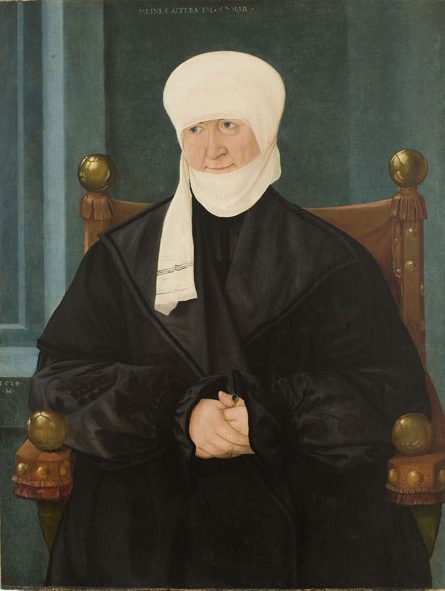
    Portrait of a Woman of 57 (1539), Hans Mielich. (MNAC, Barcelona). More information.

    Still, her case, she felt, was different. Her daughter had been long affianced — allianced, too, by a father who had given his life to the state — to a youth of noble lineage and owner of a large estate. As she arrived at this point in her statement Ernest interrupted her, saying:

    “And for that very reason, I am informed the grand duke said, he objected to our union; perhaps not in so many words, but such was doubtless his meaning. He regards the Barony of Deckendorf as already powerful enough. Let the earldom of Linden be combined therewith, as would be the case in my marriage with my darling, and Leopold thinks the lordship might, in time, over-shadow his own proud station.”

    “O! what a fool!” exclaimed Electa, impatiently. ”When Ernest and I would be to him two of the very best and truest of friends.”

    “That is what I shall try to make him understand, my own precious love,” said Ernest, as he moved back his chair from the table. There was further conversation on the all-important subject, but, as the result will be seen in the end, there is no need that we should follow it further.

    The question of companionship on the journey had been discussed, and the brave youth had decided that he would go unattended. He was not afraid of robbers, for he took with him nothing for them to steal. As for money, all he could want was in the hands of the baroness’s banker in Baden-Baden, and a simple cheque would command it. A companion of his own turn of mind and thought, one intelligent and educated, would have been pleasant; but none such was within call; so, after due consideration, he had resolved to go alone. Thus he could speed on his way as he pleased, and enjoy his own thoughts and fancies.

    The baroness had given her last words of direction and caution; both she and Electra had given him their blessing, and their parting kiss; after which he sent a servant to order his horse, while he went to his chamber to get his portmanteau and his pistols.

    The pistols, of the very latest pattern, procured of the manufacturer, at Heidelberg, less than a year ago, were the best weapons of their class to be found anywhere. The spring jaws for the flint, with the steel for the stroke directly over, and closing the pan, had been introduced; and the stock had been brought to a graceful, compact, and convenient form. In short, the pistols which our hero then handled were as nearly perfect as was possible with the flint lock.

    Those for the holsters were large and strong, carrying an ounce ball, the handles, or buts, being heavily bound with cast brass, to fit them for clubbing purposes in case of need. The smaller pistol, for the pocket, was highly ornamented. There were two barrels and two locks; the bores little more than half the diameter of the former; its sandalwood stock being richly bound and inlaid with silver and gold.

    As he took them up he instinctively opened the pans to see that the priming had not been accidently disturbed, and having found them intact, he put the smaller one into his pocket; took the others under his arm; then picked up his portmanteau and went out. In the passage he found a servant to whom he gave his key, bidding her to keep it until his return.

    As he passed through the lower hall he looked round for any friendly face that might appear; but no one did he see. He had not expected that Electra would come down; he had bidden her not to do so; but she might have sent word. None came, however, and he went his way out through the vestibule, down the broad steps, to the inner court, where he found his horse, and near by it standing Sir Pascal Dunwolf.

    For the moment his heart quickened its beatings, and his hands closed more tightly upon his luggage; but the knight gave him a smile, and offered his hand, which the youth took as soon as he had landed his portmanteau.

    “You have my letters?”

    “Yes Meinherr; and I will promptly deliver them.”

    “Thanks! I was not sure that my page had given them to you. The graceless rascal is such a liar that I know not when to believe him. But he is faithful, nevertheless, and serves me well, when it comes convenient for him to do so. I wish you a pleasant journey, Captain; and I beg you to forget our little passage of yesterday.”

    “It is already forgotten, Sir Pascal.”

    “Thanks again; and once more — success to you.” And with this the knight bowed, at the same time, raising his plumed cap, and then turned away.

    Ernest secured his portmanteau in its place, and put the pistols into the holsters; then vaulted to his saddle, and rode away. Not until he had crossed the draw-bridge, and began the descent of the deep ditch beyond, did he think of the last look he had seen upon the face of Sir Pascal Dunwolf. At that moment his thoughts chancing to turn back to his interview with the dark-browed knight, the look glared upon him. He saw it as though the face was there before him, and he could read its full diabolism. What did it mean? There had been malevolence in it, and such intense spite; but why should he have worn an expression of triumph? — for such it had surely been. Had he more promise from the grand duke than they had thought? Had he ground for the assurance that the youth’s mission would be fruitless? If not, whence his feeling of triumph? — for, the more he thought of it, the more deeply was he convinced that he had not been mistaken in his estimate of the knight’s look.

    “Bah! — I am a fool!” he told himself, after a deal of perplexing study. “The man is a natural braggart, and his look of triumph was a reflection of the wish of his heart. The grand duke will never enforce the marriage of Electra von Deckendorf with that monster! I will make him understand that he will find a safer friend in me than any man can find in Sir Pascal Dunwolf.” And he resolved that he would think no more about it.

    The sun was two hours high as Ernest crossed the stream in the valley, and shortly afterwards he began the ascent of the Schwarzwolf Mountain — or rather, of a spur thereof. It was a wild, rugged pass, but the path was clear, and he went on without difficulty, but rather slowly. At the summit of the spur the road lay through a dense growth of mountain fir — the black fir, whence the forest (wald) takes its name — and here, under the shadow of a precipitous cliff which arose on his left hand, he saw a large wolf sitting. His horse stopped suddenly and tried to turn, but the rider held him to his place; he could not hope to force him by the place, however, while the beast remained at his post; and he certainly exhibited no signs of moving out of the way.

    The captain knew that sometimes an old wolf, in his mountain fastness, would be very bold and fearless, though he did not believe the animal would attack him. He considered a few moments, and then drew one of the large pistols, meaning to give the beast a shot between the eyes, the mark being direct to his aim. At the cocking and aiming of the piece the wolf raised himself to an erect posture, but nothing more. With a sure aim our rider pulled the trigger. A flash of the powder in the pan followed, and that was all. He waited a few seconds, to make sure that the fire had hot held only temporarily, and then knew that his pistol had missed fire entirely — something he had never before known with those weapons. Never before a burning of the priming without communicating fire to the charge.

    The bright flash and the tiny wave of smoke that curled up from the pan caused the wolf to take himself off, but that mattered little to the owner of the pistol at that particular moment. He cared more to know what was the matter with his powder.

    As soon as he had made sure that the wolf had disappeared, he slipped from his saddle, and having thrown the rein over the broken stub of a stout branch, he gave his attention to his pistol. First, however, before going further, he thought he would try the other. He took it from its holster, cocked it, took aim at a small sapling fifteen to twenty yards away, and pulled the trigger. Whew! The result was as before. His next movement was to draw the double-barrelled weapon from his pocket, and try first one hammer, and then the other; and, as the reader doubtless imagines, with the same result.

    And now for the bottom facts. There must be mischief somewhere. Ernest sat down upon a stone by the wayside, and exposed the screw upon the tail of the rammer of one of the holster pistols, with which he easily drew forth the wadding of the first one he took in hand; but he quickly determined that it was not the wadding he had himself put there. It was a wad of paper, which he recognised to be a part of a leaf from one of the books that lay in his room. He went on, and drew forth another wad, but no bullet. Then another — and yet another — piece from the same book, until the barrel was empty and the vent-hole clear.

    The second holster pistol, and likewise both the barrels of the smaller pistol, were found to have been deprived of their proper charges of powder and ball, and filled with nothing but paper from his devoted book! He sat for a time and looked at the three pistols.

    And the light burst upon him. He now could translate the look he had seen upon Dunwolf’s dark visage. And he understood, also, the secret of the early visit of the hunchback page. And, of course, there was more to come, which would doubtless present itself in due time.

    Fortunately he had plenty of ammunition in his saddle-bags. He opened them, and proceeded to load his weapons with extra care. He measured the powder critically; saw that the communication with the priming was free; he fitted a tallowed patch about the bullet so that it should drive home snugly; and when the work was done, and the flints had been made sure of striking plenty of fire, he put the pistols back into their places of rest, and resumed his journey.

    At a short distance from where he had stopped he reached the brow of the spur, and looked down into the valley below. It was a vast concavity of the forest, black as night, with here and there a giant oak or pine towering above the levels of the firs, and anon a cliff of gray rock lifted its bare peak into sight. The path was lost to view not far away, but the traveller knew where it lay, and was well acquainted with its many windings and its numerous branches. It was the branching of diverging tracks that made the desolate portion of the Schwarzwald dangerous to strangers. Many a man has been lost in those endless, intricate wilds; the sun and stars shut out by the mountain mists: his instinct leading him onward — ever onward — in a fatal circle, which he pursues until fatigue and famine conquer, and he finally sinks, perhaps not an hour’s journey from the point of his departure!

    But Ernest von Linden knew every turn and every branch, and he pushed surely on. A few hours’ more would bring him to the town of Wolfach, beyond which the road was broad and mostly good.

    He had reached the foot of the mountain spur, and was striking into a broader and better path, when he distinctly heard the footfall of a horse other than his own, not far away on his left hand, and on looking in that direction, he detected an opening in the thick wood, which he soon discovered to be another path, joining that which he was following at a short distance ahead. He looked to it that the pistols were loose in their holsters, and a few moments later two horsemen appeared to view directly before him, and not more than a dozen yards away.

    As he drew rein and brought his horse to a halt, the two men turned and faced him, and he recognised at sight two of the stout men-at-arms of Sir Pascal Dunwolf’s troop. They had not taken the trouble to disguise themselves.

    “Ha, Captain! Is it really you? I’faith, you must have given Sir Pascal the slip. He declared in our hearing that you would not leave the castle. Do you journey to Baden-Baden?”

    “Such is my intention.”

    “Good! We shall have company. In these times, with Thorbrand’s infants running at will through the forest, it is just as well to travel in goodly company. But I am surprised that you should have come alone.”

    “I have traversed this section many times,” the young man returned, and have yet to encounter an enemy. Still, as you suggest, we know not when one may appear.”

    “That is even so; but against the three of us it would require a strong force to prevail.”

    While this coloquy had been going on our hero had been making a study of the two men before him, and he had been content to quietly answer them that he might gain the opportunity.

    They were men of powerful frames, with VILLAIN indelibly stamped upon both their faces. Those faces were coarse-featured and battered; heavy-lipped and low-browed; with as wicked a complement of eyes as ever looked from a human head. They wore the uniform of their troop, heavy swords hung at their sides, daggers in their girdles, and evidently pistols in their holsters.

    Ernest knew that they must have left the castle during the night, for he remembered distinctly having seen them at parade on the preceding evening. And if they had left the castle during the night, of course their chief had sent them; for they could not have passed the sentinels otherwise. And for what had they been sent? Ah! it remained for them — clumsy loons! to blunder out the truth.

    “Captain,” said the second man of the twain, with an exceedingly cunning look, “did the chief send any letters by you?”

    What did this mean? Why was the question asked? The youth determined to pursue the matter to a solution.

    “He did,” he answered, after only an instant’s hesitation.

    “Oho! Then you saw him. I s’pose he gave the letters to you with his own hands.”

    Ernest began to gain a glimmering of light.

    “No,” he said. “They were given to me by another.”

    “I wouldn’t have believed it. Generally he doesn’t trust his letters in the hands of his underlings. I s’pose he sent ’em by Lieutenant Franz?”

    “No.”

    “Eh? Who could it have been?”

    “They were brought by a humpbacked dwarf, who brought them to me in my chamber before I had completed my toilet.”

    “Well, is it possible? What d’you think of that, Roger?”

    The man thus appealed to declared, most soberly, that he wouldn’t have believed it.

    The rascals had now learned all they could hope to discover by questioning. They believed that the captain’s pistols were innocent of powder and ball; and he knew that they so believed. Further, he knew that Sir Pascal had sent them out to intercept — to waylay — him, and that he had promised them that their victim’s weapons should be rendered harmless.

    At this point Ernest gathered in his slack rein and sat erect.

    “Look, you, sirrah!” to the man who had first addressed him. “If I heard
    correctly, your name is Roger. Now, sir” — to the other — “by what name may I call you?”

    “My name is Otto, sir,” the fellow replied without hesitation

    “Will you now tell me whither you are bound?”

    “Why,” answered Roger, “we are going right along with you.”

    “To Baden-Baden?”

    “Certainly.”

    “For what purpose?”

    “Why — bless you — the governor sent us, of course.”

    “Aye, but upon what business? He did not send you without a purpose.”

    “No, certainly not. He sent us — Eh, Otto?”

    “Why — he sent us,” said Otto, “to hunt up the trail of the robbers; and that was why we started off on that side path.”

    “And now,” suggested Ernest, “you will look for them in Baden-Baden?”

    “Yes; if we take a notion so to do. We are acting on our own judgment, and we’ll have you to know that we are not responsible to you.”

    “Certainly not. I should be exceedingly sorry if you were. And now, Roger and Otto, you will turn your horses’ heads to the front, and ride on. I propose to ride in the rear.”

    At that moment the assassins were evidently not prepared to act in concert; so without hesitation, save for the simple exchanging of a glance, they turned, as they had been ordered, and rode on. For a little time they sped on at a gallop, gaining a considerable distance in advance. At length they came to an open glade through which ran a brooklet of clear, sparkling water, where they reined up and allowed their horses to drink. Their heads were close together in earnest consultation, and our hero saw one of them point over his shoulder towards himself, at the same time laying the other hand upon the hilt of his sword.

    Evidently the time of trial was at hand; but the brave youth did not shrink, nor did he fear. He felt that he had the advantage, and with a watchful, wary eye upon their every movement, he rode slowly on.


    Notes and Reference

    • barony: a baron’s domain.
    • Schwarzwolf Mountain: fictional.
    • fastness: stronghold; fortified place.
    • rammer: in a muzzle-loaded firearm, an attachment to help load the bullet.
    • tallowed: v.t. constructed from n. “tallow”: solid oil or fat of ruminant animals (Encyc. Brit. qtd. Century Dictionary).
    • anon: soon.

    Handwerk, Brian. “Will We Ever Know Why Nazi Leader Rudolf Hess Flew to Scotland in the Middle of World War II?Smithsonian Magazine (May 2016).

    Creative Commons License
    This work is licensed under a Creative Commons Attribution-ShareAlike 4.0 International License.

  • Cobb’s False Knight: 1. The Castle and the Cot — An Alarm

    Cobb’s False Knight: 1. The Castle and the Cot — An Alarm


    THE FALSE KNIGHT

    or

    ROBBER OF THE BLACK FOREST

    A Story of Love, Mystery, and Adventure

    by

    SYLVANUS COBB, JR.


    Foreword

    The images the word “knight” conjures up might all be similar for most of us: Shining armour, bravery, jousting, glorious, bloody battles, castles, saving distressed damsels even perhaps. But isn’t it a strange word? In French, it’s “Chevalier”. A man on a horse. In Spanish, “Caballero”, a man on a horse. In German, it’s “Ritter“, derived from “Reiter”, which means “Rider”.

    So where does that rather odd and unhorsely word “Knight” come from? Not from “neigh”, although many a knight’s steed may at the thought. These days, it’s pronounced with a softer beginning, simply the letter “n” with a totally silent “k”.

    Centuries ago however, English people spoke the same word with a hard “kn”. Worse still, they made a retching sort of noise at the end. “Knicht” perhaps. That’s because the word knight wasn’t English. They had, for whatever strange reason, magpied the term from Dutch and German, from “Knecht”, despite the English having had a lot of trouble reproducing that strange retching German and Dutch “ch”.

    Knicht? It sounds more like an insult than title. A word that doesn’t conjure up images of bravery, jousting or shining armour at all. That’s because a Knecht was a mere “boy”, a youth, in the sense of “servant”. A lowly squire in the knightly sense rather than a brave warrior? A lackey? For whatever reason, the English seemed to love the strange and incorrect expression so much that they kept it as their own.

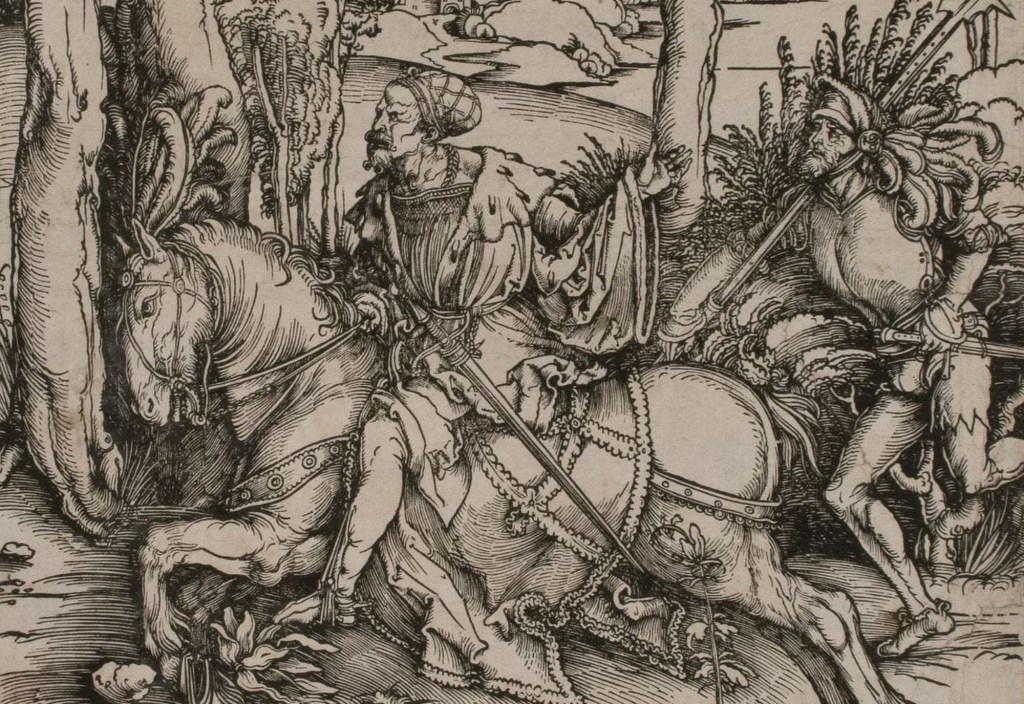
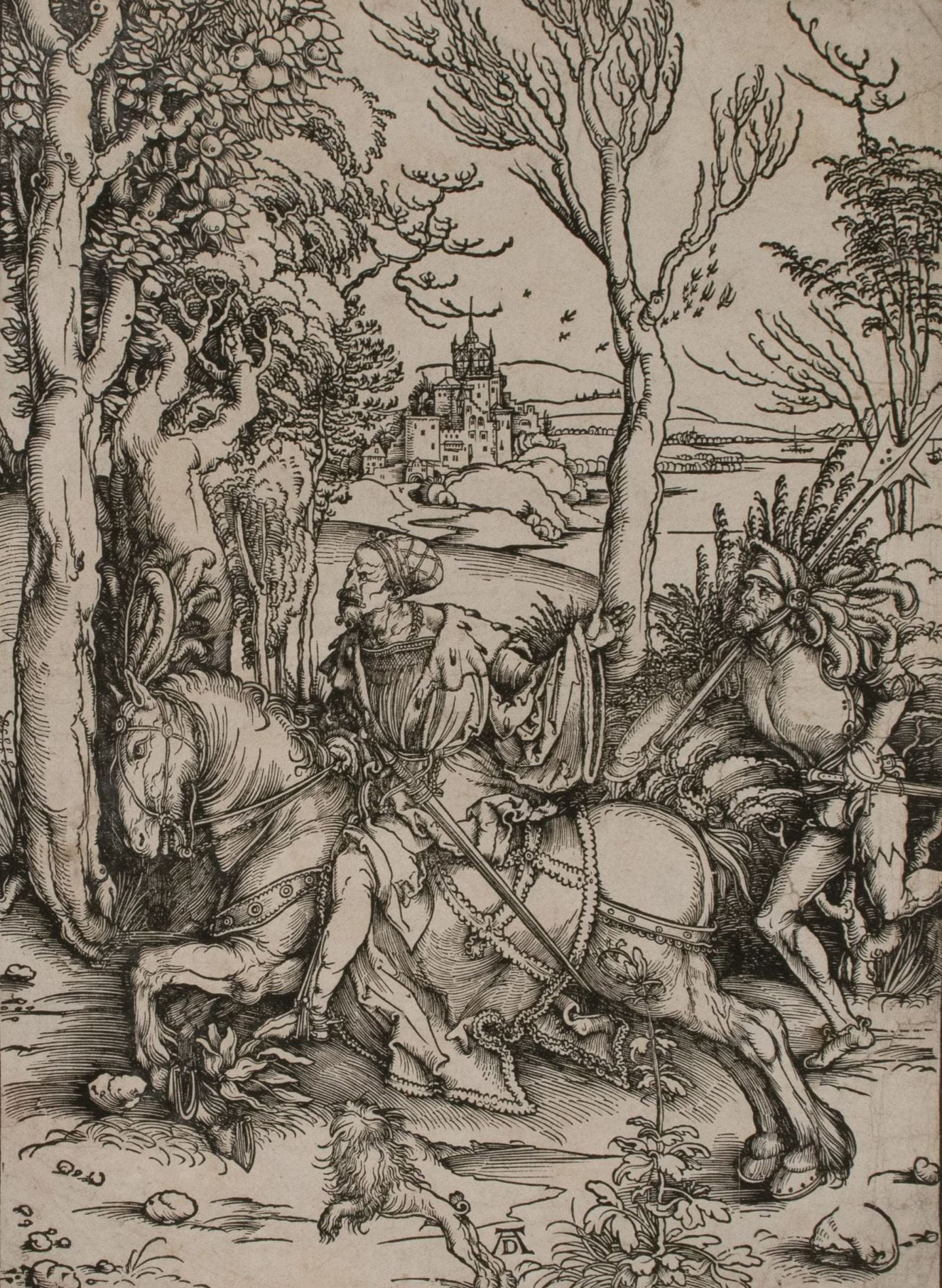
    Albrecht Duerer, Ritter und Landsknecht — the difference to a simple “Knecht” being that a “Landsknecht” was an armed footsoldier. Both far lower in rank however than a knight.

    From around 900 years ago, this anglicised word, in the older pronunciation, described a military follower of a king or duke. Who, similarly to a Caballero, Chevalier or Ritter, used to ride around on a horse, doing his “serving” in that sense. Of course Dutch, French or German knights also usually served kings or dukes, etc., yet the words for “knight” in those languages emphasise the connection to horses, and not to any servile duty to a “superior”.

    Is this why we saw the phenomenon of “Raubritter”, “Robber knights“, more in Germany and at least not linguistically, in England? In England, they call them “robber barons” and not “robber knights”. Perhaps the knights in England were less evil? Not so the Barons apparently.

    Were there any robber knights in the Black Forest? The very name of this area might suggest a darker side, with one famous castle ruin located right in the “Hoellental”, “Hell’s Valley”. Although many robber knights had castles along the Rhine, where they extorted payments from travellers, there are Swabian folk tales about “Hans von Wieladingen”, from the southern end of the Black Forest, who used to lure merchants to his castle by playing his violin, only to throw them in his dungeon, pending the payment of ransoms.

    Knights in the middle ages naturally had something feudal about them, but often more in the sense of “feud”. When they had disagreements with neighbouring “strong men”, this resulted in them attacking and burning down the villages and even destroying the castle of the enemy. Perhaps it’s little wonder, especially after the Thirty Years War, that only ruins of castles in the Black Forest remain…

    A “False Knight”. Is that a double negative then, even after nine hundred years of anglicising the humble “k-nicht” with the retching ending? Hans von Wieladingen may have been a robber, but he really was a knight, title, castle and all. Is there any evidence of there ever having been a real false knight? 

    Back in the year 1284, a humble German peasant decided that it would be a good idea to pretend to be Kaiser Frederick II. The problem was that the real Kaiser had already died in 1250. But he was sorely missed in the decades that became known as the “Kaierlose, die schreckliche Zeit”, the “Kaiserless, the terrible times” because of the political chaos of the interregnum. So Tile Kolup, Dietrich Woodenshoe’s other name, turned up thirty four years later in the city of Cologne claiming to be the dear old Kaiser.

    Whereupon the locals tossed him into a cesspit and dunked him in the Rhine. Undaunted, a perhaps rather smelly Kolup proceeded to the town of Neuss, several miles downstream, where, after he had cleaned himself up, his reception was so much more positive that he used a fake royal seal on documents. He made money by selling fake royal privileges, sealed with wax with his trusty fake seal.

    But what has this got to do with any “false knight”? The following image, from the year 1474, depicts a scene from Tile Kolup’s story in the “Chronicle of the Ninety Five Rulers“, a manuscript kept in the Austrian National Library.

    Clemens Specker, 1479, illustration of the story of Tile Kolup, depicting the “Three Chancellors Paying an Innkeeper”, from the “Chronicle of the Ninety-Five Rulers”, Austrian National Library.

    The text tells us that it shows the fake Kaiser’s three fake “Chancellors” paying an innkeeper in the town of Wetzlar. A chancellor used to be a person who ran a royal household. Usually a knight. The third fake “Chancellor” is even depicted on horseback. He and his co-conspirator “Chancellors” were apparently “moors”.

    Sadly, King Rudolf of Habsburg had Tile Kolup captured and burned at the stake in Wetzlar in 1285. It is only fake news that the exquisite German dish “Kaiserbraten” (“Emperor’s Fry) was so named in honour of this incident. There are no references to the fate of the fake knights, so maybe they managed to get away…

    This story may not quite sound as unlikely as, for example, a resurrected President Kennedy coming back to save America in the year 1997. After all, there were no photos or films back then and because of average mortality, hardly anyone alive in 1284 would ever have laid eyes on good old Kaiser Frederick II.

    The only drawings of him are in old manuscripts only seen by a privileged few. The very most that people would have known was that the dearly departed Kaiser had a big red beard, hence his Italian name Barbarossa. Surprisingly, the only know image of Tile Kolup, his impostor, depicts the wannabe Kaiser without as much as a moustache….


    CHAPTER ONE

    THE CASTLE AND THE COT — AN ALARM

    By far the larger portion of the Grand Duchy of Baden, together with a large part of the territory of Wurtemberg, is covered by that wild and darksome, yet romantic picturesque mountainous region known as the Black Forest (German. Schwarzwald). Near the centre of this forest, on the eastern confine of that district of Baden called the Middle Rhine, nestled away in one of the wildest and most romantic of the Schwarzwald vales, was the small town or hamlet of Deckendorf, taking its name from a strong castle that reared its massive walls and embattled towers upon a rocky eminence close at hand.

    At the time of which we write — during the first half of the seventeenth century — Deckendorf Castle was under the immediate command of a veteran, war-worn knight, Sir Arthur von Morin; but he was not its feudal lord. Ten years previous to the opening of our story, the Baron Gregory von Deckendorf, lord of the domain — then in the early prime of his manhood — in the fullness of his Christian zeal, accompanied John Sigismund in his crusade against the infidel Turks, and in battle with the Moslem he fell, leaving a wife and daughter to mourn his loss.

    On the eve of his departure upon the fatal crusade, the baron had placed his castle and his family under the care of his wife’s uncle, the veteran knight aforesaid, giving him full power, and receiving in return the oath of fealty to himself, and good faith to the baroness and her daughter. And most  loyally had .Sir Arthur kept his oath and his faith. The bereaved ones had come to lean upon him as upon a lord and master, and to love and revere him as a father.

    One of the most beautifully romantic spots in this beautiful and romantic region of which we write, was a small plateau — an elevated bit of table land — on a mountain side, directly opposite to the castle. Imagine twin mountains — one to the east, the other to the west, and between them a crystal stream, leaping from rock to rock in silvery cascades, soon thereafter settling into a sober, placid river, on the fertile intervales of which clustered the dwellings, the shops, the quaint old mill, and the still quainter old church of Deckendorf. On the side of the easterly mountain, not far from its foot, stood Deckendorf Castle; opposite, on the side of the mountain to the westward, and at about the same elevation, was the plateau of which we have spoken, whereon stood the cot of Martin Oberwarld, one of the most accomplished and intrepid of the trained hunters of the Schwarzwald.

    View on the Middle Rhine (1770). Herman Saftleven. Museum Boijmans Van Beuningen.

    The cot covered a broad area; its walls were of gray stone: its small gothic windows, looking not unlike the eyes of some shaggy-headed monster, set so deep in the thick masonry, were artistically glazed; while the widely-spreading roof, steeply sloping — its eaves overhanging so as to afford protection to doors and windows against ordinary storms — was a thatch of fine mountain reeds, made impervious by a liberal application of the balsam of the black fir. A scene it was, take it all in all, that would have happily fixed the gaze of the painter, and made his heart glad.

    Towards the close of a pleasant day of early summer, two girls sat just outside the open doorway of the hunter’s cot. They were very nearly of the same age, one of them having seen eighteen years, the other nineteen, and they were both beautiful, gifted with that beauty of heart and soul of truth and faith — that beauty of loveliness which appeals to the better and nobler instincts, elevating and purifying the love it awakens. They were healthful and vigorous, with forms of sylph-like grace and comeliness; fond of outdoor life and exercise, their forest roaming and mountain climbing having given them unusual strength of limb and powers of endurance.

    The elder of the twain was Electra von Deckendorf, heiress of the grim old castle over the way, and of the greater part of the town and territory in the neighboring valley. She was slightly taller than her companion; her hair was of a dark glossy brown, gathered away from her brow and temples into a heavy braid, which, secured by a bit of silvery ribbon, was suffered to float over her back as it would. Her eyes were of a dark pearly gray, full of mellow, liquid light, with truth and affection in every friendly glance. The younger maiden was Irene Oberwald, daughter of the owner of the cot. She was a laughter-loving, sparkling girl, looking for brightness and goodness wherever they might be found, and never happier than when she could give of her happiness to others. She had a wealth of golden curls, floating over her shoulder in wild but lovely profusion; her eyes, of heaven’s own blue, were large, full and brilliant, rippling with smiles when she was happy, or overflowing with tears when sympathy touched the fount of her tender emotions. Of her it might be truly said: “She was a thing of beauty, and a joy forever.” Electra came to her for comfort always when clouds overhung her path; and to the poor and the suffering of the village of the valley she was an angel of light and goodness. But in this latter respect — in benefactions upon the villagers — be sure Electra bore her part. Little could Irene have done in the way of bestowing creature comforts without the aid of her dear sister of the castle.

    Nothing of raiment, on the present occasion, wore the heiress of Deckendorf to distinguish her from the humble daughter of the poor hunter. Tunics, or short jackets, of velvet — blue for Electra, and crimson for Irene — tastefully embroidered with thread and lace of gold; shirts of fine linen stuff, worn short, so as not to interfere with their mountain climbing; stockings of finely knit silk, with strong leather boots, gave protection to their feet, while for head-covering twin hats of finest Italian straw, fashioned for comfort, but with a true eye to comeliness, lay upon a rough stone bench at their side.

    Such were the principal items of the garb of these two girls, and to be sure nothing more was required nor could anything more have been brought into play to set forth in the rich fullness of perfection their matchless grace and beauty, both of form and feature.

    At Electra’s feet lay a magnificent stag-hound, her constant friend and companion in her forest rambles. He was large and powerful, with a face full of affection and intelligence, and his gentle mistress felt as safe in his companionship as though guarded by a squadron of troopers in full panoply of war.

    On the present occasion, as we thus introduce the two girls and the canine friend and companion, the heiress had just arrived from the castle; and Irene’s first question, after the first impulsive greetings had been exchanged, was of one whom she had hoped to see, but who had not made his appearance.

    “Why didn’t he come?” she asked, with a hand laid affectionately upon her companion’s arm. “I could not have believed you would have come without him.”

    “Ah,” murmured the heiress, with a mournful shake of the head, “my own thoughts and my noble Fritz were all the companionship I wanted. Dear old Fritz!” she cried, throwing her arms round the neck of the dog, who had lifted his muzzle to her knee with a loving light in his brown eyes on hearing his name thus called; “if all could love me with your true heart! Ah!”

    “Electra! What is it! Why do you speak in that manner? Surely, Ernest is not —”

    “Ernest!” broke in the baron’s daughter, quickly and eagerly. “Oh! he is brave and loyal — as true as truth itself. No, no: do you never, never think an evil thing of Ernest. Poor Ernest! He is wandering away somewhere by himself, I have no doubt, dwelling upon his unhappiness, as I have been doing.”

    “Dear sister,” cried Irene, with sympathetic alarm, “you frighten me. — O!” — her memory coming to her aid — “is it something about that dark Sir Pascal?”

    “Yes, Irene — alas! yes.”

    “Electra,” reaching her hand coaxingly to her friend’s shoulders, “I wish you would tell me the story. You have often spoken of Sir Pascal Dunwolf as one of whom you feared. You are not afraid to trust me?”

    “No no, dear sister mine. 0! when I shall have known the fear of trusting you this life will have become bare and barren indeed! — Irene” — after a brief pause — “I will tell you the whole story from beginning to end; and who shall say how much you may be able to help me.”

    “One thing you know, Electra, I will help you if I can.”

    “Yes, my sister, I know it well; and you may be sure I shall not hesitate to ask you for help if I think you are able to give it. Listen, now, and you shall know all about it.”

    After a little thought the baron’s daughter spoke, tremulously at first, as follows:

    “Between Ernest von Linden and myself, though I have always called him, as he has me, cousin, there is no relationship of blood at all. His mother was Uncle Arthur’s youngest sister; and Sir Arthur, you know, is my mother’s uncle by having married with her mother’s sister. Still, both my father and mother loved Ernest from the first as though he had been of their own flesh and blood, and it was always papa’s wish that he should be my husband. He was an only child, left fatherless and motherless when only six years of age, when Sir Arthur took him, and very shortly afterwards, on the death of his wife, placed him where he has since had a home — with us. The estate of Lindenberg is very valuable, and is not only entirely unencumbered, but Uncle Arthur has so managed the property during the twenty years almost of his stewardship that it has fully doubled in value. Knowing that Ernest’s worldly prosperity was assured, my father only asked that he should grow up to be a true and loyal man to claim my hand, always understanding that I should be willing, and that Ernest should truly love and desire me.

    “You know, Irene, how we have loved. It has been a calm, quiet love, but deep, strong, and abiding. Really, we never knew how all-absorbing and powerful our love had become until the bolt came that threatens to smite it.”

    “Electra!”

    “Hush! Do not interrupt me. I will explain. Just before my father went away on that dreadful crusade — O, I cannot bear to think of it! I shall never become reconciled — never! It was ten years ago this very month that he left us — O, so proud and brave, his heart given to the cause of his Lord and Master, Jesus Christ, as he religiously believed. Just before he went away, he spoke with Ernest and myself together. He told us that the Baroness and Sir Arthur both knew his wishes, and it was right that we should know. Never mind the injunctions which he laid upon us; the principal thing was this: Should anything happen to prevent his return to us — should he fall upon the field of battle — it was his desire that we should be married when I should have reached the age of nineteen. He set it first at twenty, but both Ernest and my mother entreated him to cut off a single year: and he did so.

    “Of his death you know. He fell at Novi, in Croatia, struck down by a turbaned Turk at the very end of the battle. He would not flee when the others did. I have been told that Sigismund had ordered a retreat a long time before my father would listen to such a thing; and it was while endeavouring to cut his way out from the midst of the Moslem host that he received his death-blow.”

    At this point the stag-hound lifted his head upon the knee of his mistress, his eloquent eyes looking the sympathy he could not speak. Upon his neck she wept a time in silence, and then resumed her story.

    “In that darksome, mournful time, what should we have done without Ernest? He was our comfort and our joy. Uncle Arthur, with his heart in the war, himself battle-worn and scarred, felt only pride in what he called the baron’s noble sacrifice. Yet, he was sympathetic and kind; but not with the sympathy and the kindness of Ernest. Well, the years passed: Ernest was away much of the time at school, in Heidelberg; and, of late, since Sir Arthur has been so feeble, he has been obliged to be much of the time on his estate, it having come into his full possession three years ago. He has been with us, however, when he could; my mother has regarded him as her son, while I, with my heart given wholly to him, have simply looked upon him as my husband — so in spirit, awaiting only the few; short months that must pass before it can be so indeed.

    “And now comes the storm that threatens to shatter our fabric of bliss and blast our every hope. Ah, how gladly would I exchange places with the lowest peasant girl of Baden! See what it is to be heiress of Deckendorf Castle. By the law of the land I have been, ever since the death of my father, a ward of the reigning grand duke. It has only remained for him to claim his right for me to submit to his authority. It is known at Baden-Baden that Sir Arthur has been stricken with paralysis, and that his days are numbered. Deckendorf Castle, commanding as it does one of the chief passes of the Schwarzwald, between Baden and Wurtemberg, is of so great importance to the State that the grand duke feels that he must have it under his own control, to which end he would place one of his own paladins in full possession, which possession can be gained only by marrying me. Now, do you not understand?”

    “Mercy!” cried the hunter’s daughter, with a frightened look. “Is Sir Pascal Dunwolf the man whom the grand duke would make master of Deckendorf Castle?”

    “Verily, he is the man.”

    “And he would have you become that man’s wife.”

    “So he has said.”‘

    “But, surely, Leopold has a heart. He is himself young, is he not?”

    “I think he is. It is only two years since he succeeded his father on the ducal throne.”

    “What reason does he give? He would not do such a thing without some good and sufficient reason.”

    “His reason, as Sir Arthur has explained it to me, is that there is treason in this section of the Schwarzwald. Some of the powerful barons of Wurtemberg have entered into a league, the object of which is the conquest of a large portion of the district of the Middle Rhine; and it is strongly suspected that a number of the barons of this very district, are ready to join with the enemy as soon as the opportunity is offered. In order to make such a movement a success, the possession of Deckendorf Castle would be indispensable. Thus you can understand why the grand duke should wish to place one of his chief officers in our old fortress.”

    ”Let him place as many officers in your castle as he likes. Do you give to them the room, and betake yourself to this dear old cot. You will never listen to such an outrageous thing. Tell me that you will not.”

    “Ah! my dear sister,”‘ said the heiress, with a lugubrious shake of the head, “it is one of the penalties of rank from which I cannot escape. Although the grand duke has power to give my hand in marriage to whom he will, he cannot make another lord of Deckendorf except my hand goes with the title. He cannot rob me of my heritage.”

    “But he can do what is ten thousand, times worse!” cried the hunter’s daughter, with wrathful emphasis. “He can rob you of your life’s life — of hope and joy — for all time to come!”

    “Alas! yes.”

    “But you will not suffer it. You must not. Why does not Ernest go himself to the ducal court and plead his cause — his cause and yours? As I live, I believe Leopold would listen to him.”

    Still Electra shook her head. “I fear it would be of no use,” she said. “Ernest saw the prince when he was last at Baden-Baden, having been commissioned by my mother to strongly oppose the marriage by him contemplated. Ernest spoke eloquently, as we know he must have done, telling the story of our early betrothal, and of our deep and unwavering love. Leopold listened patiently, and even kindly, but he would not give up his cherished plan. He said the safety of the State must take precedence of everything else. He was sorry to be obliged to make unhappiness for even the very lowest of his subjects; but when the weal of the nation was in the balance the romantic love of a single pair could not be considered. He then told Ernest, to wait. He said he should very soon send Sir Pascal to Deckendorf and he was sure we should like him.”

    “And do you mean to tamely submit? Will you give up your love of a lifetime without an effort?”

    “No! no!’ cried Electra, starting to her feet, with her hands upraised — “not without an effort! O, no! I shall struggle be sure. If Sir Pascal comes, thinking to find in the heiress of Deckendorf a willing victim, he will find instead, I fear, a vixen. I will show him what an injured, indignant maiden can do towards defending herself. If he will take me for his wife as I shall appear to him, he must be something different from the majority of men. No! no, Irene! I shall not surrender without an effort!”

    “Good! Good!” exclaimed the maiden of the cot, with enthusiasm. “You will have time for thought. Of course Sir Arthur will help you all he can.”

    “Yes bless his dear old heart! He will do all that he is able to do: but that, I fear, will not be much. He is very weak, and his mental powers are not what they were. Alas! poor uncle is terribly shattered. Ha! What was that?”

    The girls were at that moment startled by what sounded like a painful moan, or cry of some one in distress. The dog at the same time came to his feet, gave a single sniff in the direction of the point whence the sound had come, and then bounded away.

    “Ah there it. is again!” said Irene, as a low wail of distress was plainly borne to their ears.

    Before Electra could answer the stag-hound came bounding back in quest of help. He stopped before his mistress, gave her a look which she plainly understood, and then turned to lead the way as he desired her to follow.

    “Fritz has found something for us to do,” Electra said, as the dog looked back with an entreating whine. “Let us follow him and see what it is.”

    “Do you feel it safe to do so?”

    “Yes. Fritz would not ask me to go where there was danger — be sure of that. Hark! It is a man in dire distress. Come! Who can tell what the need may be?”

    Irene hesitated no more. “Go on!” Electra said to the dog; and with a glad cry he set forth. They followed him across the open space beside the cot, and into the dark wood of mountain firs beyond followed, both of them, to their fate. What was to come to them of that forest search not the wildest fancy could have pictured to their imagination.


    Notes

    • cot: cottage/hut
    • “a thing of beauty, and a joy forever”: “A thing of beauty is a joy forever,” John Keats, “Endymion”.

    This work CC BY-SA 4.0

  • Cobb’s The False Knight

    Cobb’s The False Knight

    Give me them good ol’ days of guns, of snakes, an’ gapin’ jaws
    Of wolves an’ ragin’ catamounts, with blood upon their paws;
    W’en six-foot heroes courted girls that they had snatched away
    From out a bloody bandit’s clasp, an’ tramped him into clay.

    I wish we had some writers now who understand the job,
    Some writers who can sling themselves like ol’ Sylvanus Cobb!

    Sam Walter Foss, “Uncle Seth on the Modern Novel”

    Outstanding popular novelist of nineteenth century America, Sylvanus Cobb Jr (1823-87) was famous for contributions to the New York Ledger. From 1856 until his death in 1887 the Ledger published his short stories and serialised novels, adding up to 89,544 pages of manuscript. During his whole career he produced 120 novels, over 800 short stories, and over 90,000 manuscript pages of short pieces for weeklies.

    Sylvanus Cobb Jr.
    Sylvanus Cobb Jr.

    Cobb was a scrupulous researcher, and three years’ experience as a seafarer in the United States Navy provided him with plenty of material. But in addition to his own name, he found it advantageous to employ several pseudonyms. Under “Colonel Walter B. Dunlap,” he cultivated notoriety as an adventurer and expert on the East.

    “Colonel Dunlap,” wrote his publisher:

    has travelled through Asia and Africa, and has had considerable experience in fighting elephants, lions, tigers, boa constrictors, cannibals and other tough customers …

    At the same time that Cobb’s own novels were appearing in the Ledger, so did seventy-two of the Colonel’s “Forest Adventures” and several “Sketches of Adventure.” His publisher spruiked one of the Colonel’s serialised novels, Lorinda the Princess; or, The Sultana’s Diadem as

    a new story of Eastern life, with which Colonel Dunlap is so familiar. He has travelled a great deal, and, judging from his thrilling sketches in the Ledger, he has had more adventures than almost any other living man.

    The Colonel grew into such a vivid figure that the Ledger received countless inquiries about him, and one man claimed to have met him out West.

    Cobb’s brilliant writing reached Australian shores in the 1880s. The False Knight appeared serialized far and wide, creating a sensation from the Nepean, through Horsham, to out beyond the black stump. It is to this medieval story of love, mystery, and adventure set in the Black Forest of Germany that we now turn in our quest for gems of penny and dime novels that would otherwise remain buried. The serial begins next week.

    Context and commentary by Oliver Raven will accompany each instalment. An acute observer and entertaining writer, Oliver is expert in German history, culture and language, and has trodden among some of the very scenes and castles where the adventure takes place.

    Perhaps he will be able to keep Cobb honest. I doubt it.

  • J.F. Smith’s Mystery of the Marsh — Sixteenth Instalment

    J.F. Smith’s Mystery of the Marsh — Sixteenth Instalment

    Prior to the two Australian newspaper series we’re using to reconstruct The Mystery of the Marsh, the novel appeared serialized in the New York Ledger during the period December 1882 — March 1883. You may recall that Smith moved from Europe to the United States in 1870, residing there until his death in 1890. According to Montague Summers, the author of A Gothic Bibliography (1941; 1964), by that time Smith’s fortune was ‘wasted’, owing to his ‘too ample charities and generosity’, and he died ‘in obscurity, if not indeed in actual want.’

    During that period, Smith wrote original stories for the New York Ledger, a so-called ‘six-cent weekly’ offering diverse family entertainment, but catering mostly for a female readership, with an emphasis on romantic fiction (‘Dime Novels and Penny Dreadfuls’; Stanford U).

    In considering provenance, as tempting as it is to suggest that Mystery of the Marsh was first published in the New York Ledger, Summers cautions that in America Smith ‘republished many of his old tales and wrote some new romances the titles of which it is baffling to trace.’ The problem is exacerbated by the fact that many stories published in London were given no explicit byline, but rather advertised as ‘By the author of such-and-such.’ It would seem a fool’s errand to go wading through a morass of digitized newspapers in search of a serialized text whose author was unstated and title unsure.

    The copy referenced in the New York Ledger is itself  hard to access. Earhart and Jewell explain how

    While the works of major writers and periodicals are being digitized, there is limited funding for others. For example, scholars have no electronic or even microfilm access to the New York Ledger, the newspaper where Fanny Fern, among the most famous women writers in the nineteenth century, published her weekly columns from 1856 to 1872.

    The American Literature Scholar in the Digital Age, (U of Michigan P, 2011)

    There is little if any doubt, however, that the work is Smith’s own, given its style, catalogue attributions, and details of reference, some of which I’ve mentioned in previous notes. It seems to me that, in one sense, while we cannot know exactly when the work first appeared, such a limitation adds a certain interest to the work, being a function of the channels and technologies of the text’s transmission.

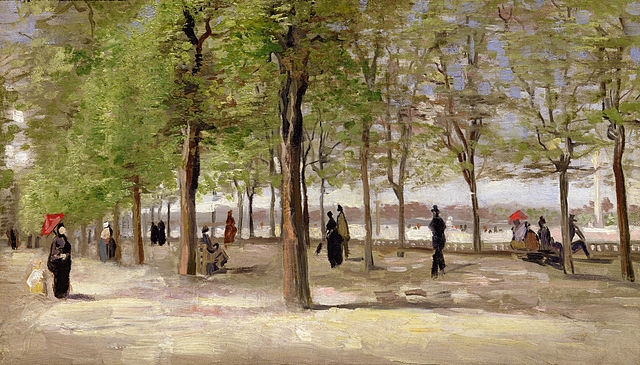
    More on technicalities in a later post. For the time being, let us leave them behind and turn to the pleasure of the text. In this week’s chapter, the Paris duel and its aftermath; and some dubious characters find themselves ensnared. This instalment’s featured image shows a daytime view of one of the ‘alleys’ of the Luxembourg where the duel is fought.


    CHAPTER SIXTEEN

    Result of the Duel — The Victor and his Friends Make Good their Retreat to London — Lord Bury Once More in the Country — Plot and Counterplot

    On reaching the alley of the Luxembourg — the one skirted by the dead wall in which Marshal Ney was shot for his fidelity to the first Napoleon, and truth compels us to add, undoubted treason to Louis the Eighteenth — the late revellers, their eyes still sparkling under the influence of the wine cup, advanced with a confident if not cheerful air, followed by the three Englishman, whose demeanor appeared far more serious.

    Allée au jardin du Luxembourg, Vincent van Gogh, 1886

    At a distance, but out of sight, Monsieur Vezin, with several agents of police, were on their track. The clever detective had received not only his reward, but instructions. If Lord Bury fell, he was to take no steps against the liberty of his antagonist. If Clarence succumbed, he was not to use the information he had obtained or arrest him. The only circumstances under which the last step would be taken — his refusal to fight — did not seem likely to occur; he was already on the ground.

    Although little more than boys in years, the students were men of the world as far as the punctilios of the duel are concerned. They had secured the services of a surgeon on their way to the Luxembourg, measured the ground with mathematical exactness, and placed the pistol in the hands of their principal.

    It had been agreed that the combatants should fire together.

    The fall of the handkerchief was followed by the instantaneous discharge of the weapons. Lord Bury still stood erect, although the ball of Clarence had slightly grazed his temple. Marsham lay senseless on the ground, bleeding from a severe wound in his throat.

    The surgeon approached, looked in his face, and shook his head gravely. Despite the semi-Bohemian life he led, he was a man of honor. Turning to the English group, he said:

    ‘You had better retire, gentlemen, and provide for your safety. The result threatens to be serious, and the government of the day sets its face against duelling.’

    Captain Seymour had taken the precaution of keeping the carriage waiting at the gate of the Luxembourg. In less than an hour Bury and his friends had quitted Paris and were on their way to the nearest frontier town in Belgium.

    Monsieur Vezin took care they were not too closely followed.

    Meanwhile Marsham had been taken back to his hotel, and further surgical assistance sent for.

    * * *

    Tact is one of those qualities which some men are born with; few things are more difficult to acquire. Experience can only partially supply its absence. It lacks the smoothness, the ready spontaneity of the former; then it sometimes blunders, which tact carefully avoids.

    ‘Here, you girls,’ exclaimed Sir George Meredith, handing the “Morning Post” — the fashionable journal of the day — to his daughter as they sat at luncheon, ‘see if you can solve this riddle. I can make nothing of it.’

    Clara addressed herself to the paragraph in the “Morning Post,” and had not proceeded far before a deadly paleness overspread her countenance, and she fell, half-fainting, from her chair.

    With the assistance of Lady Kate and Rose Neville, who were staying at the Hall, the housekeeper and female servants conveyed the deeply agitated girl to her own room. A groom was dispatched to the nearest physician by her half distracted parent, who at intervals stood puzzling his brains as to the cause of the sudden attack. Slowly the perception dawned upon his mind that something in the “Post” had occasioned it

    Snatching up the paper, he perused the paragraph a second time. For the benefit of our readers we shall transcribe it :

    ‘Paris. — Duel in High Life. — On the l8th instant a hostile meeting took place in the garden of the Luxembourg, between Captain Lord B—, of the Guards, and Lieutenant M—-, whose late retirement from the service caused considerable comment in fashionable circles. Both the combatants wore wounded; his lordship in the temple; his antagonist far more seriously in the throat. His life, we hear, is despaired of.’

    What renders the affair still more distressing is the fact of the father of Lord B— being married to the mother of the gentleman whose life is despaired of.

    ‘B stands for Bury,’ muttered the baronet, after reading the paragraph a second and third time. ‘He would never be such a fool as to call Marsham to account, and yet M— designates the rascal clearly enough.’

    ‘But why should Clara faint on reading the news?’ he added.

    Glancing his eyes once more over the journal, he detected a paragraph which had escaped his attention:

    ‘Lord Bury, we are happy to hear, has arrived safely from Paris, and is now staying with his regiment at Knightsbridge.’

    And a little lower down he read:

    ‘Viscount and Viscountess Allworth left town last night for the continent. The state of Mr. M— is considered hopeless.’

    ‘Served the rascal right, if it is really the man I suspect,’ said Sir George, by way of comment. ‘But I have no time to think of him. My mind is occupied with Clara. What could her fainting mean?’

    The speaker paced the apartment for several minutes. A smile at last appeared upon his honest countenance.’ An idea had struck him — one that, we shrewdly suspect, has already occurred to our readers.

    ‘If it should be so,’ he muttered, ‘I have a great mind to write and remind him of his promised visit. But first for the “Morning Post.”‘

    Carefully marking the two last bits of gossip, he directed the housekeeper to convey the paper to Lady Kate Kepple.

    ‘A clever girl that,’ he thought. ‘She will know what I mean. Girls understand each other.’

    Two hours elapsed before his niece made her appearance. She entered the room with a smiling face that boded favourable intelligence of the patient.

    ‘Clara is much better!’ she exclaimed. ‘Quite recovered from her fainting fit. The heat of the weather. Nothing serious.’

    ‘No doubt’ of it,’ replied the baronet. ‘I felt it myself. Dreadfully warm.’

    The morning had been a frosty one. The speakers looked in each other’s face, and laughed. A sense of the ridiculous had struck them both.

    ‘Sir George,’ observed the young lady, regarding him archly, ‘are you aware that you are a very deceitful, treacherous old gentleman?’

    ‘Treacherous and deceitful!’ exclaimed her relative. ‘What can you mean?’

    ‘Exactly what I said,’ answered Kate; ‘and you know it. But we will not discuss the question. It can do no good. If I had a secret,’ she added, ‘I should be very careful how I gave you a clue to it.’

    ‘All girls have their secret,’ observed the father of Clara, playfully, ‘and I feel certain that you are no exception to the rule, for you have a heart.’

    Lady Kate coloured to the temples.

    ‘So you may just as well confess it,’ added the speaker.

    ‘When I have,’ she answered laughingly, as she quitted the room, ‘I will come to you for advice; but not till then.’

    The worthy baronet felt particularly well satisfied with himself. He had acted most diplomatically; conveyed the information he wished to his daughter without permitting his suspicions as to the cause of her illness to appear.

    That same day he wrote to his nephew, alluded frankly to the reports he had read, and asked him candidly how much truth he was to attribute to them. He concluded the letter by reminding him of his promised visit to the country.

    That will do,’ he said, after reading  it  twice; ‘must not appear too pressing. Clara would never forgive me. I wish she were well married.’

    ‘Just the thing,’ thought his lordship, on perusing the invitation. ‘A few weeks rest will be welcome to me. I wonder if Clara knew of her father’s writing. Don’t be conceited, Bury,’ he added, smiling to himself;  ‘even if she does know of it, it means nothing. What more natural? It must be awfully dull in the country.’

    Ten days later he was on his way to Norfolk, but not alone. Tom Randal accompanied him in the character of his valet.

    It is the privilege of every officer in the army to take one man from his regiment to act as a servant, not that the young guardsman had the slightest intention of entrusting his person to the care of the rustic lover of the pretty Phoebe, who, excited by the hope of meeting his sweetheart again, and, if possible, shaking her resolution, forgot all about his determination of wearing no other livery than that of his country.

    ‘Tom,’ said his captain, when everything was settled; ‘we travel in mufti.’

    Mufti, in military parlance, means plain clothes.

    ‘Sorry to disappoint you,’ continued the speaker, ‘but you can wear your uniform only on Sundays; weekdays you will have to dress in –‘

    ‘Your Lordship’s livery,’ interrupted the farmer’s son, in a tone of wounded pride.

    The officer fixed his eyes keenly upon him.

    ‘You deserve that I should say yes, for doubting me,’ he replied. ‘Do you think I could humiliate you? I had no other means of obtaining your temporary leave of absence, or I would have tried it. Take that card, Tom, to my tailor. He will supply you with plain clothes that will not disgrace your father’s son — and on Sundays you may break the hearts of half the village girls by wearing your uniform — and a deuced fine fellow you look in it.’

    ‘Phœbe,’ he added, ‘will scarcely be able to resist it.’

    Needless to say, poor Tom Randal was profuse in his gratitude. At the appointed time they started on their journey.

     * * *

    Like a solitary spider in its web, Mr. Brit, senior, sat alone in his chambers. The clerks had quitted at the usual hour, but their employer remained under pretence of having important papers to look through; but in reality to hold a meeting with his agent and confederate, the money lender.

    Benoni, who, whilst seeming attentive only to his duties, had eyes and ears for everything that transpired, was not deceived by their ruse. He had already acquired one piece of practical knowledge in his new profession — that the last thing a lawyer gives is his reason for any act. He prefers putting forth the pretence. Instead of returning as his fellow clerks did, to his lodgings, he resolved to remain in the neighbourhood of the Old Jury and watch the proceedings of his employer.

    To this degrading action he was impelled by a double motive  — curiosity and fear. The allurements of London had already proved too much for him; he had yielded to their blandishments and plunged, without making any real resistance, into a career of vice. As is usual in such cases, the first false step forced on a second. To supply the means of extravagance, the unfortunate youth had appropriated a check, left by a country client in settlement of an account; and even that was not the worst — he had endorsed it with his employer’s name.

    No wonder the possible consequence of this rash act haunted him. He saw but one way of escaping from it — discovering something so damaging to the reputation of the pious Mr. Brit that might in turn place that gentleman in his power.

    It was a terrible game of see-saw Benoni was playing. At one end of the balance stood the hangman with his rope; at the other, even if he succeeded, shame and exposure.

    The odds were desperately in favor of the elder rogue.

    Benoni had concealed himself in a dark, narrow passage, bordered by dirty, gloomy-looking houses. At night the passage was a solitude; few except the hungry and destitute invaded it — or the criminal.

    After standing two hours upon the watch, a prey to his remorseful fears, the concealed spy saw the old money lender, Moses, glide like a shadow from his own den to that of the respectable Mr. Brit.

    ‘Something,’ he thought, ‘but not sufficient. If I could but overhear their conversation.’

    Whilst he stood puzzling his fevered brain to contrive the means, two men, who, from the bottom of the passage, had been watching his proceedings, crept stealthily towards him. They were meanly dressed, their faces partially hid by high shirt collars, then just coming into vogue, and long woollen wrappers twisted loosely round their necks.

    No echoing footfall gave warning of their approach. A cloak was thrown suddenly over the head of the spy, who felt himself dragged still farther into the passage, then down a short flight of steps, leading, as he rightly conjectured, to the basement of one of the houses.

    The prisoner, who had never been remarkable for courage, believing himself to have fallen into the hands of justice, fainted.

    On recovering his senses he found himself seated in an arm chair, his arms bound, and the cloak still over his face. Certain animals, we are told, when closely pressed by the hunter, will pretend to be dead. Benoni was not much of a naturalist, but he had read the Greek fable, and, although restored to consciousness, made up his mind to act the insensible.

    He was rewarded by hearing the following conversation between his captors:

    ‘I tell you,’ said the tallest of the two, ‘it is useless to trust him. He has not the courage of a hare. Can’t you see what a miserable cur he is?’

    ‘But he is cunning,’ replied a thin, squeaking voice, which the listener thought he recognised.

    ‘What security will his cunning give for his fidelity?’

    ‘None; but I have a better than that — his neck.’

    The tall man repeated the words.

    ‘Yes,’ continued the former speaker. ‘He has committed a breach of trust; forged old Brit’s name to a check; no great amount, but sufficient to hang him. The warrant is out.’

    Benoni with difficulty suppressed a groan.

    ‘On his return to his lodgings he will be arrested.’

    At this revelation the prisoner experienced a fresh access of terror. His limbs trembled in every joint, and, yet faithful to the part he was acting, he gave no signs of consciousness till the cloak had been removed and a glass of cold water dashed in his face, when he opened first one eye, then the other, and stared languidly round the room.

    ‘Ah, Wickwar,’ he said, In a faint tone, ‘is that you?’

    ‘In person,’ chuckled the man.

    ‘Always playing some practical joke.’

    ‘You will find it no joke,’ observed the squeaking voice, dryly.

    Benoni recognised in its answer the confidential clerk of Mr. Moses, the money-lender, and experienced an unpleasant choking sensation at his throat.

    ‘Look you,’ continued the speaker. ‘I don’t know that I am much better than you are — only a little more prudent. My employer has no hold on me. Yours has upon you. I have engaged myself to serve this gentleman, who has fallen into the hands of our masters, who are great rogues, but exceedingly clever ones. I am bound to carry out my promise. Now, if you could undertake to guide him to a place of safety, perhaps — mind, I only say perhaps — I might connive at your escaping with him. Do you know of such a place?’

    ‘I do!’ exclaimed Benoni, eagerly. ‘A retreat where the staunchest bloodhounds of the law would not attempt to penetrate.’

    ‘Is it far from London?’

    ‘Thirty miles.’

    ‘By land or water?’

    ‘Much the same either way,’ was the reply. ‘But by water would be safest. What day is it?’

    ‘Thursday.’

    ‘Then I am certain I could perform my promise,’ observed Benoni. ‘There will be boats in the river laden with wild fowl, game and spirits. Four hours’ sharp rowing will land us safely in the Bittern’s Marsh.’

    After a few whispered words between the two men the proposal was agreed to.

    ‘Listen to me,’ said the eldest. ‘Guide me safely to the place you name, and you will not only secure your own safety, but a handsome reward. Attempt to betray me, and I will  blow your brains out. I will not be taken alive.’

    To prove this threat was not an idle one, he drew from his pocket a pair of pistols.

    The three speakers quitted the basement together.

    At the entrance of the passage Wickwar gave a low whistle, and presently a dingy looking cab was seen driving along the Old Jury. Benoni and the tall man entered it, when it immediately drove off. The money-order clerk stood watching it as it disappeared.

    ‘The fools!’ he muttered to himself. ‘Bully and coward — they are well matched.’

    Waiting till the rattle of the wheels ceased to be heard, the schemer crossed rapidly to the other side of the streets and began groping his way in the dark up the stairs leading to the chamber of the respectable Mr. Brit.

    It was no part of that gentleman’s policy — all lawyer’s are gentlemen by act of Parliament — to drive the fugitive, who was no other than their dupe Burcham, out of the country, but to frighten him into some place of concealment where he could communicate neither with friends nor receive advice. The transactions with his dupe through his agent, Moses, had been most profitable, and promised to be more so, but he well knew they could not bear the light. It was with this view the scene we have described had been enacted.

    Needless to add that Wickwar was in the plot.

    ‘Capital, my dear fellow, capital!’ said the lawyer, in a tone of satisfaction, when the last-named personage entered the chambers. ‘Could not have done it better myself.’

    ‘Peautiful!’ exclaimed the Jew. You think he will be quite safe?’

    ‘As in the grave,’ answered the clerk, confidently. ‘Few,’ he added, have ever escaped from the Bittern’s Marsh.’

    This edition © 2019 Furin Chime, Michael Guest


    Notes and References

    he had read the Greek fable: Seems to be Aesop’s fable of the cat and the mice.

    Mufti, in military parlance, means plain clothes: See Hobson-Jobson: a glossary of colloquial Anglo-Indian words and phrases, and of kindred terms, etymological, historical, geographical and discursive by Sir Henry Yule et al (London: Murray, 1903). Jump to page on Internet Archive.

    Luxembourg Gardens and Latin Quarter locations:

    Montague Summers. A Gothic Bibliography. NY: Russell & Russell, 1964 (1941). Jump to page on Internet Archive.