Tag: Mythic realism

  • Acacia and Ash

    Acacia and Ash

    He had been instructing Lena in the secret arts since she was scarcely past the crib. Even then her talent was unmistakable, revealing itself in the look in her eyes, the elasticity of her tiny muscles, the spring in her limbs. How piercingly and wisely she looked at him – and into him! She was an infant when he found her one morning lying in a puddle of tap-water on the floor, his scented pine-soot inkstick ground to smithereens on the purple-red volcanic inkstone, his brushes in disarray but for the one grasped in her fist, with which she was bespattering and daubing all over the floorboards and her own self with energetic expressions of pretemporal flux, the originary Nameless, the mother of all things. Amid her chaos, an image of an embryo? Or was it merely a shape expressed from the dark recesses of his own psyche, imposed upon meaningless blotches and smears?
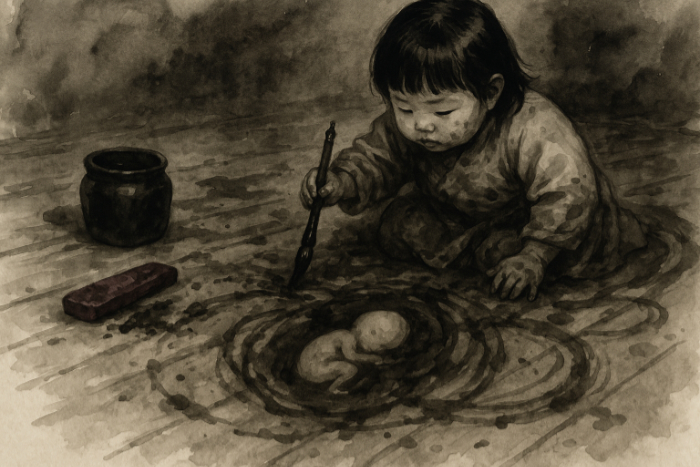
    A delicate watercolor of a small East Asian girl seated cross-legged on the floor, her head bowed in quiet concentration as she paints or embroiders with ink on stretched fabric. The style is loose and flowing, evoking traditional brush painting, with soft washes of colour fading into the paper.

    The prodigious air of equanimity he observed in her at that instant persuaded him the former was true: the form was no accident, but an intentional representation; and this was borne out over time, for as he introduced her to the time-proven techniques and subtleties of the calligraphic art, she would occasionally reproduce similar but evolved versions of the same motif, one after the next.

    Over the years, the outline became stylised and filled with scenes, blurry at first, then increasingly detailed, as though brought into focus by a kinesigraph, an invention he’d read about in the newspaper, said to have recorded the growth of a universal embryo. As Lao-Tzu’s disciple Zhuangzi wrote: “So all creatures come out of the mysterious workings and go back into them again.” Close by the pair of boulders that marked the feet, two human figures walked side by side upon a waterwheel, driving a stream to flow upward, delineating the spine, which culminated at its point of entry into the skull. Beneath the jagged boulders representing the cranium sat an adult figure, cross-legged.

    “Who are these children?” Mow Fung asked one day.

    “This one is called Yin,” she said, tracing the outline of the girl, “and the other one Yang. Surely you should know that, since you already told me all about Yin and Yang so many times. Aren’t they really, really strong? And they work so hard to create the energy for all of nature, and for human life too. This stream flows east, all the way up to the top of the Southern Mountains, these huge rocks.”

    “And this man sitting on the mountain – is it me?”

    She emitted a sweet, bubbling peal of laughter.

    “Oh no, goodness gracious, that could never be you, although you are very old, like that man; and he sits there doing nothing but contemplating nothing and pondering on things that can’t be named, just like you. Tee-hee!

    “Do you know? this man’s mother conceived him when she saw a falling star, and then she carried him in her belly for sixty-two years and he was born when she leaned against a plum tree to catch her breath. Poor woman! But lucky for him, because the plum is an auspicious tree.

    “A great crack of thunder erupted, and fairies danced on rainbows high up in the sky. He already had grey hair and a beard and long earlobes like a little old man, and he could already walk and talk straight away.

    “That’s why he was called Lao-Tzu, which is a way of saying ‘venerable teacher,’ because ‘Lao’ means ‘old’ and ‘Tzu’ ‘master.’ I think I would have had a heart attack if I’d been poor old Mrs Lao, his mama.

    “Truth to tell, with all these wild tales about him, I sometimes wonder whether he existed at all, at least as one real man in history. Maybe he was many.

    “Some people think he came down from heaven many times to help humans along the path, and even taught Confucius and Buddha. But perhaps what we think of as the scribblings of one person are the work of several, collected together over centuries. Anyway, my picture is all about making the gold elixir, and becoming an immortal like Lao-Tzu, poor old Mr Rabbit Ears.”

    Despite, or perhaps because of, her precocious cleverness, she was becoming rather hard to bear. Not so much so for her parents, who had an inkling of the forces that drove her. Not only had her father cultivated these gifts in her, which were now developing in strange and unforeseen ways, but she was, in some sense, an extension of his own past.

    No, he had no-one but himself to blame: his own youthful conceit having left him exquisitely vulnerable to a joke of cosmic proportions, the cosmos apparently having a nose for hubris in those whose gifts were squandered early, especially the inwardly illumined lured by aberrant indulgences, the pleasures of opium smoke among them. Our man had broken a habit to which he succumbed years ago when he fled to Canton, after the tragic deaths of his mother and friends, the three Bandit-Monks as they became known after their years of devotion and training, and their innumerable acts of generosity and self-sacrifice on behalf of the mountain folk. At one time he numbered among the fifty per-cent of Chinese immigrants in Ballarat who were slaves of the poppy, a statistic assiduously reported by government investigators.

    • • •

    Forward then, into the Underworld, though barely a word forward in a place like this. At any rate, for the sake of argument, best accept the proposition that they proceed, the living and dead, or, depending on an unforeseeable outcome, the earlier and later dead; the guide and follower, though who is which has fallen into doubt.

    There had been a lantern, a delicious trembling thing, whose light had coiled around him lovingly, as if loath to depart; but he discarded it after it extinguished in a gust. No, wrong. Impossible: gusts in the abysmal vacuum of this intermediary hell! And yet a stench manages to surface. When, from time to time, the two regain an animal characteristic or other, they are able, after a fashion, to gasp or puke.

    The idea of light remains, however, to which they cling, though no sun to adorn the infinitely high and starless ceiling of opaque black. A light of sorts emanates from the earth itself, all about, dull and nausea-green. It is said that this place is nowhere and everywhere, a place where, when the maximum is attained, the opposite is inevitable.

    The Sightseeing phase. Here we have the famous Gate of Sighs, unmarked and nondescript, but unmistakable, worn smooth as glass where heads beyond eternal count have bowed low to the stone. Inevitable psychopomp Horse-Face stands to the left, Ox-Head the right. (Or was it Kangaroo and Emu?) One looked on, while the other counted on his fingers, saying nothing, while their minions dragged the two through the dirt, red when it would appear in spasmodic flashes of gaslight.

    Clerks of merit and sin pore over their ledgers, spectral bureaucrats assisted by their ink ghosts. They afford few words and barely a glance at the souls. Their avatars would abound in the Colony, haunting the public, despised but obeyed: turnkeys, forever-echoes from the prison cell.

    An abysmal semi-skeletal thing in a frayed robe peers more closely at the once-guide. “Still warm,” it mutters, “but the paperwork is complete. All in order. We don’t make mistakes in here” – prompting its indescribably ghastly and abominable colleague to cast it a long blank look, before turning again to its own ledger.

    The plain widens, if such a thing were possible in this deathly nowhere, giving way to produce the sensation of a soft tearing into black salient. Surely we are not inside a body… The guide sinks to his knees (ha!), and the larger, redder one, once a cadaver, clasps his living companion’s shoulder and emits an utterance for comfort.

    “Take heart. This is meant to be,” he says, surprisingly without any trace of surprise that he has acquired a mouth, and that words come out of it, the inanity of which strikes him the moment he expresses them.

    But the once-shaman replies with a desolate moan, for all this not a whit what was intended by him. Pity the hunching, the spasms, as if some mute refusal were lodged at the back of his skull. Voices of the dead are carried in the Whispering Wind: dear companions from the past beseech him to leave the path and rejoin them. And what is this abomination? The innocent voice of his daughter among them, who should not be here by any means! He goes to rise, but sinks again when the voice folds back into the many others, that murmuring desolate weft.

    Then this way, onto a plain of hungry ghosts, detritis of failed judgements, souls that neither reincarnate nor dissolve. Disgusting creatures with distended bellies, leech-like necks, and mouths tiny as the eyes of needles, testament to their forever insatiable desires.

    At last, he regains the “power” of speech:

    “Not this. This is not the shape, nor the measure, nor the place. I am not the one. Stop when it is time to stop. Well, stop!” It is barely a whisper suffused in a sob. “I am not dead!”

    “No need to be upset,” the bigger, red one comforts him.

    • • •

    Spurred by the censorious tongue of her school mistress, Miss Pritchard-Jones, in her mid-forties, formerly a Willoughton, Lincolnshire girl known simply as Ruby Jones, some of the locals were starting to turn stony-faced at Lena’s approach, save for the subtle arch of an eyebrow, passed from one to another in discreet recognition. The covert signal was spreading steadily through the European populace of Deep Lead. Miss Pritchard-Jones had paid a Sunday visit to the Junction Hotel with one of Lena’s alchemical paintings under her arm, which happened to depict Yin and Yang in their respective guises of tiger and dragon, in the celestial act of conjoining that occurs at midnight in the alchemical process, when the elixir circulates nine times and returns to the immortal origin. Yes, there above the two fiery figures, the Sword of Wisdom and a once ferocious Monster of Illusion now immobilised with its limbs bound could be distinguished hanging in the stars. Where else could she have obtained such knowledge and imagery? – apart from Time’s Heavenly Sanctuary an Infinity above the Jagged Rocks, to whose archives he himself had long since given up hope of gaining admittance.

    “There is something not quite right with the child. She performs dismally on her school tests, though she appears to possess intelligence. Doubtless, she has the ability to ‘go places.’ Many girls of her ability become perfectly capable wives, maids, hairdressers, shop-girls,” the teacher explained after they sat down to a cup of tea. She then hurriedly concealed the painting in her soft leather satchel, before beginning to outline her solution to the problem she believed was vividly immanent in the incendiary artifact.

    “Mental and moral discipline are indispensable in the education of a child, else she be led to stray from a productive and righteous path into pitfalls of crime and vagrancy,” she elaborated. “I concede that you in your position, who come from a primitive land and are constrained to a humble, not to say precarious, station in life, in a country that is not always hospitable to orientals and natives, are unable to grasp fully the importance of a wholesome family background to the upbringing and development of a child of Lena’s age, and indeed her siblings …”

    The child’s parents looked at her in silence, their eyes stripping back the powdered mask and genteel veils to glimpse the workings beneath – subtle mechanisms, hardened circuits, a cogged and coded puppet, sealed within a larger apparatus of manners and decorum. Her cavernous mouth moved with a life of its own, and her massive, powdered and rouged face inflated to fill the room. Their existences shrank to an invisible plane, and they levitated up to a spot in a shaded corner to observe, alighting like the butterfly in Zhuangzi’s dream. From here, the onslaught softened to the echo of a gale howling in the distance, though her words remained clearly discernible.

    “I will put it plainly. Her brain is wrong, her mind astray,” and she proceeded to enumerate several further instances of warped expression that, in her view, had led to the present pass. She paused to take in their reaction but they gave her none. “My concern is that unless steps are taken she will continue to deteriorate – and not only in her schoolwork. By education, we practitioners mean not merely lessons, but all that may be educed – brought out – from the child: intellectually, yes, but morally as well. To begin at the true foundation, one must attend first to the parents. For are we not told, on the highest authority, that the sins of the fathers shall be visited upon the children unto the third and fourth generation? The baser thoughts, emotions, and impulses of the parents find harmful expression in their descendants. It behooves parents to reflect upon their sacred responsibilities.”

    They were more primitive than she had feared. “To quote from Archdeacon Julius’s recent sermon in Ballarat, which I had the honour to attend in person,” she said deliberately, taking out a newspaper cutting from her satchel and laying it down with ceremonial care, “the Lord says expressly that young children are like as arrows in the hands of a giant. From this we may draw the inference, as the Archdeacon explains, that each human life is fired out into the world like an arrow, and just like an arrow, not to miss its mark – by ‘missing its mark’ of course, he refers to sinning – it needs to be keenly pointed, which is to say, trained and sharpened by education. Furthermore, just as an arrow has three feathers, the three stabilising forces for a young life need to be: knowledge, love, and work. And so on and so forth. I would like Lena to take this and read it closely and explain it to you both thoroughly, so that all of you can understand. And I have a proposal …”

    A faint breath, a stirring as if by the wing of a moth, made Mow Fung aware that his eldest had joined them up at the cornice.

    “Yes, bring it in,” he transmitted and lowered his full awareness back into his corporeal body.

    “It is a well-known fact that poorer parents tend to coddle their children more than the richer, and the children tyrannize them in return.”

    “Something in what you say there,” Anna said with a smile.

    The door squeaked open and Lena entered with schoolroom poise, carrying her current work of art: black crayon on a sheet of wrapping paper. A figure seated cross-legged, spine straight, balancing the sun on one palm, the moon on the other. Within his belly, a stove glowed, its tiny flame drawn with a child’s fierce precision. The girl set the picture on the table without a word and assumed a still posture.

    Watercolor portrait of a middle-aged woman with hair pulled back and a stern expression softened by a slight smile. Her eyes remain cool, suggesting restraint. She wears a dark high-collared dress, and the painting’s style is muted, realistic, and softly textured.

    Miss Pritchard-Jones’s smile did not quite reach her eyes.

    “And what do we have here, dear?” she asked sweetly, leaning forward to squint at the drawing, as though it almost certainly contained something improper.

    “Is this meant to be… a magician of some sort?” the schoolmistress tried again, tracing the black line that circled the figure’s stomach. “Or perhaps… a new kind of stove?”

    “It’s just a man,” Lena said.

    “He seems to have swallowed a brazier,” said Miss Pritchard-Jones, letting out a snort of mirth – which, after a glance at the girl’s father, anticipating that he would share her amusement, she immediately stifled.

    Mow Fung looked at the drawing for a long moment, then at Lena. The silence stretched.

    “Why do you think his eyes are crossed, Miss Pritchard-Jones?” Mow Fung asked.

    “Goodness gracious, there is no why or wherefore about it. All nonsense.”

    “Lena?”

    “His eyes revolve like the planets in the solar system, Miss Pritchard-Jones. He squints and then rolls his eyes from left to right and back again to raise and lower his inner fire. From left to the top of his head, then down to the right to look inside his navel. He rolls his eyes around the sun thirty-six times to raise the positive fire. Twenty-four times around the moon to lower the negative fire.”

    “Incorrigible,” the teacher said.

    “Yet, you must admit it means something to her, and you see how she has learned your schoolbook science.” Then turning to his daughter, “Miss Pritchard-Jones has a proposal for you, so pay attention.”

    “I shall listen and obey, Father.”

    The woman struck a declamatory attitude.

    “It is true, parental responsibility involves the proper training of each child by its parents, but this is the ideal not always reached. Unfortunately, we do not have sufficient resources at the Deep Lead school to provide the religious instruction so sorely needed in a case such as this. However, as a Teaching Elder of St. Matthew’s in Stawell, I have taken it among my broader civil responsibilities to provide extra-curricular religious training and discipline to a small group of lucky young people deemed most in need of healing, in what I make bold to refer to as sessions of spiritual therapy. Spiritual wellbeing is as important to a child as their physical wellbeing and should never be neglected, lest the child herself be considered neglected.”

    Lena made her opinion clear immediately upon Miss Pritchard-Jones’s departure.

    “If she thinks I’m going to traipse all the way over to Stawell every Sunday to listen to more of her tripe, she’s got another damn thing coming.”

    “You should think about making an effort to fit in,” her mother ventured. “When turtles hide in the mud they remain safe and cannot be harmed. When they come out, people catch them. Same with fish. When they stay down deep, nothing can hurt them; but when they surface, the birds catch and eat them.”

    “Yes, best be like the turtle in the mud, the fish in the deep,” her father agreed, “Who knows? – there may be things worth learning in this spiritual therapy business.”

    “Don’t worry,” Lena said, “I’ll take care of it.”

    The next evening, there was no one around to notice the slender shadow flit through the laneway that ran alongside the teacher’s residence nearby the Deep Lead school, nor the flash of a match igniting a rectangular slip of paper, which burned for a few seconds to ash. The ‘Five Ghosts’ talisman works to traumatic effect when exercised against susceptible victims of a sensitive disposition, but Miss Pritchard-Jones was not such a person. Moreover, the artificer of the talisman, though youthful, was a compassionate girl, and inscribed it with characters that summoned less insidious spectres. No terrifying flying-head ghosts, faceless ghosts without feet, or baleful hungry ghosts from hell. Instead of these, naughty, playful sprites, who on the completion of each childish prank would depart back into the spirit realm to the tone of a chime, leaving no more than that playful and well-intentioned vibration. Just the type of spiritual therapy that might do her teacher good. Little harm likely ensues when a goldfish goes missing from out of its bowl but reappears a day later unassisted, looking as though nothing has happened; and the same is true of a budgerigar from its cage. Then a pet rabbit absconds leaving its cage door wired shut behind it, lagomorphous version of the Davenport Brothers, the famous mystical escapologists. It fails to return; but perhaps this is far less than a miracle, given the hatred for its species throughout the Wimmera at that time.

    Resting on her beloved rattan chaise longue on the veranda, Miss Pritchard-Jones looked up when the Fung child appeared, cradling the pet rabbit she had found hopping aimlessly on the roadside. The girl gently placed it in her hands. There was enough empathy in Lena’s eyes to still the suspicion, barely forming, that she might somehow have been responsible for the escapade – which indeed, she was not, at least in a certain direct sense of the word. The teacher smiled and patted the girl’s hand; her need of spiritual therapy was never again mentioned, and the tinkle of the teacher’s little Aeolian chime was from that time only ever heard when a gentle breeze, at least, would stir. A past offering from an anonymous pupil, the Japanese curio could be obtained at Kwong Hing’s shop in the Chinese camp.

    • • •

    A flat place. No texture or edge. Suggestion of enclosure without form. Inner perimeter, no wall. The air is not air as such. Breathing is not a prerequisite. And yet there is a pressure from above, faint but definite, of eternal waiting.

    A pale thing leans. A figure, perhaps, or a coagulation of posture. It inclines forward from among a stand of not-columns. Not arranged, not formed, neither standing nor collapsed. The pale thing has no face, or a great many, vaguely superimposed. It carries the smell of ancient, unwashed robes, and the fungal tang of mouldering rice-paper: suggestive of a monolithic bureaucrat obsessed with the accounting of infinitesimal infractions.

    It speaks: “Proceed.”

    Silence. Then again: “No. Abide.”

    The Celestial lowers his head even lower. The other stiffens. Progress may no longer be an option for him.

    “There is a discrepancy,” the thing says. “Designation uncertain. Misprocessed? Unprocessed?”

    It shuffles what appears to be a sheaf, but the papers are not quite flat, and not quite still. One separates, drifts, curls at the edge before floating down to a non-floor, sizzling to ash.

    “State your designation.”

    No answer.

    “He is not dead,” explains once-Forbes.

    The thing tilts. Abides. Tilts again, as if abiding might yield reply.

    “He is here. There is no procedure for reversal.”

    Mow Fung emits a sob.

    Nothing changes.

    Then: “Though I suppose even that may be subject to review these days, the way things are going. We will open the Register of Residual Appearances (Beings Undead or Vanished.)”

    It does nothing.

    “Ah. Yes. An echo. The shadow of an intention. The residue of action restrained. A karmic hesitancy.”

    It does not look up.

    “He may proceed.”

    Then, as if mumbling to itself. “Unless the next phase has been canceled… We received a memorandum but the seals were indistinct. The authority unclear. Proceed. If that is the word.”

    Not a soul stirs.

    • • •

    One day, she looked up from a swing he had hung for her years before, from the low branch of the blue gum behind the backyard, studied his face seriously and said: “Father, I am ready.”

    “For what?”

    “I don’t know yet exactly for what.”

    “Well, I shall have to save to buy you a violin or something.”

    She looked at him with a long-suffering expression, but did not answer.

    “The Maiden spoke to me when I was watering her. She gave me quite a shock, but I heard her voice distinctly.” The Maiden was the title they gave the stateliest maiden wattle in the acacia grove. Acacia maidenii was the plant’s Latin name, she informed him.

    A close-up watercolor of a young East Asian girl seen through a foreground of soft golden wattle (acacia) blossoms. Her face is partially obscured by the foliage as she looks directly toward the viewer, her expression thoughtful and serene. The style is fluid, with abstracted edges and gentle hues.

    “Oh?” The plants had never spoken to him, though he paid respects, and certainly watered them more dutifully than his number one daughter.

    “What did she say?”

    “She said there was something I must do.

    “Oh?”

    “She said there were some things you have to do before she’ll be able to speak to you directly – some procedures – and then you will be able to tell me what she said. I understand much from her, but there are other things I need you to explain.”

    “What are these procedures?”

    “First, you should get a pencil and paper. Have you been squinting properly?”

    He found the stub of a pencil and an old envelope in a shut-off area of the bar he called his office. She related to him the means of extracting potions from the maiden wattle, which would show him a new, deeper path than the one from which he strayed, even before leaving China. “This is the best way to use the bark and roots here,” she said, and summarised the procedures for him, drafting some diagrams in her precise hand and noting down Chinese names for some substances that she could not possibly have learned except from an adept in alchemy or sorcery.

    He explained about the tree spirits and malevolent wandering ghosts. Some plants and trees develop a natural spirit of their own – a spirit-being inhabiting the stem or trunk, like a tree fairy. These are far more powerful than common ghosts and spirits, though usually benevolent. Sometimes, however, a wandering ghost may take possession of a tree and impersonate a natural spirit. These are dangerous. Homeless ghosts that settle in innocent trees can harm human beings, and people must be wary of them.

    “I understand all this,” she said. “The Maiden explained to me I was a wise and ancient being.”

    “I thought I told you that.”

    “Not in so many words.”

    “Oh.”

    “Now, try to listen and not be dense.”

    He gave her a paternal look, an eyebrow raised.

    “The Maiden told me to say that,” she said with a look of surprise.

    “That’s all right,” he said. “I suppose I’ll have to learn when it’s you being cheeky yourself.”

    “Now come with me to the acacias.” And he went with her to his special garden.

    “Your arts are a little outdated,” Lena said. “She says that her cousin acacia pycnantha is so popular and beautiful that she will likely become the flower symbol of this whole country. She has such magnificent golden blooms, and we love her wattle-seed cakes and biscuits. The Aborigines, she says, use her wood to make spears and boomerangs, and put her leaves and bark in the billabong to make the fish go sleepy, so they can catch them easy. They use her smoke as a medicine, too, for things like diarrhoea and inflamed skin.”

    “Oh yes, of course, of course.”

    “Please stop looking at me superciliously. She isn’t fond of sarcasm, in fact she loathes it.”

    “She told you that?”

    “Nor fond of the faintly ironical tone you affect at times, she said just now.”

    “Oh.”

    “She knows a lot about you. She knows about the Jade Volume in the sanctuary above the jagged rocks, and about your friend in China the mighty general Senggelinqin, and the story about your mother and the bandits, and the opium, and how you came to Australia, and tramped all the way from Robe to Ararat, before coming to Stawell and Deep Lead. She knows a great deal.”

    “I think I told you those stories myself.”

    “She showed me inside my mind, I think, or in a dream, in moving pictures. It was like I was there, sort of thing.”


    © Michael Guest 2025

  • 3. Glenorchy Royal (from the draft novel Stawell Bardo)

    3. Glenorchy Royal (from the draft novel Stawell Bardo)

    Glenorchy Royal

    Let us regress a few weeks, before the scene at the homely Junction Hotel. Before the discovery of the headless body. Before any names were written down, even in a dog-eared notebook. The world barely notices such half-invisible men until a cause arises to record them – for all their swagger. This was before all that, when they strode unhindered and unsought. Dust clung to them, and their deeds had not yet congealed into fates. Glenorchy manifested itself lazily as they approached: a post fence, a dozing kelpie mix, the tin flash of a roof. The Royal Hotel waited in the heat, half-slumped, only half-aware.

    “This is a hellish, God-awful, melancholy town. The miserable bloody air here alone is enough to make a cove want to get rotten,” Burns said, dispensing with his hat and scratching his head. Truth was, he was feeling tolerably well, buoyed by the promise a day held that commenced with a bout in the Glenorchy Royal Hotel, renowned as it was in the district for its unadulterated grog. No fig tobacco in the brandy casks here, cobber. And the publican’s daughters are good sorts, too – said to cut out a stubborn bullock as good as any plains stockman. The publican knows everything about anything, by all accounts, including, perhaps, the lay of the land. But it turns out he ain’t here. Joseph Jenkins, the self-styled “part proprietor,” has charge of the place today and is big-noting himself on the strength of it.

    A hollow masculine chorus echoed in the bar – voices of shearers, farmhands, bullock-drivers – out of which one solo strain or another might ascend now and then, distinct enough to catch scraps of individual wisdom: the blowflies, the heat, a dog’s virtues, or a horse’s ailment. The most vocal, a couple of ancient farmers at a table by the front window, were bemoaning rabbits.

    “Official work to do, Scotty,” Burns said. “No good to be drunk as fiddler’s bitches.”

    “Why bullock our guts out? Like my old man used to say, never put off till tomorrow what you can do the day after. A spell of easy drinking will give us zest for the task. Don’t take much, anyway, to find out where the lots are, chuck up a couple of pegs and notices.”

    “Back here by late afternoon for cards and hot whisky anyway.”

    “You’ve already got a good start on it, mate.”

    But Burns called the barman over and ordered four tots of rum for a heart-starter.

    “Me and me mate’s got a thirst on after a’rambling place to place for work, which we’ve been doing in the hearty manly fashion, in the spirit of comradeship that is the pride of the Australian bush,” he said – in a forced jocular, theatrical tone that, boorish as it proved generally to most audiences subjected to it, he knew would draw a guileless grin from Forbes.

    “Soon to be landowners,” Forbes said. “Proper cockies, us!”

    Burns inquired of the barman:

    “Would you mind fetching us some of the more recent volumes of your collected publications, my good fellow – any sorts of broadsheets, gazettes, whatever journals have informed and entertained your distinguished clientele.”

    Then turning to his companion:

    “Must keep track of world affairs, when you’ve got your head in a hole in the ground half the time, old man. See how the Australian Eleven are going over in the old Britannia, and so on and so forth.”

    “Oh yes, God almighty!” Forbes let go a cracking belch that silenced the bar for a moment, and the two roared madly, Burns holding his stomach and shaking his head.

    When the barman returned with their nobblers of rum and some newspapers, Burns raised a hand as if to prevent Forbes from paying and produced two shillings from his money purse. “It’s what a bloke does for a good cobber, who’s a half decent sort,” he said.

    Forbes threw his head back from his paper, then tapped it three times with his index finger to mark the rhythm of his utterance, as if to emphasise its gravity.

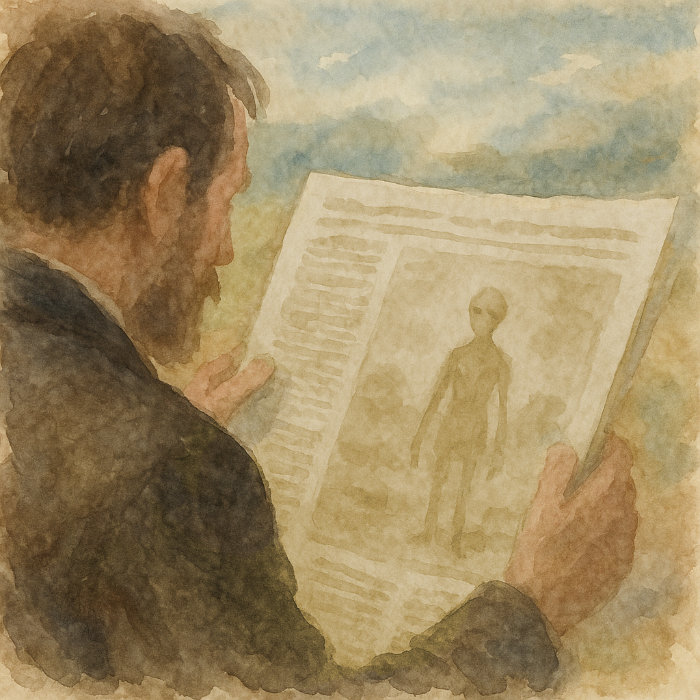
    “I bloody well knew it! People on Mars are no bloody different from us here on Earth.”

    “What is that nonsense?” Burns said, glancing up from a cricket report.

    “Not nonsense, mate, The Australian Town and Country Journal, scientific notes. It’s not as bright as it is down here, but their eyes are more sensitive, so they can see just as good. The polar snows extend further, so it’s colder, you know, naturally, but by no means less in proportion to the lessened power of the solar rays – so, anyway, make of that what you like.”

    “Fuck me dead,” Burns said.

    “This Professor Lockyer – or some what’s-his-name or other – has discovered several remarkable seas in the southern hemisphere, including inland seas, some of them connected and some not connected with the larger seas by straits. One of their seas looks exactly like the Baltic, and there’s an equatorial sea, a long straggling arm, twisting almost in the shape of an S laid on its back, from east to west, at least 1000 miles in length, and 100 miles in breadth.

    Forbes shook his head slowly and mused through the window towards outer space.

    “Let’s have another rum. That reminds me, we need some S-hooks from the blacksmith’s, for sinking them dams in Dunkeld.”

    When the barman served them, Burns was again magnanimous in paying.

    “Why do you say that every time?” Forbes said.

    “What?”

    “All that deal about paying for your mates. I’d take my turn just as quick, except you’re holding all my dough.”

    “What?”

    “Nothing.”

    “And why would that be, do you reckon?”

    “What?”

    “Why am I holding your dough for you, do you reckon?”

    “So as I won’t chuck it away on cards?”

    “Or pour it down your gullet, right? Look here, if you want to hold it yourself, you’ve only got to say so.”

    “Ar, it’s alright, you go on holding it.”

    “No, no, here you go, have it bloody back, because I know what’s going to happen.”

    “No, it’s alright mate, you hold it. You hold onto it for me.”

    “No,” Burns said, raising his voice as he bent down to undo his swag, lying on the floor by his boots. “If that’s how you feel about it, you take it, and we’ll wait and see what happens.”

    He fussed around, unable to lay his hand on the stash immediately, testily disembowelling the swag. The bar now quiet, furtive eyeballs over nobblers of whisky hot. Strange ones.

    “Don’t worry about it, Bobbie” – Forbes pleading – “I’m sorry. You look after it for me, please mate.”

    Burns’ back and shoulders slumped as he sighed, tut-tutted, shook his head, sat up, leaned back.

    Pause.

    “Ah, Scotty, what are we going to do with you, son? I know you’re a good’un right and proper, but god you make it hard to look after you sometimes.”

    Weary head shake.

    “Sorry mate, sorry.” Forbes placed his hand on the back of his mate’s wrist, and the two men looked each other in the face. His eyes watered, a teardrop forming at each inner corner. Conscious of it enough not to sniff, he looked into Burns. A kind man, tough but kind, good to me. His eyes, well, there was a trace of softness to them. Like his beard, bushy but soft. Burns could see right into him, too; he could see that much. They had shared tender times together, which was not the usual lot of those thrust together in railway camps. Forbes sought a salve of kindness in his eyes, the closest thing he had known to affection for a long time – who knows? – for his whole life long.

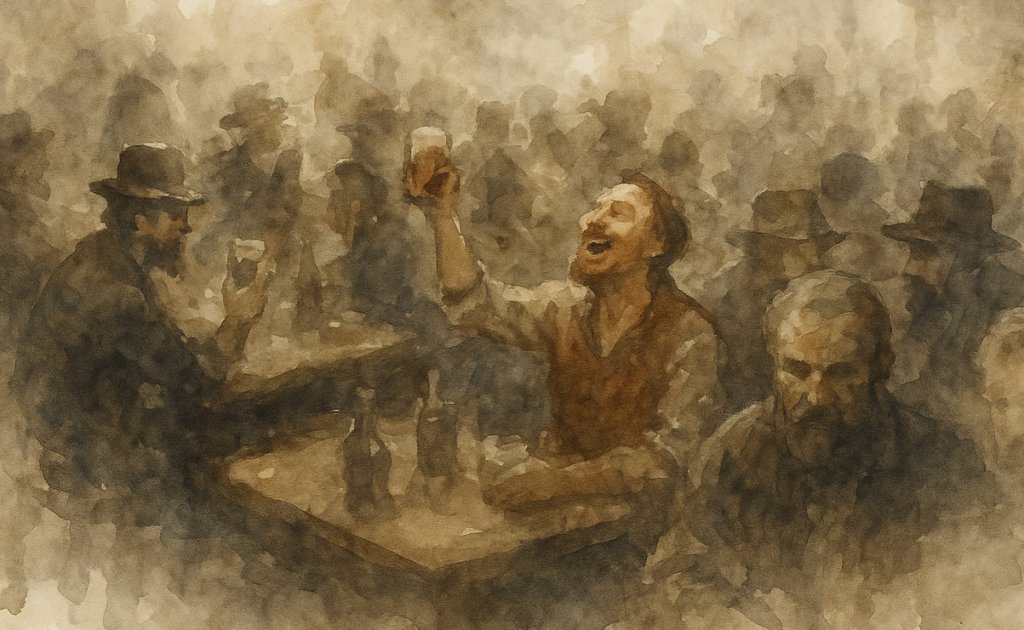
    Day moves along, and the rambunctious hour draws near. Patrons who’d started at half past ten in the morning are caught up by tardier arrivals, spurring themselves on to comparable states of elation.

    At some point, a mob of navvies crowd round the old farmers and begin to ply them with whisky for sport. Taking a barrel or chair for a seat, the hands share the one table, while one or two stand leaning against the wall engaged in their own conversations.

    “Bloomin’ city so-called ‘sport shooters’ brung ’em over from the Old Country, and the sparrows and deers and all. Said in the paper, if we got rid of the vermin, they’d get even more. Bloody Wild Rabbit Propagation Committee, would you believe?”

    “Don’t tell me!” yells a hand, hawks and hacks in his pocket-rag out of politeness.

    “I’m telling you, my son,” says the old red-haired feller, “It’s bad enough now with the rabbits, but in the sixties, them damn vermin was so many, you’d go to pull out spuds and find they was rabbit nuts instead!”

    “You don’t say!”

    Hoots and hollers. “What’d you do with the rabbit, mate?”

    “Well, you threw it out and chucked the balls in the broth for veggies. No one was in the mood for rabbits no more, in no shape or form, I’ll tell yer that much.”

    “Didn’t the government do nothin’ about it?”

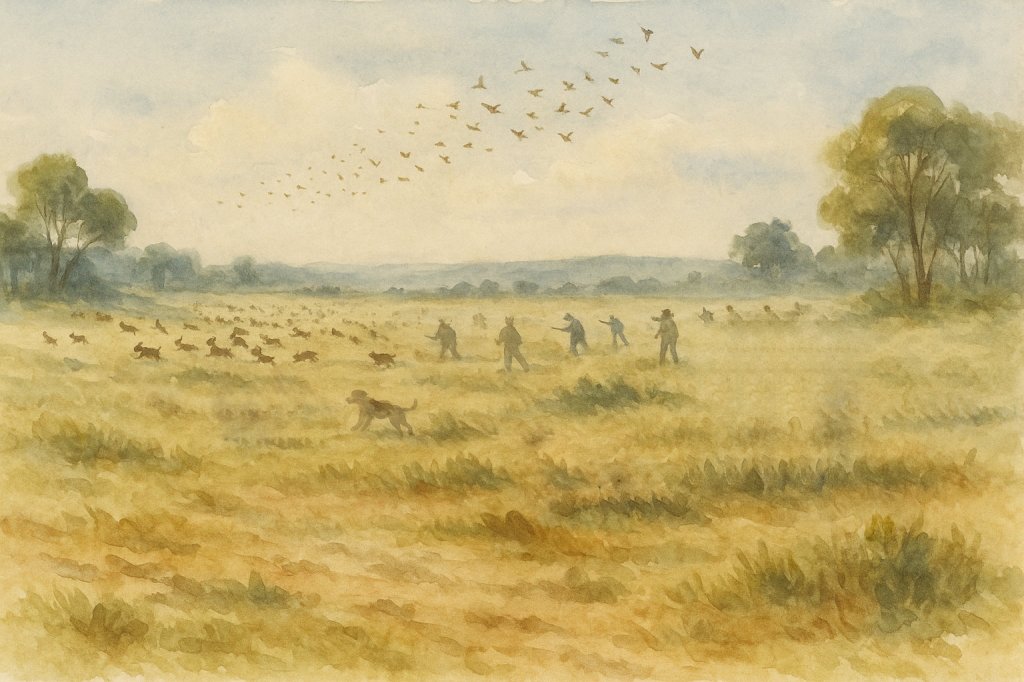
    “I tell you what,” says old red-headed bloke’s mate. “I’ll tell you right now all what the guvment’s good for. Bloody nothing. A year ago they come up here, these blokes, an army of them got sent by the guv’ment. Half a dozen Melbourne loafers and twenty-eight mongrel dogs! They went into a district so thick with pests that hundreds of men, women, and children had worked day and night for months with dogs, guns, and traps – and still made no impression. So we laughed our guts out at these poor bastards running around with their dogs. Not worth a tinker’s dam, them blokes. And sure enough, the dogs tired of huntin’ rabbits and thought they’d prefer worrying the sheep, and the local inspector took out a writ against these bastards for having unregistered dogs!”

    A gust of laughter rips through the heat – “God Almighty!” – “Don’t tell me!” – “You’re havin’ us on, y’old bugger!” – “Bloody hell, so who was the vermin after all, eh?!”

    Misshapen dwarfish gargoyle Poor Joe the Ostler is all unbridled mirth.  Lets loose an ear-splitting hoot, perching upon his stool. Leaning next to him, kindly Tom Piper, who was once a prize-fighter, stands Poor Joe another, but will keep an eye on him.

    “Goin’ to have a wee jig, Joe?” lisps a vile flea called MacDougal, peering across Tom Piper’s face, up to mischief. Poor Joe’s drunken antics are a thing to behold.

    “Do you want to find yourself out there on your face in that muck-heap, MacDougal?” Tom Piper is not one to waste words, and MacDougal slurps quietly, before seeking less perilous entertainment.

    Old red-headed bloke’s mate. “An imbecile from Warrnambool invented some kind of pills to poison them rabbits, and them pills did work to great effect for sure when a rabbit ate one, but hardly any of the rabbits did. Weren’t to their liking. God’s blood! We tried destroying them, filling their burrows with poisonous fumes, but that was damnable hard work, and we didn’t know where half their burrows was. It’s a nightmare, as you can well imagine!”

    Burns sorts the accommodation.

    Pencil poised, the barman assumes: “Two rooms?”

    “Just the one, son. He’s too far gone to warrant a room his own. I know him. I’ll have to look after him later.”

    “Who’s paying?”

    “I am, for sure as lookin’ at me, see this roll I’ve got here!”

    The barman looks him in the eye – a flicker of recognition there, and maybe a hint of suspicion.

    “Come on, cobber, I’ll see you an extra couple of bob.”

    Something in the barman’s smile twitches – almost salacious, or maybe just the beer – but not enough to call it a leer. And Burns missed it anyway.

    “If you say so, mate. Two bob, ya reckon?”

    Forbes mingles, spreading his innocent masculine charm, and generally the locals take to him. Burns has passed him enough dough to stand a few rounds, and he is liberal with it. Here is the single theatre where he can demonstrate the largesse that he aspires to be known for. In return, you have to lend him your ear to chew on for a bit.

    “Who are you, my good man, and what’s your game?” says Forbes to an amiable fellow

    “Archibald Fletcher. I work for Stawell Council as a road overseer.”

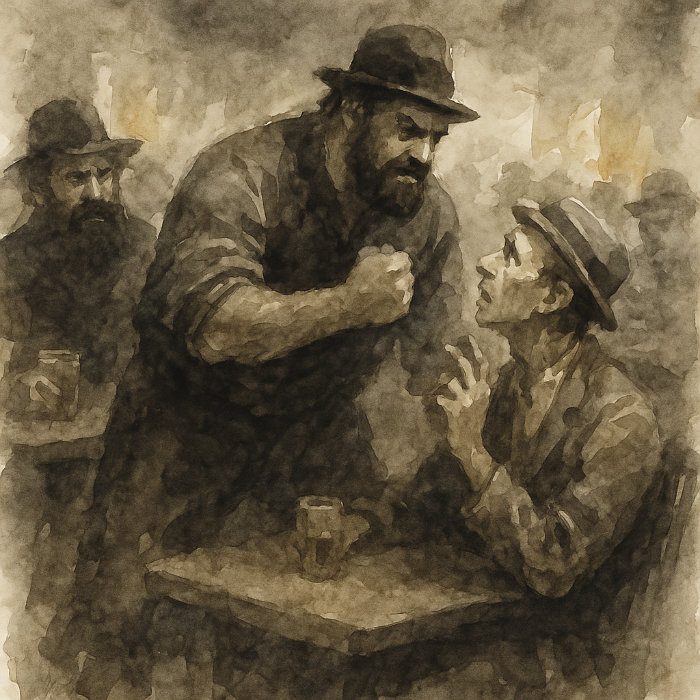
    “Well, Archy, I wish to have a word with you. Who is that gentleman over there with the long white coat? He insulted me about my church, my creed, and my coat, and I will not take that from any man! Not him nor you.”

    “I see no such chap.”

    “Do you think I’m stupid, do you? You might be surprised to hear that some fellow in England has made a remarkable invention called ‘captive daylight.’ Did you know that, smart-arse?”

    “And what might that be, Scotty?” Burns sidles up, winking a cold wink at Fletcher, the council road overseer.

    “What it sounds like, mate, just what it sounds like. I read that this chap, a Mr. Balmain, I think his name is, if memory serves, has succeeded in producing a luminous paint which can absorb light, as it were, and during darkness will suffice to illuminate an entire apartment. Very interesting article.”

    “My lord! That will be good for the outhouse!” Howls from those in earshot. “Yeah, good for readin’ the paper in the dunny without no candle!” Further rustic, scatological expressions of humour.

    Fletcher moves off, as the others incline an ear.

    “Yes, well, indeed, some might suggest there are those dimwits who can’t get their minds out of them parts! Anyways, they’re going to use it in compartments on board ironclads, probably. It’s quite intelligent, really,” Forbes says.

    “How would you turn this paint off when you wanted to go to sleep?”

    “Well, I don’t know, I suppose you don’t need to sleep in the dark, does you?”

    “A lot of blokes don’t like to sleep when the room’s all lit up, like. I’m one of them myself, in fact, so it seems to me there are apparent drawbacks with this invention.”

    “I can assure you as some folks would prefer to read late into the night, save on the price of oil at the same time, and pull the sheet up over their head later.”

    The laughter swells around them, voices breaking off into pockets of side talk. Burns drags a barrel up beside Forbes and leans close, his mouth near the other man’s ear, speaking gutturally against the racket, passing on what Jenkins the barman calls good oil on the allotments of land up for selection. There’s one or two up this way, not far from the river, which at this time of year has dried up into a line of muddy water holes, but there’s some better ones closer to Stawell, too. Blow going all the way down there today; best to catch the train there tomorrow or the day after. Cast an eye over the ones up here first. Bit of a walk this arvo. Then go down to Stawell by rail. You can meet the missus and kids.

    They down two more solid nobblers of rum apiece, before following the route Jenkins’ map takes them on, out of town and north-east towards Swede’s Creek. Forbes has procured two flasks of brandy with what is left of the money Burns has given him, and they alternate swigs, while Burns elaborates on his vision of their shared future as wheat farmers. For the most part, Burns will live with his wife and six children in Stawell, and Forbes will occupy a house on the new property. They stop at the weir for a smoke and gaze down at the muddy trickle way below. Burns lets drop the empty flask, which comes to rest with its mouth barely above the surface, such that suddenly the waters eddy in, until it emits a comic gurgle and disappears.

    Burns knows more than enough about farming, he reckons, to put Forbes on the right track. There are two classes of selectors – one goes on the land without money, and the other without knowledge; and there are some who go on the land without either. But of the first two, he would rather give credit to the man who lacked money but possessed knowledge than he would trust the man who had a limited supply of money and no knowledge at all. Did you know, mate, that sailors make the best selectors? The best of non-farmer selectors, that is. They are quick-eyed, active, strong-handed, and excellent judges of the weather. They can, he opines, almost without exception, successfully compete with old hands in fencing land.

    Four bottles of water? asks some bird invisible in the bush, the phrase clear as speech.

    “Well, I sure ain’t no sailor neither,” Forbes admits, in a tone that one would not quite call wheedling as such, though a kind of seeking for self-reassurance is evident in it, some murky undertone. “I think I might have my work cut out,” he says with a self-deprecating smile.

    “Tosh! you will do alright, son,” Burns says with a wink and a slap on his mate’s shoulder. “Well, I have to say the land’s not much good around here. Only fit for a sheep walk and a poor one at that. You’ll find a sheep every five acres around this place at best.”

    They continue their trek for a while, Burns examining a clod of the friable clay here and there, until the second flask is emptied. “Not too heavily timbered around here,” Burns observes, taking a final swig and tossing the flask. “Just a few patches of bull-oak – though that’s useful stuff for building.” Belch. “The creek’s not always like this, you know, just waterholes. It fills up alright, and I heard some talk back there about some sort of irrigation scheme that might come through in a while.” Snort, hack.

    “Listen to them birds,” Forbes says with a giggle. “They’re saying the same thing over and over and over. What sorts of birds is they?”

    They stop still and listen. A long silence. Then … CRACK! Click-click-click!

    “Out here? Must be lost,” Burns mutters of the Eastern Whipbird.

    Four bottles o’ water – watchya baaaack!

    “There he is!” laughs Forbes – a flash of sheer, foolish delight. “Four bottles of water!”

    “They’re not talkin’, just skwarkin’, son.” Burns’ patience thins. “Will you listen to what I’m saying to you, for Chrissakes?”

    Forbes is still looking up into the branches, laughing.

    Burns exhales, the sound more growl than sigh. A shadow seeps into his gaze and his jaw tightens.

    Cackling, Forbes mimics some more, then falls silent, listening. Burns spits, thinking. Here and now, God help me, I could kill him.

    As they go on, Burns lags behind, wobbling his head, sneering, and mouthing Forbes’ words in a sarcastic pantomime.

    They arrive back at the Royal. Forbes takes some brandy and old newspapers up to their room and pores over some articles of passing interest, though his brain is unable to comprehend much of what his eyes admit into it: The necessity of employing very intense temperatures in cremation, so as to convert the body into ashes, appears likely to be done away with by the experiments of M. Lissagarry. The difficulty in cremation is to decompose and reduce to ashes tissues containing 75 per cent of water; but M. Lissagarry overcomes this by exposing the body, first of all, to the action of superheated steam, which chars the tissues and enables them to burn easily in an ordinary simple furnace at a very much less cost of fuel and without the least unpleasantness . . .

    He blinks slowly, reaches for the brandy, and lets the print swim before his eyes, the words dissolving into the paper’s yellowy grain. His lips shape the words soundlessly. There are some hard ones, but Bobby will know what they mean. He always knows. Rolling onto his back, arms askew, Christlike, he drops into unconsciousness. Snores like ballast pouring into a hopper. Dreams a dream of a sky fretted with magpies, wings beating over acres of land littered with skeletons.

    Tom Piper steers Poor Joe, incoherent, out the back to his mat of hay in the stable. Off he totters, and Tom returns to the fray.

    Burns throws himself into a chaotic game of three-card loo in progress in a smoke-filled room adjoining the bar. Six men compete for tricks around a dilapidated table buried under piles of coins and damp clumps of notes, while onlookers crowd in to outshout each other’s wagers. In the main bar, an accordion strikes up an off-key melody, an Irishman belts out an amorous ditty, forcing the instrument to conform. Then a polka, and a few dance in pairs, man on man, stiffly wobbling around each other like toy peacocks, leaning away, gripping each other by the elbows. Only one woman is present, and she is too far in her cups, anyway, to be of any use, engaged in a slurring interchange with a navvy at the bar, though their topics are unrelated, and they speak past each other’s eyes.

    Burns’ cheer curdles as his luck rots. Repeatedly ‘looed,’ he feeds the pot, three at a time. Others scoop the winnings while his pile shrinks. The pool swells. Greed thickens. The drink works deeper with each loss, peeling him down – the drunken, belligerent aggrandising become brutish, to reptilian – to a being older than men. His hands move more slowly now, eyes narrowed, as though weighing the other men for more than their cards. A primitive thought coils, half-remembered, half-whispered by something older than his bones, shedding centuries like skins – as though a presence that had slithered through ages of darkness might, on a vicious whim, infect a human soul.

    After the fun, Jenkins the barman is left to sweep the refuse into piles on the floor. He leaves the doors open for the last curls of tobacco stench to drift out with the nocturnal breeze. The place is otherwise empty except for Burns – or rather, what’s left of him. The man-shape slumps in the chair, but the thing inside is pared back to its oldest layer, the cold-blooded remnant that survives when all else is stripped away. His gaze is hooded, face sliding off the skull, mouth agape and drooling. A slow flick of the tongue, lizard-like, tastes the air.

    When Jenkins has finished sweeping, he leads the creature up the stairs. By the top step, Burns is down on all fours, almost slithering. “Here you are, mate,” Jenkins says at the door. “Allow me…” He turns the master key and ushers the creature inside. From somewhere far back in his skull, Burns watches this with cold detachment. When he spits, his saliva oozes in strings to the floorboards. He tries littler ptuh! ptuh! spits to be rid of it, but it clings there.


    Michael Guest © 2025

    Images generated by AI

  • 1. Down Train from Horsham (from the draft novel Stawell Bardo)

    1. Down Train from Horsham (from the draft novel Stawell Bardo)

    Though railway convention would designate a train travelling from Horsham toward Melbourne as an up train, I have titled this chapter Down Train from Horsham intentionally. The descent invoked here is not geographical but tonal: a movement into rougher country, uncertain fortunes, and subterranean narrative currents. It is, in spirit, a passage downward.


    Down Train from Horsham

    Some dragon stirred from its rest with a snort and shrill hiss. Flame flashed beneath her firebox, steam jetted behind the front wheels, a plume burst from the smokestack. The engineer tugged the pull cord and let go two long, shrill blasts on the screamer.

    Over on the wide, newly asphalted street, their cart driver pulled his horses up to a stop. Forbes was on the ground by the time Burns hauled himself down.

    “Slow today ain’t we?” Forbes said with a wink.

    Burns grunted, dusted off his coat, and spat.

    Both strong, stout men they were, both with full beards, Burns’s brown, Forbes’s flecked auburn when the sun hit it right. The two barely had time to buy tickets, but the guard spotted them and didn’t give the flag.

    “Get a move on, youse blokes,” he growled as they strode up to the door of the last carriage.

    “Go blow your nose, General,” Burns said.

    “Thanks old mate,” Forbes said, smirking at the guard and touching the brim of his grimy, battered wide-awake hat. No nap, no fuzz on the felt – that’s what ‘wide-awake’ meant, Burns told him. He liked that.

    “No call to go tippin’ your lid to the likes of him,” Burns snarled, striding ahead. “All they do is blow on their whistles and wave their bloody flags, riding about all day on railways that we builds for them.”

    AI generated image of train waiting to leave the station at Horsham

    Burns pushed back the reversible seat to make two facing seats, and they swung their swags up onto the overhead rack. Forbes let his bulk fall, crashing down on the forward-facing seat with a thump that startled everyone in the carriage. Heads turned, eyes exchanged glances, eyebrows arched.

    An upright matron leaned to the ear of her companion, a young wife, who commented under her breath, in a tone heard through the carriage, “Navvies by the look.” She pulled a grimace of distaste and flashed a glance toward heaven. Two wide-eyed children across the aisle from the women craned their necks, straining for a better look at the commotion. The elderly clergyman turned his attention back to the Melbourne Argus in his lap, his eye pausing on the masthead: “I am in the place where I am demanded of conscience to speak the truth, and therefore the truth I speak, impugn it who list.” Ah, the brave words of John Knox, a fellow Scotsman.

    Acting oblivious to the disapproving looks but inwardly savouring them, Forbes leaned back to think on the waves of heat rising from the platform. Burns stood with his hands on his hips, staring down at his mate, gripping the seat to adjust his balance as the carriage lurched forward.

    “No, I won’t go backwards,” Burns said.

    “What’s that?” Forbes said, still looking out, the hint of a rascally smile on his lips.

    “It gives me the pip, going backwards does.”

    “Gives everyone the pip, Burnsy. Be a man.”

    “Come on, we’ve been over all this. Get over to this side, at least for a little bit. It’ll have me spewing, mate.”

    “Sit down and shut up, man,” Forbes said. “We can swap after a bit.”

    “For Christ’s sake, I’m not feeling too well after last night.”

    “It was me finished that last quart of rum off with Johnson and the Painter brothers after you flaked out.”

    “Well damn you then.” Burns slumped into the seat across the aisle and looked sullenly out the window, watching the buildings slip by. He took off his hat and ran his hand across his balding scalp. Getting tired of this redheaded prick. “You’re like a naughty kid sometimes. I’m not going to read the newspapers with you anymore now. You were looking forward to that, weren’t you? Over a beer at the pub when we get in.”

    “I’ll read them by myself,” Forbes said petulantly, with a touch of true hurt.

    “Oh yes, oh yes. You are a great reader by yourself, you are.” Burns gave a short derisive laugh. “A regular font of learning. A real Aristotle. Great Peripatetic Philosopher, you are, for sure. A true Bard and all rolled into one. Ha!”

    The train rattled along, passing across the town boundary. A sweet breeze cooled the carriage and Burns’ temper. This was grand country – miles of grazing country, like parkland, and burgeoning seas of wheat turned ghostly in the sun – pale dragons gliding low over the gold. Any man’s heart would glow, and he whistled a few bars of an old ditty that had been playing on his mind the past few days. Trilli-la, trilli-la, as the lassie flung them tripes, flung them far …

    He turned to Forbes and called out over the rhythmic clatter, nodding to the scene. “Magnificent property – the Cawter Brothers, squatters of course, you understand.”

    “Sorry about all that, just pulling your leg.” Forbes said. “Here, take a swig on this, the real article. Found it in back of the cart. Blakey can get another one at the pub, blow ’im.” He offered the flask with a grin and a look that said: ‘we mates again?’ “Look Burnsy,” he said, ”I know I wouldn’t be reading at all if you hadn’t showed me, and I thank you for it, I do, I really do. Mates?”

    Flask to his gob, Forbes froze mid-gulp and grinned. “Can’t hear you. Come on over here, come on.” Forbes swung himself over onto the rear-facing seat. Burns took the place he had vacated.

    Burns shrugged off his aggravation with a mighty swig. “Grumph! God, that’s rough, you ratbag! Gad, that is poison. Villainous vile low stuff indeed it is.”

    “My word! Produces the desired effects, nonetheless, don’t it?”

    “Aye, to be sure – makes the vendor rich and the buyer mad, if that’s what you want.”

    They laughed raucously and then stopped, collapsing abruptly into a sober silence filled with sporadic vague recollections of drunken aftermaths. Pause of indeterminate length and depth. Some stubby vegetation jogged past and the carriage rocked and creaked.

    “Passable whisky.” Forbes had come to love a game with Burns.

    “Passable? My stars, whisky, you reckon! Whisky! There ain’t the slightest suspicion of malt in the composition of this grog. More a concoction of cheap liquor and primitive adulterating agents mixed in by some low, roguish bush publican. Water for toning it done, tobacco and bluestone for bringing it up to the required ‘biting’ standard. That’s what it is. Impossible to calculate the amount of evil wrought by foul stuff like this. What do you reckon? Passable, right enough!”

    Forbes laughed a child’s open, careless laugh. “Righto, well you are free to give it me back then. I’ll down it, no worries.”

    “Steady on, son! I fancy trying another drop or two yet, just to make sure it’s alright for you.”

    “How’s that, then?”

    “Not too bad when you can get it down.”

    Forbes blinked. “What’d you say back there, mate – something Brothers?”

    AI generated image of the two men smoking in the train carriage.

    “Carter Brothers,” said Burns. “Own that place outside of Horsham. North Brighton Estate, la-di-da, fancy stuff. Nothing around like that these days for the likes of honest blokes like us. The rich got the best, and you need money for grazing. Thousands of selector homesteads around these parts, though, I’ve got to admit. At first the squatters tried to get rid of them – pulled up their pegs as fast as they could put ‘em down and burned down every patch of bull-oak in sight – makes decent timber that stuff. Squatters thought they’d won out. Got all the best bits, creek frontages and fertile spots, and didn’t bother to buy up till it was too late and the selectors all got in. Now they own most of the land in the district. Yeah, plenty of selectors in the Wimmera, and soon we may be pleased to number ourselves among ’em, indeed, I’ll wager. Stake my life on it.”

    Forbes yawned and stretched. He took out a two-bladed knife and a plug of tobacco from the pocket of his grimy, gray tweed coat and proceeded to cut some tobacco for a smoke. The knife was a small one with a white handle, but one half of the bone was off, the handle on that side showing the brass. “So how about this place you want to select?” he said. “Is it worth me putting in? What do I want to go on the land for? I’m free as the breeze in the work I do, can go when and whither I wish. That’s the life.” His sly attempt to kick off more sport.

    “Ar, not again,” Burns said, taking up the flask for a swig. “Wake up to yourself, man. You’re a navvy. You want to dig ditches all your life? You’re still young. You want to get yourself a stake. What’s a navvy do, son?” He lit his pipe.

    “I don’t know … digs holes?” …

    “That’s right, digs holes. And what else?”

    “Digs more holes.”

    “Correct. And what then?”

    “Digs some holes and then some trenches for good measure.”

    Burns laughed. “Yes, very good. Anything else?”

    “Cuts some dams.”

    “Yes, for a break, and when he finishes with that? Come on, what have we been doing out at Dimboola?”

    “Ballast. Spreads tons of damn ballast along the line.”

    “Of course he bloody does!” Burns said. “And that’s a lark for you, ain’t it! Anyway, we’ve got nothing to be ashamed about. It’s men like us what builds these railroads, son. Railroads into the future, I reckon. But there’s too much of our sweat and blood in ’em. What you want is to go up in the world. Like I’ve been saying, keep our dough together and build up from there. We’ll be full-blown gentleman in the long run. Whisky, women and song for the asking. In South Australia I was born …” His sonorous tenor cracked with volume, his rhythm matching the pulse of the wheels over the railway sleepers.

    “Heave away, heave away ….” Red-headed Scotty Forbes, so-called, being Irish, was gifted with an equally stirring off-key tenor. He coughed back some reflux and took a big guzzle.

    South Australia is me home …

    Heave away, heave away …

    “Don’t worry, I looked after you over there, didn’t I, son? I’ll fix you up here too, no two ways. Oh heave away you rolling king, we’re bound for South Australia …

    The carriage rocked and clattered along. Forbes packed his pipe and lit it up, twisted his body around and leaned back over the seat. “This is a smoking carriage, is it not?” he asked of the woman diagonally across the aisle. “You don’t object to smoking, madam?”

    It was no smoking, but the woman submitted grimly and said no. Further down, the young wife staged a little drama, rousing her children and shepherding them out.

    The pipe smoke curled lazily in the light. It caught a shaft of sun and hovered there, luminous and insolent. Forbes leaned back, legs stretched long beneath the seat, puffing like he had nowhere particular to be. Beside him, Burns smirked toward the window.

    After a minute or two, the clergyman rose indignantly. He stepped up the aisle, steady as a magistrate, and came to a stop at Forbes’s elbow. “I for one,” he said, glaring down through the smoke, “do object to that filthy habit. And if you persist in indulging in it here, I shall be forced to quit the carriage.”

    Forbes didn’t look up. “Here’s a bonny little reverend, then.”

    Burns sucked on his pipe and exhaled with exaggerated pleasure. “Blind me, people can be disagreeable. Proper cantankerous old ratbags, I’ve had a gutful of their sort.”

    The clergyman’s gaze turned sharp. “Passengers who wish to smoke,” he said, “ought to remove themselves to one of the carriages provided for that very purpose.”

    “Filthy with ash and worse,” Burns said, with wide, innocent eyes. “Even a hardened smoker can’t stand the stink. Anyhow, they’re full. We usually go first class but feel like slumming it today.”

    The Scotish clergyman looking down sternly.

    Forbes puffed on his pipe, grinning back at his companion. He leaned over and hawked something from the back of his throat. The spit hit the outside of the window with a soft, wet smack.

    Burns said to the clergyman, “I know better men than you who partake of the weed.”

    “I shall request the guard remove you at the next station.”

    “No need for that, Bishop,” Burns said. “We plan to alight in that parish in any case, where we have some important business in which to attend. To wit, the acquisition of a prime piece of real estate, for your information.”

    “It’s a good half hour and more to Glenorchy,” the clergyman insisted. “These good people should not be poisoned by smoke and nauseated by your vile expectorations.”

    “Alright, have it your way, if you’re going to be like that,” Forbes said, tapping his pipe against the windowsill, so that the embers fell out onto the floor. He made a show of stomping them out.

    “And if drunken men are permitted to travel, it ought to be in a special carriage.”

    “Look, you’ve got your way,” Burns said, pointing his pipe at him. “Now if you’d kindly go and do your preaching elsewhere, we’d be much obliged.”

    The clergyman blinked, lips pursed. No one else moved. Burns leaned back and took one last puff.

    “Off to buggery with you where you belong, if you don’t mind, good sir. Go to hell with the rest of your sort.”

    The clergyman strode back to his seat, amid some covert approving nods and comments from his fellow travelers for the effort he had made, and took up his newspaper. For the rest of their journey, in loud, vulgar tones, Burns aired his views on Presbyterian priggery and wowsers, white bearded, bald headed old Scottish hypocrites, bastards and coots, and so forth, for the entertainment of Forbes, who hooted and cackled at his mate’s performance, clapping his hands in unpredictable spasms of mirth, as he would do at times, in a way that would cause the casual onlooker to think he might be touched.

    As they drew closer to Glenorchy, the red-headed Forbes drank and nodded, while the balding Burns, his elder, shared his wisdom, audible to their captive and drowsy companion travelers … “Won’t hurt to find out about it, anyway, price is very reasonable … together we’ll be right … Look at this bloody scrub … Good places coming up here at Wal Wal that got had up by selectors … be right with our stake at Glenorchy though, right as rain … Don’t worry about all that, I’ve got it all for you … Six hundred quid in the bank at Dunkeld, anyhow … Breed a few sheep here and all …”

    “I do love a train ride!“ Forbes said.

    “Fine ride, fine ride. It’s the future, you know. We are living in the future, my friend,” said Burns.

    Mother speaking quietly to her little daughter by a carriage window.

    “You can see the scenery, and the occasional sheep. Very fine indeed. trees and pastures and all the rest. Exceeding rapidity. Velocity of modern times, and no mistake,” said Forbes.

    “We are kings, mate, kings of the rail,” said Burns.

    “Considerable dry day though. What day is it, anyway?” said Forbes.

    “Monday, don’t you recall? We resigned our positions on the Sunday?” said Burns.

    “Wind’s changed. Look at the steam!” said Forbes.

    “Nice smell, eh? Sweet-like, but then it hits you in the back of the throat, as well,” said Burns. “Get your head back in, Scotty! God you’re a child. Pull ya bloody noggin in or you’ll get it knocked orf!”

    The train crawled to a stop and sighed an immortal hiss. The two men gathered their swags and pocketed their pipes, leaving the empty flagon adrift on one of the seats, and lumbered towards the front, Burns bumping into the clergyman’s seat as he passed. The wife and daughter of the ironmonger at Stawell silently watched them go out, eyes on their backs.

    “That’s the sort of people you get on the trains,” murmured the mother to her daughter.

    “Here’s to land, mate – ours soon enough,” Burns said, stepping down onto the stationary earth.

    Michael Guest © 2025


    Graphics are AI generated