Tag: Mushanokoji’s The Innocent

  • Twin Desires: Exploring Mushanokoji’s Humanist Roots

    Twin Desires: Exploring Mushanokoji’s Humanist Roots

    Followed by his colleagues from the Peers’ School, Mushanokoji began publishing Shirakaba in 1910, which was to become the most important literary magazine of early twentieth century Japan. He had graduated from the Peers’ School, then withdrawn from Tokyo Imperial University in 1907. Shirakaba means “White Birch,” in reference to the white birches that appear plentifully in Japan, but are even more overtly symbolic in Russian literature.

    This post in the Exploratory Companion will sketch out elements of the literary and lived forms of Mushanokoji’s evolving humanism, from his Tolstoyan beginnings, through Maeterlinck, and culminating in his literary philosophy and social experiment at Atarashikimura village. I aim to explore the broader global context for his development. It’s not only via his attachment to the metaphysics of Maeterlinck that THE INNOCENT speaks so accessibly to modern readers, nor only through its avant-garde characteristics, but also because of his position in this ongoing historical movement of “East-meets-West” humanism and peace.

    Rousseau – Tolstoy – Gandhi: evolving world vision

    The title Shirakaba resonates with the influence exercised upon the young Meiji intelligentsia by the great Russian author Count Leo Tolstoy (1828 – 1910), through ideas communicated to them by Mushanokoji himself. This influence extended not only to the field of literature but also into social and community idealism, and Mushanokoji’s founding of the village of Atarashikimura, to embody his ideals and teachings. (Rekolektiv, “Atarashikimura in Interwar Japan”).

    To outline the origins of a broader humanistic movement of which Mushanokoji’s work is one manifestation, we would look to Jean-Jacques Rousseau (1712 –78), whose critique of social inequality and ideas about education and the nature of humanity captivated Tolstoy from the age of fifteen. The opening up of a secluded Japan and its potent interaction with Western culture during the Meiji period provided fertile ground in which these ideals could evolve in a fascinating direction.
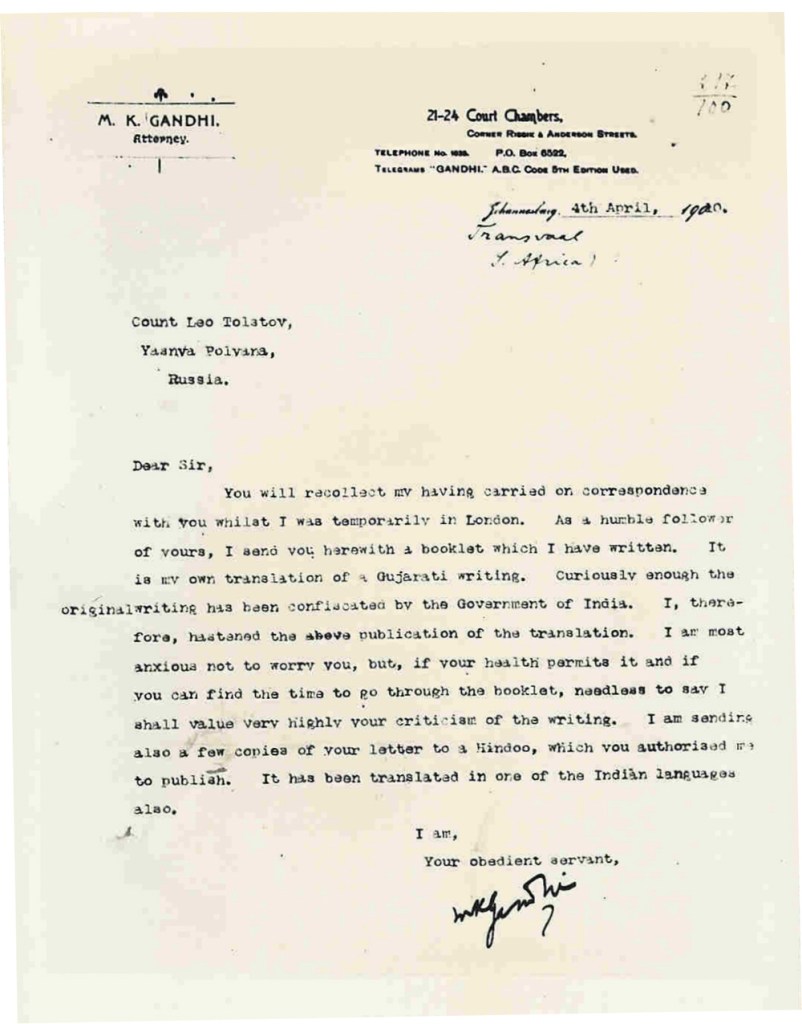
    Facsimile of 1910 letter from Gandji to Tolstoy (UHM Library)
    Facsimile of 1910 letter from Gandhi to Tolstoy (UHM Library)

    Tolstoy’s contribution to the broad politics of peace and non-violence was, of course, immense, and magnified through his relationship with Mahatma Gandhi (1869 –1948). In his autobiography The Story of My Experiments with Truth (1925-29; 161), Gandhi wrote that he was “overwhelmed” by the Russian’s reinterpretation of Christianity, due to its “independent thinking, profound morality and […] truthfulness.”
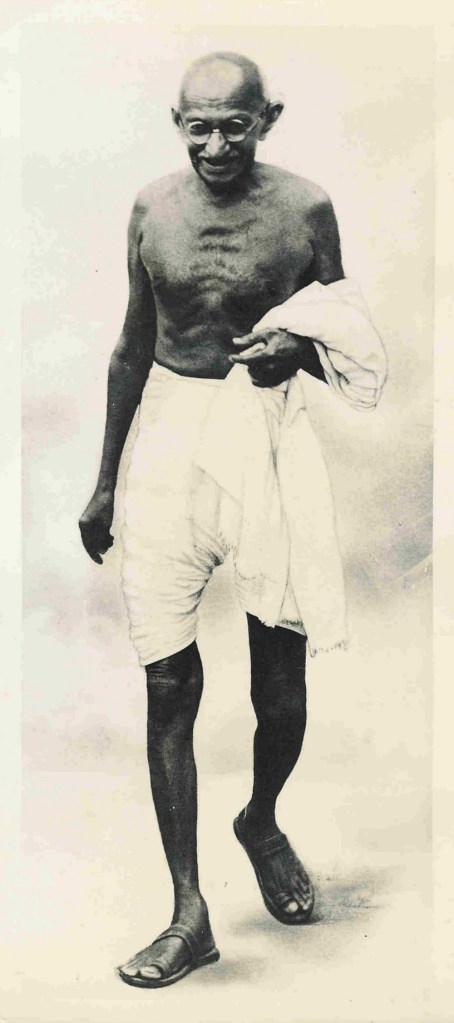
    "The Mahatma" 1945 (UHM Library)
    “The Mahatma” 1945 (UHM Library)

    Tolstoy’s 1908 “A Letter to a Hindu” instigated an ongoing correspondence between the two great luminaries. In 1910, the Mahatma established a cooperative settlement in South Africa, naming it Tolstoy Farm, which was to be a model for self-sufficient, communal living, and training in satyagraha — a commitment to truth, non-violence, self-suffering, courage, conviction, and self-discipline.

    Aristocratic obligation and presumption

    The youngest of eight sons of a Japanese Viscount, Mushanokoji turned to Leo Tolstoy for literary and humanitarian inspiration, fueled by a sense of social obligation that inhered in his aristocratic birthright. During what is sometimes called his “Tolstoy craze” late in his adolescence, Mushanokoji had emulated the ascetic lifestyle that Tolstoy espoused, by living in a small, unheated hut on his family’s estate, “wearing simple clothes and leaving the stove unlit.” Indeed, because of their privileged origins, Mushanokoji and his Peers’ School colleagues received criticism in Japan as being immature and dandyish dilettantes, despite or perhaps even because of the charitable acts that several of them exhibited in response to social inequality, such as Arishima Takeo, who gave his family farm in Hokkaido to its tenants as cooperative owners (Yiu 218).

    Mushanokoji’s uncle provided his nephew with recently translated Japanese editions of Tolstoy’sThe Kingdom of God is Within You (1894) and other works by Tolstoy, and also introduced him to the Bible:

    Mushanokoji’s host – his reclusive uncle Kadenokoji Sukekoto – was far from fashionable. After suffering a series of financial setbacks, Kadenokoji had retired to live alone on his sole remaining estate. He worked in his fields in the daytime and spent the evenings studying sacred texts and discussing them with Christian pastors and Buddhist monks. His eclectic spirituality set an example for his nephew, who would also spend his life gathering ideas from diverse sources.

    Anna Neima, The Utopians: Six Attempts to Build the Perfect Society (118).

    Mushanokoji's uncle Viscount Sukekoto Kadenokoji (1860 –1925) 1913
    Viscount Sukekoto Kadenokoji (1860 –1925), 1913

    Mushanokoji was indeed greatly inspired by Kadenokoji. It is unlikely, however, that the compassionate and amusing portrait of Jibun’s uncle in Chapter 7 of THE INNOCENT is specifically him, since he died from kidney failure at the age of 65, whereas the uncle in the novella dies from cancer at 45 or 46. Recall, however, that Jibun’s father appears in the novella, even though the fact is he died when the author was an infant; so the possibility remains that Jibun’s uncle may be based on Kadenokoji.

    It is perhaps fairly natural to suspect the compassion that privileged individuals extend to those below. For some, the image of Marie Antoinette dressing up as a peasant in her rustic hamlet in the grounds of the Château de Versailles prefigures an inauthentic spectacle of the aristocrat Tolstoy assuming the guise and lifestyle of his peasants, from which he always had the freedom to withdraw.

    Not to be too glib, however: Buddha himself, Siddhartha Gautama, was an aristocrat who, in his “Great Renunciation,” gave up his wealth, family, and social status to become a wandering ascetic.

    Shadow of Buddha: eclectic spiritual roots of a humanistic ideology

    Tolstoy deeply respected Asian culture, and his ideology is redolent with Eastern thought. His interest stemmed from an early experience at age nineteen, when he met a Buddhist monk in a hospital in Kazan, who had been robbed and assaulted violently, but had not fought back, adhering to the principle of non-violence (Kamalakaran).

    The encounter had a profound effect on Tolstoy, fostering his lifelong interest in Buddhism and other Eastern teachings. He experienced an existential crisis in his mid-50s, which he described in his autobiographical A Confession (1880), when, after having achieved wealth and fame, he found life lacking in meaning. Tolstoy became disillusioned with traditional Christian churches, believing they had corrupted Christ’s message. While his resulting “new faith” was not explicitly Buddhist, it marked a significant sympathy with Eastern philosophies. (See Kamalakaran, “The influence of Buddhism and Hinduism on Leo Tolstoy’s life” – Russia Beyond.)

    Tolstoy engaged further with Buddhism in an 1889 essay, “Siddartha, Called the Buddha, That is the Holy One,” and expressed Buddhist ideas in his correspondence, discussing concepts such as karma and reincarnation. Towards the end of his life, he contributed an article on the Buddha to his anthology “The Circle of Reading” (1906) and translated the American Paul Carus’s (1852 – 1919) story “Karma” into Russian.
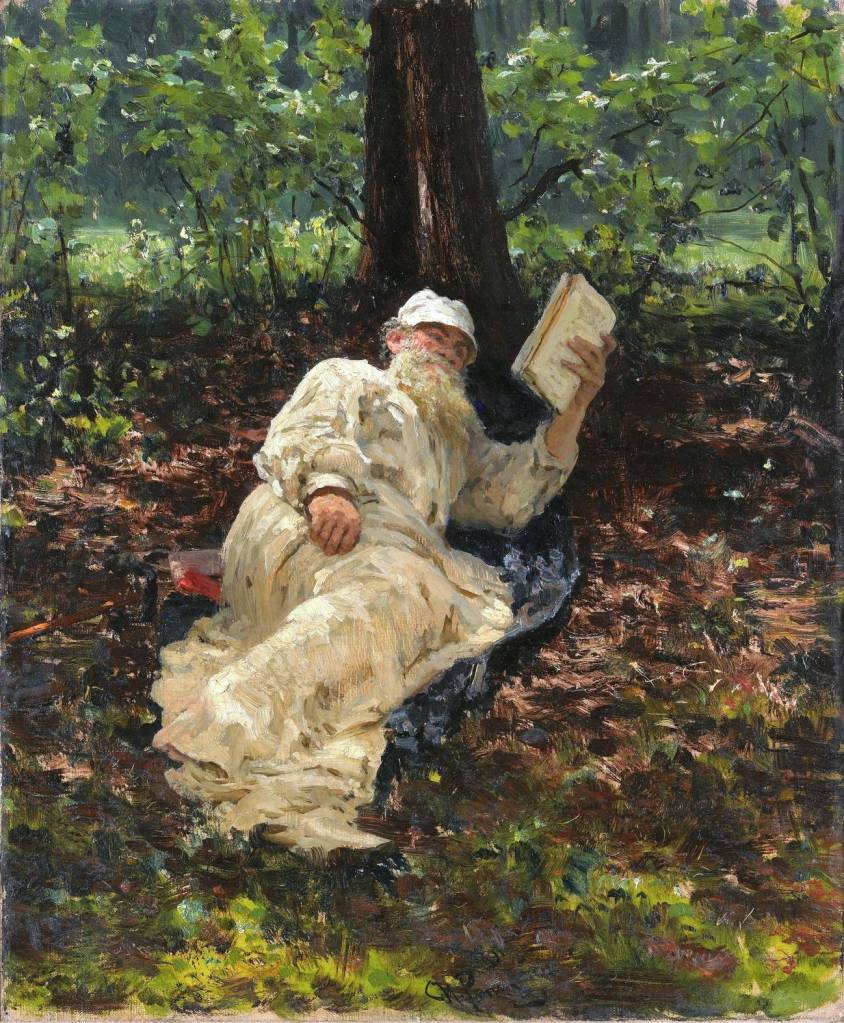
    Tolstoy Resting in the Forest, Ilya Repin, 1891
    Tolstoy Resting in the Forest, Ilya Repin, 1891

    His adoption of vegetarianism, championing of non-violence, and attempts to live a simpler life demonstrate an affinity with Buddhist practice. Ultimately, the philosophy he developed, known as tolstovstvo, containing a core concept of mankind living in peace, harmony, and unity, and which also encompassed his rejection of luxury and opposition to the exploitation of peasants, is in keeping with Buddhist ideals.

    Subsequently Tolstoy engaged in further Japanese projects, particularly in the context of agrarian and utopian movements. He collaborated with Konishi Masutaro, a Japanese Orthodox priest, on a translation of the Daoist text, the Daodejing, which they both saw as “an escape from state authoritarianism” and a step towards a “‘new universal religion’ based on Tolstoyanism” (Johnson, “Displacements: Current Work on Japanese Modernism”). Tolstoy’s concern with the peasantry and agricultural reform became a significant legacy in Japan, influencing movements described as “agrarian-Buddhist utopianism” (see Shields).

    Mushanokoji explored Buddhism explicitly to some extent in later life, presenting the Buddha as a “human” ideal in his popular work Life of Shakyamuni Buddha (1934; ctd. in Shields). Mushanokoji’s explicit intention here was to emphasize the “human” Shakyamuni, portraying him as an ideal figure lauded for his insight and compassion, someone who possessed a natural innocence, described as “the heart of a child” (akago no kokoro). He portrays Buddha as a valuable model for human behavior, one stripped of mystical elements. Mushanokoji included Shakyamuni Buddha in a pantheon of “masters” alongside Jesus Christ (whom he saw as a “man with a pure, pure heart”), philosophers, writers, and even literary characters, all of whom served as models of human “liberation” (Shields).

    …“the Buddha” functions [for Mushanokoji] as a representative of a complex of humanist ideals, including a religious understanding rooted in common sense and compatible with modern science, one that rejects social discrimination and institutional hypocrisy, and looks to nature itself as a source for liberation.

    Shields, “Future Perfect: Tolstoy and the Structures of Agrarian-Buddhist Utopianism in Taisho Japan”

    Mushanokoji’s utopian vision thus blended liberal-humanist ideals evolved from Buddhist, Christian, and Western philosophical traditions. Shirakaba writers compiled a list of idealist “masters” whom they admired, including Christ, Buddha, Confucius, St. Francis, Rousseau, Carlyle, Whitman, and William James. Interestingly, in her book, Meeting the Sensei: The Role of the Masters in Shirakaba Writers, Maya Mortimer asserts that in rejecting all (positivistic) “-isms,” the Shirakaba “masters” embody a “way of unlearning” or a Zen-like methodology (ctd. in Shields).

    Subversive philosophy of self-love

    In an explicit doctrine of egoism (jiko shugi), Mushanokoji advocated one’s complete subordination to the Self:

    Our present generation can no longer be satisfied with what is called “objectivism” in naturalist ideology. We are too individualistic for that . . . I have, therefore, taught myself to place entire trust in the Self. To me, nothing has more authority than the Self. If a thing appears white to me, white it is. If one day I see it as black, black is what it will be. If someone tries to convince me that what I see as white is black, I will just think that person is wrong. Accordingly, if the “self” is white to me, nobody will make me say it is black.

    Mushanokoji, “Art for the Self” (1911), qtd. in Shields

    THE INNOCENT brilliantly embodies such a subjective gesture. In what I have called Jibun’s “spiralling inwards,” he is drawn towards the phantasm of his beloved, the girl Tsuru. That is, she is rendered as a symbol of an ideal love, which is ultimately perceived as his love for himself, which he realizes he is unable to sacrifice for her sake (See previous posts and Translator’s Preface to THE INNOCENT).

    Portrait of Mushanokoji Saneatsu by Tsubaki Sadao (1896 – 1957) 1922
    Portrait of Mushanokoji Saneatsu by Tsubaki Sadao (1896 –1957), 1922

    As discussed in previous posts, Mushanokoji’s humanistic perspectives were greatly influenced as well by the Belgian writer and philosopher Maurice Maeterlinck, with a primary emphasis on self-love and the cultivation of the individual self. Mushanokoji declared in an early issue of the Shirakaba journal, on the struggle of attaining a free individuality:

    I only understand myself. I only do my work; I only love myself. Hated though I am, despised though I am, I go my own way.

    Mushanokoji in Shirakaba (1912), quoted in Gennifer Weisenfeld, MAVO: Japanese Arts and the Avant-Garde, 1905–1931 (Berkeley, CA; Los Angeles, CA; London, 2002), 22

    Thus Mushanokoji’s thought evolved in a direction away from the ideal of self-sacrifice associated with his earlier Tolstoyan influence. Maeterlinck’s metaphysical vision validated an insular, contemplative life. It equipped Mushanokoji to make a literary inward turn to autobiographical fiction and to embody the inner trajectory in literary form.

    A brilliantly original achievement in THE INNOCENT lies in how the author explores multiple implications of such an introjection of objective reality, preserved ironically in an accessible naturalism. In so doing, Mushanokoji adapted Maeterlinck’s philosophy of self-love, encouraging individuals to conduct themselves as individualistic moderns, living for their own pleasure, and writing about the process of exploring their own natures. Mushanokoji came to adopt a pivotal point of opposition between Tolstoy and Maeterlinck: that we must love ourself in order to love others:

    In an essay titled Jiko no tame oyobi hoka ni tsuite (For My Own Sake and Other Things, 1912), [Mushanokoji] paraphrased Maurice Maeterlinck (1862–1949) and wrote, “Even if you were told to love your neighbor, you must first learn to love yourself. Moreover, it is not sufficient to love your neighbor as you love yourself. You must love yourself in oth­ers” 

    Mushanokoji “For my own sake and other things” (1912), qtd in Angela Yiu, “Atarashikimura: The Intellectual and Literary Contexts of a Taishō Utopian Village,” Japan Today

    Mushanokoji’s exploration of identity and self-cultivation in THE INNOCENT and later writings became a key early expression of a cultural phenomenon of the time — a so-called “cult of self-love.” It became a popular mindset among Japanese youth, even prompting government concerns. School texts were rewritten, with the idea of preventing hedonistic individualism from undermining loyalty to the state. Conservatives fumed that Western ideas were destroying Japan’s social cohesion, and that traditional values of piety and loyalty had to be revived (Yiu).

    “Twin Desires”: I-novel and village utopia

    Atarashikimura can be read as the continuous augmentation of an ego that seeks to make its impact felt not only on the pages of a book but literally on earth. The village, like his art, is created “for the sake of the self ” (jiko no tame), and is thus the ultimate act of self-expression.

    Angela Yiu, “Atarashikimura: The Intellectual and Literary Contexts of a Taisho Utopian Village.”

    In 1918, in an effort to embody his ideals and teachings, Mushanokoi established a utopian village community in Japan: Atarashikimura (“New Village”). Mushanokoji’s social project was in the spirit of Tolstoy’s school for peasants at his estate of Yasnaya Polyana (“Bright Meadows”) (Rekolektiv). Atarashikimura can be described not merely as a social experiment but as an instance of an “I-novel” sensibility given physical form: “Atarashikimura is an I-novel written not in the pages of a book but in an actual geographical dimension” (Yiu). Still operating today, though relocated from its original site in Miyazaki prefecture to Saitama prefecture in 1939, the village embodies Mushanokoji’s egoistic and creative vision. It’s about an hour and a half from Tokyo.

    Today, the village continues to operate based on original principles of communal living and the pursuit of art and culture, fulfillment of each individual’s destiny, and the importance of each person’s individuality. Residents, currently numbering around twenty, contribute six hours of compulsory labor per day. (Members living outside the village can contribute funds.) The remaining time is for the free pursuit of truth, virtue, beauty, and personal interests aimed at actualizing one’s authentic self. Villagers receive an allowance from a collective fund for their daily needs (see Yiu).

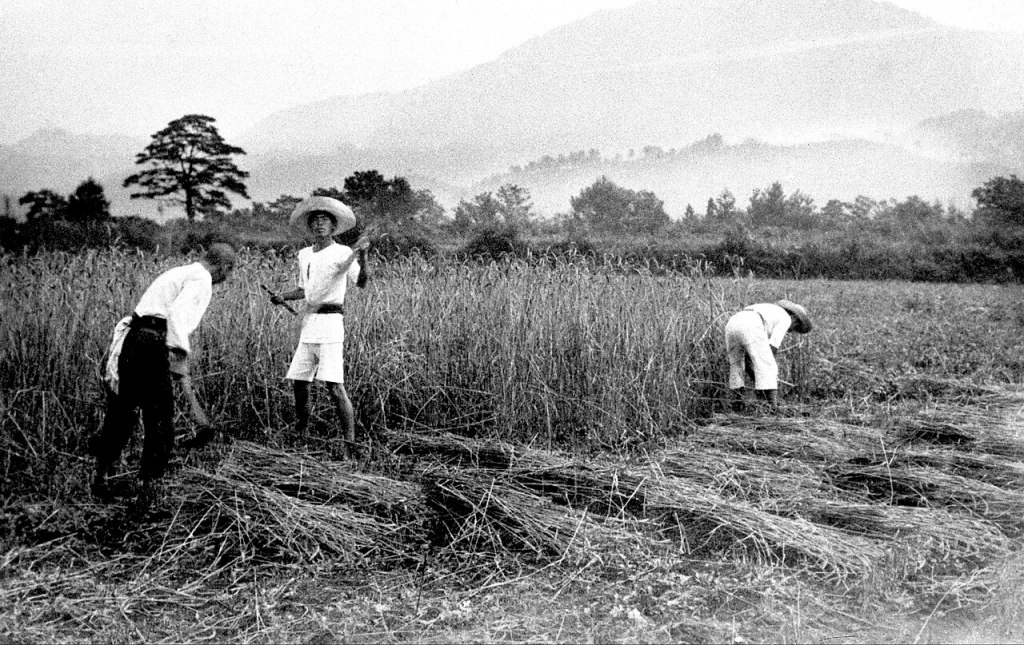
    The harvest wheat in Atarashikimura, 1919. Mushanokoji is facing the camera.
    The harvest wheat in Atarashikimura, 1919. Mushanokoji is facing the camera.

    When Mushanokoji founded Atarashikimura, during the late Meiji and Taisho eras, or from around the end of the nineteenth century to the mid-1920s, a period in Japan saw the rise of kyoyo shugi, an emphasis on holistic personal development, intellectual cultivation, assimilating ideas from Western humanism, which influenced groups such as the Shirakaba-ha. The concept can be translated as “liberal arts” and is linked as well to the German concept of Bildung, which emphasizes intellectual and personal self-cultivation. Alongside this development at the time was a growing exploration of the inner self, as propounded by Mushanokoji.

    The I-Novel and Inner Exploration

    Crucially, this period also witnessed the emergence of the I-novel (shishosetsu), a genre of which Mushanokoji’s THE INNOCENT is a seminal exemplar. The I-novel is characterized by its intensely self-oriented nature and the cultivation and assertion of the ego as the ultimate authority. The I-novel marks a strong focus on interiority in fictional writing, as we see clearly in the case of THE INNOCENT, with the novella’s single-minded exploration of identity and self-cultivation.

    Angela Yiu describes how Mushanokoji’s aspirations in literary art and his wish to create a new world, a utopian community, were his “twin desires,” such as he expressed in his 1921 autobiographical novel Aru otoko (A Certain Man). In an article entitled “Art for Oneself” (1911), at around the same time as THE INNOCENT, he wrote: “I go all the way to create art for the sake of oneself.” The thought process of Jibun in THE INNOCENT demonstrates his arrival at this same conviction of Mushanokoji’s: a sentiment that extended to his village project. Atarashikimura can be viewed as “[Mushanokoji’s] most invested work of art, a sakuhin {work] that is created for the sake of maximum self-expression” (Yiu).

    “Imperialistic Egoism” and the Village

    Saneasu Mushanokoji’s philosophy involves a complex blend of influences, including a tension between his declared admiration for Leo Tolstoy and a contrasting development of what Yiu calls an “imperialistic egoism.” In THE INNOCENT, the ego is clearly presented as undergoing an all-encompassing expansion, to the extent that even the beloved character Tsuru is beyond actual reach, but merely an internal phantasm. In attempting to mitigate such an extreme degree of aggrandizement, we may bear in mind Maeterlinck’s own formulation from his book Wisdom and Destiny (1898):

    Tolstoy’s ideas on humanism, equality, communal living, and labour profoundly influenced Mushanokoji throughout his life, though Mushanokoji selectively adopted or reinterpreted these ideas to accommodate a philosophy centered on the assertion and cultivation of the self, as advanced by Maeterlinck. Mushanokoji’s is a more progressive ideal than Tolstoy’s, validating aspects like

    […] lust, sex and pleasure-seeking as essential, even moral, components of human existence … This new philosophy of hedonistic egotism was the second of the two strands that Mushanokoji would eventually weave together to form his utopian ideology, combining it with the socially minded influence of Tolstoy and Christ.

    Neima, 125

    In Chapter 5 of THE INNOCENT, a still “prudish” Tolstoyan Jibun debates the opposition with his libertine, Maeterlinckian visitor:

    “You speak from the female perspective, as one would expect from a prude,” he said. “But a healthy man has rights as well. Someone who takes pleasure in life is entitled to do so, without having to go around like some kind of sexual invalid. You, as a scholar, should not derive satisfaction from the plight of the weak. I will not accept the idea that healthy people should be condemned for complying with the demands of nature and enjoying themselves.”

    Mushanokoji adapted the philosophy of self-love into a literary philosophy focused on exploring the transcendent extent of one’s own self. His celebration of the self is a crucial element reflecting his philosophical evolution during the period leading up to THE INNOCENT. A model of the Japanese I-novel genre, the novella is marked by an overwhelming emphasis on the subjective perspective and assertion of the ego.

    The concept of what Yiu calls Mushanokoji’s “imperialistic egoism” may be further debated in the context of his utopian commune, Atarashikimura. She argues that the village can be read as a physical manifestation of a creative ego seeking to “make its impact felt not only on the pages of a book but literally on earth.” For Yiu, this strong sense of self implies eliminating the difference between self and others by “subsuming others under an overpowering self”. The observation aligns with Mushanokoji’s assertion that “there is no authority above the self.

    The idea of a central “self” encompassing or projecting onto others within the communal setting resonates with the theme of solipsism found in his literary works. This is particularly so inTHE INNOCENT, in which the narrator reduces the figure of the “other” (his beloved Tsuru in this case) to a mere projection of “projection of fantasies and desires, entirely lacking in agency (Lippit, 14).

    In his Topographies of Japanese Modernism, Lippit considers that Mushanokoji’s “discursive rendering of the relationship between self and other,” where the Other is reduced to a “phantasmal image,” not only provides a framework for Mushanokoji’s fiction, but also his “consciousness of modern culture” (Lippit 14). The village, as Mushanokoji’s “most invested work of art […] created for maximum self-expression” and an I-novel written in a “physical reality,” reflects this same tendency for the individual self to be the ultimate frame of reference, potentially overshadowing the independent reality and experiences of others.

    The concept of “imperialistic egoism” encapsulates a fascinating paradox within Mushanokoji Saneatsu’s work: the transformation of personal idealism into a broader social project. In the I-novel form, this egoism seems not only ideologically tenable but formally generativeTHE INNOCENT thrives on the inward-turning journey of the self, with its solipsistic implications often turning into a source of ironic humor. The exaggerated isolation of the protagonist, driven by self-absorption, becomes a way of exploring human vulnerability, and this humor lends the text a certain playfulness while deepening the existential weight of its themes.

    However, when these same “imperialistic egoism” impulses are extended into the practical framework of Atarashikimura, their implications seem less straightforward. The utopian vision powered by a single, dominant self could, at least hypothetically, run the risk of reproducing some of the hierarchical dynamics it was meant to challenge. The tension between the ideal and the real seems to suggest that what enables the author’s literary world — the expansive self — might not seamlessly translate into a sustainable communal project. It remains uncertain whether this “imperialistic egoism,” when enacted outside the literary realm, would promote true cooperation or potentially veer into paternalism, revealing the complex balancing act between idealism and pragmatism that such a project sets in play.


    Notes and further reading

    Gandhi Image citations:

    Press Information Bureau, “Gandhi (Full Length Portrait),” UHM Library Digital Image Collections, accessed May 11, 2025, https://digital.library.manoa.hawaii.edu/items/show/27516.

    Press Information Bureau, “Letter to Tolstoy,” UHM Library Digital Image Collections, accessed May 11, 2025, https://digital.library.manoa.hawaii.edu/items/show/27528.

  • Maeterlinck’s play The Blind (Part One)

    Maeterlinck’s play The Blind (Part One)

    In my translator’s preface to Saneatsu Mushanokoji’s The Innocent (Omedetaki Hito of 1911), I noted a curious feature of the novella: Mushanokoji seems to anticipate aspects of very modern writers such as Samuel Beckett and Italo Calvino in particular. Mushanokoji’sThe Innocent intriguingly prefigures elements of Beckett’s minimalism and Calvino’s conceptual play, bridging literary traditions in a way that feels startlingly modern to contemporary readers.

    The preeminent scholar of Japanese modernism Donald Keene (1922 – 2019) may overlook Mushanokoji’s continuing and extensive potential, I feel, when he excludes him from relevance beyond his own milieu. Moreover, Keene was so imposing a figure, I suggest, that his oversight impeded translation of the work, although it is given frequent reference in critical discussions of Japanese modernism.

    Keene writes that Mushanokoji is

    more likely to be remembered for his humanitarian ideals and his writings on art than for his works of fiction. His popularity has lingered on, but his works seem to belong to another age.

    Dawn to the West: Japanese literature of the Modern Era (New York : Holt, Rinehart, and Winston, 1984 [p. 457])

    But I detect a disarming self-parodic strain in Mushanokoji’s novella, which has an effect of undermining (to a calculated extent) the absolute self-centeredness of the anti-hero “Jibun” (= “myself”) of the seminal I-novel. This obsession of Jibun’s is the very mechanism by which the narrative is enabled to spiral inward into the self, at the same time reducing his beloved Tsuru to a phantasm. It strains credibility that Jibun never once speaks with Tsuru, while remaining rational and empathetic in other respects. The inwardly moving spiral traced by the story is equally an effect of form and structure, such as we see where Jibun continues exploring the inner self in “addenda” to the main narrative, where Calvino-esque pieces are to be found, alongside little “Beckettian” dramas. Keene’s naturalistic reading overlooks the novella’s deliberate self-parody and its experimental form.

    At any rate, serving as a conduit, so to speak, for the apparent prescience of this, Mushanokoji’s first published work, is the impact that the Belgian playwright and Nobel Prize in Literature laureate Maurice Maeterlinck was having upon Mushanokoji at the time he was writing The Innocent. This sense of spiraling inwardness and abstraction links Mushanokoji directly to Maeterlinck, whose aesthetics of individualism and metaphysical exploration were pivotal during the novella’s composition. One tends to skim over the significant single reference to Maeterinck in Chapter 4:

    I have not seen her for almost a year. I have never spoken to her. Nonetheless, I believe that during the past three to four years, our hearts have not been strangers. It is a selfish belief, but I have held such thoughts for some years now, ever since I began seriously reading Maeterlinck.

    The Innocent, Mushanokoji, translated by Michael Guest, (Sydney: Furin Chime, 2024) p. 37

    Mushanokoji hitherto adopted Leo Tolstoy as his literary idol, but by the time he wrote The Innocent, had “graduated” from the Russian naturalist to the Belgian symbolist; reading Tolstoy, Mushanokoji wrote, now “gave [him] headaches” because of his prudery (Keene 451). Instead, he leaned towards Maeterlinck’s aesthetics of individualism.

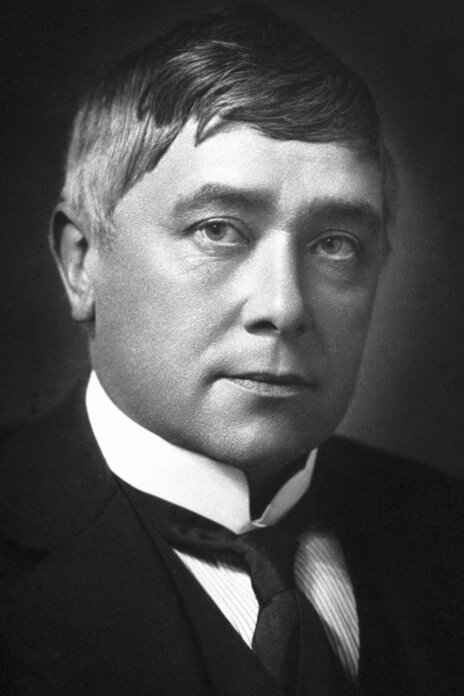
    Maurice Maeterlinck, from the Nobel Foundation Archive

    It is Beckett’s appropriation of the Belgian mystic that provides us with a direct connection toThe Innocent. By the time of Godot and Endgame, the symbolist theatre of Maeterlinck with its lack of plot and love of silence, had lost some currency: an American college student is memorialized as responding, when asked who Maurice Maeterlinck was, that he was the “king of Abyssinia” (William Lyon Phelps, “An Estimate of Maeterlinck,” North American Review 213.782 [Jan., 1921]). Beckett gives these theatrical aesthetics a new breath of life, while revivifying their metaphysical themes.

    Peter Szondi identifies Maeterlinck’s profound perception a defining realization that recurs throughout Beckett’s oeuvre:

    In Maeterlinck’s work only a single moment is dealt with, the moment when a helpless human being is overtaken by fate (32).

    Theory of the Modern Drama, trans. M. Hayes (Minneapolis: U of Minnesota P, 1987)

    It is so Beckettian, and essentially the same metaphysical thematic is at the bottom of two dramaticules in “addenda” to Mushanokoji’s The Innocent.

    Over my next couple posts, I will present an edition of Maeterlinck’s play, The Blind (Les Aveugles 1890) which strikingly demonstrates its significance for Beckett’s writing. Stark simplicity and themes of existential waiting resonate deeply with Beckett’s most iconic plays.

    Ashley Taggart writes of the “thematic debt owed by Beckett to Maeterlinck” identifiable in this work.

    Set in an indeterminate time, the situation depicted has a characteristic simplicity: six blind men and six blind women have been led out from their “asylum” for the day by an old priest. At a clearing in the forest, they stop, and, unknown to the others, the priest dies in their midst. Meanwhile, the blind await his return (from what they think is an excursion in search of bread and water) with mounting anxiety. That’s it. They sit around and wait, a la Godot, but in this case for the priest, whose lifeless body is slumped against a tree in between the men and the women. You could say it’s a one-act play minus the act.

    Maeterlinck and Beckett: Paying Lip-Service to Silence (Samuel Beckett Today / Aujourd’hui, Vol. 22, Samuel Beckett: Debts and Legacies [2010]}

    It is impossible to overlook the tonal and thematic features, broad and detailed, present in Maeterlink’s play, that Beckett lavishes in Waiting for Godot (1948/54) and Endgame (1957). Beckett’s deep engagement with Maeterlinck demonstrates the enduring relevance of these themes, which also reverberate in the background of Mushanokoji’s The Innocent.


    The Blind

    To Charles Van Lerberghe

    An ancient Norland forest, with an eternal look, under a sky of deep stars. In the centre, and in the deep of the night, a very old priest is sitting, wrapped in a great black cloak. The chest and the head, gently upturned and deathly motionless, rest against the trunk of a giant hollow oak. The face is fearsome pale and of an immovable waxen lividness, in which the purple lips fall slightly apart. The dumb, fixed eyes no longer look out from the visible side of Eternity and seem to bleed with immemorial sorrows and with tears. The hair, of a solemn whiteness, falls in stringy locks, stiff and few, over a face more illuminated and more weary than all that surrounds it in the watchful stillness of that melancholy wood. The hands, pitifully thin, are clasped rigidly over the thighs.

    On the right, six old men, all blind, are sitting on stones, stumps and dead leaves.

    On the left, separated from them by an uprooted tree and fragments of rock, six women, also blind, are sitting opposite the old men. Three among them pray and mourn without ceasing, in a muffled voice. Another is old in the extreme. The fifth, in an attitude of mute insanity, holds on her knees a little sleeping child. The sixth is strangely young, and her whole body is [*62] drenched with her beautiful hair. They, as well as the old men, are all clad in the same ample and sombre garments. Most of them are waiting, with their elbows on their knees and their faces in their hands; and all seem to have lost the habit of ineffectual gesture and no longer turn their heads at the stifled and uneasy noises of the Island. Tall funereal trees, — yews, weeping willows, cypresses, — cover them with their faithful shadows. A cluster of long, sickly asphodels is in bloom, not far from the priest, in the night. It is unusually oppressive, despite the moonlight that here and there struggles to pierce for an instant the glooms of the foliage.

    FIRST BLIND MAN (who was born blind): He hasn’t come back yet?

    SECOND BLIND MAN (who also was born blind): You have awakened me.

    FIRST BLIND MAN: I was sleeping too.

    THIRD BLIND MAN (also born blind): I was sleeping, too.

    FIRST BLIND MAN.
    He hasn’t come yet?

    SECOND BLIND MAN.
    I hear nothing coming. [*63]

    THIRD BLIND MAN.
    It is time to go back to the Asylum.

    FIRST BLIND MAN.
    We ought to find out where we are.

    SECOND BLIND MAN.
    It has grown cold since he left.

    FIRST BLIND MAN.
    We ought to find out where we are!

    THE VERY OLD BLIND MAN,
    Does anyone know where we are?

    THE VERY OLD BLIND WOMAN.
    We were walking a very long while; we must be a long way from the Asylum.

    FIRST BLIND MAN.
    Oh! the women are opposite us?

    THE VERY OLD BLIND WOMAN.
    We are sitting opposite you.

    FIRST BLIND MAN.
    Wait, I am coming over where you are. [He rises and gropes in the dark.] — Where are you? — Speak! let me hear where you are! [*64]

    THE VERY OLD BLIND WOMAN.
    Here; we are sitting on stones.

    FIRST BLIND MAN.
    [Advances and stumbles against the fallen tree and the rocks.] There is something between us.

    SECOND BLIND MAN.
    We had better keep our places.

    THIRD BLIND MAN.
    Where are you sitting? — Will you come over by us?

    THE VERY OLD BLIND WOMAN.
    We dare not rise!

    THIRD BLIND MAN.
    Why did he separate us?

    The Blind Leading the Blind by Pieter Breugel the Elder, 1568

    FIRST BLIND MAN.
    I hear praying on the women’s side.

    SECOND BLIND MAN.
    Yes; the three old women are praying.

    FIRST BLIND MAN.
    This is no time for prayer! [*65]

    SECOND BLIND MAN.
    You will pray soon enough, in the dormitory! [The three old women continue their prayers.]

    THIRD BLIND MAN.
    I should like to know who it is I am sitting by.

    SECOND BLIND MAN.
    I think I am next to you. [They feel about them.]

    THIRD BLIND MAN.
    We can’t reach each other.

    FIRST BLIND MAN.
    Nevertheless, we are not far apart. [He feels about him and strikes with his staff the fifth blind man, who utters a muffled groan.] The one who cannot hear is beside us.

    SECOND BLIND MAN.
    I don’t hear everybody; we were six just now.

    FIRST BLIND MAN.
    I am going to count. Let us question the women, too; we must know what to depend upon. I hear the three old women praying all the time; are they together?

    THE VERY OLD BLIND WOMAN.
    They are sitting beside me, on a rock. [*66]

    FIRST BLIND MAN.
    I am sitting on dead leaves.

    THIRD BLIND MAN.
    And the beautiful blind girl, where is she?

    THE VERY OLD BLIND WOMAN.
    She is near them that pray.

    SECOND BLIND MAN.
    Where is the mad woman, and her child?

    THE YOUNG BLIND GIRL.
    He sleeps; do not awaken him!

    FIRST BLIND MAN.
    Oh! how far away you are from us! I thought you were opposite me!

    THIRD BLIND MAN.
    We know – nearly – all we need to know. Let us chat a little, while we wait for the priest to come back.

    THE VERY OLD BLIND WOMAN.
    He told us to wait for him in silence.

    THIRD BLIND MAN.
    We are not in a church.

    THF VERY OLD BLIND WOMAN.
    You do not know where we are.
    [*67]

    THIRD BLIND MAN.
    I am afraid when I am not speaking,

    SECOND BLIND MAN.
    Do you know where the priest went?

    THIRD BLIND MAN.
    I think he leaves us for too long a time.

    FIRST BLIND MAN.
    He is getting too old. It looks as though he himself has no longer seen for some time. He will not admit it, for fear another should come to take his place among us; but I suspect he hardly sees at all anymore. We must have another guide; he no longer listens to us, and we are getting too numerous. He and the three nuns are the only people in the house who can see; and they are all older than we are! — I am sure he has misled us and that he is looking for the road. Where has he gone? — He has no right to leave us here. . . .

    THE VERY OLD BLIND MAN.
    He has gone a long way: I think he said so to the women.

    FIRST BLIND MAN.
    He no longer speaks except to the women?
    — Do we no longer exist? — We shall have to complain of him in the end. [*68]

    THE VERY OLD BLIND MAN.
    To whom will you complain?

    FIRST BLIND MAN.
    I don’t know yet; we shall see, we shall see. — But where has he gone, I say? — I am asking the women.

    THE VERY OLD BLIND WOMAN.
    He was weary with walking such a long time. I think he sat down a moment among us. He has been very sad and very feeble for several days. He is afraid since the physician died. He is alone. He hardly speaks anymore. I don’t know what has happened. He insisted on going out today. He said he wished to see the Island, a last time, in the sunshine, before winter came. The winter will be very long and cold, it seems, and the ice comes already from the North. He was very uneasy, too: they say the storms of the last few days have swollen the river and all the dikes are shaken. He said also that the sea frightened him; it is troubled without cause, it seems, and the coast of the Island is no longer high enough. He wished to see; but he did not tell us what he saw. — At present, I think he has gone to get some bread and water for the mad woman. He said he would have to go, a long way, perhaps. We must wait.

    [*69]

    THE YOUNG BLIND GIRL.
    He took my hands when he left; and his hands shook as if he were afraid. Then he kissed me.

    FIRST BLIND MAN.
    Oh! oh!

    THE YOUNG BLIND GIRL.
    I asked him what had happened. He told me he did not know what was going to happen. He told me the reign of old men was going to end, perhaps.…

    FIRST BLIND MAN.
    What did he mean by saying that?

    THE YOUNG BLIND GIRL.
    I did not understand him. He told me he was going over by the great lighthouse.

    FIRST BLIND MAN.
    Is there a lighthouse here?

    THE YOUNG BLIND GIRL.
    Yes, at the north of the Island. I believe we are not far from it. He said he saw the light of the beacon even here, through the leaves. He has never seemed more sorrowful than today, and I believe he has been weeping for several days. I do not know why, but I wept also without seeing him. I did not hear [*70] him go away. I did not question him any further. I was aware that he smiled very gravely; I was aware that he closed his eyes and wished to be silent.…

    FIRST BLIND MAN.
    He said nothing to us of all that!

    THE YOUNG BLIND GIRL.
    You do not listen when he speaks!

    THE VERY OLD BLIND WOMAN.
    You all murmur when he speaks!

    SECOND BLIND MAN.
    He merely said “Good-night” to us when he went away.

    THIRD BLIND MAN.
    It must be very late.

    FIRST BLIND MAN.
    He said “Good-night” two or three times when he went away, as if he were going to sleep. I was aware that he was looking at me when he said “Good-night; good-night.” — The voice has a different sound when you look at anyone fixedly.

    FIFTH BLIND MAN.
    Pity the blind!

    [*71]

    FIRST BLIND MAN.
    Who is that, talking nonsense?

    SECOND BLIND MAN.
    I think it is he who is deaf.

    FIRST BLIND MAN.
    Be quiet! — This is no time for begging!

    THIRD BLIND MAN.
    Where did he go to get his bread and water?

    THE VERY OLD BLIND WOMAN.
    He went toward the sea.

    THIRD BLIND MAN.
    Nobody goes toward the sea like that at his age!

    SECOND BLIND MAN.
    Are we near the sea?

    THE OLD BLIND WOMAN.
    Yes; keep still a moment; you will hear it.

    [Murmur of a sea, nearby and very calm, against the cliffs.]

    SECOND BLIND MAN.
    I hear only the three old women praying.

    THE VERY OLD BLIND WOMAN.
    Listen well; you will hear it across their prayers.
    [*72 ]

    SECOND BLIND MAN
    Yes; I hear something not far from us.

    THE VERY OLD BLIND MAN.
    It was asleep; one would say that it awaked.

    FIRST BLIND MAN.
    He was wrong to bring us here; I do not like to hear that noise.

    THE VERY OLD BLIND MAN.
    You know quite well the Island is not large. It can be heard whenever one goes outside the Asylum close.

    SECOND BLIND MAN.
    I never listened to it.

    THIRD BLIND MAN.
    It seems close beside us today; I do not like to hear it so near.

    SECOND BLIND MAN.
    No more do I; besides, we didn’t ask to go out from the Asylum.

    THIRD BLIND MAN.
    We have never come so far as this; it was needless to bring us so far.
    [*73]

    THE VERY OLD BLIND WOMAN.
    The weather was very fine this morning; he wanted to have us enjoy the last sunny days, before shutting us up all winter in the Asylum.

    FIRST BLIND MAN.
    But I prefer to stay in the Asylum.

    THE VERY OLD BLIND WOMAN.
    He said also that we ought to know something of the little Island we live on. He himself had never been all over it; there is a mountain that no one has climbed, valleys one fears to go down into, and caves into which no one has ever yet penetrated. Finally he said we must not always wait for the sun under the vaulted roof of the dormitory; he wished to lead us as far as the seashore. He has gone there alone.

    THE VERY OLD BLIND MAN.
    He is right. We must think of living.

    FIRST BLIND MAN.
    But there is nothing to see outside!

    SECOND BLIND MAN.
    Are we in the sun, now?

    THIRD BLIND MAN.
    Is the sun still shining?
    [*74]

    SIXTH BLIND MAN.
    I think not: it seems very late.

    SECOND BLIND MAN.
    What time is it?

    THE OTHERS.
    I do not know. — Nobody knows.

    SECOND BLIND MAN.
    Is it light still? [To the sixth blind man.] — Where are you? — How is it, you who can see a little, how is it?

    SIXTH BLIND MAN.
    I think it is very dark; when there is sunlight, I see a blue line under my eyelids. I did see one, a long while ago; but now, I no longer perceive anything.

    FIRST BLIND MAN.
    For my part, I know it is late when I am hungry: and I am hungry.

    THIRD BLIND MAN.
    Look up at the sky; perhaps you will see something there!

    [All lift their heads skyward, with the exception of the three who were born blind, who continue to look upon the ground.]

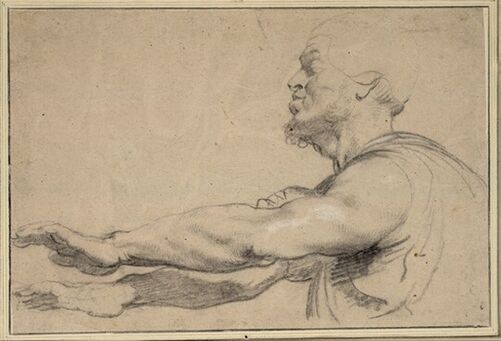
    Studie van een blinde man, 1617-1618, Peter Paul Rubens

    SIXTH BLIND MAN.
    I do not know whether we are under the sky.

    [*75]

    FIRST BLIND MAN.
    The voice echoes as if we were in a cavern.

    THE VERY OLD BLIND MAN.
    I think, rather, that it echoes so because it is evening.

    THE YOUNG BLIND GIRL.
    It seems to me that I feel the moonlight on my hands.

    THE VERY OLD BLIND WOMAN.
    I believe there are stars: I hear them.

    THE YOUNG BLIND GIRL.
    So do I.

    FIRST BLIND MAN.
    I hear no noise.

    SECOND BLIND MAN.
    I hear only the noise of our breathing.

    THE VERY OLD BLIND MAN.
    I believe the women are right.

    FIRST BLIND MAN.
    I never heard the stars.

    THE TWO OTHERS WHO WERE BORN BLIND.
    Nor we, either.

    [A flight of night birds alights suddenly in the foliage]

    [*76]

    SECOND BLIND MAN.
    Listen! Listen! — what is up there above us? — Do you hear?

    THE VERY OLD BLIND MAN.
    Something has passed between us and the sky!

    SIXTH BLIND MAN.
    There is something stirring over our heads; but we cannot reach there!

    FIRST BLIND MAN.
    I do not recognize that noise. — I should like to go back to the Asylum.

    SECOND BLIND MAN.
    We ought to know where we are!

    SIXTH BLIND MAN.
    I have tried to get up; there is nothing but thorns about me; I dare not stretch out my hands.

    THIRD BLIND MAN.
    We ought to know where we are!

    THE VERY OLD BLIND MAN.
    We cannot know!

    SIXTH BLIND MAN.
    We must be very far from the house. I no longer understand any of the noises.

    [*77]

    THIRD BLIND MAN.
    For a long time I have smelled the odor of dead leaves —

    SIXTH BLIND MAN.
    Is there any of us who has seen the Island in the past, and can tell us where we are?

    THE VERY OLD BLIND WOMAN.
    We were all blind when we came here.

    FIRST BLIND MAN.
    We have never seen.

    SECOND BLIND MAN.
    Let us not alarm ourselves needlessly. He will come back soon; let us wait a little longer. But in the future, we will not go out any more with him.

    THE VERY OLD BLIND MAN.
    We cannot go out alone.

    FIRST BLIND MAN.
    We will not go out at all. I had rather not go out.

    SECOND BLIND MAN.
    We had no desire to go out. Nobody asked him to.

    [*78]

    THE VERY OLD BLIND WOMAN.
    It was a feast-day in the Island; we always go out on the great holidays.

    THIRD BLIND MAN.
    He tapped me on the shoulder while I was still asleep, saying: “Rise, rise; it is time, the sun is shining!” — Is it? I had not perceived it. I never saw the sun.

    THE VERY OLD BLIND MAN.
    I have seen the sun, when I was very young.

    THE VERY OLD BLIND WOMAN.
    So have I; a very long time ago; when I was a child; but I hardly remember it any longer.

    THIRD BLIND MAN.
    Why does he want us to go out every time the sun shines? Who can tell the difference? I never know whether I take a walk at noon or at midnight.

    SIXTH BLIND MAN.
    I had rather go out at noon; I guess vaguely then at a great white light, and my eyes make great efforts to open.

    THIRD BLIND MAN.
    I prefer to stay in the refectory, near the seacoal fire; there was a big fire this morning….

    [*79]

    SECOND BLIND MAN.
    He could take us into the sun in the courtyard. There the walls are a shelter; you cannot go out when the gate is shut, — I always shut it. — Why are you touching my left elbow?

    FIRST BLIND MAN.
    I have not touched you. I can’t reach you.

    SECOND BLIND MAN.
    I tell you somebody touched my elbow!

    FIRST BLIND MAN.
    It was not any of us.

    SECOND BLIND MAN.
    I should like to go away.

    THE VERY OLD BLIND WOMAN.
    My God! My God! Tell us where we are!

    FIRST BLIND MAN.
    We cannot wait for eternity.

    [A clock, very far away, strikes twelve slowly.]

    THE VERY OLD BLIND WOMAN.
    Oh, how far we are from the asylum!

    THE VERY OLD BLIND MAN.
    It is midnight.

    [*80]

    SECOND BLIND MAN.
    It is noon. — Does anyone know? — Speak!

    SIXTH BLIND MAN.
    I do not know, but I think we are in the dark.

    FIRST BLIND MAN.
    I don’t know any longer where I am; we slept too long —

    SECOND BLIND MAN.
    I am hungry.

    THE OTHERS.
    We are hungry and thirsty.

    SECOND BLIND MAN.
    Have we been here long?

    THE VERY OLD BLIND WOMAN.
    It seems as if I had been here centuries!

    SIXTH BLIND MAN.
    I begin to understand where we are …

    THIRD BLIND MAN.
    We ought to go toward the side where it struck midnight…

    [All at once the night birds scream exultingly in the darkness.]

    [*81]

    FIRST BLIND MAN.
    Do you hear? — Do you hear?

    SECOND BLIND MAN.
    We are not alone here!

    THIRD BLIND MAN.
    I suspected something a long while ago: we are overheard. — Has he come back?

    FIRST BLIND MAN.
    I don’t know what it is: it is above us.

    SECOND BLIND MAN.
    Did the others hear nothing? — You are always silent!

    THE VERY OLD BLIND MAN.
    We are listening still.

    THE YOUNG BLIND GIRL.
    I hear wings about me!

    THE VERY OLD BLIND WOMAN.
    My God! my God I Tell us where we are!

    SIXTH BLIND MAN.
    I begin to understand where we are.… The Asylum is on the other side of the great river; we crossed the old bridge. He led us to the north of the Island. We are not far from the [*82] river, and perhaps we shall hear it if we listen a moment.… We must go as far as the water’s edge, if he does not come back. . . . There, night and day, great ships pass, and the sailors will perceive us on the banks. It is possible that we are in the wood that surrounds the lighthouse; but I do not know the way out.… Will anyone follow me?

    FIRST BLIND MAN.
    Let us remain seated! — Let us wait, let us wait. We do not know in what direction the great river is, and there are marshes all about the Asylum. Let us wait, let us wait.… He will return…. he must return!

    SIXTH BLIND MAN.
    Does anyone know by what route we came here? He explained it to us as he walked.

    FIRST BLIND MAN.
    I paid no attention to him.

    SIXTH BLIND MAN.
    Did anyone listen to him?

    THIRD BLIND MAN.
    We must listen to him in the future.

    SIXTH BLIND MAN.
    Were any of us born on the Island?

    [*83]

    THE VERY OLD BLIND MAN.
    You know very well we came from elsewhere.

    THE VERY OLD BLIND WOMAN.
    We came from the other side of the sea.

    FIRST BLIND MAN.
    I thought I should die on the voyage.

    SECOND BLIND MAN.
    So did I; we came together.

    THIRD BLIND MAN.
    We are all three from the same parish.

    FIRST BLIND MAN.
    They say you can see it from here, on a clear day, — toward the north. It has no steeple.

    THIRD BLIND MAN.
    We came by accident.

    THE VERY OLD BLIND WOMAN.
    I come from another direction.…

    SECOND BLIND MAN.
    From where?

    THE VERY OLD BLIND WOMAN.
    I dare no longer dream of it…. I hardly remember any longer when I speak of it.… It was too long ago…. It was colder there than here.…

    [*84]

    THE YOUNG BLIND GIRL.
    I come from very far.…

    FIRST BLIND MAN.
    Well, from where?

    THE YOUNG BLIND GIRL.
    I could not tell you. How would you have me explain! — It is too far from here; it is beyond the sea. I come from a great country.… I could only make you understand by signs: and we no longer see. I have wandered too long.… But I have seen the sunlight and the water and the fire, mountains, faces, and strange flowers.… There are none such on this Island; it is too gloomy and too cold…. I have never recognized their perfume since I saw them last.… And I have seen my parents and my sisters…. I was too young then to know where I was.… I still played by the seashore.… But oh, how I remember having seen!… One day I saw the snow on a mountain-top… I began to distinguish the unhappy…

    FIRST BLIND MAN.
    What do you mean?

    THE YOUNG BLIND GIRL.
    I distinguish them yet at times by their voices…. I have memories which are clearer when I do not think upon them….

    [* 85]

    FIRST BLIND MAN.
    I have no memories.

    [A flight of large migratory birds pass clamorously, above the trees.]

    THE VERY OLD BLIND MAN.
    Something is passing again across the sky!

    SECOND BLIND MAN.
    Why did you come here?

    THE VERY OLD BLIND MAN.
    Of whom do you ask that?

    SECOND BLIND MAN.
    Of our young sister.

    THE YOUNG BLIND GIRL.
    I was told he could cure me. He told me I would see some day; then I could leave the Island.…

    FIRST BLIND MAN.
    We all want to leave the Island!

    SECOND BLIND MAN.
    We shall stay here always.

    THIRD BLIND MAN.
    He is too old; he will not have time to cure us.

    [TO BE CONTINUED]


    • In Maurice Maeterlinck, The Intruder: The Blind; The Seven Princesses; The Death of Tintagiles, translated by Richard Hovey, NY: Dodd, Mead, and Company, 1911. Page numbers in the text (*) are from this edition.
    • Featured image is The Blind Leading the Blind by Pieter Breughel the Elder, 1568