
Missing Persons
“Here, have a go at this:
“A strange discovery was made yesterday by a miner named Wilson. While cutting props in the bush, about two miles from the Deep Lead, he found that he was at work beside the headless trunk of a human being. The remains were lying about ten feet from an abandoned shaft. The head was severed from the body, and although a careful search was made, it was nowhere to be found. The body had apparently been removed to its present spot within the last week, for there is a mark on the ground close to where the remains were. The body appeared to be that of a male, tall and slender. Not a vestige of clothing of any description was found on or near the remains.
“Well, that is out of the ordinary, ain’t it, Wilson, what it says in this rag here?” Cleggett, the barroom wag, lowered the newspaper and gave Wilson a sidelong look over his glass.
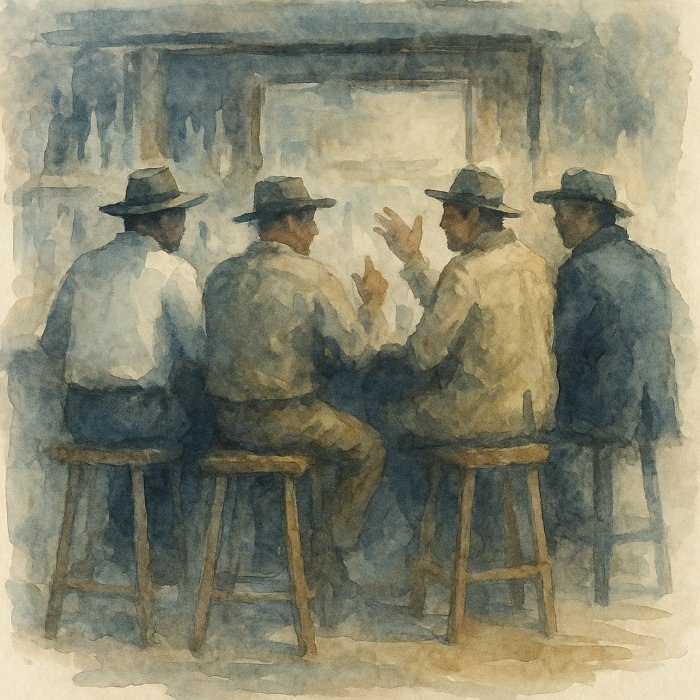
“Indeed, well it was exceeding strange,” Wilson said. “Eerie, horrible, and awful as well, I can assure ye. Not every day a cove turns around and cops an eyeful of sompthing like that, I mean to say, a naked corpse right there next to you where you’re workin’. Inches away. Cop that, mate! A nude, naked body of some bloke without no head and all – without a particle of clothing. Ants all over it. Crawling down his throat and everything. No private parts neither and all.”
“Where was is clothes?” Nash muttered from along the bar.
“No one knows for godsakes, shit! But you know, there wasn’t no stink of decomposing, having been there a while, and the skin was a kind of mystic golden colour, swear to Christ, like the Pharaoh, I reckon, like some mummy. Cor’blimey, fill this up for us, Ronald, wont’ya? I’m still a’shiverin’ and a’shakin’ from the shock. Shout me one? What about it? Calm me nerves. Who’s won the bloody cricket in Melbourne, anyhoo?”
Cleggett set his glass down and snorted wearily.
“No, I mean, strange you was working, like the paper says here. I ain’t never seen you doing no work never. Never heard of it neither. Yet here it is in black and white in the bloody paper. You working! How do they get them facts the sorts of which no-one’s never seen nor heard of before? Cutting props, you? God Almighty, what a farce. Love to witness that. That is an original story!”
He paused for effect. “Oh, I see! No, the point of the story is, some bloke’s got himself murdered and ’ad his head cut ’orf and you found him.”
A couple of grunts along the line.
“Well anyway, who is he? Or if you like, who was he?”
“They dunno who he was,” Wilson explained. “That’s the problem, like. How can they catch who done him in, if they don’t even know who he was, like? That’s just what I’m trying to tell the bloomin’ coppers. Detective didn’t even want to listen to me. Just kept telling me to shut up every time I opened me mouth. I was invited to the whatsit, of course – as what they call the discoverer of the cadaver. Bloody dead body layin’ there large as life. Shit. And I lost the day’s work of cuttin’ props and all.” He took a gulp of whiskey.
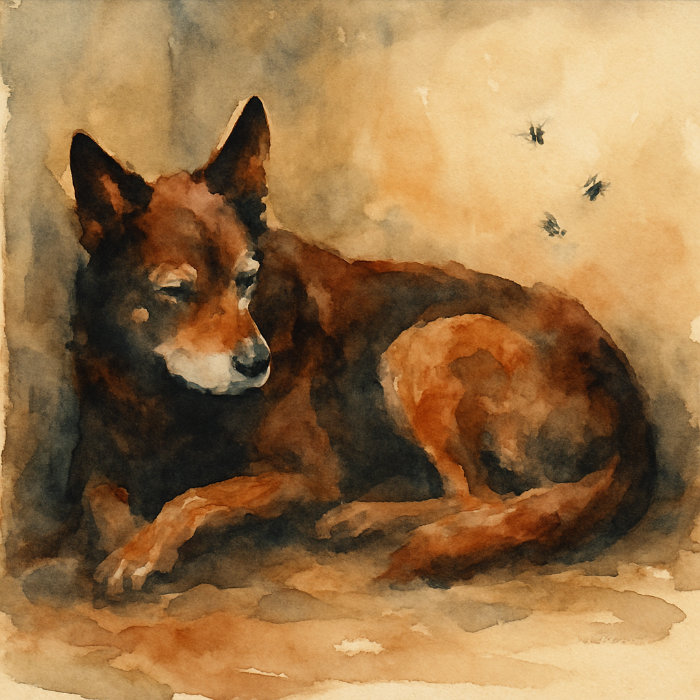
“Oh yes, you and your props. Hi, get that dog out of ’ere!”
“Oi, get that bloody dog out!”
“Ah, he’s not doin’ no harm.”
“Yeah, leave the poor bastard be.”
“Ah, e’s bringin’ in the flies!”
“No he ain’t. Look, he’s drawin’ ours over there into his corner! Look at that one, there you go.”
“So he is, leave him then.”
“Yeah, leave him be, he ain’t doin’ no harm nohow.”
“Leave him be, you bastard!”
The greying old red and tan kelpie settled in.
“That is a problem, about the identity. But I overheard the coppers say some bloke was missing.”
“Yeah, who?”
“Bellman, I think I heard. Poor bastard. Wife and child, I think I heard. Maybe not, I dunno. She left him, I think maybe I heard.”
“Good name,” Cleggett reflected.
“Yeah, I know.”
“Never send to know for whom the bell tolls …” Cleggett drawled.
“Yeah, I know.”
“It tolls for thee.”
“Oh, for Chrissakes. Blimey, you don’t half bang on. Gad, what are they putting in this stuff?
•
The mystery astonished and horrified the community, locally and across the country. At last the police had something to work upon in ferreting out what had seemed a hopeless mystery. Steadfastly, Detective Forster – dour, methodical, undistracted – set himself to the task of unravelling the details and run the murderer to ground.
One Frank A. Bellman, a labourer, hadn’t been accounted for during the past month and seemed a likely candidate for the victim. The time frame was right, and his brother was concerned enough to notify the constabulary. Bellman was supposed to visit him at Warrnambool – but failed to show up.
Forster was at his desk, some new leads having come in. He perused the recent details on Bellman, a page and a half. Hopefully, this was the man. Seemed a decent enough fellow, drank a bit, perhaps too much, but what was that? Didn’t gamble, hardly.
Why was the head cut off? Obviously, to hide the identity of the deceased; so it was likely the perpetrator either had some connection to him or had been seen with him recently.
Forster harked back to the inquiry at the pub at Deep Lead, and how the Celestial seemed to look not at the corpse, but somehow through it. That Mow Fung, weird character, Chinese or no. Forster could not get him out of his head. Perhaps call in on him in a couple of days, might know something he’s not saying.
Frank A. Bellman.
Frank a bellman?
Rubbish.
He was at his wits’ end, mind going around in circles, at the end of a track that petered out and turned into sand, just like his visit to the Junction Hotel and the crime scene. The crime scene a murderer’s paradise, if one had such an inclination. Footprints in the sand were erased in no time. Bottomless mining holes everywhere for miles around, one right near the body. Take the head and clothes, and you are away Scot free.
Bellman was a good chance, so Forster mounted up and set off to do the rounds of Bellman’s known haunts. He rode out to Bellman’s shanty, where he found a dead dog, and a half-mad horse, and spent a while getting water into it and shifting it into the shade.
“I’ll send someone in a little bit, you blokes, you keep tight, won’t be long.”
He rode out through the front barbed-wire gate and dismounted to hook it up again. Clear as day, the Junction publican came to mind again. That inscrutable look still gave you the shivers somehow. He mounted, wheeled about, feeling an impulse to return to the shack.

A shed fifty yards off stood steaming in the midday sun, so he went over. Behind the shed, a foal lay panting. He coaxed it into the shade, then went to fetch some water from Bellman’s muddy dam. When he poured it gently over the foal’s neck, the animal blinked, snorted, and took a drink. It would live.
He paused at the gate, took a long breath, and rode to the barracks.
Mounted-Constable Hadfield was there, chatting with a civilian. They stopped and looked up when Forster came in.
“This is Mister Bell,” Hadfield said.
“Bellman?”
“Just Bell, Detective Sergeant. He’s a woodcarter, lives here in Stawell.”
A bleached, weathered scrap of clothing lay on the desk: the torn-off half-portion of a waistcoat, violently ripped from the rest, buttons missing and lining torn askew.
“What’s this?”
“Mister Bell found these items in the bush, sir, a bit of a way from Deep Lead towards here, and he brought them in for us.”
Forster checked himself – he’d been too brusque. “That’s very kind of you, sir. Do you mind telling me what took you out that way?”
“Following my occupation. Gathering and carting wood. Sometimes I carts it, sometimes gathers, most often usually both.”
“Might you be available to show us the spot, post haste?”
•
Bell had found the waistcoat on his way to a place called the Four Posts, about eighty yards from the Old Glenorchy Road. The three fossicked through the immediate area, moving as systematically as they could outward from the spot, which Bell had thoughtfully marked with a cross of four rocks. After about an hour, Forster dispatched Bell to fetch Constable Hillard for another set of legs and eyes.
Alone now, taking a mental break, he wandered down to a dry creek bed, fringed with scrub and tall kangaroo grass.
A lone bird call rang out – Four gallons of water! – and he stopped, turning towards the sound. To his left, where the call had come from, something caught his eye: a small heap half-hidden in the grass. He’d almost missed it, for the cloth had taken on a yellowish-green tinge from long exposure, nearly the same as the tussocks around it. He might have passed and re-passed forever without discovering it, but for that bird. Feathered bloody oracle.

Three buckets of water! Fainter, receding, gone. Magnifying the heavy, empty expanse. What turns up when you are not looking.
The coat was blood-stained, especially about the neck. One button remained on the waistcoat, the only one to withstand the violent strain by which the garment had been yanked open. It matched one found under the body. On the shirt, too, were the gaps where two buttons, also recovered under the remains, had been torn free. There could be no doubt that the clothes were those worn by the murdered man. He drew from the tangle of cloth a third of a wideawake felt hat, the rest having been cut away. A few hairs clung to the remaining rim, the same colour as those found at the base of the dead man’s neck. They were stuck to the felt by blood. The trousers were missing, and so was the dead man’s head.
“Wideawake,” he couldn’t help saying softly aloud, as he made his notes, “no nap.”
He’d organise another sweep in a week or so, but for now there were other fires to tend.
Bellman’s mother had been summoned over from Horsham to examine the remains, which she was sure as sure could be were her son’s:
“It can’t be he, oh it can’t be he! But I fear it is. I’m certain it is! His hair’s turned a little more to the reddish hue, that’s all, workin’ out here like a navvy! What a bonnie bairn he was, the wee rascal! That mole on his shoulder is sure his. Oh, he was a fine laddie, with all of his future in front of him. But will you look at him, look at his skin. It’s … radiant, the peak of health! Bless the daft lad – he couldn’t scrub up like that when he was living. Ach, ma heid’s mince!”
Hillard fetched her again from the Commercial Hotel in Stawell, where she was being put up, having imperfect relations with her other son. This time, it was not the body she was brought in to identify, but the items of clothing recovered from the bush.
“He was a dear laddie,” she said quavering, placing her frail hand on the waistcoat. “Och, to think this was the last thing he wore, it sends me heart racin’. Well, whit’s fur ye’ll no go by ye!” Overcome, she paled and drew the back of her hand up to her brow. Forster pulled a chair over and lowered her into it.
There came a knock at the door, and a constable poked his head in. “There’s a bloke out here to see you, Detective.”
“Not now.”
“It seems important.”
“I said not now.” The door closed.
Mrs Bellman began to sob. The door opened again; the same constable gestured to Hillard, who looked at Forster.
“For goodness sake, go and see what he wants.”
The woman sobbed convulsively. Forster laid a hand lightly on her shoulder. The door opened and Hadfield came in quietly followed by a man.
“You alright, Ma?”
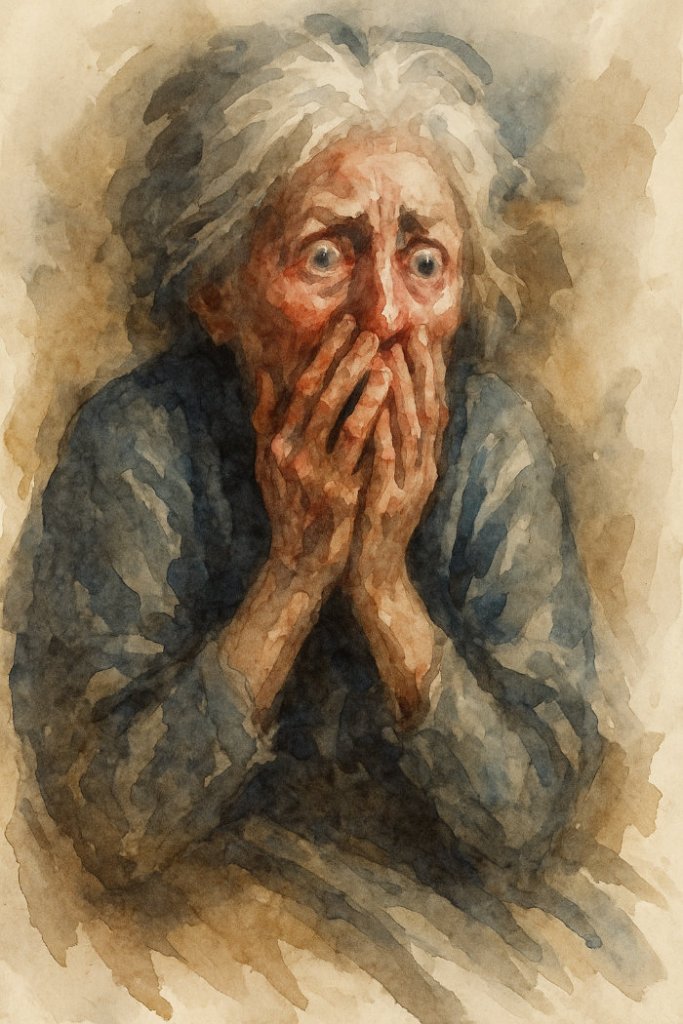
“In the name o’ the wee man, this isnae real!” Mrs Bellman turned white as a sheet, rose shaking – “Ye’re meant to be deid!” – and abruptly dropped to the floor.
Thus the Bellman mystery – if one can call it that – was solved. Instead of going to Warrnambool as planned, he had detoured over into New South Wales and returned the next Saturday. He’d left the animals with feed enough for a few days, thinking he’d be home on Sunday. But his horse threw a shoe past Moama and went lame, and the smith wouldn’t see him till Friday, he had to lay up at some wayside inn, only the publican’s daughter had the measles, and he ended up minding the place while the missus boiled onions. At any rate: no foul play, no mystery. Just an irritatingly loquacious fellow, who couldn’t be bothered sending a wire.
The case of a carrier named Flannigan, though not dissimilar, was in some respects more of a nuisance. His circumstances made it likely that the remains found near Deep Lead might be his. Detective Forster left Stawell by the first train Monday morning to conduct some interviews. On Tuesday, he struck out for Woodend and went some distance into Bullarook Forest, before doubling back to Seymour. He set the telegraph wires to work, then back to Ballarat, chasing a clue. By wire, he learned that Flannigan was alive and well in Deniliquin.
The circumstances surrounding the disappearance of all persons reported missing from the district had now been accounted for. The discovery of the clothing further assisted in establishing the identity of the murdered man and was expected to furnish evidence leading to the apprehension of the perpetrator. Another step had been taken in the matter, and it was to be hoped that justice, having misplaced its head, would soon find its footing.


 Furin Chime Press™