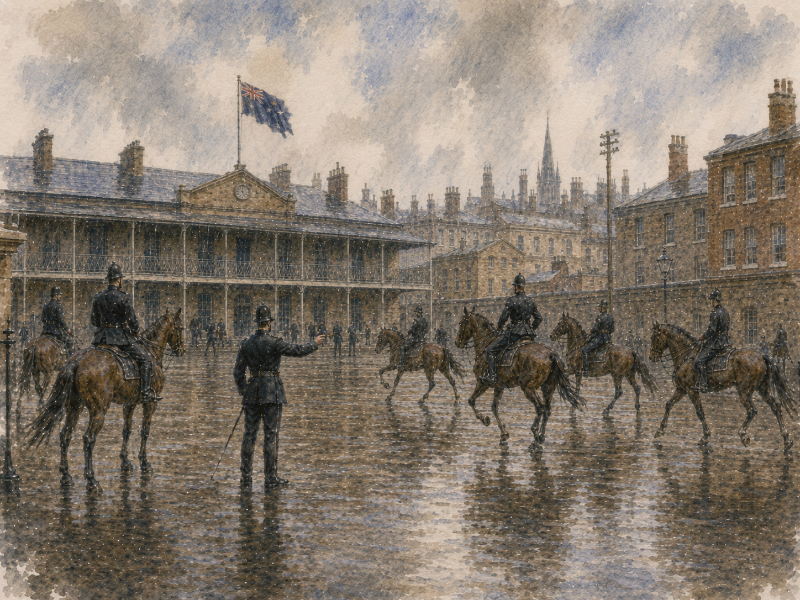
Lili was accompanied to the senior inspector’s office by the sergeant who had been stationed to guard her door for the night. Forster sat there quietly looking out through the closed window onto the parade ground, where some drills were in progress. The sounds of horses and the raised voices of drill instructors broke into the room when the door opened, and were muted again as the sergeant left. Inspector Secretan introduced himself and directed her to sit in the empty chair alongside Forster.
“The Commissioner was pleased that his notice in the Gazette succeeded in reaching you, Miss Chan,” Secretan said, “although we were taken aback that the result should prove so dramatic.”
I do assure you, Inspector,” she said, “that Detective Forster was entirely up to the task. Every hair on my head remains unharmed. I would appreciate it if we might keep it all out of the papers.”
“That’s well and good,” said Secretan. “Well and good.” He paused to draw on his cigar, glancing over the statements pertaining to the previous night’s events. “Of course, Detective Forster’s use of deadly force has set in motion certain procedures designed to assess whether it was justified, but from these accounts, it does appear in order, at first glance. Indeed, he is to be commended for ensuring your safety in the course of your response to the Commissioner’s invitation.
“The detective is soon to act as a prosecution witness, as you are probably aware, at the Central Criminal Court, a duty that will not be impeded by the matter at hand. However, questions have now been raised concerning you yourself, which require some answers. Forster has been designated the officer in charge of establishing the facts of your case.”
He pressed a brass button on the edge of his desk, and somewhere beyond the closed door, a bell gave a muffled note. After a moment, the sergeant appeared.
“Miss Moira Sculley is to be brought here from detention, and have the clerk attend with his notebook,” Secretan ordered.
A guard led Moira in, her arm in a sling. Lili gave her an intensely searching look as she passed, and a quizzical little frown crossed Moira’s face for an instant.
“Lovely to see you so soon,” Lili said softly as Moira sat down, the guard standing next to her. Forster gave Lili a blank look before turning to Moira.
“You are here for the part you played in Miss Chan’s abduction.”
Moira shrugged. “She come of her own free will.”
Lili briefly cleared her throat. “I don’t believe I used that exact word, Detective Forster,” she said. Forster looked at her in astonishment. “At least,” she continued, “not in connection with Miss … Sculley. In fact, I formed the distinct impression that she herself was subject to the coercion of that horrid corpulent gentleman now deceased, who introduced himself to me as Algernon. An unconvincing alias, obviously.”
“I see,” Forster said curtly. “Let us accept that premise, then, since you are the only one, Miss Chan, who had a chance to observe their relationship.”
“After all,” said Lili, “he did shoot her. I believe it was to prevent her from flinging the door open in an effort to abet my dash for freedom, just as you arrived so heroically, Detective.”
“Yet, Miss Chan, according to what you told me last night about the incident in the swamp, Miss Sculley was at very least the instrument employed by this … Algernon … to plant a note in your pocket, and to surveil your movements throughout the day.”
“So I thought at the time, Detective,” Lili said. “But I was extremely disquieted on arriving at Algernon’s shack. Everything was a blur, to an extent that I fear I may have jumped to that conclusion. I must admit to not seeing the young woman’s face clearly when whoever-they-were bumped into me outside the jeweller’s…”
“Quite right,” Moira piped up. “I ain’t been near Bourke Street for weeks.” Forster gave her a sharp look.
“Bourke Street?”
“I must have let that drop during our discussion at the shack,” Lili added quickly.
“Well, on another detail… let me read from Miss Sculley’s statement,” Forster said, thumbing through a sheaf of papers. “‘Then the fancy Chinese tart admitted to Algy she was the one that done in his big brother’s mate Fang in San Francisco and stole his loot. Oh, she was cool about it, alright.’”
“The poor child must have misheard,” said Lili. “I said no such thing. You will recall that Fang was the reprehensible highbinder who kept me his slave for months until he was assassinated by a rival tong. It was in all the papers. Naturally, I changed my identity after that fortunate incident, in order to escape any further maltreatment.”
Forster persisted with Moira. “Who is this Blue Marquis you referred to in your statement, who was apparently the reason Miss Chan was lured to the swamp?”
“A valuable diamond ring she murdered him for…,” said Moira, uncertainly.
“This?” Forster took the ring from his pocket and laid it on the table before her. “Our constables retrieved it this morning.”
“That’s the one.”
“We had it looked at. It’s a worthless piece of paste,” the detective said.
“If you don’t mind,” said Lili, “I would like it back regardless, because it holds no small sentimental value for me – it’s a tiny fragment of my past self, one might say, worthless as it may be.”
“Well … it’s been all too much for me.” Moira gave Lili a glance now more shrewd than spiteful.
“She is obviously confused,” Lili said. “There is no reason for you to hold her any longer, after what she has been through with that thug. Who knows what lies he probably told her about me?” She dabbed the corner of her eye with her handkerchief.
Inspector Secretan gave her a second to compose herself.
“Miss Sculley may be dismissed. Kindly see her to the front gates, Sergeant.”
When they had gone, he turned to Forster.
“It seems to me the mystery of this so-called Blue Marquis ring is likely no more than the deluded imaginings of a homicidal monomaniac, who is now resting deservedly in the barracks mortuary. But before we draw a line under the case, it would perhaps be best for you to accompany Miss Chan on a visit to Mr Kaminski’s when she returns to learn the results of his appraisal. In a semi-informal capacity, as it were, if that would be permissible, Miss Chan?”
“Thank you, Inspector, that would be entirely apropos. And perhaps after that we might be able to proceed with our excursion to the Gilbert and Sullivan? I’ve heard all about it and am absolutely dying to see it. Detective Forster?”
But Forster only gave her a slight nod and a grim smile.
• • •
It was well within the seven-times-seven days of the bardo – sacred interval! – when Lena had seen the detective as she came into Deep Lead from the bush track and he turned just in time to see her slipping in and out of the mirage – lately such an everyday phenomenon in the bush around these parts. Except that she had experienced the illusion as a sense of lightness and return somehow, yes, as though she had been returning from somewhere a great distance off, or rather, from a kind of nowhere, the memory of which transformed into a sudden dizziness and queer visual shimmer that almost made her trip, and gave her a fleeting impression that she could be about to die, so strong she let out an involuntary laugh.
Afterward, she went into the garden behind the Junction’s teahouse to visit the maiden wattle, for whom she fetched a can of water from the tank. Mow Fung must have noticed her come in, because he joined her for a little while by the plant. Both father and daughter drew insight and calm from the wattle, which had a way of filtering the midday light through its leaves, thereby producing what seemed like a cool and ambient sphere – a calming aura, one might say. Lena retained her uncanny connection with her “Maiden” and even extracted her resin to use as an ingredient for incense.
“I noticed that the detective came to the teahouse,” Lena said. “He is sure to meet Miss Chan. I wonder whether they will hit it off? Of course, you won’t mention to him your business with the spirit of the headless man. He might find it odd.” She giggled. “Even Mama finds it a little bit silly. I can’t imagine you in Hell. How terrifying it must be.”
“As you should know, the old fables are a way to help simple souls like myself to understand the nature of our own being. Ancient stories about the Ten Courts can guide us towards understanding and confronting the dark shadows that dwell within ourselves. It makes perfect sense. Let’s say you commit fairly light crimes. In such cases you will go to Tongue-Pull Hell for lying, or suffer the scissor torture for breaking up a marriage. Worse crimes are punished in more severe, lower hells. If you kill animals for sport, you must climb a mountain of knives. Those who disrespect their elders, commit murder, or break monastic vows will find themselves in a vast crimson pool, where they choke forever on boiling, filthy blood. It’s all somewhere inside oneself … almost enough to make you wonder how much of it is there in any real sense.”
Official horse-face demon rifles through the papers piled before him on his desk, a few of which catch fire from the sparks, while three ox-heads idle over a game of snakes and ladders, tiny screams floating up from the board. Horse-face scowls, spectacles balanced precariously above his nostrils, and snorts an abrupt reply to the human being standing there before him, the smell of life lingering about him.
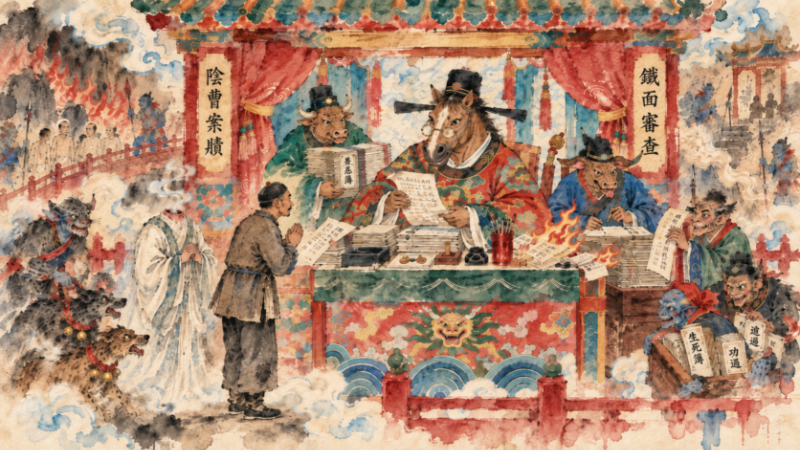
“Foolish Daoist publican,” he spits. “I presume you represent this headless supplicant trailing along behind you with the hound-demons snapping at his heels. What are his name and circumstances?”
“I do not know his name, nor even his face, because he was decapitated in the bush, and when his body was discovered, he was taken to my pub to be stored and investigated.”
“Address?” Mow Fung tells him where the body had been found at the Four Posts, and the horse-face summons two demons with blue faces and hooked ivory tusks, sending them to retrieve the spirit’s details. They return almost instantly dragging a barrow behind them, trailing coals and burning reams and scraps of paper.
“Luckily,” hisses the horse-face, “a few remnants of the record remain, though it was ordered to be assigned to the Pit of Irrelevance.” Blowing on the sheaf presented to him, he extinguishes it, producing a plume of thick acrid black smoke.
“This happens to be the most recent entry – luckily for him. According to the regulations, that makes it admissible as the record of final authority. I see you have visited the place of death?”
“There was a strong sense of his presence,” says Mow Fung, “as though he is tied to the spot. His head cannot be found.”
“I see here that you performed some arcane rites. Not that it is any great concern of mine, but it may be a good idea to fashion a head from paper and ink, then burn it. For the hun, the corpse is mere paperwork. Identity and karmic record are what count.”
“I tried the head effigy. The head descended temporarily onto the body, then disappeared again.”
“Then try again. Each seeks the other, as do the hun and po: ethereal and corporeal…” Tosses his head and looks to the upper void. “Is this kindergarten? Now take a look here,” waving a charred document, “and you’ll see the supplicant does not need to confront the judges, but instead, being an innocent victim of murder, is to be sent to Wangsi Cheng, the wrongful-death precinct.”
He flicks his hand and a team of ox-heads materialise and bear them away bodily, both living and dead. In the void, the entire group dissolves into spots of dark light, yet their individual forms may be perceived, not unlike the projections of a shadow play. Wang Sicheng is not far from the Pool of Blood.
“Wangsi Cheng? Seventh jurisdiction, is it, Bright Nose?” says one of the ox-heads, giving one of their burdens a sniff. “This living one is surely destined for Fire Mountain, in the Eighth – classified as the most suitable for liquor-drinking Daoist monks…”
“Horse-face said what he said, White Cork,” comes a reply. “He is not yet dead. This other decapitated wonder is the murder victim, apparently.”
“I visited the Four Posts a few times over the next weeks to try and summon the soul,” said Mow Fung, “so he wouldn’t wander off into the bush and get lost. The dreams nagged at me to go there to chant sutras, burn hell money to bribe the guards down below, ring my good brass bell to lure the soul out of the ground.”
“You didn’t make a spectacle of yourself?” said Lena, looking up earnestly, from where she knelt to remove some stubborn weeds.
“Don’t worry, Pu-Ehr taught me long ago how you can perform these rituals subtly when you know the methods – like a deep meditation. It was to purify the Four Posts, as well: You wouldn’t want some hungry ghost wandering around the place scaring anyone who went there at night, asking them if they knew where his head was.”
“Pu-Ehr…” Lena mused.
• • •
Some days later, Lili received Kaminski’s note asking her to call at his shop when she was able. Wary that the tong may be keeping an eye on the jeweller’s, she penned a note and gave it to hotel reception to deliver to Detective Forster at Russell Street.
“You mentioned,” she said when he arrived at her door in the early afternoon, “you had a question or two you wanted to ask him about my ‘case,’ as you call it.”
“Just to tidy up one or two minor details,” William replied. “It shouldn’t interfere with your business.”
Kaminski was amenable to the detective’s participation in the meeting. “Tea for my guests, if you please,” he said to an attendant after greeting them. He seated them in his back room, and Forster briefed him on the events that occurred after Lili’s previous visit. He appeared visibly stunned, then solicitous when told about the incident at West Melbourne Swamp. “My dear girl,” he said, “that is a most notorious area. You must promise me never to set foot there again.”
“I was coerced to go into that godforsaken wilderness,” she replied with implacable calm. “But with your kind offices, and the Melbourne Police Force at my side, now it all seems like a fading nightmare.”
“I wonder, sir,” asked Forster, “whether you might have some idea about the people who were pursuing her, since they managed to plant a note in her pocket just after she left here. I imagine they may have tracked her in the first place by watching the jewellers in the district.”
“I am loath to admit that some knaves number among my profession,” Kaminski said. “I am deeply grateful that Miss Chan chanced upon me with enquiries about her jewels, else she may have found herself even more gravely ensnared. However, I pride myself on being widely known for my high ethics, even among blackguards of their stamp. They know what to expect should they darken my door.”
One of Kaminski’s attendants entered with tea. When she had left, Kaminski continued.
“In other words,” he said, “our established clientele are impeccable – as is my establishment in the scrupulous measures we take to preserve all elements of their privacy.” His finger tapped slightly on a business ledger on top of the mahogany desk, which was set with some neat rows of velvet-lined trays, alongside one or two instruments of his trade.
“No, I did not mean to imply otherwise,” Forster was quick to reassure him. “Indeed, Russell Street has quite a comprehensive understanding of the establishments in this trade, and your own possesses an immaculate reputation with us. I presume, therefore, that you are unfamiliar with our felon from the other evening, a burly Chinese-American thug who goes – that is to say – went by the alias Algernon, and his associate, a young Victorian female, modest in means yet familiar with this neighbourhood, who calls herself Moira?”
“I should say not.”
Forster chuckled lightly at the man’s profound indignation. “Then, that’s all my loose threads tied up, thank you, Mr Kaminski. Miss Chan has asked me to remain while she completes her business, if you don’t mind.”
“Not in the least,” Kaminski said, and fetched from his safe a tray holding several small envelopes and some documents. “I have finished cataloguing your gems, Miss Chan, and a fine collection it is, including, as I mentioned during our last meeting, one outstanding stone. I will match them against the inventory and, if you don’t mind, have you sign for them.”
Lili and Kaminski examined the contents of each package, and Lili signed one of the papers. Forster sat back in his chair, casually overseeing the proceedings.
“After my ordeal at the hands of the criminal underworld, I should be rather anxious keeping these valuables about me here in the city. And my premises at Deep Lead are not altogether as secure as they might be,” she said.
Kaminski replied that he would be honoured to take charge of the jewels, act as her agent in any trade dealings she might require, and have them deposited in his strong-room box in the Bank of Australasia for safekeeping in the long term, where he kept his finest gems, to all of which she assented. Forster agreed to witness their transaction, signing where Kaminski indicated. Lili kept only a few gems to carry in the false bottom of her jewel case, “for any extraordinary expenses which may arise,” she said.
“Oh, and of course, I almost forgot,” said Kaminski when they finished. “The matter of that special stone, which I have researched a little about. Fascinating story…”
“Perhaps tedious for William…” Lili broke in.
“Go right ahead,” said Forster insouciantly, “I’m not in any hurry.”
Kaminski resumed his seat and took a sip of tea. “I recovered the issue of the Jewelers’ Circular and Horological Review where I first saw mention of the rumour that an important historical gem was being offered for sale in the United States,” he said. “The stone was further rumoured to have entered the French royal collection during the reign of Louis XV. It is not reported as established fact, mind you; however, it was supposed to be among a number of pieces that disappeared during the theft of the Crown Jewels from the Garde-Meuble in Paris, in September 1792, amid the violence of the French Revolution and the imprisonment of Louis XVI and Marie-Antoinette.”
Lili felt a tingle in her spine that was not entirely pleasant. Forster looked mildly interested.

Kaminski continued: “What caught my eye was the reported description of the stone as being cut in ‘an old, elongated navette’ form – that means like a ‘little boat’, pointed at both ends. There is a charming story, probably a myth, mind you, that the style came into fashion when Louis XV had a diamond cut in a shape intended to resemble the smile of his mistress, the Marquise de Pompadour. The cut itself came to be known as the ‘marquise cut.’”
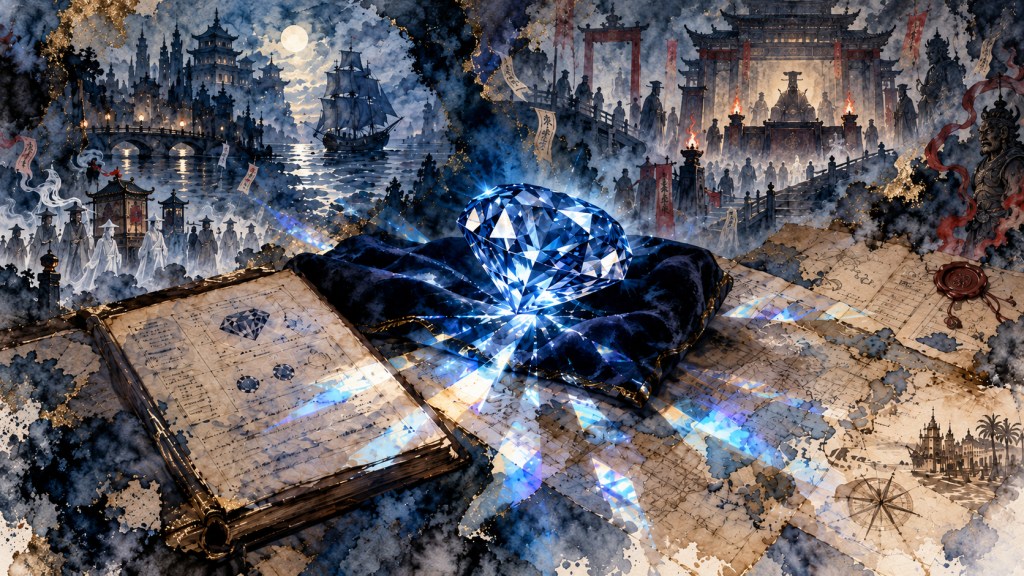
He took up a small publication that lay in the tray, thumbed through a few pages, and continued, “You see, there is even a sketch of the rumoured stone.” He emptied a gem from one of the envelopes, and it lay there glistening alone on the black velvet, an intriguing pale, smoky violet glimmer about it. Lili took the Circular issue and peered at the sketch, then picked up the gem and compared the two. “Hmm…” She held it up to the window light and turned it slightly, causing its steel-blue heart to flash for the briefest instant.
Forster uncrossed his legs and sat a little more forward in his seat. “Miss Chan,” he said quietly, “do you happen to have brought your ‘Blue Marquis’ with you, which we returned to you at Russell Street?” She withdrew the ring from her jewellery case and placed both down together on the tray.
Kaminski let out a guffaw. “No, no!” he laughed. “This vulgar piece of strass bears not the slightest resemblance to a true diamond, let alone the so-called Blue Marquis, rumoured to have been seen some years ago in America.”
Forster had set his mouth in a grim line, but said nothing more. Lili sensed his detective’s mind at work, connecting her via Moira’s testimony to acts she may have committed in San Francisco that were, strictly speaking, felonies.
“All hearsay,” she could say.
He would regard her with that cool eye of his. “Perhaps, but I am struck by the alignment of these details with the gems in your possession. In particular, I note that you allowed me to carry on under the delusion that this rumoured Blue Marquis was strass, while keeping this valuable stone, the real one, here under lock and key and having it valued.”
“I had never heard of it before this fantastical history lesson.”
“No? And yet our tong friend at the Swamp seemed deadly familiar with the name.”
“This is all terribly interesting, Mr Kaminski,” Lili said. “But why Marquis and not Marquise?”
“To distinguish the particular stone from its generic cut – the Marquise style I described.”
“Do continue. You were telling us the stone was stolen during the French Revolution.”
“Indeed. Most of the stolen Crown Jewels eventually reappeared during the years after the theft, but a small number – this one possibly included – did not resurface for decades. Others perhaps never will. The rumoured Blue Marquis is somewhat smaller than the stones recorded in the inventories of the Ancien Régime, but similar enough in cut and colour for some experts to conclude that it may have been recut from one of the original royal stones.”
Forster leaned forward. “What order of value are we speaking of, Mr Kaminski?”
“As an ordinary stone, it is worth a small fortune – easily eight hundred pounds sterling.”
“And if it is this lost…Blue Marquis?”
“If this provenance as rumoured can be established, I hesitate to give a figure – immeasurably more.”
“Enough to kill for,” he would say.
“And you would be able to prove that to a jury, beyond a reasonable doubt? Or would you be stuck with another – what did you call it – ‘circumstantial case,’ I wonder?”
He would shake his head, as though questioning how he could have been so taken in.
“I did nothing out of greed, believe me, William.”
“As the theory has it,” Kaminski continued, “further evidence for the Marquis appears in a London auction catalogue of 1851, which refers to ‘a valuable blue navette-cut diamond, of six and three-quarter carats, of uncertain provenance, but unquestionably French.’”
“And the weight of the article before us?” said Forster, already anticipating Kaminski’s answer.
“That’s the marvellous thing,” Kaminski said with a wide smile. “Six and three-quarters precisely.”
“The documented trail ends in London, though,” Lili suggested blandly.
“The documented trail, perhaps. There are later reports of a similar blue stone circulating among merchants in the Pearl River trade, though nothing firm enough to establish ownership or continuity.”
“All extremely iffy,” Lili said.
“Except for 1853 murmurs in a San Francisco newspaper about a ‘blue talisman’ discovered in a crate of curios from China,” Kaminski insisted, “which quickly became an object of frantic desire among waterfront gamblers and dealers.”
Lili was quiet.
“The point is,” Kaminski insisted, “that the San Francisco report refers to it in a marginal note as Le Marquis Bleu, and suggests royal origins deliberately obscured by a name that preserved a French aristocratic flavour while distancing the stone from the Crown. There is no specific carat weight given in the Circular, but there is the sketch, you see.”
“The circumstances?” asked Forster.
“It was offered for sale but the deal collapsed. There have been no further reported sightings. It goes underground again.”
There was little more to say at Kaminski’s, and even less during their walk to her hotel, where they paused awkwardly in the lobby.
“Well…” said Forster, but did not finish whatever it was he had intended.
“You don’t have to say anything, I know what you are thinking. I can tell you where the trail went after London. To a smuggler in San Francisco; to my employer, Madame Ah Toy, whose note Mr Lee Kong Wing, the Elder at the See Yup Temple, delivered to me; then to Fang, who stole it from her. Finally, to me.”
“So Moira was right. You murdered Fang Jing Dock for the Blue Marquis.”
“I did nothing for that diamond nor any others.”
“The most heinous of crimes.”
“If I had not bitten through in that circumstance, I would have been devoured whole – and I very nearly was. Perhaps a man cannot understand.”
“I sympathise deeply with you for the plight you suffered in San Francisco. But I never dreamed you capable of such a crime.”
“Men,” she said under her breath. “Merely circumstantial evidence, Detective.”
“Then let me ask you straight out, Lili. Did you kill Fang Jing Dock?”
“I have not come so far,” she said steadily, “to confess, so to speak, any of my acts to a soul. Not even to you.”
From the draft novel Stawell Bardo © Michael Guest 2026

