Tag: Lili Chan

  • Dust of the Dragon’s Tail

    Dust of the Dragon’s Tail

    The fleeting glimpse he had gained of a young fair-haired woman through the half-opened doorway to the inner sanctum of the Jade Phoenix had nagged at the detective. Of late, Chinese camps were acquiring a reputation among certain of the Wimmera youth for the unwholesome diversions they afforded. Alluring as these places may have appeared to some of tender years, especially to the wayward and unchristian among them, they were commonly reckoned iniquitous dens.

    One sixteen-year-old girl undertook a week-long, hundred-and-forty-mile journey from her home at Ballan, only fifty miles out of Melbourne, in quest, so she said, of a situation at Horsham. Playing upon the compassion of publicans she visited along the way, she obtained overnight board and a shilling here and there to buy meals on the road. Her real destination turned out, after a circuitous detour, to be the house of a suspect European woman at the Deep Lead Chinese camp, where she took up quarters.

    Hearing news of her arrival, Constable Hillard went out to interview her and, disbelieving her story, gave her notice to quit. When she spun him more yarns, attempting to fob him off and contrive to remain, he brought her up on vagrancy before the Stawell bench. The magistrate discharged her after a sound admonition, and the next thing you know, off she went to live with a Chinese gardener at Doctor’s Creek. Not a week later, Hillard ferreted out a second one, not even sixteen, who deserted her family home for the camp, because, she explained, of her father’s cruelty and the lack of comforts at home.

    This same girl was already known to the police, having recently preferred a rather serious charge against a young man from Stawell, which he was to answer at the next General Sessions. There was something wrong in the state of Denmark, the magistrate informed Forster in writing, when girls such as these sought the association of a Chinese camp, proposing that if an example were made of those who harboured them there, it might prove a deterrent.

    Dark-eyed Miss Chan – Forster addressed her as such, for the woman’s unassailable poise checked in him any impulse he may have felt to assume the familiarity of ‘Lili’ – acknowledged, when he called on her the next day, that she had indeed engaged a young white woman as a waitress and housekeeper, and he was welcome to meet her; she was just now in the back garden feeding the chickens. This he did. No ragamuffin, but a strapping, jocular red-haired Irish colleen of nineteen she was, radiating goodwill and health, and obviously unsoiled by the demons of opium and rum.

    Perhaps, Forster reflected, the growing distaste for the Chinese immigrant as ignorant pagan and filthy barbarian had little basis beyond plain bigotry and the biased reporting of the newspapers. There was the old enmity of rival gold-miners, resulting in thuggery and atrocity at Buckland River, Lambing Flats, and as close by as Ararat itself, less than twenty years ago.
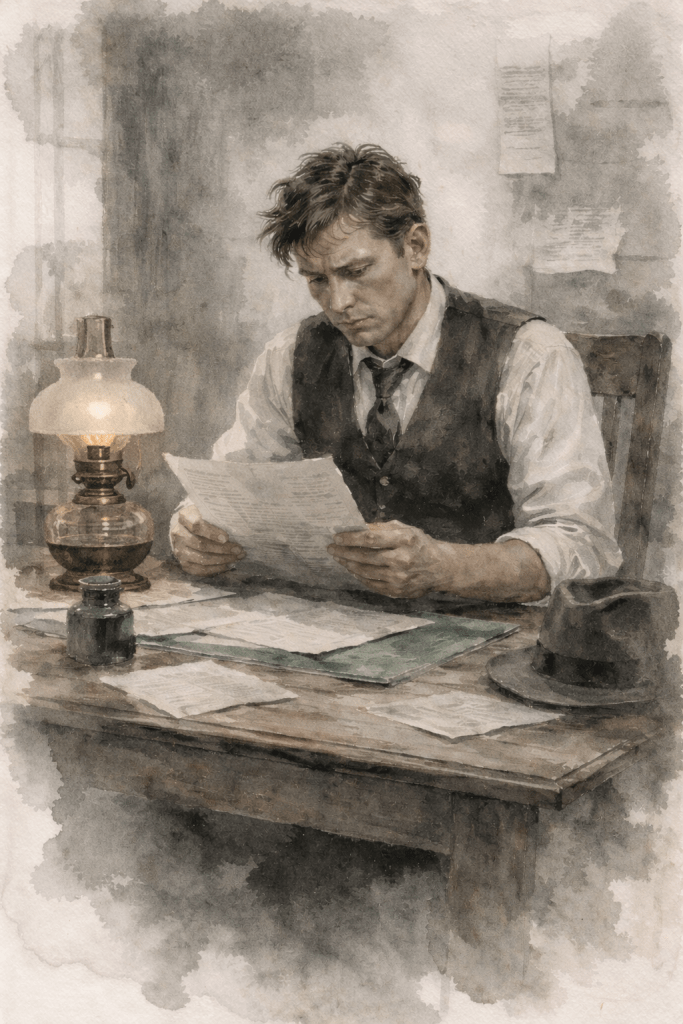
    Detective Forster sits alone at his desk in a modest 1880s bush office, leaning over papers in a dark coat and brimmed hat. An oil lamp and scattered documents rest on the desk, and the scene has a sombre, reflective mood.

    Disgruntled unionists were, he presumed, at the root of the more recent political pressure to exclude Chinese sailors and stokers from working on steamers trading to and about the Australian ports. Invariably cheerful and obliging Chinese fishmongers and hawkers of all sorts of useful wares had now become the targets of insult and violence from many working-class Australians, owing to a general animus against the Australian Steam Navigation Company, which had been hiring Chinese. Most unworthy of a great, free people. And what did this rabble know of China, a country they so despised? Most likely little, if anything, more than he did.

    If Lili Chan and his other new acquaintance, the mysterious Mow Fung – full of surprises he was, publican-cum-priest of some sort, evidently – were a measure, the Chinese had much to contribute to this country, and especially to a far-flung region like this. In idle moments, he found his thoughts wandering in their direction – and in Lili Chan’s, he cautioned himself, rather too often. He could entertain not the slightest likelihood that such a woman might have any possible interest in a crusty, ill-oiled bachelor such as he, even despite her situation, which was a morally tenuous one in the eyes of most. He could only wonder at what had brought her here, to the middle of nowhere, when clearly her talents and charms – that trace of a cultured American accent – would have fitted her for a rewarding position in Melbourne, at least. Enigma indeed. Her skin was of such a subdued olive hue, her features of such subtlety, that she might well pass for white, given the right circumstances and Western attire. Now, there he went, off again on mad imaginings …

    It was in the midst of reflecting on her features that he recalled having paused, some months earlier, on an item in the weekly Victorian Police Gazette – one that had caught his eye by departing from the usual notices concerning people wanted for questioning, prisoners discharged from gaol and the like. He retrieved the number from the bottom of a tea chest packed with old copies of the journal in a corner of the storeroom by the stables.

    “The whereabouts of a missing heiress are sought. The Cantonese woman, of Anglo-Chinese descent, has been traced from the United States, where she spent several years after leaving China, to the Colony. Information has come to light concerning her entitlement to a handsome fortune, of which she is not likely to be aware. Contact should be made with Chief Commissioner Chomley.”

    The memory of the notice clung to him. The next day he rode to the Jade Phoenix, and presently laid the gazette before Miss Chan. The proprietress looked up from the page and bathed the detective in the cool liquid of her unblinking gaze.

    “I was not aware, Sergeant, that you took such an interest in the minutiae of my appearance and background. Your detective’s training, no doubt. The innocent Miss Finnegan discovered in the employ of this humble if disreputable establishment – that speaks well for your skill. Are you ever able to separate yourself from your duties as a … copper?”

    Mincing by their armchairs just as her name was mentioned, the lusty Molly Finnegan, playing at saucy Irish soubrette, flourished her feather duster and made her exit.

    “Have you ever thought of entering the gambling line? Your attention to detail and, I suspect, your talent for handling disturbances would be invaluable,” Lili Chan said.

    “I dare say the references would prove difficult.”

    “On the contrary, Sergeant. In certain establishments, a good blow and a discreet silence recommend a man admirably.”

    “I suspect I should make a very poor ornament to such a profession.”

    “A poor ornament may still have his uses,” Lili said.

    She lowered her eyes to the gazette again. “In some houses, usefulness is the rarer quality.”

    He watched her a moment. “Miss Chan, does this notice mean anything to you?”

    “My origins are too humble, I fear, to promise any inheritance beyond poverty and woe; but if it will put your mind at ease, you may enquire with the Chief Commissioner on my behalf.” What harm, she reflected, could come of agreeing to so much, when to refuse would only raise suspicion.

    • • •

    “Where were we?” said the voice of Huish-Huish, accompanied by the gentle jangle of a consecrated shamanic rattle, amid the light aroma of incense.

    “I recall, the zither.”

    After Fang Jing Dock’s tong began putting some serious pressure on Ah Toy, unassailable though she had been for the past twenty years, she sold up and moved to an undisclosed destination. With no choice in the matter, Chan Lee Lung became his mistress, and he moved in with her. It had been clear for some time that despite his dandyish affectations he was an enforcer – a so-called highbinder or hatchetman – for the Hing San Fong Tong, passing publicly under the name Society of the Mind Abiding in Tranquility and Freedom. Whenever he went out to conduct business of a certain kind, he would don chain mail beneath his dress shirt, tightly bind his queue up underneath his derby, to keep it from being seized in any rough stuff, and conceal his butterfly swords beneath the back of his jacket, all the while preening himself before his ornate mirror.

    One evening he and a henchman returned to the house with another Chinese man unknown to her. The three repaired to a room that Fang had commandeered as his music studio, where he also kept a small vault containing the most precious valuables of his tong: a handful of flawless diamonds of inestimable value. Before long the sound of Fang’s Viennese zither could be heard filtering out, a fantasia on Il Trovatore. She went to her bed and fell into a deep sleep, to be shaken awake by Fang.
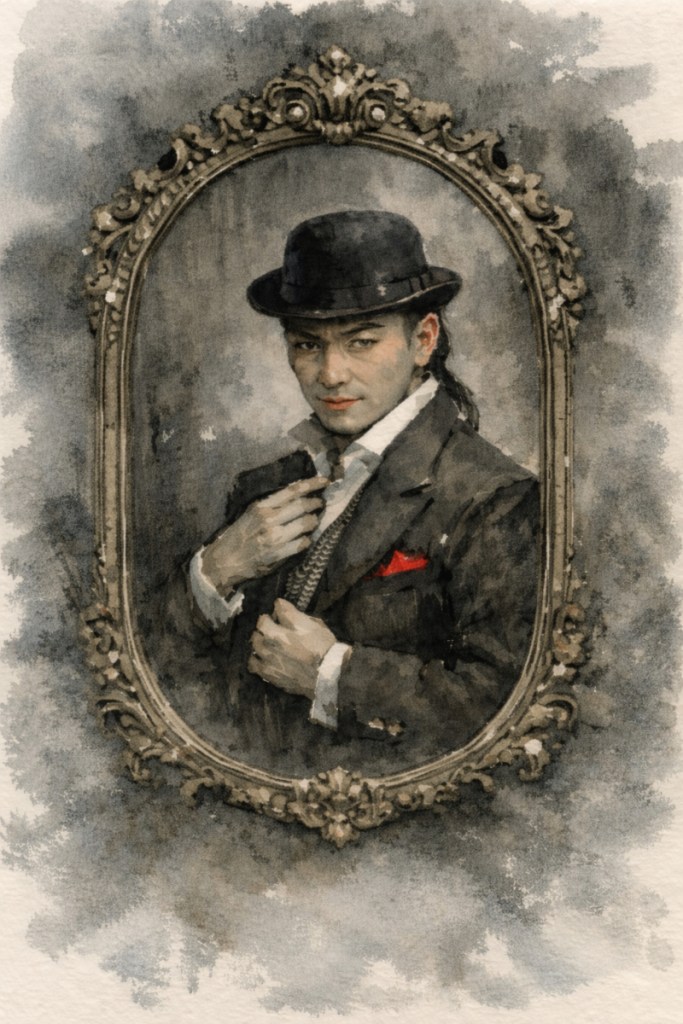
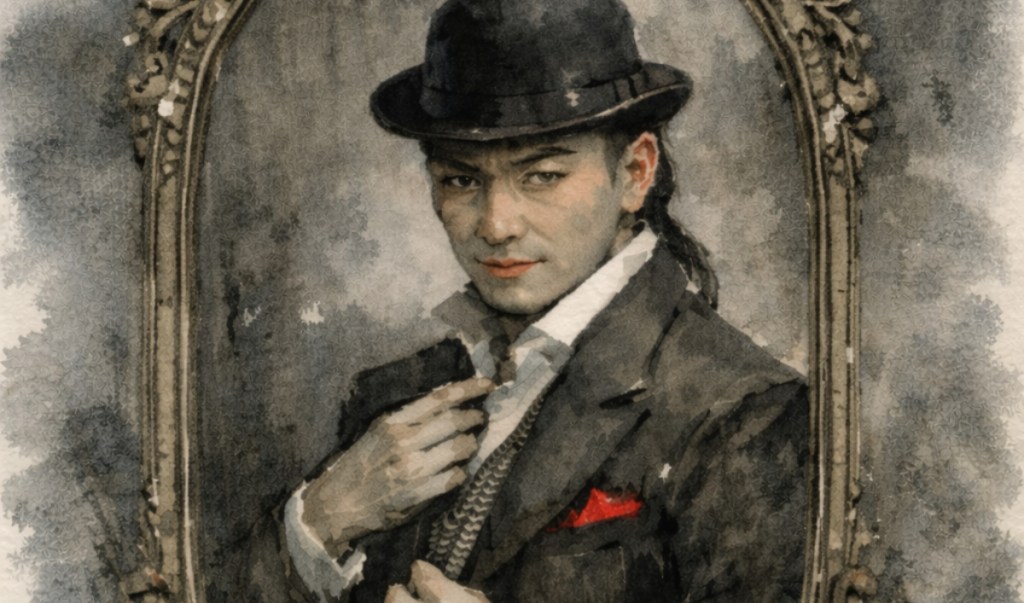
    The highbinder Fang wearing suit, derby, and barely concealed chainmail vest, preens himself in an ornate mirror, adjusting his appearance with deliberate care. The image is rendered in a watery, near-monochrome wash with a subtle red highlight, the reflected figure contained within the frame and the edges fading into abstraction.

    “Go and see what you think of the new centrepiece in the studio and tidy up a bit in there. Fat Louis and I have some business to discuss, then we’ll get things back in order.”

    The third man sat slumped sideways in a wicker chair, his sightless eyes bulging wide, his tongue lolling from the contorted blue face. Around the throat, biting deep into the flesh, was a garrote fashioned from a metal contrabass string, carving what looked like a raspberry-jam-filled rut. She sank silently onto a chair and took stock of her future, which was clearly what Fang had intended.

    When she entered the sitting room, Fang and Fat Louis were sipping pink champagne, and nibbling on Roquefort.

    “Nice tang,” Fat Louis said. “King of cheeses.”

    “Butyric acid caused by the fungus Penicillium roqueforti,” Fang said. “Legend has it that the cheese was discovered when a youth herding his sheep on Combalou Mountain, partook of his lunch of bread and ewes’ milk curds. Seeing a beautiful girl in the distance, he ran off vainly in pursuit of her, leaving behind his flock and his lunch. When he revisited the spot a few months later, the mold had transformed his plain peasant repast into this delectable bonne bouche.”

    Then looking up at Chan Lee, “That was quick. Did he have anything to say?”

    “He thought the end was the best part,” she said in a measured tone.

    “The critics be damned, I say!”

    The two men fell about.

    Chan Lee looked at Fang steadily.

    “There is no medicine for vulgarity,” she said, taking up the champagne flute on the table for Fat Louis to fill. No way out of this but forward; she must watch for an opportunity out of the corner of her eye. 

    “I told you she would have what it takes,” Fang said. “You can tell a woman of breeding. And she knows as well,” lending a malevolent emphasis, “that the song of a dead bird is a sad one.”

    One thing was certain: to run to the police, if the chance arose, would be a waste of time and might well invite a fatal reprisal from Fang’s cohorts, were he to be put away, which in fact was unlikely, since the law tended to stay out of Chinese matters when they did not directly affect anyone else. For the time being she played the dutiful concubine to Fang. As he wished, she took on the mantle of his wife, at least in the view of the public, though the union was not sanctioned by either a Chinese or American ceremony. As an enforced confidante of the highbinder, who often boasted to her of his crimes, she was ever more ensnared in the strands of his fate, becoming, in the parlance of the courts, an accessory after the fact, and thus acquiring the guilt of his felonies.

    • • •

    In the Deep Lead Joss House, Chan Lee sorted through fifty yarrow stalks as Huish-Huish had taught her, occasionally raising them to her nose to savour the herb’s unique aroma. Huish-Huish counted off the number of stalks remaining between Chan Lee’s fingers at each stage, and the procedure was repeated six times to determine the lines of the session’s hexagram: Biting Through – judgement, punishment, discernment. None of the lines signifies guilt, though a little harm may be done. On the whole, an optimistic sign: though there may be trouble at the beginning, one bite’s through. Justice is administered, punishments exacted. If you lose your teeth, you lose your grip.
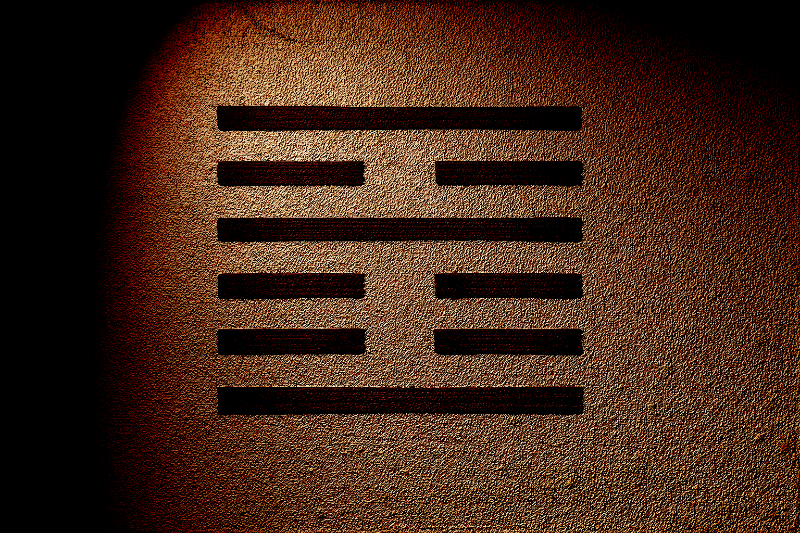
    Black on gold image of the Yi Jing (I Ching) hexagram 21 Biting Through. Bottom to top, the lines are Yang (solid), Yin (broken), Yin, Yang, Yin, Yang.

    “Cutting … gnawing … chewing …” Huish-Huish said. “A picture of the mouth. You bite through, get your teeth into something.”

    “Cutting.” Chan Lee intoned the word, the eye of flesh closing, the inward gaze of the eye of her contemplation floating back in time. “If you chew dried salt meat, you’ll find yourself poisoned.”

    Knowing not whether for good or ill, she decided that her best move would be to gratify him by seeming to take pleasure in what he did – deeds she found appalling and sickening, lacking as she did the same innate relish for inflicting misery that she now knew to be his. She did not stop to ask whether repeated exposure would inure her to his evils; whether, by touching black paint, her fingers too might be blackened. One thing was sure: there was no iota of love in her heart for the man who had become her ostensible protector. Fang was a man in whose arid heart love for any other creature had never taken root. As time went by, familiarity became contempt, and instead of any initial ardour, the possession of one so desired by others only fed in him a seething sadistic scorn that grew stronger by the day. This scorn he expressed in a ritual of cruelty, a proxy for the conjugal act, with strangulation and cutting for caresses. Sometimes his fervent passions quite got the better of him, and it was on the cards that he would murder her before too much longer.

    Deadened by morphia, a living ghost of herself, she faded from the view of her admirers, most of them so addled that, appeased by a surfeit of available substitutes, they forgot her before long – or rather, recalled only the myth of that bewitching peony of the Barbary Coast, and not the flesh-and-blood woman. Most. An up-and-coming stage magician, Chee Ling Qua, formerly of the ‘Court of Peking’ troupe, was presently engaged at the Bella Union – fire-breathing, sword-swallowing, linking rings, disappearing rabbits and chickens, the works. He could materialize a great big glass bowl full of goldfish out of thin air. A gentle soul, meek and mild, far from a hero come to save the day, but she credited his avowals of undying love and knew that he possessed, if not great means, at least some paste gems of amazing fire and brilliance for use in his performances.

    He was also on close terms with the most highly skilled and secretive Celestial apothecary in the city, whom he commissioned to create incendiaries and other chemical substances necessary for his stage effects. Chan Lee contrived to steal some time alone with the magician in his dressing room one evening when Fang was occupied with business; though he despised her he was as possessive of her as ever. He was much preoccupied these days, his gang embroiled in a war with a rival tong over the exclusive right to operate fan tan games and lotteries in the Barbary Coast. As it happened, Ling Qua was on the verge of pulling up stakes and setting off abroad with his own small troupe. Chan Lee should come with them at any cost, he begged, as she rearranged his robes. She could work as his magician’s assistant, peppering up the act with an arabesque here and a shimmy there … she’d pack them in.

    A month later, the Australasian and American Mail Steamship Company’s City of Melbourne headed towards the Golden Gate, its passenger list including a modest troupe of performers, a mixture of Chinese and Europeans, among them the sylphlike Suzon Chabrier formerly of the Folies Bergère, an inconspicuous brunette who, on closer inspection, as the customs official who processed her had remarked to his colleague, had a charming and subtle nuance of face that could almost pass as oriental. While her fellow passengers lined the decks for their last glimpses of Angel Island, Yerba Buena, and Alcatraz, Miss Chabrier reclined on a deckchair in a discreet black velvet dress, her chapeau decorated with simple field blossoms and pushed forward over her head, perusing the Daily Alta California. She was particularly attentive to an article on page two, which reported on the sudden death of a despised highbinder for the Hing San Fong Tong, one Fang Jing Dock. A photograph of the victim’s corpse had sunk into grainy shadow, which was perhaps for the best, the report ran, since readers would have found the contorted face and twisted limbs most distressing. Suzon applied her reading magnifier to the image, then read on. A note found on the corpse showed that he had expected death by rival hatchetmen.
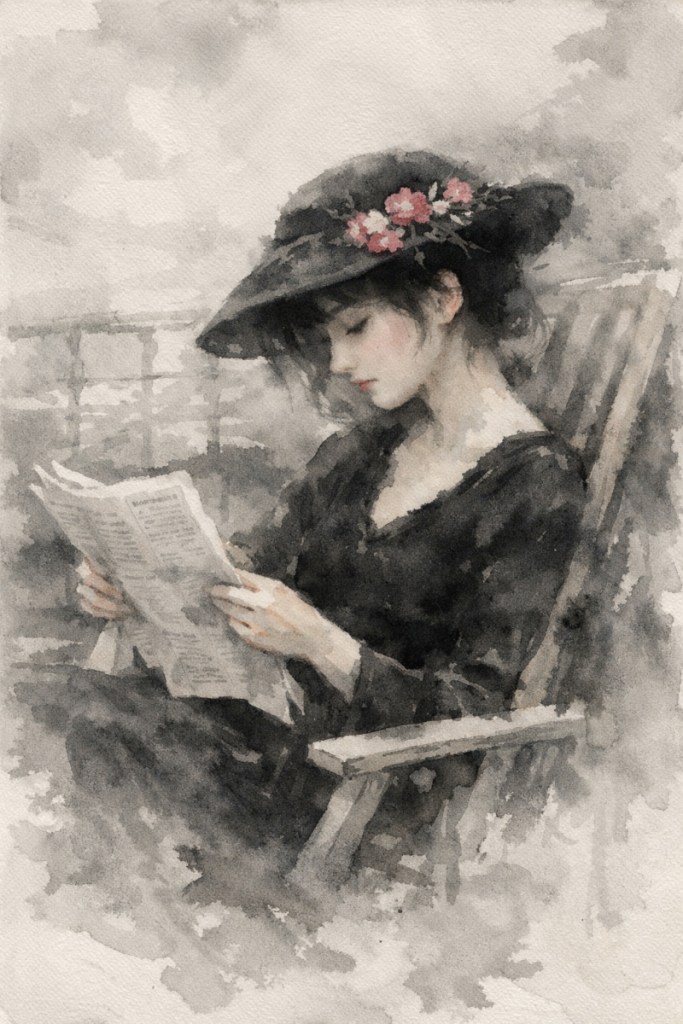
    Chan Lee, later known as Lily Chan, sits in a deckchair aboard a steamship leaving San Francisco, having assumed the identity of Suzon Chabrier of the Folies Bergère.

    The note read: ‘Soon I must go to my fathers. Whether by the broad bladed axe or by dust of the dragon’s tail, it matters not. This I know. I go. I commend my spirit to Buddha, the all-wise and merciful.’

    “A searching examination of the body,” the reporter continued, “failed to reveal any marks of violence. It is believed that by ‘dust of the dragon’s tail,’ Fang referred to some potent oriental poison. From his expression of agony, it appeared he had been administered sufficient of the substance, whatever it was, to kill an hundred men. Police arrested another highbinder named Fat Louis, who is well-known to have been an associate of the dead man; but it has come out that he was employed surreptitiously by the rival tong in question, the See Yups. The dead man, who will not be missed, was under suspicion for a number of murders of fellow Chinese. A woman with whom he cohabited, once well-known around the gambling dens and houses of ill-repute, has not been seen for several months, and is now added to a long list of the presumed victims of the deceased ne’er-do-well.”


    From the draft novel Stawell Bardo © Michael Guest 2026
  • The Joss House

    The Joss House

    Hung and festooned as it was with tablets, banners and fans, the joss house at the Chinese camp in Deep Lead was a living bubble of China in the Wimmera. House of deus, so called, from the Portuguese for god. Just inside the doorway, to the left, stood a large iron bell and a tall, barrel-shaped hand drum, with a peacock painted over the pig-skin drumhead. Beside them were glass cases containing sacred candles and five tiers of shelves holding prayers written on paper slips.

    To the unaccustomed eye, the decor was gaudy, with multi-coloured pennants, Chinese characters in purple and gold painted on the walls and roof. Paper and stained-glass lanterns hung from the ceiling; bunches of tinsel in vases were set on stands carved in relief, to depict different epochs. No master craftsman created these, but they proclaim a naïve hand: work executed with painstaking devotion by a jack-of-all-trades, a long-time resident of the Chinese camp.

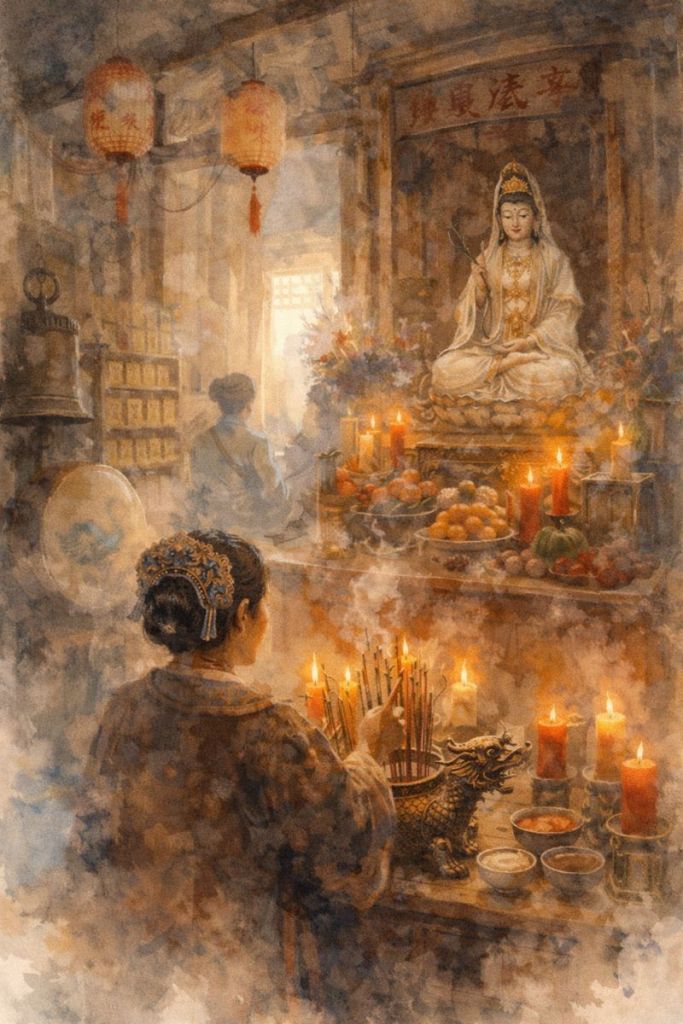
    Watercolour of Joss House interior. A woman tends the altar, on which is seated a carved deity. There are incense, lanterns, a drum, and various other religios artefacts.

    In her ceremonial robe adorned with all the deities of heaven to clothe her in the protection of the universe, Huish-Huish, Mow Fung’s wife, prepared the altar for the ceremony dedicated to making peace with ghosts. At the very back, raised on a pedestal, in the position of greatest honour, stands the immortal Guanyin, provider of good fortune, who is certain to help, for she hears all the cries of the world and is ever willing to offer protection from any kind of threat or attack. She sits placidly upon a lotus, attired pure white, with gold ornaments and crown. In her right palm she holds a golden flask filled with pure water, in her left raised hand, a twig of willow. Water is to ease suffering and purify the body; willow keeps evil and demons at bay. Huish-Huish communes regularly with the bodhisattva, as though she is a dear friend. She regularly brings the statue flowers, food and drink to sustain and empower her. She is no less beautiful for being made out of plaster. The neck of the statue is pierced with a hole, for other spirits to enter and represent her, after the fashion of an avatar; for Guanyin cannot be everywhere at once herself.

    She lit the sacred lamp for the illumination of wisdom, then the two candles, standing for the sun and moon, and for the two eyes of the human being: the light of the Tao and windows to the psyche. These would help her penetrate the dust of the everyday world. In front of them, three cups, one each of tea, rice and water: tea for yin, the female energy; water for yang, the male; and rice the union of both of these, containing yang from the sun and yin from the earth. In front of them in turn, five plates of fruit to represent the five elements: green for wood, red for fire, yellow for earth, white for metal, black for water. These for the liver, heart, spleen, lungs and kidneys – in harmonious cooperation, a cycle of good health. Sour, bitter, sweet, salty, pungent: plum, apricot, dates, peach, chestnut. She placed dried foods on the altar on this occasion, because she wanted to absorb power from it. When she wishes to empower the altar, she gives it fresh food and flowers, from which it draws life energy.

    In front of the five plates stood the incense burner, a bronze dragon turtle, the smoke curling up through the vents in the top of its carapace – vents in the form of the eight trigrams. The joss sticks were Lena’s work: Mongolian incense, pepped up with dubious substances extracted from her beloved maiden wattle. Necessary cleansing rituals completed, Huish-Huish burned the protective talismans and traced their forms in the air.

    Knowing from previous experiences the ceremonial protocols, Chan Lee Lung – known in Deep Lead as Lili Chan, proprietor of the Jade Phoenix – bowed in deference as she entered, then seated herself. Huish-Huish placed a talisman on her head and performed the mudras, the hand gestures used for drawing out spirits. Based on their previous ceremonies, she has come to suspect that urges to self-harm and suicide afflicting the woman are quite possibly the handiwork of a ghost. There are any number of possible reasons why a ghost might wish the subject injury. She is a beautiful woman, and some ghost may want to marry her, particularly if she has said something inadvertently in earshot that put such a nonsense into its mind. On the other hand, it was common for the ghost of someone who died by suicide to become stranded at the gates of hell, compelled to reenact the fatal act for eternity, unless they were able to find someone to replace them, through that person’s own suicide. Or she may have crossed paths with the spirit of a suicide, or tarried at a haunted spot marked by an unnatural death. Such spirits were always in search of a victim.

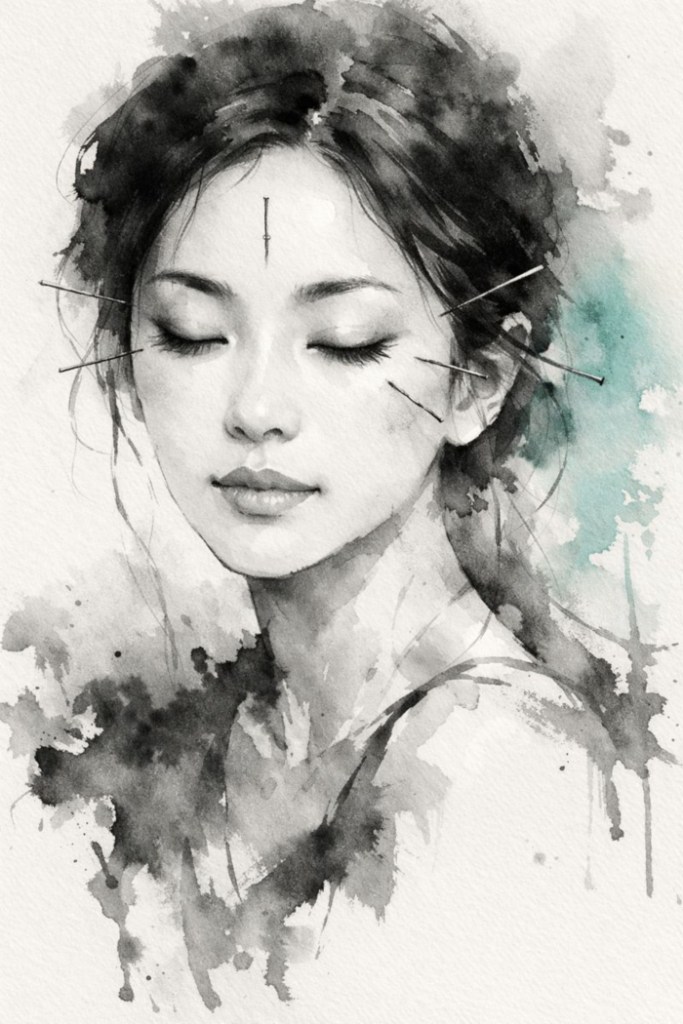
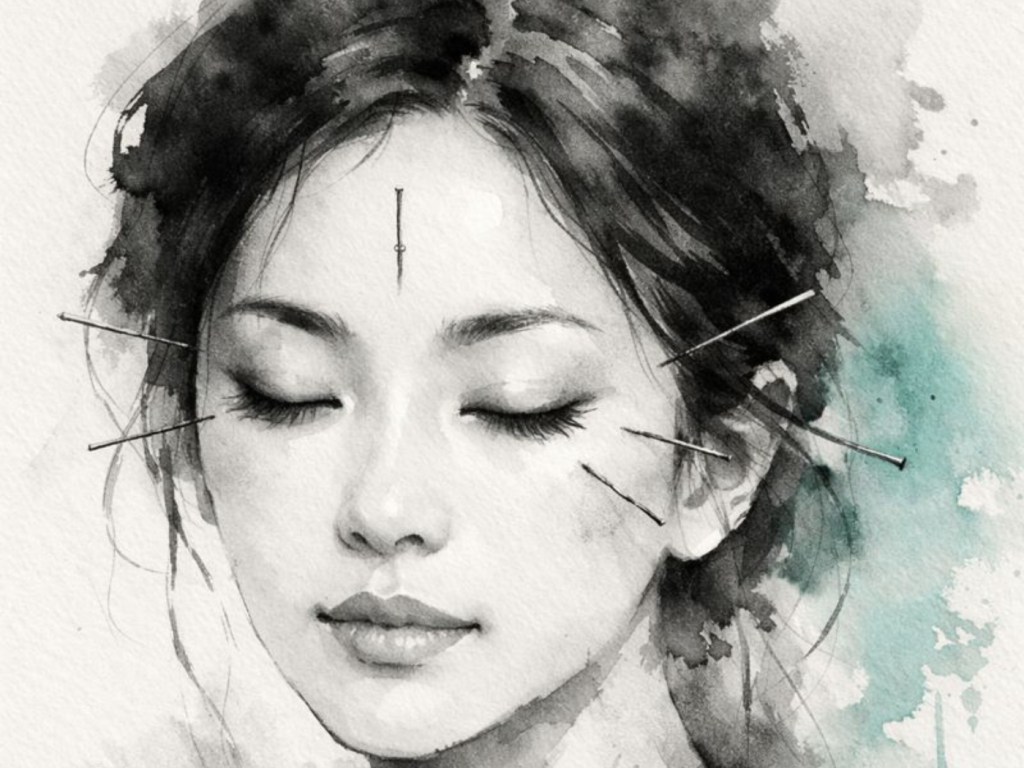
    Watercolour image of a Euro-Asian woman in closeup, with her eyes closed, and acupuncture needles in her face, at a few points around the eyes

    The only way to get some idea is to travel with the woman as she journeys through her psyche via the medium of her speech, her story. In this way Huish-Huish may make the woman aware of the ghost, and encounter its weaker manifestations within the trance; there, the ghost itself may be dissolved or at least dissuaded. At the same time, however, in order to heal, she must make herself whole, cultivate herself, and grow in accord with the principles laid out in the Yi Jing and other Taoist teachings. No quick fix here, no game of fantan, this.

    “Every child loves the pretty fable of Kwang Kau’s dream about the butterfly, which Zhuangzi teaches us,” Huish-Huish says. “When Kau awoke from the dream, he found himself unable to tell whether he was Kau dreaming he was a butterfly or the butterfly dreaming it was Kau.

    “Another tale strikes me as somehow similar, in which Shadow and Penumbra converse – Penumbra wanting to know why Shadow moves as she does, perhaps because Penumbra must follow. So Penumbra says, ‘Before, you were walking, but now you have stopped. You were sitting, but now you stand up. How and why do you do that?’

    “Shadow answers, ‘I have to wait for something else to move, and then I will do the same thing as it, almost as though I am its second skin …’”

    The woman listens, as though to a disembodied voice – fluent, lilting Mandarin. Though her own native tongue was that of the city of Taishan – Taishonese, a dialect of Yue, kin to Cantonese – the music of the hypnotic voice draws her into its discourse, and it seems she leaves the world behind her.

    “‘How on earth would I know?’ says Shadow,” Huish-Huish continued. “‘How could I possibly know what it is, that thing which moves, and which I follow – whether the scales of a snake, or a cicada’s wing? How should I have an idea why I perform one particular act instead of another?’”

    The woman’s eyes are closed, and she is already on the brink of a great descent. She hears the pure tone of a chime, and the jingling of rattles, the sounds suffused with the heavy smoke of the incense.

     “Like Shadow and Penumbra,” the voice continued, “I wonder whether we might allow ourselves to pass through phases of our deeper selves – or our earlier selves, when these are not the same thing – and sink into each other, you and I. Penumbras of the scales of a snake follow the shadows of the scales, which follow the snake; they need not feel the belly of the snake sliding across the sand, which is irrelevant to them and impossible to access. And to whom is visible the penumbra of a shadow of the wing of a cicada? And what does the cicada follow, when it does as it does?”

    Huish-Huish aims to melt away her own ego – to become a nothingness, receptive to the projections of memory – because memory is the essence of the psyche itself.

    She guided Chan Lee Lung to lie back upon a low wooden plinth set before the altar, her head resting upon a rice-husk dragon cushion.

    With an austere calm, she placed fine needles along the woman’s brow, at the temples, beneath the eyes, where the face is thinner and the mind can loosen its hold. Chan Lee Lung felt no pain – only a spreading lightness, as though the weight of her features were being unhooked from memory.

    After a while, Chan Lee Lung could no longer separate her inner dialogue from the sound of the guiding voice, which had transposed itself into a chant, whose symbolic words she was unable to comprehend as words, but which fell into a silence as deep as that of the deepest well. As they penetrated the surface of the ether, or whatever liquid-like substance lay at the bottom of the well, something more pure than water, the pitch darkness ignited: each word flared into a splash of sparkling light, cohering into one image, then another, then the next, setting in play a flickering spectacle. A dream that was not quite a dream; a reality that was somehow greater than her reality of the everyday. As instructed, she began to say whatever went through her mind, as though she were a traveller in a railway carriage, sitting by the window, describing to someone else in the carriage the changing scenes she saw outside.

    Standing on a Canton roadside are a woman and her five children, all dressed in their best holiday black, which is nevertheless patched in some places and threadbare in others. Hardly finery, but the woman does her best under extenuating circumstances, as she repeats often to her neighbours and the grocery vendors. The middle daughter examines her mother’s face and observes a liquid bead run down along her nose and fall to the dust.

    “Mama, do you cry?” she asks.

    “Only sweat. Stand quietly.”

    Their sign leans upright against the trunk of the slender tree under whose branches they have sought shade. The mother pacifies the baby, bounces him gently and reassures him with baby-talk, before binding him again to her back, where he falls asleep immediately. At this sight, the eldest daughter stifles the lump in her throat until the mother notices her quivering jaw and corrects her sternly. In the joss house at the Deep Lead Chinese camp, Chan Lee Lung is once again overcome with a profound sadness. Her mother was a hard woman. Again she tastes the blood in her mouth, where she bit herself on the lip to prevent herself from crying – and bites it once again.

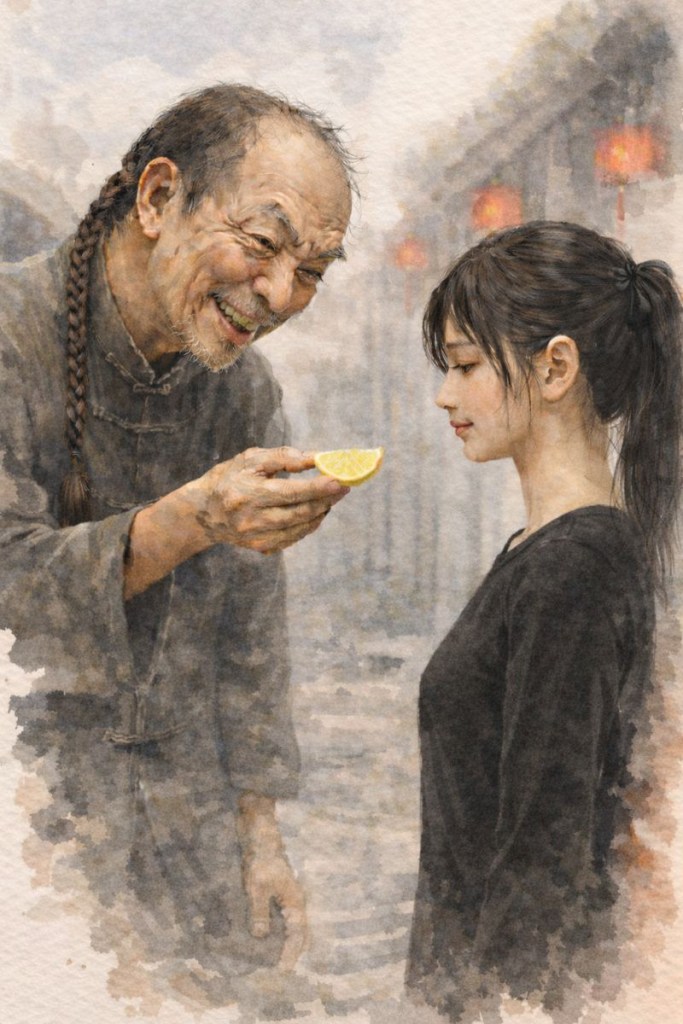
    They met up with the broker, who was carrying their sign, at the appointed spot. She disliked the man’s fat, ugly, greasy face. Even his queue seemed to have lumps of fat in it, and he smelled like rotten pork. He laughed when she pointed out these shortcomings to him. He took a piece of lemon from his pocket and presented it to her. She asked him why he thought she would want a piece of lingmung. He corrected her, with another patronising laugh.

    In a Canton street, an old Chinese man, grinning. offers a young woman a piece of lemon. Watercolour image.

    Ningmeng,” he said, pronouncing the syllables of the Mandarin word. And again, after sucking the lemon, he repeated it, pedantically now, with his bloated, sensual, wet lips, “Ning meng.” Emphasised with two beats of his fat forefinger on her forehead. He told the girls to stand in line, with their bags arranged neatly by their feet.

    She wanted to know what was going to happen to her and he replied that if she was a good girl she would go in a magnificent European ship to a wonderful place called Gold Mountain, an earthly paradise where the streets were paved with gold. There she would find boundless happiness as a wife to many men, have all the food she could eat, wear a cheongsam of the finest silk, and return to China a rich lady.

    She saw the improper look he cast her mother, which he pretended was secret while intending her to notice it, a wink and leer that revealed his green teeth. She complained to the mother, saying she did not want to leave her sisters and little brother, and the mother reassured her that her sisters were leaving as well, to somewhere they would be safe from the fighting here. Her brother was too young to miss her, so she need have no concern for him.

    Another man arrived by rickshaw, perused the sign, and Lemon-man took him aside to discuss a transaction. Her mother told her to take up her bag and walk with dignity to the rickshaw. She was a big girl now, and the world would be her oyster. That is all she remembers of the time her mother sold her, except that as the vehicle moved off, she looked around to farewell her mother and siblings. Her mother had her back turned, remonstrating with the broker, as was her usual way in such pecuniary transactions. Her sisters were waving to her gaily, delighted to see her riding in a rickshaw for the first time.

    Two months later, the Pacific Mail Steamship Company’s China passed through the narrow strait into San Francisco Bay. The voyage seemed far shorter to the girl, who had been pacified with narcotics for much of the time, in order to prevent her from creating any fuss. It was a recurring delirious episode; she was rolled to and fro on her narrow bunk with the tossing of the vessel, nausea melding with visions of her sisters who, in her dreams, were transmogrified into salivating crimson ghouls. They were standing beside the repulsive man, between whose luminous green teeth issued copious streams of blood. In her waking moments, she was indifferent to the crush and squalor around her. 

    “This is the Golden Gate to Gold Mountain, the country of your dreams.”

    The woman assigned to play the role of her mother had, during her lucid intervals, been tutoring her in what she must say in case she was questioned by someone called Customs. The girl learned to utter the English word “seamstress” while performing an appropriate pantomime, smiling with an air of great earnestness.

    If her acting talents were unconvincing and the two apprehended, the White Devil would visit unspeakable torment on her.

    Although the two travelled in a better section of steerage, it was only thanks to the ‘value’ her buyers saw in her looks and talents in song and dance, which they judged superior to those of their former favourite, a Hong Kong girl they subsequently cast aside. Chan Lee Lung was cloistered with a group of a dozen other girls, away from the hundreds of male emigrants and prostitutes also travelling in steerage, shielded from the rapes and bashings by two bodyguards known not for their physiques, but for their ruthless cunning and their expertise with concealed weapons.

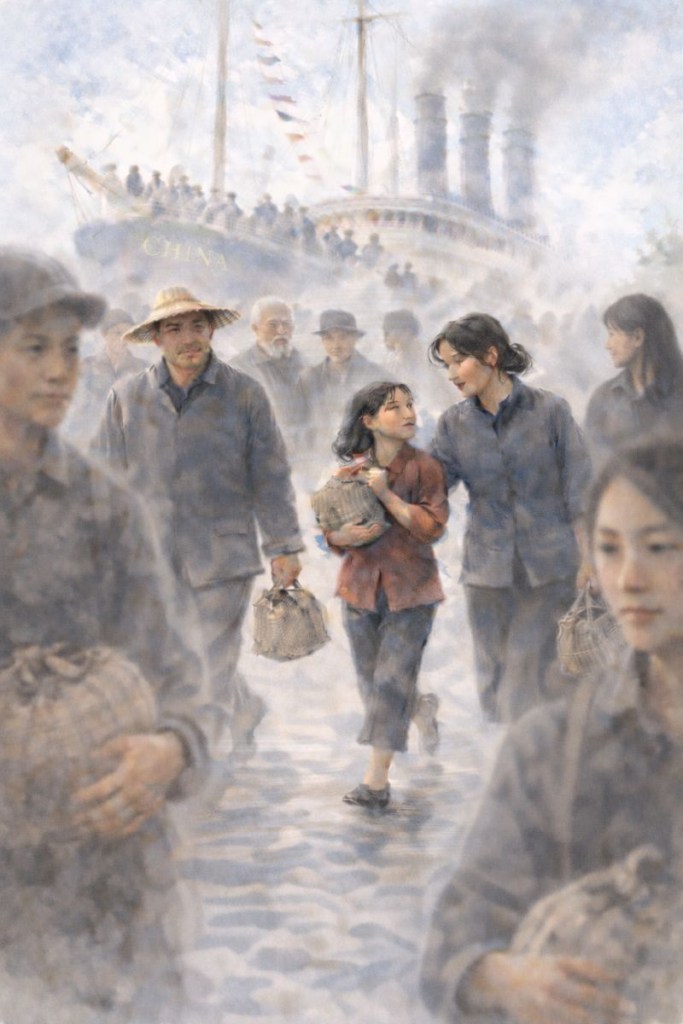
    Leaning against the railing on the starboard deck, bracing herself against the jostling crowd, the girl inclined her face to the magnificent morning sun, emerging from wisps of fog that had been thick and opaque only minutes earlier. This was the first time for the duration of the voyage that she had been permitted up on deck. The ship was about to dock when a splash was heard from the port side, followed by distinct female screams and a rising volume of anxious chatter, as a wave of agitation spread through the huddle of disembarkees. Descending the gangplank, shouldering a jute sack containing her meagre belongings, she overheard a high-pitched, trembling mention of the name Lee Sing, which seemed vaguely to resemble that of the girl in Hong Kong whose fate she had supplanted with her own.

    A girl among a crowd of disembarkees from the steamship China, docked at a San Francisco wharf.

    Bound-footed Madame Ah Toy, the girl’s new owner, immediately warmed to her. When the ageing madam raised the girl’s chin with two fingers to appraise her face more closely, despite the air of sadness that still hung over her, the girl’s eyes reminded her of her own, formerly renowned for their laughing quality. Goldminers “came to gaze upon the countenance of the charming Ah Toy,” the newspaper said once, in poetic, libidinous understatement. And they would come to gaze on the countenance of this girl, her newest attraction, as well. “But only gaze for the time being,” Ah Toy said to herself, in the cold arithmetic of her trade, now satisfied the girl was physically sound, “until you’re growed up good and proper.” There was more in those eyes, however, that drew the woman’s attention: a depth of soul and intelligence; a quiet defiance that she could see would never be crushed. The madam had good reason to identify with the girl’s sterling qualities, having herself wrought a fortune as the first Chinese courtesan and the first Chinese madam of the red-light district, the so-called Barbary Coast.

     Ah Toy oversaw the education of her new protégé as she would that of a cherished daughter, with a loving and stern hand. She declaimed her belief that “son without learning, you have raised an ass; daughter without learning, you have raised a pig,” and over the next few years, the girl flowered under her regime. She soon assumed mastery over the various academic and dance hall pursuits for which her tutelage had been commissioned, guided by professorial clients of Ah Toy’s famous establishment in an alley off Clay Street, under contracts of barter.

    The girl’s getting of wisdom served, as ever, a financial motive, for the ladies of the Chinese establishment trailed those employed in French, Mexican, British and American cat houses, whose popularity ranked roughly in that order. Competition was fierce in the bagnio trade. The French fandango parlour had its les nymphes du pavé, late of the Parisian gutters, who were packing in the patrons to overflowing, gussied up in their red slippers, black stockings, garters and jackets, nothing down below. Stories abounded of outrageous personalities: The Roaring Gimlet, Snakehips Lulu and the rest. Holy Moses! Madame Featherlegs would gallop a horse down the main street wearing nothing but batwing chaps.

    Unfortunately, although a successful entrepreneur, Ah Toy had also become rather a laughing stock, largely because of her Chinese-ness, but also because of the young age and sickly condition of the girls crammed into her shacks, or “cribs,” in Jackson Street, sometimes abused by white boys scarcely older than children themselves.

    These girls she considered, and treated, no better than chattel.

    The girl grew into her role admirably, expressing as though they were natural traits the aristocratic airs she was schooled in; airs that in fact derived from no single country, but from an amalgam of places, real and imaginary. Yet somehow her intrinsic class seemed to imbue these artificial attributes with substance.

    She was not overawed by anyone she met, but treated with due respect and equality all who crossed her path: from city officials who surreptitiously joined the growing flood of patrons paying good money for no more than the pleasure of gazing upon her, to slave girls locked in the cribs like animals. Most of these girls had been smuggled from China, either peddled, like her, or abducted outright. Sufferers of syphilis numbered among them, their short futures preordained: to die disfigured beggars on the streets of Chinatown.

    She felt a compassion for these creatures in the cribs, pleading their cause to Madame Ah Toy and doing her utmost to convince her, in terms she would understand, that acknowledging even minimal duties of care to the crib girls might serve her business-wise – allowing her to be perceived as less of a pariah and blight on society, though she couched that more gently.

    No cribs for her, nor even a residence in one of the sumptuously appointed parlour houses. Ah Toy set her up in a double storey brick house of her own, where she entertained only the most prestigious clientele – exclusively white, expressly no Chinese – when she was not assisting her proprietress to operate the gambling house and manage the business affairs. As well, Ah Toy provided her with a chaperon, a certain Fung Jing Dock, whom she introduced to Chan Lee Lung as an office bearer in a newly formed organisation known as the Society of the Mind Abiding in Tranquility and Freedom. He was, Ah Toy said, a virtuoso on the zither as well as an avid student of the Yi Jing.

    “Regarding my degree of talent with the zither, I must refuse to answer,” Fung Jing Dock pleaded charmingly, “in order to avoid incriminating myself.”

    Nevertheless, he proved to be a surprisingly good amateur zitherist, and Chan Lee Lung and he spent a few minutes at the instrument together now and then during the daylight hours.

    “But there is more to this story,” Lili Chan said as they came out of the joss house and into the dazzling sunlight. “It does not end well, I’m afraid.” She turned towards her establishment.

    Huish-Huish looked at her face, which seemed pallid.

    “As a process, the ceremony may sometimes require any number of iterations,” she said. “Some subjects joke that it will go on forever, and they will never be free of me. Things cannot be rushed, however. We will have plenty of opportunity next time.” She laughed. “There is no cure for the human existence, you know,” she said. She briefly squeezed her companion’s arm and went back briskly into the joss house. Pausing to look up at the empty expanse of sky for a second, Lili took in a long breath, before making her way languidly down the street.


    From the draft novel Stawell Bardo © Michael Guest 2026