Tag: John Frederick Smith

  • J.F. Smith’s Mystery of the Marsh — Seventeenth Instalment

    J.F. Smith’s Mystery of the Marsh — Seventeenth Instalment

    Old newspapers are not much cared about and are often applied to undignified functions, recalling Dryden:

    From dusty shops neglected authors come,
    Martyrs of pies, and relics of the bum.

    (‘Mac Flecknoe’)

    or tossed on the rubbish heap, as in Joyce:

    About that original hen. Midwinter (fruur or kuur?) was in the offing and Premver a promise of a pril when, as kischabrigies sang life’s old sahatsong, an iceclad shiverer, merest of bantlings observed a cold fowl behaviourising strangely on that fatal midden or chip factory or comicalbottomed copsjute (dump for short) afterwards changed into the orangery […]

    (Finnegans Wake, Ch. 5)

    Biddy the hen scratches up an old letter in the rubbish heap, which stands for Finnegans Wake the novel itself, or the Bible, or even the substance of universal human history. Mere “bits and scraps” (Samuel Beckett) though they may be, they are impregnated with the world in which they were manufactured, and which decays along with them. Note that as Biddy scratches and pecks on the letter, she creates marks and holes that later exegetes interpret as part of the original message.

    This project of raising Smith’s penny novel is achievable thanks to the work accomplished by scholars and librarians such as those who established the Trove digital archives of the National Library of Australia, from where I’ve obtained the original serials of The Mystery of the Marsh.

    Convenient, comprehensive and flexible a resource as Trove is, we find many instances where the text breaks down in one way or another, presenting a jigsaw puzzle. Figure 1 shows a fundamental type of this problem. Here there are two horns of the dilemma: i) the easier, where a librarian needed to piece together the paper, like an actual jigsaw; and ii) where the text, to varying degrees, becomes difficult to read, either because of damage to the original, or because of a problem in the copying process. For example:
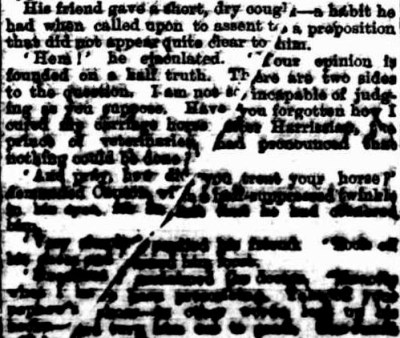
    Figure 1. Sample of torn and blurred copy.

    Here is how the machine-reader deals with the text in Figure 1, extending from “His friend gave a short, dry cough”:

    ffi^MBnd-g8-fi^HteB^^ooBi^i-^lsfeit4«
    had ^g^. calLad..Ojp)6n ^tb jBssent tr- a proposition
    – ‘ Heidi I ‘ fie eiBonlatedl . ”Jtmx -^nidn ts
    :f&nn4id~ cmL .«.? Ealt trutlL. Tt A* ar6 m- pldea

    After “There are two sides”, it seems to give up and omit the rest as a smudge.

    Very Wake-esque but unedifying. Usually the machine-read copy is useful in piecing together a rough cut and saving a fair amount of keying-in, though every word still needs to be checked against one or both of the (digitalized) original copies.

    Thankfully there are two different copies of the serial, appearing in different publications, originally separated by about eight years, and edited by different editors. When the earlier “fair” copy is damaged (so-termed because it is closer to the author and has proven itself reliable), the later “foul” copy can provide clarification.

    At the same time, the editor of the foul copy sometimes slaps things together cavalierly. This is understandable — they’re not handling a manuscript of Shakespeare’s or the Dead Sea scrolls. Their job is to fill up available space in the most economical way. But in so doing, they often fiddle about with points of spelling, grammar and lexicon, probably aiming to make the story “more readable,” but sometimes achieving the opposite.

    Figure 2 demonstrates one of a couple of befuddling gaffes on the part of the foul editor this fortnight:

    Figure 2. Editorial gaffe from the foul copy.

    Perhaps you’ve spotted the problem already: there is no such word as “obinsensible”. At the end-of-line hyphen the text jumps to somewhere unrelated to the original scene: from Goliah and William’s reunion, to Benoni’s apprehension by the villains (in the previous chapter of the fair copy), where it stays for the rest of the chapter, hopelessly throwing out the entire narrative and requiring all sorts of calisthenics to get back on track. It’s interesting to observe how the editor’s fast moving eye has been deceived by an illusion of continuity created by the references in both scenes to two characters conversing, and by the formatting. The reader glides on blithely — and suddenly thinks, “What the blazes is going on?!”

    The sample in Figure 3 presents a satisfying teaser.

    Figure 3. Sample of blurred word in fair copy.

    This is from the scene where William finally meets his love-interest Lady Kate again, when they are both being driven in carriages in London’s Hyde Park — a popular Sunday recreation of the well-to-do.  We can clearly see that Kate “involuntarily pulled” something that stops the carriage, but what? The words are not quite clear enough to be confident without further reference.

    The foul copy doesn’t help: the cavalier editor doesn’t seem to know either, or maybe thinks their readership won’t, and treats the incident thus:

    The former recognised her protector in an instant, and involuntarily, for it was the impulse of gratitude, called the driver to stop the carriage.

    However, calling the driver to stop is not really an involuntary action in the sense that physically pulling on a device that automatically stops the carriage may be considered. Such a device enables the chain of action to occur in an instant: the sighting; the recognition; and her involuntarily activating the device, which automatically stops the carriage.

    The device in question is found in Dearden’s Miscellany (1839): a “check string”, an invention that causes the reins to be pulled up automatically from inside the carriage in case of an emergency. Why on earth did the foul editor muck up Smith’s perfectly good line? The term was used in Australia, as its occurrence in Caroline Leakey’s novel Broad Arrow (1859) evidences.


    CHAPTER SEVENTEEN

    The Tables Begin to Turn — Lady Kate Meets Her Protector — A Lawyer’s Plot, but an Honest One

    It is a sad thing when parents, by dishonourable practices, give their children the right to despise them. The natural law is sure to avenge the violation of the divine one; for, with respect, filial love gradually dies — fading like some young tree planted in an ungenial soil; first indifference, then contempt usurps its place. In rough, uncultivated natures a worse tyranny is not unfrequently exercised over the erring parents who have no moral force to resist it, and they either sink into the slaves of the offspring their example has corrupted, or consent to pander to their vices.

    No doubt this is a terrible picture, but, alas! it is a true one; and may be seen, allowing for difference in tone and colour, in almost every grade of society — the highest as well as the lowest. In the former, the veil of a flimsy refinement hides the more revolting traits; but they exist. The facts are there. In the latter, they stare you in the face in all their cynical deformity.

    Viscount and Lady Allworth were beginning to feel the truth of this. The fashionable season had once more commenced in London, but Lord Bury never appeared at any of his father’s parties. He ceased to frequent the club of which they were both members, in order to avoid meeting him. Occasionally, however, it was unavoidable; but when society threw them together he treated him merely with that formal respect which, in some instances, is more cutting than downright rudeness, and far more painful to receive than positive insult. The more polished the weapon the deeper the wound.

    What made the conduct of the young nobleman still more mortifying to his father, was that he never failed to attend the receptions of Lady Montague, who had returned to town for the season. Sir George Meredith and his daughter were her ladyship’s guests; they had accepted an invitation to spend the season with her, to the great delight of Kate and Clara, who become warm friends.

    The fashionable world, which is far more observant than outsiders give it credit for, soon began to notice this polite estrangement between father and son; and the viscount, who was not wanting in tact, resolved to have an explanation with Bury. Half a dozen times he had called at his chambers, but never found him at home. ‘Absent,’ ‘On duty,’ or ‘In the country,’ were the answers he received from the obsequious porter, as he respectfully received his lordship’s card and placed it on the rack In his office. The aged roué knew that the fellow was lying, and almost respected him for the grace with which he did it.

    An actor himself, he could appreciate good acting in others.

    So he muttered, as he drove from the Albany —

    ‘Bury has taken his part and seems resolved to carry it out. Let him — cursedly ungrateful, though. I hate ingratitude. I first suggested Meredith’s girl — he ought to remember that, and not feel so resentful at the Chellston affair.’

    That any higher principle had actuated his lordship’s conduct never entered into the imagination of the worldly-minded man.

    Lady Allworth already began to discern this painful truth; in forfeiting the respect of her son she had lost all hold on his affection, which had never been very strong. From Dinant, a small town in Brittany, to which he had retired on recovering from his wound, he was continually writing for money to supply his vulgar extravagance, and yet the allowance made him was a liberal one. In answer to a letter refusing to send additional funds, he wrote back threatening to return to England and expose her share in the attempt to force Lady Kate into a clandestine marriage; if he could not rob, he would disgrace her.

    The reply of her ladyship was characteristic and laconic:

    ‘Return without my permission, and I will not only reduce the allowance I promised, but disinherit you. You cannot scare me.’

    Not a word of affection. She felt that he had none. She could not appeal to his honor; it had too long been forfeited. It was to his selfish fears that she addressed her answer, and it proved successful. Clarence Marsham knew his mother too well to doubt for an Instant that, if further provoked, she would execute her threats. He was entirely at her mercy, and he knew it. It was a bitter pill for him to swallow, but after a brief struggle with his passionate temper and sundry profane curses he did swallow it, sat down and wrote a penitential letter, declaring that he was drunk when he made his insolent demand, and asking her forgiveness, which in due time was coldly accorded.

    Lady Allworth was what the world would call a strong-minded woman; if any real strength can be found in evil, undoubtedly she merited the designation. Up to the present period her life had been a series of successes, purchased by sacrifices which will appear hereafter in all their questionable details. The crowning scheme — the marriage of her worthless son with Lady Kate Kepple — had hitherto proved a failure which discouraged without inducing her to change her purpose, which remained fixed as ever, although at times, when dwelling on the future, she began to discern faint outlines of that dark shadow which from the first step into crime follows one’s footsteps. Sometimes it appeared to be drawing nearer, frowning menacingly; then it would disappear, and courage revive again.

    We must not forget William Whiston, the hero of our tale, who had passed his first year at Cambridge, where to the great delight of his uncle, he had obtained two scholarships — one in mathematics and one in classics, and was now in London for the vacation.

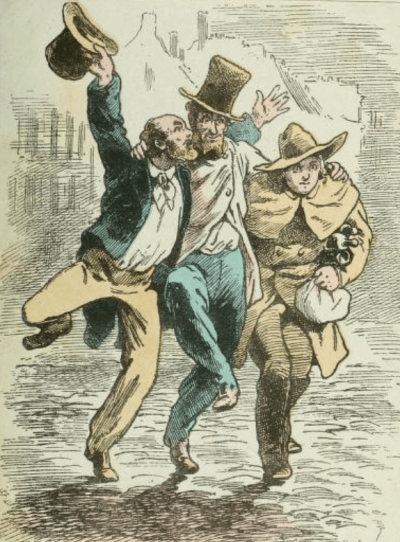
    William Powell Frith (1836-8), attrib. Douglas Cowper.

    It was not the trifling income derived from this success that gratified his guardian; that was a matter of perfect indifference to him. It was the proof that his nephew had used his time at college wisely. Tutors had written most encouragingly respecting him, predicting his future success.

    Still the old lawyer did not feel quite satisfied; the pale cheeks and certain dark circles round the eyes of the tired student alarmed him, and the first thing he did on his arrival was to send for a physician.

    ‘Overwork,’ said the man of science. ‘No organic disease.’

    The uncle breathed more freely.

    ‘We will soon remedy this,’ he observed. ‘The boy is up for the long vacation, and shall work only six hours per day.’

    Dr. Canton shook his head.

    ‘What! You think that too much? Four, then.’

    ‘Not one,’ replied the doctor emphatically.

    ‘I have frequently observed that you lawyers,’ he added, ‘astute enough in your own profession, are like children when they wander out of it — bewildered and unreliable in their judgment. I would as soon consult my tailor on a plea in chancery,’ he added, ‘as a lawyer on a point of hygiene.’

    His friend gave a short dry cough — a habit he had when called upon to assent to a proposition that did not appear quite clear to him.

    ‘Hem!’ he ejaculated. ‘Your opinion is founded on a half truth. There are two sides to the question. I am not so incapable of judging as you suppose. Have you forgotten how I cured my carriage horse after Harrassian, the prince of veterinaries, had pronounced that nothing could be done?’

    ‘And pray, how did you treat your horse?’ demanded Canton, with a half-suppressed twinkle in his eyes, for he felt that he had cornered him.

    ‘Very simply,’ replied his friend. ‘Took off his shoes and turned him loose.’

    ‘Excellent!’ exclaimed the doctor. ‘Exactly what I have been prescribing. Take off your nephew’s shoes — in other words, lock up his books — and turn him out to grass. The result will be the same.’

    With these words the friendly physician took his leave.

    ‘Canton is right!’ exclaimed the man of law, after a few minutes’ reflection. ‘I was a fool not to perceive it at first. The boy’s brain has been overtaxed. No more work till the end of the vacation. What a terrible error I was about to fall into! He shall enjoy himself. Won’t let him go to Deerhurst, though.’

    Two days afterwards our hero was delighted by the arrival of his faithful friend, Goliah. Knowing their attachment to each other, Lawyer Whiston had arranged that the two young men should spend a month together in London. There was nothing selfish in the old man’s affection for his nephew. He knew that the sympathies of youth require youth to draw them forth. The wisdom of age, however the young may venerate it, sometimes appears dry to them. Paradox as it may seem, hearts sometimes require weakness instead of strength to lean upon.

    For several instants the long separated friends sat silently grasping each other’s hand. The honest rustic was the first to speak.

    ‘This be like old times ag’in,’ he observed. ‘Deerhurst has been mortal dull without thee. Willie,’ he added, ‘thee do look pale and tired like.’

    ‘A little over-worked. Nothing more,’ replied the student. ‘I shall soon get over it.’ My uncle is very kind to me, and I have done my best to please him.’

    ‘Kind to thee?’ repeated his friend. ‘How can he help being kind to thee? Thee hast such a curious way of making a home in the hearts of all who know thee.’

    ‘Not all,’ said Willie, with something like a sigh.

    ‘All!’ added Goliah emphatically. ‘And those who don’t love thee don’t know thee. But never mind that now. I be come to spend a whole month with thee. The hay be all in, and Uncle Whiston settled it all right with mother.’

    His hearer heard the arrangement with almost as much surprise as pleasure. It was an additional proof of the place he had won in the regard of his relative.

    It was dinner-time before the lawyer made his appearance in Soho Square. He brought Bunce with him. The appearance of the poor tramp was so improved that Goliah scarcely recognised him.

    ‘Why, thee do look like a born gentleman!’ he exclaimed, at the same time shaking hands with him cordially. ‘They wouldn’t know thee at Deerhurst,’ he added.

    ‘You are as true a gentleman as I am,’ observed the wanderer. ‘Probably more so.’

    ‘I see thee be poking fun at me.’

    ‘Not so,’ replied his former acquaintance. ‘Fine clothes do not make a gentleman, or the ruffian upon whose face you left the mark of your whip would be the better gentleman of the three. It is the heart that gives the title. The rest is the mere gilding of the surface.’

    ‘There be some truth in that,’ said the honest rustic, thoughtfully.

    His hearers remarked with pleasure that considerable improvement had taken place less in the language than the manners of the speaker. He was far more quiet. His rough, boisterous fits of laughter no longer jarred upon the ears. If occasionally they broke forth, they were quickly suppressed. Mr. Whiston and Bunce felt more surprised than our hero did at the change. He thought of Susan, and understood it. His own recollections of Kate — the influence they had exercised upon his mind, although he still ignored her rank and fortune — explained it to him.

    Love is a great beautifier. The fable of Cymon and his nymph contains a delicate truth. Few of us, we suspect, but have learnt the lesson.

    ‘Not at home to any one,’ said the lawyer, as the butler placed the dessert upon the table, ‘and do not disturb me unless I ring.’

    The well-trained domestic withdrew.

    ‘And now, boys,’ continued the speaker, ‘as my nephew is enjoying his vacation, I think it only fair that I should take mine for an evening or two at least. Impossible to take more. The affairs of others might suffer.’

    ‘How stand affairs at Deerhurst?’ he added, addressing himself to Goliah. ‘Commence with Farmer Hurst, his wife and the pretty Susan.’

    At the last name his visitor coloured slightly and looked embarrassed, till a smile from Willie encouraged him to proceed.

    ‘Farmer Hurst is a changed man,’ he replied. ‘He do miss his nephew sadly. For the matter of that, so do the whole village. I don’t think,’ he added, ‘the grey mare be the best horse in the stable as it wor once. The filly ha’ taken her place. Not altogether,’ he added thoughtfully; ‘wish she had; but in a great many things.’

    ‘You mean to say that Peggy has not so much her own way as she used to have,’ observed the lawyer.

    ‘That’s it. How clever thee do put it.’

    ‘Mere practice,’ observed the man of law. ‘You, too, Goliah, are becoming a logician in your way.’

    ‘What be that?’ demanded the latter. ‘Nothing to do with law, I hope.’

    ‘More than you imagine, I expect,’ answered Mr. Whiston, with a smile. ‘But never mind that now. What is the news from Deerhurst?’

    ‘Schoolmaster Blackmore and his son Benoni ha’ left the place. Neighbours began to look coldly on them, so they started off, bag and baggage, without a word to any one; and a good riddance, too.’

    ‘And where are they gone? To London?’

    ‘Not so far as that,’ continued the lad. ‘Leastways Benoni has been seen several times in the village. He do come mostly at nights. People do say they be livin’ at their old home in the Marsh.’

    The lawyer and Bunce exchanged glances.

    ‘Mind,’ added the speaker, ‘I don’t know that it is so. At any rate he took all his books there. Breeze and Howard helped to carry them. It be a queer place to live in, fit only for wild geese and teal. Justice’s clerk told mother that schoolmaster ha’ gotten a lease of the whole place from some great lord in London.’

    The questioner brought the forefinger down to the palm of his hand — a habit he had when he wished to impress any fact or legal point upon his mind.

    Goliah looked upon all this as mere love of gossip on the part of Richard Whiston. In his simple, honest heart he never once suspected that the shrewd man of law was putting him through a regular examination.

    ‘And is this all?’ he asked.

    ‘All as I can recollect,’ was the reply.

    ‘So Benoni came merely to visit his old friends,’ observed the lawyer.

    ‘Since he went back on Willie all the boys despise him — turned him out of the cricket club, thof he wor one of the best bowlers we had. Stay, I do recollect something. The first time he came wor to get some iron bars his father had ordered of Mottram, the blacksmith.’

    A second finger was turned down.

    ‘And the next time?’ said the lawyer, insinuatingly.

    ‘He met Peggy Hurst at the Red Barn. I don’t think,’ added the speaker, ‘he will go near the farm again.’

    ‘And why not?’

    ‘I thrashed him,’ said Goliah, quietly. ‘I heard him tell Peggy that he wor in love wi’ her daughter, and I couldn’t stand that.’

    ‘Jealous,’ observed Willie.

    ‘Not a bit,’ answered his friend. ‘Susan despises him. What true-hearted girl could fancy a coward. I wor never jealous of any one but thee.’

    ‘And with quite as little reason,’ replied our hero. ‘It is quite true that Susan and I love each other; but it is only as brother and sister — nothing more.’

    ‘I know that,’ said the admirer of his cousin. ‘Thee told I so afore, and thee do allays speak the truth. It took such a lump off my heart; for what chance should I ha’ had again thee? Susan told I the same thing when I spoke my mind to her.’

    ‘And she answered —’

    ‘Nay, Willie, that beant fair,’ interrupted his friend. ‘There be two to that secret. When thee do fall in love thee will know all about it. P’raps she laughed at I — p’raps she did not; at any rate, she wor not very angry, though her mother is — she be dead set agin me. The farmer, I think, is all right, or soon will be.’

    Our hero sighed, and mentally repeated the words of the speaker, ‘When thee do fall in love.’ The poor boy was already in love. The fair girl he had rescued had left her image in his young heart. The gift of the watch — and, still more, the simple words from Kate — had confirmed the impression. The desire of pleasing his uncle was not the only motive for his hard studies at the university; a yet stronger impulse inspired him — the thought of making himself worthy of her; for, without the slightest suspicion of her real rank or fortune, he felt they were superior to his.

    ‘Now, boys,’ said the lawyer, as he bade them good night, ‘amuse yourselves in the morning as you please. The carriage and horses are at your disposal. After lunch I would advise you to take a drive in Hyde Park. The season is at its height for equipages, beautiful girls, and remarkable personages. Europe has not a scene to equal it. I can’t accompany you; neither can I spare Bunce — most important case to come off. But we shall meet at dinner.’

    ‘And my studies, sir —’ suggested Willie.

    ‘Hang your studies!’ interrupted his uncle. ‘Of course I don’t exactly mean that; but merely for the present. Recollect that for the present,’ he added, laughingly, ‘I have taken off your shoes and turned you out to grass.’

    Goliah slapped his thigh — a habit he had when greatly pleased — and exclaimed, triumphantly:

    ‘That be right, lawyer! It will soon bring back the colour to Willie’s cheeks, which those plaguey books ha’ stolen away. I opened one of ’em, and it made my eyes ache to look at the crooked lines and figgers; never seed anything like it, except in a conjuring book at fair time. Ecod!’ he added, ‘thee beest almost as sensible as a farmer.’

    Richard Whiston bowed gravely; there was an amused expression on his face.

    ‘I fear you flatter me,’ he said.

    Bunce and Willie laughed heartily.

    Poor Goliah coloured to the roots of his hair; he was quite quick enough to perceive the ridiculous side of his speech, and hastened to amend it.

    ‘I meant about horses,’ he said. ‘I didn’t think thee knowed so much. Of course, in law, book-larning, and such things, thee do know a great deal more. Why don’t thee help I, Willie?’ he exclaimed, turning to his friend. ‘I always helped thee. Thee do know what I mean.’

    ‘And so does my uncle,’ replied our hero. ‘He understands you even better than I do.’

    ‘Then he beant angry wi’ I?’ said the honest rustic.

    ‘Not in the least,’ said Mr. Whiston shaking hands with him before quitting the room. ‘We perfectly understand each other.’

    ‘Of course we does,’ observed Goliah, as the gentleman disappeared, ‘though Willie and Bunce both laughed at I.’

    Rotten Row and Hyde Park Corner. c.1890-1900. Photomechanical print. Source: Wikimedia Commons.

    The following day our hero and his friend did not neglect the lawyer’s advice of driving in Hyde Park at the hour he named, when the scene appears most attractive, especially to those who contemplate it for the first time. No doubt there are spots in the world equally beautiful; a few, perhaps, still more so, but none more animated. The throng of equipages in which elderly persons take their ease whilst inhaling the fresh pure air, the crowd of lovely girls, all life and animation, cantering on well-trained steeds, attended by fathers, brothers and admirers, the former proud of their charge the latter trusting to win a smile from the lips that enthralled them.

    Talk of the Isle of Calypso! The graceful fable of Fenelon never presented half its charms. His goddess and worshippers were a myth — those of Hyde Park are living realities, pure flesh and blood, fresh from the hand of nature.

    Youth! youth! such are thy glorious visions! They haunt its dreams; nor are those of age entirely free from them, dimly seen, perhaps, through the falling mists of a once happy past. So great was the excitement of Goliah that Willie had to check his outspoken bursts of admiration, which more than once attracted attention; and yet there was nothing coarse in them. The heart of the honest rustic was too well guarded for that by the recollection of the pretty Susan.

    Nothing like a pure, manly love to keep the lips and heart pure.

    As they were about to quit the ring the carriage of the lawyer crossed the elegant barouche of Lady Montague. Fortunately its noble owner was not in it — only her niece and Clara Meredith. The former recognised her protector in an instant, and involuntarily pulled the check-string. We say involuntarily, for it was the impulse of gratitude. Nothing more! Of course not! Had the high-born girl taken time to reflect, the fashionable surroundings, the familiar faces passing and repassing, might have prevented her. We do not mean to say that it would, but merely possibly.

    Mr. Whiston’s coachman — he had once been in the service of a lord chancellor — perfectly well understood what the drawing-up of Lady Montague’s equipage meant, and quietly drew up beside it. Clara Meredith looked on wonderingly. She could not understand the blushing, half-hesitating manner of her friend as she addressed our hero whose confusion equalled if it did not exceed her own.

    A very few words explained it.

    ‘I cannot,’ she said, ‘suffer the opportunity to escape me of expressing my gratitude to those who so generously protected me from a very great danger; that I have not done so personally before has not been from heartlessness, but ignorance of his name and address.’

    ‘It is the happiest recollection of my life,’ answered Willie, modestly; ‘but I fear you overrate my services.’

    ‘What!’ exclaimed Goliah, upon whose sluggish brain the truth was slowly dawning. ‘Be thee the —’

    ‘Even so,’ interrupted Lady Kate, hastily, for she had an instinctive dread of what was about to follow. ‘Do you not recollect me?’

    ‘How should I?’ replied the former. ‘Not but I ha’ often thought on thee. When I seed thee afore thee wor —’

    A violent nudge in the ribs, which, as the speaker declared, almost drove the breath out of him, gave him an unmistakable hint that he was treading on forbidden ground. Poor Willie was in agonies lest he should not take it.

    ‘So differently dressed,’ added the rustic, suppressing the allusion to her being disguised as a boy, which trembled upon his lips; ‘but that be only natteral; people don’t wear such fine clothes in the country as they do in London.’

    His friend breathed more freely, and the burning blush which had risen to the cheeks of the agitated girl gradually receded as the words were so adroitly turned.

    ‘You will find me at the residence of my aunt and guardian, Lady Montague,’ observed Lady Kate, at the same time giving him her card, and accepting the one he proffered.

    ‘I ain’t got no card,’ observed Goliah; ‘but I can write my name if Willie will lend I a pencil; that’s if’ — a second nudge, equally emphatic with the first one, cut short the rest of his speech.

    ‘Home!’ said Kate, at the same time bowing her adieu.

    The equipages separated, and for some minutes the ladies drove from the Park in silence.

    ‘O, Kate! Kate,’ said Clara Meredith, who was the first to speak.

    ‘You think I have acted wrongly?’

    ‘Incautiously, my love; wrongly, no — a hundred times no. Better, perhaps, to have let the recollection of the adventure fade from the memory of each.’

    ‘And endure the self-reproach of ingratitude?’ observed Kate.

    ‘Well, there is something in that,’ replied her companion. ‘I wonder what your dear old aunt will say — for, of course, you will tell her?’

    ‘Of course,’ was the reply.

    ‘Can you tell me, James,’ said Miss Meredith, addressing the coachman, ‘to whom the carriage in which those gentlemen were riding, belongs?’

    ‘Certainly, Miss,’ answered the man. ‘To Mr. Whiston, the great lawyer, who has the management of Lady Montague’s estates. The youngest of the gentlemen is his nephew, a great scholar, they say; and —’

    ‘Thank you, that will do.’

    Lady Kate glanced furtively at the card.

    ‘It is the same name,’ she whispered.

    ‘Thank Heaven he is a gentleman,’ exclaimed Clara.

    Her friend made no reply. She had never doubted it.

    Our hero felt too much excited by the unexpected meeting which had set his young heart dreaming to pay much attention to his companion, who sat silently by his side, turning the affair over in his mind in the hope of finding a solution.

    At last he broke into a low chuckle.

    ‘Ecod, Willie,’ he said, ‘thee beest a sly one.’

    ‘I do not understand you.’

    ‘Thee never told I about the — thee knowest who I mean. I can believe now,’ added the speaker, ‘that thee do love Susan only like a brother.’

    ‘Nonsense, Goliah! I have never seen the lady till this morning since we lost sight of her on Chandos-street. She is evidently far above me in rank as fortune. Her speaking to me was merely the result of gratitude, nothing more.’

    His friend gave a knowing wink.

    ‘No, for thee do allays speak the truth when thee do know it. I ha’ learnt many things since thee was puzzling thee brains over them dreadful books that make my eyes ache to look at, and be wiser nor thee in some things.’

    ‘Not unlikely. Susan is a very clever girl,’ observed his friend, with a smile.

    ‘Never mind Susan now,’ added Goliah. ‘I tell ’ee thee girl is in love wi’ thee.’

    ‘Ridiculous!’

    ‘’Diculous or not, be it so. Eyes don’t lie, though the tongue does.’

    Somehow our hero did not feel quite as angry at the absurdity of the speaker as he ought perhaps to have done. During the rest of their ride to Soho Square he remained silent, chewing the cud, as Shakespeare says, of sweet and bitter fancies — a weakness we are all liable to, age as well as youth.

    This edition © 2019 Furin Chime, Michael Guest


    Notes

    Finnegans Wake: For a pertinent site on the Wake, see Susie Lopez’s piece at Lithub, ‘Finnegan’s Wake at 80: In Defense of the Difficult: On the Pleasure of Annotating One of Literature’s Most Challenging Works’.

    TroveTrove, National Library of Australia

    Cymon and his Nymph: See John Dryden, ‘Cymon and Iphigenia‘, from Boccace, in Fables Ancient and Modern (1700).

    Isle of Calypso: Reference to Angelica Kauffman’s painting, Telemachus and the Nymphs of Calypso (1782), showing a scene from François Fénelon’s novel The Adventures of Telemachus (1699).

    Rotten Row and Hyde Park Corner (image): A likely site for Lady Kate and William to have crossed paths. See ‘Victorian London: Entertainment and Recreation’.  ‘Rotten Row’ is a corruption of Route du Roi, The King’s Road, which William III had built at the end of the seventeenth century as a safe route for him to travel between Kensington Palace and St. James’s Palace. In the image, Rotten Row is to the right; it was for saddle-horses only.

    Ecod: Egad.

    chewing the cud, as Shakespeare says: Common misquotation of As You Like It, 4.3: “Chewing the food of sweet and bitter fancy”.

    Dearden’s Miscellaney (1839).  Jump to page on Internet Archive for ‘check string’ entry (under “Important Invention”, p.121).

  • J.F. Smith’s Mystery of the Marsh — Fifteenth Instalment

    J.F. Smith’s Mystery of the Marsh — Fifteenth Instalment

    The scene shifts to Paris, where Smith can draw upon his youthful experience of bohemian life in the Latin Quarter.  A character in our upper echelon has gone there to take care of some … unfinished business — of the serious kind. Here we meet a new brand of character, a detective by the name of Monsieur Vezin. Although, while in the process of introducing him Smith alludes to Poe (1809–49), this Vezin is hardly the stature of the brilliant Le Chevalier Auguste Dupin — the world’s first fictional detective — of The Murders in the Rue Morgue and The Purloined Letter. One has only to look at his coarse, mercenary nature and how he snaps up such a mundane mission. Dupin would never lower himself.

    In saying so, I don’t mean to detract from Smith. On the contrary, his subtle realistic approach compares favourably with Poe’s spectacle and artifice, as entertaining as these are in their own right. (An escaped orangutan did it?!)

    Smith’s seemingly gratuitous reference to Poe is complicated, but worth a few minutes trying to untangle. The historical Duchess de Berry (Maria Carolina Ferdinanda Luise; 1798–1870) is famous for her intrigue against Louis Philippe I, King of France, in whose place she aimed to ‘restore’ her son Henri as the legitimate descendant of the overthrown Bourbon dynasty.  In an incident well-known in the history of cryptography, she sent an encrypted letter to a group of anti-monarchists in Paris, advising them she had arrived in order to mount the insurrection. Unfortunately, she forgot to supply them with the cipher-key (the key explaining which ciphers in the message correspond to which letters of the alphabet).

    It was the great politician and orator, the lawyer Pierre-Antoine Berryer, who reputedly worked out the key — definitely not a detective named Vezin. Poe used the idea in his story The Gold-bug, where the plot turns on deciphering an encoded message just as Berryer did. On the other hand, this particular letter of the Duchess’ doesn’t seem to have been ‘compromising’ as such. Perhaps Smith mixes in a vague allusion to Poe’s ‘purloined letter’, since its disclosure ‘would bring in question the honor of a personage of most exalted station’ (Poe, PL).

    Later in the chapter, out of the blue, Smith makes further reference to the absence of a figurative ‘key’, this time in the form of a Latin quotation: ‘nil nisi clavis [deest]’ (‘nothing is wanting but the key’), an arcane Masonic catechism. Does he mean to imply, more broadly, that there exists a missing master-key to some overarching mystery? Shades of Umberto Eco. Is it for the reader, or yet for the author himself to uncover?

    And we notice the echoing of names and identities. ‘Marsham’ has become ‘Marsh’, recalling the eponymous Bittern’s Marsh. We have ‘Lord Bury’, the alluded ‘Duchess of Berry’ and ‘Berryer’. Don’t tell me something is going to be found buried in the marsh?

    Yet the substance of the story unfolds in a straightforward, naturalistic fashion, without a defined, singular, impelling mystery. It is as though the entry of the Poe-esque character, Vezin, acts as a stimulus for ideas that are more characteristic of the Dupin-style of detective fiction, the precursor to the twentieth-century mystery genre. Many incidents in Smith’s novel have a ‘mystery’ or unknown quantity attached to them, waiting to be revealed: boys who turn out to be girls; dark plots; characters with obscure histories in the marsh; and those who have disappeared back into the Bittern’s Marsh …

    Naturally enough, the contemporary reader cannot expect it to conform to a modern mystery. But nevertheless, the conventions of the genre may skew one’s expectations.


    CHAPTER FIFTEEN

    A Glance at Paris — The Avenger on the Track — Students’ Orgie — Preliminaries of a Duel

    When Lord Bury started for France it was with the full intention of calling Clarence Marsham to account for his unmanly conduct to Lady Kate.

    Our traveller’s first halting-place was Paris. It was not his lordship’s first visit to the gay metropolis of our Gallic neighbors. He had been there twice before; seen something of its dissipations, without plunging over head and ears into them. Escaped from the fire, in fact, with only a few feathers singed.

    Faithful to the object of his journey, knowing the character and habits of the man he sought, he frequented once more the scenes he had formerly visited. They failed, however, to attract him. His mind had acquired a more manly tone.

    Paris, Grands Boulevards 1860. Etching

    It is astonishing how soon a naturally healthy appetite sickens of the sugared dainties of our youth.

    Not having discovered Clarence Marsham where he thought he would be found, Lord Bury addressed himself first to the English embassy; next to the prefecture of the police. Neither of them could afford the information be required. No passport in the name of Marsham had been viséd at either place.

    Travelling with a Secretary of State’s passport, which the English Government grants only to the favourite few, his lordship had been received with great civility by the authorities, who really felt anxious to oblige him.

    As he was leaving the prefecture — it was his third visit — a little old man, who had very much the air of a retired grocer or small shopkeeper, addressed him, and after a profusion of bows, such as Frenchmen alone know how to make, blandly inquired if he could be of any service.

    ‘I fear not,’ was the reply. ‘I have already had two interviews with the minister of police, who assures me that everything has been done that could be done.’

    ‘Officially?’ inquired the old man.

    ‘Of course.’ The querist smiled sarcastically. There was an expression of something very like contempt in his small, twinkling grey eyes at the obtuseness of the Englishman that roused the anger of the latter, who asked himself if the Frenchman had played with or been mocking him. Monsieur Vezin noticed this, and hastened to dissipate it.

    ‘No, no, my lord,’ he said, eagerly. ‘The prefect of the police can have no interest in deceiving you. What I meant was simply this: Official investigations are not always the most satisfactory. They have so much to attend to.’

    The traveller naturally felt surprised at finding his thoughts so accurately interpreted, and eyed the speaker more closely.

    ‘You know me?’ he observed.

    The detective smiled.

    ‘I know everyone who comes to Paris in his own name and with a legitimate passport,’ he replied. ‘And those who do not, I know where to find them.’

    ‘Who are you, sir?’

    ‘I am Vezin.’

    I know not whether it tells in their favour or not as a people, but the French have long been celebrated for the marvellous astuteness of their police. It is a speciality, and they are proud of it. And yet, singular contradiction, the humblest tradesman or mechanic would consider himself insulted by being taken for a member of it. Hint to a Frenchman of the middle classes that his morals are loose, he will only laugh at you. Accuse him of untruthfulness, he merely shrugs his shoulders. Call him a spy, and he is ready to fight you.

    Lord Bury was no stranger to the name of the detective. It was of European reputation, although he had not yet made the famous stroke by which he discovered the compromising letter of the Duchess de Berry, which the American poet, Poe, has made such a clever use of.

    ‘It is not the means I should prefer,’ he thought, but Clarence Marsham has left me no other.’

    Turning to the old man, he added, aloud:

    ‘I think, Monsieur, that you can be of use to me.’

    Vezin bowed.

    ‘This is no place for confidence,’ continued the speaker. ‘Follow me to my hotel, where we can converse more freely.’

    ‘With pleasure, my lord.’

    Once seated at the Bristol — the then fashionable hotel — his lordship described his anxiety to discover the whereabouts of Clarence Marsham, but not his motives; in this he was wrong. A detective is something like a confessor — he should be trusted with everything or nothing. The young Englishman ought to have understood this — perhaps he did — but his pride revolted at the thought of painting one so nearly connected with him in his true colours.

    Monsieur Vezin looked puzzled — just sufficiently to justify his asking a few questions.

    ‘Very clear,’ he said;  ‘in fact, perfectly lucid; still in certain cases we require an excess of light. Has the Englishman — I wish to put it as delicately as possible, done anything to render him amenable to the laws?’

    ‘His offence is a social one,’ was the evasive answer.

    ‘And you are in Paris to call him to an account?’ continued the former. ‘You need not reply. I can read the intention in your flashing eyes. I have nothing to do with that. If Mr. Clarence Marsham is in Paris I pledge my reputation to discover his retreat — but it will cost both time and money.’

    ‘You shall have no cause to complain,’ observed Lord Bury, haughtily. ‘Find his address, that is all I ask. You may leave the rest to me.’

    Monsieur Vezin thought so too.

    Three days after the above conversation the detective made his appearance at the Hotel Bristol again;  his employer saw by his eyes that he had been successful.

    ‘Well?’ he exclaimed eagerly.

    ‘I am on the track my lord.’

    ‘Pshaw! Only on the track?’

    ‘That is something,’ observed Monsieur Vezin, quietly; ‘a pledge that I shall run him to earth, as your fox-hunting countrymen say. There is but one difficulty. He has a Secretary of State’s passport,’ he added, significantly, ‘in the name of Marsh.’

    ‘My father must have procured it for him,’ thought Lord Bury, bitterly.

    ‘That there may be no errors,’ continued his visitor, ‘I have called to consult with you before I proceed any further.’

    ‘Not for the world!’ exclaimed his lordship, eagerly. ‘Leave him to me.’

    ‘He has signed a false name.’

    ‘With no political or fraudulent intentions. I can answer for that.’

    ‘Still it is a serious offence by the laws of France. I ought to arrest him.’

    ‘Come, come, Monsieur Vezin,’ said the Englishman, forcing a smile. ‘You are, I am convinced, too gallant a gentleman’ — the word gentleman stuck in his throat — ‘not to appreciate the difficulty in which such a step would place me; my honour and courage might be suspected — the world would suppose that I feared to meet him.’

    ‘It is possible,’ observed the Frenchman, musingly.

    ‘Of course it is,’ said his employer. ‘Let us see if duty or sentiment cannot hit upon a compromise.’

    A compromise was hit upon. Needless to say, it took a tangible shape, and the following agreement made: At an early hour the following morning, Monsieur Vezin was to accompany Lord Bury and two of his English friends, to point out the house in the students’ quarters where Clarence Marsham had taken up his abode. If he accepted the duel, well, the police would wink at its taking place. If he refused, they were at once to arrest him.

    ‘I shall be sure to hit him,’ thought his lordship, as he quitted his hotel in search of a second.

    The detective muttered something very similar as he walked towards the prefecture of police; to be sure, the words were somewhat different.

    ‘He means mischief. I can see it in his eyes,’ he said. ‘Bah! What is it to me if one English dog shoots another? — a troublesome affair off my mind, even if I am well paid for it.’

    ‘The Latin Quarter of Paris has a type apart from the rest of  the pleasure-loving city. It is the centre of Bohemian life in all its varieties. Students, grisettes, dealers in books, old coins, bric-a-brac, antique furniture, costumes and armor, indispensable accessories of the painter’s studio, locate themselves chiefly in the street of the Ancient Comedy, where the once celebrated Cafe Procope still. opens wide its doors. The brilliant galaxy, Balzac, Lamartine, dear old Béranger, Victor Hugo, have long since disappeared from the busy stage of Parisian life.

    Student life in the Latin Quarter has changed but little. Its amusements, occupations, habits, vices, and, let us add, virtues, are still pretty much the same as when the author shared it some fifty years ago. A little study, great extravagance, loyal generosity to a comrade in distress, a rude sense of honor where their own sex are concerned, a general disregard of it towards the weaker and more helpless one.

    Street in Latin Quarter, 1862, photograph, Charles Marville. Source: nga.gov

    The houses occupied by the students are exceedingly numerous. The steady ones board; the pleasure-seeking merely lodge in them. Each set of rooms is a separate fortress; their occupants band in strict alliance for self-defence.

    In the middle ages, the members of the university braved the crown — frequently gave laws to it. At the present day they brave only the police, unless a revolution happens to be upon the tapis; then something like their old spirit returns to them.

    In the street of the Ancient Comedy stands a large hotel which, for nearly a century, has been a favorite abode with the semi-Bohemian race we have just described. On the first floor of the building, Clarence Marsham — or rather Clarence Marsh, as his passport designated him — had engaged one of the most roomy and best apartments. Compared with his neighboring lodgers, his surroundings might be termed luxurious; still they were a sad falling off from the regimental club and the splendors of Allworth House. The youthful profligate did not, however, regret the change very much. In Paris he had found what he deemed compensation in the alluring pleasures of the French metropolis.

    Although his mother had reduced his allowance by one half, Clarence Marsham appeared a veritable Crœsus to his new acquaintances, who ate his suppers, drank his wines, and occasionally borrowed a few francs from him. Not that he was by any means a generous lender; it was a tax he had to pay, and he paid it grudgingly.

    Our roué, who was fast gliding into the habits and manners of his new associates, had invited some half dozen of them to a late breakfast in his rooms. Amongst others were Duhammel, the son of a rich notary; Alfred Oufroy, of an old Norman family; Alphonse Dubarry; St. Ange, brother to the great advocate, — all of them giddy, pleasure loving youths, but extremely sensitive on the one great point of French honor — courage.

    As for morals, in the strict sense of the word, we fear they scoffed at them.

    From Scenes de la vie de boheme (1850), Henri Murger, illustr. Maurice Berty.
    From La Vie de Boheme (1850), Henri Murger, illustr. Maurice Berty.

    The revel was at its height — continued from the orgies of the preceding night — orgies which we cannot take upon ourselves to describe, even if we had the inclination. Glasses were drained, plans for fresh dissipations laid out, and vows of eternal friendship — false as dicers’ oaths — exchanged.

    One instant, bursts of equivocal jest; the next, the half-drunken madcaps broke into one of their student songs — honoured traditions in the Latin Quarter. Their fathers and grandfathers most probably, had sung them under similar circumstances, with the same noisy accompaniments of jingling glasses and rattling of forks and knives.

    Brother students, we are met for mirth and delight,
    And joy the bright goblet of Bacchus shall fill;
    For though woman, dear women, be absent to-night,
    The spell of her beauty is over us still.
    ‘Twas wisely decreed by our masters of old,
    To refuse them degrees, ‘spite entreaties and sighs;
    For once in our halls they would rule uncontrolled,
    And govern each class by the light of their eyes.
    Then think not in Bacchus alone we delight,
    And seek but the cup of the wine-god to fill:
    For though woman, dear woman, be absent to-night,
    The spell of her beauty is over us still.

    The cheers which followed the song and chorus had barely subsided when Monsieur Bellot, the proprietor of the hotel, entered the room. His appearance was hailed by the revellers with bursts of laughter and applause. Clarence insisted on his drinking a glass of champagne in honor of his guests. The Frenchman bowed, swallowed the wine, then gravely informed the host that three gentlemen were in the ante-room who insisted on seeing him.

    The young Englishman looked disconcerted. The recollection of the false passport, and his assumed name, suggested suspicions of the police.

    ‘Who are they?’ he demanded after a pause. ‘Frenchmen?’

    ‘No,’ replied Mons. Bellot, ‘Englishmen. I can swear to that. But their cards,’ he added, at the same time, ‘will doubtless inform you of the purport of their visit.’

    The roué read the names of three officers of Lord Bury’s regiment. His enemy had found him.

    ‘Yes, certainly!’ exclaimed the latter, enforcing a laugh to conceal his embarrassment. ‘They are old friends, show them in.’

    The students noticed with surprise that the three Englishmen, when they entered the room, instead of rushing to their host, embracing him, and indulging in a succession of gyrations which it would puzzle a mathematician to describe, bowed stiffly, and the eldest one, advancing towards Clarence, requested the favour of a private conversation with him.

    ‘A duel,’ whispered Oufroy.

    Duhammel thought it looked very like one.

    ‘How odd these islanders are,’ added a third student. ‘Three seconds to carry one message. But, nil nisi clavis, we have not the key of the enigma yet.’

    ‘You may speak before these gentlemen,’ exclaimed Marsham, in a tone of bravado, trusting that his guests would stand by him.

    ‘Tiens!’ said one of them. ‘The insular appears civilised.’

    Considering that barely four years had elapsed since the battle of Waterloo had been fought, this was rather a handsome admission for a Frenchman to make.

    ‘My Lord Bury,’ said the second, ‘feeling deeply insulted in his honour and personal dignity by the conduct of Mr. Marsh’– he gave him his assumed name — ‘towards a lady whose name it would be indelicate to mention, demands immediate satisfaction for the outrage.’

    Although Clarence was not particularly brave, he was far from being, in the ordinary acceptation of the word, a coward. He knew that his lordship was a dead shot, and began to reflect whether some means might not be found to avoid the meeting. What made the affair more difficult was the Englishman had delivered his message in excellent French.

    ‘Mon Dieu!’ whispered Oufroy in his ear. ‘What are you hesitating about?’

    ‘Looking for his lost courage,’ suggested another of the students.

    Clarence turned towards them, his mind being made up at last.

    ‘Gentlemen,’ he said, ‘you are, I believe, all of you, my excellent good friends.’

    To this there succeeded a dead silence His guests were waiting.

    ‘I am placed in a position of extreme delicacy,’ added the speaker, ‘and solicit your advice, pledging myself, of course, to act on it.’

    At this there was a faint murmur of approval.

    ‘The gentleman who has challenged me is so nearly related to me that I hesitate about accepting the provocation.’

    ‘Is he a brother?’ asked Duhammel, the oldest of the Frenchmen present.

    ‘No. His father is the husband of my mother.’

    An ironical smile — in fact, it amounted almost to a sneer — curled the lips of the students, who unanimously assured the speaker that so slight a degree of relationship presented no obstacle to his accepting the duel.

    ‘Curse them!’ muttered Clarence to himself. ‘I am in for it.’ Speaking aloud he added: ‘Thanks, gentlemen; you have relieved my mind of a painful doubt. Perhaps you will arrange the time and place of meeting with my adversary?’

    ‘It must be instantly,’ observed Captain Seymour, the name of the messenger. ‘His lordship is waiting in the Alley of the Luxembourg, hard by.’

    ‘Is the offence so deadly?’ asked Duhammel.

    ‘Most deadly,’ was the reply. Walking close to Clarence, he whispered in his ear: ‘Choose at once ‘between the satisfaction demanded or being arrested, dragged through the streets of Paris, for travelling under a false name and passport.’

    ‘And can you reconcile to yourselves turning informers?’

    ‘Under ordinary circumstances, certainly not; but by violating the laws of honor you have placed yourself beyond the pale of society. The police are already in the hotel, ready to arrest you. The exposure once made, his friends cannot permit Lord Bury to meet you.’

    ‘And shall I fall?’

    ‘You need not trouble yourself for any after results,’ observed Captain Seymour, dryly.

    ‘Should I be the victor?’ added Clarence.

    ‘In that case,’ remarked the former, ‘neither my brother officers nor myself will feel called upon .to denounce you.’

    Cornered at every point, the cowardly insulter of Lady Kate resolved to take the desperate chance. Walking to the table he tossed off in succession two or three glasses of wine; then, turning to his student friends, exclaimed, in an almost joyous tone:

    ‘I am ready.’

    The former had already supplied themselves with both swords and pistols, that the principal might have the choice of weapons on the ground.

    ‘And now, gentlemen, where to?’ inquired Duhammel.

    ‘To the garden of the Luxembourg,’ answered Captain Seymour, gravely.

    A few minutes later the speakers passed by the Odeon, where a bal masque had been held the preceding night. Several of the students who had attended it recognised Clarence and his friends as they passed them.

    Death and dissipation jostled each other on the street. They are old acquaintances, and a familiar nod was all that seemed necessary.

    This edition © 2019 Furin Chime, Michael Guest


    Notes, References, Further Reading

    orangutan: To counterbalance my glib comment, see Sydney Lévy, ‘Why an Ourang-Outang? Thinking and Computing with Poe‘, at Épistémocritique: Littérature et savoirs.

    orgie: Fr. orgy

    grisette: ‘1. A young French working-class woman; 2. A young woman combining part-time prostitution with some other occupation.’ Merriam-Webster.

    upon the tapis: from Fr. ‘sur le tapis’ = ‘on the carpet’; in the context, ‘on the table-cloth’, or ‘under consideration’, as in the English idiom ‘on the table’.

    Crœsus: King of Lydia, 560–547 BCE, whose riches came from gold in the sands of the River Pactolus, where King Midas washed his hands.

    false as dicers’ oaths: ‘Such an act / That blurs the grace and blush of modesty, / Calls virtue hypocrite, takes off the rose / From the fair forehead of an innocent love / And sets a blister there, makes marriage-vows / As false as dicers’ oaths: O, such a deed […]’ (Hamlet iii.4). That is, as untrustworthy as a dicer’s vow to quit gambling.

    [Louis de Loménie], R.M. Walsh, trans. ‘Berryer’ in Sketches of Conspicuous Living Characters of France (1841). Available free at Internet Archive.

    Henri Murger, La Vie de Boheme (1850). Available free at Internet Archive.

    Edgar Allan Poe, ‘The Murders in the Rue Morgue’ (1841), ‘The Purloined Letter’ (PL) (1844), ‘The Gold-bug’ (1843).

    William F. Friedman, ‘Edgar Allan Poe, Cryptographer’ in L.J. Budd and E.H. Cady eds.,  On Poe (1993).

  • J.F. Smith’s Mystery of the Marsh — Fourteenth Instalment

    J.F. Smith’s Mystery of the Marsh — Fourteenth Instalment

    What a presumption of Burcham’s that Lady Kate’s cousin Clara Meredith will drop everything and marry him because an inheritance of five thousand a year hinges on it! He doesn’t need Mr. Brit to tell him there will be possibly much more for him when her father dies, issues of marriage and inheritance dictating the distribution of property. The situation reflects something of the dominion that the “unfair sex” held over women to a large extent in the Victorian era, much depending on class. Generally speaking, a wife had no separate legal existence from her husband, who had power over her property, estates, any earnings she might have, custody of children, and her body. It was not until 1891 that a court of law overturned a man’s right to keep his wife at home under lock and key (Perkin).

    A private system of law, however, enabling upper-class Englishwomen to hold separate estates and income, made them perhaps the most liberated wives in the world.

    In this respect, Clara is not atypical of a woman from the untitled gentry. Raised in protective families,

    They were not reared as shrinking violets; almost without exception they were brought up in the country, outdoor life being considered more important than other forms of education. But these half-educated, horse-loving girls often married young and became great hostesses in London. They were considered among the most politically minded women in Europe. They learned from their elders, but had their own views and expected to air them. (Perkin 101)

    It was a pivotal time, with moves to guarantee the financial protection of women in the upper and middle classes a thin end of the wedge for emancipation of women throughout society.

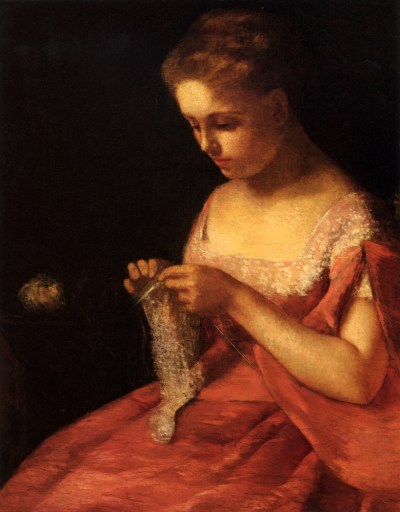
    “The Young Bride” 1875, Mary Cassatt. Source: wikiart.org

    Tied up in the conniving around the issue of Clara’s inheritance, we are introduced to a stereotyped caricature of a Jewish man, a money-lender brought in furtively by Burcham’s lawyer, Roland Brit.

    The figure strikes us as unfunny and at least in poor taste, reflecting echoes of systemic anti-semitism. It is a serious issue even in the present day, with  the theatrical representation of characters such as Shylock and Fagin encountering criticism.

    ‘The Merchant of Venice’ perpetuates vile stereotypes of Jews. So why do we still produce it? […] It is time to say “never again” to this historical aberration. Every time it is produced, the play introduces new audiences to vile medieval tropes of Jew-hatred that we should have long ago left behind.

    Steve Frank, Washington Post

    It’s not just this latest hook-nosed rendition of Oliver! that offends — it’s wrong to revive it at all … Fagin was written in the 19th century but his character is rooted in the middle ages and it is regressive to revive this musical. I have no problems with presenting “bad Jews”, but let them be fleshed-out characters, not stereotypes.

    Julia Pascal, The Guardian, Australian edition


    CHAPTER FOURTEEN

    Still in the Country — The Unexpected Inheritance — A Proposal of Marriage Rejected, and the Vow of Vengeance

    Still in the country! Yes, dear reader, and we can’t get out of it just at present without leaving a blot in our history, which, in your interest as well as our own, we have not the slightest intention of doing. So, for a brief spell, you must be content to hear more of rural walks, flowers, rustic friends and acquaintances. For several months Lady Kate and her Cousin Clara pursued the even tenor of their lives. The latter had all but forgotten the terrible trial she had been subjected to at Allworth Park — her perilous journey and the incidents connected with it — all but one: the gallant youth who had protected her. Sometimes she saw him in her dreams. She could not be blamed for that. No girl can help her dreams, we all know.

    The family party at the Hall were seated at the breakfast table on a delicious morning in autumn, when the owner rather startled his daughter and visitors by suddenly exclaiming:

    ‘Zounds! How unexpected!’ as he dropped the newspaper he had been reading.

    ‘What is unexpected, papa?’ inquired Clara.

    ‘Lady Burcham is dead,’ replied the baronet. ‘Apoplexy! Always thought it would end that way. Great feeder. Would not take exercise. Never could coax her into the hunting-field.’

    ‘I have never frequented the hunting field,’ observed Lady Montague, gravely.

    ‘Hem,’ coughed Sir George. ‘Very different person. She was exceedingly stout, you are gracefully thin, and are several years younger,’ he added.

    ‘Five or six, at the least,’ said her ladyship, somewhat reassured by his last observation. ‘She was rich, I believe.’

    ‘Not one of our great county fortunes,’ remarked the host, ‘ but handsomely well off. The estate is worth eight thousand a year at the very least. I suppose her scamp of a nephew will come in for it. As her heir-at-law, I shall be expected to attend the funeral. Great bore:’

    ‘Perhaps she has left you a legacy,’ observed Lady Kate.

    ‘Don’t want it,’ answered the old gentleman, sharply. ‘Enough money of my own already; more would be a plague to me.’

    ‘Oh! Oh!’ exclaimed the cousins, laughingly; ‘money a plague! Only consider the good one can do with it.’

    ‘Not,’ added Clara, looking suddenly serious, ‘that it can ever compensate for the loss of those we love. If it could I should hate it.’

    Her father marked the tears ready to start at the thought so unexpectedly conjured up, and silently kissed them away.

    That same evening’s post brought a letter to the baronet from the solicitors of the deceased lady, informing him of her death and inviting him to attend the funeral at Burcham House that day week. The letter was signed ‘Brit and Son.’

    Funerals sometimes have their comic as well as serious aspect, especially when the dead have left no grateful hearts to mourn for them — no recollection of charities unostentatiously performed, no memories of sympathies with the living, no offspring’s tears to fall upon the coffin. These are tokens which no number of distant expectant heirs, no pomp of heraldry or luxuries of woe, can replace. Without them the velvet pall and emblazoned escutcheon are merely empty, idle mockeries.

    Such was the aspect which the great hall of Burcham House displayed on the day of the late owner’s funeral. Cousins, nephews, and yet more distant relatives had gathered from the neighbouring counties to listen to her will. No one except the solicitors had the slightest idea of its contents, and as the lady had been exceedingly capricious whilst living, even those relatives who had most offended her were not without hopes.

    Such was the scene when Sir George Meredith arrived at the Hall, where he was received by the steward and lawyers. Brit, whose visage was of the exact professional length befitting the occasion, was the most serious one in the room.

    As for Burcham, who had borrowed money of his aunt, vexed, annoyed, and disgusted her in various ways, he scarcely hoped to be remembered in the disposition of her property, and witnessed the arrival of the heir-at-law with a smile of indifference. As he frequently boasted to his. friends, he would die game anyhow.

    When the testament was opened, its contents surprised every one. The testatrix bequeathed her estates to her nephew, Master Burcham, and Clara Meredith, jointly, share and share alike, provided they contracted matrimony within the space of two years from the old lady’s death; and in the event of the above-mentioned marriage not taking place, the estates to be sold and the funds distributed to such charities as her valued friend and sole executor, Joshua Brit, senior of the firm of Brit and Son, Old Jury, London, should name for that purpose.

    There was a general murmur of disappointment when the lawyer concluded the reading of the will.

    Sir George Meredith felt greatly surprised, but in no way disappointed at the disposition of the deceased lady’s property. Burcham regarded him with a triumphant air. It never entered into his coarse imagination that any girl would reject five thousand a year, even if it had the trifling incumbrance of a husband attached to it.

    ‘Once my wife,’ he muttered to himself, ‘I will pay Clara and her father off old scores. There is a long debt standing between us.’

    He had not forgotten the threat of the stocks; it rankled deeply in his memory.

    As the baronet was about entering his carriage to return home, the executor advanced obsequiously and inquired if he had any instructions to leave with him.

    ‘No,’ replied the old gentleman in a tone of surprise. ‘What can I have to say in the affair? It does not rest with me.’

    The next instant he drove away.

    ‘It will never be a match,’ muttered the lawyer. ‘They despise him. What are five thousand a year to Sir George Meredith and his daughter? The charities will come in for the property. What a vast amount of good it will do, especially as I have the management of the revenues.’

    From that hour the length of the old schemer’s visage gradually decreased.

    ‘I say, old fellow,’ said Burcham, after the mourners — all more or less disappointed — had taken their leave, ‘don’t you think the old girl made a foolish will’? I ought to have been left sole heir. Not that I suppose it much signifies,’ he added.

    ‘Probably not,’ answered the executor. ‘My late respected client was a most conscientious woman, and the estate being hers before her marriage concluded she had a right to dispose of it as she pleased,. You forget she was a Meredith.’

    ‘No I don’t, curse her.’

    ‘Oh, Mr. Burcham!’ exclaimed the lawyer, greatly shocked, or pretending to be so. He was a great stickler for the proprieties.

    ‘Well, you need not repeat it,’ replied the co-heir. ‘But it is very provoking to be compelled to marry a girl I don’t care a straw for.’

    ‘With five thousand a year,’ added Mr. Brit; ‘and heaven knows how much more when her father dies.’

    ‘It may turn out for the best, after all,’ observed the former speaker, musingly. ‘Anyway, I am in for the matrimonial noose. How soon ought I to propose?’

    ‘Not before a month, at the very earliest,’ was the reply; ‘it would not look well.’ ‘

    I have a month’s fling before me, at any rate,’ exclaimed the roue. ‘ I say, old fellow, you could not let me have a couple of hundred pounds, could you?’

    ‘It is against the articles of the firm to lend money,’ was the cautious answer, ‘or I should be happy to oblige you. Others are less scrupulous; and with your prospects there ought not to be any difficulty, especially as the sum is a trifling one.’

    ‘Try Moses again,’ said Burcham. ‘But he is such an unreasonable rascal. I suppose I may refer him to you?’

    ‘Yes, certainly; but if you take my advice you will have nothing to do with him.’

    ‘Ah, I forgot he’s a neighbour of yours. You know him?’

    ‘Slightly,’ replied the lawyer, repressing a smile.

    A blush of indignation rose on the countenance of Clara Meredith when the baronet informed her of the conditions of Lady Burcham’s will.

    ‘How intensely absurd!’ she exclaimed. ‘I would rather die than marry him. Of course, papa, you told him so?’ she added.

    ‘No.’

    ‘No!’ repeated the indignant girl.

    ‘The rejection must come from you,’ continued Sir George. ‘I have no right to decide for you.’

    ‘And I must really go through the form of listening to him?’

    ‘I fear so.’

    ‘And give him a civil answer?’

    ‘It is the custom of such occasions.’

    ‘Why, papa, you speak as coolly as if you thought it possible I should accept him, and I think it very unkind of you.’

    Her father drew towards her and kissed her.

    ‘You must not be so impetuous, pet,’ he said,’ and jump at such rash conclusions. You ought to know that I would rather see you in your coffin than the wife of Burcham, or of any man,’ he added, ‘whom you could not respect as well as love. I fear, Clara, you are a little capricious.’

    ‘How can you be so unjust, papa.’

    ‘You have refused Wiltshire?’

    ‘Yes, papa.’

    ‘And Sir John Radcliff?’

    ‘Oh, he is so insipid.’

    And the speaker was about to enumerate several others of her rejected admirers, when his daughter sprang upon his lap and threw her arms about his neck, exclaiming as she did so:

    ‘How sly you have been, papa! I did not think you had noticed their attentions. Why, are you in such a hurry to get rid of your saucy girl?’

    ‘No,’ replied the baronet fondly. ‘It is that before I die I wish to see you the wife of some good and honorable man, who will insure your happiness. I care not how poor he is, provided his character is unblemished and you love him, You have carte blanche in your choice. I know,’ he added, ‘that you will never abuse it by giving your hand to any one who is not in the true sense of the word a gentleman.’

    Involuntarily the thoughts of the speaker reverted to his nephew, Lord Bury, who appeared to him to be just the husband he would have selected for his daughter, but as unfortunately there did not appear the slightest chance of such an attachment, he tried to dismiss the subject from his mind.

    Clara felt but too glad to escape from the room, and so the conversation terminated. Possibly she feared to be further questioned, or, what is still more probable, began to understand her own heart.

    When Lawyer Brit declared that he never lent money, those who knew him well — and there were a few such’ persons in the world — would have construed his declaration in an exactly opposite sense. The fact was that he did lend money, and to a very large extent, but not in his own name. He was far too cautious for that. Like other successful rogues, he had learnt during his long practice the value of the word reputation –that is to say, its commercial value. Besides this, he had other reasons: His connection with certain important charities, whose well-meaning, but easily duped directors were exceedingly sensitive on such subjects. The concerns were prosperous. It not only provided them with fat salaries, but enabled them to provide for younger sons and dependants by secretaryships,  inspectorships, auditors, and other profitable employments.

    Many of the public charities in England are, no doubt, admirably administered. Some — suppose we say, tolerably. Others are as much a business as the dealings in dry goods, tobaccos, teas or sugars.

    Lawyer Brit employed therefore an agent in his pecuniary transactions — the same Mr. Moses to whom Burcham alluded on the executor’s refusal to advance him the two hundred pounds. The said Moses was one of the most abused persons in London, and yet it was extraordinary how many respectable persons had transactions with him. The smooth-faced principal in his schemes of usury —  the man who found the money, and profited so largely by them — was the first to condemn him. Whenever Moses made his appearance at the lawyer’s offices the latter would make difficulties about seeing him, wring his hands, look virtuously indignant, and wonder how his respectable clients could entangle themselves by dealings with such a disreputable person. This little by-play he enacted for the benefit of his clerks, who would be sure to repeat it. It deceived most of them; not all, perhaps. Benoni already began to have an inkling as to the true character of his employer. The lessons of the old schoolmaster had not been thrown away upon his son. Benoni was a close, though a silent, observer.

    On his return to London the head of this prosperous firm had a long interview with his son, Roland, in his private room. Even to him it was limited. True his new clerk had inspired him with a favourable opinion, but Mr. Brit acted only on certainties. The youth had not compromised himself yet.

    ‘Well, Roland,’ said his parent, ‘ have you calculated the amount of Burcham’s securities — the exact value of  his remaining interest in the property?’

    ‘About four thousand pounds, sir.’

    ‘Under the hammer?’

    ‘Of course,’ replied the son. ‘We make no allowance for fancy values,’

    ‘Right; very right, my boy,’ observed his senior. ‘Sentiment is only another name for weakness in all business transactions. Is Moses informed that I wish to see him?’

    ‘He will call at one, sir.’

    ‘Very good. Contrive to be in the clerks’ office when he arrives. Make the usual difficulties. Moses will understand it. It might be as well to have some slight altercation with him, Nothing serious, of course,’

    Roland Brit smiled at what he considered unnecessary precautions. The young spider knew all the capabilities of the paternal web — its elastic strength, powers of retaining the foolish insect once entangled in its meshes; but he had not the experience of the old one.

    Mr. Brit had rather a foolish habit for a person in his position of talking to himself when alone. He was aware of this, and standing orders had been given than none of the clerks should enter his private room without first knocking at outward doors, of which there were two — one of oak, the other of green baize.

    ‘Everything appears safe,’ muttered the lawyer, as he closed them both after his son, and had thrown himself into an easy-chair. ‘Burcham’s property — Burcham’s estate — will stand another thousand, although I did not calculate on paying so much for it. Nor will I,’ he added, ’till I get him completely in my power. I must risk something for the charities. Last year’s subscription fell short. Not much — not much,’ he repeated, reflectively. ‘Still a wise man should not neglect the first signs of danger. Lady Burcham’s bequest will place them beyond danger, I can only secure it for them. The world thinks I am overpaid for my services. It little knows the anxieties I endure, and all in the cause of charity.’

    If, as an old proverb asserts, that charity begins at home, the subtle schemer had some reason perhaps for his conclusions.

    The author has taken his readers thus far into his confidence in order to prepare them for the plan the lawyer had concocted for the ruin of Mr. Burcham, who, in his dealings with the respectable Moses, had not, as yet, committed an act to place his liberty at his mercy. He was a coarse brutal bully, as well as a fool; but nothing more.

    It never entered Mr. Brit’s calculations that Clara Meredith would reject the fortune and the husband. Could he have been assured of that he would not have taken so much trouble. Rich as he was, he felt that he could not have refused it, no matter what the conditions.

    Hearing his son’s voice in dispute the lawyer broke off the train of reflection as he hastened into the clerks’ office, where he found his son, as he expected, having warm words with the Jew moneylender.

    ‘My father will not see you,’ said Roland, as his father, as he entered from his private room.

    ‘Pisiness is pisiness,’ answered the Israelite, who perfectly understood the part he was to act. ‘One of his clients has –‘

    ‘Mr. Moses,’ said the head of the firm, interrupting him, ‘this is really intolerable. I have already informed you more than once that when you have any affairs in which my clients are interested, it would be more agreeable to communicate by letter.’

    ‘It is pressing.’

    ‘I cannot help that.’

    ‘Ferry vell; den I will ruin your client  — send him to prison for debt — sell him up, and all because he has a bad lawyer.’

    Mr. Brit looked exceedingly distressed. ‘If the case is really so urgent –‘

    ‘I tells you it is urgent,’ interrupted the money-lender. ‘The writs are out, I have got judgment against him.’

    ‘Against whom?’

    ‘Your client — Mr. Burcham.’

    ‘Improvident young man,’ sighed the lawyer. ‘After all my friendly warnings, too. I suppose I must see you.’

    ‘It vill be better.’

    ‘Step this way,’ said the head of the firm. ‘What a scandal for an office like mine.’

    Like two actors satisfied with their exertions, the speakers entered the private room together and closed the doors care. fully after them. Once alone, they regarded each other in the face, shook hands, and indulged in a quiet chuckle.

    ‘Peautiful!’ exclaimed the visitor.

    ‘Not so loud, Mr. Moses,’ replied the lawyer. ‘It really was exceedingly well acted.’

    ‘It is too bad,’ observed Roland Brit, as the speakers disappeared, ‘that my father, who abhors all such practices, should be exposed to this annoyance.’

    All the clerks, as in duty and prudence bound, expressed great sympathy with this natural indignation. All but Benoni; he was reflecting upon it.

    The sum of one thousand pounds was duly advanced by the accommodating Mr. Moses to dupe Burcham, but not till after a number of letters from the latter, filled with false statements sufficient at any time to establish a charge of fraud, had passed between them.

    ‘I don’t quite understand the affair,’ observed the ostensible money-lender, at the conclusion of the transaction. ‘You bid me not to set a detective to watch him.’

    ‘Not for your life,’ ejaculated the lawyer. ‘Make no movement without my orders.’

    ‘I vill not; but I forsee it vill pring troubles.’

    Mr. Brit regarded him earnestly. It was the first time he had ever heard a word of remonstrance from his lips.

    ‘If you are dissatisfied,’ he remarked, sternly.

    Moses resumed his former subservient manner.

    ‘Not at all, not at all, mine good Mr. Brit, If I feels just a little uneasy, it was on your accounts, not mine own.’

    ‘Very well, sir, I will understand it so.’

    Notwithstanding his assertion to the contrary, Mr. Moses did not feel satisfied with the transaction — not on account of its immorality — he was above such vulgar scruples; all he doubted was its safety.

    After enjoying a month’s dissipation in London, Burcham returned to the country to propose to Clara Meredith. Never for an instant from the first reading of the will had he entertained a doubt of her accepting him. Five thousand a year, he concluded rarely went begging. Great, therefore, was his astonishment, to say

    nothing of his mortification, when the young lady, after listening with exemplary patience to his rough style of wooing, civilly, but decidedly, rejected him.

    ‘You can’t mean it!’ he said. ‘It will ruin me.’

    ‘I am not responsible for that.’

    ‘And the five thousand a year?’

    ‘I do not require it; and the condition renders it impossible I should accept it,’ added the firm-hearted girl.

    ‘O, nonsense! You only say this to tease me.’

    ‘Believe me, I have no such wish,’ replied Clara, who began to feel tired as well as disgusted at the interview. ‘You do not know me, Mr. Burcham.’

    ‘Nor you me,’ explained the disappointed suitor, scowling fearfully. ‘It is a plot to ruin me, rob me of my inheritance, and drive me from the county. I will be revenged; I will thwart your hopes and prospects at every turn! I could not rest in my grave unless I had obtained satisfaction for this cruel, heartless insult!’

    Although not in the least terrified by his menaces, Clara Meredith rang the bell, and her father entered the room, accompanied by Lady Kate. The coward and bully — for none else would insult a woman — sullenly withdrew.

    This edition © 2019 Furin Chime, Michael Guest


    Reference and Further Reading

    • Joan Perkin, Women and Marriage in Nineteenth Century England (Routledge, 1989)
    • Todd M. Endelman, The Jews of Britain, 1656 – 2000 (U of California P, 2002)
  • J.F. Smith’s Mystery of the Marsh — Twelfth Instalment

    J.F. Smith’s Mystery of the Marsh — Twelfth Instalment

    Margaret Oliphant’s essay ‘The Byways of Literature: Reading for the Million’ (1858) is something of a seminal study in literature and popular culture. Her elegant piece is by turns endearing — particularly in her approval of our man Smith — and a worry for its tone of condescension towards ‘the Million,’ meaning the multitude, the ‘lower classes’.

    Let us give the masses all credit for their gift of reading; but before we glorify ourselves over the march of intelligence, let us pause first to look into their books.

    There is an irony, which is to some extent to be borne out:

    These unfortunate masses! When first the schoolmaster began to be abroad, how tenderly we took care of the improvement of their minds, and how zealously exerted ourselves to make literature a universal dominie, graciously enlightening the neophyte on every subject under heaven!

    Edinburgh-born ‘Mrs Oliphant’ (née Wilson, 1828–97) did not herself hail from an aristocratic background but a more bourgeois family. Her father was employed as a clerk in the customs and excise service, and she was afforded an education solid enough for her subsequently to produce more than ninety novels, among more than one hundred books. She was well received by critics and was Queen Victoria’s favourite novelist.

    Margaret Oliphant (1828–97)

    She fell out of currency until the late twentieth century, when some of her works returned into print, in an atmosphere of renewed interest in women’s writing. Merryn Williams compares her to Jane Austen and George Eliot and considers her ‘indispensible reading for anyone interested in women in the nineteenth century‘ (Women in the English Novel, 1800–1900).

    Bear in mind that the occasional tone of condescension I mentioned is characteristic of the era, in which a revolution in industry — including the attachment of a steam engine to a rotary printing press capable of printing on both sides of a sheet of paper — made possible the production of millions of copies of a single page in a day, and thus the birth of a mass media. Political, moral and financial imperatives came into play: on the one hand, considerations of the education, edification, ‘betterment’ and socializing of the masses; on the other, anxieties about the breakdown of social order.

    Questions arose such as, What kind of reading is appropriate for the working class (obviously, something useful)? And even fears about the ‘contamination’ of one class by another — more than a metaphor when it came down to instituting public libraries.

    In her essay, Oliphant writes of a summer afternoon in a cathedral town. She has charge of a restless child, whom she takes to a grassy patch by the cathedral, beyond the ‘verdant turf of the cathedral close’, having spent sixpence on some miscellaneous literature to amuse her with. The child is more fascinated with the ‘living daisies outside better than the dead effigies within’, and Oliphant spreads the papers out on the grass.

    Grave literature and learning, decorum and dignity, the authorities of society, stood represented in those grave old houses, from which no careless human eye looked out; and scattered over the daisies, with the wind among their leaves, lay the unauthoritative, undignified, unlearned broadsheets, which represent literature to a great portion of our country people, despite of all the better provision made for their pleasure.

    There could not possibly be a more marked or total contrast than between the object of our immediate attention and the scene.

    Thus is revealed an epiphany, which is not too far from the reader-response and reception theories of nowadays, to the effect that, ‘the multitude’, the reading public — those girls in the mills — will freely take what it pleases and do as it likes with the literature that is put in front of it. And so it ought.

    But here’s the good part. Whom should she uncover from her little trove of cheap writings among the daisies? Of course:

    Here is one personage, for instance, whom rival publications vie for the possession of, and whom the happy successful competitor advertises with all the glow and effusion of conscious triumph,—J. F.; nay, let us be particular,— John Frederick Smith, Esq. This gentleman is a great author, though nobody (who is anybody) ever was aware of it […]

    [Y]et we protest we never read a word of his writings, nor heard a whisper of his existence, until we spread out our sixpenny budget of light literature upon the June daisies. What matter? His portrait, from a photograph by Mayall, may be had in those regions where his sway is acknowledged; and the everybody, who is nobody, bestows upon him that deep-rolling subterraneous universal applause which is fame.


    CHAPTER TWELVE

    Goliah Gob’s Watch — Great Excitement in the Village of Deerhurst — Two Fathers and Two Sons — Viscount Allworth and Lord Bury — The Schoolmaster and Benoni

    Our readers, we flatter ourself, will step back with pleasure to see what some of their old acquaintances have been doing all this time.

    There was great excitement in the village of Deerhurst when it was known that Goliah Gob had received a splendid gold watch from one of the girls he assisted to rescue, and the interest was still further increased by the mysterious manner in which it had been conveyed to him — left at his mother’s farm by an itinerant preacher who had slept at the house overnight, and found on the table in his room, addressed to the honest rustic.

    It was a great puzzle to him, no doubt. But the London lawyer knew how to choose his agents.

    Peggy Hurst spitefully declared, without ever seeing it, that the watch would prove brass. Even Susan doubted, but it might be otherwise.

    We wonder if she had an eye to future contingencies. At any rate, she gave her mother, who watched her with the stealthiness of a lynx, no reasonable cause of complaint. She quitted her home, which had become intolerably dull since the departure of William, only on Sundays, to accompany her father to church. Not even his wife’s influence could prevent the old man from attending it. He had done naught to disgrace himself, he said, and would not give his neighbours cause to blame him.

    Mrs. Hurst prudently abstained. She had not forgotten the scene in the justice room at Squire Tyrell’s, the insults of the crowd, and above all, the triumphant, jeering glances of the Widow Gob.

    Absenting herself from church was the one weak spot in the programme she had traced for keeping Goliah and her daughter apart. There might be nothing between them at present; she admitted that, and determined within herself there never should be if she could prevent it.

    The last few days had greatly intensified her hatred of the Gob dynasty.

    ‘Mind and return as soon as the service is over,’ she said, after carefully tying her husband’s cravat.

    ‘I don’t expect anyone will invite us to stay,’ observed her husband, dryly.

    ‘And look closely after Susan,’ added his wife.

    ‘Aye, aye. I’ll take care on her.’

    ‘And watch if she exchanges looks or words with any of the singers in the organ galleries.’

    ‘I can’t,’ said the farmer.

    ‘Nonsense, Peter.’

    ‘I won’t,’ he added, firmly. ‘Susan be a good girl. Why should I play the spy upon her and feel ashamed to look my own child in the face? And it is my opinion there be naught to spy out. Now you know my meaning.’

    Mrs. Hurst looked thunderstruck. It was the first symptom of rebellion against domestic government that had occurred since they had been married. No wonder it startled, if it did not greatly alarm her.

    As for her daughter, she appeared rather amused than otherwise at her mother’s astonishment. Possibly she also did not place much confidence in her father’s resolution.

    ‘Peter,’ gasped his wife, in a tragic tone, ‘answer me one question.’

    ‘I will if I can.’

    ‘Are you in your right senses?’

    ‘No.’ The admission seemed to afford Peggy considerable relief.

    ‘I thought not,’ she muttered.

    ‘But I am coming to them,’ added her husband.

    Catching up his hat with an air of determination, the speaker quitted the kitchen, and, accompanied by Susan, started on his way to church; and Peggy, disconcerted by forebodings of the approaching end of her reign, sank into her easy chair to meditate.

    The truth was, she had stretched her authority too far. She muttered to herself: ‘He misses Willie, and the loss has made him mad.’

    This conclusion appeared to afford her considerable relief.

    ‘It can’t last, and it sha’n’t last,’ she resumed. ‘Why, Peter never ventured to cry snip unless I first said snap! and now — We shall see, we shall see. I’d rather die than give in to him. What would Mrs. Gob say?’

    Many wives have made similar resolutions before, and yet been obliged eventually to yield. Patience, gentle reader; the domestic battle is only just commenced. A shot from the outposts; nothing more.

    Up to our present writing we have barely alluded to the village schoolmaster, and yet he is destined to play an important part in our tale, as well as his treacherous son, Benoni.

    Theophilus Blackmore — or old Theo, as his pupils called him — seemed to have been born without any strong moral perceptions; and yet he was neither dissipated in his habits, vindictive in temper, nor naturally inclined to cruelty. He had no sympathies, no hates, but looked upon life as a mathematical problem, which, once solved, could have no further interest for him.

    His one solitary passion was for books; provided that were gratified, the world with its petty rivalries, jealousies, ambitions and crimes, might jog on as it pleased. They were the one necessity of his existence; he hungered for them.

    Reading had made him a ripe scholar. Science rendered him familiar with the latest discoveries; and yet he had never applied his knowledge to any practical or useful purposes.

    The Village Schoolmaster (1881), Charles West Cope. Source: Leicester Arts and Museums. Public Domain.

    When we say the old man had no sympathies, we ought to have admitted one exception. He felt a sort of dreamy kind of regard for his son Benoni. He had educated, but failed to make a man of him. All the higher qualities of manhood were lacking — honor, truthfulness, courage, fidelity in friendship.

    The fatal influences of his childhood clung to the young hypocrite still.

    How the old schoolmaster ever thought of marrying was a wonder to most persons who knew him. Possibly he wanted a cook or housekeeper. Certain it is that love had small, if any, share in his resolution. Since the death of his wife he had never been known to allude to her. In short, there appeared to be a mystery about the man which no one had ever been able to fathom.

    For several days the continued presence of Benoni in the house failed to excite his attention. When he did notice it he attributed it to the absence of his companion, Willie. As weeks passed, and the youth still avoided going to the village, or event attending church service on Sundays, the curiosity of Theophilus Blackmore became excited; not that he thought of questioning him. He knew his soon too well for that. Truthfulness was not one of Benoni’s characteristics. He took a surer way, and speedily learnt from his pupils the story of the boy’s treachery.

    Some parents would have felt grieved — would have remonstrated, corrected; not so the old bookworm. He regarded it as a thing that was to be — a mere incident in the drama of existence.

    The state of quietude was broken by a very unusual circumstance — the arrival of a visitor, who drove directly to their solitary abode, and remained nearly two hours in close conversation with the owner. Vainly did Benoni try to catch the subject — he was not above listening — but the door of the room was kept locked till the departure of the stranger.

    The following day his father delighted his pupils by informing them that for three days they might take a holiday — business of importance obliging him to pass that period in London. In short, he at once dismissed them, and as they quitted the school-room, settled himself down to one of his favourite authors. The curiosity of his son was excited to the highest pitch.

    ‘Did you say you were going to London?’ he demanded, alter a pause, trusting that his father might impart something more.

    ‘Did you not hear me?’

    ‘Am I to accompany you?’

    ‘No.’

    The querist looked terribly disappointed.

    ‘I have never been in London,’ he observed.

    ‘And what would you do there?’ inquired Mr. Blackmore, sharply. ‘You have not a single friend or acquaintance there that I am aware of. You might have had one, but foolishly lost him by your treachery.’

    The youth colored deeply.

    ‘To preserve a friend,’ added the speaker, ‘we must observe the laws which govern friendship — truth, honor, sincerity.’

    ‘Do you reproach me?’ exclaimed Benoni, getting excited.

    ‘I never indulge in reproaches,’ observed his father, for the first time raising his eyes from the volume before him. ‘They do no good. Besides, you would not feel them.’

    ‘And whose the fault?’ retorted the young man. ‘Yours! You trained me to distrust the natural feelings of the heart, calling them weakness; taught me to be as cold and artificial as yourself; and now find fault with your own work.

    ‘I tried to make you a philosopher,’ said the schoolmaster.

    ‘And trained a hypocrite,’ replied his son.

    ‘We will not dispute on terms,’ remarked the book-worm. ‘They are convertible, as mathematics teaches. What folly induced you to release the two ruffians in the Red Barn?’

    ‘They were from the Bittern’s Marsh,’ answered the youth, sullenly.

    ‘Ah!’ ejaculated his hearer.

    ‘And recognised me.’

    ‘That gave the act some show of reason,’ observed Mr. Blackmore after a pause. ‘An excuse, but not a necessity,’ he added. ‘You should have consulted me.’

    ‘There was no time for consultation. I had to decide,’ replied his son. ‘Consult, indeed! Father,’ he continued, ‘has there ever existed the least confidence between us? I know as little of your past life as of the future. That you are a cold selfish hypocrite, I have long since discovered; but there my knowledge ends. It would be better for us to part.’

    ‘What!’ said the old man sarcastically. ‘The tiger cub would break its chain?’

    ‘You should have forged it stronger,’ was the muttered reply.

    His parent closed the book he had been reading, and commenced pacing up and down the room for several minutes, muttering to himself, ‘Kismet! Kismet!’ the Arabic word for fate. Suddenly he paused in his peregrination, and fixed his glaring blue eyes upon the inflamed countenance of the speaker.

    ‘You are right,’ he said. ‘It is time that we should part. Cold as you think me, I will not suffer you to cast yourself upon the world without some chance of escaping shipwreck. But you must leave the means to me. This visit to London is most opportune. Yes, yes,’ he muttered to himself, ‘I will insist upon it. You must await my return. My absence will not exceed three days. Promise me.’

    Benoni pledged his word to remain. Nor that the speaker placed much reliance upon it; he trusted more to the fact that, with the exception of a few shillings, he knew him to be penniless. That same evening he started upon his journey, and at the time appointed returned to Deerhurst.

    Vainly did his son try to read in his face the success or disappointment of his hopes. The countenance of the Sphinx could not have been more impassive. Unable to endure the suspense of doubt, he boldly questioned him.

    ‘Have you succeeded?’ he demanded.

    ‘Yes,’ was the reply, ‘In a week or two you will enter the office of Brit and Son, London.’

    ‘What are they?’

    ‘Lawyers.’

    ‘Only lawyers!’ remarked Benoni, in a tone of disappointment.

    ‘Did you expect to be articled to a cabinet minister?’ asked his father, sarcastically. ‘Such personages do not generally take apprentices.’

    ‘No. But I –‘

    ‘Shall I tell you what a lawyer really is?’ continued, the former, interrupting him. ‘He is the depository of secrets affecting the honor, and sometimes the fortune, and sometimes the lives, of his clients; an agent to baffle the ends of justice more frequently than to assist them. The fortunes of the fools who trust them pass through their hands, which are birdlimed, and some of the feathers of the golden geese are sure to stick to them. Only lawyers!’ he repeated. ‘You are unworthy to be my pupil if you fail to find your advantage in this.’

    ‘But all lawyers are not alike,’ suggested the young man.

    ‘Perhaps not,’ was the reply. ‘I only state the rule, and waste no time or thought upon the exceptions, I know what is best for you.’

    His son thought so, too, and began to feel pleased with the idea, although it was not the profession he would have chosen. But, then, it promised change — change from the dreary, dull, unloving home to the busy realities of life; activity, success, and possibly revenge upon his former friend, Willie, whose honest scorn of his treachery had deeply stung him.

    Two weeks before the departure of Benoni for London there was to be a wedding at Deerhurst church, which Susan naturally felt desirous of attending. All girls like to be present at weddings; at least we never knew one that did not.

    Peggy Hurst made but a faint attempt to prevent her daughter from going. The wish was so natural. Then her father spoke out, and somehow his wife felt less inclined to oppose him than formerly. It did not appear quite so safe. She was a tactician in her way, and husbanded her forces for serious occasions.

    The church was crowded, as is usual on such occasions. The farmer met several old friends and acquaintances, who appeared something less inclined than lately to censure him very strongly. The fact was, they knew where the shoe pinched. They were mostly married men, and had worn it themselves, Opinions, like the weathercock, were veering round in the old man’s favour.

    Whilst he was chatting with some and shaking hands with others Susan contrived to slip from his side, and made her way to the organ-gallery. Behind the instrument she found Goliah. Of course she appeared very much surprised.

    ‘Dear me, Mr. Gob,’ she exclaimed. ‘You here!’

    ‘Ees,’ answered the rustic; ‘beant this the place?’

    She had forgotten, for the instant, a message she had sent him. There was no time for coquetting. She felt that, and came at once to her purpose.

    ‘I am uneasy in my mind’ she began. ‘Benoni is about leaving for London, and I have written a letter to put my cousin on his guard, for I feel certain some treachery is intended. He has twice held long talks with mother at the bottom of the orchard. I dare not post it in the village. Mother and post-mistress are too intimate. Can’t you take it?’

    ‘You may swear to that,’ replied her admirer — ‘not that I ever heard of thee swearing. I be goin’ wi’ a load of hay in the mornin’. Dear! Dear!’ he added. ‘I do feel mortal bad.’

    ‘What can be the matter with you?’ inquired Susan, archly .

    ‘I think it be love. And now the murder’s out!’

    ‘Nonsense!’ said the village beauty, as she disappeared down the gallery staircase. ‘Mrs. Gob’s dumplings were too heavy! It can only be indigestion!’

    The honest fellow looked after her wistfully.

    ‘It beant dumplings,’ he muttered. ‘Mother’s dumplings are allays light. What will I do?’ he added. ‘Sartin it be love!’

    We think so, too.

    Viscount Allworth would have made an excellent stage manager of a vaudeville theatre. Neither was he without some talent for tragedy. His mise en scene, too, was admirable. He could set his face to any expression he pleased, for, like the Roman actor who of old had worn the mask so long, his features took the impress of bronze.

    For several days his lordship had been expecting a visit from his son, and remained at home, watching with calm confidence his arrival. No sooner did he perceive the brougham enter the square than he walked deliberately to the mirror in the dressing-room, to arrange his countenance for the occasion. Satisfied of his artistic success, he seated himself at a table. The bell had rung for the performance. He was ready.

    ‘Welcome, my dear boy!’ he exclaimed, as the young man entered the apartment. ‘I am glad you are come. I have been anxiously expecting you.’

    ‘Doubtless, my lord,’ was the reply, ‘for the honour of our name is dear to me.’

    ‘The honour of our name is untouched.’

    ‘Hear me, father –‘

    ‘You must first hear me,’ interrupted the aged hypocrite, with well-affected dignity. ‘Unjust accusations are always regretted; forbearance rarely is so. You have heard the rumours?’

    Lord Bury bowed in the affirmative. I have done everything in my power to stifle them — not without success, I flatter myself. Something also I have exacted by way of atonement. Clarence Marsham has quitted the army.’

    ‘His debts compelled him.’

    ‘Not so,’ observed his parent. ‘Lady Allworth was quite prepared to pay them but I refused to listen to any compromise.’

    ‘And where is the scoundrel now?’ demanded the visitor, the, frown upon his brow slightly relaxing.

    ‘In France.’

    ‘Paris?’

    ‘I presume so.’

    At the very moment he uttered the equivocating lie the speaker had a letter dated from Dinent, in Brittany, written by his step-son, in his pocket.

    ‘What more can I do?’ continued his father. ‘I cannot divorce my wife because her son has acted like a fool. Is it not better to let the rumors quietly die out than to create any further scandal? My own conduct has been perfectly clear in the affair, but I leave the decision with you.’

    ‘Possibly you are right,’ observed Lord Bury, after reflecting on the circumstances. ‘At least, I shall not oppose it; but this acquiescence, forced upon me by consideration for my cousin, Kate, will not prevent me from proceeding immediately to Paris and calling Clarence to account.’

    ‘I have no opinion to offer on that point,’ observed the viscount, gravely. ‘And now, Egbert,’ he continued, ‘weigh all that has taken place calmly; question me on any point of my conduct you please, I am ready to answer you.’

    ‘Father,’ replied the young guardsman, ‘I would fain believe, and dare not question you, lest some painful doubts should be re-awakened. God forgive you if you have deceived me!’

    It is a hard thing to force upon a son the terrible conviction that his father is a villain. Lord Bury took his leave, hoping and trusting probably against his better reason. A few minutes after his departure Lady Allworth entered the dressing-room. She had overheard every word that passed.

    ‘Admirable!’ she said. ‘Yes; I think I have pretty well mystified him. We have now a clear field before us. ‘But the bonds?’ he added, eagerly.

    ‘Shall be paid the instant you have signed the lease of the Bittern’s Marsh.’

    This edition © 2019 Furin Chime, Michael Guest


    Notes, References, Further Reading

    dominie: Scottish English term for a schoolmaster.

    [Margaret Oliphant], The Byways of Literature: Reading for the Million’, Blackwood’s Edinburgh Magazine 84 (August 1858) 200-16. Available at Internet Archive. [Author’s name not given on the text.]

    John Sutherland, ed., Longman Companion to Victorian Fiction, 2d ed. (Routledge, 1988).

    Victorian Fiction Research Guides, ‘Margaret Oliphant‘.

    Lewis C. Roberts, ‘Disciplining and Disinfecting Working-Class Readers in the Victorian Public Library’, Victorian Literature and Culture, Vol. 26, No. 1 (1998),105-132.

  • J.F. Smith’s Mystery of the Marsh — Eleventh Instalment

    J.F. Smith’s Mystery of the Marsh — Eleventh Instalment

    This chapter presents insights into the motivations and machinations in play at the ‘higher end’ of society. A far cry from Mrs. Hurst’s scheme to have William and Goliah banged up for the ‘theft’ of the horse and wagon, motivated partially by her rivalry with Mrs. Gob over her excellent butter.

    Nevertheless, the differences appear to be more in terms of their degrees of subtlety and complexity rather than in essence. Smith presents the moral attributes of the characters in a system of defined binary oppositions, which work at times to undercut each other in the same character. Someone who wears a ‘black hat’ in the first instance may be shown subsequently to have redeeming qualities to some extent. (Cinema quite commonly applies similar techniques.)

    It seems on cue to turn, as we do in the present chapter, to a deeper context of meaning for his play of morality and human nobility. The scene in the regimental headquarters of the Royal Life Guards and Horse Guards (also known as The Blues) serves to diminish the importance of the social hierarchy per se, with this proximity to royalty and empire.

    These are the two most senior regiments of the Royal Household Cavalry, dating to the restoration of Charles II in 1660. They boasted an illustrious record of service at home and abroad in any number of theatres of war over the subsequent centuries, including Waterloo.

    In the Victorian era, the British Empire had become one upon which ‘the sun never set’. A certain mode of history — ‘Whig historiography’ — assumed popularity, one that viewed this position of world leadership as a logical and inevitable development, a march towards global enlightenment based on the principles enshrined in British governance.

    Lord Macaulay’s (1800–1859) five-volume History of England (1848) is considered the archetype of Whig history. But guess in whose history we can discern shades? Correct: in John Frederick Smith’s own volume of the nine-volume Cassell’s lIlustrated History of England (1874):

    The slow building of a constitution which finds no parallel in the world is the most distinctive, as it is the largest feature in English history … If we do not profit in heart and head by the experience which the ages have gathered for us — if we do not grow, as they would have us, not only in wisdom but in humility, in moderation, in humanity — we have to blame, not these unerring teachers, but ourselves.

    Preface to Volume 1

    The Celtic queen Boadicea leading the British revolt against the Romans, 60/61 CE. Frontispiece to Cassell’s Illustrated History of England Vol. 1 (cropped).


    CHAPTER ELEVEN

    Clara Meredith Does not Feel Quite Satisfied with Herself — The Sketch — Return of her Cousin to London

    Clara was seated in the library, thinking over the events of the last few days, and taking herself to task for her conduct to her cousin. To be sure, his neglecting to make her acquaintance in London — her first season, too — was unkind, to say the least of it; but had she the right to resent it, and turn him into ridicule on his arrival in the country? After turning the circumstances over in her mind she came to the conclusion that she had not. It was undignified, to say the least of it; and she felt dissatisfied with herself, and all the more so that he had endured her sarcasm with such polished good humour.

    That her cousin was ultra-fashionable, and not a little fastidious, she did not doubt; but that he merited the title some of her dear friends in London had given him of a “cynical, heartless man,” she could not believe. Had he not danced with the May Queen at her request; defended her from the insulting familiarity of Burcham? Shaken hands with Tom Randal as he reluctantly yielded to his right to protect his rustic sweetheart?

    What better proofs of manhood could he have given?

    ‘Clara,’ said his lordship, as he entered the library, ‘I am come to fulfil my promise. I told you when I made it that I was not much of an artist; but I have done my best.’

    He placed the sketch in her hand.

    The young lady coloured slightly as she received it. She had secretly hoped he had forgotten it; but Bury was a man of his word. Despite the seriousness of her late thoughts she could not help laughing gaily as she contemplated the drawing. It was really exceedingly well done for an amateur, and he had carried out her description to the letter. There stood the old mansion in the distance; Clara, in a short frock and blue sash, screaming on the bank of the pond; his lordship floundering in the water. One of the famous red morocco shoes floating on the surface, and a goose swimming after it.

    The last, by-the-by, was an introduction of the artist’s own, intended, probably, as a slight epigram on the playful malice which had recalled the incidents.

    ‘I am glad,’ observed Clara, recovering her seriousness, ‘that you have recollected your promise, and yet it scarcely amounted to one. But why represent me twice?’

    ‘I scarcely understand you, cousin.’

    His cousin pointed to the goose sailing after the shoe. His lordship smiled.

    ‘I am ever so much obliged to you,’ resumed the fair girl, after a pause. Is it really mine?’

    ‘Undoubtedly, since you have honored me by accepting it. Shall the drawing find a place in your album, or be sent as a contribution to the next fancy fair?’

    ‘Neither one nor the other,’ answered his cousin, with a show of feeling at which she felt provoked with herself. ‘I can dispose of it in a far more fitting way. And yet it is a almost a pity,’ she added, as she crushed the sketch in her little hand, dropped it into the fire, stood watching it until it was consumed, and then, with a quiet courtesy, quitted the room.

    Lord Bury stood for some little time gazing after her in silence. Possibly the problem was becoming interesting to him.

    ‘Pshaw!’ he muttered, as he took up a newspaper to while away the time till luncheon. ‘Why should I feel surprised? Good blood will tell.’

    Had he said good principles, the observation, we suspect, would have been more germane to the matter, as our friend, Shakespeare, says.

    Three days after the interview in the library, which neither of the cousins thought fit to allude to again, Lord Bury, who had just received his letters, informed Sir George that he was obliged to start the following morning, on particular business, for London.

    ‘Nothing unpleasant, I trust. Can I be of any use?’

    ‘Exceedingly unpleasant, uncle, for it concerns the honor of one who ought to be very dear to me. Unfortunately,’ he added, ‘you cannot be of the slightest assistance to me.’

    ‘That scamp of a father, I suppose,’ thought his host, who had noticed the word “ought.” ‘He is always getting himself into some infernal scrape or another. Older, too, than I am.’

    Of course he kept these reflections to himself.

    ‘Possibly I may be able to renew my visit,’ said his lordship, ‘in the shooting season. That is, if I have not worn out my welcome.’

    ‘We are homespun, Egbert,’ observed his relative, ‘and can stand a vast amount of wear and tear. Come when you will, always glad to see you, Make it a promise, and I will keep the home cover for you. Make it your home if you like.

    ‘That is,’ he added, noticing the blush upon his daughter’s cheek, ‘as long as I live, Of course I cannot answer for my successor.’

    ‘That would be unreasonable, Sir George,’ observed the nephew, who had noticed the blush and the correction of the speaker’s offer. ‘Thanks, I will not abuse your hospitality.’

    The next day Lord Bury started for London.

    ‘Well, Sparks,’ said his lordship, when the sergeant-major entered the room the morning after his arrival at headquarters, to report on the condition of his company, ‘anything important?’

    ‘Not very,’ answered the old soldier. ‘There has been a fine young fellow here from the country, who wants to enlist, but won’t engage in any company but yours. Such a chest! Stands six feet two; straight as a pike-staff. Knows the points of a horse as well as the regimental vet, himself. Hope we shan’t lose him.’

    ‘But why in my company?’ demanded Lord Bury.

    ‘Heard that you were a kind officer, most likely.’

    ‘No flattery, Sparks. Did the young fellow you were speaking of give his name?’

    ‘Tom Randal, my lord.’

    ‘Find him; bring him to me instantly,’ exclaimed the officer, greatly interested. ‘You said truly, he is a fine fellow — a man every inch of him.’

    In a few minutes the lover of the pretty Phœbe entered the luxuriously-furnished room of the officer, who frankly held out his hand to him.

    Although the countenance of the new recruit flushed with a momentary satisfaction, he did not accept it.

    ‘You forget,’ he observed, ‘that I am about to become a private soldier.’

    ‘No, I do not,’ replied his lordship; ’till you are enlisted, you are a free man, and a prince might shake hands with you. Once in the ranks,’ he added, ‘it would be different; but that will be neither your fault nor mine.’

    The hand was again extended, and this time cordially shaken. The sergeant discreetly withdrew. He thought it best to leave the officer and his rustic friend together.

    Tom Randal, after the quarrel with his father, had made the best of his way to London on foot; for he had very little money, and proceeded at once to the barracks of the Guards. Our readers know the rest. Vainly did his aristocratic friend try to argue him out of his intention to enlist, pointing out the difficulty of obtaining his discharge when once he had taken the fatal shilling.

    ‘The colonel,’ he added, is a good man — a kind man — but will never consent to let a fine young fellow like you leave the regiment when once engaged in it,’ and advised him to take a few days to consider of it.

    ‘Not an hour, my lord,’ replied the lover of Phœbe. ‘I have lost the only girl I can ever love, and all through my father’s prejudice, pride, and obstinacy. It has cost him his son,’ he added. ‘He shall find I can be as resolute as he is. My mind is made up.’

    Trooper of the Royal Horse Guards, 1828. (Created 1847) Public Domain. Source: Wikipedia

    Lord Bury sent for Sergeant Sparks, and Tom Randal quitted the room, duly enlisted into his majesty’s first regiment of Life Guards.

    The poor fellow, we suspect, had inherited some of the old farmer’s temper; if so, the army was, perhaps, the best school to work it out of him.

    The expiration of his leave of absence was not the only motive which brought his lordship to London. He could easily have obtained a prolongation of it. He had received a letter from one of his most intimate friends, informing him of certain ugly rumours that were whispered in society of an attempt to force his cousin, Lady Kate Kepple, into an unequal marriage with Clarence Marsham, and that Lord Allworth’s name was unpleasantly mixed up with the transaction. ‘Of course,’ added the writer, ‘I do not vouch for the correctness of these reports; but as they are levelled at the honor of your family, I felt it my duty to inform you of them. All I really know is that the chancellor has deprived your father of the guardianship of Lady Kate’s person, and that his step-son has sold out of the army. The last two facts I affirm on my knowledge. There the duty of friendship ends. It is for you to act as you think best.’

    On his way to town, the young guardsman had perused the letter at least a dozen times, and each reading added to his mortification. As we before observed, he was both proud and honorable, weak in some things and extremely sensitive; but, then, we are not drawing a perfect character; absolute perfection, we fear, would be just a little insipid.

    His first visit was to Montague House. There, at least, he expected to learn the truth. Its owner, with whom he was a favorite, received him nervously. Our readers have not forgotten her intense dread of scandal, and the feeling increased tenfold when he had explained the object of his visit.

    ‘It it possible!’ she exclaimed, ‘that, despite my precautions, the unfortunate story has leaked out?’

    ‘It is true, then?’

    ‘I cannot deny it.’

    Lord Bury rose to take his leave.’

    ‘Egbert! Egbert! cannot the affair be hushed up?’

    ‘Impossible!’ was the reply. ‘At present it is only whispered; in a week’s time it will be a common topic of conversation in half the drawing-rooms in London. It is my duty,’ he added, firmly, ‘to see that your conduct and Kate’s should be unquestioned.’

    Again he moved towards the door.

    ‘Stay,’ said her ladyship, lowering her voice to a whisper. ‘You do not know all.’

    ‘For Heaven’s sake, let me hear it, aunt!’

    ‘Kate escaped from Allworth Park in boy’s clothes; walked all one night in them, and slept the next in a barn.’

    ‘Is that the worst?’

    ‘What could be worse?’ replied the aristocratic old maid, blushing deeply as the veiled meaning of his question dawned upon her mind. ‘Is not Kate living — slowly recovering her health and spirits?’

    A terrible suspicion passed from the heart of Lord Bury. He knew the speaker too well to doubt her word for an instant. A third time he was about to depart.

    ‘Stay,’ said Lady Montague, ‘Do tell me where you are going.’

    ‘To see my father,’ answered her visitor, gloomily. ‘I have a hard task before me, but will not shrink from it.’

    This time he succeeded in quitting the room.

    ‘Poor Egbert!’ sighed Lady Montague, as he disappeared. ‘He is very much to be pitied. Why did my sister marry Allworth? I told her he was a roue, repeated all the evil reports I ever heard of him, warned her every way; but it was of no use — seemed to increase her infatuation. If she had accepted some plain country gentleman, or even a bishop’s son I should not so much have minded, although, of course, it would have been a misalliance. But no, she would have a peer. Poor girl; she paid dearly enough for her folly. And yet,’ she added, thoughtfully, ‘I do not think it was all ambition. At the worst,’ continued her ladyship, ‘Kate and I can return to Montague Castle, live like nuns, and when we die, leave our fortunes to found a hospital for old maids.’

    However improbable, the project certainly was not an impossible one, although somehow we have an idea that Lady Kate will feel but little disposed to join in it.

    Viscount Allworth never believed it would be possible to keep the disgraceful escapade of his stepson from the knowledge of society — he knew the world too well for that — so he prudently resolved to make his own share in the transaction appear as harmless as possible. What he most feared was the indignation of his own son, who had lately shown a spirit which startled him.

    ‘Bury behaved exceedingly well in the Chellston affair,’ he muttered to himself, as he turned the incidents over in his scheming brain. ‘Must keep friends with him if possible.’

    Having traced a line of conduct for himself, Lord Allworth was not the man to be easily moved to depart from it; and the less so, that for the first time for years he found himself — thanks to the Chellston trickery — tolerably at ease in his pecuniary affairs; hence the firmness with which he insisted on Clarence Marcham’s retirement from the army.

    ‘Absurd!’ exclaimed his wife, when he informed her of his determination. ‘A mere boyish folly; the world soon forgets such things.’

    ‘In some persons, perhaps, but not in others,’ remarked the husband, gravely. ‘You made no objection when I stated my intention to Lady Montague.’

    ‘Because I did not believe you to be serious. In fact I never know when you. are serious. I considered it merely a sop thrown to the old Cerberus.’

    His lordship appeared greatly shocked.

    ‘I wish, Lady Allworth,’ he observed, but without losing his temper, ‘that you would be a little more refined in your expressions. I am aware that the defects of early education and associations are hard to overcome. Still it may be done. You will oblige greatly by striving to recollect this the next time you speak of my first wife’s sister, a woman of high birth, large fortune, and spotless reputation.’

    There was a momentary lull in the stormy conversation. The viscountess bit her lips to avoid giving expression to her rage at his provoking coolness.

    The husband — and we feel there are but too many like him in the world — enjoyed his wife’s mortification exceedingly.

    ‘I perceive what you are driving at,’ observed the angry woman. ‘You require money?’

    ‘No.’

    The lady gazed at him with astonishment. It was the first time in her married life she had received such an answer to a similar question.

    ‘Money,’ continued the speaker, ‘is an excellent thing in its way. I can’t imagine how some people contrive to exist without it; but it is not everything. Listen to me — my conduct is not so unkind as you suspect. You are far from being a fool, Lady Allworth. I know that you can control your temper on some occasions, and act with prudence.’

    The wife could scarcely repress a smile; she recollected how cleverly she had contrived to outwit him in the settlement of her fortune.

    ‘I have seen the commander-in-chief,’ added the speaker; ‘the affair has got wind through the rascally lawyers. I suspect Clarence is in bad odor at the Horse Guards — very bad. His royal highness is decidedly of opinion that he ought to sell out; and you know what such an opinion from such a quarter means. The price of his commission I am told, will barely pay his debts.’

    ‘Debts!’ gasped the astonished mother; ‘why, his allowance has been most liberal!’

    ‘Not feeling the slightest interest in the subject,’ said his lordship, ‘I made no inquiry as to their amount. You perceive the step is inevitable. Clarence had better return to France; living is cheap there; great resort for half-pay people. But he must decide quickly; in three days he will be arrested.’

    It is quite true that Viscountess Allworth loved her son, but, then, she loved herself a great deal more, and did not care to impoverish herself to pay off his liabilities. He must do that, she thought, by a wealthy marriage. So far from having abandoned the project, she clung to it more tenaciously than ever. Two days afterwards the unmanly scapegrace landed in France.

    We scarcely need to remind our readers that these last arrangements were made during Lord Bury’s visit to the country.

    This edition © 2019 Furin Chime, Michael Guest


    Notes and References

    ‘as our friend, Shakespeare, says’: ‘The phrase would be more germane to the matter if we could carry cannon by our sides’ (Hamlet, V, 2).

    ‘[to take] the fatal shilling’: sign up as a soldier, ‘from the former practice of giving a shilling to a recruit when he enlisted’, wordhistories.net

    Macaulay, Thomas Babington, Baron, 1800-1859, History of England from the Accession of James the Second (1901). Digital facsimile available at the Internet Archive. Link opens Vol. 1.

    Smith, John Frederick, Cassell’s Illustrated History of England (1874). Beautifully illustrated digital facsimile available at the Internet Archive. Link opens Vol. 1.

    While all nine volumes of Cassell’s Illustrated History are sometimes attributed to Smith, Andrew King and John Plunkett reveal that he actually only wrote the first. Subsequently Cassell ‘realized that Smith was less concerned with facts than narrative drive’ and handed the rest of the work over to William Howitt (1792–1879) (King and Plunkett, Victorian Print Media, OUP, 2005, p. 415).